





High Availability Storage
SUSE's Building Blocks
Roger Zhou
Sr. Eng Manager
zzhou@suse.com
Guoqing Jiang
HA Specialist
gqjiang@suse.com
2
SLE-HA Introduction
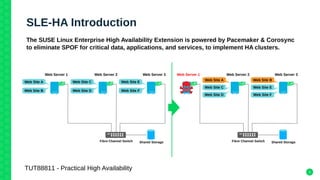
The SUSE Linux Enterprise High Availability Extension is powered by Pacemaker & Corosync
to eliminate SPOF for critical data, applications, and services, to implement HA clusters.
TUT88811 - Practical High Availability
Web Site A
Web Site B
Web Server 1
Web Site C
Web Site D
Web Site E
Web Site F
Web Server 2 Web Server 3
Shared StorageFibre Channel Switch
Web Site A Web Site B
Web Server 1
Web Site C
Web Site D
Web Site E
Web Site F
Web Server 2 Web Server 3
Shared StorageFibre Channel Switch
3
Storage
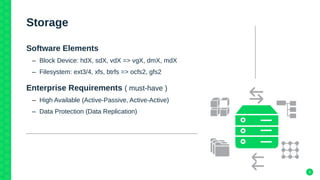
Software Elements
– Block Device: hdX, sdX, vdX => vgX, dmX, mdX
– Filesystem: ext3/4, xfs, btrfs => ocfs2, gfs2
Enterprise Requirements ( must-have )
– High Available (Active-Passive, Active-Active)
– Data Protection (Data Replication)
4
Small Business
5
High Availability Block Device
- active/passive
6
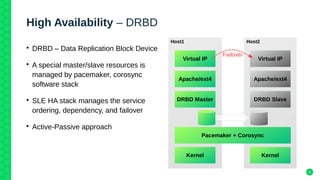
High Availability – DRBD
• DRBD – Data Replication Block Device
• A special master/slave resources is
managed by pacemaker, corosync
software stack
• SLE HA stack manages the service
ordering, dependency, and failover
• Active-Passive approach
Host1 Host2
Virtual IP
Apache/ext4
DRBD Master
Kernel
Virtual IP
Apache/ext4
DRBD Slave
Pacemaker + Corosync
Kernel
Failover
7
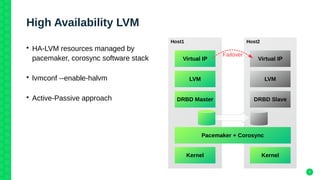
High Availability LVM
• HA-LVM resources managed by
pacemaker, corosync software stack
• lvmconf --enable-halvm
• Active-Passive approach
Host1 Host2
Virtual IP
LVM
DRBD Master
Kernel
Virtual IP
LVM
DRBD Slave
Pacemaker + Corosync
Kernel
Failover
8
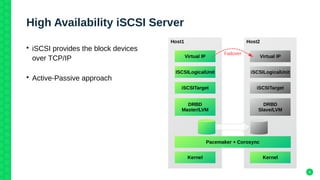
High Availability iSCSI Server
• iSCSI provides the block devices
over TCP/IP
• Active-Passive approach
Host1 Host2
Virtual IP
ISCSILogicalUnit
iSCSITarget
Kernel
Virtual IP
iSCSILogicalUnit
iSCSITarget
Pacemaker + Corosync
Kernel
Failover
DRBD
Master/LVM
DRBD
Slave/LVM
9
High Availability Filesystem
10
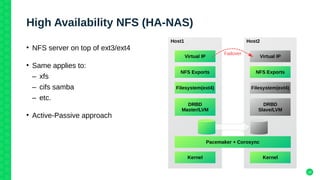
High Availability NFS (HA-NAS)
• NFS server on top of ext3/ext4
• Same applies to:
– xfs
– cifs samba
– etc.
• Active-Passive approach
Host1 Host2
Virtual IP
NFS Exports
Filesystem(ext4)
Kernel
Virtual IP
NFS Exports
Filesystem(ext4)
Pacemaker + Corosync
Kernel
Failover
DRBD
Master/LVM
DRBD
Slave/LVM
11
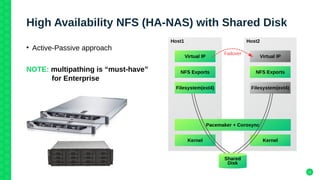
High Availability NFS (HA-NAS) with Shared Disk
• Active-Passive approach
NOTE: multipathing is “must-have”
for Enterprise
Host1 Host2
Virtual IP
NFS Exports
Kernel
Virtual IP
NFS Exports
Pacemaker + Corosync
Kernel
Failover
Shared
Disk
Filesystem(ext4) Filesystem(ext4)
12
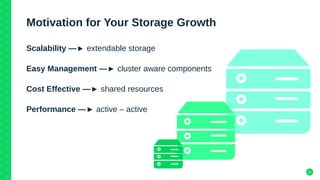
Motivation for Your Storage Growth
Scalability —► extendable storage
Easy Management —► cluster aware components
Cost Effective —► shared resources
Performance —► active – active
13
Concurrent Sharing – you need a lock
14
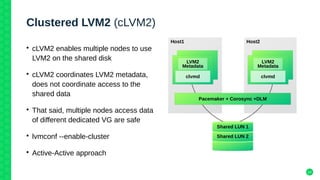
Clustered LVM2 (cLVM2)
• cLVM2 enables multiple nodes to use
LVM2 on the shared disk
• cLVM2 coordinates LVM2 metadata,
does not coordinate access to the
shared data
• That said, multiple nodes access data
of different dedicated VG are safe
• lvmconf --enable-cluster
• Active-Active approach
Host1 Host2
Pacemaker + Corosync +DLM
LVM2
Metadata
clvmd
Shared LUN 2
Shared LUN 1
LVM2
Metadata
clvmd
15
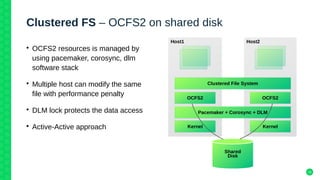
Clustered FS – OCFS2 on shared disk
• OCFS2 resources is managed by
using pacemaker, corosync, dlm
software stack
• Multiple host can modify the same
file with performance penalty
• DLM lock protects the data access
• Active-Active approach
Host1 Host2
Clustered File System
Kernel
Pacemaker + Corosync + DLM
Kernel
OCFS2 OCFS2
Shared
Disk
16
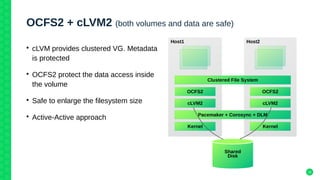
OCFS2 + cLVM2 (both volumes and data are safe)
• cLVM provides clustered VG. Metadata
is protected
• OCFS2 protect the data access inside
the volume
• Safe to enlarge the filesystem size
• Active-Active approach
Host1 Host2
Clustered File System
Kernel
Pacemaker + Corosync + DLM
Kernel
cLVM2 cLVM2
Shared
Disk
OCFS2 OCFS2
17
Is Data Safe Enough?
18
Data Replication
Data Replication in general
– File Replication (Not the focus of this talk.)
– Block Level Replication
• A great new feature “Clustered MD RAID 1” now is available in in SLE12 HA SP2
– Object Storage Replication
• TUT89016 - SUSE Enterprise Storage: Disaster Recovery with Block Mirroring
Requirements in HA context
– Multiple nodes
– Active-active
19
Data Replication – DRBD
DRBD can be thought as a networked RAID1.
DRBD allows you to create a mirror of two block devices that
are located at two different sites across the network.
It mirrors data in real-time, so its replication occurs
continuously, and works well for long distance replication.
SLE 12 HA SP2 now supports DRBD 9.
20
Data Replication – clvm/cmirrord
● There are different types of LV in CLVM: Snapshot, Striped and
Mirrored etc.
● CLVM has been extended from LVM to support transparent
management of volume groups across the whole cluster.
● For CLVM, we can also created mirrored lv to achieve data
replication, and cmirrord is used to tracks mirror log info
in a cluster.
21
Data Replication – clustered md/raid1
The cluster multi-device (Cluster MD) is a software based RAID
storage solution for a cluster.
The biggest motivation for Cluster MD is that CLVM/cmirrord has
severe performance issue and people are not happy about it.
Cluster MD provides the redundancy of RAID1
mirroring to the cluster. SUSE considers to
support other RAID levels with further evaluation.
22
Data Replication – clustered md/raid1 (cont.)
Internals:
– Cluster MD keeps write-intent-bitmap for each cluster node.
– During "normal" I/O access, we assume the clustered filesystem ensures that only one
node writes to any given block at a time.
– With each node have it's own bitmap, there would be no locking
and no need to keep sync array during normal operation.
– Cluster MD would only handle the bitmaps when
resync/recovery etc happened.
23
Data Replication – clustered md/raid1 (cont.)
It coordinates RAID1 metadata, not coordinate access to the
shared data, and it’s performance is close to native RAID1.
CLVM must send a message to user space, that must be
passed to all nodes. Acknowledgments must return to the
originating node, then to the kernel module.
Some related links:
https://lwn.net/Articles/674085/
http://www.spinics.net/lists/raid/msg47863.html
24
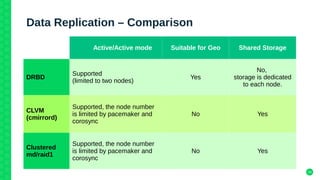
Data Replication – Comparison
Active/Active mode Suitable for Geo Shared Storage
DRBD
Supported
(limited to two nodes)
Yes
No,
storage is dedicated
to each node.
CLVM
(cmirrord)
Supported, the node number
is limited by pacemaker and
corosync
No Yes
Clustered
md/raid1
Supported, the node number
is limited by pacemaker and
corosync
No Yes
25
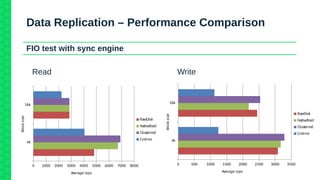
Data Replication – Performance Comparison
FIO test with sync engine
Read Write
4k
16k
0 500 1000 1500 2000 2500 3000 3500
RawDisk
NativeRaid
Clustermd
Cmirror
Average iops
Blocksize
4k
16k
0 1000 2000 3000 4000 5000 6000 7000 8000
RawDisk
NativeRaid
Clustermd
Cmirror
Average iops
Blocksize
26
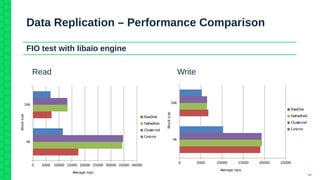
Data Replication – Performance Comparison
FIO test with libaio engine
Read Write
4k
16k
0 5000 10000 15000 20000 25000 30000 35000 40000
RawDisk
NativeRaid
Clustermd
Cmirror
Average iops
Blocksize
4k
16k
0 5000 10000 15000 20000 25000
RawDisk
NativeRaid
Clustermd
Cmirror
Average iopsBlocksize
27
Recap
28
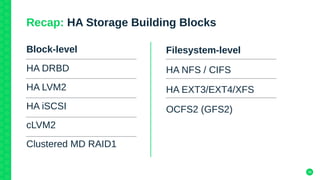
Recap: HA Storage Building Blocks
Block-level
HA DRBD
HA LVM2
HA iSCSI
cLVM2
Clustered MD RAID1
Filesystem-level
HA NFS / CIFS
HA EXT3/EXT4/XFS
OCFS2 (GFS2)
29
Question & Answer
High Availability Storage (susecon2016)

High Availability Storage (susecon2016)

  • 1.
    High Availability Storage SUSE'sBuilding Blocks Roger Zhou Sr. Eng Manager zzhou@suse.com Guoqing Jiang HA Specialist gqjiang@suse.com
  • 2.
    2 SLE-HA Introduction The SUSELinux Enterprise High Availability Extension is powered by Pacemaker & Corosync to eliminate SPOF for critical data, applications, and services, to implement HA clusters. TUT88811 - Practical High Availability Web Site A Web Site B Web Server 1 Web Site C Web Site D Web Site E Web Site F Web Server 2 Web Server 3 Shared StorageFibre Channel Switch Web Site A Web Site B Web Server 1 Web Site C Web Site D Web Site E Web Site F Web Server 2 Web Server 3 Shared StorageFibre Channel Switch
  • 3.
    3 Storage Software Elements – BlockDevice: hdX, sdX, vdX => vgX, dmX, mdX – Filesystem: ext3/4, xfs, btrfs => ocfs2, gfs2 Enterprise Requirements ( must-have ) – High Available (Active-Passive, Active-Active) – Data Protection (Data Replication)
  • 4.
  • 5.
    5 High Availability BlockDevice - active/passive
  • 6.
    6 High Availability –DRBD • DRBD – Data Replication Block Device • A special master/slave resources is managed by pacemaker, corosync software stack • SLE HA stack manages the service ordering, dependency, and failover • Active-Passive approach Host1 Host2 Virtual IP Apache/ext4 DRBD Master Kernel Virtual IP Apache/ext4 DRBD Slave Pacemaker + Corosync Kernel Failover
  • 7.
    7 High Availability LVM •HA-LVM resources managed by pacemaker, corosync software stack • lvmconf --enable-halvm • Active-Passive approach Host1 Host2 Virtual IP LVM DRBD Master Kernel Virtual IP LVM DRBD Slave Pacemaker + Corosync Kernel Failover
  • 8.
    8 High Availability iSCSIServer • iSCSI provides the block devices over TCP/IP • Active-Passive approach Host1 Host2 Virtual IP ISCSILogicalUnit iSCSITarget Kernel Virtual IP iSCSILogicalUnit iSCSITarget Pacemaker + Corosync Kernel Failover DRBD Master/LVM DRBD Slave/LVM
  • 9.
  • 10.
    10 High Availability NFS(HA-NAS) • NFS server on top of ext3/ext4 • Same applies to: – xfs – cifs samba – etc. • Active-Passive approach Host1 Host2 Virtual IP NFS Exports Filesystem(ext4) Kernel Virtual IP NFS Exports Filesystem(ext4) Pacemaker + Corosync Kernel Failover DRBD Master/LVM DRBD Slave/LVM
  • 11.
    11 High Availability NFS(HA-NAS) with Shared Disk • Active-Passive approach NOTE: multipathing is “must-have” for Enterprise Host1 Host2 Virtual IP NFS Exports Kernel Virtual IP NFS Exports Pacemaker + Corosync Kernel Failover Shared Disk Filesystem(ext4) Filesystem(ext4)
  • 12.
    12 Motivation for YourStorage Growth Scalability —► extendable storage Easy Management —► cluster aware components Cost Effective —► shared resources Performance —► active – active
  • 13.
  • 14.
    14 Clustered LVM2 (cLVM2) •cLVM2 enables multiple nodes to use LVM2 on the shared disk • cLVM2 coordinates LVM2 metadata, does not coordinate access to the shared data • That said, multiple nodes access data of different dedicated VG are safe • lvmconf --enable-cluster • Active-Active approach Host1 Host2 Pacemaker + Corosync +DLM LVM2 Metadata clvmd Shared LUN 2 Shared LUN 1 LVM2 Metadata clvmd
  • 15.
    15 Clustered FS –OCFS2 on shared disk • OCFS2 resources is managed by using pacemaker, corosync, dlm software stack • Multiple host can modify the same file with performance penalty • DLM lock protects the data access • Active-Active approach Host1 Host2 Clustered File System Kernel Pacemaker + Corosync + DLM Kernel OCFS2 OCFS2 Shared Disk
  • 16.
    16 OCFS2 + cLVM2(both volumes and data are safe) • cLVM provides clustered VG. Metadata is protected • OCFS2 protect the data access inside the volume • Safe to enlarge the filesystem size • Active-Active approach Host1 Host2 Clustered File System Kernel Pacemaker + Corosync + DLM Kernel cLVM2 cLVM2 Shared Disk OCFS2 OCFS2
  • 17.
  • 18.
    18 Data Replication Data Replicationin general – File Replication (Not the focus of this talk.) – Block Level Replication • A great new feature “Clustered MD RAID 1” now is available in in SLE12 HA SP2 – Object Storage Replication • TUT89016 - SUSE Enterprise Storage: Disaster Recovery with Block Mirroring Requirements in HA context – Multiple nodes – Active-active
  • 19.
    19 Data Replication –DRBD DRBD can be thought as a networked RAID1. DRBD allows you to create a mirror of two block devices that are located at two different sites across the network. It mirrors data in real-time, so its replication occurs continuously, and works well for long distance replication. SLE 12 HA SP2 now supports DRBD 9.
  • 20.
    20 Data Replication –clvm/cmirrord ● There are different types of LV in CLVM: Snapshot, Striped and Mirrored etc. ● CLVM has been extended from LVM to support transparent management of volume groups across the whole cluster. ● For CLVM, we can also created mirrored lv to achieve data replication, and cmirrord is used to tracks mirror log info in a cluster.
  • 21.
    21 Data Replication –clustered md/raid1 The cluster multi-device (Cluster MD) is a software based RAID storage solution for a cluster. The biggest motivation for Cluster MD is that CLVM/cmirrord has severe performance issue and people are not happy about it. Cluster MD provides the redundancy of RAID1 mirroring to the cluster. SUSE considers to support other RAID levels with further evaluation.
  • 22.
    22 Data Replication –clustered md/raid1 (cont.) Internals: – Cluster MD keeps write-intent-bitmap for each cluster node. – During "normal" I/O access, we assume the clustered filesystem ensures that only one node writes to any given block at a time. – With each node have it's own bitmap, there would be no locking and no need to keep sync array during normal operation. – Cluster MD would only handle the bitmaps when resync/recovery etc happened.
  • 23.
    23 Data Replication –clustered md/raid1 (cont.) It coordinates RAID1 metadata, not coordinate access to the shared data, and it’s performance is close to native RAID1. CLVM must send a message to user space, that must be passed to all nodes. Acknowledgments must return to the originating node, then to the kernel module. Some related links: https://lwn.net/Articles/674085/ http://www.spinics.net/lists/raid/msg47863.html
  • 24.
    24 Data Replication –Comparison Active/Active mode Suitable for Geo Shared Storage DRBD Supported (limited to two nodes) Yes No, storage is dedicated to each node. CLVM (cmirrord) Supported, the node number is limited by pacemaker and corosync No Yes Clustered md/raid1 Supported, the node number is limited by pacemaker and corosync No Yes
  • 25.
    25 Data Replication –Performance Comparison FIO test with sync engine Read Write 4k 16k 0 500 1000 1500 2000 2500 3000 3500 RawDisk NativeRaid Clustermd Cmirror Average iops Blocksize 4k 16k 0 1000 2000 3000 4000 5000 6000 7000 8000 RawDisk NativeRaid Clustermd Cmirror Average iops Blocksize
  • 26.
    26 Data Replication –Performance Comparison FIO test with libaio engine Read Write 4k 16k 0 5000 10000 15000 20000 25000 30000 35000 40000 RawDisk NativeRaid Clustermd Cmirror Average iops Blocksize 4k 16k 0 5000 10000 15000 20000 25000 RawDisk NativeRaid Clustermd Cmirror Average iopsBlocksize
  • 27.
  • 28.
    28 Recap: HA StorageBuilding Blocks Block-level HA DRBD HA LVM2 HA iSCSI cLVM2 Clustered MD RAID1 Filesystem-level HA NFS / CIFS HA EXT3/EXT4/XFS OCFS2 (GFS2)
  • 29.