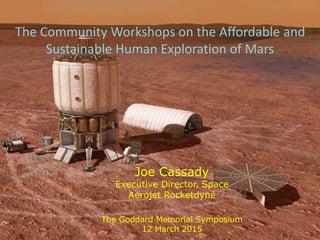
The Community Workshops on the Affordable and
Sustainable Human Exploration of Mars
Joe Cassady
Executive Director, Space
Aerojet Rocketdyne
The Goddard Memorial Symposium
12 March 2015 1
Why Do Mars Plans Gather Dust?
• Sticker shock!!! (dates back to the 1960’s)
• Attempt to extend Earth-dependent
architectures to Mars
• Reliance on technology breakthroughs
• Assumption of reduced launch costs
• Inability to sustain over multi-decade
execution
Why “Affording Mars” Workshops?
• Many critics like to casually cite very large numbers:
“trillion dollar Mars mission”
– US policy has shied away from Mars in part because of the
perception of very high cost
– Multiple independent design studies – albeit preliminary –
support the affordability of initial human missions to Mars
• Significant involvement by broad community of
stakeholders will be critical for successful Mars
exploration
– Significant background reading, planning, and briefings
– Participants intended to be representative of stakeholder
communities
3
“Affording Mars” Workshops (AM I & II)
4
Formal reports available at http://www.exploremars.org/
2013 at the George Washington University
2014 at Caltech
Consensus Architecture Elements from
Scenario and Architecture Group
“Split Mission” Concept Enabled by SLS-class
Heavy Lift, Orion MPCV, Atmospheric
Decelerator, and High-Power SEP
(Graphics: Boeing, Lockheed-Martin, NASA,
Aerojet Rocketdyne)
Priority Consensus Recommendations
For the 2020s: A Habitation Facility “Bridge” Between ISS and the
Capability to Travel to Mars
Deep-space habitation facilities for the 2020s using ISS-based designs and components.
(Courtesy: Lockheed Martin (left image), The Boeing Corporation (right image))
6
Priority Consensus Recommendations
A Heavy Robotic Lander as an EDL Precursor
7
Mars Sample Return as a Heavy Lander to Demonstrate EDL and ISRU Technologies.
(Courtesy: ESA (top left image), NASA and JPL (lower left and right image)
Priority Consensus Recommendations
Closer Collaboration Between Scientists, Engineers, and Architects
8
Scientific discovery will be a major element of human Mars exploration, which
will require active participation by scientists from the start.
(Courtesy: NASA and JPL; H. Thronson)
Priority Consensus Recommendations
Summary Additional Recommendations
9
• Initial human missions to the surface of Mars should include elements
necessary for eventual establishment of sustainable surface outposts broadly
analogous to the initial phases of science-guided Antarctic exploration on
Earth.
• The workshop concluded that a robotic sample return mission may be required
to learn how to protect against forward and backward contamination before
humans land on Mars
• Human missions to Mars orbit or the martian moons may be essential for risk
reduction as immediate precursors to surface missions
• Human operations on the lunar surface, including landing, mobility, power, and
environmental control and life support systems (ECLSS), are not required in
advance of initial human Mars missions
Most Important: Tell The Story
10
11