• Ahad fahid alzabni 201604283
• Shuruq Fahad Alenezi 201605923
• Noura Bandar alshammary 201604107
• Fatimah Fathi Alferyafi 201606106
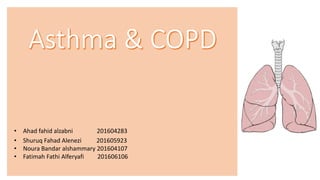
• CHRONIC OBSTRUCTIVE PULMONARY DISEASE (COPD):
is characteristic by insufficient air flow causes by unusual inflammatory response of
the lung to toxic particles or gases. associated with neutrophilic rather than
eosinophilic
inflammation.
• asthma :
caused by inhaled stimuli that lead to evaluation of bronchial response and bronchi
contraction result in brief period of intense
shortness of breath. pathologically eosinophilic inflammation of bronchial mucosa
and enlargement of e airway wall cells secretory glands.
Difference between COPD and asthma:
both experience shortness of breathe because their airways become swollen and filled with mucus,
the difference is asthma attack may be triggered by exposure to allergens while COPD have milder
versions of symptoms even without triggers.
Most people are diagnosed with asthma in childhood, while COPD patients get diagnosis until they
are 40 or older.
there are some drugs that used for both asthma and COPD .
drugs that used are:
1. sympathomimetic agents
2. METHYLXANTHINE DRUGS,
3. ANTIMUSCARINIC AGENTS,
4. CORTICOSTEROIDS
Drugs
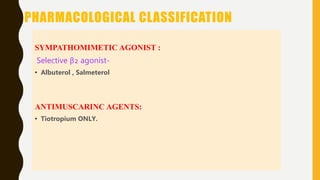
PHARMACOLOGICAL CLASSIFICATION
SYMPATHOMIMETIC AGONIST :
Selective β2 agonist-
• Albuterol , Salmeterol
ANTIMUSCARINC AGENTS:
• Tiotropium ONLY.
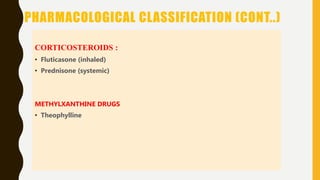
PHARMACOLOGICAL CLASSIFICATION (CONT..)
CORTICOSTEROIDS :
• Fluticasone (inhaled)
• Prednisone (systemic)
METHYLXANTHINE DRUGS
• Theophylline
M E C H A N I S M O F
A C T I O N
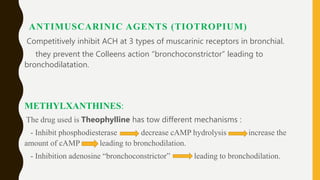
ANTIMUSCARINIC AGENTS (TIOTROPIUM)
Competitively inhibit ACH at 3 types of muscarinic receptors in bronchial.
they prevent the Colleens action ā€œbronchoconstrictorā€ leading to
bronchodilatation.
METHYLXANTHINES:
The drug used is Theophylline has tow different mechanisms :
- Inhibit phosphodiesterase decrease cAMP hydrolysis increase the
amount of cAMP leading to bronchodilation.
- Inhibition adenosine ā€œbronchoconstrictorā€ leading to bronchodilation.
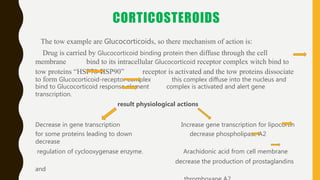
CORTICOSTEROIDS
The tow example are Glucocorticoids, so there mechanism of action is:
Drug is carried by Glucocorticoid binding protein then diffuse through the cell
membrane bind to its intracellular Glucocorticoid receptor complex witch bind to
tow proteins ā€œHSP70-HSP90ā€ receptor is activated and the tow proteins dissociate
to form Glucocorticoid-receptor complex this complex diffuse into the nucleus and
bind to Glucocorticoid response element complex is activated and alert gene
transcription.
result physiological actions
Decrease in gene transcription Increase gene transcription for lipocortin
for some proteins leading to down decrease phospholipase A2
decrease
regulation of cyclooxygenase enzyme. Arachidonic acid from cell membrane
decrease the production of prostaglandins
and
β 2 AGONISTS:
They are bronchodilators ā€œrelaxation of bronchioles smooth muscleā€.
Drug bind to β2 receptor ā€œ7 transmembrane proteins and G protein coupled receptorā€ G
protein undergoes conformational changes GDP with α subunit dissociate to bind α
subunit exchange GDP with GTP and bind to adenylyl cyclase to activate it adenylyl cyclase
produce cAMP from ATP the result is tow physiological actions : 1- inactivate myosin witch
is important for contraction. 2- decrease intracellular Calcium ā€œimportant in activation of MLCK.
- MLCK is enzyme that is important in the mechanism of contraction in muscle.
T H E R A P E U T I C U S E S
BETA AGONISTS
• Albuterol : Asthma, chronic obstructive pulmonary disease (COPD)
- drug of choice in acute asthmatic bronchospasm
• Salmeterol : Asthma prophylaxis
• Epinephrine : Anaphylaxis, asthma, others
rarely used for asthma (β2-selective agents preferred).
• Isoproterenol : Asthma, but β2-selective agents preferred
METHYLXANTHINES :
Asthma, COPD
ANTIMUSCARINIC AGENTS
Antimuscarinic agents are effective bronchodilators. When given
intravenously, atropine, the prototypical muscarinic antagonist, causes
bronchodilation at a lower dose than that needed to cause an increase in
heart rate.
The selectivity of atropine’s effect can be increased further by
administering the drug by inhalation or by use of a more selective
quaternary
ammonium derivative of atropine, ipratropium bromide.
Ipratropium can be delivered in high doses by this route because it is
poorly absorbed into the circulation and does not readily enter the central
nervous system.
CORTICOSTEROIDS
Clinical studies of corticosteroids consistently show them to be
effective in improving all indices of asthma control—severity of
symptoms, tests of airway caliber and bronchial reactivity, frequency
of exacerbations, and quality of life. Because of severe adverse effects when given
chronically, oral and parenteral corticosteroids are reserved for patients who require
urgent treatment, ie, those who have not improved adequately with
bronchodilators
or who experience worsening symptoms despite maintenance therapy. Regular
or ā€œcontrollerā€ therapy is maintained with aerosol corticosteroids.
SIDE EFFECTS
1- SYMPATHOMIMETIC AGENTS ( Beta 2-selective agonist)
The use of sympathomimetic agent by inhalation may cause
• cardiac arrhythmias
• hypoxemia acutely
• Tachyphylaxis
2- METHYLXANTHINE DRUGS
The methylxanthines have effects on the central nervous system, kidney, and cardiac
muscle :
A. Central Nervous System Effects
• nervousness and tremor ( larger doses necessary )
• medullary stimulation and convulsions and may lead to death (Very high doses, from
accidental overdose )
B. Cardiovascular Effects
• slight tachycardia
• increase in cardiac output
• raising blood pressure
C . Effects on Kidney increased glomerular filtration and reduced
tubular sodium reabsorption
3- CORTICOSTEROIDS :
(inhalation )
• Increased risk of infection
• vocal cord changes
( systemic )
• Acute pancreatitis ( high doses )
• osteoporosis
• Emotional disturbances ( depression )
• hypokalemia
•3- ANTIMUSCARINIC AGENTS (TIOTROPIUM) :
- Dry mouth.
- headache.
- pharyngitis.
- upper respiratory infection.
REFERENCES
Side effects : Basic & Clinical Pharmacology and
Pharmacology ( by: Richard A. Harvey).
Therapeutic uses : Basic & Clinical Pharmacology
and Pharmacology ( by: Richard A. Harvey).

Asthma copd

  • 1.
    • Ahad fahidalzabni 201604283 • Shuruq Fahad Alenezi 201605923 • Noura Bandar alshammary 201604107 • Fatimah Fathi Alferyafi 201606106
  • 2.
    • CHRONIC OBSTRUCTIVEPULMONARY DISEASE (COPD): is characteristic by insufficient air flow causes by unusual inflammatory response of the lung to toxic particles or gases. associated with neutrophilic rather than eosinophilic inflammation. • asthma : caused by inhaled stimuli that lead to evaluation of bronchial response and bronchi contraction result in brief period of intense shortness of breath. pathologically eosinophilic inflammation of bronchial mucosa and enlargement of e airway wall cells secretory glands.
  • 3.
    Difference between COPDand asthma: both experience shortness of breathe because their airways become swollen and filled with mucus, the difference is asthma attack may be triggered by exposure to allergens while COPD have milder versions of symptoms even without triggers. Most people are diagnosed with asthma in childhood, while COPD patients get diagnosis until they are 40 or older.
  • 4.
    there are somedrugs that used for both asthma and COPD . drugs that used are: 1. sympathomimetic agents 2. METHYLXANTHINE DRUGS, 3. ANTIMUSCARINIC AGENTS, 4. CORTICOSTEROIDS Drugs
  • 5.
    PHARMACOLOGICAL CLASSIFICATION SYMPATHOMIMETIC AGONIST: Selective β2 agonist- • Albuterol , Salmeterol ANTIMUSCARINC AGENTS: • Tiotropium ONLY.
  • 6.
    PHARMACOLOGICAL CLASSIFICATION (CONT..) CORTICOSTEROIDS: • Fluticasone (inhaled) • Prednisone (systemic) METHYLXANTHINE DRUGS • Theophylline
  • 7.
    M E CH A N I S M O F A C T I O N
  • 8.
    ANTIMUSCARINIC AGENTS (TIOTROPIUM) Competitivelyinhibit ACH at 3 types of muscarinic receptors in bronchial. they prevent the Colleens action ā€œbronchoconstrictorā€ leading to bronchodilatation. METHYLXANTHINES: The drug used is Theophylline has tow different mechanisms : - Inhibit phosphodiesterase decrease cAMP hydrolysis increase the amount of cAMP leading to bronchodilation. - Inhibition adenosine ā€œbronchoconstrictorā€ leading to bronchodilation.
  • 9.
    CORTICOSTEROIDS The tow exampleare Glucocorticoids, so there mechanism of action is: Drug is carried by Glucocorticoid binding protein then diffuse through the cell membrane bind to its intracellular Glucocorticoid receptor complex witch bind to tow proteins ā€œHSP70-HSP90ā€ receptor is activated and the tow proteins dissociate to form Glucocorticoid-receptor complex this complex diffuse into the nucleus and bind to Glucocorticoid response element complex is activated and alert gene transcription. result physiological actions Decrease in gene transcription Increase gene transcription for lipocortin for some proteins leading to down decrease phospholipase A2 decrease regulation of cyclooxygenase enzyme. Arachidonic acid from cell membrane decrease the production of prostaglandins and
  • 10.
    β 2 AGONISTS: Theyare bronchodilators ā€œrelaxation of bronchioles smooth muscleā€. Drug bind to β2 receptor ā€œ7 transmembrane proteins and G protein coupled receptorā€ G protein undergoes conformational changes GDP with α subunit dissociate to bind α subunit exchange GDP with GTP and bind to adenylyl cyclase to activate it adenylyl cyclase produce cAMP from ATP the result is tow physiological actions : 1- inactivate myosin witch is important for contraction. 2- decrease intracellular Calcium ā€œimportant in activation of MLCK. - MLCK is enzyme that is important in the mechanism of contraction in muscle.
  • 11.
    T H ER A P E U T I C U S E S
  • 12.
    BETA AGONISTS • Albuterol: Asthma, chronic obstructive pulmonary disease (COPD) - drug of choice in acute asthmatic bronchospasm • Salmeterol : Asthma prophylaxis • Epinephrine : Anaphylaxis, asthma, others rarely used for asthma (β2-selective agents preferred). • Isoproterenol : Asthma, but β2-selective agents preferred METHYLXANTHINES : Asthma, COPD
  • 13.
    ANTIMUSCARINIC AGENTS Antimuscarinic agentsare effective bronchodilators. When given intravenously, atropine, the prototypical muscarinic antagonist, causes bronchodilation at a lower dose than that needed to cause an increase in heart rate. The selectivity of atropine’s effect can be increased further by administering the drug by inhalation or by use of a more selective quaternary ammonium derivative of atropine, ipratropium bromide. Ipratropium can be delivered in high doses by this route because it is poorly absorbed into the circulation and does not readily enter the central nervous system.
  • 14.
    CORTICOSTEROIDS Clinical studies ofcorticosteroids consistently show them to be effective in improving all indices of asthma control—severity of symptoms, tests of airway caliber and bronchial reactivity, frequency of exacerbations, and quality of life. Because of severe adverse effects when given chronically, oral and parenteral corticosteroids are reserved for patients who require urgent treatment, ie, those who have not improved adequately with bronchodilators or who experience worsening symptoms despite maintenance therapy. Regular or ā€œcontrollerā€ therapy is maintained with aerosol corticosteroids.
  • 15.
  • 16.
    1- SYMPATHOMIMETIC AGENTS( Beta 2-selective agonist) The use of sympathomimetic agent by inhalation may cause • cardiac arrhythmias • hypoxemia acutely • Tachyphylaxis 2- METHYLXANTHINE DRUGS The methylxanthines have effects on the central nervous system, kidney, and cardiac muscle : A. Central Nervous System Effects • nervousness and tremor ( larger doses necessary ) • medullary stimulation and convulsions and may lead to death (Very high doses, from accidental overdose )
  • 17.
    B. Cardiovascular Effects •slight tachycardia • increase in cardiac output • raising blood pressure C . Effects on Kidney increased glomerular filtration and reduced tubular sodium reabsorption 3- CORTICOSTEROIDS : (inhalation ) • Increased risk of infection • vocal cord changes ( systemic ) • Acute pancreatitis ( high doses ) • osteoporosis • Emotional disturbances ( depression ) • hypokalemia
  • 18.
    •3- ANTIMUSCARINIC AGENTS(TIOTROPIUM) : - Dry mouth. - headache. - pharyngitis. - upper respiratory infection.
  • 19.
    REFERENCES Side effects :Basic & Clinical Pharmacology and Pharmacology ( by: Richard A. Harvey). Therapeutic uses : Basic & Clinical Pharmacology and Pharmacology ( by: Richard A. Harvey).