ASSISTIVE 
TECHNOLOGY 
DEVICES AND 
SERVICES 
Keyauna Maddox 
APT 507
Outcome of Presentation… 
 Be able to explain what Assistive Technology is. 
 Understand how Assistive Technology came to be. 
 Be able to identify a variety of Light and High Tech Assistive Technology 
devices. 
 Explain who is responsible for the funding of Assistive Technology. 
 Understand how ethical practices relate to Assistive Technology. 
 Explain how Assistive Technology should be used to benefit 
students with disabilities.
What is Assistive Technology? 
Any item or piece of equipment or product system acquired 
commercially; off the shelf, modified, or customized, and used to 
increase, maintain, or improve functional capability for an individual 
with disabilities. 
Technology-Related Assistance for Individuals with Disabilities Act of 1988 (Public Law 100-447)
How did Assistive Technology Evolve? 
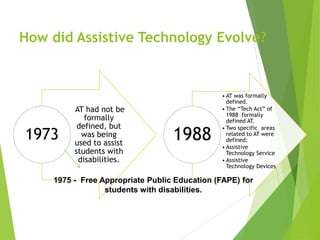
AT had not be 
formally 
defined, but 
was being 
used to assist 
students with 
disabilities. 
1973 
• AT was formally 
defined. 
• The “Tech Act” of 
1988 formally 
defined AT. 
• Two specific areas 
related to AT were 
defined: 
• Assistive 
Technology Service 
• Assistive 
Technology Devices 
1988 
1975 - Free Appropriate Public Education (FAPE) for 
students with disabilities.
Continued… 
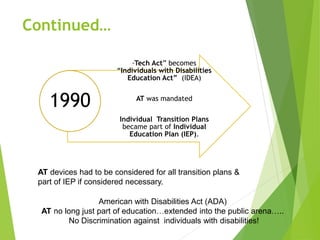
“Tech Act” becomes 
“Individuals with Disabilities 
Education Act” (IDEA) 
AT was mandated 
Individual Transition Plans 
became part of Individual 
Education Plan (IEP). 
1990 
AT devices had to be considered for all transition plans & 
part of IEP if considered necessary. 
American with Disabilities Act (ADA) 
AT no long just part of education…extended into the public arena….. 
No Discrimination against individuals with disabilities!
Continued… 
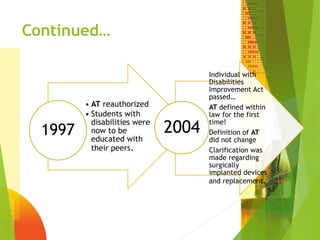
• AT reauthorized 
• Students with 
disabilities were 
now to be 
educated with 
their peers. 
1997 
Individual with 
Disabilities 
Improvement Act 
passed… 
AT defined within 
law for the first 
time! 
Definition of AT 
did not change 
Clarification was 
made regarding 
surgically 
implanted devices 
and replacement. 
2004
What is the purpose of the Assistive 
Technology Continuum? 
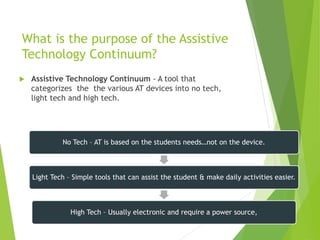
 Assistive Technology Continuum - A tool that 
categorizes the the various AT devices into no tech, 
light tech and high tech. 
No Tech – AT is based on the students needs…not on the device. 
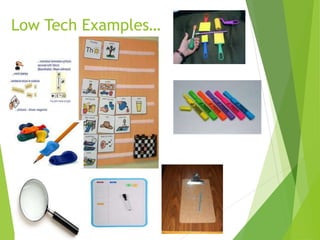
Light Tech – Simple tools that can assist the student & make daily activities easier. 
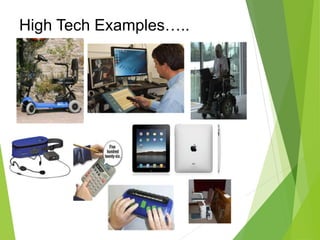
High Tech – Usually electronic and require a power source,
Low Tech Examples…
High Tech Examples…..
Funding - Who’s 
Responsible? 
School District Level – Responsible for any AT devices or 
services that appears in students IEP. 
Medicare, Medicaid and Private Insurance (Focus of AT is 
more for medical need) – Assist in paying for AT services. 
Other Options: 
1. Special needs libraries 
2. Lending libraries 
3. Disability Organizations 
4. Churches, Service Clubs, Local Business & Vendors 
5. Family & Friends
What role does Ethics play in AT? 
Ethics – Standard of conduct directly related to the profession in which you 
practice. 
Rehabilitation Engineering & Assistive Technology Society of North America 
(RESNA) 
 Professional organization for AT 
 Code of Ethics standards are specific for AT 
Council for Exceptional Children (CEC) 
 Largest international professional organization devoted to individuals with 
disabilities 
 Advocates for appropriate policies 
 Sets professional standards 
 Provide professional development
Ethics continues… 
1. Is the Individual Education Plan (IEP) team doing what is right for 
the student? 
2. Does the IEP team have an understanding of what technology can 
and will do for the student? 
3. Is AT appropriate for this student? 
4. Is the IEP team ensuring that ethical standards of practices are 
being followed. 
5. Are educators being adequately trained (professional 
development) in AT?
How to Incorporate AT? 
IEP Team Must: 
1. Identify how student will access the general education curriculum 
2. Identify learning goals for student 
3. Determine what accommodations and modifications student will needed 
to meet their specific goals. 
4. AT services or devices must be considered as part of students IEP plan. 
5. ALL parties involved MUST regard privacy issues!
FUNDING 
Local Sources 
 For small monetary requests (under approximately 
$2500) 
• Service Organizations 
• Local Businesses 
• Community Foundations 
Large Foundations 
 Additional funding for larger requests (Typically over 
$5000) 
• Private Foundations 
• Corporate Foundations 
• Visit MATRs website for more resources 
 http://www.cenmi.org/matr
OUTSIDE FUNDING 
Service Organizations 
 Many local service organizations may provide money to help 
someone in their community. You can get a list of these 
organizations from your local Chamber of Commerce. Some 
examples of these organizations would be: Rotary Club, 
Kiwanis, Lions Club, JayCees, Business and Professional 
Women’s Association. 
Community Foundations 
 A Community Foundation is much like a private foundation; 
its funds, however, are derived from many donors rather than 
a single source. They handle bequests from those who do 
not wish to establish an individual private foundation, 
donations from corporations within the area, and donations 
from small givers. They are usually established for a specific 
geographic area. 
Private Foundations 
 These are non-profit organizations with an endowment 
usually donated from a single source, such as an individual 
or family. The private foundation is usually established from 
personal wealth. Examples of a private foundation would 
include Rockefeller Foundation, William H. and Grace A Dow 
Foundation, and Knight Family Charitable and Educational 
Foundation. 

OUTSIDE FUNDING CON’T 
Corporate Foundation 
 Created by a corporation; a way for the corporation to 
return some of its profits to the community. Corporations 
have widely varying corporate philanthropy programs and 
can be a great source of funding for educational purposes. 
Some examples of a corporate foundation might be AT & T, 
Barnes & Noble, Kmart Corporation Contributions 
Program. 
 There may be a private foundation and a corporate 
foundation of the same name. Do not confuse foundations 
with similar names. Even though their origins may be 
similar, their purposes may be very different. Example: 
William H and Grace A. Dow Foundation (private 
foundation) and Dow Chemical Company Foundation 
(corporate foundation)
OUTSIDE FUNDING CON’T 
Local Businesses 
 Do not overlook smaller companies and 
independently owned businesses in your area. While 
individual companies or businesses may not be able 
to fund a grant idea on their own, several could 
contribute to fund a project. Even some larger 
corporations tend to “give where they live”. 

IDEA 
It is important to remember that IDEA ’97 clearly states 
that it is the school’s responsibility to purchase needed 
AT but IDEA does not prevent you from seeking 
additional funding from outside sources. At no time, can 
the responsibility for funding for devices or services be 
passed on to the student’s family.
Questions or Comments…..
Resources: 
Beard, L., Carpenter, L., Johnston, L. (2011). Assistive Technology: Access for 
All Students. New Jersey: Pearson. 
Assistive Technology Enabling Dreams. (2009). 
http://www.youtube.com/watch?v=zZ5CkpgVQJ4&feature=relatedg 
Examples of Low Tech Assistive Technology. 
www.k12.wa.us/pubdocs/LowTechAssistiveTechnology.pdf 
Assistive Technology: Type of High Tech Assistive Technology. 
www.ist.hawaii.edu/training/tech/07_types2.php

Assistive Technology Devices and Services

  • 1.
    ASSISTIVE TECHNOLOGY DEVICESAND SERVICES Keyauna Maddox APT 507
  • 2.
    Outcome of Presentation…  Be able to explain what Assistive Technology is.  Understand how Assistive Technology came to be.  Be able to identify a variety of Light and High Tech Assistive Technology devices.  Explain who is responsible for the funding of Assistive Technology.  Understand how ethical practices relate to Assistive Technology.  Explain how Assistive Technology should be used to benefit students with disabilities.
  • 3.
    What is AssistiveTechnology? Any item or piece of equipment or product system acquired commercially; off the shelf, modified, or customized, and used to increase, maintain, or improve functional capability for an individual with disabilities. Technology-Related Assistance for Individuals with Disabilities Act of 1988 (Public Law 100-447)
  • 4.
    How did AssistiveTechnology Evolve? AT had not be formally defined, but was being used to assist students with disabilities. 1973 • AT was formally defined. • The “Tech Act” of 1988 formally defined AT. • Two specific areas related to AT were defined: • Assistive Technology Service • Assistive Technology Devices 1988 1975 - Free Appropriate Public Education (FAPE) for students with disabilities.
  • 5.
    Continued… “Tech Act”becomes “Individuals with Disabilities Education Act” (IDEA) AT was mandated Individual Transition Plans became part of Individual Education Plan (IEP). 1990 AT devices had to be considered for all transition plans & part of IEP if considered necessary. American with Disabilities Act (ADA) AT no long just part of education…extended into the public arena….. No Discrimination against individuals with disabilities!
  • 6.
    Continued… • ATreauthorized • Students with disabilities were now to be educated with their peers. 1997 Individual with Disabilities Improvement Act passed… AT defined within law for the first time! Definition of AT did not change Clarification was made regarding surgically implanted devices and replacement. 2004
  • 7.
    What is thepurpose of the Assistive Technology Continuum?  Assistive Technology Continuum - A tool that categorizes the the various AT devices into no tech, light tech and high tech. No Tech – AT is based on the students needs…not on the device. Light Tech – Simple tools that can assist the student & make daily activities easier. High Tech – Usually electronic and require a power source,
  • 8.
  • 9.
  • 10.
    Funding - Who’s Responsible? School District Level – Responsible for any AT devices or services that appears in students IEP. Medicare, Medicaid and Private Insurance (Focus of AT is more for medical need) – Assist in paying for AT services. Other Options: 1. Special needs libraries 2. Lending libraries 3. Disability Organizations 4. Churches, Service Clubs, Local Business & Vendors 5. Family & Friends
  • 11.
    What role doesEthics play in AT? Ethics – Standard of conduct directly related to the profession in which you practice. Rehabilitation Engineering & Assistive Technology Society of North America (RESNA)  Professional organization for AT  Code of Ethics standards are specific for AT Council for Exceptional Children (CEC)  Largest international professional organization devoted to individuals with disabilities  Advocates for appropriate policies  Sets professional standards  Provide professional development
  • 12.
    Ethics continues… 1.Is the Individual Education Plan (IEP) team doing what is right for the student? 2. Does the IEP team have an understanding of what technology can and will do for the student? 3. Is AT appropriate for this student? 4. Is the IEP team ensuring that ethical standards of practices are being followed. 5. Are educators being adequately trained (professional development) in AT?
  • 13.
    How to IncorporateAT? IEP Team Must: 1. Identify how student will access the general education curriculum 2. Identify learning goals for student 3. Determine what accommodations and modifications student will needed to meet their specific goals. 4. AT services or devices must be considered as part of students IEP plan. 5. ALL parties involved MUST regard privacy issues!
  • 14.
    FUNDING Local Sources  For small monetary requests (under approximately $2500) • Service Organizations • Local Businesses • Community Foundations Large Foundations  Additional funding for larger requests (Typically over $5000) • Private Foundations • Corporate Foundations • Visit MATRs website for more resources  http://www.cenmi.org/matr
  • 15.
    OUTSIDE FUNDING ServiceOrganizations  Many local service organizations may provide money to help someone in their community. You can get a list of these organizations from your local Chamber of Commerce. Some examples of these organizations would be: Rotary Club, Kiwanis, Lions Club, JayCees, Business and Professional Women’s Association. Community Foundations  A Community Foundation is much like a private foundation; its funds, however, are derived from many donors rather than a single source. They handle bequests from those who do not wish to establish an individual private foundation, donations from corporations within the area, and donations from small givers. They are usually established for a specific geographic area. Private Foundations  These are non-profit organizations with an endowment usually donated from a single source, such as an individual or family. The private foundation is usually established from personal wealth. Examples of a private foundation would include Rockefeller Foundation, William H. and Grace A Dow Foundation, and Knight Family Charitable and Educational Foundation. 
  • 16.
    OUTSIDE FUNDING CON’T Corporate Foundation  Created by a corporation; a way for the corporation to return some of its profits to the community. Corporations have widely varying corporate philanthropy programs and can be a great source of funding for educational purposes. Some examples of a corporate foundation might be AT & T, Barnes & Noble, Kmart Corporation Contributions Program.  There may be a private foundation and a corporate foundation of the same name. Do not confuse foundations with similar names. Even though their origins may be similar, their purposes may be very different. Example: William H and Grace A. Dow Foundation (private foundation) and Dow Chemical Company Foundation (corporate foundation)
  • 17.
    OUTSIDE FUNDING CON’T Local Businesses  Do not overlook smaller companies and independently owned businesses in your area. While individual companies or businesses may not be able to fund a grant idea on their own, several could contribute to fund a project. Even some larger corporations tend to “give where they live”. 
  • 18.
    IDEA It isimportant to remember that IDEA ’97 clearly states that it is the school’s responsibility to purchase needed AT but IDEA does not prevent you from seeking additional funding from outside sources. At no time, can the responsibility for funding for devices or services be passed on to the student’s family.
  • 19.
  • 20.
    Resources: Beard, L.,Carpenter, L., Johnston, L. (2011). Assistive Technology: Access for All Students. New Jersey: Pearson. Assistive Technology Enabling Dreams. (2009). http://www.youtube.com/watch?v=zZ5CkpgVQJ4&feature=relatedg Examples of Low Tech Assistive Technology. www.k12.wa.us/pubdocs/LowTechAssistiveTechnology.pdf Assistive Technology: Type of High Tech Assistive Technology. www.ist.hawaii.edu/training/tech/07_types2.php