Prepared by Hina Sunbal
Submitted to Sir Mansoor Qayyum
1) Who are pagans
2) Trait of pagans
3) Brief history
4) What do pagans
believe in?
5) The way of worshiping
6) Basic Principles of
Pagans
7) Types of pagans
8) Festivals
9) Symbols
 The term pagan comes from the Latin “paganus” which
refers to those who lived in the country.
 A person who holds believes in a religion other than
Christianity, Judaism, Hinduism, Islam, and Buddhism.
 Others simply define it as being without a religion
because they do not have official doctrine Pagans do
not believe in traditional religions.
 he more common meaning of classical Latin pāgānus is
"civilian, non-militant". Christians called themselves
mīlitēs, "enrolled soldiers" of Christ, members of his
militant church, and applied to non-Christians the term
applied by soldiers to all who were "not enrolled in the
army."
 The word or term pagan came from old classic Latin
“paganus” which have different meanings:
 People who lives in the country also called country
dweller and civilians
 People who believe in “the old ways”
 People who do not believe in one God
 People who are not part of the Christianity, Judaism,
Hinduism, Islam, and Buddhism
 People who believe in multiple god and goddess
 People who deeply respects nature
 People who believes in natural powers
 People who do not have traditional religion
 Paganus acquired its religious connotations by the mid-4th
century. As early as the 5th century, the word pagan was
metaphorically used to denote persons outside the bounds of
the Christian community. The period of Renaissance 1500s.
 1600s, put a temporary halt to Pagan thinking.
 their focus on Paganism, were accepted again during the
Enlightenment of the 1700s.
 Paganism experienced another rise in the 1800s and 1900s
when modern forms of Buddhism and Hinduism were growing
in popularity.
 20th century is considered the golden age of paganism
because many people attracted toward paganism.
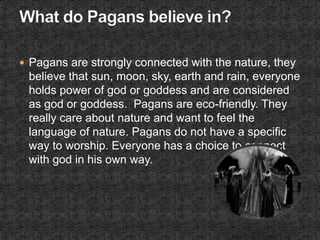
 Pagans are strongly connected with the nature, they
believe that sun, moon, sky, earth and rain, everyone
holds power of god or goddess and are considered
as god or goddess. Pagans are eco-friendly. They
really care about nature and want to feel the
language of nature. Pagans do not have a specific
way to worship. Everyone has a choice to connect
with god in his own way.
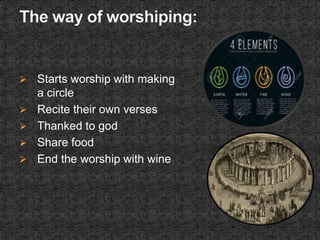
 Starts worship with making
a circle
 Recite their own verses
 Thanked to god
 Share food
 End the worship with wine
 Personal Responsibility for Your Actions and Personal
Development:
 “The development of your personal beliefs, morals and ethics
is your own responsibility .... It is the responsibility of each
individual to learn to recognize what is right from wrong,
regardless of our early environment.”
 Everything is Sacred:
 “Most pagan religions believe that everything in the universe is
sacred. All parts of our universe are considered divine and, as
such, sacred and worthy of our deepest respect.”
 Freedom of Choosing Deity:
 “In all pagan religions, it is up to the individual to determine
what Deity means to them, who or what Deity is right for them
and how they ultimately develop their relationship with their
chosen Deity.
 Paleo-paganism
 Civilo-paganis
 Meso-paganism
 Syncreto-paganism
 Neo-paganism
 Secular Paganism
 Naturalistic
Paganism
 Winter Solstice (Yule)
 Imbolc (Candlemas)
 Spring Equinox (Ostar
a)
 Beltane (May Eve)
 Summer Solstice
(Litha)
 Lughnasadh (Lammas
)
 Autumn Equinox (Mab
on)
 Samhain (Hallowe'en)
 Conclusion:
 Pagans are people who believe in multiple gods. They do not believe
in Islam, Christianity and Judaism. They belong to pre-Christian era
and were inspired by Greece and Roman gods. They are emotionally
connected with nature and have a huge respect for it. Many Pagans
believe in multiple gods but worship only one, usually called the King
of gods.
 Pagans have multiple beliefs but they do not consider each other
superior or inferior based on beliefs. They have existed for a long
time and since there are no boundaries, it has been impacted by its
environment and attracted audience from all over the world.
 They have nine different rituals during which they recite to thank their
own gods. Pagans perform religious duties in open spaces. They do
not assign special buildings for performing religious duties.
 They openly accept and welcome anyone who wants to join their
community. Pagans were believed to worship Satan, an allegation
that they have strictly denied

Assignments on pagans

  • 1.
    Prepared by HinaSunbal Submitted to Sir Mansoor Qayyum
  • 2.
    1) Who arepagans 2) Trait of pagans 3) Brief history 4) What do pagans believe in? 5) The way of worshiping 6) Basic Principles of Pagans 7) Types of pagans 8) Festivals 9) Symbols
  • 3.
     The termpagan comes from the Latin “paganus” which refers to those who lived in the country.  A person who holds believes in a religion other than Christianity, Judaism, Hinduism, Islam, and Buddhism.  Others simply define it as being without a religion because they do not have official doctrine Pagans do not believe in traditional religions.  he more common meaning of classical Latin pāgānus is "civilian, non-militant". Christians called themselves mīlitēs, "enrolled soldiers" of Christ, members of his militant church, and applied to non-Christians the term applied by soldiers to all who were "not enrolled in the army."
  • 4.
     The wordor term pagan came from old classic Latin “paganus” which have different meanings:  People who lives in the country also called country dweller and civilians  People who believe in “the old ways”  People who do not believe in one God  People who are not part of the Christianity, Judaism, Hinduism, Islam, and Buddhism  People who believe in multiple god and goddess  People who deeply respects nature  People who believes in natural powers  People who do not have traditional religion
  • 5.
     Paganus acquiredits religious connotations by the mid-4th century. As early as the 5th century, the word pagan was metaphorically used to denote persons outside the bounds of the Christian community. The period of Renaissance 1500s.  1600s, put a temporary halt to Pagan thinking.  their focus on Paganism, were accepted again during the Enlightenment of the 1700s.  Paganism experienced another rise in the 1800s and 1900s when modern forms of Buddhism and Hinduism were growing in popularity.  20th century is considered the golden age of paganism because many people attracted toward paganism.
  • 6.
     Pagans arestrongly connected with the nature, they believe that sun, moon, sky, earth and rain, everyone holds power of god or goddess and are considered as god or goddess. Pagans are eco-friendly. They really care about nature and want to feel the language of nature. Pagans do not have a specific way to worship. Everyone has a choice to connect with god in his own way.
  • 7.
     Starts worshipwith making a circle  Recite their own verses  Thanked to god  Share food  End the worship with wine
  • 8.
     Personal Responsibilityfor Your Actions and Personal Development:  “The development of your personal beliefs, morals and ethics is your own responsibility .... It is the responsibility of each individual to learn to recognize what is right from wrong, regardless of our early environment.”  Everything is Sacred:  “Most pagan religions believe that everything in the universe is sacred. All parts of our universe are considered divine and, as such, sacred and worthy of our deepest respect.”  Freedom of Choosing Deity:  “In all pagan religions, it is up to the individual to determine what Deity means to them, who or what Deity is right for them and how they ultimately develop their relationship with their chosen Deity.
  • 9.
     Paleo-paganism  Civilo-paganis Meso-paganism  Syncreto-paganism  Neo-paganism  Secular Paganism  Naturalistic Paganism
  • 10.
     Winter Solstice(Yule)  Imbolc (Candlemas)  Spring Equinox (Ostar a)  Beltane (May Eve)  Summer Solstice (Litha)  Lughnasadh (Lammas )  Autumn Equinox (Mab on)  Samhain (Hallowe'en)
  • 12.
     Conclusion:  Pagansare people who believe in multiple gods. They do not believe in Islam, Christianity and Judaism. They belong to pre-Christian era and were inspired by Greece and Roman gods. They are emotionally connected with nature and have a huge respect for it. Many Pagans believe in multiple gods but worship only one, usually called the King of gods.  Pagans have multiple beliefs but they do not consider each other superior or inferior based on beliefs. They have existed for a long time and since there are no boundaries, it has been impacted by its environment and attracted audience from all over the world.  They have nine different rituals during which they recite to thank their own gods. Pagans perform religious duties in open spaces. They do not assign special buildings for performing religious duties.  They openly accept and welcome anyone who wants to join their community. Pagans were believed to worship Satan, an allegation that they have strictly denied