Spiritual self
Learning Objective
At the end of this lesson, you should be able to:
1. Identify various religious practices and beliefs;
2. understand the self in relation with religious
beliefs, and
3. explain ways of finding the meaning of life.
Introduction
*The ability to use moral sensibility and
conscience may be seen through the
expressions of religion, its beliefs and
practices. In the same manner, cultural rituals
and ceremonies are some manifestations
what people believe in.
GUESS THE
RELIGION
Guess the religion
SHARE
SOMETHING
ABOUT IT…
Guess the religion
SHARE
SOMETHING
ABOUT IT…
Guess the religion
SHARE
SOMETHING
ABOUT IT…
Guess the religion
SHARE
SOMETHING
ABOUT IT…
ABSTRACTION
Religion
• Rebecca Stein (Stein 2011) define religion "as
a set of cultural beliefs and practices that
usually includes some or all of basic
characteristics.
CHARACTERISTICS OF RELIGION
A belief in
anthropomorphic
supernatural
being, such as
spirit and gods.
A focus on the
sacred
supernatural,
where sacred
refers to a feeling
of reverence and
awe.
1. 2.
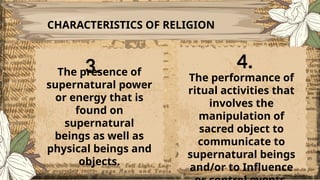
CHARACTERISTICS OF RELIGION
The presence of
supernatural power
or energy that is
found on
supernatural
beings as well as
physical beings and
objects.
The performance of
ritual activities that
involves the
manipulation of
sacred object to
communicate to
supernatural beings
and/or to Influence
3. 4.
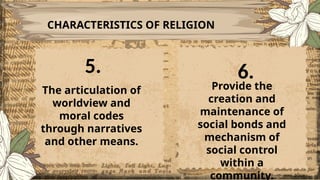
CHARACTERISTICS OF RELIGION
The articulation of
worldview and
moral codes
through narratives
and other means.
Provide the
creation and
maintenance of
social bonds and
mechanism of
social control
within a
community.
5. 6.
QUESTION
• When was the first time you realized that
there is a higher being than yourself?
Different religions with
different beliefs and
practices
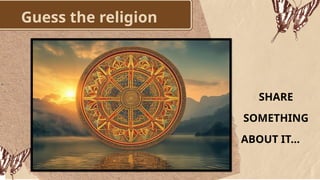
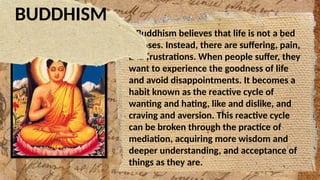
• Buddhism believes that life is not a bed
of roses. Instead, there are suffering, pain,
and frustrations. When people suffer, they
want to experience the goodness of life
and avoid disappointments. It becomes a
habit known as the reactive cycle of
wanting and hating, like and dislike, and
craving and aversion. This reactive cycle
can be broken through the practice of
mediation, acquiring more wisdom and
deeper understanding, and acceptance of
things as they are.
BUDDHISM
CHRISTIANITY
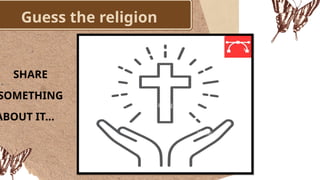
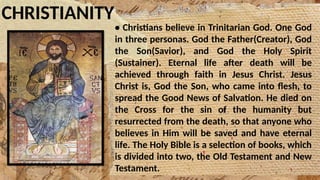
• Christians believe in Trinitarian God. One God
in three personas. God the Father(Creator), God
the Son(Savior), and God the Holy Spirit
(Sustainer). Eternal life after death will be
achieved through faith in Jesus Christ. Jesus
Christ is, God the Son, who came into flesh, to
spread the Good News of Salvation. He died on
the Cross for the sin of the humanity but
resurrected from the death, so that anyone who
believes in Him will be saved and have eternal
life. The Holy Bible is a selection of books, which
is divided into two, the Old Testament and New
Testament.
CHRISTIANITY
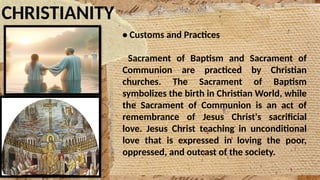
• Customs and Practices
Sacrament of Baptism and Sacrament of
Communion are practiced by Christian
churches. The Sacrament of Baptism
symbolizes the birth in Christian World, while
the Sacrament of Communion is an act of
remembrance of Jesus Christ's sacrificial
love. Jesus Christ teaching in unconditional
love that is expressed in loving the poor,
oppressed, and outcast of the society.
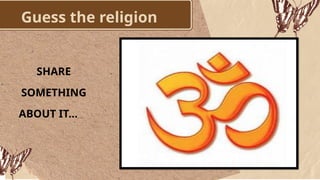
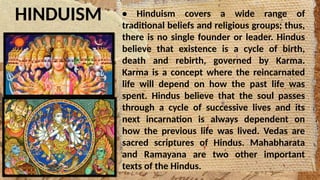
HINDUISM • Hinduism covers a wide range of
traditional beliefs and religious groups; thus,
there is no single founder or leader. Hindus
believe that existence is a cycle of birth,
death and rebirth, governed by Karma.
Karma is a concept where the reincarnated
life will depend on how the past life was
spent. Hindus believe that the soul passes
through a cycle of successive lives and its
next incarnation is always dependent on
how the previous life was lived. Vedas are
sacred scriptures of Hindus. Mahabharata
and Ramayana are two other important
texts of the Hindus.
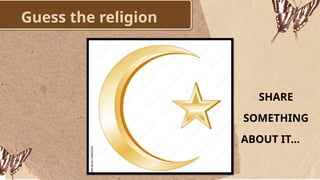
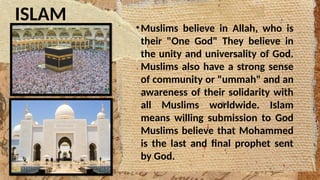
ISLAM
•Muslims believe in Allah, who is
their "One God" They believe in
the unity and universality of God.
Muslims also have a strong sense
of community or "ummah" and an
awareness of their solidarity with
all Muslims worldwide. Islam
means willing submission to God
Muslims believe that Mohammed
is the last and final prophet sent
by God.
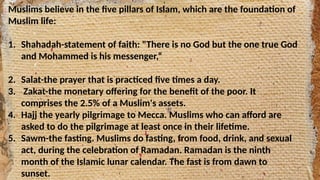
Muslims believe in the five pillars of Islam, which are the foundation of
Muslim life:
1. Shahadah-statement of faith: "There is no God but the one true God
and Mohammed is his messenger,“
2. Salat-the prayer that is practiced five times a day.
3. Zakat-the monetary offering for the benefit of the poor. It
comprises the 2.5% of a Muslim's assets.
4. Hajj the yearly pilgrimage to Mecca. Muslims who can afford are
asked to do the pilgrimage at least once in their lifetime.
5. Sawm-the fasting. Muslims do fasting, from food, drink, and sexual
act, during the celebration of Ramadan. Ramadan is the ninth
month of the Islamic lunar calendar. The fast is from dawn to
sunset.
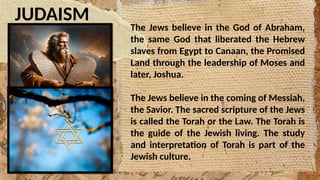
JUDAISM
The Jews believe in the God of Abraham,
the same God that liberated the Hebrew
slaves from Egypt to Canaan, the Promised
Land through the leadership of Moses and
later, Joshua.
The Jews believe in the coming of Messiah,
the Savior. The sacred scripture of the Jews
is called the Torah or the Law. The Torah is
the guide of the Jewish living. The study
and interpretation of Torah is part of the
Jewish culture.
JUDAISM
• Customs and Practices
There are five major festivals observed by the Jews:
1. Rosh Hashanah - the New Year
2. Yom Kippur - the Day of Atonement
3. Pesach- Passover
4. Shavuot- Pentecost
5. Sukkot-Tabernacles. The Jewish Sabbath begins on
Friday evening at sunset and is an important time
when families gather for the Shabbat meal
Spiritual self
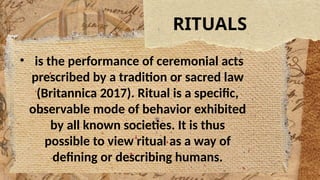
RITUALS
• is the performance of ceremonial acts
prescribed by a tradition or sacred law
(Britannica 2017). Ritual is a specific,
observable mode of behavior exhibited
by all known societies. It is thus
possible to view ritual as a way of
defining or describing humans.
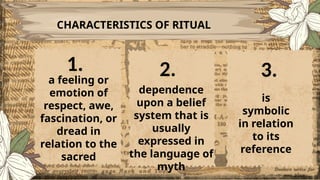
CHARACTERISTICS OF RITUAL
a feeling or
emotion of
respect, awe,
fascination, or
dread in
relation to the
sacred
1. 3.
dependence
upon a belief
system that is
usually
expressed in
the language of
myth
is
symbolic
in relation
to its
reference
2.
FINDING THE
MEANING OF LIFE
FINDING THE
MEANING OF
LIFE
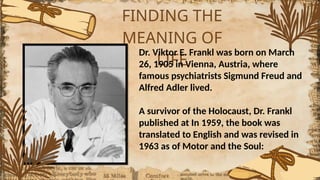
Dr. Viktor E. Frankl was born on March
26, 1905 in Vienna, Austria, where
famous psychiatrists Sigmund Freud and
Alfred Adler lived.
A survivor of the Holocaust, Dr. Frankl
published at In 1959, the book was
translated to English and was revised in
1963 as of Motor and the Soul:
LOGOTHERAPHY
Logotherapy is often referred to as the “third
Viennese school of psychotherapy,” and it originated
in the 1930s as a response to both Freud’s
psychoanalysis and Adler’s emphasis on power
within society. It is more than just “therapy.” It is a
philosophy for the spiritually lost and an education
for those who are confused. It offers support in the
face of suffering and healing for the sick (Guttmann,
2008).
LOGOTHERAPHY
THREE WAYS TO FIND MEANING IN LIFE
1. By Creating a work or doing deeds.
2. By experiencing something or
encountering someone.
3. By the attitude we adopt towards
unavoidable suffering.
LOGOTHERAPHY
Freedom of will asserts that humans are free to decide and can
take a stance toward both internal and external conditions.
Will to meaning states that humans are free to achieve goals and
purposes in life. Frustration, aggression, addiction, depression, and
suicidality arise when individuals cannot realize their “will to
meaning.”
Meaning in life is based on the idea that meaning is an objective
reality rather than merely an illusion or personal perception.
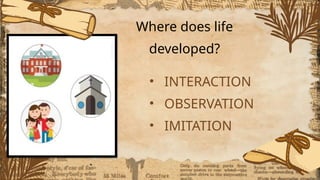
Where does life
developed?
• INTERACTION
• OBSERVATION
• IMITATION
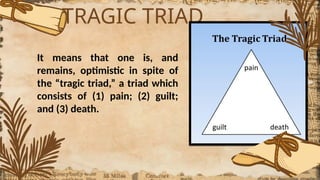
TRAGIC TRIAD
It means that one is, and
remains, optimistic in spite of
the “tragic triad,” a triad which
consists of (1) pain; (2) guilt;
and (3) death.
*
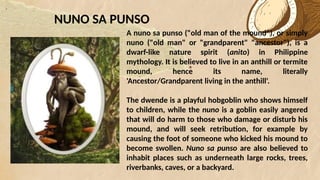
NUNO SA PUNSO
A nuno sa punso ("old man of the mound"), or simply
nuno ("old man" or "grandparent" "ancestor"), is a
dwarf-like nature spirit (anito) in Philippine
mythology. It is believed to live in an anthill or termite
mound, hence its name, literally
'Ancestor/Grandparent living in the anthill'.
The dwende is a playful hobgoblin who shows himself
to children, while the nuno is a goblin easily angered
that will do harm to those who damage or disturb his
mound, and will seek retribution, for example by
causing the foot of someone who kicked his mound to
become swollen. Nuno sa punso are also believed to
inhabit places such as underneath large rocks, trees,
riverbanks, caves, or a backyard.
*
KAPRE
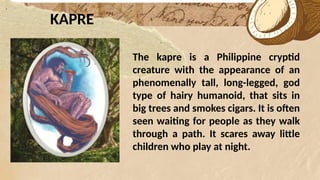
The kapre is a Philippine cryptid
creature with the appearance of an
phenomenally tall, long-legged, god
type of hairy humanoid, that sits in
big trees and smokes cigars. It is often
seen waiting for people as they walk
through a path. It scares away little
children who play at night.
*
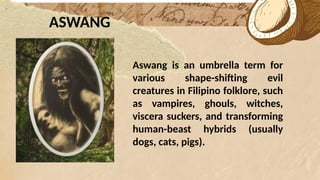
ASWANG
Aswang is an umbrella term for
various shape-shifting evil
creatures in Filipino folklore, such
as vampires, ghouls, witches,
viscera suckers, and transforming
human-beast hybrids (usually
dogs, cats, pigs).
*
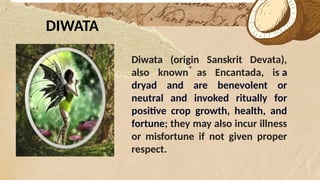
DIWATA
Diwata (origin Sanskrit Devata),
also known as Encantada, is a
dryad and are benevolent or
neutral and invoked ritually for
positive crop growth, health, and
fortune; they may also incur illness
or misfortune if not given proper
respect.
*
BAKUNAWA
Bakunawa is a giant sea dragon from
Bisaya culture, it symbolizes, greed,
avarice. The same word used by the
Bisaya to mean eclipse. The eclipse
is a natural phenomenon, but
according to Bisaya lore, Bakunawa
ate moons out of greed.
Understanding the self ( spiritual self)

Understanding the self ( spiritual self)

  • 1.
  • 2.
    Learning Objective At theend of this lesson, you should be able to: 1. Identify various religious practices and beliefs; 2. understand the self in relation with religious beliefs, and 3. explain ways of finding the meaning of life.
  • 3.
    Introduction *The ability touse moral sensibility and conscience may be seen through the expressions of religion, its beliefs and practices. In the same manner, cultural rituals and ceremonies are some manifestations what people believe in.
  • 6.
  • 7.
  • 8.
  • 9.
  • 10.
  • 11.
    ABSTRACTION Religion • Rebecca Stein(Stein 2011) define religion "as a set of cultural beliefs and practices that usually includes some or all of basic characteristics.
  • 12.
    CHARACTERISTICS OF RELIGION Abelief in anthropomorphic supernatural being, such as spirit and gods. A focus on the sacred supernatural, where sacred refers to a feeling of reverence and awe. 1. 2.
  • 13.
    CHARACTERISTICS OF RELIGION Thepresence of supernatural power or energy that is found on supernatural beings as well as physical beings and objects. The performance of ritual activities that involves the manipulation of sacred object to communicate to supernatural beings and/or to Influence 3. 4.
  • 14.
    CHARACTERISTICS OF RELIGION Thearticulation of worldview and moral codes through narratives and other means. Provide the creation and maintenance of social bonds and mechanism of social control within a community. 5. 6.
  • 15.
    QUESTION • When wasthe first time you realized that there is a higher being than yourself?
  • 16.
  • 17.
    • Buddhism believesthat life is not a bed of roses. Instead, there are suffering, pain, and frustrations. When people suffer, they want to experience the goodness of life and avoid disappointments. It becomes a habit known as the reactive cycle of wanting and hating, like and dislike, and craving and aversion. This reactive cycle can be broken through the practice of mediation, acquiring more wisdom and deeper understanding, and acceptance of things as they are. BUDDHISM
  • 18.
    CHRISTIANITY • Christians believein Trinitarian God. One God in three personas. God the Father(Creator), God the Son(Savior), and God the Holy Spirit (Sustainer). Eternal life after death will be achieved through faith in Jesus Christ. Jesus Christ is, God the Son, who came into flesh, to spread the Good News of Salvation. He died on the Cross for the sin of the humanity but resurrected from the death, so that anyone who believes in Him will be saved and have eternal life. The Holy Bible is a selection of books, which is divided into two, the Old Testament and New Testament.
  • 19.
    CHRISTIANITY • Customs andPractices Sacrament of Baptism and Sacrament of Communion are practiced by Christian churches. The Sacrament of Baptism symbolizes the birth in Christian World, while the Sacrament of Communion is an act of remembrance of Jesus Christ's sacrificial love. Jesus Christ teaching in unconditional love that is expressed in loving the poor, oppressed, and outcast of the society.
  • 20.
    HINDUISM • Hinduismcovers a wide range of traditional beliefs and religious groups; thus, there is no single founder or leader. Hindus believe that existence is a cycle of birth, death and rebirth, governed by Karma. Karma is a concept where the reincarnated life will depend on how the past life was spent. Hindus believe that the soul passes through a cycle of successive lives and its next incarnation is always dependent on how the previous life was lived. Vedas are sacred scriptures of Hindus. Mahabharata and Ramayana are two other important texts of the Hindus.
  • 21.
    ISLAM •Muslims believe inAllah, who is their "One God" They believe in the unity and universality of God. Muslims also have a strong sense of community or "ummah" and an awareness of their solidarity with all Muslims worldwide. Islam means willing submission to God Muslims believe that Mohammed is the last and final prophet sent by God.
  • 22.
    Muslims believe inthe five pillars of Islam, which are the foundation of Muslim life: 1. Shahadah-statement of faith: "There is no God but the one true God and Mohammed is his messenger,“ 2. Salat-the prayer that is practiced five times a day. 3. Zakat-the monetary offering for the benefit of the poor. It comprises the 2.5% of a Muslim's assets. 4. Hajj the yearly pilgrimage to Mecca. Muslims who can afford are asked to do the pilgrimage at least once in their lifetime. 5. Sawm-the fasting. Muslims do fasting, from food, drink, and sexual act, during the celebration of Ramadan. Ramadan is the ninth month of the Islamic lunar calendar. The fast is from dawn to sunset.
  • 23.
    JUDAISM The Jews believein the God of Abraham, the same God that liberated the Hebrew slaves from Egypt to Canaan, the Promised Land through the leadership of Moses and later, Joshua. The Jews believe in the coming of Messiah, the Savior. The sacred scripture of the Jews is called the Torah or the Law. The Torah is the guide of the Jewish living. The study and interpretation of Torah is part of the Jewish culture.
  • 24.
    JUDAISM • Customs andPractices There are five major festivals observed by the Jews: 1. Rosh Hashanah - the New Year 2. Yom Kippur - the Day of Atonement 3. Pesach- Passover 4. Shavuot- Pentecost 5. Sukkot-Tabernacles. The Jewish Sabbath begins on Friday evening at sunset and is an important time when families gather for the Shabbat meal
  • 27.
  • 28.
    RITUALS • is theperformance of ceremonial acts prescribed by a tradition or sacred law (Britannica 2017). Ritual is a specific, observable mode of behavior exhibited by all known societies. It is thus possible to view ritual as a way of defining or describing humans.
  • 29.
    CHARACTERISTICS OF RITUAL afeeling or emotion of respect, awe, fascination, or dread in relation to the sacred 1. 3. dependence upon a belief system that is usually expressed in the language of myth is symbolic in relation to its reference 2.
  • 30.
  • 31.
    FINDING THE MEANING OF LIFE Dr.Viktor E. Frankl was born on March 26, 1905 in Vienna, Austria, where famous psychiatrists Sigmund Freud and Alfred Adler lived. A survivor of the Holocaust, Dr. Frankl published at In 1959, the book was translated to English and was revised in 1963 as of Motor and the Soul:
  • 32.
    LOGOTHERAPHY Logotherapy is oftenreferred to as the “third Viennese school of psychotherapy,” and it originated in the 1930s as a response to both Freud’s psychoanalysis and Adler’s emphasis on power within society. It is more than just “therapy.” It is a philosophy for the spiritually lost and an education for those who are confused. It offers support in the face of suffering and healing for the sick (Guttmann, 2008).
  • 33.
    LOGOTHERAPHY THREE WAYS TOFIND MEANING IN LIFE 1. By Creating a work or doing deeds. 2. By experiencing something or encountering someone. 3. By the attitude we adopt towards unavoidable suffering.
  • 34.
    LOGOTHERAPHY Freedom of willasserts that humans are free to decide and can take a stance toward both internal and external conditions. Will to meaning states that humans are free to achieve goals and purposes in life. Frustration, aggression, addiction, depression, and suicidality arise when individuals cannot realize their “will to meaning.” Meaning in life is based on the idea that meaning is an objective reality rather than merely an illusion or personal perception.
  • 35.
    Where does life developed? •INTERACTION • OBSERVATION • IMITATION
  • 36.
    TRAGIC TRIAD It meansthat one is, and remains, optimistic in spite of the “tragic triad,” a triad which consists of (1) pain; (2) guilt; and (3) death.
  • 38.
    * NUNO SA PUNSO Anuno sa punso ("old man of the mound"), or simply nuno ("old man" or "grandparent" "ancestor"), is a dwarf-like nature spirit (anito) in Philippine mythology. It is believed to live in an anthill or termite mound, hence its name, literally 'Ancestor/Grandparent living in the anthill'. The dwende is a playful hobgoblin who shows himself to children, while the nuno is a goblin easily angered that will do harm to those who damage or disturb his mound, and will seek retribution, for example by causing the foot of someone who kicked his mound to become swollen. Nuno sa punso are also believed to inhabit places such as underneath large rocks, trees, riverbanks, caves, or a backyard.
  • 39.
    * KAPRE The kapre isa Philippine cryptid creature with the appearance of an phenomenally tall, long-legged, god type of hairy humanoid, that sits in big trees and smokes cigars. It is often seen waiting for people as they walk through a path. It scares away little children who play at night.
  • 40.
    * ASWANG Aswang is anumbrella term for various shape-shifting evil creatures in Filipino folklore, such as vampires, ghouls, witches, viscera suckers, and transforming human-beast hybrids (usually dogs, cats, pigs).
  • 41.
    * DIWATA Diwata (origin SanskritDevata), also known as Encantada, is a dryad and are benevolent or neutral and invoked ritually for positive crop growth, health, and fortune; they may also incur illness or misfortune if not given proper respect.
  • 42.
    * BAKUNAWA Bakunawa is agiant sea dragon from Bisaya culture, it symbolizes, greed, avarice. The same word used by the Bisaya to mean eclipse. The eclipse is a natural phenomenon, but according to Bisaya lore, Bakunawa ate moons out of greed.