Process/product optimization 
using design of experiments and 
response surface methodology 
Mikko Mäkelä 
Sveriges landbruksuniversitet 
Swedish University of Agricultural Sciences 
Department of Forest Biomaterials and Technology 
Division of Biomass Technology and Chemistry 
Umeå, Sweden
Contents 
Practical course, arranged in 4 individual sessions: 
 Session 1 – Introduction, factorial design, first order models 
 Session 2 – Matlab exercise: factorial design 
 Session 3 – Central composite designs, second order models, ANOVA, 
blocking, qualitative factors 
 Session 4 – Matlab exercise: practical optimization example on given 
data
Session 1 
Introduction 
 Why experimental design 
Factorial design 
 Design matrix 
 Model equation = coefficients 
 Residual 
 Response contour
Session 2 
Factorial design 
 Research problem 
 Design matrix 
 Model equation = coefficients 
 Degrees of freedom 
 Predicted response 
 Residual 
 ANOVA 
 R2 
 Response contour
Session 3 
Central composite designs 
Design variance 
Common designs 
Second order models 
Stationary points 
ANOVA 
Blocking 
Confounding 
Qualitative factors
Session 4 
Uncontrolled factors 
Factor coding 
Realized vs. planned 
Response transformation 
Coefficients 
Observed vs. predicted 
Residuals 
ANOVA 
Contour 
Estimated prediction variance 
Confidence interval
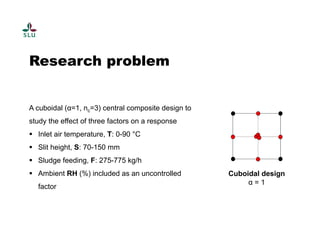
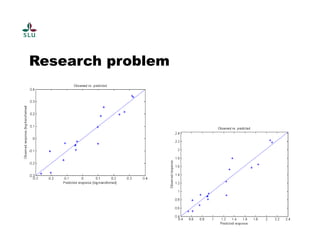
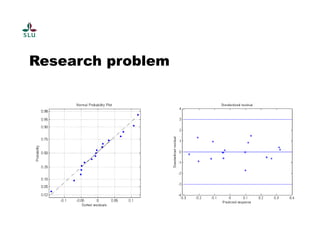
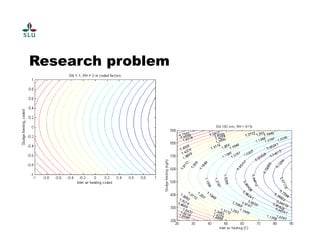
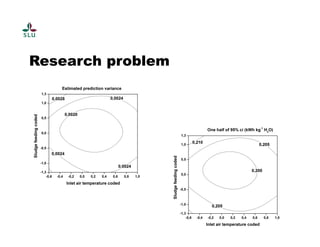
Research problem 
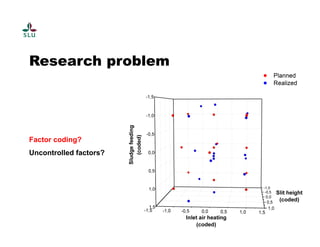
A cuboidal (α=1, nc=3) central composite design to 
study the effect of three factors on a response 
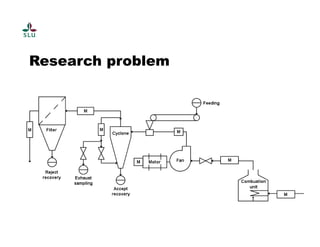
 Inlet air temperature, T: 0-90 °C 
 Slit height, S: 70-150 mm 
 Sludge feeding, F: 275-775 kg/h 
 Ambient RH (%) included as an uncontrolled 
factor 
Cuboidal design 
α = 1
Research problem
Research problem 
Factor coding? 
Uncontrolled factors?
Research problem 
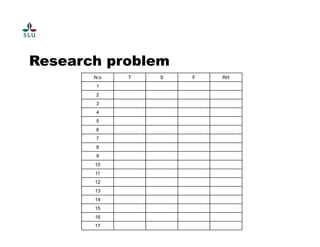
N:o T S F RH 
1 
2 
3 
4 
5 
6 
7 
8 
9 
10 
11 
12 
13 
14 
15 
16 
17
Research problem
Research problem
Research problem
Research problem
Research problem 
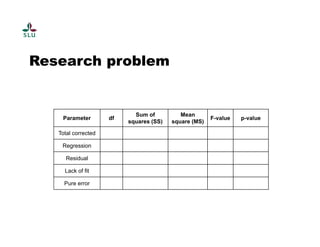
Parameter df Sum of 
squares (SS) 
Mean 
square (MS) F-value p-value 
Total corrected 
Regression 
Residual 
Lack of fit 
Pure error
Research problem
Research problem 
ݕො ൌ ܾ௢ ൅ ܠᇱ܊ܔ ൅ ܠ′۰෡ 
ܠ where 
ܠᇱ ൌ ݔଵ ݔଶ ⋯ ݔ௞ , ܊ܔ ൌ 
ܾଵ 
ܾଶ 
⋮ 
ܾ௞ 
and ۰෡ 
ൌ 
ܾଵଵ ܾଵଶ/2 ⋯ ܾଵ௞/2 
ܾଶଶ ⋯ ܾଶ௞/2 
⋱ ⋮ 
sym. ܾ௞௞ 
→ డ௬ො 
డ௫య 
మ 
ൌ డሺఉబାఉభ௫భାఉమ௫మାఉయ௫యାఉర௫రାఉయయ௫య 
డ௫య 
ൌ 0 
→ ݔଷ ൌ ିఉయ 
ଶఉయయ
Research problem
Session 4 
Uncontrolled factors 
Factor coding 
Realized vs. planned 
Response transformation 
Coefficients 
Observed vs. predicted 
Residuals 
ANOVA 
Contour 
Estimated prediction variance 
Confidence interval
How to continue? 
Literature 
 Myers RH, Montgomery DC, Anderson-Cook CM, Response Surface Methodology, 
Process and Product Optimization Using Designed Experiments, 3rd ed., John Wiley & 
Sons, Hoboken, New Jersey, 2009 (recommended) 
 Eriksson L, Johansson E, Kettaneh-Wold N, Wikström C, Wold S, Design of 
Experiments, Principles and Applications, 3rd ed., Umetrics, Umeå,2008 (useful for 
beginners) 
Software 
 Matlab (The MathWorks, Inc.), Modde (Umetrics), Design Expert® (Stat-Ease, Inc.), 
JMP (SAS Institute Inc.), Minitab (Minitab Inc.)
Thank you for participating! 
You can contact me via 
 E-mail (mikko.makela@slu.se) 
 ResearchGate (https://www.researchgate.net/profile/Mikko_Maekelae) 
 LinkedIn (https://www.linkedin.com/in/mikkomaekelae)

S4 - Process/product optimization using design of experiments and response surface methodology - Session 4/4

  • 1.
    Process/product optimization usingdesign of experiments and response surface methodology Mikko Mäkelä Sveriges landbruksuniversitet Swedish University of Agricultural Sciences Department of Forest Biomaterials and Technology Division of Biomass Technology and Chemistry Umeå, Sweden
  • 2.
    Contents Practical course,arranged in 4 individual sessions:  Session 1 – Introduction, factorial design, first order models  Session 2 – Matlab exercise: factorial design  Session 3 – Central composite designs, second order models, ANOVA, blocking, qualitative factors  Session 4 – Matlab exercise: practical optimization example on given data
  • 3.
    Session 1 Introduction  Why experimental design Factorial design  Design matrix  Model equation = coefficients  Residual  Response contour
  • 4.
    Session 2 Factorialdesign  Research problem  Design matrix  Model equation = coefficients  Degrees of freedom  Predicted response  Residual  ANOVA  R2  Response contour
  • 5.
    Session 3 Centralcomposite designs Design variance Common designs Second order models Stationary points ANOVA Blocking Confounding Qualitative factors
  • 6.
    Session 4 Uncontrolledfactors Factor coding Realized vs. planned Response transformation Coefficients Observed vs. predicted Residuals ANOVA Contour Estimated prediction variance Confidence interval
  • 7.
    Research problem Acuboidal (α=1, nc=3) central composite design to study the effect of three factors on a response  Inlet air temperature, T: 0-90 °C  Slit height, S: 70-150 mm  Sludge feeding, F: 275-775 kg/h  Ambient RH (%) included as an uncontrolled factor Cuboidal design α = 1
  • 8.
  • 9.
    Research problem Factorcoding? Uncontrolled factors?
  • 10.
    Research problem N:oT S F RH 1 2 3 4 5 6 7 8 9 10 11 12 13 14 15 16 17
  • 11.
  • 12.
  • 13.
  • 14.
  • 15.
    Research problem Parameterdf Sum of squares (SS) Mean square (MS) F-value p-value Total corrected Regression Residual Lack of fit Pure error
  • 16.
  • 17.
    Research problem ݕොൌ ܾ௢ ൅ ܠᇱ܊ܔ ൅ ܠ′۰෡ ܠ where ܠᇱ ൌ ݔଵ ݔଶ ⋯ ݔ௞ , ܊ܔ ൌ ܾଵ ܾଶ ⋮ ܾ௞ and ۰෡ ൌ ܾଵଵ ܾଵଶ/2 ⋯ ܾଵ௞/2 ܾଶଶ ⋯ ܾଶ௞/2 ⋱ ⋮ sym. ܾ௞௞ → డ௬ො డ௫య మ ൌ డሺఉబାఉభ௫భାఉమ௫మାఉయ௫యାఉర௫రାఉయయ௫య డ௫య ൌ 0 → ݔଷ ൌ ିఉయ ଶఉయయ
  • 18.
  • 19.
    Session 4 Uncontrolledfactors Factor coding Realized vs. planned Response transformation Coefficients Observed vs. predicted Residuals ANOVA Contour Estimated prediction variance Confidence interval
  • 20.
    How to continue? Literature  Myers RH, Montgomery DC, Anderson-Cook CM, Response Surface Methodology, Process and Product Optimization Using Designed Experiments, 3rd ed., John Wiley & Sons, Hoboken, New Jersey, 2009 (recommended)  Eriksson L, Johansson E, Kettaneh-Wold N, Wikström C, Wold S, Design of Experiments, Principles and Applications, 3rd ed., Umetrics, Umeå,2008 (useful for beginners) Software  Matlab (The MathWorks, Inc.), Modde (Umetrics), Design Expert® (Stat-Ease, Inc.), JMP (SAS Institute Inc.), Minitab (Minitab Inc.)
  • 21.
    Thank you forparticipating! You can contact me via  E-mail (mikko.makela@slu.se)  ResearchGate (https://www.researchgate.net/profile/Mikko_Maekelae)  LinkedIn (https://www.linkedin.com/in/mikkomaekelae)