Process/product optimization 
using design of experiments and 
response surface methodology 
M. Mäkelä 
Sveriges landbruksuniversitet 
Swedish University of Agricultural Sciences 
Department of Forest Biomaterials and Technology 
Division of Biomass Technology and Chemistry 
Umeå, Sweden
Contents 
Practical course, arranged in 4 individual sessions: 
 Session 1 – Introduction, factorial design, first order models 
 Session 2 – Matlab exercise: factorial design 
 Session 3 – Central composite designs, second order models, ANOVA, 
blocking, qualitative factors 
 Session 4 – Matlab exercise: practical optimization example on given data
Session 1 
Introduction 
 Why experimental design 
Factorial design 
 Design matrix 
 Model equation = coefficients 
 Residual 
 Response contour
Session 2 
Factorial design 
 Research problem 
 Design matrix 
 Model equation = coefficients 
 Degrees of freedom 
 Predicted response 
 Residual 
 ANOVA 
 R2 
 Response contour
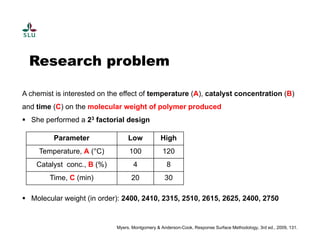
Research problem 
A chemist is interested on the effect of temperature (A), catalyst concentration (B) 
and time (C) on the molecular weight of polymer produced 
 She performed a 23 factorial design 
Parameter Low High 
Temperature, A (°C) 100 120 
Catalyst conc., B (%) 4 8 
Time, C (min) 20 30 
 Molecular weight (in order): 2400, 2410, 2315, 2510, 2615, 2625, 2400, 2750 
Myers, Montgomery & Anderson-Cook, Response Surface Methodology, 3rd ed., 2009, 131.
Research problem 
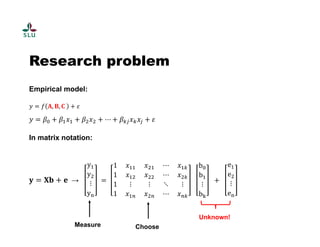
Empirical model: 
ݕ ൌ ݂ ۯ, ۰, ۱ ൅ ߝ 
ݕ ൌ ߚ଴ ൅ ߚଵݔଵ ൅ ߚଶݔଶ ൅ ⋯ ൅ ߚ௞௝ݔ௞ݔ௝ ൅ ߝ 
In matrix notation: 
ܡ ൌ ܆܊ ൅ ܍ → 
yଵ 
yଶ 
⋮ 
y୬ 
ൌ 
1 ݔଵଵ ݔଶଵ ⋯ ݔଵ௞ 
1 ݔଵଶ ݔଶଶ ⋯ ݔଶ௞ 
1 ⋮ ⋮ ⋱ ⋮ 
1 ݔଵ௡ ݔଶ௡ ⋯ ݔ௡௞ 
b଴ 
bଵ 
⋮ 
b୩ 
൅ 
eଵ 
eଶ 
⋮ 
e୬ 
Measure Choose 
Unknown!
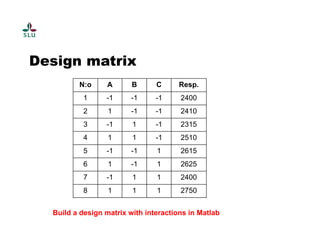
Design matrix 
N:o A B C Resp. 
1 -1 -1 -1 2400 
2 1 -1 -1 2410 
3 -1 1 -1 2315 
4 1 1 -1 2510 
5 -1 -1 1 2615 
6 1 -1 1 2625 
7 -1 1 1 2400 
8 1 1 1 2750 
Build a design matrix with interactions in Matlab
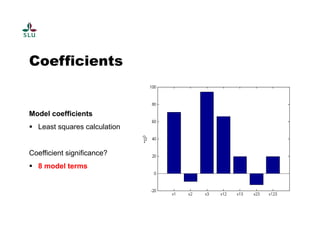
Coefficients 
Model coefficients 
 Least squares calculation 
Coefficient significance? 
 8 model terms
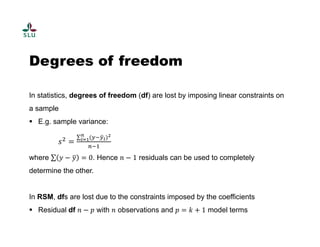
Degrees of freedom 
In statistics, degrees of freedom (df) are lost by imposing linear constraints on 
a sample 
 E.g. sample variance: 
ݏଶ ൌ Σ ሺ௬ି௬ത೔ ೙ ሻమ 
೔సభ 
௡ିଵ 
where Σ ݕ െ ݕത ൌ 0. Hence ݊ െ 1 residuals can be used to completely 
determine the other. 
In RSM, dfs are lost due to the constraints imposed by the coefficients 
 Residual df ݊ െ ݌ with ݊ observations and ݌ ൌ ݇ ൅ 1 model terms
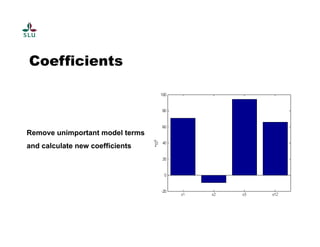
Coefficients 
Remove unimportant model terms 
and calculate new coefficients
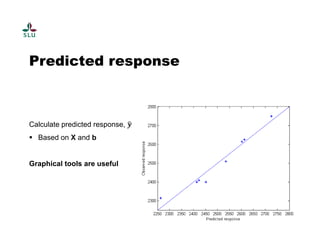
Predicted response 
Calculate predicted response, ࢟ෝ 
 Based on X and b 
Graphical tools are useful
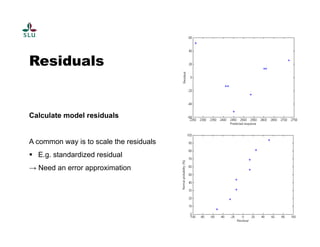
Residuals 
Calculate model residuals 
A common way is to scale the residuals 
 E.g. standardized residual 
→ Need an error approximation
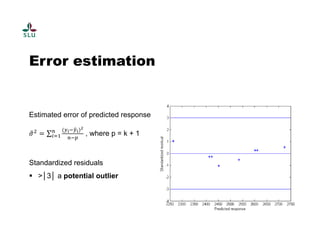
Error estimation 
Estimated error of predicted response 
ߪොଶ ൌ Σ ሺ௬೔ି௬ො೔ሻమ 
௡ 
௜ୀଵ , where p = k + 1 
௡ି௣ 
Standardized residuals 
 >│3│ a potential outlier
ANOVA 
Analysis of variance (ANOVA) allows to statistically test the model 
 Fisher’s F test 
 H0: ߚ଴ ൌ ߚଵ ൌ ⋯ ൌ ߚ௞ ൌ 0 
 H1: ߚ௝ ് 0 for at least one j 
Parameter df Sum of 
squares (SS) 
Mean 
square (MS) 
F-value p-value 
Total corrected n-1 SStot MStot 
Regression k SSmod MSmod MSmod 
/MSres 
<0.05 
>0.05 
Residual n-k-1 SSres MSres 
Lack of fit 
Pure error
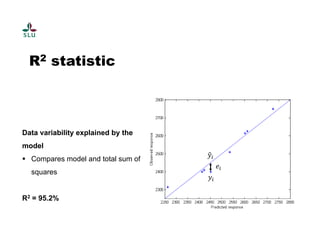
R2 statistic 
ݕො௜ 
ݕ௜ 
݁௜ 
Data variability explained by the 
model 
 Compares model and total sum of 
squares 
R2 = 95.2%
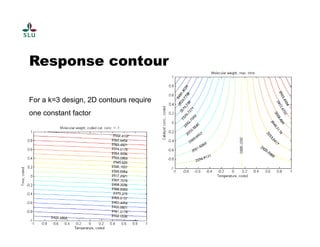
Response contour 
For a k=3 design, 2D contours require 
one constant factor
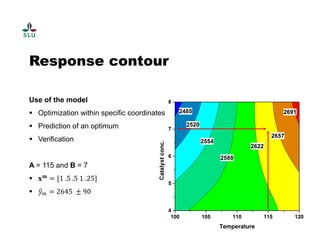
Response contour 
Use of the model 
 Optimization within specific coordinates 
 Prediction of an optimum 
 Verification 
A = 115 and B = 7 
 ܠܕ ൌ ሾ1 .5 .5 1 .25ሿ 
 ݕො௠ ൌ 2645 േ 90
Research problem 
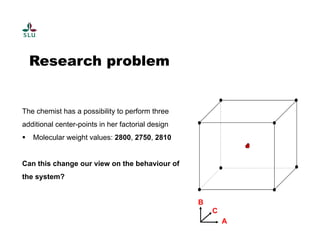
The chemist has a possibility to perform three 
additional center-points in her factorial design 
 Molecular weight values: 2800, 2750, 2810 
Can this change our view on the behaviour of 
the system? 
A 
B 
C
Session 2 
Factorial design 
 Research problem 
 Design matrix 
 Model equation = coefficients 
 Degrees of freedom 
 Predicted response 
 Residual 
 ANOVA 
 R2 
 Response contour
Nomenclature 
Design matrix 
Coefficient 
Degree of freedom 
Prediction 
Residual 
Outlier 
ANOVA 
Sum of squares 
Mean square 
Contour
Contents 
Practical course, arranged in 4 individual sessions: 
 Session 1 – Introduction, factorial design, first order models 
 Session 2 – Matlab exercise: factorial design 
 Session 3 – Central composite designs, second order models, ANOVA, 
blocking, qualitative factors 
 Session 4 – Matlab exercise: practical optimization example on given data
Thank you for listening!

S2 - Process product optimization using design experiments and response surface methodolgy

  • 1.
    Process/product optimization usingdesign of experiments and response surface methodology M. Mäkelä Sveriges landbruksuniversitet Swedish University of Agricultural Sciences Department of Forest Biomaterials and Technology Division of Biomass Technology and Chemistry Umeå, Sweden
  • 2.
    Contents Practical course,arranged in 4 individual sessions:  Session 1 – Introduction, factorial design, first order models  Session 2 – Matlab exercise: factorial design  Session 3 – Central composite designs, second order models, ANOVA, blocking, qualitative factors  Session 4 – Matlab exercise: practical optimization example on given data
  • 3.
    Session 1 Introduction  Why experimental design Factorial design  Design matrix  Model equation = coefficients  Residual  Response contour
  • 4.
    Session 2 Factorialdesign  Research problem  Design matrix  Model equation = coefficients  Degrees of freedom  Predicted response  Residual  ANOVA  R2  Response contour
  • 5.
    Research problem Achemist is interested on the effect of temperature (A), catalyst concentration (B) and time (C) on the molecular weight of polymer produced  She performed a 23 factorial design Parameter Low High Temperature, A (°C) 100 120 Catalyst conc., B (%) 4 8 Time, C (min) 20 30  Molecular weight (in order): 2400, 2410, 2315, 2510, 2615, 2625, 2400, 2750 Myers, Montgomery & Anderson-Cook, Response Surface Methodology, 3rd ed., 2009, 131.
  • 6.
    Research problem Empiricalmodel: ݕ ൌ ݂ ۯ, ۰, ۱ ൅ ߝ ݕ ൌ ߚ଴ ൅ ߚଵݔଵ ൅ ߚଶݔଶ ൅ ⋯ ൅ ߚ௞௝ݔ௞ݔ௝ ൅ ߝ In matrix notation: ܡ ൌ ܆܊ ൅ ܍ → yଵ yଶ ⋮ y୬ ൌ 1 ݔଵଵ ݔଶଵ ⋯ ݔଵ௞ 1 ݔଵଶ ݔଶଶ ⋯ ݔଶ௞ 1 ⋮ ⋮ ⋱ ⋮ 1 ݔଵ௡ ݔଶ௡ ⋯ ݔ௡௞ b଴ bଵ ⋮ b୩ ൅ eଵ eଶ ⋮ e୬ Measure Choose Unknown!
  • 7.
    Design matrix N:oA B C Resp. 1 -1 -1 -1 2400 2 1 -1 -1 2410 3 -1 1 -1 2315 4 1 1 -1 2510 5 -1 -1 1 2615 6 1 -1 1 2625 7 -1 1 1 2400 8 1 1 1 2750 Build a design matrix with interactions in Matlab
  • 8.
    Coefficients Model coefficients  Least squares calculation Coefficient significance?  8 model terms
  • 9.
    Degrees of freedom In statistics, degrees of freedom (df) are lost by imposing linear constraints on a sample  E.g. sample variance: ݏଶ ൌ Σ ሺ௬ି௬ത೔ ೙ ሻమ ೔సభ ௡ିଵ where Σ ݕ െ ݕത ൌ 0. Hence ݊ െ 1 residuals can be used to completely determine the other. In RSM, dfs are lost due to the constraints imposed by the coefficients  Residual df ݊ െ ݌ with ݊ observations and ݌ ൌ ݇ ൅ 1 model terms
  • 10.
    Coefficients Remove unimportantmodel terms and calculate new coefficients
  • 11.
    Predicted response Calculatepredicted response, ࢟ෝ  Based on X and b Graphical tools are useful
  • 12.
    Residuals Calculate modelresiduals A common way is to scale the residuals  E.g. standardized residual → Need an error approximation
  • 13.
    Error estimation Estimatederror of predicted response ߪොଶ ൌ Σ ሺ௬೔ି௬ො೔ሻమ ௡ ௜ୀଵ , where p = k + 1 ௡ି௣ Standardized residuals  >│3│ a potential outlier
  • 14.
    ANOVA Analysis ofvariance (ANOVA) allows to statistically test the model  Fisher’s F test  H0: ߚ଴ ൌ ߚଵ ൌ ⋯ ൌ ߚ௞ ൌ 0  H1: ߚ௝ ് 0 for at least one j Parameter df Sum of squares (SS) Mean square (MS) F-value p-value Total corrected n-1 SStot MStot Regression k SSmod MSmod MSmod /MSres <0.05 >0.05 Residual n-k-1 SSres MSres Lack of fit Pure error
  • 15.
    R2 statistic ݕො௜ ݕ௜ ݁௜ Data variability explained by the model  Compares model and total sum of squares R2 = 95.2%
  • 16.
    Response contour Fora k=3 design, 2D contours require one constant factor
  • 17.
    Response contour Useof the model  Optimization within specific coordinates  Prediction of an optimum  Verification A = 115 and B = 7  ܠܕ ൌ ሾ1 .5 .5 1 .25ሿ  ݕො௠ ൌ 2645 േ 90
  • 18.
    Research problem Thechemist has a possibility to perform three additional center-points in her factorial design  Molecular weight values: 2800, 2750, 2810 Can this change our view on the behaviour of the system? A B C
  • 19.
    Session 2 Factorialdesign  Research problem  Design matrix  Model equation = coefficients  Degrees of freedom  Predicted response  Residual  ANOVA  R2  Response contour
  • 20.
    Nomenclature Design matrix Coefficient Degree of freedom Prediction Residual Outlier ANOVA Sum of squares Mean square Contour
  • 21.
    Contents Practical course,arranged in 4 individual sessions:  Session 1 – Introduction, factorial design, first order models  Session 2 – Matlab exercise: factorial design  Session 3 – Central composite designs, second order models, ANOVA, blocking, qualitative factors  Session 4 – Matlab exercise: practical optimization example on given data
  • 22.
    Thank you forlistening!