_______URBAN DESIGN STUDIO - II______________________________
BY-SAKSHI SHARMA
F.Y. M.ARCH
ASSIGNMENT 1
ELEMENTS OF URBAN DESIGN
URBAN BLOCK / NEIGHBOURHOOD
What is Urban Block –
• Urban blocks can be defined as the space within the
street pattern of a city that is subdivided into land lots
for the construction of buildings.
• It is an effort to create a residential neighbourhood to
meet the need of an family life in a unit.
• These area are self sufficient served with all basic
facilities like the school, parks, shopping area,
commercials for daily needs, residential blocks,
recreational spaces etc.
• Introduced by Clarence Perry in 1920.
What is Urban Neighborhood Concept –
Clearence Perry identified six neighbourhood unit
design principles.
1. The unit was to be ideally a shape in which all sides were
fairly equidistant from the centre.
2. A central neighbourhood or community centre was to
contain various institutional sites, including a school,
grouped round a central green space.
3. Local shops or shops and apartments were to be located at
the outer corners of the neighbourhood.
4. Scattered small parks and open spaces, located in each
quadrant of the neighbourhood, were to form 10 per cent
of the total area.
5. Arterial streets were to bound each side of the
neighbourhood while,
6. The layout of the internal street was to be a combination of
curvilinear and diagonal roads to discourage through
traffic. Vehicular and pedestrian traffic was to be
segregated.
City of Lenexa Los Angeles
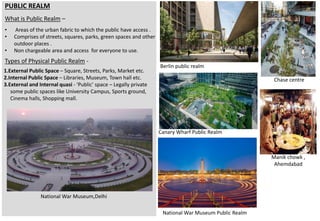
PUBLIC REALM
What is Public Realm –
Types of Physical Public Realm -
1.External Public Space – Square, Streets, Parks, Market etc.
2.Internal Public Space – Libraries, Museum, Town hall etc.
3.External and Internal quasi - ‘Public’ space – Legally private
some public spaces like University Campus, Sports ground,
Cinema halls, Shopping mall.
• Areas of the urban fabric to which the public have access .
• Comprises of streets, squares, parks, green spaces and other
outdoor places .
• Non chargeable area and access for everyone to use.
Berlin public realm
Canary Wharf Public Realm
National War Museum Public Realm
Chase centre
Manik chowk ,
Ahemdabad
National War Museum,Delhi
Main Street (Sub Arterial )
High Street (local street )
Boulevards
Skywalks
Esplanaed
Alley
• A public thoroughfare, usually paved, in a village, town, or
city, including the sidewalk or sidewalks
• Streets -a public road in a city, town, or village, typically with
houses and buildings on one or both sides
STREETS
Types of Streets-
•Main street.
•High street
•skywalks
•Boulevard.
•Esplanade & Promenade.
•Highway.
•One-way Street.
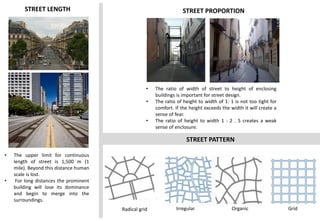
Different Heights to width ratios for street enclosure
STREET LENGTH
• The upper limit for continuous
length of street is 1,500 m (1
mile). Beyond this distance human
scale is lost.
• For long distances the prominent
building will lose its dominance
and begin to merge into the
surroundings.
STREET PROPORTION
• The ratio of width of street to height of enclosing
buildings is important for street design.
• The ratio of height to width of 1: 1 is not too tight for
comfort. If the height exceeds the width it will create a
sense of fear.
• The ratio of height to width 1 : 2 . 5 creates a weak
sense of enclosure.
STREET PATTERN
Irregular Organic
Radical grid Grid
Food market,Mumbai
• A regular gathering of people for the purchase and sale of
provisions, livestock, and other commodities
• Natural markets have existed for as long as people have
been exchanging goods and services. They take many
forms and exist all around the world.
• Types of Market
Khaugali/food market
Chor bazar
Street market
Shopping market
Retail Market
Vegetable/fruit market
MARKETS
Vegetable/fruit market
Shopping market,Goa
Retail market,Goa
URBAN SQUARE/PLAZZAS
What are Urban Squares/plazzas?
• It is an open public space used for community
gatherings .
• On the relation between the forms of the
surrounding buildings .
• These get established on crossings or intersection
of roads.
Urban square:
1. Formal space reinforced by formal surrounding
buildings .
2. Formal space contrasted with informal
surrounding buildings .
3. Informal space and building.
Types of squares:
Chennai’s Kathipara urban square.
Urban square in Rome Piazza Navona, Italy
Time Square, New York
Indore urban square.
St. Peters square ,Rome
URBAN OPEN SPACES
What are open spaces?
• Area constructed by the open space outside the
building entity in the central area of the city that
provides public activities.
• It includes paths, landscapes, squares-garden,
parks etc.
• They give form and shape of the city.
• Give recreational spaces to people.
Bryant Park in New york
Use of riverfronts
Marine lines ,Mumbai
Urban open space in Melbourne, Australia
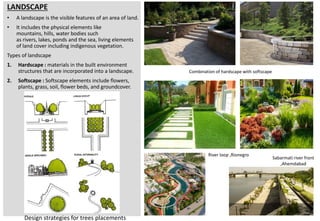
LANDSCAPE
• A landscape is the visible features of an area of land.
• It includes the physical elements like
mountains, hills, water bodies such
as rivers, lakes, ponds and the sea, living elements
of land cover including indigenous vegetation.
Types of landscape
1. Hardscape : materials in the built environment
structures that are incorporated into a landscape.
2. Softscape : Softscape elements include flowers,
plants, grass, soil, flower beds, and groundcover.
Design strategies for trees placements
River loop ,Rionegro
Combination of hardscape with softscape
Sabarmati river front
,Ahemdabad

Assignment 1-sakshi uds.pdf

  • 1.
    _______URBAN DESIGN STUDIO- II______________________________ BY-SAKSHI SHARMA F.Y. M.ARCH ASSIGNMENT 1 ELEMENTS OF URBAN DESIGN
  • 2.
    URBAN BLOCK /NEIGHBOURHOOD What is Urban Block – • Urban blocks can be defined as the space within the street pattern of a city that is subdivided into land lots for the construction of buildings. • It is an effort to create a residential neighbourhood to meet the need of an family life in a unit. • These area are self sufficient served with all basic facilities like the school, parks, shopping area, commercials for daily needs, residential blocks, recreational spaces etc. • Introduced by Clarence Perry in 1920. What is Urban Neighborhood Concept – Clearence Perry identified six neighbourhood unit design principles. 1. The unit was to be ideally a shape in which all sides were fairly equidistant from the centre. 2. A central neighbourhood or community centre was to contain various institutional sites, including a school, grouped round a central green space. 3. Local shops or shops and apartments were to be located at the outer corners of the neighbourhood. 4. Scattered small parks and open spaces, located in each quadrant of the neighbourhood, were to form 10 per cent of the total area. 5. Arterial streets were to bound each side of the neighbourhood while, 6. The layout of the internal street was to be a combination of curvilinear and diagonal roads to discourage through traffic. Vehicular and pedestrian traffic was to be segregated. City of Lenexa Los Angeles
  • 3.
    PUBLIC REALM What isPublic Realm – Types of Physical Public Realm - 1.External Public Space – Square, Streets, Parks, Market etc. 2.Internal Public Space – Libraries, Museum, Town hall etc. 3.External and Internal quasi - ‘Public’ space – Legally private some public spaces like University Campus, Sports ground, Cinema halls, Shopping mall. • Areas of the urban fabric to which the public have access . • Comprises of streets, squares, parks, green spaces and other outdoor places . • Non chargeable area and access for everyone to use. Berlin public realm Canary Wharf Public Realm National War Museum Public Realm Chase centre Manik chowk , Ahemdabad National War Museum,Delhi
  • 4.
    Main Street (SubArterial ) High Street (local street ) Boulevards Skywalks Esplanaed Alley • A public thoroughfare, usually paved, in a village, town, or city, including the sidewalk or sidewalks • Streets -a public road in a city, town, or village, typically with houses and buildings on one or both sides STREETS Types of Streets- •Main street. •High street •skywalks •Boulevard. •Esplanade & Promenade. •Highway. •One-way Street. Different Heights to width ratios for street enclosure
  • 5.
    STREET LENGTH • Theupper limit for continuous length of street is 1,500 m (1 mile). Beyond this distance human scale is lost. • For long distances the prominent building will lose its dominance and begin to merge into the surroundings. STREET PROPORTION • The ratio of width of street to height of enclosing buildings is important for street design. • The ratio of height to width of 1: 1 is not too tight for comfort. If the height exceeds the width it will create a sense of fear. • The ratio of height to width 1 : 2 . 5 creates a weak sense of enclosure. STREET PATTERN Irregular Organic Radical grid Grid
  • 6.
    Food market,Mumbai • Aregular gathering of people for the purchase and sale of provisions, livestock, and other commodities • Natural markets have existed for as long as people have been exchanging goods and services. They take many forms and exist all around the world. • Types of Market Khaugali/food market Chor bazar Street market Shopping market Retail Market Vegetable/fruit market MARKETS Vegetable/fruit market Shopping market,Goa Retail market,Goa
  • 7.
    URBAN SQUARE/PLAZZAS What areUrban Squares/plazzas? • It is an open public space used for community gatherings . • On the relation between the forms of the surrounding buildings . • These get established on crossings or intersection of roads. Urban square: 1. Formal space reinforced by formal surrounding buildings . 2. Formal space contrasted with informal surrounding buildings . 3. Informal space and building. Types of squares: Chennai’s Kathipara urban square. Urban square in Rome Piazza Navona, Italy Time Square, New York Indore urban square. St. Peters square ,Rome
  • 8.
    URBAN OPEN SPACES Whatare open spaces? • Area constructed by the open space outside the building entity in the central area of the city that provides public activities. • It includes paths, landscapes, squares-garden, parks etc. • They give form and shape of the city. • Give recreational spaces to people. Bryant Park in New york Use of riverfronts Marine lines ,Mumbai Urban open space in Melbourne, Australia
  • 9.
    LANDSCAPE • A landscapeis the visible features of an area of land. • It includes the physical elements like mountains, hills, water bodies such as rivers, lakes, ponds and the sea, living elements of land cover including indigenous vegetation. Types of landscape 1. Hardscape : materials in the built environment structures that are incorporated into a landscape. 2. Softscape : Softscape elements include flowers, plants, grass, soil, flower beds, and groundcover. Design strategies for trees placements River loop ,Rionegro Combination of hardscape with softscape Sabarmati river front ,Ahemdabad