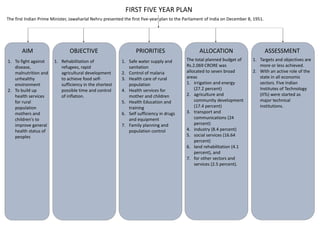
1. To fight against
disease,
malnutrition and
unhealthy
environment
2. To build up
health services
for rural
population
mothers and
children's to
improve general
health status of
peoples
FIRST FIVE YEAR PLAN
The total planned budget of
Rs.2.069 CRORE was
allocated to seven broad
areas
1. irrigation and energy
(27.2 percent)
2. agriculture and
community development
(17.4 percent)
3. transport and
communications (24
percent)
4. industry (8.4 percent)
5. social services (16.64
percent)
6. land rehabilitation (4.1
percent), and
7. for other sectors and
services (2.5 percent).
1. Safe water supply and
sanitation
2. Control of malaria
3. Health care of rural
population
4. Health services for
mother and children
5. Health Education and
training
6. Self sufficiency in drugs
and equipment
7. Family planning and
population control
AIM ALLOCATION
PRIORITIES ASSESSMENT
OBJECTIVE
1. Targets and objectives are
more or less achieved.
2. With an active role of the
state in all economic
sectors. Five Indian
Institutes of Technology
(IITs) were started as
major technical
institutions.
1. Rehabilitation of
refugees, rapid
agricultural development
to achieve food self-
sufficiency in the shortest
possible time and control
of inflation.
The first Indian Prime Minister, Jawaharlal Nehru presented the first five-year plan to the Parliament of India on December 8, 1951.
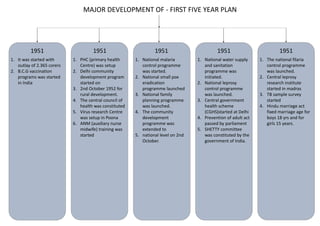
MAJOR DEVELOPMENT OF - FIRST FIVE YEAR PLAN
1951 1951
1951 1951
1951
1. National water supply
and sanitation
programme was
initiated.
2. National leprosy
control programme
was launched.
3. Central government
health scheme
(CGHS)started at Delhi
4. Prevention of adult act
passed by parliament
5. SHETTY committee
was constituted by the
government of India.
1. The national filaria
control programme
was launched.
2. Central leprosy
research institute
started in madras
3. TB sample survey
started
4. Hindu marriage act
fixed marriage age for
boys 18 yrs and for
girls 15 years.
1. National malaria
control programme
was started.
2. National small pox
eradication
programme launched
3. National family
planning programme
was launched.
4. The community
development
programme was
extended to
5. national level on 2nd
October.
1. PHC (primary health
Centre) was setup
2. Delhi community
development program
started on
3. 2nd October 1952 for
rural development.
4. The central council of
health was constituted
5. Virus research Centre
was setup in Poona
6. ANM (auxiliary nurse
midwife) training was
started
1. It was started with
outlay of 2.365 corers
2. B.C.G vaccination
programs was started
in India
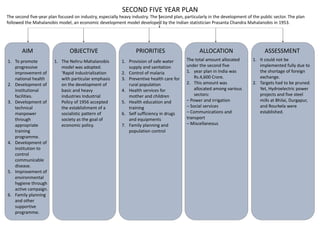
1. To promote
progressive
improvement of
national health
2. Development of
institutional
facilities.
3. Development of
technical
manpower
through
appropriate
training
programme.
4. Development of
institution to
control
communicable
disease.
5. Improvement of
environmental
hygiene through
active campaign.
6. Family planning
and other
supportive
programme.
SECOND FIVE YEAR PLAN
The total amount allocated
under the second five
1. year plan in India was
Rs.4,600 Crore.
2. This amount was
allocated among various
sectors:
– Power and irrigation
– Social services
– Communications and
transport
– Miscellaneous
1. Provision of safe water
supply and sanitation
2. Control of malaria
3. Preventive health care for
rural population
4. Health services for
mother and children
5. Health education and
training
6. Self sufficiency in drugs
and equipments
7. Family planning and
population control
AIM ALLOCATION
PRIORITIES ASSESSMENT
OBJECTIVE
1. It could not be
implemented fully due to
the shortage of foreign
exchange.
2. Targets had to be pruned.
Yet, Hydroelectric power
projects and five steel
mills at Bhilai, Durgapur,
and Rourkela were
established.
1. The Nehru-Mahalanobis
model was adopted.
‘Rapid industrialization
with particular emphasis
on the development of
basic and heavy
industries Industrial
Policy of 1956 accepted
the establishment of a
socialistic pattern of
society as the goal of
economic policy.
The second five-year plan focused on industry, especially heavy industry. The Second plan, particularly in the development of the public sector. The plan
followed the Mahalanobis model, an economic development model developed by the Indian statistician Prasanta Chandra Mahalanobis in 1953.
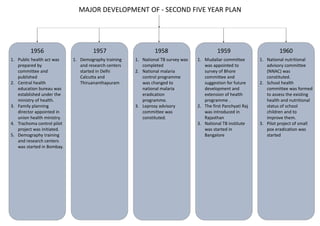
MAJOR DEVELOPMENT OF - SECOND FIVE YEAR PLAN
1956 1959
1958 1960
1957
1. Mudaliar committee
was appointed to
survey of Bhore
committee and
suggestion for future
development and
extension of health
programme .
2. The first Panchyati Raj
was introduced in
Rajasthan
3. National TB institute
was started in
Bangalore
1. National nutritional
advisory committee
(NNAC) was
constituted.
2. School health
committee was formed
to assess the existing
health and nutritional
status of school
children and to
improve them.
3. Pilot project of small
pox eradication was
started
1. National TB survey was
completed
2. National malaria
control programme
was changed to
national malaria
eradication
programme.
3. Leprosy advisory
committee was
constituted.
1. Demography training
and research centers
started in Delhi
Calcutta and
Thiruananthapuram
1. Public health act was
prepared by
committee and
published
2. Central health
education bureau was
established under the
ministry of health.
3. Family planning
director appointed in
union health ministry.
4. Trachoma control pilot
project was initiated.
5. Demography training
and research centers
was started in Bombay.
1. To remove the
shortage and
deficiency which
were observed
at the end of
second five year
plan in the field
of health
2. To provide the
institutional
facilities
especially in
rural areas
3. To remove the
shortage of
trained
personnel and
supplies, lack of
safe drinking
water in rural
area and
inadequate
drainage system.
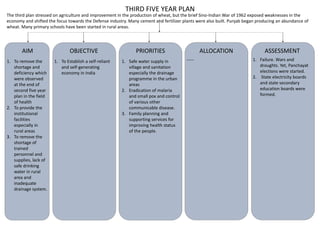
THIRD FIVE YEAR PLAN
-----
1. Safe water supply in
village and sanitation
especially the drainage
programme in the urban
areas
2. Eradication of malaria
and small pox and control
of various other
communicable disease.
3. Family planning and
supporting services for
improving health status
of the people.
AIM ALLOCATION
PRIORITIES ASSESSMENT
OBJECTIVE
1. Failure. Wars and
droughts. Yet, Panchayat
elections were started.
2. State electricity boards
and state secondary
education boards were
formed.
1. To Establish a self-reliant
and self-generating
economy in India
The third plan stressed on agriculture and improvement in the production of wheat, but the brief Sino-Indian War of 1962 exposed weaknesses in the
economy and shifted the focus towards the Defense industry. Many cement and fertilizer plants were also built. Punjab began producing an abundance of
wheat. Many primary schools have been started in rural areas.
0
0.005
0.01
0.015
0.02
0.025
0.03
0.035
0.04
FIRST FIVE YEAR PLAN
Chart Title
Target Growth Actual Growth
0
0.5
1
1.5
2
2.5
3
3.5
4
4.5
5
Category 1
Chart Title
Series 1 Series 2
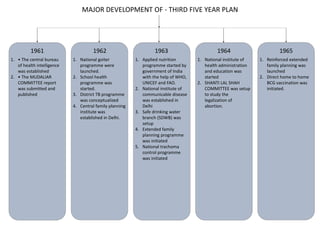
MAJOR DEVELOPMENT OF - THIRD FIVE YEAR PLAN
1961 1964
1963 1965
1962
1. National institute of
health administration
and education was
started
2. SHANTI LAL SHAH
COMMITTEE was setup
to study the
legalization of
abortion.
1. Reinforced extended
family planning was
launched
2. Direct home to home
BCG vaccination was
initiated.
1. Applied nutrition
programme started by
government of India
with the help of WHO,
UNICEF and FAO.
2. National institute of
communicable disease
was established in
Delhi
3. Safe drinking water
branch (SDWB) was
setup
4. Extended family
planning programme
was initiated
5. National trachoma
control programme
was initiated
1. National goiter
programme were
launched.
2. School health
programme was
started.
3. District TB programme
was conceptualized
4. Central family planning
institute was
established in Delhi.
1. • The central bureau
of health intelligence
was established
2. • The MUDALIAR
COMMITTEE report
was submitted and
published
0
0.5
1
1.5
2
2.5
3
3.5
4
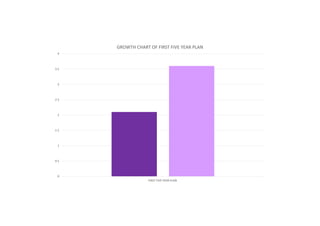
FIRST FIVE YEAR PLAN
GROWTH CHART OF FIRST FIVE YEAR PLAN
4.2
4.25
4.3
4.35
4.4
4.45
4.5
4.55
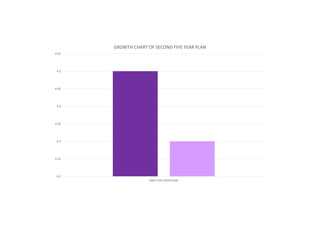
FIRST FIVE YEAR PLAN
GROWTH CHART OF SECOND FIVE YEAR PLAN
0
1
2
3
4
5
6
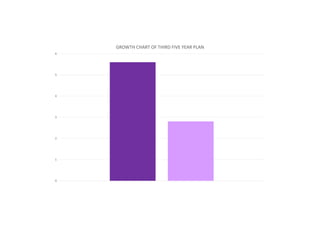
GROWTH CHART OF THIRD FIVE YEAR PLAN
0
1
2
3
4
5
6
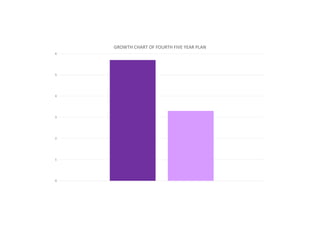
GROWTH CHART OF FOURTH FIVE YEAR PLAN
4.2
4.3
4.4
4.5
4.6
4.7
4.8
4.9
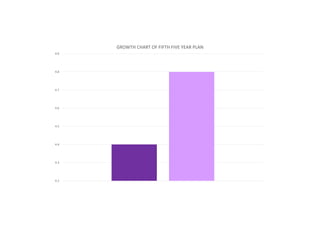
GROWTH CHART OF FIFTH FIVE YEAR PLAN
4.9
5
5.1
5.2
5.3
5.4
5.5
5.6
5.7
5.8
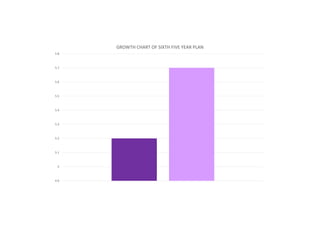
GROWTH CHART OF SIXTH FIVE YEAR PLAN
4.4
4.6
4.8
5
5.2
5.4
5.6
5.8
6
6.2
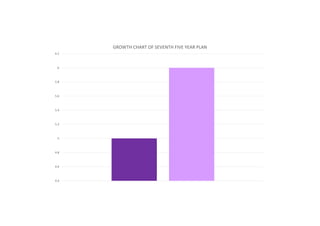
GROWTH CHART OF SEVENTH FIVE YEAR PLAN
0
1
2
3
4
5
6
7
8
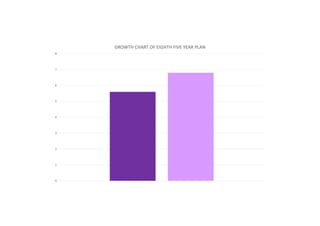
GROWTH CHART OF EIGHTH FIVE YEAR PLAN
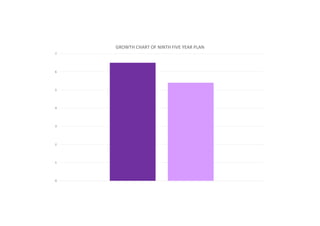
0
1
2
3
4
5
6
7
GROWTH CHART OF NINTH FIVE YEAR PLAN
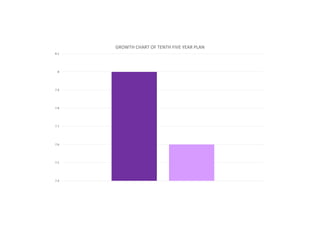
7.4
7.5
7.6
7.7
7.8
7.9
8
8.1
GROWTH CHART OF TENTH FIVE YEAR PLAN
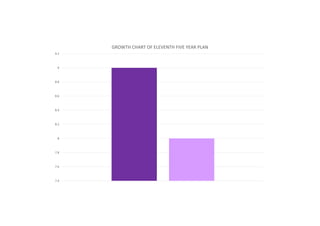
7.4
7.6
7.8
8
8.2
8.4
8.6
8.8
9
9.2
GROWTH CHART OF ELEVENTH FIVE YEAR PLAN

Final Presentation.pptx

  • 2.
    1. To fightagainst disease, malnutrition and unhealthy environment 2. To build up health services for rural population mothers and children's to improve general health status of peoples FIRST FIVE YEAR PLAN The total planned budget of Rs.2.069 CRORE was allocated to seven broad areas 1. irrigation and energy (27.2 percent) 2. agriculture and community development (17.4 percent) 3. transport and communications (24 percent) 4. industry (8.4 percent) 5. social services (16.64 percent) 6. land rehabilitation (4.1 percent), and 7. for other sectors and services (2.5 percent). 1. Safe water supply and sanitation 2. Control of malaria 3. Health care of rural population 4. Health services for mother and children 5. Health Education and training 6. Self sufficiency in drugs and equipment 7. Family planning and population control AIM ALLOCATION PRIORITIES ASSESSMENT OBJECTIVE 1. Targets and objectives are more or less achieved. 2. With an active role of the state in all economic sectors. Five Indian Institutes of Technology (IITs) were started as major technical institutions. 1. Rehabilitation of refugees, rapid agricultural development to achieve food self- sufficiency in the shortest possible time and control of inflation. The first Indian Prime Minister, Jawaharlal Nehru presented the first five-year plan to the Parliament of India on December 8, 1951.
  • 3.
    MAJOR DEVELOPMENT OF- FIRST FIVE YEAR PLAN 1951 1951 1951 1951 1951 1. National water supply and sanitation programme was initiated. 2. National leprosy control programme was launched. 3. Central government health scheme (CGHS)started at Delhi 4. Prevention of adult act passed by parliament 5. SHETTY committee was constituted by the government of India. 1. The national filaria control programme was launched. 2. Central leprosy research institute started in madras 3. TB sample survey started 4. Hindu marriage act fixed marriage age for boys 18 yrs and for girls 15 years. 1. National malaria control programme was started. 2. National small pox eradication programme launched 3. National family planning programme was launched. 4. The community development programme was extended to 5. national level on 2nd October. 1. PHC (primary health Centre) was setup 2. Delhi community development program started on 3. 2nd October 1952 for rural development. 4. The central council of health was constituted 5. Virus research Centre was setup in Poona 6. ANM (auxiliary nurse midwife) training was started 1. It was started with outlay of 2.365 corers 2. B.C.G vaccination programs was started in India
  • 4.
    1. To promote progressive improvementof national health 2. Development of institutional facilities. 3. Development of technical manpower through appropriate training programme. 4. Development of institution to control communicable disease. 5. Improvement of environmental hygiene through active campaign. 6. Family planning and other supportive programme. SECOND FIVE YEAR PLAN The total amount allocated under the second five 1. year plan in India was Rs.4,600 Crore. 2. This amount was allocated among various sectors: – Power and irrigation – Social services – Communications and transport – Miscellaneous 1. Provision of safe water supply and sanitation 2. Control of malaria 3. Preventive health care for rural population 4. Health services for mother and children 5. Health education and training 6. Self sufficiency in drugs and equipments 7. Family planning and population control AIM ALLOCATION PRIORITIES ASSESSMENT OBJECTIVE 1. It could not be implemented fully due to the shortage of foreign exchange. 2. Targets had to be pruned. Yet, Hydroelectric power projects and five steel mills at Bhilai, Durgapur, and Rourkela were established. 1. The Nehru-Mahalanobis model was adopted. ‘Rapid industrialization with particular emphasis on the development of basic and heavy industries Industrial Policy of 1956 accepted the establishment of a socialistic pattern of society as the goal of economic policy. The second five-year plan focused on industry, especially heavy industry. The Second plan, particularly in the development of the public sector. The plan followed the Mahalanobis model, an economic development model developed by the Indian statistician Prasanta Chandra Mahalanobis in 1953.
  • 5.
    MAJOR DEVELOPMENT OF- SECOND FIVE YEAR PLAN 1956 1959 1958 1960 1957 1. Mudaliar committee was appointed to survey of Bhore committee and suggestion for future development and extension of health programme . 2. The first Panchyati Raj was introduced in Rajasthan 3. National TB institute was started in Bangalore 1. National nutritional advisory committee (NNAC) was constituted. 2. School health committee was formed to assess the existing health and nutritional status of school children and to improve them. 3. Pilot project of small pox eradication was started 1. National TB survey was completed 2. National malaria control programme was changed to national malaria eradication programme. 3. Leprosy advisory committee was constituted. 1. Demography training and research centers started in Delhi Calcutta and Thiruananthapuram 1. Public health act was prepared by committee and published 2. Central health education bureau was established under the ministry of health. 3. Family planning director appointed in union health ministry. 4. Trachoma control pilot project was initiated. 5. Demography training and research centers was started in Bombay.
  • 6.
    1. To removethe shortage and deficiency which were observed at the end of second five year plan in the field of health 2. To provide the institutional facilities especially in rural areas 3. To remove the shortage of trained personnel and supplies, lack of safe drinking water in rural area and inadequate drainage system. THIRD FIVE YEAR PLAN ----- 1. Safe water supply in village and sanitation especially the drainage programme in the urban areas 2. Eradication of malaria and small pox and control of various other communicable disease. 3. Family planning and supporting services for improving health status of the people. AIM ALLOCATION PRIORITIES ASSESSMENT OBJECTIVE 1. Failure. Wars and droughts. Yet, Panchayat elections were started. 2. State electricity boards and state secondary education boards were formed. 1. To Establish a self-reliant and self-generating economy in India The third plan stressed on agriculture and improvement in the production of wheat, but the brief Sino-Indian War of 1962 exposed weaknesses in the economy and shifted the focus towards the Defense industry. Many cement and fertilizer plants were also built. Punjab began producing an abundance of wheat. Many primary schools have been started in rural areas.
  • 7.
    0 0.005 0.01 0.015 0.02 0.025 0.03 0.035 0.04 FIRST FIVE YEARPLAN Chart Title Target Growth Actual Growth
  • 8.
  • 9.
    MAJOR DEVELOPMENT OF- THIRD FIVE YEAR PLAN 1961 1964 1963 1965 1962 1. National institute of health administration and education was started 2. SHANTI LAL SHAH COMMITTEE was setup to study the legalization of abortion. 1. Reinforced extended family planning was launched 2. Direct home to home BCG vaccination was initiated. 1. Applied nutrition programme started by government of India with the help of WHO, UNICEF and FAO. 2. National institute of communicable disease was established in Delhi 3. Safe drinking water branch (SDWB) was setup 4. Extended family planning programme was initiated 5. National trachoma control programme was initiated 1. National goiter programme were launched. 2. School health programme was started. 3. District TB programme was conceptualized 4. Central family planning institute was established in Delhi. 1. • The central bureau of health intelligence was established 2. • The MUDALIAR COMMITTEE report was submitted and published
  • 10.
    0 0.5 1 1.5 2 2.5 3 3.5 4 FIRST FIVE YEARPLAN GROWTH CHART OF FIRST FIVE YEAR PLAN
  • 11.
    4.2 4.25 4.3 4.35 4.4 4.45 4.5 4.55 FIRST FIVE YEARPLAN GROWTH CHART OF SECOND FIVE YEAR PLAN
  • 12.
    0 1 2 3 4 5 6 GROWTH CHART OFTHIRD FIVE YEAR PLAN
  • 13.
    0 1 2 3 4 5 6 GROWTH CHART OFFOURTH FIVE YEAR PLAN
  • 14.
  • 15.
  • 16.
  • 17.
    0 1 2 3 4 5 6 7 8 GROWTH CHART OFEIGHTH FIVE YEAR PLAN
  • 18.
    0 1 2 3 4 5 6 7 GROWTH CHART OFNINTH FIVE YEAR PLAN
  • 19.
  • 20.