A systematic process of monitoring and maintaining
 Tangible assets ( such as buildings, machinery, land, vehicles, etc.) and
 Intangible assets of clients (such as human capital, intellectual property,
goodwill and/or financial assets)
Managing the assets of pension fund by investment managers is
an example of asset management.
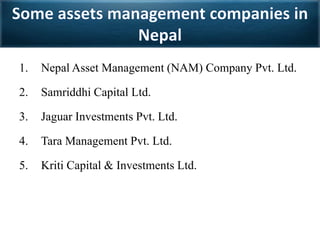
1. Nepal Asset Management (NAM) Company Pvt. Ltd.
2. Samriddhi Capital Ltd.
3. Jaguar Investments Pvt. Ltd.
4. Tara Management Pvt. Ltd.
5. Kriti Capital & Investments Ltd.
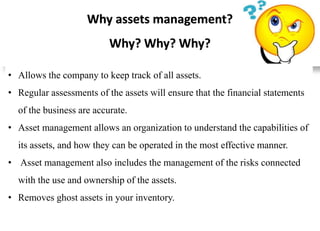
Why assets management?
Why? Why? Why?
• Allows the company to keep track of all assets.
• Regular assessments of the assets will ensure that the financial statements
of the business are accurate.
• Asset management allows an organization to understand the capabilities of
its assets, and how they can be operated in the most effective manner.
• Asset management also includes the management of the risks connected
with the use and ownership of the assets.
• Removes ghost assets in your inventory.
Items
included in
assets of
commercial
banks
Fixed
assets
Cash in
hand and
at bank
Loan and
advances
Other
assets
Investment
Cash in hand and at bank:-
Cash at bank and in hand refers to amounts which are held by a business in the
form of notes and coins (e.g. petty cash) or which are held at a bank in the form of
on demand deposits such as current accounts and savings accounts.
Investments:-
An investment is a monetary asset purchased with the idea that the asset will
provide income in the future or will later be sold at a higher price for a profit.
Loan and advances:-
“Loan” refers to the amount borrowed by one person from another. “Advance’’ on
the other hand, is a ‘credit facility’ granted by the bank. Banks grant advances
largely for short-term purposes, such as purchase of goods traded in and meeting
other short-term trading liabilities.
Fixed assets:-
A fixed asset is a long-term tangible piece of property that a firm owns and uses in
its operations to generate income. Fixed assets are not expected to be consumed or
converted into cash within a year. Fixed assets are known as property, plant, and
equipment (PP&E).
Other assets:-
This group of assets, comprising of heterogeneous items like advance taxes paid
and the value of the stocks of stamps and stationery, is not a significant component
of total bank assets.
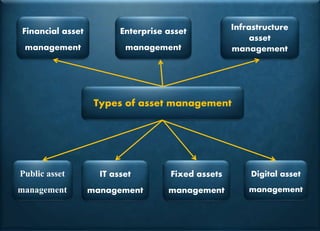
Types of asset management
Public asset
management
IT asset
management
Fixed assets
management
Digital asset
management
Financial asset
management
Enterprise asset
management
Infrastructure
asset
management
Financial Asset Management:-
Financial Asset Management, often referred to simply as Asset Management, is the
sector of the financial services industry that manages investment funds and client
investment accounts.
Enterprise Asset Management:-
Management of the fixed assets of an organization including acquisition, operation,
maintenance and decommissioning. The definition is occasionally expanded to
include intangible assets.
Infrastructure Asset Management:-
Management of public infrastructure such as roads, bridges, waterways and electric
grids with a focus on maintenance, rehabilitation, and replacement of infrastructure.
Public Asset Management:-
Similar to Infrastructure Asset Management except that it has a greater scope that
includes facilities such as schools, parks, public spaces and airports. Public Asset
Management is often focused on extending the service life of public assets.
IT Asset Management:-
The governance and control of IT hardware and software. IT Asset Management
encapsulates the maintenance, contract management and accounting functions for
IT assets.
Fixed Assets Management:-
The practice of tracking fixed assets for the purposes of financial accounting,
maintenance and loss prevention.
Digital Asset Management:-
Management of the information collections that an organization owns, controls or
has the right to use.
Assets management

Assets management

  • 2.
    A systematic processof monitoring and maintaining  Tangible assets ( such as buildings, machinery, land, vehicles, etc.) and  Intangible assets of clients (such as human capital, intellectual property, goodwill and/or financial assets) Managing the assets of pension fund by investment managers is an example of asset management.
  • 3.
    1. Nepal AssetManagement (NAM) Company Pvt. Ltd. 2. Samriddhi Capital Ltd. 3. Jaguar Investments Pvt. Ltd. 4. Tara Management Pvt. Ltd. 5. Kriti Capital & Investments Ltd.
  • 4.
    Why assets management? Why?Why? Why? • Allows the company to keep track of all assets. • Regular assessments of the assets will ensure that the financial statements of the business are accurate. • Asset management allows an organization to understand the capabilities of its assets, and how they can be operated in the most effective manner. • Asset management also includes the management of the risks connected with the use and ownership of the assets. • Removes ghost assets in your inventory.
  • 5.
    Items included in assets of commercial banks Fixed assets Cashin hand and at bank Loan and advances Other assets Investment
  • 6.
    Cash in handand at bank:- Cash at bank and in hand refers to amounts which are held by a business in the form of notes and coins (e.g. petty cash) or which are held at a bank in the form of on demand deposits such as current accounts and savings accounts. Investments:- An investment is a monetary asset purchased with the idea that the asset will provide income in the future or will later be sold at a higher price for a profit. Loan and advances:- “Loan” refers to the amount borrowed by one person from another. “Advance’’ on the other hand, is a ‘credit facility’ granted by the bank. Banks grant advances largely for short-term purposes, such as purchase of goods traded in and meeting other short-term trading liabilities.
  • 7.
    Fixed assets:- A fixedasset is a long-term tangible piece of property that a firm owns and uses in its operations to generate income. Fixed assets are not expected to be consumed or converted into cash within a year. Fixed assets are known as property, plant, and equipment (PP&E). Other assets:- This group of assets, comprising of heterogeneous items like advance taxes paid and the value of the stocks of stamps and stationery, is not a significant component of total bank assets.
  • 8.
    Types of assetmanagement Public asset management IT asset management Fixed assets management Digital asset management Financial asset management Enterprise asset management Infrastructure asset management
  • 9.
    Financial Asset Management:- FinancialAsset Management, often referred to simply as Asset Management, is the sector of the financial services industry that manages investment funds and client investment accounts. Enterprise Asset Management:- Management of the fixed assets of an organization including acquisition, operation, maintenance and decommissioning. The definition is occasionally expanded to include intangible assets. Infrastructure Asset Management:- Management of public infrastructure such as roads, bridges, waterways and electric grids with a focus on maintenance, rehabilitation, and replacement of infrastructure.
  • 10.
    Public Asset Management:- Similarto Infrastructure Asset Management except that it has a greater scope that includes facilities such as schools, parks, public spaces and airports. Public Asset Management is often focused on extending the service life of public assets. IT Asset Management:- The governance and control of IT hardware and software. IT Asset Management encapsulates the maintenance, contract management and accounting functions for IT assets. Fixed Assets Management:- The practice of tracking fixed assets for the purposes of financial accounting, maintenance and loss prevention. Digital Asset Management:- Management of the information collections that an organization owns, controls or has the right to use.