MA. RIEZA R. FATALLA
MAED-Educational Management
•Why are we
here?
“The illiterate of the 21st century is
NOT the PERSON who is unable
to read and write, rather the person
who is unable to
learn, unlearn & relearn”
Are resources controlled by an entity as a result
of past events, and from which future economic
benefits or service potential are expected to flow
to the entity.
If an expenditure is instead consumed within the
current Period, it is classified as an expense.
- Cash
- Marketable Securities
- Accounts Receivables
- Prepaid Assets
- Land
- Buildings
- Office Equipment
- Furniture and Fixtures
CLASSIFICATION OF ASSET
• What Is the
Issue?
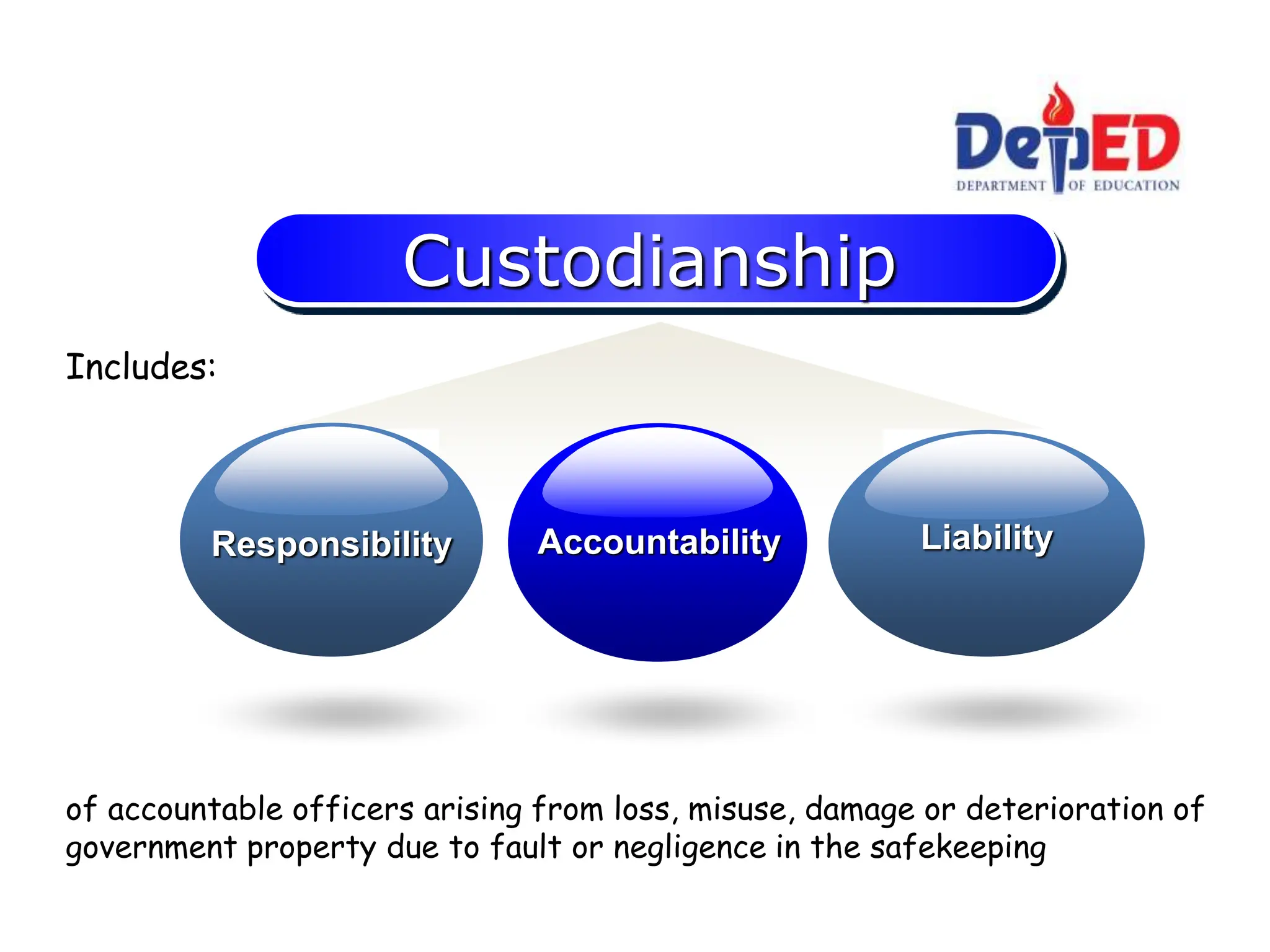
Custodianship
Accountability Liability
Responsibility
of accountable officers arising from loss, misuse, damage or deterioration of
government property due to fault or negligence in the safekeeping
Includes:
Accountability, Responsibility
and Liability for Government
Property
• Accountability – “a person” obligations to carry out
responsibilities and be answerable for decisions and activities
• Responsibility – the acceptance of assigned authority and the
obligation prudently to exercise assigned or imputed authority
attaching to the assigned or imputed role of an individual or
group participating in organizational activities or decision
• Liability – Refers to the obligation that arises as a
consequence of an illegal or improper act or the non-
performance of what one is mandated to do.
DO LRMDS Coordinator /
Librarian
DO Supply Officer /
Sch Property Custodian
DO / School
ICT Coordinator
Head of the Agency
- Immediately and primary responsible
for all government funds and property
pertaining to his/her agency
- are officers who are made
responsible for the supervision
and control of accountable
officers
ACCOUNTABLE OFFICER
Accountable – Answerable or one whose duties permit or required possession or
custody of funds and property such as cashier, disbursing or supply officer and other
persons though not accountable may be held accountable by virtue of their
participation on a particular transaction
10
6. Prepares Inventory Report including (monitoring the
actual location of asset, condition of asset and Person
Accountable) as required by COA
4. Prepares Issuance Documents Property
Acknowledgement Receipt (PAR) and Inventory Custodian
Slip (ICS)
3. Records delivery / transfer / donations thru Property Card
and Stock Card (duly inspected from a perfected PO or
Contract, formal turn-over thru IRP or duly accepted or signed
Deed of Donation)
1. Accepts delivery / transfer / donations
(duly signed PO / Contract / Deed of
Donation and MOA)
2. Signs Inspection and Acceptance Report
5. Conducts Inventory Taking and Maintains PC & SC
Role of Supply Officer / Property
Custodian
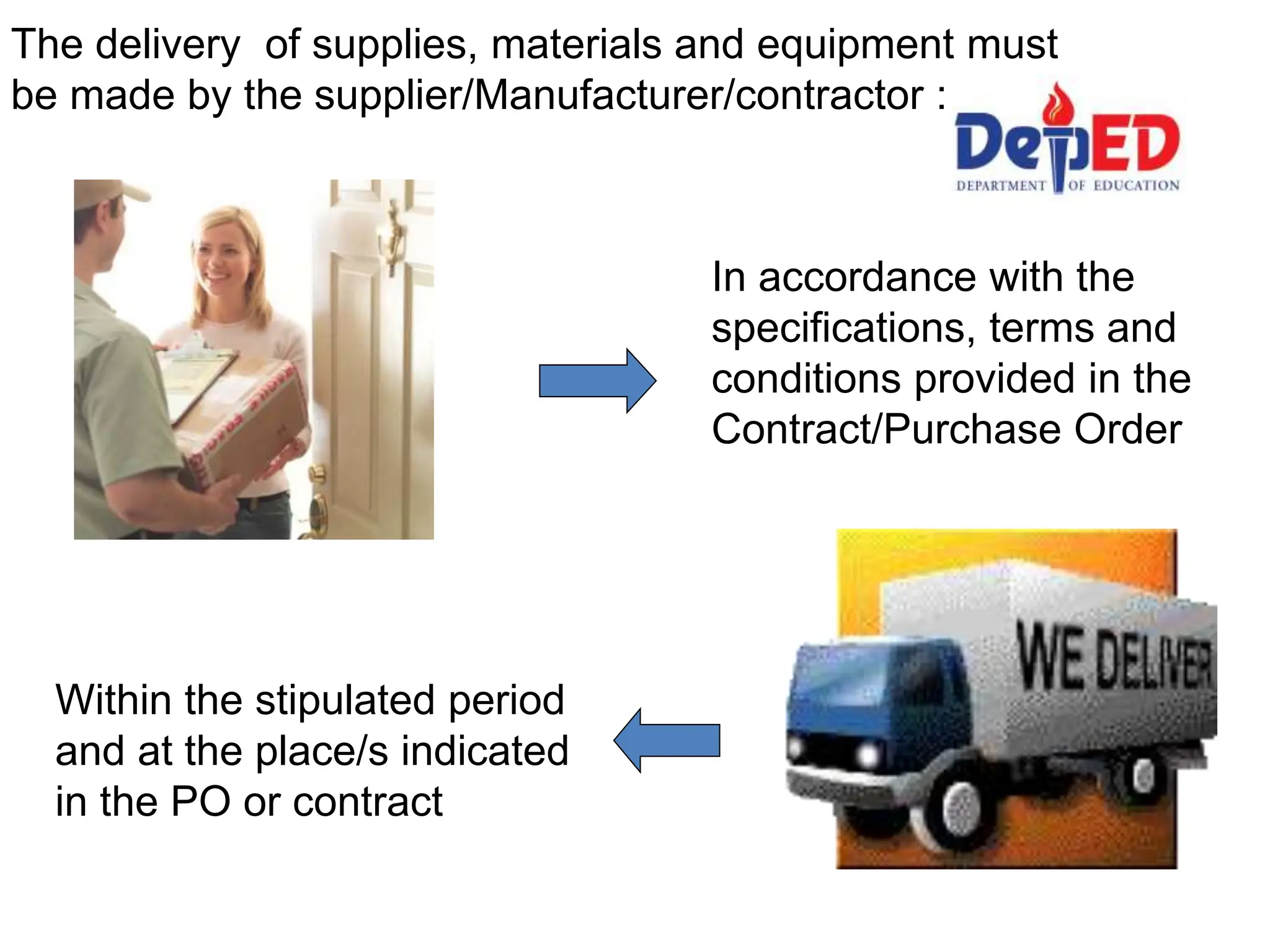
The delivery of supplies, materials and equipment must
be made by the supplier/Manufacturer/contractor :
In accordance with the
specifications, terms and
conditions provided in the
Contract/Purchase Order
Within the stipulated period
and at the place/s indicated
in the PO or contract
The Supply Officer / Designated Property
Custodian shall receive all the deliveries and
signs the Delivery Receipt (DR) if the delivered
goods are in accordance with the contract or
Purchase Order (PO).
If not, he/she may reject the deliveries
until the supplier complies with the end-
users specifications
Supply Officer/Designated Property Custodian
signs “Received” portion of the original and copy 2 of
Delivery Receipt (DR)
All items to be inspected shall be accepted first
by the Property Officer/School Property
Custodian, as the case may be (Section 114,
COA Circular 92-386)
The above provision pertains only to the
receipting/signing on the delivery receipt (DR)
and temporary recording of the deliveries upon
arrival of goods or articles. The deliveries
are still subject to inspection for
conformity with specifications on the
order.
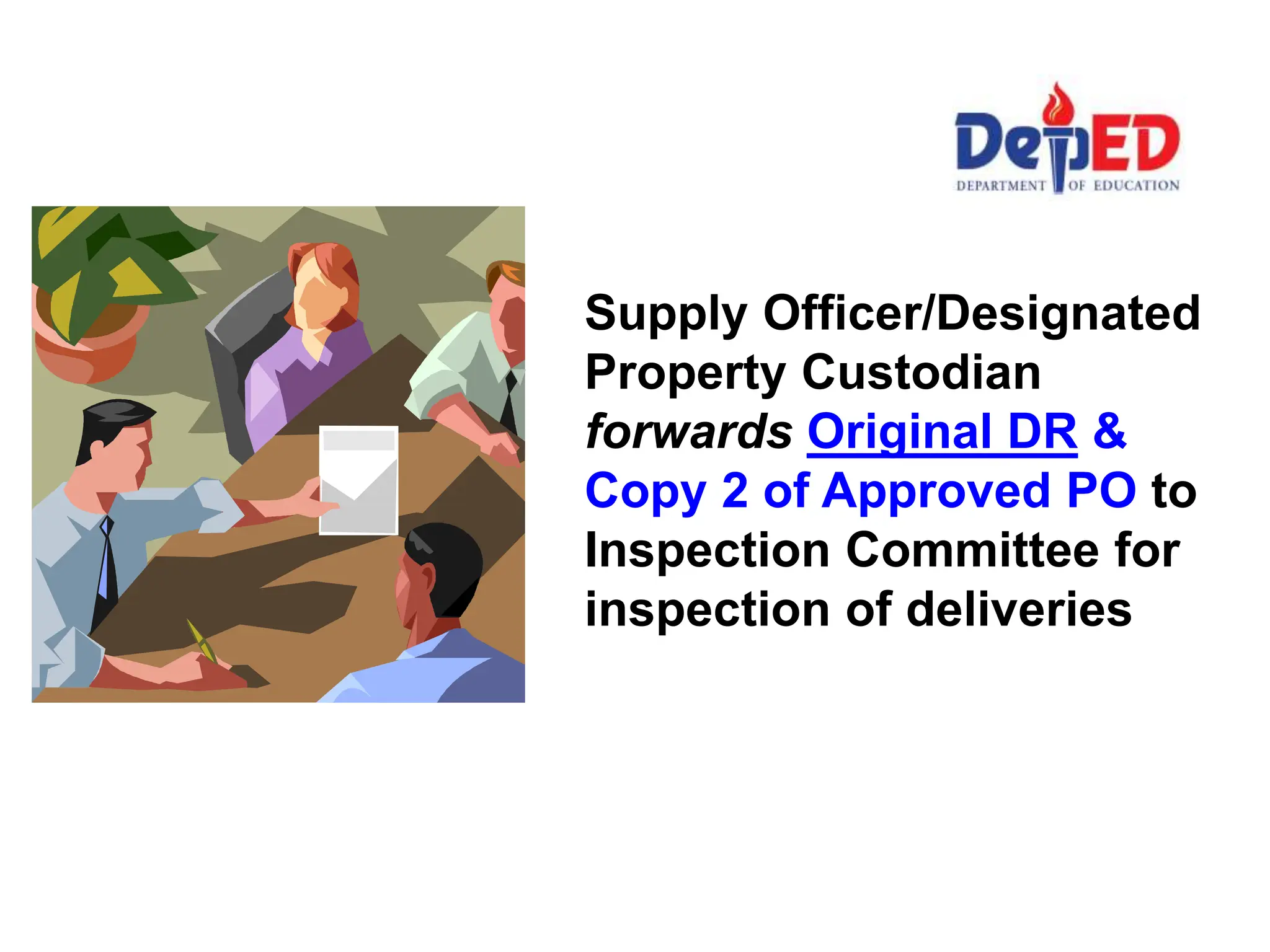
Supply Officer/Designated
Property Custodian
forwards Original DR &
Copy 2 of Approved PO to
Inspection Committee for
inspection of deliveries
The Head of Office or
school shall constitute an
Inspection Committee to
inspect and validate
deliveries
The School Inspection Committee
shall be composed of :
Regular Members:
a). Team Leader – at least 2nd ranking
permanent official of school
b). One (1) school personnel designated by
the principal who has knowledge/technical
expertise relevant to the goods delivered
c). One (1) representative from PTA or NGOs
The Division Office Inspection Committee
shall be composed of :
Regular Members:
a). Team Leader – at least 3rd ranking permanent
official of the procuring entity
b). One (1) representative from any of the regular
offices under the Office of the Schools Division
Superintendent (SDS) such as, but not limited to
the following
* Administrative Unit
* Budget Unit
* Legal Unit
* School Governance and Operation Division
c). Representative from the procuring entity who
has knowledge/technical expertise relevant to the
goods delivered
The Regional Office Inspection Committee
shall be composed of :
Regular Members:
a). Team Leader – at least 5th ranking permanent
official of the procuring entity
b). One (1) representative from any of the regular
offices under the Office of the Regional Director
such as, but not limited to the following
* Administrative Unit
* Budget Unit
* Legal Unit
* Education Support Services Division
c). Representative from the procuring entity who
has knowledge/technical expertise relevant to the
goods delivered
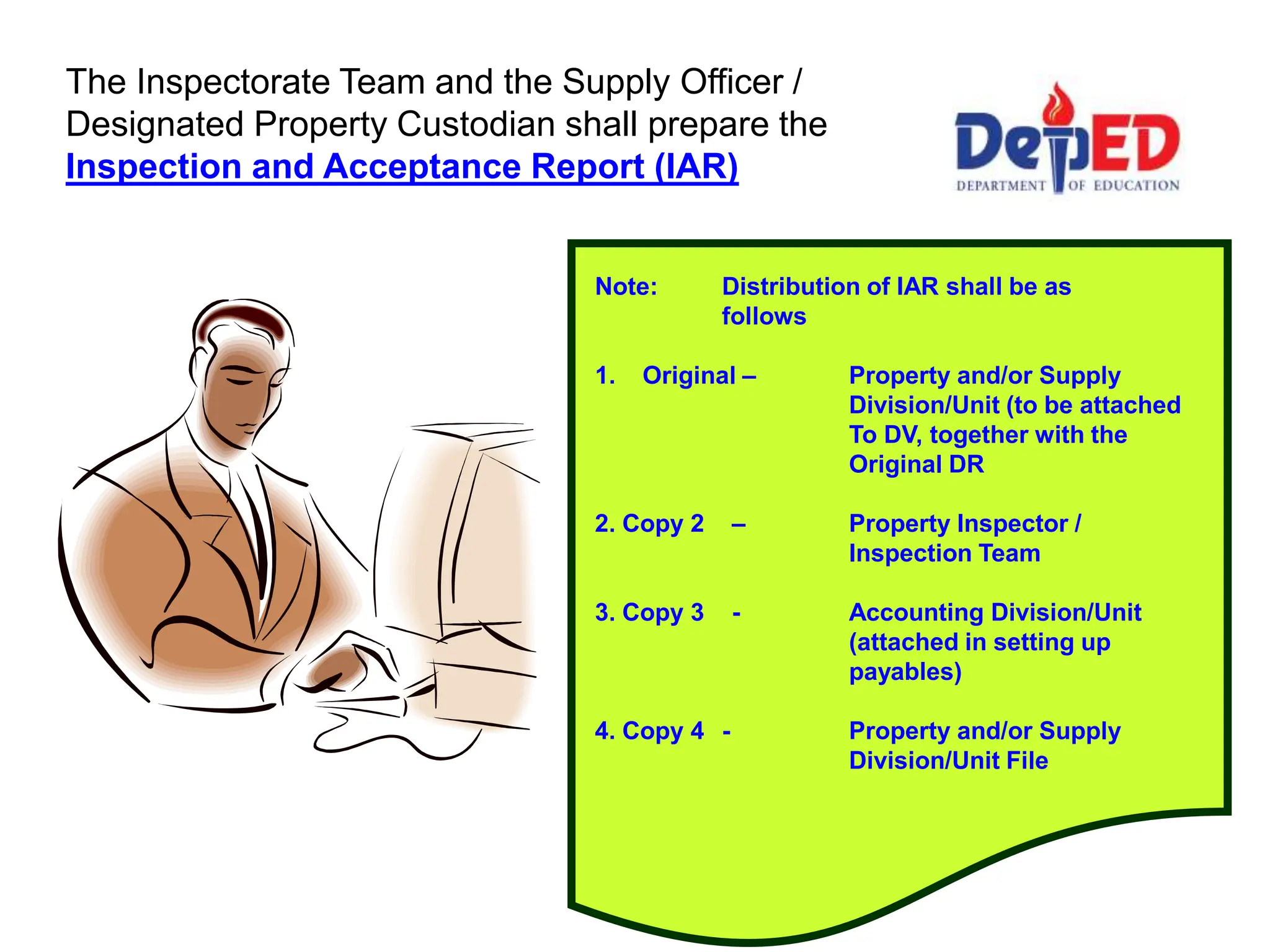
The Inspectorate Team and the Supply Officer /
Designated Property Custodian shall prepare the
Inspection and Acceptance Report (IAR)
Note: Distribution of IAR shall be as
follows
1. Original – Property and/or Supply
Division/Unit (to be attached
To DV, together with the
Original DR
2. Copy 2 – Property Inspector /
Inspection Team
3. Copy 3 - Accounting Division/Unit
(attached in setting up
payables)
4. Copy 4 - Property and/or Supply
Division/Unit File
The Office/School inspection
Committee shall sign the Inspection
and Acceptance Report (IAR) prior
to acceptance by the Supply
Officer/School Property Custodian.
Loss of Government Property
It is the power of the COA to
credit losses of property or act
on application for relief of
accountability
New Form from COA
Report of Loss
DISPOSAL– is the end of the life cycle of
a government property
Disposal Objectives
• to avoid continuing carrying/inventory
costs
• to prevent further deterioration
thereby obtaining the fair return in
case of sale
• to relieve accountable officers of
unnecessary accountability
• to make available space for the
agency
Determination of Disposable Property
• Can no longer be repaired or reconditioned
• Maintenance/repair costs more than or
outweighs the benefits and services
• Has become obsolete or outmoded
• Has been rendered unnecessary due to
change in the Agency’s functions/mandate
• In excess of requirements
• Has become dangerous or hazardous to use
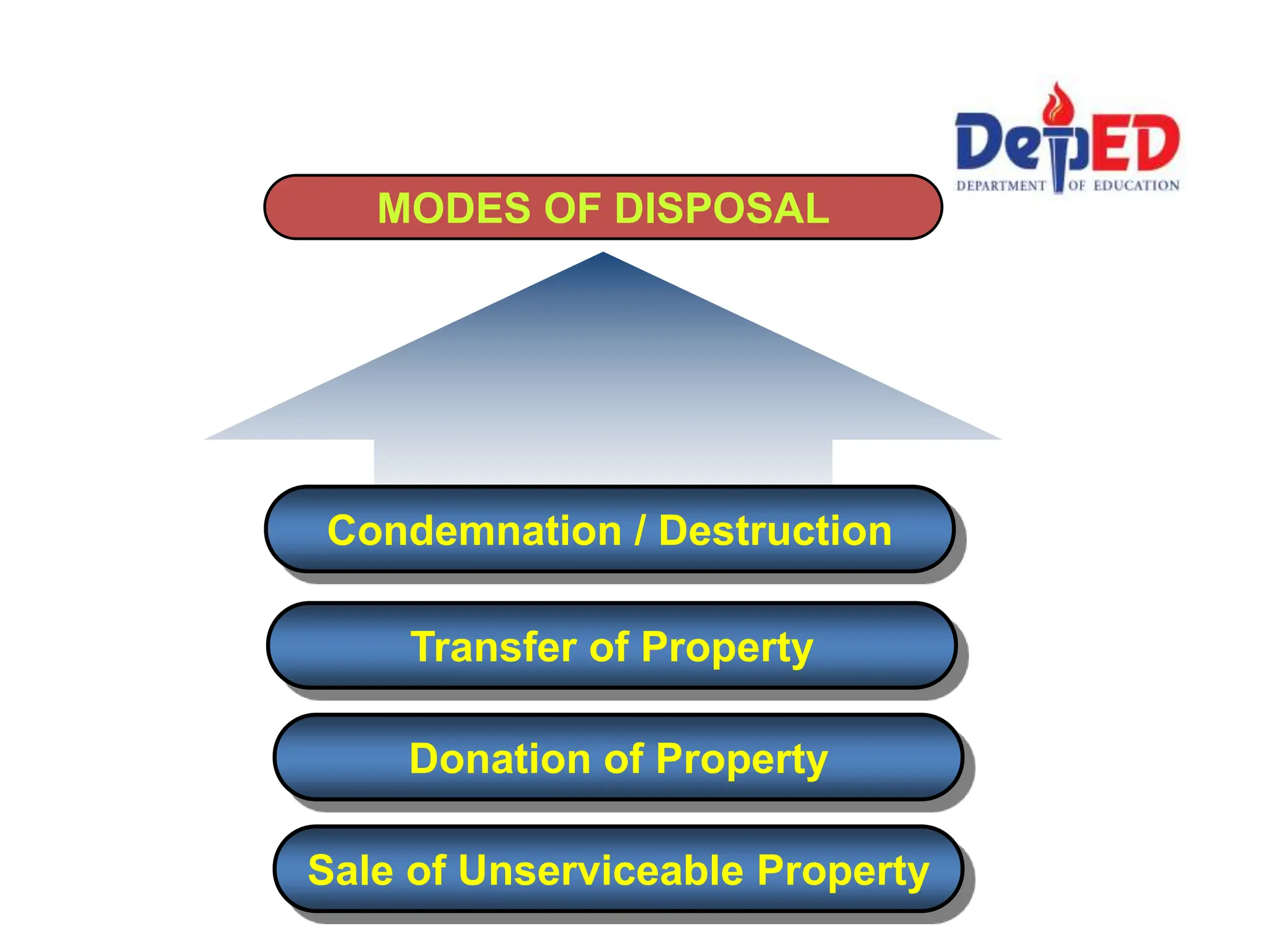
MODES OF DISPOSAL
Transfer of Property
Donation of Property
Condemnation / Destruction
Sale of Unserviceable Property
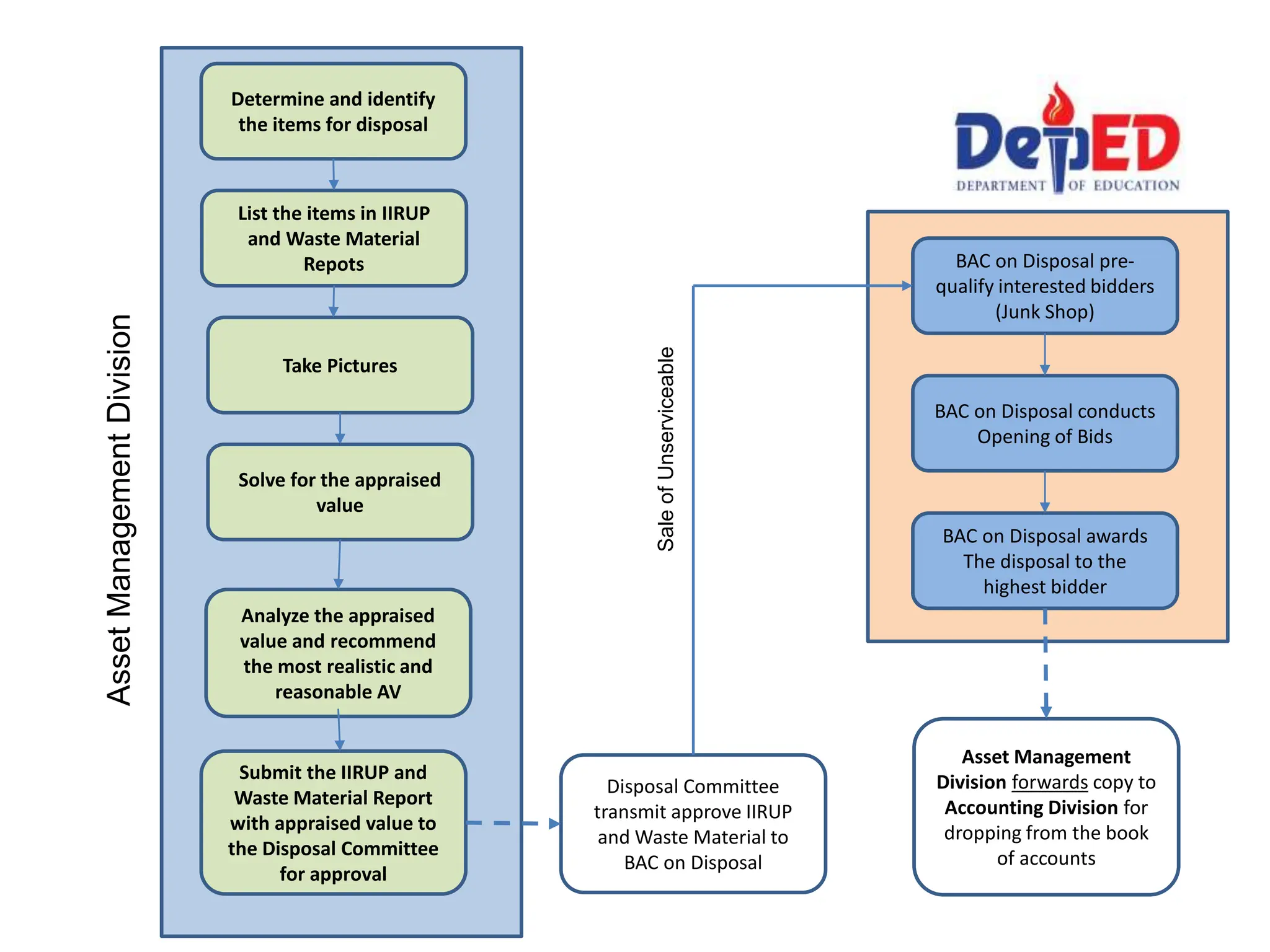
Determine and identify
the items for disposal
List the items in IIRUP
and Waste Material
Repots
Take Pictures
Solve for the appraised
value
Analyze the appraised
value and recommend
the most realistic and
reasonable AV
Submit the IIRUP and
Waste Material Report
with appraised value to
the Disposal Committee
for approval
Disposal Committee
transmit approve IIRUP
and Waste Material to
BAC on Disposal
BAC on Disposal pre-
qualify interested bidders
(Junk Shop)
BAC on Disposal conducts
Opening of Bids
BAC on Disposal awards
The disposal to the
highest bidder
Asset Management
Division forwards copy to
Accounting Division for
dropping from the book
of accounts
Asset
Management
Division
Sale
of
Unserviceable
“The only person who is educated
is the one who has learned how to learn…. and
changed “
Carl Rogers
ASSET MANAGEMENT.pptx Educational management

ASSET MANAGEMENT.pptx Educational management

  • 1.
    MA. RIEZA R.FATALLA MAED-Educational Management
  • 2.
  • 3.
    “The illiterate ofthe 21st century is NOT the PERSON who is unable to read and write, rather the person who is unable to learn, unlearn & relearn”
  • 4.
    Are resources controlledby an entity as a result of past events, and from which future economic benefits or service potential are expected to flow to the entity. If an expenditure is instead consumed within the current Period, it is classified as an expense.
  • 5.
    - Cash - MarketableSecurities - Accounts Receivables - Prepaid Assets - Land - Buildings - Office Equipment - Furniture and Fixtures CLASSIFICATION OF ASSET
  • 6.
    • What Isthe Issue?
  • 7.
    Custodianship Accountability Liability Responsibility of accountableofficers arising from loss, misuse, damage or deterioration of government property due to fault or negligence in the safekeeping Includes:
  • 8.
    Accountability, Responsibility and Liabilityfor Government Property • Accountability – “a person” obligations to carry out responsibilities and be answerable for decisions and activities • Responsibility – the acceptance of assigned authority and the obligation prudently to exercise assigned or imputed authority attaching to the assigned or imputed role of an individual or group participating in organizational activities or decision • Liability – Refers to the obligation that arises as a consequence of an illegal or improper act or the non- performance of what one is mandated to do.
  • 9.
    DO LRMDS Coordinator/ Librarian DO Supply Officer / Sch Property Custodian DO / School ICT Coordinator Head of the Agency - Immediately and primary responsible for all government funds and property pertaining to his/her agency - are officers who are made responsible for the supervision and control of accountable officers ACCOUNTABLE OFFICER Accountable – Answerable or one whose duties permit or required possession or custody of funds and property such as cashier, disbursing or supply officer and other persons though not accountable may be held accountable by virtue of their participation on a particular transaction
  • 10.
    10 6. Prepares InventoryReport including (monitoring the actual location of asset, condition of asset and Person Accountable) as required by COA 4. Prepares Issuance Documents Property Acknowledgement Receipt (PAR) and Inventory Custodian Slip (ICS) 3. Records delivery / transfer / donations thru Property Card and Stock Card (duly inspected from a perfected PO or Contract, formal turn-over thru IRP or duly accepted or signed Deed of Donation) 1. Accepts delivery / transfer / donations (duly signed PO / Contract / Deed of Donation and MOA) 2. Signs Inspection and Acceptance Report 5. Conducts Inventory Taking and Maintains PC & SC Role of Supply Officer / Property Custodian
  • 11.
    The delivery ofsupplies, materials and equipment must be made by the supplier/Manufacturer/contractor : In accordance with the specifications, terms and conditions provided in the Contract/Purchase Order Within the stipulated period and at the place/s indicated in the PO or contract
  • 12.
    The Supply Officer/ Designated Property Custodian shall receive all the deliveries and signs the Delivery Receipt (DR) if the delivered goods are in accordance with the contract or Purchase Order (PO). If not, he/she may reject the deliveries until the supplier complies with the end- users specifications Supply Officer/Designated Property Custodian signs “Received” portion of the original and copy 2 of Delivery Receipt (DR)
  • 13.
    All items tobe inspected shall be accepted first by the Property Officer/School Property Custodian, as the case may be (Section 114, COA Circular 92-386) The above provision pertains only to the receipting/signing on the delivery receipt (DR) and temporary recording of the deliveries upon arrival of goods or articles. The deliveries are still subject to inspection for conformity with specifications on the order.
  • 14.
    Supply Officer/Designated Property Custodian forwardsOriginal DR & Copy 2 of Approved PO to Inspection Committee for inspection of deliveries
  • 15.
    The Head ofOffice or school shall constitute an Inspection Committee to inspect and validate deliveries
  • 16.
    The School InspectionCommittee shall be composed of : Regular Members: a). Team Leader – at least 2nd ranking permanent official of school b). One (1) school personnel designated by the principal who has knowledge/technical expertise relevant to the goods delivered c). One (1) representative from PTA or NGOs
  • 17.
    The Division OfficeInspection Committee shall be composed of : Regular Members: a). Team Leader – at least 3rd ranking permanent official of the procuring entity b). One (1) representative from any of the regular offices under the Office of the Schools Division Superintendent (SDS) such as, but not limited to the following * Administrative Unit * Budget Unit * Legal Unit * School Governance and Operation Division c). Representative from the procuring entity who has knowledge/technical expertise relevant to the goods delivered
  • 18.
    The Regional OfficeInspection Committee shall be composed of : Regular Members: a). Team Leader – at least 5th ranking permanent official of the procuring entity b). One (1) representative from any of the regular offices under the Office of the Regional Director such as, but not limited to the following * Administrative Unit * Budget Unit * Legal Unit * Education Support Services Division c). Representative from the procuring entity who has knowledge/technical expertise relevant to the goods delivered
  • 19.
    The Inspectorate Teamand the Supply Officer / Designated Property Custodian shall prepare the Inspection and Acceptance Report (IAR) Note: Distribution of IAR shall be as follows 1. Original – Property and/or Supply Division/Unit (to be attached To DV, together with the Original DR 2. Copy 2 – Property Inspector / Inspection Team 3. Copy 3 - Accounting Division/Unit (attached in setting up payables) 4. Copy 4 - Property and/or Supply Division/Unit File
  • 20.
    The Office/School inspection Committeeshall sign the Inspection and Acceptance Report (IAR) prior to acceptance by the Supply Officer/School Property Custodian.
  • 23.
    Loss of GovernmentProperty It is the power of the COA to credit losses of property or act on application for relief of accountability New Form from COA Report of Loss
  • 25.
    DISPOSAL– is theend of the life cycle of a government property
  • 26.
    Disposal Objectives • toavoid continuing carrying/inventory costs • to prevent further deterioration thereby obtaining the fair return in case of sale • to relieve accountable officers of unnecessary accountability • to make available space for the agency
  • 27.
    Determination of DisposableProperty • Can no longer be repaired or reconditioned • Maintenance/repair costs more than or outweighs the benefits and services • Has become obsolete or outmoded • Has been rendered unnecessary due to change in the Agency’s functions/mandate • In excess of requirements • Has become dangerous or hazardous to use
  • 28.
    MODES OF DISPOSAL Transferof Property Donation of Property Condemnation / Destruction Sale of Unserviceable Property
  • 29.
    Determine and identify theitems for disposal List the items in IIRUP and Waste Material Repots Take Pictures Solve for the appraised value Analyze the appraised value and recommend the most realistic and reasonable AV Submit the IIRUP and Waste Material Report with appraised value to the Disposal Committee for approval Disposal Committee transmit approve IIRUP and Waste Material to BAC on Disposal BAC on Disposal pre- qualify interested bidders (Junk Shop) BAC on Disposal conducts Opening of Bids BAC on Disposal awards The disposal to the highest bidder Asset Management Division forwards copy to Accounting Division for dropping from the book of accounts Asset Management Division Sale of Unserviceable
  • 30.
    “The only personwho is educated is the one who has learned how to learn…. and changed “ Carl Rogers