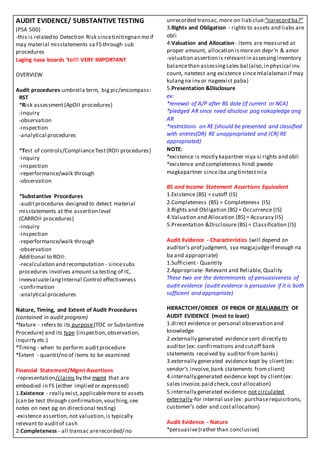
AUDIT EVIDENCE/ SUBSTANTIVE TESTING
(PSA 500)
-this is related to Detection Risk sincetinitingnan mo if
may material misstatements sa FS through sub
procedures
Laging nasa boards ‘to!!! VERY IMPORTANT
OVERVIEW
Audit procedures-umbrella term, big pic/encompass:
RST
*Risk assessment(ApOII procedures)
-inquiry
-observation
-inspection
-analytical procedures
*Test of controls/ComplianceTest(ROII procedures)
-inquiry
-inspection
-reperformance/walk through
-observation
*Substantive Procedures
-auditprocedures designed to detect material
misstatements at the assertion level
(CARROII procedures)
-inquiry
-inspection
-reperformance/walk through
-observation
Additional to ROII:
-recalculation and recomputation - sincesubs
procedures involves amount sa testing of IC,
ineevaluatelangInternal Control effectiveness
-confirmation
-analytical procedures
Nature, Timing, and Extent of Audit Procedures
(contained in audit program)
*Nature - refers to its purpose(TOC or Substantive
Procedure) and its type (inspection,observation,
inquirty etc.)
*Timing - when to perform auditprocedure
*Extent - quantit/no of items to be examined
Financial Statement/Mgmt Assertions
-representation/claims by the mgmt that are
embodied in FS (either implied or expressed)
1.Existence - really exist,applicablemore to assets
(can be test through confirmation,vouching,see
notes on next pg on directional testing)
-existence assertion,not valuation,is typically
relevant to auditof cash
2.Completeness - all transac arerecorded/ no
unrecorded transac,more on liab clue:“narecord ba?”
3.Rights and Obligation - rights to assets and liabs are
obli
4.Valuation and Allocation- items are measured at
proper amount, allocation ismoreon depr’n & amor
-valuation assertion is relevantin assessinginventory
balancethan assessingsales bal (also,in physical inv
count, natetest ang existence sincemlalalaman if may
kulangna inv or nageexist paba)
5.Presentation &Disclosure
ex:
*renewal of A/P after BS date (if current or NCA)
*pledged AR since need idisclose pag nakapledge ang
AR
*restrictions on RE (should be presented and classified
with entries(DR) RE unappropriated and (CR) RE
appropriated)
NOTE:
*existence is mostly kapartner niya si rights and obli
*existence and completeness hindi pwede
magkapartner sinceiba ungtinitestnila
BS and Income Statement Assertions Equivalent
1.Existence (BS) = cutoff (IS)
2.Completeness (BS) = Completeness (IS)
3.Rights and Obligation (BS) = Occurrence (IS)
4.Valuation and Allocation (BS) = Accuracy (IS)
5.Presentation &Disclosure(BS) = Classification (IS)
Audit Evidence - Characteristics (will depend on
auditor’s prof judgment, sya magjajudgeif enough na
ba and appropriate)
1.Sufficient- Quantity
2.Appropriate- Relevant and Reliable, Quality
These two are the determinants of persuasiveness of
audit evidence (audit evidence is persuasive if it is both
sufficient and appropriate)
HIERACTCHY/ORDER OF PRIOR OF REALIABILITY OF
AUDIT EVIDENCE (most to least)
1.direct evidence or personal observation and
knowledge
2.externally generated evidence sent directly to
auditor (ex: confirmations and cutoff bank
statements received by auditor from banks)
3.externally generated evidence kept by client(ex:
vendor’s invoive,bank statements from client)
4.internally generated evidence kept by client(ex:
sales invoice,paid check,cost allocation)
5.internally generated evidence not circulated
externally-for internal use(ex: purchaserequisitions,
customer’s oder and costallocation)
Audit Evidence - Nature
*persuasive(rather than conclusive)
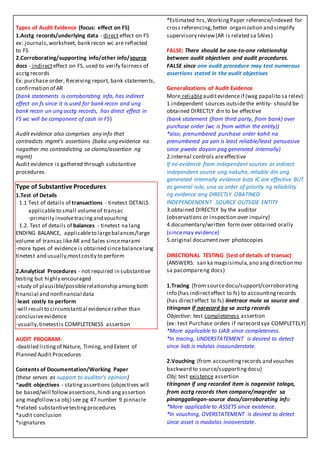
Types of Audit Evidence (focus: effect on FS)
1.Acctg records/underlying data - direct effect on FS
ex: journals,worksheet, bank recon wc are reflected
to FS
2.Corroborating/supporting info/other info/source
docs - indirecteffect on FS, used to verify fairness of
acctgrecords
Ex: purchase order, Receiving report, bank statements,
confirmation of AR
(bank statements is corroborating info, has indirect
effect on fs since it is used for bank recon and ung
bank recon un ung acctg records, has direct effect in
FS wc will be component of cash in FS)
Audit evidence also comprises any info that
contradicts mgmt’s assertions (baka ung evidence na
nagather mo contradicting sa claims/assertion ng
mgmt)
Audit evidence is gathered through substantive
procedures.
Type of Substantive Procedures
1.Test of Details
1.1 Test of details of transactions - tinetest DETAILS
applicableto small volumeof transac
-primarily involvetracingand vouching
1.2. Test of details of balances - tinetest na lang
ENDING BALANCE, applicableto largebalances/large
volume of transac likeAR and Sales sincemarami
-more types of evidence is obtained sincebalancelang
tinetest and usually,mostcostly to perform
2.Analytical Procedures - not required in substantive
testing but highly encouraged
-study of plausible/possiblerelationship amongboth
financial and nonfinancial data
-least costly to perform
-will resultto circumstantial evidencerather than
conclusiveevidence
-usually,tinetestis COMPLETENESS assertion
AUDIT PROGRAM-
-deatiled listingof Nature, Timing, and Extent of
Planned Audit Procedures
Contents of Documentation/Working Paper
(these serves as support to auditor’s opinion)
*audit objectives - statingassertions (objectives will
be based/will followassertions,hindi angassertion
ang magfollowsa obj) see pg 47 number 9 pinnacle
*related substantivetestingprocedures
*audit conclusion
*signatures
*Estimated hrs,WorkingPaper reference/indexed for
cross referencing,better organization and simplify
supervisory review(AR is related sa SAles)
FALSE: There should be one-to-one relationship
between audit objectives and audit procedures.
FALSE since one audit procedure may test numerous
assertions stated in the audit objectives
Generalizations of Audit Evidence
More reliableauditevidenceif (wag papalito sa relev):
1.independent sources outsidethe entity- should be
obtained DIRECTLY din to be effective
(bank statement (from third party, from bank) over
purchase order (wc is from within the entity))
*also, prenumbered purchase order kahit na
prenumbered pa yan is least reliable/least persuasive
since pwede dayain pag generated internally)
2.internal controls areeffective
If no evidence from independent sources or indirect
independent source ung nakuha, reliable din ang
generated internally evidence bsta IC are effective BUT
as general rule, una sa order of priority ng reliability
ng evidence ang DIRECTLY OBATINED
INDEPENDENDENT SOURCE OUTSIDE ENTITY
3.obtained DIRECTLY by the auditor
(observations or inspection over inquiry)
4.documentary/written form over obtained orally
(sincemay evidence)
5.original documentover photocopies
DIRECTIONAL TESTING (test of details of transac)
(ANSWERS: san ka magsisimula,ano angdirection mo
sa pacompareng docs)
1.Tracing (from sourcedocu/support/corroborating
info (has indirecteffect to fs) to accountingrecords
(has directeffect to fs) iinetrace mula sa source and
titingnan if narecord ba sa acctg records
Objective: test completeness assertion
(ex: test Purchase orders if narecord sya COMPLETELY)
*More applicable to LIAB since completeness.
*In tracing, UNDERSTATEMENT is desired to detect
since liab is mdalas inaaunderstate.
2.Vouching (from accountingrecords and vouches
backward to source/supportingdocu)
Obj: test existence assertion
titingnan if ung recorded item is nageexist talaga,
from acctg records then compare/magrefer sa
pinanggalingan-source docu/corroborating info
*More applicable to ASSETS since existence.
*In vouching, OVERSTATEMENT is desired to detect
since asset is madalas inooverstate.
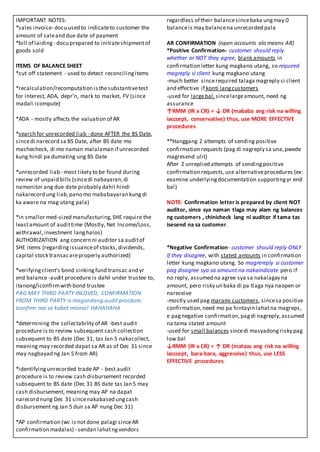
IMPORTANT NOTES:
*sales invoice- docu used to indicateto customer the
amount of saleand due date of payment
*bill of laiding - docu prepared to initiateshipmentof
goods sold
ITEMS OF BALANCE SHEET
*cut off statement - used to detect reconcilingitems
*recalculation/recomputation isthesubstantivetest
for interest, ADA, depr’n, mark to market, FV (since
madali icompute)
*ADA - mostly affects the valuation of AR
*search for unrecorded liab - done AFTER the BS Date,
sincedi narecord sa BS Date, after BS date mo
machecheck, di mo naman malalaman if unrecorded
kung hindi pa dumating ung BS Date
*unrecorded liab - most likely to be found during
review of unpaid bills (sincedi nabayaran,di
namonitor ang due date probably dahil hindi
nakarecord ung liab,pano mo mababayaran kungdi
ka aware na mag utang pala)
*in smallor med-sized manufacturing,SHE require the
leastamount of audittime (Mostly, Net Income/Loss,
withrawal,investment langhalos)
AUTHORIZATION ang concern ni auditor sa auditof
SHE items (regardingissuanceof stocks,dividends,
capital stock transacareproperly authorized)
*verifyingclient’s bond sinkingfund transac and yr
end balance -audit procedure is dahil under trustee to,
itanong/iconfirmwith bond trustee
PAG MAY THIRD PARTY INLOVED, CONFIRMATION
FROM THIRD PARTY is magandang audit procdure.
Iconfirm mo sa kabet mismo! HAHAHAHA
*determining the collectability of AR -best audit
procedure is to review subsequent cash collection
subsequent to BS date (Dec 31, tas Jan 5 nakacollect,
meaning may recorded dapat sa AR as of Dec 31 since
may nagbayad ng Jan 5 from AR)
*identifyingunrecorded trade AP - best audit
procedure is to review cash disbursement recorded
subsequent to BS date (Dec 31 BS date tas Jan 5 may
cash disbursement, meaning may AP na dapat
narecord nung Dec 31 sincenakabased ungcash
disbursement ng Jan 5 dun sa AP nung Dec 31)
*AP confirmation (wc is notdone palagi sinceAR
confirmation madalas) - sendan lahatngvendors
regardless of their balancesincebaka ungmay 0
balanceis may balancena unrecorded pala
AR CONFIRMATION (open accounts alo means AR)
*Positive Confirmation- customer should reply
whether or NOT they agree, blank amounts in
confirmation letter kung magkano utang, so required
magreply si client kung magkano utang
-much better sincerequired talaga magreply si client
and effective if konti langcustomers
-used for largebal,sincelargeamount, need ng
assurance
↑RMM (IR x CR) = ↓ DR (mababa ang risk na willing
iacccept, conservative) thus, use MORE EFFECTIVE
procedures
**Hanggang 2 attempts of sending positive
confirmation requests (pag di nagreply sa una,pwede
magresend ulit)
After 2 unreplied attempts of sendingpositive
confirmation requests,use alternativeprocedures (ex:
examine underlyingdocumentation supportingyr end
bal)
NOTE: Confirmation letter is prepared by client NOT
auditor, since sya naman tlaga may alam ng balances
ng customers , chinicheck lang ni auditor if tama tas
isesend na sa customer.
*Negative Confirmation- customer should reply ONLY
if they disagree, with stated amounts in confirmation
letter kung magkano utang. So magrereply si customer
pag disagree sya sa amount na nakaindicate pero if
no reply, assumed na agree sya sa nakalagay na
amount, pero risky un baka di pa tlaga nya naopen or
nareceive
-mostly used pag marami customers, sincesa positive
confirmation,need mo pa hintayin lahatna magreps,
e pagnegative confirmation,pagdi nagreply,assumed
na tama stated amount
-used for small balances sincedi masyadongrisky pag
low bal
↓RMM (IR x CR) = ↑ DR (mataas ang risk na willing
iacccept, bara-bara, aggressive) thus, use LESS
EFFECTIVE procedures

AUDIT EVIDENCE-SUBSTANTIVE TESTING.docx

  • 1.
    AUDIT EVIDENCE/ SUBSTANTIVETESTING (PSA 500) -this is related to Detection Risk sincetinitingnan mo if may material misstatements sa FS through sub procedures Laging nasa boards ‘to!!! VERY IMPORTANT OVERVIEW Audit procedures-umbrella term, big pic/encompass: RST *Risk assessment(ApOII procedures) -inquiry -observation -inspection -analytical procedures *Test of controls/ComplianceTest(ROII procedures) -inquiry -inspection -reperformance/walk through -observation *Substantive Procedures -auditprocedures designed to detect material misstatements at the assertion level (CARROII procedures) -inquiry -inspection -reperformance/walk through -observation Additional to ROII: -recalculation and recomputation - sincesubs procedures involves amount sa testing of IC, ineevaluatelangInternal Control effectiveness -confirmation -analytical procedures Nature, Timing, and Extent of Audit Procedures (contained in audit program) *Nature - refers to its purpose(TOC or Substantive Procedure) and its type (inspection,observation, inquirty etc.) *Timing - when to perform auditprocedure *Extent - quantit/no of items to be examined Financial Statement/Mgmt Assertions -representation/claims by the mgmt that are embodied in FS (either implied or expressed) 1.Existence - really exist,applicablemore to assets (can be test through confirmation,vouching,see notes on next pg on directional testing) -existence assertion,not valuation,is typically relevant to auditof cash 2.Completeness - all transac arerecorded/ no unrecorded transac,more on liab clue:“narecord ba?” 3.Rights and Obligation - rights to assets and liabs are obli 4.Valuation and Allocation- items are measured at proper amount, allocation ismoreon depr’n & amor -valuation assertion is relevantin assessinginventory balancethan assessingsales bal (also,in physical inv count, natetest ang existence sincemlalalaman if may kulangna inv or nageexist paba) 5.Presentation &Disclosure ex: *renewal of A/P after BS date (if current or NCA) *pledged AR since need idisclose pag nakapledge ang AR *restrictions on RE (should be presented and classified with entries(DR) RE unappropriated and (CR) RE appropriated) NOTE: *existence is mostly kapartner niya si rights and obli *existence and completeness hindi pwede magkapartner sinceiba ungtinitestnila BS and Income Statement Assertions Equivalent 1.Existence (BS) = cutoff (IS) 2.Completeness (BS) = Completeness (IS) 3.Rights and Obligation (BS) = Occurrence (IS) 4.Valuation and Allocation (BS) = Accuracy (IS) 5.Presentation &Disclosure(BS) = Classification (IS) Audit Evidence - Characteristics (will depend on auditor’s prof judgment, sya magjajudgeif enough na ba and appropriate) 1.Sufficient- Quantity 2.Appropriate- Relevant and Reliable, Quality These two are the determinants of persuasiveness of audit evidence (audit evidence is persuasive if it is both sufficient and appropriate) HIERACTCHY/ORDER OF PRIOR OF REALIABILITY OF AUDIT EVIDENCE (most to least) 1.direct evidence or personal observation and knowledge 2.externally generated evidence sent directly to auditor (ex: confirmations and cutoff bank statements received by auditor from banks) 3.externally generated evidence kept by client(ex: vendor’s invoive,bank statements from client) 4.internally generated evidence kept by client(ex: sales invoice,paid check,cost allocation) 5.internally generated evidence not circulated externally-for internal use(ex: purchaserequisitions, customer’s oder and costallocation) Audit Evidence - Nature *persuasive(rather than conclusive)
  • 2.
    Types of AuditEvidence (focus: effect on FS) 1.Acctg records/underlying data - direct effect on FS ex: journals,worksheet, bank recon wc are reflected to FS 2.Corroborating/supporting info/other info/source docs - indirecteffect on FS, used to verify fairness of acctgrecords Ex: purchase order, Receiving report, bank statements, confirmation of AR (bank statements is corroborating info, has indirect effect on fs since it is used for bank recon and ung bank recon un ung acctg records, has direct effect in FS wc will be component of cash in FS) Audit evidence also comprises any info that contradicts mgmt’s assertions (baka ung evidence na nagather mo contradicting sa claims/assertion ng mgmt) Audit evidence is gathered through substantive procedures. Type of Substantive Procedures 1.Test of Details 1.1 Test of details of transactions - tinetest DETAILS applicableto small volumeof transac -primarily involvetracingand vouching 1.2. Test of details of balances - tinetest na lang ENDING BALANCE, applicableto largebalances/large volume of transac likeAR and Sales sincemarami -more types of evidence is obtained sincebalancelang tinetest and usually,mostcostly to perform 2.Analytical Procedures - not required in substantive testing but highly encouraged -study of plausible/possiblerelationship amongboth financial and nonfinancial data -least costly to perform -will resultto circumstantial evidencerather than conclusiveevidence -usually,tinetestis COMPLETENESS assertion AUDIT PROGRAM- -deatiled listingof Nature, Timing, and Extent of Planned Audit Procedures Contents of Documentation/Working Paper (these serves as support to auditor’s opinion) *audit objectives - statingassertions (objectives will be based/will followassertions,hindi angassertion ang magfollowsa obj) see pg 47 number 9 pinnacle *related substantivetestingprocedures *audit conclusion *signatures *Estimated hrs,WorkingPaper reference/indexed for cross referencing,better organization and simplify supervisory review(AR is related sa SAles) FALSE: There should be one-to-one relationship between audit objectives and audit procedures. FALSE since one audit procedure may test numerous assertions stated in the audit objectives Generalizations of Audit Evidence More reliableauditevidenceif (wag papalito sa relev): 1.independent sources outsidethe entity- should be obtained DIRECTLY din to be effective (bank statement (from third party, from bank) over purchase order (wc is from within the entity)) *also, prenumbered purchase order kahit na prenumbered pa yan is least reliable/least persuasive since pwede dayain pag generated internally) 2.internal controls areeffective If no evidence from independent sources or indirect independent source ung nakuha, reliable din ang generated internally evidence bsta IC are effective BUT as general rule, una sa order of priority ng reliability ng evidence ang DIRECTLY OBATINED INDEPENDENDENT SOURCE OUTSIDE ENTITY 3.obtained DIRECTLY by the auditor (observations or inspection over inquiry) 4.documentary/written form over obtained orally (sincemay evidence) 5.original documentover photocopies DIRECTIONAL TESTING (test of details of transac) (ANSWERS: san ka magsisimula,ano angdirection mo sa pacompareng docs) 1.Tracing (from sourcedocu/support/corroborating info (has indirecteffect to fs) to accountingrecords (has directeffect to fs) iinetrace mula sa source and titingnan if narecord ba sa acctg records Objective: test completeness assertion (ex: test Purchase orders if narecord sya COMPLETELY) *More applicable to LIAB since completeness. *In tracing, UNDERSTATEMENT is desired to detect since liab is mdalas inaaunderstate. 2.Vouching (from accountingrecords and vouches backward to source/supportingdocu) Obj: test existence assertion titingnan if ung recorded item is nageexist talaga, from acctg records then compare/magrefer sa pinanggalingan-source docu/corroborating info *More applicable to ASSETS since existence. *In vouching, OVERSTATEMENT is desired to detect since asset is madalas inooverstate.
  • 3.
    IMPORTANT NOTES: *sales invoice-docu used to indicateto customer the amount of saleand due date of payment *bill of laiding - docu prepared to initiateshipmentof goods sold ITEMS OF BALANCE SHEET *cut off statement - used to detect reconcilingitems *recalculation/recomputation isthesubstantivetest for interest, ADA, depr’n, mark to market, FV (since madali icompute) *ADA - mostly affects the valuation of AR *search for unrecorded liab - done AFTER the BS Date, sincedi narecord sa BS Date, after BS date mo machecheck, di mo naman malalaman if unrecorded kung hindi pa dumating ung BS Date *unrecorded liab - most likely to be found during review of unpaid bills (sincedi nabayaran,di namonitor ang due date probably dahil hindi nakarecord ung liab,pano mo mababayaran kungdi ka aware na mag utang pala) *in smallor med-sized manufacturing,SHE require the leastamount of audittime (Mostly, Net Income/Loss, withrawal,investment langhalos) AUTHORIZATION ang concern ni auditor sa auditof SHE items (regardingissuanceof stocks,dividends, capital stock transacareproperly authorized) *verifyingclient’s bond sinkingfund transac and yr end balance -audit procedure is dahil under trustee to, itanong/iconfirmwith bond trustee PAG MAY THIRD PARTY INLOVED, CONFIRMATION FROM THIRD PARTY is magandang audit procdure. Iconfirm mo sa kabet mismo! HAHAHAHA *determining the collectability of AR -best audit procedure is to review subsequent cash collection subsequent to BS date (Dec 31, tas Jan 5 nakacollect, meaning may recorded dapat sa AR as of Dec 31 since may nagbayad ng Jan 5 from AR) *identifyingunrecorded trade AP - best audit procedure is to review cash disbursement recorded subsequent to BS date (Dec 31 BS date tas Jan 5 may cash disbursement, meaning may AP na dapat narecord nung Dec 31 sincenakabased ungcash disbursement ng Jan 5 dun sa AP nung Dec 31) *AP confirmation (wc is notdone palagi sinceAR confirmation madalas) - sendan lahatngvendors regardless of their balancesincebaka ungmay 0 balanceis may balancena unrecorded pala AR CONFIRMATION (open accounts alo means AR) *Positive Confirmation- customer should reply whether or NOT they agree, blank amounts in confirmation letter kung magkano utang, so required magreply si client kung magkano utang -much better sincerequired talaga magreply si client and effective if konti langcustomers -used for largebal,sincelargeamount, need ng assurance ↑RMM (IR x CR) = ↓ DR (mababa ang risk na willing iacccept, conservative) thus, use MORE EFFECTIVE procedures **Hanggang 2 attempts of sending positive confirmation requests (pag di nagreply sa una,pwede magresend ulit) After 2 unreplied attempts of sendingpositive confirmation requests,use alternativeprocedures (ex: examine underlyingdocumentation supportingyr end bal) NOTE: Confirmation letter is prepared by client NOT auditor, since sya naman tlaga may alam ng balances ng customers , chinicheck lang ni auditor if tama tas isesend na sa customer. *Negative Confirmation- customer should reply ONLY if they disagree, with stated amounts in confirmation letter kung magkano utang. So magrereply si customer pag disagree sya sa amount na nakaindicate pero if no reply, assumed na agree sya sa nakalagay na amount, pero risky un baka di pa tlaga nya naopen or nareceive -mostly used pag marami customers, sincesa positive confirmation,need mo pa hintayin lahatna magreps, e pagnegative confirmation,pagdi nagreply,assumed na tama stated amount -used for small balances sincedi masyadongrisky pag low bal ↓RMM (IR x CR) = ↑ DR (mataas ang risk na willing iacccept, bara-bara, aggressive) thus, use LESS EFFECTIVE procedures