TABLE OF CONTENT
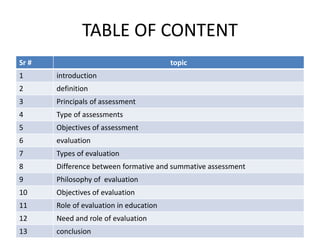
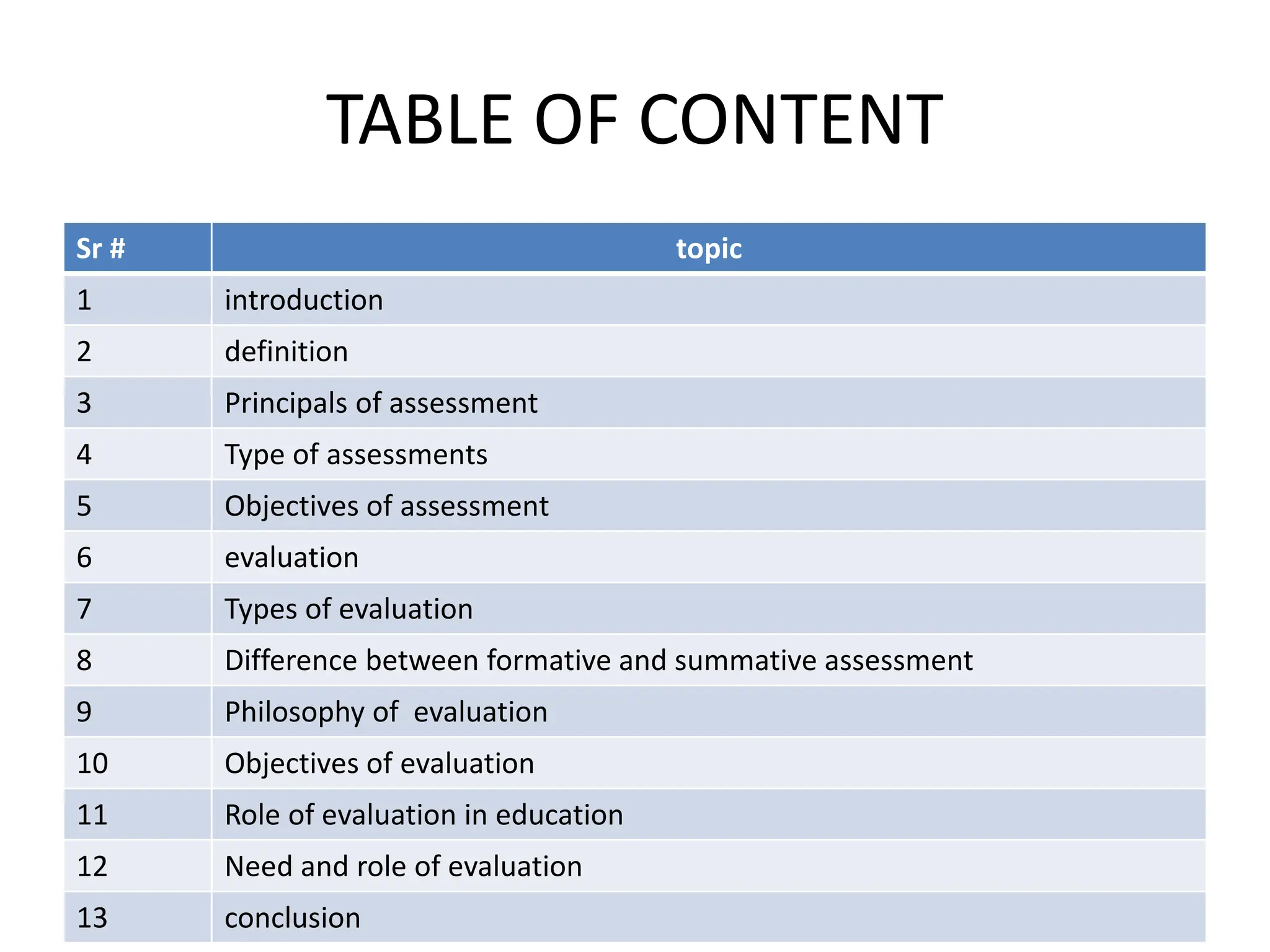
Sr # topic
1 introduction
2 definition
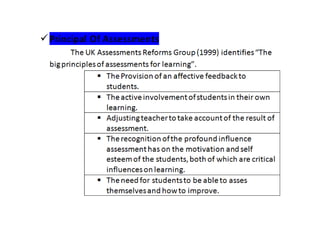
3 Principals of assessment
4 Type of assessments
5 Objectives of assessment
6 evaluation
7 Types of evaluation
8 Difference between formative and summative assessment
9 Philosophy of evaluation
10 Objectives of evaluation
11 Role of evaluation in education
12 Need and role of evaluation
13 conclusion
INTRODUCTION
Besides teaching we have to assess our
self as well as our students. It is
beneficial for our teaching to set the
target for our self and our students. Feed
forward remarks and compliments are so
much important to the students. It also
gives information to institutional and
external stakeholders.
Definitions
• Assessment can be defined as the process of
gathering the data and fashioning them into
interpretable form for decision-making. It
involves collecting data with a view of making
valve judgment about the quality of a person,
object, group or event (Ajuonnma, 2006).
• Assessment is the systematic collection, review,
and use of information about educational
programs undertaken for the purpose of
improving student learning and development.
(Ref:T. Marchese, 1987)
Principles of assessment
• The five principles that underpin quality
assessment practice specify it should.
• Be complementary to and supportive of learning.
• Be valid and reliable;
• Be fit for purpose and manageable;
• Support teachers 'professional judgement;and
• Support accountability
BY (CCEA)
Types of assessment
• Formative assessment
• Summative assessment
• Diagnostic assessment
• Evaluation assessment
BY(CCEA)
Formative assessment
Formative assessment is a range of formal and
informal assessment procedures used by
teachers during the learning process so they
can modify teaching and learning activities to
improve pupil attainment.
BY(CCEA)
Summative assessment
• Summative assessment comes at the end of a
learning sequence and is used to acknowledge,
record and report on pupils 'overall
achievement at given point.
BY (CCEA)
Diagnostic assessment
• Diagnostic assessment is used to identify
individual strengths, areas for improvement
and to inform next step.
BY (CCEA)
Evaluation assessment
• Evaluation assessment is concerned with the
overarching performance of arrangements in
department, school or system.
BY(CCEA)
OBJECTIVES OF ASSESSMENT
• Assessment discover the current status of student knowledge
and understanding.
• To solve a problem in our teaching.
• To determine whether we need to change direction in our
teaching.
• To find out how students are experienced learning in our
classroom.
• Assessing to give learners feedback on their progress.
• Assessing learning to improve our profession through the
scholarship of teaching and learning. (Sotl)
• Provides diagnostic feedback..
Definition of Evaluation
• Evaluation is the systematic process of
collecting and analyzing data in order to
determine whether, and to what degree,
objectives have been or are being achieved .
• Evaluation is the systematic process of
collecting and analyzing data in order to make
decisions.
(L.R Hay 1985)
Types of evaluation
1. Program evaluation
2. Student Evaluation
3. Formative Evaluation
4. Summative Evaluation
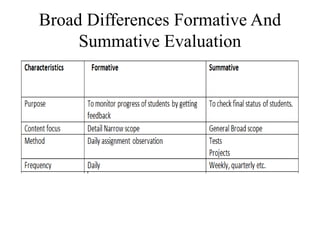
Broad Differences Formative And
Summative Evaluation
Evaluation is based on two philosophies
1st Philosophy
• One traditional philosophy is that ability to learn
is randomly distributed in the general population.
It means that if some learning is assigned to a
class and then a test is administrator to study their
performance.
• The result of test shows that some students score
is very high and some students is score is low and
majority of students score falls between these two
extremes. This was the old philosophy based on
the superiority of heredity.
2ND Philosophy
• This philosophy of evaluation has recently
emerged. The need philophy is based on
democratic values and gives importance to the
environment. It is based on the univer
salisation of education. It assumes that if
education is thought universal, the
responsibility of teacher is to help as many
students as possible to learn.
Objectives of evaluation
• Evaluation in education is necessary and it has more
objectives than measurement. It is a tool to make a
judgment about the quality of program in education.
Evaluation helps educators in making decisions.
• Evaluation is based on two philosophies
• Traditional philosophy
• Democratic philosophy
• According to William wee rams and Stephen G Jars’
(1990) to be more effective, however, evaluation
requires that judgments be based on appropriate and
relevant data. Ineffective evaluation is made upon
whim or fancy, even in the broader community context.
Role of evaluation in education
• Selection decision
• Placement decision
• Classification decision
• Diagnosis and remedial decision
• Feed back
• Motivation and guidance of learning
• Program evaluation
• Development
• Assigning maker to students
Types of evaluation
• Program evaluation
• Student evaluation
i) Formative assessment
ii) Summative assessment
Need and role of evaluation
Evaluation is done to gather the information which is the
basic thing of decision making, operation of program
and replacement of program. It is also helpful for
planning the activities replacing the activities and
objectives to make learners more comfotable.(cont)
Need and role of evaluation
In education educators have to make some
instructional decision based on evaluation
done by teachers. in evaluation educator have
to decide about the test quality and test type.
CONCLUSION
Conclusion
• Evaluation is the continuous inspection of akk
available information concerning the student,
teacher, educational programmed and the teaching
learning process to ascertain the degree of change
in the students and form valid judgment about the
students and the effectiveness of the programmed.
• Value judgment on an observation, performance
test or any data whether directly measured or
inferred is called evaluation.
THANKS FOR YOUR PATIENCE

Assessment, measurement and Evaluation .pptx

  • 1.
    TABLE OF CONTENT Sr# topic 1 introduction 2 definition 3 Principals of assessment 4 Type of assessments 5 Objectives of assessment 6 evaluation 7 Types of evaluation 8 Difference between formative and summative assessment 9 Philosophy of evaluation 10 Objectives of evaluation 11 Role of evaluation in education 12 Need and role of evaluation 13 conclusion
  • 2.
    INTRODUCTION Besides teaching wehave to assess our self as well as our students. It is beneficial for our teaching to set the target for our self and our students. Feed forward remarks and compliments are so much important to the students. It also gives information to institutional and external stakeholders.
  • 3.
    Definitions • Assessment canbe defined as the process of gathering the data and fashioning them into interpretable form for decision-making. It involves collecting data with a view of making valve judgment about the quality of a person, object, group or event (Ajuonnma, 2006). • Assessment is the systematic collection, review, and use of information about educational programs undertaken for the purpose of improving student learning and development. (Ref:T. Marchese, 1987)
  • 4.
    Principles of assessment •The five principles that underpin quality assessment practice specify it should. • Be complementary to and supportive of learning. • Be valid and reliable; • Be fit for purpose and manageable; • Support teachers 'professional judgement;and • Support accountability BY (CCEA)
  • 6.
    Types of assessment •Formative assessment • Summative assessment • Diagnostic assessment • Evaluation assessment BY(CCEA)
  • 7.
    Formative assessment Formative assessmentis a range of formal and informal assessment procedures used by teachers during the learning process so they can modify teaching and learning activities to improve pupil attainment. BY(CCEA)
  • 8.
    Summative assessment • Summativeassessment comes at the end of a learning sequence and is used to acknowledge, record and report on pupils 'overall achievement at given point. BY (CCEA)
  • 9.
    Diagnostic assessment • Diagnosticassessment is used to identify individual strengths, areas for improvement and to inform next step. BY (CCEA)
  • 10.
    Evaluation assessment • Evaluationassessment is concerned with the overarching performance of arrangements in department, school or system. BY(CCEA)
  • 11.
    OBJECTIVES OF ASSESSMENT •Assessment discover the current status of student knowledge and understanding. • To solve a problem in our teaching. • To determine whether we need to change direction in our teaching. • To find out how students are experienced learning in our classroom. • Assessing to give learners feedback on their progress. • Assessing learning to improve our profession through the scholarship of teaching and learning. (Sotl) • Provides diagnostic feedback..
  • 13.
    Definition of Evaluation •Evaluation is the systematic process of collecting and analyzing data in order to determine whether, and to what degree, objectives have been or are being achieved . • Evaluation is the systematic process of collecting and analyzing data in order to make decisions. (L.R Hay 1985)
  • 14.
    Types of evaluation 1.Program evaluation 2. Student Evaluation 3. Formative Evaluation 4. Summative Evaluation
  • 15.
    Broad Differences FormativeAnd Summative Evaluation
  • 16.
    Evaluation is basedon two philosophies 1st Philosophy • One traditional philosophy is that ability to learn is randomly distributed in the general population. It means that if some learning is assigned to a class and then a test is administrator to study their performance. • The result of test shows that some students score is very high and some students is score is low and majority of students score falls between these two extremes. This was the old philosophy based on the superiority of heredity.
  • 17.
    2ND Philosophy • Thisphilosophy of evaluation has recently emerged. The need philophy is based on democratic values and gives importance to the environment. It is based on the univer salisation of education. It assumes that if education is thought universal, the responsibility of teacher is to help as many students as possible to learn.
  • 18.
    Objectives of evaluation •Evaluation in education is necessary and it has more objectives than measurement. It is a tool to make a judgment about the quality of program in education. Evaluation helps educators in making decisions. • Evaluation is based on two philosophies • Traditional philosophy • Democratic philosophy • According to William wee rams and Stephen G Jars’ (1990) to be more effective, however, evaluation requires that judgments be based on appropriate and relevant data. Ineffective evaluation is made upon whim or fancy, even in the broader community context.
  • 19.
    Role of evaluationin education • Selection decision • Placement decision • Classification decision • Diagnosis and remedial decision • Feed back • Motivation and guidance of learning • Program evaluation • Development • Assigning maker to students
  • 20.
    Types of evaluation •Program evaluation • Student evaluation i) Formative assessment ii) Summative assessment Need and role of evaluation Evaluation is done to gather the information which is the basic thing of decision making, operation of program and replacement of program. It is also helpful for planning the activities replacing the activities and objectives to make learners more comfotable.(cont)
  • 21.
    Need and roleof evaluation In education educators have to make some instructional decision based on evaluation done by teachers. in evaluation educator have to decide about the test quality and test type.
  • 24.
  • 25.
    Conclusion • Evaluation isthe continuous inspection of akk available information concerning the student, teacher, educational programmed and the teaching learning process to ascertain the degree of change in the students and form valid judgment about the students and the effectiveness of the programmed. • Value judgment on an observation, performance test or any data whether directly measured or inferred is called evaluation.
  • 26.