Assessing Students’ Information Literacy Skills Using
MAP-Works
University of Pittsburgh at Greensburg AiA Team Members: Amanda Folk (Director, Millstein Library),
Jackie Horrall (Assistant VPAA), and Sheila Confer (Assistant Director of the Academic Village)
Research Question: Do students at Pitt-Greensburg
demonstrate a progressive increase in their information literacy
skills as they move through coursework toward degree
completion?
Description: Our project investigates the use MAP-Works
transition and check-up surveys as vehicles for information
literacy assessment. The use of these surveys will allow us to
track students’ progress longitudinally and hopefully increase
the data we are able to collect from upperclassmen.
This project is part of the program “Assessment in Action: Academic
Libraries and Student Success” which is undertaken by the Association of
College and Research Libraries (ACRL) in partnership with the Association
for Institutional Research and the Association of Public and Land-grant
Universities. The program, a cornerstone of ACRL's Value of Academic
Libraries initiative, is made possible by the Institute of Museum and
Library Services.
Students’ Strengths
• Defining a scholarly article
• Getting background info
• Identifying appropriate evaluation
questions
• Citing and understanding what
paraphrasing is
Students’ Weaknesses
• Selecting characteristics of a scholarly
article
• Determining an appropriate topic scope
• Boolean searching using OR
What’s Next?
 Analyze results of this assessment in
combination with results of the HEDS
Research Practices Survey
 Use results of both assessments to
develop tiered learning outcomes.
 Use results of both assessments to begin
conversations with teaching faculty about
embedding information literacy explicitly
into their courses.
 Think about developing a bank of valid
and reliable assessment questions,
especially if this becomes our main vehicle
for information literacy assessment.
Results
What is MAP-Works?
MAP-Works is an interactive student success tool that helps
students make a successful transition to college, provides key
information to faculty and professional staff, creates
opportunities for early intervention, connects students to
campus resources and re-aligns student expectations to
improve their learning experience.
MAP-Works uses survey, institutional data and input by staff
and faculty to create individualized risk indicators and reports
for each student.
Timeline and Process
Developed
and
submitted
an expedited
IRB
application
in order to
collect data
in summer
2015.
Met to finalize
questions to be
added to the
MAP-Works fall
transition
(freshmen and
sophomores)
and fall check-
up (juniors and
seniors)
surveys.
Collected
data during
the fall
2015
semester.
Analyzed data
using Stata
during the
spring 2016
semester. Most
analysis was
descriptive.
Report of
preliminary
findings to
Greensburg
campus and ULS
administrations.
Presentation
about information
literacy skills to
Greensburg
campus faculty.
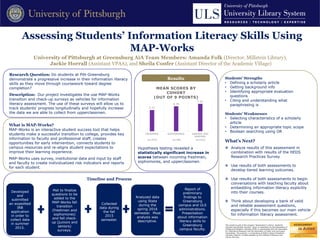
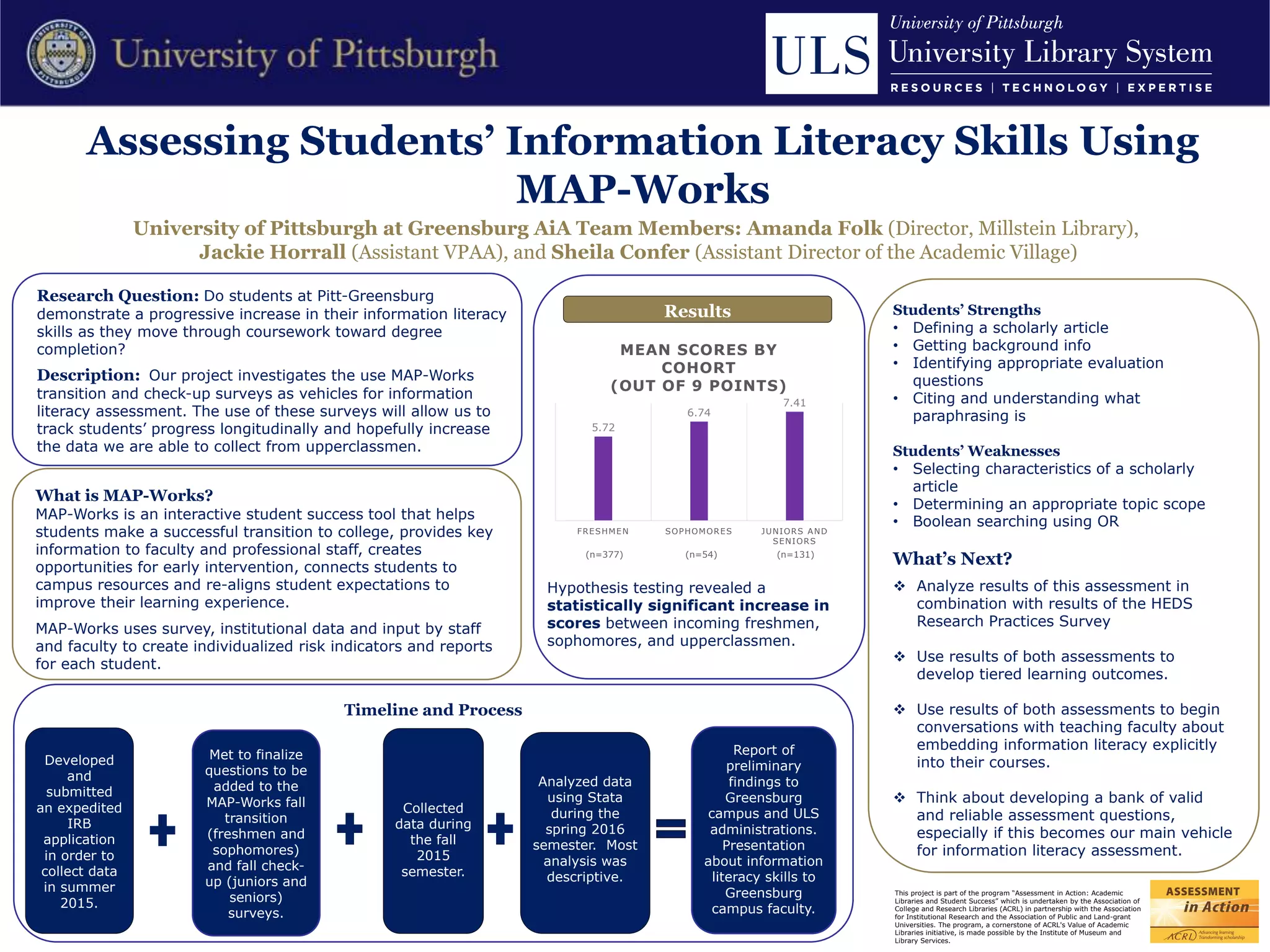
(n=377) (n=54) (n=131)
5.72
6.74
7.41
FRESHMEN SOPHOMORES JUNIORS AND
SENIORS
MEAN SCORES BY
COHORT
(OUT OF 9 POINTS)
Hypothesis testing revealed a
statistically significant increase in
scores between incoming freshmen,
sophomores, and upperclassmen.

Assessing Students' Information Literacy Skills Using MAP-Works

  • 1.
    Assessing Students’ InformationLiteracy Skills Using MAP-Works University of Pittsburgh at Greensburg AiA Team Members: Amanda Folk (Director, Millstein Library), Jackie Horrall (Assistant VPAA), and Sheila Confer (Assistant Director of the Academic Village) Research Question: Do students at Pitt-Greensburg demonstrate a progressive increase in their information literacy skills as they move through coursework toward degree completion? Description: Our project investigates the use MAP-Works transition and check-up surveys as vehicles for information literacy assessment. The use of these surveys will allow us to track students’ progress longitudinally and hopefully increase the data we are able to collect from upperclassmen. This project is part of the program “Assessment in Action: Academic Libraries and Student Success” which is undertaken by the Association of College and Research Libraries (ACRL) in partnership with the Association for Institutional Research and the Association of Public and Land-grant Universities. The program, a cornerstone of ACRL's Value of Academic Libraries initiative, is made possible by the Institute of Museum and Library Services. Students’ Strengths • Defining a scholarly article • Getting background info • Identifying appropriate evaluation questions • Citing and understanding what paraphrasing is Students’ Weaknesses • Selecting characteristics of a scholarly article • Determining an appropriate topic scope • Boolean searching using OR What’s Next?  Analyze results of this assessment in combination with results of the HEDS Research Practices Survey  Use results of both assessments to develop tiered learning outcomes.  Use results of both assessments to begin conversations with teaching faculty about embedding information literacy explicitly into their courses.  Think about developing a bank of valid and reliable assessment questions, especially if this becomes our main vehicle for information literacy assessment. Results What is MAP-Works? MAP-Works is an interactive student success tool that helps students make a successful transition to college, provides key information to faculty and professional staff, creates opportunities for early intervention, connects students to campus resources and re-aligns student expectations to improve their learning experience. MAP-Works uses survey, institutional data and input by staff and faculty to create individualized risk indicators and reports for each student. Timeline and Process Developed and submitted an expedited IRB application in order to collect data in summer 2015. Met to finalize questions to be added to the MAP-Works fall transition (freshmen and sophomores) and fall check- up (juniors and seniors) surveys. Collected data during the fall 2015 semester. Analyzed data using Stata during the spring 2016 semester. Most analysis was descriptive. Report of preliminary findings to Greensburg campus and ULS administrations. Presentation about information literacy skills to Greensburg campus faculty. (n=377) (n=54) (n=131) 5.72 6.74 7.41 FRESHMEN SOPHOMORES JUNIORS AND SENIORS MEAN SCORES BY COHORT (OUT OF 9 POINTS) Hypothesis testing revealed a statistically significant increase in scores between incoming freshmen, sophomores, and upperclassmen.