Guidelines Workshop
Purpose of Guidelines Institutions developing online courses of quality. Assure articulation agreements can be used without additional scrutiny. Faculty issues they need to address when developing online courses. Used as a self-assessment tool. Students Assure we are providing them with exceptional learning experiences.  All Used as a guide to review online courses after they are developed.
Task Force Recommendations Guidelines (not standards) Process for quality control MCCVLC Guidelines  or Plan of action that “may more appropriately assist them in assessing quality in the courses they offer through the MCCVLC.”
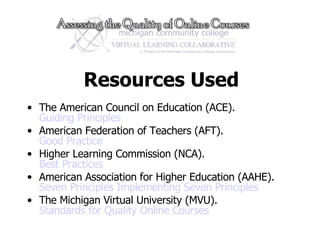
Resources Used The American Council on Education (ACE).  Guiding Principles American Federation of Teachers (AFT).  Good Practice Higher Learning Commission (NCA).  Best Practices American Association for Higher Education (AAHE). Seven Principles   Implementing Seven Principles The Michigan Virtual University (MVU). Standards for Quality Online Courses
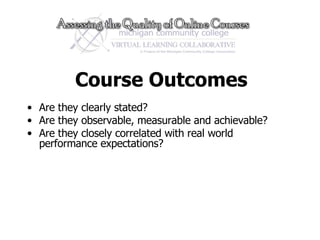
Course Outcomes Are they clearly stated? Are they observable, measurable and achievable?  Are they closely correlated with real world performance expectations?
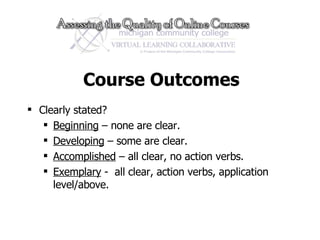
Course Outcomes Clearly stated? Beginning  – none are clear. Developing  – some are clear. Accomplished  – all clear, no action verbs.  Exemplary  -  all clear, action verbs, application level/above.
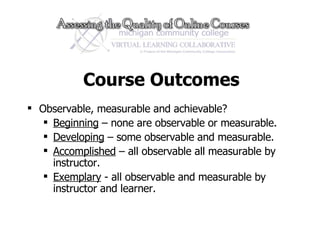
Course Outcomes Observable, measurable and achievable? Beginning  – none are observable or measurable. Developing  – some observable and measurable. Accomplished  – all observable all measurable by instructor.  Exemplary  - all observable and measurable by instructor and learner.
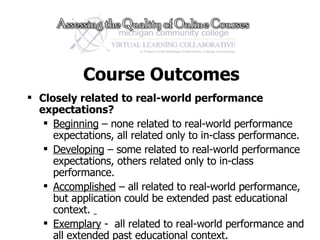
Course Outcomes Closely related to real-world performance expectations? Beginning  – none  related to real-world performance expectations, all related only to in-class performance . Developing  – some  related to real-world performance expectations , others  related only to in-class performance . Accomplished  – all  related to real-world performance, but application could be extended past educational context.  Exemplary  -  all  related to real-world performance and all extended past educational context.
Example - Course Outcomes Assess the quality of an online course with the MCCVLC Online Course Guidelines and Rubric. clearly stated? observable, measurable and achievable? closely related to real-world performance expectations?
Course Construction Course content, outcomes, practice and assessment are  consistent .  Course materials are presented to accommodate  multiple learning styles .  Presentation of content fosters  active learning  opportunities.  Course design includes the  necessary components of successful instruction  at the module/lesson level. Course  instructions and definitions are clear .
Course Interaction Are course interaction requirements clearly stated? Are a variety of opportunities designed for interaction between instructor-student?  Are clear standards set for instructors' response to students?  Are learning activities developed to foster instructor-student, student-content and, where appropriate, student-student interaction?
Course Assessment Are assessment methods appropriate to the outcomes, activities and technologies? Are assessments of student learning timely, appropriate and responsive to the needs of the individual learner? Are assessments of student achievement conducted by comparing student performance to the intended learning outcomes? Are policies and procedures designed to ensure the integrity of the student's work? Are students' achievement of learning outcomes documented?
Course Technologies Are technologies employed in ways that are appropriate for the course outcomes? Are student minimum technology requirements accurately and clearly stated?
Course Resources Are they accessible to the learners (all downloads are identified and made available to student)? Are they in accordance with the Americans with Disabilities Act?  Are reading levels for instructional materials identified?
Course Maintenance Are courses evaluated regularly to determine if the learning design is effective - in terms of the student and instruction components? Are plans in place for continual review and improvement of courses?
Course Development  and Support Are faculty provided with appropriate training and technical support? Are faculty able to access appropriate technical infrastructure? Are qualified instructional designers given an appropriate role in course development?

Assessing Quality in Online Courses

  • 1.
  • 2.
    Purpose of GuidelinesInstitutions developing online courses of quality. Assure articulation agreements can be used without additional scrutiny. Faculty issues they need to address when developing online courses. Used as a self-assessment tool. Students Assure we are providing them with exceptional learning experiences. All Used as a guide to review online courses after they are developed.
  • 3.
    Task Force RecommendationsGuidelines (not standards) Process for quality control MCCVLC Guidelines or Plan of action that “may more appropriately assist them in assessing quality in the courses they offer through the MCCVLC.”
  • 4.
    Resources Used TheAmerican Council on Education (ACE). Guiding Principles American Federation of Teachers (AFT). Good Practice Higher Learning Commission (NCA). Best Practices American Association for Higher Education (AAHE). Seven Principles Implementing Seven Principles The Michigan Virtual University (MVU). Standards for Quality Online Courses
  • 5.
    Course Outcomes Arethey clearly stated? Are they observable, measurable and achievable? Are they closely correlated with real world performance expectations?
  • 6.
    Course Outcomes Clearlystated? Beginning – none are clear. Developing – some are clear. Accomplished – all clear, no action verbs. Exemplary - all clear, action verbs, application level/above.
  • 7.
    Course Outcomes Observable,measurable and achievable? Beginning – none are observable or measurable. Developing – some observable and measurable. Accomplished – all observable all measurable by instructor. Exemplary - all observable and measurable by instructor and learner.
  • 8.
    Course Outcomes Closelyrelated to real-world performance expectations? Beginning – none related to real-world performance expectations, all related only to in-class performance . Developing – some related to real-world performance expectations , others related only to in-class performance . Accomplished – all related to real-world performance, but application could be extended past educational context. Exemplary - all related to real-world performance and all extended past educational context.
  • 9.
    Example - CourseOutcomes Assess the quality of an online course with the MCCVLC Online Course Guidelines and Rubric. clearly stated? observable, measurable and achievable? closely related to real-world performance expectations?
  • 10.
    Course Construction Coursecontent, outcomes, practice and assessment are consistent . Course materials are presented to accommodate multiple learning styles . Presentation of content fosters active learning opportunities. Course design includes the necessary components of successful instruction at the module/lesson level. Course instructions and definitions are clear .
  • 11.
    Course Interaction Arecourse interaction requirements clearly stated? Are a variety of opportunities designed for interaction between instructor-student? Are clear standards set for instructors' response to students? Are learning activities developed to foster instructor-student, student-content and, where appropriate, student-student interaction?
  • 12.
    Course Assessment Areassessment methods appropriate to the outcomes, activities and technologies? Are assessments of student learning timely, appropriate and responsive to the needs of the individual learner? Are assessments of student achievement conducted by comparing student performance to the intended learning outcomes? Are policies and procedures designed to ensure the integrity of the student's work? Are students' achievement of learning outcomes documented?
  • 13.
    Course Technologies Aretechnologies employed in ways that are appropriate for the course outcomes? Are student minimum technology requirements accurately and clearly stated?
  • 14.
    Course Resources Arethey accessible to the learners (all downloads are identified and made available to student)? Are they in accordance with the Americans with Disabilities Act? Are reading levels for instructional materials identified?
  • 15.
    Course Maintenance Arecourses evaluated regularly to determine if the learning design is effective - in terms of the student and instruction components? Are plans in place for continual review and improvement of courses?
  • 16.
    Course Development and Support Are faculty provided with appropriate training and technical support? Are faculty able to access appropriate technical infrastructure? Are qualified instructional designers given an appropriate role in course development?