Online Course EvaluationA proposal by Tari D. Hardy
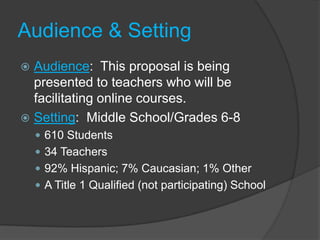
Audience & SettingAudience:  This proposal is being presented to teachers who will be facilitating online courses.Setting:  Middle School/Grades 6-8610 Students34 Teachers92% Hispanic; 7% Caucasian; 1% OtherA Title 1 Qualified (not participating) School
A Necessary StepOnline course evaluation is a necessary step toward insuring that our students receive the same high quality courses online as they would in the face-to-face classroom.
Why Evaluate?To maintain standards-based integrityTo verify rigorTo be sure content is accessible through a variety of learning stylesTo witness student-student and student-teacher interaction
Four-Point ScaleWhen evaluating using a scale of 1-4, please consider the following:1 = no evidence2 = developing3 = meets4 = exceeds
Quality Online Course InitiativeInformation on the following slides has been taken from QOCI (Quality Online Course Initiative), and edited to meet the particular course requirements of our district.  For further information on QOCI, please visit these websites:Quality Online Course Initiative Rubric by Illinois Online Network is licensed under a Creative Commons Attribution-Noncommercial-Share Alike 3.0 United States License.Based on a work at www.ion.uillinois.edu.Permissions beyond the scope of this license may be available at http://www.ion.uillinois.edu/about/staff.asp.
InformationA good online course must present the following information in a format that is readily accessible to the student:Course DescriptionInstructor InformationInstructional MaterialsGrading PolicyTechnical CompetenciesCode of Conduct
Learning OutcomesStudents will learn more if they’re made aware of their expected learning outcomes.  Therefore, the following information should be available within the online course:Course Goals and ObjectivesModule ObjectivesPurpose of Activities
Course Structure & PresentationThe following elements should be present during course presentation:SequenceChunkingMultimodal InstructionPresentationAudioVideo
IntegrityAll online courses must abide by copyright and fair use laws.
ProposalWhen observing and evaluating online courses within our district, each of the above indicators will be rated on a scale of 1-4.Teachers facilitating courses that meet or exceed expectations will be provided the support they need to continue their fine work.Teachers facilitating courses scoring no evidence or developing will receive additional professional development and mentoring, along with follow-up reviews.
Any Questions?Images by www.classroomclipart.com

Online course evaluation

  • 1.
    Online Course EvaluationAproposal by Tari D. Hardy
  • 2.
    Audience & SettingAudience: This proposal is being presented to teachers who will be facilitating online courses.Setting: Middle School/Grades 6-8610 Students34 Teachers92% Hispanic; 7% Caucasian; 1% OtherA Title 1 Qualified (not participating) School
  • 3.
    A Necessary StepOnlinecourse evaluation is a necessary step toward insuring that our students receive the same high quality courses online as they would in the face-to-face classroom.
  • 4.
    Why Evaluate?To maintainstandards-based integrityTo verify rigorTo be sure content is accessible through a variety of learning stylesTo witness student-student and student-teacher interaction
  • 5.
    Four-Point ScaleWhen evaluatingusing a scale of 1-4, please consider the following:1 = no evidence2 = developing3 = meets4 = exceeds
  • 6.
    Quality Online CourseInitiativeInformation on the following slides has been taken from QOCI (Quality Online Course Initiative), and edited to meet the particular course requirements of our district. For further information on QOCI, please visit these websites:Quality Online Course Initiative Rubric by Illinois Online Network is licensed under a Creative Commons Attribution-Noncommercial-Share Alike 3.0 United States License.Based on a work at www.ion.uillinois.edu.Permissions beyond the scope of this license may be available at http://www.ion.uillinois.edu/about/staff.asp.
  • 7.
    InformationA good onlinecourse must present the following information in a format that is readily accessible to the student:Course DescriptionInstructor InformationInstructional MaterialsGrading PolicyTechnical CompetenciesCode of Conduct
  • 8.
    Learning OutcomesStudents willlearn more if they’re made aware of their expected learning outcomes. Therefore, the following information should be available within the online course:Course Goals and ObjectivesModule ObjectivesPurpose of Activities
  • 9.
    Course Structure &PresentationThe following elements should be present during course presentation:SequenceChunkingMultimodal InstructionPresentationAudioVideo
  • 10.
    IntegrityAll online coursesmust abide by copyright and fair use laws.
  • 11.
    ProposalWhen observing andevaluating online courses within our district, each of the above indicators will be rated on a scale of 1-4.Teachers facilitating courses that meet or exceed expectations will be provided the support they need to continue their fine work.Teachers facilitating courses scoring no evidence or developing will receive additional professional development and mentoring, along with follow-up reviews.
  • 12.
    Any Questions?Images bywww.classroomclipart.com