ASPHALT RUBBER BINDER
S.ARUNRAJ 1
Submitted by,
S.ARUNRAJ
M.E. STRUCTURAL
ENGINEERING,
ANNA UNIVERSITY REGIONAL
CAMPUS,
MADURAI.
An overview of the
 Components
 Properties
 Quality Control
S.ARUNRAJ 2
A blend of asphalt cement, reclaimed tire
rubber and certain additives in which the
rubber component is at least 15% by weight of
the total blend and has reacted in the hot
asphalt asphalt cement sufficiently to cause
swelling of the rubber particles.
Asphalt Rubber
S.ARUNRAJ 3
COMPONENTS
 Crumb Rubber
 Asphalt Cement
 Additives
S.ARUNRAJ 4
Asphalt Rubber Binder
CRUMB RUBBER
Crumb rubber is produced from grinding up whole scrap tires and other
waste rubber products. Crumb rubber comes in a variety of grades and
designations presented by particular size and/or source.
Crumb Rubber Grades are usually identified by the following types.
Type 1 or Grade A: Coarse CRM, 10 mesh, usually for spray
applied applications like chip sealing
Type 2 or Grade B: 14 to 20 mesh, used for spray applied
applications and hot mix design for both moderate and
cold climates
Type 3 : 30 mesh, used for hot mix design in extreme cold
climate regions
Mesh size designation refers to the first sieve with an upper range
specification between 5.0 & 10.0 percent retained.
S.ARUNRAJ 5
Asphalt Rubber Binder
CRUMB RUBBER
Handling and Storage
A variety of packaging is available from
50 lb. paper sacks to
1 ton bulk bags.
Special consideration should be given to transporting and site
storage to protect from moisture. Moisture content
specifications usually are less than 0.75%. Excessive
moisture content can cause rapid foaming and boil over of the
asphalt rubber binder. If bulking of the crumb rubber is
evident, talc can be added to reduce bulking up to 4.0% max.
S.ARUNRAJ 6
Asphalt Rubber Binder
ASPHALT CEMENTS
Asphalt cements come in a variety of grades and
designations. Typically softer grades are used in
blending asphalt rubber binder for a particular
region than are used for production of
conventional hot mix.
S.ARUNRAJ 7
Asphalt Rubber Binder - Asphalt Cements
ASPHALT CEMENTS
USED FOR ASPHALT RUBBER
BINDER
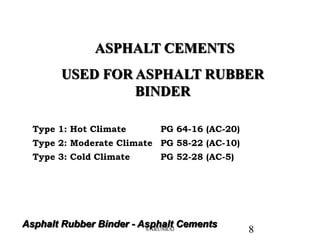
Type 1: Hot Climate PG 64-16 (AC-20)
Type 2: Moderate Climate PG 58-22 (AC-10)
Type 3: Cold Climate PG 52-28 (AC-5)
S.ARUNRAJ 8
Asphalt Rubber Binder - Asphalt Cements
PERFORMANCE
GRADED ASPHALTS
Example:
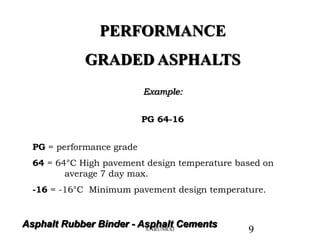
PG 64-16
PG = performance grade
64 = 64°C High pavement design temperature based on
average 7 day max.
-16 = -16°C Minimum pavement design temperature.
S.ARUNRAJ 9
Asphalt Rubber Binder - Asphalt Cements
VISCOSITY
GRADED ASPHALTS
1st Example: AC-10
AC-20
AC = Asphalt Cement
10 = Viscosity in hundreds of poises at 60°C ± 20%
AC-10 will have an absolute viscosity of 1000 ± 200 poise
2nd Example: AR-1000
AR-2000
AR = Aged Residue
1000 = Viscosity in poises at 60°C ± 25% after exposure to
rolling thin film oven test
AR-1000 will have an absolute viscosity after RTFO of 1000
± 250 poise.
S.ARUNRAJ 10
Asphalt Rubber Binder
ADDITIVES
Used in conjunction with crumb rubber to aid or help produce a
desirable property.
Some additives include:
 Extender oils - aid in the reaction of the crumb rubber by
providing aromatics which are absorbed by the rubber, and
help with dispersion by chemically suspending the rubber in
the asphalt.
 Anti-stripping agents - used to increase or improve
adhesion.
 High natural rubber - used to improve adhesion and
flexibility.
 Polymers
S.ARUNRAJ 11
Asphalt Rubber Binder
PROPERTIES
 Asphalt Rubber Blend Design Profile
 Reactions
 Specification Testing
S.ARUNRAJ 12
Asphalt Rubber Binder - Properties
ASPHALT RUBBER BLEND
DESIGN PROFILE
A design profile is typically developed to
evaluate the compatibility between
materials used, component interaction
and to check for stability of blend over
time.
S.ARUNRAJ 13
Asphalt Rubber Binder - Properties
REACTIONS BETWEEN
COMPONENTS
Dependant on:
 Time
 Temperature
 Component interaction based on the
chemical makeup.
S.ARUNRAJ 14
Asphalt Rubber Binder - Properties
SPECIFICATION TESTING
Various tests are performed to identify
and monitor various properties.
S.ARUNRAJ 15
Asphalt Rubber Binder - Properties
APPARENT VISCOSITY
Measurement is achieved by a rotational viscometer and
presented in centipoise (cP) or Pascal Seconds (Pa-s).
 Brookfield Viscometer
 Haake Viscometer
Monitors fluid consistency of asphalt rubber binder to
ensure pumpability, to identify binder changes which
might affect hot mix placement and compaction.
If the Brookfield is the required method for acceptance,
then the Haake viscometer should be calibrated and
corrected to the Brookfield measurement for field use.
S.ARUNRAJ 16
Asphalt Rubber Binder - Properties
PENETRATION
ASTM D 5
AASHTO T 49
Measurement is achieved by a penetromometer and
presented in tenths of a millimeter units.
Asphalt rubber binder consistency can be evaluated
at low, moderate, and high temperatures. Needle
penetration is usually the standard at 39.2°F and
77.0°F. Cone penetration is typically used with
asphalt rubber binder with larger particle size crumb
rubber (10 mesh and up).
S.ARUNRAJ 17
Asphalt Rubber Binder - Properties
SOFTENING POINT
ASTM D36
AASHTO T 53
Measurement is achieved by the ring and ball
method and presented in °F or °C and is an indicator
of material stiffness. This shows the tendency of the
material to flow at elevated temperatures.
S.ARUNRAJ 18
Asphalt Rubber Binder - Properties
DUCTILITY
ASTM D113
AASHTO T 51
Measurement is achieved by pulling a sample apart at
a specified rate and temperature until fracture. This
is one measure of the tensile properties of the asphalt
rubber binder.
Ductility should not be considered a reliable measure of ductile
properties for an Asphalt Rubber Binder. The crumb rubber
particle interference within the reduced area of the test specimen
is most likely to cause premature failure
S.ARUNRAJ 19
Asphalt Rubber Binder - Properties
RESILIENCE
ASTM D5329
Measures the elastic properties of the asphalt
rubber binder and is expressed as a percentage of
rebound for the binder.
Resilience is one of the most important properties in the
specifications and is a more reliable measure of elasticity.
S.ARUNRAJ 20
Asphalt Rubber Binder - Properties
% rubber is usually expressed 1 of
2 ways:
% by weight of total binder
% by weight of asphalt cement
Example:
19.0% by total binder = 23.5% by asphalt cement
S.ARUNRAJ 21
Asphalt Rubber
Specifications
• Rubberized asphalt concrete Type “G”, Type
“D”, Type “O”, Type “O-HB”
• Asphalt rubber chip seal
S.ARUNRAJ 22
Open Graded Gap Graded Dense Graded
Aggregate Gradation Comparison
S.ARUNRAJ 23
Asphalt Rubber Binder
QUALITY CONTROL
Begins with pre-job testing to set the standard from which field
testing can be compared.
The asphalt rubber blend design evaluates the compatibility of the
components to economically produce a binder that meets the
project specifications.
The design profile is a good tool to indicate appropriate testing for
monitoring the project. This profile establishes a target viscosity
for field testing.
Monitoring: Significant fluctuation in viscosity (even if still
meeting project specifications) can cause challenges with the hot
mix placement or suggest that other specifications such as
resilience, softening point, etc. are no longer being met.
S.ARUNRAJ 24
Asphalt Rubber Binder
QUALITY CONTROL
Sampling Consideration
It is important during field sampling of the Asphalt Rubber Blend
holding tanks to consider the required testing. Reheating of the
retained one gallon sample for Central Laboratory test preparation
has shown to alter the physical properties of some AR Binders.
Typically viscosity is lowered, resilience and softening points
decrease, with penetrations increasing at both 77oF and 39.2oF.
Individual test specimens should be prepared at the time of
sampling for later testing.
S.ARUNRAJ 25
Asphalt Rubber Binder
QUALITY CONTROL
Sampling Consideration
If individual test specimens are not obtained during tank
sampling and central laboratory testing is required. The one
gallon container should not be reheated over direct flame or hot
plate.
This would result in significant devulcanization, impacting the
test results. Reheating of sample should be achieved by placing
in a forced draft oven at 350oF for approximately 1-2 hours until
fluid. Then transferred to a hot plate, while continuously stirring,
until proper test temperature is obtained.
S.ARUNRAJ 26
S.ARUNRAJ 27

ASPHALT RUBBER BINDER

  • 1.
    ASPHALT RUBBER BINDER S.ARUNRAJ1 Submitted by, S.ARUNRAJ M.E. STRUCTURAL ENGINEERING, ANNA UNIVERSITY REGIONAL CAMPUS, MADURAI.
  • 2.
    An overview ofthe  Components  Properties  Quality Control S.ARUNRAJ 2
  • 3.
    A blend ofasphalt cement, reclaimed tire rubber and certain additives in which the rubber component is at least 15% by weight of the total blend and has reacted in the hot asphalt asphalt cement sufficiently to cause swelling of the rubber particles. Asphalt Rubber S.ARUNRAJ 3
  • 4.
    COMPONENTS  Crumb Rubber Asphalt Cement  Additives S.ARUNRAJ 4
  • 5.
    Asphalt Rubber Binder CRUMBRUBBER Crumb rubber is produced from grinding up whole scrap tires and other waste rubber products. Crumb rubber comes in a variety of grades and designations presented by particular size and/or source. Crumb Rubber Grades are usually identified by the following types. Type 1 or Grade A: Coarse CRM, 10 mesh, usually for spray applied applications like chip sealing Type 2 or Grade B: 14 to 20 mesh, used for spray applied applications and hot mix design for both moderate and cold climates Type 3 : 30 mesh, used for hot mix design in extreme cold climate regions Mesh size designation refers to the first sieve with an upper range specification between 5.0 & 10.0 percent retained. S.ARUNRAJ 5
  • 6.
    Asphalt Rubber Binder CRUMBRUBBER Handling and Storage A variety of packaging is available from 50 lb. paper sacks to 1 ton bulk bags. Special consideration should be given to transporting and site storage to protect from moisture. Moisture content specifications usually are less than 0.75%. Excessive moisture content can cause rapid foaming and boil over of the asphalt rubber binder. If bulking of the crumb rubber is evident, talc can be added to reduce bulking up to 4.0% max. S.ARUNRAJ 6
  • 7.
    Asphalt Rubber Binder ASPHALTCEMENTS Asphalt cements come in a variety of grades and designations. Typically softer grades are used in blending asphalt rubber binder for a particular region than are used for production of conventional hot mix. S.ARUNRAJ 7
  • 8.
    Asphalt Rubber Binder- Asphalt Cements ASPHALT CEMENTS USED FOR ASPHALT RUBBER BINDER Type 1: Hot Climate PG 64-16 (AC-20) Type 2: Moderate Climate PG 58-22 (AC-10) Type 3: Cold Climate PG 52-28 (AC-5) S.ARUNRAJ 8
  • 9.
    Asphalt Rubber Binder- Asphalt Cements PERFORMANCE GRADED ASPHALTS Example: PG 64-16 PG = performance grade 64 = 64°C High pavement design temperature based on average 7 day max. -16 = -16°C Minimum pavement design temperature. S.ARUNRAJ 9
  • 10.
    Asphalt Rubber Binder- Asphalt Cements VISCOSITY GRADED ASPHALTS 1st Example: AC-10 AC-20 AC = Asphalt Cement 10 = Viscosity in hundreds of poises at 60°C ± 20% AC-10 will have an absolute viscosity of 1000 ± 200 poise 2nd Example: AR-1000 AR-2000 AR = Aged Residue 1000 = Viscosity in poises at 60°C ± 25% after exposure to rolling thin film oven test AR-1000 will have an absolute viscosity after RTFO of 1000 ± 250 poise. S.ARUNRAJ 10
  • 11.
    Asphalt Rubber Binder ADDITIVES Usedin conjunction with crumb rubber to aid or help produce a desirable property. Some additives include:  Extender oils - aid in the reaction of the crumb rubber by providing aromatics which are absorbed by the rubber, and help with dispersion by chemically suspending the rubber in the asphalt.  Anti-stripping agents - used to increase or improve adhesion.  High natural rubber - used to improve adhesion and flexibility.  Polymers S.ARUNRAJ 11
  • 12.
    Asphalt Rubber Binder PROPERTIES Asphalt Rubber Blend Design Profile  Reactions  Specification Testing S.ARUNRAJ 12
  • 13.
    Asphalt Rubber Binder- Properties ASPHALT RUBBER BLEND DESIGN PROFILE A design profile is typically developed to evaluate the compatibility between materials used, component interaction and to check for stability of blend over time. S.ARUNRAJ 13
  • 14.
    Asphalt Rubber Binder- Properties REACTIONS BETWEEN COMPONENTS Dependant on:  Time  Temperature  Component interaction based on the chemical makeup. S.ARUNRAJ 14
  • 15.
    Asphalt Rubber Binder- Properties SPECIFICATION TESTING Various tests are performed to identify and monitor various properties. S.ARUNRAJ 15
  • 16.
    Asphalt Rubber Binder- Properties APPARENT VISCOSITY Measurement is achieved by a rotational viscometer and presented in centipoise (cP) or Pascal Seconds (Pa-s).  Brookfield Viscometer  Haake Viscometer Monitors fluid consistency of asphalt rubber binder to ensure pumpability, to identify binder changes which might affect hot mix placement and compaction. If the Brookfield is the required method for acceptance, then the Haake viscometer should be calibrated and corrected to the Brookfield measurement for field use. S.ARUNRAJ 16
  • 17.
    Asphalt Rubber Binder- Properties PENETRATION ASTM D 5 AASHTO T 49 Measurement is achieved by a penetromometer and presented in tenths of a millimeter units. Asphalt rubber binder consistency can be evaluated at low, moderate, and high temperatures. Needle penetration is usually the standard at 39.2°F and 77.0°F. Cone penetration is typically used with asphalt rubber binder with larger particle size crumb rubber (10 mesh and up). S.ARUNRAJ 17
  • 18.
    Asphalt Rubber Binder- Properties SOFTENING POINT ASTM D36 AASHTO T 53 Measurement is achieved by the ring and ball method and presented in °F or °C and is an indicator of material stiffness. This shows the tendency of the material to flow at elevated temperatures. S.ARUNRAJ 18
  • 19.
    Asphalt Rubber Binder- Properties DUCTILITY ASTM D113 AASHTO T 51 Measurement is achieved by pulling a sample apart at a specified rate and temperature until fracture. This is one measure of the tensile properties of the asphalt rubber binder. Ductility should not be considered a reliable measure of ductile properties for an Asphalt Rubber Binder. The crumb rubber particle interference within the reduced area of the test specimen is most likely to cause premature failure S.ARUNRAJ 19
  • 20.
    Asphalt Rubber Binder- Properties RESILIENCE ASTM D5329 Measures the elastic properties of the asphalt rubber binder and is expressed as a percentage of rebound for the binder. Resilience is one of the most important properties in the specifications and is a more reliable measure of elasticity. S.ARUNRAJ 20
  • 21.
    Asphalt Rubber Binder- Properties % rubber is usually expressed 1 of 2 ways: % by weight of total binder % by weight of asphalt cement Example: 19.0% by total binder = 23.5% by asphalt cement S.ARUNRAJ 21
  • 22.
    Asphalt Rubber Specifications • Rubberizedasphalt concrete Type “G”, Type “D”, Type “O”, Type “O-HB” • Asphalt rubber chip seal S.ARUNRAJ 22
  • 23.
    Open Graded GapGraded Dense Graded Aggregate Gradation Comparison S.ARUNRAJ 23
  • 24.
    Asphalt Rubber Binder QUALITYCONTROL Begins with pre-job testing to set the standard from which field testing can be compared. The asphalt rubber blend design evaluates the compatibility of the components to economically produce a binder that meets the project specifications. The design profile is a good tool to indicate appropriate testing for monitoring the project. This profile establishes a target viscosity for field testing. Monitoring: Significant fluctuation in viscosity (even if still meeting project specifications) can cause challenges with the hot mix placement or suggest that other specifications such as resilience, softening point, etc. are no longer being met. S.ARUNRAJ 24
  • 25.
    Asphalt Rubber Binder QUALITYCONTROL Sampling Consideration It is important during field sampling of the Asphalt Rubber Blend holding tanks to consider the required testing. Reheating of the retained one gallon sample for Central Laboratory test preparation has shown to alter the physical properties of some AR Binders. Typically viscosity is lowered, resilience and softening points decrease, with penetrations increasing at both 77oF and 39.2oF. Individual test specimens should be prepared at the time of sampling for later testing. S.ARUNRAJ 25
  • 26.
    Asphalt Rubber Binder QUALITYCONTROL Sampling Consideration If individual test specimens are not obtained during tank sampling and central laboratory testing is required. The one gallon container should not be reheated over direct flame or hot plate. This would result in significant devulcanization, impacting the test results. Reheating of sample should be achieved by placing in a forced draft oven at 350oF for approximately 1-2 hours until fluid. Then transferred to a hot plate, while continuously stirring, until proper test temperature is obtained. S.ARUNRAJ 26
  • 27.