Thank you for joining us.
    The webcast will
     begin shortly.
Questions ?

    A live Q&A with the presenters
    immediately follows the video
presentation. Submit your questions
 in the “Ask A Question” box on the
     bottom right of the console.
Application Service Provider: ASP

• Secure, scalable DICOM data archive with full
  disaster recovery
• Turnkey offsite solution
• Price per procedure model
• Obsolescence protection from hardware and
  software as an expendable cost
• Data are redundantly backed up at several remote
  data centers
• Images are immediately available to radiologists,
  specialists, and referring physicians
Diagnostic Imaging Services - New Orleans


• Survived Hurricane Katrina
• Due to ASP, PACS and offsite archive
  were secure
• No electronic images were lost
• Five free-standing radiology facilities
• 115,000-120,000 imaging procedures
  each year
University of Washington Medical Center - Seattle


 • 450-bed hospital
 • 9 neighborhood clinics
 • 100 outpatient facilities
 • 210,000 imaging procedures annually
 • Top 10 medical centers in the U.S.
   — U.S. News and World Report
 • Teaching hospital for University of
   Washington School of Medicine
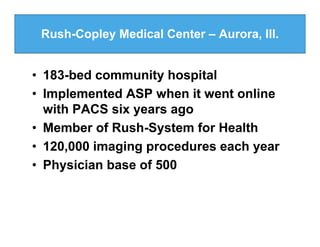
Rush-Copley Medical Center – Aurora, Ill.


• 183-bed community hospital
• Implemented ASP when it went online
  with PACS six years ago
• Member of Rush-System for Health
• 120,000 imaging procedures each year
• Physician base of 500
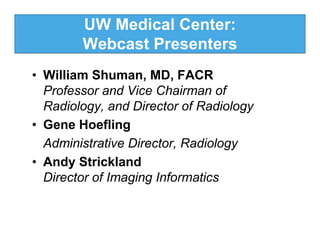
UW Medical Center:
        Webcast Presenters
• William Shuman, MD, FACR
  Professor and Vice Chairman of
  Radiology, and Director of Radiology
• Gene Hoefling
  Administrative Director, Radiology
• Andy Strickland
  Director of Imaging Informatics
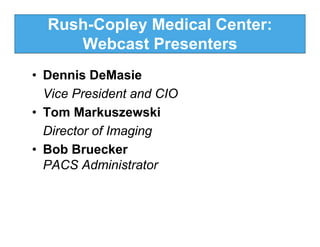
Rush-Copley Medical Center:
     Webcast Presenters
• Dennis DeMasie
  Vice President and CIO
• Tom Markuszewski
  Director of Imaging
• Bob Bruecker
  PACS Administrator
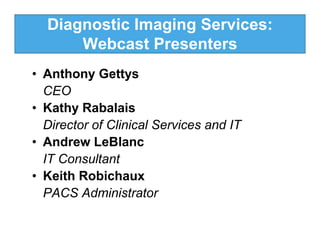
Diagnostic Imaging Services:
      Webcast Presenters
• Anthony Gettys
  CEO
• Kathy Rabalais
  Director of Clinical Services and IT
• Andrew LeBlanc
  IT Consultant
• Keith Robichaux
  PACS Administrator
Q & A Session
  Please submit your questions by
typing them in the “Ask A Question”
  box in the right of your console.
UW Medical Center: Facility Overview


• Harborview Medical Center – trauma
  and burn center
• Children’s Hospital & Regional Medical
  Center
• Veteran’s Administration Puget Sound
  Health System
• 13 primary care clinics around the city
• 2 specialty clinics
UW Medical Center: Technology Portfolio

  •   64-Slice CT
  •   1.5 and 3 Tesla MR
  •   Digital mammography
  •   4D ultrasound
  •   Nuclear medicine
  •   PET/CT
  •   Interventional radiology
  •   PET/CT and CT in radiation therapy for IMRT
      therapy planning
Reasons for Going with ASP

• Filmless for seven years
• Gradually extended PACS into the
  enterprise and expanded network
• Required a better archiving solution
• Prior to ASP, used optical disc and
  then migrated to content addressed
  storage
UW Medical Center: ASP Benefits

• Cost-effective savings
• Factor of safety and disaster recovery
• Data are backed up at several offsite
  locations
• UW located near:
      - Volcano: Mt. Rainier
      - Earthquake fault
      - Tsunami zone
• Expense of having a safe backup system is a
  fraction of what a minimal disaster would
  cost
UW Medical Center: PACS Archive

• PACS archive = 30 Terabytes
• Expected to reach 50 TB in a couple years
• 25 TB online for short-term storage
• Previously used optical disc for disaster
  recovery, but it was too limited for growth
• Went to spinning disc, RAID technology
• Needed a third tier storage strategy
• Looked into ASP solution
UW Medical Center: Disaster Recovery

• Three copies of every exam are sent at
  acquisition time:
  - One copy of images goes to short-term,
  on-site storage
  - Second copy goes to server that sends
  images to ASP via VPN to Chicago where
  stored in another spinning RAID device
  - Third copy kept on other ASP site in
  California
UW Medical Center: Benefits of ASP

• Ability to continue business even if the
  entire hospital is destroyed in an
  earthquake
• Archive is online
• Simple implementation – only need to
  provide a network connection to ASP
  center
• Can run 150 MB per second over the
  internet through a VPN
UW Medical Center: Choosing ASP

• Decision driven by escalating data
  sets – 64-slice CT
• Started looking at ASP two years ago
• Key as move into next-generation
  imaging systems with larger data
  volumes
• Outgrew local archive
Rush-Copley: Why ASP?

• Driver: Avoid capital expense
• ASP: Expense it as you use it
• Don’t need hospital technical staff to
  manage storage – vendor provides
  resources
• Frees up CIO to focus on hospital’s
  business and clinical needs
• Certified disaster recovery
Rush-Copley: ASP Lessons Learned

 • Maximize resources to focus on
   strategic operations
 • Do a site visit prior to implementing
   ASP
 • Be sure vendor is thorough
 • No HIPAA or JCAHO issues
 • No concern with upgrades
 • Looking to add cardiology ASP next
Rush-Copley: ASP Lessons Learned

 • Logical solution for disaster-recovery
 • Three layers of backup with ASP
 • Turnkey solution at 2 offsite locations
 • Invisible solution to the organization
   from a hardware cost and manpower
   cost
 • ASP vs. onsite storage – pick ASP
Rush-Copley: ASP Benefits

• RAID – 4TB
• Store 2-3 years of images in short-term
  storage
• ASP: Long-term storage is infinite
• Never run out of space
• Pay only for storage that is used
• Issue of storage is invisible, concerns
  and problems are in the background
Rush-Copley: User Experience

• No data migration issues
• No questions, because there are no
  problems
• User feedback: Out of site, out of mind
  – the system always works
• Images are always available under all
  circumstances
Rush-Copley: User Experience

• ASP means images and problems are
  out of sight, out of mind
• No hardware and software
  obsolescence
• No change in platforms to worry about
• No data migration costs
DIS: Overview

• 110,000 imaging procedures a year
• 5 facilities located throughout the
  metropolitan New Orleans area –
  Metairie and Marerro, La.
• Women’s center performs 20,000-
  25,000 mammography procedures per
  year
• 100-150 open MRI procedures on a
  monthly basis
DIS: Benefits of ASP

• Created numerous efficiencies from a
  radiologist’s standpoint
• Improved radiologist workflow
• Better use of radiologists’ time
• Able to store images at an offsite
  location for a minimal fee
DIS: Katrina and Beyond

• When Katrina hit, the storage of images was
  not a concern because ASP safely stored
  information offsite
• After the storm, opened each clinic
  individually
• Able to retrieve images and operate as
  normal, as if the storm had never
  happened
• Within 6-7 months after reopening, DIS
  was back to pre-Katrina imaging volume
DIS: Katrina and Beyond

• Once reopened, patients were happy to
  get images they needed
• Continuity of care for patients
• Referring physicians were glad too
DIS: The Disaster Plan
•   June 2005: Review disaster plan with personnel
•   August 2005: Activated disaster plan
•   Katrina was imminent, had to shut down
•   Before closing, made sure all modality-specific
    exams had gone to ASP
•   Images were stored offsite in Chicago and California,
    as well as in short-term storage in New Orleans
•   Went smoothly
•   Confident in double back-up
•   Able to retrieve data when they returned or wherever
    they set up a workstation to work from
DIS: After Katrina

• After setting up a workstation, they were
  able to read digital mammography exams
  quickly
• Patient data and reports were fully secure
  and safe through ASP
• ASP allowed us ‘one less worry’
DIS: Factors to Consider for ASP

 • Strategic advantage – allowed us to recover
   quickly from a disaster
 • Disaster Recovery – data are maintained no
   matter what happens locally
 • Got PACS back online 3 weeks after Katrina
 • Gave referring physicians access via web
 • Convenience – technologists don’t have to
   retrieve tapes
 • Instant access to images
 • All data were maintained, nothing was lost
Webcast Presenters
•   William Shuman, MD, FACR          • Anthony Gettys
    Professor and Vice Chairman         CEO
    of Radiology, and Director of     • Kathy Rabalais
    Radiology
•   Gene Hoefling                       Director of Clinical Services
                                        and IT
    Administrative Director,          • Andrew LeBlanc
    Radiology
•   Andy Strickland                     IT Consultant
    Director of Imaging Informatics   • Keith Robichaux
•   Dennis DeMasie                      PACS Administrator
    Vice President and CIO            • Andy Vranesic
•   Tom Markuszewski                    GE Healthcare
    Director of Imaging               • Vijay Tanjore
•   Bob Bruecker                        GE Healthcare
    PACS Administrator
Thank You
    To view an archive of this
  video webcast, please visit …
www.HealthImaging.com/Webcasts

Application Service Provider: ASP

  • 1.
    Thank you forjoining us. The webcast will begin shortly.
  • 2.
    Questions ? A live Q&A with the presenters immediately follows the video presentation. Submit your questions in the “Ask A Question” box on the bottom right of the console.
  • 3.
    Application Service Provider:ASP • Secure, scalable DICOM data archive with full disaster recovery • Turnkey offsite solution • Price per procedure model • Obsolescence protection from hardware and software as an expendable cost • Data are redundantly backed up at several remote data centers • Images are immediately available to radiologists, specialists, and referring physicians
  • 4.
    Diagnostic Imaging Services- New Orleans • Survived Hurricane Katrina • Due to ASP, PACS and offsite archive were secure • No electronic images were lost • Five free-standing radiology facilities • 115,000-120,000 imaging procedures each year
  • 5.
    University of WashingtonMedical Center - Seattle • 450-bed hospital • 9 neighborhood clinics • 100 outpatient facilities • 210,000 imaging procedures annually • Top 10 medical centers in the U.S. — U.S. News and World Report • Teaching hospital for University of Washington School of Medicine
  • 6.
    Rush-Copley Medical Center– Aurora, Ill. • 183-bed community hospital • Implemented ASP when it went online with PACS six years ago • Member of Rush-System for Health • 120,000 imaging procedures each year • Physician base of 500
  • 7.
    UW Medical Center: Webcast Presenters • William Shuman, MD, FACR Professor and Vice Chairman of Radiology, and Director of Radiology • Gene Hoefling Administrative Director, Radiology • Andy Strickland Director of Imaging Informatics
  • 8.
    Rush-Copley Medical Center: Webcast Presenters • Dennis DeMasie Vice President and CIO • Tom Markuszewski Director of Imaging • Bob Bruecker PACS Administrator
  • 9.
    Diagnostic Imaging Services: Webcast Presenters • Anthony Gettys CEO • Kathy Rabalais Director of Clinical Services and IT • Andrew LeBlanc IT Consultant • Keith Robichaux PACS Administrator
  • 10.
    Q & ASession Please submit your questions by typing them in the “Ask A Question” box in the right of your console.
  • 11.
    UW Medical Center:Facility Overview • Harborview Medical Center – trauma and burn center • Children’s Hospital & Regional Medical Center • Veteran’s Administration Puget Sound Health System • 13 primary care clinics around the city • 2 specialty clinics
  • 12.
    UW Medical Center:Technology Portfolio • 64-Slice CT • 1.5 and 3 Tesla MR • Digital mammography • 4D ultrasound • Nuclear medicine • PET/CT • Interventional radiology • PET/CT and CT in radiation therapy for IMRT therapy planning
  • 13.
    Reasons for Goingwith ASP • Filmless for seven years • Gradually extended PACS into the enterprise and expanded network • Required a better archiving solution • Prior to ASP, used optical disc and then migrated to content addressed storage
  • 14.
    UW Medical Center:ASP Benefits • Cost-effective savings • Factor of safety and disaster recovery • Data are backed up at several offsite locations • UW located near: - Volcano: Mt. Rainier - Earthquake fault - Tsunami zone • Expense of having a safe backup system is a fraction of what a minimal disaster would cost
  • 15.
    UW Medical Center:PACS Archive • PACS archive = 30 Terabytes • Expected to reach 50 TB in a couple years • 25 TB online for short-term storage • Previously used optical disc for disaster recovery, but it was too limited for growth • Went to spinning disc, RAID technology • Needed a third tier storage strategy • Looked into ASP solution
  • 16.
    UW Medical Center:Disaster Recovery • Three copies of every exam are sent at acquisition time: - One copy of images goes to short-term, on-site storage - Second copy goes to server that sends images to ASP via VPN to Chicago where stored in another spinning RAID device - Third copy kept on other ASP site in California
  • 17.
    UW Medical Center:Benefits of ASP • Ability to continue business even if the entire hospital is destroyed in an earthquake • Archive is online • Simple implementation – only need to provide a network connection to ASP center • Can run 150 MB per second over the internet through a VPN
  • 18.
    UW Medical Center:Choosing ASP • Decision driven by escalating data sets – 64-slice CT • Started looking at ASP two years ago • Key as move into next-generation imaging systems with larger data volumes • Outgrew local archive
  • 19.
    Rush-Copley: Why ASP? •Driver: Avoid capital expense • ASP: Expense it as you use it • Don’t need hospital technical staff to manage storage – vendor provides resources • Frees up CIO to focus on hospital’s business and clinical needs • Certified disaster recovery
  • 20.
    Rush-Copley: ASP LessonsLearned • Maximize resources to focus on strategic operations • Do a site visit prior to implementing ASP • Be sure vendor is thorough • No HIPAA or JCAHO issues • No concern with upgrades • Looking to add cardiology ASP next
  • 21.
    Rush-Copley: ASP LessonsLearned • Logical solution for disaster-recovery • Three layers of backup with ASP • Turnkey solution at 2 offsite locations • Invisible solution to the organization from a hardware cost and manpower cost • ASP vs. onsite storage – pick ASP
  • 22.
    Rush-Copley: ASP Benefits •RAID – 4TB • Store 2-3 years of images in short-term storage • ASP: Long-term storage is infinite • Never run out of space • Pay only for storage that is used • Issue of storage is invisible, concerns and problems are in the background
  • 23.
    Rush-Copley: User Experience •No data migration issues • No questions, because there are no problems • User feedback: Out of site, out of mind – the system always works • Images are always available under all circumstances
  • 24.
    Rush-Copley: User Experience •ASP means images and problems are out of sight, out of mind • No hardware and software obsolescence • No change in platforms to worry about • No data migration costs
  • 25.
    DIS: Overview • 110,000imaging procedures a year • 5 facilities located throughout the metropolitan New Orleans area – Metairie and Marerro, La. • Women’s center performs 20,000- 25,000 mammography procedures per year • 100-150 open MRI procedures on a monthly basis
  • 26.
    DIS: Benefits ofASP • Created numerous efficiencies from a radiologist’s standpoint • Improved radiologist workflow • Better use of radiologists’ time • Able to store images at an offsite location for a minimal fee
  • 27.
    DIS: Katrina andBeyond • When Katrina hit, the storage of images was not a concern because ASP safely stored information offsite • After the storm, opened each clinic individually • Able to retrieve images and operate as normal, as if the storm had never happened • Within 6-7 months after reopening, DIS was back to pre-Katrina imaging volume
  • 28.
    DIS: Katrina andBeyond • Once reopened, patients were happy to get images they needed • Continuity of care for patients • Referring physicians were glad too
  • 29.
    DIS: The DisasterPlan • June 2005: Review disaster plan with personnel • August 2005: Activated disaster plan • Katrina was imminent, had to shut down • Before closing, made sure all modality-specific exams had gone to ASP • Images were stored offsite in Chicago and California, as well as in short-term storage in New Orleans • Went smoothly • Confident in double back-up • Able to retrieve data when they returned or wherever they set up a workstation to work from
  • 30.
    DIS: After Katrina •After setting up a workstation, they were able to read digital mammography exams quickly • Patient data and reports were fully secure and safe through ASP • ASP allowed us ‘one less worry’
  • 31.
    DIS: Factors toConsider for ASP • Strategic advantage – allowed us to recover quickly from a disaster • Disaster Recovery – data are maintained no matter what happens locally • Got PACS back online 3 weeks after Katrina • Gave referring physicians access via web • Convenience – technologists don’t have to retrieve tapes • Instant access to images • All data were maintained, nothing was lost
  • 32.
    Webcast Presenters • William Shuman, MD, FACR • Anthony Gettys Professor and Vice Chairman CEO of Radiology, and Director of • Kathy Rabalais Radiology • Gene Hoefling Director of Clinical Services and IT Administrative Director, • Andrew LeBlanc Radiology • Andy Strickland IT Consultant Director of Imaging Informatics • Keith Robichaux • Dennis DeMasie PACS Administrator Vice President and CIO • Andy Vranesic • Tom Markuszewski GE Healthcare Director of Imaging • Vijay Tanjore • Bob Bruecker GE Healthcare PACS Administrator
  • 33.
    Thank You To view an archive of this video webcast, please visit … www.HealthImaging.com/Webcasts