Delivering Knowledge into the Workflow
Jonathan Teich – AMDIS fall symposium, Sept. 30, 2013
1
The Guy Who Knows
2
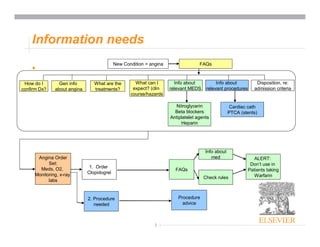
New Condition = angina FAQs
How do I
confirm Dx?
Gen info
about angina
What are the
treatments?
What can I
expect? (clin
course/hazards
Info about
relevant MEDS
Info about
relevant procedures
Disposition, re:
admission criteria
Nitroglycerin
Beta blockers
Antiplatelet agents
Heparin
Cardiac cath
PTCA (stents)
Angina Order
Set:
Meds, O2,
Monitoring, x-ray,
labs
1. Order
Clopidogrel
FAQs
ALERT:
Don’t use in
Patients taking
WarfarinCheck rules
Info about
med
2. Procedure
needed
Procedure
advice
Information needs
•
3
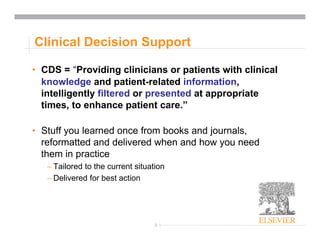
Clinical Decision Support
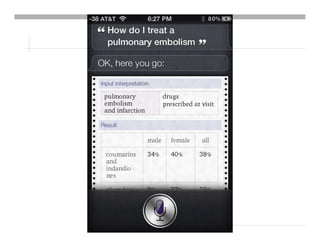
• CDS = “Providing clinicians or patients with clinical
knowledge and patient-related information,
intelligently filtered or presented at appropriate
times, to enhance patient care.”
• Stuff you learned once from books and journals,
reformatted and delivered when and how you need
them in practice
– Tailored to the current situation
– Delivered for best action
4
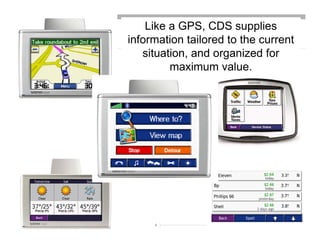
Like a GPS, CDS supplies
information tailored to the current
situation, and organized for
maximum value.
5
6
Goal
We seek to repurpose the content available in
books, journals, guidelines, etc.,
to deliver the most precise information and the
most useful form
For any given workflow and information need
7
Physician information needs and queries
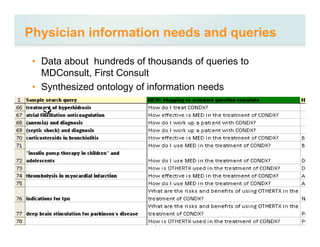
• Data about hundreds of thousands of queries to
MDConsult, First Consult
• Synthesized ontology of information needs
7
8
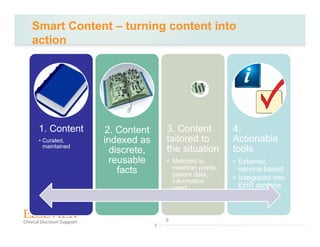
Smart Content – turning content into
action
1. Content
• Curated,
maintained
2. Content
indexed as
discrete,
reusable
facts
3. Content
tailored to
the situation
• Matched to
insertion points,
patient data,
information
need
configuration
4.
Actionable
tools
• External,
service-based
• Integrated into
EHR screens
8
9
10
11
12
12
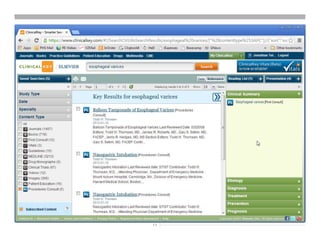
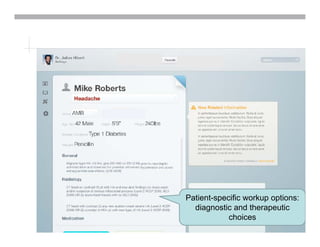
Patient-specific workup options:
diagnostic and therapeutic
choices
13
13
*
14
Summary
• Knowledge is a parallel to data – they both have
ontologies, coding, and could have standards
• Knowledge can be applied in different forms for
different workflows and different users
• Need to balance working with EHRs, SMART sidecars,
standalone references, smartphones – for the best
clinical result
j.teich@elsevier.com
jteich@harvard.edu

[Teich] amdis

  • 1.
    Delivering Knowledge intothe Workflow Jonathan Teich – AMDIS fall symposium, Sept. 30, 2013
  • 2.
  • 3.
    2 New Condition =angina FAQs How do I confirm Dx? Gen info about angina What are the treatments? What can I expect? (clin course/hazards Info about relevant MEDS Info about relevant procedures Disposition, re: admission criteria Nitroglycerin Beta blockers Antiplatelet agents Heparin Cardiac cath PTCA (stents) Angina Order Set: Meds, O2, Monitoring, x-ray, labs 1. Order Clopidogrel FAQs ALERT: Don’t use in Patients taking WarfarinCheck rules Info about med 2. Procedure needed Procedure advice Information needs •
  • 4.
    3 Clinical Decision Support •CDS = “Providing clinicians or patients with clinical knowledge and patient-related information, intelligently filtered or presented at appropriate times, to enhance patient care.” • Stuff you learned once from books and journals, reformatted and delivered when and how you need them in practice – Tailored to the current situation – Delivered for best action
  • 5.
    4 Like a GPS,CDS supplies information tailored to the current situation, and organized for maximum value.
  • 6.
  • 7.
    6 Goal We seek torepurpose the content available in books, journals, guidelines, etc., to deliver the most precise information and the most useful form For any given workflow and information need
  • 8.
    7 Physician information needsand queries • Data about hundreds of thousands of queries to MDConsult, First Consult • Synthesized ontology of information needs 7
  • 9.
    8 Smart Content –turning content into action 1. Content • Curated, maintained 2. Content indexed as discrete, reusable facts 3. Content tailored to the situation • Matched to insertion points, patient data, information need configuration 4. Actionable tools • External, service-based • Integrated into EHR screens 8
  • 10.
  • 11.
  • 12.
  • 13.
  • 14.
  • 15.
    14 Summary • Knowledge isa parallel to data – they both have ontologies, coding, and could have standards • Knowledge can be applied in different forms for different workflows and different users • Need to balance working with EHRs, SMART sidecars, standalone references, smartphones – for the best clinical result j.teich@elsevier.com jteich@harvard.edu