ASME Y14.5-2018
(Revision of ASME Y14.5-2009)
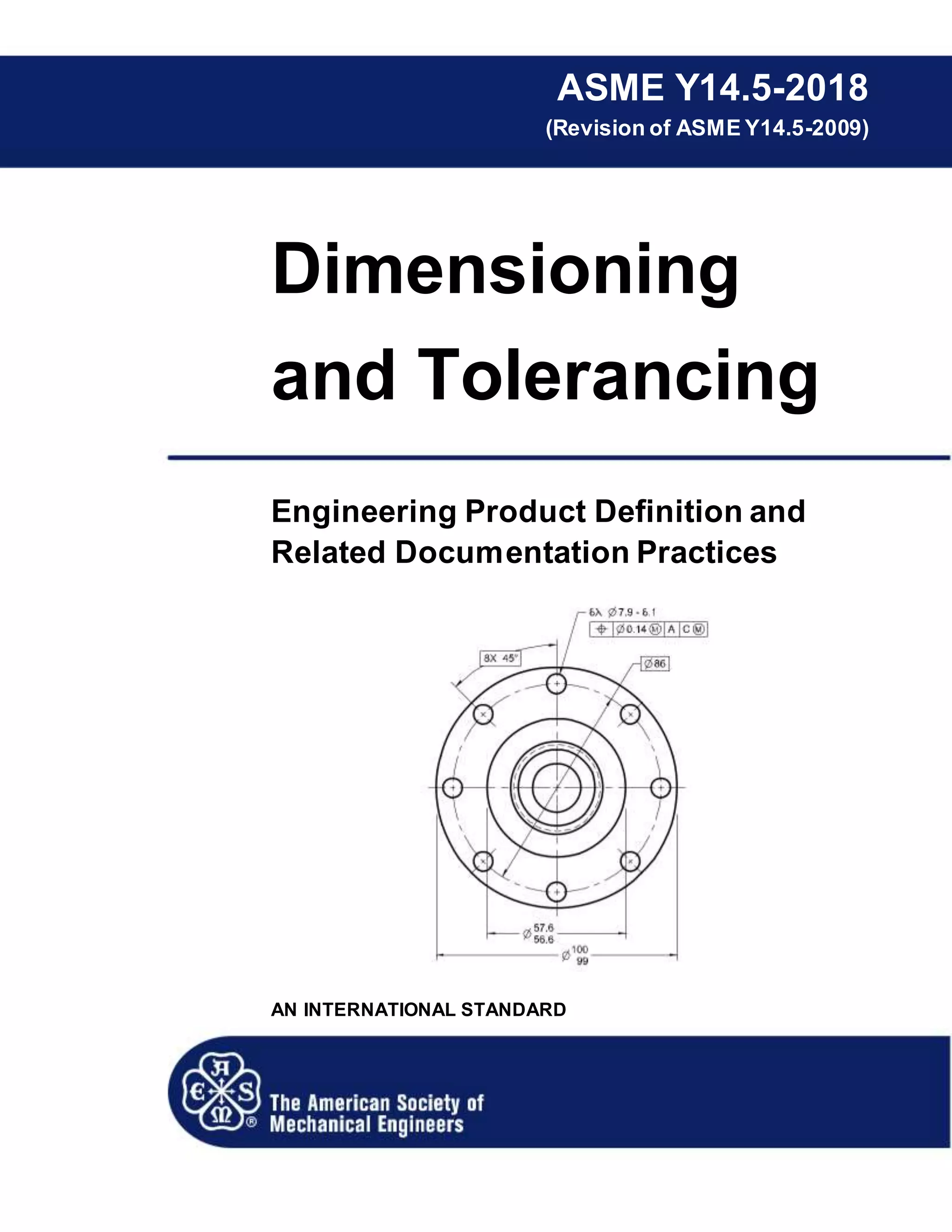
Dimensioning
and Tolerancing
Engineering Product Definition and
Related Documentation Practices
AN INTERNATIONAL STANDARD
ASME Y14.5
ADOPTION NOTICE
ASME Y14.5, Dimensioning and Tolerancing, was adopted on 9 February 2009 for use by the
Department of Defense (DoD). Proposed changes by DoD activities must be submitted to the
DoD Adopting Activity: Commander, U.S. Army Research, Development and Engineering
Center (ARDEC), ATTN: AMSRD-AAR-QES-E, Picatinny Arsenal, NJ 07806-5000. Copies of
this document may be purchased from The American Society of Mechanical Engineers (ASME),
150 Clove Road, 6th Floor, Little Falls, NJ 07424-2139; http://www.asme.org.
Custodians:
Army — AR
Navy — SA
Air Force — 16
Adopting Activity:
Army — AR
(Project DRPR-2009-003)
Review Activities:
Army — CR, MI, PT, TM
Navy — AS, CG, CH, EC, MC, NP, TD
Air Force — 13, 99
DLA — DH
OSD — SE
NSA — NS
Other — CM, MP, DC2
NOTE: The activities listed above were interested in this document as of the date of this
document. Since organizations and responsibilities can change, you should verify the currency of
the information above using the ASSIST Online database at https://quicksearch.dla.mil.
ASMC NA AREA DRPR
ASME Y14.5-2018
(Revision of ASME Y14.5-2009)
Dimensioning
and Tolerancing
Engineering Product Definition and
Related Documentation Practices
AN INTERNATIONAL STANDARD
x
Date ofIssuance: February 11, 2019
This Standardwill berevised when theSociety approves theissuanceof a newedition.
Periodicallycertainactionsof theASMEY14 Committee may bepublished asCases.Cases arepublished on theASMEwebsite
under the Y14 Committee Page at http://go.asme.org/Y14committee as they are issued.
Errata to codes andstandards may be posted on the ASME website under the Committee Pages to provide corrections to
incorrectly published items,or to correcttypographical or grammatical errorsin codes and standards. Such errata shall be
used on the date posted.
The Y14 CommitteePagecan befound athttp://go.asme.org/Y14committee.Thereis an option available to automatically
receivean e-mail notification when errata are posted to a particular code or standard. This option can be found on the
appropriate Committee Page after selecting “Errata” in the “Publication Information” section.
ASME is the registered trademark ofThe American Society ofMechanical Engineers.
This international code or standard was developed under procedures accredited as meeting the criteria for American National S tandards
and it is an American National Standard. The Standards Committee that approved the code or standard was balanced to assure that
individuals from competent and concerned interests have had an opportunity to participate. The proposed code or standard was made
available for public review and comment that provides an opportunity for additional public input from industry, academia, regulatory
agencies, and the public-at-large.
ASME does not “approve,” “rate,” or “endorse” any item, construction,proprietary device, or activity.
ASME does not take any position with respect to the validity ofany patent rights asserted in connection with any items mentioned in this
document, and does not undertake to insure anyone utilizing a standard against liability for infringement ofany applicable l etters patent,
nor assume any such liability. Users ofa code or standard are expressly advised that determination ofthe validity ofany such patent rights,
and the risk of infringement ofsuch rights, is entirely their own responsibility.
Participation by federal agency representative(s) or person(s) affiliated with industry is not to be in terpreted as government or industry
endorsement of this code or standard.
ASME accepts responsibility for only those interpretations ofthis document issued in accordance with the established ASMEpr ocedures
and policies, which precludes the issuance ofinterpretations by individuals.
No part of this document may be reproduced in any form,
in an electronic retrieval system or otherwise,
without the prior written permission ofthe publisher.
The American Society ofMechanical Engineers
Two Park Avenue, New York, NY 10016-5990
Copyright © 2019 by
THE AMERICAN SOCIETY OF MECHANICAL ENGINEERS
All rights reserved
Printed in U.S.A.
CONTENTS
Foreword . . . . . . . . . . . . . . . . . . . . . . . . . . . . . . . . . . . . . . . . . . . . . . . . . . . . . . . . . . . . . . . . . . . . . . . . xiv
CommitteeRoster . . . . . . . . . . . . . . . . . . . . . . . . . . . . . . . . . . . . . . . . . . . . . . . . . . . . . . . . . . . . . . . . . . xv
Correspondence Withthe Y14 Committee . . . . . . . . . . . . . . . . . . . . . . . . . . . . . . . . . . . . . . . . . . . . . . . . . xvi
Section 1 Scope . . . . . . . . . . . . . . . . . . . . . . . . . . . . . . . . . . . . . . . . . . . . . . . . . . . . . . . . . . . . . . 1
1.1 Introduction . . . . . . . . . . . . . . . . . . . . . . . . . . . . . . . . . . . . . . . . . . . . . . . . . . . . . . . . . 1
1.2 General . . . . . . . . . . . . . . . . . . . . . . . . . . . . . . . . . . . . . . . . . . . . . . . . . . . . . . . . . . . . . 1
1.3 Reference to This Standard . . . . . . . . . . . . . . . . . . . . . . . . . . . . . . . . . . . . . . . . . . . . . . 1
1.4 ASME Y14 Series Conventions . . . . . . . . . . . . . . . . . . . . . . . . . . . . . . . . . . . . . . . . . . . . 1
1.5 Drawings WithoutReference to a Standard . . . . . . . . . . . . . . . . . . . . . . . . . . . . . . . . . . . 2
1.6 Reference to Gaging . . . . . . . . . . . . . . . . . . . . . . . . . . . . . . . . . . . . . . . . . . . . . . . . . . . . 2
1.7 Symbols . . . . . . . . . . . . . . . . . . . . . . . . . . . . . . . . . . . . . . . . . . . . . . . . . . . . . . . . . . . . 3
Section 2 References . . . . . . . . . . . . . . . . . . . . . . . . . . . . . . . . . . . . . . . . . . . . . . . . . . . . . . . . . . 4
2.1 Introduction . . . . . . . . . . . . . . . . . . . . . . . . . . . . . . . . . . . . . . . . . . . . . . . . . . . . . . . . . 4
2.2 Cited Standards . . . . . . . . . . . . . . . . . . . . . . . . . . . . . . . . . . . . . . . . . . . . . . . . . . . . . . . 4
2.3 Additional Sources (NotCited) . . . . . . . . . . . . . . . . . . . . . . . . . . . . . . . . . . . . . . . . . . . . 4
Section 3 Definitions . . . . . . . . . . . . . . . . . . . . . . . . . . . . . . . . . . . . . . . . . . . . . . . . . . . . . . . . . . 5
Section 4 Fundamental Rules, Tolerancing Defaults, and Dimensioning Practices . . . . . . . . . . . 12
4.1 Fundamental Rules . . . . . . . . . . . . . . . . . . . . . . . . . . . . . . . . . . . . . . . . . . . . . . . . . . . . 12
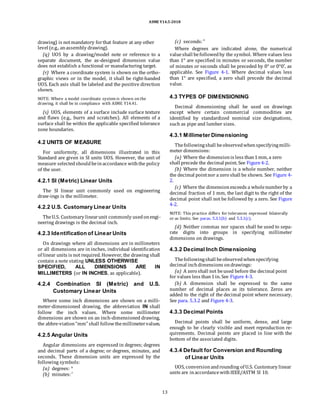
4.2 Units of Measure . . . . . . . . . . . . . . . . . . . . . . . . . . . . . . . . . . . . . . . . . . . . . . . . . . . . . . 13
4.3 Types of Dimensioning . . . . . . . . . . . . . . . . . . . . . . . . . . . . . . . . . . . . . . . . . . . . . . . . . 13
4.4 Applicationof Dimensions . . . . . . . . . . . . . . . . . . . . . . . . . . . . . . . . . . . . . . . . . . . . . . . 14
4.5 DimensioningFeatures . . . . . . . . . . . . . . . . . . . . . . . . . . . . . . . . . . . . . . . . . . . . . . . . . 15
4.6 Locationof Features . . . . . . . . . . . . . . . . . . . . . . . . . . . . . . . . . . . . . . . . . . . . . . . . . . . 18
Section 5 Tolerancing, InterpretationofLimits, Limits ofSize, and Material Condition Modifiers 33
5.1 General . . . . . . . . . . . . . . . . . . . . . . . . . . . . . . . . . . . . . . . . . . . . . . . . . . . . . . . . . . . . . 33
5.2 DirectTolerancingMethods . . . . . . . . . . . . . . . . . . . . . . . . . . . . . . . . . . . . . . . . . . . . . . 33
5.3 ToleranceExpression . . . . . . . . . . . . . . . . . . . . . . . . . . . . . . . . . . . . . . . . . . . . . . . . . . . 34
5.4 Interpretation of Limits . . . . . . . . . . . . . . . . . . . . . . . . . . . . . . . . . . . . . . . . . . . . . . . . . 34
5.5 Single LimitTolerancedDimensions . . . . . . . . . . . . . . . . . . . . . . . . . . . . . . . . . . . . . . . . 35
5.6 ToleranceAccumulationBetweenSurfaces . . . . . . . . . . . . . . . . . . . . . . . . . . . . . . . . . . . 35
5.7 Dimensions Relatedto an Origin . . . . . . . . . . . . . . . . . . . . . . . . . . . . . . . . . . . . . . . . . . 35
5.8 Limits of Size . . . . . . . . . . . . . . . . . . . . . . . . . . . . . . . . . . . . . . . . . . . . . . . . . . . . . . . . 35
5.9 Applicability of Modifiers onGeometric ToleranceValues andDatum Feature References . 36
5.10 Screw Threads . . . . . . . . . . . . . . . . . . . . . . . . . . . . . . . . . . . . . . . . . . . . . . . . . . . . . . . 38
5.11 Gears and Splines . . . . . . . . . . . . . . . . . . . . . . . . . . . . . . . . . . . . . . . . . . . . . . . . . . . . . 38
5.12 Boundary Conditions . . . . . . . . . . . . . . . . . . . . . . . . . . . . . . . . . . . . . . . . . . . . . . . . . . . 38
5.13 Angular Surfaces . . . . . . . . . . . . . . . . . . . . . . . . . . . . . . . . . . . . . . . . . . . . . . . . . . . . . . 38
5.14 Conical Tapers . . . . . . . . . . . . . . . . . . . . . . . . . . . . . . . . . . . . . . . . . . . . . . . . . . . . . . . 38
iii
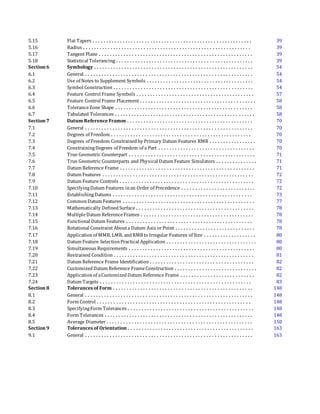
5.15 Flat Tapers . . . . . . . . . . . . . . . . . . . . . . . . . . . . . . . . . . . . . . . . . . . . . . . . . . . . . . . . . . 39
5.16 Radius . . . . . . . . . . . . . . . . . . . . . . . . . . . . . . . . . . . . . . . . . . . . . . . . . . . . . . . . . . . . . 39
5.17 Tangent Plane . . . . . . . . . . . . . . . . . . . . . . . . . . . . . . . . . . . . . . . . . . . . . . . . . . . . . . . . 39
5.18 Statistical Tolerancing . . . . . . . . . . . . . . . . . . . . . . . . . . . . . . . . . . . . . . . . . . . . . . . . . . 39
Section 6 Symbology . . . . . . . . . . . . . . . . . . . . . . . . . . . . . . . . . . . . . . . . . . . . . . . . . . . . . . . . . . 54
6.1 General . . . . . . . . . . . . . . . . . . . . . . . . . . . . . . . . . . . . . . . . . . . . . . . . . . . . . . . . . . . . . 54
6.2 Use of Notes to Supplement Symbols . . . . . . . . . . . . . . . . . . . . . . . . . . . . . . . . . . . . . . . 54
6.3 Symbol Construction . . . . . . . . . . . . . . . . . . . . . . . . . . . . . . . . . . . . . . . . . . . . . . . . . . . 54
6.4 Feature Control Frame Symbols . . . . . . . . . . . . . . . . . . . . . . . . . . . . . . . . . . . . . . . . . . . 57
6.5 Feature Control Frame Placement . . . . . . . . . . . . . . . . . . . . . . . . . . . . . . . . . . . . . . . . . . 58
6.6 ToleranceZone Shape . . . . . . . . . . . . . . . . . . . . . . . . . . . . . . . . . . . . . . . . . . . . . . . . . . 58
6.7 Tabulated Tolerances . . . . . . . . . . . . . . . . . . . . . . . . . . . . . . . . . . . . . . . . . . . . . . . . . . . 58
Section 7 Datum Reference Frames . . . . . . . . . . . . . . . . . . . . . . . . . . . . . . . . . . . . . . . . . . . . . . 70
7.1 General . . . . . . . . . . . . . . . . . . . . . . . . . . . . . . . . . . . . . . . . . . . . . . . . . . . . . . . . . . . . . 70
7.2 Degrees of Freedom . . . . . . . . . . . . . . . . . . . . . . . . . . . . . . . . . . . . . . . . . . . . . . . . . . . 70
7.3 Degrees of Freedom Constrainedby Primary Datum Features RMB . . . . . . . . . . . . . . . . . 70
7.4 ConstrainingDegrees of Freedom of a Part . . . . . . . . . . . . . . . . . . . . . . . . . . . . . . . . . . . 70
7.5 True Geometric Counterpart . . . . . . . . . . . . . . . . . . . . . . . . . . . . . . . . . . . . . . . . . . . . . . 71
7.6 True Geometric Counterparts and Physical Datum Feature Simulators . . . . . . . . . . . . . . . 71
7.7 Datum Reference Frame . . . . . . . . . . . . . . . . . . . . . . . . . . . . . . . . . . . . . . . . . . . . . . . . . 71
7.8 Datum Features . . . . . . . . . . . . . . . . . . . . . . . . . . . . . . . . . . . . . . . . . . . . . . . . . . . . . . . 72
7.9 Datum Feature Controls . . . . . . . . . . . . . . . . . . . . . . . . . . . . . . . . . . . . . . . . . . . . . . . . . 72
7.10 SpecifyingDatum Features inan Order of Precedence . . . . . . . . . . . . . . . . . . . . . . . . . . . 72
7.11 EstablishingDatums . . . . . . . . . . . . . . . . . . . . . . . . . . . . . . . . . . . . . . . . . . . . . . . . . . . 73
7.12 CommonDatum Features . . . . . . . . . . . . . . . . . . . . . . . . . . . . . . . . . . . . . . . . . . . . . . . . 77
7.13 Mathematically DefinedSurface . . . . . . . . . . . . . . . . . . . . . . . . . . . . . . . . . . . . . . . . . . . 78
7.14 MultipleDatum ReferenceFrames . . . . . . . . . . . . . . . . . . . . . . . . . . . . . . . . . . . . . . . . . 78
7.15 Functional Datum Features . . . . . . . . . . . . . . . . . . . . . . . . . . . . . . . . . . . . . . . . . . . . . . 78
7.16 Rotational Constraint Abouta Datum Axis orPoint . . . . . . . . . . . . . . . . . . . . . . . . . . . . . 78
7.17 Applicationof MMB, LMB, andRMB to Irregular Features of Size . . . . . . . . . . . . . . . . . . . 80
7.18 Datum Feature SelectionPractical Application . . . . . . . . . . . . . . . . . . . . . . . . . . . . . . . . . 80
7.19 Simultaneous Requirements . . . . . . . . . . . . . . . . . . . . . . . . . . . . . . . . . . . . . . . . . . . . . . 80
7.20 Restrained Condition . . . . . . . . . . . . . . . . . . . . . . . . . . . . . . . . . . . . . . . . . . . . . . . . . . . 81
7.21 Datum Reference Frame Identification . . . . . . . . . . . . . . . . . . . . . . . . . . . . . . . . . . . . . . 82
7.22 CustomizedDatum Reference FrameConstruction . . . . . . . . . . . . . . . . . . . . . . . . . . . . . . 82
7.23 Applicationof aCustomizedDatum Reference Frame . . . . . . . . . . . . . . . . . . . . . . . . . . . 82
7.24 Datum Targets . . . . . . . . . . . . . . . . . . . . . . . . . . . . . . . . . . . . . . . . . . . . . . . . . . . . . . . 83
Section 8 Tolerances of Form . . . . . . . . . . . . . . . . . . . . . . . . . . . . . . . . . . . . . . . . . . . . . . . . . . . 148
8.1 General . . . . . . . . . . . . . . . . . . . . . . . . . . . . . . . . . . . . . . . . . . . . . . . . . . . . . . . . . . . . . 148
8.2 Form Control . . . . . . . . . . . . . . . . . . . . . . . . . . . . . . . . . . . . . . . . . . . . . . . . . . . . . . . . 148
8.3 SpecifyingForm Tolerances . . . . . . . . . . . . . . . . . . . . . . . . . . . . . . . . . . . . . . . . . . . . . . 148
8.4 Form Tolerances . . . . . . . . . . . . . . . . . . . . . . . . . . . . . . . . . . . . . . . . . . . . . . . . . . . . . . 148
8.5 Average Diameter . . . . . . . . . . . . . . . . . . . . . . . . . . . . . . . . . . . . . . . . . . . . . . . . . . . . . 150
Section 9 Tolerances of Orientation . . . . . . . . . . . . . . . . . . . . . . . . . . . . . . . . . . . . . . . . . . . . . . 163
9.1 General . . . . . . . . . . . . . . . . . . . . . . . . . . . . . . . . . . . . . . . . . . . . . . . . . . . . . . . . . . . . . 163
9.2 OrientationControl . . . . . . . . . . . . . . . . . . . . . . . . . . . . . . . . . . . . . . . . . . . . . . . . . . . . 163
9.3 SpecifyingOrientationTolerances . . . . . . . . . . . . . . . . . . . . . . . . . . . . . . . . . . . . . . . . . . 163
9.4 Tangent Plane . . . . . . . . . . . . . . . . . . . . . . . . . . . . . . . . . . . . . . . . . . . . . . . . . . . . . . . . 164
9.5 AlternativePractice . . . . . . . . . . . . . . . . . . . . . . . . . . . . . . . . . . . . . . . . . . . . . . . . . . . . 164
Section 10 Tolerances of Position . . . . . . . . . . . . . . . . . . . . . . . . . . . . . . . . . . . . . . . . . . . . . . . . . 179
10.1 General . . . . . . . . . . . . . . . . . . . . . . . . . . . . . . . . . . . . . . . . . . . . . . . . . . . . . . . . . . . . . 179
10.2 Positional Tolerancing . . . . . . . . . . . . . . . . . . . . . . . . . . . . . . . . . . . . . . . . . . . . . . . . . . 179
10.3 Positional TolerancingFundamentals — I . . . . . . . . . . . . . . . . . . . . . . . . . . . . . . . . . . . . 179
10.4 Positional TolerancingFundamentals — II . . . . . . . . . . . . . . . . . . . . . . . . . . . . . . . . . . . 182
10.5 Pattern Location . . . . . . . . . . . . . . . . . . . . . . . . . . . . . . . . . . . . . . . . . . . . . . . . . . . . . . 184
10.6 Coaxial Feature Controls . . . . . . . . . . . . . . . . . . . . . . . . . . . . . . . . . . . . . . . . . . . . . . . . 187
10.7 TolerancingforSymmetrical Relationships . . . . . . . . . . . . . . . . . . . . . . . . . . . . . . . . . . . 188
Section 11 Tolerances of Profile . . . . . . . . . . . . . . . . . . . . . . . . . . . . . . . . . . . . . . . . . . . . . . . . . . 240
11.1 General . . . . . . . . . . . . . . . . . . . . . . . . . . . . . . . . . . . . . . . . . . . . . . . . . . . . . . . . . . . . . 240
11.2 Profile . . . . . . . . . . . . . . . . . . . . . . . . . . . . . . . . . . . . . . . . . . . . . . . . . . . . . . . . . . . . . 240
11.3 ToleranceZone Boundaries . . . . . . . . . . . . . . . . . . . . . . . . . . . . . . . . . . . . . . . . . . . . . . 240
11.4 ProfileApplications . . . . . . . . . . . . . . . . . . . . . . . . . . . . . . . . . . . . . . . . . . . . . . . . . . . . 241
11.5 Material Conditionand Boundary ConditionModifiers as Relatedto ProfileControls . . . . . 242
11.6 CompositeProfile . . . . . . . . . . . . . . . . . . . . . . . . . . . . . . . . . . . . . . . . . . . . . . . . . . . . . 242
11.7 MultipleSingle-Segment ProfileTolerancing . . . . . . . . . . . . . . . . . . . . . . . . . . . . . . . . . . 244
11.8 CombinedControls . . . . . . . . . . . . . . . . . . . . . . . . . . . . . . . . . . . . . . . . . . . . . . . . . . . . 244
11.9 Profileof a Line as a Refinement . . . . . . . . . . . . . . . . . . . . . . . . . . . . . . . . . . . . . . . . . . 244
11.10 Dynamic ProfileToleranceModifier . . . . . . . . . . . . . . . . . . . . . . . . . . . . . . . . . . . . . . . . 244
Section 12 Tolerances of Runout . . . . . . . . . . . . . . . . . . . . . . . . . . . . . . . . . . . . . . . . . . . . . . . . . 287
12.1 General . . . . . . . . . . . . . . . . . . . . . . . . . . . . . . . . . . . . . . . . . . . . . . . . . . . . . . . . . . . . . 287
12.2 Runout . . . . . . . . . . . . . . . . . . . . . . . . . . . . . . . . . . . . . . . . . . . . . . . . . . . . . . . . . . . . . 287
12.3 Runout Tolerance . . . . . . . . . . . . . . . . . . . . . . . . . . . . . . . . . . . . . . . . . . . . . . . . . . . . . 287
12.4 Types of RunoutTolerances . . . . . . . . . . . . . . . . . . . . . . . . . . . . . . . . . . . . . . . . . . . . . . 287
12.5 Runout Toleranceand Size . . . . . . . . . . . . . . . . . . . . . . . . . . . . . . . . . . . . . . . . . . . . . . . 288
12.6 Application . . . . . . . . . . . . . . . . . . . . . . . . . . . . . . . . . . . . . . . . . . . . . . . . . . . . . . . . . . 288
12.7 Specification . . . . . . . . . . . . . . . . . . . . . . . . . . . . . . . . . . . . . . . . . . . . . . . . . . . . . . . . . 289
Mandatory Appendix
I Alternate Practices . . . . . . . . . . . . . . . . . . . . . . . . . . . . . . . . . . . . . . . . . . . . . . . . . . . . 306
Nonmandatory Appendices
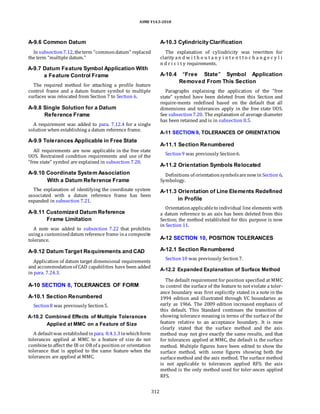
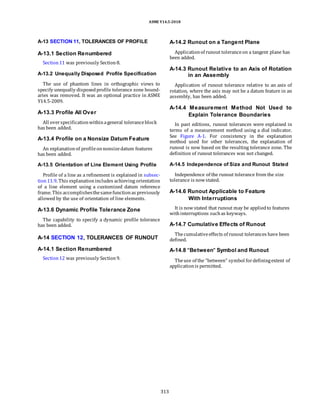
A Principal Changes and Improvements . . . . . . . . . . . . . . . . . . . . . . . . . . . . . . . . . . . . . . . 310
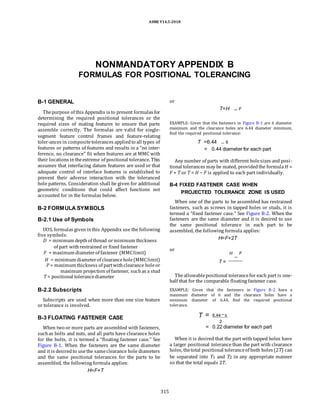
B Formulas forPositional Tolerancing . . . . . . . . . . . . . . . . . . . . . . . . . . . . . . . . . . . . . . . . 315
C Form, Proportion, and Comparison of Symbols . . . . . . . . . . . . . . . . . . . . . . . . . . . . . . . . 318
D Former Practices . . . . . . . . . . . . . . . . . . . . . . . . . . . . . . . . . . . . . . . . . . . . . . . . . . . . . . 326
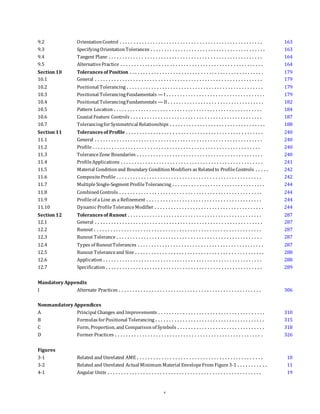
Figures
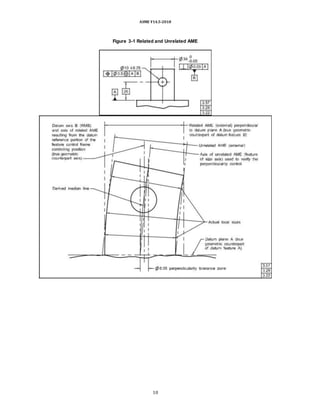
3-1 Related and Unrelated AME . . . . . . . . . . . . . . . . . . . . . . . . . . . . . . . . . . . . . . . . . . . . . . 10
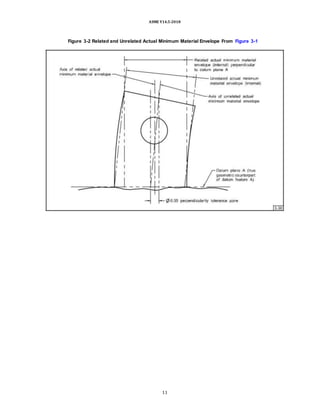
3-2 Related and Unrelated Actual Minimum Material EnvelopeFrom Figure3-1 . . . . . . . . . . . 11
4-1 Angular Units . . . . . . . . . . . . . . . . . . . . . . . . . . . . . . . . . . . . . . . . . . . . . . . . . . . . . . . . 19
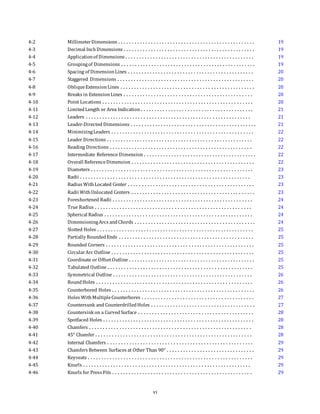
v
4-2 MillimeterDimensions . . . . . . . . . . . . . . . . . . . . . . . . . . . . . . . . . . . . . . . . . . . . . . . . . . 19
4-3 Decimal InchDimensions . . . . . . . . . . . . . . . . . . . . . . . . . . . . . . . . . . . . . . . . . . . . . . . . 19
4-4 Applicationof Dimensions . . . . . . . . . . . . . . . . . . . . . . . . . . . . . . . . . . . . . . . . . . . . . . . 19
4-5 Groupingof Dimensions . . . . . . . . . . . . . . . . . . . . . . . . . . . . . . . . . . . . . . . . . . . . . . . . . 19
4-6 Spacing of DimensionLines . . . . . . . . . . . . . . . . . . . . . . . . . . . . . . . . . . . . . . . . . . . . . . 20
4-7 Staggered Dimensions . . . . . . . . . . . . . . . . . . . . . . . . . . . . . . . . . . . . . . . . . . . . . . . . . . 20
4-8 ObliqueExtensionLines . . . . . . . . . . . . . . . . . . . . . . . . . . . . . . . . . . . . . . . . . . . . . . . . . 20
4-9 Breaks in ExtensionLines . . . . . . . . . . . . . . . . . . . . . . . . . . . . . . . . . . . . . . . . . . . . . . . 20
4-10 Point Locations . . . . . . . . . . . . . . . . . . . . . . . . . . . . . . . . . . . . . . . . . . . . . . . . . . . . . . . 20
4-11 LimitedLength or Area Indication . . . . . . . . . . . . . . . . . . . . . . . . . . . . . . . . . . . . . . . . . 21
4-12 Leaders . . . . . . . . . . . . . . . . . . . . . . . . . . . . . . . . . . . . . . . . . . . . . . . . . . . . . . . . . . . . 21
4-13 Leader-Directed Dimensions . . . . . . . . . . . . . . . . . . . . . . . . . . . . . . . . . . . . . . . . . . . . . . 21
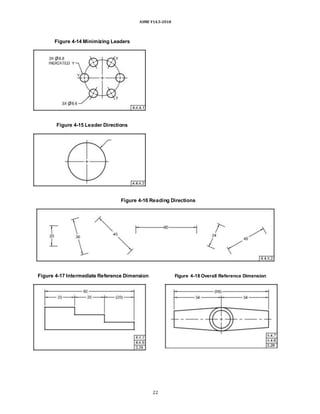
4-14 MinimizingLeaders . . . . . . . . . . . . . . . . . . . . . . . . . . . . . . . . . . . . . . . . . . . . . . . . . . . . 22
4-15 Leader Directions . . . . . . . . . . . . . . . . . . . . . . . . . . . . . . . . . . . . . . . . . . . . . . . . . . . . . 22
4-16 Reading Directions . . . . . . . . . . . . . . . . . . . . . . . . . . . . . . . . . . . . . . . . . . . . . . . . . . . . 22
4-17 Intermediate Reference Dimension . . . . . . . . . . . . . . . . . . . . . . . . . . . . . . . . . . . . . . . . . 22
4-18 Overall ReferenceDimension . . . . . . . . . . . . . . . . . . . . . . . . . . . . . . . . . . . . . . . . . . . . . 22
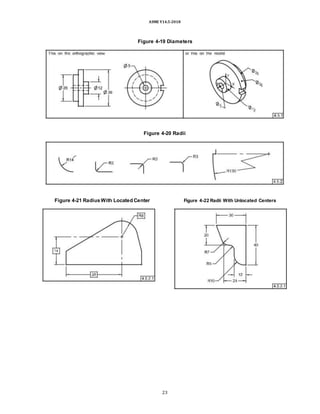
4-19 Diameters . . . . . . . . . . . . . . . . . . . . . . . . . . . . . . . . . . . . . . . . . . . . . . . . . . . . . . . . . . . 23
4-20 Radii . . . . . . . . . . . . . . . . . . . . . . . . . . . . . . . . . . . . . . . . . . . . . . . . . . . . . . . . . . . . . . 23
4-21 Radius WithLocated Center . . . . . . . . . . . . . . . . . . . . . . . . . . . . . . . . . . . . . . . . . . . . . . 23
4-22 Radii WithUnlocated Centers . . . . . . . . . . . . . . . . . . . . . . . . . . . . . . . . . . . . . . . . . . . . . 23
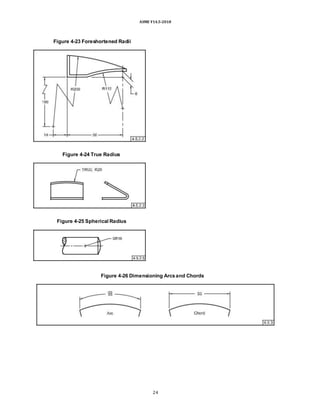
4-23 Foreshortened Radii . . . . . . . . . . . . . . . . . . . . . . . . . . . . . . . . . . . . . . . . . . . . . . . . . . . 24
4-24 True Radius . . . . . . . . . . . . . . . . . . . . . . . . . . . . . . . . . . . . . . . . . . . . . . . . . . . . . . . . . 24
4-25 Spherical Radius . . . . . . . . . . . . . . . . . . . . . . . . . . . . . . . . . . . . . . . . . . . . . . . . . . . . . . 24
4-26 DimensioningArcs andChords . . . . . . . . . . . . . . . . . . . . . . . . . . . . . . . . . . . . . . . . . . . . 24
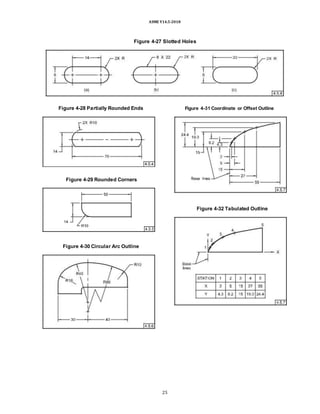
4-27 Slotted Holes . . . . . . . . . . . . . . . . . . . . . . . . . . . . . . . . . . . . . . . . . . . . . . . . . . . . . . . . . 25
4-28 Partially RoundedEnds . . . . . . . . . . . . . . . . . . . . . . . . . . . . . . . . . . . . . . . . . . . . . . . . . 25
4-29 Rounded Corners . . . . . . . . . . . . . . . . . . . . . . . . . . . . . . . . . . . . . . . . . . . . . . . . . . . . . . 25
4-30 CircularArc Outline . . . . . . . . . . . . . . . . . . . . . . . . . . . . . . . . . . . . . . . . . . . . . . . . . . . . 25
4-31 Coordinate or OffsetOutline . . . . . . . . . . . . . . . . . . . . . . . . . . . . . . . . . . . . . . . . . . . . . . 25
4-32 Tabulated Outline . . . . . . . . . . . . . . . . . . . . . . . . . . . . . . . . . . . . . . . . . . . . . . . . . . . . . 25
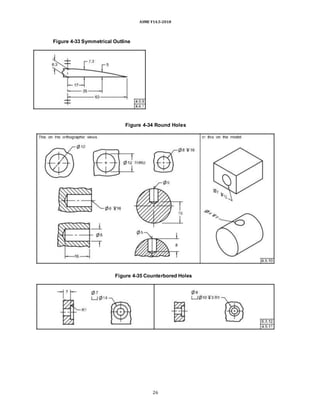
4-33 Symmetrical Outline . . . . . . . . . . . . . . . . . . . . . . . . . . . . . . . . . . . . . . . . . . . . . . . . . . . 26
4-34 RoundHoles . . . . . . . . . . . . . . . . . . . . . . . . . . . . . . . . . . . . . . . . . . . . . . . . . . . . . . . . . 26
4-35 Counterbored Holes . . . . . . . . . . . . . . . . . . . . . . . . . . . . . . . . . . . . . . . . . . . . . . . . . . . . 26
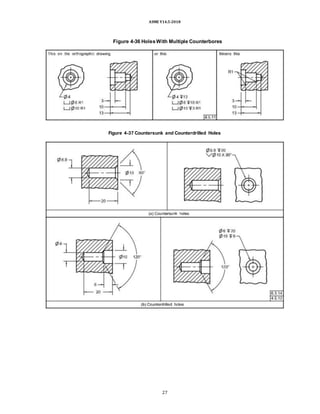
4-36 Holes WithMultipleCounterbores . . . . . . . . . . . . . . . . . . . . . . . . . . . . . . . . . . . . . . . . . 27
4-37 Countersunk and CounterdrilledHoles . . . . . . . . . . . . . . . . . . . . . . . . . . . . . . . . . . . . . . 27
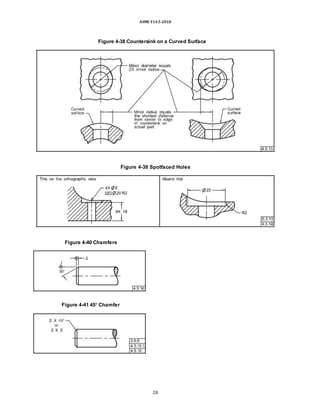
4-38 Countersink on a CurvedSurface . . . . . . . . . . . . . . . . . . . . . . . . . . . . . . . . . . . . . . . . . . 28
4-39 Spotfaced Holes . . . . . . . . . . . . . . . . . . . . . . . . . . . . . . . . . . . . . . . . . . . . . . . . . . . . . . . 28
4-40 Chamfers . . . . . . . . . . . . . . . . . . . . . . . . . . . . . . . . . . . . . . . . . . . . . . . . . . . . . . . . . . . 28
4-41 45° Chamfer . . . . . . . . . . . . . . . . . . . . . . . . . . . . . . . . . . . . . . . . . . . . . . . . . . . . . . . . . 28
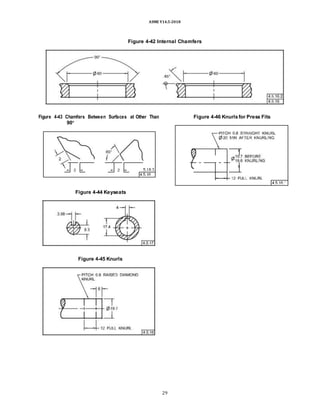
4-42 Internal Chamfers . . . . . . . . . . . . . . . . . . . . . . . . . . . . . . . . . . . . . . . . . . . . . . . . . . . . . 29
4-43 Chamfers Between Surfaces at Other Than 90° . . . . . . . . . . . . . . . . . . . . . . . . . . . . . . . . 29
4-44 Keyseats . . . . . . . . . . . . . . . . . . . . . . . . . . . . . . . . . . . . . . . . . . . . . . . . . . . . . . . . . . . . 29
4-45 Knurls . . . . . . . . . . . . . . . . . . . . . . . . . . . . . . . . . . . . . . . . . . . . . . . . . . . . . . . . . . . . . 29
4-46 Knurls for Press Fits . . . . . . . . . . . . . . . . . . . . . . . . . . . . . . . . . . . . . . . . . . . . . . . . . . . 29
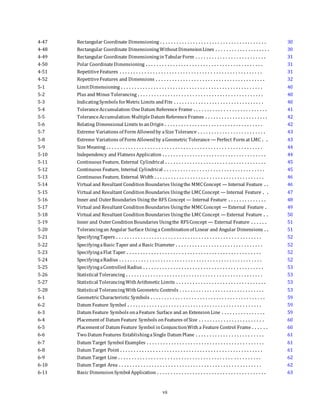
vi
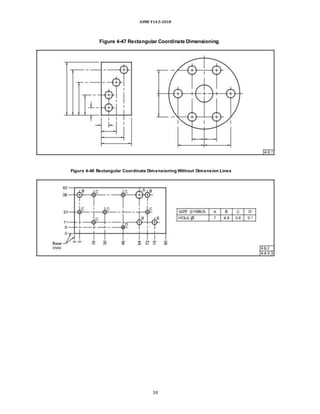
4-47 Rectangular Coordinate Dimensioning . . . . . . . . . . . . . . . . . . . . . . . . . . . . . . . . . . . . . . . 30
4-48 Rectangular Coordinate DimensioningWithoutDimensionLines . . . . . . . . . . . . . . . . . . . . 30
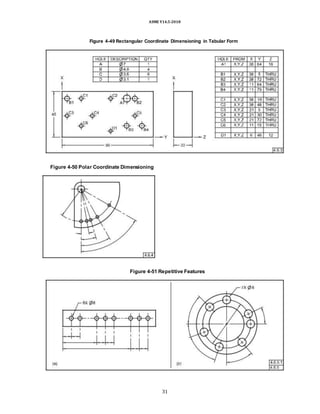
4-49 Rectangular Coordinate DimensioninginTabularForm . . . . . . . . . . . . . . . . . . . . . . . . . . 31
4-50 Polar CoordinateDimensioning . . . . . . . . . . . . . . . . . . . . . . . . . . . . . . . . . . . . . . . . . . . 31
4-51 RepetitiveFeatures . . . . . . . . . . . . . . . . . . . . . . . . . . . . . . . . . . . . . . . . . . . . . . . . . . . . 31
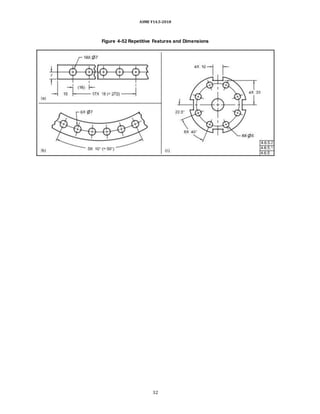
4-52 RepetitiveFeatures and Dimensions . . . . . . . . . . . . . . . . . . . . . . . . . . . . . . . . . . . . . . . . 32
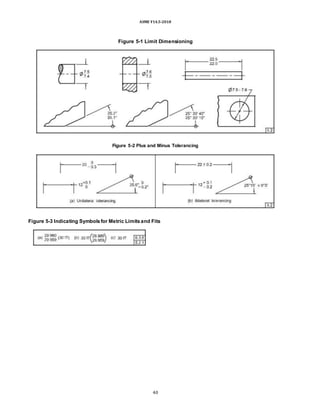
5-1 LimitDimensioning . . . . . . . . . . . . . . . . . . . . . . . . . . . . . . . . . . . . . . . . . . . . . . . . . . . . 40
5-2 Plus and Minus Tolerancing . . . . . . . . . . . . . . . . . . . . . . . . . . . . . . . . . . . . . . . . . . . . . . 40
5-3 IndicatingSymbols forMetric Limits andFits . . . . . . . . . . . . . . . . . . . . . . . . . . . . . . . . . 40
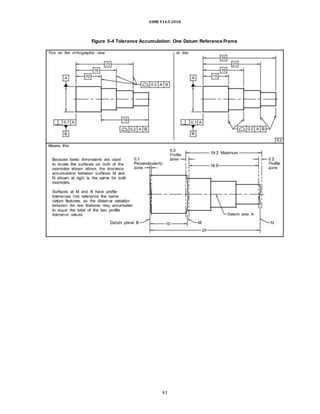
5-4 ToleranceAccumulation:OneDatum Reference Frame . . . . . . . . . . . . . . . . . . . . . . . . . . . 41
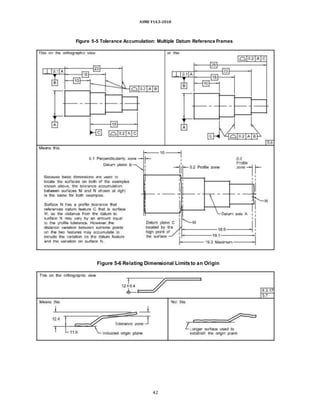
5-5 ToleranceAccumulation:MultipleDatum ReferenceFrames . . . . . . . . . . . . . . . . . . . . . . . 42
5-6 Relating Dimensional Limits to anOrigin . . . . . . . . . . . . . . . . . . . . . . . . . . . . . . . . . . . . 42
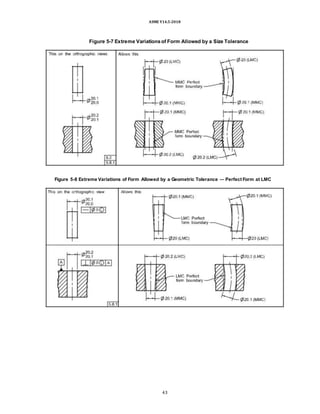
5-7 Extreme Variations of Form Allowedby aSize Tolerance . . . . . . . . . . . . . . . . . . . . . . . . . 43
5-8 Extreme Variations of Form Allowedby aGeometric Tolerance — Perfect Form at LMC . . 43
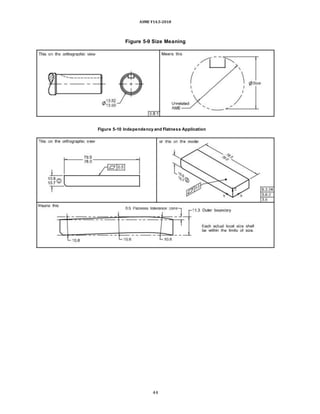
5-9 Size Meaning . . . . . . . . . . . . . . . . . . . . . . . . . . . . . . . . . . . . . . . . . . . . . . . . . . . . . . . . . 44
5-10 Independency and Flatness Application . . . . . . . . . . . . . . . . . . . . . . . . . . . . . . . . . . . . . . 44
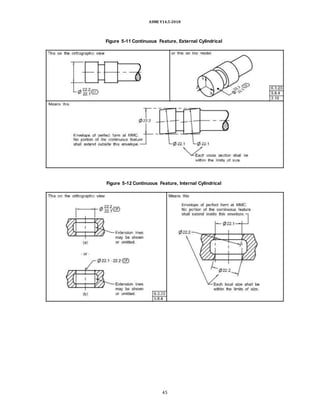
5-11 Continuous Feature, External Cylindrical . . . . . . . . . . . . . . . . . . . . . . . . . . . . . . . . . . . . . 45
5-12 Continuous Feature, Internal Cylindrical . . . . . . . . . . . . . . . . . . . . . . . . . . . . . . . . . . . . . 45
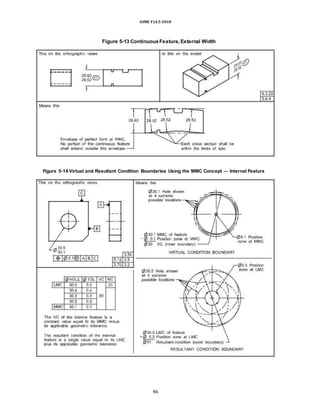
5-13 Continuous Feature, External Width . . . . . . . . . . . . . . . . . . . . . . . . . . . . . . . . . . . . . . . . 46
5-14 Virtual and Resultant ConditionBoundaries Usingthe MMCConcept — Internal Feature . . 46
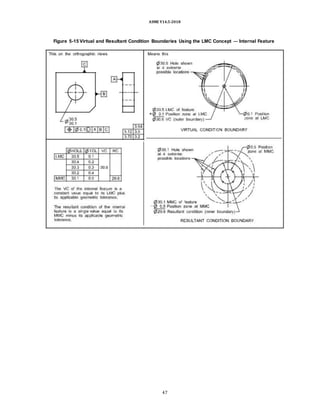
5-15 Virtual and Resultant ConditionBoundaries Usingthe LMCConcept — Internal Feature . . 47
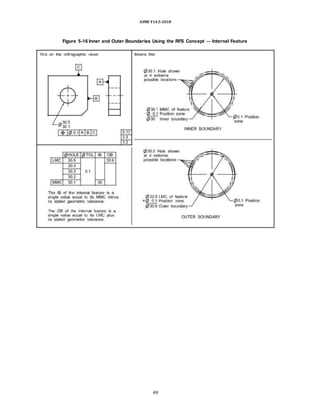
5-16 Inner and OuterBoundaries Using the RFS Concept — Internal Feature . . . . . . . . . . . . . . 48
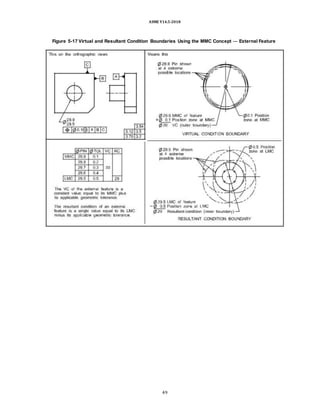
5-17 Virtual and Resultant ConditionBoundaries Usingthe MMCConcept — External Feature . 49
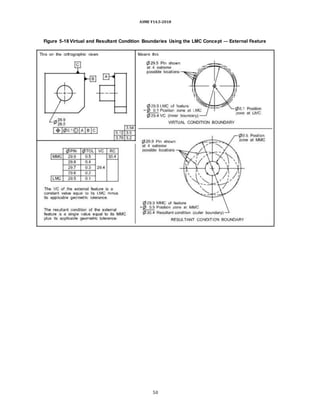
5-18 Virtual and Resultant ConditionBoundaries Usingthe LMCConcept — External Feature . . 50
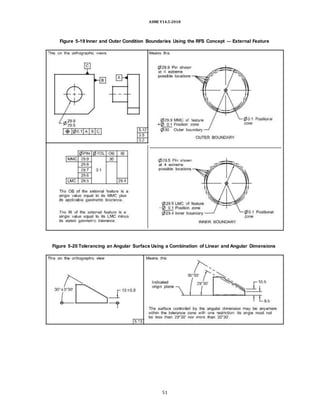
5-19 Inner and OuterConditionBoundaries Usingthe RFSConcept — External Feature . . . . . . 51
5-20 Tolerancingan Angular Surface Usinga Combinationof Linear and Angular Dimensions . . 51
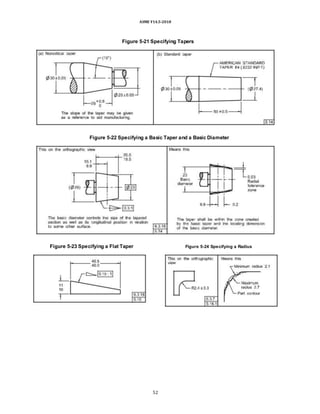
5-21 SpecifyingTapers . . . . . . . . . . . . . . . . . . . . . . . . . . . . . . . . . . . . . . . . . . . . . . . . . . . . . 52
5-22 SpecifyingaBasic Taper and a Basic Diameter . . . . . . . . . . . . . . . . . . . . . . . . . . . . . . . . 52
5-23 SpecifyingaFlat Taper . . . . . . . . . . . . . . . . . . . . . . . . . . . . . . . . . . . . . . . . . . . . . . . . . 52
5-24 SpecifyingaRadius . . . . . . . . . . . . . . . . . . . . . . . . . . . . . . . . . . . . . . . . . . . . . . . . . . . . 52
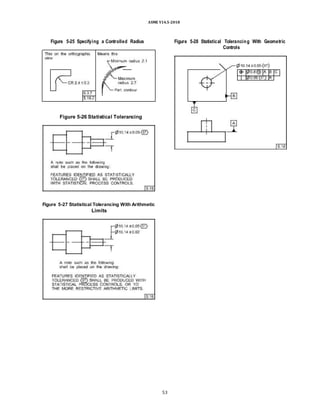
5-25 SpecifyingaControlled Radius . . . . . . . . . . . . . . . . . . . . . . . . . . . . . . . . . . . . . . . . . . . . 53
5-26 Statistical Tolerancing . . . . . . . . . . . . . . . . . . . . . . . . . . . . . . . . . . . . . . . . . . . . . . . . . . 53
5-27 Statistical TolerancingWithArithmetic Limits . . . . . . . . . . . . . . . . . . . . . . . . . . . . . . . . . 53
5-28 Statistical TolerancingWithGeometric Controls . . . . . . . . . . . . . . . . . . . . . . . . . . . . . . . 53
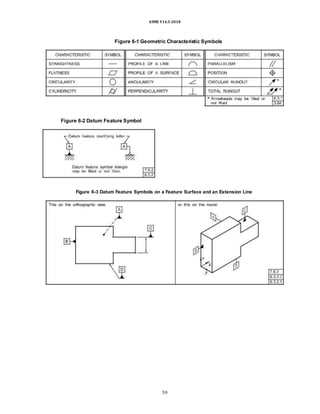
6-1 Geometric Characteristic Symbols . . . . . . . . . . . . . . . . . . . . . . . . . . . . . . . . . . . . . . . . . . 59
6-2 Datum Feature Symbol . . . . . . . . . . . . . . . . . . . . . . . . . . . . . . . . . . . . . . . . . . . . . . . . . 59
6-3 Datum Feature Symbols onaFeature Surface and an ExtensionLine . . . . . . . . . . . . . . . . 59
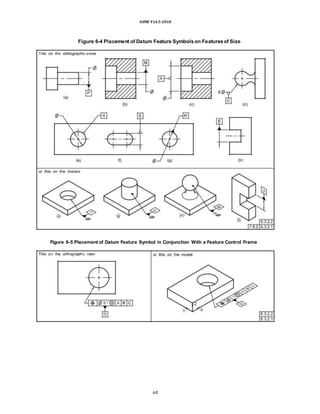
6-4 Placementof Datum Feature Symbols onFeatures of Size . . . . . . . . . . . . . . . . . . . . . . . . 60
6-5 Placementof Datum Feature Symbol inConjunctionWith a Feature Control Frame . . . . . . 60
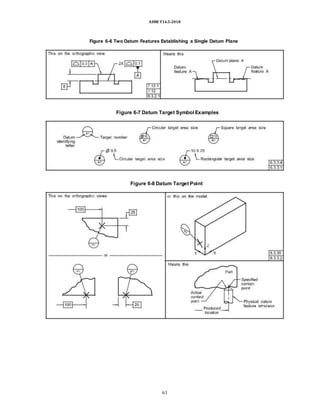
6-6 Two Datum Features EstablishingaSingle Datum Plane . . . . . . . . . . . . . . . . . . . . . . . . . 61
6-7 Datum Target Symbol Examples . . . . . . . . . . . . . . . . . . . . . . . . . . . . . . . . . . . . . . . . . . . 61
6-8 Datum Target Point . . . . . . . . . . . . . . . . . . . . . . . . . . . . . . . . . . . . . . . . . . . . . . . . . . . . 61
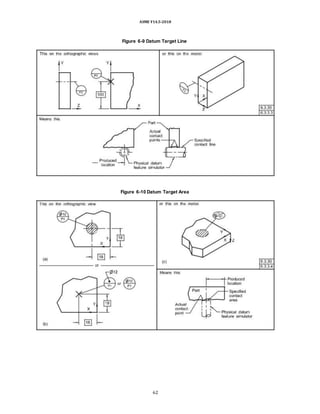
6-9 Datum Target Line . . . . . . . . . . . . . . . . . . . . . . . . . . . . . . . . . . . . . . . . . . . . . . . . . . . . 62
6-10 Datum Target Area . . . . . . . . . . . . . . . . . . . . . . . . . . . . . . . . . . . . . . . . . . . . . . . . . . . . 62
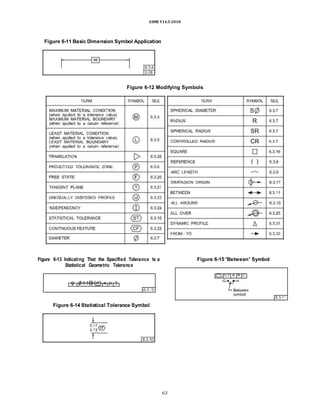
6-11 Basic DimensionSymbol Application . . . . . . . . . . . . . . . . . . . . . . . . . . . . . . . . . . . . . . . . 63
vii
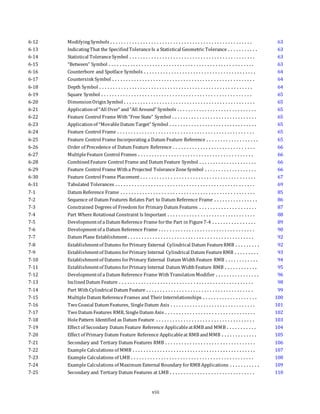
6-12 ModifyingSymbols . . . . . . . . . . . . . . . . . . . . . . . . . . . . . . . . . . . . . . . . . . . . . . . . . . . . 63
6-13 IndicatingThat the SpecifiedToleranceIs a Statistical Geometric Tolerance . . . . . . . . . . . 63
6-14 Statistical ToleranceSymbol . . . . . . . . . . . . . . . . . . . . . . . . . . . . . . . . . . . . . . . . . . . . . . 63
6-15 “Between” Symbol . . . . . . . . . . . . . . . . . . . . . . . . . . . . . . . . . . . . . . . . . . . . . . . . . . . . . 63
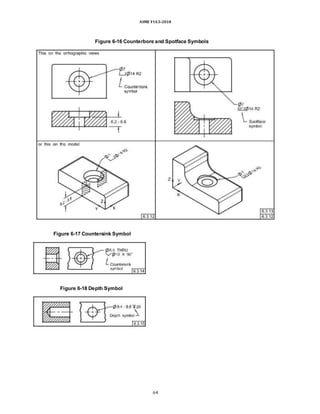
6-16 Counterbore and Spotface Symbols . . . . . . . . . . . . . . . . . . . . . . . . . . . . . . . . . . . . . . . . . 64
6-17 Countersink Symbol . . . . . . . . . . . . . . . . . . . . . . . . . . . . . . . . . . . . . . . . . . . . . . . . . . . . 64
6-18 Depth Symbol . . . . . . . . . . . . . . . . . . . . . . . . . . . . . . . . . . . . . . . . . . . . . . . . . . . . . . . . 64
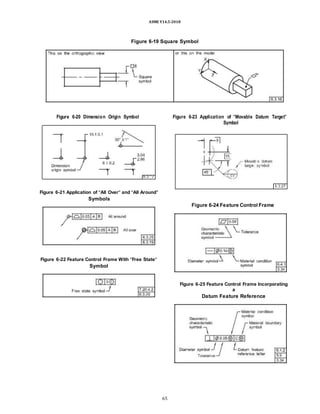
6-19 Square Symbol . . . . . . . . . . . . . . . . . . . . . . . . . . . . . . . . . . . . . . . . . . . . . . . . . . . . . . . 65
6-20 DimensionOriginSymbol . . . . . . . . . . . . . . . . . . . . . . . . . . . . . . . . . . . . . . . . . . . . . . . . 65
6-21 Applicationof “All Over” and“All Around” Symbols . . . . . . . . . . . . . . . . . . . . . . . . . . . . . 65
6-22 Feature Control Frame With “Free State” Symbol . . . . . . . . . . . . . . . . . . . . . . . . . . . . . . . 65
6-23 Applicationof “MovableDatum Target” Symbol . . . . . . . . . . . . . . . . . . . . . . . . . . . . . . . . 65
6-24 Feature Control Frame . . . . . . . . . . . . . . . . . . . . . . . . . . . . . . . . . . . . . . . . . . . . . . . . . . 65
6-25 Feature Control Frame Incorporating a Datum Feature Reference . . . . . . . . . . . . . . . . . . . 65
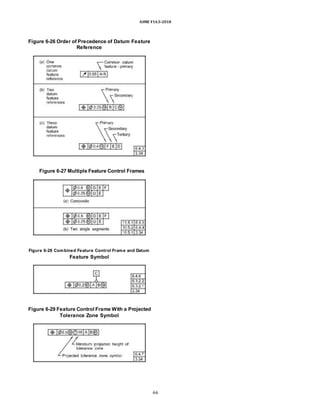
6-26 Order of Precedence of Datum Feature Reference . . . . . . . . . . . . . . . . . . . . . . . . . . . . . . 66
6-27 MultipleFeature Control Frames . . . . . . . . . . . . . . . . . . . . . . . . . . . . . . . . . . . . . . . . . . 66
6-28 CombinedFeature Control Frame and Datum Feature Symbol . . . . . . . . . . . . . . . . . . . . . 66
6-29 Feature Control Frame Witha Projected ToleranceZoneSymbol . . . . . . . . . . . . . . . . . . . 66
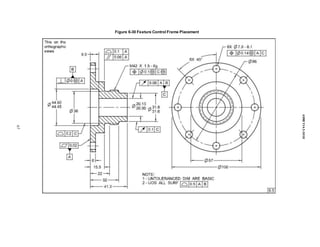
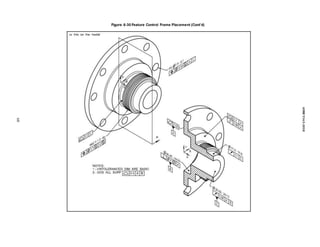
6-30 Feature Control Frame Placement . . . . . . . . . . . . . . . . . . . . . . . . . . . . . . . . . . . . . . . . . . 67
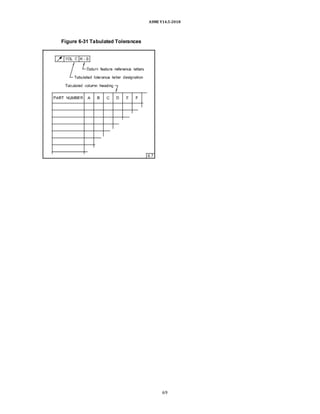
6-31 Tabulated Tolerances . . . . . . . . . . . . . . . . . . . . . . . . . . . . . . . . . . . . . . . . . . . . . . . . . . . 69
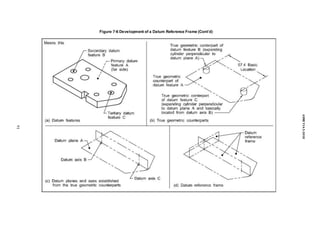
7-1 Datum Reference Frame . . . . . . . . . . . . . . . . . . . . . . . . . . . . . . . . . . . . . . . . . . . . . . . . . 85
7-2 Sequence of Datum Features Relates Part to Datum Reference Frame . . . . . . . . . . . . . . . . 86
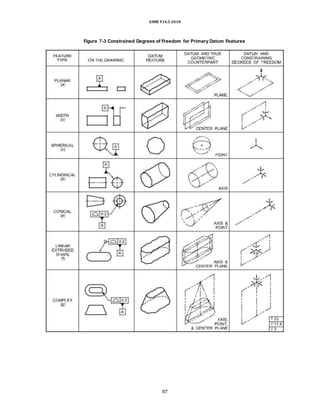
7-3 Constrained Degrees of Freedom for Primary Datum Features . . . . . . . . . . . . . . . . . . . . . 87
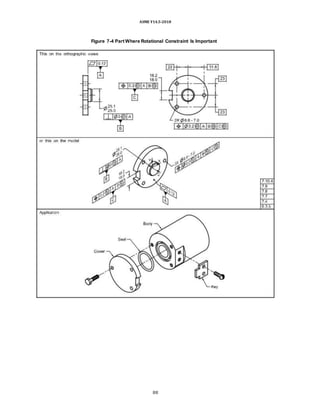
7-4 Part Where Rotational Constraint Is Important . . . . . . . . . . . . . . . . . . . . . . . . . . . . . . . . 88
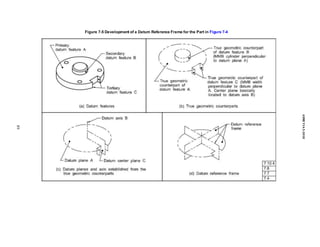
7-5 Developmentof a Datum Reference Frame forthe Part in Figure7-4 . . . . . . . . . . . . . . . . 89
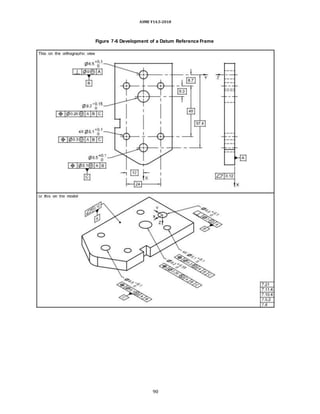
7-6 Developmentof a Datum Reference Frame . . . . . . . . . . . . . . . . . . . . . . . . . . . . . . . . . . . 90
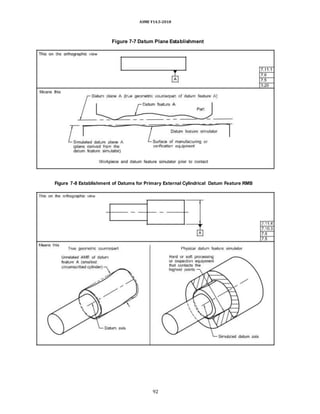
7-7 Datum Plane Establishment . . . . . . . . . . . . . . . . . . . . . . . . . . . . . . . . . . . . . . . . . . . . . . 92
7-8 Establishmentof Datums forPrimary External Cylindrical Datum FeatureRMB . . . . . . . . . 92
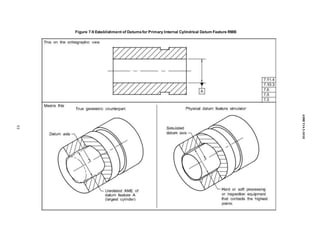
7-9 Establishmentof Datums forPrimary Internal Cylindrical Datum FeatureRMB . . . . . . . . . 93
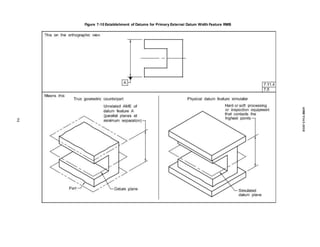
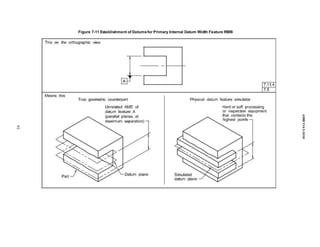
7-10 Establishmentof Datums forPrimary External Datum WidthFeature RMB . . . . . . . . . . . . 94
7-11 Establishmentof Datums forPrimary Internal Datum WidthFeature RMB . . . . . . . . . . . . 95
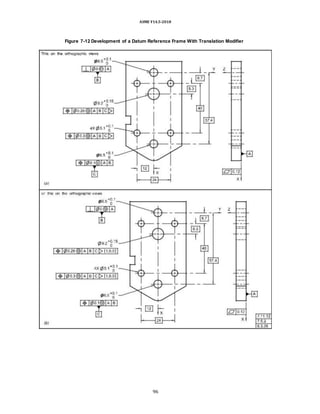
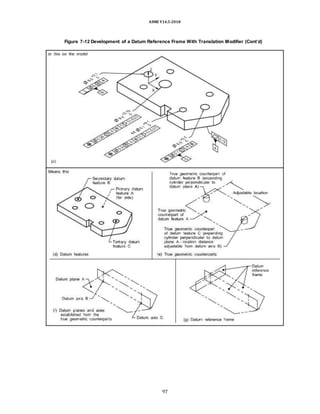
7-12 Developmentof a Datum Reference Frame WithTranslationModifier . . . . . . . . . . . . . . . . 96
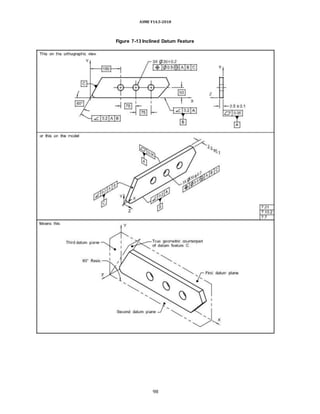
7-13 InclinedDatum Feature . . . . . . . . . . . . . . . . . . . . . . . . . . . . . . . . . . . . . . . . . . . . . . . . . 98
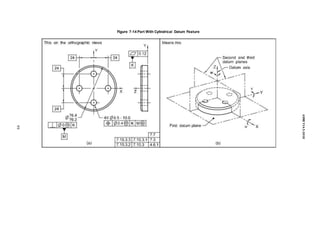
7-14 Part WithCylindrical Datum Feature . . . . . . . . . . . . . . . . . . . . . . . . . . . . . . . . . . . . . . . 99
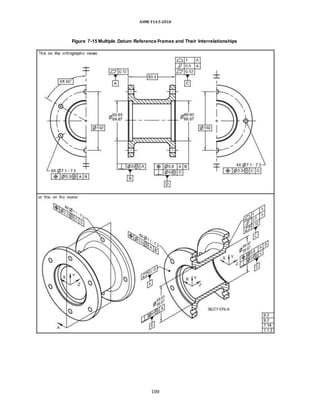
7-15 MultipleDatum ReferenceFrames and TheirInterrelationships . . . . . . . . . . . . . . . . . . . . 100
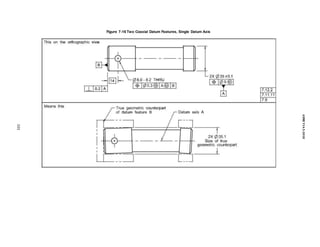
7-16 Two Coaxial Datum Features, SingleDatum Axis . . . . . . . . . . . . . . . . . . . . . . . . . . . . . . . 101
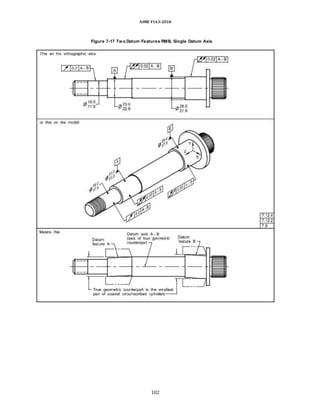
7-17 Two Datum Features RMB, SingleDatum Axis . . . . . . . . . . . . . . . . . . . . . . . . . . . . . . . . . 102
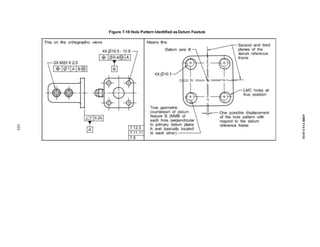
7-18 HolePattern Identified as Datum Feature . . . . . . . . . . . . . . . . . . . . . . . . . . . . . . . . . . . . 103
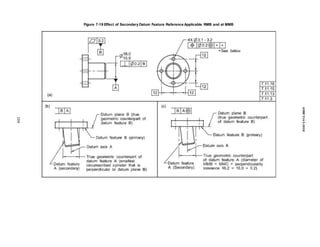
7-19 Effect of Secondary Datum Feature Reference ApplicableatRMB and MMB . . . . . . . . . . . 104
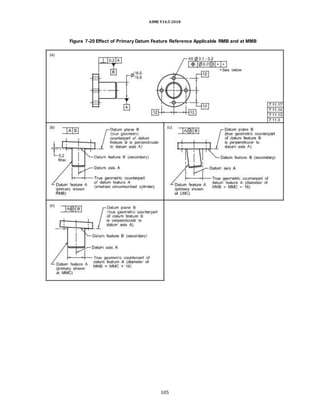
7-20 Effect of Primary Datum Feature Reference Applicableat RMB andMMB . . . . . . . . . . . . . 105
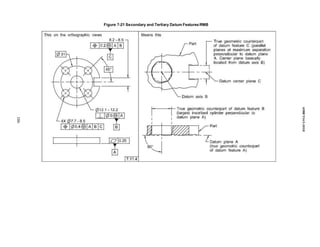
7-21 Secondary and Tertiary Datum Features RMB . . . . . . . . . . . . . . . . . . . . . . . . . . . . . . . . . 106
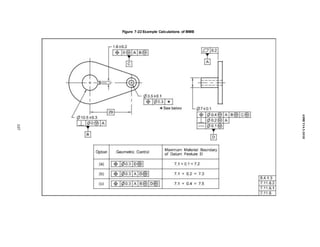
7-22 Example Calculations of MMB . . . . . . . . . . . . . . . . . . . . . . . . . . . . . . . . . . . . . . . . . . . . . 107
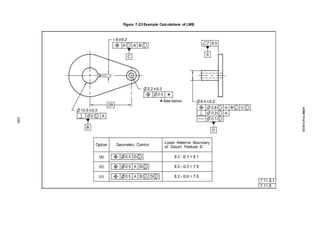
7-23 Example Calculations of LMB . . . . . . . . . . . . . . . . . . . . . . . . . . . . . . . . . . . . . . . . . . . . . 108
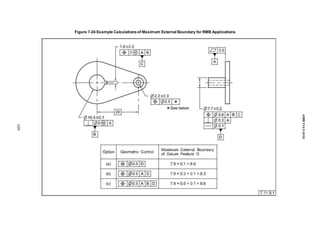
7-24 Example Calculations of Maximum External Boundary forRMB Applications . . . . . . . . . . . 109
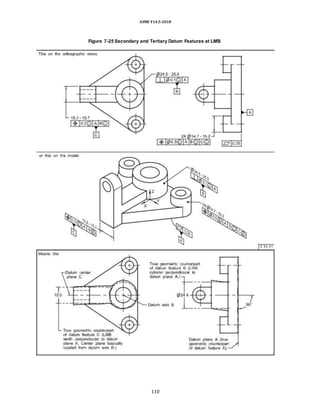
7-25 Secondary and Tertiary Datum Features at LMB . . . . . . . . . . . . . . . . . . . . . . . . . . . . . . . 110
viii
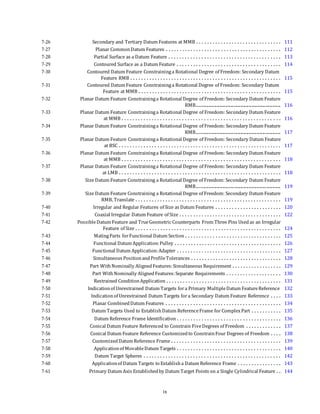
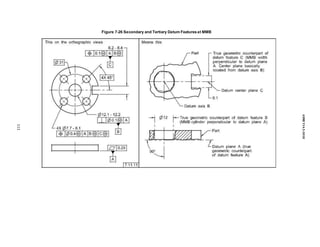
7-26 Secondary and Tertiary Datum Features at MMB . . . . . . . . . . . . . . . . . . . . . . . . . . . . . . . 111
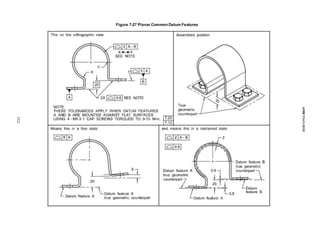
7-27 Planar CommonDatum Features . . . . . . . . . . . . . . . . . . . . . . . . . . . . . . . . . . . . . . . . . . 112
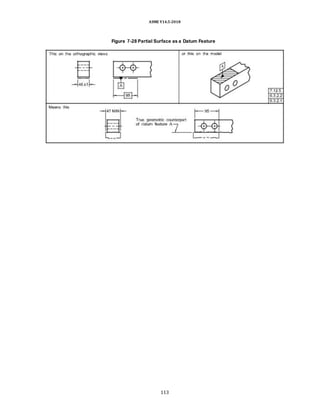
7-28 Partial Surface as a Datum Feature . . . . . . . . . . . . . . . . . . . . . . . . . . . . . . . . . . . . . . . . . 113
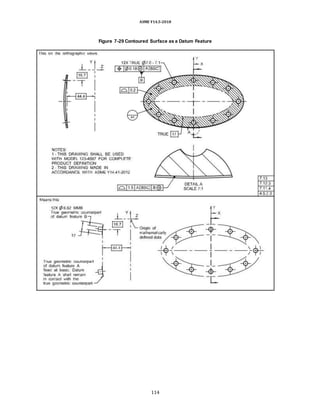
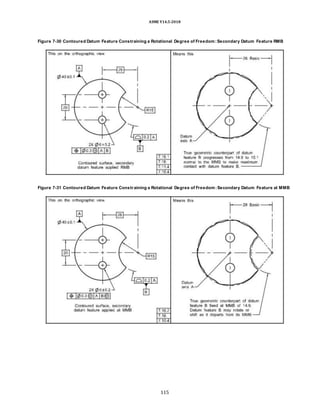
7-29 Contoured Surface as a Datum Feature . . . . . . . . . . . . . . . . . . . . . . . . . . . . . . . . . . . . . . 114
7-30 Contoured Datum Feature Constraininga Rotational Degree of Freedom: Secondary Datum
Feature RMB . . . . . . . . . . . . . . . . . . . . . . . . . . . . . . . . . . . . . . . . . . . . . . . . . . . . . . . 115
7-31 Contoured Datum Feature Constraininga Rotational Degree of Freedom: Secondary Datum
Feature at MMB . . . . . . . . . . . . . . . . . . . . . . . . . . . . . . . . . . . . . . . . . . . . . . . . . . . . 115
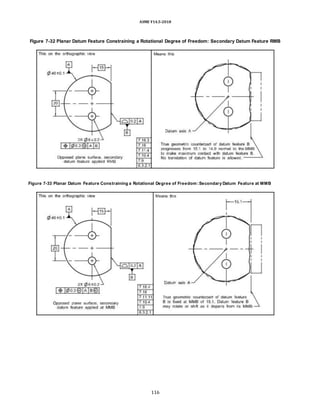
7-32 Planar Datum Feature Constraininga Rotational Degree of Freedom: Secondary Datum Feature
RMB............................................................. 116
7-33 Planar Datum Feature Constraininga Rotational Degree of Freedom: Secondary Datum Feature
at MMB . . . . . . . . . . . . . . . . . . . . . . . . . . . . . . . . . . . . . . . . . . . . . . . . . . . . . . . . . . 116
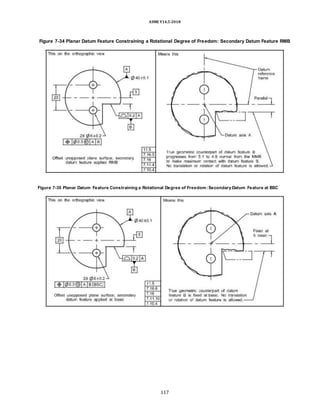
7-34 Planar Datum Feature Constraininga Rotational Degree of Freedom: Secondary Datum Feature
RMB............................................................. 117
7-35 Planar Datum Feature Constraininga Rotational Degree of Freedom: Secondary Datum Feature
at BSC . . . . . . . . . . . . . . . . . . . . . . . . . . . . . . . . . . . . . . . . . . . . . . . . . . . . . . . . . . . 117
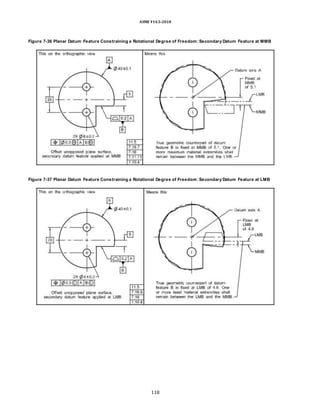
7-36 Planar Datum Feature Constraininga Rotational Degree of Freedom: Secondary Datum Feature
at MMB . . . . . . . . . . . . . . . . . . . . . . . . . . . . . . . . . . . . . . . . . . . . . . . . . . . . . . . . . . 118
7-37 Planar Datum Feature Constraininga Rotational Degree of Freedom: Secondary Datum Feature
at LMB . . . . . . . . . . . . . . . . . . . . . . . . . . . . . . . . . . . . . . . . . . . . . . . . . . . . . . . . . . . 118
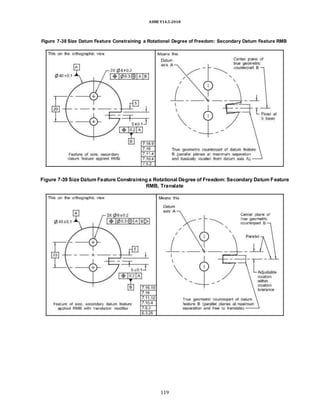
7-38 Size Datum Feature Constraining a Rotational Degree of Freedom: Secondary Datum Feature
RMB............................................................. 119
7-39 Size Datum Feature Constraining a Rotational Degree of Freedom: Secondary Datum Feature
RMB, Translate . . . . . . . . . . . . . . . . . . . . . . . . . . . . . . . . . . . . . . . . . . . . . . . . . . . . . 119
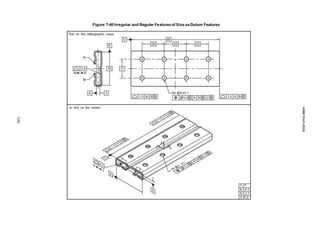
7-40 Irregular and Regular Features of Size as Datum Features . . . . . . . . . . . . . . . . . . . . . . . . 120
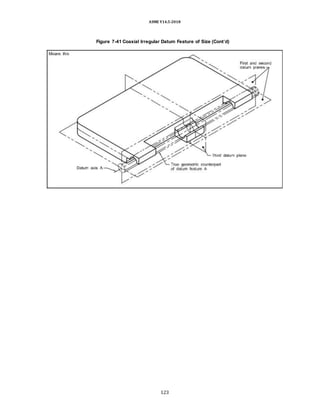
7-41 Coaxial Irregular Datum Feature of Size . . . . . . . . . . . . . . . . . . . . . . . . . . . . . . . . . . . . . 122
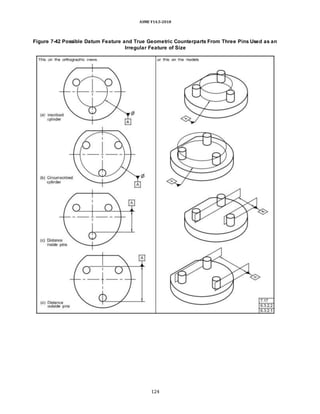
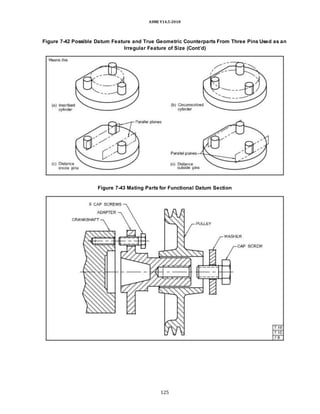
7-42 PossibleDatum Feature and TrueGeometric Counterparts From Three Pins Usedas an Irregular
Feature of Size . . . . . . . . . . . . . . . . . . . . . . . . . . . . . . . . . . . . . . . . . . . . . . . . . . . . . 124
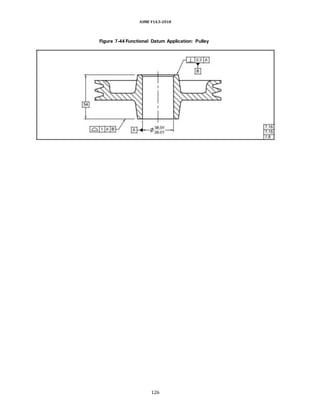
7-43 MatingParts forFunctional Datum Section . . . . . . . . . . . . . . . . . . . . . . . . . . . . . . . . . . . 125
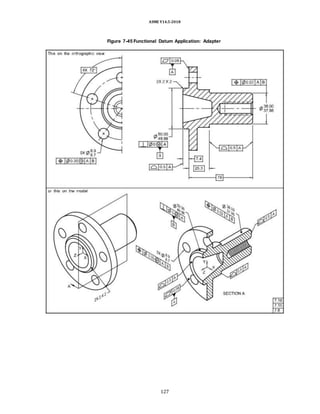
7-44 Functional Datum Application:Pulley . . . . . . . . . . . . . . . . . . . . . . . . . . . . . . . . . . . . . . . 126
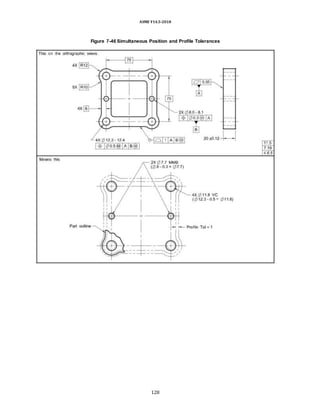
7-45 Functional Datum Application:Adapter . . . . . . . . . . . . . . . . . . . . . . . . . . . . . . . . . . . . . . 127
7-46 Simultaneous PositionandProfileTolerances . . . . . . . . . . . . . . . . . . . . . . . . . . . . . . . . . 128
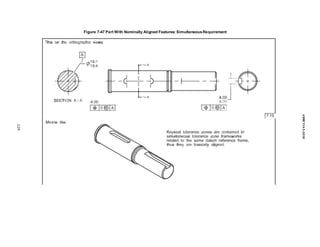
7-47 Part WithNominally AlignedFeatures:Simultaneous Requirement . . . . . . . . . . . . . . . . . . 129
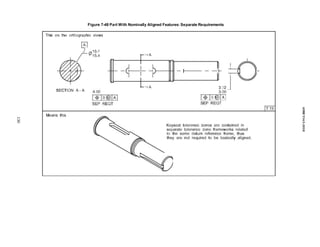
7-48 Part WithNominally AlignedFeatures:Separate Requirements . . . . . . . . . . . . . . . . . . . . 130
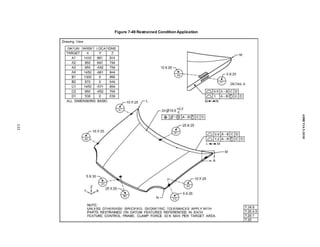
7-49 Restrained ConditionApplication . . . . . . . . . . . . . . . . . . . . . . . . . . . . . . . . . . . . . . . . . . 131
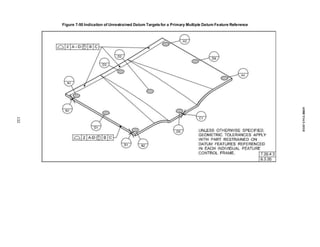
7-50 Indicationof Unrestrained Datum Targets fora Primary MultipleDatum FeatureReference 132
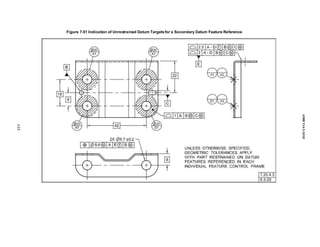
7-51 Indicationof Unrestrained Datum Targets fora Secondary Datum Feature Reference . . . . 133
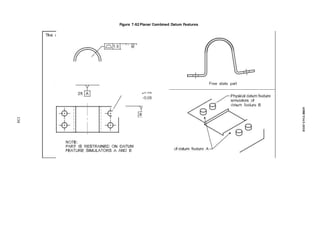
7-52 Planar CombinedDatum Features . . . . . . . . . . . . . . . . . . . . . . . . . . . . . . . . . . . . . . . . . . 134
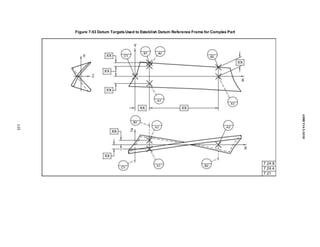
7-53 Datum Targets Used to EstablishDatum ReferenceFrame for ComplexPart . . . . . . . . . . . 135
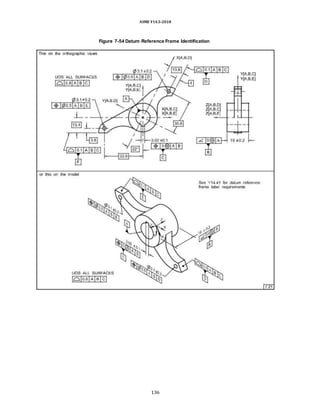
7-54 Datum Reference Frame Identification . . . . . . . . . . . . . . . . . . . . . . . . . . . . . . . . . . . . . . 136
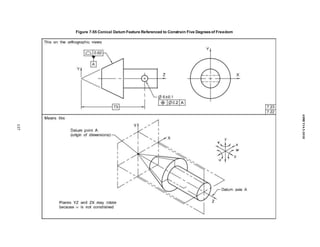
7-55 Conical Datum Feature Referenced to Constrain FiveDegrees of Freedom . . . . . . . . . . . . . 137
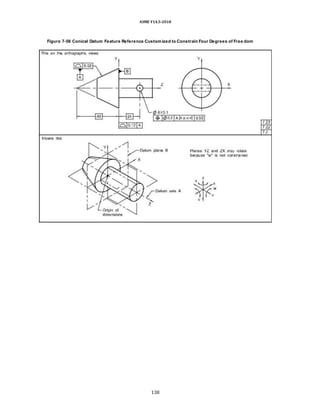
7-56 Conical Datum Feature Reference Customizedto ConstrainFour Degrees of Freedom . . . . 138
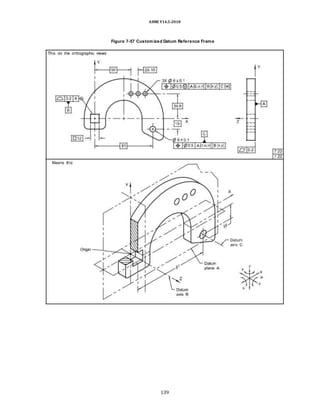
7-57 CustomizedDatum Reference Frame . . . . . . . . . . . . . . . . . . . . . . . . . . . . . . . . . . . . . . . . 139
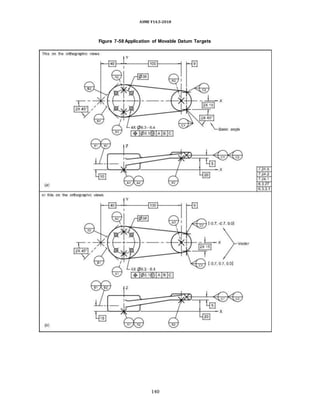
7-58 Applicationof MovableDatum Targets . . . . . . . . . . . . . . . . . . . . . . . . . . . . . . . . . . . . . . 140
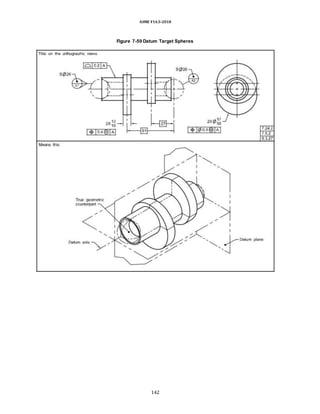
7-59 Datum Target Spheres . . . . . . . . . . . . . . . . . . . . . . . . . . . . . . . . . . . . . . . . . . . . . . . . . . 142
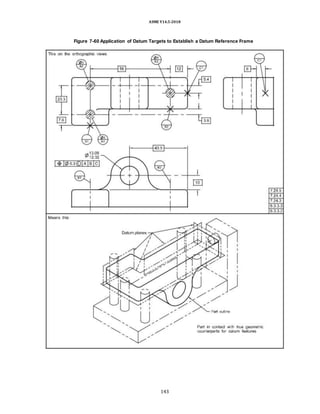
7-60 Applicationof Datum Targets to Establisha Datum Reference Frame . . . . . . . . . . . . . . . . 143
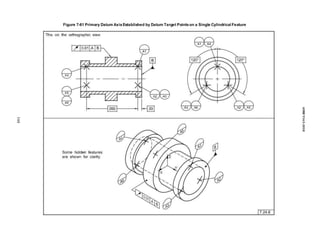
7-61 Primary Datum Axis Establishedby Datum Target Points on a Single Cylindrical Feature . . 144
ix
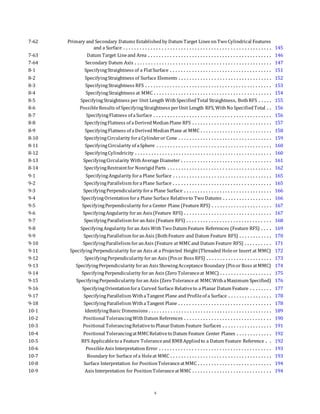
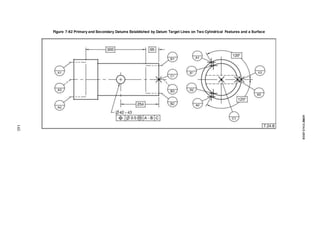
7-62 Primary and Secondary Datums Establishedby Datum Target Lines onTwo Cylindrical Features
and a Surface . . . . . . . . . . . . . . . . . . . . . . . . . . . . . . . . . . . . . . . . . . . . . . . . . . . . . . 145
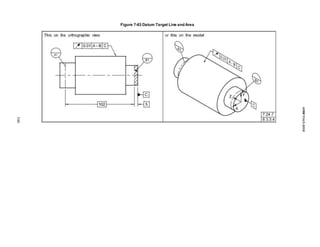
7-63 Datum Target Lineand Area . . . . . . . . . . . . . . . . . . . . . . . . . . . . . . . . . . . . . . . . . . . . . 146
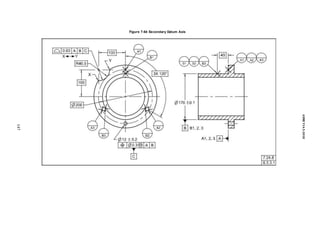
7-64 Secondary Datum Axis . . . . . . . . . . . . . . . . . . . . . . . . . . . . . . . . . . . . . . . . . . . . . . . . . . 147
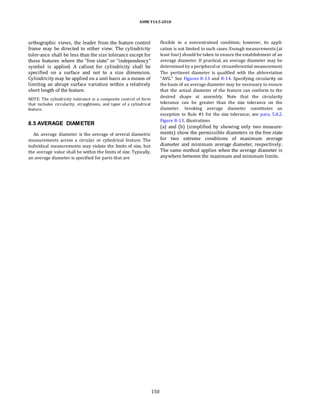
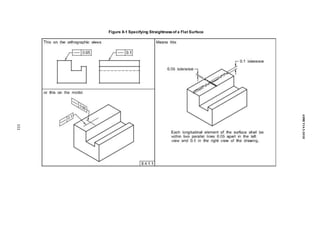
8-1 SpecifyingStraightness of a FlatSurface . . . . . . . . . . . . . . . . . . . . . . . . . . . . . . . . . . . . . 151
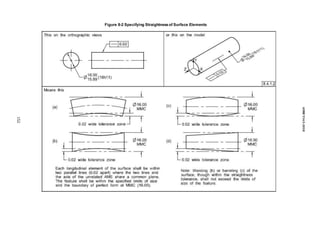
8-2 SpecifyingStraightness of Surface Elements . . . . . . . . . . . . . . . . . . . . . . . . . . . . . . . . . . 152
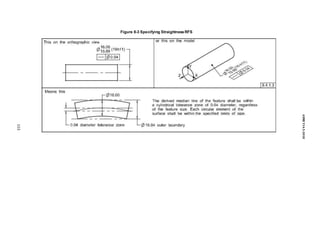
8-3 SpecifyingStraightness RFS . . . . . . . . . . . . . . . . . . . . . . . . . . . . . . . . . . . . . . . . . . . . . . 153
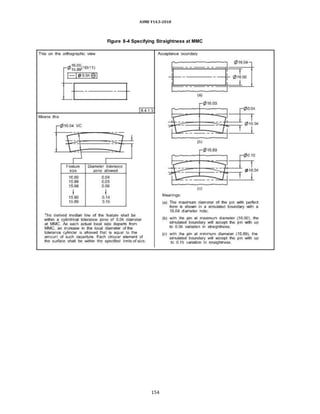
8-4 SpecifyingStraightness at MMC . . . . . . . . . . . . . . . . . . . . . . . . . . . . . . . . . . . . . . . . . . . 154
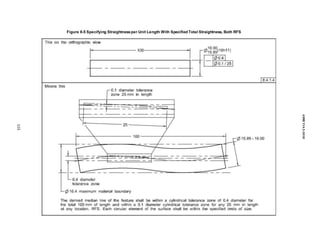
8-5 SpecifyingStraightness per Unit Length WithSpecifiedTotal Straightness, BothRFS . . . . . 155
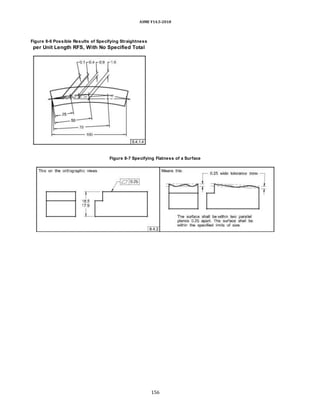
8-6 PossibleResults of SpecifyingStraightness perUnit Length RFS, WithNo SpecifiedTotal . . 156
8-7 SpecifyingFlatness of aSurface . . . . . . . . . . . . . . . . . . . . . . . . . . . . . . . . . . . . . . . . . . . 156
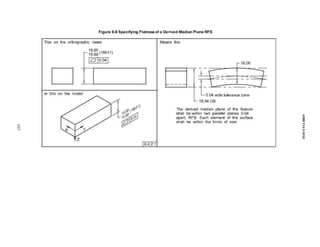
8-8 SpecifyingFlatness of aDerivedMedianPlane RFS . . . . . . . . . . . . . . . . . . . . . . . . . . . . . 157
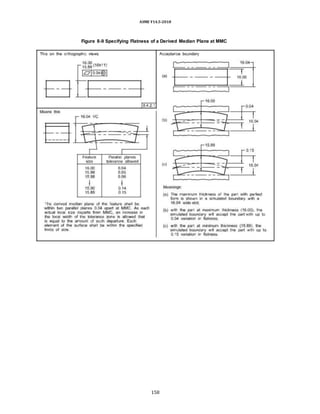
8-9 SpecifyingFlatness of aDerivedMedian Plane at MMC . . . . . . . . . . . . . . . . . . . . . . . . . . 158
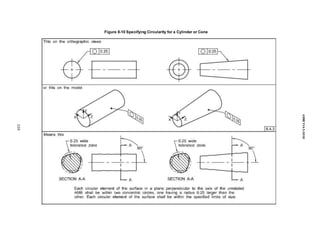
8-10 SpecifyingCircularity foraCylinderor Cone . . . . . . . . . . . . . . . . . . . . . . . . . . . . . . . . . . 159
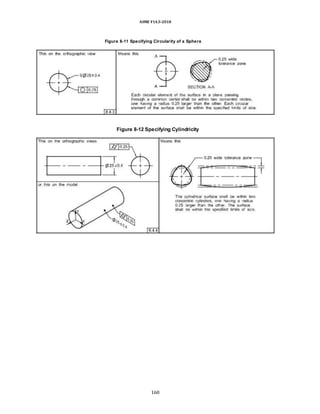
8-11 SpecifyingCircularity of aSphere . . . . . . . . . . . . . . . . . . . . . . . . . . . . . . . . . . . . . . . . . . 160
8-12 SpecifyingCylindricity . . . . . . . . . . . . . . . . . . . . . . . . . . . . . . . . . . . . . . . . . . . . . . . . . . 160
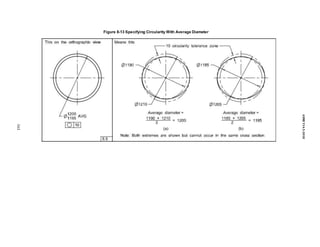
8-13 SpecifyingCircularity WithAverageDiameter . . . . . . . . . . . . . . . . . . . . . . . . . . . . . . . . . 161
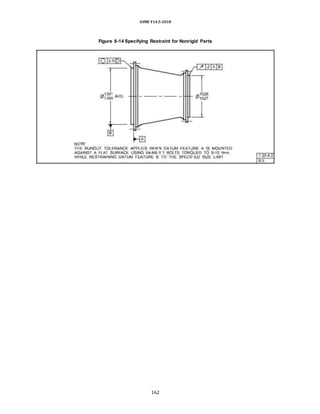
8-14 SpecifyingRestraintfor NonrigidParts . . . . . . . . . . . . . . . . . . . . . . . . . . . . . . . . . . . . . . 162
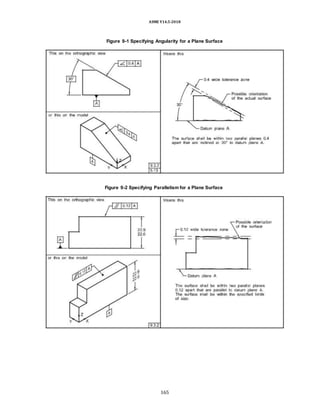
9-1 SpecifyingAngularity fora Plane Surface . . . . . . . . . . . . . . . . . . . . . . . . . . . . . . . . . . . . 165
9-2 SpecifyingParallelism foraPlane Surface . . . . . . . . . . . . . . . . . . . . . . . . . . . . . . . . . . . . 165
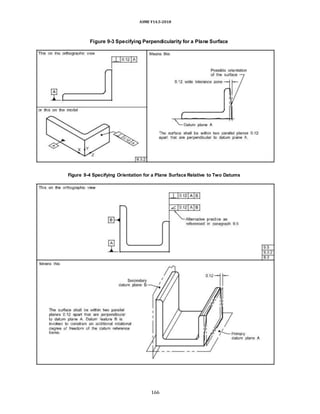
9-3 SpecifyingPerpendicularity fora Plane Surface . . . . . . . . . . . . . . . . . . . . . . . . . . . . . . . . 166
9-4 SpecifyingOrientationfora Plane Surface Relativeto Two Datums . . . . . . . . . . . . . . . . . . 166
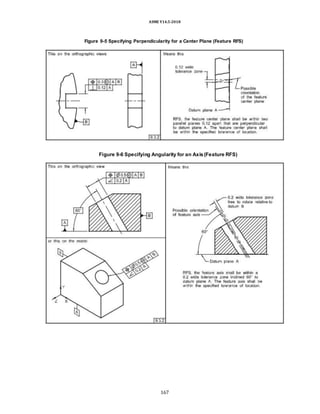
9-5 SpecifyingPerpendicularity fora Center Plane (Feature RFS) . . . . . . . . . . . . . . . . . . . . . . 167
9-6 SpecifyingAngularity foran Axis (Feature RFS) . . . . . . . . . . . . . . . . . . . . . . . . . . . . . . . . 167
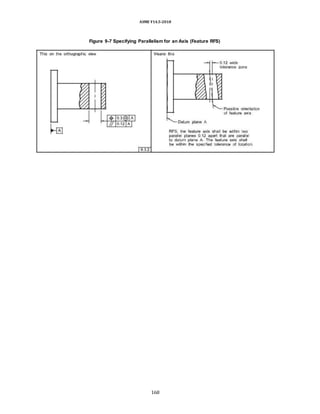
9-7 SpecifyingParallelism foranAxis (Feature RFS) . . . . . . . . . . . . . . . . . . . . . . . . . . . . . . . 168
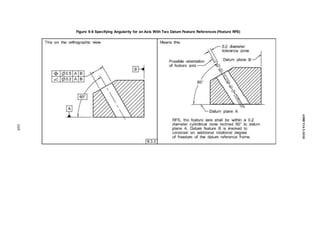
9-8 SpecifyingAngularity foran Axis WithTwo Datum Feature References (Feature RFS) . . . . 169
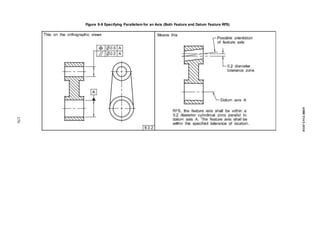
9-9 SpecifyingParallelism foranAxis (BothFeature and Datum Feature RFS) . . . . . . . . . . . . 170
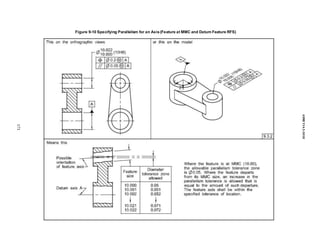
9-10 SpecifyingParallelism foranAxis (Feature at MMCand Datum Feature RFS) . . . . . . . . . . 171
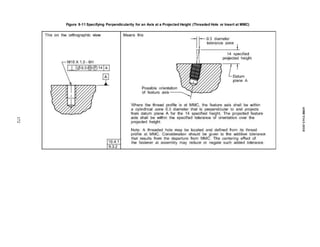
9-11 SpecifyingPerpendicularity foran Axis at a Projected Height(Threaded Holeor Insert at MMC) 172
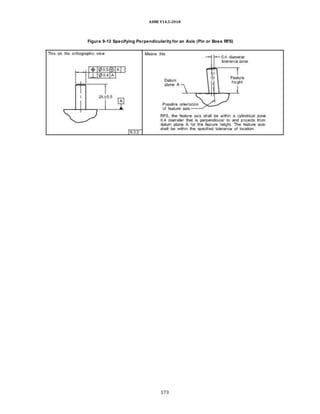
9-12 SpecifyingPerpendicularity foran Axis (Pinor Boss RFS) . . . . . . . . . . . . . . . . . . . . . . . . 173
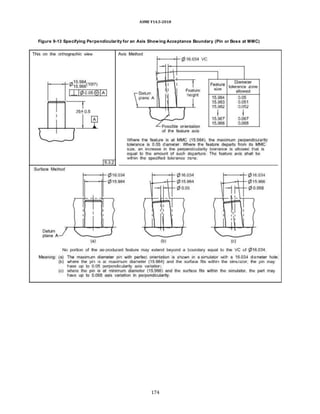
9-13 SpecifyingPerpendicularity foran Axis ShowingAcceptance Boundary (Pinor Boss atMMC) 174
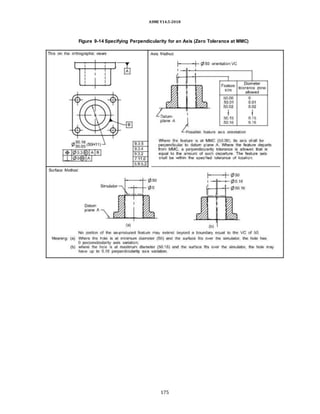
9-14 SpecifyingPerpendicularity foran Axis (Zero Toleranceat MMC) . . . . . . . . . . . . . . . . . . . 175
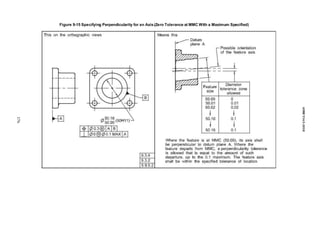
9-15 SpecifyingPerpendicularity foran Axis (Zero Toleranceat MMCWithaMaximum Specified) 176
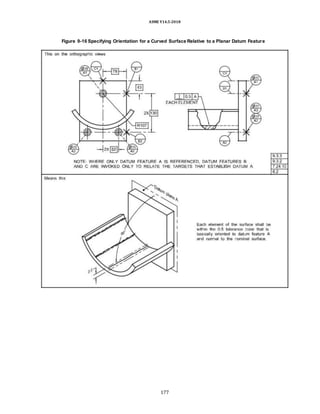
9-16 SpecifyingOrientationfora Curved Surface Relativeto a Planar Datum Feature . . . . . . . . 177
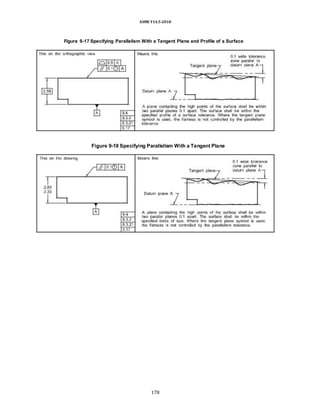
9-17 SpecifyingParallelism WithaTangent Plane and Profileof a Surface . . . . . . . . . . . . . . . . 178
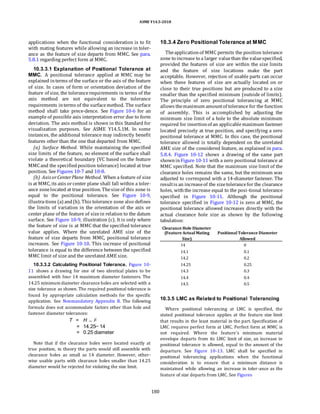
9-18 SpecifyingParallelism WithaTangent Plane . . . . . . . . . . . . . . . . . . . . . . . . . . . . . . . . . . 178
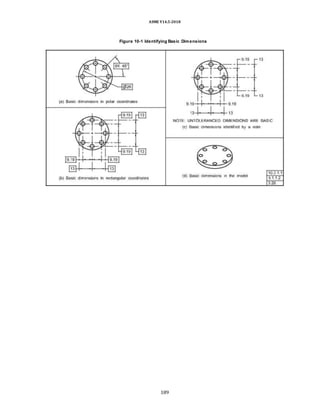
10-1 IdentifyingBasic Dimensions . . . . . . . . . . . . . . . . . . . . . . . . . . . . . . . . . . . . . . . . . . . . . 189
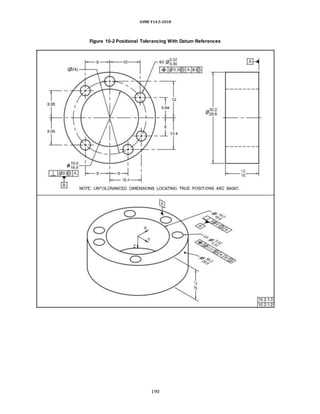
10-2 Positional TolerancingWithDatum References . . . . . . . . . . . . . . . . . . . . . . . . . . . . . . . . 190
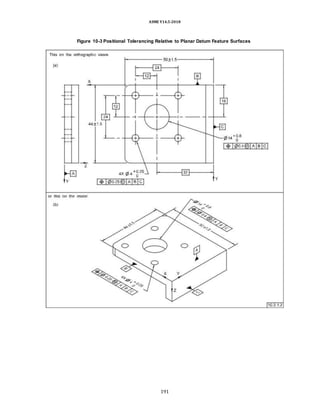
10-3 Positional TolerancingRelativeto PlanarDatum Feature Surfaces . . . . . . . . . . . . . . . . . . 191
10-4 Positional TolerancingatMMCRelativeto Datum Feature Center Planes . . . . . . . . . . . . . 192
10-5 RFS Applicableto a Feature Toleranceand RMB Appliedto a Datum Feature Reference . . 192
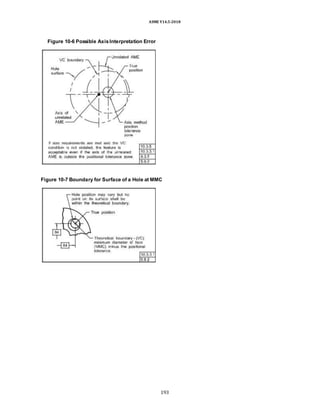
10-6 PossibleAxis Interpretation Error . . . . . . . . . . . . . . . . . . . . . . . . . . . . . . . . . . . . . . . . . 193
10-7 Boundary for Surface of a Holeat MMC . . . . . . . . . . . . . . . . . . . . . . . . . . . . . . . . . . . . . 193
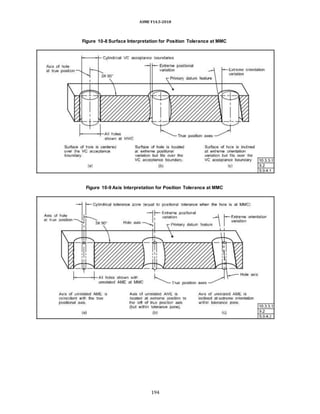
10-8 Surface Interpretation for PositionToleranceatMMC . . . . . . . . . . . . . . . . . . . . . . . . . . . 194
10-9 Axis Interpretation for PositionToleranceatMMC . . . . . . . . . . . . . . . . . . . . . . . . . . . . . 194
x
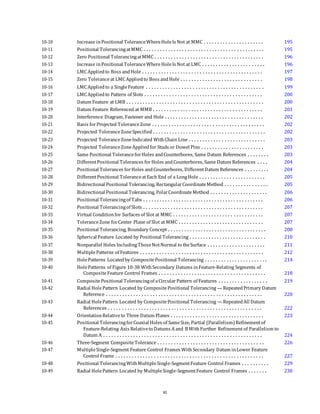
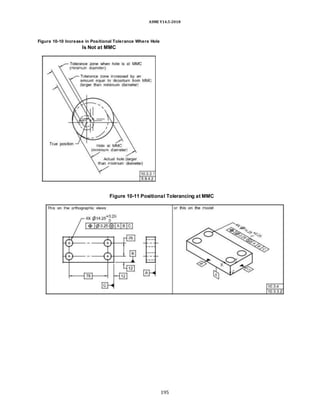
10-10 Increase inPositional ToleranceWhereHoleIs Not at MMC . . . . . . . . . . . . . . . . . . . . . . 195
10-11 Positional TolerancingatMMC . . . . . . . . . . . . . . . . . . . . . . . . . . . . . . . . . . . . . . . . . . . . 195
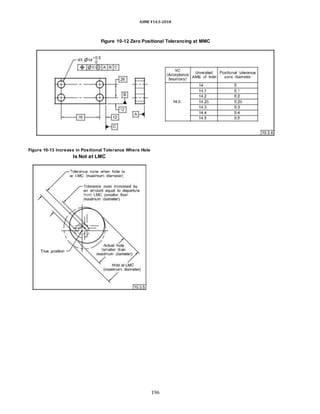
10-12 Zero Positional TolerancingatMMC . . . . . . . . . . . . . . . . . . . . . . . . . . . . . . . . . . . . . . . . 196
10-13 Increase inPositional ToleranceWhereHoleIs Not at LMC . . . . . . . . . . . . . . . . . . . . . . . 196
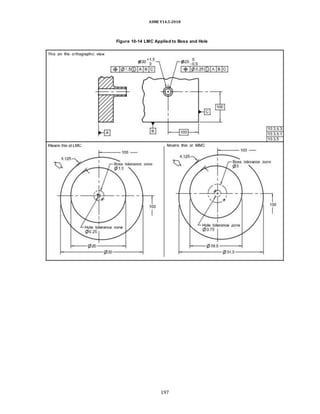
10-14 LMCAppliedto Boss andHole . . . . . . . . . . . . . . . . . . . . . . . . . . . . . . . . . . . . . . . . . . . . 197
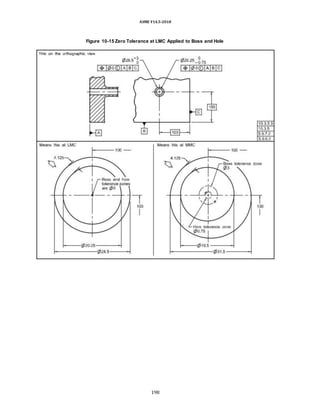
10-15 Zero Toleranceat LMCAppliedto Boss andHole . . . . . . . . . . . . . . . . . . . . . . . . . . . . . . 198
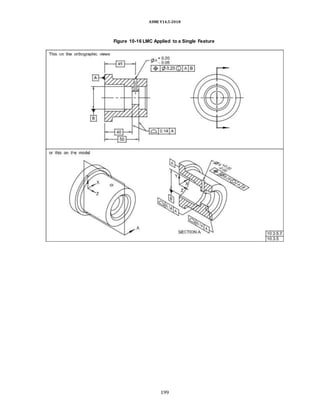
10-16 LMCAppliedto a SingleFeature . . . . . . . . . . . . . . . . . . . . . . . . . . . . . . . . . . . . . . . . . . . 199
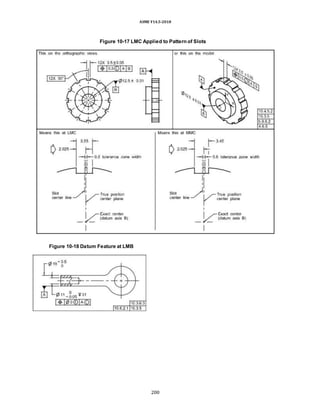
10-17 LMCAppliedto Pattern of Slots . . . . . . . . . . . . . . . . . . . . . . . . . . . . . . . . . . . . . . . . . . . 200
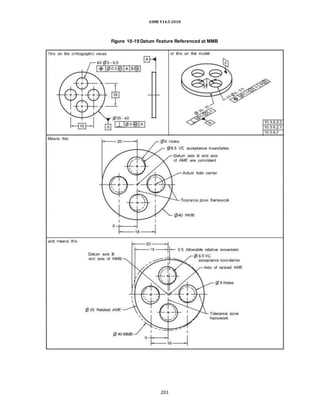
10-18 Datum Feature at LMB . . . . . . . . . . . . . . . . . . . . . . . . . . . . . . . . . . . . . . . . . . . . . . . . . . 200
10-19 Datum Feature Referenced at MMB . . . . . . . . . . . . . . . . . . . . . . . . . . . . . . . . . . . . . . . . 201
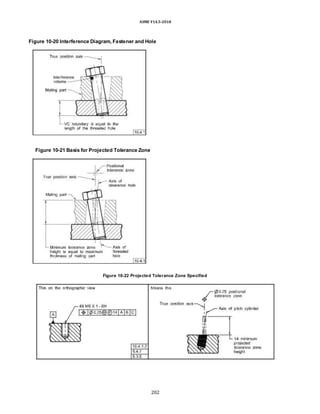
10-20 Interference Diagram, Fastener and Hole . . . . . . . . . . . . . . . . . . . . . . . . . . . . . . . . . . . . 202
10-21 Basis forProjected ToleranceZone . . . . . . . . . . . . . . . . . . . . . . . . . . . . . . . . . . . . . . . . . 202
10-22 Projected ToleranceZoneSpecified . . . . . . . . . . . . . . . . . . . . . . . . . . . . . . . . . . . . . . . . . 202
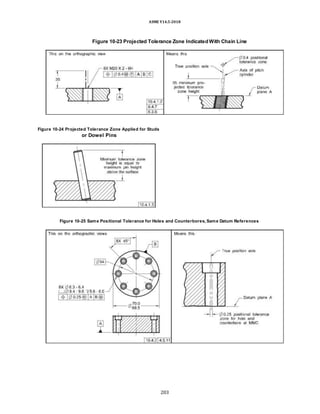
10-23 Projected ToleranceZoneIndicated WithChain Line . . . . . . . . . . . . . . . . . . . . . . . . . . . . 203
10-24 Projected ToleranceZoneAppliedfor Studs or Dowel Pins . . . . . . . . . . . . . . . . . . . . . . . 203
10-25 Same Positional ToleranceforHoles andCounterbores, Same Datum References . . . . . . . . 203
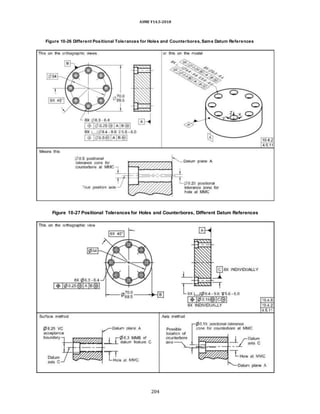
10-26 DifferentPositional Tolerances forHoles andCounterbores, Same Datum References . . . . 204
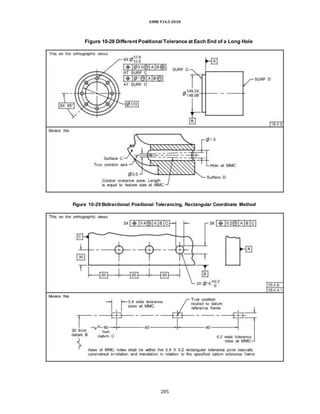
10-27 Positional Tolerances forHoles andCounterbores, DifferentDatum References . . . . . . . . . 204
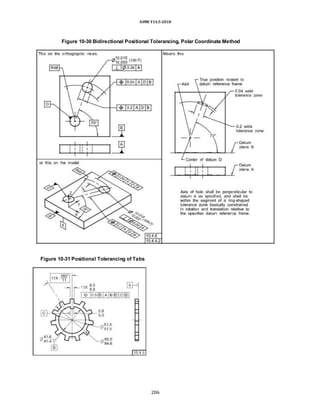
10-28 DifferentPositional ToleranceatEach End of a LongHole . . . . . . . . . . . . . . . . . . . . . . . . 205
10-29 Bidirectional Positional Tolerancing, RectangularCoordinateMethod . . . . . . . . . . . . . . . . 205
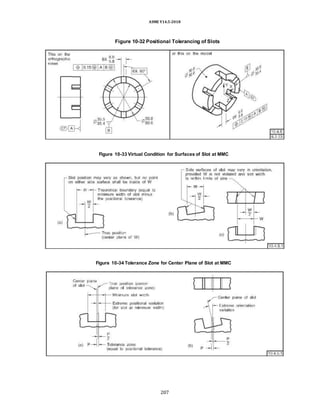
10-30 Bidirectional Positional Tolerancing, PolarCoordinateMethod . . . . . . . . . . . . . . . . . . . . . 206
10-31 Positional Tolerancingof Tabs . . . . . . . . . . . . . . . . . . . . . . . . . . . . . . . . . . . . . . . . . . . . 206
10-32 Positional Tolerancingof Slots . . . . . . . . . . . . . . . . . . . . . . . . . . . . . . . . . . . . . . . . . . . . 207
10-33 Virtual Conditionfor Surfaces of Slot at MMC . . . . . . . . . . . . . . . . . . . . . . . . . . . . . . . . . 207
10-34 ToleranceZone forCenter Plane of Slot at MMC . . . . . . . . . . . . . . . . . . . . . . . . . . . . . . . 207
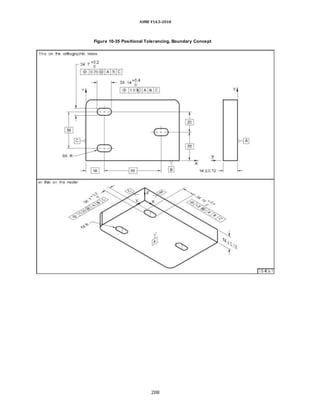
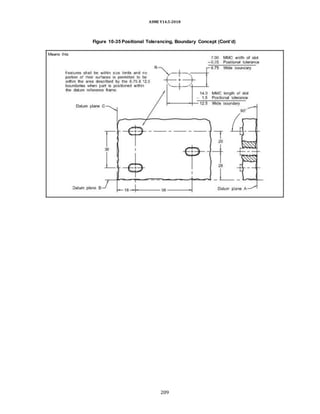
10-35 Positional Tolerancing, Boundary Concept . . . . . . . . . . . . . . . . . . . . . . . . . . . . . . . . . . . . 208
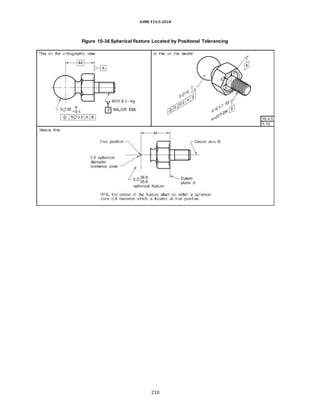
10-36 Spherical Feature Located by Positional Tolerancing . . . . . . . . . . . . . . . . . . . . . . . . . . . . 210
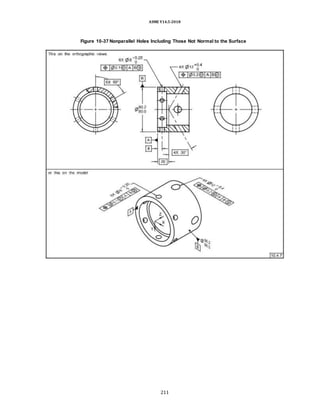
10-37 Nonparallel Holes IncludingThoseNotNormal to theSurface . . . . . . . . . . . . . . . . . . . . . 211
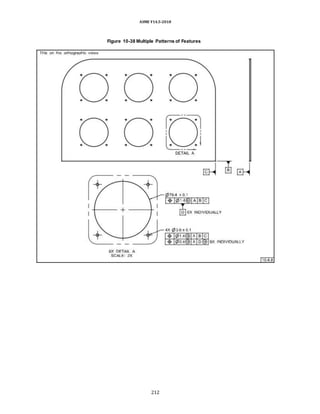
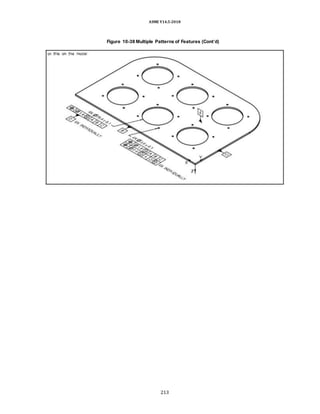
10-38 MultiplePatterns of Features . . . . . . . . . . . . . . . . . . . . . . . . . . . . . . . . . . . . . . . . . . . . . 212
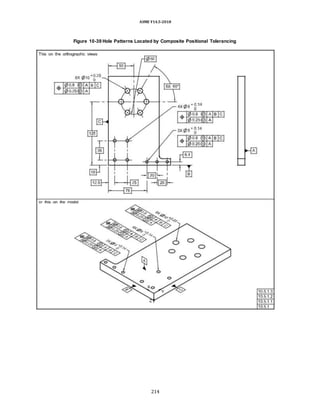
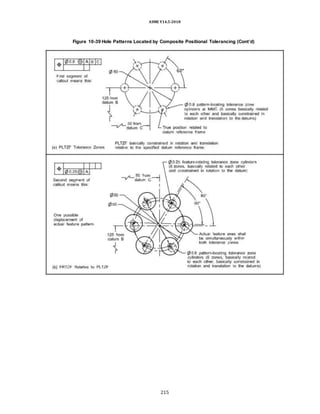
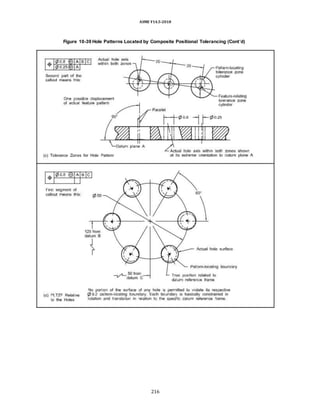
10-39 HolePatterns Locatedby CompositePositional Tolerancing . . . . . . . . . . . . . . . . . . . . . . . 214
10-40 HolePatterns of Figure 10-38 WithSecondary Datums inFeature-Relating Segments of
CompositeFeature Control Frames . . . . . . . . . . . . . . . . . . . . . . . . . . . . . . . . . . . . . . . 218
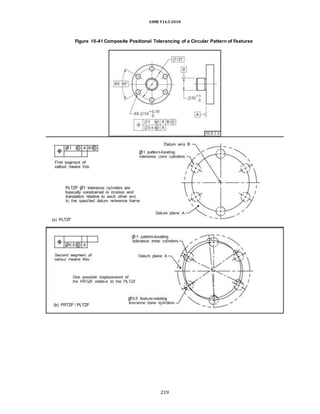
10-41 CompositePositional Tolerancingof aCircularPattern of Features . . . . . . . . . . . . . . . . . . 219
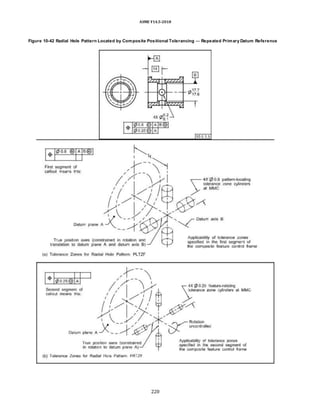
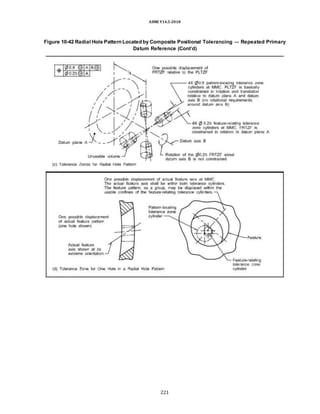
10-42 Radial HolePattern Located by CompositePositional Tolerancing — RepeatedPrimary Datum
Reference . . . . . . . . . . . . . . . . . . . . . . . . . . . . . . . . . . . . . . . . . . . . . . . . . . . . . . . . . 220
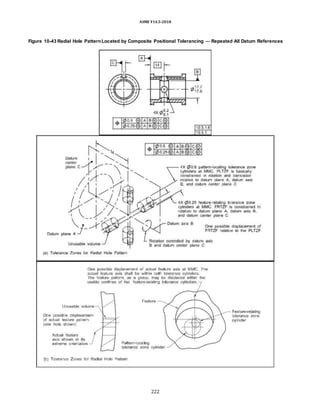
10-43 Radial HolePattern Located by CompositePositional Tolerancing — RepeatedAll Datum
References . . . . . . . . . . . . . . . . . . . . . . . . . . . . . . . . . . . . . . . . . . . . . . . . . . . . . . . . 222
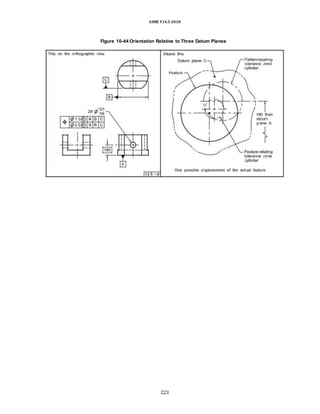
10-44 OrientationRelativeto Three Datum Planes . . . . . . . . . . . . . . . . . . . . . . . . . . . . . . . . . . 223
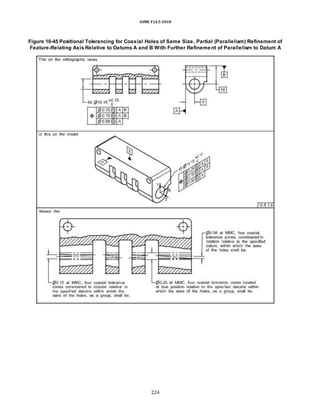
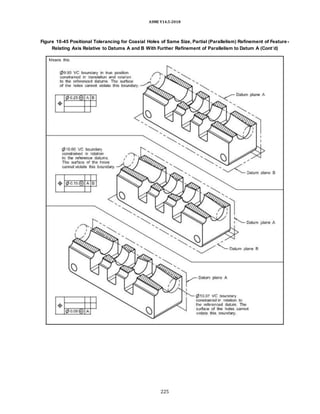
10-45 Positional TolerancingforCoaxial Holes of SameSize, Partial (Parallelism) Refinementof
Feature-Relating Axis Relativeto Datums Aand B WithFurther Refinement of Parallelism to
Datum A . . . . . . . . . . . . . . . . . . . . . . . . . . . . . . . . . . . . . . . . . . . . . . . . . . . . . . . . . . 224
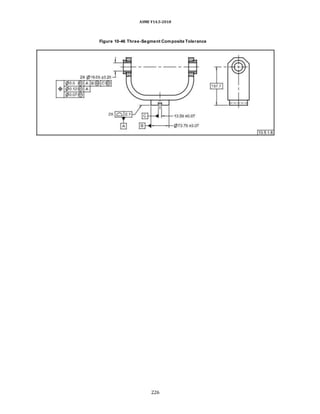
10-46 Three-Segment CompositeTolerance . . . . . . . . . . . . . . . . . . . . . . . . . . . . . . . . . . . . . . . 226
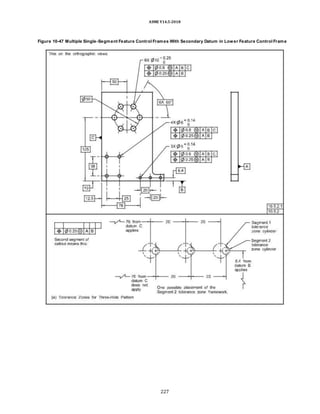
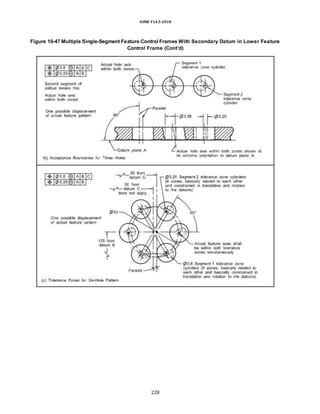
10-47 MultipleSingle-Segment Feature Control Frames WithSecondary Datum inLower Feature
Control Frame . . . . . . . . . . . . . . . . . . . . . . . . . . . . . . . . . . . . . . . . . . . . . . . . . . . . . . 227
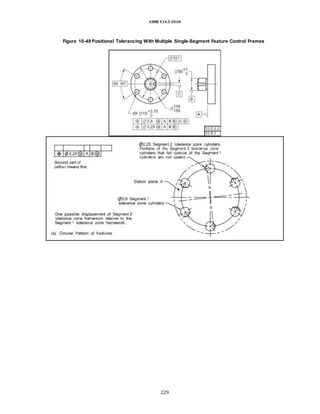
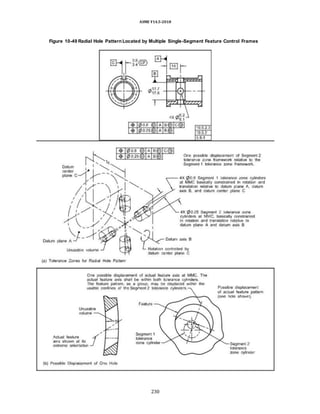
10-48 Positional TolerancingWithMultipleSingle-SegmentFeature Control Frames . . . . . . . . . . 229
10-49 Radial HolePattern Located by MultipleSingle-SegmentFeature Control Frames . . . . . . . 230
xi
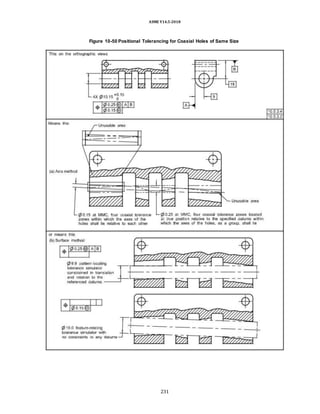
10-50 Positional TolerancingforCoaxial Holes of SameSize . . . . . . . . . . . . . . . . . . . . . . . . . . . 231
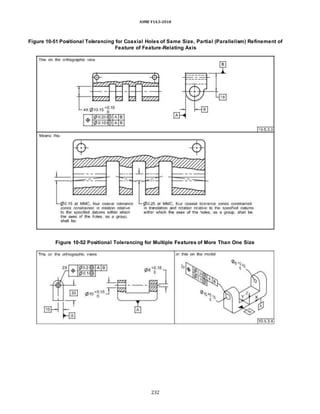
10-51 Positional TolerancingforCoaxial Holes of SameSize, Partial (Parallelism) Refinementof
Feature of Feature-Relating Axis . . . . . . . . . . . . . . . . . . . . . . . . . . . . . . . . . . . . . . . . . 232
10-52 Positional TolerancingforMultipleFeatures of MoreThanOne Size . . . . . . . . . . . . . . . . . 232
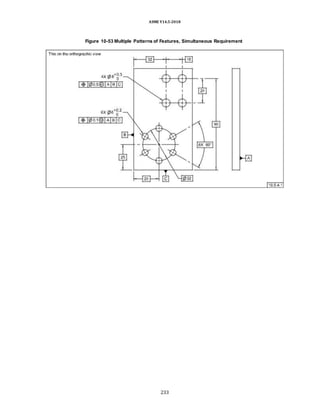
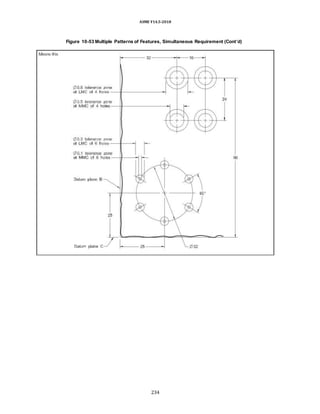
10-53 MultiplePatterns of Features, Simultaneous Requirement . . . . . . . . . . . . . . . . . . . . . . . . 233
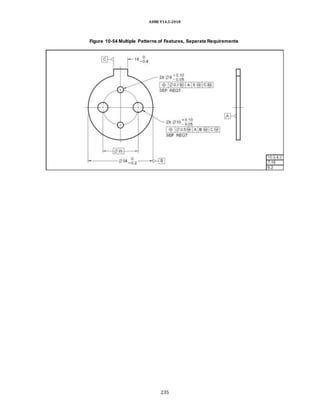
10-54 MultiplePatterns of Features, Separate Requirements . . . . . . . . . . . . . . . . . . . . . . . . . . . 235
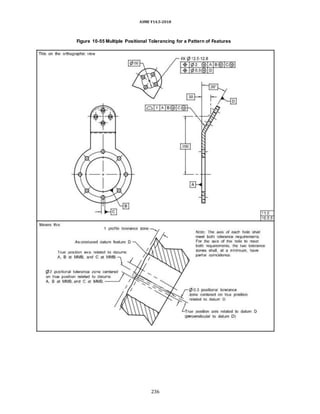
10-55 MultiplePositional TolerancingforaPattern of Features . . . . . . . . . . . . . . . . . . . . . . . . . 236
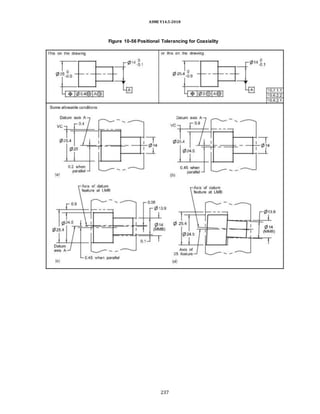
10-56 Positional TolerancingforCoaxiality . . . . . . . . . . . . . . . . . . . . . . . . . . . . . . . . . . . . . . . . 237
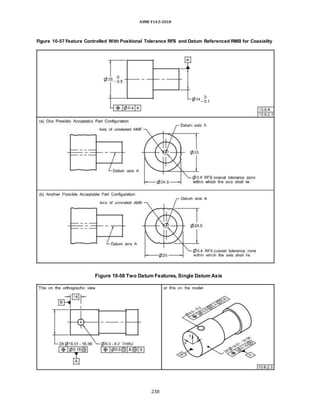
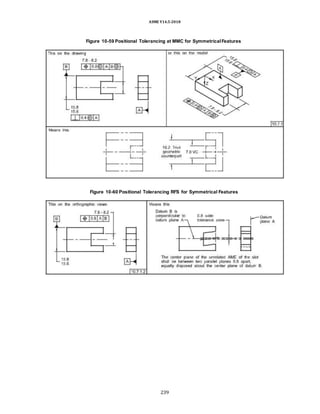
10-57 Feature ControlledWithPositional ToleranceRFSand Datum Referenced RMB forCoaxiality 238
10-58 Two Datum Features, SingleDatum Axis . . . . . . . . . . . . . . . . . . . . . . . . . . . . . . . . . . . . . 238
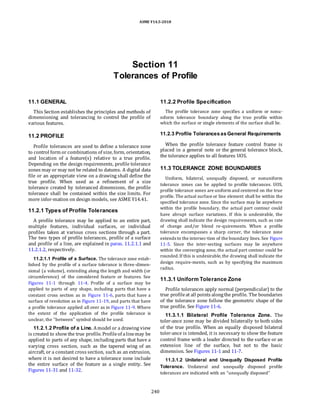
10-59 Positional TolerancingatMMCforSymmetrical Features . . . . . . . . . . . . . . . . . . . . . . . . . 239
10-60 Positional TolerancingRFSforSymmetrical Features . . . . . . . . . . . . . . . . . . . . . . . . . . . . 239
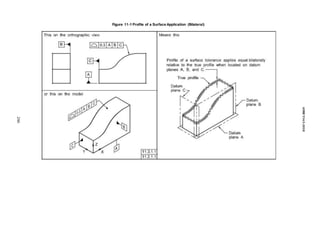
11-1 Profileof a Surface Application(Bilateral) . . . . . . . . . . . . . . . . . . . . . . . . . . . . . . . . . . . . 246
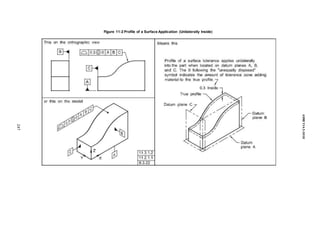
11-2 Profileof a Surface Application(Unilaterally Inside) . . . . . . . . . . . . . . . . . . . . . . . . . . . . 247
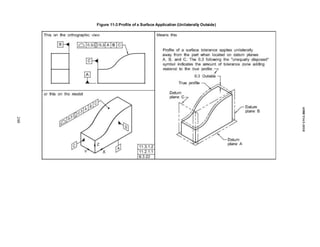
11-3 Profileof a Surface Application(Unilaterally Outside) . . . . . . . . . . . . . . . . . . . . . . . . . . . 248
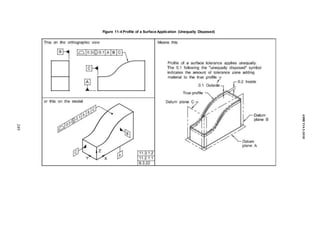
11-4 Profileof a Surface Application(Unequally Disposed) . . . . . . . . . . . . . . . . . . . . . . . . . . . 249
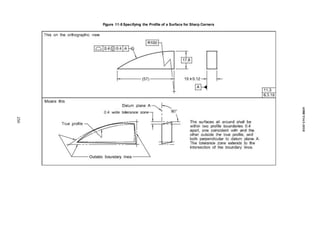
11-5 Specifyingthe Profileof a Surface for Sharp Corners . . . . . . . . . . . . . . . . . . . . . . . . . . . . 250
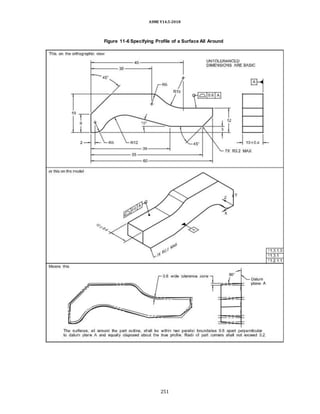
11-6 SpecifyingProfileof a Surface All Around . . . . . . . . . . . . . . . . . . . . . . . . . . . . . . . . . . . . 251
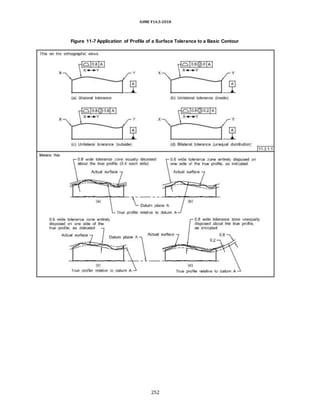
11-7 Applicationof Profileof a Surface Toleranceto a Basic Contour . . . . . . . . . . . . . . . . . . . . 252
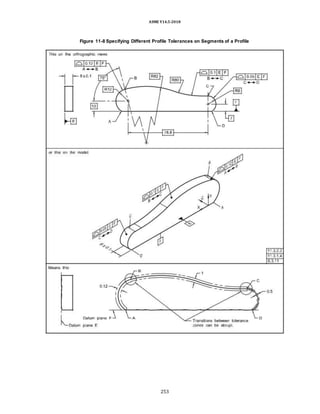
11-8 SpecifyingDifferentProfileTolerances onSegments of a Profile . . . . . . . . . . . . . . . . . . . . 253
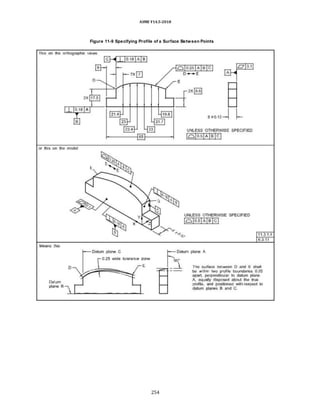
11-9 SpecifyingProfileof a Surface Between Points . . . . . . . . . . . . . . . . . . . . . . . . . . . . . . . . 254
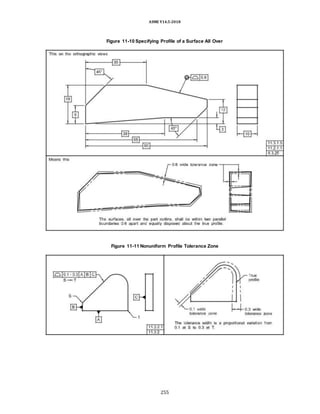
11-10 SpecifyingProfileof a Surface All Over . . . . . . . . . . . . . . . . . . . . . . . . . . . . . . . . . . . . . . 255
11-11 Nonuniform ProfileToleranceZone . . . . . . . . . . . . . . . . . . . . . . . . . . . . . . . . . . . . . . . . 255
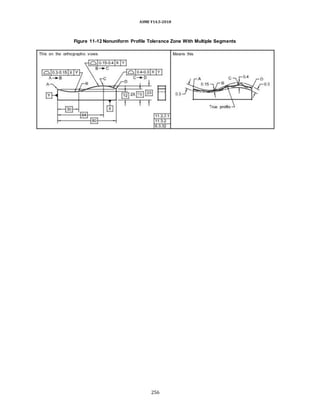
11-12 Nonuniform ProfileToleranceZoneWithMultipleSegments . . . . . . . . . . . . . . . . . . . . . . 256
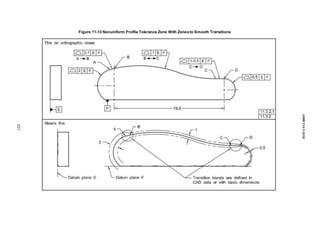
11-13 Nonuniform ProfileTolerance ZoneWithZones to SmoothTransitions . . . . . . . . . . . . . . . 257
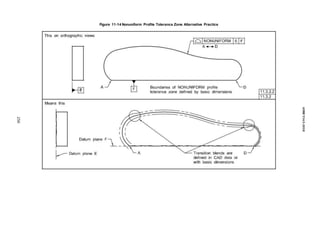
11-14 Nonuniform ProfileToleranceZoneAlternate Practice . . . . . . . . . . . . . . . . . . . . . . . . . . . 258
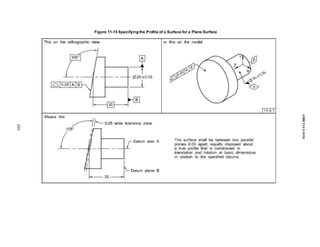
11-15 Specifyingthe Profileof a Surface for a Plane Surface . . . . . . . . . . . . . . . . . . . . . . . . . . . 259
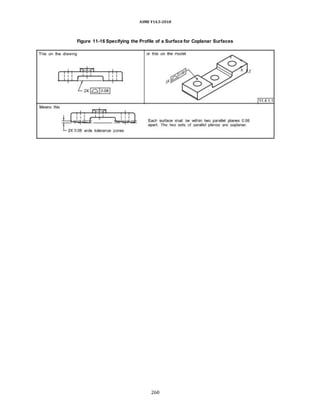
11-16 Specifyingthe Profileof a Surface for Coplanar Surfaces . . . . . . . . . . . . . . . . . . . . . . . . . 260
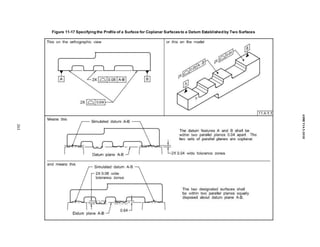
11-17 Specifyingthe Profileof a Surface for Coplanar Surfaces to a Datum Establishedby Two Surfaces 261
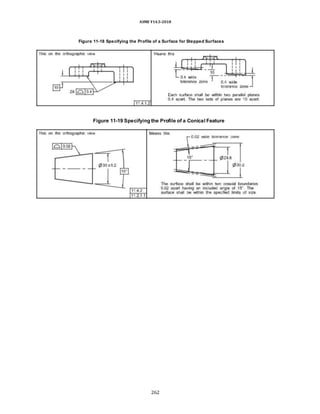
11-18 Specifyingthe Profileof a Surface for Stepped Surfaces . . . . . . . . . . . . . . . . . . . . . . . . . . 262
11-19 Specifyingthe Profileof a Conical Feature . . . . . . . . . . . . . . . . . . . . . . . . . . . . . . . . . . . 262
11-20 ProfileTolerancingof a Conical Feature, Datum Related . . . . . . . . . . . . . . . . . . . . . . . . . 263
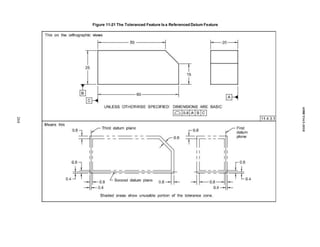
11-21 TheTolerancedFeature Is a Referenced Datum Feature . . . . . . . . . . . . . . . . . . . . . . . . . . 264
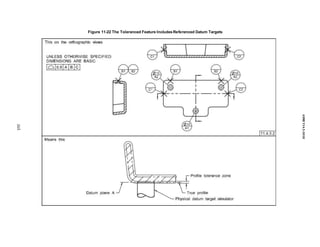
11-22 TheTolerancedFeature Includes Referenced Datum Targets . . . . . . . . . . . . . . . . . . . . . . 265
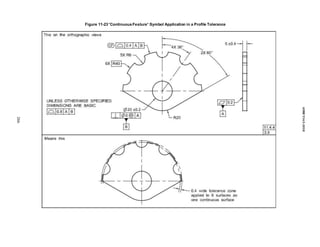
11-23 “Continuous Feature” Symbol ApplicationinaProfileTolerance . . . . . . . . . . . . . . . . . . . . 266
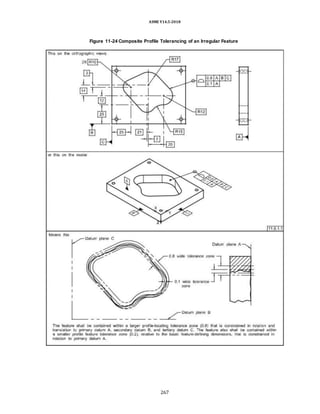
11-24 CompositeProfileTolerancingof anIrregular Feature . . . . . . . . . . . . . . . . . . . . . . . . . . . 267
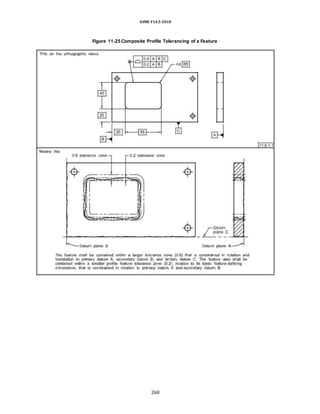
11-25 CompositeProfileTolerancingof aFeature . . . . . . . . . . . . . . . . . . . . . . . . . . . . . . . . . . . 268
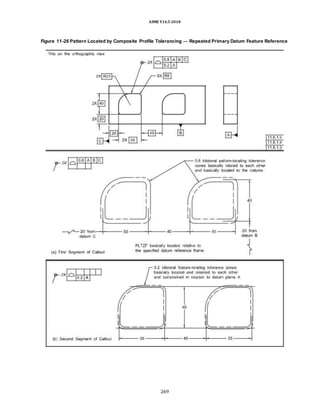
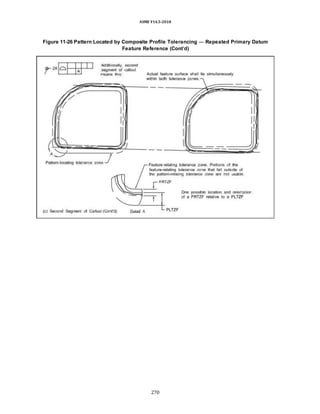
11-26 Pattern Located by CompositeProfileTolerancing— Repeated Primary Datum Feature
Reference . . . . . . . . . . . . . . . . . . . . . . . . . . . . . . . . . . . . . . . . . . . . . . . . . . . . . . . . . 269
11-27 Pattern Located by CompositeProfileTolerancing — Repeated Primary and Secondary Datum
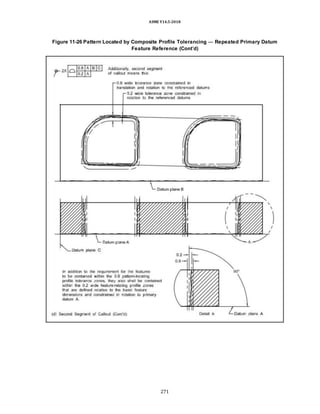
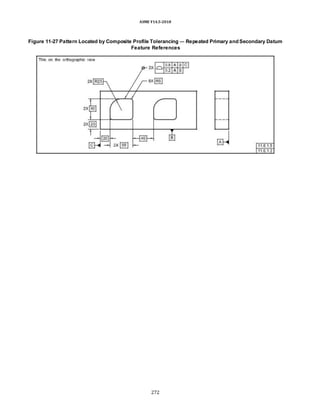
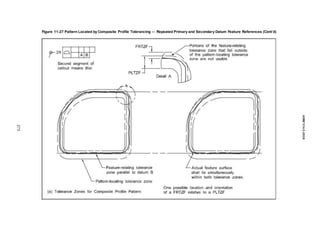
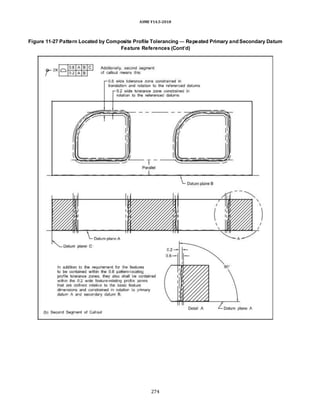
Feature References . . . . . . . . . . . . . . . . . . . . . . . . . . . . . . . . . . . . . . . . . . . . . . . . . . 272
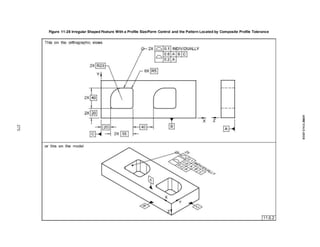
11-28 Irregular Shaped Feature Witha ProfileSize/Form Control and the Pattern Located by
CompositeProfileTolerance . . . . . . . . . . . . . . . . . . . . . . . . . . . . . . . . . . . . . . . . . . . 275
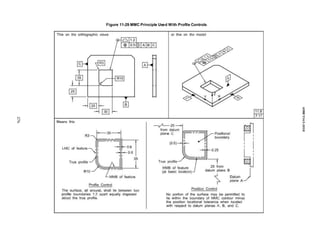
11-29 MMCPrincipleUsedWithProfileControls . . . . . . . . . . . . . . . . . . . . . . . . . . . . . . . . . . . 276
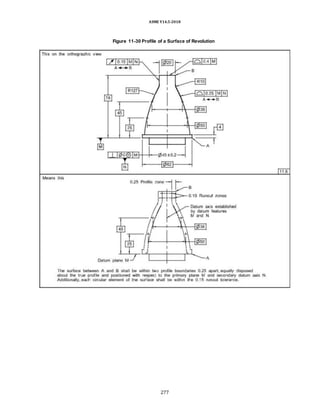
11-30 Profileof a Surface of Revolution . . . . . . . . . . . . . . . . . . . . . . . . . . . . . . . . . . . . . . . . . . 277
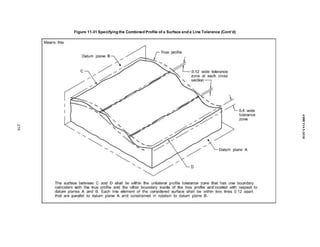
11-31 Specifyingthe CombinedProfileof a Surface and a LineTolerance . . . . . . . . . . . . . . . . . . 278
xii
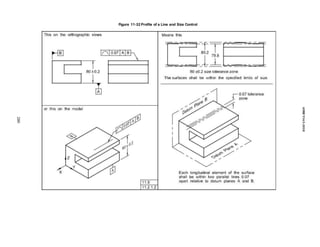
11-32 Profileof a Line and SizeControl . . . . . . . . . . . . . . . . . . . . . . . . . . . . . . . . . . . . . . . . . . 280
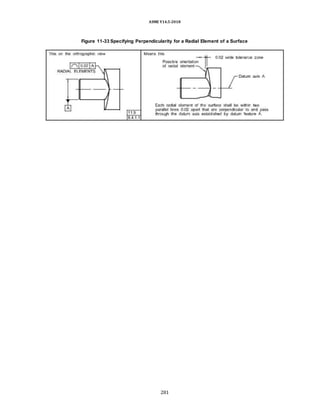
11-33 SpecifyingPerpendicularity fora Radial Element of a Surface . . . . . . . . . . . . . . . . . . . . . . 281
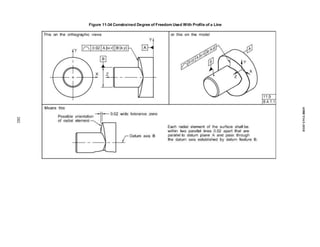
11-34 Constrained Degree of Freedom UsedWith Profileof a Line . . . . . . . . . . . . . . . . . . . . . . . 282
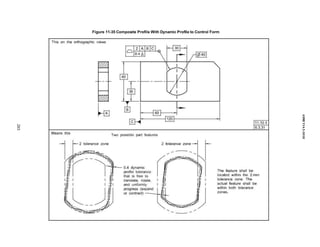
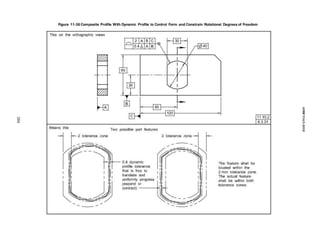
11-35 CompositeProfileWithDynamic Profileto Control Form . . . . . . . . . . . . . . . . . . . . . . . . . 283
11-36 CompositeProfileWithDynamic Profileto Control Form andConstrain Rotational Degrees of
Freedom . . . . . . . . . . . . . . . . . . . . . . . . . . . . . . . . . . . . . . . . . . . . . . . . . . . . . . . . . . 284
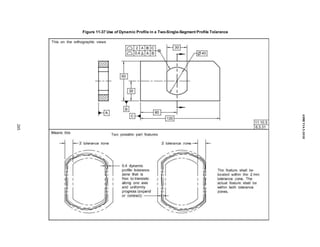
11-37 Use of Dynamic ProfileinaTwo-Single-Segment ProfileTolerance . . . . . . . . . . . . . . . . . . 285
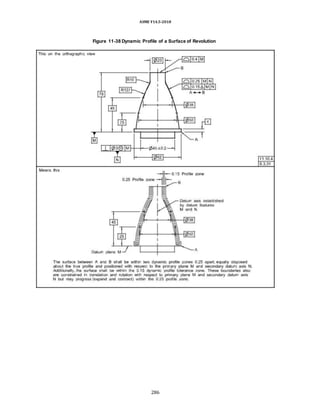
11-38 Dynamic Profileof aSurface of Revolution . . . . . . . . . . . . . . . . . . . . . . . . . . . . . . . . . . . 286
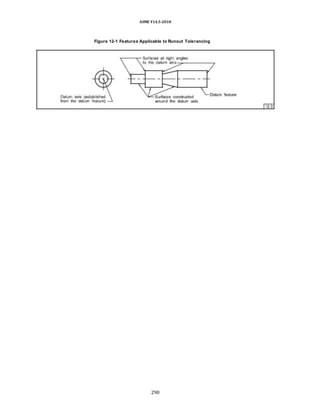
12-1 Features Applicableto Runout Tolerancing . . . . . . . . . . . . . . . . . . . . . . . . . . . . . . . . . . . 290
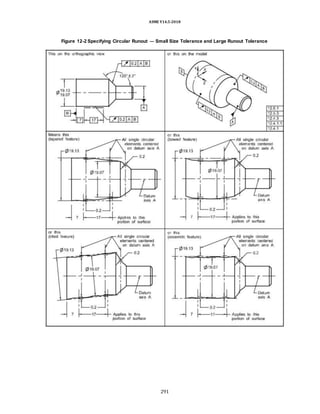
12-2 SpecifyingCircularRunout— Small SizeToleranceand Large RunoutTolerance . . . . . . . . 291
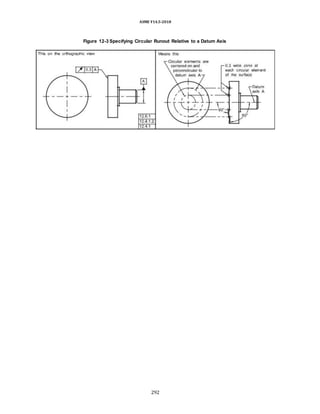
12-3 SpecifyingCircularRunoutRelativeto a Datum Axis . . . . . . . . . . . . . . . . . . . . . . . . . . . . 292
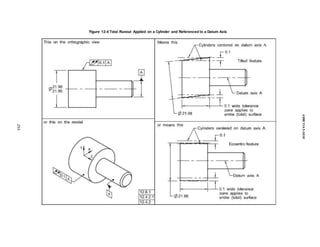
12-4 Total Runout Appliedona Cylinder and Referenced to a Datum Axis . . . . . . . . . . . . . . . . 293
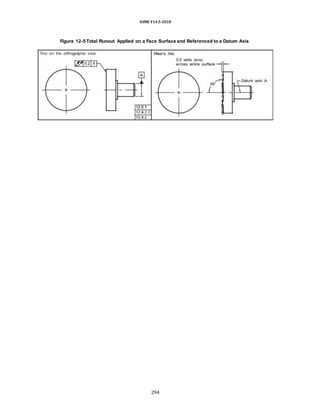
12-5 Total Runout Appliedona Face Surface and Referenced to a Datum Axis . . . . . . . . . . . . . 294
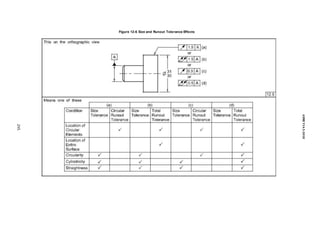
12-6 Size and RunoutToleranceEffects . . . . . . . . . . . . . . . . . . . . . . . . . . . . . . . . . . . . . . . . . 295
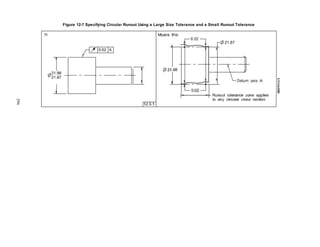
12-7 SpecifyingCircularRunoutUsing a Large Size Toleranceand a Small RunoutTolerance . . . 296
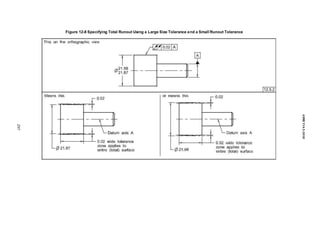
12-8 SpecifyingTotal RunoutUsinga Large SizeToleranceand a Small Runout Tolerance . . . . . 297
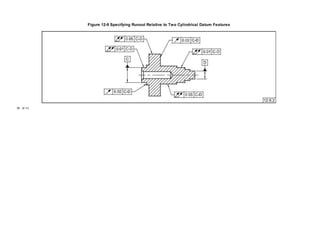
12-9 SpecifyingRunoutRelativeto Two Cylindrical Datum Features . . . . . . . . . . . . . . . . . . . . . 298
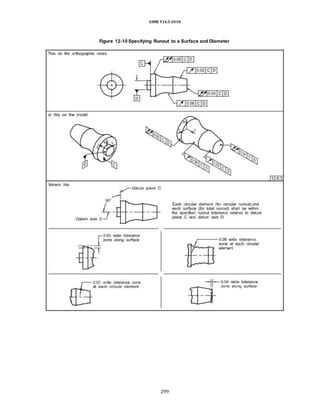
12-10 SpecifyingRunoutto a Surface and Diameter . . . . . . . . . . . . . . . . . . . . . . . . . . . . . . . . . 299
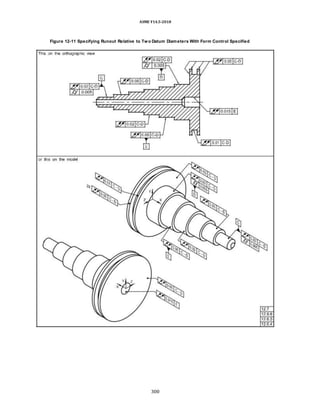
12-11 SpecifyingRunoutRelativeto Two Datum Diameters WithForm Control Specified . . . . . . 300
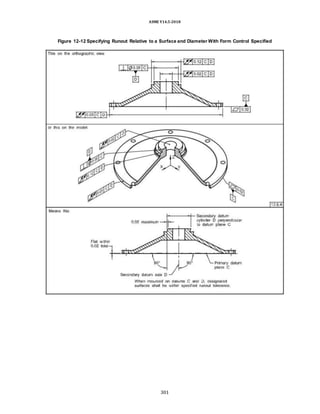
12-12 SpecifyingRunoutRelativeto a Surface and DiameterWith Form Control Specified . . . . . . 301
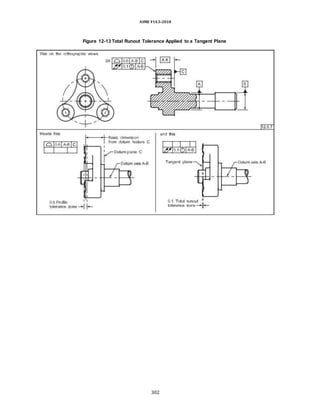
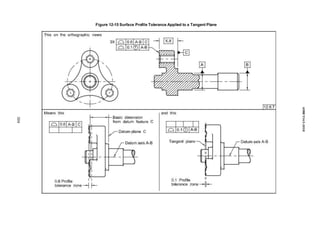
12-13 Total Runout ToleranceAppliedto a Tangent Plane . . . . . . . . . . . . . . . . . . . . . . . . . . . . . 302
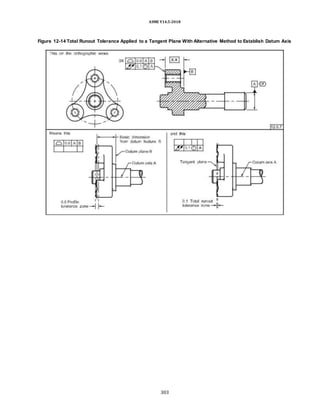
12-14 Total Runout ToleranceAppliedto a Tangent Plane WithAlternate Method to EstablishDatum
Axis . . . . . . . . . . . . . . . . . . . . . . . . . . . . . . . . . . . . . . . . . . . . . . . . . . . . . . . . . . . . . 303
12-15 Surface ProfileToleranceAppliedto a Tangent Plane . . . . . . . . . . . . . . . . . . . . . . . . . . . 304
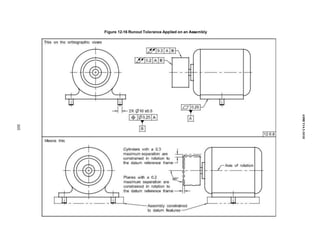
12-16 Runout ToleranceAppliedonan Assembly . . . . . . . . . . . . . . . . . . . . . . . . . . . . . . . . . . . 305
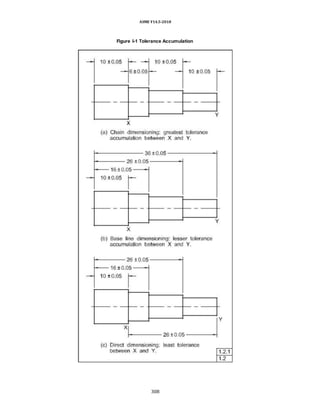
I-1 ToleranceAccumulation . . . . . . . . . . . . . . . . . . . . . . . . . . . . . . . . . . . . . . . . . . . . . . . . . 308
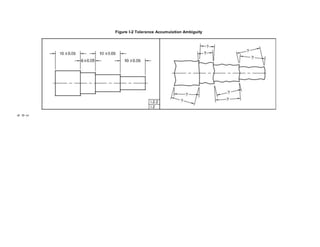
I-2 ToleranceAccumulationAmbiguity . . . . . . . . . . . . . . . . . . . . . . . . . . . . . . . . . . . . . . . . . 309
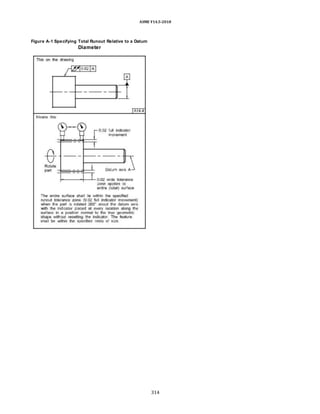
A-1 SpecifyingTotal RunoutRelativeto a Datum Diameter . . . . . . . . . . . . . . . . . . . . . . . . . . 314
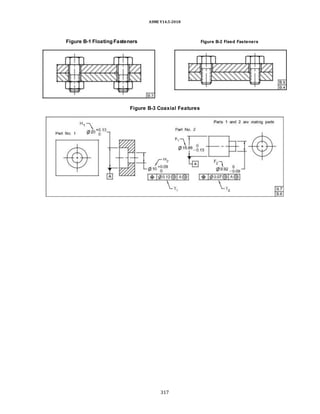
B-1 FloatingFasteners . . . . . . . . . . . . . . . . . . . . . . . . . . . . . . . . . . . . . . . . . . . . . . . . . . . . . 317
B-2 FixedFasteners . . . . . . . . . . . . . . . . . . . . . . . . . . . . . . . . . . . . . . . . . . . . . . . . . . . . . . . 317
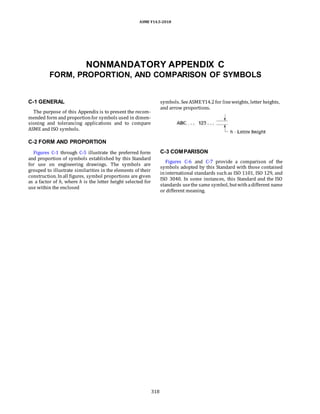
B-3 Coaxial Features . . . . . . . . . . . . . . . . . . . . . . . . . . . . . . . . . . . . . . . . . . . . . . . . . . . . . . 317
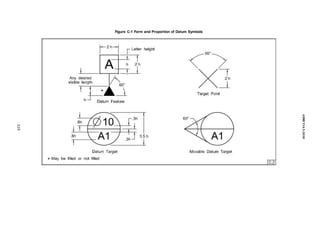
C-1 Form and Proportion of Datum Symbols . . . . . . . . . . . . . . . . . . . . . . . . . . . . . . . . . . . . . 319
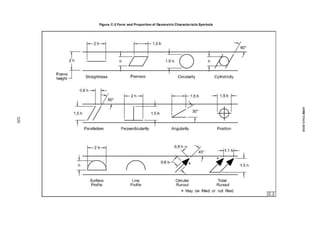
C-2 Form and Proportion of Geometric Characteristic Symbols . . . . . . . . . . . . . . . . . . . . . . . . 320
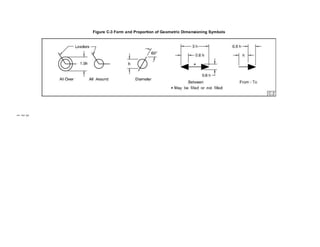
C-3 Form and Proportion of Geometric DimensioningSymbols . . . . . . . . . . . . . . . . . . . . . . . . 321
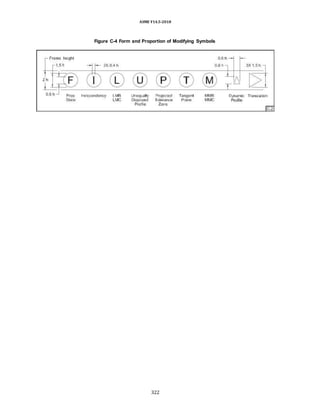
C-4 Form and Proportion of ModifyingSymbols . . . . . . . . . . . . . . . . . . . . . . . . . . . . . . . . . . 322
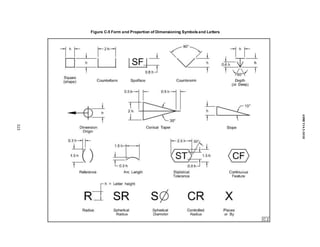
C-5 Form and Proportion of DimensioningSymbolsand Letters . . . . . . . . . . . . . . . . . . . . . . . 323
C-6 Comparisonof Symbols . . . . . . . . . . . . . . . . . . . . . . . . . . . . . . . . . . . . . . . . . . . . . . . . . 324
C-7 Comparisonof Other Symbols . . . . . . . . . . . . . . . . . . . . . . . . . . . . . . . . . . . . . . . . . . . . 325
xiii
FOREWORD
This issue is a revision of ASME Y14.5-2009, Dimensioning and Tolerancing. The objectives for this revision are to correct
any inconsistencies in the previous edition, to determine actions based on deferred comments from the review of the previous
edition’s draft,to include model-based applications in many of the example figures, and to address proposals submitted by the
public or members of the Subcommittee. Based on guidance from the Y14 Committee, the material formerly in Section 1 has
been reorganized into Sections 1 through 4, and the subsequent Sections have been renumbered.
Because of the widespread use of computer-aided design (CAD) and the industry transition toward reduced use of
orthographic views forproductdefinition, model views were added in many figures throughout the Standard. This is in
part to ensure that this Standard is applicable to the use of dimensions and tolerances in models and model-based
drawings. The methods of application in model views are currently defined in ASME Y14.41, but the meanings of the
tolerances are defined in this Standard.
The Foreword of ASME Y14.5-2009 pointed out the increasing importance for design to more precisely state
functional requirements through the useof geometric dimensioningandtolerancing(GD&T), and not to rely on the less
definitivemethodof directly applied limit dimensions for form, orientation, location, and profile of part features. This
2018 revision emphasizes the use of profile for location tolerances applied to surfaces; the use of plus and minus
tolerances has been moved to an Appendix that is likely to be removed in the next revision.
With a focus on making the transition from the previous edition to this edition simple, no reversals of tolerancing
concepts have been made. However, two past practices, use of concentricity and use of symmetry symbols, are no
longer supported. Both have been eliminated because other characteristics provide more direct control of features and
establish requirements that have a well-defined meaning. Deletion of the symbols does not leave industry without a
means to control coaxial orsymmetrical features, butit does eliminatethe confusion that surrounds these symbols and
their misapplication.
Text and figure edits were made to improve readability and clarify content. Changes in sentence structure,
organization of content, and method of illustration are not an indication of technical changes.
Work on this issue began at a meeting in Sarasota, Florida, in April 2009. Numerous deferred comments from the
public reviewforthe previous revision, as well as newproposals forrevisionandimprovement from the Subcommittee
and interested parties in the user community, were evaluated at subsequent semiannual meetings. The first draft
entered the review process after it was completed in August 2015. Additional technical improvements and numerous
editorial changes were made based on the comments received.
A Nonmandatory Appendix provides information about many of the updates in this edition of this Standard. One of
the updates is an explicit statement that unless otherwise specified by drawing/model note or reference to a separate
document, the as-designed dimension value does not establish a functional or manufacturing target. In addition, the
term “true geometric counterpart” has replaced the term “theoretical datum feature simulator.” The use of the “true
geometric counterpart” term is limited to datums.
This Standard is availableforpublic reviewona continuingbasis. This provides anopportunity for additional public-
review input from industry, academia, regulatory agencies, and the public-at-large.
This revisionwas approvedas an AmericanNational Standard on August 13, 2018.
xiv
ASME Y14 COMMITTEE
Engineering Product Definition and Related
Documentation Practices
(Thefollowingis theroster of theCommitteeat thetimeof approval of this Standard.)
STANDARDS COMMITTEE OFFICERS
W. A. Kaba, Jr., Chair
J. I. Miles, Vice Chair
F. Constantino, Secretary
STANDARDS COMMITTEE PERSONNEL
A. R. Anderson, Dimensional Dynamics, LLC A. Krulikowski, Krulikowski Consulting, LLC
F. Bakos, Consultant E. McCarthy, E. F. McCarthy Consulting, Inc.
J. V. Burleigh, Unaffiliated P. J. McCuistion, Multimac
F. Constantino, TheAmerican Society of Mechanical Engineers J. D. Meadows, James D. Meadows &Associates, Inc.
D. O. Coon, Bell Helicopter M. E. Meloro, Northrop Grumman Corp.
R. Courson, SAE International J. I. Miles, Technical Consultants, Inc.
K. Dobert, Siemens PLM Software M. A. Murphy, Unaffiliated
S. Hauger, Deere& Co. H. W. Oakes,USAF University of Dayton ResearchInstitute
J. B. Hoskins, BoeingCo. B. A. Wilson, Consultant
J. Houck, Woodward, Inc. E. F. Zwettler, Rolls-RoyceCorp.
R. C. Jensen, Hexagon ManufacturingIntelligence K. E. Wiegandt, ContributingMember, Consultant
W. A. Kaba, Jr.,Spirit AeroSystems, Inc.
SUBCOMMITTEE 5— DIMENSIONING AND TOLERANCING
B. A. Wilson, Chair, Consultant P. Mares, BoeingCo.
A. G. Neumann,Vice Chair, Technical Consultants, Inc. E. McCarthy, E. F. McCarthy Consulting, Inc.
M. E. Meloro, Secretary, Northrop Grumman Corp. P. J. McCuistion, Multimac
A. R. Anderson, Dimensional Dynamics, LLC M. A. Murphy, Unaffiliated
G. Arnold, GE Appliances/Haier D. W. Shepherd, Shepherd Industries
F. Bakos, Consultant P. C. Tillet, Naval SurfaceWarfareCenter, Dahlgren Division
R. Courson, SAE International D. Watts, Validate-3D, LLC
D. E. Day, Tec-Ease, Inc. M. P. Wright, Lockheed Martin Aeronautics Co.
K. Dobert, Siemens PLM Software E. F. Zwettler, Rolls-RoyceCorp.
P. J. Drake,Jr.,MechSigmaConsulting, Inc. Jichang Yu, Delegate, Standardization Administration of China
B. R. Fischer, TDP 360, LLC D. O. Coon, Alternate, Bell Helicopter
A. R. Gellings, Deere& Co. J. Houck, Alternate, Woodward, Inc.
R. C. Hughes, El Camino College N. W. Cutler, ContributingMember, Dimensional Management, Inc.
R. C. Jensen, Hexagon ManufacturingIntelligence C. Houk, ContributingMember, Consultant
A. Krulikowski, Krulikowski Consulting, LLC J. D. Keith, ContributingMember, Consultant
SUBCOMMITTEE 5 — SUPPORT GROUP
G. Fisher, Rolls-RoyceCorp. J. I. Miles, Technical Consultants, Inc.
M. Foster, Applied Geometrics, Inc. S. Neumann,Technical Consultants, Inc.
J. D. Meadows, James D. Meadows &Associates, Inc. J. Scheibel, BoeingCo.
P. Meadows, RCO Engineering, Inc. R. A. Wheeler, RW-OptDesign, LLC
xv
CORRESPONDENCE WITH THE Y14 COMMITTEE
General. ASME Standards are developed and maintained with the intent to represent the consensus of concerned
interests. As such, users of this Standard may interact with the Committee by requesting interpretations, proposing
revisions or a case, and attending Committee meetings. Correspondence should be addressed to:
Secretary, Y14 Standards Committee
TheAmericanSociety of Mechanical Engineers
Two Park Avenue
NewYork, NY10016-5990
http://go.asme.org/Inquiry
Proposing Revisions. Revisions are made periodically to the Standard to incorporate changes that appear
necessary or desirable, as demonstrated by the experience gained from the application of the Standard. Approved
revisions will be published periodically.
TheCommittee welcomes proposals forrevisions to this Standard. Such proposals should be as specific as possible,
citing the paragraph number(s), the proposed wording, and a detailed description of the reasons for the proposal,
including any pertinent documentation.
Proposing a Case. Cases may beissuedto provide alternative rules when justified, to permit early implementation
of an approved revision when the need is urgent, or to provide rules not covered by existing provisions. Cases are
effective immediately upon ASME approval and shall be posted on the ASME Committee web page.
Requests for Cases shall provide a Statement of Need and Background Information. The request should identify the
Standard and the paragraph, figure, or table number(s), and be written as a Question and Reply in the same format as
existingCases. Requests for Cases should also indicate the applicable edition(s) of the Standard to which the proposed
Case applies.
Attending Committee Meetings. TheY14Standards Committeeregularly holds meetings and/or telephone confer-
ences that are open to the public. Persons wishing to attend any meeting and/or telephone conference should contact
the Secretary of the Y14 Standards Committee. Future Committee meeting dates and locations can be found on the
Committee Page at http://go.asme.org/Y14committee.
xvi
ASME Y14.5-2018
Section 1
Scope
1.1 INTRODUCTION
This Standard establishes symbols, rules, definitions,
requirements, defaults, and recommended practices for
stating and interpreting dimensioning, tolerancing, and
related requirements for use on engineering drawings,
models defined in digital data files, and related
documents. For a mathematical explanation of many of
the principles in this Standard, see ASME Y14.5.1M.
Additional uniform practices for applying dimensions,
tolerances, and related requirements in digital data sets
are defined in ASME Y14.41. Practices unique to
architectural and civil engi-neering and welding
symbology are not included in this Standard.
1.2 GENERAL
Sections 1 through 4 establish related references, defi-
nitions, fundamental rules, and practices for general
dimensioning. For tolerancing practices, see Sections 5
through 12. Additional information about tolerancing is i
n M a n d a t o r y A p p e n d i x I a n d N o n m a n d a t o r
y Appendices A through D.
1.3 REFERENCE TO THIS STANDARD
When engineering documentation is based on this
Standard, this fact shall be noted on the documentation
or in a referenced separate document. References to this
Standard shall include the designation of ASME Y14.5-
2018.
1.4 ASME Y14 SERIES CONVENTIONS
Theconventions in paras. 1.4.1through 1.4.10are used
in this and other ASME Y14 standards.
1.4.1 Mandatory, Recommended, Guidance,
and Optional Words
(a) Theword “shall” establishes arequirement.
(b) Theword “will” establishes adeclarationof
purposeon the part of the design activity.
(c) Theword “should” establishes arecommended
practice.
(d) Theword “may” establishes anallowedpractice.
(e) The words “typical,” “example,” “for reference,”
and the Latin abbreviation “e.g.” indicate suggestions
given for guidance only.
(f) The word “or” used in conjunction with a require-
ment or a recommended practice indicates that there are
two or more options for complying with the stated
requirement or practice.
(g) The phrase “unless otherwise specified” (UOS)
shall be used to indicate a default requirement. The
phrase is used when the default is a generally applied
requirement and an exception may be provided by
another document or requirement.
1.4.2 Cross-Reference of Standards
Cross-reference of standards in text with or without a
date following the standard designator shall be inter-
preted as follows:
(a) Reference to other ASME Y14 standards in the text
without a date following the standard designator indicates
that the issue of the standard identified in the References
section (Section 2) shall be used to meet the requirement.
(b) Reference to other ASME Y14 standards in the text
with a date following the standard designator indicates
that only that issue of the standard shall be used to meet
the requirement.
1.4.3 Invocation of Referenced Standards
Thefollowingexamples definethe invocationof a stan-
dard when specifiedinthe References section (Section 2)
and referenced in the text of this Standard:
(a) When a referenced standard is cited in the text
with no limitations to a specific subject or paragraph(s)
of the standard, the entire standard is invoked. For
example, “Dimensioning and tolerancing shall be in
accordance with ASME Y14.5” is invoking the complete
standard because the subject of the standard is
dimensioning and tolerancing and no specific subject or
paragraph(s) within the standard are invoked.
(b) When a referenced standard is cited in the text
with limitations to a specific subject or paragraph(s) of
the standard, only the paragraph(s) on that subject are
invoked. For example, “Assign part or identifying
numbers in accordance with ASME Y14.100” is only
invokingtheparagraph(s) onpart oridentifyingnumbers
because the subject of the standard is
1
ASME Y14.5-2018
engineering drawing practices and part or identifying
numbers is a specific subjectwithinthestandard.
(c) When a referenced standard is cited in the text
without an invoking statement such as “in accordance
with,” the standard is for guidance only. For example,
“Forgaging principles, seeASMEY14.43” is only for guid-
ance and no portion of the standard is invoked.
1.4.4 Parentheses Following a Definition
When a definitionis followed by a standard referenced
in parentheses, the standard referenced in parentheses is
the source for the definition.
1.4.5 Notes
Notes depicted in this Standard in ALL UPPERCASE
letters are intended to reflect actual drawing or model
entries. Notes depicted in initial uppercase or lowercase
letters are to be considered supporting data to the
contents of this Standard and are not intended for literal
entry on drawings. A statement requiring the addi-tion of
a note withthe qualifier“suchas” is a requirement to add
a note, and the content of the text is allowed to vary to
suit the application.
1.4.6 Acronyms and Abbreviations
Acronyms and abbreviations are spelled out the first
time used in this Standard, followed by the acronym or
abbreviation in parentheses. The acronym is used there-
after throughout the text.
1.4.7 Units
The International System of Units (SI) is featured in
this Standard. It should be understood that U.S.
Customary units could equally have been used without
prejudice to the principles established. UOS, the unit for
all dimen-sion values in this Standard is the millimeter.
1.4.8 Figures
The figures in this Standard are intended only as illus-
trations to aid the user in understanding the practices
described in the text. In some cases, figures show a level
of detail as needed for emphasis. In other cases, figures
are incomplete by intent so as to illustrate a concept or
facet thereof. The absence of figure(s) has no bearing on
the applicability of the stated requirements or practice.
To comply with the requirements of this Standard, actual
data sets shall meet the content require-ments set forth
inthe text. To assist the user of this Standard, a list of the
paragraph(s) that refer to an illus-tration appears in the
lower right-hand corner of each figure. This list may not
be all-inclusive. The absence of a paragraph reference is
not a reason to assume inap-plicability. Some figures are
illustrations of models in a three-dimensional
environment. The absence of dimen-
sioning and tolerancing annotations in a view may
indicate that the product definition is defined in three
dimensions. Dimensions that locate or orient and are not
shown are considered basic and shall be queried to
determine the intended requirement. When the letter “h”
is used in figures for letter heights or for symbol
proportions, select the applicable letter height in
accordance with ASME Y14.2. Multiview drawings
contained within figures are third angle projection.
1.4.9 Precedence of Standards
The following are ASME Y14 Standards that are basic
engineering drawing standards:
ASME Y14.1, Decimal InchDrawingSheet Size and
Format ASMEY14.1M, Metric DrawingSheet Sizeand
Format ASMEY14.2, Line Conventions andLettering
ASME Y14.3, Orthographic and Pictorial Views
ASME Y14.5, DimensioningandTolerancing
ASME Y14.24, Types and Applications of Engineering
Drawings
ASME Y14.34, AssociatedLists
ASME Y14.35, Revision of Engineering Drawings and
Associated Documents
ASME Y14.36, Surface Texture Symbols
ASME Y14.38, Abbreviations and Acronyms for Use on
Drawings and Related Documents
ASME Y14.41, Digital ProductDefinitionDataPractices
ASME Y14.100, Engineering Drawing Practices
All other ASMEY14 standards are consideredspecialty
types of standards and contain additional requirements
or make exceptions to the basic standards as required to
support a process or type of drawing.
1.4.10 Use of an ASME Y14 Case
Where engineering documentation is based on an
ASME Y14 Case, this fact shall be noted on the
documentation or in a referenced separate document.
1.5 DRAWINGS WITHOUT REFERENCE
TO A STANDARD
When a drawing is produced without a reference to a
standard (company, regional, national, or international)
or contractually imposed documents, the drawing shall
be interpreted in accordance with ASME PDS-1.1–2013.
1.6 REFERENCE TO GAGING
This document is not intended as a gaging standard.
Any reference to gaging is included for explanatory
purposes o n l y . F o r g a g i n g p r i n c i p l e s , s e e A S
M E Y 1 4 . 4 3 , Dimensioning and Tolerancing Principles
for Gages and Fixtures.
2
ASME Y14.5-2018
1.7 SYMBOLS
Adoption of symbols indicating dimensional require-
ments, as shown in Nonmandatory Appendix C, does not
preclude the use of equivalent terms or abbreviations
where symbology is considered inappropriate.
3
ASME Y14.5-2018
Section 2
References
2.1 INTRODUCTION
The following revisions of American National
Standards form a part of this Standard to the extent
specified herein. A more recent revision may be used
provided there is no conflict with the text of this
Standard. In the event of a conflict between the text of
this Standard and the refer-ences cited herein, the text of
this Standard shall take precedence.
2.2 CITED STANDARDS
ANSI B4.2-1978 (R2009),Preferred MetricLimits and Fits
ANSI B89.3.1-1972(R2003), Measurementof Out-of-
Roundness
ASME B1.1-2003(R2008), UnifiedInch Screw Threads
(UN and UNRThread Form)
ASME B1.13M-2005(R2015), Metric ScrewThreads: M
Profile
ASME B5.10-1994(R2013), MachineTapers — Self
Holdingand Steep Taper Series
ASME B46.1-2009, Surface Texture, Surface Roughness,
Waviness, andLay
ASME B89.6.2-1973(R2017), Temperature and Humidity
Environmentfor Dimensional Measurement
ASME B94.6-1984(R2014), Knurling
ASME B94.11M-1993, TwistDrills
ASME PDS-1.1–2013, Dimensioning, Tolerancing, Surface
Texture, and Metrology Standards — Rules for
Drawings WithIncompleteReference to Applicable
DrawingStandard
ASME Y14.1-2012, Decimal InchDrawingSheet Size and
Format
ASME Y14.1M-2012, Metric DrawingSheet Size and
Format
ASME Y14.2-2014, Line Conventions andLettering
ASME Y14.5.1M-1994 (R2012), Mathematical Definition
of Dimensioning and Tolerancing Principles
ASME Y14.6-2001 (R2013), Screw Thread Representation
ASME Y14.8-2009 (R2014), Castings, Forgings, and
MoldedParts
ASME Y14.36-2018, Surface Texture Symbols
ASME Y14.41-2012, Digital Product Definition Data
Practices
ASME Y14.43-2011, Dimensioning and Tolerancing
Principles for Gages and Fixtures
USAS B4.1-1967 (R2004), Preferred Limits and Fits for
Cylindrical Parts
Publisher:The AmericanSociety of Mechanical Engineers
(ASME), Two Park Avenue, New York, NY 10016-5990
(www.asme.org)
IEEE/ASTM SI 10-2016, American National Standard for
Use of the International System of Units (SI): The
Modern Metric System1
Publisher: Institute of Electrical and Electronics
Engineers, Inc. (IEEE), 445 Hoes Lane, Piscataway, NJ
08854 (www.ieee.org)
2.3 ADDITIONAL SOURCES (NOT CITED)
ASME B1.2-1983 (R2017), Gages and Gaging for Unified
Inch Screw Threads; Errata May 1992
ASME B89.1.5-1998 (R2014), Measurement of Plain
External Diameters for Use as Master Discs
ASME Y14.3M-2012, Orthographic and Pictorial Views
ASME Y14.38-2007 (R2013), Abbreviations and
Acronyms for Use on Drawings and Related Documents
ASME Y14.100-2017, Engineering DrawingPractices
Publisher:The AmericanSociety of Mechanical Engineers
(ASME), Two Park Avenue, NewYork, NY10016-5990
(www.asme.org)
1IEEE/ASTM standards are also available from the American Society
for Testing and Materials (ASTM International), 100 Barr Harbor Drive,
P.O. Box C700, West Conshohocken, PA 19428-2959 (www.astm.org).
4
ASME Y14.5-2018
Section 3
Definitions
3.1 ANGULARITY
angularity: the condition of a line element, surface,
feature’s center plane, tangent plane, or feature’s axis at
an impliedorspecified basic angle of any value from one
or more datum planes or datum axes.
3.2 BOUNDARY, INNER (IB)
boundary, inner: a worst-case boundary generated by the
collectiveeffects of the smallest feature of size (MMC for
an internal feature of size, LMC for an external feature of
size) and the applicable geometric tolerance. See Figures
5-14 through 5-19.
3.3 BOUNDARY, LEAST MATERIAL (LMB)
boundary, least material: the worst-case boundary that
exists on or inside the material of a feature(s) and is
defined by the combined effects of size and geometric
tolerances.
3.4 BOUNDARY, MAXIMUM MATERIAL (MMB)
boundary, maximum material: the worst-case boundary
that exists on or outside the material of a feature(s) and
is defined by the combined effects of size and geometric
tolerances.
3.5 BOUNDARY, OUTER (OB)
boundary, outer: a worst-case boundary generated by the
collectiveeffects of the largest feature of size (LMC for an
internal feature of size, MMC for an external feature of
size) and the applicable geometric tolerance. See Figures
5-10 and 5-14 through 5-19.
3.6 CIRCULARITY (ROUNDNESS)
circularity (roundness): the condition of a surface in which
(a) for a feature other than a sphere, all points of each
circumferential line created by the surface intersected by
any plane perpendicular to the axis or spine(curved line)
are equidistant from that axis or spine.
(b) for a sphere, all points of the surface intersected by
any plane passing through a common center are equidi-
stant from that center.
3.7 COAXIALITY
coaxiality:theconditioninwhichtheaxis of the unrelated
actual mating envelope (AME) or axis of the unrelated
minimum material envelope, as applicable, of one or
more surfaces of revolution is coincident with a datum
axis or another feature axis.
3.8 COMPLEX FEATURE
complex feature: a single surface of compound curvature
or a collection of features.
3.9 CONSTRAINT
constraint:alimitto one or moredegrees of freedom.
3.10 CONTINUOUS FEATURE
continuous feature: two or more interrupted features
designated with a “CF” symbol, indicating they are to be
considered as a single feature. See Figure 11-23.
3.11 CONTINUOUS FEATURE OF SIZE
continuous feature of size: two or more regular features of
size or an interrupted regular feature of size that is desig-
nated with a “CF” symbol, indicating they are to be consid-
ered as a single regular feature of size. See Figure 5-11.
3.12 COPLANARITY
coplanarity:theconditionof two or more surfaces having
all elements in one plane.
3.13 CYLINDRICITY
cylindricity: the condition of a surface of revolution in
which all points of the surface are equidistant from a
common axis.
3.14 DATUM
datum: a theoretically exact point, axis, line, plane, or
combination thereof derived from the true geometric
counterpart.
3.15 DATUM AXIS
datumaxis:the axis of a true geometric counterpart.
5
ASME Y14.5-2018
3.16 DATUM CENTER PLANE
datum center plane: the center plane of a true geometric
counterpart.
3.17 DATUM FEATURE
datum feature: a feature that is identified with either a
datum feature symbol or a datum target symbol(s).
3.18 DATUM FEATURE SIMULATOR
datum feature simulator: the physical boundary used to
establish a simulated datum from a specified datum
feature.
NOTE: For example, a gage, a fixture element, and digital data
(such as machine tables, surface plates, a mandrel, or a math-
ematical simulation) are not true planes, but are of sufficient
quality that the planes derived from them are used to establish
simulated datums. Datum feature simulators are used as the
physical embodiment of the true geometric counterparts during
manufacturing and inspection. See ASME Y14.43.
3.25 DIMENSION
dimension:a numerical value(s) or mathematical expres-
sion in appropriate units of measure used to define the
shape, size, orientation, or location of a part feature or
between part features.
3.26 DIMENSION, BASIC
dimension, basic:atheoretically exactdimension.
NOTE: A basic dimension is indicated by one of the methods
shown in Figures 6-11 and 10-1.
3.27 DIMENSION, DIRECTLY TOLERANCED
dimension, directly toleranced: a dimension with an asso-
ciated plus/minus tolerance or limit dimension values.
NOTE: Where a plus/minus general tolerance is applied to a
dimension, the dimension is considered a directly toleranced
dimension.
3.19 DATUM REFERENCE FRAME
datum reference frame: three mutually perpendicular
datum planes and three mutually perpendicular axes at
the intersections of those planes. See Figure 7-1.
3.20 DATUM, SIMULATED
datum, simulated:a point, axis, line, orplane (orcombina-
tionthereof) derived from a datum feature simulator. See
subsection 7.6 and Figure 7-7.
3.28 DIMENSION, REFERENCE
dimension, reference: dimensional information, usually
without a tolerance, that is used for reference purposes
only. Areference dimension is a repeat of a dimension or
is derived from other values shown on the drawing or on
related drawings. It is considered auxiliary information
and does not govern productionor inspectionoperations.
See Figures 4-17 and 4-18. Where a basic dimension is
repeated on a drawing, it is not identified as reference.
For information on how to indicate a reference
dimension, see para. 4.4.6.
3.21 DATUM TARGET
datum target: the designated points, lines, or areas that
are used in establishing a datum.
3.22 DERIVED MEDIAN LINE
derived median line: an imperfect (abstract) line formed
by the center points of all cross sections of the feature.
These cross sections are normal (perpendicular) to the
axis of the unrelated AME. See Figure 3-1.
3.23 DERIVED MEDIAN PLANE
derived median plane: an imperfect (abstract) plane
formedby the center points of all line segments bounded
by the feature. These line segments are normal
(perpendicular) to the center plane of the unre-lated
AME.
3.24 DIAMETER, AVERAGE
diameter, average: the average of several diametric
measurements across a circular or cylindrical feature.
3.29 ENVELOPE, ACTUAL MATING (AME)
envelope, actualmating: asimilarperfect feature(s) coun-
terpart of smallest size that can be contracted about an
external feature(s) or of largest size that can be expanded
within an internal feature(s) so that it coincides with the
surface(s) at the highest points. This envelope is on or
outside the material. There are two types of AMEs, as
described below.
(a) related AME: a similar perfect feature(s) counter-
part expanded within an internal feature(s) or contracted
about an external feature(s) whileconstrained in orienta-
tion, inlocation, orin both orientation and location to the
applicable datum(s). See Figure 3-1.
(b) unrelated AME: a similar perfect feature(s)
counter-part expanded within an internal feature(s) or
contracted about an external feature(s), and not
constrained to any datum(s). See Figure 3-1.
3.30 ENVELOPE, ACTUAL MINIMUM MATERIAL
envelope, actual minimum material: a similar perfect
feature(s) counterpart of largest size that can be expanded
within an external feature(s) or of smallest size that can be
6
ASME Y14.5-2018
contracted about an internal feature(s) so that it coincides
with the surface(s) at the lowest points. This envelope is on
or within the material. There are two types of actual
minimum material envelopes, as described below.
(a) related actual minimum material envelope: a
similar perfect feature(s) counterpart contracted about
an internal feature(s) or expanded within an external
feature(s) whileconstrainedin orientation, in location, or
in both orientation and location to the applicable
datum(s). See Figure 3-2.
(b) unrelated actual minimum material envelope: a
similar perfect feature(s) counterpart contracted about
an internal feature(s) or expanded within an external
feature(s), and not constrained to any datum reference
frame. See Figure 3-2.
3.35.2 Regular Feature of Size
regularfeature of size:one cylindrical surface, a spherical
surface, a circular element, or a set of two opposed
parallel line elements or opposed parallel surfaces
associated with a single directly toleranced dimension.
See subsection 5.2 and para. 5.8.1(e).
3.36 FEATURE-RELATING TOLERANCE
ZONE FRAMEWORK (FRTZF)
feature-relating tolerance zone framework: the tolerance
zone framework that controls the basic relationship
between the features in a pattern with that framework
constrained in rotational degrees of freedom relative to
any referenced datum features.
3.31 FEATURE
feature:a physical portionof apart (suchas a surface, pin
outside diameter, hole, or slot) or its representation on
drawings, models, or digital data files.
3.32 FEATURE AXIS
feature axis:the axis of the unrelated AMEof a feature.
3.33 FEATURE, CENTER PLANE OF
feature, center plane of: the center plane of the unrelated
AME of a feature.
3.37 FLATNESS
flatness:the conditionof asurface orderived median
plane havingall elements inone plane.
3.38 FREE STATE
free state: the conditioninwhichno externally
introducedforces other than gravity are applied to a part.
3.39 INTERRUPTION
interruption:agap orgaps ina feature that divideitinto
two ormore features (e.g., a slotora groove).
3.34 FEATURE CONTROL FRAME
feature control frame: a rectangle divided into compart-
ments containing the geometric characteristic symbol
followedby thetolerance valueor description, modifiers,
and any applicable datum feature references. See Figures
6-24 through 6-29.
3.35 FEATURE OF SIZE
feature of size:a general term that is usedin this Standard
to refer to instances in which both a regular and an irre-
gular feature of size apply.
3.40 LEAST MATERIAL CONDITION (LMC)
least material condition: the condition in which a feature
of size contains the least amount of material within the
stated limits of size, e.g., maximum hole diameter or
minimum shaft diameter.
3.41 MAXIMUM MATERIAL CONDITION (MMC)
maximum material condition: the condition in which a
feature of sizecontains the maximum amount of material
within the stated limits of size, e.g., minimum hole
diameter or maximum shaft diameter.
3.35.1 Irregular Feature of Size
irregularfeature of size:there are two types of irregular
features of size, as follows:
(a) a directly toleranced feature or collection of
features that may contain or be contained by an
unrelated AME that is a sphere, cylinder, or pair of
parallel planes. See Figure 7-41.
(b) a directly toleranced feature or collection of
features that may contain or be contained by an
unrelated AME other than a sphere, cylinder, or pair of
parallel planes. See Figures 7-40 and 11-29.
3.42 NONUNIFORM TOLERANCE ZONE
nonuniform tolerance zone: an MMB and an LMB, where
at least one boundary is a specified shape that is not a
uniform offset from true profile.
3.43 PARALLELISM
parallelism: the condition of a line element, surface,
tangent plane, feature’s center plane, or feature’s axis at
an impliedorspecifiedbasic 0° (parallel) anglerelativeto
one or more datum planes or datum axes.
7
ASME Y14.5-2018
3.44 PATTERN
pattern: two or more features to which a position or
profile geometric tolerance is applied and that are
grouped by one of the following methods: nX, n COAXIAL
HOLES, ALL AROUND, ALL OVER, between A and B (A ↔
B), from A to B (A → B), n SURFACES, simultaneous
requirements, or INDICATED, where n in these examples
represents a number.
3.52 REPRESENTED LINE ELEMENT
represented line element: a supplemental geometry line or
curve segment indicating the orientation of a direction-
dependent tolerance. (ASME Y14.41)
3.53 RESTRAINED
restrained: the condition in which externally induced
forces in addition to gravity are applied to a part.
3.45 PATTERN-LOCATING TOLERANCE
ZONE FRAMEWORK (PLTZF)
pattern-locating tolerance zone framework: the tolerance
zone framework that controls the basic relationship
between the features in a pattern with that framework
constrained in translational and rotational degrees of
freedom relative to the referenced datum features.
3.46 PERPENDICULARITY
perpendicularity:the condition of a line element, surface,
tangent plane, feature’s center plane, or feature’s axis at
an implied or specified basic 90° (perpendicular) angle
rel-ative to one or more datum planes or datum axes.
3.47 PLANE, TANGENT
plane, tangent: a plane that contacts the high point or
points of the specified surface.
3.48 POSITION
position: the location of one or more features of size rel-
ative to one another or to one or more datums.
3.49 PROFILE
profile: an outline of a surface, a shape made up of one or
more features, or a two-dimensional element of one or
more features.
3.50 REGARDLESS OF FEATURE SIZE (RFS)
regardless of feature size: a condition in which a
geometric tolerance applies at any increment of size of
the unrelated AME of the feature of size.
3.51 REGARDLESS OF MATERIAL
BOUNDARY (RMB)
regardless of material boundary: a condition in which a
movable or variable true geometric counterpart
progresses from MMB toward LMB until it makes
maximum allowable contact with the extremities of a
datum feature(s) to establish a datum.
3.54 RESULTANT CONDITION
resultant condition: the single worst-case boundary
gener-ated by the collective effects of a feature of size’s
specified MMC or LMC, the geometric tolerance for that
material condition, the size tolerance, and the additional
geometric tolerance derived from the feature’s departure
from its specifiedmaterial condition. See Figures 5-14, 5-
15, 5-17, and 5-18.
3.55 RUNOUT
runout: a general term that applies to both circular and
total runout.
3.55.1 Circular Runout
circular runout: the condition in which each circular
element of a surface is at zero variation relative to a
datum axis or axis of rotation established from the datum
reference frame.
3.55.2 Total Runout
total runout: the condition in which all elements of a
surface or tangent plane are at zero variation relative to a
datum axis or axis of rotation established from the datum
reference frame.
3.56 SIMULTANEOUS REQUIREMENT
simultaneous requirement: the condition in which two or
more geometric tolerances apply as a single pattern or
part requirement. See subsection 7.19.
3.57 SIZE, ACTUAL LOCAL
size, actual local: the actual value of any individual
distance at any cross section of a feature of size. See
Figure 3-1.
3.58 SIZE, LIMITS OF
size, limits of:the specifiedmaximum andminimum sizes.
See subsection5.5.
3.59 SIZE, NOMINAL
size, nominal: the designation used for purposes of
general identification. (USAS B4.1)
8
ASME Y14.5-2018
3.60 STATISTICAL TOLERANCING
statistical tolerancing: the assigning of tolerances to
related components of an assembly on the basis of sound
statistics (e.g., the assembly tolerance is equal to the
square root of the sum of the squares of the individual
tolerances).
3.61 STRAIGHTNESS
straightness: the condition in which an element of a
surface, or a derived median line, is a straight line.
3.65 TOLERANCE, UNILATERAL
tolerance, unilateral: a tolerance in which variation is
permitted in one direction from the specified dimension
or true profile.
3.66 TRUE GEOMETRIC COUNTERPART
true geometric counterpart: the theoretically perfect
boundary used to establish a datum from a specified
datum feature.
NOTE: This term is only applicable to datums.
3.62 TOLERANCE
tolerance: the total amount a dimension or feature is
permitted to vary. The tolerance is the difference
between the maximum and minimum limits.
3.67 TRUE POSITION
true position:thetheoretically exactlocationof a feature
of size, as establishedby basic dimensions.
3.63 TOLERANCE, BILATERAL
tolerance, bilateral: a tolerance in which variation is
permitted in both directions from the specified
dimension or true profile.
3.63.1 Tolerance, Equal Bilateral
tolerance, equalbilateral: a tolerancein whichvariationis
permitted equally in both directions from the specified
dimension or true profile.
3.63.2 Tolerance, Unequal Bilateral
tolerance, unequal bilateral: a tolerance that permits
unequal amounts of variation in both directions from the
specified dimension or true profile.
3.64 TOLERANCE, GEOMETRIC
tolerance, geometric: a tolerance indicated using a
geometric characteristic symbol. See Figure 6-1 for a list
of the geometric characteristic symbols.
3.68 TRUE PROFILE
true profile: the profile defined by basic radii, basic
angular dimensions, basic coordinate dimensions, basic
dimen-sion of size, undimensioned drawings, formulas,
or math-ematical data, including design models.
3.69 UNIFORM TOLERANCE ZONE
uniform tolerance zone: a constant distance between two
boundaries equally or unequally disposed about the true
profileor entirely disposedononesideof the true profile.
3.70 VIRTUAL CONDITION (VC)
virtual condition: a constant boundary generated by the
collective effects of a considered feature of size’s specified
MMC or LMC and the geometric tolerance for that material
condition. See Figures 5-14, 5-15, 5-17, and 5-18.
9
ASME Y14.5-2018
Figure 3-1 Related and Unrelated AME
10
ASME Y14.5-2018
Figure 3-2 Related and Unrelated Actual Minimum Material Envelope From Figure 3-1
11
ASME Y14.5-2018
Section 4
Fundamental Rules, Tolerancing Defaults, and Dimensioning
Practices
4.1 FUNDAMENTAL RULES
Dimensioningandtolerancingshall clearly defineengi-
neering intent and shall conform to the following:
(a) Each feature shall be toleranced. Tolerances may
be applied directly to size dimensions. Tolerances shall
be applied using feature control frames when feature
defini-tionis basic. Tolerances may also beindicated by a
note or located in a supplementary block of the drawing
format. See ASME Y14.1 and ASME Y14.1M. Those
dimensions s pec i f i c a l l y i d e n t i f i e d a s r e f e r e
n c e , m a x i m u m , minimum, or stock (commercial
stock size) do not require the application of a tolerance.
(b) Dimensioningandtolerancingshall becomplete so
there is full understanding of the characteristics of each
feature. Values may be expressed in an engineering
drawing or in a CAD product definition data set. See
ASME Y14.41. Neither scaling (measuring directly from
an engineering drawing graphics sheet) nor assumption
of a distance or size is permitted, except in
undimensioned drawings, such as loft, printed wiring,
templates, and master layouts prepared on stable
material, provided the necessary control dimensions are
specified. Model data shall be queried when dimensions
are not displayed on the model.
(c) Each necessary dimension of an end product shall
be shownor definedby model data. No more dimensions
than those necessary for complete definition shall be
given. The use of reference dimensions on a drawing
should be minimized.
(d) Dimensions shall be selected and arranged to suit
the function and mating relationship of a part and shall
not be subject to more than one interpretation.
(e) The drawing should define a part without specifying
manufacturing methods. Thus, only the diameter of a hole is
given without indicating whether it is to be drilled, reamed,
punched, or made by another operation. However, in those
instances where manufacturing, processing, quality
assurance, or environmental informa-tion is essential to the
definition of engineering require-ments, the information
shall be specified on the drawing or in a document
referenced on the drawing.
(f) Nonmandatory processingdimensions shallbe
i d e n t i f i e d b y a n a p p r o p r i a t e n o t e , s u c h a s
NONMANDATORY (MFG DATA). Examples of nonmanda-
tory data are processing dimensions that provide for finish
allowance, shrink allowance, and other requirements,
provided the final dimensions are given on the drawing.
(g) Dimensions shouldbearranged to provide
required informationforoptimum readability.
(h) Dimensions in orthographic views should be
shown in true profile views and refer to visible outlines.
When dimensions are shown in models, the dimensions
shall be applied in a manner that shows the true value.
(i) Wires, cables, sheets, rods, and other materials
manufactured to gage or code numbers shall be specified
by linear dimensions indicating the diameter or
thickness. Gage or code numbers may be shown in
parentheses following the dimension.
(j) An implied90° angleshall apply where center lines
and lines depicting features are shown on orthographic
views at right angles and no angle is specified. For infor-
mation on applicable tolerances for implied 90° angles,
see para. 5.1.1.3.
(k) An implied 90° basic angle shall apply where
center lines of features or surfaces shown at right angles
on an orthographic view are located or defined by basic
dimen-sions andno angle is specified. Forinformation on
appli-cable tolerances for implied 90° basic angles, see
para. 5.1.1.4.
(l) A zero basic dimension shall apply where axes,
center planes, or surfaces are showncoincident on ortho-
graphic views and geometric tolerances establish the
rela-tionship between the features. On CAD models, the
distance is basic when queried model distances are zero
and geometric tolerances establish the relationship
between the features. For information on applicable
toler-ances for zero basic dimensions, see para. 5.1.1.4.
(m) UOS, all dimensions and tolerances are applicable
at 20°C (68°F) in accordance with ASME B89.6.2.
Compensation may be made for measurements made at
other temperatures.
(n) UOS, all dimensions and tolerances apply in a free
state condition. Forexceptions to this rule, see subsection
7.20.
(o) UOS, all tolerances and datum features apply for
full depth, length, and width of the feature.
(p) Dimensions and tolerances apply only at the drawing
level where they are specified. A dimension speci-fied for a
given feature on one level of drawing (e.g., a detail
12
ASME Y14.5-2018
drawing) is notmandatory forthat feature at any other
level (e.g., anassembly drawing).
(q) UOS by a drawing/model note or reference to a
separate document, the as-designed dimension value
does not establish a functional or manufacturing target.
(r) Where a coordinate system is shown on the ortho-
graphic views or in the model, it shall be right-handed
UOS. Each axis shall be labeled and the positive direction
shown.
NOTE: Where a model coordinate system is shown on the
drawing, it shall be in compliance with ASME Y14.41.
(s) UOS, elements of a surface include surface texture
and flaws (e.g., burrs and scratches). All elements of a
surface shall be within the applicable specified tolerance
zone boundaries.
(c) seconds:"
Where degrees are indicated alone, the numerical
valueshall befollowedby the symbol. Where values less
than 1° are specified in minutes or seconds, the number
of minutes or seconds shall be preceded by 0° or 0°0′, as
applicable. See Figure 4-1. Where decimal values less
than 1° are specified, a zero shall precede the decimal
value.
4.3 TYPES OF DIMENSIONING
Decimal dimensioning shall be used on drawings
except where certain commercial commodities are
identified by standardized nominal size designations,
such as pipe and lumber sizes.
4.2 UNITS OF MEASURE
For uniformity, all dimensions illustrated in this
Standard are given in SI units UOS. However, the unit of
measure selectedshouldbeinaccordance withthe policy
of the user.
4.2.1 SI (Metric) Linear Units
The SI linear unit commonly used on engineering
draw-ings is the millimeter.
4.2.2 U.S. Customary Linear Units
TheU.S. Customary linearunit commonly usedonengi-
neering drawings is the decimal inch.
4.2.3 Identification of Linear Units
On drawings where all dimensions are in millimeters
or all dimensions are in inches, individual identification
of linear units is not required. However, the drawing shall
contain a note stating UNLESS OTHERWISE
SPECIFIED, ALL DIMENSIONS ARE IN
MILLIMETERS (or IN INCHES, as applicable).
4.2.4 Combination SI (Metric) and U.S.
Customary Linear Units
Where some inch dimensions are shown on a milli-
meter-dimensioned drawing, the abbreviation IN shall
follow the inch values. Where some millimeter
dimensions are shown on an inch-dimensioned drawing,
the abbre-viation“mm” shall followthemillimetervalues.
4.2.5 Angular Units
Angular dimensions are expressed in degrees; degrees
and decimal parts of a degree; or degrees, minutes, and
seconds. These dimension units are expressed by the
following symbols:
(a) degrees: °
(b) minutes:′
4.3.1 Millimeter Dimensioning
Thefollowingshall beobservedwhenspecifyingmilli-
meter dimensions:
(a) Where the dimensionis less than1mm, a zero
shall precede the decimal point. See Figure4-2.
(b) Where the dimension is a whole number, neither
the decimal pointnor a zero shall be shown. See Figure 4-
2.
(c) Where the dimensionexceeds a wholenumberby a
decimal fraction of 1 mm, the last digit to the right of the
decimal point shall not be followed by a zero. See Figure
4-2.
NOTE: This practice differs for tolerances expressed bilaterally
or as limits. See paras. 5.3.1(b) and 5.3.1(c).
(d) Neither commas nor spaces shall be used to sepa-
rate digits into groups in specifying millimeter
dimensions on drawings.
4.3.2 Decimal Inch Dimensioning
Thefollowingshall beobservedwhenspecifying
decimal inchdimensions ondrawings:
(a) A zero shall not beused before the decimal point
for values less than1in. See Figure 4-3.
(b) A dimension shall be expressed to the same
number of decimal places as its tolerance. Zeros are
added to the right of the decimal point where necessary.
See para. 5.3.2 and Figure 4-3.
4.3.3 Decimal Points
Decimal points shall be uniform, dense, and large
enough to be clearly visible and meet reproduction re-
quirements. Decimal points are placed in line with the
bottom of the associated digits.
4.3.4 Default for Conversion and Rounding
of Linear Units
UOS, conversionandrounding of U.S. Customary linear
units are inaccordancewithIEEE/ASTM SI 10.
13
ASME Y14.5-2018
4.4 APPLICATION OF DIMENSIONS
Dimensions may be applied by means of dimension
lines, extension lines, chain lines, notes, or leaders from
dimensions. Dimensions may also be applied through
specifications directed to the appropriate features or
contained in a digital data set. See Figure 4-4. Notes may
be used to convey additional information. For further
information on dimension lines, extension lines, chain
lines, leaders, and digital product definition data
practices, see ASME Y14.2 and ASME Y14.41.
NOTE: Figures in Section 4 showing application of dimensions
are not intended to be complete drawings and illustrate a
dimen-sioning concept defined by the text without indicating
datums or tolerancing methods.
4.4.1 Dimension Lines
A dimensionline, withits arrowheads, shows thedirec-
tion and extent of a dimension. Numerals indicate the
number of units of a measurement. Dimension lines
should be broken for insertion of numerals as shown in
Figure 4-4. Where horizontal dimension lines are not
broken, numerals may be placedaboveand parallel to the
dimension lines.
NOTE: The following shall not be used as a dimension line: a
center line, an extension line, a phantom line, a line that is part
of the outline of the object, or a continuation of any of these
lines. A dimension line is not used as an extension line, except
where a simplified method of coordinate dimensioning is used
to define curved outlines. See Figure 4-33.
4.4.2 Extension (Projection) Lines
Extension lines are used to indicate the extension of a
surface or point to a location preferably outside the part
outline. See para. 4.4.8. On orthographic views, extension
lines start with a short visible gap from the outline of the
part and extend beyond the outermost related dimension
line. See Figure 4-6. Extension lines are drawn perpendi-
cular to dimension lines. Where space is limited, extension
lines may be drawn at an oblique angle to clearly illustrate
where they apply. Where oblique extension lines are used,
the dimension lines shall be shown in the direction in which
they apply. See Figure 4-8.
4.4.2.1 Crossing Extension Lines. Wherever
practical, extension lines should neither cross one
another nor cross dimension lines. To minimize such
crossings, the shortest dimension line is shown nearest
the outline of the object. See Figure 4-7. Where extension
lines mustcross otherextensionlines, dimensionlines, or
lines depicting features, they are not to be broken. Where
extension lines cross arrowheads or dimension lines
close to arrow-heads, a break in the extension line is
permissible. See Figure 4-9.
4.4.2.2 Locating Points or Intersections. When a
point is located by extension lines only, the extension
lines from surfaces should pass through the point or
intersection. See Figure 4-10.
4.4.3 Limited Length or Area Indication
4.4.1.1 Alignment. Dimensionlinesshould be aligned
and grouped for uniform appearance. See Figure 4-5.
4.4.1.2 Spacing. Dimension lines are drawn parallel to
the direction of measurement. The space between the first
dimension line and the part outline should be not less than
10 mm; the space between succeeding parallel dimension
lines should be not less than 6 mm. See Figure 4-6.
NOTE: These spacings are intended as guides only. If the drawing
meets the reproduction requirements of the accepted industry or
military reproduction specification, nonconformance to these
spacingrequirements is not abasis for rejection of thedrawing.
Where there are several parallel dimension lines, the
numerals should be staggered for easier reading. See
Figure 4-7.
4.4.1.3 Angle Dimensions. The dimension line of an
angle is an arc drawn with its center at the apex of the
angle. Thedimensionlinemay terminate with one arrow-
head and a dimension origin symbol, as shown in Figure
4-1, or with two arrowheads, as shown in Figure 4-4.
4.4.1.4 Crossing Dimension Lines. Crossingdimen-
sion lines should be avoided. Where crossing dimension
lines is unavoidable, the dimension lines shall be
unbroken.
Where it is desired to indicate that a limited length or
area of a surface is to receive additional treatment or
consideration within limits specified on the drawing, the
extent of these limits may be indicated by use of a chain
line. See Figure 4-11.
4.4.3.1 Chain Lines. In an appropriate orthographic
view or section, a chain line is drawn parallel to the
surfaceprofileat a short distancefrom it. Dimensions are
added for length and location. If applied to a surface of
revolution, theindicationmay beshownon one sideonly.
See Figure 4-11, illustration(a). Ina model, supplemental
geometry may be used to indicate a limited area. An
entire feature is indicated in a model by attaching the
notation to the feature. See ASME Y14.41.
4.4.3.2 Omitting Chain Line Dimensions. If the
chain line clearly indicates the location and extent of the
surface area, dimensions may be omitted. See Figure 4-
11, illus-tration (b).
4.4.3.3 Area Indication Identification. Where the
desired area is shown on a direct view of the surface, the
area is section lined within the chain line boundary and
appropriately dimensioned. See Figure 4-11, illustra-tion
(c).
14
ASME Y14.5-2018
4.4.4 Leaders (Leader Lines)
A leader is used to direct a dimension, note, or symbol
to the intended place on the drawing. Normally, a leader
in an orthographic view terminates in an arrowhead.
However, when it is intended for a leader to refer to a
surface by ending within the outline of that surface, the
leader shall terminate in a dot. A leader should be an
inclinedstraightlineexcept for a short horizontal portion
extending to the midheightof the first or last character of
the note or dimension. Two or more leaders to adjacent
areas on the drawing should be drawn parallel to each
other. See Figure 4-12. Leaders in a model terminate in a
dot where the leader contacts a surface. Where the leader
terminates on the edge of a feature such as a hole, the
leader terminates with an arrowhead. See ASME Y14.41.
4.4.4.1 Leader-Directed Dimensions. Leader-
directed dimensions are specified individually to avoid
compli-cated leaders. See Figure 4-13. When too many
leaders wouldimpair the legibility of the drawing, letters
or symbols shouldbeusedto identify features. See Figure
4-14.
4.4.4.2 Circle and Arc. When a leader is directed to a
circle or an arc, its direction should be radial. See Figure
4-15.
4.4.5 Reading Direction
Reading directionforthe specifications in paras. 4.4.5.1
through 4.4.5.5 apply with regard to the orientation of
the drawing graphics sheet. Forplacement in models, see
ASME Y14.41.
4.4.5.1 Notes. Notes shouldbeplacedto read from the
bottom of the drawing.
4.4.5.2 Dimensions. Dimensions shown with dimen-
sionlines and arrowheads on orthographic views should
be placed to read from the bottom of the drawing. See
Figure 4-16.
4.4.5.3 Base Line Dimensioning. Base line
dimensions should be shown aligned to their extension
lines and read from the bottom or right side of the
drawing. See Figure 4-48.
4.4.5.4 Feature Control Frames. Feature control
frames should be placed to read from the bottom of the
drawing.
4.4.5.5 Datum Feature Symbols. Datum feature
symbols should be placed to read from the bottom of the
drawing.
4.4.6 Reference Dimensions
The method for identifying a reference dimension (or
reference data) on drawings is to enclose the dimension
(or data) within parentheses. See Figures 4-17 and 4-18.
4.4.7 Overall Dimensions
When an overall dimension is specified, one inter-
mediate dimensionis omitted or identified as a reference
dimension. See Figure 4-17. When the intermediate
dimensions are more important than the overall dimen-
sion, the overall dimension, if used, is identified as a
refer-ence dimension. See Figure 4-18.
4.4.8 Dimensioning Within the Outline of a View
Dimensions are usually placed outside the outline of a
view. Wheredirectness of applicationprovides clarity, or
where extension lines or leader lines would be
excessively long, dimensions may be placed within the
outline of a view.
4.4.9 Dimensions Not to Scale
Agreement should exist between the pictorial presen-
tation of a feature and its defining dimension. When a
change to a feature is made, the following, as applicable,
shall be observed:
(a) Where the soleauthority for the product definition
is a hard-copy original drawing graphics sheet and it is
not feasible to update the view of the feature, the out-of-
scale defining dimension shall be underlined with a
straight thick line. Where a basic dimension symbol is
used, the line shall be placed beneath the symbol.
(b) Where the soleauthority for the product definition
is a model (digital), referto ASME Y14.41.
4.5 DIMENSIONING FEATURES
Various characteristics and features require unique
methods of dimensioning.
4.5.1 Diameters
Thediameter symbol shall precedeall diametervalues.
Where the diameters of a number of concentric
cylindrical features are specified in orthographic views,
such diameters should be dimensioned in a longitudinal
view. See Figure 4-19. Where the diameter of a spherical
feature is specified, thevalueis precededby the spherical
diameter symbol. Diameter dimensions in a model may
be attached by leader. See ASME Y14.41.
4.5.2 Radii
Each radius value shall be preceded by the appropriate
radius symbol. See Figure 4-20. A radius dimension line uses
one arrowhead, at the arc end of the dimension line. An
arrowhead is never used at the radius center. Where
location of the center is important and space permits, a
dimension line may be drawn from the radius center with
the arrowhead touching the arc, and the dimension placed
between the arrowhead and the center. Where space is
limited, the dimension line may be extended through the
radius center. Where it is inconvenient to place the
15
ASME Y14.5-2018
arrowhead between the radius center and the arc, it may
be placed outside the arc with a leader. Where the center
of a radius is not dimensionally located, the center shall
not be indicated. See Figure 4-20.
4.5.2.1 Center of Radius. Whereadimensionis given
to the center of a radius, a small cross should be drawn at
the center. Extension lines and dimension lines shall be
usedto locate the center. See Figure 4-21. Where location
of the center is unimportant, the drawing shall clearly
show that the arc location is controlled by other dimen-
sionedfeatures such as tangent surfaces. See Figure 4-22.
4.5.2.2 Foreshortened Radii. Where the center of a
radius is outside the drawing or interferes with another
view on a drawing graphics sheet, the radius dimension
line may be foreshortened. See Figure 4-23. The portion
of the dimension line extending from the arrowhead is
radial relative to the arc. Where the radius dimensionline
is foreshortened and the center is located by coordinate
dimensions, thedimensionl i nel o c a t i n g t h e c e n t e
r i s a l s o f o r e s h o r t e n e d . Dimensionlines may not
be foreshortened when dimen-sioningamodel. See ASME
Y14.41.
4.5.2.3 True Radius. On an orthographic view, where
a radius is dimensioned in a view that does not show the
true shape of the radius, “TRUE” is added before or after
the radius dimension. See Figure 4-24. This practice is
applicable to other foreshortened features in addition to
radii. See Figure 7-29. This practice is not applicable to
dimensions applied on a model. See ASME Y14.41.
4.5.2.4 Multiple Radii. When a part has a number of
radii of the same dimension, a note may be used instead
of dimensioning each radius separately.
4.5.2.5 Spherical Radii. When a spherical surface is
dimensioned by a radius, the radius dimension shall be
preceded by the symbol SR. See Figure 4-25.
4.5.3 Chords and Arcs
Thedimensioningof chords andarcs shall be as shown
in Figure 4-26.
4.5.4 Rounded Ends and Slotted Holes
Features having rounded ends, including slotted holes,
should be dimensioned using one of the methods shown in
Figure 4-27. For fully rounded ends, the radii are indicated
but not dimensioned. For features with partially rounded
ends, the radii are dimensioned. See Figure 4-28.
4.5.5 Rounded Corners
Where corners are rounded, dimensions define the
edges, and the arcs are tangent. See Figure 4-29.
4.5.6 Outlines Consisting of Arcs
A curvedoutlinecomposedof two or morearcs may be
dimensioned by giving the radii of all arcs and locating
the necessary centers with coordinate dimensions. Other
radii are located on the basis of their points of tangency.
See Figure 4-30.
4.5.7 Irregular Outlines
Irregular outlines may be dimensioned as shown in
Figures 4-31 and 4-32. Circular or noncircular outlines
may be dimensioned by the rectangular coordinate
method or the offset method. See Figure 4-31.
Coordinates are dimensioned from base lines. Where
many coordinates are required to define an outline, the
vertical and horizontal coordinate dimensions may be
tabulated, as in Figure 4-32. The outline may also be
defined by mathematical formula or digital data.
4.5.8 Grid System
Curved pieces that represent patterns may be defined
by a grid system with numbered grid lines.
4.5.9 Symmetrical Outlines
Symmetrical outlines may be dimensioned on one side
of the center line of symmetry when using a drawing
graphics sheet. Such is the case when, due to the size of
the part or space limitations, only part of the outline can
be conveniently shown. See Figure 4-33. Half of the
outlineof the symmetrical shapeis shown, andsymmetry
is indicatedby applyingsymbols forpartsymmetry to the
center line. See ASME Y14.2.
4.5.10 Round Holes
Roundholes are dimensionedas shown in Figure 4-34.
If itis not clear that a hole goes through, the abbreviation
“THRU” follows adimension. Wheremultiplefeatures are
involved, additional clarification may be required. The
depth dimension of a blind hole is the depth of the full
diameter from the outer surface of the part. Where the
depth dimension is not clear, as from a curved surface,
the depth should be dimensioned using dimension and
extension lines rather than notation. For methods of
speci-fying blind holes, see Figure 4-34.
4.5.11 Counterbored Holes
Counterbored holes may be specified as shown in Figure
4-35,and, where applicable, a fillet radius may be speci-fied.
Where control of the counterbored depth is required, it may
be specified using depth dimension following the depth
symbol. Where the thickness of the remaining mate-rial has
significance, this thickness (rather than the depth) is
dimensioned. For holes having more than one counter-bore,
see Figure 4-36. The relationship of the counterbore
16
ASME Y14.5-2018
and the holeshall be specified. See Figures 10-25 through
10-27.
4.5.12 Countersunk and Counterdrilled Holes
For countersunk holes, the diameter and included angle of
the countersink are specified.Other methods of speci-fying a
countersink, such as specifying a gage diameter or a depth in
combination with other parameters, may be used. For
counterdrilled holes, the diameter and depth of the
counterdrill are specified. Specifying the included angle of
the counterdrill is optional. See Figure 4-37. The depth
dimension is the depth of the full diameter of the
counterdrill from the outer surface of the part.
dimensional control. SeeFigure4-42. This type of control
may also be applied to the chamfer diameter on a shaft.
4.5.16.3 Nonperpendicular Intersecting Surfaces.
Two acceptable methods of dimensioning chamfers for
surfaces intersecting at other than right angles are shown
in Figure 4-43.
4.5.17 Keyseats
Keyseats are dimensioned by width, depth, location, and,
if required, length. The depth may be dimensioned from the
opposite side of the shaft or hole. See Figure 4-44.
4.5.13 Chamfered and Countersunk Holes
on Curved Surfaces
Where a holeis chamfered or countersunk on a curved
surface, the diameter specified applies at the minor
diameter of the chamfer or countersink. See Figure 4-38.
4.5.14 Spotfaces
Where the diameter of a spotfaceis specified, thedepth
or the remaining thickness of material may be specified.
If no depth or remaining thickness of material is
specified, thespotfaceis the minimum depthnecessary to
clean up the surface to the specified diameter. Where
applicable, a fillet radius may be indicated for the
spotface. Thespotfacediameter is the distance across the
flat and does not include any fillet that may be specified.
In some cases, such as with a through hole, a notation
may be necessary to indicate the surface to be spotfaced.
See Figure 4-39. A spotface may be specified by a note
and need not be shown pictorially.
4.5.15 Machining Centers
When machining centers are to remain on the finished
part, this is indicated by a note or dimensioned on the
drawing. See ASME B94.11M.
4.5.16 Chamfers
Chamfers are dimensioned by a linear dimension and
an angle, or by two linear dimensions. See Figures 4-40
through 4-43. When an angle and a linear dimension are
specified, the linear dimension is the distance from the
indicated surface of the part to the start of the chamfer.
See Figure 4-40.
4.5.16.1 Chamfers Specified by Note. A note may be
used to specify 45° chamfers on perpendicular surfaces. See
Figure 4-41.This method is used only with 45° cham-fers, as
the linear value applies in either direction.
4.5.16.2 Round Holes. Where the edge of a round
holeis chamfered, the practice of para. 4.5.16.1 should be
followed, except where the chamfer diameter requires
4.5.18 Knurling
Knurling is specified in terms of type, pitch, and
diameter before and after knurling. Where control is not
required, the diameter after knurling is omitted. Where
only a portion of a feature requires knurling, the location
and length of the knurl shall bespecified. See Figure 4-45.
4.5.18.1 Knurling for Press Fit. Where knurling is
required to provide a press fit between parts, a note that
specifies the type of knurl, its pitch, the toleranced
diameter of the feature before knurling, and the
minimum acceptable diameter after knurling shall be
included. Where needed, the maximum diameter after
knurling may also be specified. See Figure 4-46.
4.5.18.2 Knurling Standard.Forinformation on inch
knurling, see ASME B94.6.
4.5.19 Rod and Tubing Details
Rods and tubing should be defined in three coordinate
directions and toleranced using geometric tolerances.
They may be dimensioned by specifying the straight
lengths, bend radii, angles of bend, and angles of twist for
all portions of each feature. In orthographic views, this
may be done by means of auxiliary views, tabulation, or
supplementary data. In a model, the true geometry may
be used to define the shape.
4.5.20 Screw Threads
Methods of specifyinganddimensioningscrew threads
are covered in ASME Y14.6.
4.5.21 Surface Texture
Methods of specifying surface texture requirements
are covered in ASME Y14.36M. For additional
information, see ASME B46.1.
4.5.22 Involute Splines
Methods of specifyinginvolutesplinerequirements are
covered in the ANSI B92 series of standards.
17
ASME Y14.5-2018
4.5.23 Castings, Forgings, and Molded Parts
Methods of specifying requirements peculiar to cast-
ings, forgings, and molded parts are covered in ASME
Y14.8.
4.6 LOCATION OF FEATURES
Rectangular coordinate or polar coordinate
dimensions locate features with respect to one another,
and as a group or individually from a datum, a datum
reference frame, or an origin. The features that establish
this datum, datum reference frame, or origin shall be
identified. For toler-ances on location, see Sections 10,
11, and 12. Round holes or other features of symmetrical
contour may be located by specifying distances, or
distances and direc-tions to the feature centers from a
datum, a datum refer-ence frame, or an origin.
4.6.1 Rectangular Coordinate Dimensioning
Where rectangular coordinate dimensioning is used to
locate features, linear dimensions specify distances in
coordinatedirections from two orthree mutually perpen-
dicularplanes. See Figure 4-47. Coordinate dimensioning
shall clearly indicate which features of the part establish
these planes. Formethods to accomplishthis usingdatum
features, see Figures 7-2 and 7-14.
4.6.2 Rectangular Coordinate Dimensioning
Without Dimension Lines
On orthographic views, dimensions may be shown on
extension lines without the use of dimension lines or
arrowheads. The base lines are indicated as zero coordi-
nates. See Figure 4-48.
4.6.3 Tabular Dimensioning
Tabular dimensioning is a type of rectangular coordi-
nate dimensioning in which dimensions from mutually
perpendicular planes are listed in a table on the drawing
rather than on the pictorial delineation. See Figure 4-49.
Tables may be prepared in any suitable manner that
adequately locates the features.
4.6.4 Polar Coordinate Dimensioning
When polar coordinate dimensioning is used to locate
features, a linear dimension and an angular dimension
specify a distance from a fixed point at an angular
direction from two or three mutually perpendicular
planes. Thefixed pointis the intersection of these planes.
See Figure 4-50.
4.6.5 Repetitive Features or Dimensions
Repetitive features or dimensions may be specified by
the use of an “X” in conjunction with a numeral to
indicate the number of places required. See Figures 4-51
and 4-52. Where used with a basic dimension, the “X”
may be placed either inside or outside the basic
dimension frame. No space is used between the number
of occurrences and the “X.”A space is used between the
“X” and the dimension. See Figures 7-46 and 10-17.
4.6.5.1 Seriesand Patterns. Features, such as holes
and slots, that are repeated in a series or pattern may be
specified by giving the required number of features and
an “X” followed by the size dimension of the feature. A
space is used between the “X” and the dimen-sion. See
Figures 4-51 and 4-52.
4.6.5.2 Spacing. Equal spacing of features in a series
or pattern may be specified by giving the required
number of spaces and an “X,” followed by the applicable
dimension. A space is used between the “X” and the
dimension. See Figure 4-52. When it is difficult to
distinguish between the dimension and the number of
spaces, as in Figure 4-52, illustration (a), one space may
be dimensioned and identified as reference.
4.6.6 Use of “X” to Indicate “By”
An “X” may be used to indicate “by” between coordinate
dimensions as shown in Figure 4-41. In such cases, the “X”
shall be preceded and followed by one character space.
NOTE: When the practices described in paras. 4.6.5 and 4.6.6 are
used on the same drawing, care shall be taken to ensure that
each usage is clear.
18
ASME Y14.5-2018
Figure 4-1 Angular Units
Figure 4-2 Millimeter Dimensions
Figure 4-3 Decimal Inch Dimensions
Figure 4-4 Application of Dimensions Figure 4-5 Grouping of Dimensions
19
ASME Y14.5-2018
Figure 4-6 Spacing of Dimension Lines Figure 4-10 Point Locations
Figure 4-7 Staggered Dimensions
Figure 4-8 Oblique Extension Lines
Figure 4-9 Breaksin Extension Lines
20
ASME Y14.5-2018
Figure 4-11 Limited Length or Area Indication
Figure 4-12 Leaders Figure 4-13 Leader-Directed Dimensions
21
ASME Y14.5-2018
Figure 4-14 Minimizing Leaders
Figure 4-15 Leader Directions
Figure 4-16 Reading Directions
Figure 4-17 Intermediate Reference Dimension Figure 4-18 Overall Reference Dimension
22
ASME Y14.5-2018
Figure 4-19 Diameters
Figure 4-20 Radii
Figure 4-21 RadiusWith Located Center Figure 4-22 Radii With Unlocated Centers
23
ASME Y14.5-2018
Figure 4-23 Foreshortened Radii
Figure 4-24 True Radius
Figure 4-25 Spherical Radius
Figure 4-26 Dimensioning Arcsand Chords
24
ASME Y14.5-2018
Figure 4-27 Slotted Holes
Figure 4-28 Partially Rounded Ends Figure 4-31 Coordinate or Offset Outline
Figure 4-29 Rounded Corners
Figure 4-32 Tabulated Outline
Figure 4-30 Circular Arc Outline
25
ASME Y14.5-2018
Figure 4-33 Symmetrical Outline
Figure 4-34 Round Holes
Figure 4-35 Counterbored Holes
26
ASME Y14.5-2018
Figure 4-36 HolesWith Multiple Counterbores
Figure 4-37 Countersunk and Counterdrilled Holes
27
ASME Y14.5-2018
Figure 4-38 Countersink on a Curved Surface
Figure 4-39 Spotfaced Holes
Figure 4-40 Chamfers
Figure 4-41 45° Chamfer
28
ASME Y14.5-2018
Figure 4-42 Internal Chamfers
Figure 4-43 Chamfers Between Surfaces at Other Than Figure 4-46 Knurlsfor Press Fits
90°
Figure 4-44 Keyseats
Figure 4-45 Knurls
29
ASME Y14.5-2018
Figure 4-47 Rectangular Coordinate Dimensioning
Figure 4-48 Rectangular Coordinate Dimensioning Without Dimension Lines
30
ASME Y14.5-2018
Figure 4-49 Rectangular Coordinate Dimensioning in Tabular Form
Figure 4-50 Polar Coordinate Dimensioning
Figure 4-51 Repetitive Features
31
ASME Y14.5-2018
Figure 4-52 Repetitive Features and Dimensions
32
ASME Y14.5-2018
Section 5
Tolerancing, Interpretation of Limits, Limits of Size, and Material
Condition Modifiers
5.1 GENERAL
This Section establishes practices for expressing toler-
ances on linear and angular dimensions, applicability of
material condition modifiers on geometric tolerance
values, and interpretations governing limits and
tolerances.
NOTE: If a model is used to define the tolerances of a part, see
ASME Y14.41 for additional requirements.
5.1.1 Application
Tolerances may beexpressed as follows:
(a) as direct limits oras tolerancevalues applied
directly to a dimension;seesubsection5.2
(b) as a geometric tolerance, as describedin Sections 8
through 12
(c) ina note or table referring to specific dimensions
(d) as specifiedinother documents referenced on the
drawing for specific features orprocesses
(e) in a general tolerance block or general note refer-
ring to all dimensions on a drawing for which tolerances
are not otherwise specified
5.1.1.1 Positional Tolerancing Method. Tolerances
on dimensions thatlocatefeatures of sizeare specifiedby
the positional tolerancing method described in Section
10. In certain cases, such as locating irregular shaped
features, the profile tolerancing method described in
Section 11 should be used.
5.1.1.2 Basic Dimensions. Basic dimensions shall be
indicated on the orthographic views or in the model in
one of the following ways:
(a) applyingthe basic dimensionsymbol to eachbasic
dimension. SeeFigure 10-1, illustrations (a) and (b).
(b) specifying on the drawing (or in a document refer-
e n c e d o nt h e d r a w i n g ) ag e ne r a l no t e s u c h a
s “UNTOLERANCED DIMENSIONSAREBASIC.” See Figure
10-1, illustration (c).
NOTE: When using this method, a plus/minus tolerance is not
allowed via a general tolerance block or notes.
(c) impliedbasic dimensionsof 0° and90°. See paras.
4.1(k) and 4.1(l).
(d) specifyingandqueryingbasic dimensions on
models. SeeASME Y14.41.
5.1.1.3 Tolerances for Implied 90° Angles. Where
an implied 90° angle applies, the applicable tolerance is
the same as for all other angular features shown on the
field of the drawing governed by general angular
tolerance notes or general tolerance block values. For the
rule regarding implied 90° angles, see para. 4.1(j).
5.1.1.4 Tolerances for Implied 90° or 0° Basic Angles.
Where an implied 90° or 0° basic angle applies, the ap-
plicable tolerance(s) are provided by a feature control
frame or note that governs the location, orientation,
profile, or runout of features. For rules regarding implied
90° or 0° basic angles, see paras. 4.1(k) and 4.1(l).
5.2 DIRECT TOLERANCING METHODS
Limits and directly applied tolerance values for
features of size may be specified using one of the
following methods:
(a) Limit Dimensioning. The high limit (maximum
value) is placed above the low limit (minimum value).
When expressed in a single line, the low limit precedes
the high limit and a dash separates the two values. See
Figure 5-1.
(b) Plus and Minus Tolerancing. Thedimensionis given
first, followed by a plus and minus expression of
tolerance. See Figure 5-2.
(c) Geometric Tolerances Directly Applied to Features.
See Sections 8 through 12.
5.2.1 Metric Limits and Fits
For metric application of limits and fits, the tolerance
may be indicatedby a basic size and tolerance symbol as
in Figure 5-3. The term “basic size,” when used in regard
to limits and fits, is defined as the size to which limits or
deviations are assigned. See ANSI B4.2 for complete
infor-mation on this system.
33
ASME Y14.5-2018
5.3 TOLERANCE EXPRESSION
The number of decimal places shown in tolerance
expressions shall be as explained in paras. 5.3.1 through
5.3.3. For unilateral and bilateral tolerances, the plus
value shall be placed above the minus value.
5.3.1 Millimeter Tolerances
Where millimeter dimensions are used on drawings,
the following apply:
(a) Where unilateral tolerancing is used and either the
plus or minus value is 0, a single zero shall be shown
without a plus or minus sign.
(b) Where bilateral tolerancing is used, both the plus
and minus values shall have the same number of decimal
places, using zeros where necessary. The dimension
value of 32 is not required to have the same number of
decimal places as the tolerance values.
(c) Where limit dimensioning is used and either the
maximum or minimum value has digits following a
decimal point, the other value shall have zeros added for
uniformity.
(b) Where bilateral tolerancing is used, both the plus
and minus values and the dimension value of .500 shall
have the same number of decimal places, using zeros
where necessary.
(c) Where limit dimensioning is used and either the
maximum or minimum value has digits following a
decimal point, the other value shall have zeros added for
uniformity.
(d) Where basic dimensions are used, associated toler-
ances shall contain the number of decimal places neces-sary
for the required level of precision. There is no requirement
for the basic dimension value to be expressed with the same
number of decimal places as the tolerance.
(d) Where basic dimensions areused, associatedtoler-
ances contain the number of decimal places necessary for
the required level of precision. Thebasic dimensionvalue
observes the practices of para. 4.3.1.
5.3.2 Inch Tolerances
Where inchdimensions areusedon a drawing, the
followingapply:
(a) Where unilateral tolerancing is used and either the
plus orminus valueis 0, its dimension shall be expressed
with the same number of decimal places, and the 0 value
shall have the opposite sign of the nonzero value.
5.3.3 Angle Tolerances
Where angle dimensions are used, both the plus and
minus values and the angle have the same number of
decimal places. Values less than1° shall include a leading
zero.
5.4 INTERPRETATION OF LIMITS
All dimensional limitvalues are absolute. Dimensional
limit values, regardless of the number of decimal places,
are used as if they were continued with zeros.
34
ASME Y14.5-2018
5.4.1 Plated or Coated Parts
Where a part is to be plated or coated, the drawing or
referenced document shall specify whether the dimen-
sions apply before or after plating. Typical examples of
notes are the following:
(a) DIMENSIONAL LIMITS APPLY AFTER PLATING.
(b) DIMENSIONAL LIMITS APPLY BEFORE PLATING.
NOTE: For processes other than plating, substitute the appro-
priate term.
other surface. Without this indication, the longer surface
could have been selected as the origin, thus permitting a
greater angular variation between surfaces. The dimen-
sion origin symbol by itself does not establish form
control on the origin surface. Form and orientation toler-
ances may be required for fit and function.
NOTE: Application of the dimension origin symbol does not
establish a datum reference frame as described in Section 7.
5.5 SINGLE LIMIT TOLERANCED DIMENSIONS
MIN or MAX shall be placed after a dimension when
other elements of the design determine the other unspe-
cifiedlimit. Singlelimittolerances ondimensions may be
used where the intent is clear, and the unspecified limit
can be zero or approach infinity without resulting in a
condition detrimental to the design. Examples of where
single limit tolerance dimensions may be used include
depths of holes, lengths of threads, corner radii, and
chamfers.
5.6 TOLERANCE ACCUMULATION
BETWEEN SURFACES
Tolerance accumulation between surfaces can occur as a
result of datum selection, profile tolerances applied to
features, and datum feature references in the profile toler-
ances. See Figures 5-4 and 5-5. The use of profile toler-ances
for location of surfaces is the preferred practice and can
minimize tolerance accumulation without regard to how the
basic location dimensions are applied. In the case of an
undimensioned model, all queries for basic values should be
made in relation to the datums refer-enced in the applicable
feature control frames. Planar feature-to-feature
relationships as shown in Figures 5-
4 and 5-5, where neither is a referenced datum feature,
do not establish a requirement unless a feature-relating
tolerance is applied. For information about tolerance
accumulation related to directly applied tolerances, see
Mandatory Appendix I.
5.7 DIMENSIONS RELATED TO AN ORIGIN
In certain cases, it is necessary to indicate that a dimen-
sion between two features shall originate from one of the
two features and not the other. One method that may be
used to accomplish this is to apply the dimension origin
symbol. Where the dimension origin symbol is applied, the
high points of the surface indicated as the origin define a
plane for measurement.The dimensions related to the origin
are taken from the point, plane, or axis and define a zone
within which the other features shall lie. In Figure 5-6, the
dimension origin symbol indicates that the dimension
originates from the plane established by the shorter surface
and dimensional limits apply to the
5.8 LIMITS OF SIZE
UOS, the limits of size of an individual regular feature of
size define the extent of allowable variation of geometric
form, as well as size. The actual local size of an individual
feature of size shall be within the specified limits of size.
5.8.1 Rule #1: The Envelope Principle
(Variations of Form)
The form of an individual regular feature of size is
controlled by its limits of size to the extent prescribed in
(a) through (e) below and illustrated in Figure 5-7.
(a) The surface or surfaces of a regular feature of size
shall notextend beyondan envelopethat is aboundary of
perfect form at MMC. This boundary is the true geometric
form represented by the drawing views or model. No
elements of the produced surface shall violate this
boundary unless the requirement for perfect form at
MMC has been removed. There are several methods of
overriding Rule #1 that are covered in paras. 5.8.2, 5.8.3,
8.4.1.3, 8.4.2.1, and 8.5.
(b) Where the actual local size of a regular feature of size
has departed from MMC toward LMC, a local variation in
form is allowed equal to the amount of such departure.
(c) There is no default requirement for a boundary of
perfect form at LMC, but a requirement may be invoked
as explained in (d). Thus, a regular feature of size
produced at its LMC limit of size is permitted to vary
from true form to the maximum variation allowed by the
boundary of perfect form at MMC.
(d) When a geometric tolerance is specifiedto apply at
LMC, perfect form at LMC is required and there is no
requirement for perfect form at MMC. See para. 10.3.5
and Figure 5-8.
(e) Where a portion of a regular feature of size has a
localized area(s) that do not contain opposed points, the
actual valueof an individual distanceatany cross section
between the unrelated AMEto a point on the surface may
not violate the LMC limit. See Figure 5-9.
5.8.2 Form Control Does Not Apply
(Exceptions to Rule #1)
Thecontrol of geometric form prescribedby limits of
sizedoes not apply to the following:
35
ASME Y14.5-2018
(a) items identified as stock, such as bars, sheets,
tubing, structural shapes, and other items produced to
established industry or government standards that
prescribe limits for straightness, flatness, and other
geometric characteristics. Unless geometric tolerances
are specified on the drawing of a part made from these
items, standards for these items govern the surfaces that
remain inthe as-furnishedcondition on the finished part.
(b) tolerances appliedwith the free state modifier.
(c) when form tolerances of straightness or flatness are
applied to a feature of size. See paras. 8.4.1.3 and 8.4.2.1.
(d) when the “independency” symbol is used. See
Figure 5-10 and para. 6.3.24.
CAUTION: Without a supplementary form control, the
feature form is uncontrolled where the “independency”
symbol is applied.
(e) when average diameter is specified. Seesubsection
8.5.
5.9 APPLICABILITY OF MODIFIERS ON
GEOMETRIC TOLERANCE VALUES
AND DATUM FEATURE REFERENCES
RFS, MMC, or LMC applies to each geometric tolerance
value applied on a feature of size. See Figure 6-25. RMB,
MMB, or LMB applies to each datum feature reference.
5.9.1 Rule #2: RFS AND RMB DEFAULT
RFS is the default condition for geometric tolerance
values. TheMMCorLMCmaterial conditionmodifiermay
be applied to a geometric tolerance value to override the
RFS default. RMB is the default condition for datum
feature references. The MMB or LMB material boundary
modifier may be applied to a datum feature reference to
override the RMB default.
NOTE: Circular runout, total runout, orientation tolerances
applied to a surface, profile of a line, profile of a surface, circu-
larity, and cylindricity cannot be modified to apply at MMC or
LMC.
5.8.3 Relationship Between Individual Features
Limits of sizedo not control the orientation or location
relationshipbetween individual features. Features shown
perpendicular, coaxial, orsymmetrical to each other shall
be adequately toleranced for location and orientation to
avoid incomplete product requirements. The necessary
tolerances shouldbespecifiedusingthe methods given in
Sections 9 through 12. If it is necessary to establish a
boundary of perfect form at MMC to control the relation-
shipbetween features, one of the followingmethods shall
be used:
(a) Specify a zero tolerance of orientation at MMC,
including a datum reference (at MMB if applicable), to
control angularity, perpendicularity, or parallelism of the
feature. See para. 9.3.4.
(b) Specify a zero positional tolerance at MMC,
includingany specifieddatum reference (at MMB if appli-
cable), to control coaxial or symmetrical features. See
paras. 10.6.2.2 and 10.7.1.1.
(c) Indicate this control for the features involved by a
note such as “PERFECT ORIENTATION (or COAXIALITY or
LOCATION OF SYMMETRICAL FEATURES) AT MMC
REQUIRED FORRELATED FEATURES.”
5.9.2 Surface Method Default for Geometric
Tolerances Modified at MMC or LMC
When there are form deviations on the feature, the
deviation in terms of the feature axis or feature center
plane may not be equivalent to the deviation of the
surface limited by a VC boundary. See Figures 10-6 and
10-7. Thesurfacemethod shall take precedence when the
tolerances are applied at MMC or LMC. See para.
10.3.3.1(a). The surface method is not applicable when
tolerances are applied RFS.
5.9.3 Effect of RFS
When a geometric tolerance is appliedon an RFS basis,
the specified tolerance is independent of the size of the
considered feature of size. A tolerance, other than form,
applied RFS on a feature of size establishes a tolerance
zone that controls the center point, axis, or center plane
of the unrelated AME. A form tolerance applied RFS on a
feature of size establishes a tolerance zone that controls
the derived median plane or derived median line. The
tolerance is limited to the specified value regardless of
the size of the unrelated AME.
5.8.4 Limits of Size and Continuous Features
of Size
Thenote “CONTINUOUSFEATURE” or the “CF” symbol
shall be used to identify a group of two or more features
of size when there is a requirement that they be treated
geometrically as anindividual feature of size. See Figures
5-11 through 5-13 and 10-49. Continuous feature
application to nonsize features is explained in para.
6.3.23.
5.9.4 Effect of MMC
When a geometric tolerance is applied on an MMC basis,
the allowable variation is dependent on the specified
geometric tolerance and the departure of the considered
feature from the MMC size. The specified tolerance estab-
lishes the allowable variation when the produced feature is
at the MMC limit of size. Additional variation is available
when the produced feature departs from MMC. There are
two methods for determining the amount of additional
tolerance permitted. They are the surface method and
36
ASME Y14.5-2018
the axis method. See para. 5.9.2 regarding risks
associated with the axis method.
5.9.4.1 Explanation of the Surface Method.Whena
geometric tolerance is applied on an MMC basis, the
feature’s surfaceshall notviolate the VC boundary. While
maintaining the specified size limits of the feature, no
element of the surface shall violate the VC boundary.
Additional variation is available when the produced
feature departs from MMC. The maximum geometric
variation is permitted when the produced feature is at
LMC and has perfect form. See Figure 10-8.
NOTE: When a geometric tolerance applied at MMC results in a
negative VC (i.e., when a 2.0–2.5 internal feature of size has a
position tolerance of 3.0, the VC is −1.0), the surface interpreta-
tion does not apply.
5.9.4.2 Explanation of the Axis Method. When an
orientation or position tolerance is applied on an MMC basis,
the feature’s axis, center plane, or center point shall not
violate the tolerance zone. The tolerance avail-able is the
specified value if the unrelated AME is at the MMC limit of
size. See Figure 10-9. When the size of the unrelated AME of
the feature departs from MMC, the toler-ance zone increases.
The increase in the tolerance zone is equal to the difference
between the specified MMC limit of size and the unrelated
AME size. The resulting tolerance zone is equal to the stated
geometric tolerance plus the additional tolerance. See para.
10.3.3.1 and Figure 10-10. The total permissible variation in
the specified geometric characteristic is maximum when the
unrelated AME of the feature is at LMC, unless a maximum
(“MAX”) is specified in the feature control frame.
5.9.5 Effect of Zero Tolerance at MMC
When a feature of size has a geometric tolerance
applied on an MMC basis and the function of the
toleranced feature allows, the entire combined effects of
size tolerance and geometric tolerance may be assigned
as a sizetolerance with the geometric tolerance of zero at
MMC applied. Where a zero geometric tolerance is
applied on an MMC basis, the allowable variation is
entirely dependent on the departure of the produced
feature from MMC. Variation is only permissible if the
produced feature is not at the MMC limit of size. There
are two methods for determiningthe amountof tolerance
permitted. They are the surface method and the axis
method. See para. 5.9.2 regarding risks associated with
the axis method.
5.9.5.1 Explanation of the Surface Method. Whena
geometric tolerance is applied on a zero tolerance on an
MMC basis, the feature’s surface shall not violate the VC
boundary that is equal to the MMC size. The toler-ance
available is zero if the produced feature is at the MMC
limitof size. When the feature of size departs from MMC,
additional geometric variation is permitted. The
maximum geometric variation is permitted when the
produced feature is at LMC and has perfect form.
5.9.5.2 Explanation of the Axis Method. Where an
orientation or position tolerance is applied on a zero
toler-ance on an MMC basis, the feature’s axis, center
plane, or center point shall notviolate the tolerance zone.
No toler-ance is allowed if the feature is produced at its
MMClimitof size. Wherethe size of the unrelated AME of
the feature departs from MMC, the tolerance zone
increases. The increase in the tolerance zone is equal to
the difference between the specified MMC limit of size
and the unrelated AME size. The permissible variation is
maximum when the unrelated AME of the feature is at
LMC, unless a maximum (“MAX”) is specified in the
feature control frame. See Figures 9-14 and 9-15.
5.9.6 Effect of LMC
When a geometric tolerance is applied on an LMC
basis, the allowable variation is dependent on the
specified geometric tolerance and the departure of the
considered feature from the LMC size. The specified
tolerance is only applicable when the produced feature is
at the LMClimitof size. Additional toleranceis availableif
the produced feature departs from LMC. There are two
methods for determining the amount of additional
tolerance permitted. They are the surface method and the
axis method. See para. 5.9.2 regarding risks associated
with the axis method.
5.9.6.1 Explanation of the Surface Method. Whena
geometric tolerance is applied on an LMC basis, the
feature’s surfaceshall notviolate the VC boundary. While
maintaining the specified size limits of the feature, no
element of the surface shall violate the VC boundary.
When a feature of size departs from LMC, addi-tional
geometric variation is permitted. The maximum
geometric variation is permitted when the produced
feature is at MMC.
NOTE: When a geometric tolerance applied at LMC results in a
negative VC (e.g., when a 2.0–2.5 external feature of size has a
position tolerance of 3.0, the VC is −1.0), the surface interpreta-
tion does not apply.
5.9.6.2 Explanation of the Axis Method. When an
orientation or position tolerance is applied on an LMC basis,
the feature’s axis, center plane, or center point shall not
violate the tolerance zone. The tolerance avail-able is the
specified value if the unrelated actual minimum material
envelope is at the LMC limit of size. When the size of the
unrelated actual minimum material envelope of the feature
departs from LMC, the tolerance zone increases. The
increase in the tolerance zone is equal to the differ-ence
between the specified LMC limit of size and the unre-lated
actual minimum material envelope size. The resulting
tolerance zone is equal to the stated geometric tolerance
plus the additional tolerance. See Figures 10-15
37
ASME Y14.5-2018
and 10-17. The total permissible variation for the
specified geometric characteristic is maximum when the
unrelated actual minimum material envelope of the
feature is at MMC, unless amaximum (“MAX”) is specified
in the feature control frame.
5.9.7 Effect of Zero Tolerance at LMC
When a feature of size has a geometric tolerance
applied on an LMC basis and the function of the
toleranced feature allows, the entire combined effects of
size tolerance and geometric tolerance may be assigned
as a sizetolerance with the geometric tolerance of zero at
LMCapplied. Where a zero geometric tolerance is applied
on an LMC basis, the allowable variation is entirely
dependent on the departure of the produced feature from
LMC. Geometric tolerance is only available if the
produced feature is not at the LMC limitof size. There are
two methods for determining the amount of tolerance
permitted. They are the surface method and the axis
method. See para. 5.9.2 regarding risks associated with
the axis method.
5.9.7.1 Explanation of the Surface Method. Whena
geometric tolerance is applied on a zero tolerance on an
LMC basis, the feature’s surface shall not violate the VC
boundary that is equal to the LMC size. The tolerance
available is zero if the produced feature is at the LMC
limit of size. When the feature of size departs from LMC,
addi-tional geometric variation is permitted. The
maximum geometric variation is permitted when the
produced feature is at MMC and has perfect form.
5.9.7.2 Explanation of the Axis Method. When an
orientation or position tolerance is applied on a zero toler-
ance on an LMC basis, the feature’s axis, center plane, or
center point shall not violate the tolerance zone. No toler-
ance is allowed if the feature is produced at its LMC limit of
size. When the size of the unrelated actual minimum mate-
rial envelope of the considered feature departs from LMC,
the tolerance zone increases. The increase in the tolerance
zone is equal to the difference between the specified LMC
limit of size and the unrelated actual minimum material
envelope size. See Figure 10-15. The total permissible
variation for the specified geometric characteristic is
maximum when the unrelated actual minimum material
envelope of the feature is at MMC, unless a maximum
(“MAX”) is specified in the feature control frame.
5.10 SCREW THREADS
UOS, each tolerance of orientation or position and each
datum reference specified for a screw thread applies to the
pitch cylinder axis. When an exception to this practice is
necessary, the specific feature of the screw thread (such as
“MAJOR DIA” or “MINOR DIA”) shall be stated beneath or
adjacent to the feature control frame or beneath or adja-cent
to the datum feature symbol, as applicable. See Figure
10-36. Forthread features, seeASME B1.1and ASME
B1.13M.
5.11 GEARS AND SPLINES
Each tolerance of orientation or position and each
datum reference specified for features other than screw
threads, such as gears and splines, shall designate the
specific featureof the gear or splineto whicheachapplies
(such as “MAJOR DIA,” “PITCH DIA,” or “MINOR DIA”).
This information should be stated beneath the feature
control frame or beneath or adjacent to the datum
feature symbol, as applicable.
5.12 BOUNDARY CONDITIONS
Depending on its function, a feature of size is
controlled by its size and any applicable geometric
tolerances. Amaterial condition(RFS, MMC, orLMC) may
also be ap-plicable. Consideration shall be given to the
collective effects of MMC and applicable tolerances in
determining the clearance between parts (fixed or
floating fastener formula) and in establishing gage
feature sizes. Consideration shall be given to the
collective effects of LMC and applicable tolerances in
determining guaranteed area of contact, thin wall
conservation, andalignmenthole location in establishing
gage feature sizes. Consideration shall be given to the
collectiveeffects of RFS and any ap-plicable tolerances in
determining guaranteed control of the feature center
point, axis, derived median line, center plane, or derived
median plane. See Figures 5-14 through 5-19.
5.13 ANGULAR SURFACES
When an angular surfaceis defined by a combinationof
a directly toleranced linear dimension and an angular
dimension, the surface shall be within a tolerance zone
represented by two nonparallel planes. See Figure 5-20.
The tolerance zone widens as the distance from the apex
of the angle increases. Where a tolerance zone with
parallel boundaries is desired, angularity or profile
tolerance should be used. See Figure 9-1 and Sections 9
and 11.
5.14 CONICAL TAPERS
Conical tapers include the category of standard machine
tapers used throughout the tooling industry, classified as
American Standard Self-Holding and Steep Taper series. See
ASME B5.10. American Standard machine tapers are usually
dimensioned and toleranced by specifying the taper name
and number. See Figure 5-21, illustration
(b). The diameter at the gage lineand the length may also
be specified. The taper, in inches per foot, and the
diameter of the small end may be shown as reference. A
conical taper may also be specified by one of the
following methods:
38
ASME Y14.5-2018
(a) a basictaper and a basic diameter (see Figure 5-22)
(b) a sizetolerancecombinedwitha profileof a
surfacetolerance appliedto the taper (see para. 11.4.2)
(c) a toleranced diameter at both ends of a taper and a
toleranced length [seeFigure 5-21, illustration(a)]
NOTE: The method described in (c) above is applicable for
noncritical tapers, such as the transition between diameters of a
shaft.
(d) a compositeprofiletolerance
Conical taper is the ratio of the difference in the
diameters of two sections (perpendicular to the axis) of a
cone to the distance between these sections.
Thus, taper = (D − d)/L in the followingdiagram:
5.16.2 Controlled Radius Tolerance
When a controlled radius is specified, a tolerance zone
bounded by two arcs is created (the minimum and maximum
radii). The part surface shall be within this tolerance zone
and shall be a fair curve without reversals. Additionally, radii
taken at all points on the part contour shall be neither
smaller than the specified minimum limit nor larger than the
maximum limit. See Figure 5-25. When the center of the
radius is located via dimension(s), the arcs are concentric.
When the center of the radius is not located (tangent
located), the arcs are tangent to the adja-cent surfaces and
create a crescent-shaped tolerance zone.
NOTE: It is recommended that the controlled radius only be
used if its meaning is clarified by a general note, a company or
industry standard, or another engineering specification. This
clarification should define the limits of allowable imperfections,
and should be referenced on the drawing, annotated model, or
elsewhere in the data set.
Thesymbol foraconical taper is shownin Figure 5-22.
5.15 FLAT TAPERS
A flat taper may be specified by a toleranced slope and
a toleranced height at one end. See Figure 5-23. Slope
may be specifiedas the inclination of a surface expressed
as a ratio of the difference in the heights at each end
(above and at right angles to a base line) to the distance
between those heights.
Thus, slope=(H − h)/L inthe followingdiagram:
Thesymbol forslopeis shownin Figure5-23.
5.16 RADIUS
When a radius is specified, the details in paras. 5.16.1
and 5.16.2 shall apply.
5.16.1 Directly Toleranced Radius
When a radius symbol R is specified, a tolerance zone
bounded by two arcs is created (the minimum and
maximum radii). The part surface shall be within this
zone. When the center of the radius is located via dimen-
sion(s), the arcs are concentric. When the center of the
radius is not located (tangent located), the arcs are
tangent to the adjacent surfaces and create a crescent-
shaped tolerance zone. See Figure 5-24.
5.17 TANGENT PLANE
When it is desired to control a tangent plane
established by the contacting points of a surface, the
tangent plane symbol shall be added in the feature
control frame after the stated tolerance. See Figures 9-17
and 9-18. Where irregularities on the surface cause the
tangent plane to be unstable (i.e., it rocks) when brought
into contact with the corresponding toleranced feature,
see para. 7.11.2 and ASME Y14.5.1M.
5.18 STATISTICAL TOLERANCING
When itis the choiceof the design activity to usestatis-
tical tolerancing, it may be indicated in the following
manner. See Figures 5-26 through 5-28.
(a) A note suchas the followingshall beplacedonthe
d r a wi n g : F E A T U R E S I D E N T I F I E D W I T
H T H E STATISTICALLY TOLERANCED SYMBOL
SHALL BE PRODUCED WITH STATISTICAL
PROCESS CONTROLS. See Figure 5-26.
(b) When it is necessary to designate both the statistical
limits and the arithmetic limits where the dimension has the
possibility of being produced without statistical process
control (SPC),a note such as the following shall be placed on
the drawing: FEATURES IDENTIFIED
WITH THE STATISTICALLY TOLERANCED SYMBOL
SHALL BE PRODUCED WITH STATISTICAL PROCESS
CONTROLS, OR TO THE MORE RESTRICTIVE
ARITHMETIC LIMITS. See Figure 5-27.
CAUTION: When using the “statistical tolerancing” symbol,
the necessary statistical indices should be specified.
39
ASME Y14.5-2018
Figure 5-1 Limit Dimensioning
Figure 5-2 Plus and Minus Tolerancing
Figure 5-3 Indicating Symbolsfor Metric Limitsand Fits
40
ASME Y14.5-2018
Figure 5-4 Tolerance Accumulation: One Datum Reference Frame
41
ASME Y14.5-2018
Figure 5-5 Tolerance Accumulation: Multiple Datum Reference Frames
Figure 5-6 Relating Dimensional Limitsto an Origin
42
ASME Y14.5-2018
Figure 5-7 Extreme Variationsof Form Allowed by a Size Tolerance
Figure 5-8 Extreme Variations of Form Allowed by a Geometric Tolerance — Perfect Form at LMC
43
ASME Y14.5-2018
Figure 5-9 Size Meaning
Figure 5-10 Independency and Flatness Application
44
ASME Y14.5-2018
Figure 5-11 Continuous Feature, External Cylindrical
Figure 5-12 Continuous Feature, Internal Cylindrical
45
ASME Y14.5-2018
Figure 5-13 ContinuousFeature, External Width
Figure 5-14 Virtual and Resultant Condition Boundaries Using the MMC Concept — Internal Feature
46
ASME Y14.5-2018
Figure 5-15 Virtual and Resultant Condition Boundaries Using the LMC Concept — Internal Feature
47
ASME Y14.5-2018
Figure 5-16 Inner and Outer Boundaries Using the RFS Concept — Internal Feature
48
ASME Y14.5-2018
Figure 5-17 Virtual and Resultant Condition Boundaries Using the MMC Concept — External Feature
49
ASME Y14.5-2018
Figure 5-18 Virtual and Resultant Condition Boundaries Using the LMC Concept — External Feature
50
ASME Y14.5-2018
Figure 5-19 Inner and Outer Condition Boundaries Using the RFS Concept — External Feature
Figure 5-20 Tolerancing an Angular Surface Using a Combination of Linear and Angular Dimensions
51
ASME Y14.5-2018
Figure 5-21 Specifying Tapers
Figure 5-22 Specifying a Basic Taper and a Basic Diameter
Figure 5-23 Specifying a Flat Taper Figure 5-24 Specifying a Radius
52
ASME Y14.5-2018
Figure 5-25 Specifying a Controlled Radius Figure 5-28 Statistical Tolerancing With Geometric
Controls
Figure 5-26 Statistical Tolerancing
Figure 5-27 Statistical Tolerancing With Arithmetic
Limits
53
ASME Y14.5-2018
Section 6
Symbology
6.1 GENERAL
This Section establishes the symbols, notes, and other
dimensional requirements used in engineering data. It
also establishes how the symbols are indicated in engi-
neering data.
6.2 USE OF NOTES TO SUPPLEMENT SYMBOLS
Situations may arise in which the desired geometric re-
quirements cannot be completely conveyed by symbology. In
such cases, a note should be used to describe the
requirement,either separately or to supplement a geometric
symbol. See Figures 9-16 and 10-54.
6.3 SYMBOL CONSTRUCTION
Information related to the construction, form, and
proportion of individual symbols described herein is
containedin Nonmandatory AppendixC. Symbols shall be
of sufficient clarity to meet the legibility and reprodu-
cibility requirements of ASME Y14.2.
6.3.1 Geometric Characteristic Symbols
Thesymbolic means of indicating geometric character-
istics are shown in Figure 6-1.
6.3.2 Datum Feature Symbol
The symbolic means of indicating a datum feature consists
of an uppercase letter enclosed in a square or rectangular
frame and a leader line extending from the frame to the
feature, terminating with a triangle. The triangle may be
filled or not filled. See Figure 6-2. Letters of the alphabet
(except I, O, and Q) shall be used as datum feature
identifying letters. Each datum feature of a part requiring
identification shall be assigned a different letter. When
datum features requiring identi-fication on a drawing are so
numerous as to exhaust the single-alpha series, the double-
alpha series (AA through AZ, BA through BZ, etc.) shall be
used and enclosed in a rectangular frame. Where the same
datum feature symbol is repeated to identify the same
feature in other locations of a drawing, it need not be
identified as reference. The triangle of the datum feature
symbol may be applied to the feature surface, surface
outline, extension line, dimension line, or feature control
frame as described in paras. 6.3.2.1
and 6.3.2.2. Thedatum feature symbol shall notbe
appliedto center lines, center planes, oraxes.
6. 3.2.1 Datum Feature Symbol Application in
Orthographic Views. Thedatum feature symbol may be
(a) placedon the outlineof a feature surface.
(b) placed on an extension line of the feature outline
clearly separated from the dimension line, when the
datum feature is the surface itself.
(c) placed on a leader line directed to the surface.
When the datum feature is hidden, the leader line may be
shown as a dashed line. See Figure 6-3.
(d) placed on the dimension line or an extension of the
dimension line of a feature of size when the datum is an
axis or center plane. If there is insufficient space for the
two arrows, one arrow may be replaced by the datum
feature triangle. See Figure 6-4, illustrations (a) through
(c), (f), and (h); Figure 7-40; and Figure 7-42, illus-
trations (c) and (d).
(e) placedon the outlineof a cylindrical feature surface
or an extensionlineof the feature outline, separated from
the sizedimension, whenthe datum is an axis. For curved
features, the triangle may be tangent to the feature. See
Figure 6-4, illustrations (e) and (g).
(f) placed on the horizontal portion of a dimension
leader linefor the sizedimension. See Figure6-4, illustra-
tion (d); Figures 7-32 and 7-33; and Figure 7-42, illustra-
tions (a) and (b).
(g) placed above or below and attached to the feature
control frame. See para. 6.4.6 and Figures 6-5 and 6-28.
(h) placedon a chainlinethat indicates a partial datum
feature. See Figure 7-28.
(i) attached to a profile tolerance that is applicable to
more than one surface, thus identifying the surfaces as
acting together to establish one datum. See Figure 6-6.
6.3.2.2 Datum Feature Symbol Application on
Models. See ASME Y14.41 for additional information
regarding datum feature symbol application on models.
The datum feature symbol may be
(a) placedon the feature surface.
(b) placedon a leader linedirected to the surface. See
Figure 6-3.
(c) placed on the dimension line or an extension of the
dimension line of a feature of size when the datum is an
axis or center plane. If there is insufficient space for the
two arrows, one arrow may be replaced by the datum
54
ASME Y14.5-2018
feature triangle. See Figure 6-4, illustration(l);Figure7-
40; and Figure 7-42, illustrations (c) and(d).
(d) placed on the outline of a cylindrical feature
surface or an extension line of the feature outline,
separated from the sizedimension, when the datum is an
axis. For curved features, the triangle may be tangent to
the feature. See Figure 6-4, illustrations (i) and (j).
(e) placed on the horizontal portion of a dimension
leader linefor the sizedimension. SeeFigure6-4, illustra-
tion (k) and Figure 7-42, illustrations (a) and (b).
(f) placed above or below and attached to the feature
control frame. See para. 6.4.6 and Figures 6-5 and 6-28.
(g) attached by leader orplaced onan indicated
partial datum feature. See Figure 7-28.
(h) attached to a profile tolerance that is applicable to
more than one surface, thus identifying the surfaces as
acting together to establish one datum.
6.3.3 Symbology for Datum Targets
6.3.3.1 Datum Target Symbol. The symbolic means
of indicating a datum target shall be a circle divided
horizon-tally into halves. The lower half contains a letter
identi-fying the associated datum, followed by the target
number assigned sequentially, starting with 1 for each
datum. See Figure 6-7. The symbol should be placed
outside the part outline. A radial line attached to the
symbol shall be directed to a target point, target line,
target area, or other geometry, as applicable. In
orthographic views, a solid radial line indicates that the
datum target is on the near (visible) view of the surface,
and a dashed radial line indicates that the datum target is
on the far (hidden) surface. See Figure 7-58. In a model,
the leader is always solid. Where datum target symbols
are used, the datum feature may also be identified with
the datum feature symbol. Where the datum feature
symbol is used in combination with datum targets, the
letter and numbers (separated by commas) identifying
the associated datum targets shall be shown near the
datum feature symbol. See Figure 7-64.
6.3.3.2 Datum Target Point Symbol. A datum target
point shall be indicated by the target point symbol.
Where shown in orthographic views, the targets shall be
dimensionally located in a direct view of the surface, or,
where there is no direct view, the point loca-tion shall be
dimensioned on two adjacent views. See Figures 6-8 and
7-60. In a model, the location shall be defined either by
the application of dimensions or by the model geometry.
6.3.3.3 Datum Target Line Symbol. Where shown in
orthographic views, a datum target line shall be indicated by
the datum target point symbol on an edge view of the
surface, a phantom line on the direct view, or both with
controlling dimensions added. Where shown in a model, the
datum target line is represented by a phantom line, and the
location shall be defined either by the application of
dimensions or by the model geometry. See Figures 6-9
and 7-60.
6.3.3.4 Datum Target Area Symbol. Where a datum
target area is required, a target area of the desired size
and shape shall bespecified. In an orthographic view, the
datum target area shall be indicated by section lines
inside a phantom outline of the desired shape, with
controlling dimensions added when the target area is
within a larger area and is large enough to be shown. The
basic dimension of size and shape of the area shall be
specifiedby direct application of dimen-sions, entered in
the upper half of the datum target symbol, defined in a
note, or defined by the model. See Figure 6-10,
illustration (a) and Figure 7-63. If there is not sufficient
spacewithinthe upper half, the sizeand shape of the area
may be placed outside and connected by a leader line
terminating with a dot inside the upper half. Target area
dimensions attachedby leader line are treated as basic as
if placed inside the circle unless directly toler-anced as
allowed by para 7.24.3. See Figure 6-7 and Figure 6-10,
illustration (b). On a model, target areas are shown with
supplemental geometry. See ASME Y14.41. See ASME
Y14.43 for datum target tolerances.
6.3.4 Basic Dimension Symbol
The symbolic means of indicating a basic dimension
shall be to enclose the dimension value in a rectangle as
shown in Figure 6-11.
6.3.5 Material Condition/Boundary Symbols
The symbolic means of indicating “at MMC” or “at
MMB” and “at LMC” or “at LMB” shall be as shown in
Figures 6-12 and 7-4.
6.3.6 Projected Tolerance Zone Symbol
Thesymbolic means of indicatinga projected tolerance
zone shall beas shown in Figures 6-12, 10-22, and 10-23.
6.3.7 Diameter and Radius Symbols
The symbols used to indicate diameter, spherical
diameter, radius, spherical radius, and controlled radius
shall be as shown in Figures 5-24, 5-25, and 6-12. These
symbols shall precede the value of a dimension or
tolerance givenas a diameter or radius, as applicable. The
symbol and the value shall not be separated by a space.
6.3.8 Reference Symbol
Thesymbolic means of indicatingadimension or other
dimensional data as reference shall be to enclose the
dimension(ordimensional data) within parentheses. See
Figures 5-3 and 6-12. In written notes, parentheses retain
their grammatical interpretation UOS. When it is
necessary to define dimensions or dimensional data as
55
ASME Y14.5-2018
reference in a note, the term “REFERENCE” or the abbre-
viation “REF” shall be used.
6.3.9 Arc Length Symbol
The symbolic means of indicating that a dimension is
an arc length measured on a curved outline shall be as
shown in Figure 6-12. The symbol shall be placed above
the dimension and applies to the surface nearest the
dimension.
6.3.10 Statistical Tolerancing Symbol
The symbolic means of indicating that a tolerance is
based on statistical tolerancing shall be as shown in
Figure 6-12. If the tolerance is a statistical geometric
toler-ance, the symbol shall be placed in the feature
control frame following the stated tolerance and any
modifier. See Figure 6-13. If the tolerance is a statistical
sizetoler-ance, the symbol shall be placed adjacent to the
size dimension. See Figure 6-14.
6.3.16 Square Symbol
The symbolic means of indicating that a single dimen-
sion applies to a square shape shall be to precede that
dimension with the square symbol, as shown in Figures
6-12 and 6-19. No space is shown between the symbol
and the dimension value.
6.3.17 Dimension Origin Symbol
The symbolic means of indicating that a toleranced
dimension between two features originates from one of
these features and not the other shall be as shown in
Figures 5-6, 6-12, and 6-20.
6.3.18 Taper and Slope Symbols
The symbolic means of indicating taper and slope for
conical and flat tapers shall be as shown in Figures 5-22
and 5-23. Thesesymbols shallbeshown with the vertical
leg to the left.
6.3.11 “Between” Symbol
The symbolic means of indicating that a tolerance or
other specification applies across multiple features or to
a limited segment of a feature between designated
extremities shall be as shown in Figures 6-12, 6-15, 11-8,
and 11-9. The leader from the feature control frame shall
be directed to the portion of the feature to which that
tolerance applies. In Figure 6-15, for example, the
tolerance applies only between “G” and “H.” “G” and “H”
may be points, lines, or features.
6.3.12 Counterbore Symbol
The symbolic means of indicating a counterbore shall be
as shown in Figures 4-35 and 6-16. The symbol shall
precede, with no space, the dimension of the counterbore.
6.3.13 Spotface Symbol
Thesymbolic means of indicatingaspotfaceshall be as
shown in Figures 4-39 and 6-16. The symbol shall
precede, with no space, the dimension of the spotface.
6.3.14 Countersink Symbol
The symbolic means of indicating a countersink shall
be as shown in Figures 4-37 and 6-17. The symbol shall
precede, withno space, the dimensionof the countersink.
6.3.19 “All Around” Symbol
For orthographic views, the symbolic means of indi-
cating that a profile tolerance or other specification
applies to surfaces all around a feature or group of
features, in the view specified, shall be a circle located at
the junction of the leader from the feature control frame.
See Figures 6-12, 6-21, and 11-5. In a model used to
generate orthographic views, the “all around” symbol is
used in combination with establishing associa-tivity of
the features and the feature control frame. See ASME
Y14.41.
6.3.20 “Free State” Symbol
Where tolerances are defined as applicable in a
restrained condition and an additional tolerance is
appliedin the free state as definedin subsection 7.20, the
symbolic means of indicating that the toleranced feature
or datum feature applies in its free state is shown in
Figures 6-12 and 6-22. When the symbol is applied to a
tolerance in the feature control frame, it shall follow the
stated tolerance and any modifier. When the symbol is
applied to a datum feature reference, it shall follow the
datum feature reference and any modi-fier. SeeFigures 7-
50 and 7-51. When the symbol is applied to a directly
toleranced dimension, it shall follow the dimension and
tolerance.
6.3.15 Depth Symbol
The symbolic means of indicating that a dimension
applies to the depth of a feature shall be a depth symbol
preceding the depth dimension, as shown in Figure 6-18.
No space is shown between the symbol and the
dimension value.
6.3.21 Tangent Plane Symbol
Thesymbolic means of indicating a tangent plane shall
be as shownin Figure6-12. Thesymbol shall beplaced in
the feature control frame following the stated tolerance
as shown in Figures 9-17 and 9-18. Also see subsections
3.47 and 9.4.
56
ASME Y14.5-2018
6.3.22 “Unequally Disposed” Profile Symbol
The symbolic means of indicating a unilateral or
unequally disposed profile tolerance is shown in Figure
6-12. The symbol shall be placed in the feature control
frame following the tolerance value, as shown in Figures
11-2 through 11-4 and para. 11.3.1.2.
6.3.23 “Continuous Feature” Symbol
The symbolic means for identifying two or more inter-
rupted features or interrupted regular features of size as a
single feature or feature of size is shown in Figure 6-12. The
“CF” symbol shall be applied to a size dimension of an
interrupted regular feature of size, adjacent to a geometric
tolerance for an interrupted surface, or adjacent to a datum
feature symbol applied to interrupted features. When using
the “CF” symbol, the extension lines between the features
may be shown or omitted; however, extension lines by
themselves do not indicate
a CF. See Figures 5-11 through 5-13 and 10-32, and para.
5.8.4. The number of surfaces (n) that are included in the
CF, such as “n SURFACES,” may be added beside the “CF”
symbol.
6.3.24 “Independency” Symbol
Thesymbolic means for indicating that perfect form of
a regular feature of sizeat MMC or at LMC is not required
is shownin Figure 6-12. The symbol shall be placed near
the appropriate dimension or notation. See para. 5.8.2
and Figure 5-10.
6.3.25 “All Over” Symbol
The symbolic means for indicating that a profile toler-
ance or other specification shall apply all over the three-
dimensional profileof a part is shown in Figure 6-12. See
Figures 6-21 and 11-10 and para. 11.3.1.5.
6.3.26 Datum Translation Symbol
The symbolic means for indicating that a true
geometric counterpart shall not be fixed at its basic
location and shall be free to translate is shown in Figure
6-12. See Figures 7-21 and 7-39 and para. 7.16.10.
6.3.27 “Movable Datum Target” Symbol
The symbolic means of indicating that a datum target
shall not be fixed at its basic location and shall be free to
translate is shownin Figure 6-23. See Figures 7-58 and 7-
59 and para. 7.24.2. Orientation of the triangular pointer
does not denote directionof movement. It is aligned with
the horizontal line in the datum target symbol and
pointed to the left or right. The leader extends from the
tip of the triangle.
6.3.28 Surface Texture Symbols
For information on the symbolic means of specifying
surface texture, see ASME Y14.36M.
6.3.29 Symbols for Limits and Fits
For information on the symbolic means of specifying
metric limits and fits, see para. 5.2.1.
6.3.30 Datum Reference Frame Symbol
The symbolic means for indicating a datum reference
frame is shown in Figures 6-8 through 6-10, 7-1, and 7-2.
Thedatum reference frame symbol shall consist of the X,
Y, and Z coordinate labels applied to the axes of the
datum reference frame.
6.3.31 Dynamic Profile Tolerance Zone Modifier
The symbolic means for specifying the refinement of
the form independent of size of a considered feature that
is controlledby a profile tolerance is shown in Figures 6-
12 and 11-35 through 11-38. See subsection 11.10.
6.3.32 “From–To” Symbol
The symbolic means to indicate that a specification
tran-sitions from one location to a second location is
shown in Figures 6-12 and 11-12. The leader from the
feature control frame shall be directed to the portion of
the feature to which that tolerance applies. Figure 11-12,
for example, shows three tolerance transitions that go
from A to B, from B to C, and from C to D. The “from” and
“to” locations may be points, lines, or features.
6.4 FEATURE CONTROL FRAME SYMBOLS
Geometric characteristic symbols, the tolerance value,
modifiers, and datum feature reference letters, where ap-
plicable, are combined in a feature control frame to
express a geometric tolerance. The symbols may also be
used in drawing notes and engineering documentation.
6.4.1 Feature Control Frame
Each feature control frame is a rectangle divided into
compartments and shall have 1 of the 12 geometric char-
acteristic symbols and a tolerance. Where applicable, the
tolerance shall be preceded by the diameter or spherical
diameter symbol and followed by a material condition
modifier and any other modifier. Datum feature refer-
ences shall also beincludedwhere applicable. See Figures
6-24, 7-2, and 10-4.
6.4.2 Feature Control Frame Incorporating
One Datum Feature Reference
When a geometric tolerance is related to a datum, this
relationship shall be indicated by entering the datum
feature reference letter in a compartment following the
57
ASME Y14.5-2018
tolerance. Where applicable, the datum feature reference
letter shall be followed by a material boundary modifier.
See Figure 6-25.
6.4.3 Feature Control Frame Incorporating Two
or Three Datum Feature References
When more than one datum feature reference is
required, the datum feature reference letters (each
followed by a material boundary modifier, where appli-
cable) are entered in separate compartments in the
desired order of precedence, from left to right. See Figure
6-26, illustrations (b) and (c). Datum feature refer-ence
letters need not be in alphabetical order in the feature
control frame.
6.4.4 Composite Feature Control Frame
A composite feature control frame contains a single
geometric characteristic symbol (position or profile)
followedby two ormore segments, each containing toler-
ance and any required datum references, one above the
other. See Figure 6-27, illustration (a) and paras. 10.5.1
and 11.6.
6.4.5 Multiple Single-Segment Feature
Control Frames
The symbolic means of representing multiple single-
segment feature control frames shall have a geometric
symbol for each segment as shown in Figure 6-27, illus-
tration (b). Application of this control is described in
para. 10.5.2.
minimum projection of the tolerance zone shall follow
the projected tolerance zone symbol except as follows.
See Figures 6-29 and 10-22. Where orthographic views
are used and it is necessary forclarification, theprojected
tolerance zoneshall beindicated witha chainline and the
minimum projection of the tolerance zone shall be speci-
fiedin a drawing view. In this case, the projection dimen-
sion indicating the minimum projection of the tolerance
zone may be omitted from the feature control frame. See
Figure 10-23. In a model, the projection direction is
estab-lished as being on the side of the part where the
tolerance specification leader terminates on the part.
6.5 FEATURE CONTROL FRAME PLACEMENT
A feature control frame shall be related to a considered
feature by one of the following methods and as depicted
in Figure 6-30:
(a) locatingthe frame belowor besidea leader-
directed note or dimensionpertainingto the feature
(b) attaching a leader from the framepointing to the
feature oran extensionlinerelating to the feature
(c) attaching a side, corner, or end of the frameto an
extensionlinefrom the feature
(d) attaching a side, corner, or end of the frame to an
extension of the dimension line pertaining to a feature of
size
(e) placingthe feature control frame ina note, chart,
or the general tolerance block
(f) attaching the feature control frame to another
feature control frame that is placed according to one of
the methods in (a) through (d)
6.4.6 Combined Feature Control Frame and
Datum Feature Symbol
When a feature or pattern of features controlled by a
geometric tolerance also serves as a datum feature, the
feature control frame and datum feature symbol may be
combined. The datum feature symbol may be attached to
the feature control frame. In the positional tolerance
example in Figure 6-28, a feature is controlled for
positioninrelationto datums A and B, and the controlled
feature is identified as datum feature C.
6.4.7 Feature Control Frame With a
Projected Tolerance Zone
When a positional or an orientation tolerance is speci-fied
as a projected tolerance zone, the projected tolerance zone
symbol shall be placed in the feature control frame following
the stated tolerance and any applicable material condition
modifier. The dimension indicating the
6.6 TOLERANCE ZONE SHAPE
When the specified tolerance value represents the
diameter of a cylindrical or spherical zone, the diameter
or spherical diameter symbol shall precede the tolerance
value. When the tolerance zone is other than cylindrical
or spherical, the diameter symbol or spherical diameter
symbol shall beomitted, andthe specifiedtolerancevalue
represents the full width of the tolerance zone and is
applied as explained in Sections 7 through 12. In some
cases, the tolerance zone is nonuniform and shall be
specified as described in para. 11.3.2.
6.7 TABULATED TOLERANCES
When the tolerance in a feature control frame is tabulated, a
letter representing the tolerance, preceded by the abbrevia-tion
“TOL,” shall be entered as shown in Figure 6-31.
58
ASME Y14.5-2018
Figure 6-1 Geometric Characteristic Symbols
Figure 6-2 Datum Feature Symbol
Figure 6-3 Datum Feature Symbols on a Feature Surface and an Extension Line
59
ASME Y14.5-2018
Figure 6-4 Placement of Datum Feature Symbolson Featuresof Size
Figure 6-5 Placement of Datum Feature Symbol in Conjunction With a Feature Control Frame
60
ASME Y14.5-2018
Figure 6-6 Two Datum Features Establishing a Single Datum Plane
Figure 6-7 Datum Target Symbol Examples
Figure 6-8 Datum Target Point
61
ASME Y14.5-2018
Figure 6-9 Datum Target Line
Figure 6-10 Datum Target Area
62
ASME Y14.5-2018
Figure 6-11 Basic Dimension Symbol Application
Figure 6-12 Modifying Symbols
Figure 6-13 Indicating That the Specified Tolerance Is a Figure 6-15“Between” Symbol
Statistical Geometric Tolerance
Figure 6-14 Statistical Tolerance Symbol
63
ASME Y14.5-2018
Figure 6-16 Counterbore and Spotface Symbols
Figure 6-17 Countersink Symbol
Figure 6-18 Depth Symbol
64
ASME Y14.5-2018
Figure 6-19 Square Symbol
Figure 6-20 Dimension Origin Symbol Figure 6-23 Application of “Movable Datum Target”
Symbol
Figure 6-21 Application of “All Over” and “All Around”
Symbols
Figure 6-24 Feature Control Frame
Figure 6-22 Feature Control Frame With “Free State”
Symbol
Figure 6-25 Feature Control Frame Incorporating
a
Datum Feature Reference
65
ASME Y14.5-2018
Figure 6-26 Order of Precedence of Datum Feature
Reference
Figure 6-27 Multiple Feature Control Frames
Figure 6-28 Combined Feature Control Frame and Datum
Feature Symbol
Figure 6-29 Feature Control Frame With a Projected
Tolerance Zone Symbol
66
Figure 6-30 Feature Control Frame Placement
67
ASME
Y14.5-2018
Figure 6-30 Feature Control Frame Placement (Cont’d)
68
ASME
Y14.5-2018
ASME Y14.5-2018
Figure 6-31 Tabulated Tolerances
69
ASME Y14.5-2018
Section 7
Datum Reference Frames
7.1 GENERAL
This Section establishes the principles of identifying
features as datum features forthe purpose of establishing
relationships imposed by geometric tolerances and for
constrainingdegrees of freedom. This Section also estab-
lishes the criteria for establishing datums and the datum
reference frame using true geometric counterparts
derived from datum features.
7.2 DEGREES OF FREEDOM
All parts have six degrees of freedom, three transla-
tional and three rotational, that may be constrained by
datum feature references in a feature control frame. The
three translational degrees of freedom are termed x, y,
and z. The three rotational degrees of freedom are
termed u, v, and w. See Figure 7-1 and Figure 7-2, illus-
trations (c), (d), and (e).
NOTE: In the “Means this” portion of some figures in this
Standard, the translational and rotational degrees of freedom
are annotated as in Figures 7-2 and 7-56 to aid the user in inter-
preting the drawing.
7.3 DEGREES OF FREEDOM CONSTRAINED
BY PRIMARY DATUM FEATURES RMB
The relationship between the primary datum feature
and its true geometric counterpart constrains degrees of
freedom. See Figure 7-3 for some examples of degrees of
freedom constrained by primary datum features RMB.
Althoughcollections of features may be used to establish
a single datum, for simplicity, the chart in Figure 7-3
illustrates only single datum features. The degrees of
freedom constrained depend on whether the datum
feature is referenced as a primary, a secondary, or a
tertiary datum feature. See Figures 7-2, 7-9, and 7-14.
Thefollowingprimary datums are derived from the asso-
ciated true geometric counterpart:
(a) A planar datum feature (nominally flat) establishes
a true geometric counterpart that creates a datum plane
and constrains three degrees of freedom (one transla-
tional and two rotational). See Figure 7-3, illustration (a).
(b) A width as a datum feature (two opposed parallel
surfaces) establishes a true geometric counterpart that
creates a datum center plane and constrains three
degrees of freedom (one translational and two rotational).
See Figure 7-3, illustration(b).
(c) A spherical datum feature establishes a true
geometric counterpart that creates a datum center point
and constrains three degrees of freedom (all transla-
tional). See Figure 7-3, illustration (c).
(d) A cylindrical datum feature establishes a true
geometric counterpart that creates a datum axis (line) and
constrains four degrees of freedom (two translational and
two rotational). See Figure 7-3, illustration (d).
(e) A conical-shaped datum feature establishes a true
geometric counterpart that creates a datum axis and a
datum point and constrains five degrees of freedom
(three translational and two rotational). See Figure 7-3,
illustration (e).
(f) The datum feature of the linear extruded shape
shown in Figure 7-3, illustration (f) establishes a true
geometric counterpart that creates a datum plane and a
datum axis and constrains five degrees of freedom (two
translational and three rotational).
(g) The complex datum feature shown in Figure 7-3,
illustration (g) establishes a true geometric counterpart
that creates a datum plane, a datum point, and a datum
axis and constrains six degrees of freedom (three
translational and three rotational).
7.4 CONSTRAINING DEGREES OF FREEDOM
OF A PART
Where datum features are referenced, the part is
constrained relative to the applicable true geometric
counterparts in the specified order of precedence to
estab-lishthe datum reference frame. This establishes the
rela-tionships that exist between the geometric tolerance
zones and the datum reference frame. See Figures 7-2
and 7-4 through 7-6. True geometric counterparts are
used to associate the datum features and the datums.
This constrains themotion(degrees of freedom) between
the part and the associated datum reference frame.
NOTE: The sequence of establishing a datum reference frame
from datum features and true geometric counterparts is
described in subsection 7.3. In subsequent text, for brevity, this
process is described as “establishing a datum reference frame
from datum features.”
70
ASME Y14.5-2018
7.5 TRUE GEOMETRIC COUNTERPART
A true geometric counterpart, as defined in subsection
3.66, shall bethe inverseshape of the datum feature, UOS.
See Figures 7-7 through 7-11.
7.5.1 Types of True Geometric Counterparts
A true geometric counterpart may be one of the
following:
(a) an MMB
(b) an LMB
(c) a related AME
(d) an unrelated AME
(e) a related actual minimum material envelope
(f) an unrelated actual minimum material envelope
(g) a tangent plane
(h) a datum target(s)
(i) a mathematically definedcontour
7.5.2 Requirements of True
Geometric Counterparts
True geometric counterparts have the following
requirements:
(a) perfect form.
(b) basic orientationrelativeto one another for all the
datum references ina feature control frame.
(c) basic location relative to other true geometric coun-
terparts for all the datum references in a feature control
frame, unless a translation modifier or “movable datum
target” symbol is specified. See Figures 7-6, 7-12, and 7-38.
(d) movablelocation when the translation modifier or
the “movable datum target” symbol is specified. See
Figures 7-12, 7-39, and 7-59.
(e) fixedat the designated size, whenMMB orLMB is
specified.
(f) adjustable insize, whenthe datum feature applies
RMB.
NOTE: Some of the requirements in (a) through (f) above are
not applicable when a customized datum reference frame is
specified.
7.6 TRUE GEOMETRIC COUNTERPARTS AND
PHYSICAL DATUM FEATURE SIMULATORS
This Standard defines engineering specifications rela-tive
to theoretical datums established from true geometric
counterparts. In the practical application, measurements
cannot be made from datums or true geometric counter-
parts; therefore, simulated datums are established using
physical datum feature simulators. For example, machine
tables and surface plates, though not true planes, are of such
quality that the planes derived from them are used to
establish the simulated datums from which measure-ments
are taken and dimensions verified. See Figure 7-7. Also, for
example,ring and plug gages and mandrels, though not true
cylinders, are of such quality that their
axes are used as simulated datums from which measure-
ments are taken and dimensions verified. See Figures 7-8
and 7-9. When magnified surfaces of manufactured parts
are seen to have irregularities, contact is made with a
true geometric counterpart at a number of surface
extremities or high points. Theprinciples inthis Standard
are based on true geometric counterparts and do not take
into account any tolerances or error in the physical
datum feature simulators. See ASME Y14.43.
NOTE: Therearemany ways to accomplish thepractical applica-tion
(i.e., datum feature simulator). For purposes of describing the
theoretical concepts in this Standard, contact orinteraction between
the part and the true geometric counterpart, rather than the
imperfect physical datum featuresimulator, is described.
7.7 DATUM REFERENCE FRAME
Sufficient datum features or designated portions of these
features are chosen to position the part in relation to one or
more planes of the datum reference frame. This reference
frame exists in theory only and not on the part. See Figure 7-
1. Therefore, it is necessary to establish a method of
simulating the theoretical reference frame from the actual
features of the part. In practice, the features are associated
with physical or mathematical elements that simulate the
true geometric counterparts in a stated order of precedence
and according to applicable modifiers. This constrains the
applicable degrees of freedom between the part and the
associated datum refer-ence frame. See Figures 7-2, 7-4, 7-5,
7-13, and 7-14.
7.7.1 Mutually Perpendicular Planes
The planes of the datum reference frame are simulated
ina mutually perpendicularrelationshipto providedirec-
tion as well as the origin for related dimensions. This
theo-retical reference frame constitutes the three-plane
dimensioning system used for dimensioning and
tolerancing.
7.7.2 Number of Datum Reference Frames
In some cases, a single datum reference frame is suffi-
cient. In others, additional datum reference frames may be
necessary when physical separation or the functional rela-
tionship of features requires that different datum refer-ence
frames be applied. In such cases, each feature control frame
shall contain the applicable datum feature refer-ences. Any
difference in the order of precedence or in the material
boundary of any datum features referenced in multiple
feature control frames requires different datum simulation
methods and, consequently, establishes a different datum
reference frame. See Figure 7-15.
71
ASME Y14.5-2018
7.8 DATUM FEATURES
A datum feature is selected on the basis of its functional
relationship to the toleranced feature and the require-ments
of the design. See Figures 7-4,7-5, and 7-43 through 7-45.To
ensure proper assembly, corresponding interfacing features
of mating parts should be selected as datum features.
However, a datum feature should be accessible on the part
and of sufficient size to permit its use. Datum features shall
be readily discernible on the part. Therefore, in the case of
symmetrical parts or parts with identical features, physical
identification of the datum feature on the part may be
necessary.
in the pattern and the pattern’s orientation, location, or
both to higher-precedence datums shall be applicable.
7.10 SPECIFYING DATUM FEATURES IN AN
ORDER OF PRECEDENCE
Datum features shall be specified in an order of prece-
dence to constrain a part relative to the datum reference
frame. The desiredorder of precedence shall be indicated
by entering the appropriate datum feature reference
letters, from left to right, in the feature control frame.
Figure 7-2 illustrates a part where the datum features are
planar surfaces.
7.8.1 Temporary and Permanent Datum Features
Features of in-process parts, such as castings, forgings,
machinings, or fabrications, may be used as temporary
datum features to create permanent datum features. Such
temporary datum features may or may not be subse-
quently removed by machining. Permanent datum
features should be surfaces or diameters not appreciably
changed by subsequent processing operations.
7.8.2 Datum Feature Identification
Datum features are physical features identified on the
drawing by means of a datum feature symbol, datum
target symbol(s), or a note. See Figures 6-2 through 6-4.
7.9 DATUM FEATURE CONTROLS
Geometric tolerances related to a datum reference
frame do not take into account any variations in form,
orientation, or location of the datum features. Datum
features shall be controlled by applying appropriate
geometric tolerances and/or by sizedimensions. To make
it possible to calculate the true geometric counter-part
boundaries of each datum feature in a datum refer-ence
frame, a relationshipbetween the datum features shall be
specified. Tolerances applied that affect a datum feature
or the relationship between datum features include the
following:
(a) primary datum feature(s) size and form (see
Figures 7-2 and 7-4) and/or the location between
features in a pattern used to establish the primary datum
(see Figures 7-16 and 7-17).
(b) secondary datum feature(s) size, orientation, and/
or location, as applicable, to a higher-precedence datum
(see Figures 7-2, 7-4, 7-18, 7-32, and 7-33); where a
pattern of features serves to establish the secondary
datum, the location between features in the pattern and
the pattern’s orientation, location, or both to a higher-
precedence datum shall be applicable.
(c) tertiary datum feature(s) size, orientation, and/or
location to higher-precedence datums, as applicable (see
Figures 7-2 and 7-4); where a pattern of features serves to
establish the tertiary datum, the location between features
7.10.1 Development of a Datum Reference Frame
for Parts With Planar Surface Datum
Features
The feature control frame in Figure 7-2 illustrates the
datum reference frame for the part shown in its functional
assembly in illustration (b). Figure 7-2 illustrates the
development of the datum reference frame along with
degrees of freedom. The datum features referenced in the
feature control frame fully constrain the six degrees of
freedom (three translational and three rota-tional) to
establish a datum reference frame. Relating a part to a true
geometric counterpart and a datum refer-ence frame in this
manner ensures consistency in meaning of specified
engineering requirements. See Figure 7-1.
(a) In Figure 7-2, illustration (a), datum feature D is
referenced as the primary datum feature. Where a
surface is specified as a datum feature, the high point(s)
on the surface establish a datum plane. This primary
datum feature contacts the true geometric counterpart on
a minimum of three points (see para. 7.11.2 for
discussiononrockingorunstabledatum features). In this
example, where the primary datum feature contacts the
true geometric counterpart, three degrees of freedom
(one translational and two rotational) are constrained:
rotation about the X-axis (u), rotation about the Y-axis (v),
and translation in the z direction.
(b) Datum feature E is referenced as the secondary
datum feature. This feature contacts the true geometric
counterpart at a minimum of two points whilethecontact
established in (a) is maintained. See Figure 7-2,
illustration (d). In this example, where the secondary
datum feature contacts its true geometric counterpart,
two degrees of freedom (one translational and one rota-
tional) are constrained: translation in the x direction and
rotation about the Z-axis (w).
(c) Datum feature F is referenced as the tertiary datum
feature. This datum feature contacts its true geometric
counterpart at a minimum of onepointwhilethe contacts
established in (a) and (b) are maintained. See Figure 7-2,
illustration(e). In this example, where the tertiary datum
feature contacts its true geometric counterpart, the
72
ASME Y14.5-2018
remaining degree of freedom is constrained: translation
in the y direction.
7.10.2 Parts With Inclined Datum Features
For parts with inclined datum features as shown in
Figure 7-13, a true geometric counterpart plane is
oriented at the basic angle of the datum feature. The
corre-sponding plane of the datum reference frame
passes through the vertex of the basic angle and is
mutually perpendicular to the other two planes.
7.10.3 Parts With Cylindrical Datum Features
The datum of a cylindrical datum feature is the axis of
the true geometric counterpart. This axis serves as the
origin for relationships defined by geometric tolerances.
See Figures 7-8, 7-9, and 7-14. A primary cylindrical
datum feature is always associated with two theoretical
planes intersecting at right angles on the datum axis.
Depending on the number of planes established by
higher-precedence datums, secondary and tertiary datum
axes may establish zero, one, or two theoretical planes.
7.10.3.1 Cylindrical Datum Feature. Figure 7-14
illus-trates a part with a cylindrical datum feature.
Primary datum feature K relates the part to the first
datum plane. Since secondary datum feature M is
cylindrical, it is associated with two theoretical planes,
the second and third in a three-plane relationship.
7.10.3.2 Datum Axis and Two Planes. The two
theo-retical planes are represented on an orthographic
view by center lines crossing at right angles, as in Figure
7-14, illus-tration (a). The intersection of these planes
coincides with the datum axis. See Figure 7-14,
illustration(b). Onceestablished, thedatum axis becomes
the origin for related dimensions.
7.10.3.3 Orientation of Two Planes. No rotational
constraint of the second and third planes of the datum
reference frame in Figure 7-14 is specified, as rotation of
the pattern of holes about the datum axis has no effect on
the function of the part. In such cases, only the following
two datum features are referenced in the feature control
frame:
(a) primary datum feature K, whichestablishes a
datum plane
(b) secondary datum feature M, whichestablishes a
datum axis perpendicularto datum plane K
7.10.4 Constraining Rotational Degrees
of Freedom
To constrain the rotational degree of freedom of two
planes about a datum axis, a lower-precedence datum
feature is referenced in the feature control frame. See
subsection 7.16.
(a) Figure 7-4 illustrates the constraint of the rota-
tional degree of freedom of the two planes intersecting
through the secondary datum feature B, established by
the center plane of the tertiary datum feature C. Figure 7-
5 illustrates the development of the datum reference
frame for the positional tolerance of the three holes in
Figure 7-4.
(b) Figure 7-6 illustrates the constraint of the rota-
tional degree of freedom of the two planes intersecting
through the secondary datum feature B. Constraint is
established by the tertiary datum feature C.
(c) Figures 7-30 through 7-39 illustrate the constraint
of the rotational degree of freedom of the two planes
inter-secting through datum feature A. Constraint is
established by datum feature B.
7.11 ESTABLISHING DATUMS
Paragraphs 7-11.1 through 7-11.17 define the criteria
for establishingdatums usingthe true geometric counter-
parts of datum features.
7.11.1 Plane Surfaces as Datum Features
Where a nominally flat surface is specified as a datum
feature, the corresponding true geometric counterpart is
a plane contacting high points of that surface. See Figure
7-7. The minimum number of points contacted by the
true geometric counterpart depends on whether the
surface is a primary, a secondary, or a tertiary datum
feature. See para. 7.10.1.
7.11.2 Irregularitieson Datum FeaturesApplicable
RMB
If irregularities on a datum feature are such that the part
is unstable (i.e., it rocks) when it is brought into contact with
the corresponding true geometric counterpart, the default
requirement is that the part be adjusted to a single solution
that minimizes the separation between the feature and the
true geometric counterpart per ASME Y14.5.1M. If a different
procedure is desired (candi-date datum set, Chebychev, least
squares, translational least squares, etc.), it shall be
specified.
7.11.3 Effect of Specified Material Boundary
on Datum Feature References
The boundary applicable to datum features referenced
in a feature control frame affects the relationship of the
part to the datum reference frame. RMB is implied when
no modifier is shown. MMB or LMB modifiers may be
applied to any datum feature reference, except where the
primary datum feature is planar. See Figures 7-19 and 7-
20.
73
ASME Y14.5-2018
7.11.4 Datum Features Applicable RMB
When a datum feature or collection of datum features
applies RMB in a feature control frame, the true
geometric counterpart geometry originates at the MMB
and progresses proportionally through the tolerance
zone to make maximum possible contact with the datum
feature or collection of features. If another fitting routine
is required, it shall be stated on the drawing.
As a practical example, a machine element that is vari-
able (suchas a chuck, mandrel, vise, or centering device)
is used as a physical datum feature simulator of the
datum feature and to establish the simulated datum.
(a) Primary Datum Feature — Cylinder RMB. The datum is
the axis of the true geometric counterpart of the datum
feature. The true geometric counterpart (or unrelated AME)
is the smallest circumscribed (for an external feature) or
largest inscribed (for an internal feature) perfect cylinder
that makes maximum possible contact with the datum
feature surface. See Figure 7-3, illustration
(d) and Figures 7-8 and 7-9.
(b) Primary Datum Feature — Width RMB. The datum is
the center plane of the true geometric counterpart of the
datum feature. The true geometric counterpart (or unre-
lated AME) is two parallel planes at minimum separation
(for an external feature) or maximum separation (for an
internal feature) that make maximum possible contact with
the corresponding surfaces of the datum feature. See Figure
7-3, illustration (b) and Figures 7-10 and 7-11.
(c) Primary Datum Feature — Sphere RMB. The datum is
the center point of the true geometric counterpart of the
datum feature. The true geometric counterpart (or unre-
lated AME) is the smallest circumscribed (for an external
feature) or largest inscribed (for an internal feature) perfect
sphere that makes maximum possible contact with the
datum feature surface. See Figure 7-3, illustration
(c).
(d) Primary Datum Feature — Complex Features RMB.
Simulation of a complex feature referenced as primary
RMB may resultina difficultsimulationrequirement. For
these applications, the specification of datum targets; a
datum feature referenced at [BSC], with the abbreviation
“BSC” meaning basic; or an alternatively defined
stabilization method may be used. See Figure 7-29.
(e) Secondary Datum Feature RMB — Cylinder or
Width. For both external and internal features, the
secondary datum (axis or center plane) is established in
the same manner as indicated in (a) and (b) with an
additional requirement. The theoretical cylinder or
parallel planes of the true geometric counterpart shall be
oriented and/or located to the primary datum feature’s
true geometric counterpart. Datum feature B in Figure 7-
21 illustrates this principleforcylinders, and Figure 7-38
illustrates the same principle for widths. In Figure 7-38,
the secondary true geometric counterpart RMB
expands and makes maximum possible contact,
constraining all possible remaining degrees of freedom.
(f) Tertiary Datum Feature — Cylinder or Width RMB.
For both external and internal features, the tertiary
datum (axis or center plane) is established in the same
manner as indicated in (e) with an additional
requirement. The theo-retical cylinder or parallel planes
of the true geometric counterpart shall be oriented
and/or located to both the primary and secondary datum
features’ true geometric counterparts. A width tertiary
datum feature may belocated to a datum axis as in Figure
7-21 or offset from a plane of the datum reference frame.
Figure 7-6 illustrates the same principle for a cylinder.
(g) Secondary and Tertiary Datum Features — Sphere
RMB. The secondary or tertiary datum (center point) is
established in the same manner as indicated in (c) with
an additional requirement that the theoretical center
point is located relative to higher-precedence datum
features’ true geometric counterparts. The true geometric
counterpart for a translatable secondary or tertiary
spherical datum feature is established in the same
manner as for a primary one as stated in (c).
(h) Secondary and Tertiary Surfaces RMB. Where the
datum feature (secondary or tertiary) is a surface, RMB
applied to the datum feature requires the true geometric
counterpart to expand, contract, or progress normal to
the true profile of the feature from its MMB to its LMB
until the true geometric counterpart makes maximum
possible contact with the extremities of the datum
feature whilerespectingthe higher-precedence datum(s).
See Figures 7-30, 7-32, and 7-34.
7.11.5 Specifying Datum Features at MMB
Where MMB is applied to a datum feature referenced
in a feature control frame, it establishes the true
geometric counterpart of the appropriate boundary. The
appropriate boundary is determined by the collective
effects of size and any applicable geometric tolerances
relative to any higher-precedence datums. As a practical
example, when a datum feature is applied on an MMB
basis, machine and gaging elements in the processing
equipment that remain constant may be used to simulate
a true geometric counterpart of the feature and to
establish the simulated datum. To determine the
applicable boundary, see para. 7.11.6.
7.11.6 Determining the Size of True
Geometric Counterparts at MMB
An analysis of geometric tolerances applied to a datum
feature is necessary in determining the size of the datum
feature’s true geometric counterpart. A feature of size or a
pattern of features of size serving as a datum feature may
have several MMBs. These include the MMC of a datum
feature of size and the collective effects of MMC and
geometric tolerances. Datum feature precedence shall
74
ASME Y14.5-2018
be respected, except in the case of a customized datum
reference frame.See subsection 7.22. When an MMBequal to
MMC is the design requirement for a given datum feature, a
zero geometric tolerance at MMC is speci-fied to the datum
feature as shown on datum features B and C in Figure 7-22.
See para. 10.3.4 and Figure 9-14.
(a) The appropriate MMB for determining the size of
the true geometric counterpart for an internal datum
feature(s) of size is the largest MMB that the datum
feature(s) of size can contain while respecting the datum
feature precedence.
(b) The appropriate MMB for determining the size of
the true geometric counterpart for an external datum
feature(s) of sizeis the smallestMMB thatcancontain the
datum feature(s) of size while respecting the datum
feature precedence. See Figure 7-22 for examples of
calculating the size of MMB.
7.11.6.1 Determining the Appropriate MMB. Datum
feature D in Figure 7-22 has three MMBs. For an external
feature of size, the appropriate MMB is the smallest
boundary that can containthe datum feature of sizewhile
respecting datum feature precedence.
(a) Where datum feature D is referenced as primary,
collective effects of MMC (7.1 dia.) and the straightness
tolerance (0.1 dia.) establish an MMB of 7.2 dia. See
option (a) in the table shown in Figure 7-22.
(b) Where datum feature D is referenced as secondary, to
ensure that datum precedence is not violated, the collec-tive
effects of the MMC (7.1 dia.) and the perpendicularity
tolerance (0.2 dia.) establish an MMB of 7.3 dia. See option
(b) inthe tableshownin Figure7-22.
(c) Where datum feature D is referenced as tertiary, to
ensure that datum precedence is not violated, the collec-
tive effects of the MMC (7.1 dia.) and the position
tolerance (0.4dia.) establishan MMB of 7.5 dia. Since the
perpen-dicularity tolerance is a refinement of the
positiontoler-ance, itis not additive. See option (c) in the
table shown in Figure 7-22.
7.11.6.2 Calculationsfor the MMB. For the position
tolerance applied to datum feature D in Figure 7-22, the
appropriate MMBs for datum features B and C are 10.2
dia. (10.2 MMC minus 0 perpendicularity tolerance) and
1.4 (1.4 MMC minus 0 position tolerance), respectively.
7.11.7 Specifying Datum Features at LMB
Where LMB is applied to a datum feature referenced in
a feature control frame, it establishes the true geometric
counterpart at the appropriate boundary. The
appropriate boundary is determined by the collective
effects of size and any applicable geometric tolerances
relative to any higher-precedence datums. To determine
the applicable boundary, see para. 7.11.8.
7.11.8 Determining the Size of True
Geometric Counterparts at LMB
An analysis of geometric tolerances applied to a datum
feature is necessary in determining the size of the datum
feature’s true geometric counterpart. A feature or a
pattern of features serving as a datum feature may have
several LMBs. These include the LMC of a feature or the
collectiveeffects of LMCandgeometric tolerances. Datum
feature precedence shall be respected, except in the case
of a customized datum reference frame. See subsection
7.22. When an LMB equal to LMC is the design
requirement for a given datum feature, a zero geometric
tolerance at LMC is specified to the datum feature, as
shown on datum features B and C in Figure 7-23. See
para. 10.3.5.3.
(a) The appropriate LMB for determining the size of
the true geometric counterpart for an internal datum
feature(s) is the smallest LMB that can contain the
feature(s) of size while respecting datum feature
precedence.
(b) The appropriate LMB for determining the size of
the true geometric counterpart for an external datum
feature(s) is the largest LMB that the datum feature(s) of
size can contain while respecting datum feature
precedence. See Figure 7-23 for examples of calculating
the size of LMB.
7.11.8.1 Determining the Correct LMB. Datum
feature D in Figure 7-23 has three LMBs. For an external
feature of size, the appropriate LMB is the largest
boundary that the datum feature of sizecancontain while
respecting datum feature precedence.
(a) Where datum feature D is referenced as primary,
collective effects of LMC (8.2 dia.) and the straightness
tolerance (0.1dia.) establishanLMB of 8.1 dia. See option
(a) in the table shown in Figure 7-23.
(b) Where datum feature D is referenced as secondary, to
ensure that datum precedence is not violated, the collec-tive
effects of the LMC (8.2 dia.) and the perpendicularity
tolerance (0.3 dia.) establish an LMB of 7.9 dia. See option
(b) inthe tableshownin Figure7-23.
(c) Where datum feature D is referenced as tertiary, to
ensure that datum precedence is not violated, the collec-
tive effects of the LMC (8.2 dia.) and the position
tolerance (0.6 dia.) establish an LMB of 7.6 dia. Since the
perpendi-cularity tolerance is a refinement of the
position tolerance, it is not additive. See option (c) in the
table shown in Figure 7-23.
7.11.8.2 Calculations for the LMB. For the position
tolerance applied to datum feature D, the appropriate
LMBs for datum features B and C are 10.8 dia. (10.8 LMC
plus 0 perpendicularity tolerance) and 1.8 (1.8 LMC plus
0 position tolerance), respectively.
75
ASME Y14.5-2018
7.11.9 Specifying Datum Features RMB
Where RFS is applicable to the tolerances applied to a
datum feature and RMB is applicable to the datum
feature reference in a feature control frame, there is no
fixed-sizetrue geometric counterpart. The true geometric
counter-part shall contract to fit an external datum
feature and expand to fit an internal datum feature. For
an external feature, there is a maximum external
boundary that is the collective effects of size, form, and
any applicable geometric tolerances relative to any
higher-precedence datums. For an internal feature, there
is a minimum internal boundary that is the collective
effects of size, form, and any applicable geometric
tolerances relative to any higher-precedence datums. As
a practical example, where a datum feature of size is
appliedon an RMB basis, machineandgaging elements in
the process equipmentshall beable to expand or contract
as required to establish the simulated datum. To deter-
mine the applicable boundary, see para. 7.11.9.1.
7.11.9.1 Determining a Worst-Case Material
Boundary (RMB). Datum feature D in Figure 7-24 has
three OBs resulting from the tolerances applied to the
datum feature and the datum reference applied RMB. For
an external feature of size, the maximum OB is the
smallestenvelopethat the datum feature does not violate
with that envelope constrained to any higher-precedence
datums.
(a) Where datum feature D is referenced as primary,
collective effects of MMC (7.9 dia.) and the straightness
tolerance (0.1 dia.) establish an OB of 8 dia. See option
(a) inthe tableshownin Figure7-24.
(b) Where datum feature D is referenced as secondary,
to ensure that datum precedence is not violated, the
collec-tive effects of the MMC (7.9 dia.), the
perpendicularity tolerance(0.3 dia.), and the straightness
tolerance of 0.1dia. establish an OB of 8.3 dia. See option
(b) in the table shown in Figure 7-24.
(c) Where datum feature D is referenced as tertiary, to
ensure that datum precedence is not violated, the collec-
tive effects of the MMC (7.9 dia.), the position tolerance
(0.6dia.), and the straightness tolerance of 0.1 dia. estab-
lish an OB of 8.6 dia. Because straightness applied to a
feature of sizecontrols thederived medianline, and posi-
tion controls the axis of the unrelated AME, the form and
position tolerances accumulate. Since the perpendicu-
larity tolerance (0.3 dia.) is a refinement of the position
tolerance, it is not additive. See option (c) in the table
shown in Figure 7-24.
7.11.10 Explicit Specification of True
Geometric Counterpart Boundaries
In cases where the boundary is not clear or another
boundary is required, the value of a fixed-size boundary
shall be stated, enclosed in brackets, following the appli-
cable datum feature reference and any modifier, such as
the “free state” symbol, in the feature control frame. RMB,
MMB, and LMB are not applicable when the size of the
simulator is specified. The boundary may also be specified
by including a numeric value preceded by a diameter
symbol, radius symbol, spherical diameter, or spherical
radius symbol, as applicable, between the brackets.
To indicate that the true geometric counterpart is
defined by the basic dimensions of the true profile of the
datum feature, the term “[BSC],” meaning basic, shall
follow the datum reference letter in the feature control
frame. See Figure 7-35.
7.11.11 Datum Feature Shift/Displacement
MMB or LMB modifiers applied to the datum feature
reference allow the datum feature to shift/displace from
the boundary established by the true geometric
counterpart in an amount that is equal to the difference
between the applicable (unrelated or related) AME for
MMB, actual minimum material envelope for LMB, or
surface of the feature and the true geometric counterpart.
The datum reference frame is established from the true
geometric counterpart and not the datum features. See
Figure 7-25 for LMB; Figures 7-16, 7-18, and 7-26 for
MMB; and Figure 7-33 for a surface referenced as a
datum feature at MMB. The datum feature shift/displace-
ment shall always be limited or constrained by the true
geometric counterpart. Where the true geometric coun-
terpart geometry does not fully limit or constrain the
feature, such as where it may rotate away from the true
geometric counterpart as shown in Figure 7-36, an
extremity of the datum feature shall remain between the
MMB and the LMB. See para. 7.16.7.
7.11.12 Translation Modifier
When it is necessary to indicate that the basic location of
the true geometric counterpart is unlocked and the true
geometric counterpart is able to translate within the speci-
fied geometric tolerance to fully engage the feature, the
translation modifier shall be added to the feature control
frame following the datum feature reference and any other
applicable modifiers. See Figure 7-12, illustration (a), Figure
7-39, and para. 6.3.26. When the translation modi-fier is
applicable and the direction of movement is not clear,
movement requirements shall be specified. A coor-dinate
system for the applicable datum reference frame is added
and the direction of movement is indicated using a unit
vector designation consisting of “i, j, k” components
(corresponding to the X-axis, Y-axis, and Z-axis of the coor-
dinate system), placed in brackets and following the trans-
lation modifier symbol. See Figure 7-12, illustrations (b)
76
ASME Y14.5-2018
and (c). The vector notation shall contain the number of
decimal places necessary to achieve adequate precision.
The true geometric counterpart may translate in either
direction (positive or negative) along this vector.
7.11.13 Effects of Datum Precedence and Datum
Feature Material Boundary Conditions
When datums are specified in an order of precedence,
the material boundary at which each datum feature
applies shall be determined. The effect of the applicable
material boundary and order of precedence should be
consideredrelative to fit and function of the part. Figures
7-19 and 7-20 illustrate a part with a pattern of holes
located in relation to cylindrical datum feature A and flat
surface datum feature B. As indicated by aster-isks,
datum feature references may be specified in different
ways.
7.11.14 Cylindrical Feature RMB Primary
In Figure 7-20, illustration (b), diameter A is the
primary datum feature and RMB is applicable; surface B
is the secondary datum feature. Thedatum axis is the axis
of the true geometric counterpart. The true geometric
counterpart is the smallest circumscribed cyl-inder that
contacts cylindrical feature A, and that circum-scribing
cylinder is the unrelated AME of diameter A. This
cylinderencompasses variationsinthesizeand form of A
withinspecifiedlimits. However, any variationin perpen-
dicularity betweensurface B and diameter A, the primary
datum feature, affects the degree of contact of surface B
with its true geometric counterpart.
7.11.15 Surface Primary, Cylindrical Feature
RMB Secondary
In Figure 7-19, illustration(b), surfaceB is the primary
datum feature, diameter A is the secondary datum
feature, and RMB is applicable. Datum axis Ais the axis of
the smal-lest circumscribed cylinder that contacts
cylindrical feature A, the circumscribing cylinder is
perpendicular to the primary datum plane B, and the
circumscribing cyl-inder is the related AME of the
diameter A. In addition to size and form variations, this
cylinder encompasses any variation in perpendicularity
between diameter A and primary datum B.
7.11.16 Surface Primary, Cylindrical Feature
at MMB Secondary
In Figure 7-19, illustration (c), surface B is the primary
datum feature, diameter A is the secondary datum feature,
and MMB is applied. Datum axis A is the axis of a fixed-size
cylindrical true geometric counterpart that is perpendi-cular
to datum plane B. A displacement of the datum feature is
allowed when there is clearance between
datum feature Aand its true geometric counterpart.
See para. 10.3.6.2.
7.11.17 Cylindrical Feature at MMB Primary
In Figure 7-20, illustrations (c) and (d), diameter A is the
primary datum feature and MMB is applied; surface B is the
secondary datum feature and RMB applies. Datum A is the
axis of the true geometric counterpart of fixed size at MMB.
Because datum feature A is primary, any variation in
perpendicularity between surface B and datum axis A may
affect the degree of contact of surface B with its true
geometric counterpart. Where datum feature A departs from
MMB, relative movement (translation or rotation) can occur
between datum axis A and the axis of the unre-lated AME of
datum feature A. See para. 10.3.6.2.
7.12 COMMON DATUM FEATURES
When morethan onedatum feature is usedto establish
a true geometric counterpart for a single datum, the
appropriate datum feature reference letters and asso-
ciated modifiers, separated by a dash, are entered in one
compartment of the feature control frame. See para.
7.21(b) and Figure 7-27. Since the datum features are
equally important, datum feature reference letters may
be entered in any order within this compartment. Where
no material boundary modifier is applied, the default
RMB condition(Rule #2) applies. Where MMB or LMB is
the required boundary condition, the MMB or LMB
boundary modifiershall beapplied following each datum
feature reference letter. Where the intent is clear, a single
datum feature reference letter may be used to define the
multiple surfaces as a single datum feature. See paras.
6.3.2.1(g) and 7.12.1 and Figure 6-6. Where applicable,
each datum feature reference letter shall befollowedby a
material boundary modifier.
7.12.1 Simulation of a Single Datum Plane
Figure 6-6 is an example of a single datum plane simu-
lated by the true geometric counterpart simultaneously c
o nt a c t i n g t h e h i g h p o i n t s o f t w o s u r f a c e s .
Identification of two features to establish a single datum
plane may be required where separation of the features
is causedby an obstruction, such as in Figure 6-6, or by a
comparable opening (e.g., a slot). For control-ling
coplanarity of these surfaces, see Figure 6-6 and para.
11.4.1.1.
7.12.2 Single Axisof Two Coaxial Featuresof Size
Figures 7-16 and 7-17 are examples of a single datum
axis establishedfrom the axes of the true geometric coun-
terparts that simultaneously constrain the two coaxial
diameters. The datum features in Figure 7-16 may be
specified applicable RMB or specified to apply at MMB
77
ASME Y14.5-2018
or LMB, as applicable. In Figure 7-17, the datum features
for the runout tolerances can only apply RMB.
7.12.3 Pattern of Features of Size at MMB
Multiple features of size, such as a pattern of holes at
MMB, may be used as a group in the establishment of a true
geometric counterpart to derive a datum reference frame.
See Figure 7-18. In this case, when the part is mounted on
the true geometric counterpart of primary datum feature A,
the pattern of holes establishes the true geometric coun-
terpart that is used to derive the second and third planes of
the datum reference frame. The true geometric counter-part
of datum feature B is the collection of the MMBs of all of the
holes located at true position. The origin of the datum
reference frame may be established at the center of the
pattern of the true geometric counterpart where it intersects
plane A, as shown in Figure 7-18, or at any other location
defined with basic dimensions relative to the true geometric
counterpart as in Figure 7-29. Where datum feature B is
referenced at MMB, rel-ative movement (translation and/or
rotation) of the datum features is allowed when there is
clearance between the datum features and their true
geometric counterparts. This relative movement is related to
any clearance between the surfaces of datum feature B and
the MMB of each hole. This clearance is affected by the size,
orientation, and location of all holes collectively.
7.12.4 Pattern of Features of Size RMB
When RMB is applicable in a feature control frame to
commondatum features of size used to establish a single
datum, the true geometric counterpart of each feature
shall befixed in location relative to one another. The true
geometric counterparts shall expand or contract
simultaneously from their worst-case material boundary
to their LMB until the true geometric counterparts make
maximum possible contact with the extremities of the
datum feature(s). When irregularities on the feature(s)
may allow the part to be unstable, a single solution shall
be defined to constrain the part. See Figure 7-17.
7.12.5 Partial Surfaces as Datum Features
It is often desirable to specify only part of a surface,
instead of the entire surface, to serve as a datum feature.
In addition to the methods specified in (a) and
(b) below, itis permissibleto specify a partial surfacein
note form or by a datum target.
(a) Orthographic Views. A chain line drawn parallel to
the surface profile and dimensioned to define the area
and location as in Figure 7-28 indicates a partial feature
as a datum feature.
(b) Models. Supplemental geometry indicates a partial
feature as a datum feature. See Figure 7-28 and ASME
Y14.41.
7.13 MATHEMATICALLY DEFINED SURFACE
Where a compound curve or contoured surface is used as
a datum feature, it shall be mathematically defined in a
three-dimensional coordinate system. When such a feature
is referenced as a datum feature, its true geometric
counterpart (derived from the math data) is used in estab-
lishing the datum reference frame. Aligning the high points
of the datum feature with its true geometric coun-terpart
constrains the part relative to the datum reference frame.
When the datum feature alone does not adequately
constrain the required degrees of freedom of the part,
additional datum features are required. See Figure 7-29.
7.14 MULTIPLE DATUM REFERENCE FRAMES
More than one datum reference frame may be necessary
for certain parts, depending on functional requirements.
When more than one datum reference frame is used and it is
necessary to determine the relationships and calculate
boundaries between the reference frames, the relation-ship
between the datum reference frames shall be speci-fied. In
Figure 7-15, datum features A and B establish one datum
reference frame, while datum features C and D establish a
different datum reference frame. Datum features C and D
have tolerances applied that reference datums A and B, thus
establishing the relationship between the datum reference
frames. Neither datum reference frame constrains all six
degrees of freedom. The hole patterns in the two ends are
separate require-ments and have no datum reference that
constrains rota-tion of one pattern of holes to the other.
7.15 FUNCTIONAL DATUM FEATURES
Only the required datum features should be referenced
in feature control frames when specifying geometric
toler-ances. An understanding of the geometric control
provided by these tolerances (as explained in Sections 8
through 12) is necessary to determine the number of
datum feature references required for a given
application. The functional requirements of the design
should be the basis for selecting the related datum
features to be refer-enced in the feature control frame.
Figures 7-43 through 7-45 illustrateparts in an assembly
where geometric toler-ances are specified, each having
the required number of datum feature references.
7.16 ROTATIONAL CONSTRAINT ABOUT A
DATUM AXIS OR POINT
Where a datum reference frame is established from a
primary or secondary datum axis or point, a lower-prece-
dence datum feature surface or feature of size may be used
to constrain rotation. See para. 7.10.4. Depending on func-
tional requirements, there are many ways to constrain the
rotational degrees of freedom about the higher-prece-dence
datum. Figures 7-30 through 7-39 illustrate the
78
ASME Y14.5-2018
development of a datum reference frame based on the
principles outlined in the true geometric counterpart re-
quirements. In these figures, datum feature A establishes
an axis and the lower-precedence datum feature B is
located(positionedor profiled) to datum feature A and is
then used to orient the rotational degrees of freedom to
establishthe datum reference frame that is used to locate
the two 6-mm-dia. holes. Depending on functional
requirements, this lower-precedence datum feature may
apply RMB or be modified to apply at MMB or LMB. The
datum reference frame is established from the true
geometric counterparts and not from the datum features.
7.16.4 PlanarDatum Feature at MMB Constraining a
Rotational Degree of Freedom
In Figure 7-33, datum feature B is modified to apply at
MMB. This requires the true geometric counterpart to be
fixed at the MMB of 15.1 and thus orients the two planes
that originate at the axis of the true geometric
counterpart of datum feature A. Where datum feature B
departs from MMB, relative movement (rotation) can
occur between the true geometric counterpart for datum
feature B and the related AME of datum feature B. Datum
feature B may rotate within the confines created by its
departure from MMB and might not remain in contact
with the true geometric counterpart.
7.16.1 Contoured Datum Feature RMB
Constraining a Rotational Degree of
Freedom
In Figure 7-30, datum feature B applies RMB. This
requires the true geometric counterpart geometry to
originate at the MMB of R14.9 and progress through the
profile tolerance zone toward the LMB of R15.1 until it
makes maximum contact with datum feature B and
constrains the rotational degree of freedom of the part
around the axis of the true geometric counterpart from
datum feature A.
7.16.2 Contoured Datum Feature at MMB
Constraining a Rotational Degree of
Freedom
In Figure 7-31, datum feature B is modified to apply at
MMB. This requires the true geometric counterpart to be
fixedat the MMB of R14.9and thus orients the two planes
that originate at the axis of the true geometric
counterpart of datum feature A. Where datum feature B
departs from MMB, relative movement (rotation) can
occur between the true geometric counterpart for datum
feature B and the related AME of datum feature B. Datum
feature B may rotate within the confines created by its
departure from MMB and might not remain in contact
with the true geometric counterpart.
7.16.3 Planar Datum Feature RMB Constraining a
Rotational Degree of Freedom
In Figure 7-32, datum feature B applies RMB. This
requires the true geometric counterpart geometry to
originate at the MMB of 15.1 and progress through the
profile tolerance zone toward the LMB of 14.9 until it
makes maximum contact with datum feature B and
constrains the rotational degree of freedom of the part
around the axis of the true geometric counterpart of
datum feature A.
7.16.5 Offset Planar Datum Feature RMB
Constraining a RotationalDegree of
Freedom
In Figure 7-34, datum feature B is offset relative to
datum axis A and applies RMB. This requires the true
geometric counterpart to meet the following conditions:
(a) The true geometric counterpart geometry origi-
nates at the MMB of 5.1 and progresses through the
profile tolerance zone toward the LMB of 4.9 until it
makes maximum contact with datum feature B.
(b) The true geometric counterpart constrains the
rota-tional degree of freedom of the part around the axis
of the true geometric counterpart of datum feature A.
7.16.6 Offset Planar Datum Feature Set at Basic,
Constraining a RotationalDegree of
Freedom
In Figure 7-35, datum feature B is offset 5 relative to
datum axis A. RMB does not apply as it is overridden in
the feature control frame for the two holes by “[BSC]”
following the reference to datum feature B. See para.
7.11.10. This requires the true geometric counterpart to
be fixed at 5 basic and the datum feature shall make
contact with the true geometric counterpart. This
constrains the rotational degree of freedom of the two
planes of the datum reference frame around the axis of
the true geometric counterpart of datum feature A.
7.16.7 Offset Planar Datum Feature at MMB
Constraining a RotationalDegree of
Freedom
In Figure 7-36, datum feature B is offset relative to datum
axis A and the datum feature reference is modified to apply
at MMB. This requires the true geometric counter-part to be
fixed at the MMBof 5.1 and constrains the rota-tional degree
of freedom of the two planes of the datum reference frame
that originate at the true geometric coun-terpart of datum
feature A. The part may rotate on datum axis A provided one
or more maximum material
79
ASME Y14.5-2018
extremities of datum feature B remain between the MMB
and LMB for that feature.
7.16.8 Offset Planar Datum Features at LMB
Constraining a Rotational Degree of
Freedom
In Figure 7-37, datum feature B is offset relative to datum
axis A and the datum feature reference is modified to apply
at LMB. This requires the true geometric counter-part to be
fixed at the LMB of 4.9 and constrains the rota-tional degree
of freedom of the two planes of the datum reference frame
that originate at the true geometric coun-terpart of datum
feature A. The part may rotate on datum axis A provided one
or more least materialextremities of datum feature Bremain
between the MMB and LMB.
7.16.9 Datum Feature of Size RMB Constraining
a Rotational Degree of Freedom
In Figure 7-38, datum feature B applies RMB and is
posi-tion toleranced relative to datum axis A. This
requires the center plane of the datum feature B
simulator geometry to be fixed at the basic 5 dimension
and the true geometric counterpart geometry to expand
until it makes maximum contact with datum feature B.
This constrains the rota-tional degree of freedom of the
two planes of the datum reference frame around the axis
of the true geometric counterpart of datum feature A.
7.16.10 Datum Feature of Size RMB With
Translation Modifier Constraining
Rotational Degrees of Freedom
In Figure 7-39, datum feature B applies RMB with a
translation modifier. This allows the center plane of the
true geometric counterpart to translate while main-
taining its orientation to higher-precedence datums. The
parallel planes of the true geometric counterpart expand
to make maximum contact with the datum feature.
7.17 APPLICATION OF MMB, LMB, AND RMB
TO IRREGULAR FEATURES OF SIZE
MMB, LMB, andRMB apply to irregular features of size
when they are selectedas datum features.
(a) In someapplications, irregular features of size that
contain or may be contained by an AME or actual
minimum material envelope from which a center point,
an axis, or a center plane can be derived may be used as
datum features. See para. 3.35.1(a) and Figures 7-40
through 7-42. MMB, LMB, and RMB principles apply to
these types of irregular features of size.
(b) In other applications (such as an irregular shaped
feature) where a boundary has been defined using profile
tolerancing, a center point, an axis, or a center plane may not
be readily definable. See para. 3.35.1(b) and Figure 11-29.
MMB and LMB principles may be applied to this type of
irregular feature of size. When RMB is applicable, the
fitting routine may be the same as for a regular feature of
size, ora specific fittingroutinemay be defined, or datum
targets may be used.
NOTE: Datum feature reference RMB may become very complex
or not be feasible for some irregular features of size.
7.18 DATUM FEATURE SELECTION
PRACTICAL APPLICATION
Figure 7-43 illustrates an assembly of mating parts.
Datum features for this assembly are shown in Figures 7-
44 and 7-45 and were selected based on functional
assembly and mating conditions. Figure 7-44 illustrates
the pulley and the datum features selected based on the
functional interrelationship with the adapter in the
assembly. The internal bore on the pulley is selected as
the primary datum feature (identified as A) based on the
amount of contact it has with the pilot diameter of the
adapter. Theshoulderhas the secondary contact with the
adapter, and itis selected as the secondary datum feature
(identified as B). The assembly of the pulley to the
adapter depends on the clamping of the bolt and washer;
a tertiary datum feature is not necessary. Figure 7-45
illustrates the adapter with its datum features and
appropriate geometric tolerances based on function. An
analysis of the relationship between the adapter and the
crankshaft indicates that the shoulder has the most
contact with the crankshaft; because the bolt force on the
assembly loads the shoulder surface plane into contact
with the end of the crankshaft, establishing an initial
orientation, it is selected as the primary datum feature
(identified as A) for the adapter. Secondary contact is
between the pilot on the adapter and the bore on the
crankshaft, and therefore the pilot is selected as the
secondary datum feature (identifiedas B) for the adapter.
In this example, a tertiary datum feature is unne-cessary
as the rotation is constrained by the five clearance holes
and other features on the part do not need to be
controlledforrotation. Selectionof datum features in this
manner minimizes tolerance accumulation within an
assembly and is also representative of actual function.
7.19 SIMULTANEOUS REQUIREMENTS
A simultaneous requirement applies to position and
profile tolerances that are located by basic dimensions
related to common datum features referenced in the
same order of precedence at the same boundary condi-
tions. In a simultaneous requirement, there is no transla-
tion or rotation between the datum reference frames of
the included geometric tolerances, thus creating a single
pattern. Figures 7-46 and 7-47 show examples of simul-
taneous requirements. If such an interrelationship is not
required, a notationsuchas SEP REQT shouldbe placed
adjacent to each applicable feature control frame. See
80
ASME Y14.5-2018
Figures 7-48 and 10-54 and para. 10.5.4.2. This principle
does not apply to the lower segments of composite
feature control frames. See para. 10.5.4.2. If a
simultaneous requirement is desired for the lower
segments of two or more composite feature control
frames, a notation such as SIM REQT shall be placed
adjacent to each appli-cable lower segment of the feature
control frames. Simultaneous requirements are not
applicable and cannot be invoked by notation on single-
segment or multiple-segment feature control frames
when the datum references are different, the datum
references appear in a different order of precedence, or
the applicable material boundaries are different.
7.20 RESTRAINED CONDITION
It may be desirable to restrain a part or assembly to
simulate its shape in the installed condition. To invoke a
restrained condition, a general note, a flag, or a local note
shall be specified or referenced on the drawing or
annotated model defining the restraint requirements. See
Figures 7-27 and 7-49. When a general note invokes a
restrained condition, all dimensions and toler-ances
apply in the restrained condition unless they are
overridden by a “free state” symbol or equivalent
method. If a restrained condition is invoked by a flag or
local note, only the noted dimensions and tolerances
apply in the restrained condition.
7.20.1 Specification of Restraint Magnitude
The allowed or required magnitude of force (clamp
load, torque, etc.) or conditionusedto restrain a part may
be one of the following:
(a) the magnitude necessary to restrain the part on
the physical datum feature simulators. See Figure 7-49.
(b) the magnitude of the loadthat the part is subjected
to inits installedcondition.
7.20.2 Location, Direction, Sequence, and Area
of Restraint
When applicable, parameters such as the location,
direction, sequence, and area of restraint may be shown
on the drawing or annotated model, or be specified in
another document. If the parameters of restraint are
specified in another document, the document shall be
noted on the product drawing or annotated model.
Additional restraints may not be used.
(a) When datum targets are specified, the restraint
load shall be applied over each datum target, normal to
the surface at that location and the same size and shape
as the datum target UOS. In cases in which restraint
applies to a datum target line or area specified on a
surface with more than one normal vector, the direction
of the restraint load should be specified.
(b) When the entire surface is specified as the datum
feature, the restraint load shall be applied over the entire
datum feature, normal to the true geometric counterpart
and the same size and shape as the datum feature UOS. In
cases in which restraint applies to a datum feature with
more than one normal vector, the direction of the
restraint load should be specified.
7.20.3 Gravity
When the force of gravity is a concern regarding product
requirements, the direction of gravity shall be indicated.
7.20.4 Application of “Free State” Symbol
The “free state” symbol may only be applied to toler-ances
on parts that include one or more restraint notes. Free state
variation on restrained parts may be controlled as described
in paras. 7.20.4.1 through 7.20.4.5.
7.20.4.1 Specifying Directly Toleranced
Dimensions for Features Subject to Free State
Variation on a Restrained Part. If adirectly toleranced
dimension is applied to a feature in the free state on a
restrained part, the “free state” symbol, where required,
is placedadjacent to the directly toleranced dimension to
remove the restrained requirement from the indicated
dimension.
7.20.4.2 Specifying Geometric Tolerances on
Features Subject to Free State Variation on a
Restrained Part. When a geometric tolerance is applied
with the “free state” symbol, the tolerance is ap-plicable
on that feature with the part in a free state. Where
required, the “free state” symbol is placed in the feature
control frame, following the tolerance and any modifiers,
to remove the restrained requirement for that tolerance.
See Figures 6-22 and 8-14.
7.20.4.3 Specifying a Free State Datum Reference(s)
on a Restrained Part. A geometric tolerance applied to a
restrained part or assembly may require one or more free
state (unrestrained) datum references. Unrestrained datum
features are designated by the “free state” symbol applied to
a datum feature referenced in the feature control frame
following any other modifying symbols. See Figures 7-49
through 7-51. For overcon-strained datum reference frames
on a produced part, the datum features or datum targets
referenced as free state are not required to contact the
physical datum feature simulator when they are in the free
state.
7.20.4.4 Restraining Parts Using Features of Size. It
may be necessary to use multiple features of size to estab-
lish a datum reference frame when a restrained require-
ment is invoked. For the datum features to comply with the
physical datum feature simulators, forces may be applied
81
ASME Y14.5-2018
in accordance with the specified restraint requirement to
flex or deform the part. See Figure 7-52.
NOTE: The position tolerance shown in Figure 7-52 for datum
feature B (pattern of four holes) is not used to determine the
free state location of the holes. It is used to establish the MMB
simu-lators that are to restrain the part to simulate the installed
condition.
7.20.4.5 Contacting Physical Datum Feature
Simulators. When restraint is applied, all restrained
nonsize datum features shall contact the physical datum
feature simulators, UOS. Features of size refer-enced at
MMB are not required to make contact with the
simulator.
7.21 DATUM REFERENCE FRAME IDENTIFICATION
When a datum reference frame has been properly
estab-lished and it is considered necessary to illustrate
the coor-dinate system of a datum reference frame, the
axes of the coordinate system may be labeled on the
orthographic views to show the translational degrees of
freedom x, y, and z. See Figures 7-2, 7-6, 7-13, and 7-53.
On the model, each datum reference frame shall be
associated with a corresponding coordinate system per
ASME Y14.41.
(a) Orthographic View Requirements. When multiple
datum reference frames exist and it is desirable to label the
axes of the coordinate system (X, Y, and Z), any labeled axes
shall include a reference to the associated datum reference
frame. On the orthographic view, the X-, Y-, and Z-axes for
the three datum reference frames shall be identified by the
notation [A,B,C], [A,B,D], and [A,B,E]. These labels
represent the datum features (without modi-fiers) for each
datum reference frame, and follow the X, Y, and Z
identification letters. See Figure 7-54.
(b) Use of Common Datum Features. When common
datum features are used to identify a datum within a
datum reference frame, the relevant common datum
feature letters shall be separated by a hyphen as in [F-
D,B,C].
(c) Model Requirements. Each datum reference frame–
to–coordinate system relationship shall be clearly
presented. When a datum reference frame is labeled, the
label shall take the form of DRF_XXX (underscore
required), where the datum letters of the datum
reference frame are used in place of XXX.
7.22 CUSTOMIZED DATUM REFERENCE
FRAME CONSTRUCTION
To limit the degrees of freedom constrained by datum
features referenced in an order of precedence, a custo-
mized datum reference frame may be invoked. When
applying the customized datum reference frame, the
following requirements govern the constraint on each
datum feature reference:
(a) Where orthographic views are used, the rectan-
gular coordinate axes shall be labeled in at least two
views on the drawing. See Figures 7-55 and 7-56. In a
model, the axes only need to be labeled once for each
datum reference frame.
(b) The degree(s) of freedom to be constrained by
each datum feature referenced in the feature control
frame shall be explicitly stated by placing the designated
degree of freedom to be constrained in lowercase
letter(s) “[x,y,z,u,v,w]” inbrackets followingeach datum
feature reference and any applicable modifier
(s). See Figures 7-56 and 7-57.
NOTE: Customized datum reference frames shall not be used
with composite tolerances. Where a customized datum
reference frame is needed, one or more single-segment feature
control frames shall be used.
7.23 APPLICATION OF A CUSTOMIZED
DATUM REFERENCE FRAME
In Figure 7-55, the conical primary datum feature A
constrains five degrees of freedom, including translation
inz. The origin of the datum reference frame to locate the
6-dia. hole is from the apex of the conical true geometric
counterpart. In someapplications, it may be necessary to
customize the datum reference frame. The following are
examples of applications of customized datum reference
frames:
(a) In Figure 7-56, the design intent is that the
primary datum feature A constrains four degrees of
freedom, excluding translation in z. Secondary datum
feature B is a thrust face and, when customized,
constrains the translational degree of freedom (z). The 6-
dia. hole is located to the conical feature with translation
z omitted. Secondary datum feature B constrains transla-
tion in z. In this example, the declared degrees of
constraint for datum feature A are x, y, u, and v. The
declared degree of constraint for datum feature B is z.
(b) In Figure 7-57, datum feature B would normally
constrain two translational degrees of freedom, x and y,
and one rotational degree of freedom, w. See Figure 7-3,
illustration (f). The purpose of the square hole is to
transfer torque but not to orient the part. Therefore, the
design intent is that datum feature B restrains two
translational degrees of freedom but not the rotational
degree of freedom. In the position tolerance for the three
holes, datum feature A constrains three degrees of
freedom, z, u, and v. Even though datum feature B would
normally constrain the three remaining degrees of
freedom, using the customized datum reference frame
constraintrequirements, datum feature B constrains only
two translational degrees of freedom, x and y. Datum
feature C, then, constrains the remaining degree of
rotational freedom, w.
82
ASME Y14.5-2018
7.24 DATUM TARGETS
Datum targets may be used in establishing a datum
reference frame. Because of inherent irregularities, the
entire surface of somefeatures cannotbe effectively used
to establish a datum. Examples are nonplanar or uneven
surfaces produced by casting, forging, or molding;
surfaces of weldments; and thin-section surfaces subject
to bowing, warping, or other inherent or induced
distortions. Wherethe entire surface is not used to estab-
lish a datum, datum targets are used in establishing a
datum reference frame. Datum targets and datum
features (as described earlier) may be combined to
establish a datum reference frame. Where datum feature
reference is made to datum targets applied on a feature
of size, RMB is applicable unless the datum feature
reference is otherwise modified.
7.24.1 Establishing a Center Plane From
Datum Targets
Figure 7-58 is an example of a center plane established
by a V-shaped true geometric counterpart established
from two datum target lines. In the orthographic view,
datum targets B1 and B2 are located relative to datum
targets A1 and A2 with a basic dimension and are shown
as datum target lines. If a datum target plane V-shaped
true geometric counterpart is required, B1 and B2 would
only be shown in the top view. On the model, the V-
shaped simulator is represented by supple-mental
geometry tangent to the cylindrical feature, and the
datum target is attached by a leader. For clarification, the
directionof movement may be indicated by the addi-tion
of a represented line element as described in ASME
Y14.41.
7.24.2 “Movable Datum Target” Symbol
The “movable datum target” symbol may be used to
indicate movement of the datum target’s true geometric
counterpart. Where datum targets establish a center
point, axis, or center plane and RMB is applicable, the
true geometric counterpart moves normal to the true
profile, and the “movable datum target” symbol, though
not required, may be used for clarity. Where the true
geometric counterpart is not normal to the true profile,
the “movabledatum target” symbol shall beused, and the
direction of the movement shall be defined as described
in (a) through (c) below. See Figure 7-58. For an example
of where the true geometric counterpart moves along an
axis, see Figure 7-59.
(a) For orthographic views on engineering drawings,
the movement may be indicated by the addition of a line
indicatingthe directionof movement. The line element is
placed at the point of contact for a datum target point,
along the line for a datum target line, or within the area
for a datum target area. The movement is along the
represented line element. The line element
shall bespecifiedwithone ormore basic angles. See
Figure 7-58, illustration(a).
(b) Alternatively, for drawings that include X-, Y-, and
Z-axes to represent the datum reference frame(s), the
direc-tion of movement may be indicated using a unit
vectordesignationconsistingof i, j, k components (corre-
sponding to the X-, Y-, and Z-axes of the coordinate
system), placed in brackets and adjacent to the “movable
datum target” symbol. The vector direction is toward the
surface of each datum feature. See Figure 7-58,
illustration (b). The vector notation shall be shown in at
least one view where the target is shown. For drawings
that include more than one datum reference frame, the
particular datum reference frame to which the i, j, k
components are related shall be specified by placing the
applicable datum feature letters within square brackets
following the closing bracket that contains the i, j, k
components (such as “[i, j, k]” or [A,B,C]).
(c) For a model, the direction of movement shall be
indicatedby the addition of a represented line element to
indicate the direction of movement. The line element
shall be placed on the outside of the material. One end of
the lineelement shall terminate at the point of contact for
a datum target point, at a point on the line for a datum
target line, or at a point within the area for a datum target
area. The movement is along the represented line
element. See Figure 7-58, illus-tration (c) and ASME
Y14.41.
7.24.3 Datum Target Dimensions
Where applicable, the location and size of datum
targets should be defined with either basic or directly
toleranced dimensions. If basic dimensions are used,
established tooling or gaging tolerances apply. Figure 7-
60 illustrates a part where datum targets are located by
means of basic dimensions.
NOTE: For information on tolerancing physical datum feature
simulators and their interrelationships between the simulators,
see ASME Y14.43.
7.24.4 Datum Planes Established by
Datum Targets
A primary datum plane is established by at least three
target points not on a straight line. See Figure 7-60. A
secondary datum plane is usually established by two
targets. A tertiary datum plane is usually established by
one target. A combination of target points, lines, and
areas may be used. See Figure 7-60. For stepped surfaces,
the datum plane should contain at least one of the datum
targets. Some features, such as curved or contoured
surfaces, may require datum planes that are completely
offset from the datum targets. See Figure 7-53.
83
ASME Y14.5-2018
7.24.5 Stepped Surfaces
A datum plane may be established by targets located on
stepped surfaces, as in Figures 7-58 and 7-60. The basic
dimension defines the offset between the datum targets.
at an equal rate from a commonaxis thatis perpendicular
to the primary datum plane. Where MMB is specified, the
centering method used to establish the datum axis has a
set of three equally spaced features set at a fixed radial
distance based on the MMB.
7.24.6 Primary Datum Axis
Two sets of three equally spaced datum targets may be
used to establish a datum axis for a primary datum
feature. See Figures 7-61 and 7-62. The two datum target
sets are spaced as far apart as practical and dimensioned
from the secondary datum feature where needed. Where
RMB is applicable, a centering procedure used to
establish the datum axis has two sets of three equally
spaced contacting datum target simulators capable of
moving radially at an equal rate from a common axis. To
ensure repeatability of the location of the three datum
target points, a tertiary datum feature may be necessary.
For the MMB, the centering procedure used to establish
the datum axis has two sets of three equally spaced
datum target simu-lators set at a fixed radial distance
based onthe MMB. Wheretwo cylindrical datum features
of different diameters are used to establish a datum axis,
as in Figure 7-62, each datum feature is identified with a
different letter.
7.24.7 Circular and Cylindrical Targets
Circulartarget lines and cylindrical targetareas may be
used to establish a datum axis on round features. See
Figure 7-63.
7.24.8 Secondary Datum Axis
For a secondary datum feature, a set of three equally
spacedtargets may be used to establish a datum axis. See
Figure 7-64. In this example, the datum targets and the
contacting true geometric counterparts are oriented rel-
ative to the datum reference frame. Where RMB is appli-
cable, a typical centering method used to establish the
datum axis has a set of three equally spaced contacting
true geometric counterparts capable of moving radially
7.24.9 Datums Established From Complex
or Irregular Surfaces
Datum targets may be usedto establisha datum from a
complex or irregular surface. When a datum target area
or datum target lineis shown on a nonplanar surface, the
shape of the datum target’s true geometric counterpart is
the sameas the basic shape of the surface. In Figure 7-49,
the datum target area’s true geometric counterparts for
A1 through A4 are the same as the basic contour of the
part surface. Where a datum reference frame has been
properly establishedbut its planes are unclear, the datum
reference frame coordinate axes may be labeled to
appropriate extension or center lines as needed. See
Figure 7-53. The datum feature symbol should be
attached only to identifiable datum features. Where
datums are established by targets on complex or
irregular surfaces, the datum may be identified by a note
such as DATUM AXIS A or DATUM PLANE A.
7.24.10 Datum Features Established From Datum
Targets With Fewer Than Three Mutually
Perpendicular Planes
When using datum features defined by datum targets
ina feature control frame establishedby fewer than three
mutually perpendicular planes, the datums that are the
basis for the datum reference frame shall be referenced.
See Figure 9-16. The targets that provide definition for
the datums referenced in the feature control frame shall
be specified in a note, such as WHERE ONLY DATUM
FEATURE A IS REFERENCED, DATUM FEATURES
B AND C ARE INVOKED ONLY TO RELATE THE
TARGETS THAT ESTABLISH DATUM A.
84
Figure 7-1 Datum Reference Frame
85
ASME
Y14.5-2018
ASME Y14.5-2018
Figure 7-2 Sequence of Datum Features Relates Part to Datum Reference Frame
86
ASME Y14.5-2018
Figure 7-3 Constrained Degrees of Freedom for Primary Datum Features
87
ASME Y14.5-2018
Figure 7-4 Part Where Rotational Constraint Is Important
88
Figure 7-5 Development of a Datum Reference Frame for the Part in Figure 7-4
89
ASME
Y14.5-2018
ASME Y14.5-2018
Figure 7-6 Development of a Datum Reference Frame
90
Figure 7-6 Development of a Datum Reference Frame (Cont’d)
91
ASME
Y14.5-2018
ASME Y14.5-2018
Figure 7-7 Datum Plane Establishment
Figure 7-8 Establishment of Datums for Primary External Cylindrical Datum Feature RMB
92
Figure 7-9 Establishment of Datumsfor Primary Internal Cylindrical Datum Feature RMB
93
ASME
Y14.5-2018
Figure 7-10 Establishment of Datums for Primary External Datum Width Feature RMB
94
ASME
Y14.5-2018
Figure 7-11 Establishment of Datumsfor Primary Internal Datum Width Feature RMB
95
ASME
Y14.5-2018
ASME Y14.5-2018
Figure 7-12 Development of a Datum Reference Frame With Translation Modifier
96
ASME Y14.5-2018
Figure 7-12 Development of a Datum Reference Frame With Translation Modifier (Cont’d)
97
ASME Y14.5-2018
Figure 7-13 Inclined Datum Feature
98
Figure 7-14 Part With Cylindrical Datum Feature
99
ASME
Y14.5-2018
ASME Y14.5-2018
Figure 7-15 Multiple Datum Reference Frames and Their Interrelationships
100
Figure 7-16 Two Coaxial Datum Features, Single Datum Axis
101
ASME
Y14.5-2018
ASME Y14.5-2018
Figure 7-17 Two Datum Features RMB, Single Datum Axis
102
Figure 7-18 Hole Pattern Identified asDatum Feature
103
ASME
Y14.5-2018
Figure 7-19 Effect of Secondary Datum Feature Reference Applicable RMB and at MMB
104
ASME
Y14.5-2018
ASME Y14.5-2018
Figure 7-20 Effect of Primary Datum Feature Reference Applicable RMB and at MMB
105
Figure 7-21 Secondary and Tertiary Datum FeaturesRMB
106
ASME
Y14.5-2018
Figure 7-22 Example Calculations of MMB
107
ASME
Y14.5-2018
Figure 7-23 Example Calculations of LMB
108
ASME
Y14.5-2018
Figure 7-24 Example Calculationsof Maximum External Boundary for RMB Applications
109
ASME
Y14.5-2018
ASME Y14.5-2018
Figure 7-25 Secondary and Tertiary Datum Features at LMB
110
Figure 7-26 Secondary and Tertiary Datum Featuresat MMB
111
ASME
Y14.5-2018
Figure 7-27 Planar Common Datum Features
112
ASME
Y14.5-2018
ASME Y14.5-2018
Figure 7-28 Partial Surface as a Datum Feature
113
ASME Y14.5-2018
Figure 7-29 Contoured Surface as a Datum Feature
114
ASME Y14.5-2018
Figure 7-30 Contoured Datum Feature Constraining a Rotational Degree of Freedom:Secondary Datum Feature RMB
Figure 7-31 Contoured Datum Feature Constraining a Rotational Degree of Freedom:Secondary Datum Feature at MMB
115
ASME Y14.5-2018
Figure 7-32 Planar Datum Feature Constraining a Rotational Degree of Freedom: Secondary Datum Feature RMB
Figure 7-33 Planar Datum Feature Constraining a Rotational Degree of Freedom:Secondary Datum Feature at MMB
116
ASME Y14.5-2018
Figure 7-34 Planar Datum Feature Constraining a Rotational Degree of Freedom: Secondary Datum Feature RMB
Figure 7-35 Planar Datum Feature Constraining a Rotational Degree of Freedom:Secondary Datum Feature at BSC
117
ASME Y14.5-2018
Figure 7-36 Planar Datum Feature Constraining a Rotational Degree of Freedom:Secondary Datum Feature at MMB
Figure 7-37 Planar Datum Feature Constraining a Rotational Degree of Freedom:Secondary Datum Feature at LMB
118
ASME Y14.5-2018
Figure 7-38 Size Datum Feature Constraining a Rotational Degree of Freedom: Secondary Datum Feature RMB
Figure 7-39 Size Datum Feature Constraining a Rotational Degree of Freedom: Secondary Datum Feature
RMB, Translate
119
Figure 7-40 Irregular and Regular Featuresof Size asDatum Features
120
ASME
Y14.5-2018
Figure 7-40 Irregular and Regular Features of Size as Datum Features (Cont’d)
121
ASME
Y14.5-2018
ASME Y14.5-2018
Figure 7-41 Coaxial Irregular Datum Feature of Size
122
ASME Y14.5-2018
Figure 7-41 Coaxial Irregular Datum Feature of Size (Cont’d)
123
ASME Y14.5-2018
Figure 7-42 Possible Datum Feature and True Geometric Counterparts From Three Pins Used as an
Irregular Feature of Size
124
ASME Y14.5-2018
Figure 7-42 Possible Datum Feature and True Geometric Counterparts From Three Pins Used as an
Irregular Feature of Size (Cont’d)
Figure 7-43 Mating Parts for Functional Datum Section
125
ASME Y14.5-2018
Figure 7-44 Functional Datum Application: Pulley
126
ASME Y14.5-2018
Figure 7-45 Functional Datum Application: Adapter
127
ASME Y14.5-2018
Figure 7-46 Simultaneous Position and Profile Tolerances
128
Figure 7-47 Part With Nominally Aligned Features: SimultaneousRequirement
129
ASME
Y14.5-2018
Figure 7-48 Part With Nominally Aligned Features: Separate Requirements
130
ASME
Y14.5-2018
Figure 7-49 Restrained Condition Application
131
ASME
Y14.5-2018
Figure 7-50 Indication of Unrestrained Datum Targetsfor a Primary Multiple Datum Feature Reference
132
ASME
Y14.5-2018
Figure 7-51 Indication of Unrestrained Datum Targetsfor a Secondary Datum Feature Reference
133
ASME
Y14.5-2018
Figure 7-52 Planar Combined Datum Features
134
ASME
Y14.5-2018
Figure 7-53 Datum TargetsUsed to Establish Datum Reference Frame for Complex Part
135
ASME
Y14.5-2018
ASME Y14.5-2018
Figure 7-54 Datum Reference Frame Identification
136
Figure 7-55 Conical Datum Feature Referenced to Constrain Five Degreesof Freedom
137
ASME
Y14.5-2018
ASME Y14.5-2018
Figure 7-56 Conical Datum Feature Reference Customized to Constrain Four Degrees of Free dom
138
ASME Y14.5-2018
Figure 7-57 Customized Datum Reference Frame
139
ASME Y14.5-2018
Figure 7-58 Application of Movable Datum Targets
140
Figure 7-58 Application of Movable Datum Targets (Cont’d)
141
ASME
Y14.5-2018
ASME Y14.5-2018
Figure 7-59 Datum Target Spheres
142
ASME Y14.5-2018
Figure 7-60 Application of Datum Targets to Establish a Datum Reference Frame
143
Figure 7-61 Primary Datum AxisEstablished by Datum Target Pointson a Single Cylindrical Feature
144
ASME
Y14.5-2018
Figure 7-62 Primary and Secondary Datums Established by Datum Target Lines on Two Cylindrical Features and a Surface
145
ASME
Y14.5-2018
Figure 7-63 Datum Target Line and Area
146
ASME
Y14.5-2018
Figure 7-64 Secondary Datum Axis
147
ASME
Y14.5-2018
ASME Y14.5-2018
Section 8
Tolerances of Form
8.1 GENERAL
This Section establishes the principles and methods of
dimensioning and tolerancing to control the form of
features.
8.2 FORM CONTROL
Form tolerances control straightness, flatness, circu-
larity, and cylindricity. Whenspecifyinga form tolerance,
consideration shall be given to the control of form
already establishedthrough other tolerances such as size
(Rule #1), orientation, runout, and profile controls. See
paras. 5.8 and 5.8.1 and Figure 5-7.
8.3 SPECIFYING FORM TOLERANCES
Form tolerances critical to function or interchange-
ability are specified where the tolerances of size do not
provide sufficient control. A tolerance of form may be
specified where no tolerance of size is given, e.g., in the
control of flatness after assembly of the parts. A form
tolerance specifies a zone within which the consid-ered
feature, its line elements, its derived median line, or its
derived median plane must be contained.
8.4 FORM TOLERANCES
Form tolerances are applicable to single (individual)
features, elements of single features, single features of
size, and single features established by the application of
the “CF” symbol; therefore, form tolerances are not
related to datums. Paragraphs 8.4.1 through 8.4.4 cover
the particulars of the form tolerances, i.e., straight-ness,
flatness, circularity, and cylindricity.
8.4.1 Straightness
A straightness tolerance specifies a tolerance zone
within which the considered element of a surface or
derived median line shall lie. A straightness tolerance is
applied in the view where the elements to be controlled
are represented by a straight line.
8.4.1.1 Straightness of Line Elements. Figure 8-1
illus-trates the use of straightness tolerance on a flat surface.
Each line element of the surface shall lie between two
parallel lines separated by the amount of the prescribed
straightness tolerance and in a direction indicated by the
orthographic view or by supplemental geometry in the
model. Straightness may be applied to control line
elements in asingledirectionon a flatsurface; itmay also
be applied in multiple directions. The straightness
tolerance shall be less than the size tolerance relative to
any opposed surfaces and any other geometric toler-
ances that affect the straightness of line elements except
for those features where the “free state” or the “indepen-
dency” symbol is applied. Where function requires the
line elements to be related to a datum feature(s), the
profile of a line shall be specified relative to datums. See
Figures 11-33 and 11-34.
8.4.1.2 Straightness of Line Elements on the
Surface of Cylindrical Features. Figure 8-2 shows an
example of a cylindrical feature in which all circular
elements of the surfaceare to be within the specified size
tolerance. Each longitudinal element of the surface shall
liebetween two parallel lines separated by the amount of
the prescribed straightness tolerance and in a plane
common with the axis of the unrelated AME of the
feature. The feature control frame is attached to a leader
directed to the surfaceor extensionlineof the surface but
not to the size dimension. The straightness tolerance
shall be less than the size tolerance and any other
geometric tolerances that affect the straightness of line
elements except for those features where the “free state”
or the “independency” symbol is applied. Since the limits
of size must be respected, the full straight-ness tolerance
may not be availableforopposing elements in the case of
waisting or barreling of the surface. See Figure 8-2.
8.4.1.3 Derived Median Line Straightness. When the
feature control frame is associated with the size dimen-sion
or attached to an extension of the dimension line of a
cylindrical feature, the straightness tolerance applies to the
derived median line of the cylindrical feature. A diameter
symbol precedes the tolerance value indicating a cylindrical
tolerance zone, and the tolerance is applied on an RFS, MMC,
or LMC basis. The tolerance value may be greater than the
size tolerance; the boundary of perfect form at MMC does
not apply. See Figures 8-3 and 8-4. When the straightness
tolerance at MMC is used in conjunction with an orientation
or position tolerance at MMC, the specified straightness
tolerance value shall not be greater than the specified
orientation or position
148
ASME Y14.5-2018
tolerance valueand does not contributeto the IB or OB of
the positionororientation tolerance. The collectiveeffect
of the MMCsizeandform tolerance produces a VC, OB, or
IB resulting from the form tolerance but does not affect
the IB or OB created by any orientation or position
tolerances on the feature. See Figure 7-22.
When applied on an MMC basis, as in Figure 8-4, the
maximum straightness tolerance is the specified tolerance
plus the amount the actual local size of the feature departs
from its MMC size. The derived median line of the actual
feature at MMC shall be within a cylindrical tolerance zone
as specified. As each actual local size departs from MMC, an
increase in the local diameter of the tolerance zone is
allowed that is equal to the amount of this departure. Each
circular element of the surface (i.e., actual local size) shall be
within the specified limits of size.
When applied RFS, as in Figure 8-3, the maximum
straightness tolerance is the specified tolerance. The
derived median line of the actual feature RFS shall be
withina cylindrical tolerancezoneas specified. When the
straightness tolerance RFS is used in conjunction with an
orientation tolerance RFS or position tolerance RFS, the
specified straightness tolerance value combines with the
specified orientation or position tolerance value and
contributes to the IB or OB of the position or orienta-tion
tolerance.
8.4.1.4 Applied on a Unit Basis. Straightness may be
applied on a unit basis as a means of limiting an abrupt
surface variation within a relatively short length of the
feature. See Figure 8-5. When using unit control on a
feature of size, a maximum limit is typically specified to
limit the relatively large theoretical variations that may
resultif leftunrestricted. If the unitvariationappears as a
“bow” in the toleranced feature, and the bow is allowed
to continue at the same rate for several units, the overall
tolerance variation may result in an unsatisfactory part.
Figure 8-6 illustrates the possible condition in which
straightness per unit length given in Figure 8-5 is used
alone, i.e., if straightness for the total length is not
specified. A multiple-segment feature control frame
showingonesymbol or multiple single segments may be
used. See para. 8.4.2.2.
8.4.2 Flatness
A flatness tolerance specifies a tolerance zone defined by
two parallel planes within which the surface or derived
median plane shall lie. When a flatness tolerance is speci-fied
on a surface, the feature control frame is attached to a leader
directed to the surface or to an extension line of the surface.
See Figure 8-7. With flatness of a surface, where the
considered surface is associated with a size dimension, the
flatness tolerance shall be less than the size tolerance except
for those features to which the “free state” or “inde-
pendency” symbol is applied. When the “independency”
symbol is applied to the size dimension, the requirement
for perfect form at MMC is removed and the form
tolerance may be larger than the size tolerance.
8.4.2.1 Application of FlatnessRFS, MMC, or LMC
to Width. Flatness may be applied on an RFS, MMC, or
LMC basis to width features of size, and the tolerance
value may be greater than the size tolerance; the
boundary of perfect form at MMC does not apply. In this
instance, the derivedmedian planeshall lie in a tolerance
zone between two parallel planes separated by the
amount of the tolerance. Feature control frame
placement and arrangement as described in para. 8.4.1.3
apply, except the diameter symbol is not used, since the
tolerance zone is a width. See Figures 8-8 and 8-9.
8.4.2.2 Applied on a Unit Basis. Flatness may be
applied on a unit basis as a means of limiting an abrupt
surface variation within a relatively small area of the
feature. The unit variation is used either in combi-nation
with a specified total variation or alone. Caution should
be exercised when using unit control alone for the
reasons given in para. 8.4.1.4. Since flatness involves
surface area, the size of the unit area, e.g., a square area
“25 X 25” or a circular area “25” in diameter, is specified
to the right of the flatness tolerance, separated by a slash.
A multiple-segment feature control frame may be used
showing one symbol (as illustrated in the figures below)
or multiplesingle-segment frames may be used, as in the
following examples:
8.4.3 Circularity (Roundness)
A circularity tolerance specifies a tolerance zone bounded
by two concentric circles within which each circular element
of the surface shall lie, and applies independently at any
plane described in paras.3.6(a) and 3.6(b). See Figures 8-10
and 8-11. A callout for circularity shall be specified on a
surface and not to a size dimension. The circularity tolerance
shall be less than the size tolerance and other geometric
tolerances that affect the circularity of the feature, except for
those features where Rule #1 does not apply (e.g., “free
state” symbol, average diameter, “inde-pendency” symbol).
See subsection 8.5.
NOTE: See ANSI B89.3.1 and ASME Y14.5.1M for further infor-
mation on this subject.
8.4.4 Cylindricity
A cylindricity tolerance specifies a tolerance zone
bounded by two concentric cylinders. The surface shall be
within these two concentric cylinders. In the case of cylin-
dricity, unlike that of circularity, the tolerance applies simul-
taneously to both circular and longitudinal elements of the
surface (the entire surface).See Figure 8-12. When shown in
149
ASME Y14.5-2018
orthographic views, the leader from the feature control
frame may be directed to either view. The cylindricity
toler-ance shall be less than the size tolerance except for
those features where the “free state” or “independency”
symbol is applied. A callout for cylindricity shall be
specified on a surface and not to a size dimension.
Cylindricity may be applied on a unit basis as a means of
limiting an abrupt surface variation within a relatively
short length of the feature.
NOTE: The cylindricity tolerance is a composite control of form
that includes circularity, straightness, and taper of a cylindrical
feature.
8.5 AVERAGE DIAMETER
An average diameter is the average of several diametric
measurements across a circular or cylindrical feature. The
individual measurements may violate the limits of size, but
the average value shall be within the limits of size. Typically,
an average diameter is specified for parts that are
flexible in a nonrestrained condition; however, its appli-
cation is not limited to such cases. Enough measurements (at
least four) should be taken to ensure the establishment of an
average diameter. If practical, an average diameter may be
determined by a peripheralor circumferential measurement.
The pertinent diameter is qualified with the abbreviation
“AVG.” See Figures 8-13 and 8-14. Specifying circularity on
the basis of an average diameter may be necessary to ensure
that the actual diameter of the feature can conform to the
desired shape at assembly. Note that the circularity
tolerance can be greater than the size tolerance on the
diameter. Invoking average diameter constitutes an
exception to Rule #1 for the size tolerance; see para. 5.8.2.
Figure 8-13, illustrations
(a) and (b) (simplified by showing only two measure-
ments) show the permissible diameters in the free state
for two extreme conditions of maximum average
diameter and minimum average diameter, respectively.
The same method applies when the average diameter is
anywhere between the maximum and minimum limits.
150
Figure 8-1 Specifying Straightnessof a Flat Surface
151
ASME
Y14.5-2018
Figure 8-2 Specifying Straightnessof Surface Elements
152
ASME
Y14.5-2018
Figure 8-3 Specifying StraightnessRFS
153
ASME
Y14.5-2018
ASME Y14.5-2018
Figure 8-4 Specifying Straightness at MMC
154
Figure 8-5 Specifying Straightnessper Unit Length With Specified Total Straightness, Both RFS
155
ASME
Y14.5-2018
ASME Y14.5-2018
Figure 8-6 Possible Results of Specifying Straightness
per Unit Length RFS, With No Specified Total
Figure 8-7 Specifying Flatness of a Surface
156
Figure 8-8 Specifying Flatnessof a Derived Median Plane RFS
157
ASME
Y14.5-2018
ASME Y14.5-2018
Figure 8-9 Specifying Flatness of a Derived Median Plane at MMC
158
Figure 8-10 Specifying Circularity for a Cylinder or Cone
159
ASME
Y14.5-2018
ASME Y14.5-2018
Figure 8-11 Specifying Circularity of a Sphere
Figure 8-12 Specifying Cylindricity
160
Figure 8-13 Specifying Circularity With Average Diameter
161
ASME
Y14.5-2018
ASME Y14.5-2018
Figure 8-14 Specifying Restraint for Nonrigid Parts
162
ASME Y14.5-2018
Section 9
Tolerances of Orientation
9.1 GENERAL
This Section establishes the principles and methods of
dimensioning and tolerancing to control orientation of
features.
9.2 ORIENTATION CONTROL
Orientation tolerances control angularity, parallelism,
and perpendicularity, i.e., all angular relationships. Note
that an orientation tolerance, when applied to a plane
surface, controls flatness to the extent of the orien-tation
tolerance unless the tangent plane symbol is added.
When the flatness control in the orientation tolerance is
not sufficient, a separate flatness tolerance should be
considered. See Figure 7-15. An orientation tolerance
does not control the locationof features. Whenspecifying
an orientation tolerance, considerationshouldbegivento
the control of orientation already established through
other tolerances, such as position, runout, and profile
controls. See Figures 10-8 and 10-9.
9.3 SPECIFYING ORIENTATION TOLERANCES
When specifying an orientation tolerance, the
tolerance zone shall be related to one or more datums.
See Figures 7-15 and 9-4. Orientation tolerances are
constrainedonly inrotational degrees of freedom relative
to the referenced datums; they are not constrained in
translational degrees of freedom. Thus, with orientation
tolerances, even in those instances where datum features
may constrain all degrees of freedom, the tolerance zone
only orients to that datum reference frame. Sufficient
datum features shall be referenced to constrain the
required rotational degrees of freedom. If the primary
datum feature alonedoes not constrainsufficient degrees
of freedom, additional datum features shall be specified.
An angularity tolerance may be applied to a surface,
center plane, or axis that is an implied 0° (parallel),
implied 90° (perpendicular), or other basic angle from
one or more datum planes or datum axes.
9.3.1 Orientation Tolerance Zone
An orientation tolerance specifies a zone within which
the considered feature, its line elements, its axis, or its
center plane shall be contained.
9.3.2 Orientation Tolerance
An orientationtolerance specifies oneof the following:
(a) a tolerance zone defined by two parallel planes at the
specified basic angle from, parallel to, or perpendicular to
one or more datum planes or datum axes, within which the
surface, axis, or center plane of the considered feature shall
be contained. See Figures 9-1 through 9-7.
(b) a cylindrical tolerance zone at the specified basic
angle from, parallel to, or perpendicular to one or more
datum planes or datum axes, within which the axis of the
considered feature shall be contained. See Figures 9-8
through 9-15.
(c) a tolerance zone defined by two parallel lines at the
specified basic angle from, parallel to, or perpendicular to a
datum plane or axis, within which the line element of the
surface shall be contained. See Figures 9-16 through 9-18.
9.3.3 Application of Each Element’s
Tolerance Zones
Tolerance zones apply to the full extent of a feature, UOS.
When it is a requirement to control only individual line
elements of a surface, a qualifying notation, such as “EACH
ELEMENT” is added to the drawing. See Figure 9-16. This
permits control of individual elements of the surface
indepen-dently in relation to the datum and does not limit
the total surface to an encompassing zone. Each distance
between the line element tolerance zone boundaries
remains normal to the as-designed theoretically perfect
surface. Orientation tolerances only constrain rotational
degrees of freedom relative to the referenced datums.
Adding a notation such as “EACH RADIAL ELEMENT”
invokes a translational degree of freedom that cannot be
controlled by orientation tolerances. When control of
radial elements is required, profile shall be used. See
subsection 11.9.
9.3.4 Application of Zero Tolerance at MMC
When no variations of orientation are permitted at the
MMC size limit of a feature of size, the feature control
frame contains a zero for the tolerance, modified by the
symbol for MMC. If the feature of size is at its MMC limit
of size, it shall be perfect in orientation with respect to
the datum. Atolerance can existonly as the feature of size
departs from MMC. Theallowableorientationtoleranceis
equal to the amount of the
163
ASME Y14.5-2018
departure. See Figures 9-14 and 9-15. These principles
are also applicable to features of size toleranced for
orienta-tion at LMC. There may be applications in which
the full additional allowable tolerance does not meet the
func-tional requirements. In such cases, the amount of
addi-tional tolerance shall be limited by stating “MAX”
following the MMC modifier. See Figure 9-15.
of size and the unrelated AME size of the hole. When the
unrelated AME size is larger than MMC, the specified
orientation tolerancefor a holemay be exceeded and still
satisfy function and interchangeability requirements.
NOTE: These concepts are equally applicable to all features of
size except spheres.
9.3.5 Explanation of Orientation Tolerance at
MMC
An orientation tolerance applied at MMC may be
explained in terms of the surface or the axis of a
cylindrical feature or the surfaces or center plane of a
width feature. In certain cases of extreme form deviation
(withinlimits of size) of thecylinder or width feature, the
tolerance in terms of the feature axis or center plane may
not be equivalent to the tolerance in terms of the surface.
In such cases, the surface method shall take precedence
as in Figure 10-6.
(a) In Terms of the Surface of a Hole. Whilemaintaining
the specified size limits of a hole, no element of the hole
surface shall be inside a theoretical boundary (VC)
constrained in rotation to the datum reference frame. See
Figure 10-6.
(b) In Terms of the Axis of a Hole. When a hole is at MMC
(minimum diameter), the feature axis shall fall within a
cylindrical tolerance zone whose axis is constrained in
rotation to the datum reference frame. The axis of a feature
is the axis of the unrelated AME. The diameter of this zone is
equal to the orientation tolerance. See Figure 9-14. It is only
when the hole is at MMC that the specified tolerance zone
applies. When the unrelated AME size of the hole is larger
than MMC, the orientation tolerance increases. This increase
of orientation tolerance is equal to the difference between
the specified MMC limit
9.4 TANGENT PLANE
When it is desired to control a tangent plane
established by the contacting points of a surface, the
tangent plane symbol shall be added in the feature
control frame after the stated tolerance. See Figures 9-17
and 9-18. When a tangent plane symbol is specified with
a geometric tolerance, a plane contacting the high points
of the feature shall be within the tolerance zone
established by the geometric tolerance. Some points of
the toleranced feature may lie outside of the tolerance
zone. The form of the toleranced feature is not controlled
by the geometric tolerance. When irregularities on the
surface cause the tangent plane to be unstable (i.e., it
rocks) whenbrought into contact with the corresponding
toleranced feature, see ASME Y14.5.1M for definition of
mathematical requirements.
NOTE: The tangent plane symbol is illustrated with orientation
tolerances; however, it may also have applications using other
geometric characteristic symbols such as runout and profile
when it is applied to a planar feature.
9.5 ALTERNATIVE PRACTICE
As an alternative practice, the angularity symbol may
be used to control parallel and perpendicular
relationships. The tolerance zones derived are the same
as those described in para. 9.3.2. See Figure 9-4.
164
ASME Y14.5-2018
Figure 9-1 Specifying Angularity for a Plane Surface
Figure 9-2 Specifying Parallelism for a Plane Surface
165
ASME Y14.5-2018
Figure 9-3 Specifying Perpendicularity for a Plane Surface
Figure 9-4 Specifying Orientation for a Plane Surface Relative to Two Datums
166
ASME Y14.5-2018
Figure 9-5 Specifying Perpendicularity for a Center Plane (Feature RFS)
Figure 9-6 Specifying Angularity for an Axis(Feature RFS)
167
ASME Y14.5-2018
Figure 9-7 Specifying Parallelism for an Axis (Feature RFS)
168
Figure 9-8 Specifying Angularity for an Axis With Two Datum Feature References (Feature RFS)
169
ASME
Y14.5-2018
Figure 9-9 Specifying Parallelism for an Axis (Both Feature and Datum Feature RFS)
170
ASME
Y14.5-2018
Figure 9-10 Specifying Parallelism for an Axis(Feature at MMC and Datum Feature RFS)
171
ASME
Y14.5-2018
Figure 9-11 Specifying Perpendicularity for an Axis at a Projected Height (Threaded Hole or Insert at MMC)
172
ASME
Y14.5-2018
ASME Y14.5-2018
Figure 9-12 Specifying Perpendicularity for an Axis (Pin or Boss RFS)
173
ASME Y14.5-2018
Figure 9-13 Specifying Perpendicularity for an Axis Showing Acceptance Boundary (Pin or Boss at MMC)
174
ASME Y14.5-2018
Figure 9-14 Specifying Perpendicularity for an Axis (Zero Tolerance at MMC)
175
Figure 9-15 Specifying Perpendicularity for an Axis(Zero Tolerance at MMC With a Maximum Specified)
176
ASME
Y14.5-2018
ASME Y14.5-2018
Figure 9-16 Specifying Orientation for a Curved Surface Relative to a Planar Datum Feature
177
ASME Y14.5-2018
Figure 9-17 Specifying Parallelism With a Tangent Plane and Profile of a Surface
Figure 9-18 Specifying Parallelism With a Tangent Plane
178
ASME Y14.5-2018
Section 10
Tolerances of Position
10.1 GENERAL
This Section establishes the principles of tolerances of
locationthrough applicationof positiontolerances. Po s i
t i o n m a y b e u s e d t o c o n t r o l t h e f o l l o w i n g
relationships:
(a) center distancebetween features of sizesuchas
holes, slots, bosses, andtabs
(b) locationof features of size[suchas in (a)] as a
group, from datums
(c) coaxial relationships of features of size
(d) symmetrical relationshipsof features of size
10.2 POSITIONAL TOLERANCING
A positional toleranceestablishes requirements as
explained in(a) and (b) below.
(a) a zone within which the center point, axis, or
center plane of a feature of size is permitted to vary from
a true (theoretically exact) position
(b) (where specified on an MMC or LMC basis) a
boundary, defined as the VC, located at the true (theore-
tically exact) position, that shall not be violated by the
surface or surfaces of the considered feature of size
Basic dimensions establish the true position from
speci-fied datums and between interrelated features. A
posi-tional tolerance shall be indicated by the position
symbol, a tolerance value, applicable material condition
modifiers, and appropriate datum feature references
placed in a feature control frame.
10.2.1 Components of Positional Tolerancing
Paragraphs 10.2.1.1 through 10.2.1.3 describe the
components of positional tolerancing.
10.2.1.1 Dimensionsfor True Position. Dimensions
used to locate true position shall be basic and defined in
accordance with para. 5.1.1.2. See Figure 10-1. For ap-
plicable notes in digital data files, see ASME Y14.41.
10.2.1.2 Use of Feature Control Frame. A feature
control frame is added to the notation used to specify the
size and number of features. See Figures 10-2 through
10-4, which show different types of feature pattern
dimensioning.
10.2.1.3 Identifying Featuresto Establish Datums.
It is necessary to identify features or features of size on a
part to establish datums for dimensions locating true
posi-tions except where the positioned features establish
the primary datum. (The exception is explained in para.
10.6.2.3.) For example, in Figure 10-2, if datum
references had been omitted, it would not be clear
whether the inside diameter or the outside diameter was
the intended datum feature for the dimensions locating
true positions. The intended datum features are
identifiedwithdatum feature symbols,andthe applicable
datum feature refer-ences are included in the feature
control frame. For infor-mation on specifying datums in
an order of precedence, see subsection 7.10.
10.3 POSITIONAL TOLERANCING
FUNDAMENTALS — I
This subsection is a general explanation of positional
tolerancing.
10.3.1 Material Condition Basis
Positional tolerancingshall beappliedonan MMC, RFS,
or LMC basis. When MMC or LMC is required, the appro-
priate modifier follows the specified tolerance. See
subsection 5.8.
10.3.2 RFS as Related to Positional Tolerancing
The design or function of a part may require the posi-
tional tolerance to be maintained regardless of the
feature’s unrelated AME size. RFS, where applicable to
the positional tolerance associated with a feature of size,
requires the axis, center plane, or center point of each
feature of size to be located within the specified posi-
tional tolerance regardless of the size of the feature. In
Figure 10-5, the sixholes may vary in size from 25 dia. to
25.6 dia. Each hole axis shall be located within the
specifiedpositional toleranceregardless of the size of the
hole.
10.3.3 MMC as Related to Positional Tolerancing
When positional tolerancing at MMC is specified, the
stated positional tolerance applies at the feature size
limit that results in the maximum material in the part.
MMC should be specified in positional tolerancing
179
ASME Y14.5-2018
applications when the functional consideration is to fit
with mating features while allowing an increase in toler-
ance as the feature of size departs from MMC. See para.
5.8.1 regarding perfect form at MMC.
10.3.3.1 Explanation of Positional Tolerance at
MMC. A positional tolerance applied at MMC may be
explained interms of the surface or the axis of the feature
of size. In cases of form or orientation deviation of the
feature of size, the tolerancerequirements in terms of the
axis method are not equivalent to the tolerance
requirements interms of the surfacemethod. The surface
method shall take prece-dence. See Figure 10-6 for an
example of possible axis interpretation error due to form
deviation. The axis method is shown in this Standard for
visualization purposes. See ASME Y14.5.1M. In some
instances, the additional tolerance may indirectly benefit
features other than the one that departed from MMC.
(a) Surface Method. While maintaining the specified
size limits of the feature, no element of the surface shall
violate a theoretical boundary (VC based on the feature
MMCand the specifiedposition tolerance) located at true
position. See Figures 10-7 and 10-8.
(b) Axis orCenterPlane Method. When a feature of size
is at MMC, its axis orcenter plane shall fall within a toler-
ance zonelocated at true position. Thesizeof this zone is
equal to the positional tolerance. See Figure 10-9,
illustra-tions (a) and(b). This tolerance zone also defines
the limits of variation in the orientation of the axis or
center plane of the feature of sizein relation to the datum
surface. See Figure 10-9, illustration (c). It is only where
the feature of size is at MMC that the specified tolerance
value applies. Where the unrelated AME size of the
feature of size departs from MMC, positional tolerance
increases. See Figure 10-10. This increase of positional
tolerance is equal to the difference between the specified
MMC limit of size and the unrelated AME size.
10.3.3.2 Calculating Positional Tolerance. Figure 10-
11 shows a drawing for one of two identical plates to be
assembled with four 14 maximum diameter fasteners. The
14.25 minimum diameter clearance holes are selected with a
size tolerance as shown. The required positional tolerance is
found by appropriate calculation methods for the specific
application. See Nonmandatory Appendix B. The following
formula does not accommodate factors other than hole and
fastener diameter tolerances:
T = H F
= 14.25 14
= 0.25 diameter
Note that if the clearance holes were located exactly at
true position, in theory the parts would still assemble with
clearance holes as small as 14 diameter. However, other-
wise usable parts with clearance holes smaller than 14.25
diameter would be rejected for violating the size limit.
10.3.4 Zero Positional Tolerance at MMC
Theapplicationof MMC permits the position tolerance
zone to increase to a larger valuethan the valuespecified,
provided the features of size are within the size limits
and the feature of size locations make the part
acceptable. However, rejection of usable parts can occur
when these features of size are actually located on or
close to their true positions but are produced to a size
smaller than the specified minimum (outside of limits).
The principle of zero positional tolerancing at MMC
allows themaximum amountof tolerance for the function
of assembly. This is accomplished by adjusting the
minimum size limit of a hole to the absolute minimum
required for insertionof an applicablemaximum fastener
located precisely at true position, and specifying a zero
positional tolerance at MMC. In this case, the positional
tolerance allowed is totally dependent on the unrelated
AME size of the considered feature, as explained in para.
5.8.4. Figure 10-12 shows a drawing of the same part
showninFigure 10-11 with a zero positional tolerance at
MMC specified. Note that the maximum size limit of the
clearance holes remains the same, but the minimum was
adjusted to correspond with a 14-diameter fastener. The
resultis an increaseof the sizetolerancefor the clearance
holes, withthe increase equal to the posi-tional tolerance
specified in Figure 10-11. Although the positional
tolerance specified in Figure 10-12 is zero at MMC, the
positional tolerance allowed increases directly with the
actual clearance hole size as shown by the following
tabulation:
Clearance Hole Diameter
(Feature ActualMating PositionalTolerance Diameter
Size) Allowed
14 0
14.1 0.1
14.2 0.2
14.25 0.25
14.3 0.3
14.4 0.4
14.5 0.5
10.3.5 LMC as Related to Positional Tolerancing
Where positional tolerancing at LMC is specified, the
stated positional tolerance applies at the feature size limit
that results in the least material in the part. Specification of
LMC requires perfect form at LMC. Perfect form at MMC is
not required. Where the feature’s minimum material
envelope departs from its LMC limit of size, an increase in
positional tolerance is allowed, equal to the amount of the
departure. See Figure 10-13. LMC shall be specified in
positional tolerancing applications when the functional
consideration is to ensure that a minimum distance is
maintained while allowing an increase in toler-ance as the
feature of size departs from LMC. See Figures
180
ASME Y14.5-2018
10-14 through 10-18. LMC may be used to maintain a
desired relationship between the surface of a feature and
its true position at tolerance extremes. As with MMC, the
surface method shall take precedence over the axis
method. See para. 10.3.3.1 and Figure 10-6.
10.3.5.1 LMC to Protect Wall Thickness. Figure 10-
14 illustrates a boss and hole combination located by
basic dimensions. Wall thickness is minimum when the
boss and hole are at their LMC sizes and both features of
size are displaced in opposite extremes. As each feature
of size departs from LMC, the wall thickness may
increase. The departure from LMC permits a
corresponding increase in the positional tolerance, thus
maintaining the desired minimum wall thickness
between these surfaces.
10.3.5.2 LMC Applied to Single Features of Size. LMC
may also be applied to single features of size, such as the
hole shown in Figure 10-16. In this example, the position of
the hole relative to the inside web is critical. When LMC is
applied, an increase in the positional tolerance is permitted
while protecting the wall thickness.
10.3.5.3 Zero Positional Tolerance at LMC. The
appli-cation of LMC permits the tolerance to exceed the
value specified, provided features of size are within the
sizelimits and the feature of size locations make the part
ac-ceptable. However, rejection of usable parts can occur
where features of size, such as holes, are actually located
on orcloseto their true positions but are produced larger
than the specifiedmaximum size (outside of size limits).
The principle of zero positional tolerancing at LMC may
be used in applications in which it is desired to protect a
minimum distance on a part and allow an increase in
tolerance when the toleranced feature departs from LMC.
This is accomplishedby adjustingthemaximum sizelimit
of a hole to the absolute maximum allowed to meet
functional requirements (such as wall thickness) while
specifying a zero positional tolerance at LMC. When this
is done, the positional toler-ance allowed is totally
dependent on the actual minimum material size of the
considered feature of size. Figure 10-15 shows the same
drawing as Figure 10-14, except the tolerances have been
changed to show zero positional tolerance at LMC. Note
that the minimum sizelimitof theholeremains the same,
but the maximum was adjusted to correspond with a
20.25-diameter VC. This results in an increase of the size
tolerance for the hole, with the increase equal to the
positional tolerance specified in Figure 10-14. Although
the positional tolerance specified in Figure 10-15 is zero
at LMC, the positional tolerance allowed is directly
related to the minimum material hole size as shown by
the following tabulation:
Hole Diameter
(Feature Minimum Material PositionalTolerance Diameter
Size) Allowed
20.25 0
20 0.25
19.75 0.5
19.5 0.75
10.3.6 Datum Feature Modifiers in
Positional Tolerances
References to datum features of size shall be made
RMB or at MMB or LMB.
10.3.6.1 Datum Features RMB. The functional
require-ments of some designs may require that a datum
feature be applicableRMB. Thatis, itmay be necessary to
require the axis of an actual datum feature (such as
datum diameter B in Figure 10-5) to be the datum axis for
the holes in the pattern regardless of the datum feature’s
size. The RMB application does not permit any
translation or rotation between the axis of the datum
feature and the tolerance zone framework for the pattern
of features, where the datum feature size varies.
10.3.6.2 Displacement Allowed by Datum
Features at MMB. For some applications, a feature or
group of features (such as a group of mounting holes)
may be positionedrelativeto a datum feature(s) of size at
MMB. See Figure 10-19, where displacement is allowed
when the datum feature departs from MMB.
10.3.6.2.1 Datum Feature of Size at MMB. When
a datum feature is at MMB, its axis orcenter planeis coin-
cident with the datum axis or datum center plane and it
determines the location of the pattern of features as a
group. The tolerance zone framework is constrained in
translation on the datum axis or center plane. See Figure
10-19, illustration (a).
10.3.6.2.2 Departure of Datum Features From MMB.
When a datum feature departs from MMB, relative move-
ment can occur between the datum axis or datum center
plane and the axis or center plane of the related AME of
datum feature B. See para. 7.11.11 and Figure 10-19,
illus-tration (b).
(a) Effect on Considered Features. The amount of the
datum feature’s departure from MMB does not provide
additional positional tolerance for each considered
feature in relation to the others within the pattern, but it
does allow the pattern of features as a group to move
within the amount of departure.
(b) Inspection Method Variation. If a functional gage is
used to check the part, the relative movement between
datum axis B and the axis of the datum feature is auto-
matically accommodated. However, this relative move-
ment shall be taken into account if open setup inspection
methods are used.
181
ASME Y14.5-2018
10.3.6.3 Displacement Allowed by Datum Features at
LMB. For some applications, a feature or group of features may
be positioned relative to a datum feature at LMB. See Figure 10-
18. In such a case, allowable displacement results when the
datum feature departs from LMB.
10.4 POSITIONAL TOLERANCING
FUNDAMENTALS — II
This subsection expands on the principles of the general
explanation of positional tolerancing in subsection 10.3.
10.4.1 Projected Tolerance Zone
The application of the projected tolerance zone shall be
used where the variation in orientation of threaded or press-
fit holes could cause fasteners, such as screws, studs, or pins,
to interfere with mating parts. See Figure 10-20. An
interference can occur where a tolerance is specified for the
location of a threaded or press-fit hole and the hole is
inclined within the positional limits. Unlike the floating
fastener application involving clearance holes only, the
orientation of a fixed fastener is governed by the produced
hole into which it assembles. Figure 10-21 illus-trates how
the projected tolerance zone concept realisti-cally treats the
condition shown in Figure 10-20. Note that it is the variation
in orientation of the portion of the fastener passing through
the mating part that is signifi-cant. The location and
orientation of the threaded hole are only important insofar
as they affect the extended portion of the engaging fastener.
Where design considerations require closer control in the
orientation of a threaded hole than is required by the
positional tolerance, an orien-tation tolerance applied as a
projected tolerance zone may be specified. See Figure 9-11.
To control the feature within the part, an additional
tolerance may be specified. Where a composite feature
control frame is used, the placement of the projected
tolerance zone symbol is defined in para. 10.5.1.7. Where
multiple single-segment feature control frames are used, the
projected tolerance zone symbol shall be shown in all
applicable segments.
10.4.1.1 Clearance Holes in Mating Parts. Specifying a
projected tolerance zone ensures that fixed fasteners do not
interfere with mating parts having clearance hole sizes d e t
e r m i n e d b y t h e f o r m u l a s r e c o m m e n d e d i n
Nonmandatory Appendix B. Further enlargement of clear-
ance holes to provide for extreme variation in orientation of
the fastener may not be necessary.
10.4.1.2 Projected Zone Application for
Orthographic Views. Figures 10-22 and 10-23 illustrate
the application of a positional tolerance using a projected
tolerance zone in an orthographic view. The specified value
for the projected tolerance zone is a minimum and
represents the maximum permissible mating part thickness
or the maximum installed length or height of the
components, such as screws, studs, or dowel pins. See para.
10.4.1.3. The direction and height of the projected toler-
ance zone are indicated as illustrated. The minimum
extent and direction of the projected tolerance zone are
shown in a drawing view as a dimensioned value with a
chain line drawn closely adjacent to an extension of the
center line of the hole.
10.4.1.3 Stud and Pin Application. Where studs or
press-fit pins are located on an assembly drawing, the
specifiedpositional toleranceapplies only to theheight of
the projecting portion of the stud or pin after installa-
tion, and the specificationof a projected tolerance zone is
unnecessary. However, a projected tolerance zone is ap-
plicable when threaded or plain holes for studs or pins
are located on a detail part drawing. In these cases, the
speci-fied projected height shall equal the maximum
permis-sible height of the stud or pin after installation,
not the mating part thickness. See Figure 10-24.
10.4.2 Coaxial Features
When positional tolerances are used to locate coaxial
features, such as counterbored holes, the following prac-
tices apply:
(a) A single feature control frame, placed under the
specifiedfeature size requirements, establishes the same
positional toleranceforall the coaxial features. See Figure
10-25. Identical diameter tolerance zones for all coaxial
features are constrainedin translation and rotation at the
true position relative to the specified datums.
(b) When different positional tolerances are used to
locate two or more coaxial features, multiple feature
control frames are used. A feature control frame is
applied to each coaxial feature. See Figure 10-26, where
different diameter tolerance zones for hole and
counterbore are coaxially located at the true position rel-
ative to the specified datums.
(c) When positional tolerances areusedto locateholes
and control individual coaxial relationships relative to
different datum features, two feature control frames may
be usedas in(b). In addition, a note shall be placed under
the datum feature symbol for one coaxial feature and
another under the feature control frame for the other
coaxial feature, indicating the number of places each
applies on an individual basis. See Figure 10-27.
10.4.3 Closer Control at One End of a Feature
of Size
When design permits, different positional tolerances
may be specified for the extremities of long holes; this
establishes a conical rather than a cylindrical tolerance
zone. See Figure 10-28.
182
ASME Y14.5-2018
10.4.4 Bidirectional Positional Tolerancing
of Features of Size
When it is desired to specify a greater tolerance in one
direction than another, bidirectional positional toleran-
cing may be applied. Bidirectional positional tolerancing
results in a noncylindrical tolerance zone for locating
round holes; therefore, the diameter symbol shall be
omitted from the feature control frame in these
applications.
NOTE: A further refinement of orientation within the positional
tolerance may be required.
10.4.4.1 Rectangular Coordinate Method. For
features located by basic rectangular coordinate dimen-
sions, separate feature control frames are used to
indicate the direction and magnitude of each positional
tolerance relative to specified datums. See Figure 10-29.
The feature control frames are attached to dimension
lines applied in perpendicular directions. Each tolerance
value represents a distance between two parallel planes
equally disposed about the true position.
10.4.4.2 Polar Coordinate Method. Bidirectional
posi-tional tolerancing may also be applied to features
located by basic polar coordinate dimensions relative to
specifieddatums. Whena different toleranceis desired in
each direction, one dimension line shall be applied in a
radial direction and the other perpendicular to the line-
of-centers. The positional tolerance values represent
distances between two concentric arc boundaries (for the
radial direction), and two planes parallel to the plane
between the centers and equally disposed about the true
position. See Figure 10-30, where a further require-ment
of perpendicularity within the positional tolerance zone
has been specified. In all cases, the shape and extent of
the tolerance zone shall be made clear.
10.4.5 Noncircular Features of Size
The fundamental principles of true position dimen-
sioning and positional tolerancing for circular features of
size, such as holes and bosses, apply also to noncircular
features of size, such as open-end slots, tabs, and elongated
holes. For such features of size, a positional tolerance may be
used to locate the center plane established by parallel
surfaces of the feature of size. The tolerance value repre-
sents a distance between two parallel planes; therefore, the
diameter symbol shall be omitted from the feature control
frame. See Figures 10-31 and 10-32.
and no surfaceelement of an external feature of sizeshall
be outside a theoretical boundary located at true
position. See Figure 10-33.
(b) In Terms of the Center Plane of a Feature of Size.
When a feature of size is at MMC, its center plane must
fall withina tolerancezone defined by two parallel planes
equally disposed about the true position. The width of
this zone is equal to the positional tolerance. See Figure
10-34. This tolerancezonealso defines the limits of varia-
tionin the orientation of the center plane of the feature of
sizein relation to the referenced datums. It is only where
the feature of size is at MMC that the specified tolerance
zone applies. When the unrelated AME size of an internal
feature of size is larger than MMC, additional positional
tolerance results. Likewise, wheretheunrelated AME size
of an external feature of size is smaller than MMC, addi-
tional positional tolerance results. This increase of posi-
tional tolerance is equal to the difference between the
specifiedMMClimitof sizeand the unrelated AME size of
the feature of size.
(c) In Terms of the Boundary of a Feature of Size. A posi-
tional tolerance applied to a feature of size establishes a
control of the surface relative to a boundary. While main-
taining the specified size limits of the feature of size, no
element of its surface shall violate a theoretical boundary of
identical shape located at true position. For an internal
feature, the size of the boundary is equal to the MMC size of
the feature minus its positional tolerance. See Figure 10-35.
For an external feature, the size of the boundary is equal to
the MMC size of the feature plus its positional tolerance. The
term “BOUNDARY” may be placed beneath the feature
control frames but is not required. In this example, a greater
positional tolerance is allowed for length than for width.
When the same posi-tional tolerance can be allowed for
both, only one feature control frame is necessary, directed to
the feature by a leader and separated from the size
dimensions.
NOTE: This method may also be applied to other irregular
shaped features of size when a profile tolerance is applied to the
feature and the center is not conveniently identifiable. See
subsection 11.8.
10.4.5.2 LMC Applied to a Radial Pattern of Slots.
In Figure 10-17, a radial pattern of slots is located
relativeto an end face and a center hole. LMC is specified
to maintain the desired relationship between the side
surfaces of the slots and the true position, where
rotational alignment withthe mating part may be critical.
10.4.5.1 Noncircular Features of Size at MMC.
When a positional tolerance of a noncircular feature of
size applies at MMC, the following apply:
(a) In Terms of the Surfaces of a Feature of Size. While
maintaining the specified size limits of the feature, no
surface element of an internal feature of size shall be
inside a theoretical boundary located at true position
10.4.6 Spherical Features
A positional tolerance may be used to control the loca-
tion of a spherical feature relative to other features of a
part. See Figure10-36. The symbol forspherical diameter
precedes the size dimension of the feature and the posi-
tional tolerance value, to indicate a spherical tolerance
zone. When it is intended for the tolerance zone shape
183
ASME Y14.5-2018
to be otherwise, dimensions shall be shown, similar to
the examples shown in Figures 10-29 and 10-30 for a
bidir-ectional tolerance zone of a cylindrical hole.
10.4.7 Nonparallel Axis Hole Patterns
Positional tolerancing may be applied to a pattern of
holes where axes are neither parallel to each other nor
normal to the surface. See Figure 10-37.
10.4.8 Repetitive Pattern of Features of Size
Related to a Repeated Datum Reference
Frame
When positional tolerances are used to locate patterns
of features of size relative to repetitive datums, the
feature control frames and datums are specified as
shown in Figures 10-27 and 10-38. The same note shall
be placed beneath or adjacent to the datum feature
symbol and also beneath or adjacent to the feature
control frame for the controlled features of size
indicating the number of places each applies on an
individual basis. To establishassociation with one line of
a multiple-segment feature control frame, placement
shall be adja-cent to the applicable segment. When the
individual re-quirements are shown on the main view or
in a CAD model without a detail view, the indication of
the number of occurrences shall be shown. Figure 10-38
shows the appli-cation of individual requirements in a
detail view. When a detail view includes a notation of the
number of occur-rences of that detail view, then the “6X”
on the “INDIVIDUALLY” notation may be omitted. The
“6X INDIVIDUALLY” notation beside the datum feature D
symbol indicates that each of the six occurrences of the
79.4-diameter hole acts as a separate datum feature and
establishes a separate datum D. The “6X INDIVIDUALLY”
notation associated with the second segment of the
positional tolerances on the “4X” 3.6-diameter holes
indicates that each pattern of four holes has a tolerance
zone framework located relative to the specified datums.
10.5 PATTERN LOCATION
A pattern of features of sizemay havemultiplelevels of
positional control required. The pattern of features of
size may require a larger tolerance relative to the datum
refer-ence frame while a smaller tolerance is required
within the pattern. Multiple levels of tolerance control
may be applied using composite positional tolerances or
multiple single-segment feature control frames.
10.5.1 Composite Positional Tolerancing
Composite positional tolerancing provides an applica-
tionof positional tolerancingforthe location of feature of
size patterns as well as the interrelation (constrained in
rotation and translation) of features of size within these
patterns. Requirements are annotated by the use of a
composite feature control frame. See para. 6.4.4 and
Figure 6-27, illustration(a). Thepositionsymbol shall be
entered once and shall be applicable to all horizontal
segments. Each complete horizontal segment in the
feature control frames of Figures 10-39 and 10-40 should
be verified separately.
(a) PLTZF. When composite controls are used, the
uppermost segment is the pattern-locating control. The
PLTZF is constrained in rotation and translation relative
to the specified datums. The PLTZF specifies the larger
positional tolerance for the location of the pattern of
features of size as a group. Applicable datum features are
referenced in a desired order of precedence and serve to
relate the PLTZF to the datum reference frame. See
Figure 10-39, illustration (a).
(b) FRTZF. Each lower segment is a feature-relating
control that governs the smaller positional tolerance for
each feature of size within the pattern (feature-to-feature
relationship). Basic dimensions used to relate the PLTZF
to specified datums are not applicable to the location of
the FRTZF. See Figure 10-39, illustration
(b). The toleranced feature shall be within both the
PLTZF and the FRTZF. In some instances, portions of the
FRTZF may lie outside of the PLTZF and are not usable.
(1) When datum feature references are not
specified in a lower segment of the composite feature
control frame, the FRTZF is free to rotate and translate.
(2) When datum feature references are specified in
a lower segment, the FRTZF is constrained only in
rotation relative to the datum reference frame.
(3) When datum feature references are specified,
one or more of the datum feature references specified in
the upper segment of the frame are repeated, as appli-
cable, and in the same order of precedence, to constrain
rotation of the FRTZF. In some instances, the repeated
datum feature references may not constrain any degrees
of freedom; however, they are necessary to main-tain the
identical datum reference frame, such as datum feature B
in the lower segment in Figure 10-43.
10.5.1.1 Primary Datum Repeated in Lower
Segment(s). As can be seen from the sectional view of
the tolerance zones inFigure 10-39, illustration(c), since
datum plane A has been repeated in the lower segment of
the composite feature control frame, the axes of both the
PLTZF and FRTZF cylinders are perpen-dicular to datum
plane A and therefore are parallel to each other. In
certain instances, portions of the smaller zones may fall
beyond the peripheries of the larger tolerance zones.
However, these portions of the smaller tolerance zones
are not usable because the axes of the features must not
violate the boundaries of the larger tolerance zones. The
axes of the holes shall be within the larger tolerance
zones and withinthe smallertolerancezones. The axes of
t h e a c t u a l h o l e s m a y v a r y o b l i qu e l y ( o ut o f
184
ASME Y14.5-2018
perpendicularity) only within the confines of the respec-
tive smaller FRTZF positional tolerance zones.
NOTE: The zones in Figures 10-39 and 10-40 are shown as they
exist at the MMC of the features. The large zones would increase
in size by the amount the features depart from MMC, as would
the smaller zones; the two zones are not cumulative.
10.5.1.2 Primary and Secondary Datums
Repeated in Lower Segment(s). Figure 10-40 repeats
the hole patterns of Figure 10-39. In Figure 10-40, the
lower segment of the composite feature control frame
repeats datums A and B. The pattern-locating tolerance
requirements established by the first segment are the
same as explained in Figure 10-39. Figure 10-40,
illustration (a) shows that the toler-ance cylinders of the
FRTZF may be translated (displaced) from the true
position locations (as a group) as governed by the
tolerance cylinders of the PLTZF, while they are
constrained in rotation to datum planes A and B. Figure
10-40, illustration (a) shows that the actual axes of the
holes in the actual feature pattern must reside within the
tolerance cylinders of both the FRTZF and the PLTZF.
10.5.1.3 In Terms of Hole Surfaces. Figure 10-39,
illus-trations (d) through (f) illustrate the positional
tolerance requirements of the six-hole pattern shown in
Figure 10-39, whichis explainedin terms of holesurfaces
relative to acceptance boundaries. See para. 10.3.3.1(a).
The result is the same for the surface explanation as for
an axis, except as noted in para. 10.3.3.1.
10.5.1.4 Applied to Patterns of Features of Size
Relative to Datum Features. Composite positional toler-
ancing may be applied to patterns of features of size on
circular parts. See Figure 10-41. With datum A repeated in
the lower segment of the composite feature control frame,
Figure 10-41, illustration (b) shows the tolerance cylin-ders
of the FRTZF translated (as a group) from the basic locations
within the bounds imposed by the PLTZF, while constrained
in rotation to datum plane A.
10.5.1.5 Applied to a Radial Hole Pattern. Figure
10-42 shows an example of a radial hole pattern where
the plane of the PLTZF is located from a datum face by a
basic dimension. When datum references are not
specified in the lower segment of a composite feature
control frame, the FRTZF is free to rotate and translate as
governed by the tolerance zones of the PLTZF. The same
explanation given in para. 10.5.1 also applies to Figure
10-42. With datum plane A referenced in the lower
segment of the composite feature control frame, the
tolerance zones of the FRTZF (as a group) are
constrained in rotation (parallel to datum plane A) and
may be translated as governed by the tolerance zones of
the PLTZF. See also Figure 10-42, illustrations (a)
through (d).
10.5.1.6 Controlling Radial Location. The control
showninFigures 10-43 and 10-44 may bespecifiedwhen
rotational constraint is important but the design permits
a feature-relating tolerance zone to be displaced within
the bounds governed by a pattern-locating toler-ance
zone, while being held parallel and perpendicular to the
three mutually perpendicular planes of the datum
reference frame. See also Figure 10-43, illustrations (a)
and (b).
10.5.1.7 Projected Tolerance Zones for
Composite Positional Tolerancing. When the design
dictates the use of a projected tolerance zone for
compositepositional tolerancing, the projected tolerance
zone symbol shall be placed in all segments of the
composite feature control frame. The feature axes shall
simultaneously be within both the pattern-locating and
the feature-relating toler-ance zones.
10.5.1.8 Composite Positional Tolerances —
Multiple Segments. Composite tolerances have two or
more segments. Each segment of a composite position
feature control frame establishes tolerance zones and
constraints to any referenced datums shown in the segment.
Datum references in the first segment establish all applicable
rotational and translational constraints rel-ative to the
referenced datums. Datum references in the second and
subsequent segments establish only rotational constraints
relative to the referenced datums. See Figure 10-45. For a
pattern of features with a composite posi-tional tolerance
applied, a PLTZF is created by the first segment and a
separate FRTZF is created by each subse-quent segment.
Each FRTZF is constrained only to the referenced datums
within the segment. Absence of datum references in a
segment indicates that no rotational or translation
constraints are established by that segment. See Figure 10-
46. The first segment of the given example creates a PLTZF
that is a straight line with two 0.5-diameter tolerance zones
(at MMC) constrained in rota-tion and translation relative to
datum A, datum B at MMB, and datum C at MMB. The second
segment creates an FRTZF that is a straight line with two
0.12-diameter toler-ance zones (at MMC) that are
constrained in rotation rel-ative to datum A. The third
segment creates an FRTZF that is a straight line with two
0.07-diameter tolerance zones (at MMC) with no constraint
to any datum.
10.5.2 Multiple Single-Segment
Positional Tolerancing
Multiple single-segment positional tolerances provide
multiplepositional tolerancingrequirements forthe loca-
tion of features of size and establish requirements for
pattern location as well as the interrelation (constrained
in rotation and translation) of features of size within the
patterns. Requirements are annotated by the use of two
or more feature control frames. The position symbol is
entered in each of the single segments. The datum
185
ASME Y14.5-2018
feature references in any segment are not permitted to be an
exact repeat of all the datum feature references in other
segments. Each complete horizontal segment may be veri-
fied separately. When multiple single-segment positional
controls are used, each segment creates a tolerance zone
framework. It is neither a PLTZF nor an FRTZF since those
terms are specific to composite tolerances. Applicable datum
feature references are specified in the desired order of
precedence and serve to relate the tolerance zone
framework to the datum reference frame. See Figures 6-27,
illustration (b) and 10-47 through 10-49.
10.5.2.1 Multiple Single-Segment Feature Control
Frames. When it is desired to invoke basic dimensions
along with the datum references, single-segment feature
control frames are used. Figure 10-47 shows two single-
segment feature control frames. The lower feature
control frame repeats datums A and B. Figure 10-47,
illustration (a) shows that the tolerance cylinders of the
tolerance zone framework for Segment 2 (as a group) are
free to be translated (displaced) to the left or right as
governed by the basically located tolerance cylinders of
the tolerance zone framework for Segment 1, while
remaining perpendicular to datum plane A and basically
located to datum plane B. Figure 10-47, illus-tration (b)
shows that the actual axes of the holes in the actual
feature pattern must reside within both the toler-ance
cylinders of the tolerance zone framework for Segment 2
and the tolerance zone framework for Segment 1. Figure
10-47, illustration (c) repeats the rela-tionships for the
six-hole pattern of features shown in Figure 10-47.
10.5.2.2 Multiple Single Segments Applied to
Patterns of Features of Size on Circular Parts.
Multiple single-segment positional tolerancing may be
applied to patterns of features of size on circular parts.
Figure 10-48 shows two single-segment feature control
frames. These are used when it is desired to establish a
coaxiality relationship between the tolerance zone
framework for Segment 2 and Segment 1. Figure 10-48,
illustration(a) shows that the tolerance zone frame-work
for Segment 2 may rotate relative to the tolerance zone
framework for Segment 1. The actual hole axes of the
actual feature of size pattern must reside within both the
tolerance cylinders of the tolerance zone framework for
Segment 2 and the tolerance zone framework for
Segment 1.
10.5.2.3 Multiple Single Segments Applied to a
Radial Hole Pattern. Figure 10-49 shows two single-
segment feature control frames. Theseare usedwhen it is
desired to specify a need for a coaxiality relationship
between the tolerance zone framework for Segment 2
and the tolerance zone framework for Segment 1. A
secondary datum reference is shown in the lower feature
control frame. Figure 10-49, illustration (a) shows that
the tolerance zones of the tolerance zone
framework for Segment 2 are parallel to datum plane A
and coaxial about datum axis B. While remaining parallel
and coaxial, the tolerance zone framework for Segment 2
may be displaced rotationally, as governed by the toler-
ance cylinders of the tolerance zone framework for
Segment 1. The axes of the features in the actual feature
pattern may be displaced, individually or as a pattern,
within the boundaries of the smaller tolerance cylinders.
Portions of the smaller tolerance zones located outside
the larger tolerancezones are not usable, since the actual
feature axes must reside within the boundaries of both
zones. See Figure 10-49, illustra-tion (b).
10.5.3 Coaxial Positional Tolerances
Paragraphs 10.5.3.1 through 10.5.3.4explainpositional
tolerancing as applied to coaxial patterns of features of
size.
10.5.3.1 Coaxial Pattern of Features of Size. A compo-
site positional tolerance may be used to control the align-
ment of two or more coaxial features of size. This method
controls the coaxiality of features of size without exces-
sively restricting the pattern-locating tolerance.
10.5.3.2 Two or More Coaxial Features of Size in
Pattern-Locating Tolerance. Controls, such as those
shown in Figure 10-50, may be specified when it is
desired to produce two or more coaxial features of size
within a relatively larger pattern-locating tolerance zone.
Theaxis of the PLTZF and its tolerance zones are parallel
to datums A and B. Since the lower (feature-relating)
segment of the feature control frame does not invoke
orientation datums, the axis of the FRTZF and its
tolerance zones may be skewed relative to the axis of the
PLTZF and its tolerance zones. Depending on the actually
produced size of each coaxial feature of size, the axis of
each individual feature of size may be inclined within its
respective cylindrical tolerance zone.
10.5.3.3 Rotational Constraint of Feature-Relating
Tolerances. When it is desired to refine the rotational
constraint of the FRTZF and its tolerance zones as
governed by the boundary established by the PLTZF and
its tolerance zones, datum references specified in the
upper segment of the frame are repeated in the lower
segment, as applicable, in the same order of prece-dence
as in the upper segment of the feature control frame. See
Figure 10-51. Since the lower (feature-relating) segment
of the feature control frame invokes datums A and B, the
common axis of the FRTZF cylinders must be parallel to
the axis of the PLTZF cylinders.
10.5.3.4 Multiple Features of Size Within a Pattern. In
orthographic views, where holes are of different specified
sizes and the same positional tolerance requirements apply
to all holes, a single feature control symbol, supple-mented
by a notation such as “2X” shall be used. See Figure
186
ASME Y14.5-2018
10-52. Holes withinapattern may be labeled with a letter
and the pattern referenced below the feature control
frames. In a model, the “2X” notation and associativity
make clear which holes are toleranced. The same toler-
ance zone relationships apply as for Figure 10-50.
10.5.4 Simultaneous Requirements
Simultaneous requirements are applicable to
positional tolerances as well as profile.
10.5.4.1 Simultaneous Requirement RMB. When
multiple patterns of features of size are located relative
to commondatum features not subject to size tolerances,
or to commondatum features of size specified RMB, they
are considered to be a single pattern. For example, in
Figure 10-53, each pattern of features of size is located
relative to common datum features not subject to size
tolerances. Sinceall locatingdimensions are basic and all
measurements are from a common datum reference
frame, positional tolerance requirements for the part are
considereda singlerequirement. The actual centers of all
holes shall be within their respective toler-ance zones
when measured from datums A, B, and C.
NOTE: The explanation given in Figure 10-53, illustration (a)
still applies when independent verification of pattern locations
becomes necessary due to size or complexity of the part.
10.5.4.2 SimultaneousRequirement — at MMB or
LMB. When multiple patterns of features are located rel-
ative to common datum features in the same order of
precedence with the same material boundary modifiers,
there is an option whether the patterns are to be consid-
ered as a single pattern or as having separate require-
ments. If no note is added adjacent to the feature control
frames, the patterns are to be treated as a single pattern.
When it is desired to permit the patterns to be treated as
separate patterns, a notationsuchas “SEP REQT” shall be
placed adjacent to each feature control frame. See Figure
10-54. This allows the datum features of size to establish
a separate datum reference frame for each pattern of
features of size, as a group. These datum reference
frames may translate and rotate independently of each
other, resulting in an independent relationship between
the patterns. This principle does not apply to the lower
segments of composite feature control frames except as
noted in subsection 7.19.
10.5.5 Multiple PositionalTolerances fora
Pattern of Features of Size
If different datum features, different datum feature
modifiers, orthesame datum features in a different order
of precedence are specified, this constitutes a different
datum reference frame and design requirements. This is
not to be specified using the composite positional
tolerancing method. A separately specified tolerance,
using a second single-segment feature control frame, is
used, includingapplicable datum features, as an indepen-
dent requirement. See Figure 10-55.
10.6 COAXIAL FEATURE CONTROLS
The amount of permissible variation from coaxiality
may be expressedby a variety of means, including a posi-
tional tolerance, a runout tolerance, or a profile of a
surface tolerance.
10.6.1 Selection of Coaxial Feature Controls
Selection of the proper control depends on the func-
tional requirements of the design.
(a) When the axis or surface of features must be
controlled and the use of the RFS, MMC, or LMC material
condition is applicable, positional tolerancing is recom-
mended. See para. 10.6.2.1.
(b) When the surface of a feature must be controlled
relative to the datum axis, runout tolerancing is recom-
mended. See para. 10.6.3 and subsection 12.2.
(c) When itis desiredto achievea combinedcontrol of
size, form, orientation, and location of a feature within
the stated tolerance, profiletolerancing is recommended.
See paras. 10.6.5 and 11.4.2.
10.6.2 Positional Tolerance Control
When the surfaces of revolutionare cylindrical and the
control of the axes can be applied on a material condition
basis, positional tolerancing should be used.
10.6.2.1 Coaxial Relationships. A coaxial relationship
may be controlled by specifying a positional tolerance at
MMC. See Figure 10-56. A coaxial relationship may also be
controlled by specifying a positional tolerance RFS (as in
Figure 10-57) or at LMC (as in Figure 10-18). The datum
feature may be specified on an MMB, LMB, or RMB basis,
depending on the design requirements. In Figure 10-56, the
datum feature is specified on an MMB basis. In such cases,
any departure of the datum feature from MMB may result in
an additional displacement between its axis and the axis of
the considered feature. See the conditions shown in Figure
10-56. When two or more features are coaxially related to
such a datum, e.g., a shaft with several diameters, the
considered features are displaced as a group relative to the
datum feature, as explained in para. 10.5.3.2 for a pattern of
features.
10.6.2.2 Coaxial Features Controlled Within Limits
of Size. When it is necessary to control coaxiality of related
features within their limits of size, a zero positional toler-
ance at MMC may be specified. The datum feature is
normally specified on an MMB basis. See Figure 10-56,
illustration (b). The tolerance establishes coaxial bound-
aries of perfect form. Variations in coaxiality between the
features are permitted only where the features depart from
their MMC sizes toward LMC. See Figure 10-56
187
ASME Y14.5-2018
for possible displacements. See also paras. 5.8.4 and
6.3.23 for use of the “CF” symbol.
10.6.2.3 Coaxial Features Without
DatumReferences. A coaxial relationship may be
controlled by specifying a positional tolerance without
datum references, as shown in Figure 10-58. This method
allows specific control of feature-to-feature coaxiality. When
features are specified with different sizes, a single feature
control frame, supple-mented by a notation, such as “2X,”
shall be used. A posi-tional tolerance specification with no
datum reference creates a relationship between the
toleranced features but implies no relationship to any other
features. The toleranced features may be identified as a
single datum feature, which may then be referenced in the
feature control frames of other features, as needed.
10.6.3 Runout Tolerance Control
For information on controlling surfaces of revolution,
suchas cylinders andcones, relativeto an axis of rotation
with a runout tolerance, see subsection 12.2.
10.6.4 Controlling Features With
Positional Tolerances
In Figure 10-57, illustration (a), the axis of the
controlled feature’s unrelated AME has been displaced
0.2 to the left, relative to the axis of datum feature A, and
0.5 material has been removed from the right side of the
feature’s surface. In Figure 10-57, illustration(b), the axis
of the controlled feature’s unrelated AME has also been
displaced 0.2 to the left, relative to the axis of datum
feature A, while0.25material has been removed from the
upper side of the feature’s surface and 0.25 material has
been removed from the lower side of the feature’s
surface. Since the size of the unrelated AME of the
controlled features in Figure 10-57 is 25 diameter, the
controlled features remain within accept-able limits of
size. For coaxial positional tolerance, the location of the
axis of the feature’s unrelated AME is controlled relative
to the axis of the datum feature. When checked for a
coaxial positional tolerance relation-ship, the items
depicted in Figure 10-57 are acceptable.
10.6.5 Profile of a Surface Tolerance Control
For information on controlling the coaxiality of a
surfaceof revolutionrelative to a datum axis with profile
of a surface tolerance, see para. 11.4.2.
10.7 TOLERANCING FOR
SYMMETRICAL RELATIONSHIPS
Symmetrical relationships may be controlled using
either positional or profile tolerances. However, these
two tolerancecontrols establishsignificantlydifferent re-
quirements. Positional tolerancing for symmetrical rela-
tionships establishes a requirement where the center
plane of the unrelated AME of one or more features is
congruent with a datum axis orcenter planewithinspeci-
fied limits. The tolerance value may be specified
applicable at MMC, LMC, or RFS and the datum feature
references at MMB, LMB, or RMB. Profile tolerancing is
explained in Section 11.
10.7.1 Positional Tolerancing at MMC
A symmetrical relationshipmay becontrolledby speci-
fying a positional tolerance at MMC as in Figure 10-59.
The explanations given in paras. 10.4.5.1(a) and
10.4.5.1(b) apply to the considered feature. The datum
feature may be specifiedonanMMB, LMB, or RMB basis,
depending on the design requirements.
10.7.1.1 Zero Positional Tolerancing at MMC for
Symmetrical Relationships. When it is necessary to
control the symmetrical relationship of related features
within their limits of size, a zero positional tolerance at
MMCis specified. Thetoleranceestablishes symme-trical
boundaries of perfect form. Variations in position
between the features are permitted only when the
features depart from their MMC sizes toward LMC. This
application is the same as that shown in Figure 10-56,
illustration (b) except that it applies the tolerance to a
center plane location.
10.7.1.2 Positional Tolerancing RFS. Some designs
may require a control of the symmetrical relationship
between features to apply regardless of their actual sizes.
In suchcases, thespecifiedpositional toleranceis applied
RFS and the datum reference applied RMB. See Figure 10-
60.
188
ASME Y14.5-2018
Figure 10-1 Identifying Basic Dimensions
189
ASME Y14.5-2018
Figure 10-2 Positional Tolerancing With Datum References
190
ASME Y14.5-2018
Figure 10-3 Positional Tolerancing Relative to Planar Datum Feature Surfaces
191
ASME Y14.5-2018
Figure 10-4 Positional Tolerancing at MMC Relative to Datum Feature Center Planes
Figure 10-5 RFS Applicable to a Feature Tolerance and RMB Applied to a Datum Feature Reference
192
ASME Y14.5-2018
Figure 10-6 Possible AxisInterpretation Error
Figure 10-7 Boundary for Surface of a Hole at MMC
193
ASME Y14.5-2018
Figure 10-8 Surface Interpretation for Position Tolerance at MMC
Figure 10-9 Axis Interpretation for Position Tolerance at MMC
194
ASME Y14.5-2018
Figure 10-10 Increase in Positional Tolerance Where Hole
Is Not at MMC
Figure 10-11 Positional Tolerancing at MMC
195
ASME Y14.5-2018
Figure 10-12 Zero Positional Tolerancing at MMC
Figure 10-13 Increase in Positional Tolerance Where Hole
Is Not at LMC
196
ASME Y14.5-2018
Figure 10-14 LMC Applied to Boss and Hole
197
ASME Y14.5-2018
Figure 10-15 Zero Tolerance at LMC Applied to Boss and Hole
198
ASME Y14.5-2018
Figure 10-16 LMC Applied to a Single Feature
199
ASME Y14.5-2018
Figure 10-17 LMC Applied to Pattern of Slots
Figure 10-18 Datum Feature at LMB
200
ASME Y14.5-2018
Figure 10-19 Datum Feature Referenced at MMB
201
ASME Y14.5-2018
Figure 10-20 Interference Diagram, Fastener and Hole
Figure 10-21 Basis for Projected Tolerance Zone
Figure 10-22 Projected Tolerance Zone Specified
202
ASME Y14.5-2018
Figure 10-23 Projected Tolerance Zone Indicated With Chain Line
Figure 10-24 Projected Tolerance Zone Applied for Studs
or Dowel Pins
Figure 10-25 Same Positional Tolerance for Holes and Counterbores, Same Datum References
203
ASME Y14.5-2018
Figure 10-26 Different Positional Tolerances for Holes and Counterbores, Same Datum References
Figure 10-27 Positional Tolerances for Holes and Counterbores, Different Datum References
204
ASME Y14.5-2018
Figure 10-28 Different Positional Tolerance at Each End of a Long Hole
Figure 10-29 Bidirectional Positional Tolerancing, Rectangular Coordinate Method
205
ASME Y14.5-2018
Figure 10-30 Bidirectional Positional Tolerancing, Polar Coordinate Method
Figure 10-31 Positional Tolerancing of Tabs
206
ASME Y14.5-2018
Figure 10-32 Positional Tolerancing of Slots
Figure 10-33 Virtual Condition for Surfaces of Slot at MMC
Figure 10-34 Tolerance Zone for Center Plane of Slot at MMC
207
ASME Y14.5-2018
Figure 10-35 Positional Tolerancing, Boundary Concept
208
ASME Y14.5-2018
Figure 10-35 Positional Tolerancing, Boundary Concept (Cont’d)
209
ASME Y14.5-2018
Figure 10-36 Spherical Feature Located by Positional Tolerancing
210
ASME Y14.5-2018
Figure 10-37 Nonparallel Holes Including Those Not Normal to the Surface
211
ASME Y14.5-2018
Figure 10-38 Multiple Patterns of Features
212
ASME Y14.5-2018
Figure 10-38 Multiple Patterns of Features (Cont’d)
213
ASME Y14.5-2018
Figure 10-39 Hole Patterns Located by Composite Positional Tolerancing
214
ASME Y14.5-2018
Figure 10-39 Hole Patterns Located by Composite Positional Tolerancing (Cont’d)
215
ASME Y14.5-2018
Figure 10-39 Hole Patterns Located by Composite Positional Tolerancing (Cont’d)
216
ASME Y14.5-2018
Figure 10-39 Hole Patterns Located by Composite Positional Tolerancing (Cont’d)
217
ASME Y14.5-2018
Figure 10-40 Hole Patterns of Figure 10-38 With Secondary Datums in Feature-Relating Segments of
Composite Feature Control Frames
218
ASME Y14.5-2018
Figure 10-41 Composite Positional Tolerancing of a Circular Pattern of Features
219
ASME Y14.5-2018
Figure 10-42 Radial Hole Pattern Located by Composite Positional Tolerancing — Repeated Primary Datum Reference
220
ASME Y14.5-2018
Figure 10-42 Radial Hole Pattern Located by Composite Positional Tolerancing — Repeated Primary
Datum Reference (Cont’d)
221
ASME Y14.5-2018
Figure 10-43 Radial Hole PatternLocated by Composite Positional Tolerancing — Repeated All Datum References
222
ASME Y14.5-2018
Figure 10-44 Orientation Relative to Three Datum Planes
223
ASME Y14.5-2018
Figure 10-45 Positional Tolerancing for Coaxial Holes of Same Size, Partial (Parallelism) Refinement of
Feature-Relating Axis Relative to Datums A and B With Further Refinement of Parallelism to Datum A
224
ASME Y14.5-2018
Figure 10-45 Positional Tolerancing for Coaxial Holes of Same Size, Partial (Parallelism) Refinement of Feature-
Relating Axis Relative to Datums A and B With Further Refinement of Parallelism to Datum A (Cont’d)
225
ASME Y14.5-2018
Figure 10-46 Three-Segment Composite Tolerance
226
ASME Y14.5-2018
Figure 10-47 Multiple Single-Segment Feature Control Frames With Secondary Datum in Lower Feature Control Frame
227
ASME Y14.5-2018
Figure 10-47 Multiple Single-Segment Feature Control Frames With Secondary Datum in Lower Feature
Control Frame (Cont’d)
228
ASME Y14.5-2018
Figure 10-48 Positional Tolerancing With Multiple Single-Segment Feature Control Frames
229
ASME Y14.5-2018
Figure 10-49 Radial Hole PatternLocated by Multiple Single-Segment Feature Control Frames
230
ASME Y14.5-2018
Figure 10-50 Positional Tolerancing for Coaxial Holes of Same Size
231
ASME Y14.5-2018
Figure 10-51 Positional Tolerancing for Coaxial Holes of Same Size, Partial (Parallelism) Refinement of
Feature of Feature-Relating Axis
Figure 10-52 Positional Tolerancing for Multiple Features of More Than One Size
232
ASME Y14.5-2018
Figure 10-53 Multiple Patterns of Features, Simultaneous Requirement
233
ASME Y14.5-2018
Figure 10-53 Multiple Patterns of Features, Simultaneous Requirement (Cont’d)
234
ASME Y14.5-2018
Figure 10-54 Multiple Patterns of Features, Separate Requirements
235
ASME Y14.5-2018
Figure 10-55 Multiple Positional Tolerancing for a Pattern of Features
236
ASME Y14.5-2018
Figure 10-56 Positional Tolerancing for Coaxiality
237
ASME Y14.5-2018
Figure 10-57 Feature Controlled With Positional Tolerance RFS and Datum Referenced RMB for Coaxiality
Figure 10-58 Two Datum Features, Single Datum Axis
238
ASME Y14.5-2018
Figure 10-59 Positional Tolerancing at MMC for SymmetricalFeatures
Figure 10-60 Positional Tolerancing RFS for Symmetrical Features
239
ASME Y14.5-2018
Section 11
Tolerances of Profile
11.1 GENERAL
This Section establishes the principles and methods of
dimensioning and tolerancing to control the profile of
various features.
11.2.2 Profile Specification
The profile tolerance zone specifies a uniform or nonu-
niform tolerance boundary along the true profile within
which the surface or single elements of the surface shall lie.
11.2 PROFILE
Profile tolerances are used to define a tolerance zone
to control form or combinations of size, form, orientation,
and location of a feature(s) relative to a true profile.
Depending on the design requirements, profile tolerance
zones may or may not be related to datums. A digital data
file or an appropriate view on a drawing shall define the
true profile. When used as a refinement of a size
tolerance created by toleranced dimensions, the profile
tolerance shall be contained within the size limits. For
more infor-mation on design models, see ASME Y14.41.
11.2.1 Types of Profile Tolerances
A profile tolerance may be applied to an entire part,
multiple features, individual surfaces, or individual
profiles taken at various cross sections through a part.
The two types of profile tolerances, profile of a surface
and profile of a line, are explained in paras. 11.2.1.1 and
11.2.1.2, respectively.
11.2.1.1 Profile of a Surface. The tolerance zone estab-
lished by the profile of a surface tolerance is three-dimen-
sional (a volume), extending along the length and width (or
circumference) of the considered feature or features. See
Figures 11-1 through 11-4. Profile of a surface may be
applied to parts of any shape, including parts that have a
constant cross section as in Figure 11-6, parts that have a
surface of revolution as in Figure 11-19, and parts that have
a profile tolerance applied all over as in Figure 11-9. Where
the extent of the application of the profile tolerance is
unclear, the “between” symbol should be used.
11.2.1.2 Profile of a Line. Amodel or a drawing view
is created to showthe true profile. Profileof alinemay be
applied to parts of any shape, including parts that have a
varying cross section, such as the tapered wing of an
aircraft, or a constant cross section, such as an extrusion,
where it is not desired to have a tolerance zone include
the entire surface of the feature as a single entity. See
Figures 11-31 and 11-32.
11.2.3 Profile TolerancesasGeneral Requirements
When the profile tolerance feature control frame is
placed in a general note or the general tolerance block,
the tolerance applies to all features UOS.
11.3 TOLERANCE ZONE BOUNDARIES
Uniform, bilateral, unequally disposed, or nonuniform
tolerance zones can be applied to profile tolerances. UOS,
profile tolerance zones are uniform and centered on the true
profile. The actual surface or line element shall be within the
specified tolerance zone. Since the surface may lie anywhere
within the profile boundary, the actual part contour could
have abrupt surface variations. If this is undesirable, the
drawing shall indicate the design requirements, such as rate
of change and/or blend re-quirements. When a profile
tolerance encompasses a sharp corner, the tolerance zone
extends to the intersec-tion of the boundary lines. See Figure
11-5. Since the inter-secting surfaces may lie anywhere
within the converging zone, the actual part contour could be
rounded.If this is undesirable,the drawing shall indicate the
design require-ments, such as by specifying the maximum
radius.
11.3.1 Uniform Tolerance Zone
Profile tolerances apply normal (perpendicular) to the
true profileat all points alongthe profile. The boundaries
of the tolerance zone follow the geometric shape of the
true profile. See Figure 11-6.
11.3.1.1 Bilateral Profile Tolerance Zone. The
toler-ance zone may be divided bilaterally to both sides
of the true profile. When an equally disposed bilateral
toler-ance is intended, it is necessary to show the feature
control frame with a leader directed to the surface or an
extension line of the surface, but not to the basic
dimension. See Figures 11-1 and 11-7.
11.3.1.2 Unilateral and Unequally Disposed Profile
Tolerance. Unilateral and unequally disposed profile
tolerances are indicated with an “unequally disposed”
240
ASME Y14.5-2018
profile symbol placed in the feature control frame. See
Figures 11-2 through 11-4. The “unequally disposed”
symbol is placed in the feature control frame following
the tolerance value. Asecondvalueis added followingthe
“unequally disposed” symbol to indicate the tolerance in
the direction that would allow additional material to be
added to the true profile.
(a) Unilateral Tolerance in the Direction That Adds
Material. When a unilateral profile tolerance is 0.3 and
applies from the true profile in the direction that adds
material, the tolerance value would be 0.3 and the value
following the “unequally disposed” symbol would be
“0.3.” See Figure 11-3.
(b) UnilateralTolerance in the Direction That Removes
Material. When a unilateral profile tolerance is 0.3 and
applies from the true profile in the direction that
removes material, the feature control frame would read
“0.3,” “unequally disposed” symbol, “0.” See Figure 11-2.
(c) Unequally Disposed Tolerance. When an unequally
disposedprofile tolerance is 0.3 and 0.1 applies from the
true profile in the direction that adds material and 0.2
applies from the true profile in the direction that
removes material, the feature control frame would read
“0.3,” “unequally disposed” symbol, “0.1.” See Figure 11-
4.
11.3.1.3 All AroundSpecification. When a profile
toler-ance applies all around the true profile of the
designated features of the part (in the view in which it is
specified), the“all around” symbol is placed on the leader
from the feature control frame. See Figure 11-6. The “all
around” symbol shall not be applied in an axonometric
view on a two-dimensional drawing. When the require-
ment is that the tolerance applies all over a part, the “all
over” symbol may be used. See para. 11.3.1.5.
11.3.1.4 Defining the Extent of a Profile
Tolerance. When portions of a surface or surfaces have
different profile tolerances, the extent of each profile
tolerance shall be indicated, e.g., by the use of reference
letters to identify the extremities or limits of application
for each requirement accompanied with the use of the
“between” symbol with each profile tolerance. See Figure
11-8. Similarly, if some areas of the profile are controlled
by a profile tolerance and other segments by directly
toleranced dimensions, the extent of the profile tolerance
shall be indicated. See Figure 11-9.
11.3.1.5 All Over Specification. A profile tolerance
may be appliedall overthe three-dimensional profile of a
part UOS. It shall beapplied in one of the following ways:
(a) placethe “all over” symbol ontheleader from the
feature control frameas shownin Figure 11-10
(b) placethe term “ALL OVER” beneath the feature
control frame
(c) placethe profiletolerance requirement in the
general tolerance block orgeneral notes
11.3.2 Nonuniform Tolerance Zone
A nonuniform tolerance zone may be indicated by
stating the beginning and ending widths of a profile toler-
ance zone. The profile tolerance width is a proportional
variation from one value to another between two
specified locations on the considered feature. The values
are related to the specified locations on the considered
feature by the letters separated by an arrow (e.g., in
Figure 11-11, the valueof the tolerance is 0.1at locationS
and 0.3 at locationT). Theterm “NONUNIFORM” replaces
the tolerance value within the feature control frame
when the profile bound-aries are established by model
data. See Figures 11-11 through 11-14.
11.3.2.1 Drawing Indication. For the nonuniform toler-
ance zone, the leader line from the feature control frame is
directed to the true profile. See Figures 11-11 through 11-
13.When individual segments of a profile are toleranced, the
extent of each profile segment shall be indicated, e.g., by use
of reference letters to identify the extremities or limits of
each segment. See Figures 11-12 and 11-13.
11.3.2.2 Zones to Smooth the Transitions. Figure
11-8 illustrates abrupt transitions that occur at the
transition points B and C when different profile
tolerances are speci-fied on adjoining segments of a
feature. A nonuniform profiletolerancezone may be used
to smooth the transi-tion areas. See Figure 11-14.
11.3.2.3 Alternative Practice. The boundaries of a
“NONUNIFORM” profile tolerance may be defined by
basic dimensions on a drawing with phantom lines to
indi-cate the tolerance zone.
11.4 PROFILE APPLICATIONS
Applications of profile tolerancing are described in
paras. 11.4.1 through 11.4.4.
11.4.1 Profile Tolerance for Plane Surfaces
Profile tolerancing may be used to control the form,
orientation, and location of plane surfaces. In Figure 11-
15, profile of a surface is used to control a plane surface
inclined to two datum features. In this example, the
tolerance zone is constrained in all three translational
degrees of freedom and two rotational degrees of
freedom relative to the referenced datum features.
11.4.1.1 Coplanarity. A profile of a surface tolerance
may be used to control the mutual orientation and location
of two or more surfaces. For basic surfaces that are coplanar
(parallel with zero offset), a control is provided similar to
that achieved by a flatness tolerance applied to a single
plane surface. As shown in Figure 11-16, the profile of a
surface tolerance establishes two tolerance zones, parallel
with zero offset, within which the considered surfaces shall
lie. As in the case of flatness, no datum
241
ASME Y14.5-2018
reference is stated. When two or more surfaces are
involved, it may be desirable to identify which specific
surface(s) are to be used as the datum feature(s). Datum
feature symbols are applied to these surfaces with the
appropriate tolerancefor their relationshipto each other.
The datum reference letters are added to the feature
control frame for the features being controlled. See
Figure 11-17.
11.4.1.2 Offset Surfaces. A profile of a surface toler-
ance should be used when it is desired to control two or
more surfaces offset to each other. The feature control
frame is associated with the applicable surfaces. The
desiredoffset is defined by a basic dimension. See Figure
11-18.
11.4.4 Application on Continuous Features
Profiletolerances may be appliedwith the “CF” symbol
to indicate that an interrupted surface is contained
within one tolerance zone as if the features create a
continuous feature. See Figure 11-23.
11.5 MATERIAL CONDITION AND
BOUNDARY CONDITION MODIFIERS AS
RELATED TO PROFILE CONTROLS
Since profile control is used primarily as a surface
control, MMC and LMC modifiers shall not be applied to
the tolerance value. MMB and LMB applications (modi-
fiers) are only permissible on the datum feature refer-
ences. See Figures 7-34 through 7-37, 7-46, and 10-55.
11.4.2 Conical Surfaces
A profiletoleranceshouldbe specifiedto control a
conical surfaceinoneof the followingways:
(a) as an independent control of form, as in Figure 11-
19
(b) as combinations of size, form, orientation, and
loca-tion, as inFigure 11-20
Figure 11-19 depicts a conical feature controlled by a
composite profile of a surface tolerance where form of
the surface is a refinement of size. In Figure 11-20, the
same control is applied but it is referenced to a datum
axis. In each case, the feature shall be within size limits
and the tolerance zone constrained in translation and
rotation to the referenced datum feature.
11.4.3 Profile on Nonsize Datum Features
When the toleranced feature is or includes the refer-
enced datum feature, the profile tolerance is affected as
described in paras. 11.4.3.1 and 11.4.3.2.
11.4.3.1 When the Toleranced Feature Is a
Nonsize Datum Feature. At the datum feature, the
distance to the true profile is zero. Since the datum
feature may not pass through the datum plane, the
tolerance on the considered feature shall be as follows:
(a) For an equal bilateral profile tolerance, half of the
profile tolerance is available for variation of the datum
feature. See Figure 11-21.
(b) For a unilateral profiletolerance, the tolerance
may only beappliedinto the material of the feature.
11.4.3.2 When the Toleranced Feature Includes
Datum Targets. At the datum target, the contact
point(s) and the true profile are coincident. The entire
profile tolerance is available to the feature except at the
datum target contact points. See Figure 11-22.
11.6 COMPOSITE PROFILE
A composite profile tolerance may be used when
design requirements permit a profile-locating tolerance
zone to be larger than the profile feature tolerance zone
that controls other characteristics of the feature.
11.6.1 Composite Profile Tolerancing for a
Single Feature
This method provides a composite application of
profile tolerancing for location of a profiled feature as
well as the requirement of various combinations of size,
form, and orientation of the feature within the larger
profile-locating tolerance zone. Requirements are
annotated by the use of a composite profile feature
control frame similar to that shown in Figure 6-27,
illustration (a). Each complete hori-zontal segment of a
composite profile feature control frame constitutes a
separately verifiable component of multiple interrelated
requirements. The profile symbol is entered once and is
applicableto all horizontal segments. The upper segment
is referred to as the “profile-locating control.” It specifies
the larger profile tolerance of the profiled feature and is
constrained in translation and rotation to the referenced
datum features. Applicable datums are specified in a
desired order of precedence. The lower segments are
referred to as “profile feature controls” and are
constrained only in rota-tion relative to the referenced
datum features. Each segment specifies a progressively
smaller profile toler-ance than the preceding segment.
11.6.1.1 Explanation of Composite Profile Tolerance
for a Single Feature. Figure 11-24 contains an irregular
shaped feature with a composite profile tolerance applied.
The toleranced feature is located from specified datums by
basic dimensions. Datum feature references in the upper
segment of a composite profile feature control frame serve
to constrain translation and rotation of the profile-locating
tolerance zone relative to referenced datums. See Figure 11-
24. Datum features referenced in the
242
ASME Y14.5-2018
lower segment constrain the rotation of the profile toler-
ance zone relative to the referenced datums. See Figure
11-25. The tolerance values represent the distance
between two boundaries disposed about the true profile
with respect to the applicable datums. The actual surface
of the controlled feature shall be within both the profile-
locating tolerance zone and the profile feature tolerance
zone.
11.6.1.2 Composite Profile Tolerancing for
Multiple Features(Feature Pattern Location). When
design re-quirements for a pattern of features permit a
profile FRTZF to be located and oriented within limits
imposedonitby a profilePLTZF, composite profile toler-
ancing is used.
11 . 6 . 1 . 3 Explanation of Composite Profile
Tolerancing for Multiple Features. This paragraph
provides a composite application of profile tolerancing
for the locationandorientation (translation and rotation)
of a feature pattern (PLTZF) as well as the interrelation
(size, form, orientation, and location) of profiled features
within these patterns (FRTZF). Requirements are anno-
tated by the use of a compositefeaturecontrol frame. The
profile symbol is entered once and is applicable to each
horizontal segment. Each horizontal segment in the
feature control frame should be verified separately. See
Figure 11-26.
(a) PLTZF. When composite controls are used, the
uppermost segment is the profile pattern-locating
control. ThePLTZF is constrained in rotation and transla-
tionrelative to the specifieddatums. ThePLTZF specifies
the larger profile tolerance for the location of the pattern
of profiledfeatures as a group. Applicable datum features
are referenced in the desired order of precedence and
serve to relate the PLTZF to the datum reference frame.
See Figure 11-26, illustration (a) and Figure 11-27,
illustration (a).
(b) FRTZF. Each of the lower segments is referred to as a
“profile feature-relating control.” They govern the smaller
tolerance for size, form, orientation, and location within the
pattern of features and may include constraints on rotation
of an FRTZF to specified datums. Basic location dimensions
used to relate the PLTZF to specified datums are not
applicable to the location of any FRTZF. The toler-anced
feature shall be within both the PLTZF and the FRTZF. See
Figure 11-26, illustration (b) and Figure 11-27, illustration
(b). In some instances, portions of the FRTZF may lie outside
of the PLTZF and are not usable.
(1) When datum feature references are not
specified in a lower segment of the composite feature
control frame, the FRTZF is free to rotate and translate.
(2) When datum feature references are specified in
a lower segment, the FRTZF is constrained only in
rotation relative to the datum reference frame. See Figure
11-26, illustration (c) and Figure 11-27, illustration (b).
(3) When datum feature references are specified,
one or more of the datum feature references specified in
the upper segment of the frame are repeated, as appli-
cable, and in the same order of precedence, to constrain
rotation of the FRTZF. In some instances, the repeated
datum feature references may not constrain any degrees
of freedom; however, they are necessary to main-tain the
identical datum reference frame.
(c) Where the design requires different datums,
different datum modifiers, or the same datums in a
different order of precedence, multiple single-segment
feature control frames shall be specified, because this
constitutes multiple datum reference frames. This shall
not be specified using the composite profile tolerancing
method.
11.6.1.4 Primary Datum Feature Repeated in Lower
Segment(s). As can be seen from the sectional view of the
tolerance zones in Figure 11-26,illustration (d), since datum
feature A has been repeated in the lower segment of the
composite feature control frame, the profile zones of both
the PLTZF and the FRTZF are perpen-dicular to datum plane
A and, therefore, parallel to each other. See also Figure 11-
26,illustration (c). The profile of the actual feature may vary
obliquely (out of perpendicu-larity) only within the confines
of the respective smaller feature-relating tolerance zones
(FRTZF).
11.6.1.5 Primary and Secondary Datum Features
Repeated in Lower Segment(s). Figure 11-27 repeats
the feature patterns of Figure 11-26. In Figure 11-27, the
lower segment of the composite feature control frame
repeats datum feature references A and B. Figure 11-27,
illustrations (a) and (b) show that the toler-ance zones of
the FRTZF may be translated from the true locations (as a
group), as governed by the tolerance zones of the PLTZF,
constrained in rotation by datum planes A and B. Figure
11-27, illustration (a) shows that the actual surfaces of
the features reside within both tolerance zones of the
FRTZF and the PLTZF.
11.6.2 Composite Profile With Independent
Size/ Form Control
When the design requires that the size and form of one
or more features be controlled independently of the
composite profile tolerance, a separate single-segment
profilefeature control frame is usedfollowed by the term
“INDIVIDUALLY.” Thesize/form tolerancespecified shall
be less than the tolerance in the lower segment (FRTZF)
of the composite profile control. See Figure 11-28.
243
ASME Y14.5-2018
11.7 MULTIPLE SINGLE-SEGMENT
PROFILE TOLERANCING
For multiple single-segment profile tolerancing, datum
feature references are interpreted the same as for multiple
single-segment positional tolerancing. See para. 10.5.2.
11.8 COMBINED CONTROLS
Profile tolerancing may be combined with other types of
geometric tolerancing. Profile tolerancing may be combined
with positional tolerancing when it is necessary to control
the boundary of a noncylindrical feature. See Figure 11-29.
In this example, the basic dimensions and the profile
tolerance establish a tolerance zone to control the shape and
size of the feature. Additionally, the positional tolerance
establishes a theoretical boundary offset from the applicable
profile boundary. For an internal feature, the boundary
equals the MMC size of the profile minus the positional
tolerance, and the entire feature surface shall lie outside the
boundary. For an external feature, the boundary equals the
MMC size of the profile plus the positional tolerance, and the
entire feature surface shall be within the boundary.The term
“BOUNDARY” is optional and may be placed beneath the
positional feature control frame. Figure 11-30 illus-trates a
surface that has a profile tolerance refined by a runout
tolerance. The entire surface shall be within the profile
tolerance, and the circular elements shall be within the
specified runout tolerance.
to control the perpendicularity of radial line elements in
a surface. Figure 11-34 illustrates the profile of a line
being used to control the parallelism of radial line
elements in a surface. A customized datum reference
frame is used to constrain only two rotational degrees of
freedom relative to the primary datum A plane and two
translational degrees of freedom relative to the
secondary datum axis B. The translational degree of
freedom from the primary datum is not constrained.
11.10 DYNAMIC PROFILE TOLERANCE MODIFIER
By default, a profile tolerance zone follows the true
profileof the considered feature. A profile tolerance zone
is static and controls both the form and size of the
considered feature unless the dynamic profile toler-ance
modifier is applied. When it is desirable to refine the
form but not the size of a considered feature that is
controlled by a profile tolerance, the dynamic profile
toler-ance modifier, Δ, may be applied to a refining
profile toler-ance. The function of the dynamic profile is
to allow form to be controlled independent of size.
When the dynamic profile tolerance modifier is
applied, the zone is permitted to progress (expand or
contract normal to the true profile) whilemaintaining the
specified constant width (distance between the
boundaries). This retains the form control while relaxing
the size control. The actual feature shall simultaneously
be within the dynamic profile tolerance zone and any
other applicable tolerance zone.
11.9 PROFILE OF A LINE AS A REFINEMENT
When it is a requirement to control individual line
elements of a surface, a profileof a linetolerance is speci-
fied. See Figures 11-31 through 11-34. This permits
control of individual lineelements of thesurface indepen-
dently in relation to the datum reference frame and does
not limit the total surface to an encompassing zone.
Figure 11-31 illustrates a surface that has a profile of a
surface tolerance refined by a profile of a line tolerance.
The surface shall be within the profile of a surface
tolerance, and each straight line element of the surface
shall also be parallel to the datum planes established by
datum features A and B within the tolerance specified. A
customized datum reference frame is used to release the
profile of a line tolerance from the translational
constraints of the datum reference frame. Figure 11-32
illustrates a part with a profile of a line tolerance where
size is controlled by a separate tolerance. Line elements
of the surface along the profile shall be within the profile
tolerance zone and within a size-limiting zone. In this
application, the profile of a line is applied on one surface
of a width feature of size and the datum feature
references can only constrain the rotational degrees of
freedom for the profile of a line tolerance. Figure 11-33
illustrates the profile of a line being used
11.10.1 Dynamic Profile Tolerance
Controlling Form
When the dynamic tolerance modifier is applied to a
lower segment of a composite tolerance without datum
feature references, the tolerance zone controls the form
but not the sizeof the feature and it uniformly progresses
(expands or contracts) normal to the true profile, UOS.
See Figure 11-35. The 2 profile tolerance zone is
constrained in translation and rotation relative to the
datum reference frame established by datum features A,
B, and C. In Figure 11-35, the 0.4 dynamic profile zone is
an equal bilateral about the basic profileof the toleranced
feature. The 0.4 dynamic profile tolerance zone may
rotate and translate relative to the datum reference
frame. In addition, the tolerance zone may expand or
contract while maintaining the form of the feature within
the 0.4 tolerance zone, releasing the size of the feature to
uniformly progress within the upper segment of the
composite profile tolerance. The actual feature shall
simultaneously be within both tolerance zones.
244
ASME Y14.5-2018
11.10.2 Dynamic Profile Tolerance
Controlling Form and Orientation
When the dynamic tolerance modifier is applied to a
lower segment of a composite tolerance and includes
datum feature references, the tolerance zone controls the
form and orientation but not the size of the feature. See
Figure 11-36. The 2 profile tolerance zone is constrained
in translation and rotation relative to the datum
reference frame established by datum features A, B, and
C. The 0.4 dynamic profile tolerance zone in the lower
segment of the composite tolerance is constrained in
rotation but not translation relative to the datum refer-
ence frame. This tolerance zone may expand or contract
while maintaining the form and orientation of the feature
within the 0.4 tolerance zone, allowing the size of the
feature to uniformly progress. The actual feature shall
simultaneously be within both tolerance zones.
11.10.3 Dynamic Profile Tolerance Applied to
the Lower Segment of Multiple Single-
Segment Feature Control Frames
When the dynamic profiletolerancemodifieris applied
in a segment of multiple single-segment feature control
frames and includes datum feature references, the toler-
ance zone is constrained in translation and rotation, but
not size, as applicable. The tolerance zone controls the
form and orientation of the feature. See Figure 11-37. The
2 profile tolerance zone is constrained in translation
and rotation relative to the datum reference frame estab-
lished by datum features A, B, and C. The 0.4 dynamic profile
tolerance zone in the lower segment is constrained in
translation and rotation relative to the datum reference
frame. This tolerance zone may expand or contract while
controlling the form, orientation, and location of the feature
within the 0.4 tolerance zone, allowing the size of the feature
to uniformly progress. The actual feature shall
simultaneously be within both tolerance zones.
NOTE: Multiple features are considered to be a single feature
unless “INDIVIDUALLY” follows a separate single-segment
profile feature control frame.
11.10.4 Dynamic Profile Tolerance Applied to
a Surface of Revolution
The dynamic profile tolerance may be applied to
surfaces of revolution to maintain the shape of the
consid-ered feature while allowing its size to vary. See
Figure 11-38. The entire surfacebetween A and B shall be
within the profile tolerance of 0.25, which is equally
disposedaboutthe true profile. The 0.15 dynamic profile
tolerance zone in the lower segment is constrained in
translation and rota-tion relative to the datum reference
frame. This tolerance zone may expand or contract while
controlling the form, orientation, and location of the
feature within the 0.15 tolerance zone, allowing the size
of the feature to uniformly progress. The actual feature
shall simulta-neously be within both tolerance zones.
245
Figure 11-1 Profile of a Surface Application (Bilateral)
246
ASME
Y14.5-2018
Figure 11-2 Profile of a Surface Application (Unilaterally Inside)
247
ASME
Y14.5-2018
Figure 11-3 Profile of a Surface Application (Unilaterally Outside)
248
ASME
Y14.5-2018
Figure 11-4 Profile of a Surface Application (Unequally Disposed)
249
ASME
Y14.5-2018
Figure 11-5 Specifying the Profile of a Surface for Sharp Corners
250
ASME
Y14.5-2018
ASME Y14.5-2018
Figure 11-6 Specifying Profile of a Surface All Around
251
ASME Y14.5-2018
Figure 11-7 Application of Profile of a Surface Tolerance to a Basic Contour
252
ASME Y14.5-2018
Figure 11-8 Specifying Different Profile Tolerances on Segments of a Profile
253
ASME Y14.5-2018
Figure 11-9 Specifying Profile of a Surface Between Points
254
ASME Y14.5-2018
Figure 11-10 Specifying Profile of a Surface All Over
Figure 11-11 Nonuniform Profile Tolerance Zone
255
ASME Y14.5-2018
Figure 11-12 Nonuniform Profile Tolerance Zone With Multiple Segments
256
Figure 11-13 Nonuniform Profile Tolerance Zone With Zonesto Smooth Transitions
257
ASME
Y14.5-2018
Figure 11-14 Nonuniform Profile Tolerance Zone Alternative Practice
258
ASME
Y14.5-2018
Figure 11-15 Specifying the Profile of a Surface for a Plane Surface
259
ASME
Y14.5-2018
ASME Y14.5-2018
Figure 11-16 Specifying the Profile of a Surface for Coplanar Surfaces
260
Figure 11-17 Specifying the Profile of a Surface for Coplanar Surfacesto a Datum Established by Two Surfaces
261
ASME
Y14.5-2018
ASME Y14.5-2018
Figure 11-18 Specifying the Profile of a Surface for Stepped Surfaces
Figure 11-19 Specifying the Profile of a Conical Feature
262
Figure 11-20 Profile Tolerancing of a Conical Feature, Datum Related
263
ASME
Y14.5-2018
Figure 11-21 The Toleranced Feature Isa Referenced Datum Feature
264
ASME
Y14.5-2018
Figure 11-22 The Toleranced Feature IncludesReferenced Datum Targets
265
ASME
Y14.5-2018
Figure 11-23“ContinuousFeature” Symbol Application in a Profile Tolerance
266
ASME
Y14.5-2018
ASME Y14.5-2018
Figure 11-24 Composite Profile Tolerancing of an Irregular Feature
267
ASME Y14.5-2018
Figure 11-25 Composite Profile Tolerancing of a Feature
268
ASME Y14.5-2018
Figure 11-26 Pattern Located by Composite Profile Tolerancing — Repeated Primary Datum Feature Reference
269
ASME Y14.5-2018
Figure 11-26 Pattern Located by Composite Profile Tolerancing — Repeated Primary Datum
Feature Reference (Cont’d)
270
ASME Y14.5-2018
Figure 11-26 Pattern Located by Composite Profile Tolerancing — Repeated Primary Datum
Feature Reference (Cont’d)
271
ASME Y14.5-2018
Figure 11-27 Pattern Located by Composite Profile Tolerancing — Repeated Primary and Secondary Datum
Feature References
272
Figure 11-27 Pattern Located by Composite Profile Tolerancing — Repeated Primary and Secondary Datum Feature References (Cont’d)
273
ASME
Y14.5-2018
ASME Y14.5-2018
Figure 11-27 Pattern Located by Composite Profile Tolerancing — Repeated Primary and Secondary Datum
Feature References (Cont’d)
274
Figure 11-28 Irregular Shaped Feature With a Profile Size/Form Control and the Pattern Located by Composite Profile Tolerance
275
ASME
Y14.5-2018
Figure 11-29 MMC Principle Used With Profile Controls
276
ASME
Y14.5-2018
ASME Y14.5-2018
Figure 11-30 Profile of a Surface of Revolution
277
Figure 11-31 Specifying the Combined Profile of a Surface and a Line Tolerance
278
ASME
Y14.5-2018
Figure 11-31 Specifying the Combined Profile of a Surface and a Line Tolerance (Cont’d)
279
ASME
Y14.5-2018
Figure 11-32 Profile of a Line and Size Control
280
ASME
Y14.5-2018
ASME Y14.5-2018
Figure 11-33 Specifying Perpendicularity for a Radial Element of a Surface
281
Figure 11-34 Constrained Degree of Freedom Used With Profile of a Line
282
ASME
Y14.5-2018
Figure 11-35 Composite Profile With Dynamic Profile to Control Form
283
ASME
Y14.5-2018
Figure 11-36 Composite Profile With Dynamic Profile to Control Form and Constrain Rotational Degrees of Freedom
284
ASME
Y14.5-2018
Figure 11-37 Use of Dynamic Profile in a Two-Single-Segment Profile Tolerance
285
ASME
Y14.5-2018
ASME Y14.5-2018
Figure 11-38 Dynamic Profile of a Surface of Revolution
286
ASME Y14.5-2018
Section 12
Tolerances of Runout
12.1 GENERAL
This Section establishes the principles and methods of
dimensioning and tolerancing to control runout of
various geometrical shapes.
12.2 RUNOUT
Circular runout and total runout are geometric toler-
ances used to control applicable characteristics of
surfaces of revolution relative to the datum axis RMB.
12.3 RUNOUT TOLERANCE
The types of features controlled by runout tolerances
include those surfaces constructed around a datum axis
and those constructed at right angles to a datum axis. See
Figure 12-1. When applied to a feature of size, runout
tolerances may be greater than, equal to, or less than the
size tolerance of the considered feature.
12.3.1 Datum Features for Runout Tolerances
The datum axis for a runout tolerance should be estab-
lished by a cylindrical datum feature of sufficient length,
two or more cylindrical datum features having sufficient
axial separation, or a cylindrical datum feature(s) in
combination with a face at a right angle to the cylindrical
feature(s). Features used as datum features for estab-
lishing axes should be functional, such as mounting
features that establishanaxis of rotation. When runout is
applied on an assembly, the axis of rotation may not be a
datum axis. See para. 12.6.8.
12.3.2 Degrees of Freedom Constrained
The tolerance zone is constrained in translation and
rotation relativeto the datum axis or axis of rotation. The
tolerance zone shall contain all controlled elements for
each considered feature within the specified runout
tolerance. This may also include the datum features as a
part of the runout tolerance control where so designated.
12.4 TYPES OF RUNOUT TOLERANCES
There are two types of runout tolerances: circular
runout and total runout. The type used is dependent on
design requirements and manufacturing considera-tions.
Circular runout is normally a less complex require-
ment than total runout. Paragraphs 12.4.1 through 12.4.3
describe both types of runout and their resulting
tolerance zones. Whena surfaceis controlled by a runout
tolerance, intended interruptions of a surface, such as
keyways or holes, do not affect the tolerance zone
boundaries, and the extent of the boundaries is limited to
where there is material.
12.4.1 Control of Circular Elements
Circularrunout provides control of circularelements of
a surface relative to the datum axis. A tolerance zone is
created and applied independently to each circular cross
section of the surface of the part.
(a) When applied to cylindrical, conical, and curved
surfaces constructed around a datum axis, circular
runout controls the cumulative variations of form and
coaxiality. See Figure 12-2. When a limited area of appli-
cationis specified, thelocationof the area shall be dimen-
sioned from and referenced to a datum reference frame.
See para. 12.4.3 and Figure 12-2.
(b) When applied to surfaces constructed at right
angles to the datum axis, circularrunout controls circular
variations (wobble) of a plane surface. See Figure 12-3.
12.4.1.1 Circular Runout Tolerance Zone for
Nonplanar Features. When a circular runout tolerance
is appliedto a surface of revolution, all cross sections on
the surface are independent and each circular runout
tolerance zone is bounded by two circles that are coaxial
(constrained in translation) to the datum axis and lie in a
plane(s) normal (constrained in rotation) to the datum
axis. The distance between these circles is normal to the
true geometry, and the circles are separated by a radial
distance equal to the specified circular runout tolerance.
See Figure 12-2.
12.4.1.2 Circular Runout Tolerance Zone for
Planar Features. When a circular runout tolerance is
applied to a planar surface perpendicular to the axis of
rotation, all circular elements on the surface are
independent and each circular runout tolerance zone is
bounded by two circles of the same diameter that are
centered onthe axis of rotation and axially separatedby a
distance equal to the specified circular runout tolerance.
See Figure 12-3.
287
ASME Y14.5-2018
12.4.2 Total Runout for Control of Surfaces
Total runout provides control of all surfaceelements of
the considered feature. The tolerance applies simulta-
neously to all circularandprofile elements of the surface.
(a) When applied to surfaces constructed around a
datum axis, total runout controls cumulative variations
suchas circularity, cylindricity, straightness, andlocation
(coaxiality) of a cylindrical surface. See Figure 12-4.
(b) When applied to surfaces constructed at right
angles to the datum axis, total runout controls cumulative
variations suchas flatness, straightness, and perpendicu-
larity (to detect wobble) of a planar surface. See Figure
12-5.
12.4.2.1 Total Runout Tolerance Zone for
Cylindrical Features. All surface elements shall be
within a tolerance zone consisting of two coaxial
cylinders with a radial sep-aration equal to the tolerance
value specified. The toler-ance zone is constrained in
translation (coaxial) to the datum axis. See Figure 12-4.
12.4.2.2 Total Runout Tolerance Zone for Planar
Features. All surface elements shall be within a
tolerance zone consisting of two parallel planes with a
separation equal to the tolerance value specified. The
tolerance zone is constrained in rotation (normal) to the
datum axis. See Figure 12-5.
12.4.3 Runout Applied to a Portion of a Surface
When a runout tolerance applies to a specific (partial)
portion of a surface, a chain line may be drawn adjacent
to the surfaceprofileon onesideof the datum axis for the
desired length when shown in an orthographic view.
Basic dimensions are used to define the location and
extent of the portionindicated in this way. See Figure 12-
2. The “between” symbol method may also be used to
indicate a limit of the specified runout control as an
alternative to use of the chain line and basic dimensions
defining the location and extent.
12.5 RUNOUT TOLERANCE AND SIZE
Runout tolerance and size tolerance values are based
on the design requirements, and there is no requirement
that runout be larger or smaller than the size tolerance.
Runout and size tolerances do have combined effects on
size, form, orientation, and location of the toleranced
feature. See Figure 12-6. Whichever tolerance is more
restrictive (i.e., smaller), size or runout, establishes the
tolerance of form.
12.5.1 Small Circular Runout Tolerance and
Large Size Tolerance
A small circular runout tolerance may be applied on a
feature that has a large size tolerance. See Figure 12-7. The
circular runout tolerance of 0.02 must be met at each cross
section regardless of the size at that cross section. When
the runout tolerance is met, it limits sizevariationat each
cross section to be 0.04 diameter. The variation in
diameter across the entire length of the part may be the
full range permitted by the size tolerance, but at each
cross section, it is limited to 0.04. The resulting surface
could be tapered.
12.5.2 Small Total Runout Tolerance and
Large Size Tolerance
A small total runout tolerance may be applied on a
feature that has a large size tolerance. See Figure 12-8.
Thetotal runout tolerance of 0.02 must be met across the
entire feature. Whenthe runout toleranceis met, it limits
sizevariationacross the feature to be 0.04 diameter. This
limits thesize variation on any produced part to no more
than 0.04. However, any part may be produced at the
maximum or the minimum size, or any size between,
provided the size variation does not result in exceeding
the total runout tolerance.
12.5.3 Large Runout Tolerance and Small
Size Tolerance
When a circular or total runout tolerance is larger than
the size tolerance, the size tolerance controls variations
insizeand form. The larger runout tolerance controls the
orientation and coaxiality to the datum axis for a surface
of revolution. See Figure 12-2. The larger runout
tolerance controls the orientation for a planar surface at
a right angle to the datum axis.
12.6 APPLICATION
Themethods discussed in paras. 12.6.1 through 12.6.8
are used to specify arunout tolerance and datum features
in various applications. The tolerance zones apply to the
full extent of the considered feature surface.
12.6.1 Control of Diameters to Datum Axis
When features to be controlled are diameters related
to a datum axis, one or more of the diameters may be
speci-fied as datum features to establish the datum axis,
and each related surface is assigned a runout tolerance
with respect to this datum axis. Figures 12-2 through 12-
5 illustrate the fundamental principle of relating features
ina runout tolerance to a datum axis as estab-lished from
a single cylindrical datum feature of sufficient length.
Figure 12-2 incorporates the principle of circular runout
tolerancing and illustrates the control of circular
elements of a surface. Figure 12-4 incorporates the prin-
ciple of total runout tolerancing and illustrates the
control of an entire surface.
288
ASME Y14.5-2018
12.6.2 Common Cylindrical Datum Features
Figure 12-9 illustrates application of runout tolerances
when two cylindrical datum features collectively establish a
single datum axis to which the features are related.
12.6.3 Cylindrical and Planar Datum Features
When features to be controlledare related to a cylinder
and a planar surface at right angles to it, each related
surface is assigned a runout tolerance with respect to the
two datums. The datums are specified separately to
indicate datum precedence. See Figure 12-10.
12.6.7 Runout Tolerance Applied to a
Tangent Plane
Runout tolerance may be applied to a tangent plane for
one or more coplanar feature faces that are
perpendicular to an axis of rotation. UOS, for a runout
tolerance applied with the tangent plane requirement,
the extent of the tangent plane is circular with a radius
equal to the distance from the axis of rotation to the
furthest point on the surface(s) toleranced. See Figures
12-13 and 12-14. Therequirements may also bespecified
using profile tolerances. See Figure 12-15.
12.6.4 Control of Individual Datum
Feature Surfaces
It may be necessary to control individual datum feature
surface variations with respect to flatness, circularity,
parallelism, straightness, or cylindricity. When such control
is required, the appropriate tolerance shall be specified. See
Figures 12-11 and 12-12 for examples applying cylindricity
and flatness to the datum features.
12.6.5 Control of Runout to a Datum Feature(s)
Runout tolerance may be applied to a datum feature(s)
and related to the datum axis derived from that datum
feature(s). See Figure 12-11.
12.6.6 Relationship of Features Based
on Referenced Datums
Runout tolerances are referenced to appropriate datum
features to achieve the desired relationship between the
features and the referenced datums. More than one datum
axis may be specified to which runout tolerances are refer-
enced. See Figure 12-11, where the runout tolerance of the
hole is related to datum E rather than the axis C-D.
12.6.8 Runout Tolerance Application on
an Assembly
When specified at an assembly level, runout require-
ments may reference datum features that locate the
assembly. The runout tolerance is relative to the axis of
rotation while the axis is constrained at the basic angle
relative to the datum reference frame, and the assembly
is constrained in translation and rotation to the datum
reference frame. See Figure 12-16, where the datum
features do not establish the location of the axis of
rotation, but they do constrain the orientation of the axis
to ensure that the toleranced feature is within the
specified runout tolerance of the assembly. Additionally,
the axis of rotation may be labeled.
12.7 SPECIFICATION
In orthographic views, multipleleaders may be used to
direct a feature control frame to two or more surfaces
having a common runout tolerance. Surfaces may be
speci-fied individually or in groups without affecting the
runout tolerance. See Figure 12-11.
289
ASME Y14.5-2018
Figure 12-1 Features Applicable to Runout Tolerancing
290
ASME Y14.5-2018
Figure 12-2 Specifying Circular Runout — Small Size Tolerance and Large Runout Tolerance
291
ASME Y14.5-2018
Figure 12-3 Specifying Circular Runout Relative to a Datum Axis
292
Figure 12-4 Total Runout Applied on a Cylinder and Referenced to a Datum Axis
293
ASME
Y14.5-2018
ASME Y14.5-2018
Figure 12-5 Total Runout Applied on a Face Surface and Referenced to a Datum Axis
294
Figure 12-6 Size and Runout Tolerance Effects
295
ASME
Y14.5-2018
Figure 12-7 Specifying Circular Runout Using a Large Size Tolerance and a Small Runout Tolerance
296
5.Y14ASME
Figure 12-8 Specifying Total Runout Using a Large Size Tolerance and a Small Runout Tolerance
297
ASME
Y14.5-2018
Figure 12-9 Specifying Runout Relative to Two Cylindrical Datum Features
2
9
8
ASME Y14.5-2018
Figure 12-10 Specifying Runout to a Surface and Diameter
299
ASME Y14.5-2018
Figure 12-11 Specifying Runout Relative to Two Datum Diameters With Form Control Specified
300
ASME Y14.5-2018
Figure 12-12 Specifying Runout Relative to a Surface and Diameter With Form Control Specified
301
ASME Y14.5-2018
Figure 12-13 Total Runout Tolerance Applied to a Tangent Plane
302
ASME Y14.5-2018
Figure 12-14 Total Runout Tolerance Applied to a Tangent Plane With Alternative Method to Establish Datum Axis
303
Figure 12-15 Surface Profile Tolerance Applied to a Tangent Plane
304
ASME
Y14.5-2018
Figure 12-16 Runout Tolerance Applied on an Assembly
305
ASME
Y14.5-2018
ASME Y14.5-2018
MANDATORY APPENDIX I
ALTERNATIVE PRACTICES
I-1 GENERAL
Although there are preferred practices shown within
the body of this Standard, alternative practices may exist
that are commonly usedinindustry. Any risksasso-ciated
with using alternative practices are the responsi-bility of
the user. Some alternative practices are documented in
this Appendix as a result of common industry use or
software limitations. Some practices have been removed
from the body of the Standard because of their lack of a
well-definedmeaning. All alter-native practices shown in
this Appendix may be removed from this Standard after a
period of timehas passedto permitindustry to transition
to the preferred practices within the body of the
Standard. Adoption of the preferred practices contained
within the body of the Standard is encouraged.
I-2 DIRECTLY APPLIED LOCATION TOLERANCES
Tolerances directly applied to location dimensions for
regular features of size were removed from this dimen-
sioning and tolerancing Standard in 1982, and they are
not includedinthe alternative practices in this Appendix.
There is no defined meaning in this Standard for a toler-
ance that is directly applied to a location dimension that
applies to a regular feature of size. See Sections 10, 11,
and 12 for standard practices to be used for application
of locating tolerances on regular features of size.
The preferred practice for tolerances on location of a
surface is to apply a profile tolerance with appropriate
datum feature references. See Section 11. An alternative
practice shown in this Appendix, which was shown in
previous editions of this Standard, is to directly apply
tolerances on location dimensions on surfaces. The brief
meaning description previously given did not go into detail
about the potential for ambiguous situations caused by
features manufactured with form or orientation variation.
See para. I-2.1 and Figures I-1 and I-2.
As an alternative practice, a tolerance directly applied
to a location dimension for a surface may be used. See
Figure I-1. The explanation of the general meaning of the
directly applied tolerance that was formerly given in the
Standard is provided in paras. I-2.1 through I-2.3.
Theapplicationshownin Figure I-1 is sometimes used
in industry, but there is an unintended and often unrec-
ognizedambiguity. As the surfaces vary in form or orien-
tation, that variation may open questions regarding the
measurement origin and measurement direction for
dimensions extending between the surfaces. See Figure I-
2.
I-2.1 Tolerance Accumulation From
Directly Applied Tolerances
Figure I-1 compares the tolerance values resulting
from three methods of dimensioning but does not
address the ambiguity that can occur. Based on this
simplistic under-standing of the intended meaning, the
dimensioning method does affect the accumulation of
tolerances. However, the simplistic assessment of
tolerance accumu-lation is incomplete, because in
addition to the accumula-tions shown here, the effects of
form and orientation on the accumulation may increase
the total variation beyond what is explained.
(a) Chain Dimensioning. The maximum variation
between two features is equal to the sum of the tolerances
on the intermediate distances; this results in the greatest
tolerance accumulation. In Figure I-1, illustration (a), the
tolerance accumulation between surfaces X and Y is ±0.15.
(b) Base Line Dimensioning. The maximum variation
between two features is equal to the sum of the
tolerances on the two dimensions from their origin to the
features; this results in a reduction of the tolerance
accumulation. In Figure I-1, illustration (b), the tolerance
accumulation between surfaces X and Y is ±0.1.
(c) Direct Dimensioning. The maximum variation
between two features is controlled by the tolerance on
the dimension between the features; this results in the
leasttolerance. In FigureI-1, illustration(c), thetolerance
between surfaces X and Y is ±0.05.
I-2.2 Directly Applied Location
Tolerance Ambiguity
When tolerance is directly applied to a location dimen-
sion between surfaces, there is no assumed origin for the
measurements. When more than two surfaces are involved,
questions can arise regarding whether the origin for each
dimension may be different. There is ambi-guity regarding
the direction of the measurement when no indication is
given of a required measurement vector. See Figure I-2.
Whether a measurement must extend perpen-dicular to a
particular surface or parallel to one of the
306
ASME Y14.5-2018
possible axes is unknown, and the feature selected to
establish measurement direction can affect the measure-
ment result if form or orientation variation exists on the
features. Whether all dimensions must be measured
along the same vector is not defined, and the vector may
vary when different features are used as the origin for
each measurement.
I-2.3 Avoidance of Location Tolerance Ambiguity
Should this alternative practice be used, the user is
responsible to provide sufficient explanation of require-
ments to prevent the ambiguity that can occur. To avoid
the risk associated with this alternative practice, apply
basic location dimensions and profile tolerances.
I-3 ANGULAR RELATIONSHIPS
Angles defined with directly toleranced dimensioning may
be ambiguous because assumptions must be made as to the
origin. In a simple application, the use of the dimen-
sion origin symbol may be adequate. See Section 5. In
most cases, identifying a datum feature(s) and
establishing the angular relationship with a basic angle
and orientation tolerance clearly defines the orientation
relationship. See Section 9.
I-4 FILLETS, CORNERS, CHAMFERS, AND CONES
Fillets, corners, chamfers, and cones may be specified
by notes and other common means that are not fully
defined and may resultinambiguity. Tolerances for these
features may be clearly defined using profile tolerancing.
See Section 11. Profile tolerancing may control the
location, orientation, size, and form within a defined
boundary. A chamfer or cone may be located by
identifying a gage diameter with a positional tolerance, a
combination of profile and position, or a composite
profile tolerance. See Sections 10 and 11.
307
ASME Y14.5-2018
Figure I-1 Tolerance Accumulation
308
Figure I-2 Tolerance Accumulation Ambiguity
3
0
9
ASME Y14.5-2018
NONMANDATORY APPENDIX A
PRINCIPAL CHANGES AND IMPROVEMENTS
A-1 GENERAL
The purpose of this Appendix is to provide a list of the
principal changes and improvements in this revision of the
Standard. The changes specific to a Section or Appendix are
summarized under the appropriate Section headings in this
Appendix. This Appendix does not include an exhaustive list
of all edits made in the Standard.
Figures have been updated to include model-based
application of dimensions and tolerances. Views have
been added to figures to illustrate application in models.
Where an application method is specific to either
orthographic views or models, the limitation of
applicability is notedinthe figure or text. For explanation
of model-based application requirements that are
different from orthographic view requirements, see
ASME Y14.41.
A-2 STANDARD Y14 FORMAT
The format of this Standard has been revised to
organize the material previously in Section 1 into new
Sections 1 through 4 to be consistent with other ASME
Y14 stan-dards. This change resulted in the renumbering
of all Sections but did not affect the order of information.
Conventions defined in new subsection 1.4 have been
applied throughout the Standard; individual edits based
on thoseconventions arenot delineated in this Appendix.
A-3 SECTION 1, SCOPE
Section 1 is now limited to the subject of Scope.
Subsection1.4 was added to explain the ASME Y14 series
conventions used in the ASME Y14 standards, and these
conventions have been applied throughout this Standard.
A-4 SECTION 2, REFERENCES
This Sectionwas previously subsection1.2. Precedence
of informationinthis Standard was made
mandatory in the case of a conflict between this Standard
and the information contained in any Standard
referenced within this one.
A-5 SECTION 3, DEFINITIONS
Definitions forterms shown in ASME Y14.5-2009 were
contained in subsection 1.3 and throughout the text.
Definitions for terms specific to this Standard are now in
Section 3.
A-5.1 Edited Definitions
Thefollowingdefinitions were edited for added clarity
and without intent of change to the meaning: angularity;
boundary, least material (LMB); datum target; feature;
free state; irregular feature of size; and runout.
A-5.2 Added Definitions
The following definitions were added: continuous
feature, continuous feature of size, interruption, repre-
sented line element, restrained, and true geometric
counterpart.
A-5.3 Deleted Definitions
The following definitions were deleted: concentricity,
free state variation, restraint, symmetry, and theoretical
datum feature simulator.
A-6 SECTION 4, FUNDAMENTAL RULES AND
GENERAL DIMENSIONING PRACTICES
A-6.1 Fundamental Rules Relocated
Fundamental rules previously in subsection 1.4 are
now in Section 4.
A-6.2 Fundamental Rules Edited
Requirements in para. 4.1(g) were split to create re-
quirements 4.1(g) and 4.1(h). Requirement 4.1(o) was
edited to clarify applicability of the full extent requirement
on tolerances and datums.Requirement 4.1(q) was added to
explicitly state that UOS by drawing/modelnote or reference
to a separate document, the as-designed dimen-sion value
does not establish a functional or manufac-turing target.
Requirement(s) regarding elements that are included within
tolerance boundaries were added.
310
ASME Y14.5-2018
A-7 SECTION 5, GENERAL TOLERANCING
AND RELATED PRINCIPLES
A-7.1 Section Renumbered
Section5 was previously Section2.
A-8.3 Added Symbols
A “dynamic profiletolerancezonemodifier” was added
for usewith profile tolerancing. A “from–to” symbol was
added for indicating the direction in which a tolerance or
other requirement applies.
A-7.2 Directly Toleranced Location Dimensions
Removed From the Body of the Standard
Information applicable to directly toleranced location
dimensions for surfaces has been removed from this
Section and added to Mandatory Appendix I. The practice
of direct applicationof tolerances on locationdimensions
is not supported as a preferred practice because of the
ambiguity that can be created through this method. This
practice is now included as an alternative practice in
Mandatory Appendix I, and some of the possible ambi-
guities are explained. This informationhas beenplaced in
an Appendix to permit its use during a transition period
as users become familiar with the preferred practices in
which feature control frames are used to specify profile
tolerances for the location of surfaces.
A-7.3 Rule #1 Explanation Expanded
Requirements related to Rule #1 are clarified in para.
5.8.1(a), and their applicability to a feature of size that
has localized areas without opposed points has been
added in para. 5.8.1(e).
A-7.4 Paragraph 5.8.2 Edited
Theexceptions to Rule #1have been edited.
A-7.5 Paragraph 5.16.1 Radius Further Explained
Theeffect of a radius tolerancehas been edited.
A-7.6 Paragraph 5.16.2 Controlled Radius
Further Explained
The effect of a controlled radius tolerance has been
edited.
A-8 SECTION 6, SYMBOLOGY
A-8.1 Section Renumbered
Section6 was previously Section3.
A-8.2 Applicability of Symbols in
Models Illustrated
Application of symbols in models was added to some
figures. Notation was added where needed to indicate
application limitation to orthographic views.
A-8.4 Removed Symbols
“Concentricity” and “symmetry” symbols have been
removed.
A-8.5 “Free State” Symbol Application Revised
Theexplanation of the useof the “free state” symbol as
defined in para. 6.3.20 was revised.
A-9 SECTION 7, DATUM REFERENCE FRAMES
A-9.1 Section Renumbered
Section7 was previously Section4.
A-9.2 Effects of Straightness on Datum
Simulation Explained
The explanation of the method to determine the MMB
of a datum feature was expanded and clarified to include
a straightness tolerance on the datum feature of size.
Figures 7-22 and 7-23 and paras. 7.11.6 through 7.11.8
explainthe applicationof MMB andLMB. Figure 7-24 and
para. 7.11.9 were added to explain the applicability of
RMB.
A-9.3 Clarified True Geometric Counterpart at
LMB
An explanation for determining the size of a true
geometric counterpart at LMB was clarified in para.
7.11.8 and its subparagraphs.
A-9.4 Tolerance Accumulation Effects of RFS
An explanation of the accumulation of tolerances
resulting from tolerances applied RFS was expanded in
para. 7.11.9 and its subparagraphs.
A-9.5 Simulation Requirements for
Datum Features
Paragraphs 7.11.9 and 7.16.7 were edited and para.
7.16.8 was added to establish a changed requirement
related to datum feature shift/displacement. These revi-
sions require only an extremity of the simulated datum
feature to remain within the MMB and LMB. That is a
change from the ASME Y14.5-2009 requirement for the
datum feature to remain in contact with the simulator.
311
ASME Y14.5-2018
A-9.6 Common Datum
In subsection7.12, theterm “commondatum” replaced
the term “multiple datum.”
A-9.7 Datum Feature Symbol Application With
a Feature Control Frame
The required method for attaching a profile feature
control frame and a datum feature symbol to multiple
surfaces was relocated from Section 7 to Section 6.
A-9.8 Single Solution for a Datum
Reference Frame
A requirement was added to para. 7.12.4 for a single
solution when establishing a datum reference frame.
A-9.9 Tolerances Applicable in Free State
All requirements are now applicable in the free state
UOS. Restrained condition requirements and use of the
“free state” symbol are explained in subsection 7.20.
A-9.10 Coordinate System Association
With a Datum Reference Frame
The explanation of identifying the coordinate system
associated with a datum reference frame has been
expanded in subsection 7.21.
A-9.11 Customized Datum Reference
Frame Limitation
A note was added to subsection 7.22 that prohibits
usinga customizeddatum reference frame ina composite
tolerance.
A-9.12 Datum Target Requirements and CAD
Application of datum target dimensional requirements
and accommodationof CAD capabilities have been added
in para. 7.24.3.
A-10 SECTION 8, TOLERANCES OF FORM
A-10.1 Section Renumbered
Section8 was previously Section5.
A-10.2 Combined Effects of Multiple Tolerances
Applied at MMC on a Feature of Size
A defaultwas establishedin para. 8.4.1.3inwhichform
tolerances applied at MMC to a feature of size do not
combineto affect the IB or OB of a position or orientation
tolerance that is applied to the same feature when the
tolerances are applied at MMC.
A-10.3 Cylindricity Clarification
The explanation of cylindricity was rewritten for
clarity an d w i t h o u t a n y i n t e n t t o c h a n g e c y l i
n d r i c i t y requirements.
A-10.4 “Free State” Symbol Application
Removed From This Section
Paragraphs explaining the application of the “free
state” symbol have been deleted from this Section and
require-ments redefined based on the default that all
dimensions and tolerances apply in the free state UOS.
See subsection7.20. The explanation of average diameter
has been retained and is in subsection 8.5.
A-11 SECTION 9, TOLERANCES OF ORIENTATION
A-11.1 Section Renumbered
Section9 was previously Section6.
A-11.2 Orientation Symbols Relocated
Definitions of orientationsymbolsarenowin Section 6,
Symbology.
A-11.3 Orientation of Line Elements Redefined
in Profile
Orientationapplicableto individual line elements with
a datum reference to an axis has been deleted from this
Section; the method established for this purpose is now
in Section 11.
A-12 SECTION 10, POSITION TOLERANCES
A-12.1 Section Renumbered
Section10 was previously Section7.
A-12.2 Expanded Explanation of Surface Method
The default requirement for position specified at MMC
to control the surface of the feature to not violate a toler-
ance boundary was first explicitly stated in a note in the
1994 edition and illustrated through VC boundaries as
early as 1966. The 2009 edition increased emphasis of
this default. This Standard continues the transition of
showing tolerance meaning in terms of the surface of the
feature relative to an acceptance boundary. It is now
clearly stated that the surface method and the axis
method may not give exactly the same results, and that
for tolerances applied at MMC, the default is the surface
method. Multiple figures have been edited to show the
surface method, with some figures showing both the
surfacemethod and the axis method. The surface method
is not applicable to tolerances applied RFS; the axis
method is the only method used for toler-ances applied
RFS.
312
ASME Y14.5-2018
A-13 SECTION 11, TOLERANCES OF PROFILE
A-13.1 Section Renumbered
Section11 was previously Section8.
A-14.2 Runout on a Tangent Plane
Applicationof runout toleranceon a tangent plane has
been added.
A-13.2 Unequally Disposed Profile Specification
The use of phantom lines in orthographic views to
specify unequally disposedprofile tolerance zone bound-
aries was removed. It was an optional practice in ASME
Y14.5-2009.
A-14.3 Runout Relative to an Axis of Rotation
in an Assembly
Application of runout tolerance relative to an axis of
rotation, where the axis may not be a datum feature in an
assembly, has been added.
A-13.3 Profile All Over
All overspecificationwithinageneral toleranceblock
has been added.
A-13.4 Profile on a Nonsize Datum Feature
An explanationof profileonnonsizedatum features
has been added.
A-14.4 Measurement Method Not Used to
Explain Tolerance Boundaries
In past editions, runout tolerances were explained in
terms of a measurement method using a dial indicator.
See Figure A-1. For consistency in the explanation
method used for other tolerances, the explanation of
runout is now based on the resulting tolerance zone. The
definition of runout tolerances was not changed.
A-13.5 Orientation of Line Element Using Profile
Profile of a line as a refinement is explained in subsec-
tion11.9. This explanationincludes achieving orientation
of a line element using a customized datum reference
frame. This accomplishesthesamefunctionas previously
allowed by the use of orientation of line elements.
A-13.6 Dynamic Profile Tolerance Zone
The capability to specify a dynamic profile tolerance
has been added.
A-14 SECTION 12, TOLERANCES OF RUNOUT
A-14.1 Section Renumbered
Section12 was previously Section9.
A-14.5 Independence of Size and Runout Stated
Independence of the runout tolerance from the size
tolerance is nowstated.
A-14.6 Runout Applicable to Feature
With Interruptions
It is nowstated that runout may be appliedto features
withinterruptions suchas keyways.
A-14.7 Cumulative Effects of Runout
Thecumulativeeffects of runout tolerances have been
defined.
A-14.8 “Between” Symbol and Runout
Theuse of the “between” symbol fordefiningextent of
applicationis permitted.
313
ASME Y14.5-2018
Figure A-1 Specifying Total Runout Relative to a Datum
Diameter
314
ASME Y14.5-2018
NONMANDATORY APPENDIX B
FORMULAS FOR POSITIONAL TOLERANCING
B-1 GENERAL
Thepurpose of this Appendix is to present formulas for
determining the required positional tolerances or the
required sizes of mating features to ensure that parts
assemble correctly. The formulas are valid for single-
segment feature control frames and feature-relating
toler-ances in compositetolerances appliedto all types of
features or patterns of features and results in a “no inter-
ference, no clearance” fit when features are at MMC with
their locations intheextreme of positional tolerance. This
assumes that interfacing datum features are used or that
adequate control of interface features is established to
prevent their adverse interaction with the toleranced
hole patterns. Consideration shall be given for additional
geometric conditions that could affect functions not
accounted for in the formulas below.
B-2 FORMULA SYMBOLS
B-2.1 Use of Symbols
UOS, formulas giveninthis Appendix use the following
five symbols:
D = minimum depthof thread orminimum thickness
of part withrestrained or fixed fastener
F = maximum diameterof fastener (MMClimit)
H = minimum diameterof clearancehole(MMClimit)
P = maximum thickness of partwithclearance holeor
maximum projection of fastener, suchas a stud
T = positional tolerancediameter
B-2.2 Subscripts
Subscripts are used when more than one size feature
or tolerance is involved.
B-3 FLOATING FASTENER CASE
When two or more parts are assembled with fasteners,
suchas bolts and nuts, and all parts have clearance holes
for the bolts, it is termed a “floating fastener case.” See
Figure B-1. When the fasteners are the same diameter
and it is desiredto usethe sameclearance hole diameters
and the same positional tolerances for the parts to be
assembled, the following formula applies:
H=F+T
or
T=H F
EXAMPLE: Given that the fasteners in Figure B-1 are 6 diameter
maximum and the clearance holes are 6.44 diameter minimum,
find the required positional tolerance:
T =6.44 6
= 0.44 diameter for each part
Any number of parts with different holesizes and posi-
tional tolerances may be mated, providedthe formula H =
F + T or T = H − F is applied to each part individually.
B-4 FIXED FASTENER CASE WHEN
PROJECTED TOLERANCE ZONE IS USED
When one of the parts to be assembled has restrained
fasteners, such as screws in tapped holes or studs, it is
termed a “fixed fastener case.” See Figure B-2. When the
fasteners are the same diameter and it is desired to use
the same positional tolerance in each part to be
assembled, the following formula applies:
H=F+2T
or
H F
T =
Theallowablepositional tolerancefor each part is one-
half that for the comparable floating fastener case.
EXAMPLE: Given that the fasteners in Figure B-2 have a
maximum diameter of 6 and the clearance holes have a
minimum diameter of 6.44, find the required positional
tolerance.
T = 6.44 6
2
= 0.22 diameter for each part
When it is desired that the part with tapped holes have
a larger positional tolerance than the part with clearance
holes, thetotal positional toleranceof both holes (2T) can
be separated into T1 and T2 in any appropriate manner
so that the total equals 2T.
315
ASME Y14.5-2018
2T=T1+T2
EXAMPLE: When 2T is 0.44, if T1 = 0.18, then T2 = 0.26.
The general formula for the fixed fastener case where
two mating parts have different positional tolerances is
H=F+T1+T2
Thepreceding formulas do not providesufficientclear-
ance for the fixed fastener case when threaded holes or
holes fortight-fitting members, suchas dowels, are out of
square. To provide for these conditions, an orientation
tolerance may be applied or the projected tolerance zone
method of positional tolerancing should be applied to
threaded holes or tight-fitting holes. See Section 10.
B-5 PROVISION FOR TILTING OF THE AXIS
OR CENTER PLANE
When an orientation tolerance or the projected toler-
ance zone system is not used, it is required to select a
positional tolerance and clearance hole combination that
compensates forthe allowabletilting of the axis or center
plane of the fixed fastener feature.
H=F+T1 + T2j
2P
z
D
i1 + y
k {
where
D = minimum depthof engagement of threaded or
tight-fitting member
P = maximum projectionof fastener
T1 = positional tolerancediameterof clearanceholeT2
= positional tolerancediameterof tapped or tight-
fitting holes
EXAMPLE: Given that the fasteners in Figure B-2 have a
maximum diameter of 6F, the positional tolerance of the clear-
ance hole is 0.2T1, the positional tolerance of the tapped hole is
0.4T2, the maximum thickness of the plate with the clearance
hole is 12P, and the minimum thickness of the plate with the
tapped hole is 8D, find the required clearance hole size, H.
desired to divide the available tolerance unequally
between the parts, the following formula is useful:
H1+H2=F1+F2+T1+T2
NOTE: This formula is valid only for simple coaxial parts that are
of similar length as shown here. Consideration shall be given for
other geometric conditions (i.e., orientation, projected tolerance,
etc.) that may be required for function.
EXAMPLE: Given the information shown in Figure B-3, solve for
T1 and T2.
H1+H2 = F1+F2+T1+T2
T1+T2 = (H1 + H2) (F1 + F2)
= (20 + 10) (19.89 + 9.92)
= 0.19 total available tolerance
This total available tolerance may be divided in any desired
manner, such as
T1 = 0.12
T2 = 0.07
B-7 LIMITS AND FITS
When requirements for the size and fit of mating
features are specified by symbols per ANSI B4.2, the
formulas for positional tolerancing are also applicable.
EXAMPLE: For a design that requires a “loose running” fit, using
the “hole basis” approach, the features would be shown as
follows:
H = F+T1+T2(1+
2
D
P
)
= 6 + 0.2 + 0.4(1 +
2 ×
8
12
)
= 6 + 0.2 + 0.4(1 + 3)
= 6 + 0.2 + 0.4(4)
= 6+0.2+1.6
= 7.8
B-6 COAXIAL FEATURES
The formula below applies to mating parts with two
coaxial features when one of these features is a datum
feature for the other. See Figure B-3. When it is
The above symbols have been used with Table 2 in
ANSI B4.2to obtain the limit values shown in Figure B-3.
Tables B2 and B3 in ANSI B4.2 show the following:
(a) For the holebasic size20, fundamental deviation
H20 = 0.
(b) For the holebasic size10, fundamental deviation
H10 = 0.
(c) For the shaftbasic size20, fundamental deviation
c20 = −0.11.
(d) For the shaftbasic size10, fundamental deviation
c10 = −0.08.
316
ASME Y14.5-2018
Figure B-1 Floating Fasteners Figure B-2 Fixed Fasteners
Figure B-3 Coaxial Features
317
ASME Y14.5-2018
NONMANDATORY APPENDIX C
FORM, PROPORTION, AND COMPARISON OF SYMBOLS
C-1 GENERAL
The purpose of this Appendix is to present the recom-
mended form and proportionfor symbols used in dimen-
sioning and tolerancing applications and to compare
ASME and ISO symbols.
symbols. SeeASMEY14.2for lineweights, letter heights,
and arrow proportions.
C-2 FORM AND PROPORTION
Figures C-1 through C-5 illustrate the preferred form
and proportion of symbols established by this Standard
for use on engineering drawings. The symbols are
grouped to illustrate similarities in the elements of their
construction. Inall figures, symbol proportions are given
as a factor of h, where h is the letter height selected for
use within the enclosed
C-3 COMPARISON
Figures C-6 and C-7 provide a comparison of the
symbols adopted by this Standard with those contained
ininternational standards suchas ISO 1101, ISO 129, and
ISO 3040. In some instances, this Standard and the ISO
standards usethe same symbol, butwithadifferent name
or different meaning.
318
Figure C-1 Form and Proportion of Datum Symbols
319
ASME
Y14.5-2018
Figure C-2 Form and Proportion of Geometric Characteristic Symbols
320
ASME
Y14.5-2018
Figure C-3 Form and Proportion of Geometric Dimensioning Symbols
3
2
1
ASME Y14.5-2018
Figure C-4 Form and Proportion of Modifying Symbols
322
Figure C-5 Form and Proportion of Dimensioning Symbolsand Letters
323
ASME
Y14.5-2018
ASME Y14.5-2018
Figure C-6 Comparison of Symbols
324
ASME Y14.5-2018
Figure C-7 Comparison of Other Symbols
325
ASME Y14.5-2018
NONMANDATORY APPENDIX D
FORMER PRACTICES
D-1 GENERAL
The purpose of this Appendix is to identify and illustrate
symbols, terms, and methods of dimensioning that were
featured in ASME Y14.5-2009. For information on changes
and improvements, see Nonmandatory Appendix A and the
Foreword. The information in this Appendix is provided to
assist in the interpretation of existing draw-ings on which
former practices may appear.
D-2 CONCENTRICITY DEFINITION REMOVED
“Concentricity” was defined as the condition in which
the median points of all diametrically opposed elements
of a surface of revolution (or the median points of corre-
spondingly located elements of two or more radially
disposed features) are congruent with a datum axis (or
center point).
D-3 SYMMETRY DEFINITION REMOVED
“Symmetry” was defined as the condition in which the
median points of all opposed or correspondingly located
elements of two or more feature surfaces are congruent
with a datum axis or center plane.
D-4 CONCENTRICITY AND SYMMETRY
SYMBOLS REMOVED
The symbols for concentricity and symmetry, shown
below, have been deleted.
D-5 DECISION DIAGRAM APPENDIX REMOVED
The Nonmandatory Appendix showing decision
diagrams for geometric controls has been deleted.
326
Y14 ENGINEERING PRODUCT DEFINITION AND RELATED
DOCUMENTATION PRACTICES
Y14.1-2012 Decimal Inch DrawingSheet Sizeand Format
Y14.1M-2012 Metric DrawingSheet Sizeand Format
Y14.2-2014 LineConventions and Lettering
Y14.3-2012 (R2018) Orthographic and Pictorial Views
Y14.5-2018 Dimensioningand Tolerancing
Y14.5.1M-1994 (R2012) Mathematical Definition of Dimensioningand TolerancingPrinciples
Y14.5.2-2017 Certification of Geometric Dimensioningand Tolerancing Professionals
Y14.6-2001 (R2018) Screw Thread Representation
Y14.8-2009 (R2014) Castings, Forgings, and Molded Parts
Y14.24-2012 Types and Applications of EngineeringDrawings
Y14.31-2014 Undimensioned Drawings
Y14.34-2013 (R2018) Associated Lists
Y14.35-2014 Revision of EngineeringDrawings and Associated Documents
Y14.36-2018 SurfaceTextureSymbols
Y14.37-2012 CompositePart Drawings
Y14.38-2007 (R2013) Abbreviations and Acronymsfor Useon Drawings and Related Documents
Y14.41-2012 DataPractices
Y14.43-2011 Dimensioningand TolerancingPrinciples for Gages and Fixtures
Y14.44-2008 (R2014) ReferenceDesignations for Electrical and Electronics Parts and Equipment
Y14.47-2018 Model Organization SchemaPractices
Y14.100-2017 Engineering DrawingPractices
Y32.7-1972 (R2014) Graphic Symbols for Railroad Maps and Profiles
Y32.18-1972 (R2013) Symbols for Mechanical and Acoustical Elementsas Used in Schematic Diagrams
TheASME Publications Catalogshows acompletelistof all theStandards published bytheSociety. Foracomplimentary catalog, or thelatest
information about our publications, call 1-800-THE-ASME (1-800-843-2763).
ASME Services
ASME is committed to developingand deliveringtechnical information. At ASME’s Customer Care, wemakeeveryeffort toansweryour
questions and expediteyour orders. Ourrepresentatives areready toassistyou in thefollowingareas:
ASME Press Member Services & Benefits Public Information
Codes & Standards Other ASME Programs Self-Study Courses
Credit Card Orders Payment Inquiries Shipping Information
IMechE Publications Professional Development Subscriptions/Journals/Magazines
Meetings & Conferences Short Courses SymposiaVolumes
Member Dues Status Publications Technical Papers
How can you reach us? It’s easier than ever!
Therearefour options for makinginquiries*or placingorders. Simply mail, phone, fax, or E-mail us and aCustomer Carerepresentativewill
handleyour request.
Mail Call Toll Free Fax—24 hours E-Mail—24 hours
ASME US & Canada: 800-THE-ASME 973-882-1717 customercare@asme.org
150 CloveRoad, 6th Floor (800-843-2763) 973-882-5155
LittleFalls, New Jersey Mexico: 95-800-THE-ASME
07424-2139 (95-800-843-2763)
*Customer Carestaff are not permitted to answer inquiries about thetechnical content of this codeor standard. Information as to whether or
not technical inquiries are issued to this code or standard is shown on the copyright page. All technical inquiries must be submitted in
writingto thestaff secretary. Additional procedures for inquiries may belisted within.
ASME Y14.5-2018

ASME-Y14.5-2018-Dimensioning-and-Tolerancing - Copy.doc

  • 1.
    ASME Y14.5-2018 (Revision ofASME Y14.5-2009) Dimensioning and Tolerancing Engineering Product Definition and Related Documentation Practices AN INTERNATIONAL STANDARD
  • 2.
    ASME Y14.5 ADOPTION NOTICE ASMEY14.5, Dimensioning and Tolerancing, was adopted on 9 February 2009 for use by the Department of Defense (DoD). Proposed changes by DoD activities must be submitted to the DoD Adopting Activity: Commander, U.S. Army Research, Development and Engineering Center (ARDEC), ATTN: AMSRD-AAR-QES-E, Picatinny Arsenal, NJ 07806-5000. Copies of this document may be purchased from The American Society of Mechanical Engineers (ASME), 150 Clove Road, 6th Floor, Little Falls, NJ 07424-2139; http://www.asme.org. Custodians: Army — AR Navy — SA Air Force — 16 Adopting Activity: Army — AR (Project DRPR-2009-003) Review Activities: Army — CR, MI, PT, TM Navy — AS, CG, CH, EC, MC, NP, TD Air Force — 13, 99 DLA — DH OSD — SE NSA — NS Other — CM, MP, DC2 NOTE: The activities listed above were interested in this document as of the date of this document. Since organizations and responsibilities can change, you should verify the currency of the information above using the ASSIST Online database at https://quicksearch.dla.mil. ASMC NA AREA DRPR
  • 3.
    ASME Y14.5-2018 (Revision ofASME Y14.5-2009) Dimensioning and Tolerancing Engineering Product Definition and Related Documentation Practices AN INTERNATIONAL STANDARD x
  • 4.
    Date ofIssuance: February11, 2019 This Standardwill berevised when theSociety approves theissuanceof a newedition. Periodicallycertainactionsof theASMEY14 Committee may bepublished asCases.Cases arepublished on theASMEwebsite under the Y14 Committee Page at http://go.asme.org/Y14committee as they are issued. Errata to codes andstandards may be posted on the ASME website under the Committee Pages to provide corrections to incorrectly published items,or to correcttypographical or grammatical errorsin codes and standards. Such errata shall be used on the date posted. The Y14 CommitteePagecan befound athttp://go.asme.org/Y14committee.Thereis an option available to automatically receivean e-mail notification when errata are posted to a particular code or standard. This option can be found on the appropriate Committee Page after selecting “Errata” in the “Publication Information” section. ASME is the registered trademark ofThe American Society ofMechanical Engineers. This international code or standard was developed under procedures accredited as meeting the criteria for American National S tandards and it is an American National Standard. The Standards Committee that approved the code or standard was balanced to assure that individuals from competent and concerned interests have had an opportunity to participate. The proposed code or standard was made available for public review and comment that provides an opportunity for additional public input from industry, academia, regulatory agencies, and the public-at-large. ASME does not “approve,” “rate,” or “endorse” any item, construction,proprietary device, or activity. ASME does not take any position with respect to the validity ofany patent rights asserted in connection with any items mentioned in this document, and does not undertake to insure anyone utilizing a standard against liability for infringement ofany applicable l etters patent, nor assume any such liability. Users ofa code or standard are expressly advised that determination ofthe validity ofany such patent rights, and the risk of infringement ofsuch rights, is entirely their own responsibility. Participation by federal agency representative(s) or person(s) affiliated with industry is not to be in terpreted as government or industry endorsement of this code or standard. ASME accepts responsibility for only those interpretations ofthis document issued in accordance with the established ASMEpr ocedures and policies, which precludes the issuance ofinterpretations by individuals. No part of this document may be reproduced in any form, in an electronic retrieval system or otherwise, without the prior written permission ofthe publisher. The American Society ofMechanical Engineers Two Park Avenue, New York, NY 10016-5990 Copyright © 2019 by THE AMERICAN SOCIETY OF MECHANICAL ENGINEERS All rights reserved Printed in U.S.A.
  • 5.
    CONTENTS Foreword . .. . . . . . . . . . . . . . . . . . . . . . . . . . . . . . . . . . . . . . . . . . . . . . . . . . . . . . . . . . . . . . . . . . . . . . xiv CommitteeRoster . . . . . . . . . . . . . . . . . . . . . . . . . . . . . . . . . . . . . . . . . . . . . . . . . . . . . . . . . . . . . . . . . . xv Correspondence Withthe Y14 Committee . . . . . . . . . . . . . . . . . . . . . . . . . . . . . . . . . . . . . . . . . . . . . . . . . xvi Section 1 Scope . . . . . . . . . . . . . . . . . . . . . . . . . . . . . . . . . . . . . . . . . . . . . . . . . . . . . . . . . . . . . . 1 1.1 Introduction . . . . . . . . . . . . . . . . . . . . . . . . . . . . . . . . . . . . . . . . . . . . . . . . . . . . . . . . . 1 1.2 General . . . . . . . . . . . . . . . . . . . . . . . . . . . . . . . . . . . . . . . . . . . . . . . . . . . . . . . . . . . . . 1 1.3 Reference to This Standard . . . . . . . . . . . . . . . . . . . . . . . . . . . . . . . . . . . . . . . . . . . . . . 1 1.4 ASME Y14 Series Conventions . . . . . . . . . . . . . . . . . . . . . . . . . . . . . . . . . . . . . . . . . . . . 1 1.5 Drawings WithoutReference to a Standard . . . . . . . . . . . . . . . . . . . . . . . . . . . . . . . . . . . 2 1.6 Reference to Gaging . . . . . . . . . . . . . . . . . . . . . . . . . . . . . . . . . . . . . . . . . . . . . . . . . . . . 2 1.7 Symbols . . . . . . . . . . . . . . . . . . . . . . . . . . . . . . . . . . . . . . . . . . . . . . . . . . . . . . . . . . . . 3 Section 2 References . . . . . . . . . . . . . . . . . . . . . . . . . . . . . . . . . . . . . . . . . . . . . . . . . . . . . . . . . . 4 2.1 Introduction . . . . . . . . . . . . . . . . . . . . . . . . . . . . . . . . . . . . . . . . . . . . . . . . . . . . . . . . . 4 2.2 Cited Standards . . . . . . . . . . . . . . . . . . . . . . . . . . . . . . . . . . . . . . . . . . . . . . . . . . . . . . . 4 2.3 Additional Sources (NotCited) . . . . . . . . . . . . . . . . . . . . . . . . . . . . . . . . . . . . . . . . . . . . 4 Section 3 Definitions . . . . . . . . . . . . . . . . . . . . . . . . . . . . . . . . . . . . . . . . . . . . . . . . . . . . . . . . . . 5 Section 4 Fundamental Rules, Tolerancing Defaults, and Dimensioning Practices . . . . . . . . . . . 12 4.1 Fundamental Rules . . . . . . . . . . . . . . . . . . . . . . . . . . . . . . . . . . . . . . . . . . . . . . . . . . . . 12 4.2 Units of Measure . . . . . . . . . . . . . . . . . . . . . . . . . . . . . . . . . . . . . . . . . . . . . . . . . . . . . . 13 4.3 Types of Dimensioning . . . . . . . . . . . . . . . . . . . . . . . . . . . . . . . . . . . . . . . . . . . . . . . . . 13 4.4 Applicationof Dimensions . . . . . . . . . . . . . . . . . . . . . . . . . . . . . . . . . . . . . . . . . . . . . . . 14 4.5 DimensioningFeatures . . . . . . . . . . . . . . . . . . . . . . . . . . . . . . . . . . . . . . . . . . . . . . . . . 15 4.6 Locationof Features . . . . . . . . . . . . . . . . . . . . . . . . . . . . . . . . . . . . . . . . . . . . . . . . . . . 18 Section 5 Tolerancing, InterpretationofLimits, Limits ofSize, and Material Condition Modifiers 33 5.1 General . . . . . . . . . . . . . . . . . . . . . . . . . . . . . . . . . . . . . . . . . . . . . . . . . . . . . . . . . . . . . 33 5.2 DirectTolerancingMethods . . . . . . . . . . . . . . . . . . . . . . . . . . . . . . . . . . . . . . . . . . . . . . 33 5.3 ToleranceExpression . . . . . . . . . . . . . . . . . . . . . . . . . . . . . . . . . . . . . . . . . . . . . . . . . . . 34 5.4 Interpretation of Limits . . . . . . . . . . . . . . . . . . . . . . . . . . . . . . . . . . . . . . . . . . . . . . . . . 34 5.5 Single LimitTolerancedDimensions . . . . . . . . . . . . . . . . . . . . . . . . . . . . . . . . . . . . . . . . 35 5.6 ToleranceAccumulationBetweenSurfaces . . . . . . . . . . . . . . . . . . . . . . . . . . . . . . . . . . . 35 5.7 Dimensions Relatedto an Origin . . . . . . . . . . . . . . . . . . . . . . . . . . . . . . . . . . . . . . . . . . 35 5.8 Limits of Size . . . . . . . . . . . . . . . . . . . . . . . . . . . . . . . . . . . . . . . . . . . . . . . . . . . . . . . . 35 5.9 Applicability of Modifiers onGeometric ToleranceValues andDatum Feature References . 36 5.10 Screw Threads . . . . . . . . . . . . . . . . . . . . . . . . . . . . . . . . . . . . . . . . . . . . . . . . . . . . . . . 38 5.11 Gears and Splines . . . . . . . . . . . . . . . . . . . . . . . . . . . . . . . . . . . . . . . . . . . . . . . . . . . . . 38 5.12 Boundary Conditions . . . . . . . . . . . . . . . . . . . . . . . . . . . . . . . . . . . . . . . . . . . . . . . . . . . 38 5.13 Angular Surfaces . . . . . . . . . . . . . . . . . . . . . . . . . . . . . . . . . . . . . . . . . . . . . . . . . . . . . . 38 5.14 Conical Tapers . . . . . . . . . . . . . . . . . . . . . . . . . . . . . . . . . . . . . . . . . . . . . . . . . . . . . . . 38 iii
  • 6.
    5.15 Flat Tapers. . . . . . . . . . . . . . . . . . . . . . . . . . . . . . . . . . . . . . . . . . . . . . . . . . . . . . . . . . 39 5.16 Radius . . . . . . . . . . . . . . . . . . . . . . . . . . . . . . . . . . . . . . . . . . . . . . . . . . . . . . . . . . . . . 39 5.17 Tangent Plane . . . . . . . . . . . . . . . . . . . . . . . . . . . . . . . . . . . . . . . . . . . . . . . . . . . . . . . . 39 5.18 Statistical Tolerancing . . . . . . . . . . . . . . . . . . . . . . . . . . . . . . . . . . . . . . . . . . . . . . . . . . 39 Section 6 Symbology . . . . . . . . . . . . . . . . . . . . . . . . . . . . . . . . . . . . . . . . . . . . . . . . . . . . . . . . . . 54 6.1 General . . . . . . . . . . . . . . . . . . . . . . . . . . . . . . . . . . . . . . . . . . . . . . . . . . . . . . . . . . . . . 54 6.2 Use of Notes to Supplement Symbols . . . . . . . . . . . . . . . . . . . . . . . . . . . . . . . . . . . . . . . 54 6.3 Symbol Construction . . . . . . . . . . . . . . . . . . . . . . . . . . . . . . . . . . . . . . . . . . . . . . . . . . . 54 6.4 Feature Control Frame Symbols . . . . . . . . . . . . . . . . . . . . . . . . . . . . . . . . . . . . . . . . . . . 57 6.5 Feature Control Frame Placement . . . . . . . . . . . . . . . . . . . . . . . . . . . . . . . . . . . . . . . . . . 58 6.6 ToleranceZone Shape . . . . . . . . . . . . . . . . . . . . . . . . . . . . . . . . . . . . . . . . . . . . . . . . . . 58 6.7 Tabulated Tolerances . . . . . . . . . . . . . . . . . . . . . . . . . . . . . . . . . . . . . . . . . . . . . . . . . . . 58 Section 7 Datum Reference Frames . . . . . . . . . . . . . . . . . . . . . . . . . . . . . . . . . . . . . . . . . . . . . . 70 7.1 General . . . . . . . . . . . . . . . . . . . . . . . . . . . . . . . . . . . . . . . . . . . . . . . . . . . . . . . . . . . . . 70 7.2 Degrees of Freedom . . . . . . . . . . . . . . . . . . . . . . . . . . . . . . . . . . . . . . . . . . . . . . . . . . . 70 7.3 Degrees of Freedom Constrainedby Primary Datum Features RMB . . . . . . . . . . . . . . . . . 70 7.4 ConstrainingDegrees of Freedom of a Part . . . . . . . . . . . . . . . . . . . . . . . . . . . . . . . . . . . 70 7.5 True Geometric Counterpart . . . . . . . . . . . . . . . . . . . . . . . . . . . . . . . . . . . . . . . . . . . . . . 71 7.6 True Geometric Counterparts and Physical Datum Feature Simulators . . . . . . . . . . . . . . . 71 7.7 Datum Reference Frame . . . . . . . . . . . . . . . . . . . . . . . . . . . . . . . . . . . . . . . . . . . . . . . . . 71 7.8 Datum Features . . . . . . . . . . . . . . . . . . . . . . . . . . . . . . . . . . . . . . . . . . . . . . . . . . . . . . . 72 7.9 Datum Feature Controls . . . . . . . . . . . . . . . . . . . . . . . . . . . . . . . . . . . . . . . . . . . . . . . . . 72 7.10 SpecifyingDatum Features inan Order of Precedence . . . . . . . . . . . . . . . . . . . . . . . . . . . 72 7.11 EstablishingDatums . . . . . . . . . . . . . . . . . . . . . . . . . . . . . . . . . . . . . . . . . . . . . . . . . . . 73 7.12 CommonDatum Features . . . . . . . . . . . . . . . . . . . . . . . . . . . . . . . . . . . . . . . . . . . . . . . . 77 7.13 Mathematically DefinedSurface . . . . . . . . . . . . . . . . . . . . . . . . . . . . . . . . . . . . . . . . . . . 78 7.14 MultipleDatum ReferenceFrames . . . . . . . . . . . . . . . . . . . . . . . . . . . . . . . . . . . . . . . . . 78 7.15 Functional Datum Features . . . . . . . . . . . . . . . . . . . . . . . . . . . . . . . . . . . . . . . . . . . . . . 78 7.16 Rotational Constraint Abouta Datum Axis orPoint . . . . . . . . . . . . . . . . . . . . . . . . . . . . . 78 7.17 Applicationof MMB, LMB, andRMB to Irregular Features of Size . . . . . . . . . . . . . . . . . . . 80 7.18 Datum Feature SelectionPractical Application . . . . . . . . . . . . . . . . . . . . . . . . . . . . . . . . . 80 7.19 Simultaneous Requirements . . . . . . . . . . . . . . . . . . . . . . . . . . . . . . . . . . . . . . . . . . . . . . 80 7.20 Restrained Condition . . . . . . . . . . . . . . . . . . . . . . . . . . . . . . . . . . . . . . . . . . . . . . . . . . . 81 7.21 Datum Reference Frame Identification . . . . . . . . . . . . . . . . . . . . . . . . . . . . . . . . . . . . . . 82 7.22 CustomizedDatum Reference FrameConstruction . . . . . . . . . . . . . . . . . . . . . . . . . . . . . . 82 7.23 Applicationof aCustomizedDatum Reference Frame . . . . . . . . . . . . . . . . . . . . . . . . . . . 82 7.24 Datum Targets . . . . . . . . . . . . . . . . . . . . . . . . . . . . . . . . . . . . . . . . . . . . . . . . . . . . . . . 83 Section 8 Tolerances of Form . . . . . . . . . . . . . . . . . . . . . . . . . . . . . . . . . . . . . . . . . . . . . . . . . . . 148 8.1 General . . . . . . . . . . . . . . . . . . . . . . . . . . . . . . . . . . . . . . . . . . . . . . . . . . . . . . . . . . . . . 148 8.2 Form Control . . . . . . . . . . . . . . . . . . . . . . . . . . . . . . . . . . . . . . . . . . . . . . . . . . . . . . . . 148 8.3 SpecifyingForm Tolerances . . . . . . . . . . . . . . . . . . . . . . . . . . . . . . . . . . . . . . . . . . . . . . 148 8.4 Form Tolerances . . . . . . . . . . . . . . . . . . . . . . . . . . . . . . . . . . . . . . . . . . . . . . . . . . . . . . 148 8.5 Average Diameter . . . . . . . . . . . . . . . . . . . . . . . . . . . . . . . . . . . . . . . . . . . . . . . . . . . . . 150 Section 9 Tolerances of Orientation . . . . . . . . . . . . . . . . . . . . . . . . . . . . . . . . . . . . . . . . . . . . . . 163 9.1 General . . . . . . . . . . . . . . . . . . . . . . . . . . . . . . . . . . . . . . . . . . . . . . . . . . . . . . . . . . . . . 163
  • 7.
    9.2 OrientationControl .. . . . . . . . . . . . . . . . . . . . . . . . . . . . . . . . . . . . . . . . . . . . . . . . . . . 163 9.3 SpecifyingOrientationTolerances . . . . . . . . . . . . . . . . . . . . . . . . . . . . . . . . . . . . . . . . . . 163 9.4 Tangent Plane . . . . . . . . . . . . . . . . . . . . . . . . . . . . . . . . . . . . . . . . . . . . . . . . . . . . . . . . 164 9.5 AlternativePractice . . . . . . . . . . . . . . . . . . . . . . . . . . . . . . . . . . . . . . . . . . . . . . . . . . . . 164 Section 10 Tolerances of Position . . . . . . . . . . . . . . . . . . . . . . . . . . . . . . . . . . . . . . . . . . . . . . . . . 179 10.1 General . . . . . . . . . . . . . . . . . . . . . . . . . . . . . . . . . . . . . . . . . . . . . . . . . . . . . . . . . . . . . 179 10.2 Positional Tolerancing . . . . . . . . . . . . . . . . . . . . . . . . . . . . . . . . . . . . . . . . . . . . . . . . . . 179 10.3 Positional TolerancingFundamentals — I . . . . . . . . . . . . . . . . . . . . . . . . . . . . . . . . . . . . 179 10.4 Positional TolerancingFundamentals — II . . . . . . . . . . . . . . . . . . . . . . . . . . . . . . . . . . . 182 10.5 Pattern Location . . . . . . . . . . . . . . . . . . . . . . . . . . . . . . . . . . . . . . . . . . . . . . . . . . . . . . 184 10.6 Coaxial Feature Controls . . . . . . . . . . . . . . . . . . . . . . . . . . . . . . . . . . . . . . . . . . . . . . . . 187 10.7 TolerancingforSymmetrical Relationships . . . . . . . . . . . . . . . . . . . . . . . . . . . . . . . . . . . 188 Section 11 Tolerances of Profile . . . . . . . . . . . . . . . . . . . . . . . . . . . . . . . . . . . . . . . . . . . . . . . . . . 240 11.1 General . . . . . . . . . . . . . . . . . . . . . . . . . . . . . . . . . . . . . . . . . . . . . . . . . . . . . . . . . . . . . 240 11.2 Profile . . . . . . . . . . . . . . . . . . . . . . . . . . . . . . . . . . . . . . . . . . . . . . . . . . . . . . . . . . . . . 240 11.3 ToleranceZone Boundaries . . . . . . . . . . . . . . . . . . . . . . . . . . . . . . . . . . . . . . . . . . . . . . 240 11.4 ProfileApplications . . . . . . . . . . . . . . . . . . . . . . . . . . . . . . . . . . . . . . . . . . . . . . . . . . . . 241 11.5 Material Conditionand Boundary ConditionModifiers as Relatedto ProfileControls . . . . . 242 11.6 CompositeProfile . . . . . . . . . . . . . . . . . . . . . . . . . . . . . . . . . . . . . . . . . . . . . . . . . . . . . 242 11.7 MultipleSingle-Segment ProfileTolerancing . . . . . . . . . . . . . . . . . . . . . . . . . . . . . . . . . . 244 11.8 CombinedControls . . . . . . . . . . . . . . . . . . . . . . . . . . . . . . . . . . . . . . . . . . . . . . . . . . . . 244 11.9 Profileof a Line as a Refinement . . . . . . . . . . . . . . . . . . . . . . . . . . . . . . . . . . . . . . . . . . 244 11.10 Dynamic ProfileToleranceModifier . . . . . . . . . . . . . . . . . . . . . . . . . . . . . . . . . . . . . . . . 244 Section 12 Tolerances of Runout . . . . . . . . . . . . . . . . . . . . . . . . . . . . . . . . . . . . . . . . . . . . . . . . . 287 12.1 General . . . . . . . . . . . . . . . . . . . . . . . . . . . . . . . . . . . . . . . . . . . . . . . . . . . . . . . . . . . . . 287 12.2 Runout . . . . . . . . . . . . . . . . . . . . . . . . . . . . . . . . . . . . . . . . . . . . . . . . . . . . . . . . . . . . . 287 12.3 Runout Tolerance . . . . . . . . . . . . . . . . . . . . . . . . . . . . . . . . . . . . . . . . . . . . . . . . . . . . . 287 12.4 Types of RunoutTolerances . . . . . . . . . . . . . . . . . . . . . . . . . . . . . . . . . . . . . . . . . . . . . . 287 12.5 Runout Toleranceand Size . . . . . . . . . . . . . . . . . . . . . . . . . . . . . . . . . . . . . . . . . . . . . . . 288 12.6 Application . . . . . . . . . . . . . . . . . . . . . . . . . . . . . . . . . . . . . . . . . . . . . . . . . . . . . . . . . . 288 12.7 Specification . . . . . . . . . . . . . . . . . . . . . . . . . . . . . . . . . . . . . . . . . . . . . . . . . . . . . . . . . 289 Mandatory Appendix I Alternate Practices . . . . . . . . . . . . . . . . . . . . . . . . . . . . . . . . . . . . . . . . . . . . . . . . . . . . 306 Nonmandatory Appendices A Principal Changes and Improvements . . . . . . . . . . . . . . . . . . . . . . . . . . . . . . . . . . . . . . . 310 B Formulas forPositional Tolerancing . . . . . . . . . . . . . . . . . . . . . . . . . . . . . . . . . . . . . . . . 315 C Form, Proportion, and Comparison of Symbols . . . . . . . . . . . . . . . . . . . . . . . . . . . . . . . . 318 D Former Practices . . . . . . . . . . . . . . . . . . . . . . . . . . . . . . . . . . . . . . . . . . . . . . . . . . . . . . 326 Figures 3-1 Related and Unrelated AME . . . . . . . . . . . . . . . . . . . . . . . . . . . . . . . . . . . . . . . . . . . . . . 10 3-2 Related and Unrelated Actual Minimum Material EnvelopeFrom Figure3-1 . . . . . . . . . . . 11 4-1 Angular Units . . . . . . . . . . . . . . . . . . . . . . . . . . . . . . . . . . . . . . . . . . . . . . . . . . . . . . . . 19 v
  • 8.
    4-2 MillimeterDimensions .. . . . . . . . . . . . . . . . . . . . . . . . . . . . . . . . . . . . . . . . . . . . . . . . . 19 4-3 Decimal InchDimensions . . . . . . . . . . . . . . . . . . . . . . . . . . . . . . . . . . . . . . . . . . . . . . . . 19 4-4 Applicationof Dimensions . . . . . . . . . . . . . . . . . . . . . . . . . . . . . . . . . . . . . . . . . . . . . . . 19 4-5 Groupingof Dimensions . . . . . . . . . . . . . . . . . . . . . . . . . . . . . . . . . . . . . . . . . . . . . . . . . 19 4-6 Spacing of DimensionLines . . . . . . . . . . . . . . . . . . . . . . . . . . . . . . . . . . . . . . . . . . . . . . 20 4-7 Staggered Dimensions . . . . . . . . . . . . . . . . . . . . . . . . . . . . . . . . . . . . . . . . . . . . . . . . . . 20 4-8 ObliqueExtensionLines . . . . . . . . . . . . . . . . . . . . . . . . . . . . . . . . . . . . . . . . . . . . . . . . . 20 4-9 Breaks in ExtensionLines . . . . . . . . . . . . . . . . . . . . . . . . . . . . . . . . . . . . . . . . . . . . . . . 20 4-10 Point Locations . . . . . . . . . . . . . . . . . . . . . . . . . . . . . . . . . . . . . . . . . . . . . . . . . . . . . . . 20 4-11 LimitedLength or Area Indication . . . . . . . . . . . . . . . . . . . . . . . . . . . . . . . . . . . . . . . . . 21 4-12 Leaders . . . . . . . . . . . . . . . . . . . . . . . . . . . . . . . . . . . . . . . . . . . . . . . . . . . . . . . . . . . . 21 4-13 Leader-Directed Dimensions . . . . . . . . . . . . . . . . . . . . . . . . . . . . . . . . . . . . . . . . . . . . . . 21 4-14 MinimizingLeaders . . . . . . . . . . . . . . . . . . . . . . . . . . . . . . . . . . . . . . . . . . . . . . . . . . . . 22 4-15 Leader Directions . . . . . . . . . . . . . . . . . . . . . . . . . . . . . . . . . . . . . . . . . . . . . . . . . . . . . 22 4-16 Reading Directions . . . . . . . . . . . . . . . . . . . . . . . . . . . . . . . . . . . . . . . . . . . . . . . . . . . . 22 4-17 Intermediate Reference Dimension . . . . . . . . . . . . . . . . . . . . . . . . . . . . . . . . . . . . . . . . . 22 4-18 Overall ReferenceDimension . . . . . . . . . . . . . . . . . . . . . . . . . . . . . . . . . . . . . . . . . . . . . 22 4-19 Diameters . . . . . . . . . . . . . . . . . . . . . . . . . . . . . . . . . . . . . . . . . . . . . . . . . . . . . . . . . . . 23 4-20 Radii . . . . . . . . . . . . . . . . . . . . . . . . . . . . . . . . . . . . . . . . . . . . . . . . . . . . . . . . . . . . . . 23 4-21 Radius WithLocated Center . . . . . . . . . . . . . . . . . . . . . . . . . . . . . . . . . . . . . . . . . . . . . . 23 4-22 Radii WithUnlocated Centers . . . . . . . . . . . . . . . . . . . . . . . . . . . . . . . . . . . . . . . . . . . . . 23 4-23 Foreshortened Radii . . . . . . . . . . . . . . . . . . . . . . . . . . . . . . . . . . . . . . . . . . . . . . . . . . . 24 4-24 True Radius . . . . . . . . . . . . . . . . . . . . . . . . . . . . . . . . . . . . . . . . . . . . . . . . . . . . . . . . . 24 4-25 Spherical Radius . . . . . . . . . . . . . . . . . . . . . . . . . . . . . . . . . . . . . . . . . . . . . . . . . . . . . . 24 4-26 DimensioningArcs andChords . . . . . . . . . . . . . . . . . . . . . . . . . . . . . . . . . . . . . . . . . . . . 24 4-27 Slotted Holes . . . . . . . . . . . . . . . . . . . . . . . . . . . . . . . . . . . . . . . . . . . . . . . . . . . . . . . . . 25 4-28 Partially RoundedEnds . . . . . . . . . . . . . . . . . . . . . . . . . . . . . . . . . . . . . . . . . . . . . . . . . 25 4-29 Rounded Corners . . . . . . . . . . . . . . . . . . . . . . . . . . . . . . . . . . . . . . . . . . . . . . . . . . . . . . 25 4-30 CircularArc Outline . . . . . . . . . . . . . . . . . . . . . . . . . . . . . . . . . . . . . . . . . . . . . . . . . . . . 25 4-31 Coordinate or OffsetOutline . . . . . . . . . . . . . . . . . . . . . . . . . . . . . . . . . . . . . . . . . . . . . . 25 4-32 Tabulated Outline . . . . . . . . . . . . . . . . . . . . . . . . . . . . . . . . . . . . . . . . . . . . . . . . . . . . . 25 4-33 Symmetrical Outline . . . . . . . . . . . . . . . . . . . . . . . . . . . . . . . . . . . . . . . . . . . . . . . . . . . 26 4-34 RoundHoles . . . . . . . . . . . . . . . . . . . . . . . . . . . . . . . . . . . . . . . . . . . . . . . . . . . . . . . . . 26 4-35 Counterbored Holes . . . . . . . . . . . . . . . . . . . . . . . . . . . . . . . . . . . . . . . . . . . . . . . . . . . . 26 4-36 Holes WithMultipleCounterbores . . . . . . . . . . . . . . . . . . . . . . . . . . . . . . . . . . . . . . . . . 27 4-37 Countersunk and CounterdrilledHoles . . . . . . . . . . . . . . . . . . . . . . . . . . . . . . . . . . . . . . 27 4-38 Countersink on a CurvedSurface . . . . . . . . . . . . . . . . . . . . . . . . . . . . . . . . . . . . . . . . . . 28 4-39 Spotfaced Holes . . . . . . . . . . . . . . . . . . . . . . . . . . . . . . . . . . . . . . . . . . . . . . . . . . . . . . . 28 4-40 Chamfers . . . . . . . . . . . . . . . . . . . . . . . . . . . . . . . . . . . . . . . . . . . . . . . . . . . . . . . . . . . 28 4-41 45° Chamfer . . . . . . . . . . . . . . . . . . . . . . . . . . . . . . . . . . . . . . . . . . . . . . . . . . . . . . . . . 28 4-42 Internal Chamfers . . . . . . . . . . . . . . . . . . . . . . . . . . . . . . . . . . . . . . . . . . . . . . . . . . . . . 29 4-43 Chamfers Between Surfaces at Other Than 90° . . . . . . . . . . . . . . . . . . . . . . . . . . . . . . . . 29 4-44 Keyseats . . . . . . . . . . . . . . . . . . . . . . . . . . . . . . . . . . . . . . . . . . . . . . . . . . . . . . . . . . . . 29 4-45 Knurls . . . . . . . . . . . . . . . . . . . . . . . . . . . . . . . . . . . . . . . . . . . . . . . . . . . . . . . . . . . . . 29 4-46 Knurls for Press Fits . . . . . . . . . . . . . . . . . . . . . . . . . . . . . . . . . . . . . . . . . . . . . . . . . . . 29 vi
  • 9.
    4-47 Rectangular CoordinateDimensioning . . . . . . . . . . . . . . . . . . . . . . . . . . . . . . . . . . . . . . . 30 4-48 Rectangular Coordinate DimensioningWithoutDimensionLines . . . . . . . . . . . . . . . . . . . . 30 4-49 Rectangular Coordinate DimensioninginTabularForm . . . . . . . . . . . . . . . . . . . . . . . . . . 31 4-50 Polar CoordinateDimensioning . . . . . . . . . . . . . . . . . . . . . . . . . . . . . . . . . . . . . . . . . . . 31 4-51 RepetitiveFeatures . . . . . . . . . . . . . . . . . . . . . . . . . . . . . . . . . . . . . . . . . . . . . . . . . . . . 31 4-52 RepetitiveFeatures and Dimensions . . . . . . . . . . . . . . . . . . . . . . . . . . . . . . . . . . . . . . . . 32 5-1 LimitDimensioning . . . . . . . . . . . . . . . . . . . . . . . . . . . . . . . . . . . . . . . . . . . . . . . . . . . . 40 5-2 Plus and Minus Tolerancing . . . . . . . . . . . . . . . . . . . . . . . . . . . . . . . . . . . . . . . . . . . . . . 40 5-3 IndicatingSymbols forMetric Limits andFits . . . . . . . . . . . . . . . . . . . . . . . . . . . . . . . . . 40 5-4 ToleranceAccumulation:OneDatum Reference Frame . . . . . . . . . . . . . . . . . . . . . . . . . . . 41 5-5 ToleranceAccumulation:MultipleDatum ReferenceFrames . . . . . . . . . . . . . . . . . . . . . . . 42 5-6 Relating Dimensional Limits to anOrigin . . . . . . . . . . . . . . . . . . . . . . . . . . . . . . . . . . . . 42 5-7 Extreme Variations of Form Allowedby aSize Tolerance . . . . . . . . . . . . . . . . . . . . . . . . . 43 5-8 Extreme Variations of Form Allowedby aGeometric Tolerance — Perfect Form at LMC . . 43 5-9 Size Meaning . . . . . . . . . . . . . . . . . . . . . . . . . . . . . . . . . . . . . . . . . . . . . . . . . . . . . . . . . 44 5-10 Independency and Flatness Application . . . . . . . . . . . . . . . . . . . . . . . . . . . . . . . . . . . . . . 44 5-11 Continuous Feature, External Cylindrical . . . . . . . . . . . . . . . . . . . . . . . . . . . . . . . . . . . . . 45 5-12 Continuous Feature, Internal Cylindrical . . . . . . . . . . . . . . . . . . . . . . . . . . . . . . . . . . . . . 45 5-13 Continuous Feature, External Width . . . . . . . . . . . . . . . . . . . . . . . . . . . . . . . . . . . . . . . . 46 5-14 Virtual and Resultant ConditionBoundaries Usingthe MMCConcept — Internal Feature . . 46 5-15 Virtual and Resultant ConditionBoundaries Usingthe LMCConcept — Internal Feature . . 47 5-16 Inner and OuterBoundaries Using the RFS Concept — Internal Feature . . . . . . . . . . . . . . 48 5-17 Virtual and Resultant ConditionBoundaries Usingthe MMCConcept — External Feature . 49 5-18 Virtual and Resultant ConditionBoundaries Usingthe LMCConcept — External Feature . . 50 5-19 Inner and OuterConditionBoundaries Usingthe RFSConcept — External Feature . . . . . . 51 5-20 Tolerancingan Angular Surface Usinga Combinationof Linear and Angular Dimensions . . 51 5-21 SpecifyingTapers . . . . . . . . . . . . . . . . . . . . . . . . . . . . . . . . . . . . . . . . . . . . . . . . . . . . . 52 5-22 SpecifyingaBasic Taper and a Basic Diameter . . . . . . . . . . . . . . . . . . . . . . . . . . . . . . . . 52 5-23 SpecifyingaFlat Taper . . . . . . . . . . . . . . . . . . . . . . . . . . . . . . . . . . . . . . . . . . . . . . . . . 52 5-24 SpecifyingaRadius . . . . . . . . . . . . . . . . . . . . . . . . . . . . . . . . . . . . . . . . . . . . . . . . . . . . 52 5-25 SpecifyingaControlled Radius . . . . . . . . . . . . . . . . . . . . . . . . . . . . . . . . . . . . . . . . . . . . 53 5-26 Statistical Tolerancing . . . . . . . . . . . . . . . . . . . . . . . . . . . . . . . . . . . . . . . . . . . . . . . . . . 53 5-27 Statistical TolerancingWithArithmetic Limits . . . . . . . . . . . . . . . . . . . . . . . . . . . . . . . . . 53 5-28 Statistical TolerancingWithGeometric Controls . . . . . . . . . . . . . . . . . . . . . . . . . . . . . . . 53 6-1 Geometric Characteristic Symbols . . . . . . . . . . . . . . . . . . . . . . . . . . . . . . . . . . . . . . . . . . 59 6-2 Datum Feature Symbol . . . . . . . . . . . . . . . . . . . . . . . . . . . . . . . . . . . . . . . . . . . . . . . . . 59 6-3 Datum Feature Symbols onaFeature Surface and an ExtensionLine . . . . . . . . . . . . . . . . 59 6-4 Placementof Datum Feature Symbols onFeatures of Size . . . . . . . . . . . . . . . . . . . . . . . . 60 6-5 Placementof Datum Feature Symbol inConjunctionWith a Feature Control Frame . . . . . . 60 6-6 Two Datum Features EstablishingaSingle Datum Plane . . . . . . . . . . . . . . . . . . . . . . . . . 61 6-7 Datum Target Symbol Examples . . . . . . . . . . . . . . . . . . . . . . . . . . . . . . . . . . . . . . . . . . . 61 6-8 Datum Target Point . . . . . . . . . . . . . . . . . . . . . . . . . . . . . . . . . . . . . . . . . . . . . . . . . . . . 61 6-9 Datum Target Line . . . . . . . . . . . . . . . . . . . . . . . . . . . . . . . . . . . . . . . . . . . . . . . . . . . . 62 6-10 Datum Target Area . . . . . . . . . . . . . . . . . . . . . . . . . . . . . . . . . . . . . . . . . . . . . . . . . . . . 62 6-11 Basic DimensionSymbol Application . . . . . . . . . . . . . . . . . . . . . . . . . . . . . . . . . . . . . . . . 63 vii
  • 10.
    6-12 ModifyingSymbols .. . . . . . . . . . . . . . . . . . . . . . . . . . . . . . . . . . . . . . . . . . . . . . . . . . . 63 6-13 IndicatingThat the SpecifiedToleranceIs a Statistical Geometric Tolerance . . . . . . . . . . . 63 6-14 Statistical ToleranceSymbol . . . . . . . . . . . . . . . . . . . . . . . . . . . . . . . . . . . . . . . . . . . . . . 63 6-15 “Between” Symbol . . . . . . . . . . . . . . . . . . . . . . . . . . . . . . . . . . . . . . . . . . . . . . . . . . . . . 63 6-16 Counterbore and Spotface Symbols . . . . . . . . . . . . . . . . . . . . . . . . . . . . . . . . . . . . . . . . . 64 6-17 Countersink Symbol . . . . . . . . . . . . . . . . . . . . . . . . . . . . . . . . . . . . . . . . . . . . . . . . . . . . 64 6-18 Depth Symbol . . . . . . . . . . . . . . . . . . . . . . . . . . . . . . . . . . . . . . . . . . . . . . . . . . . . . . . . 64 6-19 Square Symbol . . . . . . . . . . . . . . . . . . . . . . . . . . . . . . . . . . . . . . . . . . . . . . . . . . . . . . . 65 6-20 DimensionOriginSymbol . . . . . . . . . . . . . . . . . . . . . . . . . . . . . . . . . . . . . . . . . . . . . . . . 65 6-21 Applicationof “All Over” and“All Around” Symbols . . . . . . . . . . . . . . . . . . . . . . . . . . . . . 65 6-22 Feature Control Frame With “Free State” Symbol . . . . . . . . . . . . . . . . . . . . . . . . . . . . . . . 65 6-23 Applicationof “MovableDatum Target” Symbol . . . . . . . . . . . . . . . . . . . . . . . . . . . . . . . . 65 6-24 Feature Control Frame . . . . . . . . . . . . . . . . . . . . . . . . . . . . . . . . . . . . . . . . . . . . . . . . . . 65 6-25 Feature Control Frame Incorporating a Datum Feature Reference . . . . . . . . . . . . . . . . . . . 65 6-26 Order of Precedence of Datum Feature Reference . . . . . . . . . . . . . . . . . . . . . . . . . . . . . . 66 6-27 MultipleFeature Control Frames . . . . . . . . . . . . . . . . . . . . . . . . . . . . . . . . . . . . . . . . . . 66 6-28 CombinedFeature Control Frame and Datum Feature Symbol . . . . . . . . . . . . . . . . . . . . . 66 6-29 Feature Control Frame Witha Projected ToleranceZoneSymbol . . . . . . . . . . . . . . . . . . . 66 6-30 Feature Control Frame Placement . . . . . . . . . . . . . . . . . . . . . . . . . . . . . . . . . . . . . . . . . . 67 6-31 Tabulated Tolerances . . . . . . . . . . . . . . . . . . . . . . . . . . . . . . . . . . . . . . . . . . . . . . . . . . . 69 7-1 Datum Reference Frame . . . . . . . . . . . . . . . . . . . . . . . . . . . . . . . . . . . . . . . . . . . . . . . . . 85 7-2 Sequence of Datum Features Relates Part to Datum Reference Frame . . . . . . . . . . . . . . . . 86 7-3 Constrained Degrees of Freedom for Primary Datum Features . . . . . . . . . . . . . . . . . . . . . 87 7-4 Part Where Rotational Constraint Is Important . . . . . . . . . . . . . . . . . . . . . . . . . . . . . . . . 88 7-5 Developmentof a Datum Reference Frame forthe Part in Figure7-4 . . . . . . . . . . . . . . . . 89 7-6 Developmentof a Datum Reference Frame . . . . . . . . . . . . . . . . . . . . . . . . . . . . . . . . . . . 90 7-7 Datum Plane Establishment . . . . . . . . . . . . . . . . . . . . . . . . . . . . . . . . . . . . . . . . . . . . . . 92 7-8 Establishmentof Datums forPrimary External Cylindrical Datum FeatureRMB . . . . . . . . . 92 7-9 Establishmentof Datums forPrimary Internal Cylindrical Datum FeatureRMB . . . . . . . . . 93 7-10 Establishmentof Datums forPrimary External Datum WidthFeature RMB . . . . . . . . . . . . 94 7-11 Establishmentof Datums forPrimary Internal Datum WidthFeature RMB . . . . . . . . . . . . 95 7-12 Developmentof a Datum Reference Frame WithTranslationModifier . . . . . . . . . . . . . . . . 96 7-13 InclinedDatum Feature . . . . . . . . . . . . . . . . . . . . . . . . . . . . . . . . . . . . . . . . . . . . . . . . . 98 7-14 Part WithCylindrical Datum Feature . . . . . . . . . . . . . . . . . . . . . . . . . . . . . . . . . . . . . . . 99 7-15 MultipleDatum ReferenceFrames and TheirInterrelationships . . . . . . . . . . . . . . . . . . . . 100 7-16 Two Coaxial Datum Features, SingleDatum Axis . . . . . . . . . . . . . . . . . . . . . . . . . . . . . . . 101 7-17 Two Datum Features RMB, SingleDatum Axis . . . . . . . . . . . . . . . . . . . . . . . . . . . . . . . . . 102 7-18 HolePattern Identified as Datum Feature . . . . . . . . . . . . . . . . . . . . . . . . . . . . . . . . . . . . 103 7-19 Effect of Secondary Datum Feature Reference ApplicableatRMB and MMB . . . . . . . . . . . 104 7-20 Effect of Primary Datum Feature Reference Applicableat RMB andMMB . . . . . . . . . . . . . 105 7-21 Secondary and Tertiary Datum Features RMB . . . . . . . . . . . . . . . . . . . . . . . . . . . . . . . . . 106 7-22 Example Calculations of MMB . . . . . . . . . . . . . . . . . . . . . . . . . . . . . . . . . . . . . . . . . . . . . 107 7-23 Example Calculations of LMB . . . . . . . . . . . . . . . . . . . . . . . . . . . . . . . . . . . . . . . . . . . . . 108 7-24 Example Calculations of Maximum External Boundary forRMB Applications . . . . . . . . . . . 109 7-25 Secondary and Tertiary Datum Features at LMB . . . . . . . . . . . . . . . . . . . . . . . . . . . . . . . 110 viii
  • 11.
    7-26 Secondary andTertiary Datum Features at MMB . . . . . . . . . . . . . . . . . . . . . . . . . . . . . . . 111 7-27 Planar CommonDatum Features . . . . . . . . . . . . . . . . . . . . . . . . . . . . . . . . . . . . . . . . . . 112 7-28 Partial Surface as a Datum Feature . . . . . . . . . . . . . . . . . . . . . . . . . . . . . . . . . . . . . . . . . 113 7-29 Contoured Surface as a Datum Feature . . . . . . . . . . . . . . . . . . . . . . . . . . . . . . . . . . . . . . 114 7-30 Contoured Datum Feature Constraininga Rotational Degree of Freedom: Secondary Datum Feature RMB . . . . . . . . . . . . . . . . . . . . . . . . . . . . . . . . . . . . . . . . . . . . . . . . . . . . . . . 115 7-31 Contoured Datum Feature Constraininga Rotational Degree of Freedom: Secondary Datum Feature at MMB . . . . . . . . . . . . . . . . . . . . . . . . . . . . . . . . . . . . . . . . . . . . . . . . . . . . 115 7-32 Planar Datum Feature Constraininga Rotational Degree of Freedom: Secondary Datum Feature RMB............................................................. 116 7-33 Planar Datum Feature Constraininga Rotational Degree of Freedom: Secondary Datum Feature at MMB . . . . . . . . . . . . . . . . . . . . . . . . . . . . . . . . . . . . . . . . . . . . . . . . . . . . . . . . . . 116 7-34 Planar Datum Feature Constraininga Rotational Degree of Freedom: Secondary Datum Feature RMB............................................................. 117 7-35 Planar Datum Feature Constraininga Rotational Degree of Freedom: Secondary Datum Feature at BSC . . . . . . . . . . . . . . . . . . . . . . . . . . . . . . . . . . . . . . . . . . . . . . . . . . . . . . . . . . . 117 7-36 Planar Datum Feature Constraininga Rotational Degree of Freedom: Secondary Datum Feature at MMB . . . . . . . . . . . . . . . . . . . . . . . . . . . . . . . . . . . . . . . . . . . . . . . . . . . . . . . . . . 118 7-37 Planar Datum Feature Constraininga Rotational Degree of Freedom: Secondary Datum Feature at LMB . . . . . . . . . . . . . . . . . . . . . . . . . . . . . . . . . . . . . . . . . . . . . . . . . . . . . . . . . . . 118 7-38 Size Datum Feature Constraining a Rotational Degree of Freedom: Secondary Datum Feature RMB............................................................. 119 7-39 Size Datum Feature Constraining a Rotational Degree of Freedom: Secondary Datum Feature RMB, Translate . . . . . . . . . . . . . . . . . . . . . . . . . . . . . . . . . . . . . . . . . . . . . . . . . . . . . 119 7-40 Irregular and Regular Features of Size as Datum Features . . . . . . . . . . . . . . . . . . . . . . . . 120 7-41 Coaxial Irregular Datum Feature of Size . . . . . . . . . . . . . . . . . . . . . . . . . . . . . . . . . . . . . 122 7-42 PossibleDatum Feature and TrueGeometric Counterparts From Three Pins Usedas an Irregular Feature of Size . . . . . . . . . . . . . . . . . . . . . . . . . . . . . . . . . . . . . . . . . . . . . . . . . . . . . 124 7-43 MatingParts forFunctional Datum Section . . . . . . . . . . . . . . . . . . . . . . . . . . . . . . . . . . . 125 7-44 Functional Datum Application:Pulley . . . . . . . . . . . . . . . . . . . . . . . . . . . . . . . . . . . . . . . 126 7-45 Functional Datum Application:Adapter . . . . . . . . . . . . . . . . . . . . . . . . . . . . . . . . . . . . . . 127 7-46 Simultaneous PositionandProfileTolerances . . . . . . . . . . . . . . . . . . . . . . . . . . . . . . . . . 128 7-47 Part WithNominally AlignedFeatures:Simultaneous Requirement . . . . . . . . . . . . . . . . . . 129 7-48 Part WithNominally AlignedFeatures:Separate Requirements . . . . . . . . . . . . . . . . . . . . 130 7-49 Restrained ConditionApplication . . . . . . . . . . . . . . . . . . . . . . . . . . . . . . . . . . . . . . . . . . 131 7-50 Indicationof Unrestrained Datum Targets fora Primary MultipleDatum FeatureReference 132 7-51 Indicationof Unrestrained Datum Targets fora Secondary Datum Feature Reference . . . . 133 7-52 Planar CombinedDatum Features . . . . . . . . . . . . . . . . . . . . . . . . . . . . . . . . . . . . . . . . . . 134 7-53 Datum Targets Used to EstablishDatum ReferenceFrame for ComplexPart . . . . . . . . . . . 135 7-54 Datum Reference Frame Identification . . . . . . . . . . . . . . . . . . . . . . . . . . . . . . . . . . . . . . 136 7-55 Conical Datum Feature Referenced to Constrain FiveDegrees of Freedom . . . . . . . . . . . . . 137 7-56 Conical Datum Feature Reference Customizedto ConstrainFour Degrees of Freedom . . . . 138 7-57 CustomizedDatum Reference Frame . . . . . . . . . . . . . . . . . . . . . . . . . . . . . . . . . . . . . . . . 139 7-58 Applicationof MovableDatum Targets . . . . . . . . . . . . . . . . . . . . . . . . . . . . . . . . . . . . . . 140 7-59 Datum Target Spheres . . . . . . . . . . . . . . . . . . . . . . . . . . . . . . . . . . . . . . . . . . . . . . . . . . 142 7-60 Applicationof Datum Targets to Establisha Datum Reference Frame . . . . . . . . . . . . . . . . 143 7-61 Primary Datum Axis Establishedby Datum Target Points on a Single Cylindrical Feature . . 144 ix
  • 12.
    7-62 Primary andSecondary Datums Establishedby Datum Target Lines onTwo Cylindrical Features and a Surface . . . . . . . . . . . . . . . . . . . . . . . . . . . . . . . . . . . . . . . . . . . . . . . . . . . . . . 145 7-63 Datum Target Lineand Area . . . . . . . . . . . . . . . . . . . . . . . . . . . . . . . . . . . . . . . . . . . . . 146 7-64 Secondary Datum Axis . . . . . . . . . . . . . . . . . . . . . . . . . . . . . . . . . . . . . . . . . . . . . . . . . . 147 8-1 SpecifyingStraightness of a FlatSurface . . . . . . . . . . . . . . . . . . . . . . . . . . . . . . . . . . . . . 151 8-2 SpecifyingStraightness of Surface Elements . . . . . . . . . . . . . . . . . . . . . . . . . . . . . . . . . . 152 8-3 SpecifyingStraightness RFS . . . . . . . . . . . . . . . . . . . . . . . . . . . . . . . . . . . . . . . . . . . . . . 153 8-4 SpecifyingStraightness at MMC . . . . . . . . . . . . . . . . . . . . . . . . . . . . . . . . . . . . . . . . . . . 154 8-5 SpecifyingStraightness per Unit Length WithSpecifiedTotal Straightness, BothRFS . . . . . 155 8-6 PossibleResults of SpecifyingStraightness perUnit Length RFS, WithNo SpecifiedTotal . . 156 8-7 SpecifyingFlatness of aSurface . . . . . . . . . . . . . . . . . . . . . . . . . . . . . . . . . . . . . . . . . . . 156 8-8 SpecifyingFlatness of aDerivedMedianPlane RFS . . . . . . . . . . . . . . . . . . . . . . . . . . . . . 157 8-9 SpecifyingFlatness of aDerivedMedian Plane at MMC . . . . . . . . . . . . . . . . . . . . . . . . . . 158 8-10 SpecifyingCircularity foraCylinderor Cone . . . . . . . . . . . . . . . . . . . . . . . . . . . . . . . . . . 159 8-11 SpecifyingCircularity of aSphere . . . . . . . . . . . . . . . . . . . . . . . . . . . . . . . . . . . . . . . . . . 160 8-12 SpecifyingCylindricity . . . . . . . . . . . . . . . . . . . . . . . . . . . . . . . . . . . . . . . . . . . . . . . . . . 160 8-13 SpecifyingCircularity WithAverageDiameter . . . . . . . . . . . . . . . . . . . . . . . . . . . . . . . . . 161 8-14 SpecifyingRestraintfor NonrigidParts . . . . . . . . . . . . . . . . . . . . . . . . . . . . . . . . . . . . . . 162 9-1 SpecifyingAngularity fora Plane Surface . . . . . . . . . . . . . . . . . . . . . . . . . . . . . . . . . . . . 165 9-2 SpecifyingParallelism foraPlane Surface . . . . . . . . . . . . . . . . . . . . . . . . . . . . . . . . . . . . 165 9-3 SpecifyingPerpendicularity fora Plane Surface . . . . . . . . . . . . . . . . . . . . . . . . . . . . . . . . 166 9-4 SpecifyingOrientationfora Plane Surface Relativeto Two Datums . . . . . . . . . . . . . . . . . . 166 9-5 SpecifyingPerpendicularity fora Center Plane (Feature RFS) . . . . . . . . . . . . . . . . . . . . . . 167 9-6 SpecifyingAngularity foran Axis (Feature RFS) . . . . . . . . . . . . . . . . . . . . . . . . . . . . . . . . 167 9-7 SpecifyingParallelism foranAxis (Feature RFS) . . . . . . . . . . . . . . . . . . . . . . . . . . . . . . . 168 9-8 SpecifyingAngularity foran Axis WithTwo Datum Feature References (Feature RFS) . . . . 169 9-9 SpecifyingParallelism foranAxis (BothFeature and Datum Feature RFS) . . . . . . . . . . . . 170 9-10 SpecifyingParallelism foranAxis (Feature at MMCand Datum Feature RFS) . . . . . . . . . . 171 9-11 SpecifyingPerpendicularity foran Axis at a Projected Height(Threaded Holeor Insert at MMC) 172 9-12 SpecifyingPerpendicularity foran Axis (Pinor Boss RFS) . . . . . . . . . . . . . . . . . . . . . . . . 173 9-13 SpecifyingPerpendicularity foran Axis ShowingAcceptance Boundary (Pinor Boss atMMC) 174 9-14 SpecifyingPerpendicularity foran Axis (Zero Toleranceat MMC) . . . . . . . . . . . . . . . . . . . 175 9-15 SpecifyingPerpendicularity foran Axis (Zero Toleranceat MMCWithaMaximum Specified) 176 9-16 SpecifyingOrientationfora Curved Surface Relativeto a Planar Datum Feature . . . . . . . . 177 9-17 SpecifyingParallelism WithaTangent Plane and Profileof a Surface . . . . . . . . . . . . . . . . 178 9-18 SpecifyingParallelism WithaTangent Plane . . . . . . . . . . . . . . . . . . . . . . . . . . . . . . . . . . 178 10-1 IdentifyingBasic Dimensions . . . . . . . . . . . . . . . . . . . . . . . . . . . . . . . . . . . . . . . . . . . . . 189 10-2 Positional TolerancingWithDatum References . . . . . . . . . . . . . . . . . . . . . . . . . . . . . . . . 190 10-3 Positional TolerancingRelativeto PlanarDatum Feature Surfaces . . . . . . . . . . . . . . . . . . 191 10-4 Positional TolerancingatMMCRelativeto Datum Feature Center Planes . . . . . . . . . . . . . 192 10-5 RFS Applicableto a Feature Toleranceand RMB Appliedto a Datum Feature Reference . . 192 10-6 PossibleAxis Interpretation Error . . . . . . . . . . . . . . . . . . . . . . . . . . . . . . . . . . . . . . . . . 193 10-7 Boundary for Surface of a Holeat MMC . . . . . . . . . . . . . . . . . . . . . . . . . . . . . . . . . . . . . 193 10-8 Surface Interpretation for PositionToleranceatMMC . . . . . . . . . . . . . . . . . . . . . . . . . . . 194 10-9 Axis Interpretation for PositionToleranceatMMC . . . . . . . . . . . . . . . . . . . . . . . . . . . . . 194 x
  • 13.
    10-10 Increase inPositionalToleranceWhereHoleIs Not at MMC . . . . . . . . . . . . . . . . . . . . . . 195 10-11 Positional TolerancingatMMC . . . . . . . . . . . . . . . . . . . . . . . . . . . . . . . . . . . . . . . . . . . . 195 10-12 Zero Positional TolerancingatMMC . . . . . . . . . . . . . . . . . . . . . . . . . . . . . . . . . . . . . . . . 196 10-13 Increase inPositional ToleranceWhereHoleIs Not at LMC . . . . . . . . . . . . . . . . . . . . . . . 196 10-14 LMCAppliedto Boss andHole . . . . . . . . . . . . . . . . . . . . . . . . . . . . . . . . . . . . . . . . . . . . 197 10-15 Zero Toleranceat LMCAppliedto Boss andHole . . . . . . . . . . . . . . . . . . . . . . . . . . . . . . 198 10-16 LMCAppliedto a SingleFeature . . . . . . . . . . . . . . . . . . . . . . . . . . . . . . . . . . . . . . . . . . . 199 10-17 LMCAppliedto Pattern of Slots . . . . . . . . . . . . . . . . . . . . . . . . . . . . . . . . . . . . . . . . . . . 200 10-18 Datum Feature at LMB . . . . . . . . . . . . . . . . . . . . . . . . . . . . . . . . . . . . . . . . . . . . . . . . . . 200 10-19 Datum Feature Referenced at MMB . . . . . . . . . . . . . . . . . . . . . . . . . . . . . . . . . . . . . . . . 201 10-20 Interference Diagram, Fastener and Hole . . . . . . . . . . . . . . . . . . . . . . . . . . . . . . . . . . . . 202 10-21 Basis forProjected ToleranceZone . . . . . . . . . . . . . . . . . . . . . . . . . . . . . . . . . . . . . . . . . 202 10-22 Projected ToleranceZoneSpecified . . . . . . . . . . . . . . . . . . . . . . . . . . . . . . . . . . . . . . . . . 202 10-23 Projected ToleranceZoneIndicated WithChain Line . . . . . . . . . . . . . . . . . . . . . . . . . . . . 203 10-24 Projected ToleranceZoneAppliedfor Studs or Dowel Pins . . . . . . . . . . . . . . . . . . . . . . . 203 10-25 Same Positional ToleranceforHoles andCounterbores, Same Datum References . . . . . . . . 203 10-26 DifferentPositional Tolerances forHoles andCounterbores, Same Datum References . . . . 204 10-27 Positional Tolerances forHoles andCounterbores, DifferentDatum References . . . . . . . . . 204 10-28 DifferentPositional ToleranceatEach End of a LongHole . . . . . . . . . . . . . . . . . . . . . . . . 205 10-29 Bidirectional Positional Tolerancing, RectangularCoordinateMethod . . . . . . . . . . . . . . . . 205 10-30 Bidirectional Positional Tolerancing, PolarCoordinateMethod . . . . . . . . . . . . . . . . . . . . . 206 10-31 Positional Tolerancingof Tabs . . . . . . . . . . . . . . . . . . . . . . . . . . . . . . . . . . . . . . . . . . . . 206 10-32 Positional Tolerancingof Slots . . . . . . . . . . . . . . . . . . . . . . . . . . . . . . . . . . . . . . . . . . . . 207 10-33 Virtual Conditionfor Surfaces of Slot at MMC . . . . . . . . . . . . . . . . . . . . . . . . . . . . . . . . . 207 10-34 ToleranceZone forCenter Plane of Slot at MMC . . . . . . . . . . . . . . . . . . . . . . . . . . . . . . . 207 10-35 Positional Tolerancing, Boundary Concept . . . . . . . . . . . . . . . . . . . . . . . . . . . . . . . . . . . . 208 10-36 Spherical Feature Located by Positional Tolerancing . . . . . . . . . . . . . . . . . . . . . . . . . . . . 210 10-37 Nonparallel Holes IncludingThoseNotNormal to theSurface . . . . . . . . . . . . . . . . . . . . . 211 10-38 MultiplePatterns of Features . . . . . . . . . . . . . . . . . . . . . . . . . . . . . . . . . . . . . . . . . . . . . 212 10-39 HolePatterns Locatedby CompositePositional Tolerancing . . . . . . . . . . . . . . . . . . . . . . . 214 10-40 HolePatterns of Figure 10-38 WithSecondary Datums inFeature-Relating Segments of CompositeFeature Control Frames . . . . . . . . . . . . . . . . . . . . . . . . . . . . . . . . . . . . . . . 218 10-41 CompositePositional Tolerancingof aCircularPattern of Features . . . . . . . . . . . . . . . . . . 219 10-42 Radial HolePattern Located by CompositePositional Tolerancing — RepeatedPrimary Datum Reference . . . . . . . . . . . . . . . . . . . . . . . . . . . . . . . . . . . . . . . . . . . . . . . . . . . . . . . . . 220 10-43 Radial HolePattern Located by CompositePositional Tolerancing — RepeatedAll Datum References . . . . . . . . . . . . . . . . . . . . . . . . . . . . . . . . . . . . . . . . . . . . . . . . . . . . . . . . 222 10-44 OrientationRelativeto Three Datum Planes . . . . . . . . . . . . . . . . . . . . . . . . . . . . . . . . . . 223 10-45 Positional TolerancingforCoaxial Holes of SameSize, Partial (Parallelism) Refinementof Feature-Relating Axis Relativeto Datums Aand B WithFurther Refinement of Parallelism to Datum A . . . . . . . . . . . . . . . . . . . . . . . . . . . . . . . . . . . . . . . . . . . . . . . . . . . . . . . . . . 224 10-46 Three-Segment CompositeTolerance . . . . . . . . . . . . . . . . . . . . . . . . . . . . . . . . . . . . . . . 226 10-47 MultipleSingle-Segment Feature Control Frames WithSecondary Datum inLower Feature Control Frame . . . . . . . . . . . . . . . . . . . . . . . . . . . . . . . . . . . . . . . . . . . . . . . . . . . . . . 227 10-48 Positional TolerancingWithMultipleSingle-SegmentFeature Control Frames . . . . . . . . . . 229 10-49 Radial HolePattern Located by MultipleSingle-SegmentFeature Control Frames . . . . . . . 230 xi
  • 14.
    10-50 Positional TolerancingforCoaxialHoles of SameSize . . . . . . . . . . . . . . . . . . . . . . . . . . . 231 10-51 Positional TolerancingforCoaxial Holes of SameSize, Partial (Parallelism) Refinementof Feature of Feature-Relating Axis . . . . . . . . . . . . . . . . . . . . . . . . . . . . . . . . . . . . . . . . . 232 10-52 Positional TolerancingforMultipleFeatures of MoreThanOne Size . . . . . . . . . . . . . . . . . 232 10-53 MultiplePatterns of Features, Simultaneous Requirement . . . . . . . . . . . . . . . . . . . . . . . . 233 10-54 MultiplePatterns of Features, Separate Requirements . . . . . . . . . . . . . . . . . . . . . . . . . . . 235 10-55 MultiplePositional TolerancingforaPattern of Features . . . . . . . . . . . . . . . . . . . . . . . . . 236 10-56 Positional TolerancingforCoaxiality . . . . . . . . . . . . . . . . . . . . . . . . . . . . . . . . . . . . . . . . 237 10-57 Feature ControlledWithPositional ToleranceRFSand Datum Referenced RMB forCoaxiality 238 10-58 Two Datum Features, SingleDatum Axis . . . . . . . . . . . . . . . . . . . . . . . . . . . . . . . . . . . . . 238 10-59 Positional TolerancingatMMCforSymmetrical Features . . . . . . . . . . . . . . . . . . . . . . . . . 239 10-60 Positional TolerancingRFSforSymmetrical Features . . . . . . . . . . . . . . . . . . . . . . . . . . . . 239 11-1 Profileof a Surface Application(Bilateral) . . . . . . . . . . . . . . . . . . . . . . . . . . . . . . . . . . . . 246 11-2 Profileof a Surface Application(Unilaterally Inside) . . . . . . . . . . . . . . . . . . . . . . . . . . . . 247 11-3 Profileof a Surface Application(Unilaterally Outside) . . . . . . . . . . . . . . . . . . . . . . . . . . . 248 11-4 Profileof a Surface Application(Unequally Disposed) . . . . . . . . . . . . . . . . . . . . . . . . . . . 249 11-5 Specifyingthe Profileof a Surface for Sharp Corners . . . . . . . . . . . . . . . . . . . . . . . . . . . . 250 11-6 SpecifyingProfileof a Surface All Around . . . . . . . . . . . . . . . . . . . . . . . . . . . . . . . . . . . . 251 11-7 Applicationof Profileof a Surface Toleranceto a Basic Contour . . . . . . . . . . . . . . . . . . . . 252 11-8 SpecifyingDifferentProfileTolerances onSegments of a Profile . . . . . . . . . . . . . . . . . . . . 253 11-9 SpecifyingProfileof a Surface Between Points . . . . . . . . . . . . . . . . . . . . . . . . . . . . . . . . 254 11-10 SpecifyingProfileof a Surface All Over . . . . . . . . . . . . . . . . . . . . . . . . . . . . . . . . . . . . . . 255 11-11 Nonuniform ProfileToleranceZone . . . . . . . . . . . . . . . . . . . . . . . . . . . . . . . . . . . . . . . . 255 11-12 Nonuniform ProfileToleranceZoneWithMultipleSegments . . . . . . . . . . . . . . . . . . . . . . 256 11-13 Nonuniform ProfileTolerance ZoneWithZones to SmoothTransitions . . . . . . . . . . . . . . . 257 11-14 Nonuniform ProfileToleranceZoneAlternate Practice . . . . . . . . . . . . . . . . . . . . . . . . . . . 258 11-15 Specifyingthe Profileof a Surface for a Plane Surface . . . . . . . . . . . . . . . . . . . . . . . . . . . 259 11-16 Specifyingthe Profileof a Surface for Coplanar Surfaces . . . . . . . . . . . . . . . . . . . . . . . . . 260 11-17 Specifyingthe Profileof a Surface for Coplanar Surfaces to a Datum Establishedby Two Surfaces 261 11-18 Specifyingthe Profileof a Surface for Stepped Surfaces . . . . . . . . . . . . . . . . . . . . . . . . . . 262 11-19 Specifyingthe Profileof a Conical Feature . . . . . . . . . . . . . . . . . . . . . . . . . . . . . . . . . . . 262 11-20 ProfileTolerancingof a Conical Feature, Datum Related . . . . . . . . . . . . . . . . . . . . . . . . . 263 11-21 TheTolerancedFeature Is a Referenced Datum Feature . . . . . . . . . . . . . . . . . . . . . . . . . . 264 11-22 TheTolerancedFeature Includes Referenced Datum Targets . . . . . . . . . . . . . . . . . . . . . . 265 11-23 “Continuous Feature” Symbol ApplicationinaProfileTolerance . . . . . . . . . . . . . . . . . . . . 266 11-24 CompositeProfileTolerancingof anIrregular Feature . . . . . . . . . . . . . . . . . . . . . . . . . . . 267 11-25 CompositeProfileTolerancingof aFeature . . . . . . . . . . . . . . . . . . . . . . . . . . . . . . . . . . . 268 11-26 Pattern Located by CompositeProfileTolerancing— Repeated Primary Datum Feature Reference . . . . . . . . . . . . . . . . . . . . . . . . . . . . . . . . . . . . . . . . . . . . . . . . . . . . . . . . . 269 11-27 Pattern Located by CompositeProfileTolerancing — Repeated Primary and Secondary Datum Feature References . . . . . . . . . . . . . . . . . . . . . . . . . . . . . . . . . . . . . . . . . . . . . . . . . . 272 11-28 Irregular Shaped Feature Witha ProfileSize/Form Control and the Pattern Located by CompositeProfileTolerance . . . . . . . . . . . . . . . . . . . . . . . . . . . . . . . . . . . . . . . . . . . 275 11-29 MMCPrincipleUsedWithProfileControls . . . . . . . . . . . . . . . . . . . . . . . . . . . . . . . . . . . 276 11-30 Profileof a Surface of Revolution . . . . . . . . . . . . . . . . . . . . . . . . . . . . . . . . . . . . . . . . . . 277 11-31 Specifyingthe CombinedProfileof a Surface and a LineTolerance . . . . . . . . . . . . . . . . . . 278 xii
  • 15.
    11-32 Profileof aLine and SizeControl . . . . . . . . . . . . . . . . . . . . . . . . . . . . . . . . . . . . . . . . . . 280 11-33 SpecifyingPerpendicularity fora Radial Element of a Surface . . . . . . . . . . . . . . . . . . . . . . 281 11-34 Constrained Degree of Freedom UsedWith Profileof a Line . . . . . . . . . . . . . . . . . . . . . . . 282 11-35 CompositeProfileWithDynamic Profileto Control Form . . . . . . . . . . . . . . . . . . . . . . . . . 283 11-36 CompositeProfileWithDynamic Profileto Control Form andConstrain Rotational Degrees of Freedom . . . . . . . . . . . . . . . . . . . . . . . . . . . . . . . . . . . . . . . . . . . . . . . . . . . . . . . . . . 284 11-37 Use of Dynamic ProfileinaTwo-Single-Segment ProfileTolerance . . . . . . . . . . . . . . . . . . 285 11-38 Dynamic Profileof aSurface of Revolution . . . . . . . . . . . . . . . . . . . . . . . . . . . . . . . . . . . 286 12-1 Features Applicableto Runout Tolerancing . . . . . . . . . . . . . . . . . . . . . . . . . . . . . . . . . . . 290 12-2 SpecifyingCircularRunout— Small SizeToleranceand Large RunoutTolerance . . . . . . . . 291 12-3 SpecifyingCircularRunoutRelativeto a Datum Axis . . . . . . . . . . . . . . . . . . . . . . . . . . . . 292 12-4 Total Runout Appliedona Cylinder and Referenced to a Datum Axis . . . . . . . . . . . . . . . . 293 12-5 Total Runout Appliedona Face Surface and Referenced to a Datum Axis . . . . . . . . . . . . . 294 12-6 Size and RunoutToleranceEffects . . . . . . . . . . . . . . . . . . . . . . . . . . . . . . . . . . . . . . . . . 295 12-7 SpecifyingCircularRunoutUsing a Large Size Toleranceand a Small RunoutTolerance . . . 296 12-8 SpecifyingTotal RunoutUsinga Large SizeToleranceand a Small Runout Tolerance . . . . . 297 12-9 SpecifyingRunoutRelativeto Two Cylindrical Datum Features . . . . . . . . . . . . . . . . . . . . . 298 12-10 SpecifyingRunoutto a Surface and Diameter . . . . . . . . . . . . . . . . . . . . . . . . . . . . . . . . . 299 12-11 SpecifyingRunoutRelativeto Two Datum Diameters WithForm Control Specified . . . . . . 300 12-12 SpecifyingRunoutRelativeto a Surface and DiameterWith Form Control Specified . . . . . . 301 12-13 Total Runout ToleranceAppliedto a Tangent Plane . . . . . . . . . . . . . . . . . . . . . . . . . . . . . 302 12-14 Total Runout ToleranceAppliedto a Tangent Plane WithAlternate Method to EstablishDatum Axis . . . . . . . . . . . . . . . . . . . . . . . . . . . . . . . . . . . . . . . . . . . . . . . . . . . . . . . . . . . . . 303 12-15 Surface ProfileToleranceAppliedto a Tangent Plane . . . . . . . . . . . . . . . . . . . . . . . . . . . 304 12-16 Runout ToleranceAppliedonan Assembly . . . . . . . . . . . . . . . . . . . . . . . . . . . . . . . . . . . 305 I-1 ToleranceAccumulation . . . . . . . . . . . . . . . . . . . . . . . . . . . . . . . . . . . . . . . . . . . . . . . . . 308 I-2 ToleranceAccumulationAmbiguity . . . . . . . . . . . . . . . . . . . . . . . . . . . . . . . . . . . . . . . . . 309 A-1 SpecifyingTotal RunoutRelativeto a Datum Diameter . . . . . . . . . . . . . . . . . . . . . . . . . . 314 B-1 FloatingFasteners . . . . . . . . . . . . . . . . . . . . . . . . . . . . . . . . . . . . . . . . . . . . . . . . . . . . . 317 B-2 FixedFasteners . . . . . . . . . . . . . . . . . . . . . . . . . . . . . . . . . . . . . . . . . . . . . . . . . . . . . . . 317 B-3 Coaxial Features . . . . . . . . . . . . . . . . . . . . . . . . . . . . . . . . . . . . . . . . . . . . . . . . . . . . . . 317 C-1 Form and Proportion of Datum Symbols . . . . . . . . . . . . . . . . . . . . . . . . . . . . . . . . . . . . . 319 C-2 Form and Proportion of Geometric Characteristic Symbols . . . . . . . . . . . . . . . . . . . . . . . . 320 C-3 Form and Proportion of Geometric DimensioningSymbols . . . . . . . . . . . . . . . . . . . . . . . . 321 C-4 Form and Proportion of ModifyingSymbols . . . . . . . . . . . . . . . . . . . . . . . . . . . . . . . . . . 322 C-5 Form and Proportion of DimensioningSymbolsand Letters . . . . . . . . . . . . . . . . . . . . . . . 323 C-6 Comparisonof Symbols . . . . . . . . . . . . . . . . . . . . . . . . . . . . . . . . . . . . . . . . . . . . . . . . . 324 C-7 Comparisonof Other Symbols . . . . . . . . . . . . . . . . . . . . . . . . . . . . . . . . . . . . . . . . . . . . 325 xiii
  • 16.
    FOREWORD This issue isa revision of ASME Y14.5-2009, Dimensioning and Tolerancing. The objectives for this revision are to correct any inconsistencies in the previous edition, to determine actions based on deferred comments from the review of the previous edition’s draft,to include model-based applications in many of the example figures, and to address proposals submitted by the public or members of the Subcommittee. Based on guidance from the Y14 Committee, the material formerly in Section 1 has been reorganized into Sections 1 through 4, and the subsequent Sections have been renumbered. Because of the widespread use of computer-aided design (CAD) and the industry transition toward reduced use of orthographic views forproductdefinition, model views were added in many figures throughout the Standard. This is in part to ensure that this Standard is applicable to the use of dimensions and tolerances in models and model-based drawings. The methods of application in model views are currently defined in ASME Y14.41, but the meanings of the tolerances are defined in this Standard. The Foreword of ASME Y14.5-2009 pointed out the increasing importance for design to more precisely state functional requirements through the useof geometric dimensioningandtolerancing(GD&T), and not to rely on the less definitivemethodof directly applied limit dimensions for form, orientation, location, and profile of part features. This 2018 revision emphasizes the use of profile for location tolerances applied to surfaces; the use of plus and minus tolerances has been moved to an Appendix that is likely to be removed in the next revision. With a focus on making the transition from the previous edition to this edition simple, no reversals of tolerancing concepts have been made. However, two past practices, use of concentricity and use of symmetry symbols, are no longer supported. Both have been eliminated because other characteristics provide more direct control of features and establish requirements that have a well-defined meaning. Deletion of the symbols does not leave industry without a means to control coaxial orsymmetrical features, butit does eliminatethe confusion that surrounds these symbols and their misapplication. Text and figure edits were made to improve readability and clarify content. Changes in sentence structure, organization of content, and method of illustration are not an indication of technical changes. Work on this issue began at a meeting in Sarasota, Florida, in April 2009. Numerous deferred comments from the public reviewforthe previous revision, as well as newproposals forrevisionandimprovement from the Subcommittee and interested parties in the user community, were evaluated at subsequent semiannual meetings. The first draft entered the review process after it was completed in August 2015. Additional technical improvements and numerous editorial changes were made based on the comments received. A Nonmandatory Appendix provides information about many of the updates in this edition of this Standard. One of the updates is an explicit statement that unless otherwise specified by drawing/model note or reference to a separate document, the as-designed dimension value does not establish a functional or manufacturing target. In addition, the term “true geometric counterpart” has replaced the term “theoretical datum feature simulator.” The use of the “true geometric counterpart” term is limited to datums. This Standard is availableforpublic reviewona continuingbasis. This provides anopportunity for additional public- review input from industry, academia, regulatory agencies, and the public-at-large. This revisionwas approvedas an AmericanNational Standard on August 13, 2018. xiv
  • 17.
    ASME Y14 COMMITTEE EngineeringProduct Definition and Related Documentation Practices (Thefollowingis theroster of theCommitteeat thetimeof approval of this Standard.) STANDARDS COMMITTEE OFFICERS W. A. Kaba, Jr., Chair J. I. Miles, Vice Chair F. Constantino, Secretary STANDARDS COMMITTEE PERSONNEL A. R. Anderson, Dimensional Dynamics, LLC A. Krulikowski, Krulikowski Consulting, LLC F. Bakos, Consultant E. McCarthy, E. F. McCarthy Consulting, Inc. J. V. Burleigh, Unaffiliated P. J. McCuistion, Multimac F. Constantino, TheAmerican Society of Mechanical Engineers J. D. Meadows, James D. Meadows &Associates, Inc. D. O. Coon, Bell Helicopter M. E. Meloro, Northrop Grumman Corp. R. Courson, SAE International J. I. Miles, Technical Consultants, Inc. K. Dobert, Siemens PLM Software M. A. Murphy, Unaffiliated S. Hauger, Deere& Co. H. W. Oakes,USAF University of Dayton ResearchInstitute J. B. Hoskins, BoeingCo. B. A. Wilson, Consultant J. Houck, Woodward, Inc. E. F. Zwettler, Rolls-RoyceCorp. R. C. Jensen, Hexagon ManufacturingIntelligence K. E. Wiegandt, ContributingMember, Consultant W. A. Kaba, Jr.,Spirit AeroSystems, Inc. SUBCOMMITTEE 5— DIMENSIONING AND TOLERANCING B. A. Wilson, Chair, Consultant P. Mares, BoeingCo. A. G. Neumann,Vice Chair, Technical Consultants, Inc. E. McCarthy, E. F. McCarthy Consulting, Inc. M. E. Meloro, Secretary, Northrop Grumman Corp. P. J. McCuistion, Multimac A. R. Anderson, Dimensional Dynamics, LLC M. A. Murphy, Unaffiliated G. Arnold, GE Appliances/Haier D. W. Shepherd, Shepherd Industries F. Bakos, Consultant P. C. Tillet, Naval SurfaceWarfareCenter, Dahlgren Division R. Courson, SAE International D. Watts, Validate-3D, LLC D. E. Day, Tec-Ease, Inc. M. P. Wright, Lockheed Martin Aeronautics Co. K. Dobert, Siemens PLM Software E. F. Zwettler, Rolls-RoyceCorp. P. J. Drake,Jr.,MechSigmaConsulting, Inc. Jichang Yu, Delegate, Standardization Administration of China B. R. Fischer, TDP 360, LLC D. O. Coon, Alternate, Bell Helicopter A. R. Gellings, Deere& Co. J. Houck, Alternate, Woodward, Inc. R. C. Hughes, El Camino College N. W. Cutler, ContributingMember, Dimensional Management, Inc. R. C. Jensen, Hexagon ManufacturingIntelligence C. Houk, ContributingMember, Consultant A. Krulikowski, Krulikowski Consulting, LLC J. D. Keith, ContributingMember, Consultant SUBCOMMITTEE 5 — SUPPORT GROUP G. Fisher, Rolls-RoyceCorp. J. I. Miles, Technical Consultants, Inc. M. Foster, Applied Geometrics, Inc. S. Neumann,Technical Consultants, Inc. J. D. Meadows, James D. Meadows &Associates, Inc. J. Scheibel, BoeingCo. P. Meadows, RCO Engineering, Inc. R. A. Wheeler, RW-OptDesign, LLC xv
  • 18.
    CORRESPONDENCE WITH THEY14 COMMITTEE General. ASME Standards are developed and maintained with the intent to represent the consensus of concerned interests. As such, users of this Standard may interact with the Committee by requesting interpretations, proposing revisions or a case, and attending Committee meetings. Correspondence should be addressed to: Secretary, Y14 Standards Committee TheAmericanSociety of Mechanical Engineers Two Park Avenue NewYork, NY10016-5990 http://go.asme.org/Inquiry Proposing Revisions. Revisions are made periodically to the Standard to incorporate changes that appear necessary or desirable, as demonstrated by the experience gained from the application of the Standard. Approved revisions will be published periodically. TheCommittee welcomes proposals forrevisions to this Standard. Such proposals should be as specific as possible, citing the paragraph number(s), the proposed wording, and a detailed description of the reasons for the proposal, including any pertinent documentation. Proposing a Case. Cases may beissuedto provide alternative rules when justified, to permit early implementation of an approved revision when the need is urgent, or to provide rules not covered by existing provisions. Cases are effective immediately upon ASME approval and shall be posted on the ASME Committee web page. Requests for Cases shall provide a Statement of Need and Background Information. The request should identify the Standard and the paragraph, figure, or table number(s), and be written as a Question and Reply in the same format as existingCases. Requests for Cases should also indicate the applicable edition(s) of the Standard to which the proposed Case applies. Attending Committee Meetings. TheY14Standards Committeeregularly holds meetings and/or telephone confer- ences that are open to the public. Persons wishing to attend any meeting and/or telephone conference should contact the Secretary of the Y14 Standards Committee. Future Committee meeting dates and locations can be found on the Committee Page at http://go.asme.org/Y14committee. xvi
  • 19.
    ASME Y14.5-2018 Section 1 Scope 1.1INTRODUCTION This Standard establishes symbols, rules, definitions, requirements, defaults, and recommended practices for stating and interpreting dimensioning, tolerancing, and related requirements for use on engineering drawings, models defined in digital data files, and related documents. For a mathematical explanation of many of the principles in this Standard, see ASME Y14.5.1M. Additional uniform practices for applying dimensions, tolerances, and related requirements in digital data sets are defined in ASME Y14.41. Practices unique to architectural and civil engi-neering and welding symbology are not included in this Standard. 1.2 GENERAL Sections 1 through 4 establish related references, defi- nitions, fundamental rules, and practices for general dimensioning. For tolerancing practices, see Sections 5 through 12. Additional information about tolerancing is i n M a n d a t o r y A p p e n d i x I a n d N o n m a n d a t o r y Appendices A through D. 1.3 REFERENCE TO THIS STANDARD When engineering documentation is based on this Standard, this fact shall be noted on the documentation or in a referenced separate document. References to this Standard shall include the designation of ASME Y14.5- 2018. 1.4 ASME Y14 SERIES CONVENTIONS Theconventions in paras. 1.4.1through 1.4.10are used in this and other ASME Y14 standards. 1.4.1 Mandatory, Recommended, Guidance, and Optional Words (a) Theword “shall” establishes arequirement. (b) Theword “will” establishes adeclarationof purposeon the part of the design activity. (c) Theword “should” establishes arecommended practice. (d) Theword “may” establishes anallowedpractice. (e) The words “typical,” “example,” “for reference,” and the Latin abbreviation “e.g.” indicate suggestions given for guidance only. (f) The word “or” used in conjunction with a require- ment or a recommended practice indicates that there are two or more options for complying with the stated requirement or practice. (g) The phrase “unless otherwise specified” (UOS) shall be used to indicate a default requirement. The phrase is used when the default is a generally applied requirement and an exception may be provided by another document or requirement. 1.4.2 Cross-Reference of Standards Cross-reference of standards in text with or without a date following the standard designator shall be inter- preted as follows: (a) Reference to other ASME Y14 standards in the text without a date following the standard designator indicates that the issue of the standard identified in the References section (Section 2) shall be used to meet the requirement. (b) Reference to other ASME Y14 standards in the text with a date following the standard designator indicates that only that issue of the standard shall be used to meet the requirement. 1.4.3 Invocation of Referenced Standards Thefollowingexamples definethe invocationof a stan- dard when specifiedinthe References section (Section 2) and referenced in the text of this Standard: (a) When a referenced standard is cited in the text with no limitations to a specific subject or paragraph(s) of the standard, the entire standard is invoked. For example, “Dimensioning and tolerancing shall be in accordance with ASME Y14.5” is invoking the complete standard because the subject of the standard is dimensioning and tolerancing and no specific subject or paragraph(s) within the standard are invoked. (b) When a referenced standard is cited in the text with limitations to a specific subject or paragraph(s) of the standard, only the paragraph(s) on that subject are invoked. For example, “Assign part or identifying numbers in accordance with ASME Y14.100” is only invokingtheparagraph(s) onpart oridentifyingnumbers because the subject of the standard is 1
  • 20.
    ASME Y14.5-2018 engineering drawingpractices and part or identifying numbers is a specific subjectwithinthestandard. (c) When a referenced standard is cited in the text without an invoking statement such as “in accordance with,” the standard is for guidance only. For example, “Forgaging principles, seeASMEY14.43” is only for guid- ance and no portion of the standard is invoked. 1.4.4 Parentheses Following a Definition When a definitionis followed by a standard referenced in parentheses, the standard referenced in parentheses is the source for the definition. 1.4.5 Notes Notes depicted in this Standard in ALL UPPERCASE letters are intended to reflect actual drawing or model entries. Notes depicted in initial uppercase or lowercase letters are to be considered supporting data to the contents of this Standard and are not intended for literal entry on drawings. A statement requiring the addi-tion of a note withthe qualifier“suchas” is a requirement to add a note, and the content of the text is allowed to vary to suit the application. 1.4.6 Acronyms and Abbreviations Acronyms and abbreviations are spelled out the first time used in this Standard, followed by the acronym or abbreviation in parentheses. The acronym is used there- after throughout the text. 1.4.7 Units The International System of Units (SI) is featured in this Standard. It should be understood that U.S. Customary units could equally have been used without prejudice to the principles established. UOS, the unit for all dimen-sion values in this Standard is the millimeter. 1.4.8 Figures The figures in this Standard are intended only as illus- trations to aid the user in understanding the practices described in the text. In some cases, figures show a level of detail as needed for emphasis. In other cases, figures are incomplete by intent so as to illustrate a concept or facet thereof. The absence of figure(s) has no bearing on the applicability of the stated requirements or practice. To comply with the requirements of this Standard, actual data sets shall meet the content require-ments set forth inthe text. To assist the user of this Standard, a list of the paragraph(s) that refer to an illus-tration appears in the lower right-hand corner of each figure. This list may not be all-inclusive. The absence of a paragraph reference is not a reason to assume inap-plicability. Some figures are illustrations of models in a three-dimensional environment. The absence of dimen- sioning and tolerancing annotations in a view may indicate that the product definition is defined in three dimensions. Dimensions that locate or orient and are not shown are considered basic and shall be queried to determine the intended requirement. When the letter “h” is used in figures for letter heights or for symbol proportions, select the applicable letter height in accordance with ASME Y14.2. Multiview drawings contained within figures are third angle projection. 1.4.9 Precedence of Standards The following are ASME Y14 Standards that are basic engineering drawing standards: ASME Y14.1, Decimal InchDrawingSheet Size and Format ASMEY14.1M, Metric DrawingSheet Sizeand Format ASMEY14.2, Line Conventions andLettering ASME Y14.3, Orthographic and Pictorial Views ASME Y14.5, DimensioningandTolerancing ASME Y14.24, Types and Applications of Engineering Drawings ASME Y14.34, AssociatedLists ASME Y14.35, Revision of Engineering Drawings and Associated Documents ASME Y14.36, Surface Texture Symbols ASME Y14.38, Abbreviations and Acronyms for Use on Drawings and Related Documents ASME Y14.41, Digital ProductDefinitionDataPractices ASME Y14.100, Engineering Drawing Practices All other ASMEY14 standards are consideredspecialty types of standards and contain additional requirements or make exceptions to the basic standards as required to support a process or type of drawing. 1.4.10 Use of an ASME Y14 Case Where engineering documentation is based on an ASME Y14 Case, this fact shall be noted on the documentation or in a referenced separate document. 1.5 DRAWINGS WITHOUT REFERENCE TO A STANDARD When a drawing is produced without a reference to a standard (company, regional, national, or international) or contractually imposed documents, the drawing shall be interpreted in accordance with ASME PDS-1.1–2013. 1.6 REFERENCE TO GAGING This document is not intended as a gaging standard. Any reference to gaging is included for explanatory purposes o n l y . F o r g a g i n g p r i n c i p l e s , s e e A S M E Y 1 4 . 4 3 , Dimensioning and Tolerancing Principles for Gages and Fixtures. 2
  • 21.
    ASME Y14.5-2018 1.7 SYMBOLS Adoptionof symbols indicating dimensional require- ments, as shown in Nonmandatory Appendix C, does not preclude the use of equivalent terms or abbreviations where symbology is considered inappropriate. 3
  • 22.
    ASME Y14.5-2018 Section 2 References 2.1INTRODUCTION The following revisions of American National Standards form a part of this Standard to the extent specified herein. A more recent revision may be used provided there is no conflict with the text of this Standard. In the event of a conflict between the text of this Standard and the refer-ences cited herein, the text of this Standard shall take precedence. 2.2 CITED STANDARDS ANSI B4.2-1978 (R2009),Preferred MetricLimits and Fits ANSI B89.3.1-1972(R2003), Measurementof Out-of- Roundness ASME B1.1-2003(R2008), UnifiedInch Screw Threads (UN and UNRThread Form) ASME B1.13M-2005(R2015), Metric ScrewThreads: M Profile ASME B5.10-1994(R2013), MachineTapers — Self Holdingand Steep Taper Series ASME B46.1-2009, Surface Texture, Surface Roughness, Waviness, andLay ASME B89.6.2-1973(R2017), Temperature and Humidity Environmentfor Dimensional Measurement ASME B94.6-1984(R2014), Knurling ASME B94.11M-1993, TwistDrills ASME PDS-1.1–2013, Dimensioning, Tolerancing, Surface Texture, and Metrology Standards — Rules for Drawings WithIncompleteReference to Applicable DrawingStandard ASME Y14.1-2012, Decimal InchDrawingSheet Size and Format ASME Y14.1M-2012, Metric DrawingSheet Size and Format ASME Y14.2-2014, Line Conventions andLettering ASME Y14.5.1M-1994 (R2012), Mathematical Definition of Dimensioning and Tolerancing Principles ASME Y14.6-2001 (R2013), Screw Thread Representation ASME Y14.8-2009 (R2014), Castings, Forgings, and MoldedParts ASME Y14.36-2018, Surface Texture Symbols ASME Y14.41-2012, Digital Product Definition Data Practices ASME Y14.43-2011, Dimensioning and Tolerancing Principles for Gages and Fixtures USAS B4.1-1967 (R2004), Preferred Limits and Fits for Cylindrical Parts Publisher:The AmericanSociety of Mechanical Engineers (ASME), Two Park Avenue, New York, NY 10016-5990 (www.asme.org) IEEE/ASTM SI 10-2016, American National Standard for Use of the International System of Units (SI): The Modern Metric System1 Publisher: Institute of Electrical and Electronics Engineers, Inc. (IEEE), 445 Hoes Lane, Piscataway, NJ 08854 (www.ieee.org) 2.3 ADDITIONAL SOURCES (NOT CITED) ASME B1.2-1983 (R2017), Gages and Gaging for Unified Inch Screw Threads; Errata May 1992 ASME B89.1.5-1998 (R2014), Measurement of Plain External Diameters for Use as Master Discs ASME Y14.3M-2012, Orthographic and Pictorial Views ASME Y14.38-2007 (R2013), Abbreviations and Acronyms for Use on Drawings and Related Documents ASME Y14.100-2017, Engineering DrawingPractices Publisher:The AmericanSociety of Mechanical Engineers (ASME), Two Park Avenue, NewYork, NY10016-5990 (www.asme.org) 1IEEE/ASTM standards are also available from the American Society for Testing and Materials (ASTM International), 100 Barr Harbor Drive, P.O. Box C700, West Conshohocken, PA 19428-2959 (www.astm.org). 4
  • 23.
    ASME Y14.5-2018 Section 3 Definitions 3.1ANGULARITY angularity: the condition of a line element, surface, feature’s center plane, tangent plane, or feature’s axis at an impliedorspecified basic angle of any value from one or more datum planes or datum axes. 3.2 BOUNDARY, INNER (IB) boundary, inner: a worst-case boundary generated by the collectiveeffects of the smallest feature of size (MMC for an internal feature of size, LMC for an external feature of size) and the applicable geometric tolerance. See Figures 5-14 through 5-19. 3.3 BOUNDARY, LEAST MATERIAL (LMB) boundary, least material: the worst-case boundary that exists on or inside the material of a feature(s) and is defined by the combined effects of size and geometric tolerances. 3.4 BOUNDARY, MAXIMUM MATERIAL (MMB) boundary, maximum material: the worst-case boundary that exists on or outside the material of a feature(s) and is defined by the combined effects of size and geometric tolerances. 3.5 BOUNDARY, OUTER (OB) boundary, outer: a worst-case boundary generated by the collectiveeffects of the largest feature of size (LMC for an internal feature of size, MMC for an external feature of size) and the applicable geometric tolerance. See Figures 5-10 and 5-14 through 5-19. 3.6 CIRCULARITY (ROUNDNESS) circularity (roundness): the condition of a surface in which (a) for a feature other than a sphere, all points of each circumferential line created by the surface intersected by any plane perpendicular to the axis or spine(curved line) are equidistant from that axis or spine. (b) for a sphere, all points of the surface intersected by any plane passing through a common center are equidi- stant from that center. 3.7 COAXIALITY coaxiality:theconditioninwhichtheaxis of the unrelated actual mating envelope (AME) or axis of the unrelated minimum material envelope, as applicable, of one or more surfaces of revolution is coincident with a datum axis or another feature axis. 3.8 COMPLEX FEATURE complex feature: a single surface of compound curvature or a collection of features. 3.9 CONSTRAINT constraint:alimitto one or moredegrees of freedom. 3.10 CONTINUOUS FEATURE continuous feature: two or more interrupted features designated with a “CF” symbol, indicating they are to be considered as a single feature. See Figure 11-23. 3.11 CONTINUOUS FEATURE OF SIZE continuous feature of size: two or more regular features of size or an interrupted regular feature of size that is desig- nated with a “CF” symbol, indicating they are to be consid- ered as a single regular feature of size. See Figure 5-11. 3.12 COPLANARITY coplanarity:theconditionof two or more surfaces having all elements in one plane. 3.13 CYLINDRICITY cylindricity: the condition of a surface of revolution in which all points of the surface are equidistant from a common axis. 3.14 DATUM datum: a theoretically exact point, axis, line, plane, or combination thereof derived from the true geometric counterpart. 3.15 DATUM AXIS datumaxis:the axis of a true geometric counterpart. 5
  • 24.
    ASME Y14.5-2018 3.16 DATUMCENTER PLANE datum center plane: the center plane of a true geometric counterpart. 3.17 DATUM FEATURE datum feature: a feature that is identified with either a datum feature symbol or a datum target symbol(s). 3.18 DATUM FEATURE SIMULATOR datum feature simulator: the physical boundary used to establish a simulated datum from a specified datum feature. NOTE: For example, a gage, a fixture element, and digital data (such as machine tables, surface plates, a mandrel, or a math- ematical simulation) are not true planes, but are of sufficient quality that the planes derived from them are used to establish simulated datums. Datum feature simulators are used as the physical embodiment of the true geometric counterparts during manufacturing and inspection. See ASME Y14.43. 3.25 DIMENSION dimension:a numerical value(s) or mathematical expres- sion in appropriate units of measure used to define the shape, size, orientation, or location of a part feature or between part features. 3.26 DIMENSION, BASIC dimension, basic:atheoretically exactdimension. NOTE: A basic dimension is indicated by one of the methods shown in Figures 6-11 and 10-1. 3.27 DIMENSION, DIRECTLY TOLERANCED dimension, directly toleranced: a dimension with an asso- ciated plus/minus tolerance or limit dimension values. NOTE: Where a plus/minus general tolerance is applied to a dimension, the dimension is considered a directly toleranced dimension. 3.19 DATUM REFERENCE FRAME datum reference frame: three mutually perpendicular datum planes and three mutually perpendicular axes at the intersections of those planes. See Figure 7-1. 3.20 DATUM, SIMULATED datum, simulated:a point, axis, line, orplane (orcombina- tionthereof) derived from a datum feature simulator. See subsection 7.6 and Figure 7-7. 3.28 DIMENSION, REFERENCE dimension, reference: dimensional information, usually without a tolerance, that is used for reference purposes only. Areference dimension is a repeat of a dimension or is derived from other values shown on the drawing or on related drawings. It is considered auxiliary information and does not govern productionor inspectionoperations. See Figures 4-17 and 4-18. Where a basic dimension is repeated on a drawing, it is not identified as reference. For information on how to indicate a reference dimension, see para. 4.4.6. 3.21 DATUM TARGET datum target: the designated points, lines, or areas that are used in establishing a datum. 3.22 DERIVED MEDIAN LINE derived median line: an imperfect (abstract) line formed by the center points of all cross sections of the feature. These cross sections are normal (perpendicular) to the axis of the unrelated AME. See Figure 3-1. 3.23 DERIVED MEDIAN PLANE derived median plane: an imperfect (abstract) plane formedby the center points of all line segments bounded by the feature. These line segments are normal (perpendicular) to the center plane of the unre-lated AME. 3.24 DIAMETER, AVERAGE diameter, average: the average of several diametric measurements across a circular or cylindrical feature. 3.29 ENVELOPE, ACTUAL MATING (AME) envelope, actualmating: asimilarperfect feature(s) coun- terpart of smallest size that can be contracted about an external feature(s) or of largest size that can be expanded within an internal feature(s) so that it coincides with the surface(s) at the highest points. This envelope is on or outside the material. There are two types of AMEs, as described below. (a) related AME: a similar perfect feature(s) counter- part expanded within an internal feature(s) or contracted about an external feature(s) whileconstrained in orienta- tion, inlocation, orin both orientation and location to the applicable datum(s). See Figure 3-1. (b) unrelated AME: a similar perfect feature(s) counter-part expanded within an internal feature(s) or contracted about an external feature(s), and not constrained to any datum(s). See Figure 3-1. 3.30 ENVELOPE, ACTUAL MINIMUM MATERIAL envelope, actual minimum material: a similar perfect feature(s) counterpart of largest size that can be expanded within an external feature(s) or of smallest size that can be 6
  • 25.
    ASME Y14.5-2018 contracted aboutan internal feature(s) so that it coincides with the surface(s) at the lowest points. This envelope is on or within the material. There are two types of actual minimum material envelopes, as described below. (a) related actual minimum material envelope: a similar perfect feature(s) counterpart contracted about an internal feature(s) or expanded within an external feature(s) whileconstrainedin orientation, in location, or in both orientation and location to the applicable datum(s). See Figure 3-2. (b) unrelated actual minimum material envelope: a similar perfect feature(s) counterpart contracted about an internal feature(s) or expanded within an external feature(s), and not constrained to any datum reference frame. See Figure 3-2. 3.35.2 Regular Feature of Size regularfeature of size:one cylindrical surface, a spherical surface, a circular element, or a set of two opposed parallel line elements or opposed parallel surfaces associated with a single directly toleranced dimension. See subsection 5.2 and para. 5.8.1(e). 3.36 FEATURE-RELATING TOLERANCE ZONE FRAMEWORK (FRTZF) feature-relating tolerance zone framework: the tolerance zone framework that controls the basic relationship between the features in a pattern with that framework constrained in rotational degrees of freedom relative to any referenced datum features. 3.31 FEATURE feature:a physical portionof apart (suchas a surface, pin outside diameter, hole, or slot) or its representation on drawings, models, or digital data files. 3.32 FEATURE AXIS feature axis:the axis of the unrelated AMEof a feature. 3.33 FEATURE, CENTER PLANE OF feature, center plane of: the center plane of the unrelated AME of a feature. 3.37 FLATNESS flatness:the conditionof asurface orderived median plane havingall elements inone plane. 3.38 FREE STATE free state: the conditioninwhichno externally introducedforces other than gravity are applied to a part. 3.39 INTERRUPTION interruption:agap orgaps ina feature that divideitinto two ormore features (e.g., a slotora groove). 3.34 FEATURE CONTROL FRAME feature control frame: a rectangle divided into compart- ments containing the geometric characteristic symbol followedby thetolerance valueor description, modifiers, and any applicable datum feature references. See Figures 6-24 through 6-29. 3.35 FEATURE OF SIZE feature of size:a general term that is usedin this Standard to refer to instances in which both a regular and an irre- gular feature of size apply. 3.40 LEAST MATERIAL CONDITION (LMC) least material condition: the condition in which a feature of size contains the least amount of material within the stated limits of size, e.g., maximum hole diameter or minimum shaft diameter. 3.41 MAXIMUM MATERIAL CONDITION (MMC) maximum material condition: the condition in which a feature of sizecontains the maximum amount of material within the stated limits of size, e.g., minimum hole diameter or maximum shaft diameter. 3.35.1 Irregular Feature of Size irregularfeature of size:there are two types of irregular features of size, as follows: (a) a directly toleranced feature or collection of features that may contain or be contained by an unrelated AME that is a sphere, cylinder, or pair of parallel planes. See Figure 7-41. (b) a directly toleranced feature or collection of features that may contain or be contained by an unrelated AME other than a sphere, cylinder, or pair of parallel planes. See Figures 7-40 and 11-29. 3.42 NONUNIFORM TOLERANCE ZONE nonuniform tolerance zone: an MMB and an LMB, where at least one boundary is a specified shape that is not a uniform offset from true profile. 3.43 PARALLELISM parallelism: the condition of a line element, surface, tangent plane, feature’s center plane, or feature’s axis at an impliedorspecifiedbasic 0° (parallel) anglerelativeto one or more datum planes or datum axes. 7
  • 26.
    ASME Y14.5-2018 3.44 PATTERN pattern:two or more features to which a position or profile geometric tolerance is applied and that are grouped by one of the following methods: nX, n COAXIAL HOLES, ALL AROUND, ALL OVER, between A and B (A ↔ B), from A to B (A → B), n SURFACES, simultaneous requirements, or INDICATED, where n in these examples represents a number. 3.52 REPRESENTED LINE ELEMENT represented line element: a supplemental geometry line or curve segment indicating the orientation of a direction- dependent tolerance. (ASME Y14.41) 3.53 RESTRAINED restrained: the condition in which externally induced forces in addition to gravity are applied to a part. 3.45 PATTERN-LOCATING TOLERANCE ZONE FRAMEWORK (PLTZF) pattern-locating tolerance zone framework: the tolerance zone framework that controls the basic relationship between the features in a pattern with that framework constrained in translational and rotational degrees of freedom relative to the referenced datum features. 3.46 PERPENDICULARITY perpendicularity:the condition of a line element, surface, tangent plane, feature’s center plane, or feature’s axis at an implied or specified basic 90° (perpendicular) angle rel-ative to one or more datum planes or datum axes. 3.47 PLANE, TANGENT plane, tangent: a plane that contacts the high point or points of the specified surface. 3.48 POSITION position: the location of one or more features of size rel- ative to one another or to one or more datums. 3.49 PROFILE profile: an outline of a surface, a shape made up of one or more features, or a two-dimensional element of one or more features. 3.50 REGARDLESS OF FEATURE SIZE (RFS) regardless of feature size: a condition in which a geometric tolerance applies at any increment of size of the unrelated AME of the feature of size. 3.51 REGARDLESS OF MATERIAL BOUNDARY (RMB) regardless of material boundary: a condition in which a movable or variable true geometric counterpart progresses from MMB toward LMB until it makes maximum allowable contact with the extremities of a datum feature(s) to establish a datum. 3.54 RESULTANT CONDITION resultant condition: the single worst-case boundary gener-ated by the collective effects of a feature of size’s specified MMC or LMC, the geometric tolerance for that material condition, the size tolerance, and the additional geometric tolerance derived from the feature’s departure from its specifiedmaterial condition. See Figures 5-14, 5- 15, 5-17, and 5-18. 3.55 RUNOUT runout: a general term that applies to both circular and total runout. 3.55.1 Circular Runout circular runout: the condition in which each circular element of a surface is at zero variation relative to a datum axis or axis of rotation established from the datum reference frame. 3.55.2 Total Runout total runout: the condition in which all elements of a surface or tangent plane are at zero variation relative to a datum axis or axis of rotation established from the datum reference frame. 3.56 SIMULTANEOUS REQUIREMENT simultaneous requirement: the condition in which two or more geometric tolerances apply as a single pattern or part requirement. See subsection 7.19. 3.57 SIZE, ACTUAL LOCAL size, actual local: the actual value of any individual distance at any cross section of a feature of size. See Figure 3-1. 3.58 SIZE, LIMITS OF size, limits of:the specifiedmaximum andminimum sizes. See subsection5.5. 3.59 SIZE, NOMINAL size, nominal: the designation used for purposes of general identification. (USAS B4.1) 8
  • 27.
    ASME Y14.5-2018 3.60 STATISTICALTOLERANCING statistical tolerancing: the assigning of tolerances to related components of an assembly on the basis of sound statistics (e.g., the assembly tolerance is equal to the square root of the sum of the squares of the individual tolerances). 3.61 STRAIGHTNESS straightness: the condition in which an element of a surface, or a derived median line, is a straight line. 3.65 TOLERANCE, UNILATERAL tolerance, unilateral: a tolerance in which variation is permitted in one direction from the specified dimension or true profile. 3.66 TRUE GEOMETRIC COUNTERPART true geometric counterpart: the theoretically perfect boundary used to establish a datum from a specified datum feature. NOTE: This term is only applicable to datums. 3.62 TOLERANCE tolerance: the total amount a dimension or feature is permitted to vary. The tolerance is the difference between the maximum and minimum limits. 3.67 TRUE POSITION true position:thetheoretically exactlocationof a feature of size, as establishedby basic dimensions. 3.63 TOLERANCE, BILATERAL tolerance, bilateral: a tolerance in which variation is permitted in both directions from the specified dimension or true profile. 3.63.1 Tolerance, Equal Bilateral tolerance, equalbilateral: a tolerancein whichvariationis permitted equally in both directions from the specified dimension or true profile. 3.63.2 Tolerance, Unequal Bilateral tolerance, unequal bilateral: a tolerance that permits unequal amounts of variation in both directions from the specified dimension or true profile. 3.64 TOLERANCE, GEOMETRIC tolerance, geometric: a tolerance indicated using a geometric characteristic symbol. See Figure 6-1 for a list of the geometric characteristic symbols. 3.68 TRUE PROFILE true profile: the profile defined by basic radii, basic angular dimensions, basic coordinate dimensions, basic dimen-sion of size, undimensioned drawings, formulas, or math-ematical data, including design models. 3.69 UNIFORM TOLERANCE ZONE uniform tolerance zone: a constant distance between two boundaries equally or unequally disposed about the true profileor entirely disposedononesideof the true profile. 3.70 VIRTUAL CONDITION (VC) virtual condition: a constant boundary generated by the collective effects of a considered feature of size’s specified MMC or LMC and the geometric tolerance for that material condition. See Figures 5-14, 5-15, 5-17, and 5-18. 9
  • 28.
    ASME Y14.5-2018 Figure 3-1Related and Unrelated AME 10
  • 29.
    ASME Y14.5-2018 Figure 3-2Related and Unrelated Actual Minimum Material Envelope From Figure 3-1 11
  • 30.
    ASME Y14.5-2018 Section 4 FundamentalRules, Tolerancing Defaults, and Dimensioning Practices 4.1 FUNDAMENTAL RULES Dimensioningandtolerancingshall clearly defineengi- neering intent and shall conform to the following: (a) Each feature shall be toleranced. Tolerances may be applied directly to size dimensions. Tolerances shall be applied using feature control frames when feature defini-tionis basic. Tolerances may also beindicated by a note or located in a supplementary block of the drawing format. See ASME Y14.1 and ASME Y14.1M. Those dimensions s pec i f i c a l l y i d e n t i f i e d a s r e f e r e n c e , m a x i m u m , minimum, or stock (commercial stock size) do not require the application of a tolerance. (b) Dimensioningandtolerancingshall becomplete so there is full understanding of the characteristics of each feature. Values may be expressed in an engineering drawing or in a CAD product definition data set. See ASME Y14.41. Neither scaling (measuring directly from an engineering drawing graphics sheet) nor assumption of a distance or size is permitted, except in undimensioned drawings, such as loft, printed wiring, templates, and master layouts prepared on stable material, provided the necessary control dimensions are specified. Model data shall be queried when dimensions are not displayed on the model. (c) Each necessary dimension of an end product shall be shownor definedby model data. No more dimensions than those necessary for complete definition shall be given. The use of reference dimensions on a drawing should be minimized. (d) Dimensions shall be selected and arranged to suit the function and mating relationship of a part and shall not be subject to more than one interpretation. (e) The drawing should define a part without specifying manufacturing methods. Thus, only the diameter of a hole is given without indicating whether it is to be drilled, reamed, punched, or made by another operation. However, in those instances where manufacturing, processing, quality assurance, or environmental informa-tion is essential to the definition of engineering require-ments, the information shall be specified on the drawing or in a document referenced on the drawing. (f) Nonmandatory processingdimensions shallbe i d e n t i f i e d b y a n a p p r o p r i a t e n o t e , s u c h a s NONMANDATORY (MFG DATA). Examples of nonmanda- tory data are processing dimensions that provide for finish allowance, shrink allowance, and other requirements, provided the final dimensions are given on the drawing. (g) Dimensions shouldbearranged to provide required informationforoptimum readability. (h) Dimensions in orthographic views should be shown in true profile views and refer to visible outlines. When dimensions are shown in models, the dimensions shall be applied in a manner that shows the true value. (i) Wires, cables, sheets, rods, and other materials manufactured to gage or code numbers shall be specified by linear dimensions indicating the diameter or thickness. Gage or code numbers may be shown in parentheses following the dimension. (j) An implied90° angleshall apply where center lines and lines depicting features are shown on orthographic views at right angles and no angle is specified. For infor- mation on applicable tolerances for implied 90° angles, see para. 5.1.1.3. (k) An implied 90° basic angle shall apply where center lines of features or surfaces shown at right angles on an orthographic view are located or defined by basic dimen-sions andno angle is specified. Forinformation on appli-cable tolerances for implied 90° basic angles, see para. 5.1.1.4. (l) A zero basic dimension shall apply where axes, center planes, or surfaces are showncoincident on ortho- graphic views and geometric tolerances establish the rela-tionship between the features. On CAD models, the distance is basic when queried model distances are zero and geometric tolerances establish the relationship between the features. For information on applicable toler-ances for zero basic dimensions, see para. 5.1.1.4. (m) UOS, all dimensions and tolerances are applicable at 20°C (68°F) in accordance with ASME B89.6.2. Compensation may be made for measurements made at other temperatures. (n) UOS, all dimensions and tolerances apply in a free state condition. Forexceptions to this rule, see subsection 7.20. (o) UOS, all tolerances and datum features apply for full depth, length, and width of the feature. (p) Dimensions and tolerances apply only at the drawing level where they are specified. A dimension speci-fied for a given feature on one level of drawing (e.g., a detail 12
  • 31.
    ASME Y14.5-2018 drawing) isnotmandatory forthat feature at any other level (e.g., anassembly drawing). (q) UOS by a drawing/model note or reference to a separate document, the as-designed dimension value does not establish a functional or manufacturing target. (r) Where a coordinate system is shown on the ortho- graphic views or in the model, it shall be right-handed UOS. Each axis shall be labeled and the positive direction shown. NOTE: Where a model coordinate system is shown on the drawing, it shall be in compliance with ASME Y14.41. (s) UOS, elements of a surface include surface texture and flaws (e.g., burrs and scratches). All elements of a surface shall be within the applicable specified tolerance zone boundaries. (c) seconds:" Where degrees are indicated alone, the numerical valueshall befollowedby the symbol. Where values less than 1° are specified in minutes or seconds, the number of minutes or seconds shall be preceded by 0° or 0°0′, as applicable. See Figure 4-1. Where decimal values less than 1° are specified, a zero shall precede the decimal value. 4.3 TYPES OF DIMENSIONING Decimal dimensioning shall be used on drawings except where certain commercial commodities are identified by standardized nominal size designations, such as pipe and lumber sizes. 4.2 UNITS OF MEASURE For uniformity, all dimensions illustrated in this Standard are given in SI units UOS. However, the unit of measure selectedshouldbeinaccordance withthe policy of the user. 4.2.1 SI (Metric) Linear Units The SI linear unit commonly used on engineering draw-ings is the millimeter. 4.2.2 U.S. Customary Linear Units TheU.S. Customary linearunit commonly usedonengi- neering drawings is the decimal inch. 4.2.3 Identification of Linear Units On drawings where all dimensions are in millimeters or all dimensions are in inches, individual identification of linear units is not required. However, the drawing shall contain a note stating UNLESS OTHERWISE SPECIFIED, ALL DIMENSIONS ARE IN MILLIMETERS (or IN INCHES, as applicable). 4.2.4 Combination SI (Metric) and U.S. Customary Linear Units Where some inch dimensions are shown on a milli- meter-dimensioned drawing, the abbreviation IN shall follow the inch values. Where some millimeter dimensions are shown on an inch-dimensioned drawing, the abbre-viation“mm” shall followthemillimetervalues. 4.2.5 Angular Units Angular dimensions are expressed in degrees; degrees and decimal parts of a degree; or degrees, minutes, and seconds. These dimension units are expressed by the following symbols: (a) degrees: ° (b) minutes:′ 4.3.1 Millimeter Dimensioning Thefollowingshall beobservedwhenspecifyingmilli- meter dimensions: (a) Where the dimensionis less than1mm, a zero shall precede the decimal point. See Figure4-2. (b) Where the dimension is a whole number, neither the decimal pointnor a zero shall be shown. See Figure 4- 2. (c) Where the dimensionexceeds a wholenumberby a decimal fraction of 1 mm, the last digit to the right of the decimal point shall not be followed by a zero. See Figure 4-2. NOTE: This practice differs for tolerances expressed bilaterally or as limits. See paras. 5.3.1(b) and 5.3.1(c). (d) Neither commas nor spaces shall be used to sepa- rate digits into groups in specifying millimeter dimensions on drawings. 4.3.2 Decimal Inch Dimensioning Thefollowingshall beobservedwhenspecifying decimal inchdimensions ondrawings: (a) A zero shall not beused before the decimal point for values less than1in. See Figure 4-3. (b) A dimension shall be expressed to the same number of decimal places as its tolerance. Zeros are added to the right of the decimal point where necessary. See para. 5.3.2 and Figure 4-3. 4.3.3 Decimal Points Decimal points shall be uniform, dense, and large enough to be clearly visible and meet reproduction re- quirements. Decimal points are placed in line with the bottom of the associated digits. 4.3.4 Default for Conversion and Rounding of Linear Units UOS, conversionandrounding of U.S. Customary linear units are inaccordancewithIEEE/ASTM SI 10. 13
  • 32.
    ASME Y14.5-2018 4.4 APPLICATIONOF DIMENSIONS Dimensions may be applied by means of dimension lines, extension lines, chain lines, notes, or leaders from dimensions. Dimensions may also be applied through specifications directed to the appropriate features or contained in a digital data set. See Figure 4-4. Notes may be used to convey additional information. For further information on dimension lines, extension lines, chain lines, leaders, and digital product definition data practices, see ASME Y14.2 and ASME Y14.41. NOTE: Figures in Section 4 showing application of dimensions are not intended to be complete drawings and illustrate a dimen-sioning concept defined by the text without indicating datums or tolerancing methods. 4.4.1 Dimension Lines A dimensionline, withits arrowheads, shows thedirec- tion and extent of a dimension. Numerals indicate the number of units of a measurement. Dimension lines should be broken for insertion of numerals as shown in Figure 4-4. Where horizontal dimension lines are not broken, numerals may be placedaboveand parallel to the dimension lines. NOTE: The following shall not be used as a dimension line: a center line, an extension line, a phantom line, a line that is part of the outline of the object, or a continuation of any of these lines. A dimension line is not used as an extension line, except where a simplified method of coordinate dimensioning is used to define curved outlines. See Figure 4-33. 4.4.2 Extension (Projection) Lines Extension lines are used to indicate the extension of a surface or point to a location preferably outside the part outline. See para. 4.4.8. On orthographic views, extension lines start with a short visible gap from the outline of the part and extend beyond the outermost related dimension line. See Figure 4-6. Extension lines are drawn perpendi- cular to dimension lines. Where space is limited, extension lines may be drawn at an oblique angle to clearly illustrate where they apply. Where oblique extension lines are used, the dimension lines shall be shown in the direction in which they apply. See Figure 4-8. 4.4.2.1 Crossing Extension Lines. Wherever practical, extension lines should neither cross one another nor cross dimension lines. To minimize such crossings, the shortest dimension line is shown nearest the outline of the object. See Figure 4-7. Where extension lines mustcross otherextensionlines, dimensionlines, or lines depicting features, they are not to be broken. Where extension lines cross arrowheads or dimension lines close to arrow-heads, a break in the extension line is permissible. See Figure 4-9. 4.4.2.2 Locating Points or Intersections. When a point is located by extension lines only, the extension lines from surfaces should pass through the point or intersection. See Figure 4-10. 4.4.3 Limited Length or Area Indication 4.4.1.1 Alignment. Dimensionlinesshould be aligned and grouped for uniform appearance. See Figure 4-5. 4.4.1.2 Spacing. Dimension lines are drawn parallel to the direction of measurement. The space between the first dimension line and the part outline should be not less than 10 mm; the space between succeeding parallel dimension lines should be not less than 6 mm. See Figure 4-6. NOTE: These spacings are intended as guides only. If the drawing meets the reproduction requirements of the accepted industry or military reproduction specification, nonconformance to these spacingrequirements is not abasis for rejection of thedrawing. Where there are several parallel dimension lines, the numerals should be staggered for easier reading. See Figure 4-7. 4.4.1.3 Angle Dimensions. The dimension line of an angle is an arc drawn with its center at the apex of the angle. Thedimensionlinemay terminate with one arrow- head and a dimension origin symbol, as shown in Figure 4-1, or with two arrowheads, as shown in Figure 4-4. 4.4.1.4 Crossing Dimension Lines. Crossingdimen- sion lines should be avoided. Where crossing dimension lines is unavoidable, the dimension lines shall be unbroken. Where it is desired to indicate that a limited length or area of a surface is to receive additional treatment or consideration within limits specified on the drawing, the extent of these limits may be indicated by use of a chain line. See Figure 4-11. 4.4.3.1 Chain Lines. In an appropriate orthographic view or section, a chain line is drawn parallel to the surfaceprofileat a short distancefrom it. Dimensions are added for length and location. If applied to a surface of revolution, theindicationmay beshownon one sideonly. See Figure 4-11, illustration(a). Ina model, supplemental geometry may be used to indicate a limited area. An entire feature is indicated in a model by attaching the notation to the feature. See ASME Y14.41. 4.4.3.2 Omitting Chain Line Dimensions. If the chain line clearly indicates the location and extent of the surface area, dimensions may be omitted. See Figure 4- 11, illus-tration (b). 4.4.3.3 Area Indication Identification. Where the desired area is shown on a direct view of the surface, the area is section lined within the chain line boundary and appropriately dimensioned. See Figure 4-11, illustra-tion (c). 14
  • 33.
    ASME Y14.5-2018 4.4.4 Leaders(Leader Lines) A leader is used to direct a dimension, note, or symbol to the intended place on the drawing. Normally, a leader in an orthographic view terminates in an arrowhead. However, when it is intended for a leader to refer to a surface by ending within the outline of that surface, the leader shall terminate in a dot. A leader should be an inclinedstraightlineexcept for a short horizontal portion extending to the midheightof the first or last character of the note or dimension. Two or more leaders to adjacent areas on the drawing should be drawn parallel to each other. See Figure 4-12. Leaders in a model terminate in a dot where the leader contacts a surface. Where the leader terminates on the edge of a feature such as a hole, the leader terminates with an arrowhead. See ASME Y14.41. 4.4.4.1 Leader-Directed Dimensions. Leader- directed dimensions are specified individually to avoid compli-cated leaders. See Figure 4-13. When too many leaders wouldimpair the legibility of the drawing, letters or symbols shouldbeusedto identify features. See Figure 4-14. 4.4.4.2 Circle and Arc. When a leader is directed to a circle or an arc, its direction should be radial. See Figure 4-15. 4.4.5 Reading Direction Reading directionforthe specifications in paras. 4.4.5.1 through 4.4.5.5 apply with regard to the orientation of the drawing graphics sheet. Forplacement in models, see ASME Y14.41. 4.4.5.1 Notes. Notes shouldbeplacedto read from the bottom of the drawing. 4.4.5.2 Dimensions. Dimensions shown with dimen- sionlines and arrowheads on orthographic views should be placed to read from the bottom of the drawing. See Figure 4-16. 4.4.5.3 Base Line Dimensioning. Base line dimensions should be shown aligned to their extension lines and read from the bottom or right side of the drawing. See Figure 4-48. 4.4.5.4 Feature Control Frames. Feature control frames should be placed to read from the bottom of the drawing. 4.4.5.5 Datum Feature Symbols. Datum feature symbols should be placed to read from the bottom of the drawing. 4.4.6 Reference Dimensions The method for identifying a reference dimension (or reference data) on drawings is to enclose the dimension (or data) within parentheses. See Figures 4-17 and 4-18. 4.4.7 Overall Dimensions When an overall dimension is specified, one inter- mediate dimensionis omitted or identified as a reference dimension. See Figure 4-17. When the intermediate dimensions are more important than the overall dimen- sion, the overall dimension, if used, is identified as a refer-ence dimension. See Figure 4-18. 4.4.8 Dimensioning Within the Outline of a View Dimensions are usually placed outside the outline of a view. Wheredirectness of applicationprovides clarity, or where extension lines or leader lines would be excessively long, dimensions may be placed within the outline of a view. 4.4.9 Dimensions Not to Scale Agreement should exist between the pictorial presen- tation of a feature and its defining dimension. When a change to a feature is made, the following, as applicable, shall be observed: (a) Where the soleauthority for the product definition is a hard-copy original drawing graphics sheet and it is not feasible to update the view of the feature, the out-of- scale defining dimension shall be underlined with a straight thick line. Where a basic dimension symbol is used, the line shall be placed beneath the symbol. (b) Where the soleauthority for the product definition is a model (digital), referto ASME Y14.41. 4.5 DIMENSIONING FEATURES Various characteristics and features require unique methods of dimensioning. 4.5.1 Diameters Thediameter symbol shall precedeall diametervalues. Where the diameters of a number of concentric cylindrical features are specified in orthographic views, such diameters should be dimensioned in a longitudinal view. See Figure 4-19. Where the diameter of a spherical feature is specified, thevalueis precededby the spherical diameter symbol. Diameter dimensions in a model may be attached by leader. See ASME Y14.41. 4.5.2 Radii Each radius value shall be preceded by the appropriate radius symbol. See Figure 4-20. A radius dimension line uses one arrowhead, at the arc end of the dimension line. An arrowhead is never used at the radius center. Where location of the center is important and space permits, a dimension line may be drawn from the radius center with the arrowhead touching the arc, and the dimension placed between the arrowhead and the center. Where space is limited, the dimension line may be extended through the radius center. Where it is inconvenient to place the 15
  • 34.
    ASME Y14.5-2018 arrowhead betweenthe radius center and the arc, it may be placed outside the arc with a leader. Where the center of a radius is not dimensionally located, the center shall not be indicated. See Figure 4-20. 4.5.2.1 Center of Radius. Whereadimensionis given to the center of a radius, a small cross should be drawn at the center. Extension lines and dimension lines shall be usedto locate the center. See Figure 4-21. Where location of the center is unimportant, the drawing shall clearly show that the arc location is controlled by other dimen- sionedfeatures such as tangent surfaces. See Figure 4-22. 4.5.2.2 Foreshortened Radii. Where the center of a radius is outside the drawing or interferes with another view on a drawing graphics sheet, the radius dimension line may be foreshortened. See Figure 4-23. The portion of the dimension line extending from the arrowhead is radial relative to the arc. Where the radius dimensionline is foreshortened and the center is located by coordinate dimensions, thedimensionl i nel o c a t i n g t h e c e n t e r i s a l s o f o r e s h o r t e n e d . Dimensionlines may not be foreshortened when dimen-sioningamodel. See ASME Y14.41. 4.5.2.3 True Radius. On an orthographic view, where a radius is dimensioned in a view that does not show the true shape of the radius, “TRUE” is added before or after the radius dimension. See Figure 4-24. This practice is applicable to other foreshortened features in addition to radii. See Figure 7-29. This practice is not applicable to dimensions applied on a model. See ASME Y14.41. 4.5.2.4 Multiple Radii. When a part has a number of radii of the same dimension, a note may be used instead of dimensioning each radius separately. 4.5.2.5 Spherical Radii. When a spherical surface is dimensioned by a radius, the radius dimension shall be preceded by the symbol SR. See Figure 4-25. 4.5.3 Chords and Arcs Thedimensioningof chords andarcs shall be as shown in Figure 4-26. 4.5.4 Rounded Ends and Slotted Holes Features having rounded ends, including slotted holes, should be dimensioned using one of the methods shown in Figure 4-27. For fully rounded ends, the radii are indicated but not dimensioned. For features with partially rounded ends, the radii are dimensioned. See Figure 4-28. 4.5.5 Rounded Corners Where corners are rounded, dimensions define the edges, and the arcs are tangent. See Figure 4-29. 4.5.6 Outlines Consisting of Arcs A curvedoutlinecomposedof two or morearcs may be dimensioned by giving the radii of all arcs and locating the necessary centers with coordinate dimensions. Other radii are located on the basis of their points of tangency. See Figure 4-30. 4.5.7 Irregular Outlines Irregular outlines may be dimensioned as shown in Figures 4-31 and 4-32. Circular or noncircular outlines may be dimensioned by the rectangular coordinate method or the offset method. See Figure 4-31. Coordinates are dimensioned from base lines. Where many coordinates are required to define an outline, the vertical and horizontal coordinate dimensions may be tabulated, as in Figure 4-32. The outline may also be defined by mathematical formula or digital data. 4.5.8 Grid System Curved pieces that represent patterns may be defined by a grid system with numbered grid lines. 4.5.9 Symmetrical Outlines Symmetrical outlines may be dimensioned on one side of the center line of symmetry when using a drawing graphics sheet. Such is the case when, due to the size of the part or space limitations, only part of the outline can be conveniently shown. See Figure 4-33. Half of the outlineof the symmetrical shapeis shown, andsymmetry is indicatedby applyingsymbols forpartsymmetry to the center line. See ASME Y14.2. 4.5.10 Round Holes Roundholes are dimensionedas shown in Figure 4-34. If itis not clear that a hole goes through, the abbreviation “THRU” follows adimension. Wheremultiplefeatures are involved, additional clarification may be required. The depth dimension of a blind hole is the depth of the full diameter from the outer surface of the part. Where the depth dimension is not clear, as from a curved surface, the depth should be dimensioned using dimension and extension lines rather than notation. For methods of speci-fying blind holes, see Figure 4-34. 4.5.11 Counterbored Holes Counterbored holes may be specified as shown in Figure 4-35,and, where applicable, a fillet radius may be speci-fied. Where control of the counterbored depth is required, it may be specified using depth dimension following the depth symbol. Where the thickness of the remaining mate-rial has significance, this thickness (rather than the depth) is dimensioned. For holes having more than one counter-bore, see Figure 4-36. The relationship of the counterbore 16
  • 35.
    ASME Y14.5-2018 and theholeshall be specified. See Figures 10-25 through 10-27. 4.5.12 Countersunk and Counterdrilled Holes For countersunk holes, the diameter and included angle of the countersink are specified.Other methods of speci-fying a countersink, such as specifying a gage diameter or a depth in combination with other parameters, may be used. For counterdrilled holes, the diameter and depth of the counterdrill are specified. Specifying the included angle of the counterdrill is optional. See Figure 4-37. The depth dimension is the depth of the full diameter of the counterdrill from the outer surface of the part. dimensional control. SeeFigure4-42. This type of control may also be applied to the chamfer diameter on a shaft. 4.5.16.3 Nonperpendicular Intersecting Surfaces. Two acceptable methods of dimensioning chamfers for surfaces intersecting at other than right angles are shown in Figure 4-43. 4.5.17 Keyseats Keyseats are dimensioned by width, depth, location, and, if required, length. The depth may be dimensioned from the opposite side of the shaft or hole. See Figure 4-44. 4.5.13 Chamfered and Countersunk Holes on Curved Surfaces Where a holeis chamfered or countersunk on a curved surface, the diameter specified applies at the minor diameter of the chamfer or countersink. See Figure 4-38. 4.5.14 Spotfaces Where the diameter of a spotfaceis specified, thedepth or the remaining thickness of material may be specified. If no depth or remaining thickness of material is specified, thespotfaceis the minimum depthnecessary to clean up the surface to the specified diameter. Where applicable, a fillet radius may be indicated for the spotface. Thespotfacediameter is the distance across the flat and does not include any fillet that may be specified. In some cases, such as with a through hole, a notation may be necessary to indicate the surface to be spotfaced. See Figure 4-39. A spotface may be specified by a note and need not be shown pictorially. 4.5.15 Machining Centers When machining centers are to remain on the finished part, this is indicated by a note or dimensioned on the drawing. See ASME B94.11M. 4.5.16 Chamfers Chamfers are dimensioned by a linear dimension and an angle, or by two linear dimensions. See Figures 4-40 through 4-43. When an angle and a linear dimension are specified, the linear dimension is the distance from the indicated surface of the part to the start of the chamfer. See Figure 4-40. 4.5.16.1 Chamfers Specified by Note. A note may be used to specify 45° chamfers on perpendicular surfaces. See Figure 4-41.This method is used only with 45° cham-fers, as the linear value applies in either direction. 4.5.16.2 Round Holes. Where the edge of a round holeis chamfered, the practice of para. 4.5.16.1 should be followed, except where the chamfer diameter requires 4.5.18 Knurling Knurling is specified in terms of type, pitch, and diameter before and after knurling. Where control is not required, the diameter after knurling is omitted. Where only a portion of a feature requires knurling, the location and length of the knurl shall bespecified. See Figure 4-45. 4.5.18.1 Knurling for Press Fit. Where knurling is required to provide a press fit between parts, a note that specifies the type of knurl, its pitch, the toleranced diameter of the feature before knurling, and the minimum acceptable diameter after knurling shall be included. Where needed, the maximum diameter after knurling may also be specified. See Figure 4-46. 4.5.18.2 Knurling Standard.Forinformation on inch knurling, see ASME B94.6. 4.5.19 Rod and Tubing Details Rods and tubing should be defined in three coordinate directions and toleranced using geometric tolerances. They may be dimensioned by specifying the straight lengths, bend radii, angles of bend, and angles of twist for all portions of each feature. In orthographic views, this may be done by means of auxiliary views, tabulation, or supplementary data. In a model, the true geometry may be used to define the shape. 4.5.20 Screw Threads Methods of specifyinganddimensioningscrew threads are covered in ASME Y14.6. 4.5.21 Surface Texture Methods of specifying surface texture requirements are covered in ASME Y14.36M. For additional information, see ASME B46.1. 4.5.22 Involute Splines Methods of specifyinginvolutesplinerequirements are covered in the ANSI B92 series of standards. 17
  • 36.
    ASME Y14.5-2018 4.5.23 Castings,Forgings, and Molded Parts Methods of specifying requirements peculiar to cast- ings, forgings, and molded parts are covered in ASME Y14.8. 4.6 LOCATION OF FEATURES Rectangular coordinate or polar coordinate dimensions locate features with respect to one another, and as a group or individually from a datum, a datum reference frame, or an origin. The features that establish this datum, datum reference frame, or origin shall be identified. For toler-ances on location, see Sections 10, 11, and 12. Round holes or other features of symmetrical contour may be located by specifying distances, or distances and direc-tions to the feature centers from a datum, a datum refer-ence frame, or an origin. 4.6.1 Rectangular Coordinate Dimensioning Where rectangular coordinate dimensioning is used to locate features, linear dimensions specify distances in coordinatedirections from two orthree mutually perpen- dicularplanes. See Figure 4-47. Coordinate dimensioning shall clearly indicate which features of the part establish these planes. Formethods to accomplishthis usingdatum features, see Figures 7-2 and 7-14. 4.6.2 Rectangular Coordinate Dimensioning Without Dimension Lines On orthographic views, dimensions may be shown on extension lines without the use of dimension lines or arrowheads. The base lines are indicated as zero coordi- nates. See Figure 4-48. 4.6.3 Tabular Dimensioning Tabular dimensioning is a type of rectangular coordi- nate dimensioning in which dimensions from mutually perpendicular planes are listed in a table on the drawing rather than on the pictorial delineation. See Figure 4-49. Tables may be prepared in any suitable manner that adequately locates the features. 4.6.4 Polar Coordinate Dimensioning When polar coordinate dimensioning is used to locate features, a linear dimension and an angular dimension specify a distance from a fixed point at an angular direction from two or three mutually perpendicular planes. Thefixed pointis the intersection of these planes. See Figure 4-50. 4.6.5 Repetitive Features or Dimensions Repetitive features or dimensions may be specified by the use of an “X” in conjunction with a numeral to indicate the number of places required. See Figures 4-51 and 4-52. Where used with a basic dimension, the “X” may be placed either inside or outside the basic dimension frame. No space is used between the number of occurrences and the “X.”A space is used between the “X” and the dimension. See Figures 7-46 and 10-17. 4.6.5.1 Seriesand Patterns. Features, such as holes and slots, that are repeated in a series or pattern may be specified by giving the required number of features and an “X” followed by the size dimension of the feature. A space is used between the “X” and the dimen-sion. See Figures 4-51 and 4-52. 4.6.5.2 Spacing. Equal spacing of features in a series or pattern may be specified by giving the required number of spaces and an “X,” followed by the applicable dimension. A space is used between the “X” and the dimension. See Figure 4-52. When it is difficult to distinguish between the dimension and the number of spaces, as in Figure 4-52, illustration (a), one space may be dimensioned and identified as reference. 4.6.6 Use of “X” to Indicate “By” An “X” may be used to indicate “by” between coordinate dimensions as shown in Figure 4-41. In such cases, the “X” shall be preceded and followed by one character space. NOTE: When the practices described in paras. 4.6.5 and 4.6.6 are used on the same drawing, care shall be taken to ensure that each usage is clear. 18
  • 37.
    ASME Y14.5-2018 Figure 4-1Angular Units Figure 4-2 Millimeter Dimensions Figure 4-3 Decimal Inch Dimensions Figure 4-4 Application of Dimensions Figure 4-5 Grouping of Dimensions 19
  • 38.
    ASME Y14.5-2018 Figure 4-6Spacing of Dimension Lines Figure 4-10 Point Locations Figure 4-7 Staggered Dimensions Figure 4-8 Oblique Extension Lines Figure 4-9 Breaksin Extension Lines 20
  • 39.
    ASME Y14.5-2018 Figure 4-11Limited Length or Area Indication Figure 4-12 Leaders Figure 4-13 Leader-Directed Dimensions 21
  • 40.
    ASME Y14.5-2018 Figure 4-14Minimizing Leaders Figure 4-15 Leader Directions Figure 4-16 Reading Directions Figure 4-17 Intermediate Reference Dimension Figure 4-18 Overall Reference Dimension 22
  • 41.
    ASME Y14.5-2018 Figure 4-19Diameters Figure 4-20 Radii Figure 4-21 RadiusWith Located Center Figure 4-22 Radii With Unlocated Centers 23
  • 42.
    ASME Y14.5-2018 Figure 4-23Foreshortened Radii Figure 4-24 True Radius Figure 4-25 Spherical Radius Figure 4-26 Dimensioning Arcsand Chords 24
  • 43.
    ASME Y14.5-2018 Figure 4-27Slotted Holes Figure 4-28 Partially Rounded Ends Figure 4-31 Coordinate or Offset Outline Figure 4-29 Rounded Corners Figure 4-32 Tabulated Outline Figure 4-30 Circular Arc Outline 25
  • 44.
    ASME Y14.5-2018 Figure 4-33Symmetrical Outline Figure 4-34 Round Holes Figure 4-35 Counterbored Holes 26
  • 45.
    ASME Y14.5-2018 Figure 4-36HolesWith Multiple Counterbores Figure 4-37 Countersunk and Counterdrilled Holes 27
  • 46.
    ASME Y14.5-2018 Figure 4-38Countersink on a Curved Surface Figure 4-39 Spotfaced Holes Figure 4-40 Chamfers Figure 4-41 45° Chamfer 28
  • 47.
    ASME Y14.5-2018 Figure 4-42Internal Chamfers Figure 4-43 Chamfers Between Surfaces at Other Than Figure 4-46 Knurlsfor Press Fits 90° Figure 4-44 Keyseats Figure 4-45 Knurls 29
  • 48.
    ASME Y14.5-2018 Figure 4-47Rectangular Coordinate Dimensioning Figure 4-48 Rectangular Coordinate Dimensioning Without Dimension Lines 30
  • 49.
    ASME Y14.5-2018 Figure 4-49Rectangular Coordinate Dimensioning in Tabular Form Figure 4-50 Polar Coordinate Dimensioning Figure 4-51 Repetitive Features 31
  • 50.
    ASME Y14.5-2018 Figure 4-52Repetitive Features and Dimensions 32
  • 51.
    ASME Y14.5-2018 Section 5 Tolerancing,Interpretation of Limits, Limits of Size, and Material Condition Modifiers 5.1 GENERAL This Section establishes practices for expressing toler- ances on linear and angular dimensions, applicability of material condition modifiers on geometric tolerance values, and interpretations governing limits and tolerances. NOTE: If a model is used to define the tolerances of a part, see ASME Y14.41 for additional requirements. 5.1.1 Application Tolerances may beexpressed as follows: (a) as direct limits oras tolerancevalues applied directly to a dimension;seesubsection5.2 (b) as a geometric tolerance, as describedin Sections 8 through 12 (c) ina note or table referring to specific dimensions (d) as specifiedinother documents referenced on the drawing for specific features orprocesses (e) in a general tolerance block or general note refer- ring to all dimensions on a drawing for which tolerances are not otherwise specified 5.1.1.1 Positional Tolerancing Method. Tolerances on dimensions thatlocatefeatures of sizeare specifiedby the positional tolerancing method described in Section 10. In certain cases, such as locating irregular shaped features, the profile tolerancing method described in Section 11 should be used. 5.1.1.2 Basic Dimensions. Basic dimensions shall be indicated on the orthographic views or in the model in one of the following ways: (a) applyingthe basic dimensionsymbol to eachbasic dimension. SeeFigure 10-1, illustrations (a) and (b). (b) specifying on the drawing (or in a document refer- e n c e d o nt h e d r a w i n g ) ag e ne r a l no t e s u c h a s “UNTOLERANCED DIMENSIONSAREBASIC.” See Figure 10-1, illustration (c). NOTE: When using this method, a plus/minus tolerance is not allowed via a general tolerance block or notes. (c) impliedbasic dimensionsof 0° and90°. See paras. 4.1(k) and 4.1(l). (d) specifyingandqueryingbasic dimensions on models. SeeASME Y14.41. 5.1.1.3 Tolerances for Implied 90° Angles. Where an implied 90° angle applies, the applicable tolerance is the same as for all other angular features shown on the field of the drawing governed by general angular tolerance notes or general tolerance block values. For the rule regarding implied 90° angles, see para. 4.1(j). 5.1.1.4 Tolerances for Implied 90° or 0° Basic Angles. Where an implied 90° or 0° basic angle applies, the ap- plicable tolerance(s) are provided by a feature control frame or note that governs the location, orientation, profile, or runout of features. For rules regarding implied 90° or 0° basic angles, see paras. 4.1(k) and 4.1(l). 5.2 DIRECT TOLERANCING METHODS Limits and directly applied tolerance values for features of size may be specified using one of the following methods: (a) Limit Dimensioning. The high limit (maximum value) is placed above the low limit (minimum value). When expressed in a single line, the low limit precedes the high limit and a dash separates the two values. See Figure 5-1. (b) Plus and Minus Tolerancing. Thedimensionis given first, followed by a plus and minus expression of tolerance. See Figure 5-2. (c) Geometric Tolerances Directly Applied to Features. See Sections 8 through 12. 5.2.1 Metric Limits and Fits For metric application of limits and fits, the tolerance may be indicatedby a basic size and tolerance symbol as in Figure 5-3. The term “basic size,” when used in regard to limits and fits, is defined as the size to which limits or deviations are assigned. See ANSI B4.2 for complete infor-mation on this system. 33
  • 52.
    ASME Y14.5-2018 5.3 TOLERANCEEXPRESSION The number of decimal places shown in tolerance expressions shall be as explained in paras. 5.3.1 through 5.3.3. For unilateral and bilateral tolerances, the plus value shall be placed above the minus value. 5.3.1 Millimeter Tolerances Where millimeter dimensions are used on drawings, the following apply: (a) Where unilateral tolerancing is used and either the plus or minus value is 0, a single zero shall be shown without a plus or minus sign. (b) Where bilateral tolerancing is used, both the plus and minus values shall have the same number of decimal places, using zeros where necessary. The dimension value of 32 is not required to have the same number of decimal places as the tolerance values. (c) Where limit dimensioning is used and either the maximum or minimum value has digits following a decimal point, the other value shall have zeros added for uniformity. (b) Where bilateral tolerancing is used, both the plus and minus values and the dimension value of .500 shall have the same number of decimal places, using zeros where necessary. (c) Where limit dimensioning is used and either the maximum or minimum value has digits following a decimal point, the other value shall have zeros added for uniformity. (d) Where basic dimensions are used, associated toler- ances shall contain the number of decimal places neces-sary for the required level of precision. There is no requirement for the basic dimension value to be expressed with the same number of decimal places as the tolerance. (d) Where basic dimensions areused, associatedtoler- ances contain the number of decimal places necessary for the required level of precision. Thebasic dimensionvalue observes the practices of para. 4.3.1. 5.3.2 Inch Tolerances Where inchdimensions areusedon a drawing, the followingapply: (a) Where unilateral tolerancing is used and either the plus orminus valueis 0, its dimension shall be expressed with the same number of decimal places, and the 0 value shall have the opposite sign of the nonzero value. 5.3.3 Angle Tolerances Where angle dimensions are used, both the plus and minus values and the angle have the same number of decimal places. Values less than1° shall include a leading zero. 5.4 INTERPRETATION OF LIMITS All dimensional limitvalues are absolute. Dimensional limit values, regardless of the number of decimal places, are used as if they were continued with zeros. 34
  • 53.
    ASME Y14.5-2018 5.4.1 Platedor Coated Parts Where a part is to be plated or coated, the drawing or referenced document shall specify whether the dimen- sions apply before or after plating. Typical examples of notes are the following: (a) DIMENSIONAL LIMITS APPLY AFTER PLATING. (b) DIMENSIONAL LIMITS APPLY BEFORE PLATING. NOTE: For processes other than plating, substitute the appro- priate term. other surface. Without this indication, the longer surface could have been selected as the origin, thus permitting a greater angular variation between surfaces. The dimen- sion origin symbol by itself does not establish form control on the origin surface. Form and orientation toler- ances may be required for fit and function. NOTE: Application of the dimension origin symbol does not establish a datum reference frame as described in Section 7. 5.5 SINGLE LIMIT TOLERANCED DIMENSIONS MIN or MAX shall be placed after a dimension when other elements of the design determine the other unspe- cifiedlimit. Singlelimittolerances ondimensions may be used where the intent is clear, and the unspecified limit can be zero or approach infinity without resulting in a condition detrimental to the design. Examples of where single limit tolerance dimensions may be used include depths of holes, lengths of threads, corner radii, and chamfers. 5.6 TOLERANCE ACCUMULATION BETWEEN SURFACES Tolerance accumulation between surfaces can occur as a result of datum selection, profile tolerances applied to features, and datum feature references in the profile toler- ances. See Figures 5-4 and 5-5. The use of profile toler-ances for location of surfaces is the preferred practice and can minimize tolerance accumulation without regard to how the basic location dimensions are applied. In the case of an undimensioned model, all queries for basic values should be made in relation to the datums refer-enced in the applicable feature control frames. Planar feature-to-feature relationships as shown in Figures 5- 4 and 5-5, where neither is a referenced datum feature, do not establish a requirement unless a feature-relating tolerance is applied. For information about tolerance accumulation related to directly applied tolerances, see Mandatory Appendix I. 5.7 DIMENSIONS RELATED TO AN ORIGIN In certain cases, it is necessary to indicate that a dimen- sion between two features shall originate from one of the two features and not the other. One method that may be used to accomplish this is to apply the dimension origin symbol. Where the dimension origin symbol is applied, the high points of the surface indicated as the origin define a plane for measurement.The dimensions related to the origin are taken from the point, plane, or axis and define a zone within which the other features shall lie. In Figure 5-6, the dimension origin symbol indicates that the dimension originates from the plane established by the shorter surface and dimensional limits apply to the 5.8 LIMITS OF SIZE UOS, the limits of size of an individual regular feature of size define the extent of allowable variation of geometric form, as well as size. The actual local size of an individual feature of size shall be within the specified limits of size. 5.8.1 Rule #1: The Envelope Principle (Variations of Form) The form of an individual regular feature of size is controlled by its limits of size to the extent prescribed in (a) through (e) below and illustrated in Figure 5-7. (a) The surface or surfaces of a regular feature of size shall notextend beyondan envelopethat is aboundary of perfect form at MMC. This boundary is the true geometric form represented by the drawing views or model. No elements of the produced surface shall violate this boundary unless the requirement for perfect form at MMC has been removed. There are several methods of overriding Rule #1 that are covered in paras. 5.8.2, 5.8.3, 8.4.1.3, 8.4.2.1, and 8.5. (b) Where the actual local size of a regular feature of size has departed from MMC toward LMC, a local variation in form is allowed equal to the amount of such departure. (c) There is no default requirement for a boundary of perfect form at LMC, but a requirement may be invoked as explained in (d). Thus, a regular feature of size produced at its LMC limit of size is permitted to vary from true form to the maximum variation allowed by the boundary of perfect form at MMC. (d) When a geometric tolerance is specifiedto apply at LMC, perfect form at LMC is required and there is no requirement for perfect form at MMC. See para. 10.3.5 and Figure 5-8. (e) Where a portion of a regular feature of size has a localized area(s) that do not contain opposed points, the actual valueof an individual distanceatany cross section between the unrelated AMEto a point on the surface may not violate the LMC limit. See Figure 5-9. 5.8.2 Form Control Does Not Apply (Exceptions to Rule #1) Thecontrol of geometric form prescribedby limits of sizedoes not apply to the following: 35
  • 54.
    ASME Y14.5-2018 (a) itemsidentified as stock, such as bars, sheets, tubing, structural shapes, and other items produced to established industry or government standards that prescribe limits for straightness, flatness, and other geometric characteristics. Unless geometric tolerances are specified on the drawing of a part made from these items, standards for these items govern the surfaces that remain inthe as-furnishedcondition on the finished part. (b) tolerances appliedwith the free state modifier. (c) when form tolerances of straightness or flatness are applied to a feature of size. See paras. 8.4.1.3 and 8.4.2.1. (d) when the “independency” symbol is used. See Figure 5-10 and para. 6.3.24. CAUTION: Without a supplementary form control, the feature form is uncontrolled where the “independency” symbol is applied. (e) when average diameter is specified. Seesubsection 8.5. 5.9 APPLICABILITY OF MODIFIERS ON GEOMETRIC TOLERANCE VALUES AND DATUM FEATURE REFERENCES RFS, MMC, or LMC applies to each geometric tolerance value applied on a feature of size. See Figure 6-25. RMB, MMB, or LMB applies to each datum feature reference. 5.9.1 Rule #2: RFS AND RMB DEFAULT RFS is the default condition for geometric tolerance values. TheMMCorLMCmaterial conditionmodifiermay be applied to a geometric tolerance value to override the RFS default. RMB is the default condition for datum feature references. The MMB or LMB material boundary modifier may be applied to a datum feature reference to override the RMB default. NOTE: Circular runout, total runout, orientation tolerances applied to a surface, profile of a line, profile of a surface, circu- larity, and cylindricity cannot be modified to apply at MMC or LMC. 5.8.3 Relationship Between Individual Features Limits of sizedo not control the orientation or location relationshipbetween individual features. Features shown perpendicular, coaxial, orsymmetrical to each other shall be adequately toleranced for location and orientation to avoid incomplete product requirements. The necessary tolerances shouldbespecifiedusingthe methods given in Sections 9 through 12. If it is necessary to establish a boundary of perfect form at MMC to control the relation- shipbetween features, one of the followingmethods shall be used: (a) Specify a zero tolerance of orientation at MMC, including a datum reference (at MMB if applicable), to control angularity, perpendicularity, or parallelism of the feature. See para. 9.3.4. (b) Specify a zero positional tolerance at MMC, includingany specifieddatum reference (at MMB if appli- cable), to control coaxial or symmetrical features. See paras. 10.6.2.2 and 10.7.1.1. (c) Indicate this control for the features involved by a note such as “PERFECT ORIENTATION (or COAXIALITY or LOCATION OF SYMMETRICAL FEATURES) AT MMC REQUIRED FORRELATED FEATURES.” 5.9.2 Surface Method Default for Geometric Tolerances Modified at MMC or LMC When there are form deviations on the feature, the deviation in terms of the feature axis or feature center plane may not be equivalent to the deviation of the surface limited by a VC boundary. See Figures 10-6 and 10-7. Thesurfacemethod shall take precedence when the tolerances are applied at MMC or LMC. See para. 10.3.3.1(a). The surface method is not applicable when tolerances are applied RFS. 5.9.3 Effect of RFS When a geometric tolerance is appliedon an RFS basis, the specified tolerance is independent of the size of the considered feature of size. A tolerance, other than form, applied RFS on a feature of size establishes a tolerance zone that controls the center point, axis, or center plane of the unrelated AME. A form tolerance applied RFS on a feature of size establishes a tolerance zone that controls the derived median plane or derived median line. The tolerance is limited to the specified value regardless of the size of the unrelated AME. 5.8.4 Limits of Size and Continuous Features of Size Thenote “CONTINUOUSFEATURE” or the “CF” symbol shall be used to identify a group of two or more features of size when there is a requirement that they be treated geometrically as anindividual feature of size. See Figures 5-11 through 5-13 and 10-49. Continuous feature application to nonsize features is explained in para. 6.3.23. 5.9.4 Effect of MMC When a geometric tolerance is applied on an MMC basis, the allowable variation is dependent on the specified geometric tolerance and the departure of the considered feature from the MMC size. The specified tolerance estab- lishes the allowable variation when the produced feature is at the MMC limit of size. Additional variation is available when the produced feature departs from MMC. There are two methods for determining the amount of additional tolerance permitted. They are the surface method and 36
  • 55.
    ASME Y14.5-2018 the axismethod. See para. 5.9.2 regarding risks associated with the axis method. 5.9.4.1 Explanation of the Surface Method.Whena geometric tolerance is applied on an MMC basis, the feature’s surfaceshall notviolate the VC boundary. While maintaining the specified size limits of the feature, no element of the surface shall violate the VC boundary. Additional variation is available when the produced feature departs from MMC. The maximum geometric variation is permitted when the produced feature is at LMC and has perfect form. See Figure 10-8. NOTE: When a geometric tolerance applied at MMC results in a negative VC (i.e., when a 2.0–2.5 internal feature of size has a position tolerance of 3.0, the VC is −1.0), the surface interpreta- tion does not apply. 5.9.4.2 Explanation of the Axis Method. When an orientation or position tolerance is applied on an MMC basis, the feature’s axis, center plane, or center point shall not violate the tolerance zone. The tolerance avail-able is the specified value if the unrelated AME is at the MMC limit of size. See Figure 10-9. When the size of the unrelated AME of the feature departs from MMC, the toler-ance zone increases. The increase in the tolerance zone is equal to the difference between the specified MMC limit of size and the unrelated AME size. The resulting tolerance zone is equal to the stated geometric tolerance plus the additional tolerance. See para. 10.3.3.1 and Figure 10-10. The total permissible variation in the specified geometric characteristic is maximum when the unrelated AME of the feature is at LMC, unless a maximum (“MAX”) is specified in the feature control frame. 5.9.5 Effect of Zero Tolerance at MMC When a feature of size has a geometric tolerance applied on an MMC basis and the function of the toleranced feature allows, the entire combined effects of size tolerance and geometric tolerance may be assigned as a sizetolerance with the geometric tolerance of zero at MMC applied. Where a zero geometric tolerance is applied on an MMC basis, the allowable variation is entirely dependent on the departure of the produced feature from MMC. Variation is only permissible if the produced feature is not at the MMC limit of size. There are two methods for determiningthe amountof tolerance permitted. They are the surface method and the axis method. See para. 5.9.2 regarding risks associated with the axis method. 5.9.5.1 Explanation of the Surface Method. Whena geometric tolerance is applied on a zero tolerance on an MMC basis, the feature’s surface shall not violate the VC boundary that is equal to the MMC size. The toler-ance available is zero if the produced feature is at the MMC limitof size. When the feature of size departs from MMC, additional geometric variation is permitted. The maximum geometric variation is permitted when the produced feature is at LMC and has perfect form. 5.9.5.2 Explanation of the Axis Method. Where an orientation or position tolerance is applied on a zero toler-ance on an MMC basis, the feature’s axis, center plane, or center point shall notviolate the tolerance zone. No toler-ance is allowed if the feature is produced at its MMClimitof size. Wherethe size of the unrelated AME of the feature departs from MMC, the tolerance zone increases. The increase in the tolerance zone is equal to the difference between the specified MMC limit of size and the unrelated AME size. The permissible variation is maximum when the unrelated AME of the feature is at LMC, unless a maximum (“MAX”) is specified in the feature control frame. See Figures 9-14 and 9-15. 5.9.6 Effect of LMC When a geometric tolerance is applied on an LMC basis, the allowable variation is dependent on the specified geometric tolerance and the departure of the considered feature from the LMC size. The specified tolerance is only applicable when the produced feature is at the LMClimitof size. Additional toleranceis availableif the produced feature departs from LMC. There are two methods for determining the amount of additional tolerance permitted. They are the surface method and the axis method. See para. 5.9.2 regarding risks associated with the axis method. 5.9.6.1 Explanation of the Surface Method. Whena geometric tolerance is applied on an LMC basis, the feature’s surfaceshall notviolate the VC boundary. While maintaining the specified size limits of the feature, no element of the surface shall violate the VC boundary. When a feature of size departs from LMC, addi-tional geometric variation is permitted. The maximum geometric variation is permitted when the produced feature is at MMC. NOTE: When a geometric tolerance applied at LMC results in a negative VC (e.g., when a 2.0–2.5 external feature of size has a position tolerance of 3.0, the VC is −1.0), the surface interpreta- tion does not apply. 5.9.6.2 Explanation of the Axis Method. When an orientation or position tolerance is applied on an LMC basis, the feature’s axis, center plane, or center point shall not violate the tolerance zone. The tolerance avail-able is the specified value if the unrelated actual minimum material envelope is at the LMC limit of size. When the size of the unrelated actual minimum material envelope of the feature departs from LMC, the tolerance zone increases. The increase in the tolerance zone is equal to the differ-ence between the specified LMC limit of size and the unre-lated actual minimum material envelope size. The resulting tolerance zone is equal to the stated geometric tolerance plus the additional tolerance. See Figures 10-15 37
  • 56.
    ASME Y14.5-2018 and 10-17.The total permissible variation for the specified geometric characteristic is maximum when the unrelated actual minimum material envelope of the feature is at MMC, unless amaximum (“MAX”) is specified in the feature control frame. 5.9.7 Effect of Zero Tolerance at LMC When a feature of size has a geometric tolerance applied on an LMC basis and the function of the toleranced feature allows, the entire combined effects of size tolerance and geometric tolerance may be assigned as a sizetolerance with the geometric tolerance of zero at LMCapplied. Where a zero geometric tolerance is applied on an LMC basis, the allowable variation is entirely dependent on the departure of the produced feature from LMC. Geometric tolerance is only available if the produced feature is not at the LMC limitof size. There are two methods for determining the amount of tolerance permitted. They are the surface method and the axis method. See para. 5.9.2 regarding risks associated with the axis method. 5.9.7.1 Explanation of the Surface Method. Whena geometric tolerance is applied on a zero tolerance on an LMC basis, the feature’s surface shall not violate the VC boundary that is equal to the LMC size. The tolerance available is zero if the produced feature is at the LMC limit of size. When the feature of size departs from LMC, addi-tional geometric variation is permitted. The maximum geometric variation is permitted when the produced feature is at MMC and has perfect form. 5.9.7.2 Explanation of the Axis Method. When an orientation or position tolerance is applied on a zero toler- ance on an LMC basis, the feature’s axis, center plane, or center point shall not violate the tolerance zone. No toler- ance is allowed if the feature is produced at its LMC limit of size. When the size of the unrelated actual minimum mate- rial envelope of the considered feature departs from LMC, the tolerance zone increases. The increase in the tolerance zone is equal to the difference between the specified LMC limit of size and the unrelated actual minimum material envelope size. See Figure 10-15. The total permissible variation for the specified geometric characteristic is maximum when the unrelated actual minimum material envelope of the feature is at MMC, unless a maximum (“MAX”) is specified in the feature control frame. 5.10 SCREW THREADS UOS, each tolerance of orientation or position and each datum reference specified for a screw thread applies to the pitch cylinder axis. When an exception to this practice is necessary, the specific feature of the screw thread (such as “MAJOR DIA” or “MINOR DIA”) shall be stated beneath or adjacent to the feature control frame or beneath or adja-cent to the datum feature symbol, as applicable. See Figure 10-36. Forthread features, seeASME B1.1and ASME B1.13M. 5.11 GEARS AND SPLINES Each tolerance of orientation or position and each datum reference specified for features other than screw threads, such as gears and splines, shall designate the specific featureof the gear or splineto whicheachapplies (such as “MAJOR DIA,” “PITCH DIA,” or “MINOR DIA”). This information should be stated beneath the feature control frame or beneath or adjacent to the datum feature symbol, as applicable. 5.12 BOUNDARY CONDITIONS Depending on its function, a feature of size is controlled by its size and any applicable geometric tolerances. Amaterial condition(RFS, MMC, orLMC) may also be ap-plicable. Consideration shall be given to the collective effects of MMC and applicable tolerances in determining the clearance between parts (fixed or floating fastener formula) and in establishing gage feature sizes. Consideration shall be given to the collective effects of LMC and applicable tolerances in determining guaranteed area of contact, thin wall conservation, andalignmenthole location in establishing gage feature sizes. Consideration shall be given to the collectiveeffects of RFS and any ap-plicable tolerances in determining guaranteed control of the feature center point, axis, derived median line, center plane, or derived median plane. See Figures 5-14 through 5-19. 5.13 ANGULAR SURFACES When an angular surfaceis defined by a combinationof a directly toleranced linear dimension and an angular dimension, the surface shall be within a tolerance zone represented by two nonparallel planes. See Figure 5-20. The tolerance zone widens as the distance from the apex of the angle increases. Where a tolerance zone with parallel boundaries is desired, angularity or profile tolerance should be used. See Figure 9-1 and Sections 9 and 11. 5.14 CONICAL TAPERS Conical tapers include the category of standard machine tapers used throughout the tooling industry, classified as American Standard Self-Holding and Steep Taper series. See ASME B5.10. American Standard machine tapers are usually dimensioned and toleranced by specifying the taper name and number. See Figure 5-21, illustration (b). The diameter at the gage lineand the length may also be specified. The taper, in inches per foot, and the diameter of the small end may be shown as reference. A conical taper may also be specified by one of the following methods: 38
  • 57.
    ASME Y14.5-2018 (a) abasictaper and a basic diameter (see Figure 5-22) (b) a sizetolerancecombinedwitha profileof a surfacetolerance appliedto the taper (see para. 11.4.2) (c) a toleranced diameter at both ends of a taper and a toleranced length [seeFigure 5-21, illustration(a)] NOTE: The method described in (c) above is applicable for noncritical tapers, such as the transition between diameters of a shaft. (d) a compositeprofiletolerance Conical taper is the ratio of the difference in the diameters of two sections (perpendicular to the axis) of a cone to the distance between these sections. Thus, taper = (D − d)/L in the followingdiagram: 5.16.2 Controlled Radius Tolerance When a controlled radius is specified, a tolerance zone bounded by two arcs is created (the minimum and maximum radii). The part surface shall be within this tolerance zone and shall be a fair curve without reversals. Additionally, radii taken at all points on the part contour shall be neither smaller than the specified minimum limit nor larger than the maximum limit. See Figure 5-25. When the center of the radius is located via dimension(s), the arcs are concentric. When the center of the radius is not located (tangent located), the arcs are tangent to the adja-cent surfaces and create a crescent-shaped tolerance zone. NOTE: It is recommended that the controlled radius only be used if its meaning is clarified by a general note, a company or industry standard, or another engineering specification. This clarification should define the limits of allowable imperfections, and should be referenced on the drawing, annotated model, or elsewhere in the data set. Thesymbol foraconical taper is shownin Figure 5-22. 5.15 FLAT TAPERS A flat taper may be specified by a toleranced slope and a toleranced height at one end. See Figure 5-23. Slope may be specifiedas the inclination of a surface expressed as a ratio of the difference in the heights at each end (above and at right angles to a base line) to the distance between those heights. Thus, slope=(H − h)/L inthe followingdiagram: Thesymbol forslopeis shownin Figure5-23. 5.16 RADIUS When a radius is specified, the details in paras. 5.16.1 and 5.16.2 shall apply. 5.16.1 Directly Toleranced Radius When a radius symbol R is specified, a tolerance zone bounded by two arcs is created (the minimum and maximum radii). The part surface shall be within this zone. When the center of the radius is located via dimen- sion(s), the arcs are concentric. When the center of the radius is not located (tangent located), the arcs are tangent to the adjacent surfaces and create a crescent- shaped tolerance zone. See Figure 5-24. 5.17 TANGENT PLANE When it is desired to control a tangent plane established by the contacting points of a surface, the tangent plane symbol shall be added in the feature control frame after the stated tolerance. See Figures 9-17 and 9-18. Where irregularities on the surface cause the tangent plane to be unstable (i.e., it rocks) when brought into contact with the corresponding toleranced feature, see para. 7.11.2 and ASME Y14.5.1M. 5.18 STATISTICAL TOLERANCING When itis the choiceof the design activity to usestatis- tical tolerancing, it may be indicated in the following manner. See Figures 5-26 through 5-28. (a) A note suchas the followingshall beplacedonthe d r a wi n g : F E A T U R E S I D E N T I F I E D W I T H T H E STATISTICALLY TOLERANCED SYMBOL SHALL BE PRODUCED WITH STATISTICAL PROCESS CONTROLS. See Figure 5-26. (b) When it is necessary to designate both the statistical limits and the arithmetic limits where the dimension has the possibility of being produced without statistical process control (SPC),a note such as the following shall be placed on the drawing: FEATURES IDENTIFIED WITH THE STATISTICALLY TOLERANCED SYMBOL SHALL BE PRODUCED WITH STATISTICAL PROCESS CONTROLS, OR TO THE MORE RESTRICTIVE ARITHMETIC LIMITS. See Figure 5-27. CAUTION: When using the “statistical tolerancing” symbol, the necessary statistical indices should be specified. 39
  • 58.
    ASME Y14.5-2018 Figure 5-1Limit Dimensioning Figure 5-2 Plus and Minus Tolerancing Figure 5-3 Indicating Symbolsfor Metric Limitsand Fits 40
  • 59.
    ASME Y14.5-2018 Figure 5-4Tolerance Accumulation: One Datum Reference Frame 41
  • 60.
    ASME Y14.5-2018 Figure 5-5Tolerance Accumulation: Multiple Datum Reference Frames Figure 5-6 Relating Dimensional Limitsto an Origin 42
  • 61.
    ASME Y14.5-2018 Figure 5-7Extreme Variationsof Form Allowed by a Size Tolerance Figure 5-8 Extreme Variations of Form Allowed by a Geometric Tolerance — Perfect Form at LMC 43
  • 62.
    ASME Y14.5-2018 Figure 5-9Size Meaning Figure 5-10 Independency and Flatness Application 44
  • 63.
    ASME Y14.5-2018 Figure 5-11Continuous Feature, External Cylindrical Figure 5-12 Continuous Feature, Internal Cylindrical 45
  • 64.
    ASME Y14.5-2018 Figure 5-13ContinuousFeature, External Width Figure 5-14 Virtual and Resultant Condition Boundaries Using the MMC Concept — Internal Feature 46
  • 65.
    ASME Y14.5-2018 Figure 5-15Virtual and Resultant Condition Boundaries Using the LMC Concept — Internal Feature 47
  • 66.
    ASME Y14.5-2018 Figure 5-16Inner and Outer Boundaries Using the RFS Concept — Internal Feature 48
  • 67.
    ASME Y14.5-2018 Figure 5-17Virtual and Resultant Condition Boundaries Using the MMC Concept — External Feature 49
  • 68.
    ASME Y14.5-2018 Figure 5-18Virtual and Resultant Condition Boundaries Using the LMC Concept — External Feature 50
  • 69.
    ASME Y14.5-2018 Figure 5-19Inner and Outer Condition Boundaries Using the RFS Concept — External Feature Figure 5-20 Tolerancing an Angular Surface Using a Combination of Linear and Angular Dimensions 51
  • 70.
    ASME Y14.5-2018 Figure 5-21Specifying Tapers Figure 5-22 Specifying a Basic Taper and a Basic Diameter Figure 5-23 Specifying a Flat Taper Figure 5-24 Specifying a Radius 52
  • 71.
    ASME Y14.5-2018 Figure 5-25Specifying a Controlled Radius Figure 5-28 Statistical Tolerancing With Geometric Controls Figure 5-26 Statistical Tolerancing Figure 5-27 Statistical Tolerancing With Arithmetic Limits 53
  • 72.
    ASME Y14.5-2018 Section 6 Symbology 6.1GENERAL This Section establishes the symbols, notes, and other dimensional requirements used in engineering data. It also establishes how the symbols are indicated in engi- neering data. 6.2 USE OF NOTES TO SUPPLEMENT SYMBOLS Situations may arise in which the desired geometric re- quirements cannot be completely conveyed by symbology. In such cases, a note should be used to describe the requirement,either separately or to supplement a geometric symbol. See Figures 9-16 and 10-54. 6.3 SYMBOL CONSTRUCTION Information related to the construction, form, and proportion of individual symbols described herein is containedin Nonmandatory AppendixC. Symbols shall be of sufficient clarity to meet the legibility and reprodu- cibility requirements of ASME Y14.2. 6.3.1 Geometric Characteristic Symbols Thesymbolic means of indicating geometric character- istics are shown in Figure 6-1. 6.3.2 Datum Feature Symbol The symbolic means of indicating a datum feature consists of an uppercase letter enclosed in a square or rectangular frame and a leader line extending from the frame to the feature, terminating with a triangle. The triangle may be filled or not filled. See Figure 6-2. Letters of the alphabet (except I, O, and Q) shall be used as datum feature identifying letters. Each datum feature of a part requiring identification shall be assigned a different letter. When datum features requiring identi-fication on a drawing are so numerous as to exhaust the single-alpha series, the double- alpha series (AA through AZ, BA through BZ, etc.) shall be used and enclosed in a rectangular frame. Where the same datum feature symbol is repeated to identify the same feature in other locations of a drawing, it need not be identified as reference. The triangle of the datum feature symbol may be applied to the feature surface, surface outline, extension line, dimension line, or feature control frame as described in paras. 6.3.2.1 and 6.3.2.2. Thedatum feature symbol shall notbe appliedto center lines, center planes, oraxes. 6. 3.2.1 Datum Feature Symbol Application in Orthographic Views. Thedatum feature symbol may be (a) placedon the outlineof a feature surface. (b) placed on an extension line of the feature outline clearly separated from the dimension line, when the datum feature is the surface itself. (c) placed on a leader line directed to the surface. When the datum feature is hidden, the leader line may be shown as a dashed line. See Figure 6-3. (d) placed on the dimension line or an extension of the dimension line of a feature of size when the datum is an axis or center plane. If there is insufficient space for the two arrows, one arrow may be replaced by the datum feature triangle. See Figure 6-4, illustrations (a) through (c), (f), and (h); Figure 7-40; and Figure 7-42, illus- trations (c) and (d). (e) placedon the outlineof a cylindrical feature surface or an extensionlineof the feature outline, separated from the sizedimension, whenthe datum is an axis. For curved features, the triangle may be tangent to the feature. See Figure 6-4, illustrations (e) and (g). (f) placed on the horizontal portion of a dimension leader linefor the sizedimension. See Figure6-4, illustra- tion (d); Figures 7-32 and 7-33; and Figure 7-42, illustra- tions (a) and (b). (g) placed above or below and attached to the feature control frame. See para. 6.4.6 and Figures 6-5 and 6-28. (h) placedon a chainlinethat indicates a partial datum feature. See Figure 7-28. (i) attached to a profile tolerance that is applicable to more than one surface, thus identifying the surfaces as acting together to establish one datum. See Figure 6-6. 6.3.2.2 Datum Feature Symbol Application on Models. See ASME Y14.41 for additional information regarding datum feature symbol application on models. The datum feature symbol may be (a) placedon the feature surface. (b) placedon a leader linedirected to the surface. See Figure 6-3. (c) placed on the dimension line or an extension of the dimension line of a feature of size when the datum is an axis or center plane. If there is insufficient space for the two arrows, one arrow may be replaced by the datum 54
  • 73.
    ASME Y14.5-2018 feature triangle.See Figure 6-4, illustration(l);Figure7- 40; and Figure 7-42, illustrations (c) and(d). (d) placed on the outline of a cylindrical feature surface or an extension line of the feature outline, separated from the sizedimension, when the datum is an axis. For curved features, the triangle may be tangent to the feature. See Figure 6-4, illustrations (i) and (j). (e) placed on the horizontal portion of a dimension leader linefor the sizedimension. SeeFigure6-4, illustra- tion (k) and Figure 7-42, illustrations (a) and (b). (f) placed above or below and attached to the feature control frame. See para. 6.4.6 and Figures 6-5 and 6-28. (g) attached by leader orplaced onan indicated partial datum feature. See Figure 7-28. (h) attached to a profile tolerance that is applicable to more than one surface, thus identifying the surfaces as acting together to establish one datum. 6.3.3 Symbology for Datum Targets 6.3.3.1 Datum Target Symbol. The symbolic means of indicating a datum target shall be a circle divided horizon-tally into halves. The lower half contains a letter identi-fying the associated datum, followed by the target number assigned sequentially, starting with 1 for each datum. See Figure 6-7. The symbol should be placed outside the part outline. A radial line attached to the symbol shall be directed to a target point, target line, target area, or other geometry, as applicable. In orthographic views, a solid radial line indicates that the datum target is on the near (visible) view of the surface, and a dashed radial line indicates that the datum target is on the far (hidden) surface. See Figure 7-58. In a model, the leader is always solid. Where datum target symbols are used, the datum feature may also be identified with the datum feature symbol. Where the datum feature symbol is used in combination with datum targets, the letter and numbers (separated by commas) identifying the associated datum targets shall be shown near the datum feature symbol. See Figure 7-64. 6.3.3.2 Datum Target Point Symbol. A datum target point shall be indicated by the target point symbol. Where shown in orthographic views, the targets shall be dimensionally located in a direct view of the surface, or, where there is no direct view, the point loca-tion shall be dimensioned on two adjacent views. See Figures 6-8 and 7-60. In a model, the location shall be defined either by the application of dimensions or by the model geometry. 6.3.3.3 Datum Target Line Symbol. Where shown in orthographic views, a datum target line shall be indicated by the datum target point symbol on an edge view of the surface, a phantom line on the direct view, or both with controlling dimensions added. Where shown in a model, the datum target line is represented by a phantom line, and the location shall be defined either by the application of dimensions or by the model geometry. See Figures 6-9 and 7-60. 6.3.3.4 Datum Target Area Symbol. Where a datum target area is required, a target area of the desired size and shape shall bespecified. In an orthographic view, the datum target area shall be indicated by section lines inside a phantom outline of the desired shape, with controlling dimensions added when the target area is within a larger area and is large enough to be shown. The basic dimension of size and shape of the area shall be specifiedby direct application of dimen-sions, entered in the upper half of the datum target symbol, defined in a note, or defined by the model. See Figure 6-10, illustration (a) and Figure 7-63. If there is not sufficient spacewithinthe upper half, the sizeand shape of the area may be placed outside and connected by a leader line terminating with a dot inside the upper half. Target area dimensions attachedby leader line are treated as basic as if placed inside the circle unless directly toler-anced as allowed by para 7.24.3. See Figure 6-7 and Figure 6-10, illustration (b). On a model, target areas are shown with supplemental geometry. See ASME Y14.41. See ASME Y14.43 for datum target tolerances. 6.3.4 Basic Dimension Symbol The symbolic means of indicating a basic dimension shall be to enclose the dimension value in a rectangle as shown in Figure 6-11. 6.3.5 Material Condition/Boundary Symbols The symbolic means of indicating “at MMC” or “at MMB” and “at LMC” or “at LMB” shall be as shown in Figures 6-12 and 7-4. 6.3.6 Projected Tolerance Zone Symbol Thesymbolic means of indicatinga projected tolerance zone shall beas shown in Figures 6-12, 10-22, and 10-23. 6.3.7 Diameter and Radius Symbols The symbols used to indicate diameter, spherical diameter, radius, spherical radius, and controlled radius shall be as shown in Figures 5-24, 5-25, and 6-12. These symbols shall precede the value of a dimension or tolerance givenas a diameter or radius, as applicable. The symbol and the value shall not be separated by a space. 6.3.8 Reference Symbol Thesymbolic means of indicatingadimension or other dimensional data as reference shall be to enclose the dimension(ordimensional data) within parentheses. See Figures 5-3 and 6-12. In written notes, parentheses retain their grammatical interpretation UOS. When it is necessary to define dimensions or dimensional data as 55
  • 74.
    ASME Y14.5-2018 reference ina note, the term “REFERENCE” or the abbre- viation “REF” shall be used. 6.3.9 Arc Length Symbol The symbolic means of indicating that a dimension is an arc length measured on a curved outline shall be as shown in Figure 6-12. The symbol shall be placed above the dimension and applies to the surface nearest the dimension. 6.3.10 Statistical Tolerancing Symbol The symbolic means of indicating that a tolerance is based on statistical tolerancing shall be as shown in Figure 6-12. If the tolerance is a statistical geometric toler-ance, the symbol shall be placed in the feature control frame following the stated tolerance and any modifier. See Figure 6-13. If the tolerance is a statistical sizetoler-ance, the symbol shall be placed adjacent to the size dimension. See Figure 6-14. 6.3.16 Square Symbol The symbolic means of indicating that a single dimen- sion applies to a square shape shall be to precede that dimension with the square symbol, as shown in Figures 6-12 and 6-19. No space is shown between the symbol and the dimension value. 6.3.17 Dimension Origin Symbol The symbolic means of indicating that a toleranced dimension between two features originates from one of these features and not the other shall be as shown in Figures 5-6, 6-12, and 6-20. 6.3.18 Taper and Slope Symbols The symbolic means of indicating taper and slope for conical and flat tapers shall be as shown in Figures 5-22 and 5-23. Thesesymbols shallbeshown with the vertical leg to the left. 6.3.11 “Between” Symbol The symbolic means of indicating that a tolerance or other specification applies across multiple features or to a limited segment of a feature between designated extremities shall be as shown in Figures 6-12, 6-15, 11-8, and 11-9. The leader from the feature control frame shall be directed to the portion of the feature to which that tolerance applies. In Figure 6-15, for example, the tolerance applies only between “G” and “H.” “G” and “H” may be points, lines, or features. 6.3.12 Counterbore Symbol The symbolic means of indicating a counterbore shall be as shown in Figures 4-35 and 6-16. The symbol shall precede, with no space, the dimension of the counterbore. 6.3.13 Spotface Symbol Thesymbolic means of indicatingaspotfaceshall be as shown in Figures 4-39 and 6-16. The symbol shall precede, with no space, the dimension of the spotface. 6.3.14 Countersink Symbol The symbolic means of indicating a countersink shall be as shown in Figures 4-37 and 6-17. The symbol shall precede, withno space, the dimensionof the countersink. 6.3.19 “All Around” Symbol For orthographic views, the symbolic means of indi- cating that a profile tolerance or other specification applies to surfaces all around a feature or group of features, in the view specified, shall be a circle located at the junction of the leader from the feature control frame. See Figures 6-12, 6-21, and 11-5. In a model used to generate orthographic views, the “all around” symbol is used in combination with establishing associa-tivity of the features and the feature control frame. See ASME Y14.41. 6.3.20 “Free State” Symbol Where tolerances are defined as applicable in a restrained condition and an additional tolerance is appliedin the free state as definedin subsection 7.20, the symbolic means of indicating that the toleranced feature or datum feature applies in its free state is shown in Figures 6-12 and 6-22. When the symbol is applied to a tolerance in the feature control frame, it shall follow the stated tolerance and any modifier. When the symbol is applied to a datum feature reference, it shall follow the datum feature reference and any modi-fier. SeeFigures 7- 50 and 7-51. When the symbol is applied to a directly toleranced dimension, it shall follow the dimension and tolerance. 6.3.15 Depth Symbol The symbolic means of indicating that a dimension applies to the depth of a feature shall be a depth symbol preceding the depth dimension, as shown in Figure 6-18. No space is shown between the symbol and the dimension value. 6.3.21 Tangent Plane Symbol Thesymbolic means of indicating a tangent plane shall be as shownin Figure6-12. Thesymbol shall beplaced in the feature control frame following the stated tolerance as shown in Figures 9-17 and 9-18. Also see subsections 3.47 and 9.4. 56
  • 75.
    ASME Y14.5-2018 6.3.22 “UnequallyDisposed” Profile Symbol The symbolic means of indicating a unilateral or unequally disposed profile tolerance is shown in Figure 6-12. The symbol shall be placed in the feature control frame following the tolerance value, as shown in Figures 11-2 through 11-4 and para. 11.3.1.2. 6.3.23 “Continuous Feature” Symbol The symbolic means for identifying two or more inter- rupted features or interrupted regular features of size as a single feature or feature of size is shown in Figure 6-12. The “CF” symbol shall be applied to a size dimension of an interrupted regular feature of size, adjacent to a geometric tolerance for an interrupted surface, or adjacent to a datum feature symbol applied to interrupted features. When using the “CF” symbol, the extension lines between the features may be shown or omitted; however, extension lines by themselves do not indicate a CF. See Figures 5-11 through 5-13 and 10-32, and para. 5.8.4. The number of surfaces (n) that are included in the CF, such as “n SURFACES,” may be added beside the “CF” symbol. 6.3.24 “Independency” Symbol Thesymbolic means for indicating that perfect form of a regular feature of sizeat MMC or at LMC is not required is shownin Figure 6-12. The symbol shall be placed near the appropriate dimension or notation. See para. 5.8.2 and Figure 5-10. 6.3.25 “All Over” Symbol The symbolic means for indicating that a profile toler- ance or other specification shall apply all over the three- dimensional profileof a part is shown in Figure 6-12. See Figures 6-21 and 11-10 and para. 11.3.1.5. 6.3.26 Datum Translation Symbol The symbolic means for indicating that a true geometric counterpart shall not be fixed at its basic location and shall be free to translate is shown in Figure 6-12. See Figures 7-21 and 7-39 and para. 7.16.10. 6.3.27 “Movable Datum Target” Symbol The symbolic means of indicating that a datum target shall not be fixed at its basic location and shall be free to translate is shownin Figure 6-23. See Figures 7-58 and 7- 59 and para. 7.24.2. Orientation of the triangular pointer does not denote directionof movement. It is aligned with the horizontal line in the datum target symbol and pointed to the left or right. The leader extends from the tip of the triangle. 6.3.28 Surface Texture Symbols For information on the symbolic means of specifying surface texture, see ASME Y14.36M. 6.3.29 Symbols for Limits and Fits For information on the symbolic means of specifying metric limits and fits, see para. 5.2.1. 6.3.30 Datum Reference Frame Symbol The symbolic means for indicating a datum reference frame is shown in Figures 6-8 through 6-10, 7-1, and 7-2. Thedatum reference frame symbol shall consist of the X, Y, and Z coordinate labels applied to the axes of the datum reference frame. 6.3.31 Dynamic Profile Tolerance Zone Modifier The symbolic means for specifying the refinement of the form independent of size of a considered feature that is controlledby a profile tolerance is shown in Figures 6- 12 and 11-35 through 11-38. See subsection 11.10. 6.3.32 “From–To” Symbol The symbolic means to indicate that a specification tran-sitions from one location to a second location is shown in Figures 6-12 and 11-12. The leader from the feature control frame shall be directed to the portion of the feature to which that tolerance applies. Figure 11-12, for example, shows three tolerance transitions that go from A to B, from B to C, and from C to D. The “from” and “to” locations may be points, lines, or features. 6.4 FEATURE CONTROL FRAME SYMBOLS Geometric characteristic symbols, the tolerance value, modifiers, and datum feature reference letters, where ap- plicable, are combined in a feature control frame to express a geometric tolerance. The symbols may also be used in drawing notes and engineering documentation. 6.4.1 Feature Control Frame Each feature control frame is a rectangle divided into compartments and shall have 1 of the 12 geometric char- acteristic symbols and a tolerance. Where applicable, the tolerance shall be preceded by the diameter or spherical diameter symbol and followed by a material condition modifier and any other modifier. Datum feature refer- ences shall also beincludedwhere applicable. See Figures 6-24, 7-2, and 10-4. 6.4.2 Feature Control Frame Incorporating One Datum Feature Reference When a geometric tolerance is related to a datum, this relationship shall be indicated by entering the datum feature reference letter in a compartment following the 57
  • 76.
    ASME Y14.5-2018 tolerance. Whereapplicable, the datum feature reference letter shall be followed by a material boundary modifier. See Figure 6-25. 6.4.3 Feature Control Frame Incorporating Two or Three Datum Feature References When more than one datum feature reference is required, the datum feature reference letters (each followed by a material boundary modifier, where appli- cable) are entered in separate compartments in the desired order of precedence, from left to right. See Figure 6-26, illustrations (b) and (c). Datum feature refer-ence letters need not be in alphabetical order in the feature control frame. 6.4.4 Composite Feature Control Frame A composite feature control frame contains a single geometric characteristic symbol (position or profile) followedby two ormore segments, each containing toler- ance and any required datum references, one above the other. See Figure 6-27, illustration (a) and paras. 10.5.1 and 11.6. 6.4.5 Multiple Single-Segment Feature Control Frames The symbolic means of representing multiple single- segment feature control frames shall have a geometric symbol for each segment as shown in Figure 6-27, illus- tration (b). Application of this control is described in para. 10.5.2. minimum projection of the tolerance zone shall follow the projected tolerance zone symbol except as follows. See Figures 6-29 and 10-22. Where orthographic views are used and it is necessary forclarification, theprojected tolerance zoneshall beindicated witha chainline and the minimum projection of the tolerance zone shall be speci- fiedin a drawing view. In this case, the projection dimen- sion indicating the minimum projection of the tolerance zone may be omitted from the feature control frame. See Figure 10-23. In a model, the projection direction is estab-lished as being on the side of the part where the tolerance specification leader terminates on the part. 6.5 FEATURE CONTROL FRAME PLACEMENT A feature control frame shall be related to a considered feature by one of the following methods and as depicted in Figure 6-30: (a) locatingthe frame belowor besidea leader- directed note or dimensionpertainingto the feature (b) attaching a leader from the framepointing to the feature oran extensionlinerelating to the feature (c) attaching a side, corner, or end of the frameto an extensionlinefrom the feature (d) attaching a side, corner, or end of the frame to an extension of the dimension line pertaining to a feature of size (e) placingthe feature control frame ina note, chart, or the general tolerance block (f) attaching the feature control frame to another feature control frame that is placed according to one of the methods in (a) through (d) 6.4.6 Combined Feature Control Frame and Datum Feature Symbol When a feature or pattern of features controlled by a geometric tolerance also serves as a datum feature, the feature control frame and datum feature symbol may be combined. The datum feature symbol may be attached to the feature control frame. In the positional tolerance example in Figure 6-28, a feature is controlled for positioninrelationto datums A and B, and the controlled feature is identified as datum feature C. 6.4.7 Feature Control Frame With a Projected Tolerance Zone When a positional or an orientation tolerance is speci-fied as a projected tolerance zone, the projected tolerance zone symbol shall be placed in the feature control frame following the stated tolerance and any applicable material condition modifier. The dimension indicating the 6.6 TOLERANCE ZONE SHAPE When the specified tolerance value represents the diameter of a cylindrical or spherical zone, the diameter or spherical diameter symbol shall precede the tolerance value. When the tolerance zone is other than cylindrical or spherical, the diameter symbol or spherical diameter symbol shall beomitted, andthe specifiedtolerancevalue represents the full width of the tolerance zone and is applied as explained in Sections 7 through 12. In some cases, the tolerance zone is nonuniform and shall be specified as described in para. 11.3.2. 6.7 TABULATED TOLERANCES When the tolerance in a feature control frame is tabulated, a letter representing the tolerance, preceded by the abbrevia-tion “TOL,” shall be entered as shown in Figure 6-31. 58
  • 77.
    ASME Y14.5-2018 Figure 6-1Geometric Characteristic Symbols Figure 6-2 Datum Feature Symbol Figure 6-3 Datum Feature Symbols on a Feature Surface and an Extension Line 59
  • 78.
    ASME Y14.5-2018 Figure 6-4Placement of Datum Feature Symbolson Featuresof Size Figure 6-5 Placement of Datum Feature Symbol in Conjunction With a Feature Control Frame 60
  • 79.
    ASME Y14.5-2018 Figure 6-6Two Datum Features Establishing a Single Datum Plane Figure 6-7 Datum Target Symbol Examples Figure 6-8 Datum Target Point 61
  • 80.
    ASME Y14.5-2018 Figure 6-9Datum Target Line Figure 6-10 Datum Target Area 62
  • 81.
    ASME Y14.5-2018 Figure 6-11Basic Dimension Symbol Application Figure 6-12 Modifying Symbols Figure 6-13 Indicating That the Specified Tolerance Is a Figure 6-15“Between” Symbol Statistical Geometric Tolerance Figure 6-14 Statistical Tolerance Symbol 63
  • 82.
    ASME Y14.5-2018 Figure 6-16Counterbore and Spotface Symbols Figure 6-17 Countersink Symbol Figure 6-18 Depth Symbol 64
  • 83.
    ASME Y14.5-2018 Figure 6-19Square Symbol Figure 6-20 Dimension Origin Symbol Figure 6-23 Application of “Movable Datum Target” Symbol Figure 6-21 Application of “All Over” and “All Around” Symbols Figure 6-24 Feature Control Frame Figure 6-22 Feature Control Frame With “Free State” Symbol Figure 6-25 Feature Control Frame Incorporating a Datum Feature Reference 65
  • 84.
    ASME Y14.5-2018 Figure 6-26Order of Precedence of Datum Feature Reference Figure 6-27 Multiple Feature Control Frames Figure 6-28 Combined Feature Control Frame and Datum Feature Symbol Figure 6-29 Feature Control Frame With a Projected Tolerance Zone Symbol 66
  • 85.
    Figure 6-30 FeatureControl Frame Placement 67 ASME Y14.5-2018
  • 86.
    Figure 6-30 FeatureControl Frame Placement (Cont’d) 68 ASME Y14.5-2018
  • 87.
    ASME Y14.5-2018 Figure 6-31Tabulated Tolerances 69
  • 88.
    ASME Y14.5-2018 Section 7 DatumReference Frames 7.1 GENERAL This Section establishes the principles of identifying features as datum features forthe purpose of establishing relationships imposed by geometric tolerances and for constrainingdegrees of freedom. This Section also estab- lishes the criteria for establishing datums and the datum reference frame using true geometric counterparts derived from datum features. 7.2 DEGREES OF FREEDOM All parts have six degrees of freedom, three transla- tional and three rotational, that may be constrained by datum feature references in a feature control frame. The three translational degrees of freedom are termed x, y, and z. The three rotational degrees of freedom are termed u, v, and w. See Figure 7-1 and Figure 7-2, illus- trations (c), (d), and (e). NOTE: In the “Means this” portion of some figures in this Standard, the translational and rotational degrees of freedom are annotated as in Figures 7-2 and 7-56 to aid the user in inter- preting the drawing. 7.3 DEGREES OF FREEDOM CONSTRAINED BY PRIMARY DATUM FEATURES RMB The relationship between the primary datum feature and its true geometric counterpart constrains degrees of freedom. See Figure 7-3 for some examples of degrees of freedom constrained by primary datum features RMB. Althoughcollections of features may be used to establish a single datum, for simplicity, the chart in Figure 7-3 illustrates only single datum features. The degrees of freedom constrained depend on whether the datum feature is referenced as a primary, a secondary, or a tertiary datum feature. See Figures 7-2, 7-9, and 7-14. Thefollowingprimary datums are derived from the asso- ciated true geometric counterpart: (a) A planar datum feature (nominally flat) establishes a true geometric counterpart that creates a datum plane and constrains three degrees of freedom (one transla- tional and two rotational). See Figure 7-3, illustration (a). (b) A width as a datum feature (two opposed parallel surfaces) establishes a true geometric counterpart that creates a datum center plane and constrains three degrees of freedom (one translational and two rotational). See Figure 7-3, illustration(b). (c) A spherical datum feature establishes a true geometric counterpart that creates a datum center point and constrains three degrees of freedom (all transla- tional). See Figure 7-3, illustration (c). (d) A cylindrical datum feature establishes a true geometric counterpart that creates a datum axis (line) and constrains four degrees of freedom (two translational and two rotational). See Figure 7-3, illustration (d). (e) A conical-shaped datum feature establishes a true geometric counterpart that creates a datum axis and a datum point and constrains five degrees of freedom (three translational and two rotational). See Figure 7-3, illustration (e). (f) The datum feature of the linear extruded shape shown in Figure 7-3, illustration (f) establishes a true geometric counterpart that creates a datum plane and a datum axis and constrains five degrees of freedom (two translational and three rotational). (g) The complex datum feature shown in Figure 7-3, illustration (g) establishes a true geometric counterpart that creates a datum plane, a datum point, and a datum axis and constrains six degrees of freedom (three translational and three rotational). 7.4 CONSTRAINING DEGREES OF FREEDOM OF A PART Where datum features are referenced, the part is constrained relative to the applicable true geometric counterparts in the specified order of precedence to estab-lishthe datum reference frame. This establishes the rela-tionships that exist between the geometric tolerance zones and the datum reference frame. See Figures 7-2 and 7-4 through 7-6. True geometric counterparts are used to associate the datum features and the datums. This constrains themotion(degrees of freedom) between the part and the associated datum reference frame. NOTE: The sequence of establishing a datum reference frame from datum features and true geometric counterparts is described in subsection 7.3. In subsequent text, for brevity, this process is described as “establishing a datum reference frame from datum features.” 70
  • 89.
    ASME Y14.5-2018 7.5 TRUEGEOMETRIC COUNTERPART A true geometric counterpart, as defined in subsection 3.66, shall bethe inverseshape of the datum feature, UOS. See Figures 7-7 through 7-11. 7.5.1 Types of True Geometric Counterparts A true geometric counterpart may be one of the following: (a) an MMB (b) an LMB (c) a related AME (d) an unrelated AME (e) a related actual minimum material envelope (f) an unrelated actual minimum material envelope (g) a tangent plane (h) a datum target(s) (i) a mathematically definedcontour 7.5.2 Requirements of True Geometric Counterparts True geometric counterparts have the following requirements: (a) perfect form. (b) basic orientationrelativeto one another for all the datum references ina feature control frame. (c) basic location relative to other true geometric coun- terparts for all the datum references in a feature control frame, unless a translation modifier or “movable datum target” symbol is specified. See Figures 7-6, 7-12, and 7-38. (d) movablelocation when the translation modifier or the “movable datum target” symbol is specified. See Figures 7-12, 7-39, and 7-59. (e) fixedat the designated size, whenMMB orLMB is specified. (f) adjustable insize, whenthe datum feature applies RMB. NOTE: Some of the requirements in (a) through (f) above are not applicable when a customized datum reference frame is specified. 7.6 TRUE GEOMETRIC COUNTERPARTS AND PHYSICAL DATUM FEATURE SIMULATORS This Standard defines engineering specifications rela-tive to theoretical datums established from true geometric counterparts. In the practical application, measurements cannot be made from datums or true geometric counter- parts; therefore, simulated datums are established using physical datum feature simulators. For example, machine tables and surface plates, though not true planes, are of such quality that the planes derived from them are used to establish the simulated datums from which measure-ments are taken and dimensions verified. See Figure 7-7. Also, for example,ring and plug gages and mandrels, though not true cylinders, are of such quality that their axes are used as simulated datums from which measure- ments are taken and dimensions verified. See Figures 7-8 and 7-9. When magnified surfaces of manufactured parts are seen to have irregularities, contact is made with a true geometric counterpart at a number of surface extremities or high points. Theprinciples inthis Standard are based on true geometric counterparts and do not take into account any tolerances or error in the physical datum feature simulators. See ASME Y14.43. NOTE: Therearemany ways to accomplish thepractical applica-tion (i.e., datum feature simulator). For purposes of describing the theoretical concepts in this Standard, contact orinteraction between the part and the true geometric counterpart, rather than the imperfect physical datum featuresimulator, is described. 7.7 DATUM REFERENCE FRAME Sufficient datum features or designated portions of these features are chosen to position the part in relation to one or more planes of the datum reference frame. This reference frame exists in theory only and not on the part. See Figure 7- 1. Therefore, it is necessary to establish a method of simulating the theoretical reference frame from the actual features of the part. In practice, the features are associated with physical or mathematical elements that simulate the true geometric counterparts in a stated order of precedence and according to applicable modifiers. This constrains the applicable degrees of freedom between the part and the associated datum refer-ence frame. See Figures 7-2, 7-4, 7-5, 7-13, and 7-14. 7.7.1 Mutually Perpendicular Planes The planes of the datum reference frame are simulated ina mutually perpendicularrelationshipto providedirec- tion as well as the origin for related dimensions. This theo-retical reference frame constitutes the three-plane dimensioning system used for dimensioning and tolerancing. 7.7.2 Number of Datum Reference Frames In some cases, a single datum reference frame is suffi- cient. In others, additional datum reference frames may be necessary when physical separation or the functional rela- tionship of features requires that different datum refer-ence frames be applied. In such cases, each feature control frame shall contain the applicable datum feature refer-ences. Any difference in the order of precedence or in the material boundary of any datum features referenced in multiple feature control frames requires different datum simulation methods and, consequently, establishes a different datum reference frame. See Figure 7-15. 71
  • 90.
    ASME Y14.5-2018 7.8 DATUMFEATURES A datum feature is selected on the basis of its functional relationship to the toleranced feature and the require-ments of the design. See Figures 7-4,7-5, and 7-43 through 7-45.To ensure proper assembly, corresponding interfacing features of mating parts should be selected as datum features. However, a datum feature should be accessible on the part and of sufficient size to permit its use. Datum features shall be readily discernible on the part. Therefore, in the case of symmetrical parts or parts with identical features, physical identification of the datum feature on the part may be necessary. in the pattern and the pattern’s orientation, location, or both to higher-precedence datums shall be applicable. 7.10 SPECIFYING DATUM FEATURES IN AN ORDER OF PRECEDENCE Datum features shall be specified in an order of prece- dence to constrain a part relative to the datum reference frame. The desiredorder of precedence shall be indicated by entering the appropriate datum feature reference letters, from left to right, in the feature control frame. Figure 7-2 illustrates a part where the datum features are planar surfaces. 7.8.1 Temporary and Permanent Datum Features Features of in-process parts, such as castings, forgings, machinings, or fabrications, may be used as temporary datum features to create permanent datum features. Such temporary datum features may or may not be subse- quently removed by machining. Permanent datum features should be surfaces or diameters not appreciably changed by subsequent processing operations. 7.8.2 Datum Feature Identification Datum features are physical features identified on the drawing by means of a datum feature symbol, datum target symbol(s), or a note. See Figures 6-2 through 6-4. 7.9 DATUM FEATURE CONTROLS Geometric tolerances related to a datum reference frame do not take into account any variations in form, orientation, or location of the datum features. Datum features shall be controlled by applying appropriate geometric tolerances and/or by sizedimensions. To make it possible to calculate the true geometric counter-part boundaries of each datum feature in a datum refer-ence frame, a relationshipbetween the datum features shall be specified. Tolerances applied that affect a datum feature or the relationship between datum features include the following: (a) primary datum feature(s) size and form (see Figures 7-2 and 7-4) and/or the location between features in a pattern used to establish the primary datum (see Figures 7-16 and 7-17). (b) secondary datum feature(s) size, orientation, and/ or location, as applicable, to a higher-precedence datum (see Figures 7-2, 7-4, 7-18, 7-32, and 7-33); where a pattern of features serves to establish the secondary datum, the location between features in the pattern and the pattern’s orientation, location, or both to a higher- precedence datum shall be applicable. (c) tertiary datum feature(s) size, orientation, and/or location to higher-precedence datums, as applicable (see Figures 7-2 and 7-4); where a pattern of features serves to establish the tertiary datum, the location between features 7.10.1 Development of a Datum Reference Frame for Parts With Planar Surface Datum Features The feature control frame in Figure 7-2 illustrates the datum reference frame for the part shown in its functional assembly in illustration (b). Figure 7-2 illustrates the development of the datum reference frame along with degrees of freedom. The datum features referenced in the feature control frame fully constrain the six degrees of freedom (three translational and three rota-tional) to establish a datum reference frame. Relating a part to a true geometric counterpart and a datum refer-ence frame in this manner ensures consistency in meaning of specified engineering requirements. See Figure 7-1. (a) In Figure 7-2, illustration (a), datum feature D is referenced as the primary datum feature. Where a surface is specified as a datum feature, the high point(s) on the surface establish a datum plane. This primary datum feature contacts the true geometric counterpart on a minimum of three points (see para. 7.11.2 for discussiononrockingorunstabledatum features). In this example, where the primary datum feature contacts the true geometric counterpart, three degrees of freedom (one translational and two rotational) are constrained: rotation about the X-axis (u), rotation about the Y-axis (v), and translation in the z direction. (b) Datum feature E is referenced as the secondary datum feature. This feature contacts the true geometric counterpart at a minimum of two points whilethecontact established in (a) is maintained. See Figure 7-2, illustration (d). In this example, where the secondary datum feature contacts its true geometric counterpart, two degrees of freedom (one translational and one rota- tional) are constrained: translation in the x direction and rotation about the Z-axis (w). (c) Datum feature F is referenced as the tertiary datum feature. This datum feature contacts its true geometric counterpart at a minimum of onepointwhilethe contacts established in (a) and (b) are maintained. See Figure 7-2, illustration(e). In this example, where the tertiary datum feature contacts its true geometric counterpart, the 72
  • 91.
    ASME Y14.5-2018 remaining degreeof freedom is constrained: translation in the y direction. 7.10.2 Parts With Inclined Datum Features For parts with inclined datum features as shown in Figure 7-13, a true geometric counterpart plane is oriented at the basic angle of the datum feature. The corre-sponding plane of the datum reference frame passes through the vertex of the basic angle and is mutually perpendicular to the other two planes. 7.10.3 Parts With Cylindrical Datum Features The datum of a cylindrical datum feature is the axis of the true geometric counterpart. This axis serves as the origin for relationships defined by geometric tolerances. See Figures 7-8, 7-9, and 7-14. A primary cylindrical datum feature is always associated with two theoretical planes intersecting at right angles on the datum axis. Depending on the number of planes established by higher-precedence datums, secondary and tertiary datum axes may establish zero, one, or two theoretical planes. 7.10.3.1 Cylindrical Datum Feature. Figure 7-14 illus-trates a part with a cylindrical datum feature. Primary datum feature K relates the part to the first datum plane. Since secondary datum feature M is cylindrical, it is associated with two theoretical planes, the second and third in a three-plane relationship. 7.10.3.2 Datum Axis and Two Planes. The two theo-retical planes are represented on an orthographic view by center lines crossing at right angles, as in Figure 7-14, illus-tration (a). The intersection of these planes coincides with the datum axis. See Figure 7-14, illustration(b). Onceestablished, thedatum axis becomes the origin for related dimensions. 7.10.3.3 Orientation of Two Planes. No rotational constraint of the second and third planes of the datum reference frame in Figure 7-14 is specified, as rotation of the pattern of holes about the datum axis has no effect on the function of the part. In such cases, only the following two datum features are referenced in the feature control frame: (a) primary datum feature K, whichestablishes a datum plane (b) secondary datum feature M, whichestablishes a datum axis perpendicularto datum plane K 7.10.4 Constraining Rotational Degrees of Freedom To constrain the rotational degree of freedom of two planes about a datum axis, a lower-precedence datum feature is referenced in the feature control frame. See subsection 7.16. (a) Figure 7-4 illustrates the constraint of the rota- tional degree of freedom of the two planes intersecting through the secondary datum feature B, established by the center plane of the tertiary datum feature C. Figure 7- 5 illustrates the development of the datum reference frame for the positional tolerance of the three holes in Figure 7-4. (b) Figure 7-6 illustrates the constraint of the rota- tional degree of freedom of the two planes intersecting through the secondary datum feature B. Constraint is established by the tertiary datum feature C. (c) Figures 7-30 through 7-39 illustrate the constraint of the rotational degree of freedom of the two planes inter-secting through datum feature A. Constraint is established by datum feature B. 7.11 ESTABLISHING DATUMS Paragraphs 7-11.1 through 7-11.17 define the criteria for establishingdatums usingthe true geometric counter- parts of datum features. 7.11.1 Plane Surfaces as Datum Features Where a nominally flat surface is specified as a datum feature, the corresponding true geometric counterpart is a plane contacting high points of that surface. See Figure 7-7. The minimum number of points contacted by the true geometric counterpart depends on whether the surface is a primary, a secondary, or a tertiary datum feature. See para. 7.10.1. 7.11.2 Irregularitieson Datum FeaturesApplicable RMB If irregularities on a datum feature are such that the part is unstable (i.e., it rocks) when it is brought into contact with the corresponding true geometric counterpart, the default requirement is that the part be adjusted to a single solution that minimizes the separation between the feature and the true geometric counterpart per ASME Y14.5.1M. If a different procedure is desired (candi-date datum set, Chebychev, least squares, translational least squares, etc.), it shall be specified. 7.11.3 Effect of Specified Material Boundary on Datum Feature References The boundary applicable to datum features referenced in a feature control frame affects the relationship of the part to the datum reference frame. RMB is implied when no modifier is shown. MMB or LMB modifiers may be applied to any datum feature reference, except where the primary datum feature is planar. See Figures 7-19 and 7- 20. 73
  • 92.
    ASME Y14.5-2018 7.11.4 DatumFeatures Applicable RMB When a datum feature or collection of datum features applies RMB in a feature control frame, the true geometric counterpart geometry originates at the MMB and progresses proportionally through the tolerance zone to make maximum possible contact with the datum feature or collection of features. If another fitting routine is required, it shall be stated on the drawing. As a practical example, a machine element that is vari- able (suchas a chuck, mandrel, vise, or centering device) is used as a physical datum feature simulator of the datum feature and to establish the simulated datum. (a) Primary Datum Feature — Cylinder RMB. The datum is the axis of the true geometric counterpart of the datum feature. The true geometric counterpart (or unrelated AME) is the smallest circumscribed (for an external feature) or largest inscribed (for an internal feature) perfect cylinder that makes maximum possible contact with the datum feature surface. See Figure 7-3, illustration (d) and Figures 7-8 and 7-9. (b) Primary Datum Feature — Width RMB. The datum is the center plane of the true geometric counterpart of the datum feature. The true geometric counterpart (or unre- lated AME) is two parallel planes at minimum separation (for an external feature) or maximum separation (for an internal feature) that make maximum possible contact with the corresponding surfaces of the datum feature. See Figure 7-3, illustration (b) and Figures 7-10 and 7-11. (c) Primary Datum Feature — Sphere RMB. The datum is the center point of the true geometric counterpart of the datum feature. The true geometric counterpart (or unre- lated AME) is the smallest circumscribed (for an external feature) or largest inscribed (for an internal feature) perfect sphere that makes maximum possible contact with the datum feature surface. See Figure 7-3, illustration (c). (d) Primary Datum Feature — Complex Features RMB. Simulation of a complex feature referenced as primary RMB may resultina difficultsimulationrequirement. For these applications, the specification of datum targets; a datum feature referenced at [BSC], with the abbreviation “BSC” meaning basic; or an alternatively defined stabilization method may be used. See Figure 7-29. (e) Secondary Datum Feature RMB — Cylinder or Width. For both external and internal features, the secondary datum (axis or center plane) is established in the same manner as indicated in (a) and (b) with an additional requirement. The theoretical cylinder or parallel planes of the true geometric counterpart shall be oriented and/or located to the primary datum feature’s true geometric counterpart. Datum feature B in Figure 7- 21 illustrates this principleforcylinders, and Figure 7-38 illustrates the same principle for widths. In Figure 7-38, the secondary true geometric counterpart RMB expands and makes maximum possible contact, constraining all possible remaining degrees of freedom. (f) Tertiary Datum Feature — Cylinder or Width RMB. For both external and internal features, the tertiary datum (axis or center plane) is established in the same manner as indicated in (e) with an additional requirement. The theo-retical cylinder or parallel planes of the true geometric counterpart shall be oriented and/or located to both the primary and secondary datum features’ true geometric counterparts. A width tertiary datum feature may belocated to a datum axis as in Figure 7-21 or offset from a plane of the datum reference frame. Figure 7-6 illustrates the same principle for a cylinder. (g) Secondary and Tertiary Datum Features — Sphere RMB. The secondary or tertiary datum (center point) is established in the same manner as indicated in (c) with an additional requirement that the theoretical center point is located relative to higher-precedence datum features’ true geometric counterparts. The true geometric counterpart for a translatable secondary or tertiary spherical datum feature is established in the same manner as for a primary one as stated in (c). (h) Secondary and Tertiary Surfaces RMB. Where the datum feature (secondary or tertiary) is a surface, RMB applied to the datum feature requires the true geometric counterpart to expand, contract, or progress normal to the true profile of the feature from its MMB to its LMB until the true geometric counterpart makes maximum possible contact with the extremities of the datum feature whilerespectingthe higher-precedence datum(s). See Figures 7-30, 7-32, and 7-34. 7.11.5 Specifying Datum Features at MMB Where MMB is applied to a datum feature referenced in a feature control frame, it establishes the true geometric counterpart of the appropriate boundary. The appropriate boundary is determined by the collective effects of size and any applicable geometric tolerances relative to any higher-precedence datums. As a practical example, when a datum feature is applied on an MMB basis, machine and gaging elements in the processing equipment that remain constant may be used to simulate a true geometric counterpart of the feature and to establish the simulated datum. To determine the applicable boundary, see para. 7.11.6. 7.11.6 Determining the Size of True Geometric Counterparts at MMB An analysis of geometric tolerances applied to a datum feature is necessary in determining the size of the datum feature’s true geometric counterpart. A feature of size or a pattern of features of size serving as a datum feature may have several MMBs. These include the MMC of a datum feature of size and the collective effects of MMC and geometric tolerances. Datum feature precedence shall 74
  • 93.
    ASME Y14.5-2018 be respected,except in the case of a customized datum reference frame.See subsection 7.22. When an MMBequal to MMC is the design requirement for a given datum feature, a zero geometric tolerance at MMC is speci-fied to the datum feature as shown on datum features B and C in Figure 7-22. See para. 10.3.4 and Figure 9-14. (a) The appropriate MMB for determining the size of the true geometric counterpart for an internal datum feature(s) of size is the largest MMB that the datum feature(s) of size can contain while respecting the datum feature precedence. (b) The appropriate MMB for determining the size of the true geometric counterpart for an external datum feature(s) of sizeis the smallestMMB thatcancontain the datum feature(s) of size while respecting the datum feature precedence. See Figure 7-22 for examples of calculating the size of MMB. 7.11.6.1 Determining the Appropriate MMB. Datum feature D in Figure 7-22 has three MMBs. For an external feature of size, the appropriate MMB is the smallest boundary that can containthe datum feature of sizewhile respecting datum feature precedence. (a) Where datum feature D is referenced as primary, collective effects of MMC (7.1 dia.) and the straightness tolerance (0.1 dia.) establish an MMB of 7.2 dia. See option (a) in the table shown in Figure 7-22. (b) Where datum feature D is referenced as secondary, to ensure that datum precedence is not violated, the collec-tive effects of the MMC (7.1 dia.) and the perpendicularity tolerance (0.2 dia.) establish an MMB of 7.3 dia. See option (b) inthe tableshownin Figure7-22. (c) Where datum feature D is referenced as tertiary, to ensure that datum precedence is not violated, the collec- tive effects of the MMC (7.1 dia.) and the position tolerance (0.4dia.) establishan MMB of 7.5 dia. Since the perpen-dicularity tolerance is a refinement of the positiontoler-ance, itis not additive. See option (c) in the table shown in Figure 7-22. 7.11.6.2 Calculationsfor the MMB. For the position tolerance applied to datum feature D in Figure 7-22, the appropriate MMBs for datum features B and C are 10.2 dia. (10.2 MMC minus 0 perpendicularity tolerance) and 1.4 (1.4 MMC minus 0 position tolerance), respectively. 7.11.7 Specifying Datum Features at LMB Where LMB is applied to a datum feature referenced in a feature control frame, it establishes the true geometric counterpart at the appropriate boundary. The appropriate boundary is determined by the collective effects of size and any applicable geometric tolerances relative to any higher-precedence datums. To determine the applicable boundary, see para. 7.11.8. 7.11.8 Determining the Size of True Geometric Counterparts at LMB An analysis of geometric tolerances applied to a datum feature is necessary in determining the size of the datum feature’s true geometric counterpart. A feature or a pattern of features serving as a datum feature may have several LMBs. These include the LMC of a feature or the collectiveeffects of LMCandgeometric tolerances. Datum feature precedence shall be respected, except in the case of a customized datum reference frame. See subsection 7.22. When an LMB equal to LMC is the design requirement for a given datum feature, a zero geometric tolerance at LMC is specified to the datum feature, as shown on datum features B and C in Figure 7-23. See para. 10.3.5.3. (a) The appropriate LMB for determining the size of the true geometric counterpart for an internal datum feature(s) is the smallest LMB that can contain the feature(s) of size while respecting datum feature precedence. (b) The appropriate LMB for determining the size of the true geometric counterpart for an external datum feature(s) is the largest LMB that the datum feature(s) of size can contain while respecting datum feature precedence. See Figure 7-23 for examples of calculating the size of LMB. 7.11.8.1 Determining the Correct LMB. Datum feature D in Figure 7-23 has three LMBs. For an external feature of size, the appropriate LMB is the largest boundary that the datum feature of sizecancontain while respecting datum feature precedence. (a) Where datum feature D is referenced as primary, collective effects of LMC (8.2 dia.) and the straightness tolerance (0.1dia.) establishanLMB of 8.1 dia. See option (a) in the table shown in Figure 7-23. (b) Where datum feature D is referenced as secondary, to ensure that datum precedence is not violated, the collec-tive effects of the LMC (8.2 dia.) and the perpendicularity tolerance (0.3 dia.) establish an LMB of 7.9 dia. See option (b) inthe tableshownin Figure7-23. (c) Where datum feature D is referenced as tertiary, to ensure that datum precedence is not violated, the collec- tive effects of the LMC (8.2 dia.) and the position tolerance (0.6 dia.) establish an LMB of 7.6 dia. Since the perpendi-cularity tolerance is a refinement of the position tolerance, it is not additive. See option (c) in the table shown in Figure 7-23. 7.11.8.2 Calculations for the LMB. For the position tolerance applied to datum feature D, the appropriate LMBs for datum features B and C are 10.8 dia. (10.8 LMC plus 0 perpendicularity tolerance) and 1.8 (1.8 LMC plus 0 position tolerance), respectively. 75
  • 94.
    ASME Y14.5-2018 7.11.9 SpecifyingDatum Features RMB Where RFS is applicable to the tolerances applied to a datum feature and RMB is applicable to the datum feature reference in a feature control frame, there is no fixed-sizetrue geometric counterpart. The true geometric counter-part shall contract to fit an external datum feature and expand to fit an internal datum feature. For an external feature, there is a maximum external boundary that is the collective effects of size, form, and any applicable geometric tolerances relative to any higher-precedence datums. For an internal feature, there is a minimum internal boundary that is the collective effects of size, form, and any applicable geometric tolerances relative to any higher-precedence datums. As a practical example, where a datum feature of size is appliedon an RMB basis, machineandgaging elements in the process equipmentshall beable to expand or contract as required to establish the simulated datum. To deter- mine the applicable boundary, see para. 7.11.9.1. 7.11.9.1 Determining a Worst-Case Material Boundary (RMB). Datum feature D in Figure 7-24 has three OBs resulting from the tolerances applied to the datum feature and the datum reference applied RMB. For an external feature of size, the maximum OB is the smallestenvelopethat the datum feature does not violate with that envelope constrained to any higher-precedence datums. (a) Where datum feature D is referenced as primary, collective effects of MMC (7.9 dia.) and the straightness tolerance (0.1 dia.) establish an OB of 8 dia. See option (a) inthe tableshownin Figure7-24. (b) Where datum feature D is referenced as secondary, to ensure that datum precedence is not violated, the collec-tive effects of the MMC (7.9 dia.), the perpendicularity tolerance(0.3 dia.), and the straightness tolerance of 0.1dia. establish an OB of 8.3 dia. See option (b) in the table shown in Figure 7-24. (c) Where datum feature D is referenced as tertiary, to ensure that datum precedence is not violated, the collec- tive effects of the MMC (7.9 dia.), the position tolerance (0.6dia.), and the straightness tolerance of 0.1 dia. estab- lish an OB of 8.6 dia. Because straightness applied to a feature of sizecontrols thederived medianline, and posi- tion controls the axis of the unrelated AME, the form and position tolerances accumulate. Since the perpendicu- larity tolerance (0.3 dia.) is a refinement of the position tolerance, it is not additive. See option (c) in the table shown in Figure 7-24. 7.11.10 Explicit Specification of True Geometric Counterpart Boundaries In cases where the boundary is not clear or another boundary is required, the value of a fixed-size boundary shall be stated, enclosed in brackets, following the appli- cable datum feature reference and any modifier, such as the “free state” symbol, in the feature control frame. RMB, MMB, and LMB are not applicable when the size of the simulator is specified. The boundary may also be specified by including a numeric value preceded by a diameter symbol, radius symbol, spherical diameter, or spherical radius symbol, as applicable, between the brackets. To indicate that the true geometric counterpart is defined by the basic dimensions of the true profile of the datum feature, the term “[BSC],” meaning basic, shall follow the datum reference letter in the feature control frame. See Figure 7-35. 7.11.11 Datum Feature Shift/Displacement MMB or LMB modifiers applied to the datum feature reference allow the datum feature to shift/displace from the boundary established by the true geometric counterpart in an amount that is equal to the difference between the applicable (unrelated or related) AME for MMB, actual minimum material envelope for LMB, or surface of the feature and the true geometric counterpart. The datum reference frame is established from the true geometric counterpart and not the datum features. See Figure 7-25 for LMB; Figures 7-16, 7-18, and 7-26 for MMB; and Figure 7-33 for a surface referenced as a datum feature at MMB. The datum feature shift/displace- ment shall always be limited or constrained by the true geometric counterpart. Where the true geometric coun- terpart geometry does not fully limit or constrain the feature, such as where it may rotate away from the true geometric counterpart as shown in Figure 7-36, an extremity of the datum feature shall remain between the MMB and the LMB. See para. 7.16.7. 7.11.12 Translation Modifier When it is necessary to indicate that the basic location of the true geometric counterpart is unlocked and the true geometric counterpart is able to translate within the speci- fied geometric tolerance to fully engage the feature, the translation modifier shall be added to the feature control frame following the datum feature reference and any other applicable modifiers. See Figure 7-12, illustration (a), Figure 7-39, and para. 6.3.26. When the translation modi-fier is applicable and the direction of movement is not clear, movement requirements shall be specified. A coor-dinate system for the applicable datum reference frame is added and the direction of movement is indicated using a unit vector designation consisting of “i, j, k” components (corresponding to the X-axis, Y-axis, and Z-axis of the coor- dinate system), placed in brackets and following the trans- lation modifier symbol. See Figure 7-12, illustrations (b) 76
  • 95.
    ASME Y14.5-2018 and (c).The vector notation shall contain the number of decimal places necessary to achieve adequate precision. The true geometric counterpart may translate in either direction (positive or negative) along this vector. 7.11.13 Effects of Datum Precedence and Datum Feature Material Boundary Conditions When datums are specified in an order of precedence, the material boundary at which each datum feature applies shall be determined. The effect of the applicable material boundary and order of precedence should be consideredrelative to fit and function of the part. Figures 7-19 and 7-20 illustrate a part with a pattern of holes located in relation to cylindrical datum feature A and flat surface datum feature B. As indicated by aster-isks, datum feature references may be specified in different ways. 7.11.14 Cylindrical Feature RMB Primary In Figure 7-20, illustration (b), diameter A is the primary datum feature and RMB is applicable; surface B is the secondary datum feature. Thedatum axis is the axis of the true geometric counterpart. The true geometric counterpart is the smallest circumscribed cyl-inder that contacts cylindrical feature A, and that circum-scribing cylinder is the unrelated AME of diameter A. This cylinderencompasses variationsinthesizeand form of A withinspecifiedlimits. However, any variationin perpen- dicularity betweensurface B and diameter A, the primary datum feature, affects the degree of contact of surface B with its true geometric counterpart. 7.11.15 Surface Primary, Cylindrical Feature RMB Secondary In Figure 7-19, illustration(b), surfaceB is the primary datum feature, diameter A is the secondary datum feature, and RMB is applicable. Datum axis Ais the axis of the smal-lest circumscribed cylinder that contacts cylindrical feature A, the circumscribing cylinder is perpendicular to the primary datum plane B, and the circumscribing cyl-inder is the related AME of the diameter A. In addition to size and form variations, this cylinder encompasses any variation in perpendicularity between diameter A and primary datum B. 7.11.16 Surface Primary, Cylindrical Feature at MMB Secondary In Figure 7-19, illustration (c), surface B is the primary datum feature, diameter A is the secondary datum feature, and MMB is applied. Datum axis A is the axis of a fixed-size cylindrical true geometric counterpart that is perpendi-cular to datum plane B. A displacement of the datum feature is allowed when there is clearance between datum feature Aand its true geometric counterpart. See para. 10.3.6.2. 7.11.17 Cylindrical Feature at MMB Primary In Figure 7-20, illustrations (c) and (d), diameter A is the primary datum feature and MMB is applied; surface B is the secondary datum feature and RMB applies. Datum A is the axis of the true geometric counterpart of fixed size at MMB. Because datum feature A is primary, any variation in perpendicularity between surface B and datum axis A may affect the degree of contact of surface B with its true geometric counterpart. Where datum feature A departs from MMB, relative movement (translation or rotation) can occur between datum axis A and the axis of the unre-lated AME of datum feature A. See para. 10.3.6.2. 7.12 COMMON DATUM FEATURES When morethan onedatum feature is usedto establish a true geometric counterpart for a single datum, the appropriate datum feature reference letters and asso- ciated modifiers, separated by a dash, are entered in one compartment of the feature control frame. See para. 7.21(b) and Figure 7-27. Since the datum features are equally important, datum feature reference letters may be entered in any order within this compartment. Where no material boundary modifier is applied, the default RMB condition(Rule #2) applies. Where MMB or LMB is the required boundary condition, the MMB or LMB boundary modifiershall beapplied following each datum feature reference letter. Where the intent is clear, a single datum feature reference letter may be used to define the multiple surfaces as a single datum feature. See paras. 6.3.2.1(g) and 7.12.1 and Figure 6-6. Where applicable, each datum feature reference letter shall befollowedby a material boundary modifier. 7.12.1 Simulation of a Single Datum Plane Figure 6-6 is an example of a single datum plane simu- lated by the true geometric counterpart simultaneously c o nt a c t i n g t h e h i g h p o i n t s o f t w o s u r f a c e s . Identification of two features to establish a single datum plane may be required where separation of the features is causedby an obstruction, such as in Figure 6-6, or by a comparable opening (e.g., a slot). For control-ling coplanarity of these surfaces, see Figure 6-6 and para. 11.4.1.1. 7.12.2 Single Axisof Two Coaxial Featuresof Size Figures 7-16 and 7-17 are examples of a single datum axis establishedfrom the axes of the true geometric coun- terparts that simultaneously constrain the two coaxial diameters. The datum features in Figure 7-16 may be specified applicable RMB or specified to apply at MMB 77
  • 96.
    ASME Y14.5-2018 or LMB,as applicable. In Figure 7-17, the datum features for the runout tolerances can only apply RMB. 7.12.3 Pattern of Features of Size at MMB Multiple features of size, such as a pattern of holes at MMB, may be used as a group in the establishment of a true geometric counterpart to derive a datum reference frame. See Figure 7-18. In this case, when the part is mounted on the true geometric counterpart of primary datum feature A, the pattern of holes establishes the true geometric coun- terpart that is used to derive the second and third planes of the datum reference frame. The true geometric counter-part of datum feature B is the collection of the MMBs of all of the holes located at true position. The origin of the datum reference frame may be established at the center of the pattern of the true geometric counterpart where it intersects plane A, as shown in Figure 7-18, or at any other location defined with basic dimensions relative to the true geometric counterpart as in Figure 7-29. Where datum feature B is referenced at MMB, rel-ative movement (translation and/or rotation) of the datum features is allowed when there is clearance between the datum features and their true geometric counterparts. This relative movement is related to any clearance between the surfaces of datum feature B and the MMB of each hole. This clearance is affected by the size, orientation, and location of all holes collectively. 7.12.4 Pattern of Features of Size RMB When RMB is applicable in a feature control frame to commondatum features of size used to establish a single datum, the true geometric counterpart of each feature shall befixed in location relative to one another. The true geometric counterparts shall expand or contract simultaneously from their worst-case material boundary to their LMB until the true geometric counterparts make maximum possible contact with the extremities of the datum feature(s). When irregularities on the feature(s) may allow the part to be unstable, a single solution shall be defined to constrain the part. See Figure 7-17. 7.12.5 Partial Surfaces as Datum Features It is often desirable to specify only part of a surface, instead of the entire surface, to serve as a datum feature. In addition to the methods specified in (a) and (b) below, itis permissibleto specify a partial surfacein note form or by a datum target. (a) Orthographic Views. A chain line drawn parallel to the surface profile and dimensioned to define the area and location as in Figure 7-28 indicates a partial feature as a datum feature. (b) Models. Supplemental geometry indicates a partial feature as a datum feature. See Figure 7-28 and ASME Y14.41. 7.13 MATHEMATICALLY DEFINED SURFACE Where a compound curve or contoured surface is used as a datum feature, it shall be mathematically defined in a three-dimensional coordinate system. When such a feature is referenced as a datum feature, its true geometric counterpart (derived from the math data) is used in estab- lishing the datum reference frame. Aligning the high points of the datum feature with its true geometric coun-terpart constrains the part relative to the datum reference frame. When the datum feature alone does not adequately constrain the required degrees of freedom of the part, additional datum features are required. See Figure 7-29. 7.14 MULTIPLE DATUM REFERENCE FRAMES More than one datum reference frame may be necessary for certain parts, depending on functional requirements. When more than one datum reference frame is used and it is necessary to determine the relationships and calculate boundaries between the reference frames, the relation-ship between the datum reference frames shall be speci-fied. In Figure 7-15, datum features A and B establish one datum reference frame, while datum features C and D establish a different datum reference frame. Datum features C and D have tolerances applied that reference datums A and B, thus establishing the relationship between the datum reference frames. Neither datum reference frame constrains all six degrees of freedom. The hole patterns in the two ends are separate require-ments and have no datum reference that constrains rota-tion of one pattern of holes to the other. 7.15 FUNCTIONAL DATUM FEATURES Only the required datum features should be referenced in feature control frames when specifying geometric toler-ances. An understanding of the geometric control provided by these tolerances (as explained in Sections 8 through 12) is necessary to determine the number of datum feature references required for a given application. The functional requirements of the design should be the basis for selecting the related datum features to be refer-enced in the feature control frame. Figures 7-43 through 7-45 illustrateparts in an assembly where geometric toler-ances are specified, each having the required number of datum feature references. 7.16 ROTATIONAL CONSTRAINT ABOUT A DATUM AXIS OR POINT Where a datum reference frame is established from a primary or secondary datum axis or point, a lower-prece- dence datum feature surface or feature of size may be used to constrain rotation. See para. 7.10.4. Depending on func- tional requirements, there are many ways to constrain the rotational degrees of freedom about the higher-prece-dence datum. Figures 7-30 through 7-39 illustrate the 78
  • 97.
    ASME Y14.5-2018 development ofa datum reference frame based on the principles outlined in the true geometric counterpart re- quirements. In these figures, datum feature A establishes an axis and the lower-precedence datum feature B is located(positionedor profiled) to datum feature A and is then used to orient the rotational degrees of freedom to establishthe datum reference frame that is used to locate the two 6-mm-dia. holes. Depending on functional requirements, this lower-precedence datum feature may apply RMB or be modified to apply at MMB or LMB. The datum reference frame is established from the true geometric counterparts and not from the datum features. 7.16.4 PlanarDatum Feature at MMB Constraining a Rotational Degree of Freedom In Figure 7-33, datum feature B is modified to apply at MMB. This requires the true geometric counterpart to be fixed at the MMB of 15.1 and thus orients the two planes that originate at the axis of the true geometric counterpart of datum feature A. Where datum feature B departs from MMB, relative movement (rotation) can occur between the true geometric counterpart for datum feature B and the related AME of datum feature B. Datum feature B may rotate within the confines created by its departure from MMB and might not remain in contact with the true geometric counterpart. 7.16.1 Contoured Datum Feature RMB Constraining a Rotational Degree of Freedom In Figure 7-30, datum feature B applies RMB. This requires the true geometric counterpart geometry to originate at the MMB of R14.9 and progress through the profile tolerance zone toward the LMB of R15.1 until it makes maximum contact with datum feature B and constrains the rotational degree of freedom of the part around the axis of the true geometric counterpart from datum feature A. 7.16.2 Contoured Datum Feature at MMB Constraining a Rotational Degree of Freedom In Figure 7-31, datum feature B is modified to apply at MMB. This requires the true geometric counterpart to be fixedat the MMB of R14.9and thus orients the two planes that originate at the axis of the true geometric counterpart of datum feature A. Where datum feature B departs from MMB, relative movement (rotation) can occur between the true geometric counterpart for datum feature B and the related AME of datum feature B. Datum feature B may rotate within the confines created by its departure from MMB and might not remain in contact with the true geometric counterpart. 7.16.3 Planar Datum Feature RMB Constraining a Rotational Degree of Freedom In Figure 7-32, datum feature B applies RMB. This requires the true geometric counterpart geometry to originate at the MMB of 15.1 and progress through the profile tolerance zone toward the LMB of 14.9 until it makes maximum contact with datum feature B and constrains the rotational degree of freedom of the part around the axis of the true geometric counterpart of datum feature A. 7.16.5 Offset Planar Datum Feature RMB Constraining a RotationalDegree of Freedom In Figure 7-34, datum feature B is offset relative to datum axis A and applies RMB. This requires the true geometric counterpart to meet the following conditions: (a) The true geometric counterpart geometry origi- nates at the MMB of 5.1 and progresses through the profile tolerance zone toward the LMB of 4.9 until it makes maximum contact with datum feature B. (b) The true geometric counterpart constrains the rota-tional degree of freedom of the part around the axis of the true geometric counterpart of datum feature A. 7.16.6 Offset Planar Datum Feature Set at Basic, Constraining a RotationalDegree of Freedom In Figure 7-35, datum feature B is offset 5 relative to datum axis A. RMB does not apply as it is overridden in the feature control frame for the two holes by “[BSC]” following the reference to datum feature B. See para. 7.11.10. This requires the true geometric counterpart to be fixed at 5 basic and the datum feature shall make contact with the true geometric counterpart. This constrains the rotational degree of freedom of the two planes of the datum reference frame around the axis of the true geometric counterpart of datum feature A. 7.16.7 Offset Planar Datum Feature at MMB Constraining a RotationalDegree of Freedom In Figure 7-36, datum feature B is offset relative to datum axis A and the datum feature reference is modified to apply at MMB. This requires the true geometric counter-part to be fixed at the MMBof 5.1 and constrains the rota-tional degree of freedom of the two planes of the datum reference frame that originate at the true geometric coun-terpart of datum feature A. The part may rotate on datum axis A provided one or more maximum material 79
  • 98.
    ASME Y14.5-2018 extremities ofdatum feature B remain between the MMB and LMB for that feature. 7.16.8 Offset Planar Datum Features at LMB Constraining a Rotational Degree of Freedom In Figure 7-37, datum feature B is offset relative to datum axis A and the datum feature reference is modified to apply at LMB. This requires the true geometric counter-part to be fixed at the LMB of 4.9 and constrains the rota-tional degree of freedom of the two planes of the datum reference frame that originate at the true geometric coun-terpart of datum feature A. The part may rotate on datum axis A provided one or more least materialextremities of datum feature Bremain between the MMB and LMB. 7.16.9 Datum Feature of Size RMB Constraining a Rotational Degree of Freedom In Figure 7-38, datum feature B applies RMB and is posi-tion toleranced relative to datum axis A. This requires the center plane of the datum feature B simulator geometry to be fixed at the basic 5 dimension and the true geometric counterpart geometry to expand until it makes maximum contact with datum feature B. This constrains the rota-tional degree of freedom of the two planes of the datum reference frame around the axis of the true geometric counterpart of datum feature A. 7.16.10 Datum Feature of Size RMB With Translation Modifier Constraining Rotational Degrees of Freedom In Figure 7-39, datum feature B applies RMB with a translation modifier. This allows the center plane of the true geometric counterpart to translate while main- taining its orientation to higher-precedence datums. The parallel planes of the true geometric counterpart expand to make maximum contact with the datum feature. 7.17 APPLICATION OF MMB, LMB, AND RMB TO IRREGULAR FEATURES OF SIZE MMB, LMB, andRMB apply to irregular features of size when they are selectedas datum features. (a) In someapplications, irregular features of size that contain or may be contained by an AME or actual minimum material envelope from which a center point, an axis, or a center plane can be derived may be used as datum features. See para. 3.35.1(a) and Figures 7-40 through 7-42. MMB, LMB, and RMB principles apply to these types of irregular features of size. (b) In other applications (such as an irregular shaped feature) where a boundary has been defined using profile tolerancing, a center point, an axis, or a center plane may not be readily definable. See para. 3.35.1(b) and Figure 11-29. MMB and LMB principles may be applied to this type of irregular feature of size. When RMB is applicable, the fitting routine may be the same as for a regular feature of size, ora specific fittingroutinemay be defined, or datum targets may be used. NOTE: Datum feature reference RMB may become very complex or not be feasible for some irregular features of size. 7.18 DATUM FEATURE SELECTION PRACTICAL APPLICATION Figure 7-43 illustrates an assembly of mating parts. Datum features for this assembly are shown in Figures 7- 44 and 7-45 and were selected based on functional assembly and mating conditions. Figure 7-44 illustrates the pulley and the datum features selected based on the functional interrelationship with the adapter in the assembly. The internal bore on the pulley is selected as the primary datum feature (identified as A) based on the amount of contact it has with the pilot diameter of the adapter. Theshoulderhas the secondary contact with the adapter, and itis selected as the secondary datum feature (identified as B). The assembly of the pulley to the adapter depends on the clamping of the bolt and washer; a tertiary datum feature is not necessary. Figure 7-45 illustrates the adapter with its datum features and appropriate geometric tolerances based on function. An analysis of the relationship between the adapter and the crankshaft indicates that the shoulder has the most contact with the crankshaft; because the bolt force on the assembly loads the shoulder surface plane into contact with the end of the crankshaft, establishing an initial orientation, it is selected as the primary datum feature (identified as A) for the adapter. Secondary contact is between the pilot on the adapter and the bore on the crankshaft, and therefore the pilot is selected as the secondary datum feature (identifiedas B) for the adapter. In this example, a tertiary datum feature is unne-cessary as the rotation is constrained by the five clearance holes and other features on the part do not need to be controlledforrotation. Selectionof datum features in this manner minimizes tolerance accumulation within an assembly and is also representative of actual function. 7.19 SIMULTANEOUS REQUIREMENTS A simultaneous requirement applies to position and profile tolerances that are located by basic dimensions related to common datum features referenced in the same order of precedence at the same boundary condi- tions. In a simultaneous requirement, there is no transla- tion or rotation between the datum reference frames of the included geometric tolerances, thus creating a single pattern. Figures 7-46 and 7-47 show examples of simul- taneous requirements. If such an interrelationship is not required, a notationsuchas SEP REQT shouldbe placed adjacent to each applicable feature control frame. See 80
  • 99.
    ASME Y14.5-2018 Figures 7-48and 10-54 and para. 10.5.4.2. This principle does not apply to the lower segments of composite feature control frames. See para. 10.5.4.2. If a simultaneous requirement is desired for the lower segments of two or more composite feature control frames, a notation such as SIM REQT shall be placed adjacent to each appli-cable lower segment of the feature control frames. Simultaneous requirements are not applicable and cannot be invoked by notation on single- segment or multiple-segment feature control frames when the datum references are different, the datum references appear in a different order of precedence, or the applicable material boundaries are different. 7.20 RESTRAINED CONDITION It may be desirable to restrain a part or assembly to simulate its shape in the installed condition. To invoke a restrained condition, a general note, a flag, or a local note shall be specified or referenced on the drawing or annotated model defining the restraint requirements. See Figures 7-27 and 7-49. When a general note invokes a restrained condition, all dimensions and toler-ances apply in the restrained condition unless they are overridden by a “free state” symbol or equivalent method. If a restrained condition is invoked by a flag or local note, only the noted dimensions and tolerances apply in the restrained condition. 7.20.1 Specification of Restraint Magnitude The allowed or required magnitude of force (clamp load, torque, etc.) or conditionusedto restrain a part may be one of the following: (a) the magnitude necessary to restrain the part on the physical datum feature simulators. See Figure 7-49. (b) the magnitude of the loadthat the part is subjected to inits installedcondition. 7.20.2 Location, Direction, Sequence, and Area of Restraint When applicable, parameters such as the location, direction, sequence, and area of restraint may be shown on the drawing or annotated model, or be specified in another document. If the parameters of restraint are specified in another document, the document shall be noted on the product drawing or annotated model. Additional restraints may not be used. (a) When datum targets are specified, the restraint load shall be applied over each datum target, normal to the surface at that location and the same size and shape as the datum target UOS. In cases in which restraint applies to a datum target line or area specified on a surface with more than one normal vector, the direction of the restraint load should be specified. (b) When the entire surface is specified as the datum feature, the restraint load shall be applied over the entire datum feature, normal to the true geometric counterpart and the same size and shape as the datum feature UOS. In cases in which restraint applies to a datum feature with more than one normal vector, the direction of the restraint load should be specified. 7.20.3 Gravity When the force of gravity is a concern regarding product requirements, the direction of gravity shall be indicated. 7.20.4 Application of “Free State” Symbol The “free state” symbol may only be applied to toler-ances on parts that include one or more restraint notes. Free state variation on restrained parts may be controlled as described in paras. 7.20.4.1 through 7.20.4.5. 7.20.4.1 Specifying Directly Toleranced Dimensions for Features Subject to Free State Variation on a Restrained Part. If adirectly toleranced dimension is applied to a feature in the free state on a restrained part, the “free state” symbol, where required, is placedadjacent to the directly toleranced dimension to remove the restrained requirement from the indicated dimension. 7.20.4.2 Specifying Geometric Tolerances on Features Subject to Free State Variation on a Restrained Part. When a geometric tolerance is applied with the “free state” symbol, the tolerance is ap-plicable on that feature with the part in a free state. Where required, the “free state” symbol is placed in the feature control frame, following the tolerance and any modifiers, to remove the restrained requirement for that tolerance. See Figures 6-22 and 8-14. 7.20.4.3 Specifying a Free State Datum Reference(s) on a Restrained Part. A geometric tolerance applied to a restrained part or assembly may require one or more free state (unrestrained) datum references. Unrestrained datum features are designated by the “free state” symbol applied to a datum feature referenced in the feature control frame following any other modifying symbols. See Figures 7-49 through 7-51. For overcon-strained datum reference frames on a produced part, the datum features or datum targets referenced as free state are not required to contact the physical datum feature simulator when they are in the free state. 7.20.4.4 Restraining Parts Using Features of Size. It may be necessary to use multiple features of size to estab- lish a datum reference frame when a restrained require- ment is invoked. For the datum features to comply with the physical datum feature simulators, forces may be applied 81
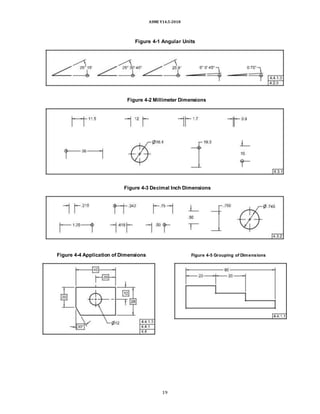
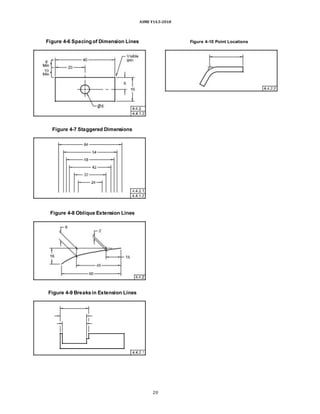
  • 100.
    ASME Y14.5-2018 in accordancewith the specified restraint requirement to flex or deform the part. See Figure 7-52. NOTE: The position tolerance shown in Figure 7-52 for datum feature B (pattern of four holes) is not used to determine the free state location of the holes. It is used to establish the MMB simu-lators that are to restrain the part to simulate the installed condition. 7.20.4.5 Contacting Physical Datum Feature Simulators. When restraint is applied, all restrained nonsize datum features shall contact the physical datum feature simulators, UOS. Features of size refer-enced at MMB are not required to make contact with the simulator. 7.21 DATUM REFERENCE FRAME IDENTIFICATION When a datum reference frame has been properly estab-lished and it is considered necessary to illustrate the coor-dinate system of a datum reference frame, the axes of the coordinate system may be labeled on the orthographic views to show the translational degrees of freedom x, y, and z. See Figures 7-2, 7-6, 7-13, and 7-53. On the model, each datum reference frame shall be associated with a corresponding coordinate system per ASME Y14.41. (a) Orthographic View Requirements. When multiple datum reference frames exist and it is desirable to label the axes of the coordinate system (X, Y, and Z), any labeled axes shall include a reference to the associated datum reference frame. On the orthographic view, the X-, Y-, and Z-axes for the three datum reference frames shall be identified by the notation [A,B,C], [A,B,D], and [A,B,E]. These labels represent the datum features (without modi-fiers) for each datum reference frame, and follow the X, Y, and Z identification letters. See Figure 7-54. (b) Use of Common Datum Features. When common datum features are used to identify a datum within a datum reference frame, the relevant common datum feature letters shall be separated by a hyphen as in [F- D,B,C]. (c) Model Requirements. Each datum reference frame– to–coordinate system relationship shall be clearly presented. When a datum reference frame is labeled, the label shall take the form of DRF_XXX (underscore required), where the datum letters of the datum reference frame are used in place of XXX. 7.22 CUSTOMIZED DATUM REFERENCE FRAME CONSTRUCTION To limit the degrees of freedom constrained by datum features referenced in an order of precedence, a custo- mized datum reference frame may be invoked. When applying the customized datum reference frame, the following requirements govern the constraint on each datum feature reference: (a) Where orthographic views are used, the rectan- gular coordinate axes shall be labeled in at least two views on the drawing. See Figures 7-55 and 7-56. In a model, the axes only need to be labeled once for each datum reference frame. (b) The degree(s) of freedom to be constrained by each datum feature referenced in the feature control frame shall be explicitly stated by placing the designated degree of freedom to be constrained in lowercase letter(s) “[x,y,z,u,v,w]” inbrackets followingeach datum feature reference and any applicable modifier (s). See Figures 7-56 and 7-57. NOTE: Customized datum reference frames shall not be used with composite tolerances. Where a customized datum reference frame is needed, one or more single-segment feature control frames shall be used. 7.23 APPLICATION OF A CUSTOMIZED DATUM REFERENCE FRAME In Figure 7-55, the conical primary datum feature A constrains five degrees of freedom, including translation inz. The origin of the datum reference frame to locate the 6-dia. hole is from the apex of the conical true geometric counterpart. In someapplications, it may be necessary to customize the datum reference frame. The following are examples of applications of customized datum reference frames: (a) In Figure 7-56, the design intent is that the primary datum feature A constrains four degrees of freedom, excluding translation in z. Secondary datum feature B is a thrust face and, when customized, constrains the translational degree of freedom (z). The 6- dia. hole is located to the conical feature with translation z omitted. Secondary datum feature B constrains transla- tion in z. In this example, the declared degrees of constraint for datum feature A are x, y, u, and v. The declared degree of constraint for datum feature B is z. (b) In Figure 7-57, datum feature B would normally constrain two translational degrees of freedom, x and y, and one rotational degree of freedom, w. See Figure 7-3, illustration (f). The purpose of the square hole is to transfer torque but not to orient the part. Therefore, the design intent is that datum feature B restrains two translational degrees of freedom but not the rotational degree of freedom. In the position tolerance for the three holes, datum feature A constrains three degrees of freedom, z, u, and v. Even though datum feature B would normally constrain the three remaining degrees of freedom, using the customized datum reference frame constraintrequirements, datum feature B constrains only two translational degrees of freedom, x and y. Datum feature C, then, constrains the remaining degree of rotational freedom, w. 82
  • 101.
    ASME Y14.5-2018 7.24 DATUMTARGETS Datum targets may be used in establishing a datum reference frame. Because of inherent irregularities, the entire surface of somefeatures cannotbe effectively used to establish a datum. Examples are nonplanar or uneven surfaces produced by casting, forging, or molding; surfaces of weldments; and thin-section surfaces subject to bowing, warping, or other inherent or induced distortions. Wherethe entire surface is not used to estab- lish a datum, datum targets are used in establishing a datum reference frame. Datum targets and datum features (as described earlier) may be combined to establish a datum reference frame. Where datum feature reference is made to datum targets applied on a feature of size, RMB is applicable unless the datum feature reference is otherwise modified. 7.24.1 Establishing a Center Plane From Datum Targets Figure 7-58 is an example of a center plane established by a V-shaped true geometric counterpart established from two datum target lines. In the orthographic view, datum targets B1 and B2 are located relative to datum targets A1 and A2 with a basic dimension and are shown as datum target lines. If a datum target plane V-shaped true geometric counterpart is required, B1 and B2 would only be shown in the top view. On the model, the V- shaped simulator is represented by supple-mental geometry tangent to the cylindrical feature, and the datum target is attached by a leader. For clarification, the directionof movement may be indicated by the addi-tion of a represented line element as described in ASME Y14.41. 7.24.2 “Movable Datum Target” Symbol The “movable datum target” symbol may be used to indicate movement of the datum target’s true geometric counterpart. Where datum targets establish a center point, axis, or center plane and RMB is applicable, the true geometric counterpart moves normal to the true profile, and the “movable datum target” symbol, though not required, may be used for clarity. Where the true geometric counterpart is not normal to the true profile, the “movabledatum target” symbol shall beused, and the direction of the movement shall be defined as described in (a) through (c) below. See Figure 7-58. For an example of where the true geometric counterpart moves along an axis, see Figure 7-59. (a) For orthographic views on engineering drawings, the movement may be indicated by the addition of a line indicatingthe directionof movement. The line element is placed at the point of contact for a datum target point, along the line for a datum target line, or within the area for a datum target area. The movement is along the represented line element. The line element shall bespecifiedwithone ormore basic angles. See Figure 7-58, illustration(a). (b) Alternatively, for drawings that include X-, Y-, and Z-axes to represent the datum reference frame(s), the direc-tion of movement may be indicated using a unit vectordesignationconsistingof i, j, k components (corre- sponding to the X-, Y-, and Z-axes of the coordinate system), placed in brackets and adjacent to the “movable datum target” symbol. The vector direction is toward the surface of each datum feature. See Figure 7-58, illustration (b). The vector notation shall be shown in at least one view where the target is shown. For drawings that include more than one datum reference frame, the particular datum reference frame to which the i, j, k components are related shall be specified by placing the applicable datum feature letters within square brackets following the closing bracket that contains the i, j, k components (such as “[i, j, k]” or [A,B,C]). (c) For a model, the direction of movement shall be indicatedby the addition of a represented line element to indicate the direction of movement. The line element shall be placed on the outside of the material. One end of the lineelement shall terminate at the point of contact for a datum target point, at a point on the line for a datum target line, or at a point within the area for a datum target area. The movement is along the represented line element. See Figure 7-58, illus-tration (c) and ASME Y14.41. 7.24.3 Datum Target Dimensions Where applicable, the location and size of datum targets should be defined with either basic or directly toleranced dimensions. If basic dimensions are used, established tooling or gaging tolerances apply. Figure 7- 60 illustrates a part where datum targets are located by means of basic dimensions. NOTE: For information on tolerancing physical datum feature simulators and their interrelationships between the simulators, see ASME Y14.43. 7.24.4 Datum Planes Established by Datum Targets A primary datum plane is established by at least three target points not on a straight line. See Figure 7-60. A secondary datum plane is usually established by two targets. A tertiary datum plane is usually established by one target. A combination of target points, lines, and areas may be used. See Figure 7-60. For stepped surfaces, the datum plane should contain at least one of the datum targets. Some features, such as curved or contoured surfaces, may require datum planes that are completely offset from the datum targets. See Figure 7-53. 83
  • 102.
    ASME Y14.5-2018 7.24.5 SteppedSurfaces A datum plane may be established by targets located on stepped surfaces, as in Figures 7-58 and 7-60. The basic dimension defines the offset between the datum targets. at an equal rate from a commonaxis thatis perpendicular to the primary datum plane. Where MMB is specified, the centering method used to establish the datum axis has a set of three equally spaced features set at a fixed radial distance based on the MMB. 7.24.6 Primary Datum Axis Two sets of three equally spaced datum targets may be used to establish a datum axis for a primary datum feature. See Figures 7-61 and 7-62. The two datum target sets are spaced as far apart as practical and dimensioned from the secondary datum feature where needed. Where RMB is applicable, a centering procedure used to establish the datum axis has two sets of three equally spaced contacting datum target simulators capable of moving radially at an equal rate from a common axis. To ensure repeatability of the location of the three datum target points, a tertiary datum feature may be necessary. For the MMB, the centering procedure used to establish the datum axis has two sets of three equally spaced datum target simu-lators set at a fixed radial distance based onthe MMB. Wheretwo cylindrical datum features of different diameters are used to establish a datum axis, as in Figure 7-62, each datum feature is identified with a different letter. 7.24.7 Circular and Cylindrical Targets Circulartarget lines and cylindrical targetareas may be used to establish a datum axis on round features. See Figure 7-63. 7.24.8 Secondary Datum Axis For a secondary datum feature, a set of three equally spacedtargets may be used to establish a datum axis. See Figure 7-64. In this example, the datum targets and the contacting true geometric counterparts are oriented rel- ative to the datum reference frame. Where RMB is appli- cable, a typical centering method used to establish the datum axis has a set of three equally spaced contacting true geometric counterparts capable of moving radially 7.24.9 Datums Established From Complex or Irregular Surfaces Datum targets may be usedto establisha datum from a complex or irregular surface. When a datum target area or datum target lineis shown on a nonplanar surface, the shape of the datum target’s true geometric counterpart is the sameas the basic shape of the surface. In Figure 7-49, the datum target area’s true geometric counterparts for A1 through A4 are the same as the basic contour of the part surface. Where a datum reference frame has been properly establishedbut its planes are unclear, the datum reference frame coordinate axes may be labeled to appropriate extension or center lines as needed. See Figure 7-53. The datum feature symbol should be attached only to identifiable datum features. Where datums are established by targets on complex or irregular surfaces, the datum may be identified by a note such as DATUM AXIS A or DATUM PLANE A. 7.24.10 Datum Features Established From Datum Targets With Fewer Than Three Mutually Perpendicular Planes When using datum features defined by datum targets ina feature control frame establishedby fewer than three mutually perpendicular planes, the datums that are the basis for the datum reference frame shall be referenced. See Figure 9-16. The targets that provide definition for the datums referenced in the feature control frame shall be specified in a note, such as WHERE ONLY DATUM FEATURE A IS REFERENCED, DATUM FEATURES B AND C ARE INVOKED ONLY TO RELATE THE TARGETS THAT ESTABLISH DATUM A. 84
  • 103.
    Figure 7-1 DatumReference Frame 85 ASME Y14.5-2018
  • 104.
    ASME Y14.5-2018 Figure 7-2Sequence of Datum Features Relates Part to Datum Reference Frame 86
  • 105.
    ASME Y14.5-2018 Figure 7-3Constrained Degrees of Freedom for Primary Datum Features 87
  • 106.
    ASME Y14.5-2018 Figure 7-4Part Where Rotational Constraint Is Important 88
  • 107.
    Figure 7-5 Developmentof a Datum Reference Frame for the Part in Figure 7-4 89 ASME Y14.5-2018
  • 108.
    ASME Y14.5-2018 Figure 7-6Development of a Datum Reference Frame 90
  • 109.
    Figure 7-6 Developmentof a Datum Reference Frame (Cont’d) 91 ASME Y14.5-2018
  • 110.
    ASME Y14.5-2018 Figure 7-7Datum Plane Establishment Figure 7-8 Establishment of Datums for Primary External Cylindrical Datum Feature RMB 92
  • 111.
    Figure 7-9 Establishmentof Datumsfor Primary Internal Cylindrical Datum Feature RMB 93 ASME Y14.5-2018
  • 112.
    Figure 7-10 Establishmentof Datums for Primary External Datum Width Feature RMB 94 ASME Y14.5-2018
  • 113.
    Figure 7-11 Establishmentof Datumsfor Primary Internal Datum Width Feature RMB 95 ASME Y14.5-2018
  • 114.
    ASME Y14.5-2018 Figure 7-12Development of a Datum Reference Frame With Translation Modifier 96
  • 115.
    ASME Y14.5-2018 Figure 7-12Development of a Datum Reference Frame With Translation Modifier (Cont’d) 97
  • 116.
    ASME Y14.5-2018 Figure 7-13Inclined Datum Feature 98
  • 117.
    Figure 7-14 PartWith Cylindrical Datum Feature 99 ASME Y14.5-2018
  • 118.
    ASME Y14.5-2018 Figure 7-15Multiple Datum Reference Frames and Their Interrelationships 100
  • 119.
    Figure 7-16 TwoCoaxial Datum Features, Single Datum Axis 101 ASME Y14.5-2018
  • 120.
    ASME Y14.5-2018 Figure 7-17Two Datum Features RMB, Single Datum Axis 102
  • 121.
    Figure 7-18 HolePattern Identified asDatum Feature 103 ASME Y14.5-2018
  • 122.
    Figure 7-19 Effectof Secondary Datum Feature Reference Applicable RMB and at MMB 104 ASME Y14.5-2018
  • 123.
    ASME Y14.5-2018 Figure 7-20Effect of Primary Datum Feature Reference Applicable RMB and at MMB 105
  • 124.
    Figure 7-21 Secondaryand Tertiary Datum FeaturesRMB 106 ASME Y14.5-2018
  • 125.
    Figure 7-22 ExampleCalculations of MMB 107 ASME Y14.5-2018
  • 126.
    Figure 7-23 ExampleCalculations of LMB 108 ASME Y14.5-2018
  • 127.
    Figure 7-24 ExampleCalculationsof Maximum External Boundary for RMB Applications 109 ASME Y14.5-2018
  • 128.
    ASME Y14.5-2018 Figure 7-25Secondary and Tertiary Datum Features at LMB 110
  • 129.
    Figure 7-26 Secondaryand Tertiary Datum Featuresat MMB 111 ASME Y14.5-2018
  • 130.
    Figure 7-27 PlanarCommon Datum Features 112 ASME Y14.5-2018
  • 131.
    ASME Y14.5-2018 Figure 7-28Partial Surface as a Datum Feature 113
  • 132.
    ASME Y14.5-2018 Figure 7-29Contoured Surface as a Datum Feature 114
  • 133.
    ASME Y14.5-2018 Figure 7-30Contoured Datum Feature Constraining a Rotational Degree of Freedom:Secondary Datum Feature RMB Figure 7-31 Contoured Datum Feature Constraining a Rotational Degree of Freedom:Secondary Datum Feature at MMB 115
  • 134.
    ASME Y14.5-2018 Figure 7-32Planar Datum Feature Constraining a Rotational Degree of Freedom: Secondary Datum Feature RMB Figure 7-33 Planar Datum Feature Constraining a Rotational Degree of Freedom:Secondary Datum Feature at MMB 116
  • 135.
    ASME Y14.5-2018 Figure 7-34Planar Datum Feature Constraining a Rotational Degree of Freedom: Secondary Datum Feature RMB Figure 7-35 Planar Datum Feature Constraining a Rotational Degree of Freedom:Secondary Datum Feature at BSC 117
  • 136.
    ASME Y14.5-2018 Figure 7-36Planar Datum Feature Constraining a Rotational Degree of Freedom:Secondary Datum Feature at MMB Figure 7-37 Planar Datum Feature Constraining a Rotational Degree of Freedom:Secondary Datum Feature at LMB 118
  • 137.
    ASME Y14.5-2018 Figure 7-38Size Datum Feature Constraining a Rotational Degree of Freedom: Secondary Datum Feature RMB Figure 7-39 Size Datum Feature Constraining a Rotational Degree of Freedom: Secondary Datum Feature RMB, Translate 119
  • 138.
    Figure 7-40 Irregularand Regular Featuresof Size asDatum Features 120 ASME Y14.5-2018
  • 139.
    Figure 7-40 Irregularand Regular Features of Size as Datum Features (Cont’d) 121 ASME Y14.5-2018
  • 140.
    ASME Y14.5-2018 Figure 7-41Coaxial Irregular Datum Feature of Size 122
  • 141.
    ASME Y14.5-2018 Figure 7-41Coaxial Irregular Datum Feature of Size (Cont’d) 123
  • 142.
    ASME Y14.5-2018 Figure 7-42Possible Datum Feature and True Geometric Counterparts From Three Pins Used as an Irregular Feature of Size 124
  • 143.
    ASME Y14.5-2018 Figure 7-42Possible Datum Feature and True Geometric Counterparts From Three Pins Used as an Irregular Feature of Size (Cont’d) Figure 7-43 Mating Parts for Functional Datum Section 125
  • 144.
    ASME Y14.5-2018 Figure 7-44Functional Datum Application: Pulley 126
  • 145.
    ASME Y14.5-2018 Figure 7-45Functional Datum Application: Adapter 127
  • 146.
    ASME Y14.5-2018 Figure 7-46Simultaneous Position and Profile Tolerances 128
  • 147.
    Figure 7-47 PartWith Nominally Aligned Features: SimultaneousRequirement 129 ASME Y14.5-2018
  • 148.
    Figure 7-48 PartWith Nominally Aligned Features: Separate Requirements 130 ASME Y14.5-2018
  • 149.
    Figure 7-49 RestrainedCondition Application 131 ASME Y14.5-2018
  • 150.
    Figure 7-50 Indicationof Unrestrained Datum Targetsfor a Primary Multiple Datum Feature Reference 132 ASME Y14.5-2018
  • 151.
    Figure 7-51 Indicationof Unrestrained Datum Targetsfor a Secondary Datum Feature Reference 133 ASME Y14.5-2018
  • 152.
    Figure 7-52 PlanarCombined Datum Features 134 ASME Y14.5-2018
  • 153.
    Figure 7-53 DatumTargetsUsed to Establish Datum Reference Frame for Complex Part 135 ASME Y14.5-2018
  • 154.
    ASME Y14.5-2018 Figure 7-54Datum Reference Frame Identification 136
  • 155.
    Figure 7-55 ConicalDatum Feature Referenced to Constrain Five Degreesof Freedom 137 ASME Y14.5-2018
  • 156.
    ASME Y14.5-2018 Figure 7-56Conical Datum Feature Reference Customized to Constrain Four Degrees of Free dom 138
  • 157.
    ASME Y14.5-2018 Figure 7-57Customized Datum Reference Frame 139
  • 158.
    ASME Y14.5-2018 Figure 7-58Application of Movable Datum Targets 140
  • 159.
    Figure 7-58 Applicationof Movable Datum Targets (Cont’d) 141 ASME Y14.5-2018
  • 160.
    ASME Y14.5-2018 Figure 7-59Datum Target Spheres 142
  • 161.
    ASME Y14.5-2018 Figure 7-60Application of Datum Targets to Establish a Datum Reference Frame 143
  • 162.
    Figure 7-61 PrimaryDatum AxisEstablished by Datum Target Pointson a Single Cylindrical Feature 144 ASME Y14.5-2018
  • 163.
    Figure 7-62 Primaryand Secondary Datums Established by Datum Target Lines on Two Cylindrical Features and a Surface 145 ASME Y14.5-2018
  • 164.
    Figure 7-63 DatumTarget Line and Area 146 ASME Y14.5-2018
  • 165.
    Figure 7-64 SecondaryDatum Axis 147 ASME Y14.5-2018
  • 166.
    ASME Y14.5-2018 Section 8 Tolerancesof Form 8.1 GENERAL This Section establishes the principles and methods of dimensioning and tolerancing to control the form of features. 8.2 FORM CONTROL Form tolerances control straightness, flatness, circu- larity, and cylindricity. Whenspecifyinga form tolerance, consideration shall be given to the control of form already establishedthrough other tolerances such as size (Rule #1), orientation, runout, and profile controls. See paras. 5.8 and 5.8.1 and Figure 5-7. 8.3 SPECIFYING FORM TOLERANCES Form tolerances critical to function or interchange- ability are specified where the tolerances of size do not provide sufficient control. A tolerance of form may be specified where no tolerance of size is given, e.g., in the control of flatness after assembly of the parts. A form tolerance specifies a zone within which the consid-ered feature, its line elements, its derived median line, or its derived median plane must be contained. 8.4 FORM TOLERANCES Form tolerances are applicable to single (individual) features, elements of single features, single features of size, and single features established by the application of the “CF” symbol; therefore, form tolerances are not related to datums. Paragraphs 8.4.1 through 8.4.4 cover the particulars of the form tolerances, i.e., straight-ness, flatness, circularity, and cylindricity. 8.4.1 Straightness A straightness tolerance specifies a tolerance zone within which the considered element of a surface or derived median line shall lie. A straightness tolerance is applied in the view where the elements to be controlled are represented by a straight line. 8.4.1.1 Straightness of Line Elements. Figure 8-1 illus-trates the use of straightness tolerance on a flat surface. Each line element of the surface shall lie between two parallel lines separated by the amount of the prescribed straightness tolerance and in a direction indicated by the orthographic view or by supplemental geometry in the model. Straightness may be applied to control line elements in asingledirectionon a flatsurface; itmay also be applied in multiple directions. The straightness tolerance shall be less than the size tolerance relative to any opposed surfaces and any other geometric toler- ances that affect the straightness of line elements except for those features where the “free state” or the “indepen- dency” symbol is applied. Where function requires the line elements to be related to a datum feature(s), the profile of a line shall be specified relative to datums. See Figures 11-33 and 11-34. 8.4.1.2 Straightness of Line Elements on the Surface of Cylindrical Features. Figure 8-2 shows an example of a cylindrical feature in which all circular elements of the surfaceare to be within the specified size tolerance. Each longitudinal element of the surface shall liebetween two parallel lines separated by the amount of the prescribed straightness tolerance and in a plane common with the axis of the unrelated AME of the feature. The feature control frame is attached to a leader directed to the surfaceor extensionlineof the surface but not to the size dimension. The straightness tolerance shall be less than the size tolerance and any other geometric tolerances that affect the straightness of line elements except for those features where the “free state” or the “independency” symbol is applied. Since the limits of size must be respected, the full straight-ness tolerance may not be availableforopposing elements in the case of waisting or barreling of the surface. See Figure 8-2. 8.4.1.3 Derived Median Line Straightness. When the feature control frame is associated with the size dimen-sion or attached to an extension of the dimension line of a cylindrical feature, the straightness tolerance applies to the derived median line of the cylindrical feature. A diameter symbol precedes the tolerance value indicating a cylindrical tolerance zone, and the tolerance is applied on an RFS, MMC, or LMC basis. The tolerance value may be greater than the size tolerance; the boundary of perfect form at MMC does not apply. See Figures 8-3 and 8-4. When the straightness tolerance at MMC is used in conjunction with an orientation or position tolerance at MMC, the specified straightness tolerance value shall not be greater than the specified orientation or position 148
  • 167.
    ASME Y14.5-2018 tolerance valueanddoes not contributeto the IB or OB of the positionororientation tolerance. The collectiveeffect of the MMCsizeandform tolerance produces a VC, OB, or IB resulting from the form tolerance but does not affect the IB or OB created by any orientation or position tolerances on the feature. See Figure 7-22. When applied on an MMC basis, as in Figure 8-4, the maximum straightness tolerance is the specified tolerance plus the amount the actual local size of the feature departs from its MMC size. The derived median line of the actual feature at MMC shall be within a cylindrical tolerance zone as specified. As each actual local size departs from MMC, an increase in the local diameter of the tolerance zone is allowed that is equal to the amount of this departure. Each circular element of the surface (i.e., actual local size) shall be within the specified limits of size. When applied RFS, as in Figure 8-3, the maximum straightness tolerance is the specified tolerance. The derived median line of the actual feature RFS shall be withina cylindrical tolerancezoneas specified. When the straightness tolerance RFS is used in conjunction with an orientation tolerance RFS or position tolerance RFS, the specified straightness tolerance value combines with the specified orientation or position tolerance value and contributes to the IB or OB of the position or orienta-tion tolerance. 8.4.1.4 Applied on a Unit Basis. Straightness may be applied on a unit basis as a means of limiting an abrupt surface variation within a relatively short length of the feature. See Figure 8-5. When using unit control on a feature of size, a maximum limit is typically specified to limit the relatively large theoretical variations that may resultif leftunrestricted. If the unitvariationappears as a “bow” in the toleranced feature, and the bow is allowed to continue at the same rate for several units, the overall tolerance variation may result in an unsatisfactory part. Figure 8-6 illustrates the possible condition in which straightness per unit length given in Figure 8-5 is used alone, i.e., if straightness for the total length is not specified. A multiple-segment feature control frame showingonesymbol or multiple single segments may be used. See para. 8.4.2.2. 8.4.2 Flatness A flatness tolerance specifies a tolerance zone defined by two parallel planes within which the surface or derived median plane shall lie. When a flatness tolerance is speci-fied on a surface, the feature control frame is attached to a leader directed to the surface or to an extension line of the surface. See Figure 8-7. With flatness of a surface, where the considered surface is associated with a size dimension, the flatness tolerance shall be less than the size tolerance except for those features to which the “free state” or “inde- pendency” symbol is applied. When the “independency” symbol is applied to the size dimension, the requirement for perfect form at MMC is removed and the form tolerance may be larger than the size tolerance. 8.4.2.1 Application of FlatnessRFS, MMC, or LMC to Width. Flatness may be applied on an RFS, MMC, or LMC basis to width features of size, and the tolerance value may be greater than the size tolerance; the boundary of perfect form at MMC does not apply. In this instance, the derivedmedian planeshall lie in a tolerance zone between two parallel planes separated by the amount of the tolerance. Feature control frame placement and arrangement as described in para. 8.4.1.3 apply, except the diameter symbol is not used, since the tolerance zone is a width. See Figures 8-8 and 8-9. 8.4.2.2 Applied on a Unit Basis. Flatness may be applied on a unit basis as a means of limiting an abrupt surface variation within a relatively small area of the feature. The unit variation is used either in combi-nation with a specified total variation or alone. Caution should be exercised when using unit control alone for the reasons given in para. 8.4.1.4. Since flatness involves surface area, the size of the unit area, e.g., a square area “25 X 25” or a circular area “25” in diameter, is specified to the right of the flatness tolerance, separated by a slash. A multiple-segment feature control frame may be used showing one symbol (as illustrated in the figures below) or multiplesingle-segment frames may be used, as in the following examples: 8.4.3 Circularity (Roundness) A circularity tolerance specifies a tolerance zone bounded by two concentric circles within which each circular element of the surface shall lie, and applies independently at any plane described in paras.3.6(a) and 3.6(b). See Figures 8-10 and 8-11. A callout for circularity shall be specified on a surface and not to a size dimension. The circularity tolerance shall be less than the size tolerance and other geometric tolerances that affect the circularity of the feature, except for those features where Rule #1 does not apply (e.g., “free state” symbol, average diameter, “inde-pendency” symbol). See subsection 8.5. NOTE: See ANSI B89.3.1 and ASME Y14.5.1M for further infor- mation on this subject. 8.4.4 Cylindricity A cylindricity tolerance specifies a tolerance zone bounded by two concentric cylinders. The surface shall be within these two concentric cylinders. In the case of cylin- dricity, unlike that of circularity, the tolerance applies simul- taneously to both circular and longitudinal elements of the surface (the entire surface).See Figure 8-12. When shown in 149
  • 168.
    ASME Y14.5-2018 orthographic views,the leader from the feature control frame may be directed to either view. The cylindricity toler-ance shall be less than the size tolerance except for those features where the “free state” or “independency” symbol is applied. A callout for cylindricity shall be specified on a surface and not to a size dimension. Cylindricity may be applied on a unit basis as a means of limiting an abrupt surface variation within a relatively short length of the feature. NOTE: The cylindricity tolerance is a composite control of form that includes circularity, straightness, and taper of a cylindrical feature. 8.5 AVERAGE DIAMETER An average diameter is the average of several diametric measurements across a circular or cylindrical feature. The individual measurements may violate the limits of size, but the average value shall be within the limits of size. Typically, an average diameter is specified for parts that are flexible in a nonrestrained condition; however, its appli- cation is not limited to such cases. Enough measurements (at least four) should be taken to ensure the establishment of an average diameter. If practical, an average diameter may be determined by a peripheralor circumferential measurement. The pertinent diameter is qualified with the abbreviation “AVG.” See Figures 8-13 and 8-14. Specifying circularity on the basis of an average diameter may be necessary to ensure that the actual diameter of the feature can conform to the desired shape at assembly. Note that the circularity tolerance can be greater than the size tolerance on the diameter. Invoking average diameter constitutes an exception to Rule #1 for the size tolerance; see para. 5.8.2. Figure 8-13, illustrations (a) and (b) (simplified by showing only two measure- ments) show the permissible diameters in the free state for two extreme conditions of maximum average diameter and minimum average diameter, respectively. The same method applies when the average diameter is anywhere between the maximum and minimum limits. 150
  • 169.
    Figure 8-1 SpecifyingStraightnessof a Flat Surface 151 ASME Y14.5-2018
  • 170.
    Figure 8-2 SpecifyingStraightnessof Surface Elements 152 ASME Y14.5-2018
  • 171.
    Figure 8-3 SpecifyingStraightnessRFS 153 ASME Y14.5-2018
  • 172.
    ASME Y14.5-2018 Figure 8-4Specifying Straightness at MMC 154
  • 173.
    Figure 8-5 SpecifyingStraightnessper Unit Length With Specified Total Straightness, Both RFS 155 ASME Y14.5-2018
  • 174.
    ASME Y14.5-2018 Figure 8-6Possible Results of Specifying Straightness per Unit Length RFS, With No Specified Total Figure 8-7 Specifying Flatness of a Surface 156
  • 175.
    Figure 8-8 SpecifyingFlatnessof a Derived Median Plane RFS 157 ASME Y14.5-2018
  • 176.
    ASME Y14.5-2018 Figure 8-9Specifying Flatness of a Derived Median Plane at MMC 158
  • 177.
    Figure 8-10 SpecifyingCircularity for a Cylinder or Cone 159 ASME Y14.5-2018
  • 178.
    ASME Y14.5-2018 Figure 8-11Specifying Circularity of a Sphere Figure 8-12 Specifying Cylindricity 160
  • 179.
    Figure 8-13 SpecifyingCircularity With Average Diameter 161 ASME Y14.5-2018
  • 180.
    ASME Y14.5-2018 Figure 8-14Specifying Restraint for Nonrigid Parts 162
  • 181.
    ASME Y14.5-2018 Section 9 Tolerancesof Orientation 9.1 GENERAL This Section establishes the principles and methods of dimensioning and tolerancing to control orientation of features. 9.2 ORIENTATION CONTROL Orientation tolerances control angularity, parallelism, and perpendicularity, i.e., all angular relationships. Note that an orientation tolerance, when applied to a plane surface, controls flatness to the extent of the orien-tation tolerance unless the tangent plane symbol is added. When the flatness control in the orientation tolerance is not sufficient, a separate flatness tolerance should be considered. See Figure 7-15. An orientation tolerance does not control the locationof features. Whenspecifying an orientation tolerance, considerationshouldbegivento the control of orientation already established through other tolerances, such as position, runout, and profile controls. See Figures 10-8 and 10-9. 9.3 SPECIFYING ORIENTATION TOLERANCES When specifying an orientation tolerance, the tolerance zone shall be related to one or more datums. See Figures 7-15 and 9-4. Orientation tolerances are constrainedonly inrotational degrees of freedom relative to the referenced datums; they are not constrained in translational degrees of freedom. Thus, with orientation tolerances, even in those instances where datum features may constrain all degrees of freedom, the tolerance zone only orients to that datum reference frame. Sufficient datum features shall be referenced to constrain the required rotational degrees of freedom. If the primary datum feature alonedoes not constrainsufficient degrees of freedom, additional datum features shall be specified. An angularity tolerance may be applied to a surface, center plane, or axis that is an implied 0° (parallel), implied 90° (perpendicular), or other basic angle from one or more datum planes or datum axes. 9.3.1 Orientation Tolerance Zone An orientation tolerance specifies a zone within which the considered feature, its line elements, its axis, or its center plane shall be contained. 9.3.2 Orientation Tolerance An orientationtolerance specifies oneof the following: (a) a tolerance zone defined by two parallel planes at the specified basic angle from, parallel to, or perpendicular to one or more datum planes or datum axes, within which the surface, axis, or center plane of the considered feature shall be contained. See Figures 9-1 through 9-7. (b) a cylindrical tolerance zone at the specified basic angle from, parallel to, or perpendicular to one or more datum planes or datum axes, within which the axis of the considered feature shall be contained. See Figures 9-8 through 9-15. (c) a tolerance zone defined by two parallel lines at the specified basic angle from, parallel to, or perpendicular to a datum plane or axis, within which the line element of the surface shall be contained. See Figures 9-16 through 9-18. 9.3.3 Application of Each Element’s Tolerance Zones Tolerance zones apply to the full extent of a feature, UOS. When it is a requirement to control only individual line elements of a surface, a qualifying notation, such as “EACH ELEMENT” is added to the drawing. See Figure 9-16. This permits control of individual elements of the surface indepen-dently in relation to the datum and does not limit the total surface to an encompassing zone. Each distance between the line element tolerance zone boundaries remains normal to the as-designed theoretically perfect surface. Orientation tolerances only constrain rotational degrees of freedom relative to the referenced datums. Adding a notation such as “EACH RADIAL ELEMENT” invokes a translational degree of freedom that cannot be controlled by orientation tolerances. When control of radial elements is required, profile shall be used. See subsection 11.9. 9.3.4 Application of Zero Tolerance at MMC When no variations of orientation are permitted at the MMC size limit of a feature of size, the feature control frame contains a zero for the tolerance, modified by the symbol for MMC. If the feature of size is at its MMC limit of size, it shall be perfect in orientation with respect to the datum. Atolerance can existonly as the feature of size departs from MMC. Theallowableorientationtoleranceis equal to the amount of the 163
  • 182.
    ASME Y14.5-2018 departure. SeeFigures 9-14 and 9-15. These principles are also applicable to features of size toleranced for orienta-tion at LMC. There may be applications in which the full additional allowable tolerance does not meet the func-tional requirements. In such cases, the amount of addi-tional tolerance shall be limited by stating “MAX” following the MMC modifier. See Figure 9-15. of size and the unrelated AME size of the hole. When the unrelated AME size is larger than MMC, the specified orientation tolerancefor a holemay be exceeded and still satisfy function and interchangeability requirements. NOTE: These concepts are equally applicable to all features of size except spheres. 9.3.5 Explanation of Orientation Tolerance at MMC An orientation tolerance applied at MMC may be explained in terms of the surface or the axis of a cylindrical feature or the surfaces or center plane of a width feature. In certain cases of extreme form deviation (withinlimits of size) of thecylinder or width feature, the tolerance in terms of the feature axis or center plane may not be equivalent to the tolerance in terms of the surface. In such cases, the surface method shall take precedence as in Figure 10-6. (a) In Terms of the Surface of a Hole. Whilemaintaining the specified size limits of a hole, no element of the hole surface shall be inside a theoretical boundary (VC) constrained in rotation to the datum reference frame. See Figure 10-6. (b) In Terms of the Axis of a Hole. When a hole is at MMC (minimum diameter), the feature axis shall fall within a cylindrical tolerance zone whose axis is constrained in rotation to the datum reference frame. The axis of a feature is the axis of the unrelated AME. The diameter of this zone is equal to the orientation tolerance. See Figure 9-14. It is only when the hole is at MMC that the specified tolerance zone applies. When the unrelated AME size of the hole is larger than MMC, the orientation tolerance increases. This increase of orientation tolerance is equal to the difference between the specified MMC limit 9.4 TANGENT PLANE When it is desired to control a tangent plane established by the contacting points of a surface, the tangent plane symbol shall be added in the feature control frame after the stated tolerance. See Figures 9-17 and 9-18. When a tangent plane symbol is specified with a geometric tolerance, a plane contacting the high points of the feature shall be within the tolerance zone established by the geometric tolerance. Some points of the toleranced feature may lie outside of the tolerance zone. The form of the toleranced feature is not controlled by the geometric tolerance. When irregularities on the surface cause the tangent plane to be unstable (i.e., it rocks) whenbrought into contact with the corresponding toleranced feature, see ASME Y14.5.1M for definition of mathematical requirements. NOTE: The tangent plane symbol is illustrated with orientation tolerances; however, it may also have applications using other geometric characteristic symbols such as runout and profile when it is applied to a planar feature. 9.5 ALTERNATIVE PRACTICE As an alternative practice, the angularity symbol may be used to control parallel and perpendicular relationships. The tolerance zones derived are the same as those described in para. 9.3.2. See Figure 9-4. 164
  • 183.
    ASME Y14.5-2018 Figure 9-1Specifying Angularity for a Plane Surface Figure 9-2 Specifying Parallelism for a Plane Surface 165
  • 184.
    ASME Y14.5-2018 Figure 9-3Specifying Perpendicularity for a Plane Surface Figure 9-4 Specifying Orientation for a Plane Surface Relative to Two Datums 166
  • 185.
    ASME Y14.5-2018 Figure 9-5Specifying Perpendicularity for a Center Plane (Feature RFS) Figure 9-6 Specifying Angularity for an Axis(Feature RFS) 167
  • 186.
    ASME Y14.5-2018 Figure 9-7Specifying Parallelism for an Axis (Feature RFS) 168
  • 187.
    Figure 9-8 SpecifyingAngularity for an Axis With Two Datum Feature References (Feature RFS) 169 ASME Y14.5-2018
  • 188.
    Figure 9-9 SpecifyingParallelism for an Axis (Both Feature and Datum Feature RFS) 170 ASME Y14.5-2018
  • 189.
    Figure 9-10 SpecifyingParallelism for an Axis(Feature at MMC and Datum Feature RFS) 171 ASME Y14.5-2018
  • 190.
    Figure 9-11 SpecifyingPerpendicularity for an Axis at a Projected Height (Threaded Hole or Insert at MMC) 172 ASME Y14.5-2018
  • 191.
    ASME Y14.5-2018 Figure 9-12Specifying Perpendicularity for an Axis (Pin or Boss RFS) 173
  • 192.
    ASME Y14.5-2018 Figure 9-13Specifying Perpendicularity for an Axis Showing Acceptance Boundary (Pin or Boss at MMC) 174
  • 193.
    ASME Y14.5-2018 Figure 9-14Specifying Perpendicularity for an Axis (Zero Tolerance at MMC) 175
  • 194.
    Figure 9-15 SpecifyingPerpendicularity for an Axis(Zero Tolerance at MMC With a Maximum Specified) 176 ASME Y14.5-2018
  • 195.
    ASME Y14.5-2018 Figure 9-16Specifying Orientation for a Curved Surface Relative to a Planar Datum Feature 177
  • 196.
    ASME Y14.5-2018 Figure 9-17Specifying Parallelism With a Tangent Plane and Profile of a Surface Figure 9-18 Specifying Parallelism With a Tangent Plane 178
  • 197.
    ASME Y14.5-2018 Section 10 Tolerancesof Position 10.1 GENERAL This Section establishes the principles of tolerances of locationthrough applicationof positiontolerances. Po s i t i o n m a y b e u s e d t o c o n t r o l t h e f o l l o w i n g relationships: (a) center distancebetween features of sizesuchas holes, slots, bosses, andtabs (b) locationof features of size[suchas in (a)] as a group, from datums (c) coaxial relationships of features of size (d) symmetrical relationshipsof features of size 10.2 POSITIONAL TOLERANCING A positional toleranceestablishes requirements as explained in(a) and (b) below. (a) a zone within which the center point, axis, or center plane of a feature of size is permitted to vary from a true (theoretically exact) position (b) (where specified on an MMC or LMC basis) a boundary, defined as the VC, located at the true (theore- tically exact) position, that shall not be violated by the surface or surfaces of the considered feature of size Basic dimensions establish the true position from speci-fied datums and between interrelated features. A posi-tional tolerance shall be indicated by the position symbol, a tolerance value, applicable material condition modifiers, and appropriate datum feature references placed in a feature control frame. 10.2.1 Components of Positional Tolerancing Paragraphs 10.2.1.1 through 10.2.1.3 describe the components of positional tolerancing. 10.2.1.1 Dimensionsfor True Position. Dimensions used to locate true position shall be basic and defined in accordance with para. 5.1.1.2. See Figure 10-1. For ap- plicable notes in digital data files, see ASME Y14.41. 10.2.1.2 Use of Feature Control Frame. A feature control frame is added to the notation used to specify the size and number of features. See Figures 10-2 through 10-4, which show different types of feature pattern dimensioning. 10.2.1.3 Identifying Featuresto Establish Datums. It is necessary to identify features or features of size on a part to establish datums for dimensions locating true posi-tions except where the positioned features establish the primary datum. (The exception is explained in para. 10.6.2.3.) For example, in Figure 10-2, if datum references had been omitted, it would not be clear whether the inside diameter or the outside diameter was the intended datum feature for the dimensions locating true positions. The intended datum features are identifiedwithdatum feature symbols,andthe applicable datum feature refer-ences are included in the feature control frame. For infor-mation on specifying datums in an order of precedence, see subsection 7.10. 10.3 POSITIONAL TOLERANCING FUNDAMENTALS — I This subsection is a general explanation of positional tolerancing. 10.3.1 Material Condition Basis Positional tolerancingshall beappliedonan MMC, RFS, or LMC basis. When MMC or LMC is required, the appro- priate modifier follows the specified tolerance. See subsection 5.8. 10.3.2 RFS as Related to Positional Tolerancing The design or function of a part may require the posi- tional tolerance to be maintained regardless of the feature’s unrelated AME size. RFS, where applicable to the positional tolerance associated with a feature of size, requires the axis, center plane, or center point of each feature of size to be located within the specified posi- tional tolerance regardless of the size of the feature. In Figure 10-5, the sixholes may vary in size from 25 dia. to 25.6 dia. Each hole axis shall be located within the specifiedpositional toleranceregardless of the size of the hole. 10.3.3 MMC as Related to Positional Tolerancing When positional tolerancing at MMC is specified, the stated positional tolerance applies at the feature size limit that results in the maximum material in the part. MMC should be specified in positional tolerancing 179
  • 198.
    ASME Y14.5-2018 applications whenthe functional consideration is to fit with mating features while allowing an increase in toler- ance as the feature of size departs from MMC. See para. 5.8.1 regarding perfect form at MMC. 10.3.3.1 Explanation of Positional Tolerance at MMC. A positional tolerance applied at MMC may be explained interms of the surface or the axis of the feature of size. In cases of form or orientation deviation of the feature of size, the tolerancerequirements in terms of the axis method are not equivalent to the tolerance requirements interms of the surfacemethod. The surface method shall take prece-dence. See Figure 10-6 for an example of possible axis interpretation error due to form deviation. The axis method is shown in this Standard for visualization purposes. See ASME Y14.5.1M. In some instances, the additional tolerance may indirectly benefit features other than the one that departed from MMC. (a) Surface Method. While maintaining the specified size limits of the feature, no element of the surface shall violate a theoretical boundary (VC based on the feature MMCand the specifiedposition tolerance) located at true position. See Figures 10-7 and 10-8. (b) Axis orCenterPlane Method. When a feature of size is at MMC, its axis orcenter plane shall fall within a toler- ance zonelocated at true position. Thesizeof this zone is equal to the positional tolerance. See Figure 10-9, illustra-tions (a) and(b). This tolerance zone also defines the limits of variation in the orientation of the axis or center plane of the feature of sizein relation to the datum surface. See Figure 10-9, illustration (c). It is only where the feature of size is at MMC that the specified tolerance value applies. Where the unrelated AME size of the feature of size departs from MMC, positional tolerance increases. See Figure 10-10. This increase of positional tolerance is equal to the difference between the specified MMC limit of size and the unrelated AME size. 10.3.3.2 Calculating Positional Tolerance. Figure 10- 11 shows a drawing for one of two identical plates to be assembled with four 14 maximum diameter fasteners. The 14.25 minimum diameter clearance holes are selected with a size tolerance as shown. The required positional tolerance is found by appropriate calculation methods for the specific application. See Nonmandatory Appendix B. The following formula does not accommodate factors other than hole and fastener diameter tolerances: T = H F = 14.25 14 = 0.25 diameter Note that if the clearance holes were located exactly at true position, in theory the parts would still assemble with clearance holes as small as 14 diameter. However, other- wise usable parts with clearance holes smaller than 14.25 diameter would be rejected for violating the size limit. 10.3.4 Zero Positional Tolerance at MMC Theapplicationof MMC permits the position tolerance zone to increase to a larger valuethan the valuespecified, provided the features of size are within the size limits and the feature of size locations make the part acceptable. However, rejection of usable parts can occur when these features of size are actually located on or close to their true positions but are produced to a size smaller than the specified minimum (outside of limits). The principle of zero positional tolerancing at MMC allows themaximum amountof tolerance for the function of assembly. This is accomplished by adjusting the minimum size limit of a hole to the absolute minimum required for insertionof an applicablemaximum fastener located precisely at true position, and specifying a zero positional tolerance at MMC. In this case, the positional tolerance allowed is totally dependent on the unrelated AME size of the considered feature, as explained in para. 5.8.4. Figure 10-12 shows a drawing of the same part showninFigure 10-11 with a zero positional tolerance at MMC specified. Note that the maximum size limit of the clearance holes remains the same, but the minimum was adjusted to correspond with a 14-diameter fastener. The resultis an increaseof the sizetolerancefor the clearance holes, withthe increase equal to the posi-tional tolerance specified in Figure 10-11. Although the positional tolerance specified in Figure 10-12 is zero at MMC, the positional tolerance allowed increases directly with the actual clearance hole size as shown by the following tabulation: Clearance Hole Diameter (Feature ActualMating PositionalTolerance Diameter Size) Allowed 14 0 14.1 0.1 14.2 0.2 14.25 0.25 14.3 0.3 14.4 0.4 14.5 0.5 10.3.5 LMC as Related to Positional Tolerancing Where positional tolerancing at LMC is specified, the stated positional tolerance applies at the feature size limit that results in the least material in the part. Specification of LMC requires perfect form at LMC. Perfect form at MMC is not required. Where the feature’s minimum material envelope departs from its LMC limit of size, an increase in positional tolerance is allowed, equal to the amount of the departure. See Figure 10-13. LMC shall be specified in positional tolerancing applications when the functional consideration is to ensure that a minimum distance is maintained while allowing an increase in toler-ance as the feature of size departs from LMC. See Figures 180
  • 199.
    ASME Y14.5-2018 10-14 through10-18. LMC may be used to maintain a desired relationship between the surface of a feature and its true position at tolerance extremes. As with MMC, the surface method shall take precedence over the axis method. See para. 10.3.3.1 and Figure 10-6. 10.3.5.1 LMC to Protect Wall Thickness. Figure 10- 14 illustrates a boss and hole combination located by basic dimensions. Wall thickness is minimum when the boss and hole are at their LMC sizes and both features of size are displaced in opposite extremes. As each feature of size departs from LMC, the wall thickness may increase. The departure from LMC permits a corresponding increase in the positional tolerance, thus maintaining the desired minimum wall thickness between these surfaces. 10.3.5.2 LMC Applied to Single Features of Size. LMC may also be applied to single features of size, such as the hole shown in Figure 10-16. In this example, the position of the hole relative to the inside web is critical. When LMC is applied, an increase in the positional tolerance is permitted while protecting the wall thickness. 10.3.5.3 Zero Positional Tolerance at LMC. The appli-cation of LMC permits the tolerance to exceed the value specified, provided features of size are within the sizelimits and the feature of size locations make the part ac-ceptable. However, rejection of usable parts can occur where features of size, such as holes, are actually located on orcloseto their true positions but are produced larger than the specifiedmaximum size (outside of size limits). The principle of zero positional tolerancing at LMC may be used in applications in which it is desired to protect a minimum distance on a part and allow an increase in tolerance when the toleranced feature departs from LMC. This is accomplishedby adjustingthemaximum sizelimit of a hole to the absolute maximum allowed to meet functional requirements (such as wall thickness) while specifying a zero positional tolerance at LMC. When this is done, the positional toler-ance allowed is totally dependent on the actual minimum material size of the considered feature of size. Figure 10-15 shows the same drawing as Figure 10-14, except the tolerances have been changed to show zero positional tolerance at LMC. Note that the minimum sizelimitof theholeremains the same, but the maximum was adjusted to correspond with a 20.25-diameter VC. This results in an increase of the size tolerance for the hole, with the increase equal to the positional tolerance specified in Figure 10-14. Although the positional tolerance specified in Figure 10-15 is zero at LMC, the positional tolerance allowed is directly related to the minimum material hole size as shown by the following tabulation: Hole Diameter (Feature Minimum Material PositionalTolerance Diameter Size) Allowed 20.25 0 20 0.25 19.75 0.5 19.5 0.75 10.3.6 Datum Feature Modifiers in Positional Tolerances References to datum features of size shall be made RMB or at MMB or LMB. 10.3.6.1 Datum Features RMB. The functional require-ments of some designs may require that a datum feature be applicableRMB. Thatis, itmay be necessary to require the axis of an actual datum feature (such as datum diameter B in Figure 10-5) to be the datum axis for the holes in the pattern regardless of the datum feature’s size. The RMB application does not permit any translation or rotation between the axis of the datum feature and the tolerance zone framework for the pattern of features, where the datum feature size varies. 10.3.6.2 Displacement Allowed by Datum Features at MMB. For some applications, a feature or group of features (such as a group of mounting holes) may be positionedrelativeto a datum feature(s) of size at MMB. See Figure 10-19, where displacement is allowed when the datum feature departs from MMB. 10.3.6.2.1 Datum Feature of Size at MMB. When a datum feature is at MMB, its axis orcenter planeis coin- cident with the datum axis or datum center plane and it determines the location of the pattern of features as a group. The tolerance zone framework is constrained in translation on the datum axis or center plane. See Figure 10-19, illustration (a). 10.3.6.2.2 Departure of Datum Features From MMB. When a datum feature departs from MMB, relative move- ment can occur between the datum axis or datum center plane and the axis or center plane of the related AME of datum feature B. See para. 7.11.11 and Figure 10-19, illus-tration (b). (a) Effect on Considered Features. The amount of the datum feature’s departure from MMB does not provide additional positional tolerance for each considered feature in relation to the others within the pattern, but it does allow the pattern of features as a group to move within the amount of departure. (b) Inspection Method Variation. If a functional gage is used to check the part, the relative movement between datum axis B and the axis of the datum feature is auto- matically accommodated. However, this relative move- ment shall be taken into account if open setup inspection methods are used. 181
  • 200.
    ASME Y14.5-2018 10.3.6.3 DisplacementAllowed by Datum Features at LMB. For some applications, a feature or group of features may be positioned relative to a datum feature at LMB. See Figure 10- 18. In such a case, allowable displacement results when the datum feature departs from LMB. 10.4 POSITIONAL TOLERANCING FUNDAMENTALS — II This subsection expands on the principles of the general explanation of positional tolerancing in subsection 10.3. 10.4.1 Projected Tolerance Zone The application of the projected tolerance zone shall be used where the variation in orientation of threaded or press- fit holes could cause fasteners, such as screws, studs, or pins, to interfere with mating parts. See Figure 10-20. An interference can occur where a tolerance is specified for the location of a threaded or press-fit hole and the hole is inclined within the positional limits. Unlike the floating fastener application involving clearance holes only, the orientation of a fixed fastener is governed by the produced hole into which it assembles. Figure 10-21 illus-trates how the projected tolerance zone concept realisti-cally treats the condition shown in Figure 10-20. Note that it is the variation in orientation of the portion of the fastener passing through the mating part that is signifi-cant. The location and orientation of the threaded hole are only important insofar as they affect the extended portion of the engaging fastener. Where design considerations require closer control in the orientation of a threaded hole than is required by the positional tolerance, an orien-tation tolerance applied as a projected tolerance zone may be specified. See Figure 9-11. To control the feature within the part, an additional tolerance may be specified. Where a composite feature control frame is used, the placement of the projected tolerance zone symbol is defined in para. 10.5.1.7. Where multiple single-segment feature control frames are used, the projected tolerance zone symbol shall be shown in all applicable segments. 10.4.1.1 Clearance Holes in Mating Parts. Specifying a projected tolerance zone ensures that fixed fasteners do not interfere with mating parts having clearance hole sizes d e t e r m i n e d b y t h e f o r m u l a s r e c o m m e n d e d i n Nonmandatory Appendix B. Further enlargement of clear- ance holes to provide for extreme variation in orientation of the fastener may not be necessary. 10.4.1.2 Projected Zone Application for Orthographic Views. Figures 10-22 and 10-23 illustrate the application of a positional tolerance using a projected tolerance zone in an orthographic view. The specified value for the projected tolerance zone is a minimum and represents the maximum permissible mating part thickness or the maximum installed length or height of the components, such as screws, studs, or dowel pins. See para. 10.4.1.3. The direction and height of the projected toler- ance zone are indicated as illustrated. The minimum extent and direction of the projected tolerance zone are shown in a drawing view as a dimensioned value with a chain line drawn closely adjacent to an extension of the center line of the hole. 10.4.1.3 Stud and Pin Application. Where studs or press-fit pins are located on an assembly drawing, the specifiedpositional toleranceapplies only to theheight of the projecting portion of the stud or pin after installa- tion, and the specificationof a projected tolerance zone is unnecessary. However, a projected tolerance zone is ap- plicable when threaded or plain holes for studs or pins are located on a detail part drawing. In these cases, the speci-fied projected height shall equal the maximum permis-sible height of the stud or pin after installation, not the mating part thickness. See Figure 10-24. 10.4.2 Coaxial Features When positional tolerances are used to locate coaxial features, such as counterbored holes, the following prac- tices apply: (a) A single feature control frame, placed under the specifiedfeature size requirements, establishes the same positional toleranceforall the coaxial features. See Figure 10-25. Identical diameter tolerance zones for all coaxial features are constrainedin translation and rotation at the true position relative to the specified datums. (b) When different positional tolerances are used to locate two or more coaxial features, multiple feature control frames are used. A feature control frame is applied to each coaxial feature. See Figure 10-26, where different diameter tolerance zones for hole and counterbore are coaxially located at the true position rel- ative to the specified datums. (c) When positional tolerances areusedto locateholes and control individual coaxial relationships relative to different datum features, two feature control frames may be usedas in(b). In addition, a note shall be placed under the datum feature symbol for one coaxial feature and another under the feature control frame for the other coaxial feature, indicating the number of places each applies on an individual basis. See Figure 10-27. 10.4.3 Closer Control at One End of a Feature of Size When design permits, different positional tolerances may be specified for the extremities of long holes; this establishes a conical rather than a cylindrical tolerance zone. See Figure 10-28. 182
  • 201.
    ASME Y14.5-2018 10.4.4 BidirectionalPositional Tolerancing of Features of Size When it is desired to specify a greater tolerance in one direction than another, bidirectional positional toleran- cing may be applied. Bidirectional positional tolerancing results in a noncylindrical tolerance zone for locating round holes; therefore, the diameter symbol shall be omitted from the feature control frame in these applications. NOTE: A further refinement of orientation within the positional tolerance may be required. 10.4.4.1 Rectangular Coordinate Method. For features located by basic rectangular coordinate dimen- sions, separate feature control frames are used to indicate the direction and magnitude of each positional tolerance relative to specified datums. See Figure 10-29. The feature control frames are attached to dimension lines applied in perpendicular directions. Each tolerance value represents a distance between two parallel planes equally disposed about the true position. 10.4.4.2 Polar Coordinate Method. Bidirectional posi-tional tolerancing may also be applied to features located by basic polar coordinate dimensions relative to specifieddatums. Whena different toleranceis desired in each direction, one dimension line shall be applied in a radial direction and the other perpendicular to the line- of-centers. The positional tolerance values represent distances between two concentric arc boundaries (for the radial direction), and two planes parallel to the plane between the centers and equally disposed about the true position. See Figure 10-30, where a further require-ment of perpendicularity within the positional tolerance zone has been specified. In all cases, the shape and extent of the tolerance zone shall be made clear. 10.4.5 Noncircular Features of Size The fundamental principles of true position dimen- sioning and positional tolerancing for circular features of size, such as holes and bosses, apply also to noncircular features of size, such as open-end slots, tabs, and elongated holes. For such features of size, a positional tolerance may be used to locate the center plane established by parallel surfaces of the feature of size. The tolerance value repre- sents a distance between two parallel planes; therefore, the diameter symbol shall be omitted from the feature control frame. See Figures 10-31 and 10-32. and no surfaceelement of an external feature of sizeshall be outside a theoretical boundary located at true position. See Figure 10-33. (b) In Terms of the Center Plane of a Feature of Size. When a feature of size is at MMC, its center plane must fall withina tolerancezone defined by two parallel planes equally disposed about the true position. The width of this zone is equal to the positional tolerance. See Figure 10-34. This tolerancezonealso defines the limits of varia- tionin the orientation of the center plane of the feature of sizein relation to the referenced datums. It is only where the feature of size is at MMC that the specified tolerance zone applies. When the unrelated AME size of an internal feature of size is larger than MMC, additional positional tolerance results. Likewise, wheretheunrelated AME size of an external feature of size is smaller than MMC, addi- tional positional tolerance results. This increase of posi- tional tolerance is equal to the difference between the specifiedMMClimitof sizeand the unrelated AME size of the feature of size. (c) In Terms of the Boundary of a Feature of Size. A posi- tional tolerance applied to a feature of size establishes a control of the surface relative to a boundary. While main- taining the specified size limits of the feature of size, no element of its surface shall violate a theoretical boundary of identical shape located at true position. For an internal feature, the size of the boundary is equal to the MMC size of the feature minus its positional tolerance. See Figure 10-35. For an external feature, the size of the boundary is equal to the MMC size of the feature plus its positional tolerance. The term “BOUNDARY” may be placed beneath the feature control frames but is not required. In this example, a greater positional tolerance is allowed for length than for width. When the same posi-tional tolerance can be allowed for both, only one feature control frame is necessary, directed to the feature by a leader and separated from the size dimensions. NOTE: This method may also be applied to other irregular shaped features of size when a profile tolerance is applied to the feature and the center is not conveniently identifiable. See subsection 11.8. 10.4.5.2 LMC Applied to a Radial Pattern of Slots. In Figure 10-17, a radial pattern of slots is located relativeto an end face and a center hole. LMC is specified to maintain the desired relationship between the side surfaces of the slots and the true position, where rotational alignment withthe mating part may be critical. 10.4.5.1 Noncircular Features of Size at MMC. When a positional tolerance of a noncircular feature of size applies at MMC, the following apply: (a) In Terms of the Surfaces of a Feature of Size. While maintaining the specified size limits of the feature, no surface element of an internal feature of size shall be inside a theoretical boundary located at true position 10.4.6 Spherical Features A positional tolerance may be used to control the loca- tion of a spherical feature relative to other features of a part. See Figure10-36. The symbol forspherical diameter precedes the size dimension of the feature and the posi- tional tolerance value, to indicate a spherical tolerance zone. When it is intended for the tolerance zone shape 183
  • 202.
    ASME Y14.5-2018 to beotherwise, dimensions shall be shown, similar to the examples shown in Figures 10-29 and 10-30 for a bidir-ectional tolerance zone of a cylindrical hole. 10.4.7 Nonparallel Axis Hole Patterns Positional tolerancing may be applied to a pattern of holes where axes are neither parallel to each other nor normal to the surface. See Figure 10-37. 10.4.8 Repetitive Pattern of Features of Size Related to a Repeated Datum Reference Frame When positional tolerances are used to locate patterns of features of size relative to repetitive datums, the feature control frames and datums are specified as shown in Figures 10-27 and 10-38. The same note shall be placed beneath or adjacent to the datum feature symbol and also beneath or adjacent to the feature control frame for the controlled features of size indicating the number of places each applies on an individual basis. To establishassociation with one line of a multiple-segment feature control frame, placement shall be adja-cent to the applicable segment. When the individual re-quirements are shown on the main view or in a CAD model without a detail view, the indication of the number of occurrences shall be shown. Figure 10-38 shows the appli-cation of individual requirements in a detail view. When a detail view includes a notation of the number of occur-rences of that detail view, then the “6X” on the “INDIVIDUALLY” notation may be omitted. The “6X INDIVIDUALLY” notation beside the datum feature D symbol indicates that each of the six occurrences of the 79.4-diameter hole acts as a separate datum feature and establishes a separate datum D. The “6X INDIVIDUALLY” notation associated with the second segment of the positional tolerances on the “4X” 3.6-diameter holes indicates that each pattern of four holes has a tolerance zone framework located relative to the specified datums. 10.5 PATTERN LOCATION A pattern of features of sizemay havemultiplelevels of positional control required. The pattern of features of size may require a larger tolerance relative to the datum refer-ence frame while a smaller tolerance is required within the pattern. Multiple levels of tolerance control may be applied using composite positional tolerances or multiple single-segment feature control frames. 10.5.1 Composite Positional Tolerancing Composite positional tolerancing provides an applica- tionof positional tolerancingforthe location of feature of size patterns as well as the interrelation (constrained in rotation and translation) of features of size within these patterns. Requirements are annotated by the use of a composite feature control frame. See para. 6.4.4 and Figure 6-27, illustration(a). Thepositionsymbol shall be entered once and shall be applicable to all horizontal segments. Each complete horizontal segment in the feature control frames of Figures 10-39 and 10-40 should be verified separately. (a) PLTZF. When composite controls are used, the uppermost segment is the pattern-locating control. The PLTZF is constrained in rotation and translation relative to the specified datums. The PLTZF specifies the larger positional tolerance for the location of the pattern of features of size as a group. Applicable datum features are referenced in a desired order of precedence and serve to relate the PLTZF to the datum reference frame. See Figure 10-39, illustration (a). (b) FRTZF. Each lower segment is a feature-relating control that governs the smaller positional tolerance for each feature of size within the pattern (feature-to-feature relationship). Basic dimensions used to relate the PLTZF to specified datums are not applicable to the location of the FRTZF. See Figure 10-39, illustration (b). The toleranced feature shall be within both the PLTZF and the FRTZF. In some instances, portions of the FRTZF may lie outside of the PLTZF and are not usable. (1) When datum feature references are not specified in a lower segment of the composite feature control frame, the FRTZF is free to rotate and translate. (2) When datum feature references are specified in a lower segment, the FRTZF is constrained only in rotation relative to the datum reference frame. (3) When datum feature references are specified, one or more of the datum feature references specified in the upper segment of the frame are repeated, as appli- cable, and in the same order of precedence, to constrain rotation of the FRTZF. In some instances, the repeated datum feature references may not constrain any degrees of freedom; however, they are necessary to main-tain the identical datum reference frame, such as datum feature B in the lower segment in Figure 10-43. 10.5.1.1 Primary Datum Repeated in Lower Segment(s). As can be seen from the sectional view of the tolerance zones inFigure 10-39, illustration(c), since datum plane A has been repeated in the lower segment of the composite feature control frame, the axes of both the PLTZF and FRTZF cylinders are perpen-dicular to datum plane A and therefore are parallel to each other. In certain instances, portions of the smaller zones may fall beyond the peripheries of the larger tolerance zones. However, these portions of the smaller tolerance zones are not usable because the axes of the features must not violate the boundaries of the larger tolerance zones. The axes of the holes shall be within the larger tolerance zones and withinthe smallertolerancezones. The axes of t h e a c t u a l h o l e s m a y v a r y o b l i qu e l y ( o ut o f 184
  • 203.
    ASME Y14.5-2018 perpendicularity) onlywithin the confines of the respec- tive smaller FRTZF positional tolerance zones. NOTE: The zones in Figures 10-39 and 10-40 are shown as they exist at the MMC of the features. The large zones would increase in size by the amount the features depart from MMC, as would the smaller zones; the two zones are not cumulative. 10.5.1.2 Primary and Secondary Datums Repeated in Lower Segment(s). Figure 10-40 repeats the hole patterns of Figure 10-39. In Figure 10-40, the lower segment of the composite feature control frame repeats datums A and B. The pattern-locating tolerance requirements established by the first segment are the same as explained in Figure 10-39. Figure 10-40, illustration (a) shows that the toler-ance cylinders of the FRTZF may be translated (displaced) from the true position locations (as a group) as governed by the tolerance cylinders of the PLTZF, while they are constrained in rotation to datum planes A and B. Figure 10-40, illustration (a) shows that the actual axes of the holes in the actual feature pattern must reside within the tolerance cylinders of both the FRTZF and the PLTZF. 10.5.1.3 In Terms of Hole Surfaces. Figure 10-39, illus-trations (d) through (f) illustrate the positional tolerance requirements of the six-hole pattern shown in Figure 10-39, whichis explainedin terms of holesurfaces relative to acceptance boundaries. See para. 10.3.3.1(a). The result is the same for the surface explanation as for an axis, except as noted in para. 10.3.3.1. 10.5.1.4 Applied to Patterns of Features of Size Relative to Datum Features. Composite positional toler- ancing may be applied to patterns of features of size on circular parts. See Figure 10-41. With datum A repeated in the lower segment of the composite feature control frame, Figure 10-41, illustration (b) shows the tolerance cylin-ders of the FRTZF translated (as a group) from the basic locations within the bounds imposed by the PLTZF, while constrained in rotation to datum plane A. 10.5.1.5 Applied to a Radial Hole Pattern. Figure 10-42 shows an example of a radial hole pattern where the plane of the PLTZF is located from a datum face by a basic dimension. When datum references are not specified in the lower segment of a composite feature control frame, the FRTZF is free to rotate and translate as governed by the tolerance zones of the PLTZF. The same explanation given in para. 10.5.1 also applies to Figure 10-42. With datum plane A referenced in the lower segment of the composite feature control frame, the tolerance zones of the FRTZF (as a group) are constrained in rotation (parallel to datum plane A) and may be translated as governed by the tolerance zones of the PLTZF. See also Figure 10-42, illustrations (a) through (d). 10.5.1.6 Controlling Radial Location. The control showninFigures 10-43 and 10-44 may bespecifiedwhen rotational constraint is important but the design permits a feature-relating tolerance zone to be displaced within the bounds governed by a pattern-locating toler-ance zone, while being held parallel and perpendicular to the three mutually perpendicular planes of the datum reference frame. See also Figure 10-43, illustrations (a) and (b). 10.5.1.7 Projected Tolerance Zones for Composite Positional Tolerancing. When the design dictates the use of a projected tolerance zone for compositepositional tolerancing, the projected tolerance zone symbol shall be placed in all segments of the composite feature control frame. The feature axes shall simultaneously be within both the pattern-locating and the feature-relating toler-ance zones. 10.5.1.8 Composite Positional Tolerances — Multiple Segments. Composite tolerances have two or more segments. Each segment of a composite position feature control frame establishes tolerance zones and constraints to any referenced datums shown in the segment. Datum references in the first segment establish all applicable rotational and translational constraints rel-ative to the referenced datums. Datum references in the second and subsequent segments establish only rotational constraints relative to the referenced datums. See Figure 10-45. For a pattern of features with a composite posi-tional tolerance applied, a PLTZF is created by the first segment and a separate FRTZF is created by each subse-quent segment. Each FRTZF is constrained only to the referenced datums within the segment. Absence of datum references in a segment indicates that no rotational or translation constraints are established by that segment. See Figure 10- 46. The first segment of the given example creates a PLTZF that is a straight line with two 0.5-diameter tolerance zones (at MMC) constrained in rota-tion and translation relative to datum A, datum B at MMB, and datum C at MMB. The second segment creates an FRTZF that is a straight line with two 0.12-diameter toler-ance zones (at MMC) that are constrained in rotation rel-ative to datum A. The third segment creates an FRTZF that is a straight line with two 0.07-diameter tolerance zones (at MMC) with no constraint to any datum. 10.5.2 Multiple Single-Segment Positional Tolerancing Multiple single-segment positional tolerances provide multiplepositional tolerancingrequirements forthe loca- tion of features of size and establish requirements for pattern location as well as the interrelation (constrained in rotation and translation) of features of size within the patterns. Requirements are annotated by the use of two or more feature control frames. The position symbol is entered in each of the single segments. The datum 185
  • 204.
    ASME Y14.5-2018 feature referencesin any segment are not permitted to be an exact repeat of all the datum feature references in other segments. Each complete horizontal segment may be veri- fied separately. When multiple single-segment positional controls are used, each segment creates a tolerance zone framework. It is neither a PLTZF nor an FRTZF since those terms are specific to composite tolerances. Applicable datum feature references are specified in the desired order of precedence and serve to relate the tolerance zone framework to the datum reference frame. See Figures 6-27, illustration (b) and 10-47 through 10-49. 10.5.2.1 Multiple Single-Segment Feature Control Frames. When it is desired to invoke basic dimensions along with the datum references, single-segment feature control frames are used. Figure 10-47 shows two single- segment feature control frames. The lower feature control frame repeats datums A and B. Figure 10-47, illustration (a) shows that the tolerance cylinders of the tolerance zone framework for Segment 2 (as a group) are free to be translated (displaced) to the left or right as governed by the basically located tolerance cylinders of the tolerance zone framework for Segment 1, while remaining perpendicular to datum plane A and basically located to datum plane B. Figure 10-47, illus-tration (b) shows that the actual axes of the holes in the actual feature pattern must reside within both the toler-ance cylinders of the tolerance zone framework for Segment 2 and the tolerance zone framework for Segment 1. Figure 10-47, illustration (c) repeats the rela-tionships for the six-hole pattern of features shown in Figure 10-47. 10.5.2.2 Multiple Single Segments Applied to Patterns of Features of Size on Circular Parts. Multiple single-segment positional tolerancing may be applied to patterns of features of size on circular parts. Figure 10-48 shows two single-segment feature control frames. These are used when it is desired to establish a coaxiality relationship between the tolerance zone framework for Segment 2 and Segment 1. Figure 10-48, illustration(a) shows that the tolerance zone frame-work for Segment 2 may rotate relative to the tolerance zone framework for Segment 1. The actual hole axes of the actual feature of size pattern must reside within both the tolerance cylinders of the tolerance zone framework for Segment 2 and the tolerance zone framework for Segment 1. 10.5.2.3 Multiple Single Segments Applied to a Radial Hole Pattern. Figure 10-49 shows two single- segment feature control frames. Theseare usedwhen it is desired to specify a need for a coaxiality relationship between the tolerance zone framework for Segment 2 and the tolerance zone framework for Segment 1. A secondary datum reference is shown in the lower feature control frame. Figure 10-49, illustration (a) shows that the tolerance zones of the tolerance zone framework for Segment 2 are parallel to datum plane A and coaxial about datum axis B. While remaining parallel and coaxial, the tolerance zone framework for Segment 2 may be displaced rotationally, as governed by the toler- ance cylinders of the tolerance zone framework for Segment 1. The axes of the features in the actual feature pattern may be displaced, individually or as a pattern, within the boundaries of the smaller tolerance cylinders. Portions of the smaller tolerance zones located outside the larger tolerancezones are not usable, since the actual feature axes must reside within the boundaries of both zones. See Figure 10-49, illustra-tion (b). 10.5.3 Coaxial Positional Tolerances Paragraphs 10.5.3.1 through 10.5.3.4explainpositional tolerancing as applied to coaxial patterns of features of size. 10.5.3.1 Coaxial Pattern of Features of Size. A compo- site positional tolerance may be used to control the align- ment of two or more coaxial features of size. This method controls the coaxiality of features of size without exces- sively restricting the pattern-locating tolerance. 10.5.3.2 Two or More Coaxial Features of Size in Pattern-Locating Tolerance. Controls, such as those shown in Figure 10-50, may be specified when it is desired to produce two or more coaxial features of size within a relatively larger pattern-locating tolerance zone. Theaxis of the PLTZF and its tolerance zones are parallel to datums A and B. Since the lower (feature-relating) segment of the feature control frame does not invoke orientation datums, the axis of the FRTZF and its tolerance zones may be skewed relative to the axis of the PLTZF and its tolerance zones. Depending on the actually produced size of each coaxial feature of size, the axis of each individual feature of size may be inclined within its respective cylindrical tolerance zone. 10.5.3.3 Rotational Constraint of Feature-Relating Tolerances. When it is desired to refine the rotational constraint of the FRTZF and its tolerance zones as governed by the boundary established by the PLTZF and its tolerance zones, datum references specified in the upper segment of the frame are repeated in the lower segment, as applicable, in the same order of prece-dence as in the upper segment of the feature control frame. See Figure 10-51. Since the lower (feature-relating) segment of the feature control frame invokes datums A and B, the common axis of the FRTZF cylinders must be parallel to the axis of the PLTZF cylinders. 10.5.3.4 Multiple Features of Size Within a Pattern. In orthographic views, where holes are of different specified sizes and the same positional tolerance requirements apply to all holes, a single feature control symbol, supple-mented by a notation such as “2X” shall be used. See Figure 186
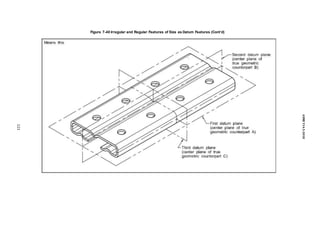
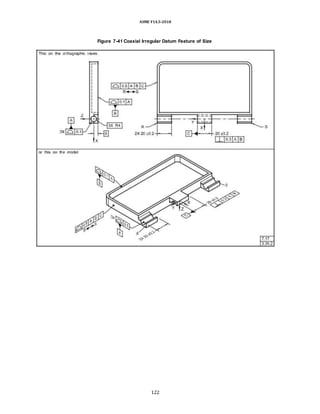
  • 205.
    ASME Y14.5-2018 10-52. Holeswithinapattern may be labeled with a letter and the pattern referenced below the feature control frames. In a model, the “2X” notation and associativity make clear which holes are toleranced. The same toler- ance zone relationships apply as for Figure 10-50. 10.5.4 Simultaneous Requirements Simultaneous requirements are applicable to positional tolerances as well as profile. 10.5.4.1 Simultaneous Requirement RMB. When multiple patterns of features of size are located relative to commondatum features not subject to size tolerances, or to commondatum features of size specified RMB, they are considered to be a single pattern. For example, in Figure 10-53, each pattern of features of size is located relative to common datum features not subject to size tolerances. Sinceall locatingdimensions are basic and all measurements are from a common datum reference frame, positional tolerance requirements for the part are considereda singlerequirement. The actual centers of all holes shall be within their respective toler-ance zones when measured from datums A, B, and C. NOTE: The explanation given in Figure 10-53, illustration (a) still applies when independent verification of pattern locations becomes necessary due to size or complexity of the part. 10.5.4.2 SimultaneousRequirement — at MMB or LMB. When multiple patterns of features are located rel- ative to common datum features in the same order of precedence with the same material boundary modifiers, there is an option whether the patterns are to be consid- ered as a single pattern or as having separate require- ments. If no note is added adjacent to the feature control frames, the patterns are to be treated as a single pattern. When it is desired to permit the patterns to be treated as separate patterns, a notationsuchas “SEP REQT” shall be placed adjacent to each feature control frame. See Figure 10-54. This allows the datum features of size to establish a separate datum reference frame for each pattern of features of size, as a group. These datum reference frames may translate and rotate independently of each other, resulting in an independent relationship between the patterns. This principle does not apply to the lower segments of composite feature control frames except as noted in subsection 7.19. 10.5.5 Multiple PositionalTolerances fora Pattern of Features of Size If different datum features, different datum feature modifiers, orthesame datum features in a different order of precedence are specified, this constitutes a different datum reference frame and design requirements. This is not to be specified using the composite positional tolerancing method. A separately specified tolerance, using a second single-segment feature control frame, is used, includingapplicable datum features, as an indepen- dent requirement. See Figure 10-55. 10.6 COAXIAL FEATURE CONTROLS The amount of permissible variation from coaxiality may be expressedby a variety of means, including a posi- tional tolerance, a runout tolerance, or a profile of a surface tolerance. 10.6.1 Selection of Coaxial Feature Controls Selection of the proper control depends on the func- tional requirements of the design. (a) When the axis or surface of features must be controlled and the use of the RFS, MMC, or LMC material condition is applicable, positional tolerancing is recom- mended. See para. 10.6.2.1. (b) When the surface of a feature must be controlled relative to the datum axis, runout tolerancing is recom- mended. See para. 10.6.3 and subsection 12.2. (c) When itis desiredto achievea combinedcontrol of size, form, orientation, and location of a feature within the stated tolerance, profiletolerancing is recommended. See paras. 10.6.5 and 11.4.2. 10.6.2 Positional Tolerance Control When the surfaces of revolutionare cylindrical and the control of the axes can be applied on a material condition basis, positional tolerancing should be used. 10.6.2.1 Coaxial Relationships. A coaxial relationship may be controlled by specifying a positional tolerance at MMC. See Figure 10-56. A coaxial relationship may also be controlled by specifying a positional tolerance RFS (as in Figure 10-57) or at LMC (as in Figure 10-18). The datum feature may be specified on an MMB, LMB, or RMB basis, depending on the design requirements. In Figure 10-56, the datum feature is specified on an MMB basis. In such cases, any departure of the datum feature from MMB may result in an additional displacement between its axis and the axis of the considered feature. See the conditions shown in Figure 10-56. When two or more features are coaxially related to such a datum, e.g., a shaft with several diameters, the considered features are displaced as a group relative to the datum feature, as explained in para. 10.5.3.2 for a pattern of features. 10.6.2.2 Coaxial Features Controlled Within Limits of Size. When it is necessary to control coaxiality of related features within their limits of size, a zero positional toler- ance at MMC may be specified. The datum feature is normally specified on an MMB basis. See Figure 10-56, illustration (b). The tolerance establishes coaxial bound- aries of perfect form. Variations in coaxiality between the features are permitted only where the features depart from their MMC sizes toward LMC. See Figure 10-56 187
  • 206.
    ASME Y14.5-2018 for possibledisplacements. See also paras. 5.8.4 and 6.3.23 for use of the “CF” symbol. 10.6.2.3 Coaxial Features Without DatumReferences. A coaxial relationship may be controlled by specifying a positional tolerance without datum references, as shown in Figure 10-58. This method allows specific control of feature-to-feature coaxiality. When features are specified with different sizes, a single feature control frame, supple-mented by a notation, such as “2X,” shall be used. A posi-tional tolerance specification with no datum reference creates a relationship between the toleranced features but implies no relationship to any other features. The toleranced features may be identified as a single datum feature, which may then be referenced in the feature control frames of other features, as needed. 10.6.3 Runout Tolerance Control For information on controlling surfaces of revolution, suchas cylinders andcones, relativeto an axis of rotation with a runout tolerance, see subsection 12.2. 10.6.4 Controlling Features With Positional Tolerances In Figure 10-57, illustration (a), the axis of the controlled feature’s unrelated AME has been displaced 0.2 to the left, relative to the axis of datum feature A, and 0.5 material has been removed from the right side of the feature’s surface. In Figure 10-57, illustration(b), the axis of the controlled feature’s unrelated AME has also been displaced 0.2 to the left, relative to the axis of datum feature A, while0.25material has been removed from the upper side of the feature’s surface and 0.25 material has been removed from the lower side of the feature’s surface. Since the size of the unrelated AME of the controlled features in Figure 10-57 is 25 diameter, the controlled features remain within accept-able limits of size. For coaxial positional tolerance, the location of the axis of the feature’s unrelated AME is controlled relative to the axis of the datum feature. When checked for a coaxial positional tolerance relation-ship, the items depicted in Figure 10-57 are acceptable. 10.6.5 Profile of a Surface Tolerance Control For information on controlling the coaxiality of a surfaceof revolutionrelative to a datum axis with profile of a surface tolerance, see para. 11.4.2. 10.7 TOLERANCING FOR SYMMETRICAL RELATIONSHIPS Symmetrical relationships may be controlled using either positional or profile tolerances. However, these two tolerancecontrols establishsignificantlydifferent re- quirements. Positional tolerancing for symmetrical rela- tionships establishes a requirement where the center plane of the unrelated AME of one or more features is congruent with a datum axis orcenter planewithinspeci- fied limits. The tolerance value may be specified applicable at MMC, LMC, or RFS and the datum feature references at MMB, LMB, or RMB. Profile tolerancing is explained in Section 11. 10.7.1 Positional Tolerancing at MMC A symmetrical relationshipmay becontrolledby speci- fying a positional tolerance at MMC as in Figure 10-59. The explanations given in paras. 10.4.5.1(a) and 10.4.5.1(b) apply to the considered feature. The datum feature may be specifiedonanMMB, LMB, or RMB basis, depending on the design requirements. 10.7.1.1 Zero Positional Tolerancing at MMC for Symmetrical Relationships. When it is necessary to control the symmetrical relationship of related features within their limits of size, a zero positional tolerance at MMCis specified. Thetoleranceestablishes symme-trical boundaries of perfect form. Variations in position between the features are permitted only when the features depart from their MMC sizes toward LMC. This application is the same as that shown in Figure 10-56, illustration (b) except that it applies the tolerance to a center plane location. 10.7.1.2 Positional Tolerancing RFS. Some designs may require a control of the symmetrical relationship between features to apply regardless of their actual sizes. In suchcases, thespecifiedpositional toleranceis applied RFS and the datum reference applied RMB. See Figure 10- 60. 188
  • 207.
    ASME Y14.5-2018 Figure 10-1Identifying Basic Dimensions 189
  • 208.
    ASME Y14.5-2018 Figure 10-2Positional Tolerancing With Datum References 190
  • 209.
    ASME Y14.5-2018 Figure 10-3Positional Tolerancing Relative to Planar Datum Feature Surfaces 191
  • 210.
    ASME Y14.5-2018 Figure 10-4Positional Tolerancing at MMC Relative to Datum Feature Center Planes Figure 10-5 RFS Applicable to a Feature Tolerance and RMB Applied to a Datum Feature Reference 192
  • 211.
    ASME Y14.5-2018 Figure 10-6Possible AxisInterpretation Error Figure 10-7 Boundary for Surface of a Hole at MMC 193
  • 212.
    ASME Y14.5-2018 Figure 10-8Surface Interpretation for Position Tolerance at MMC Figure 10-9 Axis Interpretation for Position Tolerance at MMC 194
  • 213.
    ASME Y14.5-2018 Figure 10-10Increase in Positional Tolerance Where Hole Is Not at MMC Figure 10-11 Positional Tolerancing at MMC 195
  • 214.
    ASME Y14.5-2018 Figure 10-12Zero Positional Tolerancing at MMC Figure 10-13 Increase in Positional Tolerance Where Hole Is Not at LMC 196
  • 215.
    ASME Y14.5-2018 Figure 10-14LMC Applied to Boss and Hole 197
  • 216.
    ASME Y14.5-2018 Figure 10-15Zero Tolerance at LMC Applied to Boss and Hole 198
  • 217.
    ASME Y14.5-2018 Figure 10-16LMC Applied to a Single Feature 199
  • 218.
    ASME Y14.5-2018 Figure 10-17LMC Applied to Pattern of Slots Figure 10-18 Datum Feature at LMB 200
  • 219.
    ASME Y14.5-2018 Figure 10-19Datum Feature Referenced at MMB 201
  • 220.
    ASME Y14.5-2018 Figure 10-20Interference Diagram, Fastener and Hole Figure 10-21 Basis for Projected Tolerance Zone Figure 10-22 Projected Tolerance Zone Specified 202
  • 221.
    ASME Y14.5-2018 Figure 10-23Projected Tolerance Zone Indicated With Chain Line Figure 10-24 Projected Tolerance Zone Applied for Studs or Dowel Pins Figure 10-25 Same Positional Tolerance for Holes and Counterbores, Same Datum References 203
  • 222.
    ASME Y14.5-2018 Figure 10-26Different Positional Tolerances for Holes and Counterbores, Same Datum References Figure 10-27 Positional Tolerances for Holes and Counterbores, Different Datum References 204
  • 223.
    ASME Y14.5-2018 Figure 10-28Different Positional Tolerance at Each End of a Long Hole Figure 10-29 Bidirectional Positional Tolerancing, Rectangular Coordinate Method 205
  • 224.
    ASME Y14.5-2018 Figure 10-30Bidirectional Positional Tolerancing, Polar Coordinate Method Figure 10-31 Positional Tolerancing of Tabs 206
  • 225.
    ASME Y14.5-2018 Figure 10-32Positional Tolerancing of Slots Figure 10-33 Virtual Condition for Surfaces of Slot at MMC Figure 10-34 Tolerance Zone for Center Plane of Slot at MMC 207
  • 226.
    ASME Y14.5-2018 Figure 10-35Positional Tolerancing, Boundary Concept 208
  • 227.
    ASME Y14.5-2018 Figure 10-35Positional Tolerancing, Boundary Concept (Cont’d) 209
  • 228.
    ASME Y14.5-2018 Figure 10-36Spherical Feature Located by Positional Tolerancing 210
  • 229.
    ASME Y14.5-2018 Figure 10-37Nonparallel Holes Including Those Not Normal to the Surface 211
  • 230.
    ASME Y14.5-2018 Figure 10-38Multiple Patterns of Features 212
  • 231.
    ASME Y14.5-2018 Figure 10-38Multiple Patterns of Features (Cont’d) 213
  • 232.
    ASME Y14.5-2018 Figure 10-39Hole Patterns Located by Composite Positional Tolerancing 214
  • 233.
    ASME Y14.5-2018 Figure 10-39Hole Patterns Located by Composite Positional Tolerancing (Cont’d) 215
  • 234.
    ASME Y14.5-2018 Figure 10-39Hole Patterns Located by Composite Positional Tolerancing (Cont’d) 216
  • 235.
    ASME Y14.5-2018 Figure 10-39Hole Patterns Located by Composite Positional Tolerancing (Cont’d) 217
  • 236.
    ASME Y14.5-2018 Figure 10-40Hole Patterns of Figure 10-38 With Secondary Datums in Feature-Relating Segments of Composite Feature Control Frames 218
  • 237.
    ASME Y14.5-2018 Figure 10-41Composite Positional Tolerancing of a Circular Pattern of Features 219
  • 238.
    ASME Y14.5-2018 Figure 10-42Radial Hole Pattern Located by Composite Positional Tolerancing — Repeated Primary Datum Reference 220
  • 239.
    ASME Y14.5-2018 Figure 10-42Radial Hole Pattern Located by Composite Positional Tolerancing — Repeated Primary Datum Reference (Cont’d) 221
  • 240.
    ASME Y14.5-2018 Figure 10-43Radial Hole PatternLocated by Composite Positional Tolerancing — Repeated All Datum References 222
  • 241.
    ASME Y14.5-2018 Figure 10-44Orientation Relative to Three Datum Planes 223
  • 242.
    ASME Y14.5-2018 Figure 10-45Positional Tolerancing for Coaxial Holes of Same Size, Partial (Parallelism) Refinement of Feature-Relating Axis Relative to Datums A and B With Further Refinement of Parallelism to Datum A 224
  • 243.
    ASME Y14.5-2018 Figure 10-45Positional Tolerancing for Coaxial Holes of Same Size, Partial (Parallelism) Refinement of Feature- Relating Axis Relative to Datums A and B With Further Refinement of Parallelism to Datum A (Cont’d) 225
  • 244.
    ASME Y14.5-2018 Figure 10-46Three-Segment Composite Tolerance 226
  • 245.
    ASME Y14.5-2018 Figure 10-47Multiple Single-Segment Feature Control Frames With Secondary Datum in Lower Feature Control Frame 227
  • 246.
    ASME Y14.5-2018 Figure 10-47Multiple Single-Segment Feature Control Frames With Secondary Datum in Lower Feature Control Frame (Cont’d) 228
  • 247.
    ASME Y14.5-2018 Figure 10-48Positional Tolerancing With Multiple Single-Segment Feature Control Frames 229
  • 248.
    ASME Y14.5-2018 Figure 10-49Radial Hole PatternLocated by Multiple Single-Segment Feature Control Frames 230
  • 249.
    ASME Y14.5-2018 Figure 10-50Positional Tolerancing for Coaxial Holes of Same Size 231
  • 250.
    ASME Y14.5-2018 Figure 10-51Positional Tolerancing for Coaxial Holes of Same Size, Partial (Parallelism) Refinement of Feature of Feature-Relating Axis Figure 10-52 Positional Tolerancing for Multiple Features of More Than One Size 232
  • 251.
    ASME Y14.5-2018 Figure 10-53Multiple Patterns of Features, Simultaneous Requirement 233
  • 252.
    ASME Y14.5-2018 Figure 10-53Multiple Patterns of Features, Simultaneous Requirement (Cont’d) 234
  • 253.
    ASME Y14.5-2018 Figure 10-54Multiple Patterns of Features, Separate Requirements 235
  • 254.
    ASME Y14.5-2018 Figure 10-55Multiple Positional Tolerancing for a Pattern of Features 236
  • 255.
    ASME Y14.5-2018 Figure 10-56Positional Tolerancing for Coaxiality 237
  • 256.
    ASME Y14.5-2018 Figure 10-57Feature Controlled With Positional Tolerance RFS and Datum Referenced RMB for Coaxiality Figure 10-58 Two Datum Features, Single Datum Axis 238
  • 257.
    ASME Y14.5-2018 Figure 10-59Positional Tolerancing at MMC for SymmetricalFeatures Figure 10-60 Positional Tolerancing RFS for Symmetrical Features 239
  • 258.
    ASME Y14.5-2018 Section 11 Tolerancesof Profile 11.1 GENERAL This Section establishes the principles and methods of dimensioning and tolerancing to control the profile of various features. 11.2.2 Profile Specification The profile tolerance zone specifies a uniform or nonu- niform tolerance boundary along the true profile within which the surface or single elements of the surface shall lie. 11.2 PROFILE Profile tolerances are used to define a tolerance zone to control form or combinations of size, form, orientation, and location of a feature(s) relative to a true profile. Depending on the design requirements, profile tolerance zones may or may not be related to datums. A digital data file or an appropriate view on a drawing shall define the true profile. When used as a refinement of a size tolerance created by toleranced dimensions, the profile tolerance shall be contained within the size limits. For more infor-mation on design models, see ASME Y14.41. 11.2.1 Types of Profile Tolerances A profile tolerance may be applied to an entire part, multiple features, individual surfaces, or individual profiles taken at various cross sections through a part. The two types of profile tolerances, profile of a surface and profile of a line, are explained in paras. 11.2.1.1 and 11.2.1.2, respectively. 11.2.1.1 Profile of a Surface. The tolerance zone estab- lished by the profile of a surface tolerance is three-dimen- sional (a volume), extending along the length and width (or circumference) of the considered feature or features. See Figures 11-1 through 11-4. Profile of a surface may be applied to parts of any shape, including parts that have a constant cross section as in Figure 11-6, parts that have a surface of revolution as in Figure 11-19, and parts that have a profile tolerance applied all over as in Figure 11-9. Where the extent of the application of the profile tolerance is unclear, the “between” symbol should be used. 11.2.1.2 Profile of a Line. Amodel or a drawing view is created to showthe true profile. Profileof alinemay be applied to parts of any shape, including parts that have a varying cross section, such as the tapered wing of an aircraft, or a constant cross section, such as an extrusion, where it is not desired to have a tolerance zone include the entire surface of the feature as a single entity. See Figures 11-31 and 11-32. 11.2.3 Profile TolerancesasGeneral Requirements When the profile tolerance feature control frame is placed in a general note or the general tolerance block, the tolerance applies to all features UOS. 11.3 TOLERANCE ZONE BOUNDARIES Uniform, bilateral, unequally disposed, or nonuniform tolerance zones can be applied to profile tolerances. UOS, profile tolerance zones are uniform and centered on the true profile. The actual surface or line element shall be within the specified tolerance zone. Since the surface may lie anywhere within the profile boundary, the actual part contour could have abrupt surface variations. If this is undesirable, the drawing shall indicate the design requirements, such as rate of change and/or blend re-quirements. When a profile tolerance encompasses a sharp corner, the tolerance zone extends to the intersec-tion of the boundary lines. See Figure 11-5. Since the inter-secting surfaces may lie anywhere within the converging zone, the actual part contour could be rounded.If this is undesirable,the drawing shall indicate the design require-ments, such as by specifying the maximum radius. 11.3.1 Uniform Tolerance Zone Profile tolerances apply normal (perpendicular) to the true profileat all points alongthe profile. The boundaries of the tolerance zone follow the geometric shape of the true profile. See Figure 11-6. 11.3.1.1 Bilateral Profile Tolerance Zone. The toler-ance zone may be divided bilaterally to both sides of the true profile. When an equally disposed bilateral toler-ance is intended, it is necessary to show the feature control frame with a leader directed to the surface or an extension line of the surface, but not to the basic dimension. See Figures 11-1 and 11-7. 11.3.1.2 Unilateral and Unequally Disposed Profile Tolerance. Unilateral and unequally disposed profile tolerances are indicated with an “unequally disposed” 240
  • 259.
    ASME Y14.5-2018 profile symbolplaced in the feature control frame. See Figures 11-2 through 11-4. The “unequally disposed” symbol is placed in the feature control frame following the tolerance value. Asecondvalueis added followingthe “unequally disposed” symbol to indicate the tolerance in the direction that would allow additional material to be added to the true profile. (a) Unilateral Tolerance in the Direction That Adds Material. When a unilateral profile tolerance is 0.3 and applies from the true profile in the direction that adds material, the tolerance value would be 0.3 and the value following the “unequally disposed” symbol would be “0.3.” See Figure 11-3. (b) UnilateralTolerance in the Direction That Removes Material. When a unilateral profile tolerance is 0.3 and applies from the true profile in the direction that removes material, the feature control frame would read “0.3,” “unequally disposed” symbol, “0.” See Figure 11-2. (c) Unequally Disposed Tolerance. When an unequally disposedprofile tolerance is 0.3 and 0.1 applies from the true profile in the direction that adds material and 0.2 applies from the true profile in the direction that removes material, the feature control frame would read “0.3,” “unequally disposed” symbol, “0.1.” See Figure 11- 4. 11.3.1.3 All AroundSpecification. When a profile toler-ance applies all around the true profile of the designated features of the part (in the view in which it is specified), the“all around” symbol is placed on the leader from the feature control frame. See Figure 11-6. The “all around” symbol shall not be applied in an axonometric view on a two-dimensional drawing. When the require- ment is that the tolerance applies all over a part, the “all over” symbol may be used. See para. 11.3.1.5. 11.3.1.4 Defining the Extent of a Profile Tolerance. When portions of a surface or surfaces have different profile tolerances, the extent of each profile tolerance shall be indicated, e.g., by the use of reference letters to identify the extremities or limits of application for each requirement accompanied with the use of the “between” symbol with each profile tolerance. See Figure 11-8. Similarly, if some areas of the profile are controlled by a profile tolerance and other segments by directly toleranced dimensions, the extent of the profile tolerance shall be indicated. See Figure 11-9. 11.3.1.5 All Over Specification. A profile tolerance may be appliedall overthe three-dimensional profile of a part UOS. It shall beapplied in one of the following ways: (a) placethe “all over” symbol ontheleader from the feature control frameas shownin Figure 11-10 (b) placethe term “ALL OVER” beneath the feature control frame (c) placethe profiletolerance requirement in the general tolerance block orgeneral notes 11.3.2 Nonuniform Tolerance Zone A nonuniform tolerance zone may be indicated by stating the beginning and ending widths of a profile toler- ance zone. The profile tolerance width is a proportional variation from one value to another between two specified locations on the considered feature. The values are related to the specified locations on the considered feature by the letters separated by an arrow (e.g., in Figure 11-11, the valueof the tolerance is 0.1at locationS and 0.3 at locationT). Theterm “NONUNIFORM” replaces the tolerance value within the feature control frame when the profile bound-aries are established by model data. See Figures 11-11 through 11-14. 11.3.2.1 Drawing Indication. For the nonuniform toler- ance zone, the leader line from the feature control frame is directed to the true profile. See Figures 11-11 through 11- 13.When individual segments of a profile are toleranced, the extent of each profile segment shall be indicated, e.g., by use of reference letters to identify the extremities or limits of each segment. See Figures 11-12 and 11-13. 11.3.2.2 Zones to Smooth the Transitions. Figure 11-8 illustrates abrupt transitions that occur at the transition points B and C when different profile tolerances are speci-fied on adjoining segments of a feature. A nonuniform profiletolerancezone may be used to smooth the transi-tion areas. See Figure 11-14. 11.3.2.3 Alternative Practice. The boundaries of a “NONUNIFORM” profile tolerance may be defined by basic dimensions on a drawing with phantom lines to indi-cate the tolerance zone. 11.4 PROFILE APPLICATIONS Applications of profile tolerancing are described in paras. 11.4.1 through 11.4.4. 11.4.1 Profile Tolerance for Plane Surfaces Profile tolerancing may be used to control the form, orientation, and location of plane surfaces. In Figure 11- 15, profile of a surface is used to control a plane surface inclined to two datum features. In this example, the tolerance zone is constrained in all three translational degrees of freedom and two rotational degrees of freedom relative to the referenced datum features. 11.4.1.1 Coplanarity. A profile of a surface tolerance may be used to control the mutual orientation and location of two or more surfaces. For basic surfaces that are coplanar (parallel with zero offset), a control is provided similar to that achieved by a flatness tolerance applied to a single plane surface. As shown in Figure 11-16, the profile of a surface tolerance establishes two tolerance zones, parallel with zero offset, within which the considered surfaces shall lie. As in the case of flatness, no datum 241
  • 260.
    ASME Y14.5-2018 reference isstated. When two or more surfaces are involved, it may be desirable to identify which specific surface(s) are to be used as the datum feature(s). Datum feature symbols are applied to these surfaces with the appropriate tolerancefor their relationshipto each other. The datum reference letters are added to the feature control frame for the features being controlled. See Figure 11-17. 11.4.1.2 Offset Surfaces. A profile of a surface toler- ance should be used when it is desired to control two or more surfaces offset to each other. The feature control frame is associated with the applicable surfaces. The desiredoffset is defined by a basic dimension. See Figure 11-18. 11.4.4 Application on Continuous Features Profiletolerances may be appliedwith the “CF” symbol to indicate that an interrupted surface is contained within one tolerance zone as if the features create a continuous feature. See Figure 11-23. 11.5 MATERIAL CONDITION AND BOUNDARY CONDITION MODIFIERS AS RELATED TO PROFILE CONTROLS Since profile control is used primarily as a surface control, MMC and LMC modifiers shall not be applied to the tolerance value. MMB and LMB applications (modi- fiers) are only permissible on the datum feature refer- ences. See Figures 7-34 through 7-37, 7-46, and 10-55. 11.4.2 Conical Surfaces A profiletoleranceshouldbe specifiedto control a conical surfaceinoneof the followingways: (a) as an independent control of form, as in Figure 11- 19 (b) as combinations of size, form, orientation, and loca-tion, as inFigure 11-20 Figure 11-19 depicts a conical feature controlled by a composite profile of a surface tolerance where form of the surface is a refinement of size. In Figure 11-20, the same control is applied but it is referenced to a datum axis. In each case, the feature shall be within size limits and the tolerance zone constrained in translation and rotation to the referenced datum feature. 11.4.3 Profile on Nonsize Datum Features When the toleranced feature is or includes the refer- enced datum feature, the profile tolerance is affected as described in paras. 11.4.3.1 and 11.4.3.2. 11.4.3.1 When the Toleranced Feature Is a Nonsize Datum Feature. At the datum feature, the distance to the true profile is zero. Since the datum feature may not pass through the datum plane, the tolerance on the considered feature shall be as follows: (a) For an equal bilateral profile tolerance, half of the profile tolerance is available for variation of the datum feature. See Figure 11-21. (b) For a unilateral profiletolerance, the tolerance may only beappliedinto the material of the feature. 11.4.3.2 When the Toleranced Feature Includes Datum Targets. At the datum target, the contact point(s) and the true profile are coincident. The entire profile tolerance is available to the feature except at the datum target contact points. See Figure 11-22. 11.6 COMPOSITE PROFILE A composite profile tolerance may be used when design requirements permit a profile-locating tolerance zone to be larger than the profile feature tolerance zone that controls other characteristics of the feature. 11.6.1 Composite Profile Tolerancing for a Single Feature This method provides a composite application of profile tolerancing for location of a profiled feature as well as the requirement of various combinations of size, form, and orientation of the feature within the larger profile-locating tolerance zone. Requirements are annotated by the use of a composite profile feature control frame similar to that shown in Figure 6-27, illustration (a). Each complete hori-zontal segment of a composite profile feature control frame constitutes a separately verifiable component of multiple interrelated requirements. The profile symbol is entered once and is applicableto all horizontal segments. The upper segment is referred to as the “profile-locating control.” It specifies the larger profile tolerance of the profiled feature and is constrained in translation and rotation to the referenced datum features. Applicable datums are specified in a desired order of precedence. The lower segments are referred to as “profile feature controls” and are constrained only in rota-tion relative to the referenced datum features. Each segment specifies a progressively smaller profile toler-ance than the preceding segment. 11.6.1.1 Explanation of Composite Profile Tolerance for a Single Feature. Figure 11-24 contains an irregular shaped feature with a composite profile tolerance applied. The toleranced feature is located from specified datums by basic dimensions. Datum feature references in the upper segment of a composite profile feature control frame serve to constrain translation and rotation of the profile-locating tolerance zone relative to referenced datums. See Figure 11- 24. Datum features referenced in the 242
  • 261.
    ASME Y14.5-2018 lower segmentconstrain the rotation of the profile toler- ance zone relative to the referenced datums. See Figure 11-25. The tolerance values represent the distance between two boundaries disposed about the true profile with respect to the applicable datums. The actual surface of the controlled feature shall be within both the profile- locating tolerance zone and the profile feature tolerance zone. 11.6.1.2 Composite Profile Tolerancing for Multiple Features(Feature Pattern Location). When design re-quirements for a pattern of features permit a profile FRTZF to be located and oriented within limits imposedonitby a profilePLTZF, composite profile toler- ancing is used. 11 . 6 . 1 . 3 Explanation of Composite Profile Tolerancing for Multiple Features. This paragraph provides a composite application of profile tolerancing for the locationandorientation (translation and rotation) of a feature pattern (PLTZF) as well as the interrelation (size, form, orientation, and location) of profiled features within these patterns (FRTZF). Requirements are anno- tated by the use of a compositefeaturecontrol frame. The profile symbol is entered once and is applicable to each horizontal segment. Each horizontal segment in the feature control frame should be verified separately. See Figure 11-26. (a) PLTZF. When composite controls are used, the uppermost segment is the profile pattern-locating control. ThePLTZF is constrained in rotation and transla- tionrelative to the specifieddatums. ThePLTZF specifies the larger profile tolerance for the location of the pattern of profiledfeatures as a group. Applicable datum features are referenced in the desired order of precedence and serve to relate the PLTZF to the datum reference frame. See Figure 11-26, illustration (a) and Figure 11-27, illustration (a). (b) FRTZF. Each of the lower segments is referred to as a “profile feature-relating control.” They govern the smaller tolerance for size, form, orientation, and location within the pattern of features and may include constraints on rotation of an FRTZF to specified datums. Basic location dimensions used to relate the PLTZF to specified datums are not applicable to the location of any FRTZF. The toler-anced feature shall be within both the PLTZF and the FRTZF. See Figure 11-26, illustration (b) and Figure 11-27, illustration (b). In some instances, portions of the FRTZF may lie outside of the PLTZF and are not usable. (1) When datum feature references are not specified in a lower segment of the composite feature control frame, the FRTZF is free to rotate and translate. (2) When datum feature references are specified in a lower segment, the FRTZF is constrained only in rotation relative to the datum reference frame. See Figure 11-26, illustration (c) and Figure 11-27, illustration (b). (3) When datum feature references are specified, one or more of the datum feature references specified in the upper segment of the frame are repeated, as appli- cable, and in the same order of precedence, to constrain rotation of the FRTZF. In some instances, the repeated datum feature references may not constrain any degrees of freedom; however, they are necessary to main-tain the identical datum reference frame. (c) Where the design requires different datums, different datum modifiers, or the same datums in a different order of precedence, multiple single-segment feature control frames shall be specified, because this constitutes multiple datum reference frames. This shall not be specified using the composite profile tolerancing method. 11.6.1.4 Primary Datum Feature Repeated in Lower Segment(s). As can be seen from the sectional view of the tolerance zones in Figure 11-26,illustration (d), since datum feature A has been repeated in the lower segment of the composite feature control frame, the profile zones of both the PLTZF and the FRTZF are perpen-dicular to datum plane A and, therefore, parallel to each other. See also Figure 11- 26,illustration (c). The profile of the actual feature may vary obliquely (out of perpendicu-larity) only within the confines of the respective smaller feature-relating tolerance zones (FRTZF). 11.6.1.5 Primary and Secondary Datum Features Repeated in Lower Segment(s). Figure 11-27 repeats the feature patterns of Figure 11-26. In Figure 11-27, the lower segment of the composite feature control frame repeats datum feature references A and B. Figure 11-27, illustrations (a) and (b) show that the toler-ance zones of the FRTZF may be translated from the true locations (as a group), as governed by the tolerance zones of the PLTZF, constrained in rotation by datum planes A and B. Figure 11-27, illustration (a) shows that the actual surfaces of the features reside within both tolerance zones of the FRTZF and the PLTZF. 11.6.2 Composite Profile With Independent Size/ Form Control When the design requires that the size and form of one or more features be controlled independently of the composite profile tolerance, a separate single-segment profilefeature control frame is usedfollowed by the term “INDIVIDUALLY.” Thesize/form tolerancespecified shall be less than the tolerance in the lower segment (FRTZF) of the composite profile control. See Figure 11-28. 243
  • 262.
    ASME Y14.5-2018 11.7 MULTIPLESINGLE-SEGMENT PROFILE TOLERANCING For multiple single-segment profile tolerancing, datum feature references are interpreted the same as for multiple single-segment positional tolerancing. See para. 10.5.2. 11.8 COMBINED CONTROLS Profile tolerancing may be combined with other types of geometric tolerancing. Profile tolerancing may be combined with positional tolerancing when it is necessary to control the boundary of a noncylindrical feature. See Figure 11-29. In this example, the basic dimensions and the profile tolerance establish a tolerance zone to control the shape and size of the feature. Additionally, the positional tolerance establishes a theoretical boundary offset from the applicable profile boundary. For an internal feature, the boundary equals the MMC size of the profile minus the positional tolerance, and the entire feature surface shall lie outside the boundary. For an external feature, the boundary equals the MMC size of the profile plus the positional tolerance, and the entire feature surface shall be within the boundary.The term “BOUNDARY” is optional and may be placed beneath the positional feature control frame. Figure 11-30 illus-trates a surface that has a profile tolerance refined by a runout tolerance. The entire surface shall be within the profile tolerance, and the circular elements shall be within the specified runout tolerance. to control the perpendicularity of radial line elements in a surface. Figure 11-34 illustrates the profile of a line being used to control the parallelism of radial line elements in a surface. A customized datum reference frame is used to constrain only two rotational degrees of freedom relative to the primary datum A plane and two translational degrees of freedom relative to the secondary datum axis B. The translational degree of freedom from the primary datum is not constrained. 11.10 DYNAMIC PROFILE TOLERANCE MODIFIER By default, a profile tolerance zone follows the true profileof the considered feature. A profile tolerance zone is static and controls both the form and size of the considered feature unless the dynamic profile toler-ance modifier is applied. When it is desirable to refine the form but not the size of a considered feature that is controlled by a profile tolerance, the dynamic profile toler-ance modifier, Δ, may be applied to a refining profile toler-ance. The function of the dynamic profile is to allow form to be controlled independent of size. When the dynamic profile tolerance modifier is applied, the zone is permitted to progress (expand or contract normal to the true profile) whilemaintaining the specified constant width (distance between the boundaries). This retains the form control while relaxing the size control. The actual feature shall simultaneously be within the dynamic profile tolerance zone and any other applicable tolerance zone. 11.9 PROFILE OF A LINE AS A REFINEMENT When it is a requirement to control individual line elements of a surface, a profileof a linetolerance is speci- fied. See Figures 11-31 through 11-34. This permits control of individual lineelements of thesurface indepen- dently in relation to the datum reference frame and does not limit the total surface to an encompassing zone. Figure 11-31 illustrates a surface that has a profile of a surface tolerance refined by a profile of a line tolerance. The surface shall be within the profile of a surface tolerance, and each straight line element of the surface shall also be parallel to the datum planes established by datum features A and B within the tolerance specified. A customized datum reference frame is used to release the profile of a line tolerance from the translational constraints of the datum reference frame. Figure 11-32 illustrates a part with a profile of a line tolerance where size is controlled by a separate tolerance. Line elements of the surface along the profile shall be within the profile tolerance zone and within a size-limiting zone. In this application, the profile of a line is applied on one surface of a width feature of size and the datum feature references can only constrain the rotational degrees of freedom for the profile of a line tolerance. Figure 11-33 illustrates the profile of a line being used 11.10.1 Dynamic Profile Tolerance Controlling Form When the dynamic tolerance modifier is applied to a lower segment of a composite tolerance without datum feature references, the tolerance zone controls the form but not the sizeof the feature and it uniformly progresses (expands or contracts) normal to the true profile, UOS. See Figure 11-35. The 2 profile tolerance zone is constrained in translation and rotation relative to the datum reference frame established by datum features A, B, and C. In Figure 11-35, the 0.4 dynamic profile zone is an equal bilateral about the basic profileof the toleranced feature. The 0.4 dynamic profile tolerance zone may rotate and translate relative to the datum reference frame. In addition, the tolerance zone may expand or contract while maintaining the form of the feature within the 0.4 tolerance zone, releasing the size of the feature to uniformly progress within the upper segment of the composite profile tolerance. The actual feature shall simultaneously be within both tolerance zones. 244
  • 263.
    ASME Y14.5-2018 11.10.2 DynamicProfile Tolerance Controlling Form and Orientation When the dynamic tolerance modifier is applied to a lower segment of a composite tolerance and includes datum feature references, the tolerance zone controls the form and orientation but not the size of the feature. See Figure 11-36. The 2 profile tolerance zone is constrained in translation and rotation relative to the datum reference frame established by datum features A, B, and C. The 0.4 dynamic profile tolerance zone in the lower segment of the composite tolerance is constrained in rotation but not translation relative to the datum refer- ence frame. This tolerance zone may expand or contract while maintaining the form and orientation of the feature within the 0.4 tolerance zone, allowing the size of the feature to uniformly progress. The actual feature shall simultaneously be within both tolerance zones. 11.10.3 Dynamic Profile Tolerance Applied to the Lower Segment of Multiple Single- Segment Feature Control Frames When the dynamic profiletolerancemodifieris applied in a segment of multiple single-segment feature control frames and includes datum feature references, the toler- ance zone is constrained in translation and rotation, but not size, as applicable. The tolerance zone controls the form and orientation of the feature. See Figure 11-37. The 2 profile tolerance zone is constrained in translation and rotation relative to the datum reference frame estab- lished by datum features A, B, and C. The 0.4 dynamic profile tolerance zone in the lower segment is constrained in translation and rotation relative to the datum reference frame. This tolerance zone may expand or contract while controlling the form, orientation, and location of the feature within the 0.4 tolerance zone, allowing the size of the feature to uniformly progress. The actual feature shall simultaneously be within both tolerance zones. NOTE: Multiple features are considered to be a single feature unless “INDIVIDUALLY” follows a separate single-segment profile feature control frame. 11.10.4 Dynamic Profile Tolerance Applied to a Surface of Revolution The dynamic profile tolerance may be applied to surfaces of revolution to maintain the shape of the consid-ered feature while allowing its size to vary. See Figure 11-38. The entire surfacebetween A and B shall be within the profile tolerance of 0.25, which is equally disposedaboutthe true profile. The 0.15 dynamic profile tolerance zone in the lower segment is constrained in translation and rota-tion relative to the datum reference frame. This tolerance zone may expand or contract while controlling the form, orientation, and location of the feature within the 0.15 tolerance zone, allowing the size of the feature to uniformly progress. The actual feature shall simulta-neously be within both tolerance zones. 245
  • 264.
    Figure 11-1 Profileof a Surface Application (Bilateral) 246 ASME Y14.5-2018
  • 265.
    Figure 11-2 Profileof a Surface Application (Unilaterally Inside) 247 ASME Y14.5-2018
  • 266.
    Figure 11-3 Profileof a Surface Application (Unilaterally Outside) 248 ASME Y14.5-2018
  • 267.
    Figure 11-4 Profileof a Surface Application (Unequally Disposed) 249 ASME Y14.5-2018
  • 268.
    Figure 11-5 Specifyingthe Profile of a Surface for Sharp Corners 250 ASME Y14.5-2018
  • 269.
    ASME Y14.5-2018 Figure 11-6Specifying Profile of a Surface All Around 251
  • 270.
    ASME Y14.5-2018 Figure 11-7Application of Profile of a Surface Tolerance to a Basic Contour 252
  • 271.
    ASME Y14.5-2018 Figure 11-8Specifying Different Profile Tolerances on Segments of a Profile 253
  • 272.
    ASME Y14.5-2018 Figure 11-9Specifying Profile of a Surface Between Points 254
  • 273.
    ASME Y14.5-2018 Figure 11-10Specifying Profile of a Surface All Over Figure 11-11 Nonuniform Profile Tolerance Zone 255
  • 274.
    ASME Y14.5-2018 Figure 11-12Nonuniform Profile Tolerance Zone With Multiple Segments 256
  • 275.
    Figure 11-13 NonuniformProfile Tolerance Zone With Zonesto Smooth Transitions 257 ASME Y14.5-2018
  • 276.
    Figure 11-14 NonuniformProfile Tolerance Zone Alternative Practice 258 ASME Y14.5-2018
  • 277.
    Figure 11-15 Specifyingthe Profile of a Surface for a Plane Surface 259 ASME Y14.5-2018
  • 278.
    ASME Y14.5-2018 Figure 11-16Specifying the Profile of a Surface for Coplanar Surfaces 260
  • 279.
    Figure 11-17 Specifyingthe Profile of a Surface for Coplanar Surfacesto a Datum Established by Two Surfaces 261 ASME Y14.5-2018
  • 280.
    ASME Y14.5-2018 Figure 11-18Specifying the Profile of a Surface for Stepped Surfaces Figure 11-19 Specifying the Profile of a Conical Feature 262
  • 281.
    Figure 11-20 ProfileTolerancing of a Conical Feature, Datum Related 263 ASME Y14.5-2018
  • 282.
    Figure 11-21 TheToleranced Feature Isa Referenced Datum Feature 264 ASME Y14.5-2018
  • 283.
    Figure 11-22 TheToleranced Feature IncludesReferenced Datum Targets 265 ASME Y14.5-2018
  • 284.
    Figure 11-23“ContinuousFeature” SymbolApplication in a Profile Tolerance 266 ASME Y14.5-2018
  • 285.
    ASME Y14.5-2018 Figure 11-24Composite Profile Tolerancing of an Irregular Feature 267
  • 286.
    ASME Y14.5-2018 Figure 11-25Composite Profile Tolerancing of a Feature 268
  • 287.
    ASME Y14.5-2018 Figure 11-26Pattern Located by Composite Profile Tolerancing — Repeated Primary Datum Feature Reference 269
  • 288.
    ASME Y14.5-2018 Figure 11-26Pattern Located by Composite Profile Tolerancing — Repeated Primary Datum Feature Reference (Cont’d) 270
  • 289.
    ASME Y14.5-2018 Figure 11-26Pattern Located by Composite Profile Tolerancing — Repeated Primary Datum Feature Reference (Cont’d) 271
  • 290.
    ASME Y14.5-2018 Figure 11-27Pattern Located by Composite Profile Tolerancing — Repeated Primary and Secondary Datum Feature References 272
  • 291.
    Figure 11-27 PatternLocated by Composite Profile Tolerancing — Repeated Primary and Secondary Datum Feature References (Cont’d) 273 ASME Y14.5-2018
  • 292.
    ASME Y14.5-2018 Figure 11-27Pattern Located by Composite Profile Tolerancing — Repeated Primary and Secondary Datum Feature References (Cont’d) 274
  • 293.
    Figure 11-28 IrregularShaped Feature With a Profile Size/Form Control and the Pattern Located by Composite Profile Tolerance 275 ASME Y14.5-2018
  • 294.
    Figure 11-29 MMCPrinciple Used With Profile Controls 276 ASME Y14.5-2018
  • 295.
    ASME Y14.5-2018 Figure 11-30Profile of a Surface of Revolution 277
  • 296.
    Figure 11-31 Specifyingthe Combined Profile of a Surface and a Line Tolerance 278 ASME Y14.5-2018
  • 297.
    Figure 11-31 Specifyingthe Combined Profile of a Surface and a Line Tolerance (Cont’d) 279 ASME Y14.5-2018
  • 298.
    Figure 11-32 Profileof a Line and Size Control 280 ASME Y14.5-2018
  • 299.
    ASME Y14.5-2018 Figure 11-33Specifying Perpendicularity for a Radial Element of a Surface 281
  • 300.
    Figure 11-34 ConstrainedDegree of Freedom Used With Profile of a Line 282 ASME Y14.5-2018
  • 301.
    Figure 11-35 CompositeProfile With Dynamic Profile to Control Form 283 ASME Y14.5-2018
  • 302.
    Figure 11-36 CompositeProfile With Dynamic Profile to Control Form and Constrain Rotational Degrees of Freedom 284 ASME Y14.5-2018
  • 303.
    Figure 11-37 Useof Dynamic Profile in a Two-Single-Segment Profile Tolerance 285 ASME Y14.5-2018
  • 304.
    ASME Y14.5-2018 Figure 11-38Dynamic Profile of a Surface of Revolution 286
  • 305.
    ASME Y14.5-2018 Section 12 Tolerancesof Runout 12.1 GENERAL This Section establishes the principles and methods of dimensioning and tolerancing to control runout of various geometrical shapes. 12.2 RUNOUT Circular runout and total runout are geometric toler- ances used to control applicable characteristics of surfaces of revolution relative to the datum axis RMB. 12.3 RUNOUT TOLERANCE The types of features controlled by runout tolerances include those surfaces constructed around a datum axis and those constructed at right angles to a datum axis. See Figure 12-1. When applied to a feature of size, runout tolerances may be greater than, equal to, or less than the size tolerance of the considered feature. 12.3.1 Datum Features for Runout Tolerances The datum axis for a runout tolerance should be estab- lished by a cylindrical datum feature of sufficient length, two or more cylindrical datum features having sufficient axial separation, or a cylindrical datum feature(s) in combination with a face at a right angle to the cylindrical feature(s). Features used as datum features for estab- lishing axes should be functional, such as mounting features that establishanaxis of rotation. When runout is applied on an assembly, the axis of rotation may not be a datum axis. See para. 12.6.8. 12.3.2 Degrees of Freedom Constrained The tolerance zone is constrained in translation and rotation relativeto the datum axis or axis of rotation. The tolerance zone shall contain all controlled elements for each considered feature within the specified runout tolerance. This may also include the datum features as a part of the runout tolerance control where so designated. 12.4 TYPES OF RUNOUT TOLERANCES There are two types of runout tolerances: circular runout and total runout. The type used is dependent on design requirements and manufacturing considera-tions. Circular runout is normally a less complex require- ment than total runout. Paragraphs 12.4.1 through 12.4.3 describe both types of runout and their resulting tolerance zones. Whena surfaceis controlled by a runout tolerance, intended interruptions of a surface, such as keyways or holes, do not affect the tolerance zone boundaries, and the extent of the boundaries is limited to where there is material. 12.4.1 Control of Circular Elements Circularrunout provides control of circularelements of a surface relative to the datum axis. A tolerance zone is created and applied independently to each circular cross section of the surface of the part. (a) When applied to cylindrical, conical, and curved surfaces constructed around a datum axis, circular runout controls the cumulative variations of form and coaxiality. See Figure 12-2. When a limited area of appli- cationis specified, thelocationof the area shall be dimen- sioned from and referenced to a datum reference frame. See para. 12.4.3 and Figure 12-2. (b) When applied to surfaces constructed at right angles to the datum axis, circularrunout controls circular variations (wobble) of a plane surface. See Figure 12-3. 12.4.1.1 Circular Runout Tolerance Zone for Nonplanar Features. When a circular runout tolerance is appliedto a surface of revolution, all cross sections on the surface are independent and each circular runout tolerance zone is bounded by two circles that are coaxial (constrained in translation) to the datum axis and lie in a plane(s) normal (constrained in rotation) to the datum axis. The distance between these circles is normal to the true geometry, and the circles are separated by a radial distance equal to the specified circular runout tolerance. See Figure 12-2. 12.4.1.2 Circular Runout Tolerance Zone for Planar Features. When a circular runout tolerance is applied to a planar surface perpendicular to the axis of rotation, all circular elements on the surface are independent and each circular runout tolerance zone is bounded by two circles of the same diameter that are centered onthe axis of rotation and axially separatedby a distance equal to the specified circular runout tolerance. See Figure 12-3. 287
  • 306.
    ASME Y14.5-2018 12.4.2 TotalRunout for Control of Surfaces Total runout provides control of all surfaceelements of the considered feature. The tolerance applies simulta- neously to all circularandprofile elements of the surface. (a) When applied to surfaces constructed around a datum axis, total runout controls cumulative variations suchas circularity, cylindricity, straightness, andlocation (coaxiality) of a cylindrical surface. See Figure 12-4. (b) When applied to surfaces constructed at right angles to the datum axis, total runout controls cumulative variations suchas flatness, straightness, and perpendicu- larity (to detect wobble) of a planar surface. See Figure 12-5. 12.4.2.1 Total Runout Tolerance Zone for Cylindrical Features. All surface elements shall be within a tolerance zone consisting of two coaxial cylinders with a radial sep-aration equal to the tolerance value specified. The toler-ance zone is constrained in translation (coaxial) to the datum axis. See Figure 12-4. 12.4.2.2 Total Runout Tolerance Zone for Planar Features. All surface elements shall be within a tolerance zone consisting of two parallel planes with a separation equal to the tolerance value specified. The tolerance zone is constrained in rotation (normal) to the datum axis. See Figure 12-5. 12.4.3 Runout Applied to a Portion of a Surface When a runout tolerance applies to a specific (partial) portion of a surface, a chain line may be drawn adjacent to the surfaceprofileon onesideof the datum axis for the desired length when shown in an orthographic view. Basic dimensions are used to define the location and extent of the portionindicated in this way. See Figure 12- 2. The “between” symbol method may also be used to indicate a limit of the specified runout control as an alternative to use of the chain line and basic dimensions defining the location and extent. 12.5 RUNOUT TOLERANCE AND SIZE Runout tolerance and size tolerance values are based on the design requirements, and there is no requirement that runout be larger or smaller than the size tolerance. Runout and size tolerances do have combined effects on size, form, orientation, and location of the toleranced feature. See Figure 12-6. Whichever tolerance is more restrictive (i.e., smaller), size or runout, establishes the tolerance of form. 12.5.1 Small Circular Runout Tolerance and Large Size Tolerance A small circular runout tolerance may be applied on a feature that has a large size tolerance. See Figure 12-7. The circular runout tolerance of 0.02 must be met at each cross section regardless of the size at that cross section. When the runout tolerance is met, it limits sizevariationat each cross section to be 0.04 diameter. The variation in diameter across the entire length of the part may be the full range permitted by the size tolerance, but at each cross section, it is limited to 0.04. The resulting surface could be tapered. 12.5.2 Small Total Runout Tolerance and Large Size Tolerance A small total runout tolerance may be applied on a feature that has a large size tolerance. See Figure 12-8. Thetotal runout tolerance of 0.02 must be met across the entire feature. Whenthe runout toleranceis met, it limits sizevariationacross the feature to be 0.04 diameter. This limits thesize variation on any produced part to no more than 0.04. However, any part may be produced at the maximum or the minimum size, or any size between, provided the size variation does not result in exceeding the total runout tolerance. 12.5.3 Large Runout Tolerance and Small Size Tolerance When a circular or total runout tolerance is larger than the size tolerance, the size tolerance controls variations insizeand form. The larger runout tolerance controls the orientation and coaxiality to the datum axis for a surface of revolution. See Figure 12-2. The larger runout tolerance controls the orientation for a planar surface at a right angle to the datum axis. 12.6 APPLICATION Themethods discussed in paras. 12.6.1 through 12.6.8 are used to specify arunout tolerance and datum features in various applications. The tolerance zones apply to the full extent of the considered feature surface. 12.6.1 Control of Diameters to Datum Axis When features to be controlled are diameters related to a datum axis, one or more of the diameters may be speci-fied as datum features to establish the datum axis, and each related surface is assigned a runout tolerance with respect to this datum axis. Figures 12-2 through 12- 5 illustrate the fundamental principle of relating features ina runout tolerance to a datum axis as estab-lished from a single cylindrical datum feature of sufficient length. Figure 12-2 incorporates the principle of circular runout tolerancing and illustrates the control of circular elements of a surface. Figure 12-4 incorporates the prin- ciple of total runout tolerancing and illustrates the control of an entire surface. 288
  • 307.
    ASME Y14.5-2018 12.6.2 CommonCylindrical Datum Features Figure 12-9 illustrates application of runout tolerances when two cylindrical datum features collectively establish a single datum axis to which the features are related. 12.6.3 Cylindrical and Planar Datum Features When features to be controlledare related to a cylinder and a planar surface at right angles to it, each related surface is assigned a runout tolerance with respect to the two datums. The datums are specified separately to indicate datum precedence. See Figure 12-10. 12.6.7 Runout Tolerance Applied to a Tangent Plane Runout tolerance may be applied to a tangent plane for one or more coplanar feature faces that are perpendicular to an axis of rotation. UOS, for a runout tolerance applied with the tangent plane requirement, the extent of the tangent plane is circular with a radius equal to the distance from the axis of rotation to the furthest point on the surface(s) toleranced. See Figures 12-13 and 12-14. Therequirements may also bespecified using profile tolerances. See Figure 12-15. 12.6.4 Control of Individual Datum Feature Surfaces It may be necessary to control individual datum feature surface variations with respect to flatness, circularity, parallelism, straightness, or cylindricity. When such control is required, the appropriate tolerance shall be specified. See Figures 12-11 and 12-12 for examples applying cylindricity and flatness to the datum features. 12.6.5 Control of Runout to a Datum Feature(s) Runout tolerance may be applied to a datum feature(s) and related to the datum axis derived from that datum feature(s). See Figure 12-11. 12.6.6 Relationship of Features Based on Referenced Datums Runout tolerances are referenced to appropriate datum features to achieve the desired relationship between the features and the referenced datums. More than one datum axis may be specified to which runout tolerances are refer- enced. See Figure 12-11, where the runout tolerance of the hole is related to datum E rather than the axis C-D. 12.6.8 Runout Tolerance Application on an Assembly When specified at an assembly level, runout require- ments may reference datum features that locate the assembly. The runout tolerance is relative to the axis of rotation while the axis is constrained at the basic angle relative to the datum reference frame, and the assembly is constrained in translation and rotation to the datum reference frame. See Figure 12-16, where the datum features do not establish the location of the axis of rotation, but they do constrain the orientation of the axis to ensure that the toleranced feature is within the specified runout tolerance of the assembly. Additionally, the axis of rotation may be labeled. 12.7 SPECIFICATION In orthographic views, multipleleaders may be used to direct a feature control frame to two or more surfaces having a common runout tolerance. Surfaces may be speci-fied individually or in groups without affecting the runout tolerance. See Figure 12-11. 289
  • 308.
    ASME Y14.5-2018 Figure 12-1Features Applicable to Runout Tolerancing 290
  • 309.
    ASME Y14.5-2018 Figure 12-2Specifying Circular Runout — Small Size Tolerance and Large Runout Tolerance 291
  • 310.
    ASME Y14.5-2018 Figure 12-3Specifying Circular Runout Relative to a Datum Axis 292
  • 311.
    Figure 12-4 TotalRunout Applied on a Cylinder and Referenced to a Datum Axis 293 ASME Y14.5-2018
  • 312.
    ASME Y14.5-2018 Figure 12-5Total Runout Applied on a Face Surface and Referenced to a Datum Axis 294
  • 313.
    Figure 12-6 Sizeand Runout Tolerance Effects 295 ASME Y14.5-2018
  • 314.
    Figure 12-7 SpecifyingCircular Runout Using a Large Size Tolerance and a Small Runout Tolerance 296 5.Y14ASME
  • 315.
    Figure 12-8 SpecifyingTotal Runout Using a Large Size Tolerance and a Small Runout Tolerance 297 ASME Y14.5-2018
  • 316.
    Figure 12-9 SpecifyingRunout Relative to Two Cylindrical Datum Features 2 9 8
  • 317.
    ASME Y14.5-2018 Figure 12-10Specifying Runout to a Surface and Diameter 299
  • 318.
    ASME Y14.5-2018 Figure 12-11Specifying Runout Relative to Two Datum Diameters With Form Control Specified 300
  • 319.
    ASME Y14.5-2018 Figure 12-12Specifying Runout Relative to a Surface and Diameter With Form Control Specified 301
  • 320.
    ASME Y14.5-2018 Figure 12-13Total Runout Tolerance Applied to a Tangent Plane 302
  • 321.
    ASME Y14.5-2018 Figure 12-14Total Runout Tolerance Applied to a Tangent Plane With Alternative Method to Establish Datum Axis 303
  • 322.
    Figure 12-15 SurfaceProfile Tolerance Applied to a Tangent Plane 304 ASME Y14.5-2018
  • 323.
    Figure 12-16 RunoutTolerance Applied on an Assembly 305 ASME Y14.5-2018
  • 324.
    ASME Y14.5-2018 MANDATORY APPENDIXI ALTERNATIVE PRACTICES I-1 GENERAL Although there are preferred practices shown within the body of this Standard, alternative practices may exist that are commonly usedinindustry. Any risksasso-ciated with using alternative practices are the responsi-bility of the user. Some alternative practices are documented in this Appendix as a result of common industry use or software limitations. Some practices have been removed from the body of the Standard because of their lack of a well-definedmeaning. All alter-native practices shown in this Appendix may be removed from this Standard after a period of timehas passedto permitindustry to transition to the preferred practices within the body of the Standard. Adoption of the preferred practices contained within the body of the Standard is encouraged. I-2 DIRECTLY APPLIED LOCATION TOLERANCES Tolerances directly applied to location dimensions for regular features of size were removed from this dimen- sioning and tolerancing Standard in 1982, and they are not includedinthe alternative practices in this Appendix. There is no defined meaning in this Standard for a toler- ance that is directly applied to a location dimension that applies to a regular feature of size. See Sections 10, 11, and 12 for standard practices to be used for application of locating tolerances on regular features of size. The preferred practice for tolerances on location of a surface is to apply a profile tolerance with appropriate datum feature references. See Section 11. An alternative practice shown in this Appendix, which was shown in previous editions of this Standard, is to directly apply tolerances on location dimensions on surfaces. The brief meaning description previously given did not go into detail about the potential for ambiguous situations caused by features manufactured with form or orientation variation. See para. I-2.1 and Figures I-1 and I-2. As an alternative practice, a tolerance directly applied to a location dimension for a surface may be used. See Figure I-1. The explanation of the general meaning of the directly applied tolerance that was formerly given in the Standard is provided in paras. I-2.1 through I-2.3. Theapplicationshownin Figure I-1 is sometimes used in industry, but there is an unintended and often unrec- ognizedambiguity. As the surfaces vary in form or orien- tation, that variation may open questions regarding the measurement origin and measurement direction for dimensions extending between the surfaces. See Figure I- 2. I-2.1 Tolerance Accumulation From Directly Applied Tolerances Figure I-1 compares the tolerance values resulting from three methods of dimensioning but does not address the ambiguity that can occur. Based on this simplistic under-standing of the intended meaning, the dimensioning method does affect the accumulation of tolerances. However, the simplistic assessment of tolerance accumu-lation is incomplete, because in addition to the accumula-tions shown here, the effects of form and orientation on the accumulation may increase the total variation beyond what is explained. (a) Chain Dimensioning. The maximum variation between two features is equal to the sum of the tolerances on the intermediate distances; this results in the greatest tolerance accumulation. In Figure I-1, illustration (a), the tolerance accumulation between surfaces X and Y is ±0.15. (b) Base Line Dimensioning. The maximum variation between two features is equal to the sum of the tolerances on the two dimensions from their origin to the features; this results in a reduction of the tolerance accumulation. In Figure I-1, illustration (b), the tolerance accumulation between surfaces X and Y is ±0.1. (c) Direct Dimensioning. The maximum variation between two features is controlled by the tolerance on the dimension between the features; this results in the leasttolerance. In FigureI-1, illustration(c), thetolerance between surfaces X and Y is ±0.05. I-2.2 Directly Applied Location Tolerance Ambiguity When tolerance is directly applied to a location dimen- sion between surfaces, there is no assumed origin for the measurements. When more than two surfaces are involved, questions can arise regarding whether the origin for each dimension may be different. There is ambi-guity regarding the direction of the measurement when no indication is given of a required measurement vector. See Figure I-2. Whether a measurement must extend perpen-dicular to a particular surface or parallel to one of the 306
  • 325.
    ASME Y14.5-2018 possible axesis unknown, and the feature selected to establish measurement direction can affect the measure- ment result if form or orientation variation exists on the features. Whether all dimensions must be measured along the same vector is not defined, and the vector may vary when different features are used as the origin for each measurement. I-2.3 Avoidance of Location Tolerance Ambiguity Should this alternative practice be used, the user is responsible to provide sufficient explanation of require- ments to prevent the ambiguity that can occur. To avoid the risk associated with this alternative practice, apply basic location dimensions and profile tolerances. I-3 ANGULAR RELATIONSHIPS Angles defined with directly toleranced dimensioning may be ambiguous because assumptions must be made as to the origin. In a simple application, the use of the dimen- sion origin symbol may be adequate. See Section 5. In most cases, identifying a datum feature(s) and establishing the angular relationship with a basic angle and orientation tolerance clearly defines the orientation relationship. See Section 9. I-4 FILLETS, CORNERS, CHAMFERS, AND CONES Fillets, corners, chamfers, and cones may be specified by notes and other common means that are not fully defined and may resultinambiguity. Tolerances for these features may be clearly defined using profile tolerancing. See Section 11. Profile tolerancing may control the location, orientation, size, and form within a defined boundary. A chamfer or cone may be located by identifying a gage diameter with a positional tolerance, a combination of profile and position, or a composite profile tolerance. See Sections 10 and 11. 307
  • 326.
    ASME Y14.5-2018 Figure I-1Tolerance Accumulation 308
  • 327.
    Figure I-2 ToleranceAccumulation Ambiguity 3 0 9
  • 328.
    ASME Y14.5-2018 NONMANDATORY APPENDIXA PRINCIPAL CHANGES AND IMPROVEMENTS A-1 GENERAL The purpose of this Appendix is to provide a list of the principal changes and improvements in this revision of the Standard. The changes specific to a Section or Appendix are summarized under the appropriate Section headings in this Appendix. This Appendix does not include an exhaustive list of all edits made in the Standard. Figures have been updated to include model-based application of dimensions and tolerances. Views have been added to figures to illustrate application in models. Where an application method is specific to either orthographic views or models, the limitation of applicability is notedinthe figure or text. For explanation of model-based application requirements that are different from orthographic view requirements, see ASME Y14.41. A-2 STANDARD Y14 FORMAT The format of this Standard has been revised to organize the material previously in Section 1 into new Sections 1 through 4 to be consistent with other ASME Y14 stan-dards. This change resulted in the renumbering of all Sections but did not affect the order of information. Conventions defined in new subsection 1.4 have been applied throughout the Standard; individual edits based on thoseconventions arenot delineated in this Appendix. A-3 SECTION 1, SCOPE Section 1 is now limited to the subject of Scope. Subsection1.4 was added to explain the ASME Y14 series conventions used in the ASME Y14 standards, and these conventions have been applied throughout this Standard. A-4 SECTION 2, REFERENCES This Sectionwas previously subsection1.2. Precedence of informationinthis Standard was made mandatory in the case of a conflict between this Standard and the information contained in any Standard referenced within this one. A-5 SECTION 3, DEFINITIONS Definitions forterms shown in ASME Y14.5-2009 were contained in subsection 1.3 and throughout the text. Definitions for terms specific to this Standard are now in Section 3. A-5.1 Edited Definitions Thefollowingdefinitions were edited for added clarity and without intent of change to the meaning: angularity; boundary, least material (LMB); datum target; feature; free state; irregular feature of size; and runout. A-5.2 Added Definitions The following definitions were added: continuous feature, continuous feature of size, interruption, repre- sented line element, restrained, and true geometric counterpart. A-5.3 Deleted Definitions The following definitions were deleted: concentricity, free state variation, restraint, symmetry, and theoretical datum feature simulator. A-6 SECTION 4, FUNDAMENTAL RULES AND GENERAL DIMENSIONING PRACTICES A-6.1 Fundamental Rules Relocated Fundamental rules previously in subsection 1.4 are now in Section 4. A-6.2 Fundamental Rules Edited Requirements in para. 4.1(g) were split to create re- quirements 4.1(g) and 4.1(h). Requirement 4.1(o) was edited to clarify applicability of the full extent requirement on tolerances and datums.Requirement 4.1(q) was added to explicitly state that UOS by drawing/modelnote or reference to a separate document, the as-designed dimen-sion value does not establish a functional or manufac-turing target. Requirement(s) regarding elements that are included within tolerance boundaries were added. 310
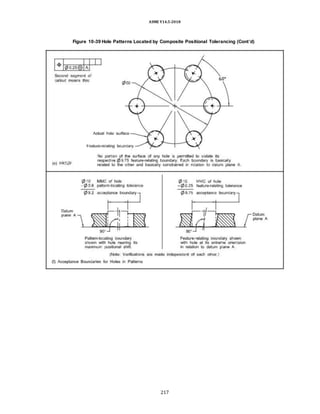
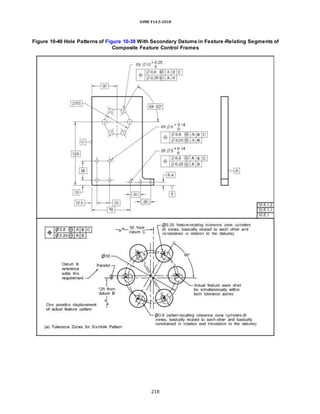
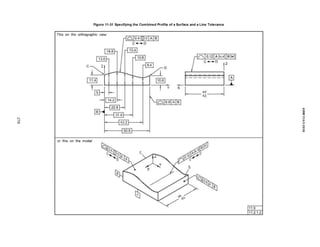
  • 329.
    ASME Y14.5-2018 A-7 SECTION5, GENERAL TOLERANCING AND RELATED PRINCIPLES A-7.1 Section Renumbered Section5 was previously Section2. A-8.3 Added Symbols A “dynamic profiletolerancezonemodifier” was added for usewith profile tolerancing. A “from–to” symbol was added for indicating the direction in which a tolerance or other requirement applies. A-7.2 Directly Toleranced Location Dimensions Removed From the Body of the Standard Information applicable to directly toleranced location dimensions for surfaces has been removed from this Section and added to Mandatory Appendix I. The practice of direct applicationof tolerances on locationdimensions is not supported as a preferred practice because of the ambiguity that can be created through this method. This practice is now included as an alternative practice in Mandatory Appendix I, and some of the possible ambi- guities are explained. This informationhas beenplaced in an Appendix to permit its use during a transition period as users become familiar with the preferred practices in which feature control frames are used to specify profile tolerances for the location of surfaces. A-7.3 Rule #1 Explanation Expanded Requirements related to Rule #1 are clarified in para. 5.8.1(a), and their applicability to a feature of size that has localized areas without opposed points has been added in para. 5.8.1(e). A-7.4 Paragraph 5.8.2 Edited Theexceptions to Rule #1have been edited. A-7.5 Paragraph 5.16.1 Radius Further Explained Theeffect of a radius tolerancehas been edited. A-7.6 Paragraph 5.16.2 Controlled Radius Further Explained The effect of a controlled radius tolerance has been edited. A-8 SECTION 6, SYMBOLOGY A-8.1 Section Renumbered Section6 was previously Section3. A-8.2 Applicability of Symbols in Models Illustrated Application of symbols in models was added to some figures. Notation was added where needed to indicate application limitation to orthographic views. A-8.4 Removed Symbols “Concentricity” and “symmetry” symbols have been removed. A-8.5 “Free State” Symbol Application Revised Theexplanation of the useof the “free state” symbol as defined in para. 6.3.20 was revised. A-9 SECTION 7, DATUM REFERENCE FRAMES A-9.1 Section Renumbered Section7 was previously Section4. A-9.2 Effects of Straightness on Datum Simulation Explained The explanation of the method to determine the MMB of a datum feature was expanded and clarified to include a straightness tolerance on the datum feature of size. Figures 7-22 and 7-23 and paras. 7.11.6 through 7.11.8 explainthe applicationof MMB andLMB. Figure 7-24 and para. 7.11.9 were added to explain the applicability of RMB. A-9.3 Clarified True Geometric Counterpart at LMB An explanation for determining the size of a true geometric counterpart at LMB was clarified in para. 7.11.8 and its subparagraphs. A-9.4 Tolerance Accumulation Effects of RFS An explanation of the accumulation of tolerances resulting from tolerances applied RFS was expanded in para. 7.11.9 and its subparagraphs. A-9.5 Simulation Requirements for Datum Features Paragraphs 7.11.9 and 7.16.7 were edited and para. 7.16.8 was added to establish a changed requirement related to datum feature shift/displacement. These revi- sions require only an extremity of the simulated datum feature to remain within the MMB and LMB. That is a change from the ASME Y14.5-2009 requirement for the datum feature to remain in contact with the simulator. 311
  • 330.
    ASME Y14.5-2018 A-9.6 CommonDatum In subsection7.12, theterm “commondatum” replaced the term “multiple datum.” A-9.7 Datum Feature Symbol Application With a Feature Control Frame The required method for attaching a profile feature control frame and a datum feature symbol to multiple surfaces was relocated from Section 7 to Section 6. A-9.8 Single Solution for a Datum Reference Frame A requirement was added to para. 7.12.4 for a single solution when establishing a datum reference frame. A-9.9 Tolerances Applicable in Free State All requirements are now applicable in the free state UOS. Restrained condition requirements and use of the “free state” symbol are explained in subsection 7.20. A-9.10 Coordinate System Association With a Datum Reference Frame The explanation of identifying the coordinate system associated with a datum reference frame has been expanded in subsection 7.21. A-9.11 Customized Datum Reference Frame Limitation A note was added to subsection 7.22 that prohibits usinga customizeddatum reference frame ina composite tolerance. A-9.12 Datum Target Requirements and CAD Application of datum target dimensional requirements and accommodationof CAD capabilities have been added in para. 7.24.3. A-10 SECTION 8, TOLERANCES OF FORM A-10.1 Section Renumbered Section8 was previously Section5. A-10.2 Combined Effects of Multiple Tolerances Applied at MMC on a Feature of Size A defaultwas establishedin para. 8.4.1.3inwhichform tolerances applied at MMC to a feature of size do not combineto affect the IB or OB of a position or orientation tolerance that is applied to the same feature when the tolerances are applied at MMC. A-10.3 Cylindricity Clarification The explanation of cylindricity was rewritten for clarity an d w i t h o u t a n y i n t e n t t o c h a n g e c y l i n d r i c i t y requirements. A-10.4 “Free State” Symbol Application Removed From This Section Paragraphs explaining the application of the “free state” symbol have been deleted from this Section and require-ments redefined based on the default that all dimensions and tolerances apply in the free state UOS. See subsection7.20. The explanation of average diameter has been retained and is in subsection 8.5. A-11 SECTION 9, TOLERANCES OF ORIENTATION A-11.1 Section Renumbered Section9 was previously Section6. A-11.2 Orientation Symbols Relocated Definitions of orientationsymbolsarenowin Section 6, Symbology. A-11.3 Orientation of Line Elements Redefined in Profile Orientationapplicableto individual line elements with a datum reference to an axis has been deleted from this Section; the method established for this purpose is now in Section 11. A-12 SECTION 10, POSITION TOLERANCES A-12.1 Section Renumbered Section10 was previously Section7. A-12.2 Expanded Explanation of Surface Method The default requirement for position specified at MMC to control the surface of the feature to not violate a toler- ance boundary was first explicitly stated in a note in the 1994 edition and illustrated through VC boundaries as early as 1966. The 2009 edition increased emphasis of this default. This Standard continues the transition of showing tolerance meaning in terms of the surface of the feature relative to an acceptance boundary. It is now clearly stated that the surface method and the axis method may not give exactly the same results, and that for tolerances applied at MMC, the default is the surface method. Multiple figures have been edited to show the surface method, with some figures showing both the surfacemethod and the axis method. The surface method is not applicable to tolerances applied RFS; the axis method is the only method used for toler-ances applied RFS. 312
  • 331.
    ASME Y14.5-2018 A-13 SECTION11, TOLERANCES OF PROFILE A-13.1 Section Renumbered Section11 was previously Section8. A-14.2 Runout on a Tangent Plane Applicationof runout toleranceon a tangent plane has been added. A-13.2 Unequally Disposed Profile Specification The use of phantom lines in orthographic views to specify unequally disposedprofile tolerance zone bound- aries was removed. It was an optional practice in ASME Y14.5-2009. A-14.3 Runout Relative to an Axis of Rotation in an Assembly Application of runout tolerance relative to an axis of rotation, where the axis may not be a datum feature in an assembly, has been added. A-13.3 Profile All Over All overspecificationwithinageneral toleranceblock has been added. A-13.4 Profile on a Nonsize Datum Feature An explanationof profileonnonsizedatum features has been added. A-14.4 Measurement Method Not Used to Explain Tolerance Boundaries In past editions, runout tolerances were explained in terms of a measurement method using a dial indicator. See Figure A-1. For consistency in the explanation method used for other tolerances, the explanation of runout is now based on the resulting tolerance zone. The definition of runout tolerances was not changed. A-13.5 Orientation of Line Element Using Profile Profile of a line as a refinement is explained in subsec- tion11.9. This explanationincludes achieving orientation of a line element using a customized datum reference frame. This accomplishesthesamefunctionas previously allowed by the use of orientation of line elements. A-13.6 Dynamic Profile Tolerance Zone The capability to specify a dynamic profile tolerance has been added. A-14 SECTION 12, TOLERANCES OF RUNOUT A-14.1 Section Renumbered Section12 was previously Section9. A-14.5 Independence of Size and Runout Stated Independence of the runout tolerance from the size tolerance is nowstated. A-14.6 Runout Applicable to Feature With Interruptions It is nowstated that runout may be appliedto features withinterruptions suchas keyways. A-14.7 Cumulative Effects of Runout Thecumulativeeffects of runout tolerances have been defined. A-14.8 “Between” Symbol and Runout Theuse of the “between” symbol fordefiningextent of applicationis permitted. 313
  • 332.
    ASME Y14.5-2018 Figure A-1Specifying Total Runout Relative to a Datum Diameter 314
  • 333.
    ASME Y14.5-2018 NONMANDATORY APPENDIXB FORMULAS FOR POSITIONAL TOLERANCING B-1 GENERAL Thepurpose of this Appendix is to present formulas for determining the required positional tolerances or the required sizes of mating features to ensure that parts assemble correctly. The formulas are valid for single- segment feature control frames and feature-relating toler-ances in compositetolerances appliedto all types of features or patterns of features and results in a “no inter- ference, no clearance” fit when features are at MMC with their locations intheextreme of positional tolerance. This assumes that interfacing datum features are used or that adequate control of interface features is established to prevent their adverse interaction with the toleranced hole patterns. Consideration shall be given for additional geometric conditions that could affect functions not accounted for in the formulas below. B-2 FORMULA SYMBOLS B-2.1 Use of Symbols UOS, formulas giveninthis Appendix use the following five symbols: D = minimum depthof thread orminimum thickness of part withrestrained or fixed fastener F = maximum diameterof fastener (MMClimit) H = minimum diameterof clearancehole(MMClimit) P = maximum thickness of partwithclearance holeor maximum projection of fastener, suchas a stud T = positional tolerancediameter B-2.2 Subscripts Subscripts are used when more than one size feature or tolerance is involved. B-3 FLOATING FASTENER CASE When two or more parts are assembled with fasteners, suchas bolts and nuts, and all parts have clearance holes for the bolts, it is termed a “floating fastener case.” See Figure B-1. When the fasteners are the same diameter and it is desiredto usethe sameclearance hole diameters and the same positional tolerances for the parts to be assembled, the following formula applies: H=F+T or T=H F EXAMPLE: Given that the fasteners in Figure B-1 are 6 diameter maximum and the clearance holes are 6.44 diameter minimum, find the required positional tolerance: T =6.44 6 = 0.44 diameter for each part Any number of parts with different holesizes and posi- tional tolerances may be mated, providedthe formula H = F + T or T = H − F is applied to each part individually. B-4 FIXED FASTENER CASE WHEN PROJECTED TOLERANCE ZONE IS USED When one of the parts to be assembled has restrained fasteners, such as screws in tapped holes or studs, it is termed a “fixed fastener case.” See Figure B-2. When the fasteners are the same diameter and it is desired to use the same positional tolerance in each part to be assembled, the following formula applies: H=F+2T or H F T = Theallowablepositional tolerancefor each part is one- half that for the comparable floating fastener case. EXAMPLE: Given that the fasteners in Figure B-2 have a maximum diameter of 6 and the clearance holes have a minimum diameter of 6.44, find the required positional tolerance. T = 6.44 6 2 = 0.22 diameter for each part When it is desired that the part with tapped holes have a larger positional tolerance than the part with clearance holes, thetotal positional toleranceof both holes (2T) can be separated into T1 and T2 in any appropriate manner so that the total equals 2T. 315
  • 334.
    ASME Y14.5-2018 2T=T1+T2 EXAMPLE: When2T is 0.44, if T1 = 0.18, then T2 = 0.26. The general formula for the fixed fastener case where two mating parts have different positional tolerances is H=F+T1+T2 Thepreceding formulas do not providesufficientclear- ance for the fixed fastener case when threaded holes or holes fortight-fitting members, suchas dowels, are out of square. To provide for these conditions, an orientation tolerance may be applied or the projected tolerance zone method of positional tolerancing should be applied to threaded holes or tight-fitting holes. See Section 10. B-5 PROVISION FOR TILTING OF THE AXIS OR CENTER PLANE When an orientation tolerance or the projected toler- ance zone system is not used, it is required to select a positional tolerance and clearance hole combination that compensates forthe allowabletilting of the axis or center plane of the fixed fastener feature. H=F+T1 + T2j 2P z D i1 + y k { where D = minimum depthof engagement of threaded or tight-fitting member P = maximum projectionof fastener T1 = positional tolerancediameterof clearanceholeT2 = positional tolerancediameterof tapped or tight- fitting holes EXAMPLE: Given that the fasteners in Figure B-2 have a maximum diameter of 6F, the positional tolerance of the clear- ance hole is 0.2T1, the positional tolerance of the tapped hole is 0.4T2, the maximum thickness of the plate with the clearance hole is 12P, and the minimum thickness of the plate with the tapped hole is 8D, find the required clearance hole size, H. desired to divide the available tolerance unequally between the parts, the following formula is useful: H1+H2=F1+F2+T1+T2 NOTE: This formula is valid only for simple coaxial parts that are of similar length as shown here. Consideration shall be given for other geometric conditions (i.e., orientation, projected tolerance, etc.) that may be required for function. EXAMPLE: Given the information shown in Figure B-3, solve for T1 and T2. H1+H2 = F1+F2+T1+T2 T1+T2 = (H1 + H2) (F1 + F2) = (20 + 10) (19.89 + 9.92) = 0.19 total available tolerance This total available tolerance may be divided in any desired manner, such as T1 = 0.12 T2 = 0.07 B-7 LIMITS AND FITS When requirements for the size and fit of mating features are specified by symbols per ANSI B4.2, the formulas for positional tolerancing are also applicable. EXAMPLE: For a design that requires a “loose running” fit, using the “hole basis” approach, the features would be shown as follows: H = F+T1+T2(1+ 2 D P ) = 6 + 0.2 + 0.4(1 + 2 × 8 12 ) = 6 + 0.2 + 0.4(1 + 3) = 6 + 0.2 + 0.4(4) = 6+0.2+1.6 = 7.8 B-6 COAXIAL FEATURES The formula below applies to mating parts with two coaxial features when one of these features is a datum feature for the other. See Figure B-3. When it is The above symbols have been used with Table 2 in ANSI B4.2to obtain the limit values shown in Figure B-3. Tables B2 and B3 in ANSI B4.2 show the following: (a) For the holebasic size20, fundamental deviation H20 = 0. (b) For the holebasic size10, fundamental deviation H10 = 0. (c) For the shaftbasic size20, fundamental deviation c20 = −0.11. (d) For the shaftbasic size10, fundamental deviation c10 = −0.08. 316
  • 335.
    ASME Y14.5-2018 Figure B-1Floating Fasteners Figure B-2 Fixed Fasteners Figure B-3 Coaxial Features 317
  • 336.
    ASME Y14.5-2018 NONMANDATORY APPENDIXC FORM, PROPORTION, AND COMPARISON OF SYMBOLS C-1 GENERAL The purpose of this Appendix is to present the recom- mended form and proportionfor symbols used in dimen- sioning and tolerancing applications and to compare ASME and ISO symbols. symbols. SeeASMEY14.2for lineweights, letter heights, and arrow proportions. C-2 FORM AND PROPORTION Figures C-1 through C-5 illustrate the preferred form and proportion of symbols established by this Standard for use on engineering drawings. The symbols are grouped to illustrate similarities in the elements of their construction. Inall figures, symbol proportions are given as a factor of h, where h is the letter height selected for use within the enclosed C-3 COMPARISON Figures C-6 and C-7 provide a comparison of the symbols adopted by this Standard with those contained ininternational standards suchas ISO 1101, ISO 129, and ISO 3040. In some instances, this Standard and the ISO standards usethe same symbol, butwithadifferent name or different meaning. 318
  • 337.
    Figure C-1 Formand Proportion of Datum Symbols 319 ASME Y14.5-2018
  • 338.
    Figure C-2 Formand Proportion of Geometric Characteristic Symbols 320 ASME Y14.5-2018
  • 339.
    Figure C-3 Formand Proportion of Geometric Dimensioning Symbols 3 2 1
  • 340.
    ASME Y14.5-2018 Figure C-4Form and Proportion of Modifying Symbols 322
  • 341.
    Figure C-5 Formand Proportion of Dimensioning Symbolsand Letters 323 ASME Y14.5-2018
  • 342.
    ASME Y14.5-2018 Figure C-6Comparison of Symbols 324
  • 343.
    ASME Y14.5-2018 Figure C-7Comparison of Other Symbols 325
  • 344.
    ASME Y14.5-2018 NONMANDATORY APPENDIXD FORMER PRACTICES D-1 GENERAL The purpose of this Appendix is to identify and illustrate symbols, terms, and methods of dimensioning that were featured in ASME Y14.5-2009. For information on changes and improvements, see Nonmandatory Appendix A and the Foreword. The information in this Appendix is provided to assist in the interpretation of existing draw-ings on which former practices may appear. D-2 CONCENTRICITY DEFINITION REMOVED “Concentricity” was defined as the condition in which the median points of all diametrically opposed elements of a surface of revolution (or the median points of corre- spondingly located elements of two or more radially disposed features) are congruent with a datum axis (or center point). D-3 SYMMETRY DEFINITION REMOVED “Symmetry” was defined as the condition in which the median points of all opposed or correspondingly located elements of two or more feature surfaces are congruent with a datum axis or center plane. D-4 CONCENTRICITY AND SYMMETRY SYMBOLS REMOVED The symbols for concentricity and symmetry, shown below, have been deleted. D-5 DECISION DIAGRAM APPENDIX REMOVED The Nonmandatory Appendix showing decision diagrams for geometric controls has been deleted. 326
  • 345.
    Y14 ENGINEERING PRODUCTDEFINITION AND RELATED DOCUMENTATION PRACTICES Y14.1-2012 Decimal Inch DrawingSheet Sizeand Format Y14.1M-2012 Metric DrawingSheet Sizeand Format Y14.2-2014 LineConventions and Lettering Y14.3-2012 (R2018) Orthographic and Pictorial Views Y14.5-2018 Dimensioningand Tolerancing Y14.5.1M-1994 (R2012) Mathematical Definition of Dimensioningand TolerancingPrinciples Y14.5.2-2017 Certification of Geometric Dimensioningand Tolerancing Professionals Y14.6-2001 (R2018) Screw Thread Representation Y14.8-2009 (R2014) Castings, Forgings, and Molded Parts Y14.24-2012 Types and Applications of EngineeringDrawings Y14.31-2014 Undimensioned Drawings Y14.34-2013 (R2018) Associated Lists Y14.35-2014 Revision of EngineeringDrawings and Associated Documents Y14.36-2018 SurfaceTextureSymbols Y14.37-2012 CompositePart Drawings Y14.38-2007 (R2013) Abbreviations and Acronymsfor Useon Drawings and Related Documents Y14.41-2012 DataPractices Y14.43-2011 Dimensioningand TolerancingPrinciples for Gages and Fixtures Y14.44-2008 (R2014) ReferenceDesignations for Electrical and Electronics Parts and Equipment Y14.47-2018 Model Organization SchemaPractices Y14.100-2017 Engineering DrawingPractices Y32.7-1972 (R2014) Graphic Symbols for Railroad Maps and Profiles Y32.18-1972 (R2013) Symbols for Mechanical and Acoustical Elementsas Used in Schematic Diagrams TheASME Publications Catalogshows acompletelistof all theStandards published bytheSociety. Foracomplimentary catalog, or thelatest information about our publications, call 1-800-THE-ASME (1-800-843-2763).
  • 346.
    ASME Services ASME iscommitted to developingand deliveringtechnical information. At ASME’s Customer Care, wemakeeveryeffort toansweryour questions and expediteyour orders. Ourrepresentatives areready toassistyou in thefollowingareas: ASME Press Member Services & Benefits Public Information Codes & Standards Other ASME Programs Self-Study Courses Credit Card Orders Payment Inquiries Shipping Information IMechE Publications Professional Development Subscriptions/Journals/Magazines Meetings & Conferences Short Courses SymposiaVolumes Member Dues Status Publications Technical Papers How can you reach us? It’s easier than ever! Therearefour options for makinginquiries*or placingorders. Simply mail, phone, fax, or E-mail us and aCustomer Carerepresentativewill handleyour request. Mail Call Toll Free Fax—24 hours E-Mail—24 hours ASME US & Canada: 800-THE-ASME 973-882-1717 customercare@asme.org 150 CloveRoad, 6th Floor (800-843-2763) 973-882-5155 LittleFalls, New Jersey Mexico: 95-800-THE-ASME 07424-2139 (95-800-843-2763) *Customer Carestaff are not permitted to answer inquiries about thetechnical content of this codeor standard. Information as to whether or not technical inquiries are issued to this code or standard is shown on the copyright page. All technical inquiries must be submitted in writingto thestaff secretary. Additional procedures for inquiries may belisted within.
  • 347.