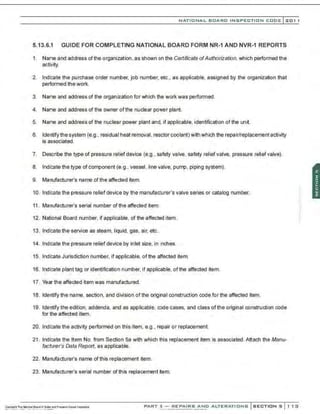
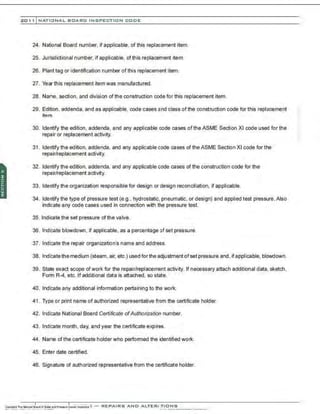
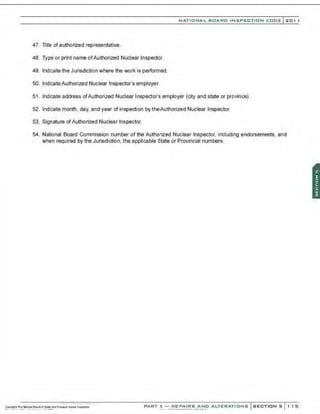
·'
.•
0
(}
NATIONAL BOARO INSPECTION COOE l 201 1
PART 3, REPAIRS AND ALTERATIONS
All charts, graphs, tables, and other criteria that have been reprinted from the
ASME Boiler and Pressure Vessel Code, Sections I, IV, VI II, and X are used
with the permission of the American Society of Mechanical Engineers. All
Rights Reserved.
PART 3 - REPAIRS ANO ALTERATIONS
201, I NATIONAL BOARD INSPECTION CODE
NOTE: Pages ii through xvi are not part of this American National Standard.
Headquarters
1055 CrupperAvenue
Columbus, Ohio 43229-1183
614.888 8320
614.847.1828 Fax
Testing Laboratory
7437 Pingue Drive
Worthington, Ohio 43085-1715
614.888.8320
614.848.3474 Fax
Training & Conference Center
1065 Crupper Avenue
Columbus, Ohio 43229-1183
614.888.8320
614.847.5542 Fax
Inspection Training Center
1075 Crupper Avenue
Columbus, Ohio 43229-1183
614.888.8320
614.431 .3208 Fax
Library of Congress Catalog Card No. 52-44738
Printed in the United States ofAmerica
All Rights Reserved
© 2011 The National Board of Boiler and Pressure
Vessel Inspectors
www.nationalboard.org
Board of Trustees
J.M. Given Jr.
Chairman
J.T.Amato
First Vice Chairman
D.J. Jenkins
Second Vice Chairman
O.A. Oouin
Secretary/Treasurer
J.H. Burpee
Member at Large
C. Cantrell
Member at Large
G.L. Scribner
Member at Large
M. Washington
Member at Large
Advisory Committee
G.W. Galanes. P.E.
representing welding industries
K. Moore
representing National Board
certificate holders
L.J. McManamon Jr.
representing organized labor
M.J. Pischke
representing pressure vessel
manufacturers
B.R. Morelock, P.E.
representing boiler and
pressure vessel users
C.E. Perry
representing boiler
manufacturers
R.V. Wielgozinski
representing authorized
inspection agencies
(insurance companies)
NATIONAL BOARD INSPECTION CODE l201 1
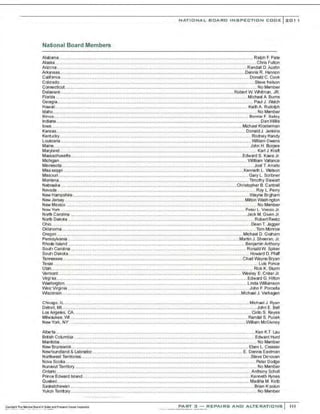
National Board Members
Alabama .... ........................ ................. ...................................... Ralph P. Pate
Alaslta.........................................................................................................................................................................Chris Fulton
Arizma................................................................................................................................................................Randall D. Austin
Al1<a1sas............................................................................................................................................................Dennis R. Hannon
Cal~ornia ...............................................................................................................................................................Donald C. Cook
Colo·ado....................................................................................................................................................................Steve Nelson
Connecticut.................................................................................................................................................................. No Member
DelaNare ... ........................ ................. .......................Robert W. Wh~man, JR.
Florida .................................................................................................................................................................Michael A. Burns
Georgia.....................................................................................................................................................................Paul J. Welch
Hawaii.. ................................................................................................................................................Keith A. Rudolph
Idaho .................................. .......................................... ... .................................. ........................ No Member
lllinoe................................................................................................................................................................... Bennie F. 3~iley
Indiana............................................................................................................................................................................DanWillis
Iowa............ ....................... .............................Michael Klosterman
Ka~s ...................................... ........................................................................................................................DonaldJ. Jenkins
Kent•
)cky.................................................................................................................................................................Rodney Handy
Lou~iana ................................................................................................................................................................William Owens
Maine ............................................. ............................................. .................................................... .................. John H. Burpee
Maryland......................................................................................................................................................................Karl J. Kraft
Massachusetts.................................................................................................................................................Edward $. KaNa Jr.
Michigan ..............................................................................................................................................................Willliam Valance
Minnesota..................................................................................................................................................................Joel T. Amato
Miss ssippi ........................................................................................................................................................Kenneth L. W!tson
Miss,uri................................................................................................................................................................Gary L Scribner
Montana ......................................... ......................................................................................................... ........... Timothy S:ewart
Nebraska ...................................................................................................... ....................................... .....Christopher B. Cantrell
Nevada .......................................................................................................................................................................Roy L Perry
New Hampshire.....................................................................................................................................................Wayne Bcgham
NewJersey........................................................................................................................................................Milton Wash ngton
NewMexico.................................................................................................................................................................No Member
Ne¥J York ...........................................................................................................................................................Pe ter L... Veecio Jr.
North Carolina .....................................................................................................................................................Jack M. Given Jr.
North Dakota .............................................................................................................................................................RobertReetz
Ohio.......................................................................................................................................................................Dean T. Jagger
Okla1oma .................................................................................................................................................................Tom Monroe
Oregon ............................................................................................................................................................Michael D. Graham
Pennsylvania ................................................................................................................................................Martin J. Sheeran, Jr.
Rhode Island .....................................................................................................................................................Benjamin Anthony
Sou1 Carolina.................................................................................................................................................... RonaldW. Spiker
Sout1 Dakota.........................................................................................................................................................Howard D. Pfaff
Tennessee .......... .................... ................. ..................................... ..................................Chad Wayne Bryan
Texas...........................................................................................................................................................................Luis Ponce
Utah.........................................................................................................................................................................Rick K. Sturm
Vermont..........................................................................................................................................................Wesley E. Crider Jr.
Virginia.................................................................................................................................................................Edward G. Hilton
Washington..........................................................................................................................................................Linda Williamson
Wes: Virginia .........................................................................................................................................................John F. Porcella
Wisconsin........... .................... ................ .................................................... ........................... .....Michael J.Verhagen
Chi~o, IL ...........................................................................................................................................................Michael J. Ryan
Detroit, Ml ............................................................................... ...................................................................................John E. Bell
LosAngeles. CA..... ..... ...................... ................. ...................... ..... ................ .. Cirilo S. Reyes
Milwaukee, WI .....................................................................................................................................................Randal $. Pucek
NewYork, NY.....................................................................................................................................................William McGivney
Alberta .......................................................................................................................................................................Ken K.T. Lau
Br~ish Columbia ........................................................................................................................................................Edward Hurd
Man~oba ................ ................................... ................ .................................................... .......................................... No Member
New Brunswick....... ..... ...................... ................. ...................... ..... ................. Eben L Creaser
New'oundland & Labrador...............................................................................................................................E. Dennis Eastman
Northwest Territories...............................................................................................................................................Steve Do1ovan
Nova Scotia................................................................................................................................................................ Peter Dodge
Nunavut Territory......................................................................................................................................................... No Member
Ontario...................................................................................................................................................................Anthony Scholl
Prinoe Edward Island ................................. ................ .................................................... .....................................Kenneth Hynes
Quebec........ ...................... ................. ................. .................. Madiha M. Kotb
Saskatchewan........ ................. .......................................Brian Krasiun
Yukcn Terr~ory............................................................................................................................................................. No Member
·.·..-..·,·....-...... ·..- .. ;,-
PART 3 - REPAIRS A ND ALTERATIONS Ill
20 1 , I NATIONAL BOARD INSPECTION CODE
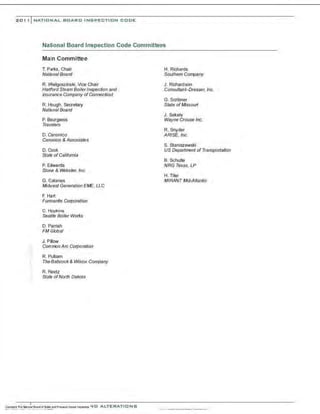
National Board Inspection Code Committees
Main Committee
T. Parks, Chair
National Board
R. Wielgoszinski, Vice Chair
Hartford Steam Boilerlnspec6on and
Insurance Company ofConnec6cut
R. Hough, SeQ-etary
National Board
P. Bourgeois
Travelers
D. Canonico
Canonico & Associates
D. Cook
State ofCalifornia
P. Edwards
Stone & Webster, Inc.
G. Galanes
Midwest Generation EME, l.LC
F. Hart
Funnanite Corporation
C. Hopkins
Seattle Boiler Works
D. Parrish
FM G/obal
J. Pillow
Common Arc Corpora6on
R. Pulliam
The Babcock& Wilcox Company
R. Reetz
State ofNorth Dakota
H. Richards
Southern Company
J. Richardson
Consultant-Dresser, Inc.
G. Scribner
State ofMissouri
J . Sekely
Wayne Crouse Inc.
R. Snyder
ARISE. Inc.
S. Staniszewski
US Department of Transporta6on
B. Schulte
NRG Texas, LP
H.Titer
MIRANT Mid-Mantic
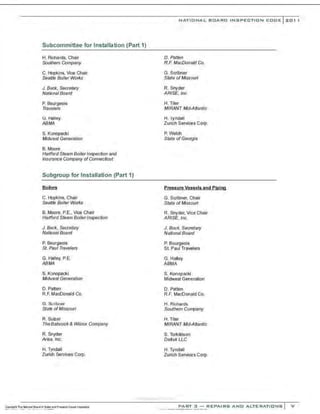
Subcommittee for Installation (Part 1)
H. Richards, Chair
Southern Company
C. Hopkins, Vice Chair
Seattle Boiler Worlrs
J. Bock, Secretaty
National Board
P. Bourgeois
TraV91ers
G. Halley
ABMA
S. Konopacki
Midwest Generation
B. Moore
Hartford Steam Boilerlnspec~on and
Insurance Company ofConnec~cut
Subgroup for Installation (Part 1)
C. Hopkins, Chair
Seattle Boiler Worlrs
B. Moore, P.E., Vice Chair
Hart'ordSteam BoilerInspection
J. Bock, Secretaty
National Board
P. Bourgeois
St. Paul Travelers
G. Halley, P.E.
ABMA
S. K·, nopacki
Midwest Generation
D. Patten
R.F. MacDonald Co.
G. Scribner
State ofMissouri
R. Sulzer
The Babcock& Wilcox Company
R. Snyder
Arise, Inc.
H. Tyndall
Zurich Services Corp.
NATIONAL BOARD INSPECTION CODE l 2 01 1
D. Patten
R.F. MacDonald Co.
G. Scribner
State ofMissouri
R. Snyder
ARISE, Inc.
H. Titer
MIRANT Mid·AOanlic
H. fyndall
Zurich Services Corp.
P. Welch
State ofGeorgia
Pressure Vessels and Pipina
G. Scribner, Chair
State ofMissouri
R. Snyder, Vice Chair
ARISE, Inc.
J. Bock, Secreta')'
Na~onal Board
P. Bourgeois
St. Paul Travelers
G. Halley
ABMA
S. Konopacki
Midwest Generation
D. Patten
R.F. MacDonald Co.
H. Richards
Southern Company
H. Titer
MIRANT Mid·AOantic
S. Torkildson
De~ak lLC
H. Tyndall
Zurich Services Corp.
.....·.....·.....··..·..·.·..·
PART 3 - REPAIRS A ND ALTERATIONS V
20 1 , I NATIONAL BOARD INSPECTION CODE
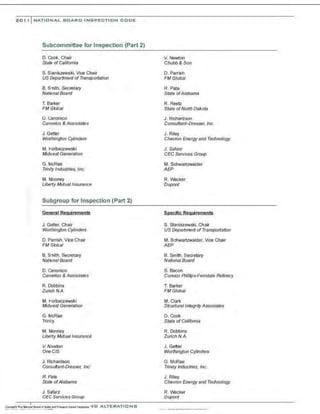
Subcommittee for Inspection (Part 2)
D. Cook, Chair
state ofCalifornia
S. S:aniszewski, Vice Chair
US Department of Transpottation
B. S1lith, Secretary
National Board
T. Barker
FMGiobal
u. Canomco
canon/co & Associates
J. Getter
Worillington Cylinders
M. t-orbaczewski
Midwest Generation
G. tv'cRae
Trini!y Industries, Inc.
M. Mooney
Ube.
1y Mutua/Insurance
Subgroup for Inspection (Part 2)
General Reauirements
J. Getter, Chair
Worthington Cylinders
D. Parrish. Vice Chair
FM Giobal
B. S1lith, Secretary
National Board
D. Canonico
Canonico & Associates
R. Dobbins
Zurich N.A.
M. t-orbaczewski
Midwest Generation
G. tv'cRae
Trini:y
M. llonney
UbMy Mutua/Insurance
V. Nawton
OneCIS
J. Richardson
Consultant-Dresser, Inc.
R. Pate
State ofAlabama
J. Safarz
CEC Services Group
V. Newton
Chubb& Son
D. Parrish
FMGiobal
R. Pate
State ofAlabama
R. Reetz
State ofNorth Dakota
J. Richardson
Consultant-Dresser, Inc.
J. Riley
Chevron Energy and Technology
J. Safarz
CEC SeNices Group
M. Schwartzwalder
AEP
R. 'Micker
Dupont
Specific Requirements
S. Staniszewski, Chair
US Department of Transporta6on
M. Schwartzwalder, Vice Chair
AEP
B. Smith, Secretary
Na6onal Board
S. Bacon
Conoco Phillips-Ferndale Refinery
T. Barker
FMG/obal
M. Clark
Structural IntegrityAssociates
D. Cook
State ofCalifornia
R. Dobbins
Zurich N.A.
J. Getter
Worthington Cylinders
G. McRae
Trinity Industries, Inc.
J . Riley
Chevron Energy and Technology
R. 'Micker
Ouponr
NATIONAL BOARD INSPECTION CODE l 201 1
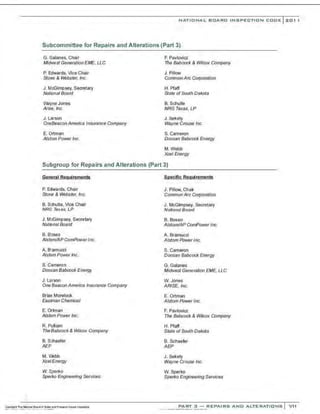
Subcommittee for Repairs and Alterations (Part 3)
G. Galanes, Chair
Midwest G&nerafion EME, LLC
P. Edwards, Vice Chair
Stone & Webster, Inc.
J. McGimpsey, Secretary
Natcnal Board
WayneJones
Arise, Inc.
J . Larson
One88acon America Insurance Company
E. Ortman
Alstom PowerInc.
F. Pavlovia
The Babcock & Wilcox Company
J. Pillow
Common Arc Corporation
H. Pfaff
State ofSouth Dakota
B. Schulte
NRG Texas, LP
J. sekely
Wayne Crouse Inc.
S. Cameron
Doosan Babcock Energy
M.Webb
Xcel Energy
Subgroup for Repairs and Alterations (Part 3)
General Reguiremf!nts
P. Edwards, Chair
Stone & Webster, Inc.
B. Schulte, Vice Chair
NRG T<>xas, LP
J. McGimpsey, Secretary
National Board
B. Boseo
Alstom/APComPowerInc.
A. B·amucci
Alstom PowerInc.
S. Cameron
Doosan Babcock Energy
J. Larson
OneBeacon America Insurance Company
Brian Morelock
Eastnan Chemical
E. Ortman
Alstom Power lt!C.
R. Pulliam
The Babcock& Wilcox Company
B. Schaefer
AEP
M. Webb
XceiEnergy
w. Sperko
Sperko Engineering Services
Specific Requirements
J. Pillow, Chair
Common Arc Corporation
J. McGimpsey, Secretary
National Board
B. Boseo
AlstornlAP ComPower Inc.
A. Bramucci
Alstom Power Inc.
S. Cameron
Doosan Babcock Energy
G. Galanes
Midwest GeneraUon EME, LLC
W. Jones
ARISE, Inc.
E. Ortman
Alstom PowerInc.
F. Pavlovia
The Babcock & Wik:ox Company
H. Pfaff
State ofSouth Dakota
B. Schaefer
AEP
J. Sekely
Wayne Crouse Inc.
W. Sperko
Sperko Engineering SeiVices
PART 3 - REPAIRS AND ALTERATIONS VII
201, I NATIONAL BOARD INSPECTION CODE
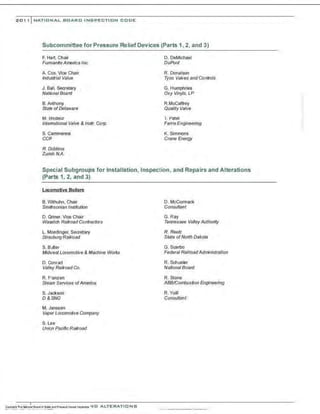
Subcommittee for Pressure Relief Devices (Parts 1, 2, and 3)
F. Hart, Chair
Furmanfte America Inc.
A. Cox, Vice Chair
lndustrial Value
J. Ball, SecretafY
National Board
B. Anthony
State ofDelaware
M. t:!rOdeur
International Valve & lnstr. Corp.
S. Carnrneresi
CCR
R. Dobbins
Zurich N.A.
D. DeMichael
DuPont
R. Donalson
Tyco ValVes andControls
G. Hurnphries
Oxy Vinyls. LP
R.McCaffrey
Quality Valve
1. Patel
Farris Engineering
K. Simmons
Crane Energy
Special Subgroups for Installation, Inspection, and Repairs and Alterations
(Parts 1, 2, and 3)
Locomotive Boilers
B.1/'lthuhn, Chair
SmiN1sonian lnstlution
D. Griner, Vice Chair
Wasatch Railroad Contractors
L. Moedinger, SecretaJY
Strasburg RaHroad
S. BJtler
Midwest LocomotAie & Machine Worlcs
D. Conrad
Valley Railroad Co.
R. F•anzen
Steam SeiVices ofAmerica
S. Jackson
D&SNG
M. Janssen
Vapor Locomo6ve Company
S. Lee
Union Pacific Ra.Nroad
D. McCormack
Consultant
G. Ray
Tennessee VaHey Authority
R. Reetz
State ofNorth Dakota
G. Scerbo
Federal Railroad Administration
R. Schueler
Na6onal Board
R. Stone
ABB!Combus6on Engineering
R. Yuill
Consultant
NATIONAL BOARD INSPECTION CODE l 2 01 1
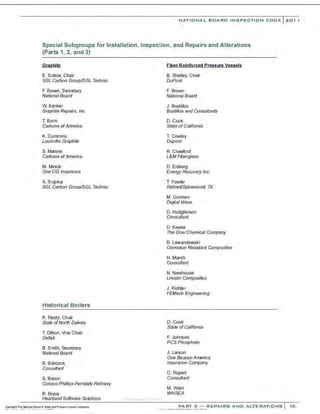
Special Subgroups for Installation, Inspection, and Repairs and Alterations
(Parts 1, 2, and 3)
Graphite
E. Soltow, Chair
SGL Carbon GroupiSGL Technic
F. Brown, Secretary
National Board
W. Banker
Grap/Jile Repairs, Inc
T. Bonn
Carbone ofAmerica
K. Cummins
LouisvHie Graphite
S. Malone
Caroone ofAmerica
M. Minick
OneCIS Insurance
A. S:Upica
SGL Calbon GroupiSGL Technic
Historical Boilers
R. Reetz, Chair
State ofNorth Dakota
T. Dillion, Vice Chair
Deltak
B. S'llith, Secretary
National Board
B. Babcock
ConsuNant
S. Bacon
Conoco Phi/ips-Ferndale Refinery
R. Bryce
HeartlandSoffware Solutions ', -.,•,;,·..........·..·..·,·..··
Fiber..Reinforced Prassure Vessels
B. Shelley, Chair
DuPont
F. Brown
National Board
J. Bustillos
BustHios and Consultants
D. Cook
State ofCaHfomia
T. Cowley
Dupont
R. Crawford
L&M Fiberglass
D. Eisberg
Energy Recovery Inc.
T
. Fowler
Retired/Spicewood, 7X
M. Gorman
Digital Wave
D. Hodgkinson
Consultant
D. Keeler
The DowChemical Company
R. Lewandowski
Corrosion Resistant Composites
H. Marsh
Consultant
N. Newhouse
Uncoln Composites
J. Richter
FEMech Engineering
D. Cook
State ofCalifornia
F. Johnson
PC$ PhOsphate
J. larson
One Beacon America
Insurance Company
D. Rupert
Consultant
M. Wahl
WHSEA
PART 3 - REPAIRS A ND ALTERATIONS IX
201, I NATI ONAL BO AR D INSPECTION CODE
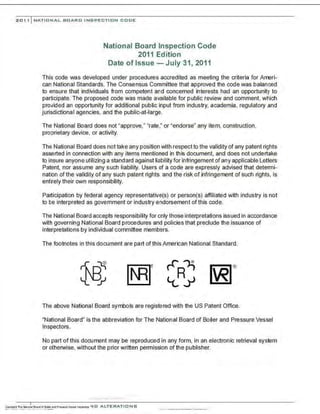
National Board Inspection Code
2011 Edition
Date of Issue- July 31, 2011
This code was developed under procedures accredited as meeting the criteria for Ameri-
can National Standards. The Consensus Committee that approved the code was balanced
to ensure that individuals from competent and concerned interests had an opportunity to
participate. The proposed code was made available for public review and comment, which
provided an opportunity for additional public input from industry, academia, regulatory and
jurisdictional agencies, and the public-at-large.
The National Board does not "approve," "rate ," or "endorse" any item, construction,
proprietary device, or activity.
The National Board does not take any position with respect to the validity of any patent rights
asserted in connection with any items mentioned in this document, and does not undertake
to insure anyone utilizing a standard against liability for infringement of any applicable Letters
Patent, nor assume any such liability. Users of a code are expressly advised that determi-
nation of the validity of any such patent rights. and the risk of infringement of such rights, is
entirely their own responsibility.
Participation by federal agency representative(s) or person(s) affiliated with industry is not
to be interpreted as government or industry endorsement of this code.
The National Board accepts responsibility for only those interpretations issued in accordance
with governing National Board procedures and policies that preclude the issuance of
interpretations by individual committee members.
The footnotes in this document are part of this American National Standard.
[~J
The above National Board symbols are registered with the US Patent Office.
"National Board" is the abbreviation for The National Board of Boiler and Pressure Vessel
Inspectors.
No part of this document may be reproduced in any form, in an electronic retrieval system
or otherwise, without the prior written permission of the publisher.
...·..-.·......... · .....·..·
NATIONAL BOARD INSPECTION CODE l 201 1
Foreword
The National Board of Boiler and Pressure Vessel Inspectors is an organization comprised of
Chief Inspectors for the states, cities, and terr~ories of the United States and provinces and
territories of Canada . It is organized for the purpose of promoting greater safety to life and
property by securing concerted action and maintaining uniformity in post-construction
activities of pressure-retaining items, thereby ensuring acceptance and interchangeability
among Jurisdictional authorities responsible for the administration and enforcement of vari-
ous codes and standards.
In keeping with the principles of promoting safety and maintaining uniformity. the National
Board originally published The NBIC in 1946. establishing rules for inspection and repairs
to boilers and pressure vessels. The National Board Inspection Code (NBIC) Committee is
charged with the responsibility for maintaining and revising the NBIC. In the interest of public
safety, the NBIC Committee decided, in 1995, to revise the scope of the NBIC to include rules
for installation, inspection, and repair or alteration to boilers, pressure vessels, piping, and
nonmetallic materials.
In 2007, the NBIC was restructured into three Parts specifically identifying important post-
construction activities involving safety of pressure-retaining items. This restructuring provides
for future expansion, transparency, and uniformity, ultimately improving public safety.
The NBIC Committee's function is to establish rules of safety governing post-construction
activities for the installation, inspection and repair and alteration of pressure-retaining items,
and to Interpret these rules when questions arise regarding their Intent In formulating the
rules, the NBIC Committee considers the needs and concerns of individuals and organiza-
tions involved in the safety of pressure-retaining items. The objective of the rules is to af-
ford reasonably certain protection of life and property, so as to give a reasonably long, safe
period of usefulness.Advancements in design and material and the evidence of experience
are recognized.
The rules established by the NBIC Committee are not to be interpreted as approving,
recommending, or endorsing any proprietary or specific design, or as limiting in any way an
organization's freedom to choose any method that conforms to the NBIC rules.
The NBIC Committee meets regularly to consider revisions of existing rules, formulation of
new rules, and respond to requests for interpretations. Requests for interpretation must be
addressed to the NBIC Secretary in writing and must give full particulars in order to receive
Committee consideration and a written reply. Proposed revisions to the Code resulting from
inquiries will be presented to the NBIC Committee for appropriate action.
Proposed revisions to the Code approved by the NBIC Committee are submitted to the
American National Standards Institute and published on the National Board Web site to
invite comments from all interested persons. After the allotted time for public review and final
approval the new edition is published.
Organizations or users of pressure-retaining items are cautioned against making use of
revisions that are less restrictive than former requirements without having assurance that
they have been accepted by the Jurisdiction where the pressure-retaining item is installed.
PART 3 - REPAIRS A ND ALTERATIONS XI
201, I NATIONAL BOARD INSPECTION CODE
The general philosophy underlying the NBIC is to parallel those provisions of the original
code of construction, as they can be applied to post-construction activities.
The NBIC does not contain rules to cover all details of post-construction activities. IJIhere
complete details are not given, it is intended that individuals or organizations, subject to the
acceptance of the Inspector and Jurisdiction when applicable, provide details for post-
construction activities that will be as safe as otherwise provided by the rules in the original
Code of Construction.
Activities not conforming to the rules of the original code of construction or the NBIC must
receive specific approval of the Jurisdiction. who may establish requirements for design.
construction, inspection, testing, and documentation.
There are instances where the NBIC serves to warn against pitfalls; but the Code is not a
handbook, and cannot substitute for education, experience, and sound engineering judgment.
It isintended that this Edition ofthe NBIC not be retroactive. Unless the Jurisdiction imposes
the use of an earlier edition, the latest effective edition is the governing document.
NATIONAL BOARD INSPECTION CODE l 201 1
Introduction
It is the purpose of the National Board Inspection Code (NBIC) to maintain the integrity of
pressure-retaining items by providing rules for installation, and after the items have been
placed into service, by providing rules for inspection and repair and alteration, thereby
ensuring that these items may continue to be safely used.
The NBIC is intended to provide rules, information and guidance to manufacturers,
Jurisdictions, inspectors, owner-users. installers. contractors, and other individuals and
organizations performing or involved in post-construction activities, thereby encouraging the
uniform administration of rules pertaining to pressure-retaining items.
Scope
The NBIC recognizes three important areas ofpost-construction activities where information,
understanding, and following specific requirements will promote public and personal safety.
These areas include:
Installation
• Inspection
Repairs and Alterations
The NBIC provides rules, information, and guidance for post-construction activities, but does
not provide details for all conditions involving pressure-retaining items. Where complete
details are not provided in this Code, the Code user is advised to seek guidance from the
Jurisdiction and from other technical sources.
Thewords shall, should, and may are used throughout the NBIC and have the following intent:
Shall- action that is mandatory and required.
• Should - indicates a preferred but not mandatory means to accomplish the require-
ment unless specified by others such as the Jurisdiction.
May - permissive, not required or a means to accomplish the specified task.
Organization
The NBIC is organized into three Parts to coincide with specific post-construction activities
involving pressure-retaining items. Each Partprovides general and specific rules, information,
and guidance within each applicable post-construction activity. Other NBIC Parts or other
published standards may contain additional information or requirements needed to meet the
rules of the NBIC. Specific references are provided in each Part to direct the user where to
find this additional information. NBIC Parts are identified as:
Part 1, Installation - This Part provides requirements and guidance to ensure all types
of pressure-retaining items are installed and function properly. Installation includes
meeting specific safety criteria for construction, materials, design, supports, safety
devices, operation, testing, and maintenance.
Part 2, Inspection - This Part provides information and guidance needed to perform
and document inspections for all typesof pressure-retaining items. This Part includes
information on personnel safety, non-destructive examination, tests, failure
mechanisms, types of pressure equipment, fitness for service, risk-based assess-
ments, and performance-based standards.
PART 3 - REPAIRS A ND ALTERATIONS XIII
201, I NATIONAL BOARD INSPECTION CODE
Part 3, Repairs and Alterations - This Part provides information and guidance to
perform, verify, and document acceptable repairs or alterations to pressure-retaining
items regardless of code ofconstruction.Alternative methods for examination, testing,
heat treatment, etc., are provided when the original code of construction requirements
cannot be met. Specific acceptable and proven repair methods are also provided.
Each NBIC Part is divided into major Sections as outlined in the Table of Contents.
Tables, charts, and figures provide relevant illustrations or supporting information for text
passages, and are designated with numbers corresponding to the paragraph they illustrate
or support within each Section. Multiple tables. charts. or figures referenced by the same
paragraph will have additional letters reflecting the order of reference. Tables, charts, and
figures are located in or after each major Sec1ion within each NBIC Part
Text Identification and Numbering
Each page in the text will be designated in the top header with the publication's name, part
number, and part title. The numbering sequence for each section begins with the section
number followed by a dot to further designate major sections (e.g., 1.1 , 1.2, 1.3). Major
sections are further subdivided using dots to designate subsections within that major section
(e.g., 1.1.1, 1.2.1, 1.3.1). Subsections can further be divided as necessary.
Paragraphs under sections or subsections shall be designated with small letters in paren-
thesis (e.g., a), b), c)) and further subdivided using numbers in parenthesis (e.g., 1), 2), 3)).
Subdivisions of paragraphs beyond this pointwill be designated using a hierarchical sequence
of letters and numbers followed by a dot.
Example: 2.1 Major Section
2.1.1 Section
2.1.2 Section
2.1.2. Subsection
a) paragraph
b) paragraph
1) subparagraph
2) subparagraph
a. subdivisions
1. subdivisions
2. subdivisions
b. subdivisions
1. subdivisions
2. subdivisions
Tables and figures will be designated with the referencing section orsubsection identification.
I'Vl)en more than one table orfigure is referenced in the same section or subsection, letters or
numbers in sequential order will be used following each section or subsection identification.
NATIONAL BOARD INSPECTION CODE l 201 1
Supplements
Supplements are contained in each Part of the NBIC to designate information only pertain-
ing to a specific type of pressure-retaining item (e.g., Locomotive Boilers, Historical Boilers,
Graphite Pressure Vessels.) Supplements follow the same numbering system used for the
main text only preceded by the Letter "S." Each page of the supplement will identify the
supplement number and name in the top heading.
Interpretations
On request, the NBIC Committee will render an interpretation of any requirement of this
Code. Interpretations are provided for each Part and are specific to the Code edition and
addenda referenced in the interpretation. Interpretations provide information only and are
notpart of this Code.
Jurisdictional Precedence
Reference is made throughout this Code to !he requirements of the "Jurisdiction." /Vhere
any provision herein presents a direct or implied conflict with any jurisdictional regulation,
the Jurisdictional regulation shall govern.
Units of Measurement
Both U.S. customary units and metric units are used in the NBIC. The value stated in U.S. cus-
tomary units or metric units are to be regarded separately as the standard. Within the text,
the metric units are shown In parentheses. In supplement 6, Parts 2 and 3, Continued Service
and Inspection of DOT Transport Tanks, the metric units are shown first with the U.S. customary
unils shown in parentheses.
U.S. customary units or metric units may be used with this edition of the NBIC, but one sys-
tem of units shall be used consistently throughout a repair or alteration of pressure-retaining
items. It is the responsibility of National Board accredited repair organizations to ensure the
appropriate units are used consistently throughout all phases ofwork. This includes materials,
design, procedures, testing, documentation, and stamping. The NBIC policy for metrication
is outlined in each part of the NBIC.
:.;,;,·.......... ·....·....
PART 3 - REPAIRS A ND ALTERATIONS XV
201, I NATIONAL BOARD INSPECTION CODE
Accreditation Programs
The National Board administers and accredits three specific repair programs• as shown below:
"R"..........Repairs and Alterations to Pressure-Retaining Items
"VR"........Repairs to Pressure Relief Valves
"NR"........Repair and Replacement Activities for Nuclear Items
Part 3, Repairs and Alterations, of the NBIC describes the administrative requirements forthe
accreditation of these repair organizations.
The National Board also administers and accredits four specific inspection agency programs
as shown below:
New Construction
Criteria forAcceptance of Authorized Inspection Agencies for New Construction
(NB-360)
lnservice
Qualifications and Duties for Authorized Inspection Agencies (AlAs) Performing In-
service Inspection Activities and Qualifications for Inspectors of Boilers and Pressure
Vessels
(NB-369)
Owner-User
Accreditation of Owner-User Inspection Organizations (OUIO) (NB-371) Owners
or users may be accredited for both a repair and inspection program provided the
requirements for each accreditation program are met.
Federal Government
Qualifications and Duties for Federal Inspection Agencies Performing lnservlce In-
spection Activities (FIAs) {NB-390)
These programs can be viewed on the National Board Web site. For questions or further
information regarding these programs contact
The National Board of Boiler and Pressure Vessel Inspectors
1055 Crupper Avenue
Columbus, OH 43229-1183
Phone - 614.888.8320
Fax - 6 14.847.1828
Web site -www.nationalboard.org
Certificates of Authorization for Accreditation Programs
Any organization seeking an accredited program may apply to the National Board to obtain a
Certificate ofAuthorization for the requested scope of activities.A confidential review shall be
conducted to evaluate the organization's quality system. Upon completion of the evaluation,
a recommendation will be made to the National Board regarding issuance of a Certificate of
Authorization.
Certificate ofAuthorization scope, issuance, and revisions for National Board accreditation
programs are specified in the applicable National Board procedures. When the quality sys-
tem requirements of the appropriate accreditation program have been met, a Certificate of
Authorization and appropriate National Board symbol stamp shall be issued.
1 caution, some Jurisdictionsmayindependentlyadminister aprogramof authorization fororganizationsto perform repairs and
alterationswithin that Jurisdiction.
0
N
NATIONAL BOARD INSPECTION CODE l 201 1
PART 3, REPAfRS AND ALTERATIONS
All charts, graphs. tables, and other criteria that have been reprinted from the ASME
Boiler and Pressure Vessel Code. Sections I, IV, VIII, and X are used with the permis-
sion of the American Society of Mechanical Engineers. All Rights Reserved.
PART 3 - REPAIRS AND ALTERATIONS
201 1 INATIONAL. BOARD INSPECTION CODE
PART 3- REPAIRS AND ALTERATIONS
TABLE OF CONTENTS
National Board Contact Information ...................................................................................................... II
National Board Board of Trustees I Advisory Committee Members ....................................................... II
National Board Members ...................................................................................................................... Ill
NBIC Committee Structure ....................................................................................................................IV
National Board Inspection Code Edition I Addendum ............................................................................ X
Foreword
lntroduction
Section 1
1.1
1.2
1.3
1.3.1
1.3.2
1.4
1.5
1.5.1
1.5.2
1.6
1.6.1
1.6.2
1.6.3
1.6.4
1.6.5
1.6.5.1
1.7
1.7.1
1.7.2
1.7.3
1.7.4
1.7.5
1.7.5.1
1.7.5.2
1.7.5.3
1.7.5.4
1.7.5.5
1.7.5.6
1.7.6
1.7.6.1
1.7.6.2
1.7.6.3
1.7.6.4
1.7.6.5
....................................................................................................................................... XI
......................................................................................................................................XIII
General and Administrative Requirements .................................................................... 11
Scope ............................................................................................................................ 12
Construction Standards for Pressure-Retaining Items................................................... 12
Inspector ........................................................................................................................ 13
Authorization ................................................................................................................. 13
Acceptance Inspection .................................................................................................. 13
Definitions Relating to Pressure Relief Devices ............................................................ 13
Accreditation................................................................................................................... 14
Accreditation Process..................................................................................................... 14
Scope Issuance and Revision to a Quality System ........................................................ 14
Accreditation of "R" Repair Organizations...................................................................... 15
Scope ............................................................................................................................ 15
Prerequisites for Issuing a National Board Certificate ofAuthorization ......................... 15
Procedure for Obtaining or Renewing a National Board Certificate ofAuthorization .... 15
National Board "R" Symbol Stamp ................................................................................ 17
Quality System .............................................................................................................. 17
Outline of Requirements for a Quality System for Qualification
for the National Board "R" Certificate ofAuthorization .................................................. 17
Accreditation of "VR" Repair Organizations ................................................................... 20
Scope ............................................................................................................................ 20
Jurisdictional Participation ............................................................................................. 20
General Rules ...............................................................................................................20
Repair of Nuclear Valves ............................................................................................... 20
Issuance and Renewal of the "VR" Certificate ofAuthorization ..................................... 21
General...........................................................................................................................21
Issuance of Certificate....................................................................................................21
Renewal of Certificate .................................................................................................... 21
Review of Applicant's Facility ......................................................................................... 21
Verification Testing .........................................................................................................22
Verification Testing Alternatives............................ .......................................................... 22
Use of the "VR" Authorization ........................................................................................ 23
Technical Requirements.................................................................................................23
Stamp Use......................................................................................................................23
Return of Stamp ............................................................................................................. 23
Multiple Locations........................................................................................................... 24
Certificate ofAuthorization Contents ............................................................................. 24
1.7.6.6
1.7.6.7
1.7.7
1.7.7.1
1.7.7.2
1.7.7.3
1.7.7.4
1.7.7.5
1.i.8
1.8
1.8.1
1.8.2
1.8.3
1.8.4
1.8.5
1.8.5.1
1.8.6
Section 2
2.1
2.2
2.2.1
2.2.2
2.2.3
2.2.4
2.2.5
2.2.6
2.3
2.4
2.5
2.5.1
2.5.2
2.5.3
2.5.3.1
2.5.3.2
2.5.3.3
2.5.3.4
2.5.3.5
Section 3
3 1
3.2
3.2.1
3.2.2
3.2.3
3.2.4
3.2.5
3.2.6
3.3
3.3.1
3.3.2
3.3.3
3.3.4
NATIO N AL BOARD INSPECTION CODE l 201 1
Changes to Certificates ofAuthorization ........................................................................ 24
Issuance of More Than One "VR" Symbol Stamp to a
Certificate ofAuthorization Holder.................................................................................. 24
Quality System .............................................................................................................. 24
General...........................................................................................................................24
Written Description ........................................................................................................24
Review................................................................ ............................................................ 25
Maintenance of Controlled Copy .................................................................................... 25
Outline of Requirements for a Quality System ............................................................... 25
ASME 'V," "HV," or "W" Certificate Holders ................................................................. 28
"NR" Accreditation Requirements................................................................................... 29
Scope ............................................................................................................................29
Prerequisites for Issuing a National Board "NR" Certificate ofAuthorization ................ 20
Procedures for Obtaining or Renewing a National Board "NR"
Certificate of Authorization ............................................................................................ 30
National Board "NR" Symbol Stamp .............................................................................. 32
Quality System Program ................................................................................................ 32
Outline of Requirements for a Quality System Program for Qualification
for the National Board "NR" Symbol Stamp .................................................................. 32
Interface with the Owner's Repair/Replacement Program ............................................ 38
Welding and HeatTreatment..........................................................................................41
Scope ............................................................................................................................42
Welding .........................................................................................................................42
Welding Procedure Specifications ................................................................................. 42
Standard Welding Procedure Specifications ................................................................. 42
Performance Qualification .............................................................................................42
Welding Records ........................................................................................................... 42
Welder's Identification ...................................................................................................43
Welder's Continuity ....................................................................................................... 43
Standard Welding Procedure Specifications .................................................................43
AWS Reference Standards ................................................ ........................................... 50
Heat Treatment ..............................................................................................................50
Preheating .....................................................................................................................50
Postweld Heat Treatment (PWHT) ................................................................................. 52
Alternative Welding Methods Without Postweld Heat Treatment ................................... 53
Welding Method 1 ......................................................................................................... 54
Welding Method 2 .........................................................................................................54
Welding Method 3 ......................................................................................................... 56
Welding Method 4 .........................................................................................................57
Welding Method 5 .........................................................................................................58
Requirements for Repairs and Alterations...................................................................... 59
ScnpP. ... . .. .. flO
General Requirements for Repairs and Alterations ....................................................... 60
Material Requirements for Repairs and Alterations ....................................................... 60
Replacement Parts ........................................................................................................60
Drawings .......................................................................................................................61
Design Requirements for Repairs and Alterations ........................................................ 61
Calculations ................................................................................................................... 62
Reference to Other Codes and Standards .................................................................... 62
Repairs to Pressure-Retaining Items ............................................................................ 62
Defect Repairs ............................................................................................................... 62
Routine Repairs ............................................................................................................. 62
Examples of Repairs .....................................................................................................63
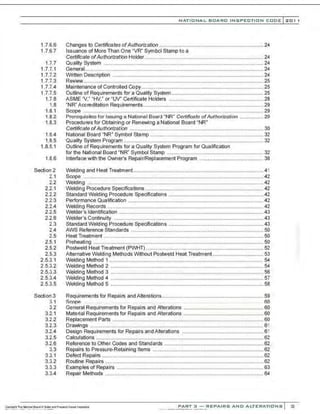
Repair Methods .............................................................................................................64
PART 3 - REPAIRS AND ALTERATIONS 3
201 1 INATIONAL. BOARD INSPECTION CODE
3 .3.-'.1
3.3.4.2
3.3.4.3
3.3..1!..4
3.3.4.5
3.3.-'.6
3.3.-'.7
3.3.-'.8
3.3.5
3.3.5.1
3.3.5.2
3.4
3.-'-.1
3.4.2
3.4.3
3.4.4
3.4.-'.1
Section 4
-'.1
4.2
4.3
.1!..4
4.t..1
4.4.2
4.5
4.5.1
4.5.2
4.5.3
4.5.4
Section 5
5.1
5.2
5.2.1
5.2.2
5.3
5.4
5.5
5.5.1
5.5.2
5.5.3
5.5.4
5.fi 5
5.6
5.7
5.7.1
5.7.2
5.7.3
5.7.4
5.7.5
5.8
5.8.1
5.8.2
5.9
5.10
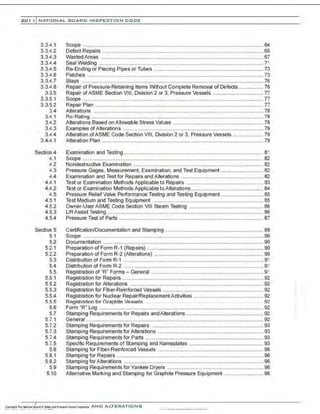
Scope ............................................................................................................................64
Defect Repairs ...............................................................................................................65
Wasted Areas ................................................................................................................67
Seal Welding ................................................................................................................. 71
Re-Ending or Piecing Pipes or Tubes ........................................................................... 73
Patches .........................................................................................................................73
Stays .............................................................................................................................76
Repair of Pressure-Retaining Items IJIAthout Complete Removal of Defects ................. 76
Repair of ASME Section VIII. Division 2 or 3. Pressure Vessels ................................... 77
Scope ............................................................................................................................77
Repair Plan .................................................................................................................... 77
Alterations .....................................................................................................................78
Ro-Rating ......................................................................................................................78
Alterations Based on Allowable Stress Values .............................................................. 78
Examples of Alterations .................................................................................................79
Alteration of ASME Code Section VIII, Division 2 or 3. Pressure Vessels ..................... 79
Alteration Plan ...............................................................................................................79
Examination and Testing ................................................................................................ 81
Scope ............................................................................................................................82
Nondestructive Examination .......................................................................................... 82
Pressure Gages, Measurement, Examination, and Test Equipment ............................. 82
Examination and Test for Repairs and Alterations ......................................................... 82
Test or Examination Methods Applicable to Repairs ..................................................... 83
Test or Examination Methods Applicable toAlterations.................................................. 84
Pressure Relief Valve Performance Testing and Testing Equipment ............................. 85
Test Medium and Testing Equipment ............................................................................ 85
Owner-UserASME Code Section VIII Steam Testing ................................................... 86
LiftAssist Testing ........................................................................................................... 86
Pressure Test of Parts ................................................................................................... 87
Certification/Documentation and Stamping .................................................................... 89
Scope ............................................................................................................................ 90
Documentation ..............................................................................................................90
Preparation of Form R-1 (Repairs) ................................................................................ 90
Preparation of Form R-2 (Alterations) ........................................................................... 90
Distribution of Form R-1 ................................................................................................ 91
Distribution of Form R-2 ................................................................................................ 91
Registration of "R" Forms- General ............................................................................. 91
Registration for Repairs ................................................................................................. 92
Registration for Alterations ............................................................................................ 92
Registration for Fiber-Reinforced Vessels ..................................................................... 92
Registration for Nuclear Repair/ReplacementActivities ................................................ 92
Registration for Gr::~r>hite Vessels .. .. .. .. . ..... 92
Form "R" Log .................................................................................................................92
Stamping Requirements for Repairs andAlterations ..................................................... 92
General ..........................................................................................................................92
Stamping Requirements for Repairs ............................................................................. 93
Stamping Requirements for Alterations ......................................................................... 93
Stamping Requirements for Parts ................................................................................. 93
Specific Requirements of Stamping and Nameplates ................................................... 93
Stamping for Fiber-Reinforced Vessels ......................................................................... 96
Stamping for Repairs ..................................................................................................... 96
Stamping forAlterations ................................................................................................ 96
Stamping Requirements for Yankee Dryers .................................................................. 96
Alternative Marking and Stamping for Graphite Pressure Equipment ........................... 96
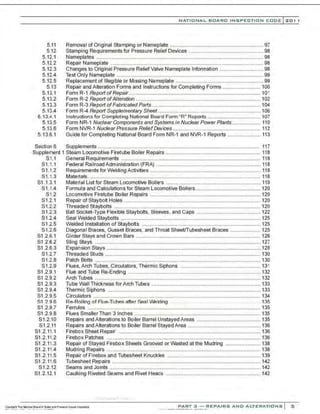
5.11
5.12
5.12.1
5.12.2
5.12.3
5.12.4
5.12.5
5.13
5.13.1
5.13.2
5.13.3
5.13.4
5.13.4.1
5.13.5
5.13.6
5.13.6.1
NATIONAL BOARD INSPECTION CODE l 201 1
Removal of Original Stamping or Nameplate ................................................................ 97
Stamping Requirements for Pressure Relief Devices ................................................... 98
Nameplates ...................................................................................................................98
Repair Nameplate ......................................................................................................... 98
Changes to Original Pressure Relief Valve Nameplate Information .............................. 98
Test Only Nameplate .....................................................................................................99
Replacement of lllegible or Missing Nameplate ............................................................ 99
Repair and Alteration Forms and Instructions for Completing Forms .......................... 100
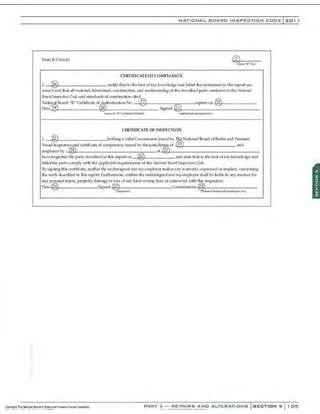
Form R-1 Report ofRepair........................................................................................... 101
Form R-2 Report ofAlteration ...................................................................................... 102
Form R-3 Report ofFabricated Parts........................................................................... 104
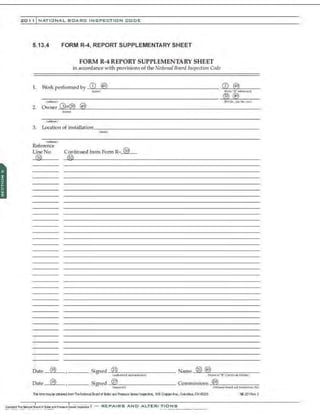
Form R-4 Report Supplementary Sheet....................................................................... 106
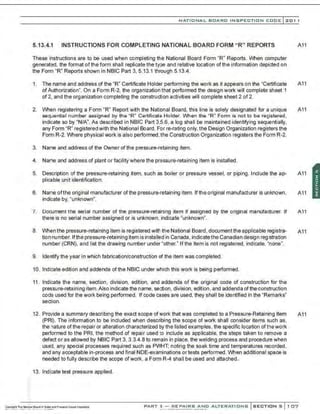
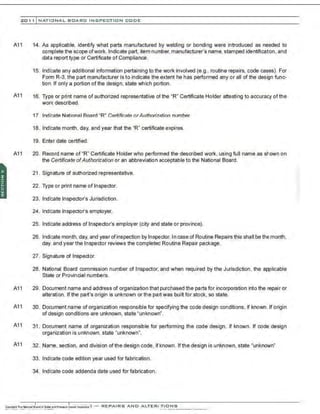
Instructions for Completing National Board Form "R" Reports..................................... 107
Form NR-1 Nuclear Components and Systems in Nuclear Power Plants.................... 110
Form NVR-1 Nuclear Pressure ReliefDevices ............................................................ 112
Guide for Completing National Board Form NR-1 and NVR-1 Reports ....................... 113
Section 6 Supplements ............................................................................................................... 117
Supplement 1 Steam Locomotive Firetube Boiler Repairs ................................................................. 118
S1.1
S1.1.1
S1.1.2
S1 .1.3
S1 .1.3.1
S1.1.4
S1.2
S1.2.1
S1 .2.2
S1.2.3
S1.2.4
S1.2.5
S1.2.6
S1 .2.6.1
S1 .2.6.2
S1 .2.6.3
S1.2.7
S1.2.8
S1.2.9
S1 .2.9.1
S1 .2.9.2
S1 .2.9.3
S1 .2.9.4
S1 .2.9.5
S1 2 .~ 6
S1 .2.9.7
S1 .2.9.8
S1.2.10
S1.2.11
S1 .2.11.1
S1 .2.11.2
S1.2.11.3
S1 .2.11.4
S1 .2.11.5
S1.2.11.6
S1.2.12
S1.2.12.1
General Requirements ................................................................................................ 118
Federal Railroad Administration (FRA) ................ ............... ......................................... 118
Requirements for Welding Activities ............................................................................ 118
Materials....................................................................................................................... 118
Material List for Steam Locomotive Boilers ................................................................. 119
Formula and Calculations for Steam Locomotive Boilers............................................. 120
Locomotive Firetube Boiler Repairs ............................................................................ 120
Repair of Staybolt Holes .............................................................................................. 120
Threaded Staybolts ..................................................................................................... 120
Ball Socket-Type Flexible Staybolts, Sleeves, and Caps ............................................ 122
Seal Welded Staybolts ................................................................................................ 125
Welded Installation of Staybolts .................................................................................. 125
Diagonal Braces. Gusset Braces. and T~roat SheeVTubesheet Braces ..................... 125
Girder Stays and Crown Bars ...................................................................................... 126
Sling Stays .................................................................................................................. 127
Expansion Stays .......................................................................................................... 128
Threaded Studs ........................................................................................................... 130
Patch Bolts .................................................................................................................. 130
Flues, Arch Tubes, Circulators, Thermic Siphons ....................................................... 131
Flue and Tube Re-Ending ........................................................................................... 132
Arch Tubes .................................................................................................................. 132
Tube Wall Thickness for Arch Tubes ........................................................................... 133
Thermic Siphons ......................................................................................................... 133
Circulators ................................................................................................................... 134
Re-Rolling nf Flue-Tuhes >liter Seal WP.Irling .. .. 135
Ferrules ....................................................................................................................... 135
Flues Smaller Than 3 Inches ....................................................................................... 135
Repairs and Alterations to Boiler Barrel Unstayed Areas ............................................ 135
Repairs and Alterations to Boiler Barrel Stayed Area .................................................. 136
Firebox Sheet Repair .................................................................................................. 136
Firebox Patches .......................................................................................................... 136
Repair of Stayed Firebox Sheets Grooved or Wasted at the Mudring ........................ 138
Mudring Repairs .......................................................................................................... 138
Repair of Firebox and Tubesheet Knuckles ................................................................ 139
Tubesheet Repairs ...................................................................................................... 142
Seams and Joints ........................................................................................................ 142
Caulking Riveted Seams and Rivet Heaos ................................................................. 142
·,·..·..·.-....-.....· -..-..·,·..·
PART 3 - REPAIRS AND ALTERATIONS 5
201 1 INATIONAL. BOARD INSPECTION CODE
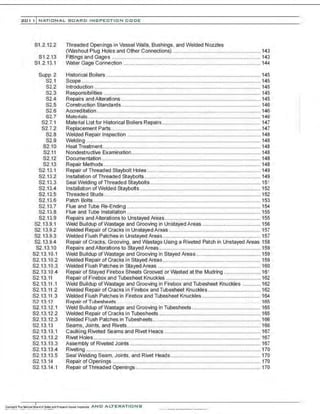
81 .2.12.2
81.2.13
81.2.13.1
Supp. 2
S2.1
S2.2
S2.3
S2.4
S2.5
S2.6
S2.7
S2.7.1
82.7.2
S2.8
S2.9
S2.10
82.11
S2.12
S2.13
82.13.1
82.13.2
S2.13.3
S2.13.4
82.13.5
S2.13.6
S2.13.7
S2.13.8
82.13.9
S2.13.9.1
S2.13.9.2
82.13.9.3
82.13.9.4
82 .13.10
S2.13.10.1
82.13.10.2
S2.13.10.3
S2.13.10.4
82.13.11
S2.13.11.1
S2.13.11 .2
S2.13.11.3
~2 . 1::11 2
S2.13.12.1
S2.13.12.2
82.13.12.3
S2.13.13
S2.13.13.1
S2.13.13.2
82.13.13.3
S2.13.13.4
S2.13.13.5
82.13.14
S2.13.14.1
Threaded Openings in Vessel walls, Bushings, and Welded Nozzles
(Washout Plug Holes and Other Connections) ............................................................ 143
Fittings and Gages ...................................................................................................... 143
Water Gage Connection .............................................................................................. 144
Historical Boilers .......................................................................................................... 145
Scope ........................................................................................................................... 145
Introduction .................................................................................................................. 145
Responsibilities ............................................................................................................ 145
Repairs and Alterations ................................................................................................ 145
Construction Standards................................................................................................ 146
Acereditation ................................................................................................................. 146
Materials....................................................................................................................... 146
Material List for Historical Boilers Repairs.................................................................... 147
Replacement Parts....................................................................................................... 147
Welded Repair Inspection ........................................................................................... 148
Welding ........................................................................................................................ 148
Heat Treatment............................................................................................................. 148
Nondestructive Examination......................................................................................... 148
Documentation ............................................................................................................. 148
Repair Methods ...... ...................................................................................................... 148
Repair of Threaded Staybolt Holes .............................................................................. 149
Installation of Threaded Staybolts ................................................................................ 149
Seal Welding ofThreaded Staybolts............................................................................ 151
lnstallation ofWelded Staybolts ................................................................................... 152
Threaded Studs............................................................................................................ 152
Patch Bolts ................................................................................................................... 153
Flue and Tube Re-Ending ............................................................................................ 154
Flue and Tube Installation ............................................................................................ 155
Repairs and Alterations to Unstayed Areas.................................................................. 155
Weld Buildup of Wastage and Grooving in UnstayedAreas ........................................ 156
Welded Repair of Cracks in Unstayed Areas ............................................................... 157
Welded Flush Patches in Unstayed Areas ................................................................... 157
Repair of Cracks, Grooving, and Wastage Using a Riveted Patch in Unstayed Areas 158
Repairs and Alterations to StayedAreas...................................................................... 159
Weld Buildup ofWastage and Grooving in Stayed Areas .... ........................................ 159
Welded Repair of Cracks in Stayed Areas ................................................................... 159
Welded Flush Patches in Stayed Areas ....................................................................... 160
Repair of Stayed Firebox Sheets Grooved or Wasted at the Mudring ......................... 161
Repair of Firebox and Tubesheet Knuckles ................................................................. 162
Weld Buildup ofWastage and Grooving in Firebox and Tubesheet Knuckles ............ 162
Welded Repair of Cracks in Firebox and Tubesheet Knuckles .................................... 162
Welded Flush Patches in Firebox and Tubesheet Knuckles ................ ........................ 164
Repair of TubP.sheP.t~ . . . .. . . . . .. .. 165
Weld Buildup ofWastage and Grooving in Tubesheets ............................................... 165
Welded Repair of Cracks in Tubesheets ...................................................................... 165
Welded Flush Patches in Tubesheets .......................................................................... 166
Seams, Joints, and Rivets............................................................................................ 166
Caulking Riveted Seams and Rivet Heads .................................................................. 167
Rivet Holes ................................................................................................................... 167
Assembly of Riveted Joints .......................................................................................... 167
Riveting ........................................................................................................................ 170
Seal Welding Seam, Joints, and Rivet Heads.............................................................. 170
Repair of Openings ...................................................................................................... 170
Repair ofThreaded Openings ...................................................................................... 170
S2.13.14.2
S2.13.14.3
S2.13.14.3
Supp 3
S3.1
S3.2
S3.3
S3.4
S3.5
S3.5.1
S3.5.2
S3.5.2.1
S3.5.2.2
S3.5.2.3
S3.5.3
S3 .5.3.1
S3.5.3.2
S3.5.4
S3.5.'-.1
S3.5.'-.2
NATIO N AL BOARD INSPECTION CODE l 2 0 1 1
Repair of Handhole Openings ...................................................................................... 170
Repair of Fusible Plug Opening ................................................................................... 171
Repair of Handhole Doors............................................................................................ 172
Repair and Alteration of Graphite Pressure Equipment .............................................. 173
Scope .......................................................................................................................... 173
Repairs .............................................................. .......................................................... 173
Repairs of a Routine Nature ........................................................................................ 175
Alterations ................................................................................................................... 175
Repair Guide for Impervious Graph~e ......................................................................... 176
lntroduction .................................................................................................................. 176
Typical Graphite Fractures .......................................................................................... 176
Major Fracture ............................................................................................................. 176
Intermediate Fracture .................................................................................................. 176
Minor Fracture ............................................................................................................. 179
Graphite Repair by Plug Stitching ............................................................................... 179
Plug Stitching Procedure ............................................................................................. 180
Figures - Typical Plug Stitching Procedure ................................................................. 181
Re-lmpregnation of Graphite Parts (Tubesheets, Heads, and Blocks) ....................... 181
Control of Impregnation Material ................................................................................. 181
Finishing the Repair .................................................................................................... 182
Supplement 4 Repair and Alteration of Fiber-Reinforced Thermosetting Plastic
S4.1
S4.2
S4.3
St:.4
S4.5
S.0.6
S-'.7
S.:0.8
S'-.9
S4.10
S4.10.1
S4.10.2
S4.10.3
S4.10.4
S4.10.5
S4.11
S4.12
S4.13
S4.13.1
S4.14
S4.14.1
S4.14.2
S4.1'-.3
S4.14.4
S4.15
S4.16
S4.16.1
S4.16.2
S4.16.3
S4.16.4
S4.16.5
S4.17
Pressure Equipment .................................................................................................... 183
Scope .......................................................................................................................... 183
Inspector Qualifications ............................................................................................... 183
Tools ............................................................................................................................ 184
Limitations ................................................................................................................... 184
Repair Limitations for Filament Wound Vessels .......................................................... 184
Vessels Fabricated Using Elevated Temperature Cured Resin Systems .................... 184
Code of Construction.................................................................................................... 185
Materials....................................................................................................................... 185
Replacement Parts....................................................................................................... 185
Secondary Bonding ..................................................................................................... 186
Secondary Bonding Procedure Specifications ............................................................ 186
Performance Qualifications ......................................................................................... 186
Records ....................................................................................................................... 186
Secondary Bonder's Identification ............................................................................... 186
Secondary Bonder's Continuity ................................................................................... 186
Curing........................................................................................................................... 187
Nondestructive Examination......................................................................................... 187
Pressure and Acoustic Emission Tests......................................................................... 192
Pressure Gages, Measurement. and Examination and Test Equipment...................... 192
Ac:ceptance ln~pection . .. .. . .. .. . .. .. 192
Stamping ...................................................................................................................... 192
Documentation ............................................................................................................ 192
Registration of Documentation .................................................................................... 192
Distribution of Oocumentation ...................................................................................... 192
Pressure Testing For Repairs ...................................................................................... 193
Additional Requirements for Repairs ........................................................................... 193
Scope .......................................................................................................................... 193
Drawings ..................................................................................................................... 193
Repair Plan .................................................................................................................. 193
Routine Repairs ........................................................................................................... 193
Repair Methods ........................................................................................................... 194
Additional Requirements forAlterations ...................................................................... 194
PART 3 - REPAIRS AND ALTERATIONS 7
201 1 INATIONAL. BOARD INSPECTION CODE
S4.17.1
S4.17.2
S4.17.3
S4.17.4
S4.17.5
S4.17.6
S4.18
S4.18.1
S4.18.2
84.18.2.1
84.18.2.2
84.18.2.3
84. 18.2.4
84.18.2.5
84.18.2.6
84.18.2.7
84.18.2.8
Scope .......................................................................................................................... 195
Design ......................................................................................................................... 195
Alteration Plan ............................................................................................................. 195
Calculations .................................................................................................................. 195
Re-Rating ..................................................................................................................... 196
Pressure Testing........................................................................................................... 196
Repair and Alteration Methods ............................ .............................. .......................... 197
General Requirements ................................................................................................ 197
Classification of Repairs .............................................................................................. 197
Type 1a - Repair ofthe Corrosion Barrier ................................................................... 198
Type 1b- Repair of the Corrosion Barrier for Vessels with Precision Bores .............. 200
Type 2 - Corrosion Barrier and Internal Structural Layer Repairs .............................. 202
Type 3 - External Structural Layer Repair3 ................................................................. 202
Type 4-Alterations ..................................................................................................... 204
Type 5 - Miscellaneous General External Repairs or Alterations ............................... 204
Type 6 - Thermoplastic Repairs .................................................................................. 204
Type 7- Gel Coat Repairs .......................................................................................... 205
Supplement 5 General Requirements for Repairs and Alterations to Yankee Dryers ........................ 206
S5.1 Scope ..........................................................................................................................206
S5.2 Examinations and Test Methods .................................................................................. 206
S5.3 Yankee Dryer Repair Methods .................................................................................... 206
S5.3.1 Replacement Parts for Yankee Dryers ........................................................................ 206
S5.4 Repair Guide for Yankee Dryers .................................................................................. 206
S5.5 Procedures That Do Not Require Stamping or Nameplate Attachment ...................... 207
S5.6 Damage Repair ........................................................................................................... 208
S5.6.1 Repair of Local Thinning ............................................................................................. 208
S5.6.2 Treatment of Crack-Like Flaws ................................................................................... 208
85.6.3 Driven Plug Repair ......................................................................................................209
S5.6.4 Treaded Plug Repair ...................................................................................................210
S5.7 Alterations to Yankee Dryers ....................................................................................... 210
S5.7.1 Scope .......................................................................................................................... 210
S5.7.2 Alteration Types ...........................................................................................................210
Supp.lement 6 Repair, Alteration, and Modification of DOT Transport Tanks ..................................... 211
S6.0
S6.1
S6.2
S6.3
S6.4
S6.5
S6.6
S6.7
S6 7.1
S6.8
S6.8.1
S6.8.2
S6.8.3
S6.8.4
S6.8.5
S6.8.6
S6.9
S6.9.1
S6.9.2
S6.9.3
S6.10
General Requirements ................................................................................................. 211
Scope ........................................................................................................................... 211
Construction Standards................................................................................................ 211
Accreditation................................................................................................................. 211
Materials....................................................................................................................... 211
Replacement Parts....................................................................................................... 211
Authorization ............................................................................................................... 212
Inspection ..................................................................................................................... 212
Inspector Dutia,:; for Rar airs. Alteration,:;. and Modifications .. .. . . .. 212
Welding ........................................................................................................................213
Welding Procedure Specification ................................................................................. 214
Standard Welding Procedure Specifications ............................................................... 214
Performance Qualification ........................................................................................... 214
Welding Records.......................................................................................................... 214
Welder's Identification ................................................................................................. 214
Welder's Continuity .....................................................................................................214
Heat Treatment.............................................................................................................215
Preheating .................................................................................................................... 215
Postweld Heat Treatment ............................................................................................ 215
Alternatives to Postweld Heat Treatment ................................................................... 215
Nondestructive Examination......................................................................................... 215
.-..- ..-.-....-..... ·-.........
S6.11
S6.12
S6.13
S6.14
S6.14.1
S6.15
S6.15.1
S6.15.2
S6.16
S6.16.1
S6.16.2
S6.16.3
86.16.4
S6.16.5
S6.17
S6.17.1
S6.17.2
S6.1i.3
S6.18
S6.18.1
S6.18.2
S6.19
S6.19.1
S6.19.2
S6.19.3
NATIO N AL BOARD INSPECTION CODE l 201 1
Coatings and Linings.................................................................................................... 216
Measurement, Examination, and Test Equipment ....................................................... 216
Acceptance Inspection ................................................................................................. 216
Stamping ...................................................................................................................... 216
Removal of Original Stamping or Nameplate............................................................... 216
"TR" Forms ..................................................................................................................217
Registration of "TR" Forms ... ............................... .............................. .......................... 217
Form "TR" Log.............................................................................................................. 217
Additional Requirements for Repairs, Alterations. or Modifications.............................. 217
Scope ...........................................................................................................................217
Repairs of Defects........................................................................................................ 217
Modifications ................................................................................................................217
Drawings ......................................................................................................................217
Authorization ................................................................................................................ 217
Examination and Test ................................................................................................... 218
Methods........................................................................................................................218
Stamping ......................................................................................................................218
Documentation ............................................................................................................. 219
Preparation of ''TR'' Forms ........................................................................................... 219
Distribution .................................................................................................................219
Registration .................................................................................................................. 219
Repairs, Alterations, or Modification Reports ............................................................... 219
Registration of Form TR-1 and Form TR-2................................................................... 220
General Requirements "TR" Stamping and Nameplates.............................................. 220
Stamping of the 'TR" Symbol....................................................................................... 220
Supplement 7 Requirements for Repairs to Pressure Relief Devices ................................................ 221
S7.1
87.2
S7.3
S7.4
S7.5
S7.6
S7.7
S7.8
S7.9
S7.10
S7.10.1
S7.10.2
S7.10.3
S7.10.4
S7.10.5
87.106
S7.11
S7.11.1
S7.11.2
S7.11.3
S7.11.4
S7.12
S7.12.1
S7.12.2
S7.12.3
S7.12.4
S7.12.5
S7.12.6
Scope .......................................................................................................................... 221
General Requirements ................................................................................................ 221
Weld Repairs to Pressure Relief Valve Parts .............................................................. 221
Materials for Pressure Relief Devices ......................................................................... 222
Replacement Parts for Pressure Relief Devices ......................................................... 222
Initial Adjustments to Pressure Relief Valves .............................................................. 223
Field Repair .................................................................................................................223
Audit Requirements ..................................................................................................... 223
Use of Owner-User Personnel .................................................................................... 223
Guide to Jurisdictions forAuthorization of Owners-Users to Make
Adjustments to Pressure ReliefValves ....................................................................... 224
General ........................................................................................................................ 224
Training ........................................................................................................................ 224
Documentation ............................................................................................................224
Quality System ............................................................................................................ 224
External Adjustments ............ ....................................................................................... 225
Repairs . .... . . .. .. .. . .. . ?.2fi
Training and Qualification of Personnel ....................................................................... 225
General ........................................................................................................................ 225
Contents of Training Program ..................................................................................... 225
Qualification of Personnel ........................................................................................... 225
Annual Review of Qualification .................................................................................... 226
Welding for Pressure ReliefValves ............................................................................. 226
Welding Procedure Specifications ............................................................................... 226
Standard Welding Procedure Specifications ............................................................... 226
Performance Qualification ........................................................................................... 226
Welding Records ......................................................................................................... 226
Welders' Identification ................................................................................................. 227
Welders' Continuity ...................................................................................................... 227
PART 3 - REPAIRS AND ALTERATIONS Sl
201 1 INATIONAL. BOARD INSPECTION CODE
S7.13
S7.13.1
S7.13.2
S7.14
S7.14.1
S7.14.2
S7.14.3
Heat Treatment ............................................................................................................227
Preheating ...................................................................................................................227
Postweld Heat Treatment ............................................................................................ 227
Recommended Procedures for Repairing Pressure Relief Valves .............................. 227
lntroduction ..................................................................................................................227
Spring-Loaded Pressure Relief Valves ........................................................................ 228
Pilot Operated Safety Relief Valves ............................................................................ 230
Supplement 8 Recommended Guide for the Design of a Test System for Pressure
Relief Devices in Compressible Ruid Service ............................................................. 233
S8.1 Introduction .................................................................................................................. 233
S8.2 General ........................................................................................................................233
S8.3 Test System Description .............................................................................................. 233
S8.4 Test Vessel Sizing Data ............................................................................................... 235
S8.5 Tables, Charts, and Figures ........................................................................................ 236
Supplement 9 Procedures to Extend the "VR" Certificate ofAuthorization and Stamp
to ASME "NV" Stamped Pressure Relief Devices ....................................................... 237
S9.1 Introduction ..................................................................................................................237
S9.2 Administrative Prooedures .......................................................................................... 237
S9.3 General Rules ....... ...................................................................................................... 238
Supplement 10 Repair and Alterations of Pressure Vessels in Liquefied Petroleum Gas Service ..... 239
S10.1 Scope ..........................................................................................................................212
S10.2 General and Administrative Requirements .................................................................. 239
S10.3 Welding .......................................................................................................................239
S10.4 Requirements for Repairs and Alterations ................................................................... 239
S10.5 Examination and Testing ............................................................................................. 239
S10.6 Certification/Documentation and Stamping ................................................................. 239
S10.7 Inspection ....................................................................................................................240
S10.8 Coatings ......................................................................................................................240
Section 7
7.1
7.2
7.3
7.4
Section 8
8.1
8.2
8.3
8.4
R.5
Section 9
9.1
Section 10
10.1
10.2
10.3
Section 11
NBIC Policy for Metrication .......................................................................................... 241
General ........................................................................................................................242
Equivalent Rationale ................................................................................................... 242
Prooedure for Conversion ........................................................................................... 242
Referencing Tables ...................................................................................................... 243
Preparation of Technical Inquiries to the National Board Inspection Code Committee 247
lntroduction .................................................................................................................. 248
lnquiry Format .............................................................................................................248
Code Revisions orAdditions ....................................................................................... 249
Code Interpretations ............. ....................................................................................... 249
Suhmittals . .. . . . .. . . . . 250
Glossary ofTerms ........................................................................................................ 251
Definitions ....................................................................................................................252
NBIC Approved Interpretations..................................................................................... 257
SCOPE ........................................................................................................................ 258
Index of Interpretations................................................................................................. 258
Subject Index of Interpretations.................................................................................... 261
Index............................................................................................................................ 265
0
N
NATIONAL BOARD INSPECTION CODE l 201 1
PART 3, SECTION 1
REPAIRS AND ALTERATIONS- General and
Administrative Requirements
·.·..·..·;....-..................
PART 3- REPAIRS AND ALTERATIONS SECTION 1 1 1
201 1 INATIONAL. BCARC I NSPECTION CODE
PART 3, SECTION 1
REPAIRS AND ALTERATIONS - GENERAL AND
ADMINISTRATIVE REQUIREMENTS
1.1 SCOPE
a) This part provides general requirements that apply when performing repairs and alterations to pressure-
retaining items.
b) This part describes tile administrative requirements for tile accreditation of repair organizations.'
c) The National Board administers three specific accreditation programs:
"R"- Repairs and Alterations to Pressure-Retaining Items
"VR"- Repairs to Pressure ReliefValves
"NR"- Repair and ReplacementActivities for Nuclear Items
1.2 CONSTRUCTION STANDARDS FOR PRESSURE-RETAINING ITEMS
a) When the standard governing the original construction is the ASME Code or ASME RTP-1, repairs and
alterations to pressure-retaining items shall conform, insofar as possible, to the section and edition ofthe
ASME Code most applicable to the work planned.
b) Ifthe pressure-retaining item was not constructed to a construction code or standard, orwhen the standard
governing the original construction is not the ASME Code or ASME RTP-1, repairs or alterations shall
conform, insofar as possible, to the edition ofthe construction standard or specification most applicable
to the work. Where this is not possible or practicable, it is permissible to use other codes, standards, or
specifications, including the ASME Code or ASME RTP-1. provided the "R" Certificate Holder has the
concurrence of the Inspector and the Jurisdiction where the pressure-retaining item is installed.
c) For historical boilers, the 1971 Edition of Section I ofASME Boiler Code, Part PR and PFT provides the
many pressure-related components and features of construction encountered in firetube boilers.
d) For pressure relieving devices the applicable standard for new valves to be used for reference during re-
pairs is theASME Code.ASME Code Cases shall be used for repairs when they were used in the original
construction of the valve. ASME Code Cases may be used when they have been accepted for use by the
NBIC committee and the Jurisdiction where the pressure-retaining item is installed.
1) For pressure relieving devices the code case number shall be noted on the repair document and.
when required by the code case, stamped on lhe repair nameplate.
2) The Jurisdiction where the pressure-retaining item is installed shall be consulted for any unique re-
quirements it may have established.
' ~utiOn: Some jurisdictionsmay independentlyadministeraprogramofauthorization fororgan~ations to perform repairsand alterations
within thatJurisdiction.
............... ..... .
~~~~'"'....~m~!~~.OI!~~.-!dPres.,..ey~ur~: - REPAIRS ANO ALTER.t,!,l}?.~.~.....-.~.-...... .......- ....
NATIONAL BOARO INSPECTION COOE l 201 1
e) Piping systems are designed for a variety of service conditions such as steam. water, oil, gas. or air.
Design requirements for repairs and alterations are to meet the original code of construction or the code
most appropriate for the repair or alteration. These systems shall be designed for the most severe condi-
tions of pressure, temperature. loadings, and expected transients considered for normal operation. All
pipe materials, fittings, and valves shall be rated forthe maximum service conditions for normal operation.
Design corrosion of piping systems should also be considered when determining types of matenals and
thicknesses.
1.3 INSPECTOR
a) Inspection and certification shall be made by an Inspector holding the appropriate commission is;;ued by A11
the National Board and employed by an Authorized Inspection Agency (see 9.0, Glossary of Terms, for
definition ofAuthorized Inspection Agency).
b) An Inspector employed by an Owner-User Inspection Organization or a Federal Inspection Agency may
authorize and accept work only on pressure-retaining ~ems owned or used bythe respective organization.
Each accredited Owner-User Inspection Organization's quality program shall have specific approval ofthe
Jurisdiction as required.
1.3.1 AUTHORIZATION
a) The Inspector's authorization to perform a repair or alteration shall be obtained by the repair organization
prior to initiation of a repair or alteration to a pressure-retaining item. The Inspector shall determine that
the repair or alteration methods are acceptable.
b) Subject to acceptance of the Jurisdiction, the lnsp!!ctor may give approval for routine repairs prior to the
start of work provided the Inspector ensures that the "R" Certificate Holder has adequately addressed
routine repairs in the quality program.
U.2 ACCEPTANCE INSPECTION
;.
a) The Inspector making the acceptance inspection shall be the same Inspectorwho authorized the repair or
alteration.Where this is not possible or practicable,another Inspector may performthe acceptanceinspec-
> tion; however, in all cases. the Inspector who performs the acceptance inspection shall be an employee
ofthe same organization as the Inspector who authorized the repair or alteration.
b) Before signing the appropriate NBIC Report Form. the Inspector shall review the drawings, ensure the
repair or a~eration was performed in accordance with the accepted code of construction or standard ,
witness any pressure test or any acceptable alternative test method applied, ensure that the required
nondestructive examinations have been performed satisfactorily, and that the other functions necessary
to ensure compliance with the requirements of this Code have been satisfactorily performed.
1.4 DEFINITIONS RELATING TO PRESSURE RELIEF DEVICES
Unless otherwise specified in these rules and procedUies, the definitions relating to pressure relief devices in
Section 2 ofANSI/ASME PTC-25-2001 shall apply.
PART 3 - REPAIRS ANO ALTERATIONS SECTION 1 1 3
201 1 INATIONAL. BCARC I NSPECTION CODE
1.5 ACCREDITATION
a) Organizations performing repairs or alterationsto pressure-retaining items shall be accredited as described
in this section, as appropriate for the scope ofwork to be performed.
b) Organizations performing repairs outside the scope of the NBIC may be accredited and shall meet any
additional requirements of the Jurisdiction where the work is performed.
1.5.1 ACCREDITATION PROCESS
a) The National Board administers accreditation programs for authorization of organizations performing
repairs and alterations to pressure-retaining items and/or pressure relief valves.
b) Any organization may apply to the National Board to obtain a Certificate ofAuthorization forthe requested
scope ofactivities. A review shall be conducted to evaluate the organization'squality system. The individual
assigned to conduct the evaluation shall meet the qualification requirements prescribed by the National
Board. Upon completion of the evaluation, any deficiencies within the organization's quality system will be
documented and a recommendation will be made to the National Board regarding issuance of a Certificate
ofAuthorization.
c) As part of the accreditation process, an applicant's quality system is subject to a review. National Board
procedures provide for the confidential review resulting in recommendations to issue or not issue a Cer-
tificate ofAuthorization.
d) When the quality system requirements of this Section have been met, a Certificate ofAuthorization and
appropriate National Board symbol stamp shall be issued.
e) The accreditation programs provide requirements for organizations performing repairs and alterations to
pressure-retaining items. Depending upon the expected scope of activities at the time of review, orga-
nizations may be authorized to perform design only, metallic or non-metallic repairs, and/or alterations
eith;r in the shop only, field only, or shop and field.Repairs and/or alterations to metallic and non-metallic
pressure-retaining items are made by welding, bonding and/or mechanical assembly.
1.5.2 SCOPE ISSUANCE AND REVISION TO A QUALITY SYSTEM
a) Anyscope revision shall require authorized inspection agency acceptance ofquality system changes. These
changes shall be submitted to the National Board for acceptance. A program review may be required by
the National Board or the Jurisdiction to ensure quality system requirements are met for scope changes.
Upon occeptonce ofthe chonges, the NotionofBoord will issue o Certificate ofAuthorization with o revised
scope.
b) The "VR" accreditation program provides requirements for organizations perfomning repairs to pressure
relief valves. For scope issuance and revisions, refer to NBIC Part 3,1.7.
·.·..·, ·,·....·...... ·..·..·
,·..·
NATIO N AL BOARO INSPECTION COOE l201 1
1.6 ACCREDITATION OF "R" REPAIR ORGANIZATIONS
1.6.1 SCOPE
a) This section provides requirements that shall be met by organizations in order to obtain a National Board
Certificate ofAuthorization to use the "R" Symbol Stamp for the repair or alteration of pressure-retaining
items. Organizations may be authorized to perform repairs only, or repairs and alterations.
b) The issuance of the "R" Stamp is not restricted to organizations whose primary business is to repair and
alter pressure-retaining items, nor to manufacturers of pressure-retaining items. CNmers and users of
pressure-retaining items and other organizations that qualify in accordance with these rules may also
obtain the "R" Stamp.
c) Owners or users may be accredited for both a repair and inspection program provided the owner or user
complies with the requirements of the "R" program and the National Board requirements of NB-371 for an
Owner-User Inspection Organization. The requirements of NBIC Part 3. 1.6.2(a) do not apply if the owner
or user chooses to use the Owner-User Inspection Organization to acceptthe repair quality system when:
1) There is no conflict with jurisdictional requirements.
2) The line ofauthority for the Owner-User Inspection Organization shall be independent ofthe organiza-
tion responsible for execution of "R" program work.
3) The process and Inspector limitations are described in the written Owner-User Inspection Organiza-
tion's quality system manual.
1.6.2 PREREQUISITES FOR ISSUING A NATIONAL BOARD CERTIFICATE
OF AUTHORIZATION
Before an organization can obtain a National Board "R" Certificate ofAuthorization, the organization shall:
a) Have and maintain an Inspection Agreement with an Authorized Inspection Agency;
b) Have, in the English language, a written Quality Systemthat complieswith the requirements ofthis section
and includes the expected scope of activities;
c) Have the current edition and addendum ofthe National Board Inspection Code, all parts; and
d) Have available a copy of the code of construction appropriate to the intended scope of work.
1.6.3 PROCEDURE FOR OBTAINING OR RENEWING A NATIONAL BOARD
CERTIFICATE OF AUTHORIZATION
a) Prior to issuance or renewal of a National Board "R" Certificate ofAuthorization, the organization and its
facilities are subjectto a review oftheir Quality System.The implementation ofthe Quality Systemshall be
satisfactorily demonstrated by the organization. The National Board reserves the absolute right to cancel,
refuse to issue, or renew such authorization.
PART 3 - REPAIRS ANO ALTERATIONS SECTION 1 1 5
201 1 INATIONAL. BCARC I NSPECTION CODE
b) Organizations desiring to renew or obtain a National Board Certificate ofAuthorization shall apply to the
National Board using fonns obtained from the National Board.Application for renewal shall be made prior
to the expiration date of the Ceroficate ofAuthorization.
c) When an organization has plants or shops in morethan one location, the organization shall submit sepa-
rate applications for each plant or shop. The organization may perform repairs or alterations in its plants.
shops, or in the field, provided such operations are described in the organization's Quality System.
d) Upon notification ofthe review dates from the National Board, it is the responsibility ofthe organization to
make arrangements for the review.
e) The Review Team, as a minimum. shall consist of one representative each from the Authorized Inspection
Agency and the Jurisdiction.'
f) The Review Team shall conduct an evaluation ofthe organization's Quality System. The organization shall
demonstrate sufficient implementation of the Quality System to provide evidence of the organization's
knowledge ofwelding, nondestructive examination,postweld heattreatment, and other repair or a~eration
activities performed appropriate for the requested scope ofwork. The demonstration shall be performed
using current work, a demonstration mock-up, or a combination of both.
g) A recommendation to issue, renew, or withhold t~e National Board Certificate ofAuthorization shall be
included in a Review Report prepared by the Review Team. The completed Review Report shall be for-
.· warded to the National Board.
.;
li) If proper administrative fees are paid and all other requirements are met, a Certificate ofAuthorization will
be issued evidencing permission to use the "R" Symbol Stamp. The certificate shall expire on the triennial
:: anniversary date.
i) When an organization holding a National Board Certificate ofAuthorization changes ownership, name,
location, or address, the National Board shall be notified. The Certificate ofAuthorization may be revised
by submitting an application for National Board "R" Certificate ofAuthorization; however, are-review may
be required.
j) The holder of an ASME Code Symbol Stamp, whose facilities were reviewed (with the exception of "V,"
"UV," "HV," "NV," and "H" [cast iron or cast aluminum]) may obtain National Board authorization without a
review of its facilities, provided:
1) The organization has a Quality System to cover the scope of the repairs or alterations to be made,
subject to review by the Jurisdiction; and
2) The application for the "R" Certificate ofAuthorization is submitted within 12months from the issuance
oftheASME Certificate ofAuthorization. The initial Certificate ofAuthorization shall be issued to expire
concurrent with theASME Certificate ofAuthorization. Subsequent certificates shall be renewed upon
a successful review and implementation of its Quality System by a National Board Representative.
k) The Jurisdiction may audit the Quality System and activities of an organization upon a valid request from
an owner, user, inspection agency, or the National Board.
2 Jurisdiction: TheNationalBoard member jurisdictionwherethe or
ganization islocated. Alternatively, wheretheJurisdiction el~s notto
perfonn therevieworwhere thereisnoJurisdict ionor where theJurisdiction istheorganization's Authorized lnspectlonAge:ncy, theNational
Boardof Boiler andPressureVessel Inspectorswill represent theJurisdiction. At theJurisdiction'sdiscretion, theJurisdiCtion maychoose to be
amemberof the review team if theJurisdictionchooses not to be the team leader.
NATIO N AL BOARO INSPECTION COOE l201 1
I) The NBIC Committee may at any time change the rules for the issuance of Certificates of Authorization
and use of the "R" Symbol Stamp. These rules shall become binding on all certificate holders.
1.6.4 NATIONAL BOARD "R" SYMBOL STAMP
a) All "R" Symbol Stamps shall be obtained from the National Board ofBoiler and Pressure Vessel Inspectors.
Authorization to use the "R" Symbol Stamp may begranted by the National Board at its absolute discretion.
b) The "R" Symbol Stamp is furnished on loan by the National Board for a nominal fee. Each organization
shall agree if authorization to use the "R" Symbol Stamp is granted, that the "R" Symbol Stamp is at all
times the property of the National Board and will be promptly returned upon demand. If the organization
discontinues the use ofthe "R" Symbol Stamp, inspection agreementwith anAuthorized Inspection .1gency,
or if the Certificate ofAuthorization has expired and no new certificate has been issued, the "R" Symbol
Stamp shall be returned to the National Board.
c) The organization's Quality System shall provide for adequate control ofthe "R' Symbol Stamp. Provisions
may be made for the issuance of the "R" Symbol Stamp for use at various field locations.
d) The holder of a Certificate ofAuthorization may obtain more than one "R" Symbol Stamp provided the
organization's Quality System describes how the use ofsuch stamps is controlled fromthe location shown
on the certificate.
e) An organization shall not permit others to use the 'R" Symbol Stamp loaned to it by the National Board.
1.6.5 QUALITY SYSTEM
A holder ofa National Board Certificate ofAuthorization shall have and maintain a written Quality System. The
System shall satisfactorily meet the requirements of the NBIC and shall be available for review. The Quality
System may be brief orvoluminous, depending on the projected scope ofwork. It shall be treated confidentially
by the National Board.
1.6.5.1 OUTLINE OF REQUIREMENTS FOR A QUALITY SYSTEM FOR QUALIFICATION
FOR THE NATIONAL BOARD "R" CERTIFICATE OF AUTHORIZATION
The following is a guide for required features of a Quality System which shall be included in the organization's
Quality System Manual. As a minimum, each organization shall address the required features relative to the
scope of work to be performed. Organizations shall explain their intent, capability and applicability for each
required feature outlined in this section. Work may be subcontracted provided controls are clearly defined for
maintaining full responsibility for code compliance by the National Board repair organization certifying thework.
a) litle Page
The name and complete address of the company to which the National Board Certificate ofAuthorization
is issued shall be included on the litle Page ofthe Quality System Manual.
b) Cor.tents Page
The manual should contain a page listing the contents of the manual by subject, number (if applicable),
and revision number of each document.
·.·..·..·,·....-..... ·..·..·,·..·
PART 3 - REPAIRS ANO ALTERATIONS SECTION 1 1 7
201 1 INATIONAL. BCARC I NSPECTION CODE
c) Scope of Work
The manual shall clearly indicate the scope and type of repairs or alterations the organization is capable
of and intends to carry out.
d) Statement ofAuthority and Responsibility
A dated Statement ofAuthority, signed by an officer of the organization, shall be included in the manual.
Further, the Statement ofAuthority shall include:
1) A statement that all repairs or alterations carried out by the organization shall meet the requirements
ofthe NBIC and the Jurisdiction, as applicable;
2) A statement that ifthere is a disagreement in the implementation ofthe Quality System. the matter is
to be referred for resolution to a higher authority in the company;
3) The title of the individual who will be responsible to ensure that 1) above is followed and has the
freedom and authority to carry out the responsibility.
e) Manual Control
The manual shall include the necessary provisionsfor revising and issuing documents to keep the manual
current. The title of the individual authorized to approve revisions shall be included in the manual. Revi-
sions must be accepted by the Authorized Inspection Agency prior to issuance of the manual and its
implementation.
I) Organization
An organizational chart shall be included in the manual. It shall include the title ofthe heads of all depart-
ments or divisions that perform functions that can affect the quality ofthe repair or alteration. and it shall
show the relationship between each department or division.
The manual shall identifythe title ofthose individuals responsible for preparation, implementation, or veri-
fication ofthe Quality System. The responsibilities shall be clearly defined and the individuals shell have
the organizational freedom and authority to fulfill those responsibilities.
g) Drawings, Design and Specifications
Themanual shall contain controls to ensurethat all design infomnation, applicable drawings, design calcula-
tions. specifications. and instructions are prepared or obtained, controlled , and interpreted in accordance
with the original code of construction.
h) Repair and Alteration Methods
The manual shall include controls for repairs and alterations. including mechanical assembly procedures,
materials, nondestructive examination methods, pre-heat, and postweld heat treatment, as applicable.
Special requirements such as nonmetallic repairs and alterations to graphite and fiber-reinforced thermo-
setting plastic pressure-retaining items including bonding or mechanical assembly procedures shall be
addressed, if applicable.
i) Materials
The manual shall describe the method used to ensure that only acceptable materials (including welding
material) are used for repairs and alterations.The menuaI shall include a description ofhow existing material
is identified and new material is ordered, verifted, and identified. The manual shall identify the title of the
individual(s) responsible for each function and a brief description of how the function is to be performed.
NATIONAL BOARO INSPECTION COOE l201 1
j) Method of Performing Vbrk
The manual shall describe the methods for performing and documenting repairs and alterations in suf-
ficient detail to permit the Inspector to determine at what stages specific inspections are to be performed.
The method of repair or alteration must have prior acceptance of the Inspector.
k) Welding, NDE and Heat Treatment
The manual shall describe controls for welding, nondestructive examination , and heat treatment. The
manuaI is to indicate the title ofthe individual(s) responsible for the welding procedure specification (WPS)
and its qualification, and the qualification ofwelders and welding operators. It is essential that onlywelding
procedure specifications and welders or welding operators qualified, as required by the NBIC. be used in
the repair or alteration of pressure-retaining items. It is also essential that welders and welding operators
maintain their proficiency as required by the NBIC. while engaged in the repair or alteration of pressure-
retaining items. The manual shall also describe ccntrols for ensuring that the required WPS or Standard
Welding Procedure Specification (SWPS) is available to the welder or welding operator prior to welding.
SimiIar responsibility for nondestructive examination and heat treatment shall be described in the manual.
I) Examinations and Tests
Reference shall be made in the manual for examinations and tests upon completion of the repair or altera-
tion.
m) Calibration
The manual shall describe a system for the calibration of examination, measuring, and test equipment
used in the performance of repairs and alterations.
n) Acceptance and Inspection of Repair or Alteration
The manual shall specifically indicate that before the work is started, acceptance of the repair/a~eration
shall be obtained from an Inspectorwho will make the required Inspections and ccnflrm NBIC ccmpllance
by signing and dating the applicable NBIC Report Form• upon completion ofthe work.
o) Inspections
The manual shall make provisions for the Inspector to have access to all drawings, design calculations,
spe~ifications, procedures, process sheets, repair or alteration procedures, test results, and other docu-
ments as necessary to ensure ccmpliance with the NBIC. A copy of the current manual shall be available
to the inspector.
p) Report of Repair orAlteration Form
The manual shall indicate the title ofthe individuals responsible for preparing, signing , and presenting the
NBIC Report Forms to the Inspector. The distribution of the NBIC Report Forms' shall be described in the
manual.
q) Exhibits
Any forms referenced in the manual shall be included. The form may be a part of the referencing docu-
ment or included as an appendix. For clarity, the forms may be completed and identified as examples.
The name and accepted abbreviations of the 'R" Certificate Holder shall be included in the manual.
r) Construction Code
The manual shall include provisions for addressing the requirements that pertain to the specific construc-
tion code for the equipment being repaired or altered.
3 N61( Report Fonn: National SOard Fonn R-1 for Repairs, Fonn R·2 for Alterations, Form R·J for Fabric<~ted Parts, or Form R-4 Report
Supplementary Sheet.
·,·..·.:.-............-.......
PART 3 - REPAIRS ANO ALTERATIONS SECTION 1 1 S1
201 1 INATIONAL. BCARC I NSPECTION CODE
s) Nonconforming Items
There shall be a system acceptable to the Inspector for the correction of nonconformities. A nonconfor-
mance is any condition that does not comply with the applicable rules of the NBIC, construction code,
jurisdictional requirements. orthe quality system. Nonconformance must be corrected or eliminated before
the repaired or altered component can be considered in compliance with the NBIC.
1.7 ACCREDITATION OF "VR" REPAIR ORGANIZATIONS
1.7.1 SCOPE
a) These administrative rules and procedures are provided for those who wish to obtain a National Board
Certificate ofAuthorization for use of the "VR" (Repair of Pressure ReliefValves) symbol stamp. I! should
be noted that the issuance ofthe "VR" stamp is not restricted to companies whose primary business is the
repair of pressure reliefvalves, nor to manufacturers or assemblers that hold an ASME "V." "HV." "UV," or
"NV' Code Symbol Stamp. O.Vners and users of boilers and pressure vessels and other organizations that
qualify in accordance with the National Board Rules and Regulations may also obtain the "VR" Certificate
and stamp.
b) In order to provide due process in the issuance, renewal, and revocation of "VR" symbol stamps and
certificates of authorization. the National Board Appeals Committee procedures provide an affected "VR"
Certificate ofAuthorization applicantthe right of appeal. or to provide additional information that may affect
the Committee's decision.
1.7.2 JURISDICTIONAL PARTICIPATION
The National Board memberjurisdiction in which the "VR" organization is located is encouraged to participate
in the review and demonstration of the applicant's quality system. The Jurisdiction may require participation
in the review of the repair organization and the demonstration and acceptance of the repair organization's
quality system manual.
1.7.3 GENERAL RULES
The general rules of the National Board "VR" certification program apply only to the repair of National Board
capacity certifiedASME Code Section I, "V' stamped, Section IV, "HV' marked, and Section VIII, "UV' stamped
pressure relief valves that:
a) Have be~n in service or tlav~ been exposed to environmental or other (;Oilditions such ttlalthere isreason
to question their ability to perform equivalent to the standards for new valves; or
b) Any or all of the valve's external adjustment seals have been broken. opened, or otherwise disturbed,
regardless ofthe valve's age or service status.
1.7.4 REPAIR OF NUCLEAR VALVES
Provided that the requirements of Supplement 9 and applicable requirements ofthese rules are met, the "VR'
certificate may be extended to apply to the repair of any ASME Code Section Ill, Class 1, 2, or 3, pressure
relief devices that have been capacity certified by the National Board and have been in service, regardless of
their intended function. in a nuclear system.
NATIO N AL BOARO INSPECTION COOE l201 1
1.7.5 ISSUANCE AND RENEWAL OF THE " VR" CERTIFICATE OF AUTHORIZATION
1.7.5.1 GENERAL
Authorization to usethe stamp bearing the official National Board "VR" symbol as shown in NBIC Part 3, Sec-
tion 5, will be granted by the National Board pursuant to the provisions of the following administrative rules
and procedures. NBIC Part 3, Supplement 9, provides rules for the repair ofASME Section Ill, "NV' stamped
pressure relief devices.
1.7.5.2 ISSUANCE OF CERTIFICATE
a) Repair organizations, manufacturers, assemblers. or users that make repairs to the American Society of
Mechanical Engineers (ASME) Code symbol. stamped or marked (as applicable). and The National Board
of Boiler and Pressure Vessel Inspectors (National Board) capacity oertified pressure relief valves may
apply to the National Board for a Certificate ofAuthorization to use the "VR" symbol. The National Board
may at any time, through the NBIC Committee, modify the regulations concerning the issuanoe and use of
such valve repair symbol. All such modified regulations shall become binding upon holders of valid Valve
Repair Certificates ofAuthorization.
b) Authorization to use the "VR" stamp may be granted or withheld by the National Board in its absolute
discretion. If authorization is granted and proper administrative fees paid, a Certificate ofAuthorization
will be issued evidencing permission to use such a symbol , expiring on the triennial anniversary date. The
oertificate will be signed by the National Board Chairman of the National Board of Trustees, the Executive
Director, or any other duly authorized offioer.
c) The oertificate shall list the physical, permanent address of record for the oertificate holder's shop/plant.
For field-only scopes, this address of record shown on the Certificate ofAuthorization iswhere administra-
tive, technical, and quality aspects ofthe business are controlled.
1.7.5.3 RENEWAL OF CERTIFICATE
The Ceroficate ofAuthorization is renewable every three (3) years subjectto a review ofthe Quality System by
a representative of the National Board, review and acoeptance of the representative's report by the National
Board, and sucoessful completion ofcapacity verification tests. See NBIC Part 3, 1.7.8forexoeptions.The ap-
plicant should apply to the National Board for renewal of authorization and re-issuanoe of the oertificate prior
to the date of expiration. The National Board reserves the absolute right to canoe!, refuse to issue, or renew
such authorization.
1.7.5.4 REVIEW OF APPLICANT'S FACILITY
a) Before issuanoe or renewal of pressure relief "VR" Certificates ofAuthorization. the repair organization,
its written quality system, and its faci l~ies are subject to a review and verification of implementatkln of its
quality system by a representative ofthe National Board. The implementation demonstration shall include,
as a minimum, disassembly, inspection, repair, application ofspecial processes, reassembly, setting, and
testing of valves within the scope of the applicant's quality system.
b) The applicant shall repair and submit for verificatbn testing one (1) valve for each ASME Code section
(exoept Section Ill) and test fluid (steam, air/gas, liquid) which will appear on the Certificate ofAuthoriza-
tion. A minimum oftwo (2) valves are required regardless ofASME Code sections or test fluid. The valves
PART 3 - REPAIRS ANO ALTERATIONS SECTION 1 21
201 1 INATIO NAL. BCARC I NSPE CTION COD E
::
shall be within the capabilities of the National Board accepted laboratory. When an applicant is using the
provisions of NBIC Part 3, 4.5.2, the applicant shall submit one additionalASME Section VIII steam valve
set, on air. for verification testing on steam.
c) The applicant shall have a copy of the National Board Pressure ReliefDevice Certifications publication.
NB-18, dated within one year (available from the National Board Web page), the latest Edition of the
National Board Inspection Code (NBIC), all parts; and the ASME Code section(s) that the organization is
including in its scope.
d) It is the responsibility of the valve repair organization to make arrangements for this review. Certificates
cannot be issued or renewed until the National Board is in receipt of approval of this review. V'vtlerever
possible, National Board reviews of valve repair organizations shall be coordinated with ASME reviews,
when applicable.
e) Forfield-only repair scopes, the review shall encompass both the applicant's address of record and field
repair demonstration site. The demonstration site shall be representative of that typically encountered by
the applicant (see NBIC Part 3, 1.7.5.6).
1.7.5.5 VERIFICATION TESTING
a) Before the "VR" Certificate ofAuthorization and stamps may be issued or renewed, the demonstration
val'ves must successfully complete capacity and operational verification tests at a National Board accepted
testing laboratory. See NBIC Part 3, 1.7.5.6 and 1.7.8 for exceptions. The valves shall be typical of those
repaired by the organization and within the capabilities of the testing laboratory.
b) Tests conducted at the accepted testing laboratory shall be witnessed by a representative of the National
Board. The purpose of the tests is to ensure that the repairs have been satisfactorily carried out and the
function and operation ofthe valves meetthe requirements ofthe section oftheASME Code towhich they
were manufactured.
c) Valves not meeting the function or operational requirements of the section of the ASME Code to which
they were manufactured shall be considered to have failed. Replacement valves shall be repaired and
selected for testing as stated above, at a rate of two (2) valves for each one (1) that failed.
1) If either or both of these replacement valves fail to meet the above criteria, the applicant shall docu-
ment the cause ofthe noted deficiencies and actions taken to guard against future occurrence. Upon
acceptance of this information by the National Board, one (1) additional valve for each replacement
valve that failed shall be repaired and tested. The valve(s) shall be ofthe sameASME Code Section.
fluid and set pressure scope, as the valve previously failing to meet the test requirement.
2) Failure ofthis valve(s) to meet the ASME Code to which the valve was manufactured shall be cause
for consideration by the National Board of revocation of the "VR" Certificate ofAuthorization or ac-
ceptance of alternative corrective action.
1.7.5.6 VERIFICATION TESTING ALTERNATIVES
a) In such cases where all valves repaired by the applicant for a specified ASME Code Section or test fluid
exceed the capabilities ofthe accepted testing laboratory, valves forthatASME Code Section or test fluid
shal be selected as specified in NBIC Part 3, 1.7.5.4, and a demonstration test shall be successfully
performed in lieu of verification testing specified in NBIC Part 3, 1.7.5.5. The demonstration tests shall be
NATIONAL BOARO INSPECTION COOE l 201 1
conducted at a facility mutually agreeable to the National Board representative, the facility owner, and the
applicant. The purpose ofthese tests is to demonstrate, in the presence ofa National Board representative,
thatthe repaired valves shall have adequate seat trghtness atthe maximum expected operating pressure
prior to lifting, shall open within the required set pressure tolerance. operate consistently without chatter.
and reclose within the required blowdown.
b) If a valve lift-assist device is used by the applicant to establish set pressure after repairs, this devi·~e must
also be used to set the demonstration valves.
c) If e~her of these valves fail to meet the above criteria, then replacement valves shall be repaired and
tested at a rate of two valves for each onethatfaill!d.
1) If either or both of these replacement valves fail to meet the above criteria, the applicant shall docu-
ment the cause of the noted deficiencies and actions taken to guard against future occurrence. Upon
acceptance of this information by the National Board, one (1) additional valve for each replacement
valve that failed shall be repaired and tested. The valve(s) shall be of the same ASME Code section,
fluid. and set pressure scope as the valve previously failing to meet the test requirement.
2) Failure ofthis valve(s) to meet the ASME Code to which the valve was manufactured shall be cause
for consideration by the National Board of revocation of the "VR" Certificate ofAuthorization or ac-
ceptanoe of alternative corrective action.
1.7.6 USE OF THE "VR" AUTHORIZATION
1.7.6.1 TECHNICAL REQUIREMENTS
The administrative requirements ofNBIC Part 3, 1.7 for use of the "VR" stamp shall be used in conjunction with
the technical requirements for valve repair as described in NBIC Part 3, Supplement 7. Those requirements
shall be mandatory when a 'VR" repair is performed.
1.7.6.2 STAMP USE
Each "VR" symbol stamp shall be used only by the repair firm within the scope, limitations, and restrictions
under which it was issued.
1.7.6.3 RETURN OF STAMP
Each applicant shall agree, if authorization to use the stamp is granted, that the stamp is at all times the
property of the National Board and will be promptly returned upon demand. If the applicant discontinues the
repair of such valves or if the "VR" Certificate ofAuthorization issued to such applicant has expired and no
new certificate has been issued, the stamp will be returned to the National Board.
PART 3 - REPAIRS ANO ALTERATIONS SECTION 1 23
201 1 INATIONAL. BCARC I NSPECTION CODE
1.7.6.4 MULTIPLE LOCATIONS
A holder of a National Board "VR" stamp shall not permit any others to use the "VR" Symbol Stamp loaned
to it by the National Board. When a repair organization, manufacturer, or user has a repair department and/
or equipment in fixed plants or shops located in more than one geographical area, it must submit separate
applications for each plant or shop with the addresses of all such repair locations.
1.7.6.5 CERTIFICATE OF AUTHORIZATION CONTENTS
Qualification for repair location (shop, shop and field, or field only), Code Section (Section I, Ill, IV, and/or VIII
valves), Special Processes, and Test Media shall be specified on the repair organization's "VR" Cerlificate of
Authorization. ··
1.7.6.6 CHANGES TO CERTIFICATES OF AUTHORIZATION
a) When a "VR" Certificate Holder intends to change the address of record (location), the certificate holder
sha1
1notify the National Board in writing priorto relocating. The new facilities and related quality system for
the new location shall be reviewed in accordance with NBIC Part 3, 1.7.5.4. Issuance of a new Certificate
ofAuthorization is subject to the procedures herein.
b) When a "VR" Certificate Holder intends to change ownership or scope, the certificate holder shall notify
the National Board in writing prior to the change. A review, in accordance with NBIC Part 3, 1.7.5.4, may
be required depending upon the nature and extent of the change to the quality system manual, repair
procedures, or facilities. Issuance ofa new Certificate ofAuthorization is subject to the procedures herein.
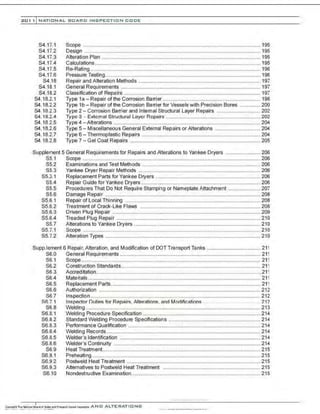
1.7.6.7 ISSUANCE OF MORE THAN ONE "VR" SYMBOL STAMP TO A CERTIFICATE OF
AUTHORIZATION HOLDER
The holder of a Certificate ofAuthorization may obtain more than one "VR" Symbol Stamp provided ~s qual-
ity system manual controls the use of such stamps from the address of record shown on the Certificate of
Authorization.
1.7.7 QUALITY SYSTEM
1.7.7.1 GENERAL
Each applicant for a new or renewed "VR" Certificate ofAuthorization shall have and maintain a quality system
which shall establish that all oftheserules and administrative procedures and applicableASME Code require-
ments, including material control, fabrication, machining, welding, examination, setting, testing. inspection,
sealing, and stamping will be met.
1.7.7.2 WRITTEN DESCRIPTION
A written description. in the English language, of the system the applicantwill use shall be available for review
and shall contain. as a minimum. the features setforth in NBIC Part 3, 1.7.7.5. This description may be brief or
voluminous, depending upon the projected scope ofwork, and shall be treated confidentially. In general, the
quality system shall describe and explain what documents and procedures the repair firm will use to validate
a valve repair.
NATI O N A L BOARO INSPE CTION COO E l201 1
1.7.7.3 REVIEW
A review of the applicant's quality system will be performed by a representative of the National Board. The
review will include a demonstration of the implementation of the provisions of the applicant's quality system.
1.7.7.4 MAINTENANCE OF CONTROLLED COPY
Each applicant to whom a ' VR" Certificate of Authorization is issued shall maintain thereafter a controlled
copy of the accepted quality system manual with the National Board. Except for changes that do not affect
the quality system, revisions to the quality system manual shall not be implemented until such revisions are
accepted by the National Board.
1.7.7.5 OUTLINE OF REQUIREMENTS FORA QUALITY SYSTEM
The following establishes the minimum requirements of the written description of the quality system. It is re-
quired that each valve repair organization develop its own quality system that meets the requirements of its
organization. For this reason it is not possible to develop one quality system that could apply to more than one
organization. The written description shall include, as a minimum, the following features:
a) Title Page
The title page shall include the name and address ·~f the company to which the National Board Certificate
of Authorization is to be issued.
b) Revision Log
A revision log is required to ensure revision control of the quality system manual. The log should contain
sufficient space for date, description and section of revision. company approval, and National Board ac-
ceptance.
c) Cor.tents Page
The contents page should list and reference, by paragraph and page number, the subjects and exhibits
contained therein.
d) Statement ofAuthority and Responsibility
A statement of authority and responsibility shall be dated and signed by an officer ofthe company. It shall
include:
1) A statement that the "VR" stamp shall be applred only to pressure relief valves that meet both ofthe
following conditions:
a. Are stamped with anASME "V','UV", or "NV'' Code symbol or marked with anASME "t·IV" symbol
and have been capacity certified by the National Board; and
b. Have been disassembled, inspected, and repaired by the Certificate Holder such that the
valves' condition and performance are equivalent to the standards for new valves.
2) The title of the individual responsible for ensuring that the quality system is followed and who has
authority and freedom to affect the responsibility;
3) A statement that if there is a disagreement in the implementation of the written quality system, the
matter is to be referred to a higher authority in the company for resolution; and
PART 3 - REPAI RS A N O ALTERATI O N S SECTION 1 25
201 1 INATIONAL. BCARC I NSPECTION CODE
4) The title ofthe individual authorized to approve revisions to the written quality system and the method
by which such revisions are to be submitted tothe National Board for acceptance before implementa-
tion.
e) Organization Chart
A chart showing the relationship between management, purchasing. repairing, inspection. and quality
control personnel is required and shall reflect the actual organization in place.
f) Scope ofWork
1) The scope of work section shall indicate the scope and type of valve repairs. including conversions
the organization is capable of and intends to perform. The location of repairs (shop. shop and field,
or field only), ASME Code Section(s) to which the repairs apply, the test medium (air, gas, liquid, or
steam. or combinations thereof). and special processes (machining, welding,postweld heattreatment,
or nondestructive examination. or combinations thereof) shall be specifically addressed.
2) The types and sizes ofvalves to be repaired, pressure ranges and other limitations, such as engineer-
ing and test facilities, should also be addressed.
g) Drawings and Specification Control
The drawings and specification control system shall provide procedures assuring thatthe latest applicable
drawings, specifications, and instructions required are usedfor valve repair, including conversions,inspec-
tion. and testing.
h) Material and Part Control
The material and part control section shall describe purchasing, receiving, storage, and issuing of parts.
1) State the title of the individual responsible for the purchasing of all material.
2) State the title of the individual responsible for certification and other records as required.
3) All incoming materials and parts shall be checked for conformancewith the purchase order and, where
applicable, the material specifications or drawings. Indicate how material or part is identified and how
identity is maintained by the quality system.
i) Repair and Inspection Program
Therepair and inspection program section shall include referenceto a document (such as a report, traveler,
or checklist) that outlines the specific repair and inspection procedures used in the repair ofpressure relief
valves. Repair procedures shall require verification that the critical parts meet the valve manufacturer's
specification. Supplement S7.14 outlines recommended procedures covering some specific items. Provi-
sions shall be made to retain this document for a period of a!least five years.
1) Each valve or group of valves shall be accompanied by the document referred to above for process-
ing through the plant. Each valve shall have a unique identifier (i.e., repair serial number, shop order
number, etc.) appearing on the repair documentation and repair nameplate such that traceability is
established.
2) The document referred to above shall describe the original nameplate information, including the
ASME Code symbol stamping and the repair nameplate information, if applicable. In addition, it shall
include material checks, replacement parts, conversion parts (or both). reference to items such as
the welding procedure specifications (WPS), frt-up, NDE technique, heat treatment, and pressure
test methods to be used. Application of the "VR" stamp to the repair nameplate shall be recorded in
NATIO N AL BOARO INSPECTION COOE l201 1
this document. Specific conversions performe:l with the new Type/Model Number shall be recorded
on the document. There shall be a space for "signoffs" at each operation to verify that each step has
been properly performed.
3) The system shall include a method of controlling the repair or replacement of critical valve parts. The
method of identifying each spring shall be indi,
::ated.
4) The system shall also describe the controls used to ensure that any personnel engaged in the repair
of pressure relief valves are trained and qualified in accordance with NBIC Part 3, Supplement 7.
j) Welding, NDE, and Hea!Treatment (when applicable)
The quality system manual shall indicate the title ofthe person(s) responsible for and describe the sys-
tem used in the selection, development, approval, and qualification ofwelding procedure specifications,
and the qualification of welders and welding operators in accordance with the provisions of NBIC Part 3,
Supplement 7.
1) The quality system manual may include controls for the "VR" Certificate Holder to have the pressure
relief valve part repaired by a National Board "R" Certificate Holder, per NBIC Part 3, Supplement 7.
2) The completed Form R-1 shall be noted on and attached to the "VR" Certificate Holder's document
required in NBIC Part 3, 1.7.7.5 i). Similarly, NDE and heat treatmenttechniques must be covered in
the quality system manual. When outside services are used for NDE and heat treatment. the quality
system manual shall describe the system whereby the use of such services meet the requirements
ofthe applicable section of theASME Code.
k) Valve Testing, Setting, and Sealing
The system shall Include provisions that each valve shall be tested, set, and all external adjustments
sealed according to the requirements of the applicable ASME Code Section and the National Board. The
seal shall identify the "VR" Certificate Holder making the repair.Abbreviations or initials shall be permitted,
provided such identification is acceptable to the National Board.
I) Valve Repair Nameplates
An effective valve stamping system shall be established to ensure proper stamping of each valve as re-
quired by NBIC Part 3, 5.12.2. The manual shall include a description of a nameplate or a drawing. A11
m) Calibration
'·
1) The manual shall describe a systemfor the calibration ofexamination, measuring, and test equipment :.
used in the performance of repairs. Documentation of these calibrations shall include the standard
used and the results.
2) All calibration standards shall be calibrated against certified equipment having known valid relation-
ships to nationally recognized standards.
n) Manual Control
The quality system shall include:
1) Measures to control the issuance of and revisions to the quality system manual;
2) Provisions for a review of the system in order to maintain the manual current with these rules and the
applicable sections of the ASME Code;
3) The title(s) ofthe individual(s) responsible for control, revisions, and review ofthe manual;
PART 3 - REPAIRS ANO ALTERATIONS SECTION 1 27
201 1 INATIONAL. BCARC I NSPECTION CODE
4) Provision of a controlled copy of the written quality system manual to be submitted to the National
Board; and
5) Revisions shall be submitted for acceptance by the National Board prior to being implemented.
o) Nonconformities
The system shall establish measures for the identification, documentation, evaluation, segregation, and
disposition of nonconformities. A nonconformity is a condition ofany material, item, product, or process in
which one or more characteristics do not conform to the established requirements. These may include,but
are not limited to, data discrepancies, procedural and/or documentation deficiencies, or material defects.
Also, thetitle(s) of the individual(s) involved in this process shall be included.
p) Exhibits
Forms used in the quality system shall be included in the manual with a written description. Forms exhibited
should be marked SAMPLE and completed in a manner typical of actual valve repair procedures.
q) Testing Equipment (See NBIC Part 3, Supplement 8)
The system shall include a means to control the development, addition, or modification oftesting equip-
ment to ensure the requirements of NBIC Part 3, 4.5.1(b) are met.
r) Field Repairs (See NBIC Part 3, S7.7)
Iffield repairs are included in the scope ofwork, the system shall address any differences or additions to
the quality system required to properly control this activity, including the following:
1) Provisions for annual audits of field activities shall be included;
2) Provisions for receipt and Inspection of replacement parts, Including parts received from the owner-
user, shall be addressed;
3) If owner-user personnel will assist with repairs, provisions for the use of owner-user personnel shall
be included; and
4) Provisions for use of owner-user measurement and test equipment, if applicable, shall be addressed.
1.7.8 ASME "V," "HV," OR "UV" CERTIFICATE HOLDERS
a) A manufacturer holding a valid ASME Certificate ofAuthorization for use of an ASME "V', "HV', or "UV'
Code symbol stamp may obtain the "VR" Certificate of Authorizationfor the repair of pressure relief valves
covered bytheASME Certificate ofAuthorization and that meetthe requirements of NBIC Part 3, 1.7.3. This
can be accomplished without a review of the facilities provided there is a written quality system to cover
the scope of the repairs to be made and the repairs are carried out at the same location where the ASME
valves are manufactured. Unless the repaired valves are tested on the same facilities and to the same
procedures as new valves, two (2) repaired valves shall be selected by a National Board Representative
for verification tests.
b) The initial Certificate ofAuthorization shall be issued to expire concurrent with the ASME Certificate of
Authorization. Subsequent certificates shall be renewed upon a successful review and verification of
imp'ementation of its quality system by a National Board Representative. This review shall be performed
concurrently with the ASME Certificate renewal review.
c) A manufacturer may also perform field repairs of pressure relief valves covered by the ASME Certificate
ofAuthorization provided the provisions of NBIC Part 3, S7.7 are met.
.·
....·.·....-..... . ..·..-,·..
>
NATI O N A L BOARO INSPE CTION COO E l201 1
d) Assemblers holdingASME Certificates ofAuthorization shall qualify for the "VR' Certificate ofAuthoriza-
tion as required elsewhere in these rules.
e) The quality system manual shall be submitted for review and acceptance by the National Board.
f) In order for an ASME Code symbol stamp holder to qualify for the National Board "VR" stamp, the follow-
ing areas to the written quality system usually require attention:
1) Statement ofAuthority and Responsibility
This should clearly indicate that valve repairs are carried out in accordance with the requirements
and the rules of the National Board and the quality system manual. In addition, the scope andtype of
valve repairs covered by the manual should be indicated.
2) Organization
Unless the functions which affect the quality of valve repairs are carried out by individuals other than
those responsible for manufacturing or assembly, it should not be necessary to revise the organization
chart.
3) General Quality Functions
Usually quality system requirements regarding valve repairs may be controlled in the same manner
as forASME manufacturing or assembly provided applicable shop and/or field activities are covered.
If this is the case, the applicant forthe "VR' stamp should include in its quality system manual a sepa-
rate section covering valve repairs that references the applicable section of the manual. For a more
explicit explanation see NBIC Part 3, 1.7.7.5, Outline ofRequirements for a Quality System.
1.8 "NR" ACCREDITATION REQUIREMENTS
1.8.1 SCOPE
a) This section provides requirements that must be met for an organization to obtain a National Board Cer-
tificate ofAuthorization to use the "NR" Symbol Stamp for the Repair/Replacement activities performed
in accordance with this Part and ASME Section XI requirements.
b) The issuance of the "NR" stamp is not restricted to organizations whose primary business is to perform
repair/replacement activities orto manufacturers or assemblers that hold anASME "N"-type Code symbol
stamp. Owners and users of nuclear components and other organizations that qualify in accordance with
these rules may also obtain the "NR" stamp.
1.8.2 PREREQUISITES FOR ISSUING A NATIONAL BOARD "NR" CERTIFICATE OF
AUTHORIZATION
Before an organization can obtain a National Board "NR" Certificate ofAuthorization, the organization shall:
a) Have and maintain an inspection agreement with an accredited Nuclear Inspection Agency in accordance
with NB-360,• NB-369,5 and ASME Section XI;
4 NB-;6o,Criteriafor Acceptanceof AuthorizedJnspecUonAgenclesjorNewConstmct!on.
5 Nll-369, Quol!ficotlon and Duues tor AuthOrized Inspection Agencies (AlAS) Performinglnserviee Inspection ACUvltles and Quollicotion of
Inspectors of Boilers and PressureVessels.
PART 3 - REPAI RS A N O ALTERATI O N S SECTION 1 2'SI
201 1 INATIONAL. BCARC I NSPECTION CODE
b) Have, in the English language, a written Quality System Program that complies with the requirements of
this Section and addresses controls for the intended scope of activities;
c) Have a current Edition of the NBIC. all parts; and
d) Have available copies of the original code of construction appropriate to the intended scope ofwork and
the applicable edition and addenda ofASME Section XI, as required by the regulatory authority.6
1.8.3 PROCEDURES FOR OBTAINING OR RENEWING A NATIONAL BOARD "NR"
CERTIFICATE OF AUTHORIZATION
a) Prior to issuance or renewal ofa National Board "NR" Certificate ofAuthorization, the organization and its
facilities are subject to a review of its Quality System Program. The implementation of the Quality System
Program shall be satisfactorily demonstrated by the organization. Demonstration of implementation shall
meet the most stringent code requirements for the scope of work to be performed by the organization.
The National Board reserves the absolute right to cancel, nefuse to issue, or renew such authorization.
The National Board will return fees paid for the unexpired term ofthe certificate.
b) Organizations desiring to obtain a National Board Certificate ofAuthorization shall apply to the National
Board using forms obtained from the National Board. Application for nenewal shall be made prior to the
exp:ration date of the Certificate ofAuthorization.
c) These procedures also applyto qualified organizations that make repairs toASME Section Ill, "NV' Pressure
ReliefDevices. An organization that holds a valid "NR" Certificate ofAuthorization shall , for the purpose of
these procedunes, be known as an authorized nuclear repair organization.
d) Authorized Nuclear Inspection Agencies and Inspectors referred to in these procedures shall meet the
requirements of, and have been qualified and commissioned in accordance with, the NB-263 National
Board Rules for lnservice and New Construction Commissioned Inspectors.
e) Repair/replacement activities performed underthe"NR" Certificate ofAuthorization must be in accordance
with the provisions of the NBIC, Section XI oftheASME Code and the rules ofthe Jurisdiction.
f) Each authorized nuclear repair organization shall maintain a documented Quality System Program that
meets the requirements of NBIC Part 3. 1.8.5.1. The Quality System Program shall be commensurate
with the scope of the organization's activities and shall be acceptable to the Jurisdiction, the Authorized
Nuclear Inspection Agency, and the National Board.
g) Before an "NR" Certificate ofAuthorization will be issued or renewed, the applicant must have the Quality
System Program and the implementation ofthe program reviewed and found acceptable by representa-
tives ofthe National Board, the Jurisdiction . and the accredited Authorized Nuclear Inspection Agency. If
the applicant is an ASME "N"-type Certificate ofAuthorization holder, has demonstrated within the last 12
months the implementation of the quality program, and can verify by documentation that the organization
is capable of implementing its quality program as being in compliance with this part, a further verification
implementation by the survey team may not be necessary.
6 Regulatory Authority;A federalgovernment agency, such astheun~ed States Nuclear RegulatoryCommission. empowered to Issueand
enforce regulationsconcerning thedesign, construction, andoperatiorof nudear power plants.
NATIO N AL BOARO INSPECTION COOE l201 1
h) Applicants that do not hold valid ASME "N"-type Certificates ofAuthorization shall demonstrate. by docu-
mentation and actual implementation, that they are capable of performing repair/replacement activities
in accordance with the requirements ofASME Section XI and the scope of their application for an "NR"
Certificate ofAuthorization.
i) ForNational Board authorization to repairASME 'NV'f'NB"-stamped pressure relief devices, the applicant
shall hold a valid "VR" Certificate ofAuthorization for the repair ofASME Section Ill pressure relief valves
and also meet the applicable requirements for "NR" certification and NBIC Part 3, Supplement 7.
j) When these requirements have been met, the applicant may be issued an "NR" Certificate ofAuthoriza-
tion. which clearly outlines the scope ofwork for Section Ill pressure relief devices.
k) The Jurisdiction will be the National Board member Jurisdiction in which the applicant is located. If the
implementation ofthe Quality System Program takes place outside ofthe Jurisdiction where the applicant's
program was reviewed, the National Board member in the Jurisdiction where the implementation takes
place may participate in this portion of the survey. At the request of the Jurisdiction, the National Board
representative may also act for said Jurisdiction.
I) Where there is no National Board member Jurisdiction, the applicant's Quality System Program shall be
acceptable to representatives of the National Board and the Authorized Nuclear Inspection Agency.
m) Theapplicant shall requestthe National Board to evaluatethe Quality System Program and implementation
prior to the issuance of an "NR" Certificate ofAuthorization. The National Board. when requested through
the appropriate form, will arrange for an evaluation of the applicant's Quality System Program. The pro-
gram will be evaluated on the basis of its compliance with the National Board rules for certification. The
program shall be adequate to control the intended scope of work. The "NR" Certificate ofAuthorization
that Is Issued shall specify the scope and limits ofwork for which the applicant Is certified.
n) Revisions tothe Quality System Program shall be acceptable totheAuthorized Nuclear Inspector Supervi-
sor of theAuthorized Nuclear Inspection Agency before implementation.
o) The "NR" Certificate ofAuthorization holder shall be subject to an audit annually by theAuthorized Nuclear
Inspection Agency to assure compliance w~h the Quality System Program.
p) Upon notification ofthe survey dates from the National Board, it is the responsibility ofthe organization to
make arrangements for the survey.
q) The Survey Team, as a minimum, shall consist of one representative each from the National Board. Au-
thorized Nuclear Inspection Agency, and Jurisdiction.
r) A recommendation to issue. renew. orwithhold the National Board Certificate ofAuthorization forthe "NR"
Symbol Stamp shall be included in a summary report prepared by the survey team leader. The completed
summary report shall be forwarded to the National Board.
s) If proper administrative fees are paid and all other requirements are met, an "NR" Certificate ofAuthoriza-
tion will be issued evidencing authorization to use the "NR" Symbol Stamp. The Certificate shall e:<pire on
the triennial anniversary date.
t) When an organization holding a National Board Certificate ofAuthorization changes ownership, name, or
address.the National Board shall be notified. The Certificate ofAuthorization may be revised by submitting
an application for National Board "NR" Certificate ofAuthorization.
PART 3 - REPAIRS ANO ALTERATIONS SECTION 1 31
201 1 INATIONAL. BCARC I NSPECTION CODE
u) The National Board may at any time change the rules for the issuance of the Certificate ofAuthorization
and use of the "NR" Symbol Stamp. These rules shall become binding on all certificate holders.
1.8.4 NATIONAL BOARD "NR" SYMBOL STAMP
a) All "NR" Symbol Stamps shall be obtained from the National Board ci Boiler and Pressure Vessel Inspectors.
Authorization to use the "NR'' Symbol Stamp may be granted by the National Board at its absolute discretion.
b) The National Board, for a nominal fee, furnishes the "NR" Symbol Stamp. Each organization shall agree,
if authorized to use the "NR" Symbol Stamp, that the "NR" Symbol Stamp is at all times the property of
the National Bo:;~rd and will be promptly returned upon demand. If the organization discontinues the use
of the "NR" Symbol Stamp or if the Certificate ofAuthorization has expired and no new Certificate ofAu-
thorization has been issued, the "NR" Symbol Stamp shall be returned to the National Board.
c) The organization's Quality System Program shall provide for adequate control ofthe "NR" Symbol Stamp.
d) The organization authorized to use the "NR" Symbol Stamp may obtain more than one "NR" Symbol Stamp
provided the organization's Quality System Program describes how the use of such stamps are controlled
from the location shown on the "NR" Certificate ofAuthorization.
e) The organization shall not permit other organizations to use the "NR" Symbol Stamp loaned to ~by the
National Board .
1.8.5 QUALITY SYSTEM PROGRAM
A holder of a National Board Certificate ofAuthorization shall have and maintain a written Quality System
Program. The system shall satisfactorily meet the requirements ofthe NBIC, jurisdictional requirements, and
shall be available for review. The Quality System Program may be brief or voluminous, depending on the
circumstances. It shall be treated confidentially by the National Board.
1.8.5.1 OUTLINE OF REQUIREMENTS FORA QUALITY SYSTEM PROGRAM FOR
QUALIFICATION FOR THE NATIONAL BOARD "NR" SYMBOL STAMP
These rules set forth the requirements for planning, managing, and implementing the organizations Qual-
ity System Programs for controlling the quality of activities performed during repair/replacement activities of
components and systems in nuclear power plants within the scope ofthe applicable edition and addenda of
Section XI oftheASME Code. These rules are to be the basis for evaluating suclh programs prior to the issu-
ance ortlle National Boord "NR" Certificate orAu/lroriarlioo.
a) Organization
1) The authority and responsibility ofthose in charge of the Quality System Program and activities affecting
quality shall be clearly established and documented. The person and organization performing Quality
System functions shall have sufficient and well-defined responsibility, authority, and organizational
freedom to:
a. Identify quality problems;
b. Initiate action which results in solutions;
NATIO N AL BOARO INSPECTION COOE l201 1
c. Verify implementation of solutions to those problems; and
d. Control further processing, delivery or installation of a nonconforming item, deficiency or unsatis-
factory condition until proper disposition has been made.
2) The person and organization responsiblefor defining and for measuring the overall effectiveness ofthe
Quality System Program shall be designated sufficiently independentfrom the pressure ofproduction,
have direct access to responsible management at a level where appropriate action can be required
and report regularly on the effectiveness ofthe program. Assurance of quality requires management
measures which provide that the individual or group assigned the responsibility of inspection, testing,
checking, or otherwise verifying that an activitf has been correctly performed, is independent ofthe
individuaI or group directly responsible for performing the specific activity. The specific responsibilities
ofthe QualityAssurance organization ofthe "NR" Certificate Holder shall include the review ofwritten
procedures and monitoring of all activities concerned with the Quality System Program as covered in
these rules.
b) Quality System Program
1) Before becoming a holder of an "NR" Certificate ofAuthorization, the applicant shall establish a Qual-
ity System Program for the control of the quality of work to be performed. The program shall define
the organizational structure within which the Quality System Program is to be implemented and shall
clearly delineate the responsibilities, levels of authority, and lines of communication for the various
individuals involved. The program shall be documented in detail in a Quality System Manual that
shall be a major basis for demonstration of compliancewith the NBIC. The applicant's Quality System
Program shall be documented by written policies, procedures, and instructions and shall be based on
the organization's scope ofwork to be performed.
2) The applicant's program need not be in the same format or sequential arrangement as the require-
ments in these rules as long as all applicable program requirements have been covered. The program
shall provide for the accomplishment ofactivities affecting quality under suitably controlled conditions.
Controlled conditions include the use of appropriate equipment, suitable environmental conditions for
accomplishing the activity and assurance that prerequisites for the activity have been satisfed. The
program shall take into account the need for special controls, processes, test equipment, tools, and
skills to attain the required quality and need for the verification of quality by inspection and test. The
program shall provide for ready detection of nonconforming material and items and for timely and
positive corrective actions.
3) The program shall provide for indoctrination and training of personnel performing activities affecting
quality as necessary to assure that suitable proficiency is achieved and maintained. It shall be the
responsibility ofthe "NR" Certificate Holder to ensure that all personnel performing quality functions
within the scopeofthese rules. including personnel ofsubcontracted services. are qualified as specified
in these rules. The assignment of qualified personnel shall be at the discretion of the "NR" Certificate
Holder.
4) The "NR" Certificate Holder shall be responsible for advising hisAuthorized Nuclear InspectionAgency
of any proposed changes to the Quality System Manual and shall have acceptance of the Authorized
Nuclear Inspection Agency'sAuthorized Nuclear Inspector Supervisor before putting such changes into
effect. The "NR" Certificate Holder shall make a current copy of the Quality System Manual available
to theAuthorized Nuclear Inspector. The "NR" Certificate Holder shall be responsible for promptly no-
tifying theAuthorized Nuclear Inspector of such accepted changes, including evidence of acceptance
by the Authorized Nuclear Inspection Agency.
PART 3 - REPAIRS ANO ALTERATIONS SECTION 1 33
201 1 INATIONAL. BCARC I NSPECTION CODE
5) The quality of all repair/replacement activities shall be controlled at all points necessary to ensure
conformance with the requirements of these rules and the "NR" Certificate Holder's Quality System
ManuaL
6) The Certificate Holder shall make available to the Authorized Nuclear Inspector such drawings and
process sheets as are necessary to make the Quality System Program intelligible.
c) Design Control
1) ASME Section XI establishes that the owner is responsible for design in connection with repair/re-
placement activities. The "NR" Certificate Hold:!r must ensure that the design specification, drawings,
or other specifications or instructions furnished by the owner satisfy the code edition and addenda of
the owner's design specification. To satisfy this requirement, the "NR" Certificate Holder shall estab-
lish requirements that correctly incorporate the owner's design specification requirements into their
specifications, drawings, procedures, and instructions, which may be necessary to carry out thework.
The "NR" Certificate Holder's system shall include provisions to ensure that the appropriate quality
standards are specified and included in all quality records. These records shall be reviewed for com-
pliance with the owner's design specification and the requirements ofASME Section XI.
2) If the "NR" Certificate Holder's specifications, drawings, procedures, and instructions conflict with the
owner's design specification, a system must be implemented that will resolve or eliminate the defr
ciency. This system must be reconciled with the owner and the "NR" Certificate Holder in accordance
with IWA-4000 ofASME Section XI.
d) Procurement Document Control
Documents for procurement of materials, Items, and subcontracted services shall Include requirements
to the extent necessary to ensure compliance with the owner's design specifications and IWA-4000 of
ASME Section XI. To the extent necessary, procurement documents shall require suppliers to maintain
a Quality System Program consistent with the applicable requirements of the edition and addenda ofthe
code of construction to which the items are constructed. Measures shall be established to ensure that all
purchased material, items, and services conform to these requirements.
e) Instructions, Procedures and Drawings
Activities affecting quality shall be prescribed by documented instructions, procedures or drawings of a
type appropriate to the circumstances and shall be accomplished in accordance with these instructions,
procedures, or drawings. Instructions, procedures, or drawings shall include appropriate quantitative and
qualitative criteria for determining that activities affecting quality have been satisfactorily accomplished.
The "NR" Certificate Holder shall maintain a written description of procedures, instructions, or drawings
use:l by his organization for control of quality and examination requirements detailing the implementation
ofthe Quality System requirements. Copies ofthese procedures shall be readily available to theAuthorized
Nuclear Inspector.
f) Document Control
The program shall include measures to control the issuance, use. and disposition of documents. such as
spe:ifications, instructions, procedures, and drawings, including changes thereto. These measures shall
ensure that the latest applicable documents, including changes, are reviewed for adequacy and approved
for release by authorized personnel and distributed for use at the location where the prescribed a:tivity is
performed.
NATIO N AL BOARO INSPECTION COOE l201 1
g) Control of Purchased Material, Items. and Services
Measures shall be established to ensure that all purchased material. items, and servioes conform to the
requirements of the owner's design specifications and applicable edition and addenda of the code of
construction and ASME Section XI. These measures shall include identification for material traceability.
Provisions shall be identified for source evaluation and objective evidence shall be provided evidencing
quality standards for material examination upon receipt.
h) Identification and Control of Material and Items
1) Measures shall be established for identification and control ofmaterial and items, including partially fab-
ricated assemblies. These measures shall ensure that identification is maintained and traceable, either
on the material or component, or on recordsthroughoutthe repair/replacement activity. These measunes
shall be designed to prevent the use of incorrect or defective items and those which have not received
the required examinations, tests, or inspections.
2) Permanent or temporary unit identification marl<s shall be applied using methods and materialsthat are
legible and not detrimental to the component or system involved. Such identification shall be located
in areas that will not interfere with the function or quality aspects of the item.
3) Certified Material Test Reports shall be identifed as required by the applicable material specification
in ASME Section II and shall satisfy any additional requirements specified in the original code of con-
struction. The Certified Material Test Report or Certificate of Compliance need not be duplicated for
submission with compliance documents when a record of compliance and satisfactory reviews of the
Certified Material Test Report and Certificates of Compliance is provided. Documents shall provide
a record that the Certified Material Test Report and Certificates ofCompliance have been received.
reviewed, and found acceptable. When the "NR" Certificate Holder Scope authorizes the organiza-
tion to perform examinations and tests in accordance with the original code of construction, the "NR"
Certificate Holder shall certify compliance either on a Certified Material Test Report or Certificate of
Conformance that the material satisfies the original code of construction requirements.
i) Control of Processes
1) The "NR'' Certificate Holder shall operate undera controlled system such as process sheets, checklists,
travelers. or equivalent procedures. Measures shall be established to ensure that processes such as
welding, nondestructive examination, and heattreating are controlled in accordance with the rules of
the applicable section of theASME Code and are accomplished by qualified personnel using qualified
procedures.
2) Process sheets, checklists, travelers, or equivalent documentation shall be prepared, including the
document numbers and revisions to which the process conforms with space provided for reporting
results of completion of specific operations at checkpoints of repair/replacement activities.
j) Examinations, Tests and Inspections
1) In-process and final examinations and tests shall be established to ensure conformance with specifi-
cations, drawings, instructions, and procedures which incorporate or reference the requirements and
acceptance limits contained in applicable design documents. Examination activities to verify the quality
ofwor1< shall be performed by persons other than those who performed the activity being examined.
Such persons shall not report directly to the immediate supervisors responsible for the work being
examined.
-
.·..·..·............-..·,·..·
PART 3 - REPAIRS ANO ALTERATIONS SECTION 1 35
201 1 INATIONAL. BCARC I NSPECTION CODE
2) Process sheets. travelers, or checklists shall be prepared. including the document numbers and revi-
sion to which the examination or test is to be performed. with space provided for recording results.
3) Mandatory hold/inspection points atwhich witnessing is required by the "NR" Certificate Holder's rep-
resentative or theAuthorized Nuclear Inspector shall be indicated in the controlling documents. Wor1<
shall not proceed beyond mandatory hold/inspection points without the consent ofthe "NR" Certificate
Holder's representative or theAuthorized Nuclear Inspector, as appropriate.
k) Test Control
1) Testing shall be performed in accordance with the owner's written test procedures that incorporate or
reference the requirements and acceptance limits contained in applicable design documents.
2) Test procedures shall include provisions for ensuring that prerequisites for the given test have been
met, that adequate instrumentation is availableand used, and that necessary monitoring is performed.
Prerequisites may include calibrated instrumentation, appropriate equipment, trained personnel, con-
d~ion oftest equipment and the item to be tested, suitable environmental conditions, and provisions
for data acquisition.
3) Test resuIts shall bedocumented and evaluated to ensure thattest requirements have been satisfied.
I) Control of Measuring and Test Equipment
Measures shall be established and documented to ensure that tools, gages. instruments, and other
measuring and testing equipment and devices used in activities affecting quality are of the proper
range, type, and accuracy to verify conformance to established requirements.A procedure shall be in
effect to ensure that they are calibrated and properly adjusted at specified periods or use Intervals to
maintain accuracy within specified limits. Calibration shall be traceable to known national standards,
where these standards exist, or with the device manufacturer's recommendation.
m) Quality Records
1) The owner is responsible for designating records to be maintained. Measures shall be established
for the "NR" Certificate Holder to maintain these records (See 1.8.5.1 m) 2)] required for Quality As-
surance of repair/replacement activities. These shall include documents such as records of materi-
als, manufacturing, examination. and test data taken before and during repair/replacement activity.
Procedures, specifications, and drawings used shall be fully identified by pertinent material or item
identification numbers, revision numbers, and issue dates. The records shall also include related data
such as personnel qualification,procedures, equipment, and related repairs. The "NR" Certificate Holder
shall take such steps as may be required to provide suitable protection from deterioration and damage
for all records while in his care. Also, it is requ'red that the "NR" Certificate Holder have a system for
correction or amending records that satisfies the owner's requirements. These records may be either
the original or a reproduced, legible copy and shall be transferred to the owner at his request.
2) Records to be maintained as required in NBIC Part 3, 1.8.5.1 m) 1) above may include the following:
a. An index that details the location and individual responsible for maintaining the records;
b. Data reports, properly executed, for each replacement component, part, appurtenance, piping
system, and piping assembly, when required by the design specification or the owner;
c. The required as-constructed drawings certified as to correctness;
.............. " ....
~~~~,....~b,~!~~.oc:.!'!~~Pr...aro';'~w~ : - REPAIRS ANO A L
T E R.t ,!,l}?.~.~.....-.~.-.............- ....
NATIO N AL BOARO INSPECTION COOE l201 1
d. Copies of applicable Certified Material Test Reports and Certificates of Compliance;
e. As-built sketch{es) including tabulations ofmaterials repair/replacement procedures, and instruc-
tions to achieve compliance with ASME Section XI.
f. Nondestructive examination reports, including results of examinations, shall identify the ASNT.
SNT-TC-1A, CP-189, orACCP level of personnel interpreting the examination results. TheASNT
Central Certification Program (ACCP) may be used to fulfill the examination and demonstration
requirement ofthe employer's written practice. Final radiographs shall be included where radiog-
raphy has been performed;
g. Records ofall heattreatments may beeitherthe heattreatment charts or a summary description of
heat treatment time and temperature data certified by the "NR" Certificate Holder. Heat treatments
performed by the material manufacturer to satisfy requirements ofthe material specifications may
be reported on the Certified Material Test Report; or
h. Any and all nonconformance reports shall satisfy IWA-4000 of ASME Section XI and shall be
reconciled by the owner prior to certification ofthe Form NR-1 or NVR-1, as applicable.
3) After a repair/replacement activity, all records including audit reports required to verify compliance
with the applicable engineering documents andthe "NR" Certificate Holder's Quality System Program,
except those required by the owner or listed in NBIC Part 3, 1.8.5.1 m) 2) a) thru g) above, shall be
maintained at a place mutually agreed upon by the owner and the "NR" Certificate Holder. These re-
cords shall be maintained for a period offiVe years after completion of the repair/replacementactivity.
4) The original of the completed Form NR-1 or Form NVR-1, as applicable, shall be registered with the
National Board and, If required, a copy forwarded to the Jurisdiction where the nuclear power plant Is
located.
n) Examination or Test Status
Measures shall be established to indicate examination and test status of parts, items, or components
during the repair/replacement activity. The system used shall provide positive identification of the part,
item, or component by means of stamps, labels, routing cards, or other acoeptable methods. The system
shall include any prooedures or instructions neoessary to achieve compliance. Also, measures shall be
provided for the identification of acoeptable and unacceptable items. They shall also include procedures
for control of status indicators, including the authority for application and removal of status indicators.
o) Nonconforming Materials or Items
Measures shall be established to control materials or items that do not conform to requirements in order
:~ to preventtheir inadvertent use. including measures to identify and control the proper installation of items
and to preclude nonconformance with the requirements of these rules. These measures shall include
procedures for identification, documentation, segregation, and disposition. Nonconforming items shall be
reviewed for acceptanoe, rejection, or repair in accordancewith documented procedures. The responsibil-
ity and authority for the disposition of nonconforming items shall be defined. Repaired or modified items
shall be re-examined in accordanoewith the applicable prooedures. Measures that control further process-
ing :>fa nonconforming or defective item, pending a decision on its disposition , shall be established and
maintained. Ultimate disposition of nonconforming items shall be documented.
PART 3 - REPAIRS ANO ALTE RATIONS SECTION 1 3 7
201 1 INATIONAL. BCARC I NSPECTION CODE
p) CorrectiveAction
1) Measures shall be established to ensure that conditions adverse to quality such as failures, malfunc-
tions, deficiencies, deviations, defective material and equipment, and other nonconformances are
promptly identified and corrected.
2) In the case of significant conditions adverse to quality, the measures shall also ensure that the cause
ofthese conditions be determined and corrected to preclude repetition. The identification of significant
conditions adverseto quality, the cause, condition, and the corrective action taken shall be documented
and reported to the appropriate levels of management.
3) The requirements shall also extend to the performance of subcontractors' corrective action measures.
q) Audits
A comprehensive system ofplanned and periodic audits shall be carried out by the 'NR" Certificate Holder's
organization to ensure compliance with the Qualitf System Program and to determine its effectiveness.
Audits shall be performed in accordance with written procedures or checklists by personnel not having
direct responsibilities in the areas being audited. Audit results shall be documented by the auditing per-
sonnel for review by management having responsibility in that area. Follow-up action, including re-audit
of deficient areas, shall be taken where indicated.Audit results shall be made available to the Authorized
Nuclear Inspector.
r) Authorized Nuclear Inspector
Measures shall be taken to reference the commissioned Rules for National Board Authorized Nuclear
Inspector,qualified In accordance with the Rules for NationalBoardInservice and Newconstruction Com-
misioned Inspectors, to ensure that the latest documents including the Quality System Program will be
made available to the inspector. TheAuthorized Nuclear Inspector shall be consulted prior to the issuance
of a repair/replacement program in orderthat the Inspector may select any inspection or hold points in the
program.The Authorized Nuclear Inspector shall not sign Form NR-1 or Form NVR-1, as applicable, unless
satisfied that all work carried out is in accordance with the NBIC, ASME Section Xl, and any jurisdictional
requirements.
S) EXhibits
Forms referenced in the Quality System Manual shall be explained in the text and included as part of the
referencing document or as an appendix. Forms shall be controlled and identified to show the latest ap-
proved revision, exhibit name, and other corresponding references as stated in the Quality System manual.
1.8.6 INTERFACE WITH THE OWNER'S REPAIR/REPLACEMENT PROGRAM
Interface with the owner's repair/replacement program shall meet the following:
a) The repair/replacement plan shall be subject to the acceptance of the Jurisdiction and the owner'sAutho-
rizej Nuclear In-Service Inspector (ANII).
b) Repair/replacement activities of nuclear components shall meet the requirements ofASME Section XI of
the ASME BoilerandPressure Vessel Code and the Jurisdiction where the nuclear power plant is located.
·.·..·..-,·....·.... ··..·..·. -
..
NATIO N AL BOARO INSPECTION COOE l201 1
c) Documentation ofthe repair/replacement activities ofnuclear components shall be recorded on the National
Board Report of Nuclear Repair/Modification or Replacement activities. Form NR-1 . or Form NVR-1. as
applicable. The completed forms shall be signed by a representative of the authorized nuclear repair or-
ganization and theAuthorized Nuclear Inspector ifthe repair/replacement activity meets the requirements
ofASME Section XI. For repair/replacement activities that involve design changes as specified 1
n NBIC
Part 3. 1.8.5.1 c). Form NR-1, or Form NVR-1, as applicable, shall indicate the responsible organization
satisfying the owner's design specification requirements.
d) The authorized nuclear repair organization shall provide a copy of the signed Form NR-1 or FormNVR-1,
as applicable, to the owner, if required, the Jurisdiction, and the Authorized Nuclear Inspection Agency.
The original Form NR-1 or Form NVR-1, as applicable, shall be registered with the National Board by the
authorized nuclear repair organization.
e) The authorized nuclear repair organization shall provide a nameplate/stamping for repair/replacement
activities for each nuclear component unless otherwise required by the Owner's Quality System Program.
The required information and format shall be as shown in NBIC Part 3, Section 5.
PART 3 - REPA'i'f'fs"A;N'o" .O.'LTERATIONS SECTION 1 3 'SI
201 1 INATIONAL. BCARC INSPECTION CODE
·.·..·..·.·......... ·
..·
..·,·..·
0
N
NATIONAL BOARO INSPECTION COOE l201 1
PART 3, SECTION 2
REPAIRS AND ALTERATIONS- WELDING AND HEAT
TREATMENT
PART 3 - REPAIRS ANO ALTERATIONS SECTION 2 4 1
201 1 INATIONAL. BCARC I NSPECTION CODE
PART 3, SECTION 2
REPAIRS AND ALTERATIONS - WELDING AND HEAT TREATMENT
2.1 SCOPE
This section provides general and specific requirements forwelding and heattreating when performing welded
repairs and alterations to pressure-retaining items. Careful consideration shall be given to pressure-retaining
items that have been fabricated ofeither creep strength enhanoed ferritic materials orferritic materials enhanced
by heat treatment. The tensile and creep strength pnoperties ofthese materials can be degraded by notfoilowing
specific welding and heat treatment requirements. The user is cautioned to seek technical guidance rorwelding
and heat treating requirements in accordance with the original code of construction.
2.2 WELDING
Welding shall be performed in accordance with the requirements of the original code of construction used for
the pressure-retaining item whenever possible.
2.2.1 WELDING PROCEDURE SPECIFICATIONS
Welding shall be performed in accordance with Welding Procedure Specifications (WPS) qualified in accor-
dance with the original code of construction or the construction standard or code selected. When this is not
possible or practicable. the WPS may be qualified in accordance with ASME Section IX.
2.2.2 STANDARD WELDING PROCEDURE SPECIFICATIONS (SEE NBIC PART 3, 2.3)
An "R" Certificate Holder may use one or more applicable Standard Welding Pnooedure Specifications (SWPS)
shown in NBIC Part 3, Table 2.3 without supporting Procedure Qualification Records (PQRs) since SWPS
are pre-qualified.
2.2.3 PERFORMANCE QUALIFICATION
Welders and welding operators shall be qualified for the welding processes that are used. Such qualification
shall be in accordance with the requirements of the original code of construction, the construction standard,
code selected orASME Section IX. Use of a Standard Welding Prooedure Specification shown in NBIC Part
3, 2.3 is permitted for performance qualification testmg.
2.2.4 WELDING RECORDS
The "R" Certificate Holder shall maintain a record ofthe results obtained in Welding Procedure Qualifications,
except for those qualifications for which the provisions of NBIC Part 3, 2.2.2 are used and of the results ob-
tained in welding performance qualifications. These records shall be certified by the "R" Certificate Holder
and shall be available to the Inspector.
NATIONAL BOARO INSPECTION COOE l201 1
2.2.5 WELDER'S IDENTIFICATION
The "R" Certificate Holder shall establish a system for the assignment of a unique identification mark to each
welder/welding operator qualified in accordance with the requirements of the NBIC. The "R" Certificate Holder
shall also establish a written procedurewhereby welded joints are identified as to thewelder orwelding opera-
tor who made them. This procedure shall use one or more of the following methods and be acceptable to the
Inspector. The welder's orwelding operator's identification mark may be stamped (low stress stamp) adjacent
to welded joints made by the individual, orthe "R" Certificate Holder may keep a documented record ofwelded
joints and the welders or welding operators used in making the joints.
2.2.6 WELDER'S CONTINUITY
The performance qualification of a welder or welding operator shall be affected when one of the following
conditions occur:
a) When thewelderorwelding operator has notwelded using a specific process during a period of sixmonths
or more, their qualifications forthat process shall expire.The "R" Certificate Holder shall maintain a welding
continuity record and shall make the record available to the Inspector. The method of recording welding
continuity and the record retention period shall be described in the "R" Certificate Holder's Quality System
Manual.
b) When there is specific reason to question a welde~s ability to make welds that meet the specification, the
qualification which supports the welding that is being performed shall be revoked. All other qualifications
not questioned remain in effect.
2.3 STANDARD WELDING PROCEDURE SPECIFICATIONS
One or more SWPSsfrom NBIC Part 3, Table 2.3 may be used as an alternative to one ormore WPS documents
qualified by the organization making the repair or alteration, provided the organization accepts by certification
(contained therein) full responsibility for the application of the SWPS in conformance with the application as
stated in the SWPS. When using SWPS's, all variables listed on the Standard Welding Procedure are consid-
ered essential and, therefore, the repair organization cannot deviate, modify, amend, or revise any SWPS's.
US Customary Units or metric units may be used for all SWPSs in NBIC Part 3, Table 2.3, but one system
shall be used for application of the entire SWPS in accordance with the metric conversation table contained
in the SWPS. The user may issue supplementary instructions as allowed by the SWPS. Standard Welding
Procedures Specifications shall not be used in the same productjointtogetherwith the other Standard Welding
Procedure Specifications or other welding procedure specifications qualified by the organization.
The AWS reaffirms SWPSs in accordance with ANSI procedures. When reaffirmation occurs without revision
to the SWPS, the letter "R" is added to the SWPS designation following the year. Such designation is consid-
ered to be identical with the previously published version and may be used pending incorporation herein. on
the same basis as the version listed in NBIC Part 3, Table 2.3.
PART I - REPAIRS AND ALTERATIONS SECTION 2 43
201 1 INATIO NAL. BCARC I NSPE CTION COD E
Table 2.3
Carbon Steel- (P1 Materials)
SMAVV- Shielded Metal Arc Welding
Standard Welding Procedure Specification for Shielded Metal Arc Welding of Carbon 82.1.001-90
Steel, iM-1/P-1, Group 1 or 2), 3116 in. (5 mm) through 3/4 in. (13 mm), in the As-Weld- and
ed Condition, With Backing. 82.1-1-001:
90(R2006)
Standard Welding Procedure Specification for Shielded Metal Arc Welding of Carbon 82.1-1-016-94
Steel (M-1/P-1/S-1 , Group 1 or 2), 1/8 in. (3.2 mm) through 1-1/2 in. (38 mm) Thick, and
E7018,As-Welded or PWHT Condition. 82.1-1-016-94R
Standard Welding Procedure Specification for Shielded Metal Arc Welding of Carbon 82.1-1-017-94
Steel (M-1/P-1/S-1 , Group 1 or 2), 1/8 in. (3.2 mm) through 1-1/2 in. (38 mm) Thick, and
E6010,As-Welded or PWHT Condition. B2.1-1-017-94R
Standard Welding Procedure Specification for Shielded Metal Arc Welding of Carbon 82.1-1-022-94
Steel (M-1/P-1/S-1 , Group 1 or 2), 1/8 in. (3.2 mm) through 1-1/2 in. (38 mm) Thick, and
E6010 (Vertical Uphill) followed by E7018, As-Welded or PWH Condition. B2.1· 1-022-94R
Standard Welding Procedure Specification for Shielded Metal Arc Welding of Carbon 82.1-1-026-94
Steel (M-1/P-1/S-1 , Group 1 or 2), 1/8 in. (3.2 mm) through 1-1/2 in. (38 mm) Thick, and
E6010 (Vertical Downhill) followed by E7018, As-Welded or PWH Condition. 82.1-1-026-94R
Standard Welding Procedure Specification for Shielded Metal Arc Welding of Carbon 82.1-1-201-96.
Steel (M-1/P-1/S-1, Group 1 or 2), 1/8 in. (3.2 mm) through 314 in. (19 mm)Thick, and 82.1-1-201-
E601 0 (Vertical Downhill) followed by E7018, (Vertical Uphill) As-Welded Condition, 96(R2007)
Primarly PipeApplications.
Standard Welding Procedure Specification for Shielded Metal Arc Welding of Carbon 82.1-1-202-
Steel (M-1/P-1/S-1, Group 1 or 2), 1/8 in. (3.2 mm) through 314 in. (19 mm) thick, E6010 96(R2007)
(Vertical Downhill) followed by E7018 (Vertical Uphill),As-Welded Condition, Primarily
PipeApplications.
Standard Welding Procedure Specification for Shielded Metal Arc Welding of Carbon 82.1-1-203·96
Steel (M-1/P-1/S-1 , Group 1 or 2), 1/8 in. (3.2 mm) through 314 in. (19 mm) Thick, and 82.1-1-203-
E601 0 (Vertical Uphill), As-Welded Condition, Primarily PipeApplications. 96(R2007)
Standard Welding Procedure Specification for Shielded Metal Arc Welding of Carbon 82.1-1-204-96
Steel (M-1/P-1/S-1 . Group 1 or 2), 1/8 in. (3.2 mm) through 314 in. (19 mm) Thick, and 82. 1-1-204-
E601 o(Vertical downhill root with balance vertical uphill), As-Welded Condition, Primar- 96(R2007)
ily Pipe Applications.
Standard Welding Procedure Specification for Shielded Metal Arc Welding of Carbon 82.1-1-205-96
Steel (M-1/P-1/S-1, Group 1 or 2), 1/8 in. (3.2 mm) through 1-1/2 in. (38 mm) Thick, and 82. 1-1-205·
E601 0 (Vertical Uphill) followed by E7018 (Vertical Uphill),As-Welded or PWH Condi- 96(R2007)
tion, Primarily Pipe Applications.
Standard Welding Procedure Specification for Shielded Metal Arc Welding of Carbon 82 1-1-206-96
Steel (M-1/P-1/S-1 , Group 1 or 2), 1/8 in. (3.2 mm) through 314 in. (19 mm) Thick, and 82.1-1-206-
E6010 (Vertical Downhill) followed by E7018 (Vertical Uph II), As-Welded or PWiT Con- 96(R2007)
dition, Primarily PipeApplications.
- REPA IRS A ND ALT ER ,II riONS
NATI ONA L BOARO INSPE CTION COO E l 201 1
Standard Welding Procedure Specification for Shielded Metal Arc Welding of carbon
Steel (M-1/P-1/S-1, Group 1 or 2), 1/8 in. (3.2 mm) through 314 in. (19 mm) Thick,
E7018,As-Welded or PWHT Condition, Primarily PipeApplications.
Standard Welding Procedure Specification for Shielded Metal Arc Welding of carbon
Steel (M-1/P-1/S-1 , Group 1 or 2), 1/8 in. (3.2 mm) through1-1/2 in. (38 mm) Thick,
E7018,As-Welded or PWHT Condition, Primarily PipeApplications.
GTAW- Gas Tungsten Arc Welding
Standard Welding Procedure Specification for Gas Tungsten Arc Welding of Carbon
Steel, (M-1/P-1, Group 1 or 2), 3116 in. (5 mm) through 7/ll in. (22 mm) Thick, in the As-
Welded Condition, IMth or Without Backing.
Standard Welding Procedure Specification for Gas TungstenArcWelding of Carbon
Steel (M-1/P-1/S-1 , Group 1 or 2), 1/8 in. (3.2 mm) through 314 in. (19 mm)Thick,
ER70S-2. As-Welded or PM-H Condition, Primarily Pipe Application.
Standard Welding Procedure Specification for Gas TungstenArcWelding of Carbon
Steel (M-1/P-1/S-1 , Group 1 or 2), 1/8 in. (3.2 mm) through 1-1/2 in. (38 mm) Thick,
ER70S-2, As-Welded or PM-IT Condition, Primarily Pipe Application.
Standard Welding Procedure Specification for Gas TungstenArc Welding (Consumable
Insert) of Carbon Steel (M-1/P-1/S-1, Group 1 or 2), 1/ll in. (3.2 mm) through 3/4 in.
(19 mm) Thick, INMs1 and ER70S·2, As-Welded or PWHT Condition, Primarily Pipe
Application.
Standard Welding Procedure Specification for Gas TungstenArc Welding with Consum-
able Insert Root of Carbon Steel (M-1/P-1/S-1, Group 1 or2). 1/8 in. (3.2 mm) through
1-1/2 in. (38 mm) Thick, INMs-1, ER70S-2, As-Welded or PM-IT Condition, Primarily
PipeApplications.
FCAW- Flux Core Arc Welding
Standard Welding Procedure Specification for Self-Shielded Flux CoredArc Welding of
carbon Steel (M-1/P-1/S-1, Group 1 or 2), 1/8 ln. (3.2 mm) through 1-1/2 in. (38 mm)
Thick, E71T-8, As-Welded Condition.
Standard Welding Procedure Specification for C02 Shielded Flux Cored Arc Welding
of caroon Steel (M-1/P-1/S-1, Group 1 or 2), 1/8 in. (3.2 mm) through 1-1/2 in. (38 mm)
Thick, E70T-1 and E71T-1 ,As-Welded Condition.
Standard Welding Procedure Specification for 75% Ar/25% C02 Shielded Flux Cored
Arc Welding of Carbon Steel (M-1/P-1/S-1, Group 1 or2), 1/ll in. (3.2 mm) through 1-1/2
in. (38 mm) Thick, E70T-1M and E71T-1M, As-Welded or PWHT Condition.
82.1-1-208-96
82.1-1-208-
96(R2007)
82.1-002-90,
82.1-002-
90(R2000) and
82.1-1-002-90R
82.1-1-207-96
821-1-207-96
(R2007)
82.1-1-210-96
82.1-1-210:2001
82.1-1-018-94
and
82.1-1.018-94R
82.1-1-019-94
and
82.1-1-019-94R
82.1-1-020-94
and
82.1-1-020-94R
PART I - REPA IRS AND ALTERAT I ONS SECTION 2 45
2 0 1 1 INATIONAL. BCARC I NSPECTION CODE
Standard Welding Procedure for Self-Shielded Flux CoredArc Welding of Carbon Steel
(M-1/P-1/S-1, Group 1 or 2), 1/8 in. (3.2 mm) through 1/2 i~. (13 mm) Thick. E71T-11,
As-Welded Condition.
Standard Welding Procedure Specification (SWPS) forArgon Plus 25% Carbon Dioxide
Shielded Flux CoredArc Welding of Carbon Steel (M-1/P-1
/S-1, Groups 1 and 2), 1/8 in.
(3.2 mm) through 1·1/2 in. (38 mm) Thick, E7XT· XM, As-Welded or PM-IT Condition,
Primarly PipeApplications.
GMAW- Gas Metal Arc Welding
Standard Welding Procedure Specification for Argon Plus 25% Carbon Dioxide Shielded
Gas Metal Arc Welding (Short Circuiting Transfer Mode) followed by Argon Plus 2%
Oxygen Shielded Gas Metal Arc Welding (Spray Transfer Mode) of Carbon Steel
(M-1/P-1/S-1, Groups 1 and 2), 1/8 in. (3.2 mm) through 1-1/2 in. (38 mm) Thick,
ER70S-3, Flat Position Only, As-Welded or PWHT Condkion, Primarily PipeApplica·
tions.
Standard Welding Procedure Specification for Argon Plus 2% Oxygen Shielded Gas
Metal Arc Welding (Spray Transfer Mode) of Carbon Steel (M-1/P-1/S-1, Groups 1 and
2), 1/8 in. (3.2 mm) through 1-1/2 in. (38 mm) Thick, ER70S-3, Flat Position Only,As-
Welded or PWHT Condition, Primarily Pipe Applications.
GTAWISMAW Combination of Welding Processes
Standard Welding Procedure Specification for Gas TungstenArc Welding Followed by
Shielded Metal Arc Welding of Carbon Steel (M-1/P-1/S- 1, Group 1 or 2), 1/8 in. (3.2
mm) through 1-1/2 in. (38 mm) Thick, ER70S-2 and E7018, As-Welded or PM-IT Condi·
U
ou.
Standard Welding Procedure Specification for Gas TungstenArc Welding followed by
Shielded Metal Arc Welding o f Carbon Steel (M-1/P-1/S-1, Groups 1 or 2), 1/8 in.
(3.2 mm) through 3/4 in. (19 mm) Thick, ER70S-2 and E7018, As-Welded or PWHT
Condition, Primarily Pipe Applications.
Standard Welding Procedure Specification for Gas TungstenArc Welding followed by
Shielded Metal Arc Welding of Carbon Steel (M-1/P-1/S-1, Groups 1 or 2), 1/8 in.
(3.2 mm) through 1·112 in. (38 mm) Thick, ER70S·2 and E7018. As-Welded or PWHT
Condition, Primarily Pipe Applica tions.
Standard Welding Procedure Specification for Gas TungstenArc Welding (Consumable
Insert) Followed by Shielded Metal Arc Welding of Carbon Steel (M-1/P-1/S-1, Group 1
or 2), 118 in. (3.2 mm) through 3141n. (19 mm) Thick, INMs1 and E7018,As-Welded or
PM-IT Condition, Primarily Pipe Applications.
Standard Welding Procedure Specification for Gas TungstenArc Welding with Consum-
able Insert Root Followed by Shielded Metal Arc Welding of Carbon Steel (M-1/P-1/S- 1,
Group 1 or 2), 1/8 in. (3.2 mm) through 1-1/2 in. (38 mm) Thick, INMs-1 , ER70S-2, and
E7018As-Welded or PWHT Condition, Primarily PipeApplications.
-REPAIRS AND ALTER,IIriONS
82.1· 1·027:1995
and
82.1· 1·027· 1998
82.1-1·234:
2006
82.1-1·233:
2000
82.1-1-235:
2006
82.1-1-021-94
and
82.1-1-021-94R
82.1· 1·209-96
82.1-1-209-96
(R2007)
82.1-1-211-96
82.1· 1·211:2001
NATIONAL BOARO INSPECTION COOE l 201 1
GMAW/FCAW- Combination of Welding Processes
Standard Velding Procedure Specification forArgon Plus 25% Carbon Dioxide Shielded 82.1-1-232:2006
Gas Metal Arc Velding (Short Circuiting Transfer Mode) Followed by Argon Plus 25%
Carbon Dioxide Shielded Flux Cored Arc Welding of Carbon Steel (m-1/P-1/S-1, Groups
1 and 2), 118 in. (3.2 mm) through 1·112 in. (38 mm) Thick, ER70S· 3 and EXT·X, As-
Velded or PWHT Condition, Primarily PipeApplications.
Austenitic Stainless Steel- (M8/P8/S8 Materials)
SMAW- Shielded Metal Arc Welding
Standard Velding Procedure Specification for Shielded Metal Arc Velding ofAusten-
itic Stainless Steel (M..SIP..SIS-8, Group 1), 118 in. (3.2 mm) through 1·112 in. (38 mm)
Thick,As-Velded Condition.
Standard Velding Procedure Specification for Shielded Metal Arc Velding ofAusten-
itic Stainless Steel (M..SIP..SIS-8, Group 1), 118 in. (3.2 mm) through 1·112 in. (38 mm)
Thick, E3XX-XX, As-Velded Condition, Primarily Pipe Application.
GTAW- Gas Tungsten Arc Welding
Standard Velding Procedure Specification for Gas TungstenArc Welding ofAusten-
itic Stainless Steel (M..S/P..SIS-8, Group 1), 118 in. (3.2 mm) through 1-112 in. (38 mm)
Thick,As.-Velded Condition.
Standard Velding Procedure Specification for Gas TungstenArc Welding ofAustenitic
Stoinleso Steel (M..SIP 8/S-8, Group 1), 1116 in. (1 .6 mm} through 1-1/2 in. (38 mm)
Thick, ER3XX, As-Velded Condition, Primarily Plate and Structural Applications.
Standard Velding Procedure Specification for Gas TungstenArc Welding ofAustenitic
Stainless Steel (M-8/P-8/S-8, Group 1), 1116 in. (1 .6 mm) through 1-112 in. (38 mm)
Thick, ER3XX, As-Velded Condition, Primarily PipeApplications.
Standard Velding Procedure Specification for Gas TungstenArc Welding ofAustenitic
Stainless Steel (M-8/P-8/S-8, Group 1), 1116 in. (1 .6 mm) through 1-112 in. (38 mm)
thick, ER3XX,As·Velded Condition, Primarily Pipe Applications.
Standard Velding Procedure Specification for Gas TungstenArc Welding With
Consumable Insert Root ofAustenitic Stainless Steel (M-S!P-8/S-8, Group 1), 118 in.
(3.2 mm) through 1·112 in. (38 mm) Thick, IN3XX and ER3XXAs·Velded Condition,
Primarly Pipe Applications.
Combination Processes GTAWISMAW
Standard Velding Procedure Specification for Gas TungstenArc Welding followed by
Shielded Metal Arc Welding ofAustenitic Stainless Steel (M-8/P-8/S-8, Group 1), 118 in.
(32 mm) through 1-112 in. (38 mm) Thick, As-Velded Condition.
82.1-8-023-94
82.1-8-213-97
and 82.1-8·213·
96(R2007)
82.1-8-024-94
82.1-8-024:2001
82.1-8-212-97
82.1-8-212:2001
82.1-8-21 5: 1998
82.1-8-215:2001
82.1-8-025-94
PART I - REPAIRS AND ALTERATIONS SECTION 2 47
201 1 INATIO NAL. BCARC INSPE CTION COD E
Standard Welding Procedure Specification for Gas TungstenArcWelding followed by 82.1·8·025:2001
Shielded Metal Arc Welding ofAustenitic Stainless Steel (M-8/P-8/S-8, Group 1), 1/8 in.
(3..2 mm) through 1·112 in. (38 mm) Thick, ER3XXand E3XX-XX, As-Welded Condition.
Primarly Plate and Structural Applications.
Standard Welding Procedure Specification for Gas TungstenArc Welding Followed by 82.1-8-214-97
Shielded Metal Arc Welding ofAustenitic Stainless Steel (M-8/P-8/S-8, Group 1), 1/8 in.
(3.2 mm) through 1-1/2 in. (38 mm) Thick, ER3XX and E3XX-XX, As-Welded Condition,
Primarly PipeApplications.
Standard Welding Procedure Specification for Gas TungstenArcWelding Followed by 82.1-8-214:2001
Shielded Metal Arc Welding of Austenitic Stainless Steel (M-8/P-8/S-8, Group 1). 1/8 in.
(3..2 mm) through 1-1/2 in. (38 mm) Thick, ER3XX and E3XX-XX, As-Welded Condition,
Primarly PipeApplications.
·, Standard Welding Procedure Specification for Gas TungstenArcWelding With 82.1-8-216-1998
Consumable Insert Followed by Shielded Metal Arc Welding ofAustenitic Stainless
Steel (M-8/P-8/S-8, Group 1), 1/8 in. (3.2 mm) lhrough 1-112 in. (38 mm) thick, IN3XX,
ER3XX, and E3XX-XX As-Welded Condition, Primarily PipeApplication.
Standard Welding Procedure Specification for Gas TungstenArc Welding with Consum- 82.1-8-216:2001
able Insert Root followed by Shielded Metal Arc Welding ofAustenitic Stainless Steel
(M-8/P-8/S-8, Group 1), 1/8 in. (3.2 mm) through 1-1/2 in. ;38 mm) Thick, IN3XX,
ER3XX, and E3XX-XXAs-Welded Condition, Primarily PipeApplications.
Combination of Carbon Steel (P-1 Material) To Austenitic Stainless Steel (P-8 Material)
SMAW- Shielded Metal Arc Welding
Standard Welding Procedure Specifications for Shielded Metal Arc Welding of Car-
bon Steel (M-1/P-1/S-1, Groups 1 or 2) to Austenitic Stainess Steel (M-8/P-8/S-8,
Group 1), 1/8 in. (3.2 mm) through 1-1/2 in. (38 mm) Thick, E309(L)-15, -16, or -17,
As-Welded Condition, Primarily Pipe Applications.
GTAW-Gas Tungsten Arc Welding
Standard Welding Procedure Specification for Gas TungstenArc Welding of Carbon
Steel (M-1/P-1/5-1 , Groups 1 or 2) to Austenitic Stainless Steel (M-8/P-8/S-8, Group
1), 1/16 in. (1 .6 mm) through 1-1/2 in. (38 mm) Thick, ER309(L), As-Welded Condi-
tion, Primarily Pipe Applications.
Standard Welding Procedure Specifications for Gas TungstenArc Welding wilh
Consumable Insert Root of Carbon Steel (M-1/P-1/S-1, Groups 1 or 2) to Austenitic
Stainless Steel (M-8/P-8/S-8, Group 1), 1/16 in. (1 .6 mm) through 1-1/2 in. (38 mm)
Thick, IN309 and ER309(L), As-Welded Condition, Primarily PipeApplications.
-REPA IRS A ND ALT ER ,II rtONS
82.1-1/8-228:2002
82.1-1/8-227:2002
82.1-1/8-230:2002
NATIO N AL BOARO INSPECTION COOE l 2 0 1 1
GTAW/SMAW Combination of Welding Processes
Standard IJ'.elding Procedure Specifications for Gas TungstenArc Welding followed
by Shielded Metal Arc Welding of Carbon Steel (M-1/P-1/S-1,Groups 1 or 2) to Aus-
tenitic Stainless Steel (M-8/P-8/S-8, Group 1). 1/8 in. (3.2 mm) through 1-1/2 in. (38
mm) Thick, ER309(L) and E309(L)-15, -16, or -17, As-Welded Condition. Primarily
PipeApplications.
Standard IJ'.elding Procedure Specifications for Gas TungstenArc Welding with
Consumable Insert Root followed by Shielded Metal Arc Welding of Gart>on Steel
(M-1/P-1/S-1, Groups 1 or 2) to Austenitic Stainless Steei1:M-81P-8/S-8, Group 1).
1/8 in. (3.2 mm) through 1-1/2 in. (38 mm) Thick, IN3009, ER309. and E309-15,
-1 6, or-17 or IN309, ER309(L) and ER309(L)-15, -1 6, or -17, As-Welded Condition,
Primarly Pipe Applications.
Chromium Molybdenum Steel (M4/P4 and M5a/P5A Materials)
SMAW- Shielded Metal Arc Welding
Standard IJ'.elding Procedure Specifications for Shielded Metal Arc Welding of
Chromium-Molybdenum Steel (M-4/P-4, Group 1 or 2), E8)18-82, 1/8 in. (3.2 mm)
through 1-1/2 in. (38 mm) Thick,As-IJ'.elded Condition, 1/8 in. (3.2 mm) through
1-1/2 in. (38 mm) Thick, PWHT Condition, Primarily Pipe P.pplications.
Standard IJ'.elding Procedure Specifications for Shielded Metal Arc Welding of
Chromium-Molybdenum Steel (M-5AIP-5A), E9018-83, 1/8 in. (3.2 mm) through
1-1/2 in. (38 mm) Thick, As-Welded Condition, 1/8 in. (3.2 mm) through 1-1/2 in.
(38 mm) Thick, PWHT Condition, Primarily PipeApplications.
GTAW- Gas Tungsten Arc Welding
Standard IJ'.elding Procedure Specifications for Gas TungstenArc Welding of
Chromium-Molybdenum Steel (M-4/P-4, Group 1 or 2), ERSOS-82, 1/8 in. (3.2 mm)
through 1-1/2 in. (38 mm) Thick,As-IJ'.elded Condition, 1/8 in. (3.2 mm) through 314
in. (19 mm) Thick, PWHT Condition, Primarily Pipe ApplicBtions.
Standard IJ'.elding Procedure Specifications for Gas Tung~tenArc Welding (Consum-
able Insert Root) of Chromium-Molybdenum Steel (M-4/P-4, Group 1 or 2), E8018·
82, 1/8 in. (3.2 mm) through 1-1/2 in. (38 mm) Thick, As-Welded Condition, 1/8 in.
(3.2 mm) through 3/4 in. (19 mm) Thick, PWHT Condition, IN515 and ER80S-82.
Primarly PipeApplications.
Standard IJ'.elding Procedure Specifie3tions for Gas Tung~tenArc Welding of
Chromium-Molybdenum Steel (M-5AIP·5A). ER90S-83. 118 in. (3.2 mm) through
1-1/2 in. (38 mm) Thick, As-Welded Condition, 1/8 in. (3.2 mm) through 314 in.
(19 mm) Thick, PWHT Condition, Primarily Pipe Applicatio~s.
Standard IJ'.elding Procedure Specifications for Gas TungstenArc Welding (Consum-
able Insert Root) of Chromium-Molybdenum Steel (M-5NP-5A), 1/8 in. (3.2 mm)
through
1-1/2 in. (38 mm) Thick. As-Welded Condition, 1/8 in. (3.2 mm) through 314 in.
(19 mm) Thick, PWHT Condition, IN521 and ER90S-83, Primarily Pipe Applications.
82.1-1/8-229:2002
82.1-1/8-231:2002
82.1-4-218:1999
82.1-SA-223:1999
82.1-4-217:1999
82.1-4-220:1999
82.1-SA-222:1999
82.1-SA-225:1999
·.·..·..·,·..........·-..·,;,·..·
PART I - REPAIRS AND ALTERATIONS SECTION 2 4<;1
201 1 INATIONAL. BCARC I NSPECTION CODE
Chromium-Molybdenum Steel Processes GTAW/SMAW
Standard Welding Procedure Specifications for Gas TungstenArc Welding (Consum· 82.1·4·221:1999
able Insert Root) followed by Shielded Metal ArcWelding of Chromium-Molybdenum
Steel (M-4/P-4, Group 1 or 2), 1/8 in. (3.2 mm) through 1-'12 in. (38 mm) Thick, As-
Welded Condition, 1/8 in. (3.2 mm) lhrough 1· 1/2 in. (38 mm) Thick, PWHT Condi·
tion, IN515, ER80S-82, and E8018-82, Primarily PipeApplications.
Standard Welding Procedure Specifications for Gas TungstenArc Welded followed 82.1-SA-224:1999
by Shielded Metal ArcWelding of Chromium-Molybdenum Sleel (M·5AIP·5A), 1/8 in.
(3.2 m11) through 1-112 in. (38 mm) Thick. As-Welded Condition, 1/8 in. (32 mm)
lhrougn 1· 1/2 in. (38 mm) Thick, PWHT Condition, ER90S·B3 and E9018·83, Plimar·
ily Pipe Applications.
Standard Welding Procedure Specifications for Gas TungstenArcWelding (Consum- 82.1-SA-226:1999
able Insert Root) followed by Shielded Metal ArcWelding of Chromium-Molybdenum
Steel (M-5AIP-5A), 1/8 in. (3.2 mm) through 1-112 in. (38 mm) Thick, As-Welded
Conditon, 1/8 in. (3.2 mm) lhrough 1-1/2 in. (38 mm) Thick, PWHT Condition, IN521,
ER90S· B3, and E9018·B3, Plimalily Pipe Applications.
Standard Welding Procedure Specifications (SVWS) for Gas Tungsten Arc Welded 82.1-4-219:1999
followed by Shielded Metal Arc Welding of Chromium-Molybdenum Steel (M-4A/P-4,
Group 1 or 2), 1/8 in. (3.2 mm) through 112 in. (13 mm) Thick, As-Welded Condition,
1/8 in. (3.2 mm) through 1-1/2 in. (38 mm) Thick, PWHT Condition, ER80S-82 and
E9018-B2, Plimalily Pipe Applications.
2.4 AWS REFERENCE STANDARDS
The following AWS Standards have been adopted by the NBIC for use as referenced below:
a) AWS 82.1-Specification for IJiklding Procedure and Performance Qualification
b) AWS 82.1 BMG- Base Metal Grouping for IJiklding Procedure and Performance Qualification
2.5 HEAT TREATMENT
2.5.1 PREHEATING
a) Preheating may be employed during welding to assist in completion ofthe welded joint. The need for and
the temperature of preheat are dependent on a number of factors such as chemical analysis. degree of
restraint ofthe items being joined.material thickness, and mechanical properties. The Welding Procedure
Specification for the material being welded shall specify the preheat temperature requirements.
b) See minimum temperatures for preheating given in NBIC Part 3, Table 2.5.1 as a general guide. It is
cautioned that the preheating temperatures listed do not necessarily ensure satisfactory completion of
the welded joint. Requirements for individual materials within the P-Number listing may have preheating
requirements more or less restrictive than this general guide. When reference is made in this section to
materials by the ASME designation, P-Number and Group Number, the suggestions of this Section apply
to the applicable materials of the original code of construction, either ASME or other, which conform by
chemical composition and mechanical properties to ASME materials having the ASME P-Nunnber and
Group Number designations.
-REPAIRS AND ALTER,IIriONS
NATIONAL BOARO INSPECTION COOE l 201 1
Table 2.5.1
Minimum Temperatures for Preheating
Thicknesses referenced are nominal at the weld for the parts to be joined.
a) P-No. 1 Group Nos. 1, 2, and 3 1) 175'F (79'C) for material that has both a specified maxi-
mum carbon content in excess of 0.30% and a thick-
ness at the joint in excess of 1 in.
2) 50'F (10'C) for all other materials in this P-Number.
b) P-No. 3 Group Nos. 1, 2, and 3 1) 175' F (79'C) for material that has either a specified mini-
mum tensile strength in excess of 70,000 psi (480 MPa)
or a thickness at the joint in excess of 5/8 in. (16 mm).
2) 50'F (10'C) for all other materials in this P-Number.
c) P·No. 4 Group Nos. 1 and 2 1) 250' F (120' C) for material that has either a specified
minimum tensile strength in excess of60,000 psi
(410 MPa) or a thickness at the joint in excess of 1/2 in.
(13 mm).
2) 5D'F (10'C) for all other materials in this P-Number.
d) P-No. SA Group 1 and 58, Group 1 1) 400' F (205' C) for material that has either a specified
minimum tensile strength in excess of60,000 psi
(410 MPa) or has both a specified minimum chromium
oontent above 6.0% and thickness at the joint in excess
of 1/2 in. (13 mm).
2) 300' F (150' C) for all other materials in this P-Number.
e) P-No. 6 Group Nos. 1. 2. and 3 400' F (205'C)
f) P-No. 7 Group Nos. 1 and 2 None
g) P-No. 8 Group Nos. 1 and 2 None
h) P-No. 9 Group 1) 250' F (120' C) for P-9A Gr. 1 materials
2) 300' F (150' C) for P-98 Gr. 1 materials
i) P-Nc. 10 Group 1) 175' F (79'C) for P-1OA Gr. 1 materials
2) 25D' F (120' C) for P-108 Gr. 2 materials
3) 175'F (79'C) for P-1 DC Gr. 3 materials
4) 250' F (120' C) for P-10F Gr. 6 materials
5) For P-10C Gr. 3 materials, preheat is neither required
nor prohibited, and consideration shall be given to the
limitation of interpass temperature for various thick-
nesses to avoid detrimental effects on the mechanical
properties of heat treated material.
6) For P-1 OD Gr. 4 and P-10E Gr. 5 materials, 300'F
(15D'C) wilh interpass temperature maintained between
350'F and 450'F (175' C and 230'C).
·:
:-
.•
PART I - REPAIRS AND ALTERATIONS SECTION 2 51
201 1 INATIONAL. BCARC I NSPECTION CODE
j) P-No. 11 Group 1) P·11AGroup
Group 1 . None (Note 1)
Group 2 · Same as for P·No. 5 (Note 1)
Group 3. Same as for P-No. 5 (Note 1)
Group 4 · 250' F (120'C)
2) P-11B Group
Group 1 · Same as for P·No. 3 (Note 1)
Group 2 ·Same as for P-No. 3 (Note 1)
Group 3 ·Same as for P-No. 3 (Note 1)
Group 4. Same as for P-No. 3 (Note 1)
Group 5 ·Same as for P-No. 3 (Note 1)
Group 6 · Same as for P·No. 5 (Note 1)
Group 7 . Same as for P-No. 5 (Note 1)
Note 1 Consideration shall be given to the limitation of interpass temperature for various thicknesses to
avoid detrimental effects on the mechanical properties of heat treated materials.
2.5.2 POSTWELD HEAT TREATMENT (PWHT)
a) Postweld heattreatment shall be performed as required by the original code ofconstruction, the construc-
tion standard or code selected in accordance with a written procedure. The procedure shall contain the
parameters for postweld heat treatment.
b) When it is impractical or detrimental to Postweld Heat Treat (PWHT) the entire item or band around the
item, the following local PWHT method may be performed on spherical or cylindrical pressure-retaining
items using the time and temperature parameters in the original code of construction and in accordance
with a written procedure acceptable to the Inspector and , when required , by the Jurisdiction.
1) Heat a local area around the nozzle, welded attachment, or repair area such that the area is brought
up uniformly to the required PWHT temperature. The application of local PWHT should be performed
with controlled heating methods, such as induction or electric resistance heaters, and employing ther-
mocouples to monitor PWHT temperature. The Soak Band (SB) shall extend tangentially and radially
from the edge of the nozzle wall, or attachment weld or repair area equally by a minimum distanoe as
defined by the thickness of the shell, tor 2 in. (50 mm). whichever is less.
Soak Band (SB)- this is the region on the spherical or cylindrical shell that will be heated uniformly
to the required PWHT temperature. This band encompasses a circular region in the tangential and
radial directions starting from the edge of a welded nozzle, or repair area or welded attachment that
will be subjected to PWHT.
2) The length of the Heating Band (HB) shall consist of the SB distanoe plus 4VR' t. In no case shall the
distanoe of the HB that extends beyond the edge ofthe nozzle weld, attachment weld or repair area
be less than 5" R't.
Heating Band (HB) - this is the region that encompasses the application of heat for PWHT and is
defined in length by the equation (SB+4vR't). where R is the outer radius of the spherical or cylindri-
cal shell in inches (mm), and t is equal to the nominal thickness ofthe spherical or cylindrical shell in
inches (mm).
3) The Gradient Control Band (GCB) shall be kept as low as possible in all directions to avoid harmful
temperature gradients adjacent to nozzles or geometric discontinuities.
-REPAIRS AND ALTER,IIriONS
NATIONAL BOARO INSPECTION COOE l201 1
Gradient Control Band -this is the region that encompasses the SB, HB and extends beyond the
edge of the HB.
4) For PWHT of nozzle welds, repair welds, and external attachment welds on smooth spherical shells,
heads, and cylindrical shells. the temperature differential within the GCB measured at the outside edge
ofthe SB and thetemperature measured atthe outside edge ofthe HB shall not exceed one-half(1/2)
ofthe peak soak PWHT temperature.
5) The term t. or definition ofthickness for calculating the holding time, for local PWHT shall be the nomi-
nal thickness of either a full penetration weld, or the groove weld depth of a partial penetration repair
weld. If a fillet weld is used in combination with a groove weld, the nominal thickness for PWHT shall
be the depth of the groove weld.
2.5.3 ALTERNATIVE WELDING METHODS WITHOUT POSTWELD HEAT TREATMENT
a) Under certain conditions. postweld heat treatment, in accordance with the original code of construction.
may be inadvisable or impractical. In such instances, the following alternative methods may be used.
b) Competenttechnical advice shall be obtained fromthe manufacturer ofthe pressure-retaining item or from
another qualified source, such advice being especially necessary if the alternative is to be used in highly
stressed areas, if service conditions are conducive to stress corrosion cracking, ifmaterials are subjectto
hydrogen embrittlement, or are operating at temperatures in the creep range, or if the alternative is being
considered for "on-stream" repairs or "hot tapping" on piping systems. Selection of the welding method
used shall be based on the rules ofthe original code of construction together with the above mentioned
advice concerning the adequacy of the weld in the as-welded condition at operating and pressure test
conditions.
c) When reference is made in this Section to materials by theASME designation,P-Number and Group Nunr
ber, the requirements of this Section apply to the applicable materials of the original code of construction,
eithar ASME or other, which conform by chemical composition and mechanical properties to the ASME
P-Number and Group Number designations.
d) The detailed welding methods listed in the following subsections may be used as an alternative to post-
weld heat treatment (PWHT). NBIC Part 3, 2.5.3.1 is a method in which the welding procedure requires
an elevation of the preheat temperature. In contrast, NBIC Part 3, 2.5.3.2 thru 2.5.3.5, are methods in
which the welding procedure requires the use of a temper-bead welding technique. In 2.5.3.5 is a method
in which the welding procedure used for joining dissimilar materials requires either an elevation of the
preheat temperature or a temper-bead welding technique, depending on the chemical composition of the
base metal that is joined to an austenitic steel. Temper-bead welding procedure nomenclature is defined
in Section IX of the ASME Boiler and Pressure Vessel Code. Typically, this technique minimizes heat
input ofthe initial beads, thus limiting heat beyond the weld heat-affected zone (HAZ) of the base metal.
Heat input shall be increased for successive beads in accordance with the rules of QW290 for temper
bead welding in ASME Section IX. The Welding Procedure and Welder Performance Qualifications shall.
in all cases, be in accordance with the requirements of the latest Edition of Section IX of the ASJIAE Boiler
and Pressure Vessel Code.
e) Nondestructive Examination of Welds
1) Prior to welding. the area prepared for welding shall be examined using either the Magnetic Particle
(MT) or the Liquid Penetrant (PT) examination method to determine that no defects exist.Afterthefin-
ished weld has reached ambient temperature, theweld shall be examined again by either of the above
methods to determine that no defects exist using acceptance standards acceptable to the Inspector
PART I - REPAIRS AND ALTERATIONS SECTION 2 53
201 1 INATIONAL. BCARC I NSPECTION CODE
or original code of construction. In addition, welds greater than 3/8 in. (9.6 mm) deep or welds in a
boiler, pressure vessel, or piping system that were originally required to be radiographed by the rules
of the original code of construction. shall be radiographically examined. In situations where it is not
practical to perform radiography, the accessible surfaces of each nonradiographed repair weld shall
be fully examined using the MT or PT method to determine that no defects exist and the maximum
allowable working pressure and/or allowable temperature shall be re-evaluated to the satisfaction of
the jurisdiction at the location of installation.
f) Methods that may be used as alternatives to postweld heat treatment are described in the following sub-
sections.
2.5.3.1 WELDING METHOD 1
When u:;ing this method, the following is required:
a) This method may be used when the applicable rules of the original code of construction did not require
notch toughness testing:
b) The materials shall be limited toP-No. 1. Groups 1. 2. and 3 and toP-No. 3, Groups 1 and 2 (excluding
Mn-Mo steels in Group 2), as permitted for welded construction by the applicable rules ofthe original code
of construction:
c) Thewelding shall be limited to the Shielded Metal-Arcwelding (SMAW), Gas Metal-Arc Welding (GMAW),
Fluxcored Arc Welding (FCAW), and Gas Tungsten-Arc Welding (GTAW) processes;
d) The Welders and Welding Operators. ~lding Procedures Specifications shall be qualified in accordance
with the applicable rules of the original code of construction, except that no postweld heattreatment shall
be applied to the test coupon;
e) The weld area shall be preheated and maintained at a minimum temperature of 300'F (149' C) during
welding. The 300' F (149' C) temperature shall be checked to assure that 4 in. (1 02 mm) of the material
or four times the material thickness (whichever is greater) on each side of the groove (or full thickness of
joint for a grooveweld) is maintained at the minimum temperature during welding. The maximum interpass
temperature shall not exceed 450'F (230"C). When the weld does not penetrate through the full thickness
of the material, the minimum preheat and maximum interpass temperatures need only be maintained at
a di:;tance of4 in. (102 mm) or four times the depth ofthe repair weld, whichever is greater. on each side
of the joint.
2.5.3.2 WELDING METHOD 2
When u:;ing this method, the following is required:
a) This method shall be used when the applicable rules of the original code of construction required notch
toughness testing or shall be used when the appli:able rules ofthe original code of construction did not
require notch toughness testing provided the adequacy ofthe notch toughness of the weld, including the
heat-affected zone, in the as-welded condition at operating and pressure test conditions is verified;
b) Thematerials shall be limited to carbon and low alloy steels permitted forweided construction by the applicable
rule; ofthe original code of construction. including those materials conforming to any of the following ASME
P-No. designations: P-No. 1, Groups 1, 2, and 3; P-No. 3, Groups 1, 2, and 3; P-No. 4; P-No. SA; P-No. 9A;
P-No. 10A; P-No. 10B; P-No. 10C; P-No. 11A; or P-No. 118;
-REPAIRS AND ALTER,IIriONS
NATIONAL BOARO INSPECTION COOE l201 1
c) Thewelding shall be limited to the Shielded Metal-Arc W:!lding (SMAW), Gas Metal-Arc Welding (GMAW),
Fluxcored-Arc Welding (FCAW), and Gas Tungsten-Arc Welding (GTAW) processes.
d) TheWelding Procedures Specifications shall be qualified in accordance with the temper bead procedure
qualification requirements in QW-290 ofASME Section IX, and shall include the following additional re-
quirements:
1) For P-No. 1 Groups 1, 2, and 3 and P-No. 3 Groups 1, 2, and 3, the minimum preheat temperature
shall be 35o•F (1 n •c), and the maximum interpass shall be 45o•F (232°C).
2) For P-No. 9A, P-No. 10A, P-No. 108. P-No. 10C, P-No. 11A, or P-No. 118, the minimum preheat
and interpass temperature requirements shall be in accordance with the guidelines in N81C Part 3,
2.5.1.
3) For P-No. 4 and P-No. 5Amaterials, the minimum preheat,interpass temperature, and technique shall
be in accordance with N81C Part 3, 2.5.3.4. The repair depth for temper bead repairs toP-No. 4 and
P-No. 5A materials shall be in accordance with the requirements of N81C Part 3, 2.5.3.4(a) ;
e) The test material for the welding procedure qualifiCation shall be of the same material specification (in-
clueing specification type, grade, class, and condition of heat treatment) as the material being repaired.
In the event that the notch toughness of the material to be repaired is unknown, evidence from tests of
that material or from another acceptable source (see N81C Part 3, 2.5.3) may be used for the base metal
notch toughness when qualifying the WPS as required in N81C Part 3, 2.5.3.2(h). In the event that the
original material specification is obsolete, the test material used should conform as closely as possible
to the original material used for construction based on nominal composition and carbon equivalent (IIW
Formula),' but in no case shall the material be lower in strength.
:: f) The qualification thickness for the test plates and repair groove depths shall be in accordance with ASME
Section IX;
g) The organization making the repair shall include, when qualifying its WPS, sufficient tests to determine
thatthe notch toughness ofthe weld metal and the heat-affected zone ofthe base metal in the"as-welded"
condition is adequate at the minimum operating and pressure test temperatures (including start-up and
shutdown). If for reasons of corrosion resistance, special hardness limits are necessary, such limits shall
be included when qualifying the WPS;
h) Notch toughness shall be determined and evaluated by Charpy impacttests in accordance with t~.e provi-
sions of the original code of construction at the temperature determined in accordance with N81C Part 3,
2.5.3.2(d). Exemptions from impacttesting described in the original code ofconstruction are not applicable;
i) Forthe welding process in N81C Part 3, 2.5.3.2(c),use of austensic orferritic filler metals are permitted. For A11
ferritic filler metals, use only electrodes and filler metals that are classified by the filler metal specification
with a diffusible-hydrogen designator of H8 or lower. When shielding gases are used with a process, the
gas shall exhibit a dew point that is below -so•F (-5o•c). Surfaces on which welding will be done shall
be maintained in a dry condition during welding and be free of rust, mill scale, and hydrogen producing
contaminants such as oil, grease, and other organic materials;
j) After the weld has been deposited flush with the base metal, a surface temper reinforcing weld layer shall
be applied;
7 The I W carbon Equivalent Fonnula isCE=C+Mf16 +(Cr+Mo+V)/5• (Ni.Cu)/1 5- Elements are expressed inWeight PercentAmounts.
PART I - REPAIRS AND ALTERATIONS SECTION 2 55
201 1 INATIONAL. BCARC I NSPECTION CODE
A11
.·
.·
k) For welds made by SMAW and FCAW, after completion of welding and without allowing the weldment
to cool below the minimum preheat temperature, the temperature of the weldment shall be raised to a
temperature of 450•F (232•C) minimum for a minimum period of two hours. This hydrogen bake-out
treatment may be omitted provided the electrode used is classified by the filler metal manufacturer with a
diffusible-hydrogen designator of H4 (e.g., E7018-H4);
I) After thefinished repairweld has cooled to ambienttemperature, the surface temper reinforcing layer shall
be removed substantially flush with the surface ofthe base material.
2.5.3.3 WELDING METHOD 3
When using this method, the following is required:
a) This method may be used when the applicable rulesof the original code ofconstruction did not requ ~e notch
toughness testing;
b) The materials shall be limited to any P-No. 1 or P-No. 3 material as permitted for welded construction by
the applicable rules of the original code of construction;
c) The welding shall be limited to the SMAW, FCAW, and GTAW processes;
d) The test material for the welding procedure qualification shall be of the same P-No. and Group No. as the
base material specification of the repair. In the e'ent that the original material specification is obsolete,
the test material used should conform to the nominal composition and carbon equivalent (IIW Formula)6
as the material being repaired, but in no case shaII the material be Iower in strength;
e) Ifforreasons ofcorrosion resistance, special hardness limits are necessary, such limits shall be includedwhen
qualifying the WPS;
f) The qualification thickness for the test plates and repair groove depths shall be in accordance with ASME
Section IX;
g) The WPS shall be qualified in accordance with the temper bead procedure qualification requirements in
QW-290 ofASME Section IX, and shall include the following additional requirements:
8
1) The minimum preheat temperature for welding shall be 350•F (177• C) and the maximum interpass
temperature shall be 450°F (232°C);
2) For the welding processes in NBIC Part 3, 2.53.3 c), use of austensic or ferritic filler metals are per-
mitted. Forferritic filler metals, use only electrodes or filler metals that are classified by the filler metal
specification with a diffusible-hydrogen designator ofHB or lower may be used. When shielding gases
are used with a process, the gas shall exhibit a dew point that is below ~o·F (-so•C). Surfaces on which
welding will be done shall be maintained in a drt condition during welding and be free of rust, mil scale,
and hydrogen producing contaminants such as oil, grease, and other organic materials;
3) After completion ofwelding using SMAW andwithout allowing the weldment to cool below the mini-
mum preheat temperature, the temperature ofthe weldment shall be raised to a temperature of450•F
(232•C) minimum for a minimum period oftwo hours. This hydrogen bake-out treatment may be omit-
ted, provided the electrode used is ciassified by the filler metal manufacturerwith a diffusible-hydrogen
designator of H4 (e.g., E7018-H4);
The I W carbon Equivalent Fonnula isCE=C+Mf16 +(Cr+Mo+V)/5• (Ni+Cu)/1 5- Elements are express-ed inWeight PercentAmounts.
-REPAIRS AND ALTER,IIriONS
NATIO N AL BOARO INSPECTION COOE l201 1
4) After the finished repairweld has cooled to ambient temperature, the final temper bead reinforcement
layer shall be removed substantially flush with the surface of the base material.
2.5.3.4 WELDING METHOD 4
When using this method, the following is required:
a) This method is limited to repairwelds in pressure-retaining items containing defects not penetrating through
the full thickness for which the applicable rules of the original code of construction did not require notch
toughness testing;
b) The materials shall be limited to P-No. 4, Groups 1 and 2, and P-No. SA steels as permitted for welded
construction by the applicable rules of the original code of construction;
c) The welding shall be limited to the SMAW, FCAW, GMAW or GTAW processes using low-hydrogen elec-
trodes and fitter metals classified by the filler metal specification with a diffusible-hydrogen designator
of H8 or tower, and suitably controlled by maintenance procedures to avoid contamination by hydrogen
producing sources. The surface of the metal prepared for welding shall be free of contaminants;
d) The test material for the welding procedure qualification shall be of the same P-No. and Group No. as the
original material specification for the repair. In theeventthatthe original material specification is obsolete,
the test material used shall conform to the nominal composition and carbon equivalent (IIWformula)• as
the original material used for construction, and in no case shall the material be tower in strength;
e) lffor reasons of corrosion resistance, special hardness limits are necessary, such limits shall be included
when qualifying the WPS;
f) The qualification thickness for the test plates and repair groove depths shall be in accordance with ASME
Section IX;
g) Thewelding procedunes(WPS) shall bequalifted in accordancewith the temper bead procedure qualifica-
tion requirements in QW290 ofASME Section IX, and shall include the following additional requirements:
1) The minimum preheat temperature for welding shall be 3oo·F (1so· c) for P-No. 4 material am 4oo·F
(2oo•q for P-No. SAmaterial. The preheat temperature shall be checked to ensure that4 in. (102mm)
ofthe material or four times the material thickness (whiclhever is greater) on each side ofthe groove
(or full thickness of joint for a groove weld) is maintained at the minimum temperature during weld-
ing. The interpass temperature shall not exceed soo•F (430•C). When the weld does not penetrate
through the full thickness of the material, the minimum preheat and maximum interpass temperature
nood only be maintained for 4 in. (102mm) or four times the depth of the repair weld (whichever is
greater) on each side of the joint;
2) For the welding processes in NBIC Part 3, 2.5.3.4 c), use of austensic or ferritic filler metals are per- A11
milled. For ferritic filler metals. use only electrodes or filler metals that are classified by the filler metal
specification with a diffusible-hydrogen designator ofH8 or lower. When shielding gases ane usedwith
a process, the gas shall exhibit a dew point that is below -60•f (-so·c). Surfaces on which welding
will be done shall be maintained in a dry condition during welding and be free of rust, mill scale, and
hydrogen producing contaminants, such as oil, grease. and other organic materials;
3) After the weld has been deposited flush with the base metal, a surface temper reinforcing weld layer
shall be applied.;
.: 9 The I W <arbon E
quivalent Fonnula IsCE=C• Mn/6 +(C
r.MO+V)/5 +{NI.Cu)/1s. Elements are expressed inWeight PercentAmounts
.•
,•
·.
~~~
~'"'....~
m~I~~.Oil~~.rdPres.uooVuuf~ PART I - REPAIRS AND ALTERATIONS SECTION 2 57
201 1 INATIONAL. BCARC I NSPECTION CODE
4) For welds made by the SMAW and FCAW processes, after completion ofwelding and without allowing
the weldment to cool below the minimum preheat temperature, the temperature of the weldment shall
be raised to 450•F (232•C) minimum for a minimum period oftwo hours. This hydrogen bake-out treat-
ment may be omitted, provided the electrode used is classified by the filler metal manufacturer with a
diffusible-hydrogen designator of H4 (e.g., E7018 H4);
5) After the finished repairweld has cooled to ambient temperature, the surface temper reinforcing weld
layer shall be removed substantially flush with the surface of the base metal (and for a fillet weld to
the required size and suitable contour of the toes).
2.5.3.5 WELDING METHOD 5
When using this method, the following is required:
a) This welding method may be used when the applicable rules of the original code of construction or the
construction standard or code selected pemnitjoining dissimilar materials used in pressure-retaining items;
b) The materials shall be limited toASME P-No. 1, Groups 1, 2, and 3, P-No. 3, Groups 1, 2, and 3, P-No.
4, P-No. SA, P-No. 9A, P-No. 10A, P-No. 108, P-No. 10C, P-No. 11A, P-No. 118 joined to either P-No.
8, P-No. 42, P-No. 43, or P-No. 45, as permitted for welded construction by the applicable rules of the
original code of construction;
c) The welding shall be limited to the SMAW, FCAW, GMAW and machine or automatic GTAW processes.
The filler metal used for joining the dissimilar materials shall be eitherA-No 8 or Nickel-Chrome alloy clas-
sification (F-No 43). When selecting a filler metal for dissimilar metalweld joints, detemnine ifthe weld joint
will be exposed to elevated temperature service. A-No 8 filler metals exposed to service temperatures
greater than 8oo•F (42rC) will exhibit reduced creep life along the fusion zone of the ferritic material due
to carbon diffusion. lnstead, a low hydrogen, Nickel-Chromium alloy classification filler metal shall be used
for dissimilar weld joints exposed to service temperatures at or above 8oo•F (42rC);
d) The WPS shall be qualified in accordance with the temper bead rules of QW290 in ASME Section IX;.
e) If the original code of construction did not require notch toughness testing, qualification of welding proce-
dures (WPS) for joining ASME P-No. 1, P-No. 3 ferritic materials to either P-No. 8, P-No. 42, P-No. 43,
or P-No. 45 materials shall be in accordance with requirements in either N81C Part 3, 2.5.3.1, Welding
Method 1 or in N81C Part 3, 2.5.3.3, Welding Method 3.
f) If the original code of construction did not require notch toughness testing, qualification ofwelding proce-
dures (WPS) for joining ASME P-No. 4, P-No. SA ferritic materials to either P-No. 8, P-No. 42, P-No. 43,
P-No. 45 materials shall be in accordance with the requirements in N81C Part 3. 2.5.3.4. Welding Method
4;
g) If the original code of construction required notch toughness testing, qualification ofwelding procedures
(WPS) for joining ferritic materials to either P-No. 8, P-No. 42, P-No. 43, or P-No. 45 materials shall be in
accordance with the requirements in N81C Part 3, 2.5.3.2, VVelding Method 2.
-REPAIRS AND ALTER,IIriONS
0
N
NATIONAL BOARO INSPECTION COOE l201 1
PART 3, SECTION 3
REPAIRS AND ALTERATIONS- REQUIREMENTS FOR
REPAIRS AND ALTERATIONS
PART 3 - REPAIRS ANO ALTERATIONS SECTION 3 59
201 1 INATIONAL. BCARC I NSPECTION CODE
PART 3, SECTION 3
REPAIRS AND ALTERATIONS - REQUIREMENTS FOR
REPAIRS AND ALTERATIONS
3.1 SCOPE
This section provides general and specific requirements for materials, replacement parts, and methods used
when performing repairs and alterations to pressure-retaining items. Specific repair or alteration methods for
other types of pressure equipment are in NBIC Part 3,Section 6, Supplements 1 through 7.
3.2 GENERAL REQUIREMENTS FOR REPAIRS AND ALTERATIONS
3.2.1 MATERIAL REQUIREMENTS FOR REPAIRS AND ALTERATIONS
:;a) The materials used in making repairs or alterations shall conform insofar as possible to the original code
of construction or construction standard or code sel~cted, including the material specification requirements
used for the work planned. Carbon or alloy steel having a carbon content of more than 0.35% shall not be
welded unless permitted by the original code of construction . The "R" Certificate Holder is responsible for
·,
verifying identification of existing materialsfnom original data, drawings, or pressure-retaining item records,
and identification of the materials to be installed. Consideration shall be given to the condition of the exist-
ing material, especially in the weld preparation area. If the existing material cannot beverified (unknown),
the "R" Certificate Holder shall perform a chemical analysis and hardness testing. as a minimum. of the
unknown material to verify its weldability and strength or may elect to qualify a weld procedure. Ifthere is
a question with regard to the weldability characteristics of the material, then competent technical advice
should be obtained.
b) For corrugating rolls manufactured per the requirements of paragraph UF-7 ofASME Section 1111, Div. 1,
restoration of worn corrugating roll surfaces by weld overlay is permitted for all classes of SA-649 forg-
ing material and an exception to the 0.35% carbon limit is permitted. The requirements to qualify welding
procedures and welder performance shall be in accordance with ASME Section IX for hard facing (wear
resistance) and corrosion resistant overlays.
3.2.2 REPLACEMENT PARTS
Replacement parts to be used in repairs or alterations shall meet the following applicable requirements:
a) Replacement parts that will be subject to internal or external pressure that consist of new materials which
should be formed to the required shape by casting, spinning, forging, die forming, and on which no fabri-
cation welding is performed, shall be supplied as material. Such parts shall be marked with the material
and part identification and the name or trademark of the parts manufacturer. In lieu of full identification
marking on the material or part, the part manufacturer may use a coded marking system traceable to the
original marking. Such markings shall be considered as the parts manufacturer's certification that the
part complies with the original code of construction. Examples include seamless or welded tubes or pipe,
forged nozzles, heads or tubesheets, or subassemblies attached together mechanically;
-REPAIRS AND ALTERATIONS
NATIO N AL BOARO INSPECTION COOE l 201 1
b) Replacement parts that will be subject to internal or external pressure that are preassembled by attach-
ment welds shall have the welding performed in accordance with the original code of construction. The
supplier or manufacturer shall certify that the material and fabrication are in accordance with the original
code of construction. This certification shall be supplied in the form of bills of material and drawings with
statement of certification. Examples include boiler furnace wall or floor panel assemblies, prefabricated
openings in boiler fumace walls, such as burner openings, air ports, inspection openings, or sootblower
openings;
c) When ASME is the original code of construction, replacement parts subject to internal or external pres-
sure fabricated by welding, which require inspection by an Authorized Inspector shall be fabricated by an
organization having an appropriate ASME Certificate ofAuthorization. The item shall be inspected and
stamped as required by the applicable section of the ASME Code. A completed ASME Manufacturer .s
Partial Data Report shall be supplied by the manufacturer;
The "R" Certificate Holder, using replacement parts fabricated and certified to an ASME Code edition and
addenda different from that used for the original construction, shall consider and seek technical advice,
where appropriate, for change or conflicts in design, materials, welding, heattreatment, examinations and
tests to ensure a safe repair/alteration is performed. Note that work once classified as a repair could now
be considered an alteration;
d) When the original code of construction is other than ASME, replacement parts subject to internal or ex-
ternal pressure, fabricated by welding. shall be manufactured by an organization certified as required by
the original code of construction. The item shall be inspected and stamped as required by the original
code of construction. Certification to the original code of construction, as required by the original code of
construction or equivalent. shall be supplied with the item. When this is not possible or practicable. the
organization fabricating the part shall have a National Board "R" Certificate ofAuthorization; replacement
parts shall be documented on Form R-3 and the "R" Symbol Stamp applied as described In NBIC Part 3,
Section 5.
3.2.3 DRAWINGS
As appropriate, drawings shall be prepared to describe the repair or alteration .Drawings shaII include sufficient
information to satisfactorily perform the repair or alteration.
3.2.4 DESIGN REQUIREMENTS FOR REPAIRS AND ALTERATIONS
a) Many repairs may not require drawings or design calculations when the original code of construction is
known and drawings and/or a Manufacturer's Data Report is available;
b) The "R" Certificate Holder performing repairs and alterations shall establish the construction standard or
code and sufficient controls to ensure that all required design infomnation, applicable drawings, design
calculations, specifications, and instructions are prepared, obtained, controlled, and interpreted to pro-
vide the basis for a repair or an alteration in accordance with the original code of construction. When a
Manufacturer's Data Report is required by the original construction standard, a copy of the original data
report shall be obtained, where available, for use in the design ofthe repair or alteration. When the original
Manufacturer's Data Report cannot be obtained, agreements on the method of establishing design basis
for the repair or alteration shall be obtained from the Inspector and the Jurisdiction. when required.
.·,·..·..·,·....·..... -..-........
PART ! -REPAIRS AND ALTERATIONS SECTION 3 G 1
201 1 INATIONAL. BCARC I NSPECTION CODE
3.2.5 CALCULATIONS
For alterations, calculations shall be completed prior to the start of any physical work.All design calculations
shall becompleted by an organization experienced in the design portion of the standard used for construction
of the item.All calculations shall be made available for review by the Inspector accepting the design.
3.2.6 REFERENCE TO OTHER CODES AND STANDARDS
Other codes, standards, and practices pertaining to the repair and alteration of pressure retaining items can
provide useful guidance. Use of these codes, standards and practices is subject to review and acceptance
by the Inspector. and when required, by the Jurisdiction. The user is cautioned that the referenced codes,
standards and practices may address methods categorized as repairs; however, some of these methods are
considered alterations by the NBIC.
In the event of a conflict with the requirements of the NBIC, the requirements of the NBIC take precedence.
Some examples are as follows:
(a) National Board Bulletin - National Board Classic Articles Series;
(b) ASME PCC-1, Guidelines for Pressure Boundary Bolted Flange Joint Assembly;
(c) ASME PCC-2. Repair of Pressure Equipment and Piping.
3.3 REPAIRS TO PRESSURE-RETAINING ITEMS
3.3.1 DEFECT REPAIRS
Before a repair is made to a defect in a welded joint or base metal, care should be taken to invest~gate its
cause and to determine its extent and likelihood of recurrence.
3.3.2 ROUTINE REPAIRS
a) Ro~tine repairs are repairs for which the requirements for in-process involvement by the Inspector and
stamping by the "R" Certificate Holder may be waived as determined appropriate by the Jurisdiction and
the Inspector. All other applicable requirements ci this Code shall be met. Prior to performing routine
repairs, the "R" Certificate Holder should determine that routine repairs are acceptable to the Jurisdiction
where the pressure-retaining item is instalied;
b) The Inspector, with the knowledge and understanding of jurisdictional requirements, shall be responsible
for meeting jurisdictional requirements and the requirements of this Code;
c) The "R" Certificate Holder's Quality System Program shall describethe process for identifying, controlling ,
and implementing routine repairs. Routine repairs shall be documented on Form R-1 with this statement
in the Remarks section: "Routine Repair.";
d) Repairs falling within one or more of the following categories may be considered routine:
-
. -.,·..·.·....~......-..·..·,·..
-REPAIRS AND ALTERATIONS
NATIONAL BOARO INSPECTION COOE l201 1
1) Welded repairs or replacements of valves, fittings, tubes. or pipes NPS 5 (ON 125) in diameter and
smaller, or sections thereof. where neither postweld heat treatment nor NDE other than visual is re-
quired by the original code of construction. This includes their attachments such as clips, lugs, skirts,
etc.. but does not include nozzles to pressure-retaining items;
2) The addition or repair of nonload bearing attachments to pressure-retaining items where postweld
heat treatment is not required;
3) Weld buildup of wasted areas in heads and shells not exceeding an area of100 sq. inches(64,520 A11
sq. mm) or a thickness of 25% of nominal wall thickness or Y. inch (13 mm), whichever is less;
4) Corrosion resistance weld overlay not exceeding 100 sq. in. (64,520 sq. mm).
3.3.3 EXAMPLES OF REPAIRS
a) Weld repairs or replacement of pressure parts or attachments that have failed in a weld or in the base
material;
b) The addition of welded attachments to pressure parts. such as:
1) Studs for insulation or refractory lining;
2) Hex steel or expanded metal for refractory lining;
3) Ladder clips;
4) Brackets having loadings that do not affect thedesign ofthe pressure-retaining item to which they are
attached; and
5) Tray support rings.
c) Corrosion resistant strip lining, or weld overlay;
d) Weld buildup of wasled areas;
e) Replacement of heat exchanger tubesheets in accordance with the original design;
f) Replacement of boiler and heat exchanger tubes where welding is involved;
g) In a boiler. a change in the arrangement of tubes in furnace walls. economizers. or super heater sections:
h) Replacement of pressure-retaining parts identical to those existing on the pressure-retaining item and
described on the original Manufacturers Data Report. For example:
1) Replacement offurnacefloor tubes and/or sidewall tubes in a boiler;
2) Replacement of a shell or head in a=rdance with the original design;
3) Rewelding a circumferential or longitudinal seam in a shell or head;
4) Replacement of nozzles of a size where reinforcement is not a consideration;
PART ! -REPAIRS AND ALTERATIONS SECTION 3 53
201 1 INATIONAL. BCARC I NSPECTION CODE
i) Installation ofnew nozzles or openings ofsuch a size and connection type that reinforcement and strength
calculations are not a consideration required by tha original code of construction:
j) The addition ofa nozzle where reinforcement is a consideration may be considered to be a repair, provided
the nozzle is identical to one in the original design, located in a similar part of the vessel. and not closer
than three times its diameter from another nozzle. The addition of such a nozzle shall be restricted by any
service requirements;
k) The installation of a flush patch to a pressure-retaining item;
I) The replacement of a shell course in a cylindrical pressure vessel;
m) Welding of gage holes;
n) Welding ofwasted or distorted flange faces;
o) Replacement of slip-on flanges with weld neck flanges or vice versa;
p) Seal welding of buttstraps and rivets;
q) Subjecttothe administrative procedures ofthe Jurisdiction and approval ofthe Inspector, the replacement
of a riveted section or part by welding;
r) The repair or replacement of a pressure part with a code-accepted material that has a nominal composi-
tion and strength that is equivalent to the original material, and is suitable for the intended service; and
s) Replacement of a pressure-retaining part with a material of different nominal composition, equal to or
greater in allowable stress from that used in the original design, provided the replacement material sat-
isfies the material and design requirements of the original code of construction under which the vessel
was built. The minimum required thickness shall be at least equal to the thickness stated on the original
Manufacturer's Data Reporl.
t) The replacement of a Pressure Relieving Device (PRD) attached by welding , provided the replacement
deviCe's relieving capacity is equal to or greater than the PRO-capacity required by the original code of
construction.
3.3.4 REPAIR METHODS
3.3.4.1 SCOPE
Except as provided in NBIC Part 3, 3.3.4.8, a repair of a defect in a welded joint or base material shall not
be made until the defect has been removed. A suitable Nondestructive Examination (NDE) method, such as
Magnetic Particle (MT) or Liquid Penetrant (PT). may be necessary to ensure complete removal ofthe defect.
If the defect penetrates the full thickness of the material, the repair shall be made with a full penetration weld
such as a double buttweld or single buttweld with or w~hout backing. Where circumstances indicate that the
defect is likely to recur. consideration should be given to removing the defective area and installing a flush
patch or taking other corrective measures acceptable to the Inspector. and when required, by the Jurisdiction.
-REPAIRS AND ALTERATIONS
NATIONAL BOARO INSPECTION COOE l201 1
3.3.4.2 DEFECT REPAIRS
a) Cra:ks
Except as provided in NBIC Part 3, 3.3.4.8, a repair of a crack in a welded joint or base material shall
not be made until the defect has been removed. A suitable nondestructive examination method such as
a MT or PT may be necessary to ensure complete removal of the defect. Ifthe defect penetrates the full
thickness of the material, the repair shall be made with a full penetration weld such as a double buttweld
or single buttweld with or without backing, as allowed by the original code of construction.
b) Unstayed Boiler Furnace Cracks
Cra:ks at the knuckle or at the turn oftheflange ofthe furnaoe opening require immediate replacement of
the affected area or specific approval of repairs by the Jurisdiction. (See NBIC Part 3, Figure 3.3.4.2-a).
c) Rivet or Staybolt Hole Cracks
Cracks radiating from rivet or staybolt holes may be repaired ifthe plate is not seriously damaged. Ifthe
plate is seriously damaged, it shall be replaced. For suggested methods ofrepair. (see NBIC Part 3, Figure
3.3.4.2-b).
d) Minor Defects
Minor cracks. isolated pits, and small plate imperfections should be examined to determine the extent
of the defect and whether repair by welding is required . Exoept as provided in NBIC Part 3, 3.3.4.8 prior
to repair by welding, the defects shall be removed to sound metal. liquid penetrant or magnetic particle
examination may be used before or after welding.
e) Defective Bolting
Defective bolting material shall not be repaired but shall be replaoed with suitable material that meets the
specifications ofthe original code of construction.
t) Bulges
1) A bulge on a watertube shall be investigated to determine the cause and extent of damage to the
tube prior to repair. Ifthe bulge has resulted in metallurgical changes to the original tube material, as
determined by field metallography, installation of a new length oftubing or tube patch (see NBIC Part
3, 3.3.4.6 b) is required. lfthe bulge has cracks as determined by NDE, installation of a new length of
tubing or a tube patch is required. Ifthe bulge does not exhibit cracks and has not resulted in metal-
lurgical changes to the original tube material, a mechanical repair may be considered subject to the
concurrence of the Inspector or Jurisdiction.
2) A bulge on a plate shall be investigated to determine the cause and extent of damage to the plate
prior to repair. If the bulge has resulted in metallurgical changes to the original plate material, as de-
termined by field metallography, installation ofa flush patch (see NBIC Part 3, 3.3.4.6 a) is required.
If the plate has cracks as determined by NDE, installation of a flush patch is required. If the bulge
does not exhibit cracks and has not resulted in metallurgical changes to the original plate material, a
mechanical repair may be considered, subject to the concurrence of the Inspector or Jurisdiction.
PART ! -REPAIRS AND ALTERATIONS SECTION 3 65
201 1 INATIONAL. BCARC INSPECTION CODE
... -a
Unstayed Boiler Furnaces
Cracks at the knuckle or at the turn of the
furnace opening require immediate replacement
of the aWected area. If repairs are attempted,
specific approval of the jurisdiction is required.
Rivet and Stay bolt Hole Cracks
Cracks 'adiating from rivet or staybo• holes should be repaired if the plate is not seriously damaged. If the
plate is seriously damaged, it shall be replaced. A suggested repair method is described below:
a. Prio• to welding, the rivets or staybolts from which the c11cks extend and the adjacent rivets (or staybolts if
appropriate) should be removed;
b. In riveted joints, tack bolts should be placed in alternate holes to hold the plate laps firmly;
c. The cracks should then be prepared for welding by chipping, grinding, or gouging;
d. In riveted joints, cracks which extend past the inner edge of the plate lap should be welded from both sides
e. Rivet holes should be reamed before new rivets are driven;
f. Threaded staybolt holes should be relapped and new staybolts properly driven and headed.
Circumferential Cracks at Girth Seams Fire Cracks at Girth Seams
-REPAIRS AND ALTERATIONS
NATIONAL BOARO INSPECTION COOE l201 1
g) Blislers
A blister may be caused by a defect in the metal such as lamination where one side exposed to the fire
overheats but the other side retains its strength due to the cooling effect of the water. After the blistered
material has been removed. the remaining wall thickness shall be determined by ultrasonic thickness
testing.A surface examination using liquid penetrant testing or magnetic particle testing shall be made to
ensure the remaining material contains no defects.lfthe remaining wall thickness is adequate, in the judg-
ment ofthe Inspector, the area may be repaired by welding as covered in NBIC Part 3 , 3.3.4.3, Wasted
Areas. If the remaining wall thickness is not adequate, a plate will require a flush patch (See NBIC Part
3, 3.3.4.6[a]) and a tube will require a new length of tube or tube patch (see NBIC Part 3, 3.3.4.6 b).
3.3.4.3 WASTED AREAS
a) Shells, Drums, Headers
Wasted areas in stayed and unstayed shells, drums, and headers may be built up by welding, provided
thatin the judgment ofthe Inspector the strength ofthe structure has not been impaired. Where extensive
weld buildup is employed, the Inspector may require an appropriate method of NDE for the completed
surface of the repair. For suggested methods of building up wasted areas by welding. (See NBIC Part 3.
Figure 3.3.4.3-a).
b) Access Opening
Wasted areas around access openings may be built up by welding or they may be repaired as described
in NBIC Part 3, Figure 3.3.4.3-b.
c) Flanges
Wasted flange fac.es may be cleaned thoroughly and built up with weld metaL They should be machined
in place, if possible, to a thickness not less than that ofthe original flange or that required by calculations
in accordance with the provisions of the original code of construction. Wasted flanges may also be re-
machined in place without building up with weld metal, provided the metal removed in the process does
not reduce the thickness of the flange to a measurement below that calculated above. Flanges that leak
because of warpage or distortion and which cannot be re-machined shall be replaced with new flanges
that have at least the dimensions conforming to th:l original code of construction.
d) Tubes
Wasted areas on tubes may be repaired by welding, provided that, in the judgment of the Inspector the
strength ofthe tube has not been impaired. Wheredeemed necessary, competent technical advice should
be obtained from the manufacturer or from another qualified source. This may be necessary when con-
sidering such items as size limitations of repaired areas, minimum tube thickness to be repaired, tube
environment, location of the tube in the boiler, and other similar conditions.
e) External Weld Metal Buildup
1) Pressure-retaining items that have localized internal thinning due to erosion and/or corrosion and
where the internal surface is not readily accessible may be weld repaired by depositing weld metal
on the external surface ofthe item as shown in NBIC Part 3, Figure 3.3.4.3-c. This method of repair
is subject to approval by the Inspector and the Jurisdiction, where required.
·.·..·..·;........ '·..·...,,'
PART ! -REPAIRS AND ALTERATIONS SECTION 3 67
201 1 INATIONAL. BCARC I NSPECTION CODE
2) All ofthe following conditions shall apply for this repair method to be permitted:
a. The component to be repaired shall be a ferrous material;
b. The maximum design temperature of the repaired component shall not exceed sso•F (340•C).
and the minimum design temperature shall not be less than -2o•F (-29.C);
c. The pressure-retaining item shall be volumetrically examined for cracks in the area to be weld
repaired. If cracks are detected, this repa·r method shall NOT be used;
d. The WPS followed shall be qualified for weld metal buildup in accordance with ASME Section IX.
The nominal chemical analysis ofthe deposited weld metal shall be equivalent to the base material
that is to be repaired. In addition,the nominal tensile strength ofthe deposited weld metal shall be
equal to or exceed the specified minimum tensile strength and shall be based on the requirements
of the welding consumable. If butt joints in the component being overlaid required postweld heat
treatment (PWHT) by the code of construction, the WPS followed for the weld buildup shall be
given PWHT;
e. The pressure-netaining item shall be taken out ofservice prior to performingthe weld metal buildup.
The owner ofthe pressure-retaining item shall evaluate the flammability, volatility, or potential reac-
tion of the contents that were in the vessel to ensure safe working conditions during weld repair.
When required by the results ofthis evaluation, the pressure-retaining item shall be drained of its
contents to the extent necessary to make the repair;
f. This method may be used more than once in the same areas to repair locally thinned areas: how-
ever. the cumulative weld buildup for all repairs shall not exceed the thickness (t) ofthe component
at any point;
g. Repairs using this method shall not cover more than 25% ofthe circumference of the component.
3) External weld buildup shall be applied in accordance with the following requirements:
a. The area to be repaired shall be ultrasonically scanned for wall thickness, and the location and
size of the thinned region shaII be mapped;
b. The area requiring repairs and the boundaries oftheweld buildup shall be marked on the external
surface of the component;
c. The general design ofthe external weld buildup shall be in accordance with NBIC Part 3, Figure
3.3.4.3-c. The finished weld buildup shall be circular, oval, or rectangular in shape;
d. The weld buildup shall extend, at full thickness, a minimum distance B in each direction beyond
the boundaries of the thinned base metal area.
1. B = 3/4 vRtnom
2. R =outer radius of the component. or 0/2
3. tnom =nominal wall thickness of the component
The thickness shall be sufficient to maintain the predicted life of the repair. Any corrosion al-
lowance that is determined to be necessary shall be added to the value of B.
-REPAIRS AND ALTERATIONS
NATIONAL BOARO INSPECTION COOE l 201 1
... -a
Weld Buildup of Wasted Area
Rivets and Staybolts
a. Prior to welding, the rivets or staybolts in the wasted area should be removed.
b. Threaded staybolt holes should be retapped afterwelding.
c. Rivet holes should be reamed after welding.
d. Welding should notcover rivet or staybolt heads.
Rivets and Stay Bolts
Tubesheet
a. Prio• to welding, the tubes in the wasted area should be removed.
b. Afte•welding, the tube holes may be reamed before new tubes are installed.
Tubeshe=t
Wasted areas in stayed and unstayed surfaces may be repaired by weld buildup, provided that in the judgment
of the Inspector the strength of the structure will not be impaired. /"mere extensive weld buildup is employed,
the inspector may require an appropriate method of NDE fer the complete surface of the repair.
·.·..-..·.·....·..... ............
PART ! -REPAIRS AND ALTERATIONS SECTION 3 69
201 1 INATIO NAL. BCARC INSPE CTION COD E
Repairs for Access Openings
A badly wasted manhole flange may be removed and replaced with a ring-type frame as shown below. The
requirements for flush patches shall be met.A full penetration weld is required. May be either double or welded
from orB side with or without a backing ring.
A badly wasted area around a handhole opening may be repaired by adding a ring, as shown below, on the
inside cJ the object.
t
Pres.sure Side
J.J.4.J·C
I 
u
Minimum lap
Y, ln. (12.7 mm)
External Overlay Terms and Definitions
W B ·
I :••,.;.
* ...Y..'i f
.······· f :
r ····---..Jr
lore
Jl ---.r-
L = length of area to be repaired along the
axis of the component
C = length of area to be repaired along out-
side circumference of the component
W =the completed thickness of the overlay
a= the angle between the component and
the overlay (maximum 45')
B = 3/4 ~(R t) minimum
R = nominal outside radius of the compo-
nent
D = the nominal outside diameter of the
component
t = nominal wall thickness of the
component
J.l = remaining wall thickness of the
component shall be 1/16 or greater
r = minimum radius, not less than the over-
lay thickness
- REPAIRS A ND A LTERA TIONS
NATIONAL BOARO INSPECTION COOE l201 1
e. All edges of the weld buildup shall be tapered to the existing contour of the component. at a maximum
angle (a) of 45•;
f. The thickness of the weld buildup shall be uniform except along tapered edges as welded surfaces are
acceptable, provided they are free of coarse ridges and valleys and are suitable for any required nonde-
structive examinations;
g. All corners of the weld buildup shall have a minimum radius (r), not less than the overlay thickness.
h. Any corrosion allowance that is determined to be necessary shall be added to the thickness of the weld
buildup;
i. The thickness (W) of the weld deposit plus the remaining wall thickness in the affected area (IJ) of the
component at its thinnest point shall not exceed the nominal wall thickness (t) ofthe component. This shall
be verified by ultrasonic methods;
j. Final dimension and contour of the weld buildup may be achieved by grinding or machining. This work
may be done before or after any PWHT;
k. Theweld buildup shall be examined by Liquid Penetrant inspection or Wet Fluorescent Magnetic Particle
inspection. Ifthe buttwelds in the component being built up were required to be volumetrically examined
during the original construction, the built-up area shall be similarly volumetrically examined;
I. For each repair, the maximum dimension (l, length along axis) compensated by a circular or oval weld
buildup shall not exceed the lesser of 1/4 the nominal outside diameter or the component of 8 in. (200
mm). The length of a rectangular patch is not limited.
m. The distance between the weld toes ofthe multiple weld buildup regions on a component outer diameter
surface area shall not be less than 3/4 -i(Rt).
3.3.4.4 SEAL WELDING
a) Seal Welding of Tubes
Tubes may be seal welded, provided the ends ofthe tubes have sufficient wall thickness to prevent burn-
through and the requirements of the original code of construction are satisfied as shown in NBIC Part 3,
Figure 3.3.4.4-a.
b) Seal Welding of Riveted Joints
Edges of buttstraps, plate laps, and nozzles, or of connections attached by riveting, may be restored to
original dimensions by welding. Seal welding of riveted joints. buttstraps. or rivets shall require the ap-
proval of the Jurisdiction. If seal welding is approved, suggested methods and precautions are shown in
NBIC Part 3, Figure 3.3.4.4-b.
PART ! -REPAIRS AND ALTERATIONS SECTION 3 7 1
201 1 INATIONAL. BCARC I NSPECTION CODE
J.J.4.4-a
Typical Examples of Seal Welding Tubes
Tubes may be seal welded provided the ends of the tubes have sufficient wall thickness to prevent bum-
through Seal welding shall be applied in strict accordance with the original code of construction for the require·
ments of the tube projection, welding, and tube expanding. Seal welding shall not be considered a strength
weld.
In watertube boilers, tubes may be seal welded on the inside oroutside of the tubesheet
? ~ } ~
-
""' 'lo..
} 3 ~ 
..... ..... .....
Seal Welding of Riveted Joints
Seal welding of riveted joints requires the approval of the Jurisdiction. Seal welding shall not be considered a
strength weld. Prior to welding, the area should be examined by an appropriate method of NDE to ensure that
there are no cracks radiating from the rivet holes. If necessary. the rivets should be removed to ensure com-
plete examination of the area. Seal welding should not be performed if cracks are present in riveted areas.
Throat approx. 1/8 in. (3.2 mm)
Typical Rivet Joint Showing Seal Weld
·,·..·..·,·........,· ....·.·..·
-REPAIRS AND ALTERATIONS
NATIONAL BOARO INSPECTION COOE l201 1
3.3.4.5 RE-ENDING OR PIECING PIPES OR TUBES
Re-ending or piecing pipes or tubes is permitted, provided the thickness ofthe remaining pipe ortube is not less
than the minimum thickness required by the original code of construction. (See NBIC Part 3, Figure 3.3.4.5).
Re-Ending or Piecing of Pipes or Tubes
re-enaul9
3.3.4.6 PATCHES
a) Flush Patches
,. 1) The weld around a flush patch shall be a full penetration weld and the accessible surfaces shall be
ground flush where required by the applicable original code ofconstruction .Examples offlush welded
patches are shown in NBIC Part 3, Figure 3.3.4.6-a. The welds shall be subjected to the nondestruc-
tive examination method used in the original code of construction or an alternative acceptable to the
Inspector.
2) Before installing a flush patch, the defective materiaI should be removed until sound material is reached.
The patch should be rolled to the proper shape or curvature. The edges should align without overlap.
In stayed areas, the weld seams should come between staybolt rows or riveted seams. Patches shall
be made from a material whose composition and thickness meet the intended service. Patches may
be any shape or size. Ifthe patch is rectangular, an adequate radius should be provided atthe corners.
Square corners should be avoided. The completed welds shall meet the requirements of the original
code of construction.
b) Tube Patches
In some situations it is necessary to weld a flush patch on a tube, such as when replacing tube sections
and accessibility around the complete circumference of the tube is restricted, or when it is necessary to
repair a small bulge. This is referred to as a window patch. Suggested methods for window patches are
sho'Nn in NBIC Part 3, Figure 3.3.4.6-b.
PART ! -REPAIRS AND ALTERATIONS SECTION 3 73
201 1 INATIONAL. BCARC I NSPECTION CODE
... -a
Flush Patch Configurations in Unstayed Areas
Flush Patches in Stayed Areas
-REPAIRS AND ALTERATIONS
NATIONAL BOARO INSPECTION COOE l 201 1
Tube Window Patching Method
It may be necessary to weld a flush patch on a tube since, in some situations, accessibility around the com-
plete circumference of the tube is restricted. Listed below a-a the suggested methods for making window
patches:
a) The patch should be made from tube material of the same type, diameter, and thickness as the one being
repaired.
b) Fit-up of the patch is important to weld integrity. The roct opening should be uniform around the patch.
c) The gas tungsten-arc welding process should be used for the inital pass on the inside of the tube and for
the inital pass joining the patch to the tube.
d) The balance of the weld may be completed by any appropriate welding process.
F;ront and Side
Vfew ofTube
Side View Showing
Patch Fit and
Welding
. , ·.....,
"""-..:... .
. .
~
r( JF 
I
~-'
- .......; .:;:;
Bevel Outside
25° -35°
Detail C>f
Patch
- vvetd
inside
PART ! -REPAIRS AND ALTERATIONS SECTION 3 75
201 1 INATIONAL. BCARC I NSPECTION CODE
3.3.4.7 STAYS
Threaded stays may be replaced by welded-in stays provided that, in the judgement ofthe Inspector, the mate-
rial adja: ent tothe staybolt has not been materiallyweakened by deterioration orwasting away. Requirements
of the original code of construction governing welded-in stays shall be met.
3.3.4.8 REPAIR OF PRESSURE-RETAINING ITEMS WITHOUT COMPLETE REMOVAL OF
DEFECTS
a) There may be cases where removal of a defect in a pressure-retaining item is not practical at the time
the defect is found. In such cases, with approval of the Inspector and , when required, the Jurisdiction, an
engineering evaluation shall be performed to determine the scope of the repair and impact to safety prior
to returning the pressure-retaining item to service for a specified period of time. The engineering evalu-
ation shall be performed by an organization with demonstrated competency in defect (and flaw) charac-
terization of pressure-retaining items. The method of defect evaluation and time interval for returning the
pressure-retaining item back to service shall be as agreed upon by the Inspector, and when required, the
Jurisdiction . The specified period of time the defect can remain in service afterweld repair shall be based
on no measureable defect growth during subsequent inspections, or a period of time as specified by the
Juri3diction, if applicable. This repair method is not permitted for vessels used in lethal service, vessels
des~gned for high-cycle operation or fatigue service, compressed air storage, and in cases where high
stress concentration cannot be reduced by weld repair. This repair method is not permitted for DOT ves-
sels.
b) One or more frtness-for-service engineering evaluation methods as described in NBIC, Part 2, 4.4, shall be
used to determine whether the defect may remain, either in part or in whole, in the pressure-retaining item. If
it is determined that the defect can remain in the item, a risk-based inspection program shall be developed to
assure inspection ofthe defect and monitoring ofdefect growth over time. This program shall be a controlled
and documented inspection program that specifies inspection intervals as agreed upon with the Inspector
and, when required, the Jurisdiction, and shaII be maintained until the defect can be completely removed
and the item repaired.
c) The following requirements shall apply to the weld repair of pressure-retaining items without complete
removal of defects;
1) Engineering evaluation of the defect in the pressure-retaining item shall be conducted using one or
more fitness-for-service condition assessment method(s) as described in NBIC, Part 2, 4.4. Engineer-
ing evaluation of the condition assessment results shall be performed by an organization that has
demonstrated industry experience in evaluating pressure-retaining items as referenced in NBIC, Part
2, 85.3.
2) If engineering evaluation indicates a defect can remain in the pressure-retaining item, a risk-based
inspection program shall be developed and implemented based on review and acceptance by the
Inspector and, when required, the Jurisdiction. The risk-based inspection program shall be in accor-
dance with the requirements in NBIC, Part 2, 4.4.
3) Thefitness-for-service condition assessment and risk-based inspection programs shall remain in effect
for the pressure-retaining item until such time that the defect can be completely removed and the item
repaired. The frtness-for-service condition assessment method, results of assessment, and method
of weld repair shall be documented on a Report of Fitness for Service Assessment (FFSA) Form as
described in NBIC, Part 2, 4.4.1 and shall be filed with the Jurisdiction, when required.
-REPAIRS AND ALTERATIONS
NATIONAL BOARO INSPECTION COOE l 201 1
4) When weld repairs are performed without complete removal of the defect(s). this shall be noted on the
Form R-1 in the description ofthe work. The "R"Stamp Holder performing theweld repairs shall provide
detailed information on the Form R-1, describing the method and extent ofrepair and include thespecific
location ofthe repair on the item.
5) The interval to either re-inspect or remove the item from service for repair shall be determined based
on a risk-based inspection program developed and implemented as required by Paragraph 3.3.4.8.
The inspection interval shall not exceed the remaining life ofthe item, and shall be documented on
the FFSA Form and in the Remarks section of the Form R-1. The FFSA Form shall be affixed to the
Form R-1 when weld repairs are performed in NBIC Part 3, 3.3.4.8.
6) A copy of the completed Form R-1 with the completed FFSAForm attached may be registered with
the National Board, and when required, filed with the Jurisdiction where the item was installed.
3.3.5 REPAIR OF ASME SECTION VIII, DIVISION 2 OR 3, PRESSURE VESSELS
3.3.5.1 SCOPE
The following requirements shall apply for the repair of pressure vessels constructed to the requirements of
Section VIII, Division 2 or 3, of theASME Code.
3.3.5.2 REPAIR PLAN
The user shall prepare. or cause to have prepared, a detailed plan covering the scope of the repair.
a) Engineer Review and Certification
The repair plan shall be reviewed and certified by an engineer meeting the criteria ofASME Section VIII,
Division 2 or 3, as applicable, for an engineer signing and certifying a Manufacturer's Design Report. The
review and certification shall be such as to ensure the work involved in the repair is compatible with the
User's Design Specification and the Manufacturer's Design Report.
NOTE: The engineer qualification criteria ofthe Jurisdiction wherethe pressure vessel is installed should
be verified before selecting the certifying engineer.
b) Authorized Inspection Agency Acceptance
Following review and certification, the repair plan shall be submitted for acceptance to the Authorized
InspectionAgency/Owner-User Inspection Organization whose Inspectorwill make the acceptanceinspec-
tion and sign the Form R-1.
PART ! -REPAIRS AND ALTERATIONS SECTION 3 77
201 1 INATIONAL. BCARC I NSPECTION CODE
3.4 ALTERATIONS
3.4.1 RE-RATINGIO
Re-rating of a pressure-retaining item by increasing the maximum allowable working pressure (internal or
external) or temperature or decreasing the minimum design metal temperature below which notch toughness
testing is required by the original code of construction, shall be done only after the following requirements
have been met to the satisfaction ofthe Jurisdiction at the location of the installation:
a) Revised calculations verifying the new service conditions shall be prepared in accordance with the "R"
Certificate Holder's Quality Control System. Establishing a higher joint efficiency tore-rate a pressure-
retaining item is not permitted;
b) All re-ratings shall be established in accordance with the requirements of the construction standard to
which the pressure-retaining item was built;
c) Current inspection records verify that the pressure-retaining item is satisfactory for the proposed service
conditions;
d) The pressure-retaining item has been pressure tested, as required, for the new service conditions. Any
insulation, coatings, or coverings that may inhibit or compromise a meaningful pressure test shall be re-
moved. to the extent identified by the Inspector;
e) In lieu of pressure testing, alternative methods can be used to ensurethestructural integrity of the re-rated
pressure-retaining item. The alternative methods shall be documented and subject to review and approval
by the Jurisdiction.
3.4.2 ALTERATIONS BASED ON ALLOWABLE STRESS VALUES
For re-rating or re-calculating a new minimum wall thickness for a pressure-retaining item using a lateredition/
addenda of the original code of construction or selected construction standard or code that permits use of
higher allowable material stress values than were used in the originaI construction, the following requirements
shall apply:
a) The "R" Certificate Holder shall verify, by calculations and other means, that there-rated item can be sat-
isfactorily operated at the new service condition (e.g., stiffness, buckling, external mechanical loadings);
b) The pressure-retaining item shall not be used in lethal service;
c) The pressure-retaining item shall not be used in high-cycle operation orfatigue service (i.e., loadings other
than primary membrane stress are controlling design considerations) unless the pressure-retaining item
was originally designed for fatigue service and a fatigue analysis is performed;
d) The pressure-retaining item shall have been constructed to the 1968 edition or later edition/addenda of
the originaI code of construction;
e) The pressure-retaining item shall be shown to comply with all relevant requirements of the ed~ion/ad­
denda of the code of construction, which permits the higher allowable stress values (e.g.. reinforcement,
toughness, examination, pressure testing);
1
0 Re-ratlng: E<cept as provided tor Yankee Dl)-ers In Supplement 5, thiscodedoes not provide rules for de-rating boilersor pressure ves-
sels; however, when the MAWP and/or allowable temperature of a bciler or pressurevessel isreduced, theJurisdictionwhere theobject is
installed should becontacted to detennlne Ifspecific proceduresshould be followed.
-REPAIRS AND ALTERATIONS
NATIO N AL BOARO INSPECTION COOE l201 1
f) The pressure-retaining ~em shall have a satisfactory operating history and current inspection of the
pressure-retaining item shall verify the item exhibits no unrepaired damage (e.g.• cracks, corrosion. ero-
sion). Areas of corrosion or erosion may be left in place provided the remaining wall thickness is greater
than the minimum thickness for the new design conditions;
g) There-rating shall be acoeptable to the Inspector and. where required, the Jurisdiction;
h) All other requirements of Part 3, as applicable, and jurisdictional requirements shall be met;
i) Use of this paragraph shall be documented in the Remarks section of Form R-2.
3.4.3 EXAMPLES OF ALTERATIONS
a) An increase in the maximum allowable working pressure (internal orexternal) ortemperature ofa pressure-
retaining item regardless ofwhether or not a physical change was made to the pressure-retainin~ item;
b) A decrease in the minimum temperature;
c) The addition of new nozzles or openings in a boiler or pressure vessel exoept those classified as repairs;
d) A change in the dimensions or contour of a pressure-retaining item;
e) In a boiler, an increase in the heating surface or steaming capacity as described on the original Manufac-
ture's Data Report;
f) The addition of a pressurized jacKet to a pressure vessel;
g) Except as permitted in NBIC, Part 3, 3.3.3 s);
h) Replaoement of a pressure-retaining part in a pressure-retaining itemwith a material of different allowable
stress or nominal composition from that used in the original design; and
i) The addition of a bracket or an increase in loading on an existing bracket that affects the design of the
pressure-retaining item to which it is attached.
j) The replacement of a Pressure Relieving Device (PRO) as a result of work completed on a Pressure-
Retaining Item (PRJ) that changes the resultant capacity to exceed the Minimum Required Relieving Ca-
pac,ty (MRRC) required by the original code of construction as described on the original Manufacturer's
Data Report.
3.4.4
3.4.4.1
ALTERATION OF ASME CODE SECTION VIII, DIVISION 2 OR 3, PRESSURE
VESSELS
ALTERATION PLAN
a) Engineer Review and Certification
The alteration plan shall be reviewed and certified by an Engineer meeting the criteria ofASME Section
VIII, Division 2 or 3, as applicable, for an Engineersigning and certifying a Manufacturer's Design Report.
The review and oertification shall be such as to ensure the work involved in the alteration is compatible
with the user's design specification and the Manufacturer's Design Report.
PAR·{ " f 'C::.: 'j';l'[:p;j(fRS AND ALTERATIONS SECTION 3 7 <;J
201 1 INATIONAL. BCARC I NSPECTION CODE
NOTE: The engineer qualification criteria of the jurisdiction where the pressure vessel is installed
should be verified before selecting the certifying engineer.
b) User's Design Specification
If tha alteration is such that the work is not compatible with, or changes one or more requirement(s) ofthe
origtnal user's design specification, the user's design specification shall be revised by the userwith the new
parameters or changes. The revisions shall be certified by an engineer meeting the criteria ofASME Section
VIII, Division 2 or 3, as applicable, for an engineer signing and certifying a Manufacturer's Design Report.
NOTE: The engineer qualification criteria of the Jurisdiction where the pressure vessel is installed
should be verified before selecting the certifying engineer.
c) Manufacturer's Design Report
The ' R" Certificate Holder shall prepare, or cause to have prepared a supplement to the Manufacturer's
Design Report to reconcile the new parameters or changes with the user's design specification.
The supplement tothe Manufacturer's Design Report shall be certified by an engineer meeting the criteria
of ASME Section VIII, Division 2 or 3, as applicable,for an engineer signing and certifying a Manufacturer's
Design Report.
NOTE: The engineer qualification criteria of the Jurisdiction where the pressure vessel is installed
should be verified before selecting the certifying engineer.
d) Authorized Inspection Agency Acceptance
Following review and certification, the alteration plan shall be submitted for acceptance to the Authorized
Inspection Agency/Owner-User Inspection Organization whose inspectorwill make the acceptanceinspec-
tion and sign the Form R-2.
-REPAIRS AND ALTERATIONS
.•
NATI ONA L BOARO INSPE CTION COO E l 201 1
0
N
PART 3, SECTION 4
REPAIRS AND ALTERATIONS-
EXAMINATION AND TESTING
PART 3 - REPA I RS A N O ALTERAT I O N S SECTION 4 B 1
...................-. ~- .............-·~
201 1 INATIO NAL. BCARC INSPE CTION COD E
PART 3, SECTION 4
REPAIRS AND ALTERATIONS - EXAMINATION AND TESTING
4.1 SCOPE
This section provides requirements and guidelines for performing examinations and tests for repairs and
alterations to pressure-retaining items.
4.2 NONDESTRUCTIVE EXAMINATION
a) The nondestructive examination (NDE) requirements, including technique, extent of coverage, proce-
dures, personnel qualification, and acceptance cr~eria , shall be in accordance with the original code of
construction for the pressure-retaining item. Veld repairs and alterations shall be subjected to the same
nondestructive examination requirements as the original welds. Where this is not possible or practicable,
alternative NDE methods acceptable to the Inspector and the Jurisdiction where the pressure-retaining
item is installed, where required . may be used.
b) NDE personnel shall be qualified and certified in accordance with the requirements of the original code
of construction. When this is not possible or practicable, NDE personnel may be qualified and certified
in accordance with their employer's written practice. ASNT SNT-TC-1A, Recommended Practice Non-
destrucfjve Testing Personnel Qualification and Cgrfification (2001 edition), or ASNT CP-189, standard
for Qualification and Cerlificafjon ofNondestructive Testing Personnel (2001 edition), shall be used as a
guideline for employersto establish theirwritten practice. TheASNT Central Certification Program(ACCP,
Rev. 3, Nov. 1997) may be used to fulfill the examination and demonstration requirernents of the employer's
written practice. Provisions for training, experience, qualification. and certification of NDE personnel shall
be described in the "R" Certificate Holder's written quality system.
4.3 PRESSURE GAGES, MEASUREMENT, EXAMINATION, AND TEST EQUIPMENT
The calibration of pressure gages, measurement, examination, and test equipment, and documentation of
calibration shall be performed , as required, by the applicable standard used for construction.
4.4 EXAMINATION AND TEST FOR REPAIRS AND ALTERATIONS
The following requirements shall apply to all repairs and alterations to pressure-retaining items:
a) The integrity of repairs, alterations, and replacement parts used in repairs and alterations shall beverified
by examination or test;
b) Testing methods used shall be suitable for providing meaningful resultsto verify the integrity ofthe repair or
alteration.Any insulation, coatings, or coverings that may inhibit or compromise a meaningful testmethod
shall be removed, to the extent identified by the Inspector;
c) The "R" Certificate Holder is responsible for all activities relating to examination and test of repairs and
alterations;
d) Examinations and tests to be used shall be subject to acceptance ofthe Inspector and, where required,
acceptance of the Jurisdiction .
NATIONAL BOARO INSPECTION COOE l201 1
4.4.1 TEST OR EXAMINATION METHODS APPLICABLE TO REPAIRS
Based on the nature and scope of the repair activity, one or a combination of the following examination and
test methods shall be applied to repairs and replacement parts used in repairs.
a) Liquid Pressure Test
Pressure testing of repairs shall meet the following requirements:
1) Pressure tests shall be conducted using water or other liquid medium. The test pressure sha'l be the
minimum required to verify the leak tightness integrity of the repair, but not more than 150% of the
maximum allowable working pressure (MAWPj stamped on the pressure-retaining items, as adjusted
for temperature. When original test pressure included consideration of corrosion allowance. the test
pressure may be further adjusted based on the remaining corrosion allowance;
2) During a pressure test where the test pressure will exceed 90% of the set pressure of the pressure
relief device. the device shall be removed whenever possible. If not possible, a spindle restraint may
be used following thevalve manufacturer's instructions and recommendations.Extreme caution should
be employed to ensure only enough force is applied to contain pressure. Excessive mechanical force
applied to the spindle restraint may result in damage to the seat and/or spindle and may interferewith
the proper operation ofthe valve. The spindle restraint shall be removed following the test;
The organization that performs the pressure test and applies a spindle restraint shall attach a metal
tag that identifies the organization and date the work was performed to the pressure relieving device.
Ifthe seal was broken, the organization shall reseal the adjustment housing with a seal that identifies
the responsible organization. The process shall be acceptable to the Jurisdiction where the pressure-
retaining items are installed;
3) The metal temperature for the pressure test shall be in accordance with the original code of construc-
tion, but not less than 60•F (16•C) unless the owner provides information on the toughness character-
istics ofthe material to indicate the acceptability of a lower test temperature. Forthick walled pressure A11
retaining items, it is recommended to seek technical guidance in establishing the notch toughness
characteristics of the steel prior to pressure testing so that the metal temperature may be warmed
above 60• F (16•C) to avoid brittle fracture. During close examination the metal temperature shall not
exceed 12o•F (49.C), unless the owner specified requirements for a higher test temperature, and it
is acceptable to the Inspector;
4) Hold-time for the pressure test shall be a minimum of 10 minutes prior to examination by the Inspec-
tor. Where the test pressure exceeds the MAWP of the item, the test pressure shall be reduced to the
MAWP for close examination by the Inspector. Hold-time for close examination shall be as necessary
for the Inspector to conduct the examination;
b) Pneumatic Test
A pneumatic test may be conducted. Concurrence ofthe owner shall be obtained in addition to that ofthe
Inspector and Jurisdiction where required. The test pressure shall be the minimum required to verify leak
tightness integrity of the repair, but shall not exceed the maximum pneumatic test pressure of the original
code of construction. Precautionary requirements of the original code of construction shall be followed;
c) Initial Service Leak Test
When an initial service leak test is permitted by the original code of construction, such testing may also
be used to verify the leak tightness integrity of repairs;
<j) Vacuum Test
.
.·
A vacuum test may be conducted. Vacuum test methods used shall be suitable to verify the leak tightness
inte~rity ofthe repair;
PART ' l - REPAIRS ANO ALTERATIONS SECTION 4 83
201 1 INATIONAL. BCARC I NSPECTION CODE
e) Nondestructive Examination (NDE)
NDE may be conducted. NDE methods used shall be suitable for providing meaningful results lo verify
the integrity of the repair. Exclusive use of Visual Examination (VT) is only permitted with the following
considerations:
1) When a pressure test or alternative NDE meth:>ds other than Visual Examination (VT), are not practi-
cable the exclusive use ofdirect vras an NDE method shall be limited to routine repairs, as identified
in NBIC Part 3, 3.3.2.
2) For each repair being considered, the exclusive use of direct vr as an NDE method shall be accept-
able to the Inspector, and where required, the Jurisdiction.
3) As a minimum, direct vr shall be performed after the root weld layer or first-pass is deposited, and
the final weld surface. Other weld layers shall be examined as identified by the Inspector and, where
required, the Jurisdiction.
4) Personnel completing direct VT shall be qualified and certified in accordance with paragraph 4.2- b),
AWS QC-1, or any nationally recognized standard acceptable to the Jurisdiction. Visual acuity shall
be demonstrated using as a minimum, standard J-2 letters on standard Jaeger test type charts for
near vision.
5) Direct VT shall be performed in accordance v..ith a written procedure meeting the procedure and re-
porting requirements listed in the original code of construction orASME Section V. Article 9.
4.4.2 TEST OR EXAMINATION METHODS APPLICABLE TO ALTERATIONS
Based on the nature and scope of the alterations activity, one or a combination of the following examination
and test methods shall be applied to alterations and replacement parts used in alterations.
a) Liquid Pressure Test
Pressure testing of alterations shall meet the following requirements:
1) A pressure test as required by the original code of construction shall be conducted. The test pressure
shaII not exceed 150% ofthe maximum allowableworking pressure (MAWP) stamped on the pressure-
retaining item, as adjusted for temperature. VVhen the original test pressure included consideration
of corrosion allowance, the test pressure may be further adjusted based on the remaining corrosion
allowance. The pressure test for replacement parts may be performed at the point of manufacture or
point of installation;
2) As an altemative to pressure testing connecting welds in accordance with the original code of con-
struction, connecting welds may be tested or examined in accordance with the rules for repairs (see
NBIC Part 3, 4.4.1). Connecting welds are defined as welds attaching the replacement part to the
pressure-retaining item;
3) During a pressure test where the test pressure will exceed 90% of the set pressure of the pressure
relief device, the device shall be removed whenever possible. If not possible, a spindle restraint may
be used following the valve manufacturer's instructions and recommendations. Extreme caution should
be employed to ensure only enough force is applied to contain pressure. Excessive mechanical force
applied to the spindle restraint may result in damage to the seat and/or spindle and may interferewith
the proper operation of the valve. The spindle restraint shall be removed following the test.
·.
NATIO N AL BOARO INSPECTION COOE l201 1
a. The organization that performs the pressure test and applies a spindle restraint shall attach a metal
tag that identifies the organization and date the work was performed to the pressure relieving de-
vice. If the seal was broken, the organization shall reseal the adjustment housing with a seal that
identifies the responsible organization. The process shall be acceptable to the Jurisdiction where
the pressure-retaining items are installed;
4) The metal temperatureforthe pressuretest shall be in accordancewith the original code of construction,
but not lessthan 60•F (16.C), unless the ownerprovides information on thetoughness characteristics of
the material to indicate the acceptability of a lowertesttemperature. Forthick walled pressure-retaining A11
items, it is recommended to seek technical guidance in establishing the notch toughness character-
istics of the steel prior to pressure testing so that the metal temperature may be warmed above 60°F
(16°C) to avoid brittle fracture.During close examination. the metal temperature shall not exceed 120°F
(49°C), unless the owner specifies requirements for a higher test temperature and it is acceptable to
the Inspector;
5) Hold-time for the pressure test shall be a minimum of 10 minutes prior to examination by the Inspector.
The test pressure shall be reduced to the MAI/'IP for close examination by the Inspector.
a. Hold-timefor close examination shall be as necessaryfor the Inspectorto conduct the examination;
b) Pneumatic Test
A pneumatic test may be conducted when contamination ofthe pressure-retaining item by liquids is possible
or when liquid pressure testing is not practicable. Concurrence of the owner shall be obtained in addition
to the Inspector and Jurisdiction where required. Pneumatic test requirements and precautions shall be in
accordance with the original code of construction.
c) Nordestructlve Examination
NDE may be conducted when contamination of the pressure-retaining item by liquids is possible or when
pressuretesting is not practicable. Concurrence ofthe owner shall be obtained in addition tothe Inspector,
and where required, the Jurisdiction. Exclusive use of Visual Examination (VT) shall not be permitted. In
all cases NDE methods or combination of methods used shall be suitable for providing meaningful results
to verify the integrity ofthe alteration.
4.5 PRESSURE RELIEF VALVE PERFORMANCE TESTING AND TESTING EQUIPMENT
Each pressure relief valve to which the "VR" repair symbol stamp is to be applied shall be subjected to the fol-
lowing tests by the repair certificate holder.
4.5.1 TEST MEDIUM AND TESTING EQUIPMENT
Valves marked for steam service, or having special internal parts for steam service, shall be tested on steam.
Valves marked for air, gas, or vapor service shall be tested with air or gas. Valves marked for liquid service
shall betested with water or other suitable liquid. ASME Code, Section IV hot-water valves, shall be tested on
water, steam, or air.
a) Each valve shall be tested to demonstrate the following:
1) Set pressure (as defined by the valve manufacturer and as listed in NB-18, Pressure Relief Device
Certifications);
PART "l- RE PA I RS ANO ALTERAT I ONS SECTION 4 85
201 1 INATIONAL. BCARC I NSPECTION CODE
2) Response to blowdown, when required by the originaI code of construction;
3) Seat tightness; and
4) For valves designed to discharge to a closed system, the tightness of the secondary pressure zone
shall be tested as required by the original code of construction.
b) The equipment used forthe performance testing prescribed above shall meet the following requirements:
1) The performance testing equipment shall include a pressure vessel ofadequate volume and pressure
source capacity to ensure compliance with NBIC Part 3, 4.5.1 a)1);
2) Prior to use. all performance testing equipment shall be qualified by the certificate holder to ensure
that the equipment and testing procedures will provide accurate results when used within the ranges
established for that equipment. This qualification may be accomplished by benchmark testing, com-
parisons to equipment used for verification testing as specifted in the quality system, or comparisons
to field performance. This qualification shall be documented and provisions made to retain such
documentation for a period ofat least frve years after the testing equipment is retired. Documentation
of this qualification shall include but not be limited to:
a. Schematic ofthe performance test equipment;
b. Size and pressure ranges of valves to be tested and the test fluid to be used;
c. Dimensions of test vessels;
d. Accuracy of pressure measuring equipment;
e. Size and design type ofvalves used to control flow; and
f. Method of qualifying.
3) Prior to the implementation ofany addition or modification to the testing equipmentthatwould alterthe
contents ofthe document required in NBIC Part 3, 4 .5.1(b)(2),the certificate holder shall re-qualifythe
performaneetest equipment in accordancewith NBIC Part 3. 4.5.1(b)(2). lfthe equipment changed was
used to satisfy the requirements of verification testing, the certificate holder shall notify the National
Board and additional verification testing, in accordance with the quality system. may be required.
4.5.2 OWNER-USER ASME CODE SECTION VIII STEAM TESTING
When ASME Code Section VIII valves are repaired by the owner for the owner's own use, valves for steam
service may be tested on airfor set pressure and, if possible, blowdown adjustment, provided the valve manu-
facture(s corrections for differential in set pressure between steam and air are applied to the set pressure.
4.5.3 LIFT ASSIST TESTING
a) A device may be used to apply an auxiliary lifting load on the spring of a repaired valve to establish the
set pressure in lieu ofthe tests required in NBIC Part 3, 4.5.1a) 1) when such testing at full pressure:
1) may cause damage to the valve being tested; or
.•
NATIONAL BOARO INSPECTION COOE l201 1
2) is impractical when system design considerations preclude testing at full pressure.
b) While actual valve blowdown and valve performance characteristics cannot be verified, valve set pres-
sure may be determined to an acceptable degree of accuracy using this testing technique provided, as a
minimum, that:
1) equipment utilized is calibrated as required in the quality system;
2) the device and test procedures that have proved to give accurate results are used and followed:
3) a static inlet pressure is applied with the test medium specified in NBIC Part 3, 4.5.1; and
4) adjustments are made in accordancewith the valve manufacturer's recommendations to ensure proper
lift and blowdown.
4.5.4 PRESSURE TEST OF PARTS
a) Parts used in repaired valves shall be pressure tested and documentation provided according to the fol-
lowing categories:
1) Replacement Parts
The "VR" Certificate Holder is responsible for documentation that the appropriate pressure test has
been completed as required by the original code of construction.
2) Parts Repaired by Welding
These parts shall be subjected to a pressure test required by the original code of construction. The
"VR" Certificate Holder shall be responsible for documentation of such test.
b) Parts repaired by re-machining within part specifications, lapping, or polishing do not require a pressure
test.
PART ' l - REPAIRS ANO ALTERATIONS SECTION 4 87
201 1 INATIONAL. BCARC INSPECTION CODE
.•
•'
REPAIRS AND ALTER/,TIONS
0
N
NATIONAL BOARD INSPECTION CODE l201 1
PART 3, SECTION 5
REPAIRS AND ALTERATIONS-
CERTIFICATION/DOCUMENTATION AND STAMPING
PART 3 - REPAIRS AND ALTERATIONS SECTION 5 89
201 1 INATIONAL. BCARC I NSPECTION CODE
PART 3, SECTION 5
REPAIRS AND ALTERATIONS -
CERTIFICATION/DOCUMENTATION AND STAMPING
5.1 SCOPE
This section provides requirements for certification, stamping, and documentation of repairs and alterations to
pressure-retaining items. Applicable forms are provided in this section for reference. Forms may be obtained
from the National Board Web site.
5.2 DOCUMENTATION
a) Repairs that have been performed in accordance with the NBIC shall be documented on Form R-1 , Re-
port ofRepair, as shown in this section. Form R-4, Report Supplementary Sheet. shall be used to record
additional data when space is insufficient on FormR-1.
b) Alterations performed in accordance with the NBIC shall be documented on Form R-2, Report ofAltera-
tion, as shown in this section. Form R-4, Report Supplementary Sheet, shall be used to record additional
data when space is insufficient on Form R-2.
5.2.1 PREPARATION OF FORM R-1 (REPAIRS)
A11 a) Using the instructions found atNBIC Part 3, 5.13.4.1 preparation of Form R-1 shall be the responsibility
ofthe "R" Certificate Holder performing the repair.
A11 b) Information describing the scope ofwork used to repair a Pressure-Retaining Item (PRI) shall be documented
on a Form R-1 and extended to a Form R-4 as nee:led to fully describe the repair activities completed per
the instructions at NBIC Part 3, 5.13.4.1.
A11 c) An Inspector shall indicate acceptance by signing Form R-1, and Form R-4, if attached.
A11 d) The Form R-3, Manufacturer's Data Reports, and Certificates ofCompliance described in this section shall
be a part of the completed Form R-1 and shall be attached thereto.
5.2.2 PREPARATION OF FORM R-2 (ALTERATIONS)
a) Initial preparation of Form R-2 shall be the responsibility of the "R" Certificate Holder responsible for the
design portion of the alteration. The design organization shall complete and sign the "Design Certification"
section of the Form R-2. An Inspector shall indicate acceptance of the design by signing the "Certificate
of Design Change Review" section of the Form R-2.
b) The information describing an alteration to a pressure-retaining item shall be identified on Form R-2 with a
complete description ofthe scope ofwork for physical or non-physical changes. When the scope ofwork
represents a change that will increase the Minimum Required Relieving Capacity (MRRC) of a pressure-
retaining item, such as a change in heating surface, Maximum Designed Steaming Capacity (MDSC),
or Btu/hr (W) heating capacity, the new MRRC shall be documented on Form R-2 and indicated on the
appropriate nameplate of NBIC Part 3, Figure 5.7.5-b or NBIC Part 3, Figure 5.7.5-c.
NATIO N AL BOARD INSPECTION CODE l201 1
c) Final preparation ofForm R-2,including gathering and attaching supporting reports, shall be the responsi-
bility ofthe "R" Certificate Holder that performed the construction portion of the alteration. The construction
organization shall complete the Form R-2 provided bythe design organization,including the "Construction
Certification" section of the form. An Inspector shall indicate that the work complies with the applicable A11
requirements of this code by completing and signing the "Certificate of Inspection" section of the form.
When no construction work is performed (e.g., a re-rating with no physical changes), the "R" Certificate
Holder responsible for the design shall prepare the Form R-2, including gathering and attaching of sup-
porting reports.
d) The following shall be attached to and become a part of completed Form R-2:
1) For ASME boilers and pressure vessels, a copy of the original Manufacturer's Data Report. when
available;
2) Form R-3. Report of Fabricated Parts Manufacturer's Partial Data Reports, or Certificates of Compli- A11
ance; and
3) For other than ASME, the manufacturer's reports (i.e., reports required by the original Code of Con-
struction, etc.), when available.
5.3 DISTRIBUTION OF FORM R-1
a) Legible copies ofcompleted Form R-1, togetherwithattachments, shall be distributed to the owneror user,
the Inspector, the Jurisdiction, if required, and the Authorized Inspection Agency responsible for inservice
inspection.
b) Distribution of Form R-1 and attachments shall be the responsibility of the organization performing the
repair.
5.4 DISTRIBUTION OF FORM R-2
a) Distribution of completed Form R-2 shall be the responsibility ofthe "R" Certificate Holder who performed
the construction portion of the alteration. When no construction work is performed (e.g., a re-rating with
no physical changes), the "R" Certificate Holder responsible for the design shall distribute the form.
b) Legible copies ofthe completed Form R-2. together with attachments, shall be distributed to the Inspector,
the authorized inspection agency responsible for the inservice inspection of the pressure-retaining item,
the owner-user, the "R" Certificate Holder responsible for design, and the Jurisdiction, if required.
5.5 REGISTRATION OF "R" FORMS- GENERAL
a) Organizations performing repairs or alterations under an "R" stamp program may register such repairs or
alterations with the National Board.
b) It should be noted that some Jurisdictions may require registration of repairs and alterations with the
National Board.
c) Forthose "R" Forms not registered with the National Board, the organization performing repairs or altera-
tions shall retain a copy of the "R" form on file for a minimum period of five years.
PART 3- REPAIRS AND ALTERATIONS SECTIONS 91
201 1 INATIONAL. BCARC I NSPECTION CODE
5.5.1 REGISTRATION FOR REPAIRS
Form R-1 may be registered with the National Board as noted in NBIC Part 3, 5.5.
5.5.2 REGISTRATION FOR ALTERATIONS
a) Ifthe pressure-retaining item is originally registeredwith the National Board,an original Form R-2,together
with attachments. shall be registered with the National Board.
b) If the item was not registered with the National Board, one original Form R-2,together with attachments.
may be registered with the National Board or retained as required by NBIC Part 3. 5.5.
5.5.3 REGISTRATION FOR FIBER-REINFORCED VESSELS
Organizations performing repairs or alterations under an "R" stamp program shall register such repairs or
alterations with the National Board.
5.5.4 REGISTRATION FOR NUCLEAR REPAIR/REPLACEMENT ACTIVITIES
Organizations performing repair/replacement activities under the "NR" stamp program shall register forms
with the National Board.
5.5.5 REGISTRATION FOR GRAPHITE VESSELS
Organizations performing repair/replacement activities under the "R" stamp program shall register such repairs
or alterations with the National Board.
5.6 FORM "R" LOG
A11 The "R" Certificate Holder shall maintain a single log documenting unique and sequentially numbered Form
"R" Reports (e.g., R-1, R-2, and R-3) that are registered with the National Board.
5.7 STAMPING REQUIREMENTS FOR REPAIRS AND ALTERATIONS
5.7.1 GENERAL
A11 The stamping of or attachment of a nameplate to a pressure-retaining item shall indicate that the work was
performed in accordance with the requirements of this Code. Such stamping or attaching ofa nameplate shall
be done only with the knowledge and authorization of the Inspector. The "R" Certificate Holder responsible
for repair or the construction portion of the alteration shall apply stamping. For are-rating where no physical
changes are made to the pressure-retaining item,the "R" Certificate Holder responsible for design shall apply
stamping.
·.·....·.-
.......... ··..·..·.·
..
NATIO N AL BOARD INSPECTION CODE l201 1
5.7.2 STAMPING REQUIREMENTS FOR REPAIRS
a) Pressure-retaining items repaired in accordance with the NBIC shall be stamped as required by this sec-
tion.
b) Subject tothe acceptance ofthe Jurisdiction and the concurrence ofthe Inspector, nameplates and stamp-
ing may not be required for routine repairs (see NBIC Part 3. 3.3.2). In all cases, the type and extent of
repairs necessary shall be considered prior to waiving the requirement.
c) Stamping or nameplate shall be applied adjacent to the original manufacturer's stamping or nameplate.A
single repair nameplate or stamping may be used for more than one repair to a pressure-retaining item,
provided each is carried out by the same certificate holder. The date of each repair, corresponding with
the date on associated Form R-1, shall be stamped on the nameplate.
5.7.3 STAMPING REQUIREMENTS FOR ALTERATIONS
Pressure-retaining items altered in accordance with this Code shall have a nameplate or stamping applied
adjacent to the original manufacturer's stamping or nameplate in accordance with this section. For an altera-
tion where physical changes are made to the pressure-retaining item. the "R" Certificate Holder responsible
for the construction portion of the alteration shall appl·y the stamping or nameplate. For an alteration where
no physical changes are made to the pressure-retaining item (e.g., are-rating) the "R" Certificate Holder, as-
suming responsibility for the design, shall apply the stamping or nameplate.
5.7.4 STAMPING REQUIREMENTS FOR PARTS
Stamping or nameplate shall be applied in a conspicuous location on the part.
5.7.5 SPECIFIC REQUIREMENTS FOR STAMPING AND NAMEPLATES
a) Required data shall be in characters of at least 5/32 in. (4 mm) high, except that characters for pressure
reliefvalve repair nameplates may be smaller. Markings may be produced by casting, etching, embossing.
debossing, stamping, or engraving.The selected method shall not result in any harmful contamination , or
sharp discontinuities to. the pressure-retaining item. See NBIC Part 3, Figures 5.7.5-a through 5.7.5-g.
b) The National Board Code Symbols ("R"."VR", and "NR") are to be stamped; Do Not Emboss.
c) Stamping directly on items, when used, shall be donewith blunt-nose continuous or blunt-nose interrupted
dot die stamps. If direct stamping would be detrimental to the item, required markings may appear on a
nameplate affixed to the item.
d) The certificate holder shall use its full name as shown on the Certificate ofAuthorization or an abbreviation
acceptable to the National Board.
e) The letters "RP" shall be stamped below the "R" Symbol Stamp to indicate organizations accredited for
performing repairs or alterations to fiber-reinforced plastic items.
f) The letter "G" shall be stamped below the "R" Symbol Stamp to indicate organizations accredited for
performing repairs or alterations to graphite pressure equipment.
PART 3- REPAIRS AND ALTERATIONS SECTIONS 93
201 1 INATIO NAL. BCARC INSPE CTION COD E
5.7.5-a
Required mar1<ings for repairs, with use of National
Board Form R-1
REPAIRED BY
1VTION.LBOARD 'R"
CERTIFI~ATE NLMBER
:;, ./.!)-(;
CERTIFCATEI-OLOEA
DA
TE REPAIFIED
Required mar1<ings for re-ratings, with use of Nation-
al Board Form R-2
AE-RATED BY
CERTIFICATE HOLOER
~:"'i
lt.RJ'
M.A.W.P. ~
AT •F
*Minimum Required Relieving Capac~y
NATION,6L BOARD 'A'
CERllFICA
TE NUMBER
DATEALTERED
• NOTE:
FIGURE 5.7.5-b
Required markings for alterations, with use of Na-
tional Board Form R-2
ALTERED BY
CERTIFICA
TE H011lffi
~:"'i
lt.RJ'
M.A.W.P. ~
AT •F
*Minimum Required Relieving Capacity
NATIONALBOARD "R'
CER11FICA
TE NUMBER
DA
TE ALTERED
t luUKt: !>./.!>·a
Required mar1<ings for parts fabricated by welding,
with use of National Board Form R-3
PART
~:"'i
CERTIFCATE I-OLDE~
lt.RJ'
P.$.1.AT ••
M.AW.P.
MANUFACTUAER·S SERIOL NO.
NATIONALBOARD 'A'
CEAllFlCA
TE NUMBER
YFAR BUILT
a) Not required when the scope ofwork does not change the Minimum Required Relieving Capacit'f.
b) Ifthe line identifying Minimum Required Relieving Capacity is represented on the nameplate and the scope
of work does not affect the Minimum Required Relieving Capacity, the line shall be"X'd" to represent "no
change".
c) Minimum Required Relieving Capacity may be abbreviated to M.R.R.C.
5.7.5~
Required mar1<ings for repair ofASME/National
Board ·v:··uv,··and •Hv··-stamped pressure relief
valves
REPAIRED BY CERfiFICATE HOLDER
~®
(1)
lYPE1
MODEL NVMBEA
(1)
S ET PRESSURE CAP/ICITY
(1) (1)
~mrs e:l:s:
REPAIR tceNTFCATICN
NATIONAL~AAD"VR' DA
TE REPAIRED
CEATIFCATE NJMBEA
Note 1: To be indicated only when changed.
. . "9
Required mar1<ings for repairor replacementof
nuclear pressure relief valves
r.:a· 1Dl.
l!..!JI 1n.J CER11FICA1EHCWER
~liONAL ecw:D CCM'LE"'I::OIN ACCORDANCE VrfHA$M: SECll~ XI
CERTIACA'!E OOS.
REPAIR D
~PI.ACEMB'il 0
EOI1100 AOOEN>A
SETPRESSUF£
C(lOE CASE($)
CAPACilY
(IFCH.t.tiGE:IN
SET PRESSURE)
DATEOFREPAIR OR REPlACEMENT
NATIO N AL BOARD INSPECTION CODE l 201
FIGURE 5.7.5·1
Required mar1<ings for nuclear repairs or
replacements
C'.OWLETED INACCOroAN:E WITHASMESECTIONXI
AEF)IA 0
EOII"IOii AOOI:UOA roo;;CASE(S)
OATEOFRERMAOR RE~ACEMGIIT
PART 3- REPAIRS AND ALTERATIONS SECTIONS 95
201 1 INATIONAL. BCARC I NSPECTION CODE
A11 5.8 STAMPING FOR FIBER-REINFORCED VESSELS
A11 The attachment of a nameplate to a repaired or altered vessel or tank shall indicate that work was performed
in accordance with requirements of this Code. The attachment of a nameplate shall be done only with knowl-
edge and authorization of the Inspector. The certificate holder responsible for repair or alteration shall apply
the stamping nameplate. Required stamping and nameplate information are shown in NBIC Part 3, 5.7.
A11 5.8.1 STAMPING FOR REPAIRS
A11 Pressure-retaining items repaired in accordance with the NBIC shall have a nameplate as required by NBIC
Part 3, 5.7. Subject to the acceptance of the Jurisdiction and the concurrence of the Inspector, nameplates
A11 may not be required for routine repairs. (See NBIC Part 3, 5.7.2[b]). In all cases, the type and extent ofrepairs
necessary shall be considered prior to waiving the requirement.
A11 5.8.2 STAMPING FOR ALTERATIONS
A11 The nameplate shall be applied in accordance with NBIC Part 3, 5.7. Location of nameplate shall be docu-
mented on Form R-2.
A11 5.9 STAMPING REQUIREMENTS FOR YANKEE DRYERS
a) Stamping is not required for repairs that do not affect pressure-retaining capability ofthe Yankee shell, as
indicated on the De-rate Curve, or other pressure-retaining parts, as indicated on the original Manufac-
turer's Data Report.
A11 b) Stamping is required for repairs that affect pressure-retaining capability ofthe Yankee Dryer shell, as indi-
cated on the De-rate Curve, or other pressure-ret;;ining parts as indicated on the original Manufacturer's
Data Report.
A11 c) Stamping is required for alterations as listed in NBIC Part 3, S5.7.2.
A11 d) Stamping, when required, shall meet the requirements for stamping in NBIC Part 3, 5.7.2. The location of
stamping shall be described in the "remarks" section of Form R-2.
5.10 ALTERNATIVE MARKING AND STAMPING FOR GRAPHITE PRESSURE
EQUIPMENT
a) GeneraI Requirements
1) This procedure may be used in lieu of the stamping and nameplate requirements defined in this sec-
tion.
2) The required data as defined in this section shall be 5/32 in. (4 mm) high, minimum.
3) The National Board Code Symbol "R" shall be used to make the impression in the cement.
NATIONAL BOARD INSPECTION CODE l201 1
b) Application of the "R" Code Symbol
1) The graphite surface shall be clean and smooth.
2) Apply a thin coating of cement onto the Code part. The cement should have the consistency of tooth-
paste.
3) Apply sufficient heat to the cement so that it begins to form a skin.
4) Apply a coating of a thinned release agent, such as "ANTI-SEIZE," to the tip of the "R" stamp with a
brush.
5) Press the coated stamp all the way to the bottom of the cement and remove by pulling straight out
before the cement hardens.
6) Cure or heat the impression as required.
7) When cured, the part may be washed to remove any excess release agent.
c) Application r:l characters directly to graphite
1) Use a very thin template of a flexible material (stainless steel; flexible and easily cleaned).
2) Place the template over a clean smooth surface.
3) Hold the template securely and trowel over with approved cement to fill all of the template area.
4) Carefully lift the template from the graphite part and examine the detail of the characters.
5) If acceptable, cure the cement.
6) lfthecharactersareincorrect or damaged, wipe off the cementwith a compatible solvent and reapply.
Note: The preceding methods can be applied jointly to identify the graphite part and to transfer the
"R" stamp.
5.11 REMOVAL OF ORIGINAL STAMPING OR NAMEPLATE
If it becomes necessary to remove original stamping, the Inspector shall, subject to the approval ofthe Juris-
diction, witness making of afacsimile of stamping, tha obliteration of old stamping, and transfer of stamping to
the new item. When stamping is on a nameplate, the Inspector shall witness transfer ofnameplate tothe new
location.Any relocation shall be described on the applicable NBIC "R" Fonnn. There-stamping or replacement
of a code symbol stamp shall be performed only as permitted by the governing code of construction.
.•
::
PART 3- REPAIRS AND ALTERATIONS SECTIONS 97
A11
201 1 INATIONAL. BCARC I NSPECTION CODE
A11
A11
5.12 STAMPING REQUIREMENTS FOR PRESSURE RELIEF DEVICES
5.12.1 NAMEPLATES
Proper marking and identification of tested or repaired valves is critical to ensuring acceptance during sub-
sequent inspections. and also provide for traceability and identification of any changes made to the valve.All
operations that require the valve's seals to be replaced shall be identified by a nameplate as described in NBIC
A11 Part 3, 5.12.2 or 5.12.4.
A11 5 .12.2 REPAIR NAMEPLATE
When a pressure relief valve is repaired, a metal repairnameplate stamped with the information required below
shall be securely attached to the valve adjacent to the original manufacturer's stamping or nameplate. If not
A11 mounted directly on the valve, the nameplate shall be securely attached so as not to interferewith valve opera-
tion and sealed in accordance with the quality system.
A11
a) Prior to attachment of the repair nameplate, the previous repair nameplate, if applicable, shall be removed
from the repaired valve.
b) As a minimum, the information on the valve repair n3meplate (see NBIC Part 3, Figure 5.7.5-e) shall include:
1) The name of the repair organization preceded by the words "repaired by';
2) The "VR" repair symbol stamp and the "VR" certificate number;
3) Unique identifier (e.g., repair serial number, shop order number. etc.);
4) Date of repair;
5) Set pressure;
6) Capacity and capacity units (if changed from original nameplate due to set pressure or service fluid
change);
7) Type/Model number (ifchanged from original nameplate by a conversion. See NBIC Part 3, S7.2); and
8) When an adjustment is made to correct for service conditions of superimposed back pressure and/or
temperature or the differential between popping pressure between steam and air (see NBIC Part 3,
4.5.2), the information on the valve repair nameplate shall include the:
a. Cold Differential Test Pressure (CDTP); and
b. Superimposed Back Pressure (BP) (only when applicable).
5.12.3 CHANGES TO ORIGINAL PRESSURE RELIEF VALVE NAMEPLATE INFORMATION
a) If the set pressure is changed. the set pressure. capacity, and blowdown. if applicable. on the original
nameplate or stamping shall be marked out, but left legible. The new capacity shall be based on that for
which the valve was originally certified.
>
NATIONAL BOARD INSPECTION CODE l 201 1
b) If service fluid is changed, the capacity, including units, on the original nameplate or stamping shall be
marked out, but left legible. The new capacity shall be based on that for which the valve was originally
certified, or if a conversion has been made, as described in NBIC Part 3, S7.2 on the capacity certification A11
for the valve as converted .
c) If tha Type/Model number is changed, the Type/Model number on the original nameplate shall be marked
out, but left legible.
d) lfth9 blowdown is changed, the blowdown on the original nameplate or stamping shall be marked out,but
left legible. The new blowdown may be based on the currentASME Code requirements.
e) Incorrect information on the original manufacturer's nameplate shall be marked out. but left legible. Cor-
rected information shall be indicated on the repair nameplate and noted on the document as required by
the quality system.
5.12.4 TEST ONLY NAMEPLATE A11
a) Where a valve has been tested and adjusted, as permitted by NBIC Part 3. S7.10.1. but not otherwise A11
repaired, a "Test Only" nameplate shall be applied that contains the following information:
1) Name of responsible organization;
2) Date oftest;
3) Set Pressure; and
4) Identification, such as "Test Only."
b) A "Test Only" nameplate is also recommended when periodic testing has been performed, even when no
adjustments have been made, for the purpose of identifying the date the valve was tested.
c) The existing repair nameplates, if applicable, shall not be removed during such testing.
5.12.5 REPLACEMENT OF ILLEGIBLE OR MISSING NAMEPLATES
a) llle£ible Nameplates
When information on the original manufacturer's or assembler's nameplate or stamping is illegible, but
traceability can be confirmed, the nameplate or stamping will be augmented by a nameplate furnished
by the "VR" Stamp Holder stamped "Duplicate." It shall contain all information that originally appeared on
the nameplate or valve, as required by the applicable section ofthe ASME Code, except the "/," "HV," or
"UV' symbol and the National Board mark. The repair organization's nameplate, with the "VR" stamp and
A11
other required data specified in NBIC Part 3. 5.12.2, will make the repairer responsible to the owner and A11
the Jurisdiction that the information on the duplicate nameplate is correct.
b) Missing Nameplates
When the original valve nameplate is missing, the repair organization is not authorized to perform repairs
to the valve under the "VR" program, unless positive identification can be made to that specific valve and
verification that the valve was originally stamped with an ASME 'V ' or "UV' symbol or marked with an
ASME "HV' symbol. Valves that can be positively identified will be equipped with a duplicate nameplate,
as described in this section, in addition to the repairer's "VR"-stamped nameplate. The repairer's respon-
sibilities for accurate data, as defined in NBIC Part 3, 5.12.5 a) (Illegible Nameplates), shall apply. A11
PART 3- REPAIRS AND ALTERATIONS SECTIONS SIS!
201 1 INATIONAL. BCARC I NSPECTION CODE
c) Marking of Original Code Stamp
When a duplicate nameplate is affixed to a valve, as required by this section, it shall be marked "Sec. 1
,"
"Sec. IV," or "Sec. VIII," as applicable, to indicate the original ASME Code stamping .
5.13 REPAIR AND ALTERATION FORMS AND INSTRUCTIONS FOR COMPLETING
FORMS
The following forms may be used for documenting specific requirements as indicated on the top of each form.
NATIONAL BOARO INSPECTION COOE l 201
5.13.1 FORM R-1, REPORT OF REPAIR
FORM R-1 REPORT OF REPAIR
in accordance with provisions of the National BMtd Inspection Code
] , Work performed by _<D'i:iil
="m
"'
' ""
" ,.
.,
.,
,,.
, ,.
..,..
,.,
,...,
,.,,
" "
' - - - - - - - - - - - - - - - - -
2. Owner_~
~~
3
~-------------------------------------------------------
t,fla!IWJ
3.
4.
5.
6.
7.
8.
9.
Lo:ation ot installation -~
0;;;;
· = -----------------------------------------------
v.,..mo:_~
(ila>l ri~l
Item identification ® lName of original manufacturer__@
.,
6
"'-- - - - - - - -
<w~~ 9 n.
....,.,lf$!~l01' pptng;
Identifyingnos.: 0 . ® _.
®
;;:;
8
== ...:
®
:;;;
8 =--
tm•A-IU'iili h."'-J (N.:ith
i illloon.1No.I - {jlftldict!M ~) - ""h1H1
NBIC Edition/ Addenda: ~uij _@,:;
~.~
;;,
.,m
rur
, ------
Ori<rinal Code of Construction for Item:_...:®t.;
11
;,...=;;r,;;;=,..---- ®
o · (Mil'lO'/IIl<S<-'1/tl.
~nJ ~
::ai~tad~ro.l.tJ
Construction Code Used for Repair Performed: ® . --'
@7;;ui=r.;;;r,=r- -
<nu'olt,..~uom,dh~i(C'I) Wdlhl/ad dMWI
Repair Type:® D Welded D Graphite Pressure Equipment D PRP Pressure Equipment
Description of work: @ D F(lm'l R4. ReponSC)pl~tAJ)'Shmt-a!t...tl«< D FFSA Form(N'B·4ffi)i; .lttlrivd
t;J""f(IM'IIt.-4 llrte.:C~")')
------------ Pressure Test, if applied @ psi MAWP @2 psi
Replacement Parts. Attached are Manufacturer's Partial Data Reports or Form R-3s properly
completed for the following items of this report:
10. Remarksc.·_@
:,
15
L-- - - - - - - - - - - - - - - - - - - - - - - - - -
CERTIFICATE OF COMI'LIANCE
l @ ccrti fy that to the best of my krtOlVIedge and belief the s tatement; in this repQrt are
CQrrect and that all material. CQnst:ruction. and workmanship on~ Repair a.mfonns to the Nah'onal T:kmrd lnsped io11 Code.
Nation•I.Jl!lard "R'" C~rtificaleof ~horization No. ® expi,..,. on-'
@:.::
SL._ _ -----
Oate ® , ® 54,"1100 ®
(JiiJl"!'C(J{~Of)I'.U'I~...i.:ln) ~ufiOft/.«1 ~1
.,;!)a;.lf•fl
CERTIFICATE OP INSPECTION
r, @ ,holding a •alid Commi<;sion i<;..c;ood by The National Board of Boiler and Pre;:;ure
Ve~cl (n<;pectQrs a~certificat.
e ofa;,mpetency, where requ ired, i~ue.iby t~ri.C!didi<mof-"
@'"
3"-- - - - - - - - -
and employe'<! by (24) of_(
~;
22~
5) ______________
have irupected the work de~;eribed in thLc; n.-pmt Qn@ , and s tate that to the best Qf my knowledge
a nd bel:ef this work complies with the applicable requirements of the  1
atiotml Board lll$Jieditm Code.
By s igning thic; certicat~ nei ther the undersign ed nor my employer makesa ny warranty, expressed or implied, concerning
the wotk describt.
>d in thi~; report Furthennore, neither the nndersigned nQr my e mployer l'hall be liab le in a ny manner for
a ny peN;Onal in jury, prQperty damage or IOS'i of any kind aris ing from Qr connected with this inspt>Ction
Date @ Signc>d @ Comml,.ion<; .~:
®'f¥:,.,-=....,-,====-:---
1MJI«t:.wr) (N.I•Mllli~X~U tn:l Jul'iH:IS."lkon No.l
ll'is fctm nyl:e cbtaredfrom TheNitior& Be«d ciBciler flldPrezwe Veeselll'6fX!da!l, 1MSCruwerAve., ColurbtS, a-1432:19 NS66f'B'l12
PART 3- REPAIRS AND ALTERATIONS SECTIONS 101
201 1 INATIO NAL. BCARC INSPECTION COD E
5.13.2 FORM R-2, REPORT OF ALTERATION
FORM R-2 REPORT OF ALTERATION
in acrordance with ~rovisions of the Nnlioru1l Bcnrd Iuspectiou Code
CONSTRUCTION REPORT SHEETlOF2
1.. Construction performed by (i) (2)
(~of "X" ~twGIIK'f'f'l:llp:on!ibh-JY~nt1~d~n) <Jionri•R."}t(pcr..CIOf'IN.l)
·--------------
(addol"') 0'0 Nco.,J<obNo.,•~~
2.0wner (3)
..~.
<.td-)
(4)
3. Location of installation
(n.o-)
( ..:tdooolo()
(6)
4.ltem identift ation ® Name of original manufacturer
5. Identifying nos.: ·-....-·-~{R"" ,
:8) (s) (9)
,@NJM.J A....:~a~-=~&;1 ()n-.t*"' ro.) .....« ) ,,._1:!-u!IQ
6. NBfC Edition/Addenda: (lo) (i(i)
(..:S~)
(il)
(!Odo:loll'd(ly
Original Code of Construction for Item:
(n.o- .'M:~M/do,..ote'l)
Construction Code to be used for Alteration Performed: (ii)
(J..M/~ddltd.o)
(ii)
wmc:..-.:'"'ld~) ('dii:JM/ ;a,:ldo:N~
7. Description of Construction Scope: (t2)
(....,lllfl.--~lllt;iA ~ Jt..4,il,._..,.) D formR·.t,.Repon Su.ppkmmtuy Sltectiaatb:hoJ
Pressure Test, if applied (13) psi MAWP (54) psi
S. Replacement Parts. Attached are Manufacturer's Partial Data Reports or Form R-3s properly
(i4)
completed for the following items of this report:
t.ol'lt~olpa~,..,.,...,~dlllaNp(O'ItyJ)It<>rC..-.loe:lt•o:'iiCo>,....IIWI~,on~Aiomol, atdodo'n~II'JII'Ow;)
9.Remarks: 65)
•.
CEIU!FICA.TE OF DESIGN 2 , ACKNOWLEDCED by CONSTRUCT!ON ORGANIZATION
'
()de.,tfythe-di'IIIV'CW:W:"~' Fcrii •Jl" ~1'41imNo. Wftfelfl'~ PO. pb. Ql' hd.l~toUril«lffl~ hJnn "R,. Jlql""" .,Mft'jtlllllondJ
f, ~ &eknowledge the provisions a1
ld requirements ofdesigndescribedon the D.ESlGN REPORT, sheet I, .
a•ld t~ig:n was introd:ured int~~ construdJon scope as ~uired ~he Natio11al &arrl fns~'t'CUOtl Cede.
Date S•J;ned
wo t<ll '"'"U'9(11<W0«5'A:l<~~k'fl} "-9 ordnpta~tto~ • l""f)
r,®
CONSTRUCTIONCERTIFIOTION
« rU fy thallo the b<-sl d •ny lo~wledge a.~ ~Uef lhcstalcn'Cnts inlhis "-'l'U'l arecorrNt
and thalli~ J:)esJgnChangedt":SCrlbed i1
 this ('('port ~rms lo Lite Nr#ia111i 80ilTd lnspt'diOtl CQ§)
~~o:~~~-~:~~-=~~~~~-~~~.o£A;nzatio•' No. z_Signtd_:@'_____expires on
tw"'•""...oraloMooswo.:r;o•"" (.Uih:ril• d ~"""""""~~~''"»
CERTIFICATE OF INSPECTION
!,_@__________holding a •alid Comonis~(ll ;.,ued by1'ht NaH
; Boord of Boiler and p,...,..,.. l!"el
(r~p~rs alld certificateofoompetency iSSued by theJ'®didionof__ -----.----------·andemployed by
- of have
b-l!>pedt'd lh.eworkdesui.i>t'd in this report on ~~~~·---·---···---· andslalelhal toLI"K'bcslof myJo-~·ledg~
and beU
clLl'lis v.t>rkoompUes with lhcapplicabl(' rc<lui.I"Jncni.Soflht Nu-b'ona!Boarti Tnspt'c'h'all Code. By signing LIUs
ctrtlllCate, llf.'Jther dle u•ldt"rsig•led nor myemployer makes anywaJ"t•nty,exp•·essedOl' impljf."d,. concerning dle
'A'Ofkdes<'.J"i.bed in this report. Furthennore, neill"te1
· ~e Ulldt"rsjg:.l<xlllOr my employershall be H
able in any m
.anner
f<.r a•l)'
@'SOJalinJlU)'• properlf dam.ag~ Ja;s o(any kind arising from or ~ru~ded~'this inspectio.n.
Dtte -·---------S
•
ooned CommiSSIOns .. 28
froJ;S cl C.: Mot~...tdllndjuMCI.d!o..._, ~)
llis fcfm1r~ l:e cttihedfn:m Tl"eNiilcnd BcadofBdleC' ll"d Pressue Vessef lrs;:ectc.t, 11:65 Crt.pPEfAve.,Cdt.nt us, OH <rl29 ta229Ae'£S
__ , I - · - -
NATIONAL BOARO INSPECTION COOE l 201
FORM R-2 REPORT OF ALTERATION
in accordance with provisions of the Nmimwl Bo11rd luspectum Code
DESIG:-.1 REPORT SHEET20F2
1. Design performed by ......,-~:J------,.,...,----,--,----- _(2)""
2:'--=----::7""7""
(nu.oi~R"~IMfttp:lllltir-!«~N.!-~1'1) (Fcft'I "R" ll..t8JIIIra..:lfl1No)
2.0woor~
3~--------------------------------------------------------
~amtJ
( ~<Ua.-)
3. Location of installation -':'
4:':::~--------------------------
<
N_,
<•d<.i-)
Name of original manufacturer..,;:6
'4---- - -- - --
4. Item identiftalion..:.
G2.:,
s !::-------:--
<b*c.f"""~ "-a.~~
5.1denlifying nos.: G) ..o.V..;
B
.J--......,..,--- -'@"'
s ' - - - - - @ (9)
<nM-••n.ll...:a) u~•••·•ui8(W:oJ ~) Q<.-lldi(Jftn(.) f.'::.
LO t.1thor) tJo'tWbuofO
6. NBICEdition/Addenda: _@~t
o
"'-,-,.--------- --'>:l~
<ll .,.,....________
~~~ ~d$Nb
~
L L
Original Code of Construction for ltem: @ _,.
I..!L)"'------------
t ..""'~"'""',..,do,~ t<l4 hCt'l/•410cld•)
Con~lruction Code tobe used for Alteration Perforrood: _,@.,ll".,.,....,....,=..,.,,---
<
N-t.-edKII'IId MIKIII'I)
@
7. Description of Design Scope:='"'1
2
"------------------------
<.--..~-.m~.,...., Pt.nn K-4, ol nl..-.lolt<M'Y) 0 Form R·.t. ~Su.pplnnm.tuy Shff'1ntt..:lt«<
Pressure Tes~ ifapplied _0),.
13
:L..____ psi MAWPc.....,
(S4);..
4L...______ psi
8. Replacement Parts. Attached are Manufacturer's Partial Data Reports or Form R-3s properly
completed for the following items of this report:
9.Renur~:~~
'L------------------------------------------------------
DESIGN CERTIFICATION
I, @ ccrU.fy U
Htllo the lx-sl of lly kJ~n,•ledgcand relief tl~slalcm.
NIS in lhis rcporl arerorr«t
and that the DesignChangedesO'ibed in this report ro!JlQ.•
1tS to lhe Nat,·o,al Board b1spectio11 ~
N.)tiola{fu
oard "R" CertiJiQ~;teof A~•izatioll No. -·<w··-:---·7.::___expjreson -...J.!Jl,l....i,i;!,I-----
Due ~ Stgned .~
~------------·
( ......Of&>liSJ'I !oKMOil.ohOI'I) (ioukftl• df"J>
MIH'It""""-))
CERTIFICATE OF DESIGN CHANGE REVlEW
l, -®---------holding a valid Commission issued by'J'hl! NaHonal O
oard Qf Boiler and Pl'e!isure V
e$1:if'
J
h'6~rs ru'ki ccrtiflcalcof romp!!lCJCy iss~d by the J~
· dit1ionoC ..@--··-··-·-··-·andcmployOOby
-.t,
.@s,<...,--,-----,,.---.,..--,-,...,--,---of ~ ha't'
re.·i~wed l.hcd('Slgn change as described in this rcpU'l an slate lhallo lhe bcslof my kno'o1
ledg:ea•dlX'Uersuch
ch
a•'8e romplies with the applica;ble requil'('ments of O
le Ndionat Board f11spedionCode- Bysigninglhis ce:l'liftcate,
lleitller the undersig•led nor lH)'t'Dlpl0)1ermakf.'S any warranty,expl:'eSst"dor impUed, OOJ1C(>nliJ'8 O
le work
d('S("ri bed in lhis rep011.. Fw·lhemlOI'e, lleither the undt>rsigned llOI.my('Hlployershallbe liable In any rnannerfor
anyp~
l.ill injury, property ~mage o~~ ofany kind arising fromorco~d with~ i~peclim.
Ode··~--·--··-·---·-·· S•gned ~ Comm~sSJons -~-·------
fitl~d,.., ~~~-~ ~td~fld ,..noldo1/ir.ln""-)
Ttis famm;ry be cttlirOO fromlmNI!icn~ &Rid riBoler ll'ldPre&stseVesselllli!XldOOi, IIR Cll..p!Xf A~.•Cdurbi.S, Ctl a29
PART 3- REPAIRS AND ALTERATIONS SECTIONS 1 0:;1
201 1 INATIONAL. BCARC INSPECTION CODE
5.13.3 FORM R-3, REPORT OF FABRICATED PARTS
FORM R-3 REPORT OF PARTS FABRICATED BY WELDING
in accordance with provisions of the /.Jalional Board Tnspection Code
1. Manufactured by """'I.1-------------------
®
2. Manufactured for~.;---------------------------
3. Design Condition specified by ,.@:::o
,_________ Code design by~<:
@::,l
,_______
4. Design Code @ .>;@
::;
3,~---__ ®
5. Identification of Parts
Line Manufacturer'S Manufacturer's Shop
Name ofPart Qty. No. Identifying No. Drawing No. MA.YP Hydro PST Year Built
/36) !37 68 f39l 140' !4)) @ (9)
6 D f p rt
a s
escnphon o
(a) Connections other than tubes Heads Qr Ends (b)Tubes
Line Size and Material Thickness Thickness Material Diameter Thickness Material
N<l. Shape Spec. No. (in.) Shape (in) Spec. No. (in) (in.) Spec. No.
(38) (42) (43) (44) (45) (46) (43) (47) (48) (43)
7. Remarks ....~.;,
1 ;.
5 L-______________________________
Thil fc«r II"Syl:e cbta,..;dfromTheNabmiBa:.ud d. Bdla- ard PrenlleVesse41nsr.ect«s, 1656 Cru;:p:~rAve.,Cdun1na, OH ~29 NB230Ret. 2
::
NATIONAL BOARO INSPECTION COOE l 201
PQnn R-3 (back)
CER'riFICATE OFCOMPUANCE
l ~ certify that. to thebest o f my k.-.owledgeand belief d1e slatemt..-nts in thi$ n:port a.re
correct and that all ma~rial_ fabrication, COnStruction,. and workmanship of the descnbed partsconform$ to the Natioual
Bmrd lt~
pech'tm Code and ~taodardsof construction cired.
Nati® al Board "R" Certificale Qf Authorizatio n No.- -'<®!::1
7
'::f-------,=.,---expin?So n -1@/:'
1&'7'---· -----
Date ® ____.J,@@
o
~_________ Signed-I@~
I;,L-------------
<na:meo(l!~ il'"Ct,.R att-HoL1aJ (iulhQft1a 1 ~
).l !ol1foej
CERTIFICATE OF INSPECTION
l :@ holdinga valid Comml5sion ~sued by The National Board of 6Qiler and Pret>sure
V~l fnspettors and certificate of competency i.ssut..od by the juri.5dkt~of @ and
employed by @ <>f~l~22:;:55,~-
l ________________
have inspected the part<> described in thi$ report <
m @ and 1llate that to the best of my knowledge and
beli efthe partscomply with the applicable requirement; of the Nafi!mal Board /,t~octim1 Code.
Bys igning thi.s crrti6cate,. neither the WldersiJ,rned nor my e mployer makes any w arranty, expressed or impl.ied, concerning
the work de9Cribed in thi.<; report. Furthennore, neither the undersigned nor my mnployer s hall be L
iable in any manner for
any F€nKtnal injul)•, property d amage or loss of any kind a rising frcnn Qr CQnnected with this in<;p«ti¢n
Date @ Signed t2J Commi>•io.-.,~@~
g
'Y-----------
~~ul ~llafla)ll;)1d ~!IJ ~;ui~dk6.'1n~l
PART 3- REPAIRS AND ALTERATIONS SECTIONS 105
201 1 INATIONAL. BCARC INSPECTION CODE
5.13.4 FORM R-4, REPORT SUPPLEMENTARY SHEET
FORM R-4 REPORT SUPPLEMENTARY SHEET
in accordance with provisionsofthe National Board l11spection Code
(~rWM)
3. Location of installation --:=.,...-------------------------
<~)
(W~)
Reference
Line No. Continued from Form R- @
GV ~
5~----------------------------------------------
.•
(i9) ~~
Date Signed 21 Name
(l.u!lcriud l'tfti'Utn!•~e) (N;U"oU!Q{'"K"' Cc.rd(b~ Holda)
Date (19) Signed (2V Commissions ~
(ln,;p«'tlr) (NltiQiu 111Q.lrd .m:l Jtu11dlo:lb'l No)
Th& li:rm maybe ot:tSMd frctn TheNatictlal Ebftd d B:ller md Pree.sure kssellnspecto~ 1056Cn.pperAve.,CotimbJ' OH 43229 I'B-231 Ae'l 2
NATIONAL BOARD INSPECTION CODE l201 1
5.13.4.1 INSTRUCTIONS FOR COMPLETING NATIONAL BOARD FORM "R" REPORTS A11
These instructions are to be used when completing the National Board Form "R" Reports. When computer
generated, the format of the form shall replicate the type and relative location of the information depicted on
the Form "R" Reports shown in NBIC Part 3, 5.13.1 through 5.13.4.
1. The name and address of the "R" Certificate Holder performing the work as it appears on the "Certificate A11
ofAuthorization". On a Form R-2, the organization that performed the design work will complete sheet 1
of 2, and the organization completing the construction activities will complete sheet 2 of 2.
2. When registering a Form "R" Report with the National Board, this line is solely designated for a unique A11
sequential number assigned by the "R" Certificate Holder. When the "R" Form is not to be registered .
indicate so by "N/A". As described in NBIC Part 3,5.6, a log shall be maintained identifying sequentially,
any Form "R" registered with the National Board. For re-rating only, the Design Organization registers the
Form R-2. Where physical work is also performed, the Construction Organization registers the Form R-2.
3. Name and address of the Owner of the pressure-retaining item.
4. Name and address of plant or facility where the pressure-retaining item is installed.
5. Description of the pressure-retaining item, such as boiler or pressure vessel, or piping. Include the ap- A11
plicable unit identification.
6. Name ofthe original manufacturer ofthe pressure-retaining item. Ifthe original manufacturer is unknown, A11
indicate by, "unknown".
7. Document the serial number of the pressure-retaining item if assigned by the original manufacturer. If A11
there is no serial number assigned or is unknown. indicate "unknown".
8. When the pressure-retaining item is registered with the National Board , document the applicable registra- A11
tion number. lfthe pressure-retaining item is installed in Canada, indicatethe Canadian design registration
number (CRN), and list the drawing number under "other." Ifthe item is not registered, indicate, "none".
9. Identify the year in which fabrication/construction of the item was completed.
10. lndi:ate edition and addenda of the NBIC under which this work is being performed.
11. lndi:ate the name, section , division, edition. and addenda of the original code of construction for the
pressure-retaining item.Also indicate the name, se,
::tion, division. edition, and addenda of the construction
code used for the work being performed. If code cases are used, they shall be identified in the "Remarks"
section.
12. Provide a summary describing the exact scope ofwork that was completed to a Pressure-Retaining Item A11
(PRI). The information to be included when describing the scope of work shall consider items such as,
the nature of the repair or alteration characterized by the listed examples, the specific location of thework
performed to the PRI, the method of repair used to include as applicable, the steps taken to remove a
defect or as allowed by NBIC Part 3. 3.3.4.8 to remain in place. the welding process and procedure when
usej, any special processes required such as PVVHT; noting the soak time and temperatures recorded,
and any acceptable in-process and final NDE-examinations or tests performed. When additional space is
needed to fully describe the scope ofwork, a Form R-4 shall be used and attached..
13. lndi:atetest pressure applied.
PART 3- REPAIRS AND ALTERATIONS SECTIONS 107
201 1 INATIONAL. BCARC I NSPECTION CODE
A11 14. As applicable. identify what parts manufactured by welding or bonding were introduced as needed to
complete the scope ofwork.Indicate part. item number,manufacturer's name, stamped identification, and
data report type or Certificate of Complianoe.
15. Indicate any additional information pertaining to the work involved (e.g., routine repairs, code cases). For
Form R-3, the part manufacturer is to indicate the extent he has performed any or all of the design func-
tion. If only a portion of the design, state which portion.
A11 16. Type or print name of authorized representative of the "R" Certificate Holder attesting to accuracy of the
work described.
17. Indicate National Board "R" Certificate orAuthorization number.
18. Indicate month, day, and year that the "R" certificate expires.
19. Enter date oertified.
A11 20. Record name of "R" Certificate Holder who performed the described work, using full name as shown on
the Certificate ofAuthorization or an abbreviation acoeptable to the National Board.
21 . Signature of authorized representative.
22. Type or print name of Inspector.
23. Indicate Inspector's Jurisdiction.
24. Indicate Inspector's employer.
25. Indicate address of Inspector's employer (city and state or province).
26. Indicate month, day, and year ofinspection by Inspector. In case of Routine Repairs this shall be the month,
day, and year the Inspector reviews the completed Routine Repair package.
27. Signature of Inspector.
28. National Board commission number of Inspector, and when required by the Jurisdiction. the applicable
State or Provincial numbers.
A11 29. Document name and address of organization that purchased the parts for incorporation into the repair or
alteration. Ifthe part's origin is unknown or the part was built for stock, so state.
A11 30. Document name of organization responsible for specifying the code design conditions, if known. lf origin
of design conditions are unknown, state "unknown".
A11 31 . Document name of organization responsible for performing the code design, if known. If code design
organization is unknown. state "unknown".
A11 32. Name. section, and division ofthe design code, if known. Ifthe design is unknown, state "unknown"
33. Indicate code edition year used for fabrication.
34. Indicate code addenda date used for fabrication.
NATIONAL BOARD INSPECTION CODE l201 1
35. Indicate the code paragraph reference for formula used to establish the MAWP.if known. Ifthe code refer- A11
ence of the formula is unknown, state 'unknown".
36. If available, identify component by part's original name. function. or use the original equipment manufac- A11
turer's "mark or item number."
37. Indicate quantity of named parts.
38. Match line number references for identification of parts and description of parts.
39. Indicate manufacturer's serial number for the named part.
40. Indicate drawing number for the named part.
41 . Indicate MaximumAllowable Working Pressure for the part. if known.
42. Use inside diameter for size: indicate shape as square. round. etc.
43. Indicate the complete material specification number and grade.
44. Indicate nominal thickness of plate and minimum thickness after forming.
45. Indicate shape as flat, dished. ellipsoidal, or hemispherical.
46. Indicate minimum thickness afterforming.
47. Indicate outside diameter.
48. Indicate minimum thickness oftubes.
49. Complete information identical to that shown on the Form R to which this sheet is supplementary.
50. Indicate the Form R type. Example: Form R-1, Form R-2, Form R-3.
51 . Indicate the reference line number from the Form R to which this sheet is supplementary.
52. Complete information for which there was insufficient space on the reference Form R.
53. If applicable, document the unique purchase order, job, or tracking number, assigned by organization A11
performing work.
54. Indicate the maximum allowable working pressure of the pressure-retaining item.
55. Indicate the type of repair, e.g., welded, graphite pressure equipment, or fiber-reinforced plastic pressure
equipment.
PART 3- REPAIRS AND ALTERATIONS SECTIONS 109
2 0 1 1 INATIONAL. BCARC INSPECTION CODE
5.13.5 FORM NR-1, NUCLEAR COMPONENTS AND SYSTEMS IN NUCLEAR
POWER PLANTS
FORM NR-1 REPORT OF REPAIR D ORREPLACEMENT0
TO NUCLEAR COMPONENTS AND SYSTEMS IN NUCLEAR POWER PLANTS
I.
• iiR:!I3 4
2. Owner -':
.,;
_& - - - - - - - - - - - - - - - - - - - - - - - - - - - - - - - - - -
• ii R:~~ll
3. Name, address, and identi fication of nudear power plant .~,;;5,1-------------------
4. Sysrem-'=
6~----------------------------------
Sa l·enl.<i that Required Re pairor Replacement Activitie<;
Ident-ification Con.<;lrUC'Iion Code Adivity
Mf
g. NarrM!/
Typeof Mfg. Sea
i al Nar i Bd j ulis. Y
ear Section/ Edition/
No. ltem Name No. No. No. Other Built Oivi.,c;ion Addenda
1 (s) (9) (II) @) (IS) (16) (17) (18) (i9)
2
3
4
5
6
7
8
9
10
11
12
Sb hems lnstalled During Replacement Activities
ldentitlcaL
ion
(n.c;talled or Name/
1rreof Replaood Mfg. Mfg. Nar l Bd juris. Year Se<:tiQO/
ltem Sa Item No. Name Serial No. No. No. Otller Built Di-is ion
(10) (21) (22) (23) (24) (25) (26) (27) (28")
6.
7.
$.
ASMECOOeSedion XIa pplicable for inservice inspt.>ction: __@~;3;
•>L-_ @
ASMECQde Sedion Xl u:!ied for repairs, modifications. or replarenlefll!;: _ _,@.;;;
3 ;.
1 '==::-
Con5truclionCode u::ec{ for repairsor replacements: _ ;;@;;;2
.f-_ @
Code O:>de Repair/
Ca<ie(S) a ..,. Replace
(19) (19) (20)
Coa
t:<;ITuclion Code
Edition/ Code o,&e
Addeoda Case(s) O ass
(29
) (29
) (29
)
®
® ®
®
9. Design responsibilities- -'<':33;;...---------------:::-----------=--
10. i est<i mnducted: Ohyd~latic O pneumatic 0de~ign p~ure presc;u1-e_@_p~i (MPa) CodeCa~~)--'@'<'3;41--
Th6lam may beob~ned lfom The t~atbnaiBoardol Boileran:l Pre~u!V Ve$ellnspe::klcs, 1055 Quppe~Ave., Coi.Jmbu~ OH4.3229 118-81
NATIONAL BOARO INSPECTION COOE l 201 1
11. D~riplion of wQrk - '<':'>'-----------------------------------
12. Remar~--40~L-------------------------------------
CEKTIFICAT£ OF COMI'U.oNCE
~ ® certify that to the becit of my knQwledgeand belief thestatements made in this report are
<Qrre(t and tJ1e repair or replacement acth•ities d~ribed abQve o:>nform tn Sertion Xl of the ASMECOOe and the National
Board 1Jl$f«t:t'o tl Cede "NR" rul~;.
® ®
National Board Certi ficate('!f A~riution N o. tO U$1! the "NR" s tamp e xpires
''NR" Ce•tilkate Holder 44
Date
w ...~,,~ ® ®
(!L Signed j6
(a~IIIOI'A!d NfW
'•i•:t..lu~) ....,
CERTIFICATE OF JNSJ>ECTION
l @ holdinga va lid commis sion issued by'J
he National Board of Boiler and Pres!:iure e<;.
;;el lo~
e<tnrs and rertificateofcompetency ;,..ue<J by the )urisdirtion of @ @ and employed by
>0 of >I
lave imptded the repair or replacement de5eribed in this repQrt on ® and state that to the bestof my
.knQw ledge a nd. belie ' this repair or replacement acti vity has been c:omple:ed in accordance with
Section X1 of the ASME Code a1
ld the NatiotJal 8CGrd ht$J~de'otl Code "NR'' ;ules.
Bysigni•l& this certificate, neither the u•'Kiersigned nor mye mploye•· makEs any warranty, expressed or implied, concerning
the work described i1 th.i s reporl fu•i hemlore, neither tl1e undersigned nor myemplo)~r ~ll be liilble in any manner for
any person.al injury, property damage, or a loss of any kind aris ing from o: a:mnected with this inspedion.
Date @ Signed ~ CQmmissions ~
aor) t1.:-N1 tlo:Mt1aftdJ..adlct.tot~flo;)
lhls lam rray:>aottanad t-ern TheNS!maiBardofBdler a'd Ple$1.118 4ueallnspecWrs, 1055 01..w«Ave., CotlntlJs. OH43229 NB-81
PART 3- REPAIRS AND ALTERATIONS SECTIONS 1 11
201 1 INATIONAL. BCARC INSPECTION CODE
5.13.6 FORM NVR-1, NUCLEAR PRESSURE RELIEF DEVICES
FORM NVR- 1 REPORT OF REPAIR 0 OR REPLACEMENT0
OF NUCLEARPRESSURE RELIEFDEVICES
Wclclr;olll'
2. Workp>rfonnt'dfOJ"-1.;!
3;,f,=- - - - - - - - - - - - - - - - - - - - - - - - - - - - - -
..,m.
3. CM'~~
·I:
4~~-------------------------------­
~•
4. Name, address, a•ld identi tlcatiolo( nuclear power plant->.;,5.L---------------------
5. a: R•pircd pl"<'Ssllrereli<fdevire:-'"'!7:,Z..- - - - - - - - - - - - - - - - - - - - - - - - - -
tr. Naueo( manufacturer 9
c ldentif);ng '""'· !J".2 ~ ~~1llclno.) ~ ~ ~
IJ'llll) ~...... 110.) i iOJ) ;;;,.it) J'Not(l
d: Cc:r~st~ructic;mCode~ @ @t. @ @.....
_,,.<oaQ<~/ckvlllloOt'l) («11'1«'1) :ldotc:n.:to) tG:.:itCoolt{llb
6. A5l1E CodtSectlonXlapplk:able for b'S('.rvice inspection: ® ® @
® {~.....-.,)
®
(<~d.:I.N•)
®
«:~<:.-1'<{~1)
7. ASl1E CodcS«tlonXl usOO for 1'."))alrsor 1'."J'lac<'Jl~Jlts: 31
® ""'""' riit"' ®Cod~tC.w(!'l)
8. Conslruc::Uon. Code.' used for n.'-'))airs or n.'-'))lace.ncnts:
<
"""'"" ( .d<lincla) tc:d•CI~W(lill
9. O..>signl"<'SpOJsibiUty~3o'!,'L-------------------------------
lO. Opening pressure: @ Btowdowl (JJ apj.".icahle) .J@-21~--- %.Set p~$$U.ro.> and hJ~wdowl adjusblE'Ilt
mad• at:-.!;3~7,1------------------- using-1@
<':'8~----------
U. Desoiplono(wol'k: {include rwne a•d ldell tifylng nWllbl>r o( replacement pru1s) _ >;QP;:9,J-- - - - - - - - - - -
12.Rem"'"""--'4;,;0~----------------------------------
CERTIFICATE Of COMPUANCE
L_.
@.;,
t;.L-----------O"rti.fy lhat to dle besto( my krW>W.edgea:lld beHef the statements nade in dis report
are t.x:rrecland lhc ~pair or ~plac.
•efrH.'.I1 of the pressUJ'(' rdicJdcvic..X'S described above ronform.s toS«UOI XIof U
e ASME
Codeand the Natit:~wl IJMrd lt~spech·o, Code "VR'' and~" mit'S.
Natio•al BoardCcrt.i 6c.ateof AulhorizaUon No. ® to usethe '"VR"slamp ~xplm..:@)
~.;
4;3.L-;=-------
Natic;mal Goard Certific;ateof Authori7.alion No. @ lou~Ihe "NR'· stamp expires-;=:-.>;@~·'!!''--~-----
Date @ @ Signed @ @'------
C£R'Iff'ICAT£ OF INSP£C1'JON
l @ hr>
ldinga valid commission isfouedby'Jhe National BoardQfBOi ler and Pressure
~9el IRSpecl(lr~nd('effificateQf~lpelenc)• issued by theJurisdic;Lioncf @ and
•mployt'dby 150 of__@le'5
:Y- - - - - - - - - - - -
have inspected therepair or replareJne•ltdescribed in this repa.·to•l @ and state that to thebesto(
my knowledgea•d beJj e(, dls repai.r or replacement has been rompleted In acrordallCeWHhSection Xl o( U
le ASM£ Code
At'ld tl~ NMietwi Board lnspecfio11 Code "VR" atld "NR" ru.Ji.'.S.
Bysigning t}Us m'tlficatc, neither 1.1)(' undersigned n!M' l'll}'employcr tnakes any wAJ'ranl}~ exprNosOO or impUcd, OOIK:Cnlrtg
lhe repair nr replacementdeliCiibed in this reporl Fw1hermQre, neither the undersit."'l'led nor my tmlployershall be liable in
any maru~ for any pef'5Qnal injury, poopertydamage, or I~ of any ldnd .lriSing from or c:rmnected with this insped ion.
Oat• @
lh6 foon 11"8Y teol:t!inedfrcm lheNmmaiBcsdof Bei!a- ll"d Presum 4nsellr8pOO:Dn>, 1CE6 OtWerAve., ColJII"bJs, OH:l129 1>8160
·,-..-..·,·....-..... ··, -..·
.·..·
NATIO N AL BOARD INSPECTION CODE l201 1
5.13.6.1 GUIDE FOR COMPLETING NATIONAL BOARD FORM NR-1 AND NVR-1 REPORTS
1. Name and address ofthe organization . as shown on the Certificate ofAuthorization, which performed the
activity.
2. Indicate the purchase order number, job number, etc., as applicable, assigned by the organization that
performed the work.
3. Name and address of the organization for which the work was performed.
4. Name and address of the owner of the nuclear power plant.
5. Name and address of the nuclear power plant and, if applicable. identification of the unit.
6. Identify the system (e.g., residual heat removal, reactor coolant) with which the repair/replacement activity
is associated.
7. Describe the type of pressure relief device (e.g., safety valve, safety relief valve, pressure relief valve).
8. Indicate the type of component (e.g., vessel, line valve, pump, piping system).
9. Manufacturer's name of the affected item.
10. Indicate the pressure relief device by the manufacturer's valve series or catalog number.
11. Manufacturer's serial number ofthe affected item.
12. National Board number, if applicable, of the affected item.
13. lndk;atethe service as steam, liquid, gas, air, etc.
14. Indicate the pressure relief device by inlet size, in inches.
15. Indicate Jurisdiction number, if applicable. of the affected item.
16. Indicate plant tag or identification number, if applicable, of the affected item.
17. Year the affected item was manufactured.
18. Identify the name, section, and division of the original construction code for the affected item.
19. Identify the edition. addenda, and as applicable, code cases, and class ofthe original construction code
for the affected item.
20. Indicate the activity performed on this item, e.g., repair or replacement.
21 . lndi·
cate the Item No. from Section Sa with which this replacement item is associated. Attach the Manu-
facturer's Data Report, as applicable.
22. Manufacturer's name of this replacement item.
23. Manufacturer's serial number of this replacement ~em.
PART 3- REPAIRS AND ALTERATIONS SECTIONS 1 13
201 1 INATIONAL. BCARC I NSPECTION CODE
24. National Board number, if applicable. of this replacement item.
25. Jurisdictional number, if applicable, of this replacement item.
26. Plant tag or identification number of this replacement item.
27. Year this replacement item was manufactured.
28. Name, section, and division ofthe construction code for this replacement item.
29. Edition, addenda, and as applicable, code cases and class of the construction code for this replacement
item.
30. Identify the edition . addenda, and any applicable code cases of the ASME Section XI code used for the
repair or replacement activity.
31 . Identify the edition, addenda, and any applicable code cases of the ASME Section XI code for the
repair/replacement activity.
32. Identify the edition, addenda, and any applicable code cases of the construction code for the
repair/replacement activity.
33. Identify the organization responsible for design or design reconciliation. if applicable.
34. Identify the type of pressure test (e.g., hydrostatic, pneumatic, or design) and applied test pressure. Also
indicate any code cases used in connection with the pressure test.
35. Indicate the set pressure of the valve.
36. Indicate blowdown, if applicable, as a percentage of set pressure.
37. Indicate the repair organization's name and address.
38. Indicate the medium (steam. air, etc.) usedforthe adjustment of set pressure and ,if applicable, blowdown.
39. State exact scope ofwork for the repair/replacement activity. If necessary attach additional data, sketch,
Form R-4, etc. If additional data is attached, so state.
40. Indicate any additional information pertaining to the work.
41 . Type or print name of authorized representative from the certificate holder.
42. lndfcate National Board Certificate ofAuthorization number.
43. Indicate month, day, and year the certificate expires.
44. Name of the certificate holder who perfomned the identified work.
45. Enter date certified.
46. Signature of authorized representative from the certificate holder.
NATIONAL BOARD INSPECTION CODE l 201 1
47. litle of authorized representative.
48. Type or print name ofAuthorized Nuclear Inspector.
49. lndi:ate the Jurisdiction where the work is performed.
50. lndi:ateAuthorized Nuclear Inspector's employer.
51 . Indicate address ofAuthorized Nuclear Inspector's employer (city and state or province).
52. Indicate month, day, and year of inspection by theAuthorized Nuclear Inspector.
53. Signature ofAuthorized Nuclear Inspector.
54. National Board Commission number of the Authorized Nuclear Inspector, including endorsements, and
when required by the Jurisdiction, the applicable State or Provincial numbers.
PART 3- REPAIRS AND ALTERATIONS SECTIONS 1 15
201 1 INATIONAL. BCARC INSPECTION CODE
REPAIRS AND AL.TERi.TIDNS
NATIONAL BOARD INSPECTION CODE l 201 1
0
N
PART 3, SECTION 6
REPAIRS AND ALTERATIONS-
SUPPLEMENTS
·.·................·..·,·..·
PART 3- REPAIRS AND ALTERATIONS SECTION 6 1 17
201 1 INATIONAL. BCARC I NSPECTION CODE
PART 3, SECTION 6
REPAIRS AND ALTERATIONS - SUPPLEMENTS
SUPPLEMENT 1
STEAM LOCOMOTIVE FIRETUBE BOILER REPAIRS
S1.1 GENERAL REQUIREMENTS
S1.1.1 FEDERAL RAILROAD ADMINISTRATION (FRA)
The FRA rules for steam locomotive boilers are published in the Code of Federal Regulations (CFR) 49CFR
Part 230, dated November 17,1999. " All locomotives under FRAjurisdiction are documented on FRA Form
4 as defined in 49CFR Part 230. This document is the formal documentation of the steam locomotive boiler
and is required to be completed prior to the boiler being placed in service. This document shall be used as
the data report for the boiler, applicable to all repairs and alterations performed. National Board "R" Certificate
Holders shall document their repairs and/or alterations on National Board Forms R-1 or R-2. These reports
shall be distributed to the owner-user of the boiler, wh' is required to incorporate them into a FRA Form 19,
which becomes an attachment to the FRA Form 4. The design margin for all such repairs or alterations shall
not be less than four, based on ultimate tensile strength of the material.
S1.1.2 REQUIREMENTS FOR WELDING ACTIVITIES
a) Before performing any welding activities, consideration shall be given to ensure the weldability of locomotive
boiler materials.
b) Special jurisdictional approval may be required prior to starting welding activity on locomotive boilers.
S1.1.3 MATERIALS
a) The older steels used in riveted construction were frequently rimmed steels, high in carbon, sulfur, phos-
phorus and hydrogen. The older steels were not melted to a fine grain practice and will typically have
poor toughness properties.
b) Ifwelding isto be used to repair a pressure-retainingitemthatwas manufactured using riveted construction,
the repair organization should perform a chemical composition analysis on the steel plate base metal and
rivet material to determine weldability. Specific quantities of carbon, manganese, sulfur, phosphorus, and
aluminum shall be identified and included in the analysis. The result of the analysis shall be acceptable
to the Inspector and Jurisdiction when required.
" Steam locomotive Inspection and maintenancestandards, which Isnowcodified at49CFR Part230, may beobtalned at the FRAWebsite.
The final rule at www.fra.dot.govfdownloads/counsel/fr/slfr.pdf.
NATIO N AL BOARD INSPECTION CODE l 201 1
S1.1.3.1 MATERIAL LIST FOR STEAM LOCOMOTIVE BOILERS
The following list is intended as a basic guideline only and covers basic carbon steel and some alloy steel
material specifications. Other alloy materials may be available for these applications if necessary.
Application Specification
BoilerTubes & SA-178 Grade A .
Flues, Arch Tubes SA-192, SA-210
Superheater Units
Boiler & Firebox Plate, Pressure SA-285 Grade C,
Retain ng Plate SA-515, SA-516,
SA-203, SA-204
Welded Staybolts SA-675, SA-36,
SA-31 Grade B
Threaded Staybolts SA-31 GradeA
SA-675 w~h a tensile strength of 47,000
psi to 65,000 psi inclusive
Staybolt Sleeves and Caps SA-105 Forging,
SA-675
Boiler Braces SA-675, SA-36
Rivets SA-675,
SA-31
Forged Parts & Fittings SA-105, SA-181
Pressure-Retaining SA·216,A-217
Steel Castings
Hollow Cylindrical SA-1 05 Forgings,
Pressure-Retaining Parts SA-675 Bar Stock
Superheater Unit Bolts Bolts · SA-193,
& Nuts Nuts- SA-194
Pipe F·anges SA-181 , SA-1 05
Bolts &Studs SA-307 GradesA&B
Pipe SA-106, SA-53
seamless
Bronze Castings & SB-61, SB-62, SE!- 148
Washout Plugs
PART 3- REPAIRS AND ALTERATIONS SECTION 6 1 19
201 1 INATIONAL. BCARC I NSPECTION CODE
a) SA-516 steel is recommended forfirebox repairs. It is a fine grain steel that accepts flanging and bending
with less tendency to crack than coarse grain steels such as SA-515 or SA-285 Grade C. Coarse grain
steels have, on occasion, been found to crack or split after complicated flanging, bending, and forming.
b) SA-36 shall not be used to make any pressure-retaining part such as shells. staybolt sleeves. or caps.
c) When rivets are made from SA-675, the finished rivets must meetthe physical requirements ofthe original
rivet specification or SA-31 GradeA or B.
d) When staybolt material tensile strength is greater than that ofthe firebox sheets, the firebox sheets deflect
instead of the staybolts, which can result in the sheets developing cracks and leaking staybolts. In addi-
tion. high tensile strength steels are difficult to drive. Maximum allowable tensile strength shall be 7,500
psi (51 .71 MPa).
S1 .1.4 FORMULA AND CALCULATIONS FOR STEAM LOCOMOTIVE BOILERS
a) Most steam locomotive boilers were manufactured in the first half of the 20~ century or before. The cal-
culations, formula, and shop practices used are now distant history and quite difficult to obtain. The rules
for riveted construction were last published by ASME in Section I Code, 1971 Edition.
b) This Supplement herein , is based in part on theASME Code, Section Ill, 1952 Edition ,12 which was the
last published edition of the Steam Locomotive Code. The railroad industry has attempted to collect the
old formula and some shop practices. These have been published by The Engineering Standards Com-
mittee for Steam Locomotives, Inc. (ESC) as Corrpendium, Volume 1, Compilation of Calculations.')
S1.2 LOCOMOTIVE FIRETUBE BOILER REPAIRS
S1 .2.1 REPAIR OF STAYBOLT HOLES
a) Staybolt holes may be repaired by welding, reaming, or retapping to a larger size or by installing a flush
patch.
b) If the staybolt hole was threaded and is to be repaired by welding, the threads shall be removed prior to
welding.
S1.2.2 THREADED STAYBOLTS (SEE NBIC PART 3, FIGURE S1.2.2)
a) All threaded staybolts shall have either 11- or 12-thread pitch. Staybolt threads shall have a good close
fit in sheets. Changing the staybolt thread pitch from 11 to 12 or the reverse shall be considered a repair.
b) All staybolts shorter than 8 in.(200 mm) in length shall have telltale holes. Staybolt telltale holes 1
n exist-
ing bolts shall be 3/16 in. (5 mm) to 7/32 in. (5.5 mm) in diameter and at least 1-1/4 in. (32 mm) deep in
the outer end. When staybolts 8 in. (200 mm) or less in length are replaced, they shall be replaced with
staybolts that have a telltale hole 3/16 in. (5 mm) to 7/32 in. (5.5 mm) in diameter their entire length, or
with ones that have a 3/16 in. (5 mm) to 7/32 in. (5.5 mm) diameter hole in each end, drilled a minimum
of 1-1/4 in. (32 mm) deep. On reduced body staybolts, the telltale hole shall extend beyond the fillet and
into the reduced section ofthe staybolt.
1
2 ThisCode isavailable from the National Board.
1) Cop~s of The Engineering Standards Committee for Steam LocomaUves, Inc., Compendium, Volume 1
, CompUaUon ofColwlatlons, may be
obtained fromthe StrasburgRail Road, P.O. SOx 96, Strasburg. PA 1757~, 71
7.687.8421
.
NATIONAL BOARD INSPECTION CODE l 201 1
Ball socket-type flexible staybolts may have telltale holes that extend from the threaded end of the bolt
intothe bolt head for a distance of one-third the spherical bolt head diameter.
c) Telltale holes shall be reopened after driving.
d) Staybolt length shall be sized so the length of bolt projecting through the sheet is not less than 1!8 in.
(3 mm) and is sufficient to produce a full head after driving.
e) The thread lead of both bolt ends and both firebox sheets shall be synchronized to permit the bolt to be
installed without stripping the threads.
t) When driving staybolt heads. the bolt's opposite end shall be bucked or braced to prevent damaging the
bolt's threads. Bracing can be done several ways, such as using a pneumatic holder or a heavy steel
bucking bar. Driving the heads on both ends of the staybolt simultaneously, using two pneumatic rivet
hammers (double gunning), is acceptable. Bolts are to be driven in such a manner as to expand radially
the bolt body and threads into the sheet prior to forming the head. Merely driving over the head is not ac-
ceptable.
g) Ball socket-type flexible staybolts shall not be braced by inserting a spacer under the cap.
h) Installation of different diameter staybolts shall be considered a repair.
•,·, ·,.·,·....·..... ·..·..·,···
PART 3- REPAIRS AND ALTERATIONS SECTION 6 1 21
201 1 INATIO NAL. BCARC I NSPE CTION COD E
S1.2.3 BALL SOCKET-TYPE FLEXIBLE STAYBOLTS, SLEEVES, AND CAPS
a) Welded flexible staybolt sleeves shall be applied as shown in NBIC Part 3. Figures S1.2.3-a through
S1 .2.3-e. Sleeve axis shall be in alignment with centerline through holes in wrapper and firebox sheets.
b) Welded sleeves and welded caps that leak at the welds or the sleeve shall be repaired .
c) Wasted caps and sleeves shall not be repaired by weld buildup.
d) Welded sleeves that have damaged cap threads shall be repaired or replaced. If the sleeve has wasted
to less than 60% of the original thickness at the threaded cap section, it may be repaired by cutting off
the threaded section and welding on a replacement section using full penetration welds.
e) Threaded or welded sleeves that are cracked or have wasted to less than 60% of the original thiCkness
at any section other than the threaded cap section shall be replaced.
f) Threaded sleeves that leak where screwed into the boiler shell or wrapper sheet shall be repaired. Seal
welding of one pass not exceeding 3/16 in. (5 mm) leg size is permissible for caulking purposes only. If
sealwelding is applied, the sleeve threads in the weld zone shall be removed prior to welding.
g) New threaded sleeves seal welded after installation shall have the threads removed from the weld zone
ofthe sleeve prior to welding.
h) Threaded staybolt caps that leak shall not be seal welded.
i) Substitution of one type of flexible staybolt sleeve by another type shall be considered a repair.
j) Where necessary for boiler expansion, ball socket-type flexible staybolts shall be positioned in such a
manner as to not interferewith boiler expansion. Where individual bolts are replaced, cane should be taken
to ensure that the stress load of the new bolt is compatible to the loading on adjacent bolts.
Note: Some locomotive boiler designs positioned the bolts by backing the bolt head away from the sleeve
socket bottom a certain amount.
Application of Wdded
TypeStayboltSleeves.
Ball Socket-Type Flexible Staybolts
Welded Cover Cap Type
welded covercap
ball socket staybolt
Welded Sleeve with Threaded
Cover Cap Type
threaded cover
welded sleeve
ball socket staybolt
Threaded Sleeve with Threaded Cover Cap Type
threaded cover cap
threaded sleeve
ball socket staybolt consisting of a
spherical nuton a threaded
rigid staybolt
ball socket staybolt
NATIO N AL BOARD INSPECTION CODE l zo1 1
.• ·C
Half Sleeve Repair Procedure for
Damaged Ball Socket Flexible Stay-
bolt Welded Sleeve
welded sleeve damaged at
threaded section
remove threaded section
down to gasket surface
do not remove existing flexible staybolt
PART 3- REPAIRS AND ALTERATIONS SECTION 6 1 23
201 1 INATIONAL. BCARC I NSPECTION CODE
Half Sleeve Repair Procedure for Damaged
Ball Socket Flexible Staybolt Welded Sleeve
half sleeve
I
I thread for standard flexible
staybolt cap and gasket
this surface machined for
full penetration weld joint
..4
Seal Welded Staybolts
staybolt head seal welded before driving
.. -e
Half Sleeve Repair Procedure for Damaged
Ball Socket Flexible Stay bolt Welded Sleeve
half sleeve
installed with full
penetration weld
staybolt head seal welded afterdriving
.·..·..·,·....·.....· ....·.·..·
NATIO N AL BOARD INSPECTION CODE l201 1
S1.2.4 SEAL WELDED STAYBOLTS (SEE NBIC Part 3, FIGURE S1.2.4)
a) Replacement threaded staybolts may be seal welded before or after driving.
b) Existing threaded staybolts that leak shall be repaired and may be seal welded. When used. seal welding
shall not be the sole means of repair.
S1.2.5 WELDED INSTALLATION OF STAYBOLTS
a) The installation of unthreaded staybolts using full penetration welds is permissible.
b) All staybolts shorter than 8 in. (200 mm) in length shall have telltale holes. Telltale hole diameter shall be
3/16 in. (5 mm) to 7/32 in. (5.5 mm) in diameter and at least 1-1/4 in. (32 mm) deep in the outer end . On
reduced body staybolts, the telltale hole shall extend beyond the fillet and into the reduced section of the
staybolt. Staybolts should have through telltale holes, which are preferred. Ball socket-type flexible stay-
bolts may have telltale holes that extend from the welded end of the bolt into the bolt head for a distance
of one-third the spherical bolt head diameter.
c) Where necessary for boiler expansion, ball socket-type flexible staybolts shall be positioned in such a
manner as to not interferewith boiler expansion. Where individual bolts are replaced, care should betaken
to ensure that the stress load of the new bolt is compatible to the loading of adjacent bolts.
Note: Some locomotive boiler designs positioned the bolts by backing the bolt head away from the sleeve
socket bottom a certain amount.
d) Installation of different diameter staybolts shall be considered a repair.
S1.2.6 DIAGONAL BRACES, GUSSET BRACES, AND THROAT SHEETITUBESHEET
BRACES (SEE NBIC Part 3 FIGURES S1.2.6 a) & S1.2.6 b)
a) Loose or damaged braces shall be repaired or replaced .
b) Only steel braces maybe repaired bywelding.AII suchwelds shall befull penetration. Wroughtiron braces
shall not be repaired by welding. When repairs or alterations are completed, the tightness and condition
of the braces and their staybolts, rivets, clevises, eyes, and pins shall be verified.
c) For pins that are fitted with nuts. the pin length shall be sized so that all threads of the nut are engaged
upon completion of installation.
d) Replacement of diagonal stays having loop-type ends shall be considered a repair.
PART 3- REPAIRS AND ALTERATIONS SECTION 6 1 25
201 1 INATIONAL. BCARC I NSPECTION CODE
.. -a
Diagonal Braces, Gusset Braces, and Throat Sheet/Tubesheet Braces
2 2
diagonal brace pin-type diagonal brace
FIGURE 51.2.6-b
DIAGONAL BRACEENDS
:·:: 0~----____....J
lO()p.Type£ud
0
0
0
0
(9 ~ el ' •
solid-type brace
o o ooo
gusset brace
S1.2.6.1 GIRDER STAYS AND CROWN BARS (SEE NBIC PART3, FIGURES S1.2.6.1-a) &
S1.2.6.1·b)
a) When repairs or alterations are completed, the installation and condition ofthe crown bars or girder stays
and all associated fittings. including stays, rivets, pins, washers. nuts, thimbles, spacers and retainers,
shal be verified.
b) Crown bars, girder stays and associated parts shall have the correct fit, alignment and bearing to the
firebox and boiler sheets.
c) Wrought iron crown bars and girder stays, and all associated fittings, shall not be repaired by welding or
application of riveted or bolted patches.
d) Steel crown bars, steel girder stays and associated steel brackets may be repaired or fabricated by weld-
ing. Welded repairs and components shall be made and examined in accordance with the ASME Boiler
and Pressure Vessel Code. Section I.
NATIONAL BOARD INSPECTION CODE l 201 1
e) Steel crown bars. steel girder stays and associated steel brackets, wasted or worn to less than 60% of
originaI thickness. shaII not be repaired by weld buildup.
f) On stays and pins that are fitted with nuts, the stay or pin length shall be sized so that all threads of the
nut are engaged upon completion of installation.
g) When driving crown bolts, the opposite bolt end shall be bucked or braced to prevent damaging the bolt
threads in the firebox sheet. Bracing can be done several ways such as using a pneumatic holder-on or
heavy steel bucking bar. The crown bolt head is to be driven in such a manner as to expand radially the
crown bolt body and threads into the sheet prior to forming the head. Merely driving over the head is not
acceptable.
h) Telltale holes shall be reopened after driving.
i) Cro'Nn bolts shall have either 11- or 12- thread pitch in the firebox sheets. Stay threads shall have good
close frt in the firebox sheet. Changing the thread pitch from 11 to 12, or the reverse, shall be considered
a repair.
FIGURE 51.2.6.1-a
CfRDERSTAY
.......
.......
FIGURE 51.2.6.1-b
CROWN BAR WITH SLINGSTAYS
I
S1 .2.6.2 SLING STAYS (SEE NBIC PART 3, FIGURES S1.2.6.2- a) & S1.2.6.2-b)
a) When repairs or alterations are completed, the installation and condition ofthe sling stays and all associ-
ated fittings, including brackets. rivets, pins. washers, nuts, thimbles and spacers. shall be verified.
b) Sling stays and the associated parts shall have the correct fit, alignment, and bearing to the crown bars,
girder stays, firebox sheets and boiler sheets.
.......-.-......... -..-..-...
PART 3- REPAIRS AND ALTERATIONS SECTION 6 1 27
201 1 INATIONAL. BCARC I NSPECTION CODE
c) On pins that are fitted with nuts the pin length shall be sized so that all threads of the nut are engaged
upon completion of installation .
d) Sling stays fabricated or repaired by welding shall bewelded and examined in accordancewith theASME
Boiler and Pressure Vessel Code Section I.
e) Holes and slots in sling stays should have all edges rounded off.
f) When driving sling-stay eye brackets, the opposite bracket end shall be bucked or braced to prevent
damaging the threads. Bracing can be done several ways such as using a pneumatic holder-on or heavy
steel bucking bar. The head of the sling stay eye bracket is to be driven in such a manner as to expand
radially the body and threads into the sheet prior to forming the head. Merely driving over the head is not
acoeptable.
g) All sling stays, nuts, and pins shall be retained mechanically or have mechanical retainers installed when
renewed or replaced.
FIGURE 81.2.6.2-a FIGURE 81.2.6.2-b
EVS.TYPESLlNO STAY
r"-
0
,.---..,
0
t -= - '®
; ~
c- s~a~
S1.2.6.3 EXPANSION STAYS (SEE NBIC PART 3, FIGURES S1.2.6.3-a) & S1.2.6.3-b)
a) When repairs or alterations are completed. the installation and condition of the expansion stays and all
associated fittings, including brackets, rivets. pins,washers, nuts, thimbles and spacers, shall be verified.
b) Wrought iron expansion stay brackets shall not be repaired by welding.
NATIO N AL BOARD INSPECTION CODE l 201 1
c) Expansion stays shall not be repaired by welding.
d) Worn pin holes and expansion slots of steel expansion stay brackets may be repaired by welding.
e) On stays and pins that are frtted with nuts, the stay or pin length shall be sized so that all threads of the
nut are engaged upon completion of installation.
f) Stay length shall be sized so the length of the stay projecting through the sheet is not less than 1/8" and
is sufficient to produce a full head after driving.
g) Stays shall have either 11 or 12thread pitch. Stay threads shall have good close frt in the sheet. Changing
the thread pitch from 11 to 12 or the reverse. shall be considered a repair.
h) Installation of expansion stays that have a different diameter in the firebox sheet shall be considered a
repair.
i) Installation of expansion stays that have a different diameter in the bracket shall be considered a repair,
provided the changes are within the stress limits otthe original code of construction.
j) When driving expansion stay heads, the opposite end shall be bucked or braced to prevent damaging the
threads. Bracing can be done several ways, such as using a pneumatic holder-on or heavy steel bucking
bar. The stay head is to be driven in such a manner as to expand radially the stay body and threads into
the sheet prior to forming the head. Merely driving over the head is not acceptable.
k) Tellfale holes shall be reopened after driving.
FIGURE S1.2.6.3-a
EXPANSIONSTAY
FIGURE S1.2.6.3-b
BAI.DWIN·l'YPE ro<J>ANSION STAY
..............
Q
' ''
PART 3- REPAIRS AND ALTERATIONS SECTION 6 1 29
201 1 INATIONAL. BCARC I NSPECTION CODE
S1 .2.7 THREADED STUDS
Studs threaded into the boiler or firebox sheets shall not be seal welded.
S1 .2.8 PATCH BOLTS (SEE NBIC PART 3, FIGURE S1.2.8)
a) Patch bolts may be replaced in kind.
b) Seal welding of bolts is permitted.
c) Patch bolts shall have either 11 or 12 thread pitch. Patch bolt threads shall be fit to support the structure
to which the bolt is applied. Changing the patch bolt thread from 11 to 12, or the reverse, shall be con-
sidered a repair.
d) A patch bolt applied in place of a rivet shall be considered an alteration.
FIGURE 51.2.8
Patch Bolts
typical patch bolt
typical patch bolt application
I
J
NATIONAL BOARO INSPECTION COOE l 201
S1.2.9 FLUES, ARCH TUBES, CIRCULATORS, THERMIC SIPHONS
TABLE 51.2.9
Maximllll allowable working pressures for steel tubes or flues for firetube boilers for differentdiameters and
gages of tubes conforming to the requirements of spec. SA-176, SA-192, SA-209, or SA-210•
Outside Minimumgage, Bitmingham Wire Ga.
oe {BWG). Inches
Clamet&rOf
tube, lnchn 13 12 II 10 9 8 7 6 5 •
0 1 = 0,095 1=0.1
09 t =0.120 1= O.t34 t = 0.1
48 1=0.1
65 1= 0. 1
80 ' =0.203 1=0.220 1=0238
I • 70 690 - - - - - - - -
1-1
12 320 •so 570 720 860 - - - - -
....~ 270 400 • 90 620 740 890
- - - -
2 2•o 350 . 30 540 650 760 900 - - -
2"-U4 210 310 380 • 60 sao 690 800 960 - -
2'-1
12 190 260 350 •30 520 620 720 860 'i/10 1oeo
3 160 230 200 360 •30 520 800 720 810 900
3-1.~
- 210 270 330 400 480 550 650 740 830
3-112 - 200 250 3 10 370 .so SIO 620 800 710
• - 160 220 270 330 390 450 540 810 650
>0-1/2 - 160 190 2• o 290 350 400 •so 540 800
• - - 180 220 250 310 360 430 ..., 540
546 - - 160 200 240 290 340 400 450 500
S.i/2 - - - 200 240 290 330 390 440 • 90
6 - - - 160 220 250 300 380 • •o 450
P•{(1-0.&S)()}x 15550
-·P •maxmm~ a!lo'IISbie ~ snsstn,poundsperscp.are iKh,
t • minrnum wet fictness,r.cm .
0 = OU'I~ dalne'ler QltJbe<s. h:hos.
F« pressute<S belowf'IOSe g~~~en .,thetabSe, fle gagelh:cmess !l1al be~ tess llalthemiWn.m gNen " tetabSe.
-~ ~ufpe-:ll-tJtldVtl~l rUUIIUW !ull~.:fllt!')j t""leJ ut'lll u4 IO~l
TABLE S1.2.9M
Maximllll allowable working pressures for steel tubes or flues for firetube boilers for different diameters and
gages of tubes conforming to the requirements of spec. SA-176, SA-192, SA-209, or SA-210•
CMside Minimum gage, Blrmlngha.mWlreOage {BWG), to mm
dill'l'*et¢«
vbe, trm 13 12 II 10 t 8 7 G & •
0 1 =2..4 t= 2.4 t= 3.0 t-.:: 3.4 t = 3.• t= 4.2 t = 4.$ 1= &.2 t= 5.$ t=t.O
25 3260 • 950 - - - - - - - -
40 2150 3250 3850 • 950 8 100 - - - - -
4S 1850 2800 3300 4300 S250 &250 - - - -
50 1850 2450 2850 3700 •sso 6350 6200 - - -
eo I ..SO 1200 2S50 3300 >4050 4800 5550 6700 - -
85 1300 1950 2300 2950 3800 4300 • 950 5950 &&50 7300
75 1100 I &SO 1950 2500 3050 3800 • 200 5000 seoo &ISO
85 - 1500 1750 2300 2800 3300 3850 4800 SIOO ~
90 - 1400 I &SO 2150 2800 3100 3S50 4300 4150 5250
100
- 1250 1450 1850 2300 2700 3 100 3750 ••so 5&00
liS - 1100 1300 1850 2050 2400 2800 3300 3750 ••
oo
126
- - 1150 1500 1850 2200 2500 3000 3350 3700
135 - - 1100 1400 1700 2000 2350 2800 3 100 3400
.... - - - 1350 1650 2000 2300 2750 3050 3350
15() - - - 1250 1550 1800 2100 2500 2800 3 100
P •{(t- 1.65)/0} x 107000
- P • ma.xm.m allowatte WJft~pressure,U opascats {kPa•.
1• mWnun wal tblc:tcness, mm,
0 =ouuidodiameter <:4i.tbos. mm.
Fotpre:sSU"e9 be>bw nosegiven~ fe cabie,thegageutiness shalbe noc kiss1'tBn he mhinnan gillenn tle cable.
•CabJJatedvale$ ofpre.sSJre ha'10 beenrowlod'edtothenext NgheruM ot50kPa.
PART 3- REPAIRS AND ALTERATIONS SECTION 6 131
201 1 INATIONAL. BCARC I NSPECTION CODE
51.2.9.1 FLUE AND TUBE RE-ENDING
a) Each boiler tube or flue that is repaired by welding IS limited to not more than three circumferential welded
joints.
b) Re-ending is permitted provided. the thickness of the tube or flue to be re-ended is not less than 90% of
that required by NBIC Part 3, Table S1 .2.9.
c) Re-end pieces shall be new material and meet the thickness requirements of NBIC Part 3, Table S1.2.9.
S1.2.9.2 ARCH TUBES
a) Arch tubes that are damaged or reduced to less than minimum required wall thickness shall be replaced
in entirety by new one-piece arch tubes. VVelded repairs or partial replacement is not permitted. Damage
includes defects such as bulging. burns, and cracks.
b) When arch tubes are installed by rolling, the tube end shall project through the firebox sheet not less than
1/4 in. (6 mm) nor more than 3/4 in. (19 mm) before flaring. At a minimum. the tube shall be expanded
and flared at least 1/8 in. (3 mm) greater than the diameter ofthe tube hole.Additionally, the tube may be
beaded and/or seal welded provided the throat of the seal weld is not more than 3/8 in. (10 mm), and the
tube is finished rolled after welding.
c) An arch tube installed by welding shall be considered a welded nozzle. Some acceptable weld joints are
shown in NBIC Part 3. Figure S1.2.9.2-a Ref. ASME Section I, Part PW 16.1.
d) A change in tube attachment frorn rolled-to-welded or welded-to-rolled shall be considered an alteration.
FIGURE S1.2.9.2-a
Welded lnstallation of Arch Tube
but not less
than 1/4 in. (6 mm)
t = thickness of vessel shell or head. in.
t,. = thickness of nozzle wall, in.
t.
t,. but not less than
1/4 in. (6 mm)
1-1
t,. = dimension of partial penetration attachmentwelds (fillet, single bevel, or single J). measured as shown
inASME Section I, Figure PW-16.1, in.
t, = not less than the smaller of 1/4 in. (6 mm) or 0.7 t, (inside comer welds may be further limited by a
lesser length of projection of the nozzle wall beyond the inside face of the vessel wall)
t,..,. = the smaller of 3/4 in. (19 mm) or the thickness of either of the weld parts joined by a fille~ single bevel,
or single J.weld, in.
NATIO N AL BOARD INSPECTION CODE l 201 1
FIGURE 51.2.9.2-b
Example ofArch Tube Installation
ARCR 'I'VBES
ARC H TU9P :£N'D JUI::K '1-UDt llltm AII.Crt 1VOII: 11'1"0
ROLLED AND f LAitBD R.OLL!D .t.rfO B2AJ)ii) JtOLLI!D AND
S BA.t.. IIELDBD
S1.2.9.3 TUBE WALL THICKNESS FOR ARCH TUBES
The minimum wall thickness of replacement arch tubes shall be as shown in Table 51 .2.9.3.
TABLE 51.2.9.3
Size Wall Thickness
Up to 3 in. (75 mm) 00 8 Birmingham wire
gage (BVG)
More tllan 3 in. (75 mm) 7 Oirmingham wire
00 to 4 in. (100 mm) 00 gage (BVG)
S1.2.9.4 THERMIC SIPHONS
a) For repairs to siphon knuckles see Repair ofFirebox and Tubesheet Knuckles, and NBIC Part 3, Figures
51.2.11.5-a and 51.2.11.5-b.
b) All weld repairs tothe unstayed sections ofthe siphon neck and body shall be radiographically examined.
PART 3- REPAIRS AND ALTERATIONS SECTION 6 1 33
201 1 INATIONAL. BCARC I NSPECTION CODE
... -a
Locomotive Firebox Thermic Siphon Installation
thitrrnk&lphon
Thermic Siphon Repair
flush patch on staybolt siphon body
51.2.9.5 CIRCULATORS
siphon neck repair fu I penetration weld
radiographically
examined afterwelding
a) All buttwelds on circulators shall be radiographically examined.
b) Welds applied to the circulator/firebox sheet joint shall be in accordance with the weld requirements for
archtubes. (See NBIC Part 3, Figure S1.2.9.2-a).
.....-.-....-.........·.·..·
NATIONAL BOARD INSPECTION CODE l201 1
S1.2.9.6 RE-ROLLING OF FLUE-TUBES AFTER SEAL WELDING
All fluesand tubes that are installed by rolling and seal welding shall be re-rolled after seal welding is complete.
S1.2.9.7 FERRULES
a) Ferrous or non-ferrous ferrules may be used on either or both ends of flues and arch tubes.
b) The application of ferrules, where none were used before, shall be considered a repair.
c) The application without ferrules, where they were used before, shall be considered a repair.
S1.2.9.8 FLUES SMALLER THAN 3 INCHES
All flues smaller than 3" OD shall be rolled and beaded or rolled and seal welded on the firebox end, and at
least one in ten at the front flue sheet end.All flues 3" OD and larger shall be rolled and beaded or rolled and
seal welded at both ends and all adjaoent flues smaller than 3" OD that are within the large flue pack shall be
rolled and beaded or rolled and seal welded at both ends.
At least one in ten of the remaining flues smaller than 3" 00 shall be beaded or seal welded on the front flue
sheet, in addition to rolling. Where less than all flues are seal welded or beaded on the front flue sheet, those
seal welded or beaded shall be distributed as evenly as practicable throughout the flue pack. This shall be
considered a repair.
S1.2.10 REPAIRS AND ALTERATIONS TO BOILER BARREL UNSTAYED AREAS
a) Except as provided in NBIC Part 3, 3.4.4.8, a repair of a defect in a welded joint or base material shall not A11
:- be made until the defect is removed. A suitable Nondestructive Examination (NDE) method such as Mag-
neti; Particle (MT) or Liquid Penetrant (PT) may be necessary to ensure complete removal of the defect.
If the defect penetrates the full thickness of the material, the repair shall be made with a full penetration
weld such as a doublebuttweld ora single buttweldwith orwithoutbacking . Wherecircumstanoes 1
ndicate
thatthe defect is likely to recur, consideration should be given to removing the defective area and installing
a flush patch or taking other corrective measures acceptable to the Inspector, and when required by the
Jurisdiction.
b) Weld buildup shall not be used if the affected section of plate has wasted below 60% of the minimum
required thickness.
c) If the cracked section of plate is retained and is to be repaired by installation of a riveted patch, the crack
may be stopped by drilling stop holes at each end or removed by a method such as grinding . cutting, or
machining. Results of stop drilling or crack removal shall be verified by NDE.
d) Welded nepairs at or near riveted seams requiring preheating or postweld heattreatment shaII be carefully
made in order to prevent loosening in the riveted seams, especiallywhen localized heating is used. Where
necessary to control expansion or to gain access for welding, rivets at the defective section and to each
side of~ may be removed . Reuse of rivets and staybolts is prohibited.
e) All welded repairs to boiler barrel unstayed areas shall be radiographically examined in accordance with
ASME Code, Section I, when the size of the repaired area is greater than the maximum size of an unrein-
foroed opening as calculated in accordance with the latest edition ofASME Code, Section I.
PART 3- REPAIRS AND ALTERATIONS SECTION 6 1 ::25
201 1 INATIONAL. BCARC I NSPECTION CODE
f) Riveted patches may be any shape or size provided the lowest patch efficiency is equal to or greater than
the lowest equivalent seam efficiency of the boilercourse towhich it is applied. Ref: ASME Code,Section
I.
g) The factor of safety of all riveted patches shall not be less than four for locomotives operating underFed-
eral Railroad Administration regulations.
S1.2.11 REPAIRS AND ALTERATIONS TO BOILER BARREL STAYED AREA
51.2.11.1 FIREBOX SHEET REPAIR
a) Cracks in all stayed firebox sheets may be repaired by welding or the installation of a flush patch.
b) If the crack extends into a staybolt or rivet hole, the staybolt or rivet shall be removed prior to making the
repair.
c) Fire cracks or thermal fatigue cracks in riveted seams located in the firebox that run from the edge of the
plate into the rivet holes may be left in place provided they do not leak and there is no indication that the
seam or rivets are loose. (See NBIC Part 3, Figure S1 .2.11.1).
51.2.11.2 FIREBOXES AND OTHER STAYED AREA PATCHES
a) Patches may be any shape provided they are adequately supported by staybolts.rivets.tubes.or otherforms of
construction.Patches on stayed surfaces should be designed soweld seams pass between staybolt rows. (See
NBC Part 3, Figure S1.2.112 ).
b) Patches are to be flush type, using full penetration welds. If the load on the patch is carried by other forms of
construction, such as staybols, rivets, or tubes, radiographic examination and postweld heat treatment of the
welds are not required.
c) Ifthe patch includes an existing riveted seam, the patch shall be riveted at that seam. Changing a riveted seam
to awelded seam is considered an alteration.
d) All rectangular or angled patches shall have adequate radius at all corners.Minimum radius to be not less than
threetimes platethickness.
e) Patches shall frt flush on the waterside of the sheet. Misalignment shall not exceed one-quarter plate
thickness on edge alignment with the sheet water side.
f) Stcrtbolts and rivets should be installed afterwelding ofpatch is completed. Reuse ofstaybolts and rivets
is prohibited.
g) We'd seams parallel to a knuckle shall be located no closer to the knuckle than the point of tangency of
the knuckle unless the weld is radiographically examined. W:!ld seams not located in the knuckle are
preferred. (See NBIC Part 3, Figure S1.2.11.5-b).
h) Patches shall be made from material that is at least equal in quality and thickness to the original material.
.-
..-..-.....·..... ·..·..·.·..·
FIGURE 5 1.2.11.1
Example of Ther mal Fire Crack
FIRE SIDE
· ·:.:.:.·...: ......·~ ..-..-.·..·•·
NATIONAL BOARD INSPECTION CODE l 2 0 1 1
Typical Firebox Patches
This figure illustrates whatwould be considered a
saw-tooth patch. tts advantage is that a maximum
amountof welding Is obtained for securing a given
patch and by zig-zagging the weld, the weld is sup-
ported by three rows of staybo~s Instead oftwo. hs
disadvantage is its irregular shape which causes
greater difficulty in fitting and applying. Rectangular
and diamond shaped patches are Illustrated for
comparison.
. I
-----------~~-~::~·~-~!~-~----------
j I I
·~
i t I .l
!
I
! I ~
-
-
T
'
-----· ·---·--
I I
-· ,_
·-t=JJt
! ~--
I
I V
''-i
 '/
,_ - -l
I
>-< I. .oi i~
j
I ! T
I
- -
PART 3 - REPAIRS AND ALTERATIONS SECTIO N 6 1 37
201 1 INATIONAL. BCARC I NSPECTION CODE
S1.2.11.3 REPAIR OF STAYED FIREBOX SHEETS GROOVED OR WASTED AT THE
MUDRING
a) Grooved or wasted firebox sheets having greater than 60% ofthe minimum required thickness remaining
may be repaired by weld buildup provided the wastage does not extend below the waterside surface of
the mudring and the strength of the structure will not be impaired. If extensive welding is required, the
affected area shall be removed and replaoed with a flush patch.
b) lftha sheetthickness has been reduoedtolessthan 60% ofthe minimum required thickness, the affected
section shall be removed and replaced with a flush patch.
c) Ifwastage and grooving extends below the mudring waterside surface and if the plate thickness remaining
has been reduced to less than the minimum required thickness, the affected section shall be removed and
replaced with a flush patch.
d) Flush patches shall be arranged to include the mudring rivets and at least the first row of staybolts above
the mudring.
S1.2.11.4 MUDRING REPAIRS (SEE NBIC PART 3, FIGURE S1.2.11.4)
a) Pitted and wasted sections of mudrings may be built up by welding provided the strength of the mudring
will not be impaired. Where extensive weld buildupis employed, the Inspector may require an appropriate
method of NDE for the repair.
b) Cra~ked or broken mudrings may be repaired by welding or installation of flush patches using full pen-
etration welds. Patches shall be made from material that is at least equal in quality and thickness to the
original material. Patches shall fit flush on waterside surfaoes. Where neoessary. firebox sheets on both
sides ofthe defect may be removed to provide acoess for inspection and welding.
Stayed Firebox Sheet Grooved or Wasted
at Mudring
Firebox Sheets
First Staybolt Row
Mudring/
.•
Mudring Repairs
mudring
remove firebox sheets for access
full penetration weld
NATIO N AL BOARD INSPECTION CODE l201 1
51.2.11.5 REPAIR OF FIREBOX AND TUBESHEET KNUCKLES
a) Welds within the points of tangency of a knuckle are permitted. Welds with angles ofless than 45 degrees
to the longitudinal axis of the knuckle shall be radiographically examined. (See NBIC Part 3, Figures
51.2.11.5-a through 51.2.11.5-g).
b) Any patch not supported by means other than the weld, such as rivets, staybolts, tubes, or other forms of
construction, shall have all weld seams radiographically examined.
c) Patches shall be formed to proper shape and curvature.
d) Wasted sections ofknuckles that have not wasted below 60% ofthe minimum required thickness may be
repaired by weld buildup provided the strength of the structure will not be impaired. Where weld buildup
is employed, the Inspector may require an appropriate method of NDE for the repair.
e) Wasted sections of knuckles that have wasted below 60% of the minimum required thickness shall be
replaced.
f) Flanges shall be made so as to avoid stress intensifiers such as abrupt ridges and grooves.
. . . -a
Firebox Tubesheet Knuckle Repair
knuckle ) ---
oo O
oo
0 oo
transverse crack in
tubesheet knuckle
knuckle patch welded through tube holes
...,.,.~ ~~~ ""t""""
1~~ ~ ~!hintnF"...
<ln&' •
line of weld is to be as neatly
horizontal as conditional will permit - flue
sheet
knuckle patch welded around tube holes
·.·..·..·.·....·.....··..·...·..·
Repair of Firebox and Tubesheet Knuckles
see layout
method in
Figure
S1 2 .11.5-b1
point of tangency
of knuckle
knuckle
'--- radius
welds located no doser to
knuckle than point of tangency
do not require radiographic
examination
PART 3- REPAIRS AND ALTERATIONS SECTION 6 1 39
201 1 INATIONAL. BCARC I NSPECTION CODE
Layout Method of Determining Knuckle Weld Angle
longitudinal
axis point
/
-~
true longitudinal axis
/
illustrati·
,ns are of inside surface of knuckle
• ·C
Repair of Firebox and Tubesheet Knuckles
/
/
/
/
Stayed Patch Applied to Butt-Welded Seam
staybolt rems point of
tangency of knuckle
~~x;::::!
- -
.l patch length patch length
knuckle ---- r~ J
tube or - - r---1
staybolt rems
-.
weld seams located between staybolt rows
and above first tube rem or staybolt rem
weld seams located between tube rems
below staybolt rows or tube rows
Stayed Patch Applied to Riveted Seam
riveted seem
weld seam located above first tu row or staybolt rem weld seam located between tube rows or staybolt rows
Repairs Requiring Radiographic Examination ofWeld Seams
weld seam located in knuckle
.........
patch not supported by tubes,
staybolts, or rivets
Firebox Throat Sheet Knuckle
typical flush patch installed with full
penetration welds
access for welding or riveting is required,
remove section of exterior or interior sheets
Fire Door Opening Repair
I
SECA·A
A-A
::.--- patch bolts or rivets
patch installed with full
penetration welds and
either patch bolts and rivets
flush patch installed
with full penetration
welds
NATIO N AL BOARD INSPECTION CODE l 201 1
.-e
Backhead Knuckle Repairs
transverse
weld
~access
for welding
ond riveting
is required,
remove
section of
exterior or
interior sheets
original wrapper sheet
typical flush patch
- staybolts
~/~=
weld located between staybok rows
FIGURE S1.2.11.5-g
Typical Flanged Sheets
...... ~
~.......~
Typical Flanged Sheets
1. Flanges shall bemade smooth and free ofridges,valleys
and grooves.
2. Flanges may be welded in accordance with this section
and all applicable sections of this Code.
PART 3- REPAIRS AND ALTERATIONS SECTION 6 141
201 1 INATIONAL. BCARC I NSPECTION CODE
S1.2.11.6 TUBESHEET REPAIRS (SEE NBIC PART 3, FIGURE S1.2.11.6)
a) Cracked tubesheet ligaments may be repaired by welding using full penetration welds.
b) Damaged tubesheet holes may be repaired by welding.
c) Sections oftubesheets damaged orwasted to less than 60% minimum required thickness shall be ~epaired
by installing a flush patch using full penetration welds.
d) Sections oftubesheets that have not wasted below 60% minimum required thickness may be repaired by
weld buildup, provided the strength ofthe structurewill not be impaired. Whereweld buildup is employed,
the Inspector may require an appropriate method of NOE for the repair.
e) Maximum diameter of flue holes shall be W' greater than the diameter of the flue. Holes shall be made
round if they equal or exoeed Y." out of the round. See NBIC Part 3, S1.2.9.7.
Tubesheet Repairs
typical tubesheet flush patches
tubesheet welded around tube holes
tubesheetwelded through ligaments and tube holes
S1.2.12 SEAMS AND JOINTS
S1.2.12.1 CAULKING RIVETED SEAMS AND RIVET HEADS (SEE NBIC PART 3, FIGURE
S1.2.12.1)
a) Caulking refers to the sealing of plate seams and rivet heads by driving the edge of one surface onto the
other by use of an impact tool.
b) Riveted seams and rivet heads may be caulked in accordanoe with ASME Code Section I, 1971.'4
14 This(ode lsavaHable from tho National Board.
,.
NATIONAL BOARD INSPECTION CODE l201 1
caulking tool
I
caulked edge of plate
S1.2.12.2 THREADED OPENINGS IN VESSEL WALLS, BUSHINGS, AND WELDED NOZZLES
(WASHOUT PLUG HOLES AND OTHER CONNECTIONS)
a) Threaded openings in vessel walls and welded nozzles with damaged threads that cannot be repaired by
retapping or rethreading should be repaired by welding a nozzle in the sheet. The nozzle shall be of such
a size as to not interfere with proper washout and inspection.
b) Threaded bushings and nozzles found to be defective shall be replaced. Seal welding is not permitted.
c) New threaded bushings equipped with shoulders may be seal welded at the shoulder.
d) New threaded bushings without shoulders that are seal welded after installation shall have the threads
removed from the weld zone of the bushing prior to welding.
e) Threaded holes with damaged threads may be repaired by weld buildup andre-tapping. The threads shall
be removed prior to welding.
51.2.13 FITTINGS AND GAGES
traight Run Globe Valve Not Permitted
PART 3- REPAIRS AND ALTERATIONS SECTION 6 14:3
201 1 INATIONAL. BCARC I NSPECTION CODE
81.2.13.1 WATER GAGE CONNECTION
a) Water gage glasses shall be applied sothatthe lowest water reading in the water gage glass ofa horizontal
firetube boiler on level track shall be at least 3 in . (75 mm) above the highest point of the tubes, flues, or
crownsheet.
b) The bottom mounting for water gage glass (and for water column if used) must not extend less than 1-1/2
in. (38 mm) insidethe boiler and beyond any obstacle immediately above it. The passage must be straight
and approximately horizontal. Connections must be applied without pockets, traps, sags, or siphons. Tu-
bular water gage glasses must be equipped with a protection shield.
c) Locomotive water gage glasses shall be provided with one top and one bottom shutoff cock and a means
to illuminate each glass. Each top and bottom shutoffcock orvalve shall be of such through flow construc-
tion as to prevent stoppage by deposits of sediments. Straight run globe valve of the ordinary type shall
not be used on such connections. (See NBIC Part 3, Figure S1 .2.13). The water gage glass connection
and pipe connection shall be fitted with a drain cock or valve having an unrestricted opening of not less
than 3/8 in . (10 mm) in diameter to facilitate cleaning.
d) Thetop and bottom water gage glass fittings are to be aligned, supported, and secured so as to maintain
the alignment ofthe water gage glass.
e) The lower edge of the steam connection to a water column or water gage glass in the boiler sha I not be
below the highest visible water level in the water gage glass. There shall be no pockets, traps, sags, or
siphons in the piping that will permit the accumulation of sediments.
f) The upper edge of the water connection to a water gage glass and the boiler shall not be above the low-
est visible water level in the water gage glass. There shall be no pockets, traps, sags, or siphons in the
connection.
·;..-..·,........... -..-..·....
NATIO N AL BOARD INSPECTION CODE l201 1
SUPPLEMENT 2
HISTORICAL BOILERS
S2.1 SCOPE
a) This Supplement is provided as a guide to repair and alteration of historical steam boilers of riveted and/
or welded construction not falling under the scope of Supplement 1. These historical steam boilers would
include: steam tractors, traction engines, hobby steam boilers, portable steam boilers, and other such
boilers that are being preserved, restored and maintained for demonstration, viewing, or educational pur-
poses.
Note: This Supplement is not to be used for steam locomotive boilers falling under the requirements of
the Federal Railroad Administration (FRA). FRA rules for steam locomotive boilers are published in 49
CFR 230. Specific rules and special requirementsfor inspection, repairs. alterations, and storage ofsteam
locomotive boilers are identified in NBIC Parts 2 and 3 Supplement 1.
b) The rules specified in this Supplement shall be used in conjunction with the applicable rules in this Code.
References specified or contained in this Supplement may provide additional information to assistthe user
when applying the requirements ofthis supplement.
S2.2 INTRODUCTION
a) The following repair and alteration rules are minimum requirements for safe and satisfactory operation of
historical boilers. Users ofthis Supplement are cautioned thatwhere complete details are not provided . the
user is advised to seek technical guidance to provide good sound engineering evaluations and practices.
b) Where adopted by a Jurisdiction. these requirements are mandatory. Where a Jurisdiction establishes
different requirements for historical boilers or where a conflict exists, the rules ofthe Jurisdiction prevaiI.
S2.3 RESPONSIBILITIES
The owner, user and/or operator are responsible for ensuring that the boiler meets all the requirements of
the Jurisdiction where the boiler is operated, including inspections, repairs, licensing, operating certificates,
permits. and operator training.
Note: It should be recognized that safety of these boilers is dependent upon the knowledge and training of
the operator in proper use, repair, maintenance, and safe operation of each specific boiler proposed to be
operated. (See NBIC Part 2, Supplement 2.)
S2.4 REPAIRS AND ALTERATIONS
Repairs and alterations to boilers of historical nature should be performed with consideration towards preserv-
ing the authenticity of original design, while at the same time ensuring that the boiler is safe to operate at the
pressure allowed by NBIC Part 2, Supplement 2.
PART 3- REPAIRS AND ALTERATIONS SECTION 6 145
201 1 INATIONAL. BCARC I NSPECTION CODE
S2.5 CONSTRUCTION STANDARDS
Repairs and aIterations shaII conform to the requirements of the original construction standard insofar as pos-
sible. If the original construction standard is unknown or unavailable, the boiler shall be considered a boiler
of locomotive design and subject to the construction standard most applicable. The construction standard
selected for the repair or alteration must meet the approval of the Jurisdiction.
S2.6 ACCREDITATION
a) Organizations performing welded repairs shall be accredited as described in NBIC Part 3. 1.6.
b) Organizations and/or individuals performing non-welded repairs do not need to have an "R" stamp unless
required by the Jurisdiction. However, they must be competent in the type of repair they are performing.
S2.7 MATERIALS
a) Materials used in making repairs shall conform to the original construction standard, if known, or to a
construction standard acceptable to the Jurisdiction. Carbon or alloy steels having carbon content greater
than 0.35% shall not bewelded. The repair organization is responsible for verifying identification ofexisting
and replacement materials.
b) The older steels used in historical boiler construction could have been supplied as either rimmed steel,
flange or firebox quality steel. Rimmed steel may be higher in carbon , sulfur, phosphorus and hydrogen
conlents that will adversely affect weldability.
c) Ifwelding is to be used to repair a pressure-retaining item where the existing material cannot be verified
(unknown), the requirements of NBIC Part 3, Part 3 3.2.1 shall be met. Specific quantities of carbon, man-
ganese. sulfur, phosphorus, and aluminum shall be identified and included in the analysis. The result of
the analysis shall be acceptable to the Inspector and, when required, the Jurisdiction.
NATIO N AL BOARD INSPECTION CODE l201 1
S2.7.1 MATERIAL LIST FOR HISTORICAL BOILERS REPAIRS
The following list is intended as a basic guideline only and covers just the basic carbon steel and some alloy
steel material specifications. Other alloy materials may be available for these applications if necessary.
Application Specification
BoilerTubes & Flues SA-178 GradeA,
SA-192, SA-210
Boiler& SA-285 Grade C,
Firebox Plate SA-515, SA-516
Stayb)Its SA-675, SA-36,
ASTMA-31
BoilerBraces SA-675, SA-36
Rivets SA-675,
ASTMA-31
Forged Parts & Fittings SA-105, SA-181
PresSJre-Retaining SA-216, SA-217
SteelCastings
Hollow Cylindrical SA-105 Forgings
Pressure-Retaining Parts SA-675 Bar Stock
Pipe Flanges SA-181, SA-105
Bronze Castings & SB-61 , SB-62
Washout Plugs
a) SA-516 steel is recommended for firebox repairs. It is a fine grain that accepts flanging and bending with
less tendency to crack than course grain steels such as SA-515 or SA-285 Grade C. Coarse grain steels
have, on occasion, been found to crack or split after complicated flanging, bending, and forming.
b) SA-36 is not to be used to make any pressure-retaining part such as shells.
c) When rivets are made from S/-675, the finished rivets must meet the physical and test requirements of
the original ASME rivet specificationASTMA-31 Grade A or B.
d) When staybolt material tensile strength is greater than that ofthe firebox sheets, the firebox sheets deflect
instead of the staybolts, which can result in the sheets developing cracks and leaking staybolts. In addi-
tion, high tensile strength steels are difficult to drive.
S2.7.2 REPLACEMENT PARTS
Replacement pressure parts formed by casting, forging, or die forming, and on which no welding has been
performad shall be supplied as material. Such parts shall be marked with the material identification required
by the construction standard used for the repair. Replacement pressure parts fabricated by welding shall be
manufactured by an organization certified as required by the construction standard used for the repair. When
it is not possible or practical for a manufacturer to supply replacement parts fabricated by welding, an organi-
zation accredited as described in NBIC Part 3, 1.6 may fabricate the part with the approval of the Jurisdiction.
PART 3- REPAIRS AND ALTERATIONS SECTION 6 147
201 1 INATIONAL. BCARC I NSPECTION CODE
S2.8 WELDED REPAIR INSPECTION
Prior to commencing any welded repairs to the pressure boundaries of historical boilers, the repair organiza-
tion shall obtain an Inspector's approval ofthe proposed repair. The Inspector shall be an employee of either
a Jurisdiction, as defined in NBIC Part 3, Section 9, Glossary, or of the Authorized Inspection Agency con-
tracted by the repair organization. The Inspector shall ensure the repairs are performed in accordance with
the approved construction standard, and shall verify any nondestructive examinations or witness pressure
testing of the completed repair.
S2.9 WELDING
VVelding shall be performed in accordance with the requirements of the approved construction standard in
consultation with the Inspector. A repair organization accredited as described in NBIC Part 3, 1.6 may use
the Standard Welding Procedure Specifications shown in 2.3, as applicable. Welders shall be qualified for
the welding processes used. Qualification shall be in accordance with the approved construction standard,
orASME Section IX.
S2.10 HEAT TREATMENT
a) Preheat and postweld heat treatment may be used to assist in completion of the welded joint. Consider-
ation should be given to the percentage of carbon content and to the thickness ofthe boiler materials to be
welded. Required preheat and PWHTtemperatures shall be specified on the qualified Welding Procedure
Specification being used.
b) Postweld heat treatment shall be performed as required by the accepted construction standard, in ac-
cordance with written procedures acceptable to the Inspector.
c) Alternative postweld heat treatment methods may be used with the Inspector's approval. Welding methods
that may be used as alternatives to postweld heat treatment when PWHT cannot be performed are limited
to increased preheat temperatures and controlled temper bead methods. (See NBIC Part 3, 2.5.3)
S2.11 NONDESTRUCTIVE EXAMINATION
The Inspector may require nondestructive examination (RT, PT, MT, UT, and VT) as necessary to ensure
satisfactory welded repairs have been accomplished.
S2.12 DOCUMENTATION
Organizations performing repairs to historic boilers shall document the repair or alteration on Form R-1or R-2,
as applicable. Permanent documentation detailing repairs or alterations should be retained by the owner in
permanent boiler records such as an operator log book.
S2.13 REPAIR METHODS
a) Bebre performing any welding activity, consideration shall be given to ensure the weldability of historical
boiler materials. Materials used for patches shall be made from material that is at least equal in quality
and strength to the original material.
..
-:
NATIONAL BOARD INSPECTION CODE l 201 1
b) Before a repair is made to a defect in a welded joint or base metal. care should be taken to investigate its
cause and to determine its extent and likelihood of recurrence.
c) A repair of a defect. such as a crack in a welded joint or base material. shall not be made until the defect
has been removed.A suitable nondestructive examination method such as Magnetic Particle (MT) or Liquid
Penetrant <Pn may be necessary to assure complete removal of the defect. Ifthe defect penetrates the
full thickness of the material, the repair shall be made with a complete penetration weld such as a double
buttweld or a single buttweld with or without backing. Where circumstances indicatethatthe defect is likely
to recur, consideration should be given to removingthe defective area and installing a flush patch or taking
other acceptable, corrective measures. A repair ofa bulge or blister shall be made if a bulge or blister will
affect the pressure retaining capability of the plate or tube or when evidence of leakage is noted.Defects
such as cracks, grooving, and wastage may be repaired by weld buildup, welded repair, a welded flush
patch, or a riveted patch as appropriate.
d) Welded repairs at or near riveted seams requiring preheating or postweld heat treatment shall be care-
fully made to prevent loosening in the riveted seams, especially when localized heating is used. Where
necessary to control expansion or to gain access for welding, rivets at the defective section and to each
side of it may be removed. Reuse of rivets is prohibited.
S2.13.1 REPAIR OF THREADED STAYBOLTHOLES
Staybolt holes may be repaired by welding, reaming, re-tapping to a larger size, or by installing a flush patch.
(See NBIC Part 3, Figure S2.13.1). If the staybolt hole was threaded and is to be repaired by welding, the
threads shall be removed prior to welding.
::SL.lJ.l
Single Staybolt Flush Patch
lo 0 0
0(
0
0 0 0 0 0
oo ooooooo ()0 o oo o Oj
S2.13.2 INSTALLATION OF THREADED STAYBOLTS
a) Threaded staybolts shall have either 11 or 12 thread pitch. Stayboltthreads shall have a closefit in sheets.
Changing the staybolt thread pitch from 11 to 12 or the reverse shall be considered a repair.
PART 3- REPAIRS AND ALTERATIONS SECTION 6 149
201 1 INATIONAL. BCARC I NSPECTION CODE
b) When staybolts 8 in. (200 mm) or less in length are replaced, they shall be replaced with staybolts that
have a telltale hole 3/16 in. (5 mm) to 7/32 in. (5.5 mm) in diameter their entire length or with ones that
have a 3/16 in. (5 mm) to 7/32 in. (5.5 mm) diameter hole in each end, drilled a minimum of 1-1/4 in.
(31 mm) deep. On reduced body staybolts, the telltale hole shall extend beyond the fillet and into the
reduced section ofthe staybolt. (See NBIC Part 3. Figure 82.13.2).
c) Telltale holes shall be reopened after driving.
d) Staybolt length shall be sized so the length of bolt projecting through the sheet is not less than 11
8 in.
(3 mm) and is sufficient to produce a full head after driving.
e) The thread lead of both bolt ends and both firebox sheets shall be synchronized to permit the bolt to be
installed without stripping the threads.
f) When driving staybolt heads, the bolt's opposite end shall be bucked or braced to prevent damaging the
boltsthreads. Bracing can be done several ways, such as using a pneumatic holder or a heavy steel buck-
ing bar. Driving the heads on both ends of the staybolt simultaneously using two pneumatic rivet hammers
(double gunning), is acceptable. Bolts are to be driven in such a manner as to expand radially the bolt
body and threads into the sheet prior to forming the head. Merely driving overthe head is not acceptable.
g) Reuse of threaded staybolts is prohibited.
h) Installation of different diameter staybolts shall be considered a non-welded (mechanical) repair.
:S2.13.2
Threaded Stay bolt
1
-'-',
,:;;;;;-~
/i['["'"""'-'~'~""""llJ
telltale
~~ J •
Jl l
'11:..
full length
thre3d staybolt
telltale
shall be at
I I
~~
4 v~- least
) l 1-114 inch
! 1 deep
I
- - -: V
I
I ll
I
1
-<t- - -
1 telltale shall
' extend beyond
tangent point of
fillet radius
J
-,,,,l l
J
reduoed body staybolt
NATIO N AL BOARD INSPECTION CODE l 2 0 1 1
S2.13.3 SEAL WELDI NG O F TH READED STAYBOLTS
a) Replacement threaded staybolts may be seal welded before or after driving. (See NBIC Part 3, Figure
$2.13.3).
b) Existing threaded staybolts that leak shall be repaired and may be seal welded. When used, seal weld-
ing shall not be the sole means of repair. Inspection must be done to ensure the material adjacent to
the staybolt has not been materially weakened by deterioration or wasting away before welding can be
performed.
::>:t.lJ.J
Seal Welding Staybolts
_ _; wvvvvvlvw.,-,
staybolt head seal welded
before driving
staybolt head seal welded
after driving
S2.13.4 INSTALLATION OF WELDED STAYBOLTS
a) The installation of unthreaded staybolts using full penetration welds is permissible. (See NBIC Part 3,
Figure S2.13.4).
b) Threaded stays may be replaced by welded-in stays provided that. in the judgement of the Inspector, the
material adjacent to the staybolt has not been materially weakened by deterioration or wasting away. If
staybolt hole is threaded , the threads shall be removed prior to welding.
c) Staybolts shorter than 8 in. (200 mm) in length shall have telltale holes. Telltale hole diameter shall be
3/16 in. (5 mm) to 7/32 in. (5.5 mm) in diameter and at least 1-1/4 in. (31 mm) deep in the outer end. On
reduced body staybolts, the telltale hole shall extend beyond the fillet and into the reduced section of the
staybolt. Staybolts should have through telltale holes, which are preferred.
d) Reuse of welded staybolts is prohibited.
e) Installation of different diameter staybolts shall be considered a repair.
PART 3- REPAIRS AND ALTERATIONS SECTION 6 151
201 1 INATIONAL. BCARC I NSPECTION CODE
Welded Staybolts
telltale
1 shall be at
+-t---tt-1,- least 1-1/4
! inch deep
i
S2.13.5 THREADED STUDS
full
penetration
weld
a) Studs threaded into the boileror firebox sheets shall not be seal welded. (See NBIC Part 3, Figure S2.13.5).
b) When studs are replaced, they shall extend at least one full thread through the sheet on the opposite side
of installation. Replacement studs shall have a minimum ofthree threads of engagement.
Threaded Studs
1full thread
through
sheet
3 full threads
of engagement
S2.13.6 PATCH BOLTS
a) Patch bolts may be replaced in kind. (See NBIC Part 3, NBIC Part 3, Figure S2.13.6).
b) Seal welding of patch bolts is permitted.
NATI ONA L BOARO INSPE CTION COO E l 201 1
Patch Bolts
typical patch bolt
typical patch bolt application
52.13.7 FLUE AND TUBE RE-ENDING
a) Each boilertube or flue that is repaired bywelding is limited to not more than three circumferentialwelded
joints.
b) Re-ending is permitted provided the thickness of the tube or flue to be re-ended is not less than 90% of
thatrequired by NBIC Part 3, Table 82.13.7. Re-end pieces shall be new material and meet the thickness
requirements of NBIC Part 3, Table 82.13.7.
TABLE $2.13.7 MAXIMUMAttOW<SL£ 'll<lllKINGPRESSURES FOR STEELruaesOIHtuesFoo FIRETUSE eo1u;ru; FOR OIFFEID~T
OtA.MET'E.RSANOGAGESOF n.JSESCONf'MMING TOT'HE REOUIREMENT·SOF SPEC. SA-176, ~-10~. SA-2<», M SA210
Outside Minimum Qlg&, Bh'MlnghamWire Gage {BWG•. lnehH
dlarreterof
tube,Jnches 13 12
" 10
• • 7
• • 4
D t•0.095 t•O.t ot t • 0.120 1• 0.134 t • 0.14S t . 0.165 t • 0.180 1• 0.203 t • 0 220 1• 0.233
1 470 690 - - - - - - - -
1·112 320 4&) 570 120
..., - - - - -
1"3-~ 270 400 490 620 740 890
- - - -
2 240 3SO o4jO 540 650 730 soo - - -
1·114 210 310 330 480 sao 6SO 300 9eO - -
2-112 190 230 3SO o430 620 m 120
..., 910 1080
3 160 230 290 330 o430 620 300 720 810 900
3-1/4 - 210 270 330 400 480 560 660 7'f> 830
3-112
- 200 260 310 370 4SO 610 020 690 no
4 - 180 220 270 330 390 460 540 310 880
4-112 - 130 190 240 290 3SO 400 480 5'fJ 300
5 - - 180 220 280 310 300 o430 490 540
5-M - - 160 200 2AO 290 340 400
""' 500
5-112 - - - 200 240 290 330 390 4'fJ 490
& - - - 160 220 280 300 300 410 460
P'- {(146S)'O}X 15$50 .....,. ? • tl"'a#nlll'l'l ~ ~ ptesst.J(e. PQU'IdS P« squa-e tlen,
t • ml'i'nl.l't'l wa1 N:~s. lr(tlet,
0 • outside d..lanl&1e- olts:bes. klctles.
FOtt)tt$$l'e.S ~.N tmegNeo l'lthet•b4e. ne g.,ge1~s ,_beno~ lets Y.an fem~ QNen~ fie tllbtec.
c~ '8be:s o( presSLitehale been roundedtothene>« high« tJ"iCC oC 10psl
P A RT 3 - R EPAIRS AND A LTERA T I ONS SECTION 6 1 5 :;1
201 1 INATIO NAL. BCARC I NSPE CTION COD E
TABLE 52.13.7M MAXIMUM AllO'MStEWORKING-SSURES F()!; sn;aTtJBESOO FLUES F<>RFIRI!TUBE 801L£RS FOO DIFFERENT
DIAMETERSAND GAGES OfTUBES TO THE REOUIRE:ME.NTSOF SPEC. SA-176, SA.-192, OR SA21
0
Outt:ld• Minimum oao-, Birmingham Wire Gage (BWG}. to mm
ditmeterof
ttlblt, mm 13 12 11 10
• 8 1 6 6 4
0 t• 2A t • 2.3 t • 3.0 t • 3.4 t • 3.8 t • 42 t • 4.6  ill 5.2 t • $.6 t • 6.0
25 3200 4950
- - - - - - - -
40 2100 3200 36SO 4950 &100 - - - - -
45 1800 21lOO 3300 4300 5200 6250 - - - -
oo 1&00 2400 ~ 3700 4550 S350 6200 - - -
80 1450 2200 2500 3300 4050 4000 5550 6700
- -
&5 1300 1950 2300 2950 3600 <1300 4950 5950 6&50 1300
75 uoo 1050 1050 2500 3050 3600 •ooo 5000 seoo ••so
85 - 1500 1750 2300 21lOO 3300 36SO 4000 5100 5650
90 - 1400 1&00 2150 2600 3 100 3550 <1300 4700 5200
100 - 1200 1450 1850 2300 2700 3 100 3750 4 100 5600
115 - !100 1300 1&00 2050 2400 2000 3300 3700 4100
125 - - !100 1500 1800 2200 2500 3000
= 3700
135 - - 1100 1400 1700 2000
= 2000 3100 3400
14<)
- - - 13:;<> 1800 2000 2300 2750 3050 3m
150 - - - 1200 1550 1800 2100 2500 2000 3 100
P • •
:C1•1.65).t:I}X 1
07000
-- p c ma)li'l'lun'l *'~ 'MXII.i.9pte$$utt. ~c:ai$ ();Pa).
1• mninum wa1 ricmess,mm.
0 • 0111slde dlame1eroc tu:tl!'S, mn.
FOtpre:stute:t t>e.»'NnosegtvM}tfoeta.M&,fe 9*t~ st&'1 be~ ttss:Nn tl.tm~ g~ent tte ~.
CaicWa1ed ~a p-esue ha<ebeen roondedtothenext hgher mn ofSOkPt.
52.13.8 FLUE AND TUBE INSTALLATION
a) When boiler tubes and flues are replaced, the MAWP ofthe boiler must not exceed the MAWP of the tube
or flue per Table S2.13.7.
b) The boiler shall have the ends ofthe tubes firmly rolled and beaded, or rolled and welded around the edge
ofthetube. (See NBIC Part 3, Figure S2.13.8). Tube ends attached by rolling and welding are subject to
the following provisions:
1) The tube sheet hole may be beveled or recessed to a depth at least equal to the thickness of the
tubes. Where the hole is beveled or recessed, the projection of the tube beyond the tube sheet shall
not exceed a distance equal to the tube thickness. The depth of any bevel or recess shall not be less
than the tube thickness or 1/8 in. (3 mm). whichever is greater, nor more than one-third of the tube
sheet thickness. (See NBIC Part 3, Figure S2.13.8 f) and g).
2) Where no bevel or recess is employed, the tube shall extend beyond the tube sheet not less than a
distance equal to the tube thickness, nor morethan twice thetube thickness.(See NBIC Part 3, Figure
S2.13.8 e).
3) On welded attachments, the tubes shall be rolled before welding and again rolled lightly after the
welding procedure.
c) Expanding of tubes by the Prosser method (see NBIC Part 3, Figure S2.13.8 b) in lieu of rolling may be
employed in combination with any beaded or welded attachment method.
d) Seal welding is permissible on any type of beaded attachment. Where seal welding is employed, a single
hydrostatic test of the boiler after seal welding shall be performed.
.·..·.,·,·....-..... ·..-..-.-..
NATIO N AL BOARD INSPECTION CODE l 201 1
e) The inner surface of the tube hole in any form of attachment may be grooved or chamfered.
f) The sharp edges of tube holes shall be taken off on both sides of the plate with a file or other tool.
Acceptable Forms of Tube Attachments
(a)
(c)
Not over 2 t nor less
than t tut In oo case
more ttan 114 in. ncr
less than118 1n.-- ..
,..-----...__..!.
(e)
Max: t and not
more lhan T/3 or
1/Sin. whichever
Is the greattf'- - -
T
T
.L
(b)
(d )
Not less than t
an:t In no case
less than 1/Bin.- - 1
r fbt more than T/3
1 ror less lhan t or
1 1
/8 In. whlchever
Is the g-eater
S2.13.9 REPAIRS AND ALTERATIONS TO UNSTAYEDAREAS
S2.13.9.1 WELD BUILDUP OF WASTAGE AND GROOVING IN UNSTAYEDAREAS
a) Weld buildup shall not be used if the affected section of plate has wasted below 60% of the minimum
required thickness per NBIC Part 2, Supplement 2. (See NBIC Part 3, Figure S2.13.9.1).
b) Wasted sections that have wasted below 60% of the minimum required thickness shall be repaired by
installing a flush patch using full penetration welds.
PART 3- REPAIRS AND ALTERATIONS SECTION 6 1 55
201 1 INATIONAL. BCARC I NSPECTION CODE
c) Weld buildup of wasted areas shall not exceed 100 sq. in. (65,000 sq. mm).
d) Weld buildup is to replace material that has been lost due to wastage and grooving, and is not to replace
thickness on the opposite side of the sheet. Weld buildup must be applied to the side of the sheet that is
wasted or grooved.
e) Prior to welding , the rivets in the wasted area should be removed.
f) Rivets holes should be reamed after welding.
g) Welding shall not cover rivet heads.
Weld Buildup
cross-section view
of boiler shell
------- ~wastedarea
.-----+---
thickness of original
boiler shell
·minimum required thickness
.-+-- .so% of minimum required
thickness
repair by weld buildup is not permitted when sheet thickness is
reduced below 60% of minimum thickness required
52.13.9.2 WELDED REPAIR OF CRACKS IN UNSTAYEDAREAS
a) Prior to repairing cracks, the plate shall be NDE examined for other defects. All affected sections shall be
repaired. (See NBIC Part 3, Figure 52.13.9.2).
b) Cracks in stayed areas may be repaired bywelding. Before cracks are repaired, however, the innersurface
ofthe plate should be examined for possible excessive corrosion or grooving.
c) Cra:ks in unstayed areas may be repaired by welding, providing the cracks do not extend between rivet
holes in a longitudinal seam or parallel to a longitudinal seam within 8 in. (200 mm).The completed repair
must be radiographed and stress relieved. Alternative nnethods in lieu of Postweld Heat Treatment identi-
fied in NBIC Part 3, 2.5.3 may be used.
d) Cracks radiating from a common point (star cracking) shall not be repaired; installation of a flush patch
is required. Cracks radiating from a rivet hole in a girth seam rnay be repaired if the plate is not seriously
damaged.
e) Prior to welding. the rivets into which cracks extend and the rivets on each side of them shall be removed.
f) In riveted joints. tack bolts should be placed in alternating holes to hold the plate laps firmly.
g) Rivets holes should be reamed after welding.
h) Welding shall not cover rivet heads.
NATIONAL BOARD INSPECTION CODE l 201 1
Unstayed Area Crack Repair
~ acceptable cracks
{ l to repair
( ~
!
unacceptable cracks
to repair by welding
installation of flush patch is required
S2.13.9.3 WELDED FLUSH PATCHES IN UNSTAYED AREAS
a) Welded repairs to boiler unstayed areas shall be radiographically examined in accordance w~h the ap-
proved code of construction or ASME Section I, when the size ofthe repaired area is greater than 3 in.
(75 mm) in diameter. The completed repair must be stress relieved.Alternative Methods without Postweld
Heat Treatment identified in NBIC Part 3, 2.5.3 may be used.
b) Theweld around a flush patch shall be a full penetration weld and the accessible surfaces shall be ground
flush. Examples offlush welded patches are shown in Figure NBIC Part 3, S2.13.9.3.
c) Before installing a flush patch. the defective material should be removed until sound material is reached.
d) The patch should be rolled or pressed to the proper shape or curvature. The edges of the patch should
align with original material without overlap. Patches shall fitflush on the waterside ofthesheet.lf thepatch
includes an existing riveted seam, the patch shall be riveted at that seam. Changing a riveted seam to a
welded seam is considered an alteration. Patches may be of any shape or size. If the patch is square or
rectangular. an adequate radius, of at least three times the material thickness should be provided at the
corners. Square corners shall be avoided.
e) Material thickness of patches shall be at least equal to, but not greater than, 1/8 in. (3 mm) thicker than
original construction thickness.
:;
:·
PART 3- REPAIRS AND ALTERATIONS SECTION 6 1 57
201 1 INATIONAL. BCARC I NSPECTION CODE
Unstayed Area Flush Patch
S2.13.9.4 REPAIR OF CRACKS, GROOVING, AND WASTAGE USING A RIVETED PATCH IN
UNSTAYED AREAS
a) If the cracked section of plate is retained and is to be repaired by installation of a riveted patch, the crack
may be stopped by drilling stop holes at each end or removed by a method such as grinding, cutting, or
machining. Results of stop drilling or crack removal shall be verified by NDE. (See NBIC Part 3, Figure
82.13.9.4).
b) Riveted patches may be installed on the boiler shell interior or exterior.
c) Installation of a riveted patch shall be considered an alteration.
d) Riveted patches may be any shape or size provided the lowest patch efficiency is equal to or greater than
the lowest equivalent seam efficiency ofthe boiler course to which it is applied.
e) The design margin of all riveted patches shall not be less than four.
Riveted Boiler Shell Patch
diagonal riveted patch circular riveted patch
typical riveted patch installation
patch
/
boiler
shell
NATIONAL BOARD INSPECTION CODE l 2 0 1 1
S2.13.10 REPAIRS AND ALTERATIONS TO STAYED AREAS
S2.13.10.1 WELD BUILDUP OF WASTAGE AND GROOVING IN STAYED AREAS
Requirements specified in NBIC Part 3, S2.13.9.1 shall be followed. Welding shall not cover rivet or
stayboltheads.
a) Prior to welding the rivets and or staybolts in the wasted areas should be removed.
b) Threaded staybolt holes shall be retapped after welding.
c) Welding shall not cover rivet or staybolt heads: and
d) See NBIC Part 3, Figure S2.13.10.3-a.
S2.13.10.2 WELDED REPAIR OF CRACKS IN STAYED AREAS
Requirements specified in NBIC Part 3, S2.13.9.2 shall apply with the following additional requirements identi-
fied below:
a) If the crack extends into a staybolt hole, the staybolt shall be removed prior to making the repair;
b) In riveted joints, tack bolts should be placed in alternating holes to hold the plate laps firmly:
c) Rivets holes should be reamed after welding; and
d) Welding shall not cover rivet or staybolt heads.
PART 3- REPAIRS AND ALTERATIONS SECTION 6 1 59
2 0 1 1 INATIONAL BOARD INSPECTI ON CODE
S2.13.10.3 WELDED FLUSH PATCHES IN STAYED AREAS
The requirements identified in NBIC Part 3, 82.13.9.3 shall apply with the additional requirements specified
below:
a) Patches may be any shape provided they are adequately supported by staybolts, rivets, tubes, or other
forms of construction. Patches on stayed surfaces should be designed so weld seams pass between
staybolt rows. (See NBIC Part 3, Figure S2.13.10.3);
b) Patches are to be flush type, using full penetration welds. lf the load on the patch is carried by other forms
of construction, such as staybolts, rivets, or tubes, radiographic examination of the welds is not required;
c) Staybolts and rivets should be installed after welding of patch is completed. Reuse of staybolts and rivets
is prohibited; and
d) Weld seams parallel to a knuckle shall be located no closer to the knuckle than the point of tangency
of the knuckle unless the weld is radiographically examined. IJI.eld seams not located in the knuckle are
preferred. (See NBIC Part 3, Figure S2.13.10.3-a) .
Stayed Area Flush Patch
0
0 0 0
0 0 0 -a
Knuckle Point of Tangency
point of
tangency of
knuckle
0 0
0 l
()
i
0
0
-~
knuckle
radius
/ 0 O t
lo 0 0
0 0 0
0 0
0 0 0
0 0 ./
---_____..-----
NATIO N AL BOARD INSPECTION CODE l201 1
S2.13.10.4 REPAIR OF STAYED FIREBOX SHEETS GROOVED OR WASTED AT THE
MUDRING
a) Mudrings ofthe Ogee style (knuckle) shall be repaired in accordance with NBIC Part 3, 52.13.11.
b) For Mudrings of the locomotive style (see NBIC Part 3, Figure 52.13.10.4). grooved or wasted firebox
sheets having greater than 60% of the minimum required thickness (see NBIC Part 3, Figure 52.13.9.1)
remaining may be repaired by weld buildup provided the wastage does not extend below the waterside
surface ofthe mudring and the strength ofthe structurewill not be impaired. Ifextensivewelding is required.
the affected area shall be removed and replaced with a flush patch.
c) If the sheet thickness has been reduced to lessthan 60% ofthe minimum required thickness, the affected
section shall be removed and replaced with a flush patch.
d) Ifwastage and grooving extends below the mudring waterside surface and if the platethickness remaining
has been reduced to less than the minimum required thickness, the affected section shall be removed and
replaced with a flush patch . (See NBIC Part 3, Figure 52.13.10.4).
e) Flush patches shall be arranged to include the mudring rivets and at least the first row of staybolts above
the mudring. (See NBIC Part 3, Figure 52.13.10.4-a).
f) For mudrings of the locomotive style, pitted and wasted sections of mudrings may be built up by welding
provided the strength ofthe mudring will not be impaired. Where extensive weld buildup is employed, the
Inspector may require an appropriate method of NDE for the repair.
g) Cracked or broken mudrings may be repaired by welding or installing flush patches using full per.etration
welds. Patches shall be made from material that is at least equal in strength and thickness to the original
material. Patches shall frt flush on waterside surfaces. Where necessary. firebox sheets on both sides ofthe
defect may be removed to provide access for inspection and welding.
Mudring Wastage Repair
sheet not wasted
below mudring
~n be ~AnoirA.d
by weld buildup
sheetwasted below mudrin1
a
must be repaired by installation offlush patch
-.·..·..-
, ·....·..... ··..·..-,·..
. . . -a
Mudring Flush Patch
0
0 D
I"
0 0
0
0
0
0 0
'
0 0
ooo000,9_
9.0.£>000POg
PART 3- REPAIRS AND ALTERATIONS SECTION 6 161
201 1 INATIONAL. BCARC I NSPECTION CODE
S2.13.11 REPAIR OF FIREBOX AND TUBESHEET KNUCKLES
S2.13.11.1 WELD BUILDUP OF WASTAGE AND GROOVING IN FIREBOX AND
TUBESHEET KNUCKLES
a) Weld buildup shall not be used if the affected section of plate has wasted below 60% of the minimum
required thickness per NBIC Part 2, Supplement 2. (See NBIC Part 3, Figure S2.13.9.1).
b) wasted sections that have wasted below 60% ofthe minimum required thickness shall be repaired by
installing a flush patch using full penetration welds.
c) Weld buildup of wasted areas shall not exceed 100 sq. in. (65.000 sq. mm).
d) Weld buildup is to replace material that has been lost due to wastage and grooving, and is not to replace
thickness on the opposite side of the sheet. Weld buildup must be applied to the side of the sheet that is
wasted or grooved .
S2.13.11.2 WELDED REPAIR OF CRACKS IN FIREBOX AND TUBESHEET KNUCKLES
a) Prior to repairing cracks, the plate shall be NDE examined for other defects. All affected sections shall be
repaired .
b) Welds within the points of tangency of a knuckle are permitted. Welds with angles of less than 45 de-
grees to the longitudinal axis of the knuckle shall be radiographically examined. (See NBIC Part 3. Figure
S2.13.11.2).
c) Cracks radiating from a common point (star cracking) shall not be repaired; installation of a flush patch is
required .
Knuckle Weld Angles
welds less than 45• to
the longitudinal axis of
the knuckle shall be
radiographically examined
90 degrees
NATIO N AL BOARD INSPECTION CODE l 201 1
welds less than 45• to the
longludinal axis of the
knuckle shall be
radiographically examined
PART 3- REPAIRS AND ALTERATIONS SECTION 6 1 6:3
201 1 INATIONAL. BCARC I NSPECTION CODE
S2.13.11.3 WELDED FLUSH PATCHES IN FIREBOX AND TUBESHEET KNUCKLES
Any patch not supported by means other than the weld, such as rivets, staybolts, tubes, or other forms of
construction, shall have all weld seams radiographically examined. (See NBIC Part 3, Figure 52.13.11.3). All
other re~uirements specified in NBIC Part 3, 52.13.9.3 shall be followed.
Knuckle Flush Patch
STAYED PATCHAPPLIEDTO BUTTV'v£LDED SEAM
staybolt rows pointof
tangency of knuckle
knuckle
weld seams located between staybolt weld seam located between tube
rows and above first tube row or staybo~ row rows below staybolt rowsor tube rows
STAYED PATCHAPPLIED TO RIVETED SEAM
riveted seam
weld seam located above first
tube row or staybolt row
weld seam located between
tube rowsor staybo~ rows
REPAIRS REQUIRING RADIOGRAPHIC EXAMINATION OF WELD SEAMS
weld seam located
in knuckle
pate not
supported by
tubes, staybolts,
or rivets
NATIO N AL BOARD INSPECTION CODE l201 1
52.13.12 REPAIR OF TUBESHEETS
52.13.12.1 WELD BUILDUP OF WASTAGE AND GROOVING IN TUBESHEETS
All requ;rements of NBIC Part 3, 52.13.9.1 and 82.13.10 shall be followed with the additional requirements
listed below:
a) Damaged tubesheet holes may be repaired by welding;
b) Prior to welding, tubes in the wasted area should be removed;
c) Tube holes should be reamed after welding;
d) Welding shaII not cover tube ends.
82.13.12.2 WELDED REPAIR OF CRACKS IN TUBESHEETS
The same method of repairing cracks in stayed areas identified in NBIC Part 3, Figure 82.13.12.2 shall be
followed with the additional requirements identified below:
a) Cracks in a tubesheet and cracks between tubesheet ligaments may be repaired by welding using full
penetration welds. Before cracks are repaired, however, the inner surface of the plate should be carefully
examined for possible excessive corrosion or grooving;
b) If the crack extends into a tube hole, the tube shall be removed prior to making the repair;
c) Tube holes should be reamed after welding; and
d) Welding shall not cover tube ends.
FIGURE 82.13.12.2
Welded Repair of Cracks in
Tubesheets
Unacceptable crack to
Repair by V'klding
Installation of Flush Patch is Required
A11:
PART 3- REPAIRS AND ALTERATIONS SECTION 6 1 6 5
201 1 INATIONAL. BCARC INSPECTION CODE
S2.13.12.3 WELDED FLUSH PATCHES IN TUBESHEETS
a) The method ofrepair shall follow the same requirements identified in S2.13.10.3with the following require-
ment as noted below:
1) Tubes, staybolts, and rivets should be installed after welding of the patch is completed.
(See NBIC Part 3, Figure 82.13.12.3).
Tubesheet Flush Patch
.•
.•
•••••
(..........
...........,
••••••••••
••••••••••
··:·.:.A
flush patch welded around
tube holes
flush patch welded
through tube holes
and ligaments
•••
(.........
••••••••••••
··=··=··=·.J
..........,
·. ··=·.:.~
$2.13.13 SEAMS, JOINTS, AND RIVETS
•••
• ••••••
1
•::::::-::.
:::-::·~·:·
··:·.··
-
S2.13.13.1 CAULKING RIVETED SEAMS AND RIVET HEADS
(SEE NBIC PART 3. FIGURE S2.13.13.1)
a) Caulking refers to the sealing of plate seams and rivet heads by driving the edge of one surface onto the
other by use of an impact tool.
b) The plate edges should be beveled to an angle not sharper than 70 degrees to the plane of the plate and
as near thereto as practicable.
c) Caulking shall be done with a tool of such form that there is no danger of scoring or damaging the plate
underneath the caulking edge, or splitting the caulked sheet.
d) Riveted seams and rivet heads may be re-caulked after repairs to tighten joint.
NATIO N AL BOARD INSPECTION CODE l201 1
Rivet Heads
caulking ~~--~-----------~--~
 >
S2.13.13.2 RIVET HOLES
::a) All holes for rivets in plates, buttstraps, heads, stays, and lugs shall be drilled; orthey may be punched at
least 1/8 in. less than full diameter for material not over 5/16 in. in thickness and at least 1/4 in. less than
full diameter for material over 5/16 in.
b) Such holes shall not be punched in material more than 5/8 in. in thickness.
c) Forfinal drilling or reaming the hole to full diameter, the parts shall be firmly bolted in position by tack bolts.
d) The finished holes must be true, clean, and concentric.
S2.13.13.3 ASSEMBLY OF RIVETED JOINTS
After drilling or reaming rivet holes. the plates shall be separated, the burrs and chips removed, and the plates
reassembled. Barrel pins fitting the holes and tack bolts to hold the plates firmly together shall be used.
S2.13.13.4 RIVETING
a) Rivets shall be so driven as to fill the holes preferably by a machine that maintains the pressure until no
part of the head shows red in the daylight. Barrel pins fitting the holes and tack bolts to hold the plates
firmly together shall be used. A rivet shall be driven on each side of each tack bolt before removing the
tack bolt.
b) Rivets shall be of sufficient length to completely fill the rivet holes and form heads at least equal in strength
to the bodies of the rivets. Forms of finished rivet heads that will be acceptable are shown in NBIC Part
3, Figure S2.13.13.4.
PART 3- REPAIRS AND ALTERATIONS SECTION 6 1 67
201 1 INATIO NAL. BCARC INSPE CTION COD E
::>2.13.13.4 (1 ot2)
American National Standard Large Rivets - I (ANSI 818.1.2-1972, R1989)
Button Head Hiah Button Cone Head Pan Head
Sec Note J -.
!~I /'B /r--:18-iv
( ~ ~~J
!P t .s~r ~ J A I t A i t
~+- ~m ~-wl . ~- ! 1
' - o-  - D_ I LD- L -fD- L
I ...,. .4 I L I
.
Nom. HeadDiam. A Height H HeadDiam. A Height H
BOd( Mfd. Driven Mfd. Driven Mfd. Driven Mfd. Driven
Diam. Note 1 Note2 Note 1 Note2 Note 1 Note2 Note 1 Note2
Dt
Button Head High Button Head (Acorn)
112 0.875 0.922 0.375 0.344 0.781 0.875 0.500 0.375
518 1.094 1.141 0.469 0.438 0.969 1.062 0.594 0.453
3/4 1.312 1.375 0.562 0.516 1.156 1.250 0.688 0.531
718 1.531 1.594 0.656 0.609 1.344 1.438 0.781 0.609
1 1.750 1.828 0.750 0.688 1.531 1.625 0.875 0.688
1·118 1.969 2.062 0.844 0.781 1.719 1.812 0.969 0.766
1·114 2.188 2.281 0.938 0.859 1.906 2.000 1.062 0.844
1-318 2.406 2.516 1.031 0.953 2.094 2.188 1.1 56 0.938
1·112 2.625 2.734 1.125 1.031 2.281 2.375 1.250 1.000
1-5/8 2.844 2.969 1.219 1.125 2.469 2.562 1.344 1.094
1-31
4 3.062 3.203 1.312 1.203 2.656 2.750 1.438 1.172
Cone Head Pan Head
1/2 0.875 0.922 0.438 0.406 0.800 0.844 0.350 0.328
5/8 1.094 1.141 0.547 0.516 1.000 1.047 0.438 0.406
314 1.312 1.375 0.656 0.625 1.200 1.266 0.525 0.484
718 1.531 1.594 0.766 0.719 1.400 1.469 0.612 0.578
1 1.750 1.828 0.875 0.828 1.600 1.687 0.700 0.656
1-118 1.969 2.063 0.984 0.938 1.800 1.891 0.788 0.734
1·114 2.188 2.281 1.094 1.031 2.000 2.094 0.875 0.812
1-318 2.406 2.516 1203 1.141 2.200 2.312 0.962 0.906
1·112 2.625 2.734 1.312 1250 2.400 2.516 1050 0.984
1·518 2.844 2.969 1.422 1.344 2.600 2.734 1.138 1.062
1-314 3.062 3.203 1.531 1.453 2.800 2.938 1.225 1.141
All dimensions are given in inches.
t Tolerance for diameter of body is plus and minus from nominal and for 1/2-inch size equals +0.020, -0.022;for size 5/8 to 1-inch,
incl., equals +0.030, -0.0251 for sizes 1-1/8 and 1-1/4-inch equals +0.035. -0.027; for sizes 1-3/8 and 1-1/2-inch equals +0.040,
-0.060; for sizes 1-518 and 1-3/4-inch equals +0.040, -0.037.
Note 1: Basicdimensionsof head as manufactured.
Note 2: Dimensions of manufactured head afterdriving and also driven head.
Note 3: Slight flat permissible within thespecified head-height tolerance.
The follov.ing formulas give the basicdimensions for manufactureo shapes: 8uffon Head, A = 1.7500; H =0.7500; G =0.8850.
High 8Uiton Head, A = 1.5000 + 0.031; H =0.7500 +0.125; F = 0.7500+ 0.281; G =0.7500 · 0.281. Cone Head, A = 1.7500; 8
= 0.9380; H =0.8750. Pan Head, A = 1.6000; 8 = 1.0000; H = 0)000. Length L is measured parallel to the rivet axis, from the
extreme end to the bearing surface plane for flat bearing surface head-type rivets,or to the intersection ofthe head top surtaoa with
the headdiameter for countersunk head4ype rivets.
NATIONAL BOARD INSPECTION CODE l 201 1
:52.13.13.4 (2 Of 2)
American National Standard Large Rivets - I (ANSI 618.1.2-1972, R1989)
I I
tlf~
~Q / 'V
.!?
L L
FlatCountersunk Head I L I Oval Countersunk Head
Flat and Oval Countersunk Head
Head Oval Oval
Body Diameter, 0 Head Diameter, A Depth, H Crown Crown
Height" Radius:
Nominar Max. Min. Max.t Min.± Ref. c G
1/2 0.500 0.520 0.478 0.936 0.872 0.260 0.095 1.125
518 0.625 0.655 0.600 1.194 1.112 0.339 0.119 1.406
314 0.750 0.780 0.725 1.421 1.322 0.400 0.142 1.688
7/8 0.875 0.905 0.850 1.647 1.532 0.460 0.166 1.969
1 1.000 1.030 0.975 1.873 1.745 0.520 0.190 2.250
1-1/8 1.125 1.160 1.098 2. 114 1.973 0.589 0.214 2.531
1-1/4 1.250 1285 1.223 2.340 2.199 0.650 0.238 2.812
1-3/8 1.375 1.415 1.345 2.567 2.426 0.710 0.261 3.094
1-1/2 1.500 1.540 1.470 2.793 2.652 0.771 0.285 3.375
1-5/8 1.625 1.665 1.588 3.019 2.878 0.831 0.309 3.656
1-3/4 1.750 1.790 1.713 3.262 3.121 0.901 0.332 3.938
-'
r
~-·l- ~
~
L
r
_L
Swell Neck
Swell Neck#
Body Diameter, 0 Diameter Under Head, E Neck
Length,
Nominal" Max. Min. Max. (Basic) Min. w
1/2 0.500 0.520 0.478 0.563 0.543 0.250
518 0.625 0.655 0.600 0.688 0.658 0.312
314 0.750 0.780 0.725 0.813 0.783 0.375
7/8 0.875 0.905 0.850 0.938 0.908 0.438
1 1.000 1.030 0.975 1.063 1.033 0.500
1-1/8 1.125 1.160 1.098 1.188 1.153 0.562
1-1/4 1.250 1.285 1.223 1.313 1.278 0.625
1-3/8 1.375 1.415 1.345 1.438 1.398 0.688
1-1/2 1.500 1.540 1.470 1.563 1.523 0.750
1-5/8 1.625 1.665 1.588 1.688 1.648 0.812
1-3/4 1.750 1.790 1.713 1.813 1.773 0.875
All dimensions are given in inches. • Basic dimension as manufact-Jred.
t Shard-edged head. ± Rounded or flat-edged irregularly shaped head (heads are not machined or trimmed.)
#The sv.:ell neck is applicable to all standard forms of large rivetsexoept the flat countersunk and oval countersunk-head ty~es.
The following formulas give the basic dimensions for manufacturec shapes: Flat Countersunk Head, A= 1.8 100; H = 1.192D(Max
A - 0)12; induded angle Qofhead = 78 degrees. Oval Countersunk Head, A = 1.8100; H = 1.192 (Max. A- 0)12; included ~ngle of
head= 78 degrees. SweH Neck, E = 0 + 0.063; K = 0.5000. Length Lis measured parallel to the rivet axis, from the extreme end
to the bearing surface plane for flat bearing surface head-type rivels, or to the intersection of the head top surface v.;th the head
diameter for countersunk head-type rivets.
Note: For more information see ANSI b18.1.2. A oopycan be obtaned in the machinist handbook.
PART 3- REPAIRS AND ALTERATIONS SECTION 6 1 69
201 1 INATIONAL. BCARC I NSPECTION CODE
S2.13.13.5 SEAL WELDING SEAM, JOINTS, AND RIVET HEADS
a) Prior to welding the area should be examined to assure that there are no cracks radiating from the rivet
holes. (See NBIC Part3, Figure S2.13.13.5).
b) Seal welding should not be performed if cracks are present in riveted areas.
c) Seal welding shall not be considered a strength weld.
Seal Welding Seam and Rivet Head
S2.13.14 REPAIR OF OPENINGS
S2.13.14.1 REPAIR OF THREADED OPENINGS
throat
approximately
118 in. (3 mm)
a) Threaded holes with damaged threads may be repaired by weld buildup andre-tapping. The threads shall
be removed prior to welding.
b) Threaded openings with damaged threads that cannot be repaired by re-tapping or re-threading should
be repaired by welding a flush patch or a connection in the sheet.
c) The connection shall be of such a size as to not interfere with proper operation, washout and inspection.
d) Patches are to be flush type, using full penetration welds. If the load on the patch is carried by other forms
of construction, such as staybolts, rivets, or tubes, radiographic examination of the welds is not required.
e) Threaded bushings and piping found to be defective shall be replaced. Seal welding is not permitted.
52.13.14.2 REPAIR OF HANDHOLE OPENINGS
a) Weld buildup shall not be used ifthe affected section of plate has wasted below 60% ofthe original thick-
ness perNBIC Part 3, Supplement2. (See NBIC Part 3, Figure S2.13.9.1). Weld buildup ofwasted areas
shall not exceed 100 sq. in. (65,000 sq. mm).
NATIONAL BOARD INSPECTION CODE l 201 1
b) Weld buildup is to replace material that has been lost due to wastage and grooving, and is not to replace
thickness on the opposite side of the sheet. Weld buildup must be applied to the side of the sheet that is
wasted or grooved .
c) Wasted sections that have wasted below 60% of the minimum required thickness shall be repaired by
installing a flush patch using full penetration welds or by the installation of a ring on the inside (pressure
side) ofthe sheet. (See NBIC Part 3, Figure S2.13.14.2).
FIGURE S2.13.14.2
Repair of Handhole Opening
plate lap should not be less than 1/2 in. (13 mm)
-==~
·
~EEiiiiii~=·
1--
Siandard fillet weld
handhole
size
52.13.14.3 REPAIR OF FUSIBLE PLUG OPENING
a) Threaded holes with damaged threads may be repaired by weld buildup andre-tapping. The threads shall
be removed prior to welding.
b) Threaded openings with damaged threads that cannot be repaired by re-tapping or re-threading should
be repaired by welding a flush patch or a connection in the sheet. The connection shall be of such a size
as to not interferewith proper operation. The coupling shall be welded flush, using a full penetration weld,
with the fireside and must not project higher than 1/2 in. (13 mm) from the water side. (See NBIC Part 3,
Figure S2.13.14.3).
c) Patches are to be flush type, using full penetration welds. If the load on the patch is earned by other forms
of construction. such as staybolts, rivets, or tubes, radiographic examination of the welds is not required.
3/4 in. (19 mm) minimum
·.·
..·
..·.·...............·..
PART 3- REPAIRS AND ALTERATIONS SECTION 6 171
201 1 INATIONAL. BCARC I NSPECTION CODE
A11 52.13.14.4 REPAIR OF HANDHOLE DOORS
Handhole doors, studs, nuts, yokes, and clamps which are worn, cracked or
otherwise damaged shall be replaced and not repaired. Replacements shall be of
new manufacture, rated for the pressure and temperature of service.
NATIO N AL BOARD INSPECTION CODE l201 1
SUPPLEMENT 3
REPAIR AND ALTERATION OF GRAPHITE PRESSURE EQUIPMENT
S3.1 SCOPE
Repairs to graphite pressure equipment require the use of certified impregnated graphite and cement. The
determining factor in establishing the desired material properties is the resin impregnation cycle. If the resin
impregnation cycle is not controlled. it is not possible to meet the minimum design values.
53.2 REPAIRS
The requirements provided in this supplement shall apply, insofar as they are applicable to graphite pressure
equipment. Graphite specific requirements include:
a) Organizations performing repairs shall be accredited as described in NBIC Part 3, 1.6, as appropriate for
the scope ofwork to be performed.
b) When the standard governing the original construction is not theASME Code, repairs or alterations shall
conform to the edition of the original construction standard or specification most applicable to the work.
Where the original code of construction is unknown, the edition and addenda of the ASME Code most
appropriate for the work shall be used, provided the "R" Certificate Holder has the concurrence of the
Inspector and the Jurisdiction where the pressure-retaining item is installed.
c) The materials used in making repairs or alterations shall conform to the requirements ofthe original code
of construction except as provided in NBIC Part 3, S3, 2 j). The "R" Certificate Holder is responsible for
verifying identification of existing materials from original data, drawings, or unit records and identification
of the materials to be installed.
d) When ASME is the originaI code ofconstruction, replacement parts subjectto internaI or external pressure,
which require shop inspection by an Authorized Inspector, shall be fabricated by an organization having
an appropriate ASME Certificate ofAuthorization. The item shall be inspected and stamped as required
by the applicable section oftheASME Code. A completed ASME Manufacturer's Partial Data Rep:Jrtshall
be supplied by the manufacturer. Further, all impregnated graphite material subject to internal or external A11
pressure shall be fabricated by an organization having the appropriateASME Certificate ofAuthorization.
The impregnated graphite material shall be inspected and stamped as required by the applicable section
of theASME Code.A completed ASME Manufacturer's Partial Data Reportwith supplementary U1 B shall
be supplied by the impregnated graphite material manufacturer.
e) When the original code ofconstruction is other thanASME, replacement parts subject to internal or external
pressure shall bemanufactured by an organization certified as required by the originaI code ofconstruction.
The item shall be inspected and stamped as required by the original code of construction. Certification
to the original code of construction as required by the original code of construction or equivalent shall be
supplied with the item. When this is not possible or practicable, the organization fabricating the part may
have a National Board Certificate ofAuthorization; replacement parts shall be documented on Form R-3
and the "R" Symbol Stamp applied as described in Section 5 of NBIC Part 3.
f) Organizations performing repairs under an "R" stamp program shall register such repairs with the National
Board.
PART 3- REPAIRS AND ALTERATIONS SECTION 6 1 73
201 1 INATIONAL. BCARC I NSPECTION CODE
g) Before signing the appropriate NBIC Form, the Inspector shall review the drawings, witness any required
pressure test, ensure that the required nondestructive examinations have been performed satisfactorily,
and that the other functions necessary to ensure compliance with the requirement ofthis Code have been
performed.
h) Pressure-retaining items repaired in accordance with the NBIC shall be marked as required by Saction 5
of this Part. The letter "G" shall be applied to the nameplate under the "R" stamp when graphite repairs
are made. The alternate procedure defined in NBIC Part 3, 5.10 may be used in lieu ofthe stamping and
nameplate attachment requirements of NBIC Part 3, Section 5.
i) Legible copies of the completed Form R-1, together with attachments, shall be distributed to the owner
or user. the Inspector. the Jurisdiction if required, and the Authorized Inspection Agency responsible for
inservice inspection. Form R-1 shall be registered with the National Board. Distribution of Form R-1 and
attachments shall be the responsibility of the organization performing the repair.
j) Graphite parts that have previously been in servicein one pressure vessel should not be used in a second
vessel without prior approval of the owner. Consideration should be given to the service condition of the
previous process and possible contamination of the subsequent process.
k) Blind cracks and delaminations may not be repaired by cement injection only.
I) Cracks and porosity in tubes may not be repaired. Cracked and porous sections may be removed so that
the remainder of the tube may be used. Individual tube sections shall not be less than 24 in. (610 mm) in
length, and the number of segments in a tube shall not exceed the quantity listed in NBIC Part 3. Table
S3.2.
m) Cementing procedure specifications shall be quallfled by the repair organization. The specifications shall
be qualified as required by the code of construction. Cementing procedure qualification shall be verified
by the Inspector.
<TABLE 53.2-
-: Pennitted Quantity of Tube Segments
Length, ft (m) Tube Segments of Joints
6 (1.8) 1 0
9 (2.7) 2 1
12 (3.7) 3 2
14 (4.3) 3 2
16 (4.9) 4 3
18 (5.5) 4 3
20 (6.1) 4 3
22 (6.7) 4 3
24 (7.3) 5 4
27 (8.2) 5 4
n) Cementing technicians shall be qualified by the repair organization. The technicians shall be qualified
as required by the code of construction. A cementing technician is any individual who is responsible for
proper joint preparation, cleaning parts to be joined, mixing cement, applying cement, securing the joint
during the curing process, and controlling the curing process.
o) All records shall be made available to the Inspector.
NATIONAL BOARD INSPECTION CODE l201 1
p) Completed repairs shall be subjected to a pressure test. The test pressure shall not be less than the maxi-
mum allowable working pressure or twice the operating pressure, whichever is lower. The test pressure
shall be maintained for 30 minutes.
q) Reimpregnation may be used to reduce porosity in an existing graphite component, which will improve
the existing graphite component's performanee and expected life. Reimpregnation ofgraphite shall not be
considered a means to restore original strength, nor shall it be considered a means to restore the original
depth of impregnation.
S3.3 REPAIRS OF A ROUTINE NATURE
a) The following repairs shall be considered routine, and shall comply with NBIC Part 3. 3.3.2.
1) Machining- routine repair shall not includethe machining ofpressure-retaining partswith the excep-
tion of minor machining for cleaning and joint preparation not to exceed 1/32 in. (0.8 mm) of material
thickness.
2) Repair of Gasket Surfaces- re-machining of gasket surfaces, re-serrating, or flattening is permitted
if the design thickness is maintained.
3) Replacing Individual Tubes - drilling out and replacing tubes with new tubes or repaired tubes. Only
certified materials shall be used for this repair.
4) Nozzle Replacement- replacement ofnozzlesby removing the old nozzle and cementing a new nozzle
in place. This is applicable for nozzles with inside diameters not exceeding 18 in. (460 mm).
5) Plugging Tubes- plugging individual tubes using accepted procedures.
6) Surface Repair- surface repair by installation of plugs or inlay material shall not exceed 1 cu. in.
(16 cu. em) of total volume.
7) Replacement or Addition of Non-Load Bearing Attachments to Pressure-Retaining Item - For at-
tachment of non-load bearing attachments to pressure-retaining items, the cementing procedure
specification need only be qualified for the pressure part and cement to be used.
b) Complete records of these routine repairs shall be kept for review by the Inspector. The records shall
include the number of tubes replaced or plugged and their location within the tube bundle.
S3.4 ALTERATIONS
a) The requirements provided in this Section shall apply, insofar as they are applicable to the materials dis-
cussed herein. Completed alterations shall be subjected to a pressure test not less than that required by
the code of construction.The test pressure shall bemaintained for a minimum of30 minutes. The pressure
shall be reduced to MAWP and maintained for inspection.
b) The nameplate shall be applied in accordance with Section 5 ofthis part.The letter "G" shall be applied to
the nameplate under the "R" stamp when graphite alterations are made. The alternate procedure defined
in 5.10 may be used in lieu ofthe stamping and nameplate attachment requirements of NBIC Part 3, Sec-
tion 5 .
PART 3- REPAIRS AND ALTERATIONS SECTION 6 1 75
201 1 INATIONAL. BCARC I NSPECTION CODE
c) Organizations performing alterations under an "R' stamp program shall register such alterations with the
National Board.
S3.5 REPAIR GUIDE FOR IMPERVIOUS GRAPHITE
S3.5.1 INTRODUCTION
a) This Section is intended to provide suggested process and technique details for repairs. This Section
should be used as a guide by the repair organization in developing specific repair procedures.
b) Damage to domes (heads), tubesheets, or nozzles is invariably a sign of improper installation . operation,
or maintenance. Because such damage is random in nature, each case must be analyzed separately to
determine the appropriate repair procedure, and the economics of repair versus replacement.
c) Impervious graphite is a machinable material. Parts can be modified or repaired in the field, or in a repair
shop.
d) Machining operations may be handled with high-speed steel tools. Extensive machining requires tungsten
carbide or diamond tooling . No cooling or flushing fluid is required, nor should either be used.
e) Cleanliness is important. Dusty, dirty, and chemically contaminated surfaces prevent proper cement ad-
hesion. Poor cement adhesion will result in a low strength joint or a joint which leaks. All surfaces should
be neutralized to a pH of 7. Graphite parts should be cleaned and washed with acetone to remove all
moisture.
f) All damage should be examined and evaluated to determine the cause. Identification and elimination of
the cause is essential in helping to prevent a recurrence.
g) A hydrophilic solvent wash on the surface of the damaged part is useful in identifying the full extent of
the cracks. The hydrophilic solvent will quickly evaporate from the surface, leaving the cracks damp and
clearly visible.
S3.5.2 TYPICAL GRAPHITE FRACTURES
S3.5.2.1 MAJOR FRACTURE
An extensive fracture, such as shown in NBIG Part 3, F1gure83.5.2.1,is best repaired by completing tr.e break
andre-cementing thetwo pieces. Temporary steel banding around the circumference is a method ofclamping
the repair until the cement is cured.
S3.5.2.2 INTERMEDIATE FRACTURE
The break is too minor to warrant completing the fracture. A pie-shaped cut may be made and the segment
re-cemented in place. (See NBIC Part 3, Figure S3.5.2.2).
·,
.. -a
Typical Tube-Tubesheet Joints
.. •C
NATIONAL BOARD INSPECTION CODE l 201 1
Typical Tube Replacement Using Sleeve and
Insert at Tubesheet Joint
Typical Tube Replacement Using Sleeve at
Tubesheet Joint
Typical Tube-Tube Joint
Cut sleeva
as Needed
Sleete
Tubesheet
lnsk.:lefa<:e
Repacement Tube
PART 3- REPAIRS AND ALTERATIONS SECTION 6 1 77
201 1 INATIONAL. BCARC I NSPECTION CODE
.. -e
Typical Edge Repair Material Inlay
I I
"""
"/  "
~ "
:SJ.5.1-t
Typical Nozzle Connection
[' .:1
// / /
--/
/ v
/ /
-
.·..·.....................
Example of Extensive Fracture Repair
Example of Intermediate Fracture Repair
Examples of Minor Fracture Repair
' .
.. - • 4,
A.UG
SfrTCHING
... -..,
. .
NATIONAL BOARD INSPECTION CODE lzot 1
S3.5.2.3 MINOR FRACTURE
For minor fractures, such as those shown in NBIC Part 3, Figure $3.5.2.3, plug stitching can be used. The
crack is removed by drilling and plugging a continuous chain of overlapping holes along the length and depth
of fracture.
S3.5.3 GRAPHITE REPAIR BY PLUG STITCHING (SEE NBIC PART 3, FIGURE S3.5.3)
a) Plug stitching is aform ofrepair by material inlaying. In this case, the inlays are small cylindrical impervious
graphite plugs. The crack orfracture is removed bydrilling and plugging a continuous series ofoverlapping
holes along its length and depth.
b) Most plug stitching is done with 7/8 in. (22 mm) diameter plugs. The plugs are laid out along the fracture
line on a pitch of 5/8 in. (16 mm) centers. The overlap of plug material is 1/4 in. (6 mm) along the fracture
line. A number of plug sizes are available and are used in repair. and the amount of overlapping is pro-
portional to their diameters.
FIGURE 53.5.3
Step One
layout Hole Centers
Pa«ern for 718' (22 mm) Diameter Plugs
(16mm) (16mm) (16mm) (16mm) (16mm) (16mm)
t~..·~&a- ·1po· 'I'~..'I'~a-'I'~-·1
!
Line ot Fracture

One additional hole location beyond tt1e endpoints ot the fracture
StepThree
Drill the First Set of Holes
oooo
Dri-ll fM1t'! oth91' hole to 7/8" (22 mm) diameter
Step Five
Drill the Second Set of Holes
The second setofdiameter holes is drilled between the installed plug$.
The dashed line represents where the rracture IJne existed.
Step Two
Drill Pilot Holes
0
114" (6 mm) diameter pilot holes drilled at eadh locaUon.
The dashed lines represent where the fracture line existed.
Step Four
Cement and Cure the Rrst Set of Plugs
Step Six
Plug Stitch Repair Completed
The dashed lioo rep_resents where the lineexisted.
tt has been completety dt1lled outand replaced with ovelfapping
graphite plugs. The fracture nolonger exists.
PART 3- REPAIRS AND ALTERATIONS SECTION 6 1 79
201 1 INATIONAL. BCARC I NSPECTION CODE
S3.5.3.1 PLUG STITCHING PROCEDURE (SEE NBIC PART 3, FIGURE S3.5.3)
The following procedure is defined for 7/8 in. (22 mm) diameter plugs (an undersized plug will allow the use
of common size tooling). Dimensions for other size plugs shall be adjusted proportionally to the diameter.
a) Trace the line of fracture with a hydrophilic solvent and mark its length and direction.
b) Beyond the end points ofthe fracture (crack), one additional plug shall be installed.
c) Starting 5/8 in. (16 mm) beyond the end point of the crack, mark drilling centers every 5/8 in. (16 mm)
along its length. Make sure there is a plug to be installed outside both end points of the line of fracture.
d) Drill a 1/4 in. (6 mm) pilot hole at each location.
e) Redrill a 7/8 in. (22 mm) hole at every other pilot hole. Holes must be drilled the full depth of the crack.
The depth and direction of the crack can be checked with hydrophilic solvent.
f) A 7/8 in . (22 mm) diameter reamer may be used to true the drilled holes.
g) Dryfit a plug into the holes. There should be 0.005 in. to 0.010 in. (.13 mm to .25 mm) clearance for the
cement joint. At no time should there be a force fit of plugs into any drilled hole. Provisions shall be pro-
vided for venting trapped air.
h) Sand the outside surface of the plugs. Thoroughly clean all the surfaces of the repair, plugs, and drilled
holes with hydrophilic solvent.
i) Apply graphite cement to both plugs and holes.All surfaces of plugs and holes to be joined are to be wet-
ted with cement.
j) Insert the cemented plugs intothe holes allowing 1/16in. (1.5 mm) ofthe plug to extend beyondthe surface
of the graphite part.
k) Cure the graphite cement according to the cement Manufacturer's instruction.
I) At this point, half of the plug stitch repair is completed. A row of plugs has been installed with 1/4 in.
(6 mm) pilot holes between them.
m) Redrill the remaining pilot holes to 7/8 in. (22 mm) diameter. The drill will remove part of the plugs that
were installed. It is important to have the plugs replace all ofthe fracture. Ifthe new holes do not cut into
the installed plugs, it will be necessary to repeat the procedure between these holes and plug locations to
ensure that all ofthe crack has been repaired. The line of fracture is completely removed by the overlap-
ping effect ofthe graphite plugs.
n) After the second set of holes have been drilled, repeat the plug cementing procedures.
o) Contour the plugs to provide a smooth transition into the adjoining surface area. The finished repair may
be coated with a wash coat for appearance.
NATIO N AL BOARD INSPECTION CODE l201 1
S3.5.3.2 FIGURES- TYPICAL PLUG STITCHING PROCEDURE
(SEE NBIC PART 3, FIGURE S3.5.3)
a) Step one: Layout hole centers.
b) Step two: Drilling pilot holes.
c) Step three: Drilling the first set of holes.
d) Step four: Cementing and curing the first set of plugs.
e) Step frve: Drilling the second set of holes.
~ Step six: Plug stitching repair completed.
S3.5.4 REIMPREGNATION OF GRAPHITE PARTS (TUBESHEETS, HEADS, AND
BLOCKS)
a) As a function of time, temperature, and chemical exposure, the resin used to impregnate graphite may
shrink and/or degrade. As such, it is possible for voids to develop in impregnated graphite that has been
in chemical service for a period of time. The resin loss can vary fnom slight to almost complete loss of
impregnation.There is no practical way to determine the amount ofresin remaining in the pores. However.
a pressure test will determine if the graphite has continuous porosity.
b) Reimpregnation of a graphite component may be used to reduce porosity in an existing graphite compo-
nent, which in turn will improve the performance and expected life ofthe existing graphite components. A
written re-impregnation procedure acceptable to the Inspector is required. The reimpregnation procedure
sha'l include as a minimum:
1) Decontamination and drying of the graphite component
2) Subjecting the component to a vacuum
3) Introducing resin under pressure
4) Curing the resin at a specified temperature and time
5) Leak test
S3.5.4.1 CONTROL OF IMPREGNATION MATERIAL
a) lmpregnation material shall bethe same as that specified in the Reimpregnation Procedure.Each impreg-
nation material shall be traceable by the name of its manufacturer and the trade name or number of that
manufacturer.
PART 3- REPAIRS AND ALTERATIONS SECTION 6 181
201 1 INATIONAL. BCARC I NSPECTION CODE
A11
b) The impregnation material manufacturer shall supply the Certificate Holder a Certificate ofAnalysis for
each material. It shall include the following:
1) Impregnation material identification
2) Batch number(s)
3) Date of manufacture
4) Shelf life
5) Viscosity perASTM D 2393
6) Specific gravity
c) Priorto reimpregnation. and at subsequent intervals nottoexceed 14days, the Certificate Holder shall test
each batch of impregnation material to assure that the characteristics of the material have not changed
from values specified in the Reimpregnation Procedure. The values obtained for viscosity and specific
gravity for the impregnation material shall be within the limits specified by the manufacturer and as listed
in the Reimpregnation Procedure. The test values shall be made available to the Inspector.
S3.5.4.2 FINISHING THE REPAIR
a) The parts should be held in place to prevent movement while curing the cemented joint to achieve a
proper repair. The repair firm should take care to ensure thatthe cementjointthickness is within the range
recommended by the cement manufacturer. Care spent in precisely aligning the parts while clamping will
avoid many finishing and machining operations later. Particular attention should be given to gasket and
other bearing surfaces.
b) Gasket and bearing surfaces may have to be machined. filed, or sanded before the job is completed.
Gasket serrations must be clean and continuous. Serrations can be easily re-cut into graphite and any
repair plugs that cross the gasket surface.
·...............··..·,;,·..·
·,
NATIO N AL BOARD INSPECTION CODE l201 1
SUPPLEMENT 4
REPAIR AND ALTERATION OF FIBER-REINFORCED THERMOSEITING PLASTIC
PRESSURE EQUIPMENT
S4.1 SCOPE
a) This Supplement provides general requirements that apply to repairs and alterations to fiber-reinforced
pressure-retaining items.
b) The letters "RP" shall be included on the "R" Certificate ofAuthorization for those organizations authorized
to perform repairs/alterations of fiber-reinforced plastic pressure equipment.
54.2 INSPECTOR QUALIFICATIONS
The 'R" Stamp Holder's inspector shall have the following qualifications:
a) No fewer than five years of current verifiable documented experience in an occupational function that has
a direct relationship to Reinforced Thermoplastic (RTP) fabrication and inspection, following customer or
natbnal standards, and be directly involved in the following activities:
1) the development of plans, drawings. procedures, inspection requirements, acceptance criteria, and
personnel qualification requirements;
2) f::lbrication . C'.onstruction. >lnd ~liJ')P.rvision of J')P.rsonnel in the production of a~semblies or subassem-
blies;
3) detection and measurement of nonconformities by application ofvisual or other nondestructive evalu-
ation processes to written procedures;
4) supervision of personnel engaged in material and component examination;
5) repairs of equipment or supervision of personnel performing repairs;
6) preparation ofwritten procedures for assembly, acceptance, nondestructive evaluation, or destructive
tests;
7) qualification of secondary bonders. laminators, and welders to applicable codes, standards, or
specifications;
8) operation techniques or activities used to fulfill quality control requirements for RTP fabrication or
assembly; and
9) train the occupational skills of fabrication or assembly of RTP equipment.
b) The inspector shall meet the following visual and educational requirements:
1) be able to read a Jaeger Type No. 1 standard chart at a distance of not less than 12 in. (305 mm);
2) be capable of distinguishing and differentiating contrast between colors;
PART 3- REPAIRS AND ALTERATIONS SECTION 6 1 83
201 1 INATIONAL. BCARC I NSPECTION CODE
3) have visual acuity checked annually to assure natural or corrected near distance vision; and
4) be a high school graduate or hold a state or military approved high school equivalency diploma.
c) The employer ofthe inspector shall certify thatthe employee complieswith the above qualification require-
ments.
S4.3 TOOLS
The following tools may be required by the inspector:
a) adequate lighting including overall lighting and a portable lamp for close inspections;
b) handheld magnifying glass;
c) Barco! hardness tester;
d) small pick or pen knife;
e) small quantity of acetone and cotton swabs;
f) camera with flash capability; and
g) liquid penetranttesting kit.
S4.4 LIMITATIONS
All field work shall be limited to secondary bonding.
S4.5 REPAIR LIMITATIONS FOR FILAMENT WOUND VESSELS
When the MAWP is greater than 200 psig (1 .38 MPa), field repair offilament wound ASME Code Section X,
Class I vessels shall be limited to corrosion barrier or liner repairs only, provided there is access to the vessel
interior. No structural repairs, re-rating, or alterations are allowed for filament wound ASME Code Section X,
Class 1 vessels that have an MAWP greater than 200 psig (1.38 MPa).
S4.6 VESSELS FABRICATED USING ELEVATED TEMPERATURE CURED
RESIN SYSTEMS
Repair ofvessels fabricated using elevated temperature cured resin systems shall be limited to the corrosion
barrier or liners only, providing there is adequate access to the vessel surface that requires the repair. No
structural repairs, re-rating or alterations are permitted with the following exceptions:
a) Repair ofvessels fabricated using elevated temperature-cured material is permitted only if the following
provisions are met:
1) Calculations must be submitted by an Engineer meeting theASME Section X criteria for an Engineer
certifying ASME Section X or RTP-1 compliance of the appropriate calculations contained in the Fab-
ricator's Design Report.
NATIO N AL BOARD INSPECTION CODE l201 1
NOTE: The engineer qualification criteria ofthe Jurisdiction where the pressure vessel is installed should
be verified before selecting the certifying engineer.
2) The original fabricator must provide its approval showing that the damage does not compromise the
pressure rating of the vessel and that the safety factor required by theASME Code or the original code
of construction is maintained.
b) Repairs that result in a revision to the pressure rating of a vessel covered as a part ofthis Section is per-
mitted, providing the new rating is less than the original rating, and as long as the safety factor required by
the ASME Code or the safety factor used as a design basis from the original code of construction is met
in its entirety, and all the requirements under NBIC Part 3, S4.17, Additional Requirements forAlterations,
are met.
S4.7 CODE OF CONSTRUCTION
a) When the standard governing the original construction is theASME Code Section X orASME RTP-1 , re-
pairs and alterations shall conform, insofar as possible, to the section and edition ofASME Code Section
X or ASME RTP-1 most applicable to the work planned.
b) When the standard governing the original construction is not theASME Code Section X orASME RTP-1.
repairs and alterations shall conform tothe originalcode ofconstruction or standard. Where this is not pos-
sible, it is permissible to use other codes. standards, or specifications, including theASME Code (Section
X or RTP-1), provided the "RP" designated "R" Certificate Holder (hereafter called the certificate holder)
has the concurrence of the Inspector and the Jurisdiction where the pressure-retaining item is installed.
S4.8 MATERIALS
The materials used in making repairs or alterations shall conform to the requirements ofthe original code of
construction.All resins and reinforcements must be properly stored and prevented from being contaminated by
water, soil, or other impurities. The certificate holder is responsiblefor verifying identification ofexisting materials
from original data, drawings. or units records. and identification ofthe materials to be installed. Consideration
shall be given to the condition of the existing laminate, especially in the secondary bond preparation area.
S4.9 REPLACEMENT PARTS
a) Replacement parts that will be subject to internal or external pressure including liquid head that are pre-
assembled with or without secondary bonds shall have the fabrication performed in accordance with the
originaI coda ofconstruction. Thefabricator shall certifythatthe matarial and fabrication arain accordanca
with the original code of construction. This certification shall be supplied in the form ofbills ofmaterial and
drawings with statements of certification. Examples include shell and head sections, or flanged nozzles.
b) WhenASME is the original code of construction, replacement parts subject to internal or external pressure
that require shop inspection by an Authorized Inspector or by a Certified Individual as defined by ASME
RTP shall be fabricated by an organization having an appropriate ASME Certificate ofAuthorization. The
item shall be inspected and stamped or marked as required by the original code of construction .A com-
pleted ASME Fabricator's Partial Data Report shall be supplied by the fabricator.
PART 3- REPAIRS AND ALTERATIONS SECTION 6 1 85
201 1 INATIONAL. BCARC I NSPECTION CODE
c) When the original code ofconstruction is otherthanASME,replacement parts subjectto internal or external
pressure shall be manufactured by an organization certified as required by the original code ofconstruction.
The item shall be inspected and stamped as required by the original code of construction. Certification
to the original code of construction as required by the original code of construction or equivalent shall be
supplied with the item. When this is not possible or practicable, the organization fabricating the part may
have a National Board Certificate ofAuthorization.Replacement parts shall be documented on Form R-3
and the "R" Symbol Stamp applied as described in NBIC Part 3, 5.7.
S4.10 SECONDARY BONDING
Secondary bonding shall be performed in accordance with the requirements ofthe original code of construc-
tion used for the pressure-retaining item.
S4.10.1 SECONDARY BONDING PROCEDURE SPECIFICATIONS
Secondary bonding shall be performed in accordance with the lamination procedure qualified in accordance
with the original code of construction.
S4.10.2 PERFORMANCE QUALIFICATIONS
Secondary bonders shall be qualified for the lamination process that is used. Such qualifications shall be in
accordance with the requirements of the original code of construction.
S4.10.3 RECORDS
The Certificate Holder shall maintain a record ofthe results obtained in secondary bonder procedure qualifica-
tions. These records shall be certified by the Certificate Holder and shall be available to the Inspector.
S4.10.4 SECONDARY BONDER'S IDENTIFICATION
The Certificate Holder shall establish a system for the assignment of a unique identification mark for each
secondary bonder qualified in accordancewith the requirements ofthe NBIC. The Certificate Holder shall also
establish a written procedure whereby all secondary bonds can be identified as to the secondary bonder who
made them. The procedure shall be acceptable to the Inspector. The Certificate Holder shall keep a record of
all secondary bonded joints and the secondary bonders who made the joints.
S4.10.5 SECONDARY BONDER'S CONTINUITY
The performance qualification of a secondary bonder shall be affected when one of the following conditions
occur:
a) When the secondary bonder has not made joints using a specific qualified lamination procedure during a
period of 18 months or more, the bonder's qualifications for that procedure shall expire.
b) When there is specific reason to question the bonder's ability to make secondary bonds that meet the
specification, the qualification which supports the secondary bonding that is being performed shall be
revoked.All other qualifications not questioned remain in effect.
NATIONAL BOARD INSPECTION CODE l201 1
84.11 CURING
Curing techniques shall be performed as required by the original code of construction or by the resin manufac-
turer's recommendations in accordanoe with a written prooedure. The procedure shall contain the parameters
for curing.
84.12 NONDESTRUCTIVE EXAMINATION
Exoeptas required by this supplement, the nondestructive examination (NDE) requirements, including technique.
extent ofcoverage, prooedures. personnel qualifications. and acoeptanoe criteria, shall be in accordancewith
the original code of construction used for the construction ofthe pressure-retaining item. Secondary bonded
repairs and alterations shall be subjected to the same nondestructive examination requirements as the original
secondary bonds. As a minimum, all secondary bonded joints made for repairs and alterations shall be sub-
jected to a Barcol hardness test in accordance with ASTM D-2583 and an acetone wipe test for all polyester
and vinyl ester resins. A visual inspection in accordance with NBIC Part 3, Table S4.12 is always required. The
criteria for visual acoeptance shall be the same as the original code of construction.
PART 3- REPAIRS AND ALTERATIONS SECTION 6 1 87
·~
:~
·•
·1
'i-1
·.1·.·-.·.
·~ I
'f
•
•
'f
••
'~
r
l
I
;n
1'1
~
;n
ID
)>
z
0
)>
4
1'1
;n
"'
:j
0
z
ID
TABLE 54.12
Visual Inspection Acceptance Criteria
Definition of Visual Inspection Levels
(to be Specified User or User'sAgent):
Level 1 =Critically Corrosion Resistant
Level 2 =Standard Corrosion Resistant
Imperfection
Name Definition of Imperfection
Burned Showing evidence of thermal
Areas decomposition through discol·
oration or heavy distortion
Chips Small pieces broken offan
(surface) edge or surface
Cracks Actual ruptures or debond
ofportions ofthe structure
Crazing Fine cracks atthe surface
(surface) of a laminate
Delamination Separation ofthe layers in a
(internal) laminate
SECTION 6
Maximum Size and Cumulative Sum of ImperfectionsAllowed After Repair.
(See General Notes (a) and (b). Imperfections Sul>ject to Cumulative Sum
Limitations are indicated with an asterisk).
Interior Layers Structural Layers
Inner Surface Thick Mat or Chopped Strand Balance of Laminate
Veil(s), Surfacing Mat Spray Layers (Including OuterSurface)
Level 1 Level 2 Level 1 Level2 Level1 Level2
NONE NONE NONE NONE NONE Never in more
than one ply
and not to ex-
ceed 16 sq. in.
(10.500 mm')
in any vessel
' 118 in. '1/8 in. '1/4 in. (6mm) '1/4 in. (6mm)
(3 mm) dia. (3mm)dia. dia. or 1/2 in. dia.or 112 in.
max. l>y max. by (13mm) length (13mm) length
30% of veil(s) 50% ofveil(s) max. by 1/16 max. by 1116
thickness max. thickness max. in. (1.5mm) in. (1.5mm)
deep deep
NONE NONE NONE NONE NONE NONE
NONE NONE Max. 1 in. Max. 2 in.
(25 mm) long (50 mm) long
by 1164 in. (0.4 by 1/64 in.
mm)deep, (0.4 mm)
max. density deep, max.
3 in. (75 mm) density 5 in.
any sq. ft. (125mm) any
sq. ft.
NONE NONE NONE NONE NONE ' None in three
plies adjacent
to interior
layer. none
larger than 1
sq. in. (650
mm') in total
area
Notes
Discoloration
only, never
delamination
or decomposi-
lion
Notto include
areas to be
covered by
joints
N
0
z
~
0
z
)>
r
m
0
)>
;n
0
z
ID
11
1'1
n
-t
0
z
n
0
0
1'1
·~
:~
·•
·"
..
'i.
·~
·r
•
~
'f
••
'~
f
l
I
~
:II
-1
:w
I
:II
1'1
11
)>
:II
Ul
)>
z
0
)>
~
1'1
:II
~
D
z
Ul
Ul
1'1
n
-1
D
z
(JI
m
<II
TABLE 54.12 (continued)
Visual Inspection Acceptance Criteria
Definition ofVisual Inspection Levels
(to be Specified User or User'sAgent):
Level 1 =Critically Corrosion Resistant
Level 2 =Standard Corrosion Resistant
Imperfection
Name D.efinition of Imperfection
Dry Spot Areas of surface where the
(surface) reinforcements have not been
wetted with resin
Edge Exposure of multiple layers of
Exposure the reinforcing matrix to the
vessel contents, usually as
a resuttofshaping or cutting
a section to be secondary
bonded (interior ofvessel
only)
Foreign Particles included in a lami-
Inclusion nate which are foreign to H
s
composition (not a minute
speck ofdust)
Gaseous Bubbles or Blisters Air Entrapment
within, on, or between Plies of Reinforce-
ments, 0.015 in. (0.4 mm) Diameter and l arger
··:- ·...·..: ...
Maximum Size and Cumulative Sum of ImperfectionsAlloWed After Repair.
(See General Notes (a) and (b). Imperfections Subject to Cumulative Sum
Limitations are indicated with an asterisk).
Interior Layers
(-0.125 in. [3 mm)Thick) Structural layers
Inner SUrface Mat orChopped Strand Balance oflaminate
Veil(s), Surfacing Mat Spray Layers (Including Outer Surface)
Level1 Level 2 Level 1 level 2 Level 1 Level 2
NONE NONE NONE NONE
NONE NONE NONE NONE
'3116 in. ' 1/4 in. *112 in. '1/2 in. *Dime size, ' Nickel size,
(5 mm) long (6 mm) long (13 mm) long (13mm) long never to never to
max. by dia. max. bydia. max. by dia. max. by dia. penetrate penetrate
or thickness orthickness or thickness or thickness lamination to lamination to
not more than not more than not more than not more than lamination lamination
30% ofveil(s) 50%of veil(s) 30% ofveil(s) 50% of veil(s)
thickness thickness thickness thickness
Max. dia. 1/6 Max. dia. 1/6 Max. dia. Max. dia. Max. dia. Max.dia.
in. (1.5 mm) in. (1.5 mm) 1/8 in. 1/8 in. 3/16 in. 1/4 in.
by 30% of by 50% of (3mm) (3mm) (5mm) (6 mm)
veil(s) veil(s)
thickness thickness
deep deep
Refer to User's Specification forQuantity Limitations
Notes
Edges
exposed to
contents must
be covef€d
with sarne
numberof
veils as
inner surface
Must be fully
resin wetted
and
encapsulated
Must not be
breakable with
a sharp point
z
~
D
z
)>
,..
m
D
)>
:II
D
z
Ul
11
1'1
n
::!
D
z
n
D
0
1'1
N
D
·~
:~
·•
·1
'it
~ I
'f
•
•
'f
••
~ ~
r
l
I
;n
1'1
~
;n
ID
)>
z
0
)>
4
1'1
;n
"'
:j
0
z
ID
SECTION 6
TABLE S4.12 (continued) Visual Inspection Acceptance Criteria
Maximum Size and Cumulative Sum of ImperfectionsAllowed After Repair.
(See General Notes (a) and (b). Imperfections Subject to Cumulative Sum
limitations are indicated with an asterisk).
Definition ofVisuallnsa:>ection Levels Interior Layers
(to be Specified Useror User'sAgent): (-{l.125 in. l3 mm] Thick) Structural Layers
Level I = Critically Corrosion Resistant Inner Surface Mat or Chopped Strand Balance of Laminate
Level 2= Standard Corrosion Resistant Veil(s), Surfacing Mat Spray LayeiS (Including Outer Surface)
Imperfection
Name Definition of Imperfection Levell Level 2 Levell Level2 Levell Level2
Pimples Small, sharp, conical el- 'Max. height 'Max. height No Limit No Lim~
(surface) evations on the surface of a ofdiameter ofdiameter
laminate 1/64 in. 1164 in.
(0.4 mm) (0.4 mm)
Pit Small crater in thesurface of ' 1/8 in. '1/8 in. '1/4 in. '1/4 in.
(surface) a laminate (3mm) max. (3mm)max. (6 mm)max. (6 mm)max.
lly30%of by30%of by 1/ 16 in. by 3/32 in.
veil(s) thick- veil(s) thick- (1.5 mm) deep (2.5 mm) deep
ness max. ness max. max. max.
Porosity Presence of numerous visual None more None more None to fully penetrate theexte-
(surface) tiny pits (pinholes). approxi- than 30% than 50% rior get ooatorget ooated exterior
mate dimension 0.005 in. (0.1 ofveil(s) thick- ofveil(s)thick- veiLNo quantity lim~.
mml) (for example, 5 in. any ness ness
sq. in. [630 sq. mm])
Scratches Sh·allow mal1<s, grooves, NONE NONE .,None more *None more
(surface) fur<>ws,or channels caused than 6 in. long than 12 in.
by improper healing (150 mm) long
(300mm)
Wet Blisters Rounded elevation of the sur- "'None over ' None over No Limit No limit
(surface) face, somewhat resembling a 3/16 in. (5 3/16 in. (5
blister of the human skin, not mrn)dia. by mm)dia. by
reinforced 1/16 in. (1.5 1/16 in. (1.5
mm) in height mm) in height
Wet Out Resin has failed to saturate NONE NONE NONE NONE Dry mat or prominent and dry wo-
Inadequate reinforcing (particulartywoven ven roving pattern not acceptable;
roving.) discernible l>ut fully saturated
woven pattern acceptable
•.·.·.·.
·........._ . ...
Notes
Must be tully
resin filled and
wetted;
generally
captured sand-
ing dust
No libelS
should be
exposed
No libelS
should be
exposed
No fibers
should be
exposed
Must be fully
resin filled; not
drips loosely
glues to 5Jr-
face, which are
to be removed
Split testson
cutouts may
be used to
discern degree
of saturation
on reinforcing
layeiS
N
0
z
~
0
z
)>
r
m
0
)>
;n
0
z
ID
11
1'1
n
-t
0
z
n
0
0
1'1
·~
:~
·•
·"
..
'i.
· ~
·r
•
~
'f
••
'~
f
l
I
~
:II
-1
:w
I
:II
1'1
11
)>
:II
Ul
)>
z
0
)>
~
1'1
:II
~
0
z
Ul
Ul
1'1
n
-1
0
z
(JI
10
TABLE 54.12 (continued)
Visual Inspection Acceptance Criteria
Maximum Size and Cumulative Sum of ImperfectionsAllowedAfterRepair.
(See General Notes (a) and (b). Imperfections SuiJject to Cumulative Sum
Limttations are indicated with an asterisk).
Definition of Visual Inspection Levels Interior Layers
(to be Specified User or User'sAgent): (-0.125 in. [3 mm) Thick) Structural layers
level 1 =Critically Corrosion Resistant Inner Surface Mat or Chopped Strand Balance of laminate
level 2 =Standard Corrosion Resistant Veil(s), Surfacing Mat Spray l ayers (Including Outer SUrface)
Imperfection
Name Definition of Imperfection Levett level2 Levell Levet2 level1 level2
Wrinkles and Generally linear, abrupt Max. Max. Maximum deviation 20%of wall
Creases changes in surface plane deviation 20% deviation 20% or 1/8 in. (3 mm),
caused by laps of reinforcing ofwall or 1/16 ofwall or 1/8 whichever is least
layers, irregular mold shape, in. (1.5 mm), in.
or Mylar®ove~ap which is least (3 mm), which
is least
Allowable Cu- Maximum allowable in any 3 5 3 5 5 5
mutative Sum square foot (0.9 sq. m)
of Highlighted
Imperfections Maximum allowable inany 16
square yard (0.8 sq. m)
20 20 30 30 40
General Notes:
(a)Aboveacceptable criteria apply to condition oflaminate after repair and hydro test.
(b) Non-catalyzed resin. is not permissible toany extent in any area of the laminate.
Notes
Not to cause
a cumulative
lineardefect
(outside defect
adding to
insidedefect)
z
~
0
z
)>
r
m
0
)>
:II
0
z
Ul
11
1'1
n
::!
0
z
n
0
0
1'1
N
0
201 1 INATIONAL. BCARC I NSPECTION CODE
S4.13 PRESSURE AND ACOUSTIC EMISSION TESTS
All vessels subject to repairs other than those defined in NBIC Part 3, S4.16.4 shall be tested in accordance
with the requirements of the original code ofconstruction. ln addition, all structural repairs and alterations shall
be pressure tested.All vessels acoustic emission tested as required by the original code of construction shall
be retested during the pressure test concentrating on the repaired or altered part of the vessel.
S4.13.1 PRESSURE GAGES, MEASUREMENT, AND EXAMINATION AND TEST
EQUIPMENT
The calibration of pressure gages, measurement, examination and test equipment, and documentation of
calibration shall be performed as required by the applicable standard used for construction.
S4.14 ACCEPTANCE INSPECTION
Before signing the appropriate NBIC report form. the Inspector shall:
a) review the drawings;
b) ensure the secondary bonding was performed in accordance with the original code of construction;
c) witness any pressure or acoustic emission test;
d) ensure that the required nondestructive examinations have been performed satisfactorily; and
e) that the other functions necessary to assure compliance with the requirements of this Code have been
performed.
S4.14.1 STAMPING
Stamping requirements for FRP vessels are identified in NBIC Part 3, Section 5.
S4.14.2 DOCUMENTATION
Documentation requirements for FRP vessels are identified in NBIC Part 3, Section 5.
S4.14.3 REGISTRATION OF DOCUMENTATION
Organizations performing repairs or alterations under an "R" stamp program shall register such repairs or
alterations with the National Board.
S4.14.4 DISTRIBUTION OF DOCUMENTATION
Distribution of documentation requirements for FRP vessels are identified in NBIC Part 3, Section 5.
.·,·..·..·.-....·..... ·..·..·,·..
NATIO N AL BOARD INSPECTION CODE l201 1
S4.15 PRESSURE TESTING FOR REPAIRS
Except as permitted in (e) below, the following requirements apply to all repairs to pressure-retaining items:
a) Repairs shall be pressure tested to 110% of the maximum allowable working pressure stamped on the
pressure-retaining item using water or other liquid medium. The Certificate Holder is responsible for all
activities relating to pressure testing of repairs.
b) Replacement parts used in repairs shall be pressure tested at the maximum allowable working pressure
indicated on the pressure-retaining item being repaired.
c) Durng a pressure test. where the test pressure will exceed the set pressure of the pressure relief device,
the device shall be prepared as recommended by the device manufacturer.
d) Hold time for the examination by the Inspector shall be the time necessary for the Inspector to conduct
the examination.
e) When pressure testing using liquids is not practical, other methods shall be used as follows:
1) The pressure test may be a pneumatic test provided the Certificate Holder has the concurrence ofthe
Inspector, the jurisdictional authority where re~uired, and the owner. Precautionary requirements of
the applicable Section of the original code of construction shall be followed. In addition, a pneumatic
test shall always be monitored by acoustic errission examination.
2) For vessels designed for vacuum, a vacuum test shall be carried out to the original test vacuum level
of the vessel. During the vacuum test. the vacuum source may be left connected to the vessel to com-
pensate for leakage at fittings. All vessels acoustic emission tested, as required by the original code
of construction, shall be retested during the vacuum test concentrating on the repaired or altered part
ofthe vessel.
S4.16 ADDITIONAL REQUIREMENTS FOR REPAIRS
S4.16.1 SCOPE
This Section provides additional requirements for repairs to pressure-retaining items and shall be used in
conjunction with NBIC Part 3, S4.1 thru S4.14 and S4.18.
54.16.2 DR.AWINGS
Drawings shall be prepared or modified to describe the repair. Drawings shall include sufficient information
to satisfactorily perform the repair.
S4.16.3 REPAIR PLAN
When repairs other than those defined in NBIC Part 3,S4.16.4 are being made toASME Section X or RTP-1
stamped equipment. the user shall prepare or cause to have prepared a detailed plan covering the scope of
the repair.
PART 3- REPAIRS AND ALTERATIONS SECTION 6 1 9:0
201 1 INATIONAL. BCARC I NSPECTION CODE
a) Engineer Review and Certification
The repair plan shall be reviewed and certified by an engineer meeting the ASME Section X or RTP-1
criteria for an engineer certifying ASME Section X or RTP-1 compliance of the appropriate calculations
contained in the Fabricator's Design Report. The review and certification shall be such to ensure that the
work involved in the repair is compatible with the User's Design Specification or User's Basic Require-
A11 ments Specification and the Fabricator's Design Report.The certification shall also include any drawings
and calculations prepared as part ofthe repair plan.
NOTE: The engineer qualification criteria of the Jurisdiction, where the pressure vessel is installed should
be verified before selecting the Certifying Engineer. The certification shall also include any drawings and
calculations prepared as part of the repair plan.
b) Authorized Acceptance
Following review and certification, the repair plan shall be submitted to the Inspector for his review and
acceptance. Repairs to pressure-retaining items shall not be initiated without the authorization ofthe ln-
spe::tor. Subject to acceptance ofthe Jurisdiction, the Inspector may give prior approvalfor routine repairs,
provided the Inspector assuresthat the Certificate Holder has acceptable procedures covering therepairs.
54.16.4 ROUTINE REPAIRS
Prior to performing routine repairs, the Certificate Holder should determine that routine repairs are acceptable
to the Jurisdiction where the work is to be performed.
a) Acceptable routine repairs are listed below:
1) The addition or repair of non-load bearing attachments to pressure-retaining items where post curing
is not required.
2) Replacement and repair of damaged corrosion liner areas in shells and heads shall not exceed 100
sq. in. (65 sq. em) and not exceed the original corrosion liner thickness.
b) Routine repairs may be perfonned under the Certificate Holder's quality system program; however, the
requirement for in-process involvement of the Inspector and stamping are waived.
(See NBIC Part 3, Section 5).
c) The process of controlling and implementing routine repairs shall be documented in the Certificate Holder's
quality system program.
,.
~) Ro~1ine repairs shall be documented on a Form R-1 with a statement on line 10, Remarks: "Routine Re-
.. pair".
S4.16.5 REPAIR METHODS
The repair methods shall be acceptable to the Inspector. Some methods of repair are contained in NBIC Part
3, S4.18.
S4.17 ADDITIONAL REQUIREMENTS FOR ALTERATIONS
NATIONAL BOARD INSPECTION CODE l201 1
S4.17.1 SCOPE
This Section provides additional requirements for alterations to pressure-retaining items, and shall be used in
conjunction with NBIC Part 3, S4.1 thru S4.14 and S4.18.
S4.17.2 DESIGN
The Certificate Holder performing alterations shall establish controls to ensure that all required design informa-
tion, applicable drawings, design calculations, specifications and instructions are prepared, obtained, controlled.
and interpreted to provide the basis for an alteration in accordancewith the original code ofconstruction. When
a Fabricator's Data Report is required by the original code of construction, a copy of the original data report
shall be obtained for use in the design of the alteration. When the original Fabricator's Data Report cannot
be obtained, agreements on the method of establishing design basis for the alteration shall be obtained from
the Inspector and the Jurisdiction.
54.17.3 ALTERATION PLAN
The user shall prepare, or cause to have prepared, a detailed plan covering the scope of the alteration.
a) Engineer Review and Certification
The alteration plan shall be reviewed and certified by an engineer meeting theASME Section X or RTP-1
criteria for an engineer certifying ASME Section X or RTP-1 compliance of the appropriate calculations
contained in the Fabricator's Design Report. The review and certification shall be such as to ensure that
the work involved in the alteration is compatible w~h the user's design specification and the Fabricators
Data Report.
NOTE: The engineer qualification criteria of the jurisdiction where the pressure vessel is installed should
be verified before selecting the certifying engineer.
b) Authorized Acceptance
Following review and certification, the alteration plan shall be submitted to the Inspector for his review
and acceptance. Alterations to pressure-retaining items shall not be initiated without the authorization of
the Inspector.
54.17.4 CALCULATIONS
A set ofcalculations shall be completed priorto the startofany physical work.All design work shall be completed
by on orgonizotion experienced in the design portion ol the stond::~rd used for the construction of the .tem. All
calculations for ASME Code Section X and RTP-1 alterations shall be certified by an engineer meeting the
ASME Section X criteria for an engineer certifyingASME Section X compliance of the calculations contained
in the Fabricator's Design Report. All calculations shall be made available for review by the Inspector.
NOTE: The engineer qualification criteria of the jurisdiction where the pressure vessel is installed should
be verified before selecting the certifying engineer.
PART 3- REPAIRS AND ALTERATIONS SECTION 6 1 95
201 1 INATIONAL. BCARC I NSPECTION CODE
S4.17.5 RE-RATING
a) Re-rating of a pressure-retaining item by increasing the maximum allowable working pressure (internal or
external) or temperature , or decreasing the minimum temperature shall be done only after the following
requirements have been met to the satisfaction ofthe Jurisdiction at the location of the installation:
1) Revised calculations verifying the new service conditions shall be prepared in accordance with the
Certificate Holder's Quality Control System. Re-rating calculations for ASME Code Section X and
RTP-1 vessels shall be perfomned by a P.E. experienced in the design of reinforced plastic pressure
vessels;
2) All re-rating shall be established in accordance with the requirements of the construction standard to
which the pressure-retaining item was built;
3) Current inspection records shall verify that the pressure-retaining item is satisfactory for the proposed
service conditions:
4) The pressure-retaining item shall be pressure tested, as required, for the new service conditions.
b) This code does not provide rules for de-rating pressure-retaining items; however, when the MAWP and/
or allowable temperature of a pressure-retaining ~em is reduced, the Jurisdiction wherein the object is
installed should be contacted to determine if specific procedures should be followed.
S4.17.6 PRESSURE TESTING
Except as permitted in (g) below, thefollowing requirements apply for pressuretesting ofalterations to pressure-
retaining items:
:~) When the alteration activity involves the installation of a replacement part and/or the alteration will impact
the design pressure, the design temperature. or the design rated capacity, a pressure test. as required
by the original code of construction. shall be conducted. An acoustic emission test is also required if the
original vessel was so tested, unless a nozzle whose diameter is one-tenth the vessel diameter or less is
being added.
The Certificate Holder is responsible for all activities related to pressure testing of replacement parts. The
pressure test may be performed at the point of manufacture or point of installation.
b) The pressure test of replacement parts and connecting secondary bonds shall be tested at 1.1 times the
maximum allowable working pressure or the original test pressure, whichever is greatest.
c) During the pressure test. where the test pressurewill exceed the set pressure ofthe pressure reliefdevice,
the device shall be prepared as recommended by the device manufacturer.
d) The liquid temperature used for pressure testing shall not be less than 40•F (4.C) nor more than 120•F
(49' C) unless the original pressure test was conducted at a higher temperature. If an acoustic emission
examination is being conducted, the temperature of the test liquid shall not vary by more than plus s•F
(-15"C) or minus 10•F (-23.C).
e) Hold time for the pressure test shall be a minimum of 30 minutes with an acoustic emission examination
or a minimum offour hours without an acoustic emission examination. The following procedure shall be
used to retest a vessel that has been tested under the provisions of Article 6 ofASME Section X and has
subsequently been repaired.
NATIO N AL BOARD INSPECTION CODE l 201 1
1) load the vessel as specified in Article 6 of ASME Section X without monitoring for acoustic emission.
2) Hold the maximum load for at least 30 minutes.
3) Condition the vessel by holding at reduced load as required by Section V, Article 11, T-1121.
4) Retest the vessel as required by this supplement.
5) The vessel shall be judged against the evaluation criteria for subsequent loadings.
f) Hold time for the examination by the Inspector sh311 be the time necessary for the Inspector to conduct
the inspection.
g) When pressure testing using liquids is not practical, other methods shall be used as follows:
1) The pressure test may be a pneumatic test provided the Certificate Holder has the concurrence of
the Inspector, the jurisdictional authority where required, and the owner. Precautionary requirements
ofthe applicable section of the original code of construction shall be followed.
2) For vessels designed for vacuum, a vacuum test shall be carried out to as close as practical to the
design vacuum IeveI ofthe vessel. During the vacuum testthe vacuum source may be left connected
to the vessel to compensate for leakage at frttings.All vessels originally acoustic emission tested shall
be retested during the vacuum test concentrating on the repaired or altered part of the vesseL
S4.18 REPAIR AND ALTERATION METHODS
S4.18.1 GENERAL REQUIREMENTS
a) In general,when a defective or damaged vessel wall is to be repaired, the total structural laminate sequence
of laminate construction removed as part of the repair shall be replaced. The replacement laminate shall
provide structural properties meeting or exceeding the requirement of the original construction standard.
Moreover, when damage includes the corrosion barrier, a corrosion barrier of the same type, which shall
meet or exceed the barrier properties of the origir,al construction, shall replace the corrosion barrier re-
moved as part of the repair.
b) The repair or alteration shall meet the requiremenIs ofthe original construction standard.
S4.18.2 CLASSIFICATION OF REPAIRS
a) Vessel repairs shall be classified into the followingtypes:
1) Type 1a - Corrosion barrier repairs;
2) Type 1b- Corrosion barriers with precision bores;
3) Type 2 - Corrosion barrier and interior structural layer repairs;
4) Type 3 - External structural layer repairs;
·.·..·..·, ...·..... ·....·,·..
A11
PART 3- REPAIRS AND ALTERATIONS SECTION 6 1 97
201 1 INATIONAL. BCARC I NSPECTION CODE
·:
5) Type4 -Alterations;
6) Type 5 - Miscellaneous general external repairs or alterations;
7) Type 6 - Thermoplastic repairs; and
8) Type 7- Gel coat repairs.
b) Each type of repair shall have its own corresponding general repair procedure as given in the following
paragraphs.
54.18.2.1 TYPE 1A- REPAIR OF THE CORROSION BARRIER
a) A corrosion barrierthat has been exposed to a process may be permeated tothe point that in some cases
the entire corrosion barrier laminate may need to be removed.
b) After the Inspector has verified that the repair procedure is acceptable. the repair shall be performed by
the Certificate Holder as follows:
1) Surface Preparation
a. The surface area that is damaged must be removed by abrasive blasting or grinding, to remove
contaminated laminate and expose sound laminate. The edge of the repaired area must have a
bevel of 2 in. (50 mm) minimum.
b. Note that any cracKs, delaminations, or permeated surface must be removed .An adequate size
abrasive, or proper sanding disc must be used to obtain a 2-3 mil (0.05 to 0.08 mm) anchor pat-
tern.
c. Preparation ofany surface requires that basic rules, common to all substrates, be followed. These
rules are as outlined below:
1. Surface must be free of contaminants:
2. Surface must be structurally sound;
3. Surface must have adequate anchor pattern;
4. Surface must be dry;
5. Surface must be primed with recommended primer.
Note: After the surface has been properly prepared, it must be kept clean and dry until
laminating can be started. Dust, moisture, or traces of oil that come in contact with the sur-
face may act as a mold release or inh1
bit the cure and prevent a good secondary bond.
2) Applying Test Patches to Verify Adequate Surface Preparation
a. Test patches should be applied to any substrate that will require a secondary bond to determine
the integrity of the primer bond prior to the application of the laminate.
NATIONAL BOARD INSPECTION CODE l 201 1
b. The subsequent steps shall be followed:
1. Apply the primer (3 to 5 mils [0.08 to 0.13 mm]) to the prepared surface, and allow primer to
cure.
2. Coat the primed surface with the same resin to be used in the Iaminate repair. Apply 4 in.
(1 00 mm) x 14 in. (360 mm) piece of polyester. such as Mylar®, strip to one edge of primed
area. Allow the polyester film to protrude from beneath the patch.
3. Apply two layers of 1-1/2 oz/sq. ft (0.46 kg/sq. m) chopped strand mat saturated with the
same resin that will be used for the repair. Mat shall be 12 in. (305 mm) x 12 in. (305 mm)
square.
4. Allow the mat layers to cure completely, this may be verified by checking the hardness of
the laminate.
5. Pry patch from surface using a screwdriver, chisel, or pry bar.
6. A clean separation indicates a poor bond.
7. Torn patch laminate or pulled substrate indicates that the bond is acceptable.
c. If the bond is not adequate, go back to step (a) and repeat the procedure.
Note: If the repair area is smaller than the test patch dimensions, decrease the test patch size
accordingly.
d. As a last resort, if the previous procedure does not provide an adequate bond, the permeated
laminate must be handled differently using the following procedure:
1. Hot water wash the equipment.
2. Abrasive blast with #3 sand, or equal, and allow to completely dry.
3. Prime with the recommended primer, an area 12 in. (305 mm) x 12 in. (305 mm) and apply
a test patch.
4. Prime a second spot 12 in. (305 mm) x 12 in. (305 mm) and prime with a recommended
epoxy resin primer.
5. Allow this primer to cure.
6. Water wash, dry, and lightly abrasive blast the epoxy primer.
7. Apply the test patches to both areas.
e. Pull both test patches after they are fully cured.
f. If both test patches are good, prime the vessel with the preferred primer. If only one test patch is
good, prime the vessel with the successful primer.
Note: If the repair area is smaller than the test patch dimensions, decrease the test patch size
accordingly.
PART 3- REPAIRS AND ALTERATIONS SECTION 6 1 99
201 1 INATIONAL. BCARC I NSPECTION CODE
g. If neither patch bonds, the vessel is probably not capable of bonding a patch and shall not be
repaired.
3) Laminate Repair
a. Repairs can be accomplished by adding back the correct corrosion barrier surface material as
specified on the Fabricator's design drawings.
b. All repairs shall be made with the same type of resin and reinforcement materials used tofabricate
the original vessel corrosion barrier. Laminate quality shall be in accordance with Table S4.12.
The acceptance criteria shall be as agreed by the Certificate Holder and Owner or as required by
the code of construction.
1. Apply the selected primer (3 to 5 mils [0.08 to 0.13 mm]) and allow to dry to the touch.
2. Continue with the specified laminate using the proper resin and cure. The first layer of
chopped strand mat used in the repair shall extend a minimum of 1 in. (25 mm) past the
damaged area. The following chopped strand mat layer shall extend a minimum of 1 in.
(25 mm) past the first layer, (in this manner, the entire area that was removed will now be
filled with the mat layers. If additional layers are required to fill the removed surface, they
must be applied), followed by the specified layer(s) of veil. The veil(s) shall extend a mini-
mum of 1 in. (25 mm) past the last chopped strand mat layer.
3. Apply a final coat of resin over entire surfacing veil. This final coat should contain a small
amount ofwax to prevent air contact, which might inhibitthe cure. Allow laminate to achieve
the manufacturer's recommended Barcol hardness before finalizing the repair.
Note: Apply heat to finalize the cure if hardness is not achieved.
S4.18.2.2 TYPE 1B - REPAIR OF THE CORROSION BARRIER FOR VESSELS WITH
PRECISION BORES
Vesselswith precision bores are commonly used when a device is installed inside the vessel and a seal between
the device and the inside diameter is required.A corrosion barrier ofa precision bore vessel is (susceptible) to
scratching and damage that may affect performance and service life of the vessel or the device placed inside
the vessel. Many times this damage may extend into areas ofthe vessel that cannot be reached. Before start·
ing. ensure that the damaged area can be reached.After the Inspector has verified that the repair procedure
is acceptable, the repair shall be performed by the Certificate Holder as follows:
a) Surface Preparation
1) The surface area that is damaged must be removed by abrasive blasting or grinding, to expose sound
laminate. No more than 0.020 in. (0.51 mm) may be removed from the wall ofthe vessel. The repaired
area shall be beveled into the good areas surrounding the damage.
2) Notethat any cracks, delaminations, or permeated surfaces must be removed. lfthedamage is deeper
than the corrosion barrier and the material removed reaches the structural laminate, the vessel is not
repairable.An adequate size abrasive. or proper sanding disc must be used to obtain a 2 to 3 mil (0.05
to 0.08 mm) anchor pattern to the area that requires the repair.
NATIONAL BOARD INSPECTION CODE l 201 1
3) Preparation of any surface requires that basic rules, common to all substrates, be followed. These
rules are as outlined below:
a. Surface must be free of contaminants;
b. Surface must be structurally sound;
c. Surface must have adequate anchor pattern;
d. Surface must be dry;
e. Surface must be primed with recommended primer.
Note: After the surface has been properly prepared, it must be kept clean and dry until laminating
can be started. Dust, moisture, or traces of oil that come in contact with the surface may act as
a mold release or act to inhibit the cure and prevent a good secondary bond. Laminating should
be done within two hours of the surface preparation.
b) Applying Test Patches to Verify Adequate Surface Preparation
1) Test patches may be applied to any substrate that will require a secondary bond to determine the
integrity of the bond prior to the application of the laminate.
2) The subsequent steps shall be followed:
a. Apply the primer (3 to 5 mils [0.08 to 0.13mm]) to the prepared surface, and allow primer to cure:
b. Coat the surface with the same resin to be used in the laminate repair. Apply a small stripof poly-
ester film, such as Mylar®, strip to one edge of primed area. Allow the polyester film to protrude
from beneath the patch;
c. Apply two layers of 1-1/2 oz. per sq. ft. (0.46 kg per sq. m) chopped strand mat saturated with the
same resin that will be used for the repair:
d. Allow the mat layerstocure completely; this may be verified by checking the hardness ofthe laminate.
Ifrequired, heat may be used to cure the material providing it is compatiblewith the initial resin used
in the fabrication of the vessel;
e. Pry patch from surface using a screwdriver. chisel, or pry bar;
f. A clean separation indicates a poor bond:
g. Torn patch laminate or pulled substrate indicates that the bond is acceptable;
h. If the bond is not adequate, go back to step (a) and repeat the procedure again .
Note: If the repair area is smaller than the test patch dimensions, decrease the test patch size
accordingly.
3) Ifneither patch bonds. thevessel is probably not capable ofbonding a patch and shall not be repaired.
PART 3- REPAIRS AND ALTERATIONS SECTION 6 201
201 1 INATIONAL. BCARC I NSPECTION CODE
c) Laminate repair
1) Repairs can be accomplished by adding back Ihe correct corrosion barrier surface material as speci-
fied on the Fabricator's design drawings.
2) When possible, repairs shall be made with the same type of resin and reinforcement materials used
to fabricate the original vessel corrosion barrier. Laminate quality shall be in accordance with Table
S4.12, or the original code of construction. However, when the original material of construction was
gelled and post cured at elevated temperatures, using the same resin may not be possible. In this
case an alternate resin systern may be used.
a. Apply the selected primer (3 to 5 mils [0.08 to 0.13 mm]) (as required for polyester and vinyl ester
resins) and allow to dry to the touch.
b. Continue with the specified laminate usingthe proper resin and cure. The first layer of non-woven
polyester veil used in the repair shall extend to the exact edge of the damaged area. If additional
layers are required to fill the removed surface, they must be applied. followed by the specified
layer(s) ofveil.
c. Apply a final coat of resin over entire surfacing veil. If this final coat is a vinyl ester or polyester
material, it should contain a small amount of wax to prevent air contact, which might inhibit the
cure. Allow laminate to achieve the manufacturer's recommended Barcol hardness before final-
izing the repair.
Note: Apply heat to finalize the cure if hardness is not achieved.
d. After the repair has been properly cured, remove any excess material with the appropriate sand-
ing tools to obtain a smooth surface that blends into the surrounding area. Cane should be taken
to ensure that the final inside diameter of the repaired area matches that ofthe surrounding area
and also conforms to the original supplier's specifications.
S4.18.2.3 TYPE 2- CORROSION BARRIER AND INTERNAL STRUCTURAL LAYER
REPAIRS
a) The procedure for the Type 1a repair must be followed with the exception of additional layers (structural
layers) that must be removed if the structure is also damaged. The repair area must be tapered similar
to the Type 1a, and all of the structural layers must be replaced making sure that the mat layers increase
in length and width by at least 1 in. (25 mm). The structural laminate sequence and thickness must be
approved by the Inspector, and proper calculations and the repair plan must be reviewed and approved
by a P.E. familiar with the work involved prior to the job.
b) Surface preparation, priming, and laminate repair must be done per Type 1a procedure.
S4.18.2.4 TYPE 3- EXTERNAL STRUCTURAL LAYER REPAIRS
a) Surface Preparation
•'
:·
1) The surface area that is damaged is to be repaired by removing the damaged area either by abrasive
blasting or grinding to expose sound laminate. The repair area must have a bevel of 2 in. (50 mm)
minimum. The ground or blasted surface must extend a minimum of4 in. {1 00 mm) past the damaged
area into the sound solid structural laminate (making sure that no layers are removed in these 4 in.
(100 mm). or as calculated accordingly.
Coontv.The--;...;-ona1
:&aii:!Oil8oolor.rldPr...u-ovcuet~ : - REPAIRS AND ALTER.JTIONS
..._ .~ . ~ ~ ... .. . ....J ••••• - · - • ..•• ~ . . ...... ......-. ~ - ...... .... ...- ...
NATIONAL BOARD INSPECTION CODE l201 1
2) Note that any cracks ordelaminations must be removed.An adequate size abrasive or propersanding
disc must be used to obtain a 2 to 3 mil 0.05 to 0.08 mm) anchor pattern.
3) Preparation of any surface requires that basic rules. common to all substrates. be followed. These
rules are as outlined below:
a. Surface must be free of contaminants;
b. Surface must be structurally sound;
c. Surface must have adequate anchor pattern;
d. Surface must be dry;
e. Surface must be primed with recommended primer.
Note: After the surface has been properly prepared, it must be kept clean and dry until laminating
can be started. Dust, moisture, or traces of oil that come in contact with the surface may act as a
mold release or inhibit the cure and prevent a good secondary bond. Laminating should be done
within two hours ofthe surface preparation.
b) Applying Test Patches to Verify Adequate Surface Preparation
1) Test patches may be applied to any substrate that will require a secondary bond to determine the
integrity of the primer bond prior to the application of the laminate.
2) The subsequent steps shall be followed:
a. Apply the primer (3 to 5 mils [0.08 to 0.13mm]) to the prepared surface, and allow primerto cure;
b. Coat the primed surface with resin to be used in the repair. Apply 4 in. (100 mm) x 14 in. (350 mm)
Mylar® strip to one edge of primed area. Allow polyester film to protrude from beneath the patch;
c. Apply two layers of 1-1/2oz.per sq.ft. (456 g/m2) chopped strand mat saturated with the specified
resin that will be used for the repair. Mat shall be 12 in. (305 mm) x 12 in. (305 mm) square;
d. Allow to cure completely; this may be verified by checking the hardness of the laminate;
e. Pry patch from surface using a screwdriver. chisel, or pry bar;
f. A clean separation indicates a poor bond;
g. Torn patch laminate or pulled substrate indicates that the bond is acceptable;
If the bond is not adequate, go back to step one and prepare the surface again.
Note: If the repair area is smaller than the test patch dimensions, decrease the test patch size
accordingly.
c) Laminate Repair
1) Repairs can be accomplished by adding back the correct equivalent contact molded laminate material
as specified on the Fabricator's design drawings, or in the Repair Plan.
,·..-..-,·,...·...., .....·..
PART 3- REPAIRS AND ALTERATIONS SECTION 6 203
201 1 INATIONAL. BCARC I NSPECTION CODE
2) All repairs shall be made with the same type of resin and reinforcement materials used to fabricate
the original vessel. Laminate quality shall be in accordance with the original construction code as
specified in the vessel drawings and specifications.
a. Apply the selected primer (3 to 5 mils [0.08 to 0.13 mm]) and allow to dry to the touch.
b. Continue with the specified laminate using the proper resin and cure.
c. Fill the removed layers with the same sequence as the original structural thickness, making sure
that the layers are increasingly larger as the laminate is applied (in the case of filament wound
structure, an equivalent contact molded thickness must be used for the repair calculations). The
first bond of the repair shall cover one degree times the width in the axial direction and shall be
centered. The repair shall extend completely around the circumference using contact molded
procedures as set forth in the code of construction.
d. After the area is completely filled with the proper laminate, a reinforcing laminate shall be applied
over the entire surface with a minimum overlap of 4 in. (1 00 mm) over the original shell, or as
shown in the calculations, whichever is greater. This overlay thickness shall be calculated in the
same way as the reinforcing pad of a nozzle with the diameter equal to the damaged area. The
design shall be in accordance with the ori9inal construction code. Allow the laminate to achieve
the manufacturer's recommended Barco! hardness before finalizing the repair.
Note: Apply heat to finalize the cure if hardness is not achieved.
e. A pressure test shall be performed per NBIC Part 3, 4.4.1.
S4.18.2.5 TYPE4 - ALTERATIONS
a) Alterations, such as the addition of a nozzle or supports, must be designed according to the original
construction standard. In the case of nozzles, the internal overlay is required according toASME RTP-1
Figure 4-8 or 4-9 (overlay "ti"). The procedure for preparing the inside surface is the same as the Type 1
repair. The external reinforcing pad shall be designed and installed according to the original construction
standard. Surface preparation for the external overlay shall be according to the Type 3 repair procedure.
b) After the alteration is completed, a pressure test shall be performed in accordance with NBICPart3, 4.4.1.
As an option . an Acoustic Emission test can be performedto monitor the repaired area during the pressure
test.
S4.18.2.6 TYPE 5- MISCELLANEOUS GENERAL EXTERNAL REPAIRS OR ALTERATIONS
External repairs or alterationsthat are performed on nonpressure retaining parts, shall be calculated according
to the original construction standard. The Inspector and the P.E. must review and approve such modifications.All
repairs and alterations shall be done according to the Type 3 repair procedure, with the exception of removing
damaged layers from the structure. Surface preparation shall be restricted to the external layer of the vessel.
S4.18.2.7 TYPE 6 - THERMOPLASTIC REPAIRS
a) The surface area that is damaged must be recondiltoned so thatthe thermoplastic liner geometry matches
that of its contacting laminate. Surfaces that are cut or torn, or missing sections, shall be repaired by
plastic welding. Welding practice, including choice ofwelding equipment, weld surface preparation, and
weld temperature shall conform to Appendix M-14 ofASME RTP-1. For materials not specified in these
NATIONAL BOARD INSPECTION CODE l 201 1
documents, the best practice as recommended by the material supplier shall be used. Welding rod. pel-
lets, powder. or plates shall be made with plastic of an identical type with properties such as melt index
and specific gravity as close as possible to the original corrosion barrier plastic.
b) Thickness ofthe repaired barrier between the wetted surface and the original surface shall be equal to or
greater than the original corrosion barrier surface specification.
c) The repaired surface shall be capable ofsupporting thefull pressure rating of the vessel at the temperature
rating ofthe vessel with no fluid leakage.
S4.18.2.8 TYPE 7- GEL COAT REPAIRS
Following restoration ofthe structural laminate layers, a gel coat shall be applied to replace the gel coat lost in
the repair. The procedure for the Type 1 repair item (a) surface preparation shall be followed. Gel coat ofthe
same type is then to be applied to the surface. Gel coat thickness is to be checked with a wet thickness gage
at each 36 sq. in. (23,200 sq. mm) area element. Thickness shall be equal to or greater than the original gel
coat specification in the "as manufactured" state of the vessel. The entire repair surface, including all seams,
shall becoated. There shall be at least a 3 in. (75 mm) overlap of gel coat at the union of repaired surface and
nonrepaired surface.
PART 3- REPAIRS AND ALTERATIONS SECTION 6 205
201 1 INATIONAL. BCARC I NSPECTION CODE
SUPPLEMENT 5
GENERAL REQUIREMENTS FOR REPAIRS AND ALTERATIONS TO
YANKEE DRYERS
S5.1 SCOPE
This Supplement provides additional requirements for repairs and alterations to Yankee dryer pressure-
retaining components and shall be used in conjunction with inspection requirements identified in NBIC Part
2, Inspection Supplement 5.
S5.2 EXAMINATIONS AND TEST METHODS
In addition to the requirements of NBIC Part 3, 4.4.1 and 4.4.2, the following are recommended:
a) Acoustic emission testing
b) Metallographic examination when thermal damage is suspected due to operational or repair activities.
S5.3 YANKEE DRYER REPAIR METHODS
This Supplement provides additional requirements for repair methods to Yankee Dryer pressure-retaining
components and shall be used in conjunction with NBIC Part 3 Section 2 through 5 ofthis Part, as appropriate.
S5.3.1 REPLACEMENT PARTS FOR YANKEE DRYERS
a) Yankee dryer replacement pressure-retaining parts shall be fabricated in accordance with the manufac-
turer's design and the original code of construction. Yankee dryer pressure-retaining parts may include:
1) shell:
2) heads;
3) center shaft, stay, or trunnion;
4) stay bars;
5) structural bolting;
6) journals.
b) Replacement of nonpressure-retaining parts, when different from the manufacturer's design, shall be
evaluated for any possible effect on the pressure-retaining parts.
S5.4 REPAIR GUIDE FOR YANKEE DRYERS
a) Welding or brazing shall not be used on any Yankee dryer pressure-retaining component manufactured
from cast iron. The Manufacturer's Data Report shall be carefully reviewed to determine the material of
construction of each Yankee dryer component sudh as shell. heads. and journals.
NATIONAL BOARD INSPECTION CODE l 201 1
b) Stwctural deterioration or damage caused by corrosion, thinning, or cracking shall not be repaired until
its extent has been determined by suitable nondestructive examination.
c) The user shall have a plan covering the scope of the repair. The plan shall ensure that the work involved
is compatible with the original design specification and good engineering practices.
d) All repair work shall be documented.
S5.5 PROCEDURES THAT DO NOT REQUIRE STAMPING OR NAMEPLATE
ATTACHMENT
All repair procedures, shall be acceptable to the Inspector, and when verif.ed by the owner-user to not affect
pressure-retaining capability ofthe Yankee dryer, do not require stamping or nameplate attachment. Examples
of repairs are:
a) Grinding and machining:
1) removal of shell overhung flange;
2) removing bolt-stop ring for test specimens;
3) head/shell joint corrosion removal;
4) journal grinding;
5) shell surfaoe grinding (crowning);
6) crack removal;
7) head flange OD reduction;
8) back spot facing of flange surfaces {head, shell, journal);
b) Metallizing (full face, spot, edge):
1) applying a metallized coating;
2) grinding of a metallized coating;
c) Epoxy (sealant) repair of steam leaks at bolted joints (using fittings and pumping bolts) and epoxy filling
of surfaoe imperfection;
d) Installation of spoiler bars;
e) Maintain/repair/replaoe internal condensate removal system;
f) Driven plug repair when completed as described in NBJC Part 3, 85.6.3;
g) Threaded plug repair when completed as described in NBIC Part 3, 85.6.4;
PART 3- REPAIRS AND ALTERATIONS SECTION 6 207
;
201 1 INATIONAL. BCARC I NSPECTION CODE
85.6 DAMAGE REPAIR
85.6.1 REPAIR OF LOCAL THINNING
a) A Local Thin Area (LTA) may develop in a pressure-retaining part or may result from the original casting
process. lnservice thin areas may result from mechanical wear, erosion-corrosion caused by steam and
condensate flow, corrosion, impact damage, or grinding for the removal of material flaws.
b) Evaluation ofthinning for repair shall consider the unique design and loading characteristics of theYankee
dryer. Local thin areas are often analyzed as specific cases by the finite element method.
1) When aLTA is evaluated by finite element method, analysis should consider the location ofthe thin
area and accountfor strength provided bythevessel center shaft and heads in addition tothe strength
provided by the shell alone. Such structural analysis should consider all relevant loads to ensure safe
operation of the shell according to the De-rate Curve, or other pressure-retaining parts as indicated
on the original Manufacturer's Data Report.
2) Following evaluation and determination of maximum allowable operating parameters, an LTA can be
coated orfilled to prevent further wear or deterioration. Grooves and gouges should always be lightly
ground to remove sharp notches and edges. Welding or brazing repairs are NOT permitted on cast-
iron pressure-retaining components.
3) Where the LTA is of sufficient size to cause a reduction in maximum allowable operating parameters
according to the De-rate Curve, an R-2 form shall be submitted.
4) Depending upon the cause of the LTA, further monitoring may be necessary to ensure deterioration
has been arrested.
5) Inspection data, including all thickness readings and corresponding locations used to determine the
minimum and average thicknesses, and the accompanying stress analysis, should be included in the
documentation and retained for the life of the vessel.
85.6.2 TREATMENT OF CRACK-LIKE FLAWS
a) Cra:k-like flaws are planar flaws that are predominantly characterized by a length and depth with a sharp
root radius. They may either be embedded or surfa:e breaking. In some cases it may be advisableto treat
volumetric flaws, such as aligned porosity, inclusions, and laps, as planar flaws, particularly when such
volumetric flaws may contain microcracks at the root.
1) Knowledge of local stress level and classification, and of flaw origin, type, size, location, and angle
relative to the principal stress direction is essential in making determinations regarding remediation. It
is also important to know whetherthe erack is active. Acoustic Emissions Testing can be used to deter-
mine if the crack is active. Various other methods of nondestructive examination should be employed
to determine crack length and depth. Ultrasonics is the recommended sizing technique for depth and
inclination ofcrack-like flaws.Magnetic Particle, specifically thewetfluorescent technique, and Liquid
Penetrant methods are applicable in determining the length of a surface flaw. Radiographic methods
may also be useful. Metallographic analysis is crucial in differentiating between original casting flaws
and cracks.
NATIO N AL BOARD INSPECTION CODE l 201 1
2) Evaluation of crack-like flaws, that have been determined to be cracks is most often accomplished
through removal via grinding or machining. Because cast iron is categorized as a brittle material, this
is the conservative approach regarding crack-like flaws. Welding or brazing repairs are not permitted
for cast-iron parts. Metal-st~ching is permitted as a repair. However this method of repair requires
evaluation as to whether a reduction in allowable operating conditions is required. This evaluation
shall be performed by the manufacturer or by another qualified source acceptable to the Inspector.
3) Crack-like flaws that have been identified as cracks, butwhich developed from normal service exposure
or excessive operating conditions, shall be remediated by appropriate means regardless of location.
4) Crack-likeflaws that have been identified as cracks that developed through non-standard load events,
such as by water hoses from operation or firef~ghting or mechanical damage. shall be remediated if
in the shell. Cracks in other pressure-retaining parts shall be analyzed, documented, and monitored
to ensure their presence will not be, or has not been. affected by current operating conditions.
5) Crack-likeflaws that are not identified as cracks, butwhich existed in the original material, i.e., material
flaws, shall be analyzed, documented, and monitoredtoensuretheir presencewill not be, or have not
been, affected by current operating conditions.
b) All documents pertaining to the crack-like flaw assessment shall be retained for the life of the vessel.
Documentation should address the engineering principles employed, including stress analysis methods
and flaw sizing, the source of all material data used, identification of any potential material property deg-
radation mechanisms and the associated influence on the propagation offlaw, and the criteria applied to
the assessment procedures.
S5.6.3 DRIVEN PLUG REPAIR
Shell surface imperfections should be repaired with smooth , driven plugs as described inASME Section VIII,
Div. 1, UCI-78, with the following additional requirements:
a) Maximum plug length (depth) shall be limited to 20% of shell effective thickness, and plug diameter shall
not exceed the plug length (depth);
b) Total surface area of plugs shall not exceed 4 sq. in. in an 8 in. diameter circle (2580 sq. mm in a 200 mm
diameter circle);
c) Average number of shell plugs shall not exceed 1 plug per 1 sq. ft. (1 plug per 0.1 sq. m) of the surface;
d) The land distance between edges of plugs shall be at least equal to the diameter of the larger plug;
e) The plug material shall conform in all respects to the material specification of the base material;
f) The installed plug shall have an interference frt. The average hole diameter is determined after the plug
hole is drilled or reamed. The maximum plug diameter shall not exceed 1.012 times the average hole
diameter. This provides an interference fit while minimizing the residual stresses;
g) All plug repair work shall be documented in the form of a plug repair map or other suitable method of
recording and retained in the dryer's permanent file.
PART 3- REPAIRS AND ALTERATIONS SECTION 6 209
201 1 INATIONAL. BCARC I NSPECTION CODE
55.6.4 THREADED PLUG REPAIR
Casting defects, leaks and local thin areas should be repaired with threaded plugs as described in ASME
Section VIII , Division 1, UCI-78 with the additional requirement that a threaded plug shall not be used in an
area subjectto dynamic loading (e.g.,Yankee dryer shell) as determined by the manufactuter or anotherqualified
source acceptable to the Inspector.
S5.7 ALTERATIONS TO YANKEE DRYERS
55.7.1 SCOPE
This Supplement provides additional requirements for alterations to Yankee dryer pressure-retaining compo-
nents and shall be used in conjunction with NBIC Part 3. Sections 2 through 5, as appropriate.
55.7.2 ALTERATION TYPES
a) Any change in the Yankee dryer (shell, heads, center shaft, fasteners), as described on the original Manu-
facturer's Data Report, which affects the pressure·retaining capability. shall be considered an alteration.
Examples of alterations are:
1) Drilling/enlarging of bolt holes in castings for larger diameter bolts;
2) Replacement of structural bolts differing in size, material, or design, from those described on the
Manufacturer's Data Report;
3) Removal of shell overhung flange;
4) Journal machining;
5) Head flange outside diameter reduction;
6) Machining of head flange or shell flange surface to remove corrosion; and
7) Operating above the nameplate temperature.
b) Alteration procedures shall be written, reviewed, approved, and accepted by the Inspector prior to the
start ofwork.
NATIO N AL BOARD INSPECTION CODE l201 1
SUPPLEMENT 6
REPAIR, ALTERATION, AND MODIFICATION OF DOT TRANSPORT TANKS
S6.0 GENERAL REQUIREMENTS
S6.1 SCOPE
This Supplement provides general requirements that apply to the repairs, alterations, or modifications to DOT
Transport Tanks used for the transportation of dangerous goods via highway, rail, air, or water.
S6.2 CONSTRUCTION STANDARDS
When the standard governing the original construction is the ASME Code or other regulations of the Com-
petent Authority, repairs, alterations, or modifications shall conform, insofar as possible, to the edition of the
construction standard or specification most applicable to the work. Where this is not possible or practical, it
is permissible to use other codes, standards or specifications, including the ASME Code provided the "TR"
Certificate Holder has the concurrence ofthe Inspector or the Competent Authority.
S6.3 ACCREDITATION
Organizations performing repairs, alterations, or modifications shall be accredited as in accordance with the
National Board 'TR" Program.
S6.4 MATERIALS
The materials used in making repairs, alterations, or modifications shall conformto the original code ofconstruc-
tion including the material specification requirements. Carbon or alloy steel having a carbon content of more
than 0.35% (0.30% for ton tanks) shall not be welded unless permitted by the original code of construction.
The "TR" Certificate Holder is responsible for verifying identification of existing materials from original data,
drawings, or unit records and identification of the material to be installed.
S6.5 REPLACEMENT PARTS
a) Replacement parts that will be subject to internal or external pressure that consist of new material which
may be formed to the required shape by spinning, forging, die forming, and on which no fabrication welding
is performed shall be supplied as material. Such parts shall be marked with the material and part identi-
fication and the name or trademark of the parts manufactured. In lieu of full identification marking on the
material or part, the part manufacture may use a coded marking system traceable to the original marking.
Such markings shall be considered as the part manufacturer's certification that the part complies with the
original code of construction. Examples include seamless or welded tube or pipe, forged nozzles, heads
or subassemblies attached mechanically.
b) Replacement parts that will be subject to internal or external pressure, that are preassembled by attach-
ment welds, shall have the welding performed in accordance with the original code of construction. This
certificate shall be supplied in the form of a bill of material or drawings with statement of certification.
PART 3- REPAIRS AND ALTERATIONS SECTION 6 21 1
201 1 INATIONAL. BCARC I NSPECTION CODE
c) Replacement parts subject to internal or external pressure fabricated by welding that require shop in-
spection by an Authorized Inspector shall be fabricated by an organization having an appropriate ASME
Certificate ofAuthorization. The item shall be inspected and stamped as required by the applicable section
of the ASME Code and DOT specification requirements. A completed ASME Manufacturer's Partial Data
Report shall be supplied by the manufacturer.
d) When the original code ofconstruction is otherthan ASME, replacement parts subject to internal or exter-
nal pressure fabricated by welding shall be manufactured by an organization certified as required by the
original code of construction. The item shall be inspected and stamped as required by the original code of
construction. Certification to the original code ofconstruction as required by the original code of construc-
tion or equivalent shall be supplied with the item. V'Jhen this is not possible or practicablethe organization
fabricating the part may have a National Board Cerlifir.afP. ofAuthorization. Replacement parts ·
;hall be
documented on Form TR-1 and the "TR" Stamp applied as described in NBIC Part 3, S6.14.
S6 .6 AUTHORIZATION
The Inspector's written authorization to perform a repair, alteration, or modification shall be obtained prior to
initiation of the repair or modification to a transport tank .
S6 .7 INSPECTION
Inspection and certification shall be made by an Inspector employed by one ofthe following:
a) An organization authorized and recognized by the CompetentAuthority.
b) TheAuthorized Inspection Agency of the "TR" Certificate Holder making the repair or modification.
S6.7.1 INSPECTOR DUTIES FOR REPAIRS, ALTERATIONS, AND MODIFICATIONS
a) Repair Organizations that possess the National Board "TR" Certificate ofAuthorization and DOT's Cargo
Tank Registration (CTR) numberwhen applicable shall use inspection services of a Registered Inspector
while performing repairs, or Modifications ofTransport Tanks. The Registered Inspector must have satis-
fied the foilowing requirements:
1) Has satisfied DOT requirements as a Registered Inspector.
2) Has successfully completed the National Board's Vlh:lb-based training program for Registered Inspec-
tors and has been issued a National Board ~rtificate of Completion.
3) Has received authorization from DOT as a Registered Inspector.
4) Has been registered by DOT for the Classification(s) of Transport Tanks to be inspected.
b) Inspectors performing repair or modification inspections under the requirements of this Supplement shall
satisfy the requirements of S6.7.1 to be authorized to sign the Form TR-1. Repairs or Modifications and
Form TR-2, Supplemental Form.
c) Forrepairs and modifications oftransporttanks, the duties ofthe Registered Inspector are detailed in Part
2, S6.10through S6.15, as required by the CompetentAuthority.
NATIONAL BOARD INSPECTION CODE l201 1
d) In addition , the duties of the Registered Inspector are summarized below:
1) Verify the organization performing the repair or modification activity is properly accredited and in pos-
session of a current Certificate ofAuthorization to apply the "TR" Stamp issued by the National Board
and is working to an approved Quality Control System;
2) Verifythat the design, ifrequired, for the modifi;ation ofthe vessel is approved by a Design Certifying
Engineer, or Designated Approval Agency or other applicable individual;
3) Verify the materials to be used to make the repair or modification are approved for use and comply
with applicable Code requirements;
4) Verify the welding procedures and welders or welding operators are properly qualified;
5) Verify that all heat treatments, if required, including PWHT have been performed in accordance with
the applicable standards and that the results are acceptable;
6) Verify that all NDE, impact tests, and other tests have been performed when required, and that the
results are acceptable;
7) Make a visual inspection of the work performed to confirm there are no visible defects or deviations
from Code requirements;
8) Perform external and internal visual inspections, if the vessel is equipped with a manway, andwitness
the hydrostatic or pneumatic pressure test and/or leak tightness test when they are required;
9) Verify the correct nameplate Is properly attached to the vessel and that the current test and Inspection
markings are properly attached and displayed on the proper vessel;
10) Sign the FormTR-1 and, as appropriate, formTR-2.
S6.8 WELDING
a) Welding shall be performed in accordance with the requirements ofthe original code of construction used
for the fabrication of the pressure vessel. For hydrogen control when low alloy steel filler metals are used,
the filler metal classification shall include an H4 supplemental diffusible hydrogen designator (maximum
4 ml [H2]/100 g deposited metal) for each ofthe following:
1) electrodes for shielded metal arc welding conforming to SFA-5.5;
2) electrodes and fluxes for submerged arc welding conforming to SFA-5.26;
3) electrodes and rods for gas shielded metal arc welding conforming to SFA-5.28;
4) electrodes for flux-cored arc welding conforming to SFA 5.29.
b) Practices used for controlling storage and exposure of filler metals shall be those developed by the "TR"
Certificate Holder or those recommended by the fi!ler metal manufacturer.
PART 3- REPAIRS AND ALTERATIONS SECTION 6 213
201 1 INATIONAL. BCARC I NSPECTION CODE
S6.8.1 WELDING PROCEDURE SPECIFICATION
Welding shall be performed in accordance with a Welding Procedure Specification (WPS) qualified in accor-
dance v.ith the original code ofconstruction. When this is not possible or practicable, the WPS may be qualified
in accordance with ASME Section IX.
S6.8.2 STANDARD WELDING PROCEDURE SPECIFICATIONS
A "TR" Certificate Holder may use one or more applicable Standard Welding Procedure Specifications shown
in NBIC Part 3, 2.3 without supporting Procedure Qualification Records (PQRs) since SWPS are pre-qualified
and the PQR will not be supplied.
S6.8.3 PERFORMANCE QUALIFICATION
Welders or welding operators shall be qualified for the welding processes that are used. Such qualification
shall be in accordance with the requirements ofthe original code of construction orASME Section IX Use of
Standard Welding Procedures Specification shown in NBIC Part 3, 2.3 is permitted for performance qualifica-
tion testing.
S6.8.4 WELDING RECORDS
The "TR" Certificate Holder shall maintain a record of the results obtained in welding procedure qualification,
except for those qualifications for which the provisions of NBIC Part 3, S6.8.2 are used and of the results
obtained in welding performance qualifications. These records shall be certified by the "TR" Certificate Holder
and shall be available to the inspector.
S6.8.5 WELDERS' IDENTIFICATION
The "TR" Certificate Holder shall establish a system for the assignment of a unique identification markto each
welder/welding operator qualified in accordancewith the requirements ofthe NBIC. The "TR" Certificate Holder
shall also establish a written procedure whereby all welded joints can be identified as to the welder orwelding
operator who made them. This procedure shall use one or more of the following methods and be acceptable
to the Inspector. The welder's or welding operator's identification mark may be stamped (low stress stamp)
adjacent to all welded joints made by the individual or, in lieu of stamping. the "TR" Certificate Holder may
keep a record ofthe welded joints and the welders or welding operators used in making the joint.
S6.8.6 WELDERS' CONTINUITY
'. The performance qualification of a welder or welding operator shall be affected when one of the following
.: conditions occurs:
a) When the welder orwelding operator has notwelded using a specific process during a period ofsixmonths
or more, their qualifications for that process shall expire;
b) When there is specific reason to question their ability to make welds that meet the specification, the quali-
fication which supports the welding that is being performed shall be revoked. All other qualifications not
questioned remain in effect.
NATIO N AL BOARD INSPECTION CODE l201 1
S6.9 HEAT TREATMENT
S6.9.1 PREHEATING
Preheating may be employed during welding to assist in completion of the welded joint (see NBIC Part 3,
2.5.1). The need for and the temperature of preheat are dependent on a number offactors such as chemical
analysis, degree of restraint of the items being joined, material thickness, and mechanical properties of the
base metals being joined. The Welding Procedure Specification for the material being welded shall specify
the preheat temperature requirements.
S6.9.2 POSTWELD HEAT TREATMENT
Postweld heat treatment may be performed as required bythe original code of construction in accordancewith
a written procedure. The procedure shall contain the parameters for postweld heat treatment. Local PWHT
that is not specified by the original code of construction may be performed in accordance with an Alternative
Postweld Heat Treatment Method described in NBIC Part 3, 2.5.3 with acceptance by the Inspector and re-
quired by the Competent Authority.
S6.9.3 ALTERNATIVES TO POSTWELD HEAT TREATMENT
a) Under certain conditions, postweld heat treatment in accordance with the original code of construction
may be inadvisable or impractical. In such instances. alternative methods of postweld heat treatment or
spe~ial welding methods ac-.ceptahleto the Inspector and Competent Authority may bP. U
J;ed
b) When the standard governing the original construction is the Code of Federal regulation for DOT/MC 331
cargo tanks for propane, butane, anhydrous ammonia, and other DOT permitted commodities, and the
tanks are madeto theASME Code, Section VIII. Division 1, Part UHT, repairs, alterations, or modifications
shall conform insofar as possible, to the edition ofthe construction standard orspecification most applicable
to the work. Where this is not possible or practicable, it is permissible to use other codes, standards, or
specifications provided the "TR" Certificate Holder has the concurrence of the DOT. Shells and heads of
MC 331 cargo tankswere made from quenched and tempered alloy steel plate. SA517,Grade E (originally
Code Case 1298) and Grade F (originally Code Case 1204) prior to 1994.
c) The 1994ASME Code Addenda revised UHT-5(b) to permit the joining of UHT materials to UCS or UHA
materials in head and shell sections. Propane, butane, and anhydrous ammonia are the most common
transported commodities and the shipper is required by DOT to comply with certain composition limita-
tions. Propane and butane transported must have sufficiently low hydrogen sulfide content so as not to
exceed the limitations for Classification One of theASTM 01838-74 copper strip test, and the anhydrous
ammonia transported must be inhibited with a minimum water content of0.2% byweight. In addition, such
cargo tanks made for propane, butane, and anhydrous ammonia service must be postweld heat treated,
unless specifically exempted by a DOT special permit that exempts PWHT.
S6.10 NONDESTRUCTIVE EXAMINATION
a) The nondestructive examination (NDE) requirements, including technique, extent of coverage, proce-
dures, personnel qualification, and acceptance cr~eria , shall be in accordance with the original code of
construction used for the pressure vessel. and repairs, alterations, and modifications shall be subjected
to the same nondestructive examination requirements as the original welds. Where this is not possible or
PART 3- REPAIRS AND ALTERATIONS SECTION 6 215
201 1 INATIONAL. BCARC I NSPECTION CODE
practicable. alternative NDE methods acceptable to the Inspector and the Competent Authority may be
used on a case-by-case basis.
b) NDE personnel shall be qualified and certified in accordance with the requirements of the original code
of construction. When this is not possible or practicable, NDE personnel may be qualified and certified in
accordance with their employer's written practice.ASNT SNT-TC-1A, Recommended Practice forNonde-
stnJctive Testing Personnel Qualification and Certification, or ACCP-189, Standard for Qualification and
Certification ofNondestructive Testing Personnel, may be used to fulfill the examination and demonstration
requirements of SNT-TC-1Aand the employer's written practice. Provisions for qualification and certifica-
tion of NDE personnel shall be described in the "TR" Certificate Holder's written quality system.
S6.11 COATINGS AND LININGS
When coatings or linings are to be inspected, such inspections shall bedone in accordancewith the Structural
Steel Painting Council, SSPC publication. #91-12. Coating and Lining Inspection Manual.
S6.12 MEASUREMENT, EXAMINATION, AND TEST EQUIPMENT
There shall be a system for calibration of pressure gages, measurement, examination, and test equipment
This system shall be documented.
S6.13 ACCEPTANCE INSPECTION
The Inspector making the acceptance inspection shall be the same Inspector who authorized the repairs.
alterations. or modifications. Where this is not possible or practical, another Inspector may perform the ac-
ceptance inspection: however. in all cases, the Inspectorwho performs the acceptance inspection shall be an
employee of the same organization as the Inspector who authorized the repairs, alterations, or modifications.
S6.14 STAMPING
The stamping of or attaching ofa nameplate to a pressure-retaining item shall indicate thatthe work was per-
formed in accordance with the requirements of this Code and any requirements of the Competent Authority.
Such st3mping or attaching of a nameplate shall be done only with the knowledge and authorization of the
Inspector and Competent Authority. The "TR" Certificate Holder responsible for the repair or the construction
portion of the modification/alteration shall apply the stamping. For are-rating where no physical changes are
made to the pressure-retaining item, the 'TR" Certificate Holder responsible for the design shall apply the
stamping. Requirements for stamping and nameplate information are shown in NBIC Part 3, Section 5.
S6.14.1 REMOVAL OF ORIGINAL STAMPING OR NAMEPLATE
If it becomes necessary to remove the original stamping, the Inspector shall, subject to the approval of the
Competent Authority, witness the making of a facsimrle of the stamping , the obliteration of the old stamp-
ing, and the transfer ofthe stamping. When the stamping is on a nameplate, the Inspector shall witness the
transfer of the nameplate to the new location. Any relocation shall be described on the applicable NBIC "TR"
Form. The restamping or replacement of a code symbol stamp shall be performed only as permitted by the
governing code of construction.
NATIONAL BOARD INSPECTION CODE l201 1
S6.15 "TR" FORMS
S6.15.1 REGISTRATION OF "TR" FORMS
Organizations performing repairs, alterations, or modifications under the "TR" program must register such
repairs, alterations, or modifications with the National Board.
S6.15.2 FORM 'TR" LOG
The 'TR" Certificate Holder shall maintain a single, sequential log of "TR"; form numbers assigned for NBIC
forms (i.e., TR-1) that are registered with the National Board.
S6.16 ADDITIONAL REQUIREMENTS FOR REPAIRS, ALTERATIONS, OR
MODIF!CATIONS
S6.16.1 SCOPE
This section provides additional requirements for repairs, alterations, or modifications to DOT Transport Tank
pressure-retaining items and shall be used in conjunction with NBIC Part 3.
S6.16.2 REPAIRS OF DEFECTS
Before a repair is made to a defect in a welded joint or base metal, care should be taken to investgate its
cause and to determine its extent and likelihood of recurrence. This information shall be made ava.lable to
the Inspector.
S6.16.3 MODIFICATIONS
All modifications to the pressure-retaining item shall meet the requirements of NBIC Part 3, Section 6.
S6.16.4 DRAWINGS
Drawings or instructions shall be prepared to describethe repair. alterations. or modification. Drawings shall
include sufficient information to satisfactorily perform the activity.
S6.16.5 AUTHORIZATION
Repairs. alterations, or modifications to a pressure-retaining item shall not be initiated without the authoriza-
tion ofthe Inspector, who shall determine that the repair methods are acceptable and subject to acceptance
of the Competent Authority.
PART 3- REPAIRS AND ALTERATIONS SECTION 6 217
201 1 INATIONAL. BCARC I NSPECTION CODE
S6.17 EXAMINATION AND TEST
A11 The following requirements shall apply to all repairs, alterations, or modifications to DOT Transport Tank
pressure-retaining items:
a) The integrity of repairs and replacement parts used in repairs, alterations, or modifications shall beverified
by examination and test;
b) The "TR" Certificate Holder is responsible for all activities relating to examination and test of repair, altera-
tions, or modifications;
c) Examination and tests to be used shall be subject to acceptance of the Inspector and the Competent
Authority.
S6.17.1 METHODS
One, or a combination of the following examination and methods. shall be applied to DOT Transport Tank
pressure retaining itmes with the concurrence of the Inspector and the Competent Authority.
a) Liquid Pressure Test
Pressure testing of repairs shall meet the following requirements:
1) Pressure tests shall be conducted using water or other suitable liquid . The test pressure shall be the
minimum required to verify the leak tightness integrity of the repair, but not more than 150% of the
maximum allowable working pressure (MAWP) stamped on the pressure-retaining item, as adjusted
for temperature. When original test pressure included consideration of corrosion allowance, the test
pressure may be further adjusted based on the remaining corrosion allowance;
2) During a pressure test where the test pressure will exceed 90% of the set pressure ofthe pressure
relief device, the device shall be removed whenever possible. If not possible, a test gag should be
used using the valve manufacturer's instructions and recommendations;
3) Hold time for the pressure test shall be a minimum of 10 minutes prior to examination by the Inspec-
tor. Where the test pressure exceeds the MAWP ofthe item. the test pressure shall be reduced to the
MAWP for close examination by the Inspector.Hold time for close examination shall be as necessary
for the Inspector to conduct the examination;
b) Pneumatic Test
A pneumatic test may be conducted. Concurrence of the owner shall be obtained in addition to that of the
Inspector and the CompetentAuthority where required. The test pressure shaII be the minimum required
to verify leak tightness integrity of the repair, but shall not exceed the maximum pneumatic test pressure
ofthe original code of construction. Precautionary requirements ofthe original code of construction shall
be followed;
c) Nondestructive Examination
Nondestructive examination (NDE) may be conducted. NDE methods shall be suitable for providing mean-
ingful results to verify the integrity ofthe repair.
S6.17.2 STAMPING
DOT Transport Tanks repaired in accordance with the NBIC shall be stamped as required by NBIC Part 3,
Section 5.
NATIONAL BOARD INSPECTION CODE l201 1
S6.17.3 DOCUMENTATION
Repairs, alterations, or modifications that have been performed in accordance with the NBIC shall be docu-
mented on Form TR-1, Report of Repair, Alteration, or Modification, as shown in NBIC Part 3, Section 5.
Form TR-2, Report Supplementary Sheet, shall be used to record additional data when space is insufficient
on Form TR-1.
S6.18 PREPARATION OF TR FORMS
Preparation of "TR" Forms shall be the responsibility of the "TR" Certificate Holder performing the repairs,
alterations, or modifications. An Inspector shall indicate acceptance by signing the appropriate ' TR" form.
S6.18.1 DISTRIBUTION
a) Legible copies of the completed Form TR-1 together with attachments shall be distributed to the owner
or user, the Inspector, and the Competent Authority, as required, and the Authorized Inspection Agency
responsible for the inspection.
b) Distribution of the Form TR-1 and attachments shall be the responsibility of the organization performing
the repair.
S6.18.2 REGISTRATION
Form, TR-1 and TR-2 shall be registered with the National Board.
S6.19 REPAIRS, ALTERATIONS, OR MODIFICATION REPORTS
a) If repairs, alterations, or modifications are performed on a Transport Tank, i.e., cargo tank, portable tank,
or ton tank, the Owner or User shall have the activity performed by a Repair Organization that has a valid
"TR" Certificate ofAuthorization issued by the National Board.
b) The repair, alteration. or modification shall be recorded on the Form TR-1. If additional space is needed
to properly record the repair, alteration, or modification, Form TR-2 shall be used .
c) It is the responsibility ofthe "TR" Symbol Stamp Holder to prepare, distribute, and maintain the Form TR-1
and, if required, Form TR-2. The Form(s) shall be distributed as follows:
1) Owner-User;
2) Registered Inspector;
3) CompetentAuthority (DOT); and
4) National Board.
d) The Form TR-1 shall be signed by a Registered Inspector as defined in NBIC Part 3, S6.7.1.
PART 3- REPAIRS AND ALTERATIONS SECTION 6 219
201 1 INATIONAL. BCARC I NSPECTION CODE
S6.19.1 REGISTRATION OF FORM TR-1 AND FORM TR-2
a) It is required by DOT that the Form TR-1 and, if applicable, Form TR-2 be registered with the National
Board.
b) The repair organization shall maintain a sequential Form "TR" Log that shall identify the following:
1) Form number assigned for Form TR-1;
2) Identify if the activity was a repair, alteration, or modification; and
3) Date sent to the National Board.
S6.19.2 GENERAL REQUIREMENTS "TR" STAMPING AND NAMEPLATES
The holder of a "TR" Certificate of Authorization is required to affix a stamping or nameplate on the Transport
Tank that indicates, as appropriate, thatthe repair, alteration, or modification has been performed in accordance
with the requirements of NBIC Part 3, Supplement 6 and the additional requirements of the code of construc-
tion. The stamping or nameplate information shall satisfy the requirements of (a) thru (g) below:
a) The required data shall be in characters at least 4 mm (5/32 in.) high;
b) The markings may be produoed by casting, etching . embossing, debossing, stamping, or engraving;
c) The selected method shall not result in any harmful contamination or sharp discontinuities to the pressure-
retaining boundary of the Transport Tank;
d) Stamping directly on the Transport Tank, when used, shall be done with blunt-nose continuous or blunt-
nose interrupted dot die stamps. If direct stamping would be detrimental to the item, required markings
may appear on a nameplate affixed to the Transport Tank;
e) The "TR" Certificate Holder shall use its full name as shown on the Certificate ofAuthorization or an ab-
breviation acceptable to the National Board;
f) The stamping, when directly on the item or when a nameplate is used shall be applied adjacent to the
original manufacturer's stamping or nameplate. A single repair, alteration, or modification stamping or
nameplate may be used for more than one repair to a Transport Tank, provided the repair, alteration, or
modification activity is carried out by the same certificate holder;
g) The date of each repair. alteration . or modification corresponding with the date on the Form TR-1 shall be
stamped on the nameplate.
S6.19.3 STAMPING OF THE "TR" SYMBOL
All repa·rs, alterations, and modifications, after acceptance by the Registered Inspector, shall have the "TR"
Symbol affixed to the stamping or the nameplate.
NATIONAL BOARD INSPECTION CODE l201 1
SUPPLEMENT 7
REQUIREMENTS FOR REPAIRS TO PRESSURE RELIEF DEVICES
S7.1 SCOPE
This Supplement provides general requirements that apply to repairs to pressure relief valves. Repairs may
be required because of defects found during periodic inspections because testing has identified that valve
perform3nce does not meet the original code of construction requirements, failure during operation, or for
routine preventative maintenance.
S7.2 GENERAL REQUIREMENTS
a) Repair of a pressure relief valve is considered to include the disassembly, replacement, ne-machining,
or deaning of any critical part, lapping of a seat and disc, reassembly, adjustment, testing, or any other
operation that may affect the flow passage, capac~y, function , or pressure-retaining integrity.
b) Conversions, changes, or adjustments affecting critical parts are also considered repairs. The scope of
conversions may include changes in service fluid and changes such as bellows, soft seats, and other
changes that may affect Type/Model number provided such changes are recorded on the document as ·
required for a quality system and the repair nameplate. (See NBIC Part 3, 5.12.1). A~1
c) The scope of repair activities shall not include changes in ASME Code status.
d) When a repair is being performed under the administrative requirements for National Board Accreditation.
a repair shall consist of the following operations as a minimum:
1) Complete disassembly, cleaning, and inspection of parts, repair or replacement of parts found to be
defective, reassembly, testing as required by NBIC Part 3, 4.5, sealing and application of a repair
nameplate. When completed, the valve's condition and performance shall be equivalent to the stan-
dards for new valves.
2) The administrative requirementsfor National BoardAccreditation apply only to valves that are stamped
with an ASME "V," "W ," or "NV' Code symbol or marked with an ASME "HV' symbol and have been
capacity certified on the applicable fluid by the National Board.
S7.3 WELD REPAIRS TO PRESSURE RELIEF VALVE PARTS
a) The Quality System Manual may include controls forthe "VR" Certificate Holder to havethe pressure relief
val>e part repaired by a National Board "R" Certificate Holder, perthis Supplement provided the following
documentation is provided to the "R" Certificate Holder:
1) Code of Construction, year built:
2) Part identification;
3) Part material specified; and
4) "VR" Certificate Holder's unique identifierfortraceability as required bythe Repair Inspection Program.
PART 3- REPAIRS AND ALTERATIONS SECTION 6 ::<:21
'•
201 1 INATIONAL. BCARC I NSPECTION CODE
b) Prior to performing weld repairsto pressure relief valve (PRV) parts, the "R" Certificate Holder shall receive
repair information required by NBIC Part 3, S7.3 a) from the "VR" Certificate Holder responsible for the
pressure relief valve repair.
1) PRV part weld repairs shall be performed under the "R" Certificate Holder's quality system; however.
the requirements for in-process involvement ofthe Inspector (see NBIC Part 3, 1.3.2) may bewaived.
The requirement for stamping is waived.
2) The process of identifying and controlling repairs shall be documented in the "R" Certificate Holder's
quality system.
3) PRV part repairs shall be documented on a Form R-1 with a statement under Remarks "PRV Part
Repair." The owner's name and location of installation shall be that of the "VR" Certificate Holder.
The information received from the 'VR" Certificate Holder as required in Supplement S7.3(a) shall be
noted under 'Description of Work."
4) Upon completion of the repair, the repaired part and completed Form R-1 shall be retumed tothe 'VR"
Certificate Holder responsible for completing the PRV repair.
S7.4 MATERIALS FOR PRESSURE RELIEF DEVICES
·.
T~e materials used in making repairs shall conform to the requirements ofthe original code of construction.
Ttie 'VR" Certificate Holder is responsible for verifying identification of existing materials from original data,
drawings, or unit records and identification ofthe materials to be installed.
S7.5 REPLACEMENT PARTS FOR PRESSURE RELIEF DEVICES
a) Critical parts shall be fabricated by the valve manufacturer orto the manufacturer's specifications. Critical
parts are those that may affect the valve flow passage, capacity, function, or pressure-retaining integrity.
b) Critical parts not fabricated by the valve manufacturer shall be supplied with material test certification for
the materia1used to fabricate the part.
c) Replacement criticaIparts receiving records shaII be attached or betraceableto the valve repair document
(see NBIC Part 3. S7.3[a]). These records shall conform to at least one of the following.
1) Receiving records documenting the shipping origin of the part fabricated by the valve manufacturer
(such as packing list) from the valve manufacturer or assembler ofthe valve type;
2) A document prepared by the 'VR" Certificate Holder certifying that the replacement part used in
the repair has the manufacturer's identification on the part or is otherwise labeled or tagged by the
manufacturer and meets the manufacturer's acceptance criteria (e.g., critical dimensions found in
maintenance manual);
3) Receiving records for replacement critical parts obtained from a source other than the valve manu-
facturer or assembler of the valve type shall include a Certificate of Compliance that provides as a
minimum:
a. The part manufacturer and part designation;
NATIONAL BOARD INSPECTION CODE l201 1
b. A certifying statement that either:
1. The part was fabricated by the valve manufacturer and meets the manufacturer's accep-
tance criteria (e.g., critical dimensionsfound in maintenance manual), or
2. The part meets the manufacturer's s~cifications and was fabricated from material as iden-
tified by the attached material test report;
c. The signature of an authorized individual of the part source;
d. The name and address of the part source for whom the authorized individual is signing.
d) Material for bolting shall meet the manufacturer's specification, but does not require material test certifica-
tion. if marked as required by the material specification.
S7.6 INITIAL ADJUSTMENTS TO PRESSURE RELIEF VALVES
The initial installation testing and adjustments ofa new pressure reliefvalve on a boiler or pressure vessel are
not considered a repair if made by the manufacturer or assembler of the valve.
S7.7 FIELD REPAIR
Repair organizations may obtain a "VR"' Certificate ofAuthorization for field repair, either as an extension to
their in-shop/plant scope, or as a field-only scope, provided that
a) Qualified technicians in the employ ofthe certificate holder perform such repairs;
b) An acceptable quality system covering field repairs, including field audits. is maintained;
c) Functions affecting the quality ofthe repaired valves are supervised from the address ofrecord where the
"VR" certification is issued.
S7.8 AUDIT REQUIREMENTS
Upon issuance ofa Certificate ofAuthorization, provided field repairs are performed, annual audits ofthework
carried out in the field shall be performed to ensure that the requirements of the certificate holder's quality
system are met. The audit shall include, but not be limited to, performance testing, in accordance with NBIC
Part 3. 4.5, of valve(s) that were repaired in the field. The audits shall be documented.
S7.9 USE OF OWNER-USER PERSONNEL
For the repair of pressure relief valves at an owner-user's facility for the owner-user's own use, the "VR" Cer-
tificate Holder may utilize owner-user personnel to assist certificate holder technician(s) in the performance
of repairs provided:
a) The use of such personnel is addressed in the "VR" Certificate Holder's quality system;
b) The owner-user personnel are trained and qualified in accordance with NBIC Part 3, S7.10;
PART 3- REPAIRS AND ALTERATIONS SECTION 6 ::<:::<:3
201 1 INATIONAL. BCARC I NSPECTION CODE
c) Owner-user personnel work underdirect supervision and control ofthe "VR" Certificate Holder's technician(s)
during any stage of the repair when they are utilized;
d) The "VR" Certificate Holder shall have the authority to assign and remove owner-user personnel at its own
discretion; and
e) The names ofthe owner-user personnel utilized are recorded on the document, as required, for a quality
system.
S7.10 GUIDE TO JURISDICTIONS FOR AUTHORIZATION OF OWNERS-USERS TO
MAKE ADJUSTMENTS TO PRESSURE RELIEF VALVES
S7.10.1 GENERAL
The Jurisdiction may authorize properly trained and qualified employees of boiler and pressure vessel owners-
users or their designees to restore set pressure and/or performance of pressure relief valves. All external
adjustments shall be resealed with a seal identifying the responsible organization and a metal tag that identifies
the organization and the date the adjustment shall be installed.
S7.10.2 TRAINING
a) The user shall establish a documented in-house training program. This program shall establish training
objectives and provide a method ofevaluating the training effectiveness.As a minimum.training objectives
for knowledge level shall include:
1) Applicable ASME Code and NBIC requirements;
2) Responsibilities within the organization's quality system;
3) Knowledge of the technical aspects and mechanical skills for making set pressure and/or blowdown
adjustments to pressure relief valves;
4) Knowledge of the technical aspects and mechanical skills for marking of pressure relief valve adjust-
ments.
b) If the user established a designee, the designee shall establish a training program and make their docu-
mentation available to the user and the jurisdictional authority.
S7.10.3 DOCUMENTATION
Each user shall document the evaluation and acceptance of an employee's or designee's qualifications.
S7.10.4 QUALITY SYSTEM
a) A written quality system shall be established by either the user or the designee with a written description
available to the jurisdictional authority.
NATIONAL BOARD INSPECTION CODE l201 1
b) The written description shall include at a minimum
1) Calibration of Test Equipment: This shall describe a system for the calibration of measuring and test
equipment. Documentation of these calibrations shall include the standard used and the resu~s. Cali-
bration standards shall be calibrated against lhe equipment having valid relationships to nationally
recognized standards.
2) Valve Testing, Setting, and Sealing:This system shall include provisionsthat each valve shall be tested,
set, and all external adjustments sealed according to the requirements ofthe applicableASME Code
Section and NBIC Part 3, S7.10.1 a).
3) Valve Marking: An effective marking system shall be established to ensure proper marking of the
metal tag required by NBIC Part 3, S7.10.1 a). The written quality system shall include a description
of drawing of the metal tag.
S7.10.5 EXTERNAL ADJUSTMENTS
Only external adjustments to restore the required set pressure and/or performance of a pressure reliaf valve
shall be made under the provisions of NBIC Part 3. S7.10.1.
S7.10.6 REPAIRS
If disassembly, change of set pressure, or additional repairs are necessary, the valve shall be repaired by an
organization that meets the requirements of the NBIC.
S7.11 TRAINING AND QUALIFICATION OF PERSONNEL
S7.11.1 GENERAL
S7.11.2 CONTENTS OF TRAINING PROGRAM
The repair organization shall establish a documented in-house training program. This program shall establish
training objectives and provide a method ofevaluating training effectiveness.As a minimum,training objectives
for knovAedge level shall include:
a) Applicable ASME Code and NBIC requirements;
b) Responsibilities within the organization's quality system: and
c) Knowledge of the technical aspects and mechanical skills for the applicable position held.
S7.11.3 QUALIFICATION OF PERSONNEL
Each repair organization shall establish minimum qualfication requirements for those positions within the or-
ganizati-on as they directly relate to pressure relief valve repair. Each repair organization shall document the
evaluation and acceptance of an individual's qualification for the applicable position.
PART 3- REPAIRS AND ALTERATIONS SECTION 6 ::<:::<:5
201 1 INATIONAL. BCARC I NSPECTION CODE
S7.11.4 ANNUAL REVIEW OF QUALIFICATION
The repair organization shall annually review the qualifications of repair personnel to verify proficiency as well
as compliance with the certificate holder's quality system. This review shall include training records, docu-
mented evidence ofwork performed, and when necessary, monitoring job performance. The review shall be
documented.
S7.12 WELDING FOR PRESSURE RELIEF VALVES
a) Welding shall be performed in accordance with the requirements ofthe original code of construction used
for the pressure reliefvalve.
b) Cast iron and carbon or alloy steel having a carbon content of more than 0.35% shall not be welded.
c) Defects in pressure relief valve parts such as cracks, pits, or corrosion that will be repaired by welding
sha I be completely removed before the weld repair of the part is performed. Removal of the defect shall
be verified by suitable NDE as required.
d) Consideration shall be given to the condition of the existing material. especially in the weld preparation
area.
S7.12.1 WELDING PROCEDURE SPECIFICATIONS
Welding shall be performed in accordancewith Welding Procedure Specifications (WPS) qualified in accordance
with the original code of construction. When this is not possible or practicable, the WPS may be qualified in
accordance with ASME Section IX.
S7.12.2 STANDARD WELDING PROCEDURE SPECIFICATIONS
A "VR" Certificate Holder may use one or more applicable Standard Welding Procedure Specifications shown
in NBIC Part 3, 2.3.
57.12.3 PERFORMANCE QUALIFICATION
Welders or welding operators shall be qualified for the welding processes that are used. Such qualification
shall be in accordance with the requirements of the original code of construction or ASME Section IX.
57.12.4 WELDING RECORDS
The "VR" Certificate Holder shall maintain a record ofthe results obtained in welding procedure qualifications,
except for those qualifications for which the provisions of NBIC Part 3, S7.12.2 are used, and of the results
obtained in welding performance qualifications. These records shall be certified by the "VR" Certificate Holder
and shall be available to the National Board.
NATIONAL BOARD INSPECTION CODE l201 1
S7.12.5 WELDERS' IDENTIFICATION
The "VR" Certificate Holder shall establish a system for the assignment of a unique identification mark to
each welder/welding operator qualified in accordance with the requirements of the NBIC. The 'VR" Certificate
Holder shall also establish a written procedure whereby welded joints can be identified as to the welder or
welding operator who made them. This procedure shall use one or more of the following methods and shall
be described in the quality control system written description. The welder's or welding operator's identifica-
tion mark may be stamped (low stress stamp) adjacent to welded joints made by the individual. or the "VR"
Certificate Holder may keep a documented record ofwelded joints and the welders or welding operators used
in making the joints.
S7.12.6 WELDERS' CONTINUITY
The performance qualification of a welder or welding operator shall be affected when one of the following
conditions occur;
a) When the welder orwelding operator has notwelded using a specific process during a period ofsixmonths
or more, their qualifications for that process shall expire.
b) When there is specific reason to question their ability to make welds that meet the specification, the
qualification that supports the welding that is being performed shall be revoked. All other qualifications
not questioned remain in effect.
S7.13 HEAT TREATMENT
S7.13.1 PREHEATING
Preheating may be employed during welding to assist in completion ofthe welded joint (NBIC Part 3, 2.5.1).
The need for and the temperature of preheat are dependent on a number of factors, such as chemical analy-
sis, degree of restraint of the items being joined, material thickness, and mechanical properties. The welding
procedure specification for the material being welded shall specify the preheat temperature requirements.
S7.13.2 POSTWELD HEAT TREATMENT
Postweld heat treatment shall be performed as required by the original code of construction in accordance
with a written procedure. The procedure shall contain the parameters for postweld heat treatment.
S7.14 RECOMMENDED PROCEDURES FOR REPAIRING PRESSURE RELIEF VALVES
$7.14.1 INTRODUCTION
a) It is essential that the repair organization establish basic. specific procedures for the repair of pressure
relief valves. The purpose of these recommended procedures is to provide the repair organization with
guidelines for this important aspect of valve repair. It is realized that there are many types ofvalves and
conditions under which they are repaired and, for this reason, the specific items in these recommended
procedures may not apply, or they may be inadequate for each ofthose types or to the detailed repairs
that may be required for each valve.
PART 3- REPAIRS AND ALTERATIONS SECTION 6 ::<:27
201 1 INATIONAL. BCARC I NSPECTION CODE
b) NBIC Part 3, $7.14.2 contains recommended procedures for the repair of spring-loaded pressure relief
val~~es, and NBIC Part 3, $7.14.3 contains recommended procedures for the repair of pilot-operated types
of safety relief valves.
S7.14.2 SPRING-LOADED PRESSURE RELIEF VALVES
Prior to removal of a valve from a system for a repair or any disassembly, ensure that all sources of pressure
have been removed from the valve.
a) Visual Inspection as Received
1) This information is to be recorded:
a. Record user (customer) identification number;
b. Complete nameplate data. plus any important information received from customer;
c. Check external adjustment seals for warranty repair;
d. Check bonnet for venting on bellow-type valves; and
e. Check appearance for any unusual damage, missing, or misapplied parts.
2) If sufficient damage or other unusual conditions are detected that may pose a safety risk during pre-
liminary testing, then proceed directly to NBIC Part 3, S7.14.2 c).
3) Valves that are to be repaired in place proceed to NBIC Part 3. $7.14.2 c), unless preliminary testing
has been authorized by the owner.
b) Preliminary Test as Received
1) Information from the recommended preliminary performance test and subsequent disassembly and
inspections will provide a basis for any repair interval change that should be necessary to ensure that
the valve will function as intended.
2) Determine set pressure or Cold Differential Test Pressure (CDTP) in accordance with manufacturer's
recommendations and appropriate ASME Code Section. Do not allow test pressure to exceed 116%
of set pressure unless otherwise specified by the owner. A minimum of three tests is usually required
to obtain consistent results.
3) If results do not correlate with field performance, then steps to duplicate field conditions (fluid and
temperature) may be necessary.
4) Record preliminary test results and test bench identification data.
c) Disassembly
1) Remove cap and lever assembly, if applicable.
2) Remove release nut assembly, if applicable.
3) Loosen jam nut on adjusting (compression) screw.
NATIONAL BOARD INSPECTION CODE l201 1
4) Record measurement and remove adjusting (compression) screw.
5) Remove bonnet or yoke.
6) Remove spring and washers, and tag (identify) including upper and lower washers, as appropriate.
7) Remove spindle and disk assembly.
8) Remove ring pins.
9) Record measurement and remove adjusting rings, nozzle. and guide, as applicable.
d) Cleaning
1) Wire all small parts together and clean by means of an abrasive. (Caution: do not use a cleaning
method that will damage the parts.)
2) Do not clean in a chemical solution except under acceptable circumstances.
3) Protect seating surfaces and nameplates prior to cleaning .
e) Inspection
1) Check spring for damage such as erosion. corrosion. cracking, breakage, or compression be!ow free
height.
2) Check nozzle for cracks (NDE as applicable) or unusual wear.
3) Check disk assembly for cracks (NDE as applicable) or unusual wear.
4) Check spindle for trueness. bearing areas, and thread condition.
5) Check guide for wear and galling.
6) Check adjusting ring(s) for worn threads and wear.
7) Check ring pins for bent or broken pin and thread condition.
8) Check bellows, if provided, for pinholes and corrosion.
9) Check flange gasket facings for wear and cuts.
f) Machining
Machine nozzle and disk, as necessary, to the manufacturer's critical dimension charts.
g) Lapping
1) Machine or hand lap disk and nozzle to be sure of flatness.
2) Lap bevel seats to a grey finish; then re-machine disk or plug to the manufacturer's critical dimension.
·,·..·..·.·....·..... ·..·..,·,;
PART 3- REPAIRS AND ALTERATIONS SECTION 6 ::<:::<:9
201 1 INATIONAL. BCARC I NSPECTION CODE
h) Adjusting Rings
Install lower ring and guide ring to the same position they were when removed, or to manufacturer's
spe=ifications.
i) Bearing Points
Grind all bearing areas with grinding compound to make sure they are round and true.
j) Testing
Test data shall be recorded. Testing will be done in accordance w~h manufacturer's recommendations
and appropriate ASME Code section. To preclude unsafe and unstable valve operations or erroneous
performance test resuIts, it is recommended that Iow volumetesting equipment (e.g., gas cylinderswithout
a test vessel, hand pumps, tubing) should be avoided.
k) Sealing
After final adjusting and acceptance by quality control inspection, all external adjustments will be sealed
with a safety seal providing a means of identification of the organization performing the repair.
I) Nameplate
The repairer will place a repair nameplate on each repaired valve. The nameplate shall, as a m1
nimum,
A11 meet the requirements of NBIC Part 3, 5.12.1.
m) Packaging, Shipping and Transportation
1) Valves should be securely fastened to pallets in the vertical position to avoid side loads on guiding
surfaces.
2) Threaded and socket-weld valves up to 2 in. (50 mm) may be securely packaged and cushioned dur-
ing transport.
3) Valve inlet and outlet connection , drain connections and bonnet vents should be protected during
shipment and storage to avoid internal contanination of the valve. Ensure all covers and/or plugs are
removed prior to installation.
4) Lifting levers should be wired or secured so they cannot be moved while the valve is being shipped
or stored.
5) Valvesfor special services, including but not linited to oxygen, chlorine, and hydrogen peroxide. should
be packaged in accordance with appropriate standards and/or owner procurement requirements.
S7.14.3 PILOT OPERATED SAFETY RELIEF VALVES
a) Visual Inspection as Received
1) This information is to be recorded:
a. Complete nameplate data, plus any other important information received from the customer;
b. User identification number, if applicable;
NATIONAL BOARD INSPECTION CODE l 201 1
c. Seals on external adjustment (yes/no);
d. Identification on seal; and
e. Obvious damage and external condition including missing or misapplied parts.
b) Disassembly
1) Remove pilot and disassemble per manufacturer's maintenance instruction.
2) Disassemble main valve. Where lift adjustments are provided, do not rernove the locking device or
change the lift unless it is required as part of conversion.
3) Remove the nozzle if recommended by the manufacturer's maintenance instructions and/or when
required as part of conversion.
c) Cleaning
1) Pilot- Components of pilot are small and must be handled carefully to prevent damage or loss.
Clean parts and nameplates with solvents that will not affect the parent metal and/or polish with 500
grit paper.
2) Main valve- Clean by appropriate means such as abrasive blast. Finishes ofmachined surfaces must
not be affected. (Caution: Do not use a cleaning method that will damage the parts or nameplates.)
d) Inspection
1) Pilot
a. Check spring for damage such as corrosion, cracks, out of square ends, etc.
b. Inspect all parts for damage. Small burrs or scratches may be removed by polishing. Severely
damaged parts should be replaced. (Internal components or pilots should not be repaired by
machining as the functions ofthe pilot could easily be impaired.)
c. Check strainers on inlet and outlet lines.
d. Replace all soft goods per manufacturer's recommendation .
2) Main Valve
a. Check nozzle seating surface for nicks. These can be removed by machining or lapping as re-
quired.
b. Check the piston and liner (or other moving member) for galling or excessive wear. The piston
should move freely in the liner.
c. Replace soft goods or re-lap disk as required.
d. Where lift adjustments are provided. measure the lift per the manufacturer's specifications.
PART 3- REPAIRS AND ALTERATIONS SECTION 6 2::31
201 1 INATIONAL. BCARC I NSPECTION CODE
e) Testing
Test data shall be recorded. Testing will be done in accordance with the manufacturer's recommendation
and in accordance with the applicable ASME Code section. To preclude unsafe and unstable valve opera-
tions or erroneous performance test results, it is recommended that low volume testing equipment (e.g.,
gas cylinders without a test vessel, hand pumps, tubing) should be avoided.
f) Sealing
After final adjustment and acceptance by quality control, all external adjustments will be sealed by means
assuring positive identification of the organization performing the repair.
g) Nameplate
The repairer will place a repair nameplate on each repaired valve. The nameplate, as a minimum, shall
A11 meet the requirements of NBJC Part 3, 5.12.1.
h) Packaging, Shipping and Transportation
1) Valves should be securely fastened to pallets in the vertical position to avoid side loads on guiding
surfaces.
2) Threaded and socket-weld valves up to 2 in. (50 mm) may be securely packaged and cushioned dur-
ing transport.
3) Valve inlet and outlet connection and drain connections should be protected during shipment and stor-
age to avoid Internal contamination of the valve. Ensure all covers and/or plugs are removed prior to
installation.
4) Lifting levers should be wired or secured so they cannot be moved while the valve is being shipped
or stored.
5) Tubing should be protected during shipment and storage to avoid damage and/or breakage.
6) Valves for special services,including but not lirrited to oxygen, chlorine, and hydrogen peroxide, should
be packaged in accordance with appropriate standards and/or owner procurement requirements.
NATIONAL BOARD INSPECTION CODE l 2 0 1 1
SUPPLEMENT 8
RECOMMENDED GUIDE FOR THE DESIGN OF A TEST SYSTEM FOR PRESSURE
RELIEF DEVICES IN COMPRESSIBLE FLUID SERVICE
S8.1 INTRODUCTION
This Supplement provides guidance for the design of a test system using compressible fluids (e.g., steam or
air/gas) and permits the determination of pressure relief valve set pressure and valve operating characteristics
such as blowdown. The size ofthe test vessel needed depends on the size of the valve, its set pressure. the
design of the test system, and whether blowdown must be demonstrated. A repair organization may use the
information provided in this Supplement to determine the minimum size test vessel needed so that the mea-
sured performance is characteristic of the valve and not the test system.
S8.2 GENERAL
:-
::
a) TheNational Board administrative rules and procedures forthe 'VR" Certificate ofAuthorization and Symbol
Stamp require that pressure relief valves, after repair, be tested in accordance with the manufacturer's
recommendations and the applicable ASME Code. The purpose of this testing is to provide reasonable
assurance that valves will perform according to design when they are returned to service.
.•
·.
b) It is recognized that a full evaluation of the performance of some pressure relief valve designs requires
testing at maximum allowable overpressure. However. it is beyond the scope ofthis Supplement to define
test equipment or facilities for such testing.
c) NBIC Part 3, Section 9 provides a glossary, NBIC Part 3, S8.3describes typical test equipment, and NBIC
Part 3, S8.4 provides data for estimating the size oftest vessels required.
S8.3 TEST SYSTEM DESCRIPTION
a) An optimum configuration,particularly when the test medium source is of small capacity, is shown in NBIC
Part 3, Figure S8.3-a. The test medium flows from the pressure source. usually a compressor or boiler,
to an accumulator. It then flows through a pressure-controlling valve into the test vessel, from which it is
discharged, through the pressure reliefvalve mounted on the test vessel. The pressure-controlling valve
is usually a globe valve, although any throttling valve is acceptable. If the pressure-controlling valve is
of adequate size and can open quickly, large transient flows can be generated, increasing the pressure
above the pressure relief valve set pressure, causing it to lift, and be sustained in its lifted condition.
b) NBIC Part 3. Figure S8.3-b shows a simpler test system in Which the test vessel is pressurized directly
from the pressure source without the use of an accumulator. In this configuration, flow-rates through the
pressure relief valve and any consequent over-pressure are dependent on the flow generating capacity
of the pressure source.
c) In a test facility, the pressure relief valve is usually mounted on an isolating valve that should be of suf-
ficient size that it will not choke flow to the pressure relief valve. There should be no intervening piping
between the two valves to avoid any significant pressure drop between the test vessel and the pressure
relief valve.
d) The isolating valve and any adapter flanges or valve test nozzles must be designed to sustain pressure
relief valve discharge forces, and so secured that these forces are not transmitted to the test vessel. This
is especially important for larger valves set at pressures greater than 100 psig (700 kPa).
PART 3- REPAIRS AND ALTERATIONS SECTION 6 233
201 1 INATIONAL. BCARC I NSPECTION CODE
e) The vessel should have a length-to-diameter ratio as low as is practical, and should be suitably anchored.
f) Pressure sensing lines should be connected to the test vessel well away from any inlet or outlet con-
neclions where pressure distortions due to transient changes in flow velocity during testing could cause
erroneous pressure readings. When testing with steam. any water head that develops in the gage line
must be taken into consideration .
g) Any intervening piping between the test vessel and the pressure relief valve should be as short and as
straight as possible and be of adequate size to minimize inlet pressure drop.
h) In the case of steam, the equipment should be insulated and steam traps should be installed, as appropri-
ate. to ensure that the test steam is dry, saturated steam with a minimum quality of 98%
i) Safety valves shall be used to protect the test vessel and the accumulator.
. -a
Schematic of Test Equipment with Accumulator
Drain Trap
TestValve
and Bypass
Drain Trap
Test
Medium
Source
Schematic of Test Equipment without Accumulator
Control Valve
and Bypass
~stvalve
Test Vessel
NATIONAL BOARD INSPECTION CODE l201 1
Test
Medium
Source
Drain Trap
S8.4 TEST VESSEL SIZING DATA
a) Recommended test vessel sizes are given in NBIC Part 3, Figures 58.4-a and 58.4-b for a configuration
using one vessel fed directly from the source of the test medium. Figure 58.4-a gives the test vessel size
in cu . ft. vs. the valve orifice area in sq. in. for dry, saturated steam. Curves are shown for set pressures
up to 500 psig (3.45MPa) for three different blowdowns: 4%, 7%, and 10%. The source is assumed to be
capable of feeding the test vessel at 2500 lbs/hr. (1135 kg/hr). Figure 58.4-b gives similar curves for air
with a source capable of feeding the test vessel at 200 SCFM (5.66 cu. m./minute).
b) For valves, with effective orifices less than 1.28 sq . in. (826 sq. mm), the size ofthe test vessel needed
becomes less dependent on the flow capacity of the source. For these valves, a 15 cu. ft. (.425 cu. m.)
minimum size test vessel is recommended. This should allow the accurate measurement and setting of
blowdown for small valves. This minimum size should also be adequate for determining set pressures of
larger valves; however,Iarger test vessels must be used ifblowdown isto be set accurately. It is recognized
thatthere are practical limits on the size and maximum pressure ofa test vessel used to demonstrate pres-
sure reliefvalve operational characteristics. In such cases, determination of valve set pressure remains
the only vioble production ond repoir test option. The recommended minimum size test vessel (15 cu. ft.
: (0.425 cu. m]) is normally adequate for this purpose.
PART 3- REPAIRS AND ALTERATIONS SECTION 6 2::;15
201 1 INATIO NAL. BCARC INSPE CTION COD E
S8.5 TABLES, CHARTS, AND FIGURES
. -a
Recommended Test Vessel Size, Test Medium : Steam
Valve FlowArea (sq. em)
300
32 3 645 967 129 1613 193 5 225 8
250
"' ........
- 8
= 200
,;
~
.. 150
.tl
(/)
Qi
"' 100
"'
~
50
~
/ /
oo /
~ ~ ~
>ll
~ 1
60~
/ / / •I ~o'>~~
)3?
/ v~~
- 7
-6 ;:;-
- 5 .§.
••
N
- 4
Cii
Qi
"'
"'
- 3 ~
- 2
0
/_bv
-- - 1
0 5 10 15 20 25 30 35
Valve FlowArea (sq. in.)
Recommended Test Vessel Size, Test Medium : Air or Gas
Valve FlowArea (sq. em)
32.3 64.5 96.7 129 161.3 193.5 225.8
250 - 7
200
=
,; 150
~
.~
(/) 100
Qi
"'
"'
~ 50
v ·
>1460'~~( ___....
~~
'14(
,o ~
~ ~------
- 6
- 5 ;:;-
.§.
-4 ..
.t:l
(/)
- 3 Qi
"'
"'
- 2 ~
....--:::::::::------ - 1
0 --
0 5 10 15 20 25 30 35
Valve FlowArea (sq. in.)
NATIO N AL BOARD INSPECTION CODE l201 1
SUPPLEMENT 9
PROCEDURES TO EXTEND THE "VR" CERTIFICATE OF AUTHORIZATION AND
STAMP TO ASME "NV" STAMPED PRESSURE RELIEF DEVICES
S9.1 INTRODUCTION
Approval to extend the scope of the National Board "VR" Certificate ofAuthorization to the Certificate Holder
to use the "VR" Stamp on ASME Code "NV' Class 1, 2, or 3 stamped pressure relief devices, which have been
capacity certified by the National Board, may be given subject to the provisions that follow.
S9.2 ADMINISTRATIVE PROCEDURES
a) The repair organization shall hold a valid "VR" Certificate ofAuthorization.
b) The repair organization shall obtain a National Board "NR" Certificate ofAuthorization and stamp. The
requirements for said certificate and stamp include, but are not limited to, the following. The repair orga-
nization shall:
1) Maintain a documented quality assurance program that meets the applicable requirements of NBIC
Part 3, 1.8. This program shall also include all the applicable requirements for the use of the "VR"
stamp;
2) Have a contract or agreementwith an Inspection Agencyto provide inspection ofrepaired "NV'-stamped
pressure relief devices by Insper.tors who have heen l'lUalified in accordl'lnce with the requirements
ofASME QAI-1, Qualifications for Authorized Inspection;
3) Successfully complete a survey ofthequality assurance program and its implementation.This survey
shall be conducted by representatives ofthe National Board, the Jurisdiction wherein the applicant's repair
facilities are located, and the applicant's Authorized Inspection Agency. Further verification of such
implementation by the survey team may not be necessary if the applicant holds a valid ASME "NV'
certificate and can verify by documentation the capability ofimplementing the quality assurance program
for repair of "NV'-stamped pressure relief devi.;es, covered by the applicant's ASME "NV' certificate.
c) The application of the "NR" Certificate ofAuthorization and stamp shall clearly define the scope of intended
activities with respect to the repair of Section Ill, "NV'-stamped pressure relief devices.
d) Revisions to the quality assurance program shall be acceptable to the Authorized Nuclear Inspector Su-
pervisor and the National Board before being implemented.
e) The scope of the "VR" Certificate ofAuthorization shall include repair of "NV'-stamped pressure relief
dev<
ces.
f) Verification testing of valves repaired by the applicant shall not be required provided such testing h3s been
successfully completed under the applicant's "VR." certification program.
g) A survey of the applicant for the "VR" Certificate ofAuthorization and endorsement of the repair of"NV'-
stamped pressure relief devices may be made concurrently.
PART 3- REPAIRS AND ALTERATIONS SECTION 6 237
201 1 INATIONAL. BCARC I NSPECTION CODE
S9.3 GENERAL RULES
a) ASME Code Section Ill, "NV'-stamped pressure relief devices, which have been repaired in accordance
with these rules, shall be stamped with both the "VR" and "NR" stamps.
b) The "VR" and "NR"' stamps shall be applied onlyto "NV' stamped (Class 1. 2, or 3) National Board capac-
ity certified pressure relief devices that have been disassembled, inspected, and repaired as necessary,
such that the valves' condition and performance are equivalent to the standards for new valves.
c) All measuring and test equipment used in the repair of pressure relief devices shall be calibrated against
certified equipment having known valid relationships to nationally recognized standards.
d) Documentation of the repair of "NV'-stamped pressure relief devices shall be recorded on the National
Board Form NVR-1 , Report ofRepair/ ReplacementActivities for Nuclear Pressure ReliefDevices, in ac-
cordance with the requirements of NBIC Part 3, 1.8.
e) When an ASME "NV'-stamped pressure relief device requires a duplicate nameplate because the original
A11 nameplate is illegible or missing, it may be applied using the procedures of NBIC Part 3, 5.12.5 provided
con~u rrence is obtained from theAuthorized Nuclear Inspector and Jurisdiction. In this casethe nameplate
shall be marked "SEC. Ill" to indicate original ASME Code stamping.
NATIONAL BOARD INSPECTION CODE l201 1
SUPPLEMENT 10
S10.1
REPAIR AND ALTERATIONS OF PRESSURE VESSELS IN LIQUEFIED
PETROLEUM GAS SERVICE
SCOPE
This Supplement provides general and specific requirements that apply tothe repairs or alterations to pressure
vessels designed for storing Liquid Petroleum Gas (LPG) and fabricated in accordance with the ASME Boiler
and Pressure Vessel Code, Section VIII, Division 1, ortheAPI-ASME Code for Unfired Pressure Vessels for
Petroleum Liquid and Gases. When the standard governing the original construction is not the ASME Boiler
and Pressure Vessel Code, Section VIII, Division 1 ortheAPI-ASME Code for Unfired Pressure Vessels for
Petroleum Liquid and Gases. the requirements of Paragraph 1.2 b), Part 3. Section 1, shall apply. In addition
to this Supplement, the applicable paragraphs of Part 3of the NBIC shall be met. Vessels used for anhydrous
ammonia service shall not be considered for repair or alteration in accordance with this Supplement
S10.2 GENERAL AND ADMINISTRATIVE REQUIREMENTS
a) Refer to NBIC Part 3, Section 1 for all applicable post construction activities pertaining to general and
administrative requirements.
b) Repairs or alterations shall conform to the edition of the ASME Code or standard most applicable to the
work.
S10.3 WELDING
Referto NBIC Part 3,Section 2 for all applicable post construction activities pertaining to welding requirements.
.. S10.4 REQUIREMENTS FOR REPAIRS AND ALTERATIONS
a) Refer to NBIC Part 3, Section 3 for all applicable post construction activities pertaining to requirements
for repairs and alterations.
1) Excluded is NBIC Part 3, 3.3.4.8 Repair of Pressure-Retaining Items Without Complete Removal of
Defects.
b) Radiographic or Ultrasonic Examinations are constdered to be suitable alternative nondestructive exami-
nation methods to ensure complete removal of the defect, as described in NBIC Part 3, 3.3.4. 1.
S10.5 EXAMINATION AND TESTING
RefertoNBIC Part 3, Section 4 foraII applicable post construction activities pertaining to examination and testing.
S10.6 CERTIFICATION/DOCUMENTATION AND STAMPING
a) Section 5 ofthis Part is applicable for all post construction activities pertaining to certification/documenta-
tion and stamping.
PART 3- REPAIRS AND ALTERATIONS SECTION 6 239
201 1 INATIONAL. BCARC I NSPECTION CODE
b) The "R" Certificate Holder shall assure all repairs or alterations involving a change to the following are
recorded on the proper NBIC form and marked on the NBIC nameplate or stamping without changing the
required format ofthe NBIC markings.
1) Servioe for which the container is designed (for example, underground, aboveground, or both)
2) Dip tube length.
3) Maximum filling limit with liquid temperature referenoe.
S10.7 INSPECTION
Refer to NBIC Part 2, Supplement 7 Inspection, for all applicable post construction activities pertaining to
inspection.
510.8 COATINGS
When coatings are reapplied, the user should verify the coating is compatible with any coating that remains
intact and is suited for the intended service application.
NATIONAL BOARD INSPECTION CODE l201 1
0
N
PART 3, SECTION 7
REPAIRS AND ALTERATIONS-
NBIC POLICY FOR METRICATION
PART 3- REPAIRS AND ALTERATIONS SECTION 7 241
201 1 INATIONAL. BCARC I NSPECTION CODE
PART 3, SECTION 7
REPAIRS AND ALTERATIONS - NBIC POLICY FOR METRICATION
7.1 GENERAL
This policy provides guidance for the use of U.S. customary units and metric units. Throughout the NBIC,
metric units are identified and placed in parentheses after the U.S. customary units referenced in the text and
associated tables. In NBIC Parts 2 and 3, SupplementS, Continued Service and Inspection of DOT Transport
Tanks the, metric units are shown first, with U.S. customary units shown in parentheses. For each repair or
alteration performed. selection of units shall be based on the units used in the original code of construction.
For example, items constructed using U.S. customary units shall be repaired or altered using U.S. custom-
ary units. The same example applies to items constructed using metric units. Whichever units are selected,
those units are to be used consistently throughout each repair or alteration. Consistent use of units includes
all aspe:ts ofwork required for repairs or alterations (i.e. materials, design, procedures, testing, documenta-
tion, and stamping, etc.).
7.2 EQUIVALENT RATIONALE
The rationale taken to convert metric units and US customary units involves knowing the difference between a
soft conversion and a hard conversion. A soft conversion is an exact conversion. A hard conversion is simply
performing a soft conversion and then rounding offwithin a range of intended precision. When value; speci-
fied in the NBIC are intended to be approximate values, a hard conversion is provided. If an exact value is
needed to maintain safety or required based on using good engineering judgment. then a soft conversion will
be used. In general, approximate accuracy is acceptable for most repairs or alterations performed using the
requirements of the NBIC. Therefore, within the NBIC, metric equivalent units are primarily hard conversions.
The following examples are provided for further clarification and understanding of soft conversions versus
hard conversions:
Example 1: Using 1 in. = 25.4 mm;
12 in. = 304.8 mm (soft conversion)
Example 2: Using the above conversion , a hard conversion may be 300 mm, or 305 mm, depending on the
degree of precision needed.
7.3 PROCEDURE FOR CONVERSION
The following guidelines shall be used to convert between US customary units and metric units within the text
of the NBIC:
a) All US customary units will be converted using a SJft conversion.
b) Soft conversion calculations will be reviewed for accuracy.
c) Based on specified value in the NBIC, an appropriate degree of precision shall be identified.
d) Once the degree of precision is decided, rounding up or down may be applied to each soft conversion in
order to obtain a hard conversion.
NATIONAL BOARO INSPECTION COOE l201 1
e) Use of hard conversion units shall be used consistently throughout the NBIC wherever soft conversions
are not required.
Note: Care shall be taken to minimize percentage difference between units.
7.4 REFERENCING TABLES
The fellowing tables are provided for guidance and conveniencewhen converting between US customary units
and metric units. See NBIC Part 3, Tables 7.4-1 through 7.4-8.
Temperature shall be converted to within 1•c as shown in NBIC Part 3, Table 7.4-2.
Fractions of an inch shall be converted according to Table 7.4-3. Even increments of inches are in even mul-
tiples of 25 mm. For example, 40 inches is equivalent to 1000 mm. Intermediate values may be interpolated
rather than converting and rounding to the nearest mm.
For nominal pipe sizes. the following relationships were used as shown in NBIC Part 3. Table 7.4-4.
Areas in square inches (in2) were converted to square mm (mm') and areas in square feet (ft') were converted
to square meters (m'). See examples in NBIC Part 3, Tables 7.4-5a and 7.4-5b.
Volumes in cubic inches (in' ) were converted to cubic mm (mm') and volumes in cubic feet (ft") were converted
to cubic meters (m3) . See examples in NBIC Part 3, Tables 7.4-6a and 7.4-6b.
;Although the pressure should always be in MPa for calculations, there are cases where other units are used
:in tne text. For example, kPa is used for small pressures. Also, rounding was to two significant figures. See
·examples in NBIC Part 3, Table 7.4-7. (Note that 14.7 psi converts to 101 kPa. while 15 psi converts to 100
:kPa. While this may seem at first glance to be an anomaly. it is consistent with the rounding philosophy.)
·:
··Material properties that are expressed in psi or ksi (e.g., allowable stress, yield and tensile
Material properties that are expressed in psi or ksi (e.g., allowable stress, yield and tensile strength, elastic
modulus) were generally converted to MPato three significant figures. See example in NBIC Part 3, Table 7.4-8.
An often seen, metric pressure rating is the expression BAR, one BAR equals 14.5 psi- to convert psi rating
to a BAR rating, multiply by 0.069.
PART 3- REPAIRS AND ALTERATIONS SECTION 7 24:3
201 1 INATIO NAL. BCARC INSPE CTION COD E
I Al:jLt: /.4·1 I Al:jLt: /.4-£
Soft Conversion Factors Temperature Equivalents
(US x Factor = Metric) Temperature •F Temperature •c
US Custom- Metric Factor 60 16
ary
70 21
in. mm 25.4
100 38
ft m 0.3048
120 49
in.2
mm2 645.16
350 177
ft.2 m' 0.09290304
400 204
in.3 mm3 16,387.064
tt• m' 0.02831685
450 232
800 427
us gal. m3 0.003785412
1150 621
US gal. liters 3.785412
psi MPa 0.0068948
psi kPa 6.894757
ft-lb J 1.355818
"F ·c 519 X ("F-32) I Al:jLt: I .4-,j
R K 519 US Fractions/Metric Equivalents
Ibm kg 0.4535924 Inches Millimeters
lbf N 4.448222 1/32 0.8
in.-lb N-mm 112.98484 3/64 1.2
ft.-lb N-m 1.3558181
1116 1.5
ksi,fln MPa-'m 1.0988434
3/32 2.5
Btulhr w 0.2930711
lblft' kglm3 16.018463
1/8 3
in.-wc kPa 0.249089
5/32 4
3/16 5
Note: The actual pressure corresponding to the
height of a vertical column of fluid depends on the
7/32 5.5
local gravitational field and the density of the fluid, 1/4 6
which in turn depends upon the temperature. This
conversion factor is the conventional value adopted
5116 8
by ISO. The conversion assumes a standard gravi- 318 10
tational field (9, - 9.80665 Nlkg) and a density of
water equal to 1,000 kglm3.
7116 11
1/2 13
9 /16 14
518 16
11/16 17
3/4 19
718 22
1 25
·,·..·..·, ....·..... ·..·.,·
.·..
NATIO N AL BOARO INSPECTION COOE l 201 1
TABLE 7.4-4 Table 7.4·5a
Pipe Sizes/Equiva Ients Area (US Customary) Area (Metric)
US Customary
Metric Practice
Practice
NFS 1/8 ON6
3in2 650 mm2
6 in2 3,900 mm2
NPS 1/4 ON8
10 in2 6,500 mm2
NPS 318 ON10
NPS 1/2 ON15
Table 7.4-5b
NPS 314 ON20
NPS 1 ON25
NPS 1-1/4 ON32
Area (US Customary) Area (Metric)
5 ft2 0.46 mm2
NPS 1-1/2 ON40
NPS2 ON 50
NPS 2-1/2 ON65
NPS3 ON80
NPS 3-1/2 ON90
NPS4 ON 100 Table 7.4·6a
NPS5 DN 125 Area (US Customary) Area (Metric)
NPS6 DN 150 1 in3 16,000 mm3
NPS8 DN 200
NPS 10 DN 250
NPS 12 DN 300
6 in' 96,000 mm'
10 in' 160,000 mm'
NPS14 ON 350
NPS16 ON400 Table 7.4-6b
NPS 18 ON450
NPS20 ON 500
Area (US Customary) Area (Metric)
5 ft3 0.14 m•
NPS22 ON 550
NPS24 DN 600
NPS26 ON650
NPS28 DN 700
NPS30 ON 750
NPS32 DN 800
NPS34 DN 850
NPS36 DN 900
NPS38 DN 950
NPS40 DN 1000
NPS42 ON 1050
NPS44 ON 1100
NPS46 ON 1150
NPS48 ON 1200
NPS50 DN 1250
NPS52 DN 1300
NPS54 DN 1350
NPS56 DN 1400
NPS58 DN 1450
NPS60 DN 1500
PART 3- REPAIRS AND A LTERATIONS SECTION 7 245
201 1 INATIONAL. BCARC I NSPECTION CODE
TABI:E"T.4-7 Table 7.4-:tf
Pressure/Equivalents Strength (US Customary) Strength (Metric)
Pressure (US Customary) Pressure (Metric) 95,000 psi 655 MPa
0.5 psi 3 kPa
2 psi 15 kPa
3 psi 20 kPa
10 psi 70 kPa
15 psi 100 kPa
30 psi 200 kPa
50 psi 350 kPa
100 psi 700 kPa
150 psi 1.03 MPa
200 psi 1.38 MPa
250 psi 1.72 MPa
300 psi 2.10 MPa
350 psi 2.40 MPa
400 psi 2.76 MPa
500 psi 3.45 MPa
600 psi 4.14 MPa
1,200 psi 8.27 MPa
1,500 psi 10.34 MPa
0
N
NATIONAL BOARD INSPECTION CODE l201 1
PART 3, SECTION 8
REPAIRS AND ALTERATIONS-
PREPARATION OF TECHNICAL INQUIRIES
OF THE NATIONAL BOARD CODE COMMITTEE
......""""' ·.......
PART 3 - REPAIRS AND ALTERATIONS SECTION B ::0:47
201 1 INATIONAL. BCARC I NSPECTION CODE
PART 3, SECTION 8
REPAIRS AND ALTERATIONS - PREPARATION OF TECHNICAL
INQUIRIES TO THE NATIONAL BOARD INSPECTION CODE COMMITTEE
8.1 INTRODUCTION
The NBIC Committee meets regularly to consider written requests for interpretations and revisions to the
Code rules. This section provides guidance to Code users for submitting technical inquiries to the Committee.
Technical inquires include requests for additions to the Code rules and requests for Code Interpretations, as
described below.
a) Coc'e Revisions
Code revisions are considered to accommodate technological developments, address administrative re-
quirements. or to clarify Code intent.
b) Coc'e Interpretations
Code Interpretations provide clarification ofthe meaning ofexisting rules in the Code, and are also presented
in question and reply format. Interpretations do not introduce new requirements. In cases where existing
Code text does not fully convey the meaning that was intended, and revision ofthe rules is required to sup-
port an Interpretation, an intent Interpretation will be issued and the Code will be revised. As a matter of
published policy, the National Board does not approve, certify, or endorse any item, construction.propriety
device or activity and, accordingly, inquiries requiring such consideration will be returned. Moreover, the
National Board does not act as a consultant on specific engineering problems or on the general application
or understanding of the Code rules.
Inquiries that do not comply with the provisions ofNBIC Part 3, Section 8 or that do not provide sufficient
information for the Committee's full understanding may result in the request being returned to the inquirer
with no
action.
8.2 INQUIRY FORMAT
Inquiries submitted to the Committee shall include:
a) Purpose
Specify one of the following:
1) revision of present Code rules;
2) new or additional Code rules; or
3) Code Interpretation.
b) Background
Provide concisely the information needed for the Committee's understanding of the inquiry, being sure to
include reference to the applicable Code Edition ,Addenda, paragraphs, figures, and tables. Preferably,
provide a copy of the specific referenced portions of the Code.
NATIO N AL BOARD INSPECTION CODE l201 1
c) Presentations
The inquirer may attend a meeting of the Committee to make a formal presentation or to answer questions
from the Committee members with regard to the inquiry. Attendance at a Committee meeting shall be at
the expense of the inquirer. The inquirer's attendance or lack of attendance at a meeting shall not be a
basis for acceptance or rejection of the inquiry by the Committee.
8.3 CODE REVISIONS OR ADDITIONS
Request for Code revisions or additions shall provide the following:
a) Proposed Revisions orAdditions
Forrevisions, identifythe rules ofthe Codethat require revision and submit a copy ofthe appropriate rules
as they appear in the Code, marked up with the proposed revision. For additions, provide the recom-
mended wording referenced to the existing Code rules.
b) Statement of Need
Provide a brief explanation ofthe need for the revision or addition.
c) Background Information
Provide background information to support the revision or addition, including any data or changes in
technology that form the basis for the request that will allow the Committee to adequately evaluate the
proposed revision or addition. Sketches, tables, figures, and graphs should be submitted as appropriate.
When applicable, identify any pertinent paragraph in the Code that would be affected by the revision or
addition and identify paragraphs in the Codethat reference the paragraphsthat are to be revised or added.
8.4 CODE INTERPRETATIONS
Requests for Code Interpretations shall provide the following:
a) Inquiry
Provide a condensed and precise question, omitting superfluous background information and, when pos-
sible, composed in such a way that a "yes" or a "no" reply, with brief provisos if needed, is acceptable.
The question should be technically and editorially correct.
b) Reply
Provide a proposed reply that will clearly and concisely answer the inquiry question. Preferably the reply
should be "yes" or "no" with brief provisos, if needed.
c) Background Information
Provide any background information that will assist the Committee in understanding the proposed Inquiry
and Reply Requests for Code Interpretations must be limited to an interpretation ofthe particular require-
ment in the Code. The Committee cannot consider consulting type requests such as:
1) A review ofcalculations, design drawings, welding qualifications, or descriptions of equipmentor parts
to determine compliance with Code requirements;
2) A request for assistance in performing any Code-prescribed functions relating to, but not limited to,
material selection, designs, calculations, fabrication, inspection . pressure testing, or installation;
3) A request seeking the rationale for Code requirements.
PART 3- REPAIRS AND ALTERATIONS SECTION B 249
201 1 INATIONAL. BCARC I NSPECTION CODE
8.5 SUBMITTALS
Submittals to and responses from the Committee shall meet the following:
a) SubmittaI
Inquiries from Code users shall be in English and preferably be submitted in typewritten form: however,
legible handwritten inquiries will be considered. They shall include the name, address, telephone number,
fax number, and email address, if available, of the inquirer and be mailed to the following address:
Secretary, NBIC Committee
The National Board of Boiler and
Pressure Vessel Inspectors
1055 CrupperAvenue
Columbus, OH 43229
As an alternative. inquiries may be submitted via fax or email to:
Secretary, NBIC Committee
Fax: 614.847.1828
Email: NB/Cinquiry@nationalboard.org
b) Response
The Secretary of the NBIC Committee shall acknowledge receipt of each properly prepared inquiry and
shall provide a written response to the Inquirer upon completion of the requested action by the NBIC
Committee.
-REPAIRS AND A LTERA ri ONS
.....·.....·.....· ..... "
NATIONAL BOARO INSPECTION COOE l201 1
0
N
PART 3, SECTION 9
REPAIRS AND ALTERATIONS-
GLOSSARY OF TERMS
PART 3- REPAIRS ANO ALTERATIONS SECTION 9 Z51
201 1 INATIONAL. BCARC I NSPECTION CODE
PART 3, SECTION 9
REPAIRS AND ALTERATIONS - GLOSSARY OF TERMS
9.1 DEFINITIONS
For the purpose of applying the rules of the NBIC, the following terms and definitions shall be used herein as
applicable to each Part:
Additional terms and definitions specific to DOT Transport Tanks are defined in NBIC Part 2, Supplement 6.
Accumulator- A vessel in which the test medium is stored or accumulated prior to its use for testing.
Alteration- A change in the item described on the original Manufacturer's Data Report which affects the
pressure containing capability of the pressure-retaining item. (See NBIC Part 3, 3.4.3, EXAMPLES OF AL-
TERATION) Nonphysical changes such as an increase in the maximum allowable working pressure (internal
or external), increase in design temperature, or a reduction in minimum temperature of a pressure-retaining
item shall be considered an alteration.
ANSI- The American National Standards Institute
A11 Appliance - A piece of equipment that includes all controls, safety devices, piping. frttings, and vessel{s)
w.
ithin a common frame or enclosure that is listed and labeled by a nationally recognized testing agency for
its intended use.
ASME Code- The American Society of Mechanical Engineers' Boiler and Pressure Vessel Code published
by that Society, including addenda and Code Cases, approved by the associated ASME Board.
Assembler- An organization who purchases or receives from a manufacturer the necessary component
parts ofvalves and assembles, adjusts, tests, seals, and ships safety or safety relief valves at a geographical
location, and using facilities other than those used by the manufacturer.
Authorized Inspection Agency-
New Construction:An Authorized Inspection Agency is one that is accredited by the National Board meet-
ing the qualification and duties of NB-360, Criteria for Acceptance ofAuthorized Inspection Agencies for
New Construction.
lnservice: An Authorized Inspection Jlency is either:
a) a jurisdictional authority as defined in the National Board Constitution; or
b) an entity that is accredited by the National Board meeting NB-369, Qualifications and Duties for Au-
thorized Inspection Agencies Performing Inservice Inspection Activities and Qualifications for Inspec-
tors of Boilers and Pressure Vessels; NB-371, Accreditation ofOwner-UserInspection Organizations
(OUIO) or NB-390, For FederalInspectionAgencies (FIAs) Performing Inservice InspectionActivities.
Capacity Certification - The verification by the National Board that a particular valve design or model has
successfully completed all capacity testing as required by the ASME Code.
Chimney or Stack -A device or means for providing the venting or escape of combustion gases from the
operating unit.
NATIO N AL BOARD INSPECTION CODE l201 1
Confined Space- Work locations considered "confined" because their conf19urations hinder the activities
of employees who must enter, work in and exit them. A confined space has limited or restricted means for
entry or exit, and it is not designed for continuous employee occupancy. Confined spaces include, but are
not limited to, underground vaults. tanks, storage bins, manholes. pits. silos, process vessels, and pipelines.
Regulaf.Jry Organizations often use the term "permit-required confined space" (permit space) to describe a
confined space that has one or more of the following characteristics: contains or has the potential to contain a
hazardous atmosphere; contains a material that has the potentialto engulf an entrant; has wallsthat converge
inward or floors that slope downward and taper into a smaller area which could trap or asphyxiate an entrant;
or contains any other recognized safety or health hazard, such as unguarded machinery, exposed live wires,
or heat stress. Confined space entry requirements may differ in many Iocationsand the Inspector is cautioned
of the need to comply with local or site- specific confined space entry requirements.
Conversion- Pressure Relief Devices: The change of a pressure relief valve from one capacity-"'
...ertified
configuration to another by use of manufacturer's instructions.
Units of Measure: Changing the numeric value ofa parameter from one system ctun~s to another.
Demonstration -A program of making evident by illustration, explanation, and completion oftasks do:ument-
ing evaluation of an applicant's ability to perform Code activities, including the adequacy ofthe applicant's quality
program, and by a review ofthe implementation of that program at the address of record and/or work location.
Dutchman- Generally limited to tube or pipe cross-section replacement. The work necessary to remove a
compromised section of material and replace the section with material meeting the service requirements and
installation procedures acceptable to the Inspector. Also recognized as piecing.
Examination - In process work denoting the act of performing or completing a task of interrogation of com-
pliance. Visual observations, radiography, liquid penetrant, magnetic particle, and ultrasonic methJds are
recognized examples of examination techniques.
Exit -A doorway, hallway, or similar passage that will allow free, normally upright unencumbered egress
from an area.
Field-Atemporary location, under the control of the Certificate Holder, that is used for repairs and/or altera-
tions to pressure-retaining items at an address differentfrom that shown on the Certificate Holder's Certificate
ofAuthorization.
Forced-Flow Steam Generator - A steam generator with no fixed steamline and waterline.
Hydrostatic Test - A liquid pressure test which is conducted using water as the test medium.
Inspection -Aprocess ofreview to ensure engineering design. materials. assembly. examination and testing
requirements have been met and are compliant with the Code.
Inspector- See National Board Commissioned Inspector and National Board Owner-User Commissioned
Inspector.
Intervening- Coming between or inserted between, as between the test vessel and the valve beingtested.
Jurisdiction - A governmental entity with the power, right, or authority to interpret and enforce law, rules, or
ordinances pertaining to boilers, pressure vessels, or other pressure-retaining items. It includes National Board
member jurisdictions defined as "jurisdictional authorities."
A11
PART 3 - REPAIRS AND ALTERATIONS SECTION 9 Z5:;1
201 1 INATIONAL. BCARC I NSPECTION CODE
Jurisdictional Authority -A member of the National Board, as defined in the National Board Constitution.
Lift Assist Device - A device used to apply an auxiliary load to a pressure reliefvalve stem or spindle, used
to determine the valve set pressure as an alternative to a full pressure test.
A11 Liquid Pressure Test - A pressure test using water or other incompressible fluid as a test medium.
Manufacturer's Documentation- The documentation that includes technical information and certification
required by the original code of construction.
Mechanical Assembly-Thework necessaryto establish orrestore a pressure retaining boundary,under supple-
mentarymaterials, wherebypressure-retaining capability is established through a mechanical,chemical.orphysical
interface, as defined under the rules ofthe NBIC.
Mechanical Repair Method - A method of repair, which restores a pressure retaining boundary to a safe
and satisfactory operating condition ,where the pressure retaining boundary is established by a method other
than welding or brazing, as defined under the rules ofthe NBIC
NBIC-The National Board Inspection Code publishe:l by The National Board ofBoiler and Pressure Vessel
Inspectors.
" NR" Certificate Holder- An organization in possession of a valid "NR" Certificate ofAuthorization issued
by the National Board.
National Board- The National Board of Boiler and Pressure Vessel Inspectors.
National Board Commissioned Inspector - An Individual who holds a valid and current National Board
Commission.
Nuclear Items - Items constructed in accordance with recognized standards to be used in nuclear p0111er plants
or fuel processing facilities.
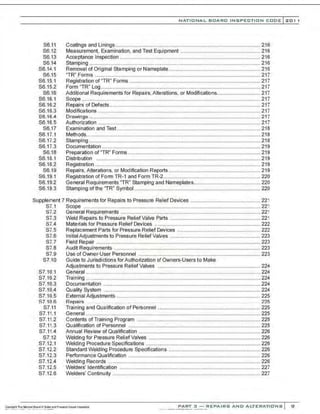
Original Code of Construction- Documents promulgated by recognized national standards writing bodies
that conlain technical requirements for construction ofpressure-retaining items or equivalent towhich the pressure-
retaining item was certified by tl'le original manufacturer.
Owner or User - As referenced in lower case letters means any person, firm or corporation legally respon-
sible for the safe operation of any pressure-retaining item.
Owner-User Inspection Organization- An owner or user of pressure-retaining items that maintains an
established inspection program. whose organization and inspection procedures meet the requirements of
the Natbnal Board rules and are acceptable to the jurisdiction or jurisdictional authority wherein the owner or
user is boated.
Owner-UserInspector-An individual who holds a valid and current National Board Owner-User Commission.
Piecing- A repair method used to remove and replace a portion of piping or tubing material with a suitable
material and installation procedure.
A11 Pneumatic Test - A pressure test which uses air or another compressible gas as the test medium.
-REPAIRS AND A LTERA ri ONS
NATIONAL BOARD INSPECTION CODE l201 1
Potable Water Heaters -A corrosion resistant appliance that includes the controls and safety devices to A11
supply potable hot water at pressure not exceeding 160 psig (1100 kPa) and temperature not in excess of
21 o·F (99·q .
1) Fired Storage Water Heater - A potable water heater in which water is heated by electricity, the combus-
tion of solid, liquid, or gaseous fuels and stores water within the same appliance.
2) Indirect Fired Water Heater - A potable water heater in which water is heated by an internal coil or heat
exchanger that receives its heatfrom an external source. Indirect fired water heaters providewater directly
to the system or store water within the same appliance.
3) Circulating Water Heater-A potable water heater which furnishes water directly to the system or to
a separate storage tank. Circulating water heaters may be either natural or forced flow.
Pressure-Retaining Items (PRI) - Any boiler, pressure vessel, piping, or material used for the containment
of pressure, either internal or external. The pressure may be obtained from an external source, or by the ap-
plication of heat from a direct source. or any combination thereof.
Pressure Test-Atestthat is conducted using a fluid (liquid or gas) contained inside a pressure-retaining item. A11
Repair-Thework necessary to restore pressure-retaining itemsto a safe and satisfactory operating condition.
Re-ending -A method used to join original code of construction piping or tubing with replacement piping or
tubing material forthe purpose of restoring a required dimension, configuration or pressure-retaining capacity.
Re-rating - See alteration.
" R" Certificate Holder - An organization in possess:on of a valid "R" Certificate ofAuthorization issued by
the Nati:>nal Board.
Safety Relief Valves -A safety relief valve is a pressure reliefvalve characterized by rapid opening or pop
action, or by opening in proportion to the increase in pressure over the opening pressure, depending on ap-
plication.
Settings- Those components and accessories required to provide support forthe component during opera-
tion and during any related maintenance activity.
Shop - A permanent location, the address that is shown on the Certificate ofAuthorization, from which a
Certificate Holder controls the repair and/or alteration of pressure-retaining items.
Testing Laboratory - National Board accepted laboratory that performs functional and capacity tests of
pressure relief devices.
Transient -An occurrence that is maintained only fora short interval as opposed to a steady state condition.
Velocity Distortion- The pressure decrease that occurs when fluid flows past the opening of a pressure
sensing line. This is a distortion of the pressure that would be measured under the same conditions for a non
or slowly moving fluid.
" VR" Certificate Holder - An organization in possession of a valid "VR" Certificate ofAuthorization issued
by the National Board.
PART 3 - REPAIRS AND ALTERATIONS SECTION 9 Z55
201 1 INATIONAL. BCARC I NSPECTION CODE
Water Head- The pressure adjustment that must betaken into account due to the weight oftest media (in
this case. water) that is 0.433 psi per vertical ft. (1 0 kPa perm.) added (subtracted) from the gage pressure
for each foot the gage is below (above) the point at which the pressure is to be measured.
-REPAIRS AND A LTERA ri ONS
0
N
NATIONAL BOARO INSPECTION COOE l 201 1
PART 3, SECTION 10
REPAIRS AND ALTERATIONS-
NBIC- APPROVED INTERPRETATIONS
PART :l.::::..~~!.".~~!:!~ -~~...0.
. ALTERATIONS SECTION 10 Z57
201 1 INATIONAL. BCARC I NSPECTION CODE
PART 3, SECTION 10
REPAIRS AND ALTERATIONS - NBIC APPROVED INTERPRETATIONS
10.1 SCOPE
a) This section provides all approved interpretations for this edition and all subsequent addenda associated
with this edition. A complete listed index is provided for reference to previously approved interpretations.
These previously approved interpretations can be found on the National Board Web site.
b) Each interpretation references the edition and addenda applicable at the time of committee response and
approvaL Use of interpretations for other than approved edition and addenda may not be appropriate for
reference.
10.2 INDEX OF INTERPRETATIONS
Foreword .......................................................................................................................................95-20
Code Cases 1923........................................................................................................................98-24
98-56
1945........................................................................................................................98-24
98-56
2203........................................................................................................................98-12
Procedure for Obtaining or Renewing a National Board
Certificate ofAuthorization.............................................................................................................98-21
07-02
Outline of Requirements for a Quality System
for Qualification for the National Board "R" Symbol Stamp ...........................................................98-13
General Rules................................................................................................................................04-02
Condition of Use ........................................................................................................ ....................98-02
Nameplate Contents......................................................................................................................98-25
98-26
95-26
Use of Owner-User Personnel During Repairs..............................................................................01-12
Test Medium and Testing Equipment.............................................................................................98-1 7
Procedure for Obtaining or Renewing a National Board
"NR" Certificate of Authorization....................................................................................................98-07
98-41
Interface with the Owner's Repair/Replacement Program ............................................................04-16
Prerequisites for Accreditation.......................................................................................................98-16
General Conditions........................................................................................................................98-1 1
Pressure Testing ......................................................... ........................... ........................................95-38
Inspection lnterval .........................................................................................................................98-19
. Conditions that Affect Remaining Life Evaluation..........................................................................01-26
98-03
95-57
Operational Inspection...................................................................................................................95-55
Inspection of Parts and Appurtenances.........................................................................................98-09
Restamping or Replacement of Nameplates.................................................................................98-35
95-47
Replacement of Stamped Data .....................................................................................................01-13
General Requirements ..................................................................................................................04-14
95-19
NATIO N AL BOARD INSPECTION CODE l 201 1
Scope ......................................................................................................................................98--22
Construction Standard...................................................................................................................95-36
95-48
04-13
Accreditation ................................................................................................................................04-13
Materials ......................................................................................................................................01-28
Replacement Parts ........................................................................................................................04-05
04-06
04-11
04-12
98--14
98--27
98--28
98--37
95-48
Welding ................................................................................................................................... 01-27
98-06
95-51
07-03
Nondestructive Examination..........................................................................................................04-06
01-24
98--1 0
95-41
Acceptance Inspection ..................................................................................................................04-21
04-22
Routine Repairs.............................................................................................................................04-09
04-10
01-19
01-20
01-22
01-23
98--01
98-04
98--18
98-31
98-42
95-27
95-28
95-31
95-33
95-53
Examination and Test ....................................................................................................................04-05
04-06
04-11
98--27
98--33
98-36
95-27
95-32
95-39
95-54
PART 3- REPAI RS AND A LTERATIONS SECTION 10 Z59
201 1 INATIONAL. BCARC I NSPECTION CODE
Methods ......................................................................................................................................04-06
04-11
04-20
01-15
Documentation ..............................................................................................................................01-29
95-50
Repair Plan ................................................................................................................................01-14
Alterations toASME Section VIII, Div. 2 ........................................................................................04-14
01-16
Design ...........................................................................................................................................98-14
95-22
04-13
Calculations ............................................................................................................ ....................01-1 7
Re-Rating ......................................................................................................................................04-03
04-04
01-11
98-14
98-15
98-20
98-32
Examination and Test ....................................................................................................................98-15
98-34
98-38
Methods.........................................................................................................................................04-20
Documentation ........................................................... ........................... ........................................01-25
95-50
Repair Methods .............................................................................................................................04-01
Scope ............................................................................................................................................96-06
Welding Method 1..........................................................................................................................04-12
Scope ............................................................................................................................................04-17
04-19
98-08
WastedAreas ................................................................................................................................98-42
Re-End1
ng or Piecing Pipes or Tubes............................................................................................98-36
Patches..........................................................................................................................................04-15
95-52
Stays..............................................................................................................................................98-40
Re-Rating ......................................................................................................................................04-18
Replacement Parts ........................................................................................................................04-07
04-08
Stamping and Nameplate Information ..... ........................... ........................... ................................95-24
Glossarf of Terms..........................................................................................................................04-13
95-21
95-29
95-34
95-43
95-45
National Board Forms....................................................................................................................98-39
95-25
95-30
95-40
95-42
NATIO N AL BOARD INSPECTION CODE l201 1
Examples of Repairs and Alterations.............................................................................................01-21
98-23
98-29
98-30
95-44
95-46
95-48
95-49
Repairs..........................................................................................................................................01-18
10.3 SUBJECT INDEX OF INTERPRETATIONS
Acceptance Inspection ..................................................................................................................04-13
04-21
04-22
Alteration Requirements ................................................................................................................04-14
Alterations toASME Section VIII, Div. 2 ........................................................................................01-16
Alternatives to PWHT....................................................................................................................98-06
Attachments ................................................................................................................................98-01
Blisters, Repair of .........................................................................................................................98-09
Calculations ................................................................................................................................01-17
Construction Standards.................................................................................................................04-1 3
Deaerators, Inspection of .............................................................................................................98-09
Defect Repairs...............................................................................................................................04-1 7
04-19
Definition of Repair........................................................................................................................98-23
98-29
98-30
95-43
95-45
95-46
95-49
Definition of Alteration....................................................................................................................95-21
95-36
95-44
95-45
Definition of lnspector....................................................................................................................95-29
Definition of Non-Load Bearing .....................................................................................................95-33
Demonstration Requirements........................................................................................................98-41
De-Rating .................................. ........................... .........................................................................98-20
Design ...........................................................................................................................................04-13
Deterio1ation ................................................................................................................................01-26
Documentation ..............................................................................................................................01-25
95-50
Examination and Test ....................................................................................................................04-05
04-06
04-11
04-20
Examples of Repairs and Alterations.............................................................................................01-21
General Rules................................................................................................................................04-02
04-14
lnspecti·Jn Interval ........................................................................... ..............................................98-19
95-57
..................... ·..·..·.·..·
PART3-REPAI RSANDALTERATIDNS SECTION 10 261
201 1 INATIONAL. BCARC I NSPECTION CODE
Joint Review Demonstration Requirements ... ...............................................................................98-21
MateriaI Thickness..................................................................................................... ....................98-36
Materials........................................................................................................................................01-28
MTR...............................................................................................................................................98-37
Nameplates ...................................................................................................................................95-24
Non "U" Stamped Vessels .............................................................................................................95-23
Nondestructive Examination..........................................................................................................04-06
01-24
98-10
Nuclear Components.....................................................................................................................98-07
Original Code of Construction .......................................................................................................95-19 ::
Out-of-Service ...............................................................................................................................98-03
Owner-user Inspection.................................................................................................................. 98-11
98-16
Owner's Repair/Replacement Program.........................................................................................04-16
Patches..........................................................................................................................................04-15
Piping ............................................................................................................................................98-22
Pressure ReliefValves ..................................................................................................................98-02
98-13
98-17
98-24
98-25
98-26
95-26
95-55
95-56
07-01
Pressure Testing............................................................................................................................96-15
98-27
98-33
98-34
98-38
95-27
95-32
95-39
95-38
Pressure Testing Repairs ..............................................................................................................01-15
Qualification ofWelders/IJI.elding Procedures ...............................................................................95-51
Quality System Manual..................................................................................................................98-13
"R" Forms ......................................................................................................................................98-39
95-27
95-28
95-30
95-40
95-42
95-48
95-50
Repair Definition ............................................................................................................................04-13
Repair Methods .............................................................................................................................04-01
Repairs............................................ ........................... ........................... ........................... .............01-18
Repair Plan....................................................................................................................................01-14
Reclassification..............................................................................................................................95-22
Replacement Nameplates .............................................................................................................98-35
95-47
NATIO N AL BOARD INSPECTION CODE l 201 1
Replacement Parts ........................................................................................................................04-05
04-06
04-07
04-08
04-1 1
04-12
98-14
98-27
98-28
01-29
Replacement of Stamped Data .....................................................................................................01-13
Re-Rating ......................................................................................................................................04-03
04-04
04-18
01-11
98-14
98-15
98-32
Routine Repairs.............................................................................................................................04-09
04-10
01 -1 9
01 -20
01-22
01-23
98.01
98-04
98-18
96-31
98-42
95-25
95-27
95-28
95-31
95-53
95-54
Stays..............................................................................................................................................95-40
Timing of Repairs ..........................................................................................................................98-05
95-41
Use of Editions/Addenda...............................................................................................................95-20
Use of Owner/User Personnel During Repairs..............................................................................01-12
Welding..........................................................................................................................................01-27
07.03
Welding Methods............................................................................. ..............................................04-06
04-12
Window Patch................................................................................................................................95-52
PART 3- REPAI RS AND A LTERATIONS SECTION 10 26:3
201 1 INATIONAL. BCARC INSPECTION CODE
........................·..·.·..
REPAIRS AND ALTERATIONS
0
N
NATIONAL BOARD INSPECTION CODE l 201 1
PART 3, SECTION 11
REPAIRS AND ALTERATIONS-
INDEX
PART~- REPAIRS AND ALTERATIONS
201 1 INATIONAL. BCARC I NSPECTION CODE
Addenda-
Part 1, Part 2, and Part 3 (Introduction)
Additional Requirements for Alterations-
Part 3 (S4.17)
Additional Requirements for Repairs-
Part 3 (S4.16)
Administrative Requirements-
Part 3 (Section 1)
Administrative Procedures for
"R''/"VR"/"NR" -
Part 3 (1.6), (1.7), (1.8), (S9.2)
Acceptance Inspection-
Part 1 (2.1 0), (2.10.5), (3.10), (4.6); Part 2 (S7.8);
Part 3 (1.3.2), (S4.14), (S6.13)
Accreditation-
.Part 3 (1.5), (1.6), (1.7), (1.8), (S2.6),(S6.3)
,: Programs -
Part 1, Part 2, and Part 3 (Introduction)
•:Acoustic Emission -
:Part 2 (4.2.8); Part 3 (S4.13)
Adjustments,
Pressure Relief Valves-
Part 3 (S7.2), (S7.6)
Authorization of Owner-Users-
Part 3 (S7.10)
Alteration -
Part 1 and Part 2 (Section 9); Part 3 (3.4), (3.4.4),
(S3.4), (S4.17). (S5.7), (Section 9)
Alternatives,
Postweld Heat Treatment -
Part 3 • (2.5.2), (2.5.3), (S6.9.3)
Nondestructive Examination-
Part 3 (4.2)
Verification Testing-
Part 3 (1.7.5.5)
Marking, Stamping-
Part 3 (5.10)
Allowable Stress Values-
Part 3 (3.4.2)
ASMECode,
Replacement Parts-
Part 3 (3.2.2)
Section VIII Division 2 and 3-
Part 3 (3.3.5), (3.4.4)
Application of NBIC-
Part 1, Part 2, and Part 3 (Edition including
Addendum), (Foreword), (Introduction)
Appurtenances-
Part 1 (2.4.4), (2.5.3), (2.10.1), (3.3.4), (3.5.3),
(4.6), (5.2.2), (5.2.5), (5.2.7); Part 2 (1.5.2),
(2.2.10), (S2.9), (2.3.5), (S6.13), (S6.16)
Assembler-
Part 1. Part 2 and Part 3 (Section 9), (S7.5), (S7.6)
Assessing Damage Mechanisms-
Part 2 (5.3)
Audit-
Part 2 (Section 9); Part 3 (1 .8.5.1[q)), (S7.8)
American National Standards Institute
(ANSI)-
Part 1. Part 2 and Part 3 (Section 9)
American Petroleum Institute (API)-
Part 2 (1.3)
AnnuaI Review,
"VR"-
Part 3 (S7.11.4)
Arch Tube-
Part 2 (S1.4.2); Part 3 (S1 .2.9.2)
Ash Removal -
Part 1 (2.6.2), (3.6.2)
Authorization -
Part 2 (5.2), (S6.4.6), (S6.5.1); Part 3 (1 .3.1)
Authorized Nuclear Inspector-
Part 1 and Part 2 (Section 9);
Part 3 (1 .8.5.1 [r)), (Section 9)
Boilers-
Part 2 (2.2), (2.5.5.1)
Watertube-
Part 2 (2.2.12.1)
Black Liquor-
Part 2 - (2.2.12.2)
Organic and Inorganic Fluid -
Part 2 (2.2.12.3)
Waste Heat-
Part 2 (2.2.12.4)
Cast Iron-
Part 2 (2.2.12.5)
Electric-
Part 2 (2.2.12.6)
Fired-Storage Water Heaters-
Part 2 (2.2.12.8)
Firetube -
Part 2 (2.2.12.9)
Historical/Hobby -
Part 2 (Supplement 2)
Modular-
Part 1 (3.7.8)
Locomotive-
Part 2 (Supplement 1)
Boiler Inspection Guideline (Historical)-
Part 2 (S2.11 )
Boiler Installation,
Power Boilers-
Part 1 (Section 2)
Steam Heating -
Part 1 (Section 3)
Heating/Potable Water Heaters -
Part 1 (Section 3)
Report-
Part 1 (1.4.5), (2.10.6), (3.10.3)
Boiler Operators (Historical) -
Part 2 (S2.11)
Boiler Repair-
Part 3 (3 3.4.2), (3.3.4.3). (Supplement 1),
(Supplement 2)
Boiler Relief Devices-
Part 2 (2.5.5.1)
NATIO N AL BOARD INSPECTION CODE l 201 1
Boiler Room Requirements -
Part 1 (2.4), (3.4)
Bonding-
Part 3 (S4.10)
Blowoff-
Part 1 (2.7.5), (3.7.7); Part 2 (2.2.6)
Braces-
Part 3 (S1 .2.6): Part 2 (S1.4.2)
Brittle Fracture -
Part 2 (5.3.8.2)
Bulges and Blisters -
Part 2 (3.4.7), (5.3.8.3), (S7.8.3);
Part 3 (3.3.4.2)
Burners and Stokers-
Part 1 (2.7.2), (3.7.3)
Calculations -
Part 1 (7.3); Part2 ($2.10.1), (S2.6.2), (7.3);
Part 3 (3.2.4), (3.2.5), (3.3.3), (3.3.4.3),
(3.4 .1), (3.4.2), (S1.1.4), (S4.6), ($4.16.3),
(S4.17.4), (S4.17.5), (S4.18.2.3)
Capacity -
Part 1 (2.9.1 3). (5.3.4); Part 2 (2.3.6.2),
(2.5.2), (2.5.4), (2.5.5.3), (2.5.7), ($2.8.1),
(S2.11), (S5.3.1), (S5.9.3), (S6.8),
(S6.13.9), (S6.13.11 .3), (S6.13.11.4),
($6.15.1), ($6.15.4)
Cargo Tanks -
Part 2 (Supplement 6)
Capacity Certification -
Part 1, Part 2 and Part 3 (5.9.3), (Section 9)
Caulking Riveted Seams-
Part3 (S1 .2.12.1), (S2.13.13.1)
PART~- REPAIRS AND ALTERATIONS
201 1 INATIONAL. BCARC I NSPECTION CODE
Certificate of Authorization -
Part 1 and Part 2 (Introduction); Part 3
(Introduction), (1.6.2), (1.6.3), (1.7.6.5),
(1.8.2), (1.8.3)
Certification-
Part 1 (1.4); Part2 (4.2), (S2.7.1), (S2.8.1),
(S6.5.3), (S6.5.4.3), (S6.14.8); Part 3
(Section 5)
Chimney or Stack -
Part 1 (2.6.1), (3.6.1)
Clearances -
Part 1 (2.3.3), (3.3.4), (4.3.2)
Cleaning-
Part 1 (5.2.7), (2.4.4), (S7.14.2); Part 2 (2.2.9),
(1.5.3)
Codes and Standards -
Part 1 (1.1); Part2 (1.3), (S2.10.5), (S6.4.5),
($6.9); Part 3 (1.2), (S2.5), (S4.7), (S6.2)
Combustion Air-
Part 1 (2.5.4), (3.5.4)
Controls-
Part 1 (2.8); Part 2 (2.2.10.7), (2.3.5.3), (2.4.8)
Compressed Air Vessels -
Part 2 (2.3.6.2)
Condition of Installation-
Part 2 (2.2.4), (2.3.2)
Condensate -
Part 1 (2.7.4)
Connections -
Part 1 (2.8.2.1), (3.7.6), (3.9.1.1), (3.9.4.2),
(3.9.4.3), (3.9.4.4), (3.9.4.5): Part 2 (2.3.3)
Continued Service (DOT)-
Part 2 (Supplement 6)
Corrosion -
Part 2 (2.2.8), (Section 3), (3.8), (S5.3.3i,
(S6.6), ($7.8.5); Part 3 (1.2), (2.5.4),
(3.2.1), (3.3.2), (3.3.3), (3.3.4.3), (3.4.2),
(4.4.1), (4.4.2), (S2.13.9.2), (S2.13.12.2),
(S4.5), (S4.6), (S4.16.4), ($4.18), (S5.6.1),
(S6.17.1), (S7.12)
Control of Corrosion-
Part 2 (3.3.3)
Coatings-
Part 3 (3.6.11)
Cracks-
Part 2 (3.4.9), (5.3.8.4), (S5.3.2), (S7.8.1);
Part3 (3.3.4.2), (S1.2.10), (S1.2.11),
(S2.13.9.2), (S2.13.9.4), ($5.6.2)
Creep-
Part 2 (3.4.2), (5.3.8.1)
Curing-
Part 3 (S4.11)
Cuts or Gouges -
Part 2 (S7.8.4); Part 3 (S5.6.1), (S7.14.2)
Damper Mechanisms -
Part 2 (Section 3), (5.3)
Deaerators-
Part 2 (2.3.6.1)
Defect Repairs-
Part 3 (3.3.1), (3.3.4.2)
Definitions -
Part 1 (Section 9); Part 2; ($6.16), (Section 9);
Part 3 (1.4), (Section 9)
Definition of Repair to Pressure Relief
Valves-
Part 3 (S7.2)
·,
·'
Dents-
Part 2 (S7.8.2), (2.3.3)
Deposits,
Waterside-
Part 2 (2.2.9); Part 3 (S1.2.13.1)
De-rating-
Part 2 (S5.2); Part 3 (3.4.1)
Design-
Part 1, Part 2, and Part 3 (Foreword),
(Introduction); Part 2 (2.2), (2.2.8),
(2.2.12.3), (2.2.10.4), (2.2.12.4), (2.2.12.5),
(2.2.12.6), (2.2.12.7), (2.2.12.8), (2.2.12.9),
(2.3.2), (2.3.5.4), (2.3.6.3), (2.3.6.5),
(2.4.3), (2.4.7), (2.5.1), (2.5.5.3), (2.5.7),
(3.3.3), (3.3.3.3), (3.3.3.5) (3.4.2), (3.4.8),
(5.3.1)
Part 3 -(1.2), (1.5.1), (1.6), (1.7), (1.8),
(3.2.4), (3.2.5), (3.3.3), (3.3.4.3), (3.3.5.2),
(3.4.1), (3.4.2), (3.4.3), (3.4.4.1), (4.5.1),
(4.5.3), (5.2.2), (5.4). (5.7.3), (S4.17.2),
(Supplement 8)
Device Data -
Part 2 (2.5.2)
Device Condition -
Part 2 (2.5.3)
Device Requirements-
Part 1 (4.5.1), (5.3.1)
Distribution of "R" Forms-
Part 3 (5.3), (5.4), (S3.2), (S4.14.4), (S6.18.1)
Documentation -
Part 1 (1 .3), (1.4.1), (S1.3); Part2 (1.2),
(1.5.4), (Section 5), (S2.6.2), (S2.7.2),
(S2.11), (S5.2.3), (S6.3); Part 3 (5.2),
(S2.12), (S4.14.2), (S6.17.3), (S7.10.3)
DOT (Transport Tanks)-
Part 2 (Supplement 6); Part 3 (Supplement 6)
Drains-
Part 1 (2.4.3), (2.6.3), (3.6.3)
NATIONAL BOARD INSPECTION CODE l zol l
Drawings -
Part 3 (2.3), (3.2.3), (S4.16.2), (S4.17.2)
Economizers -
Part 1 (2.9.4); Part 2 (2.2.12.1)
Eddy Current-
Part 2 (4.2.6)
Electrical (Installation)-
Part 1 (2.5.3), (3.5.3)
Emergency Valves and Controls-
Part 1 (2.5.6), (3.5.6)
Engineering Design -
Part 2 (3.3.3.5)
Equipment Certification -
Part 1 (1.4.2)
Equipment Operation -
Part 2 (1.4.2)
Erosion-
Part 2 (2.2.12.2), (2.2.12.4), (2.2.12.7), (3.3.1),
(5.3.7.1), (5.3.8.7), (S1.4.2)
Estimating Remaining Service Life and
Inspection Intervals-
Part 2 (5.3.4)
Evidence of Leakage,
Boilers -
Part 2(2.2.5), (2.2.7), (4.3.3); Part 3 S2.13)
Pressure Vessels -
Part 2 (2.3.3), (S4.6.2), (S6.13.9); Part 3
(S4.14), (S4.17.6), (S4.1 8.2.7)
Piping -
Part 2 (2.4.6), (2.2.10.2), (2.2.10.4)
PART~ . ..... .'~.!::f:~~~=-.~.N
-
0. ALTERATIONS
201 1 INATIONAL. BCARC I NSPECTION CODE
Examination -
Part 1 (5.4); Part 2 (2.3.3), (2.3.5.4), (2.3.6),
(2.4.5), (Section 4), (5.3.1 ), (5.3.8),
(S1.4.2), (S2.4), (S2.4.4), (S2.5);
Part 3 (3.3.4.2), (Section 4), (4.4), (S4.2),
(S4.13.1), (S4.15), (S6.17), (S4.17.6),
(S5.2). (S6.10), (S6.12), (S6.17)
Examples or Repairs and Alterations-
Part 3 (3.3.3), (3.4.3)
Exfoliation-
Part 2 (2.4.4), (3.3.1), (S6.6.3.1[e])
Exhibits-
Part 3 (1 .6.5.1[q]). (1 .7.7.5[p]). (1.8.5.1[s])
Exit and Egress -
Part 1(2.4.1), (2.5.3), (3.4.1)
Expansion Tanks -
Part 1 (3.7.9.1). (3.7.9.2); Part 2 (2.3.6.3)
Expansion and Support-
Part 1 (2.7.3), (3.3.1), (3.7.9), (3.9.4), (4.3.3);
Part 2 (2.4.7)
External Inspections,
Boilers-
Part 2 (2.2.5)
Pressure Vessels -
Part 2 (2.3.3), (S7.4)
Piping -
Part 2 (2.4.4)
Graphite-
Part 2 (S3.4)
FRP-
Part 2 (84.4), (84.7)
External Weld Metal Buildup-
Part 3 (3.3.4.3[e])
Failure Mechanisms-
Part 2 (3.4), (S6.6.4)
Fatigue -
Part 2 (3.4.1), (5.3.8.6)
Federal Railroad Administration (FRA) -
Part 2 (S1 .3); Part 3 (S1 .1.1)
Feedwater-
Part 1 (2.5.1). (3.7.4); Part 2 - (2.2.10.4),
(2.2.12.5), (S2.7.1). (S2.14), (S2.7.1i
Fiber-Reinforced Thermoset Plastic
Equipment (RTP, FRP)-
Part 2 (Supplement 4); Part 3 (Supplement 4)
Field Repairs for Relief Devices-
Part 3 (S7.7)
Firebox -
Part2 (2.2.10.2), (2.2.12.9), (S1.1), (S1 .4.2),
(S2.11); Part 3 (S1 .2.10.2), (S1.2.11 .1),
(S2.13.10.4), (S2.13.11)
Fire Damage -
Part 2 (5.3.8.5), (5.7.7). (S7.4)
Fittings -
Part 1 (3.8); Part 3 (S1 .2.13)
Flanges-
Part 1 (5.2.3); Part 2 (2.2.10.3);
Part 3 (3.3.4.3[c))
Forced-Flow Steam Generators -
Part 1 (2.9.2)
Forms -
Part 1 (1.4.1); Part2 (5.5), (S2.12);
Part 3 (Section 5). (S6.15)
Distribution -
Part 3 (5.3), (5.4)
Guide for Completing -
Part3 (5.2), (5.13)
Registration -
Part 3 (5.5.1), (5.5.2)
Foundations-
Part 1 (2.3.1)
Fractures -
Part 2 (S3.5.2)
Fuel-
Part 1 (2.5.2), (3.5.2)
Fusible Plugs-
Part 2 (S1.4.2), (S2.8.4), (S6.4.7), (S6.15.1);
Part 3 (S2.13.14.3)
Gages -
Part 1 (3.8); Part 2 (2.2.10.5), (2.3.5.1),
. (2.4.8.1), (S1.4.2), (S2.6.1), (S2.7.1),
: (S2.8.2), (S2.8.5); Part 3 (4.3)
Galvanic Corrosion -
Part 2 (3.3.1)
Glossary -
Part 1 and Part 3 (Section 9);
Part 2 (86.16- DOT Only). (Section 9)
Graphite Pressure Equipment-
Part 2 and Part 3 (Supplement 3)
Grooving -
Part 2 (3.3.1); Part 3 (S2.13.9.1), (S2.13.10),
(82.13.11)
Gage Glass-
Part 1 (2.8.1), (3.8.1.2); Part2 (S2.2.10),
(S2.7.1), (S2.8.2), (S2.11)
Hangers -
Part 1 (5.2.6)
Heat Treatment -
Part 3 (2.5), (82.1 0), (S6.9), (S7.13), (S1.2.10)
High Temperature Water-
Part 1 (3.9.5.3); Part 2 Inspection (3.4)
NATIONAL BOARD INSPECTION CODE l201 1
Historical Boilers -
Part 2 and Part 3 (Supplement 2)
Inspection -
Part 2 (S2.7)
Storage-
Part 2 ($2.13)
Repair-
Part 3 (Supplement 2)
Safety Procedures-
Part 2 (S2.14)
Hydrogen Attack-
Part 2 (3.4.5)
Hydrogen Damage-
Part 2 (3.4.6)
Hydrogen Embrittlement -
Part 2 (3.4.4)
Illegible Nameplates -
Part 3 (5.9.5)
Inquiries-
Part 1, Part 2 and Part 3 (Section 10)
lnservice Inspection-
Part 2 (1.5), (2.4.2), (2.5.4). (S1.4.2), (S2.7),
(83.1 ), (S3.4), (S4.2), (S5.1), (S6.4.6),
(S7.3)
Inspection and Test Frequencies (Pressure
Relief Devices)-
Part 2 (2.5.8), (5.3.7), (S2.7.3), (S4.9)
Inspection and Test Methods -
Part 2 (Section 4) (S2.4.4.2), (S2.5), (S6.6);
Part3 (4.4.1), (4.4.2)
Inspector Qualifications (FRP)-
Part 3 ($4.2)
Inspector Duties (DOT) -
Part 2 ($6.4.6); Part 3 (86.7.1)
PART~- REPAIRS AND ALTERATIONS
201 1 INATIONAL. BCARC I NSPECTION CODE
Installation Condition -
Part 1; Part 2 (S4.9.1)
Installation Requirements-
Part 1
Insulated Vessels, Inspection-
Part 2 (2.3.6.4(b)). (S4.7.1)
Instruments and Controls-
Part 1 (2.8). (2.9.2). (3.5.3). (3.5.6). (3.8). (4.4).
(S1.2)
Interface with Owners Repair/Replacement
Program (Nuclear)-
Part 3 (1 .8.6)
lntergranular Corrosion-
Part 2 (3.3.2)
Internal Inspections-
Part 2 (1.5.3), (2.3.4), (2.4.5), (S4.8), (S7.5).
(S2.5)
Interpretations-
Part 1, Part 2 and Part 3 (Introduction). (8.4),
(Section 10)
Interrupted Service-
Part 2 (5.3.7.2[g])
Insulation MateriaUinsulation-
Part 1 (3.3.2); Part 2 (2.2.7), (2.3.3), (2.4.6),
. (S7.4)
lnspector-
p:
art 1 (2.10), (4.6), (S1.2); Part 2 (1.4), (1.5),
(2.2). (2.3), (2.4). (2.5). (Section 4),
(5.3.3), (S4.5), (S2.4), (S4.2). (S4.5),
(S6.4.2); Part 3 (1.3), (3.3.2), (3.3.4.1),
(3.3.5), (3.4.1).(3.4.4). (4.4.1), (4.4.2).
(S2.8), (S2.9), (S2.10), (S3.2), (S4.2),
(S6.7.1)
Jurisdiction-
Part 1 (Foreword), (Introduction), (1.4.3);
Part 2 (Foreword), (Introduction). (1 .2),
(2.5.8), (5.3.1). (5.3.4), (5.4.7), (5.5.1),
(S1 .2); Part 3 (Foreword), (Introduction).
(3.3.2), (3.3.4.3(e)), (3.4.1), (3.4.2). (4.2),
(4.3), (4.4), (4.4.1), (4.4.2), (4.5). (5.7),
(5.9.5), (S2.2), (S4.16.4). (S6.3)
Jurisdictional Authority-
Part 1 (Foreword); Part 2 (Foreword), (S7.1);
Part 3 (Foreword), (S7.10)
Jurisdictional Participation -
Part 3 (1 .7.2)
Jurisdictional Precedence -
Part 1, Part 2 and Part 3 (Introduction)
Jurisdictional Requirements-
Part 1 (1.4)
Knuckles-
Part2 (2.2.8); Part 3 (81 .2.11.5), (S2.13)
Ladders and Runways-
Part 1 (2.4.2), (3.4 2)
Lamination -
Part 2 (3.4.7). (S4.3), (S4.10), (S4.18)
Lap Joints/Seams-
Part 2 (3.3.1). (3.4.9), (S2.10.6). (86.6.3.1);
Part3 (S1.2.10), (S1 .2.10), (S1.2.11),
(81.2.11 .1), (81.2.11.2), (81.2.11 .3),
(81 .2.11.4), (81.2.11 .5), (81.2.11 .6),
(S1.2.12), (81 .2.12.1), (81 .2.12.2),
(82.13.13)
Leakage -
Part 2 (2.2.7), (2.2.5), (2.3.3), (2.4.6), (S4.6.2),
(S4.6.2), (S6.4.7.4), (S6.13.9), (S7.4),
(S7.6)
Leak Testing -
Part 2 (4.3.2), (S6.13.9), (S6.14.6.2);
Part 3 (4.4.1)
Level Indicating Devices-
Part 1 (4.4.1)
Lift Assist Testing -
Part 3 (4.5.3)
Limitations (Historical Boilers) -
Part 2 (S2.10.7)
Lighting-
Part 1 (2.5.5), (3.5.5)
Line Corrosion-
Part 2 (3.3.1(t))
Liquid Ammonia Vessels-
Part 2 (2.3.6.4)
Liquid Penetrant Examination -
Part 2 (2.3.2), (4.2.3), (S2.5.4)
Liquid Petroleum Gas Pressure Vessels -
Part 2 (Supplement 7), (S6.13.6.3),
(S6.13.7.7), (S6.1 3.9)
Liquid Pressure Testing-
Part 3 (4.4.1), (4.4.2), (4.5.1), (S6.17.1)
Loadings -
Part 1 (2.3.1), (3.3), (3.3.1.1), (4.3.1), (5.2.6);
Part 3 (1 .2), (3.3.3). (3.4.2), (S4.17.6)
Local PWHT-
:: Part 3 (2.5.2)
Local Thinning-
Part 2 (5.3.8.7), (S5.3.1 ); Part 3 (S5.6.1)
NATIO N AL BOARD INSPECTION CODE l 201 1
Locomotive Boilers -
Part 2 (2.2.12.9), (Supplement 1); Part 3
(Supplement 1)
Inspection-
Part 2 (S1.4)
Storage -
Part2 (S1 .5)
Low-Water Fuel Cutoff -
Part 1 (2.8), (3.8.1 .5), (3.8.2.4);
Part 2 (2.2.10.7)
M
Macroscopic Corrosion Environments-
Part 2 (3.3.1)
Uniform Corrosion (General)-
Part 2 (3.3.1[a))
Galvanic Corrosion -
Part 2 (3.3.1[b))
Erosion Corrosion -
Part 2 (3.3.1[c))
Crevice Corrosion -
Part 2 (3.3.1[d))
Pitting Corrosion -
Part 2 (3.3.1 [e})
Line Corrosion-
Part 2 (3.3.1[f))
Exfoliation -
Part 2 (3.3.1[g))
Selective Leaching -
Part 2 (3.3.1 [h))
Grooving-
Part 2 (3.3.1[i))
Magnetic Particle Examination -
Pan 2 (4.2.2), (S2.5.5)
Materials-
Part 3 (2.5.4), (3.2.1), (S1 .1.3), (S2.7), (84.8),
(S6.4), (S7.4)
Preparation -
Part 2 (4.2)
QC Program-
Part 3 (1.6), (1 .7), (1 .8)
Selection -
Part 2 (3.3.3.3)
PART~- REPAIRS AND ALTERATI O NS
201 1 INATIONAL. BCARC I NSPECTION CODE
Metallographic -
Part 2 (4.2.7)
Methods,
Inspection and Test-
Part 2 (Section 4)
Locomotive Inspection-
Part 2 (S1 .4.1)
Metric Policy-
Part 1, Part 2 and Part 3 (Section 7)
Repair -
Part 3 (3.3.4)
Repair/Alteration, Examination/
Testing-
Part 3 (4.4.1), (4.4.2)
Microscopic Corrosion Environments-
Part 2 (3.3.2)
lntergranular Corrosion-
Part 2 (3.3.2[a))
Stress Corrosion Cracking (SCC) -
Part 2 (3.3.2[b))
Corrosion Fatigue -
Part 2 (3.3.2[c))
Minimum Thickness -
Part 2 (2.3.6.4), (5.3), (S2.6.2), (S2.10.3),
(S6.6.3.1 ). (S6.13); Part 3 (3.3.4.3), (3.4.2),
(3.4.2)
Modifications (DOT) -
Part 3 (S6.16.3)
Mudring-
Part 3 (S1 .2.11.4)
Nameplates -
Part 2 (5.2); Part 3 (5.9), (5.9.1), (5.9.2),
(5.9.3), (5.9.4), (5.9.5), (5.9.6), (5.9.6.1),
(5.9.6.2), (5.9.6.3), (5.9.6.4), (5.9.6.5),
(5.10), (5.11), (5.11 .1), (5.11 .3), (5.12),
(5.11 .2), (81 .2.10), (81.2.11), (81.2.11 .1),
(S1.2.11 .2), (81.2.11.3), (81.2.11.4),
(S1.2.11 .5), (81 .2.11.6), (S1.2.12),
(81.2.12.1), (81.2.12.2), (S6.14.1)
.-..·..·,·....·..... ·..- .. -..-
National Board "R," "VR," and "NR"
Symbol Stamps-
Part 3 (1.6.4), (1.7.6), (1.8.4), (Section 5),
(82.8.1)
Nondestructive Examination-
Part 1 (2.10.3), (81 .6); Part 2 (4.2), (81 .4),
(82.4.4.1), (S5.5), (S7.3.1); Part 3 (4.2),
(4.4.1), (4.4.2), (82.11 ), (84.12), (86.10),
(S6.17.1)
"NR" Accreditation-
Part 3 (1.8)
"NR" Symbol Stamp-
Part 3 (1.8.4), (5.9)
Nuclear Valves (repair) -
Part3(1.7.4)
"NV" Stamped Pressure Relief Devices-
Part 3 (1.7.4). (Supplement 9)
Oil Heaters-
Part 1 (3.7.1)
Operating Parameters (Yankee Dryers)-
Part 2 (S5.2.1)
Operating Systems-
Part 1 (2.7), (3.7); Part 2 (S3.3)
Organization of the NBIC-
Part 1, Part 2 and Part 3 (Introduction)
Overheating -
Part 2 (3.4.8), (81.4.2)
Owner-User -
Part 1 (1.1), (1.2); Part2 (S1.3), (82.4), (S2.5),
(S2.7), (86.4.6), (S6.6.3), (86.14.3);
Part 3 (1.3), (4.5.2), (81.1.1), (85.5),
(S7.9), (87.10), (S7.11)
Owner-User Inspection Organization -
Part 3 (1 .6.1), (3.3.5.2), (3.4.4.1)
Parts-
Part 1 (2.6.3.3), (2.9.2), (3.7.4), (3.7.7), (8.4),
(81.3); Part 2 (2.3.5), (2.1), (2.2.6), (2.2.7),
(2.2.10), (2.2.12). (2.3.4), (2.3.5), (2.3.6),
(2.5.7), (2.5.8), (8.4); Part 3 (1 .7.7.5),
(1 .8.5), (3.2.2), (3.3.3), (4.5.1 ), (4.5.4),
(5.2.2), (5.9.6.5), (5.12), (8.4), (82.7.2),
(82.13), (83.2), (83.5), (84.9), (85.3.1),
(85.6), (87.2)
Patch Bolts -
Part 3 (81 .2.8)
Patches-
Part 3 (3.3.4.6), (81.2.11 .2), (82.13)
Performance Qualification -
Part 3 (2.2.3). (84.10.2). (86.8.3), (87.12.3)
Performance Testing -
Part 3 (4.5)
Permissible Mounting (SV) -
Part 1 (2.9.5.1), (3.9.1), (3.9.4), (4.5.6), (5.3.6)
Personnel Safety -
Part 1 (Introduction), (4.5.6), (5.3.6), (81 .5);
Part 2 (Introduction), (1.4), (82.4.3),
(86.11); Part 3 (Introduction), (82.3),
(82.14)
Piecing Tubes/Pipe-
Part 3 (3.3.4.5), (82.13.7)
Pilot Operated Safety Relief Valves-
Part 2 (2.5.1); Part 3 (87.14.3)
Piping -
Part 1 (3.7.6), (3.9.1.5), (4.3.3), (Section 5);
Part 2 (2.4), (2.5.5.2), (82.8.1). (82.9);
Part 3 (3.3.4.5), (81 .2.13), (88.3)
NATIO N AL BOARD INSPECTION CODE l zol l
Pitting Corrosion-
Part2 (5.3.7.20)), (3.3.1), (81.4.2), (86.6.3.1)
Plug Stitching-
Part 3 (83.5.3.1)
Pneumatic Testing-
Part 2 (86.13.6.1 ); Part 3 (4.4.1(b]), (4.4.2(b])
Portable Tank (DOT) -
Part 2 (86.14)
Post-Inspection Activities-
Part 2 (1 .5.4), (82.4.2). (86.12.3)
Postweld Heat Treatment -
Part 3 (2.5.2), (82.1 0), (86.9.2), (87.13.2)
Potable Water Heaters-
Part 1 (3.2.3), (3.7.5.2), (3.7.7.2)
Preheating -
Part 3 (2.5.1), (82.10), (86.9.1). (87.13.1)
Pre-Inspection Activities-
Part2 (1.5.2), (2.2.3), (82.4.1), (86.12.1)
Preparation of Forms -
Part 1 (1.4.5); Part 2 (5.5); Part 3 (5.2.1),
(5.2.2)
Preservation-
Part 2 (81 .5.4), (82.13.2), (3.3.3)
Pressure Control -
Part 1 (3.8.1.4)
Pressure Gages -
Part 1 (2.8.2). (4.4.2); Part 2 (2.2.10.5),
(2.3.5.1), (2.4.8.1), (81.4.2), (82.8.5);
Part 3 (4.3)
Pressure Relief Devices-
Part 1 (2.9), (3.9), (4.5); Part 2 - (2.2.1 0.6).
(2.5); Part 3 (4.5), (5.9)
Mounting-
Part 1 (2.9.5.1). (3.9.1.1), (4.5.3), (5.3)
PART~ REPAIRS AND ALTERATI O NS
....~ ....~ .........~...............,....-....
201 1 INATIONAL. BCARC I NSPECTION CODE
Pressure Relief Valve Nameplates -
Part 3 (5.9.2), (5.9.3), (5.9.4), (5.9.5), (5.9.6),
(Supplement 7), (Supplement 8)
Pressure-Reducing Valves -
Part 1 (Supplement 2)
Pressure Testing -
Part 2 (4.3.1)
Alterations-
Part 3 (4.4.2)
FRP Vessels-
Part 3 (S4.15), (S4.17.6)
lnservice-
Part 2 (4.3.1)
Installation -
Part 1 (2.1 0.2)
Parts -
Part 3 (4.5.4)
Repairs-
Part 3 (4.4.1)
Yankee Dryers-
Part 1 (1.5); Part 2 (2.3), (2.5.5.2), (S5.6)
Pressure Vessels,
Fiber-Reinforced Thermosetting Plastic
(FRP)-
Part 2 and Part 3 (Supplement 4)
Graphite -
Part 2 and Part 3 (Supplement 3)
Inspection -
Part 2 (2.3)
Installation -
Part 1 (Section 4)
LP Gas (Propane)-
Part 2 (Supplement 7)
Relief-
Part 2 (2.3.5.2)
Section VIII Div 2 or 3-
Part 3 (3.3.5), (3.4.4)
Yankee Dryers-
Part 1 (Supplement 1); Part 2 and Part 3
(Supplement 5)
Process Variables (Corrosion)-
Part 2 (3.3.3.1)
Provisions for Expansion/Support -
Part2 (2.4.7); Part3 (S1.2.3), (S1 .2.5),
(S1 .2.10), (S2.13)
Pumps-
Part 1 (2.5.1.3)
Quality Systems -
Part3 (1.6.5), (1 .7.7), (1.8.5), (S7.10.4)
Qualifications,
FRP Performance-
Part 3 (S4.1 0.2)
Inspector -
Part 2 (S4.5), (S6.4); Part 3 (S4.2)
NDE -
Part 3 (4.2)
PRV Personnel-
Part 3 (S7.11)
Welders Performance-
Part 3 (S7.12 3), (22 3), (S6.8 3)
Quick-Actuating Closures-
Part 2 (2.3.6.5)
Quick-Disconnect Couplings -
Part 2 (2.4.8.3)
"R" Symbol Stamp -
Part 3 (1.6)
Radiography -
Part 2 (4.2.5); Part 3 (1 .8.5.1)
Records Review-
Part 2 (2.2.11), (2.3.54); Part 3 (1 .8), (3.2.1),
(3.4 .1), (S2.12), (S3.2), (S3.3), (S4.10.3),
(S4.17.5), (S6.4), (S7.4)
'
;.
Reference to other Codes and Standards -
Part 1 (Introduction); Part 2 (Introduction),
(1 .3), (2.2.12.2), (S1.3), (S4.10);
Part 3 (Introduction), (2.4), (S1 .2.12.1)
Re-ending -
Part 3 (3.3.4.5), (S1.2.9.1), (S2.13.7)
Registration of "R" Forms-
Part 3 (5.5), (5.6), (S6.18)
Remaining Service Life Assessment-
Part 2 (5.3.4)
Removal of Stamping-
Part 3 (5.8), (S6.14.1)
Renewal of "VR" Certificate -
Part 3 (1.7.5)
Repair -
Part 2 (5.4.9.2); Part 3 (3.3), (3.3.3), (3.3.4),
(3.3.5), (S1.2.1), (S1.2.10), (S1 .2.11),
(S2.4), (S2.13), (S2.13.14), (S3.2), (S3.5),
(S4.5), (S4.18), (S5.4), (S5.6), (56.16),
(S7.2)
Replacement Parts -
Part 1 (2.6.3.3); Part 3- (3.2.2), (S2.7.2),
(S4.9), (S5.3.1), (S6.5), (S7.5)
Replacement Stamping-
Part 2 (5.2), (5.5.2); Part 3 (5.8), (5.9.3),
(5.9.5), (5.9.6)' (5.10), (5.11)
Re-rating-
Part 1 and Part 2 (Section 9); Part 3 (3.4.1),
(84 17.5). (Section 9)
Responsibility-
Part 1 (1.4.1); Part 2 (5.3.3), (S2.3);
Part 3 (S2.3)
Return Pipe Connections-
Part 1 (3.7.6)
Return to Service-
Part 2 (S1 .5.6)
NATIO N AL BOARD INSPECTION CODE l 201 1
Risk-Based Inspection -
Part 2 (5.4)
Rivets/Riveted Joints-
Part2 (2.3.3), (S1.4.2), (S2.10.2);
Part 3 (3.3.4.4[b)), (S2.13.13)
Rupture Discs -
Part 2 (2.5.5.3), (S6.15.3.3)
Routine Repairs -
Part 3 (3.3.2), (S3.3), (S4.16.4)
Safety -
Part 2 (1.4), (2.5), (2.2.6), (2.3.5.2), (S2.8),
(S2.14), (S6.11)
Safety Devices-
Part 1 (2.9); Part 2 (2.2.12.3), (2.3.5.2),
(2.4.8.2), (2.5), (S2.8)
Safety Valve Capacity-
Part 1 (2.9.13), (S2.2); Part 2 (2.5)
Safety/Safety Relief Valves-
Part 1 (2.9), (3.9.2), (3.9.3), (3.9.4), (3.9.5),
(Supplement 2); Part 2 (2.5), (S2.8),
(S6.15.1.2), (S2.11); Part 3 (Supplement 7)
Scale and Sludge-
Part 2 (2.2.9), (2.2.12.5), (2.2.12.7), (2.2.12.8),
(2.2.12.9), (S1.4.2), (S2.11)
Scope of Activities (Accreditation) -
Pan 3 (1.5.2), (1.6)
Seal Welding -
Part 3 (3.3.4.4), (S1.2.4), (S2.13)
Seams and Joints-
Part3 (S1 .2.12), (S2.13.13), (S2.13.13.5)
Service Conditions-
Part 2 (2.2.2), (2.3.2), (2.4.2)
PART~ REPAIRS AND ALTERATIONS
....~ ....~ .........~...............,....-....
201 1 INATIONAL. BCARC I NSPECTION CODE
Settings -
Part 1 (2.3.1), (3.3.2)
Set Pressure-
Part 1 (2.9.1.4), (4.5.5), (5.3.5); Part 2 (2.5)
Shipping and Transporting-
Part 2 (2.5.6)
Siphons (Thermic)-
Part 2 (S1 .5.4): Part 3 (S1 .2.9.4)
Spring-Loaded Pressure Relief Valves -
Part 3 (S7.14.2)
Stamping -
Part 2 (Section 5); Part 3 (5.7), (5.8), (5.9),
(5.10), (5.11), (5.12), (S5.5), (S6.14),
(S6.17.2)
Standard Welding Procedures -
Part 3 (2.2.2), (2.3), (S6.8.2), (S7.12.2)
Stays/Staybolts-
Part 2 (2.2.10.2), (S1.4.2), (S2.10.4.1);
Part 3 (3.3.4.7), (S1 .2.1), (S1 .2.3),
(S2.13.4)
Stayed Surfaces-
Part 2 (S1.42), (S2.10.4); Part 3 (S2.13.10),
(S1.2.11)
Steam Heating Boilers-
Part 1 (Section 3); Part 2 (2.5.7), (2.5.8)
Steam Supply-
Part 1 (2.7.3)
Stop Valves-
Part 1 (2.5.1.4), (2.7.3), (3.7.5)
Storage Methods-
Part 2 (S1.5.1), (S2.13.1)
Structural Attachments-
Part 1 (2.3.2), (3.3.1), (5.2.6); Part 2 (S4.7.3),
(2.3.3), (2.3.6.3)
Structural Steel -
Part 1 (2.3.2), (3.3.3)
Supplements -
Part 1, Part 2 and Part 3 (Introduction),
(Section 6)
Supports -
Part 1 (2.3.1), (3.3.1), (4.3.1), (5.2.6);
Part 2 (2.2.10.4), (2.3.6.1), (2.3.6.2),
(2.3.6.3). (2.3.6.4). (2.4.7). (S1.42)
Superheaters -
Part 1 (2.9.3); Part 2 (2.2.12.1), (S1.4.2),
(S1.5.4)
Surfaces (FRP)-
Part 2 (S4.7.2)
Systems Testing-
Part 1 (2.1 0.4)
Technical Inquiries-
Part 1, Part 2, and Part 3 (Section 8)
Temperature Controls-
Part 1 (2.8.3), (3.8.2.3)
Temperature Effects -
Part 2 (3.4.3), (2.5.7), (3.4.1), (3.4.2), (3.4.6),
(3.4.7), (4.2.1), (5.3.1), (5.3.8.1)
Temperature and Pressure Relief Valves-
Part 1 (3.9.1.6)
Test Systems (PRV) -
Part 3 (Supplement 8)
Testing -
Part 1 (2.10), (3.10), (4.6); Part 2 (2.5.7),
(4.3), (S2.6); Part 3 (Section 4), (S6.17),
(Supplement 8)
Thermometer-
Part 1 (3.8.2.2), (3.8.3.2)
Thermal Expansion -
Part 1 (3.7.9); Part 2 (2.2.12.8), (2.4.4), (2.4 .7)
Thinning-
Part 2 (S5.3)
Ton Tanks (DOT)-
Part 2 (S6.15)
Training-
Part 3 (S7.11)
Transport Tanks (DOT) -
Part 3 (Supplement 6)
Tubes -
Part 2 (2.2.12.2), (2.2.12.9), (S2.11), (S2.13);
Part 3 (3.3.3), (3.3.4.3(d)), (3.3.4.5),
(S1.2.9), (S2.13), (S3.3)
Tubesheet -
Part2 (S2.11); Part 3 (S1 .2.11 .6), (S2.13.12)
Thermal Fluid Heaters-
Part 2 (2.2.12.3)
Threaded Connections/Openings-
Part 1 (3.9.1.2); Part 2 (2.3.4), (2.3.6.2),
(S2.9); Part3 (S1 .2.12.2)
Threaded Stays, Bolts, Studs -
Part 3 (S1 .2.2), (S1 .2.7), (S2.13.1), (S2.13.2),
($2.13.5)
Throttle and Throttle Valves-
Part2 (S1.4.2), (S2.14)
Try-Cocks -
Part 2 (S2.8.3), (S2.7.1), (S2.8)
Transport Tanks (DOT)-
Part 2 (Supplement 6)
Ultrasonic Examination -
Part 2 (4.2.4), (S2.5.3), (S2.6.2);
Part 3 (3.3.4.2), (3.3.4.3)
NATIO N AL BOARD INSPECTION CODE l 201 1
Uniform Corrosion -
Part 2 (3.3.1), (3.3.3), (5.3.7), (S1.4.2), (S2.11),
($5.3.3), ($6.6), ($7.8.5)
Units of Measurement-
Part 1, Part 2, and Part 3 (Introduction)
Unstayed Areas -
Part 2 (S1.4.1 ); Part 3 (S2.13.9), (S1.2.10)
"VR" Symbol -
Part 1 and Part 2 (Introduction);
Part 3 (Introduction), (1 .7),
(Supplement 9)
Vacuum Test -
Part 3 (4.4.1[d)); Part 2 (S6.13.9)
Vaporizers -
Part 2 (2.2.12.3)
Valves-
Part 1 (2.5.1.4), (3.7.5), (3.7.7), (5.2.4);
Part 2 (2.3.6.4), (2.4.5), ($1.4.2), (S2.9),
(S6.4.7.4)
Ventilation Air-
Part 1 (2.5.4), (3.5.4)
Verification Testing (PROs)-
Part 3 (1.7.5.5)
Vibration-
Part 2 (2.2.12.4), (2.2.12.7), (2.3.6.2)
Visual Examination -
Part 2 (4.2.1), (S2.5.2), (S4.4), (S6.13),
(S6.4.7), (S6.15.2); Part 3 (3.3.2), (5.4.2),
($4.12), (S6.7.1), ($7.14.2), (S7.14.3)
Volume (Feedwater) -
Part 1 (2.5.1.1)
. .
PART~- REPAIRS AND ALTERATIONS
201 1 INATIONAL. BCARC I NSPECTION CODE
w
Wasted Areas-
Part 3 (3.3.2), (3.3.4.3), (82.13), (82.1 3.9.1)
Water Column -
Part 1 (3.8.1.3); Part 2 (2.2.10.3), (2.2.10.4),
(81.4.2), (82.11)
Water-Gage Connection -
Part 3 (81.2.1 3.1); Part 2 (81.4.2), (82.1 3),
(82.14)
Water-Gage Glass -
Part 1 (3.8.1.2)
Part 2- (2.2.10.5), (81.4.2), (82.13),
(82.14)
Water Heaters -
Part 1 (3.23), (3 .7.5.2), (3.7.7.2), (3.8.3);
Part 2 (2.5.8)
Waterside Deposits-
Part 2 (2.2.9), (81 .4.2), (82.13.4), (86.6.3.1)
Welds,
Inspection-
Part 2; Part 3 (82.8)
Repairs -
Part 3
Welding-
Part 1 (5.2.8); Part 3 (2.2), (81 .1.2), (81 .2.5),
(82.9), (86.8), (87.3), (87.12)
Welding Procedures -
Part 3 (2.2.1), (86 .8.1), (87.12.1)
Welders Continuity -
Part 3 (2.2.6), (86 .8.6), (87.12.6)
Welders Identification -
Part 3 (2.2.5), (87 .12.5), (86.8.5)
Welding Methods-
Part 3 (2.5.3.1), (2.5.3.2), (2.5.3.3), (2.5.3.4),
(2.5.3.5), (82.13)
Welding Records -
Part 3 (2.2.4), (86.8.4), (87.12.4)
Wrapper Sheet-
Part 2 (82.11)
Yankee Dryers -
Part 2 and Part 3 (Supplement 5)
Nb 23 2011 part 3 repairs

Nb 23 2011 part 3 repairs

  • 2.
  • 3.
    .• 0 (} NATIONAL BOARO INSPECTIONCOOE l 201 1 PART 3, REPAIRS AND ALTERATIONS All charts, graphs, tables, and other criteria that have been reprinted from the ASME Boiler and Pressure Vessel Code, Sections I, IV, VI II, and X are used with the permission of the American Society of Mechanical Engineers. All Rights Reserved. PART 3 - REPAIRS ANO ALTERATIONS
  • 4.
    201, I NATIONALBOARD INSPECTION CODE NOTE: Pages ii through xvi are not part of this American National Standard. Headquarters 1055 CrupperAvenue Columbus, Ohio 43229-1183 614.888 8320 614.847.1828 Fax Testing Laboratory 7437 Pingue Drive Worthington, Ohio 43085-1715 614.888.8320 614.848.3474 Fax Training & Conference Center 1065 Crupper Avenue Columbus, Ohio 43229-1183 614.888.8320 614.847.5542 Fax Inspection Training Center 1075 Crupper Avenue Columbus, Ohio 43229-1183 614.888.8320 614.431 .3208 Fax Library of Congress Catalog Card No. 52-44738 Printed in the United States ofAmerica All Rights Reserved © 2011 The National Board of Boiler and Pressure Vessel Inspectors www.nationalboard.org Board of Trustees J.M. Given Jr. Chairman J.T.Amato First Vice Chairman D.J. Jenkins Second Vice Chairman O.A. Oouin Secretary/Treasurer J.H. Burpee Member at Large C. Cantrell Member at Large G.L. Scribner Member at Large M. Washington Member at Large Advisory Committee G.W. Galanes. P.E. representing welding industries K. Moore representing National Board certificate holders L.J. McManamon Jr. representing organized labor M.J. Pischke representing pressure vessel manufacturers B.R. Morelock, P.E. representing boiler and pressure vessel users C.E. Perry representing boiler manufacturers R.V. Wielgozinski representing authorized inspection agencies (insurance companies)
  • 5.
    NATIONAL BOARD INSPECTIONCODE l201 1 National Board Members Alabama .... ........................ ................. ...................................... Ralph P. Pate Alaslta.........................................................................................................................................................................Chris Fulton Arizma................................................................................................................................................................Randall D. Austin Al1<a1sas............................................................................................................................................................Dennis R. Hannon Cal~ornia ...............................................................................................................................................................Donald C. Cook Colo·ado....................................................................................................................................................................Steve Nelson Connecticut.................................................................................................................................................................. No Member DelaNare ... ........................ ................. .......................Robert W. Wh~man, JR. Florida .................................................................................................................................................................Michael A. Burns Georgia.....................................................................................................................................................................Paul J. Welch Hawaii.. ................................................................................................................................................Keith A. Rudolph Idaho .................................. .......................................... ... .................................. ........................ No Member lllinoe................................................................................................................................................................... Bennie F. 3~iley Indiana............................................................................................................................................................................DanWillis Iowa............ ....................... .............................Michael Klosterman Ka~s ...................................... ........................................................................................................................DonaldJ. Jenkins Kent• )cky.................................................................................................................................................................Rodney Handy Lou~iana ................................................................................................................................................................William Owens Maine ............................................. ............................................. .................................................... .................. John H. Burpee Maryland......................................................................................................................................................................Karl J. Kraft Massachusetts.................................................................................................................................................Edward $. KaNa Jr. Michigan ..............................................................................................................................................................Willliam Valance Minnesota..................................................................................................................................................................Joel T. Amato Miss ssippi ........................................................................................................................................................Kenneth L. W!tson Miss,uri................................................................................................................................................................Gary L Scribner Montana ......................................... ......................................................................................................... ........... Timothy S:ewart Nebraska ...................................................................................................... ....................................... .....Christopher B. Cantrell Nevada .......................................................................................................................................................................Roy L Perry New Hampshire.....................................................................................................................................................Wayne Bcgham NewJersey........................................................................................................................................................Milton Wash ngton NewMexico.................................................................................................................................................................No Member Ne¥J York ...........................................................................................................................................................Pe ter L... Veecio Jr. North Carolina .....................................................................................................................................................Jack M. Given Jr. North Dakota .............................................................................................................................................................RobertReetz Ohio.......................................................................................................................................................................Dean T. Jagger Okla1oma .................................................................................................................................................................Tom Monroe Oregon ............................................................................................................................................................Michael D. Graham Pennsylvania ................................................................................................................................................Martin J. Sheeran, Jr. Rhode Island .....................................................................................................................................................Benjamin Anthony Sou1 Carolina.................................................................................................................................................... RonaldW. Spiker Sout1 Dakota.........................................................................................................................................................Howard D. Pfaff Tennessee .......... .................... ................. ..................................... ..................................Chad Wayne Bryan Texas...........................................................................................................................................................................Luis Ponce Utah.........................................................................................................................................................................Rick K. Sturm Vermont..........................................................................................................................................................Wesley E. Crider Jr. Virginia.................................................................................................................................................................Edward G. Hilton Washington..........................................................................................................................................................Linda Williamson Wes: Virginia .........................................................................................................................................................John F. Porcella Wisconsin........... .................... ................ .................................................... ........................... .....Michael J.Verhagen Chi~o, IL ...........................................................................................................................................................Michael J. Ryan Detroit, Ml ............................................................................... ...................................................................................John E. Bell LosAngeles. CA..... ..... ...................... ................. ...................... ..... ................ .. Cirilo S. Reyes Milwaukee, WI .....................................................................................................................................................Randal $. Pucek NewYork, NY.....................................................................................................................................................William McGivney Alberta .......................................................................................................................................................................Ken K.T. Lau Br~ish Columbia ........................................................................................................................................................Edward Hurd Man~oba ................ ................................... ................ .................................................... .......................................... No Member New Brunswick....... ..... ...................... ................. ...................... ..... ................. Eben L Creaser New'oundland & Labrador...............................................................................................................................E. Dennis Eastman Northwest Territories...............................................................................................................................................Steve Do1ovan Nova Scotia................................................................................................................................................................ Peter Dodge Nunavut Territory......................................................................................................................................................... No Member Ontario...................................................................................................................................................................Anthony Scholl Prinoe Edward Island ................................. ................ .................................................... .....................................Kenneth Hynes Quebec........ ...................... ................. ................. .................. Madiha M. Kotb Saskatchewan........ ................. .......................................Brian Krasiun Yukcn Terr~ory............................................................................................................................................................. No Member ·.·..-..·,·....-...... ·..- .. ;,- PART 3 - REPAIRS A ND ALTERATIONS Ill
  • 6.
    20 1 ,I NATIONAL BOARD INSPECTION CODE National Board Inspection Code Committees Main Committee T. Parks, Chair National Board R. Wielgoszinski, Vice Chair Hartford Steam Boilerlnspec6on and Insurance Company ofConnec6cut R. Hough, SeQ-etary National Board P. Bourgeois Travelers D. Canonico Canonico & Associates D. Cook State ofCalifornia P. Edwards Stone & Webster, Inc. G. Galanes Midwest Generation EME, l.LC F. Hart Funnanite Corporation C. Hopkins Seattle Boiler Works D. Parrish FM G/obal J. Pillow Common Arc Corpora6on R. Pulliam The Babcock& Wilcox Company R. Reetz State ofNorth Dakota H. Richards Southern Company J. Richardson Consultant-Dresser, Inc. G. Scribner State ofMissouri J . Sekely Wayne Crouse Inc. R. Snyder ARISE. Inc. S. Staniszewski US Department of Transporta6on B. Schulte NRG Texas, LP H.Titer MIRANT Mid-Mantic
  • 7.
    Subcommittee for Installation(Part 1) H. Richards, Chair Southern Company C. Hopkins, Vice Chair Seattle Boiler Worlrs J. Bock, Secretaty National Board P. Bourgeois TraV91ers G. Halley ABMA S. Konopacki Midwest Generation B. Moore Hartford Steam Boilerlnspec~on and Insurance Company ofConnec~cut Subgroup for Installation (Part 1) C. Hopkins, Chair Seattle Boiler Worlrs B. Moore, P.E., Vice Chair Hart'ordSteam BoilerInspection J. Bock, Secretaty National Board P. Bourgeois St. Paul Travelers G. Halley, P.E. ABMA S. K·, nopacki Midwest Generation D. Patten R.F. MacDonald Co. G. Scribner State ofMissouri R. Sulzer The Babcock& Wilcox Company R. Snyder Arise, Inc. H. Tyndall Zurich Services Corp. NATIONAL BOARD INSPECTION CODE l 2 01 1 D. Patten R.F. MacDonald Co. G. Scribner State ofMissouri R. Snyder ARISE, Inc. H. Titer MIRANT Mid·AOanlic H. fyndall Zurich Services Corp. P. Welch State ofGeorgia Pressure Vessels and Pipina G. Scribner, Chair State ofMissouri R. Snyder, Vice Chair ARISE, Inc. J. Bock, Secreta')' Na~onal Board P. Bourgeois St. Paul Travelers G. Halley ABMA S. Konopacki Midwest Generation D. Patten R.F. MacDonald Co. H. Richards Southern Company H. Titer MIRANT Mid·AOantic S. Torkildson De~ak lLC H. Tyndall Zurich Services Corp. .....·.....·.....··..·..·.·..· PART 3 - REPAIRS A ND ALTERATIONS V
  • 8.
    20 1 ,I NATIONAL BOARD INSPECTION CODE Subcommittee for Inspection (Part 2) D. Cook, Chair state ofCalifornia S. S:aniszewski, Vice Chair US Department of Transpottation B. S1lith, Secretary National Board T. Barker FMGiobal u. Canomco canon/co & Associates J. Getter Worillington Cylinders M. t-orbaczewski Midwest Generation G. tv'cRae Trini!y Industries, Inc. M. Mooney Ube. 1y Mutua/Insurance Subgroup for Inspection (Part 2) General Reauirements J. Getter, Chair Worthington Cylinders D. Parrish. Vice Chair FM Giobal B. S1lith, Secretary National Board D. Canonico Canonico & Associates R. Dobbins Zurich N.A. M. t-orbaczewski Midwest Generation G. tv'cRae Trini:y M. llonney UbMy Mutua/Insurance V. Nawton OneCIS J. Richardson Consultant-Dresser, Inc. R. Pate State ofAlabama J. Safarz CEC Services Group V. Newton Chubb& Son D. Parrish FMGiobal R. Pate State ofAlabama R. Reetz State ofNorth Dakota J. Richardson Consultant-Dresser, Inc. J. Riley Chevron Energy and Technology J. Safarz CEC SeNices Group M. Schwartzwalder AEP R. 'Micker Dupont Specific Requirements S. Staniszewski, Chair US Department of Transporta6on M. Schwartzwalder, Vice Chair AEP B. Smith, Secretary Na6onal Board S. Bacon Conoco Phillips-Ferndale Refinery T. Barker FMG/obal M. Clark Structural IntegrityAssociates D. Cook State ofCalifornia R. Dobbins Zurich N.A. J. Getter Worthington Cylinders G. McRae Trinity Industries, Inc. J . Riley Chevron Energy and Technology R. 'Micker Ouponr
  • 9.
    NATIONAL BOARD INSPECTIONCODE l 201 1 Subcommittee for Repairs and Alterations (Part 3) G. Galanes, Chair Midwest G&nerafion EME, LLC P. Edwards, Vice Chair Stone & Webster, Inc. J. McGimpsey, Secretary Natcnal Board WayneJones Arise, Inc. J . Larson One88acon America Insurance Company E. Ortman Alstom PowerInc. F. Pavlovia The Babcock & Wilcox Company J. Pillow Common Arc Corporation H. Pfaff State ofSouth Dakota B. Schulte NRG Texas, LP J. sekely Wayne Crouse Inc. S. Cameron Doosan Babcock Energy M.Webb Xcel Energy Subgroup for Repairs and Alterations (Part 3) General Reguiremf!nts P. Edwards, Chair Stone & Webster, Inc. B. Schulte, Vice Chair NRG T<>xas, LP J. McGimpsey, Secretary National Board B. Boseo Alstom/APComPowerInc. A. B·amucci Alstom PowerInc. S. Cameron Doosan Babcock Energy J. Larson OneBeacon America Insurance Company Brian Morelock Eastnan Chemical E. Ortman Alstom Power lt!C. R. Pulliam The Babcock& Wilcox Company B. Schaefer AEP M. Webb XceiEnergy w. Sperko Sperko Engineering Services Specific Requirements J. Pillow, Chair Common Arc Corporation J. McGimpsey, Secretary National Board B. Boseo AlstornlAP ComPower Inc. A. Bramucci Alstom Power Inc. S. Cameron Doosan Babcock Energy G. Galanes Midwest GeneraUon EME, LLC W. Jones ARISE, Inc. E. Ortman Alstom PowerInc. F. Pavlovia The Babcock & Wik:ox Company H. Pfaff State ofSouth Dakota B. Schaefer AEP J. Sekely Wayne Crouse Inc. W. Sperko Sperko Engineering SeiVices PART 3 - REPAIRS AND ALTERATIONS VII
  • 10.
    201, I NATIONALBOARD INSPECTION CODE Subcommittee for Pressure Relief Devices (Parts 1, 2, and 3) F. Hart, Chair Furmanfte America Inc. A. Cox, Vice Chair lndustrial Value J. Ball, SecretafY National Board B. Anthony State ofDelaware M. t:!rOdeur International Valve & lnstr. Corp. S. Carnrneresi CCR R. Dobbins Zurich N.A. D. DeMichael DuPont R. Donalson Tyco ValVes andControls G. Hurnphries Oxy Vinyls. LP R.McCaffrey Quality Valve 1. Patel Farris Engineering K. Simmons Crane Energy Special Subgroups for Installation, Inspection, and Repairs and Alterations (Parts 1, 2, and 3) Locomotive Boilers B.1/'lthuhn, Chair SmiN1sonian lnstlution D. Griner, Vice Chair Wasatch Railroad Contractors L. Moedinger, SecretaJY Strasburg RaHroad S. BJtler Midwest LocomotAie & Machine Worlcs D. Conrad Valley Railroad Co. R. F•anzen Steam SeiVices ofAmerica S. Jackson D&SNG M. Janssen Vapor Locomo6ve Company S. Lee Union Pacific Ra.Nroad D. McCormack Consultant G. Ray Tennessee VaHey Authority R. Reetz State ofNorth Dakota G. Scerbo Federal Railroad Administration R. Schueler Na6onal Board R. Stone ABB!Combus6on Engineering R. Yuill Consultant
  • 11.
    NATIONAL BOARD INSPECTIONCODE l 2 01 1 Special Subgroups for Installation, Inspection, and Repairs and Alterations (Parts 1, 2, and 3) Graphite E. Soltow, Chair SGL Carbon GroupiSGL Technic F. Brown, Secretary National Board W. Banker Grap/Jile Repairs, Inc T. Bonn Carbone ofAmerica K. Cummins LouisvHie Graphite S. Malone Caroone ofAmerica M. Minick OneCIS Insurance A. S:Upica SGL Calbon GroupiSGL Technic Historical Boilers R. Reetz, Chair State ofNorth Dakota T. Dillion, Vice Chair Deltak B. S'llith, Secretary National Board B. Babcock ConsuNant S. Bacon Conoco Phi/ips-Ferndale Refinery R. Bryce HeartlandSoffware Solutions ', -.,•,;,·..........·..·..·,·..·· Fiber..Reinforced Prassure Vessels B. Shelley, Chair DuPont F. Brown National Board J. Bustillos BustHios and Consultants D. Cook State ofCaHfomia T. Cowley Dupont R. Crawford L&M Fiberglass D. Eisberg Energy Recovery Inc. T . Fowler Retired/Spicewood, 7X M. Gorman Digital Wave D. Hodgkinson Consultant D. Keeler The DowChemical Company R. Lewandowski Corrosion Resistant Composites H. Marsh Consultant N. Newhouse Uncoln Composites J. Richter FEMech Engineering D. Cook State ofCalifornia F. Johnson PC$ PhOsphate J. larson One Beacon America Insurance Company D. Rupert Consultant M. Wahl WHSEA PART 3 - REPAIRS A ND ALTERATIONS IX
  • 12.
    201, I NATIONAL BO AR D INSPECTION CODE National Board Inspection Code 2011 Edition Date of Issue- July 31, 2011 This code was developed under procedures accredited as meeting the criteria for Ameri- can National Standards. The Consensus Committee that approved the code was balanced to ensure that individuals from competent and concerned interests had an opportunity to participate. The proposed code was made available for public review and comment, which provided an opportunity for additional public input from industry, academia, regulatory and jurisdictional agencies, and the public-at-large. The National Board does not "approve," "rate ," or "endorse" any item, construction, proprietary device, or activity. The National Board does not take any position with respect to the validity of any patent rights asserted in connection with any items mentioned in this document, and does not undertake to insure anyone utilizing a standard against liability for infringement of any applicable Letters Patent, nor assume any such liability. Users of a code are expressly advised that determi- nation of the validity of any such patent rights. and the risk of infringement of such rights, is entirely their own responsibility. Participation by federal agency representative(s) or person(s) affiliated with industry is not to be interpreted as government or industry endorsement of this code. The National Board accepts responsibility for only those interpretations issued in accordance with governing National Board procedures and policies that preclude the issuance of interpretations by individual committee members. The footnotes in this document are part of this American National Standard. [~J The above National Board symbols are registered with the US Patent Office. "National Board" is the abbreviation for The National Board of Boiler and Pressure Vessel Inspectors. No part of this document may be reproduced in any form, in an electronic retrieval system or otherwise, without the prior written permission of the publisher. ...·..-.·......... · .....·..·
  • 13.
    NATIONAL BOARD INSPECTIONCODE l 201 1 Foreword The National Board of Boiler and Pressure Vessel Inspectors is an organization comprised of Chief Inspectors for the states, cities, and terr~ories of the United States and provinces and territories of Canada . It is organized for the purpose of promoting greater safety to life and property by securing concerted action and maintaining uniformity in post-construction activities of pressure-retaining items, thereby ensuring acceptance and interchangeability among Jurisdictional authorities responsible for the administration and enforcement of vari- ous codes and standards. In keeping with the principles of promoting safety and maintaining uniformity. the National Board originally published The NBIC in 1946. establishing rules for inspection and repairs to boilers and pressure vessels. The National Board Inspection Code (NBIC) Committee is charged with the responsibility for maintaining and revising the NBIC. In the interest of public safety, the NBIC Committee decided, in 1995, to revise the scope of the NBIC to include rules for installation, inspection, and repair or alteration to boilers, pressure vessels, piping, and nonmetallic materials. In 2007, the NBIC was restructured into three Parts specifically identifying important post- construction activities involving safety of pressure-retaining items. This restructuring provides for future expansion, transparency, and uniformity, ultimately improving public safety. The NBIC Committee's function is to establish rules of safety governing post-construction activities for the installation, inspection and repair and alteration of pressure-retaining items, and to Interpret these rules when questions arise regarding their Intent In formulating the rules, the NBIC Committee considers the needs and concerns of individuals and organiza- tions involved in the safety of pressure-retaining items. The objective of the rules is to af- ford reasonably certain protection of life and property, so as to give a reasonably long, safe period of usefulness.Advancements in design and material and the evidence of experience are recognized. The rules established by the NBIC Committee are not to be interpreted as approving, recommending, or endorsing any proprietary or specific design, or as limiting in any way an organization's freedom to choose any method that conforms to the NBIC rules. The NBIC Committee meets regularly to consider revisions of existing rules, formulation of new rules, and respond to requests for interpretations. Requests for interpretation must be addressed to the NBIC Secretary in writing and must give full particulars in order to receive Committee consideration and a written reply. Proposed revisions to the Code resulting from inquiries will be presented to the NBIC Committee for appropriate action. Proposed revisions to the Code approved by the NBIC Committee are submitted to the American National Standards Institute and published on the National Board Web site to invite comments from all interested persons. After the allotted time for public review and final approval the new edition is published. Organizations or users of pressure-retaining items are cautioned against making use of revisions that are less restrictive than former requirements without having assurance that they have been accepted by the Jurisdiction where the pressure-retaining item is installed. PART 3 - REPAIRS A ND ALTERATIONS XI
  • 14.
    201, I NATIONALBOARD INSPECTION CODE The general philosophy underlying the NBIC is to parallel those provisions of the original code of construction, as they can be applied to post-construction activities. The NBIC does not contain rules to cover all details of post-construction activities. IJIhere complete details are not given, it is intended that individuals or organizations, subject to the acceptance of the Inspector and Jurisdiction when applicable, provide details for post- construction activities that will be as safe as otherwise provided by the rules in the original Code of Construction. Activities not conforming to the rules of the original code of construction or the NBIC must receive specific approval of the Jurisdiction. who may establish requirements for design. construction, inspection, testing, and documentation. There are instances where the NBIC serves to warn against pitfalls; but the Code is not a handbook, and cannot substitute for education, experience, and sound engineering judgment. It isintended that this Edition ofthe NBIC not be retroactive. Unless the Jurisdiction imposes the use of an earlier edition, the latest effective edition is the governing document.
  • 15.
    NATIONAL BOARD INSPECTIONCODE l 201 1 Introduction It is the purpose of the National Board Inspection Code (NBIC) to maintain the integrity of pressure-retaining items by providing rules for installation, and after the items have been placed into service, by providing rules for inspection and repair and alteration, thereby ensuring that these items may continue to be safely used. The NBIC is intended to provide rules, information and guidance to manufacturers, Jurisdictions, inspectors, owner-users. installers. contractors, and other individuals and organizations performing or involved in post-construction activities, thereby encouraging the uniform administration of rules pertaining to pressure-retaining items. Scope The NBIC recognizes three important areas ofpost-construction activities where information, understanding, and following specific requirements will promote public and personal safety. These areas include: Installation • Inspection Repairs and Alterations The NBIC provides rules, information, and guidance for post-construction activities, but does not provide details for all conditions involving pressure-retaining items. Where complete details are not provided in this Code, the Code user is advised to seek guidance from the Jurisdiction and from other technical sources. Thewords shall, should, and may are used throughout the NBIC and have the following intent: Shall- action that is mandatory and required. • Should - indicates a preferred but not mandatory means to accomplish the require- ment unless specified by others such as the Jurisdiction. May - permissive, not required or a means to accomplish the specified task. Organization The NBIC is organized into three Parts to coincide with specific post-construction activities involving pressure-retaining items. Each Partprovides general and specific rules, information, and guidance within each applicable post-construction activity. Other NBIC Parts or other published standards may contain additional information or requirements needed to meet the rules of the NBIC. Specific references are provided in each Part to direct the user where to find this additional information. NBIC Parts are identified as: Part 1, Installation - This Part provides requirements and guidance to ensure all types of pressure-retaining items are installed and function properly. Installation includes meeting specific safety criteria for construction, materials, design, supports, safety devices, operation, testing, and maintenance. Part 2, Inspection - This Part provides information and guidance needed to perform and document inspections for all typesof pressure-retaining items. This Part includes information on personnel safety, non-destructive examination, tests, failure mechanisms, types of pressure equipment, fitness for service, risk-based assess- ments, and performance-based standards. PART 3 - REPAIRS A ND ALTERATIONS XIII
  • 16.
    201, I NATIONALBOARD INSPECTION CODE Part 3, Repairs and Alterations - This Part provides information and guidance to perform, verify, and document acceptable repairs or alterations to pressure-retaining items regardless of code ofconstruction.Alternative methods for examination, testing, heat treatment, etc., are provided when the original code of construction requirements cannot be met. Specific acceptable and proven repair methods are also provided. Each NBIC Part is divided into major Sections as outlined in the Table of Contents. Tables, charts, and figures provide relevant illustrations or supporting information for text passages, and are designated with numbers corresponding to the paragraph they illustrate or support within each Section. Multiple tables. charts. or figures referenced by the same paragraph will have additional letters reflecting the order of reference. Tables, charts, and figures are located in or after each major Sec1ion within each NBIC Part Text Identification and Numbering Each page in the text will be designated in the top header with the publication's name, part number, and part title. The numbering sequence for each section begins with the section number followed by a dot to further designate major sections (e.g., 1.1 , 1.2, 1.3). Major sections are further subdivided using dots to designate subsections within that major section (e.g., 1.1.1, 1.2.1, 1.3.1). Subsections can further be divided as necessary. Paragraphs under sections or subsections shall be designated with small letters in paren- thesis (e.g., a), b), c)) and further subdivided using numbers in parenthesis (e.g., 1), 2), 3)). Subdivisions of paragraphs beyond this pointwill be designated using a hierarchical sequence of letters and numbers followed by a dot. Example: 2.1 Major Section 2.1.1 Section 2.1.2 Section 2.1.2. Subsection a) paragraph b) paragraph 1) subparagraph 2) subparagraph a. subdivisions 1. subdivisions 2. subdivisions b. subdivisions 1. subdivisions 2. subdivisions Tables and figures will be designated with the referencing section orsubsection identification. I'Vl)en more than one table orfigure is referenced in the same section or subsection, letters or numbers in sequential order will be used following each section or subsection identification.
  • 17.
    NATIONAL BOARD INSPECTIONCODE l 201 1 Supplements Supplements are contained in each Part of the NBIC to designate information only pertain- ing to a specific type of pressure-retaining item (e.g., Locomotive Boilers, Historical Boilers, Graphite Pressure Vessels.) Supplements follow the same numbering system used for the main text only preceded by the Letter "S." Each page of the supplement will identify the supplement number and name in the top heading. Interpretations On request, the NBIC Committee will render an interpretation of any requirement of this Code. Interpretations are provided for each Part and are specific to the Code edition and addenda referenced in the interpretation. Interpretations provide information only and are notpart of this Code. Jurisdictional Precedence Reference is made throughout this Code to !he requirements of the "Jurisdiction." /Vhere any provision herein presents a direct or implied conflict with any jurisdictional regulation, the Jurisdictional regulation shall govern. Units of Measurement Both U.S. customary units and metric units are used in the NBIC. The value stated in U.S. cus- tomary units or metric units are to be regarded separately as the standard. Within the text, the metric units are shown In parentheses. In supplement 6, Parts 2 and 3, Continued Service and Inspection of DOT Transport Tanks, the metric units are shown first with the U.S. customary unils shown in parentheses. U.S. customary units or metric units may be used with this edition of the NBIC, but one sys- tem of units shall be used consistently throughout a repair or alteration of pressure-retaining items. It is the responsibility of National Board accredited repair organizations to ensure the appropriate units are used consistently throughout all phases ofwork. This includes materials, design, procedures, testing, documentation, and stamping. The NBIC policy for metrication is outlined in each part of the NBIC. :.;,;,·.......... ·....·.... PART 3 - REPAIRS A ND ALTERATIONS XV
  • 18.
    201, I NATIONALBOARD INSPECTION CODE Accreditation Programs The National Board administers and accredits three specific repair programs• as shown below: "R"..........Repairs and Alterations to Pressure-Retaining Items "VR"........Repairs to Pressure Relief Valves "NR"........Repair and Replacement Activities for Nuclear Items Part 3, Repairs and Alterations, of the NBIC describes the administrative requirements forthe accreditation of these repair organizations. The National Board also administers and accredits four specific inspection agency programs as shown below: New Construction Criteria forAcceptance of Authorized Inspection Agencies for New Construction (NB-360) lnservice Qualifications and Duties for Authorized Inspection Agencies (AlAs) Performing In- service Inspection Activities and Qualifications for Inspectors of Boilers and Pressure Vessels (NB-369) Owner-User Accreditation of Owner-User Inspection Organizations (OUIO) (NB-371) Owners or users may be accredited for both a repair and inspection program provided the requirements for each accreditation program are met. Federal Government Qualifications and Duties for Federal Inspection Agencies Performing lnservlce In- spection Activities (FIAs) {NB-390) These programs can be viewed on the National Board Web site. For questions or further information regarding these programs contact The National Board of Boiler and Pressure Vessel Inspectors 1055 Crupper Avenue Columbus, OH 43229-1183 Phone - 614.888.8320 Fax - 6 14.847.1828 Web site -www.nationalboard.org Certificates of Authorization for Accreditation Programs Any organization seeking an accredited program may apply to the National Board to obtain a Certificate ofAuthorization for the requested scope of activities.A confidential review shall be conducted to evaluate the organization's quality system. Upon completion of the evaluation, a recommendation will be made to the National Board regarding issuance of a Certificate of Authorization. Certificate ofAuthorization scope, issuance, and revisions for National Board accreditation programs are specified in the applicable National Board procedures. When the quality sys- tem requirements of the appropriate accreditation program have been met, a Certificate of Authorization and appropriate National Board symbol stamp shall be issued. 1 caution, some Jurisdictionsmayindependentlyadminister aprogramof authorization fororganizationsto perform repairs and alterationswithin that Jurisdiction.
  • 19.
    0 N NATIONAL BOARD INSPECTIONCODE l 201 1 PART 3, REPAfRS AND ALTERATIONS All charts, graphs. tables, and other criteria that have been reprinted from the ASME Boiler and Pressure Vessel Code. Sections I, IV, VIII, and X are used with the permis- sion of the American Society of Mechanical Engineers. All Rights Reserved. PART 3 - REPAIRS AND ALTERATIONS
  • 20.
    201 1 INATIONAL.BOARD INSPECTION CODE PART 3- REPAIRS AND ALTERATIONS TABLE OF CONTENTS National Board Contact Information ...................................................................................................... II National Board Board of Trustees I Advisory Committee Members ....................................................... II National Board Members ...................................................................................................................... Ill NBIC Committee Structure ....................................................................................................................IV National Board Inspection Code Edition I Addendum ............................................................................ X Foreword lntroduction Section 1 1.1 1.2 1.3 1.3.1 1.3.2 1.4 1.5 1.5.1 1.5.2 1.6 1.6.1 1.6.2 1.6.3 1.6.4 1.6.5 1.6.5.1 1.7 1.7.1 1.7.2 1.7.3 1.7.4 1.7.5 1.7.5.1 1.7.5.2 1.7.5.3 1.7.5.4 1.7.5.5 1.7.5.6 1.7.6 1.7.6.1 1.7.6.2 1.7.6.3 1.7.6.4 1.7.6.5 ....................................................................................................................................... XI ......................................................................................................................................XIII General and Administrative Requirements .................................................................... 11 Scope ............................................................................................................................ 12 Construction Standards for Pressure-Retaining Items................................................... 12 Inspector ........................................................................................................................ 13 Authorization ................................................................................................................. 13 Acceptance Inspection .................................................................................................. 13 Definitions Relating to Pressure Relief Devices ............................................................ 13 Accreditation................................................................................................................... 14 Accreditation Process..................................................................................................... 14 Scope Issuance and Revision to a Quality System ........................................................ 14 Accreditation of "R" Repair Organizations...................................................................... 15 Scope ............................................................................................................................ 15 Prerequisites for Issuing a National Board Certificate ofAuthorization ......................... 15 Procedure for Obtaining or Renewing a National Board Certificate ofAuthorization .... 15 National Board "R" Symbol Stamp ................................................................................ 17 Quality System .............................................................................................................. 17 Outline of Requirements for a Quality System for Qualification for the National Board "R" Certificate ofAuthorization .................................................. 17 Accreditation of "VR" Repair Organizations ................................................................... 20 Scope ............................................................................................................................ 20 Jurisdictional Participation ............................................................................................. 20 General Rules ...............................................................................................................20 Repair of Nuclear Valves ............................................................................................... 20 Issuance and Renewal of the "VR" Certificate ofAuthorization ..................................... 21 General...........................................................................................................................21 Issuance of Certificate....................................................................................................21 Renewal of Certificate .................................................................................................... 21 Review of Applicant's Facility ......................................................................................... 21 Verification Testing .........................................................................................................22 Verification Testing Alternatives............................ .......................................................... 22 Use of the "VR" Authorization ........................................................................................ 23 Technical Requirements.................................................................................................23 Stamp Use......................................................................................................................23 Return of Stamp ............................................................................................................. 23 Multiple Locations........................................................................................................... 24 Certificate ofAuthorization Contents ............................................................................. 24
  • 21.
    1.7.6.6 1.7.6.7 1.7.7 1.7.7.1 1.7.7.2 1.7.7.3 1.7.7.4 1.7.7.5 1.i.8 1.8 1.8.1 1.8.2 1.8.3 1.8.4 1.8.5 1.8.5.1 1.8.6 Section 2 2.1 2.2 2.2.1 2.2.2 2.2.3 2.2.4 2.2.5 2.2.6 2.3 2.4 2.5 2.5.1 2.5.2 2.5.3 2.5.3.1 2.5.3.2 2.5.3.3 2.5.3.4 2.5.3.5 Section 3 31 3.2 3.2.1 3.2.2 3.2.3 3.2.4 3.2.5 3.2.6 3.3 3.3.1 3.3.2 3.3.3 3.3.4 NATIO N AL BOARD INSPECTION CODE l 201 1 Changes to Certificates ofAuthorization ........................................................................ 24 Issuance of More Than One "VR" Symbol Stamp to a Certificate ofAuthorization Holder.................................................................................. 24 Quality System .............................................................................................................. 24 General...........................................................................................................................24 Written Description ........................................................................................................24 Review................................................................ ............................................................ 25 Maintenance of Controlled Copy .................................................................................... 25 Outline of Requirements for a Quality System ............................................................... 25 ASME 'V," "HV," or "W" Certificate Holders ................................................................. 28 "NR" Accreditation Requirements................................................................................... 29 Scope ............................................................................................................................29 Prerequisites for Issuing a National Board "NR" Certificate ofAuthorization ................ 20 Procedures for Obtaining or Renewing a National Board "NR" Certificate of Authorization ............................................................................................ 30 National Board "NR" Symbol Stamp .............................................................................. 32 Quality System Program ................................................................................................ 32 Outline of Requirements for a Quality System Program for Qualification for the National Board "NR" Symbol Stamp .................................................................. 32 Interface with the Owner's Repair/Replacement Program ............................................ 38 Welding and HeatTreatment..........................................................................................41 Scope ............................................................................................................................42 Welding .........................................................................................................................42 Welding Procedure Specifications ................................................................................. 42 Standard Welding Procedure Specifications ................................................................. 42 Performance Qualification .............................................................................................42 Welding Records ........................................................................................................... 42 Welder's Identification ...................................................................................................43 Welder's Continuity ....................................................................................................... 43 Standard Welding Procedure Specifications .................................................................43 AWS Reference Standards ................................................ ........................................... 50 Heat Treatment ..............................................................................................................50 Preheating .....................................................................................................................50 Postweld Heat Treatment (PWHT) ................................................................................. 52 Alternative Welding Methods Without Postweld Heat Treatment ................................... 53 Welding Method 1 ......................................................................................................... 54 Welding Method 2 .........................................................................................................54 Welding Method 3 ......................................................................................................... 56 Welding Method 4 .........................................................................................................57 Welding Method 5 .........................................................................................................58 Requirements for Repairs and Alterations...................................................................... 59 ScnpP. ... . .. .. flO General Requirements for Repairs and Alterations ....................................................... 60 Material Requirements for Repairs and Alterations ....................................................... 60 Replacement Parts ........................................................................................................60 Drawings .......................................................................................................................61 Design Requirements for Repairs and Alterations ........................................................ 61 Calculations ................................................................................................................... 62 Reference to Other Codes and Standards .................................................................... 62 Repairs to Pressure-Retaining Items ............................................................................ 62 Defect Repairs ............................................................................................................... 62 Routine Repairs ............................................................................................................. 62 Examples of Repairs .....................................................................................................63 Repair Methods .............................................................................................................64 PART 3 - REPAIRS AND ALTERATIONS 3
  • 22.
    201 1 INATIONAL.BOARD INSPECTION CODE 3 .3.-'.1 3.3.4.2 3.3.4.3 3.3..1!..4 3.3.4.5 3.3.-'.6 3.3.-'.7 3.3.-'.8 3.3.5 3.3.5.1 3.3.5.2 3.4 3.-'-.1 3.4.2 3.4.3 3.4.4 3.4.-'.1 Section 4 -'.1 4.2 4.3 .1!..4 4.t..1 4.4.2 4.5 4.5.1 4.5.2 4.5.3 4.5.4 Section 5 5.1 5.2 5.2.1 5.2.2 5.3 5.4 5.5 5.5.1 5.5.2 5.5.3 5.5.4 5.fi 5 5.6 5.7 5.7.1 5.7.2 5.7.3 5.7.4 5.7.5 5.8 5.8.1 5.8.2 5.9 5.10 Scope ............................................................................................................................64 Defect Repairs ...............................................................................................................65 Wasted Areas ................................................................................................................67 Seal Welding ................................................................................................................. 71 Re-Ending or Piecing Pipes or Tubes ........................................................................... 73 Patches .........................................................................................................................73 Stays .............................................................................................................................76 Repair of Pressure-Retaining Items IJIAthout Complete Removal of Defects ................. 76 Repair of ASME Section VIII. Division 2 or 3. Pressure Vessels ................................... 77 Scope ............................................................................................................................77 Repair Plan .................................................................................................................... 77 Alterations .....................................................................................................................78 Ro-Rating ......................................................................................................................78 Alterations Based on Allowable Stress Values .............................................................. 78 Examples of Alterations .................................................................................................79 Alteration of ASME Code Section VIII, Division 2 or 3. Pressure Vessels ..................... 79 Alteration Plan ...............................................................................................................79 Examination and Testing ................................................................................................ 81 Scope ............................................................................................................................82 Nondestructive Examination .......................................................................................... 82 Pressure Gages, Measurement, Examination, and Test Equipment ............................. 82 Examination and Test for Repairs and Alterations ......................................................... 82 Test or Examination Methods Applicable to Repairs ..................................................... 83 Test or Examination Methods Applicable toAlterations.................................................. 84 Pressure Relief Valve Performance Testing and Testing Equipment ............................. 85 Test Medium and Testing Equipment ............................................................................ 85 Owner-UserASME Code Section VIII Steam Testing ................................................... 86 LiftAssist Testing ........................................................................................................... 86 Pressure Test of Parts ................................................................................................... 87 Certification/Documentation and Stamping .................................................................... 89 Scope ............................................................................................................................ 90 Documentation ..............................................................................................................90 Preparation of Form R-1 (Repairs) ................................................................................ 90 Preparation of Form R-2 (Alterations) ........................................................................... 90 Distribution of Form R-1 ................................................................................................ 91 Distribution of Form R-2 ................................................................................................ 91 Registration of "R" Forms- General ............................................................................. 91 Registration for Repairs ................................................................................................. 92 Registration for Alterations ............................................................................................ 92 Registration for Fiber-Reinforced Vessels ..................................................................... 92 Registration for Nuclear Repair/ReplacementActivities ................................................ 92 Registration for Gr::~r>hite Vessels .. .. .. .. . ..... 92 Form "R" Log .................................................................................................................92 Stamping Requirements for Repairs andAlterations ..................................................... 92 General ..........................................................................................................................92 Stamping Requirements for Repairs ............................................................................. 93 Stamping Requirements for Alterations ......................................................................... 93 Stamping Requirements for Parts ................................................................................. 93 Specific Requirements of Stamping and Nameplates ................................................... 93 Stamping for Fiber-Reinforced Vessels ......................................................................... 96 Stamping for Repairs ..................................................................................................... 96 Stamping forAlterations ................................................................................................ 96 Stamping Requirements for Yankee Dryers .................................................................. 96 Alternative Marking and Stamping for Graphite Pressure Equipment ........................... 96
  • 23.
    5.11 5.12 5.12.1 5.12.2 5.12.3 5.12.4 5.12.5 5.13 5.13.1 5.13.2 5.13.3 5.13.4 5.13.4.1 5.13.5 5.13.6 5.13.6.1 NATIONAL BOARD INSPECTIONCODE l 201 1 Removal of Original Stamping or Nameplate ................................................................ 97 Stamping Requirements for Pressure Relief Devices ................................................... 98 Nameplates ...................................................................................................................98 Repair Nameplate ......................................................................................................... 98 Changes to Original Pressure Relief Valve Nameplate Information .............................. 98 Test Only Nameplate .....................................................................................................99 Replacement of lllegible or Missing Nameplate ............................................................ 99 Repair and Alteration Forms and Instructions for Completing Forms .......................... 100 Form R-1 Report ofRepair........................................................................................... 101 Form R-2 Report ofAlteration ...................................................................................... 102 Form R-3 Report ofFabricated Parts........................................................................... 104 Form R-4 Report Supplementary Sheet....................................................................... 106 Instructions for Completing National Board Form "R" Reports..................................... 107 Form NR-1 Nuclear Components and Systems in Nuclear Power Plants.................... 110 Form NVR-1 Nuclear Pressure ReliefDevices ............................................................ 112 Guide for Completing National Board Form NR-1 and NVR-1 Reports ....................... 113 Section 6 Supplements ............................................................................................................... 117 Supplement 1 Steam Locomotive Firetube Boiler Repairs ................................................................. 118 S1.1 S1.1.1 S1.1.2 S1 .1.3 S1 .1.3.1 S1.1.4 S1.2 S1.2.1 S1 .2.2 S1.2.3 S1.2.4 S1.2.5 S1.2.6 S1 .2.6.1 S1 .2.6.2 S1 .2.6.3 S1.2.7 S1.2.8 S1.2.9 S1 .2.9.1 S1 .2.9.2 S1 .2.9.3 S1 .2.9.4 S1 .2.9.5 S1 2 .~ 6 S1 .2.9.7 S1 .2.9.8 S1.2.10 S1.2.11 S1 .2.11.1 S1 .2.11.2 S1.2.11.3 S1 .2.11.4 S1 .2.11.5 S1.2.11.6 S1.2.12 S1.2.12.1 General Requirements ................................................................................................ 118 Federal Railroad Administration (FRA) ................ ............... ......................................... 118 Requirements for Welding Activities ............................................................................ 118 Materials....................................................................................................................... 118 Material List for Steam Locomotive Boilers ................................................................. 119 Formula and Calculations for Steam Locomotive Boilers............................................. 120 Locomotive Firetube Boiler Repairs ............................................................................ 120 Repair of Staybolt Holes .............................................................................................. 120 Threaded Staybolts ..................................................................................................... 120 Ball Socket-Type Flexible Staybolts, Sleeves, and Caps ............................................ 122 Seal Welded Staybolts ................................................................................................ 125 Welded Installation of Staybolts .................................................................................. 125 Diagonal Braces. Gusset Braces. and T~roat SheeVTubesheet Braces ..................... 125 Girder Stays and Crown Bars ...................................................................................... 126 Sling Stays .................................................................................................................. 127 Expansion Stays .......................................................................................................... 128 Threaded Studs ........................................................................................................... 130 Patch Bolts .................................................................................................................. 130 Flues, Arch Tubes, Circulators, Thermic Siphons ....................................................... 131 Flue and Tube Re-Ending ........................................................................................... 132 Arch Tubes .................................................................................................................. 132 Tube Wall Thickness for Arch Tubes ........................................................................... 133 Thermic Siphons ......................................................................................................... 133 Circulators ................................................................................................................... 134 Re-Rolling nf Flue-Tuhes >liter Seal WP.Irling .. .. 135 Ferrules ....................................................................................................................... 135 Flues Smaller Than 3 Inches ....................................................................................... 135 Repairs and Alterations to Boiler Barrel Unstayed Areas ............................................ 135 Repairs and Alterations to Boiler Barrel Stayed Area .................................................. 136 Firebox Sheet Repair .................................................................................................. 136 Firebox Patches .......................................................................................................... 136 Repair of Stayed Firebox Sheets Grooved or Wasted at the Mudring ........................ 138 Mudring Repairs .......................................................................................................... 138 Repair of Firebox and Tubesheet Knuckles ................................................................ 139 Tubesheet Repairs ...................................................................................................... 142 Seams and Joints ........................................................................................................ 142 Caulking Riveted Seams and Rivet Heaos ................................................................. 142 ·,·..·..·.-....-.....· -..-..·,·..· PART 3 - REPAIRS AND ALTERATIONS 5
  • 24.
    201 1 INATIONAL.BOARD INSPECTION CODE 81 .2.12.2 81.2.13 81.2.13.1 Supp. 2 S2.1 S2.2 S2.3 S2.4 S2.5 S2.6 S2.7 S2.7.1 82.7.2 S2.8 S2.9 S2.10 82.11 S2.12 S2.13 82.13.1 82.13.2 S2.13.3 S2.13.4 82.13.5 S2.13.6 S2.13.7 S2.13.8 82.13.9 S2.13.9.1 S2.13.9.2 82.13.9.3 82.13.9.4 82 .13.10 S2.13.10.1 82.13.10.2 S2.13.10.3 S2.13.10.4 82.13.11 S2.13.11.1 S2.13.11 .2 S2.13.11.3 ~2 . 1::11 2 S2.13.12.1 S2.13.12.2 82.13.12.3 S2.13.13 S2.13.13.1 S2.13.13.2 82.13.13.3 S2.13.13.4 S2.13.13.5 82.13.14 S2.13.14.1 Threaded Openings in Vessel walls, Bushings, and Welded Nozzles (Washout Plug Holes and Other Connections) ............................................................ 143 Fittings and Gages ...................................................................................................... 143 Water Gage Connection .............................................................................................. 144 Historical Boilers .......................................................................................................... 145 Scope ........................................................................................................................... 145 Introduction .................................................................................................................. 145 Responsibilities ............................................................................................................ 145 Repairs and Alterations ................................................................................................ 145 Construction Standards................................................................................................ 146 Acereditation ................................................................................................................. 146 Materials....................................................................................................................... 146 Material List for Historical Boilers Repairs.................................................................... 147 Replacement Parts....................................................................................................... 147 Welded Repair Inspection ........................................................................................... 148 Welding ........................................................................................................................ 148 Heat Treatment............................................................................................................. 148 Nondestructive Examination......................................................................................... 148 Documentation ............................................................................................................. 148 Repair Methods ...... ...................................................................................................... 148 Repair of Threaded Staybolt Holes .............................................................................. 149 Installation of Threaded Staybolts ................................................................................ 149 Seal Welding ofThreaded Staybolts............................................................................ 151 lnstallation ofWelded Staybolts ................................................................................... 152 Threaded Studs............................................................................................................ 152 Patch Bolts ................................................................................................................... 153 Flue and Tube Re-Ending ............................................................................................ 154 Flue and Tube Installation ............................................................................................ 155 Repairs and Alterations to Unstayed Areas.................................................................. 155 Weld Buildup of Wastage and Grooving in UnstayedAreas ........................................ 156 Welded Repair of Cracks in Unstayed Areas ............................................................... 157 Welded Flush Patches in Unstayed Areas ................................................................... 157 Repair of Cracks, Grooving, and Wastage Using a Riveted Patch in Unstayed Areas 158 Repairs and Alterations to StayedAreas...................................................................... 159 Weld Buildup ofWastage and Grooving in Stayed Areas .... ........................................ 159 Welded Repair of Cracks in Stayed Areas ................................................................... 159 Welded Flush Patches in Stayed Areas ....................................................................... 160 Repair of Stayed Firebox Sheets Grooved or Wasted at the Mudring ......................... 161 Repair of Firebox and Tubesheet Knuckles ................................................................. 162 Weld Buildup ofWastage and Grooving in Firebox and Tubesheet Knuckles ............ 162 Welded Repair of Cracks in Firebox and Tubesheet Knuckles .................................... 162 Welded Flush Patches in Firebox and Tubesheet Knuckles ................ ........................ 164 Repair of TubP.sheP.t~ . . . .. . . . . .. .. 165 Weld Buildup ofWastage and Grooving in Tubesheets ............................................... 165 Welded Repair of Cracks in Tubesheets ...................................................................... 165 Welded Flush Patches in Tubesheets .......................................................................... 166 Seams, Joints, and Rivets............................................................................................ 166 Caulking Riveted Seams and Rivet Heads .................................................................. 167 Rivet Holes ................................................................................................................... 167 Assembly of Riveted Joints .......................................................................................... 167 Riveting ........................................................................................................................ 170 Seal Welding Seam, Joints, and Rivet Heads.............................................................. 170 Repair of Openings ...................................................................................................... 170 Repair ofThreaded Openings ...................................................................................... 170
  • 25.
    S2.13.14.2 S2.13.14.3 S2.13.14.3 Supp 3 S3.1 S3.2 S3.3 S3.4 S3.5 S3.5.1 S3.5.2 S3.5.2.1 S3.5.2.2 S3.5.2.3 S3.5.3 S3 .5.3.1 S3.5.3.2 S3.5.4 S3.5.'-.1 S3.5.'-.2 NATION AL BOARD INSPECTION CODE l 2 0 1 1 Repair of Handhole Openings ...................................................................................... 170 Repair of Fusible Plug Opening ................................................................................... 171 Repair of Handhole Doors............................................................................................ 172 Repair and Alteration of Graphite Pressure Equipment .............................................. 173 Scope .......................................................................................................................... 173 Repairs .............................................................. .......................................................... 173 Repairs of a Routine Nature ........................................................................................ 175 Alterations ................................................................................................................... 175 Repair Guide for Impervious Graph~e ......................................................................... 176 lntroduction .................................................................................................................. 176 Typical Graphite Fractures .......................................................................................... 176 Major Fracture ............................................................................................................. 176 Intermediate Fracture .................................................................................................. 176 Minor Fracture ............................................................................................................. 179 Graphite Repair by Plug Stitching ............................................................................... 179 Plug Stitching Procedure ............................................................................................. 180 Figures - Typical Plug Stitching Procedure ................................................................. 181 Re-lmpregnation of Graphite Parts (Tubesheets, Heads, and Blocks) ....................... 181 Control of Impregnation Material ................................................................................. 181 Finishing the Repair .................................................................................................... 182 Supplement 4 Repair and Alteration of Fiber-Reinforced Thermosetting Plastic S4.1 S4.2 S4.3 St:.4 S4.5 S.0.6 S-'.7 S.:0.8 S'-.9 S4.10 S4.10.1 S4.10.2 S4.10.3 S4.10.4 S4.10.5 S4.11 S4.12 S4.13 S4.13.1 S4.14 S4.14.1 S4.14.2 S4.1'-.3 S4.14.4 S4.15 S4.16 S4.16.1 S4.16.2 S4.16.3 S4.16.4 S4.16.5 S4.17 Pressure Equipment .................................................................................................... 183 Scope .......................................................................................................................... 183 Inspector Qualifications ............................................................................................... 183 Tools ............................................................................................................................ 184 Limitations ................................................................................................................... 184 Repair Limitations for Filament Wound Vessels .......................................................... 184 Vessels Fabricated Using Elevated Temperature Cured Resin Systems .................... 184 Code of Construction.................................................................................................... 185 Materials....................................................................................................................... 185 Replacement Parts....................................................................................................... 185 Secondary Bonding ..................................................................................................... 186 Secondary Bonding Procedure Specifications ............................................................ 186 Performance Qualifications ......................................................................................... 186 Records ....................................................................................................................... 186 Secondary Bonder's Identification ............................................................................... 186 Secondary Bonder's Continuity ................................................................................... 186 Curing........................................................................................................................... 187 Nondestructive Examination......................................................................................... 187 Pressure and Acoustic Emission Tests......................................................................... 192 Pressure Gages, Measurement. and Examination and Test Equipment...................... 192 Ac:ceptance ln~pection . .. .. . .. .. . .. .. 192 Stamping ...................................................................................................................... 192 Documentation ............................................................................................................ 192 Registration of Documentation .................................................................................... 192 Distribution of Oocumentation ...................................................................................... 192 Pressure Testing For Repairs ...................................................................................... 193 Additional Requirements for Repairs ........................................................................... 193 Scope .......................................................................................................................... 193 Drawings ..................................................................................................................... 193 Repair Plan .................................................................................................................. 193 Routine Repairs ........................................................................................................... 193 Repair Methods ........................................................................................................... 194 Additional Requirements forAlterations ...................................................................... 194 PART 3 - REPAIRS AND ALTERATIONS 7
  • 26.
    201 1 INATIONAL.BOARD INSPECTION CODE S4.17.1 S4.17.2 S4.17.3 S4.17.4 S4.17.5 S4.17.6 S4.18 S4.18.1 S4.18.2 84.18.2.1 84.18.2.2 84.18.2.3 84. 18.2.4 84.18.2.5 84.18.2.6 84.18.2.7 84.18.2.8 Scope .......................................................................................................................... 195 Design ......................................................................................................................... 195 Alteration Plan ............................................................................................................. 195 Calculations .................................................................................................................. 195 Re-Rating ..................................................................................................................... 196 Pressure Testing........................................................................................................... 196 Repair and Alteration Methods ............................ .............................. .......................... 197 General Requirements ................................................................................................ 197 Classification of Repairs .............................................................................................. 197 Type 1a - Repair ofthe Corrosion Barrier ................................................................... 198 Type 1b- Repair of the Corrosion Barrier for Vessels with Precision Bores .............. 200 Type 2 - Corrosion Barrier and Internal Structural Layer Repairs .............................. 202 Type 3 - External Structural Layer Repair3 ................................................................. 202 Type 4-Alterations ..................................................................................................... 204 Type 5 - Miscellaneous General External Repairs or Alterations ............................... 204 Type 6 - Thermoplastic Repairs .................................................................................. 204 Type 7- Gel Coat Repairs .......................................................................................... 205 Supplement 5 General Requirements for Repairs and Alterations to Yankee Dryers ........................ 206 S5.1 Scope ..........................................................................................................................206 S5.2 Examinations and Test Methods .................................................................................. 206 S5.3 Yankee Dryer Repair Methods .................................................................................... 206 S5.3.1 Replacement Parts for Yankee Dryers ........................................................................ 206 S5.4 Repair Guide for Yankee Dryers .................................................................................. 206 S5.5 Procedures That Do Not Require Stamping or Nameplate Attachment ...................... 207 S5.6 Damage Repair ........................................................................................................... 208 S5.6.1 Repair of Local Thinning ............................................................................................. 208 S5.6.2 Treatment of Crack-Like Flaws ................................................................................... 208 85.6.3 Driven Plug Repair ......................................................................................................209 S5.6.4 Treaded Plug Repair ...................................................................................................210 S5.7 Alterations to Yankee Dryers ....................................................................................... 210 S5.7.1 Scope .......................................................................................................................... 210 S5.7.2 Alteration Types ...........................................................................................................210 Supp.lement 6 Repair, Alteration, and Modification of DOT Transport Tanks ..................................... 211 S6.0 S6.1 S6.2 S6.3 S6.4 S6.5 S6.6 S6.7 S6 7.1 S6.8 S6.8.1 S6.8.2 S6.8.3 S6.8.4 S6.8.5 S6.8.6 S6.9 S6.9.1 S6.9.2 S6.9.3 S6.10 General Requirements ................................................................................................. 211 Scope ........................................................................................................................... 211 Construction Standards................................................................................................ 211 Accreditation................................................................................................................. 211 Materials....................................................................................................................... 211 Replacement Parts....................................................................................................... 211 Authorization ............................................................................................................... 212 Inspection ..................................................................................................................... 212 Inspector Dutia,:; for Rar airs. Alteration,:;. and Modifications .. .. . . .. 212 Welding ........................................................................................................................213 Welding Procedure Specification ................................................................................. 214 Standard Welding Procedure Specifications ............................................................... 214 Performance Qualification ........................................................................................... 214 Welding Records.......................................................................................................... 214 Welder's Identification ................................................................................................. 214 Welder's Continuity .....................................................................................................214 Heat Treatment.............................................................................................................215 Preheating .................................................................................................................... 215 Postweld Heat Treatment ............................................................................................ 215 Alternatives to Postweld Heat Treatment ................................................................... 215 Nondestructive Examination......................................................................................... 215 .-..- ..-.-....-..... ·-.........
  • 27.
    S6.11 S6.12 S6.13 S6.14 S6.14.1 S6.15 S6.15.1 S6.15.2 S6.16 S6.16.1 S6.16.2 S6.16.3 86.16.4 S6.16.5 S6.17 S6.17.1 S6.17.2 S6.1i.3 S6.18 S6.18.1 S6.18.2 S6.19 S6.19.1 S6.19.2 S6.19.3 NATIO N ALBOARD INSPECTION CODE l 201 1 Coatings and Linings.................................................................................................... 216 Measurement, Examination, and Test Equipment ....................................................... 216 Acceptance Inspection ................................................................................................. 216 Stamping ...................................................................................................................... 216 Removal of Original Stamping or Nameplate............................................................... 216 "TR" Forms ..................................................................................................................217 Registration of "TR" Forms ... ............................... .............................. .......................... 217 Form "TR" Log.............................................................................................................. 217 Additional Requirements for Repairs, Alterations. or Modifications.............................. 217 Scope ...........................................................................................................................217 Repairs of Defects........................................................................................................ 217 Modifications ................................................................................................................217 Drawings ......................................................................................................................217 Authorization ................................................................................................................ 217 Examination and Test ................................................................................................... 218 Methods........................................................................................................................218 Stamping ......................................................................................................................218 Documentation ............................................................................................................. 219 Preparation of ''TR'' Forms ........................................................................................... 219 Distribution .................................................................................................................219 Registration .................................................................................................................. 219 Repairs, Alterations, or Modification Reports ............................................................... 219 Registration of Form TR-1 and Form TR-2................................................................... 220 General Requirements "TR" Stamping and Nameplates.............................................. 220 Stamping of the 'TR" Symbol....................................................................................... 220 Supplement 7 Requirements for Repairs to Pressure Relief Devices ................................................ 221 S7.1 87.2 S7.3 S7.4 S7.5 S7.6 S7.7 S7.8 S7.9 S7.10 S7.10.1 S7.10.2 S7.10.3 S7.10.4 S7.10.5 87.106 S7.11 S7.11.1 S7.11.2 S7.11.3 S7.11.4 S7.12 S7.12.1 S7.12.2 S7.12.3 S7.12.4 S7.12.5 S7.12.6 Scope .......................................................................................................................... 221 General Requirements ................................................................................................ 221 Weld Repairs to Pressure Relief Valve Parts .............................................................. 221 Materials for Pressure Relief Devices ......................................................................... 222 Replacement Parts for Pressure Relief Devices ......................................................... 222 Initial Adjustments to Pressure Relief Valves .............................................................. 223 Field Repair .................................................................................................................223 Audit Requirements ..................................................................................................... 223 Use of Owner-User Personnel .................................................................................... 223 Guide to Jurisdictions forAuthorization of Owners-Users to Make Adjustments to Pressure ReliefValves ....................................................................... 224 General ........................................................................................................................ 224 Training ........................................................................................................................ 224 Documentation ............................................................................................................224 Quality System ............................................................................................................ 224 External Adjustments ............ ....................................................................................... 225 Repairs . .... . . .. .. .. . .. . ?.2fi Training and Qualification of Personnel ....................................................................... 225 General ........................................................................................................................ 225 Contents of Training Program ..................................................................................... 225 Qualification of Personnel ........................................................................................... 225 Annual Review of Qualification .................................................................................... 226 Welding for Pressure ReliefValves ............................................................................. 226 Welding Procedure Specifications ............................................................................... 226 Standard Welding Procedure Specifications ............................................................... 226 Performance Qualification ........................................................................................... 226 Welding Records ......................................................................................................... 226 Welders' Identification ................................................................................................. 227 Welders' Continuity ...................................................................................................... 227 PART 3 - REPAIRS AND ALTERATIONS Sl
  • 28.
    201 1 INATIONAL.BOARD INSPECTION CODE S7.13 S7.13.1 S7.13.2 S7.14 S7.14.1 S7.14.2 S7.14.3 Heat Treatment ............................................................................................................227 Preheating ...................................................................................................................227 Postweld Heat Treatment ............................................................................................ 227 Recommended Procedures for Repairing Pressure Relief Valves .............................. 227 lntroduction ..................................................................................................................227 Spring-Loaded Pressure Relief Valves ........................................................................ 228 Pilot Operated Safety Relief Valves ............................................................................ 230 Supplement 8 Recommended Guide for the Design of a Test System for Pressure Relief Devices in Compressible Ruid Service ............................................................. 233 S8.1 Introduction .................................................................................................................. 233 S8.2 General ........................................................................................................................233 S8.3 Test System Description .............................................................................................. 233 S8.4 Test Vessel Sizing Data ............................................................................................... 235 S8.5 Tables, Charts, and Figures ........................................................................................ 236 Supplement 9 Procedures to Extend the "VR" Certificate ofAuthorization and Stamp to ASME "NV" Stamped Pressure Relief Devices ....................................................... 237 S9.1 Introduction ..................................................................................................................237 S9.2 Administrative Prooedures .......................................................................................... 237 S9.3 General Rules ....... ...................................................................................................... 238 Supplement 10 Repair and Alterations of Pressure Vessels in Liquefied Petroleum Gas Service ..... 239 S10.1 Scope ..........................................................................................................................212 S10.2 General and Administrative Requirements .................................................................. 239 S10.3 Welding .......................................................................................................................239 S10.4 Requirements for Repairs and Alterations ................................................................... 239 S10.5 Examination and Testing ............................................................................................. 239 S10.6 Certification/Documentation and Stamping ................................................................. 239 S10.7 Inspection ....................................................................................................................240 S10.8 Coatings ......................................................................................................................240 Section 7 7.1 7.2 7.3 7.4 Section 8 8.1 8.2 8.3 8.4 R.5 Section 9 9.1 Section 10 10.1 10.2 10.3 Section 11 NBIC Policy for Metrication .......................................................................................... 241 General ........................................................................................................................242 Equivalent Rationale ................................................................................................... 242 Prooedure for Conversion ........................................................................................... 242 Referencing Tables ...................................................................................................... 243 Preparation of Technical Inquiries to the National Board Inspection Code Committee 247 lntroduction .................................................................................................................. 248 lnquiry Format .............................................................................................................248 Code Revisions orAdditions ....................................................................................... 249 Code Interpretations ............. ....................................................................................... 249 Suhmittals . .. . . . .. . . . . 250 Glossary ofTerms ........................................................................................................ 251 Definitions ....................................................................................................................252 NBIC Approved Interpretations..................................................................................... 257 SCOPE ........................................................................................................................ 258 Index of Interpretations................................................................................................. 258 Subject Index of Interpretations.................................................................................... 261 Index............................................................................................................................ 265
  • 29.
    0 N NATIONAL BOARD INSPECTIONCODE l 201 1 PART 3, SECTION 1 REPAIRS AND ALTERATIONS- General and Administrative Requirements ·.·..·..·;....-.................. PART 3- REPAIRS AND ALTERATIONS SECTION 1 1 1
  • 30.
    201 1 INATIONAL.BCARC I NSPECTION CODE PART 3, SECTION 1 REPAIRS AND ALTERATIONS - GENERAL AND ADMINISTRATIVE REQUIREMENTS 1.1 SCOPE a) This part provides general requirements that apply when performing repairs and alterations to pressure- retaining items. b) This part describes tile administrative requirements for tile accreditation of repair organizations.' c) The National Board administers three specific accreditation programs: "R"- Repairs and Alterations to Pressure-Retaining Items "VR"- Repairs to Pressure ReliefValves "NR"- Repair and ReplacementActivities for Nuclear Items 1.2 CONSTRUCTION STANDARDS FOR PRESSURE-RETAINING ITEMS a) When the standard governing the original construction is the ASME Code or ASME RTP-1, repairs and alterations to pressure-retaining items shall conform, insofar as possible, to the section and edition ofthe ASME Code most applicable to the work planned. b) Ifthe pressure-retaining item was not constructed to a construction code or standard, orwhen the standard governing the original construction is not the ASME Code or ASME RTP-1, repairs or alterations shall conform, insofar as possible, to the edition ofthe construction standard or specification most applicable to the work. Where this is not possible or practicable, it is permissible to use other codes, standards, or specifications, including the ASME Code or ASME RTP-1. provided the "R" Certificate Holder has the concurrence of the Inspector and the Jurisdiction where the pressure-retaining item is installed. c) For historical boilers, the 1971 Edition of Section I ofASME Boiler Code, Part PR and PFT provides the many pressure-related components and features of construction encountered in firetube boilers. d) For pressure relieving devices the applicable standard for new valves to be used for reference during re- pairs is theASME Code.ASME Code Cases shall be used for repairs when they were used in the original construction of the valve. ASME Code Cases may be used when they have been accepted for use by the NBIC committee and the Jurisdiction where the pressure-retaining item is installed. 1) For pressure relieving devices the code case number shall be noted on the repair document and. when required by the code case, stamped on lhe repair nameplate. 2) The Jurisdiction where the pressure-retaining item is installed shall be consulted for any unique re- quirements it may have established. ' ~utiOn: Some jurisdictionsmay independentlyadministeraprogramofauthorization fororgan~ations to perform repairsand alterations within thatJurisdiction. ............... ..... . ~~~~'"'....~m~!~~.OI!~~.-!dPres.,..ey~ur~: - REPAIRS ANO ALTER.t,!,l}?.~.~.....-.~.-...... .......- ....
  • 31.
    NATIONAL BOARO INSPECTIONCOOE l 201 1 e) Piping systems are designed for a variety of service conditions such as steam. water, oil, gas. or air. Design requirements for repairs and alterations are to meet the original code of construction or the code most appropriate for the repair or alteration. These systems shall be designed for the most severe condi- tions of pressure, temperature. loadings, and expected transients considered for normal operation. All pipe materials, fittings, and valves shall be rated forthe maximum service conditions for normal operation. Design corrosion of piping systems should also be considered when determining types of matenals and thicknesses. 1.3 INSPECTOR a) Inspection and certification shall be made by an Inspector holding the appropriate commission is;;ued by A11 the National Board and employed by an Authorized Inspection Agency (see 9.0, Glossary of Terms, for definition ofAuthorized Inspection Agency). b) An Inspector employed by an Owner-User Inspection Organization or a Federal Inspection Agency may authorize and accept work only on pressure-retaining ~ems owned or used bythe respective organization. Each accredited Owner-User Inspection Organization's quality program shall have specific approval ofthe Jurisdiction as required. 1.3.1 AUTHORIZATION a) The Inspector's authorization to perform a repair or alteration shall be obtained by the repair organization prior to initiation of a repair or alteration to a pressure-retaining item. The Inspector shall determine that the repair or alteration methods are acceptable. b) Subject to acceptance of the Jurisdiction, the lnsp!!ctor may give approval for routine repairs prior to the start of work provided the Inspector ensures that the "R" Certificate Holder has adequately addressed routine repairs in the quality program. U.2 ACCEPTANCE INSPECTION ;. a) The Inspector making the acceptance inspection shall be the same Inspectorwho authorized the repair or alteration.Where this is not possible or practicable,another Inspector may performthe acceptanceinspec- > tion; however, in all cases. the Inspector who performs the acceptance inspection shall be an employee ofthe same organization as the Inspector who authorized the repair or alteration. b) Before signing the appropriate NBIC Report Form. the Inspector shall review the drawings, ensure the repair or a~eration was performed in accordance with the accepted code of construction or standard , witness any pressure test or any acceptable alternative test method applied, ensure that the required nondestructive examinations have been performed satisfactorily, and that the other functions necessary to ensure compliance with the requirements of this Code have been satisfactorily performed. 1.4 DEFINITIONS RELATING TO PRESSURE RELIEF DEVICES Unless otherwise specified in these rules and procedUies, the definitions relating to pressure relief devices in Section 2 ofANSI/ASME PTC-25-2001 shall apply. PART 3 - REPAIRS ANO ALTERATIONS SECTION 1 1 3
  • 32.
    201 1 INATIONAL.BCARC I NSPECTION CODE 1.5 ACCREDITATION a) Organizations performing repairs or alterationsto pressure-retaining items shall be accredited as described in this section, as appropriate for the scope ofwork to be performed. b) Organizations performing repairs outside the scope of the NBIC may be accredited and shall meet any additional requirements of the Jurisdiction where the work is performed. 1.5.1 ACCREDITATION PROCESS a) The National Board administers accreditation programs for authorization of organizations performing repairs and alterations to pressure-retaining items and/or pressure relief valves. b) Any organization may apply to the National Board to obtain a Certificate ofAuthorization forthe requested scope ofactivities. A review shall be conducted to evaluate the organization'squality system. The individual assigned to conduct the evaluation shall meet the qualification requirements prescribed by the National Board. Upon completion of the evaluation, any deficiencies within the organization's quality system will be documented and a recommendation will be made to the National Board regarding issuance of a Certificate ofAuthorization. c) As part of the accreditation process, an applicant's quality system is subject to a review. National Board procedures provide for the confidential review resulting in recommendations to issue or not issue a Cer- tificate ofAuthorization. d) When the quality system requirements of this Section have been met, a Certificate ofAuthorization and appropriate National Board symbol stamp shall be issued. e) The accreditation programs provide requirements for organizations performing repairs and alterations to pressure-retaining items. Depending upon the expected scope of activities at the time of review, orga- nizations may be authorized to perform design only, metallic or non-metallic repairs, and/or alterations eith;r in the shop only, field only, or shop and field.Repairs and/or alterations to metallic and non-metallic pressure-retaining items are made by welding, bonding and/or mechanical assembly. 1.5.2 SCOPE ISSUANCE AND REVISION TO A QUALITY SYSTEM a) Anyscope revision shall require authorized inspection agency acceptance ofquality system changes. These changes shall be submitted to the National Board for acceptance. A program review may be required by the National Board or the Jurisdiction to ensure quality system requirements are met for scope changes. Upon occeptonce ofthe chonges, the NotionofBoord will issue o Certificate ofAuthorization with o revised scope. b) The "VR" accreditation program provides requirements for organizations perfomning repairs to pressure relief valves. For scope issuance and revisions, refer to NBIC Part 3,1.7. ·.·..·, ·,·....·...... ·..·..· ,·..·
  • 33.
    NATIO N ALBOARO INSPECTION COOE l201 1 1.6 ACCREDITATION OF "R" REPAIR ORGANIZATIONS 1.6.1 SCOPE a) This section provides requirements that shall be met by organizations in order to obtain a National Board Certificate ofAuthorization to use the "R" Symbol Stamp for the repair or alteration of pressure-retaining items. Organizations may be authorized to perform repairs only, or repairs and alterations. b) The issuance of the "R" Stamp is not restricted to organizations whose primary business is to repair and alter pressure-retaining items, nor to manufacturers of pressure-retaining items. CNmers and users of pressure-retaining items and other organizations that qualify in accordance with these rules may also obtain the "R" Stamp. c) Owners or users may be accredited for both a repair and inspection program provided the owner or user complies with the requirements of the "R" program and the National Board requirements of NB-371 for an Owner-User Inspection Organization. The requirements of NBIC Part 3. 1.6.2(a) do not apply if the owner or user chooses to use the Owner-User Inspection Organization to acceptthe repair quality system when: 1) There is no conflict with jurisdictional requirements. 2) The line ofauthority for the Owner-User Inspection Organization shall be independent ofthe organiza- tion responsible for execution of "R" program work. 3) The process and Inspector limitations are described in the written Owner-User Inspection Organiza- tion's quality system manual. 1.6.2 PREREQUISITES FOR ISSUING A NATIONAL BOARD CERTIFICATE OF AUTHORIZATION Before an organization can obtain a National Board "R" Certificate ofAuthorization, the organization shall: a) Have and maintain an Inspection Agreement with an Authorized Inspection Agency; b) Have, in the English language, a written Quality Systemthat complieswith the requirements ofthis section and includes the expected scope of activities; c) Have the current edition and addendum ofthe National Board Inspection Code, all parts; and d) Have available a copy of the code of construction appropriate to the intended scope of work. 1.6.3 PROCEDURE FOR OBTAINING OR RENEWING A NATIONAL BOARD CERTIFICATE OF AUTHORIZATION a) Prior to issuance or renewal of a National Board "R" Certificate ofAuthorization, the organization and its facilities are subjectto a review oftheir Quality System.The implementation ofthe Quality Systemshall be satisfactorily demonstrated by the organization. The National Board reserves the absolute right to cancel, refuse to issue, or renew such authorization. PART 3 - REPAIRS ANO ALTERATIONS SECTION 1 1 5
  • 34.
    201 1 INATIONAL.BCARC I NSPECTION CODE b) Organizations desiring to renew or obtain a National Board Certificate ofAuthorization shall apply to the National Board using fonns obtained from the National Board.Application for renewal shall be made prior to the expiration date of the Ceroficate ofAuthorization. c) When an organization has plants or shops in morethan one location, the organization shall submit sepa- rate applications for each plant or shop. The organization may perform repairs or alterations in its plants. shops, or in the field, provided such operations are described in the organization's Quality System. d) Upon notification ofthe review dates from the National Board, it is the responsibility ofthe organization to make arrangements for the review. e) The Review Team, as a minimum. shall consist of one representative each from the Authorized Inspection Agency and the Jurisdiction.' f) The Review Team shall conduct an evaluation ofthe organization's Quality System. The organization shall demonstrate sufficient implementation of the Quality System to provide evidence of the organization's knowledge ofwelding, nondestructive examination,postweld heattreatment, and other repair or a~eration activities performed appropriate for the requested scope ofwork. The demonstration shall be performed using current work, a demonstration mock-up, or a combination of both. g) A recommendation to issue, renew, or withhold t~e National Board Certificate ofAuthorization shall be included in a Review Report prepared by the Review Team. The completed Review Report shall be for- .· warded to the National Board. .; li) If proper administrative fees are paid and all other requirements are met, a Certificate ofAuthorization will be issued evidencing permission to use the "R" Symbol Stamp. The certificate shall expire on the triennial :: anniversary date. i) When an organization holding a National Board Certificate ofAuthorization changes ownership, name, location, or address, the National Board shall be notified. The Certificate ofAuthorization may be revised by submitting an application for National Board "R" Certificate ofAuthorization; however, are-review may be required. j) The holder of an ASME Code Symbol Stamp, whose facilities were reviewed (with the exception of "V," "UV," "HV," "NV," and "H" [cast iron or cast aluminum]) may obtain National Board authorization without a review of its facilities, provided: 1) The organization has a Quality System to cover the scope of the repairs or alterations to be made, subject to review by the Jurisdiction; and 2) The application for the "R" Certificate ofAuthorization is submitted within 12months from the issuance oftheASME Certificate ofAuthorization. The initial Certificate ofAuthorization shall be issued to expire concurrent with theASME Certificate ofAuthorization. Subsequent certificates shall be renewed upon a successful review and implementation of its Quality System by a National Board Representative. k) The Jurisdiction may audit the Quality System and activities of an organization upon a valid request from an owner, user, inspection agency, or the National Board. 2 Jurisdiction: TheNationalBoard member jurisdictionwherethe or ganization islocated. Alternatively, wheretheJurisdiction el~s notto perfonn therevieworwhere thereisnoJurisdict ionor where theJurisdiction istheorganization's Authorized lnspectlonAge:ncy, theNational Boardof Boiler andPressureVessel Inspectorswill represent theJurisdiction. At theJurisdiction'sdiscretion, theJurisdiCtion maychoose to be amemberof the review team if theJurisdictionchooses not to be the team leader.
  • 35.
    NATIO N ALBOARO INSPECTION COOE l201 1 I) The NBIC Committee may at any time change the rules for the issuance of Certificates of Authorization and use of the "R" Symbol Stamp. These rules shall become binding on all certificate holders. 1.6.4 NATIONAL BOARD "R" SYMBOL STAMP a) All "R" Symbol Stamps shall be obtained from the National Board ofBoiler and Pressure Vessel Inspectors. Authorization to use the "R" Symbol Stamp may begranted by the National Board at its absolute discretion. b) The "R" Symbol Stamp is furnished on loan by the National Board for a nominal fee. Each organization shall agree if authorization to use the "R" Symbol Stamp is granted, that the "R" Symbol Stamp is at all times the property of the National Board and will be promptly returned upon demand. If the organization discontinues the use ofthe "R" Symbol Stamp, inspection agreementwith anAuthorized Inspection .1gency, or if the Certificate ofAuthorization has expired and no new certificate has been issued, the "R" Symbol Stamp shall be returned to the National Board. c) The organization's Quality System shall provide for adequate control ofthe "R' Symbol Stamp. Provisions may be made for the issuance of the "R" Symbol Stamp for use at various field locations. d) The holder of a Certificate ofAuthorization may obtain more than one "R" Symbol Stamp provided the organization's Quality System describes how the use ofsuch stamps is controlled fromthe location shown on the certificate. e) An organization shall not permit others to use the 'R" Symbol Stamp loaned to it by the National Board. 1.6.5 QUALITY SYSTEM A holder ofa National Board Certificate ofAuthorization shall have and maintain a written Quality System. The System shall satisfactorily meet the requirements of the NBIC and shall be available for review. The Quality System may be brief orvoluminous, depending on the projected scope ofwork. It shall be treated confidentially by the National Board. 1.6.5.1 OUTLINE OF REQUIREMENTS FOR A QUALITY SYSTEM FOR QUALIFICATION FOR THE NATIONAL BOARD "R" CERTIFICATE OF AUTHORIZATION The following is a guide for required features of a Quality System which shall be included in the organization's Quality System Manual. As a minimum, each organization shall address the required features relative to the scope of work to be performed. Organizations shall explain their intent, capability and applicability for each required feature outlined in this section. Work may be subcontracted provided controls are clearly defined for maintaining full responsibility for code compliance by the National Board repair organization certifying thework. a) litle Page The name and complete address of the company to which the National Board Certificate ofAuthorization is issued shall be included on the litle Page ofthe Quality System Manual. b) Cor.tents Page The manual should contain a page listing the contents of the manual by subject, number (if applicable), and revision number of each document. ·.·..·..·,·....-..... ·..·..·,·..· PART 3 - REPAIRS ANO ALTERATIONS SECTION 1 1 7
  • 36.
    201 1 INATIONAL.BCARC I NSPECTION CODE c) Scope of Work The manual shall clearly indicate the scope and type of repairs or alterations the organization is capable of and intends to carry out. d) Statement ofAuthority and Responsibility A dated Statement ofAuthority, signed by an officer of the organization, shall be included in the manual. Further, the Statement ofAuthority shall include: 1) A statement that all repairs or alterations carried out by the organization shall meet the requirements ofthe NBIC and the Jurisdiction, as applicable; 2) A statement that ifthere is a disagreement in the implementation ofthe Quality System. the matter is to be referred for resolution to a higher authority in the company; 3) The title of the individual who will be responsible to ensure that 1) above is followed and has the freedom and authority to carry out the responsibility. e) Manual Control The manual shall include the necessary provisionsfor revising and issuing documents to keep the manual current. The title of the individual authorized to approve revisions shall be included in the manual. Revi- sions must be accepted by the Authorized Inspection Agency prior to issuance of the manual and its implementation. I) Organization An organizational chart shall be included in the manual. It shall include the title ofthe heads of all depart- ments or divisions that perform functions that can affect the quality ofthe repair or alteration. and it shall show the relationship between each department or division. The manual shall identifythe title ofthose individuals responsible for preparation, implementation, or veri- fication ofthe Quality System. The responsibilities shall be clearly defined and the individuals shell have the organizational freedom and authority to fulfill those responsibilities. g) Drawings, Design and Specifications Themanual shall contain controls to ensurethat all design infomnation, applicable drawings, design calcula- tions. specifications. and instructions are prepared or obtained, controlled , and interpreted in accordance with the original code of construction. h) Repair and Alteration Methods The manual shall include controls for repairs and alterations. including mechanical assembly procedures, materials, nondestructive examination methods, pre-heat, and postweld heat treatment, as applicable. Special requirements such as nonmetallic repairs and alterations to graphite and fiber-reinforced thermo- setting plastic pressure-retaining items including bonding or mechanical assembly procedures shall be addressed, if applicable. i) Materials The manual shall describe the method used to ensure that only acceptable materials (including welding material) are used for repairs and alterations.The menuaI shall include a description ofhow existing material is identified and new material is ordered, verifted, and identified. The manual shall identify the title of the individual(s) responsible for each function and a brief description of how the function is to be performed.
  • 37.
    NATIONAL BOARO INSPECTIONCOOE l201 1 j) Method of Performing Vbrk The manual shall describe the methods for performing and documenting repairs and alterations in suf- ficient detail to permit the Inspector to determine at what stages specific inspections are to be performed. The method of repair or alteration must have prior acceptance of the Inspector. k) Welding, NDE and Heat Treatment The manual shall describe controls for welding, nondestructive examination , and heat treatment. The manuaI is to indicate the title ofthe individual(s) responsible for the welding procedure specification (WPS) and its qualification, and the qualification ofwelders and welding operators. It is essential that onlywelding procedure specifications and welders or welding operators qualified, as required by the NBIC. be used in the repair or alteration of pressure-retaining items. It is also essential that welders and welding operators maintain their proficiency as required by the NBIC. while engaged in the repair or alteration of pressure- retaining items. The manual shall also describe ccntrols for ensuring that the required WPS or Standard Welding Procedure Specification (SWPS) is available to the welder or welding operator prior to welding. SimiIar responsibility for nondestructive examination and heat treatment shall be described in the manual. I) Examinations and Tests Reference shall be made in the manual for examinations and tests upon completion of the repair or altera- tion. m) Calibration The manual shall describe a system for the calibration of examination, measuring, and test equipment used in the performance of repairs and alterations. n) Acceptance and Inspection of Repair or Alteration The manual shall specifically indicate that before the work is started, acceptance of the repair/a~eration shall be obtained from an Inspectorwho will make the required Inspections and ccnflrm NBIC ccmpllance by signing and dating the applicable NBIC Report Form• upon completion ofthe work. o) Inspections The manual shall make provisions for the Inspector to have access to all drawings, design calculations, spe~ifications, procedures, process sheets, repair or alteration procedures, test results, and other docu- ments as necessary to ensure ccmpliance with the NBIC. A copy of the current manual shall be available to the inspector. p) Report of Repair orAlteration Form The manual shall indicate the title ofthe individuals responsible for preparing, signing , and presenting the NBIC Report Forms to the Inspector. The distribution of the NBIC Report Forms' shall be described in the manual. q) Exhibits Any forms referenced in the manual shall be included. The form may be a part of the referencing docu- ment or included as an appendix. For clarity, the forms may be completed and identified as examples. The name and accepted abbreviations of the 'R" Certificate Holder shall be included in the manual. r) Construction Code The manual shall include provisions for addressing the requirements that pertain to the specific construc- tion code for the equipment being repaired or altered. 3 N61( Report Fonn: National SOard Fonn R-1 for Repairs, Fonn R·2 for Alterations, Form R·J for Fabric<~ted Parts, or Form R-4 Report Supplementary Sheet. ·,·..·.:.-............-....... PART 3 - REPAIRS ANO ALTERATIONS SECTION 1 1 S1
  • 38.
    201 1 INATIONAL.BCARC I NSPECTION CODE s) Nonconforming Items There shall be a system acceptable to the Inspector for the correction of nonconformities. A nonconfor- mance is any condition that does not comply with the applicable rules of the NBIC, construction code, jurisdictional requirements. orthe quality system. Nonconformance must be corrected or eliminated before the repaired or altered component can be considered in compliance with the NBIC. 1.7 ACCREDITATION OF "VR" REPAIR ORGANIZATIONS 1.7.1 SCOPE a) These administrative rules and procedures are provided for those who wish to obtain a National Board Certificate ofAuthorization for use of the "VR" (Repair of Pressure ReliefValves) symbol stamp. I! should be noted that the issuance ofthe "VR" stamp is not restricted to companies whose primary business is the repair of pressure reliefvalves, nor to manufacturers or assemblers that hold an ASME "V." "HV." "UV," or "NV' Code Symbol Stamp. O.Vners and users of boilers and pressure vessels and other organizations that qualify in accordance with the National Board Rules and Regulations may also obtain the "VR" Certificate and stamp. b) In order to provide due process in the issuance, renewal, and revocation of "VR" symbol stamps and certificates of authorization. the National Board Appeals Committee procedures provide an affected "VR" Certificate ofAuthorization applicantthe right of appeal. or to provide additional information that may affect the Committee's decision. 1.7.2 JURISDICTIONAL PARTICIPATION The National Board memberjurisdiction in which the "VR" organization is located is encouraged to participate in the review and demonstration of the applicant's quality system. The Jurisdiction may require participation in the review of the repair organization and the demonstration and acceptance of the repair organization's quality system manual. 1.7.3 GENERAL RULES The general rules of the National Board "VR" certification program apply only to the repair of National Board capacity certifiedASME Code Section I, "V' stamped, Section IV, "HV' marked, and Section VIII, "UV' stamped pressure relief valves that: a) Have be~n in service or tlav~ been exposed to environmental or other (;Oilditions such ttlalthere isreason to question their ability to perform equivalent to the standards for new valves; or b) Any or all of the valve's external adjustment seals have been broken. opened, or otherwise disturbed, regardless ofthe valve's age or service status. 1.7.4 REPAIR OF NUCLEAR VALVES Provided that the requirements of Supplement 9 and applicable requirements ofthese rules are met, the "VR' certificate may be extended to apply to the repair of any ASME Code Section Ill, Class 1, 2, or 3, pressure relief devices that have been capacity certified by the National Board and have been in service, regardless of their intended function. in a nuclear system.
  • 39.
    NATIO N ALBOARO INSPECTION COOE l201 1 1.7.5 ISSUANCE AND RENEWAL OF THE " VR" CERTIFICATE OF AUTHORIZATION 1.7.5.1 GENERAL Authorization to usethe stamp bearing the official National Board "VR" symbol as shown in NBIC Part 3, Sec- tion 5, will be granted by the National Board pursuant to the provisions of the following administrative rules and procedures. NBIC Part 3, Supplement 9, provides rules for the repair ofASME Section Ill, "NV' stamped pressure relief devices. 1.7.5.2 ISSUANCE OF CERTIFICATE a) Repair organizations, manufacturers, assemblers. or users that make repairs to the American Society of Mechanical Engineers (ASME) Code symbol. stamped or marked (as applicable). and The National Board of Boiler and Pressure Vessel Inspectors (National Board) capacity oertified pressure relief valves may apply to the National Board for a Certificate ofAuthorization to use the "VR" symbol. The National Board may at any time, through the NBIC Committee, modify the regulations concerning the issuanoe and use of such valve repair symbol. All such modified regulations shall become binding upon holders of valid Valve Repair Certificates ofAuthorization. b) Authorization to use the "VR" stamp may be granted or withheld by the National Board in its absolute discretion. If authorization is granted and proper administrative fees paid, a Certificate ofAuthorization will be issued evidencing permission to use such a symbol , expiring on the triennial anniversary date. The oertificate will be signed by the National Board Chairman of the National Board of Trustees, the Executive Director, or any other duly authorized offioer. c) The oertificate shall list the physical, permanent address of record for the oertificate holder's shop/plant. For field-only scopes, this address of record shown on the Certificate ofAuthorization iswhere administra- tive, technical, and quality aspects ofthe business are controlled. 1.7.5.3 RENEWAL OF CERTIFICATE The Ceroficate ofAuthorization is renewable every three (3) years subjectto a review ofthe Quality System by a representative of the National Board, review and acoeptance of the representative's report by the National Board, and sucoessful completion ofcapacity verification tests. See NBIC Part 3, 1.7.8forexoeptions.The ap- plicant should apply to the National Board for renewal of authorization and re-issuanoe of the oertificate prior to the date of expiration. The National Board reserves the absolute right to canoe!, refuse to issue, or renew such authorization. 1.7.5.4 REVIEW OF APPLICANT'S FACILITY a) Before issuanoe or renewal of pressure relief "VR" Certificates ofAuthorization. the repair organization, its written quality system, and its faci l~ies are subject to a review and verification of implementatkln of its quality system by a representative ofthe National Board. The implementation demonstration shall include, as a minimum, disassembly, inspection, repair, application ofspecial processes, reassembly, setting, and testing of valves within the scope of the applicant's quality system. b) The applicant shall repair and submit for verificatbn testing one (1) valve for each ASME Code section (exoept Section Ill) and test fluid (steam, air/gas, liquid) which will appear on the Certificate ofAuthoriza- tion. A minimum oftwo (2) valves are required regardless ofASME Code sections or test fluid. The valves PART 3 - REPAIRS ANO ALTERATIONS SECTION 1 21
  • 40.
    201 1 INATIONAL. BCARC I NSPE CTION COD E :: shall be within the capabilities of the National Board accepted laboratory. When an applicant is using the provisions of NBIC Part 3, 4.5.2, the applicant shall submit one additionalASME Section VIII steam valve set, on air. for verification testing on steam. c) The applicant shall have a copy of the National Board Pressure ReliefDevice Certifications publication. NB-18, dated within one year (available from the National Board Web page), the latest Edition of the National Board Inspection Code (NBIC), all parts; and the ASME Code section(s) that the organization is including in its scope. d) It is the responsibility of the valve repair organization to make arrangements for this review. Certificates cannot be issued or renewed until the National Board is in receipt of approval of this review. V'vtlerever possible, National Board reviews of valve repair organizations shall be coordinated with ASME reviews, when applicable. e) Forfield-only repair scopes, the review shall encompass both the applicant's address of record and field repair demonstration site. The demonstration site shall be representative of that typically encountered by the applicant (see NBIC Part 3, 1.7.5.6). 1.7.5.5 VERIFICATION TESTING a) Before the "VR" Certificate ofAuthorization and stamps may be issued or renewed, the demonstration val'ves must successfully complete capacity and operational verification tests at a National Board accepted testing laboratory. See NBIC Part 3, 1.7.5.6 and 1.7.8 for exceptions. The valves shall be typical of those repaired by the organization and within the capabilities of the testing laboratory. b) Tests conducted at the accepted testing laboratory shall be witnessed by a representative of the National Board. The purpose of the tests is to ensure that the repairs have been satisfactorily carried out and the function and operation ofthe valves meetthe requirements ofthe section oftheASME Code towhich they were manufactured. c) Valves not meeting the function or operational requirements of the section of the ASME Code to which they were manufactured shall be considered to have failed. Replacement valves shall be repaired and selected for testing as stated above, at a rate of two (2) valves for each one (1) that failed. 1) If either or both of these replacement valves fail to meet the above criteria, the applicant shall docu- ment the cause ofthe noted deficiencies and actions taken to guard against future occurrence. Upon acceptance of this information by the National Board, one (1) additional valve for each replacement valve that failed shall be repaired and tested. The valve(s) shall be ofthe sameASME Code Section. fluid and set pressure scope, as the valve previously failing to meet the test requirement. 2) Failure ofthis valve(s) to meet the ASME Code to which the valve was manufactured shall be cause for consideration by the National Board of revocation of the "VR" Certificate ofAuthorization or ac- ceptance of alternative corrective action. 1.7.5.6 VERIFICATION TESTING ALTERNATIVES a) In such cases where all valves repaired by the applicant for a specified ASME Code Section or test fluid exceed the capabilities ofthe accepted testing laboratory, valves forthatASME Code Section or test fluid shal be selected as specified in NBIC Part 3, 1.7.5.4, and a demonstration test shall be successfully performed in lieu of verification testing specified in NBIC Part 3, 1.7.5.5. The demonstration tests shall be
  • 41.
    NATIONAL BOARO INSPECTIONCOOE l 201 1 conducted at a facility mutually agreeable to the National Board representative, the facility owner, and the applicant. The purpose ofthese tests is to demonstrate, in the presence ofa National Board representative, thatthe repaired valves shall have adequate seat trghtness atthe maximum expected operating pressure prior to lifting, shall open within the required set pressure tolerance. operate consistently without chatter. and reclose within the required blowdown. b) If a valve lift-assist device is used by the applicant to establish set pressure after repairs, this devi·~e must also be used to set the demonstration valves. c) If e~her of these valves fail to meet the above criteria, then replacement valves shall be repaired and tested at a rate of two valves for each onethatfaill!d. 1) If either or both of these replacement valves fail to meet the above criteria, the applicant shall docu- ment the cause of the noted deficiencies and actions taken to guard against future occurrence. Upon acceptance of this information by the National Board, one (1) additional valve for each replacement valve that failed shall be repaired and tested. The valve(s) shall be of the same ASME Code section, fluid. and set pressure scope as the valve previously failing to meet the test requirement. 2) Failure ofthis valve(s) to meet the ASME Code to which the valve was manufactured shall be cause for consideration by the National Board of revocation of the "VR" Certificate ofAuthorization or ac- ceptanoe of alternative corrective action. 1.7.6 USE OF THE "VR" AUTHORIZATION 1.7.6.1 TECHNICAL REQUIREMENTS The administrative requirements ofNBIC Part 3, 1.7 for use of the "VR" stamp shall be used in conjunction with the technical requirements for valve repair as described in NBIC Part 3, Supplement 7. Those requirements shall be mandatory when a 'VR" repair is performed. 1.7.6.2 STAMP USE Each "VR" symbol stamp shall be used only by the repair firm within the scope, limitations, and restrictions under which it was issued. 1.7.6.3 RETURN OF STAMP Each applicant shall agree, if authorization to use the stamp is granted, that the stamp is at all times the property of the National Board and will be promptly returned upon demand. If the applicant discontinues the repair of such valves or if the "VR" Certificate ofAuthorization issued to such applicant has expired and no new certificate has been issued, the stamp will be returned to the National Board. PART 3 - REPAIRS ANO ALTERATIONS SECTION 1 23
  • 42.
    201 1 INATIONAL.BCARC I NSPECTION CODE 1.7.6.4 MULTIPLE LOCATIONS A holder of a National Board "VR" stamp shall not permit any others to use the "VR" Symbol Stamp loaned to it by the National Board. When a repair organization, manufacturer, or user has a repair department and/ or equipment in fixed plants or shops located in more than one geographical area, it must submit separate applications for each plant or shop with the addresses of all such repair locations. 1.7.6.5 CERTIFICATE OF AUTHORIZATION CONTENTS Qualification for repair location (shop, shop and field, or field only), Code Section (Section I, Ill, IV, and/or VIII valves), Special Processes, and Test Media shall be specified on the repair organization's "VR" Cerlificate of Authorization. ·· 1.7.6.6 CHANGES TO CERTIFICATES OF AUTHORIZATION a) When a "VR" Certificate Holder intends to change the address of record (location), the certificate holder sha1 1notify the National Board in writing priorto relocating. The new facilities and related quality system for the new location shall be reviewed in accordance with NBIC Part 3, 1.7.5.4. Issuance of a new Certificate ofAuthorization is subject to the procedures herein. b) When a "VR" Certificate Holder intends to change ownership or scope, the certificate holder shall notify the National Board in writing prior to the change. A review, in accordance with NBIC Part 3, 1.7.5.4, may be required depending upon the nature and extent of the change to the quality system manual, repair procedures, or facilities. Issuance ofa new Certificate ofAuthorization is subject to the procedures herein. 1.7.6.7 ISSUANCE OF MORE THAN ONE "VR" SYMBOL STAMP TO A CERTIFICATE OF AUTHORIZATION HOLDER The holder of a Certificate ofAuthorization may obtain more than one "VR" Symbol Stamp provided ~s qual- ity system manual controls the use of such stamps from the address of record shown on the Certificate of Authorization. 1.7.7 QUALITY SYSTEM 1.7.7.1 GENERAL Each applicant for a new or renewed "VR" Certificate ofAuthorization shall have and maintain a quality system which shall establish that all oftheserules and administrative procedures and applicableASME Code require- ments, including material control, fabrication, machining, welding, examination, setting, testing. inspection, sealing, and stamping will be met. 1.7.7.2 WRITTEN DESCRIPTION A written description. in the English language, of the system the applicantwill use shall be available for review and shall contain. as a minimum. the features setforth in NBIC Part 3, 1.7.7.5. This description may be brief or voluminous, depending upon the projected scope ofwork, and shall be treated confidentially. In general, the quality system shall describe and explain what documents and procedures the repair firm will use to validate a valve repair.
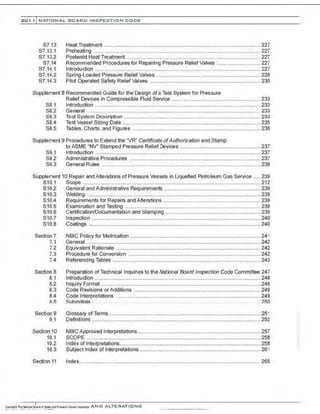
  • 43.
    NATI O NA L BOARO INSPE CTION COO E l201 1 1.7.7.3 REVIEW A review of the applicant's quality system will be performed by a representative of the National Board. The review will include a demonstration of the implementation of the provisions of the applicant's quality system. 1.7.7.4 MAINTENANCE OF CONTROLLED COPY Each applicant to whom a ' VR" Certificate of Authorization is issued shall maintain thereafter a controlled copy of the accepted quality system manual with the National Board. Except for changes that do not affect the quality system, revisions to the quality system manual shall not be implemented until such revisions are accepted by the National Board. 1.7.7.5 OUTLINE OF REQUIREMENTS FORA QUALITY SYSTEM The following establishes the minimum requirements of the written description of the quality system. It is re- quired that each valve repair organization develop its own quality system that meets the requirements of its organization. For this reason it is not possible to develop one quality system that could apply to more than one organization. The written description shall include, as a minimum, the following features: a) Title Page The title page shall include the name and address ·~f the company to which the National Board Certificate of Authorization is to be issued. b) Revision Log A revision log is required to ensure revision control of the quality system manual. The log should contain sufficient space for date, description and section of revision. company approval, and National Board ac- ceptance. c) Cor.tents Page The contents page should list and reference, by paragraph and page number, the subjects and exhibits contained therein. d) Statement ofAuthority and Responsibility A statement of authority and responsibility shall be dated and signed by an officer ofthe company. It shall include: 1) A statement that the "VR" stamp shall be applred only to pressure relief valves that meet both ofthe following conditions: a. Are stamped with anASME "V','UV", or "NV'' Code symbol or marked with anASME "t·IV" symbol and have been capacity certified by the National Board; and b. Have been disassembled, inspected, and repaired by the Certificate Holder such that the valves' condition and performance are equivalent to the standards for new valves. 2) The title of the individual responsible for ensuring that the quality system is followed and who has authority and freedom to affect the responsibility; 3) A statement that if there is a disagreement in the implementation of the written quality system, the matter is to be referred to a higher authority in the company for resolution; and PART 3 - REPAI RS A N O ALTERATI O N S SECTION 1 25
  • 44.
    201 1 INATIONAL.BCARC I NSPECTION CODE 4) The title ofthe individual authorized to approve revisions to the written quality system and the method by which such revisions are to be submitted tothe National Board for acceptance before implementa- tion. e) Organization Chart A chart showing the relationship between management, purchasing. repairing, inspection. and quality control personnel is required and shall reflect the actual organization in place. f) Scope ofWork 1) The scope of work section shall indicate the scope and type of valve repairs. including conversions the organization is capable of and intends to perform. The location of repairs (shop. shop and field, or field only), ASME Code Section(s) to which the repairs apply, the test medium (air, gas, liquid, or steam. or combinations thereof). and special processes (machining, welding,postweld heattreatment, or nondestructive examination. or combinations thereof) shall be specifically addressed. 2) The types and sizes ofvalves to be repaired, pressure ranges and other limitations, such as engineer- ing and test facilities, should also be addressed. g) Drawings and Specification Control The drawings and specification control system shall provide procedures assuring thatthe latest applicable drawings, specifications, and instructions required are usedfor valve repair, including conversions,inspec- tion. and testing. h) Material and Part Control The material and part control section shall describe purchasing, receiving, storage, and issuing of parts. 1) State the title of the individual responsible for the purchasing of all material. 2) State the title of the individual responsible for certification and other records as required. 3) All incoming materials and parts shall be checked for conformancewith the purchase order and, where applicable, the material specifications or drawings. Indicate how material or part is identified and how identity is maintained by the quality system. i) Repair and Inspection Program Therepair and inspection program section shall include referenceto a document (such as a report, traveler, or checklist) that outlines the specific repair and inspection procedures used in the repair ofpressure relief valves. Repair procedures shall require verification that the critical parts meet the valve manufacturer's specification. Supplement S7.14 outlines recommended procedures covering some specific items. Provi- sions shall be made to retain this document for a period of a!least five years. 1) Each valve or group of valves shall be accompanied by the document referred to above for process- ing through the plant. Each valve shall have a unique identifier (i.e., repair serial number, shop order number, etc.) appearing on the repair documentation and repair nameplate such that traceability is established. 2) The document referred to above shall describe the original nameplate information, including the ASME Code symbol stamping and the repair nameplate information, if applicable. In addition, it shall include material checks, replacement parts, conversion parts (or both). reference to items such as the welding procedure specifications (WPS), frt-up, NDE technique, heat treatment, and pressure test methods to be used. Application of the "VR" stamp to the repair nameplate shall be recorded in
  • 45.
    NATIO N ALBOARO INSPECTION COOE l201 1 this document. Specific conversions performe:l with the new Type/Model Number shall be recorded on the document. There shall be a space for "signoffs" at each operation to verify that each step has been properly performed. 3) The system shall include a method of controlling the repair or replacement of critical valve parts. The method of identifying each spring shall be indi, ::ated. 4) The system shall also describe the controls used to ensure that any personnel engaged in the repair of pressure relief valves are trained and qualified in accordance with NBIC Part 3, Supplement 7. j) Welding, NDE, and Hea!Treatment (when applicable) The quality system manual shall indicate the title ofthe person(s) responsible for and describe the sys- tem used in the selection, development, approval, and qualification ofwelding procedure specifications, and the qualification of welders and welding operators in accordance with the provisions of NBIC Part 3, Supplement 7. 1) The quality system manual may include controls for the "VR" Certificate Holder to have the pressure relief valve part repaired by a National Board "R" Certificate Holder, per NBIC Part 3, Supplement 7. 2) The completed Form R-1 shall be noted on and attached to the "VR" Certificate Holder's document required in NBIC Part 3, 1.7.7.5 i). Similarly, NDE and heat treatmenttechniques must be covered in the quality system manual. When outside services are used for NDE and heat treatment. the quality system manual shall describe the system whereby the use of such services meet the requirements ofthe applicable section of theASME Code. k) Valve Testing, Setting, and Sealing The system shall Include provisions that each valve shall be tested, set, and all external adjustments sealed according to the requirements of the applicable ASME Code Section and the National Board. The seal shall identify the "VR" Certificate Holder making the repair.Abbreviations or initials shall be permitted, provided such identification is acceptable to the National Board. I) Valve Repair Nameplates An effective valve stamping system shall be established to ensure proper stamping of each valve as re- quired by NBIC Part 3, 5.12.2. The manual shall include a description of a nameplate or a drawing. A11 m) Calibration '· 1) The manual shall describe a systemfor the calibration ofexamination, measuring, and test equipment :. used in the performance of repairs. Documentation of these calibrations shall include the standard used and the results. 2) All calibration standards shall be calibrated against certified equipment having known valid relation- ships to nationally recognized standards. n) Manual Control The quality system shall include: 1) Measures to control the issuance of and revisions to the quality system manual; 2) Provisions for a review of the system in order to maintain the manual current with these rules and the applicable sections of the ASME Code; 3) The title(s) ofthe individual(s) responsible for control, revisions, and review ofthe manual; PART 3 - REPAIRS ANO ALTERATIONS SECTION 1 27
  • 46.
    201 1 INATIONAL.BCARC I NSPECTION CODE 4) Provision of a controlled copy of the written quality system manual to be submitted to the National Board; and 5) Revisions shall be submitted for acceptance by the National Board prior to being implemented. o) Nonconformities The system shall establish measures for the identification, documentation, evaluation, segregation, and disposition of nonconformities. A nonconformity is a condition ofany material, item, product, or process in which one or more characteristics do not conform to the established requirements. These may include,but are not limited to, data discrepancies, procedural and/or documentation deficiencies, or material defects. Also, thetitle(s) of the individual(s) involved in this process shall be included. p) Exhibits Forms used in the quality system shall be included in the manual with a written description. Forms exhibited should be marked SAMPLE and completed in a manner typical of actual valve repair procedures. q) Testing Equipment (See NBIC Part 3, Supplement 8) The system shall include a means to control the development, addition, or modification oftesting equip- ment to ensure the requirements of NBIC Part 3, 4.5.1(b) are met. r) Field Repairs (See NBIC Part 3, S7.7) Iffield repairs are included in the scope ofwork, the system shall address any differences or additions to the quality system required to properly control this activity, including the following: 1) Provisions for annual audits of field activities shall be included; 2) Provisions for receipt and Inspection of replacement parts, Including parts received from the owner- user, shall be addressed; 3) If owner-user personnel will assist with repairs, provisions for the use of owner-user personnel shall be included; and 4) Provisions for use of owner-user measurement and test equipment, if applicable, shall be addressed. 1.7.8 ASME "V," "HV," OR "UV" CERTIFICATE HOLDERS a) A manufacturer holding a valid ASME Certificate ofAuthorization for use of an ASME "V', "HV', or "UV' Code symbol stamp may obtain the "VR" Certificate of Authorizationfor the repair of pressure relief valves covered bytheASME Certificate ofAuthorization and that meetthe requirements of NBIC Part 3, 1.7.3. This can be accomplished without a review of the facilities provided there is a written quality system to cover the scope of the repairs to be made and the repairs are carried out at the same location where the ASME valves are manufactured. Unless the repaired valves are tested on the same facilities and to the same procedures as new valves, two (2) repaired valves shall be selected by a National Board Representative for verification tests. b) The initial Certificate ofAuthorization shall be issued to expire concurrent with the ASME Certificate of Authorization. Subsequent certificates shall be renewed upon a successful review and verification of imp'ementation of its quality system by a National Board Representative. This review shall be performed concurrently with the ASME Certificate renewal review. c) A manufacturer may also perform field repairs of pressure relief valves covered by the ASME Certificate ofAuthorization provided the provisions of NBIC Part 3, S7.7 are met. .· ....·.·....-..... . ..·..-,·..
  • 47.
    > NATI O NA L BOARO INSPE CTION COO E l201 1 d) Assemblers holdingASME Certificates ofAuthorization shall qualify for the "VR' Certificate ofAuthoriza- tion as required elsewhere in these rules. e) The quality system manual shall be submitted for review and acceptance by the National Board. f) In order for an ASME Code symbol stamp holder to qualify for the National Board "VR" stamp, the follow- ing areas to the written quality system usually require attention: 1) Statement ofAuthority and Responsibility This should clearly indicate that valve repairs are carried out in accordance with the requirements and the rules of the National Board and the quality system manual. In addition, the scope andtype of valve repairs covered by the manual should be indicated. 2) Organization Unless the functions which affect the quality of valve repairs are carried out by individuals other than those responsible for manufacturing or assembly, it should not be necessary to revise the organization chart. 3) General Quality Functions Usually quality system requirements regarding valve repairs may be controlled in the same manner as forASME manufacturing or assembly provided applicable shop and/or field activities are covered. If this is the case, the applicant forthe "VR' stamp should include in its quality system manual a sepa- rate section covering valve repairs that references the applicable section of the manual. For a more explicit explanation see NBIC Part 3, 1.7.7.5, Outline ofRequirements for a Quality System. 1.8 "NR" ACCREDITATION REQUIREMENTS 1.8.1 SCOPE a) This section provides requirements that must be met for an organization to obtain a National Board Cer- tificate ofAuthorization to use the "NR" Symbol Stamp for the Repair/Replacement activities performed in accordance with this Part and ASME Section XI requirements. b) The issuance of the "NR" stamp is not restricted to organizations whose primary business is to perform repair/replacement activities orto manufacturers or assemblers that hold anASME "N"-type Code symbol stamp. Owners and users of nuclear components and other organizations that qualify in accordance with these rules may also obtain the "NR" stamp. 1.8.2 PREREQUISITES FOR ISSUING A NATIONAL BOARD "NR" CERTIFICATE OF AUTHORIZATION Before an organization can obtain a National Board "NR" Certificate ofAuthorization, the organization shall: a) Have and maintain an inspection agreement with an accredited Nuclear Inspection Agency in accordance with NB-360,• NB-369,5 and ASME Section XI; 4 NB-;6o,Criteriafor Acceptanceof AuthorizedJnspecUonAgenclesjorNewConstmct!on. 5 Nll-369, Quol!ficotlon and Duues tor AuthOrized Inspection Agencies (AlAS) Performinglnserviee Inspection ACUvltles and Quollicotion of Inspectors of Boilers and PressureVessels. PART 3 - REPAI RS A N O ALTERATI O N S SECTION 1 2'SI
  • 48.
    201 1 INATIONAL.BCARC I NSPECTION CODE b) Have, in the English language, a written Quality System Program that complies with the requirements of this Section and addresses controls for the intended scope of activities; c) Have a current Edition of the NBIC. all parts; and d) Have available copies of the original code of construction appropriate to the intended scope ofwork and the applicable edition and addenda ofASME Section XI, as required by the regulatory authority.6 1.8.3 PROCEDURES FOR OBTAINING OR RENEWING A NATIONAL BOARD "NR" CERTIFICATE OF AUTHORIZATION a) Prior to issuance or renewal ofa National Board "NR" Certificate ofAuthorization, the organization and its facilities are subject to a review of its Quality System Program. The implementation of the Quality System Program shall be satisfactorily demonstrated by the organization. Demonstration of implementation shall meet the most stringent code requirements for the scope of work to be performed by the organization. The National Board reserves the absolute right to cancel, nefuse to issue, or renew such authorization. The National Board will return fees paid for the unexpired term ofthe certificate. b) Organizations desiring to obtain a National Board Certificate ofAuthorization shall apply to the National Board using forms obtained from the National Board. Application for nenewal shall be made prior to the exp:ration date of the Certificate ofAuthorization. c) These procedures also applyto qualified organizations that make repairs toASME Section Ill, "NV' Pressure ReliefDevices. An organization that holds a valid "NR" Certificate ofAuthorization shall , for the purpose of these procedunes, be known as an authorized nuclear repair organization. d) Authorized Nuclear Inspection Agencies and Inspectors referred to in these procedures shall meet the requirements of, and have been qualified and commissioned in accordance with, the NB-263 National Board Rules for lnservice and New Construction Commissioned Inspectors. e) Repair/replacement activities performed underthe"NR" Certificate ofAuthorization must be in accordance with the provisions of the NBIC, Section XI oftheASME Code and the rules ofthe Jurisdiction. f) Each authorized nuclear repair organization shall maintain a documented Quality System Program that meets the requirements of NBIC Part 3. 1.8.5.1. The Quality System Program shall be commensurate with the scope of the organization's activities and shall be acceptable to the Jurisdiction, the Authorized Nuclear Inspection Agency, and the National Board. g) Before an "NR" Certificate ofAuthorization will be issued or renewed, the applicant must have the Quality System Program and the implementation ofthe program reviewed and found acceptable by representa- tives ofthe National Board, the Jurisdiction . and the accredited Authorized Nuclear Inspection Agency. If the applicant is an ASME "N"-type Certificate ofAuthorization holder, has demonstrated within the last 12 months the implementation of the quality program, and can verify by documentation that the organization is capable of implementing its quality program as being in compliance with this part, a further verification implementation by the survey team may not be necessary. 6 Regulatory Authority;A federalgovernment agency, such astheun~ed States Nuclear RegulatoryCommission. empowered to Issueand enforce regulationsconcerning thedesign, construction, andoperatiorof nudear power plants.
  • 49.
    NATIO N ALBOARO INSPECTION COOE l201 1 h) Applicants that do not hold valid ASME "N"-type Certificates ofAuthorization shall demonstrate. by docu- mentation and actual implementation, that they are capable of performing repair/replacement activities in accordance with the requirements ofASME Section XI and the scope of their application for an "NR" Certificate ofAuthorization. i) ForNational Board authorization to repairASME 'NV'f'NB"-stamped pressure relief devices, the applicant shall hold a valid "VR" Certificate ofAuthorization for the repair ofASME Section Ill pressure relief valves and also meet the applicable requirements for "NR" certification and NBIC Part 3, Supplement 7. j) When these requirements have been met, the applicant may be issued an "NR" Certificate ofAuthoriza- tion. which clearly outlines the scope ofwork for Section Ill pressure relief devices. k) The Jurisdiction will be the National Board member Jurisdiction in which the applicant is located. If the implementation ofthe Quality System Program takes place outside ofthe Jurisdiction where the applicant's program was reviewed, the National Board member in the Jurisdiction where the implementation takes place may participate in this portion of the survey. At the request of the Jurisdiction, the National Board representative may also act for said Jurisdiction. I) Where there is no National Board member Jurisdiction, the applicant's Quality System Program shall be acceptable to representatives of the National Board and the Authorized Nuclear Inspection Agency. m) Theapplicant shall requestthe National Board to evaluatethe Quality System Program and implementation prior to the issuance of an "NR" Certificate ofAuthorization. The National Board. when requested through the appropriate form, will arrange for an evaluation of the applicant's Quality System Program. The pro- gram will be evaluated on the basis of its compliance with the National Board rules for certification. The program shall be adequate to control the intended scope of work. The "NR" Certificate ofAuthorization that Is Issued shall specify the scope and limits ofwork for which the applicant Is certified. n) Revisions tothe Quality System Program shall be acceptable totheAuthorized Nuclear Inspector Supervi- sor of theAuthorized Nuclear Inspection Agency before implementation. o) The "NR" Certificate ofAuthorization holder shall be subject to an audit annually by theAuthorized Nuclear Inspection Agency to assure compliance w~h the Quality System Program. p) Upon notification ofthe survey dates from the National Board, it is the responsibility ofthe organization to make arrangements for the survey. q) The Survey Team, as a minimum, shall consist of one representative each from the National Board. Au- thorized Nuclear Inspection Agency, and Jurisdiction. r) A recommendation to issue. renew. orwithhold the National Board Certificate ofAuthorization forthe "NR" Symbol Stamp shall be included in a summary report prepared by the survey team leader. The completed summary report shall be forwarded to the National Board. s) If proper administrative fees are paid and all other requirements are met, an "NR" Certificate ofAuthoriza- tion will be issued evidencing authorization to use the "NR" Symbol Stamp. The Certificate shall e:<pire on the triennial anniversary date. t) When an organization holding a National Board Certificate ofAuthorization changes ownership, name, or address.the National Board shall be notified. The Certificate ofAuthorization may be revised by submitting an application for National Board "NR" Certificate ofAuthorization. PART 3 - REPAIRS ANO ALTERATIONS SECTION 1 31
  • 50.
    201 1 INATIONAL.BCARC I NSPECTION CODE u) The National Board may at any time change the rules for the issuance of the Certificate ofAuthorization and use of the "NR" Symbol Stamp. These rules shall become binding on all certificate holders. 1.8.4 NATIONAL BOARD "NR" SYMBOL STAMP a) All "NR" Symbol Stamps shall be obtained from the National Board ci Boiler and Pressure Vessel Inspectors. Authorization to use the "NR'' Symbol Stamp may be granted by the National Board at its absolute discretion. b) The National Board, for a nominal fee, furnishes the "NR" Symbol Stamp. Each organization shall agree, if authorized to use the "NR" Symbol Stamp, that the "NR" Symbol Stamp is at all times the property of the National Bo:;~rd and will be promptly returned upon demand. If the organization discontinues the use of the "NR" Symbol Stamp or if the Certificate ofAuthorization has expired and no new Certificate ofAu- thorization has been issued, the "NR" Symbol Stamp shall be returned to the National Board. c) The organization's Quality System Program shall provide for adequate control ofthe "NR" Symbol Stamp. d) The organization authorized to use the "NR" Symbol Stamp may obtain more than one "NR" Symbol Stamp provided the organization's Quality System Program describes how the use of such stamps are controlled from the location shown on the "NR" Certificate ofAuthorization. e) The organization shall not permit other organizations to use the "NR" Symbol Stamp loaned to ~by the National Board . 1.8.5 QUALITY SYSTEM PROGRAM A holder of a National Board Certificate ofAuthorization shall have and maintain a written Quality System Program. The system shall satisfactorily meet the requirements ofthe NBIC, jurisdictional requirements, and shall be available for review. The Quality System Program may be brief or voluminous, depending on the circumstances. It shall be treated confidentially by the National Board. 1.8.5.1 OUTLINE OF REQUIREMENTS FORA QUALITY SYSTEM PROGRAM FOR QUALIFICATION FOR THE NATIONAL BOARD "NR" SYMBOL STAMP These rules set forth the requirements for planning, managing, and implementing the organizations Qual- ity System Programs for controlling the quality of activities performed during repair/replacement activities of components and systems in nuclear power plants within the scope ofthe applicable edition and addenda of Section XI oftheASME Code. These rules are to be the basis for evaluating suclh programs prior to the issu- ance ortlle National Boord "NR" Certificate orAu/lroriarlioo. a) Organization 1) The authority and responsibility ofthose in charge of the Quality System Program and activities affecting quality shall be clearly established and documented. The person and organization performing Quality System functions shall have sufficient and well-defined responsibility, authority, and organizational freedom to: a. Identify quality problems; b. Initiate action which results in solutions;
  • 51.
    NATIO N ALBOARO INSPECTION COOE l201 1 c. Verify implementation of solutions to those problems; and d. Control further processing, delivery or installation of a nonconforming item, deficiency or unsatis- factory condition until proper disposition has been made. 2) The person and organization responsiblefor defining and for measuring the overall effectiveness ofthe Quality System Program shall be designated sufficiently independentfrom the pressure ofproduction, have direct access to responsible management at a level where appropriate action can be required and report regularly on the effectiveness ofthe program. Assurance of quality requires management measures which provide that the individual or group assigned the responsibility of inspection, testing, checking, or otherwise verifying that an activitf has been correctly performed, is independent ofthe individuaI or group directly responsible for performing the specific activity. The specific responsibilities ofthe QualityAssurance organization ofthe "NR" Certificate Holder shall include the review ofwritten procedures and monitoring of all activities concerned with the Quality System Program as covered in these rules. b) Quality System Program 1) Before becoming a holder of an "NR" Certificate ofAuthorization, the applicant shall establish a Qual- ity System Program for the control of the quality of work to be performed. The program shall define the organizational structure within which the Quality System Program is to be implemented and shall clearly delineate the responsibilities, levels of authority, and lines of communication for the various individuals involved. The program shall be documented in detail in a Quality System Manual that shall be a major basis for demonstration of compliancewith the NBIC. The applicant's Quality System Program shall be documented by written policies, procedures, and instructions and shall be based on the organization's scope ofwork to be performed. 2) The applicant's program need not be in the same format or sequential arrangement as the require- ments in these rules as long as all applicable program requirements have been covered. The program shall provide for the accomplishment ofactivities affecting quality under suitably controlled conditions. Controlled conditions include the use of appropriate equipment, suitable environmental conditions for accomplishing the activity and assurance that prerequisites for the activity have been satisfed. The program shall take into account the need for special controls, processes, test equipment, tools, and skills to attain the required quality and need for the verification of quality by inspection and test. The program shall provide for ready detection of nonconforming material and items and for timely and positive corrective actions. 3) The program shall provide for indoctrination and training of personnel performing activities affecting quality as necessary to assure that suitable proficiency is achieved and maintained. It shall be the responsibility ofthe "NR" Certificate Holder to ensure that all personnel performing quality functions within the scopeofthese rules. including personnel ofsubcontracted services. are qualified as specified in these rules. The assignment of qualified personnel shall be at the discretion of the "NR" Certificate Holder. 4) The "NR" Certificate Holder shall be responsible for advising hisAuthorized Nuclear InspectionAgency of any proposed changes to the Quality System Manual and shall have acceptance of the Authorized Nuclear Inspection Agency'sAuthorized Nuclear Inspector Supervisor before putting such changes into effect. The "NR" Certificate Holder shall make a current copy of the Quality System Manual available to theAuthorized Nuclear Inspector. The "NR" Certificate Holder shall be responsible for promptly no- tifying theAuthorized Nuclear Inspector of such accepted changes, including evidence of acceptance by the Authorized Nuclear Inspection Agency. PART 3 - REPAIRS ANO ALTERATIONS SECTION 1 33
  • 52.
    201 1 INATIONAL.BCARC I NSPECTION CODE 5) The quality of all repair/replacement activities shall be controlled at all points necessary to ensure conformance with the requirements of these rules and the "NR" Certificate Holder's Quality System ManuaL 6) The Certificate Holder shall make available to the Authorized Nuclear Inspector such drawings and process sheets as are necessary to make the Quality System Program intelligible. c) Design Control 1) ASME Section XI establishes that the owner is responsible for design in connection with repair/re- placement activities. The "NR" Certificate Hold:!r must ensure that the design specification, drawings, or other specifications or instructions furnished by the owner satisfy the code edition and addenda of the owner's design specification. To satisfy this requirement, the "NR" Certificate Holder shall estab- lish requirements that correctly incorporate the owner's design specification requirements into their specifications, drawings, procedures, and instructions, which may be necessary to carry out thework. The "NR" Certificate Holder's system shall include provisions to ensure that the appropriate quality standards are specified and included in all quality records. These records shall be reviewed for com- pliance with the owner's design specification and the requirements ofASME Section XI. 2) If the "NR" Certificate Holder's specifications, drawings, procedures, and instructions conflict with the owner's design specification, a system must be implemented that will resolve or eliminate the defr ciency. This system must be reconciled with the owner and the "NR" Certificate Holder in accordance with IWA-4000 ofASME Section XI. d) Procurement Document Control Documents for procurement of materials, Items, and subcontracted services shall Include requirements to the extent necessary to ensure compliance with the owner's design specifications and IWA-4000 of ASME Section XI. To the extent necessary, procurement documents shall require suppliers to maintain a Quality System Program consistent with the applicable requirements of the edition and addenda ofthe code of construction to which the items are constructed. Measures shall be established to ensure that all purchased material, items, and services conform to these requirements. e) Instructions, Procedures and Drawings Activities affecting quality shall be prescribed by documented instructions, procedures or drawings of a type appropriate to the circumstances and shall be accomplished in accordance with these instructions, procedures, or drawings. Instructions, procedures, or drawings shall include appropriate quantitative and qualitative criteria for determining that activities affecting quality have been satisfactorily accomplished. The "NR" Certificate Holder shall maintain a written description of procedures, instructions, or drawings use:l by his organization for control of quality and examination requirements detailing the implementation ofthe Quality System requirements. Copies ofthese procedures shall be readily available to theAuthorized Nuclear Inspector. f) Document Control The program shall include measures to control the issuance, use. and disposition of documents. such as spe:ifications, instructions, procedures, and drawings, including changes thereto. These measures shall ensure that the latest applicable documents, including changes, are reviewed for adequacy and approved for release by authorized personnel and distributed for use at the location where the prescribed a:tivity is performed.
  • 53.
    NATIO N ALBOARO INSPECTION COOE l201 1 g) Control of Purchased Material, Items. and Services Measures shall be established to ensure that all purchased material. items, and servioes conform to the requirements of the owner's design specifications and applicable edition and addenda of the code of construction and ASME Section XI. These measures shall include identification for material traceability. Provisions shall be identified for source evaluation and objective evidence shall be provided evidencing quality standards for material examination upon receipt. h) Identification and Control of Material and Items 1) Measures shall be established for identification and control ofmaterial and items, including partially fab- ricated assemblies. These measures shall ensure that identification is maintained and traceable, either on the material or component, or on recordsthroughoutthe repair/replacement activity. These measunes shall be designed to prevent the use of incorrect or defective items and those which have not received the required examinations, tests, or inspections. 2) Permanent or temporary unit identification marl<s shall be applied using methods and materialsthat are legible and not detrimental to the component or system involved. Such identification shall be located in areas that will not interfere with the function or quality aspects of the item. 3) Certified Material Test Reports shall be identifed as required by the applicable material specification in ASME Section II and shall satisfy any additional requirements specified in the original code of con- struction. The Certified Material Test Report or Certificate of Compliance need not be duplicated for submission with compliance documents when a record of compliance and satisfactory reviews of the Certified Material Test Report and Certificates of Compliance is provided. Documents shall provide a record that the Certified Material Test Report and Certificates ofCompliance have been received. reviewed, and found acceptable. When the "NR" Certificate Holder Scope authorizes the organiza- tion to perform examinations and tests in accordance with the original code of construction, the "NR" Certificate Holder shall certify compliance either on a Certified Material Test Report or Certificate of Conformance that the material satisfies the original code of construction requirements. i) Control of Processes 1) The "NR'' Certificate Holder shall operate undera controlled system such as process sheets, checklists, travelers. or equivalent procedures. Measures shall be established to ensure that processes such as welding, nondestructive examination, and heattreating are controlled in accordance with the rules of the applicable section of theASME Code and are accomplished by qualified personnel using qualified procedures. 2) Process sheets, checklists, travelers, or equivalent documentation shall be prepared, including the document numbers and revisions to which the process conforms with space provided for reporting results of completion of specific operations at checkpoints of repair/replacement activities. j) Examinations, Tests and Inspections 1) In-process and final examinations and tests shall be established to ensure conformance with specifi- cations, drawings, instructions, and procedures which incorporate or reference the requirements and acceptance limits contained in applicable design documents. Examination activities to verify the quality ofwor1< shall be performed by persons other than those who performed the activity being examined. Such persons shall not report directly to the immediate supervisors responsible for the work being examined. - .·..·..·............-..·,·..· PART 3 - REPAIRS ANO ALTERATIONS SECTION 1 35
  • 54.
    201 1 INATIONAL.BCARC I NSPECTION CODE 2) Process sheets. travelers, or checklists shall be prepared. including the document numbers and revi- sion to which the examination or test is to be performed. with space provided for recording results. 3) Mandatory hold/inspection points atwhich witnessing is required by the "NR" Certificate Holder's rep- resentative or theAuthorized Nuclear Inspector shall be indicated in the controlling documents. Wor1< shall not proceed beyond mandatory hold/inspection points without the consent ofthe "NR" Certificate Holder's representative or theAuthorized Nuclear Inspector, as appropriate. k) Test Control 1) Testing shall be performed in accordance with the owner's written test procedures that incorporate or reference the requirements and acceptance limits contained in applicable design documents. 2) Test procedures shall include provisions for ensuring that prerequisites for the given test have been met, that adequate instrumentation is availableand used, and that necessary monitoring is performed. Prerequisites may include calibrated instrumentation, appropriate equipment, trained personnel, con- d~ion oftest equipment and the item to be tested, suitable environmental conditions, and provisions for data acquisition. 3) Test resuIts shall bedocumented and evaluated to ensure thattest requirements have been satisfied. I) Control of Measuring and Test Equipment Measures shall be established and documented to ensure that tools, gages. instruments, and other measuring and testing equipment and devices used in activities affecting quality are of the proper range, type, and accuracy to verify conformance to established requirements.A procedure shall be in effect to ensure that they are calibrated and properly adjusted at specified periods or use Intervals to maintain accuracy within specified limits. Calibration shall be traceable to known national standards, where these standards exist, or with the device manufacturer's recommendation. m) Quality Records 1) The owner is responsible for designating records to be maintained. Measures shall be established for the "NR" Certificate Holder to maintain these records (See 1.8.5.1 m) 2)] required for Quality As- surance of repair/replacement activities. These shall include documents such as records of materi- als, manufacturing, examination. and test data taken before and during repair/replacement activity. Procedures, specifications, and drawings used shall be fully identified by pertinent material or item identification numbers, revision numbers, and issue dates. The records shall also include related data such as personnel qualification,procedures, equipment, and related repairs. The "NR" Certificate Holder shall take such steps as may be required to provide suitable protection from deterioration and damage for all records while in his care. Also, it is requ'red that the "NR" Certificate Holder have a system for correction or amending records that satisfies the owner's requirements. These records may be either the original or a reproduced, legible copy and shall be transferred to the owner at his request. 2) Records to be maintained as required in NBIC Part 3, 1.8.5.1 m) 1) above may include the following: a. An index that details the location and individual responsible for maintaining the records; b. Data reports, properly executed, for each replacement component, part, appurtenance, piping system, and piping assembly, when required by the design specification or the owner; c. The required as-constructed drawings certified as to correctness; .............. " .... ~~~~,....~b,~!~~.oc:.!'!~~Pr...aro';'~w~ : - REPAIRS ANO A L T E R.t ,!,l}?.~.~.....-.~.-.............- ....
  • 55.
    NATIO N ALBOARO INSPECTION COOE l201 1 d. Copies of applicable Certified Material Test Reports and Certificates of Compliance; e. As-built sketch{es) including tabulations ofmaterials repair/replacement procedures, and instruc- tions to achieve compliance with ASME Section XI. f. Nondestructive examination reports, including results of examinations, shall identify the ASNT. SNT-TC-1A, CP-189, orACCP level of personnel interpreting the examination results. TheASNT Central Certification Program (ACCP) may be used to fulfill the examination and demonstration requirement ofthe employer's written practice. Final radiographs shall be included where radiog- raphy has been performed; g. Records ofall heattreatments may beeitherthe heattreatment charts or a summary description of heat treatment time and temperature data certified by the "NR" Certificate Holder. Heat treatments performed by the material manufacturer to satisfy requirements ofthe material specifications may be reported on the Certified Material Test Report; or h. Any and all nonconformance reports shall satisfy IWA-4000 of ASME Section XI and shall be reconciled by the owner prior to certification ofthe Form NR-1 or NVR-1, as applicable. 3) After a repair/replacement activity, all records including audit reports required to verify compliance with the applicable engineering documents andthe "NR" Certificate Holder's Quality System Program, except those required by the owner or listed in NBIC Part 3, 1.8.5.1 m) 2) a) thru g) above, shall be maintained at a place mutually agreed upon by the owner and the "NR" Certificate Holder. These re- cords shall be maintained for a period offiVe years after completion of the repair/replacementactivity. 4) The original of the completed Form NR-1 or Form NVR-1, as applicable, shall be registered with the National Board and, If required, a copy forwarded to the Jurisdiction where the nuclear power plant Is located. n) Examination or Test Status Measures shall be established to indicate examination and test status of parts, items, or components during the repair/replacement activity. The system used shall provide positive identification of the part, item, or component by means of stamps, labels, routing cards, or other acoeptable methods. The system shall include any prooedures or instructions neoessary to achieve compliance. Also, measures shall be provided for the identification of acoeptable and unacceptable items. They shall also include procedures for control of status indicators, including the authority for application and removal of status indicators. o) Nonconforming Materials or Items Measures shall be established to control materials or items that do not conform to requirements in order :~ to preventtheir inadvertent use. including measures to identify and control the proper installation of items and to preclude nonconformance with the requirements of these rules. These measures shall include procedures for identification, documentation, segregation, and disposition. Nonconforming items shall be reviewed for acceptanoe, rejection, or repair in accordancewith documented procedures. The responsibil- ity and authority for the disposition of nonconforming items shall be defined. Repaired or modified items shall be re-examined in accordanoewith the applicable prooedures. Measures that control further process- ing :>fa nonconforming or defective item, pending a decision on its disposition , shall be established and maintained. Ultimate disposition of nonconforming items shall be documented. PART 3 - REPAIRS ANO ALTE RATIONS SECTION 1 3 7
  • 56.
    201 1 INATIONAL.BCARC I NSPECTION CODE p) CorrectiveAction 1) Measures shall be established to ensure that conditions adverse to quality such as failures, malfunc- tions, deficiencies, deviations, defective material and equipment, and other nonconformances are promptly identified and corrected. 2) In the case of significant conditions adverse to quality, the measures shall also ensure that the cause ofthese conditions be determined and corrected to preclude repetition. The identification of significant conditions adverseto quality, the cause, condition, and the corrective action taken shall be documented and reported to the appropriate levels of management. 3) The requirements shall also extend to the performance of subcontractors' corrective action measures. q) Audits A comprehensive system ofplanned and periodic audits shall be carried out by the 'NR" Certificate Holder's organization to ensure compliance with the Qualitf System Program and to determine its effectiveness. Audits shall be performed in accordance with written procedures or checklists by personnel not having direct responsibilities in the areas being audited. Audit results shall be documented by the auditing per- sonnel for review by management having responsibility in that area. Follow-up action, including re-audit of deficient areas, shall be taken where indicated.Audit results shall be made available to the Authorized Nuclear Inspector. r) Authorized Nuclear Inspector Measures shall be taken to reference the commissioned Rules for National Board Authorized Nuclear Inspector,qualified In accordance with the Rules for NationalBoardInservice and Newconstruction Com- misioned Inspectors, to ensure that the latest documents including the Quality System Program will be made available to the inspector. TheAuthorized Nuclear Inspector shall be consulted prior to the issuance of a repair/replacement program in orderthat the Inspector may select any inspection or hold points in the program.The Authorized Nuclear Inspector shall not sign Form NR-1 or Form NVR-1, as applicable, unless satisfied that all work carried out is in accordance with the NBIC, ASME Section Xl, and any jurisdictional requirements. S) EXhibits Forms referenced in the Quality System Manual shall be explained in the text and included as part of the referencing document or as an appendix. Forms shall be controlled and identified to show the latest ap- proved revision, exhibit name, and other corresponding references as stated in the Quality System manual. 1.8.6 INTERFACE WITH THE OWNER'S REPAIR/REPLACEMENT PROGRAM Interface with the owner's repair/replacement program shall meet the following: a) The repair/replacement plan shall be subject to the acceptance of the Jurisdiction and the owner'sAutho- rizej Nuclear In-Service Inspector (ANII). b) Repair/replacement activities of nuclear components shall meet the requirements ofASME Section XI of the ASME BoilerandPressure Vessel Code and the Jurisdiction where the nuclear power plant is located. ·.·..·..-,·....·.... ··..·..·. - ..
  • 57.
    NATIO N ALBOARO INSPECTION COOE l201 1 c) Documentation ofthe repair/replacement activities ofnuclear components shall be recorded on the National Board Report of Nuclear Repair/Modification or Replacement activities. Form NR-1 . or Form NVR-1. as applicable. The completed forms shall be signed by a representative of the authorized nuclear repair or- ganization and theAuthorized Nuclear Inspector ifthe repair/replacement activity meets the requirements ofASME Section XI. For repair/replacement activities that involve design changes as specified 1 n NBIC Part 3. 1.8.5.1 c). Form NR-1, or Form NVR-1, as applicable, shall indicate the responsible organization satisfying the owner's design specification requirements. d) The authorized nuclear repair organization shall provide a copy of the signed Form NR-1 or FormNVR-1, as applicable, to the owner, if required, the Jurisdiction, and the Authorized Nuclear Inspection Agency. The original Form NR-1 or Form NVR-1, as applicable, shall be registered with the National Board by the authorized nuclear repair organization. e) The authorized nuclear repair organization shall provide a nameplate/stamping for repair/replacement activities for each nuclear component unless otherwise required by the Owner's Quality System Program. The required information and format shall be as shown in NBIC Part 3, Section 5. PART 3 - REPA'i'f'fs"A;N'o" .O.'LTERATIONS SECTION 1 3 'SI
  • 58.
    201 1 INATIONAL.BCARC INSPECTION CODE ·.·..·..·.·......... · ..· ..·,·..·
  • 59.
    0 N NATIONAL BOARO INSPECTIONCOOE l201 1 PART 3, SECTION 2 REPAIRS AND ALTERATIONS- WELDING AND HEAT TREATMENT PART 3 - REPAIRS ANO ALTERATIONS SECTION 2 4 1
  • 60.
    201 1 INATIONAL.BCARC I NSPECTION CODE PART 3, SECTION 2 REPAIRS AND ALTERATIONS - WELDING AND HEAT TREATMENT 2.1 SCOPE This section provides general and specific requirements forwelding and heattreating when performing welded repairs and alterations to pressure-retaining items. Careful consideration shall be given to pressure-retaining items that have been fabricated ofeither creep strength enhanoed ferritic materials orferritic materials enhanced by heat treatment. The tensile and creep strength pnoperties ofthese materials can be degraded by notfoilowing specific welding and heat treatment requirements. The user is cautioned to seek technical guidance rorwelding and heat treating requirements in accordance with the original code of construction. 2.2 WELDING Welding shall be performed in accordance with the requirements of the original code of construction used for the pressure-retaining item whenever possible. 2.2.1 WELDING PROCEDURE SPECIFICATIONS Welding shall be performed in accordance with Welding Procedure Specifications (WPS) qualified in accor- dance with the original code of construction or the construction standard or code selected. When this is not possible or practicable. the WPS may be qualified in accordance with ASME Section IX. 2.2.2 STANDARD WELDING PROCEDURE SPECIFICATIONS (SEE NBIC PART 3, 2.3) An "R" Certificate Holder may use one or more applicable Standard Welding Pnooedure Specifications (SWPS) shown in NBIC Part 3, Table 2.3 without supporting Procedure Qualification Records (PQRs) since SWPS are pre-qualified. 2.2.3 PERFORMANCE QUALIFICATION Welders and welding operators shall be qualified for the welding processes that are used. Such qualification shall be in accordance with the requirements of the original code of construction, the construction standard, code selected orASME Section IX. Use of a Standard Welding Prooedure Specification shown in NBIC Part 3, 2.3 is permitted for performance qualification testmg. 2.2.4 WELDING RECORDS The "R" Certificate Holder shall maintain a record ofthe results obtained in Welding Procedure Qualifications, except for those qualifications for which the provisions of NBIC Part 3, 2.2.2 are used and of the results ob- tained in welding performance qualifications. These records shall be certified by the "R" Certificate Holder and shall be available to the Inspector.
  • 61.
    NATIONAL BOARO INSPECTIONCOOE l201 1 2.2.5 WELDER'S IDENTIFICATION The "R" Certificate Holder shall establish a system for the assignment of a unique identification mark to each welder/welding operator qualified in accordance with the requirements of the NBIC. The "R" Certificate Holder shall also establish a written procedurewhereby welded joints are identified as to thewelder orwelding opera- tor who made them. This procedure shall use one or more of the following methods and be acceptable to the Inspector. The welder's orwelding operator's identification mark may be stamped (low stress stamp) adjacent to welded joints made by the individual, orthe "R" Certificate Holder may keep a documented record ofwelded joints and the welders or welding operators used in making the joints. 2.2.6 WELDER'S CONTINUITY The performance qualification of a welder or welding operator shall be affected when one of the following conditions occur: a) When thewelderorwelding operator has notwelded using a specific process during a period of sixmonths or more, their qualifications forthat process shall expire.The "R" Certificate Holder shall maintain a welding continuity record and shall make the record available to the Inspector. The method of recording welding continuity and the record retention period shall be described in the "R" Certificate Holder's Quality System Manual. b) When there is specific reason to question a welde~s ability to make welds that meet the specification, the qualification which supports the welding that is being performed shall be revoked. All other qualifications not questioned remain in effect. 2.3 STANDARD WELDING PROCEDURE SPECIFICATIONS One or more SWPSsfrom NBIC Part 3, Table 2.3 may be used as an alternative to one ormore WPS documents qualified by the organization making the repair or alteration, provided the organization accepts by certification (contained therein) full responsibility for the application of the SWPS in conformance with the application as stated in the SWPS. When using SWPS's, all variables listed on the Standard Welding Procedure are consid- ered essential and, therefore, the repair organization cannot deviate, modify, amend, or revise any SWPS's. US Customary Units or metric units may be used for all SWPSs in NBIC Part 3, Table 2.3, but one system shall be used for application of the entire SWPS in accordance with the metric conversation table contained in the SWPS. The user may issue supplementary instructions as allowed by the SWPS. Standard Welding Procedures Specifications shall not be used in the same productjointtogetherwith the other Standard Welding Procedure Specifications or other welding procedure specifications qualified by the organization. The AWS reaffirms SWPSs in accordance with ANSI procedures. When reaffirmation occurs without revision to the SWPS, the letter "R" is added to the SWPS designation following the year. Such designation is consid- ered to be identical with the previously published version and may be used pending incorporation herein. on the same basis as the version listed in NBIC Part 3, Table 2.3. PART I - REPAIRS AND ALTERATIONS SECTION 2 43
  • 62.
    201 1 INATIONAL. BCARC I NSPE CTION COD E Table 2.3 Carbon Steel- (P1 Materials) SMAVV- Shielded Metal Arc Welding Standard Welding Procedure Specification for Shielded Metal Arc Welding of Carbon 82.1.001-90 Steel, iM-1/P-1, Group 1 or 2), 3116 in. (5 mm) through 3/4 in. (13 mm), in the As-Weld- and ed Condition, With Backing. 82.1-1-001: 90(R2006) Standard Welding Procedure Specification for Shielded Metal Arc Welding of Carbon 82.1-1-016-94 Steel (M-1/P-1/S-1 , Group 1 or 2), 1/8 in. (3.2 mm) through 1-1/2 in. (38 mm) Thick, and E7018,As-Welded or PWHT Condition. 82.1-1-016-94R Standard Welding Procedure Specification for Shielded Metal Arc Welding of Carbon 82.1-1-017-94 Steel (M-1/P-1/S-1 , Group 1 or 2), 1/8 in. (3.2 mm) through 1-1/2 in. (38 mm) Thick, and E6010,As-Welded or PWHT Condition. B2.1-1-017-94R Standard Welding Procedure Specification for Shielded Metal Arc Welding of Carbon 82.1-1-022-94 Steel (M-1/P-1/S-1 , Group 1 or 2), 1/8 in. (3.2 mm) through 1-1/2 in. (38 mm) Thick, and E6010 (Vertical Uphill) followed by E7018, As-Welded or PWH Condition. B2.1· 1-022-94R Standard Welding Procedure Specification for Shielded Metal Arc Welding of Carbon 82.1-1-026-94 Steel (M-1/P-1/S-1 , Group 1 or 2), 1/8 in. (3.2 mm) through 1-1/2 in. (38 mm) Thick, and E6010 (Vertical Downhill) followed by E7018, As-Welded or PWH Condition. 82.1-1-026-94R Standard Welding Procedure Specification for Shielded Metal Arc Welding of Carbon 82.1-1-201-96. Steel (M-1/P-1/S-1, Group 1 or 2), 1/8 in. (3.2 mm) through 314 in. (19 mm)Thick, and 82.1-1-201- E601 0 (Vertical Downhill) followed by E7018, (Vertical Uphill) As-Welded Condition, 96(R2007) Primarly PipeApplications. Standard Welding Procedure Specification for Shielded Metal Arc Welding of Carbon 82.1-1-202- Steel (M-1/P-1/S-1, Group 1 or 2), 1/8 in. (3.2 mm) through 314 in. (19 mm) thick, E6010 96(R2007) (Vertical Downhill) followed by E7018 (Vertical Uphill),As-Welded Condition, Primarily PipeApplications. Standard Welding Procedure Specification for Shielded Metal Arc Welding of Carbon 82.1-1-203·96 Steel (M-1/P-1/S-1 , Group 1 or 2), 1/8 in. (3.2 mm) through 314 in. (19 mm) Thick, and 82.1-1-203- E601 0 (Vertical Uphill), As-Welded Condition, Primarily PipeApplications. 96(R2007) Standard Welding Procedure Specification for Shielded Metal Arc Welding of Carbon 82.1-1-204-96 Steel (M-1/P-1/S-1 . Group 1 or 2), 1/8 in. (3.2 mm) through 314 in. (19 mm) Thick, and 82. 1-1-204- E601 o(Vertical downhill root with balance vertical uphill), As-Welded Condition, Primar- 96(R2007) ily Pipe Applications. Standard Welding Procedure Specification for Shielded Metal Arc Welding of Carbon 82.1-1-205-96 Steel (M-1/P-1/S-1, Group 1 or 2), 1/8 in. (3.2 mm) through 1-1/2 in. (38 mm) Thick, and 82. 1-1-205· E601 0 (Vertical Uphill) followed by E7018 (Vertical Uphill),As-Welded or PWH Condi- 96(R2007) tion, Primarily Pipe Applications. Standard Welding Procedure Specification for Shielded Metal Arc Welding of Carbon 82 1-1-206-96 Steel (M-1/P-1/S-1 , Group 1 or 2), 1/8 in. (3.2 mm) through 314 in. (19 mm) Thick, and 82.1-1-206- E6010 (Vertical Downhill) followed by E7018 (Vertical Uph II), As-Welded or PWiT Con- 96(R2007) dition, Primarily PipeApplications. - REPA IRS A ND ALT ER ,II riONS
  • 63.
    NATI ONA LBOARO INSPE CTION COO E l 201 1 Standard Welding Procedure Specification for Shielded Metal Arc Welding of carbon Steel (M-1/P-1/S-1, Group 1 or 2), 1/8 in. (3.2 mm) through 314 in. (19 mm) Thick, E7018,As-Welded or PWHT Condition, Primarily PipeApplications. Standard Welding Procedure Specification for Shielded Metal Arc Welding of carbon Steel (M-1/P-1/S-1 , Group 1 or 2), 1/8 in. (3.2 mm) through1-1/2 in. (38 mm) Thick, E7018,As-Welded or PWHT Condition, Primarily PipeApplications. GTAW- Gas Tungsten Arc Welding Standard Welding Procedure Specification for Gas Tungsten Arc Welding of Carbon Steel, (M-1/P-1, Group 1 or 2), 3116 in. (5 mm) through 7/ll in. (22 mm) Thick, in the As- Welded Condition, IMth or Without Backing. Standard Welding Procedure Specification for Gas TungstenArcWelding of Carbon Steel (M-1/P-1/S-1 , Group 1 or 2), 1/8 in. (3.2 mm) through 314 in. (19 mm)Thick, ER70S-2. As-Welded or PM-H Condition, Primarily Pipe Application. Standard Welding Procedure Specification for Gas TungstenArcWelding of Carbon Steel (M-1/P-1/S-1 , Group 1 or 2), 1/8 in. (3.2 mm) through 1-1/2 in. (38 mm) Thick, ER70S-2, As-Welded or PM-IT Condition, Primarily Pipe Application. Standard Welding Procedure Specification for Gas TungstenArc Welding (Consumable Insert) of Carbon Steel (M-1/P-1/S-1, Group 1 or 2), 1/ll in. (3.2 mm) through 3/4 in. (19 mm) Thick, INMs1 and ER70S·2, As-Welded or PWHT Condition, Primarily Pipe Application. Standard Welding Procedure Specification for Gas TungstenArc Welding with Consum- able Insert Root of Carbon Steel (M-1/P-1/S-1, Group 1 or2). 1/8 in. (3.2 mm) through 1-1/2 in. (38 mm) Thick, INMs-1, ER70S-2, As-Welded or PM-IT Condition, Primarily PipeApplications. FCAW- Flux Core Arc Welding Standard Welding Procedure Specification for Self-Shielded Flux CoredArc Welding of carbon Steel (M-1/P-1/S-1, Group 1 or 2), 1/8 ln. (3.2 mm) through 1-1/2 in. (38 mm) Thick, E71T-8, As-Welded Condition. Standard Welding Procedure Specification for C02 Shielded Flux Cored Arc Welding of caroon Steel (M-1/P-1/S-1, Group 1 or 2), 1/8 in. (3.2 mm) through 1-1/2 in. (38 mm) Thick, E70T-1 and E71T-1 ,As-Welded Condition. Standard Welding Procedure Specification for 75% Ar/25% C02 Shielded Flux Cored Arc Welding of Carbon Steel (M-1/P-1/S-1, Group 1 or2), 1/ll in. (3.2 mm) through 1-1/2 in. (38 mm) Thick, E70T-1M and E71T-1M, As-Welded or PWHT Condition. 82.1-1-208-96 82.1-1-208- 96(R2007) 82.1-002-90, 82.1-002- 90(R2000) and 82.1-1-002-90R 82.1-1-207-96 821-1-207-96 (R2007) 82.1-1-210-96 82.1-1-210:2001 82.1-1-018-94 and 82.1-1.018-94R 82.1-1-019-94 and 82.1-1-019-94R 82.1-1-020-94 and 82.1-1-020-94R PART I - REPA IRS AND ALTERAT I ONS SECTION 2 45
  • 64.
    2 0 11 INATIONAL. BCARC I NSPECTION CODE Standard Welding Procedure for Self-Shielded Flux CoredArc Welding of Carbon Steel (M-1/P-1/S-1, Group 1 or 2), 1/8 in. (3.2 mm) through 1/2 i~. (13 mm) Thick. E71T-11, As-Welded Condition. Standard Welding Procedure Specification (SWPS) forArgon Plus 25% Carbon Dioxide Shielded Flux CoredArc Welding of Carbon Steel (M-1/P-1 /S-1, Groups 1 and 2), 1/8 in. (3.2 mm) through 1·1/2 in. (38 mm) Thick, E7XT· XM, As-Welded or PM-IT Condition, Primarly PipeApplications. GMAW- Gas Metal Arc Welding Standard Welding Procedure Specification for Argon Plus 25% Carbon Dioxide Shielded Gas Metal Arc Welding (Short Circuiting Transfer Mode) followed by Argon Plus 2% Oxygen Shielded Gas Metal Arc Welding (Spray Transfer Mode) of Carbon Steel (M-1/P-1/S-1, Groups 1 and 2), 1/8 in. (3.2 mm) through 1-1/2 in. (38 mm) Thick, ER70S-3, Flat Position Only, As-Welded or PWHT Condkion, Primarily PipeApplica· tions. Standard Welding Procedure Specification for Argon Plus 2% Oxygen Shielded Gas Metal Arc Welding (Spray Transfer Mode) of Carbon Steel (M-1/P-1/S-1, Groups 1 and 2), 1/8 in. (3.2 mm) through 1-1/2 in. (38 mm) Thick, ER70S-3, Flat Position Only,As- Welded or PWHT Condition, Primarily Pipe Applications. GTAWISMAW Combination of Welding Processes Standard Welding Procedure Specification for Gas TungstenArc Welding Followed by Shielded Metal Arc Welding of Carbon Steel (M-1/P-1/S- 1, Group 1 or 2), 1/8 in. (3.2 mm) through 1-1/2 in. (38 mm) Thick, ER70S-2 and E7018, As-Welded or PM-IT Condi· U ou. Standard Welding Procedure Specification for Gas TungstenArc Welding followed by Shielded Metal Arc Welding o f Carbon Steel (M-1/P-1/S-1, Groups 1 or 2), 1/8 in. (3.2 mm) through 3/4 in. (19 mm) Thick, ER70S-2 and E7018, As-Welded or PWHT Condition, Primarily Pipe Applications. Standard Welding Procedure Specification for Gas TungstenArc Welding followed by Shielded Metal Arc Welding of Carbon Steel (M-1/P-1/S-1, Groups 1 or 2), 1/8 in. (3.2 mm) through 1·112 in. (38 mm) Thick, ER70S·2 and E7018. As-Welded or PWHT Condition, Primarily Pipe Applica tions. Standard Welding Procedure Specification for Gas TungstenArc Welding (Consumable Insert) Followed by Shielded Metal Arc Welding of Carbon Steel (M-1/P-1/S-1, Group 1 or 2), 118 in. (3.2 mm) through 3141n. (19 mm) Thick, INMs1 and E7018,As-Welded or PM-IT Condition, Primarily Pipe Applications. Standard Welding Procedure Specification for Gas TungstenArc Welding with Consum- able Insert Root Followed by Shielded Metal Arc Welding of Carbon Steel (M-1/P-1/S- 1, Group 1 or 2), 1/8 in. (3.2 mm) through 1-1/2 in. (38 mm) Thick, INMs-1 , ER70S-2, and E7018As-Welded or PWHT Condition, Primarily PipeApplications. -REPAIRS AND ALTER,IIriONS 82.1· 1·027:1995 and 82.1· 1·027· 1998 82.1-1·234: 2006 82.1-1·233: 2000 82.1-1-235: 2006 82.1-1-021-94 and 82.1-1-021-94R 82.1· 1·209-96 82.1-1-209-96 (R2007) 82.1-1-211-96 82.1· 1·211:2001
  • 65.
    NATIONAL BOARO INSPECTIONCOOE l 201 1 GMAW/FCAW- Combination of Welding Processes Standard Velding Procedure Specification forArgon Plus 25% Carbon Dioxide Shielded 82.1-1-232:2006 Gas Metal Arc Velding (Short Circuiting Transfer Mode) Followed by Argon Plus 25% Carbon Dioxide Shielded Flux Cored Arc Welding of Carbon Steel (m-1/P-1/S-1, Groups 1 and 2), 118 in. (3.2 mm) through 1·112 in. (38 mm) Thick, ER70S· 3 and EXT·X, As- Velded or PWHT Condition, Primarily PipeApplications. Austenitic Stainless Steel- (M8/P8/S8 Materials) SMAW- Shielded Metal Arc Welding Standard Velding Procedure Specification for Shielded Metal Arc Velding ofAusten- itic Stainless Steel (M..SIP..SIS-8, Group 1), 118 in. (3.2 mm) through 1·112 in. (38 mm) Thick,As-Velded Condition. Standard Velding Procedure Specification for Shielded Metal Arc Velding ofAusten- itic Stainless Steel (M..SIP..SIS-8, Group 1), 118 in. (3.2 mm) through 1·112 in. (38 mm) Thick, E3XX-XX, As-Velded Condition, Primarily Pipe Application. GTAW- Gas Tungsten Arc Welding Standard Velding Procedure Specification for Gas TungstenArc Welding ofAusten- itic Stainless Steel (M..S/P..SIS-8, Group 1), 118 in. (3.2 mm) through 1-112 in. (38 mm) Thick,As.-Velded Condition. Standard Velding Procedure Specification for Gas TungstenArc Welding ofAustenitic Stoinleso Steel (M..SIP 8/S-8, Group 1), 1116 in. (1 .6 mm} through 1-1/2 in. (38 mm) Thick, ER3XX, As-Velded Condition, Primarily Plate and Structural Applications. Standard Velding Procedure Specification for Gas TungstenArc Welding ofAustenitic Stainless Steel (M-8/P-8/S-8, Group 1), 1116 in. (1 .6 mm) through 1-112 in. (38 mm) Thick, ER3XX, As-Velded Condition, Primarily PipeApplications. Standard Velding Procedure Specification for Gas TungstenArc Welding ofAustenitic Stainless Steel (M-8/P-8/S-8, Group 1), 1116 in. (1 .6 mm) through 1-112 in. (38 mm) thick, ER3XX,As·Velded Condition, Primarily Pipe Applications. Standard Velding Procedure Specification for Gas TungstenArc Welding With Consumable Insert Root ofAustenitic Stainless Steel (M-S!P-8/S-8, Group 1), 118 in. (3.2 mm) through 1·112 in. (38 mm) Thick, IN3XX and ER3XXAs·Velded Condition, Primarly Pipe Applications. Combination Processes GTAWISMAW Standard Velding Procedure Specification for Gas TungstenArc Welding followed by Shielded Metal Arc Welding ofAustenitic Stainless Steel (M-8/P-8/S-8, Group 1), 118 in. (32 mm) through 1-112 in. (38 mm) Thick, As-Velded Condition. 82.1-8-023-94 82.1-8-213-97 and 82.1-8·213· 96(R2007) 82.1-8-024-94 82.1-8-024:2001 82.1-8-212-97 82.1-8-212:2001 82.1-8-21 5: 1998 82.1-8-215:2001 82.1-8-025-94 PART I - REPAIRS AND ALTERATIONS SECTION 2 47
  • 66.
    201 1 INATIONAL. BCARC INSPE CTION COD E Standard Welding Procedure Specification for Gas TungstenArcWelding followed by 82.1·8·025:2001 Shielded Metal Arc Welding ofAustenitic Stainless Steel (M-8/P-8/S-8, Group 1), 1/8 in. (3..2 mm) through 1·112 in. (38 mm) Thick, ER3XXand E3XX-XX, As-Welded Condition. Primarly Plate and Structural Applications. Standard Welding Procedure Specification for Gas TungstenArc Welding Followed by 82.1-8-214-97 Shielded Metal Arc Welding ofAustenitic Stainless Steel (M-8/P-8/S-8, Group 1), 1/8 in. (3.2 mm) through 1-1/2 in. (38 mm) Thick, ER3XX and E3XX-XX, As-Welded Condition, Primarly PipeApplications. Standard Welding Procedure Specification for Gas TungstenArcWelding Followed by 82.1-8-214:2001 Shielded Metal Arc Welding of Austenitic Stainless Steel (M-8/P-8/S-8, Group 1). 1/8 in. (3..2 mm) through 1-1/2 in. (38 mm) Thick, ER3XX and E3XX-XX, As-Welded Condition, Primarly PipeApplications. ·, Standard Welding Procedure Specification for Gas TungstenArcWelding With 82.1-8-216-1998 Consumable Insert Followed by Shielded Metal Arc Welding ofAustenitic Stainless Steel (M-8/P-8/S-8, Group 1), 1/8 in. (3.2 mm) lhrough 1-112 in. (38 mm) thick, IN3XX, ER3XX, and E3XX-XX As-Welded Condition, Primarily PipeApplication. Standard Welding Procedure Specification for Gas TungstenArc Welding with Consum- 82.1-8-216:2001 able Insert Root followed by Shielded Metal Arc Welding ofAustenitic Stainless Steel (M-8/P-8/S-8, Group 1), 1/8 in. (3.2 mm) through 1-1/2 in. ;38 mm) Thick, IN3XX, ER3XX, and E3XX-XXAs-Welded Condition, Primarily PipeApplications. Combination of Carbon Steel (P-1 Material) To Austenitic Stainless Steel (P-8 Material) SMAW- Shielded Metal Arc Welding Standard Welding Procedure Specifications for Shielded Metal Arc Welding of Car- bon Steel (M-1/P-1/S-1, Groups 1 or 2) to Austenitic Stainess Steel (M-8/P-8/S-8, Group 1), 1/8 in. (3.2 mm) through 1-1/2 in. (38 mm) Thick, E309(L)-15, -16, or -17, As-Welded Condition, Primarily Pipe Applications. GTAW-Gas Tungsten Arc Welding Standard Welding Procedure Specification for Gas TungstenArc Welding of Carbon Steel (M-1/P-1/5-1 , Groups 1 or 2) to Austenitic Stainless Steel (M-8/P-8/S-8, Group 1), 1/16 in. (1 .6 mm) through 1-1/2 in. (38 mm) Thick, ER309(L), As-Welded Condi- tion, Primarily Pipe Applications. Standard Welding Procedure Specifications for Gas TungstenArc Welding wilh Consumable Insert Root of Carbon Steel (M-1/P-1/S-1, Groups 1 or 2) to Austenitic Stainless Steel (M-8/P-8/S-8, Group 1), 1/16 in. (1 .6 mm) through 1-1/2 in. (38 mm) Thick, IN309 and ER309(L), As-Welded Condition, Primarily PipeApplications. -REPA IRS A ND ALT ER ,II rtONS 82.1-1/8-228:2002 82.1-1/8-227:2002 82.1-1/8-230:2002
  • 67.
    NATIO N ALBOARO INSPECTION COOE l 2 0 1 1 GTAW/SMAW Combination of Welding Processes Standard IJ'.elding Procedure Specifications for Gas TungstenArc Welding followed by Shielded Metal Arc Welding of Carbon Steel (M-1/P-1/S-1,Groups 1 or 2) to Aus- tenitic Stainless Steel (M-8/P-8/S-8, Group 1). 1/8 in. (3.2 mm) through 1-1/2 in. (38 mm) Thick, ER309(L) and E309(L)-15, -16, or -17, As-Welded Condition. Primarily PipeApplications. Standard IJ'.elding Procedure Specifications for Gas TungstenArc Welding with Consumable Insert Root followed by Shielded Metal Arc Welding of Gart>on Steel (M-1/P-1/S-1, Groups 1 or 2) to Austenitic Stainless Steei1:M-81P-8/S-8, Group 1). 1/8 in. (3.2 mm) through 1-1/2 in. (38 mm) Thick, IN3009, ER309. and E309-15, -1 6, or-17 or IN309, ER309(L) and ER309(L)-15, -1 6, or -17, As-Welded Condition, Primarly Pipe Applications. Chromium Molybdenum Steel (M4/P4 and M5a/P5A Materials) SMAW- Shielded Metal Arc Welding Standard IJ'.elding Procedure Specifications for Shielded Metal Arc Welding of Chromium-Molybdenum Steel (M-4/P-4, Group 1 or 2), E8)18-82, 1/8 in. (3.2 mm) through 1-1/2 in. (38 mm) Thick,As-IJ'.elded Condition, 1/8 in. (3.2 mm) through 1-1/2 in. (38 mm) Thick, PWHT Condition, Primarily Pipe P.pplications. Standard IJ'.elding Procedure Specifications for Shielded Metal Arc Welding of Chromium-Molybdenum Steel (M-5AIP-5A), E9018-83, 1/8 in. (3.2 mm) through 1-1/2 in. (38 mm) Thick, As-Welded Condition, 1/8 in. (3.2 mm) through 1-1/2 in. (38 mm) Thick, PWHT Condition, Primarily PipeApplications. GTAW- Gas Tungsten Arc Welding Standard IJ'.elding Procedure Specifications for Gas TungstenArc Welding of Chromium-Molybdenum Steel (M-4/P-4, Group 1 or 2), ERSOS-82, 1/8 in. (3.2 mm) through 1-1/2 in. (38 mm) Thick,As-IJ'.elded Condition, 1/8 in. (3.2 mm) through 314 in. (19 mm) Thick, PWHT Condition, Primarily Pipe ApplicBtions. Standard IJ'.elding Procedure Specifications for Gas Tung~tenArc Welding (Consum- able Insert Root) of Chromium-Molybdenum Steel (M-4/P-4, Group 1 or 2), E8018· 82, 1/8 in. (3.2 mm) through 1-1/2 in. (38 mm) Thick, As-Welded Condition, 1/8 in. (3.2 mm) through 3/4 in. (19 mm) Thick, PWHT Condition, IN515 and ER80S-82. Primarly PipeApplications. Standard IJ'.elding Procedure Specifie3tions for Gas Tung~tenArc Welding of Chromium-Molybdenum Steel (M-5AIP·5A). ER90S-83. 118 in. (3.2 mm) through 1-1/2 in. (38 mm) Thick, As-Welded Condition, 1/8 in. (3.2 mm) through 314 in. (19 mm) Thick, PWHT Condition, Primarily Pipe Applicatio~s. Standard IJ'.elding Procedure Specifications for Gas TungstenArc Welding (Consum- able Insert Root) of Chromium-Molybdenum Steel (M-5NP-5A), 1/8 in. (3.2 mm) through 1-1/2 in. (38 mm) Thick. As-Welded Condition, 1/8 in. (3.2 mm) through 314 in. (19 mm) Thick, PWHT Condition, IN521 and ER90S-83, Primarily Pipe Applications. 82.1-1/8-229:2002 82.1-1/8-231:2002 82.1-4-218:1999 82.1-SA-223:1999 82.1-4-217:1999 82.1-4-220:1999 82.1-SA-222:1999 82.1-SA-225:1999 ·.·..·..·,·..........·-..·,;,·..· PART I - REPAIRS AND ALTERATIONS SECTION 2 4<;1
  • 68.
    201 1 INATIONAL.BCARC I NSPECTION CODE Chromium-Molybdenum Steel Processes GTAW/SMAW Standard Welding Procedure Specifications for Gas TungstenArc Welding (Consum· 82.1·4·221:1999 able Insert Root) followed by Shielded Metal ArcWelding of Chromium-Molybdenum Steel (M-4/P-4, Group 1 or 2), 1/8 in. (3.2 mm) through 1-'12 in. (38 mm) Thick, As- Welded Condition, 1/8 in. (3.2 mm) lhrough 1· 1/2 in. (38 mm) Thick, PWHT Condi· tion, IN515, ER80S-82, and E8018-82, Primarily PipeApplications. Standard Welding Procedure Specifications for Gas TungstenArc Welded followed 82.1-SA-224:1999 by Shielded Metal ArcWelding of Chromium-Molybdenum Sleel (M·5AIP·5A), 1/8 in. (3.2 m11) through 1-112 in. (38 mm) Thick. As-Welded Condition, 1/8 in. (32 mm) lhrougn 1· 1/2 in. (38 mm) Thick, PWHT Condition, ER90S·B3 and E9018·83, Plimar· ily Pipe Applications. Standard Welding Procedure Specifications for Gas TungstenArcWelding (Consum- 82.1-SA-226:1999 able Insert Root) followed by Shielded Metal ArcWelding of Chromium-Molybdenum Steel (M-5AIP-5A), 1/8 in. (3.2 mm) through 1-112 in. (38 mm) Thick, As-Welded Conditon, 1/8 in. (3.2 mm) lhrough 1-1/2 in. (38 mm) Thick, PWHT Condition, IN521, ER90S· B3, and E9018·B3, Plimalily Pipe Applications. Standard Welding Procedure Specifications (SVWS) for Gas Tungsten Arc Welded 82.1-4-219:1999 followed by Shielded Metal Arc Welding of Chromium-Molybdenum Steel (M-4A/P-4, Group 1 or 2), 1/8 in. (3.2 mm) through 112 in. (13 mm) Thick, As-Welded Condition, 1/8 in. (3.2 mm) through 1-1/2 in. (38 mm) Thick, PWHT Condition, ER80S-82 and E9018-B2, Plimalily Pipe Applications. 2.4 AWS REFERENCE STANDARDS The following AWS Standards have been adopted by the NBIC for use as referenced below: a) AWS 82.1-Specification for IJiklding Procedure and Performance Qualification b) AWS 82.1 BMG- Base Metal Grouping for IJiklding Procedure and Performance Qualification 2.5 HEAT TREATMENT 2.5.1 PREHEATING a) Preheating may be employed during welding to assist in completion ofthe welded joint. The need for and the temperature of preheat are dependent on a number of factors such as chemical analysis. degree of restraint ofthe items being joined.material thickness, and mechanical properties. The Welding Procedure Specification for the material being welded shall specify the preheat temperature requirements. b) See minimum temperatures for preheating given in NBIC Part 3, Table 2.5.1 as a general guide. It is cautioned that the preheating temperatures listed do not necessarily ensure satisfactory completion of the welded joint. Requirements for individual materials within the P-Number listing may have preheating requirements more or less restrictive than this general guide. When reference is made in this section to materials by the ASME designation, P-Number and Group Number, the suggestions of this Section apply to the applicable materials of the original code of construction, either ASME or other, which conform by chemical composition and mechanical properties to ASME materials having the ASME P-Nunnber and Group Number designations. -REPAIRS AND ALTER,IIriONS
  • 69.
    NATIONAL BOARO INSPECTIONCOOE l 201 1 Table 2.5.1 Minimum Temperatures for Preheating Thicknesses referenced are nominal at the weld for the parts to be joined. a) P-No. 1 Group Nos. 1, 2, and 3 1) 175'F (79'C) for material that has both a specified maxi- mum carbon content in excess of 0.30% and a thick- ness at the joint in excess of 1 in. 2) 50'F (10'C) for all other materials in this P-Number. b) P-No. 3 Group Nos. 1, 2, and 3 1) 175' F (79'C) for material that has either a specified mini- mum tensile strength in excess of 70,000 psi (480 MPa) or a thickness at the joint in excess of 5/8 in. (16 mm). 2) 50'F (10'C) for all other materials in this P-Number. c) P·No. 4 Group Nos. 1 and 2 1) 250' F (120' C) for material that has either a specified minimum tensile strength in excess of60,000 psi (410 MPa) or a thickness at the joint in excess of 1/2 in. (13 mm). 2) 5D'F (10'C) for all other materials in this P-Number. d) P-No. SA Group 1 and 58, Group 1 1) 400' F (205' C) for material that has either a specified minimum tensile strength in excess of60,000 psi (410 MPa) or has both a specified minimum chromium oontent above 6.0% and thickness at the joint in excess of 1/2 in. (13 mm). 2) 300' F (150' C) for all other materials in this P-Number. e) P-No. 6 Group Nos. 1. 2. and 3 400' F (205'C) f) P-No. 7 Group Nos. 1 and 2 None g) P-No. 8 Group Nos. 1 and 2 None h) P-No. 9 Group 1) 250' F (120' C) for P-9A Gr. 1 materials 2) 300' F (150' C) for P-98 Gr. 1 materials i) P-Nc. 10 Group 1) 175' F (79'C) for P-1OA Gr. 1 materials 2) 25D' F (120' C) for P-108 Gr. 2 materials 3) 175'F (79'C) for P-1 DC Gr. 3 materials 4) 250' F (120' C) for P-10F Gr. 6 materials 5) For P-10C Gr. 3 materials, preheat is neither required nor prohibited, and consideration shall be given to the limitation of interpass temperature for various thick- nesses to avoid detrimental effects on the mechanical properties of heat treated material. 6) For P-1 OD Gr. 4 and P-10E Gr. 5 materials, 300'F (15D'C) wilh interpass temperature maintained between 350'F and 450'F (175' C and 230'C). ·: :- .• PART I - REPAIRS AND ALTERATIONS SECTION 2 51
  • 70.
    201 1 INATIONAL.BCARC I NSPECTION CODE j) P-No. 11 Group 1) P·11AGroup Group 1 . None (Note 1) Group 2 · Same as for P·No. 5 (Note 1) Group 3. Same as for P-No. 5 (Note 1) Group 4 · 250' F (120'C) 2) P-11B Group Group 1 · Same as for P·No. 3 (Note 1) Group 2 ·Same as for P-No. 3 (Note 1) Group 3 ·Same as for P-No. 3 (Note 1) Group 4. Same as for P-No. 3 (Note 1) Group 5 ·Same as for P-No. 3 (Note 1) Group 6 · Same as for P·No. 5 (Note 1) Group 7 . Same as for P-No. 5 (Note 1) Note 1 Consideration shall be given to the limitation of interpass temperature for various thicknesses to avoid detrimental effects on the mechanical properties of heat treated materials. 2.5.2 POSTWELD HEAT TREATMENT (PWHT) a) Postweld heattreatment shall be performed as required by the original code ofconstruction, the construc- tion standard or code selected in accordance with a written procedure. The procedure shall contain the parameters for postweld heat treatment. b) When it is impractical or detrimental to Postweld Heat Treat (PWHT) the entire item or band around the item, the following local PWHT method may be performed on spherical or cylindrical pressure-retaining items using the time and temperature parameters in the original code of construction and in accordance with a written procedure acceptable to the Inspector and , when required , by the Jurisdiction. 1) Heat a local area around the nozzle, welded attachment, or repair area such that the area is brought up uniformly to the required PWHT temperature. The application of local PWHT should be performed with controlled heating methods, such as induction or electric resistance heaters, and employing ther- mocouples to monitor PWHT temperature. The Soak Band (SB) shall extend tangentially and radially from the edge of the nozzle wall, or attachment weld or repair area equally by a minimum distanoe as defined by the thickness of the shell, tor 2 in. (50 mm). whichever is less. Soak Band (SB)- this is the region on the spherical or cylindrical shell that will be heated uniformly to the required PWHT temperature. This band encompasses a circular region in the tangential and radial directions starting from the edge of a welded nozzle, or repair area or welded attachment that will be subjected to PWHT. 2) The length of the Heating Band (HB) shall consist of the SB distanoe plus 4VR' t. In no case shall the distanoe of the HB that extends beyond the edge ofthe nozzle weld, attachment weld or repair area be less than 5" R't. Heating Band (HB) - this is the region that encompasses the application of heat for PWHT and is defined in length by the equation (SB+4vR't). where R is the outer radius of the spherical or cylindri- cal shell in inches (mm), and t is equal to the nominal thickness ofthe spherical or cylindrical shell in inches (mm). 3) The Gradient Control Band (GCB) shall be kept as low as possible in all directions to avoid harmful temperature gradients adjacent to nozzles or geometric discontinuities. -REPAIRS AND ALTER,IIriONS
  • 71.
    NATIONAL BOARO INSPECTIONCOOE l201 1 Gradient Control Band -this is the region that encompasses the SB, HB and extends beyond the edge of the HB. 4) For PWHT of nozzle welds, repair welds, and external attachment welds on smooth spherical shells, heads, and cylindrical shells. the temperature differential within the GCB measured at the outside edge ofthe SB and thetemperature measured atthe outside edge ofthe HB shall not exceed one-half(1/2) ofthe peak soak PWHT temperature. 5) The term t. or definition ofthickness for calculating the holding time, for local PWHT shall be the nomi- nal thickness of either a full penetration weld, or the groove weld depth of a partial penetration repair weld. If a fillet weld is used in combination with a groove weld, the nominal thickness for PWHT shall be the depth of the groove weld. 2.5.3 ALTERNATIVE WELDING METHODS WITHOUT POSTWELD HEAT TREATMENT a) Under certain conditions. postweld heat treatment, in accordance with the original code of construction. may be inadvisable or impractical. In such instances, the following alternative methods may be used. b) Competenttechnical advice shall be obtained fromthe manufacturer ofthe pressure-retaining item or from another qualified source, such advice being especially necessary if the alternative is to be used in highly stressed areas, if service conditions are conducive to stress corrosion cracking, ifmaterials are subjectto hydrogen embrittlement, or are operating at temperatures in the creep range, or if the alternative is being considered for "on-stream" repairs or "hot tapping" on piping systems. Selection of the welding method used shall be based on the rules ofthe original code of construction together with the above mentioned advice concerning the adequacy of the weld in the as-welded condition at operating and pressure test conditions. c) When reference is made in this Section to materials by theASME designation,P-Number and Group Nunr ber, the requirements of this Section apply to the applicable materials of the original code of construction, eithar ASME or other, which conform by chemical composition and mechanical properties to the ASME P-Number and Group Number designations. d) The detailed welding methods listed in the following subsections may be used as an alternative to post- weld heat treatment (PWHT). NBIC Part 3, 2.5.3.1 is a method in which the welding procedure requires an elevation of the preheat temperature. In contrast, NBIC Part 3, 2.5.3.2 thru 2.5.3.5, are methods in which the welding procedure requires the use of a temper-bead welding technique. In 2.5.3.5 is a method in which the welding procedure used for joining dissimilar materials requires either an elevation of the preheat temperature or a temper-bead welding technique, depending on the chemical composition of the base metal that is joined to an austenitic steel. Temper-bead welding procedure nomenclature is defined in Section IX of the ASME Boiler and Pressure Vessel Code. Typically, this technique minimizes heat input ofthe initial beads, thus limiting heat beyond the weld heat-affected zone (HAZ) of the base metal. Heat input shall be increased for successive beads in accordance with the rules of QW290 for temper bead welding in ASME Section IX. The Welding Procedure and Welder Performance Qualifications shall. in all cases, be in accordance with the requirements of the latest Edition of Section IX of the ASJIAE Boiler and Pressure Vessel Code. e) Nondestructive Examination of Welds 1) Prior to welding. the area prepared for welding shall be examined using either the Magnetic Particle (MT) or the Liquid Penetrant (PT) examination method to determine that no defects exist.Afterthefin- ished weld has reached ambient temperature, theweld shall be examined again by either of the above methods to determine that no defects exist using acceptance standards acceptable to the Inspector PART I - REPAIRS AND ALTERATIONS SECTION 2 53
  • 72.
    201 1 INATIONAL.BCARC I NSPECTION CODE or original code of construction. In addition, welds greater than 3/8 in. (9.6 mm) deep or welds in a boiler, pressure vessel, or piping system that were originally required to be radiographed by the rules of the original code of construction. shall be radiographically examined. In situations where it is not practical to perform radiography, the accessible surfaces of each nonradiographed repair weld shall be fully examined using the MT or PT method to determine that no defects exist and the maximum allowable working pressure and/or allowable temperature shall be re-evaluated to the satisfaction of the jurisdiction at the location of installation. f) Methods that may be used as alternatives to postweld heat treatment are described in the following sub- sections. 2.5.3.1 WELDING METHOD 1 When u:;ing this method, the following is required: a) This method may be used when the applicable rules of the original code of construction did not require notch toughness testing: b) The materials shall be limited toP-No. 1. Groups 1. 2. and 3 and toP-No. 3, Groups 1 and 2 (excluding Mn-Mo steels in Group 2), as permitted for welded construction by the applicable rules ofthe original code of construction: c) Thewelding shall be limited to the Shielded Metal-Arcwelding (SMAW), Gas Metal-Arc Welding (GMAW), Fluxcored Arc Welding (FCAW), and Gas Tungsten-Arc Welding (GTAW) processes; d) The Welders and Welding Operators. ~lding Procedures Specifications shall be qualified in accordance with the applicable rules of the original code of construction, except that no postweld heattreatment shall be applied to the test coupon; e) The weld area shall be preheated and maintained at a minimum temperature of 300'F (149' C) during welding. The 300' F (149' C) temperature shall be checked to assure that 4 in. (1 02 mm) of the material or four times the material thickness (whichever is greater) on each side of the groove (or full thickness of joint for a grooveweld) is maintained at the minimum temperature during welding. The maximum interpass temperature shall not exceed 450'F (230"C). When the weld does not penetrate through the full thickness of the material, the minimum preheat and maximum interpass temperatures need only be maintained at a di:;tance of4 in. (102 mm) or four times the depth ofthe repair weld, whichever is greater. on each side of the joint. 2.5.3.2 WELDING METHOD 2 When u:;ing this method, the following is required: a) This method shall be used when the applicable rules of the original code of construction required notch toughness testing or shall be used when the appli:able rules ofthe original code of construction did not require notch toughness testing provided the adequacy ofthe notch toughness of the weld, including the heat-affected zone, in the as-welded condition at operating and pressure test conditions is verified; b) Thematerials shall be limited to carbon and low alloy steels permitted forweided construction by the applicable rule; ofthe original code of construction. including those materials conforming to any of the following ASME P-No. designations: P-No. 1, Groups 1, 2, and 3; P-No. 3, Groups 1, 2, and 3; P-No. 4; P-No. SA; P-No. 9A; P-No. 10A; P-No. 10B; P-No. 10C; P-No. 11A; or P-No. 118; -REPAIRS AND ALTER,IIriONS
  • 73.
    NATIONAL BOARO INSPECTIONCOOE l201 1 c) Thewelding shall be limited to the Shielded Metal-Arc W:!lding (SMAW), Gas Metal-Arc Welding (GMAW), Fluxcored-Arc Welding (FCAW), and Gas Tungsten-Arc Welding (GTAW) processes. d) TheWelding Procedures Specifications shall be qualified in accordance with the temper bead procedure qualification requirements in QW-290 ofASME Section IX, and shall include the following additional re- quirements: 1) For P-No. 1 Groups 1, 2, and 3 and P-No. 3 Groups 1, 2, and 3, the minimum preheat temperature shall be 35o•F (1 n •c), and the maximum interpass shall be 45o•F (232°C). 2) For P-No. 9A, P-No. 10A, P-No. 108. P-No. 10C, P-No. 11A, or P-No. 118, the minimum preheat and interpass temperature requirements shall be in accordance with the guidelines in N81C Part 3, 2.5.1. 3) For P-No. 4 and P-No. 5Amaterials, the minimum preheat,interpass temperature, and technique shall be in accordance with N81C Part 3, 2.5.3.4. The repair depth for temper bead repairs toP-No. 4 and P-No. 5A materials shall be in accordance with the requirements of N81C Part 3, 2.5.3.4(a) ; e) The test material for the welding procedure qualifiCation shall be of the same material specification (in- clueing specification type, grade, class, and condition of heat treatment) as the material being repaired. In the event that the notch toughness of the material to be repaired is unknown, evidence from tests of that material or from another acceptable source (see N81C Part 3, 2.5.3) may be used for the base metal notch toughness when qualifying the WPS as required in N81C Part 3, 2.5.3.2(h). In the event that the original material specification is obsolete, the test material used should conform as closely as possible to the original material used for construction based on nominal composition and carbon equivalent (IIW Formula),' but in no case shall the material be lower in strength. :: f) The qualification thickness for the test plates and repair groove depths shall be in accordance with ASME Section IX; g) The organization making the repair shall include, when qualifying its WPS, sufficient tests to determine thatthe notch toughness ofthe weld metal and the heat-affected zone ofthe base metal in the"as-welded" condition is adequate at the minimum operating and pressure test temperatures (including start-up and shutdown). If for reasons of corrosion resistance, special hardness limits are necessary, such limits shall be included when qualifying the WPS; h) Notch toughness shall be determined and evaluated by Charpy impacttests in accordance with t~.e provi- sions of the original code of construction at the temperature determined in accordance with N81C Part 3, 2.5.3.2(d). Exemptions from impacttesting described in the original code ofconstruction are not applicable; i) Forthe welding process in N81C Part 3, 2.5.3.2(c),use of austensic orferritic filler metals are permitted. For A11 ferritic filler metals, use only electrodes and filler metals that are classified by the filler metal specification with a diffusible-hydrogen designator of H8 or lower. When shielding gases are used with a process, the gas shall exhibit a dew point that is below -so•F (-5o•c). Surfaces on which welding will be done shall be maintained in a dry condition during welding and be free of rust, mill scale, and hydrogen producing contaminants such as oil, grease, and other organic materials; j) After the weld has been deposited flush with the base metal, a surface temper reinforcing weld layer shall be applied; 7 The I W carbon Equivalent Fonnula isCE=C+Mf16 +(Cr+Mo+V)/5• (Ni.Cu)/1 5- Elements are expressed inWeight PercentAmounts. PART I - REPAIRS AND ALTERATIONS SECTION 2 55
  • 74.
    201 1 INATIONAL.BCARC I NSPECTION CODE A11 .· .· k) For welds made by SMAW and FCAW, after completion of welding and without allowing the weldment to cool below the minimum preheat temperature, the temperature of the weldment shall be raised to a temperature of 450•F (232•C) minimum for a minimum period of two hours. This hydrogen bake-out treatment may be omitted provided the electrode used is classified by the filler metal manufacturer with a diffusible-hydrogen designator of H4 (e.g., E7018-H4); I) After thefinished repairweld has cooled to ambienttemperature, the surface temper reinforcing layer shall be removed substantially flush with the surface ofthe base material. 2.5.3.3 WELDING METHOD 3 When using this method, the following is required: a) This method may be used when the applicable rulesof the original code ofconstruction did not requ ~e notch toughness testing; b) The materials shall be limited to any P-No. 1 or P-No. 3 material as permitted for welded construction by the applicable rules of the original code of construction; c) The welding shall be limited to the SMAW, FCAW, and GTAW processes; d) The test material for the welding procedure qualification shall be of the same P-No. and Group No. as the base material specification of the repair. In the e'ent that the original material specification is obsolete, the test material used should conform to the nominal composition and carbon equivalent (IIW Formula)6 as the material being repaired, but in no case shaII the material be Iower in strength; e) Ifforreasons ofcorrosion resistance, special hardness limits are necessary, such limits shall be includedwhen qualifying the WPS; f) The qualification thickness for the test plates and repair groove depths shall be in accordance with ASME Section IX; g) The WPS shall be qualified in accordance with the temper bead procedure qualification requirements in QW-290 ofASME Section IX, and shall include the following additional requirements: 8 1) The minimum preheat temperature for welding shall be 350•F (177• C) and the maximum interpass temperature shall be 450°F (232°C); 2) For the welding processes in NBIC Part 3, 2.53.3 c), use of austensic or ferritic filler metals are per- mitted. Forferritic filler metals, use only electrodes or filler metals that are classified by the filler metal specification with a diffusible-hydrogen designator ofHB or lower may be used. When shielding gases are used with a process, the gas shall exhibit a dew point that is below ~o·F (-so•C). Surfaces on which welding will be done shall be maintained in a drt condition during welding and be free of rust, mil scale, and hydrogen producing contaminants such as oil, grease, and other organic materials; 3) After completion ofwelding using SMAW andwithout allowing the weldment to cool below the mini- mum preheat temperature, the temperature ofthe weldment shall be raised to a temperature of450•F (232•C) minimum for a minimum period oftwo hours. This hydrogen bake-out treatment may be omit- ted, provided the electrode used is ciassified by the filler metal manufacturerwith a diffusible-hydrogen designator of H4 (e.g., E7018-H4); The I W carbon Equivalent Fonnula isCE=C+Mf16 +(Cr+Mo+V)/5• (Ni+Cu)/1 5- Elements are express-ed inWeight PercentAmounts. -REPAIRS AND ALTER,IIriONS
  • 75.
    NATIO N ALBOARO INSPECTION COOE l201 1 4) After the finished repairweld has cooled to ambient temperature, the final temper bead reinforcement layer shall be removed substantially flush with the surface of the base material. 2.5.3.4 WELDING METHOD 4 When using this method, the following is required: a) This method is limited to repairwelds in pressure-retaining items containing defects not penetrating through the full thickness for which the applicable rules of the original code of construction did not require notch toughness testing; b) The materials shall be limited to P-No. 4, Groups 1 and 2, and P-No. SA steels as permitted for welded construction by the applicable rules of the original code of construction; c) The welding shall be limited to the SMAW, FCAW, GMAW or GTAW processes using low-hydrogen elec- trodes and fitter metals classified by the filler metal specification with a diffusible-hydrogen designator of H8 or tower, and suitably controlled by maintenance procedures to avoid contamination by hydrogen producing sources. The surface of the metal prepared for welding shall be free of contaminants; d) The test material for the welding procedure qualification shall be of the same P-No. and Group No. as the original material specification for the repair. In theeventthatthe original material specification is obsolete, the test material used shall conform to the nominal composition and carbon equivalent (IIWformula)• as the original material used for construction, and in no case shall the material be tower in strength; e) lffor reasons of corrosion resistance, special hardness limits are necessary, such limits shall be included when qualifying the WPS; f) The qualification thickness for the test plates and repair groove depths shall be in accordance with ASME Section IX; g) Thewelding procedunes(WPS) shall bequalifted in accordancewith the temper bead procedure qualifica- tion requirements in QW290 ofASME Section IX, and shall include the following additional requirements: 1) The minimum preheat temperature for welding shall be 3oo·F (1so· c) for P-No. 4 material am 4oo·F (2oo•q for P-No. SAmaterial. The preheat temperature shall be checked to ensure that4 in. (102mm) ofthe material or four times the material thickness (whiclhever is greater) on each side ofthe groove (or full thickness of joint for a groove weld) is maintained at the minimum temperature during weld- ing. The interpass temperature shall not exceed soo•F (430•C). When the weld does not penetrate through the full thickness of the material, the minimum preheat and maximum interpass temperature nood only be maintained for 4 in. (102mm) or four times the depth of the repair weld (whichever is greater) on each side of the joint; 2) For the welding processes in NBIC Part 3, 2.5.3.4 c), use of austensic or ferritic filler metals are per- A11 milled. For ferritic filler metals. use only electrodes or filler metals that are classified by the filler metal specification with a diffusible-hydrogen designator ofH8 or lower. When shielding gases ane usedwith a process, the gas shall exhibit a dew point that is below -60•f (-so·c). Surfaces on which welding will be done shall be maintained in a dry condition during welding and be free of rust, mill scale, and hydrogen producing contaminants, such as oil, grease. and other organic materials; 3) After the weld has been deposited flush with the base metal, a surface temper reinforcing weld layer shall be applied.; .: 9 The I W <arbon E quivalent Fonnula IsCE=C• Mn/6 +(C r.MO+V)/5 +{NI.Cu)/1s. Elements are expressed inWeight PercentAmounts .• ,• ·. ~~~ ~'"'....~ m~I~~.Oil~~.rdPres.uooVuuf~ PART I - REPAIRS AND ALTERATIONS SECTION 2 57
  • 76.
    201 1 INATIONAL.BCARC I NSPECTION CODE 4) For welds made by the SMAW and FCAW processes, after completion ofwelding and without allowing the weldment to cool below the minimum preheat temperature, the temperature of the weldment shall be raised to 450•F (232•C) minimum for a minimum period oftwo hours. This hydrogen bake-out treat- ment may be omitted, provided the electrode used is classified by the filler metal manufacturer with a diffusible-hydrogen designator of H4 (e.g., E7018 H4); 5) After the finished repairweld has cooled to ambient temperature, the surface temper reinforcing weld layer shall be removed substantially flush with the surface of the base metal (and for a fillet weld to the required size and suitable contour of the toes). 2.5.3.5 WELDING METHOD 5 When using this method, the following is required: a) This welding method may be used when the applicable rules of the original code of construction or the construction standard or code selected pemnitjoining dissimilar materials used in pressure-retaining items; b) The materials shall be limited toASME P-No. 1, Groups 1, 2, and 3, P-No. 3, Groups 1, 2, and 3, P-No. 4, P-No. SA, P-No. 9A, P-No. 10A, P-No. 108, P-No. 10C, P-No. 11A, P-No. 118 joined to either P-No. 8, P-No. 42, P-No. 43, or P-No. 45, as permitted for welded construction by the applicable rules of the original code of construction; c) The welding shall be limited to the SMAW, FCAW, GMAW and machine or automatic GTAW processes. The filler metal used for joining the dissimilar materials shall be eitherA-No 8 or Nickel-Chrome alloy clas- sification (F-No 43). When selecting a filler metal for dissimilar metalweld joints, detemnine ifthe weld joint will be exposed to elevated temperature service. A-No 8 filler metals exposed to service temperatures greater than 8oo•F (42rC) will exhibit reduced creep life along the fusion zone of the ferritic material due to carbon diffusion. lnstead, a low hydrogen, Nickel-Chromium alloy classification filler metal shall be used for dissimilar weld joints exposed to service temperatures at or above 8oo•F (42rC); d) The WPS shall be qualified in accordance with the temper bead rules of QW290 in ASME Section IX;. e) If the original code of construction did not require notch toughness testing, qualification of welding proce- dures (WPS) for joining ASME P-No. 1, P-No. 3 ferritic materials to either P-No. 8, P-No. 42, P-No. 43, or P-No. 45 materials shall be in accordance with requirements in either N81C Part 3, 2.5.3.1, Welding Method 1 or in N81C Part 3, 2.5.3.3, Welding Method 3. f) If the original code of construction did not require notch toughness testing, qualification ofwelding proce- dures (WPS) for joining ASME P-No. 4, P-No. SA ferritic materials to either P-No. 8, P-No. 42, P-No. 43, P-No. 45 materials shall be in accordance with the requirements in N81C Part 3. 2.5.3.4. Welding Method 4; g) If the original code of construction required notch toughness testing, qualification ofwelding procedures (WPS) for joining ferritic materials to either P-No. 8, P-No. 42, P-No. 43, or P-No. 45 materials shall be in accordance with the requirements in N81C Part 3, 2.5.3.2, VVelding Method 2. -REPAIRS AND ALTER,IIriONS
  • 77.
    0 N NATIONAL BOARO INSPECTIONCOOE l201 1 PART 3, SECTION 3 REPAIRS AND ALTERATIONS- REQUIREMENTS FOR REPAIRS AND ALTERATIONS PART 3 - REPAIRS ANO ALTERATIONS SECTION 3 59
  • 78.
    201 1 INATIONAL.BCARC I NSPECTION CODE PART 3, SECTION 3 REPAIRS AND ALTERATIONS - REQUIREMENTS FOR REPAIRS AND ALTERATIONS 3.1 SCOPE This section provides general and specific requirements for materials, replacement parts, and methods used when performing repairs and alterations to pressure-retaining items. Specific repair or alteration methods for other types of pressure equipment are in NBIC Part 3,Section 6, Supplements 1 through 7. 3.2 GENERAL REQUIREMENTS FOR REPAIRS AND ALTERATIONS 3.2.1 MATERIAL REQUIREMENTS FOR REPAIRS AND ALTERATIONS :;a) The materials used in making repairs or alterations shall conform insofar as possible to the original code of construction or construction standard or code sel~cted, including the material specification requirements used for the work planned. Carbon or alloy steel having a carbon content of more than 0.35% shall not be welded unless permitted by the original code of construction . The "R" Certificate Holder is responsible for ·, verifying identification of existing materialsfnom original data, drawings, or pressure-retaining item records, and identification of the materials to be installed. Consideration shall be given to the condition of the exist- ing material, especially in the weld preparation area. If the existing material cannot beverified (unknown), the "R" Certificate Holder shall perform a chemical analysis and hardness testing. as a minimum. of the unknown material to verify its weldability and strength or may elect to qualify a weld procedure. Ifthere is a question with regard to the weldability characteristics of the material, then competent technical advice should be obtained. b) For corrugating rolls manufactured per the requirements of paragraph UF-7 ofASME Section 1111, Div. 1, restoration of worn corrugating roll surfaces by weld overlay is permitted for all classes of SA-649 forg- ing material and an exception to the 0.35% carbon limit is permitted. The requirements to qualify welding procedures and welder performance shall be in accordance with ASME Section IX for hard facing (wear resistance) and corrosion resistant overlays. 3.2.2 REPLACEMENT PARTS Replacement parts to be used in repairs or alterations shall meet the following applicable requirements: a) Replacement parts that will be subject to internal or external pressure that consist of new materials which should be formed to the required shape by casting, spinning, forging, die forming, and on which no fabri- cation welding is performed, shall be supplied as material. Such parts shall be marked with the material and part identification and the name or trademark of the parts manufacturer. In lieu of full identification marking on the material or part, the part manufacturer may use a coded marking system traceable to the original marking. Such markings shall be considered as the parts manufacturer's certification that the part complies with the original code of construction. Examples include seamless or welded tubes or pipe, forged nozzles, heads or tubesheets, or subassemblies attached together mechanically; -REPAIRS AND ALTERATIONS
  • 79.
    NATIO N ALBOARO INSPECTION COOE l 201 1 b) Replacement parts that will be subject to internal or external pressure that are preassembled by attach- ment welds shall have the welding performed in accordance with the original code of construction. The supplier or manufacturer shall certify that the material and fabrication are in accordance with the original code of construction. This certification shall be supplied in the form of bills of material and drawings with statement of certification. Examples include boiler furnace wall or floor panel assemblies, prefabricated openings in boiler fumace walls, such as burner openings, air ports, inspection openings, or sootblower openings; c) When ASME is the original code of construction, replacement parts subject to internal or external pres- sure fabricated by welding, which require inspection by an Authorized Inspector shall be fabricated by an organization having an appropriate ASME Certificate ofAuthorization. The item shall be inspected and stamped as required by the applicable section of the ASME Code. A completed ASME Manufacturer .s Partial Data Report shall be supplied by the manufacturer; The "R" Certificate Holder, using replacement parts fabricated and certified to an ASME Code edition and addenda different from that used for the original construction, shall consider and seek technical advice, where appropriate, for change or conflicts in design, materials, welding, heattreatment, examinations and tests to ensure a safe repair/alteration is performed. Note that work once classified as a repair could now be considered an alteration; d) When the original code of construction is other than ASME, replacement parts subject to internal or ex- ternal pressure, fabricated by welding. shall be manufactured by an organization certified as required by the original code of construction. The item shall be inspected and stamped as required by the original code of construction. Certification to the original code of construction, as required by the original code of construction or equivalent. shall be supplied with the item. When this is not possible or practicable. the organization fabricating the part shall have a National Board "R" Certificate ofAuthorization; replacement parts shall be documented on Form R-3 and the "R" Symbol Stamp applied as described In NBIC Part 3, Section 5. 3.2.3 DRAWINGS As appropriate, drawings shall be prepared to describe the repair or alteration .Drawings shaII include sufficient information to satisfactorily perform the repair or alteration. 3.2.4 DESIGN REQUIREMENTS FOR REPAIRS AND ALTERATIONS a) Many repairs may not require drawings or design calculations when the original code of construction is known and drawings and/or a Manufacturer's Data Report is available; b) The "R" Certificate Holder performing repairs and alterations shall establish the construction standard or code and sufficient controls to ensure that all required design infomnation, applicable drawings, design calculations, specifications, and instructions are prepared, obtained, controlled, and interpreted to pro- vide the basis for a repair or an alteration in accordance with the original code of construction. When a Manufacturer's Data Report is required by the original construction standard, a copy of the original data report shall be obtained, where available, for use in the design ofthe repair or alteration. When the original Manufacturer's Data Report cannot be obtained, agreements on the method of establishing design basis for the repair or alteration shall be obtained from the Inspector and the Jurisdiction. when required. .·,·..·..·,·....·..... -..-........ PART ! -REPAIRS AND ALTERATIONS SECTION 3 G 1
  • 80.
    201 1 INATIONAL.BCARC I NSPECTION CODE 3.2.5 CALCULATIONS For alterations, calculations shall be completed prior to the start of any physical work.All design calculations shall becompleted by an organization experienced in the design portion of the standard used for construction of the item.All calculations shall be made available for review by the Inspector accepting the design. 3.2.6 REFERENCE TO OTHER CODES AND STANDARDS Other codes, standards, and practices pertaining to the repair and alteration of pressure retaining items can provide useful guidance. Use of these codes, standards and practices is subject to review and acceptance by the Inspector. and when required, by the Jurisdiction. The user is cautioned that the referenced codes, standards and practices may address methods categorized as repairs; however, some of these methods are considered alterations by the NBIC. In the event of a conflict with the requirements of the NBIC, the requirements of the NBIC take precedence. Some examples are as follows: (a) National Board Bulletin - National Board Classic Articles Series; (b) ASME PCC-1, Guidelines for Pressure Boundary Bolted Flange Joint Assembly; (c) ASME PCC-2. Repair of Pressure Equipment and Piping. 3.3 REPAIRS TO PRESSURE-RETAINING ITEMS 3.3.1 DEFECT REPAIRS Before a repair is made to a defect in a welded joint or base metal, care should be taken to invest~gate its cause and to determine its extent and likelihood of recurrence. 3.3.2 ROUTINE REPAIRS a) Ro~tine repairs are repairs for which the requirements for in-process involvement by the Inspector and stamping by the "R" Certificate Holder may be waived as determined appropriate by the Jurisdiction and the Inspector. All other applicable requirements ci this Code shall be met. Prior to performing routine repairs, the "R" Certificate Holder should determine that routine repairs are acceptable to the Jurisdiction where the pressure-retaining item is instalied; b) The Inspector, with the knowledge and understanding of jurisdictional requirements, shall be responsible for meeting jurisdictional requirements and the requirements of this Code; c) The "R" Certificate Holder's Quality System Program shall describethe process for identifying, controlling , and implementing routine repairs. Routine repairs shall be documented on Form R-1 with this statement in the Remarks section: "Routine Repair."; d) Repairs falling within one or more of the following categories may be considered routine: - . -.,·..·.·....~......-..·..·,·.. -REPAIRS AND ALTERATIONS
  • 81.
    NATIONAL BOARO INSPECTIONCOOE l201 1 1) Welded repairs or replacements of valves, fittings, tubes. or pipes NPS 5 (ON 125) in diameter and smaller, or sections thereof. where neither postweld heat treatment nor NDE other than visual is re- quired by the original code of construction. This includes their attachments such as clips, lugs, skirts, etc.. but does not include nozzles to pressure-retaining items; 2) The addition or repair of nonload bearing attachments to pressure-retaining items where postweld heat treatment is not required; 3) Weld buildup of wasted areas in heads and shells not exceeding an area of100 sq. inches(64,520 A11 sq. mm) or a thickness of 25% of nominal wall thickness or Y. inch (13 mm), whichever is less; 4) Corrosion resistance weld overlay not exceeding 100 sq. in. (64,520 sq. mm). 3.3.3 EXAMPLES OF REPAIRS a) Weld repairs or replacement of pressure parts or attachments that have failed in a weld or in the base material; b) The addition of welded attachments to pressure parts. such as: 1) Studs for insulation or refractory lining; 2) Hex steel or expanded metal for refractory lining; 3) Ladder clips; 4) Brackets having loadings that do not affect thedesign ofthe pressure-retaining item to which they are attached; and 5) Tray support rings. c) Corrosion resistant strip lining, or weld overlay; d) Weld buildup of wasled areas; e) Replacement of heat exchanger tubesheets in accordance with the original design; f) Replacement of boiler and heat exchanger tubes where welding is involved; g) In a boiler. a change in the arrangement of tubes in furnace walls. economizers. or super heater sections: h) Replacement of pressure-retaining parts identical to those existing on the pressure-retaining item and described on the original Manufacturers Data Report. For example: 1) Replacement offurnacefloor tubes and/or sidewall tubes in a boiler; 2) Replacement of a shell or head in a=rdance with the original design; 3) Rewelding a circumferential or longitudinal seam in a shell or head; 4) Replacement of nozzles of a size where reinforcement is not a consideration; PART ! -REPAIRS AND ALTERATIONS SECTION 3 53
  • 82.
    201 1 INATIONAL.BCARC I NSPECTION CODE i) Installation ofnew nozzles or openings ofsuch a size and connection type that reinforcement and strength calculations are not a consideration required by tha original code of construction: j) The addition ofa nozzle where reinforcement is a consideration may be considered to be a repair, provided the nozzle is identical to one in the original design, located in a similar part of the vessel. and not closer than three times its diameter from another nozzle. The addition of such a nozzle shall be restricted by any service requirements; k) The installation of a flush patch to a pressure-retaining item; I) The replacement of a shell course in a cylindrical pressure vessel; m) Welding of gage holes; n) Welding ofwasted or distorted flange faces; o) Replacement of slip-on flanges with weld neck flanges or vice versa; p) Seal welding of buttstraps and rivets; q) Subjecttothe administrative procedures ofthe Jurisdiction and approval ofthe Inspector, the replacement of a riveted section or part by welding; r) The repair or replacement of a pressure part with a code-accepted material that has a nominal composi- tion and strength that is equivalent to the original material, and is suitable for the intended service; and s) Replacement of a pressure-retaining part with a material of different nominal composition, equal to or greater in allowable stress from that used in the original design, provided the replacement material sat- isfies the material and design requirements of the original code of construction under which the vessel was built. The minimum required thickness shall be at least equal to the thickness stated on the original Manufacturer's Data Reporl. t) The replacement of a Pressure Relieving Device (PRD) attached by welding , provided the replacement deviCe's relieving capacity is equal to or greater than the PRO-capacity required by the original code of construction. 3.3.4 REPAIR METHODS 3.3.4.1 SCOPE Except as provided in NBIC Part 3, 3.3.4.8, a repair of a defect in a welded joint or base material shall not be made until the defect has been removed. A suitable Nondestructive Examination (NDE) method, such as Magnetic Particle (MT) or Liquid Penetrant (PT). may be necessary to ensure complete removal ofthe defect. If the defect penetrates the full thickness of the material, the repair shall be made with a full penetration weld such as a double buttweld or single buttweld with or w~hout backing. Where circumstances indicate that the defect is likely to recur. consideration should be given to removing the defective area and installing a flush patch or taking other corrective measures acceptable to the Inspector. and when required, by the Jurisdiction. -REPAIRS AND ALTERATIONS
  • 83.
    NATIONAL BOARO INSPECTIONCOOE l201 1 3.3.4.2 DEFECT REPAIRS a) Cra:ks Except as provided in NBIC Part 3, 3.3.4.8, a repair of a crack in a welded joint or base material shall not be made until the defect has been removed. A suitable nondestructive examination method such as a MT or PT may be necessary to ensure complete removal of the defect. Ifthe defect penetrates the full thickness of the material, the repair shall be made with a full penetration weld such as a double buttweld or single buttweld with or without backing, as allowed by the original code of construction. b) Unstayed Boiler Furnace Cracks Cra:ks at the knuckle or at the turn oftheflange ofthe furnaoe opening require immediate replacement of the affected area or specific approval of repairs by the Jurisdiction. (See NBIC Part 3, Figure 3.3.4.2-a). c) Rivet or Staybolt Hole Cracks Cracks radiating from rivet or staybolt holes may be repaired ifthe plate is not seriously damaged. Ifthe plate is seriously damaged, it shall be replaced. For suggested methods ofrepair. (see NBIC Part 3, Figure 3.3.4.2-b). d) Minor Defects Minor cracks. isolated pits, and small plate imperfections should be examined to determine the extent of the defect and whether repair by welding is required . Exoept as provided in NBIC Part 3, 3.3.4.8 prior to repair by welding, the defects shall be removed to sound metal. liquid penetrant or magnetic particle examination may be used before or after welding. e) Defective Bolting Defective bolting material shall not be repaired but shall be replaoed with suitable material that meets the specifications ofthe original code of construction. t) Bulges 1) A bulge on a watertube shall be investigated to determine the cause and extent of damage to the tube prior to repair. Ifthe bulge has resulted in metallurgical changes to the original tube material, as determined by field metallography, installation of a new length oftubing or tube patch (see NBIC Part 3, 3.3.4.6 b) is required. lfthe bulge has cracks as determined by NDE, installation of a new length of tubing or a tube patch is required. Ifthe bulge does not exhibit cracks and has not resulted in metal- lurgical changes to the original tube material, a mechanical repair may be considered subject to the concurrence of the Inspector or Jurisdiction. 2) A bulge on a plate shall be investigated to determine the cause and extent of damage to the plate prior to repair. If the bulge has resulted in metallurgical changes to the original plate material, as de- termined by field metallography, installation ofa flush patch (see NBIC Part 3, 3.3.4.6 a) is required. If the plate has cracks as determined by NDE, installation of a flush patch is required. If the bulge does not exhibit cracks and has not resulted in metallurgical changes to the original plate material, a mechanical repair may be considered, subject to the concurrence of the Inspector or Jurisdiction. PART ! -REPAIRS AND ALTERATIONS SECTION 3 65
  • 84.
    201 1 INATIONAL.BCARC INSPECTION CODE ... -a Unstayed Boiler Furnaces Cracks at the knuckle or at the turn of the furnace opening require immediate replacement of the aWected area. If repairs are attempted, specific approval of the jurisdiction is required. Rivet and Stay bolt Hole Cracks Cracks 'adiating from rivet or staybo• holes should be repaired if the plate is not seriously damaged. If the plate is seriously damaged, it shall be replaced. A suggested repair method is described below: a. Prio• to welding, the rivets or staybolts from which the c11cks extend and the adjacent rivets (or staybolts if appropriate) should be removed; b. In riveted joints, tack bolts should be placed in alternate holes to hold the plate laps firmly; c. The cracks should then be prepared for welding by chipping, grinding, or gouging; d. In riveted joints, cracks which extend past the inner edge of the plate lap should be welded from both sides e. Rivet holes should be reamed before new rivets are driven; f. Threaded staybolt holes should be relapped and new staybolts properly driven and headed. Circumferential Cracks at Girth Seams Fire Cracks at Girth Seams -REPAIRS AND ALTERATIONS
  • 85.
    NATIONAL BOARO INSPECTIONCOOE l201 1 g) Blislers A blister may be caused by a defect in the metal such as lamination where one side exposed to the fire overheats but the other side retains its strength due to the cooling effect of the water. After the blistered material has been removed. the remaining wall thickness shall be determined by ultrasonic thickness testing.A surface examination using liquid penetrant testing or magnetic particle testing shall be made to ensure the remaining material contains no defects.lfthe remaining wall thickness is adequate, in the judg- ment ofthe Inspector, the area may be repaired by welding as covered in NBIC Part 3 , 3.3.4.3, Wasted Areas. If the remaining wall thickness is not adequate, a plate will require a flush patch (See NBIC Part 3, 3.3.4.6[a]) and a tube will require a new length of tube or tube patch (see NBIC Part 3, 3.3.4.6 b). 3.3.4.3 WASTED AREAS a) Shells, Drums, Headers Wasted areas in stayed and unstayed shells, drums, and headers may be built up by welding, provided thatin the judgment ofthe Inspector the strength ofthe structure has not been impaired. Where extensive weld buildup is employed, the Inspector may require an appropriate method of NDE for the completed surface of the repair. For suggested methods of building up wasted areas by welding. (See NBIC Part 3. Figure 3.3.4.3-a). b) Access Opening Wasted areas around access openings may be built up by welding or they may be repaired as described in NBIC Part 3, Figure 3.3.4.3-b. c) Flanges Wasted flange fac.es may be cleaned thoroughly and built up with weld metaL They should be machined in place, if possible, to a thickness not less than that ofthe original flange or that required by calculations in accordance with the provisions of the original code of construction. Wasted flanges may also be re- machined in place without building up with weld metal, provided the metal removed in the process does not reduce the thickness of the flange to a measurement below that calculated above. Flanges that leak because of warpage or distortion and which cannot be re-machined shall be replaced with new flanges that have at least the dimensions conforming to th:l original code of construction. d) Tubes Wasted areas on tubes may be repaired by welding, provided that, in the judgment of the Inspector the strength ofthe tube has not been impaired. Wheredeemed necessary, competent technical advice should be obtained from the manufacturer or from another qualified source. This may be necessary when con- sidering such items as size limitations of repaired areas, minimum tube thickness to be repaired, tube environment, location of the tube in the boiler, and other similar conditions. e) External Weld Metal Buildup 1) Pressure-retaining items that have localized internal thinning due to erosion and/or corrosion and where the internal surface is not readily accessible may be weld repaired by depositing weld metal on the external surface ofthe item as shown in NBIC Part 3, Figure 3.3.4.3-c. This method of repair is subject to approval by the Inspector and the Jurisdiction, where required. ·.·..·..·;........ '·..·...,,' PART ! -REPAIRS AND ALTERATIONS SECTION 3 67
  • 86.
    201 1 INATIONAL.BCARC I NSPECTION CODE 2) All ofthe following conditions shall apply for this repair method to be permitted: a. The component to be repaired shall be a ferrous material; b. The maximum design temperature of the repaired component shall not exceed sso•F (340•C). and the minimum design temperature shall not be less than -2o•F (-29.C); c. The pressure-retaining item shall be volumetrically examined for cracks in the area to be weld repaired. If cracks are detected, this repa·r method shall NOT be used; d. The WPS followed shall be qualified for weld metal buildup in accordance with ASME Section IX. The nominal chemical analysis ofthe deposited weld metal shall be equivalent to the base material that is to be repaired. In addition,the nominal tensile strength ofthe deposited weld metal shall be equal to or exceed the specified minimum tensile strength and shall be based on the requirements of the welding consumable. If butt joints in the component being overlaid required postweld heat treatment (PWHT) by the code of construction, the WPS followed for the weld buildup shall be given PWHT; e. The pressure-netaining item shall be taken out ofservice prior to performingthe weld metal buildup. The owner ofthe pressure-retaining item shall evaluate the flammability, volatility, or potential reac- tion of the contents that were in the vessel to ensure safe working conditions during weld repair. When required by the results ofthis evaluation, the pressure-retaining item shall be drained of its contents to the extent necessary to make the repair; f. This method may be used more than once in the same areas to repair locally thinned areas: how- ever. the cumulative weld buildup for all repairs shall not exceed the thickness (t) ofthe component at any point; g. Repairs using this method shall not cover more than 25% ofthe circumference of the component. 3) External weld buildup shall be applied in accordance with the following requirements: a. The area to be repaired shall be ultrasonically scanned for wall thickness, and the location and size of the thinned region shaII be mapped; b. The area requiring repairs and the boundaries oftheweld buildup shall be marked on the external surface of the component; c. The general design ofthe external weld buildup shall be in accordance with NBIC Part 3, Figure 3.3.4.3-c. The finished weld buildup shall be circular, oval, or rectangular in shape; d. The weld buildup shall extend, at full thickness, a minimum distance B in each direction beyond the boundaries of the thinned base metal area. 1. B = 3/4 vRtnom 2. R =outer radius of the component. or 0/2 3. tnom =nominal wall thickness of the component The thickness shall be sufficient to maintain the predicted life of the repair. Any corrosion al- lowance that is determined to be necessary shall be added to the value of B. -REPAIRS AND ALTERATIONS
  • 87.
    NATIONAL BOARO INSPECTIONCOOE l 201 1 ... -a Weld Buildup of Wasted Area Rivets and Staybolts a. Prior to welding, the rivets or staybolts in the wasted area should be removed. b. Threaded staybolt holes should be retapped afterwelding. c. Rivet holes should be reamed after welding. d. Welding should notcover rivet or staybolt heads. Rivets and Stay Bolts Tubesheet a. Prio• to welding, the tubes in the wasted area should be removed. b. Afte•welding, the tube holes may be reamed before new tubes are installed. Tubeshe=t Wasted areas in stayed and unstayed surfaces may be repaired by weld buildup, provided that in the judgment of the Inspector the strength of the structure will not be impaired. /"mere extensive weld buildup is employed, the inspector may require an appropriate method of NDE fer the complete surface of the repair. ·.·..-..·.·....·..... ............ PART ! -REPAIRS AND ALTERATIONS SECTION 3 69
  • 88.
    201 1 INATIONAL. BCARC INSPE CTION COD E Repairs for Access Openings A badly wasted manhole flange may be removed and replaced with a ring-type frame as shown below. The requirements for flush patches shall be met.A full penetration weld is required. May be either double or welded from orB side with or without a backing ring. A badly wasted area around a handhole opening may be repaired by adding a ring, as shown below, on the inside cJ the object. t Pres.sure Side J.J.4.J·C I u Minimum lap Y, ln. (12.7 mm) External Overlay Terms and Definitions W B · I :••,.;. * ...Y..'i f .······· f : r ····---..Jr lore Jl ---.r- L = length of area to be repaired along the axis of the component C = length of area to be repaired along out- side circumference of the component W =the completed thickness of the overlay a= the angle between the component and the overlay (maximum 45') B = 3/4 ~(R t) minimum R = nominal outside radius of the compo- nent D = the nominal outside diameter of the component t = nominal wall thickness of the component J.l = remaining wall thickness of the component shall be 1/16 or greater r = minimum radius, not less than the over- lay thickness - REPAIRS A ND A LTERA TIONS
  • 89.
    NATIONAL BOARO INSPECTIONCOOE l201 1 e. All edges of the weld buildup shall be tapered to the existing contour of the component. at a maximum angle (a) of 45•; f. The thickness of the weld buildup shall be uniform except along tapered edges as welded surfaces are acceptable, provided they are free of coarse ridges and valleys and are suitable for any required nonde- structive examinations; g. All corners of the weld buildup shall have a minimum radius (r), not less than the overlay thickness. h. Any corrosion allowance that is determined to be necessary shall be added to the thickness of the weld buildup; i. The thickness (W) of the weld deposit plus the remaining wall thickness in the affected area (IJ) of the component at its thinnest point shall not exceed the nominal wall thickness (t) ofthe component. This shall be verified by ultrasonic methods; j. Final dimension and contour of the weld buildup may be achieved by grinding or machining. This work may be done before or after any PWHT; k. Theweld buildup shall be examined by Liquid Penetrant inspection or Wet Fluorescent Magnetic Particle inspection. Ifthe buttwelds in the component being built up were required to be volumetrically examined during the original construction, the built-up area shall be similarly volumetrically examined; I. For each repair, the maximum dimension (l, length along axis) compensated by a circular or oval weld buildup shall not exceed the lesser of 1/4 the nominal outside diameter or the component of 8 in. (200 mm). The length of a rectangular patch is not limited. m. The distance between the weld toes ofthe multiple weld buildup regions on a component outer diameter surface area shall not be less than 3/4 -i(Rt). 3.3.4.4 SEAL WELDING a) Seal Welding of Tubes Tubes may be seal welded, provided the ends ofthe tubes have sufficient wall thickness to prevent burn- through and the requirements of the original code of construction are satisfied as shown in NBIC Part 3, Figure 3.3.4.4-a. b) Seal Welding of Riveted Joints Edges of buttstraps, plate laps, and nozzles, or of connections attached by riveting, may be restored to original dimensions by welding. Seal welding of riveted joints. buttstraps. or rivets shall require the ap- proval of the Jurisdiction. If seal welding is approved, suggested methods and precautions are shown in NBIC Part 3, Figure 3.3.4.4-b. PART ! -REPAIRS AND ALTERATIONS SECTION 3 7 1
  • 90.
    201 1 INATIONAL.BCARC I NSPECTION CODE J.J.4.4-a Typical Examples of Seal Welding Tubes Tubes may be seal welded provided the ends of the tubes have sufficient wall thickness to prevent bum- through Seal welding shall be applied in strict accordance with the original code of construction for the require· ments of the tube projection, welding, and tube expanding. Seal welding shall not be considered a strength weld. In watertube boilers, tubes may be seal welded on the inside oroutside of the tubesheet ? ~ } ~ - ""' 'lo.. } 3 ~ ..... ..... ..... Seal Welding of Riveted Joints Seal welding of riveted joints requires the approval of the Jurisdiction. Seal welding shall not be considered a strength weld. Prior to welding, the area should be examined by an appropriate method of NDE to ensure that there are no cracks radiating from the rivet holes. If necessary. the rivets should be removed to ensure com- plete examination of the area. Seal welding should not be performed if cracks are present in riveted areas. Throat approx. 1/8 in. (3.2 mm) Typical Rivet Joint Showing Seal Weld ·,·..·..·,·........,· ....·.·..· -REPAIRS AND ALTERATIONS
  • 91.
    NATIONAL BOARO INSPECTIONCOOE l201 1 3.3.4.5 RE-ENDING OR PIECING PIPES OR TUBES Re-ending or piecing pipes or tubes is permitted, provided the thickness ofthe remaining pipe ortube is not less than the minimum thickness required by the original code of construction. (See NBIC Part 3, Figure 3.3.4.5). Re-Ending or Piecing of Pipes or Tubes re-enaul9 3.3.4.6 PATCHES a) Flush Patches ,. 1) The weld around a flush patch shall be a full penetration weld and the accessible surfaces shall be ground flush where required by the applicable original code ofconstruction .Examples offlush welded patches are shown in NBIC Part 3, Figure 3.3.4.6-a. The welds shall be subjected to the nondestruc- tive examination method used in the original code of construction or an alternative acceptable to the Inspector. 2) Before installing a flush patch, the defective materiaI should be removed until sound material is reached. The patch should be rolled to the proper shape or curvature. The edges should align without overlap. In stayed areas, the weld seams should come between staybolt rows or riveted seams. Patches shall be made from a material whose composition and thickness meet the intended service. Patches may be any shape or size. Ifthe patch is rectangular, an adequate radius should be provided atthe corners. Square corners should be avoided. The completed welds shall meet the requirements of the original code of construction. b) Tube Patches In some situations it is necessary to weld a flush patch on a tube, such as when replacing tube sections and accessibility around the complete circumference of the tube is restricted, or when it is necessary to repair a small bulge. This is referred to as a window patch. Suggested methods for window patches are sho'Nn in NBIC Part 3, Figure 3.3.4.6-b. PART ! -REPAIRS AND ALTERATIONS SECTION 3 73
  • 92.
    201 1 INATIONAL.BCARC I NSPECTION CODE ... -a Flush Patch Configurations in Unstayed Areas Flush Patches in Stayed Areas -REPAIRS AND ALTERATIONS
  • 93.
    NATIONAL BOARO INSPECTIONCOOE l 201 1 Tube Window Patching Method It may be necessary to weld a flush patch on a tube since, in some situations, accessibility around the com- plete circumference of the tube is restricted. Listed below a-a the suggested methods for making window patches: a) The patch should be made from tube material of the same type, diameter, and thickness as the one being repaired. b) Fit-up of the patch is important to weld integrity. The roct opening should be uniform around the patch. c) The gas tungsten-arc welding process should be used for the inital pass on the inside of the tube and for the inital pass joining the patch to the tube. d) The balance of the weld may be completed by any appropriate welding process. F;ront and Side Vfew ofTube Side View Showing Patch Fit and Welding . , ·....., """-..:... . . . ~ r( JF I ~-' - .......; .:;:; Bevel Outside 25° -35° Detail C>f Patch - vvetd inside PART ! -REPAIRS AND ALTERATIONS SECTION 3 75
  • 94.
    201 1 INATIONAL.BCARC I NSPECTION CODE 3.3.4.7 STAYS Threaded stays may be replaced by welded-in stays provided that, in the judgement ofthe Inspector, the mate- rial adja: ent tothe staybolt has not been materiallyweakened by deterioration orwasting away. Requirements of the original code of construction governing welded-in stays shall be met. 3.3.4.8 REPAIR OF PRESSURE-RETAINING ITEMS WITHOUT COMPLETE REMOVAL OF DEFECTS a) There may be cases where removal of a defect in a pressure-retaining item is not practical at the time the defect is found. In such cases, with approval of the Inspector and , when required, the Jurisdiction, an engineering evaluation shall be performed to determine the scope of the repair and impact to safety prior to returning the pressure-retaining item to service for a specified period of time. The engineering evalu- ation shall be performed by an organization with demonstrated competency in defect (and flaw) charac- terization of pressure-retaining items. The method of defect evaluation and time interval for returning the pressure-retaining item back to service shall be as agreed upon by the Inspector, and when required, the Jurisdiction . The specified period of time the defect can remain in service afterweld repair shall be based on no measureable defect growth during subsequent inspections, or a period of time as specified by the Juri3diction, if applicable. This repair method is not permitted for vessels used in lethal service, vessels des~gned for high-cycle operation or fatigue service, compressed air storage, and in cases where high stress concentration cannot be reduced by weld repair. This repair method is not permitted for DOT ves- sels. b) One or more frtness-for-service engineering evaluation methods as described in NBIC, Part 2, 4.4, shall be used to determine whether the defect may remain, either in part or in whole, in the pressure-retaining item. If it is determined that the defect can remain in the item, a risk-based inspection program shall be developed to assure inspection ofthe defect and monitoring ofdefect growth over time. This program shall be a controlled and documented inspection program that specifies inspection intervals as agreed upon with the Inspector and, when required, the Jurisdiction, and shaII be maintained until the defect can be completely removed and the item repaired. c) The following requirements shall apply to the weld repair of pressure-retaining items without complete removal of defects; 1) Engineering evaluation of the defect in the pressure-retaining item shall be conducted using one or more fitness-for-service condition assessment method(s) as described in NBIC, Part 2, 4.4. Engineer- ing evaluation of the condition assessment results shall be performed by an organization that has demonstrated industry experience in evaluating pressure-retaining items as referenced in NBIC, Part 2, 85.3. 2) If engineering evaluation indicates a defect can remain in the pressure-retaining item, a risk-based inspection program shall be developed and implemented based on review and acceptance by the Inspector and, when required, the Jurisdiction. The risk-based inspection program shall be in accor- dance with the requirements in NBIC, Part 2, 4.4. 3) Thefitness-for-service condition assessment and risk-based inspection programs shall remain in effect for the pressure-retaining item until such time that the defect can be completely removed and the item repaired. The frtness-for-service condition assessment method, results of assessment, and method of weld repair shall be documented on a Report of Fitness for Service Assessment (FFSA) Form as described in NBIC, Part 2, 4.4.1 and shall be filed with the Jurisdiction, when required. -REPAIRS AND ALTERATIONS
  • 95.
    NATIONAL BOARO INSPECTIONCOOE l 201 1 4) When weld repairs are performed without complete removal of the defect(s). this shall be noted on the Form R-1 in the description ofthe work. The "R"Stamp Holder performing theweld repairs shall provide detailed information on the Form R-1, describing the method and extent ofrepair and include thespecific location ofthe repair on the item. 5) The interval to either re-inspect or remove the item from service for repair shall be determined based on a risk-based inspection program developed and implemented as required by Paragraph 3.3.4.8. The inspection interval shall not exceed the remaining life ofthe item, and shall be documented on the FFSA Form and in the Remarks section of the Form R-1. The FFSA Form shall be affixed to the Form R-1 when weld repairs are performed in NBIC Part 3, 3.3.4.8. 6) A copy of the completed Form R-1 with the completed FFSAForm attached may be registered with the National Board, and when required, filed with the Jurisdiction where the item was installed. 3.3.5 REPAIR OF ASME SECTION VIII, DIVISION 2 OR 3, PRESSURE VESSELS 3.3.5.1 SCOPE The following requirements shall apply for the repair of pressure vessels constructed to the requirements of Section VIII, Division 2 or 3, of theASME Code. 3.3.5.2 REPAIR PLAN The user shall prepare. or cause to have prepared, a detailed plan covering the scope of the repair. a) Engineer Review and Certification The repair plan shall be reviewed and certified by an engineer meeting the criteria ofASME Section VIII, Division 2 or 3, as applicable, for an engineer signing and certifying a Manufacturer's Design Report. The review and certification shall be such as to ensure the work involved in the repair is compatible with the User's Design Specification and the Manufacturer's Design Report. NOTE: The engineer qualification criteria ofthe Jurisdiction wherethe pressure vessel is installed should be verified before selecting the certifying engineer. b) Authorized Inspection Agency Acceptance Following review and certification, the repair plan shall be submitted for acceptance to the Authorized InspectionAgency/Owner-User Inspection Organization whose Inspectorwill make the acceptanceinspec- tion and sign the Form R-1. PART ! -REPAIRS AND ALTERATIONS SECTION 3 77
  • 96.
    201 1 INATIONAL.BCARC I NSPECTION CODE 3.4 ALTERATIONS 3.4.1 RE-RATINGIO Re-rating of a pressure-retaining item by increasing the maximum allowable working pressure (internal or external) or temperature or decreasing the minimum design metal temperature below which notch toughness testing is required by the original code of construction, shall be done only after the following requirements have been met to the satisfaction ofthe Jurisdiction at the location of the installation: a) Revised calculations verifying the new service conditions shall be prepared in accordance with the "R" Certificate Holder's Quality Control System. Establishing a higher joint efficiency tore-rate a pressure- retaining item is not permitted; b) All re-ratings shall be established in accordance with the requirements of the construction standard to which the pressure-retaining item was built; c) Current inspection records verify that the pressure-retaining item is satisfactory for the proposed service conditions; d) The pressure-retaining item has been pressure tested, as required, for the new service conditions. Any insulation, coatings, or coverings that may inhibit or compromise a meaningful pressure test shall be re- moved. to the extent identified by the Inspector; e) In lieu of pressure testing, alternative methods can be used to ensurethestructural integrity of the re-rated pressure-retaining item. The alternative methods shall be documented and subject to review and approval by the Jurisdiction. 3.4.2 ALTERATIONS BASED ON ALLOWABLE STRESS VALUES For re-rating or re-calculating a new minimum wall thickness for a pressure-retaining item using a lateredition/ addenda of the original code of construction or selected construction standard or code that permits use of higher allowable material stress values than were used in the originaI construction, the following requirements shall apply: a) The "R" Certificate Holder shall verify, by calculations and other means, that there-rated item can be sat- isfactorily operated at the new service condition (e.g., stiffness, buckling, external mechanical loadings); b) The pressure-retaining item shall not be used in lethal service; c) The pressure-retaining item shall not be used in high-cycle operation orfatigue service (i.e., loadings other than primary membrane stress are controlling design considerations) unless the pressure-retaining item was originally designed for fatigue service and a fatigue analysis is performed; d) The pressure-retaining item shall have been constructed to the 1968 edition or later edition/addenda of the originaI code of construction; e) The pressure-retaining item shall be shown to comply with all relevant requirements of the ed~ion/ad­ denda of the code of construction, which permits the higher allowable stress values (e.g.. reinforcement, toughness, examination, pressure testing); 1 0 Re-ratlng: E<cept as provided tor Yankee Dl)-ers In Supplement 5, thiscodedoes not provide rules for de-rating boilersor pressure ves- sels; however, when the MAWP and/or allowable temperature of a bciler or pressurevessel isreduced, theJurisdictionwhere theobject is installed should becontacted to detennlne Ifspecific proceduresshould be followed. -REPAIRS AND ALTERATIONS
  • 97.
    NATIO N ALBOARO INSPECTION COOE l201 1 f) The pressure-retaining ~em shall have a satisfactory operating history and current inspection of the pressure-retaining item shall verify the item exhibits no unrepaired damage (e.g.• cracks, corrosion. ero- sion). Areas of corrosion or erosion may be left in place provided the remaining wall thickness is greater than the minimum thickness for the new design conditions; g) There-rating shall be acoeptable to the Inspector and. where required, the Jurisdiction; h) All other requirements of Part 3, as applicable, and jurisdictional requirements shall be met; i) Use of this paragraph shall be documented in the Remarks section of Form R-2. 3.4.3 EXAMPLES OF ALTERATIONS a) An increase in the maximum allowable working pressure (internal orexternal) ortemperature ofa pressure- retaining item regardless ofwhether or not a physical change was made to the pressure-retainin~ item; b) A decrease in the minimum temperature; c) The addition of new nozzles or openings in a boiler or pressure vessel exoept those classified as repairs; d) A change in the dimensions or contour of a pressure-retaining item; e) In a boiler, an increase in the heating surface or steaming capacity as described on the original Manufac- ture's Data Report; f) The addition of a pressurized jacKet to a pressure vessel; g) Except as permitted in NBIC, Part 3, 3.3.3 s); h) Replaoement of a pressure-retaining part in a pressure-retaining itemwith a material of different allowable stress or nominal composition from that used in the original design; and i) The addition of a bracket or an increase in loading on an existing bracket that affects the design of the pressure-retaining item to which it is attached. j) The replacement of a Pressure Relieving Device (PRO) as a result of work completed on a Pressure- Retaining Item (PRJ) that changes the resultant capacity to exceed the Minimum Required Relieving Ca- pac,ty (MRRC) required by the original code of construction as described on the original Manufacturer's Data Report. 3.4.4 3.4.4.1 ALTERATION OF ASME CODE SECTION VIII, DIVISION 2 OR 3, PRESSURE VESSELS ALTERATION PLAN a) Engineer Review and Certification The alteration plan shall be reviewed and certified by an Engineer meeting the criteria ofASME Section VIII, Division 2 or 3, as applicable, for an Engineersigning and certifying a Manufacturer's Design Report. The review and oertification shall be such as to ensure the work involved in the alteration is compatible with the user's design specification and the Manufacturer's Design Report. PAR·{ " f 'C::.: 'j';l'[:p;j(fRS AND ALTERATIONS SECTION 3 7 <;J
  • 98.
    201 1 INATIONAL.BCARC I NSPECTION CODE NOTE: The engineer qualification criteria of the jurisdiction where the pressure vessel is installed should be verified before selecting the certifying engineer. b) User's Design Specification If tha alteration is such that the work is not compatible with, or changes one or more requirement(s) ofthe origtnal user's design specification, the user's design specification shall be revised by the userwith the new parameters or changes. The revisions shall be certified by an engineer meeting the criteria ofASME Section VIII, Division 2 or 3, as applicable, for an engineer signing and certifying a Manufacturer's Design Report. NOTE: The engineer qualification criteria of the Jurisdiction where the pressure vessel is installed should be verified before selecting the certifying engineer. c) Manufacturer's Design Report The ' R" Certificate Holder shall prepare, or cause to have prepared a supplement to the Manufacturer's Design Report to reconcile the new parameters or changes with the user's design specification. The supplement tothe Manufacturer's Design Report shall be certified by an engineer meeting the criteria of ASME Section VIII, Division 2 or 3, as applicable,for an engineer signing and certifying a Manufacturer's Design Report. NOTE: The engineer qualification criteria of the Jurisdiction where the pressure vessel is installed should be verified before selecting the certifying engineer. d) Authorized Inspection Agency Acceptance Following review and certification, the alteration plan shall be submitted for acceptance to the Authorized Inspection Agency/Owner-User Inspection Organization whose inspectorwill make the acceptanceinspec- tion and sign the Form R-2. -REPAIRS AND ALTERATIONS
  • 99.
    .• NATI ONA LBOARO INSPE CTION COO E l 201 1 0 N PART 3, SECTION 4 REPAIRS AND ALTERATIONS- EXAMINATION AND TESTING PART 3 - REPA I RS A N O ALTERAT I O N S SECTION 4 B 1 ...................-. ~- .............-·~
  • 100.
    201 1 INATIONAL. BCARC INSPE CTION COD E PART 3, SECTION 4 REPAIRS AND ALTERATIONS - EXAMINATION AND TESTING 4.1 SCOPE This section provides requirements and guidelines for performing examinations and tests for repairs and alterations to pressure-retaining items. 4.2 NONDESTRUCTIVE EXAMINATION a) The nondestructive examination (NDE) requirements, including technique, extent of coverage, proce- dures, personnel qualification, and acceptance cr~eria , shall be in accordance with the original code of construction for the pressure-retaining item. Veld repairs and alterations shall be subjected to the same nondestructive examination requirements as the original welds. Where this is not possible or practicable, alternative NDE methods acceptable to the Inspector and the Jurisdiction where the pressure-retaining item is installed, where required . may be used. b) NDE personnel shall be qualified and certified in accordance with the requirements of the original code of construction. When this is not possible or practicable, NDE personnel may be qualified and certified in accordance with their employer's written practice. ASNT SNT-TC-1A, Recommended Practice Non- destrucfjve Testing Personnel Qualification and Cgrfification (2001 edition), or ASNT CP-189, standard for Qualification and Cerlificafjon ofNondestructive Testing Personnel (2001 edition), shall be used as a guideline for employersto establish theirwritten practice. TheASNT Central Certification Program(ACCP, Rev. 3, Nov. 1997) may be used to fulfill the examination and demonstration requirernents of the employer's written practice. Provisions for training, experience, qualification. and certification of NDE personnel shall be described in the "R" Certificate Holder's written quality system. 4.3 PRESSURE GAGES, MEASUREMENT, EXAMINATION, AND TEST EQUIPMENT The calibration of pressure gages, measurement, examination, and test equipment, and documentation of calibration shall be performed , as required, by the applicable standard used for construction. 4.4 EXAMINATION AND TEST FOR REPAIRS AND ALTERATIONS The following requirements shall apply to all repairs and alterations to pressure-retaining items: a) The integrity of repairs, alterations, and replacement parts used in repairs and alterations shall beverified by examination or test; b) Testing methods used shall be suitable for providing meaningful resultsto verify the integrity ofthe repair or alteration.Any insulation, coatings, or coverings that may inhibit or compromise a meaningful testmethod shall be removed, to the extent identified by the Inspector; c) The "R" Certificate Holder is responsible for all activities relating to examination and test of repairs and alterations; d) Examinations and tests to be used shall be subject to acceptance ofthe Inspector and, where required, acceptance of the Jurisdiction .
  • 101.
    NATIONAL BOARO INSPECTIONCOOE l201 1 4.4.1 TEST OR EXAMINATION METHODS APPLICABLE TO REPAIRS Based on the nature and scope of the repair activity, one or a combination of the following examination and test methods shall be applied to repairs and replacement parts used in repairs. a) Liquid Pressure Test Pressure testing of repairs shall meet the following requirements: 1) Pressure tests shall be conducted using water or other liquid medium. The test pressure sha'l be the minimum required to verify the leak tightness integrity of the repair, but not more than 150% of the maximum allowable working pressure (MAWPj stamped on the pressure-retaining items, as adjusted for temperature. When original test pressure included consideration of corrosion allowance. the test pressure may be further adjusted based on the remaining corrosion allowance; 2) During a pressure test where the test pressure will exceed 90% of the set pressure of the pressure relief device. the device shall be removed whenever possible. If not possible, a spindle restraint may be used following thevalve manufacturer's instructions and recommendations.Extreme caution should be employed to ensure only enough force is applied to contain pressure. Excessive mechanical force applied to the spindle restraint may result in damage to the seat and/or spindle and may interferewith the proper operation ofthe valve. The spindle restraint shall be removed following the test; The organization that performs the pressure test and applies a spindle restraint shall attach a metal tag that identifies the organization and date the work was performed to the pressure relieving device. Ifthe seal was broken, the organization shall reseal the adjustment housing with a seal that identifies the responsible organization. The process shall be acceptable to the Jurisdiction where the pressure- retaining items are installed; 3) The metal temperature for the pressure test shall be in accordance with the original code of construc- tion, but not less than 60•F (16•C) unless the owner provides information on the toughness character- istics ofthe material to indicate the acceptability of a lower test temperature. Forthick walled pressure A11 retaining items, it is recommended to seek technical guidance in establishing the notch toughness characteristics of the steel prior to pressure testing so that the metal temperature may be warmed above 60• F (16•C) to avoid brittle fracture. During close examination the metal temperature shall not exceed 12o•F (49.C), unless the owner specified requirements for a higher test temperature, and it is acceptable to the Inspector; 4) Hold-time for the pressure test shall be a minimum of 10 minutes prior to examination by the Inspec- tor. Where the test pressure exceeds the MAWP of the item, the test pressure shall be reduced to the MAWP for close examination by the Inspector. Hold-time for close examination shall be as necessary for the Inspector to conduct the examination; b) Pneumatic Test A pneumatic test may be conducted. Concurrence ofthe owner shall be obtained in addition to that ofthe Inspector and Jurisdiction where required. The test pressure shall be the minimum required to verify leak tightness integrity of the repair, but shall not exceed the maximum pneumatic test pressure of the original code of construction. Precautionary requirements of the original code of construction shall be followed; c) Initial Service Leak Test When an initial service leak test is permitted by the original code of construction, such testing may also be used to verify the leak tightness integrity of repairs; <j) Vacuum Test . .· A vacuum test may be conducted. Vacuum test methods used shall be suitable to verify the leak tightness inte~rity ofthe repair; PART ' l - REPAIRS ANO ALTERATIONS SECTION 4 83
  • 102.
    201 1 INATIONAL.BCARC I NSPECTION CODE e) Nondestructive Examination (NDE) NDE may be conducted. NDE methods used shall be suitable for providing meaningful results lo verify the integrity of the repair. Exclusive use of Visual Examination (VT) is only permitted with the following considerations: 1) When a pressure test or alternative NDE meth:>ds other than Visual Examination (VT), are not practi- cable the exclusive use ofdirect vras an NDE method shall be limited to routine repairs, as identified in NBIC Part 3, 3.3.2. 2) For each repair being considered, the exclusive use of direct vr as an NDE method shall be accept- able to the Inspector, and where required, the Jurisdiction. 3) As a minimum, direct vr shall be performed after the root weld layer or first-pass is deposited, and the final weld surface. Other weld layers shall be examined as identified by the Inspector and, where required, the Jurisdiction. 4) Personnel completing direct VT shall be qualified and certified in accordance with paragraph 4.2- b), AWS QC-1, or any nationally recognized standard acceptable to the Jurisdiction. Visual acuity shall be demonstrated using as a minimum, standard J-2 letters on standard Jaeger test type charts for near vision. 5) Direct VT shall be performed in accordance v..ith a written procedure meeting the procedure and re- porting requirements listed in the original code of construction orASME Section V. Article 9. 4.4.2 TEST OR EXAMINATION METHODS APPLICABLE TO ALTERATIONS Based on the nature and scope of the alterations activity, one or a combination of the following examination and test methods shall be applied to alterations and replacement parts used in alterations. a) Liquid Pressure Test Pressure testing of alterations shall meet the following requirements: 1) A pressure test as required by the original code of construction shall be conducted. The test pressure shaII not exceed 150% ofthe maximum allowableworking pressure (MAWP) stamped on the pressure- retaining item, as adjusted for temperature. VVhen the original test pressure included consideration of corrosion allowance, the test pressure may be further adjusted based on the remaining corrosion allowance. The pressure test for replacement parts may be performed at the point of manufacture or point of installation; 2) As an altemative to pressure testing connecting welds in accordance with the original code of con- struction, connecting welds may be tested or examined in accordance with the rules for repairs (see NBIC Part 3, 4.4.1). Connecting welds are defined as welds attaching the replacement part to the pressure-retaining item; 3) During a pressure test where the test pressure will exceed 90% of the set pressure of the pressure relief device, the device shall be removed whenever possible. If not possible, a spindle restraint may be used following the valve manufacturer's instructions and recommendations. Extreme caution should be employed to ensure only enough force is applied to contain pressure. Excessive mechanical force applied to the spindle restraint may result in damage to the seat and/or spindle and may interferewith the proper operation of the valve. The spindle restraint shall be removed following the test.
  • 103.
    ·. NATIO N ALBOARO INSPECTION COOE l201 1 a. The organization that performs the pressure test and applies a spindle restraint shall attach a metal tag that identifies the organization and date the work was performed to the pressure relieving de- vice. If the seal was broken, the organization shall reseal the adjustment housing with a seal that identifies the responsible organization. The process shall be acceptable to the Jurisdiction where the pressure-retaining items are installed; 4) The metal temperatureforthe pressuretest shall be in accordancewith the original code of construction, but not lessthan 60•F (16.C), unless the ownerprovides information on thetoughness characteristics of the material to indicate the acceptability of a lowertesttemperature. Forthick walled pressure-retaining A11 items, it is recommended to seek technical guidance in establishing the notch toughness character- istics of the steel prior to pressure testing so that the metal temperature may be warmed above 60°F (16°C) to avoid brittle fracture.During close examination. the metal temperature shall not exceed 120°F (49°C), unless the owner specifies requirements for a higher test temperature and it is acceptable to the Inspector; 5) Hold-time for the pressure test shall be a minimum of 10 minutes prior to examination by the Inspector. The test pressure shall be reduced to the MAI/'IP for close examination by the Inspector. a. Hold-timefor close examination shall be as necessaryfor the Inspectorto conduct the examination; b) Pneumatic Test A pneumatic test may be conducted when contamination ofthe pressure-retaining item by liquids is possible or when liquid pressure testing is not practicable. Concurrence of the owner shall be obtained in addition to the Inspector and Jurisdiction where required. Pneumatic test requirements and precautions shall be in accordance with the original code of construction. c) Nordestructlve Examination NDE may be conducted when contamination of the pressure-retaining item by liquids is possible or when pressuretesting is not practicable. Concurrence ofthe owner shall be obtained in addition tothe Inspector, and where required, the Jurisdiction. Exclusive use of Visual Examination (VT) shall not be permitted. In all cases NDE methods or combination of methods used shall be suitable for providing meaningful results to verify the integrity ofthe alteration. 4.5 PRESSURE RELIEF VALVE PERFORMANCE TESTING AND TESTING EQUIPMENT Each pressure relief valve to which the "VR" repair symbol stamp is to be applied shall be subjected to the fol- lowing tests by the repair certificate holder. 4.5.1 TEST MEDIUM AND TESTING EQUIPMENT Valves marked for steam service, or having special internal parts for steam service, shall be tested on steam. Valves marked for air, gas, or vapor service shall be tested with air or gas. Valves marked for liquid service shall betested with water or other suitable liquid. ASME Code, Section IV hot-water valves, shall be tested on water, steam, or air. a) Each valve shall be tested to demonstrate the following: 1) Set pressure (as defined by the valve manufacturer and as listed in NB-18, Pressure Relief Device Certifications); PART "l- RE PA I RS ANO ALTERAT I ONS SECTION 4 85
  • 104.
    201 1 INATIONAL.BCARC I NSPECTION CODE 2) Response to blowdown, when required by the originaI code of construction; 3) Seat tightness; and 4) For valves designed to discharge to a closed system, the tightness of the secondary pressure zone shall be tested as required by the original code of construction. b) The equipment used forthe performance testing prescribed above shall meet the following requirements: 1) The performance testing equipment shall include a pressure vessel ofadequate volume and pressure source capacity to ensure compliance with NBIC Part 3, 4.5.1 a)1); 2) Prior to use. all performance testing equipment shall be qualified by the certificate holder to ensure that the equipment and testing procedures will provide accurate results when used within the ranges established for that equipment. This qualification may be accomplished by benchmark testing, com- parisons to equipment used for verification testing as specifted in the quality system, or comparisons to field performance. This qualification shall be documented and provisions made to retain such documentation for a period ofat least frve years after the testing equipment is retired. Documentation of this qualification shall include but not be limited to: a. Schematic ofthe performance test equipment; b. Size and pressure ranges of valves to be tested and the test fluid to be used; c. Dimensions of test vessels; d. Accuracy of pressure measuring equipment; e. Size and design type ofvalves used to control flow; and f. Method of qualifying. 3) Prior to the implementation ofany addition or modification to the testing equipmentthatwould alterthe contents ofthe document required in NBIC Part 3, 4 .5.1(b)(2),the certificate holder shall re-qualifythe performaneetest equipment in accordancewith NBIC Part 3. 4.5.1(b)(2). lfthe equipment changed was used to satisfy the requirements of verification testing, the certificate holder shall notify the National Board and additional verification testing, in accordance with the quality system. may be required. 4.5.2 OWNER-USER ASME CODE SECTION VIII STEAM TESTING When ASME Code Section VIII valves are repaired by the owner for the owner's own use, valves for steam service may be tested on airfor set pressure and, if possible, blowdown adjustment, provided the valve manu- facture(s corrections for differential in set pressure between steam and air are applied to the set pressure. 4.5.3 LIFT ASSIST TESTING a) A device may be used to apply an auxiliary lifting load on the spring of a repaired valve to establish the set pressure in lieu ofthe tests required in NBIC Part 3, 4.5.1a) 1) when such testing at full pressure: 1) may cause damage to the valve being tested; or .•
  • 105.
    NATIONAL BOARO INSPECTIONCOOE l201 1 2) is impractical when system design considerations preclude testing at full pressure. b) While actual valve blowdown and valve performance characteristics cannot be verified, valve set pres- sure may be determined to an acceptable degree of accuracy using this testing technique provided, as a minimum, that: 1) equipment utilized is calibrated as required in the quality system; 2) the device and test procedures that have proved to give accurate results are used and followed: 3) a static inlet pressure is applied with the test medium specified in NBIC Part 3, 4.5.1; and 4) adjustments are made in accordancewith the valve manufacturer's recommendations to ensure proper lift and blowdown. 4.5.4 PRESSURE TEST OF PARTS a) Parts used in repaired valves shall be pressure tested and documentation provided according to the fol- lowing categories: 1) Replacement Parts The "VR" Certificate Holder is responsible for documentation that the appropriate pressure test has been completed as required by the original code of construction. 2) Parts Repaired by Welding These parts shall be subjected to a pressure test required by the original code of construction. The "VR" Certificate Holder shall be responsible for documentation of such test. b) Parts repaired by re-machining within part specifications, lapping, or polishing do not require a pressure test. PART ' l - REPAIRS ANO ALTERATIONS SECTION 4 87
  • 106.
    201 1 INATIONAL.BCARC INSPECTION CODE .• •' REPAIRS AND ALTER/,TIONS
  • 107.
    0 N NATIONAL BOARD INSPECTIONCODE l201 1 PART 3, SECTION 5 REPAIRS AND ALTERATIONS- CERTIFICATION/DOCUMENTATION AND STAMPING PART 3 - REPAIRS AND ALTERATIONS SECTION 5 89
  • 108.
    201 1 INATIONAL.BCARC I NSPECTION CODE PART 3, SECTION 5 REPAIRS AND ALTERATIONS - CERTIFICATION/DOCUMENTATION AND STAMPING 5.1 SCOPE This section provides requirements for certification, stamping, and documentation of repairs and alterations to pressure-retaining items. Applicable forms are provided in this section for reference. Forms may be obtained from the National Board Web site. 5.2 DOCUMENTATION a) Repairs that have been performed in accordance with the NBIC shall be documented on Form R-1 , Re- port ofRepair, as shown in this section. Form R-4, Report Supplementary Sheet. shall be used to record additional data when space is insufficient on FormR-1. b) Alterations performed in accordance with the NBIC shall be documented on Form R-2, Report ofAltera- tion, as shown in this section. Form R-4, Report Supplementary Sheet, shall be used to record additional data when space is insufficient on Form R-2. 5.2.1 PREPARATION OF FORM R-1 (REPAIRS) A11 a) Using the instructions found atNBIC Part 3, 5.13.4.1 preparation of Form R-1 shall be the responsibility ofthe "R" Certificate Holder performing the repair. A11 b) Information describing the scope ofwork used to repair a Pressure-Retaining Item (PRI) shall be documented on a Form R-1 and extended to a Form R-4 as nee:led to fully describe the repair activities completed per the instructions at NBIC Part 3, 5.13.4.1. A11 c) An Inspector shall indicate acceptance by signing Form R-1, and Form R-4, if attached. A11 d) The Form R-3, Manufacturer's Data Reports, and Certificates ofCompliance described in this section shall be a part of the completed Form R-1 and shall be attached thereto. 5.2.2 PREPARATION OF FORM R-2 (ALTERATIONS) a) Initial preparation of Form R-2 shall be the responsibility of the "R" Certificate Holder responsible for the design portion of the alteration. The design organization shall complete and sign the "Design Certification" section of the Form R-2. An Inspector shall indicate acceptance of the design by signing the "Certificate of Design Change Review" section of the Form R-2. b) The information describing an alteration to a pressure-retaining item shall be identified on Form R-2 with a complete description ofthe scope ofwork for physical or non-physical changes. When the scope ofwork represents a change that will increase the Minimum Required Relieving Capacity (MRRC) of a pressure- retaining item, such as a change in heating surface, Maximum Designed Steaming Capacity (MDSC), or Btu/hr (W) heating capacity, the new MRRC shall be documented on Form R-2 and indicated on the appropriate nameplate of NBIC Part 3, Figure 5.7.5-b or NBIC Part 3, Figure 5.7.5-c.
  • 109.
    NATIO N ALBOARD INSPECTION CODE l201 1 c) Final preparation ofForm R-2,including gathering and attaching supporting reports, shall be the responsi- bility ofthe "R" Certificate Holder that performed the construction portion of the alteration. The construction organization shall complete the Form R-2 provided bythe design organization,including the "Construction Certification" section of the form. An Inspector shall indicate that the work complies with the applicable A11 requirements of this code by completing and signing the "Certificate of Inspection" section of the form. When no construction work is performed (e.g., a re-rating with no physical changes), the "R" Certificate Holder responsible for the design shall prepare the Form R-2, including gathering and attaching of sup- porting reports. d) The following shall be attached to and become a part of completed Form R-2: 1) For ASME boilers and pressure vessels, a copy of the original Manufacturer's Data Report. when available; 2) Form R-3. Report of Fabricated Parts Manufacturer's Partial Data Reports, or Certificates of Compli- A11 ance; and 3) For other than ASME, the manufacturer's reports (i.e., reports required by the original Code of Con- struction, etc.), when available. 5.3 DISTRIBUTION OF FORM R-1 a) Legible copies ofcompleted Form R-1, togetherwithattachments, shall be distributed to the owneror user, the Inspector, the Jurisdiction, if required, and the Authorized Inspection Agency responsible for inservice inspection. b) Distribution of Form R-1 and attachments shall be the responsibility of the organization performing the repair. 5.4 DISTRIBUTION OF FORM R-2 a) Distribution of completed Form R-2 shall be the responsibility ofthe "R" Certificate Holder who performed the construction portion of the alteration. When no construction work is performed (e.g., a re-rating with no physical changes), the "R" Certificate Holder responsible for the design shall distribute the form. b) Legible copies ofthe completed Form R-2. together with attachments, shall be distributed to the Inspector, the authorized inspection agency responsible for the inservice inspection of the pressure-retaining item, the owner-user, the "R" Certificate Holder responsible for design, and the Jurisdiction, if required. 5.5 REGISTRATION OF "R" FORMS- GENERAL a) Organizations performing repairs or alterations under an "R" stamp program may register such repairs or alterations with the National Board. b) It should be noted that some Jurisdictions may require registration of repairs and alterations with the National Board. c) Forthose "R" Forms not registered with the National Board, the organization performing repairs or altera- tions shall retain a copy of the "R" form on file for a minimum period of five years. PART 3- REPAIRS AND ALTERATIONS SECTIONS 91
  • 110.
    201 1 INATIONAL.BCARC I NSPECTION CODE 5.5.1 REGISTRATION FOR REPAIRS Form R-1 may be registered with the National Board as noted in NBIC Part 3, 5.5. 5.5.2 REGISTRATION FOR ALTERATIONS a) Ifthe pressure-retaining item is originally registeredwith the National Board,an original Form R-2,together with attachments. shall be registered with the National Board. b) If the item was not registered with the National Board, one original Form R-2,together with attachments. may be registered with the National Board or retained as required by NBIC Part 3. 5.5. 5.5.3 REGISTRATION FOR FIBER-REINFORCED VESSELS Organizations performing repairs or alterations under an "R" stamp program shall register such repairs or alterations with the National Board. 5.5.4 REGISTRATION FOR NUCLEAR REPAIR/REPLACEMENT ACTIVITIES Organizations performing repair/replacement activities under the "NR" stamp program shall register forms with the National Board. 5.5.5 REGISTRATION FOR GRAPHITE VESSELS Organizations performing repair/replacement activities under the "R" stamp program shall register such repairs or alterations with the National Board. 5.6 FORM "R" LOG A11 The "R" Certificate Holder shall maintain a single log documenting unique and sequentially numbered Form "R" Reports (e.g., R-1, R-2, and R-3) that are registered with the National Board. 5.7 STAMPING REQUIREMENTS FOR REPAIRS AND ALTERATIONS 5.7.1 GENERAL A11 The stamping of or attachment of a nameplate to a pressure-retaining item shall indicate that the work was performed in accordance with the requirements of this Code. Such stamping or attaching ofa nameplate shall be done only with the knowledge and authorization of the Inspector. The "R" Certificate Holder responsible for repair or the construction portion of the alteration shall apply stamping. For are-rating where no physical changes are made to the pressure-retaining item,the "R" Certificate Holder responsible for design shall apply stamping. ·.·....·.- .......... ··..·..·.· ..
  • 111.
    NATIO N ALBOARD INSPECTION CODE l201 1 5.7.2 STAMPING REQUIREMENTS FOR REPAIRS a) Pressure-retaining items repaired in accordance with the NBIC shall be stamped as required by this sec- tion. b) Subject tothe acceptance ofthe Jurisdiction and the concurrence ofthe Inspector, nameplates and stamp- ing may not be required for routine repairs (see NBIC Part 3. 3.3.2). In all cases, the type and extent of repairs necessary shall be considered prior to waiving the requirement. c) Stamping or nameplate shall be applied adjacent to the original manufacturer's stamping or nameplate.A single repair nameplate or stamping may be used for more than one repair to a pressure-retaining item, provided each is carried out by the same certificate holder. The date of each repair, corresponding with the date on associated Form R-1, shall be stamped on the nameplate. 5.7.3 STAMPING REQUIREMENTS FOR ALTERATIONS Pressure-retaining items altered in accordance with this Code shall have a nameplate or stamping applied adjacent to the original manufacturer's stamping or nameplate in accordance with this section. For an altera- tion where physical changes are made to the pressure-retaining item. the "R" Certificate Holder responsible for the construction portion of the alteration shall appl·y the stamping or nameplate. For an alteration where no physical changes are made to the pressure-retaining item (e.g., are-rating) the "R" Certificate Holder, as- suming responsibility for the design, shall apply the stamping or nameplate. 5.7.4 STAMPING REQUIREMENTS FOR PARTS Stamping or nameplate shall be applied in a conspicuous location on the part. 5.7.5 SPECIFIC REQUIREMENTS FOR STAMPING AND NAMEPLATES a) Required data shall be in characters of at least 5/32 in. (4 mm) high, except that characters for pressure reliefvalve repair nameplates may be smaller. Markings may be produced by casting, etching, embossing. debossing, stamping, or engraving.The selected method shall not result in any harmful contamination , or sharp discontinuities to. the pressure-retaining item. See NBIC Part 3, Figures 5.7.5-a through 5.7.5-g. b) The National Board Code Symbols ("R"."VR", and "NR") are to be stamped; Do Not Emboss. c) Stamping directly on items, when used, shall be donewith blunt-nose continuous or blunt-nose interrupted dot die stamps. If direct stamping would be detrimental to the item, required markings may appear on a nameplate affixed to the item. d) The certificate holder shall use its full name as shown on the Certificate ofAuthorization or an abbreviation acceptable to the National Board. e) The letters "RP" shall be stamped below the "R" Symbol Stamp to indicate organizations accredited for performing repairs or alterations to fiber-reinforced plastic items. f) The letter "G" shall be stamped below the "R" Symbol Stamp to indicate organizations accredited for performing repairs or alterations to graphite pressure equipment. PART 3- REPAIRS AND ALTERATIONS SECTIONS 93
  • 112.
    201 1 INATIONAL. BCARC INSPE CTION COD E 5.7.5-a Required mar1<ings for repairs, with use of National Board Form R-1 REPAIRED BY 1VTION.LBOARD 'R" CERTIFI~ATE NLMBER :;, ./.!)-(; CERTIFCATEI-OLOEA DA TE REPAIFIED Required mar1<ings for re-ratings, with use of Nation- al Board Form R-2 AE-RATED BY CERTIFICATE HOLOER ~:"'i lt.RJ' M.A.W.P. ~ AT •F *Minimum Required Relieving Capac~y NATION,6L BOARD 'A' CERllFICA TE NUMBER DATEALTERED • NOTE: FIGURE 5.7.5-b Required markings for alterations, with use of Na- tional Board Form R-2 ALTERED BY CERTIFICA TE H011lffi ~:"'i lt.RJ' M.A.W.P. ~ AT •F *Minimum Required Relieving Capacity NATIONALBOARD "R' CER11FICA TE NUMBER DA TE ALTERED t luUKt: !>./.!>·a Required mar1<ings for parts fabricated by welding, with use of National Board Form R-3 PART ~:"'i CERTIFCATE I-OLDE~ lt.RJ' P.$.1.AT •• M.AW.P. MANUFACTUAER·S SERIOL NO. NATIONALBOARD 'A' CEAllFlCA TE NUMBER YFAR BUILT a) Not required when the scope ofwork does not change the Minimum Required Relieving Capacit'f. b) Ifthe line identifying Minimum Required Relieving Capacity is represented on the nameplate and the scope of work does not affect the Minimum Required Relieving Capacity, the line shall be"X'd" to represent "no change". c) Minimum Required Relieving Capacity may be abbreviated to M.R.R.C.
  • 113.
    5.7.5~ Required mar1<ings forrepair ofASME/National Board ·v:··uv,··and •Hv··-stamped pressure relief valves REPAIRED BY CERfiFICATE HOLDER ~® (1) lYPE1 MODEL NVMBEA (1) S ET PRESSURE CAP/ICITY (1) (1) ~mrs e:l:s: REPAIR tceNTFCATICN NATIONAL~AAD"VR' DA TE REPAIRED CEATIFCATE NJMBEA Note 1: To be indicated only when changed. . . "9 Required mar1<ings for repairor replacementof nuclear pressure relief valves r.:a· 1Dl. l!..!JI 1n.J CER11FICA1EHCWER ~liONAL ecw:D CCM'LE"'I::OIN ACCORDANCE VrfHA$M: SECll~ XI CERTIACA'!E OOS. REPAIR D ~PI.ACEMB'il 0 EOI1100 AOOEN>A SETPRESSUF£ C(lOE CASE($) CAPACilY (IFCH.t.tiGE:IN SET PRESSURE) DATEOFREPAIR OR REPlACEMENT NATIO N AL BOARD INSPECTION CODE l 201 FIGURE 5.7.5·1 Required mar1<ings for nuclear repairs or replacements C'.OWLETED INACCOroAN:E WITHASMESECTIONXI AEF)IA 0 EOII"IOii AOOI:UOA roo;;CASE(S) OATEOFRERMAOR RE~ACEMGIIT PART 3- REPAIRS AND ALTERATIONS SECTIONS 95
  • 114.
    201 1 INATIONAL.BCARC I NSPECTION CODE A11 5.8 STAMPING FOR FIBER-REINFORCED VESSELS A11 The attachment of a nameplate to a repaired or altered vessel or tank shall indicate that work was performed in accordance with requirements of this Code. The attachment of a nameplate shall be done only with knowl- edge and authorization of the Inspector. The certificate holder responsible for repair or alteration shall apply the stamping nameplate. Required stamping and nameplate information are shown in NBIC Part 3, 5.7. A11 5.8.1 STAMPING FOR REPAIRS A11 Pressure-retaining items repaired in accordance with the NBIC shall have a nameplate as required by NBIC Part 3, 5.7. Subject to the acceptance of the Jurisdiction and the concurrence of the Inspector, nameplates A11 may not be required for routine repairs. (See NBIC Part 3, 5.7.2[b]). In all cases, the type and extent ofrepairs necessary shall be considered prior to waiving the requirement. A11 5.8.2 STAMPING FOR ALTERATIONS A11 The nameplate shall be applied in accordance with NBIC Part 3, 5.7. Location of nameplate shall be docu- mented on Form R-2. A11 5.9 STAMPING REQUIREMENTS FOR YANKEE DRYERS a) Stamping is not required for repairs that do not affect pressure-retaining capability ofthe Yankee shell, as indicated on the De-rate Curve, or other pressure-retaining parts, as indicated on the original Manufac- turer's Data Report. A11 b) Stamping is required for repairs that affect pressure-retaining capability ofthe Yankee Dryer shell, as indi- cated on the De-rate Curve, or other pressure-ret;;ining parts as indicated on the original Manufacturer's Data Report. A11 c) Stamping is required for alterations as listed in NBIC Part 3, S5.7.2. A11 d) Stamping, when required, shall meet the requirements for stamping in NBIC Part 3, 5.7.2. The location of stamping shall be described in the "remarks" section of Form R-2. 5.10 ALTERNATIVE MARKING AND STAMPING FOR GRAPHITE PRESSURE EQUIPMENT a) GeneraI Requirements 1) This procedure may be used in lieu of the stamping and nameplate requirements defined in this sec- tion. 2) The required data as defined in this section shall be 5/32 in. (4 mm) high, minimum. 3) The National Board Code Symbol "R" shall be used to make the impression in the cement.
  • 115.
    NATIONAL BOARD INSPECTIONCODE l201 1 b) Application of the "R" Code Symbol 1) The graphite surface shall be clean and smooth. 2) Apply a thin coating of cement onto the Code part. The cement should have the consistency of tooth- paste. 3) Apply sufficient heat to the cement so that it begins to form a skin. 4) Apply a coating of a thinned release agent, such as "ANTI-SEIZE," to the tip of the "R" stamp with a brush. 5) Press the coated stamp all the way to the bottom of the cement and remove by pulling straight out before the cement hardens. 6) Cure or heat the impression as required. 7) When cured, the part may be washed to remove any excess release agent. c) Application r:l characters directly to graphite 1) Use a very thin template of a flexible material (stainless steel; flexible and easily cleaned). 2) Place the template over a clean smooth surface. 3) Hold the template securely and trowel over with approved cement to fill all of the template area. 4) Carefully lift the template from the graphite part and examine the detail of the characters. 5) If acceptable, cure the cement. 6) lfthecharactersareincorrect or damaged, wipe off the cementwith a compatible solvent and reapply. Note: The preceding methods can be applied jointly to identify the graphite part and to transfer the "R" stamp. 5.11 REMOVAL OF ORIGINAL STAMPING OR NAMEPLATE If it becomes necessary to remove original stamping, the Inspector shall, subject to the approval ofthe Juris- diction, witness making of afacsimile of stamping, tha obliteration of old stamping, and transfer of stamping to the new item. When stamping is on a nameplate, the Inspector shall witness transfer ofnameplate tothe new location.Any relocation shall be described on the applicable NBIC "R" Fonnn. There-stamping or replacement of a code symbol stamp shall be performed only as permitted by the governing code of construction. .• :: PART 3- REPAIRS AND ALTERATIONS SECTIONS 97 A11
  • 116.
    201 1 INATIONAL.BCARC I NSPECTION CODE A11 A11 5.12 STAMPING REQUIREMENTS FOR PRESSURE RELIEF DEVICES 5.12.1 NAMEPLATES Proper marking and identification of tested or repaired valves is critical to ensuring acceptance during sub- sequent inspections. and also provide for traceability and identification of any changes made to the valve.All operations that require the valve's seals to be replaced shall be identified by a nameplate as described in NBIC A11 Part 3, 5.12.2 or 5.12.4. A11 5 .12.2 REPAIR NAMEPLATE When a pressure relief valve is repaired, a metal repairnameplate stamped with the information required below shall be securely attached to the valve adjacent to the original manufacturer's stamping or nameplate. If not A11 mounted directly on the valve, the nameplate shall be securely attached so as not to interferewith valve opera- tion and sealed in accordance with the quality system. A11 a) Prior to attachment of the repair nameplate, the previous repair nameplate, if applicable, shall be removed from the repaired valve. b) As a minimum, the information on the valve repair n3meplate (see NBIC Part 3, Figure 5.7.5-e) shall include: 1) The name of the repair organization preceded by the words "repaired by'; 2) The "VR" repair symbol stamp and the "VR" certificate number; 3) Unique identifier (e.g., repair serial number, shop order number. etc.); 4) Date of repair; 5) Set pressure; 6) Capacity and capacity units (if changed from original nameplate due to set pressure or service fluid change); 7) Type/Model number (ifchanged from original nameplate by a conversion. See NBIC Part 3, S7.2); and 8) When an adjustment is made to correct for service conditions of superimposed back pressure and/or temperature or the differential between popping pressure between steam and air (see NBIC Part 3, 4.5.2), the information on the valve repair nameplate shall include the: a. Cold Differential Test Pressure (CDTP); and b. Superimposed Back Pressure (BP) (only when applicable). 5.12.3 CHANGES TO ORIGINAL PRESSURE RELIEF VALVE NAMEPLATE INFORMATION a) If the set pressure is changed. the set pressure. capacity, and blowdown. if applicable. on the original nameplate or stamping shall be marked out, but left legible. The new capacity shall be based on that for which the valve was originally certified.
  • 117.
    > NATIONAL BOARD INSPECTIONCODE l 201 1 b) If service fluid is changed, the capacity, including units, on the original nameplate or stamping shall be marked out, but left legible. The new capacity shall be based on that for which the valve was originally certified, or if a conversion has been made, as described in NBIC Part 3, S7.2 on the capacity certification A11 for the valve as converted . c) If tha Type/Model number is changed, the Type/Model number on the original nameplate shall be marked out, but left legible. d) lfth9 blowdown is changed, the blowdown on the original nameplate or stamping shall be marked out,but left legible. The new blowdown may be based on the currentASME Code requirements. e) Incorrect information on the original manufacturer's nameplate shall be marked out. but left legible. Cor- rected information shall be indicated on the repair nameplate and noted on the document as required by the quality system. 5.12.4 TEST ONLY NAMEPLATE A11 a) Where a valve has been tested and adjusted, as permitted by NBIC Part 3. S7.10.1. but not otherwise A11 repaired, a "Test Only" nameplate shall be applied that contains the following information: 1) Name of responsible organization; 2) Date oftest; 3) Set Pressure; and 4) Identification, such as "Test Only." b) A "Test Only" nameplate is also recommended when periodic testing has been performed, even when no adjustments have been made, for the purpose of identifying the date the valve was tested. c) The existing repair nameplates, if applicable, shall not be removed during such testing. 5.12.5 REPLACEMENT OF ILLEGIBLE OR MISSING NAMEPLATES a) llle£ible Nameplates When information on the original manufacturer's or assembler's nameplate or stamping is illegible, but traceability can be confirmed, the nameplate or stamping will be augmented by a nameplate furnished by the "VR" Stamp Holder stamped "Duplicate." It shall contain all information that originally appeared on the nameplate or valve, as required by the applicable section ofthe ASME Code, except the "/," "HV," or "UV' symbol and the National Board mark. The repair organization's nameplate, with the "VR" stamp and A11 other required data specified in NBIC Part 3. 5.12.2, will make the repairer responsible to the owner and A11 the Jurisdiction that the information on the duplicate nameplate is correct. b) Missing Nameplates When the original valve nameplate is missing, the repair organization is not authorized to perform repairs to the valve under the "VR" program, unless positive identification can be made to that specific valve and verification that the valve was originally stamped with an ASME 'V ' or "UV' symbol or marked with an ASME "HV' symbol. Valves that can be positively identified will be equipped with a duplicate nameplate, as described in this section, in addition to the repairer's "VR"-stamped nameplate. The repairer's respon- sibilities for accurate data, as defined in NBIC Part 3, 5.12.5 a) (Illegible Nameplates), shall apply. A11 PART 3- REPAIRS AND ALTERATIONS SECTIONS SIS!
  • 118.
    201 1 INATIONAL.BCARC I NSPECTION CODE c) Marking of Original Code Stamp When a duplicate nameplate is affixed to a valve, as required by this section, it shall be marked "Sec. 1 ," "Sec. IV," or "Sec. VIII," as applicable, to indicate the original ASME Code stamping . 5.13 REPAIR AND ALTERATION FORMS AND INSTRUCTIONS FOR COMPLETING FORMS The following forms may be used for documenting specific requirements as indicated on the top of each form.
  • 119.
    NATIONAL BOARO INSPECTIONCOOE l 201 5.13.1 FORM R-1, REPORT OF REPAIR FORM R-1 REPORT OF REPAIR in accordance with provisions of the National BMtd Inspection Code ] , Work performed by _<D'i:iil ="m "' ' "" " ,. ., ., ,,. , ,. ..,.. ,., ,..., ,.,, " " ' - - - - - - - - - - - - - - - - - 2. Owner_~ ~~ 3 ~------------------------------------------------------- t,fla!IWJ 3. 4. 5. 6. 7. 8. 9. Lo:ation ot installation -~ 0;;;; · = ----------------------------------------------- v.,..mo:_~ (ila>l ri~l Item identification ® lName of original manufacturer__@ ., 6 "'-- - - - - - - - <w~~ 9 n. ....,.,lf$!~l01' pptng; Identifyingnos.: 0 . ® _. ® ;;:; 8 == ...: ® :;;; 8 =-- tm•A-IU'iili h."'-J (N.:ith i illloon.1No.I - {jlftldict!M ~) - ""h1H1 NBIC Edition/ Addenda: ~uij _@,:; ~.~ ;;, .,m rur , ------ Ori<rinal Code of Construction for Item:_...:®t.; 11 ;,...=;;r,;;;=,..---- ® o · (Mil'lO'/IIl<S<-'1/tl. ~nJ ~ ::ai~tad~ro.l.tJ Construction Code Used for Repair Performed: ® . --' @7;;ui=r.;;;r,=r- - <nu'olt,..~uom,dh~i(C'I) Wdlhl/ad dMWI Repair Type:® D Welded D Graphite Pressure Equipment D PRP Pressure Equipment Description of work: @ D F(lm'l R4. ReponSC)pl~tAJ)'Shmt-a!t...tl«< D FFSA Form(N'B·4ffi)i; .lttlrivd t;J""f(IM'IIt.-4 llrte.:C~")') ------------ Pressure Test, if applied @ psi MAWP @2 psi Replacement Parts. Attached are Manufacturer's Partial Data Reports or Form R-3s properly completed for the following items of this report: 10. Remarksc.·_@ :, 15 L-- - - - - - - - - - - - - - - - - - - - - - - - - - CERTIFICATE OF COMI'LIANCE l @ ccrti fy that to the best of my krtOlVIedge and belief the s tatement; in this repQrt are CQrrect and that all material. CQnst:ruction. and workmanship on~ Repair a.mfonns to the Nah'onal T:kmrd lnsped io11 Code. Nation•I.Jl!lard "R'" C~rtificaleof ~horization No. ® expi,..,. on-' @:.:: SL._ _ ----- Oate ® , ® 54,"1100 ® (JiiJl"!'C(J{~Of)I'.U'I~...i.:ln) ~ufiOft/.«1 ~1 .,;!)a;.lf•fl CERTIFICATE OP INSPECTION r, @ ,holding a •alid Commi<;sion i<;..c;ood by The National Board of Boiler and Pre;:;ure Ve~cl (n<;pectQrs a~certificat. e ofa;,mpetency, where requ ired, i~ue.iby t~ri.C!didi<mof-" @'" 3"-- - - - - - - - - and employe'<! by (24) of_( ~; 22~ 5) ______________ have irupected the work de~;eribed in thLc; n.-pmt Qn@ , and s tate that to the best Qf my knowledge a nd bel:ef this work complies with the applicable requirements of the 1 atiotml Board lll$Jieditm Code. By s igning thic; certicat~ nei ther the undersign ed nor my employer makesa ny warranty, expressed or implied, concerning the wotk describt. >d in thi~; report Furthennore, neither the nndersigned nQr my e mployer l'hall be liab le in a ny manner for a ny peN;Onal in jury, prQperty damage or IOS'i of any kind aris ing from Qr connected with this inspt>Ction Date @ Signc>d @ Comml,.ion<; .~: ®'f¥:,.,-=....,-,====-:--- 1MJI«t:.wr) (N.I•Mllli~X~U tn:l Jul'iH:IS."lkon No.l ll'is fctm nyl:e cbtaredfrom TheNitior& Be«d ciBciler flldPrezwe Veeselll'6fX!da!l, 1MSCruwerAve., ColurbtS, a-1432:19 NS66f'B'l12 PART 3- REPAIRS AND ALTERATIONS SECTIONS 101
  • 120.
    201 1 INATIONAL. BCARC INSPECTION COD E 5.13.2 FORM R-2, REPORT OF ALTERATION FORM R-2 REPORT OF ALTERATION in acrordance with ~rovisions of the Nnlioru1l Bcnrd Iuspectiou Code CONSTRUCTION REPORT SHEETlOF2 1.. Construction performed by (i) (2) (~of "X" ~twGIIK'f'f'l:llp:on!ibh-JY~nt1~d~n) <Jionri•R."}t(pcr..CIOf'IN.l) ·-------------- (addol"') 0'0 Nco.,J<obNo.,•~~ 2.0wner (3) ..~. <.td-) (4) 3. Location of installation (n.o-) ( ..:tdooolo() (6) 4.ltem identift ation ® Name of original manufacturer 5. Identifying nos.: ·-....-·-~{R"" , :8) (s) (9) ,@NJM.J A....:~a~-=~&;1 ()n-.t*"' ro.) .....« ) ,,._1:!-u!IQ 6. NBfC Edition/Addenda: (lo) (i(i) (..:S~) (il) (!Odo:loll'd(ly Original Code of Construction for Item: (n.o- .'M:~M/do,..ote'l) Construction Code to be used for Alteration Performed: (ii) (J..M/~ddltd.o) (ii) wmc:..-.:'"'ld~) ('dii:JM/ ;a,:ldo:N~ 7. Description of Construction Scope: (t2) (....,lllfl.--~lllt;iA ~ Jt..4,il,._..,.) D formR·.t,.Repon Su.ppkmmtuy Sltectiaatb:hoJ Pressure Test, if applied (13) psi MAWP (54) psi S. Replacement Parts. Attached are Manufacturer's Partial Data Reports or Form R-3s properly (i4) completed for the following items of this report: t.ol'lt~olpa~,..,.,...,~dlllaNp(O'ItyJ)It<>rC..-.loe:lt•o:'iiCo>,....IIWI~,on~Aiomol, atdodo'n~II'JII'Ow;) 9.Remarks: 65) •. CEIU!FICA.TE OF DESIGN 2 , ACKNOWLEDCED by CONSTRUCT!ON ORGANIZATION ' ()de.,tfythe-di'IIIV'CW:W:"~' Fcrii •Jl" ~1'41imNo. Wftfelfl'~ PO. pb. Ql' hd.l~toUril«lffl~ hJnn "R,. Jlql""" .,Mft'jtlllllondJ f, ~ &eknowledge the provisions a1 ld requirements ofdesigndescribedon the D.ESlGN REPORT, sheet I, . a•ld t~ig:n was introd:ured int~~ construdJon scope as ~uired ~he Natio11al &arrl fns~'t'CUOtl Cede. Date S•J;ned wo t<ll '"'"U'9(11<W0«5'A:l<~~k'fl} "-9 ordnpta~tto~ • l""f) r,® CONSTRUCTIONCERTIFIOTION « rU fy thallo the b<-sl d •ny lo~wledge a.~ ~Uef lhcstalcn'Cnts inlhis "-'l'U'l arecorrNt and thalli~ J:)esJgnChangedt":SCrlbed i1 this ('('port ~rms lo Lite Nr#ia111i 80ilTd lnspt'diOtl CQ§) ~~o:~~~-~:~~-=~~~~~-~~~.o£A;nzatio•' No. z_Signtd_:@'_____expires on tw"'•""...oraloMooswo.:r;o•"" (.Uih:ril• d ~"""""""~~~''"» CERTIFICATE OF INSPECTION !,_@__________holding a •alid Comonis~(ll ;.,ued by1'ht NaH ; Boord of Boiler and p,...,..,.. l!"el (r~p~rs alld certificateofoompetency iSSued by theJ'®didionof__ -----.----------·andemployed by - of have b-l!>pedt'd lh.eworkdesui.i>t'd in this report on ~~~~·---·---···---· andslalelhal toLI"K'bcslof myJo-~·ledg~ and beU clLl'lis v.t>rkoompUes with lhcapplicabl(' rc<lui.I"Jncni.Soflht Nu-b'ona!Boarti Tnspt'c'h'all Code. By signing LIUs ctrtlllCate, llf.'Jther dle u•ldt"rsig•led nor myemployer makes anywaJ"t•nty,exp•·essedOl' impljf."d,. concerning dle 'A'Ofkdes<'.J"i.bed in this report. Furthennore, neill"te1 · ~e Ulldt"rsjg:.l<xlllOr my employershall be H able in any m .anner f<.r a•l)' @'SOJalinJlU)'• properlf dam.ag~ Ja;s o(any kind arising from or ~ru~ded~'this inspectio.n. Dtte -·---------S • ooned CommiSSIOns .. 28 froJ;S cl C.: Mot~...tdllndjuMCI.d!o..._, ~) llis fcfm1r~ l:e cttihedfn:m Tl"eNiilcnd BcadofBdleC' ll"d Pressue Vessef lrs;:ectc.t, 11:65 Crt.pPEfAve.,Cdt.nt us, OH <rl29 ta229Ae'£S __ , I - · - -
  • 121.
    NATIONAL BOARO INSPECTIONCOOE l 201 FORM R-2 REPORT OF ALTERATION in accordance with provisions of the Nmimwl Bo11rd luspectum Code DESIG:-.1 REPORT SHEET20F2 1. Design performed by ......,-~:J------,.,...,----,--,----- _(2)"" 2:'--=----::7""7"" (nu.oi~R"~IMfttp:lllltir-!«~N.!-~1'1) (Fcft'I "R" ll..t8JIIIra..:lfl1No) 2.0woor~ 3~-------------------------------------------------------- ~amtJ ( ~<Ua.-) 3. Location of installation -':' 4:':::~-------------------------- < N_, <•d<.i-) Name of original manufacturer..,;:6 '4---- - -- - -- 4. Item identiftalion..:. G2.:, s !::-------:-- <b*c.f"""~ "-a.~~ 5.1denlifying nos.: G) ..o.V..; B .J--......,..,--- -'@"' s ' - - - - - @ (9) <nM-••n.ll...:a) u~•••·•ui8(W:oJ ~) Q<.-lldi(Jftn(.) f.'::. LO t.1thor) tJo'tWbuofO 6. NBICEdition/Addenda: _@~t o "'-,-,.--------- --'>:l~ <ll .,.,....________ ~~~ ~d$Nb ~ L L Original Code of Construction for ltem: @ _,. I..!L)"'------------ t ..""'~"'""',..,do,~ t<l4 hCt'l/•410cld•) Con~lruction Code tobe used for Alteration Perforrood: _,@.,ll".,.,....,....,=..,.,,--- < N-t.-edKII'IId MIKIII'I) @ 7. Description of Design Scope:='"'1 2 "------------------------ <.--..~-.m~.,...., Pt.nn K-4, ol nl..-.lolt<M'Y) 0 Form R·.t. ~Su.pplnnm.tuy Shff'1ntt..:lt«< Pressure Tes~ ifapplied _0),. 13 :L..____ psi MAWPc....., (S4);.. 4L...______ psi 8. Replacement Parts. Attached are Manufacturer's Partial Data Reports or Form R-3s properly completed for the following items of this report: 9.Renur~:~~ 'L------------------------------------------------------ DESIGN CERTIFICATION I, @ ccrU.fy U Htllo the lx-sl of lly kJ~n,•ledgcand relief tl~slalcm. NIS in lhis rcporl arerorr«t and that the DesignChangedesO'ibed in this report ro!JlQ.• 1tS to lhe Nat,·o,al Board b1spectio11 ~ N.)tiola{fu oard "R" CertiJiQ~;teof A~•izatioll No. -·<w··-:---·7.::___expjreson -...J.!Jl,l....i,i;!,I----- Due ~ Stgned .~ ~------------· ( ......Of&>liSJ'I !oKMOil.ohOI'I) (ioukftl• df"J> MIH'It""""-)) CERTIFICATE OF DESIGN CHANGE REVlEW l, -®---------holding a valid Commission issued by'J'hl! NaHonal O oard Qf Boiler and Pl'e!isure V e$1:if' J h'6~rs ru'ki ccrtiflcalcof romp!!lCJCy iss~d by the J~ · dit1ionoC ..@--··-··-·-··-·andcmployOOby -.t, .@s,<...,--,-----,,.---.,..--,-,...,--,---of ~ ha't' re.·i~wed l.hcd('Slgn change as described in this rcpU'l an slate lhallo lhe bcslof my kno'o1 ledg:ea•dlX'Uersuch ch a•'8e romplies with the applica;ble requil'('ments of O le Ndionat Board f11spedionCode- Bysigninglhis ce:l'liftcate, lleitller the undersig•led nor lH)'t'Dlpl0)1ermakf.'S any warranty,expl:'eSst"dor impUed, OOJ1C(>nliJ'8 O le work d('S("ri bed in lhis rep011.. Fw·lhemlOI'e, lleither the undt>rsigned llOI.my('Hlployershallbe liable In any rnannerfor anyp~ l.ill injury, property ~mage o~~ ofany kind arising fromorco~d with~ i~peclim. Ode··~--·--··-·---·-·· S•gned ~ Comm~sSJons -~-·------ fitl~d,.., ~~~-~ ~td~fld ,..noldo1/ir.ln""-) Ttis famm;ry be cttlirOO fromlmNI!icn~ &Rid riBoler ll'ldPre&stseVesselllli!XldOOi, IIR Cll..p!Xf A~.•Cdurbi.S, Ctl a29 PART 3- REPAIRS AND ALTERATIONS SECTIONS 1 0:;1
  • 122.
    201 1 INATIONAL.BCARC INSPECTION CODE 5.13.3 FORM R-3, REPORT OF FABRICATED PARTS FORM R-3 REPORT OF PARTS FABRICATED BY WELDING in accordance with provisions of the /.Jalional Board Tnspection Code 1. Manufactured by """'I.1------------------- ® 2. Manufactured for~.;--------------------------- 3. Design Condition specified by ,.@:::o ,_________ Code design by~<: @::,l ,_______ 4. Design Code @ .>;@ ::; 3,~---__ ® 5. Identification of Parts Line Manufacturer'S Manufacturer's Shop Name ofPart Qty. No. Identifying No. Drawing No. MA.YP Hydro PST Year Built /36) !37 68 f39l 140' !4)) @ (9) 6 D f p rt a s escnphon o (a) Connections other than tubes Heads Qr Ends (b)Tubes Line Size and Material Thickness Thickness Material Diameter Thickness Material N<l. Shape Spec. No. (in.) Shape (in) Spec. No. (in) (in.) Spec. No. (38) (42) (43) (44) (45) (46) (43) (47) (48) (43) 7. Remarks ....~.;, 1 ;. 5 L-______________________________ Thil fc«r II"Syl:e cbta,..;dfromTheNabmiBa:.ud d. Bdla- ard PrenlleVesse41nsr.ect«s, 1656 Cru;:p:~rAve.,Cdun1na, OH ~29 NB230Ret. 2
  • 123.
    :: NATIONAL BOARO INSPECTIONCOOE l 201 PQnn R-3 (back) CER'riFICATE OFCOMPUANCE l ~ certify that. to thebest o f my k.-.owledgeand belief d1e slatemt..-nts in thi$ n:port a.re correct and that all ma~rial_ fabrication, COnStruction,. and workmanship of the descnbed partsconform$ to the Natioual Bmrd lt~ pech'tm Code and ~taodardsof construction cired. Nati® al Board "R" Certificale Qf Authorizatio n No.- -'<®!::1 7 '::f-------,=.,---expin?So n -1@/:' 1&'7'---· ----- Date ® ____.J,@@ o ~_________ Signed-I@~ I;,L------------- <na:meo(l!~ il'"Ct,.R att-HoL1aJ (iulhQft1a 1 ~ ).l !ol1foej CERTIFICATE OF INSPECTION l :@ holdinga valid Comml5sion ~sued by The National Board of 6Qiler and Pret>sure V~l fnspettors and certificate of competency i.ssut..od by the juri.5dkt~of @ and employed by @ <>f~l~22:;:55,~- l ________________ have inspected the part<> described in thi$ report < m @ and 1llate that to the best of my knowledge and beli efthe partscomply with the applicable requirement; of the Nafi!mal Board /,t~octim1 Code. Bys igning thi.s crrti6cate,. neither the WldersiJ,rned nor my e mployer makes any w arranty, expressed or impl.ied, concerning the work de9Cribed in thi.<; report. Furthennore, neither the undersigned nor my mnployer s hall be L iable in any manner for any F€nKtnal injul)•, property d amage or loss of any kind a rising frcnn Qr CQnnected with this in<;p«ti¢n Date @ Signed t2J Commi>•io.-.,~@~ g 'Y----------- ~~ul ~llafla)ll;)1d ~!IJ ~;ui~dk6.'1n~l PART 3- REPAIRS AND ALTERATIONS SECTIONS 105
  • 124.
    201 1 INATIONAL.BCARC INSPECTION CODE 5.13.4 FORM R-4, REPORT SUPPLEMENTARY SHEET FORM R-4 REPORT SUPPLEMENTARY SHEET in accordance with provisionsofthe National Board l11spection Code (~rWM) 3. Location of installation --:=.,...------------------------- <~) (W~) Reference Line No. Continued from Form R- @ GV ~ 5~---------------------------------------------- .• (i9) ~~ Date Signed 21 Name (l.u!lcriud l'tfti'Utn!•~e) (N;U"oU!Q{'"K"' Cc.rd(b~ Holda) Date (19) Signed (2V Commissions ~ (ln,;p«'tlr) (NltiQiu 111Q.lrd .m:l Jtu11dlo:lb'l No) Th& li:rm maybe ot:tSMd frctn TheNatictlal Ebftd d B:ller md Pree.sure kssellnspecto~ 1056Cn.pperAve.,CotimbJ' OH 43229 I'B-231 Ae'l 2
  • 125.
    NATIONAL BOARD INSPECTIONCODE l201 1 5.13.4.1 INSTRUCTIONS FOR COMPLETING NATIONAL BOARD FORM "R" REPORTS A11 These instructions are to be used when completing the National Board Form "R" Reports. When computer generated, the format of the form shall replicate the type and relative location of the information depicted on the Form "R" Reports shown in NBIC Part 3, 5.13.1 through 5.13.4. 1. The name and address of the "R" Certificate Holder performing the work as it appears on the "Certificate A11 ofAuthorization". On a Form R-2, the organization that performed the design work will complete sheet 1 of 2, and the organization completing the construction activities will complete sheet 2 of 2. 2. When registering a Form "R" Report with the National Board, this line is solely designated for a unique A11 sequential number assigned by the "R" Certificate Holder. When the "R" Form is not to be registered . indicate so by "N/A". As described in NBIC Part 3,5.6, a log shall be maintained identifying sequentially, any Form "R" registered with the National Board. For re-rating only, the Design Organization registers the Form R-2. Where physical work is also performed, the Construction Organization registers the Form R-2. 3. Name and address of the Owner of the pressure-retaining item. 4. Name and address of plant or facility where the pressure-retaining item is installed. 5. Description of the pressure-retaining item, such as boiler or pressure vessel, or piping. Include the ap- A11 plicable unit identification. 6. Name ofthe original manufacturer ofthe pressure-retaining item. Ifthe original manufacturer is unknown, A11 indicate by, "unknown". 7. Document the serial number of the pressure-retaining item if assigned by the original manufacturer. If A11 there is no serial number assigned or is unknown. indicate "unknown". 8. When the pressure-retaining item is registered with the National Board , document the applicable registra- A11 tion number. lfthe pressure-retaining item is installed in Canada, indicatethe Canadian design registration number (CRN), and list the drawing number under "other." Ifthe item is not registered, indicate, "none". 9. Identify the year in which fabrication/construction of the item was completed. 10. lndi:ate edition and addenda of the NBIC under which this work is being performed. 11. lndi:ate the name, section , division, edition. and addenda of the original code of construction for the pressure-retaining item.Also indicate the name, se, ::tion, division. edition, and addenda of the construction code used for the work being performed. If code cases are used, they shall be identified in the "Remarks" section. 12. Provide a summary describing the exact scope ofwork that was completed to a Pressure-Retaining Item A11 (PRI). The information to be included when describing the scope of work shall consider items such as, the nature of the repair or alteration characterized by the listed examples, the specific location of thework performed to the PRI, the method of repair used to include as applicable, the steps taken to remove a defect or as allowed by NBIC Part 3. 3.3.4.8 to remain in place. the welding process and procedure when usej, any special processes required such as PVVHT; noting the soak time and temperatures recorded, and any acceptable in-process and final NDE-examinations or tests performed. When additional space is needed to fully describe the scope ofwork, a Form R-4 shall be used and attached.. 13. lndi:atetest pressure applied. PART 3- REPAIRS AND ALTERATIONS SECTIONS 107
  • 126.
    201 1 INATIONAL.BCARC I NSPECTION CODE A11 14. As applicable. identify what parts manufactured by welding or bonding were introduced as needed to complete the scope ofwork.Indicate part. item number,manufacturer's name, stamped identification, and data report type or Certificate of Complianoe. 15. Indicate any additional information pertaining to the work involved (e.g., routine repairs, code cases). For Form R-3, the part manufacturer is to indicate the extent he has performed any or all of the design func- tion. If only a portion of the design, state which portion. A11 16. Type or print name of authorized representative of the "R" Certificate Holder attesting to accuracy of the work described. 17. Indicate National Board "R" Certificate orAuthorization number. 18. Indicate month, day, and year that the "R" certificate expires. 19. Enter date oertified. A11 20. Record name of "R" Certificate Holder who performed the described work, using full name as shown on the Certificate ofAuthorization or an abbreviation acoeptable to the National Board. 21 . Signature of authorized representative. 22. Type or print name of Inspector. 23. Indicate Inspector's Jurisdiction. 24. Indicate Inspector's employer. 25. Indicate address of Inspector's employer (city and state or province). 26. Indicate month, day, and year ofinspection by Inspector. In case of Routine Repairs this shall be the month, day, and year the Inspector reviews the completed Routine Repair package. 27. Signature of Inspector. 28. National Board commission number of Inspector, and when required by the Jurisdiction. the applicable State or Provincial numbers. A11 29. Document name and address of organization that purchased the parts for incorporation into the repair or alteration. Ifthe part's origin is unknown or the part was built for stock, so state. A11 30. Document name of organization responsible for specifying the code design conditions, if known. lf origin of design conditions are unknown, state "unknown". A11 31 . Document name of organization responsible for performing the code design, if known. If code design organization is unknown. state "unknown". A11 32. Name. section, and division ofthe design code, if known. Ifthe design is unknown, state "unknown" 33. Indicate code edition year used for fabrication. 34. Indicate code addenda date used for fabrication.
  • 127.
    NATIONAL BOARD INSPECTIONCODE l201 1 35. Indicate the code paragraph reference for formula used to establish the MAWP.if known. Ifthe code refer- A11 ence of the formula is unknown, state 'unknown". 36. If available, identify component by part's original name. function. or use the original equipment manufac- A11 turer's "mark or item number." 37. Indicate quantity of named parts. 38. Match line number references for identification of parts and description of parts. 39. Indicate manufacturer's serial number for the named part. 40. Indicate drawing number for the named part. 41 . Indicate MaximumAllowable Working Pressure for the part. if known. 42. Use inside diameter for size: indicate shape as square. round. etc. 43. Indicate the complete material specification number and grade. 44. Indicate nominal thickness of plate and minimum thickness after forming. 45. Indicate shape as flat, dished. ellipsoidal, or hemispherical. 46. Indicate minimum thickness afterforming. 47. Indicate outside diameter. 48. Indicate minimum thickness oftubes. 49. Complete information identical to that shown on the Form R to which this sheet is supplementary. 50. Indicate the Form R type. Example: Form R-1, Form R-2, Form R-3. 51 . Indicate the reference line number from the Form R to which this sheet is supplementary. 52. Complete information for which there was insufficient space on the reference Form R. 53. If applicable, document the unique purchase order, job, or tracking number, assigned by organization A11 performing work. 54. Indicate the maximum allowable working pressure of the pressure-retaining item. 55. Indicate the type of repair, e.g., welded, graphite pressure equipment, or fiber-reinforced plastic pressure equipment. PART 3- REPAIRS AND ALTERATIONS SECTIONS 109
  • 128.
    2 0 11 INATIONAL. BCARC INSPECTION CODE 5.13.5 FORM NR-1, NUCLEAR COMPONENTS AND SYSTEMS IN NUCLEAR POWER PLANTS FORM NR-1 REPORT OF REPAIR D ORREPLACEMENT0 TO NUCLEAR COMPONENTS AND SYSTEMS IN NUCLEAR POWER PLANTS I. • iiR:!I3 4 2. Owner -': .,; _& - - - - - - - - - - - - - - - - - - - - - - - - - - - - - - - - - - • ii R:~~ll 3. Name, address, and identi fication of nudear power plant .~,;;5,1------------------- 4. Sysrem-'= 6~---------------------------------- Sa l·enl.<i that Required Re pairor Replacement Activitie<; Ident-ification Con.<;lrUC'Iion Code Adivity Mf g. NarrM!/ Typeof Mfg. Sea i al Nar i Bd j ulis. Y ear Section/ Edition/ No. ltem Name No. No. No. Other Built Oivi.,c;ion Addenda 1 (s) (9) (II) @) (IS) (16) (17) (18) (i9) 2 3 4 5 6 7 8 9 10 11 12 Sb hems lnstalled During Replacement Activities ldentitlcaL ion (n.c;talled or Name/ 1rreof Replaood Mfg. Mfg. Nar l Bd juris. Year Se<:tiQO/ ltem Sa Item No. Name Serial No. No. No. Otller Built Di-is ion (10) (21) (22) (23) (24) (25) (26) (27) (28") 6. 7. $. ASMECOOeSedion XIa pplicable for inservice inspt.>ction: __@~;3; •>L-_ @ ASMECQde Sedion Xl u:!ied for repairs, modifications. or replarenlefll!;: _ _,@.;;; 3 ;. 1 '==::- Con5truclionCode u::ec{ for repairsor replacements: _ ;;@;;;2 .f-_ @ Code O:>de Repair/ Ca<ie(S) a ..,. Replace (19) (19) (20) Coa t:<;ITuclion Code Edition/ Code o,&e Addeoda Case(s) O ass (29 ) (29 ) (29 ) ® ® ® ® 9. Design responsibilities- -'<':33;;...---------------:::-----------=-- 10. i est<i mnducted: Ohyd~latic O pneumatic 0de~ign p~ure presc;u1-e_@_p~i (MPa) CodeCa~~)--'@'<'3;41-- Th6lam may beob~ned lfom The t~atbnaiBoardol Boileran:l Pre~u!V Ve$ellnspe::klcs, 1055 Quppe~Ave., Coi.Jmbu~ OH4.3229 118-81
  • 129.
    NATIONAL BOARO INSPECTIONCOOE l 201 1 11. D~riplion of wQrk - '<':'>'----------------------------------- 12. Remar~--40~L------------------------------------- CEKTIFICAT£ OF COMI'U.oNCE ~ ® certify that to the becit of my knQwledgeand belief thestatements made in this report are <Qrre(t and tJ1e repair or replacement acth•ities d~ribed abQve o:>nform tn Sertion Xl of the ASMECOOe and the National Board 1Jl$f«t:t'o tl Cede "NR" rul~;. ® ® National Board Certi ficate('!f A~riution N o. tO U$1! the "NR" s tamp e xpires ''NR" Ce•tilkate Holder 44 Date w ...~,,~ ® ® (!L Signed j6 (a~IIIOI'A!d NfW '•i•:t..lu~) ...., CERTIFICATE OF JNSJ>ECTION l @ holdinga va lid commis sion issued by'J he National Board of Boiler and Pres!:iure e<;. ;;el lo~ e<tnrs and rertificateofcompetency ;,..ue<J by the )urisdirtion of @ @ and employed by >0 of >I lave imptded the repair or replacement de5eribed in this repQrt on ® and state that to the bestof my .knQw ledge a nd. belie ' this repair or replacement acti vity has been c:omple:ed in accordance with Section X1 of the ASME Code a1 ld the NatiotJal 8CGrd ht$J~de'otl Code "NR'' ;ules. Bysigni•l& this certificate, neither the u•'Kiersigned nor mye mploye•· makEs any warranty, expressed or implied, concerning the work described i1 th.i s reporl fu•i hemlore, neither tl1e undersigned nor myemplo)~r ~ll be liilble in any manner for any person.al injury, property damage, or a loss of any kind aris ing from o: a:mnected with this inspedion. Date @ Signed ~ CQmmissions ~ aor) t1.:-N1 tlo:Mt1aftdJ..adlct.tot~flo;) lhls lam rray:>aottanad t-ern TheNS!maiBardofBdler a'd Ple$1.118 4ueallnspecWrs, 1055 01..w«Ave., CotlntlJs. OH43229 NB-81 PART 3- REPAIRS AND ALTERATIONS SECTIONS 1 11
  • 130.
    201 1 INATIONAL.BCARC INSPECTION CODE 5.13.6 FORM NVR-1, NUCLEAR PRESSURE RELIEF DEVICES FORM NVR- 1 REPORT OF REPAIR 0 OR REPLACEMENT0 OF NUCLEARPRESSURE RELIEFDEVICES Wclclr;olll' 2. Workp>rfonnt'dfOJ"-1.;! 3;,f,=- - - - - - - - - - - - - - - - - - - - - - - - - - - - - - ..,m. 3. CM'~~ ·I: 4~~-------------------------------­ ~• 4. Name, address, a•ld identi tlcatiolo( nuclear power plant->.;,5.L--------------------- 5. a: R•pircd pl"<'Ssllrereli<fdevire:-'"'!7:,Z..- - - - - - - - - - - - - - - - - - - - - - - - - - tr. Naueo( manufacturer 9 c ldentif);ng '""'· !J".2 ~ ~~1llclno.) ~ ~ ~ IJ'llll) ~...... 110.) i iOJ) ;;;,.it) J'Not(l d: Cc:r~st~ructic;mCode~ @ @t. @ @..... _,,.<oaQ<~/ckvlllloOt'l) («11'1«'1) :ldotc:n.:to) tG:.:itCoolt{llb 6. A5l1E CodtSectlonXlapplk:able for b'S('.rvice inspection: ® ® @ ® {~.....-.,) ® (<~d.:I.N•) ® «:~<:.-1'<{~1) 7. ASl1E CodcS«tlonXl usOO for 1'."))alrsor 1'."J'lac<'Jl~Jlts: 31 ® ""'""' riit"' ®Cod~tC.w(!'l) 8. Conslruc::Uon. Code.' used for n.'-'))airs or n.'-'))lace.ncnts: < """'"" ( .d<lincla) tc:d•CI~W(lill 9. O..>signl"<'SpOJsibiUty~3o'!,'L------------------------------- lO. Opening pressure: @ Btowdowl (JJ apj.".icahle) .J@-21~--- %.Set p~$$U.ro.> and hJ~wdowl adjusblE'Ilt mad• at:-.!;3~7,1------------------- using-1@ <':'8~---------- U. Desoiplono(wol'k: {include rwne a•d ldell tifylng nWllbl>r o( replacement pru1s) _ >;QP;:9,J-- - - - - - - - - - - 12.Rem"'"""--'4;,;0~---------------------------------- CERTIFICATE Of COMPUANCE L_. @.;, t;.L-----------O"rti.fy lhat to dle besto( my krW>W.edgea:lld beHef the statements nade in dis report are t.x:rrecland lhc ~pair or ~plac. •efrH.'.I1 of the pressUJ'(' rdicJdcvic..X'S described above ronform.s toS«UOI XIof U e ASME Codeand the Natit:~wl IJMrd lt~spech·o, Code "VR'' and~" mit'S. Natio•al BoardCcrt.i 6c.ateof AulhorizaUon No. ® to usethe '"VR"slamp ~xplm..:@) ~.; 4;3.L-;=------- Natic;mal Goard Certific;ateof Authori7.alion No. @ lou~Ihe "NR'· stamp expires-;=:-.>;@~·'!!''--~----- Date @ @ Signed @ @'------ C£R'Iff'ICAT£ OF INSP£C1'JON l @ hr> ldinga valid commission isfouedby'Jhe National BoardQfBOi ler and Pressure ~9el IRSpecl(lr~nd('effificateQf~lpelenc)• issued by theJurisdic;Lioncf @ and •mployt'dby 150 of__@le'5 :Y- - - - - - - - - - - - have inspected therepair or replareJne•ltdescribed in this repa.·to•l @ and state that to thebesto( my knowledgea•d beJj e(, dls repai.r or replacement has been rompleted In acrordallCeWHhSection Xl o( U le ASM£ Code At'ld tl~ NMietwi Board lnspecfio11 Code "VR" atld "NR" ru.Ji.'.S. Bysigning t}Us m'tlficatc, neither 1.1)(' undersigned n!M' l'll}'employcr tnakes any wAJ'ranl}~ exprNosOO or impUcd, OOIK:Cnlrtg lhe repair nr replacementdeliCiibed in this reporl Fw1hermQre, neither the undersit."'l'led nor my tmlployershall be liable in any maru~ for any pef'5Qnal injury, poopertydamage, or I~ of any ldnd .lriSing from or c:rmnected with this insped ion. Oat• @ lh6 foon 11"8Y teol:t!inedfrcm lheNmmaiBcsdof Bei!a- ll"d Presum 4nsellr8pOO:Dn>, 1CE6 OtWerAve., ColJII"bJs, OH:l129 1>8160 ·,-..-..·,·....-..... ··, -..· .·..·
  • 131.
    NATIO N ALBOARD INSPECTION CODE l201 1 5.13.6.1 GUIDE FOR COMPLETING NATIONAL BOARD FORM NR-1 AND NVR-1 REPORTS 1. Name and address ofthe organization . as shown on the Certificate ofAuthorization, which performed the activity. 2. Indicate the purchase order number, job number, etc., as applicable, assigned by the organization that performed the work. 3. Name and address of the organization for which the work was performed. 4. Name and address of the owner of the nuclear power plant. 5. Name and address of the nuclear power plant and, if applicable. identification of the unit. 6. Identify the system (e.g., residual heat removal, reactor coolant) with which the repair/replacement activity is associated. 7. Describe the type of pressure relief device (e.g., safety valve, safety relief valve, pressure relief valve). 8. Indicate the type of component (e.g., vessel, line valve, pump, piping system). 9. Manufacturer's name of the affected item. 10. Indicate the pressure relief device by the manufacturer's valve series or catalog number. 11. Manufacturer's serial number ofthe affected item. 12. National Board number, if applicable, of the affected item. 13. lndk;atethe service as steam, liquid, gas, air, etc. 14. Indicate the pressure relief device by inlet size, in inches. 15. Indicate Jurisdiction number, if applicable. of the affected item. 16. Indicate plant tag or identification number, if applicable, of the affected item. 17. Year the affected item was manufactured. 18. Identify the name, section, and division of the original construction code for the affected item. 19. Identify the edition. addenda, and as applicable, code cases, and class ofthe original construction code for the affected item. 20. Indicate the activity performed on this item, e.g., repair or replacement. 21 . lndi· cate the Item No. from Section Sa with which this replacement item is associated. Attach the Manu- facturer's Data Report, as applicable. 22. Manufacturer's name of this replacement item. 23. Manufacturer's serial number of this replacement ~em. PART 3- REPAIRS AND ALTERATIONS SECTIONS 1 13
  • 132.
    201 1 INATIONAL.BCARC I NSPECTION CODE 24. National Board number, if applicable. of this replacement item. 25. Jurisdictional number, if applicable, of this replacement item. 26. Plant tag or identification number of this replacement item. 27. Year this replacement item was manufactured. 28. Name, section, and division ofthe construction code for this replacement item. 29. Edition, addenda, and as applicable, code cases and class of the construction code for this replacement item. 30. Identify the edition . addenda, and any applicable code cases of the ASME Section XI code used for the repair or replacement activity. 31 . Identify the edition, addenda, and any applicable code cases of the ASME Section XI code for the repair/replacement activity. 32. Identify the edition, addenda, and any applicable code cases of the construction code for the repair/replacement activity. 33. Identify the organization responsible for design or design reconciliation. if applicable. 34. Identify the type of pressure test (e.g., hydrostatic, pneumatic, or design) and applied test pressure. Also indicate any code cases used in connection with the pressure test. 35. Indicate the set pressure of the valve. 36. Indicate blowdown, if applicable, as a percentage of set pressure. 37. Indicate the repair organization's name and address. 38. Indicate the medium (steam. air, etc.) usedforthe adjustment of set pressure and ,if applicable, blowdown. 39. State exact scope ofwork for the repair/replacement activity. If necessary attach additional data, sketch, Form R-4, etc. If additional data is attached, so state. 40. Indicate any additional information pertaining to the work. 41 . Type or print name of authorized representative from the certificate holder. 42. lndfcate National Board Certificate ofAuthorization number. 43. Indicate month, day, and year the certificate expires. 44. Name of the certificate holder who perfomned the identified work. 45. Enter date certified. 46. Signature of authorized representative from the certificate holder.
  • 133.
    NATIONAL BOARD INSPECTIONCODE l 201 1 47. litle of authorized representative. 48. Type or print name ofAuthorized Nuclear Inspector. 49. lndi:ate the Jurisdiction where the work is performed. 50. lndi:ateAuthorized Nuclear Inspector's employer. 51 . Indicate address ofAuthorized Nuclear Inspector's employer (city and state or province). 52. Indicate month, day, and year of inspection by theAuthorized Nuclear Inspector. 53. Signature ofAuthorized Nuclear Inspector. 54. National Board Commission number of the Authorized Nuclear Inspector, including endorsements, and when required by the Jurisdiction, the applicable State or Provincial numbers. PART 3- REPAIRS AND ALTERATIONS SECTIONS 1 15
  • 134.
    201 1 INATIONAL.BCARC INSPECTION CODE REPAIRS AND AL.TERi.TIDNS
  • 135.
    NATIONAL BOARD INSPECTIONCODE l 201 1 0 N PART 3, SECTION 6 REPAIRS AND ALTERATIONS- SUPPLEMENTS ·.·................·..·,·..· PART 3- REPAIRS AND ALTERATIONS SECTION 6 1 17
  • 136.
    201 1 INATIONAL.BCARC I NSPECTION CODE PART 3, SECTION 6 REPAIRS AND ALTERATIONS - SUPPLEMENTS SUPPLEMENT 1 STEAM LOCOMOTIVE FIRETUBE BOILER REPAIRS S1.1 GENERAL REQUIREMENTS S1.1.1 FEDERAL RAILROAD ADMINISTRATION (FRA) The FRA rules for steam locomotive boilers are published in the Code of Federal Regulations (CFR) 49CFR Part 230, dated November 17,1999. " All locomotives under FRAjurisdiction are documented on FRA Form 4 as defined in 49CFR Part 230. This document is the formal documentation of the steam locomotive boiler and is required to be completed prior to the boiler being placed in service. This document shall be used as the data report for the boiler, applicable to all repairs and alterations performed. National Board "R" Certificate Holders shall document their repairs and/or alterations on National Board Forms R-1 or R-2. These reports shall be distributed to the owner-user of the boiler, wh' is required to incorporate them into a FRA Form 19, which becomes an attachment to the FRA Form 4. The design margin for all such repairs or alterations shall not be less than four, based on ultimate tensile strength of the material. S1.1.2 REQUIREMENTS FOR WELDING ACTIVITIES a) Before performing any welding activities, consideration shall be given to ensure the weldability of locomotive boiler materials. b) Special jurisdictional approval may be required prior to starting welding activity on locomotive boilers. S1.1.3 MATERIALS a) The older steels used in riveted construction were frequently rimmed steels, high in carbon, sulfur, phos- phorus and hydrogen. The older steels were not melted to a fine grain practice and will typically have poor toughness properties. b) Ifwelding isto be used to repair a pressure-retainingitemthatwas manufactured using riveted construction, the repair organization should perform a chemical composition analysis on the steel plate base metal and rivet material to determine weldability. Specific quantities of carbon, manganese, sulfur, phosphorus, and aluminum shall be identified and included in the analysis. The result of the analysis shall be acceptable to the Inspector and Jurisdiction when required. " Steam locomotive Inspection and maintenancestandards, which Isnowcodified at49CFR Part230, may beobtalned at the FRAWebsite. The final rule at www.fra.dot.govfdownloads/counsel/fr/slfr.pdf.
  • 137.
    NATIO N ALBOARD INSPECTION CODE l 201 1 S1.1.3.1 MATERIAL LIST FOR STEAM LOCOMOTIVE BOILERS The following list is intended as a basic guideline only and covers basic carbon steel and some alloy steel material specifications. Other alloy materials may be available for these applications if necessary. Application Specification BoilerTubes & SA-178 Grade A . Flues, Arch Tubes SA-192, SA-210 Superheater Units Boiler & Firebox Plate, Pressure SA-285 Grade C, Retain ng Plate SA-515, SA-516, SA-203, SA-204 Welded Staybolts SA-675, SA-36, SA-31 Grade B Threaded Staybolts SA-31 GradeA SA-675 w~h a tensile strength of 47,000 psi to 65,000 psi inclusive Staybolt Sleeves and Caps SA-105 Forging, SA-675 Boiler Braces SA-675, SA-36 Rivets SA-675, SA-31 Forged Parts & Fittings SA-105, SA-181 Pressure-Retaining SA·216,A-217 Steel Castings Hollow Cylindrical SA-1 05 Forgings, Pressure-Retaining Parts SA-675 Bar Stock Superheater Unit Bolts Bolts · SA-193, & Nuts Nuts- SA-194 Pipe F·anges SA-181 , SA-1 05 Bolts &Studs SA-307 GradesA&B Pipe SA-106, SA-53 seamless Bronze Castings & SB-61, SB-62, SE!- 148 Washout Plugs PART 3- REPAIRS AND ALTERATIONS SECTION 6 1 19
  • 138.
    201 1 INATIONAL.BCARC I NSPECTION CODE a) SA-516 steel is recommended forfirebox repairs. It is a fine grain steel that accepts flanging and bending with less tendency to crack than coarse grain steels such as SA-515 or SA-285 Grade C. Coarse grain steels have, on occasion, been found to crack or split after complicated flanging, bending, and forming. b) SA-36 shall not be used to make any pressure-retaining part such as shells. staybolt sleeves. or caps. c) When rivets are made from SA-675, the finished rivets must meetthe physical requirements ofthe original rivet specification or SA-31 GradeA or B. d) When staybolt material tensile strength is greater than that ofthe firebox sheets, the firebox sheets deflect instead of the staybolts, which can result in the sheets developing cracks and leaking staybolts. In addi- tion. high tensile strength steels are difficult to drive. Maximum allowable tensile strength shall be 7,500 psi (51 .71 MPa). S1 .1.4 FORMULA AND CALCULATIONS FOR STEAM LOCOMOTIVE BOILERS a) Most steam locomotive boilers were manufactured in the first half of the 20~ century or before. The cal- culations, formula, and shop practices used are now distant history and quite difficult to obtain. The rules for riveted construction were last published by ASME in Section I Code, 1971 Edition. b) This Supplement herein , is based in part on theASME Code, Section Ill, 1952 Edition ,12 which was the last published edition of the Steam Locomotive Code. The railroad industry has attempted to collect the old formula and some shop practices. These have been published by The Engineering Standards Com- mittee for Steam Locomotives, Inc. (ESC) as Corrpendium, Volume 1, Compilation of Calculations.') S1.2 LOCOMOTIVE FIRETUBE BOILER REPAIRS S1 .2.1 REPAIR OF STAYBOLT HOLES a) Staybolt holes may be repaired by welding, reaming, or retapping to a larger size or by installing a flush patch. b) If the staybolt hole was threaded and is to be repaired by welding, the threads shall be removed prior to welding. S1.2.2 THREADED STAYBOLTS (SEE NBIC PART 3, FIGURE S1.2.2) a) All threaded staybolts shall have either 11- or 12-thread pitch. Staybolt threads shall have a good close fit in sheets. Changing the staybolt thread pitch from 11 to 12 or the reverse shall be considered a repair. b) All staybolts shorter than 8 in.(200 mm) in length shall have telltale holes. Staybolt telltale holes 1 n exist- ing bolts shall be 3/16 in. (5 mm) to 7/32 in. (5.5 mm) in diameter and at least 1-1/4 in. (32 mm) deep in the outer end. When staybolts 8 in. (200 mm) or less in length are replaced, they shall be replaced with staybolts that have a telltale hole 3/16 in. (5 mm) to 7/32 in. (5.5 mm) in diameter their entire length, or with ones that have a 3/16 in. (5 mm) to 7/32 in. (5.5 mm) diameter hole in each end, drilled a minimum of 1-1/4 in. (32 mm) deep. On reduced body staybolts, the telltale hole shall extend beyond the fillet and into the reduced section ofthe staybolt. 1 2 ThisCode isavailable from the National Board. 1) Cop~s of The Engineering Standards Committee for Steam LocomaUves, Inc., Compendium, Volume 1 , CompUaUon ofColwlatlons, may be obtained fromthe StrasburgRail Road, P.O. SOx 96, Strasburg. PA 1757~, 71 7.687.8421 .
  • 139.
    NATIONAL BOARD INSPECTIONCODE l 201 1 Ball socket-type flexible staybolts may have telltale holes that extend from the threaded end of the bolt intothe bolt head for a distance of one-third the spherical bolt head diameter. c) Telltale holes shall be reopened after driving. d) Staybolt length shall be sized so the length of bolt projecting through the sheet is not less than 1!8 in. (3 mm) and is sufficient to produce a full head after driving. e) The thread lead of both bolt ends and both firebox sheets shall be synchronized to permit the bolt to be installed without stripping the threads. t) When driving staybolt heads. the bolt's opposite end shall be bucked or braced to prevent damaging the bolt's threads. Bracing can be done several ways, such as using a pneumatic holder or a heavy steel bucking bar. Driving the heads on both ends of the staybolt simultaneously, using two pneumatic rivet hammers (double gunning), is acceptable. Bolts are to be driven in such a manner as to expand radially the bolt body and threads into the sheet prior to forming the head. Merely driving over the head is not ac- ceptable. g) Ball socket-type flexible staybolts shall not be braced by inserting a spacer under the cap. h) Installation of different diameter staybolts shall be considered a repair. •,·, ·,.·,·....·..... ·..·..·,··· PART 3- REPAIRS AND ALTERATIONS SECTION 6 1 21
  • 140.
    201 1 INATIONAL. BCARC I NSPE CTION COD E S1.2.3 BALL SOCKET-TYPE FLEXIBLE STAYBOLTS, SLEEVES, AND CAPS a) Welded flexible staybolt sleeves shall be applied as shown in NBIC Part 3. Figures S1.2.3-a through S1 .2.3-e. Sleeve axis shall be in alignment with centerline through holes in wrapper and firebox sheets. b) Welded sleeves and welded caps that leak at the welds or the sleeve shall be repaired . c) Wasted caps and sleeves shall not be repaired by weld buildup. d) Welded sleeves that have damaged cap threads shall be repaired or replaced. If the sleeve has wasted to less than 60% of the original thickness at the threaded cap section, it may be repaired by cutting off the threaded section and welding on a replacement section using full penetration welds. e) Threaded or welded sleeves that are cracked or have wasted to less than 60% of the original thiCkness at any section other than the threaded cap section shall be replaced. f) Threaded sleeves that leak where screwed into the boiler shell or wrapper sheet shall be repaired. Seal welding of one pass not exceeding 3/16 in. (5 mm) leg size is permissible for caulking purposes only. If sealwelding is applied, the sleeve threads in the weld zone shall be removed prior to welding. g) New threaded sleeves seal welded after installation shall have the threads removed from the weld zone ofthe sleeve prior to welding. h) Threaded staybolt caps that leak shall not be seal welded. i) Substitution of one type of flexible staybolt sleeve by another type shall be considered a repair. j) Where necessary for boiler expansion, ball socket-type flexible staybolts shall be positioned in such a manner as to not interferewith boiler expansion. Where individual bolts are replaced, cane should be taken to ensure that the stress load of the new bolt is compatible to the loading on adjacent bolts. Note: Some locomotive boiler designs positioned the bolts by backing the bolt head away from the sleeve socket bottom a certain amount. Application of Wdded TypeStayboltSleeves.
  • 141.
    Ball Socket-Type FlexibleStaybolts Welded Cover Cap Type welded covercap ball socket staybolt Welded Sleeve with Threaded Cover Cap Type threaded cover welded sleeve ball socket staybolt Threaded Sleeve with Threaded Cover Cap Type threaded cover cap threaded sleeve ball socket staybolt consisting of a spherical nuton a threaded rigid staybolt ball socket staybolt NATIO N AL BOARD INSPECTION CODE l zo1 1 .• ·C Half Sleeve Repair Procedure for Damaged Ball Socket Flexible Stay- bolt Welded Sleeve welded sleeve damaged at threaded section remove threaded section down to gasket surface do not remove existing flexible staybolt PART 3- REPAIRS AND ALTERATIONS SECTION 6 1 23
  • 142.
    201 1 INATIONAL.BCARC I NSPECTION CODE Half Sleeve Repair Procedure for Damaged Ball Socket Flexible Staybolt Welded Sleeve half sleeve I I thread for standard flexible staybolt cap and gasket this surface machined for full penetration weld joint ..4 Seal Welded Staybolts staybolt head seal welded before driving .. -e Half Sleeve Repair Procedure for Damaged Ball Socket Flexible Stay bolt Welded Sleeve half sleeve installed with full penetration weld staybolt head seal welded afterdriving .·..·..·,·....·.....· ....·.·..·
  • 143.
    NATIO N ALBOARD INSPECTION CODE l201 1 S1.2.4 SEAL WELDED STAYBOLTS (SEE NBIC Part 3, FIGURE S1.2.4) a) Replacement threaded staybolts may be seal welded before or after driving. b) Existing threaded staybolts that leak shall be repaired and may be seal welded. When used. seal welding shall not be the sole means of repair. S1.2.5 WELDED INSTALLATION OF STAYBOLTS a) The installation of unthreaded staybolts using full penetration welds is permissible. b) All staybolts shorter than 8 in. (200 mm) in length shall have telltale holes. Telltale hole diameter shall be 3/16 in. (5 mm) to 7/32 in. (5.5 mm) in diameter and at least 1-1/4 in. (32 mm) deep in the outer end . On reduced body staybolts, the telltale hole shall extend beyond the fillet and into the reduced section of the staybolt. Staybolts should have through telltale holes, which are preferred. Ball socket-type flexible stay- bolts may have telltale holes that extend from the welded end of the bolt into the bolt head for a distance of one-third the spherical bolt head diameter. c) Where necessary for boiler expansion, ball socket-type flexible staybolts shall be positioned in such a manner as to not interferewith boiler expansion. Where individual bolts are replaced, care should betaken to ensure that the stress load of the new bolt is compatible to the loading of adjacent bolts. Note: Some locomotive boiler designs positioned the bolts by backing the bolt head away from the sleeve socket bottom a certain amount. d) Installation of different diameter staybolts shall be considered a repair. S1.2.6 DIAGONAL BRACES, GUSSET BRACES, AND THROAT SHEETITUBESHEET BRACES (SEE NBIC Part 3 FIGURES S1.2.6 a) & S1.2.6 b) a) Loose or damaged braces shall be repaired or replaced . b) Only steel braces maybe repaired bywelding.AII suchwelds shall befull penetration. Wroughtiron braces shall not be repaired by welding. When repairs or alterations are completed, the tightness and condition of the braces and their staybolts, rivets, clevises, eyes, and pins shall be verified. c) For pins that are fitted with nuts. the pin length shall be sized so that all threads of the nut are engaged upon completion of installation. d) Replacement of diagonal stays having loop-type ends shall be considered a repair. PART 3- REPAIRS AND ALTERATIONS SECTION 6 1 25
  • 144.
    201 1 INATIONAL.BCARC I NSPECTION CODE .. -a Diagonal Braces, Gusset Braces, and Throat Sheet/Tubesheet Braces 2 2 diagonal brace pin-type diagonal brace FIGURE 51.2.6-b DIAGONAL BRACEENDS :·:: 0~----____....J lO()p.Type£ud 0 0 0 0 (9 ~ el ' • solid-type brace o o ooo gusset brace S1.2.6.1 GIRDER STAYS AND CROWN BARS (SEE NBIC PART3, FIGURES S1.2.6.1-a) & S1.2.6.1·b) a) When repairs or alterations are completed, the installation and condition ofthe crown bars or girder stays and all associated fittings. including stays, rivets, pins, washers. nuts, thimbles, spacers and retainers, shal be verified. b) Crown bars, girder stays and associated parts shall have the correct fit, alignment and bearing to the firebox and boiler sheets. c) Wrought iron crown bars and girder stays, and all associated fittings, shall not be repaired by welding or application of riveted or bolted patches. d) Steel crown bars, steel girder stays and associated steel brackets may be repaired or fabricated by weld- ing. Welded repairs and components shall be made and examined in accordance with the ASME Boiler and Pressure Vessel Code. Section I.
  • 145.
    NATIONAL BOARD INSPECTIONCODE l 201 1 e) Steel crown bars. steel girder stays and associated steel brackets, wasted or worn to less than 60% of originaI thickness. shaII not be repaired by weld buildup. f) On stays and pins that are fitted with nuts, the stay or pin length shall be sized so that all threads of the nut are engaged upon completion of installation. g) When driving crown bolts, the opposite bolt end shall be bucked or braced to prevent damaging the bolt threads in the firebox sheet. Bracing can be done several ways such as using a pneumatic holder-on or heavy steel bucking bar. The crown bolt head is to be driven in such a manner as to expand radially the crown bolt body and threads into the sheet prior to forming the head. Merely driving over the head is not acceptable. h) Telltale holes shall be reopened after driving. i) Cro'Nn bolts shall have either 11- or 12- thread pitch in the firebox sheets. Stay threads shall have good close frt in the firebox sheet. Changing the thread pitch from 11 to 12, or the reverse, shall be considered a repair. FIGURE 51.2.6.1-a CfRDERSTAY ....... ....... FIGURE 51.2.6.1-b CROWN BAR WITH SLINGSTAYS I S1 .2.6.2 SLING STAYS (SEE NBIC PART 3, FIGURES S1.2.6.2- a) & S1.2.6.2-b) a) When repairs or alterations are completed, the installation and condition ofthe sling stays and all associ- ated fittings, including brackets. rivets, pins. washers, nuts, thimbles and spacers. shall be verified. b) Sling stays and the associated parts shall have the correct fit, alignment, and bearing to the crown bars, girder stays, firebox sheets and boiler sheets. .......-.-......... -..-..-... PART 3- REPAIRS AND ALTERATIONS SECTION 6 1 27
  • 146.
    201 1 INATIONAL.BCARC I NSPECTION CODE c) On pins that are fitted with nuts the pin length shall be sized so that all threads of the nut are engaged upon completion of installation . d) Sling stays fabricated or repaired by welding shall bewelded and examined in accordancewith theASME Boiler and Pressure Vessel Code Section I. e) Holes and slots in sling stays should have all edges rounded off. f) When driving sling-stay eye brackets, the opposite bracket end shall be bucked or braced to prevent damaging the threads. Bracing can be done several ways such as using a pneumatic holder-on or heavy steel bucking bar. The head of the sling stay eye bracket is to be driven in such a manner as to expand radially the body and threads into the sheet prior to forming the head. Merely driving over the head is not acoeptable. g) All sling stays, nuts, and pins shall be retained mechanically or have mechanical retainers installed when renewed or replaced. FIGURE 81.2.6.2-a FIGURE 81.2.6.2-b EVS.TYPESLlNO STAY r"- 0 ,.---.., 0 t -= - '® ; ~ c- s~a~ S1.2.6.3 EXPANSION STAYS (SEE NBIC PART 3, FIGURES S1.2.6.3-a) & S1.2.6.3-b) a) When repairs or alterations are completed. the installation and condition of the expansion stays and all associated fittings, including brackets, rivets. pins,washers, nuts, thimbles and spacers, shall be verified. b) Wrought iron expansion stay brackets shall not be repaired by welding.
  • 147.
    NATIO N ALBOARD INSPECTION CODE l 201 1 c) Expansion stays shall not be repaired by welding. d) Worn pin holes and expansion slots of steel expansion stay brackets may be repaired by welding. e) On stays and pins that are frtted with nuts, the stay or pin length shall be sized so that all threads of the nut are engaged upon completion of installation. f) Stay length shall be sized so the length of the stay projecting through the sheet is not less than 1/8" and is sufficient to produce a full head after driving. g) Stays shall have either 11 or 12thread pitch. Stay threads shall have good close frt in the sheet. Changing the thread pitch from 11 to 12 or the reverse. shall be considered a repair. h) Installation of expansion stays that have a different diameter in the firebox sheet shall be considered a repair. i) Installation of expansion stays that have a different diameter in the bracket shall be considered a repair, provided the changes are within the stress limits otthe original code of construction. j) When driving expansion stay heads, the opposite end shall be bucked or braced to prevent damaging the threads. Bracing can be done several ways, such as using a pneumatic holder-on or heavy steel bucking bar. The stay head is to be driven in such a manner as to expand radially the stay body and threads into the sheet prior to forming the head. Merely driving over the head is not acceptable. k) Tellfale holes shall be reopened after driving. FIGURE S1.2.6.3-a EXPANSIONSTAY FIGURE S1.2.6.3-b BAI.DWIN·l'YPE ro<J>ANSION STAY .............. Q ' '' PART 3- REPAIRS AND ALTERATIONS SECTION 6 1 29
  • 148.
    201 1 INATIONAL.BCARC I NSPECTION CODE S1 .2.7 THREADED STUDS Studs threaded into the boiler or firebox sheets shall not be seal welded. S1 .2.8 PATCH BOLTS (SEE NBIC PART 3, FIGURE S1.2.8) a) Patch bolts may be replaced in kind. b) Seal welding of bolts is permitted. c) Patch bolts shall have either 11 or 12 thread pitch. Patch bolt threads shall be fit to support the structure to which the bolt is applied. Changing the patch bolt thread from 11 to 12, or the reverse, shall be con- sidered a repair. d) A patch bolt applied in place of a rivet shall be considered an alteration. FIGURE 51.2.8 Patch Bolts typical patch bolt typical patch bolt application I J
  • 149.
    NATIONAL BOARO INSPECTIONCOOE l 201 S1.2.9 FLUES, ARCH TUBES, CIRCULATORS, THERMIC SIPHONS TABLE 51.2.9 Maximllll allowable working pressures for steel tubes or flues for firetube boilers for differentdiameters and gages of tubes conforming to the requirements of spec. SA-176, SA-192, SA-209, or SA-210• Outside Minimumgage, Bitmingham Wire Ga. oe {BWG). Inches Clamet&rOf tube, lnchn 13 12 II 10 9 8 7 6 5 • 0 1 = 0,095 1=0.1 09 t =0.120 1= O.t34 t = 0.1 48 1=0.1 65 1= 0. 1 80 ' =0.203 1=0.220 1=0238 I • 70 690 - - - - - - - - 1-1 12 320 •so 570 720 860 - - - - - ....~ 270 400 • 90 620 740 890 - - - - 2 2•o 350 . 30 540 650 760 900 - - - 2"-U4 210 310 380 • 60 sao 690 800 960 - - 2'-1 12 190 260 350 •30 520 620 720 860 'i/10 1oeo 3 160 230 200 360 •30 520 800 720 810 900 3-1.~ - 210 270 330 400 480 550 650 740 830 3-112 - 200 250 3 10 370 .so SIO 620 800 710 • - 160 220 270 330 390 450 540 810 650 >0-1/2 - 160 190 2• o 290 350 400 •so 540 800 • - - 180 220 250 310 360 430 ..., 540 546 - - 160 200 240 290 340 400 450 500 S.i/2 - - - 200 240 290 330 390 440 • 90 6 - - - 160 220 250 300 380 • •o 450 P•{(1-0.&S)()}x 15550 -·P •maxmm~ a!lo'IISbie ~ snsstn,poundsperscp.are iKh, t • minrnum wet fictness,r.cm . 0 = OU'I~ dalne'ler QltJbe<s. h:hos. F« pressute<S belowf'IOSe g~~~en .,thetabSe, fle gagelh:cmess !l1al be~ tess llalthemiWn.m gNen " tetabSe. -~ ~ufpe-:ll-tJtldVtl~l rUUIIUW !ull~.:fllt!')j t""leJ ut'lll u4 IO~l TABLE S1.2.9M Maximllll allowable working pressures for steel tubes or flues for firetube boilers for different diameters and gages of tubes conforming to the requirements of spec. SA-176, SA-192, SA-209, or SA-210• CMside Minimum gage, Blrmlngha.mWlreOage {BWG), to mm dill'l'*et¢« vbe, trm 13 12 II 10 t 8 7 G & • 0 1 =2..4 t= 2.4 t= 3.0 t-.:: 3.4 t = 3.• t= 4.2 t = 4.$ 1= &.2 t= 5.$ t=t.O 25 3260 • 950 - - - - - - - - 40 2150 3250 3850 • 950 8 100 - - - - - 4S 1850 2800 3300 4300 S250 &250 - - - - 50 1850 2450 2850 3700 •sso 6350 6200 - - - eo I ..SO 1200 2S50 3300 >4050 4800 5550 6700 - - 85 1300 1950 2300 2950 3800 4300 • 950 5950 &&50 7300 75 1100 I &SO 1950 2500 3050 3800 • 200 5000 seoo &ISO 85 - 1500 1750 2300 2800 3300 3850 4800 SIOO ~ 90 - 1400 I &SO 2150 2800 3100 3S50 4300 4150 5250 100 - 1250 1450 1850 2300 2700 3 100 3750 ••so 5&00 liS - 1100 1300 1850 2050 2400 2800 3300 3750 •• oo 126 - - 1150 1500 1850 2200 2500 3000 3350 3700 135 - - 1100 1400 1700 2000 2350 2800 3 100 3400 .... - - - 1350 1650 2000 2300 2750 3050 3350 15() - - - 1250 1550 1800 2100 2500 2800 3 100 P •{(t- 1.65)/0} x 107000 - P • ma.xm.m allowatte WJft~pressure,U opascats {kPa•. 1• mWnun wal tblc:tcness, mm, 0 =ouuidodiameter <:4i.tbos. mm. Fotpre:sSU"e9 be>bw nosegiven~ fe cabie,thegageutiness shalbe noc kiss1'tBn he mhinnan gillenn tle cable. •CabJJatedvale$ ofpre.sSJre ha'10 beenrowlod'edtothenext NgheruM ot50kPa. PART 3- REPAIRS AND ALTERATIONS SECTION 6 131
  • 150.
    201 1 INATIONAL.BCARC I NSPECTION CODE 51.2.9.1 FLUE AND TUBE RE-ENDING a) Each boiler tube or flue that is repaired by welding IS limited to not more than three circumferential welded joints. b) Re-ending is permitted provided. the thickness of the tube or flue to be re-ended is not less than 90% of that required by NBIC Part 3, Table S1 .2.9. c) Re-end pieces shall be new material and meet the thickness requirements of NBIC Part 3, Table S1.2.9. S1.2.9.2 ARCH TUBES a) Arch tubes that are damaged or reduced to less than minimum required wall thickness shall be replaced in entirety by new one-piece arch tubes. VVelded repairs or partial replacement is not permitted. Damage includes defects such as bulging. burns, and cracks. b) When arch tubes are installed by rolling, the tube end shall project through the firebox sheet not less than 1/4 in. (6 mm) nor more than 3/4 in. (19 mm) before flaring. At a minimum. the tube shall be expanded and flared at least 1/8 in. (3 mm) greater than the diameter ofthe tube hole.Additionally, the tube may be beaded and/or seal welded provided the throat of the seal weld is not more than 3/8 in. (10 mm), and the tube is finished rolled after welding. c) An arch tube installed by welding shall be considered a welded nozzle. Some acceptable weld joints are shown in NBIC Part 3. Figure S1.2.9.2-a Ref. ASME Section I, Part PW 16.1. d) A change in tube attachment frorn rolled-to-welded or welded-to-rolled shall be considered an alteration. FIGURE S1.2.9.2-a Welded lnstallation of Arch Tube but not less than 1/4 in. (6 mm) t = thickness of vessel shell or head. in. t,. = thickness of nozzle wall, in. t. t,. but not less than 1/4 in. (6 mm) 1-1 t,. = dimension of partial penetration attachmentwelds (fillet, single bevel, or single J). measured as shown inASME Section I, Figure PW-16.1, in. t, = not less than the smaller of 1/4 in. (6 mm) or 0.7 t, (inside comer welds may be further limited by a lesser length of projection of the nozzle wall beyond the inside face of the vessel wall) t,..,. = the smaller of 3/4 in. (19 mm) or the thickness of either of the weld parts joined by a fille~ single bevel, or single J.weld, in.
  • 151.
    NATIO N ALBOARD INSPECTION CODE l 201 1 FIGURE 51.2.9.2-b Example ofArch Tube Installation ARCR 'I'VBES ARC H TU9P :£N'D JUI::K '1-UDt llltm AII.Crt 1VOII: 11'1"0 ROLLED AND f LAitBD R.OLL!D .t.rfO B2AJ)ii) JtOLLI!D AND S BA.t.. IIELDBD S1.2.9.3 TUBE WALL THICKNESS FOR ARCH TUBES The minimum wall thickness of replacement arch tubes shall be as shown in Table 51 .2.9.3. TABLE 51.2.9.3 Size Wall Thickness Up to 3 in. (75 mm) 00 8 Birmingham wire gage (BVG) More tllan 3 in. (75 mm) 7 Oirmingham wire 00 to 4 in. (100 mm) 00 gage (BVG) S1.2.9.4 THERMIC SIPHONS a) For repairs to siphon knuckles see Repair ofFirebox and Tubesheet Knuckles, and NBIC Part 3, Figures 51.2.11.5-a and 51.2.11.5-b. b) All weld repairs tothe unstayed sections ofthe siphon neck and body shall be radiographically examined. PART 3- REPAIRS AND ALTERATIONS SECTION 6 1 33
  • 152.
    201 1 INATIONAL.BCARC I NSPECTION CODE ... -a Locomotive Firebox Thermic Siphon Installation thitrrnk&lphon Thermic Siphon Repair flush patch on staybolt siphon body 51.2.9.5 CIRCULATORS siphon neck repair fu I penetration weld radiographically examined afterwelding a) All buttwelds on circulators shall be radiographically examined. b) Welds applied to the circulator/firebox sheet joint shall be in accordance with the weld requirements for archtubes. (See NBIC Part 3, Figure S1.2.9.2-a). .....-.-....-.........·.·..·
  • 153.
    NATIONAL BOARD INSPECTIONCODE l201 1 S1.2.9.6 RE-ROLLING OF FLUE-TUBES AFTER SEAL WELDING All fluesand tubes that are installed by rolling and seal welding shall be re-rolled after seal welding is complete. S1.2.9.7 FERRULES a) Ferrous or non-ferrous ferrules may be used on either or both ends of flues and arch tubes. b) The application of ferrules, where none were used before, shall be considered a repair. c) The application without ferrules, where they were used before, shall be considered a repair. S1.2.9.8 FLUES SMALLER THAN 3 INCHES All flues smaller than 3" OD shall be rolled and beaded or rolled and seal welded on the firebox end, and at least one in ten at the front flue sheet end.All flues 3" OD and larger shall be rolled and beaded or rolled and seal welded at both ends and all adjaoent flues smaller than 3" OD that are within the large flue pack shall be rolled and beaded or rolled and seal welded at both ends. At least one in ten of the remaining flues smaller than 3" 00 shall be beaded or seal welded on the front flue sheet, in addition to rolling. Where less than all flues are seal welded or beaded on the front flue sheet, those seal welded or beaded shall be distributed as evenly as practicable throughout the flue pack. This shall be considered a repair. S1.2.10 REPAIRS AND ALTERATIONS TO BOILER BARREL UNSTAYED AREAS a) Except as provided in NBIC Part 3, 3.4.4.8, a repair of a defect in a welded joint or base material shall not A11 :- be made until the defect is removed. A suitable Nondestructive Examination (NDE) method such as Mag- neti; Particle (MT) or Liquid Penetrant (PT) may be necessary to ensure complete removal of the defect. If the defect penetrates the full thickness of the material, the repair shall be made with a full penetration weld such as a doublebuttweld ora single buttweldwith orwithoutbacking . Wherecircumstanoes 1 ndicate thatthe defect is likely to recur, consideration should be given to removing the defective area and installing a flush patch or taking other corrective measures acceptable to the Inspector, and when required by the Jurisdiction. b) Weld buildup shall not be used if the affected section of plate has wasted below 60% of the minimum required thickness. c) If the cracked section of plate is retained and is to be repaired by installation of a riveted patch, the crack may be stopped by drilling stop holes at each end or removed by a method such as grinding . cutting, or machining. Results of stop drilling or crack removal shall be verified by NDE. d) Welded nepairs at or near riveted seams requiring preheating or postweld heattreatment shaII be carefully made in order to prevent loosening in the riveted seams, especiallywhen localized heating is used. Where necessary to control expansion or to gain access for welding, rivets at the defective section and to each side of~ may be removed . Reuse of rivets and staybolts is prohibited. e) All welded repairs to boiler barrel unstayed areas shall be radiographically examined in accordance with ASME Code, Section I, when the size of the repaired area is greater than the maximum size of an unrein- foroed opening as calculated in accordance with the latest edition ofASME Code, Section I. PART 3- REPAIRS AND ALTERATIONS SECTION 6 1 ::25
  • 154.
    201 1 INATIONAL.BCARC I NSPECTION CODE f) Riveted patches may be any shape or size provided the lowest patch efficiency is equal to or greater than the lowest equivalent seam efficiency of the boilercourse towhich it is applied. Ref: ASME Code,Section I. g) The factor of safety of all riveted patches shall not be less than four for locomotives operating underFed- eral Railroad Administration regulations. S1.2.11 REPAIRS AND ALTERATIONS TO BOILER BARREL STAYED AREA 51.2.11.1 FIREBOX SHEET REPAIR a) Cracks in all stayed firebox sheets may be repaired by welding or the installation of a flush patch. b) If the crack extends into a staybolt or rivet hole, the staybolt or rivet shall be removed prior to making the repair. c) Fire cracks or thermal fatigue cracks in riveted seams located in the firebox that run from the edge of the plate into the rivet holes may be left in place provided they do not leak and there is no indication that the seam or rivets are loose. (See NBIC Part 3, Figure S1 .2.11.1). 51.2.11.2 FIREBOXES AND OTHER STAYED AREA PATCHES a) Patches may be any shape provided they are adequately supported by staybolts.rivets.tubes.or otherforms of construction.Patches on stayed surfaces should be designed soweld seams pass between staybolt rows. (See NBC Part 3, Figure S1.2.112 ). b) Patches are to be flush type, using full penetration welds. If the load on the patch is carried by other forms of construction, such as staybols, rivets, or tubes, radiographic examination and postweld heat treatment of the welds are not required. c) Ifthe patch includes an existing riveted seam, the patch shall be riveted at that seam. Changing a riveted seam to awelded seam is considered an alteration. d) All rectangular or angled patches shall have adequate radius at all corners.Minimum radius to be not less than threetimes platethickness. e) Patches shall frt flush on the waterside of the sheet. Misalignment shall not exceed one-quarter plate thickness on edge alignment with the sheet water side. f) Stcrtbolts and rivets should be installed afterwelding ofpatch is completed. Reuse ofstaybolts and rivets is prohibited. g) We'd seams parallel to a knuckle shall be located no closer to the knuckle than the point of tangency of the knuckle unless the weld is radiographically examined. W:!ld seams not located in the knuckle are preferred. (See NBIC Part 3, Figure S1.2.11.5-b). h) Patches shall be made from material that is at least equal in quality and thickness to the original material. .- ..-..-.....·..... ·..·..·.·..·
  • 155.
    FIGURE 5 1.2.11.1 Exampleof Ther mal Fire Crack FIRE SIDE · ·:.:.:.·...: ......·~ ..-..-.·..·•· NATIONAL BOARD INSPECTION CODE l 2 0 1 1 Typical Firebox Patches This figure illustrates whatwould be considered a saw-tooth patch. tts advantage is that a maximum amountof welding Is obtained for securing a given patch and by zig-zagging the weld, the weld is sup- ported by three rows of staybo~s Instead oftwo. hs disadvantage is its irregular shape which causes greater difficulty in fitting and applying. Rectangular and diamond shaped patches are Illustrated for comparison. . I -----------~~-~::~·~-~!~-~---------- j I I ·~ i t I .l ! I ! I ~ - - T ' -----· ·---·-- I I -· ,_ ·-t=JJt ! ~-- I I V ''-i '/ ,_ - -l I >-< I. .oi i~ j I ! T I - - PART 3 - REPAIRS AND ALTERATIONS SECTIO N 6 1 37
  • 156.
    201 1 INATIONAL.BCARC I NSPECTION CODE S1.2.11.3 REPAIR OF STAYED FIREBOX SHEETS GROOVED OR WASTED AT THE MUDRING a) Grooved or wasted firebox sheets having greater than 60% ofthe minimum required thickness remaining may be repaired by weld buildup provided the wastage does not extend below the waterside surface of the mudring and the strength of the structure will not be impaired. If extensive welding is required, the affected area shall be removed and replaoed with a flush patch. b) lftha sheetthickness has been reduoedtolessthan 60% ofthe minimum required thickness, the affected section shall be removed and replaced with a flush patch. c) Ifwastage and grooving extends below the mudring waterside surface and if the plate thickness remaining has been reduced to less than the minimum required thickness, the affected section shall be removed and replaced with a flush patch. d) Flush patches shall be arranged to include the mudring rivets and at least the first row of staybolts above the mudring. S1.2.11.4 MUDRING REPAIRS (SEE NBIC PART 3, FIGURE S1.2.11.4) a) Pitted and wasted sections of mudrings may be built up by welding provided the strength of the mudring will not be impaired. Where extensive weld buildupis employed, the Inspector may require an appropriate method of NDE for the repair. b) Cra~ked or broken mudrings may be repaired by welding or installation of flush patches using full pen- etration welds. Patches shall be made from material that is at least equal in quality and thickness to the original material. Patches shall fit flush on waterside surfaoes. Where neoessary. firebox sheets on both sides ofthe defect may be removed to provide acoess for inspection and welding. Stayed Firebox Sheet Grooved or Wasted at Mudring Firebox Sheets First Staybolt Row Mudring/ .• Mudring Repairs mudring remove firebox sheets for access full penetration weld
  • 157.
    NATIO N ALBOARD INSPECTION CODE l201 1 51.2.11.5 REPAIR OF FIREBOX AND TUBESHEET KNUCKLES a) Welds within the points of tangency of a knuckle are permitted. Welds with angles ofless than 45 degrees to the longitudinal axis of the knuckle shall be radiographically examined. (See NBIC Part 3, Figures 51.2.11.5-a through 51.2.11.5-g). b) Any patch not supported by means other than the weld, such as rivets, staybolts, tubes, or other forms of construction, shall have all weld seams radiographically examined. c) Patches shall be formed to proper shape and curvature. d) Wasted sections ofknuckles that have not wasted below 60% ofthe minimum required thickness may be repaired by weld buildup provided the strength of the structure will not be impaired. Where weld buildup is employed, the Inspector may require an appropriate method of NDE for the repair. e) Wasted sections of knuckles that have wasted below 60% of the minimum required thickness shall be replaced. f) Flanges shall be made so as to avoid stress intensifiers such as abrupt ridges and grooves. . . . -a Firebox Tubesheet Knuckle Repair knuckle ) --- oo O oo 0 oo transverse crack in tubesheet knuckle knuckle patch welded through tube holes ...,.,.~ ~~~ ""t"""" 1~~ ~ ~!hintnF"... <ln&' • line of weld is to be as neatly horizontal as conditional will permit - flue sheet knuckle patch welded around tube holes ·.·..·..·.·....·.....··..·...·..· Repair of Firebox and Tubesheet Knuckles see layout method in Figure S1 2 .11.5-b1 point of tangency of knuckle knuckle '--- radius welds located no doser to knuckle than point of tangency do not require radiographic examination PART 3- REPAIRS AND ALTERATIONS SECTION 6 1 39
  • 158.
    201 1 INATIONAL.BCARC I NSPECTION CODE Layout Method of Determining Knuckle Weld Angle longitudinal axis point / -~ true longitudinal axis / illustrati· ,ns are of inside surface of knuckle • ·C Repair of Firebox and Tubesheet Knuckles / / / / Stayed Patch Applied to Butt-Welded Seam staybolt rems point of tangency of knuckle ~~x;::::! - - .l patch length patch length knuckle ---- r~ J tube or - - r---1 staybolt rems -. weld seams located between staybolt rows and above first tube rem or staybolt rem weld seams located between tube rems below staybolt rows or tube rows Stayed Patch Applied to Riveted Seam riveted seem weld seam located above first tu row or staybolt rem weld seam located between tube rows or staybolt rows Repairs Requiring Radiographic Examination ofWeld Seams weld seam located in knuckle ......... patch not supported by tubes, staybolts, or rivets
  • 159.
    Firebox Throat SheetKnuckle typical flush patch installed with full penetration welds access for welding or riveting is required, remove section of exterior or interior sheets Fire Door Opening Repair I SECA·A A-A ::.--- patch bolts or rivets patch installed with full penetration welds and either patch bolts and rivets flush patch installed with full penetration welds NATIO N AL BOARD INSPECTION CODE l 201 1 .-e Backhead Knuckle Repairs transverse weld ~access for welding ond riveting is required, remove section of exterior or interior sheets original wrapper sheet typical flush patch - staybolts ~/~= weld located between staybok rows FIGURE S1.2.11.5-g Typical Flanged Sheets ...... ~ ~.......~ Typical Flanged Sheets 1. Flanges shall bemade smooth and free ofridges,valleys and grooves. 2. Flanges may be welded in accordance with this section and all applicable sections of this Code. PART 3- REPAIRS AND ALTERATIONS SECTION 6 141
  • 160.
    201 1 INATIONAL.BCARC I NSPECTION CODE S1.2.11.6 TUBESHEET REPAIRS (SEE NBIC PART 3, FIGURE S1.2.11.6) a) Cracked tubesheet ligaments may be repaired by welding using full penetration welds. b) Damaged tubesheet holes may be repaired by welding. c) Sections oftubesheets damaged orwasted to less than 60% minimum required thickness shall be ~epaired by installing a flush patch using full penetration welds. d) Sections oftubesheets that have not wasted below 60% minimum required thickness may be repaired by weld buildup, provided the strength ofthe structurewill not be impaired. Whereweld buildup is employed, the Inspector may require an appropriate method of NOE for the repair. e) Maximum diameter of flue holes shall be W' greater than the diameter of the flue. Holes shall be made round if they equal or exoeed Y." out of the round. See NBIC Part 3, S1.2.9.7. Tubesheet Repairs typical tubesheet flush patches tubesheet welded around tube holes tubesheetwelded through ligaments and tube holes S1.2.12 SEAMS AND JOINTS S1.2.12.1 CAULKING RIVETED SEAMS AND RIVET HEADS (SEE NBIC PART 3, FIGURE S1.2.12.1) a) Caulking refers to the sealing of plate seams and rivet heads by driving the edge of one surface onto the other by use of an impact tool. b) Riveted seams and rivet heads may be caulked in accordanoe with ASME Code Section I, 1971.'4 14 This(ode lsavaHable from tho National Board. ,.
  • 161.
    NATIONAL BOARD INSPECTIONCODE l201 1 caulking tool I caulked edge of plate S1.2.12.2 THREADED OPENINGS IN VESSEL WALLS, BUSHINGS, AND WELDED NOZZLES (WASHOUT PLUG HOLES AND OTHER CONNECTIONS) a) Threaded openings in vessel walls and welded nozzles with damaged threads that cannot be repaired by retapping or rethreading should be repaired by welding a nozzle in the sheet. The nozzle shall be of such a size as to not interfere with proper washout and inspection. b) Threaded bushings and nozzles found to be defective shall be replaced. Seal welding is not permitted. c) New threaded bushings equipped with shoulders may be seal welded at the shoulder. d) New threaded bushings without shoulders that are seal welded after installation shall have the threads removed from the weld zone of the bushing prior to welding. e) Threaded holes with damaged threads may be repaired by weld buildup andre-tapping. The threads shall be removed prior to welding. 51.2.13 FITTINGS AND GAGES traight Run Globe Valve Not Permitted PART 3- REPAIRS AND ALTERATIONS SECTION 6 14:3
  • 162.
    201 1 INATIONAL.BCARC I NSPECTION CODE 81.2.13.1 WATER GAGE CONNECTION a) Water gage glasses shall be applied sothatthe lowest water reading in the water gage glass ofa horizontal firetube boiler on level track shall be at least 3 in . (75 mm) above the highest point of the tubes, flues, or crownsheet. b) The bottom mounting for water gage glass (and for water column if used) must not extend less than 1-1/2 in. (38 mm) insidethe boiler and beyond any obstacle immediately above it. The passage must be straight and approximately horizontal. Connections must be applied without pockets, traps, sags, or siphons. Tu- bular water gage glasses must be equipped with a protection shield. c) Locomotive water gage glasses shall be provided with one top and one bottom shutoff cock and a means to illuminate each glass. Each top and bottom shutoffcock orvalve shall be of such through flow construc- tion as to prevent stoppage by deposits of sediments. Straight run globe valve of the ordinary type shall not be used on such connections. (See NBIC Part 3, Figure S1 .2.13). The water gage glass connection and pipe connection shall be fitted with a drain cock or valve having an unrestricted opening of not less than 3/8 in . (10 mm) in diameter to facilitate cleaning. d) Thetop and bottom water gage glass fittings are to be aligned, supported, and secured so as to maintain the alignment ofthe water gage glass. e) The lower edge of the steam connection to a water column or water gage glass in the boiler sha I not be below the highest visible water level in the water gage glass. There shall be no pockets, traps, sags, or siphons in the piping that will permit the accumulation of sediments. f) The upper edge of the water connection to a water gage glass and the boiler shall not be above the low- est visible water level in the water gage glass. There shall be no pockets, traps, sags, or siphons in the connection. ·;..-..·,........... -..-..·....
  • 163.
    NATIO N ALBOARD INSPECTION CODE l201 1 SUPPLEMENT 2 HISTORICAL BOILERS S2.1 SCOPE a) This Supplement is provided as a guide to repair and alteration of historical steam boilers of riveted and/ or welded construction not falling under the scope of Supplement 1. These historical steam boilers would include: steam tractors, traction engines, hobby steam boilers, portable steam boilers, and other such boilers that are being preserved, restored and maintained for demonstration, viewing, or educational pur- poses. Note: This Supplement is not to be used for steam locomotive boilers falling under the requirements of the Federal Railroad Administration (FRA). FRA rules for steam locomotive boilers are published in 49 CFR 230. Specific rules and special requirementsfor inspection, repairs. alterations, and storage ofsteam locomotive boilers are identified in NBIC Parts 2 and 3 Supplement 1. b) The rules specified in this Supplement shall be used in conjunction with the applicable rules in this Code. References specified or contained in this Supplement may provide additional information to assistthe user when applying the requirements ofthis supplement. S2.2 INTRODUCTION a) The following repair and alteration rules are minimum requirements for safe and satisfactory operation of historical boilers. Users ofthis Supplement are cautioned thatwhere complete details are not provided . the user is advised to seek technical guidance to provide good sound engineering evaluations and practices. b) Where adopted by a Jurisdiction. these requirements are mandatory. Where a Jurisdiction establishes different requirements for historical boilers or where a conflict exists, the rules ofthe Jurisdiction prevaiI. S2.3 RESPONSIBILITIES The owner, user and/or operator are responsible for ensuring that the boiler meets all the requirements of the Jurisdiction where the boiler is operated, including inspections, repairs, licensing, operating certificates, permits. and operator training. Note: It should be recognized that safety of these boilers is dependent upon the knowledge and training of the operator in proper use, repair, maintenance, and safe operation of each specific boiler proposed to be operated. (See NBIC Part 2, Supplement 2.) S2.4 REPAIRS AND ALTERATIONS Repairs and alterations to boilers of historical nature should be performed with consideration towards preserv- ing the authenticity of original design, while at the same time ensuring that the boiler is safe to operate at the pressure allowed by NBIC Part 2, Supplement 2. PART 3- REPAIRS AND ALTERATIONS SECTION 6 145
  • 164.
    201 1 INATIONAL.BCARC I NSPECTION CODE S2.5 CONSTRUCTION STANDARDS Repairs and aIterations shaII conform to the requirements of the original construction standard insofar as pos- sible. If the original construction standard is unknown or unavailable, the boiler shall be considered a boiler of locomotive design and subject to the construction standard most applicable. The construction standard selected for the repair or alteration must meet the approval of the Jurisdiction. S2.6 ACCREDITATION a) Organizations performing welded repairs shall be accredited as described in NBIC Part 3. 1.6. b) Organizations and/or individuals performing non-welded repairs do not need to have an "R" stamp unless required by the Jurisdiction. However, they must be competent in the type of repair they are performing. S2.7 MATERIALS a) Materials used in making repairs shall conform to the original construction standard, if known, or to a construction standard acceptable to the Jurisdiction. Carbon or alloy steels having carbon content greater than 0.35% shall not bewelded. The repair organization is responsible for verifying identification ofexisting and replacement materials. b) The older steels used in historical boiler construction could have been supplied as either rimmed steel, flange or firebox quality steel. Rimmed steel may be higher in carbon , sulfur, phosphorus and hydrogen conlents that will adversely affect weldability. c) Ifwelding is to be used to repair a pressure-retaining item where the existing material cannot be verified (unknown), the requirements of NBIC Part 3, Part 3 3.2.1 shall be met. Specific quantities of carbon, man- ganese. sulfur, phosphorus, and aluminum shall be identified and included in the analysis. The result of the analysis shall be acceptable to the Inspector and, when required, the Jurisdiction.
  • 165.
    NATIO N ALBOARD INSPECTION CODE l201 1 S2.7.1 MATERIAL LIST FOR HISTORICAL BOILERS REPAIRS The following list is intended as a basic guideline only and covers just the basic carbon steel and some alloy steel material specifications. Other alloy materials may be available for these applications if necessary. Application Specification BoilerTubes & Flues SA-178 GradeA, SA-192, SA-210 Boiler& SA-285 Grade C, Firebox Plate SA-515, SA-516 Stayb)Its SA-675, SA-36, ASTMA-31 BoilerBraces SA-675, SA-36 Rivets SA-675, ASTMA-31 Forged Parts & Fittings SA-105, SA-181 PresSJre-Retaining SA-216, SA-217 SteelCastings Hollow Cylindrical SA-105 Forgings Pressure-Retaining Parts SA-675 Bar Stock Pipe Flanges SA-181, SA-105 Bronze Castings & SB-61 , SB-62 Washout Plugs a) SA-516 steel is recommended for firebox repairs. It is a fine grain that accepts flanging and bending with less tendency to crack than course grain steels such as SA-515 or SA-285 Grade C. Coarse grain steels have, on occasion, been found to crack or split after complicated flanging, bending, and forming. b) SA-36 is not to be used to make any pressure-retaining part such as shells. c) When rivets are made from S/-675, the finished rivets must meet the physical and test requirements of the original ASME rivet specificationASTMA-31 Grade A or B. d) When staybolt material tensile strength is greater than that ofthe firebox sheets, the firebox sheets deflect instead of the staybolts, which can result in the sheets developing cracks and leaking staybolts. In addi- tion, high tensile strength steels are difficult to drive. S2.7.2 REPLACEMENT PARTS Replacement pressure parts formed by casting, forging, or die forming, and on which no welding has been performad shall be supplied as material. Such parts shall be marked with the material identification required by the construction standard used for the repair. Replacement pressure parts fabricated by welding shall be manufactured by an organization certified as required by the construction standard used for the repair. When it is not possible or practical for a manufacturer to supply replacement parts fabricated by welding, an organi- zation accredited as described in NBIC Part 3, 1.6 may fabricate the part with the approval of the Jurisdiction. PART 3- REPAIRS AND ALTERATIONS SECTION 6 147
  • 166.
    201 1 INATIONAL.BCARC I NSPECTION CODE S2.8 WELDED REPAIR INSPECTION Prior to commencing any welded repairs to the pressure boundaries of historical boilers, the repair organiza- tion shall obtain an Inspector's approval ofthe proposed repair. The Inspector shall be an employee of either a Jurisdiction, as defined in NBIC Part 3, Section 9, Glossary, or of the Authorized Inspection Agency con- tracted by the repair organization. The Inspector shall ensure the repairs are performed in accordance with the approved construction standard, and shall verify any nondestructive examinations or witness pressure testing of the completed repair. S2.9 WELDING VVelding shall be performed in accordance with the requirements of the approved construction standard in consultation with the Inspector. A repair organization accredited as described in NBIC Part 3, 1.6 may use the Standard Welding Procedure Specifications shown in 2.3, as applicable. Welders shall be qualified for the welding processes used. Qualification shall be in accordance with the approved construction standard, orASME Section IX. S2.10 HEAT TREATMENT a) Preheat and postweld heat treatment may be used to assist in completion of the welded joint. Consider- ation should be given to the percentage of carbon content and to the thickness ofthe boiler materials to be welded. Required preheat and PWHTtemperatures shall be specified on the qualified Welding Procedure Specification being used. b) Postweld heat treatment shall be performed as required by the accepted construction standard, in ac- cordance with written procedures acceptable to the Inspector. c) Alternative postweld heat treatment methods may be used with the Inspector's approval. Welding methods that may be used as alternatives to postweld heat treatment when PWHT cannot be performed are limited to increased preheat temperatures and controlled temper bead methods. (See NBIC Part 3, 2.5.3) S2.11 NONDESTRUCTIVE EXAMINATION The Inspector may require nondestructive examination (RT, PT, MT, UT, and VT) as necessary to ensure satisfactory welded repairs have been accomplished. S2.12 DOCUMENTATION Organizations performing repairs to historic boilers shall document the repair or alteration on Form R-1or R-2, as applicable. Permanent documentation detailing repairs or alterations should be retained by the owner in permanent boiler records such as an operator log book. S2.13 REPAIR METHODS a) Bebre performing any welding activity, consideration shall be given to ensure the weldability of historical boiler materials. Materials used for patches shall be made from material that is at least equal in quality and strength to the original material.
  • 167.
    .. -: NATIONAL BOARD INSPECTIONCODE l 201 1 b) Before a repair is made to a defect in a welded joint or base metal. care should be taken to investigate its cause and to determine its extent and likelihood of recurrence. c) A repair of a defect. such as a crack in a welded joint or base material. shall not be made until the defect has been removed.A suitable nondestructive examination method such as Magnetic Particle (MT) or Liquid Penetrant <Pn may be necessary to assure complete removal of the defect. Ifthe defect penetrates the full thickness of the material, the repair shall be made with a complete penetration weld such as a double buttweld or a single buttweld with or without backing. Where circumstances indicatethatthe defect is likely to recur, consideration should be given to removingthe defective area and installing a flush patch or taking other acceptable, corrective measures. A repair ofa bulge or blister shall be made if a bulge or blister will affect the pressure retaining capability of the plate or tube or when evidence of leakage is noted.Defects such as cracks, grooving, and wastage may be repaired by weld buildup, welded repair, a welded flush patch, or a riveted patch as appropriate. d) Welded repairs at or near riveted seams requiring preheating or postweld heat treatment shall be care- fully made to prevent loosening in the riveted seams, especially when localized heating is used. Where necessary to control expansion or to gain access for welding, rivets at the defective section and to each side of it may be removed. Reuse of rivets is prohibited. S2.13.1 REPAIR OF THREADED STAYBOLTHOLES Staybolt holes may be repaired by welding, reaming, re-tapping to a larger size, or by installing a flush patch. (See NBIC Part 3, Figure S2.13.1). If the staybolt hole was threaded and is to be repaired by welding, the threads shall be removed prior to welding. ::SL.lJ.l Single Staybolt Flush Patch lo 0 0 0( 0 0 0 0 0 0 oo ooooooo ()0 o oo o Oj S2.13.2 INSTALLATION OF THREADED STAYBOLTS a) Threaded staybolts shall have either 11 or 12 thread pitch. Stayboltthreads shall have a closefit in sheets. Changing the staybolt thread pitch from 11 to 12 or the reverse shall be considered a repair. PART 3- REPAIRS AND ALTERATIONS SECTION 6 149
  • 168.
    201 1 INATIONAL.BCARC I NSPECTION CODE b) When staybolts 8 in. (200 mm) or less in length are replaced, they shall be replaced with staybolts that have a telltale hole 3/16 in. (5 mm) to 7/32 in. (5.5 mm) in diameter their entire length or with ones that have a 3/16 in. (5 mm) to 7/32 in. (5.5 mm) diameter hole in each end, drilled a minimum of 1-1/4 in. (31 mm) deep. On reduced body staybolts, the telltale hole shall extend beyond the fillet and into the reduced section ofthe staybolt. (See NBIC Part 3. Figure 82.13.2). c) Telltale holes shall be reopened after driving. d) Staybolt length shall be sized so the length of bolt projecting through the sheet is not less than 11 8 in. (3 mm) and is sufficient to produce a full head after driving. e) The thread lead of both bolt ends and both firebox sheets shall be synchronized to permit the bolt to be installed without stripping the threads. f) When driving staybolt heads, the bolt's opposite end shall be bucked or braced to prevent damaging the boltsthreads. Bracing can be done several ways, such as using a pneumatic holder or a heavy steel buck- ing bar. Driving the heads on both ends of the staybolt simultaneously using two pneumatic rivet hammers (double gunning), is acceptable. Bolts are to be driven in such a manner as to expand radially the bolt body and threads into the sheet prior to forming the head. Merely driving overthe head is not acceptable. g) Reuse of threaded staybolts is prohibited. h) Installation of different diameter staybolts shall be considered a non-welded (mechanical) repair. :S2.13.2 Threaded Stay bolt 1 -'-', ,:;;;;;-~ /i['["'"""'-'~'~""""llJ telltale ~~ J • Jl l '11:.. full length thre3d staybolt telltale shall be at I I ~~ 4 v~- least ) l 1-114 inch ! 1 deep I - - -: V I I ll I 1 -<t- - - 1 telltale shall ' extend beyond tangent point of fillet radius J -,,,,l l J reduoed body staybolt
  • 169.
    NATIO N ALBOARD INSPECTION CODE l 2 0 1 1 S2.13.3 SEAL WELDI NG O F TH READED STAYBOLTS a) Replacement threaded staybolts may be seal welded before or after driving. (See NBIC Part 3, Figure $2.13.3). b) Existing threaded staybolts that leak shall be repaired and may be seal welded. When used, seal weld- ing shall not be the sole means of repair. Inspection must be done to ensure the material adjacent to the staybolt has not been materially weakened by deterioration or wasting away before welding can be performed. ::>:t.lJ.J Seal Welding Staybolts _ _; wvvvvvlvw.,-, staybolt head seal welded before driving staybolt head seal welded after driving S2.13.4 INSTALLATION OF WELDED STAYBOLTS a) The installation of unthreaded staybolts using full penetration welds is permissible. (See NBIC Part 3, Figure S2.13.4). b) Threaded stays may be replaced by welded-in stays provided that. in the judgement of the Inspector, the material adjacent to the staybolt has not been materially weakened by deterioration or wasting away. If staybolt hole is threaded , the threads shall be removed prior to welding. c) Staybolts shorter than 8 in. (200 mm) in length shall have telltale holes. Telltale hole diameter shall be 3/16 in. (5 mm) to 7/32 in. (5.5 mm) in diameter and at least 1-1/4 in. (31 mm) deep in the outer end. On reduced body staybolts, the telltale hole shall extend beyond the fillet and into the reduced section of the staybolt. Staybolts should have through telltale holes, which are preferred. d) Reuse of welded staybolts is prohibited. e) Installation of different diameter staybolts shall be considered a repair. PART 3- REPAIRS AND ALTERATIONS SECTION 6 151
  • 170.
    201 1 INATIONAL.BCARC I NSPECTION CODE Welded Staybolts telltale 1 shall be at +-t---tt-1,- least 1-1/4 ! inch deep i S2.13.5 THREADED STUDS full penetration weld a) Studs threaded into the boileror firebox sheets shall not be seal welded. (See NBIC Part 3, Figure S2.13.5). b) When studs are replaced, they shall extend at least one full thread through the sheet on the opposite side of installation. Replacement studs shall have a minimum ofthree threads of engagement. Threaded Studs 1full thread through sheet 3 full threads of engagement S2.13.6 PATCH BOLTS a) Patch bolts may be replaced in kind. (See NBIC Part 3, NBIC Part 3, Figure S2.13.6). b) Seal welding of patch bolts is permitted.
  • 171.
    NATI ONA LBOARO INSPE CTION COO E l 201 1 Patch Bolts typical patch bolt typical patch bolt application 52.13.7 FLUE AND TUBE RE-ENDING a) Each boilertube or flue that is repaired bywelding is limited to not more than three circumferentialwelded joints. b) Re-ending is permitted provided the thickness of the tube or flue to be re-ended is not less than 90% of thatrequired by NBIC Part 3, Table 82.13.7. Re-end pieces shall be new material and meet the thickness requirements of NBIC Part 3, Table 82.13.7. TABLE $2.13.7 MAXIMUMAttOW<SL£ 'll<lllKINGPRESSURES FOR STEELruaesOIHtuesFoo FIRETUSE eo1u;ru; FOR OIFFEID~T OtA.MET'E.RSANOGAGESOF n.JSESCONf'MMING TOT'HE REOUIREMENT·SOF SPEC. SA-176, ~-10~. SA-2<», M SA210 Outside Minimum Qlg&, Bh'MlnghamWire Gage {BWG•. lnehH dlarreterof tube,Jnches 13 12 " 10 • • 7 • • 4 D t•0.095 t•O.t ot t • 0.120 1• 0.134 t • 0.14S t . 0.165 t • 0.180 1• 0.203 t • 0 220 1• 0.233 1 470 690 - - - - - - - - 1·112 320 4&) 570 120 ..., - - - - - 1"3-~ 270 400 490 620 740 890 - - - - 2 240 3SO o4jO 540 650 730 soo - - - 1·114 210 310 330 480 sao 6SO 300 9eO - - 2-112 190 230 3SO o430 620 m 120 ..., 910 1080 3 160 230 290 330 o430 620 300 720 810 900 3-1/4 - 210 270 330 400 480 560 660 7'f> 830 3-112 - 200 260 310 370 4SO 610 020 690 no 4 - 180 220 270 330 390 460 540 310 880 4-112 - 130 190 240 290 3SO 400 480 5'fJ 300 5 - - 180 220 280 310 300 o430 490 540 5-M - - 160 200 2AO 290 340 400 ""' 500 5-112 - - - 200 240 290 330 390 4'fJ 490 & - - - 160 220 280 300 300 410 460 P'- {(146S)'O}X 15$50 .....,. ? • tl"'a#nlll'l'l ~ ~ ptesst.J(e. PQU'IdS P« squa-e tlen, t • ml'i'nl.l't'l wa1 N:~s. lr(tlet, 0 • outside d..lanl&1e- olts:bes. klctles. FOtt)tt$$l'e.S ~.N tmegNeo l'lthet•b4e. ne g.,ge1~s ,_beno~ lets Y.an fem~ QNen~ fie tllbtec. c~ '8be:s o( presSLitehale been roundedtothene>« high« tJ"iCC oC 10psl P A RT 3 - R EPAIRS AND A LTERA T I ONS SECTION 6 1 5 :;1
  • 172.
    201 1 INATIONAL. BCARC I NSPE CTION COD E TABLE 52.13.7M MAXIMUM AllO'MStEWORKING-SSURES F()!; sn;aTtJBESOO FLUES F<>RFIRI!TUBE 801L£RS FOO DIFFERENT DIAMETERSAND GAGES OfTUBES TO THE REOUIRE:ME.NTSOF SPEC. SA-176, SA.-192, OR SA21 0 Outt:ld• Minimum oao-, Birmingham Wire Gage (BWG}. to mm ditmeterof ttlblt, mm 13 12 11 10 • 8 1 6 6 4 0 t• 2A t • 2.3 t • 3.0 t • 3.4 t • 3.8 t • 42 t • 4.6 ill 5.2 t • $.6 t • 6.0 25 3200 4950 - - - - - - - - 40 2100 3200 36SO 4950 &100 - - - - - 45 1800 21lOO 3300 4300 5200 6250 - - - - oo 1&00 2400 ~ 3700 4550 S350 6200 - - - 80 1450 2200 2500 3300 4050 4000 5550 6700 - - &5 1300 1950 2300 2950 3600 <1300 4950 5950 6&50 1300 75 uoo 1050 1050 2500 3050 3600 •ooo 5000 seoo ••so 85 - 1500 1750 2300 21lOO 3300 36SO 4000 5100 5650 90 - 1400 1&00 2150 2600 3 100 3550 <1300 4700 5200 100 - 1200 1450 1850 2300 2700 3 100 3750 4 100 5600 115 - !100 1300 1&00 2050 2400 2000 3300 3700 4100 125 - - !100 1500 1800 2200 2500 3000 = 3700 135 - - 1100 1400 1700 2000 = 2000 3100 3400 14<) - - - 13:;<> 1800 2000 2300 2750 3050 3m 150 - - - 1200 1550 1800 2100 2500 2000 3 100 P • • :C1•1.65).t:I}X 1 07000 -- p c ma)li'l'lun'l *'~ 'MXII.i.9pte$$utt. ~c:ai$ ();Pa). 1• mninum wa1 ricmess,mm. 0 • 0111slde dlame1eroc tu:tl!'S, mn. FOtpre:stute:t t>e.»'NnosegtvM}tfoeta.M&,fe 9*t~ st&'1 be~ ttss:Nn tl.tm~ g~ent tte ~. CaicWa1ed ~a p-esue ha<ebeen roondedtothenext hgher mn ofSOkPt. 52.13.8 FLUE AND TUBE INSTALLATION a) When boiler tubes and flues are replaced, the MAWP ofthe boiler must not exceed the MAWP of the tube or flue per Table S2.13.7. b) The boiler shall have the ends ofthe tubes firmly rolled and beaded, or rolled and welded around the edge ofthetube. (See NBIC Part 3, Figure S2.13.8). Tube ends attached by rolling and welding are subject to the following provisions: 1) The tube sheet hole may be beveled or recessed to a depth at least equal to the thickness of the tubes. Where the hole is beveled or recessed, the projection of the tube beyond the tube sheet shall not exceed a distance equal to the tube thickness. The depth of any bevel or recess shall not be less than the tube thickness or 1/8 in. (3 mm). whichever is greater, nor more than one-third of the tube sheet thickness. (See NBIC Part 3, Figure S2.13.8 f) and g). 2) Where no bevel or recess is employed, the tube shall extend beyond the tube sheet not less than a distance equal to the tube thickness, nor morethan twice thetube thickness.(See NBIC Part 3, Figure S2.13.8 e). 3) On welded attachments, the tubes shall be rolled before welding and again rolled lightly after the welding procedure. c) Expanding of tubes by the Prosser method (see NBIC Part 3, Figure S2.13.8 b) in lieu of rolling may be employed in combination with any beaded or welded attachment method. d) Seal welding is permissible on any type of beaded attachment. Where seal welding is employed, a single hydrostatic test of the boiler after seal welding shall be performed. .·..·.,·,·....-..... ·..-..-.-..
  • 173.
    NATIO N ALBOARD INSPECTION CODE l 201 1 e) The inner surface of the tube hole in any form of attachment may be grooved or chamfered. f) The sharp edges of tube holes shall be taken off on both sides of the plate with a file or other tool. Acceptable Forms of Tube Attachments (a) (c) Not over 2 t nor less than t tut In oo case more ttan 114 in. ncr less than118 1n.-- .. ,..-----...__..!. (e) Max: t and not more lhan T/3 or 1/Sin. whichever Is the greattf'- - - T T .L (b) (d ) Not less than t an:t In no case less than 1/Bin.- - 1 r fbt more than T/3 1 ror less lhan t or 1 1 /8 In. whlchever Is the g-eater S2.13.9 REPAIRS AND ALTERATIONS TO UNSTAYEDAREAS S2.13.9.1 WELD BUILDUP OF WASTAGE AND GROOVING IN UNSTAYEDAREAS a) Weld buildup shall not be used if the affected section of plate has wasted below 60% of the minimum required thickness per NBIC Part 2, Supplement 2. (See NBIC Part 3, Figure S2.13.9.1). b) Wasted sections that have wasted below 60% of the minimum required thickness shall be repaired by installing a flush patch using full penetration welds. PART 3- REPAIRS AND ALTERATIONS SECTION 6 1 55
  • 174.
    201 1 INATIONAL.BCARC I NSPECTION CODE c) Weld buildup of wasted areas shall not exceed 100 sq. in. (65,000 sq. mm). d) Weld buildup is to replace material that has been lost due to wastage and grooving, and is not to replace thickness on the opposite side of the sheet. Weld buildup must be applied to the side of the sheet that is wasted or grooved. e) Prior to welding , the rivets in the wasted area should be removed. f) Rivets holes should be reamed after welding. g) Welding shall not cover rivet heads. Weld Buildup cross-section view of boiler shell ------- ~wastedarea .-----+--- thickness of original boiler shell ·minimum required thickness .-+-- .so% of minimum required thickness repair by weld buildup is not permitted when sheet thickness is reduced below 60% of minimum thickness required 52.13.9.2 WELDED REPAIR OF CRACKS IN UNSTAYEDAREAS a) Prior to repairing cracks, the plate shall be NDE examined for other defects. All affected sections shall be repaired. (See NBIC Part 3, Figure 52.13.9.2). b) Cracks in stayed areas may be repaired bywelding. Before cracks are repaired, however, the innersurface ofthe plate should be examined for possible excessive corrosion or grooving. c) Cra:ks in unstayed areas may be repaired by welding, providing the cracks do not extend between rivet holes in a longitudinal seam or parallel to a longitudinal seam within 8 in. (200 mm).The completed repair must be radiographed and stress relieved. Alternative nnethods in lieu of Postweld Heat Treatment identi- fied in NBIC Part 3, 2.5.3 may be used. d) Cracks radiating from a common point (star cracking) shall not be repaired; installation of a flush patch is required. Cracks radiating from a rivet hole in a girth seam rnay be repaired if the plate is not seriously damaged. e) Prior to welding. the rivets into which cracks extend and the rivets on each side of them shall be removed. f) In riveted joints. tack bolts should be placed in alternating holes to hold the plate laps firmly. g) Rivets holes should be reamed after welding. h) Welding shall not cover rivet heads.
  • 175.
    NATIONAL BOARD INSPECTIONCODE l 201 1 Unstayed Area Crack Repair ~ acceptable cracks { l to repair ( ~ ! unacceptable cracks to repair by welding installation of flush patch is required S2.13.9.3 WELDED FLUSH PATCHES IN UNSTAYED AREAS a) Welded repairs to boiler unstayed areas shall be radiographically examined in accordance w~h the ap- proved code of construction or ASME Section I, when the size ofthe repaired area is greater than 3 in. (75 mm) in diameter. The completed repair must be stress relieved.Alternative Methods without Postweld Heat Treatment identified in NBIC Part 3, 2.5.3 may be used. b) Theweld around a flush patch shall be a full penetration weld and the accessible surfaces shall be ground flush. Examples offlush welded patches are shown in Figure NBIC Part 3, S2.13.9.3. c) Before installing a flush patch. the defective material should be removed until sound material is reached. d) The patch should be rolled or pressed to the proper shape or curvature. The edges of the patch should align with original material without overlap. Patches shall fitflush on the waterside ofthesheet.lf thepatch includes an existing riveted seam, the patch shall be riveted at that seam. Changing a riveted seam to a welded seam is considered an alteration. Patches may be of any shape or size. If the patch is square or rectangular. an adequate radius, of at least three times the material thickness should be provided at the corners. Square corners shall be avoided. e) Material thickness of patches shall be at least equal to, but not greater than, 1/8 in. (3 mm) thicker than original construction thickness. :; :· PART 3- REPAIRS AND ALTERATIONS SECTION 6 1 57
  • 176.
    201 1 INATIONAL.BCARC I NSPECTION CODE Unstayed Area Flush Patch S2.13.9.4 REPAIR OF CRACKS, GROOVING, AND WASTAGE USING A RIVETED PATCH IN UNSTAYED AREAS a) If the cracked section of plate is retained and is to be repaired by installation of a riveted patch, the crack may be stopped by drilling stop holes at each end or removed by a method such as grinding, cutting, or machining. Results of stop drilling or crack removal shall be verified by NDE. (See NBIC Part 3, Figure 82.13.9.4). b) Riveted patches may be installed on the boiler shell interior or exterior. c) Installation of a riveted patch shall be considered an alteration. d) Riveted patches may be any shape or size provided the lowest patch efficiency is equal to or greater than the lowest equivalent seam efficiency ofthe boiler course to which it is applied. e) The design margin of all riveted patches shall not be less than four.
  • 177.
    Riveted Boiler ShellPatch diagonal riveted patch circular riveted patch typical riveted patch installation patch / boiler shell NATIONAL BOARD INSPECTION CODE l 2 0 1 1 S2.13.10 REPAIRS AND ALTERATIONS TO STAYED AREAS S2.13.10.1 WELD BUILDUP OF WASTAGE AND GROOVING IN STAYED AREAS Requirements specified in NBIC Part 3, S2.13.9.1 shall be followed. Welding shall not cover rivet or stayboltheads. a) Prior to welding the rivets and or staybolts in the wasted areas should be removed. b) Threaded staybolt holes shall be retapped after welding. c) Welding shall not cover rivet or staybolt heads: and d) See NBIC Part 3, Figure S2.13.10.3-a. S2.13.10.2 WELDED REPAIR OF CRACKS IN STAYED AREAS Requirements specified in NBIC Part 3, S2.13.9.2 shall apply with the following additional requirements identi- fied below: a) If the crack extends into a staybolt hole, the staybolt shall be removed prior to making the repair; b) In riveted joints, tack bolts should be placed in alternating holes to hold the plate laps firmly: c) Rivets holes should be reamed after welding; and d) Welding shall not cover rivet or staybolt heads. PART 3- REPAIRS AND ALTERATIONS SECTION 6 1 59
  • 178.
    2 0 11 INATIONAL BOARD INSPECTI ON CODE S2.13.10.3 WELDED FLUSH PATCHES IN STAYED AREAS The requirements identified in NBIC Part 3, 82.13.9.3 shall apply with the additional requirements specified below: a) Patches may be any shape provided they are adequately supported by staybolts, rivets, tubes, or other forms of construction. Patches on stayed surfaces should be designed so weld seams pass between staybolt rows. (See NBIC Part 3, Figure S2.13.10.3); b) Patches are to be flush type, using full penetration welds. lf the load on the patch is carried by other forms of construction, such as staybolts, rivets, or tubes, radiographic examination of the welds is not required; c) Staybolts and rivets should be installed after welding of patch is completed. Reuse of staybolts and rivets is prohibited; and d) Weld seams parallel to a knuckle shall be located no closer to the knuckle than the point of tangency of the knuckle unless the weld is radiographically examined. IJI.eld seams not located in the knuckle are preferred. (See NBIC Part 3, Figure S2.13.10.3-a) . Stayed Area Flush Patch 0 0 0 0 0 0 0 -a Knuckle Point of Tangency point of tangency of knuckle 0 0 0 l () i 0 0 -~ knuckle radius / 0 O t lo 0 0 0 0 0 0 0 0 0 0 0 0 ./ ---_____..-----
  • 179.
    NATIO N ALBOARD INSPECTION CODE l201 1 S2.13.10.4 REPAIR OF STAYED FIREBOX SHEETS GROOVED OR WASTED AT THE MUDRING a) Mudrings ofthe Ogee style (knuckle) shall be repaired in accordance with NBIC Part 3, 52.13.11. b) For Mudrings of the locomotive style (see NBIC Part 3, Figure 52.13.10.4). grooved or wasted firebox sheets having greater than 60% of the minimum required thickness (see NBIC Part 3, Figure 52.13.9.1) remaining may be repaired by weld buildup provided the wastage does not extend below the waterside surface ofthe mudring and the strength ofthe structurewill not be impaired. Ifextensivewelding is required. the affected area shall be removed and replaced with a flush patch. c) If the sheet thickness has been reduced to lessthan 60% ofthe minimum required thickness, the affected section shall be removed and replaced with a flush patch. d) Ifwastage and grooving extends below the mudring waterside surface and if the platethickness remaining has been reduced to less than the minimum required thickness, the affected section shall be removed and replaced with a flush patch . (See NBIC Part 3, Figure 52.13.10.4). e) Flush patches shall be arranged to include the mudring rivets and at least the first row of staybolts above the mudring. (See NBIC Part 3, Figure 52.13.10.4-a). f) For mudrings of the locomotive style, pitted and wasted sections of mudrings may be built up by welding provided the strength ofthe mudring will not be impaired. Where extensive weld buildup is employed, the Inspector may require an appropriate method of NDE for the repair. g) Cracked or broken mudrings may be repaired by welding or installing flush patches using full per.etration welds. Patches shall be made from material that is at least equal in strength and thickness to the original material. Patches shall frt flush on waterside surfaces. Where necessary. firebox sheets on both sides ofthe defect may be removed to provide access for inspection and welding. Mudring Wastage Repair sheet not wasted below mudring ~n be ~AnoirA.d by weld buildup sheetwasted below mudrin1 a must be repaired by installation offlush patch -.·..·..- , ·....·..... ··..·..-,·.. . . . -a Mudring Flush Patch 0 0 D I" 0 0 0 0 0 0 0 ' 0 0 ooo000,9_ 9.0.£>000POg PART 3- REPAIRS AND ALTERATIONS SECTION 6 161
  • 180.
    201 1 INATIONAL.BCARC I NSPECTION CODE S2.13.11 REPAIR OF FIREBOX AND TUBESHEET KNUCKLES S2.13.11.1 WELD BUILDUP OF WASTAGE AND GROOVING IN FIREBOX AND TUBESHEET KNUCKLES a) Weld buildup shall not be used if the affected section of plate has wasted below 60% of the minimum required thickness per NBIC Part 2, Supplement 2. (See NBIC Part 3, Figure S2.13.9.1). b) wasted sections that have wasted below 60% ofthe minimum required thickness shall be repaired by installing a flush patch using full penetration welds. c) Weld buildup of wasted areas shall not exceed 100 sq. in. (65.000 sq. mm). d) Weld buildup is to replace material that has been lost due to wastage and grooving, and is not to replace thickness on the opposite side of the sheet. Weld buildup must be applied to the side of the sheet that is wasted or grooved . S2.13.11.2 WELDED REPAIR OF CRACKS IN FIREBOX AND TUBESHEET KNUCKLES a) Prior to repairing cracks, the plate shall be NDE examined for other defects. All affected sections shall be repaired . b) Welds within the points of tangency of a knuckle are permitted. Welds with angles of less than 45 de- grees to the longitudinal axis of the knuckle shall be radiographically examined. (See NBIC Part 3. Figure S2.13.11.2). c) Cracks radiating from a common point (star cracking) shall not be repaired; installation of a flush patch is required .
  • 181.
    Knuckle Weld Angles weldsless than 45• to the longitudinal axis of the knuckle shall be radiographically examined 90 degrees NATIO N AL BOARD INSPECTION CODE l 201 1 welds less than 45• to the longludinal axis of the knuckle shall be radiographically examined PART 3- REPAIRS AND ALTERATIONS SECTION 6 1 6:3
  • 182.
    201 1 INATIONAL.BCARC I NSPECTION CODE S2.13.11.3 WELDED FLUSH PATCHES IN FIREBOX AND TUBESHEET KNUCKLES Any patch not supported by means other than the weld, such as rivets, staybolts, tubes, or other forms of construction, shall have all weld seams radiographically examined. (See NBIC Part 3, Figure 52.13.11.3). All other re~uirements specified in NBIC Part 3, 52.13.9.3 shall be followed. Knuckle Flush Patch STAYED PATCHAPPLIEDTO BUTTV'v£LDED SEAM staybolt rows pointof tangency of knuckle knuckle weld seams located between staybolt weld seam located between tube rows and above first tube row or staybo~ row rows below staybolt rowsor tube rows STAYED PATCHAPPLIED TO RIVETED SEAM riveted seam weld seam located above first tube row or staybolt row weld seam located between tube rowsor staybo~ rows REPAIRS REQUIRING RADIOGRAPHIC EXAMINATION OF WELD SEAMS weld seam located in knuckle pate not supported by tubes, staybolts, or rivets
  • 183.
    NATIO N ALBOARD INSPECTION CODE l201 1 52.13.12 REPAIR OF TUBESHEETS 52.13.12.1 WELD BUILDUP OF WASTAGE AND GROOVING IN TUBESHEETS All requ;rements of NBIC Part 3, 52.13.9.1 and 82.13.10 shall be followed with the additional requirements listed below: a) Damaged tubesheet holes may be repaired by welding; b) Prior to welding, tubes in the wasted area should be removed; c) Tube holes should be reamed after welding; d) Welding shaII not cover tube ends. 82.13.12.2 WELDED REPAIR OF CRACKS IN TUBESHEETS The same method of repairing cracks in stayed areas identified in NBIC Part 3, Figure 82.13.12.2 shall be followed with the additional requirements identified below: a) Cracks in a tubesheet and cracks between tubesheet ligaments may be repaired by welding using full penetration welds. Before cracks are repaired, however, the inner surface of the plate should be carefully examined for possible excessive corrosion or grooving; b) If the crack extends into a tube hole, the tube shall be removed prior to making the repair; c) Tube holes should be reamed after welding; and d) Welding shall not cover tube ends. FIGURE 82.13.12.2 Welded Repair of Cracks in Tubesheets Unacceptable crack to Repair by V'klding Installation of Flush Patch is Required A11: PART 3- REPAIRS AND ALTERATIONS SECTION 6 1 6 5
  • 184.
    201 1 INATIONAL.BCARC INSPECTION CODE S2.13.12.3 WELDED FLUSH PATCHES IN TUBESHEETS a) The method ofrepair shall follow the same requirements identified in S2.13.10.3with the following require- ment as noted below: 1) Tubes, staybolts, and rivets should be installed after welding of the patch is completed. (See NBIC Part 3, Figure 82.13.12.3). Tubesheet Flush Patch .• .• ••••• (.......... ..........., •••••••••• •••••••••• ··:·.:.A flush patch welded around tube holes flush patch welded through tube holes and ligaments ••• (......... •••••••••••• ··=··=··=·.J .........., ·. ··=·.:.~ $2.13.13 SEAMS, JOINTS, AND RIVETS ••• • •••••• 1 •::::::-::. :::-::·~·:· ··:·.·· - S2.13.13.1 CAULKING RIVETED SEAMS AND RIVET HEADS (SEE NBIC PART 3. FIGURE S2.13.13.1) a) Caulking refers to the sealing of plate seams and rivet heads by driving the edge of one surface onto the other by use of an impact tool. b) The plate edges should be beveled to an angle not sharper than 70 degrees to the plane of the plate and as near thereto as practicable. c) Caulking shall be done with a tool of such form that there is no danger of scoring or damaging the plate underneath the caulking edge, or splitting the caulked sheet. d) Riveted seams and rivet heads may be re-caulked after repairs to tighten joint.
  • 185.
    NATIO N ALBOARD INSPECTION CODE l201 1 Rivet Heads caulking ~~--~-----------~--~ > S2.13.13.2 RIVET HOLES ::a) All holes for rivets in plates, buttstraps, heads, stays, and lugs shall be drilled; orthey may be punched at least 1/8 in. less than full diameter for material not over 5/16 in. in thickness and at least 1/4 in. less than full diameter for material over 5/16 in. b) Such holes shall not be punched in material more than 5/8 in. in thickness. c) Forfinal drilling or reaming the hole to full diameter, the parts shall be firmly bolted in position by tack bolts. d) The finished holes must be true, clean, and concentric. S2.13.13.3 ASSEMBLY OF RIVETED JOINTS After drilling or reaming rivet holes. the plates shall be separated, the burrs and chips removed, and the plates reassembled. Barrel pins fitting the holes and tack bolts to hold the plates firmly together shall be used. S2.13.13.4 RIVETING a) Rivets shall be so driven as to fill the holes preferably by a machine that maintains the pressure until no part of the head shows red in the daylight. Barrel pins fitting the holes and tack bolts to hold the plates firmly together shall be used. A rivet shall be driven on each side of each tack bolt before removing the tack bolt. b) Rivets shall be of sufficient length to completely fill the rivet holes and form heads at least equal in strength to the bodies of the rivets. Forms of finished rivet heads that will be acceptable are shown in NBIC Part 3, Figure S2.13.13.4. PART 3- REPAIRS AND ALTERATIONS SECTION 6 1 67
  • 186.
    201 1 INATIONAL. BCARC INSPE CTION COD E ::>2.13.13.4 (1 ot2) American National Standard Large Rivets - I (ANSI 818.1.2-1972, R1989) Button Head Hiah Button Cone Head Pan Head Sec Note J -. !~I /'B /r--:18-iv ( ~ ~~J !P t .s~r ~ J A I t A i t ~+- ~m ~-wl . ~- ! 1 ' - o- - D_ I LD- L -fD- L I ...,. .4 I L I . Nom. HeadDiam. A Height H HeadDiam. A Height H BOd( Mfd. Driven Mfd. Driven Mfd. Driven Mfd. Driven Diam. Note 1 Note2 Note 1 Note2 Note 1 Note2 Note 1 Note2 Dt Button Head High Button Head (Acorn) 112 0.875 0.922 0.375 0.344 0.781 0.875 0.500 0.375 518 1.094 1.141 0.469 0.438 0.969 1.062 0.594 0.453 3/4 1.312 1.375 0.562 0.516 1.156 1.250 0.688 0.531 718 1.531 1.594 0.656 0.609 1.344 1.438 0.781 0.609 1 1.750 1.828 0.750 0.688 1.531 1.625 0.875 0.688 1·118 1.969 2.062 0.844 0.781 1.719 1.812 0.969 0.766 1·114 2.188 2.281 0.938 0.859 1.906 2.000 1.062 0.844 1-318 2.406 2.516 1.031 0.953 2.094 2.188 1.1 56 0.938 1·112 2.625 2.734 1.125 1.031 2.281 2.375 1.250 1.000 1-5/8 2.844 2.969 1.219 1.125 2.469 2.562 1.344 1.094 1-31 4 3.062 3.203 1.312 1.203 2.656 2.750 1.438 1.172 Cone Head Pan Head 1/2 0.875 0.922 0.438 0.406 0.800 0.844 0.350 0.328 5/8 1.094 1.141 0.547 0.516 1.000 1.047 0.438 0.406 314 1.312 1.375 0.656 0.625 1.200 1.266 0.525 0.484 718 1.531 1.594 0.766 0.719 1.400 1.469 0.612 0.578 1 1.750 1.828 0.875 0.828 1.600 1.687 0.700 0.656 1-118 1.969 2.063 0.984 0.938 1.800 1.891 0.788 0.734 1·114 2.188 2.281 1.094 1.031 2.000 2.094 0.875 0.812 1-318 2.406 2.516 1203 1.141 2.200 2.312 0.962 0.906 1·112 2.625 2.734 1.312 1250 2.400 2.516 1050 0.984 1·518 2.844 2.969 1.422 1.344 2.600 2.734 1.138 1.062 1-314 3.062 3.203 1.531 1.453 2.800 2.938 1.225 1.141 All dimensions are given in inches. t Tolerance for diameter of body is plus and minus from nominal and for 1/2-inch size equals +0.020, -0.022;for size 5/8 to 1-inch, incl., equals +0.030, -0.0251 for sizes 1-1/8 and 1-1/4-inch equals +0.035. -0.027; for sizes 1-3/8 and 1-1/2-inch equals +0.040, -0.060; for sizes 1-518 and 1-3/4-inch equals +0.040, -0.037. Note 1: Basicdimensionsof head as manufactured. Note 2: Dimensions of manufactured head afterdriving and also driven head. Note 3: Slight flat permissible within thespecified head-height tolerance. The follov.ing formulas give the basicdimensions for manufactureo shapes: 8uffon Head, A = 1.7500; H =0.7500; G =0.8850. High 8Uiton Head, A = 1.5000 + 0.031; H =0.7500 +0.125; F = 0.7500+ 0.281; G =0.7500 · 0.281. Cone Head, A = 1.7500; 8 = 0.9380; H =0.8750. Pan Head, A = 1.6000; 8 = 1.0000; H = 0)000. Length L is measured parallel to the rivet axis, from the extreme end to the bearing surface plane for flat bearing surface head-type rivets,or to the intersection ofthe head top surtaoa with the headdiameter for countersunk head4ype rivets.
  • 187.
    NATIONAL BOARD INSPECTIONCODE l 201 1 :52.13.13.4 (2 Of 2) American National Standard Large Rivets - I (ANSI 618.1.2-1972, R1989) I I tlf~ ~Q / 'V .!? L L FlatCountersunk Head I L I Oval Countersunk Head Flat and Oval Countersunk Head Head Oval Oval Body Diameter, 0 Head Diameter, A Depth, H Crown Crown Height" Radius: Nominar Max. Min. Max.t Min.± Ref. c G 1/2 0.500 0.520 0.478 0.936 0.872 0.260 0.095 1.125 518 0.625 0.655 0.600 1.194 1.112 0.339 0.119 1.406 314 0.750 0.780 0.725 1.421 1.322 0.400 0.142 1.688 7/8 0.875 0.905 0.850 1.647 1.532 0.460 0.166 1.969 1 1.000 1.030 0.975 1.873 1.745 0.520 0.190 2.250 1-1/8 1.125 1.160 1.098 2. 114 1.973 0.589 0.214 2.531 1-1/4 1.250 1285 1.223 2.340 2.199 0.650 0.238 2.812 1-3/8 1.375 1.415 1.345 2.567 2.426 0.710 0.261 3.094 1-1/2 1.500 1.540 1.470 2.793 2.652 0.771 0.285 3.375 1-5/8 1.625 1.665 1.588 3.019 2.878 0.831 0.309 3.656 1-3/4 1.750 1.790 1.713 3.262 3.121 0.901 0.332 3.938 -' r ~-·l- ~ ~ L r _L Swell Neck Swell Neck# Body Diameter, 0 Diameter Under Head, E Neck Length, Nominal" Max. Min. Max. (Basic) Min. w 1/2 0.500 0.520 0.478 0.563 0.543 0.250 518 0.625 0.655 0.600 0.688 0.658 0.312 314 0.750 0.780 0.725 0.813 0.783 0.375 7/8 0.875 0.905 0.850 0.938 0.908 0.438 1 1.000 1.030 0.975 1.063 1.033 0.500 1-1/8 1.125 1.160 1.098 1.188 1.153 0.562 1-1/4 1.250 1.285 1.223 1.313 1.278 0.625 1-3/8 1.375 1.415 1.345 1.438 1.398 0.688 1-1/2 1.500 1.540 1.470 1.563 1.523 0.750 1-5/8 1.625 1.665 1.588 1.688 1.648 0.812 1-3/4 1.750 1.790 1.713 1.813 1.773 0.875 All dimensions are given in inches. • Basic dimension as manufact-Jred. t Shard-edged head. ± Rounded or flat-edged irregularly shaped head (heads are not machined or trimmed.) #The sv.:ell neck is applicable to all standard forms of large rivetsexoept the flat countersunk and oval countersunk-head ty~es. The following formulas give the basic dimensions for manufacturec shapes: Flat Countersunk Head, A= 1.8 100; H = 1.192D(Max A - 0)12; induded angle Qofhead = 78 degrees. Oval Countersunk Head, A = 1.8100; H = 1.192 (Max. A- 0)12; included ~ngle of head= 78 degrees. SweH Neck, E = 0 + 0.063; K = 0.5000. Length Lis measured parallel to the rivet axis, from the extreme end to the bearing surface plane for flat bearing surface head-type rivels, or to the intersection of the head top surface v.;th the head diameter for countersunk head-type rivets. Note: For more information see ANSI b18.1.2. A oopycan be obtaned in the machinist handbook. PART 3- REPAIRS AND ALTERATIONS SECTION 6 1 69
  • 188.
    201 1 INATIONAL.BCARC I NSPECTION CODE S2.13.13.5 SEAL WELDING SEAM, JOINTS, AND RIVET HEADS a) Prior to welding the area should be examined to assure that there are no cracks radiating from the rivet holes. (See NBIC Part3, Figure S2.13.13.5). b) Seal welding should not be performed if cracks are present in riveted areas. c) Seal welding shall not be considered a strength weld. Seal Welding Seam and Rivet Head S2.13.14 REPAIR OF OPENINGS S2.13.14.1 REPAIR OF THREADED OPENINGS throat approximately 118 in. (3 mm) a) Threaded holes with damaged threads may be repaired by weld buildup andre-tapping. The threads shall be removed prior to welding. b) Threaded openings with damaged threads that cannot be repaired by re-tapping or re-threading should be repaired by welding a flush patch or a connection in the sheet. c) The connection shall be of such a size as to not interfere with proper operation, washout and inspection. d) Patches are to be flush type, using full penetration welds. If the load on the patch is carried by other forms of construction, such as staybolts, rivets, or tubes, radiographic examination of the welds is not required. e) Threaded bushings and piping found to be defective shall be replaced. Seal welding is not permitted. 52.13.14.2 REPAIR OF HANDHOLE OPENINGS a) Weld buildup shall not be used ifthe affected section of plate has wasted below 60% ofthe original thick- ness perNBIC Part 3, Supplement2. (See NBIC Part 3, Figure S2.13.9.1). Weld buildup ofwasted areas shall not exceed 100 sq. in. (65,000 sq. mm).
  • 189.
    NATIONAL BOARD INSPECTIONCODE l 201 1 b) Weld buildup is to replace material that has been lost due to wastage and grooving, and is not to replace thickness on the opposite side of the sheet. Weld buildup must be applied to the side of the sheet that is wasted or grooved . c) Wasted sections that have wasted below 60% of the minimum required thickness shall be repaired by installing a flush patch using full penetration welds or by the installation of a ring on the inside (pressure side) ofthe sheet. (See NBIC Part 3, Figure S2.13.14.2). FIGURE S2.13.14.2 Repair of Handhole Opening plate lap should not be less than 1/2 in. (13 mm) -==~ · ~EEiiiiii~=· 1-- Siandard fillet weld handhole size 52.13.14.3 REPAIR OF FUSIBLE PLUG OPENING a) Threaded holes with damaged threads may be repaired by weld buildup andre-tapping. The threads shall be removed prior to welding. b) Threaded openings with damaged threads that cannot be repaired by re-tapping or re-threading should be repaired by welding a flush patch or a connection in the sheet. The connection shall be of such a size as to not interferewith proper operation. The coupling shall be welded flush, using a full penetration weld, with the fireside and must not project higher than 1/2 in. (13 mm) from the water side. (See NBIC Part 3, Figure S2.13.14.3). c) Patches are to be flush type, using full penetration welds. If the load on the patch is earned by other forms of construction. such as staybolts, rivets, or tubes, radiographic examination of the welds is not required. 3/4 in. (19 mm) minimum ·.· ..· ..·.·...............·.. PART 3- REPAIRS AND ALTERATIONS SECTION 6 171
  • 190.
    201 1 INATIONAL.BCARC I NSPECTION CODE A11 52.13.14.4 REPAIR OF HANDHOLE DOORS Handhole doors, studs, nuts, yokes, and clamps which are worn, cracked or otherwise damaged shall be replaced and not repaired. Replacements shall be of new manufacture, rated for the pressure and temperature of service.
  • 191.
    NATIO N ALBOARD INSPECTION CODE l201 1 SUPPLEMENT 3 REPAIR AND ALTERATION OF GRAPHITE PRESSURE EQUIPMENT S3.1 SCOPE Repairs to graphite pressure equipment require the use of certified impregnated graphite and cement. The determining factor in establishing the desired material properties is the resin impregnation cycle. If the resin impregnation cycle is not controlled. it is not possible to meet the minimum design values. 53.2 REPAIRS The requirements provided in this supplement shall apply, insofar as they are applicable to graphite pressure equipment. Graphite specific requirements include: a) Organizations performing repairs shall be accredited as described in NBIC Part 3, 1.6, as appropriate for the scope ofwork to be performed. b) When the standard governing the original construction is not theASME Code, repairs or alterations shall conform to the edition of the original construction standard or specification most applicable to the work. Where the original code of construction is unknown, the edition and addenda of the ASME Code most appropriate for the work shall be used, provided the "R" Certificate Holder has the concurrence of the Inspector and the Jurisdiction where the pressure-retaining item is installed. c) The materials used in making repairs or alterations shall conform to the requirements ofthe original code of construction except as provided in NBIC Part 3, S3, 2 j). The "R" Certificate Holder is responsible for verifying identification of existing materials from original data, drawings, or unit records and identification of the materials to be installed. d) When ASME is the originaI code ofconstruction, replacement parts subjectto internaI or external pressure, which require shop inspection by an Authorized Inspector, shall be fabricated by an organization having an appropriate ASME Certificate ofAuthorization. The item shall be inspected and stamped as required by the applicable section oftheASME Code. A completed ASME Manufacturer's Partial Data Rep:Jrtshall be supplied by the manufacturer. Further, all impregnated graphite material subject to internal or external A11 pressure shall be fabricated by an organization having the appropriateASME Certificate ofAuthorization. The impregnated graphite material shall be inspected and stamped as required by the applicable section of theASME Code.A completed ASME Manufacturer's Partial Data Reportwith supplementary U1 B shall be supplied by the impregnated graphite material manufacturer. e) When the original code ofconstruction is other thanASME, replacement parts subject to internal or external pressure shall bemanufactured by an organization certified as required by the originaI code ofconstruction. The item shall be inspected and stamped as required by the original code of construction. Certification to the original code of construction as required by the original code of construction or equivalent shall be supplied with the item. When this is not possible or practicable, the organization fabricating the part may have a National Board Certificate ofAuthorization; replacement parts shall be documented on Form R-3 and the "R" Symbol Stamp applied as described in Section 5 of NBIC Part 3. f) Organizations performing repairs under an "R" stamp program shall register such repairs with the National Board. PART 3- REPAIRS AND ALTERATIONS SECTION 6 1 73
  • 192.
    201 1 INATIONAL.BCARC I NSPECTION CODE g) Before signing the appropriate NBIC Form, the Inspector shall review the drawings, witness any required pressure test, ensure that the required nondestructive examinations have been performed satisfactorily, and that the other functions necessary to ensure compliance with the requirement ofthis Code have been performed. h) Pressure-retaining items repaired in accordance with the NBIC shall be marked as required by Saction 5 of this Part. The letter "G" shall be applied to the nameplate under the "R" stamp when graphite repairs are made. The alternate procedure defined in NBIC Part 3, 5.10 may be used in lieu ofthe stamping and nameplate attachment requirements of NBIC Part 3, Section 5. i) Legible copies of the completed Form R-1, together with attachments, shall be distributed to the owner or user. the Inspector. the Jurisdiction if required, and the Authorized Inspection Agency responsible for inservice inspection. Form R-1 shall be registered with the National Board. Distribution of Form R-1 and attachments shall be the responsibility of the organization performing the repair. j) Graphite parts that have previously been in servicein one pressure vessel should not be used in a second vessel without prior approval of the owner. Consideration should be given to the service condition of the previous process and possible contamination of the subsequent process. k) Blind cracks and delaminations may not be repaired by cement injection only. I) Cracks and porosity in tubes may not be repaired. Cracked and porous sections may be removed so that the remainder of the tube may be used. Individual tube sections shall not be less than 24 in. (610 mm) in length, and the number of segments in a tube shall not exceed the quantity listed in NBIC Part 3. Table S3.2. m) Cementing procedure specifications shall be quallfled by the repair organization. The specifications shall be qualified as required by the code of construction. Cementing procedure qualification shall be verified by the Inspector. <TABLE 53.2- -: Pennitted Quantity of Tube Segments Length, ft (m) Tube Segments of Joints 6 (1.8) 1 0 9 (2.7) 2 1 12 (3.7) 3 2 14 (4.3) 3 2 16 (4.9) 4 3 18 (5.5) 4 3 20 (6.1) 4 3 22 (6.7) 4 3 24 (7.3) 5 4 27 (8.2) 5 4 n) Cementing technicians shall be qualified by the repair organization. The technicians shall be qualified as required by the code of construction. A cementing technician is any individual who is responsible for proper joint preparation, cleaning parts to be joined, mixing cement, applying cement, securing the joint during the curing process, and controlling the curing process. o) All records shall be made available to the Inspector.
  • 193.
    NATIONAL BOARD INSPECTIONCODE l201 1 p) Completed repairs shall be subjected to a pressure test. The test pressure shall not be less than the maxi- mum allowable working pressure or twice the operating pressure, whichever is lower. The test pressure shall be maintained for 30 minutes. q) Reimpregnation may be used to reduce porosity in an existing graphite component, which will improve the existing graphite component's performanee and expected life. Reimpregnation ofgraphite shall not be considered a means to restore original strength, nor shall it be considered a means to restore the original depth of impregnation. S3.3 REPAIRS OF A ROUTINE NATURE a) The following repairs shall be considered routine, and shall comply with NBIC Part 3. 3.3.2. 1) Machining- routine repair shall not includethe machining ofpressure-retaining partswith the excep- tion of minor machining for cleaning and joint preparation not to exceed 1/32 in. (0.8 mm) of material thickness. 2) Repair of Gasket Surfaces- re-machining of gasket surfaces, re-serrating, or flattening is permitted if the design thickness is maintained. 3) Replacing Individual Tubes - drilling out and replacing tubes with new tubes or repaired tubes. Only certified materials shall be used for this repair. 4) Nozzle Replacement- replacement ofnozzlesby removing the old nozzle and cementing a new nozzle in place. This is applicable for nozzles with inside diameters not exceeding 18 in. (460 mm). 5) Plugging Tubes- plugging individual tubes using accepted procedures. 6) Surface Repair- surface repair by installation of plugs or inlay material shall not exceed 1 cu. in. (16 cu. em) of total volume. 7) Replacement or Addition of Non-Load Bearing Attachments to Pressure-Retaining Item - For at- tachment of non-load bearing attachments to pressure-retaining items, the cementing procedure specification need only be qualified for the pressure part and cement to be used. b) Complete records of these routine repairs shall be kept for review by the Inspector. The records shall include the number of tubes replaced or plugged and their location within the tube bundle. S3.4 ALTERATIONS a) The requirements provided in this Section shall apply, insofar as they are applicable to the materials dis- cussed herein. Completed alterations shall be subjected to a pressure test not less than that required by the code of construction.The test pressure shall bemaintained for a minimum of30 minutes. The pressure shall be reduced to MAWP and maintained for inspection. b) The nameplate shall be applied in accordance with Section 5 ofthis part.The letter "G" shall be applied to the nameplate under the "R" stamp when graphite alterations are made. The alternate procedure defined in 5.10 may be used in lieu ofthe stamping and nameplate attachment requirements of NBIC Part 3, Sec- tion 5 . PART 3- REPAIRS AND ALTERATIONS SECTION 6 1 75
  • 194.
    201 1 INATIONAL.BCARC I NSPECTION CODE c) Organizations performing alterations under an "R' stamp program shall register such alterations with the National Board. S3.5 REPAIR GUIDE FOR IMPERVIOUS GRAPHITE S3.5.1 INTRODUCTION a) This Section is intended to provide suggested process and technique details for repairs. This Section should be used as a guide by the repair organization in developing specific repair procedures. b) Damage to domes (heads), tubesheets, or nozzles is invariably a sign of improper installation . operation, or maintenance. Because such damage is random in nature, each case must be analyzed separately to determine the appropriate repair procedure, and the economics of repair versus replacement. c) Impervious graphite is a machinable material. Parts can be modified or repaired in the field, or in a repair shop. d) Machining operations may be handled with high-speed steel tools. Extensive machining requires tungsten carbide or diamond tooling . No cooling or flushing fluid is required, nor should either be used. e) Cleanliness is important. Dusty, dirty, and chemically contaminated surfaces prevent proper cement ad- hesion. Poor cement adhesion will result in a low strength joint or a joint which leaks. All surfaces should be neutralized to a pH of 7. Graphite parts should be cleaned and washed with acetone to remove all moisture. f) All damage should be examined and evaluated to determine the cause. Identification and elimination of the cause is essential in helping to prevent a recurrence. g) A hydrophilic solvent wash on the surface of the damaged part is useful in identifying the full extent of the cracks. The hydrophilic solvent will quickly evaporate from the surface, leaving the cracks damp and clearly visible. S3.5.2 TYPICAL GRAPHITE FRACTURES S3.5.2.1 MAJOR FRACTURE An extensive fracture, such as shown in NBIG Part 3, F1gure83.5.2.1,is best repaired by completing tr.e break andre-cementing thetwo pieces. Temporary steel banding around the circumference is a method ofclamping the repair until the cement is cured. S3.5.2.2 INTERMEDIATE FRACTURE The break is too minor to warrant completing the fracture. A pie-shaped cut may be made and the segment re-cemented in place. (See NBIC Part 3, Figure S3.5.2.2). ·,
  • 195.
    .. -a Typical Tube-TubesheetJoints .. •C NATIONAL BOARD INSPECTION CODE l 201 1 Typical Tube Replacement Using Sleeve and Insert at Tubesheet Joint Typical Tube Replacement Using Sleeve at Tubesheet Joint Typical Tube-Tube Joint Cut sleeva as Needed Sleete Tubesheet lnsk.:lefa<:e Repacement Tube PART 3- REPAIRS AND ALTERATIONS SECTION 6 1 77
  • 196.
    201 1 INATIONAL.BCARC I NSPECTION CODE .. -e Typical Edge Repair Material Inlay I I """ "/ " ~ " :SJ.5.1-t Typical Nozzle Connection [' .:1 // / / --/ / v / / - .·..·..................... Example of Extensive Fracture Repair Example of Intermediate Fracture Repair Examples of Minor Fracture Repair ' . .. - • 4, A.UG SfrTCHING ... -.., . .
  • 197.
    NATIONAL BOARD INSPECTIONCODE lzot 1 S3.5.2.3 MINOR FRACTURE For minor fractures, such as those shown in NBIC Part 3, Figure $3.5.2.3, plug stitching can be used. The crack is removed by drilling and plugging a continuous chain of overlapping holes along the length and depth of fracture. S3.5.3 GRAPHITE REPAIR BY PLUG STITCHING (SEE NBIC PART 3, FIGURE S3.5.3) a) Plug stitching is aform ofrepair by material inlaying. In this case, the inlays are small cylindrical impervious graphite plugs. The crack orfracture is removed bydrilling and plugging a continuous series ofoverlapping holes along its length and depth. b) Most plug stitching is done with 7/8 in. (22 mm) diameter plugs. The plugs are laid out along the fracture line on a pitch of 5/8 in. (16 mm) centers. The overlap of plug material is 1/4 in. (6 mm) along the fracture line. A number of plug sizes are available and are used in repair. and the amount of overlapping is pro- portional to their diameters. FIGURE 53.5.3 Step One layout Hole Centers Pa«ern for 718' (22 mm) Diameter Plugs (16mm) (16mm) (16mm) (16mm) (16mm) (16mm) t~..·~&a- ·1po· 'I'~..'I'~a-'I'~-·1 ! Line ot Fracture One additional hole location beyond tt1e endpoints ot the fracture StepThree Drill the First Set of Holes oooo Dri-ll fM1t'! oth91' hole to 7/8" (22 mm) diameter Step Five Drill the Second Set of Holes The second setofdiameter holes is drilled between the installed plug$. The dashed line represents where the rracture IJne existed. Step Two Drill Pilot Holes 0 114" (6 mm) diameter pilot holes drilled at eadh locaUon. The dashed lines represent where the fracture line existed. Step Four Cement and Cure the Rrst Set of Plugs Step Six Plug Stitch Repair Completed The dashed lioo rep_resents where the lineexisted. tt has been completety dt1lled outand replaced with ovelfapping graphite plugs. The fracture nolonger exists. PART 3- REPAIRS AND ALTERATIONS SECTION 6 1 79
  • 198.
    201 1 INATIONAL.BCARC I NSPECTION CODE S3.5.3.1 PLUG STITCHING PROCEDURE (SEE NBIC PART 3, FIGURE S3.5.3) The following procedure is defined for 7/8 in. (22 mm) diameter plugs (an undersized plug will allow the use of common size tooling). Dimensions for other size plugs shall be adjusted proportionally to the diameter. a) Trace the line of fracture with a hydrophilic solvent and mark its length and direction. b) Beyond the end points ofthe fracture (crack), one additional plug shall be installed. c) Starting 5/8 in. (16 mm) beyond the end point of the crack, mark drilling centers every 5/8 in. (16 mm) along its length. Make sure there is a plug to be installed outside both end points of the line of fracture. d) Drill a 1/4 in. (6 mm) pilot hole at each location. e) Redrill a 7/8 in. (22 mm) hole at every other pilot hole. Holes must be drilled the full depth of the crack. The depth and direction of the crack can be checked with hydrophilic solvent. f) A 7/8 in . (22 mm) diameter reamer may be used to true the drilled holes. g) Dryfit a plug into the holes. There should be 0.005 in. to 0.010 in. (.13 mm to .25 mm) clearance for the cement joint. At no time should there be a force fit of plugs into any drilled hole. Provisions shall be pro- vided for venting trapped air. h) Sand the outside surface of the plugs. Thoroughly clean all the surfaces of the repair, plugs, and drilled holes with hydrophilic solvent. i) Apply graphite cement to both plugs and holes.All surfaces of plugs and holes to be joined are to be wet- ted with cement. j) Insert the cemented plugs intothe holes allowing 1/16in. (1.5 mm) ofthe plug to extend beyondthe surface of the graphite part. k) Cure the graphite cement according to the cement Manufacturer's instruction. I) At this point, half of the plug stitch repair is completed. A row of plugs has been installed with 1/4 in. (6 mm) pilot holes between them. m) Redrill the remaining pilot holes to 7/8 in. (22 mm) diameter. The drill will remove part of the plugs that were installed. It is important to have the plugs replace all ofthe fracture. Ifthe new holes do not cut into the installed plugs, it will be necessary to repeat the procedure between these holes and plug locations to ensure that all ofthe crack has been repaired. The line of fracture is completely removed by the overlap- ping effect ofthe graphite plugs. n) After the second set of holes have been drilled, repeat the plug cementing procedures. o) Contour the plugs to provide a smooth transition into the adjoining surface area. The finished repair may be coated with a wash coat for appearance.
  • 199.
    NATIO N ALBOARD INSPECTION CODE l201 1 S3.5.3.2 FIGURES- TYPICAL PLUG STITCHING PROCEDURE (SEE NBIC PART 3, FIGURE S3.5.3) a) Step one: Layout hole centers. b) Step two: Drilling pilot holes. c) Step three: Drilling the first set of holes. d) Step four: Cementing and curing the first set of plugs. e) Step frve: Drilling the second set of holes. ~ Step six: Plug stitching repair completed. S3.5.4 REIMPREGNATION OF GRAPHITE PARTS (TUBESHEETS, HEADS, AND BLOCKS) a) As a function of time, temperature, and chemical exposure, the resin used to impregnate graphite may shrink and/or degrade. As such, it is possible for voids to develop in impregnated graphite that has been in chemical service for a period of time. The resin loss can vary fnom slight to almost complete loss of impregnation.There is no practical way to determine the amount ofresin remaining in the pores. However. a pressure test will determine if the graphite has continuous porosity. b) Reimpregnation of a graphite component may be used to reduce porosity in an existing graphite compo- nent, which in turn will improve the performance and expected life ofthe existing graphite components. A written re-impregnation procedure acceptable to the Inspector is required. The reimpregnation procedure sha'l include as a minimum: 1) Decontamination and drying of the graphite component 2) Subjecting the component to a vacuum 3) Introducing resin under pressure 4) Curing the resin at a specified temperature and time 5) Leak test S3.5.4.1 CONTROL OF IMPREGNATION MATERIAL a) lmpregnation material shall bethe same as that specified in the Reimpregnation Procedure.Each impreg- nation material shall be traceable by the name of its manufacturer and the trade name or number of that manufacturer. PART 3- REPAIRS AND ALTERATIONS SECTION 6 181
  • 200.
    201 1 INATIONAL.BCARC I NSPECTION CODE A11 b) The impregnation material manufacturer shall supply the Certificate Holder a Certificate ofAnalysis for each material. It shall include the following: 1) Impregnation material identification 2) Batch number(s) 3) Date of manufacture 4) Shelf life 5) Viscosity perASTM D 2393 6) Specific gravity c) Priorto reimpregnation. and at subsequent intervals nottoexceed 14days, the Certificate Holder shall test each batch of impregnation material to assure that the characteristics of the material have not changed from values specified in the Reimpregnation Procedure. The values obtained for viscosity and specific gravity for the impregnation material shall be within the limits specified by the manufacturer and as listed in the Reimpregnation Procedure. The test values shall be made available to the Inspector. S3.5.4.2 FINISHING THE REPAIR a) The parts should be held in place to prevent movement while curing the cemented joint to achieve a proper repair. The repair firm should take care to ensure thatthe cementjointthickness is within the range recommended by the cement manufacturer. Care spent in precisely aligning the parts while clamping will avoid many finishing and machining operations later. Particular attention should be given to gasket and other bearing surfaces. b) Gasket and bearing surfaces may have to be machined. filed, or sanded before the job is completed. Gasket serrations must be clean and continuous. Serrations can be easily re-cut into graphite and any repair plugs that cross the gasket surface. ·...............··..·,;,·..·
  • 201.
    ·, NATIO N ALBOARD INSPECTION CODE l201 1 SUPPLEMENT 4 REPAIR AND ALTERATION OF FIBER-REINFORCED THERMOSEITING PLASTIC PRESSURE EQUIPMENT S4.1 SCOPE a) This Supplement provides general requirements that apply to repairs and alterations to fiber-reinforced pressure-retaining items. b) The letters "RP" shall be included on the "R" Certificate ofAuthorization for those organizations authorized to perform repairs/alterations of fiber-reinforced plastic pressure equipment. 54.2 INSPECTOR QUALIFICATIONS The 'R" Stamp Holder's inspector shall have the following qualifications: a) No fewer than five years of current verifiable documented experience in an occupational function that has a direct relationship to Reinforced Thermoplastic (RTP) fabrication and inspection, following customer or natbnal standards, and be directly involved in the following activities: 1) the development of plans, drawings. procedures, inspection requirements, acceptance criteria, and personnel qualification requirements; 2) f::lbrication . C'.onstruction. >lnd ~liJ')P.rvision of J')P.rsonnel in the production of a~semblies or subassem- blies; 3) detection and measurement of nonconformities by application ofvisual or other nondestructive evalu- ation processes to written procedures; 4) supervision of personnel engaged in material and component examination; 5) repairs of equipment or supervision of personnel performing repairs; 6) preparation ofwritten procedures for assembly, acceptance, nondestructive evaluation, or destructive tests; 7) qualification of secondary bonders. laminators, and welders to applicable codes, standards, or specifications; 8) operation techniques or activities used to fulfill quality control requirements for RTP fabrication or assembly; and 9) train the occupational skills of fabrication or assembly of RTP equipment. b) The inspector shall meet the following visual and educational requirements: 1) be able to read a Jaeger Type No. 1 standard chart at a distance of not less than 12 in. (305 mm); 2) be capable of distinguishing and differentiating contrast between colors; PART 3- REPAIRS AND ALTERATIONS SECTION 6 1 83
  • 202.
    201 1 INATIONAL.BCARC I NSPECTION CODE 3) have visual acuity checked annually to assure natural or corrected near distance vision; and 4) be a high school graduate or hold a state or military approved high school equivalency diploma. c) The employer ofthe inspector shall certify thatthe employee complieswith the above qualification require- ments. S4.3 TOOLS The following tools may be required by the inspector: a) adequate lighting including overall lighting and a portable lamp for close inspections; b) handheld magnifying glass; c) Barco! hardness tester; d) small pick or pen knife; e) small quantity of acetone and cotton swabs; f) camera with flash capability; and g) liquid penetranttesting kit. S4.4 LIMITATIONS All field work shall be limited to secondary bonding. S4.5 REPAIR LIMITATIONS FOR FILAMENT WOUND VESSELS When the MAWP is greater than 200 psig (1 .38 MPa), field repair offilament wound ASME Code Section X, Class I vessels shall be limited to corrosion barrier or liner repairs only, provided there is access to the vessel interior. No structural repairs, re-rating, or alterations are allowed for filament wound ASME Code Section X, Class 1 vessels that have an MAWP greater than 200 psig (1.38 MPa). S4.6 VESSELS FABRICATED USING ELEVATED TEMPERATURE CURED RESIN SYSTEMS Repair ofvessels fabricated using elevated temperature cured resin systems shall be limited to the corrosion barrier or liners only, providing there is adequate access to the vessel surface that requires the repair. No structural repairs, re-rating or alterations are permitted with the following exceptions: a) Repair ofvessels fabricated using elevated temperature-cured material is permitted only if the following provisions are met: 1) Calculations must be submitted by an Engineer meeting theASME Section X criteria for an Engineer certifying ASME Section X or RTP-1 compliance of the appropriate calculations contained in the Fab- ricator's Design Report.
  • 203.
    NATIO N ALBOARD INSPECTION CODE l201 1 NOTE: The engineer qualification criteria ofthe Jurisdiction where the pressure vessel is installed should be verified before selecting the certifying engineer. 2) The original fabricator must provide its approval showing that the damage does not compromise the pressure rating of the vessel and that the safety factor required by theASME Code or the original code of construction is maintained. b) Repairs that result in a revision to the pressure rating of a vessel covered as a part ofthis Section is per- mitted, providing the new rating is less than the original rating, and as long as the safety factor required by the ASME Code or the safety factor used as a design basis from the original code of construction is met in its entirety, and all the requirements under NBIC Part 3, S4.17, Additional Requirements forAlterations, are met. S4.7 CODE OF CONSTRUCTION a) When the standard governing the original construction is theASME Code Section X orASME RTP-1 , re- pairs and alterations shall conform, insofar as possible, to the section and edition ofASME Code Section X or ASME RTP-1 most applicable to the work planned. b) When the standard governing the original construction is not theASME Code Section X orASME RTP-1. repairs and alterations shall conform tothe originalcode ofconstruction or standard. Where this is not pos- sible, it is permissible to use other codes. standards, or specifications, including theASME Code (Section X or RTP-1), provided the "RP" designated "R" Certificate Holder (hereafter called the certificate holder) has the concurrence of the Inspector and the Jurisdiction where the pressure-retaining item is installed. S4.8 MATERIALS The materials used in making repairs or alterations shall conform to the requirements ofthe original code of construction.All resins and reinforcements must be properly stored and prevented from being contaminated by water, soil, or other impurities. The certificate holder is responsiblefor verifying identification ofexisting materials from original data, drawings. or units records. and identification ofthe materials to be installed. Consideration shall be given to the condition of the existing laminate, especially in the secondary bond preparation area. S4.9 REPLACEMENT PARTS a) Replacement parts that will be subject to internal or external pressure including liquid head that are pre- assembled with or without secondary bonds shall have the fabrication performed in accordance with the originaI coda ofconstruction. Thefabricator shall certifythatthe matarial and fabrication arain accordanca with the original code of construction. This certification shall be supplied in the form ofbills ofmaterial and drawings with statements of certification. Examples include shell and head sections, or flanged nozzles. b) WhenASME is the original code of construction, replacement parts subject to internal or external pressure that require shop inspection by an Authorized Inspector or by a Certified Individual as defined by ASME RTP shall be fabricated by an organization having an appropriate ASME Certificate ofAuthorization. The item shall be inspected and stamped or marked as required by the original code of construction .A com- pleted ASME Fabricator's Partial Data Report shall be supplied by the fabricator. PART 3- REPAIRS AND ALTERATIONS SECTION 6 1 85
  • 204.
    201 1 INATIONAL.BCARC I NSPECTION CODE c) When the original code ofconstruction is otherthanASME,replacement parts subjectto internal or external pressure shall be manufactured by an organization certified as required by the original code ofconstruction. The item shall be inspected and stamped as required by the original code of construction. Certification to the original code of construction as required by the original code of construction or equivalent shall be supplied with the item. When this is not possible or practicable, the organization fabricating the part may have a National Board Certificate ofAuthorization.Replacement parts shall be documented on Form R-3 and the "R" Symbol Stamp applied as described in NBIC Part 3, 5.7. S4.10 SECONDARY BONDING Secondary bonding shall be performed in accordance with the requirements ofthe original code of construc- tion used for the pressure-retaining item. S4.10.1 SECONDARY BONDING PROCEDURE SPECIFICATIONS Secondary bonding shall be performed in accordance with the lamination procedure qualified in accordance with the original code of construction. S4.10.2 PERFORMANCE QUALIFICATIONS Secondary bonders shall be qualified for the lamination process that is used. Such qualifications shall be in accordance with the requirements of the original code of construction. S4.10.3 RECORDS The Certificate Holder shall maintain a record ofthe results obtained in secondary bonder procedure qualifica- tions. These records shall be certified by the Certificate Holder and shall be available to the Inspector. S4.10.4 SECONDARY BONDER'S IDENTIFICATION The Certificate Holder shall establish a system for the assignment of a unique identification mark for each secondary bonder qualified in accordancewith the requirements ofthe NBIC. The Certificate Holder shall also establish a written procedure whereby all secondary bonds can be identified as to the secondary bonder who made them. The procedure shall be acceptable to the Inspector. The Certificate Holder shall keep a record of all secondary bonded joints and the secondary bonders who made the joints. S4.10.5 SECONDARY BONDER'S CONTINUITY The performance qualification of a secondary bonder shall be affected when one of the following conditions occur: a) When the secondary bonder has not made joints using a specific qualified lamination procedure during a period of 18 months or more, the bonder's qualifications for that procedure shall expire. b) When there is specific reason to question the bonder's ability to make secondary bonds that meet the specification, the qualification which supports the secondary bonding that is being performed shall be revoked.All other qualifications not questioned remain in effect.
  • 205.
    NATIONAL BOARD INSPECTIONCODE l201 1 84.11 CURING Curing techniques shall be performed as required by the original code of construction or by the resin manufac- turer's recommendations in accordanoe with a written prooedure. The procedure shall contain the parameters for curing. 84.12 NONDESTRUCTIVE EXAMINATION Exoeptas required by this supplement, the nondestructive examination (NDE) requirements, including technique. extent ofcoverage, prooedures. personnel qualifications. and acoeptanoe criteria, shall be in accordancewith the original code of construction used for the construction ofthe pressure-retaining item. Secondary bonded repairs and alterations shall be subjected to the same nondestructive examination requirements as the original secondary bonds. As a minimum, all secondary bonded joints made for repairs and alterations shall be sub- jected to a Barcol hardness test in accordance with ASTM D-2583 and an acetone wipe test for all polyester and vinyl ester resins. A visual inspection in accordance with NBIC Part 3, Table S4.12 is always required. The criteria for visual acoeptance shall be the same as the original code of construction. PART 3- REPAIRS AND ALTERATIONS SECTION 6 1 87
  • 206.
    ·~ :~ ·• ·1 'i-1 ·.1·.·-.·. ·~ I 'f • • 'f •• '~ r l I ;n 1'1 ~ ;n ID )> z 0 )> 4 1'1 ;n "' :j 0 z ID TABLE 54.12 VisualInspection Acceptance Criteria Definition of Visual Inspection Levels (to be Specified User or User'sAgent): Level 1 =Critically Corrosion Resistant Level 2 =Standard Corrosion Resistant Imperfection Name Definition of Imperfection Burned Showing evidence of thermal Areas decomposition through discol· oration or heavy distortion Chips Small pieces broken offan (surface) edge or surface Cracks Actual ruptures or debond ofportions ofthe structure Crazing Fine cracks atthe surface (surface) of a laminate Delamination Separation ofthe layers in a (internal) laminate SECTION 6 Maximum Size and Cumulative Sum of ImperfectionsAllowed After Repair. (See General Notes (a) and (b). Imperfections Sul>ject to Cumulative Sum Limitations are indicated with an asterisk). Interior Layers Structural Layers Inner Surface Thick Mat or Chopped Strand Balance of Laminate Veil(s), Surfacing Mat Spray Layers (Including OuterSurface) Level 1 Level 2 Level 1 Level2 Level1 Level2 NONE NONE NONE NONE NONE Never in more than one ply and not to ex- ceed 16 sq. in. (10.500 mm') in any vessel ' 118 in. '1/8 in. '1/4 in. (6mm) '1/4 in. (6mm) (3 mm) dia. (3mm)dia. dia. or 1/2 in. dia.or 112 in. max. l>y max. by (13mm) length (13mm) length 30% of veil(s) 50% ofveil(s) max. by 1/16 max. by 1116 thickness max. thickness max. in. (1.5mm) in. (1.5mm) deep deep NONE NONE NONE NONE NONE NONE NONE NONE Max. 1 in. Max. 2 in. (25 mm) long (50 mm) long by 1164 in. (0.4 by 1/64 in. mm)deep, (0.4 mm) max. density deep, max. 3 in. (75 mm) density 5 in. any sq. ft. (125mm) any sq. ft. NONE NONE NONE NONE NONE ' None in three plies adjacent to interior layer. none larger than 1 sq. in. (650 mm') in total area Notes Discoloration only, never delamination or decomposi- lion Notto include areas to be covered by joints N 0 z ~ 0 z )> r m 0 )> ;n 0 z ID 11 1'1 n -t 0 z n 0 0 1'1
  • 207.
    ·~ :~ ·• ·" .. 'i. ·~ ·r • ~ 'f •• '~ f l I ~ :II -1 :w I :II 1'1 11 )> :II Ul )> z 0 )> ~ 1'1 :II ~ D z Ul Ul 1'1 n -1 D z (JI m <II TABLE 54.12 (continued) VisualInspection Acceptance Criteria Definition ofVisual Inspection Levels (to be Specified User or User'sAgent): Level 1 =Critically Corrosion Resistant Level 2 =Standard Corrosion Resistant Imperfection Name D.efinition of Imperfection Dry Spot Areas of surface where the (surface) reinforcements have not been wetted with resin Edge Exposure of multiple layers of Exposure the reinforcing matrix to the vessel contents, usually as a resuttofshaping or cutting a section to be secondary bonded (interior ofvessel only) Foreign Particles included in a lami- Inclusion nate which are foreign to H s composition (not a minute speck ofdust) Gaseous Bubbles or Blisters Air Entrapment within, on, or between Plies of Reinforce- ments, 0.015 in. (0.4 mm) Diameter and l arger ··:- ·...·..: ... Maximum Size and Cumulative Sum of ImperfectionsAlloWed After Repair. (See General Notes (a) and (b). Imperfections Subject to Cumulative Sum Limitations are indicated with an asterisk). Interior Layers (-0.125 in. [3 mm)Thick) Structural layers Inner SUrface Mat orChopped Strand Balance oflaminate Veil(s), Surfacing Mat Spray Layers (Including Outer Surface) Level1 Level 2 Level 1 level 2 Level 1 Level 2 NONE NONE NONE NONE NONE NONE NONE NONE '3116 in. ' 1/4 in. *112 in. '1/2 in. *Dime size, ' Nickel size, (5 mm) long (6 mm) long (13 mm) long (13mm) long never to never to max. by dia. max. bydia. max. by dia. max. by dia. penetrate penetrate or thickness orthickness or thickness or thickness lamination to lamination to not more than not more than not more than not more than lamination lamination 30% ofveil(s) 50%of veil(s) 30% ofveil(s) 50% of veil(s) thickness thickness thickness thickness Max. dia. 1/6 Max. dia. 1/6 Max. dia. Max. dia. Max. dia. Max.dia. in. (1.5 mm) in. (1.5 mm) 1/8 in. 1/8 in. 3/16 in. 1/4 in. by 30% of by 50% of (3mm) (3mm) (5mm) (6 mm) veil(s) veil(s) thickness thickness deep deep Refer to User's Specification forQuantity Limitations Notes Edges exposed to contents must be covef€d with sarne numberof veils as inner surface Must be fully resin wetted and encapsulated Must not be breakable with a sharp point z ~ D z )> ,.. m D )> :II D z Ul 11 1'1 n ::! D z n D 0 1'1 N D
  • 208.
    ·~ :~ ·• ·1 'it ~ I 'f • • 'f •• ~ ~ r l I ;n 1'1 ~ ;n ID )> z 0 )> 4 1'1 ;n "' :j 0 z ID SECTION6 TABLE S4.12 (continued) Visual Inspection Acceptance Criteria Maximum Size and Cumulative Sum of ImperfectionsAllowed After Repair. (See General Notes (a) and (b). Imperfections Subject to Cumulative Sum limitations are indicated with an asterisk). Definition ofVisuallnsa:>ection Levels Interior Layers (to be Specified Useror User'sAgent): (-{l.125 in. l3 mm] Thick) Structural Layers Level I = Critically Corrosion Resistant Inner Surface Mat or Chopped Strand Balance of Laminate Level 2= Standard Corrosion Resistant Veil(s), Surfacing Mat Spray LayeiS (Including Outer Surface) Imperfection Name Definition of Imperfection Levell Level 2 Levell Level2 Levell Level2 Pimples Small, sharp, conical el- 'Max. height 'Max. height No Limit No Lim~ (surface) evations on the surface of a ofdiameter ofdiameter laminate 1/64 in. 1164 in. (0.4 mm) (0.4 mm) Pit Small crater in thesurface of ' 1/8 in. '1/8 in. '1/4 in. '1/4 in. (surface) a laminate (3mm) max. (3mm)max. (6 mm)max. (6 mm)max. lly30%of by30%of by 1/ 16 in. by 3/32 in. veil(s) thick- veil(s) thick- (1.5 mm) deep (2.5 mm) deep ness max. ness max. max. max. Porosity Presence of numerous visual None more None more None to fully penetrate theexte- (surface) tiny pits (pinholes). approxi- than 30% than 50% rior get ooatorget ooated exterior mate dimension 0.005 in. (0.1 ofveil(s) thick- ofveil(s)thick- veiLNo quantity lim~. mml) (for example, 5 in. any ness ness sq. in. [630 sq. mm]) Scratches Sh·allow mal1<s, grooves, NONE NONE .,None more *None more (surface) fur<>ws,or channels caused than 6 in. long than 12 in. by improper healing (150 mm) long (300mm) Wet Blisters Rounded elevation of the sur- "'None over ' None over No Limit No limit (surface) face, somewhat resembling a 3/16 in. (5 3/16 in. (5 blister of the human skin, not mrn)dia. by mm)dia. by reinforced 1/16 in. (1.5 1/16 in. (1.5 mm) in height mm) in height Wet Out Resin has failed to saturate NONE NONE NONE NONE Dry mat or prominent and dry wo- Inadequate reinforcing (particulartywoven ven roving pattern not acceptable; roving.) discernible l>ut fully saturated woven pattern acceptable •.·.·.·. ·........._ . ... Notes Must be tully resin filled and wetted; generally captured sand- ing dust No libelS should be exposed No libelS should be exposed No fibers should be exposed Must be fully resin filled; not drips loosely glues to 5Jr- face, which are to be removed Split testson cutouts may be used to discern degree of saturation on reinforcing layeiS N 0 z ~ 0 z )> r m 0 )> ;n 0 z ID 11 1'1 n -t 0 z n 0 0 1'1
  • 209.
    ·~ :~ ·• ·" .. 'i. · ~ ·r • ~ 'f •• '~ f l I ~ :II -1 :w I :II 1'1 11 )> :II Ul )> z 0 )> ~ 1'1 :II ~ 0 z Ul Ul 1'1 n -1 0 z (JI 10 TABLE 54.12(continued) Visual Inspection Acceptance Criteria Maximum Size and Cumulative Sum of ImperfectionsAllowedAfterRepair. (See General Notes (a) and (b). Imperfections SuiJject to Cumulative Sum Limttations are indicated with an asterisk). Definition of Visual Inspection Levels Interior Layers (to be Specified User or User'sAgent): (-0.125 in. [3 mm) Thick) Structural layers level 1 =Critically Corrosion Resistant Inner Surface Mat or Chopped Strand Balance of laminate level 2 =Standard Corrosion Resistant Veil(s), Surfacing Mat Spray l ayers (Including Outer SUrface) Imperfection Name Definition of Imperfection Levett level2 Levell Levet2 level1 level2 Wrinkles and Generally linear, abrupt Max. Max. Maximum deviation 20%of wall Creases changes in surface plane deviation 20% deviation 20% or 1/8 in. (3 mm), caused by laps of reinforcing ofwall or 1/16 ofwall or 1/8 whichever is least layers, irregular mold shape, in. (1.5 mm), in. or Mylar®ove~ap which is least (3 mm), which is least Allowable Cu- Maximum allowable in any 3 5 3 5 5 5 mutative Sum square foot (0.9 sq. m) of Highlighted Imperfections Maximum allowable inany 16 square yard (0.8 sq. m) 20 20 30 30 40 General Notes: (a)Aboveacceptable criteria apply to condition oflaminate after repair and hydro test. (b) Non-catalyzed resin. is not permissible toany extent in any area of the laminate. Notes Not to cause a cumulative lineardefect (outside defect adding to insidedefect) z ~ 0 z )> r m 0 )> :II 0 z Ul 11 1'1 n ::! 0 z n 0 0 1'1 N 0
  • 210.
    201 1 INATIONAL.BCARC I NSPECTION CODE S4.13 PRESSURE AND ACOUSTIC EMISSION TESTS All vessels subject to repairs other than those defined in NBIC Part 3, S4.16.4 shall be tested in accordance with the requirements of the original code ofconstruction. ln addition, all structural repairs and alterations shall be pressure tested.All vessels acoustic emission tested as required by the original code of construction shall be retested during the pressure test concentrating on the repaired or altered part of the vessel. S4.13.1 PRESSURE GAGES, MEASUREMENT, AND EXAMINATION AND TEST EQUIPMENT The calibration of pressure gages, measurement, examination and test equipment, and documentation of calibration shall be performed as required by the applicable standard used for construction. S4.14 ACCEPTANCE INSPECTION Before signing the appropriate NBIC report form. the Inspector shall: a) review the drawings; b) ensure the secondary bonding was performed in accordance with the original code of construction; c) witness any pressure or acoustic emission test; d) ensure that the required nondestructive examinations have been performed satisfactorily; and e) that the other functions necessary to assure compliance with the requirements of this Code have been performed. S4.14.1 STAMPING Stamping requirements for FRP vessels are identified in NBIC Part 3, Section 5. S4.14.2 DOCUMENTATION Documentation requirements for FRP vessels are identified in NBIC Part 3, Section 5. S4.14.3 REGISTRATION OF DOCUMENTATION Organizations performing repairs or alterations under an "R" stamp program shall register such repairs or alterations with the National Board. S4.14.4 DISTRIBUTION OF DOCUMENTATION Distribution of documentation requirements for FRP vessels are identified in NBIC Part 3, Section 5. .·,·..·..·.-....·..... ·..·..·,·..
  • 211.
    NATIO N ALBOARD INSPECTION CODE l201 1 S4.15 PRESSURE TESTING FOR REPAIRS Except as permitted in (e) below, the following requirements apply to all repairs to pressure-retaining items: a) Repairs shall be pressure tested to 110% of the maximum allowable working pressure stamped on the pressure-retaining item using water or other liquid medium. The Certificate Holder is responsible for all activities relating to pressure testing of repairs. b) Replacement parts used in repairs shall be pressure tested at the maximum allowable working pressure indicated on the pressure-retaining item being repaired. c) Durng a pressure test. where the test pressure will exceed the set pressure of the pressure relief device, the device shall be prepared as recommended by the device manufacturer. d) Hold time for the examination by the Inspector shall be the time necessary for the Inspector to conduct the examination. e) When pressure testing using liquids is not practical, other methods shall be used as follows: 1) The pressure test may be a pneumatic test provided the Certificate Holder has the concurrence ofthe Inspector, the jurisdictional authority where re~uired, and the owner. Precautionary requirements of the applicable Section of the original code of construction shall be followed. In addition, a pneumatic test shall always be monitored by acoustic errission examination. 2) For vessels designed for vacuum, a vacuum test shall be carried out to the original test vacuum level of the vessel. During the vacuum test. the vacuum source may be left connected to the vessel to com- pensate for leakage at fittings. All vessels acoustic emission tested, as required by the original code of construction, shall be retested during the vacuum test concentrating on the repaired or altered part ofthe vessel. S4.16 ADDITIONAL REQUIREMENTS FOR REPAIRS S4.16.1 SCOPE This Section provides additional requirements for repairs to pressure-retaining items and shall be used in conjunction with NBIC Part 3, S4.1 thru S4.14 and S4.18. 54.16.2 DR.AWINGS Drawings shall be prepared or modified to describe the repair. Drawings shall include sufficient information to satisfactorily perform the repair. S4.16.3 REPAIR PLAN When repairs other than those defined in NBIC Part 3,S4.16.4 are being made toASME Section X or RTP-1 stamped equipment. the user shall prepare or cause to have prepared a detailed plan covering the scope of the repair. PART 3- REPAIRS AND ALTERATIONS SECTION 6 1 9:0
  • 212.
    201 1 INATIONAL.BCARC I NSPECTION CODE a) Engineer Review and Certification The repair plan shall be reviewed and certified by an engineer meeting the ASME Section X or RTP-1 criteria for an engineer certifying ASME Section X or RTP-1 compliance of the appropriate calculations contained in the Fabricator's Design Report. The review and certification shall be such to ensure that the work involved in the repair is compatible with the User's Design Specification or User's Basic Require- A11 ments Specification and the Fabricator's Design Report.The certification shall also include any drawings and calculations prepared as part ofthe repair plan. NOTE: The engineer qualification criteria of the Jurisdiction, where the pressure vessel is installed should be verified before selecting the Certifying Engineer. The certification shall also include any drawings and calculations prepared as part of the repair plan. b) Authorized Acceptance Following review and certification, the repair plan shall be submitted to the Inspector for his review and acceptance. Repairs to pressure-retaining items shall not be initiated without the authorization ofthe ln- spe::tor. Subject to acceptance ofthe Jurisdiction, the Inspector may give prior approvalfor routine repairs, provided the Inspector assuresthat the Certificate Holder has acceptable procedures covering therepairs. 54.16.4 ROUTINE REPAIRS Prior to performing routine repairs, the Certificate Holder should determine that routine repairs are acceptable to the Jurisdiction where the work is to be performed. a) Acceptable routine repairs are listed below: 1) The addition or repair of non-load bearing attachments to pressure-retaining items where post curing is not required. 2) Replacement and repair of damaged corrosion liner areas in shells and heads shall not exceed 100 sq. in. (65 sq. em) and not exceed the original corrosion liner thickness. b) Routine repairs may be perfonned under the Certificate Holder's quality system program; however, the requirement for in-process involvement of the Inspector and stamping are waived. (See NBIC Part 3, Section 5). c) The process of controlling and implementing routine repairs shall be documented in the Certificate Holder's quality system program. ,. ~) Ro~1ine repairs shall be documented on a Form R-1 with a statement on line 10, Remarks: "Routine Re- .. pair". S4.16.5 REPAIR METHODS The repair methods shall be acceptable to the Inspector. Some methods of repair are contained in NBIC Part 3, S4.18. S4.17 ADDITIONAL REQUIREMENTS FOR ALTERATIONS
  • 213.
    NATIONAL BOARD INSPECTIONCODE l201 1 S4.17.1 SCOPE This Section provides additional requirements for alterations to pressure-retaining items, and shall be used in conjunction with NBIC Part 3, S4.1 thru S4.14 and S4.18. S4.17.2 DESIGN The Certificate Holder performing alterations shall establish controls to ensure that all required design informa- tion, applicable drawings, design calculations, specifications and instructions are prepared, obtained, controlled. and interpreted to provide the basis for an alteration in accordancewith the original code ofconstruction. When a Fabricator's Data Report is required by the original code of construction, a copy of the original data report shall be obtained for use in the design of the alteration. When the original Fabricator's Data Report cannot be obtained, agreements on the method of establishing design basis for the alteration shall be obtained from the Inspector and the Jurisdiction. 54.17.3 ALTERATION PLAN The user shall prepare, or cause to have prepared, a detailed plan covering the scope of the alteration. a) Engineer Review and Certification The alteration plan shall be reviewed and certified by an engineer meeting theASME Section X or RTP-1 criteria for an engineer certifying ASME Section X or RTP-1 compliance of the appropriate calculations contained in the Fabricator's Design Report. The review and certification shall be such as to ensure that the work involved in the alteration is compatible w~h the user's design specification and the Fabricators Data Report. NOTE: The engineer qualification criteria of the jurisdiction where the pressure vessel is installed should be verified before selecting the certifying engineer. b) Authorized Acceptance Following review and certification, the alteration plan shall be submitted to the Inspector for his review and acceptance. Alterations to pressure-retaining items shall not be initiated without the authorization of the Inspector. 54.17.4 CALCULATIONS A set ofcalculations shall be completed priorto the startofany physical work.All design work shall be completed by on orgonizotion experienced in the design portion ol the stond::~rd used for the construction of the .tem. All calculations for ASME Code Section X and RTP-1 alterations shall be certified by an engineer meeting the ASME Section X criteria for an engineer certifyingASME Section X compliance of the calculations contained in the Fabricator's Design Report. All calculations shall be made available for review by the Inspector. NOTE: The engineer qualification criteria of the jurisdiction where the pressure vessel is installed should be verified before selecting the certifying engineer. PART 3- REPAIRS AND ALTERATIONS SECTION 6 1 95
  • 214.
    201 1 INATIONAL.BCARC I NSPECTION CODE S4.17.5 RE-RATING a) Re-rating of a pressure-retaining item by increasing the maximum allowable working pressure (internal or external) or temperature , or decreasing the minimum temperature shall be done only after the following requirements have been met to the satisfaction ofthe Jurisdiction at the location of the installation: 1) Revised calculations verifying the new service conditions shall be prepared in accordance with the Certificate Holder's Quality Control System. Re-rating calculations for ASME Code Section X and RTP-1 vessels shall be perfomned by a P.E. experienced in the design of reinforced plastic pressure vessels; 2) All re-rating shall be established in accordance with the requirements of the construction standard to which the pressure-retaining item was built; 3) Current inspection records shall verify that the pressure-retaining item is satisfactory for the proposed service conditions: 4) The pressure-retaining item shall be pressure tested, as required, for the new service conditions. b) This code does not provide rules for de-rating pressure-retaining items; however, when the MAWP and/ or allowable temperature of a pressure-retaining ~em is reduced, the Jurisdiction wherein the object is installed should be contacted to determine if specific procedures should be followed. S4.17.6 PRESSURE TESTING Except as permitted in (g) below, thefollowing requirements apply for pressuretesting ofalterations to pressure- retaining items: :~) When the alteration activity involves the installation of a replacement part and/or the alteration will impact the design pressure, the design temperature. or the design rated capacity, a pressure test. as required by the original code of construction. shall be conducted. An acoustic emission test is also required if the original vessel was so tested, unless a nozzle whose diameter is one-tenth the vessel diameter or less is being added. The Certificate Holder is responsible for all activities related to pressure testing of replacement parts. The pressure test may be performed at the point of manufacture or point of installation. b) The pressure test of replacement parts and connecting secondary bonds shall be tested at 1.1 times the maximum allowable working pressure or the original test pressure, whichever is greatest. c) During the pressure test. where the test pressurewill exceed the set pressure ofthe pressure reliefdevice, the device shall be prepared as recommended by the device manufacturer. d) The liquid temperature used for pressure testing shall not be less than 40•F (4.C) nor more than 120•F (49' C) unless the original pressure test was conducted at a higher temperature. If an acoustic emission examination is being conducted, the temperature of the test liquid shall not vary by more than plus s•F (-15"C) or minus 10•F (-23.C). e) Hold time for the pressure test shall be a minimum of 30 minutes with an acoustic emission examination or a minimum offour hours without an acoustic emission examination. The following procedure shall be used to retest a vessel that has been tested under the provisions of Article 6 ofASME Section X and has subsequently been repaired.
  • 215.
    NATIO N ALBOARD INSPECTION CODE l 201 1 1) load the vessel as specified in Article 6 of ASME Section X without monitoring for acoustic emission. 2) Hold the maximum load for at least 30 minutes. 3) Condition the vessel by holding at reduced load as required by Section V, Article 11, T-1121. 4) Retest the vessel as required by this supplement. 5) The vessel shall be judged against the evaluation criteria for subsequent loadings. f) Hold time for the examination by the Inspector sh311 be the time necessary for the Inspector to conduct the inspection. g) When pressure testing using liquids is not practical, other methods shall be used as follows: 1) The pressure test may be a pneumatic test provided the Certificate Holder has the concurrence of the Inspector, the jurisdictional authority where required, and the owner. Precautionary requirements ofthe applicable section of the original code of construction shall be followed. 2) For vessels designed for vacuum, a vacuum test shall be carried out to as close as practical to the design vacuum IeveI ofthe vessel. During the vacuum testthe vacuum source may be left connected to the vessel to compensate for leakage at frttings.All vessels originally acoustic emission tested shall be retested during the vacuum test concentrating on the repaired or altered part of the vesseL S4.18 REPAIR AND ALTERATION METHODS S4.18.1 GENERAL REQUIREMENTS a) In general,when a defective or damaged vessel wall is to be repaired, the total structural laminate sequence of laminate construction removed as part of the repair shall be replaced. The replacement laminate shall provide structural properties meeting or exceeding the requirement of the original construction standard. Moreover, when damage includes the corrosion barrier, a corrosion barrier of the same type, which shall meet or exceed the barrier properties of the origir,al construction, shall replace the corrosion barrier re- moved as part of the repair. b) The repair or alteration shall meet the requiremenIs ofthe original construction standard. S4.18.2 CLASSIFICATION OF REPAIRS a) Vessel repairs shall be classified into the followingtypes: 1) Type 1a - Corrosion barrier repairs; 2) Type 1b- Corrosion barriers with precision bores; 3) Type 2 - Corrosion barrier and interior structural layer repairs; 4) Type 3 - External structural layer repairs; ·.·..·..·, ...·..... ·....·,·.. A11 PART 3- REPAIRS AND ALTERATIONS SECTION 6 1 97
  • 216.
    201 1 INATIONAL.BCARC I NSPECTION CODE ·: 5) Type4 -Alterations; 6) Type 5 - Miscellaneous general external repairs or alterations; 7) Type 6 - Thermoplastic repairs; and 8) Type 7- Gel coat repairs. b) Each type of repair shall have its own corresponding general repair procedure as given in the following paragraphs. 54.18.2.1 TYPE 1A- REPAIR OF THE CORROSION BARRIER a) A corrosion barrierthat has been exposed to a process may be permeated tothe point that in some cases the entire corrosion barrier laminate may need to be removed. b) After the Inspector has verified that the repair procedure is acceptable. the repair shall be performed by the Certificate Holder as follows: 1) Surface Preparation a. The surface area that is damaged must be removed by abrasive blasting or grinding, to remove contaminated laminate and expose sound laminate. The edge of the repaired area must have a bevel of 2 in. (50 mm) minimum. b. Note that any cracKs, delaminations, or permeated surface must be removed .An adequate size abrasive, or proper sanding disc must be used to obtain a 2-3 mil (0.05 to 0.08 mm) anchor pat- tern. c. Preparation ofany surface requires that basic rules, common to all substrates, be followed. These rules are as outlined below: 1. Surface must be free of contaminants: 2. Surface must be structurally sound; 3. Surface must have adequate anchor pattern; 4. Surface must be dry; 5. Surface must be primed with recommended primer. Note: After the surface has been properly prepared, it must be kept clean and dry until laminating can be started. Dust, moisture, or traces of oil that come in contact with the sur- face may act as a mold release or inh1 bit the cure and prevent a good secondary bond. 2) Applying Test Patches to Verify Adequate Surface Preparation a. Test patches should be applied to any substrate that will require a secondary bond to determine the integrity of the primer bond prior to the application of the laminate.
  • 217.
    NATIONAL BOARD INSPECTIONCODE l 201 1 b. The subsequent steps shall be followed: 1. Apply the primer (3 to 5 mils [0.08 to 0.13 mm]) to the prepared surface, and allow primer to cure. 2. Coat the primed surface with the same resin to be used in the Iaminate repair. Apply 4 in. (1 00 mm) x 14 in. (360 mm) piece of polyester. such as Mylar®, strip to one edge of primed area. Allow the polyester film to protrude from beneath the patch. 3. Apply two layers of 1-1/2 oz/sq. ft (0.46 kg/sq. m) chopped strand mat saturated with the same resin that will be used for the repair. Mat shall be 12 in. (305 mm) x 12 in. (305 mm) square. 4. Allow the mat layers to cure completely, this may be verified by checking the hardness of the laminate. 5. Pry patch from surface using a screwdriver, chisel, or pry bar. 6. A clean separation indicates a poor bond. 7. Torn patch laminate or pulled substrate indicates that the bond is acceptable. c. If the bond is not adequate, go back to step (a) and repeat the procedure. Note: If the repair area is smaller than the test patch dimensions, decrease the test patch size accordingly. d. As a last resort, if the previous procedure does not provide an adequate bond, the permeated laminate must be handled differently using the following procedure: 1. Hot water wash the equipment. 2. Abrasive blast with #3 sand, or equal, and allow to completely dry. 3. Prime with the recommended primer, an area 12 in. (305 mm) x 12 in. (305 mm) and apply a test patch. 4. Prime a second spot 12 in. (305 mm) x 12 in. (305 mm) and prime with a recommended epoxy resin primer. 5. Allow this primer to cure. 6. Water wash, dry, and lightly abrasive blast the epoxy primer. 7. Apply the test patches to both areas. e. Pull both test patches after they are fully cured. f. If both test patches are good, prime the vessel with the preferred primer. If only one test patch is good, prime the vessel with the successful primer. Note: If the repair area is smaller than the test patch dimensions, decrease the test patch size accordingly. PART 3- REPAIRS AND ALTERATIONS SECTION 6 1 99
  • 218.
    201 1 INATIONAL.BCARC I NSPECTION CODE g. If neither patch bonds, the vessel is probably not capable of bonding a patch and shall not be repaired. 3) Laminate Repair a. Repairs can be accomplished by adding back the correct corrosion barrier surface material as specified on the Fabricator's design drawings. b. All repairs shall be made with the same type of resin and reinforcement materials used tofabricate the original vessel corrosion barrier. Laminate quality shall be in accordance with Table S4.12. The acceptance criteria shall be as agreed by the Certificate Holder and Owner or as required by the code of construction. 1. Apply the selected primer (3 to 5 mils [0.08 to 0.13 mm]) and allow to dry to the touch. 2. Continue with the specified laminate using the proper resin and cure. The first layer of chopped strand mat used in the repair shall extend a minimum of 1 in. (25 mm) past the damaged area. The following chopped strand mat layer shall extend a minimum of 1 in. (25 mm) past the first layer, (in this manner, the entire area that was removed will now be filled with the mat layers. If additional layers are required to fill the removed surface, they must be applied), followed by the specified layer(s) of veil. The veil(s) shall extend a mini- mum of 1 in. (25 mm) past the last chopped strand mat layer. 3. Apply a final coat of resin over entire surfacing veil. This final coat should contain a small amount ofwax to prevent air contact, which might inhibitthe cure. Allow laminate to achieve the manufacturer's recommended Barcol hardness before finalizing the repair. Note: Apply heat to finalize the cure if hardness is not achieved. S4.18.2.2 TYPE 1B - REPAIR OF THE CORROSION BARRIER FOR VESSELS WITH PRECISION BORES Vesselswith precision bores are commonly used when a device is installed inside the vessel and a seal between the device and the inside diameter is required.A corrosion barrier ofa precision bore vessel is (susceptible) to scratching and damage that may affect performance and service life of the vessel or the device placed inside the vessel. Many times this damage may extend into areas ofthe vessel that cannot be reached. Before start· ing. ensure that the damaged area can be reached.After the Inspector has verified that the repair procedure is acceptable, the repair shall be performed by the Certificate Holder as follows: a) Surface Preparation 1) The surface area that is damaged must be removed by abrasive blasting or grinding, to expose sound laminate. No more than 0.020 in. (0.51 mm) may be removed from the wall ofthe vessel. The repaired area shall be beveled into the good areas surrounding the damage. 2) Notethat any cracks, delaminations, or permeated surfaces must be removed. lfthedamage is deeper than the corrosion barrier and the material removed reaches the structural laminate, the vessel is not repairable.An adequate size abrasive. or proper sanding disc must be used to obtain a 2 to 3 mil (0.05 to 0.08 mm) anchor pattern to the area that requires the repair.
  • 219.
    NATIONAL BOARD INSPECTIONCODE l 201 1 3) Preparation of any surface requires that basic rules, common to all substrates, be followed. These rules are as outlined below: a. Surface must be free of contaminants; b. Surface must be structurally sound; c. Surface must have adequate anchor pattern; d. Surface must be dry; e. Surface must be primed with recommended primer. Note: After the surface has been properly prepared, it must be kept clean and dry until laminating can be started. Dust, moisture, or traces of oil that come in contact with the surface may act as a mold release or act to inhibit the cure and prevent a good secondary bond. Laminating should be done within two hours of the surface preparation. b) Applying Test Patches to Verify Adequate Surface Preparation 1) Test patches may be applied to any substrate that will require a secondary bond to determine the integrity of the bond prior to the application of the laminate. 2) The subsequent steps shall be followed: a. Apply the primer (3 to 5 mils [0.08 to 0.13mm]) to the prepared surface, and allow primer to cure: b. Coat the surface with the same resin to be used in the laminate repair. Apply a small stripof poly- ester film, such as Mylar®, strip to one edge of primed area. Allow the polyester film to protrude from beneath the patch; c. Apply two layers of 1-1/2 oz. per sq. ft. (0.46 kg per sq. m) chopped strand mat saturated with the same resin that will be used for the repair: d. Allow the mat layerstocure completely; this may be verified by checking the hardness ofthe laminate. Ifrequired, heat may be used to cure the material providing it is compatiblewith the initial resin used in the fabrication of the vessel; e. Pry patch from surface using a screwdriver. chisel, or pry bar; f. A clean separation indicates a poor bond: g. Torn patch laminate or pulled substrate indicates that the bond is acceptable; h. If the bond is not adequate, go back to step (a) and repeat the procedure again . Note: If the repair area is smaller than the test patch dimensions, decrease the test patch size accordingly. 3) Ifneither patch bonds. thevessel is probably not capable ofbonding a patch and shall not be repaired. PART 3- REPAIRS AND ALTERATIONS SECTION 6 201
  • 220.
    201 1 INATIONAL.BCARC I NSPECTION CODE c) Laminate repair 1) Repairs can be accomplished by adding back Ihe correct corrosion barrier surface material as speci- fied on the Fabricator's design drawings. 2) When possible, repairs shall be made with the same type of resin and reinforcement materials used to fabricate the original vessel corrosion barrier. Laminate quality shall be in accordance with Table S4.12, or the original code of construction. However, when the original material of construction was gelled and post cured at elevated temperatures, using the same resin may not be possible. In this case an alternate resin systern may be used. a. Apply the selected primer (3 to 5 mils [0.08 to 0.13 mm]) (as required for polyester and vinyl ester resins) and allow to dry to the touch. b. Continue with the specified laminate usingthe proper resin and cure. The first layer of non-woven polyester veil used in the repair shall extend to the exact edge of the damaged area. If additional layers are required to fill the removed surface, they must be applied. followed by the specified layer(s) ofveil. c. Apply a final coat of resin over entire surfacing veil. If this final coat is a vinyl ester or polyester material, it should contain a small amount of wax to prevent air contact, which might inhibit the cure. Allow laminate to achieve the manufacturer's recommended Barcol hardness before final- izing the repair. Note: Apply heat to finalize the cure if hardness is not achieved. d. After the repair has been properly cured, remove any excess material with the appropriate sand- ing tools to obtain a smooth surface that blends into the surrounding area. Cane should be taken to ensure that the final inside diameter of the repaired area matches that ofthe surrounding area and also conforms to the original supplier's specifications. S4.18.2.3 TYPE 2- CORROSION BARRIER AND INTERNAL STRUCTURAL LAYER REPAIRS a) The procedure for the Type 1a repair must be followed with the exception of additional layers (structural layers) that must be removed if the structure is also damaged. The repair area must be tapered similar to the Type 1a, and all of the structural layers must be replaced making sure that the mat layers increase in length and width by at least 1 in. (25 mm). The structural laminate sequence and thickness must be approved by the Inspector, and proper calculations and the repair plan must be reviewed and approved by a P.E. familiar with the work involved prior to the job. b) Surface preparation, priming, and laminate repair must be done per Type 1a procedure. S4.18.2.4 TYPE 3- EXTERNAL STRUCTURAL LAYER REPAIRS a) Surface Preparation •' :· 1) The surface area that is damaged is to be repaired by removing the damaged area either by abrasive blasting or grinding to expose sound laminate. The repair area must have a bevel of 2 in. (50 mm) minimum. The ground or blasted surface must extend a minimum of4 in. {1 00 mm) past the damaged area into the sound solid structural laminate (making sure that no layers are removed in these 4 in. (100 mm). or as calculated accordingly. Coontv.The--;...;-ona1 :&aii:!Oil8oolor.rldPr...u-ovcuet~ : - REPAIRS AND ALTER.JTIONS ..._ .~ . ~ ~ ... .. . ....J ••••• - · - • ..•• ~ . . ...... ......-. ~ - ...... .... ...- ...
  • 221.
    NATIONAL BOARD INSPECTIONCODE l201 1 2) Note that any cracks ordelaminations must be removed.An adequate size abrasive or propersanding disc must be used to obtain a 2 to 3 mil 0.05 to 0.08 mm) anchor pattern. 3) Preparation of any surface requires that basic rules. common to all substrates. be followed. These rules are as outlined below: a. Surface must be free of contaminants; b. Surface must be structurally sound; c. Surface must have adequate anchor pattern; d. Surface must be dry; e. Surface must be primed with recommended primer. Note: After the surface has been properly prepared, it must be kept clean and dry until laminating can be started. Dust, moisture, or traces of oil that come in contact with the surface may act as a mold release or inhibit the cure and prevent a good secondary bond. Laminating should be done within two hours ofthe surface preparation. b) Applying Test Patches to Verify Adequate Surface Preparation 1) Test patches may be applied to any substrate that will require a secondary bond to determine the integrity of the primer bond prior to the application of the laminate. 2) The subsequent steps shall be followed: a. Apply the primer (3 to 5 mils [0.08 to 0.13mm]) to the prepared surface, and allow primerto cure; b. Coat the primed surface with resin to be used in the repair. Apply 4 in. (100 mm) x 14 in. (350 mm) Mylar® strip to one edge of primed area. Allow polyester film to protrude from beneath the patch; c. Apply two layers of 1-1/2oz.per sq.ft. (456 g/m2) chopped strand mat saturated with the specified resin that will be used for the repair. Mat shall be 12 in. (305 mm) x 12 in. (305 mm) square; d. Allow to cure completely; this may be verified by checking the hardness of the laminate; e. Pry patch from surface using a screwdriver. chisel, or pry bar; f. A clean separation indicates a poor bond; g. Torn patch laminate or pulled substrate indicates that the bond is acceptable; If the bond is not adequate, go back to step one and prepare the surface again. Note: If the repair area is smaller than the test patch dimensions, decrease the test patch size accordingly. c) Laminate Repair 1) Repairs can be accomplished by adding back the correct equivalent contact molded laminate material as specified on the Fabricator's design drawings, or in the Repair Plan. ,·..-..-,·,...·...., .....·.. PART 3- REPAIRS AND ALTERATIONS SECTION 6 203
  • 222.
    201 1 INATIONAL.BCARC I NSPECTION CODE 2) All repairs shall be made with the same type of resin and reinforcement materials used to fabricate the original vessel. Laminate quality shall be in accordance with the original construction code as specified in the vessel drawings and specifications. a. Apply the selected primer (3 to 5 mils [0.08 to 0.13 mm]) and allow to dry to the touch. b. Continue with the specified laminate using the proper resin and cure. c. Fill the removed layers with the same sequence as the original structural thickness, making sure that the layers are increasingly larger as the laminate is applied (in the case of filament wound structure, an equivalent contact molded thickness must be used for the repair calculations). The first bond of the repair shall cover one degree times the width in the axial direction and shall be centered. The repair shall extend completely around the circumference using contact molded procedures as set forth in the code of construction. d. After the area is completely filled with the proper laminate, a reinforcing laminate shall be applied over the entire surface with a minimum overlap of 4 in. (1 00 mm) over the original shell, or as shown in the calculations, whichever is greater. This overlay thickness shall be calculated in the same way as the reinforcing pad of a nozzle with the diameter equal to the damaged area. The design shall be in accordance with the ori9inal construction code. Allow the laminate to achieve the manufacturer's recommended Barco! hardness before finalizing the repair. Note: Apply heat to finalize the cure if hardness is not achieved. e. A pressure test shall be performed per NBIC Part 3, 4.4.1. S4.18.2.5 TYPE4 - ALTERATIONS a) Alterations, such as the addition of a nozzle or supports, must be designed according to the original construction standard. In the case of nozzles, the internal overlay is required according toASME RTP-1 Figure 4-8 or 4-9 (overlay "ti"). The procedure for preparing the inside surface is the same as the Type 1 repair. The external reinforcing pad shall be designed and installed according to the original construction standard. Surface preparation for the external overlay shall be according to the Type 3 repair procedure. b) After the alteration is completed, a pressure test shall be performed in accordance with NBICPart3, 4.4.1. As an option . an Acoustic Emission test can be performedto monitor the repaired area during the pressure test. S4.18.2.6 TYPE 5- MISCELLANEOUS GENERAL EXTERNAL REPAIRS OR ALTERATIONS External repairs or alterationsthat are performed on nonpressure retaining parts, shall be calculated according to the original construction standard. The Inspector and the P.E. must review and approve such modifications.All repairs and alterations shall be done according to the Type 3 repair procedure, with the exception of removing damaged layers from the structure. Surface preparation shall be restricted to the external layer of the vessel. S4.18.2.7 TYPE 6 - THERMOPLASTIC REPAIRS a) The surface area that is damaged must be recondiltoned so thatthe thermoplastic liner geometry matches that of its contacting laminate. Surfaces that are cut or torn, or missing sections, shall be repaired by plastic welding. Welding practice, including choice ofwelding equipment, weld surface preparation, and weld temperature shall conform to Appendix M-14 ofASME RTP-1. For materials not specified in these
  • 223.
    NATIONAL BOARD INSPECTIONCODE l 201 1 documents, the best practice as recommended by the material supplier shall be used. Welding rod. pel- lets, powder. or plates shall be made with plastic of an identical type with properties such as melt index and specific gravity as close as possible to the original corrosion barrier plastic. b) Thickness ofthe repaired barrier between the wetted surface and the original surface shall be equal to or greater than the original corrosion barrier surface specification. c) The repaired surface shall be capable ofsupporting thefull pressure rating of the vessel at the temperature rating ofthe vessel with no fluid leakage. S4.18.2.8 TYPE 7- GEL COAT REPAIRS Following restoration ofthe structural laminate layers, a gel coat shall be applied to replace the gel coat lost in the repair. The procedure for the Type 1 repair item (a) surface preparation shall be followed. Gel coat ofthe same type is then to be applied to the surface. Gel coat thickness is to be checked with a wet thickness gage at each 36 sq. in. (23,200 sq. mm) area element. Thickness shall be equal to or greater than the original gel coat specification in the "as manufactured" state of the vessel. The entire repair surface, including all seams, shall becoated. There shall be at least a 3 in. (75 mm) overlap of gel coat at the union of repaired surface and nonrepaired surface. PART 3- REPAIRS AND ALTERATIONS SECTION 6 205
  • 224.
    201 1 INATIONAL.BCARC I NSPECTION CODE SUPPLEMENT 5 GENERAL REQUIREMENTS FOR REPAIRS AND ALTERATIONS TO YANKEE DRYERS S5.1 SCOPE This Supplement provides additional requirements for repairs and alterations to Yankee dryer pressure- retaining components and shall be used in conjunction with inspection requirements identified in NBIC Part 2, Inspection Supplement 5. S5.2 EXAMINATIONS AND TEST METHODS In addition to the requirements of NBIC Part 3, 4.4.1 and 4.4.2, the following are recommended: a) Acoustic emission testing b) Metallographic examination when thermal damage is suspected due to operational or repair activities. S5.3 YANKEE DRYER REPAIR METHODS This Supplement provides additional requirements for repair methods to Yankee Dryer pressure-retaining components and shall be used in conjunction with NBIC Part 3 Section 2 through 5 ofthis Part, as appropriate. S5.3.1 REPLACEMENT PARTS FOR YANKEE DRYERS a) Yankee dryer replacement pressure-retaining parts shall be fabricated in accordance with the manufac- turer's design and the original code of construction. Yankee dryer pressure-retaining parts may include: 1) shell: 2) heads; 3) center shaft, stay, or trunnion; 4) stay bars; 5) structural bolting; 6) journals. b) Replacement of nonpressure-retaining parts, when different from the manufacturer's design, shall be evaluated for any possible effect on the pressure-retaining parts. S5.4 REPAIR GUIDE FOR YANKEE DRYERS a) Welding or brazing shall not be used on any Yankee dryer pressure-retaining component manufactured from cast iron. The Manufacturer's Data Report shall be carefully reviewed to determine the material of construction of each Yankee dryer component sudh as shell. heads. and journals.
  • 225.
    NATIONAL BOARD INSPECTIONCODE l 201 1 b) Stwctural deterioration or damage caused by corrosion, thinning, or cracking shall not be repaired until its extent has been determined by suitable nondestructive examination. c) The user shall have a plan covering the scope of the repair. The plan shall ensure that the work involved is compatible with the original design specification and good engineering practices. d) All repair work shall be documented. S5.5 PROCEDURES THAT DO NOT REQUIRE STAMPING OR NAMEPLATE ATTACHMENT All repair procedures, shall be acceptable to the Inspector, and when verif.ed by the owner-user to not affect pressure-retaining capability ofthe Yankee dryer, do not require stamping or nameplate attachment. Examples of repairs are: a) Grinding and machining: 1) removal of shell overhung flange; 2) removing bolt-stop ring for test specimens; 3) head/shell joint corrosion removal; 4) journal grinding; 5) shell surfaoe grinding (crowning); 6) crack removal; 7) head flange OD reduction; 8) back spot facing of flange surfaces {head, shell, journal); b) Metallizing (full face, spot, edge): 1) applying a metallized coating; 2) grinding of a metallized coating; c) Epoxy (sealant) repair of steam leaks at bolted joints (using fittings and pumping bolts) and epoxy filling of surfaoe imperfection; d) Installation of spoiler bars; e) Maintain/repair/replaoe internal condensate removal system; f) Driven plug repair when completed as described in NBJC Part 3, 85.6.3; g) Threaded plug repair when completed as described in NBIC Part 3, 85.6.4; PART 3- REPAIRS AND ALTERATIONS SECTION 6 207 ;
  • 226.
    201 1 INATIONAL.BCARC I NSPECTION CODE 85.6 DAMAGE REPAIR 85.6.1 REPAIR OF LOCAL THINNING a) A Local Thin Area (LTA) may develop in a pressure-retaining part or may result from the original casting process. lnservice thin areas may result from mechanical wear, erosion-corrosion caused by steam and condensate flow, corrosion, impact damage, or grinding for the removal of material flaws. b) Evaluation ofthinning for repair shall consider the unique design and loading characteristics of theYankee dryer. Local thin areas are often analyzed as specific cases by the finite element method. 1) When aLTA is evaluated by finite element method, analysis should consider the location ofthe thin area and accountfor strength provided bythevessel center shaft and heads in addition tothe strength provided by the shell alone. Such structural analysis should consider all relevant loads to ensure safe operation of the shell according to the De-rate Curve, or other pressure-retaining parts as indicated on the original Manufacturer's Data Report. 2) Following evaluation and determination of maximum allowable operating parameters, an LTA can be coated orfilled to prevent further wear or deterioration. Grooves and gouges should always be lightly ground to remove sharp notches and edges. Welding or brazing repairs are NOT permitted on cast- iron pressure-retaining components. 3) Where the LTA is of sufficient size to cause a reduction in maximum allowable operating parameters according to the De-rate Curve, an R-2 form shall be submitted. 4) Depending upon the cause of the LTA, further monitoring may be necessary to ensure deterioration has been arrested. 5) Inspection data, including all thickness readings and corresponding locations used to determine the minimum and average thicknesses, and the accompanying stress analysis, should be included in the documentation and retained for the life of the vessel. 85.6.2 TREATMENT OF CRACK-LIKE FLAWS a) Cra:k-like flaws are planar flaws that are predominantly characterized by a length and depth with a sharp root radius. They may either be embedded or surfa:e breaking. In some cases it may be advisableto treat volumetric flaws, such as aligned porosity, inclusions, and laps, as planar flaws, particularly when such volumetric flaws may contain microcracks at the root. 1) Knowledge of local stress level and classification, and of flaw origin, type, size, location, and angle relative to the principal stress direction is essential in making determinations regarding remediation. It is also important to know whetherthe erack is active. Acoustic Emissions Testing can be used to deter- mine if the crack is active. Various other methods of nondestructive examination should be employed to determine crack length and depth. Ultrasonics is the recommended sizing technique for depth and inclination ofcrack-like flaws.Magnetic Particle, specifically thewetfluorescent technique, and Liquid Penetrant methods are applicable in determining the length of a surface flaw. Radiographic methods may also be useful. Metallographic analysis is crucial in differentiating between original casting flaws and cracks.
  • 227.
    NATIO N ALBOARD INSPECTION CODE l 201 1 2) Evaluation of crack-like flaws, that have been determined to be cracks is most often accomplished through removal via grinding or machining. Because cast iron is categorized as a brittle material, this is the conservative approach regarding crack-like flaws. Welding or brazing repairs are not permitted for cast-iron parts. Metal-st~ching is permitted as a repair. However this method of repair requires evaluation as to whether a reduction in allowable operating conditions is required. This evaluation shall be performed by the manufacturer or by another qualified source acceptable to the Inspector. 3) Crack-like flaws that have been identified as cracks, butwhich developed from normal service exposure or excessive operating conditions, shall be remediated by appropriate means regardless of location. 4) Crack-likeflaws that have been identified as cracks that developed through non-standard load events, such as by water hoses from operation or firef~ghting or mechanical damage. shall be remediated if in the shell. Cracks in other pressure-retaining parts shall be analyzed, documented, and monitored to ensure their presence will not be, or has not been. affected by current operating conditions. 5) Crack-likeflaws that are not identified as cracks, butwhich existed in the original material, i.e., material flaws, shall be analyzed, documented, and monitoredtoensuretheir presencewill not be, or have not been, affected by current operating conditions. b) All documents pertaining to the crack-like flaw assessment shall be retained for the life of the vessel. Documentation should address the engineering principles employed, including stress analysis methods and flaw sizing, the source of all material data used, identification of any potential material property deg- radation mechanisms and the associated influence on the propagation offlaw, and the criteria applied to the assessment procedures. S5.6.3 DRIVEN PLUG REPAIR Shell surface imperfections should be repaired with smooth , driven plugs as described inASME Section VIII, Div. 1, UCI-78, with the following additional requirements: a) Maximum plug length (depth) shall be limited to 20% of shell effective thickness, and plug diameter shall not exceed the plug length (depth); b) Total surface area of plugs shall not exceed 4 sq. in. in an 8 in. diameter circle (2580 sq. mm in a 200 mm diameter circle); c) Average number of shell plugs shall not exceed 1 plug per 1 sq. ft. (1 plug per 0.1 sq. m) of the surface; d) The land distance between edges of plugs shall be at least equal to the diameter of the larger plug; e) The plug material shall conform in all respects to the material specification of the base material; f) The installed plug shall have an interference frt. The average hole diameter is determined after the plug hole is drilled or reamed. The maximum plug diameter shall not exceed 1.012 times the average hole diameter. This provides an interference fit while minimizing the residual stresses; g) All plug repair work shall be documented in the form of a plug repair map or other suitable method of recording and retained in the dryer's permanent file. PART 3- REPAIRS AND ALTERATIONS SECTION 6 209
  • 228.
    201 1 INATIONAL.BCARC I NSPECTION CODE 55.6.4 THREADED PLUG REPAIR Casting defects, leaks and local thin areas should be repaired with threaded plugs as described in ASME Section VIII , Division 1, UCI-78 with the additional requirement that a threaded plug shall not be used in an area subjectto dynamic loading (e.g.,Yankee dryer shell) as determined by the manufactuter or anotherqualified source acceptable to the Inspector. S5.7 ALTERATIONS TO YANKEE DRYERS 55.7.1 SCOPE This Supplement provides additional requirements for alterations to Yankee dryer pressure-retaining compo- nents and shall be used in conjunction with NBIC Part 3. Sections 2 through 5, as appropriate. 55.7.2 ALTERATION TYPES a) Any change in the Yankee dryer (shell, heads, center shaft, fasteners), as described on the original Manu- facturer's Data Report, which affects the pressure·retaining capability. shall be considered an alteration. Examples of alterations are: 1) Drilling/enlarging of bolt holes in castings for larger diameter bolts; 2) Replacement of structural bolts differing in size, material, or design, from those described on the Manufacturer's Data Report; 3) Removal of shell overhung flange; 4) Journal machining; 5) Head flange outside diameter reduction; 6) Machining of head flange or shell flange surface to remove corrosion; and 7) Operating above the nameplate temperature. b) Alteration procedures shall be written, reviewed, approved, and accepted by the Inspector prior to the start ofwork.
  • 229.
    NATIO N ALBOARD INSPECTION CODE l201 1 SUPPLEMENT 6 REPAIR, ALTERATION, AND MODIFICATION OF DOT TRANSPORT TANKS S6.0 GENERAL REQUIREMENTS S6.1 SCOPE This Supplement provides general requirements that apply to the repairs, alterations, or modifications to DOT Transport Tanks used for the transportation of dangerous goods via highway, rail, air, or water. S6.2 CONSTRUCTION STANDARDS When the standard governing the original construction is the ASME Code or other regulations of the Com- petent Authority, repairs, alterations, or modifications shall conform, insofar as possible, to the edition of the construction standard or specification most applicable to the work. Where this is not possible or practical, it is permissible to use other codes, standards or specifications, including the ASME Code provided the "TR" Certificate Holder has the concurrence ofthe Inspector or the Competent Authority. S6.3 ACCREDITATION Organizations performing repairs, alterations, or modifications shall be accredited as in accordance with the National Board 'TR" Program. S6.4 MATERIALS The materials used in making repairs, alterations, or modifications shall conformto the original code ofconstruc- tion including the material specification requirements. Carbon or alloy steel having a carbon content of more than 0.35% (0.30% for ton tanks) shall not be welded unless permitted by the original code of construction. The "TR" Certificate Holder is responsible for verifying identification of existing materials from original data, drawings, or unit records and identification of the material to be installed. S6.5 REPLACEMENT PARTS a) Replacement parts that will be subject to internal or external pressure that consist of new material which may be formed to the required shape by spinning, forging, die forming, and on which no fabrication welding is performed shall be supplied as material. Such parts shall be marked with the material and part identi- fication and the name or trademark of the parts manufactured. In lieu of full identification marking on the material or part, the part manufacture may use a coded marking system traceable to the original marking. Such markings shall be considered as the part manufacturer's certification that the part complies with the original code of construction. Examples include seamless or welded tube or pipe, forged nozzles, heads or subassemblies attached mechanically. b) Replacement parts that will be subject to internal or external pressure, that are preassembled by attach- ment welds, shall have the welding performed in accordance with the original code of construction. This certificate shall be supplied in the form of a bill of material or drawings with statement of certification. PART 3- REPAIRS AND ALTERATIONS SECTION 6 21 1
  • 230.
    201 1 INATIONAL.BCARC I NSPECTION CODE c) Replacement parts subject to internal or external pressure fabricated by welding that require shop in- spection by an Authorized Inspector shall be fabricated by an organization having an appropriate ASME Certificate ofAuthorization. The item shall be inspected and stamped as required by the applicable section of the ASME Code and DOT specification requirements. A completed ASME Manufacturer's Partial Data Report shall be supplied by the manufacturer. d) When the original code ofconstruction is otherthan ASME, replacement parts subject to internal or exter- nal pressure fabricated by welding shall be manufactured by an organization certified as required by the original code of construction. The item shall be inspected and stamped as required by the original code of construction. Certification to the original code ofconstruction as required by the original code of construc- tion or equivalent shall be supplied with the item. V'Jhen this is not possible or practicablethe organization fabricating the part may have a National Board Cerlifir.afP. ofAuthorization. Replacement parts · ;hall be documented on Form TR-1 and the "TR" Stamp applied as described in NBIC Part 3, S6.14. S6 .6 AUTHORIZATION The Inspector's written authorization to perform a repair, alteration, or modification shall be obtained prior to initiation of the repair or modification to a transport tank . S6 .7 INSPECTION Inspection and certification shall be made by an Inspector employed by one ofthe following: a) An organization authorized and recognized by the CompetentAuthority. b) TheAuthorized Inspection Agency of the "TR" Certificate Holder making the repair or modification. S6.7.1 INSPECTOR DUTIES FOR REPAIRS, ALTERATIONS, AND MODIFICATIONS a) Repair Organizations that possess the National Board "TR" Certificate ofAuthorization and DOT's Cargo Tank Registration (CTR) numberwhen applicable shall use inspection services of a Registered Inspector while performing repairs, or Modifications ofTransport Tanks. The Registered Inspector must have satis- fied the foilowing requirements: 1) Has satisfied DOT requirements as a Registered Inspector. 2) Has successfully completed the National Board's Vlh:lb-based training program for Registered Inspec- tors and has been issued a National Board ~rtificate of Completion. 3) Has received authorization from DOT as a Registered Inspector. 4) Has been registered by DOT for the Classification(s) of Transport Tanks to be inspected. b) Inspectors performing repair or modification inspections under the requirements of this Supplement shall satisfy the requirements of S6.7.1 to be authorized to sign the Form TR-1. Repairs or Modifications and Form TR-2, Supplemental Form. c) Forrepairs and modifications oftransporttanks, the duties ofthe Registered Inspector are detailed in Part 2, S6.10through S6.15, as required by the CompetentAuthority.
  • 231.
    NATIONAL BOARD INSPECTIONCODE l201 1 d) In addition , the duties of the Registered Inspector are summarized below: 1) Verify the organization performing the repair or modification activity is properly accredited and in pos- session of a current Certificate ofAuthorization to apply the "TR" Stamp issued by the National Board and is working to an approved Quality Control System; 2) Verifythat the design, ifrequired, for the modifi;ation ofthe vessel is approved by a Design Certifying Engineer, or Designated Approval Agency or other applicable individual; 3) Verify the materials to be used to make the repair or modification are approved for use and comply with applicable Code requirements; 4) Verify the welding procedures and welders or welding operators are properly qualified; 5) Verify that all heat treatments, if required, including PWHT have been performed in accordance with the applicable standards and that the results are acceptable; 6) Verify that all NDE, impact tests, and other tests have been performed when required, and that the results are acceptable; 7) Make a visual inspection of the work performed to confirm there are no visible defects or deviations from Code requirements; 8) Perform external and internal visual inspections, if the vessel is equipped with a manway, andwitness the hydrostatic or pneumatic pressure test and/or leak tightness test when they are required; 9) Verify the correct nameplate Is properly attached to the vessel and that the current test and Inspection markings are properly attached and displayed on the proper vessel; 10) Sign the FormTR-1 and, as appropriate, formTR-2. S6.8 WELDING a) Welding shall be performed in accordance with the requirements ofthe original code of construction used for the fabrication of the pressure vessel. For hydrogen control when low alloy steel filler metals are used, the filler metal classification shall include an H4 supplemental diffusible hydrogen designator (maximum 4 ml [H2]/100 g deposited metal) for each ofthe following: 1) electrodes for shielded metal arc welding conforming to SFA-5.5; 2) electrodes and fluxes for submerged arc welding conforming to SFA-5.26; 3) electrodes and rods for gas shielded metal arc welding conforming to SFA-5.28; 4) electrodes for flux-cored arc welding conforming to SFA 5.29. b) Practices used for controlling storage and exposure of filler metals shall be those developed by the "TR" Certificate Holder or those recommended by the fi!ler metal manufacturer. PART 3- REPAIRS AND ALTERATIONS SECTION 6 213
  • 232.
    201 1 INATIONAL.BCARC I NSPECTION CODE S6.8.1 WELDING PROCEDURE SPECIFICATION Welding shall be performed in accordance with a Welding Procedure Specification (WPS) qualified in accor- dance v.ith the original code ofconstruction. When this is not possible or practicable, the WPS may be qualified in accordance with ASME Section IX. S6.8.2 STANDARD WELDING PROCEDURE SPECIFICATIONS A "TR" Certificate Holder may use one or more applicable Standard Welding Procedure Specifications shown in NBIC Part 3, 2.3 without supporting Procedure Qualification Records (PQRs) since SWPS are pre-qualified and the PQR will not be supplied. S6.8.3 PERFORMANCE QUALIFICATION Welders or welding operators shall be qualified for the welding processes that are used. Such qualification shall be in accordance with the requirements ofthe original code of construction orASME Section IX Use of Standard Welding Procedures Specification shown in NBIC Part 3, 2.3 is permitted for performance qualifica- tion testing. S6.8.4 WELDING RECORDS The "TR" Certificate Holder shall maintain a record of the results obtained in welding procedure qualification, except for those qualifications for which the provisions of NBIC Part 3, S6.8.2 are used and of the results obtained in welding performance qualifications. These records shall be certified by the "TR" Certificate Holder and shall be available to the inspector. S6.8.5 WELDERS' IDENTIFICATION The "TR" Certificate Holder shall establish a system for the assignment of a unique identification markto each welder/welding operator qualified in accordancewith the requirements ofthe NBIC. The "TR" Certificate Holder shall also establish a written procedure whereby all welded joints can be identified as to the welder orwelding operator who made them. This procedure shall use one or more of the following methods and be acceptable to the Inspector. The welder's or welding operator's identification mark may be stamped (low stress stamp) adjacent to all welded joints made by the individual or, in lieu of stamping. the "TR" Certificate Holder may keep a record ofthe welded joints and the welders or welding operators used in making the joint. S6.8.6 WELDERS' CONTINUITY '. The performance qualification of a welder or welding operator shall be affected when one of the following .: conditions occurs: a) When the welder orwelding operator has notwelded using a specific process during a period ofsixmonths or more, their qualifications for that process shall expire; b) When there is specific reason to question their ability to make welds that meet the specification, the quali- fication which supports the welding that is being performed shall be revoked. All other qualifications not questioned remain in effect.
  • 233.
    NATIO N ALBOARD INSPECTION CODE l201 1 S6.9 HEAT TREATMENT S6.9.1 PREHEATING Preheating may be employed during welding to assist in completion of the welded joint (see NBIC Part 3, 2.5.1). The need for and the temperature of preheat are dependent on a number offactors such as chemical analysis, degree of restraint of the items being joined, material thickness, and mechanical properties of the base metals being joined. The Welding Procedure Specification for the material being welded shall specify the preheat temperature requirements. S6.9.2 POSTWELD HEAT TREATMENT Postweld heat treatment may be performed as required bythe original code of construction in accordancewith a written procedure. The procedure shall contain the parameters for postweld heat treatment. Local PWHT that is not specified by the original code of construction may be performed in accordance with an Alternative Postweld Heat Treatment Method described in NBIC Part 3, 2.5.3 with acceptance by the Inspector and re- quired by the Competent Authority. S6.9.3 ALTERNATIVES TO POSTWELD HEAT TREATMENT a) Under certain conditions, postweld heat treatment in accordance with the original code of construction may be inadvisable or impractical. In such instances. alternative methods of postweld heat treatment or spe~ial welding methods ac-.ceptahleto the Inspector and Competent Authority may bP. U J;ed b) When the standard governing the original construction is the Code of Federal regulation for DOT/MC 331 cargo tanks for propane, butane, anhydrous ammonia, and other DOT permitted commodities, and the tanks are madeto theASME Code, Section VIII. Division 1, Part UHT, repairs, alterations, or modifications shall conform insofar as possible, to the edition ofthe construction standard orspecification most applicable to the work. Where this is not possible or practicable, it is permissible to use other codes, standards, or specifications provided the "TR" Certificate Holder has the concurrence of the DOT. Shells and heads of MC 331 cargo tankswere made from quenched and tempered alloy steel plate. SA517,Grade E (originally Code Case 1298) and Grade F (originally Code Case 1204) prior to 1994. c) The 1994ASME Code Addenda revised UHT-5(b) to permit the joining of UHT materials to UCS or UHA materials in head and shell sections. Propane, butane, and anhydrous ammonia are the most common transported commodities and the shipper is required by DOT to comply with certain composition limita- tions. Propane and butane transported must have sufficiently low hydrogen sulfide content so as not to exceed the limitations for Classification One of theASTM 01838-74 copper strip test, and the anhydrous ammonia transported must be inhibited with a minimum water content of0.2% byweight. In addition, such cargo tanks made for propane, butane, and anhydrous ammonia service must be postweld heat treated, unless specifically exempted by a DOT special permit that exempts PWHT. S6.10 NONDESTRUCTIVE EXAMINATION a) The nondestructive examination (NDE) requirements, including technique, extent of coverage, proce- dures, personnel qualification, and acceptance cr~eria , shall be in accordance with the original code of construction used for the pressure vessel. and repairs, alterations, and modifications shall be subjected to the same nondestructive examination requirements as the original welds. Where this is not possible or PART 3- REPAIRS AND ALTERATIONS SECTION 6 215
  • 234.
    201 1 INATIONAL.BCARC I NSPECTION CODE practicable. alternative NDE methods acceptable to the Inspector and the Competent Authority may be used on a case-by-case basis. b) NDE personnel shall be qualified and certified in accordance with the requirements of the original code of construction. When this is not possible or practicable, NDE personnel may be qualified and certified in accordance with their employer's written practice.ASNT SNT-TC-1A, Recommended Practice forNonde- stnJctive Testing Personnel Qualification and Certification, or ACCP-189, Standard for Qualification and Certification ofNondestructive Testing Personnel, may be used to fulfill the examination and demonstration requirements of SNT-TC-1Aand the employer's written practice. Provisions for qualification and certifica- tion of NDE personnel shall be described in the "TR" Certificate Holder's written quality system. S6.11 COATINGS AND LININGS When coatings or linings are to be inspected, such inspections shall bedone in accordancewith the Structural Steel Painting Council, SSPC publication. #91-12. Coating and Lining Inspection Manual. S6.12 MEASUREMENT, EXAMINATION, AND TEST EQUIPMENT There shall be a system for calibration of pressure gages, measurement, examination, and test equipment This system shall be documented. S6.13 ACCEPTANCE INSPECTION The Inspector making the acceptance inspection shall be the same Inspector who authorized the repairs. alterations. or modifications. Where this is not possible or practical, another Inspector may perform the ac- ceptance inspection: however. in all cases, the Inspectorwho performs the acceptance inspection shall be an employee of the same organization as the Inspector who authorized the repairs, alterations, or modifications. S6.14 STAMPING The stamping of or attaching ofa nameplate to a pressure-retaining item shall indicate thatthe work was per- formed in accordance with the requirements of this Code and any requirements of the Competent Authority. Such st3mping or attaching of a nameplate shall be done only with the knowledge and authorization of the Inspector and Competent Authority. The "TR" Certificate Holder responsible for the repair or the construction portion of the modification/alteration shall apply the stamping. For are-rating where no physical changes are made to the pressure-retaining item, the 'TR" Certificate Holder responsible for the design shall apply the stamping. Requirements for stamping and nameplate information are shown in NBIC Part 3, Section 5. S6.14.1 REMOVAL OF ORIGINAL STAMPING OR NAMEPLATE If it becomes necessary to remove the original stamping, the Inspector shall, subject to the approval of the Competent Authority, witness the making of a facsimrle of the stamping , the obliteration of the old stamp- ing, and the transfer ofthe stamping. When the stamping is on a nameplate, the Inspector shall witness the transfer of the nameplate to the new location. Any relocation shall be described on the applicable NBIC "TR" Form. The restamping or replacement of a code symbol stamp shall be performed only as permitted by the governing code of construction.
  • 235.
    NATIONAL BOARD INSPECTIONCODE l201 1 S6.15 "TR" FORMS S6.15.1 REGISTRATION OF "TR" FORMS Organizations performing repairs, alterations, or modifications under the "TR" program must register such repairs, alterations, or modifications with the National Board. S6.15.2 FORM 'TR" LOG The 'TR" Certificate Holder shall maintain a single, sequential log of "TR"; form numbers assigned for NBIC forms (i.e., TR-1) that are registered with the National Board. S6.16 ADDITIONAL REQUIREMENTS FOR REPAIRS, ALTERATIONS, OR MODIF!CATIONS S6.16.1 SCOPE This section provides additional requirements for repairs, alterations, or modifications to DOT Transport Tank pressure-retaining items and shall be used in conjunction with NBIC Part 3. S6.16.2 REPAIRS OF DEFECTS Before a repair is made to a defect in a welded joint or base metal, care should be taken to investgate its cause and to determine its extent and likelihood of recurrence. This information shall be made ava.lable to the Inspector. S6.16.3 MODIFICATIONS All modifications to the pressure-retaining item shall meet the requirements of NBIC Part 3, Section 6. S6.16.4 DRAWINGS Drawings or instructions shall be prepared to describethe repair. alterations. or modification. Drawings shall include sufficient information to satisfactorily perform the activity. S6.16.5 AUTHORIZATION Repairs. alterations, or modifications to a pressure-retaining item shall not be initiated without the authoriza- tion ofthe Inspector, who shall determine that the repair methods are acceptable and subject to acceptance of the Competent Authority. PART 3- REPAIRS AND ALTERATIONS SECTION 6 217
  • 236.
    201 1 INATIONAL.BCARC I NSPECTION CODE S6.17 EXAMINATION AND TEST A11 The following requirements shall apply to all repairs, alterations, or modifications to DOT Transport Tank pressure-retaining items: a) The integrity of repairs and replacement parts used in repairs, alterations, or modifications shall beverified by examination and test; b) The "TR" Certificate Holder is responsible for all activities relating to examination and test of repair, altera- tions, or modifications; c) Examination and tests to be used shall be subject to acceptance of the Inspector and the Competent Authority. S6.17.1 METHODS One, or a combination of the following examination and methods. shall be applied to DOT Transport Tank pressure retaining itmes with the concurrence of the Inspector and the Competent Authority. a) Liquid Pressure Test Pressure testing of repairs shall meet the following requirements: 1) Pressure tests shall be conducted using water or other suitable liquid . The test pressure shall be the minimum required to verify the leak tightness integrity of the repair, but not more than 150% of the maximum allowable working pressure (MAWP) stamped on the pressure-retaining item, as adjusted for temperature. When original test pressure included consideration of corrosion allowance, the test pressure may be further adjusted based on the remaining corrosion allowance; 2) During a pressure test where the test pressure will exceed 90% of the set pressure ofthe pressure relief device, the device shall be removed whenever possible. If not possible, a test gag should be used using the valve manufacturer's instructions and recommendations; 3) Hold time for the pressure test shall be a minimum of 10 minutes prior to examination by the Inspec- tor. Where the test pressure exceeds the MAWP ofthe item. the test pressure shall be reduced to the MAWP for close examination by the Inspector.Hold time for close examination shall be as necessary for the Inspector to conduct the examination; b) Pneumatic Test A pneumatic test may be conducted. Concurrence of the owner shall be obtained in addition to that of the Inspector and the CompetentAuthority where required. The test pressure shaII be the minimum required to verify leak tightness integrity of the repair, but shall not exceed the maximum pneumatic test pressure ofthe original code of construction. Precautionary requirements ofthe original code of construction shall be followed; c) Nondestructive Examination Nondestructive examination (NDE) may be conducted. NDE methods shall be suitable for providing mean- ingful results to verify the integrity ofthe repair. S6.17.2 STAMPING DOT Transport Tanks repaired in accordance with the NBIC shall be stamped as required by NBIC Part 3, Section 5.
  • 237.
    NATIONAL BOARD INSPECTIONCODE l201 1 S6.17.3 DOCUMENTATION Repairs, alterations, or modifications that have been performed in accordance with the NBIC shall be docu- mented on Form TR-1, Report of Repair, Alteration, or Modification, as shown in NBIC Part 3, Section 5. Form TR-2, Report Supplementary Sheet, shall be used to record additional data when space is insufficient on Form TR-1. S6.18 PREPARATION OF TR FORMS Preparation of "TR" Forms shall be the responsibility of the "TR" Certificate Holder performing the repairs, alterations, or modifications. An Inspector shall indicate acceptance by signing the appropriate ' TR" form. S6.18.1 DISTRIBUTION a) Legible copies of the completed Form TR-1 together with attachments shall be distributed to the owner or user, the Inspector, and the Competent Authority, as required, and the Authorized Inspection Agency responsible for the inspection. b) Distribution of the Form TR-1 and attachments shall be the responsibility of the organization performing the repair. S6.18.2 REGISTRATION Form, TR-1 and TR-2 shall be registered with the National Board. S6.19 REPAIRS, ALTERATIONS, OR MODIFICATION REPORTS a) If repairs, alterations, or modifications are performed on a Transport Tank, i.e., cargo tank, portable tank, or ton tank, the Owner or User shall have the activity performed by a Repair Organization that has a valid "TR" Certificate ofAuthorization issued by the National Board. b) The repair, alteration. or modification shall be recorded on the Form TR-1. If additional space is needed to properly record the repair, alteration, or modification, Form TR-2 shall be used . c) It is the responsibility ofthe "TR" Symbol Stamp Holder to prepare, distribute, and maintain the Form TR-1 and, if required, Form TR-2. The Form(s) shall be distributed as follows: 1) Owner-User; 2) Registered Inspector; 3) CompetentAuthority (DOT); and 4) National Board. d) The Form TR-1 shall be signed by a Registered Inspector as defined in NBIC Part 3, S6.7.1. PART 3- REPAIRS AND ALTERATIONS SECTION 6 219
  • 238.
    201 1 INATIONAL.BCARC I NSPECTION CODE S6.19.1 REGISTRATION OF FORM TR-1 AND FORM TR-2 a) It is required by DOT that the Form TR-1 and, if applicable, Form TR-2 be registered with the National Board. b) The repair organization shall maintain a sequential Form "TR" Log that shall identify the following: 1) Form number assigned for Form TR-1; 2) Identify if the activity was a repair, alteration, or modification; and 3) Date sent to the National Board. S6.19.2 GENERAL REQUIREMENTS "TR" STAMPING AND NAMEPLATES The holder of a "TR" Certificate of Authorization is required to affix a stamping or nameplate on the Transport Tank that indicates, as appropriate, thatthe repair, alteration, or modification has been performed in accordance with the requirements of NBIC Part 3, Supplement 6 and the additional requirements of the code of construc- tion. The stamping or nameplate information shall satisfy the requirements of (a) thru (g) below: a) The required data shall be in characters at least 4 mm (5/32 in.) high; b) The markings may be produoed by casting, etching . embossing, debossing, stamping, or engraving; c) The selected method shall not result in any harmful contamination or sharp discontinuities to the pressure- retaining boundary of the Transport Tank; d) Stamping directly on the Transport Tank, when used, shall be done with blunt-nose continuous or blunt- nose interrupted dot die stamps. If direct stamping would be detrimental to the item, required markings may appear on a nameplate affixed to the Transport Tank; e) The "TR" Certificate Holder shall use its full name as shown on the Certificate ofAuthorization or an ab- breviation acceptable to the National Board; f) The stamping, when directly on the item or when a nameplate is used shall be applied adjacent to the original manufacturer's stamping or nameplate. A single repair, alteration, or modification stamping or nameplate may be used for more than one repair to a Transport Tank, provided the repair, alteration, or modification activity is carried out by the same certificate holder; g) The date of each repair. alteration . or modification corresponding with the date on the Form TR-1 shall be stamped on the nameplate. S6.19.3 STAMPING OF THE "TR" SYMBOL All repa·rs, alterations, and modifications, after acceptance by the Registered Inspector, shall have the "TR" Symbol affixed to the stamping or the nameplate.
  • 239.
    NATIONAL BOARD INSPECTIONCODE l201 1 SUPPLEMENT 7 REQUIREMENTS FOR REPAIRS TO PRESSURE RELIEF DEVICES S7.1 SCOPE This Supplement provides general requirements that apply to repairs to pressure relief valves. Repairs may be required because of defects found during periodic inspections because testing has identified that valve perform3nce does not meet the original code of construction requirements, failure during operation, or for routine preventative maintenance. S7.2 GENERAL REQUIREMENTS a) Repair of a pressure relief valve is considered to include the disassembly, replacement, ne-machining, or deaning of any critical part, lapping of a seat and disc, reassembly, adjustment, testing, or any other operation that may affect the flow passage, capac~y, function , or pressure-retaining integrity. b) Conversions, changes, or adjustments affecting critical parts are also considered repairs. The scope of conversions may include changes in service fluid and changes such as bellows, soft seats, and other changes that may affect Type/Model number provided such changes are recorded on the document as · required for a quality system and the repair nameplate. (See NBIC Part 3, 5.12.1). A~1 c) The scope of repair activities shall not include changes in ASME Code status. d) When a repair is being performed under the administrative requirements for National Board Accreditation. a repair shall consist of the following operations as a minimum: 1) Complete disassembly, cleaning, and inspection of parts, repair or replacement of parts found to be defective, reassembly, testing as required by NBIC Part 3, 4.5, sealing and application of a repair nameplate. When completed, the valve's condition and performance shall be equivalent to the stan- dards for new valves. 2) The administrative requirementsfor National BoardAccreditation apply only to valves that are stamped with an ASME "V," "W ," or "NV' Code symbol or marked with an ASME "HV' symbol and have been capacity certified on the applicable fluid by the National Board. S7.3 WELD REPAIRS TO PRESSURE RELIEF VALVE PARTS a) The Quality System Manual may include controls forthe "VR" Certificate Holder to havethe pressure relief val>e part repaired by a National Board "R" Certificate Holder, perthis Supplement provided the following documentation is provided to the "R" Certificate Holder: 1) Code of Construction, year built: 2) Part identification; 3) Part material specified; and 4) "VR" Certificate Holder's unique identifierfortraceability as required bythe Repair Inspection Program. PART 3- REPAIRS AND ALTERATIONS SECTION 6 ::<:21 '•
  • 240.
    201 1 INATIONAL.BCARC I NSPECTION CODE b) Prior to performing weld repairsto pressure relief valve (PRV) parts, the "R" Certificate Holder shall receive repair information required by NBIC Part 3, S7.3 a) from the "VR" Certificate Holder responsible for the pressure relief valve repair. 1) PRV part weld repairs shall be performed under the "R" Certificate Holder's quality system; however. the requirements for in-process involvement ofthe Inspector (see NBIC Part 3, 1.3.2) may bewaived. The requirement for stamping is waived. 2) The process of identifying and controlling repairs shall be documented in the "R" Certificate Holder's quality system. 3) PRV part repairs shall be documented on a Form R-1 with a statement under Remarks "PRV Part Repair." The owner's name and location of installation shall be that of the "VR" Certificate Holder. The information received from the 'VR" Certificate Holder as required in Supplement S7.3(a) shall be noted under 'Description of Work." 4) Upon completion of the repair, the repaired part and completed Form R-1 shall be retumed tothe 'VR" Certificate Holder responsible for completing the PRV repair. S7.4 MATERIALS FOR PRESSURE RELIEF DEVICES ·. T~e materials used in making repairs shall conform to the requirements ofthe original code of construction. Ttie 'VR" Certificate Holder is responsible for verifying identification of existing materials from original data, drawings, or unit records and identification ofthe materials to be installed. S7.5 REPLACEMENT PARTS FOR PRESSURE RELIEF DEVICES a) Critical parts shall be fabricated by the valve manufacturer orto the manufacturer's specifications. Critical parts are those that may affect the valve flow passage, capacity, function, or pressure-retaining integrity. b) Critical parts not fabricated by the valve manufacturer shall be supplied with material test certification for the materia1used to fabricate the part. c) Replacement criticaIparts receiving records shaII be attached or betraceableto the valve repair document (see NBIC Part 3. S7.3[a]). These records shall conform to at least one of the following. 1) Receiving records documenting the shipping origin of the part fabricated by the valve manufacturer (such as packing list) from the valve manufacturer or assembler ofthe valve type; 2) A document prepared by the 'VR" Certificate Holder certifying that the replacement part used in the repair has the manufacturer's identification on the part or is otherwise labeled or tagged by the manufacturer and meets the manufacturer's acceptance criteria (e.g., critical dimensions found in maintenance manual); 3) Receiving records for replacement critical parts obtained from a source other than the valve manu- facturer or assembler of the valve type shall include a Certificate of Compliance that provides as a minimum: a. The part manufacturer and part designation;
  • 241.
    NATIONAL BOARD INSPECTIONCODE l201 1 b. A certifying statement that either: 1. The part was fabricated by the valve manufacturer and meets the manufacturer's accep- tance criteria (e.g., critical dimensionsfound in maintenance manual), or 2. The part meets the manufacturer's s~cifications and was fabricated from material as iden- tified by the attached material test report; c. The signature of an authorized individual of the part source; d. The name and address of the part source for whom the authorized individual is signing. d) Material for bolting shall meet the manufacturer's specification, but does not require material test certifica- tion. if marked as required by the material specification. S7.6 INITIAL ADJUSTMENTS TO PRESSURE RELIEF VALVES The initial installation testing and adjustments ofa new pressure reliefvalve on a boiler or pressure vessel are not considered a repair if made by the manufacturer or assembler of the valve. S7.7 FIELD REPAIR Repair organizations may obtain a "VR"' Certificate ofAuthorization for field repair, either as an extension to their in-shop/plant scope, or as a field-only scope, provided that a) Qualified technicians in the employ ofthe certificate holder perform such repairs; b) An acceptable quality system covering field repairs, including field audits. is maintained; c) Functions affecting the quality ofthe repaired valves are supervised from the address ofrecord where the "VR" certification is issued. S7.8 AUDIT REQUIREMENTS Upon issuance ofa Certificate ofAuthorization, provided field repairs are performed, annual audits ofthework carried out in the field shall be performed to ensure that the requirements of the certificate holder's quality system are met. The audit shall include, but not be limited to, performance testing, in accordance with NBIC Part 3. 4.5, of valve(s) that were repaired in the field. The audits shall be documented. S7.9 USE OF OWNER-USER PERSONNEL For the repair of pressure relief valves at an owner-user's facility for the owner-user's own use, the "VR" Cer- tificate Holder may utilize owner-user personnel to assist certificate holder technician(s) in the performance of repairs provided: a) The use of such personnel is addressed in the "VR" Certificate Holder's quality system; b) The owner-user personnel are trained and qualified in accordance with NBIC Part 3, S7.10; PART 3- REPAIRS AND ALTERATIONS SECTION 6 ::<:::<:3
  • 242.
    201 1 INATIONAL.BCARC I NSPECTION CODE c) Owner-user personnel work underdirect supervision and control ofthe "VR" Certificate Holder's technician(s) during any stage of the repair when they are utilized; d) The "VR" Certificate Holder shall have the authority to assign and remove owner-user personnel at its own discretion; and e) The names ofthe owner-user personnel utilized are recorded on the document, as required, for a quality system. S7.10 GUIDE TO JURISDICTIONS FOR AUTHORIZATION OF OWNERS-USERS TO MAKE ADJUSTMENTS TO PRESSURE RELIEF VALVES S7.10.1 GENERAL The Jurisdiction may authorize properly trained and qualified employees of boiler and pressure vessel owners- users or their designees to restore set pressure and/or performance of pressure relief valves. All external adjustments shall be resealed with a seal identifying the responsible organization and a metal tag that identifies the organization and the date the adjustment shall be installed. S7.10.2 TRAINING a) The user shall establish a documented in-house training program. This program shall establish training objectives and provide a method ofevaluating the training effectiveness.As a minimum.training objectives for knowledge level shall include: 1) Applicable ASME Code and NBIC requirements; 2) Responsibilities within the organization's quality system; 3) Knowledge of the technical aspects and mechanical skills for making set pressure and/or blowdown adjustments to pressure relief valves; 4) Knowledge of the technical aspects and mechanical skills for marking of pressure relief valve adjust- ments. b) If the user established a designee, the designee shall establish a training program and make their docu- mentation available to the user and the jurisdictional authority. S7.10.3 DOCUMENTATION Each user shall document the evaluation and acceptance of an employee's or designee's qualifications. S7.10.4 QUALITY SYSTEM a) A written quality system shall be established by either the user or the designee with a written description available to the jurisdictional authority.
  • 243.
    NATIONAL BOARD INSPECTIONCODE l201 1 b) The written description shall include at a minimum 1) Calibration of Test Equipment: This shall describe a system for the calibration of measuring and test equipment. Documentation of these calibrations shall include the standard used and the resu~s. Cali- bration standards shall be calibrated against lhe equipment having valid relationships to nationally recognized standards. 2) Valve Testing, Setting, and Sealing:This system shall include provisionsthat each valve shall be tested, set, and all external adjustments sealed according to the requirements ofthe applicableASME Code Section and NBIC Part 3, S7.10.1 a). 3) Valve Marking: An effective marking system shall be established to ensure proper marking of the metal tag required by NBIC Part 3, S7.10.1 a). The written quality system shall include a description of drawing of the metal tag. S7.10.5 EXTERNAL ADJUSTMENTS Only external adjustments to restore the required set pressure and/or performance of a pressure reliaf valve shall be made under the provisions of NBIC Part 3. S7.10.1. S7.10.6 REPAIRS If disassembly, change of set pressure, or additional repairs are necessary, the valve shall be repaired by an organization that meets the requirements of the NBIC. S7.11 TRAINING AND QUALIFICATION OF PERSONNEL S7.11.1 GENERAL S7.11.2 CONTENTS OF TRAINING PROGRAM The repair organization shall establish a documented in-house training program. This program shall establish training objectives and provide a method ofevaluating training effectiveness.As a minimum,training objectives for knovAedge level shall include: a) Applicable ASME Code and NBIC requirements; b) Responsibilities within the organization's quality system: and c) Knowledge of the technical aspects and mechanical skills for the applicable position held. S7.11.3 QUALIFICATION OF PERSONNEL Each repair organization shall establish minimum qualfication requirements for those positions within the or- ganizati-on as they directly relate to pressure relief valve repair. Each repair organization shall document the evaluation and acceptance of an individual's qualification for the applicable position. PART 3- REPAIRS AND ALTERATIONS SECTION 6 ::<:::<:5
  • 244.
    201 1 INATIONAL.BCARC I NSPECTION CODE S7.11.4 ANNUAL REVIEW OF QUALIFICATION The repair organization shall annually review the qualifications of repair personnel to verify proficiency as well as compliance with the certificate holder's quality system. This review shall include training records, docu- mented evidence ofwork performed, and when necessary, monitoring job performance. The review shall be documented. S7.12 WELDING FOR PRESSURE RELIEF VALVES a) Welding shall be performed in accordance with the requirements ofthe original code of construction used for the pressure reliefvalve. b) Cast iron and carbon or alloy steel having a carbon content of more than 0.35% shall not be welded. c) Defects in pressure relief valve parts such as cracks, pits, or corrosion that will be repaired by welding sha I be completely removed before the weld repair of the part is performed. Removal of the defect shall be verified by suitable NDE as required. d) Consideration shall be given to the condition of the existing material. especially in the weld preparation area. S7.12.1 WELDING PROCEDURE SPECIFICATIONS Welding shall be performed in accordancewith Welding Procedure Specifications (WPS) qualified in accordance with the original code of construction. When this is not possible or practicable, the WPS may be qualified in accordance with ASME Section IX. S7.12.2 STANDARD WELDING PROCEDURE SPECIFICATIONS A "VR" Certificate Holder may use one or more applicable Standard Welding Procedure Specifications shown in NBIC Part 3, 2.3. 57.12.3 PERFORMANCE QUALIFICATION Welders or welding operators shall be qualified for the welding processes that are used. Such qualification shall be in accordance with the requirements of the original code of construction or ASME Section IX. 57.12.4 WELDING RECORDS The "VR" Certificate Holder shall maintain a record ofthe results obtained in welding procedure qualifications, except for those qualifications for which the provisions of NBIC Part 3, S7.12.2 are used, and of the results obtained in welding performance qualifications. These records shall be certified by the "VR" Certificate Holder and shall be available to the National Board.
  • 245.
    NATIONAL BOARD INSPECTIONCODE l201 1 S7.12.5 WELDERS' IDENTIFICATION The "VR" Certificate Holder shall establish a system for the assignment of a unique identification mark to each welder/welding operator qualified in accordance with the requirements of the NBIC. The 'VR" Certificate Holder shall also establish a written procedure whereby welded joints can be identified as to the welder or welding operator who made them. This procedure shall use one or more of the following methods and shall be described in the quality control system written description. The welder's or welding operator's identifica- tion mark may be stamped (low stress stamp) adjacent to welded joints made by the individual. or the "VR" Certificate Holder may keep a documented record ofwelded joints and the welders or welding operators used in making the joints. S7.12.6 WELDERS' CONTINUITY The performance qualification of a welder or welding operator shall be affected when one of the following conditions occur; a) When the welder orwelding operator has notwelded using a specific process during a period ofsixmonths or more, their qualifications for that process shall expire. b) When there is specific reason to question their ability to make welds that meet the specification, the qualification that supports the welding that is being performed shall be revoked. All other qualifications not questioned remain in effect. S7.13 HEAT TREATMENT S7.13.1 PREHEATING Preheating may be employed during welding to assist in completion ofthe welded joint (NBIC Part 3, 2.5.1). The need for and the temperature of preheat are dependent on a number of factors, such as chemical analy- sis, degree of restraint of the items being joined, material thickness, and mechanical properties. The welding procedure specification for the material being welded shall specify the preheat temperature requirements. S7.13.2 POSTWELD HEAT TREATMENT Postweld heat treatment shall be performed as required by the original code of construction in accordance with a written procedure. The procedure shall contain the parameters for postweld heat treatment. S7.14 RECOMMENDED PROCEDURES FOR REPAIRING PRESSURE RELIEF VALVES $7.14.1 INTRODUCTION a) It is essential that the repair organization establish basic. specific procedures for the repair of pressure relief valves. The purpose of these recommended procedures is to provide the repair organization with guidelines for this important aspect of valve repair. It is realized that there are many types ofvalves and conditions under which they are repaired and, for this reason, the specific items in these recommended procedures may not apply, or they may be inadequate for each ofthose types or to the detailed repairs that may be required for each valve. PART 3- REPAIRS AND ALTERATIONS SECTION 6 ::<:27
  • 246.
    201 1 INATIONAL.BCARC I NSPECTION CODE b) NBIC Part 3, $7.14.2 contains recommended procedures for the repair of spring-loaded pressure relief val~~es, and NBIC Part 3, $7.14.3 contains recommended procedures for the repair of pilot-operated types of safety relief valves. S7.14.2 SPRING-LOADED PRESSURE RELIEF VALVES Prior to removal of a valve from a system for a repair or any disassembly, ensure that all sources of pressure have been removed from the valve. a) Visual Inspection as Received 1) This information is to be recorded: a. Record user (customer) identification number; b. Complete nameplate data. plus any important information received from customer; c. Check external adjustment seals for warranty repair; d. Check bonnet for venting on bellow-type valves; and e. Check appearance for any unusual damage, missing, or misapplied parts. 2) If sufficient damage or other unusual conditions are detected that may pose a safety risk during pre- liminary testing, then proceed directly to NBIC Part 3, S7.14.2 c). 3) Valves that are to be repaired in place proceed to NBIC Part 3. $7.14.2 c), unless preliminary testing has been authorized by the owner. b) Preliminary Test as Received 1) Information from the recommended preliminary performance test and subsequent disassembly and inspections will provide a basis for any repair interval change that should be necessary to ensure that the valve will function as intended. 2) Determine set pressure or Cold Differential Test Pressure (CDTP) in accordance with manufacturer's recommendations and appropriate ASME Code Section. Do not allow test pressure to exceed 116% of set pressure unless otherwise specified by the owner. A minimum of three tests is usually required to obtain consistent results. 3) If results do not correlate with field performance, then steps to duplicate field conditions (fluid and temperature) may be necessary. 4) Record preliminary test results and test bench identification data. c) Disassembly 1) Remove cap and lever assembly, if applicable. 2) Remove release nut assembly, if applicable. 3) Loosen jam nut on adjusting (compression) screw.
  • 247.
    NATIONAL BOARD INSPECTIONCODE l201 1 4) Record measurement and remove adjusting (compression) screw. 5) Remove bonnet or yoke. 6) Remove spring and washers, and tag (identify) including upper and lower washers, as appropriate. 7) Remove spindle and disk assembly. 8) Remove ring pins. 9) Record measurement and remove adjusting rings, nozzle. and guide, as applicable. d) Cleaning 1) Wire all small parts together and clean by means of an abrasive. (Caution: do not use a cleaning method that will damage the parts.) 2) Do not clean in a chemical solution except under acceptable circumstances. 3) Protect seating surfaces and nameplates prior to cleaning . e) Inspection 1) Check spring for damage such as erosion. corrosion. cracking, breakage, or compression be!ow free height. 2) Check nozzle for cracks (NDE as applicable) or unusual wear. 3) Check disk assembly for cracks (NDE as applicable) or unusual wear. 4) Check spindle for trueness. bearing areas, and thread condition. 5) Check guide for wear and galling. 6) Check adjusting ring(s) for worn threads and wear. 7) Check ring pins for bent or broken pin and thread condition. 8) Check bellows, if provided, for pinholes and corrosion. 9) Check flange gasket facings for wear and cuts. f) Machining Machine nozzle and disk, as necessary, to the manufacturer's critical dimension charts. g) Lapping 1) Machine or hand lap disk and nozzle to be sure of flatness. 2) Lap bevel seats to a grey finish; then re-machine disk or plug to the manufacturer's critical dimension. ·,·..·..·.·....·..... ·..·..,·,; PART 3- REPAIRS AND ALTERATIONS SECTION 6 ::<:::<:9
  • 248.
    201 1 INATIONAL.BCARC I NSPECTION CODE h) Adjusting Rings Install lower ring and guide ring to the same position they were when removed, or to manufacturer's spe=ifications. i) Bearing Points Grind all bearing areas with grinding compound to make sure they are round and true. j) Testing Test data shall be recorded. Testing will be done in accordance w~h manufacturer's recommendations and appropriate ASME Code section. To preclude unsafe and unstable valve operations or erroneous performance test resuIts, it is recommended that Iow volumetesting equipment (e.g., gas cylinderswithout a test vessel, hand pumps, tubing) should be avoided. k) Sealing After final adjusting and acceptance by quality control inspection, all external adjustments will be sealed with a safety seal providing a means of identification of the organization performing the repair. I) Nameplate The repairer will place a repair nameplate on each repaired valve. The nameplate shall, as a m1 nimum, A11 meet the requirements of NBIC Part 3, 5.12.1. m) Packaging, Shipping and Transportation 1) Valves should be securely fastened to pallets in the vertical position to avoid side loads on guiding surfaces. 2) Threaded and socket-weld valves up to 2 in. (50 mm) may be securely packaged and cushioned dur- ing transport. 3) Valve inlet and outlet connection , drain connections and bonnet vents should be protected during shipment and storage to avoid internal contanination of the valve. Ensure all covers and/or plugs are removed prior to installation. 4) Lifting levers should be wired or secured so they cannot be moved while the valve is being shipped or stored. 5) Valvesfor special services, including but not linited to oxygen, chlorine, and hydrogen peroxide. should be packaged in accordance with appropriate standards and/or owner procurement requirements. S7.14.3 PILOT OPERATED SAFETY RELIEF VALVES a) Visual Inspection as Received 1) This information is to be recorded: a. Complete nameplate data, plus any other important information received from the customer; b. User identification number, if applicable;
  • 249.
    NATIONAL BOARD INSPECTIONCODE l 201 1 c. Seals on external adjustment (yes/no); d. Identification on seal; and e. Obvious damage and external condition including missing or misapplied parts. b) Disassembly 1) Remove pilot and disassemble per manufacturer's maintenance instruction. 2) Disassemble main valve. Where lift adjustments are provided, do not rernove the locking device or change the lift unless it is required as part of conversion. 3) Remove the nozzle if recommended by the manufacturer's maintenance instructions and/or when required as part of conversion. c) Cleaning 1) Pilot- Components of pilot are small and must be handled carefully to prevent damage or loss. Clean parts and nameplates with solvents that will not affect the parent metal and/or polish with 500 grit paper. 2) Main valve- Clean by appropriate means such as abrasive blast. Finishes ofmachined surfaces must not be affected. (Caution: Do not use a cleaning method that will damage the parts or nameplates.) d) Inspection 1) Pilot a. Check spring for damage such as corrosion, cracks, out of square ends, etc. b. Inspect all parts for damage. Small burrs or scratches may be removed by polishing. Severely damaged parts should be replaced. (Internal components or pilots should not be repaired by machining as the functions ofthe pilot could easily be impaired.) c. Check strainers on inlet and outlet lines. d. Replace all soft goods per manufacturer's recommendation . 2) Main Valve a. Check nozzle seating surface for nicks. These can be removed by machining or lapping as re- quired. b. Check the piston and liner (or other moving member) for galling or excessive wear. The piston should move freely in the liner. c. Replace soft goods or re-lap disk as required. d. Where lift adjustments are provided. measure the lift per the manufacturer's specifications. PART 3- REPAIRS AND ALTERATIONS SECTION 6 2::31
  • 250.
    201 1 INATIONAL.BCARC I NSPECTION CODE e) Testing Test data shall be recorded. Testing will be done in accordance with the manufacturer's recommendation and in accordance with the applicable ASME Code section. To preclude unsafe and unstable valve opera- tions or erroneous performance test results, it is recommended that low volume testing equipment (e.g., gas cylinders without a test vessel, hand pumps, tubing) should be avoided. f) Sealing After final adjustment and acceptance by quality control, all external adjustments will be sealed by means assuring positive identification of the organization performing the repair. g) Nameplate The repairer will place a repair nameplate on each repaired valve. The nameplate, as a minimum, shall A11 meet the requirements of NBJC Part 3, 5.12.1. h) Packaging, Shipping and Transportation 1) Valves should be securely fastened to pallets in the vertical position to avoid side loads on guiding surfaces. 2) Threaded and socket-weld valves up to 2 in. (50 mm) may be securely packaged and cushioned dur- ing transport. 3) Valve inlet and outlet connection and drain connections should be protected during shipment and stor- age to avoid Internal contamination of the valve. Ensure all covers and/or plugs are removed prior to installation. 4) Lifting levers should be wired or secured so they cannot be moved while the valve is being shipped or stored. 5) Tubing should be protected during shipment and storage to avoid damage and/or breakage. 6) Valves for special services,including but not lirrited to oxygen, chlorine, and hydrogen peroxide, should be packaged in accordance with appropriate standards and/or owner procurement requirements.
  • 251.
    NATIONAL BOARD INSPECTIONCODE l 2 0 1 1 SUPPLEMENT 8 RECOMMENDED GUIDE FOR THE DESIGN OF A TEST SYSTEM FOR PRESSURE RELIEF DEVICES IN COMPRESSIBLE FLUID SERVICE S8.1 INTRODUCTION This Supplement provides guidance for the design of a test system using compressible fluids (e.g., steam or air/gas) and permits the determination of pressure relief valve set pressure and valve operating characteristics such as blowdown. The size ofthe test vessel needed depends on the size of the valve, its set pressure. the design of the test system, and whether blowdown must be demonstrated. A repair organization may use the information provided in this Supplement to determine the minimum size test vessel needed so that the mea- sured performance is characteristic of the valve and not the test system. S8.2 GENERAL :- :: a) TheNational Board administrative rules and procedures forthe 'VR" Certificate ofAuthorization and Symbol Stamp require that pressure relief valves, after repair, be tested in accordance with the manufacturer's recommendations and the applicable ASME Code. The purpose of this testing is to provide reasonable assurance that valves will perform according to design when they are returned to service. .• ·. b) It is recognized that a full evaluation of the performance of some pressure relief valve designs requires testing at maximum allowable overpressure. However. it is beyond the scope ofthis Supplement to define test equipment or facilities for such testing. c) NBIC Part 3, Section 9 provides a glossary, NBIC Part 3, S8.3describes typical test equipment, and NBIC Part 3, S8.4 provides data for estimating the size oftest vessels required. S8.3 TEST SYSTEM DESCRIPTION a) An optimum configuration,particularly when the test medium source is of small capacity, is shown in NBIC Part 3, Figure S8.3-a. The test medium flows from the pressure source. usually a compressor or boiler, to an accumulator. It then flows through a pressure-controlling valve into the test vessel, from which it is discharged, through the pressure reliefvalve mounted on the test vessel. The pressure-controlling valve is usually a globe valve, although any throttling valve is acceptable. If the pressure-controlling valve is of adequate size and can open quickly, large transient flows can be generated, increasing the pressure above the pressure relief valve set pressure, causing it to lift, and be sustained in its lifted condition. b) NBIC Part 3. Figure S8.3-b shows a simpler test system in Which the test vessel is pressurized directly from the pressure source without the use of an accumulator. In this configuration, flow-rates through the pressure relief valve and any consequent over-pressure are dependent on the flow generating capacity of the pressure source. c) In a test facility, the pressure relief valve is usually mounted on an isolating valve that should be of suf- ficient size that it will not choke flow to the pressure relief valve. There should be no intervening piping between the two valves to avoid any significant pressure drop between the test vessel and the pressure relief valve. d) The isolating valve and any adapter flanges or valve test nozzles must be designed to sustain pressure relief valve discharge forces, and so secured that these forces are not transmitted to the test vessel. This is especially important for larger valves set at pressures greater than 100 psig (700 kPa). PART 3- REPAIRS AND ALTERATIONS SECTION 6 233
  • 252.
    201 1 INATIONAL.BCARC I NSPECTION CODE e) The vessel should have a length-to-diameter ratio as low as is practical, and should be suitably anchored. f) Pressure sensing lines should be connected to the test vessel well away from any inlet or outlet con- neclions where pressure distortions due to transient changes in flow velocity during testing could cause erroneous pressure readings. When testing with steam. any water head that develops in the gage line must be taken into consideration . g) Any intervening piping between the test vessel and the pressure relief valve should be as short and as straight as possible and be of adequate size to minimize inlet pressure drop. h) In the case of steam, the equipment should be insulated and steam traps should be installed, as appropri- ate. to ensure that the test steam is dry, saturated steam with a minimum quality of 98% i) Safety valves shall be used to protect the test vessel and the accumulator. . -a Schematic of Test Equipment with Accumulator Drain Trap TestValve and Bypass Drain Trap Test Medium Source
  • 253.
    Schematic of TestEquipment without Accumulator Control Valve and Bypass ~stvalve Test Vessel NATIONAL BOARD INSPECTION CODE l201 1 Test Medium Source Drain Trap S8.4 TEST VESSEL SIZING DATA a) Recommended test vessel sizes are given in NBIC Part 3, Figures 58.4-a and 58.4-b for a configuration using one vessel fed directly from the source of the test medium. Figure 58.4-a gives the test vessel size in cu . ft. vs. the valve orifice area in sq. in. for dry, saturated steam. Curves are shown for set pressures up to 500 psig (3.45MPa) for three different blowdowns: 4%, 7%, and 10%. The source is assumed to be capable of feeding the test vessel at 2500 lbs/hr. (1135 kg/hr). Figure 58.4-b gives similar curves for air with a source capable of feeding the test vessel at 200 SCFM (5.66 cu. m./minute). b) For valves, with effective orifices less than 1.28 sq . in. (826 sq. mm), the size ofthe test vessel needed becomes less dependent on the flow capacity of the source. For these valves, a 15 cu. ft. (.425 cu. m.) minimum size test vessel is recommended. This should allow the accurate measurement and setting of blowdown for small valves. This minimum size should also be adequate for determining set pressures of larger valves; however,Iarger test vessels must be used ifblowdown isto be set accurately. It is recognized thatthere are practical limits on the size and maximum pressure ofa test vessel used to demonstrate pres- sure reliefvalve operational characteristics. In such cases, determination of valve set pressure remains the only vioble production ond repoir test option. The recommended minimum size test vessel (15 cu. ft. : (0.425 cu. m]) is normally adequate for this purpose. PART 3- REPAIRS AND ALTERATIONS SECTION 6 2::;15
  • 254.
    201 1 INATIONAL. BCARC INSPE CTION COD E S8.5 TABLES, CHARTS, AND FIGURES . -a Recommended Test Vessel Size, Test Medium : Steam Valve FlowArea (sq. em) 300 32 3 645 967 129 1613 193 5 225 8 250 "' ........ - 8 = 200 ,; ~ .. 150 .tl (/) Qi "' 100 "' ~ 50 ~ / / oo / ~ ~ ~ >ll ~ 1 60~ / / / •I ~o'>~~ )3? / v~~ - 7 -6 ;:;- - 5 .§. •• N - 4 Cii Qi "' "' - 3 ~ - 2 0 /_bv -- - 1 0 5 10 15 20 25 30 35 Valve FlowArea (sq. in.) Recommended Test Vessel Size, Test Medium : Air or Gas Valve FlowArea (sq. em) 32.3 64.5 96.7 129 161.3 193.5 225.8 250 - 7 200 = ,; 150 ~ .~ (/) 100 Qi "' "' ~ 50 v · >1460'~~( ___.... ~~ '14( ,o ~ ~ ~------ - 6 - 5 ;:;- .§. -4 .. .t:l (/) - 3 Qi "' "' - 2 ~ ....--:::::::::------ - 1 0 -- 0 5 10 15 20 25 30 35 Valve FlowArea (sq. in.)
  • 255.
    NATIO N ALBOARD INSPECTION CODE l201 1 SUPPLEMENT 9 PROCEDURES TO EXTEND THE "VR" CERTIFICATE OF AUTHORIZATION AND STAMP TO ASME "NV" STAMPED PRESSURE RELIEF DEVICES S9.1 INTRODUCTION Approval to extend the scope of the National Board "VR" Certificate ofAuthorization to the Certificate Holder to use the "VR" Stamp on ASME Code "NV' Class 1, 2, or 3 stamped pressure relief devices, which have been capacity certified by the National Board, may be given subject to the provisions that follow. S9.2 ADMINISTRATIVE PROCEDURES a) The repair organization shall hold a valid "VR" Certificate ofAuthorization. b) The repair organization shall obtain a National Board "NR" Certificate ofAuthorization and stamp. The requirements for said certificate and stamp include, but are not limited to, the following. The repair orga- nization shall: 1) Maintain a documented quality assurance program that meets the applicable requirements of NBIC Part 3, 1.8. This program shall also include all the applicable requirements for the use of the "VR" stamp; 2) Have a contract or agreementwith an Inspection Agencyto provide inspection ofrepaired "NV'-stamped pressure relief devices by Insper.tors who have heen l'lUalified in accordl'lnce with the requirements ofASME QAI-1, Qualifications for Authorized Inspection; 3) Successfully complete a survey ofthequality assurance program and its implementation.This survey shall be conducted by representatives ofthe National Board, the Jurisdiction wherein the applicant's repair facilities are located, and the applicant's Authorized Inspection Agency. Further verification of such implementation by the survey team may not be necessary if the applicant holds a valid ASME "NV' certificate and can verify by documentation the capability ofimplementing the quality assurance program for repair of "NV'-stamped pressure relief devi.;es, covered by the applicant's ASME "NV' certificate. c) The application of the "NR" Certificate ofAuthorization and stamp shall clearly define the scope of intended activities with respect to the repair of Section Ill, "NV'-stamped pressure relief devices. d) Revisions to the quality assurance program shall be acceptable to the Authorized Nuclear Inspector Su- pervisor and the National Board before being implemented. e) The scope of the "VR" Certificate ofAuthorization shall include repair of "NV'-stamped pressure relief dev< ces. f) Verification testing of valves repaired by the applicant shall not be required provided such testing h3s been successfully completed under the applicant's "VR." certification program. g) A survey of the applicant for the "VR" Certificate ofAuthorization and endorsement of the repair of"NV'- stamped pressure relief devices may be made concurrently. PART 3- REPAIRS AND ALTERATIONS SECTION 6 237
  • 256.
    201 1 INATIONAL.BCARC I NSPECTION CODE S9.3 GENERAL RULES a) ASME Code Section Ill, "NV'-stamped pressure relief devices, which have been repaired in accordance with these rules, shall be stamped with both the "VR" and "NR" stamps. b) The "VR" and "NR"' stamps shall be applied onlyto "NV' stamped (Class 1. 2, or 3) National Board capac- ity certified pressure relief devices that have been disassembled, inspected, and repaired as necessary, such that the valves' condition and performance are equivalent to the standards for new valves. c) All measuring and test equipment used in the repair of pressure relief devices shall be calibrated against certified equipment having known valid relationships to nationally recognized standards. d) Documentation of the repair of "NV'-stamped pressure relief devices shall be recorded on the National Board Form NVR-1 , Report ofRepair/ ReplacementActivities for Nuclear Pressure ReliefDevices, in ac- cordance with the requirements of NBIC Part 3, 1.8. e) When an ASME "NV'-stamped pressure relief device requires a duplicate nameplate because the original A11 nameplate is illegible or missing, it may be applied using the procedures of NBIC Part 3, 5.12.5 provided con~u rrence is obtained from theAuthorized Nuclear Inspector and Jurisdiction. In this casethe nameplate shall be marked "SEC. Ill" to indicate original ASME Code stamping.
  • 257.
    NATIONAL BOARD INSPECTIONCODE l201 1 SUPPLEMENT 10 S10.1 REPAIR AND ALTERATIONS OF PRESSURE VESSELS IN LIQUEFIED PETROLEUM GAS SERVICE SCOPE This Supplement provides general and specific requirements that apply tothe repairs or alterations to pressure vessels designed for storing Liquid Petroleum Gas (LPG) and fabricated in accordance with the ASME Boiler and Pressure Vessel Code, Section VIII, Division 1, ortheAPI-ASME Code for Unfired Pressure Vessels for Petroleum Liquid and Gases. When the standard governing the original construction is not the ASME Boiler and Pressure Vessel Code, Section VIII, Division 1 ortheAPI-ASME Code for Unfired Pressure Vessels for Petroleum Liquid and Gases. the requirements of Paragraph 1.2 b), Part 3. Section 1, shall apply. In addition to this Supplement, the applicable paragraphs of Part 3of the NBIC shall be met. Vessels used for anhydrous ammonia service shall not be considered for repair or alteration in accordance with this Supplement S10.2 GENERAL AND ADMINISTRATIVE REQUIREMENTS a) Refer to NBIC Part 3, Section 1 for all applicable post construction activities pertaining to general and administrative requirements. b) Repairs or alterations shall conform to the edition of the ASME Code or standard most applicable to the work. S10.3 WELDING Referto NBIC Part 3,Section 2 for all applicable post construction activities pertaining to welding requirements. .. S10.4 REQUIREMENTS FOR REPAIRS AND ALTERATIONS a) Refer to NBIC Part 3, Section 3 for all applicable post construction activities pertaining to requirements for repairs and alterations. 1) Excluded is NBIC Part 3, 3.3.4.8 Repair of Pressure-Retaining Items Without Complete Removal of Defects. b) Radiographic or Ultrasonic Examinations are constdered to be suitable alternative nondestructive exami- nation methods to ensure complete removal of the defect, as described in NBIC Part 3, 3.3.4. 1. S10.5 EXAMINATION AND TESTING RefertoNBIC Part 3, Section 4 foraII applicable post construction activities pertaining to examination and testing. S10.6 CERTIFICATION/DOCUMENTATION AND STAMPING a) Section 5 ofthis Part is applicable for all post construction activities pertaining to certification/documenta- tion and stamping. PART 3- REPAIRS AND ALTERATIONS SECTION 6 239
  • 258.
    201 1 INATIONAL.BCARC I NSPECTION CODE b) The "R" Certificate Holder shall assure all repairs or alterations involving a change to the following are recorded on the proper NBIC form and marked on the NBIC nameplate or stamping without changing the required format ofthe NBIC markings. 1) Servioe for which the container is designed (for example, underground, aboveground, or both) 2) Dip tube length. 3) Maximum filling limit with liquid temperature referenoe. S10.7 INSPECTION Refer to NBIC Part 2, Supplement 7 Inspection, for all applicable post construction activities pertaining to inspection. 510.8 COATINGS When coatings are reapplied, the user should verify the coating is compatible with any coating that remains intact and is suited for the intended service application.
  • 259.
    NATIONAL BOARD INSPECTIONCODE l201 1 0 N PART 3, SECTION 7 REPAIRS AND ALTERATIONS- NBIC POLICY FOR METRICATION PART 3- REPAIRS AND ALTERATIONS SECTION 7 241
  • 260.
    201 1 INATIONAL.BCARC I NSPECTION CODE PART 3, SECTION 7 REPAIRS AND ALTERATIONS - NBIC POLICY FOR METRICATION 7.1 GENERAL This policy provides guidance for the use of U.S. customary units and metric units. Throughout the NBIC, metric units are identified and placed in parentheses after the U.S. customary units referenced in the text and associated tables. In NBIC Parts 2 and 3, SupplementS, Continued Service and Inspection of DOT Transport Tanks the, metric units are shown first, with U.S. customary units shown in parentheses. For each repair or alteration performed. selection of units shall be based on the units used in the original code of construction. For example, items constructed using U.S. customary units shall be repaired or altered using U.S. custom- ary units. The same example applies to items constructed using metric units. Whichever units are selected, those units are to be used consistently throughout each repair or alteration. Consistent use of units includes all aspe:ts ofwork required for repairs or alterations (i.e. materials, design, procedures, testing, documenta- tion, and stamping, etc.). 7.2 EQUIVALENT RATIONALE The rationale taken to convert metric units and US customary units involves knowing the difference between a soft conversion and a hard conversion. A soft conversion is an exact conversion. A hard conversion is simply performing a soft conversion and then rounding offwithin a range of intended precision. When value; speci- fied in the NBIC are intended to be approximate values, a hard conversion is provided. If an exact value is needed to maintain safety or required based on using good engineering judgment. then a soft conversion will be used. In general, approximate accuracy is acceptable for most repairs or alterations performed using the requirements of the NBIC. Therefore, within the NBIC, metric equivalent units are primarily hard conversions. The following examples are provided for further clarification and understanding of soft conversions versus hard conversions: Example 1: Using 1 in. = 25.4 mm; 12 in. = 304.8 mm (soft conversion) Example 2: Using the above conversion , a hard conversion may be 300 mm, or 305 mm, depending on the degree of precision needed. 7.3 PROCEDURE FOR CONVERSION The following guidelines shall be used to convert between US customary units and metric units within the text of the NBIC: a) All US customary units will be converted using a SJft conversion. b) Soft conversion calculations will be reviewed for accuracy. c) Based on specified value in the NBIC, an appropriate degree of precision shall be identified. d) Once the degree of precision is decided, rounding up or down may be applied to each soft conversion in order to obtain a hard conversion.
  • 261.
    NATIONAL BOARO INSPECTIONCOOE l201 1 e) Use of hard conversion units shall be used consistently throughout the NBIC wherever soft conversions are not required. Note: Care shall be taken to minimize percentage difference between units. 7.4 REFERENCING TABLES The fellowing tables are provided for guidance and conveniencewhen converting between US customary units and metric units. See NBIC Part 3, Tables 7.4-1 through 7.4-8. Temperature shall be converted to within 1•c as shown in NBIC Part 3, Table 7.4-2. Fractions of an inch shall be converted according to Table 7.4-3. Even increments of inches are in even mul- tiples of 25 mm. For example, 40 inches is equivalent to 1000 mm. Intermediate values may be interpolated rather than converting and rounding to the nearest mm. For nominal pipe sizes. the following relationships were used as shown in NBIC Part 3. Table 7.4-4. Areas in square inches (in2) were converted to square mm (mm') and areas in square feet (ft') were converted to square meters (m'). See examples in NBIC Part 3, Tables 7.4-5a and 7.4-5b. Volumes in cubic inches (in' ) were converted to cubic mm (mm') and volumes in cubic feet (ft") were converted to cubic meters (m3) . See examples in NBIC Part 3, Tables 7.4-6a and 7.4-6b. ;Although the pressure should always be in MPa for calculations, there are cases where other units are used :in tne text. For example, kPa is used for small pressures. Also, rounding was to two significant figures. See ·examples in NBIC Part 3, Table 7.4-7. (Note that 14.7 psi converts to 101 kPa. while 15 psi converts to 100 :kPa. While this may seem at first glance to be an anomaly. it is consistent with the rounding philosophy.) ·: ··Material properties that are expressed in psi or ksi (e.g., allowable stress, yield and tensile Material properties that are expressed in psi or ksi (e.g., allowable stress, yield and tensile strength, elastic modulus) were generally converted to MPato three significant figures. See example in NBIC Part 3, Table 7.4-8. An often seen, metric pressure rating is the expression BAR, one BAR equals 14.5 psi- to convert psi rating to a BAR rating, multiply by 0.069. PART 3- REPAIRS AND ALTERATIONS SECTION 7 24:3
  • 262.
    201 1 INATIONAL. BCARC INSPE CTION COD E I Al:jLt: /.4·1 I Al:jLt: /.4-£ Soft Conversion Factors Temperature Equivalents (US x Factor = Metric) Temperature •F Temperature •c US Custom- Metric Factor 60 16 ary 70 21 in. mm 25.4 100 38 ft m 0.3048 120 49 in.2 mm2 645.16 350 177 ft.2 m' 0.09290304 400 204 in.3 mm3 16,387.064 tt• m' 0.02831685 450 232 800 427 us gal. m3 0.003785412 1150 621 US gal. liters 3.785412 psi MPa 0.0068948 psi kPa 6.894757 ft-lb J 1.355818 "F ·c 519 X ("F-32) I Al:jLt: I .4-,j R K 519 US Fractions/Metric Equivalents Ibm kg 0.4535924 Inches Millimeters lbf N 4.448222 1/32 0.8 in.-lb N-mm 112.98484 3/64 1.2 ft.-lb N-m 1.3558181 1116 1.5 ksi,fln MPa-'m 1.0988434 3/32 2.5 Btulhr w 0.2930711 lblft' kglm3 16.018463 1/8 3 in.-wc kPa 0.249089 5/32 4 3/16 5 Note: The actual pressure corresponding to the height of a vertical column of fluid depends on the 7/32 5.5 local gravitational field and the density of the fluid, 1/4 6 which in turn depends upon the temperature. This conversion factor is the conventional value adopted 5116 8 by ISO. The conversion assumes a standard gravi- 318 10 tational field (9, - 9.80665 Nlkg) and a density of water equal to 1,000 kglm3. 7116 11 1/2 13 9 /16 14 518 16 11/16 17 3/4 19 718 22 1 25 ·,·..·..·, ....·..... ·..·.,· .·..
  • 263.
    NATIO N ALBOARO INSPECTION COOE l 201 1 TABLE 7.4-4 Table 7.4·5a Pipe Sizes/Equiva Ients Area (US Customary) Area (Metric) US Customary Metric Practice Practice NFS 1/8 ON6 3in2 650 mm2 6 in2 3,900 mm2 NPS 1/4 ON8 10 in2 6,500 mm2 NPS 318 ON10 NPS 1/2 ON15 Table 7.4-5b NPS 314 ON20 NPS 1 ON25 NPS 1-1/4 ON32 Area (US Customary) Area (Metric) 5 ft2 0.46 mm2 NPS 1-1/2 ON40 NPS2 ON 50 NPS 2-1/2 ON65 NPS3 ON80 NPS 3-1/2 ON90 NPS4 ON 100 Table 7.4·6a NPS5 DN 125 Area (US Customary) Area (Metric) NPS6 DN 150 1 in3 16,000 mm3 NPS8 DN 200 NPS 10 DN 250 NPS 12 DN 300 6 in' 96,000 mm' 10 in' 160,000 mm' NPS14 ON 350 NPS16 ON400 Table 7.4-6b NPS 18 ON450 NPS20 ON 500 Area (US Customary) Area (Metric) 5 ft3 0.14 m• NPS22 ON 550 NPS24 DN 600 NPS26 ON650 NPS28 DN 700 NPS30 ON 750 NPS32 DN 800 NPS34 DN 850 NPS36 DN 900 NPS38 DN 950 NPS40 DN 1000 NPS42 ON 1050 NPS44 ON 1100 NPS46 ON 1150 NPS48 ON 1200 NPS50 DN 1250 NPS52 DN 1300 NPS54 DN 1350 NPS56 DN 1400 NPS58 DN 1450 NPS60 DN 1500 PART 3- REPAIRS AND A LTERATIONS SECTION 7 245
  • 264.
    201 1 INATIONAL.BCARC I NSPECTION CODE TABI:E"T.4-7 Table 7.4-:tf Pressure/Equivalents Strength (US Customary) Strength (Metric) Pressure (US Customary) Pressure (Metric) 95,000 psi 655 MPa 0.5 psi 3 kPa 2 psi 15 kPa 3 psi 20 kPa 10 psi 70 kPa 15 psi 100 kPa 30 psi 200 kPa 50 psi 350 kPa 100 psi 700 kPa 150 psi 1.03 MPa 200 psi 1.38 MPa 250 psi 1.72 MPa 300 psi 2.10 MPa 350 psi 2.40 MPa 400 psi 2.76 MPa 500 psi 3.45 MPa 600 psi 4.14 MPa 1,200 psi 8.27 MPa 1,500 psi 10.34 MPa
  • 265.
    0 N NATIONAL BOARD INSPECTIONCODE l201 1 PART 3, SECTION 8 REPAIRS AND ALTERATIONS- PREPARATION OF TECHNICAL INQUIRIES OF THE NATIONAL BOARD CODE COMMITTEE ......""""' ·....... PART 3 - REPAIRS AND ALTERATIONS SECTION B ::0:47
  • 266.
    201 1 INATIONAL.BCARC I NSPECTION CODE PART 3, SECTION 8 REPAIRS AND ALTERATIONS - PREPARATION OF TECHNICAL INQUIRIES TO THE NATIONAL BOARD INSPECTION CODE COMMITTEE 8.1 INTRODUCTION The NBIC Committee meets regularly to consider written requests for interpretations and revisions to the Code rules. This section provides guidance to Code users for submitting technical inquiries to the Committee. Technical inquires include requests for additions to the Code rules and requests for Code Interpretations, as described below. a) Coc'e Revisions Code revisions are considered to accommodate technological developments, address administrative re- quirements. or to clarify Code intent. b) Coc'e Interpretations Code Interpretations provide clarification ofthe meaning ofexisting rules in the Code, and are also presented in question and reply format. Interpretations do not introduce new requirements. In cases where existing Code text does not fully convey the meaning that was intended, and revision ofthe rules is required to sup- port an Interpretation, an intent Interpretation will be issued and the Code will be revised. As a matter of published policy, the National Board does not approve, certify, or endorse any item, construction.propriety device or activity and, accordingly, inquiries requiring such consideration will be returned. Moreover, the National Board does not act as a consultant on specific engineering problems or on the general application or understanding of the Code rules. Inquiries that do not comply with the provisions ofNBIC Part 3, Section 8 or that do not provide sufficient information for the Committee's full understanding may result in the request being returned to the inquirer with no action. 8.2 INQUIRY FORMAT Inquiries submitted to the Committee shall include: a) Purpose Specify one of the following: 1) revision of present Code rules; 2) new or additional Code rules; or 3) Code Interpretation. b) Background Provide concisely the information needed for the Committee's understanding of the inquiry, being sure to include reference to the applicable Code Edition ,Addenda, paragraphs, figures, and tables. Preferably, provide a copy of the specific referenced portions of the Code.
  • 267.
    NATIO N ALBOARD INSPECTION CODE l201 1 c) Presentations The inquirer may attend a meeting of the Committee to make a formal presentation or to answer questions from the Committee members with regard to the inquiry. Attendance at a Committee meeting shall be at the expense of the inquirer. The inquirer's attendance or lack of attendance at a meeting shall not be a basis for acceptance or rejection of the inquiry by the Committee. 8.3 CODE REVISIONS OR ADDITIONS Request for Code revisions or additions shall provide the following: a) Proposed Revisions orAdditions Forrevisions, identifythe rules ofthe Codethat require revision and submit a copy ofthe appropriate rules as they appear in the Code, marked up with the proposed revision. For additions, provide the recom- mended wording referenced to the existing Code rules. b) Statement of Need Provide a brief explanation ofthe need for the revision or addition. c) Background Information Provide background information to support the revision or addition, including any data or changes in technology that form the basis for the request that will allow the Committee to adequately evaluate the proposed revision or addition. Sketches, tables, figures, and graphs should be submitted as appropriate. When applicable, identify any pertinent paragraph in the Code that would be affected by the revision or addition and identify paragraphs in the Codethat reference the paragraphsthat are to be revised or added. 8.4 CODE INTERPRETATIONS Requests for Code Interpretations shall provide the following: a) Inquiry Provide a condensed and precise question, omitting superfluous background information and, when pos- sible, composed in such a way that a "yes" or a "no" reply, with brief provisos if needed, is acceptable. The question should be technically and editorially correct. b) Reply Provide a proposed reply that will clearly and concisely answer the inquiry question. Preferably the reply should be "yes" or "no" with brief provisos, if needed. c) Background Information Provide any background information that will assist the Committee in understanding the proposed Inquiry and Reply Requests for Code Interpretations must be limited to an interpretation ofthe particular require- ment in the Code. The Committee cannot consider consulting type requests such as: 1) A review ofcalculations, design drawings, welding qualifications, or descriptions of equipmentor parts to determine compliance with Code requirements; 2) A request for assistance in performing any Code-prescribed functions relating to, but not limited to, material selection, designs, calculations, fabrication, inspection . pressure testing, or installation; 3) A request seeking the rationale for Code requirements. PART 3- REPAIRS AND ALTERATIONS SECTION B 249
  • 268.
    201 1 INATIONAL.BCARC I NSPECTION CODE 8.5 SUBMITTALS Submittals to and responses from the Committee shall meet the following: a) SubmittaI Inquiries from Code users shall be in English and preferably be submitted in typewritten form: however, legible handwritten inquiries will be considered. They shall include the name, address, telephone number, fax number, and email address, if available, of the inquirer and be mailed to the following address: Secretary, NBIC Committee The National Board of Boiler and Pressure Vessel Inspectors 1055 CrupperAvenue Columbus, OH 43229 As an alternative. inquiries may be submitted via fax or email to: Secretary, NBIC Committee Fax: 614.847.1828 Email: NB/Cinquiry@nationalboard.org b) Response The Secretary of the NBIC Committee shall acknowledge receipt of each properly prepared inquiry and shall provide a written response to the Inquirer upon completion of the requested action by the NBIC Committee. -REPAIRS AND A LTERA ri ONS
  • 269.
    .....·.....·.....· ..... " NATIONALBOARO INSPECTION COOE l201 1 0 N PART 3, SECTION 9 REPAIRS AND ALTERATIONS- GLOSSARY OF TERMS PART 3- REPAIRS ANO ALTERATIONS SECTION 9 Z51
  • 270.
    201 1 INATIONAL.BCARC I NSPECTION CODE PART 3, SECTION 9 REPAIRS AND ALTERATIONS - GLOSSARY OF TERMS 9.1 DEFINITIONS For the purpose of applying the rules of the NBIC, the following terms and definitions shall be used herein as applicable to each Part: Additional terms and definitions specific to DOT Transport Tanks are defined in NBIC Part 2, Supplement 6. Accumulator- A vessel in which the test medium is stored or accumulated prior to its use for testing. Alteration- A change in the item described on the original Manufacturer's Data Report which affects the pressure containing capability of the pressure-retaining item. (See NBIC Part 3, 3.4.3, EXAMPLES OF AL- TERATION) Nonphysical changes such as an increase in the maximum allowable working pressure (internal or external), increase in design temperature, or a reduction in minimum temperature of a pressure-retaining item shall be considered an alteration. ANSI- The American National Standards Institute A11 Appliance - A piece of equipment that includes all controls, safety devices, piping. frttings, and vessel{s) w. ithin a common frame or enclosure that is listed and labeled by a nationally recognized testing agency for its intended use. ASME Code- The American Society of Mechanical Engineers' Boiler and Pressure Vessel Code published by that Society, including addenda and Code Cases, approved by the associated ASME Board. Assembler- An organization who purchases or receives from a manufacturer the necessary component parts ofvalves and assembles, adjusts, tests, seals, and ships safety or safety relief valves at a geographical location, and using facilities other than those used by the manufacturer. Authorized Inspection Agency- New Construction:An Authorized Inspection Agency is one that is accredited by the National Board meet- ing the qualification and duties of NB-360, Criteria for Acceptance ofAuthorized Inspection Agencies for New Construction. lnservice: An Authorized Inspection Jlency is either: a) a jurisdictional authority as defined in the National Board Constitution; or b) an entity that is accredited by the National Board meeting NB-369, Qualifications and Duties for Au- thorized Inspection Agencies Performing Inservice Inspection Activities and Qualifications for Inspec- tors of Boilers and Pressure Vessels; NB-371, Accreditation ofOwner-UserInspection Organizations (OUIO) or NB-390, For FederalInspectionAgencies (FIAs) Performing Inservice InspectionActivities. Capacity Certification - The verification by the National Board that a particular valve design or model has successfully completed all capacity testing as required by the ASME Code. Chimney or Stack -A device or means for providing the venting or escape of combustion gases from the operating unit.
  • 271.
    NATIO N ALBOARD INSPECTION CODE l201 1 Confined Space- Work locations considered "confined" because their conf19urations hinder the activities of employees who must enter, work in and exit them. A confined space has limited or restricted means for entry or exit, and it is not designed for continuous employee occupancy. Confined spaces include, but are not limited to, underground vaults. tanks, storage bins, manholes. pits. silos, process vessels, and pipelines. Regulaf.Jry Organizations often use the term "permit-required confined space" (permit space) to describe a confined space that has one or more of the following characteristics: contains or has the potential to contain a hazardous atmosphere; contains a material that has the potentialto engulf an entrant; has wallsthat converge inward or floors that slope downward and taper into a smaller area which could trap or asphyxiate an entrant; or contains any other recognized safety or health hazard, such as unguarded machinery, exposed live wires, or heat stress. Confined space entry requirements may differ in many Iocationsand the Inspector is cautioned of the need to comply with local or site- specific confined space entry requirements. Conversion- Pressure Relief Devices: The change of a pressure relief valve from one capacity-"' ...ertified configuration to another by use of manufacturer's instructions. Units of Measure: Changing the numeric value ofa parameter from one system ctun~s to another. Demonstration -A program of making evident by illustration, explanation, and completion oftasks do:ument- ing evaluation of an applicant's ability to perform Code activities, including the adequacy ofthe applicant's quality program, and by a review ofthe implementation of that program at the address of record and/or work location. Dutchman- Generally limited to tube or pipe cross-section replacement. The work necessary to remove a compromised section of material and replace the section with material meeting the service requirements and installation procedures acceptable to the Inspector. Also recognized as piecing. Examination - In process work denoting the act of performing or completing a task of interrogation of com- pliance. Visual observations, radiography, liquid penetrant, magnetic particle, and ultrasonic methJds are recognized examples of examination techniques. Exit -A doorway, hallway, or similar passage that will allow free, normally upright unencumbered egress from an area. Field-Atemporary location, under the control of the Certificate Holder, that is used for repairs and/or altera- tions to pressure-retaining items at an address differentfrom that shown on the Certificate Holder's Certificate ofAuthorization. Forced-Flow Steam Generator - A steam generator with no fixed steamline and waterline. Hydrostatic Test - A liquid pressure test which is conducted using water as the test medium. Inspection -Aprocess ofreview to ensure engineering design. materials. assembly. examination and testing requirements have been met and are compliant with the Code. Inspector- See National Board Commissioned Inspector and National Board Owner-User Commissioned Inspector. Intervening- Coming between or inserted between, as between the test vessel and the valve beingtested. Jurisdiction - A governmental entity with the power, right, or authority to interpret and enforce law, rules, or ordinances pertaining to boilers, pressure vessels, or other pressure-retaining items. It includes National Board member jurisdictions defined as "jurisdictional authorities." A11 PART 3 - REPAIRS AND ALTERATIONS SECTION 9 Z5:;1
  • 272.
    201 1 INATIONAL.BCARC I NSPECTION CODE Jurisdictional Authority -A member of the National Board, as defined in the National Board Constitution. Lift Assist Device - A device used to apply an auxiliary load to a pressure reliefvalve stem or spindle, used to determine the valve set pressure as an alternative to a full pressure test. A11 Liquid Pressure Test - A pressure test using water or other incompressible fluid as a test medium. Manufacturer's Documentation- The documentation that includes technical information and certification required by the original code of construction. Mechanical Assembly-Thework necessaryto establish orrestore a pressure retaining boundary,under supple- mentarymaterials, wherebypressure-retaining capability is established through a mechanical,chemical.orphysical interface, as defined under the rules ofthe NBIC. Mechanical Repair Method - A method of repair, which restores a pressure retaining boundary to a safe and satisfactory operating condition ,where the pressure retaining boundary is established by a method other than welding or brazing, as defined under the rules ofthe NBIC NBIC-The National Board Inspection Code publishe:l by The National Board ofBoiler and Pressure Vessel Inspectors. " NR" Certificate Holder- An organization in possession of a valid "NR" Certificate ofAuthorization issued by the National Board. National Board- The National Board of Boiler and Pressure Vessel Inspectors. National Board Commissioned Inspector - An Individual who holds a valid and current National Board Commission. Nuclear Items - Items constructed in accordance with recognized standards to be used in nuclear p0111er plants or fuel processing facilities. Original Code of Construction- Documents promulgated by recognized national standards writing bodies that conlain technical requirements for construction ofpressure-retaining items or equivalent towhich the pressure- retaining item was certified by tl'le original manufacturer. Owner or User - As referenced in lower case letters means any person, firm or corporation legally respon- sible for the safe operation of any pressure-retaining item. Owner-User Inspection Organization- An owner or user of pressure-retaining items that maintains an established inspection program. whose organization and inspection procedures meet the requirements of the Natbnal Board rules and are acceptable to the jurisdiction or jurisdictional authority wherein the owner or user is boated. Owner-UserInspector-An individual who holds a valid and current National Board Owner-User Commission. Piecing- A repair method used to remove and replace a portion of piping or tubing material with a suitable material and installation procedure. A11 Pneumatic Test - A pressure test which uses air or another compressible gas as the test medium. -REPAIRS AND A LTERA ri ONS
  • 273.
    NATIONAL BOARD INSPECTIONCODE l201 1 Potable Water Heaters -A corrosion resistant appliance that includes the controls and safety devices to A11 supply potable hot water at pressure not exceeding 160 psig (1100 kPa) and temperature not in excess of 21 o·F (99·q . 1) Fired Storage Water Heater - A potable water heater in which water is heated by electricity, the combus- tion of solid, liquid, or gaseous fuels and stores water within the same appliance. 2) Indirect Fired Water Heater - A potable water heater in which water is heated by an internal coil or heat exchanger that receives its heatfrom an external source. Indirect fired water heaters providewater directly to the system or store water within the same appliance. 3) Circulating Water Heater-A potable water heater which furnishes water directly to the system or to a separate storage tank. Circulating water heaters may be either natural or forced flow. Pressure-Retaining Items (PRI) - Any boiler, pressure vessel, piping, or material used for the containment of pressure, either internal or external. The pressure may be obtained from an external source, or by the ap- plication of heat from a direct source. or any combination thereof. Pressure Test-Atestthat is conducted using a fluid (liquid or gas) contained inside a pressure-retaining item. A11 Repair-Thework necessary to restore pressure-retaining itemsto a safe and satisfactory operating condition. Re-ending -A method used to join original code of construction piping or tubing with replacement piping or tubing material forthe purpose of restoring a required dimension, configuration or pressure-retaining capacity. Re-rating - See alteration. " R" Certificate Holder - An organization in possess:on of a valid "R" Certificate ofAuthorization issued by the Nati:>nal Board. Safety Relief Valves -A safety relief valve is a pressure reliefvalve characterized by rapid opening or pop action, or by opening in proportion to the increase in pressure over the opening pressure, depending on ap- plication. Settings- Those components and accessories required to provide support forthe component during opera- tion and during any related maintenance activity. Shop - A permanent location, the address that is shown on the Certificate ofAuthorization, from which a Certificate Holder controls the repair and/or alteration of pressure-retaining items. Testing Laboratory - National Board accepted laboratory that performs functional and capacity tests of pressure relief devices. Transient -An occurrence that is maintained only fora short interval as opposed to a steady state condition. Velocity Distortion- The pressure decrease that occurs when fluid flows past the opening of a pressure sensing line. This is a distortion of the pressure that would be measured under the same conditions for a non or slowly moving fluid. " VR" Certificate Holder - An organization in possession of a valid "VR" Certificate ofAuthorization issued by the National Board. PART 3 - REPAIRS AND ALTERATIONS SECTION 9 Z55
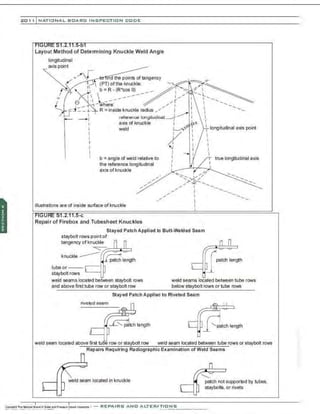
  • 274.
    201 1 INATIONAL.BCARC I NSPECTION CODE Water Head- The pressure adjustment that must betaken into account due to the weight oftest media (in this case. water) that is 0.433 psi per vertical ft. (1 0 kPa perm.) added (subtracted) from the gage pressure for each foot the gage is below (above) the point at which the pressure is to be measured. -REPAIRS AND A LTERA ri ONS
  • 275.
    0 N NATIONAL BOARO INSPECTIONCOOE l 201 1 PART 3, SECTION 10 REPAIRS AND ALTERATIONS- NBIC- APPROVED INTERPRETATIONS PART :l.::::..~~!.".~~!:!~ -~~...0. . ALTERATIONS SECTION 10 Z57
  • 276.
    201 1 INATIONAL.BCARC I NSPECTION CODE PART 3, SECTION 10 REPAIRS AND ALTERATIONS - NBIC APPROVED INTERPRETATIONS 10.1 SCOPE a) This section provides all approved interpretations for this edition and all subsequent addenda associated with this edition. A complete listed index is provided for reference to previously approved interpretations. These previously approved interpretations can be found on the National Board Web site. b) Each interpretation references the edition and addenda applicable at the time of committee response and approvaL Use of interpretations for other than approved edition and addenda may not be appropriate for reference. 10.2 INDEX OF INTERPRETATIONS Foreword .......................................................................................................................................95-20 Code Cases 1923........................................................................................................................98-24 98-56 1945........................................................................................................................98-24 98-56 2203........................................................................................................................98-12 Procedure for Obtaining or Renewing a National Board Certificate ofAuthorization.............................................................................................................98-21 07-02 Outline of Requirements for a Quality System for Qualification for the National Board "R" Symbol Stamp ...........................................................98-13 General Rules................................................................................................................................04-02 Condition of Use ........................................................................................................ ....................98-02 Nameplate Contents......................................................................................................................98-25 98-26 95-26 Use of Owner-User Personnel During Repairs..............................................................................01-12 Test Medium and Testing Equipment.............................................................................................98-1 7 Procedure for Obtaining or Renewing a National Board "NR" Certificate of Authorization....................................................................................................98-07 98-41 Interface with the Owner's Repair/Replacement Program ............................................................04-16 Prerequisites for Accreditation.......................................................................................................98-16 General Conditions........................................................................................................................98-1 1 Pressure Testing ......................................................... ........................... ........................................95-38 Inspection lnterval .........................................................................................................................98-19 . Conditions that Affect Remaining Life Evaluation..........................................................................01-26 98-03 95-57 Operational Inspection...................................................................................................................95-55 Inspection of Parts and Appurtenances.........................................................................................98-09 Restamping or Replacement of Nameplates.................................................................................98-35 95-47 Replacement of Stamped Data .....................................................................................................01-13 General Requirements ..................................................................................................................04-14 95-19
  • 277.
    NATIO N ALBOARD INSPECTION CODE l 201 1 Scope ......................................................................................................................................98--22 Construction Standard...................................................................................................................95-36 95-48 04-13 Accreditation ................................................................................................................................04-13 Materials ......................................................................................................................................01-28 Replacement Parts ........................................................................................................................04-05 04-06 04-11 04-12 98--14 98--27 98--28 98--37 95-48 Welding ................................................................................................................................... 01-27 98-06 95-51 07-03 Nondestructive Examination..........................................................................................................04-06 01-24 98--1 0 95-41 Acceptance Inspection ..................................................................................................................04-21 04-22 Routine Repairs.............................................................................................................................04-09 04-10 01-19 01-20 01-22 01-23 98--01 98-04 98--18 98-31 98-42 95-27 95-28 95-31 95-33 95-53 Examination and Test ....................................................................................................................04-05 04-06 04-11 98--27 98--33 98-36 95-27 95-32 95-39 95-54 PART 3- REPAI RS AND A LTERATIONS SECTION 10 Z59
  • 278.
    201 1 INATIONAL.BCARC I NSPECTION CODE Methods ......................................................................................................................................04-06 04-11 04-20 01-15 Documentation ..............................................................................................................................01-29 95-50 Repair Plan ................................................................................................................................01-14 Alterations toASME Section VIII, Div. 2 ........................................................................................04-14 01-16 Design ...........................................................................................................................................98-14 95-22 04-13 Calculations ............................................................................................................ ....................01-1 7 Re-Rating ......................................................................................................................................04-03 04-04 01-11 98-14 98-15 98-20 98-32 Examination and Test ....................................................................................................................98-15 98-34 98-38 Methods.........................................................................................................................................04-20 Documentation ........................................................... ........................... ........................................01-25 95-50 Repair Methods .............................................................................................................................04-01 Scope ............................................................................................................................................96-06 Welding Method 1..........................................................................................................................04-12 Scope ............................................................................................................................................04-17 04-19 98-08 WastedAreas ................................................................................................................................98-42 Re-End1 ng or Piecing Pipes or Tubes............................................................................................98-36 Patches..........................................................................................................................................04-15 95-52 Stays..............................................................................................................................................98-40 Re-Rating ......................................................................................................................................04-18 Replacement Parts ........................................................................................................................04-07 04-08 Stamping and Nameplate Information ..... ........................... ........................... ................................95-24 Glossarf of Terms..........................................................................................................................04-13 95-21 95-29 95-34 95-43 95-45 National Board Forms....................................................................................................................98-39 95-25 95-30 95-40 95-42
  • 279.
    NATIO N ALBOARD INSPECTION CODE l201 1 Examples of Repairs and Alterations.............................................................................................01-21 98-23 98-29 98-30 95-44 95-46 95-48 95-49 Repairs..........................................................................................................................................01-18 10.3 SUBJECT INDEX OF INTERPRETATIONS Acceptance Inspection ..................................................................................................................04-13 04-21 04-22 Alteration Requirements ................................................................................................................04-14 Alterations toASME Section VIII, Div. 2 ........................................................................................01-16 Alternatives to PWHT....................................................................................................................98-06 Attachments ................................................................................................................................98-01 Blisters, Repair of .........................................................................................................................98-09 Calculations ................................................................................................................................01-17 Construction Standards.................................................................................................................04-1 3 Deaerators, Inspection of .............................................................................................................98-09 Defect Repairs...............................................................................................................................04-1 7 04-19 Definition of Repair........................................................................................................................98-23 98-29 98-30 95-43 95-45 95-46 95-49 Definition of Alteration....................................................................................................................95-21 95-36 95-44 95-45 Definition of lnspector....................................................................................................................95-29 Definition of Non-Load Bearing .....................................................................................................95-33 Demonstration Requirements........................................................................................................98-41 De-Rating .................................. ........................... .........................................................................98-20 Design ...........................................................................................................................................04-13 Deterio1ation ................................................................................................................................01-26 Documentation ..............................................................................................................................01-25 95-50 Examination and Test ....................................................................................................................04-05 04-06 04-11 04-20 Examples of Repairs and Alterations.............................................................................................01-21 General Rules................................................................................................................................04-02 04-14 lnspecti·Jn Interval ........................................................................... ..............................................98-19 95-57 ..................... ·..·..·.·..· PART3-REPAI RSANDALTERATIDNS SECTION 10 261
  • 280.
    201 1 INATIONAL.BCARC I NSPECTION CODE Joint Review Demonstration Requirements ... ...............................................................................98-21 MateriaI Thickness..................................................................................................... ....................98-36 Materials........................................................................................................................................01-28 MTR...............................................................................................................................................98-37 Nameplates ...................................................................................................................................95-24 Non "U" Stamped Vessels .............................................................................................................95-23 Nondestructive Examination..........................................................................................................04-06 01-24 98-10 Nuclear Components.....................................................................................................................98-07 Original Code of Construction .......................................................................................................95-19 :: Out-of-Service ...............................................................................................................................98-03 Owner-user Inspection.................................................................................................................. 98-11 98-16 Owner's Repair/Replacement Program.........................................................................................04-16 Patches..........................................................................................................................................04-15 Piping ............................................................................................................................................98-22 Pressure ReliefValves ..................................................................................................................98-02 98-13 98-17 98-24 98-25 98-26 95-26 95-55 95-56 07-01 Pressure Testing............................................................................................................................96-15 98-27 98-33 98-34 98-38 95-27 95-32 95-39 95-38 Pressure Testing Repairs ..............................................................................................................01-15 Qualification ofWelders/IJI.elding Procedures ...............................................................................95-51 Quality System Manual..................................................................................................................98-13 "R" Forms ......................................................................................................................................98-39 95-27 95-28 95-30 95-40 95-42 95-48 95-50 Repair Definition ............................................................................................................................04-13 Repair Methods .............................................................................................................................04-01 Repairs............................................ ........................... ........................... ........................... .............01-18 Repair Plan....................................................................................................................................01-14 Reclassification..............................................................................................................................95-22 Replacement Nameplates .............................................................................................................98-35 95-47
  • 281.
    NATIO N ALBOARD INSPECTION CODE l 201 1 Replacement Parts ........................................................................................................................04-05 04-06 04-07 04-08 04-1 1 04-12 98-14 98-27 98-28 01-29 Replacement of Stamped Data .....................................................................................................01-13 Re-Rating ......................................................................................................................................04-03 04-04 04-18 01-11 98-14 98-15 98-32 Routine Repairs.............................................................................................................................04-09 04-10 01 -1 9 01 -20 01-22 01-23 98.01 98-04 98-18 96-31 98-42 95-25 95-27 95-28 95-31 95-53 95-54 Stays..............................................................................................................................................95-40 Timing of Repairs ..........................................................................................................................98-05 95-41 Use of Editions/Addenda...............................................................................................................95-20 Use of Owner/User Personnel During Repairs..............................................................................01-12 Welding..........................................................................................................................................01-27 07.03 Welding Methods............................................................................. ..............................................04-06 04-12 Window Patch................................................................................................................................95-52 PART 3- REPAI RS AND A LTERATIONS SECTION 10 26:3
  • 282.
    201 1 INATIONAL.BCARC INSPECTION CODE ........................·..·.·.. REPAIRS AND ALTERATIONS
  • 283.
    0 N NATIONAL BOARD INSPECTIONCODE l 201 1 PART 3, SECTION 11 REPAIRS AND ALTERATIONS- INDEX PART~- REPAIRS AND ALTERATIONS
  • 284.
    201 1 INATIONAL.BCARC I NSPECTION CODE Addenda- Part 1, Part 2, and Part 3 (Introduction) Additional Requirements for Alterations- Part 3 (S4.17) Additional Requirements for Repairs- Part 3 (S4.16) Administrative Requirements- Part 3 (Section 1) Administrative Procedures for "R''/"VR"/"NR" - Part 3 (1.6), (1.7), (1.8), (S9.2) Acceptance Inspection- Part 1 (2.1 0), (2.10.5), (3.10), (4.6); Part 2 (S7.8); Part 3 (1.3.2), (S4.14), (S6.13) Accreditation- .Part 3 (1.5), (1.6), (1.7), (1.8), (S2.6),(S6.3) ,: Programs - Part 1, Part 2, and Part 3 (Introduction) •:Acoustic Emission - :Part 2 (4.2.8); Part 3 (S4.13) Adjustments, Pressure Relief Valves- Part 3 (S7.2), (S7.6) Authorization of Owner-Users- Part 3 (S7.10) Alteration - Part 1 and Part 2 (Section 9); Part 3 (3.4), (3.4.4), (S3.4), (S4.17). (S5.7), (Section 9) Alternatives, Postweld Heat Treatment - Part 3 • (2.5.2), (2.5.3), (S6.9.3) Nondestructive Examination- Part 3 (4.2) Verification Testing- Part 3 (1.7.5.5) Marking, Stamping- Part 3 (5.10) Allowable Stress Values- Part 3 (3.4.2) ASMECode, Replacement Parts- Part 3 (3.2.2) Section VIII Division 2 and 3- Part 3 (3.3.5), (3.4.4) Application of NBIC- Part 1, Part 2, and Part 3 (Edition including Addendum), (Foreword), (Introduction) Appurtenances- Part 1 (2.4.4), (2.5.3), (2.10.1), (3.3.4), (3.5.3), (4.6), (5.2.2), (5.2.5), (5.2.7); Part 2 (1.5.2), (2.2.10), (S2.9), (2.3.5), (S6.13), (S6.16) Assembler- Part 1. Part 2 and Part 3 (Section 9), (S7.5), (S7.6) Assessing Damage Mechanisms- Part 2 (5.3) Audit- Part 2 (Section 9); Part 3 (1 .8.5.1[q)), (S7.8) American National Standards Institute (ANSI)- Part 1. Part 2 and Part 3 (Section 9) American Petroleum Institute (API)- Part 2 (1.3) AnnuaI Review, "VR"- Part 3 (S7.11.4) Arch Tube- Part 2 (S1.4.2); Part 3 (S1 .2.9.2) Ash Removal - Part 1 (2.6.2), (3.6.2) Authorization - Part 2 (5.2), (S6.4.6), (S6.5.1); Part 3 (1 .3.1) Authorized Nuclear Inspector- Part 1 and Part 2 (Section 9); Part 3 (1 .8.5.1 [r)), (Section 9)
  • 285.
    Boilers- Part 2 (2.2),(2.5.5.1) Watertube- Part 2 (2.2.12.1) Black Liquor- Part 2 - (2.2.12.2) Organic and Inorganic Fluid - Part 2 (2.2.12.3) Waste Heat- Part 2 (2.2.12.4) Cast Iron- Part 2 (2.2.12.5) Electric- Part 2 (2.2.12.6) Fired-Storage Water Heaters- Part 2 (2.2.12.8) Firetube - Part 2 (2.2.12.9) Historical/Hobby - Part 2 (Supplement 2) Modular- Part 1 (3.7.8) Locomotive- Part 2 (Supplement 1) Boiler Inspection Guideline (Historical)- Part 2 (S2.11 ) Boiler Installation, Power Boilers- Part 1 (Section 2) Steam Heating - Part 1 (Section 3) Heating/Potable Water Heaters - Part 1 (Section 3) Report- Part 1 (1.4.5), (2.10.6), (3.10.3) Boiler Operators (Historical) - Part 2 (S2.11) Boiler Repair- Part 3 (3 3.4.2), (3.3.4.3). (Supplement 1), (Supplement 2) Boiler Relief Devices- Part 2 (2.5.5.1) NATIO N AL BOARD INSPECTION CODE l 201 1 Boiler Room Requirements - Part 1 (2.4), (3.4) Bonding- Part 3 (S4.10) Blowoff- Part 1 (2.7.5), (3.7.7); Part 2 (2.2.6) Braces- Part 3 (S1 .2.6): Part 2 (S1.4.2) Brittle Fracture - Part 2 (5.3.8.2) Bulges and Blisters - Part 2 (3.4.7), (5.3.8.3), (S7.8.3); Part 3 (3.3.4.2) Burners and Stokers- Part 1 (2.7.2), (3.7.3) Calculations - Part 1 (7.3); Part2 ($2.10.1), (S2.6.2), (7.3); Part 3 (3.2.4), (3.2.5), (3.3.3), (3.3.4.3), (3.4 .1), (3.4.2), (S1.1.4), (S4.6), ($4.16.3), (S4.17.4), (S4.17.5), (S4.18.2.3) Capacity - Part 1 (2.9.1 3). (5.3.4); Part 2 (2.3.6.2), (2.5.2), (2.5.4), (2.5.5.3), (2.5.7), ($2.8.1), (S2.11), (S5.3.1), (S5.9.3), (S6.8), (S6.13.9), (S6.13.11 .3), (S6.13.11.4), ($6.15.1), ($6.15.4) Cargo Tanks - Part 2 (Supplement 6) Capacity Certification - Part 1, Part 2 and Part 3 (5.9.3), (Section 9) Caulking Riveted Seams- Part3 (S1 .2.12.1), (S2.13.13.1) PART~- REPAIRS AND ALTERATIONS
  • 286.
    201 1 INATIONAL.BCARC I NSPECTION CODE Certificate of Authorization - Part 1 and Part 2 (Introduction); Part 3 (Introduction), (1.6.2), (1.6.3), (1.7.6.5), (1.8.2), (1.8.3) Certification- Part 1 (1.4); Part2 (4.2), (S2.7.1), (S2.8.1), (S6.5.3), (S6.5.4.3), (S6.14.8); Part 3 (Section 5) Chimney or Stack - Part 1 (2.6.1), (3.6.1) Clearances - Part 1 (2.3.3), (3.3.4), (4.3.2) Cleaning- Part 1 (5.2.7), (2.4.4), (S7.14.2); Part 2 (2.2.9), (1.5.3) Codes and Standards - Part 1 (1.1); Part2 (1.3), (S2.10.5), (S6.4.5), ($6.9); Part 3 (1.2), (S2.5), (S4.7), (S6.2) Combustion Air- Part 1 (2.5.4), (3.5.4) Controls- Part 1 (2.8); Part 2 (2.2.10.7), (2.3.5.3), (2.4.8) Compressed Air Vessels - Part 2 (2.3.6.2) Condition of Installation- Part 2 (2.2.4), (2.3.2) Condensate - Part 1 (2.7.4) Connections - Part 1 (2.8.2.1), (3.7.6), (3.9.1.1), (3.9.4.2), (3.9.4.3), (3.9.4.4), (3.9.4.5): Part 2 (2.3.3) Continued Service (DOT)- Part 2 (Supplement 6) Corrosion - Part 2 (2.2.8), (Section 3), (3.8), (S5.3.3i, (S6.6), ($7.8.5); Part 3 (1.2), (2.5.4), (3.2.1), (3.3.2), (3.3.3), (3.3.4.3), (3.4.2), (4.4.1), (4.4.2), (S2.13.9.2), (S2.13.12.2), (S4.5), (S4.6), (S4.16.4), ($4.18), (S5.6.1), (S6.17.1), (S7.12) Control of Corrosion- Part 2 (3.3.3) Coatings- Part 3 (3.6.11) Cracks- Part 2 (3.4.9), (5.3.8.4), (S5.3.2), (S7.8.1); Part3 (3.3.4.2), (S1.2.10), (S1.2.11), (S2.13.9.2), (S2.13.9.4), ($5.6.2) Creep- Part 2 (3.4.2), (5.3.8.1) Curing- Part 3 (S4.11) Cuts or Gouges - Part 2 (S7.8.4); Part 3 (S5.6.1), (S7.14.2) Damper Mechanisms - Part 2 (Section 3), (5.3) Deaerators- Part 2 (2.3.6.1) Defect Repairs- Part 3 (3.3.1), (3.3.4.2) Definitions - Part 1 (Section 9); Part 2; ($6.16), (Section 9); Part 3 (1.4), (Section 9) Definition of Repair to Pressure Relief Valves- Part 3 (S7.2) ·, ·'
  • 287.
    Dents- Part 2 (S7.8.2),(2.3.3) Deposits, Waterside- Part 2 (2.2.9); Part 3 (S1.2.13.1) De-rating- Part 2 (S5.2); Part 3 (3.4.1) Design- Part 1, Part 2, and Part 3 (Foreword), (Introduction); Part 2 (2.2), (2.2.8), (2.2.12.3), (2.2.10.4), (2.2.12.4), (2.2.12.5), (2.2.12.6), (2.2.12.7), (2.2.12.8), (2.2.12.9), (2.3.2), (2.3.5.4), (2.3.6.3), (2.3.6.5), (2.4.3), (2.4.7), (2.5.1), (2.5.5.3), (2.5.7), (3.3.3), (3.3.3.3), (3.3.3.5) (3.4.2), (3.4.8), (5.3.1) Part 3 -(1.2), (1.5.1), (1.6), (1.7), (1.8), (3.2.4), (3.2.5), (3.3.3), (3.3.4.3), (3.3.5.2), (3.4.1), (3.4.2), (3.4.3), (3.4.4.1), (4.5.1), (4.5.3), (5.2.2), (5.4). (5.7.3), (S4.17.2), (Supplement 8) Device Data - Part 2 (2.5.2) Device Condition - Part 2 (2.5.3) Device Requirements- Part 1 (4.5.1), (5.3.1) Distribution of "R" Forms- Part 3 (5.3), (5.4), (S3.2), (S4.14.4), (S6.18.1) Documentation - Part 1 (1 .3), (1.4.1), (S1.3); Part2 (1.2), (1.5.4), (Section 5), (S2.6.2), (S2.7.2), (S2.11), (S5.2.3), (S6.3); Part 3 (5.2), (S2.12), (S4.14.2), (S6.17.3), (S7.10.3) DOT (Transport Tanks)- Part 2 (Supplement 6); Part 3 (Supplement 6) Drains- Part 1 (2.4.3), (2.6.3), (3.6.3) NATIONAL BOARD INSPECTION CODE l zol l Drawings - Part 3 (2.3), (3.2.3), (S4.16.2), (S4.17.2) Economizers - Part 1 (2.9.4); Part 2 (2.2.12.1) Eddy Current- Part 2 (4.2.6) Electrical (Installation)- Part 1 (2.5.3), (3.5.3) Emergency Valves and Controls- Part 1 (2.5.6), (3.5.6) Engineering Design - Part 2 (3.3.3.5) Equipment Certification - Part 1 (1.4.2) Equipment Operation - Part 2 (1.4.2) Erosion- Part 2 (2.2.12.2), (2.2.12.4), (2.2.12.7), (3.3.1), (5.3.7.1), (5.3.8.7), (S1.4.2) Estimating Remaining Service Life and Inspection Intervals- Part 2 (5.3.4) Evidence of Leakage, Boilers - Part 2(2.2.5), (2.2.7), (4.3.3); Part 3 S2.13) Pressure Vessels - Part 2 (2.3.3), (S4.6.2), (S6.13.9); Part 3 (S4.14), (S4.17.6), (S4.1 8.2.7) Piping - Part 2 (2.4.6), (2.2.10.2), (2.2.10.4) PART~ . ..... .'~.!::f:~~~=-.~.N - 0. ALTERATIONS
  • 288.
    201 1 INATIONAL.BCARC I NSPECTION CODE Examination - Part 1 (5.4); Part 2 (2.3.3), (2.3.5.4), (2.3.6), (2.4.5), (Section 4), (5.3.1 ), (5.3.8), (S1.4.2), (S2.4), (S2.4.4), (S2.5); Part 3 (3.3.4.2), (Section 4), (4.4), (S4.2), (S4.13.1), (S4.15), (S6.17), (S4.17.6), (S5.2). (S6.10), (S6.12), (S6.17) Examples or Repairs and Alterations- Part 3 (3.3.3), (3.4.3) Exfoliation- Part 2 (2.4.4), (3.3.1), (S6.6.3.1[e]) Exhibits- Part 3 (1 .6.5.1[q]). (1 .7.7.5[p]). (1.8.5.1[s]) Exit and Egress - Part 1(2.4.1), (2.5.3), (3.4.1) Expansion Tanks - Part 1 (3.7.9.1). (3.7.9.2); Part 2 (2.3.6.3) Expansion and Support- Part 1 (2.7.3), (3.3.1), (3.7.9), (3.9.4), (4.3.3); Part 2 (2.4.7) External Inspections, Boilers- Part 2 (2.2.5) Pressure Vessels - Part 2 (2.3.3), (S7.4) Piping - Part 2 (2.4.4) Graphite- Part 2 (S3.4) FRP- Part 2 (84.4), (84.7) External Weld Metal Buildup- Part 3 (3.3.4.3[e]) Failure Mechanisms- Part 2 (3.4), (S6.6.4) Fatigue - Part 2 (3.4.1), (5.3.8.6) Federal Railroad Administration (FRA) - Part 2 (S1 .3); Part 3 (S1 .1.1) Feedwater- Part 1 (2.5.1). (3.7.4); Part 2 - (2.2.10.4), (2.2.12.5), (S2.7.1). (S2.14), (S2.7.1i Fiber-Reinforced Thermoset Plastic Equipment (RTP, FRP)- Part 2 (Supplement 4); Part 3 (Supplement 4) Field Repairs for Relief Devices- Part 3 (S7.7) Firebox - Part2 (2.2.10.2), (2.2.12.9), (S1.1), (S1 .4.2), (S2.11); Part 3 (S1 .2.10.2), (S1.2.11 .1), (S2.13.10.4), (S2.13.11) Fire Damage - Part 2 (5.3.8.5), (5.7.7). (S7.4) Fittings - Part 1 (3.8); Part 3 (S1 .2.13) Flanges- Part 1 (5.2.3); Part 2 (2.2.10.3); Part 3 (3.3.4.3[c)) Forced-Flow Steam Generators - Part 1 (2.9.2) Forms - Part 1 (1.4.1); Part2 (5.5), (S2.12); Part 3 (Section 5). (S6.15) Distribution - Part 3 (5.3), (5.4) Guide for Completing - Part3 (5.2), (5.13) Registration - Part 3 (5.5.1), (5.5.2) Foundations- Part 1 (2.3.1)
  • 289.
    Fractures - Part 2(S3.5.2) Fuel- Part 1 (2.5.2), (3.5.2) Fusible Plugs- Part 2 (S1.4.2), (S2.8.4), (S6.4.7), (S6.15.1); Part 3 (S2.13.14.3) Gages - Part 1 (3.8); Part 2 (2.2.10.5), (2.3.5.1), . (2.4.8.1), (S1.4.2), (S2.6.1), (S2.7.1), : (S2.8.2), (S2.8.5); Part 3 (4.3) Galvanic Corrosion - Part 2 (3.3.1) Glossary - Part 1 and Part 3 (Section 9); Part 2 (86.16- DOT Only). (Section 9) Graphite Pressure Equipment- Part 2 and Part 3 (Supplement 3) Grooving - Part 2 (3.3.1); Part 3 (S2.13.9.1), (S2.13.10), (82.13.11) Gage Glass- Part 1 (2.8.1), (3.8.1.2); Part2 (S2.2.10), (S2.7.1), (S2.8.2), (S2.11) Hangers - Part 1 (5.2.6) Heat Treatment - Part 3 (2.5), (82.1 0), (S6.9), (S7.13), (S1.2.10) High Temperature Water- Part 1 (3.9.5.3); Part 2 Inspection (3.4) NATIONAL BOARD INSPECTION CODE l201 1 Historical Boilers - Part 2 and Part 3 (Supplement 2) Inspection - Part 2 (S2.7) Storage- Part 2 ($2.13) Repair- Part 3 (Supplement 2) Safety Procedures- Part 2 (S2.14) Hydrogen Attack- Part 2 (3.4.5) Hydrogen Damage- Part 2 (3.4.6) Hydrogen Embrittlement - Part 2 (3.4.4) Illegible Nameplates - Part 3 (5.9.5) Inquiries- Part 1, Part 2 and Part 3 (Section 10) lnservice Inspection- Part 2 (1.5), (2.4.2), (2.5.4). (S1.4.2), (S2.7), (83.1 ), (S3.4), (S4.2), (S5.1), (S6.4.6), (S7.3) Inspection and Test Frequencies (Pressure Relief Devices)- Part 2 (2.5.8), (5.3.7), (S2.7.3), (S4.9) Inspection and Test Methods - Part 2 (Section 4) (S2.4.4.2), (S2.5), (S6.6); Part3 (4.4.1), (4.4.2) Inspector Qualifications (FRP)- Part 3 ($4.2) Inspector Duties (DOT) - Part 2 ($6.4.6); Part 3 (86.7.1) PART~- REPAIRS AND ALTERATIONS
  • 290.
    201 1 INATIONAL.BCARC I NSPECTION CODE Installation Condition - Part 1; Part 2 (S4.9.1) Installation Requirements- Part 1 Insulated Vessels, Inspection- Part 2 (2.3.6.4(b)). (S4.7.1) Instruments and Controls- Part 1 (2.8). (2.9.2). (3.5.3). (3.5.6). (3.8). (4.4). (S1.2) Interface with Owners Repair/Replacement Program (Nuclear)- Part 3 (1 .8.6) lntergranular Corrosion- Part 2 (3.3.2) Internal Inspections- Part 2 (1.5.3), (2.3.4), (2.4.5), (S4.8), (S7.5). (S2.5) Interpretations- Part 1, Part 2 and Part 3 (Introduction). (8.4), (Section 10) Interrupted Service- Part 2 (5.3.7.2[g]) Insulation MateriaUinsulation- Part 1 (3.3.2); Part 2 (2.2.7), (2.3.3), (2.4.6), . (S7.4) lnspector- p: art 1 (2.10), (4.6), (S1.2); Part 2 (1.4), (1.5), (2.2). (2.3), (2.4). (2.5). (Section 4), (5.3.3), (S4.5), (S2.4), (S4.2). (S4.5), (S6.4.2); Part 3 (1.3), (3.3.2), (3.3.4.1), (3.3.5), (3.4.1).(3.4.4). (4.4.1), (4.4.2). (S2.8), (S2.9), (S2.10), (S3.2), (S4.2), (S6.7.1) Jurisdiction- Part 1 (Foreword), (Introduction), (1.4.3); Part 2 (Foreword), (Introduction). (1 .2), (2.5.8), (5.3.1). (5.3.4), (5.4.7), (5.5.1), (S1 .2); Part 3 (Foreword), (Introduction). (3.3.2), (3.3.4.3(e)), (3.4.1), (3.4.2). (4.2), (4.3), (4.4), (4.4.1), (4.4.2), (4.5). (5.7), (5.9.5), (S2.2), (S4.16.4). (S6.3) Jurisdictional Authority- Part 1 (Foreword); Part 2 (Foreword), (S7.1); Part 3 (Foreword), (S7.10) Jurisdictional Participation - Part 3 (1 .7.2) Jurisdictional Precedence - Part 1, Part 2 and Part 3 (Introduction) Jurisdictional Requirements- Part 1 (1.4) Knuckles- Part2 (2.2.8); Part 3 (81 .2.11.5), (S2.13) Ladders and Runways- Part 1 (2.4.2), (3.4 2) Lamination - Part 2 (3.4.7). (S4.3), (S4.10), (S4.18) Lap Joints/Seams- Part 2 (3.3.1). (3.4.9), (S2.10.6). (86.6.3.1); Part3 (S1.2.10), (S1 .2.10), (S1.2.11), (81.2.11 .1), (81.2.11.2), (81.2.11 .3), (81 .2.11.4), (81.2.11 .5), (81.2.11 .6), (S1.2.12), (81 .2.12.1), (81 .2.12.2), (82.13.13)
  • 291.
    Leakage - Part 2(2.2.7), (2.2.5), (2.3.3), (2.4.6), (S4.6.2), (S4.6.2), (S6.4.7.4), (S6.13.9), (S7.4), (S7.6) Leak Testing - Part 2 (4.3.2), (S6.13.9), (S6.14.6.2); Part 3 (4.4.1) Level Indicating Devices- Part 1 (4.4.1) Lift Assist Testing - Part 3 (4.5.3) Limitations (Historical Boilers) - Part 2 (S2.10.7) Lighting- Part 1 (2.5.5), (3.5.5) Line Corrosion- Part 2 (3.3.1(t)) Liquid Ammonia Vessels- Part 2 (2.3.6.4) Liquid Penetrant Examination - Part 2 (2.3.2), (4.2.3), (S2.5.4) Liquid Petroleum Gas Pressure Vessels - Part 2 (Supplement 7), (S6.13.6.3), (S6.13.7.7), (S6.1 3.9) Liquid Pressure Testing- Part 3 (4.4.1), (4.4.2), (4.5.1), (S6.17.1) Loadings - Part 1 (2.3.1), (3.3), (3.3.1.1), (4.3.1), (5.2.6); Part 3 (1 .2), (3.3.3). (3.4.2), (S4.17.6) Local PWHT- :: Part 3 (2.5.2) Local Thinning- Part 2 (5.3.8.7), (S5.3.1 ); Part 3 (S5.6.1) NATIO N AL BOARD INSPECTION CODE l 201 1 Locomotive Boilers - Part 2 (2.2.12.9), (Supplement 1); Part 3 (Supplement 1) Inspection- Part 2 (S1.4) Storage - Part2 (S1 .5) Low-Water Fuel Cutoff - Part 1 (2.8), (3.8.1 .5), (3.8.2.4); Part 2 (2.2.10.7) M Macroscopic Corrosion Environments- Part 2 (3.3.1) Uniform Corrosion (General)- Part 2 (3.3.1[a)) Galvanic Corrosion - Part 2 (3.3.1[b)) Erosion Corrosion - Part 2 (3.3.1[c)) Crevice Corrosion - Part 2 (3.3.1[d)) Pitting Corrosion - Part 2 (3.3.1 [e}) Line Corrosion- Part 2 (3.3.1[f)) Exfoliation - Part 2 (3.3.1[g)) Selective Leaching - Part 2 (3.3.1 [h)) Grooving- Part 2 (3.3.1[i)) Magnetic Particle Examination - Pan 2 (4.2.2), (S2.5.5) Materials- Part 3 (2.5.4), (3.2.1), (S1 .1.3), (S2.7), (84.8), (S6.4), (S7.4) Preparation - Part 2 (4.2) QC Program- Part 3 (1.6), (1 .7), (1 .8) Selection - Part 2 (3.3.3.3) PART~- REPAIRS AND ALTERATI O NS
  • 292.
    201 1 INATIONAL.BCARC I NSPECTION CODE Metallographic - Part 2 (4.2.7) Methods, Inspection and Test- Part 2 (Section 4) Locomotive Inspection- Part 2 (S1 .4.1) Metric Policy- Part 1, Part 2 and Part 3 (Section 7) Repair - Part 3 (3.3.4) Repair/Alteration, Examination/ Testing- Part 3 (4.4.1), (4.4.2) Microscopic Corrosion Environments- Part 2 (3.3.2) lntergranular Corrosion- Part 2 (3.3.2[a)) Stress Corrosion Cracking (SCC) - Part 2 (3.3.2[b)) Corrosion Fatigue - Part 2 (3.3.2[c)) Minimum Thickness - Part 2 (2.3.6.4), (5.3), (S2.6.2), (S2.10.3), (S6.6.3.1 ). (S6.13); Part 3 (3.3.4.3), (3.4.2), (3.4.2) Modifications (DOT) - Part 3 (S6.16.3) Mudring- Part 3 (S1 .2.11.4) Nameplates - Part 2 (5.2); Part 3 (5.9), (5.9.1), (5.9.2), (5.9.3), (5.9.4), (5.9.5), (5.9.6), (5.9.6.1), (5.9.6.2), (5.9.6.3), (5.9.6.4), (5.9.6.5), (5.10), (5.11), (5.11 .1), (5.11 .3), (5.12), (5.11 .2), (81 .2.10), (81.2.11), (81.2.11 .1), (S1.2.11 .2), (81.2.11.3), (81.2.11.4), (S1.2.11 .5), (81 .2.11.6), (S1.2.12), (81.2.12.1), (81.2.12.2), (S6.14.1) .-..·..·,·....·..... ·..- .. -..- National Board "R," "VR," and "NR" Symbol Stamps- Part 3 (1.6.4), (1.7.6), (1.8.4), (Section 5), (82.8.1) Nondestructive Examination- Part 1 (2.10.3), (81 .6); Part 2 (4.2), (81 .4), (82.4.4.1), (S5.5), (S7.3.1); Part 3 (4.2), (4.4.1), (4.4.2), (82.11 ), (84.12), (86.10), (S6.17.1) "NR" Accreditation- Part 3 (1.8) "NR" Symbol Stamp- Part 3 (1.8.4), (5.9) Nuclear Valves (repair) - Part3(1.7.4) "NV" Stamped Pressure Relief Devices- Part 3 (1.7.4). (Supplement 9) Oil Heaters- Part 1 (3.7.1) Operating Parameters (Yankee Dryers)- Part 2 (S5.2.1) Operating Systems- Part 1 (2.7), (3.7); Part 2 (S3.3) Organization of the NBIC- Part 1, Part 2 and Part 3 (Introduction) Overheating - Part 2 (3.4.8), (81.4.2) Owner-User - Part 1 (1.1), (1.2); Part2 (S1.3), (82.4), (S2.5), (S2.7), (86.4.6), (S6.6.3), (86.14.3); Part 3 (1.3), (4.5.2), (81.1.1), (85.5), (S7.9), (87.10), (S7.11)
  • 293.
    Owner-User Inspection Organization- Part 3 (1 .6.1), (3.3.5.2), (3.4.4.1) Parts- Part 1 (2.6.3.3), (2.9.2), (3.7.4), (3.7.7), (8.4), (81.3); Part 2 (2.3.5), (2.1), (2.2.6), (2.2.7), (2.2.10), (2.2.12). (2.3.4), (2.3.5), (2.3.6), (2.5.7), (2.5.8), (8.4); Part 3 (1 .7.7.5), (1 .8.5), (3.2.2), (3.3.3), (4.5.1 ), (4.5.4), (5.2.2), (5.9.6.5), (5.12), (8.4), (82.7.2), (82.13), (83.2), (83.5), (84.9), (85.3.1), (85.6), (87.2) Patch Bolts - Part 3 (81 .2.8) Patches- Part 3 (3.3.4.6), (81.2.11 .2), (82.13) Performance Qualification - Part 3 (2.2.3). (84.10.2). (86.8.3), (87.12.3) Performance Testing - Part 3 (4.5) Permissible Mounting (SV) - Part 1 (2.9.5.1), (3.9.1), (3.9.4), (4.5.6), (5.3.6) Personnel Safety - Part 1 (Introduction), (4.5.6), (5.3.6), (81 .5); Part 2 (Introduction), (1.4), (82.4.3), (86.11); Part 3 (Introduction), (82.3), (82.14) Piecing Tubes/Pipe- Part 3 (3.3.4.5), (82.13.7) Pilot Operated Safety Relief Valves- Part 2 (2.5.1); Part 3 (87.14.3) Piping - Part 1 (3.7.6), (3.9.1.5), (4.3.3), (Section 5); Part 2 (2.4), (2.5.5.2), (82.8.1). (82.9); Part 3 (3.3.4.5), (81 .2.13), (88.3) NATIO N AL BOARD INSPECTION CODE l zol l Pitting Corrosion- Part2 (5.3.7.20)), (3.3.1), (81.4.2), (86.6.3.1) Plug Stitching- Part 3 (83.5.3.1) Pneumatic Testing- Part 2 (86.13.6.1 ); Part 3 (4.4.1(b]), (4.4.2(b]) Portable Tank (DOT) - Part 2 (86.14) Post-Inspection Activities- Part 2 (1 .5.4), (82.4.2). (86.12.3) Postweld Heat Treatment - Part 3 (2.5.2), (82.1 0), (86.9.2), (87.13.2) Potable Water Heaters- Part 1 (3.2.3), (3.7.5.2), (3.7.7.2) Preheating - Part 3 (2.5.1), (82.10), (86.9.1). (87.13.1) Pre-Inspection Activities- Part2 (1.5.2), (2.2.3), (82.4.1), (86.12.1) Preparation of Forms - Part 1 (1.4.5); Part 2 (5.5); Part 3 (5.2.1), (5.2.2) Preservation- Part 2 (81 .5.4), (82.13.2), (3.3.3) Pressure Control - Part 1 (3.8.1.4) Pressure Gages - Part 1 (2.8.2). (4.4.2); Part 2 (2.2.10.5), (2.3.5.1), (2.4.8.1), (81.4.2), (82.8.5); Part 3 (4.3) Pressure Relief Devices- Part 1 (2.9), (3.9), (4.5); Part 2 - (2.2.1 0.6). (2.5); Part 3 (4.5), (5.9) Mounting- Part 1 (2.9.5.1). (3.9.1.1), (4.5.3), (5.3) PART~ REPAIRS AND ALTERATI O NS ....~ ....~ .........~...............,....-....
  • 294.
    201 1 INATIONAL.BCARC I NSPECTION CODE Pressure Relief Valve Nameplates - Part 3 (5.9.2), (5.9.3), (5.9.4), (5.9.5), (5.9.6), (Supplement 7), (Supplement 8) Pressure-Reducing Valves - Part 1 (Supplement 2) Pressure Testing - Part 2 (4.3.1) Alterations- Part 3 (4.4.2) FRP Vessels- Part 3 (S4.15), (S4.17.6) lnservice- Part 2 (4.3.1) Installation - Part 1 (2.1 0.2) Parts - Part 3 (4.5.4) Repairs- Part 3 (4.4.1) Yankee Dryers- Part 1 (1.5); Part 2 (2.3), (2.5.5.2), (S5.6) Pressure Vessels, Fiber-Reinforced Thermosetting Plastic (FRP)- Part 2 and Part 3 (Supplement 4) Graphite - Part 2 and Part 3 (Supplement 3) Inspection - Part 2 (2.3) Installation - Part 1 (Section 4) LP Gas (Propane)- Part 2 (Supplement 7) Relief- Part 2 (2.3.5.2) Section VIII Div 2 or 3- Part 3 (3.3.5), (3.4.4) Yankee Dryers- Part 1 (Supplement 1); Part 2 and Part 3 (Supplement 5) Process Variables (Corrosion)- Part 2 (3.3.3.1) Provisions for Expansion/Support - Part2 (2.4.7); Part3 (S1.2.3), (S1 .2.5), (S1 .2.10), (S2.13) Pumps- Part 1 (2.5.1.3) Quality Systems - Part3 (1.6.5), (1 .7.7), (1.8.5), (S7.10.4) Qualifications, FRP Performance- Part 3 (S4.1 0.2) Inspector - Part 2 (S4.5), (S6.4); Part 3 (S4.2) NDE - Part 3 (4.2) PRV Personnel- Part 3 (S7.11) Welders Performance- Part 3 (S7.12 3), (22 3), (S6.8 3) Quick-Actuating Closures- Part 2 (2.3.6.5) Quick-Disconnect Couplings - Part 2 (2.4.8.3) "R" Symbol Stamp - Part 3 (1.6) Radiography - Part 2 (4.2.5); Part 3 (1 .8.5.1) Records Review- Part 2 (2.2.11), (2.3.54); Part 3 (1 .8), (3.2.1), (3.4 .1), (S2.12), (S3.2), (S3.3), (S4.10.3), (S4.17.5), (S6.4), (S7.4) ' ;.
  • 295.
    Reference to otherCodes and Standards - Part 1 (Introduction); Part 2 (Introduction), (1 .3), (2.2.12.2), (S1.3), (S4.10); Part 3 (Introduction), (2.4), (S1 .2.12.1) Re-ending - Part 3 (3.3.4.5), (S1.2.9.1), (S2.13.7) Registration of "R" Forms- Part 3 (5.5), (5.6), (S6.18) Remaining Service Life Assessment- Part 2 (5.3.4) Removal of Stamping- Part 3 (5.8), (S6.14.1) Renewal of "VR" Certificate - Part 3 (1.7.5) Repair - Part 2 (5.4.9.2); Part 3 (3.3), (3.3.3), (3.3.4), (3.3.5), (S1.2.1), (S1.2.10), (S1 .2.11), (S2.4), (S2.13), (S2.13.14), (S3.2), (S3.5), (S4.5), (S4.18), (S5.4), (S5.6), (56.16), (S7.2) Replacement Parts - Part 1 (2.6.3.3); Part 3- (3.2.2), (S2.7.2), (S4.9), (S5.3.1), (S6.5), (S7.5) Replacement Stamping- Part 2 (5.2), (5.5.2); Part 3 (5.8), (5.9.3), (5.9.5), (5.9.6)' (5.10), (5.11) Re-rating- Part 1 and Part 2 (Section 9); Part 3 (3.4.1), (84 17.5). (Section 9) Responsibility- Part 1 (1.4.1); Part 2 (5.3.3), (S2.3); Part 3 (S2.3) Return Pipe Connections- Part 1 (3.7.6) Return to Service- Part 2 (S1 .5.6) NATIO N AL BOARD INSPECTION CODE l 201 1 Risk-Based Inspection - Part 2 (5.4) Rivets/Riveted Joints- Part2 (2.3.3), (S1.4.2), (S2.10.2); Part 3 (3.3.4.4[b)), (S2.13.13) Rupture Discs - Part 2 (2.5.5.3), (S6.15.3.3) Routine Repairs - Part 3 (3.3.2), (S3.3), (S4.16.4) Safety - Part 2 (1.4), (2.5), (2.2.6), (2.3.5.2), (S2.8), (S2.14), (S6.11) Safety Devices- Part 1 (2.9); Part 2 (2.2.12.3), (2.3.5.2), (2.4.8.2), (2.5), (S2.8) Safety Valve Capacity- Part 1 (2.9.13), (S2.2); Part 2 (2.5) Safety/Safety Relief Valves- Part 1 (2.9), (3.9.2), (3.9.3), (3.9.4), (3.9.5), (Supplement 2); Part 2 (2.5), (S2.8), (S6.15.1.2), (S2.11); Part 3 (Supplement 7) Scale and Sludge- Part 2 (2.2.9), (2.2.12.5), (2.2.12.7), (2.2.12.8), (2.2.12.9), (S1.4.2), (S2.11) Scope of Activities (Accreditation) - Pan 3 (1.5.2), (1.6) Seal Welding - Part 3 (3.3.4.4), (S1.2.4), (S2.13) Seams and Joints- Part3 (S1 .2.12), (S2.13.13), (S2.13.13.5) Service Conditions- Part 2 (2.2.2), (2.3.2), (2.4.2) PART~ REPAIRS AND ALTERATIONS ....~ ....~ .........~...............,....-....
  • 296.
    201 1 INATIONAL.BCARC I NSPECTION CODE Settings - Part 1 (2.3.1), (3.3.2) Set Pressure- Part 1 (2.9.1.4), (4.5.5), (5.3.5); Part 2 (2.5) Shipping and Transporting- Part 2 (2.5.6) Siphons (Thermic)- Part 2 (S1 .5.4): Part 3 (S1 .2.9.4) Spring-Loaded Pressure Relief Valves - Part 3 (S7.14.2) Stamping - Part 2 (Section 5); Part 3 (5.7), (5.8), (5.9), (5.10), (5.11), (5.12), (S5.5), (S6.14), (S6.17.2) Standard Welding Procedures - Part 3 (2.2.2), (2.3), (S6.8.2), (S7.12.2) Stays/Staybolts- Part 2 (2.2.10.2), (S1.4.2), (S2.10.4.1); Part 3 (3.3.4.7), (S1 .2.1), (S1 .2.3), (S2.13.4) Stayed Surfaces- Part 2 (S1.42), (S2.10.4); Part 3 (S2.13.10), (S1.2.11) Steam Heating Boilers- Part 1 (Section 3); Part 2 (2.5.7), (2.5.8) Steam Supply- Part 1 (2.7.3) Stop Valves- Part 1 (2.5.1.4), (2.7.3), (3.7.5) Storage Methods- Part 2 (S1.5.1), (S2.13.1) Structural Attachments- Part 1 (2.3.2), (3.3.1), (5.2.6); Part 2 (S4.7.3), (2.3.3), (2.3.6.3) Structural Steel - Part 1 (2.3.2), (3.3.3) Supplements - Part 1, Part 2 and Part 3 (Introduction), (Section 6) Supports - Part 1 (2.3.1), (3.3.1), (4.3.1), (5.2.6); Part 2 (2.2.10.4), (2.3.6.1), (2.3.6.2), (2.3.6.3). (2.3.6.4). (2.4.7). (S1.42) Superheaters - Part 1 (2.9.3); Part 2 (2.2.12.1), (S1.4.2), (S1.5.4) Surfaces (FRP)- Part 2 (S4.7.2) Systems Testing- Part 1 (2.1 0.4) Technical Inquiries- Part 1, Part 2, and Part 3 (Section 8) Temperature Controls- Part 1 (2.8.3), (3.8.2.3) Temperature Effects - Part 2 (3.4.3), (2.5.7), (3.4.1), (3.4.2), (3.4.6), (3.4.7), (4.2.1), (5.3.1), (5.3.8.1) Temperature and Pressure Relief Valves- Part 1 (3.9.1.6) Test Systems (PRV) - Part 3 (Supplement 8) Testing - Part 1 (2.10), (3.10), (4.6); Part 2 (2.5.7), (4.3), (S2.6); Part 3 (Section 4), (S6.17), (Supplement 8) Thermometer- Part 1 (3.8.2.2), (3.8.3.2)
  • 297.
    Thermal Expansion - Part1 (3.7.9); Part 2 (2.2.12.8), (2.4.4), (2.4 .7) Thinning- Part 2 (S5.3) Ton Tanks (DOT)- Part 2 (S6.15) Training- Part 3 (S7.11) Transport Tanks (DOT) - Part 3 (Supplement 6) Tubes - Part 2 (2.2.12.2), (2.2.12.9), (S2.11), (S2.13); Part 3 (3.3.3), (3.3.4.3(d)), (3.3.4.5), (S1.2.9), (S2.13), (S3.3) Tubesheet - Part2 (S2.11); Part 3 (S1 .2.11 .6), (S2.13.12) Thermal Fluid Heaters- Part 2 (2.2.12.3) Threaded Connections/Openings- Part 1 (3.9.1.2); Part 2 (2.3.4), (2.3.6.2), (S2.9); Part3 (S1 .2.12.2) Threaded Stays, Bolts, Studs - Part 3 (S1 .2.2), (S1 .2.7), (S2.13.1), (S2.13.2), ($2.13.5) Throttle and Throttle Valves- Part2 (S1.4.2), (S2.14) Try-Cocks - Part 2 (S2.8.3), (S2.7.1), (S2.8) Transport Tanks (DOT)- Part 2 (Supplement 6) Ultrasonic Examination - Part 2 (4.2.4), (S2.5.3), (S2.6.2); Part 3 (3.3.4.2), (3.3.4.3) NATIO N AL BOARD INSPECTION CODE l 201 1 Uniform Corrosion - Part 2 (3.3.1), (3.3.3), (5.3.7), (S1.4.2), (S2.11), ($5.3.3), ($6.6), ($7.8.5) Units of Measurement- Part 1, Part 2, and Part 3 (Introduction) Unstayed Areas - Part 2 (S1.4.1 ); Part 3 (S2.13.9), (S1.2.10) "VR" Symbol - Part 1 and Part 2 (Introduction); Part 3 (Introduction), (1 .7), (Supplement 9) Vacuum Test - Part 3 (4.4.1[d)); Part 2 (S6.13.9) Vaporizers - Part 2 (2.2.12.3) Valves- Part 1 (2.5.1.4), (3.7.5), (3.7.7), (5.2.4); Part 2 (2.3.6.4), (2.4.5), ($1.4.2), (S2.9), (S6.4.7.4) Ventilation Air- Part 1 (2.5.4), (3.5.4) Verification Testing (PROs)- Part 3 (1.7.5.5) Vibration- Part 2 (2.2.12.4), (2.2.12.7), (2.3.6.2) Visual Examination - Part 2 (4.2.1), (S2.5.2), (S4.4), (S6.13), (S6.4.7), (S6.15.2); Part 3 (3.3.2), (5.4.2), ($4.12), (S6.7.1), ($7.14.2), (S7.14.3) Volume (Feedwater) - Part 1 (2.5.1.1) . . PART~- REPAIRS AND ALTERATIONS
  • 298.
    201 1 INATIONAL.BCARC I NSPECTION CODE w Wasted Areas- Part 3 (3.3.2), (3.3.4.3), (82.13), (82.1 3.9.1) Water Column - Part 1 (3.8.1.3); Part 2 (2.2.10.3), (2.2.10.4), (81.4.2), (82.11) Water-Gage Connection - Part 3 (81.2.1 3.1); Part 2 (81.4.2), (82.1 3), (82.14) Water-Gage Glass - Part 1 (3.8.1.2) Part 2- (2.2.10.5), (81.4.2), (82.13), (82.14) Water Heaters - Part 1 (3.23), (3 .7.5.2), (3.7.7.2), (3.8.3); Part 2 (2.5.8) Waterside Deposits- Part 2 (2.2.9), (81 .4.2), (82.13.4), (86.6.3.1) Welds, Inspection- Part 2; Part 3 (82.8) Repairs - Part 3 Welding- Part 1 (5.2.8); Part 3 (2.2), (81 .1.2), (81 .2.5), (82.9), (86.8), (87.3), (87.12) Welding Procedures - Part 3 (2.2.1), (86 .8.1), (87.12.1) Welders Continuity - Part 3 (2.2.6), (86 .8.6), (87.12.6) Welders Identification - Part 3 (2.2.5), (87 .12.5), (86.8.5) Welding Methods- Part 3 (2.5.3.1), (2.5.3.2), (2.5.3.3), (2.5.3.4), (2.5.3.5), (82.13) Welding Records - Part 3 (2.2.4), (86.8.4), (87.12.4) Wrapper Sheet- Part 2 (82.11) Yankee Dryers - Part 2 and Part 3 (Supplement 5)