SESSION ID:SESSION ID:
#RSAC
Chris Houlder
Top Five Secrets to Successfully
Jumpstarting Your Cyber-Risk Program
GRC-W03
CISO
Autodesk, Inc.
@chrishoulder
chris.houlder@autodesk.com
Husam Brohi
Director, Cybersecurity and Privacy
PwC LLP
@husambrohi
husam.brohi@pwc.com
#RSAC
Situational Context
2
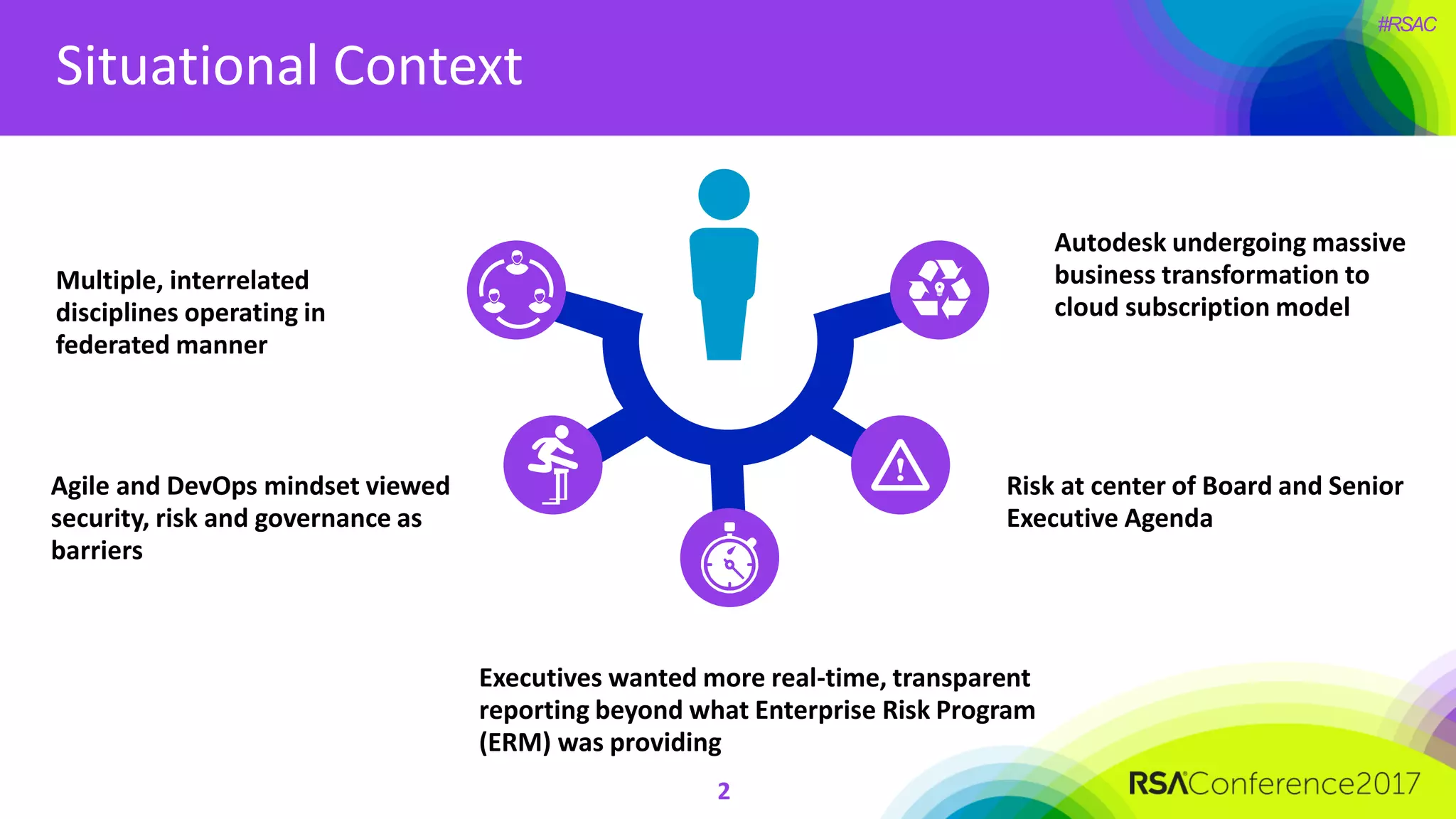
Autodesk undergoing massive
business transformation to
cloud subscription model
Risk at center of Board and Senior
Executive Agenda
Executives wanted more real-time, transparent
reporting beyond what Enterprise Risk Program
(ERM) was providing
Agile and DevOps mindset viewed
security, risk and governance as
barriers
Multiple, interrelated
disciplines operating in
federated manner
#RSAC
Our Challenge
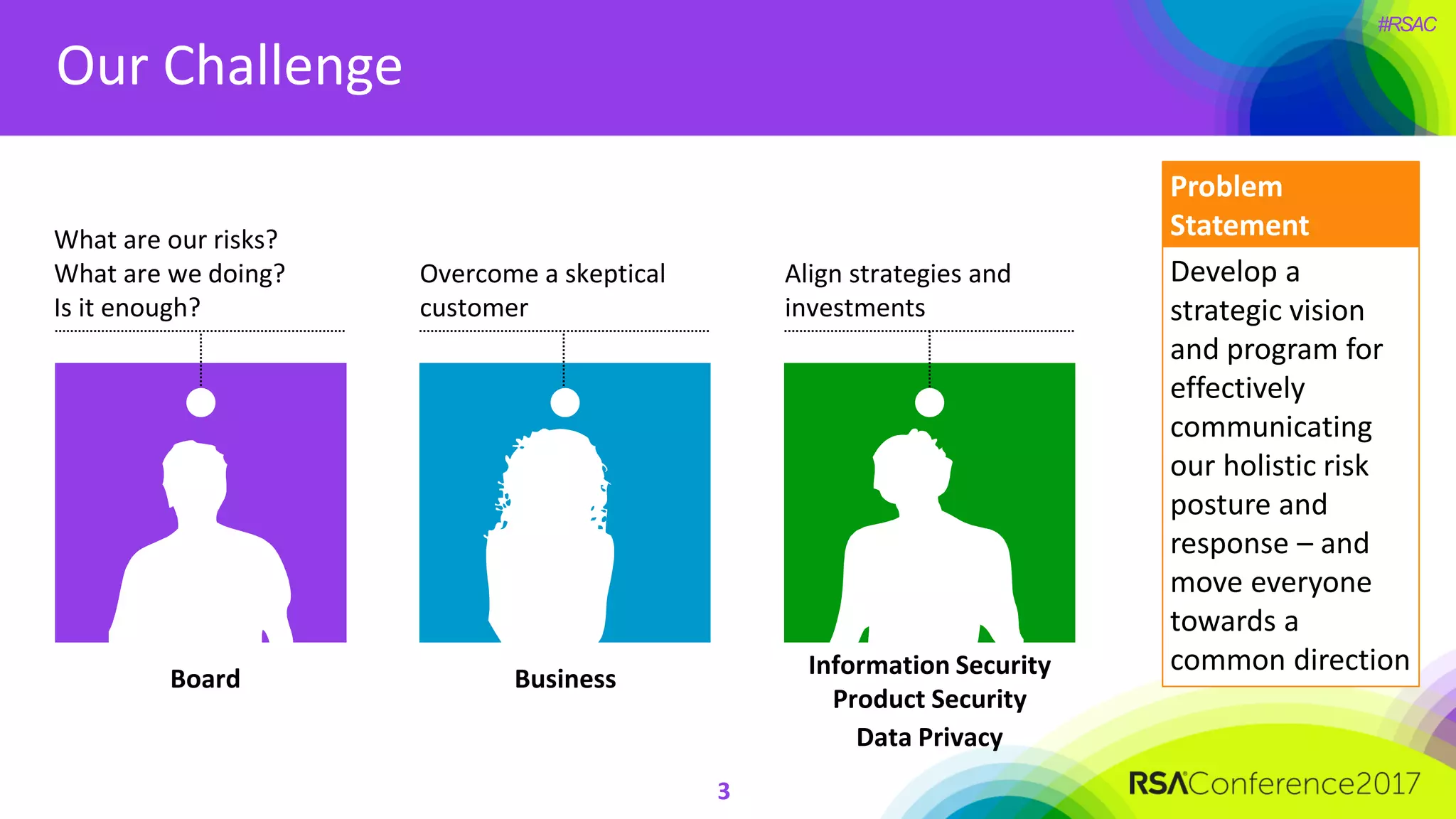
Board Business Information Security
Product Security
Data Privacy
What are our risks?
What are we doing?
Is it enough?
Overcome a skeptical
customer
Align strategies and
investments
Problem
Statement
Develop a
strategic vision
and program for
effectively
communicating
our holistic risk
posture and
response – and
move everyone
towards a
common direction
3
#RSAC
What Are We Here To Do
4
Share our story and walk through the process and key considerations for taking our cyber risk
program from concept to launch in under 6 months
Discuss how risk management serves as the core of our cybersecurity program and strategy
Provide lessons learned with you and discuss the challenges we faced, hoping that the approach
we took will be useful in your journey
This is NOT a discussion on risk management methodologies or artifacts
#RSAC
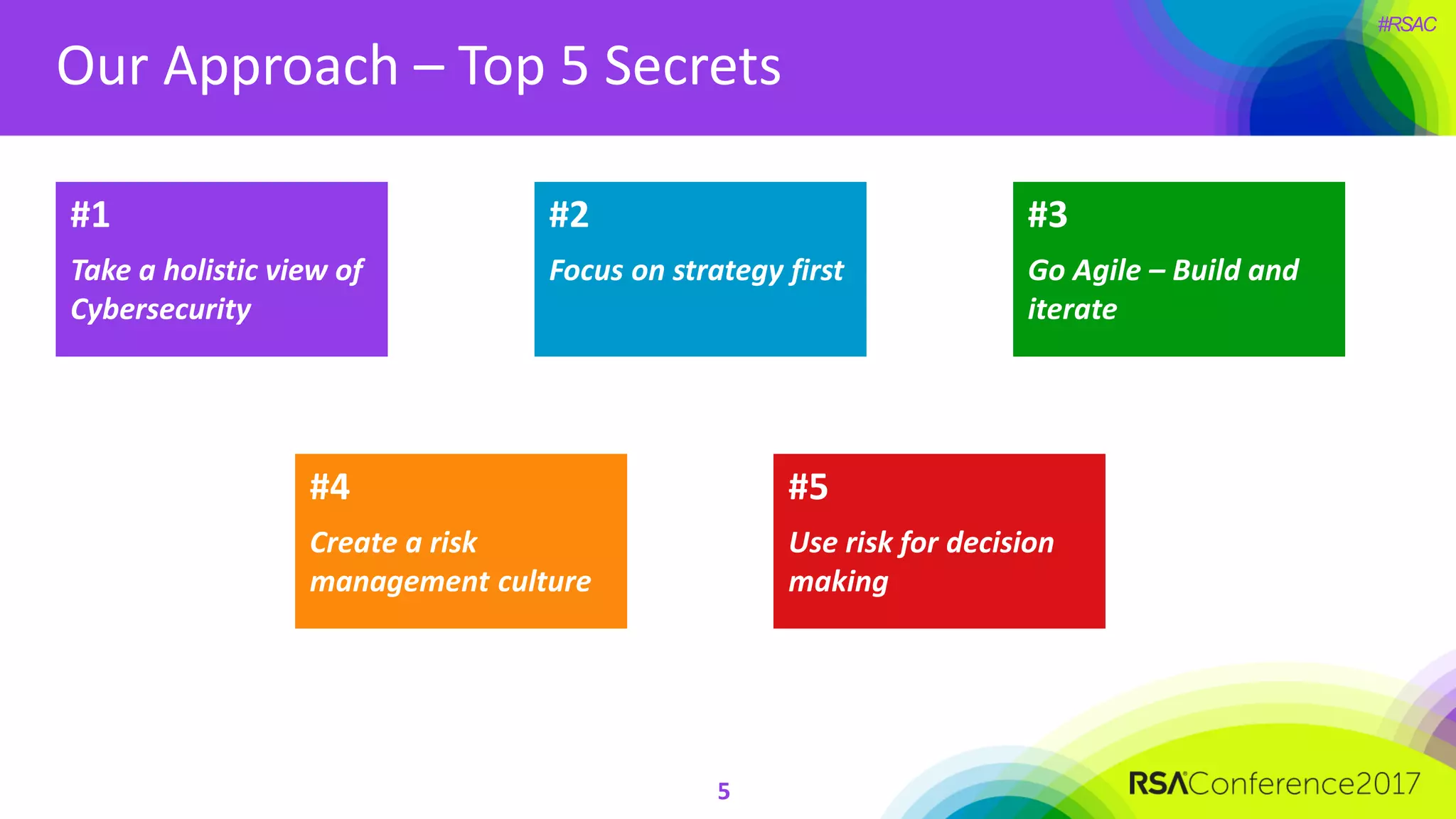
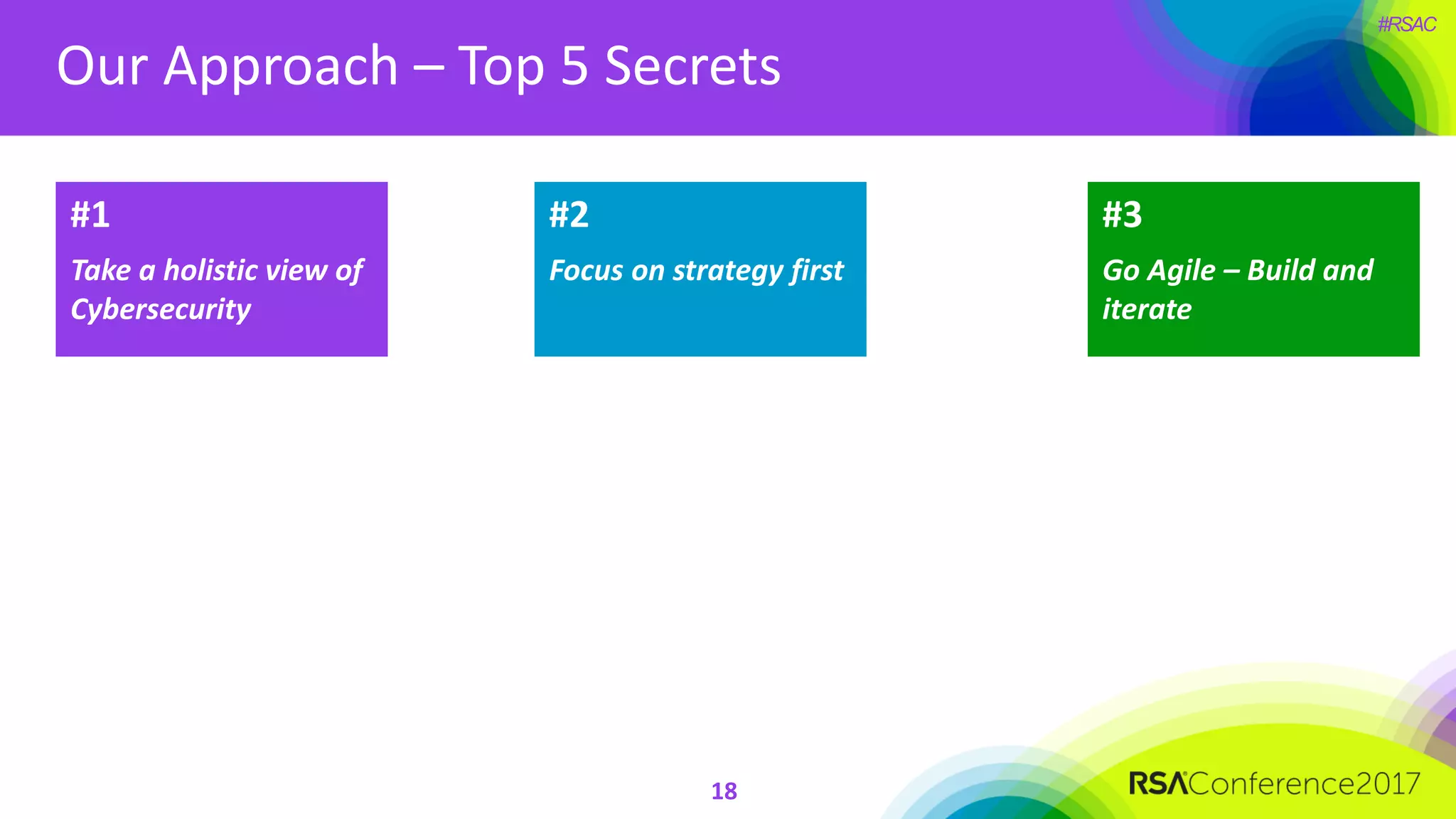
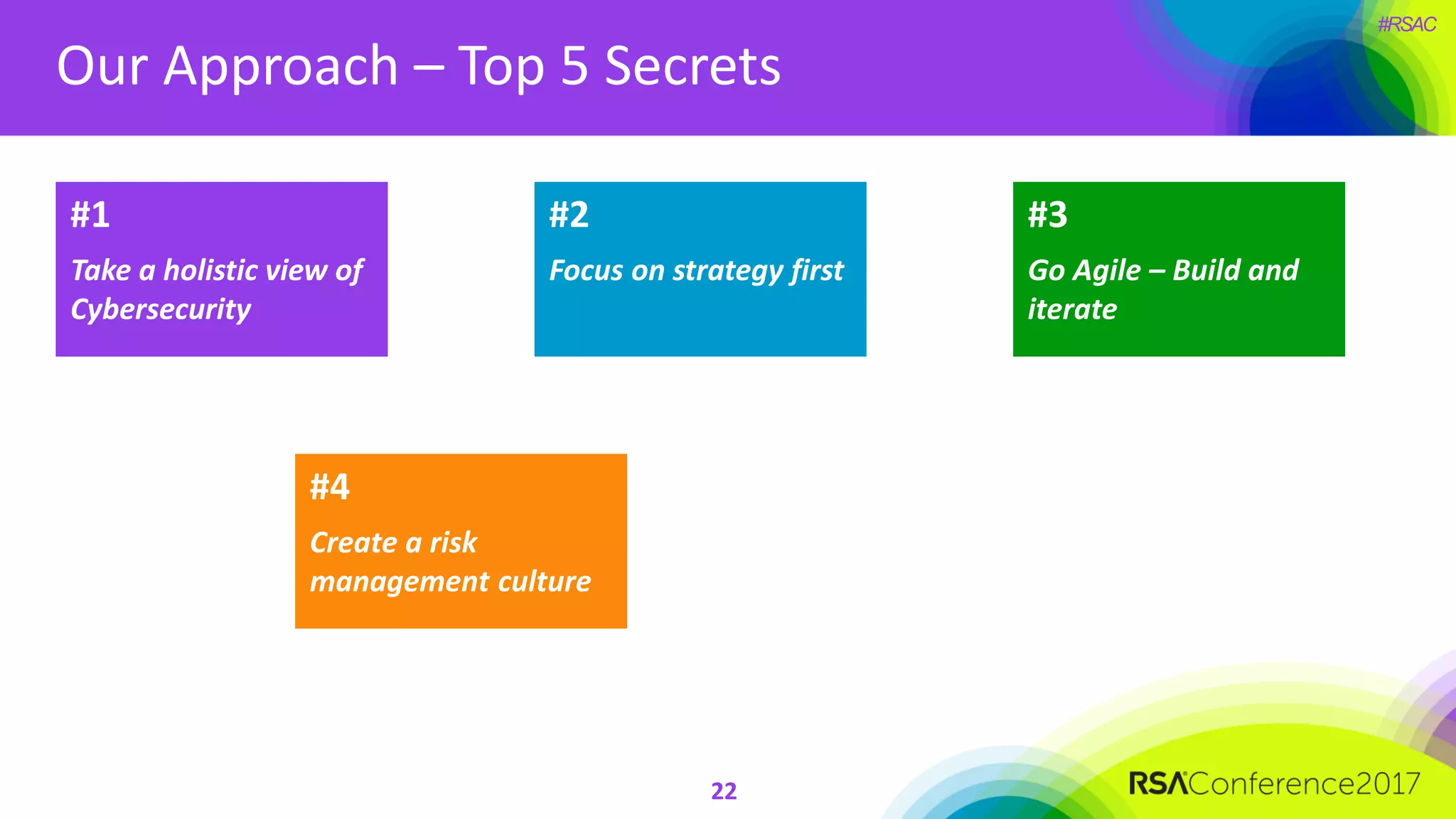
Our Approach – Top 5 Secrets
5
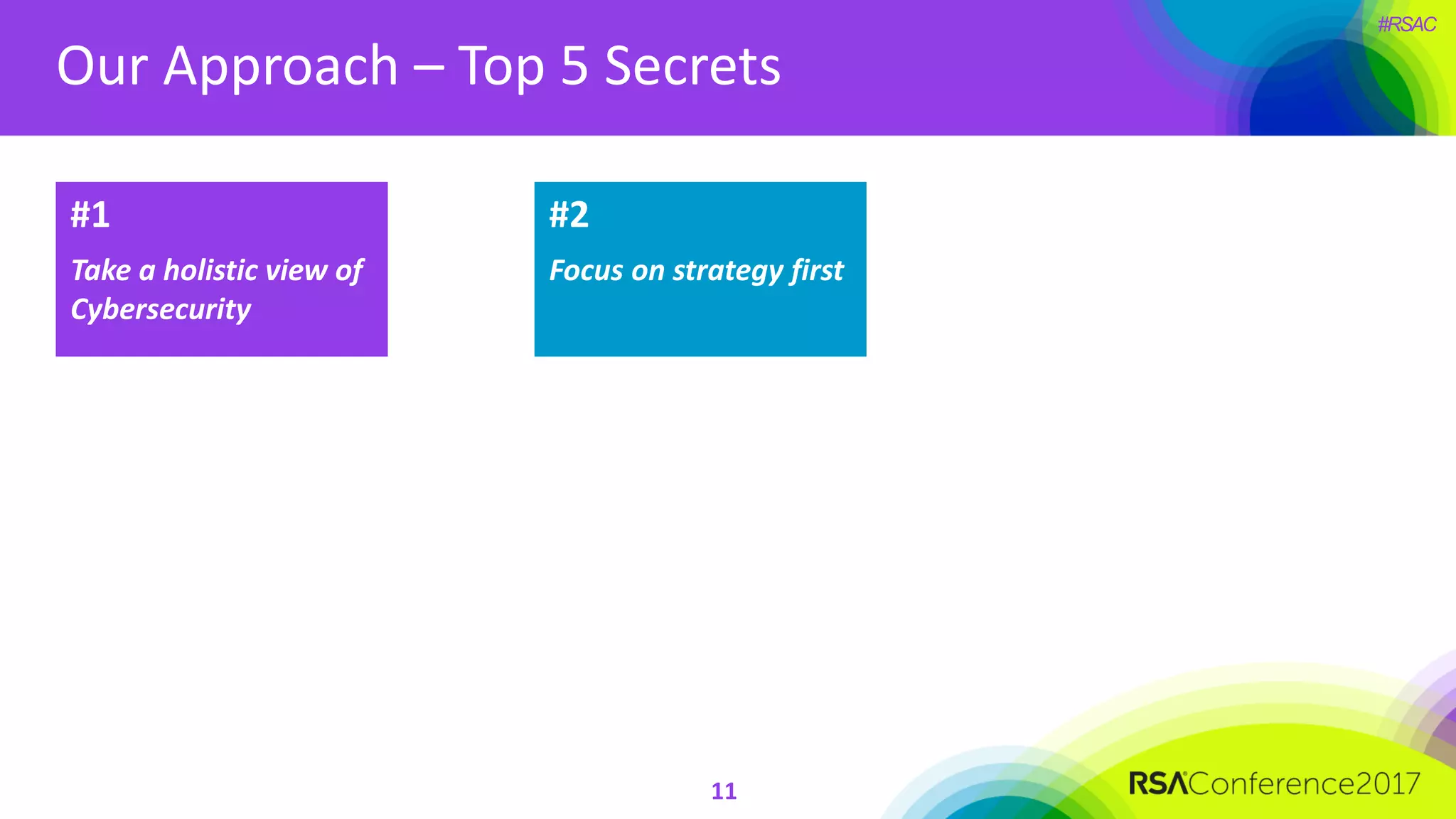
#1
Take a holistic view of
Cybersecurity
#2
Focus on strategy first
#3
Go Agile – Build and
iterate
#4
Create a risk
management culture
#5
Use risk for decision
making
“In union there is strength”
― Aesop, Ancient Greek Fabulist
#RSAC
Our Approach – Top 5 Secrets
7
#1
Take a holistic view of
Cybersecurity
#RSAC
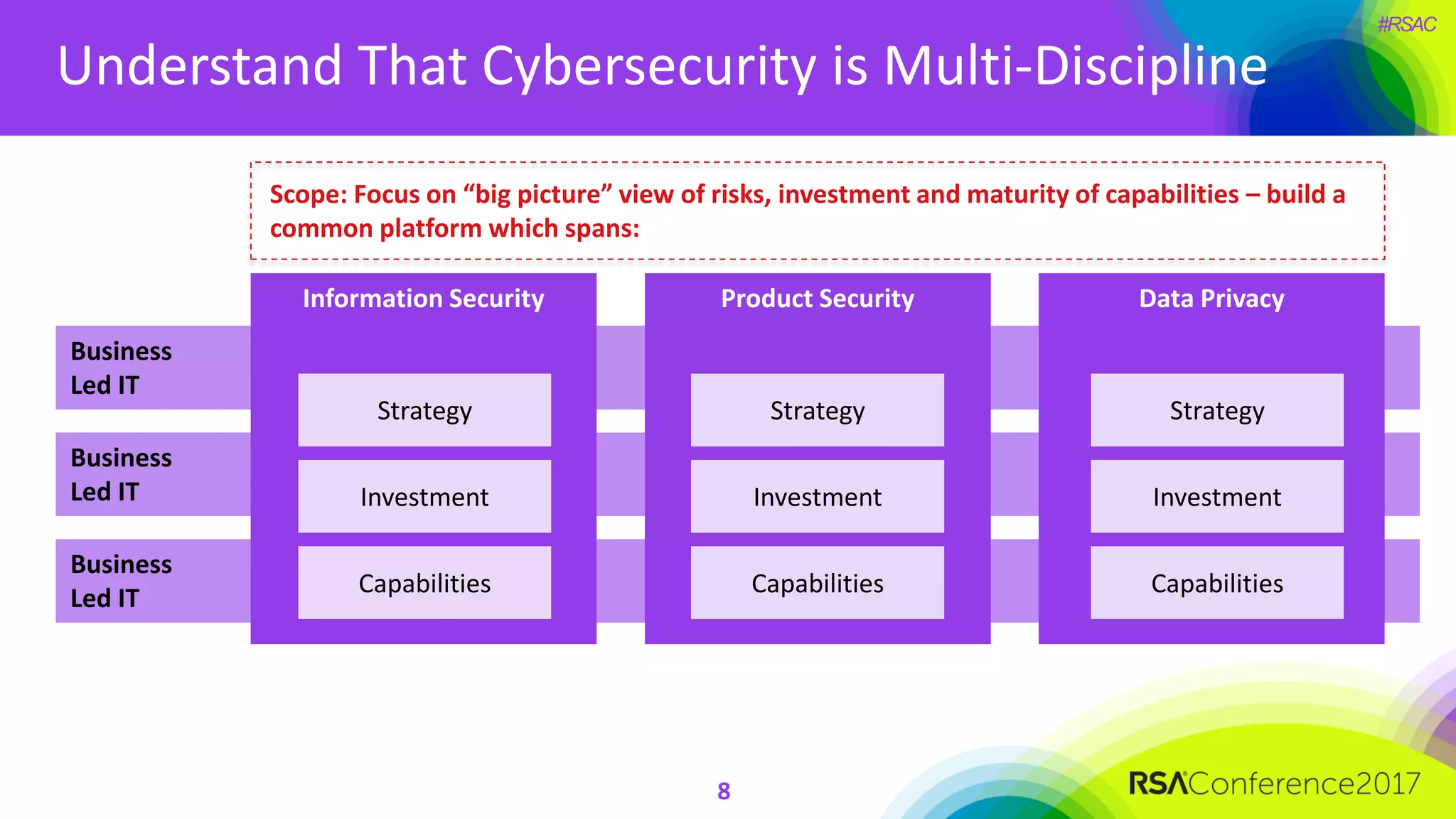
Understand That Cybersecurity is Multi-Discipline
8
Business
Led IT
Business
Led IT
Business
Led IT
Information Security Product Security Data Privacy
Strategy
Investment
Capabilities
Strategy
Investment
Capabilities
Strategy
Investment
Capabilities
Scope: Focus on “big picture” view of risks, investment and maturity of capabilities – build a
common platform which spans:
#RSAC
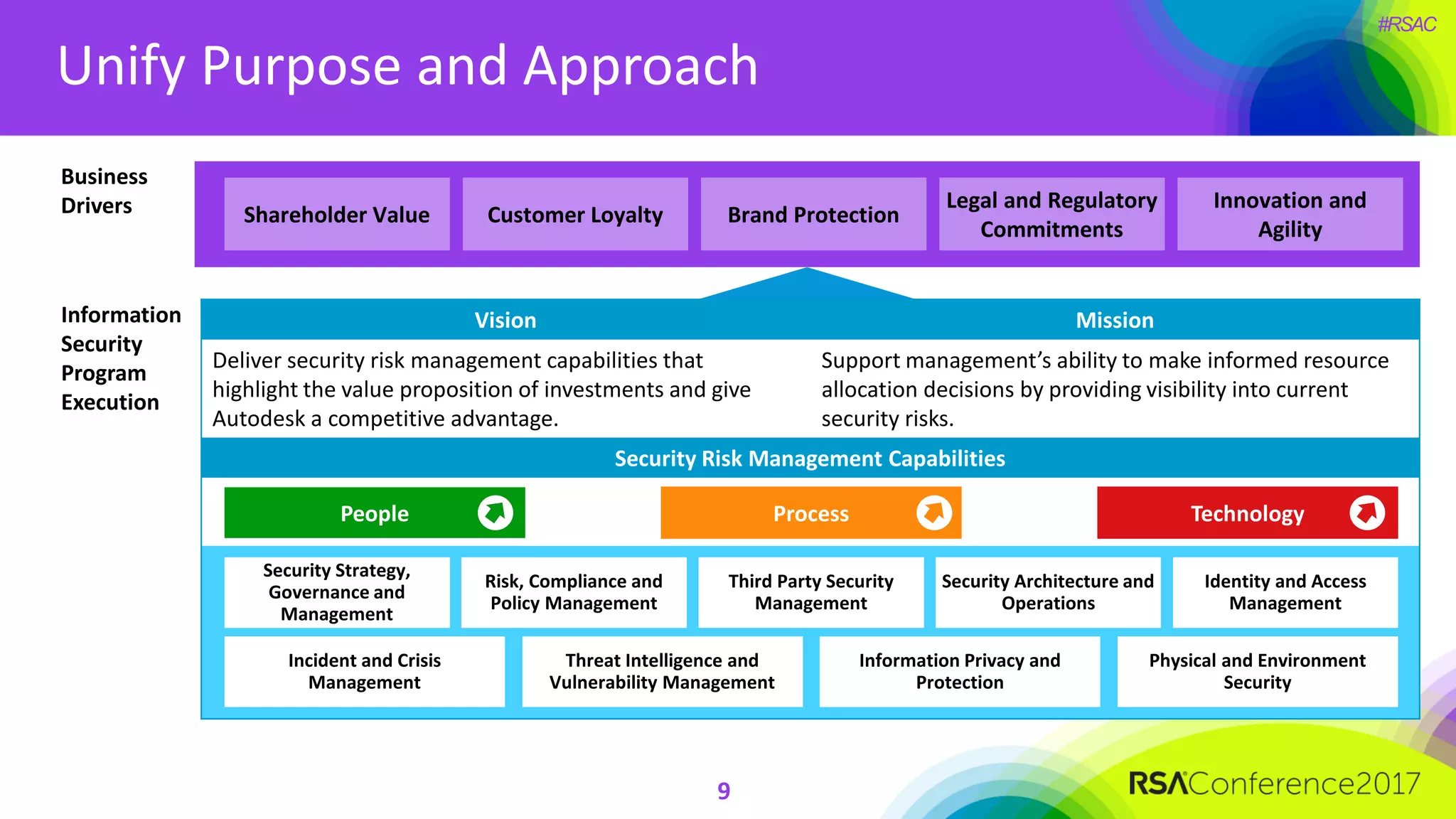
Unify Purpose and Approach
9
Vision Mission
Deliver security risk management capabilities that
highlight the value proposition of investments and give
Autodesk a competitive advantage.
Support management’s ability to make informed resource
allocation decisions by providing visibility into current
security risks.
Security Risk Management Capabilities
People Process Technology
Innovation and
Agility
Shareholder Value Brand ProtectionCustomer Loyalty
Legal and Regulatory
Commitments
Business
Drivers
Third Party Security
Management
Security Strategy,
Governance and
Management
Risk, Compliance and
Policy Management
Identity and Access
Management
Security Architecture and
Operations
Information Privacy and
Protection
Threat Intelligence and
Vulnerability Management
Physical and Environment
Security
Incident and Crisis
Management
Information
Security
Program
Execution
“The essence of strategy is choosing what not to do”
― Michael Porter, Harvard Business School Professor
#RSAC
Our Approach – Top 5 Secrets
11
#1
Take a holistic view of
Cybersecurity
#2
Focus on strategy first
#RSAC
Multi-Tiered Risk Assessment
12
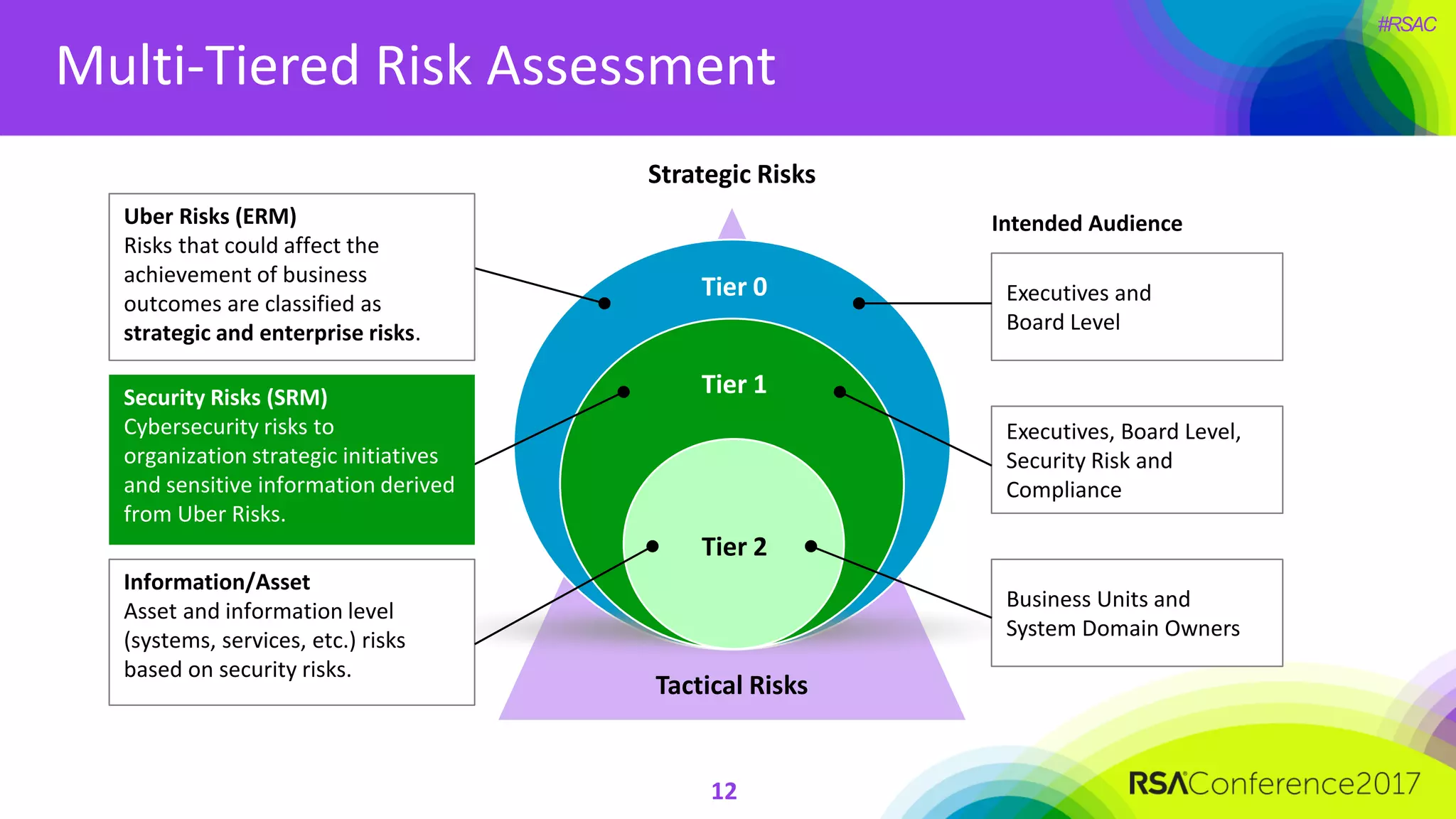
Tactical Risks
Strategic Risks
Tier 0
Tier 1
Tier 2
Security Risks (SRM)
Cybersecurity risks to
organization strategic initiatives
and sensitive information derived
from Uber Risks.
Information/Asset
Asset and information level
(systems, services, etc.) risks
based on security risks.
Uber Risks (ERM)
Risks that could affect the
achievement of business
outcomes are classified as
strategic and enterprise risks.
Intended Audience
Executives and
Board Level
Executives, Board Level,
Security Risk and
Compliance
Business Units and
System Domain Owners
“Make it simple, but significant”
― Don Draper, Fictional Character from Mad Men
#RSAC
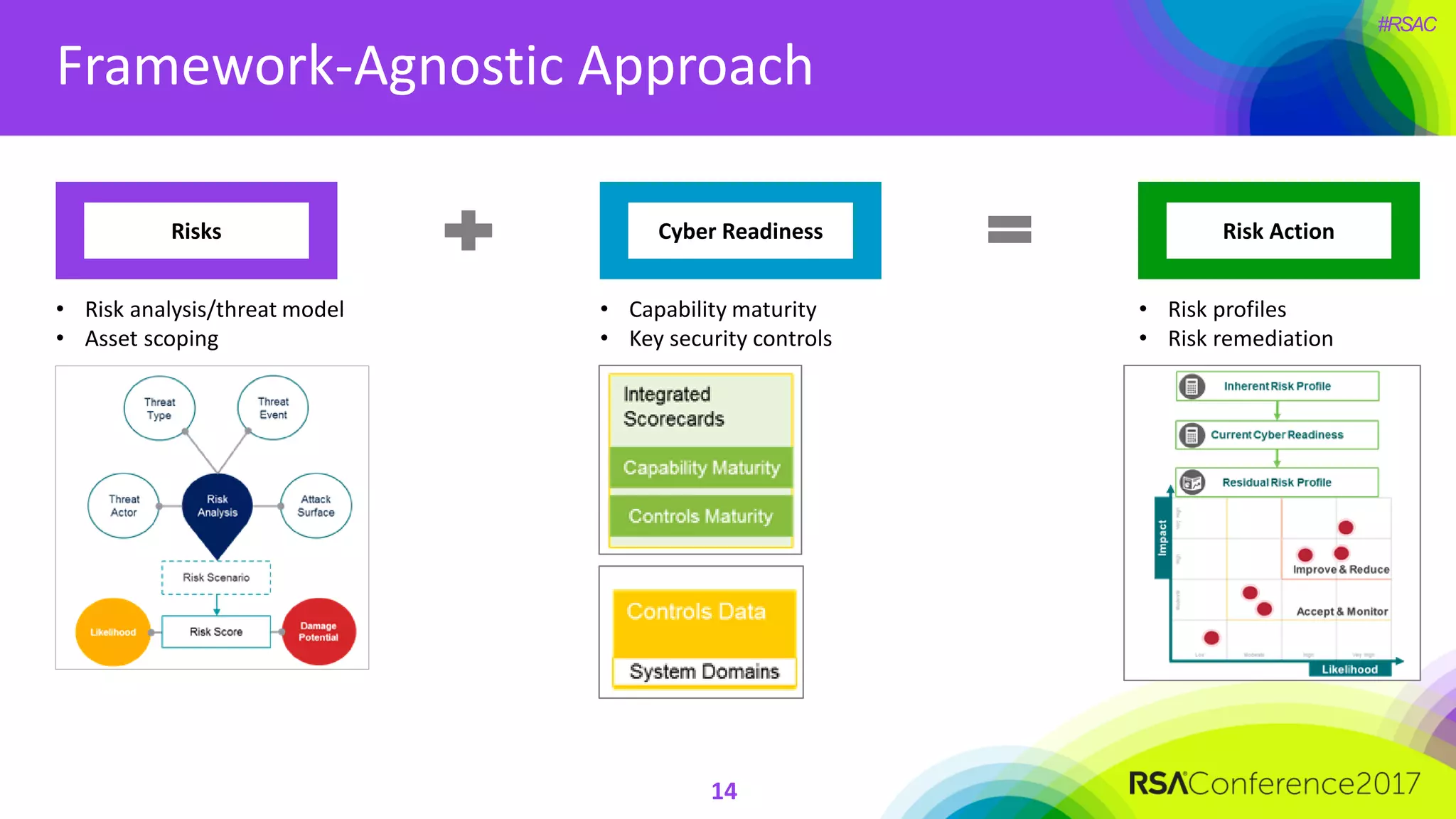
Framework-Agnostic Approach
14
Risks
• Risk analysis/threat model
• Asset scoping
Cyber Readiness
• Capability maturity
• Key security controls
Risk Action
• Risk profiles
• Risk remediation
#RSAC
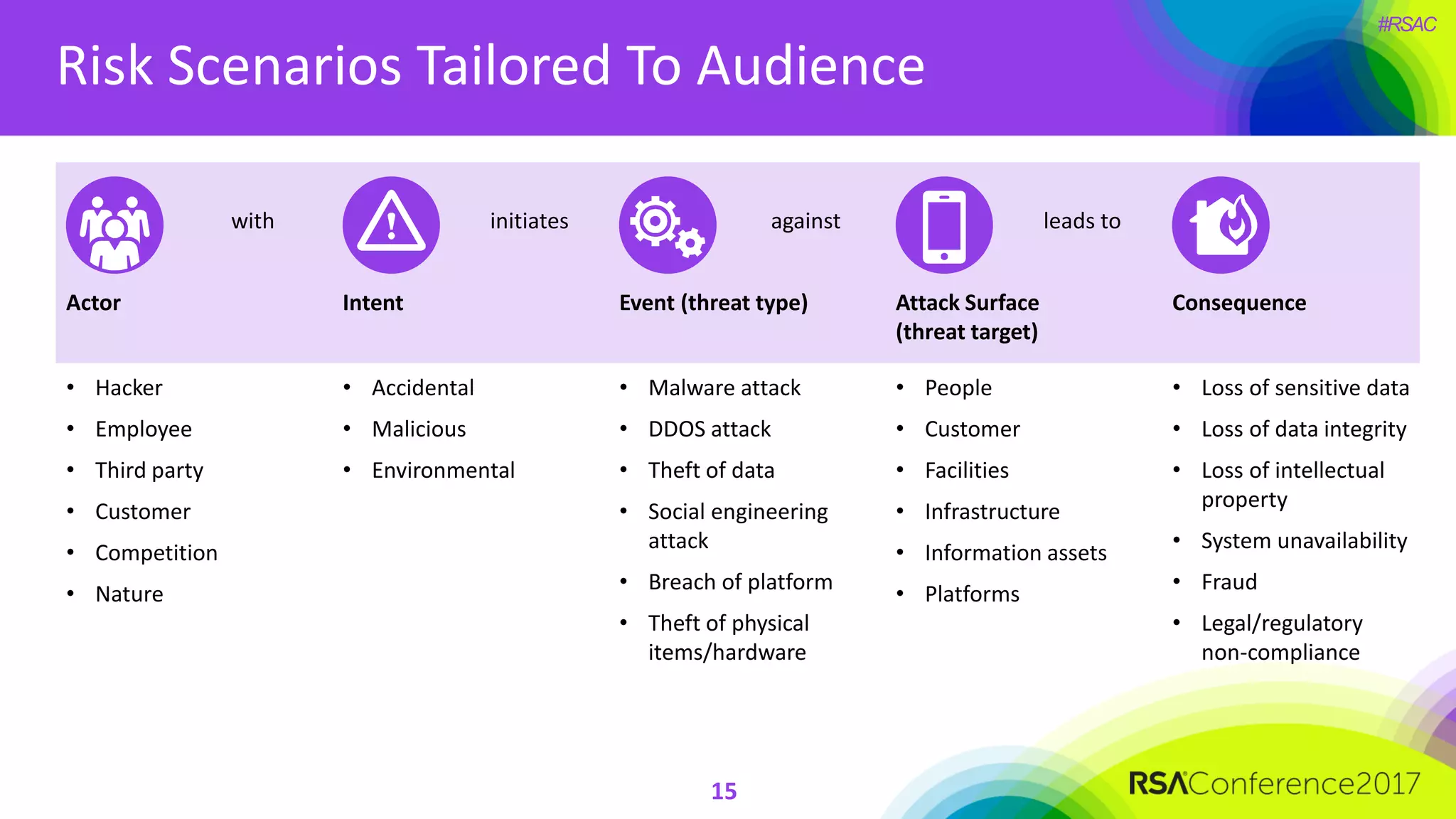
Risk Scenarios Tailored To Audience
15
with initiates against leads to
Actor
• Hacker
• Employee
• Third party
• Customer
• Competition
• Nature
Intent
• Accidental
• Malicious
• Environmental
Attack Surface
(threat target)
• People
• Customer
• Facilities
• Infrastructure
• Information assets
• Platforms
Consequence
• Loss of sensitive data
• Loss of data integrity
• Loss of intellectual
property
• System unavailability
• Fraud
• Legal/regulatory
non-compliance
Event (threat type)
• Malware attack
• DDOS attack
• Theft of data
• Social engineering
attack
• Breach of platform
• Theft of physical
items/hardware
#RSAC
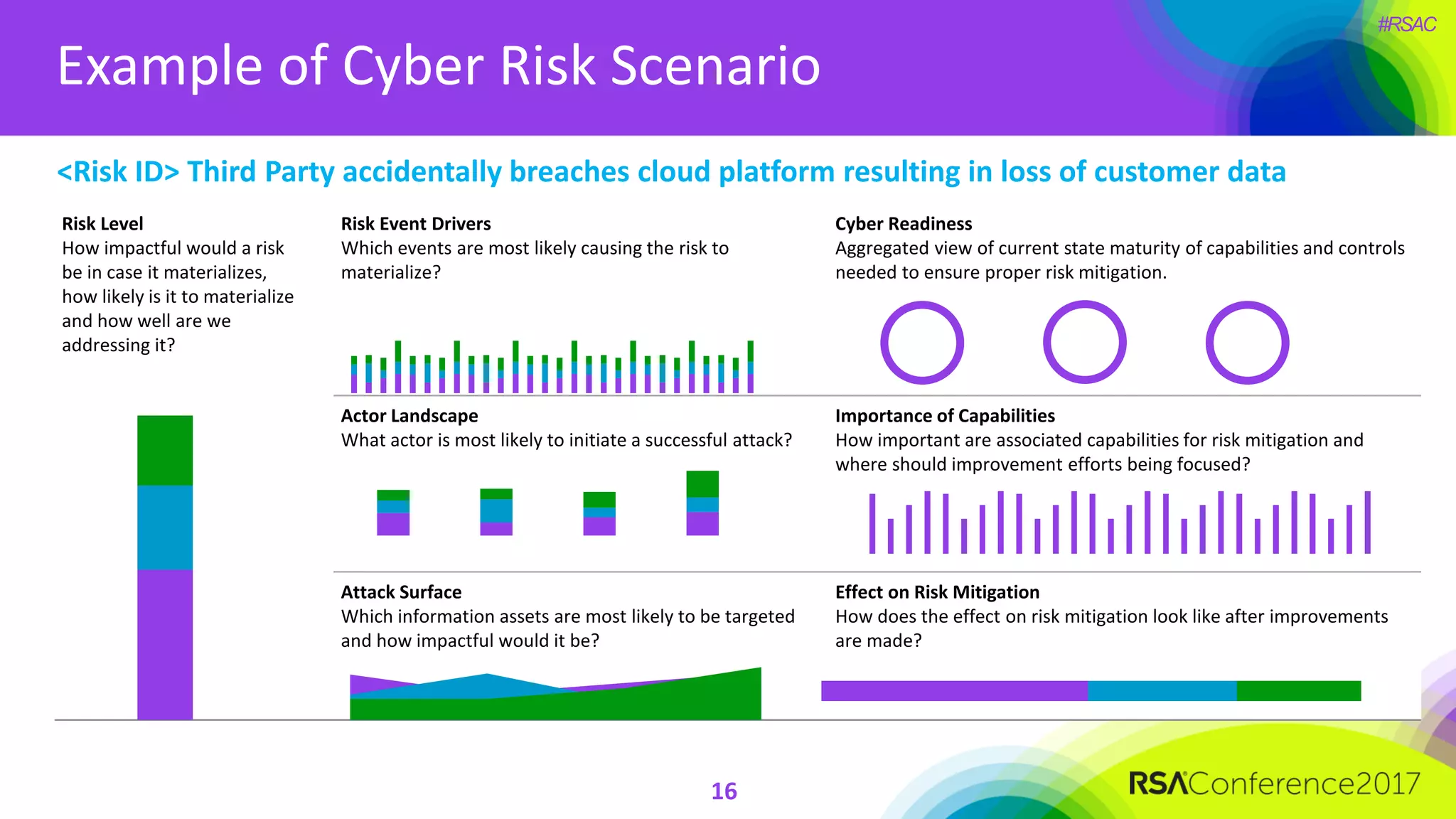
Example of Cyber Risk Scenario
16
<Risk ID> Third Party accidentally breaches cloud platform resulting in loss of customer data
Risk Level
How impactful would a risk
be in case it materializes,
how likely is it to materialize
and how well are we
addressing it?
Risk Event Drivers
Which events are most likely causing the risk to
materialize?
Cyber Readiness
Aggregated view of current state maturity of capabilities and controls
needed to ensure proper risk mitigation.
Actor Landscape
What actor is most likely to initiate a successful attack?
Importance of Capabilities
How important are associated capabilities for risk mitigation and
where should improvement efforts being focused?
Attack Surface
Which information assets are most likely to be targeted
and how impactful would it be?
Effect on Risk Mitigation
How does the effect on risk mitigation look like after improvements
are made?
“Life’s too short to build something no one wants.”
― Ash Maurya, Author of Running Lean and Creator of Lean Canvas
#RSAC
Our Approach – Top 5 Secrets
18
#1
Take a holistic view of
Cybersecurity
#2
Focus on strategy first
#3
Go Agile – Build and
iterate
#RSAC
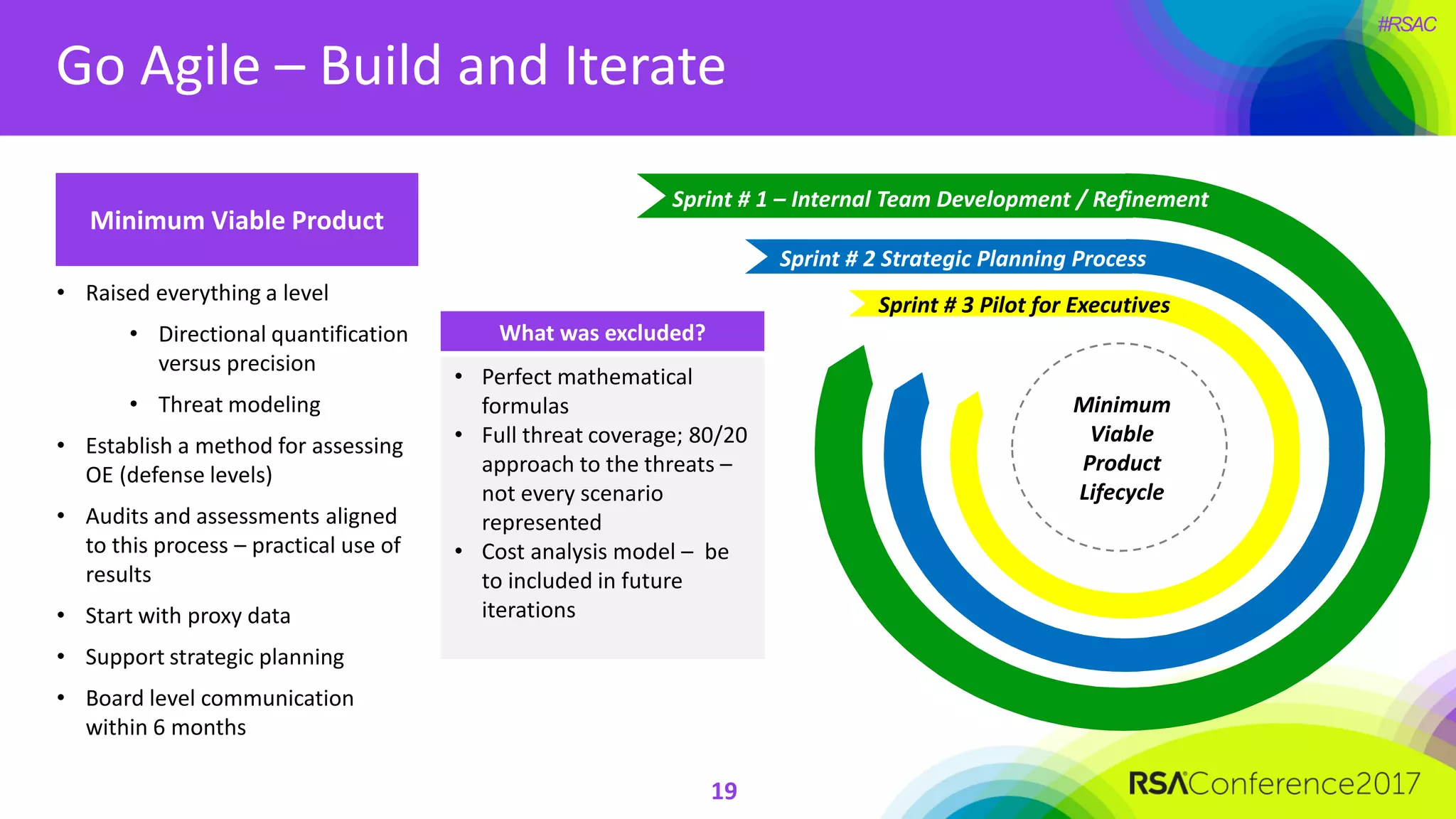
Go Agile – Build and Iterate
19
Minimum Viable Product
• Raised everything a level
• Directional quantification
versus precision
• Threat modeling
• Establish a method for assessing
OE (defense levels)
• Audits and assessments aligned
to this process – practical use of
results
• Start with proxy data
• Support strategic planning
• Board level communication
within 6 months
Sprint # 1 – Internal Team Development / Refinement
Sprint # 2 Strategic Planning Process
Sprint # 3 Pilot for Executives
Minimum
Viable
Product
Lifecycle
What was excluded?
• Perfect mathematical
formulas
• Full threat coverage; 80/20
approach to the threats –
not every scenario
represented
• Cost analysis model – be
to included in future
iterations
#RSAC
20
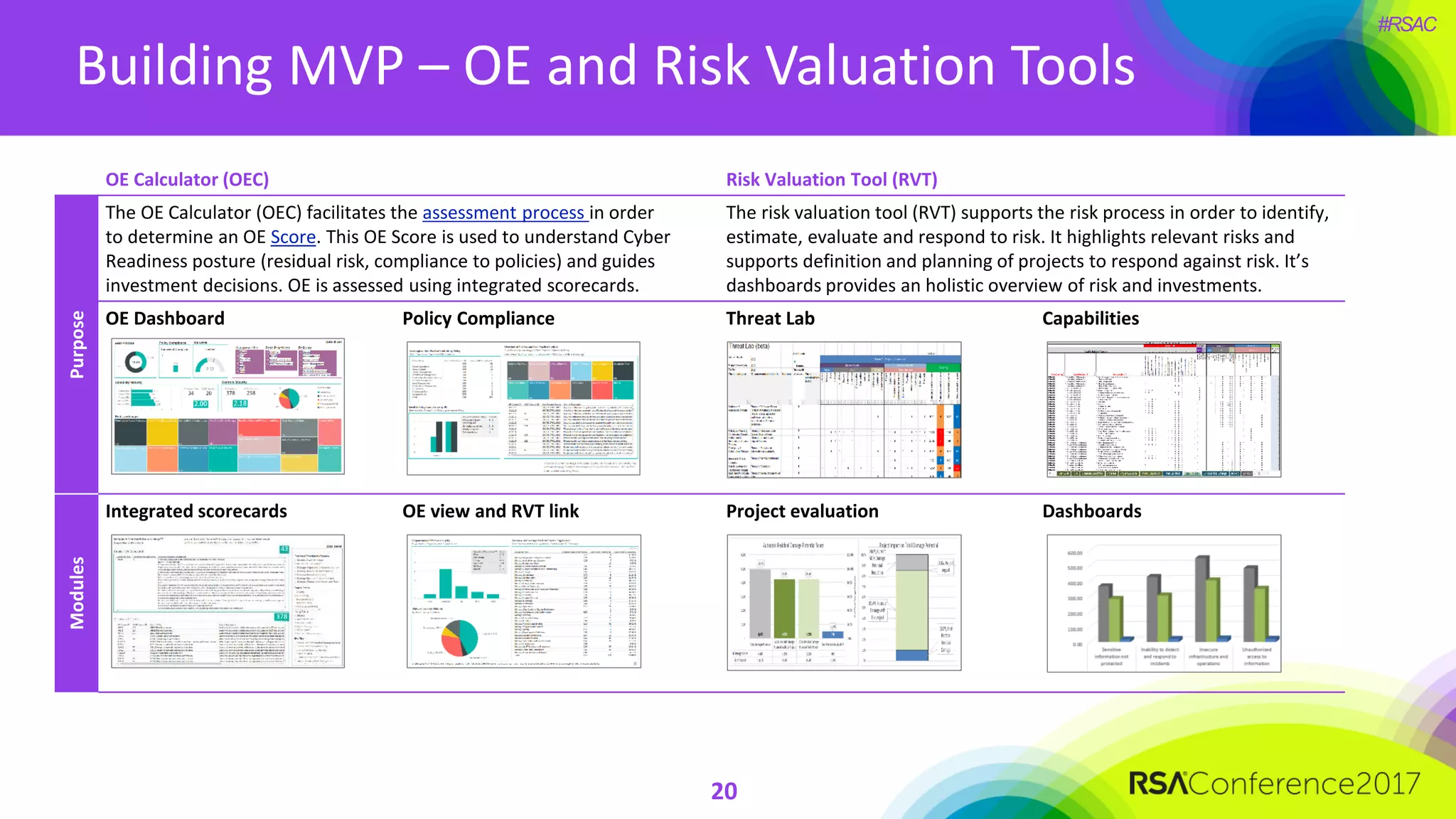
OE Calculator (OEC) Risk Valuation Tool (RVT)
Purpose
The OE Calculator (OEC) facilitates the assessment process in order
to determine an OE Score. This OE Score is used to understand Cyber
Readiness posture (residual risk, compliance to policies) and guides
investment decisions. OE is assessed using integrated scorecards.
The risk valuation tool (RVT) supports the risk process in order to identify,
estimate, evaluate and respond to risk. It highlights relevant risks and
supports definition and planning of projects to respond against risk. It’s
dashboards provides an holistic overview of risk and investments.
OE Dashboard Policy Compliance Threat Lab Capabilities
Modules
Integrated scorecards OE view and RVT link Project evaluation Dashboards
Building MVP – OE and Risk Valuation Tools
“If you don’t get culture right, nothing else matters”
― John Taft, Former CEO of RBC Wealth Management
“It is a terrible thing to look over your shoulder when
you are trying to lead – and find no one there”
― Franklin Roosevelt
#RSAC
Our Approach – Top 5 Secrets
22
#1
Take a holistic view of
Cybersecurity
#2
Focus on strategy first
#3
Go Agile – Build and
iterate
#4
Create a risk
management culture
#RSAC
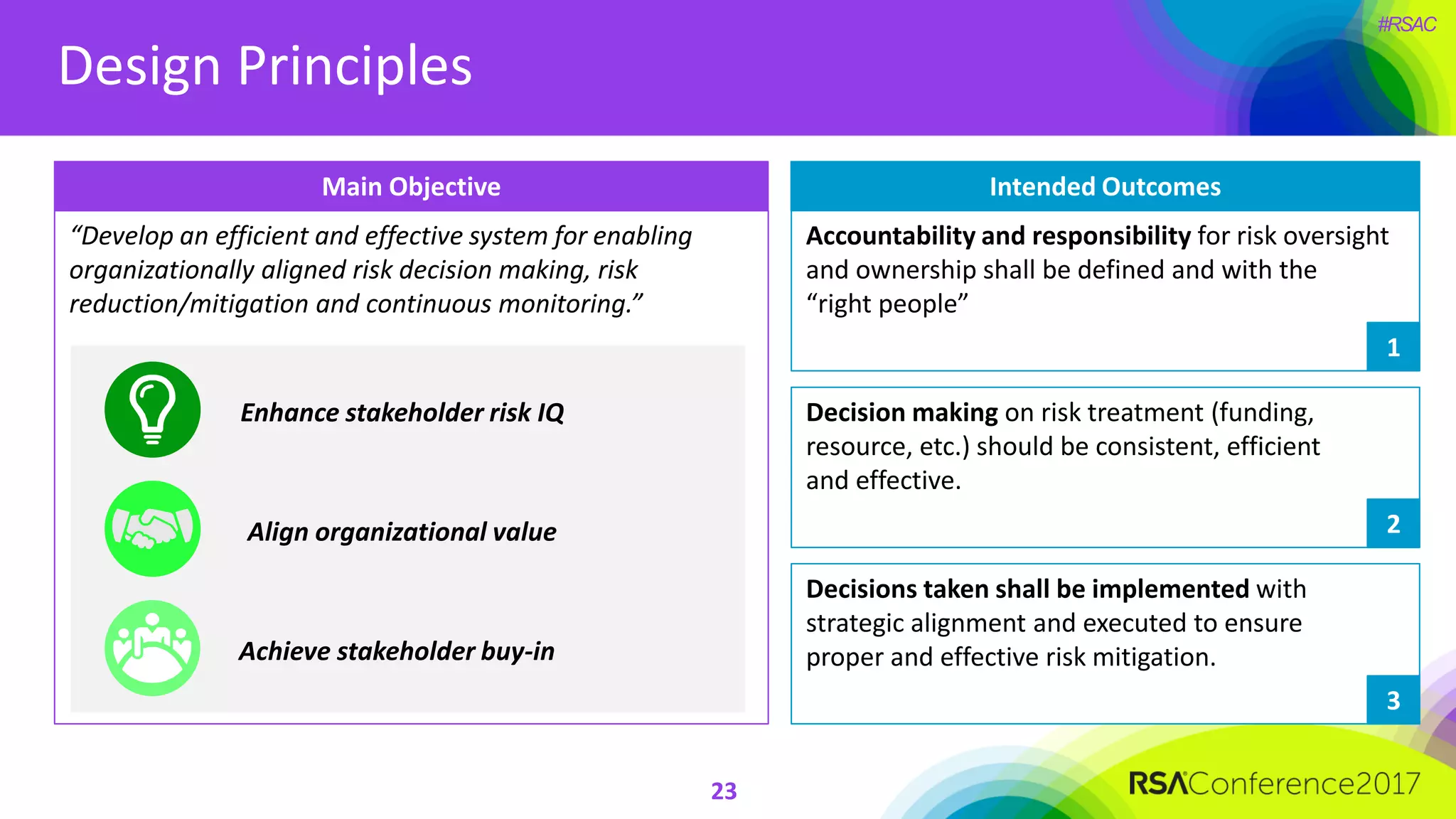
Design Principles
“Develop an efficient and effective system for enabling
organizationally aligned risk decision making, risk
reduction/mitigation and continuous monitoring.”
Main Objective Intended Outcomes
Accountability and responsibility for risk oversight
and ownership shall be defined and with the
“right people”
Decision making on risk treatment (funding,
resource, etc.) should be consistent, efficient
and effective.
Decisions taken shall be implemented with
strategic alignment and executed to ensure
proper and effective risk mitigation.
1
2
3
Enhance stakeholder risk IQ
Align organizational value
Achieve stakeholder buy-in
23
“In real life, strategy is actually very straightforward.
You pick a general direction and implement like hell.”
― Jack Welsh, Former CEO of General Electric
#RSAC
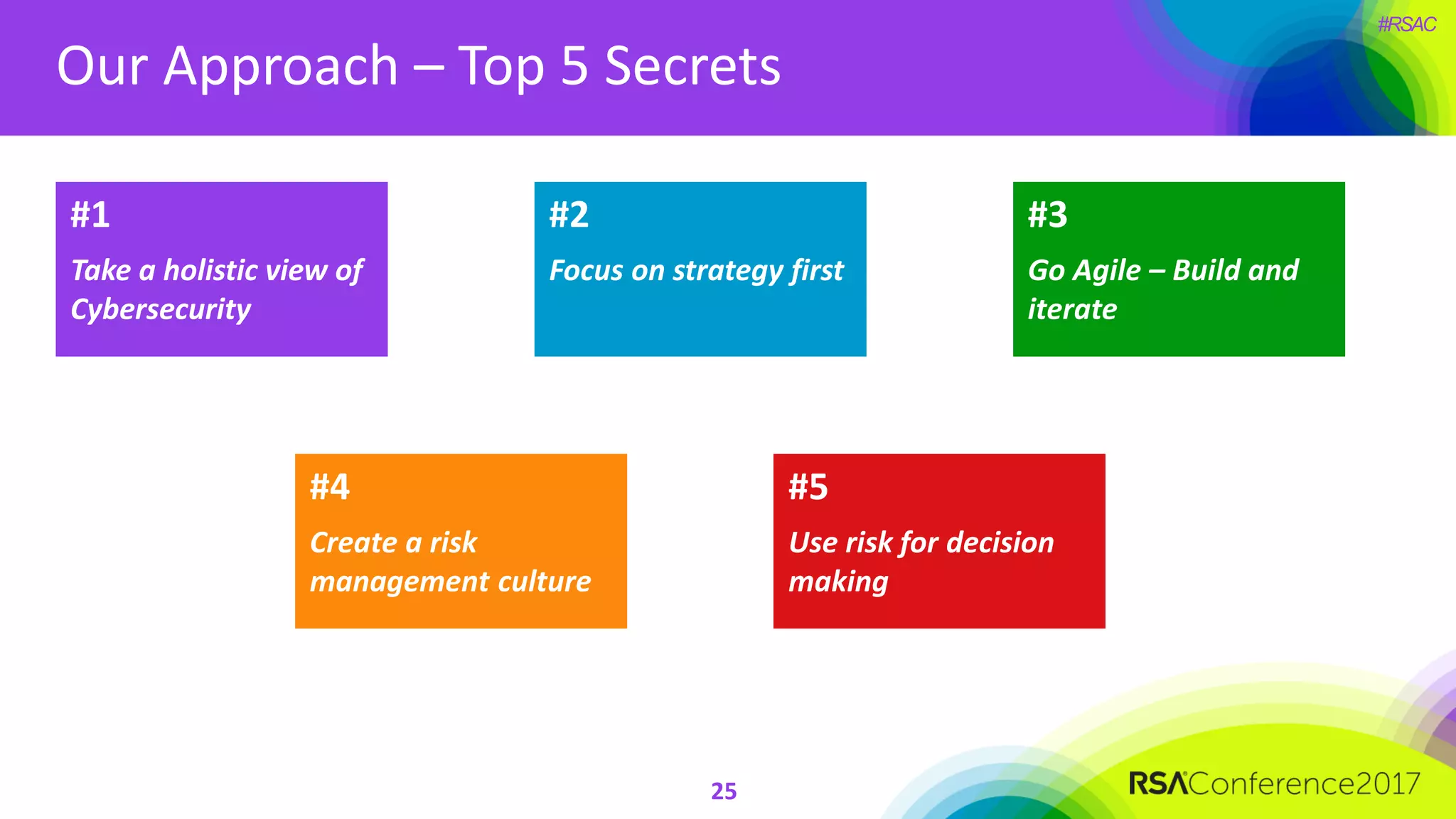
Our Approach – Top 5 Secrets
25
#1
Take a holistic view of
Cybersecurity
#2
Focus on strategy first
#3
Go Agile – Build and
iterate
#4
Create a risk
management culture
#5
Use risk for decision
making
#RSAC
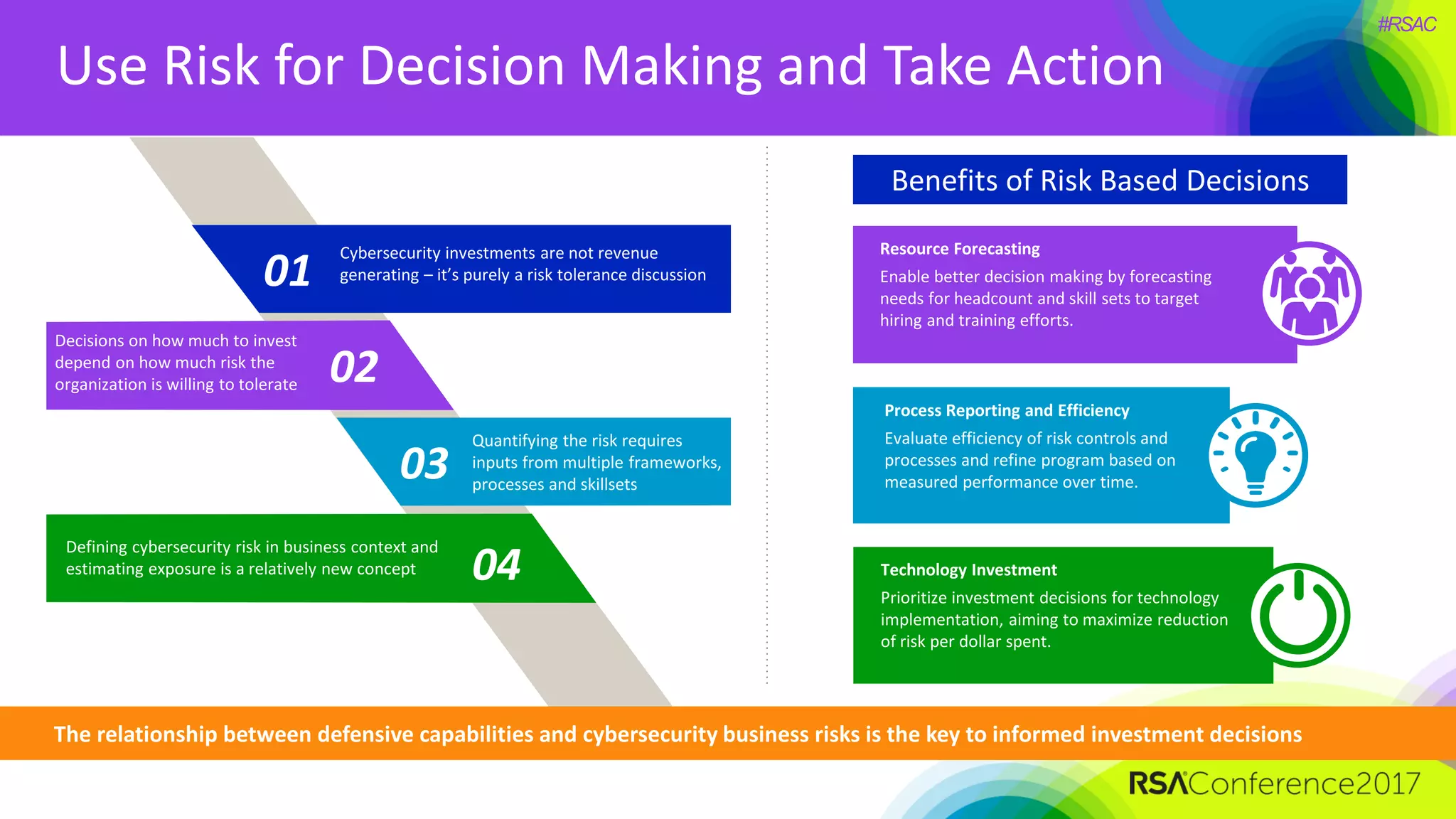
Use Risk for Decision Making and Take Action
Resource Forecasting
Enable better decision making by forecasting
needs for headcount and skill sets to target
hiring and training efforts.
Process Reporting and Efficiency
Evaluate efficiency of risk controls and
processes and refine program based on
measured performance over time.
Technology Investment
Prioritize investment decisions for technology
implementation, aiming to maximize reduction
of risk per dollar spent.
01
02
03
04
Cybersecurity investments are not revenue
generating – it’s purely a risk tolerance discussion
Decisions on how much to invest
depend on how much risk the
organization is willing to tolerate
Quantifying the risk requires
inputs from multiple frameworks,
processes and skillsets
Defining cybersecurity risk in business context and
estimating exposure is a relatively new concept
The relationship between defensive capabilities and cybersecurity business risks is the key to informed investment decisions
01
02
03
04
Cybersecurity investments are not revenue
generating – it’s purely a risk tolerance discussion
Decisions on how much to invest
depend on how much risk the
organization is willing to tolerate
Quantifying the risk requires
inputs from multiple frameworks,
processes and skillsets
Defining cybersecurity risk in business context and
estimating exposure is a relatively new concept
Benefits of Risk Based Decisions
#RSAC
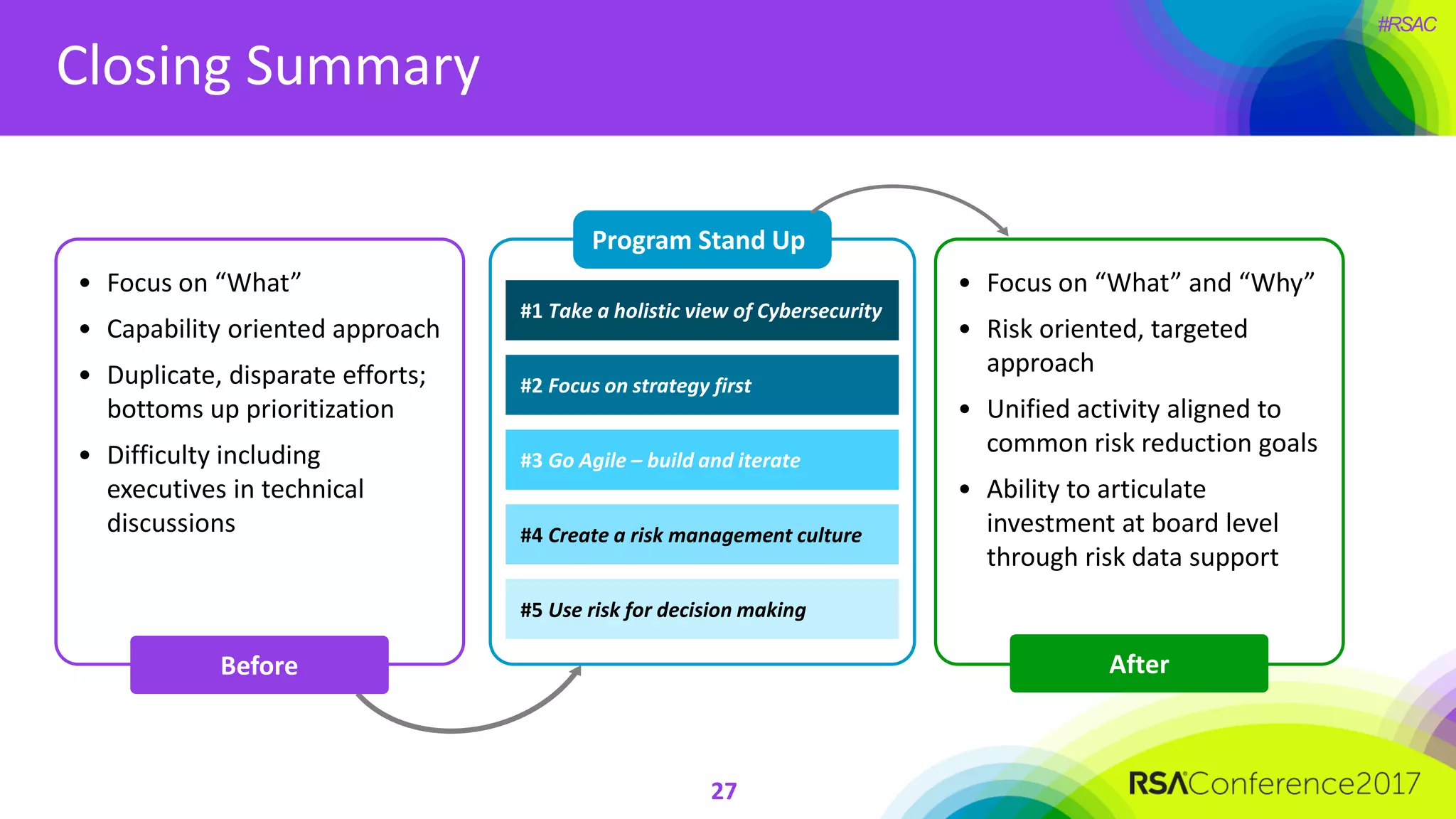
Closing Summary
27
Before
Program Stand Up
#1 Take a holistic view of Cybersecurity
#2 Focus on strategy first
#3 Go Agile – build and iterate
#4 Create a risk management culture
#5 Use risk for decision making
• Focus on “What”
• Capability oriented approach
• Duplicate, disparate efforts;
bottoms up prioritization
• Difficulty including
executives in technical
discussions
• Focus on “What” and “Why”
• Risk oriented, targeted
approach
• Unified activity aligned to
common risk reduction goals
• Ability to articulate
investment at board level
through risk data support
After
#RSAC
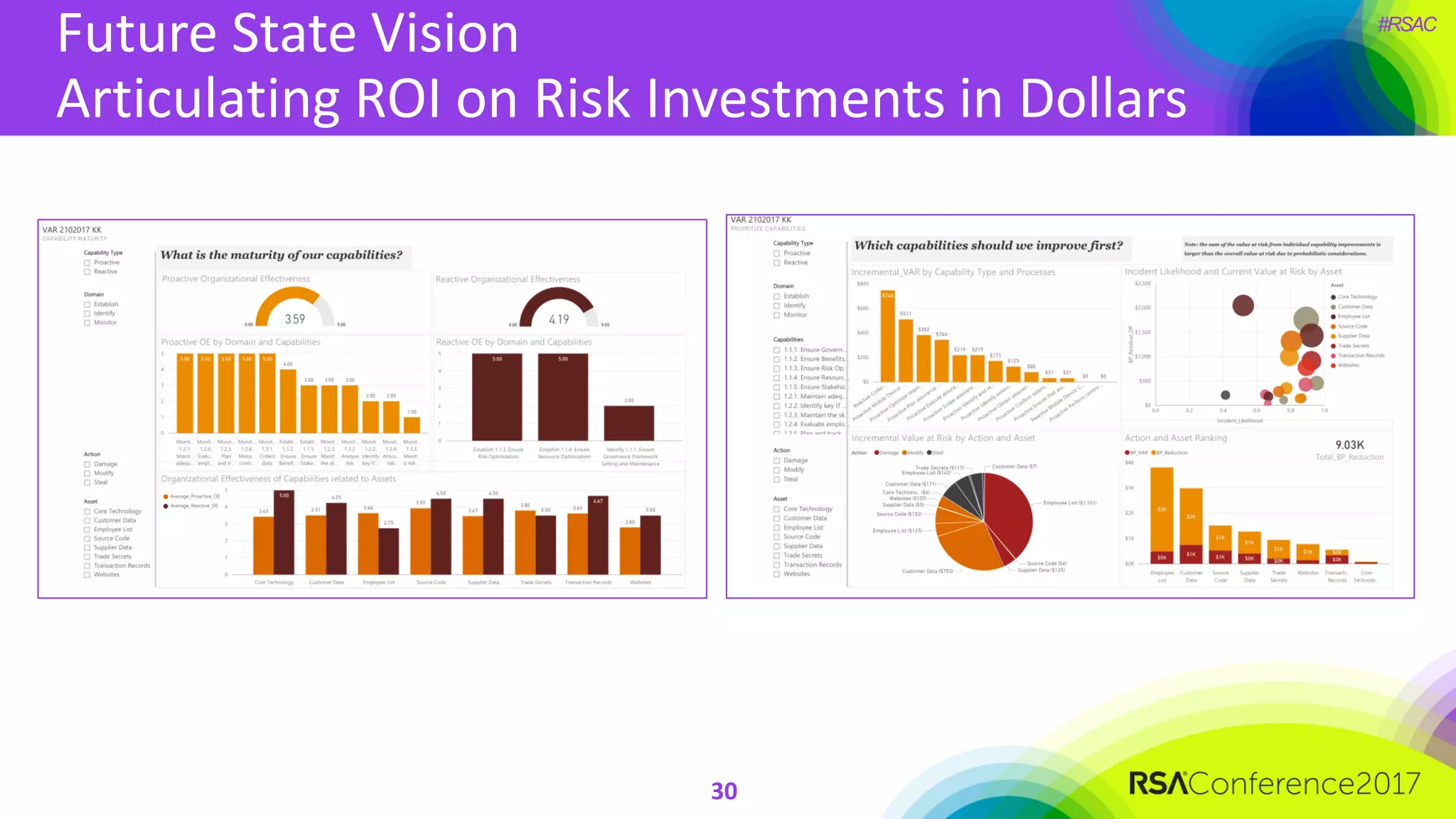
Future State Vision
Articulating ROI on Risk Investments in Dollars
28
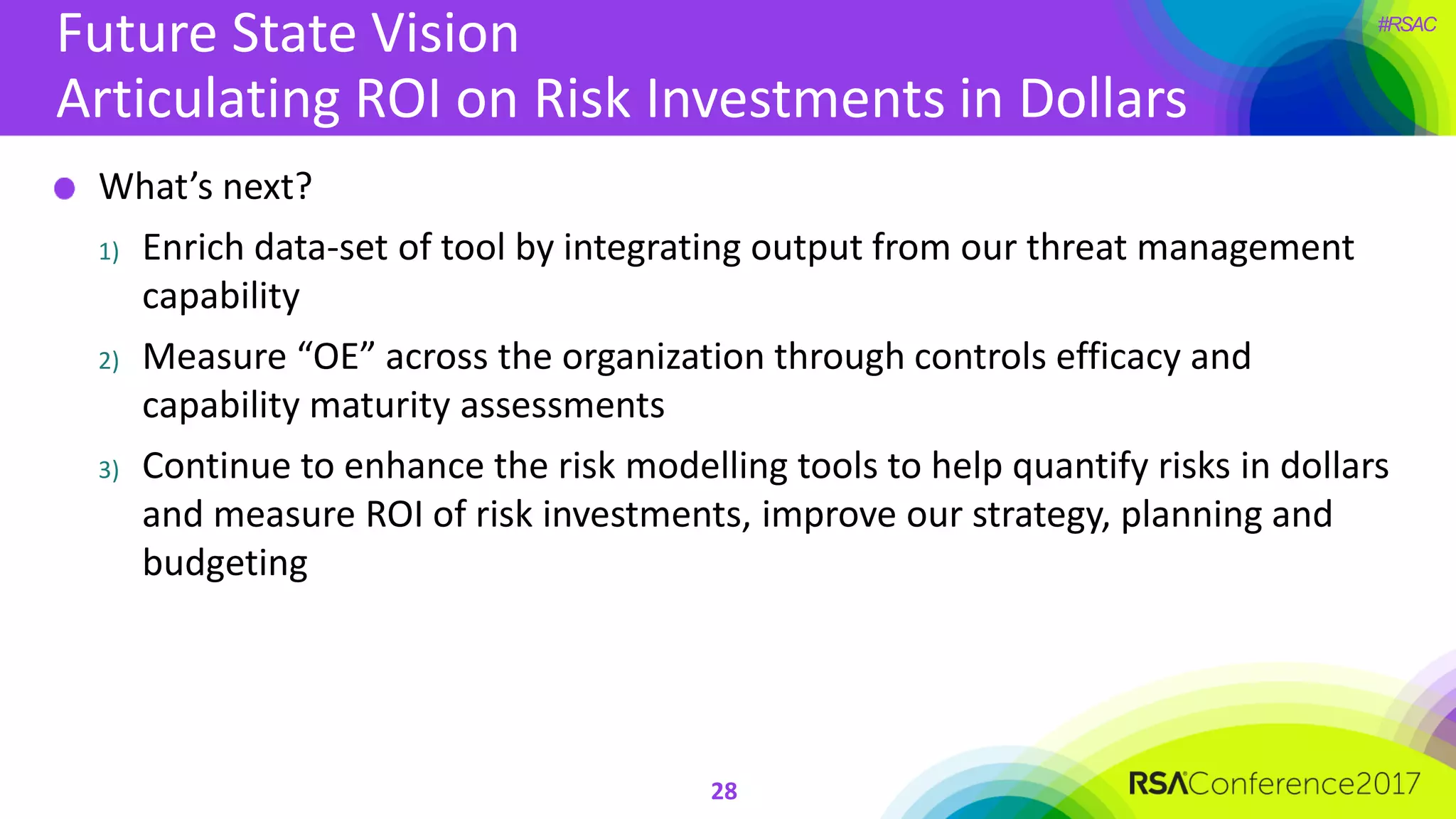
What’s next?
1) Enrich data-set of tool by integrating output from our threat management
capability
2) Measure “OE” across the organization through controls efficacy and
capability maturity assessments
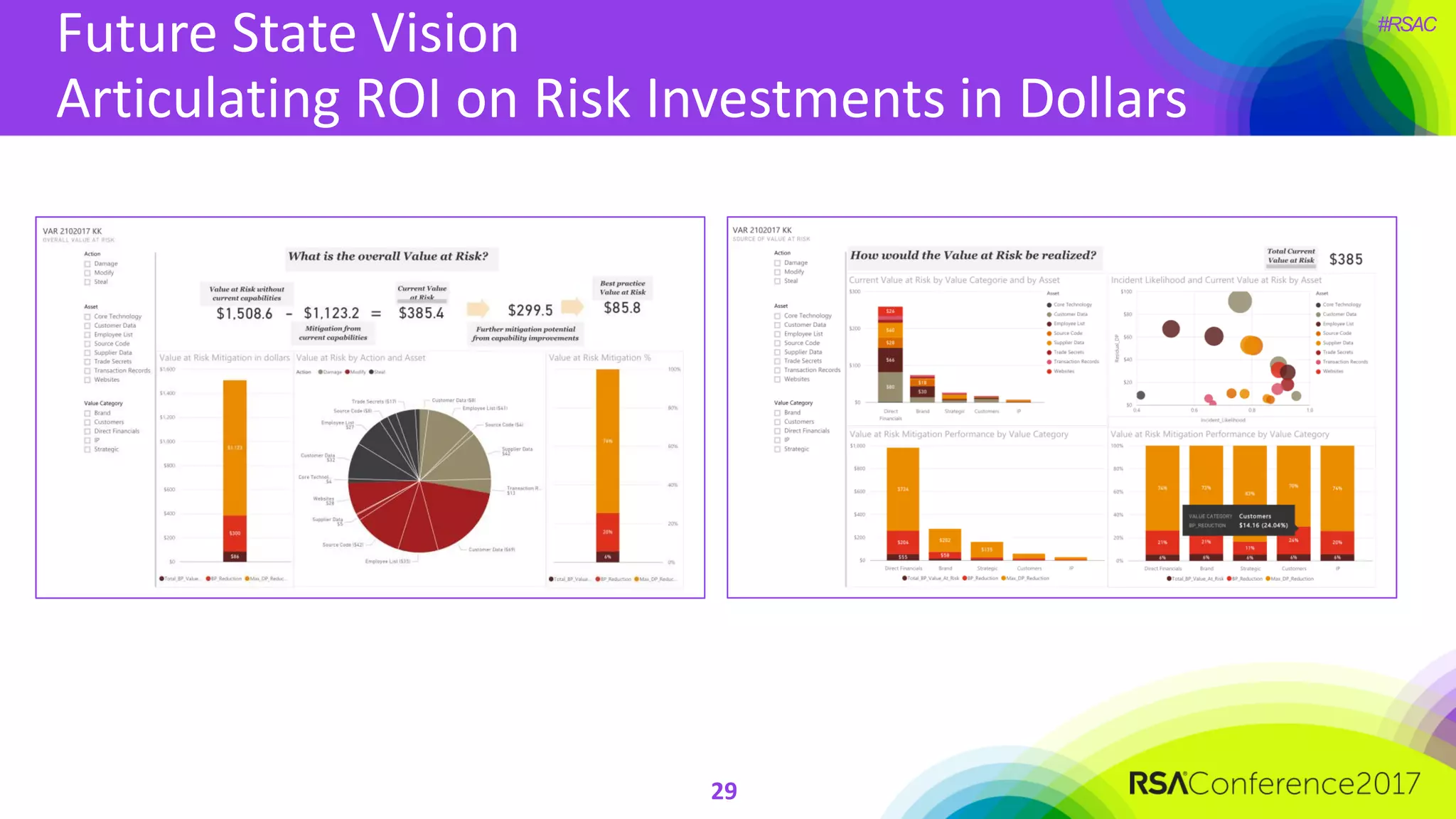
3) Continue to enhance the risk modelling tools to help quantify risks in dollars
and measure ROI of risk investments, improve our strategy, planning and
budgeting
#RSAC
Future State Vision
Articulating ROI on Risk Investments in Dollars
29
#RSAC
Future State Vision
Articulating ROI on Risk Investments in Dollars
30
#RSAC
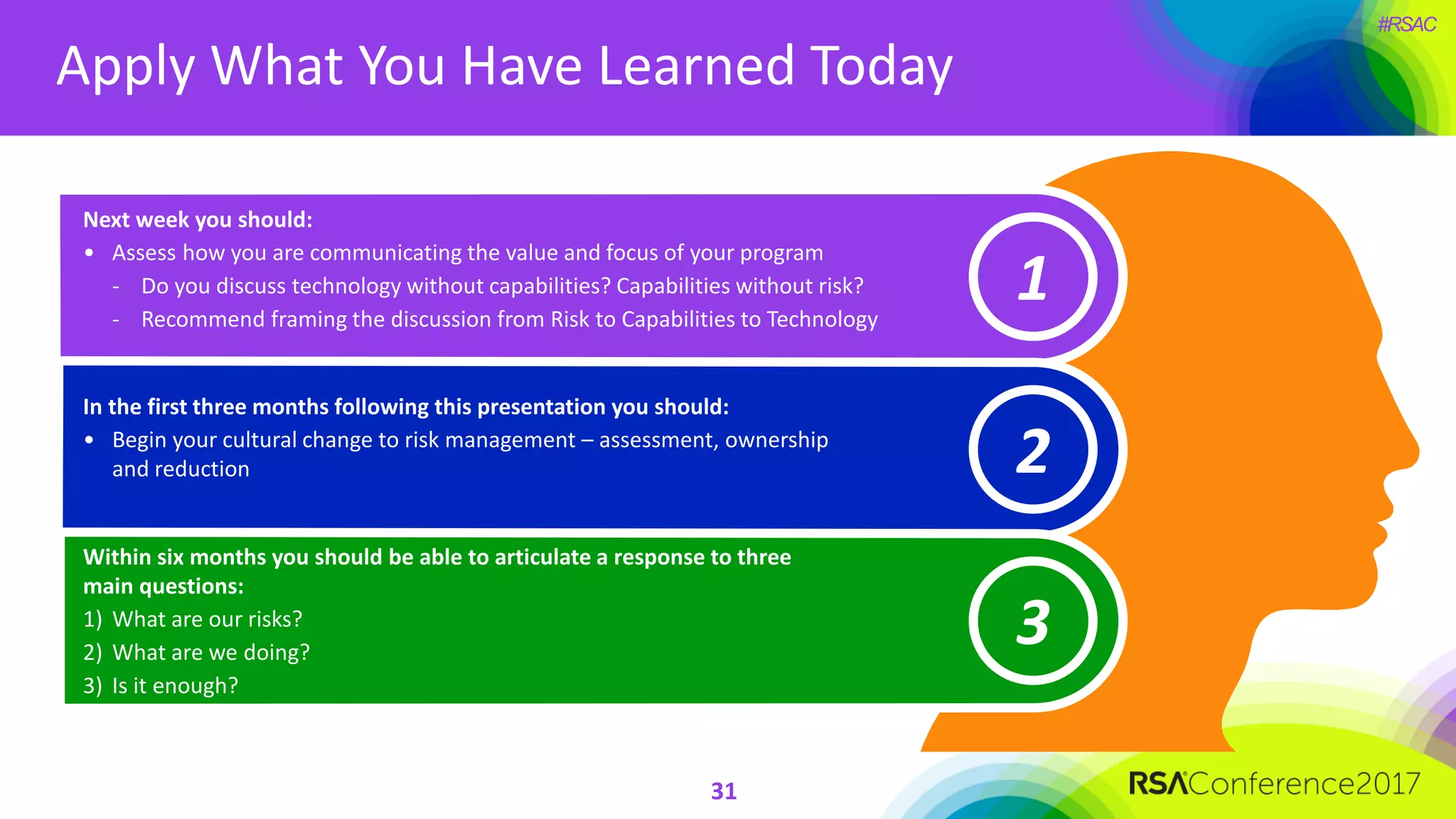
1
Next week you should:
• Assess how you are communicating the value and focus of your program
- Do you discuss technology without capabilities? Capabilities without risk?
- Recommend framing the discussion from Risk to Capabilities to Technology
2
In the first three months following this presentation you should:
• Begin your cultural change to risk management – assessment, ownership
and reduction
3
Within six months you should be able to articulate a response to three
main questions:
1) What are our risks?
2) What are we doing?
3) Is it enough?
.
Apply What You Have Learned Today
31

Top 5 secrets to successfully jumpstarting your cyber-risk program

  • 1.
    SESSION ID:SESSION ID: #RSAC ChrisHoulder Top Five Secrets to Successfully Jumpstarting Your Cyber-Risk Program GRC-W03 CISO Autodesk, Inc. @chrishoulder chris.houlder@autodesk.com Husam Brohi Director, Cybersecurity and Privacy PwC LLP @husambrohi husam.brohi@pwc.com
  • 2.
    #RSAC Situational Context 2 Autodesk undergoingmassive business transformation to cloud subscription model Risk at center of Board and Senior Executive Agenda Executives wanted more real-time, transparent reporting beyond what Enterprise Risk Program (ERM) was providing Agile and DevOps mindset viewed security, risk and governance as barriers Multiple, interrelated disciplines operating in federated manner
  • 3.
    #RSAC Our Challenge Board BusinessInformation Security Product Security Data Privacy What are our risks? What are we doing? Is it enough? Overcome a skeptical customer Align strategies and investments Problem Statement Develop a strategic vision and program for effectively communicating our holistic risk posture and response – and move everyone towards a common direction 3
  • 4.
    #RSAC What Are WeHere To Do 4 Share our story and walk through the process and key considerations for taking our cyber risk program from concept to launch in under 6 months Discuss how risk management serves as the core of our cybersecurity program and strategy Provide lessons learned with you and discuss the challenges we faced, hoping that the approach we took will be useful in your journey This is NOT a discussion on risk management methodologies or artifacts
  • 5.
    #RSAC Our Approach –Top 5 Secrets 5 #1 Take a holistic view of Cybersecurity #2 Focus on strategy first #3 Go Agile – Build and iterate #4 Create a risk management culture #5 Use risk for decision making
  • 6.
    “In union thereis strength” ― Aesop, Ancient Greek Fabulist
  • 7.
    #RSAC Our Approach –Top 5 Secrets 7 #1 Take a holistic view of Cybersecurity
  • 8.
    #RSAC Understand That Cybersecurityis Multi-Discipline 8 Business Led IT Business Led IT Business Led IT Information Security Product Security Data Privacy Strategy Investment Capabilities Strategy Investment Capabilities Strategy Investment Capabilities Scope: Focus on “big picture” view of risks, investment and maturity of capabilities – build a common platform which spans:
  • 9.
    #RSAC Unify Purpose andApproach 9 Vision Mission Deliver security risk management capabilities that highlight the value proposition of investments and give Autodesk a competitive advantage. Support management’s ability to make informed resource allocation decisions by providing visibility into current security risks. Security Risk Management Capabilities People Process Technology Innovation and Agility Shareholder Value Brand ProtectionCustomer Loyalty Legal and Regulatory Commitments Business Drivers Third Party Security Management Security Strategy, Governance and Management Risk, Compliance and Policy Management Identity and Access Management Security Architecture and Operations Information Privacy and Protection Threat Intelligence and Vulnerability Management Physical and Environment Security Incident and Crisis Management Information Security Program Execution
  • 10.
    “The essence ofstrategy is choosing what not to do” ― Michael Porter, Harvard Business School Professor
  • 11.
    #RSAC Our Approach –Top 5 Secrets 11 #1 Take a holistic view of Cybersecurity #2 Focus on strategy first
  • 12.
    #RSAC Multi-Tiered Risk Assessment 12 TacticalRisks Strategic Risks Tier 0 Tier 1 Tier 2 Security Risks (SRM) Cybersecurity risks to organization strategic initiatives and sensitive information derived from Uber Risks. Information/Asset Asset and information level (systems, services, etc.) risks based on security risks. Uber Risks (ERM) Risks that could affect the achievement of business outcomes are classified as strategic and enterprise risks. Intended Audience Executives and Board Level Executives, Board Level, Security Risk and Compliance Business Units and System Domain Owners
  • 13.
    “Make it simple,but significant” ― Don Draper, Fictional Character from Mad Men
  • 14.
    #RSAC Framework-Agnostic Approach 14 Risks • Riskanalysis/threat model • Asset scoping Cyber Readiness • Capability maturity • Key security controls Risk Action • Risk profiles • Risk remediation
  • 15.
    #RSAC Risk Scenarios TailoredTo Audience 15 with initiates against leads to Actor • Hacker • Employee • Third party • Customer • Competition • Nature Intent • Accidental • Malicious • Environmental Attack Surface (threat target) • People • Customer • Facilities • Infrastructure • Information assets • Platforms Consequence • Loss of sensitive data • Loss of data integrity • Loss of intellectual property • System unavailability • Fraud • Legal/regulatory non-compliance Event (threat type) • Malware attack • DDOS attack • Theft of data • Social engineering attack • Breach of platform • Theft of physical items/hardware
  • 16.
    #RSAC Example of CyberRisk Scenario 16 <Risk ID> Third Party accidentally breaches cloud platform resulting in loss of customer data Risk Level How impactful would a risk be in case it materializes, how likely is it to materialize and how well are we addressing it? Risk Event Drivers Which events are most likely causing the risk to materialize? Cyber Readiness Aggregated view of current state maturity of capabilities and controls needed to ensure proper risk mitigation. Actor Landscape What actor is most likely to initiate a successful attack? Importance of Capabilities How important are associated capabilities for risk mitigation and where should improvement efforts being focused? Attack Surface Which information assets are most likely to be targeted and how impactful would it be? Effect on Risk Mitigation How does the effect on risk mitigation look like after improvements are made?
  • 17.
    “Life’s too shortto build something no one wants.” ― Ash Maurya, Author of Running Lean and Creator of Lean Canvas
  • 18.
    #RSAC Our Approach –Top 5 Secrets 18 #1 Take a holistic view of Cybersecurity #2 Focus on strategy first #3 Go Agile – Build and iterate
  • 19.
    #RSAC Go Agile –Build and Iterate 19 Minimum Viable Product • Raised everything a level • Directional quantification versus precision • Threat modeling • Establish a method for assessing OE (defense levels) • Audits and assessments aligned to this process – practical use of results • Start with proxy data • Support strategic planning • Board level communication within 6 months Sprint # 1 – Internal Team Development / Refinement Sprint # 2 Strategic Planning Process Sprint # 3 Pilot for Executives Minimum Viable Product Lifecycle What was excluded? • Perfect mathematical formulas • Full threat coverage; 80/20 approach to the threats – not every scenario represented • Cost analysis model – be to included in future iterations
  • 20.
    #RSAC 20 OE Calculator (OEC)Risk Valuation Tool (RVT) Purpose The OE Calculator (OEC) facilitates the assessment process in order to determine an OE Score. This OE Score is used to understand Cyber Readiness posture (residual risk, compliance to policies) and guides investment decisions. OE is assessed using integrated scorecards. The risk valuation tool (RVT) supports the risk process in order to identify, estimate, evaluate and respond to risk. It highlights relevant risks and supports definition and planning of projects to respond against risk. It’s dashboards provides an holistic overview of risk and investments. OE Dashboard Policy Compliance Threat Lab Capabilities Modules Integrated scorecards OE view and RVT link Project evaluation Dashboards Building MVP – OE and Risk Valuation Tools
  • 21.
    “If you don’tget culture right, nothing else matters” ― John Taft, Former CEO of RBC Wealth Management “It is a terrible thing to look over your shoulder when you are trying to lead – and find no one there” ― Franklin Roosevelt
  • 22.
    #RSAC Our Approach –Top 5 Secrets 22 #1 Take a holistic view of Cybersecurity #2 Focus on strategy first #3 Go Agile – Build and iterate #4 Create a risk management culture
  • 23.
    #RSAC Design Principles “Develop anefficient and effective system for enabling organizationally aligned risk decision making, risk reduction/mitigation and continuous monitoring.” Main Objective Intended Outcomes Accountability and responsibility for risk oversight and ownership shall be defined and with the “right people” Decision making on risk treatment (funding, resource, etc.) should be consistent, efficient and effective. Decisions taken shall be implemented with strategic alignment and executed to ensure proper and effective risk mitigation. 1 2 3 Enhance stakeholder risk IQ Align organizational value Achieve stakeholder buy-in 23
  • 24.
    “In real life,strategy is actually very straightforward. You pick a general direction and implement like hell.” ― Jack Welsh, Former CEO of General Electric
  • 25.
    #RSAC Our Approach –Top 5 Secrets 25 #1 Take a holistic view of Cybersecurity #2 Focus on strategy first #3 Go Agile – Build and iterate #4 Create a risk management culture #5 Use risk for decision making
  • 26.
    #RSAC Use Risk forDecision Making and Take Action Resource Forecasting Enable better decision making by forecasting needs for headcount and skill sets to target hiring and training efforts. Process Reporting and Efficiency Evaluate efficiency of risk controls and processes and refine program based on measured performance over time. Technology Investment Prioritize investment decisions for technology implementation, aiming to maximize reduction of risk per dollar spent. 01 02 03 04 Cybersecurity investments are not revenue generating – it’s purely a risk tolerance discussion Decisions on how much to invest depend on how much risk the organization is willing to tolerate Quantifying the risk requires inputs from multiple frameworks, processes and skillsets Defining cybersecurity risk in business context and estimating exposure is a relatively new concept The relationship between defensive capabilities and cybersecurity business risks is the key to informed investment decisions 01 02 03 04 Cybersecurity investments are not revenue generating – it’s purely a risk tolerance discussion Decisions on how much to invest depend on how much risk the organization is willing to tolerate Quantifying the risk requires inputs from multiple frameworks, processes and skillsets Defining cybersecurity risk in business context and estimating exposure is a relatively new concept Benefits of Risk Based Decisions
  • 27.
    #RSAC Closing Summary 27 Before Program StandUp #1 Take a holistic view of Cybersecurity #2 Focus on strategy first #3 Go Agile – build and iterate #4 Create a risk management culture #5 Use risk for decision making • Focus on “What” • Capability oriented approach • Duplicate, disparate efforts; bottoms up prioritization • Difficulty including executives in technical discussions • Focus on “What” and “Why” • Risk oriented, targeted approach • Unified activity aligned to common risk reduction goals • Ability to articulate investment at board level through risk data support After
  • 28.
    #RSAC Future State Vision ArticulatingROI on Risk Investments in Dollars 28 What’s next? 1) Enrich data-set of tool by integrating output from our threat management capability 2) Measure “OE” across the organization through controls efficacy and capability maturity assessments 3) Continue to enhance the risk modelling tools to help quantify risks in dollars and measure ROI of risk investments, improve our strategy, planning and budgeting
  • 29.
    #RSAC Future State Vision ArticulatingROI on Risk Investments in Dollars 29
  • 30.
    #RSAC Future State Vision ArticulatingROI on Risk Investments in Dollars 30
  • 31.
    #RSAC 1 Next week youshould: • Assess how you are communicating the value and focus of your program - Do you discuss technology without capabilities? Capabilities without risk? - Recommend framing the discussion from Risk to Capabilities to Technology 2 In the first three months following this presentation you should: • Begin your cultural change to risk management – assessment, ownership and reduction 3 Within six months you should be able to articulate a response to three main questions: 1) What are our risks? 2) What are we doing? 3) Is it enough? . Apply What You Have Learned Today 31