Presented By:
Shankar Pd. Poudel
Manoj L. Sharma
Nirvik Neupane
1
 Owner Name: Faisingh lama
 Address: Bharatpur-18
 Species: Avain (Broiler)
 Age: 21 days
 Date: 2072-08-11
Post mortem lesions:
 Congested muscles
 Fluid filled cavities
 Fibrinous pericarditis
 Liver hard in consistency (Cirrhotic liver)
 Congested intestine
 Swollen kidney with congestion
 Congested lungs
2
Treatment:
 Liq. Tefroli
Sig: 10ml/100 birds OD × 7days
 Liq. Nephrocare
Sig: 28 ml/100 birds OD × 7 days
 Liq. Biotox
Sig: 1ml/lit. DW × 5 days
Advice:
 Do not cover curtain
 Change litter (add new)
Veterinarian: Dr. S. B. Raut
3
 Ascites: as I’ teez…. Derived from Greek
Word ‘askos’, meaning ‘a bag’
 An abnormal collection of fluid in
abdominal cavity.
 Not a disease but a clinical manifestation of
visceral organs.
 Fluid may contain yellow protein clots
giving it a yellowish tinge
 Occurs mostly in dog and poultry
4
Ascites
OEDEMA involving the abdomen; a very common
complication of abdominal tuberculosis,
of liver, kidney, or heart disease, as well as of
some parasitic infestations. In poultry, ascites is
sometimes associated with hypoxia (‘high altitude
disease’) although there are other causes
including toxins or, in individuals, heart defects
or abdominal tumors. It is also seen in ducks
with furazolidone poisoning.
5
 Occurs most frequently in Growing
chickens Esp. 5-6 weeks old
 May be higher than 10% in flock
 Worldwide occurrence
 Mortality 1-2%
6
 BPHS (Broiler Pulmonary Hypertension
Syndrome)
 High altitude disease
 Edema disease
 Heart Failure Syndrome
 Dropsy
 Water belly
7
 Hepatitis (cirrhosis of liver)
 Peritonitis
 Congestive heart failure (Cardiac
cause)
 Nephrotic Syndrome (Renal cause)
 Hypoproteinaemia (Nutritional cause)
8
 Can be infectious or non infectious agents
 Toxins
 Poor ventilation (inadequate supply of O2 
related to stock, housing, feed)
 Respiratory diseases
 Amyloidosis..? commonly found in meat
type ducks and breeders that means
accumulation of abnormal proteins, called
amyloids, in one or more organ system.
9
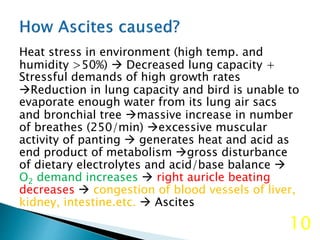
Heat stress in environment (high temp. and
humidity >50%)  Decreased lung capacity +
Stressful demands of high growth rates
Reduction in lung capacity and bird is unable to
evaporate enough water from its lung air sacs
and bronchial tree massive increase in number
of breathes (250/min) excessive muscular
activity of panting  generates heat and acid as
end product of metabolism gross disturbance
of dietary electrolytes and acid/base balance 
O2 demand increases  right auricle beating
decreases  congestion of blood vessels of liver,
kidney, intestine.etc.  Ascites
10
 Sudden deaths in rapidly developing birds
 Poor development
 Progressive weakness and abdominal
distension
 Recumbency
 Dyspnea
 Possibly cyanosis
11
 Thickening of right side myocardium
 Dilation of the ventricle
 Thickening of the atrioventricular valve
 General venous congestion
 Severe muscle congestion
 Lungs and intestines congested
 Liver enlargement
 Spleen small
 Ascites
 Pericardial effusion
 Microscopic: cartilage nodules increases in
lungs.
12
 Broiler Sudden death syndrome
 Bacterial endocarditis
 Tumors
 Fat deposition
 Salpingitis
13
 Good ventilation (including in incubation and
transport)
 Avoid any genetic tendency
 Control respiratory diseases
 Decrease feed to decrease the O2 demand
 Change litter in Layer farm (increased ammonia 
a cause of ascites)
 Pull off curtain in Broiler farm (for good ventilation)
 Avoid excess salt (NaCl)
 Avoid excessive levels of sulphur containing amino
acids
 Reduce chloride salts of vitamins and amino acids.
14
 Improve ventilation
 Vitamin C (500 ppm) has been reported to be
of benefits (in South America)
 Hepatocare : for improving hepatic function.
 Nephrocare : for improving renal function
 Toxin binder: for binding fungal and other
toxins in feed.
15
16

Ascites

  • 1.
    Presented By: Shankar Pd.Poudel Manoj L. Sharma Nirvik Neupane 1
  • 2.
     Owner Name:Faisingh lama  Address: Bharatpur-18  Species: Avain (Broiler)  Age: 21 days  Date: 2072-08-11 Post mortem lesions:  Congested muscles  Fluid filled cavities  Fibrinous pericarditis  Liver hard in consistency (Cirrhotic liver)  Congested intestine  Swollen kidney with congestion  Congested lungs 2
  • 3.
    Treatment:  Liq. Tefroli Sig:10ml/100 birds OD × 7days  Liq. Nephrocare Sig: 28 ml/100 birds OD × 7 days  Liq. Biotox Sig: 1ml/lit. DW × 5 days Advice:  Do not cover curtain  Change litter (add new) Veterinarian: Dr. S. B. Raut 3
  • 4.
     Ascites: asI’ teez…. Derived from Greek Word ‘askos’, meaning ‘a bag’  An abnormal collection of fluid in abdominal cavity.  Not a disease but a clinical manifestation of visceral organs.  Fluid may contain yellow protein clots giving it a yellowish tinge  Occurs mostly in dog and poultry 4
  • 5.
    Ascites OEDEMA involving theabdomen; a very common complication of abdominal tuberculosis, of liver, kidney, or heart disease, as well as of some parasitic infestations. In poultry, ascites is sometimes associated with hypoxia (‘high altitude disease’) although there are other causes including toxins or, in individuals, heart defects or abdominal tumors. It is also seen in ducks with furazolidone poisoning. 5
  • 6.
     Occurs mostfrequently in Growing chickens Esp. 5-6 weeks old  May be higher than 10% in flock  Worldwide occurrence  Mortality 1-2% 6
  • 7.
     BPHS (BroilerPulmonary Hypertension Syndrome)  High altitude disease  Edema disease  Heart Failure Syndrome  Dropsy  Water belly 7
  • 8.
     Hepatitis (cirrhosisof liver)  Peritonitis  Congestive heart failure (Cardiac cause)  Nephrotic Syndrome (Renal cause)  Hypoproteinaemia (Nutritional cause) 8
  • 9.
     Can beinfectious or non infectious agents  Toxins  Poor ventilation (inadequate supply of O2  related to stock, housing, feed)  Respiratory diseases  Amyloidosis..? commonly found in meat type ducks and breeders that means accumulation of abnormal proteins, called amyloids, in one or more organ system. 9
  • 10.
    Heat stress inenvironment (high temp. and humidity >50%)  Decreased lung capacity + Stressful demands of high growth rates Reduction in lung capacity and bird is unable to evaporate enough water from its lung air sacs and bronchial tree massive increase in number of breathes (250/min) excessive muscular activity of panting  generates heat and acid as end product of metabolism gross disturbance of dietary electrolytes and acid/base balance  O2 demand increases  right auricle beating decreases  congestion of blood vessels of liver, kidney, intestine.etc.  Ascites 10
  • 11.
     Sudden deathsin rapidly developing birds  Poor development  Progressive weakness and abdominal distension  Recumbency  Dyspnea  Possibly cyanosis 11
  • 12.
     Thickening ofright side myocardium  Dilation of the ventricle  Thickening of the atrioventricular valve  General venous congestion  Severe muscle congestion  Lungs and intestines congested  Liver enlargement  Spleen small  Ascites  Pericardial effusion  Microscopic: cartilage nodules increases in lungs. 12
  • 13.
     Broiler Suddendeath syndrome  Bacterial endocarditis  Tumors  Fat deposition  Salpingitis 13
  • 14.
     Good ventilation(including in incubation and transport)  Avoid any genetic tendency  Control respiratory diseases  Decrease feed to decrease the O2 demand  Change litter in Layer farm (increased ammonia  a cause of ascites)  Pull off curtain in Broiler farm (for good ventilation)  Avoid excess salt (NaCl)  Avoid excessive levels of sulphur containing amino acids  Reduce chloride salts of vitamins and amino acids. 14
  • 15.
     Improve ventilation Vitamin C (500 ppm) has been reported to be of benefits (in South America)  Hepatocare : for improving hepatic function.  Nephrocare : for improving renal function  Toxin binder: for binding fungal and other toxins in feed. 15
  • 16.