Pat Page – MBA, MAT
2014 RI Teacher of Year
Honored to represent the best…
Rhode Island Teachers
Pat Wygant
Co-Teacher
East Greenwich High School
Building Purposeful
Relationships:
The foundation for a
successful teaching career
Teaching is about
interacting with people,
not interacting with
paper.
Source: Stakeholders’ Perspectives on Induction for New Teachers…
(2010)
Education
Stakeholders
Parents
and
Caregivers
Business
and
Industry
Civic and
Community
Organizations
Students
Teachers and
Administrators
School
Committee
Governing
Bodies
BREAK DOWN THE SILOSClassroom
Departments
ExternalStakeholders
Find a way to get involved and to involve others !
Leverage
External
Expertise
LEVERAGE EXTERNAL EXPERTISE
ENGAGE CIVIC AND
INDUSTRY
LEADERS
MAKE THE
LEARNING
RELEVANT
#C2M_EGHS
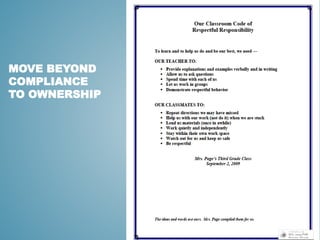
MOVE BEYOND
COMPLIANCE
TO OWNERSHIP
MODEL RISK TAKING
AND RESILIENCY
• Connect
• Share ownership and
accountability
• Take a risk
• Demonstrate resiliency
• Make it real
• Contact us:
• ppage@egsd.net
• pwygant@egsd.net
• @eghsbiz
CHALLENGE YOU
TO MAKE A
COMMITMENT
TODAY

ASCD presentation

Editor's Notes

  • #2 Pat Page: Introduction and Background Pat Wygant: Introduction and Background Pat P: Today, we going to focus on one competency that is at the foundation for your success as a teacher and the success of your students…and it’s not subject matter expertise. It’s the to build constructive, purposeful relationships.
  • #3 PW: Those words were attributed to an NT, or new teacher, in this Stakeholder study. This NT recognized early that interactions with students and key stakeholders should not be relegated to the passing of paper documents back and forth, that building relationships is critical to a positive and successful teaching and educational experience.
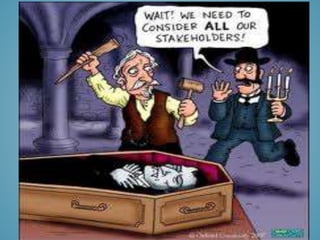
  • #4 Pat P: Now with whom do we need to build those relationships, who are the stakeholders that we must consider.
  • #5 Pat Page: Here’s my list….which is my no means exhaustive. I’m certain you can add or subject from it. I’ve identified several key stakeholder groups; individuals and entities that have a vested interest in education and more important, in your future success as an educator. Parents and caregivers entrusting you with their $250,000 - $500,000 investment; yes that’ a conservative estimate of how much was spent on you before you started college Business and Industry want workforce ready graduates – students who have developed transferrable knowledge, skills and abilities, what they call competencies. Governing bodies:, department of education on state and national levels and school committee on local put systems and supports in place to serve and support both teacher/administrators Community organizations are looking for civic-minded individuals to make a meaningful contribution to society. So at this point, you’re sitting back and saying… I have 25 elementary students and 120 middle-high school students to worry about, how can I build relationships with all these stakeholders? We’re going to take it incrementally First, we’ll define which stakeholders you should target? And then I’ll outline ways to enlist their help and support in a meaningful way.
  • #6 Pat W: First step building relationships engaging stakeholders starts with your own personal and professional behavior Your first step is to not allow yourself to be contained in your silo. What is a silo Of course I Googled it and the first hit was Wikipedia…tower like structures for holding bulk materials. Take this silo metaphor and apply it to your upcoming experience as a teacher…. That bulk material in your silo are the 25 students or grains you attempt to contain within your classroom. Your are the Subject-Matter Expert in your silo At the High School; we add another silo…departments… mathematics, science, social studies, languages and then the electives. We eat lunch separately, have separate department meetings and even have our own separate handshake (just kidding) Silo head…Department Chair External Stakeholders….want to way in…don’t’ know how. Here’s where you come into the picture
  • #7 Pat W: Reach beyond the boundaries of your classroom and discipline Seek input from colleagues in other departments, meet with them during lunch, before and after school. Share your ideas for lessons and ask for their input and guidance One of your objectives is learn how to integrate, reinforce and build on the content and skills being developed down the hall First year teacher told me, best advice she received (wasn’t from me)…was “Find a way to get involve… And I appended that “Find a way to get involved and to involve others.”
  • #8 Pat: Rigor and Relevance: let’s leverage the external expertise within or stakeholders. Parent who worked in a research lab; studying the states of matter and the water cycle. She came in and showed us…. about sublimation – substance transforms directly from a solid to a gaseous state without the intermediate step. Talk about impactful. My musical acumen is zero…pitch, tone, it’s all the same to me…but not to this parent who helped with a sound and wave science kit.
  • #9 This next relevant learning venture did involve multiple stakeholders….did drive a few stakes as part of the process of creating a learning garden Cross-curricula connections: math, science, language arts, health, art (signage and logo) Knew nothing about gardening…so when my class was awarded the grant…knew I needed help. Talked to anyone who would listen: Higher education: URI Master Gardener Program Foot Doctor: Community Groups: Providence’s Southside community land trust Daggett Farms in Slater Park – knew they partnered with individuals with disabilities; actually shared alternative assessment models for their student/employees, which I went back and shared with Special Education/Resource Staff PTG or PTA -- parent teacher association Grandparents High School Science Department I enlisted an army, and here’s the results
  • #10 These students are heading to that D quadrant
  • #11 Pat W: Probably saying it’s easy at the elementary level to involve stakeholders; students don’t want the parents involved at the HS level. You’re right…..so outreach to the civic and industry groups; rotary club; chamber of commerce; local community development authority; local shop owners Discuss Choose 2 Matter
  • #12 Obviously students need to be vested and committed to the educational experience. They are the key stakeholder and it’s imperative that you build a meaningful relationship with them. Learning is messy and can be disorderly; need to make certain unacceptable behaviors don’t get in the way. Objective: self-regulation….have the students hold themselves and each other accountable for their behaviors. Elementary version of a Shared Code of Conduct. The thoughts are theirs, the typing is mine! High school level: have students self evaluation on a rubric to behavioral standards (like a copy of either of these documents or the process by which I developed them…send an e-mail)
  • #13 If you want to make the learning relevant and involve stakeholders, you need to be embrace risk. Your challenge , my challenge is to model risk taking and resiliency. We must be willing to undertake a new venture along the students, make mistakes, troubleshoot, regroup and remain focused the outcome
  • #14 Out outcome from today is to leave you with this challenge: Connect: find a way to get involved or to involve others in your learning environment Co-develop set of classroom standards elementary, special needs, high school Take a risk and demonstrate resiliency when it doesn’t work Above all….make it real