COMMUNITY BASED PARTNERSHIPS
OCTOBER 26, 2015
WELCOME AND INTRODUCTIONS
Paul Smith, Facilitator
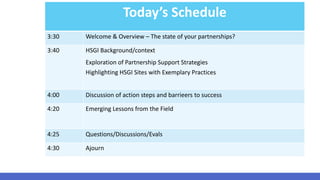
Today’s Schedule
3:30 Welcome & Overview – The state of your partnerships?
3:40 HSGI Background/context
Exploration of Partnership Support Strategies
Highlighting HSGI Sites with Exemplary Practices
4:00 Discussion of action steps and barrieers to success
4:20 Emerging Lessons from the Field
4:25 Questions/Discussions/Evals
4:30 Ajourn
WHAT IS A PARTNER?
AND WHY ARE THEY CRITICAL?
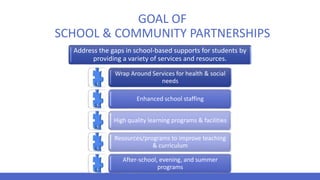
GOAL OF
SCHOOL & COMMUNITY PARTNERSHIPS
Address the gaps in school-based supports for students by
providing a variety of services and resources.
Wrap Around Services for health & social
needs
Enhanced school staffing
High quality learning programs & facilities
Resources/programs to improve teaching
& curriculum
After-school, evening, and summer
programs
SO… IS THERE ONE SOLUTION?
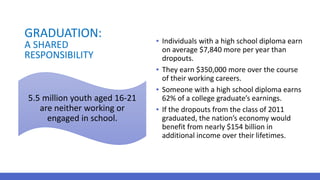
GRADUATION:
A SHARED
RESPONSIBILITY
▪ Individuals with a high school diploma earn
on average $7,840 more per year than
dropouts.
▪ They earn $350,000 more over the course
of their working careers.
▪ Someone with a high school diploma earns
62% of a college graduate’s earnings.
▪ If the dropouts from the class of 2011
graduated, the nation’s economy would
benefit from nearly $154 billion in
additional income over their lifetimes.
5.5 million youth aged 16-21
are neither working or
engaged in school.
SESSION PRIMER
▪ Consider the state of your partnerships – overall status?
▪ Examine categories of partnerships and assess progress;
▪ 3 categories: A) strong B) needs attention C) big challenges
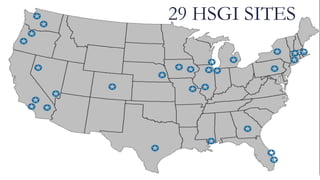
Since 2010,
29 HSGI grantees
have worked with partners to
strengthen secondary education
and keep more young people
on the path to graduation and
beyond.
29 HSGI SITES
KEY HSGI PARTNERSHIP FACTS…
▪ HSGI required applicants to partner with agencies and
CBOs.
▪ ED made Partnerships an “absolute priority” for HSGI
grantees to address non-academic root causes of drop-outs.
▪ Health, poverty, family instability.
▪ States/districts improving graduation rates identified
“multi-sector collaboration” as key to schools having the
resources & conditions necessary to meet graduation
challenge.
HSGI PROJECT ACTIVITIES
▪ Early identification of students at-risk of not graduating
▪ Service provision designed to keep at-risk students in school
▪ Identification and outreach to out-of-school youth
▪ Comprehensive site-based approaches
▪ Transition programs from middle to high schools
Sites identified partnerships as essential elements
for the success for these initiatives.
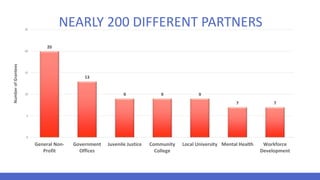
NEARLY 200 DIFFERENT PARTNERS
20
13
9 9 9
7 7
0
5
10
15
20
25
General Non-
Profit
Government
Offices
Juvenile Justice Community
College
Local University Mental Health Workforce
Development
NumberofGrantees
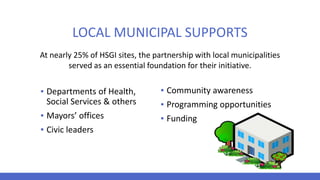
LOCAL MUNICIPAL SUPPORTS
▪ Departments of Health,
Social Services & others
▪ Mayors’ offices
▪ Civic leaders
▪ Community awareness
▪ Programming opportunities
▪ Funding
At nearly 25% of HSGI sites, the partnership with local municipalities
served as an essential foundation for their initiative.
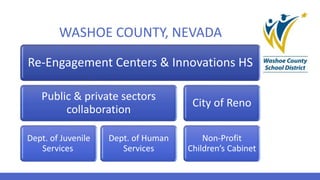
WASHOE COUNTY, NEVADA
Re-Engagement Centers & Innovations HS
Public & private sectors
collaboration
Dept. of Juvenile
Services
Dept. of Human
Services
City of Reno
Non-Profit
Children’s Cabinet
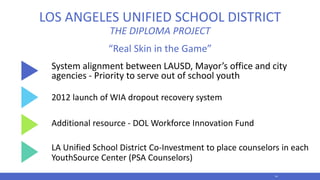
“Real Skin in the Game”
16
System alignment between LAUSD, Mayor’s office and city
agencies - Priority to serve out of school youth
Additional resource - DOL Workforce Innovation Fund
LA Unified School District Co-Investment to place counselors in each
YouthSource Center (PSA Counselors)
2012 launch of WIA dropout recovery system
LOS ANGELES UNIFIED SCHOOL DISTRICT
THE DIPLOMA PROJECT
STUDENT SUPPORTS
“A Mix of Hard Work with Heart Work”
Most HSGI sites developed safety net partnerships:
Wrap-Around
Social-Emotional
Mental Health
Through local municipalities or non-profit CBOs.
HSGI sites identified a clear need
to provide stability for fragile youth.
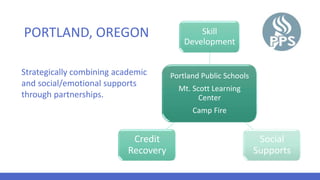
PORTLAND, OREGON
Portland Public Schools
Mt. Scott Learning
Center
Camp Fire
Skill
Development
Social
Supports
Credit
Recovery
Strategically combining academic
and social/emotional supports
through partnerships.
ACADEMIC SUPPORTS
▪Tutoring
▪Credit Recovery
▪Blend of Academic & Social Supports
▪Attendance Support
▪Re-Engagement
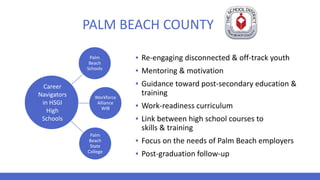
PALM BEACH COUNTY
Palm
Beach
Schools
Workforce
Alliance
WIB
Palm
Beach
State
College
Career
Navigators
in HSGI
High
Schools
▪ Re-engaging disconnected & off-track youth
▪ Mentoring & motivation
▪ Guidance toward post-secondary education &
training
▪ Work-readiness curriculum
▪ Link between high school courses to
skills & training
▪ Focus on the needs of Palm Beach employers
▪ Post-graduation follow-up
HIGHER EDUCATION PARTNERSHIPS
Many HSGI sites have partnerships with community colleges &
universities as a powerful strategy for reengaging and
motivating disconnected youth.
Dual credit
Accelerating learning
Credit recovery
Career certifications
Transition counseling
Professional development for staff
SALEM-KEIZER PUBLIC SCHOOLS
Salem-Keizer’s Early College High School co-
located at Chemeketa Community College. • Graduation Coaches
• Mentoring
• College/career
guidance
• Dual credit options
• Teen Parent supports
• On-site childcare
JUVENILE JUSTICE PARTNERSHIPS
▪ Probation departments
▪ Violence prevention coalitions
▪ District courts
▪ Juvenile assessment centers
▪ Law enforcement agencies
 Student supports
 Mentoring
 Outreach
 Assessments
 Counseling
 Referrals
 Parent/Family Supports
 School Staff Supports
 Professional Development
 Technical Assistance
 Safety planning
 Funding
While less than 10% of HSGI sites formally
collaborated with Juvenile Justice, many
others report ongoing informal relationships.
ST. CLAIR COUNTY SCHOOLS
Stay in School (SIS) Program
▪ Probation officers in the schools
▪ Suspended students earning credits
▪ Safe environment
▪ Certified teachers
▪ Chief of Juvenile Justice key member of
SIS Steering Committee
“The presence of law enforcement as a partner and normal part of
the fabric of the school community has helped bridge
the perceived disconnect between youth and police.”
FINANCIAL PARTNERS
▪ Scholarships to higher education
▪ Funding for programs, staffing, PD
▪ Building capital
▪ Books, newspapers, supplies
▪ Incentives
▪ Afterschool & summer programming
▪ Fundraising support
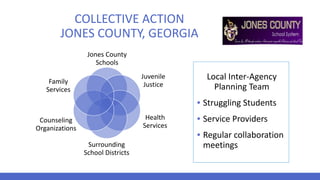
Jones County
Schools
Juvenile
Justice
Health
Services
Surrounding
School Districts
Family
Services
Counseling
Organizations
COLLECTIVE ACTION
JONES COUNTY, GEORGIA
Local Inter-Agency
Planning Team
▪ Struggling Students
▪ Service Providers
▪ Regular collaboration
meetings
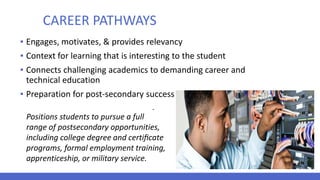
CAREER PATHWAYS
▪ Engages, motivates, & provides relevancy
▪ Context for learning that is interesting to the student
▪ Connects challenging academics to demanding career and
technical education
▪ Preparation for post-secondary success
.
Positions students to pursue a full
range of postsecondary opportunities,
including college degree and certificate
programs, formal employment training,
apprenticeship, or military service.
CHICAGO PUBIC SCHOOLS
▪ Blue 1647
EXAMINE YOUR STATUS
▪ In your assigned category, please compare notes on your B’s and C’s
▪ What are barriers to success?
▪ What are some possible solutions?
▪ Advice for others?
KEY MESSAGES FROM HSGI SITES
Seek
Understanding
Leadership Matters
Partnerships
Evolve
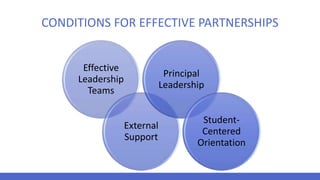
CONDITIONS FOR EFFECTIVE PARTNERSHIPS
Effective
Leadership
Teams
External
Support
Principal
Leadership
Student-
Centered
Orientation
EMERGING LESSONS FROM THE FIELD
▪ To “hit the ground running,” partners need:
▪ A good understanding of the district and the students;
▪ To be embedded in the community; and
▪ A longstanding relationship with the district, if possible.
▪ Trust, commitment and willingness to share are essential.
▪ Passion about this work and youth is the driver.
▪ Finding the fine line between management and
micro-management needs ongoing attention.

EMERGING LESSONS FROM THE FIELD
▪ Consistent communication and clear expectations among all
form the basis of a healthy, productive working relationship
among partners.
▪ Partners must identify, share and meet their own
organizational interests, as well as the collective
interests of the group. No one partner can
dominate or meet its interests to the detriment
of another partner or the group goal for the
community’s youth.
RESOURCES
▪ School-Community Partnerships: A Guide. UCLA Center for Mental Health in
Schools, 2006.
▪ Sustaining School and Community Efforts to Enhance Outcomes for Children
and Youth. UCLA Center for Mental Health in Schools, 2008.
▪ School-Community Partnerships Benefit All. Lonsdale, 2011.
▪ The Role of School and Community-Based Programs in Aiding Latina/o High
School Persistence. Harris & Kiyama, 2015.
▪ Building Strong Community Partnerships: Equal Voice and Mutual Benefits.
Journal of Latinos and Education v13, n2. De La Garza, Kuri, & Lissette, 2014.
▪ Achieving Results Through Community School Partnerships: How District and
Community Leaders Are Building Effective, Sustainable Relationships. Martin
J. Blank, Reuben Jacobson, & Atelia Melaville, 2012.
CONTACT INFO-
PBS1207@GMAIL.COM
410-206-0394
WWW.PAULSMITHCONSULTING.ORG
THANK YOU!

Partnerships_NDPNconf_SanAn2015

  • 1.
  • 2.
  • 3.
    Today’s Schedule 3:30 Welcome& Overview – The state of your partnerships? 3:40 HSGI Background/context Exploration of Partnership Support Strategies Highlighting HSGI Sites with Exemplary Practices 4:00 Discussion of action steps and barrieers to success 4:20 Emerging Lessons from the Field 4:25 Questions/Discussions/Evals 4:30 Ajourn
  • 4.
    WHAT IS APARTNER? AND WHY ARE THEY CRITICAL?
  • 5.
    GOAL OF SCHOOL &COMMUNITY PARTNERSHIPS Address the gaps in school-based supports for students by providing a variety of services and resources. Wrap Around Services for health & social needs Enhanced school staffing High quality learning programs & facilities Resources/programs to improve teaching & curriculum After-school, evening, and summer programs
  • 6.
    SO… IS THEREONE SOLUTION?
  • 7.
    GRADUATION: A SHARED RESPONSIBILITY ▪ Individualswith a high school diploma earn on average $7,840 more per year than dropouts. ▪ They earn $350,000 more over the course of their working careers. ▪ Someone with a high school diploma earns 62% of a college graduate’s earnings. ▪ If the dropouts from the class of 2011 graduated, the nation’s economy would benefit from nearly $154 billion in additional income over their lifetimes. 5.5 million youth aged 16-21 are neither working or engaged in school.
  • 8.
    SESSION PRIMER ▪ Considerthe state of your partnerships – overall status? ▪ Examine categories of partnerships and assess progress; ▪ 3 categories: A) strong B) needs attention C) big challenges
  • 9.
    Since 2010, 29 HSGIgrantees have worked with partners to strengthen secondary education and keep more young people on the path to graduation and beyond.
  • 10.
  • 11.
    KEY HSGI PARTNERSHIPFACTS… ▪ HSGI required applicants to partner with agencies and CBOs. ▪ ED made Partnerships an “absolute priority” for HSGI grantees to address non-academic root causes of drop-outs. ▪ Health, poverty, family instability. ▪ States/districts improving graduation rates identified “multi-sector collaboration” as key to schools having the resources & conditions necessary to meet graduation challenge.
  • 12.
    HSGI PROJECT ACTIVITIES ▪Early identification of students at-risk of not graduating ▪ Service provision designed to keep at-risk students in school ▪ Identification and outreach to out-of-school youth ▪ Comprehensive site-based approaches ▪ Transition programs from middle to high schools Sites identified partnerships as essential elements for the success for these initiatives.
  • 13.
    NEARLY 200 DIFFERENTPARTNERS 20 13 9 9 9 7 7 0 5 10 15 20 25 General Non- Profit Government Offices Juvenile Justice Community College Local University Mental Health Workforce Development NumberofGrantees
  • 14.
    LOCAL MUNICIPAL SUPPORTS ▪Departments of Health, Social Services & others ▪ Mayors’ offices ▪ Civic leaders ▪ Community awareness ▪ Programming opportunities ▪ Funding At nearly 25% of HSGI sites, the partnership with local municipalities served as an essential foundation for their initiative.
  • 15.
    WASHOE COUNTY, NEVADA Re-EngagementCenters & Innovations HS Public & private sectors collaboration Dept. of Juvenile Services Dept. of Human Services City of Reno Non-Profit Children’s Cabinet
  • 16.
    “Real Skin inthe Game” 16 System alignment between LAUSD, Mayor’s office and city agencies - Priority to serve out of school youth Additional resource - DOL Workforce Innovation Fund LA Unified School District Co-Investment to place counselors in each YouthSource Center (PSA Counselors) 2012 launch of WIA dropout recovery system LOS ANGELES UNIFIED SCHOOL DISTRICT THE DIPLOMA PROJECT
  • 17.
    STUDENT SUPPORTS “A Mixof Hard Work with Heart Work” Most HSGI sites developed safety net partnerships: Wrap-Around Social-Emotional Mental Health Through local municipalities or non-profit CBOs. HSGI sites identified a clear need to provide stability for fragile youth.
  • 18.
    PORTLAND, OREGON Portland PublicSchools Mt. Scott Learning Center Camp Fire Skill Development Social Supports Credit Recovery Strategically combining academic and social/emotional supports through partnerships.
  • 19.
    ACADEMIC SUPPORTS ▪Tutoring ▪Credit Recovery ▪Blendof Academic & Social Supports ▪Attendance Support ▪Re-Engagement
  • 20.
    PALM BEACH COUNTY Palm Beach Schools Workforce Alliance WIB Palm Beach State College Career Navigators inHSGI High Schools ▪ Re-engaging disconnected & off-track youth ▪ Mentoring & motivation ▪ Guidance toward post-secondary education & training ▪ Work-readiness curriculum ▪ Link between high school courses to skills & training ▪ Focus on the needs of Palm Beach employers ▪ Post-graduation follow-up
  • 21.
    HIGHER EDUCATION PARTNERSHIPS ManyHSGI sites have partnerships with community colleges & universities as a powerful strategy for reengaging and motivating disconnected youth. Dual credit Accelerating learning Credit recovery Career certifications Transition counseling Professional development for staff
  • 22.
    SALEM-KEIZER PUBLIC SCHOOLS Salem-Keizer’sEarly College High School co- located at Chemeketa Community College. • Graduation Coaches • Mentoring • College/career guidance • Dual credit options • Teen Parent supports • On-site childcare
  • 23.
    JUVENILE JUSTICE PARTNERSHIPS ▪Probation departments ▪ Violence prevention coalitions ▪ District courts ▪ Juvenile assessment centers ▪ Law enforcement agencies  Student supports  Mentoring  Outreach  Assessments  Counseling  Referrals  Parent/Family Supports  School Staff Supports  Professional Development  Technical Assistance  Safety planning  Funding While less than 10% of HSGI sites formally collaborated with Juvenile Justice, many others report ongoing informal relationships.
  • 24.
    ST. CLAIR COUNTYSCHOOLS Stay in School (SIS) Program ▪ Probation officers in the schools ▪ Suspended students earning credits ▪ Safe environment ▪ Certified teachers ▪ Chief of Juvenile Justice key member of SIS Steering Committee “The presence of law enforcement as a partner and normal part of the fabric of the school community has helped bridge the perceived disconnect between youth and police.”
  • 25.
    FINANCIAL PARTNERS ▪ Scholarshipsto higher education ▪ Funding for programs, staffing, PD ▪ Building capital ▪ Books, newspapers, supplies ▪ Incentives ▪ Afterschool & summer programming ▪ Fundraising support
  • 26.
    Jones County Schools Juvenile Justice Health Services Surrounding School Districts Family Services Counseling Organizations COLLECTIVEACTION JONES COUNTY, GEORGIA Local Inter-Agency Planning Team ▪ Struggling Students ▪ Service Providers ▪ Regular collaboration meetings
  • 27.
    CAREER PATHWAYS ▪ Engages,motivates, & provides relevancy ▪ Context for learning that is interesting to the student ▪ Connects challenging academics to demanding career and technical education ▪ Preparation for post-secondary success . Positions students to pursue a full range of postsecondary opportunities, including college degree and certificate programs, formal employment training, apprenticeship, or military service.
  • 28.
  • 29.
    EXAMINE YOUR STATUS ▪In your assigned category, please compare notes on your B’s and C’s ▪ What are barriers to success? ▪ What are some possible solutions? ▪ Advice for others?
  • 30.
    KEY MESSAGES FROMHSGI SITES Seek Understanding Leadership Matters Partnerships Evolve
  • 31.
    CONDITIONS FOR EFFECTIVEPARTNERSHIPS Effective Leadership Teams External Support Principal Leadership Student- Centered Orientation
  • 32.
    EMERGING LESSONS FROMTHE FIELD ▪ To “hit the ground running,” partners need: ▪ A good understanding of the district and the students; ▪ To be embedded in the community; and ▪ A longstanding relationship with the district, if possible. ▪ Trust, commitment and willingness to share are essential. ▪ Passion about this work and youth is the driver. ▪ Finding the fine line between management and micro-management needs ongoing attention.
  • 33.
    EMERGING LESSONS FROMTHE FIELD ▪ Consistent communication and clear expectations among all form the basis of a healthy, productive working relationship among partners. ▪ Partners must identify, share and meet their own organizational interests, as well as the collective interests of the group. No one partner can dominate or meet its interests to the detriment of another partner or the group goal for the community’s youth.
  • 34.
    RESOURCES ▪ School-Community Partnerships:A Guide. UCLA Center for Mental Health in Schools, 2006. ▪ Sustaining School and Community Efforts to Enhance Outcomes for Children and Youth. UCLA Center for Mental Health in Schools, 2008. ▪ School-Community Partnerships Benefit All. Lonsdale, 2011. ▪ The Role of School and Community-Based Programs in Aiding Latina/o High School Persistence. Harris & Kiyama, 2015. ▪ Building Strong Community Partnerships: Equal Voice and Mutual Benefits. Journal of Latinos and Education v13, n2. De La Garza, Kuri, & Lissette, 2014. ▪ Achieving Results Through Community School Partnerships: How District and Community Leaders Are Building Effective, Sustainable Relationships. Martin J. Blank, Reuben Jacobson, & Atelia Melaville, 2012.
  • 35.
  • 36.

Editor's Notes

  • #14 Compare this with paper