A CRITICAL REFLECTION
KAVYA MARAN - AS LEVEL MEDIA STUDIES
How does your product use or challenge
conventions and how does it represent
social groups or issues?
STRUCTURE AND FORMAT
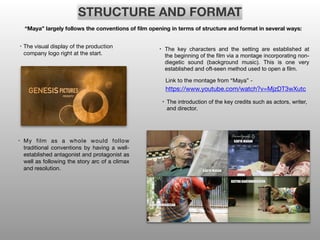
“Maya” largely follows the conventions of film opening in terms of structure and format in several ways:
• The visual display of the production
company logo right at the start.
• My film as a whole would follow
traditional conventions by having a well-
established antagonist and protagonist as
well as following the story arc of a climax
and resolution.
• The key characters and the setting are established at
the beginning of the film via a montage incorporating non-
diegetic sound (background music). This is one very
established and oft-seen method used to open a film.
Link to the montage from “Maya” - 

https://www.youtube.com/watch?v=MjzDT3wXutc
• The introduction of the key credits such as actors, writer,
and director.
SHOTS AND ANGLES
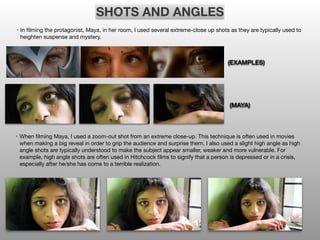
• In filming the protagonist, Maya, in her room, I used several extreme-close up shots as they are typically used to
heighten suspense and mystery.
• When filming Maya, I used a zoom-out shot from an extreme close-up. This technique is often used in movies
when making a big reveal in order to grip the audience and surprise them. I also used a slight high angle as high
angle shots are typically understood to make the subject appear smaller, weaker and more vulnerable. For
example, high angle shots are often used in Hitchcock films to signify that a person is depressed or in a crisis,
especially after he/she has come to a terrible realization.
(EXAMPLES)
(MAYA)
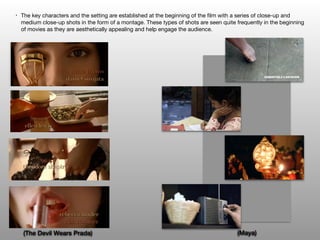
• The key characters and the setting are established at the beginning of the film with a series of close-up and
medium close-up shots in the form of a montage. These types of shots are seen quite frequently in the beginning
of movies as they are aesthetically appealing and help engage the audience.
(The Devil Wears Prada) (Maya)
LIGHTING
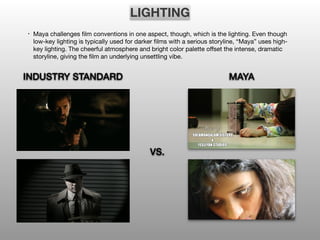
• Maya challenges film conventions in one aspect, though, which is the lighting. Even though
low-key lighting is typically used for darker films with a serious storyline, “Maya” uses high-
key lighting. The cheerful atmosphere and bright color palette offset the intense, dramatic
storyline, giving the film an underlying unsettling vibe.
VS.
INDUSTRY STANDARD MAYA
FLASHBACKS
The flashbacks incorporate echoed sounds, and are given a hazy,
over-exposed appearance in order to differentiate the aesthetic of
these scenes from the rest of the film. The scenes have a
completely different look and feel, with the trailed movements
creating an air of confusion and eeriness.
This tactic is often used in movies when jumping time frames in order to help
the audience follow the storyline.
For example, in the 2006 motion picture “The Namesake”, the flashback
sequences were shot with jerky movements, a hazy appearance and a highly
saturated color palette in order to establish a unique look and feel for these
scenes and set them apart from the rest of the film.
Link to the flashback sequence from “Maya” - 

https://www.youtube.com/watch?v=6w2sffzcvv8
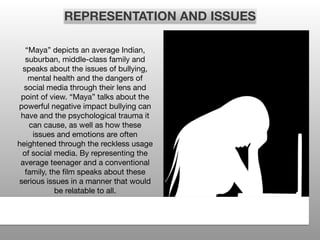
REPRESENTATION AND ISSUES
“Maya” depicts an average Indian,
suburban, middle-class family and
speaks about the issues of bullying,
mental health and the dangers of
social media through their lens and
point of view. “Maya” talks about the
powerful negative impact bullying can
have and the psychological trauma it
can cause, as well as how these
issues and emotions are often
heightened through the reckless usage
of social media. By representing the
average teenager and a conventional
family, the film speaks about these
serious issues in a manner that would
be relatable to all.
How does your product engage with audiences
and how would it be distributed as a real media text?
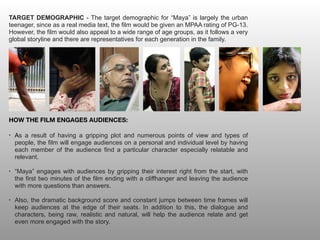
TARGET DEMOGRAPHIC - The target demographic for “Maya” is largely the urban
teenager, since as a real media text, the film would be given an MPAA rating of PG-13.
However, the film would also appeal to a wide range of age groups, as it follows a very
global storyline and there are representatives for each generation in the family.
HOW THE FILM ENGAGES AUDIENCES:
• As a result of having a gripping plot and numerous points of view and types of
people, the film will engage audiences on a personal and individual level by having
each member of the audience find a particular character especially relatable and
relevant.
• “Maya” engages with audiences by gripping their interest right from the start, with
the first two minutes of the film ending with a cliffhanger and leaving the audience
with more questions than answers.
• Also, the dramatic background score and constant jumps between time frames will
keep audiences at the edge of their seats. In addition to this, the dialogue and
characters, being raw, realistic and natural, will help the audience relate and get
even more engaged with the story.
• Promotion for the film would include a large social media presence and social media campaigns on
Twitter, Instagram and Tumblr, in addition to television and billboard ads, as teenagers are most
prominently targeted.
• The film would be released in theaters worldwide as it follows a very global storyline that is relatable
and accessible to people all over the world.
• “Maya” would be also available for purchase on Video-On-Demand sites such as iTunes, Amazon,
and YouTube shortly following the release, as the younger generations would find these platforms
more accessible.
• The film would eventually be available for streaming on Netflix and Hulu, and have repeated
television screenings worldwide in order to reach out to an international audience.
DISTRIBUTION
As a real media text, “Maya” would be distributed incorporating aspects of both new media as
well as traditional media as the film is targeted at a wide audience comprising of many different
age groups.
How did your production skills develop
throughout this project?
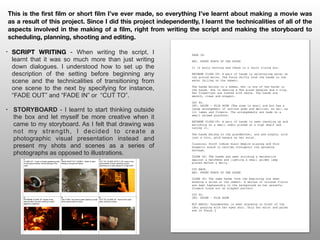
• SCRIPT WRITING - When writing the script, I
learnt that it was so much more than just writing
down dialogues. I understood how to set up the
description of the setting before beginning any
scene and the technicalities of transitioning from
one scene to the next by specifying for instance,
“FADE OUT” and “FADE IN” or “CUT TO”.
• STORYBOARD - I learnt to start thinking outside
the box and let myself be more creative when it
came to my storyboard. As I felt that drawing was
not my strength, I decided to create a
photographic visual presentation instead and
present my shots and scenes as a series of
photographs as opposed to illustrations.
This is the first film or short film I’ve ever made, so everything I’ve learnt about making a movie was
as a result of this project. Since I did this project independently, I learnt the technicalities of all of the
aspects involved in the making of a film, right from writing the script and making the storyboard to
scheduling, planning, shooting and editing.
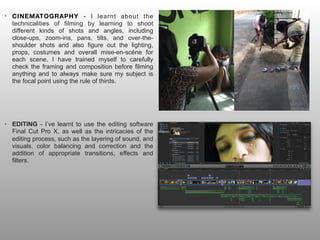
• CINEMATOGRAPHY - I learnt about the
technicalities of filming by learning to shoot
different kinds of shots and angles, including
close-ups, zoom-ins, pans, tilts, and over-the-
shoulder shots and also figure out the lighting,
props, costumes and overall mise-en-scéne for
each scene. I have trained myself to carefully
check the framing and composition before filming
anything and to always make sure my subject is
the focal point using the rule of thirds.
• EDITING - I’ve learnt to use the editing software
Final Cut Pro X, as well as the intricacies of the
editing process, such as the layering of sound, and
visuals, color balancing and correction and the
addition of appropriate transitions, effects and
filters.
How did you integrate technologies – software,
hardware, and online – in this project?
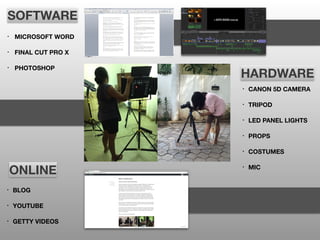
SOFTWARE
• MICROSOFT WORD
• FINAL CUT PRO X
• PHOTOSHOP
HARDWARE
• CANON 5D CAMERA
• TRIPOD
• LED PANEL LIGHTS
• PROPS
• COSTUMES
• MIC
ONLINE
• BLOG
• YOUTUBE
• GETTY VIDEOS
• Then, during the actual filming, hardware was used in terms of my camera, lights, props,
and tripod. I used a Canon 5D for filming with a 24-105 mm lens, along with a tripod. I also
used artificial LED panel lights with yellow filters as fill lights to balance the natural light in
certain shots in the opening montage.
• My online blog has helped me record my progress and thoughts throughout the entire
course of the project and I’ve consistently kept it updated.
• In addition to this, during editing, I’ve used the Internet to source copyright free background
music and sound effects for the flashback transitions and production company titling.
This project has involved a beautiful blend of software, hardware, and online technologies.
Therefore, it is evident that during each stage of production, software, hardware and online
technologies played a major role and were an integral part of each scene visible on the screen. For
example, if I was shooting the scene with the protagonist, Maya, in her room, I had my script and
storyboard on display on my desktop while I filmed using my camera, lights and tripod, after which I
could edit my footage using the Final Cut Pro X software and then proceed to update my online blog.
Like this, I have integrated technologies - software, hardware, and online - in this project.
• I’ve used the software Final Cut Pro X for editing and it has been the most crucial
component in bringing all my footage together and turning it into to a 2-minute film opening.
• I used Microsoft Word to create my script and storyboard in the initial stages of the project.
The process of working on this project has been incredibly interesting
as well as a great learning experience, and “Maya” will hopefully be
engaging and appealing to anyone who views it. I’ve come to realize
how wonderfully interesting and stimulating the journey of making a
film really is and I’ve fallen in love with the idea of being filmmaker.

AS Level Media Studies - CREATIVE CRITICAL REFLECTION (Film Opening Task)

  • 1.
    A CRITICAL REFLECTION KAVYAMARAN - AS LEVEL MEDIA STUDIES
  • 2.
    How does yourproduct use or challenge conventions and how does it represent social groups or issues?
  • 3.
    STRUCTURE AND FORMAT “Maya”largely follows the conventions of film opening in terms of structure and format in several ways: • The visual display of the production company logo right at the start. • My film as a whole would follow traditional conventions by having a well- established antagonist and protagonist as well as following the story arc of a climax and resolution. • The key characters and the setting are established at the beginning of the film via a montage incorporating non- diegetic sound (background music). This is one very established and oft-seen method used to open a film. Link to the montage from “Maya” - https://www.youtube.com/watch?v=MjzDT3wXutc • The introduction of the key credits such as actors, writer, and director.
  • 4.
    SHOTS AND ANGLES •In filming the protagonist, Maya, in her room, I used several extreme-close up shots as they are typically used to heighten suspense and mystery. • When filming Maya, I used a zoom-out shot from an extreme close-up. This technique is often used in movies when making a big reveal in order to grip the audience and surprise them. I also used a slight high angle as high angle shots are typically understood to make the subject appear smaller, weaker and more vulnerable. For example, high angle shots are often used in Hitchcock films to signify that a person is depressed or in a crisis, especially after he/she has come to a terrible realization. (EXAMPLES) (MAYA)
  • 5.
    • The keycharacters and the setting are established at the beginning of the film with a series of close-up and medium close-up shots in the form of a montage. These types of shots are seen quite frequently in the beginning of movies as they are aesthetically appealing and help engage the audience. (The Devil Wears Prada) (Maya)
  • 6.
    LIGHTING • Maya challengesfilm conventions in one aspect, though, which is the lighting. Even though low-key lighting is typically used for darker films with a serious storyline, “Maya” uses high- key lighting. The cheerful atmosphere and bright color palette offset the intense, dramatic storyline, giving the film an underlying unsettling vibe. VS. INDUSTRY STANDARD MAYA
  • 7.
    FLASHBACKS The flashbacks incorporateechoed sounds, and are given a hazy, over-exposed appearance in order to differentiate the aesthetic of these scenes from the rest of the film. The scenes have a completely different look and feel, with the trailed movements creating an air of confusion and eeriness. This tactic is often used in movies when jumping time frames in order to help the audience follow the storyline. For example, in the 2006 motion picture “The Namesake”, the flashback sequences were shot with jerky movements, a hazy appearance and a highly saturated color palette in order to establish a unique look and feel for these scenes and set them apart from the rest of the film. Link to the flashback sequence from “Maya” - https://www.youtube.com/watch?v=6w2sffzcvv8
  • 8.
    REPRESENTATION AND ISSUES “Maya”depicts an average Indian, suburban, middle-class family and speaks about the issues of bullying, mental health and the dangers of social media through their lens and point of view. “Maya” talks about the powerful negative impact bullying can have and the psychological trauma it can cause, as well as how these issues and emotions are often heightened through the reckless usage of social media. By representing the average teenager and a conventional family, the film speaks about these serious issues in a manner that would be relatable to all.
  • 9.
    How does yourproduct engage with audiences and how would it be distributed as a real media text?
  • 10.
    TARGET DEMOGRAPHIC -The target demographic for “Maya” is largely the urban teenager, since as a real media text, the film would be given an MPAA rating of PG-13. However, the film would also appeal to a wide range of age groups, as it follows a very global storyline and there are representatives for each generation in the family. HOW THE FILM ENGAGES AUDIENCES: • As a result of having a gripping plot and numerous points of view and types of people, the film will engage audiences on a personal and individual level by having each member of the audience find a particular character especially relatable and relevant. • “Maya” engages with audiences by gripping their interest right from the start, with the first two minutes of the film ending with a cliffhanger and leaving the audience with more questions than answers. • Also, the dramatic background score and constant jumps between time frames will keep audiences at the edge of their seats. In addition to this, the dialogue and characters, being raw, realistic and natural, will help the audience relate and get even more engaged with the story.
  • 11.
    • Promotion forthe film would include a large social media presence and social media campaigns on Twitter, Instagram and Tumblr, in addition to television and billboard ads, as teenagers are most prominently targeted. • The film would be released in theaters worldwide as it follows a very global storyline that is relatable and accessible to people all over the world. • “Maya” would be also available for purchase on Video-On-Demand sites such as iTunes, Amazon, and YouTube shortly following the release, as the younger generations would find these platforms more accessible. • The film would eventually be available for streaming on Netflix and Hulu, and have repeated television screenings worldwide in order to reach out to an international audience. DISTRIBUTION As a real media text, “Maya” would be distributed incorporating aspects of both new media as well as traditional media as the film is targeted at a wide audience comprising of many different age groups.
  • 12.
    How did yourproduction skills develop throughout this project?
  • 13.
    • SCRIPT WRITING- When writing the script, I learnt that it was so much more than just writing down dialogues. I understood how to set up the description of the setting before beginning any scene and the technicalities of transitioning from one scene to the next by specifying for instance, “FADE OUT” and “FADE IN” or “CUT TO”. • STORYBOARD - I learnt to start thinking outside the box and let myself be more creative when it came to my storyboard. As I felt that drawing was not my strength, I decided to create a photographic visual presentation instead and present my shots and scenes as a series of photographs as opposed to illustrations. This is the first film or short film I’ve ever made, so everything I’ve learnt about making a movie was as a result of this project. Since I did this project independently, I learnt the technicalities of all of the aspects involved in the making of a film, right from writing the script and making the storyboard to scheduling, planning, shooting and editing.
  • 14.
    • CINEMATOGRAPHY -I learnt about the technicalities of filming by learning to shoot different kinds of shots and angles, including close-ups, zoom-ins, pans, tilts, and over-the- shoulder shots and also figure out the lighting, props, costumes and overall mise-en-scéne for each scene. I have trained myself to carefully check the framing and composition before filming anything and to always make sure my subject is the focal point using the rule of thirds. • EDITING - I’ve learnt to use the editing software Final Cut Pro X, as well as the intricacies of the editing process, such as the layering of sound, and visuals, color balancing and correction and the addition of appropriate transitions, effects and filters.
  • 15.
    How did youintegrate technologies – software, hardware, and online – in this project?
  • 16.
    SOFTWARE • MICROSOFT WORD •FINAL CUT PRO X • PHOTOSHOP HARDWARE • CANON 5D CAMERA • TRIPOD • LED PANEL LIGHTS • PROPS • COSTUMES • MIC ONLINE • BLOG • YOUTUBE • GETTY VIDEOS
  • 17.
    • Then, duringthe actual filming, hardware was used in terms of my camera, lights, props, and tripod. I used a Canon 5D for filming with a 24-105 mm lens, along with a tripod. I also used artificial LED panel lights with yellow filters as fill lights to balance the natural light in certain shots in the opening montage. • My online blog has helped me record my progress and thoughts throughout the entire course of the project and I’ve consistently kept it updated. • In addition to this, during editing, I’ve used the Internet to source copyright free background music and sound effects for the flashback transitions and production company titling. This project has involved a beautiful blend of software, hardware, and online technologies. Therefore, it is evident that during each stage of production, software, hardware and online technologies played a major role and were an integral part of each scene visible on the screen. For example, if I was shooting the scene with the protagonist, Maya, in her room, I had my script and storyboard on display on my desktop while I filmed using my camera, lights and tripod, after which I could edit my footage using the Final Cut Pro X software and then proceed to update my online blog. Like this, I have integrated technologies - software, hardware, and online - in this project. • I’ve used the software Final Cut Pro X for editing and it has been the most crucial component in bringing all my footage together and turning it into to a 2-minute film opening. • I used Microsoft Word to create my script and storyboard in the initial stages of the project.
  • 18.
    The process ofworking on this project has been incredibly interesting as well as a great learning experience, and “Maya” will hopefully be engaging and appealing to anyone who views it. I’ve come to realize how wonderfully interesting and stimulating the journey of making a film really is and I’ve fallen in love with the idea of being filmmaker.