PLATYHELMINTHS
or
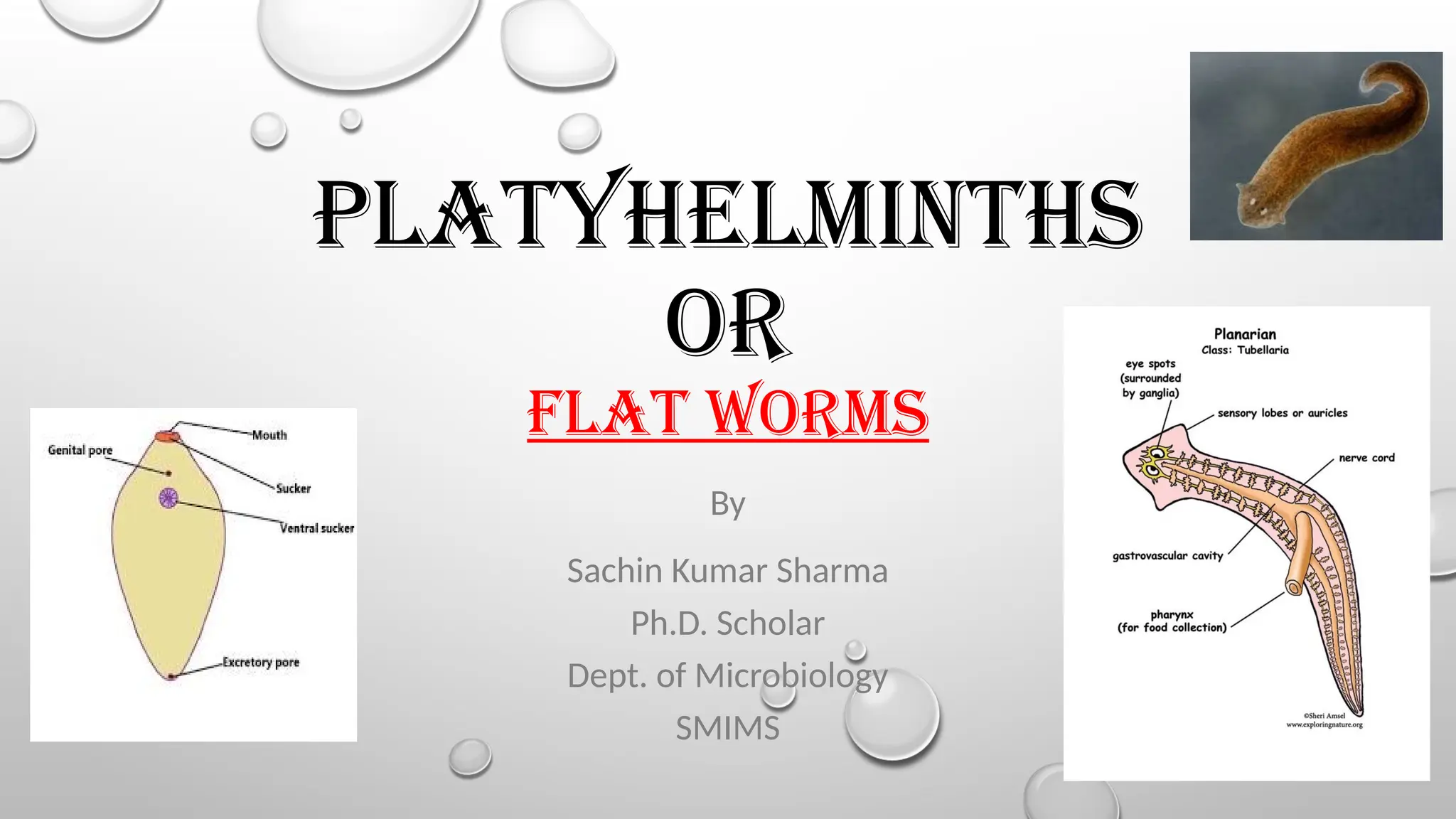
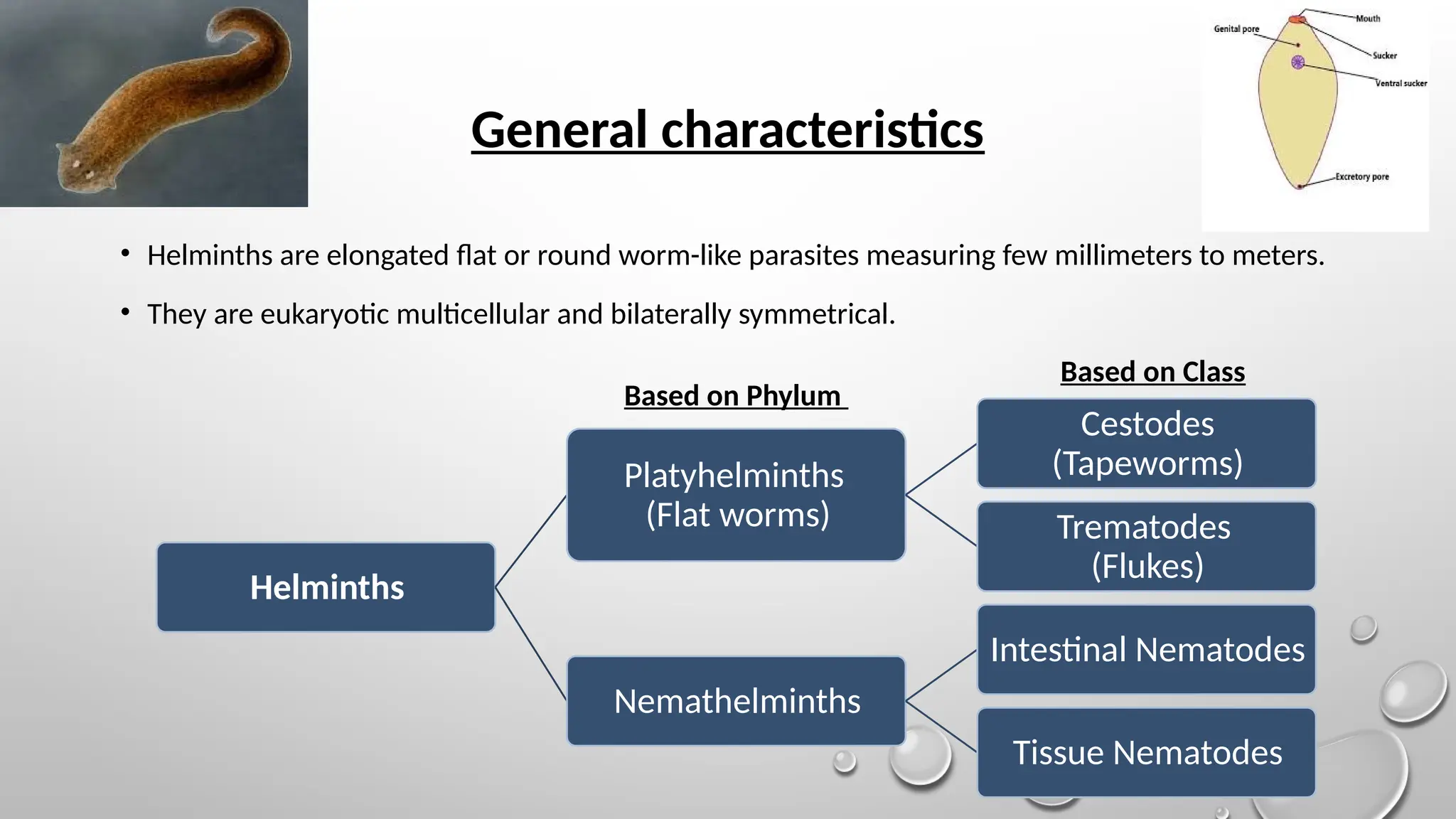
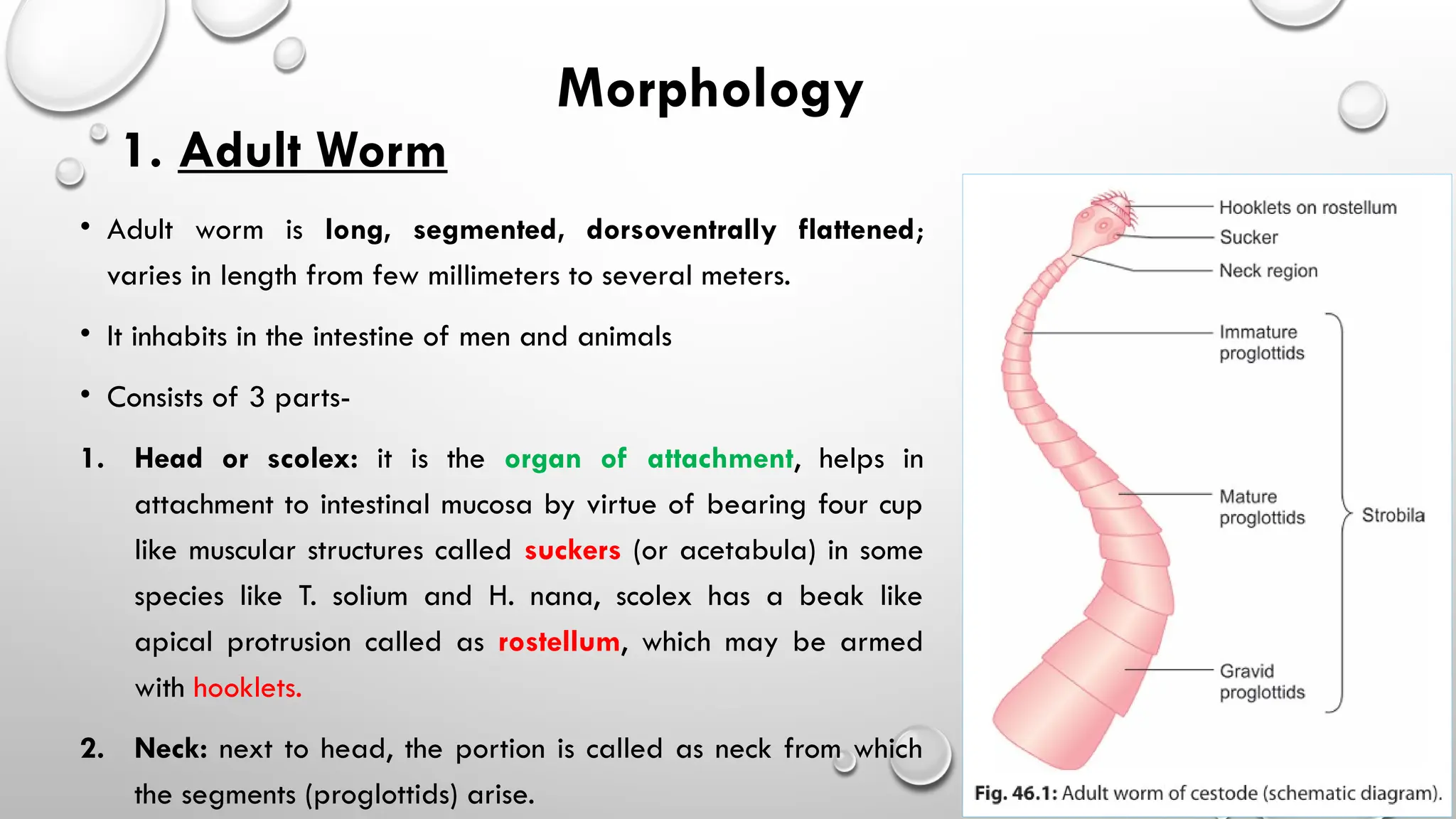
Flat worms
By
Sachin Kumar Sharma
Ph.D. Scholar
Dept. of Microbiology
SMIMS
General characteristics
• Helminths are elongated flat or round worm-like parasites measuring few millimeters to meters.
• They are eukaryotic multicellular and bilaterally symmetrical.
Helminths
Platyhelminths
(Flat worms)
Cestodes
(Tapeworms)
Trematodes
(Flukes)
Nemathelminths
Intestinal Nematodes
Tissue Nematodes
Based on Phylum
Based on Class
Morphology
1. Adult Worm
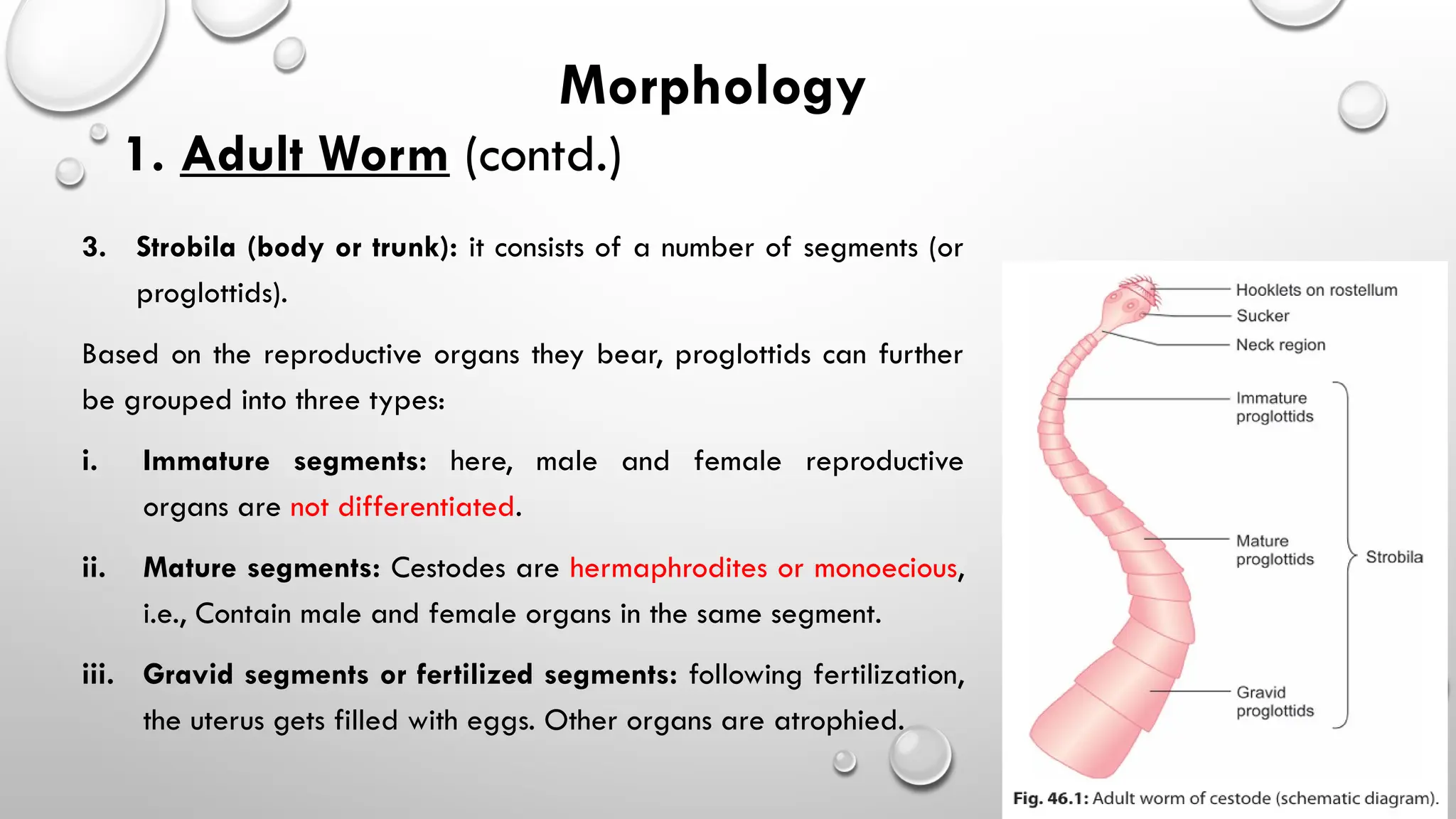
• Adult worm is long, segmented, dorsoventrally flattened;
varies in length from few millimeters to several meters.
• It inhabits in the intestine of men and animals
• Consists of 3 parts-
1. Head or scolex: it is the organ of attachment, helps in
attachment to intestinal mucosa by virtue of bearing four cup
like muscular structures called suckers (or acetabula) in some
species like T. solium and H. nana, scolex has a beak like
apical protrusion called as rostellum, which may be armed
with hooklets.
2. Neck: next to head, the portion is called as neck from which
the segments (proglottids) arise.
Morphology
1. Adult Worm (contd.)
3. Strobila (body or trunk): it consists of a number of segments (or
proglottids).
Based on the reproductive organs they bear, proglottids can further
be grouped into three types:
i. Immature segments: here, male and female reproductive
organs are not differentiated.
ii. Mature segments: Cestodes are hermaphrodites or monoecious,
i.e., Contain male and female organs in the same segment.
iii. Gravid segments or fertilized segments: following fertilization,
the uterus gets filled with eggs. Other organs are atrophied.
2. EGGS
• Eggs are formed following fertilization, fill the gravid proglottids and are subsequently released in
feces - considered as the diagnostic form.
• In most cestodes, the eggs are round to oval, consist of an embryo (or oncosphere) with six
hooklets, surrounded by radially striated embryophore.
3. LARVA
Embryonated eggs undergo further development to form larvae.
Most cestodes have only one larval stage except D. Latum.
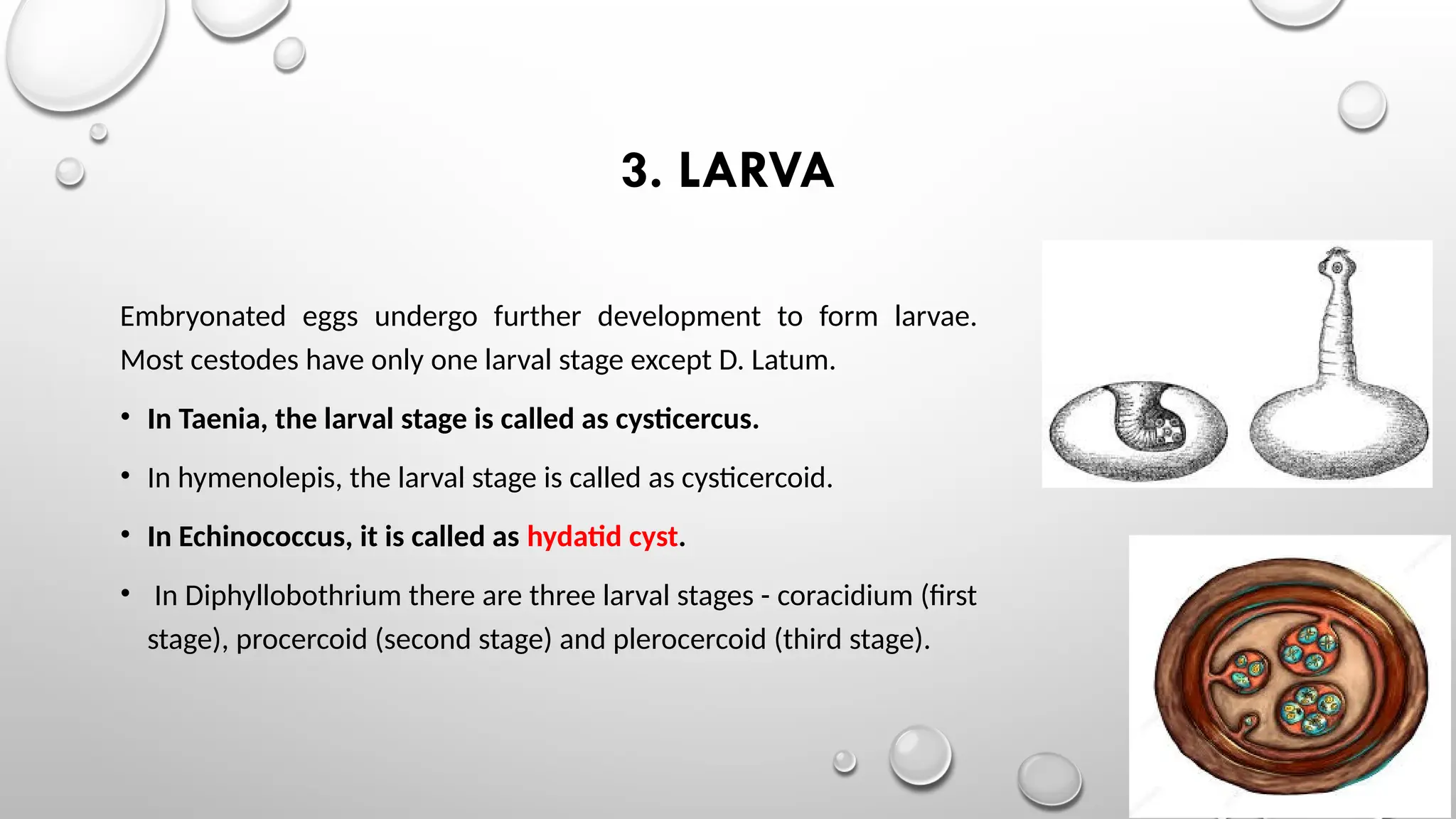
• In Taenia, the larval stage is called as cysticercus.
• In hymenolepis, the larval stage is called as cysticercoid.
• In Echinococcus, it is called as hydatid cyst.
• In Diphyllobothrium there are three larval stages - coracidium (first
stage), procercoid (second stage) and plerocercoid (third stage).
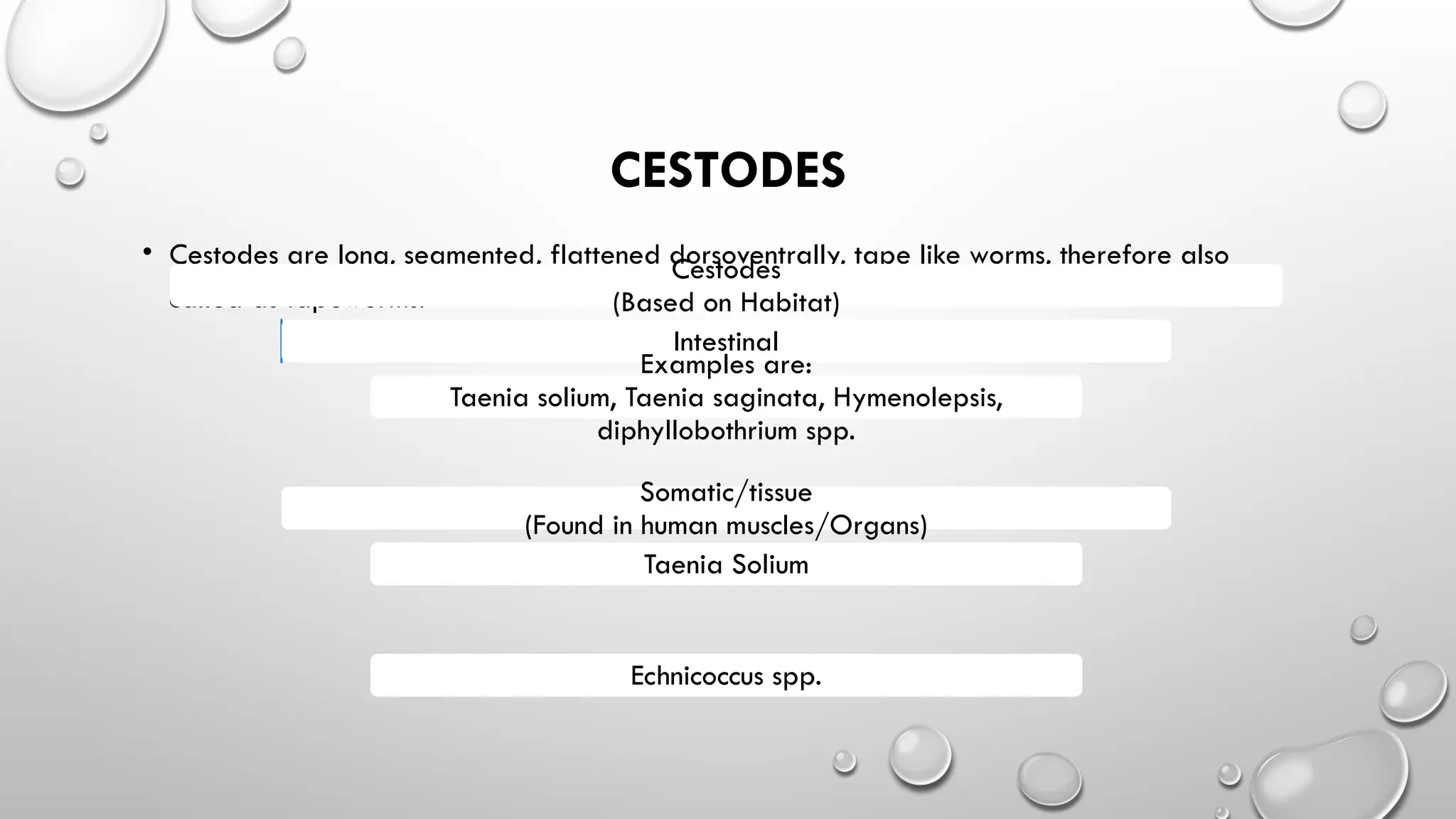
CESTODES
• Cestodes are long, segmented, flattened dorsoventrally, tape like worms, therefore also
called as tapeworms.
Cestodes
(Based on Habitat)
Intestinal
Examples are:
Taenia solium, Taenia saginata, Hymenolepsis,
diphyllobothrium spp.
Somatic/tissue
(Found in human muscles/Organs)
Taenia Solium
Echnicoccus spp.
Intestinal Taeniasis- Taenia
• Taenia exists in three morphological forms.
Adult worm: comprises of head or scolex, neck and a body
divided into several proglottids.
 The scolex bears four cup like muscular suckers which helps
in attachment.
 In t. Solium, the scolex has a beak like apical protrusion
called as rostellum. The rostellum is armed with two rows of
hooklets (hence called as armed tapeworm). Scolex of T. Soilium
Scolex of T. Saginata
Taenia (contd.)
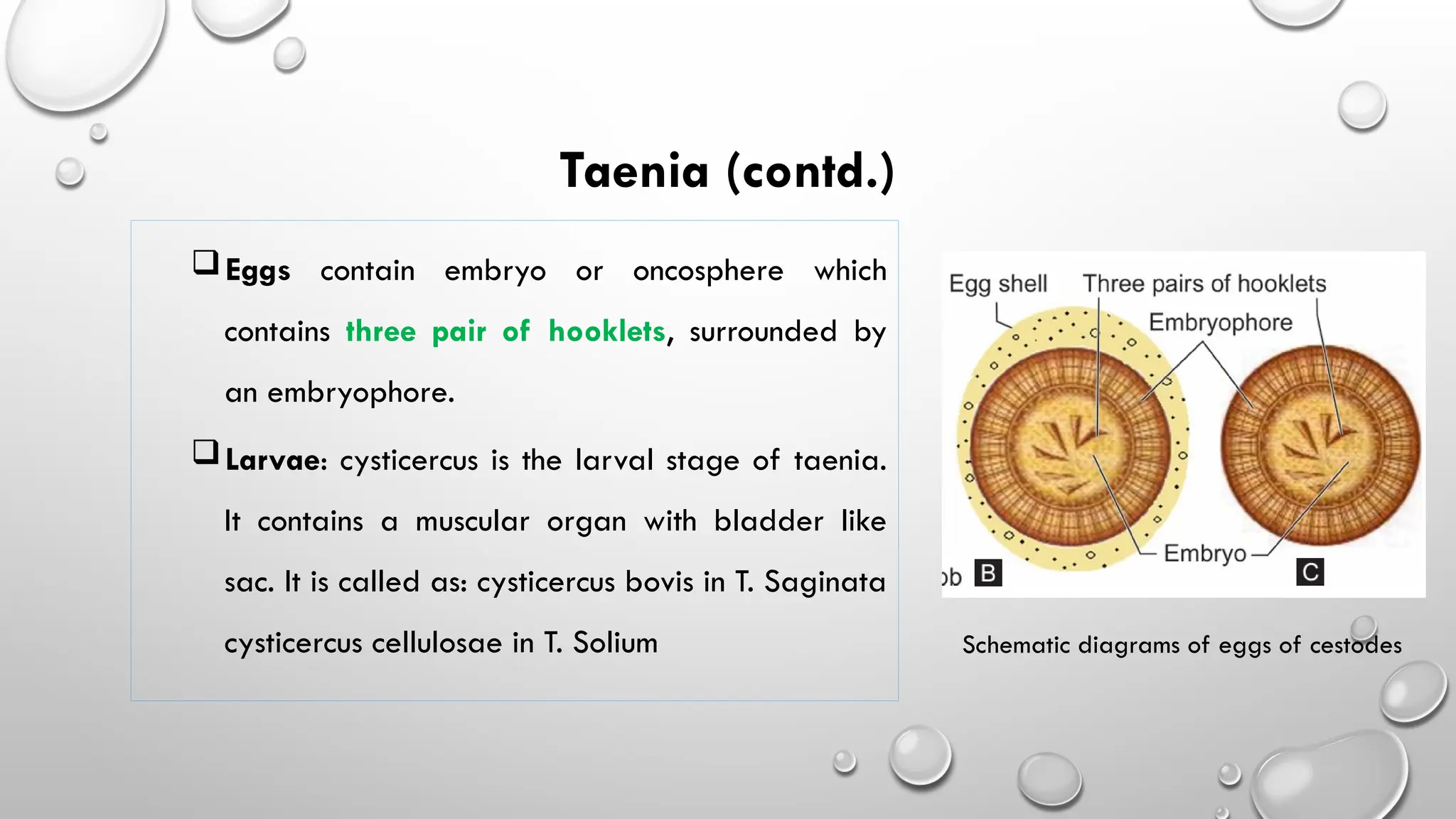
Eggs contain embryo or oncosphere which
contains three pair of hooklets, surrounded by
an embryophore.
Larvae: cysticercus is the larval stage of taenia.
It contains a muscular organ with bladder like
sac. It is called as: cysticercus bovis in T. Saginata
cysticercus cellulosae in T. Solium Schematic diagrams of eggs of cestodes
Life cycle of Taenia passes through two hosts.
• Definitive host: Man
• Intermediate host: Cattle for T. saginata
(hence called beef tapeworm) and pigs for
T. solium (hence called pork tapeworm)
LIFE CYCLE
Hymenolepis nana
• It is the smallest cestode (2.5–4 cm in length) infecting man causing
hymenolepiasis, hence also called as dwarf tapeworm. Eggs are the infective
form as well as the diagnostic form of the parasite.
 Clinical manifestations: h. Nana infection is usually asymptomatic. When the
worm burden exceeds, patients develop symptoms like anorexia, abdominal
pain, headache, dizziness and diarrhea with mucus.
Life Cycle
Man is the only host.
Infective form: Eggs.
Eggs of H. nana
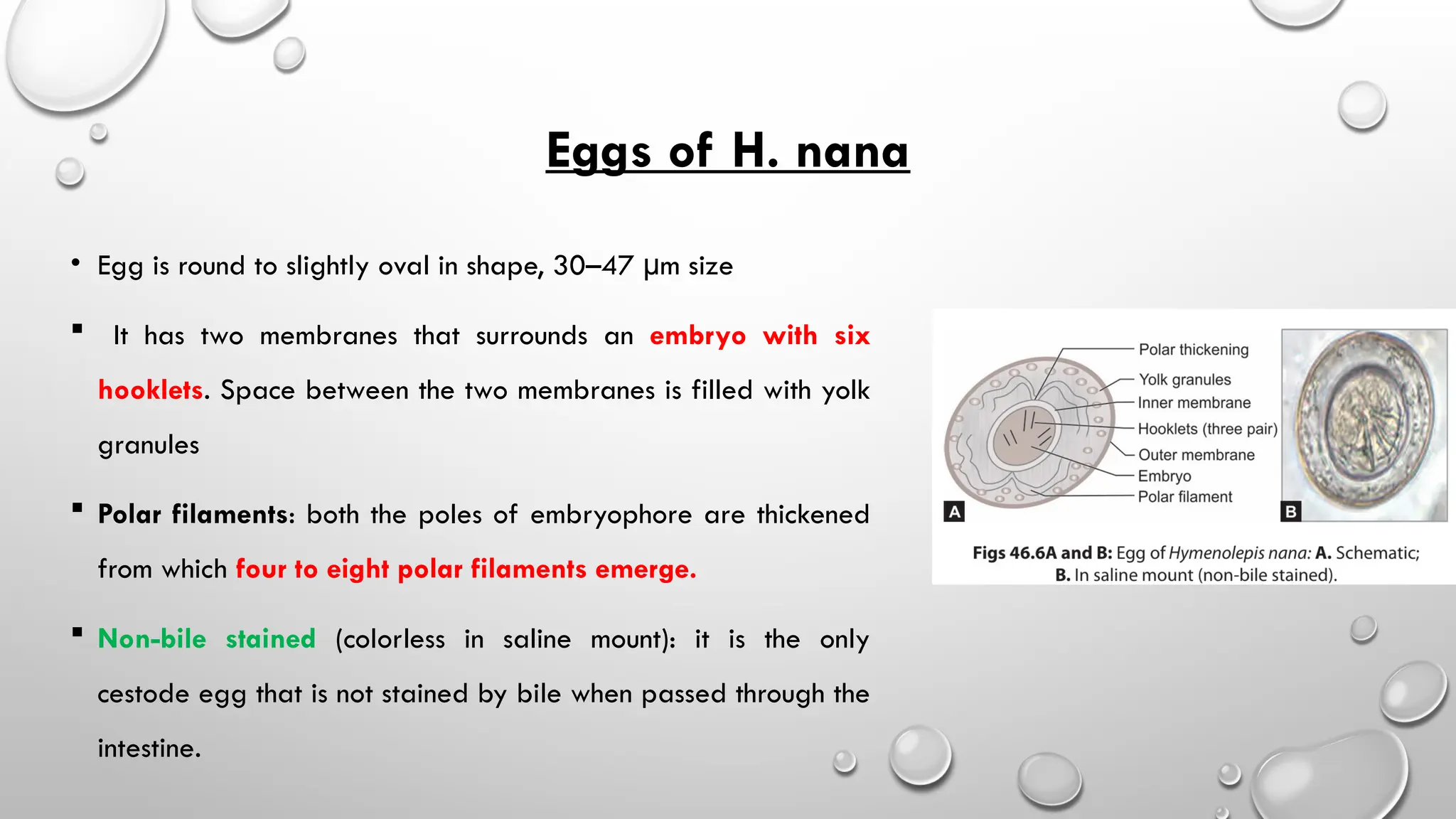
• Egg is round to slightly oval in shape, 30–47 µm size
 It has two membranes that surrounds an embryo with six
hooklets. Space between the two membranes is filled with yolk
granules
 Polar filaments: both the poles of embryophore are thickened
from which four to eight polar filaments emerge.
 Non-bile stained (colorless in saline mount): it is the only
cestode egg that is not stained by bile when passed through the
intestine.
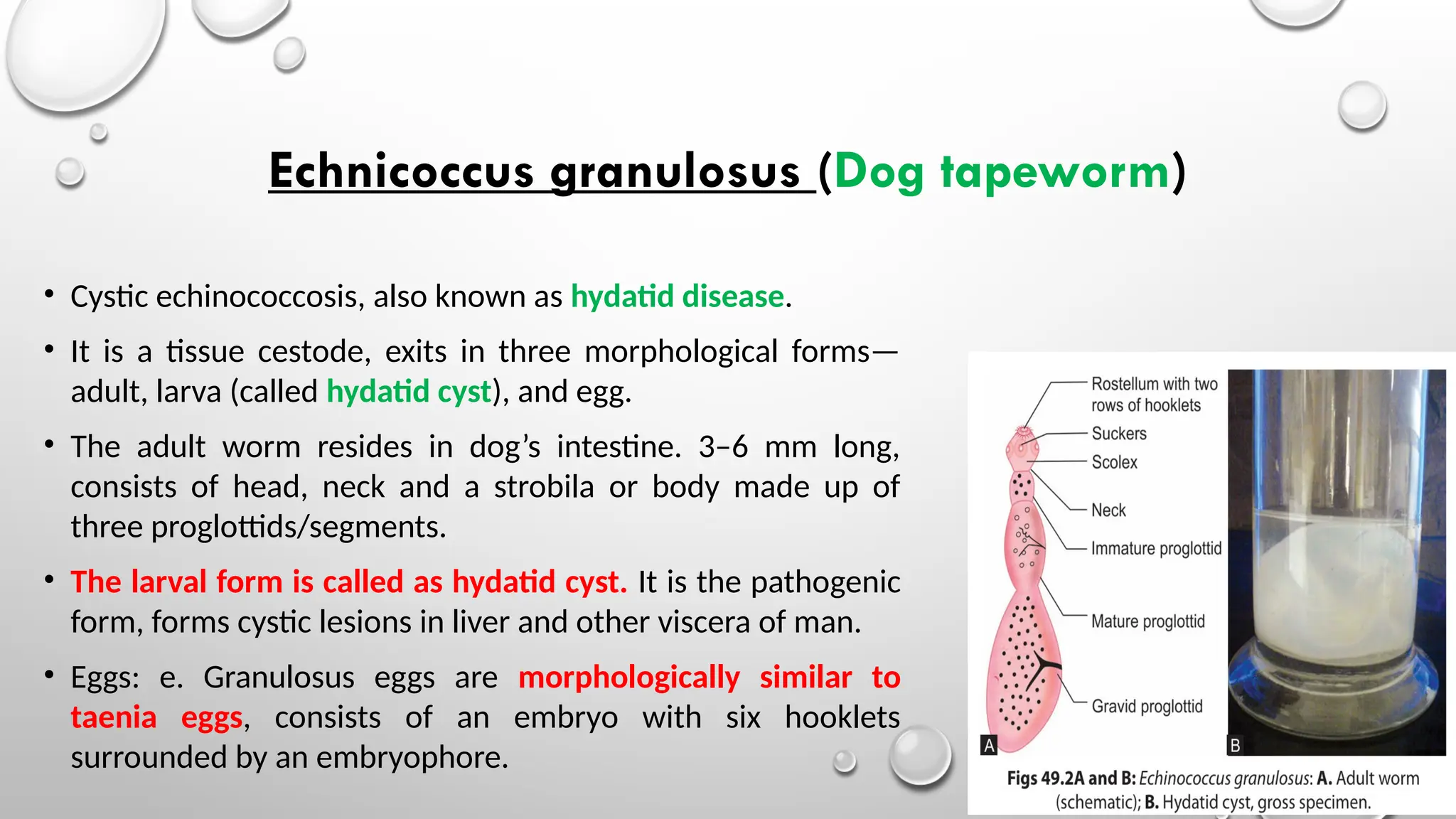
Echnicoccus granulosus (Dog tapeworm)
• Cystic echinococcosis, also known as hydatid disease.
• It is a tissue cestode, exits in three morphological forms—
adult, larva (called hydatid cyst), and egg.
• The adult worm resides in dog’s intestine. 3–6 mm long,
consists of head, neck and a strobila or body made up of
three proglottids/segments.
• The larval form is called as hydatid cyst. It is the pathogenic
form, forms cystic lesions in liver and other viscera of man.
• Eggs: e. Granulosus eggs are morphologically similar to
taenia eggs, consists of an embryo with six hooklets
surrounded by an embryophore.
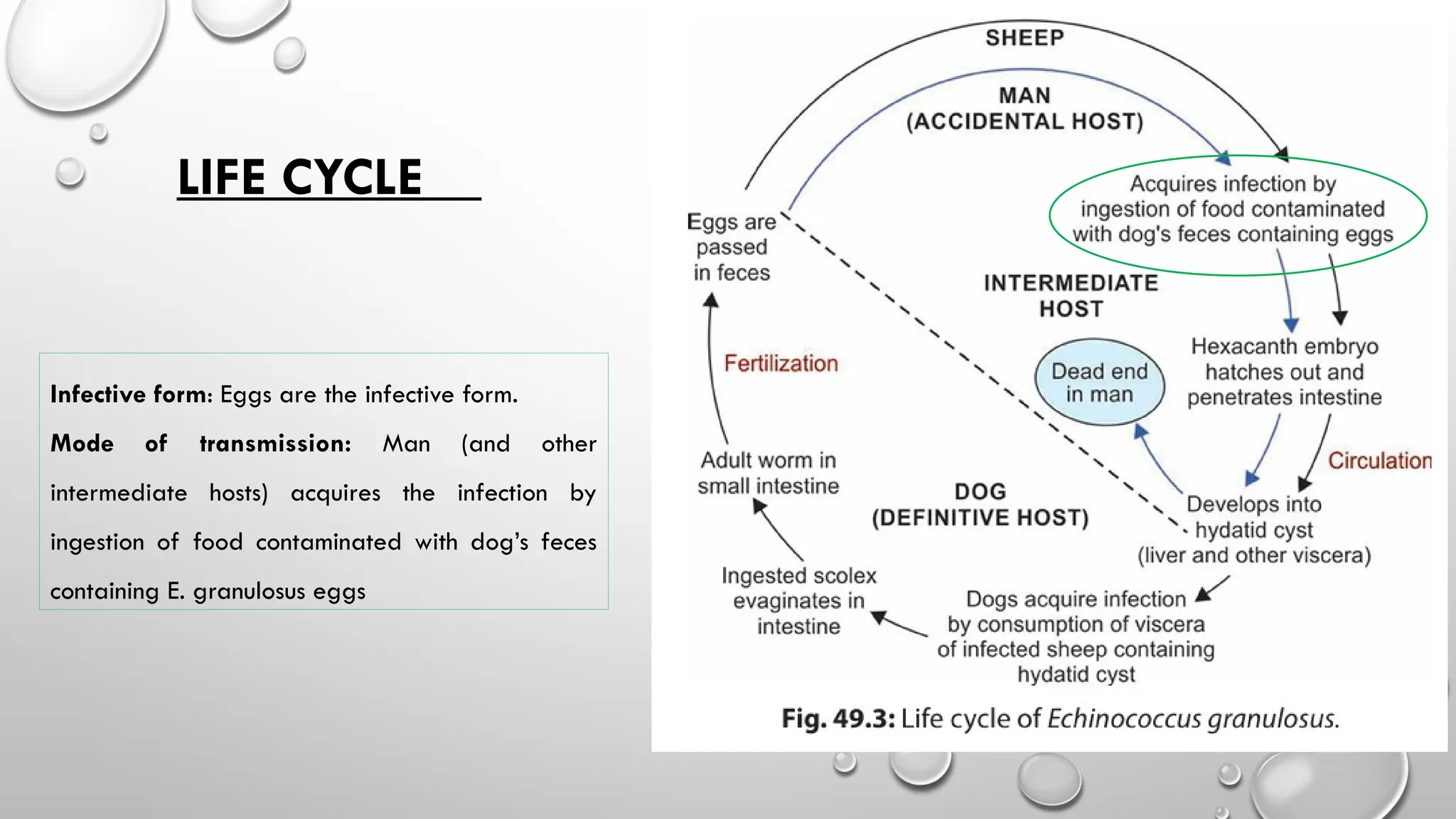
LIFE CYCLE
Infective form: Eggs are the infective form.
Mode of transmission: Man (and other
intermediate hosts) acquires the infection by
ingestion of food contaminated with dog’s feces
containing E. granulosus eggs
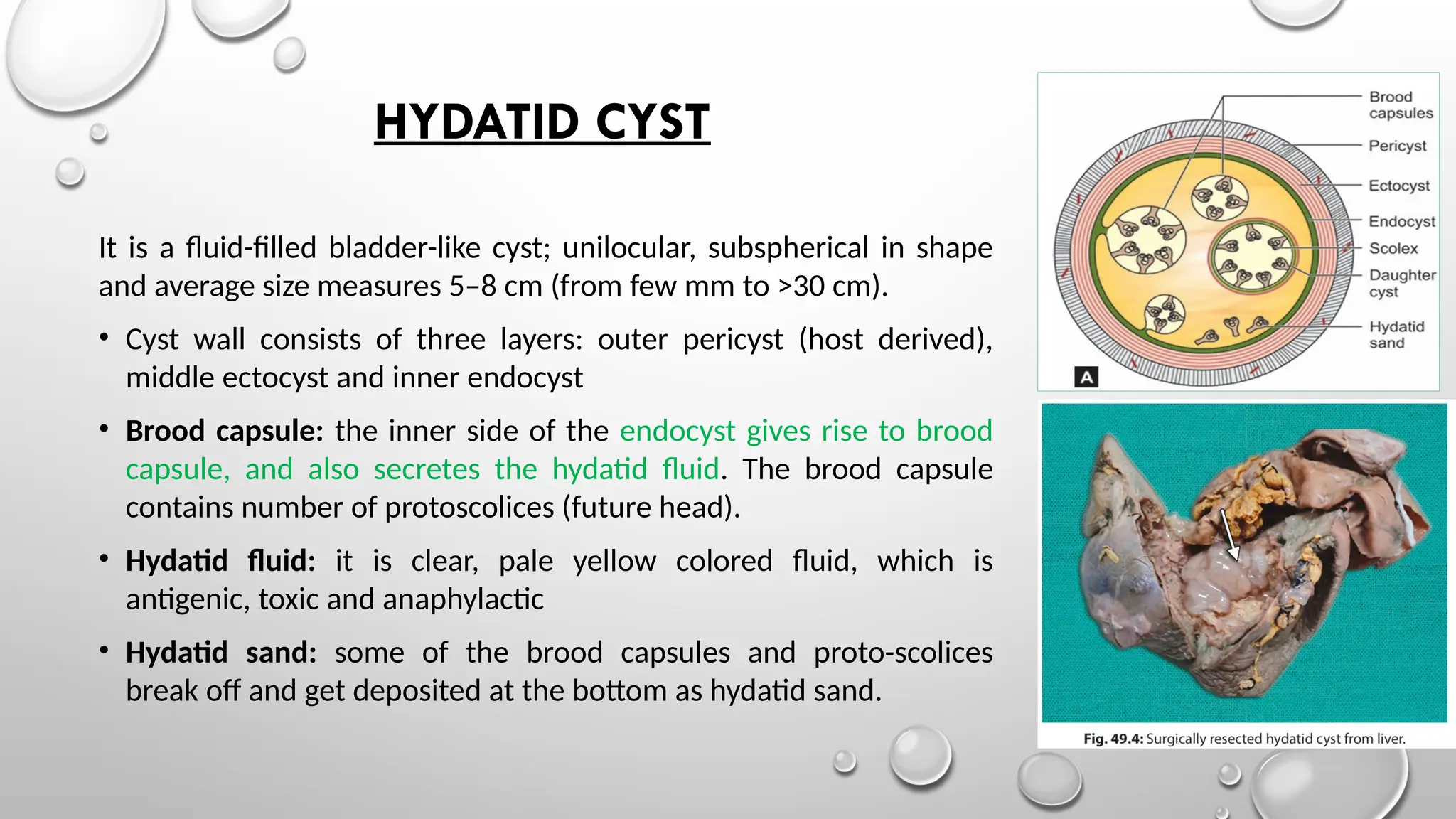
HYDATID CYST
It is a fluid-filled bladder-like cyst; unilocular, subspherical in shape
and average size measures 5–8 cm (from few mm to >30 cm).
• Cyst wall consists of three layers: outer pericyst (host derived),
middle ectocyst and inner endocyst
• Brood capsule: the inner side of the endocyst gives rise to brood
capsule, and also secretes the hydatid fluid. The brood capsule
contains number of protoscolices (future head).
• Hydatid fluid: it is clear, pale yellow colored fluid, which is
antigenic, toxic and anaphylactic
• Hydatid sand: some of the brood capsules and proto-scolices
break off and get deposited at the bottom as hydatid sand.
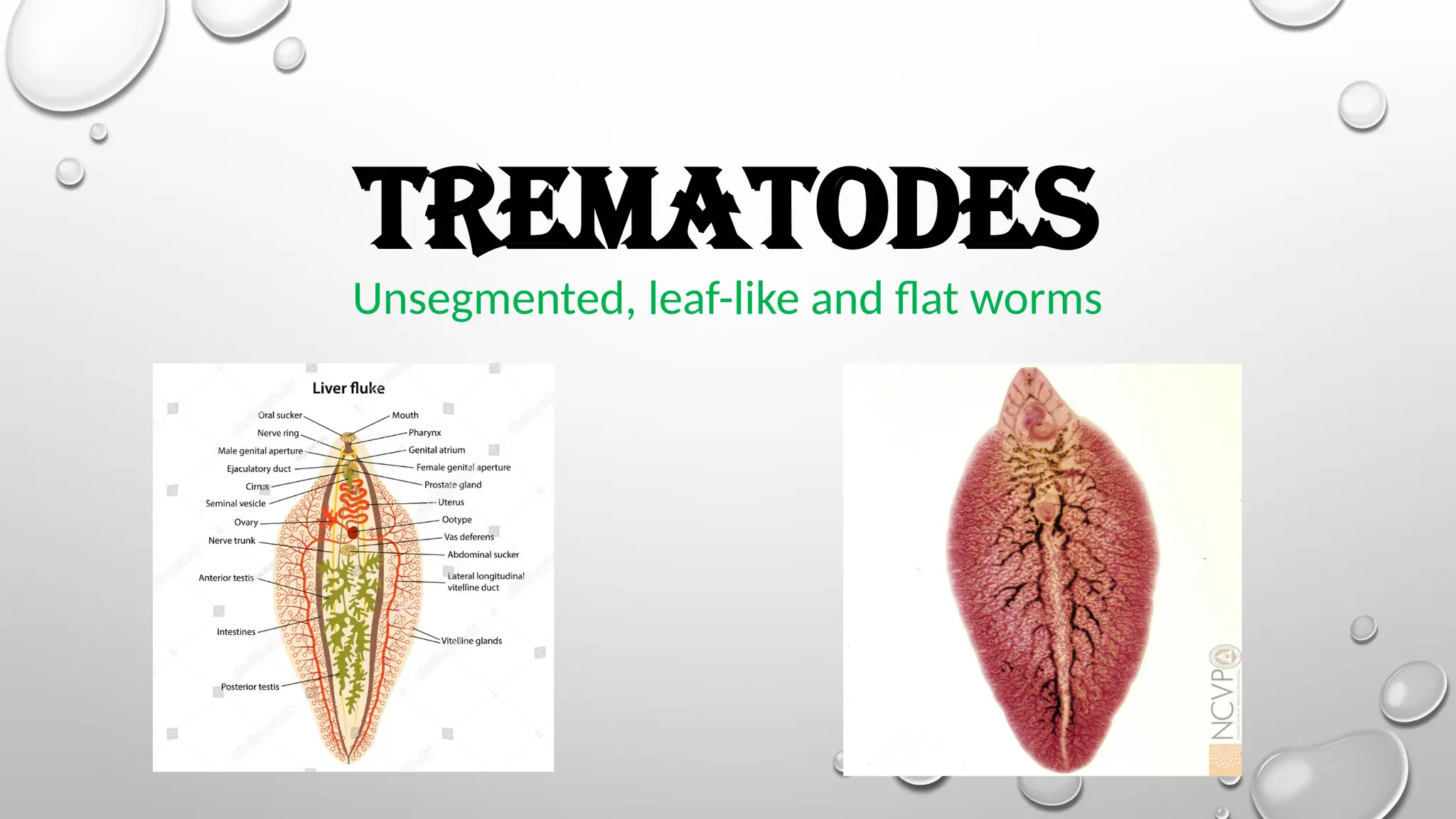
TREMATODES
Unsegmented, leaf-like and flat worms
Classification based on habitat
Trematodes
Intestinal flukes
Fasciolopsis
buski
Blood flukes
Schistosoma
S.mansoni
S. japonicum
S.hematobium
Hepatic flukes
Fasciola hepatica
Clonorchis
Opisthorchis
Lung flukes
Paragonimus
westermani
MORPHOLOGY
(3 FORMS- ADULT WORM, EGG AND LARVA)
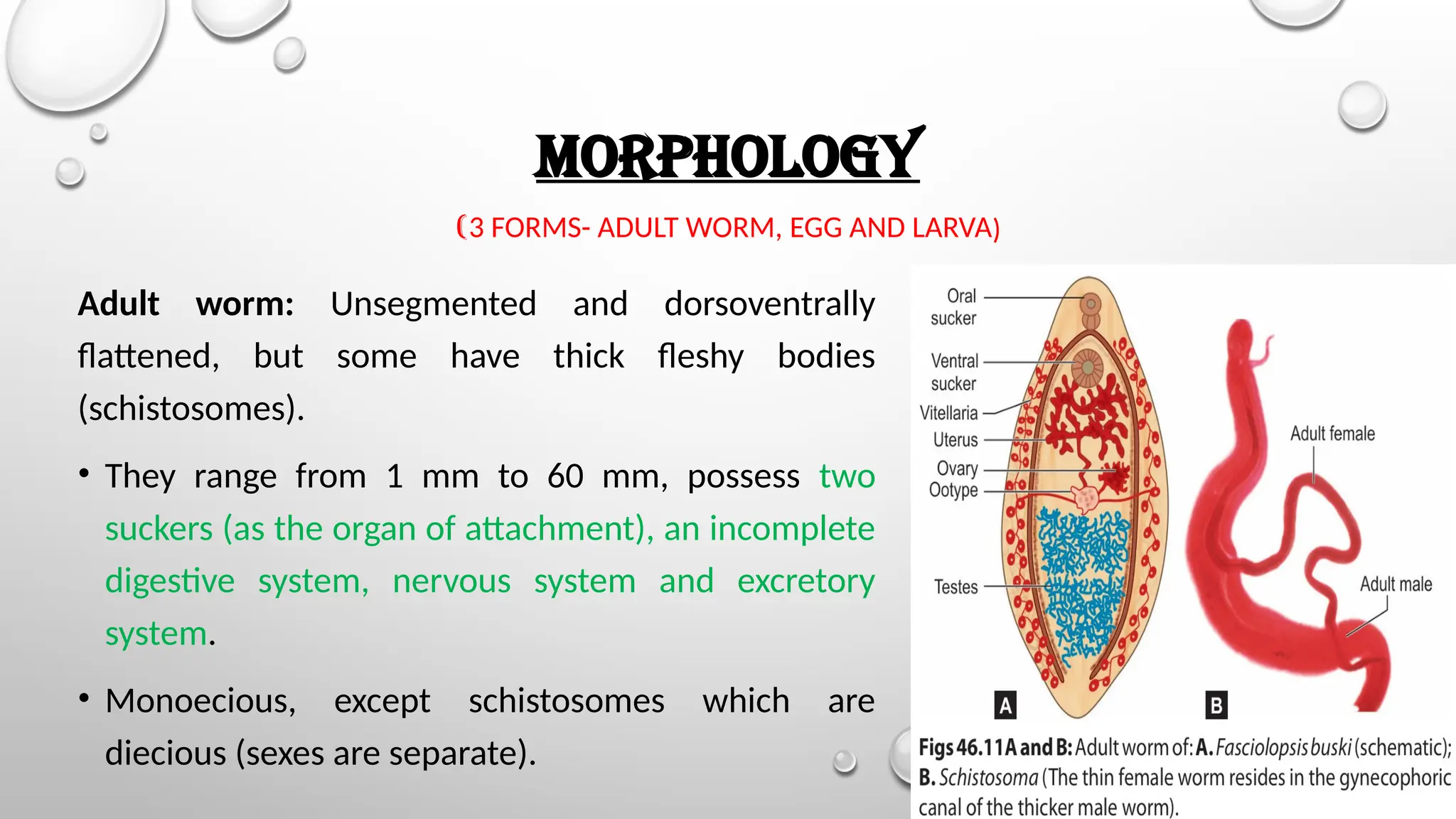
Adult worm: Unsegmented and dorsoventrally
flattened, but some have thick fleshy bodies
(schistosomes).
• They range from 1 mm to 60 mm, possess two
suckers (as the organ of attachment), an incomplete
digestive system, nervous system and excretory
system.
• Monoecious, except schistosomes which are
diecious (sexes are separate).
MORPHOLOGY
(3 FORMS- ADULT WORM, EGG AND LARVA)
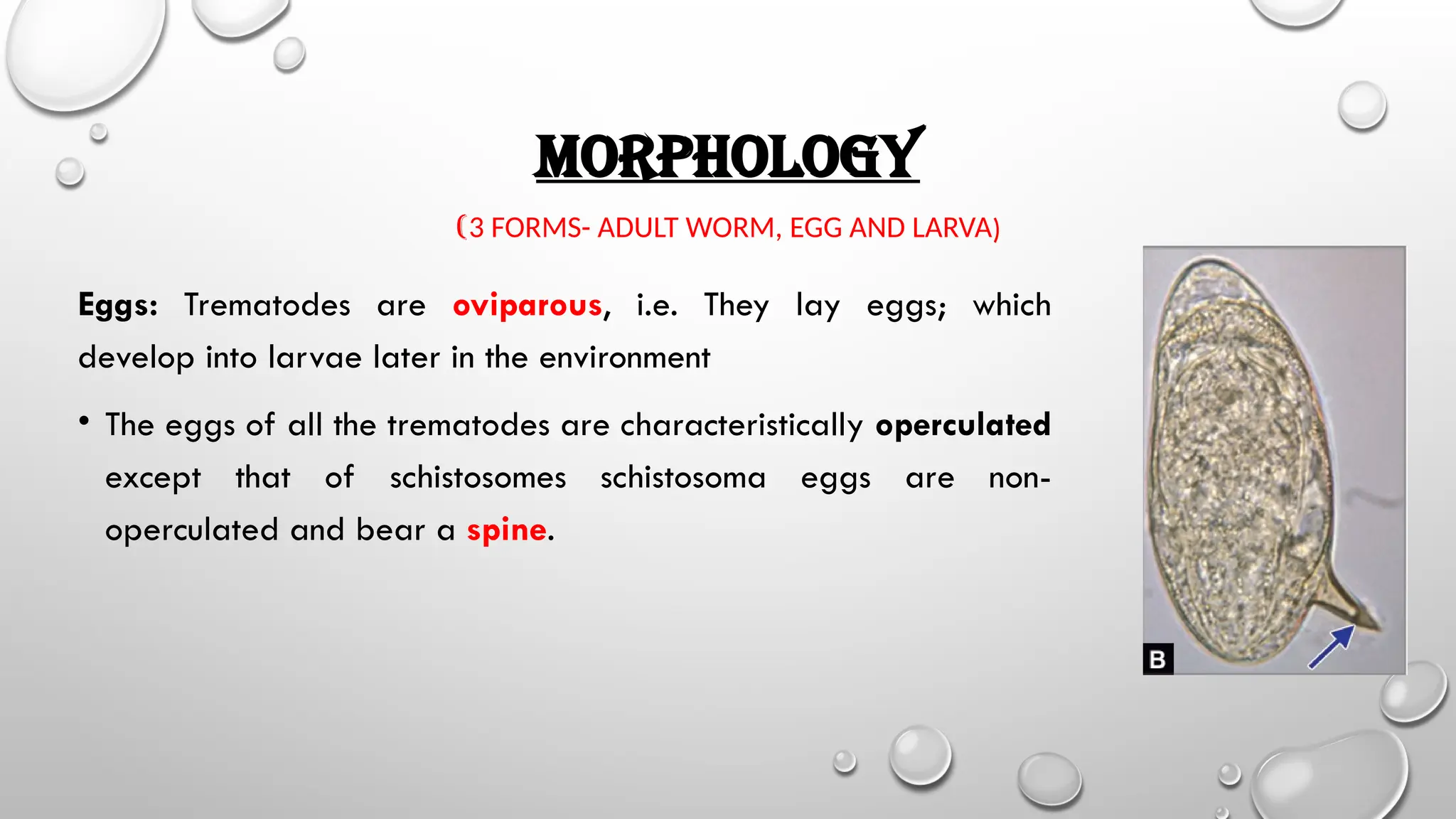
Eggs: Trematodes are oviparous, i.e. They lay eggs; which
develop into larvae later in the environment
• The eggs of all the trematodes are characteristically operculated
except that of schistosomes schistosoma eggs are non-
operculated and bear a spine.
LIFE CYCLE
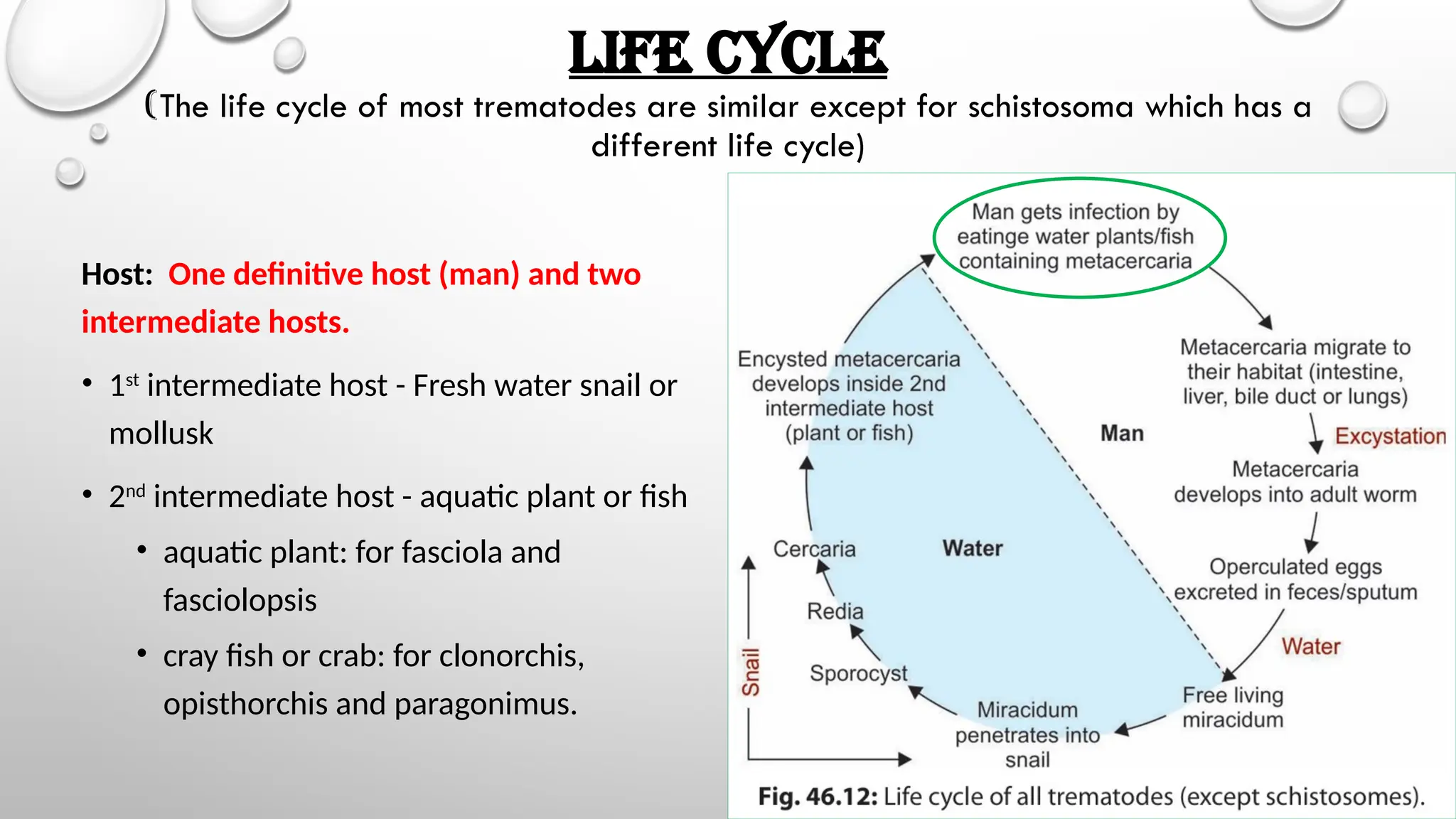
(The life cycle of most trematodes are similar except for schistosoma which has a
different life cycle)
Host: One definitive host (man) and two
intermediate hosts.
• 1st
intermediate host - Fresh water snail or
mollusk
• 2nd
intermediate host - aquatic plant or fish
• aquatic plant: for fasciola and
fasciolopsis
• cray fish or crab: for clonorchis,
opisthorchis and paragonimus.
LIFE CYCLE
(schistosoma)
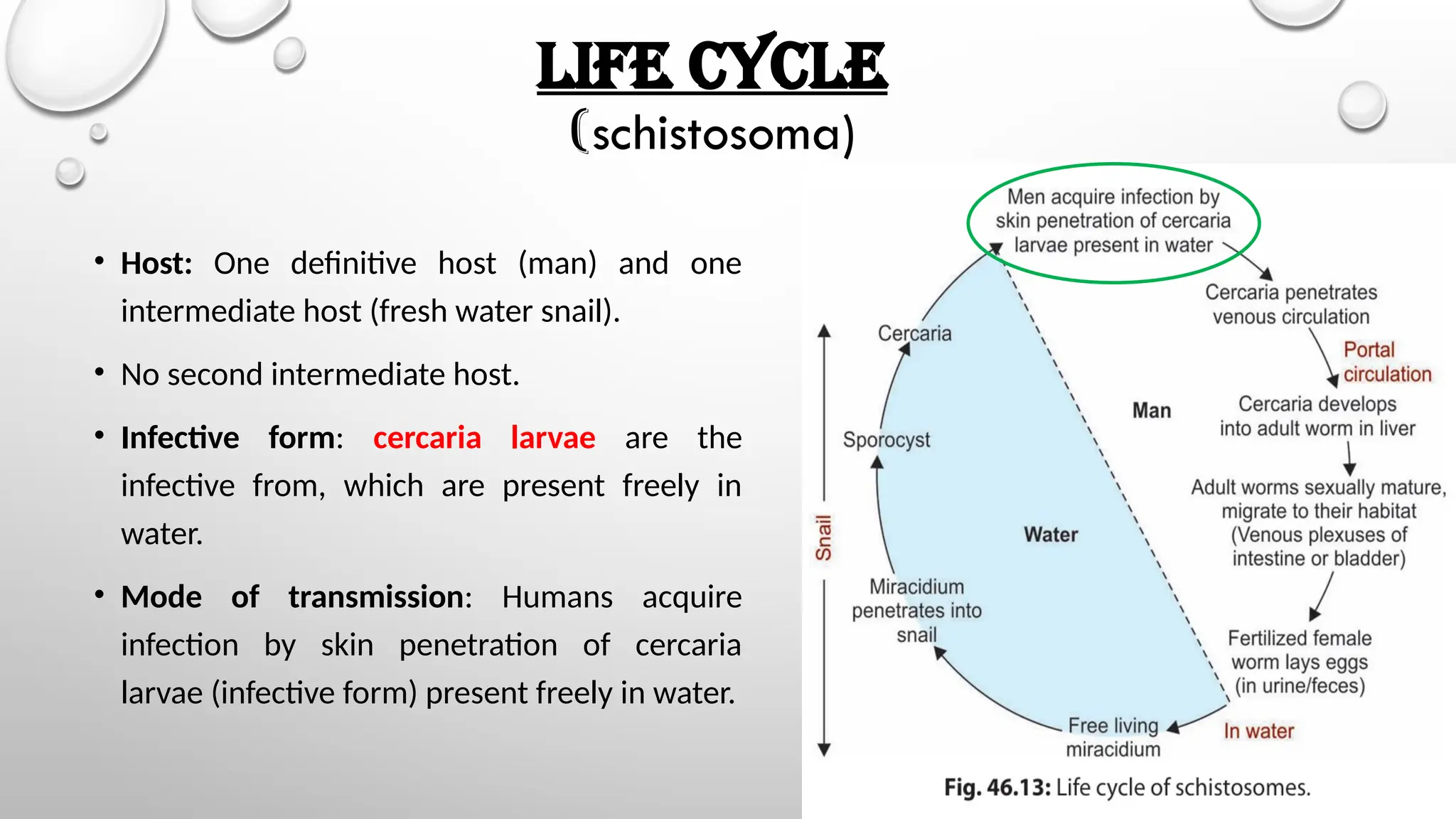
• Host: One definitive host (man) and one
intermediate host (fresh water snail).
• No second intermediate host.
• Infective form: cercaria larvae are the
infective from, which are present freely in
water.
• Mode of transmission: Humans acquire
infection by skin penetration of cercaria
larvae (infective form) present freely in water.
PATHOGENESIS OF MANSONIAN
SCHISTOSOMIASIS
• Cercarial dermatitis (swimmer’s itch): After 2 or 3 days of skin
perpetration of cercaria larvae, an itchy maculopapular rash
develops on the affected areas of the skin called as cercarial
dermatitis. This is also observed in S. Japonicum infection.
• Acute schistosomiasis (katayama syndrome): it occurs within 4–8
weeks of infection, especially when the schistosomes start
producing eggs. The antigens (released from the eggs) and the
adult worms stimulate the host humoral response, leading to the
formation of immune complexes and serum sickness like illness
called katayama fever.
• it is characterized by fever, generalized lymphadenopathy, and
hepatosplenomegaly.
PATHOGENESIS OF MANSONIAN
SCHISTOSOMIASIS
Chronic schistosomiasis: After eggs are produced, they are trapped in the small venules and are
carried from intestine through portal circulation into liver and other parts of the body.
• The eggs are deposited in the intestinal wall and other sites such as liver, lungs, brain, and spinal
cord.
• Soluble antigens liberated from eggs induce inflammatory reactions, that lead to granuloma
formation around the eggs in the intestine and other visceral sites.
Intestinal followed by hepatosplenic disease are the most common form of chronic
schistosomiasis.
LIVER FLUKES
(Fasciola, clonorchis, Opisthorchis)
• Fasciola infect liver and bile duct, whereas the others infect only the bile duct.
Life cycle
Morphology: Adult worm (leaf-like), operculated eggs, and larvae (in five stages).
Hosts: liver flukes have three hosts
• Definitive host: humans / sheep for F. hepatica (also called as sheep liver fluke)/dogs and cats for
clonorchis and Opisthorchis.
• Intermediate hosts: 1st
intermediate host - Snails, whereas the 2nd
intermediate host is aquatic plant (for
fasciola) and cray fish (for clonorchis, and opisthorchis).
Transmission: Ingestion of second intermediate host carrying metacercaria larvae (infective form).
• The larvae excyst and penetrate through the intestinal wall to migrate to their habitat (liver or bile duct),
where they develop into adult worms.
• Adult worms undergo fertilization to produce eggs. Eggs are passed from the bile duct or liver to intestine
and excreted in feces (diagnostic form).
THANK YOU
KINDLY FOLLOW THE BOOK FOR DETAILED
INFORMATION

Platyhelminths- classification, morphology, life cycle and pathogenesis.pptx

  • 1.
    PLATYHELMINTHS or Flat worms By Sachin KumarSharma Ph.D. Scholar Dept. of Microbiology SMIMS
  • 2.
    General characteristics • Helminthsare elongated flat or round worm-like parasites measuring few millimeters to meters. • They are eukaryotic multicellular and bilaterally symmetrical. Helminths Platyhelminths (Flat worms) Cestodes (Tapeworms) Trematodes (Flukes) Nemathelminths Intestinal Nematodes Tissue Nematodes Based on Phylum Based on Class
  • 3.
    Morphology 1. Adult Worm •Adult worm is long, segmented, dorsoventrally flattened; varies in length from few millimeters to several meters. • It inhabits in the intestine of men and animals • Consists of 3 parts- 1. Head or scolex: it is the organ of attachment, helps in attachment to intestinal mucosa by virtue of bearing four cup like muscular structures called suckers (or acetabula) in some species like T. solium and H. nana, scolex has a beak like apical protrusion called as rostellum, which may be armed with hooklets. 2. Neck: next to head, the portion is called as neck from which the segments (proglottids) arise.
  • 4.
    Morphology 1. Adult Worm(contd.) 3. Strobila (body or trunk): it consists of a number of segments (or proglottids). Based on the reproductive organs they bear, proglottids can further be grouped into three types: i. Immature segments: here, male and female reproductive organs are not differentiated. ii. Mature segments: Cestodes are hermaphrodites or monoecious, i.e., Contain male and female organs in the same segment. iii. Gravid segments or fertilized segments: following fertilization, the uterus gets filled with eggs. Other organs are atrophied.
  • 5.
    2. EGGS • Eggsare formed following fertilization, fill the gravid proglottids and are subsequently released in feces - considered as the diagnostic form. • In most cestodes, the eggs are round to oval, consist of an embryo (or oncosphere) with six hooklets, surrounded by radially striated embryophore.
  • 6.
    3. LARVA Embryonated eggsundergo further development to form larvae. Most cestodes have only one larval stage except D. Latum. • In Taenia, the larval stage is called as cysticercus. • In hymenolepis, the larval stage is called as cysticercoid. • In Echinococcus, it is called as hydatid cyst. • In Diphyllobothrium there are three larval stages - coracidium (first stage), procercoid (second stage) and plerocercoid (third stage).
  • 7.
    CESTODES • Cestodes arelong, segmented, flattened dorsoventrally, tape like worms, therefore also called as tapeworms. Cestodes (Based on Habitat) Intestinal Examples are: Taenia solium, Taenia saginata, Hymenolepsis, diphyllobothrium spp. Somatic/tissue (Found in human muscles/Organs) Taenia Solium Echnicoccus spp.
  • 8.
    Intestinal Taeniasis- Taenia •Taenia exists in three morphological forms. Adult worm: comprises of head or scolex, neck and a body divided into several proglottids.  The scolex bears four cup like muscular suckers which helps in attachment.  In t. Solium, the scolex has a beak like apical protrusion called as rostellum. The rostellum is armed with two rows of hooklets (hence called as armed tapeworm). Scolex of T. Soilium Scolex of T. Saginata
  • 9.
    Taenia (contd.) Eggs containembryo or oncosphere which contains three pair of hooklets, surrounded by an embryophore. Larvae: cysticercus is the larval stage of taenia. It contains a muscular organ with bladder like sac. It is called as: cysticercus bovis in T. Saginata cysticercus cellulosae in T. Solium Schematic diagrams of eggs of cestodes
  • 10.
    Life cycle ofTaenia passes through two hosts. • Definitive host: Man • Intermediate host: Cattle for T. saginata (hence called beef tapeworm) and pigs for T. solium (hence called pork tapeworm) LIFE CYCLE
  • 12.
    Hymenolepis nana • Itis the smallest cestode (2.5–4 cm in length) infecting man causing hymenolepiasis, hence also called as dwarf tapeworm. Eggs are the infective form as well as the diagnostic form of the parasite.  Clinical manifestations: h. Nana infection is usually asymptomatic. When the worm burden exceeds, patients develop symptoms like anorexia, abdominal pain, headache, dizziness and diarrhea with mucus.
  • 13.
    Life Cycle Man isthe only host. Infective form: Eggs.
  • 14.
    Eggs of H.nana • Egg is round to slightly oval in shape, 30–47 µm size  It has two membranes that surrounds an embryo with six hooklets. Space between the two membranes is filled with yolk granules  Polar filaments: both the poles of embryophore are thickened from which four to eight polar filaments emerge.  Non-bile stained (colorless in saline mount): it is the only cestode egg that is not stained by bile when passed through the intestine.
  • 15.
    Echnicoccus granulosus (Dogtapeworm) • Cystic echinococcosis, also known as hydatid disease. • It is a tissue cestode, exits in three morphological forms— adult, larva (called hydatid cyst), and egg. • The adult worm resides in dog’s intestine. 3–6 mm long, consists of head, neck and a strobila or body made up of three proglottids/segments. • The larval form is called as hydatid cyst. It is the pathogenic form, forms cystic lesions in liver and other viscera of man. • Eggs: e. Granulosus eggs are morphologically similar to taenia eggs, consists of an embryo with six hooklets surrounded by an embryophore.
  • 16.
    LIFE CYCLE Infective form:Eggs are the infective form. Mode of transmission: Man (and other intermediate hosts) acquires the infection by ingestion of food contaminated with dog’s feces containing E. granulosus eggs
  • 17.
    HYDATID CYST It isa fluid-filled bladder-like cyst; unilocular, subspherical in shape and average size measures 5–8 cm (from few mm to >30 cm). • Cyst wall consists of three layers: outer pericyst (host derived), middle ectocyst and inner endocyst • Brood capsule: the inner side of the endocyst gives rise to brood capsule, and also secretes the hydatid fluid. The brood capsule contains number of protoscolices (future head). • Hydatid fluid: it is clear, pale yellow colored fluid, which is antigenic, toxic and anaphylactic • Hydatid sand: some of the brood capsules and proto-scolices break off and get deposited at the bottom as hydatid sand.
  • 18.
  • 19.
    Classification based onhabitat Trematodes Intestinal flukes Fasciolopsis buski Blood flukes Schistosoma S.mansoni S. japonicum S.hematobium Hepatic flukes Fasciola hepatica Clonorchis Opisthorchis Lung flukes Paragonimus westermani
  • 20.
    MORPHOLOGY (3 FORMS- ADULTWORM, EGG AND LARVA) Adult worm: Unsegmented and dorsoventrally flattened, but some have thick fleshy bodies (schistosomes). • They range from 1 mm to 60 mm, possess two suckers (as the organ of attachment), an incomplete digestive system, nervous system and excretory system. • Monoecious, except schistosomes which are diecious (sexes are separate).
  • 21.
    MORPHOLOGY (3 FORMS- ADULTWORM, EGG AND LARVA) Eggs: Trematodes are oviparous, i.e. They lay eggs; which develop into larvae later in the environment • The eggs of all the trematodes are characteristically operculated except that of schistosomes schistosoma eggs are non- operculated and bear a spine.
  • 22.
    LIFE CYCLE (The lifecycle of most trematodes are similar except for schistosoma which has a different life cycle) Host: One definitive host (man) and two intermediate hosts. • 1st intermediate host - Fresh water snail or mollusk • 2nd intermediate host - aquatic plant or fish • aquatic plant: for fasciola and fasciolopsis • cray fish or crab: for clonorchis, opisthorchis and paragonimus.
  • 23.
    LIFE CYCLE (schistosoma) • Host:One definitive host (man) and one intermediate host (fresh water snail). • No second intermediate host. • Infective form: cercaria larvae are the infective from, which are present freely in water. • Mode of transmission: Humans acquire infection by skin penetration of cercaria larvae (infective form) present freely in water.
  • 25.
    PATHOGENESIS OF MANSONIAN SCHISTOSOMIASIS •Cercarial dermatitis (swimmer’s itch): After 2 or 3 days of skin perpetration of cercaria larvae, an itchy maculopapular rash develops on the affected areas of the skin called as cercarial dermatitis. This is also observed in S. Japonicum infection. • Acute schistosomiasis (katayama syndrome): it occurs within 4–8 weeks of infection, especially when the schistosomes start producing eggs. The antigens (released from the eggs) and the adult worms stimulate the host humoral response, leading to the formation of immune complexes and serum sickness like illness called katayama fever. • it is characterized by fever, generalized lymphadenopathy, and hepatosplenomegaly.
  • 26.
    PATHOGENESIS OF MANSONIAN SCHISTOSOMIASIS Chronicschistosomiasis: After eggs are produced, they are trapped in the small venules and are carried from intestine through portal circulation into liver and other parts of the body. • The eggs are deposited in the intestinal wall and other sites such as liver, lungs, brain, and spinal cord. • Soluble antigens liberated from eggs induce inflammatory reactions, that lead to granuloma formation around the eggs in the intestine and other visceral sites. Intestinal followed by hepatosplenic disease are the most common form of chronic schistosomiasis.
  • 27.
    LIVER FLUKES (Fasciola, clonorchis,Opisthorchis) • Fasciola infect liver and bile duct, whereas the others infect only the bile duct. Life cycle Morphology: Adult worm (leaf-like), operculated eggs, and larvae (in five stages). Hosts: liver flukes have three hosts • Definitive host: humans / sheep for F. hepatica (also called as sheep liver fluke)/dogs and cats for clonorchis and Opisthorchis. • Intermediate hosts: 1st intermediate host - Snails, whereas the 2nd intermediate host is aquatic plant (for fasciola) and cray fish (for clonorchis, and opisthorchis). Transmission: Ingestion of second intermediate host carrying metacercaria larvae (infective form). • The larvae excyst and penetrate through the intestinal wall to migrate to their habitat (liver or bile duct), where they develop into adult worms. • Adult worms undergo fertilization to produce eggs. Eggs are passed from the bile duct or liver to intestine and excreted in feces (diagnostic form).
  • 28.
    THANK YOU KINDLY FOLLOWTHE BOOK FOR DETAILED INFORMATION