WESTERN and
CLASSICAL ART
2
Western art forms are based on the existing culture
of each country. These cover various forms of art from
different periods such as the ancient period, the classical
period, and the medieval period.
Ancient art refers to the earliest surviving works of
art like cave paintings and portable sculptures of humans and
animals.
Classical art refers to the Greek and Roman works
of art such as majestic paintings and elaborate sculptures of
men and women, which dates back as early as 500BC.
Medieval art refers to the works of art like religious
paintings and sculptures, which were created during the
Middle Ages and covers the period between AD 1100 and
1500.
3
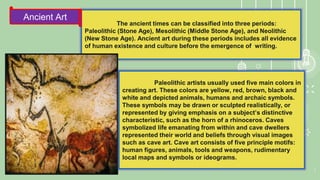
The ancient times can be classified into three periods:
Paleolithic (Stone Age), Mesolithic (Middle Stone Age), and Neolithic
(New Stone Age). Ancient art during these periods includes all evidence
of human existence and culture before the emergence of writing.
Ancient Art
Paleolithic artists usually used five main colors in
creating art. These colors are yellow, red, brown, black and
white and depicted animals, humans and archaic symbols.
These symbols may be drawn or sculpted realistically, or
represented by giving emphasis on a subject’s distinctive
characteristic, such as the horn of a rhinoceros. Caves
symbolized life emanating from within and cave dwellers
represented their world and beliefs through visual images
such as cave art. Cave art consists of five principle motifs:
human figures, animals, tools and weapons, rudimentary
local maps and symbols or ideograms.
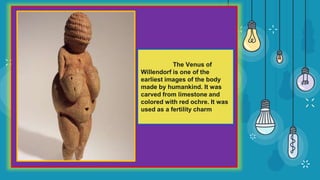
The Venus of
Willendorf is one of the
earliest images of the body
made by humankind. It was
carved from limestone and
colored with red ochre. It was
used as a fertility charm
“
5
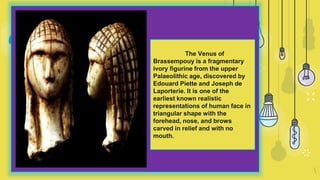
The Venus of
Brassempouy is a fragmentary
ivory figurine from the upper
Palaeolithic age, discovered by
Edouard Piette and Joseph de
Laporterie. It is one of the
earliest known realistic
representations of human face in
triangular shape with the
forehead, nose, and brows
carved in relief and with no
mouth.
Thanks!
6

Arts Lesson 1

  • 1.
  • 2.
    2 Western art formsare based on the existing culture of each country. These cover various forms of art from different periods such as the ancient period, the classical period, and the medieval period. Ancient art refers to the earliest surviving works of art like cave paintings and portable sculptures of humans and animals. Classical art refers to the Greek and Roman works of art such as majestic paintings and elaborate sculptures of men and women, which dates back as early as 500BC. Medieval art refers to the works of art like religious paintings and sculptures, which were created during the Middle Ages and covers the period between AD 1100 and 1500.
  • 3.
    3 The ancient timescan be classified into three periods: Paleolithic (Stone Age), Mesolithic (Middle Stone Age), and Neolithic (New Stone Age). Ancient art during these periods includes all evidence of human existence and culture before the emergence of writing. Ancient Art Paleolithic artists usually used five main colors in creating art. These colors are yellow, red, brown, black and white and depicted animals, humans and archaic symbols. These symbols may be drawn or sculpted realistically, or represented by giving emphasis on a subject’s distinctive characteristic, such as the horn of a rhinoceros. Caves symbolized life emanating from within and cave dwellers represented their world and beliefs through visual images such as cave art. Cave art consists of five principle motifs: human figures, animals, tools and weapons, rudimentary local maps and symbols or ideograms.
  • 4.
    The Venus of Willendorfis one of the earliest images of the body made by humankind. It was carved from limestone and colored with red ochre. It was used as a fertility charm
  • 5.
    “ 5 The Venus of Brassempouyis a fragmentary ivory figurine from the upper Palaeolithic age, discovered by Edouard Piette and Joseph de Laporterie. It is one of the earliest known realistic representations of human face in triangular shape with the forehead, nose, and brows carved in relief and with no mouth.
  • 6.