ARTIFICIAL INTELLIGENCE(AI)
WHERE MACHINES ARE
SMARTER THAN HUMAN
BEINGS
From web search to video games, artificial
intelligence is already present. AI
algorithms organize your driving routes,
filter spam, and concentrate your cameras
on faces. AI allows you to use your voice to
guide your phone and read foreign
newspapers in English. AI is at the heart of
many new technologies that will define our
future, in addition to its current applications.
AI developments translate science fiction
into practical systems, from self-driving
vehicles to domestic robotics.
WHAT IS ARTIFICIAL
INTELLIGENCE(AI)
• ARTIFICIAL INTELLIGENCE(AI) is the simulation of
human intelligence processes by machines, especially
computer systems. Specific applications of AI include
expert systems, natural languages processing, speech
recognition and machine vision.
• Artificial intelligence systems are powered by algorithms,
using techniques such as machine learning, deep learning
and rules. Machine learning algorithms feed computer
data to AI systems, using statistical techniques to enable
Ai systems get progressively better at tasks without
having to be specifically programmed to do so.
HISTORY OF ARTIFICIAL
INTELLIGENCE
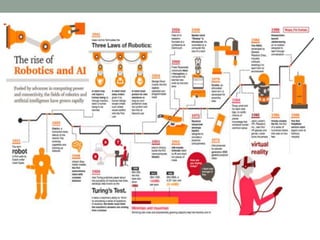
1. THE ORIGIN
OFAI
2. PUBLIC RECOGNITION
When IBM's Deep Blue defeated Russian
grandmaster Garry Kasparov in 1997, it became
the first computer to defeat a chess champion. In
2011, the computer giant's question-answering
system Watson won the quiz program "Jeopardy"
after defeating defending winners Brad Rutter
and Ken Jennings.
3. DEVELOPMENTAL TREND
Eugene Goostman made headlines after fooling
judges into thinking he was a real flesh-and-
blood human during a Turing test, a competition
devised in 1950 by British mathematician and
computer scientist Alan Turing to determine
whether a machine is clever.
Modern AI can be
traced back to
classical thinkers'
attempts to
characterize human
thought as a
symbolic system.
However, the area
of artificial
intelligence was not
formally established
until 1956, at a
conference held at
Dartmouth College
in Hanover, New
Hampshire.
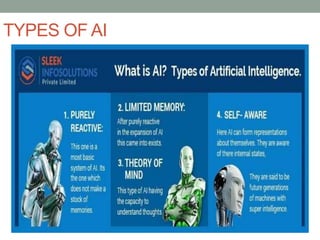
TYPES OF AI
TYPES OF AI
GOALS OF AI
• To Create Expert Systems – the systems which exhibit
intelligent behaviour, learn, demonstrate, explain, and
advice its users.
• To Implement Human Intelligence in Machines –
Creating systems that understand, think, learn, and
behave like humans.
ADVANTAGES AND
DISADVANTAGES OF
ARTIFICIAL
INTELLIGENCE
ADVANTAGES OF ARTIFICIAL
INTELLIGENCE (AI)
1.Error Reduction
2.Data Analysis and Insights – AI algorithms can analyze large data
quickly, providing valuable insights for decision-making.
3.Digital Assistants
4.Increase Work Efficiency – AI can automate repetitive tasks,
improving efficiency and productivity in various industries.
5.Reduce cost of training and operation
6.24/7 Availability – Al powered systems can operate continuously,
offering round-the-clock services and support.
7.Personilisation – AI enables personalized experiences and
recommendations based on individual preferences and behavior.
ADVANTAGES OF AI CONTINUED…
8. Improved Accuracy – AI can perform tasks with high precision,
reducing errors and improving overall accuracy.
9. Safety and Risk Reduction – AI can be used for tasks that are
hazardous to humans, reducing risks and ensuring safety.
DISADVANTAGES OF ARTIFICIAL
INTELLIGENCE (AI)
1.High Costs and Complexity – developing and implementing AI systems can
be expensive, require specialized knowledge and resources.
2.Realibility and Trust – AI systems may not always be fully reliable, leading to
distrust in their decision-making capabilities.
3.Unemployment – AI automation may lead to job losses in certain industries,
affecting the job market and workforce.
4.Dependency on Technology – Over-reliance on AI can make humans
dependent on technology and reduce critical thinking skills.
5. Ethics Concerns – AI raises ethical issues, including data privacy, algorithm
bias, and potential misuse of AI technologies.
6.Lack of Creativity and Empathy – AI lacks human qualities like creativity and
empathy, limiting its ability to understand emotions or produce original ideas.
7.No improvement
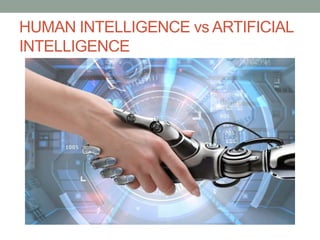
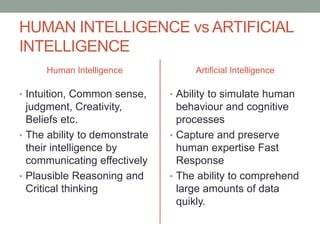
HUMAN INTELLIGENCE vs ARTIFICIAL
INTELLIGENCE
HUMAN INTELLIGENCE vs ARTIFICIAL
INTELLIGENCE
Human Intelligence
• Intuition, Common sense,
judgment, Creativity,
Beliefs etc.
• The ability to demonstrate
their intelligence by
communicating effectively
• Plausible Reasoning and
Critical thinking
Artificial Intelligence
• Ability to simulate human
behaviour and cognitive
processes
• Capture and preserve
human expertise Fast
Response
• The ability to comprehend
large amounts of data
quikly.
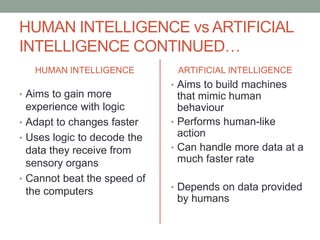
HUMAN INTELLIGENCE vs ARTIFICIAL
INTELLIGENCE CONTINUED…
HUMAN INTELLIGENCE
• Aims to gain more
experience with logic
• Adapt to changes faster
• Uses logic to decode the
data they receive from
sensory organs
• Cannot beat the speed of
the computers
ARTIFICIAL INTELLIGENCE
• Aims to build machines
that mimic human
behaviour
• Performs human-like
action
• Can handle more data at a
much faster rate
• Depends on data provided
by humans
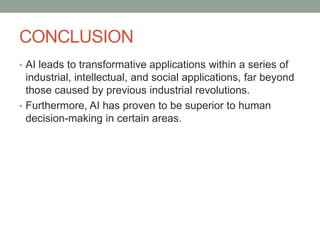
CONCLUSION
• AI leads to transformative applications within a series of
industrial, intellectual, and social applications, far beyond
those caused by previous industrial revolutions.
• Furthermore, AI has proven to be superior to human
decision-making in certain areas.
REFERENCES
1. Chandana, K. (2021) Artificial Intelligence. Available from Slideshare at
Artificial intelligence | PPT (slideshare.net) (Accessed 11 August 2023).
2. Danish, J. (2017) Report on Artificial Intelligence. Available on Slideshare at
Artificial intelligence | PDF (slideshare.net) (Accessed 13 August 2023).
3. Zeeshan, T. (2017) Intro to Artificial Intelligence. Available from Slideshare at
https://www.slideshare.net/XeeBeast/intro-to-artificial-inteligence (Accessed
14 August 2023).
4. Ayebare, E. (2019) Automation and Artificial Intelligence. Available from
Slideshare at https://www.slideshare.net/AYEBAREEUNICE/automation-and-
artificial-intelligence?from_search=0 (Accessed 15 August 2023).
5. Shabbarali6, (2022) Artificial Intelligence. ppx. Available from Slideshare at
https:www.slideshare.net/shabbarali6/artificial-intelligencepptx-252078940
(Accessed 16 August 2023)
Thank
you

ARTIFICIAL INTELLIGENCE SLIDESHARE.pptx

  • 1.
    ARTIFICIAL INTELLIGENCE(AI) WHERE MACHINESARE SMARTER THAN HUMAN BEINGS
  • 3.
    From web searchto video games, artificial intelligence is already present. AI algorithms organize your driving routes, filter spam, and concentrate your cameras on faces. AI allows you to use your voice to guide your phone and read foreign newspapers in English. AI is at the heart of many new technologies that will define our future, in addition to its current applications. AI developments translate science fiction into practical systems, from self-driving vehicles to domestic robotics.
  • 5.
    WHAT IS ARTIFICIAL INTELLIGENCE(AI) •ARTIFICIAL INTELLIGENCE(AI) is the simulation of human intelligence processes by machines, especially computer systems. Specific applications of AI include expert systems, natural languages processing, speech recognition and machine vision. • Artificial intelligence systems are powered by algorithms, using techniques such as machine learning, deep learning and rules. Machine learning algorithms feed computer data to AI systems, using statistical techniques to enable Ai systems get progressively better at tasks without having to be specifically programmed to do so.
  • 6.
  • 7.
    1. THE ORIGIN OFAI 2.PUBLIC RECOGNITION When IBM's Deep Blue defeated Russian grandmaster Garry Kasparov in 1997, it became the first computer to defeat a chess champion. In 2011, the computer giant's question-answering system Watson won the quiz program "Jeopardy" after defeating defending winners Brad Rutter and Ken Jennings. 3. DEVELOPMENTAL TREND Eugene Goostman made headlines after fooling judges into thinking he was a real flesh-and- blood human during a Turing test, a competition devised in 1950 by British mathematician and computer scientist Alan Turing to determine whether a machine is clever. Modern AI can be traced back to classical thinkers' attempts to characterize human thought as a symbolic system. However, the area of artificial intelligence was not formally established until 1956, at a conference held at Dartmouth College in Hanover, New Hampshire.
  • 8.
  • 9.
  • 10.
    GOALS OF AI •To Create Expert Systems – the systems which exhibit intelligent behaviour, learn, demonstrate, explain, and advice its users. • To Implement Human Intelligence in Machines – Creating systems that understand, think, learn, and behave like humans.
  • 11.
  • 12.
    ADVANTAGES OF ARTIFICIAL INTELLIGENCE(AI) 1.Error Reduction 2.Data Analysis and Insights – AI algorithms can analyze large data quickly, providing valuable insights for decision-making. 3.Digital Assistants 4.Increase Work Efficiency – AI can automate repetitive tasks, improving efficiency and productivity in various industries. 5.Reduce cost of training and operation 6.24/7 Availability – Al powered systems can operate continuously, offering round-the-clock services and support. 7.Personilisation – AI enables personalized experiences and recommendations based on individual preferences and behavior.
  • 13.
    ADVANTAGES OF AICONTINUED… 8. Improved Accuracy – AI can perform tasks with high precision, reducing errors and improving overall accuracy. 9. Safety and Risk Reduction – AI can be used for tasks that are hazardous to humans, reducing risks and ensuring safety.
  • 14.
    DISADVANTAGES OF ARTIFICIAL INTELLIGENCE(AI) 1.High Costs and Complexity – developing and implementing AI systems can be expensive, require specialized knowledge and resources. 2.Realibility and Trust – AI systems may not always be fully reliable, leading to distrust in their decision-making capabilities. 3.Unemployment – AI automation may lead to job losses in certain industries, affecting the job market and workforce. 4.Dependency on Technology – Over-reliance on AI can make humans dependent on technology and reduce critical thinking skills. 5. Ethics Concerns – AI raises ethical issues, including data privacy, algorithm bias, and potential misuse of AI technologies. 6.Lack of Creativity and Empathy – AI lacks human qualities like creativity and empathy, limiting its ability to understand emotions or produce original ideas. 7.No improvement
  • 15.
    HUMAN INTELLIGENCE vsARTIFICIAL INTELLIGENCE
  • 16.
    HUMAN INTELLIGENCE vsARTIFICIAL INTELLIGENCE Human Intelligence • Intuition, Common sense, judgment, Creativity, Beliefs etc. • The ability to demonstrate their intelligence by communicating effectively • Plausible Reasoning and Critical thinking Artificial Intelligence • Ability to simulate human behaviour and cognitive processes • Capture and preserve human expertise Fast Response • The ability to comprehend large amounts of data quikly.
  • 17.
    HUMAN INTELLIGENCE vsARTIFICIAL INTELLIGENCE CONTINUED… HUMAN INTELLIGENCE • Aims to gain more experience with logic • Adapt to changes faster • Uses logic to decode the data they receive from sensory organs • Cannot beat the speed of the computers ARTIFICIAL INTELLIGENCE • Aims to build machines that mimic human behaviour • Performs human-like action • Can handle more data at a much faster rate • Depends on data provided by humans
  • 18.
    CONCLUSION • AI leadsto transformative applications within a series of industrial, intellectual, and social applications, far beyond those caused by previous industrial revolutions. • Furthermore, AI has proven to be superior to human decision-making in certain areas.
  • 20.
    REFERENCES 1. Chandana, K.(2021) Artificial Intelligence. Available from Slideshare at Artificial intelligence | PPT (slideshare.net) (Accessed 11 August 2023). 2. Danish, J. (2017) Report on Artificial Intelligence. Available on Slideshare at Artificial intelligence | PDF (slideshare.net) (Accessed 13 August 2023). 3. Zeeshan, T. (2017) Intro to Artificial Intelligence. Available from Slideshare at https://www.slideshare.net/XeeBeast/intro-to-artificial-inteligence (Accessed 14 August 2023). 4. Ayebare, E. (2019) Automation and Artificial Intelligence. Available from Slideshare at https://www.slideshare.net/AYEBAREEUNICE/automation-and- artificial-intelligence?from_search=0 (Accessed 15 August 2023). 5. Shabbarali6, (2022) Artificial Intelligence. ppx. Available from Slideshare at https:www.slideshare.net/shabbarali6/artificial-intelligencepptx-252078940 (Accessed 16 August 2023)
  • 21.