ARTIFICIAL INTELLIGENCE
Fundamental And Basic About AI
Created By Rohit Jain
CONTENT ::--
DEFINITION AND HISTORY OF AI
GENETIC ALGORITHM
ANT ALGORITHMS
NEURAL NETWORKS
ADAPTIVE RESONANCE THEORY
 FUZZY LOGIC
AI TODAY
Branches OF AI
 Automatic Programming
 Bayesian Networks
 Constraint Satisfaction
 Knowledge Engineering
 Machine Learning
 Planning
 Search
Definition and History Of AI ::--
 Artificial Intelligence Is The Process Of Creating Machines that can act in a
Manner that could be considered by Human to be Intelligent.
 AI has The Potential To Change The World Like No Other Technology.
 1940s- Birth Of Computers
 1950s The Birth OF AI
 1960s The Rise Of AI
 1970s The Fall Of AI
 1980s An AI Boom And Bust
 1990s To today AI Rises Again, Quietly
GENETIC ALGORITHM ::--
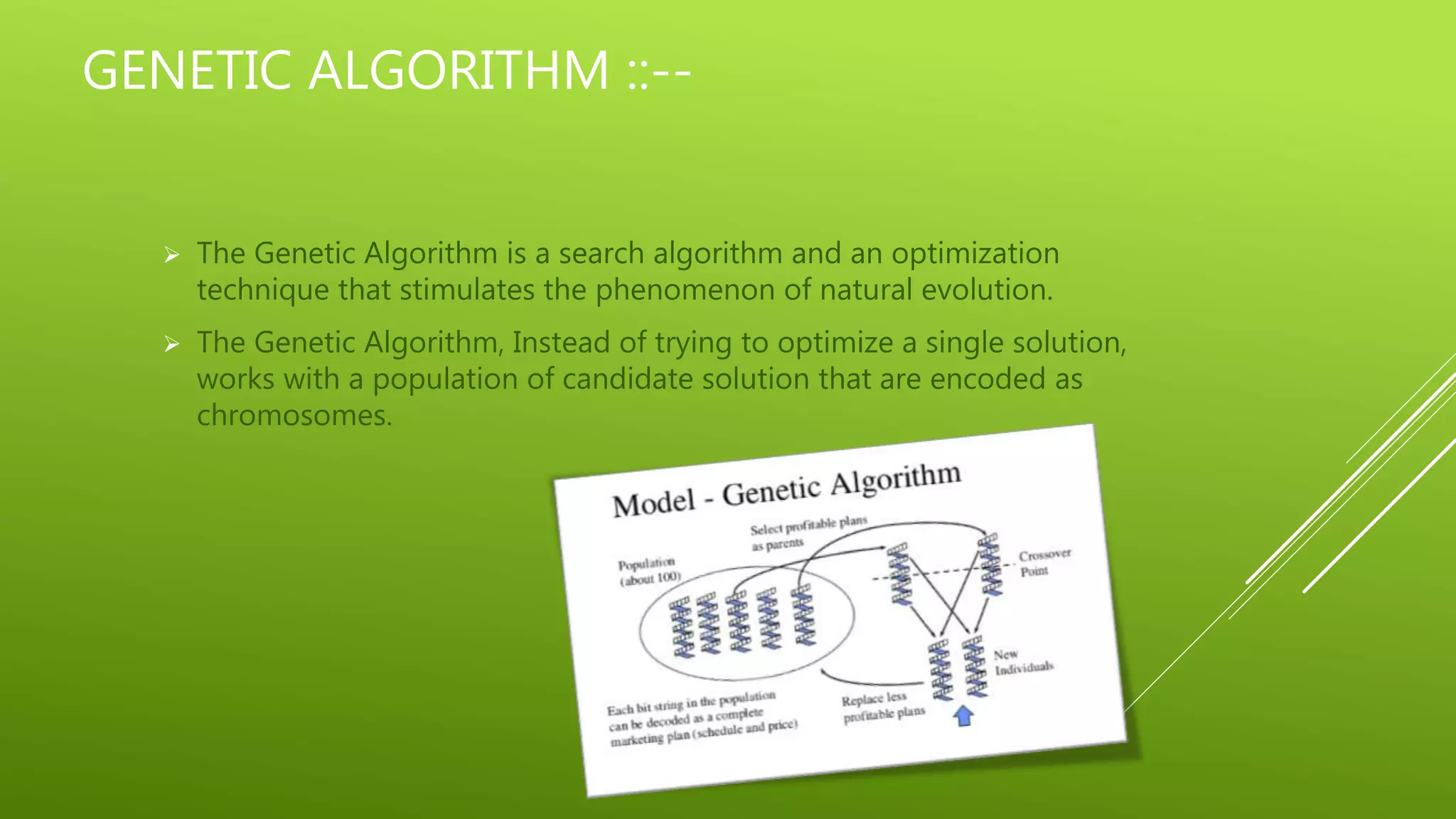
 The Genetic Algorithm is a search algorithm and an optimization
technique that stimulates the phenomenon of natural evolution.
 The Genetic Algorithm, Instead of trying to optimize a single solution,
works with a population of candidate solution that are encoded as
chromosomes.
ANT ALGORITHMS ::--
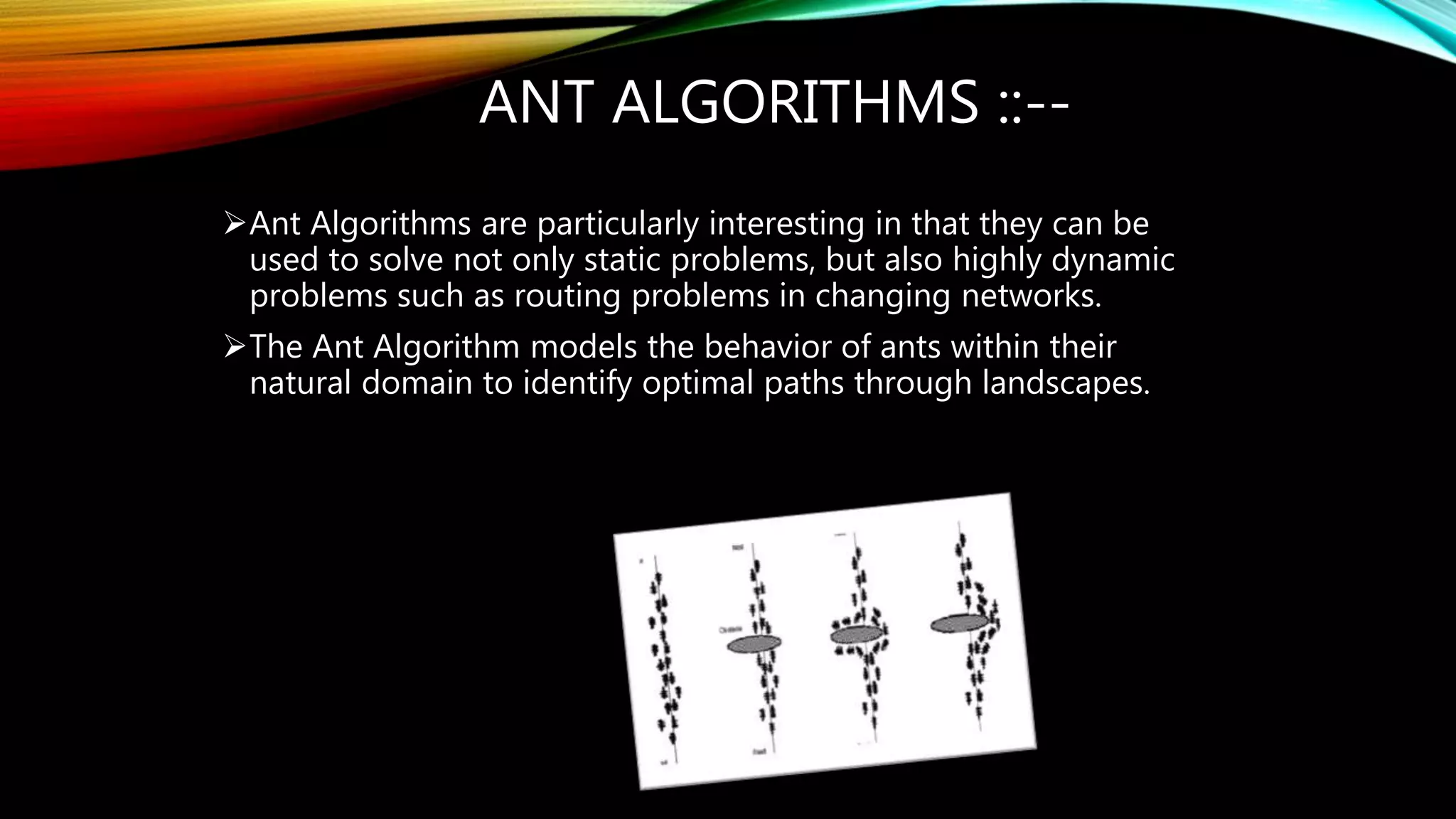
Ant Algorithms are particularly interesting in that they can be
used to solve not only static problems, but also highly dynamic
problems such as routing problems in changing networks.
The Ant Algorithm models the behavior of ants within their
natural domain to identify optimal paths through landscapes.
NEURAL NETWORKS ::--
Neural Networks are very simple implement of local behavior
observed within our own brains.
The brain is composed of neurons, which are the individual processing
elements.
Artificial Neural Networks Attempts to mimic the basic operations of
the brain. Information is passed between the neurons, and based upon
the structures and synapse weights, a network behavior is provided.



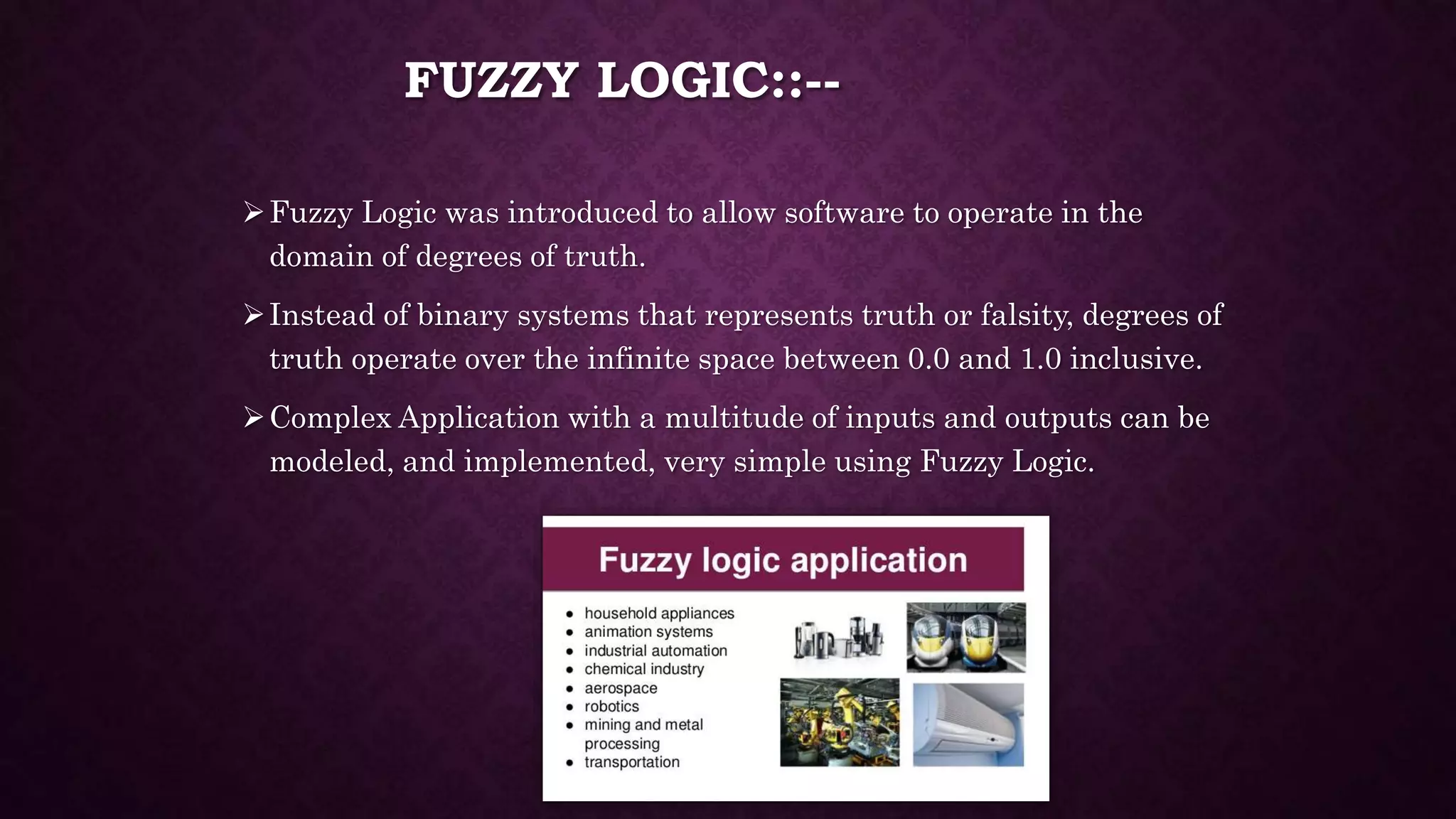
FUZZY LOGIC::--
Fuzzy Logic was introduced to allow software to operate in the
domain of degrees of truth.
Instead of binary systems that represents truth or falsity, degrees of
truth operate over the infinite space between 0.0 and 1.0 inclusive.
Complex Application with a multitude of inputs and outputs can be
modeled, and implemented, very simple using Fuzzy Logic.
METHODS OF ACHIEVE AI :-
 Top Down :-
The Top Dwon Category is Synonymous with Traditional Symbolic AI
where cognition is high level concept.
 Bottom Up :-
The Bottom Up category is synonymous with connectionist AI closely
the model of our own mammalian brain.
AI Today::--
• AI is a classical example of a technology that seems
initially so solvable , and then, on closer examination, so
thorny and difficult.
• The early promises Of AI didn’t work out, which make
predicting its future ambitious at best.
Declaration
• All The Data Are Showed On This Presentation in Come up With
some Books and Google.com
• Books Are “AI App Programming” And “Fundamental Of AI”
• Thanks For Paying attention

Artificial intelligence

  • 1.
    ARTIFICIAL INTELLIGENCE Fundamental AndBasic About AI Created By Rohit Jain
  • 2.
    CONTENT ::-- DEFINITION ANDHISTORY OF AI GENETIC ALGORITHM ANT ALGORITHMS NEURAL NETWORKS ADAPTIVE RESONANCE THEORY  FUZZY LOGIC AI TODAY
  • 3.
    Branches OF AI Automatic Programming  Bayesian Networks  Constraint Satisfaction  Knowledge Engineering  Machine Learning  Planning  Search
  • 4.
    Definition and HistoryOf AI ::--  Artificial Intelligence Is The Process Of Creating Machines that can act in a Manner that could be considered by Human to be Intelligent.  AI has The Potential To Change The World Like No Other Technology.  1940s- Birth Of Computers  1950s The Birth OF AI  1960s The Rise Of AI  1970s The Fall Of AI  1980s An AI Boom And Bust  1990s To today AI Rises Again, Quietly
  • 5.
    GENETIC ALGORITHM ::-- The Genetic Algorithm is a search algorithm and an optimization technique that stimulates the phenomenon of natural evolution.  The Genetic Algorithm, Instead of trying to optimize a single solution, works with a population of candidate solution that are encoded as chromosomes.
  • 6.
    ANT ALGORITHMS ::-- AntAlgorithms are particularly interesting in that they can be used to solve not only static problems, but also highly dynamic problems such as routing problems in changing networks. The Ant Algorithm models the behavior of ants within their natural domain to identify optimal paths through landscapes.
  • 7.
    NEURAL NETWORKS ::-- NeuralNetworks are very simple implement of local behavior observed within our own brains. The brain is composed of neurons, which are the individual processing elements. Artificial Neural Networks Attempts to mimic the basic operations of the brain. Information is passed between the neurons, and based upon the structures and synapse weights, a network behavior is provided.
  • 8.
  • 9.
    FUZZY LOGIC::-- Fuzzy Logicwas introduced to allow software to operate in the domain of degrees of truth. Instead of binary systems that represents truth or falsity, degrees of truth operate over the infinite space between 0.0 and 1.0 inclusive. Complex Application with a multitude of inputs and outputs can be modeled, and implemented, very simple using Fuzzy Logic.
  • 10.
    METHODS OF ACHIEVEAI :-  Top Down :- The Top Dwon Category is Synonymous with Traditional Symbolic AI where cognition is high level concept.  Bottom Up :- The Bottom Up category is synonymous with connectionist AI closely the model of our own mammalian brain.
  • 11.
    AI Today::-- • AIis a classical example of a technology that seems initially so solvable , and then, on closer examination, so thorny and difficult. • The early promises Of AI didn’t work out, which make predicting its future ambitious at best.
  • 12.
    Declaration • All TheData Are Showed On This Presentation in Come up With some Books and Google.com • Books Are “AI App Programming” And “Fundamental Of AI” • Thanks For Paying attention