Artificial intelligence
PRESENTED BY:-
ROSHAN S. RATHOD
M.SC :-2nd YEAR (computer science)
Index
 INTRODUCTION
 HISTORY
 WORKING
 ADVANTAGES
 DISADVANTAGES
 WEBSITES
Evidence of Artificial Intelligence folklore can be traced back to
ancient Egypt, but with the development of the electronic computer
in 1941, the technology finally became available to create machine
intelligence. The term artificial intelligence was first coined in 1956,
at the Dartmouth conference, and since then Artificial Intelligence
has expanded because of the theories and principles developed by
its dedicated researchers. Through its short modern history,
advancement in the fields of AI have been slower than first
estimated, progress continues to be made. From its birth 5 decades
ago, there have been a variety of AI programs, and they have
impacted other technological advancements
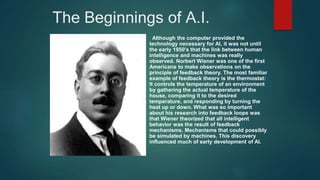
The Beginnings of A.I.
Although the computer provided the
technology necessary for AI, it was not until
the early 1950's that the link between human
intelligence and machines was really
observed. Norbert Wiener was one of the first
Americans to make observations on the
principle of feedback theory. The most familiar
example of feedback theory is the thermostat:
It controls the temperature of an environment
by gathering the actual temperature of the
house, comparing it to the desired
temperature, and responding by turning the
heat up or down. What was so important
about his research into feedback loops was
that Wiener theorized that all intelligent
behavior was the result of feedback
mechanisms. Mechanisms that could possibly
be simulated by machines. This discovery
influenced much of early development of AI.
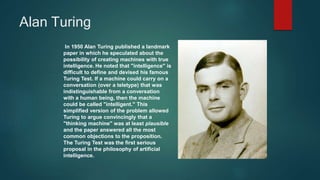
Alan Turing
In 1950 Alan Turing published a landmark
paper in which he speculated about the
possibility of creating machines with true
intelligence. He noted that "intelligence" is
difficult to define and devised his famous
Turing Test. If a machine could carry on a
conversation (over a teletype) that was
indistinguishable from a conversation
with a human being, then the machine
could be called "intelligent." This
simplified version of the problem allowed
Turing to argue convincingly that a
"thinking machine" was at least plausible
and the paper answered all the most
common objections to the proposition.
The Turing Test was the first serious
proposal in the philosophy of artificial
intelligence.
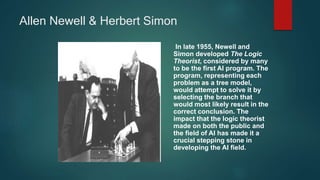
Allen Newell & Herbert Simon
In late 1955, Newell and
Simon developed The Logic
Theorist, considered by many
to be the first AI program. The
program, representing each
problem as a tree model,
would attempt to solve it by
selecting the branch that
would most likely result in the
correct conclusion. The
impact that the logic theorist
made on both the public and
the field of AI has made it a
crucial stepping stone in
developing the AI field.
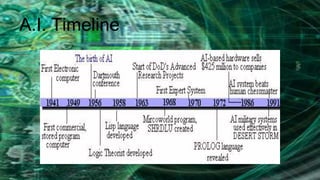
A.I. Timeline
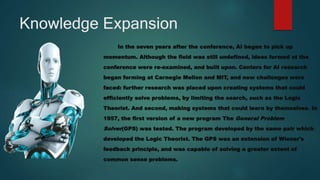
Knowledge Expansion
In the seven years after the conference, AI began to pick up
momentum. Although the field was still undefined, ideas formed at the
conference were re-examined, and built upon. Centers for AI research
began forming at Carnegie Mellon and MIT, and new challenges were
faced: further research was placed upon creating systems that could
efficiently solve problems, by limiting the search, such as the Logic
Theorist. And second, making systems that could learn by themselves. In
1957, the first version of a new program The General Problem
Solver(GPS) was tested. The program developed by the same pair which
developed the Logic Theorist. The GPS was an extension of Wiener's
feedback principle, and was capable of solving a greater extent of
common sense problems.
Knowledge Expansion (Cont.)
A couple of years after the GPS, IBM contracted a team to
research artificial intelligence. While more programs were being
produced, McCarthy was busy developing a major breakthrough
in AI history. In 1958 McCarthy announced his new
development; the LISP language, which is still used today and is
the language of choice among most AI developers. (Lisp, an
acronym for list processing, is a functional programming language
that was designed for easy manipulation of data strings. As one of
the oldest programming languages still in use, Lisp offers several
different dialects and has influenced the development of other
languages.)
A.I. Put to Test
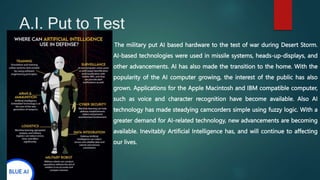
The military put AI based hardware to the test of war during Desert Storm.
AI-based technologies were used in missile systems, heads-up-displays, and
other advancements. AI has also made the transition to the home. With the
popularity of the AI computer growing, the interest of the public has also
grown. Applications for the Apple Macintosh and IBM compatible computer,
such as voice and character recognition have become available. Also AI
technology has made steadying camcorders simple using fuzzy logic. With a
greater demand for AI-related technology, new advancements are becoming
available. Inevitably Artificial Intelligence has, and will continue to affecting
our lives.
A.I. In Video Games
Video game artificial intelligence is a programming area that tries
to make the computer act in a similar way to human intelligence.
A rule based system is used whereby information and rules are
entered into a database, and when the video game AI is faced with
a situation, it finds appropriate information and acts accordingly.
Artificial intelligence  .pptx

Artificial intelligence .pptx

  • 1.
    Artificial intelligence PRESENTED BY:- ROSHANS. RATHOD M.SC :-2nd YEAR (computer science)
  • 2.
    Index  INTRODUCTION  HISTORY WORKING  ADVANTAGES  DISADVANTAGES  WEBSITES
  • 3.
    Evidence of ArtificialIntelligence folklore can be traced back to ancient Egypt, but with the development of the electronic computer in 1941, the technology finally became available to create machine intelligence. The term artificial intelligence was first coined in 1956, at the Dartmouth conference, and since then Artificial Intelligence has expanded because of the theories and principles developed by its dedicated researchers. Through its short modern history, advancement in the fields of AI have been slower than first estimated, progress continues to be made. From its birth 5 decades ago, there have been a variety of AI programs, and they have impacted other technological advancements
  • 5.
    The Beginnings ofA.I. Although the computer provided the technology necessary for AI, it was not until the early 1950's that the link between human intelligence and machines was really observed. Norbert Wiener was one of the first Americans to make observations on the principle of feedback theory. The most familiar example of feedback theory is the thermostat: It controls the temperature of an environment by gathering the actual temperature of the house, comparing it to the desired temperature, and responding by turning the heat up or down. What was so important about his research into feedback loops was that Wiener theorized that all intelligent behavior was the result of feedback mechanisms. Mechanisms that could possibly be simulated by machines. This discovery influenced much of early development of AI.
  • 6.
    Alan Turing In 1950Alan Turing published a landmark paper in which he speculated about the possibility of creating machines with true intelligence. He noted that "intelligence" is difficult to define and devised his famous Turing Test. If a machine could carry on a conversation (over a teletype) that was indistinguishable from a conversation with a human being, then the machine could be called "intelligent." This simplified version of the problem allowed Turing to argue convincingly that a "thinking machine" was at least plausible and the paper answered all the most common objections to the proposition. The Turing Test was the first serious proposal in the philosophy of artificial intelligence.
  • 7.
    Allen Newell &Herbert Simon In late 1955, Newell and Simon developed The Logic Theorist, considered by many to be the first AI program. The program, representing each problem as a tree model, would attempt to solve it by selecting the branch that would most likely result in the correct conclusion. The impact that the logic theorist made on both the public and the field of AI has made it a crucial stepping stone in developing the AI field.
  • 8.
  • 9.
    Knowledge Expansion In theseven years after the conference, AI began to pick up momentum. Although the field was still undefined, ideas formed at the conference were re-examined, and built upon. Centers for AI research began forming at Carnegie Mellon and MIT, and new challenges were faced: further research was placed upon creating systems that could efficiently solve problems, by limiting the search, such as the Logic Theorist. And second, making systems that could learn by themselves. In 1957, the first version of a new program The General Problem Solver(GPS) was tested. The program developed by the same pair which developed the Logic Theorist. The GPS was an extension of Wiener's feedback principle, and was capable of solving a greater extent of common sense problems.
  • 10.
    Knowledge Expansion (Cont.) Acouple of years after the GPS, IBM contracted a team to research artificial intelligence. While more programs were being produced, McCarthy was busy developing a major breakthrough in AI history. In 1958 McCarthy announced his new development; the LISP language, which is still used today and is the language of choice among most AI developers. (Lisp, an acronym for list processing, is a functional programming language that was designed for easy manipulation of data strings. As one of the oldest programming languages still in use, Lisp offers several different dialects and has influenced the development of other languages.)
  • 11.
    A.I. Put toTest The military put AI based hardware to the test of war during Desert Storm. AI-based technologies were used in missile systems, heads-up-displays, and other advancements. AI has also made the transition to the home. With the popularity of the AI computer growing, the interest of the public has also grown. Applications for the Apple Macintosh and IBM compatible computer, such as voice and character recognition have become available. Also AI technology has made steadying camcorders simple using fuzzy logic. With a greater demand for AI-related technology, new advancements are becoming available. Inevitably Artificial Intelligence has, and will continue to affecting our lives.
  • 12.
    A.I. In VideoGames Video game artificial intelligence is a programming area that tries to make the computer act in a similar way to human intelligence. A rule based system is used whereby information and rules are entered into a database, and when the video game AI is faced with a situation, it finds appropriate information and acts accordingly.