ARTIFICIAL
INTELLIGENCE
CHRISTY BATULANON-ARBIS
Reporter
EdD 809
Issues and Trends in Philippine Education
OBJECTIVES
1. To provide an overview of Artificial Intelligence (AI).
2. To examine the impact of AI to students, teachers,
and administrators.
3. To identify key issues and trends of AI Tools in
education system and how to address them.
 refers to the development of computer systems
and software that can perform tasks that typically
require human intelligence. These tasks include
problem-solving, learning, reasoning,
understanding natural language, recognizing
patterns, and making decisions. AI technology
seeks to create machines and software that can
mimic human cognitive functions and adapt to
new information and situations.
ARTIFICIAL INTELLIGENCE (AI)
AI technology in education is transforming
the way students learn, teachers instruct, and
schools operate. It offers a wide range of
applications and benefits in the education
sector.
STUDENTS
1. Google Workspace for
Education: Google's suite
of tools, including Google
Docs, Google Sheets, and
Google Slides, is
commonly used for
collaboration and
document creation.
STUDENTS
2. Microsoft Office 365:
Microsoft's Office 365
suite is used for
document creation,
collaboration, and
presentations.
STUDENTS
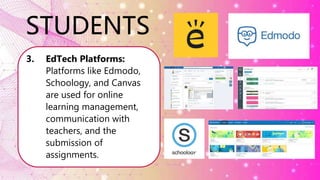
3. EdTech Platforms:
Platforms like Edmodo,
Schoology, and Canvas
are used for online
learning management,
communication with
teachers, and the
submission of
assignments.
STUDENTS
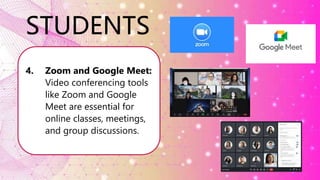
4. Zoom and Google Meet:
Video conferencing tools
like Zoom and Google
Meet are essential for
online classes, meetings,
and group discussions.
STUDENTS
5. Canva: Canva is a graphic
design tool that uses AI
to help students create
visually appealing
presentations, posters,
and other design
projects.
STUDENTS
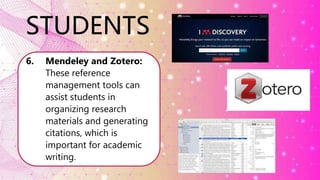
6. Mendeley and Zotero:
These reference
management tools can
assist students in
organizing research
materials and generating
citations, which is
important for academic
writing.
STUDENTS
7. Online Tutoring
Platforms: Some
students use online
tutoring platforms like
Khan Academy or Chegg,
which utilize AI to provide
personalized learning
resources and assistance.
STUDENTS
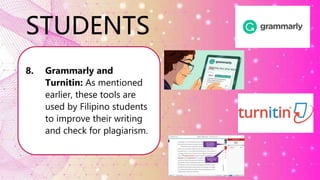
8. Grammarly and
Turnitin: As mentioned
earlier, these tools are
used by Filipino students
to improve their writing
and check for plagiarism.
STUDENTS
9. Language Learning
Apps: Language learning
apps like Duolingo,
Rosetta Stone, and
Babbel, which employ AI
to provide interactive
language lessons.
STUDENTS
10. Mobile Learning Apps:
Various educational apps,
such as Kahoot!,
Photomath, and Brainly,
help students with
subjects like math,
science, and social
studies.
STUDENTS
11. Social Media Algorithms:
While not strictly educational
tools, social media platforms
like Facebook, YouTube, and
Instagram use AI algorithms
that recommend educational
content and tutorials to
students.
BENEFITS/ADVANTAGES
1. Personalization
2. Accessibility
3. Immediate Feedback
4. Efficiency
5. Engagement
6. Data Analysis
7. Access to Resources
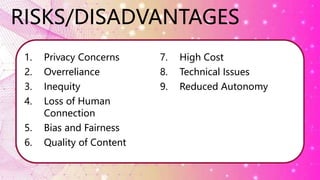
RISKS/DISADVANTAGES
1. Privacy Concerns
2. Overreliance
3. Inequity
4. Loss of Human
Connection
5. Bias and Fairness
6. Quality of Content
7. High Cost
8. Technical Issues
9. Reduced Autonomy
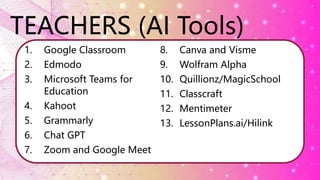
TEACHERS (AI Tools)
1. Google Classroom
2. Edmodo
3. Microsoft Teams for
Education
4. Kahoot
5. Grammarly
6. Chat GPT
7. Zoom and Google Meet
8. Canva and Visme
9. Wolfram Alpha
10. Quillionz/MagicSchool
11. Classcraft
12. Mentimeter
13. LessonPlans.ai/Hilink
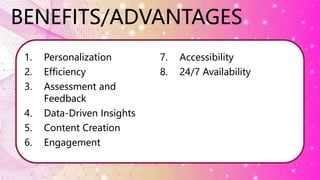
BENEFITS/ADVANTAGES
1. Personalization
2. Efficiency
3. Assessment and
Feedback
4. Data-Driven Insights
5. Content Creation
6. Engagement
7. Accessibility
8. 24/7 Availability
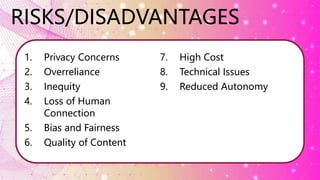
RISKS/DISADVANTAGES
1. Privacy Concerns
2. Overreliance
3. Inequity
4. Loss of Human
Connection
5. Bias and Fairness
6. Quality of Content
7. High Cost
8. Technical Issues
9. Reduced Autonomy
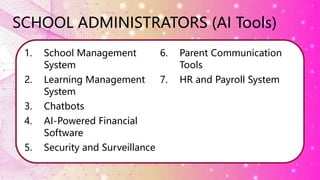
SCHOOL ADMINISTRATORS (AI Tools)
1. School Management
System
2. Learning Management
System
3. Chatbots
4. AI-Powered Financial
Software
5. Security and Surveillance
6. Parent Communication
Tools
7. HR and Payroll System
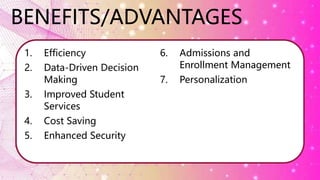
BENEFITS/ADVANTAGES
1. Efficiency
2. Data-Driven Decision
Making
3. Improved Student
Services
4. Cost Saving
5. Enhanced Security
6. Admissions and
Enrollment Management
7. Personalization
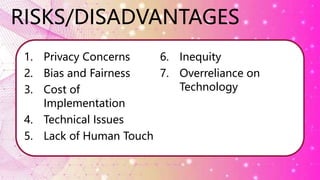
RISKS/DISADVANTAGES
1. Privacy Concerns
2. Bias and Fairness
3. Cost of
Implementation
4. Technical Issues
5. Lack of Human Touch
6. Inequity
7. Overreliance on
Technology
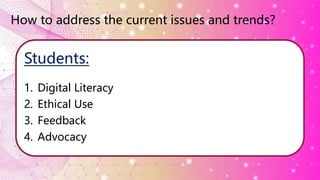
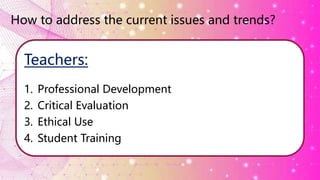
How to address the current issues and trends?
Students:
1. Digital Literacy
2. Ethical Use
3. Feedback
4. Advocacy
How to address the current issues and trends?
Teachers:
1. Professional Development
2. Critical Evaluation
3. Ethical Use
4. Student Training
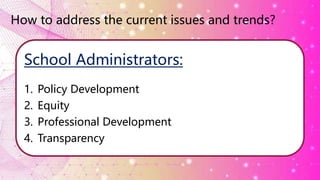
How to address the current issues and trends?
School Administrators:
1. Policy Development
2. Equity
3. Professional Development
4. Transparency
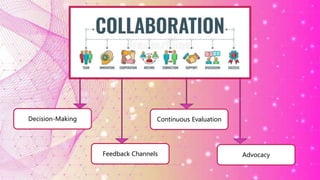
Decision-Making
Feedback Channels Advocacy
Continuous Evaluation
ARTIFICIAL INTELLIGENCE in Education.pptx

ARTIFICIAL INTELLIGENCE in Education.pptx

  • 1.
  • 2.
    OBJECTIVES 1. To providean overview of Artificial Intelligence (AI). 2. To examine the impact of AI to students, teachers, and administrators. 3. To identify key issues and trends of AI Tools in education system and how to address them.
  • 4.
     refers tothe development of computer systems and software that can perform tasks that typically require human intelligence. These tasks include problem-solving, learning, reasoning, understanding natural language, recognizing patterns, and making decisions. AI technology seeks to create machines and software that can mimic human cognitive functions and adapt to new information and situations. ARTIFICIAL INTELLIGENCE (AI)
  • 5.
    AI technology ineducation is transforming the way students learn, teachers instruct, and schools operate. It offers a wide range of applications and benefits in the education sector.
  • 6.
    STUDENTS 1. Google Workspacefor Education: Google's suite of tools, including Google Docs, Google Sheets, and Google Slides, is commonly used for collaboration and document creation.
  • 7.
    STUDENTS 2. Microsoft Office365: Microsoft's Office 365 suite is used for document creation, collaboration, and presentations.
  • 8.
    STUDENTS 3. EdTech Platforms: Platformslike Edmodo, Schoology, and Canvas are used for online learning management, communication with teachers, and the submission of assignments.
  • 9.
    STUDENTS 4. Zoom andGoogle Meet: Video conferencing tools like Zoom and Google Meet are essential for online classes, meetings, and group discussions.
  • 10.
    STUDENTS 5. Canva: Canvais a graphic design tool that uses AI to help students create visually appealing presentations, posters, and other design projects.
  • 11.
    STUDENTS 6. Mendeley andZotero: These reference management tools can assist students in organizing research materials and generating citations, which is important for academic writing.
  • 12.
    STUDENTS 7. Online Tutoring Platforms:Some students use online tutoring platforms like Khan Academy or Chegg, which utilize AI to provide personalized learning resources and assistance.
  • 13.
    STUDENTS 8. Grammarly and Turnitin:As mentioned earlier, these tools are used by Filipino students to improve their writing and check for plagiarism.
  • 14.
    STUDENTS 9. Language Learning Apps:Language learning apps like Duolingo, Rosetta Stone, and Babbel, which employ AI to provide interactive language lessons.
  • 15.
    STUDENTS 10. Mobile LearningApps: Various educational apps, such as Kahoot!, Photomath, and Brainly, help students with subjects like math, science, and social studies.
  • 16.
    STUDENTS 11. Social MediaAlgorithms: While not strictly educational tools, social media platforms like Facebook, YouTube, and Instagram use AI algorithms that recommend educational content and tutorials to students.
  • 17.
    BENEFITS/ADVANTAGES 1. Personalization 2. Accessibility 3.Immediate Feedback 4. Efficiency 5. Engagement 6. Data Analysis 7. Access to Resources
  • 18.
    RISKS/DISADVANTAGES 1. Privacy Concerns 2.Overreliance 3. Inequity 4. Loss of Human Connection 5. Bias and Fairness 6. Quality of Content 7. High Cost 8. Technical Issues 9. Reduced Autonomy
  • 19.
    TEACHERS (AI Tools) 1.Google Classroom 2. Edmodo 3. Microsoft Teams for Education 4. Kahoot 5. Grammarly 6. Chat GPT 7. Zoom and Google Meet 8. Canva and Visme 9. Wolfram Alpha 10. Quillionz/MagicSchool 11. Classcraft 12. Mentimeter 13. LessonPlans.ai/Hilink
  • 20.
    BENEFITS/ADVANTAGES 1. Personalization 2. Efficiency 3.Assessment and Feedback 4. Data-Driven Insights 5. Content Creation 6. Engagement 7. Accessibility 8. 24/7 Availability
  • 21.
    RISKS/DISADVANTAGES 1. Privacy Concerns 2.Overreliance 3. Inequity 4. Loss of Human Connection 5. Bias and Fairness 6. Quality of Content 7. High Cost 8. Technical Issues 9. Reduced Autonomy
  • 22.
    SCHOOL ADMINISTRATORS (AITools) 1. School Management System 2. Learning Management System 3. Chatbots 4. AI-Powered Financial Software 5. Security and Surveillance 6. Parent Communication Tools 7. HR and Payroll System
  • 23.
    BENEFITS/ADVANTAGES 1. Efficiency 2. Data-DrivenDecision Making 3. Improved Student Services 4. Cost Saving 5. Enhanced Security 6. Admissions and Enrollment Management 7. Personalization
  • 24.
    RISKS/DISADVANTAGES 1. Privacy Concerns 2.Bias and Fairness 3. Cost of Implementation 4. Technical Issues 5. Lack of Human Touch 6. Inequity 7. Overreliance on Technology
  • 25.
    How to addressthe current issues and trends? Students: 1. Digital Literacy 2. Ethical Use 3. Feedback 4. Advocacy
  • 26.
    How to addressthe current issues and trends? Teachers: 1. Professional Development 2. Critical Evaluation 3. Ethical Use 4. Student Training
  • 27.
    How to addressthe current issues and trends? School Administrators: 1. Policy Development 2. Equity 3. Professional Development 4. Transparency
  • 28.