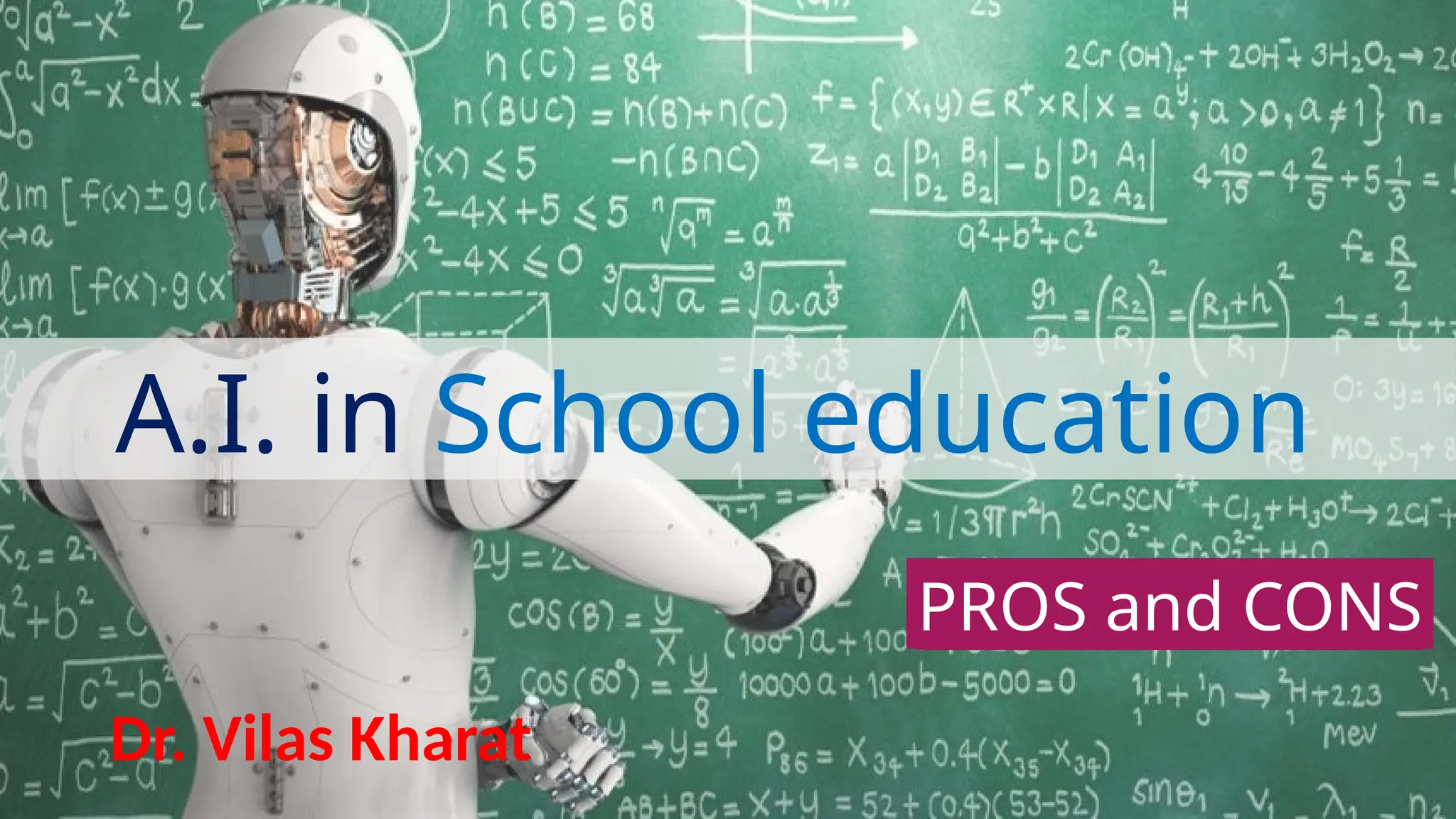
A.I. in School education
PROS and CONS
Dr. Vilas Kharat
What is AI ?
“Artificial intelligence (AI) refers to the simulation
of human intelligence in machines that are
programmed to think like humans and mimic their
actions.
The term may also be applied to any machine that
exhibits traits associated with a human mind such
as learning and problem-solving.”
- Investopedia
Why we need AI?
• increased efficiency, accuracy, and productivity.
• It can automate routine tasks.
• optimize processes.
• enable faster decision-making.
• provide insights and predictions based on data analysis,
leading to better outcomes and results.
AI in Schools
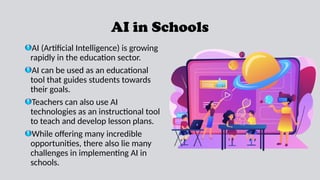
AI (Artificial Intelligence) is growing
rapidly in the education sector.
AI can be used as an educational
tool that guides students towards
their goals.
Teachers can also use AI
technologies as an instructional tool
to teach and develop lesson plans.
While offering many incredible
opportunities, there also lie many
challenges in implementing AI in
schools.
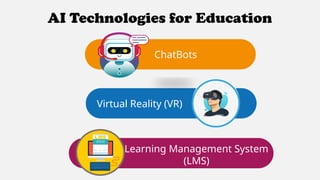
AI Technologies for Education
ChatBots
Virtual Reality (VR)
Learning Management System
(LMS)
Pros of using A.I. in Schools
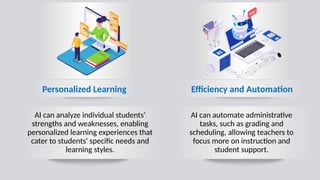
Efficiency and Automation
Personalized Learning
AI can automate administrative
tasks, such as grading and
scheduling, allowing teachers to
focus more on instruction and
student support.​
AI can analyze individual students'
strengths and weaknesses, enabling
personalized learning experiences that
cater to students' specific needs and
learning styles.​
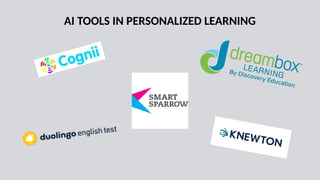
AI TOOLS IN PERSONALIZED LEARNING
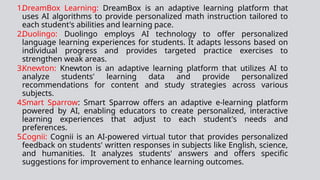
1.DreamBox Learning: DreamBox is an adaptive learning platform that
uses AI algorithms to provide personalized math instruction tailored to
each student's abilities and learning pace.
2.Duolingo: Duolingo employs AI technology to offer personalized
language learning experiences for students. It adapts lessons based on
individual progress and provides targeted practice exercises to
strengthen weak areas.
3.Knewton: Knewton is an adaptive learning platform that utilizes AI to
analyze students' learning data and provide personalized
recommendations for content and study strategies across various
subjects.
4.Smart Sparrow: Smart Sparrow offers an adaptive e-learning platform
powered by AI, enabling educators to create personalized, interactive
learning experiences that adjust to each student's needs and
preferences.
5.Cognii: Cognii is an AI-powered virtual tutor that provides personalized
feedback on students' written responses in subjects like English, science,
and humanities. It analyzes students' answers and offers specific
suggestions for improvement to enhance learning outcomes.
AI TOOLS FOR INCREASING EFFICIENCY AND AUTOMATION
FOR TEACHERS
1.Edmodo: Edmodo is an AI-powered learning management system that helps
teachers streamline communication, assignments, grading, and class
management tasks. It offers features like automated gradebooks,
assignment reminders, and personalized learning recommendations for
students.
2.Google Classroom: Google Classroom utilizes AI algorithms to automate
routine tasks such as distributing assignments, providing feedback, and
organizing class materials. It integrates seamlessly with other Google tools
like Drive and Docs, making it easy for teachers to create, distribute, and
assess student work efficiently.
3.ScribeSense: ScribeSense is an AI-based grading tool that automates the
grading of handwritten assignments and assessments. It uses machine
learning algorithms to recognize and evaluate handwriting, saving teachers
time and effort in grading papers manually.
4.TeacherVision: TeacherVision is an AI-powered educational resource
platform that offers customizable lesson plans, worksheets, and teaching
materials for educators. It uses data analytics to recommend relevant
resources based on teachers' preferences, student needs, and curriculum
requirements, helping teachers find and adapt materials quickly.
5.Chalk: Chalk is an AI-driven instructional planning and assessment platform
designed to streamline lesson planning, curriculum mapping, and
AI can generate interactive and engaging
educational content, such as virtual labs
and simulations.
Gamified learning experiences and
virtual field trips can make lessons more
interesting and memorable.
Access to Resources
AI-powered educational tools can
provide access to quality education for
students in remote or underserved
areas, closing the education gap.
Accessibility features in AI can assist
students with disabilities, making
learning more inclusive.
Improved Educational Content
AI TOOLS FOR STUDENTS WITH DISABILITY
LUMINAI
1.ClaroRead: ClaroRead is an AI-powered text-to-speech software that assists students
with dyslexia, visual impairments, or reading difficulties. It reads digital text aloud,
highlights words as they are spoken, and offers features like text customization and
voice synthesis to enhance reading comprehension and accessibility.
2.Dragon NaturallySpeaking: Dragon NaturallySpeaking is a speech recognition
software that enables students with mobility or dexterity issues to control computers
and compose documents using voice commands. It allows users to dictate text,
navigate applications, and execute commands hands-free, improving accessibility
and productivity for students with physical disabilities.
3.Texthelp Read&Write: Texthelp Read&Write is an AI-powered literacy software suite
designed to support students with learning disabilities, such as dyslexia and ADHD. It
offers features like text-to-speech, word prediction, and study tools to assist with
reading, writing, and comprehension tasks across various digital platforms.
4.EyeGaze: EyeGaze technology uses AI algorithms to track and interpret eye
movements, allowing students with severe physical disabilities or motor
impairments to control computers and communicate using only their eyes. It
enables users to navigate on-screen interfaces, select options, and generate text or
speech output through gaze-based input.
5.LuminAI: LuminAI is an AI-powered accessibility tool that enhances digital content
accessibility for students with visual impairments. It uses computer vision and image
recognition algorithms to describe visual elements, such as images, graphs, and
Language Learning
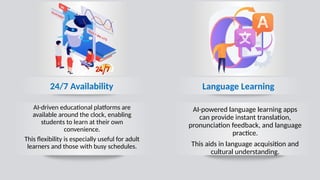
24/7 Availability
AI-driven educational platforms are
available around the clock, enabling
students to learn at their own
convenience.
This flexibility is especially useful for adult
learners and those with busy schedules.
AI-powered language learning apps
can provide instant translation,
pronunciation feedback, and language
practice.
This aids in language acquisition and
cultural understanding.
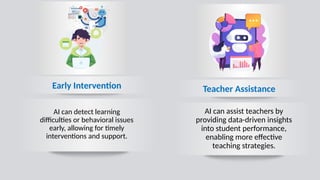
Teacher Assistance
Early Intervention
AI can detect learning
difficulties or behavioral issues
early, allowing for timely
interventions and support.
AI can assist teachers by
providing data-driven insights
into student performance,
enabling more effective
teaching strategies.
AI TOOLS FOR DIAGNOSIS OF LEARNING DIFFICULTY
Emotify
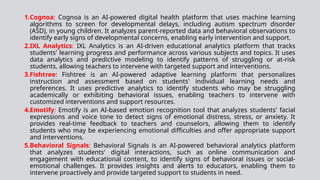
1.Cognoa: Cognoa is an AI-powered digital health platform that uses machine learning
algorithms to screen for developmental delays, including autism spectrum disorder
(ASD), in young children. It analyzes parent-reported data and behavioral observations to
identify early signs of developmental concerns, enabling early intervention and support.
2.IXL Analytics: IXL Analytics is an AI-driven educational analytics platform that tracks
students' learning progress and performance across various subjects and topics. It uses
data analytics and predictive modeling to identify patterns of struggling or at-risk
students, allowing teachers to intervene with targeted support and interventions.
3.Fishtree: Fishtree is an AI-powered adaptive learning platform that personalizes
instruction and assessment based on students' individual learning needs and
preferences. It uses predictive analytics to identify students who may be struggling
academically or exhibiting behavioral issues, enabling teachers to intervene with
customized interventions and support resources.
4.Emotify: Emotify is an AI-based emotion recognition tool that analyzes students' facial
expressions and voice tone to detect signs of emotional distress, stress, or anxiety. It
provides real-time feedback to teachers and counselors, allowing them to identify
students who may be experiencing emotional difficulties and offer appropriate support
and interventions.
5.Behavioral Signals: Behavioral Signals is an AI-powered behavioral analytics platform
that analyzes students' digital interactions, such as online communication and
engagement with educational content, to identify signs of behavioral issues or social-
emotional challenges. It provides insights and alerts to educators, enabling them to
intervene proactively and provide targeted support to students in need.
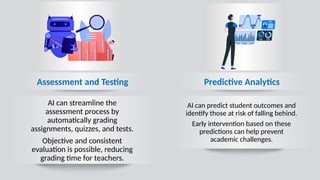
Predictive Analytics
Assessment and Testing
AI can streamline the
assessment process by
automatically grading
assignments, quizzes, and tests.
Objective and consistent
evaluation is possible, reducing
grading time for teachers.
AI can predict student outcomes and
identify those at risk of falling behind.
Early intervention based on these
predictions can help prevent
academic challenges.
AI TOOLS FOR ASSESSMENT AND TESTING
1.Gradescope: Gradescope is an AI-powered grading platform that streamlines the
grading process for assignments, quizzes, and exams. It offers features like
automated grading for multiple-choice, fill-in-the-blank, and programming
questions, as well as AI-assisted grading for handwritten responses using
computer vision technology.
2.Crowdmark: Crowdmark is an online grading and assessment platform that
utilizes AI algorithms to automate the grading of exams, quizzes, and assignments.
It offers tools for digital grading, rubric-based assessment, and providing feedback
to students, saving educators time and effort in the grading process.
3.ZipGrade: ZipGrade is a mobile app that uses AI technology to automate the
grading of multiple-choice assessments. Educators can scan answer sheets using
their smartphone camera, and the app instantly grades the responses and provides
detailed analytics and insights into student performance.
4.Remark Test Grading: Remark Test Grading is an AI-powered test grading
software that automates the grading of paper-based assessments, including
bubble sheets and answer forms. It uses optical mark recognition (OMR)
technology to scan and analyze responses, generating instant grading results and
statistical reports.
5.WIRIS quizzes: WIRIS quizzes is an AI-driven assessment platform that automates
the grading of quizzes and tests across various subjects and question types. It
offers features like automatic scoring, customizable feedback, and item analysis
tools to help educators assess student performance efficiently and accurately.
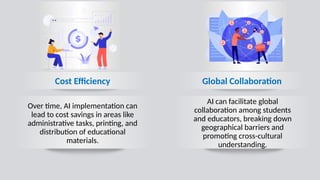
Global Collaboration
Cost Efficiency
Over time, AI implementation can
lead to cost savings in areas like
administrative tasks, printing, and
distribution of educational
materials.
AI can facilitate global
collaboration among students
and educators, breaking down
geographical barriers and
promoting cross-cultural
understanding.
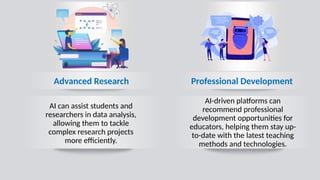
Professional Development
Advanced Research
AI can assist students and
researchers in data analysis,
allowing them to tackle
complex research projects
more efficiently.
AI-driven platforms can
recommend professional
development opportunities for
educators, helping them stay up-
to-date with the latest teaching
methods and technologies.
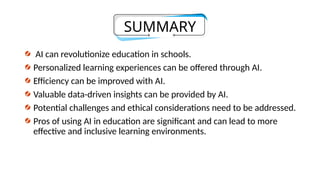
SUMMARY
AI can revolutionize education in schools.
Personalized learning experiences can be offered through AI.
Efficiency can be improved with AI.
Valuable data-driven insights can be provided by AI.
Potential challenges and ethical considerations need to be addressed.
Pros of using AI in education are significant and can lead to more
effective and inclusive learning environments.
Cons of
using A.I.
in Schools
Cons of using A.I. in Schools
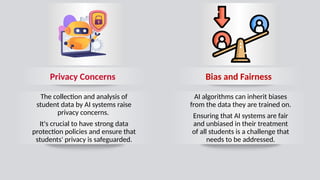
Bias and Fairness
Privacy Concerns
The collection and analysis of
student data by AI systems raise
privacy concerns.
It's crucial to have strong data
protection policies and ensure that
students' privacy is safeguarded.
AI algorithms can inherit biases
from the data they are trained on.
Ensuring that AI systems are fair
and unbiased in their treatment
of all students is a challenge that
needs to be addressed.
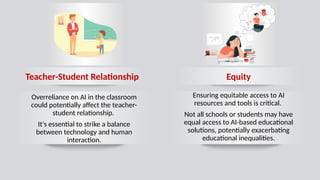
Equity
Teacher-Student Relationship
Overreliance on AI in the classroom
could potentially affect the teacher-
student relationship.
It's essential to strike a balance
between technology and human
interaction.
Ensuring equitable access to AI
resources and tools is critical.
Not all schools or students may have
equal access to AI-based educational
solutions, potentially exacerbating
educational inequalities.
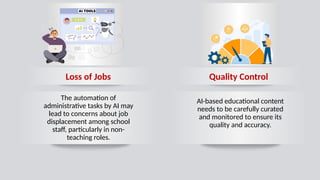
Quality Control
Loss of Jobs
The automation of
administrative tasks by AI may
lead to concerns about job
displacement among school
staff, particularly in non-
teaching roles.
AI-based educational content
needs to be carefully curated
and monitored to ensure its
quality and accuracy.​
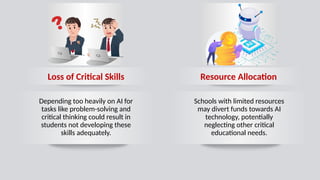
Resource Allocation
Loss of Critical Skills
Depending too heavily on AI for
tasks like problem-solving and
critical thinking could result in
students not developing these
skills adequately.
Schools with limited resources
may divert funds towards AI
technology, potentially
neglecting other critical
educational needs.
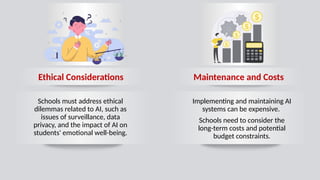
Maintenance and Costs
Ethical Considerations
Schools must address ethical
dilemmas related to AI, such as
issues of surveillance, data
privacy, and the impact of AI on
students' emotional well-being.
Implementing and maintaining AI
systems can be expensive.
Schools need to consider the
long-term costs and potential
budget constraints.
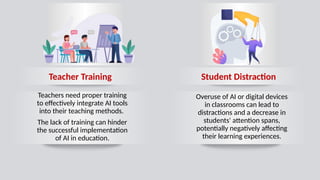
Student Distraction
Teacher Training
Teachers need proper training
to effectively integrate AI tools
into their teaching methods.
The lack of training can hinder
the successful implementation
of AI in education.
Overuse of AI or digital devices
in classrooms can lead to
distractions and a decrease in
students' attention spans,
potentially negatively affecting
their learning experiences.
AI can bring significant benefits to education.
Addressing the cons and considerations is vital for successful
implementation in schools.
Schools and policymakers must take a proactive approach to ensure
responsible and ethical use of AI technologies.
AI should enhance, rather than hinder, the educational experience
for all students.
SUMMARY
Conclusion
Conclusion
AI can bring significant improvements to schools.
It is essential to address potential challenges and
ethical considerations. Identifying the right tools
and use cases is important for integrating AI
effectively in schools.
Will AI Replace Teachers??

Artificial Intelligence in School education.pptx

  • 1.
    A.I. in Schooleducation PROS and CONS Dr. Vilas Kharat
  • 2.
    What is AI? “Artificial intelligence (AI) refers to the simulation of human intelligence in machines that are programmed to think like humans and mimic their actions. The term may also be applied to any machine that exhibits traits associated with a human mind such as learning and problem-solving.” - Investopedia
  • 3.
    Why we needAI? • increased efficiency, accuracy, and productivity. • It can automate routine tasks. • optimize processes. • enable faster decision-making. • provide insights and predictions based on data analysis, leading to better outcomes and results.
  • 4.
    AI in Schools AI(Artificial Intelligence) is growing rapidly in the education sector. AI can be used as an educational tool that guides students towards their goals. Teachers can also use AI technologies as an instructional tool to teach and develop lesson plans. While offering many incredible opportunities, there also lie many challenges in implementing AI in schools.
  • 5.
    AI Technologies forEducation ChatBots Virtual Reality (VR) Learning Management System (LMS)
  • 6.
    Pros of usingA.I. in Schools
  • 7.
    Efficiency and Automation PersonalizedLearning AI can automate administrative tasks, such as grading and scheduling, allowing teachers to focus more on instruction and student support.​ AI can analyze individual students' strengths and weaknesses, enabling personalized learning experiences that cater to students' specific needs and learning styles.​
  • 8.
    AI TOOLS INPERSONALIZED LEARNING
  • 9.
    1.DreamBox Learning: DreamBoxis an adaptive learning platform that uses AI algorithms to provide personalized math instruction tailored to each student's abilities and learning pace. 2.Duolingo: Duolingo employs AI technology to offer personalized language learning experiences for students. It adapts lessons based on individual progress and provides targeted practice exercises to strengthen weak areas. 3.Knewton: Knewton is an adaptive learning platform that utilizes AI to analyze students' learning data and provide personalized recommendations for content and study strategies across various subjects. 4.Smart Sparrow: Smart Sparrow offers an adaptive e-learning platform powered by AI, enabling educators to create personalized, interactive learning experiences that adjust to each student's needs and preferences. 5.Cognii: Cognii is an AI-powered virtual tutor that provides personalized feedback on students' written responses in subjects like English, science, and humanities. It analyzes students' answers and offers specific suggestions for improvement to enhance learning outcomes.
  • 10.
    AI TOOLS FORINCREASING EFFICIENCY AND AUTOMATION FOR TEACHERS
  • 11.
    1.Edmodo: Edmodo isan AI-powered learning management system that helps teachers streamline communication, assignments, grading, and class management tasks. It offers features like automated gradebooks, assignment reminders, and personalized learning recommendations for students. 2.Google Classroom: Google Classroom utilizes AI algorithms to automate routine tasks such as distributing assignments, providing feedback, and organizing class materials. It integrates seamlessly with other Google tools like Drive and Docs, making it easy for teachers to create, distribute, and assess student work efficiently. 3.ScribeSense: ScribeSense is an AI-based grading tool that automates the grading of handwritten assignments and assessments. It uses machine learning algorithms to recognize and evaluate handwriting, saving teachers time and effort in grading papers manually. 4.TeacherVision: TeacherVision is an AI-powered educational resource platform that offers customizable lesson plans, worksheets, and teaching materials for educators. It uses data analytics to recommend relevant resources based on teachers' preferences, student needs, and curriculum requirements, helping teachers find and adapt materials quickly. 5.Chalk: Chalk is an AI-driven instructional planning and assessment platform designed to streamline lesson planning, curriculum mapping, and
  • 12.
    AI can generateinteractive and engaging educational content, such as virtual labs and simulations. Gamified learning experiences and virtual field trips can make lessons more interesting and memorable. Access to Resources AI-powered educational tools can provide access to quality education for students in remote or underserved areas, closing the education gap. Accessibility features in AI can assist students with disabilities, making learning more inclusive. Improved Educational Content
  • 13.
    AI TOOLS FORSTUDENTS WITH DISABILITY LUMINAI
  • 14.
    1.ClaroRead: ClaroRead isan AI-powered text-to-speech software that assists students with dyslexia, visual impairments, or reading difficulties. It reads digital text aloud, highlights words as they are spoken, and offers features like text customization and voice synthesis to enhance reading comprehension and accessibility. 2.Dragon NaturallySpeaking: Dragon NaturallySpeaking is a speech recognition software that enables students with mobility or dexterity issues to control computers and compose documents using voice commands. It allows users to dictate text, navigate applications, and execute commands hands-free, improving accessibility and productivity for students with physical disabilities. 3.Texthelp Read&Write: Texthelp Read&Write is an AI-powered literacy software suite designed to support students with learning disabilities, such as dyslexia and ADHD. It offers features like text-to-speech, word prediction, and study tools to assist with reading, writing, and comprehension tasks across various digital platforms. 4.EyeGaze: EyeGaze technology uses AI algorithms to track and interpret eye movements, allowing students with severe physical disabilities or motor impairments to control computers and communicate using only their eyes. It enables users to navigate on-screen interfaces, select options, and generate text or speech output through gaze-based input. 5.LuminAI: LuminAI is an AI-powered accessibility tool that enhances digital content accessibility for students with visual impairments. It uses computer vision and image recognition algorithms to describe visual elements, such as images, graphs, and
  • 15.
    Language Learning 24/7 Availability AI-driveneducational platforms are available around the clock, enabling students to learn at their own convenience. This flexibility is especially useful for adult learners and those with busy schedules. AI-powered language learning apps can provide instant translation, pronunciation feedback, and language practice. This aids in language acquisition and cultural understanding.
  • 16.
    Teacher Assistance Early Intervention AIcan detect learning difficulties or behavioral issues early, allowing for timely interventions and support. AI can assist teachers by providing data-driven insights into student performance, enabling more effective teaching strategies.
  • 17.
    AI TOOLS FORDIAGNOSIS OF LEARNING DIFFICULTY Emotify
  • 18.
    1.Cognoa: Cognoa isan AI-powered digital health platform that uses machine learning algorithms to screen for developmental delays, including autism spectrum disorder (ASD), in young children. It analyzes parent-reported data and behavioral observations to identify early signs of developmental concerns, enabling early intervention and support. 2.IXL Analytics: IXL Analytics is an AI-driven educational analytics platform that tracks students' learning progress and performance across various subjects and topics. It uses data analytics and predictive modeling to identify patterns of struggling or at-risk students, allowing teachers to intervene with targeted support and interventions. 3.Fishtree: Fishtree is an AI-powered adaptive learning platform that personalizes instruction and assessment based on students' individual learning needs and preferences. It uses predictive analytics to identify students who may be struggling academically or exhibiting behavioral issues, enabling teachers to intervene with customized interventions and support resources. 4.Emotify: Emotify is an AI-based emotion recognition tool that analyzes students' facial expressions and voice tone to detect signs of emotional distress, stress, or anxiety. It provides real-time feedback to teachers and counselors, allowing them to identify students who may be experiencing emotional difficulties and offer appropriate support and interventions. 5.Behavioral Signals: Behavioral Signals is an AI-powered behavioral analytics platform that analyzes students' digital interactions, such as online communication and engagement with educational content, to identify signs of behavioral issues or social- emotional challenges. It provides insights and alerts to educators, enabling them to intervene proactively and provide targeted support to students in need.
  • 19.
    Predictive Analytics Assessment andTesting AI can streamline the assessment process by automatically grading assignments, quizzes, and tests. Objective and consistent evaluation is possible, reducing grading time for teachers. AI can predict student outcomes and identify those at risk of falling behind. Early intervention based on these predictions can help prevent academic challenges.
  • 20.
    AI TOOLS FORASSESSMENT AND TESTING
  • 21.
    1.Gradescope: Gradescope isan AI-powered grading platform that streamlines the grading process for assignments, quizzes, and exams. It offers features like automated grading for multiple-choice, fill-in-the-blank, and programming questions, as well as AI-assisted grading for handwritten responses using computer vision technology. 2.Crowdmark: Crowdmark is an online grading and assessment platform that utilizes AI algorithms to automate the grading of exams, quizzes, and assignments. It offers tools for digital grading, rubric-based assessment, and providing feedback to students, saving educators time and effort in the grading process. 3.ZipGrade: ZipGrade is a mobile app that uses AI technology to automate the grading of multiple-choice assessments. Educators can scan answer sheets using their smartphone camera, and the app instantly grades the responses and provides detailed analytics and insights into student performance. 4.Remark Test Grading: Remark Test Grading is an AI-powered test grading software that automates the grading of paper-based assessments, including bubble sheets and answer forms. It uses optical mark recognition (OMR) technology to scan and analyze responses, generating instant grading results and statistical reports. 5.WIRIS quizzes: WIRIS quizzes is an AI-driven assessment platform that automates the grading of quizzes and tests across various subjects and question types. It offers features like automatic scoring, customizable feedback, and item analysis tools to help educators assess student performance efficiently and accurately.
  • 22.
    Global Collaboration Cost Efficiency Overtime, AI implementation can lead to cost savings in areas like administrative tasks, printing, and distribution of educational materials. AI can facilitate global collaboration among students and educators, breaking down geographical barriers and promoting cross-cultural understanding.
  • 23.
    Professional Development Advanced Research AIcan assist students and researchers in data analysis, allowing them to tackle complex research projects more efficiently. AI-driven platforms can recommend professional development opportunities for educators, helping them stay up- to-date with the latest teaching methods and technologies.
  • 24.
    SUMMARY AI can revolutionizeeducation in schools. Personalized learning experiences can be offered through AI. Efficiency can be improved with AI. Valuable data-driven insights can be provided by AI. Potential challenges and ethical considerations need to be addressed. Pros of using AI in education are significant and can lead to more effective and inclusive learning environments.
  • 25.
    Cons of using A.I. inSchools Cons of using A.I. in Schools
  • 26.
    Bias and Fairness PrivacyConcerns The collection and analysis of student data by AI systems raise privacy concerns. It's crucial to have strong data protection policies and ensure that students' privacy is safeguarded. AI algorithms can inherit biases from the data they are trained on. Ensuring that AI systems are fair and unbiased in their treatment of all students is a challenge that needs to be addressed.
  • 27.
    Equity Teacher-Student Relationship Overreliance onAI in the classroom could potentially affect the teacher- student relationship. It's essential to strike a balance between technology and human interaction. Ensuring equitable access to AI resources and tools is critical. Not all schools or students may have equal access to AI-based educational solutions, potentially exacerbating educational inequalities.
  • 28.
    Quality Control Loss ofJobs The automation of administrative tasks by AI may lead to concerns about job displacement among school staff, particularly in non- teaching roles. AI-based educational content needs to be carefully curated and monitored to ensure its quality and accuracy.​
  • 29.
    Resource Allocation Loss ofCritical Skills Depending too heavily on AI for tasks like problem-solving and critical thinking could result in students not developing these skills adequately. Schools with limited resources may divert funds towards AI technology, potentially neglecting other critical educational needs.
  • 30.
    Maintenance and Costs EthicalConsiderations Schools must address ethical dilemmas related to AI, such as issues of surveillance, data privacy, and the impact of AI on students' emotional well-being. Implementing and maintaining AI systems can be expensive. Schools need to consider the long-term costs and potential budget constraints.
  • 31.
    Student Distraction Teacher Training Teachersneed proper training to effectively integrate AI tools into their teaching methods. The lack of training can hinder the successful implementation of AI in education. Overuse of AI or digital devices in classrooms can lead to distractions and a decrease in students' attention spans, potentially negatively affecting their learning experiences.

  • 32.
    AI can bringsignificant benefits to education. Addressing the cons and considerations is vital for successful implementation in schools. Schools and policymakers must take a proactive approach to ensure responsible and ethical use of AI technologies. AI should enhance, rather than hinder, the educational experience for all students. SUMMARY
  • 33.
    Conclusion Conclusion AI can bringsignificant improvements to schools. It is essential to address potential challenges and ethical considerations. Identifying the right tools and use cases is important for integrating AI effectively in schools.
  • 34.
    Will AI ReplaceTeachers??