Artificial Intelligence in Education
fशक्षा में क
ृ fत्रिम बुद् fधमत्ता
Dr. Rejaul Karim Barbhuiya
Assistant Professor, CIET-
NCERT
NEP 2020 highlights (Learn, Unlearn, Relearn)
● With scientific and technological advances, such as the rise of big data,
machine learning, and artificial intelligence, many unskilled jobs may be
taken over by machines,
● the need for a skilled workforce, with multidisciplinary abilities across the
sciences, social sciences, and humanities, will be increasingly in greater
demand.
● with the quickly changing employment landscape and global ecosystem, it is
becoming increasingly critical that children not only learn, but more
importantly learn how to learn.
W hat is
Intelligence
Intelligence - ability to learn and perform suitable techniques
to solve problems and achieve goals (Stanford Univ)
A modern factory robot is flexible, accurate, and consistent but
not intelligent.
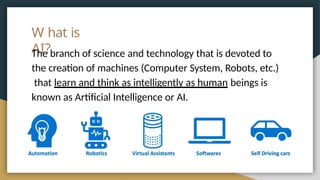
W hat is
AI?
The branch of science and technology that is devoted to
the creation of machines (Computer System, Robots, etc.)
that learn and think as intelligently as human beings is
known as Artificial Intelligence or AI.
W hat is AI (Artificial Intelligence)
Simulation of human intelligence processes by computer systems.
Characteristics of human behaviour:
● Understanding
● Reasoning
● Learning
● Solving Problems
● Effective communication
The Science and Engineering of making intelligent machines, especially
intelligent computer programs - McCarthy
SIRI and Alexa are powered by AI
Applications of AI in Daily Life
How AI systems work?
1
● by analyzing data and learning from patterns.
● use algorithms, or step-by-step instructions, to learn
from data and make decisions
● The more data they are given and the more patterns
they learn, the better they become at making
decisions and performing tasks.
●
Why sudden boom in AI
Systems?
● significant improvements in computing power and data
storage capabilities
● The growth of the internet, social media, and other digital
technologies has led to the accumulation of vast amounts of
data, which can be analyzed and used to train AI models.
● Advances in the AI research (Deep Learning)
● Advancements in Natural Language Processing (NLP): The ability
of AI to understand and interpret human language
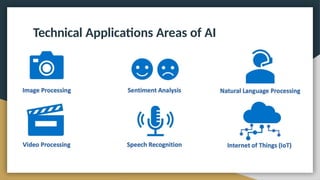
Technical Applications Areas of AI
Major areas/fields of
AI
Machine Learning - how computer agents can improve their
perception, knowledge, thinking, or actions based on
experience or data
Robotics - puts artificial intelligence into practice using machines that
perceive and interact with the physical world
Computer vision - can understand images and video
Natural language processing - understand written and spoken language;
automatic translation of text from one language to another, or
understanding text to produce knowledge about the world.
Expert Systems - learns and imitates a human being’s decision-making
ability.
Generative
AI
It is a type of artificial intelligence that focuses on
creating/generating new content.
It's a subset of machine learning, drawing from techniques like
deep learning and reinforcement learning to generate output
that con include text, images, music, video, and more.
Gen AI Use
cases
Major Use Area of Generative
AI
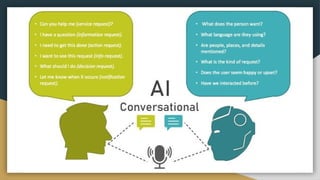
Conversational
AI
a type of AI that can simulate human conversation.
Happens through natural language processing (NLP), a field of AI that
allows computers to understand and process human languages.
“synthetic brain power that makes machines capable of understanding,
processing and responding to human language.”
AI in
Education
Use of Computers in Education are primarily aimed towards:
● increasing accessibility - Learning resources can be accessed
from anywhere, at any time
● facilitating personalized learning inside and outside the
classroom. Learning can be tailored and adapted to each
student’s goals and abilities through personalized programs,
● Time-consuming, tedious tasks such as record keeping or
grading multiple-choice tests can be completed through AI
automation, and
● exploring fundamental questions about how people learn
Personalized
Learning
● tailor learning experiences to the unique needs, preferences,
pace and abilities of each learner.
● analyzing data about individual learners, AI can provide
insights into areas of strengths and weaknesses, identify
learning styles, and provide customized recommendations
for content, resources, and activities.
● Leads to more engaging, relevant, and effective
learning experience
● bridge the skills gap that exists between different
learners
Adaptive
Learning
● AI algorithms observe you to detect how you prefer to
learn as an individual or as a chort
● Goal is creating entire learning journeys or flows that
adjust to each learner based on their interests, learning
preferences, needs, skills, and what they wish to learn
Universal
Access
● Real time text to speech, Speech to text conversion
● text to text, speech to speech conversion from one
language to another
● Will make the classroom accessible to people who speak
different languages or those having visual or hearing
impairments
From a policymaker’s
perspective
Potential application categories of AI in Edu:
(i) education management and delivery;
(ii) learning and assessment;
(iii) empowering teachers and enhancing teaching;
and
(iv) lifelong learning.
Education management and
delivery
AI systems are designed to automate aspects of school
administration, including admissions, timetabling, attendance
and homework monitoring, and school inspections.
a data-mining approach ‘learning analytics’ is used to analyse the
big data generated in learning management systems to provide
information for teachers and administrators, and sometimes
guidance for students.
some learning analytics predict which students are at risk of
failure.
Education management and
delivery
visual dashboards are used to inform data-driven decision
making
Many AI based applications collect huge amounts of student
interaction data, use machine-learning techniques to ‘search
for patterns’. The aim is to teach the software to identify when
children are confused or bored, in order to help them become
engaged.
Learning and
assessment
Broad aim to provide every learner, wherever they are in the
world, with access to high-quality, personalized, and
ubiquitous lifelong learning.
Learning and
assessment
Other categories of AI based systems for learning and assessment
are:
Dialogue-based tutoring systems
(NLP) Exploratory learning
environments Automated writing
evaluation
AI-supported reading and language learning (Babbel,
Duolingo) Smart robots
Educational virtual and augmented reality
Intelligent Tutoring
System
Works is by providing step-by-step tutorials, individualized for
each student, through topics in structured subjects such as
mathematics or physics.
It determines an optimal pathway through the learning materials
and activities by drawing on expert knowledge about the subject and
cognitive sciences,
Respond to individual students’ misconceptions and successes
As the student engages with the learning activities, the system uses
knowledge tracing and machine learning to automatically adjust the
level of difficulty and provide hints or guidance according to the
individual student’s strengths and weaknesses
Empowering teachers and enhancing
teaching
AI applications aim to help teachers reduce workloads
by automating tasks such as assessment, plagiarism
detection, administration and feedback.
AI-driven discussion forum monitoring (AI
Assistant) AI-powered teaching assistants
Empowering role of
teachers
it is widely agreed that as AI tools become more
available in classroom, it is likely that teacher roles will
change.
What is not yet clear is how this will happen.
Teachers will need to build new competencies to enable
them to work effectively with AI, and undertake
appropriate professional development to foster their
human and social capabilities.
Lifelong
learning
AI-driven lifelong learning companions
AI-enabled continuous assessment
AI-enabled record of lifelong learning achievements - AI-driven e-
portfolio
Ethical Concerns Related to AI
systems
1. Fairness: should be designed to avoid bias and discrimination and ensure
equal treatment for all individuals, regardless of their race, gender, age, or
other personal characteristics.
2. Transparency: should be transparent and explainable, with clear
documentation of how they make decisions and recommendations.
3. Privacy: respect the privacy of individuals and protect their personal data
from unauthorized access or misuse.
4. Accountability: Those who develop and deploy AI systems should be
accountable
5. Safety: to ensure the safety and well-being of users and others who
may be affected by their use.
Way
Forward
● Educators need to develop a better understanding of AI’s
impact, including on education and training.
● educators and students should have a basic understanding of AI
and data usage to be able to engage positively, critically and
ethically with this technology and to exploit its full potential.
● European Commission published Ethical Guidelines
(https://ec.europa.eu/commission/presscorner/detail/en/ip_22_6
338) on the Use of Artificial Intelligence (AI) and data in teaching
and learning for teachers
Thank You

Artificial Intelligence in Education - General perspective

  • 1.
    Artificial Intelligence inEducation fशक्षा में क ृ fत्रिम बुद् fधमत्ता Dr. Rejaul Karim Barbhuiya Assistant Professor, CIET- NCERT
  • 2.
    NEP 2020 highlights(Learn, Unlearn, Relearn) ● With scientific and technological advances, such as the rise of big data, machine learning, and artificial intelligence, many unskilled jobs may be taken over by machines, ● the need for a skilled workforce, with multidisciplinary abilities across the sciences, social sciences, and humanities, will be increasingly in greater demand. ● with the quickly changing employment landscape and global ecosystem, it is becoming increasingly critical that children not only learn, but more importantly learn how to learn.
  • 3.
    W hat is Intelligence Intelligence- ability to learn and perform suitable techniques to solve problems and achieve goals (Stanford Univ) A modern factory robot is flexible, accurate, and consistent but not intelligent.
  • 4.
    W hat is AI? Thebranch of science and technology that is devoted to the creation of machines (Computer System, Robots, etc.) that learn and think as intelligently as human beings is known as Artificial Intelligence or AI.
  • 5.
    W hat isAI (Artificial Intelligence) Simulation of human intelligence processes by computer systems. Characteristics of human behaviour: ● Understanding ● Reasoning ● Learning ● Solving Problems ● Effective communication The Science and Engineering of making intelligent machines, especially intelligent computer programs - McCarthy SIRI and Alexa are powered by AI
  • 6.
    Applications of AIin Daily Life
  • 7.
    How AI systemswork? 1 ● by analyzing data and learning from patterns. ● use algorithms, or step-by-step instructions, to learn from data and make decisions ● The more data they are given and the more patterns they learn, the better they become at making decisions and performing tasks. ●
  • 8.
    Why sudden boomin AI Systems? ● significant improvements in computing power and data storage capabilities ● The growth of the internet, social media, and other digital technologies has led to the accumulation of vast amounts of data, which can be analyzed and used to train AI models. ● Advances in the AI research (Deep Learning) ● Advancements in Natural Language Processing (NLP): The ability of AI to understand and interpret human language
  • 9.
  • 10.
    Major areas/fields of AI MachineLearning - how computer agents can improve their perception, knowledge, thinking, or actions based on experience or data Robotics - puts artificial intelligence into practice using machines that perceive and interact with the physical world Computer vision - can understand images and video Natural language processing - understand written and spoken language; automatic translation of text from one language to another, or understanding text to produce knowledge about the world. Expert Systems - learns and imitates a human being’s decision-making ability.
  • 11.
    Generative AI It is atype of artificial intelligence that focuses on creating/generating new content. It's a subset of machine learning, drawing from techniques like deep learning and reinforcement learning to generate output that con include text, images, music, video, and more.
  • 12.
  • 13.
    Major Use Areaof Generative AI
  • 14.
    Conversational AI a type ofAI that can simulate human conversation. Happens through natural language processing (NLP), a field of AI that allows computers to understand and process human languages. “synthetic brain power that makes machines capable of understanding, processing and responding to human language.”
  • 18.
    AI in Education Use ofComputers in Education are primarily aimed towards: ● increasing accessibility - Learning resources can be accessed from anywhere, at any time ● facilitating personalized learning inside and outside the classroom. Learning can be tailored and adapted to each student’s goals and abilities through personalized programs, ● Time-consuming, tedious tasks such as record keeping or grading multiple-choice tests can be completed through AI automation, and ● exploring fundamental questions about how people learn
  • 19.
    Personalized Learning ● tailor learningexperiences to the unique needs, preferences, pace and abilities of each learner. ● analyzing data about individual learners, AI can provide insights into areas of strengths and weaknesses, identify learning styles, and provide customized recommendations for content, resources, and activities. ● Leads to more engaging, relevant, and effective learning experience ● bridge the skills gap that exists between different learners
  • 20.
    Adaptive Learning ● AI algorithmsobserve you to detect how you prefer to learn as an individual or as a chort ● Goal is creating entire learning journeys or flows that adjust to each learner based on their interests, learning preferences, needs, skills, and what they wish to learn
  • 21.
    Universal Access ● Real timetext to speech, Speech to text conversion ● text to text, speech to speech conversion from one language to another ● Will make the classroom accessible to people who speak different languages or those having visual or hearing impairments
  • 22.
    From a policymaker’s perspective Potentialapplication categories of AI in Edu: (i) education management and delivery; (ii) learning and assessment; (iii) empowering teachers and enhancing teaching; and (iv) lifelong learning.
  • 23.
    Education management and delivery AIsystems are designed to automate aspects of school administration, including admissions, timetabling, attendance and homework monitoring, and school inspections. a data-mining approach ‘learning analytics’ is used to analyse the big data generated in learning management systems to provide information for teachers and administrators, and sometimes guidance for students. some learning analytics predict which students are at risk of failure.
  • 24.
    Education management and delivery visualdashboards are used to inform data-driven decision making Many AI based applications collect huge amounts of student interaction data, use machine-learning techniques to ‘search for patterns’. The aim is to teach the software to identify when children are confused or bored, in order to help them become engaged.
  • 25.
    Learning and assessment Broad aimto provide every learner, wherever they are in the world, with access to high-quality, personalized, and ubiquitous lifelong learning.
  • 26.
    Learning and assessment Other categoriesof AI based systems for learning and assessment are: Dialogue-based tutoring systems (NLP) Exploratory learning environments Automated writing evaluation AI-supported reading and language learning (Babbel, Duolingo) Smart robots Educational virtual and augmented reality
  • 27.
    Intelligent Tutoring System Works isby providing step-by-step tutorials, individualized for each student, through topics in structured subjects such as mathematics or physics. It determines an optimal pathway through the learning materials and activities by drawing on expert knowledge about the subject and cognitive sciences, Respond to individual students’ misconceptions and successes As the student engages with the learning activities, the system uses knowledge tracing and machine learning to automatically adjust the level of difficulty and provide hints or guidance according to the individual student’s strengths and weaknesses
  • 28.
    Empowering teachers andenhancing teaching AI applications aim to help teachers reduce workloads by automating tasks such as assessment, plagiarism detection, administration and feedback. AI-driven discussion forum monitoring (AI Assistant) AI-powered teaching assistants
  • 29.
    Empowering role of teachers itis widely agreed that as AI tools become more available in classroom, it is likely that teacher roles will change. What is not yet clear is how this will happen. Teachers will need to build new competencies to enable them to work effectively with AI, and undertake appropriate professional development to foster their human and social capabilities.
  • 30.
    Lifelong learning AI-driven lifelong learningcompanions AI-enabled continuous assessment AI-enabled record of lifelong learning achievements - AI-driven e- portfolio
  • 31.
    Ethical Concerns Relatedto AI systems 1. Fairness: should be designed to avoid bias and discrimination and ensure equal treatment for all individuals, regardless of their race, gender, age, or other personal characteristics. 2. Transparency: should be transparent and explainable, with clear documentation of how they make decisions and recommendations. 3. Privacy: respect the privacy of individuals and protect their personal data from unauthorized access or misuse. 4. Accountability: Those who develop and deploy AI systems should be accountable 5. Safety: to ensure the safety and well-being of users and others who may be affected by their use.
  • 32.
    Way Forward ● Educators needto develop a better understanding of AI’s impact, including on education and training. ● educators and students should have a basic understanding of AI and data usage to be able to engage positively, critically and ethically with this technology and to exploit its full potential. ● European Commission published Ethical Guidelines (https://ec.europa.eu/commission/presscorner/detail/en/ip_22_6 338) on the Use of Artificial Intelligence (AI) and data in teaching and learning for teachers
  • 33.