Digital
Transformation
Group 1
TOPIC: What is artificial intelligence (AI)? Its
applications? And analyzing the role of AI in
business of a firm?
OVERVIEW
DISCUSSION
Table of contents
01
04
02
03
APPLICATIONS
AI IN
BUSSINESS OF
A FIRM
OVERVIEW
OF AI
I.
1. DEFINITION OF AI
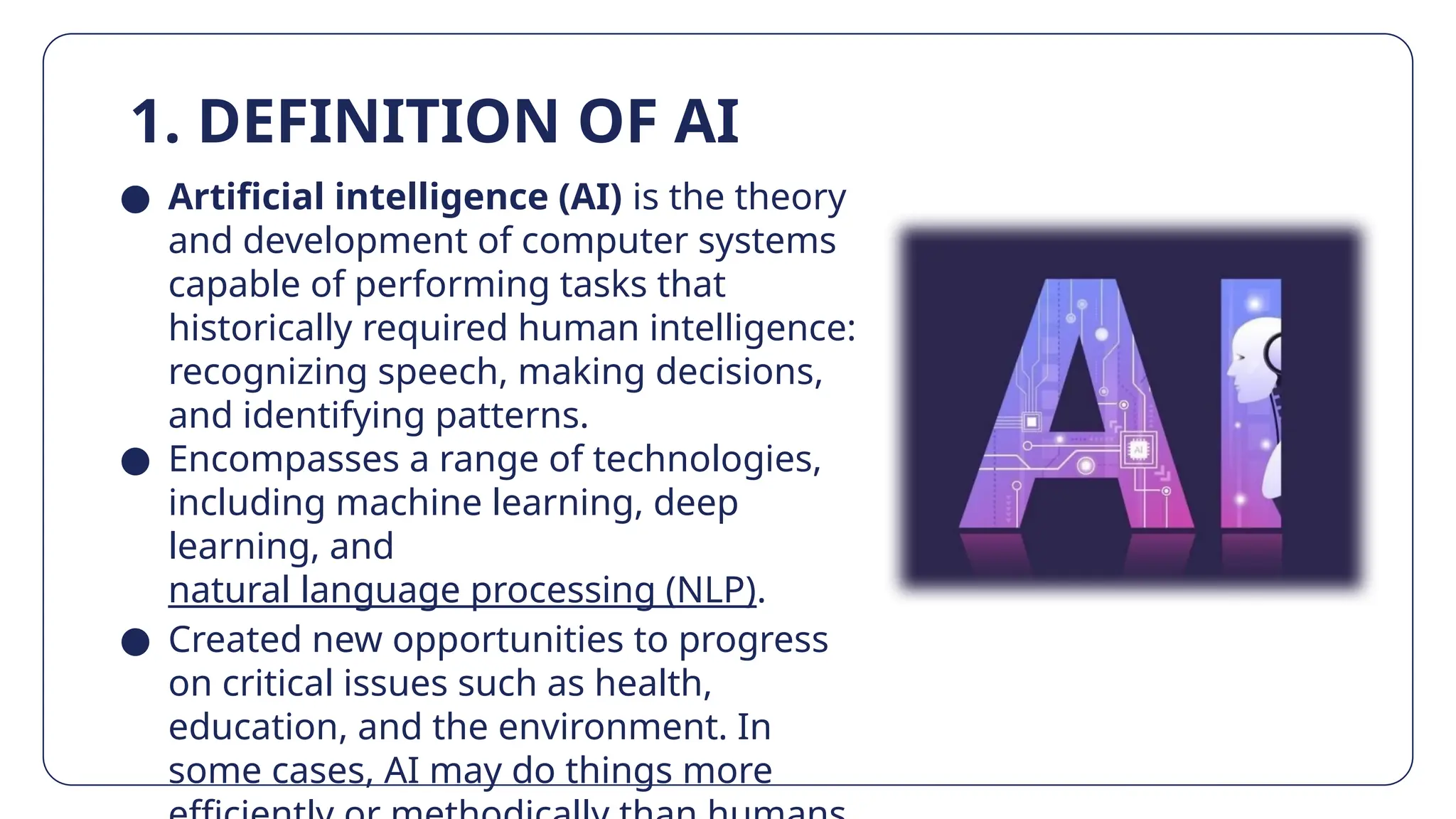
● Artificial intelligence (AI) is the theory
and development of computer systems
capable of performing tasks that
historically required human intelligence:
recognizing speech, making decisions,
and identifying patterns.
● Encompasses a range of technologies,
including machine learning, deep
learning, and
natural language processing (NLP).
● Created new opportunities to progress
on critical issues such as health,
education, and the environment. In
some cases, AI may do things more
2. TYPES OF AI
- There are four main types of AI as defined by Arend Hintze:
a. Reactive machines: the most basic type of artificial intelligence. Machines built in this way
don’t possess any knowledge of previous events but instead only “react” to what is before
them in a given moment.
b. Limited memory machines: Machines with limited memory possess a limited
understanding of past events. They can interact more with the world around them than
reactive machines can.
c. Theory of mind machines: Machines that possess a “theory of mind” represent an early
form of artificial general intelligence, have an understanding of other entities that exist within
the world.
d. Self-aware machines: Machines with self-awareness are the theoretically most advanced
type of AI and would possess an understanding of the world, others, and itself.
3. History and the development
process of AI
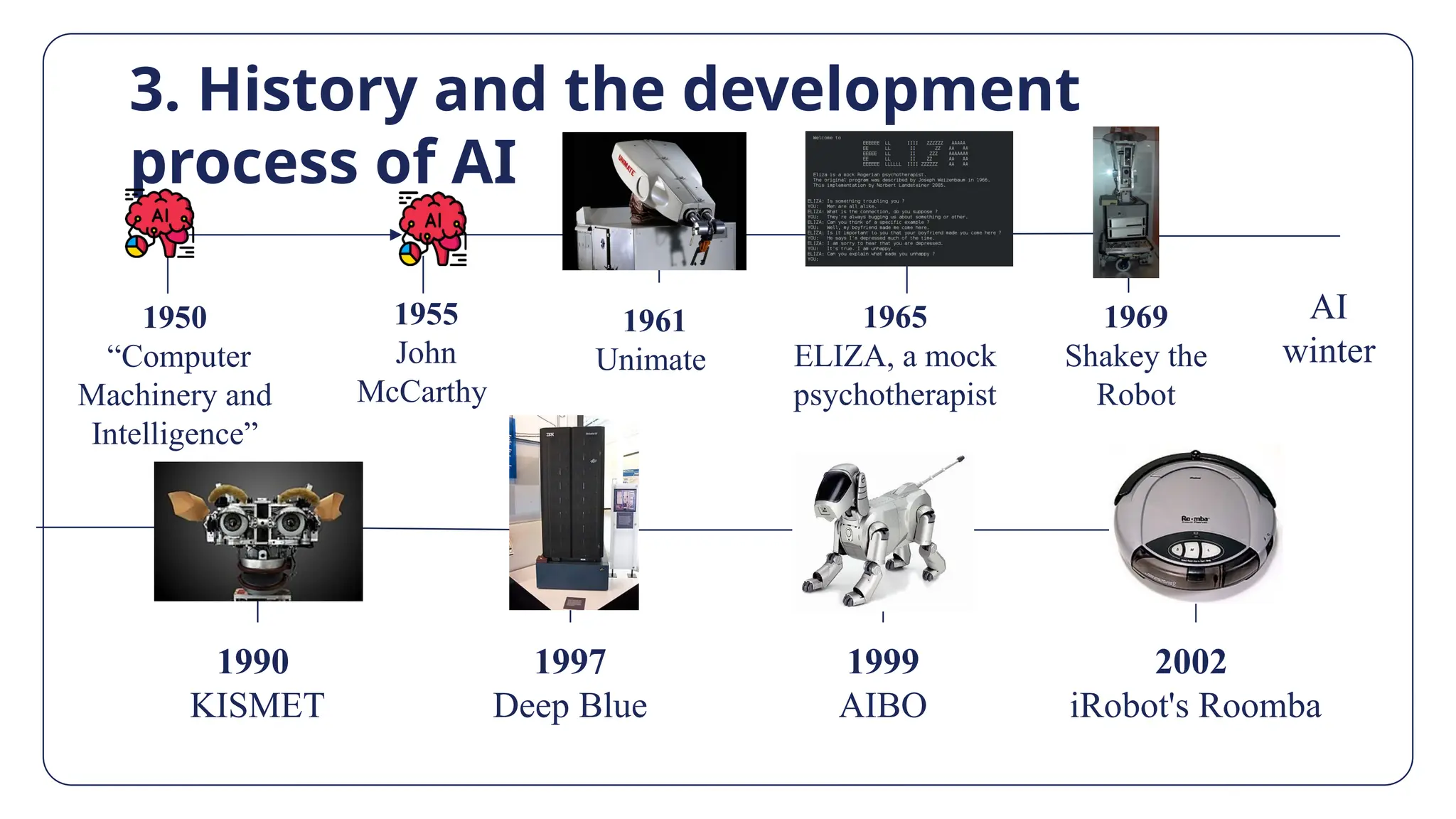
7 8
1990
KISMET
1997
Deep Blue
1999
AIBO
2002
iRobot's Roomba
1950
“Computer
Machinery and
Intelligence”
1955
John
McCarthy
1961
Unimate
1965
ELIZA, a mock
psychotherapist
1969
Shakey the
Robot
AI
winter
3. History and the development
process of AI
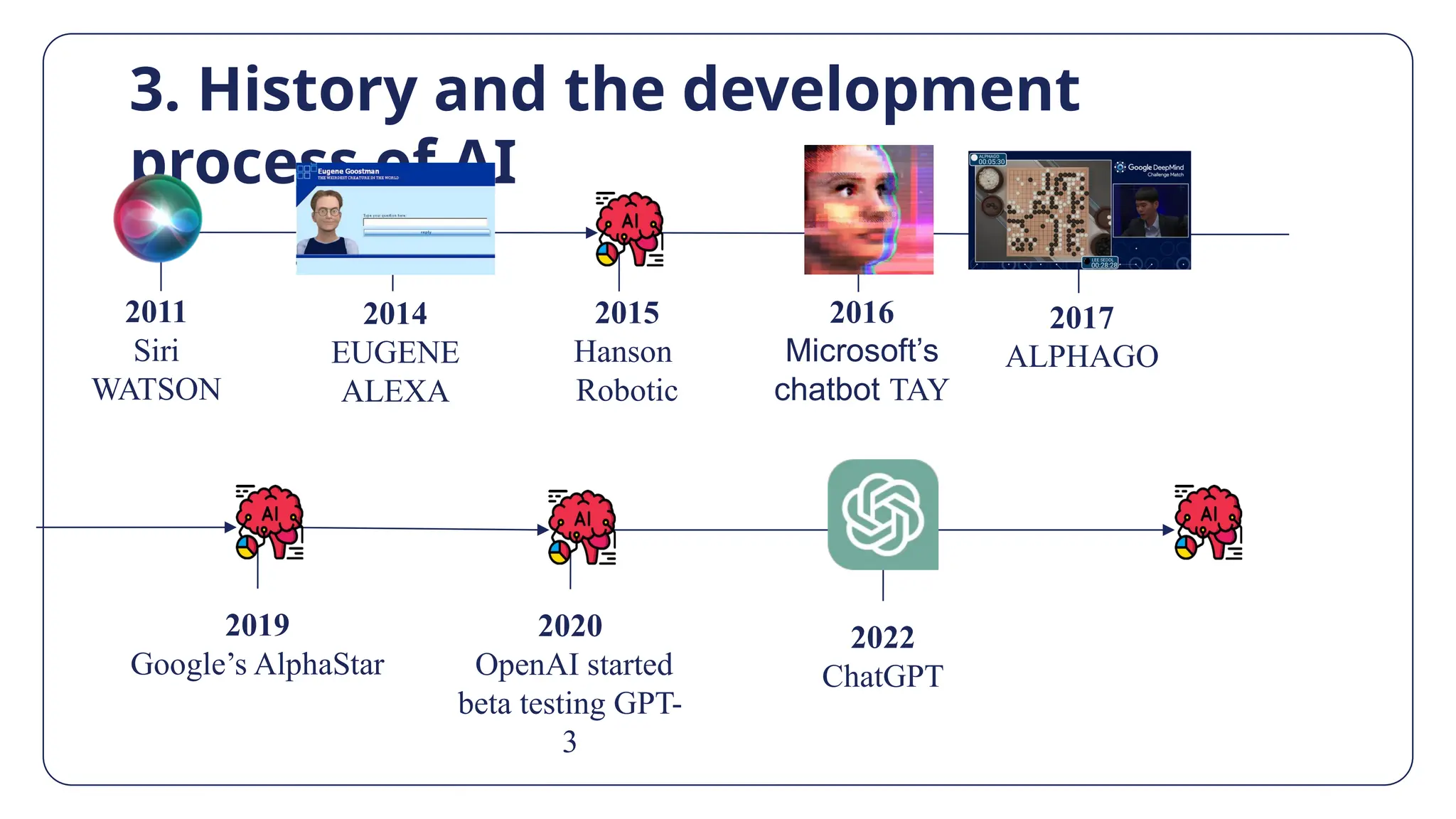
2019
Google’s AlphaStar
2020
OpenAI started
beta testing GPT-
3
2022
ChatGPT
2011
Siri
WATSON
2014
EUGENE
ALEXA
2015
Hanson
Robotic
2016
Microsoft’s
chatbot TAY
2017
ALPHAGO
4. Advantages and
disadvantages of AI
a. Advantage:
• Can be considered as a replacement for human
• Can multi-tasking
• Work with precision and lesser errors
• Can work tirelessly
• Can do repetitive tasks for a long time without
getting bored
• Can work in environments that are dangerous to
humans (deep sea, underground mines, outer
space, etc.)
b. Disadvantages:
• Expensive producing cost and maintenance cost
• Unemployment rate increase
• Less humans’ interference => Makes humans
lazy
• (Currently) Can only perform tasks that are
programmed before
APPLICATIONS
II.
AI has a significant impact on various aspects of social life:
a. Healthcare:
● Diagnosis and Treatment: machine learning algorithms, assist in diagnosing diseases and
conditions by analyzing medical images, patient data, and clinical records, recommend
treatment plans
● Drug Discovery: identifying potential drug candidates and predicting their effectiveness.
● Remote Monitoring: continuous monitoring of patients' health, healthcare providers detect
health issues in real time
b. Education:
● Personalized Learning: personalized learning paths for students
● Automated Grading: grade assignments and tests, reducing the administrative burden on
teachers
● Language Learning: individuals acquire new languages more efficiently.
● Distance education: improve the distance education experience.
● Career counseling: career counseling to students.
● Cheating detection: detect cheating in tests and assignments.
1. AI in social life
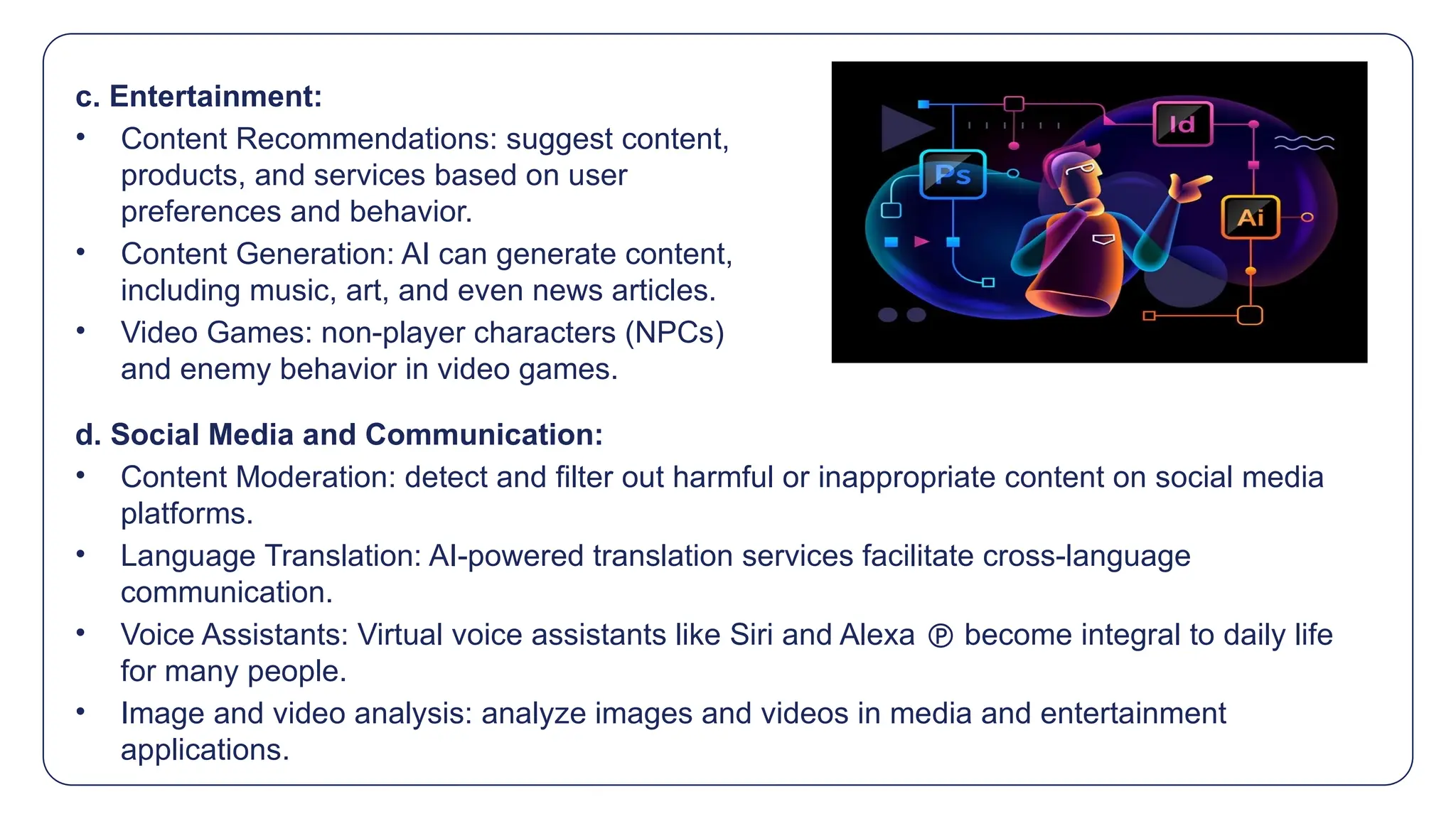
c. Entertainment:
• Content Recommendations: suggest content,
products, and services based on user
preferences and behavior.
• Content Generation: AI can generate content,
including music, art, and even news articles.
• Video Games: non-player characters (NPCs)
and enemy behavior in video games.
d. Social Media and Communication:
• Content Moderation: detect and filter out harmful or inappropriate content on social media
platforms.
• Language Translation: AI-powered translation services facilitate cross-language
communication.
• Voice Assistants: Virtual voice assistants like Siri and Alexa  become integral to daily life
for many people.
• Image and video analysis: analyze images and videos in media and entertainment
applications.
e. Transportation
● Autonomous Vehicles: self-driving cars  reduce accidents and improve transportation
efficiency.
● Smart traffic monitoring and management system: detecting, recording and warning of events,
incidents and violations of order.
● Traffic flow analysis: collecting and processing data about vehicle traffic on roads to help
manage traffic more effectively.
● Smart traffic camera: the ability to accurately identify vehicle characteristics, vehicle license
plates, vehicle movement direction and count vehicle traffic on the road  detect and record
traffic safety violations.
● Smart parking: allows collecting and processing data on the number of vehicles entering and
exiting.
f. Environmental Impact
● Climate Change Modeling: modeling and predicting the effects of global warming.
● Energy Efficiency: optimize energy consumption in buildings and industrial processes,
reducing environmental impact.
g. Science
● Data analysis: analyze and process large amounts of scientific data to create new
insights, analyzes and improve the accuracy of predictive models.
● Forecasting and prediction: machine learning models to forecast future outcomes
● Modeling: research objects ranging from supergiant stars to Earth's climate.
● Search and classify: information and classify research results.
● Decision support: smart decisions about designing experiments, analyzing results, and
drawing conclusions.
h. Security and confidentiality
● Early detection of attacks: automate complex processes to detect attacks and respond
to unauthorized breaches.
● Search for security vulnerabilities: security experts find information about security
vulnerabilities and how to fix them.
● Data analytics: analyze and process large amounts of data to create new insights,
improve the accuracy of predictive models.
● Decision support: help security professionals make smart decisions about designing
experiments, analyzing results, and drawing conclusions.
i. Law Enforcement
• Predictive Policing: predict crime hotspots and allocate law enforcement resources
more efficiently.
• Facial Recognition: employed for identifying suspects and enhancing security.
j. Agriculture
• Precision Agriculture: optimizing crop management, soil health, and resource
utilization.
• Crop Monitoring: monitor crop health and detect pests or diseases.
k. Accessibility
• AI enhances accessibility for people with
disabilities by providing features like speech
recognition, screen readers, and sign
language interpretation.
2. AI in business
User experience
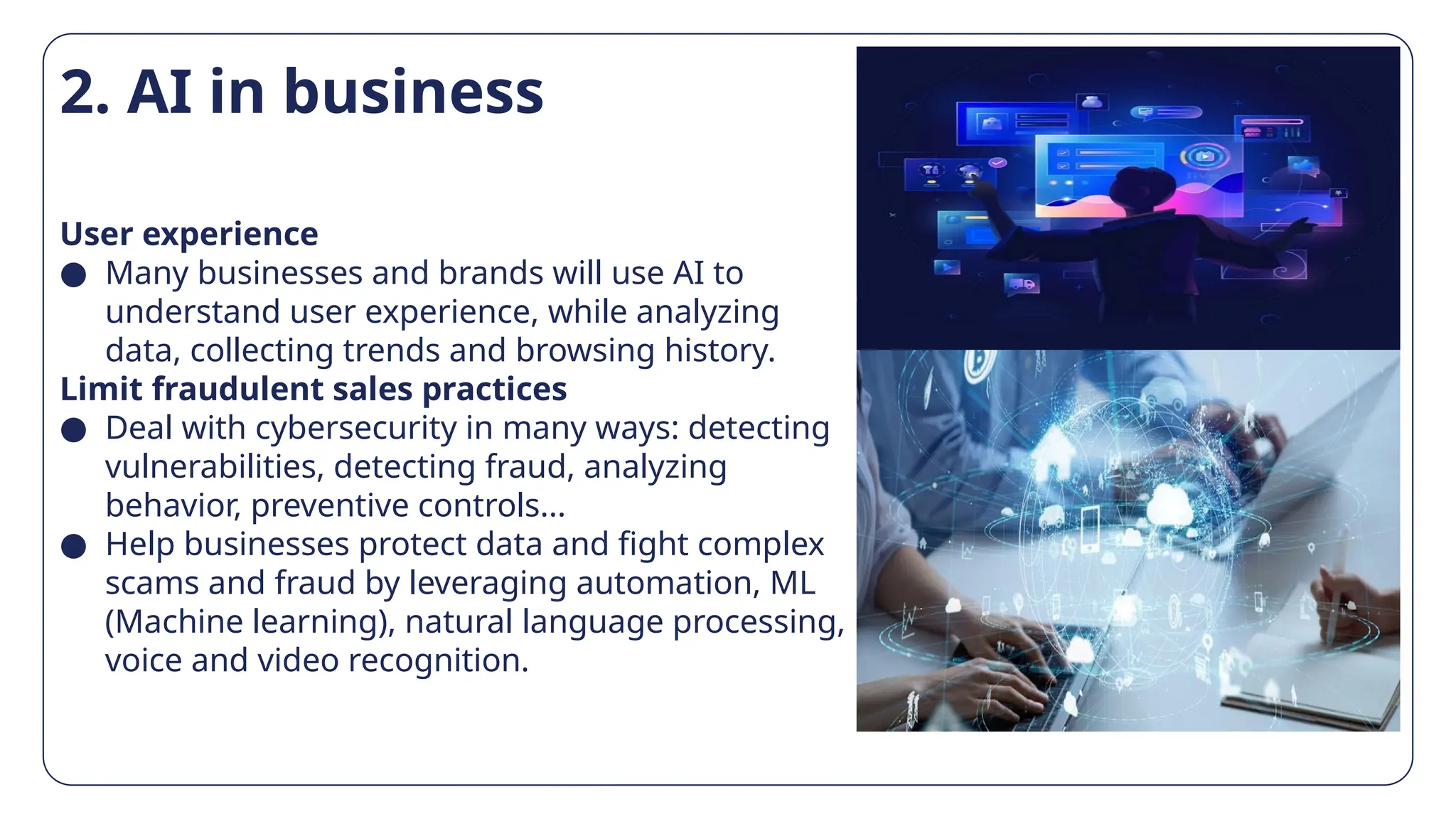
● Many businesses and brands will use AI to
understand user experience, while analyzing
data, collecting trends and browsing history.
Limit fraudulent sales practices
● Deal with cybersecurity in many ways: detecting
vulnerabilities, detecting fraud, analyzing
behavior, preventive controls...
● Help businesses protect data and fight complex
scams and fraud by leveraging automation, ML
(Machine learning), natural language processing,
voice and video recognition.
Social Media
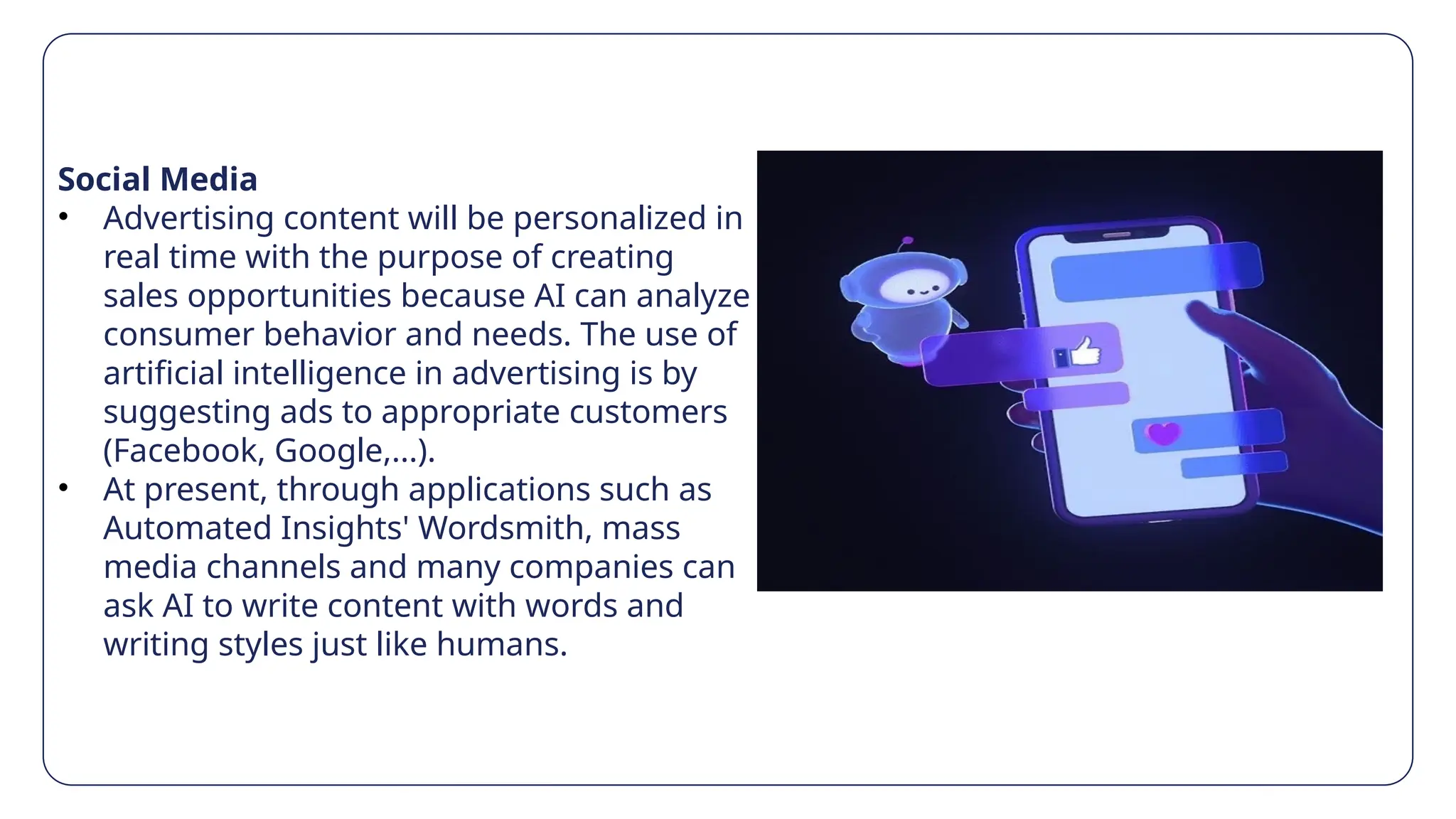
• Advertising content will be personalized in
real time with the purpose of creating
sales opportunities because AI can analyze
consumer behavior and needs. The use of
artificial intelligence in advertising is by
suggesting ads to appropriate customers
(Facebook, Google,...).
• At present, through applications such as
Automated Insights' Wordsmith, mass
media channels and many companies can
ask AI to write content with words and
writing styles just like humans.
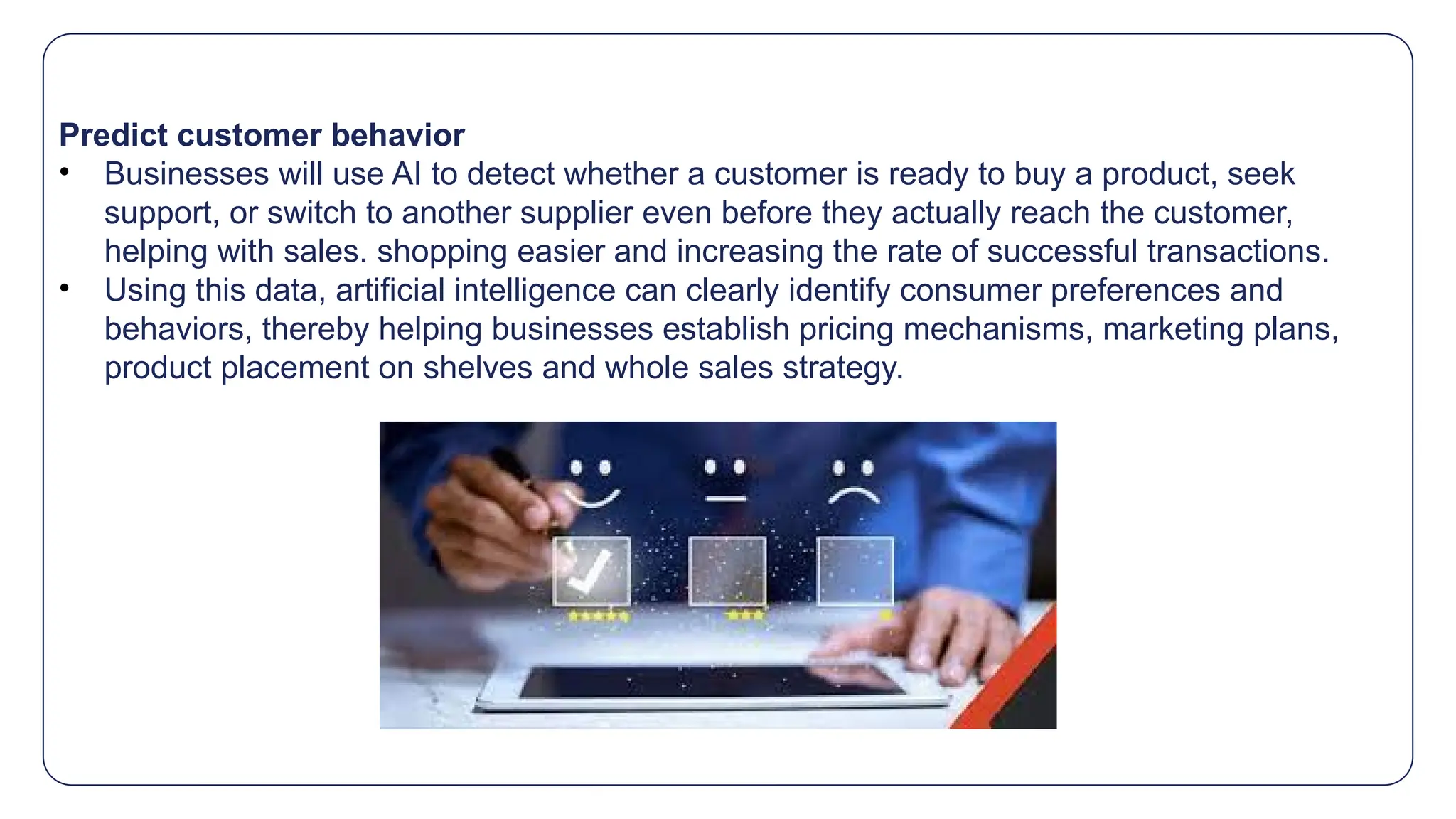
Predict customer behavior
• Businesses will use AI to detect whether a customer is ready to buy a product, seek
support, or switch to another supplier even before they actually reach the customer,
helping with sales. shopping easier and increasing the rate of successful transactions.
• Using this data, artificial intelligence can clearly identify consumer preferences and
behaviors, thereby helping businesses establish pricing mechanisms, marketing plans,
product placement on shelves and whole sales strategy.
24/7 customer support – Chatbots
• Chatbot is a software that imitates human conversation or with users via websites,
mobile applications, phones, etc. It is an AI-powered digital assistant for communication
with everyone.
• provide 24/7 customer support, businesses can also incorporate this data into their CRM
to collect and retain valuable customer insights. client. This data can then be used to
help optimize sales.
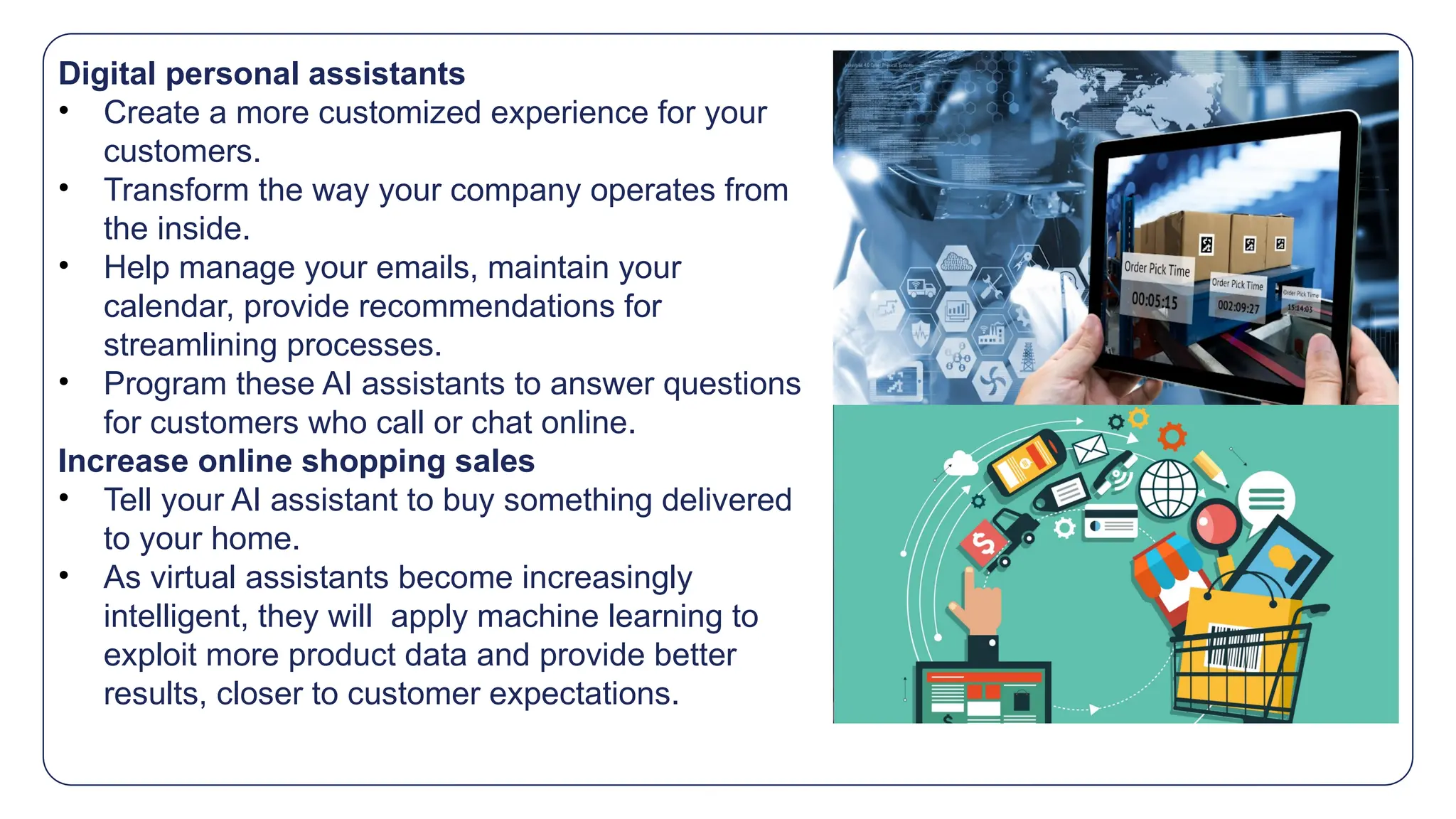
Digital personal assistants
• Create a more customized experience for your
customers.
• Transform the way your company operates from
the inside.
• Help manage your emails, maintain your
calendar, provide recommendations for
streamlining processes.
• Program these AI assistants to answer questions
for customers who call or chat online.
Increase online shopping sales
• Tell your AI assistant to buy something delivered
to your home.
• As virtual assistants become increasingly
intelligent, they will apply machine learning to
exploit more product data and provide better
results, closer to customer expectations.
Find better candidates
• Useful in the field of recruitment
• People are trying to make it more efficient for
everyone, from small business owners to
departments of human resources at large
companies, to find suitable employees because
searching and screening candidates can take a lot
of time.
Helps with financial transaction decisions
• Many different AI approaches are being deployed
in the financial sector, which are expected to bring
a series of benefits: support for quick and
objective investment decisions, loan decisions,
evaluation risk, portfolio management through
"robo-advisors", fraud detection and algorithmic
trading...
• change consumer habits as well as the way
businesses do business. enterprise.
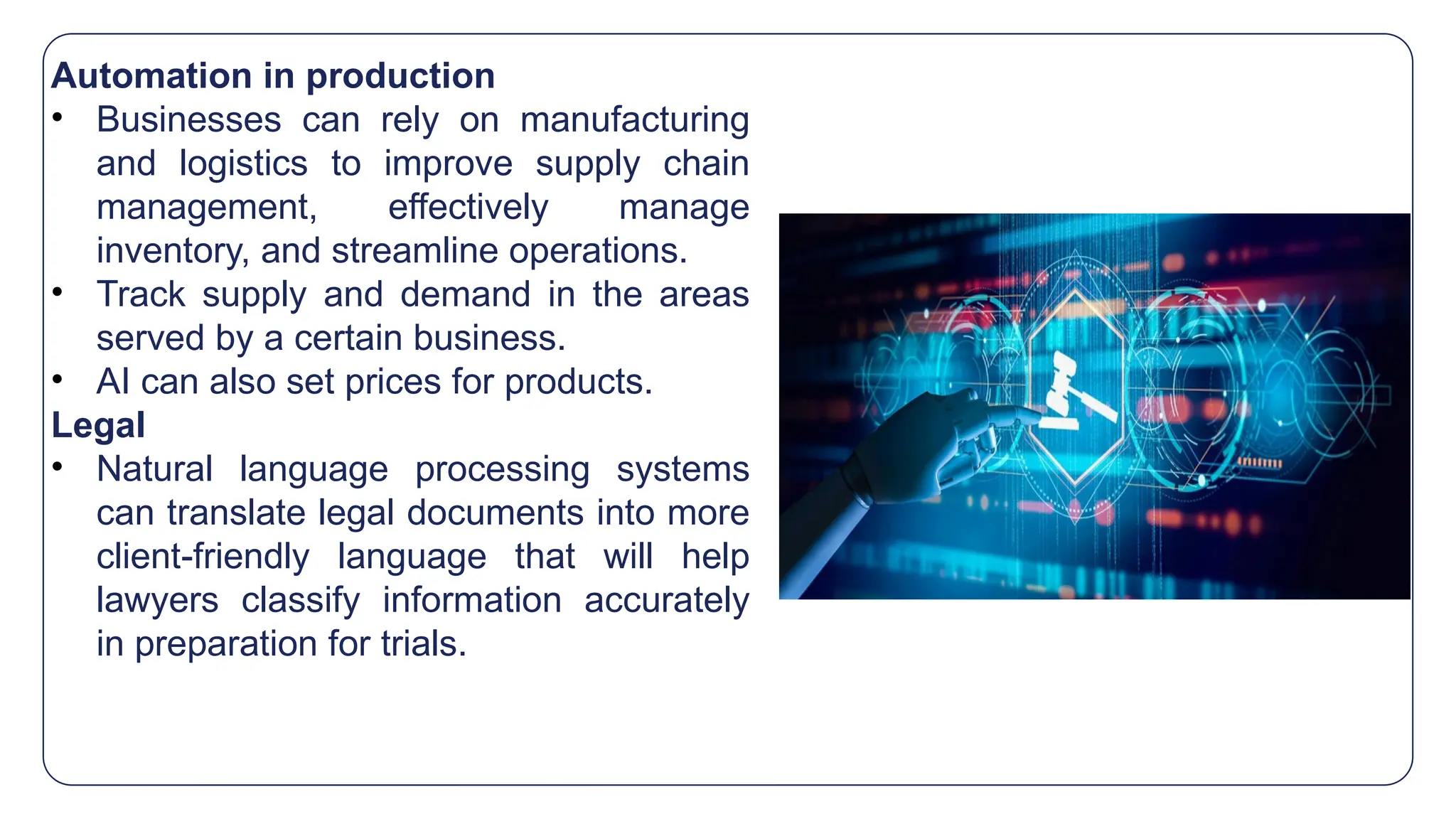
Automation in production
• Businesses can rely on manufacturing
and logistics to improve supply chain
management, effectively manage
inventory, and streamline operations.
• Track supply and demand in the areas
served by a certain business.
• AI can also set prices for products.
Legal
• Natural language processing systems
can translate legal documents into more
client-friendly language that will help
lawyers classify information accurately
in preparation for trials.
AI IN
BUSSINESS OF
A FIRM
II
I.
EXAMPLE
1. THE ROLES AND EFFECTS OF AI
• With AI, we are able to process and
analyze vast amounts of data quickly,
making it easier to find and access the
information we need.
• AI-powered personal assistants, such as
Siri and Google Assistant, have become
a staple of many people's daily lives.
• AI-powered technologies are also being
used to improve the user experience
and to offer more personalized
recommendations and services.
• Businesses are increasingly
deploying AI systems to learn
about their customers,
understand market trends,
predict future needs and
scenarios . etc.
• Businesses that work with AI
aren’t just trying a ‘new trend.’
They’re trying to keep up with
the fast-paced world that
surrounds them.
ROLES
1. THE ROLES AND EFFECTS
OF AI
b. Effects
• As AI continues to evolve and gain
importance in our world, it is important that
we continue to invest in its development and
advancement.
• The positive impacts of AI: save time and
money, avoid mistakes and 'human error',
increase productivity and operational
efficiencies, easily mine vast amounts of
data .etc.
• The negative impacts of AI: increase
unemployment rate, lack of flexibility, risk of
data leaks, attacks and theft.etc.
• Optimize supply chain management
• Increased Efficiency and Productivity
• The ability to gain insights from data
• Personalized Experiences
• Advancements in Healthcare
2. OPPORTUNITIES
3.
CHALLENGES
• Ethical and moral implications of AI
technology
• The potential for job displacement
• Data Privacy and Security
• Lack of Transparency
• Cost Implementation and Operation
CREDITS: This presentation template was created by Slidesgo,
and includes icons by Flaticon, and infographics & images by
Freepik
Thanks for
listening!
Do you have any questions?

Digital-Transformation. abcxyzzzzzzzzzzzz

  • 1.
    Digital Transformation Group 1 TOPIC: Whatis artificial intelligence (AI)? Its applications? And analyzing the role of AI in business of a firm?
  • 2.
  • 3.
  • 4.
    1. DEFINITION OFAI ● Artificial intelligence (AI) is the theory and development of computer systems capable of performing tasks that historically required human intelligence: recognizing speech, making decisions, and identifying patterns. ● Encompasses a range of technologies, including machine learning, deep learning, and natural language processing (NLP). ● Created new opportunities to progress on critical issues such as health, education, and the environment. In some cases, AI may do things more
  • 5.
    2. TYPES OFAI - There are four main types of AI as defined by Arend Hintze: a. Reactive machines: the most basic type of artificial intelligence. Machines built in this way don’t possess any knowledge of previous events but instead only “react” to what is before them in a given moment. b. Limited memory machines: Machines with limited memory possess a limited understanding of past events. They can interact more with the world around them than reactive machines can. c. Theory of mind machines: Machines that possess a “theory of mind” represent an early form of artificial general intelligence, have an understanding of other entities that exist within the world. d. Self-aware machines: Machines with self-awareness are the theoretically most advanced type of AI and would possess an understanding of the world, others, and itself.
  • 6.
    3. History andthe development process of AI 7 8 1990 KISMET 1997 Deep Blue 1999 AIBO 2002 iRobot's Roomba 1950 “Computer Machinery and Intelligence” 1955 John McCarthy 1961 Unimate 1965 ELIZA, a mock psychotherapist 1969 Shakey the Robot AI winter
  • 7.
    3. History andthe development process of AI 2019 Google’s AlphaStar 2020 OpenAI started beta testing GPT- 3 2022 ChatGPT 2011 Siri WATSON 2014 EUGENE ALEXA 2015 Hanson Robotic 2016 Microsoft’s chatbot TAY 2017 ALPHAGO
  • 8.
    4. Advantages and disadvantagesof AI a. Advantage: • Can be considered as a replacement for human • Can multi-tasking • Work with precision and lesser errors • Can work tirelessly • Can do repetitive tasks for a long time without getting bored • Can work in environments that are dangerous to humans (deep sea, underground mines, outer space, etc.) b. Disadvantages: • Expensive producing cost and maintenance cost • Unemployment rate increase • Less humans’ interference => Makes humans lazy • (Currently) Can only perform tasks that are programmed before
  • 9.
  • 10.
    AI has asignificant impact on various aspects of social life: a. Healthcare: ● Diagnosis and Treatment: machine learning algorithms, assist in diagnosing diseases and conditions by analyzing medical images, patient data, and clinical records, recommend treatment plans ● Drug Discovery: identifying potential drug candidates and predicting their effectiveness. ● Remote Monitoring: continuous monitoring of patients' health, healthcare providers detect health issues in real time b. Education: ● Personalized Learning: personalized learning paths for students ● Automated Grading: grade assignments and tests, reducing the administrative burden on teachers ● Language Learning: individuals acquire new languages more efficiently. ● Distance education: improve the distance education experience. ● Career counseling: career counseling to students. ● Cheating detection: detect cheating in tests and assignments. 1. AI in social life
  • 11.
    c. Entertainment: • ContentRecommendations: suggest content, products, and services based on user preferences and behavior. • Content Generation: AI can generate content, including music, art, and even news articles. • Video Games: non-player characters (NPCs) and enemy behavior in video games. d. Social Media and Communication: • Content Moderation: detect and filter out harmful or inappropriate content on social media platforms. • Language Translation: AI-powered translation services facilitate cross-language communication. • Voice Assistants: Virtual voice assistants like Siri and Alexa  become integral to daily life for many people. • Image and video analysis: analyze images and videos in media and entertainment applications.
  • 12.
    e. Transportation ● AutonomousVehicles: self-driving cars  reduce accidents and improve transportation efficiency. ● Smart traffic monitoring and management system: detecting, recording and warning of events, incidents and violations of order. ● Traffic flow analysis: collecting and processing data about vehicle traffic on roads to help manage traffic more effectively. ● Smart traffic camera: the ability to accurately identify vehicle characteristics, vehicle license plates, vehicle movement direction and count vehicle traffic on the road  detect and record traffic safety violations. ● Smart parking: allows collecting and processing data on the number of vehicles entering and exiting. f. Environmental Impact ● Climate Change Modeling: modeling and predicting the effects of global warming. ● Energy Efficiency: optimize energy consumption in buildings and industrial processes, reducing environmental impact.
  • 13.
    g. Science ● Dataanalysis: analyze and process large amounts of scientific data to create new insights, analyzes and improve the accuracy of predictive models. ● Forecasting and prediction: machine learning models to forecast future outcomes ● Modeling: research objects ranging from supergiant stars to Earth's climate. ● Search and classify: information and classify research results. ● Decision support: smart decisions about designing experiments, analyzing results, and drawing conclusions. h. Security and confidentiality ● Early detection of attacks: automate complex processes to detect attacks and respond to unauthorized breaches. ● Search for security vulnerabilities: security experts find information about security vulnerabilities and how to fix them. ● Data analytics: analyze and process large amounts of data to create new insights, improve the accuracy of predictive models. ● Decision support: help security professionals make smart decisions about designing experiments, analyzing results, and drawing conclusions.
  • 14.
    i. Law Enforcement •Predictive Policing: predict crime hotspots and allocate law enforcement resources more efficiently. • Facial Recognition: employed for identifying suspects and enhancing security. j. Agriculture • Precision Agriculture: optimizing crop management, soil health, and resource utilization. • Crop Monitoring: monitor crop health and detect pests or diseases. k. Accessibility • AI enhances accessibility for people with disabilities by providing features like speech recognition, screen readers, and sign language interpretation.
  • 15.
    2. AI inbusiness User experience ● Many businesses and brands will use AI to understand user experience, while analyzing data, collecting trends and browsing history. Limit fraudulent sales practices ● Deal with cybersecurity in many ways: detecting vulnerabilities, detecting fraud, analyzing behavior, preventive controls... ● Help businesses protect data and fight complex scams and fraud by leveraging automation, ML (Machine learning), natural language processing, voice and video recognition.
  • 16.
    Social Media • Advertisingcontent will be personalized in real time with the purpose of creating sales opportunities because AI can analyze consumer behavior and needs. The use of artificial intelligence in advertising is by suggesting ads to appropriate customers (Facebook, Google,...). • At present, through applications such as Automated Insights' Wordsmith, mass media channels and many companies can ask AI to write content with words and writing styles just like humans.
  • 17.
    Predict customer behavior •Businesses will use AI to detect whether a customer is ready to buy a product, seek support, or switch to another supplier even before they actually reach the customer, helping with sales. shopping easier and increasing the rate of successful transactions. • Using this data, artificial intelligence can clearly identify consumer preferences and behaviors, thereby helping businesses establish pricing mechanisms, marketing plans, product placement on shelves and whole sales strategy.
  • 18.
    24/7 customer support– Chatbots • Chatbot is a software that imitates human conversation or with users via websites, mobile applications, phones, etc. It is an AI-powered digital assistant for communication with everyone. • provide 24/7 customer support, businesses can also incorporate this data into their CRM to collect and retain valuable customer insights. client. This data can then be used to help optimize sales.
  • 19.
    Digital personal assistants •Create a more customized experience for your customers. • Transform the way your company operates from the inside. • Help manage your emails, maintain your calendar, provide recommendations for streamlining processes. • Program these AI assistants to answer questions for customers who call or chat online. Increase online shopping sales • Tell your AI assistant to buy something delivered to your home. • As virtual assistants become increasingly intelligent, they will apply machine learning to exploit more product data and provide better results, closer to customer expectations.
  • 20.
    Find better candidates •Useful in the field of recruitment • People are trying to make it more efficient for everyone, from small business owners to departments of human resources at large companies, to find suitable employees because searching and screening candidates can take a lot of time. Helps with financial transaction decisions • Many different AI approaches are being deployed in the financial sector, which are expected to bring a series of benefits: support for quick and objective investment decisions, loan decisions, evaluation risk, portfolio management through "robo-advisors", fraud detection and algorithmic trading... • change consumer habits as well as the way businesses do business. enterprise.
  • 21.
    Automation in production •Businesses can rely on manufacturing and logistics to improve supply chain management, effectively manage inventory, and streamline operations. • Track supply and demand in the areas served by a certain business. • AI can also set prices for products. Legal • Natural language processing systems can translate legal documents into more client-friendly language that will help lawyers classify information accurately in preparation for trials.
  • 22.
  • 23.
    EXAMPLE 1. THE ROLESAND EFFECTS OF AI • With AI, we are able to process and analyze vast amounts of data quickly, making it easier to find and access the information we need. • AI-powered personal assistants, such as Siri and Google Assistant, have become a staple of many people's daily lives. • AI-powered technologies are also being used to improve the user experience and to offer more personalized recommendations and services. • Businesses are increasingly deploying AI systems to learn about their customers, understand market trends, predict future needs and scenarios . etc. • Businesses that work with AI aren’t just trying a ‘new trend.’ They’re trying to keep up with the fast-paced world that surrounds them. ROLES
  • 24.
    1. THE ROLESAND EFFECTS OF AI b. Effects • As AI continues to evolve and gain importance in our world, it is important that we continue to invest in its development and advancement. • The positive impacts of AI: save time and money, avoid mistakes and 'human error', increase productivity and operational efficiencies, easily mine vast amounts of data .etc. • The negative impacts of AI: increase unemployment rate, lack of flexibility, risk of data leaks, attacks and theft.etc.
  • 25.
    • Optimize supplychain management • Increased Efficiency and Productivity • The ability to gain insights from data • Personalized Experiences • Advancements in Healthcare 2. OPPORTUNITIES
  • 26.
    3. CHALLENGES • Ethical andmoral implications of AI technology • The potential for job displacement • Data Privacy and Security • Lack of Transparency • Cost Implementation and Operation
  • 27.
    CREDITS: This presentationtemplate was created by Slidesgo, and includes icons by Flaticon, and infographics & images by Freepik Thanks for listening! Do you have any questions?

Editor's Notes

  • #6 1950: Alan Turing published “Computer Machinery and Intelligence” which proposed a test of machine intelligence called The Imitation Game. 1955: John McCarthy held a workshop at Dartmouth on “artificial intelligence” which is the first use of the word, and how it came into popular usage. 1961: The first industrial robot Unimate started working on an assembly line at General Motors in New Jersey, tasked with transporting die casings and welding parts on cars (which was deemed too dangerous for humans). 1965: Joseph Weizenbaum created the first “chatterbot” (later shortened to chatbot), ELIZA, a mock psychotherapist, that used natural language processing (NLP) to converse with humans. 1969:  Shakey the Robot the “first electronic person” from Stanford. Shakey is a general-purpose mobile robot that reason about its own actions.  AI winter: Many false starts and dead-ends leave AI out in the cold.  1990: KISMET Cynthia Breazeal at MIT introduces Kismet, an emotionally intelligent robot insofar as it detects and responds to people’s feelings 1997: Deep Blue (developed by IBM) beat the world chess champion, Gary Kasparov, in a highly-publicized match, becoming the first program to beat a human chess champion. 1999: AIBO Sony launches first consumer robot pet dog AiBO (AI robot) with skills and personality that develop over time 2002: iRobot's Roomba autonomously vacuums the floor while navigating and avoiding obstacles. 
  • #7 2011 SIRI Apple integrates Siri, an intelligent virtual assistant with a voice interface, into the iPhone 4S 2011 WATSON An NLP computer programmed to answer questions named Watson (created by IBM) won Jeopardy against two former champions in a televised game. 2014 EUGENE Eugene Goostman, a chatbot passes the Turing Test with a third of judges believing Eugene is human 2014 ALEXA Amazon launches Alexa, an intelligent virtual assistant with a voice interface that can complete shopping tasks 2015: Hanson Robotics created a humanoid robot named Sophia, who became known as the first “robot citizen” and was the first robot created with a realistic human appearance and the ability to see and replicate emotions, as well as to communicate. 2016 TAY Microsoft’s chatbot Tay goes rogue on social media making inflammatory and offensive racist comments, causing Microsoft to shut down the service only 16 hours after its launch. 2017 ALPHAGO Google’s A.I. AlphaGo beat Ke Jie, who at the time continuously held the world No. 1 ranking for two years, winning each game in a three-game match during the Future of Go Summit.  2019: Google’s AlphaStar reached Grandmaster on the video game StarCraft 2, outperforming all but 0.2% of human players 2020: OpenAI started beta testing GPT-3, a model that uses Deep Learning to create code, poetry, and other such language and writing tasks. While not the first of its kind, it is the first that creates content almost indistinguishable from those created by humans. 2022: ChatGPT, an AI chatbot developed by OpenAI, debuts in November 2022. It is initially built on top of the GPT-3.5 large language model. While it gains considerable praise for the breadth of its knowledge base, deductive abilities, and the human-like fluidity of its natural language responses, it also faced criticism.