INTERNATIONAL AGRIBUSINESS MANAGEMENT INSTITUTE
Anand Agricultural University
Anand-388110
MASTER SEMINAR PRESENTATION ON
NEXT GENERATION AGRICULTURE: AI & AUTOMATION
Presented by Major Guide
Mahima Choudhary Dr. Mahesh R.Prajapati
Reg.No: 2040624044 Associate Professor &Head,
MBA – 2nd
Semester Department of Financial Management,
IABMI ,AAU ,Anand IABMI ,AAU, Anand
AUTHOR AND
YEAR
TITLE FINDINGS
Jariwala (2025) AI and Data Science in
Sustainable Agriculture and
Food Production.
This study explored the transformative role of AI and Data Science in
sustainable agriculture, addressing critical challenges, enhancing
productivity, and fostering environmental stewardship. It defines
sustainable agriculture and its importance, highlighting the need for
innovative solutions. It covers AI techniques for water management and
irrigation systems, showcasing predictive analytics and real-time
monitoring. It discusses AI in fertilizer management, presenting techniques
to enhance efficiency. Finally, this study also explored AI-driven supply chain
optimization and food waste reduction, illustrating the impact on efficiency
and sustainability.
AUTHOR AND
YEAR
TITLE FINDINGS
Mishra (2025) Harnessing AI Technologies
for Sustainable Agricultural
Practices: Innovations in
Soil Analysis and Crop
Management.
This study showed the challenges in the agriculture sector that are becoming
significant, with a rapidly growing population and declining agricultural
productivity. Despite farmers' rigorous efforts to cultivate crops, they
encounter numerous obstacles stemming from insufficient knowledge about
soil characteristics, key influencing factors, and unpredictable weather
patterns, compounded by inadequate access to financial resources from
banks. This research highlights the transformative potential of advanced
technologies in addressing these challenges, specifically Machine Learning
(ML) and Computer Vision (CV). By implementing real-time soil analysis and
predictive weather forecasting, farmers can gain valuable insights into soil
health, nutrient composition, and moisture levels, enhancing their decision-
making processes.
AUTHOR
AND YEAR
TITLE FINDINGS
Subangi et al.
(2025)
Leveraging Library
Support Worldwide for
Academicians in
Advancing Automation
through AI, IoT, and
Robotics in Digital
Agriculture.
This study shows the swift progress in Artificial Intelligence (AI), the Internet of
Things (IoT), and Robotics is significantly transforming the landscape of digital
agriculture, enabling unprecedented levels of efficiency, precision, and sustainability.
It underscores the value of innovative library-driven initiatives in facilitating
knowledge dissemination, fostering collaboration, and inspiring novel ideas that
bridge the gap between traditional practices and advanced technological solutions.
Key Words in this study would be Digital Agriculture, Artificial Intelligence (AI),
Internet of Things (IoT), Robotics, Automation in Agriculture, Library Support
Systems, Interdisciplinary Collaboration, Precision Agriculture, Technological
Infrastructure, Research Resources, Data-Driven Decision Making, Innovation in
Agricultural Practices, Global Knowledge Networks, Emerging Technologies in
Agriculture, Sustainability in Agriculture, Capacity Building in Research, Blockchain
in Agriculture, Augmented Reality (AR), Knowledge Sharing, Community
Engagement in Agriculture, Open Access Resources, Agricultural Data
Management, Agricultural Policy Support, Smart Farming, Access to Information in
Agriculture.
AUTHOR AND
YEAR
TITLE FINDINGS
Kazi (2024) Artificial Intelligence
(AI)-Driven IoT (AIIoT)-
Based Agriculture
Automation.
This study showed the fusion of IoT and AI encompasses given rise to a new
concept - artificial intelligence driven IoT (AIIoT). AIIoT is the intersection of AI
and IoT, where AI algorithms are used to assess the data collected by IoT
devices, improving their effectiveness and intelligence. AIIoT-based agriculture
has become the outcome of the new opportunities for agricultural automation
that this technology has made possible. Agriculture automation powered by
AI and IoT is revolutionising the sector. It could lead to higher output, lower
expenses, and better sustainability. The need for food will only grow as by 2050,
it is expected that there will be 9.7 billion people on the planet. In addition to
meeting this demand, AIIoT-based agricultural automation can help with
resource scarcity and climate change issues.
AUTHOR
AND YEAR
TITLE FINDINGS
Hoque et al.
(2024)
Automation and AI in
Precision Agriculture:
Innovations for
Enhanced Crop
Management and
Sustainability.
This study showed that precision agriculture is one of the ways to achieve food
security and sustainability through better resource-use optimization and crop
productivity dealing with the challenges posed by the growing population and
addressing environmental concerns. The accuracy of crop monitoring and health
assessments has increased by 30–50 percent as a result of AI-powered solutions,
which have improved resource-based decision-making. Despite these
developments, issues of scalability, affordability for small farms, and data privacy
still exist, which can hinder technology adoption among farmers. All of these
technologies could improve decision-making and transparency in precision agriculture
by enabling real-time data transmission, secure data management, and enhanced
traceability, thus addressing current limitations and fostering trust among
stakeholders.
AUTHOR AND
YEAR
TITLE FINDINGS
Zha (2020) Artificial Intelligence in
Agriculture.
This study stated that application of AI in agriculture has been widely
considered as one of the most viable solutions to address food inadequacy
and to adapt to the need of a growing population. Three challenges that
need to be addressed in order for AI-based technology to be popularized
in markets are uneven distribution of mechanization, the ability of
algorithms to process large sets of data accurately and quickly, and the
security and privacy of data, as well as the devices. Agricultural robots
targeted at diverse aspects in agricultural industry have been developed
and improved greatly in the past years, and although pointing out the
hardship of applying machines and algorithms tested in experimental
environment to real environments, the review highlights an already
prosperous development and a promising prospect of application.
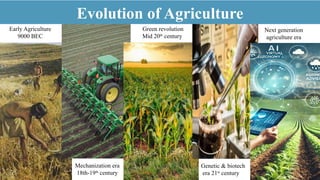
Early Agriculture
9000 BEC
Mechanization era
18th-19th
century
Green revolution
Mid 20th
century
Genetic & biotech
era 21st
century
Next generation
agriculture era
Evolution of Agriculture
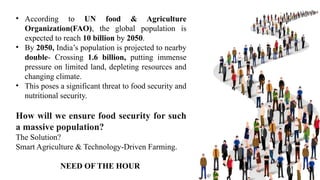
• According to UN food & Agriculture
Organization(FAO), the global population is
expected to reach 10 billion by 2050.
• By 2050, India’s population is projected to nearby
double- Crossing 1.6 billion, putting immense
pressure on limited land, depleting resources and
changing climate.
• This poses a significant threat to food security and
nutritional security.
How will we ensure food security for such
a massive population?
The Solution?
Smart Agriculture & Technology-Driven Farming.
NEED OF THE HOUR
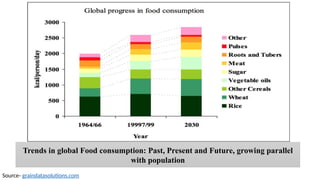
Source- graindatasolutions.com
Trends in global Food consumption: Past, Present and Future, growing parallel
with population
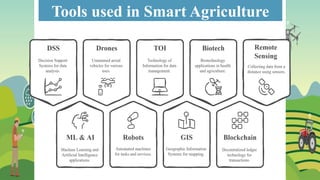
Tools used in Smart Agriculture
What is AI?
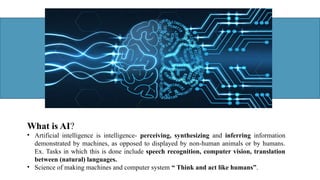
• Artificial intelligence is intelligence- perceiving, synthesizing and inferring information
demonstrated by machines, as opposed to displayed by non-human animals or by humans.
Ex. Tasks in which this is done include speech recognition, computer vision, translation
between (natural) languages.
• Science of making machines and computer system “ Think and act like humans”.
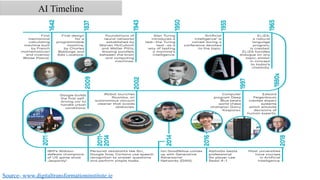
AI Timeline
Source- www.digitaltransformationinstitute.ie
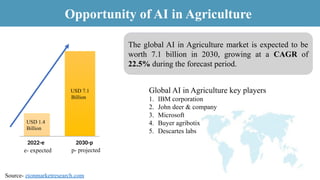
Opportunity of AI in Agriculture
USD 7.1
Billion
USD 1.4
Billion
2022-e 2030-p
The global AI in Agriculture market is expected to be
worth 7.1 billion in 2030, growing at a CAGR of
22.5% during the forecast period.
Source- zionmarketresearch.com
Global AI in Agriculture key players
1. IBM corporation
2. John deer & company
3. Microsoft
4. Buyer agribotix
5. Descartes labs
e- expected p- projected
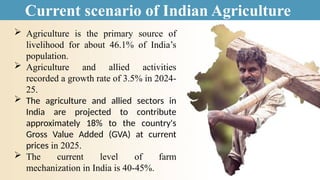
Current scenario of Indian Agriculture
 Agriculture is the primary source of
livelihood for about 46.1% of India’s
population.
 Agriculture and allied activities
recorded a growth rate of 3.5% in 2024-
25.
 The agriculture and allied sectors in
India are projected to contribute
approximately 18% to the country's
Gross Value Added (GVA) at current
prices in 2025.
 The current level of farm
mechanization in India is 40-45%.
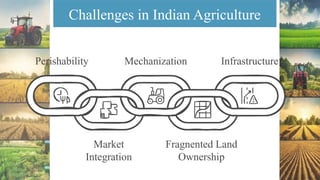
Challenges in Indian Agriculture
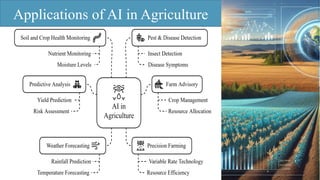
Applications of AI in Agriculture
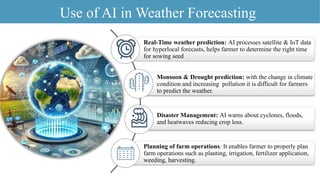
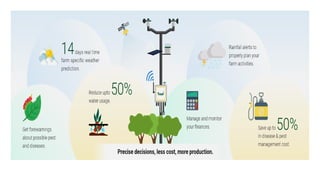
Use of AI in Weather Forecasting
Real-Time weather prediction: AI processes satellite & IoT data
for hyperlocal forecasts, helps farmer to determine the right time
for sowing seed
Monsoon & Drought prediction: with the change in climate
condition and increasing pollution it is difficult for farmers
to predict the weather.
Disaster Management: AI warns about cyclones, floods,
and heatwaves reducing crop loss.
Planning of farm operations: It enables farmer to properly plan
farm operations such as planting, irrigation, fertilizer application,
weeding, harvesting.
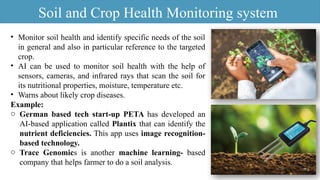
• Monitor soil health and identify specific needs of the soil
in general and also in particular reference to the targeted
crop.
• AI can be used to monitor soil health with the help of
sensors, cameras, and infrared rays that scan the soil for
its nutritional properties, moisture, temperature etc.
• Warns about likely crop diseases.
Example:
o German based tech start-up PETA has developed an
AI-based application called Plantix that can identify the
nutrient deficiencies. This app uses image recognition-
based technology.
o Trace Genomics is another machine learning- based
company that helps farmer to do a soil analysis.
Soil and Crop Health Monitoring system
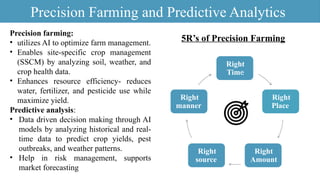
5R’s of Precision Farming
Precision Farming and Predictive Analytics
Right
Time
Right
Place
Right
Amount
Right
source
Right
manner
Precision farming:
• utilizes AI to optimize farm management.
• Enables site-specific crop management
(SSCM) by analyzing soil, weather, and
crop health data.
• Enhances resource efficiency- reduces
water, fertilizer, and pesticide use while
maximize yield.
Predictive analysis:
• Data driven decision making through AI
models by analyzing historical and real-
time data to predict crop yields, pest
outbreaks, and weather patterns.
• Help in risk management, supports
market forecasting
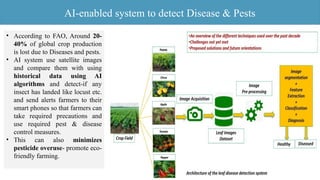
• According to FAO, Around 20-
40% of global crop production
is lost due to Diseases and pests.
• AI system use satellite images
and compare them with using
historical data using AI
algorithms and detect-if any
insect has landed like locust etc.
and send alerts farmers to their
smart phones so that farmers can
take required precautions and
use required pest & disease
control measures.
• This can also minimizes
pesticide overuse- promote eco-
friendly farming.
AI-enabled system to detect Disease & Pests
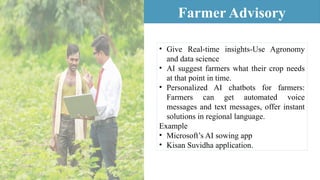
• Give Real-time insights-Use Agronomy
and data science
• AI suggest farmers what their crop needs
at that point in time.
• Personalized AI chatbots for farmers:
Farmers can get automated voice
messages and text messages, offer instant
solutions in regional language.
Example
• Microsoft’s AI sowing app
• Kisan Suvidha application.
Farmer Advisory
Agrostar, Pune
• Agrostar claims to be using a combination of knowledge of Agronomy, advanced
technology and lots of data to offer advisory services to Indian farmer.
• Currently operating in the eleven states of India.
• Agrostar offers service that begins by helping the farmer identify what their crop needs at
that moment and ends at doorstep delivery of whatever is needed.
Automation
Automation refers to the use of technology, machines, and systems to
perform tasks with minimal or no human intervention. It helps
improve efficiency, accuracy, and productivity across various
industries, including agriculture, manufacturing, healthcare, and
transportation.
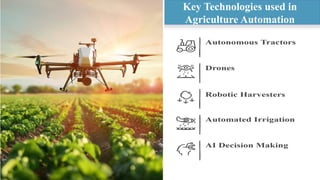
Key Technologies used in
Agriculture Automation
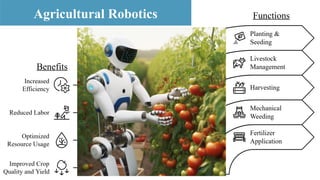
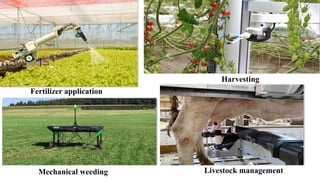
Agricultural Robotics
Benefits
Functions
Harvesting
Fertilizer application
Mechanical weeding Livestock management
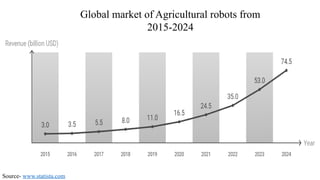
Global market of Agricultural robots from
2015-2024
Source- www.statista.com
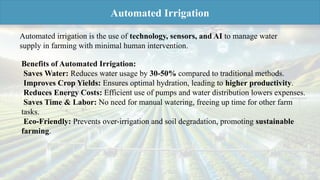
Benefits of Automated Irrigation:
Saves Water: Reduces water usage by 30-50% compared to traditional methods.
Improves Crop Yields: Ensures optimal hydration, leading to higher productivity.
Reduces Energy Costs: Efficient use of pumps and water distribution lowers expenses.
Saves Time & Labor: No need for manual watering, freeing up time for other farm
tasks.
Eco-Friendly: Prevents over-irrigation and soil degradation, promoting sustainable
farming.
Automated irrigation is the use of technology, sensors, and AI to manage water
supply in farming with minimal human intervention.
Automated Irrigation
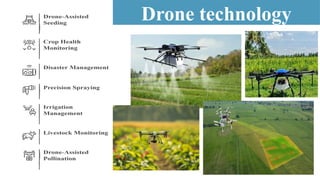
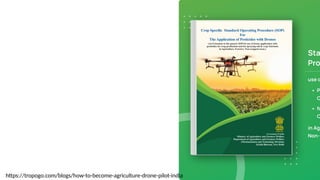
Drone technology
https://tropogo.com/blogs/how-to-become-agriculture-drone-pilot-india
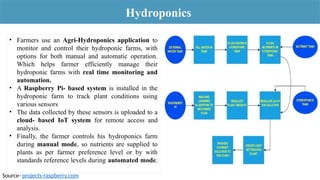
Hydroponics
• Farmers use an Agri-Hydroponics application to
monitor and control their hydroponic farms, with
options for both manual and automatic operation.
Which helps farmer efficiently manage their
hydroponic farms with real time monitoring and
automation.
• A Raspberry Pi- based system is installed in the
hydroponic farm to track plant conditions using
various sensors
• The data collected by these sensors is uploaded to a
cloud- based IoT system for remote access and
analysis.
• Finally, the farmer controls his hydroponics farm
during manual mode, so nutrients are supplied to
plants as per farmer preference level or by with
standards reference levels during automated mode.
Source- projects-raspberry.com
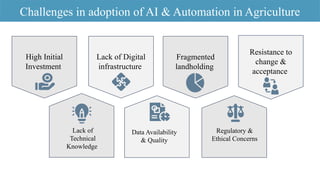
Challenges in adoption of AI & Automation in Agriculture
High Initial
Investment
Lack of Digital
infrastructure
Fragmented
landholding
Resistance to
change &
acceptance
Lack of
Technical
Knowledge
Data Availability
& Quality
Regulatory &
Ethical Concerns
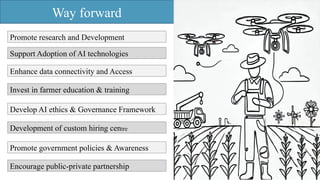
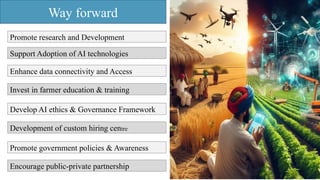
Way forward
Promote research and Development
Support Adoption of AI technologies
Enhance data connectivity and Access
Invest in farmer education & training
Develop AI ethics & Governance Framework
Development of custom hiring centre
Promote government policies & Awareness
Encourage public-private partnership
Way forward
Promote research and Development
Support Adoption of AI technologies
Enhance data connectivity and Access
Invest in farmer education & training
Develop AI ethics & Governance Framework
Development of custom hiring centre
Promote government policies & Awareness
Encourage public-private partnership
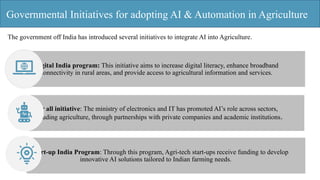
Governmental Initiatives for adopting AI & Automation in Agriculture
The government off India has introduced several initiatives to integrate AI into Agriculture.
Digital India program: This initiative aims to increase digital literacy, enhance broadband
connectivity in rural areas, and provide access to agricultural information and services.
AI for all initiative: The ministry of electronics and IT has promoted AI’s role across sectors,
including agriculture, through partnerships with private companies and academic institutions.
Start-up India Program: Through this program, Agri-tech start-ups receive funding to develop
innovative AI solutions tailored to Indian farming needs.
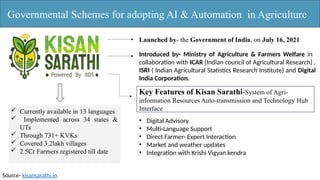
Governmental Schemes for adopting AI & Automation in Agriculture
Launched by- the Government of India, on July 16, 2021
Introduced by- Ministry of Agriculture & Farmers Welfare in
collaboration with ICAR (Indian council of Agricultural Research) ,
ISRI ( Indian Agricultural Statistics Research Institute) and Digital
India Corporation.
Key Features of Kisan Sarathi-System of Agri-
information Resources Auto-transmission and Technology Hub
Interface
• Digital Advisory
• Multi-Language Support
• Direct Farmer- Expert Interaction
• Market and weather updates
• Integration with Krishi Vigyan kendra
 Currently available in 13 languages
 Implemented across 34 states &
UTs
 Through 731+ KVKs
 Covered 3.2lakh villages
 2.5Cr Farmers registered till date
Source- kisansarathi.in
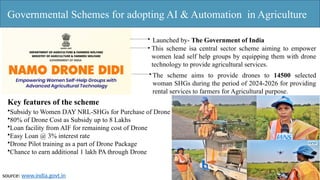
Governmental Schemes for adopting AI & Automation in Agriculture
Launched by- The Government of India
This scheme isa central sector scheme aiming to empower
women lead self help groups by equipping them with drone
technology to provide agricultural services.
The scheme aims to provide drones to 14500 selected
woman SHGs during the period of 2024-2026 for providing
rental services to farmers for Agricultural purpose.
Key features of the scheme
•Subsidy to Women DAY NRL-SHGs for Purchase of Drone
•80% of Drone Cost as Subsidy up to 8 Lakhs
•Loan facility from AIF for remaining cost of Drone
•Easy Loan @ 3% interest rate
•Drone Pilot training as a part of Drone Package
•Chance to earn additional 1 lakh PA through Drone
source: www.india.govt.in
Transforming Industries through private players
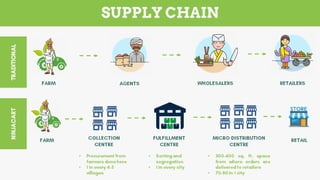
• Ninjacart is India’s largest B2B fresh produce supply chain that
directly connects farmers and manufacturers to retailers.
• It aims to solve supply chain problems in Indian agriculture using
technology and data science.
• It uses market intelligence tools, machine learning methods, to
predict market prices, and deep learning algorithms for
forecasting demand (reducing food wastage). It’s RFID powered
supply chain management helps track produce on a store shelf to
a farmer and its corresponding farmer data.
Transforming Industries through private players
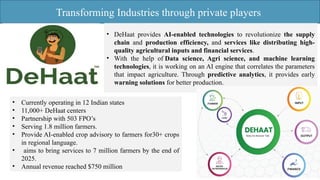
• DeHaat provides AI-enabled technologies to revolutionize the supply
chain and production efficiency, and services like distributing high-
quality agricultural inputs and financial services.
• With the help of Data science, Agri science, and machine learning
technologies, it is working on an AI engine that correlates the parameters
that impact agriculture. Through predictive analytics, it provides early
warning solutions for better production.
• Currently operating in 12 Indian states
• 11,000+ DeHaat centers
• Partnership with 503 FPO’s
• Serving 1.8 million farmers.
• Provide AI-enabled crop advisory to farmers for30+ crops
in regional language.
• aims to bring services to 7 million farmers by the end of
2025.
• Annual revenue reached $750 million
Transforming Industries through private players
• Cropin is a global Agri-ecosystem intelligence provider.
• Its suite of products enables various stakeholders, including financial service providers, to
adopt and implement digital strategies across agricultural operations.
• By leveraging advanced technologies such as artificial intelligence, machine learning, and
remote sensing, Cropin builds an intelligent, interconnected data platform.
• This platform helps organizations digitize their operations from farm to fork, utilizing near
real-time farm data and actionable insights for informed decision-making.
Case Study
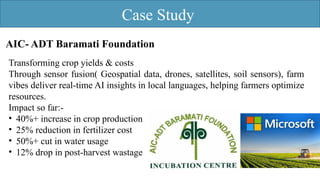
AIC- ADT Baramati Foundation
Transforming crop yields & costs
Through sensor fusion( Geospatial data, drones, satellites, soil sensors), farm
vibes deliver real-time AI insights in local languages, helping farmers optimize
resources.
Impact so far:-
• 40%+ increase in crop production
• 25% reduction in fertilizer cost
• 50%+ cut in water usage
• 12% drop in post-harvest wastage
Success story
 Founders: Ananda Verma and Shailendra Tiwari
 Started in: 2018
 Fasal was started with a simple idea - removing
guesswork from farming.
 Fasal is an AI-powered platform for the agriculture
ecosystem that records different growing conditions
on the farm. It uses data science and AI algorithms to
make on-farm predictions before delivering the
insights anywhere on any device. It helps in weather
forecast at field level, irrigation management, pest
and disease management, fertilizer, fungicide, and
pesticide application management. Also, it gives
real-time alerts about the crop, soil, and weather
conditions.
Zha, J. (2020). Artificial intelligence in agriculture. Journal of Physics: Conference Series, 1693, 012058.
https://doi.org/10.1088/1742-6596/1693/1/012058
Mishra, U. (2025). Harnessing AI technologies for sustainable agricultural practices: Innovations in soil
analysis and crop management. Biology, Engineering, Medicine and Science Reports, 11(1), 9-13.
https://doi.org/10.5530/bems.11.1.2
Hoque, A., & Padhiary, M. (2024). Automation and AI in precision agriculture: Innovations for
enhanced crop management and sustainability. Asian Journal of Research in Computer Science, 17,
95-109. https://doi.org/10.9734/ajrcos/2024/v17i10512
Kazi, K. (2024). Artificial intelligence (AI)-driven IoT (AIIoT)-based agriculture automation. In Advanced
Computational Methods for Agri-Business Sustainability (pp.72-94)
10.4018/979-8-3693-3583-3.ch005.
Shubham, K., & Shilpa. (2024). Frontiers of artificial intelligence in the agricultural sector: Trends
and transformations. Journal of Scientific Research and Reports, 30(10), 970-980.
https://doi.org/10.9734/jsrr/2024/v30i102518
Yadav, A. (2023). Unleashing the potential of agriculture: AI-powered smart farming. ACTA
Scientific Microbiology, 6, 1-2.
Das, A., Kadawla, K., Nath, H., Chakraborty, S., Ali, H., & Dubey, V. (2024). Drone-based intelligent spraying of pesticides:
Current challenges and its future prospects. In Advances in Smart Agriculture (pp. 1-12). https://doi.org/10.1007/978-981-
99-8684-2_12

master seminar digital applications in india

  • 1.
    INTERNATIONAL AGRIBUSINESS MANAGEMENTINSTITUTE Anand Agricultural University Anand-388110 MASTER SEMINAR PRESENTATION ON NEXT GENERATION AGRICULTURE: AI & AUTOMATION Presented by Major Guide Mahima Choudhary Dr. Mahesh R.Prajapati Reg.No: 2040624044 Associate Professor &Head, MBA – 2nd Semester Department of Financial Management, IABMI ,AAU ,Anand IABMI ,AAU, Anand
  • 3.
    AUTHOR AND YEAR TITLE FINDINGS Jariwala(2025) AI and Data Science in Sustainable Agriculture and Food Production. This study explored the transformative role of AI and Data Science in sustainable agriculture, addressing critical challenges, enhancing productivity, and fostering environmental stewardship. It defines sustainable agriculture and its importance, highlighting the need for innovative solutions. It covers AI techniques for water management and irrigation systems, showcasing predictive analytics and real-time monitoring. It discusses AI in fertilizer management, presenting techniques to enhance efficiency. Finally, this study also explored AI-driven supply chain optimization and food waste reduction, illustrating the impact on efficiency and sustainability.
  • 4.
    AUTHOR AND YEAR TITLE FINDINGS Mishra(2025) Harnessing AI Technologies for Sustainable Agricultural Practices: Innovations in Soil Analysis and Crop Management. This study showed the challenges in the agriculture sector that are becoming significant, with a rapidly growing population and declining agricultural productivity. Despite farmers' rigorous efforts to cultivate crops, they encounter numerous obstacles stemming from insufficient knowledge about soil characteristics, key influencing factors, and unpredictable weather patterns, compounded by inadequate access to financial resources from banks. This research highlights the transformative potential of advanced technologies in addressing these challenges, specifically Machine Learning (ML) and Computer Vision (CV). By implementing real-time soil analysis and predictive weather forecasting, farmers can gain valuable insights into soil health, nutrient composition, and moisture levels, enhancing their decision- making processes.
  • 5.
    AUTHOR AND YEAR TITLE FINDINGS Subangiet al. (2025) Leveraging Library Support Worldwide for Academicians in Advancing Automation through AI, IoT, and Robotics in Digital Agriculture. This study shows the swift progress in Artificial Intelligence (AI), the Internet of Things (IoT), and Robotics is significantly transforming the landscape of digital agriculture, enabling unprecedented levels of efficiency, precision, and sustainability. It underscores the value of innovative library-driven initiatives in facilitating knowledge dissemination, fostering collaboration, and inspiring novel ideas that bridge the gap between traditional practices and advanced technological solutions. Key Words in this study would be Digital Agriculture, Artificial Intelligence (AI), Internet of Things (IoT), Robotics, Automation in Agriculture, Library Support Systems, Interdisciplinary Collaboration, Precision Agriculture, Technological Infrastructure, Research Resources, Data-Driven Decision Making, Innovation in Agricultural Practices, Global Knowledge Networks, Emerging Technologies in Agriculture, Sustainability in Agriculture, Capacity Building in Research, Blockchain in Agriculture, Augmented Reality (AR), Knowledge Sharing, Community Engagement in Agriculture, Open Access Resources, Agricultural Data Management, Agricultural Policy Support, Smart Farming, Access to Information in Agriculture.
  • 6.
    AUTHOR AND YEAR TITLE FINDINGS Kazi(2024) Artificial Intelligence (AI)-Driven IoT (AIIoT)- Based Agriculture Automation. This study showed the fusion of IoT and AI encompasses given rise to a new concept - artificial intelligence driven IoT (AIIoT). AIIoT is the intersection of AI and IoT, where AI algorithms are used to assess the data collected by IoT devices, improving their effectiveness and intelligence. AIIoT-based agriculture has become the outcome of the new opportunities for agricultural automation that this technology has made possible. Agriculture automation powered by AI and IoT is revolutionising the sector. It could lead to higher output, lower expenses, and better sustainability. The need for food will only grow as by 2050, it is expected that there will be 9.7 billion people on the planet. In addition to meeting this demand, AIIoT-based agricultural automation can help with resource scarcity and climate change issues.
  • 7.
    AUTHOR AND YEAR TITLE FINDINGS Hoqueet al. (2024) Automation and AI in Precision Agriculture: Innovations for Enhanced Crop Management and Sustainability. This study showed that precision agriculture is one of the ways to achieve food security and sustainability through better resource-use optimization and crop productivity dealing with the challenges posed by the growing population and addressing environmental concerns. The accuracy of crop monitoring and health assessments has increased by 30–50 percent as a result of AI-powered solutions, which have improved resource-based decision-making. Despite these developments, issues of scalability, affordability for small farms, and data privacy still exist, which can hinder technology adoption among farmers. All of these technologies could improve decision-making and transparency in precision agriculture by enabling real-time data transmission, secure data management, and enhanced traceability, thus addressing current limitations and fostering trust among stakeholders.
  • 8.
    AUTHOR AND YEAR TITLE FINDINGS Zha(2020) Artificial Intelligence in Agriculture. This study stated that application of AI in agriculture has been widely considered as one of the most viable solutions to address food inadequacy and to adapt to the need of a growing population. Three challenges that need to be addressed in order for AI-based technology to be popularized in markets are uneven distribution of mechanization, the ability of algorithms to process large sets of data accurately and quickly, and the security and privacy of data, as well as the devices. Agricultural robots targeted at diverse aspects in agricultural industry have been developed and improved greatly in the past years, and although pointing out the hardship of applying machines and algorithms tested in experimental environment to real environments, the review highlights an already prosperous development and a promising prospect of application.
  • 9.
    Early Agriculture 9000 BEC Mechanizationera 18th-19th century Green revolution Mid 20th century Genetic & biotech era 21st century Next generation agriculture era Evolution of Agriculture
  • 10.
    • According toUN food & Agriculture Organization(FAO), the global population is expected to reach 10 billion by 2050. • By 2050, India’s population is projected to nearby double- Crossing 1.6 billion, putting immense pressure on limited land, depleting resources and changing climate. • This poses a significant threat to food security and nutritional security. How will we ensure food security for such a massive population? The Solution? Smart Agriculture & Technology-Driven Farming. NEED OF THE HOUR
  • 11.
    Source- graindatasolutions.com Trends inglobal Food consumption: Past, Present and Future, growing parallel with population
  • 12.
    Tools used inSmart Agriculture
  • 15.
    What is AI? •Artificial intelligence is intelligence- perceiving, synthesizing and inferring information demonstrated by machines, as opposed to displayed by non-human animals or by humans. Ex. Tasks in which this is done include speech recognition, computer vision, translation between (natural) languages. • Science of making machines and computer system “ Think and act like humans”.
  • 16.
  • 17.
    Opportunity of AIin Agriculture USD 7.1 Billion USD 1.4 Billion 2022-e 2030-p The global AI in Agriculture market is expected to be worth 7.1 billion in 2030, growing at a CAGR of 22.5% during the forecast period. Source- zionmarketresearch.com Global AI in Agriculture key players 1. IBM corporation 2. John deer & company 3. Microsoft 4. Buyer agribotix 5. Descartes labs e- expected p- projected
  • 18.
    Current scenario ofIndian Agriculture  Agriculture is the primary source of livelihood for about 46.1% of India’s population.  Agriculture and allied activities recorded a growth rate of 3.5% in 2024- 25.  The agriculture and allied sectors in India are projected to contribute approximately 18% to the country's Gross Value Added (GVA) at current prices in 2025.  The current level of farm mechanization in India is 40-45%.
  • 19.
  • 20.
    Applications of AIin Agriculture
  • 21.
    Use of AIin Weather Forecasting Real-Time weather prediction: AI processes satellite & IoT data for hyperlocal forecasts, helps farmer to determine the right time for sowing seed Monsoon & Drought prediction: with the change in climate condition and increasing pollution it is difficult for farmers to predict the weather. Disaster Management: AI warns about cyclones, floods, and heatwaves reducing crop loss. Planning of farm operations: It enables farmer to properly plan farm operations such as planting, irrigation, fertilizer application, weeding, harvesting.
  • 22.
    • Monitor soilhealth and identify specific needs of the soil in general and also in particular reference to the targeted crop. • AI can be used to monitor soil health with the help of sensors, cameras, and infrared rays that scan the soil for its nutritional properties, moisture, temperature etc. • Warns about likely crop diseases. Example: o German based tech start-up PETA has developed an AI-based application called Plantix that can identify the nutrient deficiencies. This app uses image recognition- based technology. o Trace Genomics is another machine learning- based company that helps farmer to do a soil analysis. Soil and Crop Health Monitoring system
  • 23.
    5R’s of PrecisionFarming Precision Farming and Predictive Analytics Right Time Right Place Right Amount Right source Right manner Precision farming: • utilizes AI to optimize farm management. • Enables site-specific crop management (SSCM) by analyzing soil, weather, and crop health data. • Enhances resource efficiency- reduces water, fertilizer, and pesticide use while maximize yield. Predictive analysis: • Data driven decision making through AI models by analyzing historical and real- time data to predict crop yields, pest outbreaks, and weather patterns. • Help in risk management, supports market forecasting
  • 24.
    • According toFAO, Around 20- 40% of global crop production is lost due to Diseases and pests. • AI system use satellite images and compare them with using historical data using AI algorithms and detect-if any insect has landed like locust etc. and send alerts farmers to their smart phones so that farmers can take required precautions and use required pest & disease control measures. • This can also minimizes pesticide overuse- promote eco- friendly farming. AI-enabled system to detect Disease & Pests
  • 25.
    • Give Real-timeinsights-Use Agronomy and data science • AI suggest farmers what their crop needs at that point in time. • Personalized AI chatbots for farmers: Farmers can get automated voice messages and text messages, offer instant solutions in regional language. Example • Microsoft’s AI sowing app • Kisan Suvidha application. Farmer Advisory
  • 26.
    Agrostar, Pune • Agrostarclaims to be using a combination of knowledge of Agronomy, advanced technology and lots of data to offer advisory services to Indian farmer. • Currently operating in the eleven states of India. • Agrostar offers service that begins by helping the farmer identify what their crop needs at that moment and ends at doorstep delivery of whatever is needed.
  • 27.
    Automation Automation refers tothe use of technology, machines, and systems to perform tasks with minimal or no human intervention. It helps improve efficiency, accuracy, and productivity across various industries, including agriculture, manufacturing, healthcare, and transportation.
  • 28.
    Key Technologies usedin Agriculture Automation
  • 29.
  • 30.
  • 31.
    Global market ofAgricultural robots from 2015-2024 Source- www.statista.com
  • 32.
    Benefits of AutomatedIrrigation: Saves Water: Reduces water usage by 30-50% compared to traditional methods. Improves Crop Yields: Ensures optimal hydration, leading to higher productivity. Reduces Energy Costs: Efficient use of pumps and water distribution lowers expenses. Saves Time & Labor: No need for manual watering, freeing up time for other farm tasks. Eco-Friendly: Prevents over-irrigation and soil degradation, promoting sustainable farming. Automated irrigation is the use of technology, sensors, and AI to manage water supply in farming with minimal human intervention. Automated Irrigation
  • 33.
  • 34.
  • 35.
    Hydroponics • Farmers usean Agri-Hydroponics application to monitor and control their hydroponic farms, with options for both manual and automatic operation. Which helps farmer efficiently manage their hydroponic farms with real time monitoring and automation. • A Raspberry Pi- based system is installed in the hydroponic farm to track plant conditions using various sensors • The data collected by these sensors is uploaded to a cloud- based IoT system for remote access and analysis. • Finally, the farmer controls his hydroponics farm during manual mode, so nutrients are supplied to plants as per farmer preference level or by with standards reference levels during automated mode. Source- projects-raspberry.com
  • 36.
    Challenges in adoptionof AI & Automation in Agriculture High Initial Investment Lack of Digital infrastructure Fragmented landholding Resistance to change & acceptance Lack of Technical Knowledge Data Availability & Quality Regulatory & Ethical Concerns
  • 37.
    Way forward Promote researchand Development Support Adoption of AI technologies Enhance data connectivity and Access Invest in farmer education & training Develop AI ethics & Governance Framework Development of custom hiring centre Promote government policies & Awareness Encourage public-private partnership
  • 38.
    Way forward Promote researchand Development Support Adoption of AI technologies Enhance data connectivity and Access Invest in farmer education & training Develop AI ethics & Governance Framework Development of custom hiring centre Promote government policies & Awareness Encourage public-private partnership
  • 39.
    Governmental Initiatives foradopting AI & Automation in Agriculture The government off India has introduced several initiatives to integrate AI into Agriculture. Digital India program: This initiative aims to increase digital literacy, enhance broadband connectivity in rural areas, and provide access to agricultural information and services. AI for all initiative: The ministry of electronics and IT has promoted AI’s role across sectors, including agriculture, through partnerships with private companies and academic institutions. Start-up India Program: Through this program, Agri-tech start-ups receive funding to develop innovative AI solutions tailored to Indian farming needs.
  • 40.
    Governmental Schemes foradopting AI & Automation in Agriculture Launched by- the Government of India, on July 16, 2021 Introduced by- Ministry of Agriculture & Farmers Welfare in collaboration with ICAR (Indian council of Agricultural Research) , ISRI ( Indian Agricultural Statistics Research Institute) and Digital India Corporation. Key Features of Kisan Sarathi-System of Agri- information Resources Auto-transmission and Technology Hub Interface • Digital Advisory • Multi-Language Support • Direct Farmer- Expert Interaction • Market and weather updates • Integration with Krishi Vigyan kendra  Currently available in 13 languages  Implemented across 34 states & UTs  Through 731+ KVKs  Covered 3.2lakh villages  2.5Cr Farmers registered till date Source- kisansarathi.in
  • 41.
    Governmental Schemes foradopting AI & Automation in Agriculture Launched by- The Government of India This scheme isa central sector scheme aiming to empower women lead self help groups by equipping them with drone technology to provide agricultural services. The scheme aims to provide drones to 14500 selected woman SHGs during the period of 2024-2026 for providing rental services to farmers for Agricultural purpose. Key features of the scheme •Subsidy to Women DAY NRL-SHGs for Purchase of Drone •80% of Drone Cost as Subsidy up to 8 Lakhs •Loan facility from AIF for remaining cost of Drone •Easy Loan @ 3% interest rate •Drone Pilot training as a part of Drone Package •Chance to earn additional 1 lakh PA through Drone source: www.india.govt.in
  • 42.
    Transforming Industries throughprivate players • Ninjacart is India’s largest B2B fresh produce supply chain that directly connects farmers and manufacturers to retailers. • It aims to solve supply chain problems in Indian agriculture using technology and data science. • It uses market intelligence tools, machine learning methods, to predict market prices, and deep learning algorithms for forecasting demand (reducing food wastage). It’s RFID powered supply chain management helps track produce on a store shelf to a farmer and its corresponding farmer data.
  • 44.
    Transforming Industries throughprivate players • DeHaat provides AI-enabled technologies to revolutionize the supply chain and production efficiency, and services like distributing high- quality agricultural inputs and financial services. • With the help of Data science, Agri science, and machine learning technologies, it is working on an AI engine that correlates the parameters that impact agriculture. Through predictive analytics, it provides early warning solutions for better production. • Currently operating in 12 Indian states • 11,000+ DeHaat centers • Partnership with 503 FPO’s • Serving 1.8 million farmers. • Provide AI-enabled crop advisory to farmers for30+ crops in regional language. • aims to bring services to 7 million farmers by the end of 2025. • Annual revenue reached $750 million
  • 45.
    Transforming Industries throughprivate players • Cropin is a global Agri-ecosystem intelligence provider. • Its suite of products enables various stakeholders, including financial service providers, to adopt and implement digital strategies across agricultural operations. • By leveraging advanced technologies such as artificial intelligence, machine learning, and remote sensing, Cropin builds an intelligent, interconnected data platform. • This platform helps organizations digitize their operations from farm to fork, utilizing near real-time farm data and actionable insights for informed decision-making.
  • 46.
    Case Study AIC- ADTBaramati Foundation Transforming crop yields & costs Through sensor fusion( Geospatial data, drones, satellites, soil sensors), farm vibes deliver real-time AI insights in local languages, helping farmers optimize resources. Impact so far:- • 40%+ increase in crop production • 25% reduction in fertilizer cost • 50%+ cut in water usage • 12% drop in post-harvest wastage
  • 48.
    Success story  Founders:Ananda Verma and Shailendra Tiwari  Started in: 2018  Fasal was started with a simple idea - removing guesswork from farming.  Fasal is an AI-powered platform for the agriculture ecosystem that records different growing conditions on the farm. It uses data science and AI algorithms to make on-farm predictions before delivering the insights anywhere on any device. It helps in weather forecast at field level, irrigation management, pest and disease management, fertilizer, fungicide, and pesticide application management. Also, it gives real-time alerts about the crop, soil, and weather conditions.
  • 51.
    Zha, J. (2020).Artificial intelligence in agriculture. Journal of Physics: Conference Series, 1693, 012058. https://doi.org/10.1088/1742-6596/1693/1/012058 Mishra, U. (2025). Harnessing AI technologies for sustainable agricultural practices: Innovations in soil analysis and crop management. Biology, Engineering, Medicine and Science Reports, 11(1), 9-13. https://doi.org/10.5530/bems.11.1.2 Hoque, A., & Padhiary, M. (2024). Automation and AI in precision agriculture: Innovations for enhanced crop management and sustainability. Asian Journal of Research in Computer Science, 17, 95-109. https://doi.org/10.9734/ajrcos/2024/v17i10512 Kazi, K. (2024). Artificial intelligence (AI)-driven IoT (AIIoT)-based agriculture automation. In Advanced Computational Methods for Agri-Business Sustainability (pp.72-94) 10.4018/979-8-3693-3583-3.ch005. Shubham, K., & Shilpa. (2024). Frontiers of artificial intelligence in the agricultural sector: Trends and transformations. Journal of Scientific Research and Reports, 30(10), 970-980. https://doi.org/10.9734/jsrr/2024/v30i102518 Yadav, A. (2023). Unleashing the potential of agriculture: AI-powered smart farming. ACTA Scientific Microbiology, 6, 1-2. Das, A., Kadawla, K., Nath, H., Chakraborty, S., Ali, H., & Dubey, V. (2024). Drone-based intelligent spraying of pesticides: Current challenges and its future prospects. In Advances in Smart Agriculture (pp. 1-12). https://doi.org/10.1007/978-981- 99-8684-2_12