Siri, Siri in my hand, who’s the fairest in the land?
On the interpretations, illustrations and implications of artificial intelligence
Andreas Kaplan and Michael Haenlein
Business Horizons, 62(1)
2019
Kaplan A., Haenlein M. (2019) Siri, Siri in my hand, who ‘s the fairest in the land?
On the Interpretations, Illustrations and Implications of Artificial Intelligence, Business Horizons, 62(1)
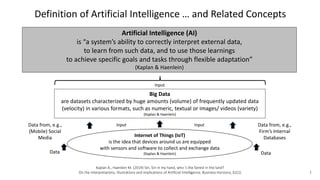
Definition of Artificial Intelligence … and Related Concepts
Artificial Intelligence (AI)
is “a system’s ability to correctly interpret external data,
to learn from such data, and to use those learnings
to achieve specific goals and tasks through flexible adaptation”
(Kaplan & Haenlein)
Big Data
are datasets characterized by huge amounts (volume) of frequently updated data
(velocity) in various formats, such as numeric, textual or images/ videos (variety)
(Kaplan & Haenlein)
Input
Internet of Things (IoT)
is the idea that devices around us are equipped
with sensors and software to collect and exchange data
(Kaplan & Haenlein)
Data from, e.g.,
(Mobile) Social
Media
Data from, e.g.,
Firm’s Internal
Databases
InputInput
Data Data
1
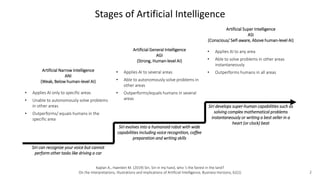
Artificial Narrow Intelligence
ANI
(Weak, Below human-level AI)
• Applies AI only to specific areas
• Unable to autonomously solve problems
in other areas
• Outperforms/ equals humans in the
specific area
Artificial General Intelligence
AGI
(Strong, Human-level AI)
• Applies AI to several areas
• Able to autonomously solve problems in
other areas
• Outperforms/equals humans in several
areas
Artificial Super Intelligence
ASI
(Conscious/ Self-aware, Above human-level AI)
• Applies AI to any area
• Able to solve problems in other areas
instantaneously
• Outperforms humans in all areas
Siri can recognize your voice but cannot
perform other tasks like driving a car
Siri evolves into a humanoid robot with wide
capabilities including voice recognition, coffee
preparation and writing skills
Siri develops super-human capabilities such as
solving complex mathematical problems
instantaneously or writing a best seller in a
heart (or clock) beat
Stages of Artificial Intelligence
2
Kaplan A., Haenlein M. (2019) Siri, Siri in my hand, who ‘s the fairest in the land?
On the Interpretations, Illustrations and Implications of Artificial Intelligence, Business Horizons, 62(1)
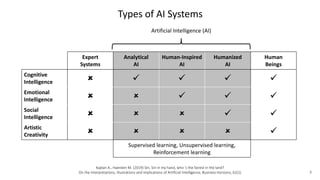
Expert
Systems
Analytical
AI
Human-Inspired
AI
Humanized
AI
Human
Beings
Cognitive
Intelligence     
Emotional
Intelligence     
Social
Intelligence     
Artistic
Creativity     
Supervised learning, Unsupervised learning,
Reinforcement learning
Types of AI Systems
Artificial Intelligence (AI)
3
Kaplan A., Haenlein M. (2019) Siri, Siri in my hand, who ‘s the fairest in the land?
On the Interpretations, Illustrations and Implications of Artificial Intelligence, Business Horizons, 62(1)
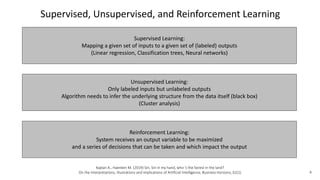
Supervised, Unsupervised, and Reinforcement Learning
Supervised Learning:
Mapping a given set of inputs to a given set of (labeled) outputs
(Linear regression, Classification trees, Neural networks)
Unsupervised Learning:
Only labeled inputs but unlabeled outputs
Algorithm needs to infer the underlying structure from the data itself (black box)
(Cluster analysis)
Reinforcement Learning:
System receives an output variable to be maximized
and a series of decisions that can be taken and which impact the output
4
Kaplan A., Haenlein M. (2019) Siri, Siri in my hand, who ‘s the fairest in the land?
On the Interpretations, Illustrations and Implications of Artificial Intelligence, Business Horizons, 62(1)
Analytical AI Human-Inspired AI Humanized AI
Universities
Virtual teaching assistants
able to answer student
questions and tailor
reactions to individual
data
AI-based career services
able to identify emotions to
improve interview
techniques of students
Robo-teachers animating
a student group by acting
as moderator and
sparring partners
Corporations
Robo-advisors leveraging
automation and AI
algorithms to manage
client portfolios
Stores identifying unhappy
shoppers via facial
recognition at checkouts to
trigger remedial actions
Virtual agents dealing
with customer complaints
and addressing concerns
of unhappy customers
Governments
Automation systems to set
the brightness of
streetlights based on
traffic and pedestrian
movements
Virtual army recruiters
interviewing and selecting
candidates based on
emotional cues
AI systems able to
psychologically train
soldiers before entering a
war zone
Illustrations of AI Applications within Specific Sectors
5
Kaplan A., Haenlein M. (2019) Siri, Siri in my hand, who ‘s the fairest in the land?
On the Interpretations, Illustrations and Implications of Artificial Intelligence, Business Horizons, 62(1)
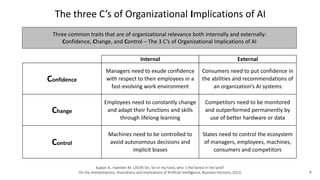
Internal External
Confidence
Managers need to exude confidence
with respect to their employees in a
fast-evolving work environment
Consumers need to put confidence in
the abilities and recommendations of
an organization’s AI systems
Change
Employees need to constantly change
and adapt their functions and skills
through lifelong learning
Competitors need to be monitored
and outperformed permanently by
use of better hardware or data
Control
Machines need to be controlled to
avoid autonomous decisions and
implicit biases
States need to control the ecosystem
of managers, employees, machines,
consumers and competitors
The three C’s of Organizational Implications of AI
Three common traits that are of organizational relevance both internally and externally:
Confidence, Change, and Control – The 3 C’s of Organizational Implications of AI
6
Kaplan A., Haenlein M. (2019) Siri, Siri in my hand, who ‘s the fairest in the land?
On the Interpretations, Illustrations and Implications of Artificial Intelligence, Business Horizons, 62(1)

Artificial Intelligence (AI) - Definition, Evolution, and Classification

  • 1.
    Siri, Siri inmy hand, who’s the fairest in the land? On the interpretations, illustrations and implications of artificial intelligence Andreas Kaplan and Michael Haenlein Business Horizons, 62(1) 2019
  • 2.
    Kaplan A., HaenleinM. (2019) Siri, Siri in my hand, who ‘s the fairest in the land? On the Interpretations, Illustrations and Implications of Artificial Intelligence, Business Horizons, 62(1) Definition of Artificial Intelligence … and Related Concepts Artificial Intelligence (AI) is “a system’s ability to correctly interpret external data, to learn from such data, and to use those learnings to achieve specific goals and tasks through flexible adaptation” (Kaplan & Haenlein) Big Data are datasets characterized by huge amounts (volume) of frequently updated data (velocity) in various formats, such as numeric, textual or images/ videos (variety) (Kaplan & Haenlein) Input Internet of Things (IoT) is the idea that devices around us are equipped with sensors and software to collect and exchange data (Kaplan & Haenlein) Data from, e.g., (Mobile) Social Media Data from, e.g., Firm’s Internal Databases InputInput Data Data 1
  • 3.
    Artificial Narrow Intelligence ANI (Weak,Below human-level AI) • Applies AI only to specific areas • Unable to autonomously solve problems in other areas • Outperforms/ equals humans in the specific area Artificial General Intelligence AGI (Strong, Human-level AI) • Applies AI to several areas • Able to autonomously solve problems in other areas • Outperforms/equals humans in several areas Artificial Super Intelligence ASI (Conscious/ Self-aware, Above human-level AI) • Applies AI to any area • Able to solve problems in other areas instantaneously • Outperforms humans in all areas Siri can recognize your voice but cannot perform other tasks like driving a car Siri evolves into a humanoid robot with wide capabilities including voice recognition, coffee preparation and writing skills Siri develops super-human capabilities such as solving complex mathematical problems instantaneously or writing a best seller in a heart (or clock) beat Stages of Artificial Intelligence 2 Kaplan A., Haenlein M. (2019) Siri, Siri in my hand, who ‘s the fairest in the land? On the Interpretations, Illustrations and Implications of Artificial Intelligence, Business Horizons, 62(1)
  • 4.
    Expert Systems Analytical AI Human-Inspired AI Humanized AI Human Beings Cognitive Intelligence     Emotional Intelligence      Social Intelligence      Artistic Creativity      Supervised learning, Unsupervised learning, Reinforcement learning Types of AI Systems Artificial Intelligence (AI) 3 Kaplan A., Haenlein M. (2019) Siri, Siri in my hand, who ‘s the fairest in the land? On the Interpretations, Illustrations and Implications of Artificial Intelligence, Business Horizons, 62(1)
  • 5.
    Supervised, Unsupervised, andReinforcement Learning Supervised Learning: Mapping a given set of inputs to a given set of (labeled) outputs (Linear regression, Classification trees, Neural networks) Unsupervised Learning: Only labeled inputs but unlabeled outputs Algorithm needs to infer the underlying structure from the data itself (black box) (Cluster analysis) Reinforcement Learning: System receives an output variable to be maximized and a series of decisions that can be taken and which impact the output 4 Kaplan A., Haenlein M. (2019) Siri, Siri in my hand, who ‘s the fairest in the land? On the Interpretations, Illustrations and Implications of Artificial Intelligence, Business Horizons, 62(1)
  • 6.
    Analytical AI Human-InspiredAI Humanized AI Universities Virtual teaching assistants able to answer student questions and tailor reactions to individual data AI-based career services able to identify emotions to improve interview techniques of students Robo-teachers animating a student group by acting as moderator and sparring partners Corporations Robo-advisors leveraging automation and AI algorithms to manage client portfolios Stores identifying unhappy shoppers via facial recognition at checkouts to trigger remedial actions Virtual agents dealing with customer complaints and addressing concerns of unhappy customers Governments Automation systems to set the brightness of streetlights based on traffic and pedestrian movements Virtual army recruiters interviewing and selecting candidates based on emotional cues AI systems able to psychologically train soldiers before entering a war zone Illustrations of AI Applications within Specific Sectors 5 Kaplan A., Haenlein M. (2019) Siri, Siri in my hand, who ‘s the fairest in the land? On the Interpretations, Illustrations and Implications of Artificial Intelligence, Business Horizons, 62(1)
  • 7.
    Internal External Confidence Managers needto exude confidence with respect to their employees in a fast-evolving work environment Consumers need to put confidence in the abilities and recommendations of an organization’s AI systems Change Employees need to constantly change and adapt their functions and skills through lifelong learning Competitors need to be monitored and outperformed permanently by use of better hardware or data Control Machines need to be controlled to avoid autonomous decisions and implicit biases States need to control the ecosystem of managers, employees, machines, consumers and competitors The three C’s of Organizational Implications of AI Three common traits that are of organizational relevance both internally and externally: Confidence, Change, and Control – The 3 C’s of Organizational Implications of AI 6 Kaplan A., Haenlein M. (2019) Siri, Siri in my hand, who ‘s the fairest in the land? On the Interpretations, Illustrations and Implications of Artificial Intelligence, Business Horizons, 62(1)