ARTIFICIAL INTELLIGENCE
&
LEARNING COMPUTERS
Jaswanthmadhav
By
INDEX
 Introduction
 Definition of turing test
 Areas of Artificial Intelligence
1. Reasoning
2. Learning
 Natural Language Processing (NLP)
 Procuring Level&Hurdles of NLP
 Neural-networks
 Example of a neural network Working
 Conclusion
INTRODUCTION
 AI deals in science, which deals with
creation of machines, which can think like
humans .
 AI is a very vast field, which spans:
Many application like Language
Processing, Image Processing, Resource
Scheduling, etc.
 Many types of technologies like Neural
Networks, and Fuzzy Logic etc.
 Disciplines like Computer Science, Statistics,
Psychology, etc.
TURING TEST
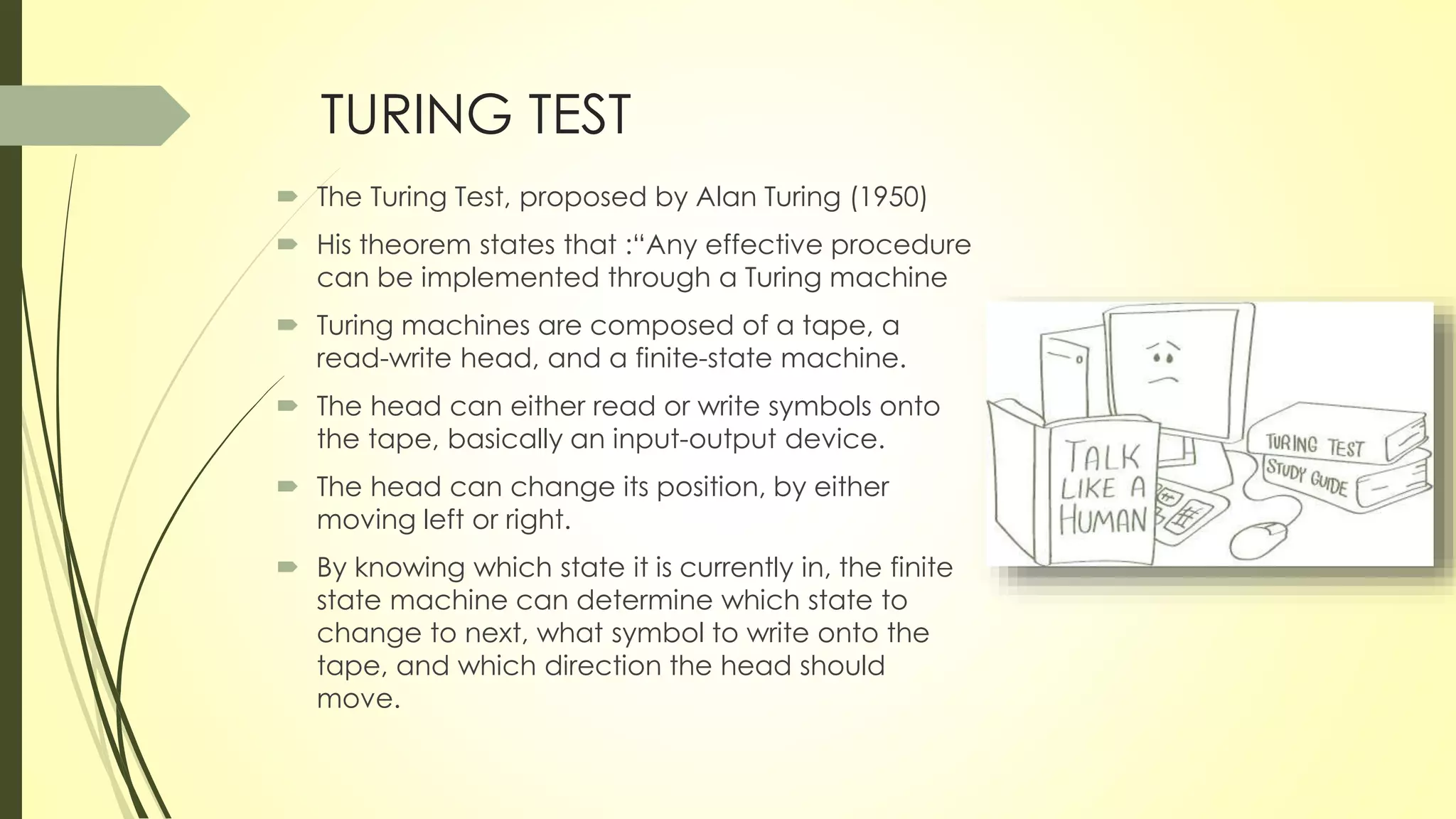
 The Turing Test, proposed by Alan Turing (1950)
 His theorem states that :“Any effective procedure
can be implemented through a Turing machine
 Turing machines are composed of a tape, a
read-write head, and a finite-state machine.
 The head can either read or write symbols onto
the tape, basically an input-output device.
 The head can change its position, by either
moving left or right.
 By knowing which state it is currently in, the finite
state machine can determine which state to
change to next, what symbol to write onto the
tape, and which direction the head should
move.
Areas of Artificial Intelligence
 Reasoning
 It is to use the stored information to answer questions.
Reasoning means, drawing of conclusion from observations.
 Reasoning in AI systems work on three principles namely:
DEDUCTION
INDUCTION
ABDUCTION
 Learning
 The most important requirement for an AI system is that it
should learn from its mistakes.
 The best way of teaching an AI system is by training & testing.
 Training involves teaching of basic principles involved in doing
a job.
 Testing process is the real test of the knowledge acquired by
the system wherein we give certain examples & test the
intelligence of the system
Natural Language Processing (NLP)
 NLP can be defined as:
making the computer understand the
language a normal human being speaks.
 It deals with under structured / semi structured
data formats and converting them into
complete understandable data form
 NLP helps us in
1. Searching for information in a vast NL (natural
language) database.
2. Analysis i.e. extracting structural data from
natural language.
 Application Spectrum of NLP
1. It provides writing and translational aids.
2. Helps humans to generate Natural Language
with proper spelling, grammar, style etc.
Procuring levels&Hurdles In NLP
 Lexical - at word level it involves pronunciation
errors.
 Syntactical - at the structure level acquiring
knowledge about the grammar and structure of
words and sentences.
 Semantic - at the meaning level.
 Pragmatic – at the context level.
• Hurdles
• There are various hurdles in the field of NLP,
especially speech processing which result in
increase in complexity of the system.
• Another major problem in speech processing
understands of speech due to wordboundary.
• This can be clearly understood from the following
example:
• I got a plate. / I got up late.
Neural-networks
 Neural networks are computational consisting of simple nodes, called units
or processing elements which are linked by weighted connections.
 A neural network maps input to output data in terms of its own internal
connectivity.
 Synapses are connections between neurons - they are not physical
connections, but miniscule gaps that allow electric signals to jump across
from neuron to neuron.
Example of a neural network Working :
 It uses a simple computational technique which can be defined as follows
 y= 0 if Σ Wi Xi <θ
 y=1 if Σ Wi Xi >θ
 Where θ is threshold value
 Wi is weight
 Xi is input
 Now this neuron can be trained to perform a particular logical operation like
AND.
Conclusion
 AI combined with various techniques in neural
networks and natural language processing will be
able to revolutionize the future of machines
 It will transform the mechanical devices helping
humans into intelligent rational robots having
emotions.
 Expert systems like Mycin can help doctors in
diagnosing patients.
 AI systems can also help us in making airline
enquiries and bookings using speech rather than
menus.
 The advent of VLSI techniques, FPGA chips are
being used in neural networks.
 The future of AI in making intelligent machines looks
incredible.
 But some kind of spiritual understanding will have to
be inculcated into the machines.
 so that their decision making is governed by some
principles and boundaries.
 1. Department of Computer Science & Engineering – Indian Institute of
Technology, Bombay
 2. AI - Rich & Knight
 3. Principles of AI - N J Nelson
 4. Neural Systems for Robotics – Omid Omidvar
 5. http://www.elsevier.nl/locate/artint
 6. http://library.thinkquest.org/18242/essays.sht
References
ANY Questions?
THANK YOU

Artificial intelligence

  • 1.
  • 2.
    INDEX  Introduction  Definitionof turing test  Areas of Artificial Intelligence 1. Reasoning 2. Learning  Natural Language Processing (NLP)  Procuring Level&Hurdles of NLP  Neural-networks  Example of a neural network Working  Conclusion
  • 3.
    INTRODUCTION  AI dealsin science, which deals with creation of machines, which can think like humans .  AI is a very vast field, which spans: Many application like Language Processing, Image Processing, Resource Scheduling, etc.  Many types of technologies like Neural Networks, and Fuzzy Logic etc.  Disciplines like Computer Science, Statistics, Psychology, etc.
  • 4.
    TURING TEST  TheTuring Test, proposed by Alan Turing (1950)  His theorem states that :“Any effective procedure can be implemented through a Turing machine  Turing machines are composed of a tape, a read-write head, and a finite-state machine.  The head can either read or write symbols onto the tape, basically an input-output device.  The head can change its position, by either moving left or right.  By knowing which state it is currently in, the finite state machine can determine which state to change to next, what symbol to write onto the tape, and which direction the head should move.
  • 5.
    Areas of ArtificialIntelligence  Reasoning  It is to use the stored information to answer questions. Reasoning means, drawing of conclusion from observations.  Reasoning in AI systems work on three principles namely: DEDUCTION INDUCTION ABDUCTION  Learning  The most important requirement for an AI system is that it should learn from its mistakes.  The best way of teaching an AI system is by training & testing.  Training involves teaching of basic principles involved in doing a job.  Testing process is the real test of the knowledge acquired by the system wherein we give certain examples & test the intelligence of the system
  • 6.
    Natural Language Processing(NLP)  NLP can be defined as: making the computer understand the language a normal human being speaks.  It deals with under structured / semi structured data formats and converting them into complete understandable data form  NLP helps us in 1. Searching for information in a vast NL (natural language) database. 2. Analysis i.e. extracting structural data from natural language.  Application Spectrum of NLP 1. It provides writing and translational aids. 2. Helps humans to generate Natural Language with proper spelling, grammar, style etc.
  • 7.
    Procuring levels&Hurdles InNLP  Lexical - at word level it involves pronunciation errors.  Syntactical - at the structure level acquiring knowledge about the grammar and structure of words and sentences.  Semantic - at the meaning level.  Pragmatic – at the context level. • Hurdles • There are various hurdles in the field of NLP, especially speech processing which result in increase in complexity of the system. • Another major problem in speech processing understands of speech due to wordboundary. • This can be clearly understood from the following example: • I got a plate. / I got up late.
  • 8.
    Neural-networks  Neural networksare computational consisting of simple nodes, called units or processing elements which are linked by weighted connections.  A neural network maps input to output data in terms of its own internal connectivity.  Synapses are connections between neurons - they are not physical connections, but miniscule gaps that allow electric signals to jump across from neuron to neuron.
  • 9.
    Example of aneural network Working :  It uses a simple computational technique which can be defined as follows  y= 0 if Σ Wi Xi <θ  y=1 if Σ Wi Xi >θ  Where θ is threshold value  Wi is weight  Xi is input  Now this neuron can be trained to perform a particular logical operation like AND.
  • 10.
    Conclusion  AI combinedwith various techniques in neural networks and natural language processing will be able to revolutionize the future of machines  It will transform the mechanical devices helping humans into intelligent rational robots having emotions.  Expert systems like Mycin can help doctors in diagnosing patients.  AI systems can also help us in making airline enquiries and bookings using speech rather than menus.  The advent of VLSI techniques, FPGA chips are being used in neural networks.  The future of AI in making intelligent machines looks incredible.  But some kind of spiritual understanding will have to be inculcated into the machines.  so that their decision making is governed by some principles and boundaries.
  • 11.
     1. Departmentof Computer Science & Engineering – Indian Institute of Technology, Bombay  2. AI - Rich & Knight  3. Principles of AI - N J Nelson  4. Neural Systems for Robotics – Omid Omidvar  5. http://www.elsevier.nl/locate/artint  6. http://library.thinkquest.org/18242/essays.sht References
  • 12.
  • 13.