Itech 7415 Master Project
Towards Humantistics Behaviour in
Chatbots: State-of-the-Art Survey,
Limitationsand Challenges Ahead
Assessment task 4: Sprint 1
Team member 1: Sudip Sapkota (30386448)
Service Chatbots: A systematic review
Semantic understanding
Lexical understanding
Understanding of stated and implied expressions
Dealing with complexity
Types of Chatbots
Different existing chatbots
Semantic understanding
Article 1 Generative and artificial intelligence chatbot falls in this category.
bi-LSTM + character embedding can be used to capture the semantics of words.
Article 2 Replica, Wysa, LISSA and Youper chatbots use AI for decision-making.
Article 3 PARRY – Eliza with attitude. Accuracy 48%.
Jabberwacky – Voice-operated AI-based chatbot.
Alexa, Siri – NLP-based voice-operated chatbots.
Article 5 Amazon lex – Works on deep learning and natural language understanding.
LUIS – uses NLP to understand user context.
Article 9 To treat users' depressive symptoms, the chatbot "Wysa" employs a variety of evidence-based therapies (such
as cognitive behavioural therapy, behavioural reinforcement, and mindfulness). LISSA is another chatbot that
helps persons with autism improve their social skills via training.
Article 10 Edwin.ai is an online English-language learning tutor power by artificial intelligence.
Article 19 Markov Chain: is used in Chatbots to build responses that are more applicable probabilistically and,
consequently, are more correct. The idea of Markov Chains is that there is a fixed probability of occurrences for
each letter or word in the same textual data set.
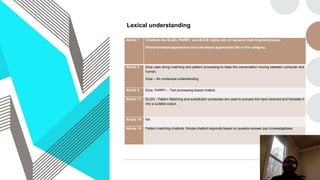
Lexical understanding
Article 1 Chatbots like ELIZA, PARRY, and ALICE highly rely on keyword matching techniques.
Retrieval-based approaches and rule-based approaches fall in this category.
Article 3 Eliza uses string matching and pattern processing to keep the conversation moving between computer and
human.
Eliza – No contextual understanding
Article 5 Eliza, PARRY – Text processing-based chatbot.
Article 17 ELIZA - Pattern Matching and substitution processes are used to process the input received and translate it
into a suitable output.
Article 18 NA
Article 19 Pattern matching chatbots: Simple chatbot responds based on question-answer pair knowledgebase.
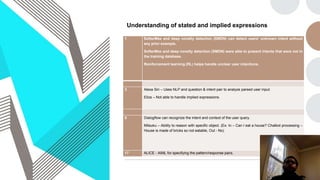
Understanding of stated and implied expressions
1 SofterMax and deep novelty detection (SMDN) can detect users' unknown intent without
any prior example.
SofterMax and deep novelty detection (SMDN) were able to present intents that were not in
the training database.
Reinforcement learning (RL) helps handle unclear user intentions.
3 Alexa Siri – Uses NLP and question & intent pair to analyze parsed user input.
Eliza – Not able to handle implied expressions.
5 Dialogflow can recognize the intent and context of the user query.
Mitsuku – Ability to reason with specific object. (Ex: In – Can I eat a house? Chatbot processing –
House is made of bricks so not eatable, Out - No)
17 ALICE - AIML for specifying the pattern/response pairs.
Dealing with complexity
1 Hybrid CNN and RNN capture the relationship between words
and extract the intent of words.
Gating mechanisms of RNN + GRU: fastly adapt to new unseen
domains irrespective of the size of the training dataset.
5 Cleverbot – Uses previous user responses and accordingly
prepares the next response for the user.
Types of Chatbots
• Service Chatbots
• Advisory Chatbots
• Commercia Chatbots
• Entertainment chatbots
• Task oriented and non-task oriented chatbots
• Lola, Dina, Smart Answering Chatbot, AutoTutor,
LISA, FITEBot Chatbot, Mobile Chatbot, NDLtutor,
CALMSystem, ScratchThAI
Different existing chatbots
Chatbots
Elizza
(Weizenbaum of the MIT AI Lab built the first
chatbots, ELIZA.)
Alice
Elizabeth
Mitsuku
Cleverbot
Chatfuel
Chat Script
Watson
LUIS
Diaglog Flow
Amazon Lex
Thank you.

Sprint 1

  • 1.
    Itech 7415 MasterProject Towards Humantistics Behaviour in Chatbots: State-of-the-Art Survey, Limitationsand Challenges Ahead Assessment task 4: Sprint 1 Team member 1: Sudip Sapkota (30386448)
  • 2.
    Service Chatbots: Asystematic review Semantic understanding Lexical understanding Understanding of stated and implied expressions Dealing with complexity Types of Chatbots Different existing chatbots
  • 3.
    Semantic understanding Article 1Generative and artificial intelligence chatbot falls in this category. bi-LSTM + character embedding can be used to capture the semantics of words. Article 2 Replica, Wysa, LISSA and Youper chatbots use AI for decision-making. Article 3 PARRY – Eliza with attitude. Accuracy 48%. Jabberwacky – Voice-operated AI-based chatbot. Alexa, Siri – NLP-based voice-operated chatbots. Article 5 Amazon lex – Works on deep learning and natural language understanding. LUIS – uses NLP to understand user context. Article 9 To treat users' depressive symptoms, the chatbot "Wysa" employs a variety of evidence-based therapies (such as cognitive behavioural therapy, behavioural reinforcement, and mindfulness). LISSA is another chatbot that helps persons with autism improve their social skills via training. Article 10 Edwin.ai is an online English-language learning tutor power by artificial intelligence. Article 19 Markov Chain: is used in Chatbots to build responses that are more applicable probabilistically and, consequently, are more correct. The idea of Markov Chains is that there is a fixed probability of occurrences for each letter or word in the same textual data set.
  • 4.
    Lexical understanding Article 1Chatbots like ELIZA, PARRY, and ALICE highly rely on keyword matching techniques. Retrieval-based approaches and rule-based approaches fall in this category. Article 3 Eliza uses string matching and pattern processing to keep the conversation moving between computer and human. Eliza – No contextual understanding Article 5 Eliza, PARRY – Text processing-based chatbot. Article 17 ELIZA - Pattern Matching and substitution processes are used to process the input received and translate it into a suitable output. Article 18 NA Article 19 Pattern matching chatbots: Simple chatbot responds based on question-answer pair knowledgebase.
  • 5.
    Understanding of statedand implied expressions 1 SofterMax and deep novelty detection (SMDN) can detect users' unknown intent without any prior example. SofterMax and deep novelty detection (SMDN) were able to present intents that were not in the training database. Reinforcement learning (RL) helps handle unclear user intentions. 3 Alexa Siri – Uses NLP and question & intent pair to analyze parsed user input. Eliza – Not able to handle implied expressions. 5 Dialogflow can recognize the intent and context of the user query. Mitsuku – Ability to reason with specific object. (Ex: In – Can I eat a house? Chatbot processing – House is made of bricks so not eatable, Out - No) 17 ALICE - AIML for specifying the pattern/response pairs.
  • 6.
    Dealing with complexity 1Hybrid CNN and RNN capture the relationship between words and extract the intent of words. Gating mechanisms of RNN + GRU: fastly adapt to new unseen domains irrespective of the size of the training dataset. 5 Cleverbot – Uses previous user responses and accordingly prepares the next response for the user.
  • 7.
    Types of Chatbots •Service Chatbots • Advisory Chatbots • Commercia Chatbots • Entertainment chatbots • Task oriented and non-task oriented chatbots • Lola, Dina, Smart Answering Chatbot, AutoTutor, LISA, FITEBot Chatbot, Mobile Chatbot, NDLtutor, CALMSystem, ScratchThAI
  • 8.
    Different existing chatbots Chatbots Elizza (Weizenbaumof the MIT AI Lab built the first chatbots, ELIZA.) Alice Elizabeth Mitsuku Cleverbot Chatfuel Chat Script Watson LUIS Diaglog Flow Amazon Lex
  • 9.