ARTIFICIAL
INTELLIGENCE
2
• Artificial intelligence (AI) is a field of computer science that focuses on creating
machines that can learn, reason, and act in ways that normally require human
intelligence.
• Artificial intelligence (AI) is a method of making a computer, a computer-
controlled robot, or a software think intelligently like the human mind.
• Artificial Intelligence encompasses a wide range of technologies, including
machine learning, natural language processing, computer vision, and
robotics.
• Narrow AI (Weak AI): AI systems designed to perform a specific task efficiently,
Eg: Voice assistants like Alexa and Siri.
• General AI(strong AI): AI with the ability to learn, reason, and perform any
intellectual task that a human can do. Eg: OpenAI, chatbot
2
3
NATURAL LANGUAGE PROCESSING(NLP)
• Natural Language Processing(NLP) is the branch of
Artificial Intelligence that provides computers with
the capability of understanding text and spoken
words in the same way a human being can.
• It incorporates machine learning models,
statistics, and deep learning models.
• Humans communicate with each other using
words and text. However, computers cannot
interpret this data, as they communicate in 1s and
0s. NLP gives the machines the ability to read,
understand and derive meaning from human
languages.
3
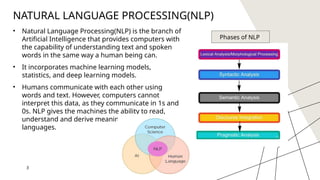
Phases of NLP:
Lexical analysis: In this phase, the
sentences, paragraphs are broken into
tokens.
For example, The sentence “He goes to
college.” is divided into [ ‘He’ , ‘goes’ , ‘to’ ,
‘college’, ‘.’] .
Syntactic analysis: In this phase, the
sentence is checked whether it is well
formed or not. It is checked for word
arrangements and grammar.
For example, The sentence “Delhi goes to
him” is rejected by the syntactic parser.
Semantic analysis: In this phase, the
sentence is checked for the literal
meaning of each word and their
arrangement together.
For example, The sentence “I ate hot ice
cream” will get rejected by the semantic
analyzer because it doesn’t make sense
4
Discourse integration: In this phase, the
impact of the sentences before a particular
sentence and the effect of the current
sentence on the upcoming sentences is
determined.
For example, the word “that” in the
sentence “He wanted that” depends upon
the prior discourse context.
Pragmatic analysis: The actual effect of
the text is discovered by applying the set of
rules that characterize cooperative
dialogues.
E.g., “close the window?” should be
interpreted as a request instead of an order.
Sometimes the discourse integration phase
and pragmatic analysis phase are
combined.
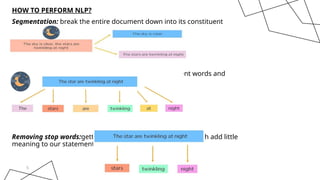
HOW TO PERFORM NLP?
Segmentation: break the entire document down into its constituent
sentences.
Tokenizing:break down your sentence into its constituent words and
store them.
Removing stop words:getting rid of non-essential words, which add little
meaning to our statement
5
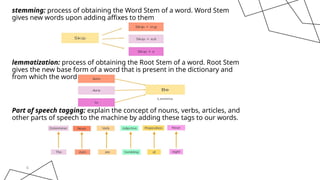
stemming: process of obtaining the Word Stem of a word. Word Stem
gives new words upon adding affixes to them
lemmatization: process of obtaining the Root Stem of a word. Root Stem
gives the new base form of a word that is present in the dictionary and
from which the word is derived.
Part of speech tagging: explain the concept of nouns, verbs, articles, and
other parts of speech to the machine by adding these tags to our words.
6
Named entity tagging: introduce your machine to pop culture references and
everyday names by flagging names of movies, important personalities or
locations, etc that may occur. You do this by classifying the words into
subcategories. The subcategories are person, location, monetary value,
quantity, organization, movie. After performing the preprocessing steps, you
then give your resultant data to a machine learning algorithm like Naive
Bayes, etc., to create your NLP application.
APPLICATIONS OF NLP
Translation Tools
Chatbots
Virtual Assistants
Autocorrect
Grammar Correction
Text Summarization
Targeted Advertising
7
8
COMPUTER VISION
o It deals with how computers can gain high-level understanding from digital
images or videos. i.e. understand and automate tasks that the human
visual system can do.
o Computer vision algorithms that we use today are based on pattern
recognition. We train computers on a massive amount of visual data—
computers process images, label objects on them, and find patterns in
those objects. For example, if we send a million images of flowers, the
computer will analyze them, identify patterns that are similar to all flowers
and, at the end of this process, will create a model “flower.”
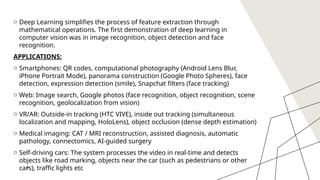
o machines interpret images as a series of pixels, each with their own set of
color values.
8
9
o Deep Learning simplifies the process of feature extraction through
mathematical operations. The first demonstration of deep learning in
computer vision was in image recognition, object detection and face
recognition.
APPLICATIONS:
o Smartphones: QR codes, computational photography (Android Lens Blur,
iPhone Portrait Mode), panorama construction (Google Photo Spheres), face
detection, expression detection (smile), Snapchat filters (face tracking)
o Web: Image search, Google photos (face recognition, object recognition, scene
recognition, geolocalization from vision)
o VR/AR: Outside-in tracking (HTC VIVE), inside out tracking (simultaneous
localization and mapping, HoloLens), object occlusion (dense depth estimation)
o Medical imaging: CAT / MRI reconstruction, assisted diagnosis, automatic
pathology, connectomics, AI-guided surgery
o Self-driving cars: The system processes the video in real-time and detects
objects like road marking, objects near the car (such as pedestrians or other
cars), traffic lights etc
9
intelligent robotics: Robotics enhanced by artificial intelligence to perform complex
tasks autonomously and adaptively. It combines hardware and AI to revolutionize
industries like healthcare, logistics, and exploration
Perception: Use of sensors (e.g., cameras, LiDAR) and AI models to interpret and
understand the environment. It Includes object recognition, scene understanding,
and mapping.
Planning and decision making: developing of algorithms that allow robots to
evaluate options, make decisions, and plan their actions. It involves path planning,
task scheduling, and real-time adjustments.
Learning: Machine learning models enable robots to improve their performance
over time. Includes reinforcement learning, transfer learning, and supervised
learning techniques.
Interaction: Natural language processing and human-computer interaction
techniques enable communication with humans. Gesture recognition, voice
commands, and emotional recognition are common applications.
Mobility and manipulation: AI-powered control systems allow robots to move and
manipulate objects efficiently. Used in autonomous vehicles, drones, and robotic
arms.
10
INTELLIGENT ROBOTICS
Autonomy: Robots operate independently without constant human oversight.
Self-driving cars and delivery robots are examples of autonomous systems.
APPLICATIONS:
Healthcare: Surgical robots, patient care, rehabilitation.
Manufacturing: Assembly lines, quality control, predictive maintenance.
Autonomous Vehicles: Self-driving cars and drones.
Exploration: Space exploration, underwater robotics.
Agriculture: Crop monitoring, automated harvesting.
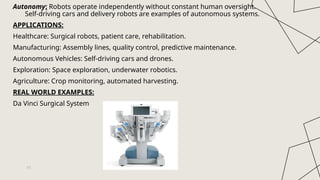
REAL WORLD EXAMPLES:
Da Vinci Surgical System
11
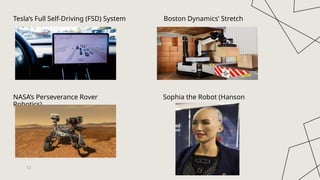
Tesla’s Full Self-Driving (FSD) System Boston Dynamics’ Stretch
NASA’s Perseverance Rover Sophia the Robot (Hanson
Robotics)
12
THANK YOU
Presented by,
Fathima Farida T N

NATURAL LANGUAGE PROCESSING in ARTIFICIAL INTELLIGENCE.pptx

  • 1.
  • 2.
    2 • Artificial intelligence(AI) is a field of computer science that focuses on creating machines that can learn, reason, and act in ways that normally require human intelligence. • Artificial intelligence (AI) is a method of making a computer, a computer- controlled robot, or a software think intelligently like the human mind. • Artificial Intelligence encompasses a wide range of technologies, including machine learning, natural language processing, computer vision, and robotics. • Narrow AI (Weak AI): AI systems designed to perform a specific task efficiently, Eg: Voice assistants like Alexa and Siri. • General AI(strong AI): AI with the ability to learn, reason, and perform any intellectual task that a human can do. Eg: OpenAI, chatbot 2
  • 3.
    3 NATURAL LANGUAGE PROCESSING(NLP) •Natural Language Processing(NLP) is the branch of Artificial Intelligence that provides computers with the capability of understanding text and spoken words in the same way a human being can. • It incorporates machine learning models, statistics, and deep learning models. • Humans communicate with each other using words and text. However, computers cannot interpret this data, as they communicate in 1s and 0s. NLP gives the machines the ability to read, understand and derive meaning from human languages. 3 Phases of NLP:
  • 4.
    Lexical analysis: Inthis phase, the sentences, paragraphs are broken into tokens. For example, The sentence “He goes to college.” is divided into [ ‘He’ , ‘goes’ , ‘to’ , ‘college’, ‘.’] . Syntactic analysis: In this phase, the sentence is checked whether it is well formed or not. It is checked for word arrangements and grammar. For example, The sentence “Delhi goes to him” is rejected by the syntactic parser. Semantic analysis: In this phase, the sentence is checked for the literal meaning of each word and their arrangement together. For example, The sentence “I ate hot ice cream” will get rejected by the semantic analyzer because it doesn’t make sense 4 Discourse integration: In this phase, the impact of the sentences before a particular sentence and the effect of the current sentence on the upcoming sentences is determined. For example, the word “that” in the sentence “He wanted that” depends upon the prior discourse context. Pragmatic analysis: The actual effect of the text is discovered by applying the set of rules that characterize cooperative dialogues. E.g., “close the window?” should be interpreted as a request instead of an order. Sometimes the discourse integration phase and pragmatic analysis phase are combined.
  • 5.
    HOW TO PERFORMNLP? Segmentation: break the entire document down into its constituent sentences. Tokenizing:break down your sentence into its constituent words and store them. Removing stop words:getting rid of non-essential words, which add little meaning to our statement 5
  • 6.
    stemming: process ofobtaining the Word Stem of a word. Word Stem gives new words upon adding affixes to them lemmatization: process of obtaining the Root Stem of a word. Root Stem gives the new base form of a word that is present in the dictionary and from which the word is derived. Part of speech tagging: explain the concept of nouns, verbs, articles, and other parts of speech to the machine by adding these tags to our words. 6
  • 7.
    Named entity tagging:introduce your machine to pop culture references and everyday names by flagging names of movies, important personalities or locations, etc that may occur. You do this by classifying the words into subcategories. The subcategories are person, location, monetary value, quantity, organization, movie. After performing the preprocessing steps, you then give your resultant data to a machine learning algorithm like Naive Bayes, etc., to create your NLP application. APPLICATIONS OF NLP Translation Tools Chatbots Virtual Assistants Autocorrect Grammar Correction Text Summarization Targeted Advertising 7
  • 8.
    8 COMPUTER VISION o Itdeals with how computers can gain high-level understanding from digital images or videos. i.e. understand and automate tasks that the human visual system can do. o Computer vision algorithms that we use today are based on pattern recognition. We train computers on a massive amount of visual data— computers process images, label objects on them, and find patterns in those objects. For example, if we send a million images of flowers, the computer will analyze them, identify patterns that are similar to all flowers and, at the end of this process, will create a model “flower.” o machines interpret images as a series of pixels, each with their own set of color values. 8
  • 9.
    9 o Deep Learningsimplifies the process of feature extraction through mathematical operations. The first demonstration of deep learning in computer vision was in image recognition, object detection and face recognition. APPLICATIONS: o Smartphones: QR codes, computational photography (Android Lens Blur, iPhone Portrait Mode), panorama construction (Google Photo Spheres), face detection, expression detection (smile), Snapchat filters (face tracking) o Web: Image search, Google photos (face recognition, object recognition, scene recognition, geolocalization from vision) o VR/AR: Outside-in tracking (HTC VIVE), inside out tracking (simultaneous localization and mapping, HoloLens), object occlusion (dense depth estimation) o Medical imaging: CAT / MRI reconstruction, assisted diagnosis, automatic pathology, connectomics, AI-guided surgery o Self-driving cars: The system processes the video in real-time and detects objects like road marking, objects near the car (such as pedestrians or other cars), traffic lights etc 9
  • 10.
    intelligent robotics: Roboticsenhanced by artificial intelligence to perform complex tasks autonomously and adaptively. It combines hardware and AI to revolutionize industries like healthcare, logistics, and exploration Perception: Use of sensors (e.g., cameras, LiDAR) and AI models to interpret and understand the environment. It Includes object recognition, scene understanding, and mapping. Planning and decision making: developing of algorithms that allow robots to evaluate options, make decisions, and plan their actions. It involves path planning, task scheduling, and real-time adjustments. Learning: Machine learning models enable robots to improve their performance over time. Includes reinforcement learning, transfer learning, and supervised learning techniques. Interaction: Natural language processing and human-computer interaction techniques enable communication with humans. Gesture recognition, voice commands, and emotional recognition are common applications. Mobility and manipulation: AI-powered control systems allow robots to move and manipulate objects efficiently. Used in autonomous vehicles, drones, and robotic arms. 10 INTELLIGENT ROBOTICS
  • 11.
    Autonomy: Robots operateindependently without constant human oversight. Self-driving cars and delivery robots are examples of autonomous systems. APPLICATIONS: Healthcare: Surgical robots, patient care, rehabilitation. Manufacturing: Assembly lines, quality control, predictive maintenance. Autonomous Vehicles: Self-driving cars and drones. Exploration: Space exploration, underwater robotics. Agriculture: Crop monitoring, automated harvesting. REAL WORLD EXAMPLES: Da Vinci Surgical System 11
  • 12.
    Tesla’s Full Self-Driving(FSD) System Boston Dynamics’ Stretch NASA’s Perseverance Rover Sophia the Robot (Hanson Robotics) 12
  • 13.