The document provides an overview of determiners, highlighting their role in specifying nouns, including articles (a/an/the), possessives, demonstratives, and quantifiers.
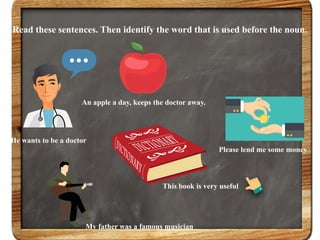
Read these sentences.Then identify the word that is used before the noun.
He wants to be a doctor
An apple a day, keeps the doctor away.
This book is very useful
Please lend me some money
My father was a famous musician
3.
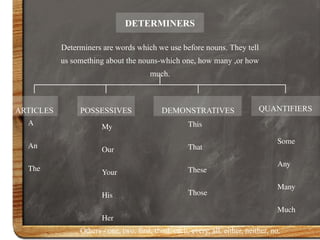
Determiners are wordswhich we use before nouns. They tell
us something about the nouns-which one, how many ,or how
much.
ARTICLES POSSESSIVES DEMONSTRATIVES QUANTIFIERS
My
Our
Your
His
Her
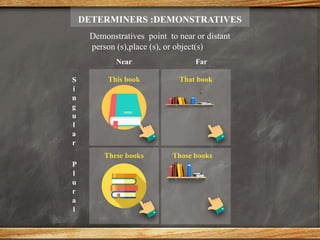
This
That
These
Those
Some
Any
Many
Much
A
An
The
DETERMINERS
Others - one, two, first, third, each, every, all, either, neither, no.
4.
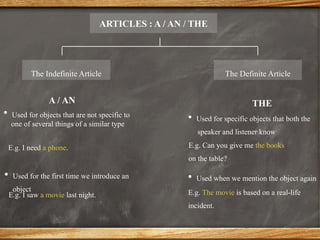
ARTICLES : A/ AN / THE
The Indefinite Article The Definite Article
• Used for objects that are not specific to
one of several things of a similar type
A / AN THE
• Used for the first time we introduce an
object
• Used when we mention the object again
• Used for specific objects that both the
speaker and listener know
E.g. The movie is based on a real-life
incident.
E.g. Can you give me the books
on the table?
E.g. I need a phone.
E.g. I saw a movie last night.
5.
USAGE EXAMPLES
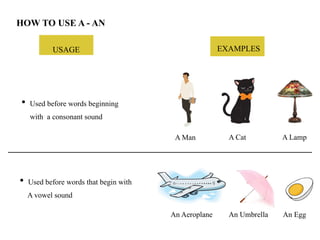
• Usedbefore words beginning
with a consonant sound
HOW TO USE A - AN
A Man A Cat A Lamp
• Used before words that begin with
A vowel sound
An Aeroplane An Umbrella An Egg
6.
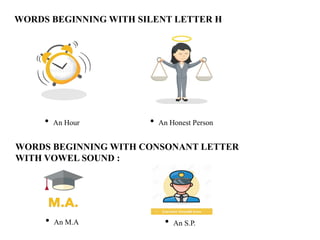
WORDS BEGINNING WITHSILENT LETTER H
• An Hour • An Honest Person
WORDS BEGINNING WITH CONSONANT LETTER
WITH VOWEL SOUND :
• An M.A • An S.P.
7.
WORDS BEGINNING WITHVOWEL LETTERS
WITH CONSONANT SOUND :
• A one man show
• A University
• A European
8.
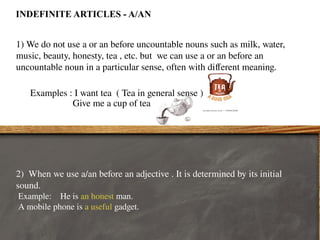
INDEFINITE ARTICLES -A/AN
1) We do not use a or an before uncountable nouns such as milk, water,
music, beauty, honesty, tea , etc. but we can use a or an before an
uncountable noun in a particular sense, often with different meaning.
Examples : I want tea ( Tea in general sense )
Give me a cup of tea
2) When we use a/an before an adjective . It is determined by its initial
sound.
Example: He is an honest man.
A mobile phone is a useful gadget.
9.
We use articlethe in the following cases:
a. with a noun when it is repeated.
As - I met a lawyer. The lawyer gave me a good advice.
b. with a singular noun referring to a particular group or class.
As- The lion is a beast of prey.
c. Before a noun made definite by a phrase or clause.
As – The lady in pink dress is his sister. The man who came late was not
allowed to enter.
DEFINITE ARTICLES - THE
The main purpose of using’ the’ is to specify a person, thing or
place. It can be used before countable and uncountable nouns:
Examples: 1. I bought a book. The book is really interesting.
2. He is the man responsible for the mishap
10.
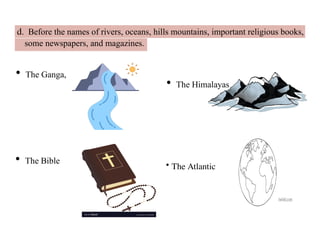
d. Before thenames of rivers, oceans, hills mountains, important religious books,
some newspapers, and magazines.
• The Ganga,
• The Himalayas
• The Bible • The Atlantic
11.
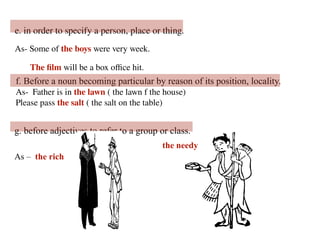
e. in orderto specify a person, place or thing.
As- Some of the boys were very week.
The film will be a box office hit.
f. Before a noun becoming particular by reason of its position, locality.
As- Father is in the lawn ( the lawn f the house)
Please pass the salt ( the salt on the table)
g. before adjectives to refer to a group or class.
As – the rich
the needy
12.
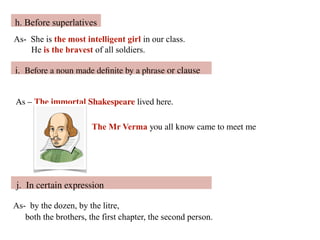
As- She isthe most intelligent girl in our class.
He is the bravest of all soldiers.
h. Before superlatives
As – The immortal Shakespeare lived here.
The Mr Verma you all know came to meet me
i. Before a noun made definite by a phrase or clause
As- by the dozen, by the litre,
both the brothers, the first chapter, the second person.
j. In certain expression
13.
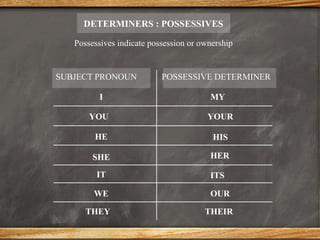
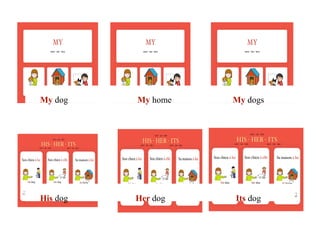
DETERMINERS : POSSESSIVES
Possessivesindicate possession or ownership
SUBJECT PRONOUN POSSESSIVE DETERMINER
I MY
YOU YOUR
HE HIS
SHE HER
IT ITS
WE OUR
THEY THEIR
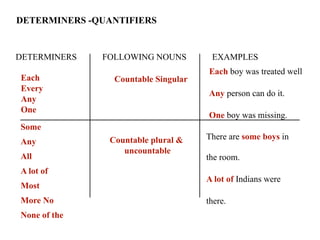
DETERMINERS -QUANTIFIERS
DETERMINERS FOLLOWINGNOUNS EXAMPLES
Each
Every
Any
One
Countable Singular
Each boy was treated well
Any person can do it.
One boy was missing.
Some
Any
All
A lot of
Most
More No
None of the
Countable plural &
uncountable
There are some boys in
the room.
A lot of Indians were
there.
17.
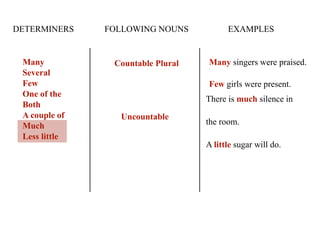
DETERMINERS FOLLOWING NOUNSEXAMPLES
Many
Several
Few
One of the
Both
A couple of
Much
Less little
Countable Plural Many singers were praised.
Few girls were present.
There is much silence in
the room.
A little sugar will do.
Uncountable
18.
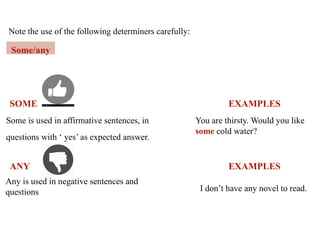
Note the useof the following determiners carefully:
Some/any
Some is used in affirmative sentences, in
questions with ‘ yes’ as expected answer.
EXAMPLES
You are thirsty. Would you like
some cold water?
SOME
ANY EXAMPLES
Any is used in negative sentences and
questions I don’t have any novel to read.
19.
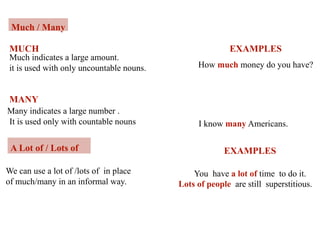
Much / Many
Muchindicates a large amount.
it is used with only uncountable nouns.
MUCH
Many indicates a large number .
It is used only with countable nouns
MANY
EXAMPLES
How much money do you have?
I know many Americans.
A Lot of / Lots of
We can use a lot of /lots of in place
of much/many in an informal way.
EXAMPLES
You have a lot of time to do it.
Lots of people are still superstitious.
20.
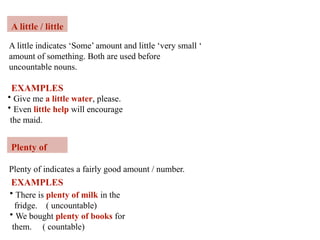
A little /little
A little indicates ‘Some’ amount and little ‘very small ‘
amount of something. Both are used before
uncountable nouns.
EXAMPLES
• Give me a little water, please.
• Even little help will encourage
the maid.
Plenty of
Plenty of indicates a fairly good amount / number.
EXAMPLES
• There is plenty of milk in the
fridge. ( uncountable)
• We bought plenty of books for
them. ( countable)
21.
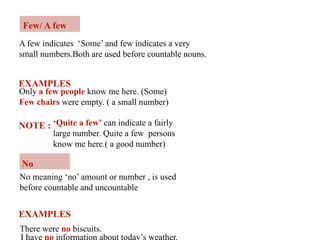
Few/ A few
Afew indicates ‘Some’ and few indicates a very
small numbers.Both are used before countable nouns.
EXAMPLES
Only a few people know me here. (Some)
Few chairs were empty. ( a small number)
NOTE : ‘Quite a few’ can indicate a fairly
large number. Quite a few persons
know me here.( a good number)
No
No meaning ‘no’ amount or number , is used
before countable and uncountable
There were no biscuits.
EXAMPLES
I have no information about today’s weather.
22.
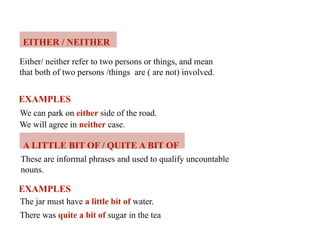
EITHER / NEITHER
Either/neither refer to two persons or things, and mean
that both of two persons /things are ( are not) involved.
EXAMPLES
We can park on either side of the road.
We will agree in neither case.
A LITTLE BIT OF / QUITE A BIT OF
These are informal phrases and used to qualify uncountable
nouns.
EXAMPLES
The jar must have a little bit of water.
There was quite a bit of sugar in the tea
23.
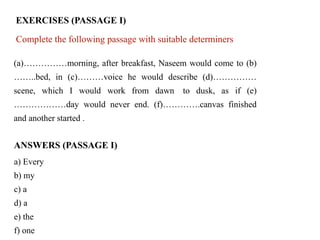
EXERCISES (PASSAGE I)
Completethe following passage with suitable determiners.
(a)……………morning, after breakfast, Naseem would come to (b)
……..bed, in (c)………voice he would describe (d)……………
scene, which I would work from dawn to dusk, as if (e)
………………day would never end. (f)………….canvas finished
and another started .
ANSWERS (PASSAGE I)
a) Every
b) my
c) a
d) a
e) the
f) one
24.
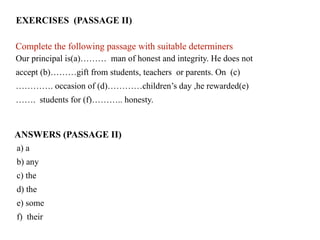
EXERCISES (PASSAGE II)
Ourprincipal is(a)……… man of honest and integrity. He does not
accept (b)………gift from students, teachers or parents. On (c)
…………. occasion of (d)…………children’s day ,he rewarded(e)
……. students for (f)……….. honesty.
Complete the following passage with suitable determiners.
a) a
b) any
c) the
d) the
e) some
f) their
ANSWERS (PASSAGE II)