Glove Integrity Testing
This article                Reprinted from                                                                The Official Journal of ISPE
describes                   PHARMACEUTICAL ENGINEERING®                                         November/December 2005, Vol. 25 No. 6

procedures to

                           Safe Access using Glove Ports –
test gloves,
shortcomings of
plastic glove
behavior, and
glove fixation. In
                           Facts and Fiction
addition, it               by Johannes Rauschnabel, Albrecht Kühnle,
presents a new             and Kuno Lemke
impulse
technique for the
improvement of


                           B
                                             Introduction                      leak testing of the isolator and glove/sleeve
reproducibility                     arrier systems, such as aseptic isola-     system.” Thus, some kind of leak testing has to
and repeatability                   tors, Restricted Access Barrier Sys-       take place in addition to visual inspection.
of a pressure                       tems (RABS) and glove boxes are being
                                    used more and more in pharmaceuti-                           Challenge
decay test.                cal production, research, and laboratories. The     Glove leaks have many reasons: mechanical
                           purpose of these barrier systems is to separate     damage through contact with sharp equipment,
                           a process area from a surrounding environ-          tools or broken glass, which cause cuts in the
                           ment – either to shield the process from con-       glove material. Clamping gloves in mechanical
                           taminants coming from outside, or to shield the     installations very often results in holes that are
                           environment from hazardous products inside.         less discrete and hard to detect. The most
                           If manual operator access is needed either          frequent types of leaks come from heavy use of
                           during processing, for maintenance reasons, or      gloves and aging. The commonly used glove
                           for environmental monitoring inside the bar-        material “Hypalon” has a layered structure,
                           rier, glove ports are needed.                       which tends to flake off over time, therefore
                               The integrity of these glove ports is crucial   causing precarious perforations of the glove
                           for maintaining sterility of the barrier system.    membrane. The glove membrane do not only
                           Therefore, frequent inspection of the glove ports   show elastic behavior, it also has viscous prop-
                           is required. The FDA guidance for industry on       erties, especially if it is stressed by tension or
                           aseptic processing1 asks for “With every use,       mechanical load. These stressed areas have a
                           gloves should be visually evaluated for any         reduced membrane thickness and are more
                           macroscopic physical defect. Physical integrity     sensitive to mechanical impacts. Membrane
                           tests should also be performed routinely,” while    rupture is very often the consequence of over
                           EC GMP ² requires “Monitoring should be car-        stressing gloves locally. Chemicals can have a
                           ried out routinely and should include frequent      similar effect: some are capable of reducing the
                                                                                                 tensile strength of the glove.
Figure 1. Proportions of
                                                                                                   Any type of leak should be
a 10 μm leak in a 400
μm membrane.                                                                                     detected with a physical glove
                                                                                                 testing procedure - at any posi-
                                                                                                 tion on the sleeve, cuff ring, or
                                                                                                 glove assembly.
                                                                                                   The standard for operating
                                                                                                 isolator systems is to work with
                                                                                                 a second disposable glove (80%
                                                                                                 of all users)³ – so that direct
                                                                                                 contamination is not very likely
                                                                                                 even in the case of a small leak.
                                                                                                 Additionally, in most isolator
                                                                                                 systems, an over pressure is
                                                                                                 applied inside barrier isolators,
                                                                                                 which prevents ingress of air-
                                                                                                 borne contamination from out

©Copyright ISPE 2005                                                NOVEMBER/DECEMBER 2005 PHARMACEUTICAL ENGINEERING                    1
Glove Integrity Testing
    side to inside. But germs are able to grow through holes –             given. Figure 1 demonstrates the proportions of a 10 µm hole
    against any pressure level. Bacterial spores have a diameter           in a 400 µm thick glove membrane (~15 mil).
    down to 1 µm, while vegetative bacilli and yeasts grow to                 However, no existing physical test method is capable of
    diameters of 10 µm and more. By above mentioned diam-                  detecting leaks in glove assemblies down to 1 µm diameter.
    eters, the acceptance criteria for a glove tester seems to be          What is worse: cuts of 100 micron scale may not be detected
                                                                           in every position of the glove assembly.
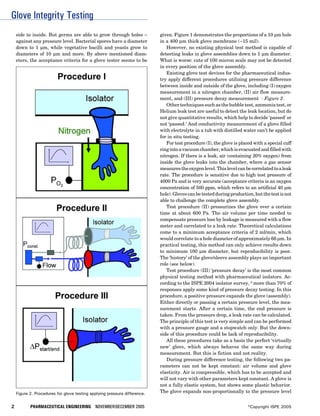
                                                                              Existing glove test devices for the pharmaceutical indus-
                                                                           try apply different procedures utilizing pressure difference
                                                                           between inside and outside of the glove, including (I) oxygen
                                                                           measurement in a nitrogen chamber, (II) air flow measure-
                                                                           ment, and (III) pressure decay measurement - Figure 2.
                                                                              Other techniques such as the bubble test, ammonia test, or
                                                                           Helium leak test are useful to detect the leak location, but do
                                                                           not give quantitative results, which help to decide ‘passed’ or
                                                                           not ‘passed.’ And conductivity measurement of a glove filled
                                                                           with electrolyte in a tub with distilled water can’t be applied
                                                                           for in situ testing.
                                                                              For test procedure (I), the glove is placed with a special cuff
                                                                           ring into a vacuum chamber, which is evacuated and filled with
                                                                           nitrogen. If there is a leak, air (containing 20% oxygen) from
                                                                           inside the glove leaks into the chamber, where a gas sensor
                                                                           measures the oxygen level. This level can be correlated to a leak
                                                                           rate. The procedure is sensitive due to high test pressure of
                                                                           4000 Pa and is very accurate (acceptance criteria is an oxygen
                                                                           concentration of 500 ppm, which refers to an artificial 40 µm
                                                                           hole). Gloves can be tested during production, but the test is not
                                                                           able to challenge the complete glove assembly.
                                                                              Test procedure (II) pressurizes the glove over a certain
                                                                           time at about 600 Pa. The air volume per time needed to
                                                                           compensate pressure loss by leakage is measured with a flow
                                                                           meter and correlated to a leak rate. Theoretical calculations
                                                                           come to a minimum acceptance criteria of 2 ml/min, which
                                                                           would correlate to a hole diameter of approximately 66 µm. In
                                                                           practical testing, this method can only achieve results down
                                                                           to minimum 100 µm diameter, but reproducibility is poor.
                                                                           The ‘history’ of the glove/sleeve assembly plays an important
                                                                           role (see below).
                                                                              Test procedure (III) ‘pressure decay’ is the most common
                                                                           physical testing method with pharmaceutical isolators. Ac-
                                                                           cording to the ISPE 2004 isolator survey, ³ more than 70% of
                                                                           responses apply some kind of pressure decay testing. In this
                                                                           procedure, a positive pressure expands the glove (assembly).
                                                                           Either directly or passing a certain pressure level, the mea-
                                                                           surement starts. After a certain time, the end pressure is
                                                                           taken. From the pressure drop, a leak rate can be calculated.
                                                                           The principle of this test is very simple and can be performed
                                                                           with a pressure gauge and a stopwatch only. But the down-
                                                                           side of this procedure could be lack of reproducibility.
                                                                              All these procedures take as a basis the perfect ‘virtually
                                                                           new’ glove, which always behaves the same way during
                                                                           measurement. But this is fiction and not reality.
                                                                              During pressure difference testing, the following two pa-
                                                                           rameters can not be kept constant: air volume and glove
                                                                           elasticity. Air is compressible, which has to be accepted and
                                                                           will not vary with other parameters kept constant. A glove is
                                                                           not a fully elastic system, but shows some plastic behavior.
    Figure 2. Procedures for glove testing applying pressure difference.   The glove expands non-proportionally to the pressure level


2          PHARMACEUTICAL ENGINEERING NOVEMBER/DECEMBER 2005                                                           ©Copyright ISPE 2005
Glove Integrity Testing
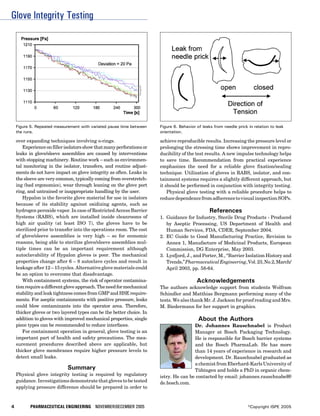
                                                                      To demonstrate the repeatable equilibrium state at the
                                                                   beginning of the measurement, a series of tests were per-
                                                                   formed with varied pause time between each run: from no
                                                                   pause to two hours - Figure 5. The results spread in a window
                                                                   of 20 Pa, which is sufficiently accurate for reliable detection
                                                                   of an artificial 100 µm hole with standard glove/sleeve com-
                                                                   binations.
                                                                      A prototype of reinforced Hypalon sleeve combined with a
                                                                   standard Hypalon glove was tested. The results were very
                                                                   positive: test pressure could be doubled (2400 Pa) without
                                                                   overstretching the sleeve. Stressing time could be cut in half and
                                                                   resolution doubled allowing reliable detection of 50 µm holes.
                                                                                        Practical Aspects
                                                                   Holes of a 100 µm diameter or less can hardly be detected
Figure 3. Measurement preparation utilizing impulse technique.     during visible inspections. Even cuts of a millimeter in size
                                                                   could remain undetected could remain undetected by visual
and does not keep its volume while keeping the pressure
                                                                   check. Under unfavorable circumstances, the detection of
constant. This behavior is dependant on glove material, glove
                                                                   these cuts also could be a challenge for physical glove testing
thickness, age, and history of the glove. Results differ with
                                                                   procedures. Depending on the location and orientation of
new gloves, heavily used gloves, freshly tested gloves, and
                                                                   such cuts, the force induced by pressurization is either suffi-
aged gloves from stock, in addition to temperature fluctua-        cient to open the leak or not. And it is not only the pressure
tions during measurement, which impact air compressibility         level that affects opening probability, but also the direction of
and glove elasticity. From all these shortcomings, physical        the cut in relation to the tension from pressurization - Figure
glove testing could be questioned principally.                     6. Cut locations in the sleeve can easily be detected, but cuts
                                                                   on the finger tip are much more difficult to be opened – this
                Innovation and Results                             is because of geometrical aspects (see above), and also due to
There is one aspect, which gives a glimmer of hope for             the higher glove thickness at the finger tip.
reproducible testing: the influence of this non-linear behav-          Another important aspect is the tightness of the complete
ior decreases with stress level. This means that with higher       assembly: port, sleeve, cuff ring, glove. The performance of
pressure or by longer period of pressurization, the glove          the whole system is determined by the weakest link. Glove
converges to a kind of ‘equilibrium state,’ from which glove       and sleeve fixations are critical points. The very common
behavior could be taken as constant.                               fixation by expanded o-rings clamping the glove (sleeve) on a
    Higher pressure levels should help, but have their limits. A   ring is not the way o-rings should be used. They have there
3000 Pa pressurization of a standard glove/sleeve assembly         best sealing properties with being pressed between two faces
(400 µm membrane thickness) results in inflating the sleeve to     of a connection. In case of oval shaped glove ports, the o-ring
balloon size while the glove keeps the shape. Therefore, the       used as an expander shows a high contact pressure at the
high pressure difference for test procedure I (4000 Pa) – which    small radius sections compared with insufficient contact
is principally useful – can only be applied for the glove alone.   pressure at the big radius sections. What is more: Hypalon
    The alternative – prolonging the period of pressurization      material tends to crawl under mechanical load – such as
– is feasible for complete glove/sleeve assemblies, but could      contact pressure by an o-ring – which has an effect on the
take hours, which is not very practical.                           tightness. Therefore re-adjustable fixations have advantages
    A new approach stresses the glove/sleeve assembly by
repeated pressure impulses, which are applied as soon as the
pressure inside the glove drops below the starting pressure
level (1200 Pa). The equilibrium state is achieved within 10 to
20 minutes depending on glove/sleeve thickness and material.
As shown in Figure 3, the impulse frequency reduces over time,
which is an indicator for approaching the equilibrium state. All
following results are achieved by that technique.
    To demonstrate the influence of stressing time, glove/
sleeve assemblies in two states (brand new, old/used) were
performed - Figure 4. The results are the average value of
three measurements. The longer the stressing time, the
smaller the deviation. The same can be observed for the
pressure level: the higher the pressure, the better the repro-
ducibility; 1200 Pa showed to be the optimum pressure level
for standard glove/sleeve assemblies.
                                                                   Figure 4. Variation of stressing time with set of old vs. new gloves.


©Copyright ISPE 2005                                                NOVEMBER/DECEMBER 2005 PHARMACEUTICAL ENGINEERING                      3
Glove Integrity Testing


    Figure 5. Repeated measurement with variated pause time between    Figure 6. Behavior of leaks from needle prick in relation to leak
    the runs.                                                          orientation.

    over expanding techniques involving o-rings.                       achieve reproducible results. Increasing the pressure level or
       Experience on filler isolators show that many perforations or   prolonging the stressing time shows improvement in repro-
    leaks in glove/sleeve assemblies are caused by interventions       ducibility of the test results. A new impulse technology helps
    with stopping machinery. Routine work – such as environmen-        to save time. Recommendation from practical experience
    tal monitoring in the isolator, transfers, and routine adjust-     emphasizes the need for a reliable glove fixation/sealing
    ments do not have impact on glove integrity as often. Leaks in     technique. Utilization of gloves in RABS, isolator, and con-
    the sleeve are very common, typically coming from overstretch-     tainment systems requires a slightly different approach, but
    ing (bad ergonomics), wear through leaning on the glove port       it should be performed in conjunction with integrity testing.
    ring, and untrained or inappropriate handling by the user.             Physical glove testing with a reliable procedure helps to
       Hypalon is the favorite glove material for use in isolators     reduce dependence from adherence to visual inspection SOPs.
    because of its stability against oxidizing agents, such as
    hydrogen peroxide vapor. In case of Restricted Access Barrier                                References
    Systems (RABS), which are installed inside cleanrooms of           1. Guidance for Industry, Sterile Drug Products - Produced
    high air quality (at least ISO 7), the gloves have to be              by Aseptic Processing, US Department of Health and
    sterilized prior to transfer into the operations room. The cost       Human Services, FDA, CDER, September 2004.
    of glove/sleeve assemblies is very high – so for economic          2. EC Guide to Good Manufacturing Practice, Revision to
    reasons, being able to sterilize glove/sleeve assemblies mul-         Annex 1, Manufacture of Medicinal Products, European
    tiple times can be an important requirement although                  Commission, DG Enterprise, May 2003.
    autoclavability of Hypalon gloves is poor. The mechanical          3. Lysfjord, J., and Porter, M., “Barrier Isolation History and
    properties change after 6 – 8 autoclave cycles and result in          Trends,” Pharmaceutical Engineering, Vol. 23, No.2, March/
    leakage after 12 – 15 cycles. Alternative glove materials could       April 2003, pp. 58-64.
    be an option to overcome that disadvantage.
       With containment systems, the risk of operator contamina-                          Acknowledgements
    tion require a different glove approach. The need for mechanical   The authors acknowledge support from students Wolfram
    stability and leak tightness comes from GMP and HSE require-       Schindler and Matthias Bergmann performing many of the
    ments. For aseptic containments with positive pressure, leaks      tests. We also thank Mr. J. Jackson for proof reading and Mrs.
    could blow contaminants into the operator area. Therefore,         M. Biedermann for her support in graphics.
    thicker gloves or two layered types can be the better choice. In
    addition to gloves with improved mechanical properties, single                         About the Authors
    piece types can be recommended to reduce interfaces.                               Dr. Johannes Rauschnabel is Product
       For containment operation in general, glove testing is an                       Manager at Bosch Packaging Technology.
    important part of health and safety precautions. The mea-                          He is responsible for Bosch barrier systems
    surement procedures described above are applicable, but                            and the Bosch PharmaLab. He has more
    thicker glove membranes require higher pressure levels to                          than 14 years of experience in research and
    detect small leaks.                                                                development. Dr. Rauschnabel graduated as
                                                                                       a chemist from Eberhard-Karls University of
                             Summary                                                   Tübingen and holds a PhD in organic chem-
    Physical glove integrity testing is required by regulatory         istry. He can be contacted by email: johannes.rauschnabel@
    guidance. Investigations demonstrate that gloves to be tested      de.bosch.com.
    applying pressure difference should be prepared in order to


4          PHARMACEUTICAL ENGINEERING NOVEMBER/DECEMBER 2005                                                         ©Copyright ISPE 2005
Glove Integrity Testing
                Albrecht Kühnle is a Mechanical Design
                Engineer at Bosch Packaging Technology.
                He has 10 years of experience in develop-
                ment of washing, sterilizing and filling pro-
                cesses, and machines for liquid pharmaceu-
                tical products. Presently, he is focused on the
                development of Bosch barrier systems,
                mainly on isolators and cRABS, as well as
appropriate components, such as transfer systems, glove
ports, glove testers, etc. He graduated with a mechanical
engineering degree at FH Aalen. He can be contacted by e-
mail: albrecht.kuehnle@ boschpackaging.com.
   Robert Bosch GmbH, Blaufelder Strasse 45, D-74564
Crailsheim, Germany.

               Kuno Lemke is Design Engineer for Bosch
               Packaging Technology. He has 33 years of
               experience in hygienic design of packaging
               machinery with focus on aseptic applications
               for food and pharmaceutical. He is involved
               in development and advanced engineering of
               equipment for sterilization and testing.
               Lemke graduated from the school of technol-
ogy at Ludwigsburg/Germany. He can be contacted by e-mail:
kuno.lemke@boschpackaging.com.
   Robert Bosch GmbH, Stuttgarter Strasse 130, D-71332
Waiblingen, Germany.


©Copyright ISPE 2005                                              NOVEMBER/DECEMBER 2005 PHARMACEUTICAL ENGINEERING   5

Article about glove integrity test

  • 1.
    Glove Integrity Testing Thisarticle Reprinted from The Official Journal of ISPE describes PHARMACEUTICAL ENGINEERING® November/December 2005, Vol. 25 No. 6 procedures to Safe Access using Glove Ports – test gloves, shortcomings of plastic glove behavior, and glove fixation. In Facts and Fiction addition, it by Johannes Rauschnabel, Albrecht Kühnle, presents a new and Kuno Lemke impulse technique for the improvement of B Introduction leak testing of the isolator and glove/sleeve reproducibility arrier systems, such as aseptic isola- system.” Thus, some kind of leak testing has to and repeatability tors, Restricted Access Barrier Sys- take place in addition to visual inspection. of a pressure tems (RABS) and glove boxes are being used more and more in pharmaceuti- Challenge decay test. cal production, research, and laboratories. The Glove leaks have many reasons: mechanical purpose of these barrier systems is to separate damage through contact with sharp equipment, a process area from a surrounding environ- tools or broken glass, which cause cuts in the ment – either to shield the process from con- glove material. Clamping gloves in mechanical taminants coming from outside, or to shield the installations very often results in holes that are environment from hazardous products inside. less discrete and hard to detect. The most If manual operator access is needed either frequent types of leaks come from heavy use of during processing, for maintenance reasons, or gloves and aging. The commonly used glove for environmental monitoring inside the bar- material “Hypalon” has a layered structure, rier, glove ports are needed. which tends to flake off over time, therefore The integrity of these glove ports is crucial causing precarious perforations of the glove for maintaining sterility of the barrier system. membrane. The glove membrane do not only Therefore, frequent inspection of the glove ports show elastic behavior, it also has viscous prop- is required. The FDA guidance for industry on erties, especially if it is stressed by tension or aseptic processing1 asks for “With every use, mechanical load. These stressed areas have a gloves should be visually evaluated for any reduced membrane thickness and are more macroscopic physical defect. Physical integrity sensitive to mechanical impacts. Membrane tests should also be performed routinely,” while rupture is very often the consequence of over EC GMP ² requires “Monitoring should be car- stressing gloves locally. Chemicals can have a ried out routinely and should include frequent similar effect: some are capable of reducing the tensile strength of the glove. Figure 1. Proportions of Any type of leak should be a 10 μm leak in a 400 μm membrane. detected with a physical glove testing procedure - at any posi- tion on the sleeve, cuff ring, or glove assembly. The standard for operating isolator systems is to work with a second disposable glove (80% of all users)³ – so that direct contamination is not very likely even in the case of a small leak. Additionally, in most isolator systems, an over pressure is applied inside barrier isolators, which prevents ingress of air- borne contamination from out ©Copyright ISPE 2005 NOVEMBER/DECEMBER 2005 PHARMACEUTICAL ENGINEERING 1
  • 2.
    Glove Integrity Testing side to inside. But germs are able to grow through holes – given. Figure 1 demonstrates the proportions of a 10 µm hole against any pressure level. Bacterial spores have a diameter in a 400 µm thick glove membrane (~15 mil). down to 1 µm, while vegetative bacilli and yeasts grow to However, no existing physical test method is capable of diameters of 10 µm and more. By above mentioned diam- detecting leaks in glove assemblies down to 1 µm diameter. eters, the acceptance criteria for a glove tester seems to be What is worse: cuts of 100 micron scale may not be detected in every position of the glove assembly. Existing glove test devices for the pharmaceutical indus- try apply different procedures utilizing pressure difference between inside and outside of the glove, including (I) oxygen measurement in a nitrogen chamber, (II) air flow measure- ment, and (III) pressure decay measurement - Figure 2. Other techniques such as the bubble test, ammonia test, or Helium leak test are useful to detect the leak location, but do not give quantitative results, which help to decide ‘passed’ or not ‘passed.’ And conductivity measurement of a glove filled with electrolyte in a tub with distilled water can’t be applied for in situ testing. For test procedure (I), the glove is placed with a special cuff ring into a vacuum chamber, which is evacuated and filled with nitrogen. If there is a leak, air (containing 20% oxygen) from inside the glove leaks into the chamber, where a gas sensor measures the oxygen level. This level can be correlated to a leak rate. The procedure is sensitive due to high test pressure of 4000 Pa and is very accurate (acceptance criteria is an oxygen concentration of 500 ppm, which refers to an artificial 40 µm hole). Gloves can be tested during production, but the test is not able to challenge the complete glove assembly. Test procedure (II) pressurizes the glove over a certain time at about 600 Pa. The air volume per time needed to compensate pressure loss by leakage is measured with a flow meter and correlated to a leak rate. Theoretical calculations come to a minimum acceptance criteria of 2 ml/min, which would correlate to a hole diameter of approximately 66 µm. In practical testing, this method can only achieve results down to minimum 100 µm diameter, but reproducibility is poor. The ‘history’ of the glove/sleeve assembly plays an important role (see below). Test procedure (III) ‘pressure decay’ is the most common physical testing method with pharmaceutical isolators. Ac- cording to the ISPE 2004 isolator survey, ³ more than 70% of responses apply some kind of pressure decay testing. In this procedure, a positive pressure expands the glove (assembly). Either directly or passing a certain pressure level, the mea- surement starts. After a certain time, the end pressure is taken. From the pressure drop, a leak rate can be calculated. The principle of this test is very simple and can be performed with a pressure gauge and a stopwatch only. But the down- side of this procedure could be lack of reproducibility. All these procedures take as a basis the perfect ‘virtually new’ glove, which always behaves the same way during measurement. But this is fiction and not reality. During pressure difference testing, the following two pa- rameters can not be kept constant: air volume and glove elasticity. Air is compressible, which has to be accepted and will not vary with other parameters kept constant. A glove is not a fully elastic system, but shows some plastic behavior. Figure 2. Procedures for glove testing applying pressure difference. The glove expands non-proportionally to the pressure level 2 PHARMACEUTICAL ENGINEERING NOVEMBER/DECEMBER 2005 ©Copyright ISPE 2005
  • 3.
    Glove Integrity Testing To demonstrate the repeatable equilibrium state at the beginning of the measurement, a series of tests were per- formed with varied pause time between each run: from no pause to two hours - Figure 5. The results spread in a window of 20 Pa, which is sufficiently accurate for reliable detection of an artificial 100 µm hole with standard glove/sleeve com- binations. A prototype of reinforced Hypalon sleeve combined with a standard Hypalon glove was tested. The results were very positive: test pressure could be doubled (2400 Pa) without overstretching the sleeve. Stressing time could be cut in half and resolution doubled allowing reliable detection of 50 µm holes. Practical Aspects Holes of a 100 µm diameter or less can hardly be detected Figure 3. Measurement preparation utilizing impulse technique. during visible inspections. Even cuts of a millimeter in size could remain undetected could remain undetected by visual and does not keep its volume while keeping the pressure check. Under unfavorable circumstances, the detection of constant. This behavior is dependant on glove material, glove these cuts also could be a challenge for physical glove testing thickness, age, and history of the glove. Results differ with procedures. Depending on the location and orientation of new gloves, heavily used gloves, freshly tested gloves, and such cuts, the force induced by pressurization is either suffi- aged gloves from stock, in addition to temperature fluctua- cient to open the leak or not. And it is not only the pressure tions during measurement, which impact air compressibility level that affects opening probability, but also the direction of and glove elasticity. From all these shortcomings, physical the cut in relation to the tension from pressurization - Figure glove testing could be questioned principally. 6. Cut locations in the sleeve can easily be detected, but cuts on the finger tip are much more difficult to be opened – this Innovation and Results is because of geometrical aspects (see above), and also due to There is one aspect, which gives a glimmer of hope for the higher glove thickness at the finger tip. reproducible testing: the influence of this non-linear behav- Another important aspect is the tightness of the complete ior decreases with stress level. This means that with higher assembly: port, sleeve, cuff ring, glove. The performance of pressure or by longer period of pressurization, the glove the whole system is determined by the weakest link. Glove converges to a kind of ‘equilibrium state,’ from which glove and sleeve fixations are critical points. The very common behavior could be taken as constant. fixation by expanded o-rings clamping the glove (sleeve) on a Higher pressure levels should help, but have their limits. A ring is not the way o-rings should be used. They have there 3000 Pa pressurization of a standard glove/sleeve assembly best sealing properties with being pressed between two faces (400 µm membrane thickness) results in inflating the sleeve to of a connection. In case of oval shaped glove ports, the o-ring balloon size while the glove keeps the shape. Therefore, the used as an expander shows a high contact pressure at the high pressure difference for test procedure I (4000 Pa) – which small radius sections compared with insufficient contact is principally useful – can only be applied for the glove alone. pressure at the big radius sections. What is more: Hypalon The alternative – prolonging the period of pressurization material tends to crawl under mechanical load – such as – is feasible for complete glove/sleeve assemblies, but could contact pressure by an o-ring – which has an effect on the take hours, which is not very practical. tightness. Therefore re-adjustable fixations have advantages A new approach stresses the glove/sleeve assembly by repeated pressure impulses, which are applied as soon as the pressure inside the glove drops below the starting pressure level (1200 Pa). The equilibrium state is achieved within 10 to 20 minutes depending on glove/sleeve thickness and material. As shown in Figure 3, the impulse frequency reduces over time, which is an indicator for approaching the equilibrium state. All following results are achieved by that technique. To demonstrate the influence of stressing time, glove/ sleeve assemblies in two states (brand new, old/used) were performed - Figure 4. The results are the average value of three measurements. The longer the stressing time, the smaller the deviation. The same can be observed for the pressure level: the higher the pressure, the better the repro- ducibility; 1200 Pa showed to be the optimum pressure level for standard glove/sleeve assemblies. Figure 4. Variation of stressing time with set of old vs. new gloves. ©Copyright ISPE 2005 NOVEMBER/DECEMBER 2005 PHARMACEUTICAL ENGINEERING 3
  • 4.
    Glove Integrity Testing Figure 5. Repeated measurement with variated pause time between Figure 6. Behavior of leaks from needle prick in relation to leak the runs. orientation. over expanding techniques involving o-rings. achieve reproducible results. Increasing the pressure level or Experience on filler isolators show that many perforations or prolonging the stressing time shows improvement in repro- leaks in glove/sleeve assemblies are caused by interventions ducibility of the test results. A new impulse technology helps with stopping machinery. Routine work – such as environmen- to save time. Recommendation from practical experience tal monitoring in the isolator, transfers, and routine adjust- emphasizes the need for a reliable glove fixation/sealing ments do not have impact on glove integrity as often. Leaks in technique. Utilization of gloves in RABS, isolator, and con- the sleeve are very common, typically coming from overstretch- tainment systems requires a slightly different approach, but ing (bad ergonomics), wear through leaning on the glove port it should be performed in conjunction with integrity testing. ring, and untrained or inappropriate handling by the user. Physical glove testing with a reliable procedure helps to Hypalon is the favorite glove material for use in isolators reduce dependence from adherence to visual inspection SOPs. because of its stability against oxidizing agents, such as hydrogen peroxide vapor. In case of Restricted Access Barrier References Systems (RABS), which are installed inside cleanrooms of 1. Guidance for Industry, Sterile Drug Products - Produced high air quality (at least ISO 7), the gloves have to be by Aseptic Processing, US Department of Health and sterilized prior to transfer into the operations room. The cost Human Services, FDA, CDER, September 2004. of glove/sleeve assemblies is very high – so for economic 2. EC Guide to Good Manufacturing Practice, Revision to reasons, being able to sterilize glove/sleeve assemblies mul- Annex 1, Manufacture of Medicinal Products, European tiple times can be an important requirement although Commission, DG Enterprise, May 2003. autoclavability of Hypalon gloves is poor. The mechanical 3. Lysfjord, J., and Porter, M., “Barrier Isolation History and properties change after 6 – 8 autoclave cycles and result in Trends,” Pharmaceutical Engineering, Vol. 23, No.2, March/ leakage after 12 – 15 cycles. Alternative glove materials could April 2003, pp. 58-64. be an option to overcome that disadvantage. With containment systems, the risk of operator contamina- Acknowledgements tion require a different glove approach. The need for mechanical The authors acknowledge support from students Wolfram stability and leak tightness comes from GMP and HSE require- Schindler and Matthias Bergmann performing many of the ments. For aseptic containments with positive pressure, leaks tests. We also thank Mr. J. Jackson for proof reading and Mrs. could blow contaminants into the operator area. Therefore, M. Biedermann for her support in graphics. thicker gloves or two layered types can be the better choice. In addition to gloves with improved mechanical properties, single About the Authors piece types can be recommended to reduce interfaces. Dr. Johannes Rauschnabel is Product For containment operation in general, glove testing is an Manager at Bosch Packaging Technology. important part of health and safety precautions. The mea- He is responsible for Bosch barrier systems surement procedures described above are applicable, but and the Bosch PharmaLab. He has more thicker glove membranes require higher pressure levels to than 14 years of experience in research and detect small leaks. development. Dr. Rauschnabel graduated as a chemist from Eberhard-Karls University of Summary Tübingen and holds a PhD in organic chem- Physical glove integrity testing is required by regulatory istry. He can be contacted by email: johannes.rauschnabel@ guidance. Investigations demonstrate that gloves to be tested de.bosch.com. applying pressure difference should be prepared in order to 4 PHARMACEUTICAL ENGINEERING NOVEMBER/DECEMBER 2005 ©Copyright ISPE 2005
  • 5.
    Glove Integrity Testing Albrecht Kühnle is a Mechanical Design Engineer at Bosch Packaging Technology. He has 10 years of experience in develop- ment of washing, sterilizing and filling pro- cesses, and machines for liquid pharmaceu- tical products. Presently, he is focused on the development of Bosch barrier systems, mainly on isolators and cRABS, as well as appropriate components, such as transfer systems, glove ports, glove testers, etc. He graduated with a mechanical engineering degree at FH Aalen. He can be contacted by e- mail: albrecht.kuehnle@ boschpackaging.com. Robert Bosch GmbH, Blaufelder Strasse 45, D-74564 Crailsheim, Germany. Kuno Lemke is Design Engineer for Bosch Packaging Technology. He has 33 years of experience in hygienic design of packaging machinery with focus on aseptic applications for food and pharmaceutical. He is involved in development and advanced engineering of equipment for sterilization and testing. Lemke graduated from the school of technol- ogy at Ludwigsburg/Germany. He can be contacted by e-mail: kuno.lemke@boschpackaging.com. Robert Bosch GmbH, Stuttgarter Strasse 130, D-71332 Waiblingen, Germany. ©Copyright ISPE 2005 NOVEMBER/DECEMBER 2005 PHARMACEUTICAL ENGINEERING 5