Article 5 of the WHO FCTC
2nd Meeting of the United Nations
Interagency Task Force on the Prevention
and Control of Noncommunicable Diseases
Geneva, 30 January 2014
Dudley Tarlton
UNDP Geneva
UNDP Responsibilities in the
Interagency Task Force
Following ECOSOC resolution E/2013/L.23, UNDP convenes
the work of the UN to “to strengthen national capacity,
leadership, governance, multisectoral action and
partnerships to accelerate country response for the
prevention and control of NCDs”
Article 5 – General Obligations
5.1 National strategies/action plans/programmes to
implement WHO FCTC
5.2 (a) Multisectoral National Coordination Mechanisms
5.2 (b) Tobacco Control Legislation
5.3 Protecting Health Policies from Industry Interference
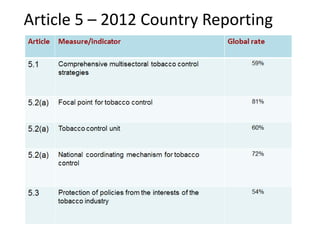
Article 5 – 2012 Country Reporting
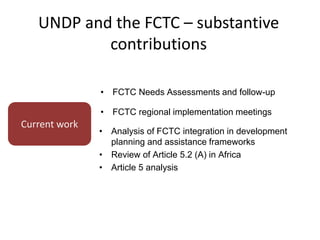
UNDP and the FCTC – substantive
contributions
Current work
• FCTC Needs Assessments and follow-up
• FCTC regional implementation meetings
• Analysis of FCTC integration in development
planning and assistance frameworks
• Review of Article 5.2 (A) in Africa
• Article 5 analysis
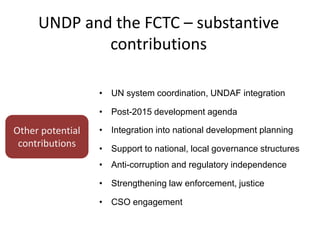
UNDP and the FCTC – substantive
contributions
Other potential
contributions
• UN system coordination, UNDAF integration
• Post-2015 development agenda
• Integration into national development planning
• Support to national, local governance structures
• Anti-corruption and regulatory independence
• Strengthening law enforcement, justice
• CSO engagement
Country Needs Assessments
Discussion Paper:
Development Planning and Tobacco Control
Implications for broader response
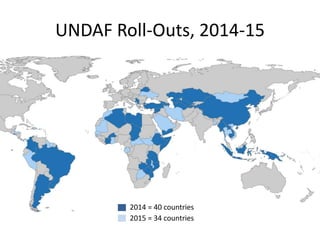
UNDAF Roll-Outs, 2014-15
2014 = 40 countries
2015 = 34 countries
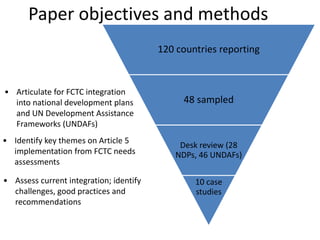
Paper objectives and methods
• Articulate for FCTC integration
into national development plans
and UN Development Assistance
Frameworks (UNDAFs)
• Assess current integration; identify
challenges, good practices and
recommendations
• Identify key themes on Article 5
implementation from FCTC needs
assessments
120 countries reporting
48 sampled
Desk review (28
NDPs, 46 UNDAFs)
10 case
studies
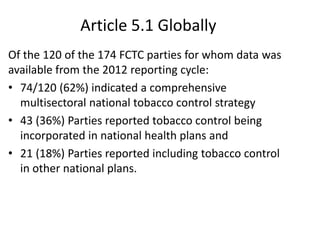
Article 5.1 Globally
Of the 120 of the 174 FCTC parties for whom data was
available from the 2012 reporting cycle:
• 74/120 (62%) indicated a comprehensive
multisectoral national tobacco control strategy
• 43 (36%) Parties reported tobacco control being
incorporated in national health plans and
• 21 (18%) Parties reported including tobacco control
in other national plans.
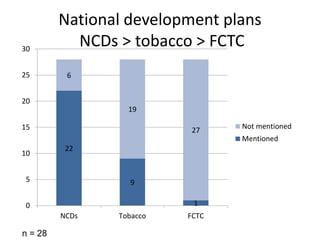
National development plans
NCDs > tobacco > FCTC
22
9
1
6
19
27
0
5
10
15
20
25
30
NCDs Tobacco FCTC
Not mentioned
Mentioned
n = 28
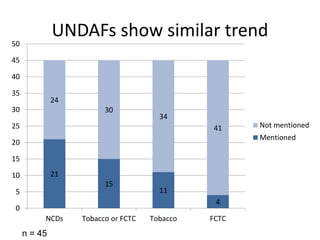
UNDAFs show similar trend
n = 45
21
15
11
4
24
30
34
41
0
5
10
15
20
25
30
35
40
45
50
NCDs Tobacco or FCTC Tobacco FCTC
Not mentioned
Mentioned
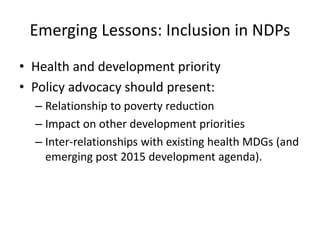
Emerging Lessons: Inclusion in NDPs
• Health and development priority
• Policy advocacy should present:
– Relationship to poverty reduction
– Impact on other development priorities
– Inter-relationships with existing health MDGs (and
emerging post 2015 development agenda).
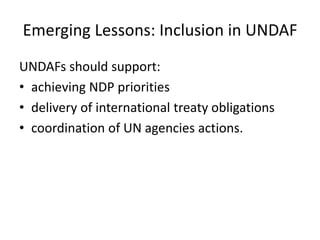
Emerging Lessons: Inclusion in UNDAF
UNDAFs should support:
• achieving NDP priorities
• delivery of international treaty obligations
• coordination of UN agencies actions.
Recommendations
• Support country-specific stakeholder analysis to identify the
governance structures to mobilize multisectoral engagement
and resources
• Resource and deliver a capacity-building strategy to support
the integration of WHO FCTC implementation into
development planning mechanisms
• Generate disaggregated data and analysis that provide
evidence of tobacco use trends as well as the impact of
tobacco use on socio-economic development.
Recommendations
• Continue advocacy efforts to make the case
for tobacco control as an issue that should be
integrated as a priority into development
planning
• Adopt a more proactive approach to
integrating the WHO FCTC into UNDAFs.
Joint Country Needs Assessments
Discussion Paper:
Development Planning and Tobacco Control
Implications for broader response
Joint Country Needs Assessments
• Request from MoH/Government to
Convention Secretariat
• Convention Secretariat organizes
• UNDP is present at each, as is WB
• UNCT members participate at country level
• Output: report identifying gaps and to address
them, recommendations listed by FCTC
Article.
Joint Country Needs Assessments
Article 5 Summary
• Analysis of 24 joint needs assessment reports
on FCTC implementation
• All 24 assessments identified existing gaps
related to Article 5
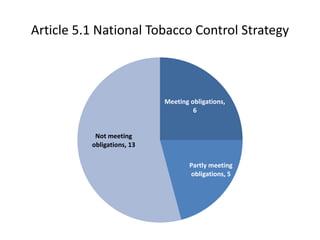
Article 5.1 National Tobacco Control Strategy
Meeting obligations,
6
Partly meeting
obligations, 5
Not meeting
obligations, 13
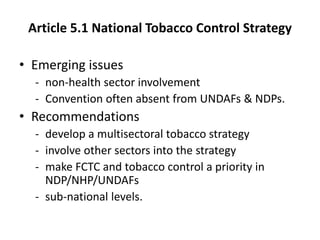
Article 5.1 National Tobacco Control Strategy
• Emerging issues
- non-health sector involvement
- Convention often absent from UNDAFs & NDPs.
• Recommendations
- develop a multisectoral tobacco strategy
- involve other sectors into the strategy
- make FCTC and tobacco control a priority in
NDP/NHP/UNDAFs
- sub-national levels.
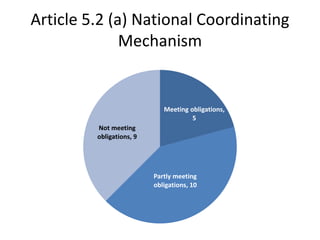
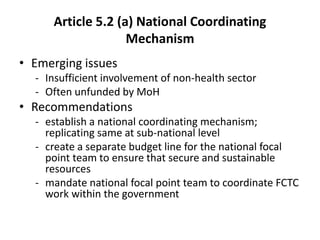
Article 5.2 (a) National Coordinating
Mechanism
Meeting obligations,
5
Partly meeting
obligations, 10
Not meeting
obligations, 9
Article 5.2 (a) National Coordinating
Mechanism
• Emerging issues
- Insufficient involvement of non-health sector
- Often unfunded by MoH
• Recommendations
- establish a national coordinating mechanism;
replicating same at sub-national level
- create a separate budget line for the national focal
point team to ensure that secure and sustainable
resources
- mandate national focal point team to coordinate FCTC
work within the government
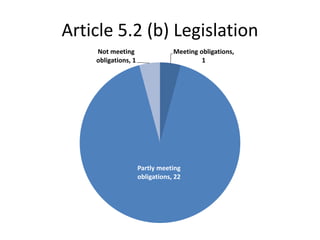
Article 5.2 (b) Legislation
Meeting obligations,
1
Partly meeting
obligations, 22
Not meeting
obligations, 1
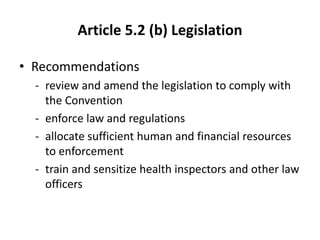
Article 5.2 (b) Legislation
• Recommendations
- review and amend the legislation to comply with
the Convention
- enforce law and regulations
- allocate sufficient human and financial resources
to enforcement
- train and sensitize health inspectors and other law
officers
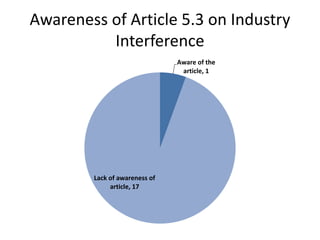
Awareness of Article 5.3 on Industry
Interference
Aware of the
article, 1
Lack of awareness of
article, 17
Article 5.3 Industry Interference
• Recommendations
- develop policy and disseminate information in line
with Article 5.3 to all branches of the government
- link this Article to the general requirements under
the Code of Conduct for all public officials
- limit and eliminate the interaction with tobacco
industry.
Country Needs Assessments
Discussion Paper
Implications for broader response
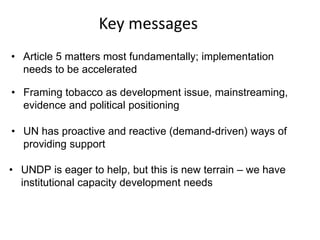
Key messages
• Article 5 matters most fundamentally; implementation
needs to be accelerated
• Framing tobacco as development issue, mainstreaming,
evidence and political positioning
• UN has proactive and reactive (demand-driven) ways of
providing support
• UNDP is eager to help, but this is new terrain – we have
institutional capacity development needs
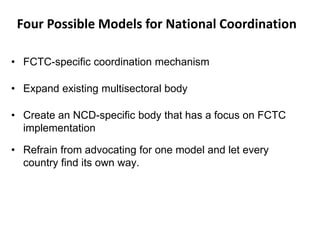
Four Possible Models for National Coordination
• FCTC-specific coordination mechanism
• Expand existing multisectoral body
• Create an NCD-specific body that has a focus on FCTC
implementation
• Refrain from advocating for one model and let every
country find its own way.
Discussion Questions
• Country Level Role for IATF members?
• Role for UNCT? WHO Reps? UN Res Coordinators?
• Challenges for integration of FCTC into development in
the post-2015 agenda?
• Do we build NCD responses on FCTC model?
Incorporate NCDs into it?
• Article 5 type guidance for NCDs?
• Normative guidance for NCD/FCTC integration into
UNDAFs?
Article 5 of the WHO FCTC and
the work of the UN-IATF on NCDs
2nd Meeting of the United Nations
Interagency Task Force on the Prevention
and Control of Noncommunicable Diseases
Geneva, 30 January 2014
Dudley Tarlton
UNDP Geneva
Vijay Trivedi,
FCTC Convention Secretariat

Article 5 of the WHO Framework Convention on Tobacco Control (FCTC)

  • 1.
    Article 5 ofthe WHO FCTC 2nd Meeting of the United Nations Interagency Task Force on the Prevention and Control of Noncommunicable Diseases Geneva, 30 January 2014 Dudley Tarlton UNDP Geneva
  • 2.
    UNDP Responsibilities inthe Interagency Task Force Following ECOSOC resolution E/2013/L.23, UNDP convenes the work of the UN to “to strengthen national capacity, leadership, governance, multisectoral action and partnerships to accelerate country response for the prevention and control of NCDs”
  • 3.
    Article 5 –General Obligations 5.1 National strategies/action plans/programmes to implement WHO FCTC 5.2 (a) Multisectoral National Coordination Mechanisms 5.2 (b) Tobacco Control Legislation 5.3 Protecting Health Policies from Industry Interference
  • 4.
    Article 5 –2012 Country Reporting
  • 5.
    UNDP and theFCTC – substantive contributions Current work • FCTC Needs Assessments and follow-up • FCTC regional implementation meetings • Analysis of FCTC integration in development planning and assistance frameworks • Review of Article 5.2 (A) in Africa • Article 5 analysis
  • 6.
    UNDP and theFCTC – substantive contributions Other potential contributions • UN system coordination, UNDAF integration • Post-2015 development agenda • Integration into national development planning • Support to national, local governance structures • Anti-corruption and regulatory independence • Strengthening law enforcement, justice • CSO engagement
  • 7.
    Country Needs Assessments DiscussionPaper: Development Planning and Tobacco Control Implications for broader response
  • 8.
    UNDAF Roll-Outs, 2014-15 2014= 40 countries 2015 = 34 countries
  • 10.
    Paper objectives andmethods • Articulate for FCTC integration into national development plans and UN Development Assistance Frameworks (UNDAFs) • Assess current integration; identify challenges, good practices and recommendations • Identify key themes on Article 5 implementation from FCTC needs assessments 120 countries reporting 48 sampled Desk review (28 NDPs, 46 UNDAFs) 10 case studies
  • 11.
    Article 5.1 Globally Ofthe 120 of the 174 FCTC parties for whom data was available from the 2012 reporting cycle: • 74/120 (62%) indicated a comprehensive multisectoral national tobacco control strategy • 43 (36%) Parties reported tobacco control being incorporated in national health plans and • 21 (18%) Parties reported including tobacco control in other national plans.
  • 12.
    National development plans NCDs> tobacco > FCTC 22 9 1 6 19 27 0 5 10 15 20 25 30 NCDs Tobacco FCTC Not mentioned Mentioned n = 28
  • 13.
    UNDAFs show similartrend n = 45 21 15 11 4 24 30 34 41 0 5 10 15 20 25 30 35 40 45 50 NCDs Tobacco or FCTC Tobacco FCTC Not mentioned Mentioned
  • 14.
    Emerging Lessons: Inclusionin NDPs • Health and development priority • Policy advocacy should present: – Relationship to poverty reduction – Impact on other development priorities – Inter-relationships with existing health MDGs (and emerging post 2015 development agenda).
  • 15.
    Emerging Lessons: Inclusionin UNDAF UNDAFs should support: • achieving NDP priorities • delivery of international treaty obligations • coordination of UN agencies actions.
  • 16.
    Recommendations • Support country-specificstakeholder analysis to identify the governance structures to mobilize multisectoral engagement and resources • Resource and deliver a capacity-building strategy to support the integration of WHO FCTC implementation into development planning mechanisms • Generate disaggregated data and analysis that provide evidence of tobacco use trends as well as the impact of tobacco use on socio-economic development.
  • 17.
    Recommendations • Continue advocacyefforts to make the case for tobacco control as an issue that should be integrated as a priority into development planning • Adopt a more proactive approach to integrating the WHO FCTC into UNDAFs.
  • 18.
    Joint Country NeedsAssessments Discussion Paper: Development Planning and Tobacco Control Implications for broader response
  • 19.
    Joint Country NeedsAssessments • Request from MoH/Government to Convention Secretariat • Convention Secretariat organizes • UNDP is present at each, as is WB • UNCT members participate at country level • Output: report identifying gaps and to address them, recommendations listed by FCTC Article.
  • 20.
    Joint Country NeedsAssessments Article 5 Summary • Analysis of 24 joint needs assessment reports on FCTC implementation • All 24 assessments identified existing gaps related to Article 5
  • 21.
    Article 5.1 NationalTobacco Control Strategy Meeting obligations, 6 Partly meeting obligations, 5 Not meeting obligations, 13
  • 22.
    Article 5.1 NationalTobacco Control Strategy • Emerging issues - non-health sector involvement - Convention often absent from UNDAFs & NDPs. • Recommendations - develop a multisectoral tobacco strategy - involve other sectors into the strategy - make FCTC and tobacco control a priority in NDP/NHP/UNDAFs - sub-national levels.
  • 23.
    Article 5.2 (a)National Coordinating Mechanism Meeting obligations, 5 Partly meeting obligations, 10 Not meeting obligations, 9
  • 24.
    Article 5.2 (a)National Coordinating Mechanism • Emerging issues - Insufficient involvement of non-health sector - Often unfunded by MoH • Recommendations - establish a national coordinating mechanism; replicating same at sub-national level - create a separate budget line for the national focal point team to ensure that secure and sustainable resources - mandate national focal point team to coordinate FCTC work within the government
  • 25.
    Article 5.2 (b)Legislation Meeting obligations, 1 Partly meeting obligations, 22 Not meeting obligations, 1
  • 26.
    Article 5.2 (b)Legislation • Recommendations - review and amend the legislation to comply with the Convention - enforce law and regulations - allocate sufficient human and financial resources to enforcement - train and sensitize health inspectors and other law officers
  • 27.
    Awareness of Article5.3 on Industry Interference Aware of the article, 1 Lack of awareness of article, 17
  • 28.
    Article 5.3 IndustryInterference • Recommendations - develop policy and disseminate information in line with Article 5.3 to all branches of the government - link this Article to the general requirements under the Code of Conduct for all public officials - limit and eliminate the interaction with tobacco industry.
  • 29.
    Country Needs Assessments DiscussionPaper Implications for broader response
  • 30.
    Key messages • Article5 matters most fundamentally; implementation needs to be accelerated • Framing tobacco as development issue, mainstreaming, evidence and political positioning • UN has proactive and reactive (demand-driven) ways of providing support • UNDP is eager to help, but this is new terrain – we have institutional capacity development needs
  • 31.
    Four Possible Modelsfor National Coordination • FCTC-specific coordination mechanism • Expand existing multisectoral body • Create an NCD-specific body that has a focus on FCTC implementation • Refrain from advocating for one model and let every country find its own way.
  • 32.
    Discussion Questions • CountryLevel Role for IATF members? • Role for UNCT? WHO Reps? UN Res Coordinators? • Challenges for integration of FCTC into development in the post-2015 agenda? • Do we build NCD responses on FCTC model? Incorporate NCDs into it? • Article 5 type guidance for NCDs? • Normative guidance for NCD/FCTC integration into UNDAFs?
  • 33.
    Article 5 ofthe WHO FCTC and the work of the UN-IATF on NCDs 2nd Meeting of the United Nations Interagency Task Force on the Prevention and Control of Noncommunicable Diseases Geneva, 30 January 2014 Dudley Tarlton UNDP Geneva Vijay Trivedi, FCTC Convention Secretariat