Setting the Context…
Jorge Bermudez, Fiocruz Brazil
Member of the UNSG HLP on access to medicines
ITPC, Global Summit on IP and access to medicines
Marrakesh, Morocco, 15-17 January 2018
Highlighting the political relevance
of Marrakesh
• Establishment of WTO, near 60 agreements and 550 pages discussed (April-
December 1994)
• The WTO TRIPS Agreement December 1994, effective 1st January 1995 (23
years have passed)
• Currently, what do we get? TRIPS-plus on FTAs, bilateral, regional or global
agreements, threats, retaliation
• Additionally we have the difficulties implementing TRIPS flexibilities, the intra-
country difficulties
• And here we are again: ITPC moving the agenda forward
• So we have a remaining issue: can we move (and how) to an IP-free environment
on pharmaceuticals? Is it feasible, possible and probable?
• For the forthcoming WHO EB Session next week and the WHA next May, how
can we head off Global Action on access to medicines picking on the UNSG HLP
and this Summit?
Further to 1994, we also have from
1998 to 2018 at WHO
•20 years at WHO and WHA,
fierce battles and difficult
consensus: the confrontation
between Trade x Health; North x
South; innovation x access …
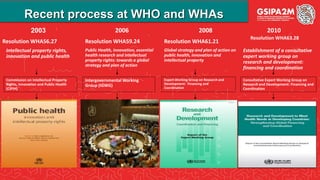
Recent process at WHO and WHAs
2003 2006 2008 2010
Resolution WHA56.27 Resolution WHA59.24 Resolution WHA61.21
Resolution WHA63.28
Intellectual property rights,
innovation and public health
Public Health, innovation, essential
health research and intellectual
property rights: towards a global
strategy and plan of action
Global strategy and plan of action on
public health, innovation and
intellectual property
Establishment of a consultative
expert working group on
research and development:
financing and coordination
Commission on Intellectual Property
Rights, Innovation and Public Health
(CIPIH)
Intergovernmental Working
Group (IGWG)
Expert Working Group on Research and
Development: Financing and
Coordination
Consultative Expert Working Group on
Research and Development: Financing and
Coordination
Collect data and proposals from the different
actors…produce an analysis of intellectual
property rights, innovation and public health,
including the question of appropriate funding
and incentive mechanisms for the creation of
new medicines and other products against
diseases that disproportionately affect
developing countries.
Draw up a global strategy and plan of action in
order to provide a medium-term framework
based on the recommendations of the
Commission; such strategy and plan of action
would aim , inter alia, at securing an enhanced
and sustainable basis for needs-driven, essential
health research and development relevant to
diseases that disproportionately affect
developing countries, proposing clear objectives
and priorities for research and development and
estimating funding needs in this area.
Examine current financing and coordination of
research and development, as well as proposals
for new and innovative sources of funding to
stimulate research and development related to
Type II and Type III diseases and the specific
research and development needs of developing
countries in relation to Type I diseases.
•
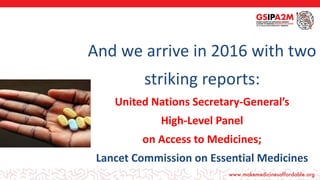
And we arrive in 2016 with two
striking reports:
United Nations Secretary-General’s
High-Level Panel
on Access to Medicines;
Lancet Commission on Essential Medicines
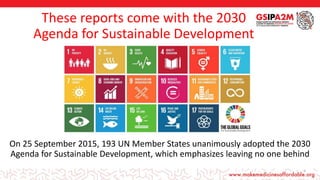
These reports come with the 2030
Agenda for Sustainable Development
On 25 September 2015, 193 UN Member States unanimously adopted the 2030
Agenda for Sustainable Development, which emphasizes leaving no one behind
6
In what context is the UNSG HLP
installed and implemented?
• The move from the MDGs to the SDGs and the 2030 Agenda for
Sustainable Development
• Access to medicines is no longer a problem restricted to LICs and
MICs (triggered by Hepatitis C DAAs. biotechnology and Oncology
products in HICs)
• Is the current system broken or failed?
• The overall confrontation between Health and Trade
• Outrageous prices and the difference between COST and PRICE
• So, setting the context is about identifying and overcoming barriers
on access to medicines
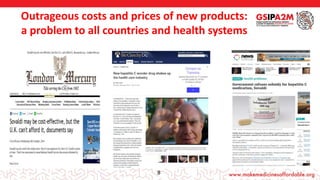
Outrageous costs and prices of new products:
a problem to all countries and health systems
8
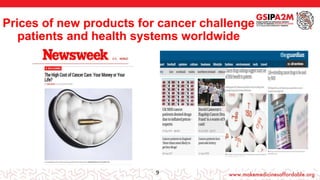
Prices of new products for cancer challenge
patients and health systems worldwide
http://www.newsweek.com/2015/07/31/high-cost-cancer-care-your-money-or-your-life-356369.html http://www.theguardian.com/society/cancer
9
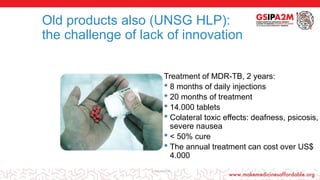
Old products also (UNSG HLP):
the challenge of lack of innovation
Treatment of MDR-TB, 2 years:
• 8 months of daily injections
• 20 months of treatment
• 14.000 tablets
• Colateral toxic effects: deafness, psicosis,
severe nausea
• < 50% cure
• The annual treatment can cost over US$
4.000
curecucure10
Regarding the process for the UNSG HLP
• In line with the recommendations of the ‘Global
Commission on HIV and the Law’, 2012
• In the context of the Post-2015 Agenda and the
Sustainable Development Goals
• A clearly written mandate: “to review and assess
proposals and recommend solutions for remedying the
policy incoherence between the justifiable rights of
inventors, international human rights law, trade rules
and public health in the context of health technologies”.
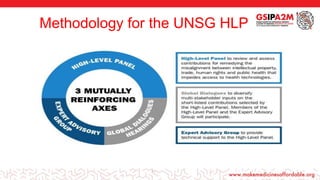
Methodology for the UNSG HLP
12
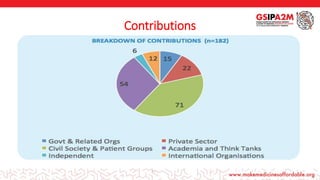
Contributions
13
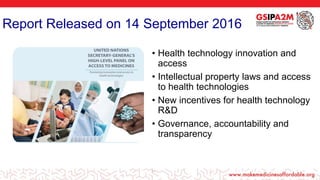
Report Released on 14 September 2016
• Health technology innovation and
access
• Intellectual property laws and access
to health technologies
• New incentives for health technology
R&D
• Governance, accountability and
transparency
14
Key Findings:
Barriers to Accessing Treatment
• Access is a global issue, not restricted to LICs
• For hepatitis C, direct acting antivirals, such as Sofosbuvir, are
successful in curing hepatitis C
• Sofosbuvir marketed at US$ 84K per patient in the United
States
• Gilead signed 5 year voluntary licenses covering 112 low and
lower middle-income countries
• Geographic scope: 50 middle-income countries with 49 million
people living with Hep C were not included in these licenses
(43% of all people living with Hep C)
• 2.6 million people in Brazil, 1.5 million people in Thailand and 30
million people in China live with Hep C
15
Recommendations: IP and Access
• WTO Members must make full use of policy
space available in Article 27(1) of TRIPS to
curtail ever-greening and reward genuine
innovation
• Governments should adopt and implement
legislation that facilitates the quick, fair and
predictable issuance of compulsory licenses
• WTO Members must revise the paragraph 6
decision to find a solution that enables swift and
expedient export of pharmaceutical products
16
Recommendations: IP and Access
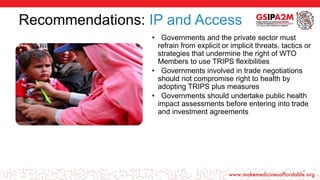
• Governments and the private sector must
refrain from explicit or implicit threats, tactics or
strategies that undermine the right of WTO
Members to use TRIPS flexibilities
• Governments involved in trade negotiations
should not compromise right to health by
adopting TRIPS plus measures
• Governments should undertake public health
impact assessments before entering into trade
and investment agreements
17
Recommendations:
New Incentives for R&D
18
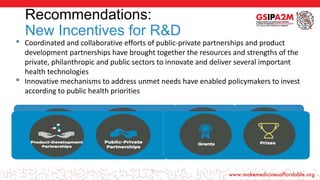
• Coordinated and collaborative efforts of public-private partnerships and product
development partnerships have brought together the resources and strengths of the
private, philanthropic and public sectors to innovate and deliver several important
health technologies
• Innovative mechanisms to address unmet needs have enabled policymakers to invest
according to public health priorities
19
Recommendations:
Binding R&D Treaty
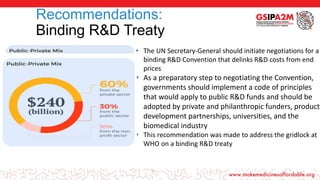
• The UN Secretary-General should initiate negotiations for a
binding R&D Convention that delinks R&D costs from end
prices
• As a preparatory step to negotiating the Convention,
governments should implement a code of principles
that would apply to public R&D funds and should be
adopted by private and philanthropic funders, product
development partnerships, universities, and the
biomedical industry
• This recommendation was made to address the gridlock at
WHO on a binding R&D treaty
HLP and beyond: concrete examples of
achievements derived from the Report
• Discussion forums and publications worldwide mentioning the UNSG HLP
Report
• Chilean Congress Resolution on compulsory licenses for patented
medicines urging the President to instruct ministries.
• TPP-11 suspending provisions of the original TPP (Comprehensive and
Progressive Agreement for the Trans Pacific Partnership) that affect
access to medicines.
• Malaysia CL for Sofosbuvir
• Mercosur-EU FTA impact analysis of TRIPS-plus measures on public
purchases in Brazil and Argentina, used on the negotiation process.
20
HLP: our vision (personal) of
what was missing
• First and forehand, we need to recognize that the current R&D and
Access system has failed (failed or broken?).
• Concrete and feasible proposals for the short, medium and long-term to
remedy a failed system.
• To propose a new IP system for pharmaceuticals, consistent with
international codes of human rights and public health, safeguarding the
rights of the inventors or individual rights (reaffirming previous
recommendations [Global Commission on HIV and the Law, 2012]).
• Countries must be free of pressures when using TRIPS flexibilities,
including patenting criteria decisions (litigation of pharmaceutical
companies against Argentina and Brasil)
HLP: our vision (personal)
of what was missing
• TRIPS-plus on FTAs should or must be immediately halted, reverted and
banned.
• HLP: too much emphasis on Voluntary; much less on Compulsory
measures.
• Essential medicines (WHO Model List for Essential Medicines) excluded
from patent protection (Global Health Law Committee of the International
Law Association: effectively automatic compulsory licensing for
essential medicines).
• Strengthening legal and advocacy roles of civil society.
• Further discussion of the Colombia case (Imatinib Novartis), fully
documented, hampering the Peace Agreement!.
Proposals for next steps?
• Contextualize proposals with the WHO draft general programme of work
2019-2023 (Promote health, keep the world safe, serve the vulnerable).
EBSS 22-23 November 2017, EB 22-27 January 2018, WHA May 2018.
• Clarify and make public legal implications, consistency of proposals with
the TRIPS Agreement and the so-called “unintended consequences” of
the proposed approach.
• Dialogue with WTO for making feasible effective proposals.
• Maintain the debate high in all possible forums.
• Addressing regional approaches, local production capacity and linking
with the Lancet Commission on Essential Medicines (expand the Lancet
Commission indicators to a global approach to cover issues raised on
the HLP).
23
So, setting the context:
• The Global Summit is planned as a return to
Marrakesh to reflect, discuss and strategize on
over two decades of the implementation of the
TRIPS Agreement, its impact on health and
access to medicines and to both imagine and re-
imagine what the next two decades of TRIPS
implementation will (or could) bring.
•ITPC Concept Note
ADD FOOTER INFORMATION HERE 24
25

GSIPA2M Opening session - Jorge Bermudez

  • 1.
    Setting the Context… JorgeBermudez, Fiocruz Brazil Member of the UNSG HLP on access to medicines ITPC, Global Summit on IP and access to medicines Marrakesh, Morocco, 15-17 January 2018
  • 2.
    Highlighting the politicalrelevance of Marrakesh • Establishment of WTO, near 60 agreements and 550 pages discussed (April- December 1994) • The WTO TRIPS Agreement December 1994, effective 1st January 1995 (23 years have passed) • Currently, what do we get? TRIPS-plus on FTAs, bilateral, regional or global agreements, threats, retaliation • Additionally we have the difficulties implementing TRIPS flexibilities, the intra- country difficulties • And here we are again: ITPC moving the agenda forward • So we have a remaining issue: can we move (and how) to an IP-free environment on pharmaceuticals? Is it feasible, possible and probable? • For the forthcoming WHO EB Session next week and the WHA next May, how can we head off Global Action on access to medicines picking on the UNSG HLP and this Summit?
  • 3.
    Further to 1994,we also have from 1998 to 2018 at WHO •20 years at WHO and WHA, fierce battles and difficult consensus: the confrontation between Trade x Health; North x South; innovation x access …
  • 4.
    Recent process atWHO and WHAs 2003 2006 2008 2010 Resolution WHA56.27 Resolution WHA59.24 Resolution WHA61.21 Resolution WHA63.28 Intellectual property rights, innovation and public health Public Health, innovation, essential health research and intellectual property rights: towards a global strategy and plan of action Global strategy and plan of action on public health, innovation and intellectual property Establishment of a consultative expert working group on research and development: financing and coordination Commission on Intellectual Property Rights, Innovation and Public Health (CIPIH) Intergovernmental Working Group (IGWG) Expert Working Group on Research and Development: Financing and Coordination Consultative Expert Working Group on Research and Development: Financing and Coordination Collect data and proposals from the different actors…produce an analysis of intellectual property rights, innovation and public health, including the question of appropriate funding and incentive mechanisms for the creation of new medicines and other products against diseases that disproportionately affect developing countries. Draw up a global strategy and plan of action in order to provide a medium-term framework based on the recommendations of the Commission; such strategy and plan of action would aim , inter alia, at securing an enhanced and sustainable basis for needs-driven, essential health research and development relevant to diseases that disproportionately affect developing countries, proposing clear objectives and priorities for research and development and estimating funding needs in this area. Examine current financing and coordination of research and development, as well as proposals for new and innovative sources of funding to stimulate research and development related to Type II and Type III diseases and the specific research and development needs of developing countries in relation to Type I diseases.
  • 5.
    • And we arrivein 2016 with two striking reports: United Nations Secretary-General’s High-Level Panel on Access to Medicines; Lancet Commission on Essential Medicines
  • 6.
    These reports comewith the 2030 Agenda for Sustainable Development On 25 September 2015, 193 UN Member States unanimously adopted the 2030 Agenda for Sustainable Development, which emphasizes leaving no one behind 6
  • 7.
    In what contextis the UNSG HLP installed and implemented? • The move from the MDGs to the SDGs and the 2030 Agenda for Sustainable Development • Access to medicines is no longer a problem restricted to LICs and MICs (triggered by Hepatitis C DAAs. biotechnology and Oncology products in HICs) • Is the current system broken or failed? • The overall confrontation between Health and Trade • Outrageous prices and the difference between COST and PRICE • So, setting the context is about identifying and overcoming barriers on access to medicines
  • 8.
    Outrageous costs andprices of new products: a problem to all countries and health systems 8
  • 9.
    Prices of newproducts for cancer challenge patients and health systems worldwide http://www.newsweek.com/2015/07/31/high-cost-cancer-care-your-money-or-your-life-356369.html http://www.theguardian.com/society/cancer 9
  • 10.
    Old products also(UNSG HLP): the challenge of lack of innovation Treatment of MDR-TB, 2 years: • 8 months of daily injections • 20 months of treatment • 14.000 tablets • Colateral toxic effects: deafness, psicosis, severe nausea • < 50% cure • The annual treatment can cost over US$ 4.000 curecucure10
  • 11.
    Regarding the processfor the UNSG HLP • In line with the recommendations of the ‘Global Commission on HIV and the Law’, 2012 • In the context of the Post-2015 Agenda and the Sustainable Development Goals • A clearly written mandate: “to review and assess proposals and recommend solutions for remedying the policy incoherence between the justifiable rights of inventors, international human rights law, trade rules and public health in the context of health technologies”.
  • 12.
  • 13.
  • 14.
    Report Released on14 September 2016 • Health technology innovation and access • Intellectual property laws and access to health technologies • New incentives for health technology R&D • Governance, accountability and transparency 14
  • 15.
    Key Findings: Barriers toAccessing Treatment • Access is a global issue, not restricted to LICs • For hepatitis C, direct acting antivirals, such as Sofosbuvir, are successful in curing hepatitis C • Sofosbuvir marketed at US$ 84K per patient in the United States • Gilead signed 5 year voluntary licenses covering 112 low and lower middle-income countries • Geographic scope: 50 middle-income countries with 49 million people living with Hep C were not included in these licenses (43% of all people living with Hep C) • 2.6 million people in Brazil, 1.5 million people in Thailand and 30 million people in China live with Hep C 15
  • 16.
    Recommendations: IP andAccess • WTO Members must make full use of policy space available in Article 27(1) of TRIPS to curtail ever-greening and reward genuine innovation • Governments should adopt and implement legislation that facilitates the quick, fair and predictable issuance of compulsory licenses • WTO Members must revise the paragraph 6 decision to find a solution that enables swift and expedient export of pharmaceutical products 16
  • 17.
    Recommendations: IP andAccess • Governments and the private sector must refrain from explicit or implicit threats, tactics or strategies that undermine the right of WTO Members to use TRIPS flexibilities • Governments involved in trade negotiations should not compromise right to health by adopting TRIPS plus measures • Governments should undertake public health impact assessments before entering into trade and investment agreements 17
  • 18.
    Recommendations: New Incentives forR&D 18 • Coordinated and collaborative efforts of public-private partnerships and product development partnerships have brought together the resources and strengths of the private, philanthropic and public sectors to innovate and deliver several important health technologies • Innovative mechanisms to address unmet needs have enabled policymakers to invest according to public health priorities
  • 19.
    19 Recommendations: Binding R&D Treaty •The UN Secretary-General should initiate negotiations for a binding R&D Convention that delinks R&D costs from end prices • As a preparatory step to negotiating the Convention, governments should implement a code of principles that would apply to public R&D funds and should be adopted by private and philanthropic funders, product development partnerships, universities, and the biomedical industry • This recommendation was made to address the gridlock at WHO on a binding R&D treaty
  • 20.
    HLP and beyond:concrete examples of achievements derived from the Report • Discussion forums and publications worldwide mentioning the UNSG HLP Report • Chilean Congress Resolution on compulsory licenses for patented medicines urging the President to instruct ministries. • TPP-11 suspending provisions of the original TPP (Comprehensive and Progressive Agreement for the Trans Pacific Partnership) that affect access to medicines. • Malaysia CL for Sofosbuvir • Mercosur-EU FTA impact analysis of TRIPS-plus measures on public purchases in Brazil and Argentina, used on the negotiation process. 20
  • 21.
    HLP: our vision(personal) of what was missing • First and forehand, we need to recognize that the current R&D and Access system has failed (failed or broken?). • Concrete and feasible proposals for the short, medium and long-term to remedy a failed system. • To propose a new IP system for pharmaceuticals, consistent with international codes of human rights and public health, safeguarding the rights of the inventors or individual rights (reaffirming previous recommendations [Global Commission on HIV and the Law, 2012]). • Countries must be free of pressures when using TRIPS flexibilities, including patenting criteria decisions (litigation of pharmaceutical companies against Argentina and Brasil)
  • 22.
    HLP: our vision(personal) of what was missing • TRIPS-plus on FTAs should or must be immediately halted, reverted and banned. • HLP: too much emphasis on Voluntary; much less on Compulsory measures. • Essential medicines (WHO Model List for Essential Medicines) excluded from patent protection (Global Health Law Committee of the International Law Association: effectively automatic compulsory licensing for essential medicines). • Strengthening legal and advocacy roles of civil society. • Further discussion of the Colombia case (Imatinib Novartis), fully documented, hampering the Peace Agreement!.
  • 23.
    Proposals for nextsteps? • Contextualize proposals with the WHO draft general programme of work 2019-2023 (Promote health, keep the world safe, serve the vulnerable). EBSS 22-23 November 2017, EB 22-27 January 2018, WHA May 2018. • Clarify and make public legal implications, consistency of proposals with the TRIPS Agreement and the so-called “unintended consequences” of the proposed approach. • Dialogue with WTO for making feasible effective proposals. • Maintain the debate high in all possible forums. • Addressing regional approaches, local production capacity and linking with the Lancet Commission on Essential Medicines (expand the Lancet Commission indicators to a global approach to cover issues raised on the HLP). 23
  • 24.
    So, setting thecontext: • The Global Summit is planned as a return to Marrakesh to reflect, discuss and strategize on over two decades of the implementation of the TRIPS Agreement, its impact on health and access to medicines and to both imagine and re- imagine what the next two decades of TRIPS implementation will (or could) bring. •ITPC Concept Note ADD FOOTER INFORMATION HERE 24
  • 25.