Songs of the Day
“Money for Nothing”
by Dire Straights
from 1985 album Brothers in Arms
“Material Girl”
by Madonna
from the 1984 album Like a Virgin
Songs of the Day
“Land of Confusion”
by Genesis
from 1986 album Invisible Touch
“Don’t come around here
no more”
by Tom Petty and the Heartbreakers
from the 1984 album Southern Accents
More strategies / tools for reading and
analyzing art. Specifically, denotative /
connotative understanding
Look at images in an art historical context to
understand the significance of history and
social connections. Art does not exist in a
bubble.
Today’s lecture helps to set up
Postmodernism / Contemporary Art
(the primary focus of our semester)
Today’s Schedule
Assignments:
Exhibition Review #1
Directions are posted on d2l
DUE: Tuesday, October 1st by midnight – in the
dropbox on D2L
Save your file as: yournameER1.doc
Do not upload formats other than .doc
or .docx – any other formats
WILL NOT BE GRADED)
ex: TraciQuinnER1.doc
To Review
ELEMENTS	
  OF	
  ART	
  -­‐	
  The	
  elements	
  of	
  art	
  are	
  the	
  building	
  
blocks	
  used	
  by	
  ar>sts	
  to	
  create	
  a	
  work	
  of	
  art.	


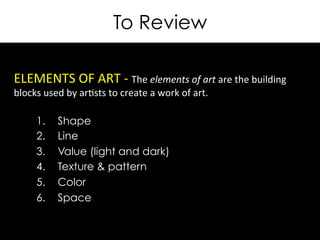
   1.  Shape
2.  Line
3.  Value (light and dark)
4.  Texture & pattern
5.  Color
6.  Space
To Review
KNOW THESE TERMS AND HOW THEY INFORM AN ARTWORK
PRINCIPLES	
  OF	
  ART	
  -­‐	
  The	
  principles	
  of	
  visual	
  art	
  are	
  the	
  
rules,	
  tools	
  and/or	
  guidelines	
  that	
  ar>sts	
  use	
  to	
  organize	
  the	
  
elements	
  of	
  art	
  in	
  an	
  artwork.	


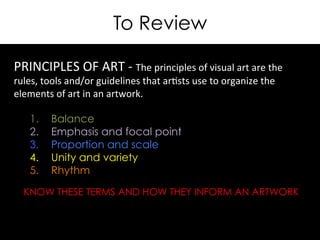
1.  Balance
2.  Emphasis and focal point
3.  Proportion and scale
4.  Unity and variety
5.  Rhythm


Reading Images
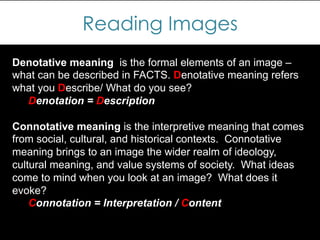
Denotative meaning is the formal elements of an image –
what can be described in FACTS. Denotative meaning refers
what you Describe/ What do you see?
Denotation = Description
Connotative meaning is the interpretive meaning that comes
from social, cultural, and historical contexts. Connotative
meaning brings to an image the wider realm of ideology,
cultural meaning, and value systems of society. What ideas
come to mind when you look at an image? What does it
evoke?
Connotation = Interpretation / Content
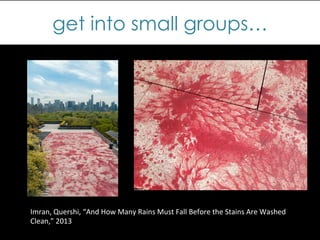
get into small groups…
Denotative meaning is the formal elements of an image –
what can be described in FACTS. Denotative meaning refers
what you Describe/ What do you see?
Denotation = Description
Connotative meaning is the interpretive meaning that comes
from social, cultural, and historical contexts. Connotative
meaning brings to an image the wider realm of ideology,
cultural meaning, and value systems of society. What ideas
come to mind when you look at an image? What does it
evoke?
Connotation = Interpretation / Content
get into small groups…
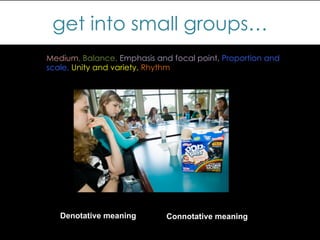
Denotative meaning 	
   Connotative meaning 	
  
Medium, Balance, Emphasis and focal point, Proportion and
scale, Unity and variety, Rhythm
get into small groups…
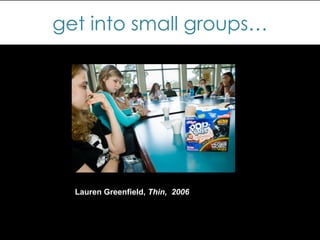
Lauren Greenfield, Thin, 2006	
  
get into small groups…
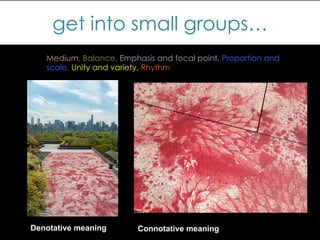
Denotative meaning 	
   Connotative meaning 	
  
Medium, Balance, Emphasis and focal point, Proportion and
scale, Unity and variety, Rhythm
get into small groups…
Imran,	
  Quershi,	
  “And	
  How	
  Many	
  Rains	
  Must	
  Fall	
  Before	
  the	
  Stains	
  Are	
  Washed	
  
Clean,”	
  2013	
  
Renaissance...
Modernism…
Postmodernism
Art History Vocabulary
•  Era
•  Period
•  Movement
•  School
•  Style
Art History Vocabulary
Era
–  Historically significant chunk of time such as
100-20,000 years
–  Geographically large
–  International
–  global
–  Distinguished by common, unifying
characteristics
Art History Vocabulary
Period
–  Historic chunk of time shorter than an Era
–  Geographically limited (usually a single
country)
–  Distinguished by common, unifying
characteristics
–  Not well-defined – could refer to the entire
rule of a European monarch (i.e. “Victorian”
period) or an individual artist’s phase (i.e.
Picasso’s “blue” period)
Art History Vocabulary
Movement
–  Historic chunk of time that is relatively short (months
or years)
–  Geographically very specific
–  Distinguished by common, unifying characteristics
–  Group of artists banded together to pursue a
specific objective (particular artistic style, political
mindset, common enemy, etc.)
–  Benefits:
•  Support each other
•  Hold their own exhibitions
•  Annoy the Art Establishment
Art History Vocabulary
School
–  Sometimes refers to an actual educational
institution and the artists who trained there
–  Often used as a synonym for movement – a
group of artists in a specific place with
common goals and a shared style – a sort of
informal or grassroots school
•  Example: The Hudson River School – a mid-19th
century American art movement carried out by a
group of landscape painters whose aesthetic vision
was influenced by romanticism.
Art History Vocabulary
Style
–  Common look (form and/or composition)
employed by an artist, school, or movement
•  Examples: Cubist, pointillist, photorealist, etc.
Pre-modernism = Renaissance
(an era)
Some key ideas leading up to modernist art
Modernism:
Modern art (an era) was a reaction to what
came before, such as The Renaissance.
Remember, we are setting up for…
Postmodernism
(the primary focus of our semester)
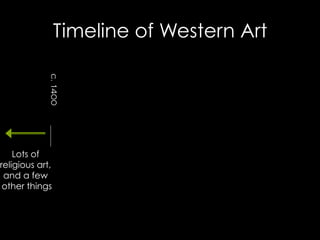
c.1400
Lots of
religious art,
and a few
other things
Timeline of Western Art
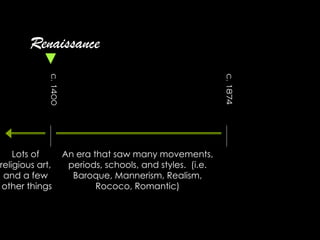
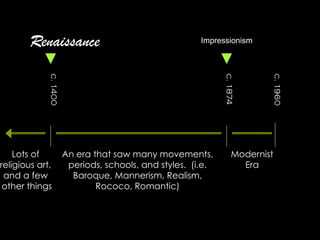
c.1400
c.1874
Renaissance
An era that saw many movements,
periods, schools, and styles. (i.e.
Baroque, Mannerism, Realism,
Rococo, Romantic)
Lots of
religious art,
and a few
other things
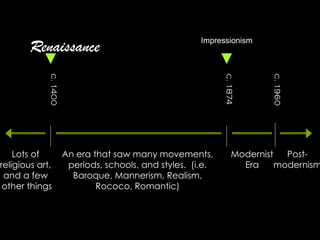
Modernist
Era
c.1400
c.1960
c.1874
Impressionism
Lots of
religious art,
and a few
other things
Renaissance
An era that saw many movements,
periods, schools, and styles. (i.e.
Baroque, Mannerism, Realism,
Rococo, Romantic)
Modernist
Era
c.1400
c.1960
c.1874
Lots of
religious art,
and a few
other things
Post-
modernism
Renaissance Impressionism
An era that saw many movements,
periods, schools, and styles. (i.e.
Baroque, Mannerism, Realism,
Rococo, Romantic)
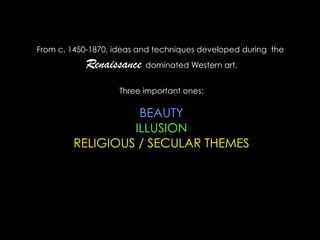
From c. 1450-1870, ideas and techniques developed during the
Renaissance dominated Western art.
Three important ones:
BEAUTY
ILLUSION
RELIGIOUS / SECULAR THEMES
1. Beauty
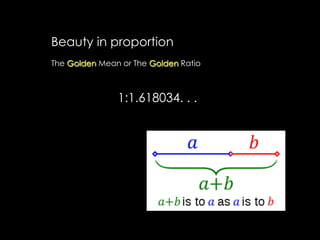
Beauty in proportion
The Golden Mean or The Golden Ratio
1:1.618034. . .
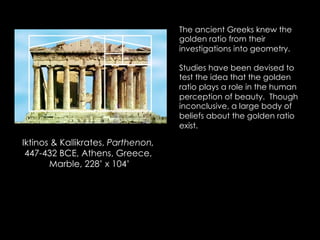
Iktinos & Kallikrates, Parthenon,
447-432 BCE, Athens, Greece,
Marble, 228’ x 104’
The ancient Greeks knew the
golden ratio from their
investigations into geometry.
Studies have been devised to
test the idea that the golden
ratio plays a role in the human
perception of beauty. Though
inconclusive, a large body of
beliefs about the golden ratio
exist.
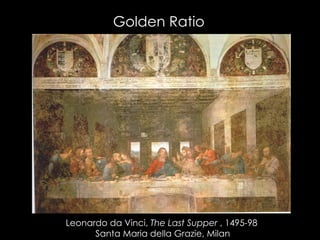
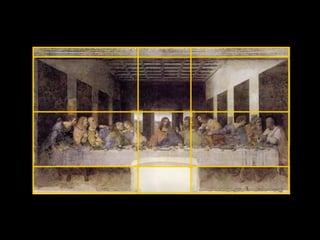
Leonardo da Vinci, The Last Supper , 1495-98
Santa Maria della Grazie, Milan
Golden Ratio
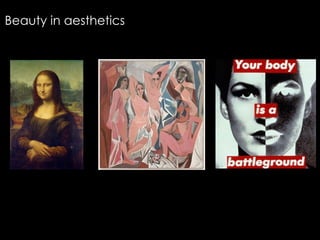
Beauty in aesthetics
Aesthetics is a branch of philosophy dealing with
the nature of art, beauty, and taste, with the
creation and appreciation of beauty.
Aesthetics change based on time and history
Western medieval aesthetics
Modern aesthetics
Postmodern Aesthetics
Beauty in aesthetics
2. Illusion
observed Reality as a kind of Truth
This was not always valued in art!
Perspective
(within the artworks
themselves)
•  Atmospheric
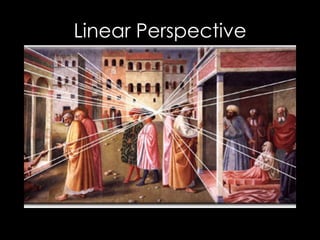
•  Linear
Perspective
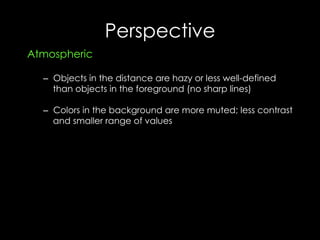
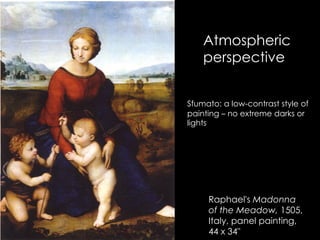
Atmospheric
–  Objects in the distance are hazy or less well-defined
than objects in the foreground (no sharp lines)
–  Colors in the background are more muted; less contrast
and smaller range of values
Raphael's Madonna
of the Meadow, 1505,
Italy, panel painting,
44 x 34"
Atmospheric
perspective
Sfumato: a low-contrast style of
painting – no extreme darks or
lights
Perspective
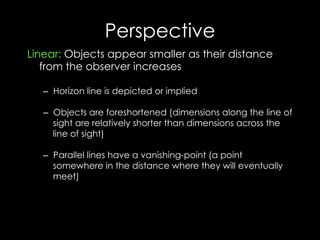
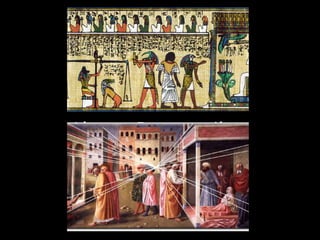
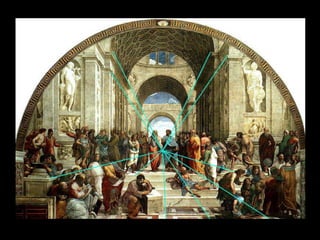
Linear: Objects appear smaller as their distance
from the observer increases
–  Horizon line is depicted or implied
–  Objects are foreshortened (dimensions along the line of
sight are relatively shorter than dimensions across the
line of sight)
–  Parallel lines have a vanishing-point (a point
somewhere in the distance where they will eventually
meet)
Linear Perspective
Linear Perspective
Linear Perspective
3. Religious / Secular
Themes
Religious Themes
The Church was arguably the largest
supporter of the arts.
•  Using images to speak to the public
– (many people were illiterate)
Belief in the power of images to convey
messages
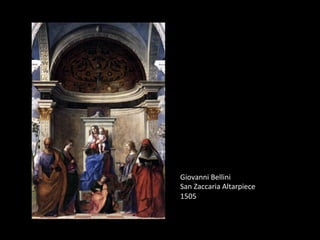
Giovanni	
  Bellini	
  
San	
  Zaccaria	
  Altarpiece	
  
1505	


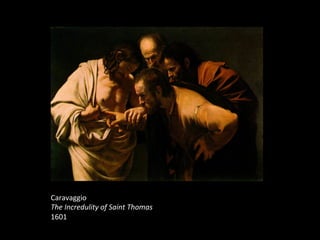
Caravaggio	
  
The	
  Incredulity	
  of	
  Saint	
  Thomas	
  
1601	


Secular Themes
In addition to religious images, around
1400 (approx. time of the beginning of the Renaissance)
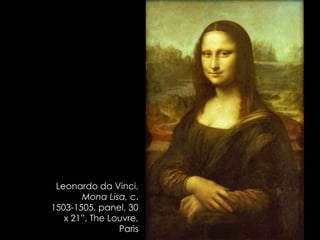
painters and sculptors began to
depict:
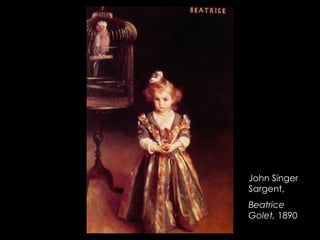
•  Average people
•  (portraits & genre paintings)
•  Historical events
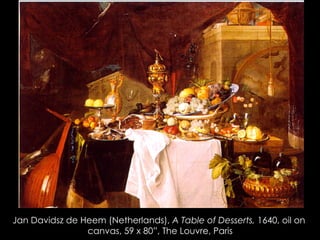
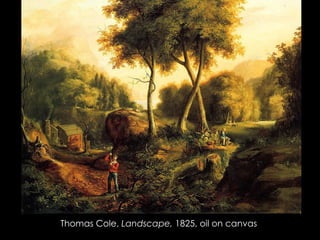
•  Everyday scenes
•  (landscapes & home interiors)
•  Stories from mythology
Leonardo da Vinci,
Mona Lisa, c.
1503-1505, panel, 30
x 21”, The Louvre,
Paris
Jan Davidsz de Heem (Netherlands), A Table of Desserts, 1640, oil on
canvas, 59 x 80”, The Louvre, Paris
Thomas Cole, Landscape, 1825, oil on canvas
John Singer
Sargent,
Beatrice
Golet, 1890
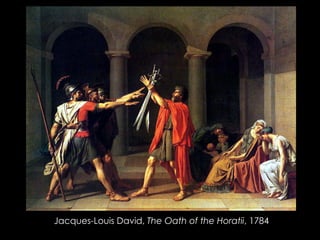
Jacques-Louis David, The Oath of the Horatii, 1784
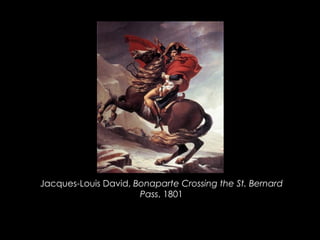
Jacques-Louis David, Bonaparte Crossing the St. Bernard
Pass, 1801
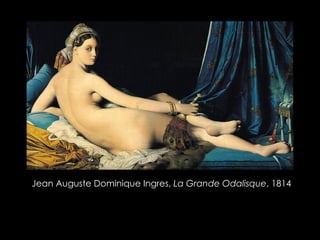
Jean Auguste Dominique Ingres, La Grande Odalisque, 1814
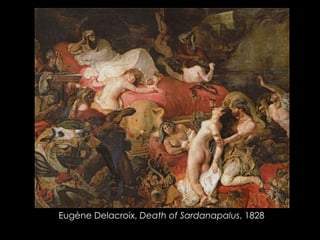
Eugène Delacroix, Death of Sardanapalus, 1828
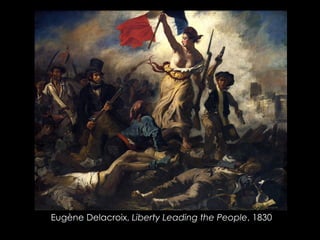
Eugène Delacroix, Liberty Leading the People, 1830
We move from the era of the
Renaissance to…
Modernism
(another era)
The Modern Era
What major technological/social event in the
19th century changed the lifestyles of
most of the Western world?
the Industrial Revolution
The Modern Era
What major technological/social event in the
19th century changed the lifestyles of
most of the Western world?
Causes of change in art were social and technological,
not aesthetic:
• Growth of cities
• New methods of transportation and communication
(i.e. internal combustion engine, railroads,
lightbulb, phonograph, telephone)
• Change in political systems and structures; Increased
democracy
• Secularization of modern society
• Availability of photography to general public
• Interest in our inner life (the psyche) – Freud et al.
Modernism
Modernism in a nutshell
•  New economic, social and political conditions of a
changing, industrialized world. (ideas, activities
and creations of people who thought "traditional"
forms of art, architecture, literature, religion, social
organization and daily life were becoming
outdated)
•  The traditions of the past (the certainty of
Enlightenment/Renaissance thinking) were cast
aside in a spirit of experimentation (new ways of
seeing, new ideas about the nature of materials
and functions of art, embracing uncertainty)
•  Affected many aspects of culture and society, not
limited to visual art and artists
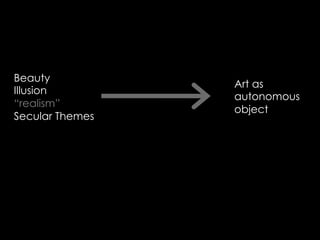
Beauty
Illusion
“realism”
Secular Themes
Art as
autonomous
object
Five recurring themes in modernist art:
1.  Seeing and perspective
2.  Abstraction
3.  Expression
4.  Fantasy
5.  Concept/idea
MEMORIZE THESE!
1. Seeing and perspective
New ways of looking at things; capturing
new/unfamiliar aspects of familiar things
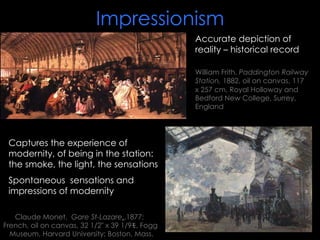
Claude Monet, Gare St-Lazare,,1877;
French, oil on canvas, 32 1/2" x 39 1/9モ, Fogg
Museum, Harvard University; Boston, Mass.
Captures the experience of
modernity, of being in the station:
the smoke, the light, the sensations
Spontaneous sensations and
impressions of modernity
Impressionism
Accurate depiction of
reality – historical record
William Frith, Paddington Railway
Station, 1882, oil on canvas, 117
x 257 cm, Royal Holloway and
Bedford New College, Surrey,
England
Impressionist Painters
•  Interested in a new way of seeing – paintings not
meant to be analyzed or decoded logically &
intellectually
•  Preoccupied with change, impermanence, and
instability - probably a reflection of the urban,
industrial world that surrounded them
•  They tried to capture spontaneity: “this very
instant”
•  Interested in depicting fleeting qualities of light
and color in nature
•  Made scenes of pleasure/leisure from their own
lives
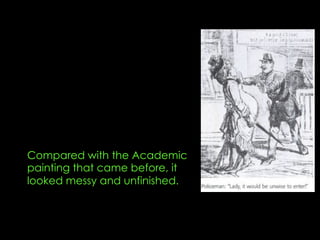
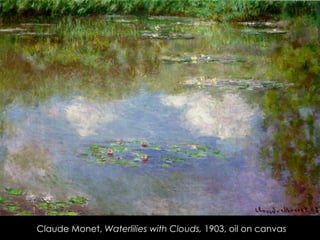
Compared with the Academic
painting that came before, it
looked messy and unfinished.
Claude Monet, Waterlilies with Clouds, 1903, oil on canvas

09.10 elementsinto modernism-1

  • 1.
    Songs of theDay “Money for Nothing” by Dire Straights from 1985 album Brothers in Arms “Material Girl” by Madonna from the 1984 album Like a Virgin
  • 2.
    Songs of theDay “Land of Confusion” by Genesis from 1986 album Invisible Touch “Don’t come around here no more” by Tom Petty and the Heartbreakers from the 1984 album Southern Accents
  • 3.
    More strategies /tools for reading and analyzing art. Specifically, denotative / connotative understanding Look at images in an art historical context to understand the significance of history and social connections. Art does not exist in a bubble. Today’s lecture helps to set up Postmodernism / Contemporary Art (the primary focus of our semester) Today’s Schedule
  • 4.
    Assignments: Exhibition Review #1 Directionsare posted on d2l DUE: Tuesday, October 1st by midnight – in the dropbox on D2L
  • 5.
    Save your fileas: yournameER1.doc Do not upload formats other than .doc or .docx – any other formats WILL NOT BE GRADED) ex: TraciQuinnER1.doc
  • 6.
    To Review ELEMENTS  OF  ART  -­‐  The  elements  of  art  are  the  building   blocks  used  by  ar>sts  to  create  a  work  of  art.         1.  Shape 2.  Line 3.  Value (light and dark) 4.  Texture & pattern 5.  Color 6.  Space
  • 7.
    To Review KNOW THESETERMS AND HOW THEY INFORM AN ARTWORK PRINCIPLES  OF  ART  -­‐  The  principles  of  visual  art  are  the   rules,  tools  and/or  guidelines  that  ar>sts  use  to  organize  the   elements  of  art  in  an  artwork.     1.  Balance 2.  Emphasis and focal point 3.  Proportion and scale 4.  Unity and variety 5.  Rhythm          
  • 8.
    Reading Images Denotative meaningis the formal elements of an image – what can be described in FACTS. Denotative meaning refers what you Describe/ What do you see? Denotation = Description Connotative meaning is the interpretive meaning that comes from social, cultural, and historical contexts. Connotative meaning brings to an image the wider realm of ideology, cultural meaning, and value systems of society. What ideas come to mind when you look at an image? What does it evoke? Connotation = Interpretation / Content
  • 9.
    get into smallgroups… Denotative meaning is the formal elements of an image – what can be described in FACTS. Denotative meaning refers what you Describe/ What do you see? Denotation = Description Connotative meaning is the interpretive meaning that comes from social, cultural, and historical contexts. Connotative meaning brings to an image the wider realm of ideology, cultural meaning, and value systems of society. What ideas come to mind when you look at an image? What does it evoke? Connotation = Interpretation / Content
  • 10.
    get into smallgroups… Denotative meaning   Connotative meaning   Medium, Balance, Emphasis and focal point, Proportion and scale, Unity and variety, Rhythm
  • 11.
    get into smallgroups… Lauren Greenfield, Thin, 2006  
  • 12.
    get into smallgroups… Denotative meaning   Connotative meaning   Medium, Balance, Emphasis and focal point, Proportion and scale, Unity and variety, Rhythm
  • 13.
    get into smallgroups… Imran,  Quershi,  “And  How  Many  Rains  Must  Fall  Before  the  Stains  Are  Washed   Clean,”  2013  
  • 14.
  • 15.
    Art History Vocabulary • Era •  Period •  Movement •  School •  Style
  • 16.
    Art History Vocabulary Era – Historically significant chunk of time such as 100-20,000 years –  Geographically large –  International –  global –  Distinguished by common, unifying characteristics
  • 17.
    Art History Vocabulary Period – Historic chunk of time shorter than an Era –  Geographically limited (usually a single country) –  Distinguished by common, unifying characteristics –  Not well-defined – could refer to the entire rule of a European monarch (i.e. “Victorian” period) or an individual artist’s phase (i.e. Picasso’s “blue” period)
  • 18.
    Art History Vocabulary Movement – Historic chunk of time that is relatively short (months or years) –  Geographically very specific –  Distinguished by common, unifying characteristics –  Group of artists banded together to pursue a specific objective (particular artistic style, political mindset, common enemy, etc.) –  Benefits: •  Support each other •  Hold their own exhibitions •  Annoy the Art Establishment
  • 19.
    Art History Vocabulary School – Sometimes refers to an actual educational institution and the artists who trained there –  Often used as a synonym for movement – a group of artists in a specific place with common goals and a shared style – a sort of informal or grassroots school •  Example: The Hudson River School – a mid-19th century American art movement carried out by a group of landscape painters whose aesthetic vision was influenced by romanticism.
  • 20.
    Art History Vocabulary Style – Common look (form and/or composition) employed by an artist, school, or movement •  Examples: Cubist, pointillist, photorealist, etc.
  • 21.
    Pre-modernism = Renaissance (anera) Some key ideas leading up to modernist art Modernism: Modern art (an era) was a reaction to what came before, such as The Renaissance.
  • 22.
    Remember, we aresetting up for… Postmodernism (the primary focus of our semester)
  • 23.
    c.1400 Lots of religious art, anda few other things Timeline of Western Art
  • 24.
    c.1400 c.1874 Renaissance An era thatsaw many movements, periods, schools, and styles. (i.e. Baroque, Mannerism, Realism, Rococo, Romantic) Lots of religious art, and a few other things
  • 25.
    Modernist Era c.1400 c.1960 c.1874 Impressionism Lots of religious art, anda few other things Renaissance An era that saw many movements, periods, schools, and styles. (i.e. Baroque, Mannerism, Realism, Rococo, Romantic)
  • 26.
    Modernist Era c.1400 c.1960 c.1874 Lots of religious art, anda few other things Post- modernism Renaissance Impressionism An era that saw many movements, periods, schools, and styles. (i.e. Baroque, Mannerism, Realism, Rococo, Romantic)
  • 27.
    From c. 1450-1870,ideas and techniques developed during the Renaissance dominated Western art. Three important ones: BEAUTY ILLUSION RELIGIOUS / SECULAR THEMES
  • 28.
  • 29.
    Beauty in proportion TheGolden Mean or The Golden Ratio 1:1.618034. . .
  • 30.
    Iktinos & Kallikrates,Parthenon, 447-432 BCE, Athens, Greece, Marble, 228’ x 104’ The ancient Greeks knew the golden ratio from their investigations into geometry. Studies have been devised to test the idea that the golden ratio plays a role in the human perception of beauty. Though inconclusive, a large body of beliefs about the golden ratio exist.
  • 31.
    Leonardo da Vinci,The Last Supper , 1495-98 Santa Maria della Grazie, Milan Golden Ratio
  • 33.
    Beauty in aesthetics Aestheticsis a branch of philosophy dealing with the nature of art, beauty, and taste, with the creation and appreciation of beauty. Aesthetics change based on time and history Western medieval aesthetics Modern aesthetics Postmodern Aesthetics
  • 34.
  • 35.
    2. Illusion observed Realityas a kind of Truth This was not always valued in art!
  • 36.
  • 37.
    Perspective Atmospheric –  Objects inthe distance are hazy or less well-defined than objects in the foreground (no sharp lines) –  Colors in the background are more muted; less contrast and smaller range of values
  • 38.
    Raphael's Madonna of theMeadow, 1505, Italy, panel painting, 44 x 34" Atmospheric perspective Sfumato: a low-contrast style of painting – no extreme darks or lights
  • 39.
    Perspective Linear: Objects appearsmaller as their distance from the observer increases –  Horizon line is depicted or implied –  Objects are foreshortened (dimensions along the line of sight are relatively shorter than dimensions across the line of sight) –  Parallel lines have a vanishing-point (a point somewhere in the distance where they will eventually meet)
  • 40.
  • 41.
  • 42.
  • 43.
    3. Religious /Secular Themes
  • 44.
    Religious Themes The Churchwas arguably the largest supporter of the arts. •  Using images to speak to the public – (many people were illiterate) Belief in the power of images to convey messages
  • 45.
    Giovanni  Bellini   San  Zaccaria  Altarpiece   1505    
  • 46.
    Caravaggio   The  Incredulity  of  Saint  Thomas   1601    
  • 47.
    Secular Themes In additionto religious images, around 1400 (approx. time of the beginning of the Renaissance) painters and sculptors began to depict: •  Average people •  (portraits & genre paintings) •  Historical events •  Everyday scenes •  (landscapes & home interiors) •  Stories from mythology
  • 48.
    Leonardo da Vinci, MonaLisa, c. 1503-1505, panel, 30 x 21”, The Louvre, Paris
  • 49.
    Jan Davidsz deHeem (Netherlands), A Table of Desserts, 1640, oil on canvas, 59 x 80”, The Louvre, Paris
  • 50.
    Thomas Cole, Landscape,1825, oil on canvas
  • 51.
  • 52.
    Jacques-Louis David, TheOath of the Horatii, 1784
  • 53.
    Jacques-Louis David, BonaparteCrossing the St. Bernard Pass, 1801
  • 54.
    Jean Auguste DominiqueIngres, La Grande Odalisque, 1814
  • 55.
    Eugène Delacroix, Deathof Sardanapalus, 1828
  • 56.
    Eugène Delacroix, LibertyLeading the People, 1830
  • 57.
    We move fromthe era of the Renaissance to… Modernism (another era)
  • 58.
    The Modern Era Whatmajor technological/social event in the 19th century changed the lifestyles of most of the Western world? the Industrial Revolution
  • 59.
    The Modern Era Whatmajor technological/social event in the 19th century changed the lifestyles of most of the Western world?
  • 60.
    Causes of changein art were social and technological, not aesthetic: • Growth of cities • New methods of transportation and communication (i.e. internal combustion engine, railroads, lightbulb, phonograph, telephone) • Change in political systems and structures; Increased democracy • Secularization of modern society • Availability of photography to general public • Interest in our inner life (the psyche) – Freud et al. Modernism
  • 61.
    Modernism in anutshell •  New economic, social and political conditions of a changing, industrialized world. (ideas, activities and creations of people who thought "traditional" forms of art, architecture, literature, religion, social organization and daily life were becoming outdated) •  The traditions of the past (the certainty of Enlightenment/Renaissance thinking) were cast aside in a spirit of experimentation (new ways of seeing, new ideas about the nature of materials and functions of art, embracing uncertainty) •  Affected many aspects of culture and society, not limited to visual art and artists
  • 62.
  • 63.
    Five recurring themesin modernist art: 1.  Seeing and perspective 2.  Abstraction 3.  Expression 4.  Fantasy 5.  Concept/idea MEMORIZE THESE!
  • 64.
    1. Seeing andperspective New ways of looking at things; capturing new/unfamiliar aspects of familiar things
  • 65.
    Claude Monet, GareSt-Lazare,,1877; French, oil on canvas, 32 1/2" x 39 1/9モ, Fogg Museum, Harvard University; Boston, Mass. Captures the experience of modernity, of being in the station: the smoke, the light, the sensations Spontaneous sensations and impressions of modernity Impressionism Accurate depiction of reality – historical record William Frith, Paddington Railway Station, 1882, oil on canvas, 117 x 257 cm, Royal Holloway and Bedford New College, Surrey, England
  • 66.
    Impressionist Painters •  Interestedin a new way of seeing – paintings not meant to be analyzed or decoded logically & intellectually •  Preoccupied with change, impermanence, and instability - probably a reflection of the urban, industrial world that surrounded them •  They tried to capture spontaneity: “this very instant” •  Interested in depicting fleeting qualities of light and color in nature •  Made scenes of pleasure/leisure from their own lives
  • 67.
    Compared with theAcademic painting that came before, it looked messy and unfinished.
  • 68.
    Claude Monet, Waterlilieswith Clouds, 1903, oil on canvas