ARTERIOVENOUS
MALFORMATIONS
Dr Avijit Banerjee (Surgery
PGT)
Dr AK Malhotra ( CHIEF
SURGEON)
SOUTH EASTERN RAILWAY
HOSPITAL
KOLKATA
THE CASE
A 22 year old boy was admitted with history of pain in the right
gluteal region for the last 2 months
Patient noticed dilated veins in right gluteal region
There was no h/o altered bowel habits , or bleeding per rectum
, or hematuria
No history of fever, loss of appetite, loss of weight
The swelling is not associated with any ulceration or satellite
nodules.
No h/o cough, hemoptysis, bone pain, headache, vomiting or
jaundice
No h/o previous excision of the swelling or presence of similar
swelling in the past.
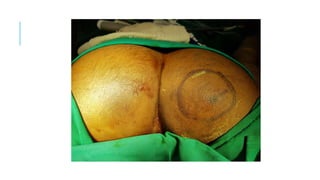
INSPECTION
There was a single ill defined swelling about 7x10cm
on the right buttock
There was no associated venous
prominence/ulceration/scar mark/satellite nodule
Cough impulse not seen
No associated pressure symptoms leading to wasting
of muscles or swelling of lower limbs
PALPATIONThere is no change of temperature over the
swelling or tenderness.
There is presence of thrill on palpation over the
swelling
The mass in soft in consistency and
compressible
Fluctuation and transillumination test is negative
No palpable cough impulse
Normal movement of adjacent joints
Examination of regional lymph nodes did not
reveal any abnormality
Per rectal examination reveals bulge on the right
side along with thrill
RADIOLOGICAL INVESTIGATIONS
USG
ARTERIOVENOUS
MALFORMATION IN THE RIGHT
GLUTEAL MUSCLES
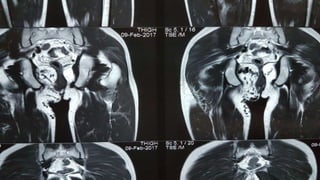
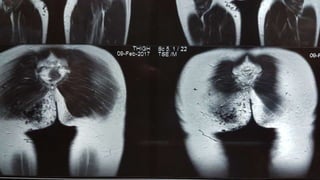
MRI
A LARGE 11.7x10.8x5.9cm AVM
IN RIGHT GLUTEAL REGION
THE LESION IS EXTENDING TO
THE ISCHIORECTAL AND
PERIANAL SPACE WITHOUT ANY
EXTENSION TO THE
INTERSPHINCTERIC REGION
FEEDING FROM BRANCHES OF
RIGHT INTERNAL ILIAC ARTERY
AND DRAINING INTO INTERNAL
ILIAC VEIN
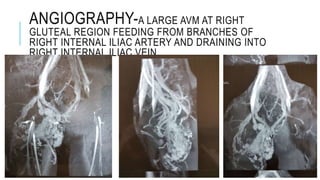
ANGIOGRAPHY-A LARGE AVM AT RIGHT
GLUTEAL REGION FEEDING FROM BRANCHES OF
RIGHT INTERNAL ILIAC ARTERY AND DRAINING INTO
RIGHT INTERNAL ILIAC VEIN
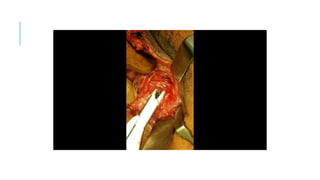
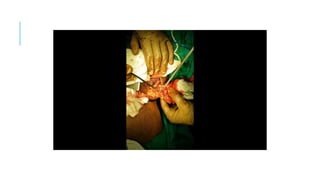
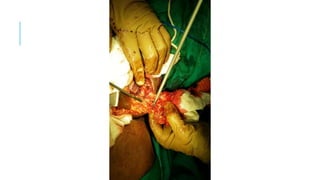
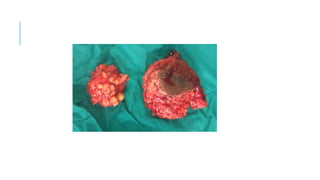
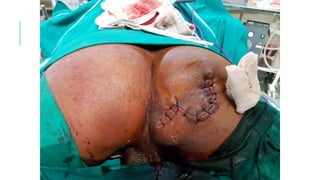
THE COURSE OF TREATMENT
Embolization of pelvic AVM done
>95% flow reduction achieved
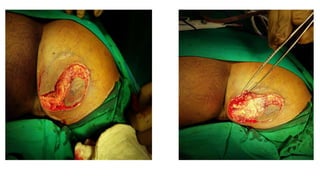
Plan for excision of AVM in right
gluteal region done under general
anaesthesia after taking high risk
consent and consent for colostomy
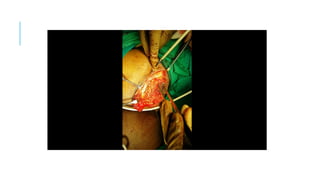
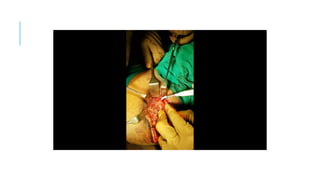
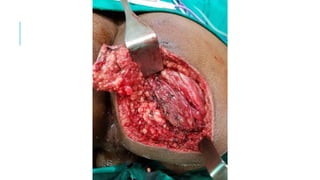
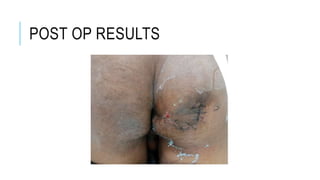
POST OP RESULTS
ARTERIOVENOUS MALFORMATION
Arteriovenous malformation (AVM) results from an error of vascular
development between the 4th and 6th weeks of gestation
According to Halsted it results from failure of arteriovenous channels in
the primitive retiform plexus to regress
AVM is 20 times more common in the central nervous system, where
apoptosis is rare
An absent capillary bed causes shunting of blood directly from the arterial
to-venous circulation, through a fistula or nidus (abnormal channels
bridging the feeding artery to the draining veins)
Hereditary haemorrhagic telangiectasia
(HHT) results from mutations in endoglin
and activin receptor like kinase 1, which
affect TGF-b signalling
Capillary malformation-arteriovenous
malformation (CM-AVM) is caused by a
mutation in RASA1
AVM may enlarge because of increased
blood flow causing collateralization,
dilatation of vessels (especially venous
ectasia), and thickening of adjacent arteries
and veins
Shunting and aneurysms due to trauma or
The most common site of extra cranial AVM is the head and neck,
followed by the limbs, trunk, and viscera
Early lesions present as a pink-red cutaneous stain, without a
palpable thrill or bruit
In future, the patient is at risk for pain, ulceration, and bleeding
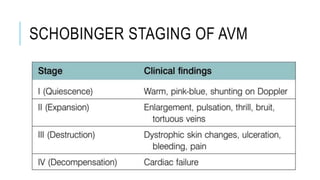
SCHOBINGER STAGING OF AVM
DIAGNOSIS
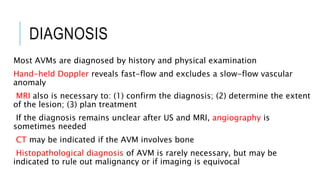
Most AVMs are diagnosed by history and physical examination
Hand-held Doppler reveals fast-flow and excludes a slow-flow vascular
anomaly
MRI also is necessary to: (1) confirm the diagnosis; (2) determine the extent
of the lesion; (3) plan treatment
If the diagnosis remains unclear after US and MRI, angiography is
sometimes needed
CT may be indicated if the AVM involves bone
Histopathological diagnosis of AVM is rarely necessary, but may be
indicated to rule out malignancy or if imaging is equivocal
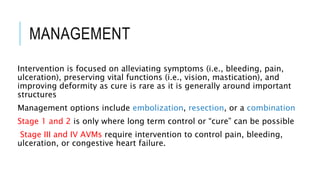
MANAGEMENT
Intervention is focused on alleviating symptoms (i.e., bleeding, pain,
ulceration), preserving vital functions (i.e., vision, mastication), and
improving deformity as cure is rare as it is generally around important
structures
Management options include embolization, resection, or a combination
Stage 1 and 2 is only where long term control or “cure” can be possible
Stage III and IV AVMs require intervention to control pain, bleeding,
ulceration, or congestive heart failure.
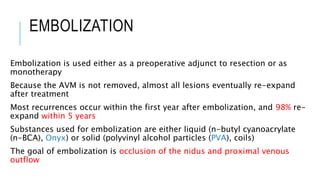
EMBOLIZATION
Embolization is used either as a preoperative adjunct to resection or as
monotherapy
Because the AVM is not removed, almost all lesions eventually re-expand
after treatment
Most recurrences occur within the first year after embolization, and 98% re-
expand within 5 years
Substances used for embolization are either liquid (n-butyl cyanoacrylate
(n-BCA), Onyx) or solid (polyvinyl alcohol particles (PVA), coils)
The goal of embolization is occlusion of the nidus and proximal venous
outflow
For preoperative embolization, temporary
occlusive substances (Gel foam powder, PVA,
embospheres) that undergo phagocytosis are
used. Permanent liquid agents capable of
permeating the nidus (n-BCA, Onyx) are
employed when embolization is the primary
treatment
The most frequent complication of embolization
is ulceration
RESECTION
Wide extirpation and reconstruction of large, diffuse AVM should be
exercised with caution because: (1) cure is rare and the recurrence rate is
high; (2) the resulting deformity is often worse than the appearance of the
malformation; (3) resection is associated with significant blood loss,
iatrogenic injury, and morbidity
Preoperative embolization will facilitate the procedure by reducing the
size of the AVM, minimizing blood loss, and creating scar tissue to aid the
dissection
Excision should be done 24–72 h after embolization, before recanalization
restores blood flow to the lesion
RECONSTRUCTION
Skin grafting over ulcerated areas has a high failure
rate because the underlying tissue is ischemic;
excision with regional flap transfer may be required
THANK YOU
Arteriovenous malformation

Arteriovenous malformation

  • 1.
    ARTERIOVENOUS MALFORMATIONS Dr Avijit Banerjee(Surgery PGT) Dr AK Malhotra ( CHIEF SURGEON) SOUTH EASTERN RAILWAY HOSPITAL KOLKATA
  • 2.
    THE CASE A 22year old boy was admitted with history of pain in the right gluteal region for the last 2 months Patient noticed dilated veins in right gluteal region There was no h/o altered bowel habits , or bleeding per rectum , or hematuria No history of fever, loss of appetite, loss of weight The swelling is not associated with any ulceration or satellite nodules. No h/o cough, hemoptysis, bone pain, headache, vomiting or jaundice No h/o previous excision of the swelling or presence of similar swelling in the past.
  • 3.
    INSPECTION There was asingle ill defined swelling about 7x10cm on the right buttock There was no associated venous prominence/ulceration/scar mark/satellite nodule Cough impulse not seen No associated pressure symptoms leading to wasting of muscles or swelling of lower limbs
  • 4.
    PALPATIONThere is nochange of temperature over the swelling or tenderness. There is presence of thrill on palpation over the swelling The mass in soft in consistency and compressible Fluctuation and transillumination test is negative No palpable cough impulse Normal movement of adjacent joints Examination of regional lymph nodes did not reveal any abnormality Per rectal examination reveals bulge on the right side along with thrill
  • 5.
    RADIOLOGICAL INVESTIGATIONS USG ARTERIOVENOUS MALFORMATION INTHE RIGHT GLUTEAL MUSCLES MRI A LARGE 11.7x10.8x5.9cm AVM IN RIGHT GLUTEAL REGION THE LESION IS EXTENDING TO THE ISCHIORECTAL AND PERIANAL SPACE WITHOUT ANY EXTENSION TO THE INTERSPHINCTERIC REGION FEEDING FROM BRANCHES OF RIGHT INTERNAL ILIAC ARTERY AND DRAINING INTO INTERNAL ILIAC VEIN
  • 8.
    ANGIOGRAPHY-A LARGE AVMAT RIGHT GLUTEAL REGION FEEDING FROM BRANCHES OF RIGHT INTERNAL ILIAC ARTERY AND DRAINING INTO RIGHT INTERNAL ILIAC VEIN
  • 9.
    THE COURSE OFTREATMENT Embolization of pelvic AVM done >95% flow reduction achieved Plan for excision of AVM in right gluteal region done under general anaesthesia after taking high risk consent and consent for colostomy
  • 21.
  • 22.
    ARTERIOVENOUS MALFORMATION Arteriovenous malformation(AVM) results from an error of vascular development between the 4th and 6th weeks of gestation According to Halsted it results from failure of arteriovenous channels in the primitive retiform plexus to regress AVM is 20 times more common in the central nervous system, where apoptosis is rare An absent capillary bed causes shunting of blood directly from the arterial to-venous circulation, through a fistula or nidus (abnormal channels bridging the feeding artery to the draining veins)
  • 23.
    Hereditary haemorrhagic telangiectasia (HHT)results from mutations in endoglin and activin receptor like kinase 1, which affect TGF-b signalling Capillary malformation-arteriovenous malformation (CM-AVM) is caused by a mutation in RASA1 AVM may enlarge because of increased blood flow causing collateralization, dilatation of vessels (especially venous ectasia), and thickening of adjacent arteries and veins Shunting and aneurysms due to trauma or
  • 24.
    The most commonsite of extra cranial AVM is the head and neck, followed by the limbs, trunk, and viscera Early lesions present as a pink-red cutaneous stain, without a palpable thrill or bruit In future, the patient is at risk for pain, ulceration, and bleeding
  • 25.
  • 26.
    DIAGNOSIS Most AVMs arediagnosed by history and physical examination Hand-held Doppler reveals fast-flow and excludes a slow-flow vascular anomaly MRI also is necessary to: (1) confirm the diagnosis; (2) determine the extent of the lesion; (3) plan treatment If the diagnosis remains unclear after US and MRI, angiography is sometimes needed CT may be indicated if the AVM involves bone Histopathological diagnosis of AVM is rarely necessary, but may be indicated to rule out malignancy or if imaging is equivocal
  • 27.
    MANAGEMENT Intervention is focusedon alleviating symptoms (i.e., bleeding, pain, ulceration), preserving vital functions (i.e., vision, mastication), and improving deformity as cure is rare as it is generally around important structures Management options include embolization, resection, or a combination Stage 1 and 2 is only where long term control or “cure” can be possible Stage III and IV AVMs require intervention to control pain, bleeding, ulceration, or congestive heart failure.
  • 28.
    EMBOLIZATION Embolization is usedeither as a preoperative adjunct to resection or as monotherapy Because the AVM is not removed, almost all lesions eventually re-expand after treatment Most recurrences occur within the first year after embolization, and 98% re- expand within 5 years Substances used for embolization are either liquid (n-butyl cyanoacrylate (n-BCA), Onyx) or solid (polyvinyl alcohol particles (PVA), coils) The goal of embolization is occlusion of the nidus and proximal venous outflow
  • 29.
    For preoperative embolization,temporary occlusive substances (Gel foam powder, PVA, embospheres) that undergo phagocytosis are used. Permanent liquid agents capable of permeating the nidus (n-BCA, Onyx) are employed when embolization is the primary treatment The most frequent complication of embolization is ulceration
  • 30.
    RESECTION Wide extirpation andreconstruction of large, diffuse AVM should be exercised with caution because: (1) cure is rare and the recurrence rate is high; (2) the resulting deformity is often worse than the appearance of the malformation; (3) resection is associated with significant blood loss, iatrogenic injury, and morbidity Preoperative embolization will facilitate the procedure by reducing the size of the AVM, minimizing blood loss, and creating scar tissue to aid the dissection Excision should be done 24–72 h after embolization, before recanalization restores blood flow to the lesion
  • 31.
    RECONSTRUCTION Skin grafting overulcerated areas has a high failure rate because the underlying tissue is ischemic; excision with regional flap transfer may be required
  • 32.