Part 2
Dr Sameeha Khan
 Cerebral arteries
 Vertebral artery
 Basilar artery
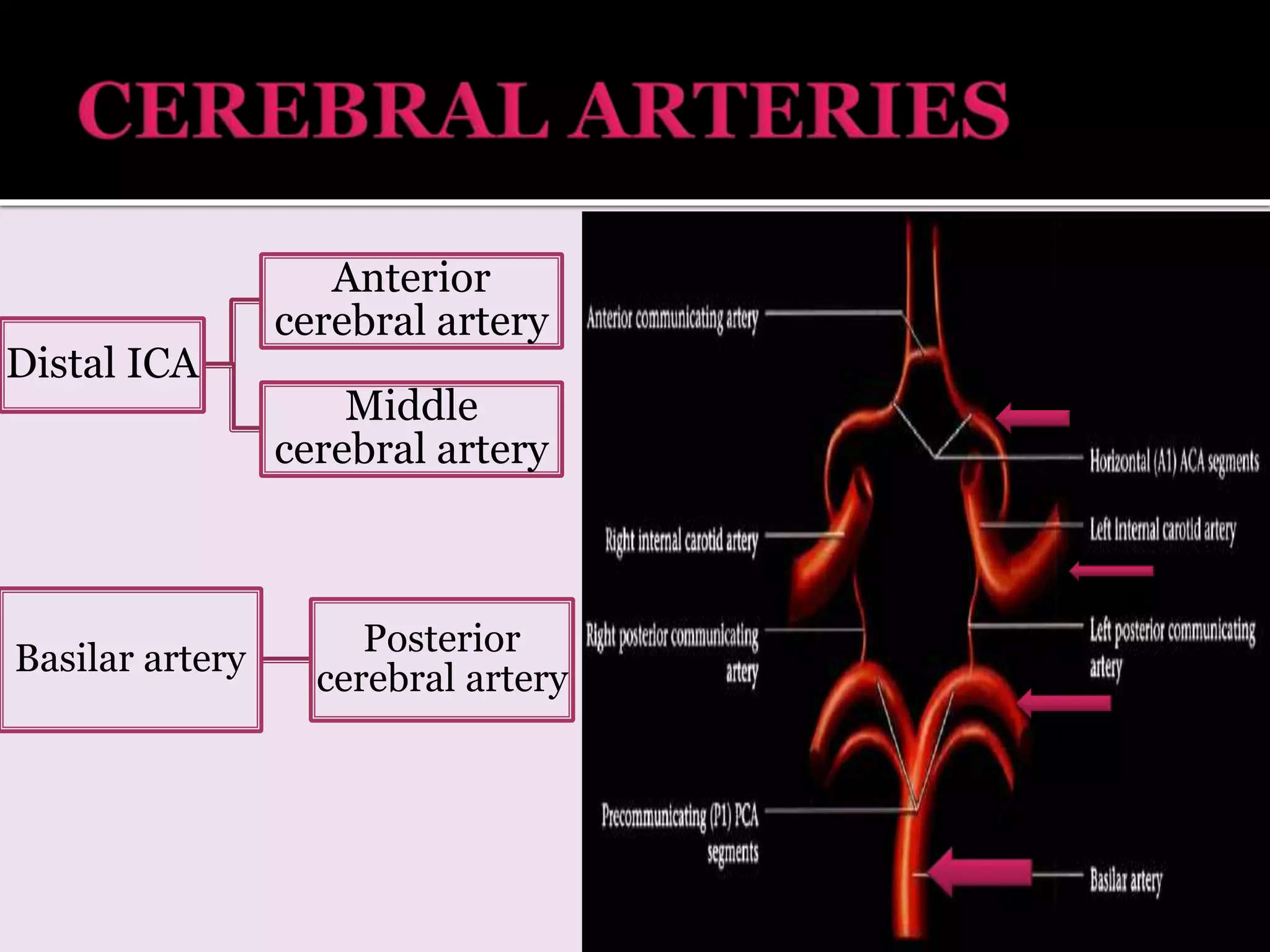
Distal ICA
Anterior
cerebral artery
Middle
cerebral artery
Basilar artery
Posterior
cerebral artery
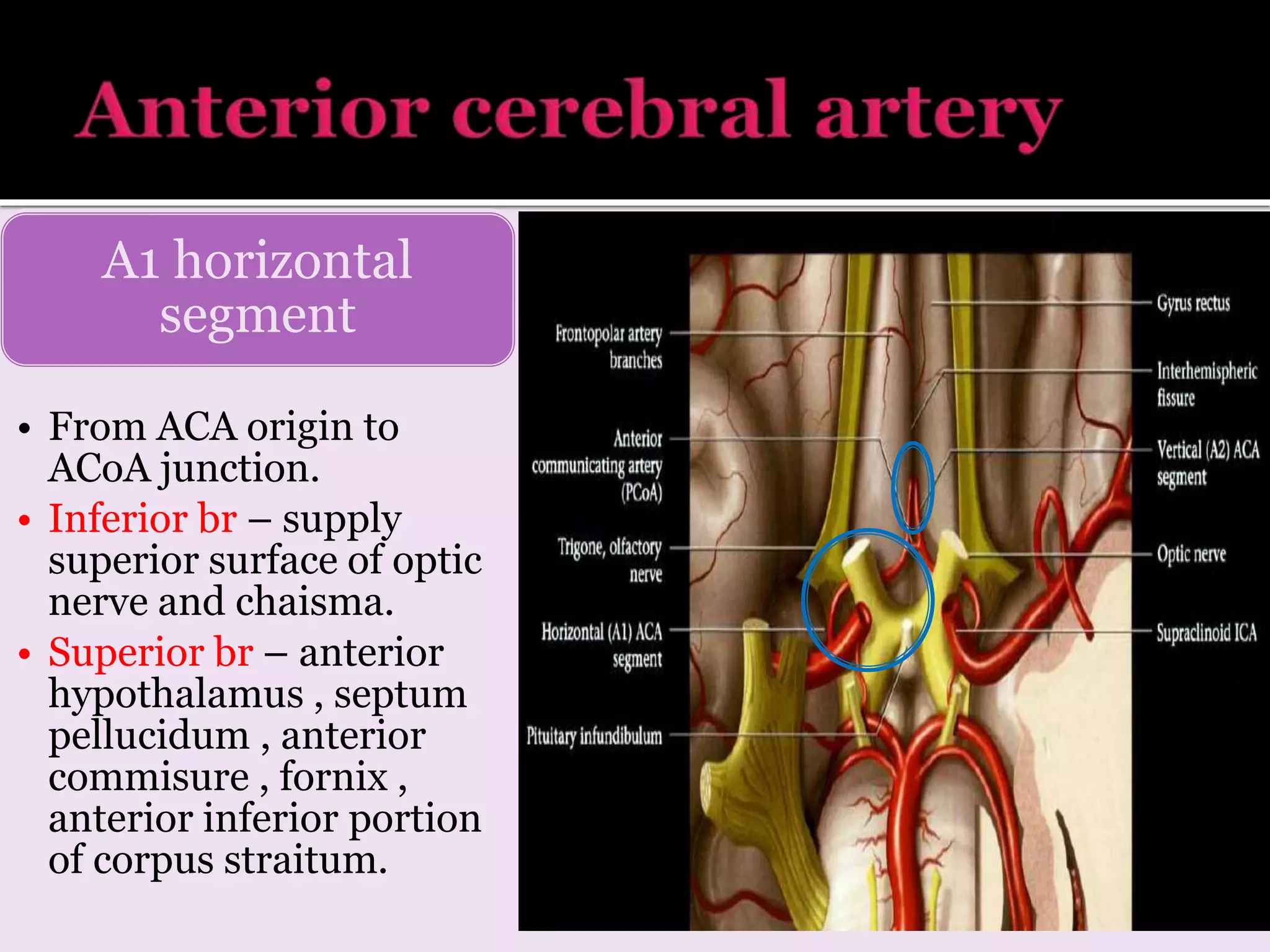
A1 horizontal
segment
• From ACA origin to
ACoA junction.
• Inferior br – supply
superior surface of optic
nerve and chaisma.
• Superior br – anterior
hypothalamus , septum
pellucidum , anterior
commisure , fornix ,
anterior inferior portion
of corpus straitum.
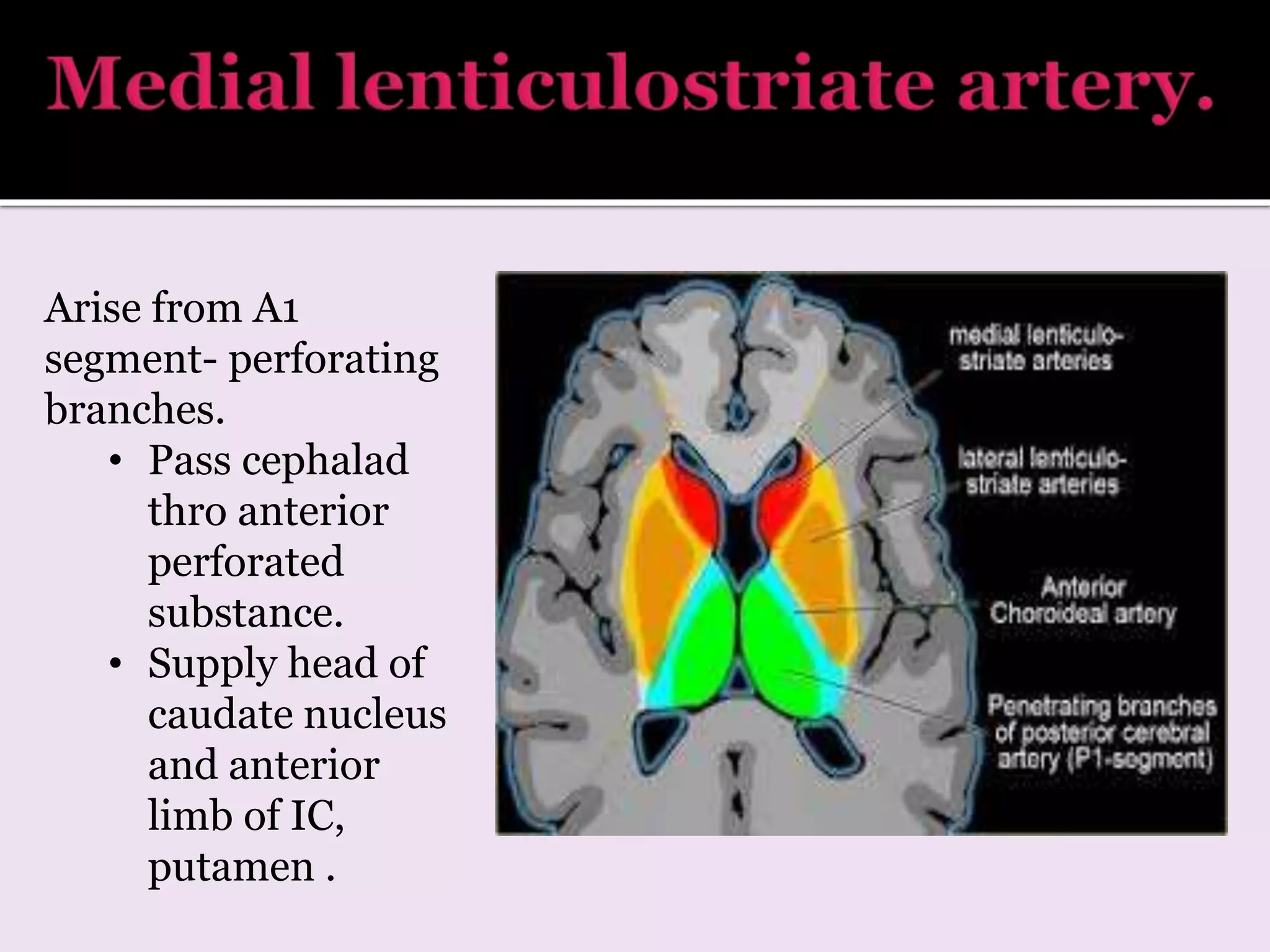
Arise from A1
segment- perforating
branches.
• Pass cephalad
thro anterior
perforated
substance.
• Supply head of
caudate nucleus
and anterior
limb of IC,
putamen .
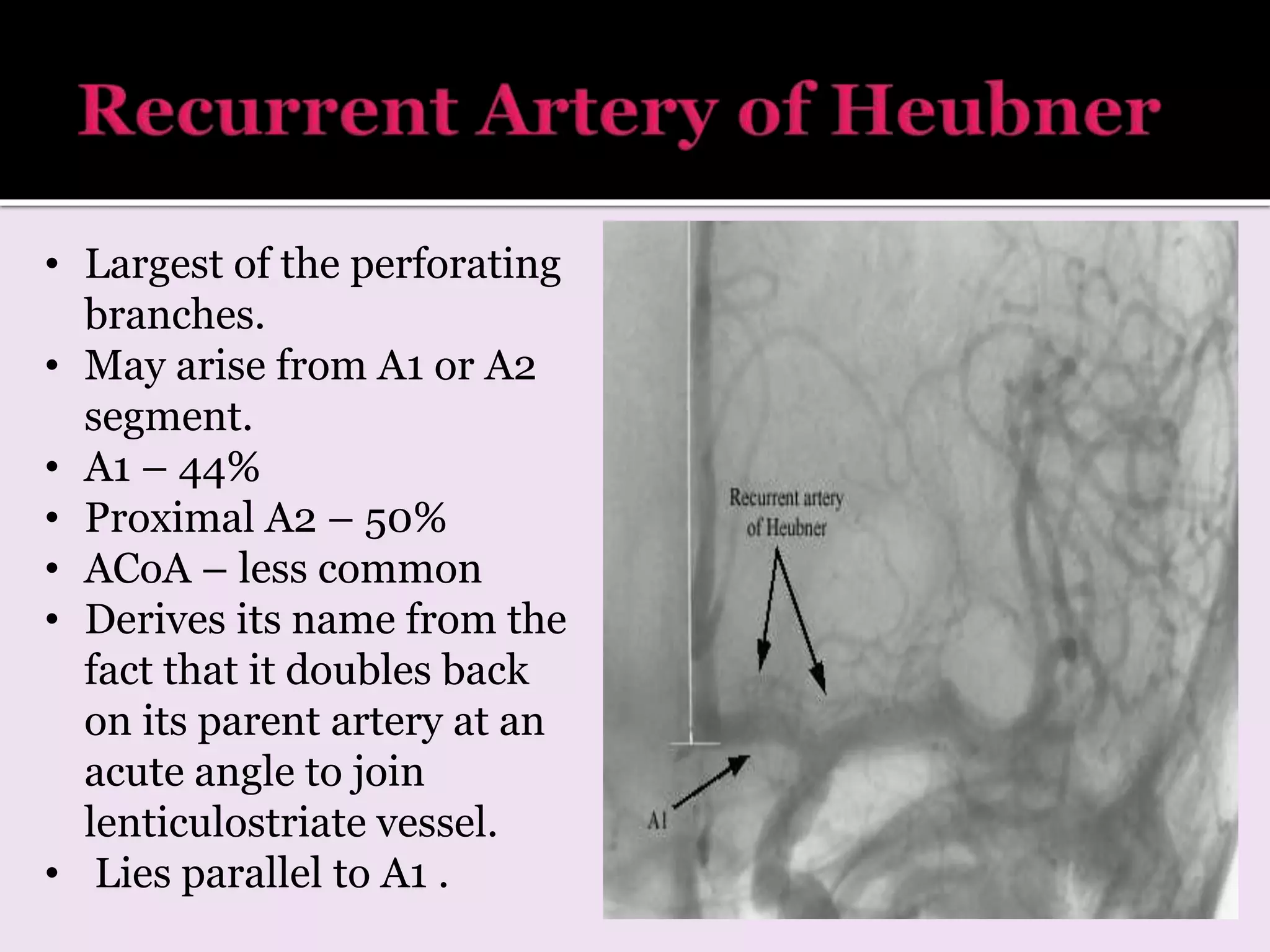
• Largest of the perforating
branches.
• May arise from A1 or A2
segment.
• A1 – 44%
• Proximal A2 – 50%
• ACoA – less common
• Derives its name from the
fact that it doubles back
on its parent artery at an
acute angle to join
lenticulostriate vessel.
• Lies parallel to A1 .
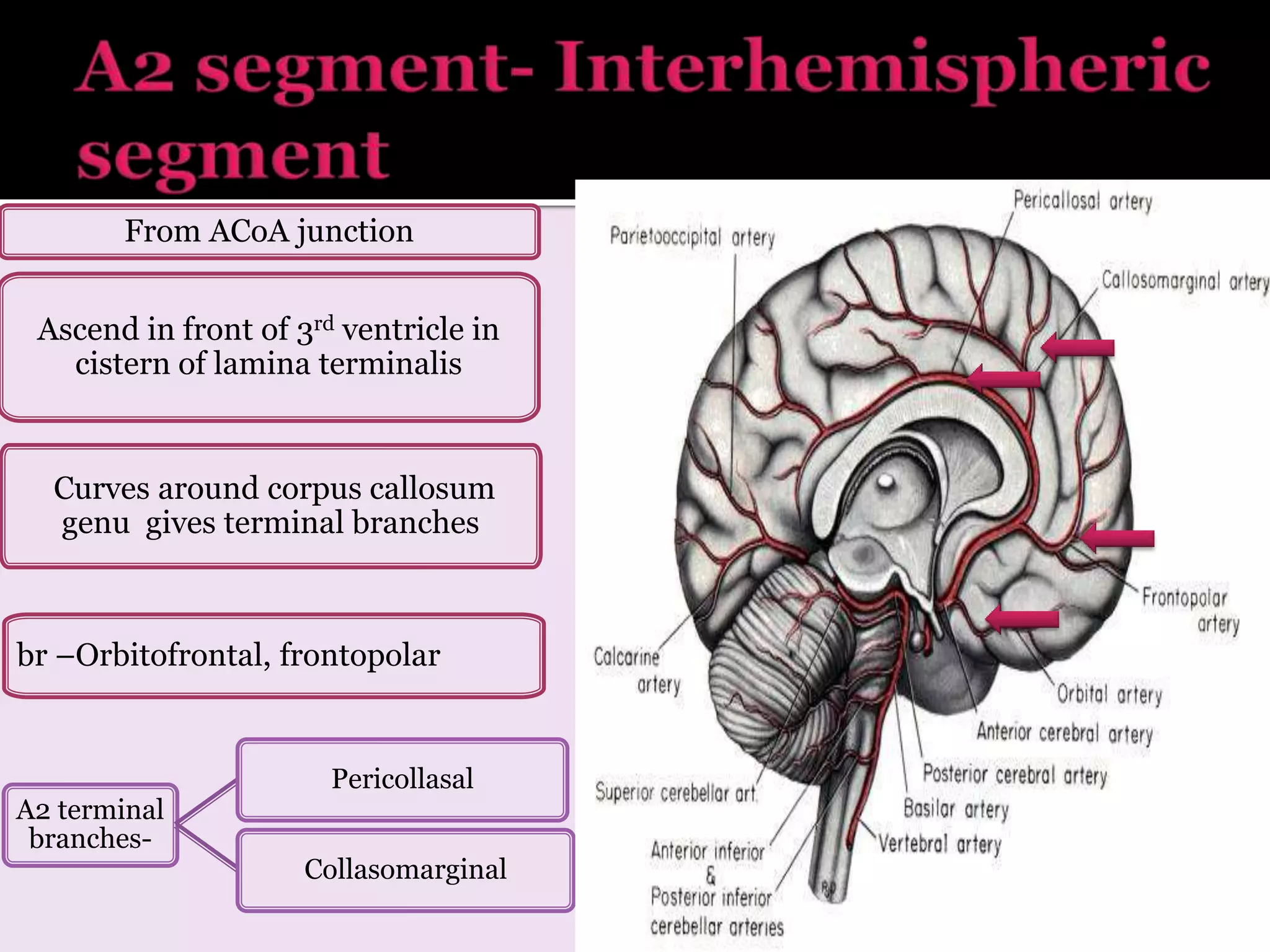
From ACoA junction
Ascend in front of 3rd ventricle in
cistern of lamina terminalis
br –Orbitofrontal, frontopolar
Curves around corpus callosum
genu gives terminal branches
A2 terminal
branches-
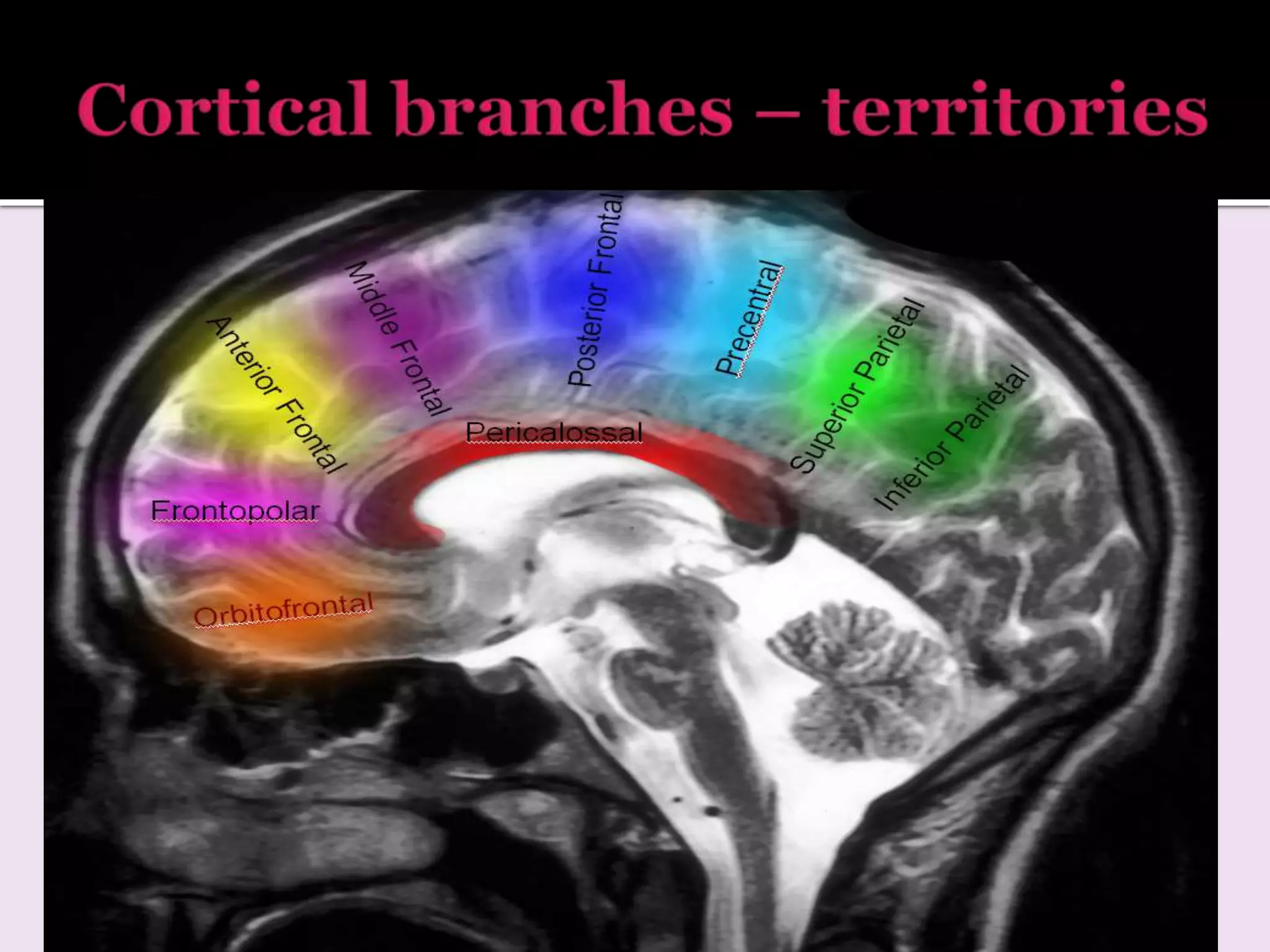
Pericollasal
Collasomarginal
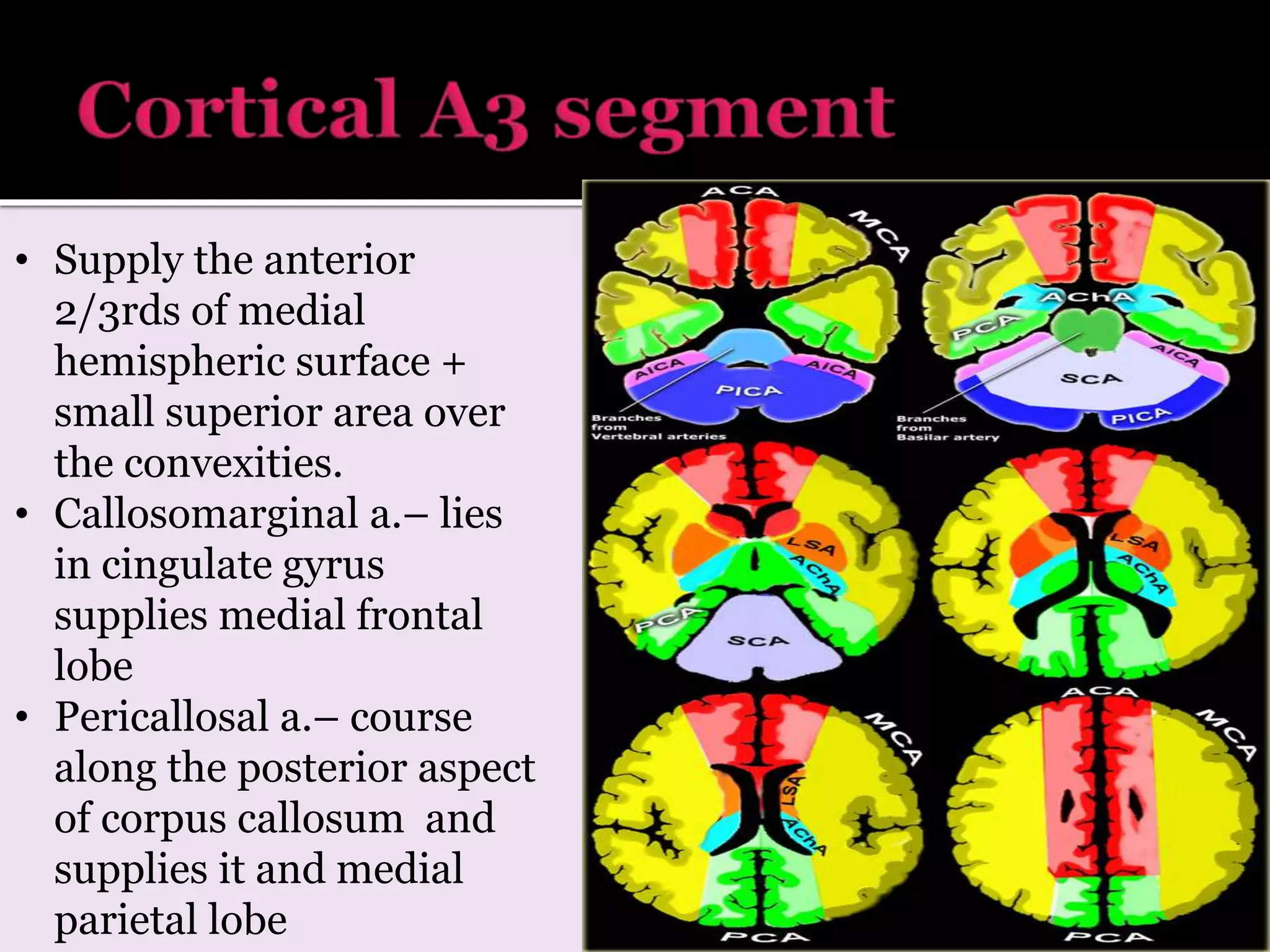
• Supply the anterior
2/3rds of medial
hemispheric surface +
small superior area over
the convexities.
• Callosomarginal a.– lies
in cingulate gyrus
supplies medial frontal
lobe
• Pericallosal a.– course
along the posterior aspect
of corpus callosum and
supplies it and medial
parietal lobe
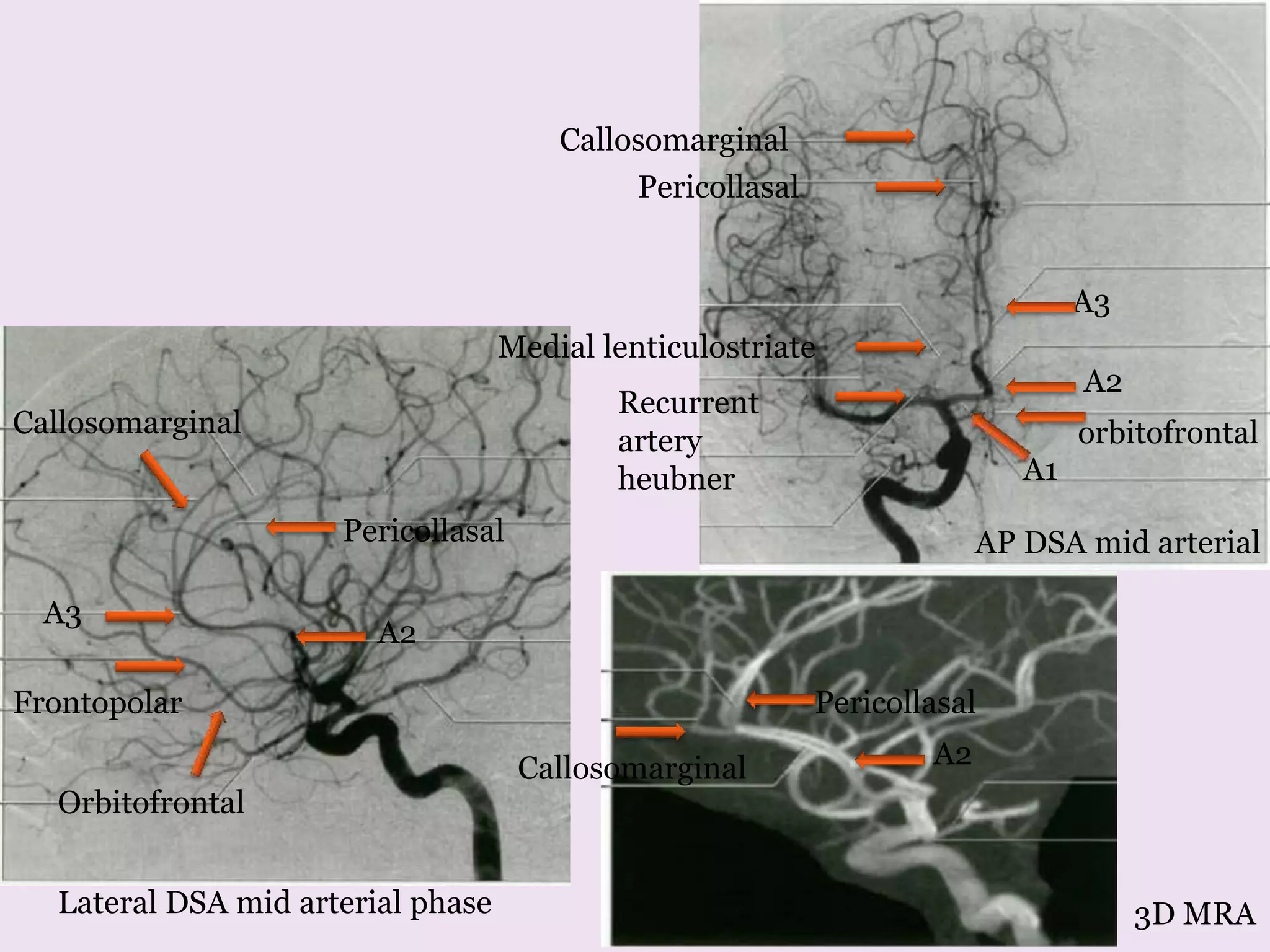
Lateral DSA mid arterial phase
A1
A2
A3
orbitofrontal
Callosomarginal
Pericollasal
Medial lenticulostriate
Recurrent
artery
heubner
Pericollasal
A2
Orbitofrontal
Frontopolar
A3
Callosomarginal
AP DSA mid arterial
3D MRA
A2
Pericollasal
Callosomarginal
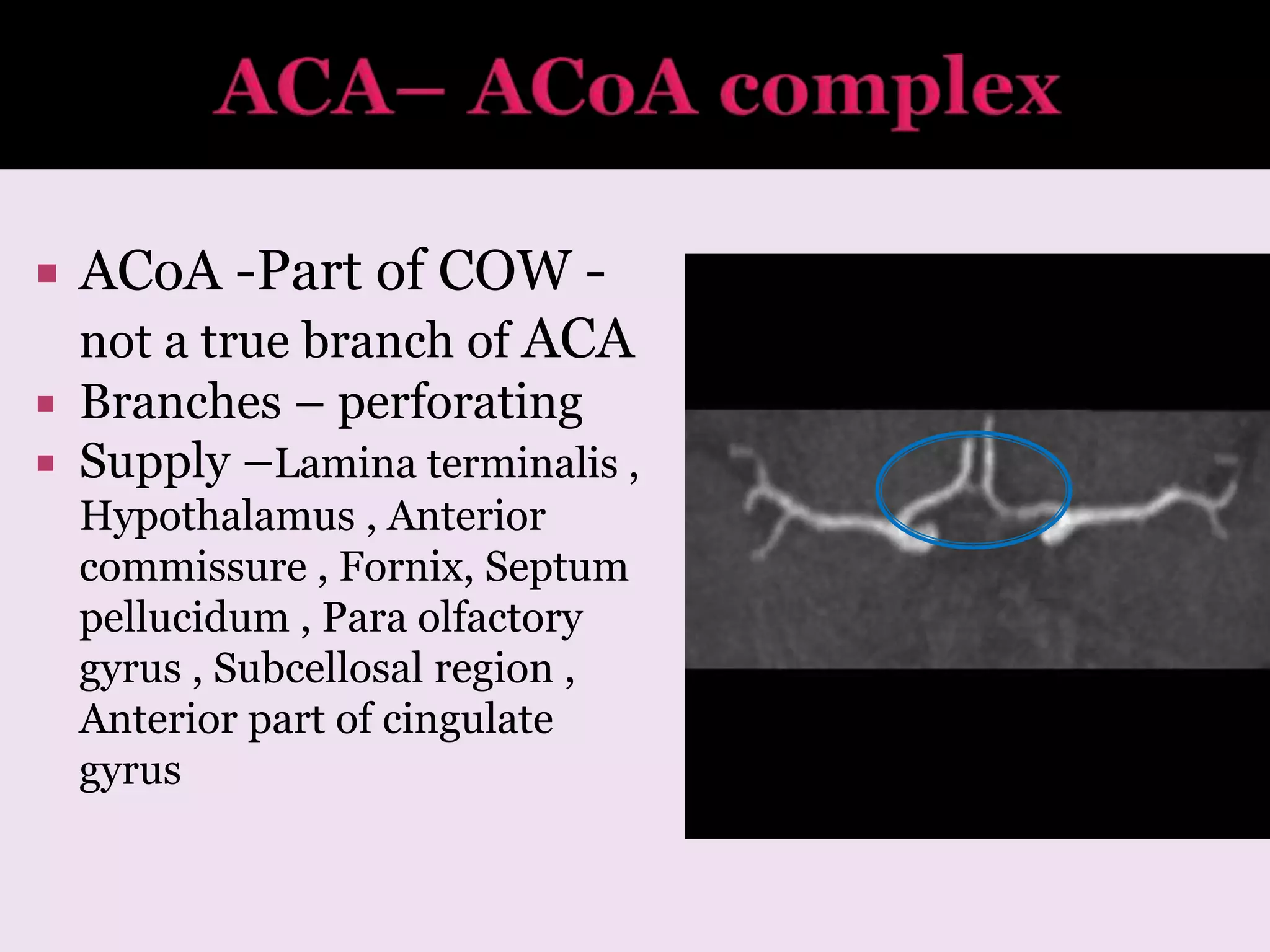
 ACoA -Part of COW -
not a true branch of ACA
 Branches – perforating
 Supply –Lamina terminalis ,
Hypothalamus , Anterior
commissure , Fornix, Septum
pellucidum , Para olfactory
gyrus , Subcellosal region ,
Anterior part of cingulate
gyrus
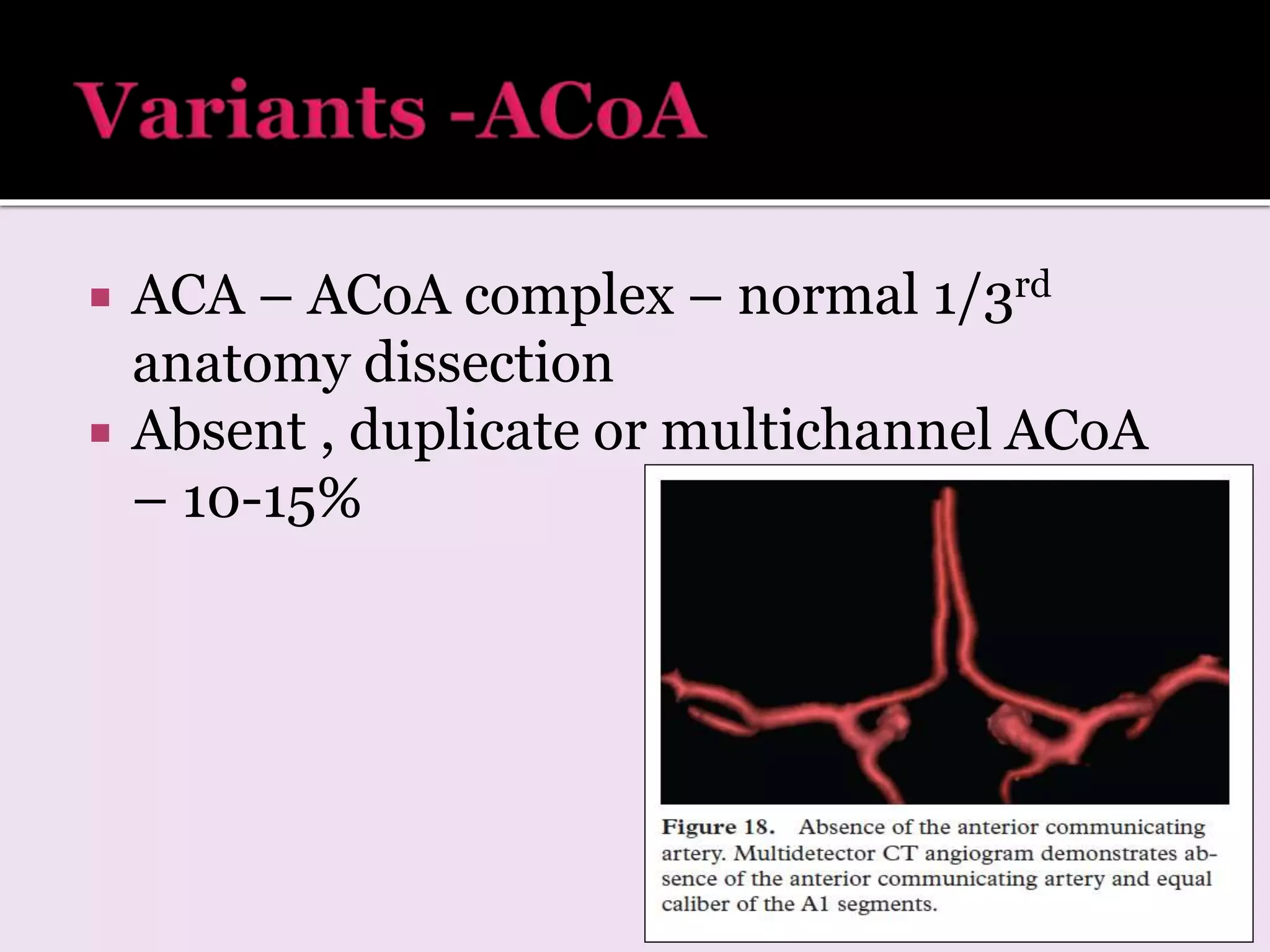
 ACA – ACoA complex – normal 1/3rd
anatomy dissection
 Absent , duplicate or multichannel ACoA
– 10-15%
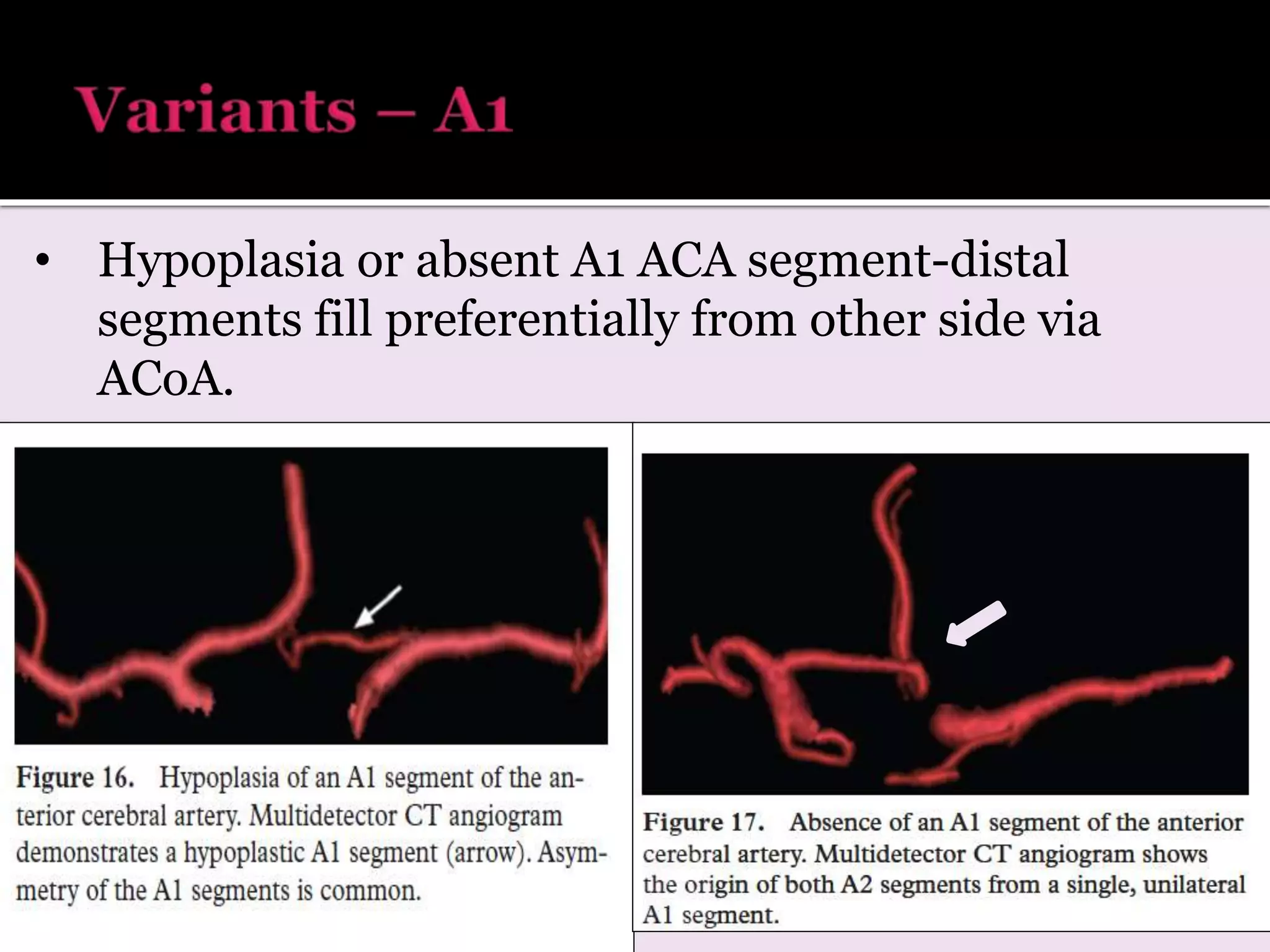
• Hypoplasia or absent A1 ACA segment-distal
segments fill preferentially from other side via
ACoA.
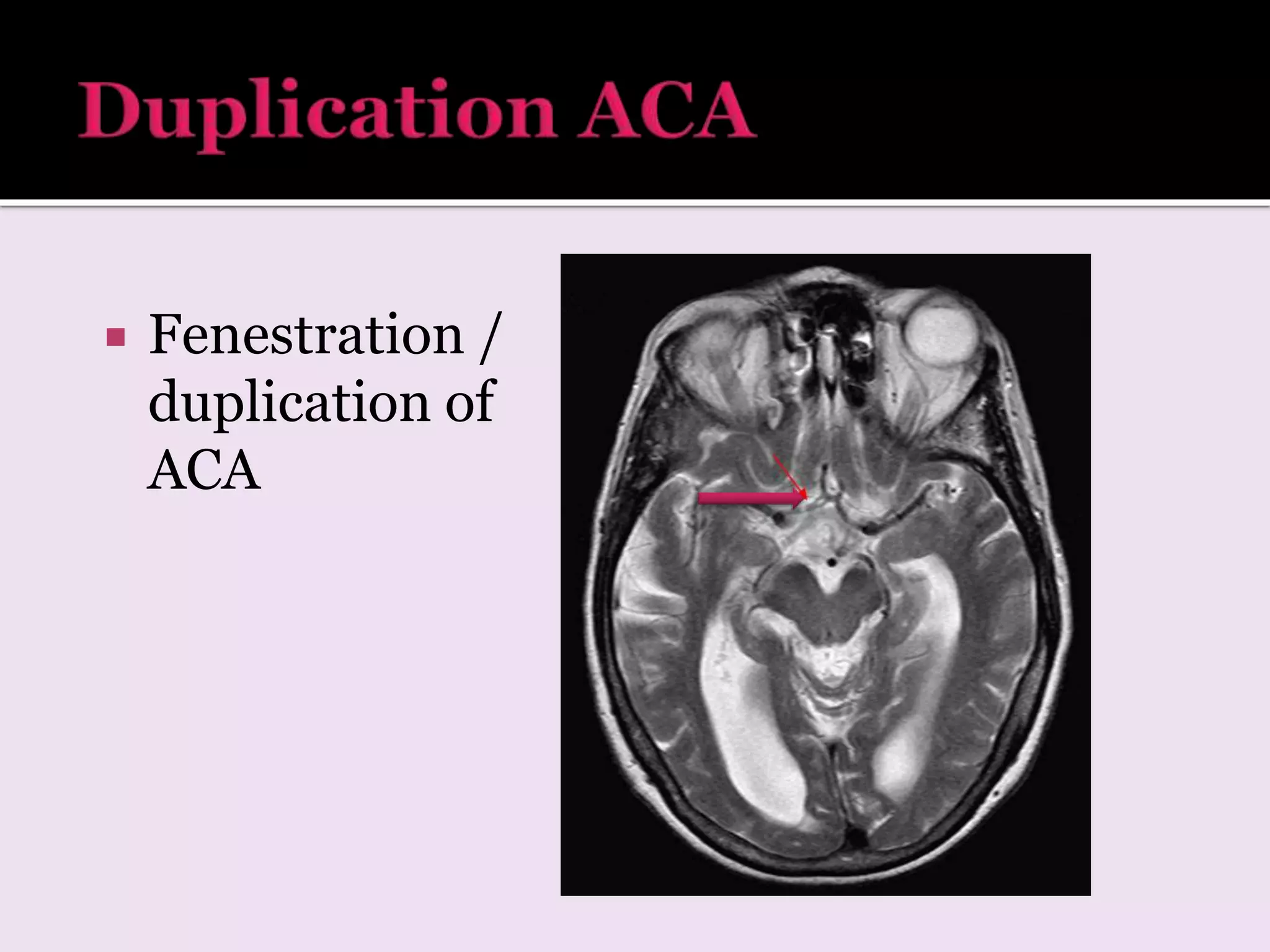
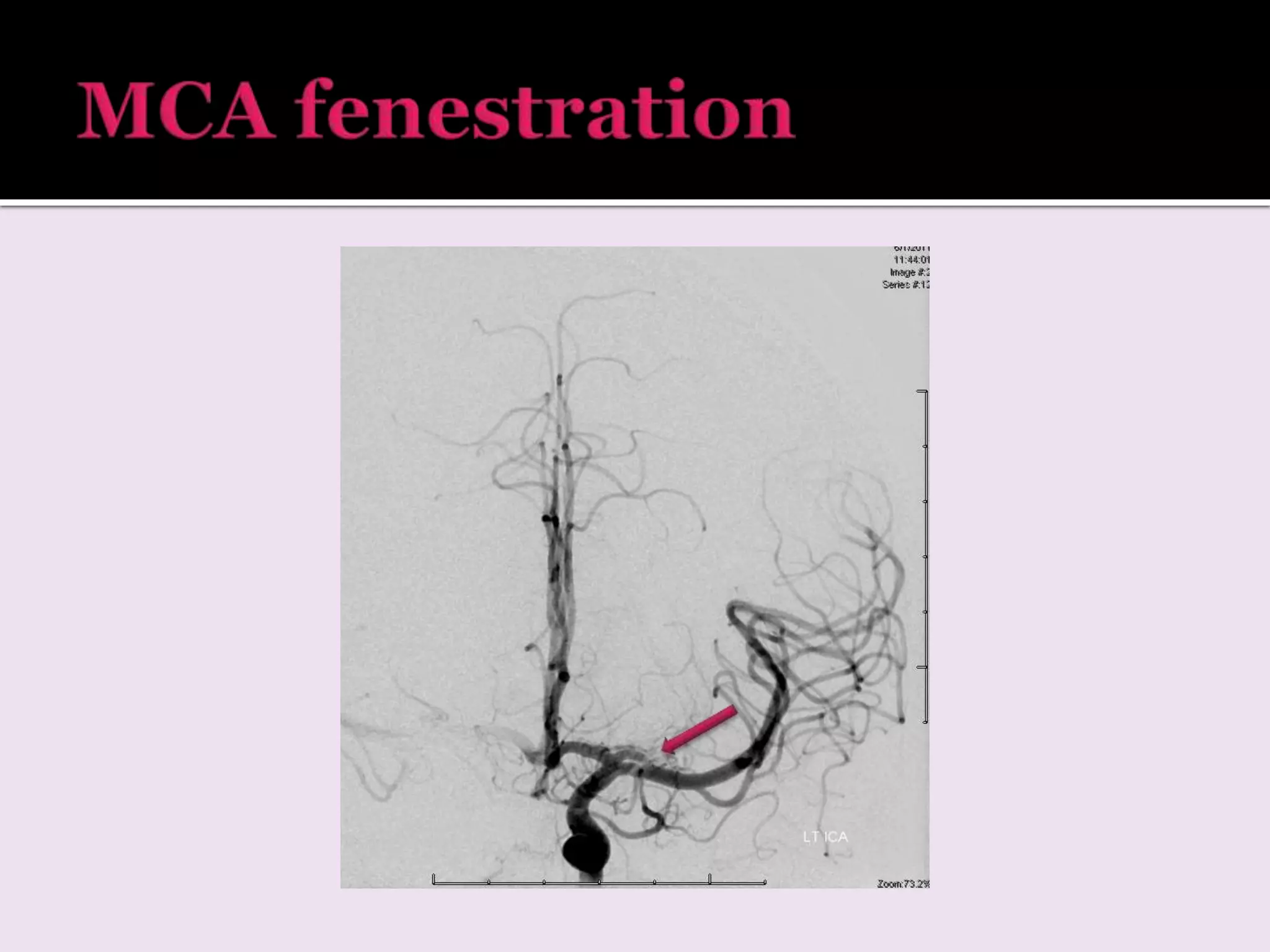
 Fenestration /
duplication of
ACA
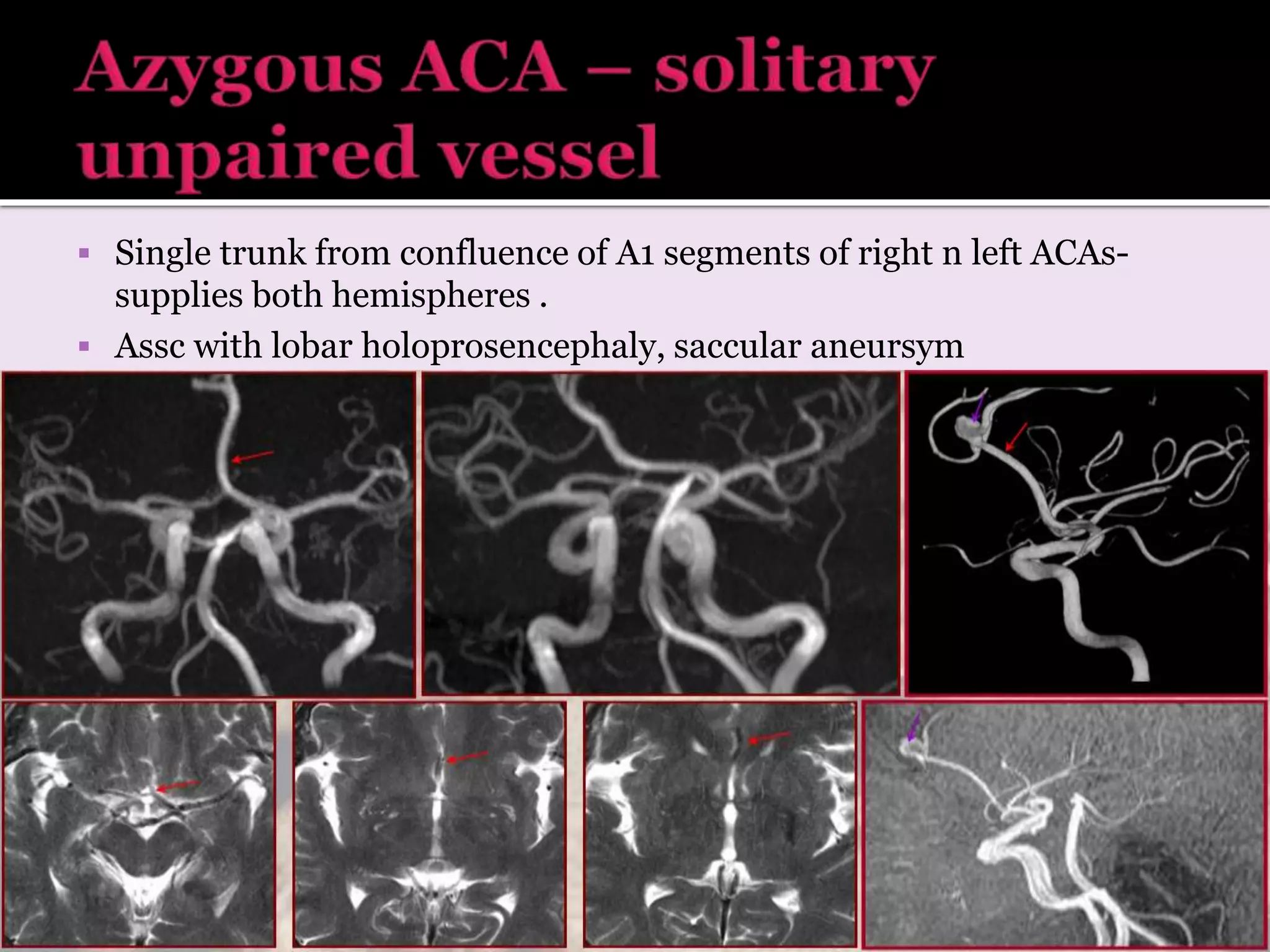
 Single trunk from confluence of A1 segments of right n left ACAs-
supplies both hemispheres .
 Assc with lobar holoprosencephaly, saccular aneursym
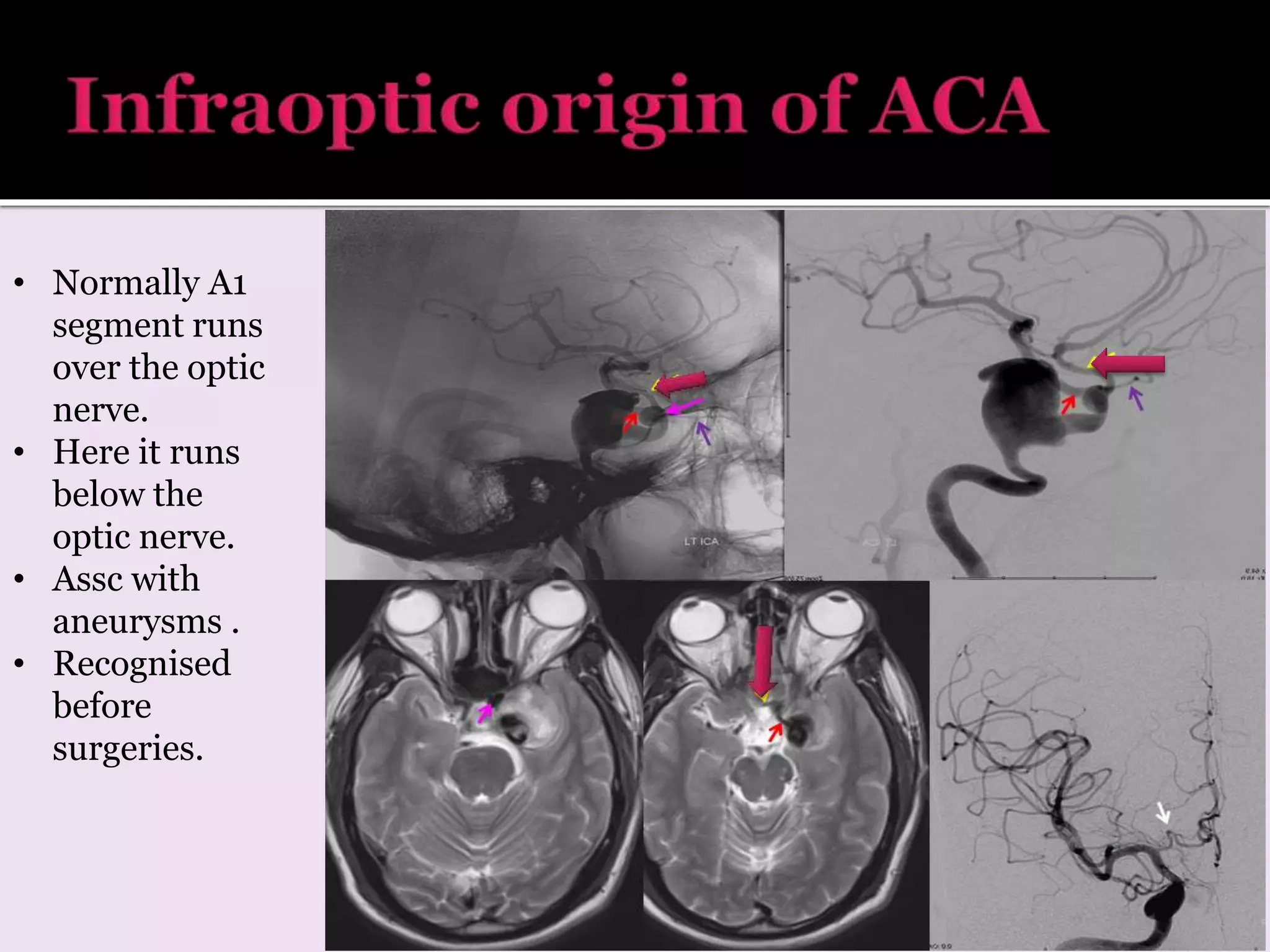
• Normally A1
segment runs
over the optic
nerve.
• Here it runs
below the
optic nerve.
• Assc with
aneurysms .
• Recognised
before
surgeries.
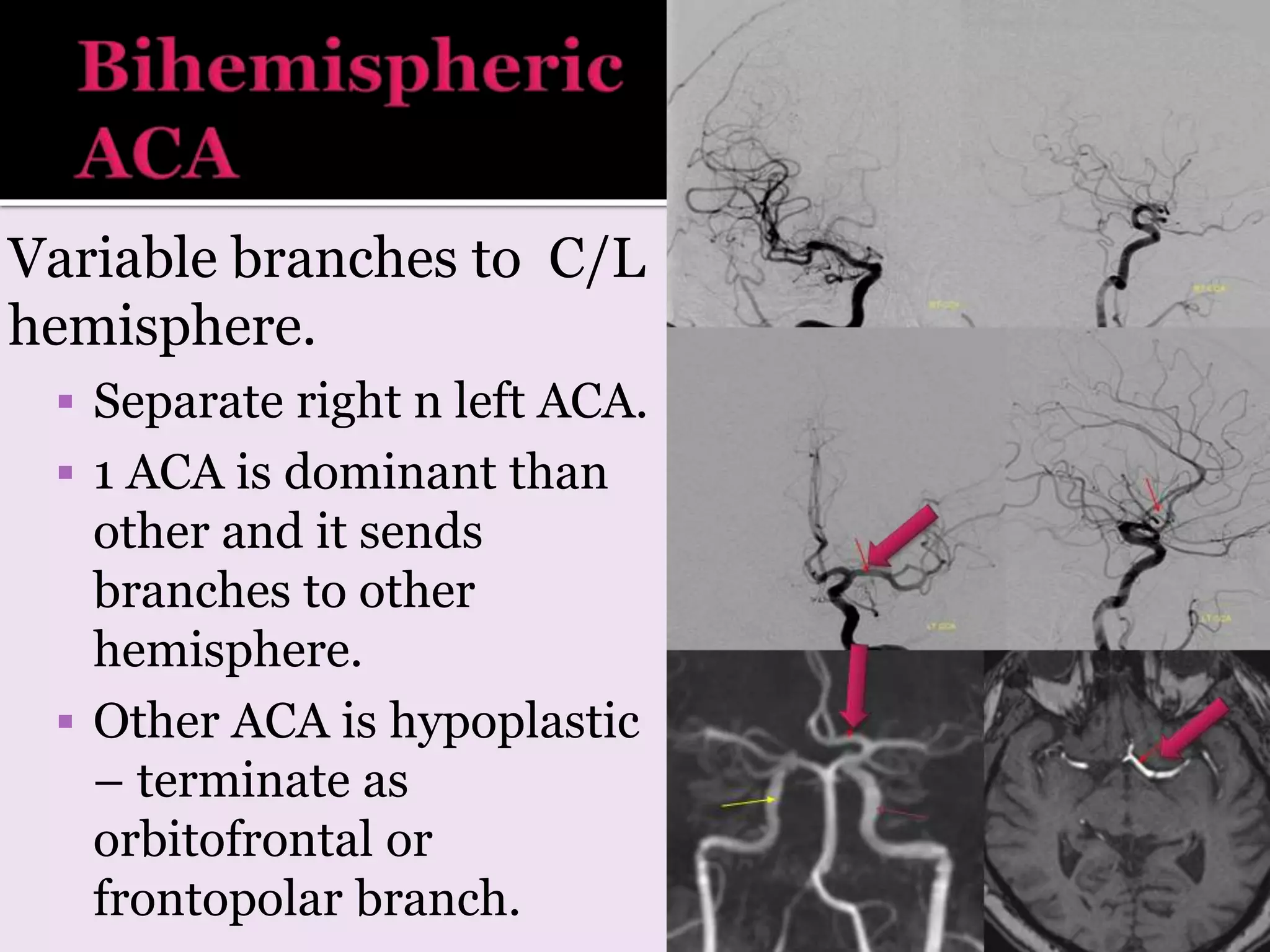
Variable branches to C/L
hemisphere.
 Separate right n left ACA.
 1 ACA is dominant than
other and it sends
branches to other
hemisphere.
 Other ACA is hypoplastic
– terminate as
orbitofrontal or
frontopolar branch.
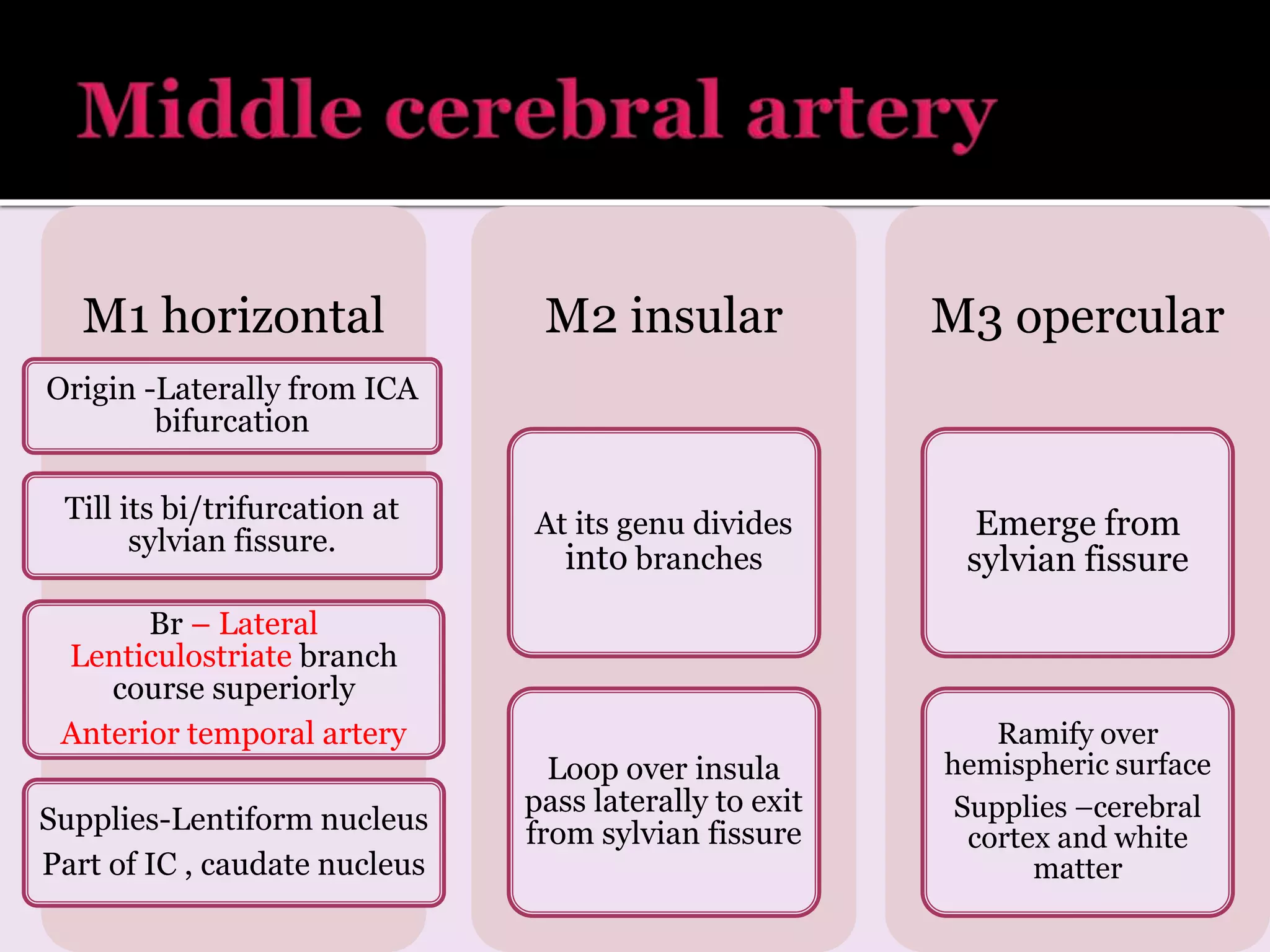
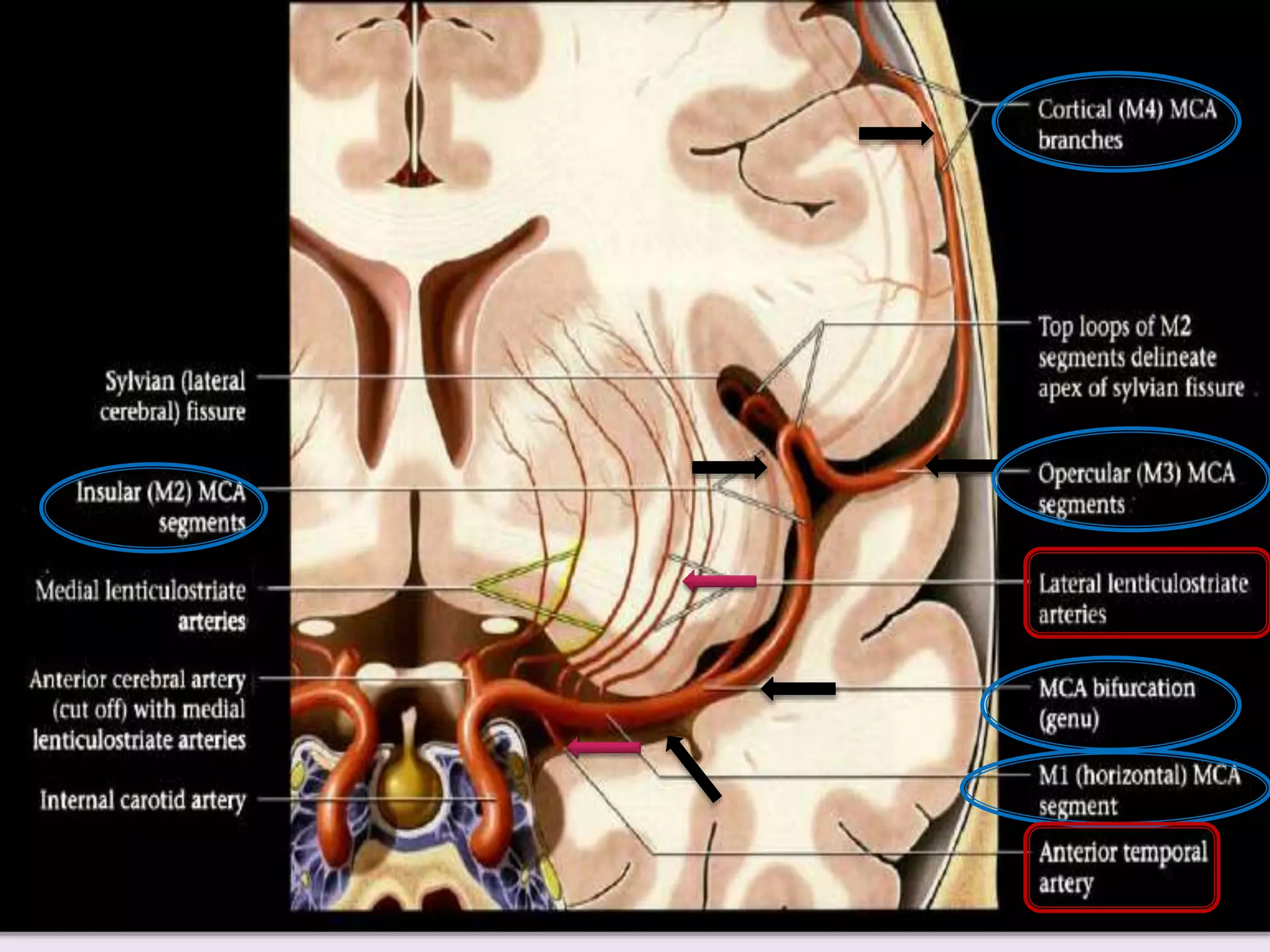
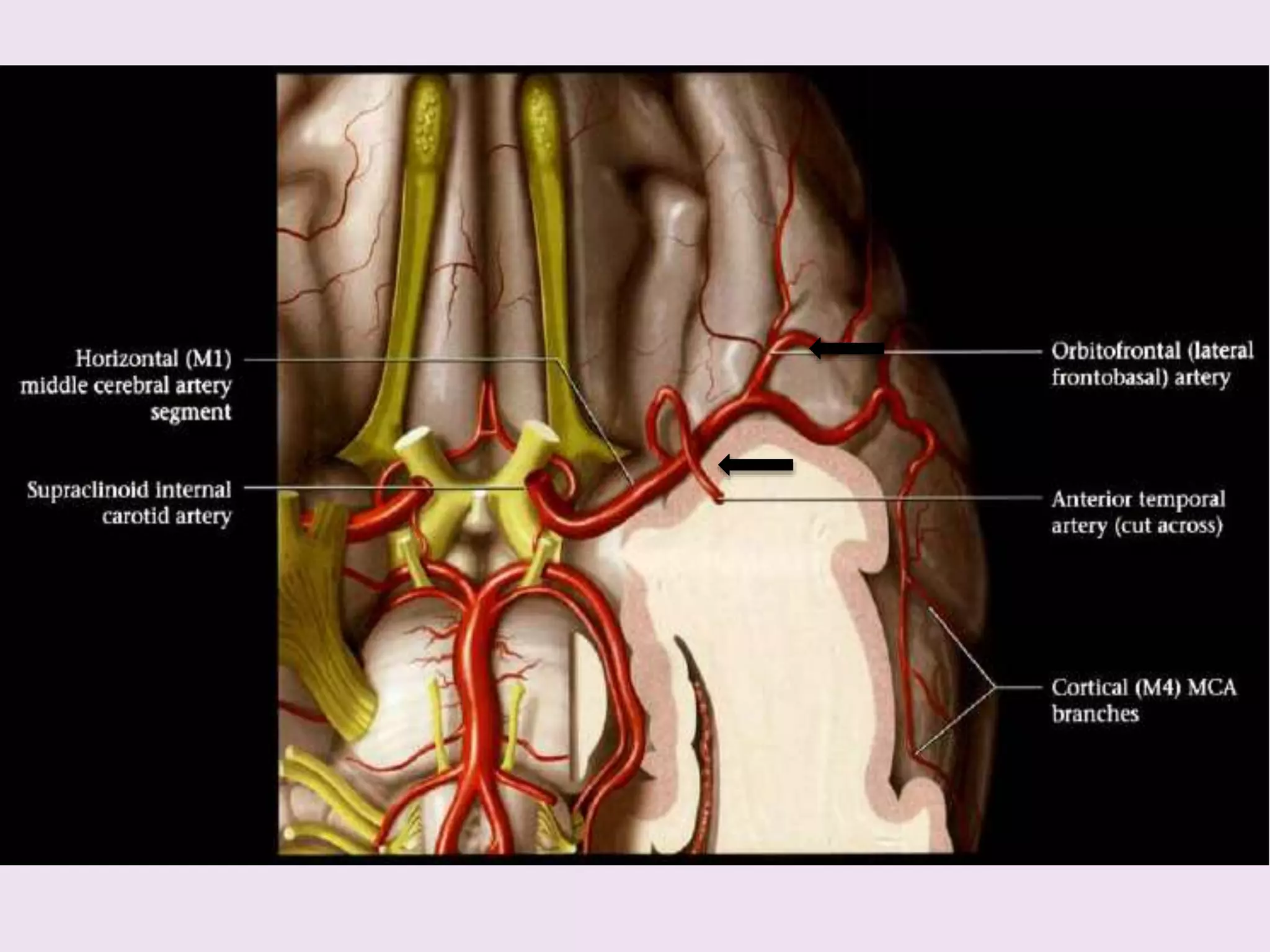
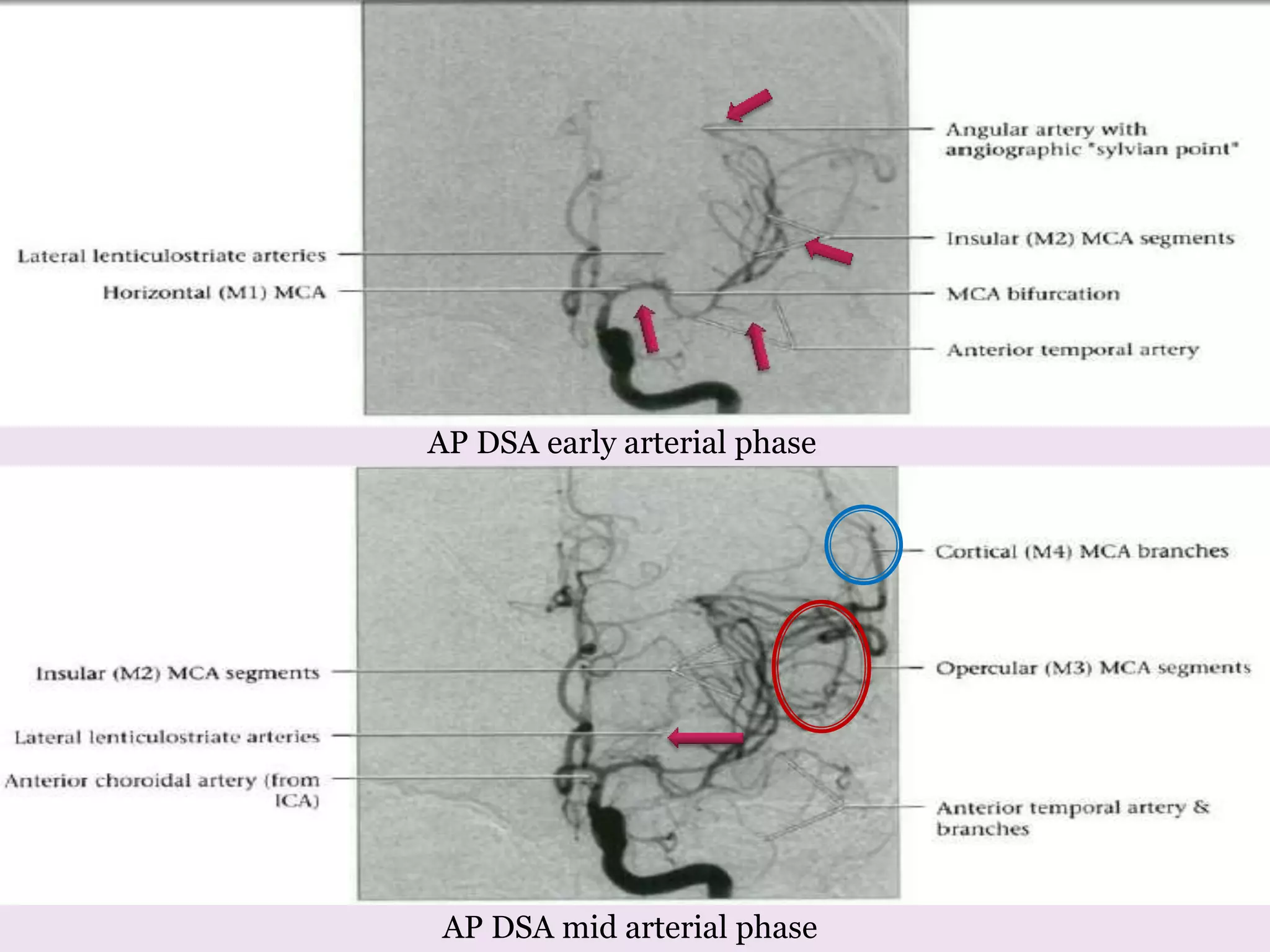
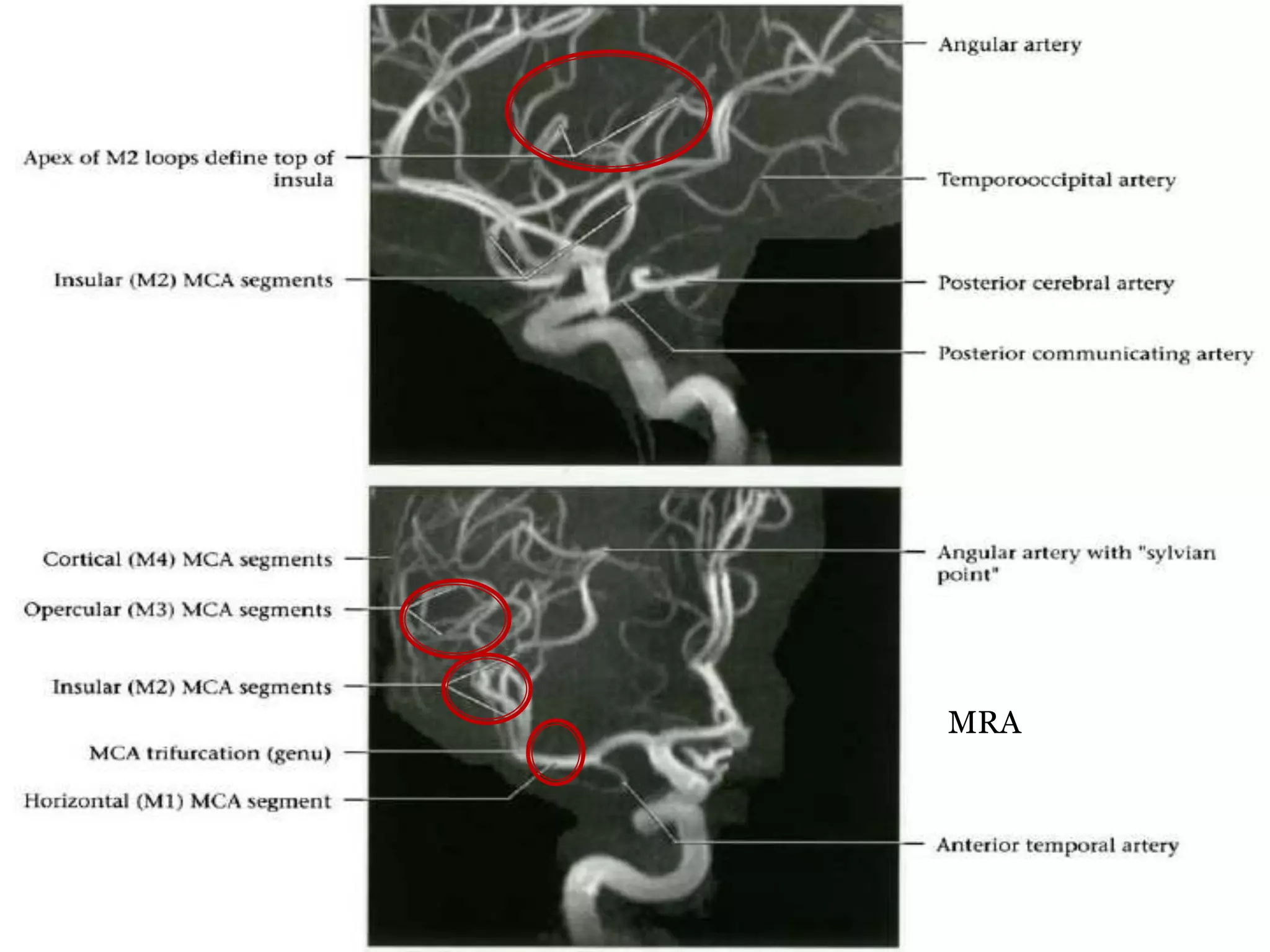
M1 horizontal
Origin -Laterally from ICA
bifurcation
Till its bi/trifurcation at
sylvian fissure.
Br – Lateral
Lenticulostriate branch
course superiorly
Anterior temporal artery
Supplies-Lentiform nucleus
Part of IC , caudate nucleus
M2 insular
At its genu divides
into branches
Loop over insula
pass laterally to exit
from sylvian fissure
M3 opercular
Emerge from
sylvian fissure
Ramify over
hemispheric surface
Supplies –cerebral
cortex and white
matter
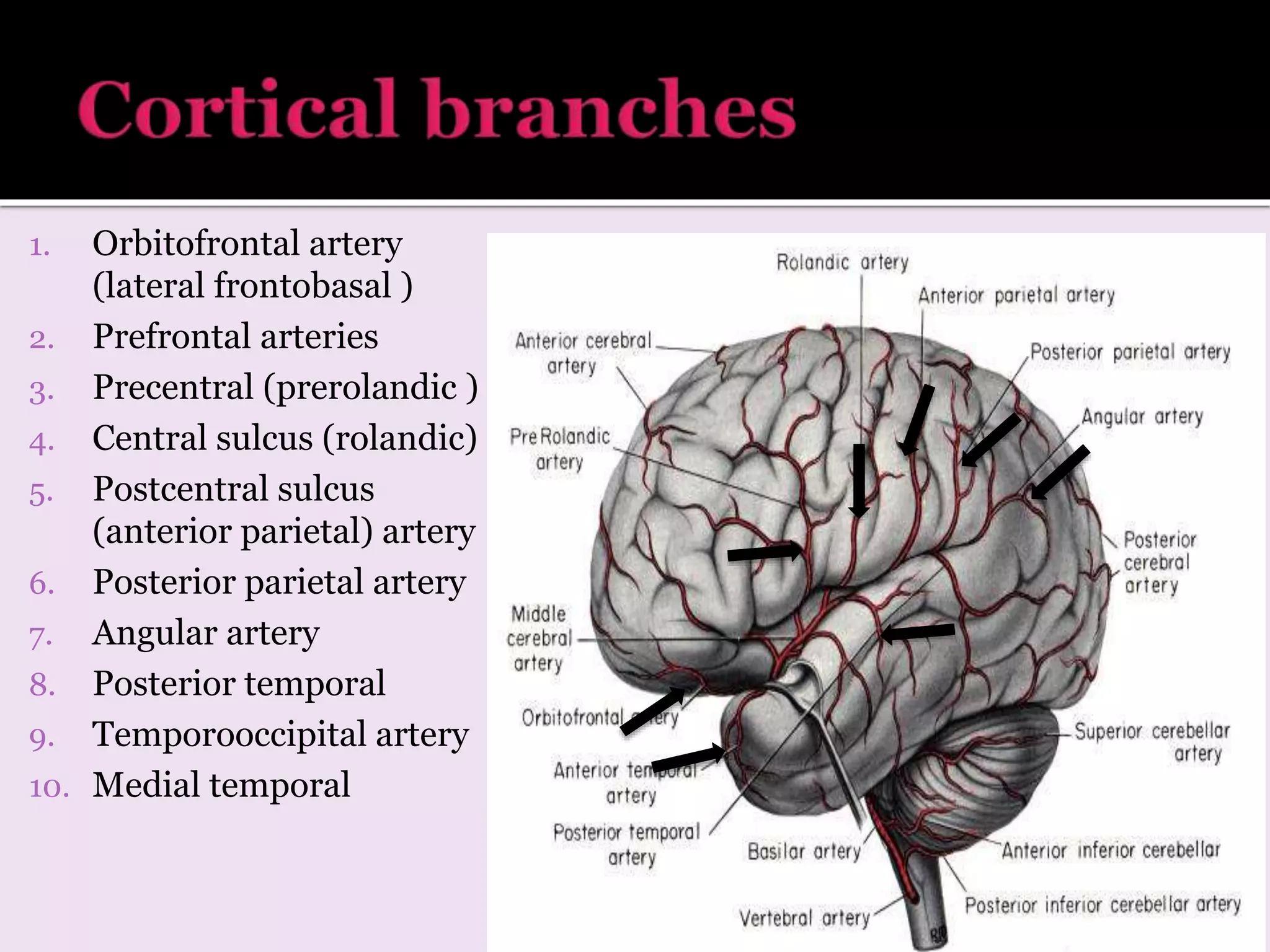
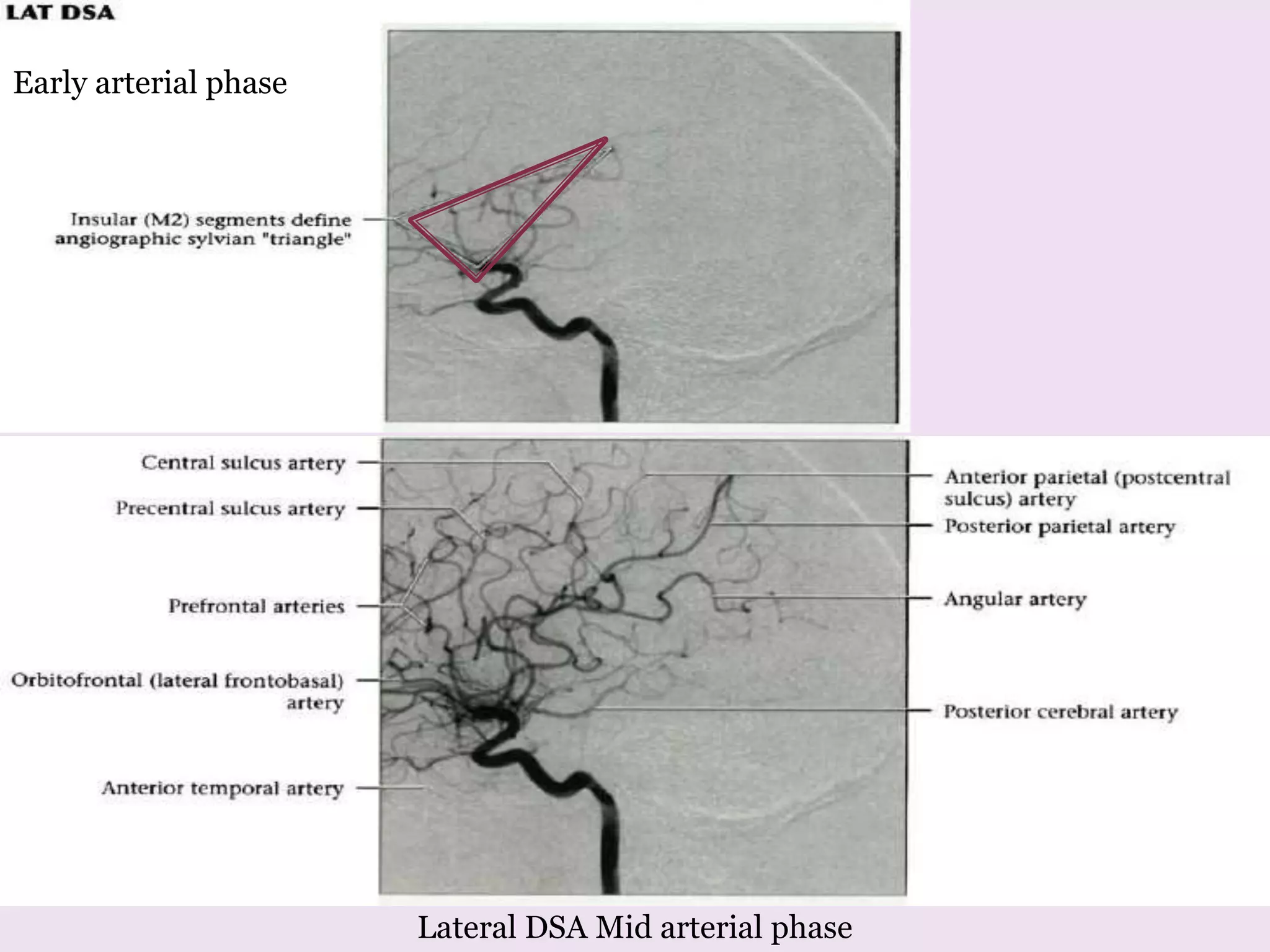
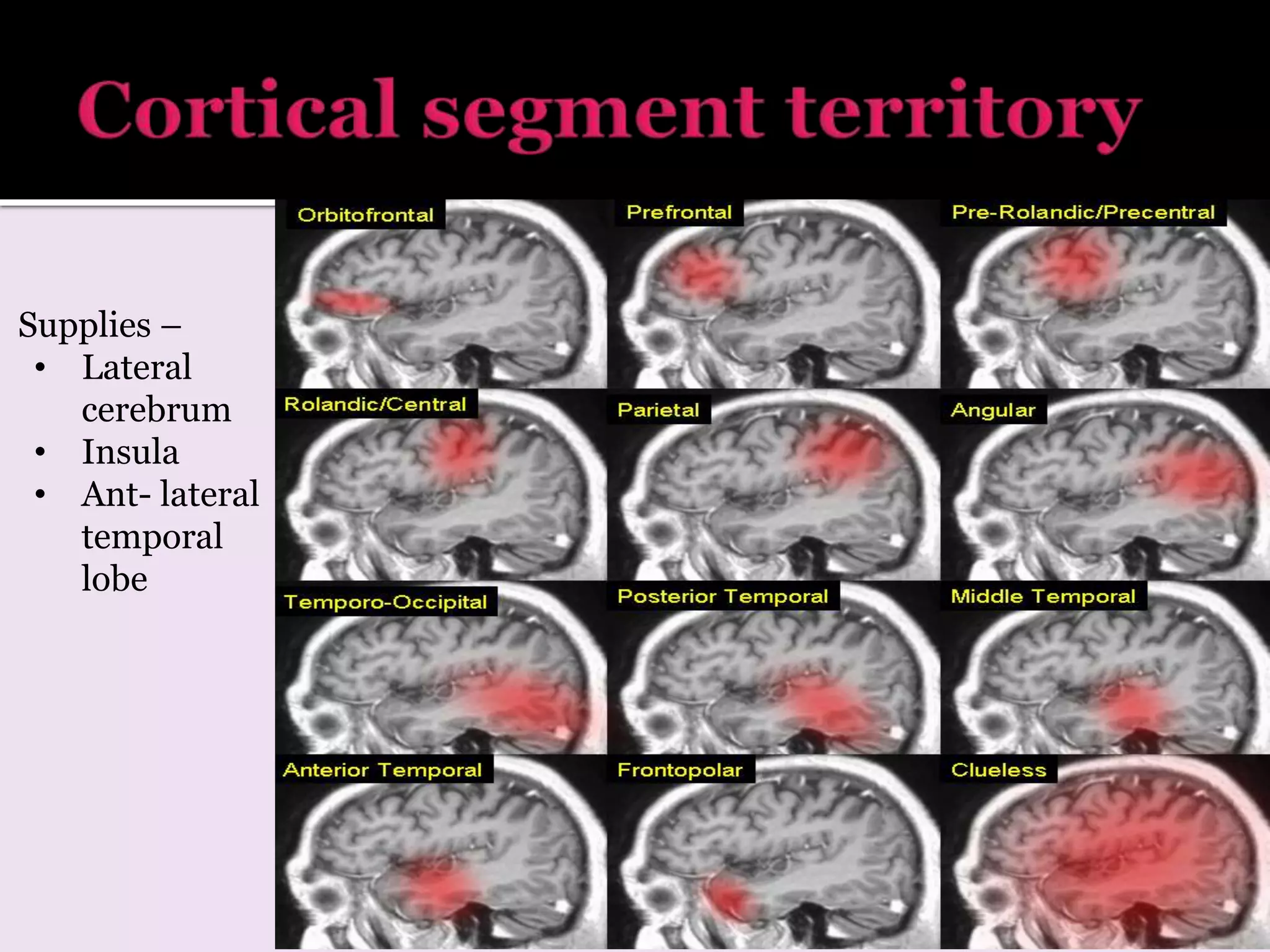
1. Orbitofrontal artery
(lateral frontobasal )
2. Prefrontal arteries
3. Precentral (prerolandic )
4. Central sulcus (rolandic)
5. Postcentral sulcus
(anterior parietal) artery
6. Posterior parietal artery
7. Angular artery
8. Posterior temporal
9. Temporooccipital artery
10. Medial temporal
AP DSA mid arterial phase
AP DSA early arterial phase
Early arterial phase
Lateral DSA Mid arterial phase
Lateral
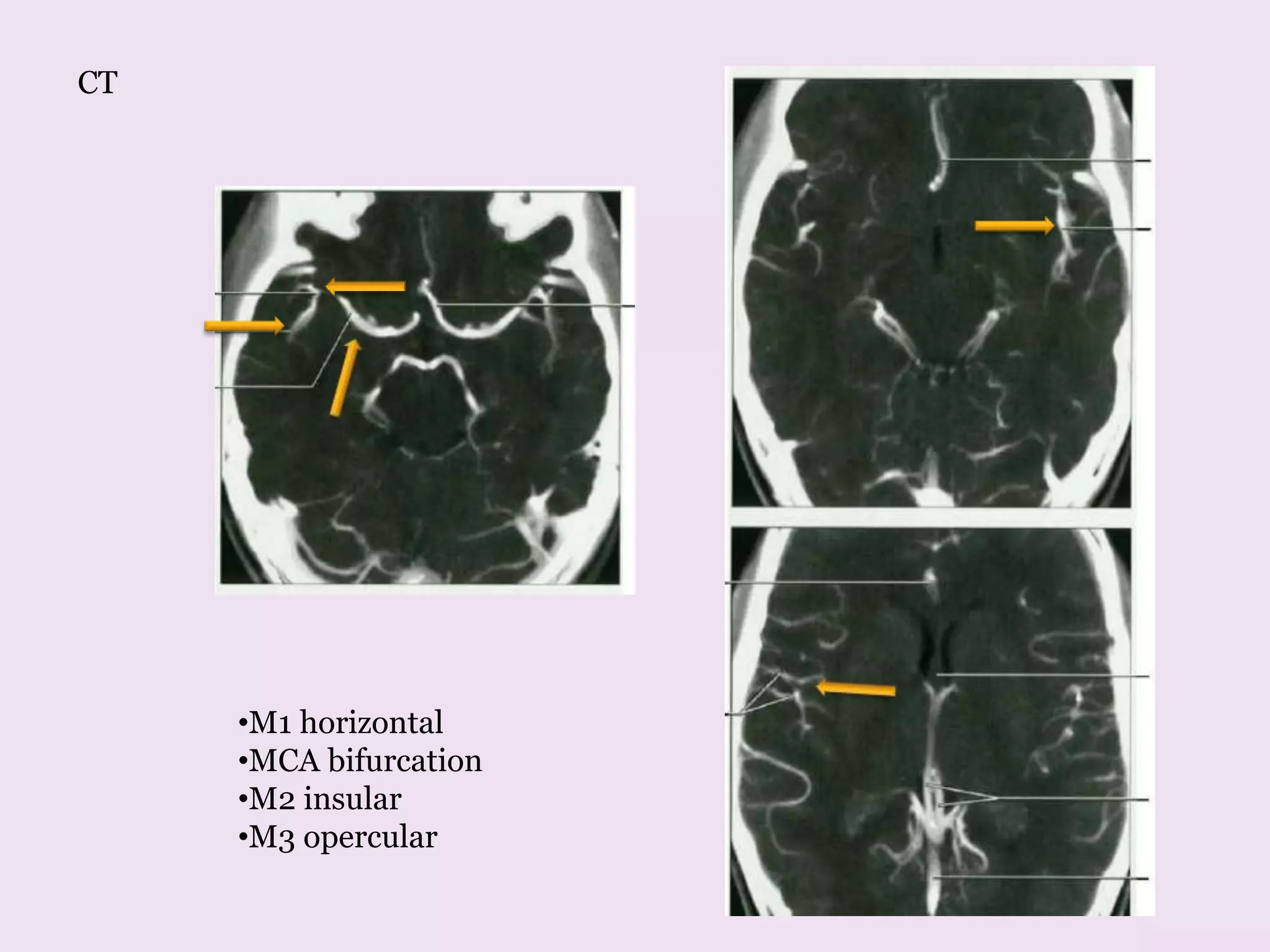
•M1 horizontal
•MCA bifurcation
•M2 insular
•M3 opercular
CT
MRA
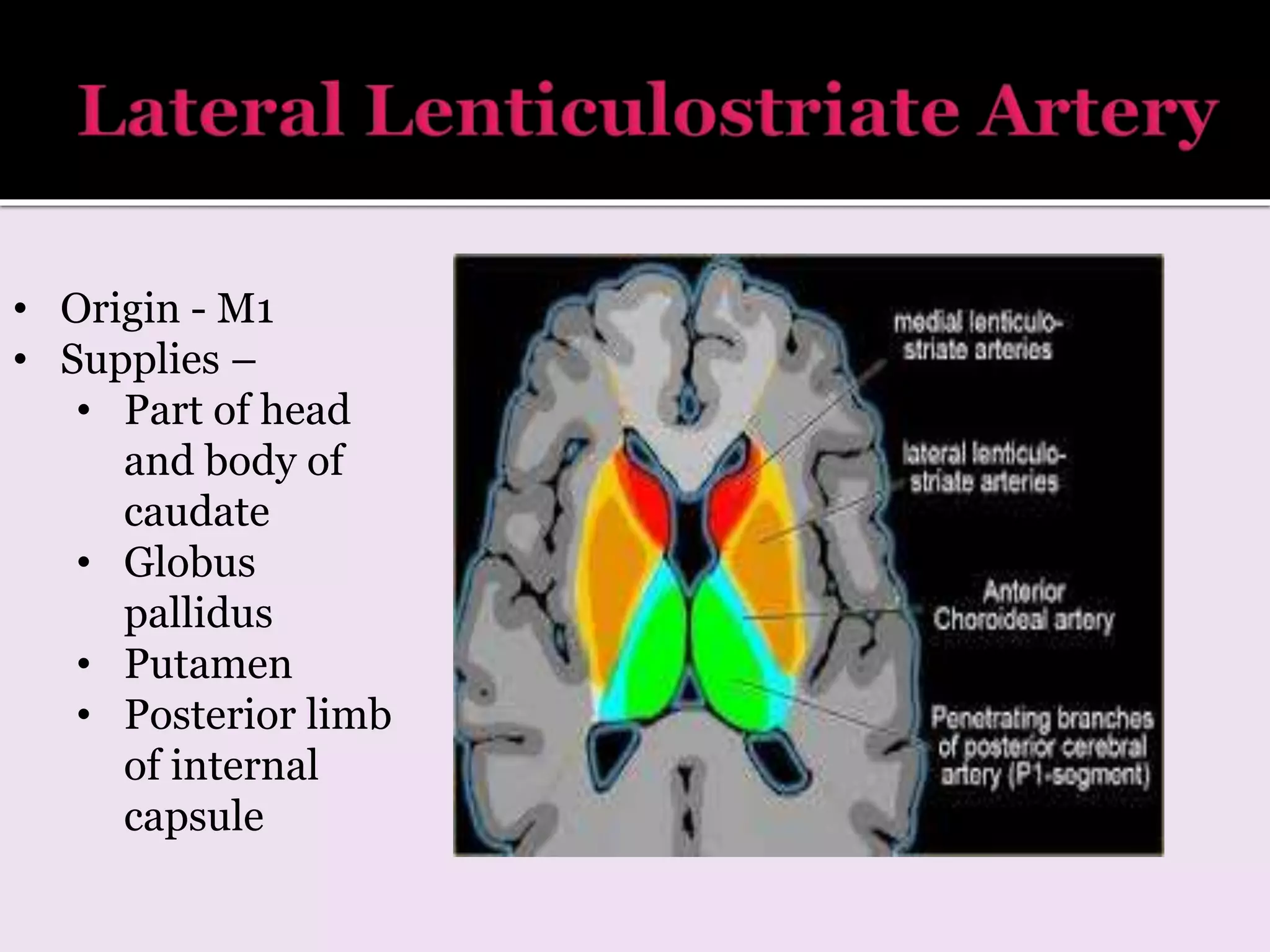
• Origin - M1
• Supplies –
• Part of head
and body of
caudate
• Globus
pallidus
• Putamen
• Posterior limb
of internal
capsule
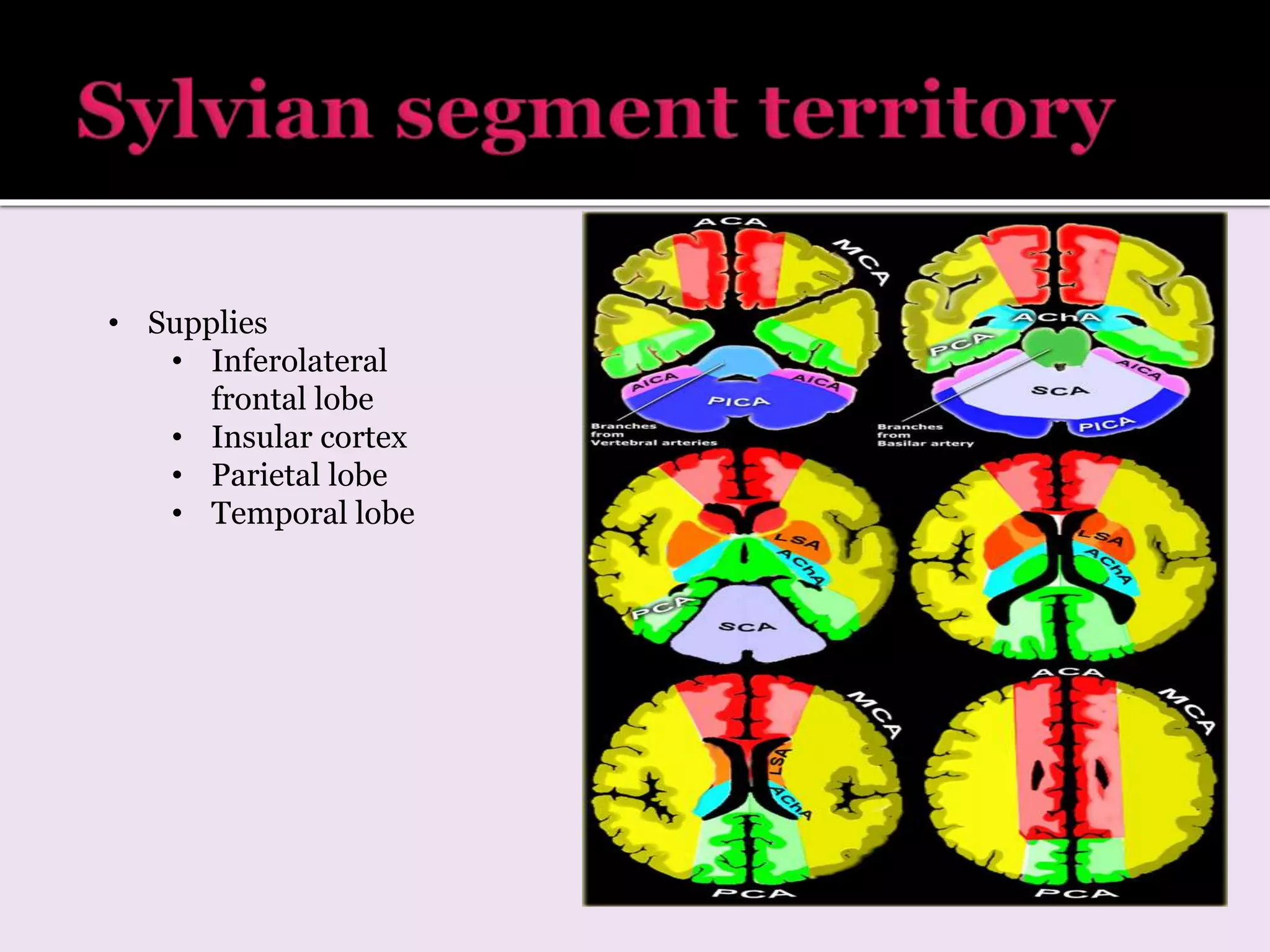
• Supplies
• Inferolateral
frontal lobe
• Insular cortex
• Parietal lobe
• Temporal lobe
Supplies –
• Lateral
cerebrum
• Insula
• Ant- lateral
temporal
lobe
 Less frequent
 Fenestration and duplication
 Single trunk
 Accessory arteries
All uncommon
≤5 %
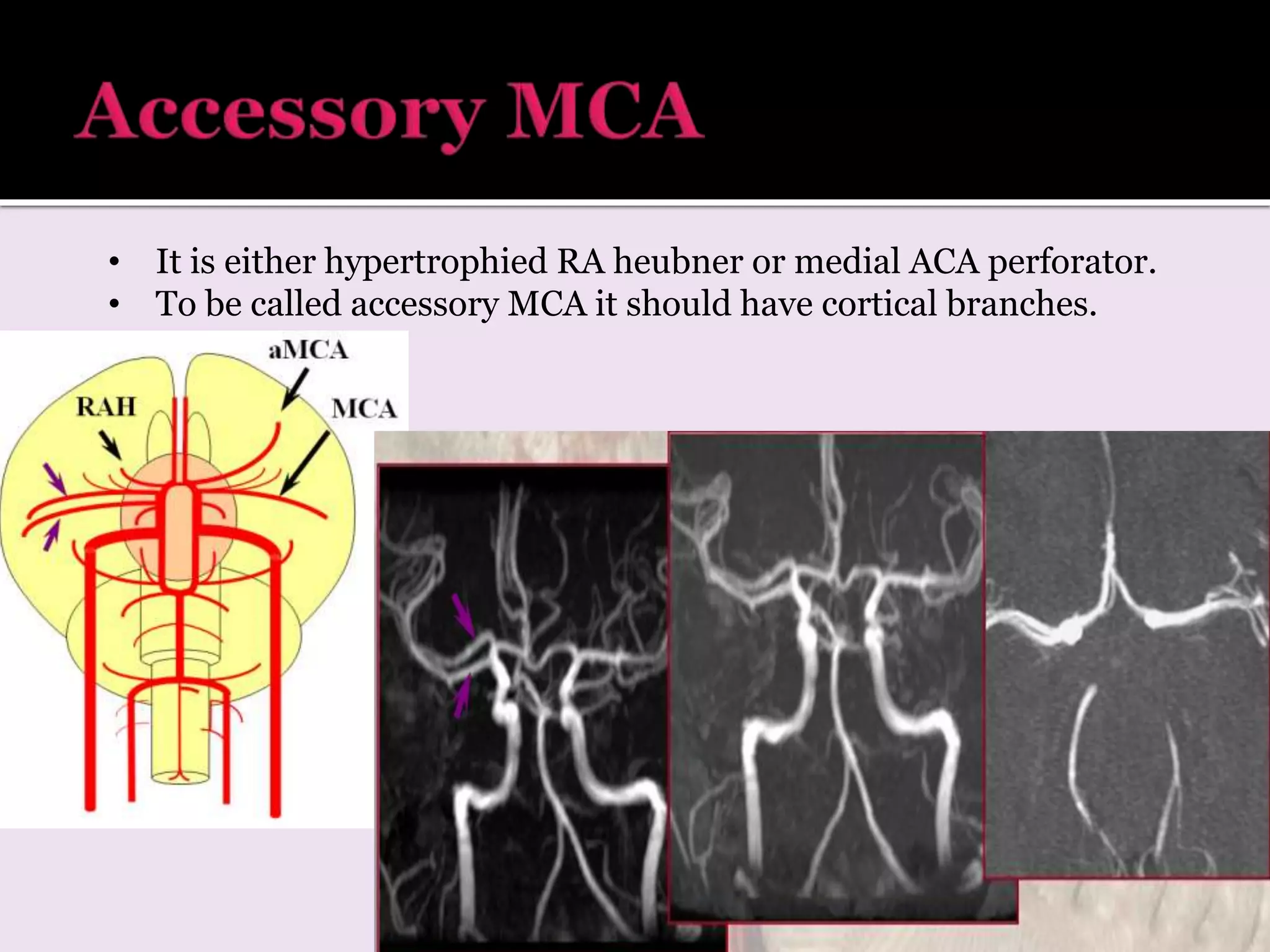
• It is either hypertrophied RA heubner or medial ACA perforator.
• To be called accessory MCA it should have cortical branches.
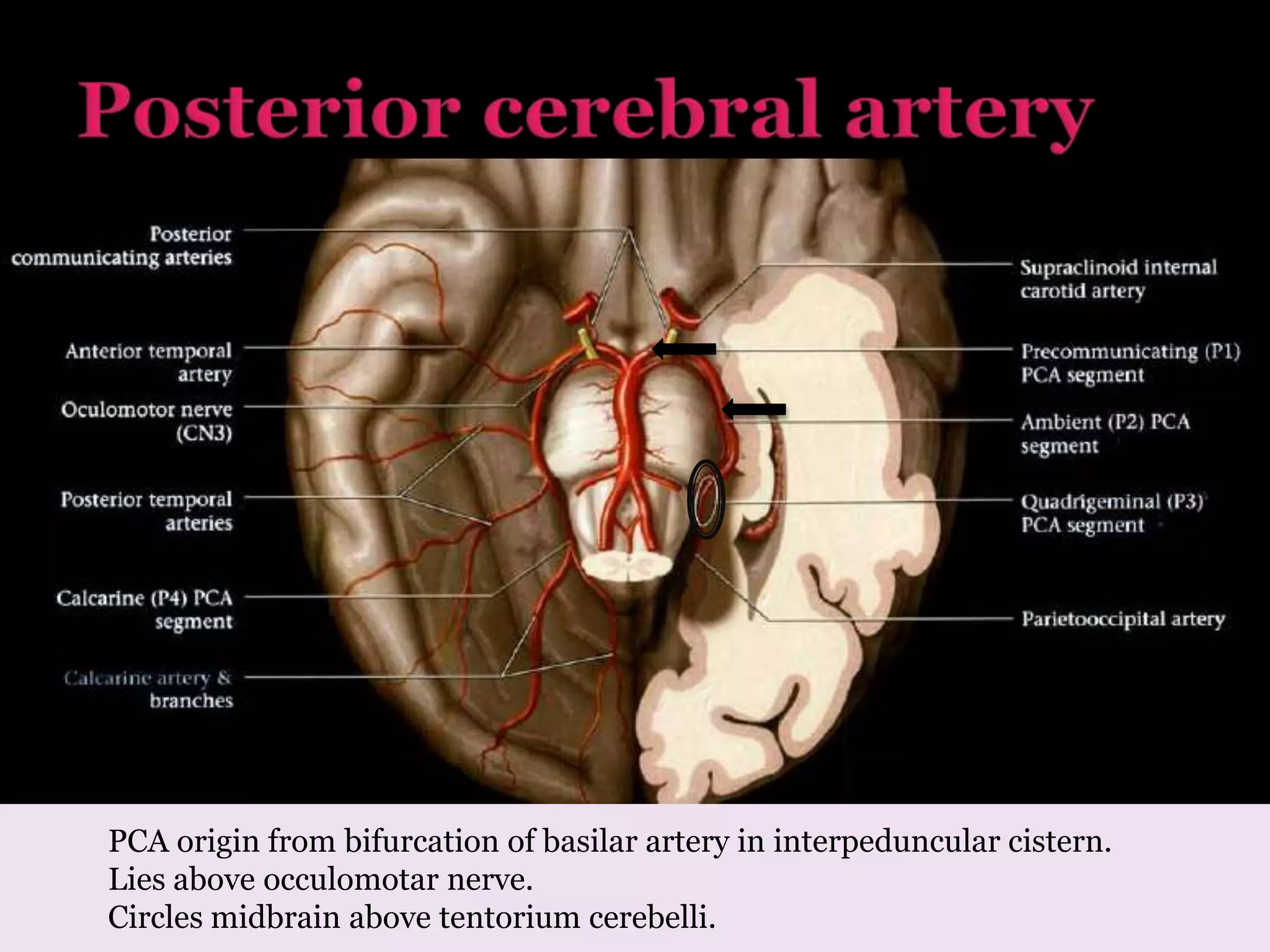
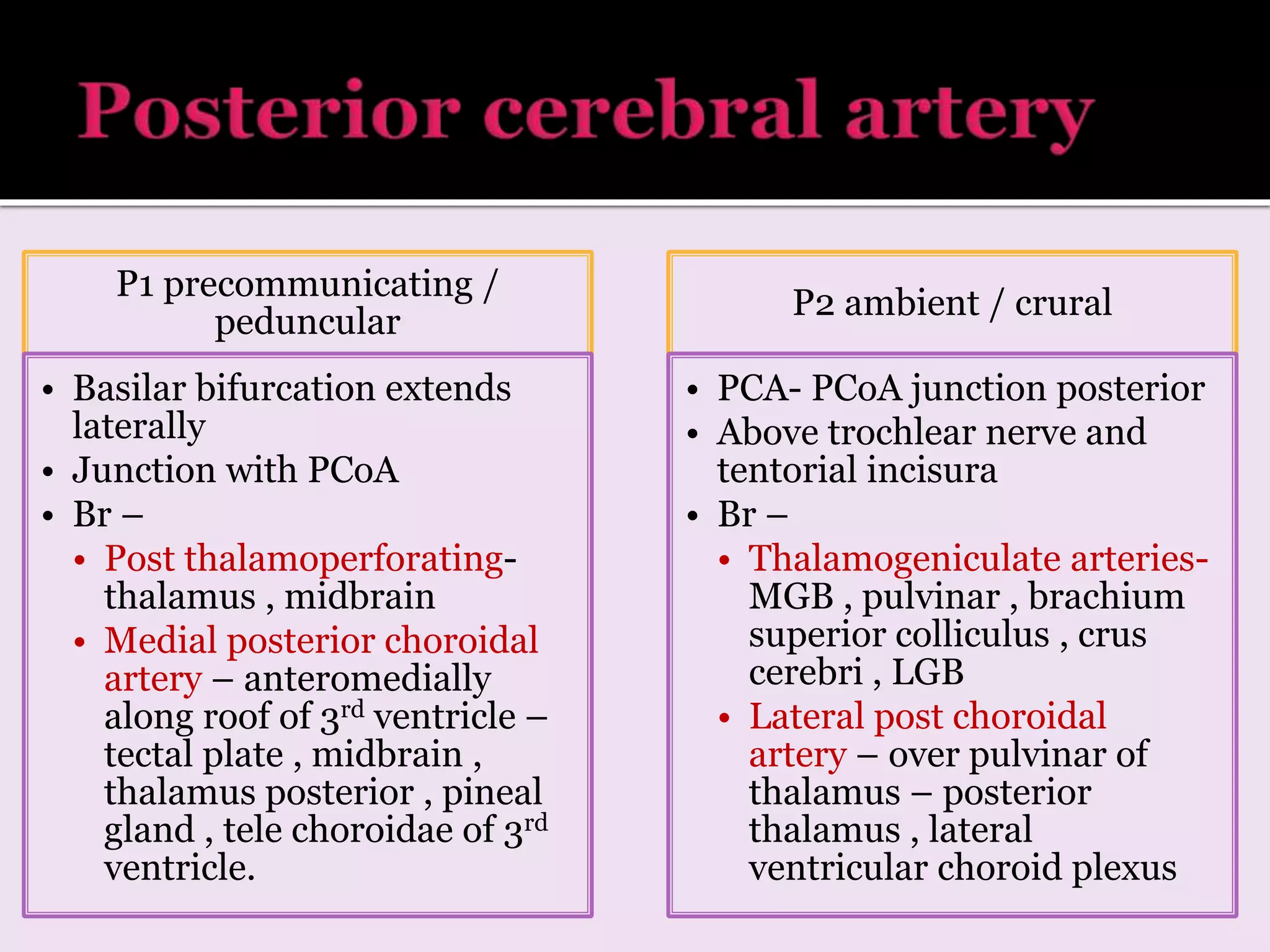
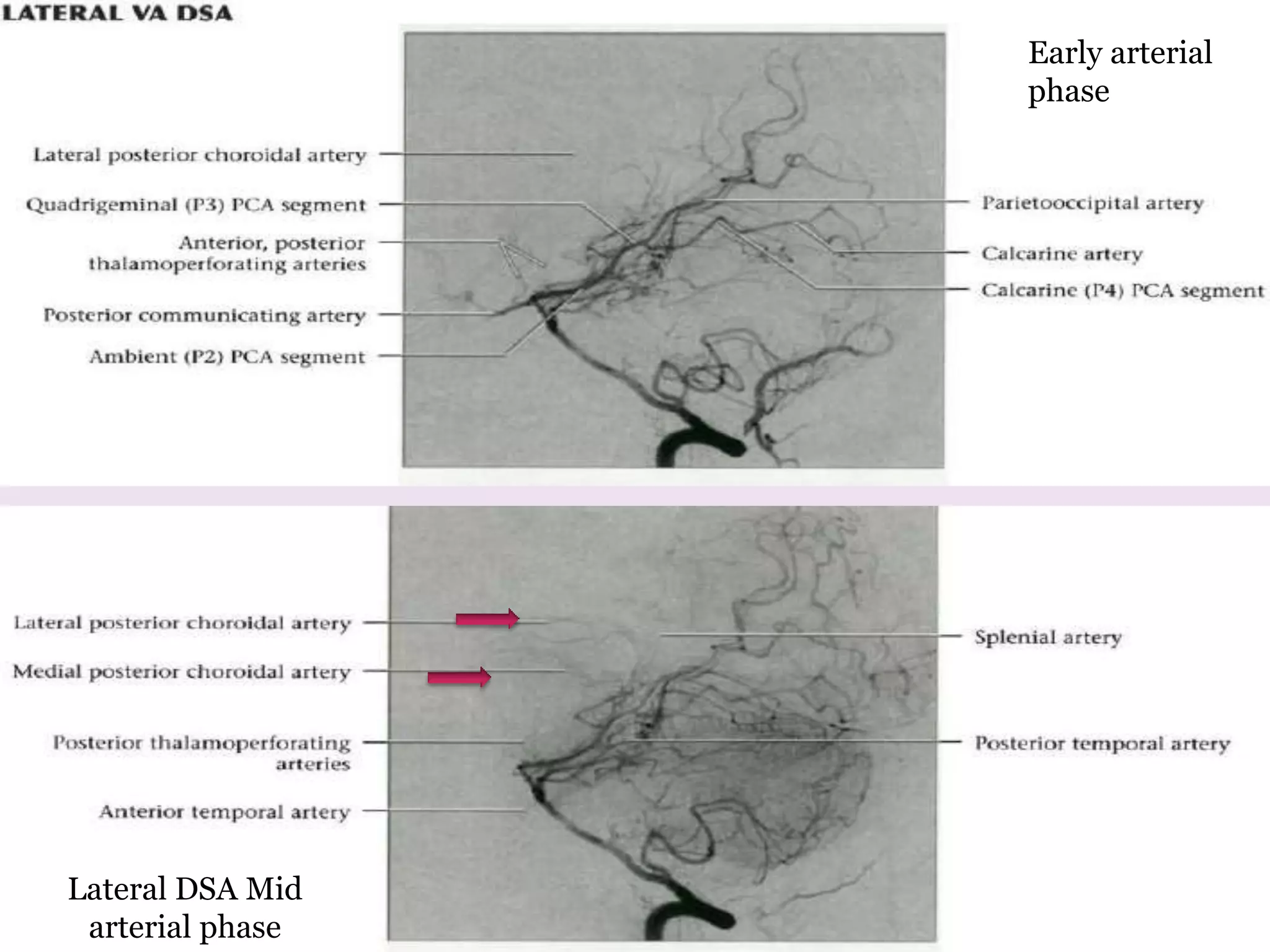
PCA origin from bifurcation of basilar artery in interpeduncular cistern.
Lies above occulomotar nerve.
Circles midbrain above tentorium cerebelli.
P1 precommunicating /
peduncular
• Basilar bifurcation extends
laterally
• Junction with PCoA
• Br –
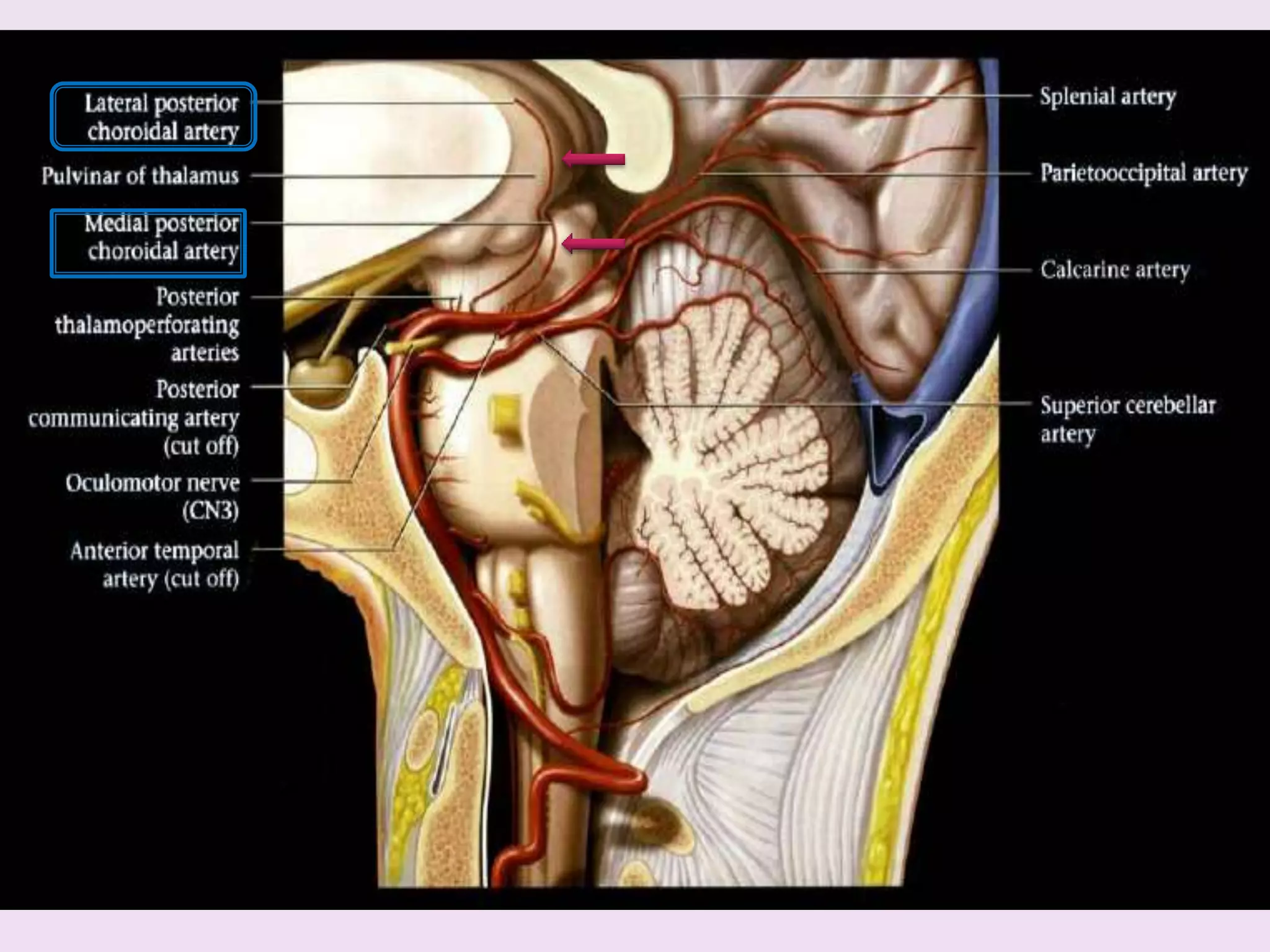
• Post thalamoperforating-
thalamus , midbrain
• Medial posterior choroidal
artery – anteromedially
along roof of 3rd ventricle –
tectal plate , midbrain ,
thalamus posterior , pineal
gland , tele choroidae of 3rd
ventricle.
P2 ambient / crural
• PCA- PCoA junction posterior
• Above trochlear nerve and
tentorial incisura
• Br –
• Thalamogeniculate arteries-
MGB , pulvinar , brachium
superior colliculus , crus
cerebri , LGB
• Lateral post choroidal
artery – over pulvinar of
thalamus – posterior
thalamus , lateral
ventricular choroid plexus
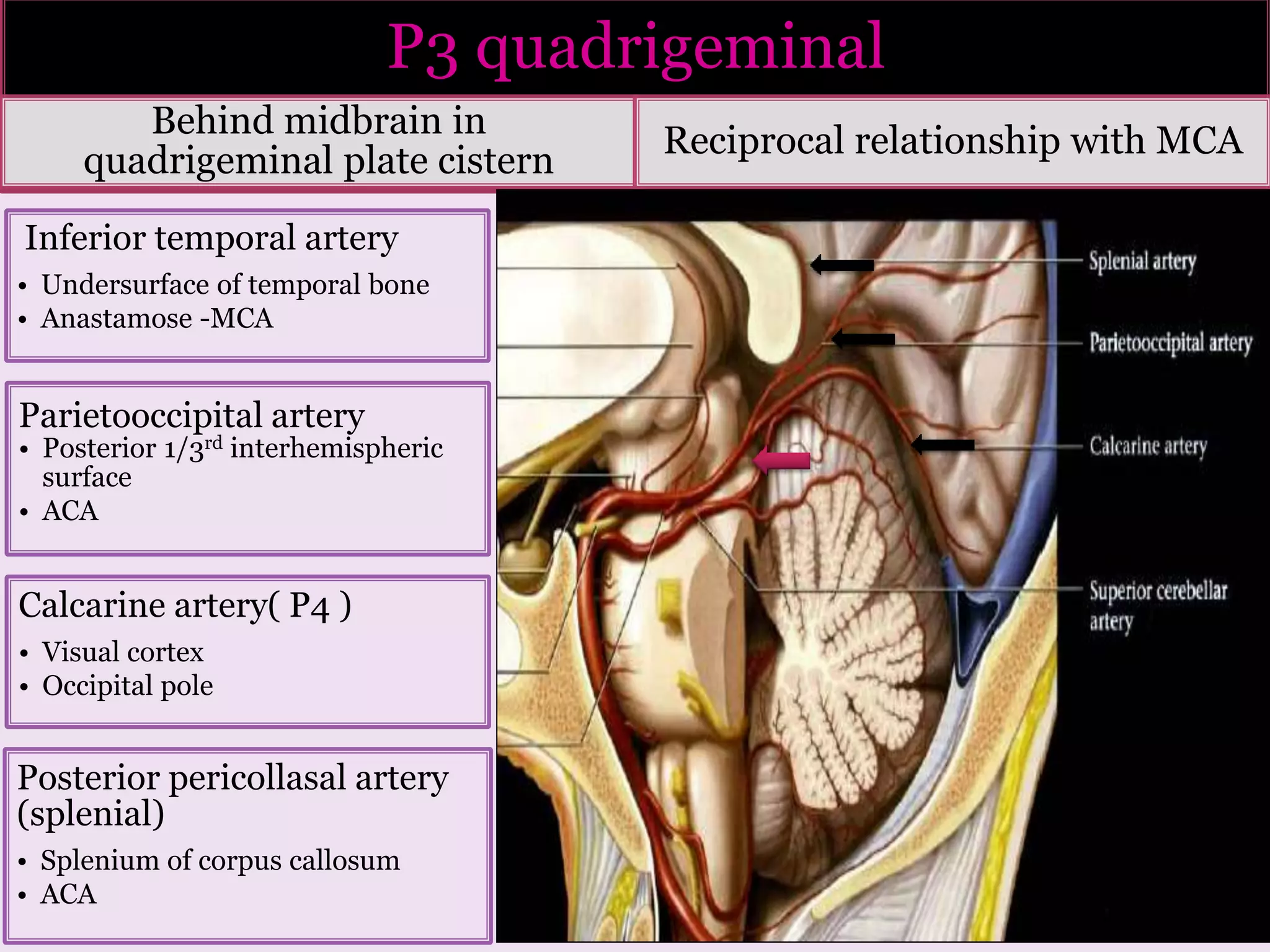
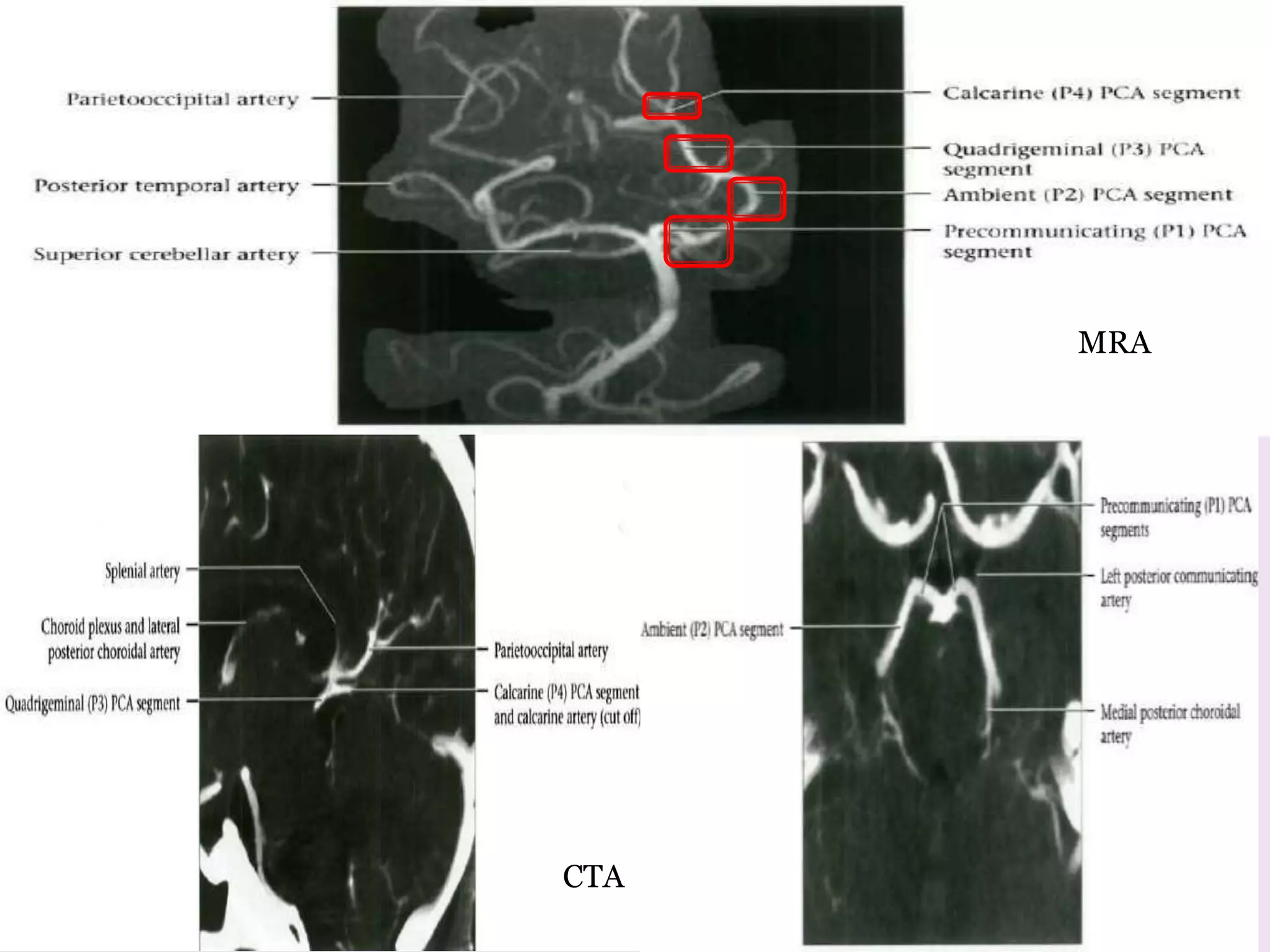
P3 quadrigeminal
Behind midbrain in
quadrigeminal plate cistern
Reciprocal relationship with MCA
Inferior temporal artery
• Undersurface of temporal bone
• Anastamose -MCA
Parietooccipital artery
• Posterior 1/3rd interhemispheric
surface
• ACA
Calcarine artery( P4 )
• Visual cortex
• Occipital pole
Posterior pericollasal artery
(splenial)
• Splenium of corpus callosum
• ACA
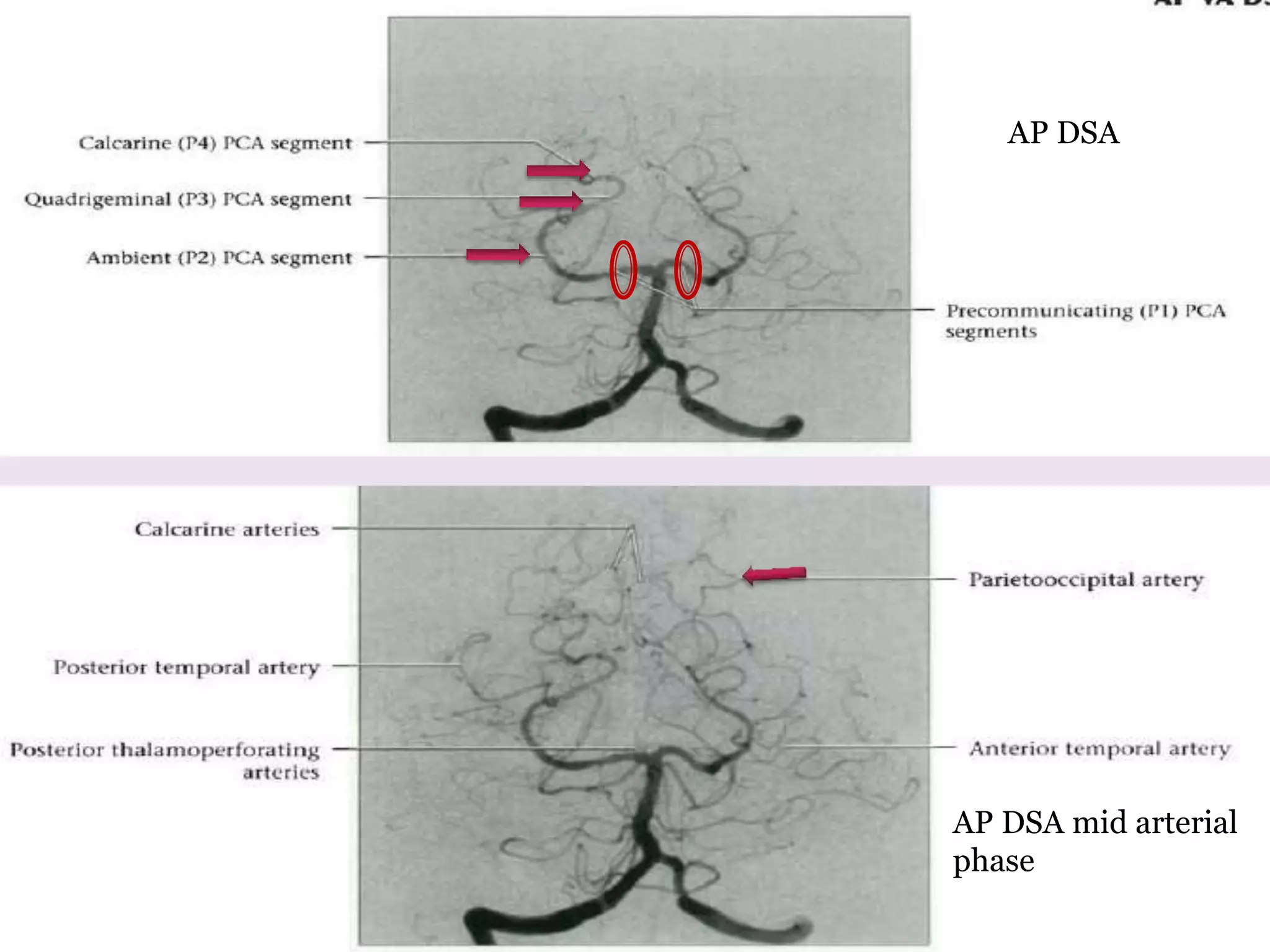
AP DSA
AP DSA mid arterial
phase
Early arterial
phase
Lateral DSA Mid
arterial phase
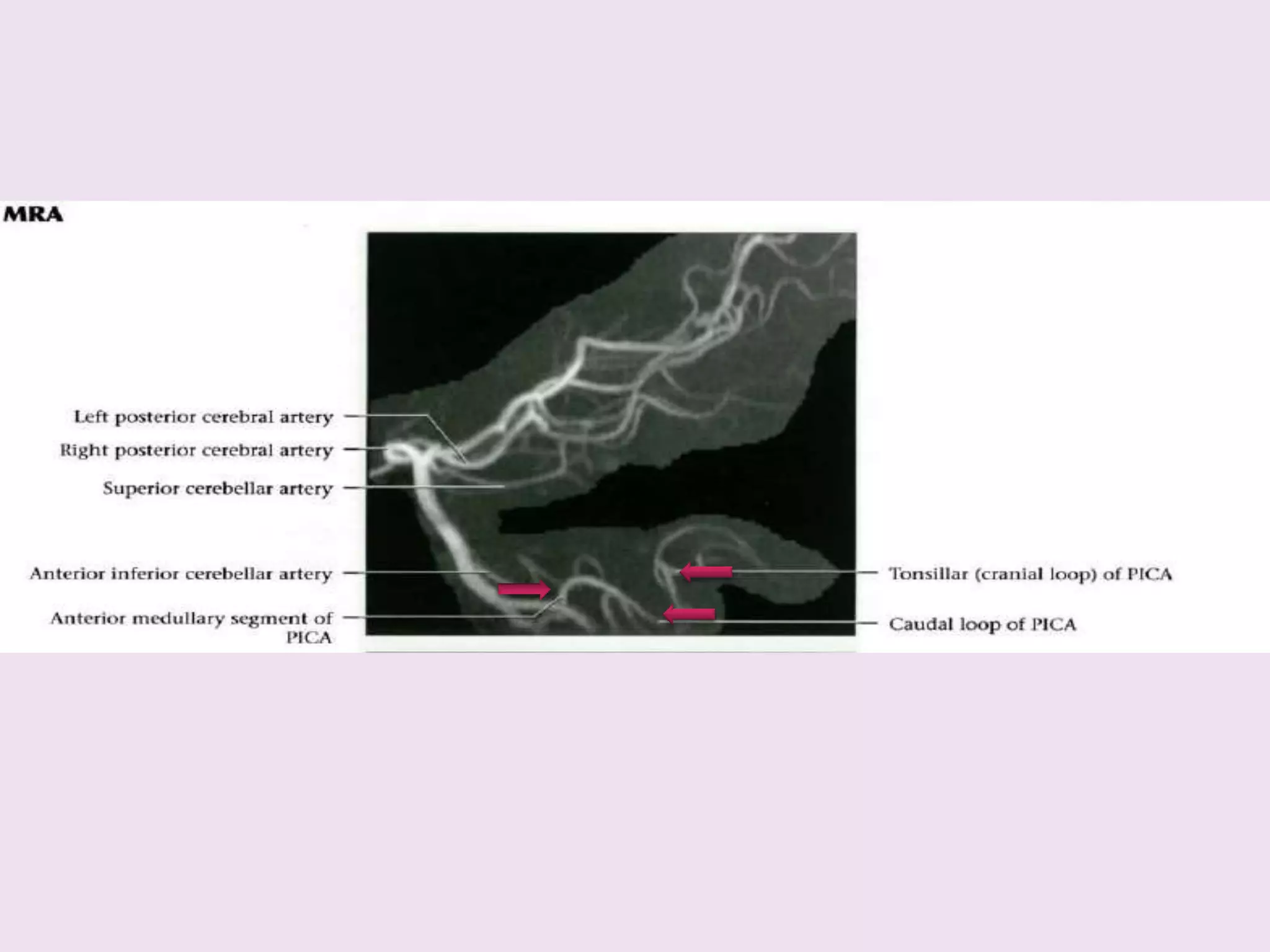
MRA
CTA
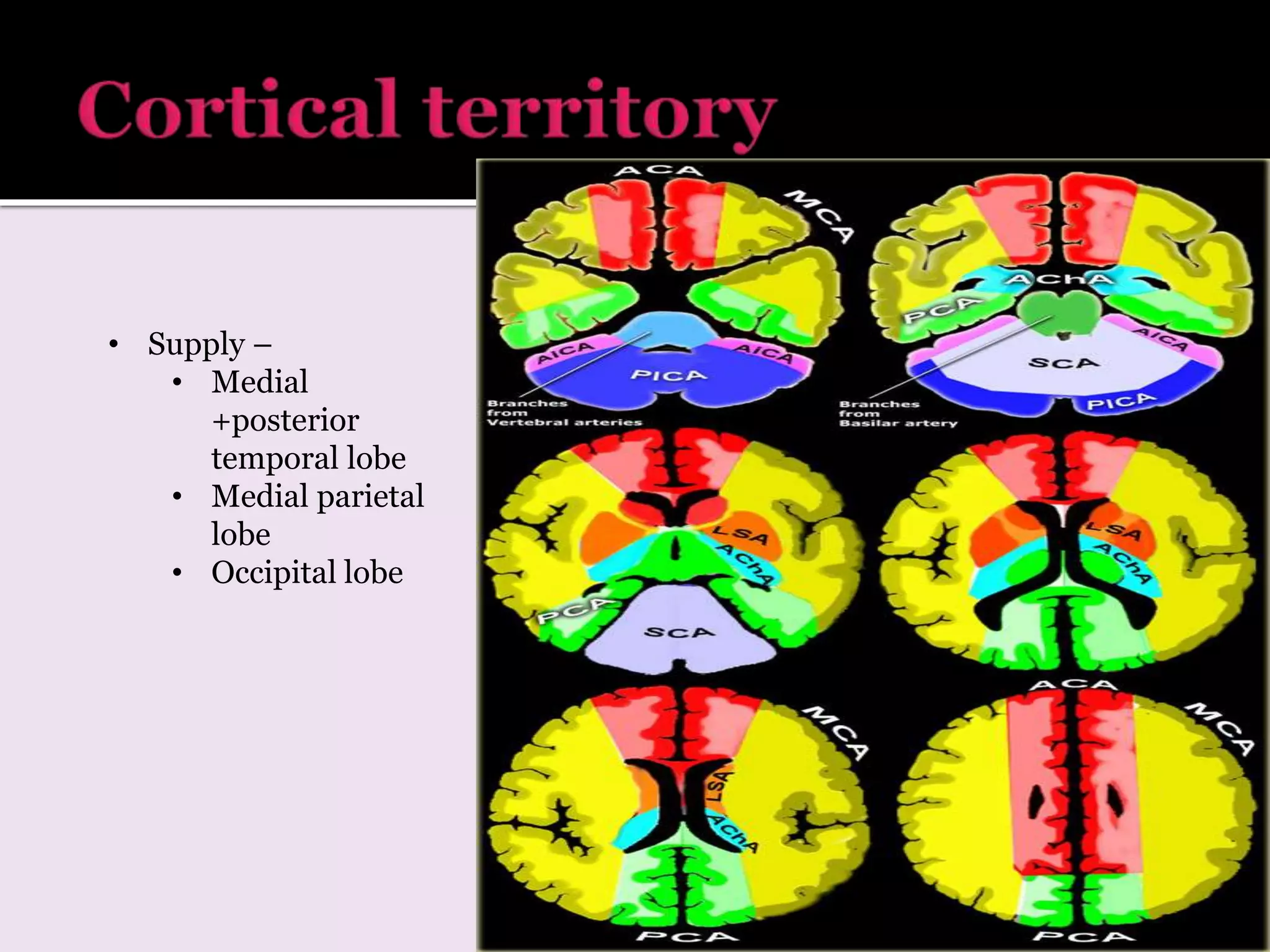
• Supply –
• Medial
+posterior
temporal lobe
• Medial parietal
lobe
• Occipital lobe
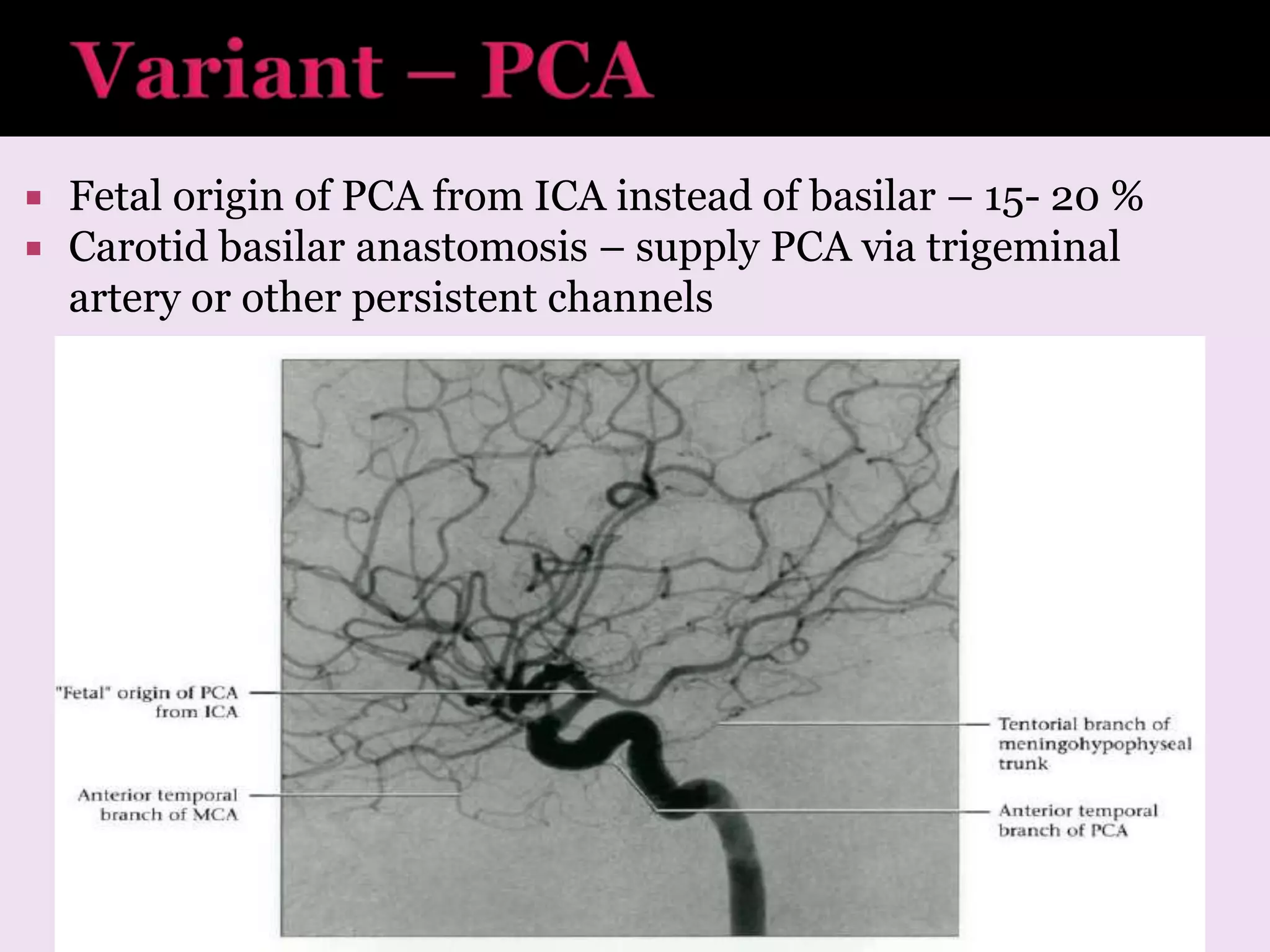
 Fetal origin of PCA from ICA instead of basilar – 15- 20 %
 Carotid basilar anastomosis – supply PCA via trigeminal
artery or other persistent channels
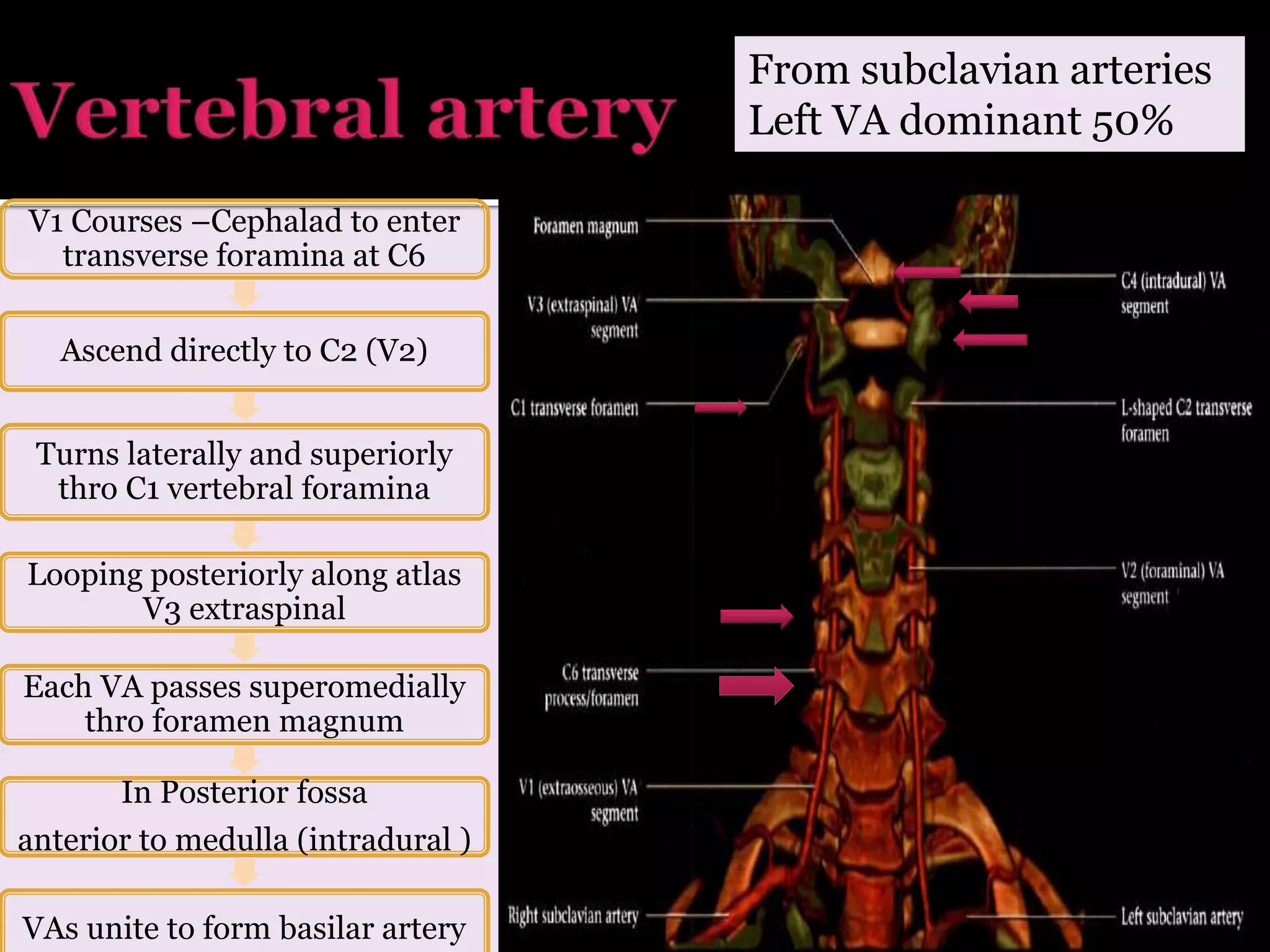
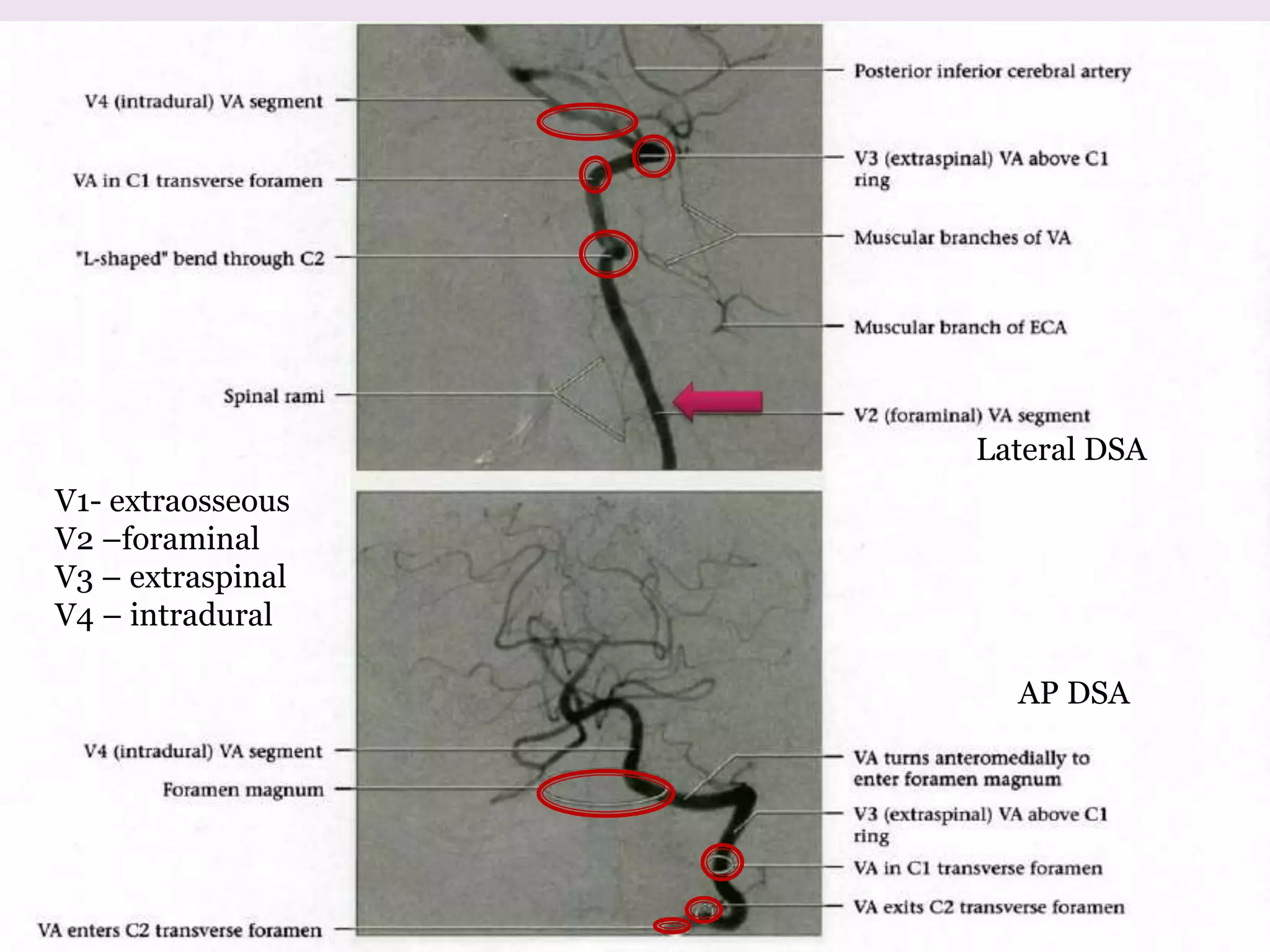
V1 Courses –Cephalad to enter
transverse foramina at C6
Ascend directly to C2 (V2)
Turns laterally and superiorly
thro C1 vertebral foramina
Looping posteriorly along atlas
V3 extraspinal
Each VA passes superomedially
thro foramen magnum
In Posterior fossa
anterior to medulla (intradural )
VAs unite to form basilar artery
From subclavian arteries
Left VA dominant 50%
1. V1-Small segmental
spinal/ meningeal/
muscular branches.
2. V2- Anterior Meningeal
artery , muscular
branches.
3. V3 -Posterior Meningeal
artery
 Courses along posterior
arch of atlas.
 Supplies falx cerebri
 Variant – origin from ECA
/ PICA.
 Greatly enlarged with
vascular malformations
and neoplasms Posterior meningeal artery
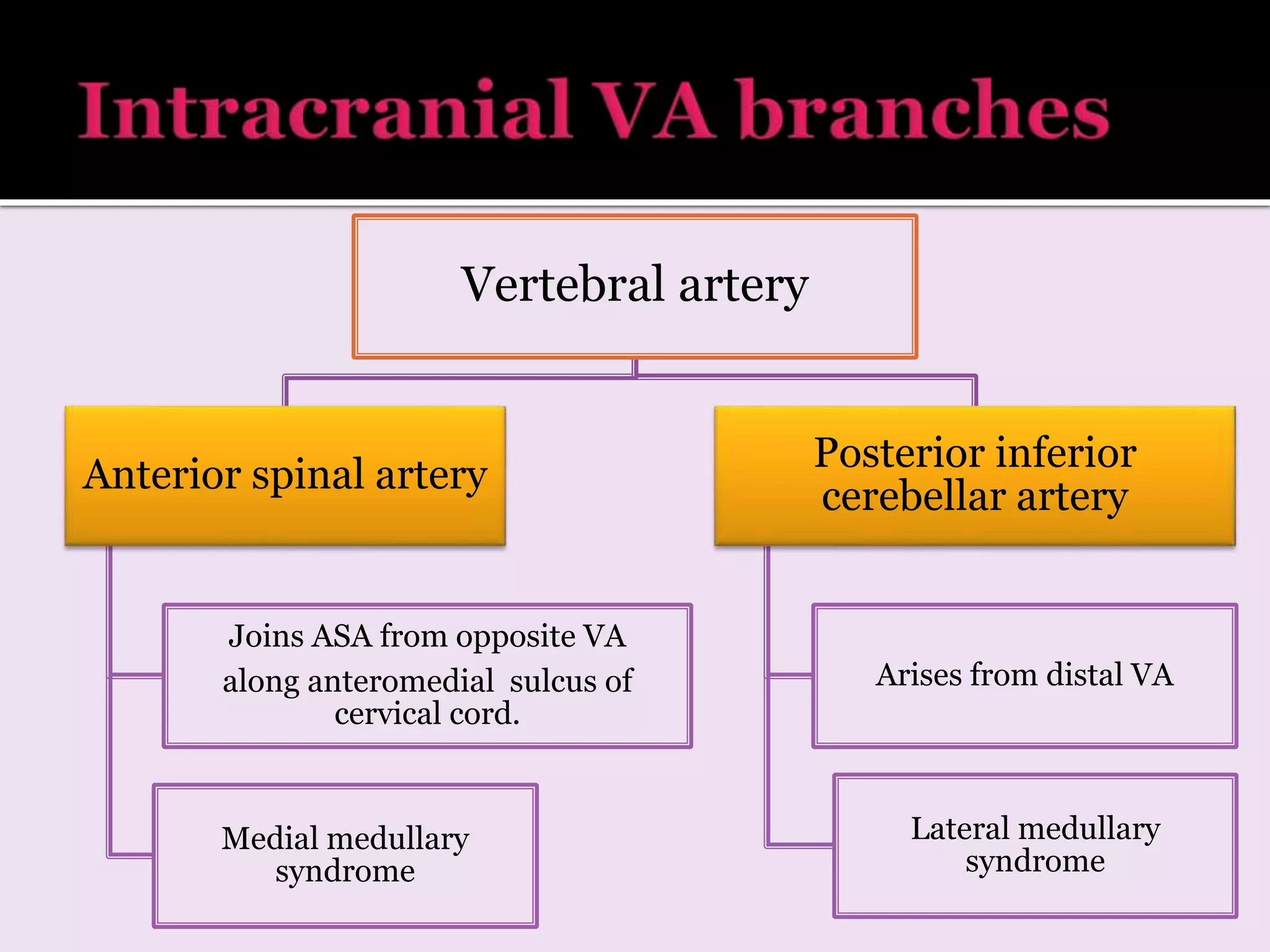
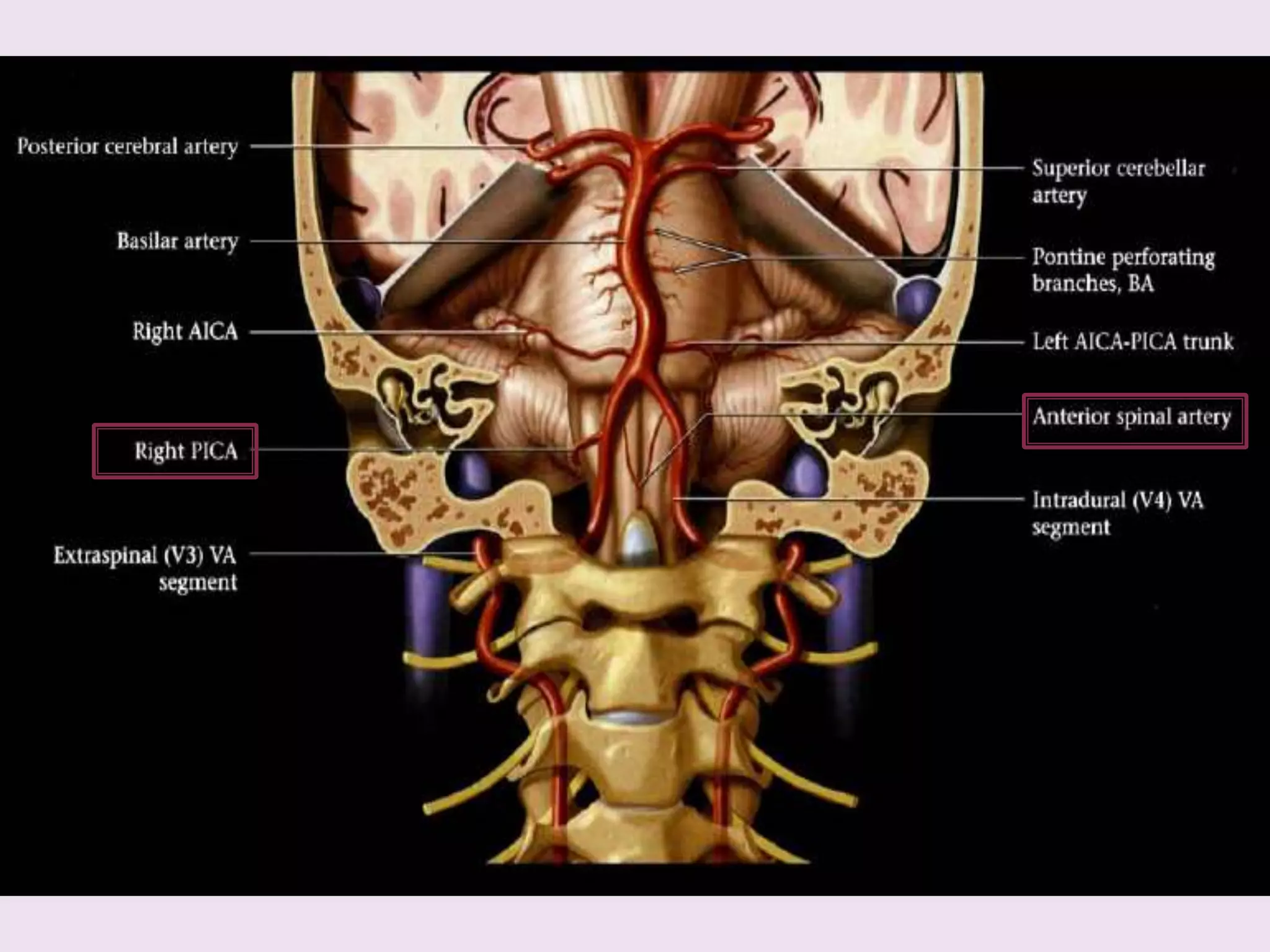
Vertebral artery
Anterior spinal artery
Joins ASA from opposite VA
along anteromedial sulcus of
cervical cord.
Medial medullary
syndrome
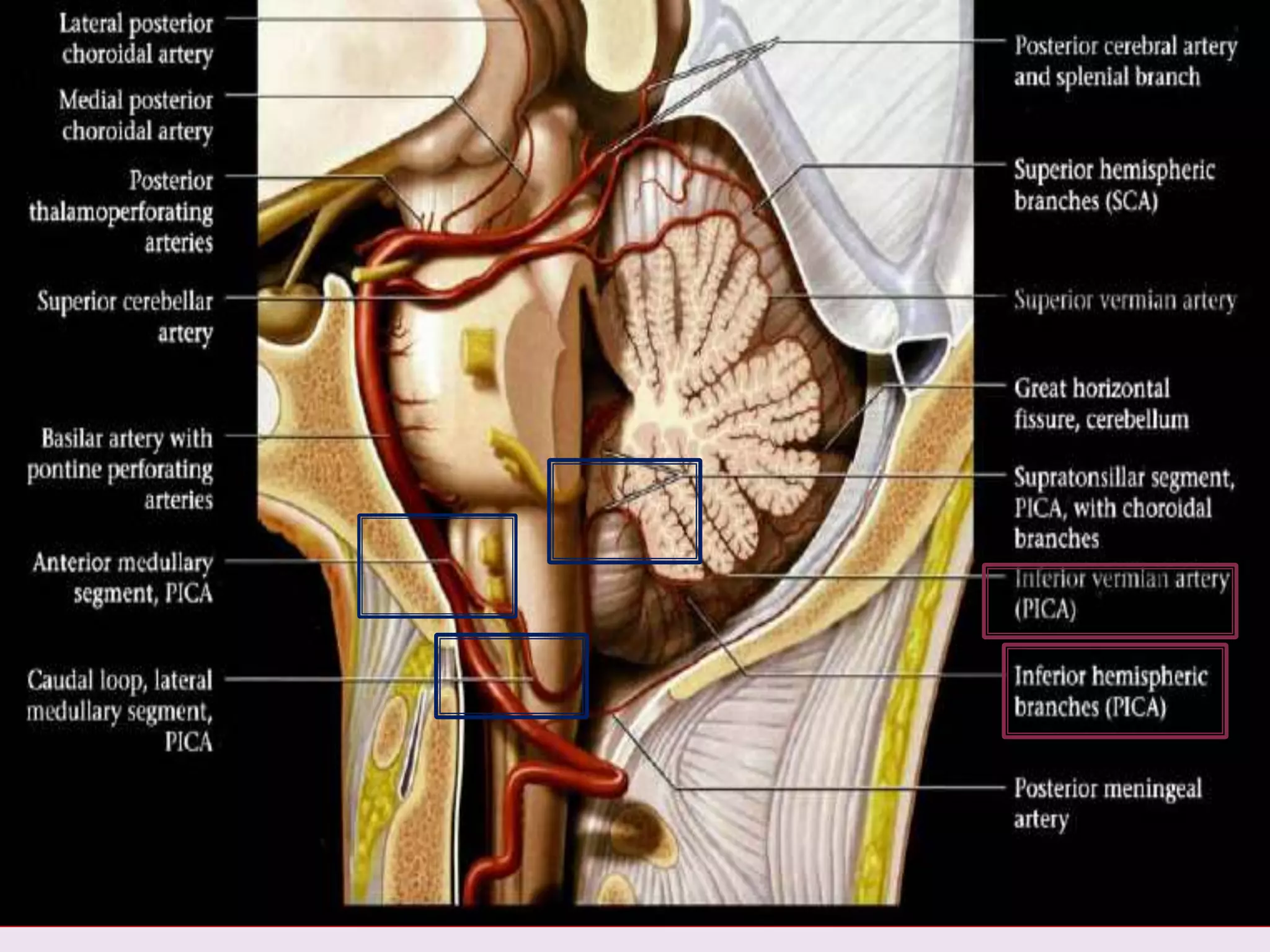
Posterior inferior
cerebellar artery
Arises from distal VA
Lateral medullary
syndrome
Lateral DSA
AP DSA
V1- extraosseous
V2 –foraminal
V3 – extraspinal
V4 – intradural
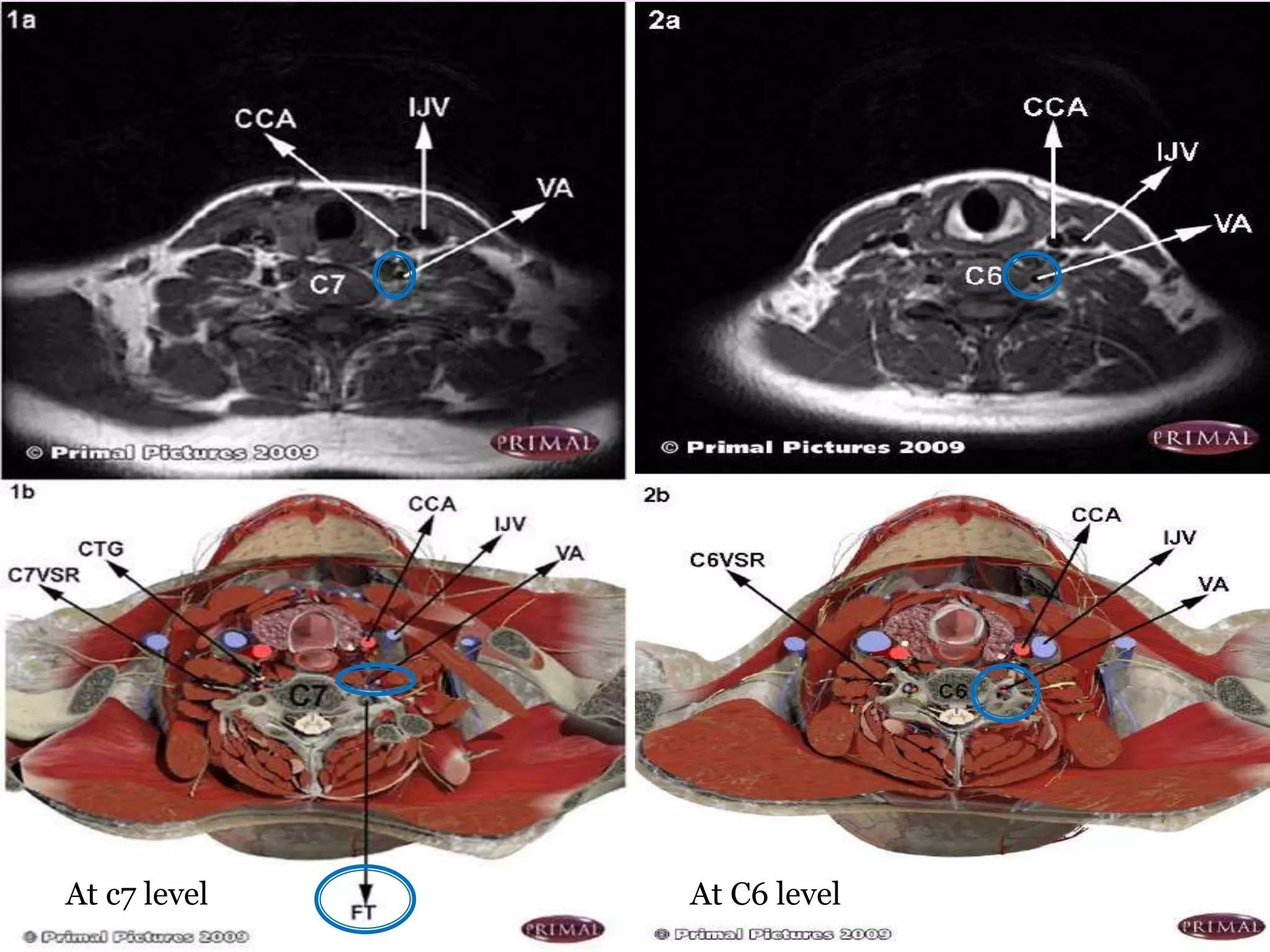
At c7 level At C6 level
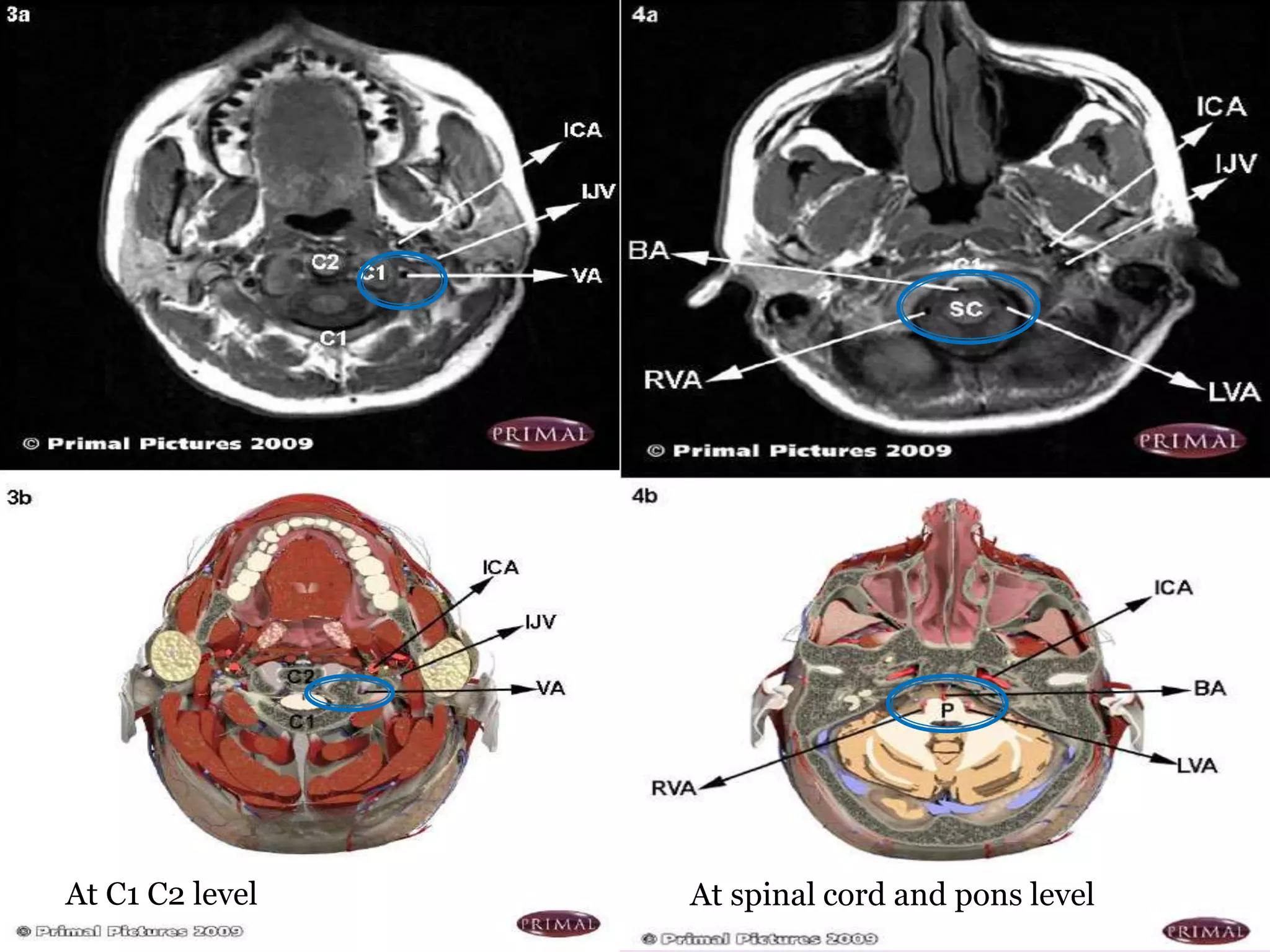
At C1 C2 level At spinal cord and pons level
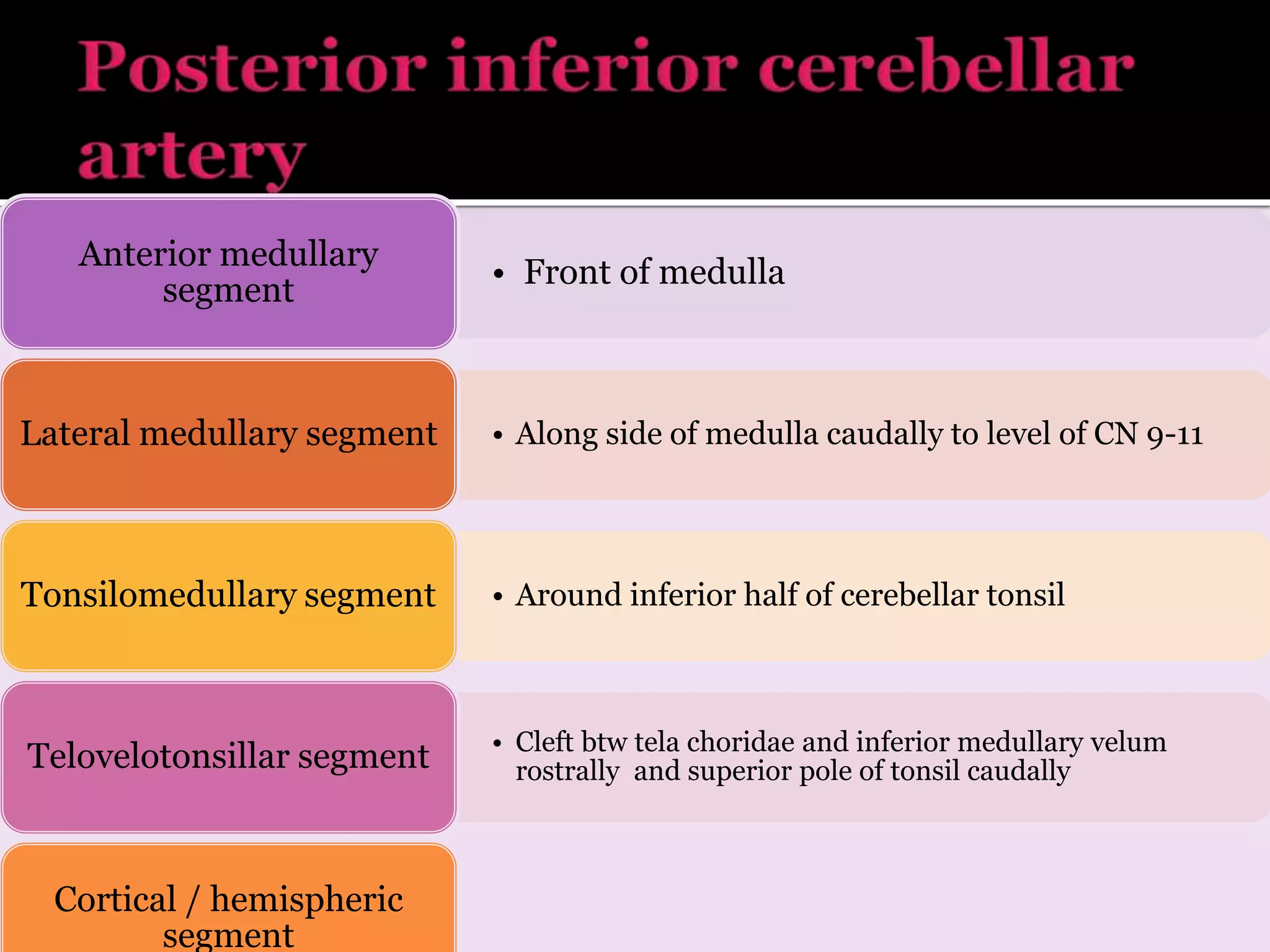
• Front of medulla
Anterior medullary
segment
• Along side of medulla caudally to level of CN 9-11Lateral medullary segment
• Around inferior half of cerebellar tonsilTonsilomedullary segment
• Cleft btw tela choridae and inferior medullary velum
rostrally and superior pole of tonsil caudallyTelovelotonsillar segment
Cortical / hemispheric
segment
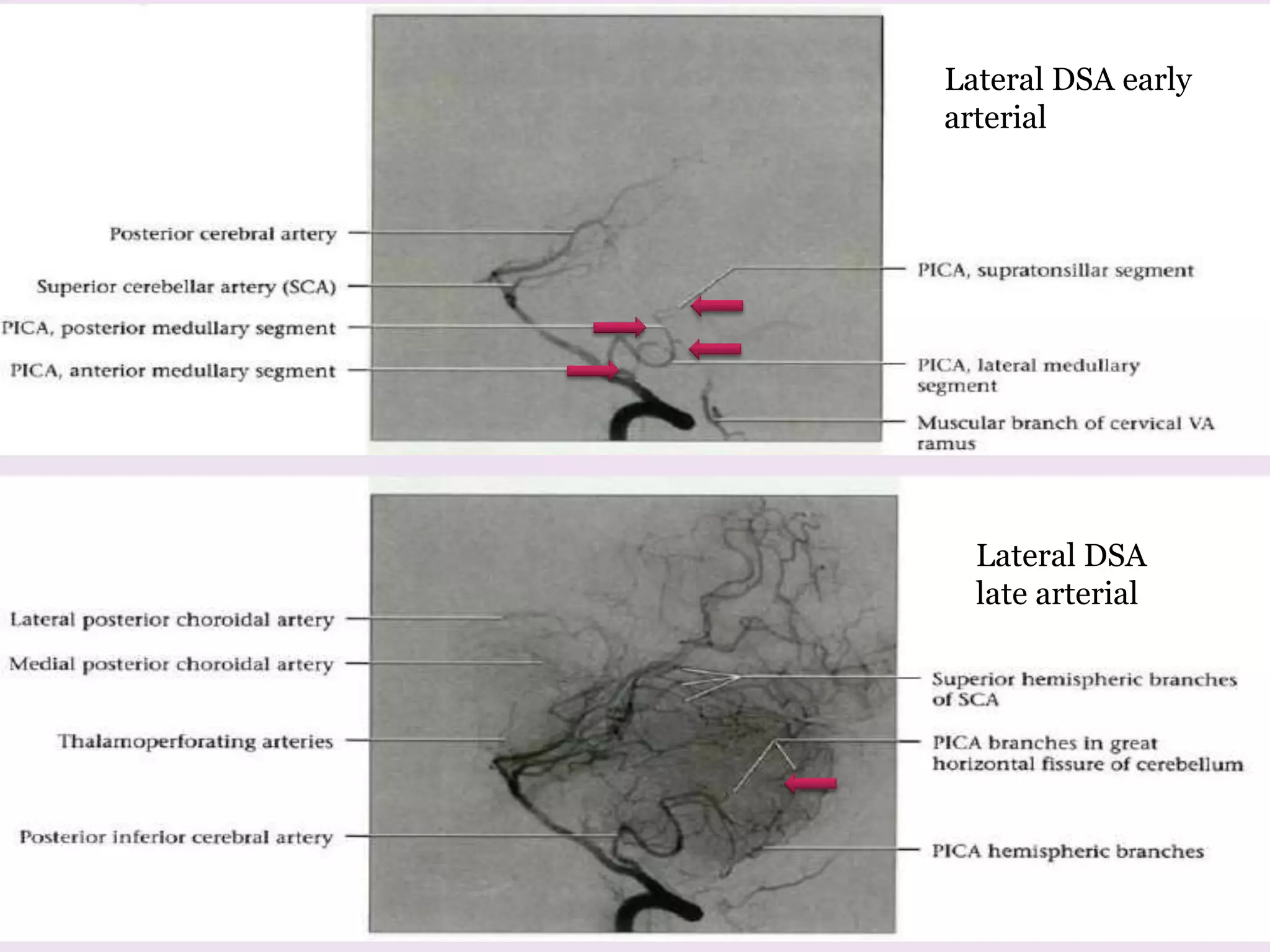
Lateral DSA early
arterial
Lateral DSA
late arterial
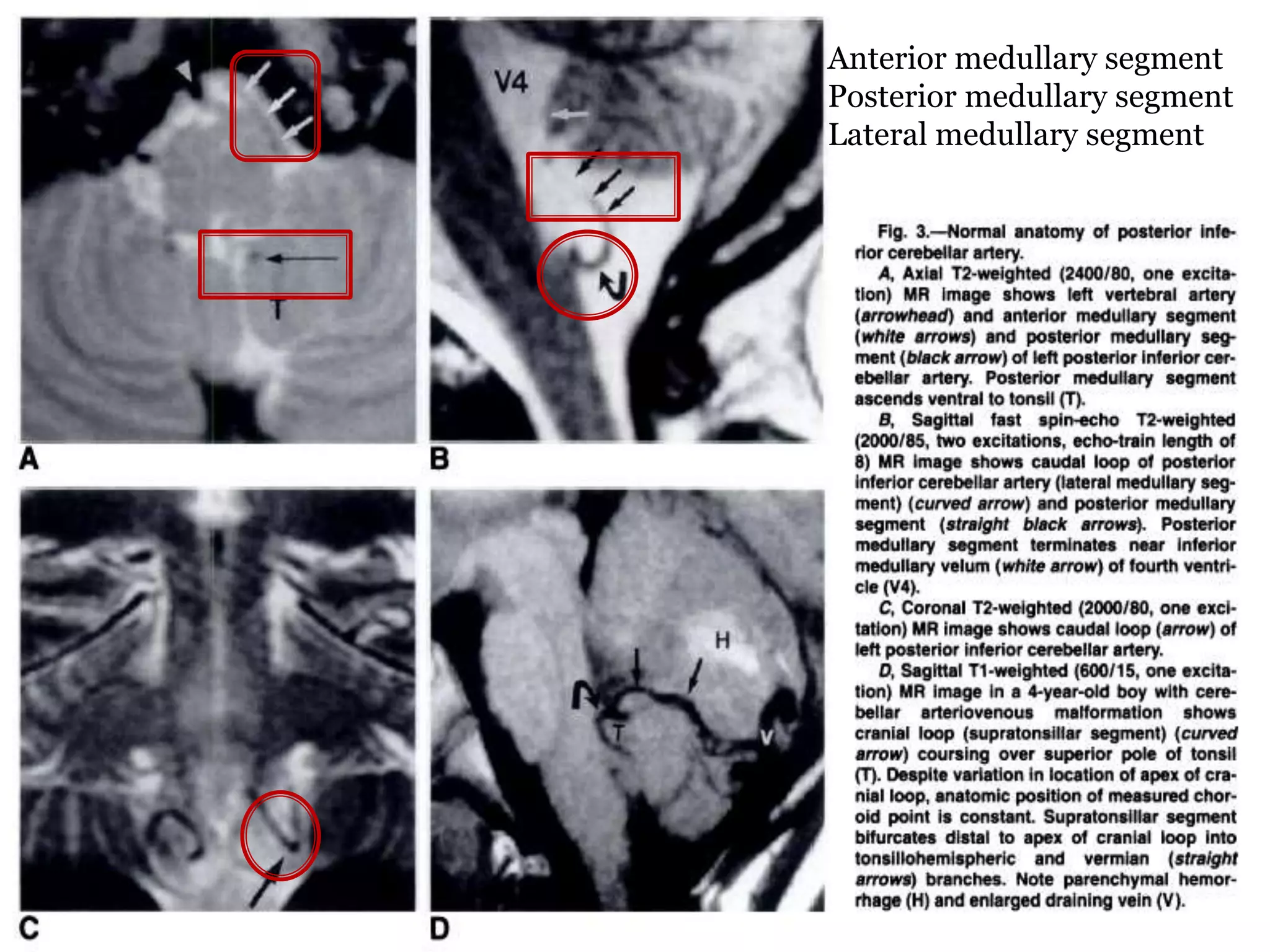
Anterior medullary segment
Posterior medullary segment
Lateral medullary segment
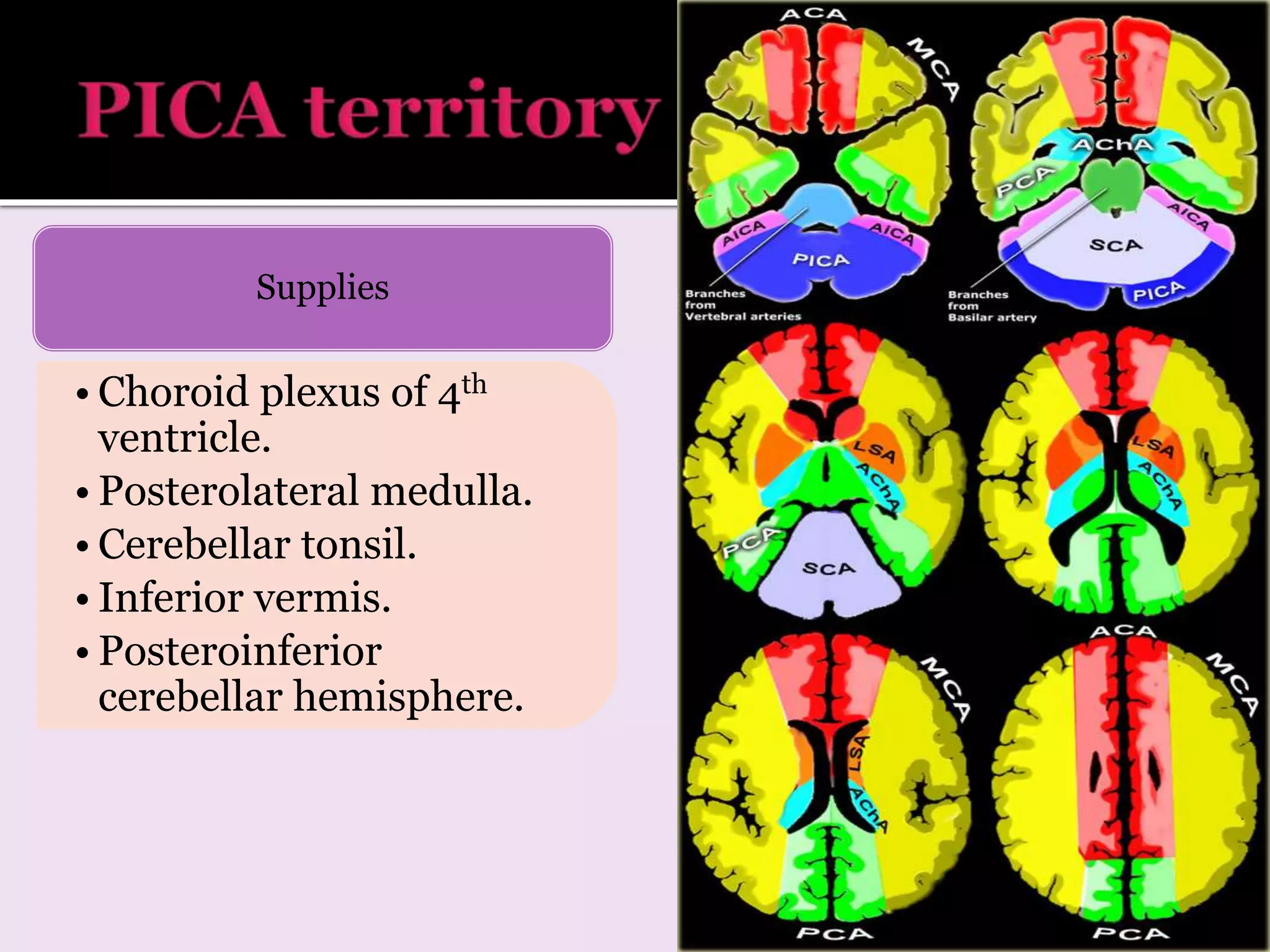
• Choroid plexus of 4th
ventricle.
• Posterolateral medulla.
• Cerebellar tonsil.
• Inferior vermis.
• Posteroinferior
cerebellar hemisphere.
Supplies
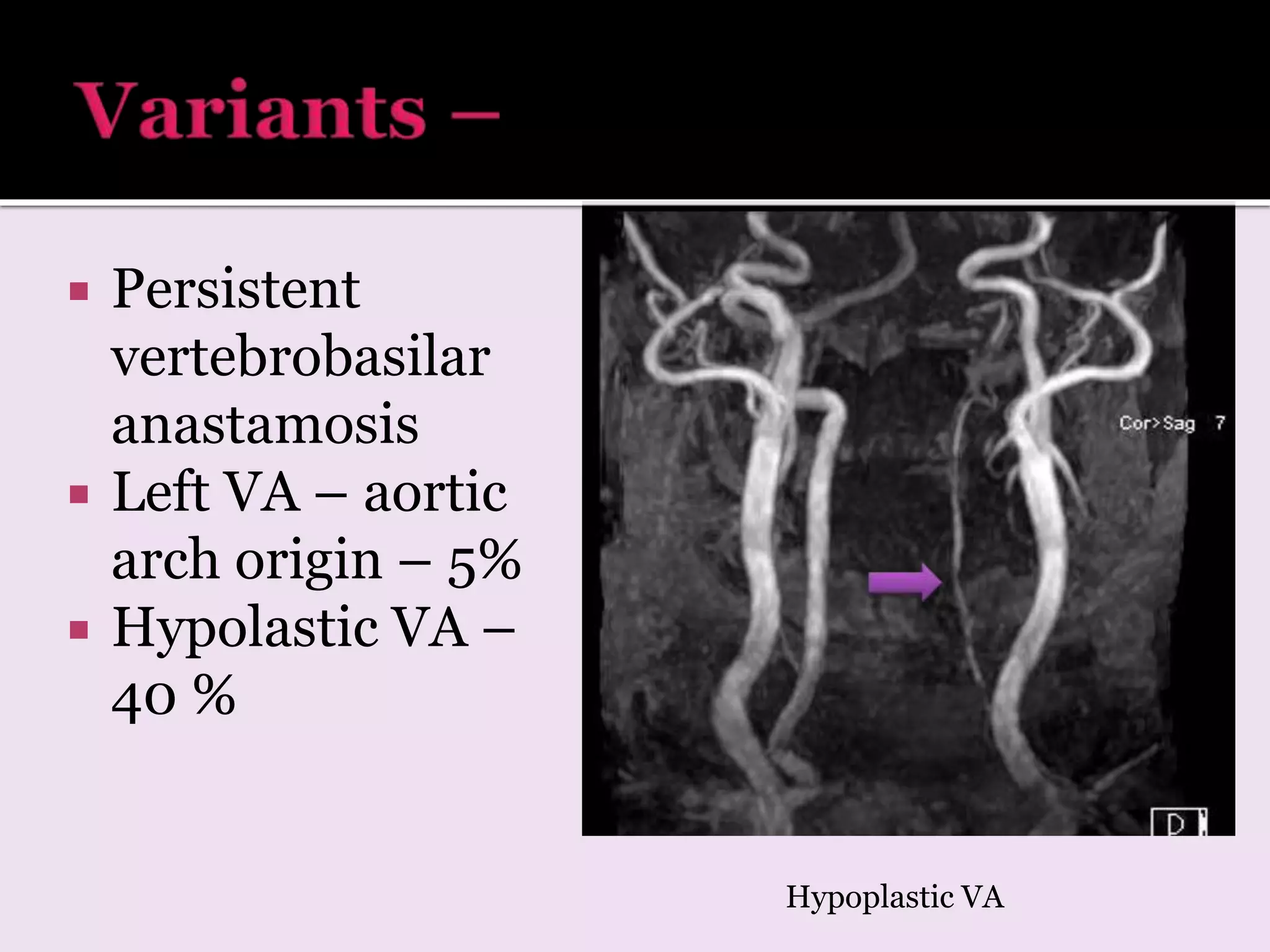
 Persistent
vertebrobasilar
anastamosis
 Left VA – aortic
arch origin – 5%
 Hypolastic VA –
40 %
Hypoplastic VA
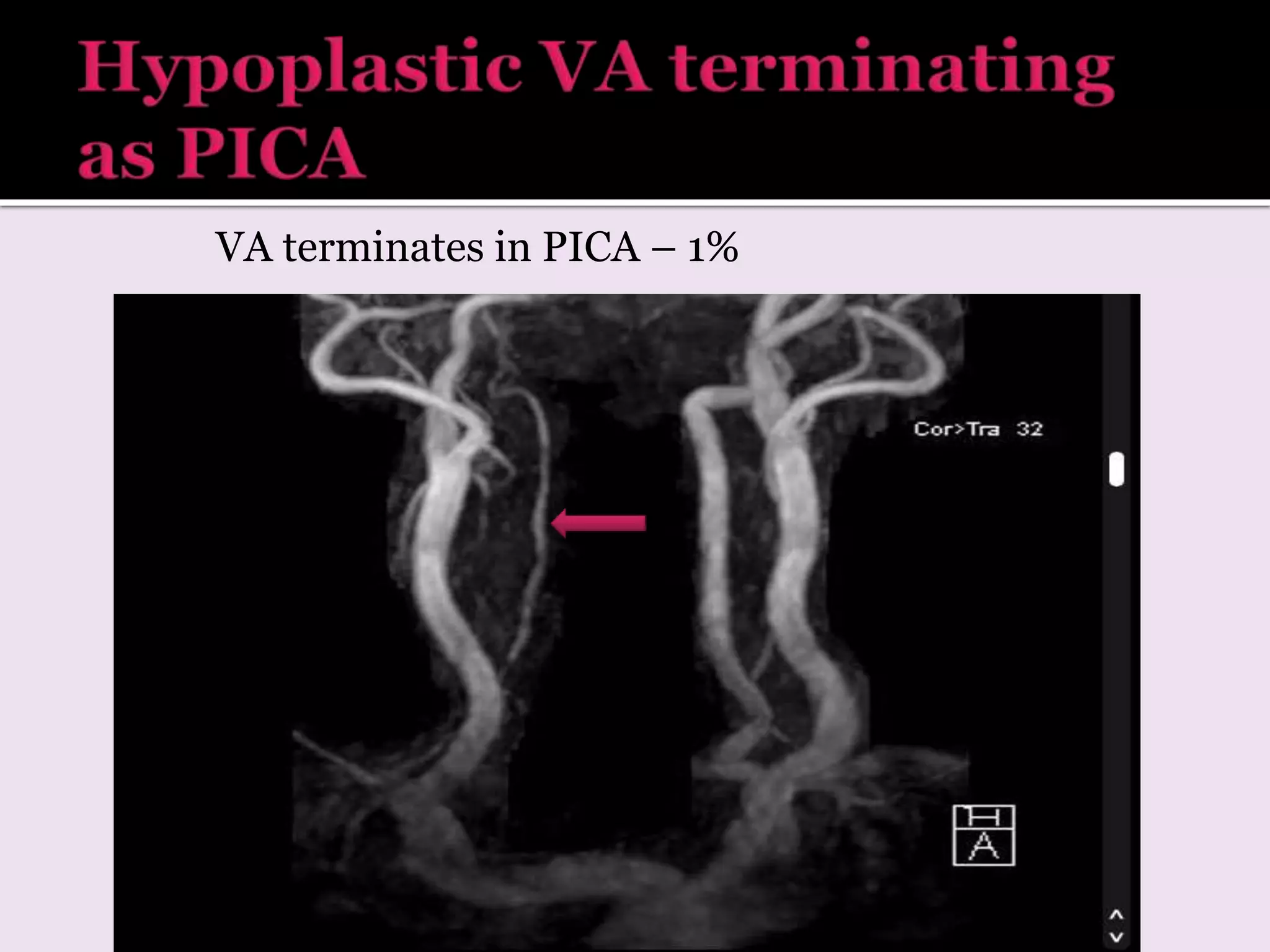
VA terminates in PICA – 1%
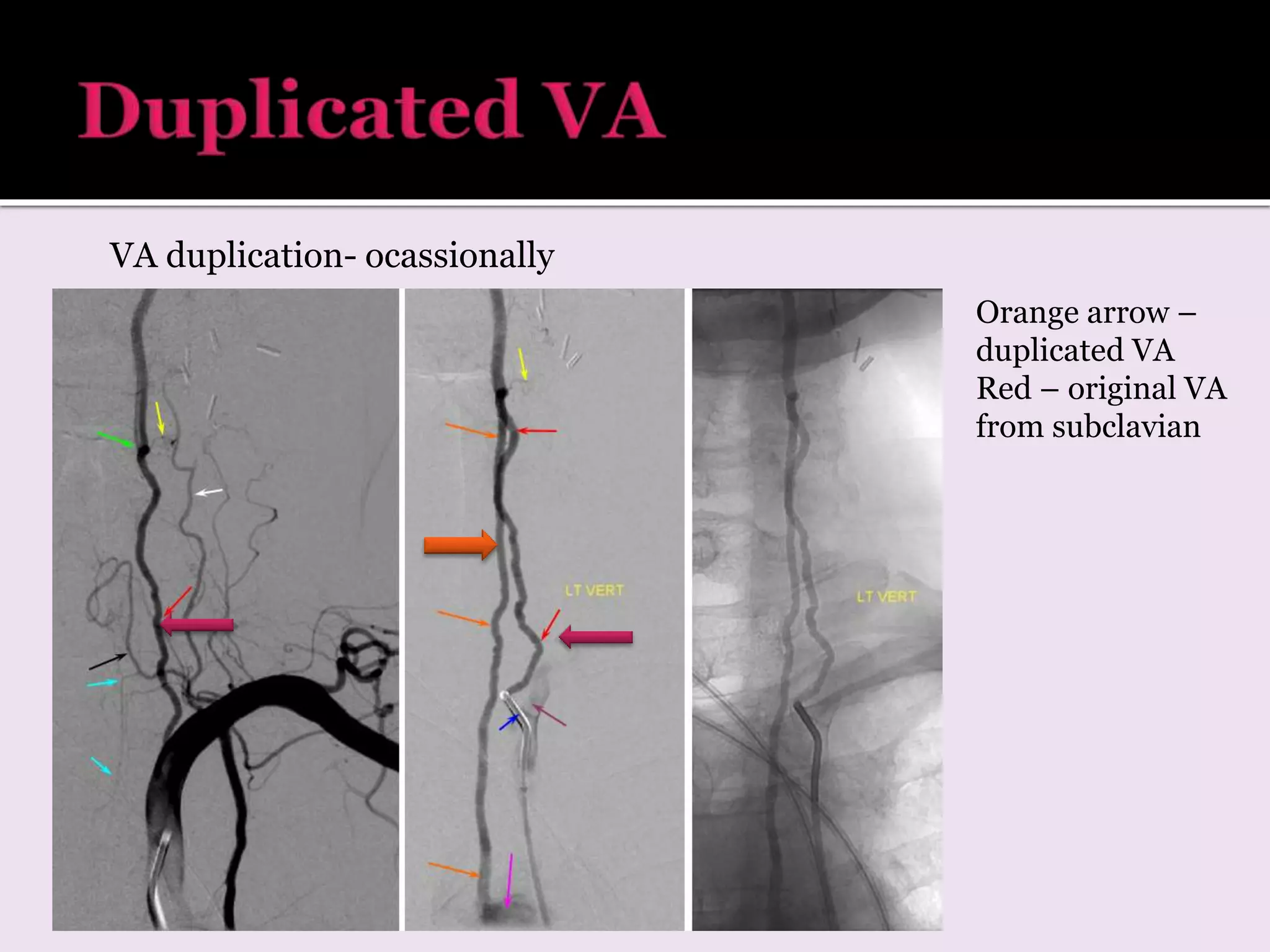
Orange arrow –
duplicated VA
Red – original VA
from subclavian
VA duplication- ocassionally
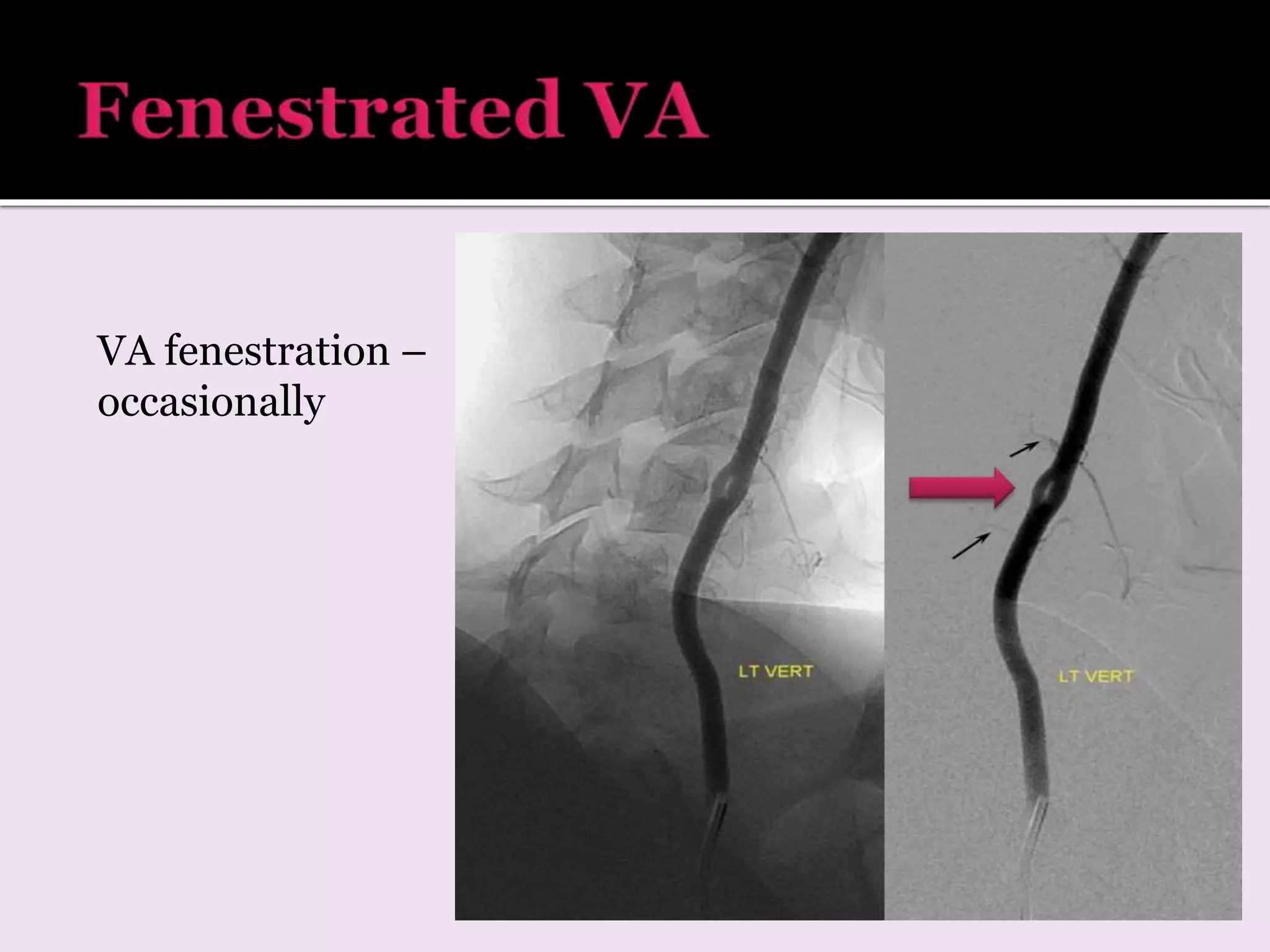
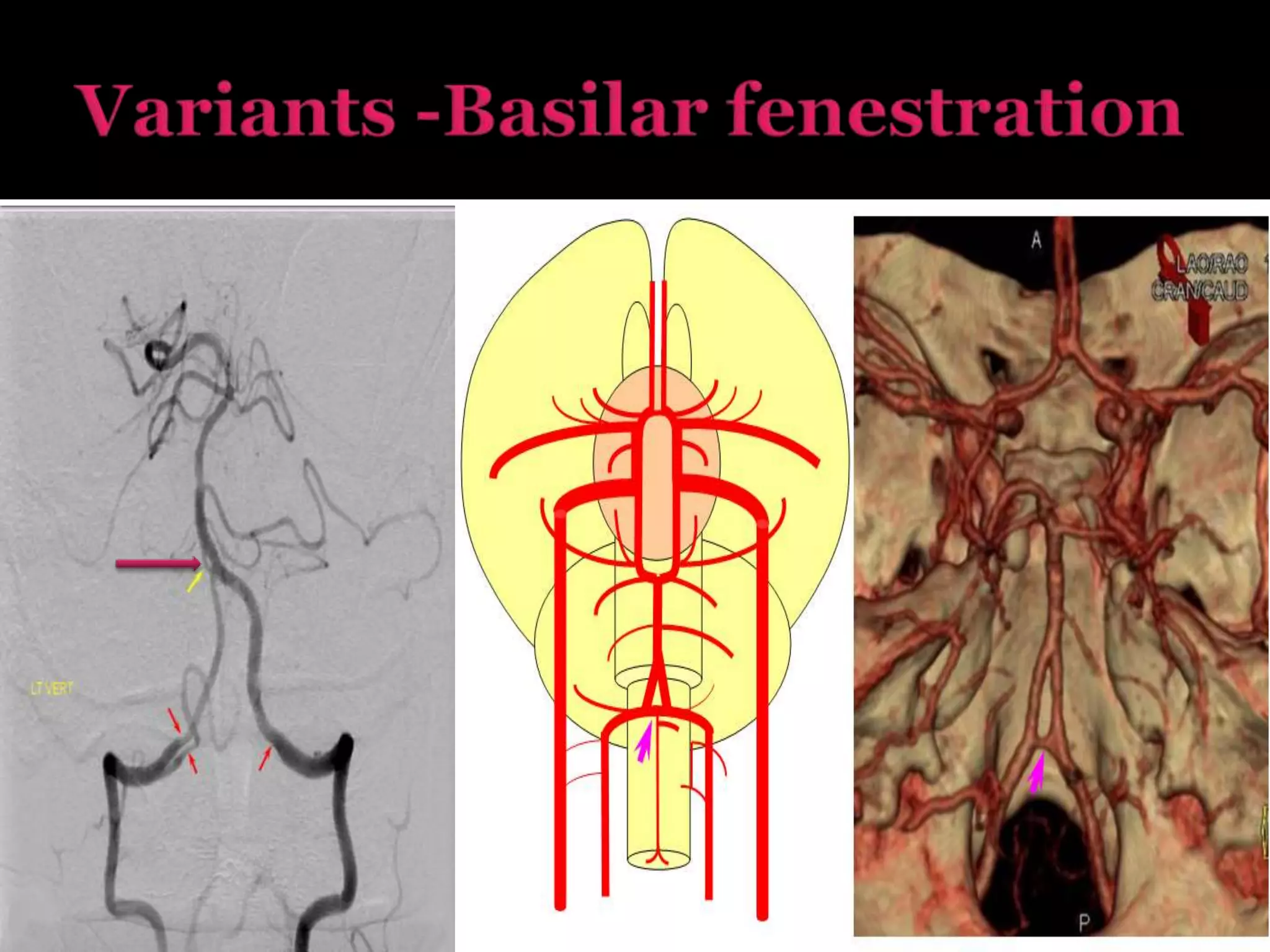
VA fenestration –
occasionally
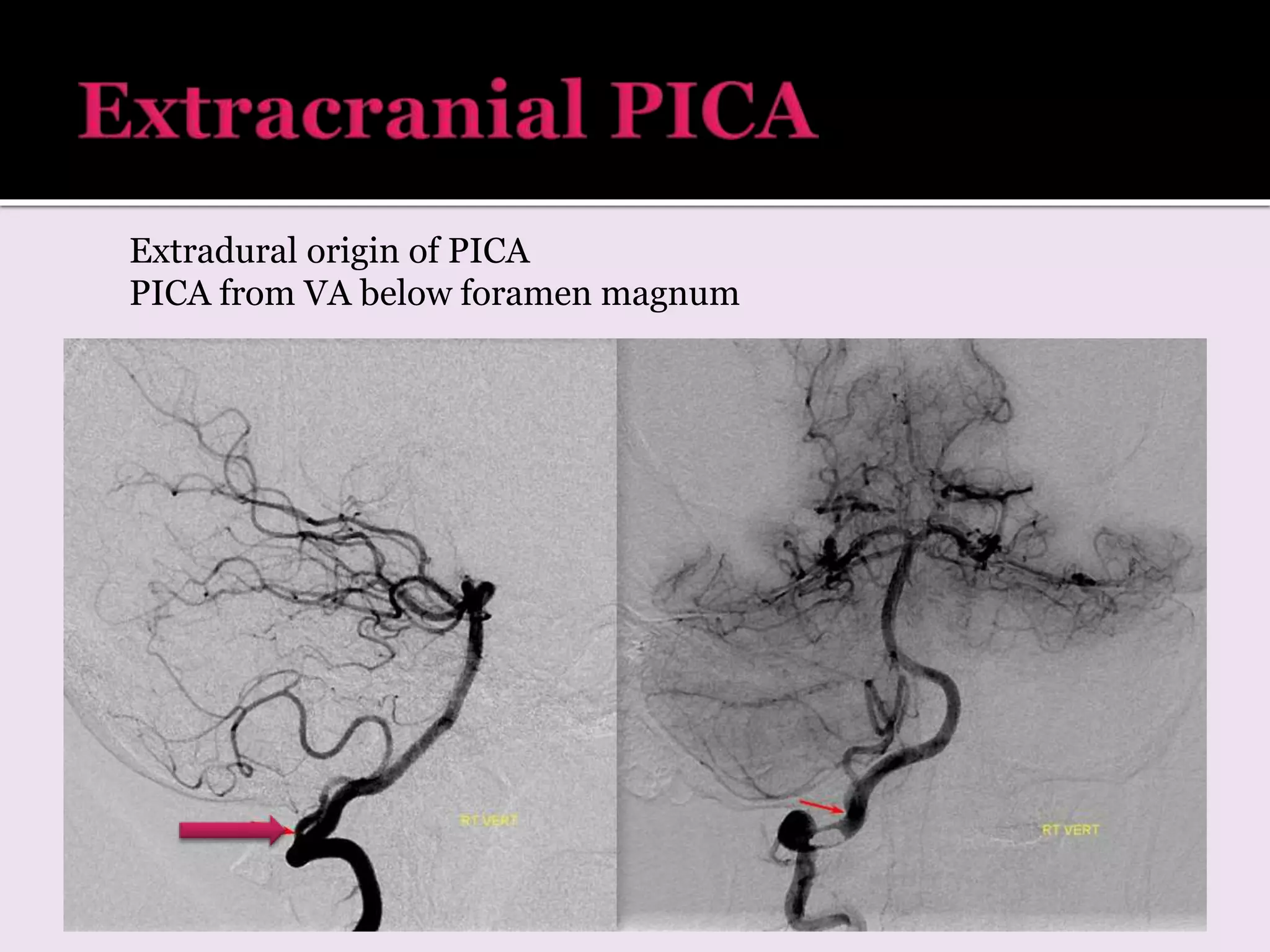
Extradural origin of PICA
PICA from VA below foramen magnum
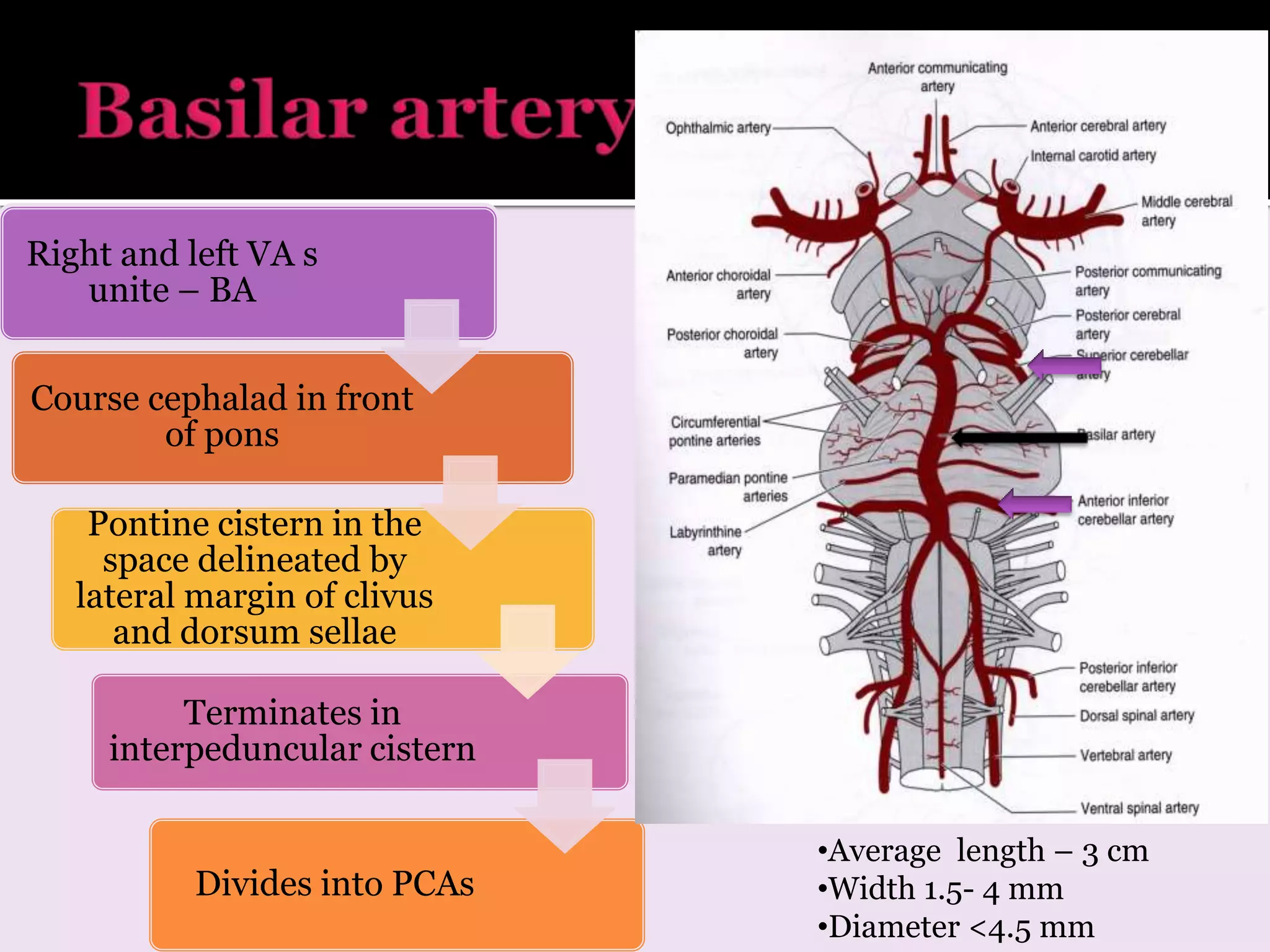
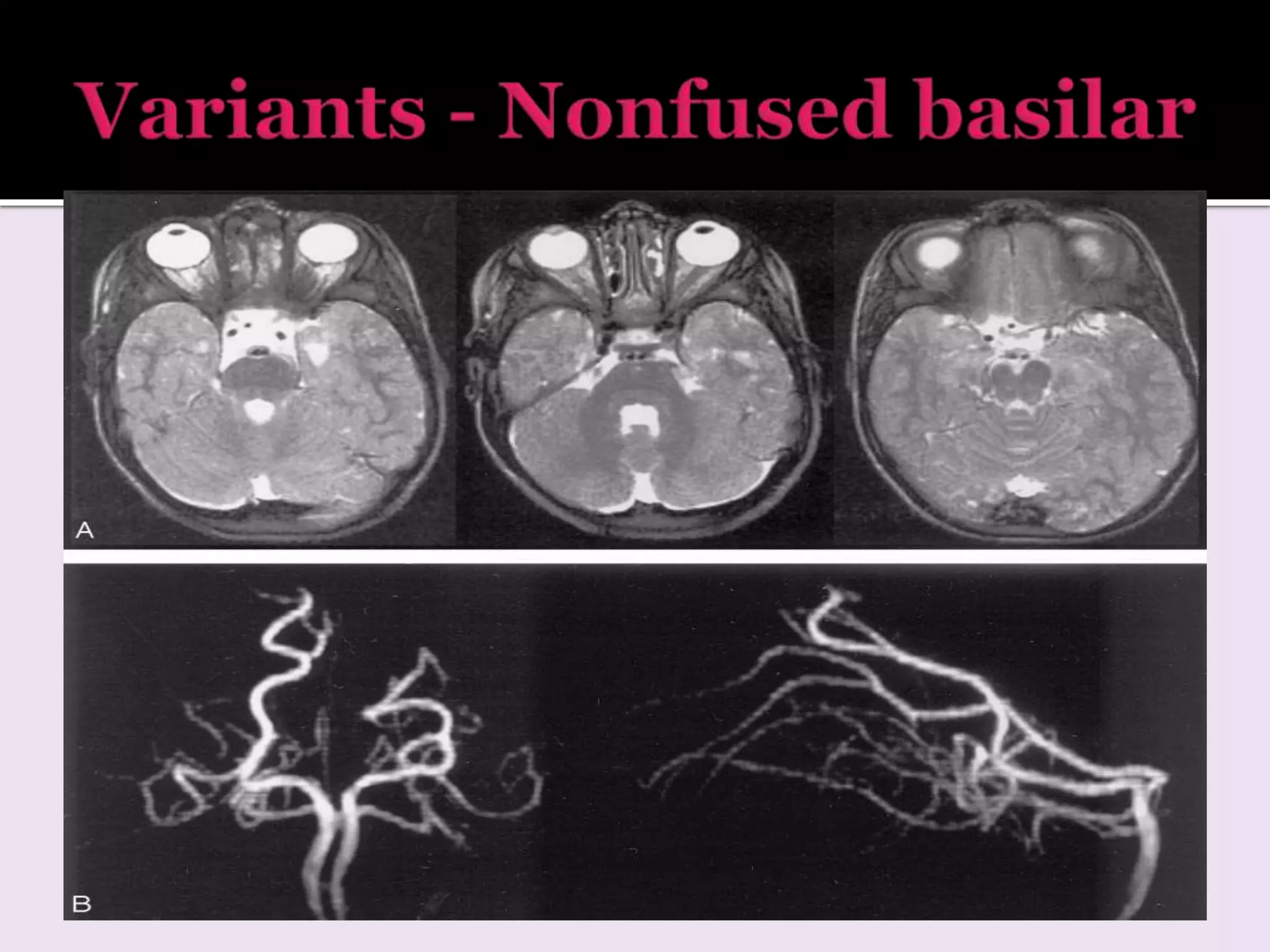
Right and left VA s
unite – BA
Course cephalad in front
of pons
Pontine cistern in the
space delineated by
lateral margin of clivus
and dorsum sellae
Terminates in
interpeduncular cistern
Divides into PCAs
•Average length – 3 cm
•Width 1.5- 4 mm
•Diameter <4.5 mm
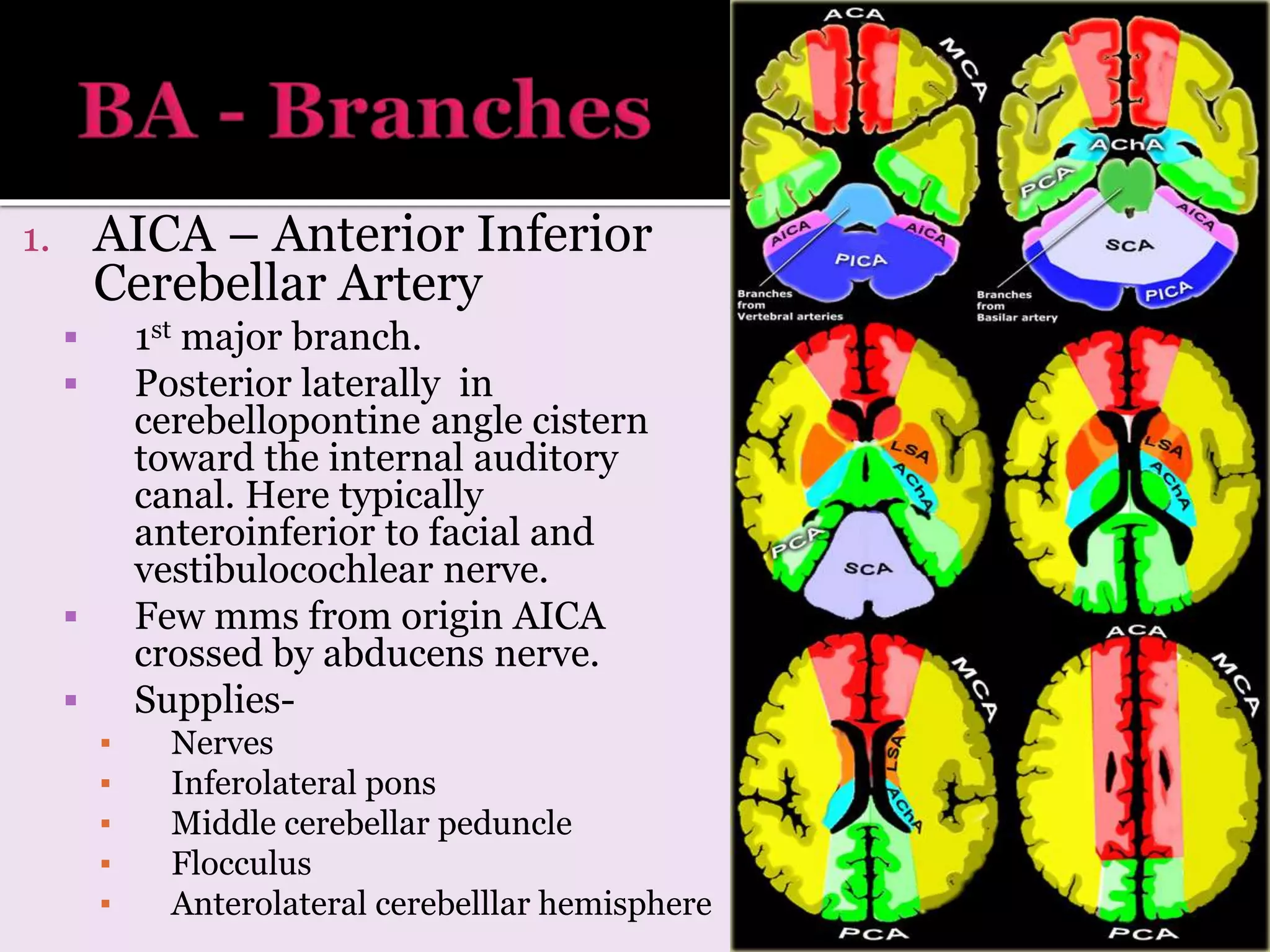
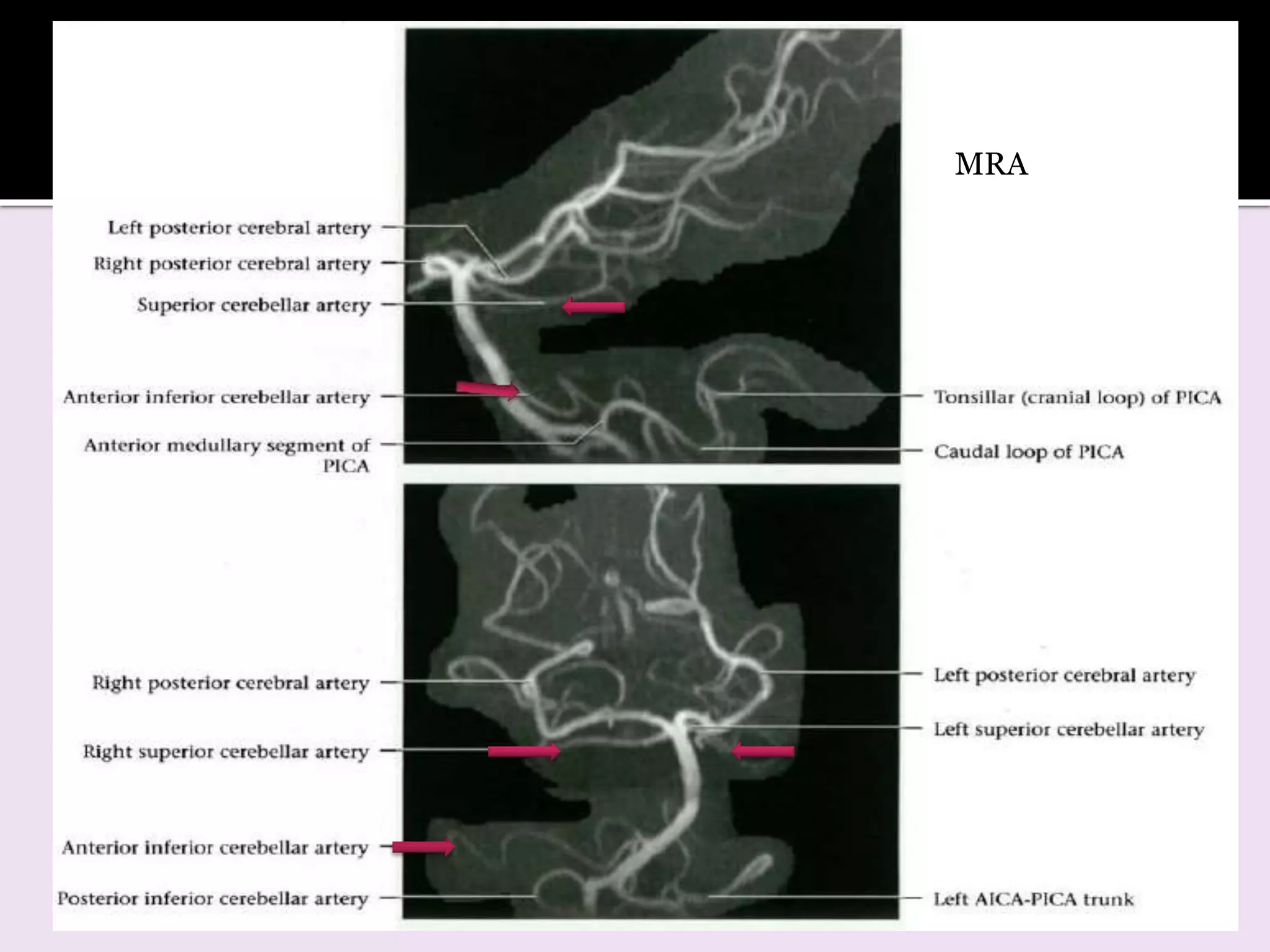
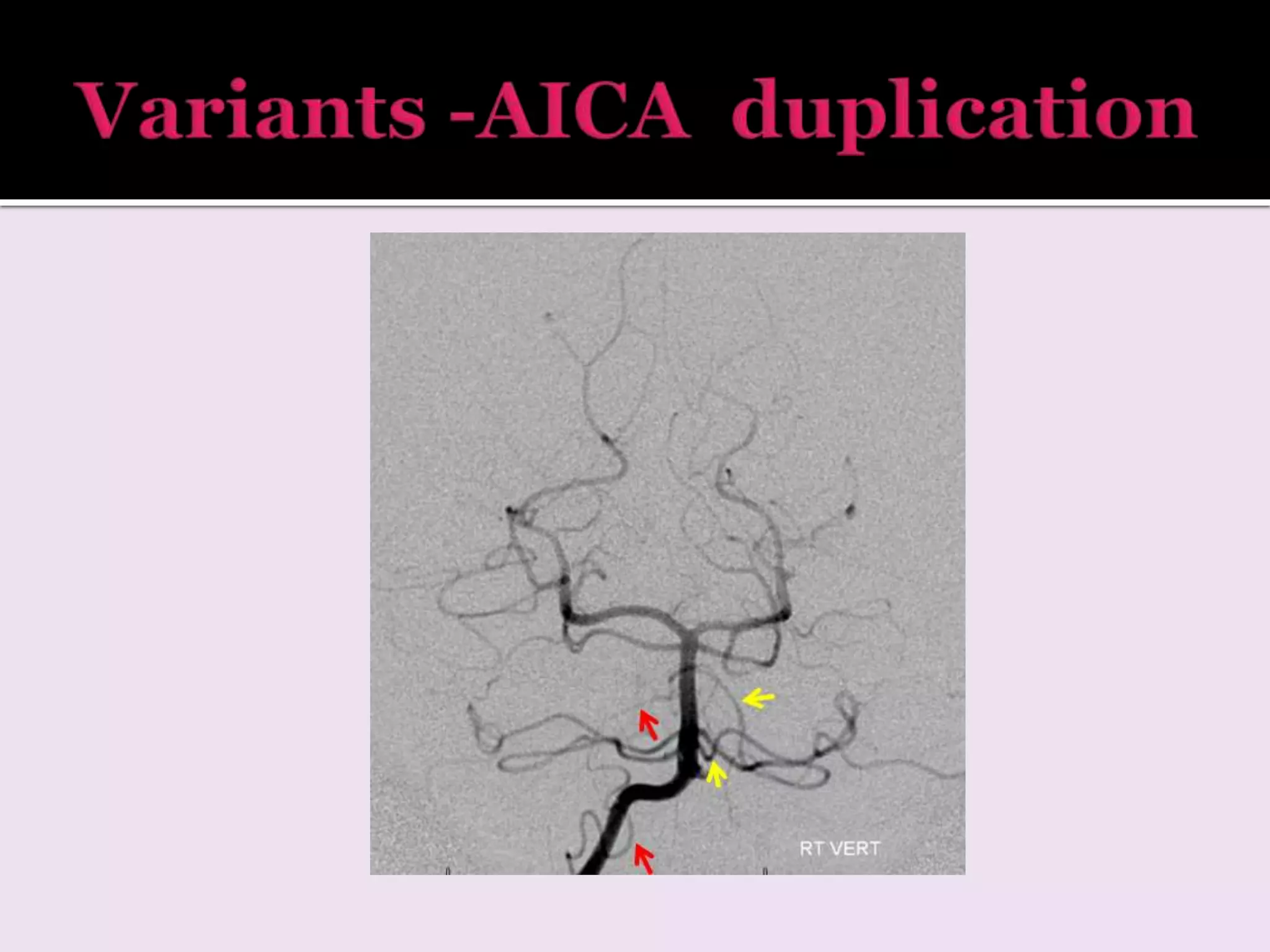
1. AICA – Anterior Inferior
Cerebellar Artery
 1st major branch.
 Posterior laterally in
cerebellopontine angle cistern
toward the internal auditory
canal. Here typically
anteroinferior to facial and
vestibulocochlear nerve.
 Few mms from origin AICA
crossed by abducens nerve.
 Supplies-
▪ Nerves
▪ Inferolateral pons
▪ Middle cerebellar peduncle
▪ Flocculus
▪ Anterolateral cerebelllar hemisphere
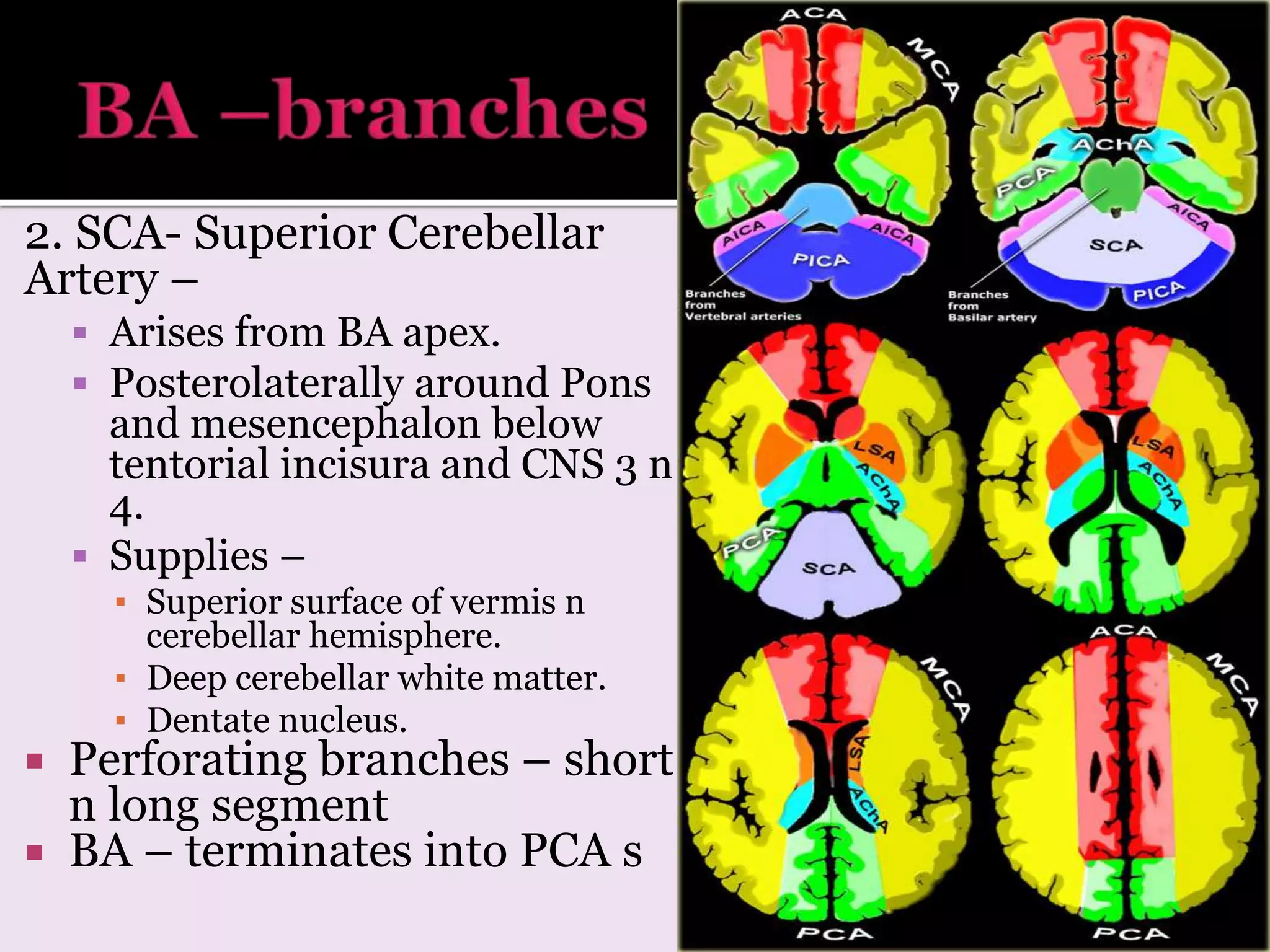
2. SCA- Superior Cerebellar
Artery –
 Arises from BA apex.
 Posterolaterally around Pons
and mesencephalon below
tentorial incisura and CNS 3 n
4.
 Supplies –
▪ Superior surface of vermis n
cerebellar hemisphere.
▪ Deep cerebellar white matter.
▪ Dentate nucleus.
 Perforating branches – short
n long segment
 BA – terminates into PCA s
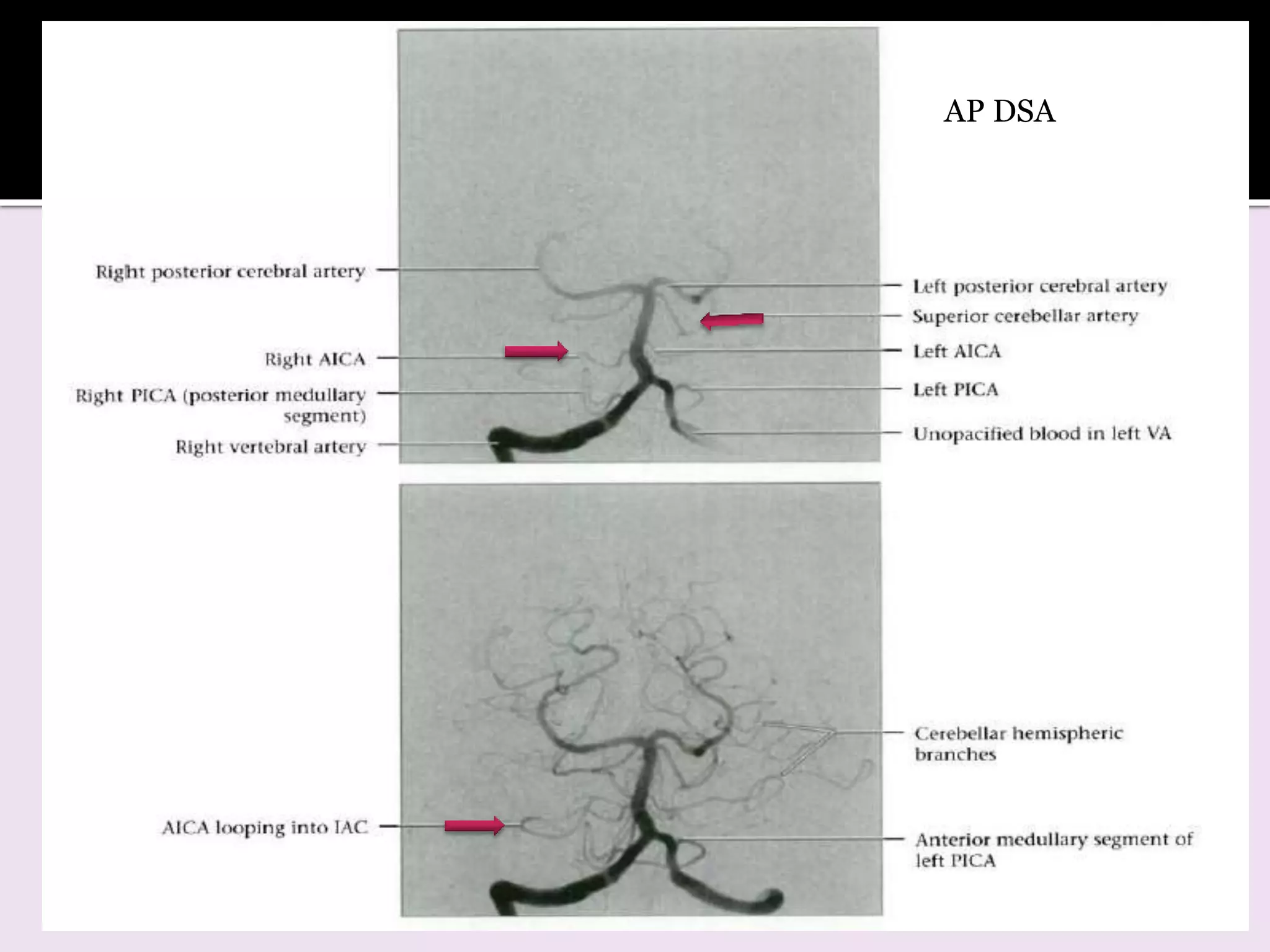
AP DSA
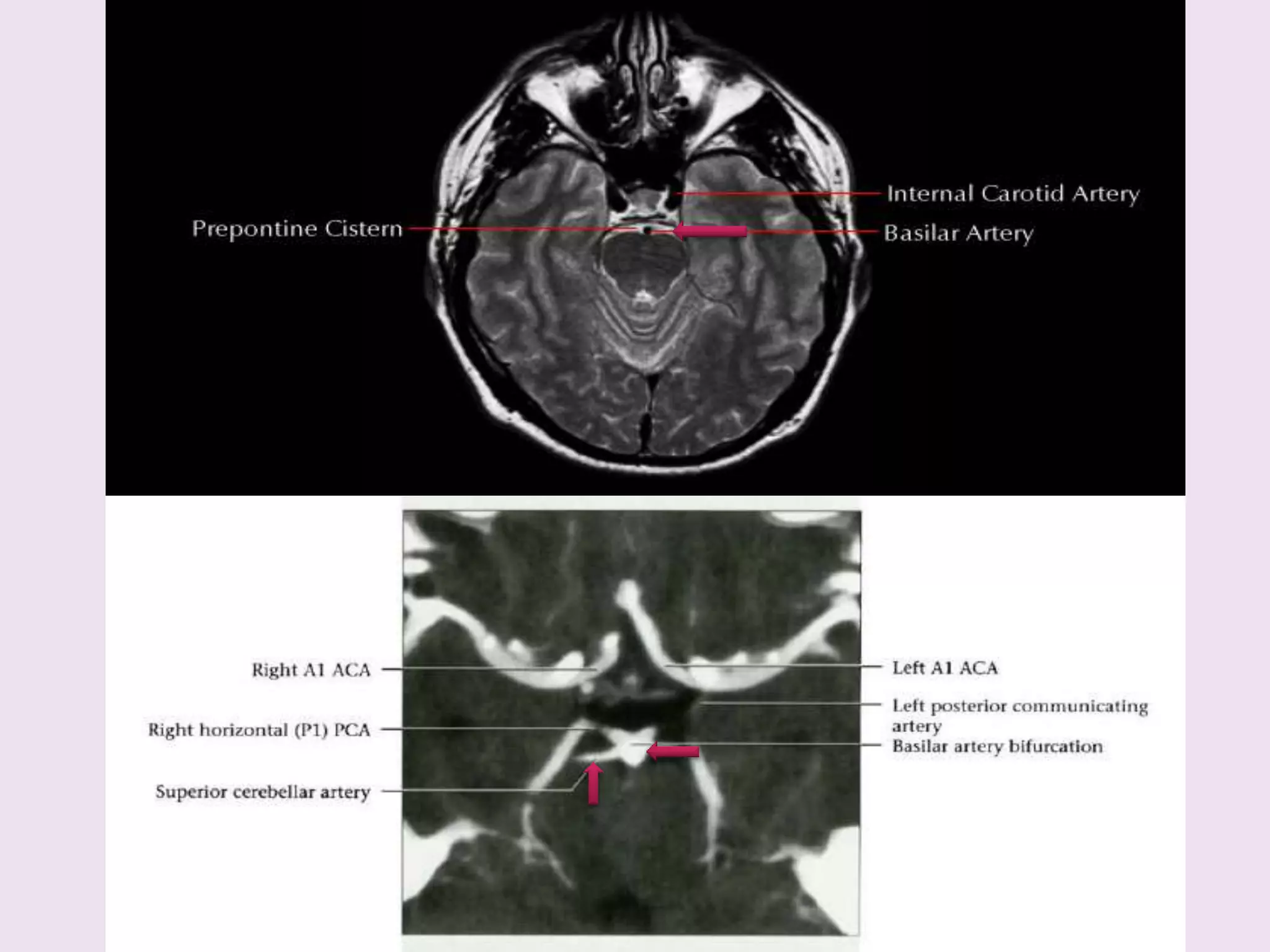
MRA
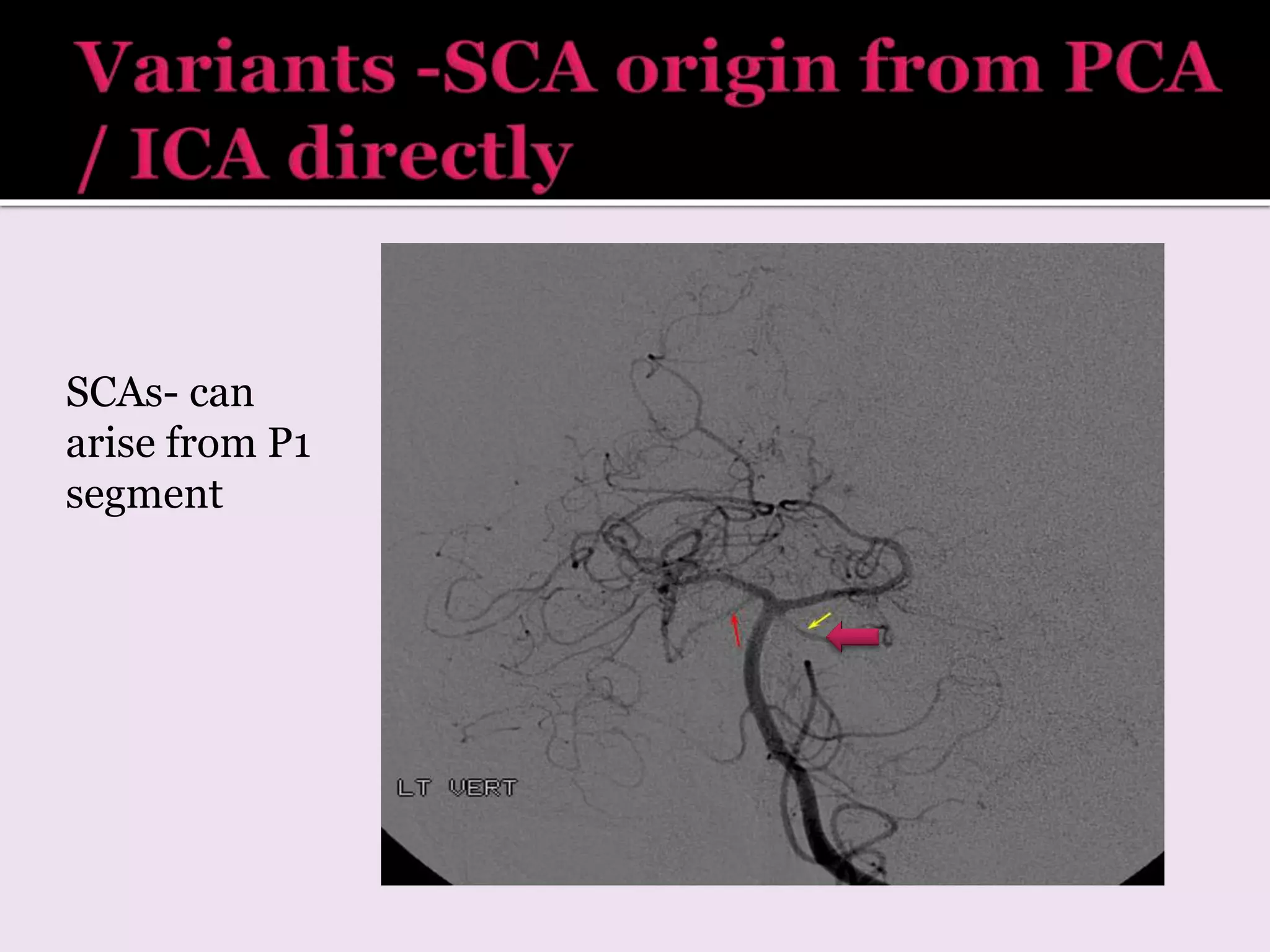
SCAs- can
arise from P1
segment
Arterial and venous supply of brain part2

Arterial and venous supply of brain part2

  • 1.
  • 2.
     Cerebral arteries Vertebral artery  Basilar artery
  • 3.
    Distal ICA Anterior cerebral artery Middle cerebralartery Basilar artery Posterior cerebral artery
  • 4.
    A1 horizontal segment • FromACA origin to ACoA junction. • Inferior br – supply superior surface of optic nerve and chaisma. • Superior br – anterior hypothalamus , septum pellucidum , anterior commisure , fornix , anterior inferior portion of corpus straitum.
  • 5.
    Arise from A1 segment-perforating branches. • Pass cephalad thro anterior perforated substance. • Supply head of caudate nucleus and anterior limb of IC, putamen .
  • 6.
    • Largest ofthe perforating branches. • May arise from A1 or A2 segment. • A1 – 44% • Proximal A2 – 50% • ACoA – less common • Derives its name from the fact that it doubles back on its parent artery at an acute angle to join lenticulostriate vessel. • Lies parallel to A1 .
  • 7.
    From ACoA junction Ascendin front of 3rd ventricle in cistern of lamina terminalis br –Orbitofrontal, frontopolar Curves around corpus callosum genu gives terminal branches A2 terminal branches- Pericollasal Collasomarginal
  • 8.
    • Supply theanterior 2/3rds of medial hemispheric surface + small superior area over the convexities. • Callosomarginal a.– lies in cingulate gyrus supplies medial frontal lobe • Pericallosal a.– course along the posterior aspect of corpus callosum and supplies it and medial parietal lobe
  • 10.
    Lateral DSA midarterial phase A1 A2 A3 orbitofrontal Callosomarginal Pericollasal Medial lenticulostriate Recurrent artery heubner Pericollasal A2 Orbitofrontal Frontopolar A3 Callosomarginal AP DSA mid arterial 3D MRA A2 Pericollasal Callosomarginal
  • 11.
     ACoA -Partof COW - not a true branch of ACA  Branches – perforating  Supply –Lamina terminalis , Hypothalamus , Anterior commissure , Fornix, Septum pellucidum , Para olfactory gyrus , Subcellosal region , Anterior part of cingulate gyrus
  • 12.
     ACA –ACoA complex – normal 1/3rd anatomy dissection  Absent , duplicate or multichannel ACoA – 10-15%
  • 13.
    • Hypoplasia orabsent A1 ACA segment-distal segments fill preferentially from other side via ACoA.
  • 14.
  • 15.
     Single trunkfrom confluence of A1 segments of right n left ACAs- supplies both hemispheres .  Assc with lobar holoprosencephaly, saccular aneursym
  • 16.
    • Normally A1 segmentruns over the optic nerve. • Here it runs below the optic nerve. • Assc with aneurysms . • Recognised before surgeries.
  • 17.
    Variable branches toC/L hemisphere.  Separate right n left ACA.  1 ACA is dominant than other and it sends branches to other hemisphere.  Other ACA is hypoplastic – terminate as orbitofrontal or frontopolar branch.
  • 18.
    M1 horizontal Origin -Laterallyfrom ICA bifurcation Till its bi/trifurcation at sylvian fissure. Br – Lateral Lenticulostriate branch course superiorly Anterior temporal artery Supplies-Lentiform nucleus Part of IC , caudate nucleus M2 insular At its genu divides into branches Loop over insula pass laterally to exit from sylvian fissure M3 opercular Emerge from sylvian fissure Ramify over hemispheric surface Supplies –cerebral cortex and white matter
  • 21.
    1. Orbitofrontal artery (lateralfrontobasal ) 2. Prefrontal arteries 3. Precentral (prerolandic ) 4. Central sulcus (rolandic) 5. Postcentral sulcus (anterior parietal) artery 6. Posterior parietal artery 7. Angular artery 8. Posterior temporal 9. Temporooccipital artery 10. Medial temporal
  • 22.
    AP DSA midarterial phase AP DSA early arterial phase
  • 23.
    Early arterial phase LateralDSA Mid arterial phase
  • 24.
  • 25.
  • 26.
    • Origin -M1 • Supplies – • Part of head and body of caudate • Globus pallidus • Putamen • Posterior limb of internal capsule
  • 27.
    • Supplies • Inferolateral frontallobe • Insular cortex • Parietal lobe • Temporal lobe
  • 28.
    Supplies – • Lateral cerebrum •Insula • Ant- lateral temporal lobe
  • 29.
     Less frequent Fenestration and duplication  Single trunk  Accessory arteries All uncommon ≤5 %
  • 31.
    • It iseither hypertrophied RA heubner or medial ACA perforator. • To be called accessory MCA it should have cortical branches.
  • 32.
    PCA origin frombifurcation of basilar artery in interpeduncular cistern. Lies above occulomotar nerve. Circles midbrain above tentorium cerebelli.
  • 33.
    P1 precommunicating / peduncular •Basilar bifurcation extends laterally • Junction with PCoA • Br – • Post thalamoperforating- thalamus , midbrain • Medial posterior choroidal artery – anteromedially along roof of 3rd ventricle – tectal plate , midbrain , thalamus posterior , pineal gland , tele choroidae of 3rd ventricle. P2 ambient / crural • PCA- PCoA junction posterior • Above trochlear nerve and tentorial incisura • Br – • Thalamogeniculate arteries- MGB , pulvinar , brachium superior colliculus , crus cerebri , LGB • Lateral post choroidal artery – over pulvinar of thalamus – posterior thalamus , lateral ventricular choroid plexus
  • 35.
    P3 quadrigeminal Behind midbrainin quadrigeminal plate cistern Reciprocal relationship with MCA Inferior temporal artery • Undersurface of temporal bone • Anastamose -MCA Parietooccipital artery • Posterior 1/3rd interhemispheric surface • ACA Calcarine artery( P4 ) • Visual cortex • Occipital pole Posterior pericollasal artery (splenial) • Splenium of corpus callosum • ACA
  • 36.
    AP DSA AP DSAmid arterial phase
  • 37.
  • 38.
  • 39.
    • Supply – •Medial +posterior temporal lobe • Medial parietal lobe • Occipital lobe
  • 40.
     Fetal originof PCA from ICA instead of basilar – 15- 20 %  Carotid basilar anastomosis – supply PCA via trigeminal artery or other persistent channels
  • 41.
    V1 Courses –Cephaladto enter transverse foramina at C6 Ascend directly to C2 (V2) Turns laterally and superiorly thro C1 vertebral foramina Looping posteriorly along atlas V3 extraspinal Each VA passes superomedially thro foramen magnum In Posterior fossa anterior to medulla (intradural ) VAs unite to form basilar artery From subclavian arteries Left VA dominant 50%
  • 42.
    1. V1-Small segmental spinal/meningeal/ muscular branches. 2. V2- Anterior Meningeal artery , muscular branches. 3. V3 -Posterior Meningeal artery  Courses along posterior arch of atlas.  Supplies falx cerebri  Variant – origin from ECA / PICA.  Greatly enlarged with vascular malformations and neoplasms Posterior meningeal artery
  • 43.
    Vertebral artery Anterior spinalartery Joins ASA from opposite VA along anteromedial sulcus of cervical cord. Medial medullary syndrome Posterior inferior cerebellar artery Arises from distal VA Lateral medullary syndrome
  • 45.
    Lateral DSA AP DSA V1-extraosseous V2 –foraminal V3 – extraspinal V4 – intradural
  • 46.
    At c7 levelAt C6 level
  • 47.
    At C1 C2level At spinal cord and pons level
  • 48.
    • Front ofmedulla Anterior medullary segment • Along side of medulla caudally to level of CN 9-11Lateral medullary segment • Around inferior half of cerebellar tonsilTonsilomedullary segment • Cleft btw tela choridae and inferior medullary velum rostrally and superior pole of tonsil caudallyTelovelotonsillar segment Cortical / hemispheric segment
  • 50.
  • 52.
    Anterior medullary segment Posteriormedullary segment Lateral medullary segment
  • 53.
    • Choroid plexusof 4th ventricle. • Posterolateral medulla. • Cerebellar tonsil. • Inferior vermis. • Posteroinferior cerebellar hemisphere. Supplies
  • 54.
     Persistent vertebrobasilar anastamosis  LeftVA – aortic arch origin – 5%  Hypolastic VA – 40 % Hypoplastic VA
  • 55.
    VA terminates inPICA – 1%
  • 56.
    Orange arrow – duplicatedVA Red – original VA from subclavian VA duplication- ocassionally
  • 57.
  • 58.
    Extradural origin ofPICA PICA from VA below foramen magnum
  • 59.
    Right and leftVA s unite – BA Course cephalad in front of pons Pontine cistern in the space delineated by lateral margin of clivus and dorsum sellae Terminates in interpeduncular cistern Divides into PCAs •Average length – 3 cm •Width 1.5- 4 mm •Diameter <4.5 mm
  • 60.
    1. AICA –Anterior Inferior Cerebellar Artery  1st major branch.  Posterior laterally in cerebellopontine angle cistern toward the internal auditory canal. Here typically anteroinferior to facial and vestibulocochlear nerve.  Few mms from origin AICA crossed by abducens nerve.  Supplies- ▪ Nerves ▪ Inferolateral pons ▪ Middle cerebellar peduncle ▪ Flocculus ▪ Anterolateral cerebelllar hemisphere
  • 61.
    2. SCA- SuperiorCerebellar Artery –  Arises from BA apex.  Posterolaterally around Pons and mesencephalon below tentorial incisura and CNS 3 n 4.  Supplies – ▪ Superior surface of vermis n cerebellar hemisphere. ▪ Deep cerebellar white matter. ▪ Dentate nucleus.  Perforating branches – short n long segment  BA – terminates into PCA s
  • 62.
  • 64.
  • 68.

Editor's Notes

  • #19 Larger of two 2 terminal icas
  • #49 9 glosso 10 vagus 1 1 spinal accessory