‘A’ Level Philosophy and Ethics
                                    Notes
                         Aristotle – The Soul

  Plato had argued that the soul was the driver of the body – the force that
  animates the human being. The soul is the person’s identity – the body
  is more like the dwelling of the soul.
     The Ancient Greek Philosophers had a low opinion of the body. They
       believed that the spirit or soul was imprisoned in the body, and
      some philosophical schools followed ascetic regimes in an attempt
                    to “free” the soul from its bodily chains.


Aristotle took a more materialist view of the soul and the body. He believed
that the body was the “stuff” that a person was made of. The soul is the
person’s “form”.

Note –    the soul is more than just an animating spirit. It is more than
          simply the mind.
             The “soul” is the pattern of humanity that the person
             conforms to. Each “soul” includes the unique form of
             each unique person.


For Aristotle, the soul is the complete package of a human being, not simply
the spark that makes it go. It is the sum total of a thing, including its
function and purpose. For example:


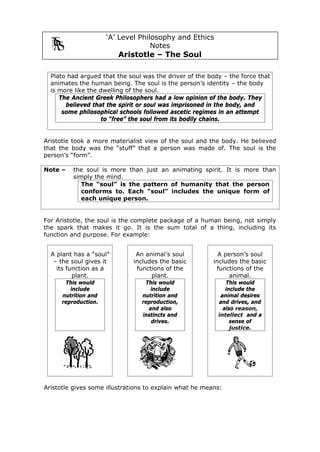
  A plant has a “soul”         An animal’s soul            A person’s soul
   – the soul gives it        includes the basic         includes the basic
    its function as a          functions of the           functions of the
          plant.                    plant.                     animal.
       This would                 This would                 This would
         include                    include                  include the
      nutrition and              nutrition and             animal desires
      reproduction.              reproduction,            and drives, and
                                   and also                 also reason,
                                 instincts and            intellect and a
                                    drives.                    sense of
                                                               justice.


Aristotle gives some illustrations to explain what he means:
Aristotle – The Soul


  De Anima 1:ii
  We have now given a general answer to the question, What is soul? It is
  substance in the sense which corresponds to the account of a thing. That
  means that it is what it is to be for a body of the character just assigned.
  § Suppose that a tool, e.g. an axe, were a natural body, then being an
     axe would have been its essence, and so its soul; if this disappeared
     from it, it would have ceased to be an axe, except in name.
  § As it is, it is an axe; for it is not of a body of that sort that what it is
     to be, i.e. its account, is a soul, but of a natural body of a particular
     kind, viz. One having in itself the power of setting itself in movement
     and arresting itself.
  § Next, apply this doctrine in the case of the parts of the living body.
     Suppose that the eye were an animal--sight would have been its soul,
     for sight is the substance of the eye which corresponds to the
     account, the eye being merely the matter of seeing; when seeing is
     removed the eye is no longer an eye, except in name--no more than
     the eye of a statue or of a painted figure.
  § We must now extend our consideration from the parts to the whole
     living body; for what the part is to the part, that the whole faculty of
     sense is to the whole sensitive body as such.
                              http://www.aquinasonline.com/medieval/pseudo-ari.htm


Consider a set of carpenter’s tools. The thing that makes the axe different to
the hammer. Both are made from a wooden handle and a metal head
attached. If the axe were a living thing, then its “body” is the wood and
metal that it is made of. The “soul” of the axe is its ability to chop through
wood.

The soul is not separate from the body. It is a basic part of it, and does not
live on after death.

However, Aristotle believed that reason is associated with the pure
thought of the Prime Mover. The Prime Mover is eternal and infinite. In
this way, it is possible to think of the reason of a person living on
after their death, but not in any recognisably individual form.

BUT…
Aristotle argued that there was no evidence for Plato’s belief in the World of
the Idea. Is there any evidence for Aristotle’s contention that true knowledge
is established in the material world?
§ Aristotle believed that everything has a Final Cause. However, Bertrand
    Russell argued (in a famous debate with Copleston, broadcast on BBC
    Radio) that “the universe is just there, and that’s that”. Sigmund Freud
    argued that our perception of order and purpose in the universe is simply
    “wishful thinking”.


                                        2

Aristotle Soul

  • 1.
    ‘A’ Level Philosophyand Ethics Notes Aristotle – The Soul Plato had argued that the soul was the driver of the body – the force that animates the human being. The soul is the person’s identity – the body is more like the dwelling of the soul. The Ancient Greek Philosophers had a low opinion of the body. They believed that the spirit or soul was imprisoned in the body, and some philosophical schools followed ascetic regimes in an attempt to “free” the soul from its bodily chains. Aristotle took a more materialist view of the soul and the body. He believed that the body was the “stuff” that a person was made of. The soul is the person’s “form”. Note – the soul is more than just an animating spirit. It is more than simply the mind. The “soul” is the pattern of humanity that the person conforms to. Each “soul” includes the unique form of each unique person. For Aristotle, the soul is the complete package of a human being, not simply the spark that makes it go. It is the sum total of a thing, including its function and purpose. For example: A plant has a “soul” An animal’s soul A person’s soul – the soul gives it includes the basic includes the basic its function as a functions of the functions of the plant. plant. animal. This would This would This would include include include the nutrition and nutrition and animal desires reproduction. reproduction, and drives, and and also also reason, instincts and intellect and a drives. sense of justice. Aristotle gives some illustrations to explain what he means:
  • 2.
    Aristotle – TheSoul De Anima 1:ii We have now given a general answer to the question, What is soul? It is substance in the sense which corresponds to the account of a thing. That means that it is what it is to be for a body of the character just assigned. § Suppose that a tool, e.g. an axe, were a natural body, then being an axe would have been its essence, and so its soul; if this disappeared from it, it would have ceased to be an axe, except in name. § As it is, it is an axe; for it is not of a body of that sort that what it is to be, i.e. its account, is a soul, but of a natural body of a particular kind, viz. One having in itself the power of setting itself in movement and arresting itself. § Next, apply this doctrine in the case of the parts of the living body. Suppose that the eye were an animal--sight would have been its soul, for sight is the substance of the eye which corresponds to the account, the eye being merely the matter of seeing; when seeing is removed the eye is no longer an eye, except in name--no more than the eye of a statue or of a painted figure. § We must now extend our consideration from the parts to the whole living body; for what the part is to the part, that the whole faculty of sense is to the whole sensitive body as such. http://www.aquinasonline.com/medieval/pseudo-ari.htm Consider a set of carpenter’s tools. The thing that makes the axe different to the hammer. Both are made from a wooden handle and a metal head attached. If the axe were a living thing, then its “body” is the wood and metal that it is made of. The “soul” of the axe is its ability to chop through wood. The soul is not separate from the body. It is a basic part of it, and does not live on after death. However, Aristotle believed that reason is associated with the pure thought of the Prime Mover. The Prime Mover is eternal and infinite. In this way, it is possible to think of the reason of a person living on after their death, but not in any recognisably individual form. BUT… Aristotle argued that there was no evidence for Plato’s belief in the World of the Idea. Is there any evidence for Aristotle’s contention that true knowledge is established in the material world? § Aristotle believed that everything has a Final Cause. However, Bertrand Russell argued (in a famous debate with Copleston, broadcast on BBC Radio) that “the universe is just there, and that’s that”. Sigmund Freud argued that our perception of order and purpose in the universe is simply “wishful thinking”. 2