Research projects  on the use of Web 2.0  in education Arely Lopez and Jana Sandford 9 th  May 2011 TILL Institute for Lifelong Learning The University of Sheffield
Comparison of two research projects  with focus on educational aspects of Web 2.0 Exploring the effectiveness of Web 2.0 for the home education of a child with Asperger Syndrome  Jana Sandford The Web 2.0 as a tool to learn a foreign language with Mexican students Arely Lopez
Similarities of both projects METHOD – qualitative methods used AREA – education THEORY BACKGROUND: Participants as “active agents” Interactivity Community aspect Independence Participation
Similarities RESEARCH FINDINGS - Practising writing and reading skills Enjoyment of using Web 2.0. Supporting peer interaction Social aspects (information sharing) Use of YouTube (sharing videos with peers) Use of blogs
Differences between projects Arely Participants – several students Participants age: 15-16 years  School environment Facebook – the most often used Web 2.0 tool Focus on one subject: learning English as foreign language Jana 1 participant Participant – 6 year old child Home education Blog – the most often used Focus on variety of subjects to address whole curricullum
Exploring the effectiveness of Web 2.0 for the home education of a child with Asperger Syndrome  Jana Sandford
Aim and Objectives Aim:  Explore educational benefits of Web 2.0 for a young child with AS. Objectives: To explore a range of Web 2.0 tools in relation to the benefits to the home education of a child with AS. To evaluate effectiveness of Web 2.0 tools chosen for trial by the child and family. To suggest further possible use of Web 2.0 tools for child for educational purposes.
Research Questions Which Web 2.0 tools would be appropriate for the child to try? Which Web 2.0 tools would be the most enjoyable for the child? Which Web 2.0 tools would bring most benefits to the child’s home education?
Research Questions Which Web 2.0 tools would be most beneficial in addressing the child’s special educational needs? What are the parents’/educator’s view on the possible further use of Web 2.0 in the child’s home education?
Methodology Qualitative research methods: Action Research Participant observations Interviews Documentation Participant: Six year old child with Asperger Syndrome
Analysis of Results Action Research Cycle Vignettes Interviews http://prezi.com/mi-am7s552qz/web-20-in-he/
Examples of Web 2.0 use Flickr  http://www.flickr.com/photos/59039728@N06/ Blog http://daniela-learning.blogspot.com/2011/04/woofie-goes-to-playground.html http://daniela-learning.blogspot.com/search/label/dinosaurs
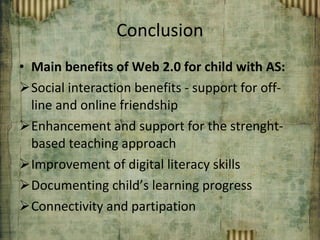
Conclusion Main benefits of Web 2.0 for child with AS: Social interaction benefits - support for off-line and online friendship Enhancement and support for the strenght-based teaching approach Improvement of digital literacy skills Documenting child’s learning progress Connectivity and partipation
Arely Lopez The Web 2.0 as a tool to learn a foreign language with Mexican students
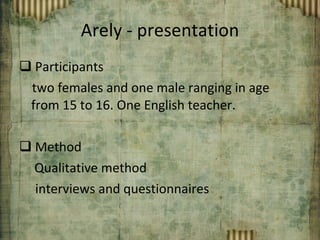
Arely - presentation Participants two females and one male ranging in age from 15 to 16. One English teacher. Method   Qualitative method  interviews and questionnaires
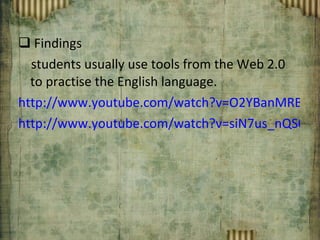
Findings students usually use tools from the Web 2.0 to practise the English language. http://www.youtube.com/watch?v=O2YBanMRBqY&feature=related http://www.youtube.com/watch?v=siN7us_nQS0&feature=fvsr
Conclusions To be part of an online society means to be updated in different context as political, cultural and social context. The virtual words and the virtual spaces make people to be tolerant but also at the same time open. Every community member has the opportunity to learn, share, interact and construct their own knowledge.
Thank you for listening !

Presentation

  • 1.
    Research projects on the use of Web 2.0 in education Arely Lopez and Jana Sandford 9 th May 2011 TILL Institute for Lifelong Learning The University of Sheffield
  • 2.
    Comparison of tworesearch projects with focus on educational aspects of Web 2.0 Exploring the effectiveness of Web 2.0 for the home education of a child with Asperger Syndrome Jana Sandford The Web 2.0 as a tool to learn a foreign language with Mexican students Arely Lopez
  • 3.
    Similarities of bothprojects METHOD – qualitative methods used AREA – education THEORY BACKGROUND: Participants as “active agents” Interactivity Community aspect Independence Participation
  • 4.
    Similarities RESEARCH FINDINGS- Practising writing and reading skills Enjoyment of using Web 2.0. Supporting peer interaction Social aspects (information sharing) Use of YouTube (sharing videos with peers) Use of blogs
  • 5.
    Differences between projectsArely Participants – several students Participants age: 15-16 years School environment Facebook – the most often used Web 2.0 tool Focus on one subject: learning English as foreign language Jana 1 participant Participant – 6 year old child Home education Blog – the most often used Focus on variety of subjects to address whole curricullum
  • 6.
    Exploring the effectivenessof Web 2.0 for the home education of a child with Asperger Syndrome Jana Sandford
  • 7.
    Aim and ObjectivesAim: Explore educational benefits of Web 2.0 for a young child with AS. Objectives: To explore a range of Web 2.0 tools in relation to the benefits to the home education of a child with AS. To evaluate effectiveness of Web 2.0 tools chosen for trial by the child and family. To suggest further possible use of Web 2.0 tools for child for educational purposes.
  • 8.
    Research Questions WhichWeb 2.0 tools would be appropriate for the child to try? Which Web 2.0 tools would be the most enjoyable for the child? Which Web 2.0 tools would bring most benefits to the child’s home education?
  • 9.
    Research Questions WhichWeb 2.0 tools would be most beneficial in addressing the child’s special educational needs? What are the parents’/educator’s view on the possible further use of Web 2.0 in the child’s home education?
  • 10.
    Methodology Qualitative researchmethods: Action Research Participant observations Interviews Documentation Participant: Six year old child with Asperger Syndrome
  • 11.
    Analysis of ResultsAction Research Cycle Vignettes Interviews http://prezi.com/mi-am7s552qz/web-20-in-he/
  • 12.
    Examples of Web2.0 use Flickr http://www.flickr.com/photos/59039728@N06/ Blog http://daniela-learning.blogspot.com/2011/04/woofie-goes-to-playground.html http://daniela-learning.blogspot.com/search/label/dinosaurs
  • 13.
    Conclusion Main benefitsof Web 2.0 for child with AS: Social interaction benefits - support for off-line and online friendship Enhancement and support for the strenght-based teaching approach Improvement of digital literacy skills Documenting child’s learning progress Connectivity and partipation
  • 14.
    Arely Lopez TheWeb 2.0 as a tool to learn a foreign language with Mexican students
  • 15.
    Arely - presentationParticipants two females and one male ranging in age from 15 to 16. One English teacher. Method Qualitative method interviews and questionnaires
  • 16.
    Findings students usuallyuse tools from the Web 2.0 to practise the English language. http://www.youtube.com/watch?v=O2YBanMRBqY&feature=related http://www.youtube.com/watch?v=siN7us_nQS0&feature=fvsr
  • 17.
    Conclusions To bepart of an online society means to be updated in different context as political, cultural and social context. The virtual words and the virtual spaces make people to be tolerant but also at the same time open. Every community member has the opportunity to learn, share, interact and construct their own knowledge.
  • 18.
    Thank you forlistening !